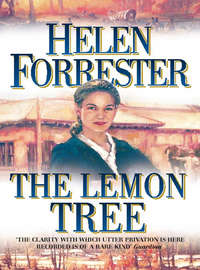
Kitabı oku: «The Lemon Tree»

HELEN FORRESTER
The Lemon Tree

Copyright
HarperCollinsPublishers 1 London Bridge Street London SE1 9GF
www.harpercollins.co.uk
This paperback edition 1995
Previously published in paperback by Fontana 1991
First published in Great Britain by Collins 1990
Copyright © Helen Forrester 1990
The Author asserts the moral right to be identified as the author of this work
All rights reserved under International and Pan-American Copyright Conventions. By payment of the required fees, you have been granted the nonexclusive, nontransferable right to access and read the text of this ebook onscreen. No part of this text may be reproduced, transmitted, downloaded, decompiled, reverse engineered, or stored in or introduced into any information storage and retrieval system, in any form or by any means, whether electronic or mechanical, now known or hereinafter invented, without the express written permission of HarperCollins e-books.
This book is sold subject to the condition that it shall not, by way of trade or otherwise, be lent, re-sold, hired out or otherwise circulated without the publisher’s prior consent in any form of binding or cover other than that in which it is published and without a similar condition including this condition being imposed on the subsequent purchaser.
HarperCollinsPublishers has made every reasonable effort to ensure that any picture content and written content in this ebook has been included or removed in accordance with the contractual and technological constraints in operation at the time of publication.
Ebook Edition © JULY 2012 ISBN 9780007392155
Version 2017-11-14
Contents
Cover
Title Page
Copyright
Chapter One
Chapter Two
Chapter Three
Chapter Four
Chapter Five
Chapter Six
Chapter Seven
Chapter Eight
Chapter Nine
Chapter Ten
Chapter Eleven
Chapter Twelve
Chapter Thirteen
Chapter Fourteen
Chapter Fifteen
Chapter Sixteen
Chapter Seventeen
Chapter Eighteen
Chapter Nineteen
Chapter Twenty
Chapter Twenty-One
Chapter Twenty-Two
Chapter Twenty-Three
Chapter Twenty-Four
Chapter Twenty-Five
Chapter Twenty-Six
Chapter Twenty-Seven
Chapter Twenty-Eight
Chapter Twenty-Nine
Chapter Thirty
Chapter Thirty-One
Chapter Thirty-Two
Chapter Thirty-Three
Chapter Thirty-Four
Chapter Thirty-Five
Chapter Thirty-Six
Chapter Thirty-Seven
Chapter Thirty-Eight
Chapter Thirty-Nine
Chapter Forty
Chapter Forty-One
Chapter Forty-Two
Chapter Forty-Three
Chapter Forty-Four
Chapter Forty-Five
Chapter Forty-Six
Chapter Forty-Seven
Chapter Forty-Eight
Chapter Forty-Nine
Select Bibliography
About the Author
Author’s Note
Other Works
About the Publisher
Chapter One
‘He’s a woman,’ Mr George Tasker announced lugubriously to Sarah, his wife of thirty years. He pushed the dog off the easy chair by the fire and sat down to take off his boots; they were very wet and were covered with wavy lines of white sediment. He put them neatly in the hearth to dry, as he continued, ‘I’m workin’ for a woman.’ His thick Liverpool accent made him sound as if he had a heavy cold in the head.
‘George, you know better than to walk on me new coconut matting with your dirty boots,’ Sarah scolded. ‘And what do you mean – he’s a woman?’
‘Wallace H. Harding is a woman!’
‘Never!’
‘He is – that is, she is. The Ould Fella’s niece – not a nephew, like we imagined. She come into our department this morning, large as life, with the lawyer, Mr Benson, and Mr Turner, the chemist.’ He stood up and rubbed his cold hands before the glowing fire. ‘She stopped and shook hands with me, seeing as I’m the Soap Master,’ he added with obvious satisfaction.
Sarah Tasker paused in the act of getting a casserole of tripe and onions out of the oven. She looked up at him through a burst of steam. ‘Well, I’m blowed! How queer!’
She turned and laid the casserole on a white-scrubbed deal table. On a wooden board lay a loaf of bread with several slices ready cut; beside it, sat a small dish of butter. She said mechanically, ‘Come and have your tea, luv.’ She picked up a brown teapot from the hob of the kitchen range and put it on the table, beside two heavy pint mugs and a pitcher of milk. Then, from a built-in shelf, she lifted down the pride of her kitchen, a green glass sugar basin won at a fair. She put it by the teapot.
In anticipation of George’s return from his job in the Lady Lavender Soap Works, she had laid his slippers on the fender to warm. George now put them on. He rose and stretched himself, a big, corpulent man, with a ruddy, kindly face boasting three generous chins. He sat himself at the table, surveyed the dish of tripe with approbation, and then said to Sarah, ‘Nobody makes tripe better’n you do, luv. I can always savour a bit of tripe.’
He invariably made a similar remark, no matter what she cooked for this main meal of the day, and, equally invariably, she beamed as if she had never heard it before. It was what made George so nice to live with, she reflected. He always appreciated what you did.
‘What’s she like?’ Sarah asked him, as she ladled generous dollops of tripe onto his plate.
Before answering, he considered the question carefully. Then he said, as he stuffed a forkful of tripe into his mouth, ‘She’s furrin – she’s almost yellow. She int a lady like we understand one – and yet she is, if you know what I mean. And she’s smart, no doubt about that.’
Sarah did not understand what he meant. She served herself, however, and commenced her meal, despite the flutter of worry in her stomach. This woman, whoever she was, could make or ruin their lives, she considered anxiously. When old Mr James Al-Khoury had died suddenly in November, 1885, they had heard that he had bequeathed the whole soap works, in which George had toiled for nearly twenty-five years, to his brother in the United States. Then Mr Benson, the lawyer, had discovered that the brother had also died, leaving everything he possessed to his wife. It had taken him some time to find out that she had moved to Canada, where she, too, had died, leaving as her sole legatee, Wallace H. Harding.
When George Tasker heard the name, whispered to him by Mr Helliwell, old James Al-Khoury’s secretary, he had assumed that the new owner was a nephew of his late employer; Mr Helliwell, priding himself on his secretarial discretion, had not enlightened him further.
And now George was saying that it was a niece!
With a feeling that she was about to choke on her tripe, Sarah realized that this foreign woman from the Colonies, who wasn’t a proper lady, would not, of course, be able to run the works, since she was a woman. Presumably she would sell it – and what happened to employees when a firm was sold over their heads, she dreaded to think. Too often, the older men found themselves out on the street. And then what would happen to them, with George out of work at fifty years of age?
George himself was ruminating over the same threat, but it did not deter him from eating his way steadily through his supper. His silent wife leaned forward and filled a mug with tea. She handed it to him. ‘Like some more tripe?’ she asked mechanically.
George wiped his mouth with the back of his hand and said he would. Then, while Sarah served him, he confirmed her fears by saying heavily, ‘Rumour is she’ll sell the place ’cos she couldn’t run it – being a woman, like.’
‘Aye, that’s what I were thinkin’.’ Then she asked warily, ‘Who’d buy it?’
‘Well, it has gone down a bit, since the Ould Fella died,’ George acknowledged. ‘But there’s some as would buy it, I think, though times are bad. There’s that Mr Lever what has started up by Crosfield’s in Warrington. Soap mad, he is. And there’s Crosfield’s themselves. They might like it, seeing as it’s close to the Brunswick Dock and the Brunswick Goods Station – very handy, it is, for shipping and receiving.’ He sipped his tea and moved uneasily in his straight wooden chair.
‘Would you keep your job?’
‘It all depends,’ he answered gloomily. ‘I’m the Soap Master and they can’t make soap without someone like me. But they could buy it and then shut it down – to get rid of a competitor.’
‘Well, we’ll worry about it when we get to it,’ Sarah responded, determined to be brave and not increase her spouse’s misgivings.
She wondered how far their savings, hidden under the loose board in the bedroom above them, would stretch if he were unemployed. With jobs so hard to find, he would hardly be likely to get another at his age, even though his mates always said he had a wonderful feel for soap.
‘What’s she like to look at?’ Sarah felt very curious about this strange woman who had come all the way from Canada. Since she was the Ould Fella’s nearest relative – except for his illegitimate son, Mr Benjamin, who didn’t count, poor lad – she must be an Arab, like he had been. George had told her that James Al-Khoury had come from Lebanon, the same Lebanon that she had read about in her Bible. Did that really make him an Arab, she wondered suddenly, and was Miss Harding, therefore, an Arab lady, for all that she had a Western name? She smiled gently. The Ould Fella had been more like a friend than an employer. Many were the times when he had sat in this very kitchen, talking about the soap works. Always talked to George, he did, before making any changes. George and him got on like two o’clock.
With a sigh she pushed her plate of tripe to one side; she would try to eat it later. Arab or not, Mr James Al-Khoury and George had been happy together. Tears welled inside her, but she crushed them back; she must not let George know how worried she was.
While he ruminated over Sarah’s question about Miss Harding, George took another slice of bread and spread it thinly with butter.
Eventually, he replied, ‘Well, she’s tall; same height as me, I should say. Thin as a rake. But when she smiles she’s got a lovely face – and great brown eyes like a young heifer. She don’t smile much, though. She were talkin’ quite sharp to Mr Turner, the chemist. I didn’t hear what she said, but I could see Turner didn’t like it. He can be a bit uppity, and he wouldn’t like being put down by a woman.’
‘What was she dressed like?’
‘Oh, she were all in black, in mourning, with a black veil thrown back from her face. She’d great rings on her fingers, all gold. No stones. She’d a ring on her marriage finger what looked roughly made; ugly, it was – not much polished. Never seen one like it before.’ He picked up his mug of tea and held it between his great hands. ‘She int married, though. I heard her correct old Bobsworth, when he called her Mrs Harding. She’s got a proud, cold way with her and she said as tart as a lemon to old Bob, “Miss Harding, if you please, Mr Bobsworth.”’
Sarah knew Mr Bobsworth quite well and she smiled, despite her forebodings. The strange lady rose in her estimation. Though she would not have hesitated to call Mr and Mrs Bobsworth her friends, they did tend to put on airs, because he was the firm’s head bookkeeper and forwarding clerk. ‘And her only the daughter of a stevedore,’ thought Sarah sourly.
George was speaking again, his heavy, grey brows knitted in puzzlement
‘As I said. Miss Harding shook hands with me, and then with everyone – even Alfie. She asked Alfie if he were born in Liverpool.’
Alfie was the seventeen-year-old mulatto labourer who swept the soap-boiling area. He also fetched and carried for the temperamental soap boilers, who sometimes dared not leave their soap pans, for fear they might miss the moment when the soap must be proved, or brine added or the boiling mixture turned off and carefully left to cool. The soap boilers were like housewives producing fine sponge cakes – everything had to be done exactly right. Sarah knew that a few people still regarded Mr Tasker as a magician, because he said he could feel how his great cauldrons of soap were getting on. He knew, they said. What he knew they did not specify – it appeared to them to be magic.
‘She told me she makes her own soap on her farm in Canada,’ expanded Mr Tasker. He put down his mug, leaned back from the table and belched. ‘She told me as the nearest soap works is hundreds of miles off and there’s no proper roads to it. Proper surprised I was, when she said it.’ His three chins wobbled, as if to indicate agreement with his remarks.
Sarah omitted to remind him that she never used any soap at all on her face, because she believed that soap spoiled her skin. As a country girl, she had always scrubbed her face with a rag dipped in water from the rain barrel at her father’s cottage door, and the present velvety smoothness of her complexion, despite her age, indicated that the natural oils of her skin had never been removed. Her five married daughters thought she was terribly old-fashioned and said that she owed it to her husband to use the soap he made. But she stubbornly refused, and told them that if they followed her example, they would not have to put that new-fangled cold cream on their faces every night. Lucky, they were, she thought, to be married to men with regular jobs, who could afford falderals like an occasional pot of cold cream.
‘It’s terrible she int a man,’ George said with feeling. ‘The Ould Fella was a good master, though he never paid out a penny he didn’t have to. Young Benji takes after him – pity the lad’s illegitimate; he could have followed him very nicely.’ He paused toget a bit of bread from between his stained front teeth with his finger. ‘Now, if she were a man, she’d be the same – a real firm hand on the tiller, she’d have. Backbone, she’s got, by the sound of her. But a woman? What can a woman do? In a soap works?’
He paused, as he contemplated in his mind’s eye the woman who now held his future in her slender fingers. Though she was so thin, he thought, she’d a nice waistline – and breasts like it said in the Bible, like pomegranates. Her long black dress fitted so closely, it stirred thoughts in a man, it did, he chided himself ruefully.
‘What about Mr Benji?’ inquired Sarah, interrupting his contemplation of the new owner’s charms.
‘Well, I’m sure James Al-Khoury were training him up to take his place when the time came, as a son should. But he only made one Will in his life, according to Mr Helliwell, and that were before Benji were born – and he were born on the wrong side of the blanket, so he int entitled to anything by law, poor lad. His dad could have left him everything in a Will and he would’ve got it all right. His mam and him and the lawyer has hunted everywhere, looking for another Will; but Mr Benson told Mr Helliwell that he’d have known if there was another Will – the Ould Fella would have come to him about it, ’cos Mr Benson used to vet all the firm’s legal papers, contracts and such – James Al-Khoury didn’t trust ’is own knowledge of English, so anything major he were goin’ to sign, he got Mr Benson, his lawyer, to check first.’
‘I suppose Mr Al-Khoury thought he’d plenty of time before he’d die.’
‘Oh, aye. He weren’t yet fifty. He never thought of a heart attack, that I’m sure; it come as an awful shock to all of us. Proper sad it is for Benji and his mam. And him a smart lad, too.’
That night, in many tiny homes round the Brunswick Dock, Wallace Helena Harding was the subject of anxious discussion; times were so bad that the very hint of the loss of a regular job was enough to cause panic. Even Alfie, the mulatto casual labourer, who slept in the back hallway of a nearby warehouse, courtesy of the nightwatchman of the building, and who had endured bitter hardship all his life, viewed with equal terror the possibility of starvation or, the only alternative, the workhouse.
The warehouse watchman was an old seaman with a wooden leg who had known Alfie and his slut of a mother all the young man’s short life, but as he sat beside him on the bottom step of the stone stairs of the great warehouse, a candle guttering in a lantern beside them, he could offer the lad little comfort.
‘She’ll ’ave to sell the soapery,’ he said finally. ‘It don’t mean, though, that the new master won’t take you on. Master Tasker’ll speak for you, I’ve no doubt.’ He paused to repack his clay pipe and then pulled back the shutter of his lantern to light it from the candle. He puffed thoughtfully for a few minutes. Then he said shrewdly, ‘A new master could buy it and then shut it down, to put an end to it. Sometimes happens when shipping companies is sold – every bleedin’ seaman that worked for the old company is out on the street – and the company what’s done the buying puts its own men in.’
Alfie, who at best was permanently hungry, sat numbly silent, and then nodded agreement. He foresaw a long vista of petty theft to keep himself alive, unless he was prepared to seek out the homosexuals who roamed the streets in search of entertainment; either way, he could land in gaol. He hung his head so that the nightwatchman could not see the despair on his face.
Chapter Two
Unaware of the stir She had caused in the heart of Mr Tasker, her soap master, or the depth of the fears she had raised in all her employees, the thin, yellow woman from the wilds of Western Canada sat at a cherry-wood desk in the bay window of her bedroom in a house in nearby Hill Street. She was in the process of writing a letter to Joe Black, her partner on her homestead in western Canada.
She stared dismally at the soaking July downpour pattering against the glass. The room smelled damp and was unexpectedly cold. What a grey and black city Liverpool was and, yet, how exciting it was with its glittering gas-lamps and heavy traffic. And how alien she felt in it.
This proud Lebanese lady, who carried a man’s name and then the name of the patron saint of Beirut, St Helena, and who normally feared nobody, was, for once, feeling intimidated by men. ‘If you can call them men,’ she muttered. ‘Self-complacent barrels of lard.’
She scolded herself that she must not prejudge. ‘You’re tired with the journey, and the confinement of the ship. And being indoors all day. You must be patient.’
She leaned back and began to tug the hairpins out of her tight bun. ‘I don’t feel patient,’ she informed herself through gritted teeth.
‘Come on, now,’ encouraged her cooler self. ‘If you can make friends with miserable and angry Blackfoot and Crees, and cope with rebellious Metis – not to speak of Oblate Fathers with the power of God behind them – you can cope with an indifferent chemist named Turner, a Benjamin Al-Khoury, head of Sales and Assistant Manager, rude enough not to be here when the new owner of his company arrives – and a lawyer you don’t trust too much.’ She pressed a tanned fist hard onto the desk, as if to emphasize her thoughts.
Then she absently spread out her fingers to look at her gold, handmade rings. Her eyes gleamed, and she laughed sardonically.
What would these stuffy Englishmen think if they knew that she lived with Joe Black, the son of a freed Ontario black slave and a Cree woman? He would make two of any of them, she thought with quiet pleasure; a big man with a face filled with laughter lines, lines that could harden when he felt insulted, till his jaw looked like a rat trap and his huge black eyes with their back-curling lashes lost their gentleness completely. He rarely struck anybody with his great fists, but when he did it was with the punishing skill of a Cree guard warrior. He had a clear, uncluttered mind, well able to assess a situation, an ability to reason, to negotiate with patience, before he struck.
These latter gifts were invaluable, she reflected, in a country full of wrathful native people; the Hudson’s Bay Company had frequently used him as peacemaker between the Indians and themselves – and even missionaries were not past using him as an interpreter.
With one finger, she touched tenderly her gold rings. When Joe had discovered that she valued jewellery, he had panned for gold in the North Saskatchewan River and had fashioned the rings for her. Lots of men had subsequently tried to find the mother lode of the river’s gold, but no one had succeeded; it was the rich, black soil which held the real wealth of the Northwest Territories.
She laughed again. ‘These pink Englishmen would have a fit,’ she told the raindrops on the windowpanes. ‘But I’ll teach them to patronize a woman,’ she promised herself. ‘I will decide the future of the Lady Lavender Soap Works!’ In which remark, she was a little too optimistic.
As she met the various people in the new world she had entered in Liverpool, she had become slowly aware that she was shabby and out of date, almost a figure of fun – a small snigger from a messenger boy, hastily stifled, a raised eyebrow, a stare in the street. She found the crush of people round her difficult enough, after the emptiness of western Canada, and this added attention had bothered her; it was the first time since she had left Lebanon that she had thought of clothes as anything else but covering against the elements.
She was unaware that, despite her clothes, she had a formidable presence. She moved swiftly with a long effortless stride, and she had responded in cold, clear sentences to the explanations given her by her escorts through the soapery. When, later, she had asked for further explanation, she had surprised them by recalling exactly what had been said.
Most of the men in the soapery wore a head-covering of some kind; but only Mr Tasker, the Soap Master and key man in the whole soapery, had doffed his bowler hat, when she had been introduced to him by Mr Benson, the lawyer. He had answered her questions carefully, his blue eyes twinkling amid rolls of fat as he endeavoured to watch the great vats steaming and heaving, and occasionally said, between his answers to her queries, ‘Excuse me, Miss’, while he instructed one of his assistants in the delicate task of producing excellent soap.
After meeting Mr Tasker and his helpers, Mr Benson had handed her over to Mr Turner, the chemist, who was, in the lawyer’s opinion, in the absence of Benjamin Al-Khoury, the most refined of her employees. He should, therefore, know how to treat a lady.
A shy, retiring man, who wanted to get back to his little laboratory, Mr Turner’s conversation was strained and desultory and did not particularly impress Wallace Helena. She was interested, however, when he told her that Mr Tasker was probably the best soap man in south Lancashire and could probably have gone to a bigger company.
‘You mean they would’ve paid him more?’
‘Yes.’
‘I wonder that he did not move.’
‘He and Mr James Al-Khoury were great friends. I believe they were together from the first establishment of the soapery. And there’s no doubt that he and Mr Benjamin get on very well.’
Wallace Helena murmured approbation.
They went into the Power House together, to meet Mr Ferguson, the Steam Engineer, a middle-aged man with a ruddy face and an air of great self-confidence and dignity. He was dressed in immaculate blue overalls. He was attentive and informative to his lady visitor, well aware that he belonged to a newly emerged class of employee able to cope with the mechanization of industry and was, therefore, a prized servant of the company. He was a trifle defensive with Mr Turner. Wallace Helena noticed this and wondered why. She had yet to discover the subtleties of class in British society; Mr Ferguson was exceedingly proud of his abilities, but he remained a working man; Mr Turner was also a highly trained man – but he was middle-class – a man of privilege as well as ability.
As she walked slowly round the works, she had noted carefully the reactions of her employees to herself and also reactions between them. After watching for years the body language of the Indians who passed over her land, to judge whether they were hostile or friendly, she had learned to observe the slightest shrug, the curve of a lip, the smallest move of hip or hand. She had quickly picked up the general nervousness of the men to whom she was introduced and she had felt sorry for them. In return, she had tried to show herself as a confident, capable person, and she felt that some of them had liked her.
Only Mr Benjamin Al-Khoury had failed to turn up.
According to Mr Bobsworth, the bookkeeper and forwarding clerk, he was in Manchester and would return in a few days’ time. ‘Life has been very hectic for Mr Benjamin since Mr James passed away, him being Assistant Manager to Mr James, like. Everything fell on him.’ Mr Bobsworth heaved a sigh deep enough to make every inch of his five feet quiver.
She had nodded, and remarked that Uncle James’s death must have been a shock to everyone.
‘Indeed, yes, Miss Harding.’ His eyes blinked behind his small, gold-rimmed spectacles, and then he said, ‘I should tell you, Ma’am, that Mr Benjamin asked me to convey his regrets to you at not being here today; he’s investigating the unexpected refusal of a customer to renew his contract with us – in the cotton trade, they are.’
‘I see,’ she had replied noncommittally, and Mr Bobsworth had begun to worry that young Benji had offended the lady deeply by his absence.
Now, seated in her stuffy bedroom, she made a face as she recalled the conversation.
If, as she suspected, Mr Benjamin Al-Khoury was her illegitimate cousin, a product of Uncle James’s love affair with an English woman, about which she had heard vaguely as a young girl when she was living in Chicago, he was probably suffering from an acute bout of jealousy because she had inherited his father’s business.
She was fairly sure that, if he had been a legitimate child, he could have claimed, in law, at least a part of his father’s Estate, no matter what his parent’s Will had said about leaving all his property to his brother, Charles, her own father. Mr Benson had, however, assured her that there were no other claimants to the Estate, and she presumed that Mr Benson knew his law.
It was possible, of course, that Benjamin Al-Khoury was some very distant relative, whose parents had also managed to survive the massacre of Christians in 1860.
With a wry smile at the foibles of his own youth, Mr Benson had explained to her that, when he was first setting up his law practice and was badly in need of every penny he could earn, her Uncle James had consulted him about the exact meaning of a contract he was about to sign. Afterwards, in pursuit of a small additional fee, he had inquired if Uncle James had a Will and, since he had not, he had been persuaded to make one.
At that time, Uncle James had had no one else to whom to leave his modest possessions, so, at the age of twenty-three, he had left everything to his brother, Charles, in Chicago. And now, as the residual legatee of her father’s and her mother’s own Wills, Wallace Helena found herself inheriting a well-run soap manufactory.
‘Why didn’t Uncle James make a more recent Will?’ she had asked Mr Benson.
‘Dear lady, I do not know. I did mention the matter to him once or twice; but he was a tremendously busy man – and, like all of us, he did not anticipate dying at forty-nine.’ He had smiled indulgently at her. ‘Do you have a Will, Miss Harding?’
‘No, I don’t,’ she had admitted, a note of surprise in her voice; she had never thought of dying herself, despite the hazards she faced daily in her life as a settler. Mr Benson’s question had made her suddenly aware of the problems Joe Black might face if, indeed, she did die. She smiled a little impishly at the lawyer, and then said gravely, ‘I’ll attend to it.’
She reverted to the matter of her uncle’s Will. ‘Perhaps Uncle James really didn’t have anyone else to leave his money to, except Papa – or me?’ In view of her surmises about Benjamin Al-Khoury, the question was a loaded one, and she watched carefully for her lawyer’s reaction.
Mr Benson was not to be drawn, however, and he answered her noncommittally, ‘Possibly not.’ She was left to puzzle about her Uncle James’s private life.
Now, as she took up her pen and dipped it into the ink, preparatory to continuing her letter to Joe Black, she decided philosophically that she would deal with Mr Benjamin whenever he decided to turn up.
She wrote in English, a language she had learned in Chicago and from her stepfather, Tom Harding: ‘Dear Joe, how I wish you were with me! I need your brains – and I need your love to sustain me.’
Should she tell this man, whom she loved with a passion and depth which sometimes frightened her, how nervous she felt?
No. He would only worry, and worry never solved anything.
With deliberate cheerfulness, she continued, ‘Thanks to Messrs Cunard, I arrived safely in Liverpool yesterday morning. At Montreal, Mr Nasrullah, Grandpapa Al-Khoury’s friend – a very old man – saw me and my baggage safely transferred to the ship, as we arranged. He was worried that I was travelling steerage, alone; but everyone was very friendly to me, though it was not very comfortable. I gave Mr Nasrullah a hasty note to post to you, and I hope you received it safely. Now that the railway line has reached Calgary, it should make a vast difference to the speed with which we can send and receive letters, even from as far north as Edmonton. (I wonder if Edmonton and St Albert will ever be served by a railway line?)
‘My dearest, it was good of you to accompany me in the stage all the way down to Calgary, to see me onto the train. I shall never forget the wonderful night we spent in that dreadfully noisy hotel! How I miss you now!
‘When the train moved out and your dear figure receded into the distance, I wished I had never set out on such a wild adventure – and yet the English lawyers sounded so eager to sell Uncle’s business that I smelled a rat; as I said to you, the works could be more valuable than they would have me know. Could the lawyers make a gain by selling to someone with whom they had made a private agreement?
‘Today, I did a fairly thorough inspection of the plant. I have not yet seen the company’s books, nor do I know enough to say how well it is doing. I am, however, uneasy that Mr Benjamin Al-Khoury, the Assistant Manager, was not here to greet me; I felt snubbed!
‘He was left nothing in Uncle James’s Will, and I suspect that he is his illegitimate son. No matter which side of the blanket he was born on, however, I am excited at the thought that I may actually have a blood relative. You know how shorn I feel because I have no family – and, without your support, I am sure I would have given up on life long ago – bless you, my dearest one.
‘I must bear in mind, though, that this man may be very jealous that I, and not he, now own the Lady Lavender.
‘Mr Benson, the lawyer, has found me two rooms near the works, in the house of Mrs Hughes, a widow – the address is at the top of this letter. The rooms are clean and her cooking is good, though I am feeling the sudden change in diet.
‘I wish you were with me. The city is very lively. I confess that I doubt if you would enjoy the noise and confusion – or the heavy smoke in the air – near the works, the filth of it is overwhelming.
‘The products of the soapery put our home-made efforts to shame. They are sweet-smelling tablets, light brown or blue-grey in colour. To scent them, they use lavender oil, caraway or cinnamon. They have, also, a fuller’s earth soap for very delicate skins. They do make plain bars of soap for laundry and for the cotton industry, and these do not smell much better than the ones we make at home!
‘The lavender oil is produced by a lady in the south of England. She also makes a perfume of it by diluting it with spirits of wine and bottling it. We act as her northern distributor for these little bottles of scent and they are sold side-by-side with our lavender soap. It is very pleasant to dab a little on my wrist and sniff it.
‘The whole operation is so interesting that I am already questioning whether I should sell it. If it is financially sound, I could, perhaps, find a knowledgeable man to run it.’
She stopped writing, and chewed the end of her pen. She knew already what she would like to do, she considered longingly. She had been born and spent her childhood in a city, and she would like to settle in Liverpool, rain and dirty air notwithstanding, and run the business herself. After all, she ruminated, she knew the centre of Liverpool quite well; she and her parents, as refugees, had spent some weeks in it, waiting for an immigrant ship to the United States – and she remembered with pleasure the pool crowded with sailing vessels which had given Liverpool its name.
‘With all that Papa taught me, I could learn to manage the Lady Lavender – it’s obviously got some good employees,’ she assured herself. ‘I suspect that before I was ten I’d learned more than some of these fat Englishmen know. I don’t know the detail of their work, but I can organize people – I can sell. But what on earth would Joe think of it – of coming to a city?’
She considered the question seriously; he wasn’t getting any younger; it was possible that he might enjoy the sheer comfort of city life after the remorseless struggle they faced on their homestead.
Wishful thinking! she chided herself, and slowly dipped her pen into the ink.
‘If we drew income from the soap works,’ she continued, ‘we could accumulate more riverside land, as it becomes available, and increase our grain crops – the minute a railway crosses the North Saskatchewan and reaches Edmonton, eastern markets would be opened up to us – and we might even have money to spend!’
She paused in her writing and wondered how many more terrible winters they would have to endure before they made enough to, perhaps, move south to a better climate. And it’s not only winter, she considered sadly, it’s clouds of merciless mosquitoes, forest fires, unsettled Indians and Metis, floods – and hunger – gnawing hunger – and the endless, endless physical work.
She bit her lips, and continued to write, asking him how the crops were doing. She hoped the cougars were not being a nuisance again this year – that was a huge pair he had shot last year.
Cougars? Bobcats? Wolves? They were a curse when one had livestock. She grinned suddenly at the idea of a cougar sniffing its way comfortably into the yard of the soap works, and then went on to give him a different piece of news.
‘Yesterday, in the street, I heard Arabic being spoken, and, frankly, I was surprised that I still understood it – though it is my childhood tongue. Three men definitely from the East, probably seamen, were talking together at a street corner; they had lost their way, but being a stranger myself to this end of the city, I could not help them so I passed on. While I am here, I hope to get some accurate news of the present situation in the Lebanon.’
She put down her pen and slowly stretched herself. It had been good to hear the language of her family. She would give a great deal to walk the ancient streets of Beirut or sit quietly in her parents’ courtyard, if it still existed, and listen to cheerful Arab voices.
But there were no familiar voices left, she reminded herself; she would have to sit by herself under the old lemon tree.
She shivered, and a sense of awful aloneness engulfed her, the ghastly loneliness of a sole survivor, with no one else alive to understand completely the horrors she had seen. For a moment she did not hear the horses’ hooves in the street outside or the rain on the window or feel the chill of her room; she was lost in a misty ebb of consciousness, through which she heard the roar of a mob out of control and the screams of the dying.
She sat perfectly still in her stiff little chair, her white face covered with perspiration, until the moment passed. Then she got up and stumbled to the washstand, to pick up a damp face flannel and press it to her temples.
Chapter Three
Feeling a little better after the damp coldness of wiping her face with a flannel, Wallace Helena sat down on the edge of the bed and slowly unlaced her neat black boots. She hauled them off and thankfully flexed her toes. On the homestead she wore soft Indian moccasins and gaiters, for which she traded barley with a Cree woman each year. She kept her precious boots for formal occasions, like visiting Mr Ross’s hotel in the settlement by Fort Edmonton. In the hotel, she was sometimes able to contact small groups of travellers in need of supplies, like flour, meat or, perhaps, a horse; they were also occasionally glad to buy well-salted butter or sour cream. The visitors were usually surveyors and miners passing through, but increasingly there were well-to-do British hunters, who had simply come to enjoy a new wilderness and hunt big game. Most of them dealt with the Hudson’s Bay Company or one or two other suppliers, who could provide coffee, sugar and salt, tobacco, alcohol and other imports. Wallace Helena, however, kept her prices low and she could usually find someone with little money only too thankful to buy cheaply. They were surprised, and sometimes amused, to be approached by a woman, particularly one who did not fit the usual mould. With her tall, spare figure and her long, mannish stride, her carefully calculated prices and her ability to strike a bargain, she was a well-known local character round Fort Edmonton, particularly disliked by the other suppliers.
Now, she longed to rest on the feather bed, but she felt she must finish her letter to Joe; she had promised to write frequently; and, even with the new railway, a letter would take some time to reach him. She made herself return to the tiny desk in the window.
After the quietness of the bush, it felt strange to be back in the hurly-burly of a city and be immediately plunged into the complexities of a factory, the first modern one that she had ever seen; it was stranger still to realize that, as soon as her uncle’s Will had been probated, she would actually own the soap works.
Pen in hand, she stared thoughtfully out of the bedroom window. Already, she had casually remarked to Mr Turner, the chemist, that it might be cheaper for the Lady Lavender to buy seed and themselves press the oil they used, rather than import it.
Mr Turner had replied superciliously that to make it pay, they would probably have to find a market for the residual solids.
It was probably the most sensible remark he had made to her that day, but she had snapped him up promptly. ‘The solids can be used for winter food for steers. Don’t your farmers know that?’
Mr Turner had gulped and failed to reply immediately; he knew little about farming. What did women know about cattle?
When he had recovered himself, he pointed out that a new venture like that would need capital. ‘Presses,’ he added vaguely, ‘and – er – men who understand farming, to sell the residue.’
‘Right.’ She had stopped to take a small black notebook and pencil out of her reticule, and made a quick note. She might, she thought, cost it out in years to come, when she understood more about the business.
Playing at her father’s feet in his large silk warehouse in Beirut or cuddled by her mother’s side when the family was gathered together in the evening, she had absorbed a great deal of the discussions going on over her head. Amongst much else, she understood the importance of estimating cost and return – and the ever-present risks of undertaking something new. During her long tour of the soap works, she had felt, at times, as if her father were whispering to her, telling her what to look for, giving her quiet advice.
And then there was the glycerine, which, the chemist had informed her, was left over after the soap was made. He had mentioned that, when properly refined, it was a good base for salves for the skin and for certain medicines; he and Benjamin Al-Khoury were working on a scented lotion for chapped hands, to market alongside the lavender perfume and toilet soaps. At present, he had informed her, the glycerine was sold to explosives manufacturers.
Explosives were used for war, she ruminated, as she enclosed her letter to Joe in an envelope and licked the flap; and she had had enough threat of that round her farm near Fort Edmonton, when the Metis had risen in defence of their land rights. It was only last year that their leader, Louis Riel, had been hanged for rebellion.
Her mind wandered to the problems of her life as a settler. The rebellion had been very frightening; and yet, she considered uneasily, Louis Riel had had a rightful cause. His people were descendants of early European settlers and their Indian wives, and they had been dispossessed of their land further east by the rush of new immigrants from Europe. In despair, they had moved westward to squat on the undeveloped lands of the Hudson’s Bay Company. Unlike her stepfather, who had himself been a squatter on the Company’s holdings, many of them had not succeeded in establishing their right to remain on the land. She thought smugly that it was thanks to her stepfather’s and her own sagacity that she now owned the land she farmed.
A squatter’s legal rights were tenuous, she knew; she herself had once not hesitated to try to overset a Metis squatter’s right to a riverside homestead which she had coveted.
‘But at least I finished up by paying him for it,’ she had said defensively to one of the Oblate Fathers from St Albert, when he had dared to criticize her ruthless business methods. ‘It cost me all I had at the time,’ she had added, hatred in every inch of her. ‘I could have hounded him off – like the Hudson’s Bay tried to do to my stepfather.’
Her eyes, long, oriental, heavily fringed with thick black lashes, were half-closed and averted from him, as she had continued, ‘When I first came to Fort Edmonton, a young innocent girl, that man shouted obscenities after me, because I’m sallow-skinned and he thought I was a Chinese – a man’s plaything. And I would prefer not to repeat what he used to call my stockman, Joe Black. Why should I care about him, Father?’ She had given a dry little laugh, and had turned and left the discomfited priest standing in the middle of the spring mud of the Fort’s yard.
The priest had sighed. He had been warned by an older priest that this wilful, proud, strayed member of the Christian flock, a lone Maronite Christian survivor of the 1860 massacres in Lebanon, had endured a lot of sorrow. She was now in her late thirties, and, in her business affairs, she had the reputation of being as merciless as an Iroquois woman – and when he considered what Iroquois women had done to captured Jesuit priests in earlier times, a faint shudder went through his thin, bent frame, as if the devil had touched him on the shoulder.
Yet, as he trudged along the trail to his Mission in St Albert, he had to admit that during the Metis uprisings she had been one of the few to remain calm. She had prepared to defend her homestead with more common sense than other settlers, many of whom had panicked – even he and his fellow priests, who ministered to the Metis, had been very frightened.
‘Nobody has to worry about Wallace Harding or Joe Black,’ one of his parishioners in St Albert had assured him. ‘They’re the best shots in the district and she’s got that cabin well defended; the rebels’ll go for easier loot.’
Then, of course, there was Joe Black himself, the priest reflected; Joseph Black, the only negro in the district. Joe had a history, too.
According to Father Lacombe, who knew almost everything about everybody, he was the son of a Cree woman and a freed slave who had accompanied John Rowand on his exploration of the Bow River, further south.
He had been brought up in his maternal grandfather’s lodge and had then gone to work on one of the early ranches. In consequence, he had a wonderful way with horses – with any animals, if it came to that. Later, he had trapped for a time, following the animals northward, and had finally met up with Tom Harding, an American miner. The young priest had never met Tom Harding, but the story was well known; Tom had been a squatter on undeveloped Hudson’s Bay Company land a few miles east of Fort Edmonton.
Disregarding the splutters of rage from the Hudson’s Bay Factor at the Fort, who was rapidly becoming less and less able to enforce his company’s rights to the immense territory they were supposed to control, Tom Harding and Joe Black had, with sporadic aid from Joe’s Cree relatives and a couple of temporarily stranded miners, slowly opened up several square miles, much of it forest. Based on what he had observed in the United States, Tom Harding sowed grass and clover, as well as barley, oats and potatoes. It was backbreaking work and, in addition, they had had the difficult task of protecting their first few animals and hens, not only from predators but also from increasingly hungry parties of Indians.
Despite Joe’s abilities as a hunter and trapper, game was scarce and in the early years they were often hungry themselves. Each year, when the ferocious winter descended on them, they would ask themselves why they bothered and would become irritable with each other. But the first sound of water dripping from the snow-covered roof would raise their spirits, and they would begin to plan the coming year. The Hudson’s Bay Factor, aware of whispers from eastern Canada and from London about the Hudson’s Bay mandate being withdrawn, gave up on them and was thankful, occasionally, to buy or trade for some of their crops, to feed the increasing number of people living in and around the Fort.
The trust between the two men became absolute.
As the early winter cold bit into the priest’s own underfed body during his long walk back to the Mission, he secretly envied Joe Black’s physical strength. Over six feet tall, Joe was, and built to it, with wiry grey hair, teeth discoloured by tobacco, and big black eyes surrounded by innumerable wrinkles; those eyes, thought the priest, could be cold and watchful, like those of a cougar he had once seen; at other times they could dance with amusement, and his deep rumbling laugh would roll across the room. An old clerk at the Fort had told him that Joe had been a fine, handsome man until he had caught the smallpox. The dreadful disease had left its marks on his cheeks and forehead, the priest reflected with compassion, and probably on his character as well.
To the priest, Joe seemed quieter than his general reputation at the Fort would indicate. Men always said that he and Tom Harding were formidable in a fight, but it did not seem to the young priest that he ever tried to pick a quarrel.
He’s very astute – and he’s older now – perhaps that’s why, guessed the priest; he must be at least fifty. But whatever a hard life had done to him, he was alert and quick to grasp a concept; you never had to explain anything twice to the man. And his looks did not seem to bother Miss Harding, Tom’s stepdaughter; it was said that she slept with Joe every night.
They were always together, riding their range, branding, setting traps in the autumn, sowing, reaping, or out shooting for the pot – not that there was much left to shoot these days. Sometimes they would be down at the Fort bargaining for sugar, coffee and tobacco, anything they could not grow or get from the Indians, the tall woman with the marks of suffering on her face and Joe with his wide grin like a steel trap.
Wallace and Joe were notorious for never parting with a penny, if they could do a deal any other way, ruminated the priest, though it was said they often gave food from their slender store to hungry Crees and Blackfoot. Tom Harding had owed his life to a Blackfoot; and his half-Cree partner, Joe, fed his own people.
Now, one of the subjects of the priest’s idle thoughts undressed slowly in a damp, cold bedroom in faraway Liverpool. She thankfully unlaced the tight corset she had bought in Montreal on the advice of the daughter of Mr Nasrullah, with whom she had stayed whilst waiting for the boat to Britain to arrive. She shivered in the unaccustomed dampness as she slipped on a cotton shift. At the washstand, she poured cold water from a pink, flowered jug into a matching bowl and slowly washed her face and hands with a piece of Lady Lavender toilet soap.
Earlier, her Welsh landlady, Mrs Hughes, had kindly put a stone hot water bottle in the feather bed, and when she climbed into the bed it was still warm. The British summer was abominably chilly, Wallace thought irritably, and she pulled the hot water bottle up from her feet and clasped it against her stomach. It was hard and uncomfortable. Fretfully, she pushed it away from her.
Without thinking, she turned over and opened her arms to the other side of the bed. But there was no one there; and again she felt encompassed by an overwhelming loneliness. What was she doing here? Her life was with Joe, she told herself.
Still shivering slightly under the linen sheets, her mind, nevertheless, wandered to the new world of the soapery and its all-male managers and workers.
From her father she had learned that employees were to be treated like family. You scolded them and kept them in line with threats of unemployment; but you looked after them, and they looked after your interests. In fact, most of her father’s employees had been blood relations, distant ones, sometimes – but related all the same.
Were some of the men in the soapery related to her? Or, regardless of that, did they think of themselves as being equivalent to her family? To be protected and cared for by her through good times and bad? It was a formidable thought.
She felt fairly certain that Benjamin Al-Khoury was a blood relation. She remembered vaguely, when her family had been living in Chicago, her father tut-tutting that her Uncle James appeared to be living with an English woman, without benefit of marriage. Such a misalliance would cast a bad name on the Lebanese community, he felt. She believed that he had written to Uncle James, saying that he should marry the lady. Wallace Helena could not recall that her uncle had ever replied to that particular point.
When, after her father’s death, Uncle James had offered her mother and herself a home, her mother had explained that he was not married to the lady who lived with him; and this could make life difficult for them, if they joined his household.
Benjamin Al-Khoury was an employee like any other employee. Yet, if he were her cousin, should she treat him differently? If he were highly resentful that she, instead of himself, had inherited his father’s Estate, how could she placate him, without losing her status as employer?
As she lay amid the unaccustomed softness of the feather bed, she began to think very carefully about how she could retain her authority and yet convey to him that she understood his probable unhappiness.
To her knowledge, she had no other blood relative and that would make him unique to her, someone very special in her estimation. It would put him on a completely different level from everyone else connected with the soapery.
A tiny thrill of hope went through her. To have a real relation implied a reciprocal obligation. Here might be a person of whom one could ask help and reasonably expect assistance as a duty, as from a brother. One could hope for consideration and affection, given freely. It was a wonderful idea to a woman who had faced as bravely as she could her uprooting from her native soil. And, when she had put down tenuous new roots in alien Chicago, she had been uprooted again, to face a life in Canada so harsh that she had expected to die. But, somehow, she had lived, a lonely refugee, misunderstood and disliked.
‘And why I should survive, God only knows,’ she thought wearily, with an odd sense of having been left out.
Amid the turmoil of new impressions collected through the day, it did not strike her that she had been thinking of the Lady Lavender Soap Works as an enterprise she would run herself. She had simply been annoyed when her lawyer, Mr Benson, had suggested that she should leave the selling of the works to him; she had brushed the suggestion off as an insult to her as a helpless woman. The fact that the original reason for her visit had simply been to assess the value of the business had been pushed to the back of her mind by the thrilling possibilities she had immediately seen, as she walked soberly round the buildings.
The straggling collection of sheds, which made up her late uncle’s factory, suggested to her not only a means of livelihood but also the chance to live in a city again, a place of fine new buildings, and homes full of lively enterprising people – literate people. They might even know where Lebanon is, she considered soberly – even have commercial ties with Beirut; Liverpool ships probably docked in Beirut sometimes.
Could one visit Beirut from Liverpool, she wondered suddenly. By this time the city might have settled down again and be safe for a Christian to visit.
As she lay staring at the moulded ceiling of the bedroom, a tightness from a long, sternly suppressed anguish seemed to grow in her chest. She breathed deeply in an effort to stop it engulfing her, and gradually, like some threatening shadow, it retreated.
She sat up and took a sip of water from a glass on the bedside table. Then she lay down again and curled herself up into a tight, foetal position, as if to protect herself from feelings too painful to be unleashed.
Ücretsiz ön izlemeyi tamamladınız.