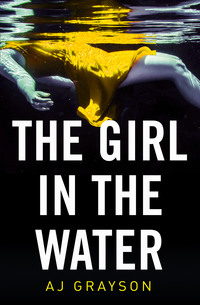
Kitabı oku: «The Girl in the Water»


Copyright
Killer Reads an imprint of
HarperCollinsPublishers
1 London Bridge Street
London SE1 9GF
www.harpercollins.co.uk
First published in Great Britain by Killer Reads 2019
Copyright © A J Grayson 2019
Cover design © HarperCollinsPublishers Ltd 2019
A J Grayson asserts the moral right to be identified as the author of this work.
A catalogue record for this book is available from the British Library
This novel is entirely a work of fiction. The names, characters and incidents portrayed in it are the work of the author’s imagination. Any resemblance to actual persons, living or dead, events or localities is entirely coincidental.
All rights reserved under International and Pan-American Copyright Conventions. By payment of the required fees, you have been granted the non-exclusive, non-transferable right to access and read the text of this e-book on screen. No part of this text may be reproduced, transmitted, downloaded, decompiled, reverse engineered, or stored in or introduced into any information storage and retrieval system, in any form or by any means, whether electronic or mechanical, now known or hereinafter invented, without the express written permission of HarperCollins.
Source ISBN: 9780008321024
Ebook Edition © July 2019 ISBN: 9780008321031
Version: 2019-03-04
Dedication
To those who have suffered:
A tribute
For David who didn’t make it: the fondest of memories.
And for Rachael, once again.
Don ’t give up.
Contents
Cover
Title Page
Copyright
Dedication
He’s hiding something …
Prologue
Part One
Beginnings
Chapter 1. Amber
Chapter 2. Amber
Chapter 3. David
Chapter 4. Amber
Chapter 5. David
Chapter 6. Amber
Chapter 7. David
Chapter 8. Amber
Chapter 9. Amber
Chapter 10. David
Chapter 11
Chapter 12. Amber
Chapter 13. David
Chapter 14. Amber
Chapter 15. Amber
Chapter 16. David
Chapter 17. Amber
Chapter 18
Chapter 19. Amber
Chapter 20
Chapter 21. Amber
Chapter 22. Amber
Part Two
Twenty-Three Years Ago
Chapter 23. David, Aged 17 With The Counsellor
Chapter 24. David With The Admissions Officer
Chapter 25. David
Part Three
The Present
Chapter 26
Chapter 27. Amber
Chapter 28. Amber
Chapter 29. David
Chapter 30
Chapter 31. Amber
Chapter 32. Amber
Chapter 33
Chapter 34. Amber
Chapter 35. Amber
Chapter 36. Amber
Chapter 37. Amber
Part Four
Two-and-a-Half Years Ago
Chapter 38. David
Chapter 39. David
Chapter 40. David
Chapter 41. David
Chapter 42. David
Part Five
The Present
Chapter 43. Amber
Chapter 44. Amber
Chapter 45
Chapter 46. Amber
Chapter 47. Amber
Chapter 48. Amber
Chapter 49. Amber
Chapter 50. David
Chapter 51
Chapter 52
Chapter 53. Amber
Chapter 54. Amber
Chapter 55. Amber
Chapter 56. Amber
Part Six
New Lives
Chapter 57. David
Chapter 58. David
Chapter 59. David
Chapter 60. Emma Fairfax
Chapter 61. Amber
Chapter 62. David
Part Seven
Finale
Chapter 63. Amber
Chapter 64. David
Chapter 65. Amber
Chapter 66. Amber
Chapter 67. Amber
Chapter 68. Amber
Chapter 69. Amber
Chapter 70. David
Chapter 71. Amber
Epilogue
Acknowledgements
About the Author
Also by AJ Grayson
About the Publisher
He’s hiding something from me. I know he is. He’s hiding something, and it’s going to change everything.
There’s nothing I can pinpoint; no concrete, indisputable fact that makes this a certainty, but I’m certain all the same.
He’s lying. And he’s never done that before.
I’m not sure what to make of it. It could be nothing. Could even be good. Men hide things, usually because they’re cowards, but sometimes because they think we want them to. They consider it wit. Maybe he’s hiding a necklace. Or earrings. Or tickets for a surprise holiday, maybe back to the coast again. He knows I always like the coast, especially in the springtime.
But I don’t really think it’s any of those, not if I’m honest. My skin is a pepper of fire and suspicion.
His briefcase is in the walk-in closet of our little bedroom. I know it’s always locked, off limits, but he never holes it away or tries to conceal it. Yet today I found it, unprompted – a pair of synthetically shiny gym shorts slung over the top, as if this would somehow mask its shape. As if I wouldn’t be able to see.
He’s lying. He’s lying.
My beautiful man is lying …
Prologue
The first body in the water was a woman’s. She was a beautiful creature, despite her unfortunate condition. Her black hair was cropped short. Her cheeks were soft. She had rose-painted lips. Above her body, stranded forever in place, the clouds floated smoothly across the sky.
The river, by all accounts, received her body with reverence. It seemed, through some wordless comprehension of nature, to know this was the arrangement and would, for a time, continue to be. ‘Everything in its appointed place,’ it seemed to affirm, and that, perhaps, made things a little more right in the world. Or wrong.
It’s sometimes hard to know the difference.
The last body in the water would be mine.
That’s a hard thing to admit, and harder to accept, but it’s the way things go. The vision, crystal and clear. My golden hair, swaying in the motion that water always has near the shore. My clothes untorn. An altogether different appearance in death than that girl. A stripe in my flesh, bleeding crimson into the water around me. My fingertips, as always, with their nails nibbled down to the skin. My blue eyes open.
It’s an odd thing, to play the observer at one’s own death. Part of me is ashamed, certain I should feel more emotion. There should be anger. Grief. But then, how can I feel those things, really? Of course the shore must be the end. Of course there is water and silence. My story was probably always going to end like this. Like most, the final page was presumably written long before the first, the conclusion the one sturdy fixture towards which everything before it was always going to lead. However they begin, there’s no story that doesn’t finish with the end.
So I see it. Real. Certain. I float in the water, my light blouse transparent against my body, suggestive in ways that, in life, would be provocative but which in death evokes only pity. I’m dead, and I’m quiet, and I’m screaming. My lips are stalled a lifeless pale, but I’m screaming. Screaming with all the breath that is no longer there.
PART ONE
BEGINNINGS
1
Amber
Every morning, as I stand in the bathroom and gaze into the mirror, my eyes look back and taunt me. The fact that their colour doesn’t match my name has always disappointed me, and it’s like they know this, and are so prominent on my slightly freckled face purely as a way to rub it in.
They should be amber, and they should be magnificent. Instead I possess the name, feminine and graceful, forever without the matching gaze. Amber on the tongue, but in the eyes, cursed with blue.
This is overstatement, of course. Something I’m prone to. I don’t genuinely consider my blue eyes a curse, and others have sometimes even found them beautiful. ‘They’re gorgeous, Amber, like twin pools of the sea’ – a splendid compliment, though more than they deserve. They’re not the deep blue of royal porcelain or a navy blazer, but something softer. Just light enough, just bright enough to mark themselves out.
David loves them, too, and for that alone I suppose I shouldn’t complain. Maybe if my face had been punctuated by some other colour the first time we met, he wouldn’t have noticed me, wouldn’t have collided into ‘hello’ and that catchy smile, and all the romance that followed. Maybe, if I had the amber eyes I’ve always craved, I’d have ended up all alone.
I shrug, seeing them in the mirror now, and go about my familiar routine. Morning is morning, and every step is practised. The mascara shade is a light brown, harder to find than a person might think, and it complements a soft brush of Clinique’s cleverly named ‘Almost Powder’ in Neutral Fair. Understated, but just enough polish to let me feel like a well-cared-for piece of art, pleasing without being showy, which is what my mother taught me always to aim for. And mothers, as no one but mothers ever suggest, always know best.
But there’s a headache forming behind my eyes – and I can almost see it in the mirror, too, with the rest that’s visible there. A strange pulsing at the sides of my face, as if the pain has shape and can be caught in the reflection in the glass.
I blink twice, the blue orbs of my eyes disappearing and then reappearing before me. I can’t dwell on the pain in my head. It has long since become a customary feature of my days, and work starts in forty-five minutes. There’s no use dwelling on what can’t be changed.
Just keep going. And I do.
The routine concludes a few minutes later. My face is done, my hair brushed, and my teeth are the glistening off-white of Rembrandt Extra’s best efforts for a heavy coffee and tea drinker.
My feet, seemingly registering all this even ahead of my brain, are already moving me out of our teal-tiled bathroom towards the kitchen.
Like they’ve lives of their own.
By disposition, I’m not a morning eater. A cup of tea, I’ve always thought, is a perfectly complete meal before midday. Add milk and it’s two courses, and entirely satisfying. Recently, though, David has been trying to change my habits of a lifetime.
Because it’s good for you, Amber. It’s healthier. Trust me, you’ll grow to like it.
Sweetest of men, David, though on this front, at least, disastrously wrong.
A tall glass of the monstrosity he calls a ‘smoothie’ has been left on our kitchen’s Formica countertop. It’s his latest effort, fitted nicely into the current trends of our health-conscious West-Coast culture. Its shade is something close to the purple of a badly overripe plum, and he’s probably got plum in there, the ass, along with banana, and berries, and spinach and Christ in heaven knows what else. ‘The flavours mix together so well, you don’t even know what you’re drinking.’ The fact that this is a lie has never stopped him from saying it. The drinks taste exactly like what they are. Reality can’t be masked, not that well. What’s in the mix always makes itself known.
I take a single sip. It’s enough. I know David wants me to take at least two, to give it the honest college try, but I can’t bring myself to do it. Won’t. It’s simply beyond my strength to stomach the stuff, so the rest of the smoothie is down the drain in a colourful swirl, and I’m comforted by the fact that blended breakfasts flow out of existence so cleanly. If David were to cook me, say, eggs (something I loathe with an almost equal fervour to smoothies), the uneaten remains would be harder to conceal. We don’t have a disposal in the sink – the landlord suggests installing one would raise our rent $75 per month, which is simply shit – and the trash can would be obvious. Maybe I’d have to dig a hole out in the garden in which to conceal the evidence, but it seems like 365 days of uneaten eggs would get noticed some time before day 366.
I rinse out the glass and set it in the rack. There’s a note on the counter, next to a ring of condensation. ‘Morning, hon. Enjoy, and have a good one. Love you, -D.’ The blue ink of the ballpoint pen has met the moisture where the glass had stood, the lower curve of the ‘D’ blurring like a watercolour.
The note warms me. I’ve never particularly cared for ‘hon’ as a term of endearment, but from David’s lips, or his pen, the word is a little embrace. I’m smiling without really noticing the change in my face that produces it, and I’m thankful, too, because I have someone who can have this effect on me – who can make my cheeks bend and turn as if he were physically connected to the muscles beneath my skin, provoking my body to move in its most intimate of gestures.
Even if he does make smoothies.
There’s coffee left in the carafe – David makes a fresh pot every morning and always leaves me some – and I pour out half a cup to gulp down before I head for the door. Not tea, but it’ll do. Sadie’s already been walked and fed and is lolling with typical canine disinterest in the corner near the fridge.
‘Bye, Sades,’ I say, my first vocalised words of the morning. I’m nibbling a nail as I say them and the words come out misformed, but my girl knows her name. No children in our little family, though we’ve been casually trying for the past year at least, and Sadie does her best to fill that void. We’re no longer spring chickens, David and I – though I won’t hit forty for another two years, so I refuse yet to be labelled middle aged – but it’s starting to feel like our efforts in this area just aren’t going to lead anywhere. I suspect, sometimes, that Sadie may be as close to a child as I’m ever going to get, though in dog years she could easily be my mother.
She acknowledges my presence with a slightly lifted head and a huff, then lets her nose flop back to the ground. Her pink tongue is askew in her teeth. Her morning walk with David is enough to last her until I get home, and I’m certain she plans to nap for the bulk of the interim. The laziest dog in creation, and I love her.
A few moments later, I’m outside. The front door to our apartment building closes with a click, and I take in a deep breath of the morning air. The sun is already well over the hills, and the flowers that line the sidewalk are glowing. Gardenias fill my nostrils – a heavy, tactile scent, perfume and honey colliding at the back of my throat. A water feature chortles gently in the corner of the lot.
The day is beautiful. The sort of day we sometimes wonder if we’ll ever see, and usually don’t appreciate when we do. I try to soak it all in. Absorb it.
It’s almost enough to make me forget the throbbing that pulses at the side of my face, and the fire that threatens to burn away the edges of my vision.
2
Amber
I’m at the bookshop by 8.25 a.m., a full five minutes ahead of schedule. There was little traffic between Windsor, the quirkily British-sounding, northern California suburb town where David and I have set down our roots, and Santa Rosa, and I’ve got a heavy foot when there’s not a mass of stop-and-go cars before me. It’s an all too frequent occurrence on this tenmile stretch of Highway 101. My little ‘put-put’, as David calls it, might only have 104 horsepower beneath its hood, but I like to put every last one of them to work. Nothing says Modern Woman of Determination like a floored car maxing out its power at 77 miles per hour and getting passed by delivery vans and teens on mopeds.
The shop is already starting to bustle with the customary movements of the morning. A few customers are perusing the racks of new arrivals. The espresso counter has a line of eager attendees. The morning delivery of periodicals and papers has just been brought inside, the boxes waiting to be opened and sorted onto their shelves.
I love the place. I know that book sales are declining and paper going the way of the digital dodo, that Kindle reigns supreme and that there is a whole generation of people who’ve never held a physical book in their hands, but there is a romanticism to the bookshop that I can’t believe will ever truly disappear. The scent of the fresh pages mingled with the thick aroma of coffee, the beautiful hush punctuated by the subtle tones of friendly chatter. It’s a paradise. A little refuge from the noise of the world outside, with a thousand stories to tell and mental universes to expand.
Of course, it’s traditionally more of a young person’s milieu, or at least it was until young meant digital and books meant old-fashioned. There are more grey-haired heads in here these days than brown or blonde, though I haven’t yet spotted the first white streak on my own. Can’t be long until I do, though. I don’t feel a day over thirty – hell, I don’t really feel different to how I did when I was in my twenties – but there are going to be forty candles on my cake soon enough, and I can’t play the child forever. Forty. One of those round numbers nobody appreciates: no longer young, not yet venerable. And you have to live with it for a few years, since ‘the forties’ are much the same as forty itself, until you hit the edge of fifty and suddenly you’re catapulted from ‘in her prime’ to ‘middle aged’. Damn, if the categories aren’t a bitch.
But whatever age may be or mean, work in the bookshop is a joy. Enough in the way of responsibilities and activities to keep me busy, without becoming crushing. Stress isn’t something I crave, nor the ‘fast-paced action’ of a more pressing grind. Leave the mad rush to others. I crave the quiet. The solitude. The rhythm of a nicely patterned life.
The solitude, of course, is relative. One is never alone, even in the dim lighting of a small bookshop. I talk with the customers now and then, though the conversations are usually brief and rarely terribly personal. And I have colleagues, some of whom have become friends – an extension of the little family that David and I constitute at home.
‘Double-caf, half-fat, cooled down, no foam latté, as the lady ordered.’ As I approach my corner of the shop, I’m greeted by Mitch Tuttle, one of those collegiate family members and, in fact, the owner of the little shop. He says the words in his usual sing-song style. He’s sporting a tired pair of trousers, untended wrinkles long since transformed into permanent creases that spider out from his crotch and knees. A belt holds them in place, hidden somewhere beneath the paunch of a stomach wrapped in a badly patterned shirt. The stress of managing such a bustling hive of worldly activity, he regularly joked, had ravaged his otherwise classical good looks. A boss with a sense of humour is not the worst thing in the world.
But his timing is off. Mitch is jovial, now, at 8.25 am – a time of day when this is more or less inexcusable.
He’s carrying a paper cup in his enormous hands. There’s a smirk, two bushy, unkempt eyebrows coming almost together as a smile wrinkles the whole of his face. Too many wrinkles for a man who hasn’t yet seen fifty.
Of course, the drink he’s announced is all wrong.
‘Shit, Mitch, I take tea. Just black, plain, tea. A miracle this shop makes a profit at all, with you at the helm. You’ve got a memory for details like a sieve.’
I take the cup, wrapping both hands around its warmth and shaking my head. Tut tut, Mr Tuttle. But it’s a ritual, not frustration. We both know the familiar script and all the gestures that go along with it. ‘Not like it hasn’t been the same order every day since we met,’ I say.
‘Thought I’d be spontaneous, force you to try something new.’ He grins, his teeth uneven but spectacularly, unnaturally white. The peroxide blonde of the dental world.
My eyebrows aren’t as pronounced as his, but they’ll still mount a good rise when the moment calls for it, and I prop them up in mock disapproval. Then a sip of my drink – tea, despite Mitch’s pronouncement, strong and hot and exactly as I like it. Of course. And in a cup from Peet’s, which we’ve collectively decided has Starbucks outgunned on all counts. We’ve all long since grown tired of the coffee we brew in-house. That’s for the patrons. We ourselves will take something a little more refined, thank you.
‘Susan still keeping you to the new diet?’ I ask him. The script had run its course, and I’d noticed Mitch had opted out of his usual coffee and sported a cup with a teabag – orange-coloured, probably indicating something herbal and revolting – dangling out of its lid.
‘The fascist,’ he mutters, looking defeated. ‘If it hasn’t been brewed from a weed or a berry, I’m not allowed anywhere near it.’
‘Commiserations.’ I’m laughing as I answer. ‘I’m still getting smoothies.’ There’s no need to elaborate. Mitch knows the story and shakes his head empathetically. If there were more hair there, it would flop with the exaggerated motion.
He’s carrying two additional paper cups in a holder, filled with whatever contents are bound for their recipients on the far end of the shop, sighing for good measure but still smiling as he walks away. Big steps, lumbering but confident – a great, heaving land mass on the move. Mitch, needless to say, doesn’t cut the slimmest of figures, and I can see why Susan wants him on a diet. Still, poor thing. I probably shouldn’t refer to him as a land mass.
I’m momentarily captivated by the motion of this boisterous, generous man, hunting down the prey to serve as the targets of his daily good deeds. I catch the look of satisfaction that covers his creased face when he spots the smiles they offer in response, and for a moment feel the melancholy that comes from wondering why there aren’t more selfless souls like Mitch Tuttle’s in the world. And definitely more bosses. But I also catch the sly sleight of hand that flicks a donut from the counter into his grasp as he saunters back, and my devious smile is instantly back. I feel exonerated from the guilt of the heaving-land-mass reflection.
‘I know I said I wouldn’t nag you.’ I let my words stretch out as he approaches. My eyes point to the deep-fried treat poorly concealed in his grip.
‘A promise I’m glad you consider as inviolate as the oath that put that ring on your finger,’ he answers, motioning towards my hand, before I can go further. He steps into his small office at the side of the shop, divided from the floor by a glass wall, and plops his overweight frame into his seat. I can hear the donut drop onto the desk next to his herbal tea.
A second later, I’m quite certain, it’s gone.
Libra Rosa is hardly the largest bookshop in our part of the world. Even in a society where they’re fast disappearing, the Bay Area still has its share of some of the greats. Green Apple in San Francisco has branches scattered around the city, some covering multiple storeys and bringing in authors and speakers while cultivating book-sharing and the lovely art of the second-hand. Johnson’s in Berkeley caters to the hip. Iconoclasm in Marin fosters the new age, as do a half-dozen others like it. There’s a little bit of something for everyone. The only thing the shops share in common is the Californian-liberal ideal that they should be nothing at all like the high-octane bookstores of New York and ‘the big cities’. They’re quiet little holes-in-the-wall with small-town vibes and a pace deliberately laid-back to suit the pot-happy lethargy of the NorCal literary culture.
Libra Rosa is, among the mix, pretty standard. A tribute to its location in Santa Rosa – an oversized town just fifty-five miles north of San Francisco and the last opportunity for residence that San Fran careerists can reasonably consider for a daily commute – the shop has been shaped by Mitch into his vision of a perfect, if miniature, out-of-town literary tribute to the old Haight-Ashbury days. Rows of new books, stacks of classics, and a small section for the second-hand, with beanbags in corners, vinyl LPs on the wall and an overall atmosphere of being committed to life in 1965. Most of what we sell can be bought on Amazon, but Mitch has ingratiated himself with enough of the local community that the shop has a decent following who come in dribs and drabs throughout the day, never more than a handful at a time, though the addition of the coffee bar and seating area two years ago upped the daily visits a little.
In one corner of the shop, on the far left as one enters and barely visible from the glass frontage onto the street, is the periodicals section. My terrain. I have a small desk surrounded by rotating racks for the newspapers and fixed shelving for the magazines.
Periodicals are even less viable these days than books, given that almost every smartphone in existence carries their content in full colour and with instant access, but keeping up the periodicals corner is something of a hobby horse for Mitch. ‘It’s called print media, and print requires paper and ink.’ God love the man for more than just his kindness. I’m not a technophobe, and I browse the Net with the best of them. But the San Francisco Chronicle and the New York Times are just never the same on the screen. You need to be able to hold them, get the ink on your fingers. It’s a life experience not to be dismissed.
So I arrive each morning. I unbundle the packs and boxes, which feels almost like working in a proper, big shop in the city – except that I know the mailman who delivers them is called Bruce, a wooly-haired gentleman who’s been on the downtown route for twenty-six years and who delivers our items ‘promptly at the exact time I get here’, and follows the delivery with a twenty-minute linger over a double black coffee, which doesn’t quite seem full octane to me. Nevertheless, I set the papers into their assigned racks, glancing through the magazines as I place them on the old shelves. It’s a job with a slow pace, deliberately as much as a simple function of location, but with an upside: it allows me to read as I go and catch glimpses of the world’s reporting on life outside.
It usually takes me an hour or two, and then I settle into the routines of maintenance, selling, curating. And simply being present, as a shop without attendants is nothing more than a warehouse. Though a shop without customers is, too, and some days we barely pass that test. So I sit at my small desk, smile as guests enter the shop, answer questions when they have them – which on rare occasion are about books or papers, but more often about their children’s recent sporting success or a vague complaint about the state of politics, or another pothole on Main Street – and spend the many quiet moments between browsing the Internet that still has stories to tell even once I’ve read all the day’s papers through.
I have my own computer for that task, and I have to admit that as much as I cherish paper and ink, I do love this thing. The latest model, thinner than my calculator and an elegantly understated shade of what Apple optimistically calls gold. I can’t say that my previous model, whatever it was, had been all that bad; but I do love a shiny new thing, and the shinier the thing that’s new, the darker the memory of what it’s replaced. God bless Apple for keeping the shiny things coming. If I weren’t happily married and Tim Cook, CEO of Apple, hadn’t announced himself as being the other way inclined, I could see myself having an extraordinarily torrid affair with that man.
Pinned to the wall beside my desk is a photo of David and me, taken a year and a half ago near Lake Berryessa, and another of David and Sadie both lying on their backs, bellies up, out in the backyard. Two frozen moments of happiness I keep right at eye level. Tacked around them are notes and posters and all the usual fare of a bookseller’s trade; but right in the centre, right at the core: two manifestations of bliss, and both with furry bellies.
I wrap my hands around my tea. One of the boxes from this morning’s delivery has already been cut open by someone else, and I reach over and grab out a copy of the Chronicle. I have a few minutes before I need to get to my chores. Right now, tea and a paper – a morning crafted for happiness.
And I’m at work.
Life is sometimes truly good.
A sip, and the tea is warm on my tongue. With a jostle of the newsprint page the day’s headlines leer up at me in bold black. Single-phrase proclamations, shouting their way into my attention. Speaking of the weather, the traffic, the political climate. Some of it interesting, most of it routine.
Ordinary.
Normal.
That’s usually how it is, just before the world changes.
3
David
Looking back, staring into the past from all that my present has become, I can honestly say that the world we inhabit is a mystery. I’ve never in all my life had to come more to grips with that fact than now. A mystery, and a puzzle.
I met her on Tuesday morning at 8.25 a.m.; I remember the timing exactly. The contours of my watch’s face, the position of its hands, I remember them in the same way poets remember the flowers on hillsides or the scents in the breeze on the days they experience love. Impossible to forget.
I’d been told a little about her. I was familiar with the kinds of details shared about individuals on a printed page, cutting a lifetime of reality down to basic facts: the length and colour of her hair, her height. Weight, at least approximately. As if these things mattered. Yet they were there to be had, and I had them in hand as I first walked in to meet her. Everything a man could possess to go on.
Except her. The experience of her simply couldn’t be compared to what I’d imagined. Or anything I’d ever experienced before. She was altogether more.
The first thing I noticed were her eyes. I’d never encountered eyes like those. I’ll never forget how they first moved me.
I think she knew, even then, that I saw something in them. That the sight of her captivated me. But, despite their potency, their vivid hue, it wasn’t their colour that captivated me. There are only so many colours eyes can take, and I’ve never found the variations to be all that engaging – whatever she or others might think.
It was their intensity. God, staring into them was like beholding a cry that had been given physical form. Her eyes were her plea, and they seemed to hold, just behind the shine of their lenses, an entire world that was screaming to be set free.
And then we spoke, and reality began to fall apart.
4
Amber
The change today came in an instant. My headache had been getting worse, despite the tea. It was still early, but the throbbing at my temples was becoming more than a mere distraction. It’s like this too often, though, and I’d already swallowed two pills to combat the customary. I’d be a Tylenol addict if they didn’t tell me it would melt my liver into goo, so I’m an ibuprofen addict instead, popping two or three at a time throughout the day, for the little good they do me.
I’d downed them in a single swallow, then set about my morning tasks. They hadn’t taken long, and the papers – which I’d already skimmed through – were now racked and the latest editions of the magazines placed prominently on their shelves. The boxes they’d come in were flattened and out back with the recycling, and I’d managed a handful of sales to the business types who wanted a paper to go with their croissant as they headed off to the office.
And then I was alone. The bliss of the job. I’d opened my laptop at a moment when the ebb and flow of the shop had been mostly flow, and called up a familiar selection of news feeds. Maybe it’s the fact that I’m in this little shop in this little city that makes me so keen on keeping up with the news. It hardly matters to me, most of it, but I read it with diligence.
My headache notwithstanding, I refocused my eyes on the computer screen. Minutes, maybe fifteen or twenty, had passed since I’d started my usual scanning, and thus far the online media wasn’t proving itself much more enticing than the day’s print versions I’d already perused.
The headlines were hardly works of art. I know a lot of effort goes into them by the poor saps whose job it is to dream up one-liners that make the boredom-inducing sound enticing. But effort isn’t always enough to breed interest.
STOCKS TRADE DOWN – BROKERS KEEP HOPES UP.
That, in the journalistic world, is apparently what passes for catchy. The down and the up; directional contrapposto. Whoever wrote that got full marks in Journalism 101.
BART TRAIN DELAYS THROW PASSENGER PATIENCE OFF THE RAILS.
This attempt to convey poignantly uninteresting content about the Bay Area Rapid Transit system under the guise of a catchy tagline – it’s an art. Like a record producer fronting an album with one catchy tune and filling the remaining eleven tracks with artless crap. By the time anyone hears them, the’ve already bought the record. (Though I can hear Tim Cook yelling at me now: ‘No one “buys a record” any more, Amber. It’s all about streaming, about personalized subscription!’ then smiling seductively and somehow charging me another $9.99 a month.)
CRACKS IN BRIDGE DIVIDE COUNTY OFFICIALS.
I’d paused at that one, tapping to see the paragraph-length summary. The concrete of a sixty-year-old bridge outside Napa, in our neighbouring county to the east, was suddenly the cause of ‘grave concern’ amongst the county administration (note the adjective ‘grave’ in a story that might involve tragedy: I read enough to know that’s strong copy), despite the fissure in the concrete having been visible for more than three decades.
I tapped my keyboard again, my waning interest spent.
Then, without any deliberate intention, my glance wandered upwards. A few headlines above the one I’d clicked, less than an inch away from scrolling off the top of the screen, a different caption grabbed me.
I can’t identify precisely how it did it – how it affected me. It was a spark, and it launched a fire in my spine that shot through me like badly wired electrics. Before I’d even taken full account of the words, I could feel the voltage in my head change.
I shoved my tea aside with a jolt, slammed the palm of my hand against the spacebar to stop the feed scrolling off the screen, and glued my eyes to the headline. I was barely aware that I had all but stopped breathing. My eyes didn’t want to focus.
The words were simple and unadorned.
WOMAN’S BODY FOUND ON SHORELINE. FOUL PLAY SUSPECTED.
And there it was, that buzzing at the surface of my scalp again. Electrics. An immediate tension in my chest.
There was nothing in the headline that should have caused such a reaction. It presented none of the witty word play of the other titles (wit, I have often observed, is generally disapproved of in writing about death, since almost nobody successfully navigates the line between banter and respectability). It was unfussy. A simple statement of fact.
WOMAN’S BODY FOUND ON SHORELINE. FOUL PLAY SUSPECTED.
I read it again, and again, and gradually became aware that my spine had gone rigid. I’m sure there was a thin film of sweat between my fingertips and the etched glass of the trackpad.
The noise of the bookshop seemed to have vanished, and if there was anyone left in the store, they had become invisible to my attention. My mind, drawn in by this headline for reasons I couldn’t explain, raced through the limited details that could be inferred from such a minuscule amount of text. ‘Foul play’ means possible homicide. Fine. I mean, horrible, of course; but comprehensible.
But my reaction, it was not comprehensible at all. I blinked, and my eyelids left trails as they rose back into their folds.
WOMAN’S BODY FOUND ON —
The words grabbed hold of me. Assaulted me. Inexplicably, at that instant, I wanted to scream out from the very depths of my belly.
Isn’t that the very strangest thing?
Then, with the shift of no more than a second, the agony fled. The headline was just a headline, clear and crisp on my screen with a stark lack of factual detail, and I was disinterested and dismissive and —
And it was back, as quickly as it had gone. My breath outpaced my pulse, my eyes clamped closed, and in an explosion of the unexplained, I couldn’t even make out the conclusion of my own thoughts. Though for a moment, just for a moment, I thought I heard them telling me that my world was coming to its end.
5
David
I was perched across from her, the day I met the woman that changed my life. I don’t know for how long. It doesn’t matter. I was in my government-issued moulded plastic chair, clipboard in hand, diagonally opposite her position in the little room.
I didn’t know who she really was then when we first began. I only knew what was in the official reports and my stack of references.
‘I’ve read your file, Miss.’ I listened to the doctor’s voice as he spoke directly to her, facing squarely across the metal table between them. ‘What the records say about you is pretty clear.’
He spoke in cold, formal phrases. He was a medical professional, of course, and of many years’ standing. But he was also an officer of the state, and she was not here under circumstances any would consider friendly.
Her expression didn’t change. Her eyes remained motionless. From my position in the shadows at the side of the room, I felt unnerved by her solidity.
‘We both know what’s brought you here,’ my superior added. Dr Marcello was an old hand at this, and I’d heard him make similar beginnings before. I craned my neck, trying to observe some emotion on the woman’s face.
‘Do you realize why you’re in this room, at this moment?’
A common formula of approach. Begin with a querying of the context; find out how much the person in front of you is willing to admit of their position, and proceed from there. With an assistant at the side, from the pharmaceutical wing, taking notes in silence in order to help with the medicinal diagnoses.
Thus far, Dr Marcello was keeping things by the book.
The woman said nothing. She was alone in the room, for all her expression would have suggested. She just stared through the walls into a space I couldn’t see.
‘You’re not here because you asked to be,’ Dr Marcello added, stating the obvious. No one came into that room by choice. Still, the comment might jog her.
Her eyes had begun to drift upwards, as if something on the ceiling was attracting her attention. My superior almost spoke again, but then a sound – nearly imperceptible – emerged from the woman’s lips.
‘Not … by … choice.’
It was the first time I heard her speak.
She was mimicking Dr Marcello’s speech, or so I thought, but still – her voice. Almost. She whispered the words, as if holding back a more personal moment.
I leaned forward in my chair, frustrated by the odd angle that kept me from gazing at her face-on. I tried to make out everything I could. She had short black hair, cropped and fine. Visible softness in her cheeks. Rose gloss on her lips that glistened in the fluorescent light as she whispered.
She was beautiful. It might have been wrong for me to think that way. Inappropriate to institutional objectivity. Too subjective and personal. But she was, and I noticed. Even from an angle, even out of reach. She was beautiful.
Dr Marcello remained impassive.
‘Call you tell me your name?’ he asked, hoping to elicit more words from her with a question that hardly required analysis.
The woman’s eyes fell back from the ceiling, straight into his. And then, to my shock, she swivelled her head and stared straight into mine.
Our first gaze. The moment my life changed.
‘My name,’ she said softly, ‘is Emma Fairfax.’
6
Amber
Somehow, the day has disappeared. I’m not sure how it’s happened. I’ve been in the bookshop since it began, going about my usual routine, and it doesn’t seem it’s lasted that long. Not long enough for end-of-the-workday noises to be emerging from the street outside, or for quick drinks at Trader Tom’s around the corner to be the subject of conversations by colleagues, not quite out of earshot, as the metal blinds are lowered inside the windows. Yet I hear them, just like that, and the clock on my monitor agrees with the voices.
Time, I suppose, gets away from us all, now and then. Einstein may have theorized that time changes relative to speed, but I’m pretty certain it also changes relative to concentration. Focus on something hard enough – as I’d apparently been doing with the news on my screen and the other work of the day – and the clocks slow down. Then you blink a few times, smear away the haze of all that intensity from your eyes, and you find you’re back in the present, situated awkwardly in the skin of the person you’d forgot you’d been a few moments before.
So I refuse to be too surprised by the noises around me, now, of a workday at its end. Nor am I overly disappointed. I love this little den of respite, yes, but I’m not a lonely woman, wedded only to my work to give my day its meaning. I have my corner of the shop, my papers, my computer, my employment that feels half like a retreat. But I also have home.
I have David.
I’m out the door by 5.07 p.m.
Mitch walks behind me. With all that mass, it’s rare he walks in front.
‘You going straight home, or you up for a drink?’
His questions are always pure, though he says them with the kind of raunchily exaggerated tone of voice that suggests we might follow up that drink with a steamy escapade, entwined in each other’s naked skin in a hotel that charges by the hour. But it’s all smoke and sarcasm with Mitch. In reality, he is devoted to Susan, the most doting wife in the world, and he knows I’m well and truly hitched and not looking to break that bond. He’s just a kind man, and one who’s fairly certain alcohol won’t be on the menu when he gets home. Nor, for that matter, any particular act that could be described as an ‘escapade’.
‘Not today, Mitch.’ I smile, pausing to allow him to catch up and lowering a hand onto his wide shoulder. There’s the uncomfortable sensation of moisture rising through the fabric of his shirt. I force myself not to lift my hand away. ‘Thanks for the offer, though.’
‘You sure? Wouldn’t take more than an—’
I switch my grip to a pat. The motion accentuates my headache, which has grown worse throughout the foggy day. ‘I’m sure.’ A bigger smile. ‘Stuff on the mind. But go have one yourself. Susan’s not bound to have a glass of Jack on the counter, is she?’
He heaves a resigned but happy sigh, muttering something indiscernible about pigs and flight, then chortles. ‘Till tomorrow, Amber.’ And he turns, and I blink, and he’s already halfway to his car.
The drive home is, as always, twice as long as the commute in. The roads are packed, the commuter congestion I’d avoided in the morning now at its predictable height. To emphasize the plight, the woman’s voice on the National Public Radio affiliate for the Bay Area suggests there’s no hope for improvement ahead. I settle passively into the time set out before me.
I have a water bottle in the cup holder at my left, its flimsy plastic only slightly sturdier than the interior of the car itself. The myth that water eases headaches is a lie, but it does make popping the ibuprofen easier. Another two are down before I’m fifteen minutes into the drive, leaving their lingering, slightly sweet taste on the back buds of my tongue. It’s too familiar. Advil’s parent company should offer me some sort of loyalty card.
The details of what I’d read during the day peck at my attention as I play tap-dance between the accelerator and the brake.
My spine tingles again with the memory of the headline that had captured my attention. An ice cube projects itself up my back.
This woman in the river.
It had been on the computer, not in print, which meant it was fresh. Probably only became known after the papers had gone to press for the day. I’d looked through them again, just to be sure, but found nothing there.
I’d gone back to the Internet, oddly enthralled, and chased up what few details were available. Age, 40. The woman who’d been found was just a year my elder. Her body had been discovered at approximately 9.45 p.m. by an advocate of late-evening walks who reported his find to the local authorities. It was situated on the Russian River – the 110-mile-long gentle beast that stretches out from near Lake Mendocino, twisting and turning south and west until it joins the Pacific Ocean in Jenner, two hours north of San Francisco. I know the river as well as anyone does who lives in the area, more by simple proximity than first-hand experience. I’ve driven along stretches of its length that run near the highways, that’s about all I can say. At places it appears mighty, at others barely more than a stream.
As I drive, now, I recall the process of searching for these facts on various police websites. It had taken over an hour. Maybe several. The day, as I say, had kind of slipped away from me.
The details, though, continue to cycle through my mind.
A hiker coming upon the body, still floating in a gentle bend in the water.
It wasn’t an overly bloody find, or particularly terrifying or grotesque. This wasn’t a dismemberment or chainsaw attack. What was disturbing was, in fact, the simplicity of the whole situation. The fact that it was almost … scenic. The river water, flowing. The mention of someone out for a casual stroll. ‘Rambling’, as the English would say, which seems appropriate as I drive towards a Californian town called Windsor.
A foolish song I knew as a child tussles at my memory, its tune playful and ridiculously out of concert with the topic of my thoughts.
Rambler, brambler, with rushes at my knees,
Walking, talking, to bushes and to bees …
I shake my head in protest. It seems inappropriate that my mind should wander to such things at this moment. I try to push the tune out of my thoughts.
Beyond the victim’s age, none of her private details – name, residence, so on – have been released to the media, except to indicate that she was a Caucasian female and apparently in good physical condition.
I fidget. But it’s not a fidget, it’s a squirm. I’m uncomfortable. The air in my car is too hot, I realize all at once. I switch on the A/C and turn the knob as far as it will go towards the little snowflake symbol. It lights up with a reassuringly blue glow – blue having at some stage become a colour we all associate with being refreshed and cool. For a moment, this meaningless fact distracts me.
The tune, though, won’t leave my head. Rambler, brambler, with rushes at my knees …
I stomp my foot beside the accelerator to shake the melody from my mind. Enough!
The cause of death I’d found was listed only as that ambiguous ‘suspected foul play’. Any further detail is apparently under embargo. Hardly surprising, as the case is so new, but it doesn’t close the door to informed speculation. As a woman who reads the news religiously, I know that ‘suspected foul play’ usually means there’s some physical evidence of additional trauma – maybe a gunshot wound, maybe stabbing. Something more than simple drowning, which would be the more obvious cause of death in a river. Drowning could indeed be murder, of course, but it could also be just a fall. Or suicide. ‘Suspected foul play’ hints there’s something more.
My temples are starting to throb. Stinking, ineffectual pills. And the air con is doing shit, blue snowflake or not. I can feel my blouse clinging to the sweat on my back.
I recite the details over and over, making them almost a chant.
A thirty-nine-year-old woman’s body.
Found at the river’s edge.
White.
Cause of death – unannounced.
Foul play.
Sinister.
I’m sure there were other things I looked at in the news today, other happenings that will have attracted me at the bookshop. But my mind is stuck on just this. On this, and …
Rambler, brambler, with rushes at my knees …
The song won’t leave my head. My breathing has become heavier, and for some reason my right leg is starting to ache. I can’t think of any reason for that. I try to reposition myself on the seat.
The lane to my left suddenly shifts to life. I click on the indicator and push myself into the moving traffic at the first opening. Distraction from the odd sensations. Triumph. We clock a stellar seven miles per hour before the motion slows again, and within a few seconds we’re back at a standstill. The lane I left is moving. I clench my fists tight on the wheel. The urge to unleash a satisfying barrage of profanities is almost overwhelming, but I try not to recite the curse words David describes, with mock old-world flare, as ‘so awfully unwomanly’. Though, to be honest, he always says it with a very un-old-worldly grin, which makes me think he half-likes those moments when I lose verbal control.
I blink heavily two or three times. There are trails there, again, following my eyelids as they move.
The traffic starts to flow once more, and I attempt to distract myself, shifting my attention to the hillsides and vineyards alongside the road. All the locals along this particular stretch of Highway 101 refer to it as the Redwood Road, though I’ve yet to spot a Redwood tree anywhere near it. An enormous growers estate, entirely modern but designed to look ancient and historical, sits off in the sweeping green hills to the left of the highway. It’s a winery, of course, as most things are around here, but I can never remember the name of it. It’s built like a castle, complete with turrets and triangular flags. An odd way to sell wine. But the visual effect is dramatic, and the delivery trucks pulling in with supplies could as easily be wagons with mounted drivers, their diesel horsepower replaced with the actual thing. It wouldn’t look the slightest bit out of place.
But then there’s a Beyoncé cutaway on the radio and a new update on the refugee crisis in Eastern Europe, and the world again seems so very, recognizably, modern. Even the vineyard castle suddenly looks pallid and uninspired. Just another hoaxy specialty shop along the roadside, different only in size from the shed a few miles back and the Safeway warehouse at the next intersection.
That’s how quickly the world changes. A soundtrack, a flash of circumstance, and it’s a different land. A familiar one, where David is waiting at home and the universe is as it should be. God, how I want that, in this moment. My normal world. My comfy home. My wonderful man.
But suddenly I’m sweating fiercely. My breathing has become tight and rapid. The northern California landscape around me is as it was a moment before, nothing at all has changed – and yet it has, all the same and all at once. The woman’s situation has thrust itself back into my mind, powerfully, her circumstances flashing like lights in my vision.
I think I might hyperventilate – maybe I already am. My pulse, I’m sure of it, is out of control. This isn’t a headache any more. I don’t understand what is happening to me. The edges of the highway are glowing white, a phosphorous light that is too bright for me to look at directly, bleeding into every inch of my vision.
And I can see a girl, like a picture from a perfectly told story. She’s right there, in the glow of white that has overtaken the world. I am an observer at the solemn portrait of something ethereal and other-worldly.
And … wrong.
I can no longer see the traffic around me. I’m not sure if I’m still in my lane, or even in my car. Life itself has gone out of focus.
I only see the girl. Her. The girl from the headline – of whom no photos have yet been released. The girl whose face I have no reason to know from Eve’s. There’s something peculiar to her eyes. Something wrong with her neck. Yet it’s her, I’m sure of it, and she’s there, her face bathed in white, staring at mine. Her life ebbing away.
And for some reason I want to call her Emma.
Ücretsiz ön izlemeyi tamamladınız.