Kitabı oku: «Forget Me Not»
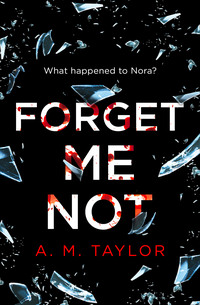
Forget Me Not
A. M. TAYLOR

A division of HarperCollinsPublishers
www.harpercollins.co.uk
Copyright
KillerReads
an imprint of HarperCollinsPublishers Ltd
1 London Bridge Street
London SE1 9GF
www.harpercollins.co.uk
First published in Great Britain by HarperCollinsPublishers 2018
Copyright © Annie Taylor 2018
Cover design by Holly Macdonald © HarperCollinsPublishers Ltd 2018
Cover photographs © Shutterstock.com
Annie Taylor asserts the moral right to be identified as the author of this work.
A catalogue copy of this book is available from the British Library.
This novel is entirely a work of fiction. The names, characters and incidents portrayed in it are the work of the author’s imagination. Any resemblance to actual persons, living or dead, events or localities is entirely coincidental.
All rights reserved under International and Pan-American Copyright Conventions. By payment of the required fees, you have been granted the non-exclusive, non-transferable right to access and read the text of this e-book on screen. No part of this text may be reproduced, transmitted, down-loaded, decompiled, reverse engineered, or stored in or introduced into any information storage and retrieval system, in any form or by any means, whether electronic or mechanical, now known or hereinafter invented, without the express written permission of HarperCollins.
Ebook Edition © October 2018 ISBN: 9780008312916
Version: 2018-05-13
Dedication
For Ruthie (big sister, best cheerleader, and all-round super woman)
Table of Contents
Cover
Title Page
Copyright
Dedication
Chapter One
Chapter Two
Chapter Three
Chapter Four
Chapter Five
Chapter Six
Chapter Seven
Chapter Eight
Chapter Nine
Chapter Ten
Chapter Eleven
Chapter Twelve
Chapter Thirteen
Chapter Fourteen
Chapter Fifteen
Chapter Sixteen
Chapter Seventeen
Chapter Eighteen
Chapter Nineteen
Chapter Twenty
Chapter Twenty-One
Chapter Twenty-Two
Chapter Twenty-Three
Chapter Twenty-Four
Chapter Twenty-Five
Chapter Twenty-Six
Chapter Twenty-Seven
Chapter Twenty-Eight
Chapter Twenty-Nine
Keep Reading…
Acknowledgements
About the Author
About the Publisher
CHAPTER ONE
Madison Journal
Ten Years Gone: Family Mourns Missing Daughter
By Angela Cairney
January 7, 2018
Ten years ago, the family and friends of Nora Altman woke up to find themselves living in a nightmare. Tomorrow marks the anniversary of her disappearance when the 17-year-old’s car was found abandoned by the side of Old Highway 51 on the road between Forest View, WI, and nearby Stokely in the early hours of January 8, 2008. The car was locked, with no sign of a struggle; the only indication that anything was wrong with the car was the empty tank of gas that had presumably halted the teen’s drive.
The case has long since gone cold, and the local police department have been criticized both by members of the community and Nora’s family for not acting quickly enough when she was first reported missing. But Chief of Waterstone Police Department Patrick Moody claims he hasn’t given up. “We’re always on the lookout for anything relating to Nora’s disappearance. This is the kind of case that defines your whole career, but its impact has been much more far-reaching than that. It’s affected the whole community and I feel the full weight of that responsibility daily. Even now.”
Three years after the teen first went missing, her father, Jonathan Altman, almost launched a civil suit against the Waterstone Police Department. “There are no hard feelings,” Moody said, “he was just doing everything he had to do to find out what happened to his daughter. As a father, I would have done the same.”
Chief Moody was planning on joining the family and close friends of Nora today to mark the ten-year anniversary of her disappearance. “We’ve done it almost every year since Nora went missing. It’s good to get together and remember her, and also to remind ourselves that there’s still work to do.”
For the family, though, the nightmare still goes on. “We’ll never have closure,” Nora’s younger sister Noelle said. Only 7 when Nora went missing, Noelle regrets not having had a big sister to grow up with and guide her along the way. “My brother Nate tries his hardest, but it’s not the same. Even though I know I barely really knew her, I still really miss her. I just know she would have been the best big sister.”
CHAPTER TWO
I was dreaming of the sheet of glass again.
I was carrying this huge plate of glass that was beginning to crack, tiny spider webs of distortion spreading fast, and as it did the pane shifted in my heavy arms and slipped from my grasp. I woke just as it should have been shattering into a million pieces on the floor below me. I carried that great big sheet of glass everywhere I went, my arms straining with the effort, my forehead shining with sweat, the glass itself slowly, slowly cracking as I shifted it slightly from hand to hand, arm to arm. It was exhausting and debilitating, cumbersome and controlling and, I thought, so, so obvious to everyone I met that I was struggling. People recognized the struggle of course, just as I knew they would, gave it a name, and either pushed it to the back of their minds or worried about it endlessly depending on who they were and what they were to me. They all made the same mistake, though: thinking that pane of glass made me weak. You try carrying something like that around with you wherever you go. You get tired, sure; but you also get strong.
There was nothing particularly special about waking up to that shattering glass. I’d done it a thousand times before and no doubt it would continue to haunt me after; it wasn’t a portent, or an omen, I didn’t have to write about it in my dream journal, or put a black mark in my diary so that in the years to come I’d be able to look back and say “ah yes, the dream. I should have known something terrible was going to happen.” Because there was no way anyone could have known.
Because when the worst has already happened, you don’t expect it to happen again.
But this story doesn’t start with a dream. What story ever does? No, this story starts with Nora.
Nora’s parents had chosen Sunday for the memorial because more people were available. The day was white and gray, the sky thick and heavy even though the snow didn’t come until nightfall. It had been the same on the day Nora disappeared but then that should have hardly come as a surprise. January has a way of making every day look and feel the same, the month lasting forever and then suddenly over. I don’t know why we gathered at the lake house rather than at the Altman home, although I was glad we weren’t huddled around the trees by the side of the road where her abandoned car had been found that morning, so many years ago. Too many impromptu vigils had happened there in the days and weeks following Nora’s disappearance for me to feel anything other than nausea when I drove past. At least the lake held some happy memories, long gone but still just about holding on. So, Nora’s dad, Jonathan, spoke, and then her older brother, Nate, did, and then we all just stood looking at the lake for a while, no one really knowing what to do, what we were expected to do. That’s something I’ve learned over the last ten years; no one ever tells you what to expect or what’s going to happen next because no one knows. You’re on your own.
I waited for a while, wanting to get Nate on his own, but Leo and Bright were stood with him, their faces pale and maybe even a little drawn but talking to each other as animatedly as you can at a memorial. They were trying to draw Nate into the conversation, trying to coax him out, but wherever he was it wasn’t with them. I had a feeling he hadn’t been with them for a while.
“Hey, Maddie,” Leo said as I approached. “Nice to see you.” Leo had just graduated from the police academy when Nora went missing. Three months on the job and he was investigating the disappearance of his best friend’s little sister. Whenever I saw him back then the image of him in his brand-new uniform would shock me all over again; he looked so young, too young to be in a position of such authority, as though he’d put the uniform on for Halloween and never taken it off.
Bright, or Michael Brightman to give him his full name, was a year older than Nate and Leo; the same age as my older sister, Serena: They’d gone out for a while, in fact, back in high school. He’d had a year longer on the job than Leo, a year or so to prepare for something neither of them could ever have seen coming when they decided they wanted to be cops in the same small town they’d grown up in, where nothing ever seemed to happen. I could still see his face, stark, stretched and stunned, when he told me they’d found Nora’s car but that there was no sign of Nora.
“Nice to see you too,” I said, leaning in for awkward hugs with both Leo and Bright before stopping at Nate whose eyes were turned towards the lake, or where the lake would have been if it weren’t blanketed with snow. I had lain my hand on Nate’s arm in an attempt to get his attention, and he finally turned towards me.
“Hey, Mads. Good of you to come,” he said, his voice scratching the cold air around us.
I looked at him, trying to make sense of what he was saying before just nodding my head slowly and saying: “I wouldn’t miss it.”
Nate sucked in a breath, still not really looking at me, and I turned back to Bright and Leo, the latter of whom met my gaze and shrugged. “Can you guys give us a minute?” I asked, the two of them sharing a look before wandering off towards the lake house without another word.
“How’re you doing, Nate?” I asked.
Nate shoved his hands into his pockets and turned towards me with a sigh. “I don’t know, Mads. How do you think I’m doing?” He was facing me but not meeting my eyes, his gaze wandering across the snowy landscape, taking in the fractured group of people who had gathered to remember Nora.
His younger sister and brother, Noelle, and Noah, were walking together towards the house, looking for warmth; his aunt stood with her arm around his mom as she quietly cried. My oldest friend, Ange, was talking to Bright and Leo now, while our parents stood in a small knot, joined by Nate’s dad, Jonathan, and the Winters family. It was a scene familiar to me, too familiar, and I wondered if that was what Nate was thinking too: How many times had we done this, how many times had we stood here, if not exactly in this precise spot, then one very much like it, thinking about Nora, remembering her, trying to keep her with us even while she was taken further and further away from us?
Ten years. I tried to take it in and couldn’t. Ten years was a lifetime, an entire decade. What was there to say about an entire decade that, for the most part, had been marked only by absence? For some people if there’s something missing, if there’s a hole in their life, they fill it; I tend to fall down it.
“How’s work?” I asked, searching his face, desperate for something, anything. “How’s Texas?” Nate had moved to Austin almost four years earlier, and I’d barely seen him, barely spoken to him since, the distance between us so much bigger, so much wider than those thousands of miles.
Nate took another long breath, looked like he was readying himself for something and ran a gloved hand over his face before batting my question away. “Texas is fine, work is fine.”
“Wow, that’s really illuminating stuff, thanks, Nate.” I wanted to smooth out the edges of my words but, for some reason, even that day, I couldn’t. They were sharp and cold, like the weather, like the day.
“That’s all I have for you right now. How about you? You want to tell me all about your great, interesting life?” Sarcasm shaded his voice, adding an unfamiliar arch to it, and he was looking right at me then, his eyes dark and hard, like a dare. I shrugged off his question, trying to pretend it slid right off my back, and he decided that he’d made his point. “See, that’s what I thought. Good to see you, Mads, be sure to have a slice of the coffee cake before you go.”
And then he was walking away from me, hands deep in his pockets, shoulders hunched.
Nate and I used to be able to communicate with each other even through silence. Despite it, because of it, whichever way you want to look at it, neither of us had the words available to talk about Nora and that was how we communicated, through the understanding that she was there, always, in every word we said and every word we didn’t, every word we couldn’t. But it had been years since that was the case and, by then, whenever we saw each other, whenever we spoke, the silences in between had no give to them. They felt like gaps, misunderstandings, another hole to fall down, another hole to be filled.
I didn’t have any cake. I’d long stopped eating at those kinds of things. The food was a necessary distraction, it gave your hands something to do while you tried to figure out exactly what it was you were meant to be doing, but I could never take a bite, my stomach twisting and turning, my throat closing up as soon as I raised anything to my lips. Inevitably I just ended up carrying a loaded plate of food around before finding somewhere to stash it. No one stayed too long that time though. No one wanted to. We’d had ten years of these things after all, and were just marking time now. When she first went missing, even in the year or two after, there was still something close to hope at the vigils and memorials but, after ten years, that was just a way of saying look at how much time has passed, look at how we’re still thinking of you. Nora was gone, and it was simply something we had to do to remind ourselves that we were still here.
Eventually I followed Nate and the rest of the party into the lake house where everyone had decamped to. I would have preferred to have left without even a goodbye, but my parents had attempted to raise me better than that, and besides, they’d driven me there. I helped myself to a coffee in the small kitchen, wishing it was a little later in the day, wishing there was wine instead, or better yet, vodka, but grateful for the pocket of extra time it gave me away from everyone. The cabin was small, just one large room with a utility room off the kitchen, the front door opening onto the living room, and even though there weren’t that many of us, it was still too many. I clutched at my coffee cup, waiting for my hands to warm up, waiting for the crushing feeling inside my chest to ease up.
Noelle was sat on the arm of one of the couches, picking at a thread that was coming loose on the sleeve of her sweater. Ten years younger that Nora, she’d turned seventeen just a few months earlier, the same age Nora had been when she went missing. I stared at her, looking instinctively, automatically, for the similarities between the two of them as I always did when I saw Elle. I didn’t have to look for long. Her hair was lighter, and she wore it longer than Nora had, and her eyes were the same brown as Nate’s rather than Nora’s arctic blue, but Nora was there still. They had the same mouth and jawline, the same shaped eyes and long neck. I knew that when Elle stood up she’d be almost as tall as Nora was, but for now Leo was leaning over her, talking intently as Elle refused to meet his eye. I joined them with my coffee, maneuvering carefully around Nate as I did so, neither of us saying a word.
“Maddie,” Elle said, her eyes meeting mine, looking grateful, I thought, or maybe even a little pleased.
“Hey, you. How you doing?”
We hugged and her body felt small in my arms even as she pulled quickly away.
“Oh, you know. Not great.”
I don’t why I kept asking people how they were, to be honest. I hated that question even on a good day, let alone that day.
I nodded and slid my gaze towards Leo, who raised his eyebrows at me and asked: “How long are you in town for, Mads?”
“I have to get back tomorrow.”
“How you finding being back in Madison? You’re doing a PhD, right?”
Yet another question I dreaded even more than “how are you doing?”
I coughed through my coffee and shook my head. “No. I quit, actually. A while ago. I’m working in the communications department now. At the university.”
“Oh. How’s that going?”
“It’s fine. It has its moments.”
“Sure,” Leo said nodding, polite, polite, “well, it’s a job, right?”
I looked at him, trying to decipher his words but he just smiled, nice and easy, his face wide open.
“They all have their moments. Last call out we got was to save Mr. Hetherington from himself. He’d locked himself out of his house and decided it was best to just sleep off whatever he’d drunk in his car, but the neighbors were worried about him, so they called us. Probably almost died of hypothermia, but what are you gonna do, that’s the job, right?”
It would have been too generous to describe Hetherington as the town drunk. He was simply a guy who got drunk and happened to live in town. I wondered at what Leo was complaining about though. You become a cop in a small town, and what else do you expect from life except fishing drunks out of ditches and pushing cars out of snow drifts? Apart from a former classmate who’d been missing for ten years, of course. It took me a while to realize that he was throwing me a tentative bone. I wasn’t where I’d expected to be in my life, but there had been days, hell, there had been months and years, where getting to even where I was then would have looked like something close to a miracle. And when it came down to it, none of us were really where we had expected to be.
I returned Leo’s smile, or at least tried to and said: “Well, you’ll be running the place soon though, right?”
Leo rolled his eyes towards the other side of the room where his father, Patrick Moody, stood, replete in his chief of police uniform, too big for this room. “Yeah, just as soon as the boss retires.”
“Hey,” I said to Elle, grabbing at her bicep, “is Jenna here? I haven’t met her yet.”
Elle shook her head. “No, she couldn’t make it.”
“That’s a shame.” Talking to Elle felt like talking through a mask or as though I was trying on another character. I tried so much harder around her than anyone else. Not because I wanted her to like me or anything, but being around her made me act the way everyone else seemed to act around me. Drawing me out, pushing for information, wide concerned eyes, forced cheer; I went the whole nine yards with Elle even as I knew how much she must have been hating it. I couldn’t help it though, the blanket of concern that overwhelmed me whenever I saw her. I so desperately wanted her to be okay, even while I came to accept the fact I never would be. Hypocrisy doesn’t always come from a bad place, just a confused one.
My efforts normally paid off with Elle though. It would be a stretch to describe her as bubbly and I hate the word vivacious, but her infectious energy was hard to ignore normally. She’d been all of seven when Nora disappeared and, in some ways, I think her youth had shielded her from the worst of it. Sometimes I wonder if it would have been easier—better—if it had happened when we were all younger. Or older. There’s something about seventeen, those soft teenage years when you think you’re made of sterner stuff but are really still filled with cotton wool. It imprinted itself so hard, so firmly into and on to me because I was so malleable, so yielding. At seventeen you think you’re done, fully formed; but really you’ve barely even got started. It was like a handprint in wet concrete pushed in at just the right moment and then made permanent.
“You talking about Jenna Fairfax?” Leo asked, and Elle nodded.
“How do you know Jenna?” I asked.
“I’ve been coaching the hockey team for a while now. Me and Bright. Fairfax is one of our best players. On the girls’ team, I mean.”
I raised an eyebrow. “Of course.”
“Elle’s getting pretty good too these days. Most elegant player on the ice what with all that figure skating,” Leo said.
Elle’s face seemed to pale even further, and her lips pulled back in a grimace as if she was about to speak before she stopped herself.
“Elle, you OK?” I asked.
“Actually I’m feeling a little sick. I might go upstairs and lie down.”
“Okay,” I said, watching as she placed her glass of water on the coffee table and pushed through the crowd to the staircase.
“She’s taking this pretty hard, huh?” Leo said.
“I don’t know. Maybe she’s really just not feeling well.”
“What about you?”
“You’d think I’d be used to it by now,” I said.
“It’s a rough thing to have to get used to, Mads.”
I shook my head, not disagreeing with him, just trying to shake something loose. To get to the root of what made it all feel so disturbingly empty. “It’s just not getting any easier. Sometimes I wish we’d stop with all the commemorations and memorials. It’s not like any of us have to be reminded, right? It’s like we’re trying to prove something, but what are we proving? Look around, there’s what, sixteen, seventeen people here?” I was talking in a strained rush, my voice low and jagged, and Leo had to step towards me to hear properly. “What good does this do any of us? All I see is us getting older and Nora staying the same.”
Leo’s brow was furrowed as he leaned over me, his hand stretching out to rest warmly on my shoulder; but someone behind me spoke before Leo had a chance to answer.
“You can go home whenever you want, Mads. No one’s keeping you from leaving,” Nate said, his voice stripped of emotion, warmth.
My hands tightened around my mug of coffee which had started to go cold. “That’s not what I meant. I want to be here; I just wish we didn’t have to be.”
“That’s not what I heard.”
“Well, maybe you shouldn’t have been eavesdropping.”
Nate’s jaw clenched as his gaze shifted almost imperceptibly so that he was now staring just to the left of my face.
“All I’m saying is, I wish one goodbye was enough. Or I wish we even got a goodbye. But we don’t even get that luxury, so we have to keep saying goodbye over and over and over again and it just feels less and less real the more that time passes,” I said in a rush.
“It’s been ten years. You think we should have just ignored that? Why’d you even come if you were so violently opposed to the idea of a ten-year memorial?”
“I’m not ‘violently opposed.’ I’m tired I guess. I’m just really, really tired.”
“Well, then I’d suggest you go home and get some rest, Mads. Get some beauty sleep.”
I couldn’t remember when or why things had got so bad between me and Nate. One day he was the person I called when I couldn’t call anyone else, and the next—well, I couldn’t even tell you. He’d simply stopped returning my calls and eventually I’d stopped making them. But he’d never spoken to me like that, with such open hostility I could feel it pounding off him, such shortness that his words threw me so much I literally stepped backwards and onto Leo’s foot.
But Nate didn’t stick around to hear my response, even if I’d been able to somehow stumble across one; he simply slipped past me and into the crowd, joining his mother in the kitchen.
It could have been a concerned comment, I suppose, something sincere and almost loving, “go home, get some sleep.” But it wasn’t and the sudden realization of how little he thought of me then roared in my ears, drowning out everything else.
It took me a while to realize Leo was talking to me, saying something soothing but ultimately meaningless: How difficult this was for Nate, how he’d been having a hard time, how difficult today was for everyone. I didn’t need Leo to tell me any of that; I knew it all already, implicitly. It was in evidence everywhere you looked in that room, and it lived inside me that day just as it did every day, but casual cruelty had never been a part of my relationship with Nate, had never formed an integral part of our language. If our silences had no give to them anymore, then neither did our words. They were brittle, ready to break at the slightest of touches.
I tried to think back to when Nate was the person I rang in the middle of the night, to when his voice was the only thing I could bear to listen to. Just like everything else then it felt so long ago, a lifetime ago. It had been years since I’d seen his name flash across the screen of my phone and, just as with Nora, my relationship to him had gradually been reduced to snowy memorials, stuffy rooms, and stilted small talk.
I took a sip of coffee, while Leo talked at me, and balked at its temperature. Depositing the mug on the coffee table I made my excuses to Leo and headed towards Ange, who was standing on the edge of a conversation between a variety of parents, not joining in. Her eyes were glazed as she drank her coffee and she failed to notice me as I approached.
“Hey,” I said, shaking her out of her reverie, “when are you heading off?”
Ange looked at me and shrugged. “Probably in twenty minutes or so, I guess?”
“No, I mean when are you heading back home to Madison?”
“Oh, not till tomorrow morning. I’m meant to be having dinner with my parents tonight.”
“I can still drive back with you, right?”
“Yeah, of course. So, have you talked to Nate yet? How’s he doing?”
“He told me I should go home to catch up on my beauty sleep,” I said while reaching for Ange’s coffee cup and taking a sip.
“Wow. How caring of him. When did you guys last speak?”
“Last year’s memorial, I guess? Definitely haven’t heard from him since then. I’m trying to work out what I did to offend him so badly, but I think it might just be my very presence.” I tried to make my voice sound light, indifferent, but failed. The truth was, I really was trying to figure out what I’d done, where it had all gone so horribly wrong.
Ange made a face at me, grabbing back her coffee. “You know that’s not it.”
“Do I? We’re not exactly friends anymore. If we ever were.”
“You’re friends. Don’t overanalyze this, it’s just a weird day.”
“Yeah, I know. I’d say something trite, like ‘can you believe it’s been ten years?’ but mostly I just feel old. And tired.”
“You know what I keep doing? I keep looking at Noah and thinking that he was a baby when she went missing. That’s what I can’t believe. That his entire life has been the same length of time as Nora being gone.”
I looked around for Noah, unable to find him, and wondered if he’d gone upstairs to join his sister. He’d been almost a year old when Nora disappeared. He had no memory of her except the one we’d built for him in her absence, and I wondered what that looked like. What that could possibly look like. We’d spent the past ten years of our lives at events like this, memorializing someone we loved, someone we missed, but for Noah this had effectively become his life. He had no memories that weren’t connected to, and hijacked by, Nora’s disappearance. At the very least I could look back to when she wasn’t gone, but for Noah, it was all he’d ever known. I thought back to the day he was born, and realized his birthday was coming up. February 14th.
***
Nora’s pissed because the birth of her baby brother is ruining her Valentine’s Day plans, so we’re lying on the couch in her parents’ living room, illegally eating marshmallows. “I don’t know what they think they’re doing,” she says, widening her eyes at me, “having a baby at their age. It’s gross. Plus, you just know this is a save-the-marriage baby. It’s so obvious.”
“That’s not fair, your parents always seem pretty happy to me. And your mom’s not that old,” I say, but Nora’s eyes just get wider.
“Oh, really? You know the doctor said Mom had a geriatric womb?”
Nora starts laughing, and I can’t help joining her, throwing a marshmallow at her head at the same time. But she catches it easily, popping it in her mouth and starting to chew while saying: “She said she almost stabbed him with a scalpel or whatever.”
“That sounds about right.”
“Yeah, as soon as I reach, like, fifty, I’m gonna start carrying a knife around to threaten people who call me ‘old’ with. No one will be able to arrest me though. I’ll just be the eccentric, kinda scary old lady.”
“It’s the perfect plan.”
“Right? I’ll get away with so much.”
Elle comes into the room then, complaining about being hungry, and Nora holds out her arms to her, beckoning her to the couch. She hops up to join us, snuggling up in between us, and Nora starts to feed her marshmallows, daring Elle to keep her mouth open while she attempts to toss them in there. “You excited to meet your baby brother, smelly head?” she asks, and Elle scowls, her face a picture of cartoonish displeasure. She is not excited to meet her younger brother. Nora pulls her onto her lap, squeezing tight and says: “You know I wasn’t excited to meet you either,” which makes Elle turn her head towards her older sister in shock. “Yeah, I thought you were going to ruin everything for me because I loved being the baby and I loved being the center of attention. But then I met you, and you were just the coolest, even though you cried, like, all the time, plus you thought I was awesome, which made me feel awesome, and now you’re my best friend.”
“I thought Maddie was your best friend,” Elle says, looking over at me suspiciously.
“Well, sure. But you’re my other best friend.”
Elle doesn’t look all that convinced, but I smile at her and she slowly takes another marshmallow from the bag and begins to chew thoughtfully on it.
Their parents hadn’t arrived back with Noah until much later, and Katherine had wanted to let Elle stay sleeping, but Nora had crept into her room and woken her. I could still see the look of sleepy awe she had on her face when she gazed down at the baby. I wondered if Elle remembered that day at all; she’d been six, so it was plausible that she did, but I knew that I’d had to fight so hard to remember Nora any other way than being gone that sometimes those memories of her being here felt too far out of reach even for me.
“Have you spoken to Louden yet?” Ange asked, cutting through my memories.
I shook my head. Louden Winters was Nora’s ex and the brother of one of our high school friends, Hale, who hadn’t made it to the memorial but had sent a vast bunch of lilies in her place. We’d all been friends at one point, more than friends really. A group of mismatched friends and siblings who’d grown up together from scraped knees and training wheels right through to tequila shots and heads hanging over the toilet bowl. I’d once been as close to Hale as I was to Ange; but then Louden had been named as a suspect in Nora’s disappearance and for some reason Hale hadn’t taken too well to me accusing him of killing our friend. I’d been trying to ignore Louden’s presence altogether, pretending he wasn’t there, but he was six foot three, taller than most everyone else there and it had been getting harder and harder to ignore the fact that I hadn’t even said hello.
“When did you last see him?” Ange asked.
“A couple of years ago at Christmas I think. At the bar. You were there.”
Ange nodded. “Right, yeah. You really haven’t seen him since?”
“No. Have you?” I asked, unable to keep the trace of suspicion that licked through me then out of my voice.
Ange swallowed a mouthful of coffee and nodded. “Yeah, I was in Chicago for a couple of days last year, remember? I went for a drink with him and Hale.”
I raised my eyebrows, looking between Ange and Louden. “Why?”
Ange shrugged. “Why not?”
I stayed staring at Louden for longer than I meant to, trying to arrange my thoughts in a way that made sense, jigsaw pieces scrambling to find their mate and failing. I knew what I wanted to say: because he might have killed our best friend, and it was almost there, rising higher and higher in my chest until I pushed it down, away, saving it for myself. I wasn’t allowed to say such things anymore.
It had been okay for a while, at least, the wild accusations and rampant theories. Louden’s arrest had come just days after Nora went missing, one of the main suspects, but he’d provided an alibi and been released without charge. It hadn’t stopped my own suspicions of course, and neither had it stalled the small-town gossip, but all these years later there was something childish about those words, an intense naiveté that I wasn’t allowed to indulge in anymore. They were words from another life, another lifetime, the one right after she went missing. Nevertheless, cold sweat pricked at my skin all of a sudden, the airless room stuffy with bodies, my own body still cold from the world outside as Louden turned towards me, feeling my stare, liquid brown eyes catching light. He lifted his chin in my direction and I let out a heavy breath before turning back to Ange.
“What did he have to say for himself?” I asked, my attempt at small talk still managing to sound like an accusation.
“The usual. He’d just started seeing someone, but I don’t know if it stuck.”
“Lucky her.”
“Mads,” Ange said, warning lacing her voice.
“What? All I’m saying is he’s a bad boyfriend, that’s all.”
“That was over ten years ago. People change.”
It was something I wanted to believe, desperately, that people change. And maybe I did believe it, just with certain caveats; that change was glacial, imperceptible, and when it did come it didn’t necessarily mean anyone had changed for the better. It seemed to me as though it was the world that kept changing, often with a loud, deafening crack as life tore itself apart, and we were all left struggling to keep up. Not all of us managed to. I was testament to that; I was still struggling to keep up with the thundercrack that had torn through our lives ten years earlier and led us all there, to that room on a snowy day.
As I stood there, just waiting for the day to end, waiting for that heavy, empty feeling to lessen just slightly, even though I knew it wouldn’t, that it probably never would, I couldn’t possibly have known that another crack was coming, waiting to tear us all apart yet again. That less than twenty-four hours later, Noelle would be dead, and I would be left once again, breathless, desperate, trying to make sense of a world that seemed determined to leave me behind, too broken and battered to even try and catch up.
CHAPTER THREE
I woke the next morning to the same shattering glass and a feeling in my chest like I couldn’t breathe, the same way I’d woken up the day before, the same way I’d been waking up for the past ten years. The weight of the memorial the day before still hadn’t lifted on top of which I had a slight hangover. I wished it felt different, I wished I felt different, but whatever I did, whatever I tried, nothing ever seemed to change. Or maybe I wasn’t trying hard enough; there were definitely people out there who would prescribe to that theory. As if she knew I was thinking of her, my phone began to buzz insistently on my bedside table, the illuminated screen telling me Serena was calling.
“Hey,” I said, pushing myself to sit up in bed as I spoke.
“Hey,” she said, her voice sounding a little breathless down the line. She was on her way to work. “How are you? How did yesterday go? Are you doing okay?” The questions came short and sharp; rat-a-tat-tat, like incredibly efficient gunfire.
I closed my eyes and took a deep breath, trying to keep my voice steady. “It was fine, I guess. It was … the same as it ever is. Hard. Cold. Strange.”
“I can’t believe it’s been ten years, Mads. It’s insane. I really wish I could have been there for you. For Nora too.” Serena had modulated her voice, gentle, gentle, but there was wind whipping around her as she walked down the street, traffic noise practically drowning her out, so I had to strain to hear her.
“I know, it’s fine. It was all fine. Ange was there, we stuck together.”
“Mom said you guys went out for a drink after?”
I rolled my eyes up towards the ceiling. My mom and sister sharing notes about me wasn’t breaking news however, so I let it slide.
“Was Nate there?” Serena continued.
“At the memorial, yeah; he didn’t come for a drink.”
There was a little beat, the briefest of pauses before: “How was he? How was that?”
I held my breath before answering, one, two, three, four, before remembering that what you were actually meant to do was count to ten while breathing to calm yourself down, not cut off the supply of oxygen for ten seconds. When I finally let the breath out, the sigh that emanated from me seemed to fill my entire bedroom.
“It was about as awkward as I thought it would be,” I said at last, “actually, you know what, it was worse than I thought it would be. He seems to actively dislike me now. I don’t know what it is I’m meant to have done, but there it is.”
Serena made a sound I had a little difficulty translating and then said: “He needs to get over himself. You’d think after everything that’s happened he could at least be nice to you.”
“It was the tenth anniversary of his sister going missing, Serena. I think we could cut him some slack,” I said, allowing Nate more sympathy than I’d given him the day before, always on the defensive when it came to him.
“Yeah, and it was the tenth anniversary of your best friend going missing! He could cut you some slack.”
I couldn’t argue with her there and she soon arrived at her L stop, so we hung up, Serena promising to call me later, and getting me to promise to call our younger sister, Cordy, even though we both knew I wouldn’t. The room felt colder, and I felt older the moment her voice left it. As I started to think about what the day actually meant—about Nora having been gone for ten years, about ten years of limbo, living in purgatory, not knowing where she was or whether she was alive—I also felt the old familiar weight begin to grow. It started in my chest, always, a boulder I couldn’t budge, a wall I couldn’t climb over or knock down. Trying to ignore it, and my phone still in my hand, I did what I did most mornings and began trawling through Instagram, anaesthetizing myself with photos of coffee, home décor tips and puppies. Should I have been doing something more profound on the morning of the official anniversary of my best friend going missing? Maybe.
It wasn’t enough though, not nearly a big enough distraction, and so I started to wonder what Nora’s family were doing, whether they would mark the day in some way, or if they felt the day before had been enough. There was no grave to visit, not for Nora. Without a body Nora had never been buried but she still left her mark. She was their mark and she was my mark. Maybe we all have them, I don’t know. Maybe I just got mine a little earlier in life than usual. But she was. She was my mark. Indelible. Permanent. Ineradicable. In some ways I was thankful for the constancy of it; I knew she’d never be fully gone as long as I was still here. Maybe that was why the pane of glass I dreamt of every night and could feel slipping from my hands almost every morning kept haunting me; because, in some ways, I didn’t want to wake up to anything else because the moment I did I’d know she was truly gone.
So, I lay in bed and imagined the Altmans slowly waking up, getting dressed and gathering for breakfast. I could see them walking down the staircase that was still gazed down upon by dozens of photos of Nora; I could see them settling down at the large table in the kitchen, coffee smells trailing through the house, snow falling outside the window just as it was falling outside mine. More likely, Noelle and Noah were getting themselves ready for school while Nate packed up to head home to Texas. Jonathan had probably already left for work, and Katherine would still be in bed, staring as blankly up at her ceiling as I had when I first woke up.
I couldn’t have known that Noelle wasn’t there, that Nate was the first to realize, that he tapped gently at his mother’s bedroom door, had to shake her to get her attention and ask where his younger sister was. That when he rang Elle’s phone it went straight to voicemail and a bubble of panic began to build somewhere near his duodenum, and Noah looked on, his wide brown eyes taking everything in. That Nate rang his dad next who was on his way to his law practice in Madison, where he spent most of the week, and that Jonathan couldn’t pick up because he hadn’t set up his hands free that morning because he didn’t want to speak to anyone that day at least not yet. That eventually Nate rang Elle’s girlfriend, Jenna, who said she hadn’t seen her since Saturday, and then finally he rang his buddy, Leo, who was already at the scene and suddenly that bubble of panic popped except it turned into a tidal wave rather than disappearing into air and he had to struggle to keep up with what Leo was saying because it couldn’t possibly be true.
It might have been around that time that my own phone rang again, Ange’s name popping up on my screen. She told me she’d be over to pick me up in an hour to take me back to Madison, and I pushed my covers off, body aching, limbs too heavy, preparing myself for a shower.
I suddenly couldn’t wait to get back to Madison, not because there was anything waiting for me there, but because waking up in that house, in the exact same spot I’d woken up ten years before, only to hear the news that Nora was missing, had too much poetic symmetry for me to handle at any one moment. My teenage bedroom rang with her memory, every inch of that room simply sang with her presence, low and clear, piercing; there was nowhere I could look that didn’t bear some trace of her. Perhaps I should have relished that. Especially on that morning. But really all I wanted was to get away from it all. I didn’t need to have the memory of Nora screaming at me from every wall and every corner to remember her any better, to miss her anymore than I already did. I wanted to hide somewhere deep and dark where Nora had never been, and do my very best to leapfrog over that day. But that was never going to be a possibility. Not that day.
I showered and dressed in the same clothes I’d been wearing the day before for no reason other than when I’d packed to go home I hadn’t been able to think beyond the memorial. Mom had already left for work by the time I made it down to the kitchen, and my dad, who was a retired school principal—my high school principal, in fact—was sat in the breakfast nook drinking coffee. The familiarity of my family home, the sight of Dad reading the newspaper, the muffled light of the kitchen as snow crowded the window pane, crouched over me as it always did when I was back there: Here was my home, a reluctant sanctuary, and yet I did not feel safe. I never did.
“Morning, Mads,” Dad said, glancing up from the paper as I wandered past to help myself to coffee and maybe even a bowl of cereal.
“Morning.”
“When are you heading back?”
“Soon. Ange will be over to pick me up in an hour or so.”
Dad nodded, sipping at his coffee as I leaned back against the kitchen counter and took a long drag from my mug.
“When are you planning to take your car in to get fixed?”
“I can’t afford it,” I said shrugging, “not right now anyway.”
“We can lend you the money.”
“It’s fine, Dad. I just need to save a little money and I’ll get it done.”
“But how will you get around until then?”
“I can just get the bus, it’s not the end of the world.”
Dad looked out the window at the snow and then back at me, an eyebrow raised in skepticism. “You can borrow the Explorer if you want? I don’t use it so much anymore anyway.”
I shook my head. “Dad, if I left you without a car you’d basically be stranded whenever Mom left the house. It’s fine, don’t worry about it.”
“But the bus—”
“Is a perfectly legitimate form of public transportation.”
“Okay, okay, I get it. I’ll back off.”
“Thank you.”
There was a slight pause while Dad weighed out his words and said: “You know your mom and I are always happy to—” his voice trailed off but his words still managed to fill the room, unspoken yet heard loud and clear.
I’d lost count of the number of times we’d had this conversation. It wasn’t always that exact conversation, of course; it wasn’t always about my broken-down, practically worthless VW. Sometimes it was about rent or my meds, occasionally about the cost of therapy and health insurance. It was always there, the helping hand, perennially extended out towards me along with the tendrils of guilt that inevitably accompanied it whenever I took it. But guilt pounded its way through my life, relentless and as all-encompassing as rain in a summer storm, regardless of whether I accepted the help that was offered me.
“I know, Dad.” I said at last.
“Okay, I just thought it needed to be said. Because you’ve been doing really well recently, but if you need a little help with money, then that’s okay. And I know yesterday must have been hard for you, not to mention today, but we just want you to stay on the right track.” He said it all in a slight rush, even though he normally spoke slowly, thoughtfully. He’d obviously worked up to this a bit, not wanting to spook me, as if I was a highly strung racehorse. I wondered if he and Mom had discussed it before she left for work that morning, or maybe even the previous night when I stumbled in through the front door, a little worse for wear.
I thought about every bitten back word I’d never spoken to my parents, and every catapult line I’d thrown out at them and wished I’d pulled back on. It had been a long ten years, and I couldn’t help feeling that I’d made it even longer. The guilt I felt over losing Nora had seeped out, into, and over everything, and eventually evolved into a guilt about feeling guilty; hell, it might even have been guilt over having any feelings at all. There’s no manual for grief, and there certainly isn’t one for being someone a missing person leaves behind; but however you were meant to act in the face of the impossible, I was pretty sure that I’d failed. Everything I did was filtered through that failure, grimy with that guilt, and as much as I hated asking for help, I seemed to be in need of it, all the time. I wanted, desperately, to get to a place where that helping hand didn’t immediately feel like a punch to the gut, but I had no idea how to get there, no idea if I ever would.
I nodded, staring into my coffee cup. I could feel the grief building in me. The small round rock of loss that lived somewhere around my abdomen and rose through my stomach and lungs, and up through my esophagus until it stayed somewhere right at the back of my throat, threatening tears and an inability to breathe. Sometimes it rose even further and lived for days inside my head, growing moss, clouding my thoughts and vision. Those were the days my limbs felt too heavy to get out of bed. Those were the days that had taught me that sometimes it was easier to say nothing at all. I had to be careful here, to maneuver myself around all the ways I might trip up, or fall down, or however you want to put it, because if I didn’t, if I didn’t look for the signs and pay attention, that rock would get bigger and bigger and heavier and heavier and I wouldn’t make it out of the house, let alone back to Madison.
“You want me to make you breakfast?” Dad added gently once it became obvious I didn’t have it in me to reply.
I shook my head again, this time a little more forcefully and said: “I’ll just have cereal.”
I was sitting in the breakfast nook eating my cereal when Ange called me again.
“Hey, I’m just finishing up my breakfast,” I said on picking up, assuming she was parked outside somewhere waiting for me to come out, “you want to come inside and wait for me here?”
“Maddie,” she said, her voice a breathless straight line.
“Yeah?” I said, suddenly sitting up a little straighter. There was something about the shape of her voice that instantly shook me, old memories rattling around in my ribcage making my heartbeat pick up.
“I … I—”
“Ange, what’s going on? What’s happened? Are you okay?” My voice was snappy and sharp, but I couldn’t help it, I knew where conversations like that went and my fear translated to frustration all too easily.
“I was just driving through town to come get you and all these police cars passed me.”
There was no way I could have possibly known, so of course I thought of Nora, blindly following my memory back, racing those cop cars as fast as they could go to a morning so vivid it could have happened yesterday.
***
I wake up slowly, one side of my face still smashed into the cool blue of my pillow case. When my eyes open the room is an even, cold grey. Ange is already up, the bed empty and the curtains opened halfway, not that it’s made much difference. Outside the world is one single color. White.
I reach for my phone, checking to see if there are any calls or texts from Nora, but there aren’t any. There’s one from Nate but I don’t read it, not yet anyway. I can smell hot butter and coffee, and I pull on my bathrobe and slippers before heading downstairs to the kitchen. Cordy is sat in the breakfast nook, her back to the window, feet on the bench and knees pulled to her chest while she texts someone feverishly and almost completely ignores me as I walk into the room. Instead of my mom at the stove, Ange hovers over the skillet, spatula in her right hand, waiting to turn the French toast over. She’s still dressed in her pajamas, one of my hoodies pulled over her T-shirt to keep her warm. Mom walks in through the garage door, waving a bottle of maple syrup triumphantly in one hand.
“I knew we had more somewhere,” she says, closing the door behind her, “disaster averted.”
“Since when do we put guests to work?” I ask, waving my hand towards Ange, and then staring pointedly at my sisters.
“Ange isn’t a guest, honey,” Mom says, squeezing Ange to her side, and kissing her on the side of her head, “she’s family.”
“Yeah, she’s family. And family makes family breakfast,” Cordy says.
“You’re all disgusting. And Ange, I apologize.”
Ange laughs and flips over four slices of bread in the huge cast iron pan, one by one.
“Have you heard from Nora?” I say to her, helping myself to a cup of coffee from the machine.
She shakes her head. “No, nothing. Have you?”
“Not since before I left work last night. You think we should be worried?”
“I dunno. It’s not like her, but maybe she went up to the lake house and forgot to take her charger or something?”
“Yeah, maybe.”
Just then I hear the sound of the front door opening, and my dad’s low chatter as he welcomes whoever it is that’s just appeared. They walk into the kitchen together, Dad hanging back in the doorway as Bright enters the room. He’s running the rim of his hat through his fingers as Mom smiles at him.
“Michael, what are you doing here? You know Serena’s back in Chicago, right?”
Bright nods his head but doesn’t answer my mom, instead looking from me to Ange who’s still studying the progress of her French toast.
“Maddie, Angela, have either of you heard from Nora today?”
We look at one another, Ange’s face suddenly slack, and I shake my head at Bright. “No, we were just talking about her. Neither of us have heard from her since last night. Why?”
“When last night?” Bright asks.
“Um, she left a voicemail on my phone.” I pull out my phone from the pocket of my bathrobe and head to recent calls. “At about 7:30. 7:27 to be exact.”
“What’s this about, Bright?” Ange asks.
“Nora took her dad’s car last night, and it was found earlier this morning, unlocked, keys in the ignition, just off Old Highway 51.”
“Yeah, so?” I ask. “Where’s Nora?”
“We don’t know.”
I could feel the same grip of panic and loss that had folded and tightened itself around me ten years before when I said to Ange: “Where were the police cars going?”
“They were headed towards the old highway, so I turned round and followed them because—” Because that was where Nora’s car had been found, and Ange was a reporter and certain habits are hard to break.
“Are you there now? What’s going on? Is it Nora?”
“Mads, it’s not Nora. It’s not Nora, but there’s a body and I think … I think it’s Noelle.”
All the air I had in my body was pulled out of me and replaced with lead, or granite, or concrete, or something heavy and immovable that dragged me down, down, down. My vision swam, images of Elle rising to the surface. She’d looked so young at the memorial and yet so weary, the weight of the world crowding her shoulders. How could this be happening again? A little over a week earlier I’d met her at CJ’s, treating her to a hot chocolate which had always been her favorite. She’d been filled with a razor-edge energy, cracking jokes and telling me stories about her girlfriend, Jenna, but then something had shifted in her and she’d started asking me questions about Nora. I’d put it down to the anniversary coming up so soon and had been happy to answer them. Normally when anyone talked about Nora I clenched up, went into lockdown, but it was different with Elle. I didn’t have to guess what her motives were when she brought Nora up, unlike with so many other people who just wanted to indulge in their morbid curiosity, to gossip about a missing girl as though she were a celebrity spiraling out of control.
I closed my eyes and tried to keep that picture of her in my mind: sitting in a booth at CJ’s, skimming the edge of her mug with her forefinger so that a pile of whipped cream and mini marshmallows appeared there before she stuck it in her mouth, while I groaned in faux disapproval and she grinned wickedly at me. I wanted to hold it there forever, but I knew how quickly that memory, that moment, would be eroded, degraded, twisted and turned into something else. I knew how quickly she’d go from Elle—the girl I’d helped teach how to ice skate and rollerblade and who’d hated to lose at Scrabble but still tried her best to win every time—to yet another person I’d be forced to mourn.
I was struggling to keep my head above the water when Ange said: “Mads, are you there?”
“Yeah,” I gasped. “I’m here.”
She talked me through what she was looking at: two cop cars and an ambulance. She recognized most everyone at the scene, including Bright and Leo and Leo’s father, Chief Moody. She knew better than to ask me if I was okay, and I knew better than to ask her. She spoke slowly, taking her time, but each word was weighed, freighted down and heavy. She’d spent a couple of years on the crime desk of a Milwaukee paper when she first graduated, but had since moved to the news desk, where if a grisly or interesting crime came up, it was invariably scooped up by one of her colleagues still working on crime. Every time she’d had to cover the death or murder of a woman or girl she saw Nora was all she had said to me at the time; it was all she needed to say. But she was clearly trying to pick up the pieces of her training there, still a reporter at heart, even as she tried to make sense of something that would never make any sense.
“And you’re sure it’s Elle?” I asked eventually, my voice small and young-sounding in the enveloping warmth of my parents’ kitchen.
“I don’t know for sure obviously, but I overheard the cops talking. They all know her, Mads, they know what she looks like. It must be her.”
I nodded, even though she couldn’t see. There wasn’t a single officer on our police force who wouldn’t know who Noelle Altman was.
“I have to go, Leo’s coming over. I think he’s going to ask me to leave.”
“Okay,” I said.
There was a small beat and then, “Should I still come over?”
“Yes,” I said, even though both of us knew we wouldn’t be leaving Forest View anytime soon.
I sat there for a long time, the morning seeping away from me until Ange arrived and told me what had happened after we’d hung up. Leo had been very proper, apparently. Refused to give her any details, saying they couldn’t confirm anything until the forensics team arrived from Wausau. When she’d asked him if it was really Elle, he’d glanced back towards the body—the body—and said he couldn’t say, but she said she knew.
I was having trouble getting to grips with what she was saying though, and although I could barely trust myself to speak, I said: “You’re sure? You’re really sure it’s Elle?”
Ange took a deep breath and seemed to steady herself. “I can’t be 100 per cent sure, but I heard them say her name. Why would they do that if it wasn’t Elle?”
I didn’t have an answer for her but my mind was a storm of other possibilities, other reasons, any other reason but that one which was so impossible I just couldn’t contemplate it. After everything that had happened, after ten years of missing Nora, of Nora being missing, how could it possibly be happening again? As we sat there I felt the past ten years diminish, shrink down to nothing so that we could have been seventeen again, Ange and I, stood in this very same room, as Bright explained to us that Nora was missing and we had to tell him anything and everything—every last detail—of the last time we’d seen or spoken to her, because every little thing mattered now. I thought about Elle’s pale face the day before, her quiet voice. She’d looked sick, or sickened by something, and I hated myself for not having pushed her more, dug deeper, delved further and figured out what—beyond the obvious—was wrong. And I realized then that I’d already accepted it, that I was already thinking of her in the past tense, and the steady pounding of guilt and grief began to build and build until it filled up the whole room.
Ücretsiz ön izlemeyi tamamladınız.