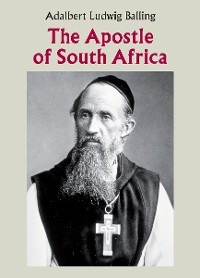
Kitabı oku: «The Apostle of South Africa»
Adalbert Ludwig Balling
THE APOSTLE
OF SOUTH AFRICA
or
God writes straight also with crooked lines
Francis Wendelin Pfanner An open-minded monk (1825–1909)
A Biographical Mosaic Portrait Of an “Adventurer in a Cowl” and an “Obedient Rebel”
Translation from the German original
ENGELSDORFER VERLAG LEIPZIG

“Der Apostel Südafrikas”
“The Apostle of South Africa”
First published in Germany in 2011
by Missionsverlag Mariannhill in Reimlingen
Bibliographical information by
German National Library:
Publication listed in German National Library
under “German National Biography”.
Detailed bibliographical information obtainable from
http://www.dnb.de.
ISBN 978-3-96008-125-8
Copyright © 2011/2015
by Adalbert Ludwig Balling
All rights reserved
Photographs: CMM-Archive, Rome/Reimlingen
English Edition printed by
Engelsdorfer Verlag Leipzig
Schongauer Straße 25, 04328 Leipzig
www.engelsdorfer-verlag.de
1st digital edition: Zeilenwert GmbH 2016
Content
Cover
Title
Map
Copyright
God’s Drummer
I. Langen-Hub near Bregenz
II. Parish Priest. Confessor to Sisters and Convicts
III. Pilgrimage to the Holy Land
IV. Mariawald Monastery
V. The Cross and the Crescent
VI. Daily Cares. Soliciting Vocations and Support
VII. Building Projects Completed
VIII. A Promotional Campaign with a Difference
IX. Opposition from all Sides
X. Years of Struggle
XI. The Eve of an Unknown Future
XII. If No One Goes, I Will
XIII. Setting Out to New Shores
XIV. In the Semi-Desert of Dunbrody
XV. Traveler Between Two Worlds
XVI. Preparing for the Great Trek
XVII. The Ricards vs. Pfanner Lawsuit
XVIII. Mariannhill flourishes
XIX. Mariannhill – Proto-Abbey in South Africa
XX. Mariannhill Pushes Boundaries
XXI. Monks or Missionaries?
XXII. Of Marriage, Schools and various Troubles
XXIII. Missionary Vigour
XXIV. The Monastery grows and grows
XXV. A Jubilee at Mariannhill. A General Chapter in Rome.
A Promotional Tour in Europa
XXVI. Strunk and Pfanner Clash
XXVII. Abbot emer. Francis does not Give Up
XXVIII. Emaus – United in Prayer
XXIX. Monk, Missionary and Hermit
XXX. New Abbot – New Rules
XXXI. The Founder’s Magical Repertoire: Old Ideas and New Propositions
XXXII. God’s Kingdom has no Boundaries
XXXIII. Friendly Letters from the Cape of Good Hope
XXXIV. Varia et Curiosa under the African Sky
XXXV. What is the Future? What the Solution?
XXXVI. The 81-year-old Abbot rallies
XXXVII. Trials and Sufferings
XXXVIII. In Franz Pfanner’s Footsteps
XXXIX. Epilogue & After Words
THE ABBOTS OF MARIANNHILL
Mariannhill Biographies
Footnotes
“Abbot Francis Pfanner died a saintly death.
He was a self-sacrificing monk, a missionary on fire to save souls and a successful organizer.
His only fault was to have believed that the Trappist contemplative life could be combined with the active life of a missionary.
He will go down in history as one of the most outstanding men in a long line of missionary heroes.
The Almighty chose to give him a heavy cross;
carrying it with fortitude, he became a saint.” 1
God’s Drummer
A Man of the Hour – Apostle of the Zulus
“Live with your century, but do not be its creature!” was Friedrich Schiller‘s advice to his contemporaries. For Francis Wendelin Pfanner, an Austrian from the north-western part of Vorarlberg, the need to obey God was not in question. Neither did he doubt the value of qualities like commitment, valour or boldness. These enabled him to accomplish the goal he had set for himself: to advance the Kingdom of God in all circumstances and in the face of any resistance. He constantly asked himself: Is what I am trying to achieve God’s will, or am I simply seeking my own ego? Is it beneficial to others or are my wishes and expectations dictated by self-glory and the quest for approval?
In Wendelin Francis’ case, nothing at all and certainly not undue solicitude for his health and life, was allowed to stand between him and God. It will be seen that the “Apostle of the Zulus” was a non-conformist. No matter what his undertakings, his charism invariably made a powerful impression. He drew crowds of listeners and admirers wherever he went – to Tyrol, Carinthia, Vienna, Linz, Bavaria, Eastern Prussia, Silesia, Saxony, Croatia, Bosnia-Herzegovina, Natal or other parts of South Africa. The vigour with which he “beat the drum for the missions” was unique. Wherever he appeared in public, people felt challenged. His enthusiasm was infectious; he swept his listeners off their feet. They realized that here was one who fought God’s battles, though his higher superiors or one or other church prelate might want to stop him. He was a man of the hour, a man of his times. Towards the end of his life he chafed under the cross God gave him. But when at the age of almost eighty-four he died, many contemporaries considered him a saint.
More than a hundred years after his death, we ask: What was so special about Wendelin Francis Pfanner? Why all the fuss about a contemplative monk, a Trappist whose rule “condemned him to lifelong silence”? Some answers come spontaneously: The monk and missionary Francis Wendelin put heart and soul into both his vocations; not only did he honour the Benedictine motto ora et labora (pray and work), but he also recognized the power of the press as an effective instrument for carrying on the work of evangelization and promoting religious and missionary vocations. Last but not least, he was known for his fervent devotion to the Sacred Heart, Christ’s Precious Blood and the Blessed Mother.
Abbot Francis Pfanner is righty credited with spearheading the evangelization of the Zulus. Therefore, he deserves to be called the Apostle of South Africa. He was an energetic advocate of the dignity of every man, woman and child, a champion of racial equality and a resounding voice calling for the Church to become socially engaged. He was the first to send African boys to Rome to study for the priesthood. But he was also, especially in his last years, a loyal monk, resigned to the Will of God and ready to accept and bear suffering, pain and sickness for God’s sake. This attitude of generous surrender made him a role model for many.
Why, we may ask today, was there so much reluctance to introduce a process of beatification for him? Was it because we expected him to be perfect before he died? Or was it because a process could be troublesome, or we, his sons and daughters, did not wish to be challenged by his saintliness?
The truth is that while a saint is still in-the-making, as it were, he/she is neither complete nor perfect. Candidates for sainthood are peoplein-progress like we are, pilgrims in via – on the way. Sinners who endeavor to be good, they know their own weakness and are humble about it. They fail but they also get up and try again. They surrender to God’s will and trust in the Holy Spirit’s guidance. Ultimately, God uses them to prove that He is quite capable of writing straight with the crooked lines of their lives, any life.
Dear Reader
It is not possible to sketch the life of Francis Wendelin Pfanner in several volumes, leave alone, in one. Neither can a sketch be produced with a few strokes of the pen. But it is possible, with the help of many strokes, many details, to compose a biographical mosaic – colourful, interesting and informative. This has been my aim in writing this book.
What you hold in hand is not a biography in the strict sense of the word. Why? Because this time I wish to approach the life and work of Abbot Francis Pfanner in a way that differs from my earlier approaches.
The life of “The Apostle of South Africa” may be compared to a colourful tapestry or a checkered quilt, which at times you may find probing and challenging. I hope that thread by thread and patch by patch, a portrait emerges which reflects the true identity and spirit of the extraordinary man Wendelin Francis Pfanner.
My almost exclusive source is a documentary work in four volumes of approximately a thousand pages each. It was compiled by Rev. Timotheus Kempf CMM in the 1970’s and 1980’s for private use by the Mariannhill Fathers, Brothers and Sisters. Its purpose was to enable an investigation into the life of the Founder in view of his eventual beatification and canonization.2 I have kept footnotes and other references to a minimum. My aim is to paint Pfanner’s portrait with the help of episodes, parables, essays, maxims and aphorisms in interview-style, here and there adding a short comment or selected testimony by a contemporary, in order to complete the portrait and make it colourful and attractive.
In short, I would like the reader to enjoy this book and personally meet the Founder of Mariannhill. – Note: “An Adventurer in a Cowl”. (5th ed.) is an abridged version of a biography of the Founder, published by Herder.3
I hope that in the end, the reader will agree with me, that the life of Wendelin Francis Pfanner is indeed many-sided and full of surprises. The direction it took seems improbable in parts; yet the story is very straightforward. The Portuguese proverb “God writes straight with crooked lines” applies to it like no other.
I thank you for your interest and wish you and your loved ones God’s blessing and the protection of his Holy Angels.
Adalbert Ludwig Balling
I.
Langen-Hub near Bregenz
A lifelong Love of Home
Vorarlberg is an ancient cultural landscape. It has been settled since times immemorial. The Rhetians came before the Celts. The Romans, too, left their imprint. Bregenz (Brigantium) received its town charter from Emperor Claudius. The Christian religion entered the region on the heels of Roman imperial troops and colonists. Later, much later, with Emperor Constantine’s rise to power and the erection of the diocese of Chur (now Switzerland), Christians felt emboldened to come into the open. Chur was separated from the north Italian archdiocese of Milan and incorporated into the Frankish imperial church. At the beginning of the nineteenth century, Vienna appeared on the map, and Vorarlberg was affiliated by imperial decree, not to Salzburg of greater Austria, but to the Diocese of Brixen in Tyrol.
Vorarlbergers are said to be warm hearted people who love their homeland and the religion of their ancestors, the Catholic religion. At the same time, they are known to be demanding, strict, intransigent and quick to defend themselves when their freedom and rights are contested.
Francis Wendelin Pfanner’s ancestors came from the Alemannic (Swabian) Allgau. He explained the family name “Pfanner” as deriving from “panner”, pan-maker. The family owned a farmstead, Langen-Hub, one of several others on the border with Germany. It was approximately a three-mile walk from the parochial village of Langen and not far from Bregenz, the capital of Vorarlberg.
According to the parish register, Wendelin’s father, Anton Pfanner, was born in 1794 and on 25 October 1822 married the twenty-two-yearold “virtuous maid”, Anna Maria Fink of Weissenhub. They had three sons and two daughters. Johann und his twin-brother Wendelin were born on 20 September 1825 and baptized on the same day at Langen. Godfather to red-haired Wendelin was his paternal uncle, Wendelin Pfanner, then a student of Theology, and his godmother, Magdalena Fink, a maternal aunt. His mother died of childbed fever at the age of twenty-six after giving birth to her fifth child, a girl, who also died!
For six years, the father’s sister Catherine took care of the Pfanner children. Wendelin and his siblings called her “Godle”, dialect for godmother. She was capable and by Abbot Francis’ testimony, a “strict foster mother: industrious, economical, responsible, devout and orderly”. She did not spare the “birch” or rod. Wendelin did not particularly like her cooking, but in his later years he fondly remembered her meatless dishes, usually fry-ups: spaetzle and noodles, fatless cheese and sauerkraut.
The Founder’s Memoirs give a glimpse of the family’s faith life.
“The unwritten law was: No day without morning prayer and no main meal without grace. Grace after the midday meal was followed by a string of prayers: several Our Father’s for a happy death and prayers to St. Martin and St. Wendelin, to guard the house against malice and accident; prayers for parents, relatives and the Holy Souls in Purgatory, and finally the Angelus. After the last grace at supper we all said an Our Father for the Holy Souls, a prayer for a good night, an act of contrition and a few ejaculatory prayers. All prayers were led by my father and joined by the farmhands.”

The house in Langen-Hub, Vorarlberg, where Pfanner was born
At the age of seven, the twins started their primary education in a oneroomed school house in Langen-Hub, where a teacher, who also functioned as organist and sacristan, taught Religion and Arithmetic. German (Grammar) was not a subject, “because people thought that it was enough for peasant children to know how to read and write”.
Wendelin was only eight years old when he had to get up at five every morning to help his parents in the stables, as was the custom in rural areas. The Pfanner children also had to give a hand with cutting and sawing logs, cultivating the soil, making hey, binding sheaves, harvesting potatoes, and erecting fences.
On Low Sunday 1833, the twins were allowed to make their first Holy Communion. They were confirmed on 19 June of the same year, either in the parochial church of Bregenz or at Feldkirch. A year and a half later, on 21 October 1834, Wendelin’s father married again. His second wife was Maria Anna Hoerburger (*1808) from Sulzberg in Bregenzer Wald. She gave birth to three sons and four daughters, of whom three died soon after birth.
One early morning when the sun was just up, Wendel was to drive a two-horse wagonload of sand to the mill. He failed miserably, as the wagon overturned and the sand was spilled. His father, watching him closely, ran up and snarled: “You will never be a farmer! I give you just one more chance: Try your luck in the saw mill! If you fail again, you will study!”
Studying in Feldkirch and Innsbruck
Abbot Francis relates that very early on Michaelmas Day (29 September 1838) his father came into the bedroom which he shared with his twin brother and shouted for him to get up!
“Wendelin! You must go to Feldkirch to study!” – I was awake immediately. On this morning, I put on a new student’s coat instead of my short jacket and exchanged my coarsely sewn and heavily cleated boots with a fine pair of thin leather shoes made for town. Thus duly apparelled, someone completed my outfit by shoving a fire red umbrella under my arm. When my father dipped his fingers into the Holy Water font by the door I did the same, but I remember that I did not know why my stepmother was crying and telling me to be good. – Once we reached the highway, my father pulled out his beads and on this beautiful morning we said a whole Psalter (15 decades) in turns. Later, we boarded a nice horse drawn omnibus which brought us to Feldkirch, City of the Muses … When my father left to return home, the only thing he said to me was: ‘Pray always and study hard’!”
Wendelin was soon known all over Feldkirch on account of his red hair. His record in the 1838/39 school registry is evidence of a good head: “Wendelin Pfanner – Conduct: Excellent; Social Studies, Religious Knowledge, Latin, Geography and History: Very Good; Arithmetic: satisfactory.” Because his first lodging was rather primitive, his godfather, now a parish priest, hired better quarters for him “at the house of two elderly ladies”. He attended daily Mass at the Capuchins’. However, after two and a half years he and a friend took up quarters with a lady and her two daughters who also boarded other students. With them he undertook hikes and weekend excursions. One evening, he found the front door at his landlady’s already locked. How could he get to his room without waking her? He quickly found a way: Making a desperate attempt to climb the leaning wall at the back of the house, he reached the open window of his room, jumped in and landed with not too much of a thud on the floor – only to find the landlady already standing in the door, shaking her head at him and saying but one word: “So, that’s how it’s done, eh?” He wished the floor had opened under his feet. Unable to utter a single word, he vowed to himself never to get into any more misconduct.
Later, a school friend remembered: “Wendelin and I had a room at Rev. Professor Wegeler’s. But after seeing under what circumstances the snuffing lady cook in the kitchen prepared our favourite dishes, we decided to leave the place as soon as the year was over.”
Wendelin spent his vacations at home, giving a hand with the work in the farm, woods, fields and sawmill. It was good exercise for him and a lot of fun besides teaching him many useful skills, as he gratefully remembered in later years.
At the end of September 1844, he and some of his classmates transferred to the Gymnasium in Innsbruck, the capital of Tyrol. The way there led across the Bavarian Allgau by way of Staufen, Immenstadt and Sonthofen (“Where my father bought our excellent Allgau bulls”) to Reutte in the Lech Valley. It was a journey which the Founder vividly remembered in 1901, when he was seventy-six years old:
“All my travels from Bregenz to Innsbruck and back were across mountains and hunchbacked hills … I remember that once on a late afternoon we got caught in a dense fog and suddenly found ourselves on the edge of a cliff over which a swift brook cascaded downward. The fog had lifted just enough for us to see the horrible depth to which this brook plunged. To add to our predicament, we had a classmate with us who was shortsighted and terribly frightened. Seeing the poor fellow quaking in his boots, I said to him: ‘If you care to entrust yourself to me, I will carry you down!’ He agreed, though very reluctantly. Quickly therefore, before he could change his mind, I swung him like a sheaf under my left arm and dragged him down – like a cat, her kittens – while with my right hand I groped down the sharp rocks. He closed his eyes, screamed and prayed but, thank God, did not resist. We made it down! Laying him on the grass, I ordered him to open his eyes and stand on his feet.”
Philosophical Studies in Innsbruck and Padua
In Innsbruck, Wendelin had excellent professors, all Jesuits. He studied Philosophy and graduated with honours. His final certificate, issued 31 July 1845, confirmed his “great diligence” in all subjects except Latin Philology, in which he managed a mere “diligent”. In Innsbruck he attended the daily Eucharist at the Chapel Royal “in the presence (portraits) of Emperor Maximilian and his iron clad ancestors”. Not long after he returned from his vacation for third-semester Philosophy, three of his classmates came to say good-bye. They were on their way to Padua to complete the semester at that famous university. Wendelin was much enticed but lacked the necessary funds to join them. Well, they said: “Volenti nil difficile! (Nothing is difficult for the determined.). They were right! In no time he found a family friend who was working in Innsbruck to lend him traveling fare and a little more. He instructed him to send the bill to his father and gave him a handwritten note to enclose with it saying that he, Wendelin, had gone to Padua for further studies.
That problem solved, he turned his face to the south – anxious with expectation. At the crack of dawn the following day the adventurers were gone, but not before Wendelin had left three guilders for his landlady and a farewell note: “Adieu! Here is my rent for the month; I am off to Italy!” Neither he nor his companions had visited Italy before, but they were willing to take a risk. Entrusting their luggage to a carrier, they hiked across the Brenner as far as Brixen and from there made their way to Italy by pay coach.
It was customary for Padua students to wear top hats, black tailcoats and, in that year, 1846, a “Pio-Nono-Beard”. 4Class conscious dandies strutted about the city in polished boots and, a Havana between their teeth, swung their “stylish swaggering canes”. The casual Mediterranean rhythm determined the life of the signori. “Most days the professors lectured to half empty benches … All we did in Philology was to translate ten pages of a Latin author into Italian.” Sometimes the “northern lights” from Vorarlberg were the only students attending demonstration classes in the theatre. They changed quarters several times and for different reasons, but in one place it was the landlady who complained that their hobnailed boots scratched up the marble floor of her pensione. Things were not exactly as they had expected; yet Padua did have its redeeming grace.
Abbot Francis:
“Though I came to Padua undecided about my career, I knew after one month that I would be a priest. As I observed the behaviour of the Italian students and got to know firsthand how depraved many of them were, no other but the celibate life held any more attraction for me. From that moment my eyes were set on Brixen, my bishop’s residence and the place of the diocesan seminary of Tyrol.”5
Padua had nothing further to offer to the Vorarlbergers. Though derided as “barbarians!” and “potato eaters!” their final certificates were the best the professors issued that year. They departed as quickly as possible, taking the train to Verona and continuing by coach to Lake Garda and Milan via Pavia. The last leg was done again by train as far as Lake Como. From there they went on foot across the Spluegen Pass and by mail coach past Liechtenstein to Feldkirch. At Langen-Hub, father and siblings were just bringing in the hay when Wendelin walked in the door. Happy to be home again, he willingly gave a hand. In fact, he spent his entire vacation, not with books, but with rake and pitchfork!
At the Brixen Seminary
The first year in Brixen, 1846 – 47, was a so-called “free year” with candidates attending lectures at the seminary but boarding on their own. Wendelin took his studies more seriously now. At the end of the first year he scored a “very good” in Church History under Professor Fessler and in Oriental Languages – Arabic, Syrian, Chaldean – under Professor Gasser, besides getting good passes in Biblical Archeology and Hebrew.
As soon as the students transferred to the seminary they received the clerical tonsure and the “short clerical cassock with tie”. Life now consisted of studies and offered very few diversions. Although there was a bowling alley and a beautiful garden to stroll around in, these pastimes did not provide enough exercise for one who had grown up on a farm in Vorarlberg. The view from his attic window was gorgeous but the mountains he could see were “out of bounds”. Too little exercise, cramped living space and a diet that was “far too greasy and devoid of fiber and vegetables” undermined his health. How could he remain fit? Wendelin took every opportunity to flex his muscles.
Abbot Francis:
“I remember that once during our common recreation my fellow seminarians wished to give themselves additional exercise by freehandedly standing up a tall pole with a handkerchief tied to its top. They could not do it. The few who tried fell on their faces, pole and all. But when they saw me coming they shouted: ‘Here comes Pfanner! He can do it! Just watch him!’ I needed no coaxing but simply picked up the pole, tied my cassock to it and with one jerk: ‘heave-ho!’ stood it up straight, while not moving an inch from my foothold … I venture to say that if there had been prizes for such feats, I would have fetched the first prize every time.”

Later, the Founder remarked that it was the unbalanced diet more than anything else that undermined his health. He came down with a heavy nosebleed and was diagnosed with pneumonia and an inflammation of the brain. Losing consciousness several times, he became so weak that the doctor sent him home to pick up new strength.
The following year, 1848/49, was rather quiet and uneventful. Or was it?
Abbot Francis:
“The only thing I vividly remember about my last year [before ordination] was that I suddenly felt a powerful urge to go to the missions. I also know what triggered it. It was the verse in the Miserere: Docebo iniquos vias tuas et impii ad te convertentur: ‘I will show your ways to the godless and sinners will return to you’. (Psalm 50 : 15), which we prayed every week. It haunted me until I confided the matter to my spiritual director and confessor. He submitted ‘my case’ for decision to the prince bishop. Before long, His Excellency ruled: ‘Oh, that Pfanner lad! He is not strong enough to go to America. He better stay at home.’ – In those days, at the mention of ‘mission’ and ‘unbelievers’ people understood America and nothing but America.”
The bishop had spoken and Wendelin stopped dreaming about the missions. Or did he? For the time being his mind turned to other pursuits. After successfully passing his finals he went on what he called “a pilgrimage to ‘Holy Cologne’.” – In the late middle ages, Cologne had been the most frequented place of pilgrimage after Jerusalem, Rome and Santiago de Compostella. Wendelin had collected enough money for the trip by saving his meagre allowance and cutting his fellow students’ hair. He deliberately denied himself “simple pleasures” for the greater pleasure of seeing a bit of the world and “travelling intelligently”, i. e., learning by seeing rather than reading.
His trip fell in the late summer of 1849. Setting out from Munich, he went via Augsburg, Nuernberg, Bamberg and Wuerzburg to Frankfurt/Main and from there via Coblenz and Bonn to Cologne. He kept his money – all in twenty-ducat coins – safely sewn in his red leather belt and carried his underwear in a backpack. The currency differed from one county or canton to another and so did the food. If, for example, he asked for a bun, he was “served a bun with butter”, although he would have preferred it dry as at home. But such was the custom. When in Rome, do as the Romans do.
The one thing he wished to see before anything else was the cathedral of Cologne with its two grand spires just then under construction. It was in Cologne where he, as president of the “Cologne Cathedral Building Society of Brixen”, delivered the contributions of his fellow seminarians. Then he took a closer look at the magnificent gothic structure.
Abbot Francis:
“I could not see enough of it! If only I could have taken the magnificent edifice with me!6 Construction had been interrupted for many years because the master plan had been misplaced, only to be found again much later in an attic in Darmstadt. I would have also visited Aachen and Brussels, if it had not been for a nasty footsore I had developed when climbing in the Tyrol Alps. Because of this sore I had to discard my boots and buy a pair of soft open shoes, the kind worn by ladies … Leaving Cologne, I travelled up the Rhine via Darmstadt and Worms to Speyer and from there to Heidelberg, Mannheim and Karlsruhe. I was lucky to be able to use one of the new railway lines as far as Freiburg.”
His next longer stop was Strassburg, and only after he had marvelled at all the wonderful sights that famous city offered did he continue his journey to Basel and from there via Lake Lucerne to Switzerland. Though he did not climb the Rigi – “because it was shrouded in mist” – he did visit Flueli7 and Einsiedeln Abbey, where he paid his respects to Our Lady, whom he asked “to help me become a good priest”. On he went on foot to the “delightful Lake Zurich” and from there to Schaffhausen to see “the Rhine Falls”. Passing Constance and Bregenz he arrived home just in time to help with the hay. “Pleased to see you after so many days,” his father welcomed him drily. “We have had nothing but rain so far. Much hey and grass is flat … You will have lots to share I should think but the stories must wait until Sunday!”
Once the harvest was in the barn, Wendelin had a few free days before he returned to Brixen for his final year of Theology. He had excellent professors: Fessler became Bishop of St. Poelten, Gasser, Prince Bishop of Brixen, while two others represented Austria at the Diet of Frankfurt (1848). At the Synod of Wuerzburg (also in 1848), his much esteemed teacher, the historian Dr. Gasser, was called the “living lexicon of Church History”.
Ordination and first Holy Mass
Wendelin was ordained sub-deacon on 14 July 1850, deacon, on 21 July, and priest, on 28 July – all by Prince Bishop Bernhard Galura, in the chapel of the Brixen seminary. Ten of the fifty seminarians ordained that years hailed from Vorarlberg! Soon after becoming a priest Wendelin traveled by horse carriage across the Brenner to Innsbruck and from there by postal coach via Reutte on the Bavarian border to Hindelang, where his father and the assistant priest of Langen waited to meet him. His first Mass was scheduled for 12 August at his home parish in Langen.
Abbot Francis:
“Very many of my relatives who lived scattered in different villages in the Bavarian Allgau came to Langen to welcome and congratulate their priest cousin, who was about to say his first Holy Mass. People in the Allgau consider a first Mass a particularly joyful event. The first thing these cousins and aunts of mine did was to kneel down to receive my blessing. People formed not just a procession but a triumphal parade, starting from the last village on Bavarian soil. Amid the crackling of small cannon and canopied by green triumphal arches I entered our homestead, people pressing in on me from all sides to wish me well. My mother stood with unconcealed pride in the doorway, ready to welcome me. She and my father knelt to receive my blessing, as also did my twin brother whom I had so often thrown into the grass during our boyish games in younger years. … My first Mass was a rare occasion for Langen, because the last such Mass had taken place fully twenty-five years earlier, when my priest uncle Wendelin had stood for the first time at the same altar as I. Now he and I celebrated together, he preaching the sermon.”
Before we follow the newly ordained priest to his first assignment, it may be well to pause for a brief review. It is based on the reminiscences which Fessler from Bregrenz, one of Wendelin’s classmates shared in 1888 on the occasion of their 25th anniversary of ordination. Fessler wrote:
“Pfanner was always serious about his studies. He excelled in Maths. I would like to illustrate his simplicity and self-control by referring to something he once said to us when we criticized a certain dish: ‘What does it matter how it is prepared as long as it is edible? Eat what is set before you!’ – While we were at the seminary, he was several times asked to mediate between rivalling friends and classmates. We came to appreciate his astute, practical mind, his clear vision and exquisite tact whenever he dealt with a sensitive issue.”
The editor of an 1888 commemorative brochure in honour of Abbot Francis expressed similar sentiments. According to him, the abbot was even as a youth known “to be diligent, industrious, solidly grounded in faith and morals, above board in every respect, opposed to evil in any shape and form, and fearless in expressing an opinion when it was called for. A good speaker and excellent mediator, he knew no regard for persons when he brought warring parties to terms. His faith was not shaken; neither did he change his mind once it was made up. Not given to making big or many words, he did study the theory of a proposition before he tabled it.”
II.
Parish Priest. Confessor to Sisters and Convicts
Pastoral Ministry in Vorarlberg, Confessor in Croatia
Four weeks after celebrating his first Mass, the new priest Wendelin Pfanner entered the pastoral ministry in Haselstauden near Dornbirn, Vorarlberg. Not used to speaking in public, he was shocked to hear his voice when he spoke from the pulpit for the first time, because “I had never before heard my voice echo back to me”. He remembered the advice of his professor in Pastoral Theology: “If you get stuck, pull all the stops! Take a quick look at your notes and continue!” Wendelin did not need it. Though the pulpit was new to him, he decided to speak freely from the beginning. But he carefully drafted every sermon. Unfortunately, he destroyed his notes as he did most other private papers.
Wendelin’s father considered it an honour to see his son off by “taking a good load of furniture, bed linen and clothes” to Haselstauden, while the young priest, in the company of two clerics from the neighbourhood, followed by coach. Haselstauden, however, wrapped itself in silence. Pfanner was not welcomed by the municipal administrator nor was a single villager on hand to help offload his “dowry”. Strange people, his father thought, shook his head and returned home on the spot.
The rectory seemed to have neither a kitchen nor a cook. The young priest did not see anyone until the following morning when, entering the church to say Mass, a grumbling old sacristan showed him round. But when he stood at the altar he was surprised that “the center aisle was filled with people. It was clear to me that they had not come so much to welcome me as to see who ‘the new one’ was.” How guarded, sceptical and suspicious these Haselstaudeners were! He wondered if he would ever be able to break down the wall behind which they were hiding. He did when typhoid broke out the following spring. It was a onetime opportunity to get to know them, and he seized it straight.

Wendelin Pfanner shortly after his Ordination to the Priesthood
Abbot Francis:
“I visited every affected family. People needed me because hardly anyone dared to go near them for fear of infection. They even told me how much they appreciated the visits of ‘the young gentleman’, as they called me. Their attitude towards me changed overnight. The church began to fill up, not now from curiosity but from a genuine desire to hear what I had to say.”
Biding his time and arming himself with much patience, young Fr. Pfanner won most of his parishioners back to the Church. He listened to them and learned to speak in a way they could understand. He instructed their children in the Faith, heard Confession and sought out the lapsed and critical. Occasionally, he read Leviticus to people who did not keep the Sunday holy, as for example, the innkeeper who when it was time for Sunday Mass sent his hired hands to work in the farm. He also persuaded two wealthy factory owners, both native Haselstaudeners, to donate stain glass windows for the parish church, Our Lady of the Visitation, which he wished to embellish. Their generosity bordered on a miracle. When twenty years later, as abbot of Mariannhill, he visited them, one remarked: “It would have been better if you had not become a Trappist. Why did you have to go so far away, first to these godforsaken Bosnians and then to the Hottentots in Africa? Haven’t we got Hottentots enough to convert?!” Nevertheless, he gave him a generous donation for the “black Hottentots”.
As for the “pagans of Haselstauden”, the young priest did all he could to strengthen their faith. For example, he invited excellent Redemptorist or Jesuit speakers to hold a parish mission. They did so with much success, the said factory owners allowing their employees to attend even on working days.
Whey Cures in Switzerland. Farewell to Haselstauden
Wendelin’s health deteriorated during his very first year in the ministry. This, though, was not the result of lack of care, because his sister Kreszentia, who had decided to stay single, was his housekeeper and looked very well after him. He developed a lung condition (TB?) and his doctor suggested that he drink whey at Gais in Canton Appenzell, Switzerland. The weeks he spent there were restful and relaxing but they did not bring about the desired cure. Abbot Francis: “The peaceful atmosphere and carefree time, the healthy air and diet probably helped me more than the whey.” As long as he had to preach, teach and hear Confessions there was little hope of recovery, leave alone a long life. So he decided to buy a burial site for himself and his sister just beside the Haselstauden church. For the rest, he served without sparing himself. In Anton Jochum, pastor of a neighbouring parish, he had a best friend and adviser. “When I was not sure about something, I consulted him and he always put me at ease, so that I saw my way again. I also gained a lot by listening to him explaining the Catechism and preaching. An excellent man, he had only one fault: he snuffed and that even during Mass! I drew his attention to it ever so cautiously but he just shrugged it off: “Alright, alright. Young men have fine manners! But you are right. Trouble is that I am too old to change.”
Though Fr. Pfanner was burdened with parochial duties he continued to mingle with people, his own family included. They could count on him. His father passed away in September 1856, but his stepmother lived for another twenty-four years. Her oldest son, Franz Xavier, married into a family at Gruenenbach in Bavaria, where as a young man he fell to his death from the threshing floor. When Wendelin’s twin brother Johann married outside the village, the Langen-Hub farmstead switched hands. Johann raised ten children. Nine were baptized by their priest uncle; the oldest was kicked by a horse and died in 1905.
In 1859, the vicar general of Vorarlberg sent Fr. Pfanner to Agram (Zagreb) in Croatia as confessor to a community of Mercy Sisters. Because these had originally come from Southern Tyrol, they were German speaking and needed a German-speaking priest. So Fr. Pfanner left Austria but not before inviting his unsuspecting parishioners to an auction sale of the cacti he had raised. They were a rare spectacle and for him a hobby the doctor had recommended as a pastime for the long winter months. He had a green thumb and in no time transformed the rectory into a sea of blossoms.
Abbot Francis:
“How little did I dream then that one day I would live in a land where the most luxurious cacti grow wild like the nettles in Europe! I had collected some thirty species and by grafting them one on another top of another I produced spectacular forms: balls, snakes, rocks and exotic shapes. I also had the exquisite Eriesy. From books I read I knew that it produced an enchantingly beautiful blossom. So when I found a bud on my specimen I was beside myself with excitement. Why, I even postponed a trip to Munich just to see it open!”
Fr. Pfanner traveled to Agram by train, via Landshut, Linz (where he visited his former professor Franz Joseph Rudigier, now bishop) and Vienna.
Confessor to Nuns and Convicts
We may wonder why he was given an appointment for which we feel he was not cut out. The explanation may be found in Brixen. There, his vicar general had consulted the seminary staff and been told by the rector of the Redemptorists, who knew Fr. Pfanner from parish missions, that he was not only a fine pastor but also an excellent confessor. Or was there another reason?
Abbot Francis:
“It was known to everyone in Brixen that I was a tough fellow and that sometimes people, including nuns, needed a firm hand. Whichever, I ended up in Agram …. As was my habit I said Mass quickly. Therefore the young priests at the convent and perhaps also the one or other Sister did not pin too much hope on the new confessor. They said: ‘Short suit (cassock worn in Vorarlberg), short Mass’ … There were three other priests in residence: the superior, four years my senior and like myself from the Brixen Diocese, a young preacher and a still younger teacher, both Croatians and lecturers at the seminary. We took meals together but otherwise had each our separate apartment. The Sisters cared for me in every regard and paid me a handsome salary besides.”
Fr. Pfanner’s main responsibility in Agram was to hear the Confessions of the Sisters, preach a German homily every Sunday and teach Religion at the convent school. When one day the chimney caught fire on top of the priests’ house, it was the Vorarlberger, practical and fearless as ever, who climbed the roof and from a window in the attic directed the water supply to the top. It was his day! The Sisters admired him for his courage and skill and changed their attitude towards him.
In the Croatia of the early eighteen-sixties (1860/1861), as in many other European countries, the desire for national identity and unity was not to be suppressed any longer. The urban elite, consisting mainly of professors and students, shouted the much-heard slogans clamouring for “national consciousness” and civil liberties.
Abbot Francis:
“Vienna had tried far too long to Germanize the Croatians; now they turned the tables on the Empire. Their aversion to ‘Swabians’. (Germans) was so great that in their coffee houses they used the then fashionable German top hats as spittoon bowls.”
Although Fr. Pfanner and his Austrian fellow priest were allowed to stay and the latter kept a very low profile, Wendelin continued undaunted to hear Confession at the various institutes run by the Sisters and four times a year also at the high security prison of Lepoclava.
A Pilgrim-Tourist in Rome
Early in 1862, Confessor Pfanner read the announcement that the first forty-two Japanese Martyrs were to be beatified in Rome. It was a rare and exciting opportunity to see the Eternal City! In no time he was ready to go. He spent eighteen days in Italy. His first visits were to the ancient shrines. By sheer luck he also caught a close glimpse of Pope Pius IX, an episode he later recounted together with other adventures.
Abbot Francis:
“I left the house before dawn and did not return before ten in the evening. Determined to waste no time, I took something to eat at a roadside coffee house or trattoria, whichever was more convenient and not at the pensione. In this way I was able to explore all four quarters of the City according to a plan I drew up. But very soon I got around without it. Despite the Roman heat I tramped to the Seven Major Churches in and outside the City in one day!”
Once when he came near the entrance of the Sistine Chapel he chanced upon a group of ladies and gentlemen assembled there, all elegantly dressed in black. Inquiring what was going on, he was told that the pope was celebrating an anniversary Mass for his predecessor, Gregory XVI. Entry was strictly by ticket. Too bad! But there must be a way of getting around the ticket, even though he only wore a short soutane instead of the long cassock customary in Rome. He tried:
“I walked over to one of the two young Swiss Guards, smiled and said: ‘Nu, an Landsma weret ihr do inne lo?‘. (You surely allow a countryman to enter, don’t you?) Though trained to keep their face straight, these guardians of the law in their stiff halberds could not supress a smile. Before I knew, one lifted the curtain just enough to call to the captain inside: ‘A Landsma!’(a countryman). The captain understood at once, batted his eyelashes and motioned to me to come forward. I was not asked twice but made my way into the Chapel. Once inside, I walked with all the self-assurance I could muster among the elite of the Roman clergy and aristocracy, all in top array, standing there at attention. And because the clergy was stationed in front of the laity, I ended up right behind the cardinals. These knelt in a semicircle around the altar, the pope himself kneeling by himself on a raised platform. Not for a mint of money would I have changed places with anyone! I was privileged not only to see the Sistina, but also to listen to Gregorian chant, the authentic Roman chant! … You see, even a blind hen sometimes finds a grain of corn! I thanked God that my mother did not speak standard German with us, or else I would not have got in there.”
Always a pastor and a witty one at that, Abbot Francis adds a practical application:
“So also will it be at ‘heaven’s door’ when the end of the world is upon us. Whoever does not have the right ticket will not get in, unless perchance he speaks a known language or happens to be a countryman of Saint Peter!”
Still in Rome, a chance cropped up to see a little more of Italy. A group of tourists were about to set off on horseback to Mount Vesuvius. Anyone was welcome to join. As usual, Wendelin’s mind was made up immediately. Leaving Naples, it was he who led the group up the mountain. What was Vesuvius compared with Vorarlberg’s summits? He was the first one on top and, reckless as usual, stood so dangerously close to the crater’s mouth, that the others shouted to him to be careful. The edge was crumbly and the crater had spat fire only six months earlier!
Back in Agram, Fr. Pfanner reviewed his Italian experience. He had spent much time at the tombs of the Apostles, pondering what he should do with the rest of his life. His health was not good and the atmosphere in Croatia, hostile. Perhaps he should enter a monastery and spend the few years remaining to him in prayer and penance to prepare for death? The thought stuck. Soon it was only a question of which Order to choose, the Franciscans or Jesuits.
While he was still undecided, two men in brown garb came to the convent door. They were Belgian Trappists begging for alms for their monastery. This was towards the end of 1862. Fr. Pfanner’s curiosity was roused by the strange apparel of the monks and until late that evening he questioned them about their Order and lifestyle. “Trappist” – the very name mesmerized him. Then and there he decided: “I will rather die from penance [as a Trappist] than from studies [as a Jesuit]!” That very night he wrote two letters, one to his bishop to dispense him from the diocesan ministry; the other, to Mariawald in Prussia, the only Germanspeaking Trappist monastery, to apply for admission. The Prior replied by return post: “Come!” Our would-be candidate was happy but wondered if he had included enough information. So he wrote again, this time also mentioning his two hernias and his voice which might not be an asset to the choir. Abbot Francis: “The second reply took a little longer and was perhaps also a little more reluctant than the first.”
III.
Pilgrimage to the Holy Land
Sightseeing in Egypt. Farewell Letters to Friends
Fr. Pfanner was still waiting for a reply from Brixen. The bishop was a former seminary professor of his and took his time, since he knew him well.
Meanwhile, the Severin Association of Vienna was looking for a priest to lead a group of pilgrims on a tour of the Holy Land. The advertisement was a heaven-sent for Fr. Pfanner. He immediately applied and being just as promptly accepted, began to make preparations. First he ordered a proper saddle from the workshops of Lepoclava, because Arab saddles, as he was told by travelers to the Near East, were sheer torture for Europeans. To the Sisters, however, he did not breathe a word about his plan to become a Trappist. They thought that he wanted to improve his knowledge of Scripture by going to the land of Scripture. But to his bishop to whom he wrote a second time he did confide that he wished to see the Lord’s homeland before burying himself in a Trappist monastery.
The group he was to guide met at Trieste. There he was given his official appointment and all the faculties he needed as president. Apparently, the organizers had been told that he spoke Italian and a little Arabic. Above all, they seemed to have known that he was not a coward. The group was mixed and manageable. It included three priests. One of them, a teacher of Religion at a gymnasium in Bohemia, he appointed treasurer. Then there was a rural pastor in his seventies, also from Bohemia, and an assistant priest from the Diocese of Regensburg. A young probationary judge from Wuerzburg was made secretary. But a Hungarian pensioner proved such a pain in the neck that “we would have been better off without him”. No one in the group had ever been outside his home or traveled. They boarded a steamer destined for the southeastern ports. As soon as it put to sea president Pfanner, like most other passengers, became seasick. “Only my secretary was spared the scourge!” They traveled via Corfu to Rhodes and Cyprus and from there to Lebanon.

Wendelin Pfanner (Confessor to Sisters at Agram, Croatia) as pilgrim’s guide to the Holy Land
In Beirut, he bought a riding crop to keep away “the crooks and rogues” who lay in wait at every city gate to pillage and plunder unsuspecting pilgrims, not simply demanding but extorting bakshish. He did not hesitate to lash out at them, commenting that “nobody would have suspected this whip swinging commander to be a kid-glove confessor to Sisters.” The group considered itself fortunate to have him.
Haifa was the first port of call in the Holy Land where they were allowed to go ashore. They climbed Mount Carmel and afterwards sailed to Jaffa (Joppa, Tel Aviv-Jafo) and there disembarked for good. It was a one of a kind experience: Arab porters stood ready to carry them like sheaves through the churning sea, after which they set them down on the beach. Once ashore, they were on “holy ground”. They knelt to kiss it.
The seasickness was gone as if it had never existed. So the tour of the Holy Land could begin.
After his return to Agram, Fr. Pfanner described his experiences in a letter to his mother and siblings, dated 4 June 1863:
“As president of the pilgrimage, I wasted precious time on official errands and visits besides acting as interpreter for my group. During Holy Week, I celebrated Mass in the very place where Jesus was nailed to the cross. I was so moved that for a moment I could not continue with the Prayers at the Foot of the Altar. On Holy Thursday, I had the honour of being one of twelve pilgrims who had their feet washed by the Patriarch of Jerusalem. Yes, this prelate of supreme rank washed, dried and kissed my feet! He also gave everyone a small cross, carved from the wood of the olive trees which still grow in the Garden of Gethsemane where Jesus suffered his agony before he died. On Good Friday, we visited the Via Dolorosa in Jerusalem. We kissed each Station but otherwise felt most unworthy to be without a cross in a place where Jesus carried such a heavy cross! The following night, in the Church of the Holy Sepulcher, we listened to the seven sermons traditionally preached there in seven languages: Italian, New Greek, Polish, French, German, Arabic and Spanish. At five o’clock on Easter morning I was allowed to say Mass in another special place: the very tomb in which Jesus was buried … It was a rare opportunity which not even a high ranking Franciscan enjoys who perhaps spends his entire life in Jerusalem, because priority is always given to visiting personalities.”
When the Easter celebrations were over the group rode to Bethany where Lazarus had been buried and raised to life. Then they continued to the place in the desert where Jesus had fasted for forty days. From there they proceeded to Jericho and the Jordan River. They pitched their tent on the bank and went into the water to fill their bottles. Afterwards they followed the Jordan to the Dead Sea and climbed the hill country to see the Church of the Manger and the Shepherds’ fields at Bethlehem. At Hebron, which they visited next, they remembered Abraham, and at St. John-in-the-Mountain, the Holy Baptist.
So far their journey had been without incident, but on this last leg the president’s horse stumbled. But for the fraction of an inch he would have plunged into a ravine. In another instance the horse did throw him in full gallop, but both times he and the horse got away with a bruise and a shock.
After a brief sojourn in Jerusalem, the president led his group to Sichem to see Jacob’s Well, then up Mount Gerizim and on to Nazareth. Later they climbed Mount Tabor from where they descended to the Sea of Galilee, in order to continue along a road leading to the Hill of the Beatitudes and the plain where Jesus multiplied the loaves. Via Cana in Galilee, renowned for the Lord’s first miracle, they returned to the sea. There they made a cash check.
Abbot Francis:
“Before we left Palestine, we distributed the remaining money. Everyone got back 93 guilders. Latest now they realized that their president had managed the tour to their benefit. They had saved money though they saw more than most other pilgrims … Now everyone was free to choose his own way home, make his own plans and manage his own funds.”
Fr. Pfanner decided to return via Egypt. Would anyone like to come along? Most did and promptly re-elected him leader.
In the Land of the Pharaohs
Embarking at Haifa, they were told that the crossing to Alexandria would take twenty-eight hours. They braced themselves. But then the sea changed; it became so rough and the going so slow that it took them more than twice the length of time: sixty-eight hours! A nightmare for the leader!
Abbot Francis:
“Sailing was torture. I was so seasick that I vowed to myself a hundred times over never again to set foot on a boat. I must laugh as I write this. What good are man’s plans if God makes his own? The proverb that man proposes and God disposes couldn’t be more accurate.”
Yes, God has his own plans. As in Pfanner’s case, so he writes straight also with the crooked lines of our own lives. In Alexandria, Fr. Pfanner stood for the first time on African soil. Little did he dream that this was his introduction to a continent where, further in the south, he would labour for twenty-seven years to establish God’s Kingdom!
Cairo was memorable on account of the Pyramids and the Sphinx but also for an unfortunate incident. Shifty porters cut his saddle bag and stole his coat with his journal. Disappointed and angry, he comforted himself with the thought that “as a Trappist I will have no use for either, my coat or my journal”. Leaving the Pyramids, he and his group traveled far “to the place where, according to tradition, Mary and Joseph had stayed in hiding with their beloved Child”. They also visited the “Mary Tree” and “Mary Fountain” which according to legend had offered the Holy Family shelter and water.
Suez on the Red Sea – the canal was just then being built – was their next destination:
“Our short stay at the little town of Suez turned into a distressing experience for me. I caught dysentery, wide spread in those parts, which confined me to my room for several days. Relief finally came in the form of a remedy the hotelkeeper offered: rice cooked in unsalted water. Later, in Bosnia, I prescribed it to great effect for my sick Brothers, and when I was in London I was able to cure a whole family with it.”
The group disbanded at Suez and everyone went home by his own way. Fr. Pfanner chose to travel via Constantinople “on the same ticket and for the same fare”. He was much impressed with the Golden Horn and a cruise on the Black Sea. From Kuscendje he journeyed by train to the Danube and by a Hungarian steamer up that great water way to Belgrade and Semlin. There he transferred to a Sava-boat and later once more to a train which eventually took him to Agram.
“When my coach drove through the convent gate and I got off, no one welcomed me. Sister Portress did not recognize me on account of my pilgrim’s beard which, as a matter of fact, had not felt a razor for fully three months! I wore it for three more days and during that time paid my respects to the cardinal archbishop.
The glory of the world and its pomp held no more attraction for me. I was only waiting for the letter that would allow me to leave the world. There were all kinds of letters waiting for me on my return but none from my bishop. So I wrote again. This time I mentioned my visit to the Orient and the Holy Land and that everything was but vanity. The only wisdom, I concluded, was to serve God in order to see him when life was over.”
This time the bishop answered by return post. He wrote that he envied Pfanner his “holy solitude” and would love to hide himself away as well, if only he were free.
Goodbye to the World
Before leaving the world for good, Fr. Pfanner took leave of close relatives and friends. In a letter to his classmate Berchtold, pastor of Hittisau in Vorarlberg, he recalled their ordination thirteen years earlier and touched on his recent experiences. Returned from a great journey that took him: “from the cedars of Lebanon to the Red Sea with its pearl oysters”, he had no words to describe what he had seen and felt. He could only hint, for “at such times the heart is drowned in the joys of a world it has never known”!
The Feast of the Nativity of Mary (8 September) was reception and profession day for many of the Sisters in Agram. Fr. Pfanner preached the sermon and afterwards joined them for supper and Evening Prayer. Then he retired to his apartment. He wrote a few more letters to his loved ones and later that evening asked the mother superior for additional traveling cases. She looked at him, apprehensively: “Where are you going, Father?” He: “I leave tomorrow morning early to become a Trappist.” Thunderstruck, she cried: “Oh no! I cannot agree! Before you came, over thirty sisters suffered from scrupulosity. You helped them overcome it. But now I have to carry this heavy cross again by myself.” The good woman broke down, but he did not allow himself to be moved. Only to a friend he confided in a letter: “It is not easy to pull myself away, but I must follow my inner call. I want to live out my days in seclusion and solitude … I desire nothing more fervently than that God would accept my resolution. Please, remember me to your loved ones and pray for me that I do not waver in my resolution.”
His mother and siblings were still in the dark about his decision. His farewell letter to them is dated 8 September, 1863, like the others:
“I am leaving Agram for good. Tomorrow I travel to a Trappist Monastery in the Rhine Province in Germany. I recognize that this is God’s will for me, just as I recognized thirteen years ago that I should become a priest. My bishop in Brixen has approved of it … I have no desire for wealth, prestige or honour in this world. My only wish is to live poor and unknown for the rest of my life, if at all they can use me in the monastery. I beg you to pray for me that I may have the strength to do all that is asked of me … Farewell. Live in such a way that one day we will meet again in heaven! My brothers and sisters, support our old mother. Ease the burden of her responsibility for the family by rendering her obedience.”
Serious and Humorous Thoughts
By Francis Wendelin Pfanner
The principle I followed when I was in school was to do all my assignments, but not a thing more than was required!
Pride and foolishness belong together and are hatched by the same hen. As long as the world lasts there will be foolish and ignorant people.
The sinister fellow is not the one who looks for light and enlightenment in the dark, but the stay-at-home who, too lazy to think, does nothing but roar from the dark.
If the heart is at peace it is easy to pray. Look at the water. When its surface is calm, you can look through it and count every pebble on the floor.
It is an art to live in a religious community and rub off your shortcomings and rough edges on the shortcomings and rough edges of others.
IV.
Mariawald Monastery
Praying and Working with Silent Monks
Fr. Pfanner traveled to Cologne via Vienna. At Wuerzburg he looked up his “secretary of pilgrim days”, while in Cologne he waited impatiently for his connection to Heimbach, the station closest to Mariawald:
“For three long hours I sat in the cathedral, but this time I had no eyes at all for the gorgeous stain glass windows or the gothic architecture, which fourteen years earlier had cast such a spell over me. ‘Why should I?’ I told myself; ‘it’s pure vanity! Once in the monastery, I cannot share what I have seen with anyone’.”
Climbing for an hour through a gorgeous beech wood he arrived at Mariawald. The monastery had been secularized in 1802 and the monks expelled. Two years before he knocked on its door Trappists from Oelenberg in the Alsace had resettled it (1861), but the actual work of reconstruction had only just then begun.
Abbot Francis:
“The beautiful Gothic church had no roof, windows or doors; even the iron bars had been broken out of the ashlars and carried off. The miraculous picture of Our Lady had been transferred to the parish church of Heimbach, where it was preserved in a separate chapel. The beautiful Gothic windows ended up in a museum in England and the monastery buildings had served as a quarry for anyone who needed stones. – The farmland was extremely poor and rocky and there was hardly enough level ground to build on.”
When Fr. Pfanner arrived on 10 September, 1863, Mariawald numbered not quite twenty monks. At thirty-three years of age the Prior was five years his junior. He was away in France attending the annual Trappist general chapter. Until his return the candidate was put up in the guest quarters. Six weeks later, on 9 October, the feast of St. Abraham, he was given the habit of the Reformed Cistercians and a new name. As Fr. Franciscus (after the Poverello of Assisi) he became a member of the Trappist Congregation of de Rancé.
His life was now ordered by the rule with its daily schedule of ora et labora.
Abbot Francis:
“My first assignment was to weed the garden. So I had to bend a lot. It was something my back did not like, but since no one asked me how I felt, I carried on, telling myself that in due time I would be given another occupation. I was mistaken. Instead, I realized that all that was expected of me was to help rebuild Mariawald … Time passed quickly. As I became better acquainted with the life of a novice and entered more deeply into the meaning of the Trappist vocation, things became easier. I even started to doubt if after all this was the life of penance I was looking for.”
To an extent, it was. In mid-18th century Mariawald was certainly not a place of bliss. What annoyed the beginner (novice) was that the study of the Psalms (by Bellarmin) was constantly interrupted by a rigid schedule of prayer and work. He got on well in community but not with everybody:
“One of the older monks who wanted to try me out was known to be difficult. He did not want to see me going flat out, because for him, who used his many private prayers as an excuse for not doing his chores, manual labour was an evil he shunned any time. It did not take me long to figure him out. He was not really a Trappist but what you would call a holy Joe. Himself neglecting his share of the work, he made sure others got more than they could cope with. For example, when we were repairing the roof he put so many slabs in my basket that not even two men could lift it. I carried it up a few times and would have continued doing so if my superior had ordered me to, but I also knew that it was against our rule to carry or assign too heavy burdens.”
Fr. Francis worked with a will. Work was a pleasure for him. Before he knew it he had regained his former strength and felt better than ever before. The ascetic lifestyle – frugal diet and hard labour in the fresh air – had an invigorating effect. He did not wish for a change. To his family he wrote that though he had no mirror to look at himself he could feel his cheeks bulging out. He was busy the whole day, either chopping wood for torches or cutting and uprooting thorns: in short, cultivating barren ground. It was the kind of work that agreed with him, and it did not matter that his hands “like the hands of a farmer” were full of calluses and cracks. Rather, he must thank his father for teaching him early in life how to work with wood and soil.
His former parishioners insisted on his return to Haselstauden. He did not think of it. Instead, he wrote to his bishop that he would renounce his benefice immediately after profession.8 So fully was he committed to the monastic life that once he had pronounced his simple vows, on 21 November 1864, he was appointed Sub-Prior.9
Daily Striving for Perfection
The monastic regimen is not soft on a man. The Mariawald community rose at a time when most other people are still asleep: at 2 a. m. on weekdays and 1 a. m. on Sundays and Holy Days. The Trappists kept perpetual silence: they did not speak without permission and then only what was absolutely necessary. Communication was by signs or the sign language. Their diet was frugal.
Abbot Francis:
“We eat everything except meat, butter or lard, eggs, fish, sweets or delicacies and use no spices. Oil is used only for salads. Instead of (Arabic) coffee we drink a brew made from barley and an additional mug of wine or a pint of beer … The Brothers take three meals a day. A hot meal is served at noon. Mornings and evenings we eat bread.”
Like everything else, the liturgy at Mariawald was sombre, devoid of all decorative detail. On special feasts such as Corpus Christi, Sacred Heart, Peter and Paul and the Visitation, the Prior preached a sermon. For Fr. Francis, who was used to preach every Sunday, this was something to get used to. He did not always manage. Once, when the Prior was again in France and he substituted for him, he preached to his heart’s content. The Brothers were delighted but some of the older monks were not. They complained and also criticised him for hearing Confession in Heimbach, where, as they had heard, people were flocking to his confessional. They warned the Prior that if Fr. Francis was not stopped, his popularity would destroy him. The result was a heated altercation between the Prior and his Sub-Prior – the one a Prussian and the other, a Vorarlberger. Fr. Francis, who seems to have taken it lightly, later referred to it as a lesson he needed to learn:

Mariawald Monastery in the Eifel, Germany, where Wendelin Pfanner entered to become a Trappist
“I have never regretted coming to the monastery. The Prior is not the monastery. Nowhere except in the monastery would I have known how deeply the tapeworm of my own ego was still lodged in my heart. Neither would anyone have pulled it out for me, for that favour they will do you only in the monastery.”
Soon afterwards Abbot Ephrem van der Meulen – Abbot of Oelenberg and Founder and Pater immediatus10 of Mariawald – recalled the Prior and appointed Fr. Eduard Scheby his successor. Scheby, Danish by birth and originally a member of the Lutheran Church, had converted to Catholicism in Vienna. First he had joined the Redemptorists in The Netherlands where he was ordained, but later he had become a Trappst at Mariawald.
Abbot Francis:
“Scheby was one of those people who dream a lot and allegedly hear God speak to them in visions. Such men may be capable after a fashion but they definitely do not make good heads of monasteries because they only confuse and mislead their unsuspecting subjects.”
Wendelin Pfanner, now Fr. Francis, could distinguish between an authentic monk and a fake one or “holy Joe”. Scheby had hardly assumed office when he made the former Sub-Prior his private secretary and Master of Brothers. Fr. Francis filled these positions to the best of his ability. But before long, he found himself at odds also with the new Prior. Scheby accused him of using the confessional to instigate the Brothers against him. The fact was, however, that Scheby himself had forfeited the Brothers’ trust and respect on account of his gross mismanagement. He also upbraided his Sub-Prior and secretary for lack of monastic piety and discipline. Was he not actually breaking holy silence quite frequently and without reason? In short, Scheby did not think too highly of Francis. And the other monks, how did they see him? Br. Zacharias spoke for several others when he suggested that Fr. Francis lead them in establishing another monastery where they could follow the strict observance of the rule without any hindrance. Would he consider such an undertaking? Fr. Francis was not disinclined but needed time to discern. Time was not granted him, however, because when the proposal was put to Abbot Ephrem he took matters into his own hands. He ordered Scheby to send Fr. Francis and Br. Zacharias to find a suitable place for a new monastery somewhere in the Danube Monarchy (Austria-Hungary). They were to be the vanguard; later he would send more monks.
Off to an Unknown Future
When the day of departure came, Fr. Francis had only one wish: to be given permission to say a word of farewell to his fellow monks. But no permission was given him. All he and Br. Zacharias were allowed to do was to exchange the customary kiss of peace – in silence! Their letters of reference, issued by the Prior, stated that they were seasoned monks and in every respect capable and worthy to prepare the ground for a new foundation. They were provided with “an old Missal, a second habit and travel fare to last us for a few days”. It took them as far as Mannheim where they would have been stranded had not a kindly man taken pity on them.
Abbot Francis:
“A cleaner of street lamps in the service of the Grand Duke took us to his house and gave us enough to continue on our journey. We were like the girl in the fairy tale ‘A Girl with Empty Pockets’.”
From their letters (decrees) of obedience the two pioneers learned what plans their superiors had and how they were expected to carry them out. The letter issued to Fr. Francis read:
“We, Father Eduard, Prior of the Monastery of Mariawald in the Order of Citeaux or La Trappe, extend to the priest Francis, professed member of this monastery our best wishes for his journey.
It has long been our desire to see our Order – the Reformed Order of Citeaux originating in France – spread also to countries in the south eastern parts of Europe. But until now we have not been able to carry it out because of the few admissions we have had to our relatively new monastery in Germany. However, with God’s help membership has increased. Therefore we have decided to open another monastery in the Austro-Hungarian Empire. We send you, Fr. Francis, to find a place for it in Hungary, Croatia, Slovenia or one of the neighbouring countries. We grant you a three-months leave-of-absence to carry out this mandate and we ask all rectors of churches to grant you, a genuine monk, admission to the Sacraments and other spiritual assistance … We affix our signature and the Seven Seals of Mary of Citeaux to this letter as proof of its authenticity. – Given at the Priory of Mariawald, on the 23rd day of July, 1867. Fr. Eduard, Prior.”
There it was. Fr. Francis and Br. Zacharias were given a bare three months to make a new foundation in totally unknown territory! But they were monks under obedience and would do their level best. The first thing they did was to split company: Zachariah continued to solicit support and vocations for the new monastery and Francis went to Vorarlberg from where he would travel to the Balkans. So one fine day a Trappist monk appeared in Langen-Hub to the surprise of everyone. His mother, however, soon realized that her son needed assistance and without further ado she paid his ticket to Hungary. There his search for a site began in earnest. Success, however, was not in coming. So he crossed into Croatia, where he could at least hope for free bed and board with the Mercy Sisters whom he had abruptly left four years earlier. If he had thought that Croatia would put no obstacles in the way of a monastic foundation, he was mistaken, for even that Catholic country held next to no chance.
The going was rough and traveling, an uninterrupted hardship.
Abbot Francis:
“We lived as it were between heaven and earth and I am sure that most gypsy families were better off than we. The only advantage we had was that we travelled light, unencumbered by personal effects. Not that Mariawald was too poor to provide us with more, no, it was simply the rule. A Trappist was given no traveling coat and only very rarely a hat or a second vest, underpants or anything like that. Common underwear was distributed every fortnight; habits and scapulars were washed twice a year. We had two habits: a coarse (hairy) one for winter and a second hand one for summer. Socks were sewn from thick cloth. Instead of boots we usually wore wooden shoes and leather ones only for church. It was a rule which also applied to the Prior. So it simply did not occur to us to ask for more.”
While Br. Zacharias promoted the new foundation, Fr. Francis inspected one estate or manor after another, hoping against hope to find something suitable and affordable. To complicate matters, two more Brothers were sent from Mariawald: Jacob, the smith, and Benedict, the cook. But when checking their decrees he found that they were issued for Oelenberg, not Agram. So he sent them back to get themselves proper papers lest by their disobedience they jeopardize the new foundation. However, the two Brothers had no desire to go to Oelenberg where Abbot Ephrem might hold them back and never let them join the new foundation. Could Fr. Francis not let them go somewhere else? After due thought he sent them to Vienna to make themselves useful with the Capuchins and from there apply for fresh letters of obedience.
“Big Bang”
The first mandate of the pioneers had not yet expired when Prior Scheby extended their leave of absence by three more months. If this surprised them they were even more puzzled when another letter arrived on the heel of the first one. This one was not official but private and written by Abbot Ephrem, who ordered Br. Zacharias to come to Oelenberg and advised Fr. Francis to return to the world. This is what according to Abbot Francis’ Memoirs he wrote: “My dear Fr. Francis, you may not return to the monastery. I forbid you to return to either Mariawald or Oelenberg. Instead, go back to the world where you can still do a lot of good. I gladly provide you with a letter of reference to any bishop to whom you may wish to apply.”
Dumbstruck at this sudden turn of events, Fr. Francis did not know what to do. Years later he explained:
“The abbot’s order was tantamount to asking me to break my vow of stability. How could a superior, any superior, leave alone the highest superior of our Congregation, because that is what Ephrem was, act like that? I prayed and reflected, reflected and prayed. Finally, I put the case before the very best canonist of the day, none other than my former professor, Dr. Joseph Fessler. He had become vicar general of Feldkirch and then Bishop of St. Poelten in which capacity he was appointed secretary general to the Vatican Council. – The one thing about which I was certain was that I would never go back to the diocesan clergy. I had become a Trappist and a Trappist I wished to remain.”
Fessler replied at once. He could not deal with the case personally, he explained, but he would refer Fr. Francis to a competent authority in Rome. This was good advice. Fr. Francis and the Brothers Zachariah, Jacob and Benedict, who had meanwhile received proper papers, left for the Eternal City. They arrived on New Year’s Eve 1868 and reported to the Trappist procurator general who resided at the French National Church of St. Louis overlooking Piazza Navona. Abbot Francis Regis11 gave them accommodation, listened to their story and promised to do everything in his power to assist them. The Brothers might chop wood for him, but Fr. Francis would need to stay by himself to write an official letter of complaint – in Latin. He hired a room for him at the German College dell’Anima, where by God’s gracious Providence his host was Rector Msgr. Gassner, another Vorarlberger!
The story of four stranded Trappists soon made its round in the City. The German curial Cardinal August von Reisach heard of it and offered to mediate. Before long, Pope Pius IX sent them to Tre Fontane.12 The year was 1868, the 18th centenary of the Beheading of St. Paul in the very ruins of Tre Fontane. Flocks of pilgrims were expected to pour in for the occasion and someone had to be on hand to show them around. So on 18 February 1868, the would-be founders from Mariawald left Rome. For the next eight months they carted away the debris that had accumulated in the sacred places, cultivated a garden and in general got things ready for the centenary. With the Brothers working outside, Fr. Francis was porter and interpreter. Several times he sent Br. Zacharias to the cardinal to enquire about their case, but each time the answer was that this was Rome; things were done the Roman way and they should be patient. Abbot Francis tells us that once they went on an excursion to Subiaco, and it is not hard to guess what their purpose was. Surely they wanted to ask Saint Benedict, patriarch also of the Cistercians, to intercede for them in their difficult situation. But would it be too farfetched to suggest that they also needed to breathe fresher air than they got in the deadly Campagna? After all, malaria had already killed Br. Benedict, the cook.
Pfanners Memoirs recount a strange incident. One day while he was working in the garden during the time of siesta, a silver-haired man stood at the outer iron-gate.
“He kept looking at me but I took no notice of him. Annoyed, he shouted to me, ‘Why are you wasting your time here? Go to Turkey! There is more work there for you than here!’ – Now it was my turn to be annoyed. What business did that old man have to meddle with me? I turned around to shoo him away but did not see him anymore. Where was he? Gone, and not a trace of him! Strange, I thought, very strange! Only much later, when I was laying a road for our monastery in Bosnia (then part of Turkey), did I remember him again: the beggar of Tre Fontane.”
Finally, on 17 July (1868), Fr. Francis was summoned to the cardinal. The case had been adjudicated in their favour and they were free to continue with the foundation. He handed him a decree of authorization, this time issued by the competent Vatican office, and wished him well. The three Trappists were overjoyed and intoned the Te Deum! After slaving away for nearly eight months at Tre Fontane they could not wait to leave. They had drained the swampy ground and started to plant eucalyptus trees to suck up the stagnant water. The favour they thus did future generations was not forgotten. The monastery of Franciscan Conventual Friars Minor across the road from Tre Fontane installed a plaque in their grounds to the memory of “Francis Pfanner, Trappist”.
The three monks celebrated their last Mass in the ancient ruins and then called on Procurator Francis Regis. After all, this good man – “one of the kindest I have ever met” – had been instrumental in making their sojourn in Rome both possible and profitable.
Before they left the City for good, Fr. Francis submitted their plans to the Holy Father: they would continue to look for an estate, large enough to build a monastery for approx. two hundred monks! That number, he stated, was not unrealistic for they were already receiving applications from Bavaria, Prussia, Baden, Hungary, Croatia and other parts of Europe. Therefore they would begin to admit candidates as soon as they were settled. They had collected enough money and the cardinal of Agram had graciously bid them welcome.
They embarked at Trieste and returned to Agram where they were welcomed again by the Mercy Sisters. However, things did not turn out as they had hoped. National sentiment in the Austrian Crown land was even less favourable to a religious foundation than before. Its citizens were clamouring for independence and foreigners, especially Austrians, were hated. Accordingly, the parliament, newly constituted in May 1868, turned their application down in its first session. It was a hard blow and one that made them ask what the future had in store for them. Closing the door on them in Croatia, would God open another? Certain signs pointed in the direction of Bosnia.
V.
The Cross and the Crescent
The Beginnings of Mariastern in Turkish Bosnia
By the summer of the following year, 1868, the small band of Trappists at Agram was tired of living like restless wanderers. Fr. Francis made a last and desperate attempt to gain a foothold and the much desired stability near Banjaluka (Luke’s Bath) in Bosnia. There was reason to hope for success though negotiations were tedious and he needed all the diplomacy and caution he could muster.
Abbot Francis:
“In order not to draw undue attention from Turkish officials I covered my habit with a trench coat which reached down to my ankles … There was not a single hotel available in Banjaluka. The only room I could find was one which an old German Jew put at my disposal. I was eager to accept but the ceiling leaked so much that without an umbrella I would have got soaked. In the end, I had to avail myself of the hospitality of the Austrian vice consul.”
Endless maneuvers and the mediation of kind people, among them the Croatian consul, a Greek businessman and an interpreter, enabled the would-be founder on 10 June 1869 to sign a contract of purchase for property outside town at 1,400 ducats. He could pay, thanks to Br. Zacharias’ successful promotion and learned to find his way in a country under Turkish rule.
Abbot Francis:
“The government did not employ surveyors; instead, natural landmarks such as brooks, ditches, rivers, dirt roads, peculiar trees and huge stones served as boundaries. Our property was about 700 to 800 ac (48 40 sq. yd.). Thus with the stroke of a pen, I became a notable landowner in the Ottoman Empire.”
The property Fr. Francis had acquired overlooked the Vrbas River. It proved to be rich in stone, silica, timber and firewood, while the Vrbas and the smaller Raskovac River had water enough to generate power for the trade shops he planned to build. Except for a few tenants, no one lived in Delibasino selo, the local name for the place. Fr. Francis described it in an article he sent to the “Vorarlberger Volksblatt”. (gazette) within days of their arrival:

1869: Fr. Francis Pfanner on horseback in front of the temporary shelter, the cradle of Mariastern near Banjaluka in Bosnia
“For the time being we live in a stable which belongs to one of our tenants. We plan to build a temporary monastery to enable us to observe our rule, but it cannot be done in a hurry.”
Forty years later he remembered:
“After a tough two-year struggle a stable was all I had to offer my Brothers. We moved in on 21 June 1869 and were finally able to lay our weary heads on ground we could call our own. There wasn’t much else, for there was no straw to be found anywhere. So with our pen knives we cut bracken, dried it in the sun and spread it on the bare ground as mattresses … We did not need windows, because even while the door, hewn of warped raw timbers and barely held together with wooden nails, was closed, abundant light came in through cracks and crevices … The floor consisted of hard, tamped clay. Rafters and shingles were partly burnt and black with soot, because during the winter the place served as a hideout where the tenant brewed the forbidden slivovitz (prune brandy). Tables, chairs, cupboards and armchairs were non-existent. We hung our coats and cowls on hooks or projections in the wall and kept smaller items, such as books, breviaries, ink, chalice, missal, candles and cruets inside or on top of covered corn vats. The builder had dispensed with a chimney, fearing that the smoke would get blown back in through the cracks. The stable served us as an all-purpose room where we took meals and spent our days and nights … A tree gave us welcome shade for saying our Office, while a 5 x 3’ hut, leaning against an ancient oak tree in the thick wood, served us as a chapel in which to celebrate Mass.”13
A letter Fr. Francis wrote on 23 June 1869 to the Cistercian Nuns of Marienstern in Saxony (Germany) had as sender an almost identical name: “Mariastern in Bosnia”. The choice of name was a token of appreciation to the nuns for the generous contribution of two thousand guilders they had made towards the new foundation.
Mariastern became known in no time. After only two years, letters addressed to “Mariastern in Turkey” or “Fr. Franz14 in Turkey” unfailingly reached their destination. As a capable leader Fr. Franz made sure that despite the more than primitive circumstances the rule was observed in its strictness. Contacts outside Bosnia were through the Austrian consulate; it kept open the much needed lifeline to donors and benefactors. After a very few weeks Mariastern received its first postulants: one from Baden in Germany, the other from Vorarlberg.
Not all the pioneers had what it took to face the challenges of a new foundation. An extreme climate with frost, snow and icy cold winds in winter and blistering heat in summer took its toll. Three Brothers fell ill during the first year: one with pleurisy, another with meningitis and a third with malaria. Thus from sheer necessity Fr. Franz turned “doctor”, relying on natural medicine and home cures. Soon he found himself treating not only his Brothers but also the sick, including sick animals, people brought to the monastery.
From Shed to Monastery
In the middle of the nineteenth century Bosnia-Herzegovina and the rest of the Balkans along with Greece and Bulgaria belonged to the Ottoman Empire governed by the Turkish Crescent. Bosnia was a Turkish province of mixed population: ca. 300,000 Muslims, 360,000 Orthodox Christians, 122,000 Catholics (mainly Croatians), 5,000 Jews and 9,000 Romani. Banjaluka was the residence of a mutasarrif, the equivalent of a district officer. He was anything but obliging. But Fr. Francis was not bullied. Differences and disputes could not deter him from building Mariastern on a solid foundation:
“We desperately needed a shelter against the approaching winter … But it did not take our Turkish neighbours or the civic authorities long before they suspected that since we had no wives we must be Christian dervishes.”
Budding Mariastern did not only have to contend with scarce living space, unfavourable weather and Turkish hostilities, but also and more importantly, with differences in outlook among its own members. While Fr. Franz was ready to dispense from one or the other rule on account of the circumstances, two of his priests insisted on the literal observance of the rule. To humour them, he almost immediately began with the construction of a temporary monastery by hiring an Austrian contractor who had been recommended to him by the consul. That building was ready in September 1869.
Fr. Francis:
“Our little monastery stands on the edge of the oak wood but still on forest floor. It has one door opening towards the river and another, towards our future stables. A staircase leads from a central passage to the attic. The floors at ground-level are of packed clay but the attic has a wooden floor. The boards are not sawn but hewn from oak trees and made to lie flat by huge iron nails. The roof is something else. The local custom is to save shingles by placing them, not in double rows but singly. The attic is our dormitory. Though it is not high enough in the center for a man to stand upright, it offers room for many postulants. Lying flat on your back on a clear night you can see the stars twinkling through the chinks between the shingles. However, if by bad luck snow blows across the roof, our brown beards and bed covers turn white in no time. When we rise for choir at one or two in the morning, icicles fall off our beards. They melt only in the warm chapel.”
This description speaks volumes! The monks at Mariawald and Oelenberg could not have lived more primitively than their confreres at Mariastern. But it was precisely this stark simplicity which gained them candidates. On 7 September 1869, Eduard Biegner entered. He had travelled from Vienna to Hungary by a Danube steamer and then down the river Sava to Alt-Gradiska in Croatia. Unannounced, he stood at the door of the little monastery by the river and asked to be admitted as a Trappist.15
A Novice in a Monastery
By Francis Wendelin Pfanner
I am cheerful and content, because body and soul are in the right place.
I would not leave the monastery for anything in the world; here alone I wish to live and die.
To have nothing in this world, not even a shirt or a quill pen to write with, means something, if one renounces these things for the love of Jesus. Formerly, I had enough of everything but not the peace of mind I enjoy now.
Our monastery still needs furnishing. Because we have neither desks nor tables we write kneeling on the floor.
The Bosnian winter of 1869/1870 was particularly severe. The monks installed an iron stove in the passage of their temporary monastery, but the smoke of the half green firewood, relentlessly curling its way to all the rooms including the chapel, drove them into the fresh air as soon as they got up.
Fr. Francis:
“Early one morning we headed for the woods to dig out stubs for no other reason than to warm up. We picked up our iron cramps and picks which leaned against the wall under the roof and started out. I don’t know what I was thinking when I grabbed mine and began to work with it. But I soon found out, because my fingers started knocking against the shaft. Completely numb, they were in no time as hard as iron. I ran to dip them in cold water. Feeling returned but the skin came off. I could not say Mass for several days.”
Until they were able to install an oven, the Mariastern pioneers had their maize bread baked by one of the tenant women. Gradually, stables for horses and cows were completed as were several trade shops. Fr. Franz appointed one of the priests as master of novices and a Brother, as general manager. Much of his own time was taken up with writing letters to friends and benefactors, while Br. Zacharias continued to campaign for support and vocations. Particularly generous donors were “named in the register of benefactors” and promised “a share in all our prayers and works of penance”. According to Trappist custom, two Masses were said for benefactors every Friday and Sunday.
Exciting Events
The new monastery for which Fr. Francis and Br. Zacharias had been sent from Mariawald had become a reality. But what was Mariastern’s status in the Order? As could be expected, Abbot Ephrem, who had been defeated in Rome, was more than reluctant to officially admit it to the Order. As vicar general of his Congregation16 he wielded his power to the effect that no admission was granted. This was a bitter pill for the pioneers but nothing could stop them from plodding on, not even the fact that all the reports Fr. Francis sent to his abbot remained unanswered. So they quietly continued turning scrub into farmland, cultivating the ground and building roads. Fr. Francis who was used to hard physical labour from youth led his monks in all activities and expected them to follow his example. Besides, he had taught himself enough of the Croatian language to attend to the people, mainly Catholics, who brought their needs to the “holy men in the woods”. One of the letters he wrote to Oelenberg describes in broad terms what life was like at Mariastern in 1869:
“At its furthest end our property borders on a huge forest where wolves have their dens. Fortunately, we do not need to fear them or other dangers. We are a community of nine, including five choir monks, but that number will soon go up to seven! Unfortunately, we had to send away two men for health reasons, i.e., chronic diseases. One was a much needed blacksmith and the other, a tailor. The only way we can get in touch with the outside world is by means of a draw bridge we have thrown across the Vrbas. Bosnia can be reached by train and/or steamer. We have no problem meeting visitors at the border because our mail coach does the eight-hour trip twice a week on a regular basis.”

The Trappist Abbey of Mariastern in Bosnia which Francis Pfanner founded in 1869
This was an open invitation to Abbot Ephrem to come and see the new foundation for himself. But he remained adamant in his refusal, maintaining that Fr. Francis had “acted without authorization”. Who could change his mind? Apparently, nobody! Fr. Francis, though he had no obligation towards him after he had been vindicated and given a fresh mandate by Rome, did everything to humour him. When next he had business at the Vatican and went to stay once again at the Trappist procure, Abbot Regis whispered to him at the door: “Your countryman is inside.” Abbot Ephrem! Without a moment’s hesitation Fr. Francis went to see him. Ephrem however simply looked at him from his armchair but did not make a move to welcome him. So what was he to do? Trappist custom bade him prostrate, and he did so.
Abbot Francis:
“I remained in my prostrate position for I don’t know how long. Only when after a considerable time I had not yet been asked to rise, I decided to get up on my own and quietly left the room.”
Until his death, Ephrem did not melt towards Francis or, for that matter, towards the monks of Mariastern or the other monasteries Fr. Francis was still to found. Neither did he inform Oelenberg that he had been defeated in Rome. On the contrary, he left his monks free to circulate the rumour that Francis was “a renegade” who acted from disobedience.
As Bosnia was considered ‘mission territory’, the monastery, too, was recorded as a missionary institute and as such came under the jurisdiction, not of the Congregation for Bishops, Priests and Religious, but Propaganda Fide. It was precisely this status which was resented by the Franciscans who had enjoyed uncontested pastoral privileges in Bosnia for four hundred years. Very soon, Fr. Francis found himself at odds with them and their bishop. However, their fear was totally unfounded, because Trappists do not usually become pastorally active except in emergencies.
Problems arose also with Turkish officials over Mariastern’s building activities. At one point, positions became so hardened that Fr. Franz had to actually resort to the supreme authority in Constantinople.
Meanwhile, the monastery experienced an explosive growth. Br. Bruno, confectioner in Austria before he entered, was appointed farm manager. His job included the care of Mariastern’s cows to which Fr. Francis had recently added four pedigree animals of the ‘Muerztal breed’. But who could milk them? Since the manager had never milked a cow, Fr. Francis taught him without further ado. Other responsibilities were distributed: Fr. Gallus was appointed coachman, Br. Fridolin, cook and Br. Jacob, smith. Whatever a man’s occupation, he lend a hand with buildings and roads, while an Italian contractor supervised the kiln and Croatian masons laid the bricks.
Endless Quarrels
Not that everything went smoothly. There were differences of opinion among the monks. Two priests complained that the projected quadrangle of the future monastery was too big for poor, simple Trappists. Fr. Francis gave in and changed the plans he had drawn up. On the whole, however, the monks were united. Things became critical only when some escaped overnight, an incident we return to a little later.
What really taxed Fr. Franz’s patience were the marauding gypsies who had been set up against the Trappists by a neighbouring Turkish landowner. Only after many negotiations and God’s felt protection at the intercession of good Saint Joseph – to whom, incidentally, Francis Wendelin Pfanner had a lifelong devotion – he was able to reach a settlement with them. It was one of the many occasions which could have robbed him of all courage and confidence. But he stood his ground even when Turkish officials tried to put a stop to the new monastery by citing the Koran to him.
Abbot Francis:
“We had hired day labourers at twenty-one Turkish groschen (pennies) a square meter to help us lay a solid foundation. Sand, though not terribly clean, was taken from a level patch of ground by the Vrbas and bricks were burnt at the brickyard in Krcevina. Firing the bricks required a large amount of firewood and a road for transport. Bricks were made and stones quarried by hired labour who also loaded the carts which were drawn by two gray Styr horses. These huge beasts easily made the trip to and fro between the kiln and the quarry a hundred times and more. Limestone was a problem. Since we did not have the right quality of lime we had to buy it from neighbouring peasants. All building timbers and boards were sewn at the mills by the river Sava on the other side of Old Gradiska six hours distant and then rafted across the Vrbas. Everything worked out alright until one day the Pasha showed up at the building site, accompanied by a whole squad of sabered officials. ‘What are you up to?!’ he shouted. ‘You are building a fortress! I say: Stop it’!”
Each time Fr. Francis demanded to see the regulations black on white and then usually ignored them. He knew fully well, for example, that by Turkish law Christians were allowed to build “only with wood and clay”. But what options did such laws leave him? Mollify the shouting Pasha with bakshish? The Pasha would have liked that and probably turned a blind eye to the building. However, the Vorarlberger would not stoop that low. “With a few hundred ducats I could have swayed the Pasha, but bribery was out of the question. I never learned that trade.”
Like two bulls interlocking horns neither the Turk nor the Vorarlberger was ready to budge an inch. However, the time came when Fr. Francis had enough of intrigues and wrangling. He threatened the Pasha that he would appeal to the sultan in Constantinople. His words came to the ears of the Austrian consul who did all in his power to restore peace between the loggerheads without, however achieving anything. Instead, Fr. Francis sent Br. Zacharias to the Ministry of Foreign Affairs in Vienna to obtain an introductory letter for him to the Sublime Porte. Armed with this letter he travelled to Istanbul to present it to the Grand Vizier in person. The journey was all but safe. Was the Pasha not known to use any means available, such as hiring highwaymen to eliminate an opponent? Fr. Franz was warned. Under cover of dark he had himself rowed across the Vrbas. On the opposite bank a horse carriage was waiting for him of the kind people used for transporting prune plums in huge vats. On this occasion one of these vats was conveniently left empty. No sooner had he let himself down in it, the driver covered it and immediately gave the horses the spurs. Eight hours to the border – plenty of time for the adventurer monk to pray for protection and the success of his mission!
In Istanbul the Franciscans – “Italians, all of them” – generously accommodated him. Was he ever happy now to have learned their language twenty years earlier in Padua! Baron von Osten-Prokesch, the Austrian ambassador to the Sublime Porte, to whom he reported the very next day, promised him assistance. He appointed an attaché to accompany him not only to the imperial palace but also to the residences of the Sultan’s officials. Fr. Francis armed himself with a lot of patience for not only in Rome but also here in Istanbul the clocks ticked differently. He waited for three months until the Sultan finally stooped to attend to his request by issuing him with an edict that authorized him to build “a private home with sixty rooms”.
Abbot Francis:
“I was promised the document but it took another week before it was actually issued, signed and sealed. The dragoman (ambassador’s interpreter) was a very fine man. Not only did he insist on sending for my ticket but he also paid for it from his own pocket. – I do not have words to describe the joy and satisfaction I felt when Constantinople lay again behind me. If I had won the California gold mines I could not have been happier.”
Challenges no End
Armed with the all-important decree, Fr. Franz returned to Mariastern to face the Pasha with more bargaining power. Construction had continued but so had the Pasha’s interferences. Fr. Franz faced him unafraid.
Abbot Francis:
“The first thing to be completed was the stone wall followed by the brickwork. Thank God, fall blessed us with favourable weather … Since we could only buy building timbers, rafters and boards at Krain, we had to transport them as far as Alt-Gradiska (both in today’s Slovenia) and from there in a ten-hour haul to Mariastern. The labor was one thing, the rivers, another. We had to negotiate two, including our wild Vrbas which had as yet no bridge. Crossing it without the aid of a single machine proved a feat of “engineering”! It showed how resourceful, no: brilliant my monks were! They first offloaded the timber and iron; then they dismantled the waggon, carried its parts and everything else through the water, reassembled the waggon on the opposite bank and, having reloaded it, drove it to the building site … In this way we carted all the materials we needed, including nails, because nothing was available in the godforsaken Banjaluka. The only building materials we could produce ourselves without the use of special equipment, were limestone and bricks.”
On 12 September 1870, sorely tried Fr. Franz wrote to his friend and benefactor, Bishop Fessler of St. Poelten. The authorities in Constantinople had not only been delighted about Mariastern’s plan to open an orphanage, but they had actually asked him to establish a school as well.
“In Constantinople I saw a rare sight: different religious communities – Jesuits, Lazarists, Benedictines, Dominicans, Reformed Franciscans, Franciscan Conventuals, Capuchins, Daughters of Lyon and Sisters of Mercy – living peacefully side by side and undisturbed by Turks, Greeks or Armenians … The Lord is good to us. Though the jug of oil and the jar of flour have been empty several times already, they have always been filled again. The building eats up what meagre funds we have; still, we make progress. Forty brick makers and twenty bricklayers, eighty labourers in all, demand a good chunk of bread every day. Thank God, so far we have been able to provide them … We are a community of twelve, including seven novices. All are Germanspeaking. – A railway is under construction at a short distance from our monastery. It begins at the Austrian border and, cutting across Bosnia, continues all the way to Constantinople. We could not be in a better position than we are. Incidentally, the Bosnian name for Mariastern is Marija Zvijezda.”
We return now to the incident we mentioned before. It was something that happened towards the end of 1870 and grievously disappointed Fr. Franz. Just before Christmas his Brothers abandoned him. They left Mariastern to seek their luck elsewhere. Only the novices stayed. The ringleaders of the deserters were two priests who convinced the others to follow them. Biegner who was only a postulant at the time, also packed to leave. He told Fr. Franz that he was disillusioned: “Reverend Father, since you are leaving, I have no choice but to go as well.” – Leave? His superior was utterly taken aback. The conspiracy had been carefully hidden from him. “Leave!” he exclaimed. “I will not leave. But if you wish to go, do so by all means. I am not keeping you.” Then musing as if to himself, he added: “Now it will be seen whether God wants Mariastern or not.”
Biegner stayed and, to anticipate our story a little, the others returned, but not before the worst was over. That year the weather played crazy. First, the Vrbas flooded the lower pastures and then it snowed nonstop. Temperatures dropped to –18 °C. It was so cold that the wolves left their dens and prowled around the neighbourhood, sniffing for food at the shelters where the hired hands lived. No one and nothing moved. Correspondence with Mariawald and Oelenberg was at an all-time low. As if these were not trials enough, on 17 January 1871 the cook died after professing his simple vows. “Br. Fridolin died a holy death,” Fr. Francis drily wrote in the monastery chronicle.
Decades later, Fr. Joseph Biegner wrote a Pro Memoriam for Br. Fridolin. “He was our first novice and a devout monk. Though a trained mason, he was made to cook. Cooking in those days was not a big thing. Our diet was more than frugal, consisting of maize porridge three times a day and, if we were lucky, a thin soup at noon with a few stray beans floating on top. We ate with wooden spoons and were happy and content. We followed the good example our Prior17 gave us, in the belief that the life we lived was normal for Trappists. We had chosen it freely. – Br. Fridolin earned heaven as a cook. In those years many of us caught malaria and I had to be ‘physician-cum-nurse’. When Fridolin was laid to rest I also was the one to climb down in his grave to pull his hood over his face – the first Trappist for whom I did this favour. In my eyes, but not only mine, Fridolin was a saint, even a martyr, on account of all the smoke which he inhaled in our primitive kitchen.”
Letter-Writer – Beggar – Health Practitioner
Despite setbacks such as the defection of his monks life at Mariastern continued. Abandoned, snowbound and completely cut off from the outside world, Fr. Franz decided to use the enforced leisure of the long dark winter months to make Mariastern known. Making himself a beggar, he wrote to friends and relatives and also composed interesting articles for newspapers and weeklies. Some of his writings found entry into a school reader; others were bound in book form and printed under the title “Letters from the Vrbas”. Today, these form part of Bosnia’s 19th century cultural heritage.
The idea of “mission” weaves like a red thread through the Prior’s writings. His description of the first public Corpus Christi procession at Mariastern in 1871 is an example. The procession was followed by eight hours of Adoration of the Blessed Sacrament, for the explicit purpose of calling down God’s blessings on Bosnia and its citizens. When word reached Banjaluka that “the foreigners at the monastery” had actually asked their God to send favourable weather to the whole of the country the Pasha was for once favourably impressed.
Fr. Franz was never idle. Besides writing to promote Mariastern he improved his knowledge of home remedies and natural medicine. He admired people who cured infirmities with simple means. Learning from them he became known for his own expertise. People who suffered from all kinds of diseases and infirmities flocked to Mariastern to consult him.
Abbot Francis:
“It is said that Trappists eat the most unbalanced diet. But this is not true! Most People in Bosnia do not eat half as well as we do. Their staple food is unleavened maize bread. As a result their bellies become distended and they are left with little or no energy. Children and youngsters of fourteen are pale, potbellied and apathetic. Horrified at these symptoms, I decided to help them to improve their eating habits.”
The “doctor of Mariastern”, although dispensing only natural remedies, cured hundreds of patients, especially those who suffered from worms and malaria. In an effort to stop the clandestine brewing of the popular prune brandy (slivovitz) he sometimes purchased a whole wagonload of plums and dried them. People admired the Trappists for their versatility, inventiveness and diligence. But when they saw the Prior working with his own hands they objected: “Effendi (sir), you work? A big lord living in a mansion like you must not work!”
A Digression:
Death and Burial of a Trappist
When a Trappist is about to die, someone knocks with a wooden hammer on a hollow board. As soon as this sound is heard the monks hurry from everywhere to the dying man’s cell to pray for him. If he wants to say farewell, make a request or exhort them in some way he is given permission to do so. Then it is seen how the Brothers love each other, even though they may not have said a word to one another for twenty years or more. Good-byes on the threshold of eternity are deeply moving. They give eloquent proof of the truth that brotherhood and love do not reside in the tongue!
When death has occurred, the deceased is dressed in his habit, wooden shoes are put on his feet and his body is laid on a board, with his head raised on a straw pillow. While this is done the community chants the Miserere (Psalm 50), the Our Father and various other psalms a hundred times over. Then the “coffin” is brought in front of the altar and the Mass for the Deceased is celebrated for the repose of the dead Brother’s soul. Afterwards, it is taken to the cemetery and lowered into a grave. A Brother goes down after it, pulls the hood over the dead one’s face, crosses his arms, incenses his body a last time and finally pours the burning coals from the censer alongside his board. When that is done, the body is covered with soil, starting at the foot end. The community returns to the church, and, prostrating before the Blessed Sacrament, prays the 7 Penitential Psalms. Each monk says a Psalter (150) of the Miserere and each priest celebrates three Holy Masses for the deceased Brother.
Francis Pfanner, “Letters from the Vrbas”. 1871 – 1874.
Seeing or, more often, hearing the monks pray shortly after midnight or at the most unearthly hour of the day was something that took their breath away: Why on earth should anyone get up so early? Had piety gone to their heads? And why did they never speak? Why did they live such a primitive life when they could afford a better one? It was all too much for them. But some reflected and came to the conclusion that it must be the love of God and fellow men that drove the Trappists to live as they did. It explained why they were moderate, simple, ascetic and, yes, celibate. Gradually, their outlook changed. The silent witness of the Trappists was not in vein. It had a profound missionary dimension and was bound to bear fruit for the good of Muslim-Orthodox Bosnia and beyond.
Serious and Funny
By Francis Pfanner OCR
What matters is common sense. Without it, diligent study and a sharp mind are of little avail.
When the devil gets his toe stepped on, he utters the selfsame groan, no matter where.
I was such a hothead when I was young that if I had had to create the world, I would have done it in one day rather than six. Thus I would have come to blows even with the Good Lord himself.
If nothing else can spur us on to work more diligently for the salvation of souls, then let us at least be ashamed at the zeal Satan displays! The idlers of this world are his followers. While we rock ourselves in our hammocks with not a care in the world, he holds the key to the powder magazine and is lying in wait to blow us up when his hour comes.
VI.
Daily Cares. Soliciting Vocations and Support
A Capable Man Grows Wings
When in the spring of 1871 warmer weather returned to Bosnia, most of Mariastern’s fugitives returned – remorsefully. Each had a story to tell. Fr. Gallus was the first. He had fallen prey to robbers who left him half naked by the roadside. Fr. Bernard wrote from the Monastery of St. Maria du Mont in France where his blood brother had entered. He asked for re-admission to Mariastern but fell ill before he could realize his wish and died. A third, Br. Jacob, the smith, had wandered high and low, until he found employment as a menial at the Austrian Hospice in Jerusalem. One day, someone found him half dead on the road. He returned to Mariastern. Even Fr. Robert, instigator and ringleader, came back after trying his luck in various monasteries, only to discover that none was as good as his own in Bosnia.
With the snow melting, work on the new monastery was resumed. The stable was completed and so was the threshing floor. Stones were quarried in a rocky gorge and a road built with them to enable more stones to be transported to other sites. Bosnian labourers worked under Fr. Franz’s supervision. He had to show them everything, for they had never seen, leave alone handled even a simple tool such as a pick ax or shovel:
“We blasted away rocks that were in the way and built bridges across the gorges. To do so we had to uproot giant oak trees, make them fall in position across the brooks and use their roots and faggots to fill in the spaces between them.”
Then there was the bell affair. Mariastern needed a bell to call the monks together for the various exercises of the day, but the Pasha would not allow it. What to do? Never short of an idea, Fr. Franz asked Austrian benefactors to donate a bell. They did and more than one. These were shipped to the border and received by a Brother who drove up with a beer cask on his cart, big enough to hold a bell. Once he had the bell fitted in the cask he filled it with beer and put the lid back on.
At Mariastern the bell was hung on a primitive belfry and rung. The Pasha was infuriated but had to realize that he was no match for the man from Vorarlberg. Franz silenced the bells until feelings had calmed down and then had them rung again. People living in the vicinity got used to them, complaints stopped and the Pasha had to find another bone to pick.
Mariastern’s flour and saw mill was powered by electricity from a nearby waterfall. This caused additional trouble. The mill had been built by a “specialist”, hired for the purpose. But it did not work and so Fr. Franz refused to pay the last instalment on the contract. The builder fumed and swore and was completely deaf to reasoning. In the end, the Prior had to call a few Brothers to evict him.
The monastery chronicler:
“Though the saw mill had been completed in the spring of 1872 it could not be operated until December. The fault was quite obviously the builder’s, who had no idea how to make three millstones work in unison. The agreed price, including a circular saw, was 6000 guilders. … Later, a well was dug to supply not only the mill with water but also the monastery and a projected brewery. – About the same time, a dairy was built, consisting of a kitchen and various cellars for storing milk and cheese. When finally the saw mill did go into operation the Pasha hurried up again to protest. He made it his habit to raise a hue and cry every time he thought there was something to cry about – probably hoping for a bribe. But he achieved nothing, for armed with a title deed from Constantinople Fr. Franz could afford to turn a deaf ear to him.”
Monastery Affairs
Fr. Francis and Fr. Robert jointly petitioned the general administration of the Congregation of Rancé to incorporate Mariastern. If neither Oelenberg nor Mariawald were willing to assume patronage, they would accept a French abbot as pater immediatus. Mariastern fulfilled the conditions for autonomy as laid down by the Trappist rule: its size was “90 yoke under the plow”18 and an additional yoke of standing timber and brushwood. The necessary income was generated by the sale of grain and dairy products. It also owned 14 head of cattle which produced enough milk to make butter and cheese, including Swiss cheese.
„Our products are a stable source of income and so is our Kunstmuehle,19 which does not have its equal in Bosnia. Why, we even expect to make profit with our brickyard because it is the only one of its kind far and wide. Moreover, Mariastern has a terraced vineyard and there are plans to acquire a machine [fruit drier] for making prunes. Ongoing development enables us to feed and maintain upwards from three hundred members … At present, we are five choir monks and six Brothers. – So much about us. But for the uninformed we add that Mariastern was founded by decree of Pope Pius IX himself.”
The reader will recall the animosity of both Oelenberg and Mariawald towards Fr. Francis and his monks. However, this had not prevented a friendly Trappist procurator in Rome, a cardinal and even the pope from giving him the go-ahead. Though the charges against him had been judged groundless and unjustified, the Roman Rota was powerless to stop the rumours circulated against him by fellow Trappists. The Oelenberg chronicler refers to Fr. Francis as a “rebellious” monk, to whom Prior Scheby – “later removed from office” – gave too much confidence. He had allegedly failed to keep the Trappist silence, criticized the Prior openly and denounced him in letters to the archbishop of Cologne. But in the end even this chronicler conceded that Fr. Francis might have been the victim of intrigue. “Certain superiors seem to have recognized him as a capable man feared him. But to give the devil his due, Francis was an extraordinary monk and a man of iron will and tireless work whom Divine Providence used to establish two monasteries [Mariastern and Mariannhill].”
On 15 December, 1872, Fr. Francis pronounced his solemn vows in Port-du-Salut, a Trappist abbey of the Congregation of de Rancé in western France. The following is his handwritten formula of profession:
“I, Fr. Francis, priest and monk in simple vows, Titular Prior of the Monastery of Mariastern, profess solemn vows by the dispensation granted the Trappists by the Sacred Congregation of the Holy Office on 5 February 1868. I promise stability, the conversion of morals and obedience according to the Rule of the holy Abbot Benedict, before God and the saints whose relics are preserved here. I do so for the monastery of Mariastern, a member of the Cistercian Congregation of Our Lady of La Trappe and established in honour of the Mother of God, Mary ever Virgin, in the presence of Rev. Henri, Abbot of Port du Salut, my pater immediatus. – Fr. Franziskus Pfanner.”
Cowls do not make Monks Stones do not make Monasteries
The same Fr. Franz who did not hesitate to call on ministers and [later] millionaires for support made it a point all his life to stay in touch with his native Vorarlberg. He might be a celebrated figure, but he always remained simple and devout – a man of the people, of prayer and work. Naturally, he wished to see this attitude reflected in his Brothers. So he taught them to observe the rule, pray and work and observe the perpetual silence of the Trappists. Giving the best of examples as a monk and pioneer, he did not lack followers as long as he was in charge.
Vocations poured into Mariastern from everywhere. In 1872, three blood brothers asked for admission – John, Matthew and Martin Zimmer from Willenz in Moravia (modern Czech Republic). Their brother, Francis, followed them a year later as an oblate. After him came John Berger, a blacksmith from Hirsching, and Joseph Gatterlehner from Puerach, both places in Upper Austria. In 1873, a fifty-four year-old diocesan priest, John Hofer from St. Leonhard in the Passeier Valley, entered. He was descended from the family of the freedom fighter Andreas Hofer of South Tyrol and as a Trappist received the name Zosimus, but he died less than three years later. In the same year, a master brewer, Wendelin Walter from Upper Silesia, received the habit. Under his capable direction, a small brewery and dairy were established. At almost the same time, Thomas Damm, a bookbinder from Metten near Cologne, joined the community.
The number of monks, recruited for the most part by either Fr. Franz himself or his tireless travelling Brother Zacharias, increased steadily. After ten years, Mariastern counted seventy priests and Brothers!
Mariastern was known for its charity towards the poor.
Abbot Francis:
“I organized a collection of second-hand liturgical vestments in Austria and made sure that they were repaired before they were distributed to the poorest churches in Bosnia. However, what are a few vestments for so many? – In the sacristies of Rome many old vestments are eaten by moths. Many things are discarded simply because they are old and worn. If I could have these as a donation, I would be as content as poor Lazarus was with the crumbs falling from the rich man’s table. A committee of generous helpers could be organized to save these things from complete decay. I am not asking for nice things but will be more than content with old chasubles and other vestments of little value.
I offer to pay for repair and transport. I would be very glad if my suggestion was taken up and I could make my poor Bosnians happy. God will abundantly reward anyone who contributes to this work of mercy.”
Another charity Fr. Franz undertook was a Christian school at Banjaluka. He won the Mercy Sisters of Agram to run it by assuring them of all possible assistance. He would not only obtain a suitable site for them but also provide furniture and teaching aids. When later he helped the Sisters to clear their debts, he did so as usual: by approaching his German friends and benefactors to make a contribution to a worthy cause. One of his biographers wrote of him:
“Fr. Franz must be credited with selflessly and disinterestedly having established the first Catholic School in Banjaluka. He wanted poor people to come in touch with the rest of the world and also give them a better understanding of the Christian faith.”. (Timotheus Kempf CMM)
Bosnian Customs and Traditions
When in 1874 Mariastern’s pater immediatus, Abbot Henri of Port du Salut came on visitation, he marveled at what Fr. Francis, who had meanwhile become Prior, and his monks had achieved. He also had high praise for the good work of the Sisters in predominantly Muslim surroundings. Still more surprised he was about the customs and usages of the Bosnian people. As he spoke only French, he was accompanied by an interpreter, Fr. Bonaventure Bayer who was fluent in German and French. In order to give his French visitors a taste of the real Bosnia, Fr. Franz decided to put them through a few experiences. He began by rowing them across the River Sava which at that time formed the border between Slovenia and Bosnia. Once Old Gradiska was behind them, he invited them to make themselves comfortable on a bed of hay, laid out for them on a rack waggon. Their eyes grew bigger by the hour, but they did not say a thing.
Abbot Francis:
“We traveled for about two hours over the rough and the smooth until we came to a coffee house. The innkeeper, barefoot, in an old pair of pants and a tatty shirt which was open all the way to his belly button, thus exposing his sweaty chest, extended a rare welcome to my two visitors, addressing me as Gospodin (Sir). When he brought in the coffee I asked him if perchance he also had cups. He did. Reaching into his shirt, he conjured up an array of dirty tin mugs, put them on the table in front of my visitors and muttered the courteous Isvolite! (s’il vous plait). Next he produced two lumps of sugar from his pocket and, placing the smaller one into my cup, bit the other in two on his foul teeth, to place one half into each of the remaining cups. It was all my pater immediatus could take, crying: ‘Mon Dieu! It’s enough’!”
But he had only had a small glimpse of Bosnia. Abbot Francis adds that the innkeeper was actually “one of the finer specimens of a Greek”, and with regard to courtesy and etiquette certainly superior to most Bosnian and Turkish landlords.
After rumbling along on the rack waggon for two more hours across country the party stopped at another wayside inn to rest and feed the horses. This time, Fr. Franz ordered a Lenten meal consisting of flour, milk and eggs. It was served on a flat dish together with bread but without a knife or fork, table cloth or serviette. Thus he “had the honour” of showing his bewildered visitors how to eat without the cultural accessories they were used to, by demonstrating how the bread could be broken into convenient pieces, dipped one piece at a time into the dish, picked up with some of the egg mix and brought safely to the mouth.
The following illustrations are title covers of two brochures which the Founder published in Bosnia.
The first two unique publications by Fr. Franz.1874 and 1875

The first title reads:
“Are you a Chimney Sweep? – A Redundant Question, annoying to some and comforting to others and answered here by Fr. Francis. – All proceeds towards the establishment of a boys’ orphanage in Banjaluka.
Price: 10 crowns in Austrian or South German currency. –
2nd Enlarged Edition, Graz 1874.

The first two unique publications by Fr. Franz.1874 and 1875
The second title reads: “Something for Unbelievers”. Experienced and narrated by Fr. Francis, Prior of the Trappists of Mariastern near Banjaluka in Bosnia.
Signa non fidelibus, sed infidelibus: “Signs are intended, not for believers but unbelievers”. (St. Paul)
Graz. Author’s Edition.
When the party finally reached the monastery, it was the Prior’s turn to learn a new custom. He could not trust his eyes. Most evidently, “there were Trappists who ate meat while they were not sick”. He found out that a private physician had prescribed meat to his visitors. He was shocked. But hardly had he recovered from the first surprise when he was in for another.
Abbot Francis, in jovial mood:
“I discovered the French cure for obesity. Abbot Henri suffered from this condition but he had found a ‘cure’. His ‘physician’ used to cut a deep hole in his upper arm, place a pea or bean in the wound, bandage it and allow the blood to turn septic. I saw with my own eyes how Fr. Bonaventure, the ‘physician’, took a bean out of such a wound, put in another one and bandaged the arm again. He did so three times a day. Imagine: Instead of prescribing a diet low in blood-builders, he tried to cure his abbot with meat and beans!”
The visitation as such was uneventful. Abbot Henri issued a few general admonitions concerning the novitiate and general cleanliness. He was apparently not able to cope with his responsibilities as abbot. A few years later he was retired and lived out his days on a small pension at a Roman convent: “a way of losing weight without beans”. (Abbot Francis) His companion and interpreter, Fr. Bonaventura Bayer, on the other hand, was transferred to Mariastern, mainly “to foster the good monastic spirit”. The chronicler concludes that the visitation was a benefit for Mariastern: “It strengthened the spirit of harmony and charity between superiors and subjects. Afterwards, Prior Francis was able to turn to his higher superiors for counsel and support whenever he faced internal or external difficulties. He did not need to legitimize himself anymore to those who doubted his monastic loyalty. As a result, he enjoyed greater recognition and honor in church circles, something that is not to be underestimated if a monastery is expected to prosper.”
VII.
Building Projects Completed
Plans for a New Foundation The Seer of Wittelsheim
Though the Pasha of Banjaluka was aware that Prior Francis had a building licence from the Grand Vizier he pretended not to know. Whenever an opportunity presented itself he did everything in his power to outwit him. Fr. Franz, however, was not hoodwinked by a Turk. More often than not he drew a red herring across the Pasha’s track. With his opponent kept at bay, the number of monks and buildings increased. But not everything went smoothly at Mariasterrn. In the spring of 1873 “we lost all our cattle to anthrax”. This was a major disaster and one which taught the Prior a lesson. He made sure it would not be repeated. He asked his brother to “find him some fine Allgau cows and a breed bull.” The animals were transported to the border by rail and from there driven to Banjaluka. Prior Franz: “Once we had a new breed, farmers came for calves, as also did the Pasha, who of course wanted his for free!”
In December 1874, the Prior reviewed Mariastern’s progress for the “Vorarlberger Volkszeitung”:
“Where five years ago there was nothing but wood and the occasional Turkish maize field or a patch of ownerless land, you will now find a monastery and a church though both still need plastering. The two buildings form a quadrangle enclosing a garden. The longest wall measures 130’. (40 m). – The following projects have been completed: a farm house with stables and barns, a flour mill and a saw mill, a large prune drier, a small brewery and several trade shops. At a short distance from the monastery we have a brick yard to make bricks and shingles, and a little further, a quarry from which we get all our stones. We split the rocks with either a pick axe or dynamite. – Two major events this year were the arrival of our new novice master, Fr. Bonaventura Bayer, and the ordination to the priesthood of Fr. Joseph Biegner, who has been with us practically from the beginning. It was Bishop Josip Juraj Strossmayer who at the cathedral of Djakovo in Slavonia conferred Holy Orders on him.”
As early as September 1874, Prior Francis presented a plan for a second Trappist monastery in Bosnia to the general chapter at Sept-Fons. The name he had chosen for it was “Mariannaberg”. But before he could begin with the construction there were obstacles to overcome. One was the Franciscans. To his greatest surprise he discovered that the bishop, also a Franciscan, was making common cause with the Pasha to obstruct Mariastern’s further development. Despite the fact that the bishop had been the first one to support his plan for expansion and despite the repeated requests by the surrounding Catholics for pastoral assistance, Vuicic turned against the Trappists. His opposition went as far as “not to allow our priests to hear Confession except of fellow monks”.
Visit to the Seers of Wittelsheim
In 1874, Prior Francis was late for the annual general chapter at Sept-Fons. This was due partly to poor train connections but partly also to his own scheduling. On their way to France he and Br. Zacharias stopped at Wittelsheim in the Alsace to meet “the seers”. In a brochure entitled “Something for Unbelievers”. (Graz, 1874) he tells us that he was driven mainly by curiosity. He wanted to know if the visionaries and their visions were as trustworthy as they were given out to be. If so then one or the other might tell him whether God wanted a second monastery in Bosnia or not. They began their inquiries by calling on the parish priest at Krueth. He gave them what information he had about the seers – twenty altogether. After that they went straight to Wittelsheim, where most of them lived. Stopping over at the “The Stork”. (inn) they were told by the innkeeper’s wife that three of the seers, including a Mrs. Maria Schott, were probably more reliable than the others. So they got in touch with Mrs. Schott without, however, telling her who they were. It was agreed that they meet the following morning after Mass.
Prior Francis:
“Mrs. Schott told us what she had seen during Mass: ‘I saw Our Lady standing on the main altar and on her side, St. Joseph and the Holy Father, the latter looking quite depressed.’
In another vision she described the Prior’s late parents “so accurately and detailed” that he could not have done better. Her words imprinted themselves on his memory. This is what he wrote in old age:
“Mrs. Schott knew nothing about me and even less about my relatives. How could she know that I came from Turkey to test the truth of her visions? I had been careful not to tell the innkeeper who we were. Even the villagers did not know what to make of me on account of my red beard and long red coat. But at a certain point, when I began to be convinced about the seer’s integrity and the genuineness of her visions, I introduced myself to her. Even so, I did not stop questioning her, just to make sure that I was not deceived. I asked her: ‘What do you see about my deceased Brothers in the monastery?’ She answered without a moment’s hesitation: ‘I see two Brothers dressed in brown like the Brother next to you; one appears golden, the other is still dark.’ I asked myself: How can this ordinary woman know that we have already lost two Brothers to death?”
When on the following day the Prior celebrated Mass, Mrs. Schott attended. Afterwards he and Br. Zacharias asked her more questions and understood from her answers that she had actually seen some of their deceased relatives. Much emboldened, the Prior asked her what she saw about their monastery. “I see Our Lady”, she replied, “and, look, she is blessing you with a star in her hand!” A star: Mariastern (Mary, the Star)! When he told her that they wished to start a second monastery, she continued: “Now I see Saint Anne with the Child Mary. Mary is blessing you with an anchor – a sign of hope for you!”
Fr. Francis confided to her that he was traveling to Rome but would return and bring her the blessing of the Holy Father. Would she kindly hold him and Mariastern in prayer, because it was not easy to face a hostile world and all the obstacles laid in his way? She replied: “You need not fear, for at today’s Mass the Mother of God offered you a crown, and what a beautiful crown that was! If only you had seen it for yourself!”
The long train ride to the Eternal City gave the Prior plenty of time to ponder what he had heard. He still had his doubts: What if the devil was playing tricks on him? But after turning the matter over many times he drew the following conclusion:
“If these visions are from the devil, he must be a stupid one, because what he has achieved is the opposite of his own natural intention. He has set my heart on fire with a stronger faith, greater hope and more love than I ever felt before. He has also made me pray more fervently. So he has failed miserably at his own game! I should thank him for that! … It is simply not possible to believe that the devil goes around, like a guardian angel or missionary, urging people – many people! to be good! Satan cannot be anything but evil and incite others to evil. Therefore, the visions of Wittelsheim cannot be tricks the devil plays with peoples’ minds.”
But what are the facts about these apparitions particularly Mrs. Schott’s? Fr. Karl Luttenbacher CSSp, himself a native of Alsace and for many years confessor to the Missionary Sisters of the Precious Blood at their motherhouse in The Netherlands, did the necessary research. From Mrs. Schott’s youngest daughter, Mary, he found out that her mother had died in 1897 and that her father had followed her two years later. Her blood sister Eugenia had become a nun at Nancy. She had been cured of a serious illness at Lourdes and lived on for another thirty-eight years. Her brother, Abbe Schott, had been a parish priest in Paris for fortythree years and died at Wittelsheim in 1945, at the age of eighty-two. She also told the Prior that after he had published his brochure about the visions many more people had come from Germany, Austria and Switzerland to personally see the place, but with the outbreak of World War One their number had dwindled and not increased again. Her mother had been taken into custody for six weeks when another woman had slanderously accused her of telling lies about her deceased family members. However, the parish priest, Waltzer, had always defended her mother and especially when the case was taken to the local ordinary. Waltzer had regarded her mother as “the main seer of Wittelsheim”, and had taken care that the relevant documents were eventually archived in Strassburg.
So much for Wittelsheim. At Mariastern, progress was in full swing. Vocations poured in from everywhere. Shortly after the Prior’s return, the diocesan priest, Karl Gabl from the Brixen diocese entered and was given the religious name Dominic. With the number of priests increasing, a new foundation was just a matter of time. On 18 November 1874, Nuncio Ludovico of Vienna sent a five-page dossier to the Cardinal Prefect of Propaganda Fide, explaining Mariastern’s intention to found a second monastery and an orphanage in the interior of Bosnia. What he did not mention was Vuicic’s resistance. That is a subject we must leave for another chapter. First, we will look at one of the Prior’s most unique vocational appeals.
Reflections
By Francis Pfanner
The Good Lord knows that I have never sought office or leadership. When I was appointed to my present role I accepted it in obedience to God and I am also ready to lay it down again when asked to. – A kind word spurns me on to sacrifice; but I do not bow to accusations and threats.
Pettish, thin-skinned people lack flexibility. Touch them and you will find that they are as brittle as glass. They break as soon as anyone tries to change them, if ever so gently.
What exchange! God gives himself to us if we give him the little we have!
Open your eyes: The world is one big wonder! We are surrounded by wonders!
To rejoice with Jesus means to have triumphed with him.
The joyful cry “Christ is risen!” is a pledge that the promises Jesus made in the Eight Beatitudes – to the poor in spirit, the meek and peaceful, the bereaved and those of pure heart, the merciful and persecuted for his sake – will be fulfilled.
VIII.
A Promotional Campaign with a Difference
“Are you a Chimney Sweep?”
The title which the Prior of Mariastern gave to a brochure he wrote in 1874 immediately caught the public eye. A modern journalist could not have done better. Fr. Franz tells us how he chanced upon it. In the Convent Lane in Agram he had been asked by an elderly gentleman “with the collar of his coat upturned and probably a member of the liberal camp”: “Are you a chimney sweep?” – “No, not exactly!” he had replied. “Why ask?” Stuck for an answer, the other had stuttered in broken Croatian: “I not know what think of your black cap!” Amused, Fr. Franz had told him who he was: a Trappist vowed to perpetual silence.
The question the man in the lane had asked followed him. Wouldn’t it make an excellent title for an article on religious vocations particularly the vocation of a Trappist? Spontaneous as he was, he sat down to put his thoughts to paper and published them in a brochure. Timotheus Kempf CMM comments on it: “It is spiced with biting scorn for the liberal spirit of the time”. Perhaps it is. Fact is that its wit and humor – often at the expense of the Trappists themselves – attracted a lot of readers. A Trappist, for example, is described as one “who loves trapping” or, in a slightly more serious vein, “a creature who, though endowed with normal reasoning power and free will, prefers to inhabit woods, gorges and solitudes. He is like the donkey, working hard for a frugal fare and, as Scripture says: thinking a lot but speaking little.”
The author describes St. Bernard as one who entered religious life in order to find God. He founded no less than sixty-nine monasteries in solitary places and filled them with men who wished to live as he himself did. But when discipline among his Cistercians deteriorated, a second Bernard arose in the person of Armand Jean le Bouthillier de Rancé (1626 – 1700), who “two hundred years ago taught his followers to go back to the original lifestyle of the Cistercians by acting foolishly according to the standards of the world, shunning human company and observing perpetual silence. And because this happened in some godforsaken corner in France which was called ‘La Trappe’, all those dumb monks, whom the world considers lunatics, were called Trappists.”
Trappists, the Prior explained, were vowed to asceticism, something people found hard to comprehend. Because they could not grasp the sense of such a life they made fun of it, saying that fasting made dull and silence, grumpy; that drinking little caused lice and saying long prayers was good only for screws. Such objections, however, were not to be taken seriously:
“The Trappist earns his bread by the sweat of his brow as the world expects it of religious. But without asking anyone’s permission a Trappist also takes the liberty to offer his sour sweat to God for his own salvation and that of his friends and benefactors, including those who flagrantly go astray in the world. … Silence serves a material as well as a moral purpose. Or why do factory owners forbid their employees to talk during working hours? To make them work harder, don’t they? It is well known, that one who talks much, works less. Moreover, silence keeps one from committing many sins such as slander, libel, giving false witness, lying, cursing, blaspheming, cracking dirty jokes, speaking ill of religion, etc … – However, to observe silence is not their prime purpose. Their main aim is ratherto attain, even in this life, the bliss which the saints in heaven is enjoy: intimate union with God. Or how does anyone who chatters nonstop hear the voice of God speaking in his heart?”
Who is fit for the Monastery?
Prior Francis believed that, with very few exceptions, everyone qualified to become a monk, if only he was determined to be a good one. Exceptions were men who were very clearly not “cut out for it” and others who did not meet the criteria which, as we shall see, he laid down in inimitable fashion. Such men should rather remain “in the world”.
The Prior’s list of eligible candidates is long and, arranged in alphabetical order as in the German original, quite whimsical.
“Who may apply?
1 Young men, from fourteen years up. Nota Bene: Contrary to Croatian opinion, that Trappists put the cowl only on criminals and convicts, these include innocents.
2 Old greybeards: they make a fine view, especially next to milksop novices. The sight of a silver-haired old man following on the heels of a callow youth with childlike simplicity is truly touching.
3 Artisans: these are most welcome because we make everything ourselves and also share our skills with others.
4 Unskilled workers, including most priests: in the monastery they serve like ordinary domestics on a daily basis and for fixed periods of time.
5 Students and academics: that they may finally put their books aside.
6 Unlearned and ignorant people: that they may be taught never again to dream of studying or appearing learned but stick to their knitting.
7 Unsuccessful students: because in a monastery where no one leads these dissolute fellows astray they may still become disciplined members of the human race.
8 Good students: if their aim is to become Trappists, but not necessarily priests.
9 Poor people: that in the company of equals they may become more content.
10 Rich candidates: we do not disdain these, for they may help us build up our monasteries and support our orphanages, if perchance they do not give away their possessions before they entered.
11 Strong men: that they may give a hand with hard manual labour.
12 Weak men: they are quite useful for sweeping the house and watching the geese.
13 Deformed and handicapped men, including those whom Jesus finds along highways and byways: for they are also invited to the great banquet.
14 One-eyed men: Jesus says that it is better to lose an eye and save one’s life than be lost with both eyes intact.
15 Greyed sinners and young villains. If they honestly wish to do penance, such people look rather nice next to innocent monks. According to the Lord’s command they must take the place of those who were invited first but rather than come to the Banquet, preferred to get themselves a wife, a farm or five yoke of oxen.
16 Simple priests, ranging from the most ignorant Gaitapper20 or country parson, to the smart secretary in an episcopal palace. Since ‘enlightened mankind’ no longer believes in the need for priests, these can give up their positions with good conscience and throw in their lot with unknown Trappists.
17 Parish priests: we have good use for their pastoral experience.
18 Professors and Doctors of Theology, particularly if such doctors have majored in Islamic Studies. If only we had such a professor among us in Mariastern!
19 Village schoolteachers: in Bosnia they can achieve much more than their most erudite counterparts in the world who must work under the restrictions imposed on them by confessional boundaries.
20 Even prelates are welcome, provided they are not very rich: because cathedral canons who are used to a handsome salary find the monastic rule too difficult to grasp.
21 Liberal officials, if they are truly liberal: for in the monastery, where life is centralized and equalized, they will enjoy equality to their heart’s content.
22 We clothe farmers, beggars and soldiers with the same cowl. Ministers and civil servants receive the same titles and the same soup, with only one exception: We do not admit upright, authentic Catholic officials, be they secretaries of state or government ministers, because society is already short of such.
23 Gagmen, jesters and comedians: that the monastery may cure them once and for all of the habit of playing pranks and tricks on others.
24 Phlegmatic people: if they remained in the world, they might even be late for heaven when their time comes to die.
25 Choleric and fiery temperaments: that their fire may be controlled in the monastery and given a proper direction, for then they may become the most successful Trappists.
26 Sanguine types, but these we admit only with much reluctance: because they do not normally persevere.
Nota Bene: We do not accept melancholic candidates. Why not? One who hangs his head in sinister thoughts will not stay with us even for one week. Trappists are a merry lot.
In closing, I might also mention a miscellany of individuals who, as in a parade or procession, run behind those I have already listed. These include soldiers, invalids, stray travelling journeymen, widowers whose children are self-supporting, ruined innkeepers, hated tax collectors, dismissed ministers and rabble like these – without number or name, and without a passport, sine fine dicentes [world without end]. They too may join us, for Matthew says in Chapter 11 of his gospel, that the narrow path – of penance! – is closed to no one who wishes to go to heaven. Jesus says to all of us: ‘Come to me, all you who labor and are heavy burdened and I will give you rest.’
These, then, are candidates fit for a Trappist monastery. God does not exclude anyone from his love who takes his hand and allows God’s all-powerful grace to draw him to heaven.”
According to Fr. Francis, even a farmer’s boy with no knowledge of Latin but a good voice could, after a while, be ordained a priest. It was also possible for a skilful artisan or capable priest to work in the monastery or in the parish ministry, but neither the artisan nor the priest would be admitted if they made such deployment the condition for entering.
Prior Francis was convinced that “every lay Brother preaches the Good News by his witness of silence, simplicity, prayer, fasting, modesty and contentment”. He reminded serious candidates that “Trappists prayed much for sinners, atheists and scoffers, so that these might have a change of heart. A candidate, who recognized the grace he was given to become a Trappist, did more good than one who donated a thousand ducats. But he should also realize that ultimately he chose that life for the good of his soul and not for the good of the monastery: “He does not do us a favour by joining us; rather God does him a favour by accepting him.”
German-speaking readers had probably never read anything quite as frank or straightforward about the Trappist vocation as this brochure. No wonder that “Are you a Chimney Sweep?” got snapped up like hotcakes”, its wit and humour becoming the talk of the day. Even Count Andrassy in Vienna felt that the title by which he had once called the monk from Vorarlberg fitted him like no other: he was “a bouncer”!
IX.
Opposition from all Sides
Denouncement. Defamation. Rejection
“If it’s free, it can’t be good”. Prior Francis knew the truth of this dictum from personal experience. Sooner or later anyone who was fervently committed to God’s cause was waylaid by the Evil One. Whoever laboured unselfishly for the benefit of others had a spoke put in his wheels. It was something he had learned, but he also found out the truth of another saying, that “man proposes and God disposes”, or in the words of our Portuguese proverb: “God writes straight also – or precisely – with crooked lines”!
God prefers to act big. Giving open-handedly and not counting the cost, he puts great trust in human beings, especially when he accepts the voluntary suffering of one who wishes to closely follow his Son.
Prior Francis shared in the Saviour’s suffering when he resolved to patiently face opposition from fellow Trappists and Franciscans. Though Bishop Vuicic had supported him at first, he very soon turned enemy, complaining bitterly against him in Rome. His charges were: “The Prior absents himself far too often from the monastery. He undertakes too many journeys. Unlike a true monastic, he is a perpetuum mobile, (constantly on the move)!”
In January 1875, Vuicic opposed the Prior’s plan for another monastery (Mariannaberg) because he had not yet consolidated the first. On the whole, he wrote, the Trappists and Franciscans did not get along. Personally, he had serious reservations against the monks taking care of orphans whose guidance and safety (read: personal integrity) they could not guarantee. It would be much better to order all the Trappists back to “Prussia”. (Mariawald)!
These charges were so appalling and farfetched that Fr. Franz took steps to refute them in Rome and at the Austrian consulate. Eventually, he abandoned his plans for a second foundation in Bosnia. Encouraged by his superiors in Rome, he concentrated his energies on the consolidation of Mariastern. But in the long run his resistance to the Franciscan monopoly bore fruit. To anticipate our story a little: After the Austrian occupation of 1878 and under considerable pressure from the imperial court and the papal nuncio in Vienna, Propaganda ordered Bishop Vuicic to be reconciled with Mariastern and support its canonical erection as an autonomous monastery. Relations between the Franciscans and Prior Francis, though still strained and reserved, improved further when Vuicic was relieved of his responsibilities in the same year, 1878.
Abbot Francis:
“I have often asked myself what a saint like Francis de Sales or Vincent de Paul or one like them would have done in my situation. Would they have let themselves be deprived of everything and also offered their cloaks when their tunics were taken? Perhaps they would not have got themselves involved in a quarrel or court case in the first place. I admit that I too was at fault. If I had been a saint like Francis or Vincent I would not have been so impatient. I wanted everything done at once – the second monastery completed before the first. However, the Franciscans did not want it so fast. Now, when fast and slow, people or oxen, meet, they are bound to collide! At that time (late 1870 s) I was so fiery that if I had had to create the world, I would have done it in one day rather than six and so I would have come to blows even with the Good Lord himself … During the Austrian occupation we realized in what a precarious situation we would have been at Mariannaberg had we gone ahead with it. God protected us by preventing it. We never stationed more than a few Brothers there and them only for security reasons.”

Wherever the Trappist Francis Pfanner lived – in Mariawald, Mariastern, Mariannhill or Emaus – chopping wood was his favourite pastime.
To further strengthen the ties with the Franciscans and keep the peace, Mariastern agreed to the following “rules of conduct”:
to refrain from interfering with diocesan affairs;
to concentrate on contemplation and manual labour;
not to build a monastery close to another religious community or institution;
to live in peace and harmony with all ethnic groups;
to recognize the pastoral rights of the Franciscans over the Mariastern orphanage;
to cede the supervision of the institutes of the Sisters of Mercy in Banjaluka to the local ordinary (Franciscan);
to ask no alms from Bosnian people, “as this would be against the interests of a mendicant Order like the Franciscans”.
Begging in London
Jump-starting Mariastern, the Prior’s undertakings were made possible mainly by the success Br. Zacharias, its chief begging monk, had in Germany and Austria. However, much more money than he could collect was needed to realize the plans the Prior entertained. Even the many letters and articles of solicitation Fr. Franz wrote did not bring in the required sums. Those sums were in fact not much more than a drop in the ocean. What was needed was a big donation or two. The Prior mused: Wasn’t there money in England? Should he not try his luck in the country which in the past had sent the first missionaries to mainland Europe? It might be worth a try. From the Austrian Embassy he obtained valuable letters of reference to Cardinal Manning of London as well as to several Lords and Ladies. Armed with these, he set out in December 1875 with customary aplomb, if with some trepidation on account of the spectre of becoming seasick in the Channel and his lack of English.
The following is his inimitable account:
“I was surprised to find only tricksters and thieves at Bishopsgate Terminal but no one to show me the way to the nearest Catholic Church. Finally, an honest gentleman came up. He spoke French and called a policeman. A coach was stopped and took me to the German Church. There, the faithful were happy to see me, for now they could count on having the three traditional Masses before the main service. Briefly, this is how I celebrated Christmas in England.”
At the German Church the “beggar” from Bosnia met a priest from Muenster in Westphalia (Germany) who had fled from the Kulturkampf. He was so kind as to introduce him to the Winkelman family, also from Westphalia, who offered to accommodate him. Once settled, he had all the time to get to know the country and the people. One Sunday he visited the Trappist Monastery Mount Saint Bernard at Whitwick, Leicester. A tour of the place opened his eyes to the astonishing progress the English Trappists had made. Why, they even generated their own gas from coal and burned the coke for fuel! He was hugely impressed:
“I could not believe my eyes when I saw all the appliances they had! I saw a turning lathe for timber and in the smithy, a drilling machine and iron bellows, all operating on steam. They also cook and launder with steam. Steam supplies the stables with water, lifts heavy sacks of corn and drives the chaff cutter. Beside these activities in and around the monastery, the Whitwick Trappists run an institution for boys, thirteen to seventeen years old, who serve probation sentences of up to six years for theft and other petty offences. The monastery provides the land which the youngsters cultivate, while the produce and income from various trade shops pay for their maintenance. – Mount Saint Bernard was founded forty years ago and has already brought many Protestants from the surroundings to the Faith. Over the years, six Catholic parishes have been established, each with its own church. – The ground presents a bit of a geological puzzle, as it is partly swampy or boggy and partly rocky. But the resourceful Trappists have come to terms with this unusual phenomenon by digging quarries, six feet deep and, filling them with stones, slowly turning the ground into arable land.”
The beggar from Bosnia made it a point to also see the Chrystal Palace, although he knew very well that the World Exhibition was long over. Anything new and progressive fascinated him. At Westminster Abbey, he met the former Prior of the Benedictine Abbey of Beuron (Germany) and one of his monks who, like many others, had escaped to England from the Kulturkampf. On the whole, Fr. Francis used his time profitably, but the response to his appeal for support was not exactly what he had hoped for. Many years later, when he had become a British citizen himself (in Natal, South Africa), the then Abbot Francis reflected on his English experience:
“One of the reasons for my meagre success may have been the fact that the more well-to-do English folk rarely spend the misty winter months in London or, for that matter, in England. Be that as it may, now it seems to me that God wanted me to become familiar with the English way of life.”
The Prior did not return to Bosnia altogether empty-handed: Lady (not Lord!) Rothschild gave him a handsome donation, which, though modest compared with the many financial obligations he had, helped to pay at least some bills. The experience only confirmed a truth he had known all along: that when it comes to generosity, the poor surpass the rich.
Political Unrest in Bosnia
The Turks continued to molest the Trappists at the slightest provocation particularly when the Prior was abroad. The Pasha closed down their saw mill and objected to their brickyard. Finally, he threatened them with the confiscation of their woods. But the monks, having become used to his continuous “yok yok”. (no, no), no longer felt threatened. They had a better chance of success if their differences with the Pasha were solved at a higher level: between the Grand Vizier in Constantinople and the foreign office in Vienna. Intrigues continued for a long time, until the Turkish officials in Banjaluka and Constantinople understood that they themselves must honour agreements – a hard lesson for autocratic rulers to learn! Meanwhile, the tedious wrangling, not to mention the host of other challenges the Prior faced, took their toll. He visited various health resorts in Tyrol to find relief for his old lung condition and recurring bouts of malaria.
His ingenuity and patience were put to the test when in 1876 the political situation escalated. Mariastern was no longer safe. So Prior Francis petitioned Emperor Franz Joseph I of Austria to take the necessary precautions.
Orthodox Christians Revolt
Later, Abbot Francis reviewed the political situation:
“Time came when people could not tolerate Turkish oppression any longer. Peasants rose up in arms against the cruelty of tax collectors, who often demanded double the tithe or as much as half the produce and even the entire crop … I understood their anger very well because the Turkish villains had also made our life hard from the time we entered the country.”
The officer who was assigned to tithe Mariastern believed that he could cheat the monks just as he cheated the peasants. He came with a whole band of cutthroats and demanded tithe and accommodation. But he had not reckoned with the Prior. Fr. Franz confronted him: With what right did he treat landowners like peasants?
The appalling atrocities of the tithing system were the straw that broke the camel’s back. Simple peasant folk rose up in revolt against Turkish supremacy. But they did not have a chance.
Abbot Francis:
“The revolt was quelled in no time, as the peasants lacked both, arms and strategy. The aftermath in the affected areas was terrible: much blood was shed, the year’s harvest destroyed and hundreds of dwellings ransacked and burnt … Hostilities continued as the revolt was only scattered, not quelled. To aggravate matters, the approaching winter raised the specter of famine and disease, inciting whole hordes of robbers to loot and ruin. They came so dangerously close to the monastery that we took alarm and looked for assistance beyond the border.”
When the situation became critical, Prior Francis contacted the Vienna foreign office. It was time for Count Andrassy to dispatch the hussars as they had agreed when he visited Vienna, or Mariastern would fall prey to marauding rebels. At the same time, a Serbian paper reported that Christians under Turkish rule suffered oppression and persecution at the hands of fanatic Muslims and that their lot was anything but enviable. Vienna took note.
On 10 September 1878 the Prior wrote that on the Feast of the Nativity of Mary (8 September) the Greek Orthodox Church of Banjaluka was burned down and Greek inhabitants were disarmed. Would Andrassy make funds available to Mariastern so that the monks could treat the many Christian and Turkish casualties and dispense medicine to people suffering from malaria?
Prior Franzis Pfanner
In the eyes of an fellow monk
When at home Prior Francis was often seen performing the meanest and heaviest jobs. He gave a hand wherever he could: in the laundry, mill or farm and on the road. He usually ate coarse graham bread and vegetables boiled in salt water. His favourite dish was beans. He seemed to think that God made beans just for the Trappists. Someone heard him say that if there were no more beans, there would also not be any more Trappists.
BROTHER DOSITHEUS LEDERER OCR
X.
Years of Struggle
Defending the Monastery in Turbulent Times
Although relations with the Franciscans had much improved, Prior Francis had to remind the sons of Saint Francis time and again that he owed his appointment to Rome and not to their bishop. Peace was restored only when he agreed to a written declaration, stating that:
1 the Trappists will not make any foundation without the approval of the local ordinary (Franciscan);
2 the Trappists submit to episcopal regulations in all matters pertaining to the Sacrament of Confession;
3 the Trappists will not collect alms without the bishop’s approval;
4 the Prior will not publish anything that may prove detrimental to the Bosnian Church;
5 the Trappists will confine themselves to a life of contemplation, manual work and the cultivation of the spiritual life;
6 the Trappists, in deference to the explicit wish of the bishop, will not encourage the faithful to attend Mass at their monastery.
The Prior and his monks pledged to honour this agreement out of obedience and for the sake of peace. Even so, Fr. Franz could not help thinking that the Poverello of Assisi would probably have been much more hospitable and accommodating of Mariastern than his Bosnian sons.
Hop and Malt God-Sustaining
(Toast: Much good may it do you!)
It took a great deal of labour before Mariastern was fully established. The Prior administered his community mainly by example. At the same time he was constantly on the look-out for more rational ways of doing things, unafraid to experiment or give new inventions a try. For example, he studied professional literature on breweries and brewing. When he could not find what he was looking for he visited several breweries in Austria to study the matter on the spot. Once he had made himself knowledgeable, he implemented what he had learned.
Abbot Francis:
“Our brewery was so designed as to provide space for storing grain under the attic. Our horses took the barley up to attic level where it could easily be offloaded. From storage it was poured down through three openings on to three interconnected malting floors and then emptied into tubs to soak. The necessary water was pumped up from the river to all sectors: tubs, brewing copper and beer cellars. The fully germinated barley fell from the malting floor into the first drying kiln and from there to the second floor. Finally, the finished malt poured out through an opening in the bottom of the last kiln. From there it was taken to ice stores which we built into the hill, one for each cellar.”
The Great Gospodin
It was not just the beer the Trappists brewed or the flower and saw mills they operated, nor even the range of workshops they maintained which earned them recognition. The reputation Mariastern enjoyed was owed in the first place to the popularity of its Prior. He was known to lead his monks in prayer and work. He never asked of others, including the hired hands, what he did not do himself. Mention must also be made of the name he had gained for himself as a natural health practitioner.
Abbot Francis:
“The favourite name they gave me was velik hedschim, the great doctor. They brought their sick from all over the country, transporting them on horseback, ox cart or sleigh. Those who came from Dalmatia and Herzegovina sometimes spent several days on the road before they knocked on our door. Sick people were transported to Mariastern from as far as Austrian Croatia! When I traveled through Bosnia I always made sure I carried my homeopathic kit.”
His own health, as we have noticed, had never been robust. After all, it was for reasons of ill health that he had to interrupt his seminary studies and renounce his wish to go to the North American missions. As parish priest in Haselstauden he had purchased a burial site because he expected to die young. Finally, he had entered Mariawald precisely to prepare for death. Even though, God had other plans. Fr. Franciscus, as his fellow monks at Mariawald called him, recovered, thriving, as he said, on the frugal Trappist diet and work in the fresh air. After four years he was judged fit to make a new foundation in the Balkans. He did remain vulnerable, though, for the rest of his life. He could not travel at sea without becoming seasick. He contracted malaria in the Roman campagna and in Croatia and Bosnia frequently suffered from bouts of fever. Personal health issues led him to take a keen interest in the sufferings of others and in natural cures. Having only little confidence in school medicine, he became a staunch advocate of homeopathy. In Bosnia, he was able to help many people who could not afford a doctor any more than the Trappists could. In time, he made the acquaintance of Pastor Sebastian Kneipp of Woerishofen (Germany), for whose natural health methods he had the highest regard.
There were other reasons why the Prior of Mariastern created a stir. He himself once overheard a Turk say to another: “You can learn more from these monks than in Vienna. I have spent several days in Vienna but did not see so many extraordinary things as I see here.” Another time a Turkish friend asked quite seriously if the Prior’s head was not bursting from all the things it absorbed and remembered. But more astounding than his vast knowledge and various skills was the sight of him working with his own hands. People could not trust their eyes when they spied him bending over a laundry tub with his sleeves rolled up, or, armed with chopper, axe or pick, helping to lay a road. “A Gospodin (boss, lord) does not work!” they objected. “A Gospodin has others to work for him!”
Abbot Francis:
“The sheer size and beauty of our monastery (compared with the hovels in which they themselves lived) impressed people, especially when the sun dipped our many windows in the bright light reflected across the valley. Strangers believed that Mariastern was the residence of a great and powerful Gospodin. Perhaps it hoarded a precious and inaccessible treasure! Sometimes it happened that when these people wanted to know from our hired hands where I was, they did not believe when they were told that I was the one working with the Brothers or Bosnian labourers. “A ti radis (you work also)?’ The Turks do not think highly of manual labour particularly when it means working with soil or doing some menial job … – Later, when the Pasha had become more approachable he also began to wonder about our lifestyle – work, diet, celibacy, etc. Once he asked me quite seriously: ‘What profit will all this be to you when you die?’ I answered him with another question: ‘Look at your self. You now cling to wives and money! When you die, you will have to part with everything you possess. What reward will you have then? We are not attached to anything in this world but renounce many goods before we die. Therefore we die easy.’ He preferred not to answer but stared into space. Only God knows what went on in his mind.”
Thunderclouds over the Balkans
Serbs and Turks continued to clash. Bosnia was in a state of permanent turmoil or emergency. The Catholic Church in Banjaluka had been burnt down, not so much out of hatred for religion but from resentment against the hated Pasha. Mariastern was spared and for the time being its monks were safe. For one, they had a powerful protector:
“St. Joseph holds his hand over us, but we also do our part to avoid dangerous situations. For example, when we drive the long distance to the border to meet new postulants we always take armed guards with us. Until now no one has come to harm.”
The frequent political skirmishes were one thing to worry about; malaria was another. The Prior went several weeks at a time to Meran or Bozen in Tyrol to recuperate, but even then he was busy with soliciting vocations. At one time he recruited twelve candidates. He instructed them to wait for him in Agram on their way to Mariastern; he would meet them to take them safely across the border. By the late 1870’s, Mariastern had developed to such an extent that it could have become an abbey even then.
1877 was a turbulent year for the Balkans. Russia declared war on the Turks while Bulgaria was made a Principality and placed under Russian protection. Though Mariastern was not directly affected by these power shifts, the general political unrest hovered like a dark cloud also over the monastery. But thanks to God’s blessing and St. Joseph’s continued protection the monks carried it off well. As their institutions flourished, their reputation spread. Self-reliance and sustainability were top priorities. Several additions were made to the monastery complex: a bone (and flint) mill to make meal for fodder and manure; a new kiln in a location where better clay for brickmaking was available; a row of six houses, built as shelters for farmhands and timber men along the road to the woods. The Trappists of Mariastern were the first to plant the potato, known in Bosnia by its Frankish name “Krummbirn”. (crooked pear). Occasionally, they received aid from outside, for example when Vienna sent – at a hint from the Prior – a shipment of young fruit trees: “compliments of the ministry of foreign affairs”.
Abbot Francis:
“I don’t know where I took the time to oversee so many departments and projects! Again and again it happened that I remembered only at lunch that I had missed breakfast or that I had lunch only in the evening. My correspondence grew out of all proportion, its sheer volume awe-inspiring. Thank God, we had vocations but we also lost quite a few men to malaria. Death snatched the best. Two young managers, pillars of the monastery both of them, were unexpectedly taken from us! One suffered a brain stroke as a result of overextension; the other drowned when the fully loaded ferry on which he was traveling, was swept off course by the raging Vrbas. The rope snapped and the ferry – wagon, horses and men – was swept down-stream. The animals swam ashore and, with God’s help, superhuman effort and a lot of luck two Brothers were also able to save themselves.”
Second Visitation
The next visitator to come to Mariastern was Abbot Jerome Guenat, the new Trappist procurator general in Rome, successor to Francis Regis. He chided the Prior for what he called “too many new-fangled ideas”. Why did he give his monks whole rye bread besides the usual black variety? Why did he have two brands of beer brewed, small beer and the common one? Such innovations were undesirable. The hermitage, too, which he had built in the woods above the monastery, was a violation of the strict Trappist observance!
Abbot Francis:
“I had introduced the extra bread and beer for no other reason than the better health of my hard working men, while the hermitage was only fifteen minutes away from the monastery. It was meant for monks who did not have time for their eight-day spiritual exercises during the summer. It consisted of a room for prayer and a bedroom which, during winter, could be heated by a small stove. Every occupant had to chop his own firewood. A small garden was attached to the house to provide exercise to those who needed it. Regular meals had to be fetched from the monastery kitchen. No ‘hermit’ was allowed to leave the premises. I myself stayed at the hermitage one winter for an eightday retreat.”
Visitator Jerome had another objection: Brothers ought not to be allowed to take off their habits when they had malaria. However, before he left Mariastern, even Jerome had words of recognition and encouragement: “Continue, beloved Brothers! You need not fear that God will abandon this house. On the contrary, he will continue to shower his blessings upon it.”
Military Occupation
The peace accord reached between Russia and Turkey in March 1878 filled the western powers with apprehension. Vienna had hoped that with the decline of the Ottoman Empire the bigger part of Bosnia and Herzegovina would fall to Austria. But that did not happen. England was displeased for its own reasons. Finally, some balance of power was restored when at the Berlin Congress, convened in 1878 by the German “Iron Chancellor” Otto von Bismarck, boundaries were re-drawn in Austria’s favour. Thus, with more unrest threatening the region, Andrassy advised Prior Francis to take his monks to safety across the border, until such time when Austrian troops were able to occupy the entire region. But the Vorarlberger did not think of vacating Mariastern:
“How could eighty people escape without arousing suspicion? If we had followed the minister’s advice, surely all our buildings would have been ransacked and burnt to the ground the very next day. So we went by the ancient counsel: Fortes fortuna juvat – fortune favours the brave! Putting our trust in God and St. Joseph, by whose help we had overcome hundreds of obstacles in the past, we remained where we were but ready to defend ourselves to the blood. Even the Pasha could not have protected us from the excesses which were soon perpetrated everywhere … – The day the Austrians, our compatriots and brothers in the Faith, marched into Bosnia was a red-letter day for us. I was at the head of those welcoming them and had the honour of riding next to the Duke of Wuerttemberg, commander-in-chief of this military action! Although the capital had already fallen to the Austrians, a fanatical Turk in our area did not stop inciting an uprising against them. It was rumoured that he and his hordes would take Banjaluka by lightning attack. But because everything remained calm, these rumours were not taken seriously. Two weeks had already elapsed since the beginning of the occupation and everything seemed to be quiet. But unknown to us, the country was seething. We found this out on the eve of the Assumption of Our Lady.”
Around four o’clock in the morning the bell rang at the monastery entrance. Puffing and panting Franciscans asked for asylum. They had fled from a band of rebels. Listening to their report, Prior Francis acted immediately by ordering the most capable Brothers to barricade doors and windows and carry stones and bricks to the first floor. Already the first townspeople were flocking into the monastery. Anticipating a raid, the cattle had been driven into the woods and now the Prior ordered that the teachers take the orphans to the woods as well. Soon Mariastern resembled a military camp. Fr. Francis asked a desperate man who was carrying a bundle of flails where he was taking them. The man pointed to the church and explained: “If the Turks try to climb in through those tall windows, the flails come in handy for bashing their heads!” The Prior chuckled: “At least here was someone who used his head to think!” Before long, the Franciscan convent in Banjaluka went up in flames, the roof truss blazing away furiously.
Abbot Francis:
“None of us had the slightest doubt as to what the Turks would do to us if we fell into their hands alive. Nothing could save us from their vengeance. But then, out of the blue, the Austrians marched in. The sound of their drums and trumpets put the rebels to flight, many of them escaping to the woods, never to be seen again. The following day, I and the young Franciscan parish priest of Banjaluka, a friend of mine, rode together to the outskirts of town. It broke my heart to see the huts of so many poor Christians burnt to cinders!”
The Austrian general imposed martial law on Banjaluka. Every day, hundreds of rebels were dragged before the tribunal and dozens were executed, while others tried to escape execution by calling on “Father Franz”. He was able to save many. When the commander in chief ordered an outdoor Mass to be said and the Pasha invited, the Prior celebrated it in appreciation of what the commander had done to restore peace and reconciliation among the different ethnic and religious groups in the Balkans.
XI.
The Eve of an Unknown Future
Austrian Occupation. German Settlers. Visit to a Harem
For a long time the aftermath of the August 1878 uprising hung over the region like a dark cloud. However, not all was lost. Though the revolt had taken a heavy toll it had not been purely destructive; neither were prospects altogether dismal. For example, after five hundred years of oppression the Christian minority saw a new future dawning for them. The Trappists began to enjoy their newly won freedom. At last they were able to carry out some of the projects they had laid on ice until peaceful times returned. Seizing the first opportunity, they constructed a road from the monastery to the railway station. But very soon they were made to realize that the occupation was not an unmixed blessing. Most of the officials appointed by the military government were Greek Orthodox for whom Catholics and, above all, Trappists were a thorn in the flesh. The Prior found that it had been easier to do business with the Turks than with the Greek officialdom. Making the best of the situation, he was able to expand Mariastern by replacing the old trade shops for the wainwright, carpenter and cooper with new ones and turning the old into lodges for hired labour. Rather unusual for a Trappist monastery, he had a halfway house built close to the station, “where newly arriving postulants and guests could find accommodation for the night”. A tenant innkeeper was employed and instructed to put up anyone who at nightfall was still bound for Mariastern. – Much later, but in the same spot, a fine public guest-house was opened. It has served “Trappist Beer” ever since.
German Settlers for Bosnia
The Austrian occupation enabled the enterprising Prior to carry out a long cherished plan: to invite folks from other countries to settle in some of Bosnia’s remoter regions to make them habitable. He appealed to Catholics in Germany and Austria. In a brochure he provided useful information about the country and its people, the nature of the soil and climate, in short, everything a prospective settler would want to know before emigrating. It proved such a practical and timely guide that in only a few months it went into a second and third printing. What prospective settlers seemed to appreciate most was the honesty with which the Prior pointed out not only the advantages they might enjoy in Bosnia but also some of the less favourable conditions and certain pitfalls newcomers had to guard against. For example, he warned that they should not expect to find the same amenities and facilities with which they were familiar in their home country:
“In Bosnia, clinics and pharmacies are the exception. That is why people who live near Mariastern bring their patients to the Trappists. Newcomers will face malaria and draught especially in the Sava Valley; it follows that they must clean the wells and find and save drinking water but also make it their business to drain wetlands. Regarding taxes and other duties, we have petitioned the government to exempt all settlers for the first five years and dispense young men from military services. But even if settlers may expect to be granted certain privileges, Bosnia is not a land of milk and honey; everyone has to put his shoulder to the wheel!”
The Prior had sound advice: The prospect of becoming rich should not be the driving force for anyone coming to Bosnia. Rather, prospective settlers should take the word of Scripture to heart: “What does it profit a man if he gains the whole world and forfeits his soul?”. (Mt 16 : 26) – His counsel, disseminated in print, fell on fertile ground. Applications, especially of young people, poured in from every corner. Many came. The majority chose to settle on level ground rather than in the hillsides. Wherever, the Prior was a much sought out intermediary and adviser especially when the newcomers wanted to finalize a land deal or were summoned to appear before the officials.
Prior Francis also introduced Sisters to Bosnia. Two congregations accepted his invitation, The Mercy Sisters of Agram und the Sisters Adorers of the Precious Blood of Gurtweil, Baden. The latter had been expelled from Germany during the Kulturkampf and found refuge at Feldkirch in Vorarlberg. They opened a convent just outside Banjaluka.
A Trappist priest heard Confession and gave religious instruction to the children whom the Sisters taught in a primitive school. Rome asked the Prior to be their superior. His responsibility was mainly to help them settle by sending his Brothers to do the heavier work for them at a minimal charge.
Abbot Francis:
“Although the former bishop of Bosnia21 called me a perpetuum mobile, I presume that the new bishop whom Rome sent to Banjaluka soon after the Austrian takeover, will be happy to reside among three religious communities.”
The steadily growing correspondence that fell to the Prior on behalf of Mariastern and, to an even greater extent, on behalf of the Bosnian Catholics made the acquisition of some mechanical printing aid necessary. A small press “for private use only” would fill this need and also the growing demand for prayer cards and holy pictures. Therefore he repeatedly petitioned the authorities for the necessary licence but, much to his chagrin, his application was turned down each time. As a result he was even more disappointed in the Austrian military government. “We had hoped that we would be granted the assistance we needed to help people, for example, by importing, duty free, better stock, stud horses, trees, seeds, and clothes for the orphans, etc., but no such assistance was given. We were treated like any Turk!”
Trappist in a Harem
During the eleven years Fr. Franz lived in Bosnia, the Pasha of Banjaluka was transferred four times. The first one, although a regular headache to begin with, did change with time and in the end became a friend.
Abbot Francis:
“One day, this Pasha sent a Safdia (policeman) to summon me to his residence. I threw myself on my Fox and rode to him. He most graciously came out to meet me, saying that he had a problem. His plan was to travel after four days but one of his wives was ill. Could I please do something for her? He mentioned some of the symptoms he had observed, but I told him that unless I saw her I could not make a diagnosis. I knew very well, of course, that his religion forbade him to let me enter his private quarters and that I would therefore not be able to assist. He replied: ‘If I give you permission you can enter my harem!’ I was surprised. However, seeing that he was serious, I followed him along several labyrinthine passages with doors on either side. It was something I was familiar with from a randomly built old Capuchin monastery in Tyrol. Finally he reached for a clasp and opened a door to a room that seemed to be empty. In the dim light seeping in through closed curtains I could barely make out a figure bundled up on a divan. I understood that this was his sick wife. An old Christian woman, probably a maid, stood beside her. The patient was wrapped in several layers of clothes. I asked the attendant to tell me something about her condition and began my diagnosis by ordering her to show me her tongue. She opened her mouth. Surprise! This bundle of misery spoke Bosnian to me: ‘My tongue is clean!’ From her determined voice I gathered that she did not wish to put out her tongue. But when the Pasha, raising his hand, cried: Allah! Allah! she put it out, a tiny thin tongue. When next I wished to feel her pulse she refused again until the Pasha ordered her once more by invoking Allah. Obediently, she pulled out a little hand from underneath the tangle of clothes. I asked her age, because judging from her tongue and hand she seemed to be just a child. The Pasha, a man in his sixties, answered for her: ‘She could be sixteen.’ I left the harem, rode home with the Safdia, gave him medicine (for bloating) and sent him back.”
A Case for Natural Medicine
Prior Francis was convinced that every person must take responsibility for his/her own health. He attempted to dispel some of the wrong notions people had about Trappists by explaining their lifestyle in a brochure:
“Most people think that in order to become a Trappist one must be completely healthy, in top physical condition and as strong as an elephant. Wrong! Let me tell you that I deliberately admit weak and sickly candidates together with healthy ones in order to make the weak ones strong again. I favour people who suffer from a lung condition, because in the monastery they stand a chance to recover on a meatless diet and by not drinking coffee or alcohol. How many people, who come to us suffering from haemorrhoids, a sick liver, rashes, stomach disorders, chronic colds, rheumatism, cold feet, etc., have not recovered! We work with natural remedies, have our own water and sun bath facilities and tell patients to move and breathe in the fresh air to strengthen their immune system! If someone does not get better we do not send him away, because not every Trappist needs to chop wood or do heavy work on the farm or threshing floor. There are other things to do like sweeping the house, plucking wool, cleaning vegetables, knitting, writing, painting, glazing, serving at table, washing dishes, etc. Besides, who would mind our geese if we only admitted masters of a trade or men as strong as a Goliath? As for the right age to enter, no one is too old to live the penitential life of a Trappist. No special skills or tricks are required. Indispensable, however, are determination and perseverance! Unsteady characters or weathervanes do not persevere in a monastery … Experience shows that weak individuals in whom at first no one placed any hope did well and became strong. Why? Because they were determined to get better! I myself am a case in point. Not a giant by nature but rather short and slight, I had weak lungs; some thought I had TB. So for several years I spent all my money on whey and water cures. In vein! I only became more debilitated. For example, I was not allowed to preach for a year. I constantly suffered from colds, hoarseness and rheumatism and I also developed a hernia. My bishop spoke to my doctor and then treated me like an invalid. He had little use for me in his diocese. In short, from the age of twenty-six I was ailing and at thirty-eight, I felt like dying. One of the reasons why I became a Trappist was to prepare for death. But lo and behold: after only fourteen days in the monastery I was able to throw off the cat skin I had worn for years and together with it I rid myself of every discomfort and ailment, except rheumatism. Working a lot in the open air, I developed a gargantuan appetite. My blood was renewed and my lungs restored.”
As a Trappist, Fr. Francis became a strict vegetarian, his diet consisting mainly of graham bread, honey, sauerkraut, vegetables, salad, fruit and similar foods, all unsalted. He learned much from the priest and homeopath Sebastian Kneipp of Woerishofen. He slept with his window open and walked barefoot or in sandals to prevent foot perspiration and cold feet. In Africa, he did not cover his head even in the bright sun. He gave his readers the following counsel:
“The world is in a sorry state. Imagine how much society, including the national economy, would profit if people subscribed to a less extravagant, luxurious and lavish lifestyle! If only folks were hardier and allowed themselves fewer cravings, there would be less misery, conflict, bankruptcy and suicide in the world! … I believe that the big man in Berlin (Count Bismarck) would have done the German Empire a better service by opening a Trappist monastery in every province than by closing down Mariawald, the only Trappist monastery in Germany. I believe that by the example of their simple frugal lifestyle the silent monks can contribute much to strengthen people’s natural resistance.”
Despite all the hardships he endured Prior Francis was a bundle of energy. He was also never short of ideas of how to make work easier or more practical. Thus he redirected a brook for it to convey water to all the main buildings in Mariastern. It was a difficult and, at times, perilous undertaking, because frequent cloudbursts made the water level to rise to fearful heights. But the stream could be tamed. Abbot Francis: “Almost everyone in the monastery subscribed to hydrotherapy. So to help as many patients as possible, I built more rooms above a canal we dug and made sure that all of them had the kind of tub bath Sebastian Kneipp advocated!”
Reflections
By Francis Pfanner
It was not on account of Mary’s virtue that she was immaculately conceived, but due to God’s grace. However, it is to her credit that by virtue and cooperation she preserved that grace.
I wish to briefly explain what I find so wonderful about Saint Joseph: He was great and small. In fact, he became great because he was small. Because he was humble, unassuming and just, he was and is for ever great.
In the Heart of Jesus we can find, as in a miraculous pharmacy, every conceivable medicine, including wonder-working ointments and plasters for all our complaints and ailments.
We must strive to penetrate into the Sacred Heart of Jesus, because only in this Heart do we find perfect rest. But we cannot enter his Heart as long as we cling to the world. Clinging to the world is the reason why many people do not find peace of soul.
There is no other door to heaven than the wound in the Saviour’s sacred side; there is no other heart but his by which we can attain eternal happiness.
The greatest and heaviest cross is the one people make for themselves by not keeping silence but complaining a lot and indulging in self-flattery and uncharitable talk.
Ücretsiz ön izlemeyi tamamladınız.