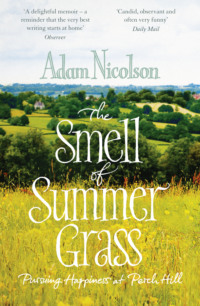
Kitabı oku: «Smell of Summer Grass: Pursuing Happiness at Perch Hill»
The Smell of Summer Grass
Pursuing Happiness
at Perch Hill
ADAM NICOLSON

Copyright
William Collins
An imprint of HarperCollinsPublishers
1 London Bridge Street
London, SE1 9GF
WilliamCollinsBooks.com
First published in Great Britain by William Collins in 2011
Copyright © Adam Nicolson 2011
Parts of this book were previously published in PERCH HILL (Robinson Publishing, 1999)
Adam Nicolson asserts the moral right to be identified as the author of this work
A catalogue record for this book is available from the British Library.
All rights reserved under International and Pan-American Copyright Conventions. By payment of the required fees, you have been granted the non-exclusive, non-transferable right to access and read the text of this e-book on-screen. No part of this text may be reproduced, transmitted, down-loaded, decompiled, reverse engineered, or stored in or introduced into any information storage and retrieval system, in any form or by any means, whether electronic or mechanical, now known or hereinafter invented, without the express written permission of HarperCollins.
Source ISBN: 9780007335572
Ebook Edition © 2011 ISBN: 9780007335589
Version: 2015-02-26
Dedication
In memory of Simon Bishop
1958–2009
Acknowledgements
The following images are reproduced with many thanks:
| Section I page 2 top | Jeremy Newick |
| Section I page 2 bottom | Andrew Palmer |
| Section I page 5 bottom | Jonathan Buckley |
| Section I page 8 top | Alexandre Bailhache |
| Section II page 2 top | Jonathan Buckley |
| Section II page 3 bottom | Alun Price |
| Section II pages 4-5 | Jonathan Buckley |
| Endpapers | Ricca Kawai. |
Large parts of this book first appeared in the Sunday Telegraph Magazine between 1995 and 2000 and two-thirds of it between hard covers in Perch Hill: a new life, published by Constable Robinson in 1999. I would very much like to thank Charles Moore, Alexander Chancellor, Aurea Carpenter and Nick Robinson, my various editors in those places, for all their help and guidance. This book takes the Perch Hill story on another full decade and looks again, with a slightly longer perspective, at those early days on the farm. This time I would again like to thank my editor Susan Watt, who has stood by me through thick and thin over many years, and my dearly valued agent Georgina Capel.
Nothing at Perch Hill could ever have happened without the people who work there and I would like to acknowledge with enormous and deeply felt thanks the difference which Tessa Bishop, Colin Pilbeam, Bea Burke, Angie Wilkins and Ben Cole have all made to our lives. Nothing, in my experience, can match the feeling which a joint and shared attachment to a place can give.
Almost needless to say – as anyone who reads these pages will discover it soon enough for themselves – the part of Sarah Raven in this story is not far short of the role played by gravity in the universe.
Adam Nicolson
Contents
Cover
Title Page
Copyright
Dedication
Acknowledgements
Part One
BREAKING
The Bright Field
Green Fading into Blue
Part Two MENDING
The Darting of Life
Patrolling the Boundaries
Neighbours with the Dead
Part Three SETTLING
Spring Births, Felled Oaks
In Deepest Arcadia
Peaches on the Cow-Shed Wall
A World in Transition
Part Four GROWING
Divorcing from the Past
The Very Opposite of Poisonous
Transformations
A Thick Pelt of Green
Feeding the Sensuous Memory
Picture Section
About the Author
By the same author
About the Publisher

Part One BREAKING
The Bright Field
IF I think of the time when we decided to come here in 1992, it is a backward glance into the dark.
A summer night. I am walking home from Mayfair, from dinner with a man I fear and distrust. He is my stepfather and I burp his food into the night air. It is sole and gooseberry mousse. His dining-room is lined in Chinese silk on which parakeets and birds of paradise were painted in Macao some years ago. The birds have kept their colours, they are the colour of flames, but the branches on which they once sat have faded back into the grey silk of the sky. On the table are silver swans, whose wings open to reveal the salt. The Madeiran linen, the polished mahogany, the dumb waiter: it’s alien country.
My stepfather and I do not communicate. ‘It’s only worth reading one book a year,’ he says. ‘The trouble with this country is the over-education of the young.’ ‘Calling a parcels service “Red Star” is a sign of the depth of communist influence, even now, in England.’
Nothing is given. I leave the house to walk across London to somewhere on the edges of Hammersmith, where I am living with Sarah Raven, the woman for whom, a few months previously, I have left my wife. That is a phrase which leaves me raw. Sarah has gone somewhere else this evening, to have dinner with friends, and won’t be back until midnight or later. I have left as early as I can from the Mayfair house and think ‘Why not?’ A warm night. A walk through London and its glitter in the dark, to expunge that padded house and all its upholstered hostilities.
There are whores in the street outside, bending down like mannequins to the windows of the slowing cars. Some of the women are so tall and so sweetly spoken they can only be men, with long, stockinged calves and a slow flitter to their eyes. One fixes me straight. ‘Looking for company?’ she asks. ‘Thank you, not tonight, thanks,’ and we move on.
I walk down Park Lane, where the cars are thick and the night heavy. The lights from the cars blip, blip, blip through the dark. Life is hurried. I pass the Dorchester and the Hilton, down to the corner where the subway drops into ungraffitied neon. Down and up and down again to the upper parts of Knightsbridge. Along there the windows gleam. A friend of mine has opened a shop in Beauchamp Place. It is lacquered scarlet inside and beautiful, with black Japanese furniture standing on the hard-wood floor.
On and out, increasingly out, away from the polish of the glimmer-zone, made shinier at night, to the open-late businesses of South Ken, where Frascati and champagne stand cooled in ranks behind glass and the Indian at the till leaves a cigarette always smoking on the ledge beside him. On, out, westwards, where occasional restaurants are all that interrupt the domestic streets now tailing into dark. The pubs have shut. It is nearing midnight.
For a stretch the street lights are broken, perhaps two in a row, and it is darker here. I think nothing of it. My mind is on other things. On what? I was thinking of a place where I have been happy, some kind of mind-cinema of it flicking through my brain: sitting back on the oars in the sunshine in a small boat off the coast of some islands in the Hebrides, where black cliffs drop into a sea the colour of green ink and the sea caves at their feet drive 50 yards or more into pink, coralline depths.
That night I was thinking of these things, of hauling crabs from the sea, scrambling among the hissing shags and peering down the dark slum tunnels where the puffins live, lying down in the long grass while the ravens honked and flicked above me and the buzzards cruised. My mind was away there that night.
I must fight a reluctance to describe what followed. I am wearing a suit, an Italian suit I have had for years, with turn-ups to the trousers and pointed tips to the lapels. It is a sharkish, double-breasted thing. The Mayfair whores had seen a businessman inside it and so, I suppose, did the three youths, late teenagers, in the Lillie Road.
The heels of my shoes were striking the pavement too hard, like flints. I tried to soften them by treading on the balls of my feet. Two of the boys were on the inside of the pavement next to the wall. I did not look at them. The other was on the kerb. I walked between the three as though through an alley and adrenalin shocked into me as I saw their eyes go white in the unlit street. I saw the kerbside boy nod at the others. I thought how contemptible was my Daily Mail fear of these people. I was already beyond them, and relieved, when my eyes and mouth stung and burned and there were hurried hands under my armpits pulling and pushing me into the mouth of a passageway leading off the road. My body had hunched over as the ammonia came into my face – bleach squirted from a lemon squeezer – and they knelt me on the gritty pavement, as though I were being unpacked, a bale of stuff, my body and suit a pocketed rucksack, all hurry and hard fingers against my ribs. I said nothing. I tried to get up but they rubbed the bleach into my eyes, oddly without violence, in the way you would pull back on the chain of a dog, simply a control.
I was not a person but a suit with pockets. I was being fleeced, in the way a shepherd might fleece a sheep. My assets were being stripped. I knelt with the grit of the pavement pricking in my cheek while they looked for money and objects in the suit that was no longer mine. They were robbing the suit. The bleach had emptied it of a person, I could not help but regard from a distance this odd, disembodied theft. I was in pain but the burning in my eyes and mouth seemed unrelated to this professional going-over of my clothes, not my clothes, the clothes, some clothes.
They left, up the passageway. I lay for a moment on the concrete slabs, excited by the reality of what had happened. My eyes were blurry and my tongue was ulcered and raw. I can taste and smell the ammonia now, years afterwards, a chemical thickness to it, a fog of fumes rising from my mouth into my nose. I got up. I dusted the suit off; it was torn. I walked down to the North End Road. There was a fish-and-chip shop open there. I went in and asked the man behind the counter if I could wash my face in his basin. He looked at me. His apron was up around his armpits. ‘We’ve been messing about a bit, have we?’
‘No,’ I said. ‘I’ve just been fucking attacked.’
He showed me a room which had a basin and a towel in it. I washed there, deep in the water, holding the water to my face and eyes, wanting to wash the pain away, and the taste of the bleach, and the furry, clogged thickness on my tongue, but feeling, more than anything, broken, hopeless, at the end of a long and hopeless trajectory which, for many months and even years, had curved only down.
I walked to the house. It wasn’t far. I sat down on the doorstep. I said to myself I was fine. But I knew I wasn’t and eventually ended up in hospital where, at three in the morning, a doctor hosed the ammonia from my eyes, holding them open with his rubber-gloved fingers one by one, so that the water would sluice around the recesses of the eye. By pure chance, the doctor told me, precisely the same thing had happened to him the year before. Some Spurs fans had set upon him, squirted his eyes with bleach, robbed him and left him feeling blurry like this on the pavement. It was his way of consoling me, I suppose.
Only later, in Sarah’s bed, deep in the night, with the grey-yellow wash of the London street lights leaking around the edges of the curtains, did I allow myself to cry, to sob out all the held-back reservoir of humiliation and failure whose dam the mugging had broken.
It was not the attack itself for which I wept and sweated that night but everything of which it seemed, however irrationally, a culmination: the failure of my first marriage the year before, my guilt at my own part in that failure, the effect my leaving would have on my three sons by that marriage, the failure or near-failure of a business I had been involved with for five years, which I had also abandoned, unable to work properly any longer, leaving it in the hands of my cousin and co-director at the one moment he most needed my help. On top of that, a book I had been trying and failing to write had finally collapsed in exhaustion and uncertainty. If I had been a horse I would have been shot. I should have been shot. I had broken down.
The mugging was a catalyst not of change, but of paralysis. I scarcely moved for three months. I lay in bed. Sarah went alone to work and to parties. I saw in her face a terror of what she had allowed into her life. I let everything about me – my own work, my sense of self-esteem, any idea of care or responsibility for others – fall away. Nothing meant anything to me. I could make no decisions. When I met people I knew, they looked into my face as though something were missing there. I woke up tired. I spoke more slowly than before. I saw a psychotherapist and told him that I felt like a sooted chimney, nothing but a dusty black hollow cylinder inside my skin. I felt that my breath polluted the air around me. I dreamed of my children. One night we were walking in a rocky place like Crete. ‘I am sorry,’ I told them. ‘I must leave you behind,’ and without waiting for an answer set off up the side of a mountain which reminded me of Mount Ida, its dry, limestone bulk, its sterility, its demand to be climbed. I arrived at the chapel on the summit, a place of bare rock, and slumped down beside the walls, my face in my hands, my body with every muscle slackened, every limb like a bone in a bag. When I looked up, I saw the three boys coming towards me, easily moving up on to the final rise, a bobbing movement, alive, lightened, untaxed by the journey on which I had deserted them. ‘Why do divorced men become obsessed by their children?’ I heard a woman ask. I could have told her: because they watch them from what seems like the far side of death.
In the face of all that, Sarah was life itself. I had met her on holiday together with a few friends. She knew my sister Rebecca and I still remember every minute of those first mornings with her. She was strong and fearless. She took control. She arranged things. I told jokes to make her laugh and she laughed with her whole head thrown back and her throat open. She didn’t take any nonsense. She raced me downhill – we were skiing – and smoked on the lifts back up. She loved the west coast of Scotland and a half-abandoned house in chestnut woods in the valley of the Tarn. She was a doctor. She always voted Labour. She wore glamorous printed silk shirts from a company called English Eccentrics. She played with her long red-brown hair while talking to me. She was the natural focus of everyone around her. There was no side or twist to her: she was what she seemed to be. She could drink for England. She seemed to like me. She loved wild flowers. She never read a book. As she pointed out to me, she had beautiful long legs, very good for walking. She was in love with the cooking of the Veneto, which she had learned as a girl. Above all she had an appetite for living. She did not seem defeated. She looked not exactly like the future but like someone with whom and alongside whom the future was full of glow and richness. Life was full for her, not as an abstract idea – nothing intellectualized here – but as a reality which involved things, food, work, happiness, children, nature, gardens, beauty. She was the substance of life.
And so we fell in love – weeks and months of looking forward to seeing her and being with her, of being enlivened by her teasing, warm, loving presence. And with that, folded in with it, my own grief and despair at what had happened. I have never known things at the same time be so beautiful and so dark.
From her house in London, Sarah and I began to search for a refuge, however naïvely and hopelessly that idea was conceived. It stemmed from no more than a belief in the pastoral. ‘Are not these woods more free from peril than the envious court?’ a figure in As You Like It asks the surrounding company. I knew in the past I had been happy in rural places. I knew, or thought I knew, that a rural place would soothe this crisis. I knew, as I walked out in the streets of London, that there was no solace there. Every surface was dead in my eyes. My mind returned constantly to those islands in Scotland which I had been thinking of on the night of the attack. For 15 years I had owned them. My father had bought them 50 years before for £1,200 and he gave them to me when I was 21, as I was to give them to my son Tom when he was 18. Cynics have said that all this was for tax reasons, but it wasn’t. I think my father gave them to me because, as a very young man, he had felt enlarged and excited by the ownership of a place like that, by the experience of being there alone or with friends, away from the thing that Auden called ‘the great bat-shadow of home’, the enclosing, claustrophobic, involuntary oppression of a parental place, which makes a bawling, complaining infant of you. He wanted, I think, to give that same enlargement to me, as I do to my own children.
It worked and the gift was this: memories of weeks there, storm-battered, sun-stilled, on which I continue to draw every day of my life. I know those islands yard by yard, I know the places to clamber up and slither down, I know the particular corners where the pair of black guillemots always nests or where the bull seal hauls himself out on the seaweedy rock, I know where the fish congregate in the tidal streams or where the eddies riffle off a nose of lichened basalt and throw your dinghy out in a sudden curving arc towards the Lewis shore. I know the natural arch where the seals swim and where the kelp gathers in an almost Ecuadorian sun-barred forest beneath your coasting hull.
I was essentially shaped by those island times. Almost everything else feels less dense and less intense than those moments of exposure. The social world, the political world, the world of getting on with work and a career, all those were for ever cast in a shadow by the raging scale and seriousness of my moments of island life. That intimacy with the natural makes the human seem vacuous.
This may be straight Wordsworthianism and I would want to disown it in favour of a less monolithically obvious thing, a glitteringly complex attitude to nature which shimmered like an opal compared with my all-too-single basalt slab. But I can’t. I know nothing bigger or finer than the feeling that all barriers are down and a full-blown flood is running to and fro between you and the rest of the world.
I know all these things and treat them as my touchstones and my yardstick. Is this life, I always ask, as good as that? Does this place measure up to that? That is the fixture; everything else can only eddy around it.
We began to search for somewhere that might be the equivalent of all that, a place which in its own terms could be an island, around which the cord could be drawn, and where life could in some ways be hidden, or even innocent. It was the search for an Arcadian simplicity in which crisis and breakdown did not and could not occur. Fantasia you might say, but it had then an urgency and reality stronger and more concrete than anything else in the world around us. There was no sense, it seemed to me, of ‘getting away’. There was no desire to enter a capsule or satellite suspended above the earth. It felt, if anything, the very opposite of that, a burrowing in, a search for a bed in which the covers could be drawn up and over us. It was, I now see, these many years later, a search for a womb, a place in which you could be protected from damage. It was an infantile need and ferociously demanding because of that.
We roamed England with the template in our minds. It seems curious now that this search might have landed almost anywhere, that anywhere might have provided the bucket into which the love could have been poured. Dorset, Devon, Somerset, Shropshire, Herefordshire, Oxfordshire, Norfolk, Suffolk, east Kent: all for a time became the zone in which safety might be found. It looks pathetic now, the two of us, in the white 2CV we had at the time, poking about like moles for a burrow, living with a private intensity the common stuff of rural estate agents’ offices.
I had no perspective on what we were doing, or at least suspended any perspective I might have had. We were the first to do this. Of course we weren’t – we were the last, the heirs and successors of a line that goes back at least to the Roman love affair with the suburban villa, perhaps beyond that to the first urban civilizations of the Near East, where the concentrated demands and sophistication of city life produced, even at the beginning, a dream image of the garden place, the paradise, in which the realities did not impinge, where the commercial and competitive structures of the city were absent. Is Genesis itself, I now wonder, a symptom of a disenchanted urbanity?
I had no desire to delineate, let alone puncture, the bubble. I needed its insulation and a belief in its power and reality. For years I had kept in my mind, as a sort of mantra, a poem by R.S. Thomas:
I have seen the sun break through
to illuminate a small field
for a while, and gone my way
and forgotten it. But that was the pearl
of great price, the one field that had
the treasure in it. I realize now
that I must give all that I have
to possess it. Life is not hurrying
on to a receding future, nor hankering after
an imagined past. It is the turning
aside like Moses to the miracle
of the lit bush, to a brightness
that seemed as transitory as your youth
once, but is the eternity that awaits you.
(‘The Bright Field’, 1975)
Thomas, a parish priest in the Lleyn peninsula in Gwynedd, in the north-west corner of Wales, is playing a fugue on the words of both Exodus and the Gospels. The Authorised Version does indeed speak of Moses ‘turning aside’ to the burning bush; Christ, talking to the Apostles, describes the Kingdom of Heaven both as the field with the treasure in it and as the pearl of great price. Both, curiously perhaps to us who dissociate so firmly the religious from the financial, use the language of money and merchants. The conditions of paradise, in Christ’s own words, can be bought. If only estate agents had cottoned on to this! Sell all that you have, money for paradise, the pearl of great price, life is neither hurrying nor hankering: turn aside to the eternity that awaits you. Heaven is waiting, the paradise womb; only look for it and you will see the bush alight beside you. The brightness of youth can be once again to hand.
I look at myself then, nearly twenty years ago, and scarcely recognize the man I was: driven by a hunger for authenticity, for a place in the world that did not seem compromised but was somehow, in reality, almost heavenly. And I feel both nostalgia for that man – for the simplicity of his proposition – and utterly removed from him, as if he were some remote cousin, sharing a few common traits, and with something of a shared history, but with an attitude to the world that seems to know about almost nothing but himself. His need for happiness was so powerful that it erased nearly everything around him. It was as if he were walking through the world surrounded by a halo of need.
My own financial state was catastrophic. I was scarcely in a condition to work, or to look for work. A kind of vertigo gripped me whenever I tried to write anything. I was producing occasional pieces for the Sunday Times but they were ground out like dust from a mortar. All fluency had gone. I wrote a book of captions to photographs of beauty spots. I ghosted another on how to take landscape photographs. I researched the illustrations for a book on evolution. Apart from the islands in Scotland, which I would sell only if death were the other choice, I owned nothing. I had given my house and its contents to my first wife. I was paying her virtually everything I earned. At times I didn’t earn enough in the month to pay her what I had promised and Sarah, from her earnings as a doctor, made up the difference. Sarah, who had inherited a little money, at least owned her house in London, all save a small mortgage, and that was the lifeboat. That house in west London, with its three bedrooms and a sliver of a garden, would take us where we needed to go.
In that search for a place, nothing much was working. House after house was wrong, wrong in feeling, wrong in its situation, wrong in its price. The more the vision glowed, the less the places we saw came up to it. There were houses drowning in carpets and improvement, their souls erased. There were others in which the road was too near. Others too dour, many too far from Cambridge where my sons were living with their mother. Both Sarah and I felt an instinctive aversion to arable parts of England. We needed grass and wood, the Arcadian savannah, the lit bush, the field illuminated for a while. I knew that when we found the place it would say ‘I am here and I am yours. I am the place.’ It was a dark time.
Only at the edges, like jottings and little coloured drawings in the margins of a text, were there any points of light: the finding of wild daffodils one day in a Dorset wood; swimming one warm and languorous evening off Chesil Beach where the swell rolled in like a lion’s stretch and yawn, over and over, a long slow growling from the shingle; a weekend on the Lizard in a sea of thrift; dawn on the Helford River, anchored in a boat between the woods, where the night rain dropped off the outstretched leaves into water as still as oil. These were bright fields too, illuminations in their way.
Why should it be that beauty can for an instant make sense of a world in which nothing else does? I am not sure. It is something I believe in without knowing why. Maybe it is simply a recognition of pattern, a concordance between you and the world. Here in a chance beautiful thing is something given, neither engineered nor sought, neither curiously made nor elaborately framed, but dropping as a bead of meaning out of a meaningless sky. Its value, its weight, is in your own recognition of its beauty. There is something naturally there which you naturally recognize as good. The ability to see that beauty is a sign that the world is not an anarchy of violence and destruction. You belong to it and it belongs to you.
That was as near as I could come to understanding why I wanted to live and be in a place that seemed beautiful. The world around you in such a place would constantly touch you and speak to you. It would become an existence thick with understanding and that sense of crowding intelligibility might be almost social in its effect, as though you were actually joining the community of the natural. This, in my loneliness and guilt, became a kind of consolation too and I held on to it as a kind of flag of hope, a thought with which I could identify and salvage what remained of my self. There’s a sentence in one of Coleridge’s notebooks for 1807, when, also with a broken marriage and a career in ruins, he was staying on a farm in Somerset. A ragged peacock walked the yard: ‘The molting Peacock with only two of his long tail feathers remaining, & those sadly in tatters, yet proudly as ever spreading out his ruined fan in the Sun & Breeze.’ That was me with my faith in redemption by beauty, like the battle-shot colours of a regiment held up to the last.
I was at work in London – I say at work; I was sitting at my desk, looking at the screen, drinking a cup of coffee, considering from a dead mind the identity of the next possible word – and the phone rang. Sarah, in a coinbox, in a pub, breathless: ‘You must come. This is the place. I’m not sure. It might be. It’s a valley. An incredible valley. It’s like the Auvergne. It’s like an English Auvergne. Come on, sweetheart. You’ve got to have a look. It might be all right. It might be. I’m not sure. You’ve got to come though. Please come.’
She was in Sussex, having gone to look at a house that we both knew was too small – it was a converted observatory – and in the wrong place, on the top of a hill where nothing would ever grow, even if its views were to the Downs and the sea and a vast dome of observable sky. It was her second visit. She asked the man living there where he usually went for a walk. He mentioned a lane that dropped from this observatory down through the woods to the valley of a little river.
She had gone down the lane, curling between the hedgerows, under the branches of the overhanging trees. It was springtime and the anemones were starry in the wood. Primroses were tucked into the shade of the hedge banks. Catkins hung off the hazels over the lane. And then, at a corner, where to one side the trees opened out to a view down the valley, and from where the pleats of the valley sides folded in one after another into the blue distance of other woods and other farms, 4 or 5 miles away, there was a sign hanging out into the lane: ‘for sale’.
She took me back there the next day. Slowly the car went down the lane. The flowers in the verges, the sunlight in blobs and patches on the surface of the road. The knitted detail of this wood-and-field place. If anywhere were ever to look like nurture, privacy, withdrawal, sustenance, love, permanence and embeddedness, this was it. Sarah had found it.
Even then, at the first instinct-driven look, this felt as if it might be the place. Why was that? And how can the mind, in a series of fugitive impressions, never analysed and perhaps not consciously registered, make its mind up so fast?
First, maybe, it was because Perch Hill was hidden. It was neither exposed to the world nor making a display to it. It was clearly living in its own nest of field and wood, a refuge which could find and supply richness from inside its own boundaries.
Second, I think, it reminded me a little of all the ingredients of the landscape I had known as a boy at Sissinghurst, 15 miles away in Kent: the coppice woods and the slightly rough pastures, the streams cutting down into the clay underbase, the woodland flora along their banks, that deep sensuous structure of light and shadow in a wooded country, where as you drop down a lane you are blinded first by the dazzle of the light and then by the depth of the shade, a flickering mobility in the world around you. Even at that subliminal level, here was somewhere that promised complexity and richness, secrets to be searched for and found.
And third, it was just the time of year, the first part of May, when England looks as if it has been newly made and the stitch-wort and campion are sparkling in the lane banks and not a single leaf on a single tree has yet gone leathery or dark or lost that bright, edible, salad greenness with which leaves first emerge into the world; and when even though the sun is shining the air is still cold and you can feel the fingers of the wind making its way between your shirt and your skin, a sensation somewhere on the boundary of uncomfortable and perfect, as if nearly perfect, as if courting perfection.
I can make this analysis only now. Twenty years ago, we were driving blind.
We turned the corner, saw the agent’s board, the sign on a little brick building saying ‘Perch Hill Farm’, and drove in. Almost everything about the place was as bad, in our eyes, as you could imagine it to be. The buildings were a horrible mixture of the improved and the wrecked: yards and yards of concrete; a plastic corrugated roof to the disintegrating barn; an oast-house whose upper storey had been removed during the war; a 1980s extension to the farmhouse, in the style of a garage attempting to look like a granary, paid for, I later learned, by selling off the milk quota. The farmhouse itself was dark and dingy downstairs. In most of the ground-floor rooms I was unable to stand up. Upstairs there was grey cheap carpet, gilded light fittings, down-lighters and pine-louvred cupboards. A 1940s brick cow shed had been enlarged with an extension made of telegraph poles and more corrugated sheeting. Three other sheds – for calves, logs and rubbish, I was told – lay scattered around the site looking as if they were waiting to be tidied up. Various bits of grass were carefully mown. There was a decorative fish pond the size of a dining-room table in front of the granary-sitting room. The truncated oast-house had become a cart shed but was now in use as an art gallery. There were places for customers to park.
None of this was quite what had been imagined. The smiles remained hanging on our lips. The buildings were raw-edged. Their arrangement was not quite what you would have hoped for, not quite a clustered yard, but a little strung out along the hill. The geese by the farm pond were angry. And a wind blew from the west. Turn aside, turn aside. I have seen the sun break through … The Bright Field murmurings were no more than faint.
Was it that time we walked around the farm or another? I don’t quite remember. We left again, slowly, back up the Dudwell lane, along others. We had lunch on the grass outside the Ash Tree at Ashburnham. I drank a pint of Harvey’s bitter and the bees hummed. We were not sure. We went back on other days, again and yet again, taking friends with us. They all thought not. The place was trammelled. Whatever it might once have had was now gone. We heard somehow that the actor and com edian John Wells had looked at the place and rejected it: too much to do. We too should look elsewhere. So we did: a large fruit farm near Canterbury, other places, Brown Oak Farm, Burned Oak Farm, Five Oaks Farm, which I occasionally pass in the car nowadays, now the focus of other lives, diverged from ours like atoms that collide for an instant and then bounce on to other paths, and never to connect with ours again.
The Perch Hill valley would not go away. It had taken up residence in my mind. I bought the largest-scale map of it that I could find and kept it on my desk. I read it at night before going to sleep, walking the dream place: the extraordinary absence of roads, the isolated farms down at the end of long tracks, the lobes of wood and fingers of meadow, the streams incised into creases in the contours, the enclosed world away from the brutalizing openness which I felt had reduced me to the condition I was now in. It is a hungry business, map-reading. It only feeds the appetite for the real. I had drawn in red biro a line around the fields and woods that went with Perch Hill Farm: 90 acres in all, draped across a shoulder of hill that ran down to the valley of the River Dudwell, and entirely surrounded by the remains of Dallington Forest. The red line around these acres made an island of significance. The more I looked at the map the more real my possession of those fields became, the more that red biro line described the island reality for which we were both longing. ‘Let’s go again,’ I said to Sarah. It would be the last time, the last throw, and then I would push this map away and the place would mean nothing to us and we could move on to other places and other obsessions.
It was a summer evening, four months after Sarah had first wandered down the lane. We went not to the house but to the fields. We had brought some bread and cheese with us. We walked around and the light was pouring honey on the woods. At the end we lay down in the big hay meadow known as the Way Field and looked across the valley to the net of hedgy woods and pastures beyond it, the terracotta tile-hung farmhouses pimpled among them, the air of unfiddled-with completeness, the haze of the hay. Owls hooted; two deer and their fawns came out of the wood into the bottom of the field to graze and look, graze and look in the pausing, anxious way they do. Graze and look, graze and look: it was what we had been doing for too long. We decided there and then: for the sort of money that could have bought you an extremely nice house in west London (double-fronted, courteous neighbours, Rosemary Vereyfied garden, a frieze of parked German cars, chocolate-coloured Labradors in pairs on red leashes) we would buy a cramped, dark old farmhouse, a collection of decrepit outbuildings and some fields that would never in a thousand years produce any income worth having. Was this wise? Yes. This was wise, the right thing to do, plumping for the lit bush. What else could money be for?
John Ventnor, the art dealer who owned the place, wanted what seemed like an outrageous amount for it: £480,000. We could afford, we thought, after the endless shuffling of portfolios, the sale of heirlooms and the accommodating of ‘certain grave reservations’ of financial advisers, no more than £375,000 and that was what we offered. Not enough. We offered £20,000 more. Not enough. What would be enough? He was prepared to countenance a 10 percent discount on the asking price: £432,000. Too much. What about £410,000? Not enough. And there it stuck for months.
We began again to look at other places but none was right. The vision in the evening field had its hooks in us. We waited, hoping that the delay would get to work on him, but it didn’t. It became clear that he shared the freehold with a stepdaughter who no longer lived there. She wanted him to sell up but he didn’t want to leave. He had no incentive to lower his price any further. We were in an impasse.
Sarah sold her house in London, our daughter Rosie was born and we all moved together into a rented basement flat of profound sterility and gloominess. I got a job on a newspaper and we borrowed money on that rather slender foundation. On winter evenings I drew plans and projections on my computer of how we might change Perch Hill, what kind of garden we might make, how we might take the land and farm it in a way that would be more generous towards it. The sliced-off oast-house became whole again on my night-time screen. I took to sitting in front of it with no other light in the room, a silvery brightness emanating from the dark, a possible future set against a present reality. Plantings and vistas criss-crossed the spaces between the buildings on my computer plans. One after another of these schemes I drew up, ever more elaborate, and they all shared the same title: ‘Arcadia for £432,000.’ Give everything you have.
One winter day I went down there again. I had never seen Perch Hill outside its springtime freshness or its hay-encompassed summer glory. This day was different. I was alone; Sarah remained with Rosie in London. A wind was cutting in from the east and for days southern England had remained below zero. All colour had drained out of the landscape. In the valley, the woods were black and the fields a silky grey as in my night-time visions of the place. The stones on the track into the farm were frozen and they made no sound as I drove over them. The geese were huddled in the lee of a bank, fingers of wind lifting the feathers on their backs. Even they couldn’t bring themselves to run out and attack me. Frost-filled gusts blew across the frozen pond. The buildings were besieged by cold.
I was there to persuade Ventnor that he should sell his farm to us for something less than the £432,000 at which he had stuck for so long. I had no real tools or levers with which to achieve this, only the suggestion that a lower price might be fair. Smilingly, over a cup of coffee, he refused. We sat first in the kitchen and then by the fire. He was polite but adamant. The oak logs burned slowly. To my own surprise, I felt no resentment. I sat there agreeing with every word he said. Why should he leave the embrace of this? Why should the poor man go out into the cold if he did not want to?
He left the room to see a man who had come to the door and as I sat there I began to be embraced by the warmth of the house. I felt it wrap its own fingers around me. If a house could speak, that was the day it spoke, the day I learned this wasn’t simply a place where we could come and impose our preconceptions. We couldn’t simply land the Bright Field fantasy here and take that as the reality in which we were now ensconced. There was some kind of dignity of place to be respected here. It had a self-sufficiency which went beyond the demands and obsessions of its current occupants. There was a pattern to it, a private rhythm, the deep, slow music to which it had been moving for the four or five centuries that people had lived in it. The two of us men sitting here now in front of the fire, what were we in the light of that? Transient parasites.
I left and we had failed to agree on price but in some other, quite unstated way, I had succumbed. The buildings might be a mishmash of what we wanted and what we didn’t. They might confront us with a list of things to do that stretched 10, 20 years into the future. The price that was required might be unreasonably high. But all of that was translated that frosty day, or perhaps started to be translated that frosty day, with the hot oak fire glowing as the only point of colour in a colourless world, into something quite different: a commitment to the place as it actually was, with all the wrinkles of its history and its habits, all its failings and imperfections, all its human muddle. Stop fussing, it said. Give yourself over to what seems good. Here – after catastrophe and culpable failure in my own life, after I had witnessed Sarah, now my wife, tending to me as I collapsed – was some kind of signpost towards coherence. Don’t look for the perfect; don’t be dissatisfied if the reality does not match the vision. Don’t insist on your own way. Feed yourself into patterns that others have made and draw your sustenance from them. Accept the other.
‘You mean pay him what he wants?’ Sarah asked that evening as I put this to her.
‘Yes,’ I said. And we did.
If a son or daughter of mine said to me nowadays that they were thinking of doing what we did then, selling everything, taking on deep debts, putting their families on the verge of penury for years to come and acquiring a place that needed more sorting out than they knew how to pay for, a rambling collection of half-coherent buildings and raggedy fields, I would say, ‘Are you sure? Are you sure you want to shackle yourself with all this? Do you know what it is you are so hungry for that this seems a price worth paying?’
Just now, faintly, as ghosts from the past, I remember people saying those things to us at the time and thinking, ‘Ah, so they don’t understand either. They haven’t understood what it is to be really and properly alive.’ And knowing for sure what that meant myself: that when faced with a steep slope or a rough sea, you should not quiver on the brink, or spend your life pacing up and down on the sand looking at the surf. You should plunge off down it or into it, trusting that when you arrive at the bottom or the far shore, you will know at least that the world’s terrors are not quite as terrifying as they sometimes seem.
Do I believe that now? Nelson told his captains that the boldest moves were the safest, but Nelson was happy to lose everyone and everything in pursuit of victory. I can’t forget the decades of debt and anxiety which lay ahead of us then, the years of work in trying to reduce the mountain of borrowings, article after article, the alarm clocks in the dark, the working late on into the night to try to balance the books. But would I now exchange the life we have had for one in which we had never taken that risk or made that step? No, not at all. I am as happy that Sarah and I married ourselves to Perch Hill as I am about the existence and beauty of my own children.
Green Fading into Blue
A CLOUD was down over the hill and the air was damp like a cloth that had just been wrung out. The buildings came like tankers out of the mist. Had we made a mistake? ‘Is it a sea fog?’ Sarah asked Ventnor.
‘Oh no,’ he said languidly, ‘it’s always like this here.’
Somehow his grief smeared us. He was unshaven; he had been unable to find a razor after he had packed everything. His mind was moving from one thing to another. This and that he talked about, these keys again, the oil delivery again, his own untidied odds and ends, a sort of humility in front of us as ‘the owners’ which grated as it reached us, as it must have grated as he said it. His eyes had black rings under them, wide panda-zones of unhappiness. Anyone, I suppose, would have been grieving at the loss of this place. It looked like an amputation. Even so, I felt nothing but impatience, as though it were already ours and he no more than an interloper here. He said nothing about that. What a curious business, this buying and selling of the things we love. It’s like a slave trade. Go, go, I said to him in silence.
His mother-in-law was there with him. She was less restrained. She showed us pictures of their dogs cavorting in the wood. I felt like saying ‘our wood’. She was still possessive. ‘I’d hate to think of anyone making a mess in there after what I’ve done,’ she said. I could see her primping the back of her hair and looking at me as though I were a piece of dog mess myself. And I suppose I was, in their eyes, the agent of eviction. Go on, away with you.
I was edged by it all. The house seemed ugly, stark and poky. I hardly fitted through a single door. Would it ever be redeemable? I was still standing off, waiting for the mooring line, but Sarah was sublime, confident, already arrived. ‘Why do starlings look so greasy?’ I heard myself asking Ventnor. ‘Like a head of hair that hasn’t been washed for weeks. They look like bookies.’ He went at last, his sadness bottled up inside the great length of his long, thin body.
We waited for the furniture van. The house seemed inadequate for our lives. I picked some flowers, I looked at the view from the top field, our summit, and we waited and waited for the van. At last they called, about midday. They were in Brightling, lost. Sarah went to guide them in, while Rosie slept upstairs. The van came. It was too big to fit around the corner of the track past the oast-house and so everything had to be carried from the other side, 100 yards further. All afternoon our possessions rolled out and into the buildings, this clothing of the bones. Come on, faster, faster. The place started to become ours. It was as though the house were trying on new clothes. Sarah was worried by the sight of a staked lilac. Was the wind really that bad?
The removal men went. The oast looked like a jumble sale and the various rooms of the house half OK with our furniture. ‘Change that window, pull down that extension, put the cowl of the oast back.’ I could have spent £100,000 here that day. Sarah and Rosie went off shopping. Ventnor returned to collect a few more things. I didn’t want to have to deal with him again. ‘I see they’ve done some damage there,’ he said, pointing at the place where the lorry’s wheels had cut into the turf, trying to get around the sharp corner by the oast-house. I hadn’t even noticed. I listened to his engine as he drove off towards somewhere else in England, the gears changing uphill to Brightling Needle, and then down more easily the far side, the sound, like a boat’s wake, slowly folding back into the trees. We never saw him again.
He had gone, it was quiet and I was alone for the first time in Perch Hill. I could feel the silence between my fingertips, the extraordinary substance of this new place, this new-old place, new-bought but ancient, ours and not ours, seeping and creeping around me. It was as though I had learned sub-aqua and for the first time had lowered myself gingerly into the body of the pool, to sense this new dimension thickly present around me as somewhere in which life might be lived and movements made. Until now all I had seen was the surface of the water, its tremors and eddies. Now, like a pike, I could hang inside it. I could feel the water starting to flow and ripple between my fingers.
That evening, as the sun dropped into the wood, I walked the boundaries, the shores of the island, the places where the woodland trees reached their arms out over the pastures. Here and there, the bluebells crept out into the grass like a painted shadow. Wild garlic was growing at the bottom of the Slip Field. I lay down in the Way Field, the field where we had decided to come here all those months before, a place and a decision which were now seared into my life like a brand, and as I lay there felt the earth under my back, its deep solidity, as Richard Jefferies had done 100 years before on the Wiltshire Downs. The hand of the rock itself was holding me up, presenting me to the sky, my body and self moulded to the contours and matched to the irreducibility of this hill on this farm at this moment. ‘You cannot fall through a field,’ I said aloud.
I took stock. What was this place to which we were now wedded? It had cost £432,000, plus all the fees. We had borrowed £160,000 to make that up, on top of the sale of the London house. My father was lending us £25,000. Our position was strung out and I had ricked my back. I felt as weak and as impotent as at any time in my life. It was an intuitive understanding, an act of faith, that the deep substance of this little fragment of landscape would mend that lack and make me whole. It was a farm of 90 acres in the Sussex Weald, about two hours south of London in the usual traffic, but no more than an hour from Westminster Bridge at five on a summer’s morning. It was down a little lane, as obscure as one could feel in the south of England, with no sound of traffic, no hint of a sodium glare in the sky at night and an air of enclosure and privacy. At the edge of the land, by the lane, was the farmyard, with its utterly compromised mixture of bad old and bad new.
Beyond the farmyard itself, things improved. It was indeed one Bright Field after another. The buildings were at almost the highest point and in all directions the land fell away in pleats, like the folds of a cloth as it drops from the table to the floor. The creases were filled with little strips of wood under whose branches small trickly streams made their way towards the River Dudwell. The broad rounded backs of the pleats were the fields themselves, eleven of them, little hedged enclosures. They made up the small island block entirely surrounded by wood. That wood was part of the ancient forest of the Weald, whose name itself, cognate with wald, meant forest. The farmland was cut from it perhaps in the 15th or 16th century. The house was built in about 1580 and was probably made of the oaks that once grew where it stood. It was poor land, solid clay, high and windy all year, cold, wet and clammy in the winter, hard, heavy and cloddy in the summer.
Because nothing destroys a landscape like money, its poverty had preserved it. We were on the edge of viable agriculture here, one of the last pieces to be cleared from the wood and already in part going back to it. You could see the lines of old hedges, hornbeam and hawthorn, growing as 40-foot trees in the middle of the woods. Those were the boundaries of the ghost fields, abandoned and returning to their natural condition. Because it was so poor, it had never been worth a farmer’s while to drive the land hard. That’s why these fields are as beautiful as any you could find in Europe, or the world come to that.
Of course there are many other pockets of beauty in England, at least away from the great slabs of denuded arable land in East Anglia and the Midlands. In my 20s I had walked through many of them, about 3,000 miles on foot when writing a book about English paths, and then as a travel writer for the Sunday Times I had walked a great deal more. In the western counties, from Devon and Dorset, up the Welsh marches to Lancashire and Cumbria, I had fallen in love with a country I hadn’t known until then, as a knitted thing, a visible testament to the long and intimate encounter between England and the English. It is the national autobiography, written every day for 1,500 years, with more life buried in it than any of us will ever know, with little thought ever given to its overall effect and its language often obscure. Maybe that is what we found at Perch Hill, a miracle of retained memory, a depth of time, and the mute, ox-like certainty which comes with that, away from the zigzags of our own chaotic existence. Nature was part of it, not all. This was no wilderness. Nor, though, was it an exclusively man-made place, sheeny and slicked up. Sometimes now I wish Perch Hill – our lives – had happened elsewhere in England, somewhere smarter and sleeker, with an elegant trout stream or smooth chalky views, but Perch Hill, stumbled on by chance, in all its scruffiness and lack of polish, but with its promise of what we always used to call echtness, an authentic, vital beauty that came up from the roots, was the right place for us. Human and natural met there in a rough old encounter and that was the world we needed.
There was a line from a poem of Tennyson’s which, from time to time that year, bumped up into my conscious mind, and presumably lurked not far beneath for the rest of it. ‘Green Sussex,’ it said, ‘fading into blue.’ That was this farm in a phrase: the green immediacy, the plunge for the valley, the stepped ridges of the Weald, blueing into the distance 10 and 12 miles away. This wasn’t a little button of perfection, a cherry perched on a cake of the wrecked, but part of a larger world and as I lay in the Way Field that evening all I could think of was the feeling of extent that ran out from there across the lane, down into the field called Toyland, beyond that into the valley of woods running off to the west, to the river down there, the deer nosing in that wood and the sight I had that morning, as we were waiting for the van, of the fox running down through that field, on the wood edge, no more than the tip of its tail visible above the grasses, a dancing point like the tip of a conductor’s baton …
I shall not forget that evening. The spring was going haywire around me. It was DNA bedlam, nature’s opening day. The black-thorn was stark white in the dark and shady corners. The willows had turned eau-de-nil. Oaks were the odd springtime mixture of red and formaldehyde yellow, the colour of old flesh preserved in bottles. The wild cherries stood hard and white like pylons in the wood and the crab apples, lower, more crabbed in form, were in full pink flower – an incredible thing a whole tree of that, the most sweetly beautiful flower in England, dolloped and larded all over the branches of a wrinkled, half-decrepit tree. In places nothing was doing better than the nettles and the thistles, but in the wood, there were the wall-to-wall bluebells, pale, almost lilac in the Middle Shaw, that eyeshadow blue: in the half-lit green darkness of the wood, that incredible, glamorous, seductive haze of the bluebell’s blue, a nightclub sheen in the low light, the sexiest colour in the English landscape, hazing my eyes, a pool of colour into which, if I could, I would have dived there and then.
There were deer on the top field. The light was catching the ridged knobbles of their spines. I drank it up: this bright sunshine, even late, the bars of it poking into the shadows of the wood; the comfort of the grass; the lane a continuous mass of wood anemones, cuckoo flowers, primroses; and one very creamy anemone up by the gate. Its colour looked to me like the top of the milk.
‘These foam-bells on the hidden currents of being’, Hugh MacDiarmid once called spring flowers, and that attitude, a slightly dismissive superiority, used to be mine too. Geology, the understructure, the creation of circumstances: those were the things that used to matter to me. I preferred the hard and stony parts of the north and west or the higher places in the Alps where, after the snow has gone, the crests and ridges are left as abused and brutalized as any frost-shattered quarry. Walking across those high, dry Alps, I have seen the whole world in every direction desert-like in its austerity, a bleakness beyond either ugliness or beauty, and thought that life could offer me nothing more.
I still lusted after that, for all the clean hard-pressure rigour of that alienating landscape, serene precisely because it is so dreadful, because from that point of desiccation there was nowhere lower to fall. But alongside it now, there was this other thing, this undeniable life-spurt in the spring, whose toughness was subtler than the stone’s but whose persistence would outlive it. Genes last longer than rocks. They slip through unbroken while continents collide and are consumed. These plants, I now saw, were the world’s version of eternity, the lit bush. If you wanted to ally yourself with strength, nothing would be more sustaining than the spring flowers.
Over the following days, we dressed the house as though preparing it to go out. It was like dressing a father or mother. She sat there mute while coats and ribbons were tried on her. ‘Oh you look nice like that,’ we would say, ‘or that, or maybe that.’ Rooms acquired meaning, another meaning. In the kitchen, painted on the cupboard door, I found a coat of arms: six white feathers on a blue ground and the motto ‘Labore et perseverantia’, By work and perseverance. It looked fairly new. What was it, a kind of d’Urberville story of a noble family collapsed to the poverty of this, to the resolution of that motto against all the odds? It was certainly a failed farm. That was the only reason we were there. We had crept like hermit crabs into a shell that others had vacated.
But I guessed the arms and the motto had no great ancestry. Had Ventnor himself painted them here in the last few years? I knew that he had attempted to make a business out of this farm, to continue with the dairy herd that he had bought with it. But he didn’t know what he was doing and had lost a fortune. The last thing he asked me before he left was ‘Are you thinking of farming here?’ to which I had been noncommittal. With something of a glittery eye, he told me not to consider it. That was a sure route to disaster. Soon stories were reaching me of Ventnor sitting in the kitchen here, his unpaid bills laid out on the table in front of him like a kind of Pelmanism from hell, his head in his hands, his prospects hopeless. Every one of these stories ended with the same warning: Don’t do it.
The Ventnor experience seemed somehow to stand between us and an earlier past. He was one of us, an urban escapee, a pastoralist, who had turned the old oast-house into an art gallery and put coach-lamp-style lights outside the doors. Where was the contact with the real thing, the real past here? There was a glimmering of discontent in my mind about that gap, still a glass wall between us and the essential nature of Perch Hill. Before Ventnor, I knew, the last farmers here had been called Weekes. Where were they? Had all trace of them disappeared? It wasn’t long before we realized that the very opposite was the case: Ken and Brenda Weekes still lived in the cottage 200 yards away across the fields. A day or two after our arrival, Sarah and I went up to see them and from that moment they became a fixed point in our lives.
Ücretsiz ön izlemeyi tamamladınız.