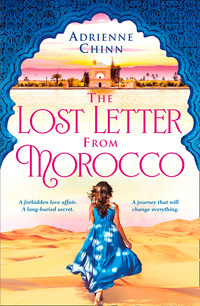
Kitabı oku: «The Lost Letter»


Copyright
Published by AVON
A Division of HarperCollinsPublishers Ltd
1 London Bridge Street
London SE1 9GF
www.harpercollins.co.uk
First published in Great Britain by HarperCollinsPublishers 2019
Copyright © Adrienne Chinn 2019
Cover design © Becky Glibbery 2019
Cover photographs © Shutterstock
Adrienne Chinn asserts the moral right to be identified as the author of this work.
A catalogue copy of this book is available from the British Library.
This novel is entirely a work of fiction. The names, characters and incidents portrayed in it are the work of the author’s imagination. Any resemblance to actual persons, living or dead, events or localities is entirely coincidental.
All rights reserved under International and Pan-American Copyright Conventions. By payment of the required fees, you have been granted the non-exclusive, non-transferable right to access and read the text of this ebook on screen. No part of this text may be reproduced, transmitted, downloaded, decompiled, reverse engineered, or stored in or introduced into any information storage and retrieval system, in any form or by any means, whether electronic or mechanical, now known or hereinafter invented, without the express written permission of HarperCollins.
Ebook Edition © March 2019 ISBN: 9780008314552
Version: 2019-01-29
Dedication
For H.
Contents
Cover
Title Page
Copyright
Dedication
Prologue
Chapter One
Chapter Two
Chapter Three
Chapter Four
Chapter Five
Chapter Six
Chapter Seven
Chapter Eight
Chapter Nine
Chapter Ten
Chapter Eleven
Chapter Twelve
Chapter Thirteen
Chapter Fourteen
Chapter Fifteen
Chapter Sixteen
Chapter Seventeen
Chapter Eighteen
Chapter Nineteen
Chapter Twenty
Chapter Twenty-One
Chapter Twenty-Two
Chapter Twenty-Three
Chapter Twenty-Four
Chapter Twenty-Five
Chapter Twenty-Six
Chapter Twenty-Seven
Chapter Twenty-Eight
Chapter Twenty-Nine
Chapter Thirty
Chapter Thirty-One
Chapter Thirty-Two
Chapter Thirty-Three
Chapter Thirty-Four
Chapter Thirty-Five
Chapter Thirty-Six
Chapter Thirty-Seven
Chapter Thirty-Eight
Chapter Thirty-Nine
Chapter Forty
Chapter Forty-One
Chapter Forty-Two
Chapter Forty-Three
Chapter Forty-Four
Chapter Forty-Five
Chapter Forty-Six
Chapter Forty-Seven
Chapter Forty-Eight
Chapter Forty-Nine
Chapter Fifty
Chapter Fifty-One
Chapter Fifty-Two
Chapter Fifty-Three
Chapter Fifty-Four
Chapter Fifty-Five
Chapter Fifty-Six
Chapter Fifty-Seven
Chapter Fifty-Eight
Chapter Fifty-Nine
Chapter Sixty
Chapter Sixty-One
Chapter Sixty-Two
Chapter Sixty-Three
Chapter Sixty-Four
Chapter Sixty-Five
Chapter Sixty-Six
Chapter Sixty-Seven
Chapter Sixty-Eight
Chapter Sixty-Nine
Chapter Seventy
Chapter Seventy-One
Chapter Seventy-Two
Epilogue
Acknowledgements
About the Author
About the Publisher
Prologue
Marrakech, Morocco – March 2009
Addy steps away from the window and runs her hand through her short red hair. She looks in the mirror and rubs a finger along the downy gingery growth of her eyebrows. She’ll need to pencil them in, but she’s used to that now. An expert.
The hotel room could be in London, Montréal or Philadelphia, the walls yellow-white, the furniture cheap wood, the bedcovers brown nylon. Only the framed desert print of a palm tree and a camel hints at the exotica outside in the Marrakech streets. Addy grabs her new digital camera off the chest of drawers and leans on the windowsill. Several storeys below, the hotel’s swimming pool shines like a turquoise kidney in the spring sunshine. A hotel is going up next door, the steel frame silhouetted against the blue sky. Men lean from scaffolding and shout as they haul up plastic buckets and pieces of metal. Addy focuses her lens and snaps several photos. Warming up. Getting into the groove. So many more images to capture in her camera before her visa expires in three months’ time. Then the book will be done and it’s back to London, God help her.
Chapter One
London, England – January 2009
Addy watches the crimson poison run down the plastic tube that loops like a roller coaster through the disinfected air. Over the green vinyl arm of the chair, over her father’s old navy cable-knit jumper that she’s pulled on, until it disappears down the roll-neck to a tube inserted in her chest. She’s named it the Red Devil. Killing everything in its path. Good cells and bad cells. Hopefully more bad than good.
The chemo room is full today. The girl, Rita, lies back in her chair and watches a nurse insert a cannula into her hand. Her long curly black hair twists around her earbud wires and bunches on her shoulders where she leans against the beige vinyl. Addy grimaces and turns her face away. She raises her arms and examines the purple bruises yellowing like spilt petrol on her arm. Collapsed. Every single vein. They’ve had to insert a Hickman into the veins leading to her heart. She hides the tubes inside her bra. So much easier than the cannula. She’d recommend it to anybody.
‘Jesus fuckin’ Christ!’ Rita howls. ‘That fuckin’ hurt!’
Rita is only nineteen. Breast cancer sucks.
‘God, the lift was out again. I mean the one for normal people. Visitors aren’t allowed in the sick people’s lift, apparently. Where do they get these orderlies, anyway? Rude little bastards.’
Addy’s half-sister, Philippa, drops her Louis Vuitton sample bag onto the mottled green linoleum and dumps a stack of magazines onto Addy’s lap as she leans in to air kiss Addy’s cheeks.
‘You’re wet, Pippa.’
‘Yes. Blasted English weather.’
Philippa shrugs out of her Burberry raincoat and flaps it around, spraying Addy with the winter damp. She drapes the raincoat over the back of Addy’s chair and drags a metal-legged stool across the linoleum. She perches on the stool, her slender knees neatly together.
Philippa rifles through the magazines on Addy’s lap. She folds over a page of House & Garden and hands it to Addy.
‘I’m in it this month. That place I did for the Russians in Mayfair? God, what a trial. Your photos don’t look too shabby either.’
Addy examines the plush interiors – an artful mix of bespoke English sofas, pop art, Gio Ponti originals and Georgian antiques.
‘Well done, Pips. It’s good publicity for you.’
Philippa wrinkles her elegant nose. ‘Don’t call me that. You know I hate it. Your pictures are in House & Garden, Addy. Do you know what that means? It’s a fresh start. You should thank me. That little photo shop of yours was bogging you down. Just as well it went bust. I don’t know how you could stand doing those dreadful kiddie and doggie pictures.’
‘We can’t all be David Bailey.’
‘Well, indeed. I don’t understand why you feel so terrible about it closing. It’s a bloody recession. Everyone’s going bust. Even my dentist is downsizing, which tells you something. He’s had to sell his Porsche and buy an Audi. Not even a sports model.’
Addy stares at her sister. ‘It’s hard out there.’
‘Absolutely,’ Philippa says, missing the sarcasm in Addy’s voice. ‘There’s no shame in your business going bankrupt, so I wish you’d stop fretting. Frankly, it’s getting on my nerves.’
Addy drops the magazine into her lap and picks up Heat. She flips through the flimsy pages trying to spot a celebrity she’s heard of.
‘It’s easy for you to say, Pippa. You’ve got Alessandro’s divorce settlement to live off.’
Philippa folds her arms across her chest. ‘Money isn’t everything, Adela. Status and reputation are much more important.’ She draws her groomed eyebrows together. ‘Well, at least as important as money.’
‘I’ll tell that to the supermarket cashier next time I try to pay for my groceries with my reputation.’
Philippa takes the magazine out of Addy’s hands and places it neatly on top of a tin of Cadbury’s Roses chocolates someone has left on the metal table beside Addy’s chair.
‘I was reading that.’
‘Don’t be absurd. There’s nothing in there but tat.’ Philippa brushes a stray hair out of her eye with a pink lacquered fingernail. ‘Didn’t I tell you I’d set you on the right track, Addy? What good are strings if you can’t pull them?’
Philippa perches on the stool, straight-backed and attentive like a fashion editor in the front row of a catwalk show. Her grey tweed suit hugs her yoga’d and Pilate’d body, every dart and seam tweaked to perfection. How is it possible that they share the same DNA? Addy wonders. The pale, curvy, ginger-haired Canadian and the stylish English gazelle.
Addy taps her chest. ‘I was the one who got us the House & Garden gig, Pippa. I’m the one who sent the photos in on spec.’
Philippa’s eyebrows twitch. ‘Oh. Did you?’
‘I did.’
Philippa purses her lips, fine lines feathering up from her top lip to her nose. ‘Well, anyway, you’re finally getting somewhere with this photography lark.’ She picks up the House & Garden and pages through the article. ‘I do have a knack though, don’t I? I’m not one of Britain’s top-fifty interior designers for nothing. My psychic told me the Russians would be good for me. Thank God someone’s got money in this godforsaken recession. All it took was blood, sweat and tears.’
‘Your blood or your clients’?’
‘Mostly the curtain-maker’s this time. The builder told me they call me Bloody Philly.’
Addy shakes her head. At forty-six, Philippa is six years older, a successful interior designer, a short-lived marriage to an Italian investment banker behind her, a tidy divorce settlement in the bank. A stonking big house in Chelsea. On all the charity ball committees. In with the ‘in crowd’. Busy, busy Philippa. Nothing like herself – the gauche one at the party in a cheap dress from the vintage stall in Brick Lane and flat shoes from Russell & Bromley hanging out by the kitchen door to grab the canapés. The grit in Philippa’s oyster.
Their father, Gus, couldn’t leave Britain behind fast enough after his divorce from Philippa’s mother, Lady Estella Fitzwilliam-Powell. The ‘Ethereal Essie’ as Warhol christened her in the Sixties when she’d become a fixture at Warhol’s Factory in New York after the divorce.
Her father had told her once that he’d met Essie on a July afternoon in the Pimm’s tent at the Henley Regatta in the summer of 1962. Addy had seen pictures of him at that age – handsome in the fair-skinned, black-haired Black Irish way. Like Gene Kelly or Tyrone Power. Essie was eighteen, famous for her boyish figure and pale beauty. You could find pictures of her online now. Impossibly slender in minidresses and white go-go boots, her thick dark hair in a geometric Vidal Sassoon cut. Their father was fresh out of Trinity College with a degree in geology, the first of his working-class family to earn a degree. Philippa came along six months after the wedding. The marriage lasted a year. After the divorce, their father headed to Canada to find oil for a big multinational. By forty, Essie was dead on the bed of her rented flat in New York. Drugs overdose. Withered and desiccated. No longer ethereal.
Now their father was dead, too. Alone in his garden on the coast of Vancouver Island, on a bed of his favourite dahlias.
‘Pip, I’ve been thinking—’
‘Thinking? What do you mean, you’ve been thinking, Addy?’ Philippa waves the magazine at the plastic bag of Red Devil hanging from its drip stand. ‘You’ve got enough on your plate right now with all this palaver. Nigel’s chosen a wonderful time to run off on you. You have to stop expecting men to be there for you. They’ll always let you down.’
‘Don’t go there.’
Philippa holds up her hands. ‘Sorry.’
Philippa’s words stick into Addy like pins in a voodoo doll. She hasn’t told Philippa that she’s been scrabbling to cover Nigel’s half of the mortgage as well as her own share for the past four months while he ‘recovers from the cancer trauma’. Didn’t they say disasters come in threes? They were wrong. A break-up, a bankrupt business, cancer and her father’s heart attack – four things. More than her fair share.
Addy rubs her hand over the short red wig, reaching a finger underneath to scratch her sweaty scalp.
‘I’ve only got one more chemo session, Pippa. Then some radiotherapy for a few weeks. They told me that’s a doddle. Then Tamoxifen for five years. If I can stay clear for that long, I’m back to being a normal human being. Even the insurance companies say so. That’s assuming I’m not dead.’
‘Don’t be so dramatic.’ Philippa tosses the Heat magazine onto the metal table and prises the lid off the tin of chocolates. ‘Someone’s taken all the caramels. Sod’s law.’ She drops the lid back on and reaches into the pocket of her suit jacket, pulling out her cell phone.
‘You can’t use that in here, Pippa. It interferes with the equipment.’
Philippa slides the phone back into the pocket of her tailored grey jacket. Her body is tense with what Addy takes to be the desire to leave and get on with the job of being Bloody Philly. ‘You were saying?’
‘It’ll be the spring when the radiotherapy’s done. It’s been a long year. I’m tired.’
‘Of course you’re tired. You have cancer.’
‘I had cancer.’
Philippa gestures at the women in various stages of baldness flaked out in vinyl hospital chairs the colour of dirty plasters. ‘What’s all this? Performance art?’
Addy rolls her eyes. ‘It’s insurance. To make sure there’s nothing hanging around.’
Philippa adjusts her grey wool skirt to rest just so on her kneecap. ‘Fine. You had cancer.’ She folds her arms, her lips in the tight line that sets Addy’s teeth on edge. The lipstick is leaching into the fine lines running up to her sister’s nose. ‘What’s this big idea of yours?’
Addy clears her throat. The Red Devil has created a hunger inside her. With every drop the hunger has sharpened until she’s become ravenous for life. Time is short. You hear it all the time. But now she knows time is short. She’s not going to waste one moment longer. Faffing around with a cheating boyfriend while working in a failing photography shop. No. She’ll become the photographer she’s always dreamed of being. Travel the world and capture it in her camera. Leave her footprint on the earth before it’s too late.
‘I’ve been thinking of working on a travel book. Julia at the photo agency thinks it’s a great idea. A “Woman’s Guide to Travelling Alone” kind of thing. On spec but if it’s good enough, Julia’s got contacts with some literary agents. Travel stories are big right now. Everyone’s trying to escape the recession one way or another.’
‘Seriously?’
Addy thrusts out her lower lip. ‘I’m not an idiot. I’ve thought this through. I need to get out of London for a while. I’m worn out. I just need to decide on a country. It needs to be exotic. And cheap.’
Philippa shudders. ‘Exotic? That sounds hot, and … unhygienic. Your career’s doing beautifully here. House & Garden. Do you know what that means? It’s a calling card. All my designer friends will be clamouring to have you photograph their work. And you want to leave on a silly jaunt to some hot, dirty, dusty, filthy fleapit? That can’t be good for you in your weakened condition. Do have some sense, Adela.’
Addy glares at her sister, knowing from countless past stand-offs that arguing is pointless. ‘Perhaps you’re right.’
‘Of course I’m right. And how on earth are you going to afford something like that? Your money’s all tied up in your flat.’
‘I can manage a few months if I’m careful with the money Dad left me. I’ll find somewhere cheap to travel to. Then, when the book sells—’
‘If it sells.’
‘—when the book sells, I’ll have some money. It might even lead to another commission.’
‘Obviously you know best. Heaven forbid you listen to your sister.’
Philippa rises and smooths her bobbed hair, a sleek sheet of brown silk. She reaches for her raincoat and rests it over her shoulders like a cape.
‘Must go now. My Russian clients are taking me to lunch at The Wolseley. They’ve just bought a house in Berkshire from some impoverished earl.’
‘I thought you hated the Russians.’
‘Don’t be daft. Of course I do. Pushy, gaudy nouveau riche with more money than sense. Which is why they’re perfect clients. I’m hardly going to let my feelings stand in the way of decorating a stately home. I’ll do a fabulous job and get you in to do the photos. I won’t even charge you a finder’s fee.’
Addy smiles feebly, wishing that Philippa wouldn’t try so hard to impose her idea of what her life should be.
‘Oh, mustn’t forget.’ Philippa picks up her sample bag and pulls out three tattered photo albums and a bulky manila envelope, adding them to the magazines on Addy’s lap. ‘It looks like you’re not the only photographer in the family. Father’s solicitor sent these to me with a stack of documents for me to sign.’ She rolls her blue eyes. ‘Like I have time. I’ve had a quick look. Tourist photos, mainly. More your kind of thing.’
Addy clutches at the albums as they slide off her lap. ‘I never knew Dad took photos.’
Philippa leans in for a quick air-kiss. ‘Who knew?’ She grimaces. ‘I hope they don’t charge the estate for the postage from Canada. Those albums weigh a ton. I’ve asked the solicitor to clear the house and sell off the contents.’
‘I might have liked to go out to Nanaimo and do that myself. I did grow up in that house.’
‘In your condition? Don’t be ridiculous. Trust me, I did you a favour. I’ve asked her to send me anything else she finds of value, though I can’t imagine there’d be much. Once the estate clears his debt, we’ll split anything left. Enough for a meal out at Pizza Hut, if we’re lucky.’
‘Were my mother’s or Dad’s Claddagh rings in with the things the solicitor sent? I haven’t seen them in ages.’
‘No, I have no idea where those are. But Dad’s pen’s in the envelope.’
Philippa gives Addy another quick air-kiss then picks her way around the other patients, carefully avoiding the nausea buckets. She raises her hand and wiggles her fingers without looking back.
Addy unties the string on the manila envelope and shakes out her father’s fat black Montblanc fountain pen with the silver nib. She flips open the faded red cover of the top album and flicks through the stiff cardboard pages. Parisian landmarks, the Coliseum in Rome, a red-sailed dhow bobbing on the water in front of the Hong Kong skyline, the evening sun silhouetting the pyramids. Images displayed like butterflies between cellophane and sticky-backed cardboard pages.
A white envelope slips out of the album, its flap dog-eared and torn. She reaches into it. More Polaroids tumble from the folds of a sheet of thin blue airmail paper, its two sides covered in her father’s blue-inked scribble.
She opens the letter:
3rd March, 1984
Zitoune, Morocco
My darling Addy,
I’m sorry it’s taken me so long to write. You know how crazy things can be when I’m over in Nigeria. I loved your letter about your initiation week at Concordia, but please tell me that was a purple wig and that you didn’t dye your lovely titian hair. Just like your mother’s.
Well, I’m not in Nigeria any more. Things are still unsettled here with the politics and all that, and with the glut of oil on the market right now, they terminated my contract early. No need to have a petroleum geologist searching for oil when they have more of it than they can sell!
The job down in Peru doesn’t start till May, so I’ve headed up to North Africa for a bit before going there. It’s dinosaur land up here, so I thought I’d do a little independent oil prospecting. Remember what I used to tell you when you were little? Where there were dinosaurs, there’s probably oil. I might try to stop by Montréal to see you when I get back before flying back to Nanaimo. Is The Old Dublin still there? They do a cracking pint of Guinness.
Addy, my darling, I’ve been doing a lot of thinking up here in the mountains. It’s a beautiful place – you must come here one day. I know how much you love the Rockies. There’s something about mountains, isn’t there? Solid and reassuring. A good place to come when life wears you down.
I know it hasn’t been easy for you since your mother died. You know there was no option but the boarding school, what with me having to travel so much for work. You made a good fist of it, though. Honour student. I never told you how proud you made me. I’m sorry for that. I’m sorry for a lot of things … I hope you know how much I love you and your sister.
There’s something I need to tell you. I’m not sure how you’ll feel about it. I’ve met someone here. Up here in a tiny village in the Moroccan mountains. You know they talk of thunderbolts? It was like that. I can’t explain it. Maybe you’ll feel it yourself one day. I hope you do.
She’s a lovely young woman from the village. She writes poetry. She has such spirit. She’s only twenty-three, Addy – nineteen years younger. I only hope
Addy peers into the envelope. Nothing. Where was the rest of the letter? What did her father hope? Who was this woman?
She looks at the Polaroids fanned out across her lap. The colours faded – the red turning into orange, the purple into pale blue, the green into yellow. The images slowly disappearing into memory. The splayed imprint of the footprint of a large bird in red clay. Something that looks like prehistoric cave carvings. An old man on a bicycle in an ancient clay-walled alleyway. A circular stone opening in a seaside wall. The shadows of a couple silhouetted on a sandy boardwalk – their loose clothing billowing about them, caught by a gust of wind. A woman’s slender brown hands holding an intricately carved wooden box inlaid with mother of pearl veneers.
Addy holds the photo up and squints at the fading image. The ring on the woman’s left ring finger. Golden hands clasping a crowned sapphire heart. A Claddagh ring. Her mother’s wedding ring. Hazel’s ring.
One by one, she turns the photographs over. Her father’s handwriting. The blue ink from his fountain pen. Dinosaur footprints, Zitoune, December 1983 – with H and … Addy squints. She can’t make out the other initial. Cave art, near Zitoune, February 1984 – with H; Alley in the Marrakech medina, March 1984 – with H; On the fortifications, Essaouira, April 1984 – with H; Le Corniche boardwalk, Casablanca, May 1984 – with H.
With H? Who’s H? Is she the woman in the letter?
Addy shifts in the chair and a final Polaroid slides out of the envelope into her lap. Its corners crushed and bent, the gloss cracking. Her father. In his forties, still fit and handsome, standing in front of a fairy-tale waterfalls. He has an arm around a woman. She’s young, with long black hair falling onto her shoulders. Her skin is a warm brown, her eyes the colour of dark chocolate.
They’re both smiling. Her father has never looked so happy. But it isn’t his smile that draws her gaze. It’s the round bump straining the fabric of the purple kaftan. Addy turns the photo over. The blue ink. The familiar impatient t’s and g’s. Zitoune waterfalls, Morocco, August 1984 – with Hanane.
Chapter Two
Zitoune, Morocco – November 1983
‘Higher, Hanane. You can do it.’
Hanane glances down at the laughing boys, her fine black eyebrows raised in doubt. ‘You think so? It looks a lot higher when you’re up here.’
‘Look, I’ll show you.’ Omar grabs a low branch of the olive tree, swinging his lithe body up onto the bough. He jiggles a branch, raining fat black olives over his older brother, Momo, and their friends, Driss and Yassine Lahcen.
‘Stop! Stop, Omar!’ Momo yells. ‘They hurt!’
‘Don’t whine, Momo,’ Hanane says. ‘Get the basket and fill it up. We don’t want them to go to waste. They’ll make good oil this year.’
Omar reaches down through the branches. ‘Take my hand, Hanane. I’ll help you.’
Hanane peers up through the grey-green canopy of the olive leaves. ‘How did you get up there so quickly, Omar? You’re like one of the monkeys by the waterfalls.’
‘I’m the best climber in Zitoune, you have to know it.’
‘I’m not as small as you. It’s harder for me to squeeze through the branches.’
‘Is it true you will be married soon?’ Momo’s best friend, ten-year-old Driss Lahcen, shouts up to her.
‘Who told you that?’
‘I heard your brother talking in the café. He said your father made a deal with your uncle in Ait Bougmez for you to marry your cousin, Mehdi, after Ramadan, and Ramadan finished already.’
Hanane grimaces and shakes her head, her long black braid swinging across the back of her blue djellaba. She’d never marry fat, ugly Mehdi, no matter what her father and Mohammed said.
She had a plan. She needed to convince her father to send her to university in Beni Mellal to study as a teacher. The new school rising up on the hill would need teachers. She was lucky that her poor mother had demanded that she learn to read and write at the village school, even though it had meant sitting behind a curtain so as not to distract the boys.
It had been wonderful, learning the magic of transcribing her thoughts into words that she’d scribble with her mother’s kohl stick onto the scraps of paper she’d collect from the alleyways and hoard in her cupboard, rolled up in the folds of a hijab. Behind the dirty flowered curtain in the schoolroom, she’d discovered a talent that was hers and hers alone. Poetry. Short, sweet aches of life. The poems sprung from her like water flowing from the fountain of the garden of Paradise.
Then her mother had died. The baby hadn’t managed more than two days of breath before he’d joined her. Her father had pulled Hanane out of school. A home needed a woman to cook the tagine and wash the clothes, he’d said. Someone needed to feed and care for him and her older brother, Mohammed. Even though she was only twelve. When her father had married the dull girl Hind the following year, nothing changed. Her education was over. But Hanane would escape her duties in the house whenever she could to range around the valleys and fields, helping the shawafa find the plants for her medicines and potions. In the mountains, she was free.
She was twenty-three now and the world was changing. Even here in the mountains. She’d often pause from washing the clothes in the river to watch a group of giggling white-smocked girls heading up the hill to the old school, their slates and chalk clutched against their chests. And the tourists were coming in from Marrakech more and more often to see the waterfalls. She’d even seen a lady on a motorcycle not three weeks ago! But since her twenty-third birthday in June, all her father and her brother, Mohammed, could talk about was her marriage.
‘I’ll never marry Mehdi. Mohammed only says it because his stupid wife, Bouchra, wants her brother here.’
‘Oh, c’mon, Hanane,’ seven-year-old Yassine Lahcen protests. ‘We want to go to dance at a wedding.’ Yassine pokes his brother on the arm. ‘Look, Driss.’ He waggles his shoulders and wiggles his hips like he’d seen the women do at Mohammed’s wedding in the summer.
Driss shoves his brother’s shoulder. ‘What are you, a girl? Stop it. Don’t be stupid.’
‘What’s wrong with being a girl, Driss?’ Hanane calls down from the tree. ‘You wouldn’t be here without your mother. You must be respectful.’
An oily black olive smacks Driss on his forehead. He peers up into the branches just as Omar launches another one at him, hitting him square on the nose.
Omar bursts into giggles. ‘It’s raining. It’s pouring. Driss Lahcen is snoring.’
A deep chuckle wafts over from the river path. A tall, black-haired European man in beige trousers and a navy jumper rolled under his chin stands on the compacted earth, holding an odd black object.
‘May I take a picture?’ he asks in accented French.
‘Hey, mister,’ Omar shouts from his perch. ‘What’s that thing?’
‘It’s a camera. But it’s a special camera. It can make the pictures here, right in front of your eyes.’
‘Serious?’
‘Definitely serious.’
‘Let him take our picture, Hanane,’ Omar shouts down through the branches. ‘I want to see it come out of the magic box.’
Hanane sweeps her eyes over the tall man. He’s much older than her brother, Mohammed, but there’s still a youthfulness about him, despite the lines that sweep out from his eyes when he smiles. His skin is very white and even from this distance, his eyes reflect the sharp blue of the November sky. His short, straight black hair shines blue where it’s caught by sunlight. He carries himself with assurance, she thinks, like a man who’s comfortable with his place in the world. What can he think of her, up here in the tree with a boy? What would her father think if he saw her talking to a foreigner?
‘I don’t think so, Omar. It’s not proper.’
Omar breaks into a wide smile. ‘She says it’s fine, mister.’
‘Omar!’ Hanane hisses. ‘You’re a bad boy.’
‘For sure, I’m a bad boy. Even Jedda says it and she loves me a lot.’
‘I don’t believe that at all. Your grandmother thinks you’re the prince of Zitoune.’
‘Wait there,’ the man shouts up to them. ‘I’ll take a picture of you two first, just as you are.’
Hanane bites her lip. Omar kicks her shoulder with his foot.
‘Your brother stinks of cumin.’
She giggles despite herself.
‘Perfect.’
The man presses a button. A whirring sound and a square of shiny grey-and-white card slides out of the camera’s mouth. The boys cluster around as the man waves it in the air.
Momo wrinkles his nose. ‘It’s smelly.’
Yassine pinches his nose with his fingers. ‘Like donkey piss.’
Driss squints at the grey paper. ‘Nothing’s happening.’
The man laughs. ‘You won’t see it until I peel back this piece of paper. We have to count one minute. Then you’ll see a picture appear’ – he waves his hands like a magician – ‘like magic.’
Omar scampers down the tree. ‘C’mon, Hanane. Come see the magic picture.’
Hanane peers through the leaves at the cluster of black heads huddled over the shiny square of card. She’d have to swear the boys to secrecy. Her honey cookies should do the trick.
‘Who wants to peel back the plastic to see the picture?’
Omar shoots his arm into the air. ‘Me! Me, mister!’
The man laughs and hands over the card. ‘There,’ he says, indicating a loose corner of the grey plastic film. ‘Pull there.’
The boys huddle closer as Omar peels back the film.
‘It’s there!’ Momo shouts. ‘It’s you and Omar in the tree. Hanane, come see.’
Hanane grabs a branch and shimmies down through the leaves. The man takes the photograph from Omar and holds it in front of Hanane. She’s there, laughing in the tree with Omar, in black-and-white. Like magic.
‘Take it. Please. So you’ll always remember your day up in that olive tree.’
Hanane shakes her head. ‘You are kind, but I couldn’t.’
Bouchra would be sure to find it, no matter how well she hid it. Only yesterday, Hanane had found her rifling through her scarves. Luckily, she’d hidden her poems in Jedda’s potion shed. If her lazy sister-in-law found the poems or a photo like this, Bouchra would frighten the devil Shaytan Iblis with her curses. Because, of course, Bouchra would betray her secrets, now that she considered herself the mistress of the Demsiri household. Bouchra would do anything to topple Hanane from her place as favourite.
‘Well, then, I’ll keep it. As a memento of a happy day.’ The man tucks the glossy photograph in his back pocket and turns to the boys. ‘Now, how about a picture of all of you boys there by the river?’
Hanane watches the boys jostle for the best place, which is taken, naturally, by Omar.
‘I’m Gus Percival,’ he says to her as he squints into the viewfinder. ‘I’m a geologist. I’m staying in Zitoune for a few months doing some research in the area.’ He waves at the boys to squeeze more closely together. ‘Say cheese.’
Hanane watches the shiny square of paper spew out of the camera’s mouth. The man waves it in the air to dry, out of reach of the excited boys.
‘Can I ask your name?’
Hanane hesitates. Why would he want to know her name? He had no place in her world, nor she in his. But why, then, did she suddenly feel like the earth had tilted and everything she’d known, everything she’d dreamed, had shifted to an unknowable place?
Omar jumps up and grabs the photograph from Gus’s hand. He peels back the grey film as the others fight to see. ‘Hanane! Come see!’
‘Hanane,’ Gus repeats. ‘It’s lovely to meet you.’
Chapter Three
Marrakech, Morocco – March 2009
The reedy whine of the snake charmers’ flutes flutters through the baseline of African drums and the water sellers’ bells as Addy weaves through the crowds in Jemaa el Fna Square. Women with veiled faces sit on stools, bowls of green mud and syringes balanced on their laps. They grab at Addy as she walks past and point to photo albums showing hands and feet covered in intricate henna patterns. A band of boy acrobats in ragged red trousers jumps and tumbles in the square. Addy snaps a string of photos as they leap from one tableau to another. A small boy grins a gap-toothed smile and thrusts a dirty wool cap at her. She digs into her pocket and grabs a handful of change, tossing it into the cap.
‘Shukran,’ the boy shouts, then he turns and runs along the line of tourists jangling the coins in his cap.
Addy wanders into the shaded alleyways of the souks, clicking photos of anything that catches her eye: a green gecko sitting on lettuce in a bamboo cage, antelope horns hanging from an apothecary’s shop front, two men eating snails from steaming bowls by a snail seller’s three-wheeled stand. Overhead, loosely woven bamboo obscures the blue sky, and shards of sunlight slice through the dust and incense that clouds the air.
Addy jostles against short, stout women in citrus-coloured hooded djellabas and hijab headscarves. Some of the women are veiled, but many of the younger women are bare-headed, with long, glossy black ponytails trailing down into the discarded hoods of their djellabas. There are girls in low-rise skinny jeans, tight, long-sleeved T-shirts with CHANNEL and GUCHI outlined in diamante, their eyes hidden behind fake designer sunglasses studded with more diamante. They totter arm-in-arm down the alleyways in high-heeled sandals, ignoring the catcalls of the boys who buzz through the crowds on their motorbikes. ‘How are you, baby? Come here, darling! I love you!’
Addy stops in front of a stall selling tote bags and straw bowls. She points to a wide-brimmed hat hanging by a loop from a nail in the wall.
‘How much for the hat?’
‘You like the hat?’ The shop seller’s lips curl back, exposing large yellow teeth. ‘No problem, mashi mushkil.’ He grabs the hat and presents it to Addy like a crown.
She sticks her finger through the loop and swings the hat back and forth.
‘I’ve never seen a hat with a loop before.’
‘It’s for hanging. It’s very clever design.’
‘How much?’
‘Two hundred dirhams.’
Addy makes a mental calculation. Around eighteen pounds. ‘Okay.’
The shop seller leers at her and Addy sees the brown rot eating through the yellow enamel.
‘It might be you would like a bag, madame? It’s very beautiful quality. The best in Marrakech.’
‘No, just the hat. Thanks.’ She hands him two crumpled dirham notes.
The shop seller eyes her as he slips the money into the pocket of his beige djellaba. He holds up a fat finger. ‘One minute, madame. Please, you wait. I am sure you will like a special bag. It’s from Fes. Very, very nice quality. Louis Vuitton.’
When he disappears behind the curtain, Addy puts on the hat and dodges out of the shop. She’s halfway down the alley towards Jemaa el Fna when she hears his shouts.
‘Come back, madame! I make you very good deal. A very beautiful bag. The best quality original fake in Marrakech!’
The sun is blazing hot when Addy steps into the square. She skirts along the perimeter in the shade of the restaurant canopies, picking her way around the café tables crowded with tourists sipping tepid Cokes and local men smoking Marlboros with tiny glasses of thick black coffee on the shaded terrace of the Café de France.
She heads down an alley towards the Koutoubia mosque, stopping short in front of a display case of cream-stuffed French pastries crawling with black flies, shaded from the sun by a faded red-and-white striped canopy. A sandwich board plastered with excursion photographs leans crookedly on the cracked paving in front of the pastry shop: desert camel trekkers silhouetted on the crests of towering dunes, blue fishing boats carpeting a seaside harbour, fairy-tale waterfalls coursing down red clay cliffs. Under the waterfalls a handwritten scrawl in blue marker fuzzy at the edges where the ink has leached into the flimsy card:
COME TO VISIT THE MOST BEAUTIFUL WATERFALLS OF NORTH AFRIQUE. ITS MAGIQUE IS AMAZING! THE CASCADES DE ZITOUNE WILL BE A WONDERFUL MEMORY FOR YOU. COME INSIDE TO BOOK A TOUR VISIT. ONLY 3 HOURS FROM MARRAKECH TO PARADISE.
Zitoune. Where her father had met Hanane. Where Hanane and her child may still be. She’d been wondering how she’d get there. Addy ducks under the frayed canopy into the pastry shop.
That night, Addy wakes up with an image in her mind’s eye. The waxing moon casts a muted light over the hotel room furniture, the shapes like hulking animals lurking in the shadows. She shuts her eyes and the image pulses against her eyelids. The figure wears a gown and turban of vivid blue. Addy lies in bed, the blueness staying with her until she falls back to sleep.
Chapter Four
The Road to Zitoune, Morocco – March 2009
The tour bus rattles across the plains of Marrakech. A wall of towering snow-capped mountains thrusts skywards at the edge of the olive groves spreading out over the plains like a green sea to the right of the road. The March sky is achingly blue. Addy unzips her camera bag. She takes out her camera and the 24–105 mm zoom lens, changes the lens and screws on the polarising filter and lens hood. Leaning out of the window, she braces her elbows against the window frame.
As the bus bounces along the potholed asphalt, she snaps pictures of the squat olive trees, cactus sprouting orange prickly pears, and green fields dotted with blood-red field poppies. Towns of pink earth buildings materialise from the land, lively with mongrel dogs chasing chickens, women riding donkeys and men with prune-like faces shooing flocks of sheep.
The sun is warm on her face and her naked arms. She settles back into her seat. The faded blue vinyl is ripped at the seams and burns her hand when she touches it. She fans her face with her straw hat. Philippa’s voice rattles around her head: Are you mad, Addy? You’re probably suffering from post-traumatic stress or something. A woman alone in the Moroccan mountains for three months? You can’t be serious.
Philippa had obviously missed the envelope of Polaroids. Missed the photo of Gus and Hanane and the letter. She’d have said something, definitely. Gloated. Anything to show up their father as a feckless, irresponsible wanderer, leaving abandoned women and children in his selfish wake. That wasn’t the father Addy knew. The doting father she’d adored. But who was this Hanane? Why was she wearing her mother, Hazel’s, Claddagh ring? Why had their father never said anything about Hanane and the baby after he’d come back from Morocco? Surely he wouldn’t have just abandoned them. But he’d done it once before, with Essie and Philippa, hadn’t he?
Maybe she and Philippa had a Moroccan brother or sister living in Morocco. A twenty-three-year-old now. Surely someone in Zitoune would know where Hanane and her child were now. Once she’d found out what had happened to them, she’d let Philippa know. That would be soon enough.
She leans her head against the vinyl seat, the bumps and sways of the bus lulling her into a dozy torpor. Nerves flutter in the pit of her stomach. Just three months. Three months to see what she can find out about Gus and the pregnant Moroccan woman in the photograph. Three months to work on the travel book. Three months to change her life.
The tour bus arrives at a junction in front of a one-storey building constructed of concrete blocks. A donkey stands tethered to a petrol pump with red paint faded by the sun. Above a window a Coca-Cola sign in looping Arabic script hangs precariously from a rusty hook. Someone’s nailed a hand-painted sign of waterfalls to a post, an arrow pointing towards mountains in the distance. The driver grinds the gears and steers the bus towards the mountains.
A half-hour later, the bus pulls into a dirt square surrounded by a jumble of buildings in various stages of construction. A group of men sits on the hill overlooking the square. The younger men wear designer jeans and hold cell phones close to their ears. The faces of the older men are deeply creased, like old leather shoes. Some suck on cigarette stubs. They wear dusty flannel trousers under brown hooded djellabas. Many of them have bright blue turbans wrapped around their heads. They’re like hungry eagles eyeing their prey.
One of the younger men separates from the group and jogs down the hill. He moves lightly like a deer, his feet finding an easy path down the rocky hillside. He wears a bright blue gown embroidered with yellow symbols over his jeans. The long tail of his blue turban flaps behind him as he lopes down the hill.
‘Sbah lkhir,’ he calls to the driver.
The driver laughs at something he says and offers him a cigarette from a crumpled Marlboro packet. The young man shakes his head and slaps the driver on the back. The driver shrugs and holds the Marlboro packet up to his lips then pulls out a cigarette with his teeth. He grabs a green plastic lighter from his dashboard, clicking under the end of the cigarette until it glows. Sucking in his cheeks, he blows out the smoke with an ‘Ahhh.’
The young man turns to face the passengers. He’s tall and slim and his blue gown floats around his body. His face is angular, his jaw strong, and his amber eyes are almond-shaped and deep-set. His lips are full and when he smiles a dimple shadows his right cheek.
‘Sbah lkhir. Good morning. Allô, bonjour, comment ça va?’ He flashes a white smile. ‘I am Omar. I am your tour guide, votre guide touristique.’ He thumps his chest with the flat of his hand and gestures around him. ‘You are welcome to my paradise and to the place of the most beautiful waterfalls in Morocco, the Cascades de Zitoune. In English, the Waterfalls of the Olive.’
He claps his hands together and flashes another white-toothed smile. ‘So, you are all happy? You are ready for the big adventure of your life?’
Addy waves at him.
‘Yes, allô?’
The blood rises in her cheeks as she feels the eyes of the other tourists on her.
‘I’m sorry. I’m not here for the tour. I just caught a lift on the tour bus because it was the easiest way here. I need to find the house I’m renting.’
‘I’m so, so sorry for that.’ His accent is heavy, the English syllables embellished with Arabic rolls of the tongue. ‘You’ll miss the best tour with the best tour guide in Morocco. But, anyway, what is the address? Is it Dar Fatima? The Hôtel de France? I can take you.’
‘No, it’s a house near the river. I can manage. I don’t want to delay your tour.’
Omar waggles his finger at her. ‘Mashi mushkil. I know the house. It’s the place of Mohammed Demsiri. Where’s your luggage? Your husband is coming soon?’
‘No. Just me. My bags are at the back. I don’t have much.’
‘No problem. I’ll make a good arrangement for you.’
‘I, but … I don’t want to be any trouble.’
Omar says something to the driver, who tosses his cigarette out of the window and starts the ignition. The door’s still open and Omar hangs half in and half out, his feet wedged against the opening. As the tour bus cuts across the square towards a small rusty bridge, he calls out to acquaintances in a guttural language. Addy sucks in her breath as the bridge’s loose boards clatter beneath the bus’s tyres.
The tour bus turns right down a narrow lane and stops in front of a squat mud house. A large inverted triangle is centred on the blue metal door and two tiny windows protected by black metal grilles have been cut into the orange pisé wall. Omar jumps out of the bus and bangs on the blue door. A woman’s voice calls out from behind the door.
‘Chkoun?’
‘Omar.’
The door opens. A young woman in pink flannelette pyjamas and a lime green hijab stands on the threshold. She wears purple Crocs and carries a wooden spoon dripping with batter. She has the same full lips and high cheekbones as Omar in her dark-skinned face. Omar gestures at the bus, his guttural words flying at her like bullets. The girl waves her spoon at Omar, flinging batter over his blue gown as she volleys back a shrill response.
Omar catches Addy’s eye. ‘One minute, one minute.’ He grabs the girl by the arm and they disappear behind the door.
A few minutes later he emerges and beckons to Addy.
‘Come.’
‘This isn’t the house on the Internet.’
‘Don’t worry. It’s the house of my family. We’ll put the luggage here and you can come on the tour. I’ll bring you to your house later.’
‘But …’
He presses his hand onto his chest. ‘I am Omar. Everybody knows me here. It’s no problem. Don’t worry.’
Philippa’s voice echoes in her head: Whatever you do, Addy, don’t trust those Moroccan men. They’re only after one thing. A British passport.
Omar shrugs. ‘Okay, so no problem. You don’t trust me, I can see it. It’s not a requirement for you to come to my house. We go to the waterfalls.’
‘No, it’s fine. I’m coming.’
‘About bloody time, too,’ a girl with a Geordie accent grumbles from the back of the bus. ‘We could’ve crossed the bloody Sahara by camel by now.’
Omar stands in a dirt-floored courtyard with the girl and two older women. A woman who looks about fifty-five stands ramrod straight and wears a red gypsy headscarf, an orange blouse buttoned to her chin, and a red-and-white striped apron over layers of skirts and flannelette pyjamas. Silver coins hang from her pierced ears and the inner lids of her amber eyes are ringed with kohl.
Beside her, an old woman in a flowered flannel housecoat and red bandana leans heavily on a knotty wooden stick. A thick silver ring marked with crosses and X’s slides around one of her gnarled fingers. Her left eye is closed and the right eye that peers out from her wrinkled face is a translucent blue. She has a blue arrow tattooed on her chin.
‘It’s my mum, my sister and my grandmother,’ Omar says, waving at the women.
Addy sets down her camera bag and her overnight bag. A clothesline has been strung across the yard and fresh washing hangs on the line dripping onto the dirt floor. A couple of scrawny chickens scratch in the red dirt. Addy extends her hand to his mother.
‘Bonjour.’
The woman takes hold of Addy’s hand in both of hers then smiles and nods. Her eyes sweep over Addy’s naked arms. She says something to Omar, who chuckles.
A small boy barges in through the door dragging Addy’s suitcase and tripod bag and deposits them next to her other luggage. Omar retrieves a coin from the pocket of his blue robe and flips it to the boy, who catches it, shouting ‘Shukran’ as he runs out of the door. The metal door bangs against its loose hinges.
The old woman waves her stick at the door and shuffles off through an archway, mumbling. Omar’s mother and sister pick up Addy’s luggage and follow the old woman into the next room.
‘Where are they going?’
‘Don’t worry. They put them in a safe place so the chickens and donkey don’t break them.’
‘Oh. Thank you.’
‘No problem. Mashi mushkil.’
‘Mashy mushkey.’
‘It’s a good accent. It’s Darija. Arabic of Morocco.’
‘It sounds different here from what I heard in Marrakech.’
‘Here we speak Tamazight mostly. It’s Amazigh language.’
‘Amazigh?’
‘Yes. We say Amazigh for one person and Imazighen for many people. Everybody else says Berber, but we don’t like it so well, even though we say it for tourists because it’s more easy. The Romans called us that because they say we were like barbarians. It’s because we fight them well. We are the first people of North Africa. We’re free people. It’s what Imazighen means. We’re not Arab in the mountains.’
‘Oh. I didn’t know that.’
‘So, I’m a good teacher, isn’t it? My sister speaks Darija and some French from her school, but my mum and grandmother speak Tamazight only.’
‘And your father?’
‘My father, he’s died.’
‘I’m sorry. I didn’t mean …’
Omar shrugs. ‘Don’t mind. It’s life.’ Omar pinches the fabric of his blue gown between his fingers. ‘It’s the special blue colour of the Imazighen. It used to be that the Tuareg Berbers in the Sahara crushed indigo powder into white clothes to make them blue to be safe from the djinn. But when it was very hot the blue colour make their faces blue as well. People called them the blue men of the desert.’
Omar drapes the loose end of his blue turban across his face, covering his nose and mouth. ‘It’s a tagelmust. It’s for the desert, but the tourists love it so we wear it everywhere now. For us, it’s the man who covers his face, not the ladies.’ He folds his arms across his chest and spreads his feet apart. ‘I’m handsome, isn’t it?’
‘I’m sure you break the hearts of all the women tourists.’
Omar tugs at the cloth covering his face. ‘I never go with the tourist ladies. It’s many ladies in Zitoune who want to marry me, but I say no. My mum don’t like it. She want many grandchildren.’
‘I’m sorry. I didn’t mean to offend …’
Omar tucks the tail of the tagelmust into his turban. ‘Mashi mushkil.’
A black-and-white cat brushes against her legs and Addy reaches down to brush its tail.
‘What a pretty cat.’
Omar shifts on his feet. ‘It’s the cat of my grandmother. It’s very, very old.’
‘Really? It doesn’t look old.’
‘She had it a long time anyway. It always follows her. It’s very curious all the time.’
Omar clears his throat. ‘It must be that I know your name.’
She stands up quickly and thrusts out her hand. ‘Addy.’
A wet pant leg wraps around her wrist like a damp leaf. She tries to shake it loose but the clothesline collapses, throwing the damp laundry into heaps on the dusty ground. The cat shoots across the courtyard and out through a crack in a thick wooden door.
Addy stares at the dust turning to red mud on the clothes. She stoops to pick up the dirty laundry.
‘I’m so sorry. I’ve messed up your mother’s laundry.’
Omar lifts the wet bundle out of Addy’s hands. ‘No mind, Adi.’ The vowels of her name curl and roll off his tongue, the accent on the last syllable. Omar stacks the wet laundry on top of a low wooden table. ‘It’s a boy’s name in Morocco. You have short hair like a boy anyway.’
Addy runs her fingers over her cropped hair. The softness still surprises her. Hair like a baby’s. A side effect of the Red Devil.
Omar wipes his muddy hands on his gown. ‘So, Adi of England. Yalla. We go.’
Ücretsiz ön izlemeyi tamamladınız.