Kitabı oku: «Ask a Policeman»
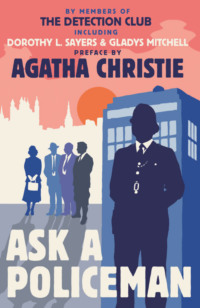
ASK A POLICEMAN
BY
ANTHONY BERKELEY
MILWARD KENNEDY
GLADYS MITCHELL
JOHN RHODE
DOROTHY L. SAYERS
&
HELEN SIMPSON

COPYRIGHT
Published by HarperCollinsPublishers Ltd
1 London Bridge Street
London SE1 9GF
www.harpercollins.co.uk
This 80th anniversary edition published in 2012
First published in Great Britain by Arthur Barker Ltd 1933
Copyright © The Detection Club 1933, 2012
The Authors asserts the moral right to be identified as the authors of this work
A catalogue record for this book is available from the British Library
All rights reserved under International and Pan-American Copyright Conventions. By payment of the required fees, you have been granted the non-exclusive, non-transferable right to access and read the text of this ebook on-screen. No part of this text may be reproduced, transmitted, down-loaded, decompiled, reverse engineered, or stored in or introduced into any information storage and retrieval system, in any form or by any means, whether electronic or mechanical, now known or hereinafter invented, without the express written permission of HarperCollins ebooks
HarperCollinsPublishers has made every reasonable effort to ensure that any picture content and written content in this ebook has been included or removed in accordance with the contractual and technological constraints in operation at the time of publication
Source ISBN: 9780007468621
Ebook Edition © SEPTEMBER 2012 ISBN: 9780007468652
Version: 2018-08-06
CONTENTS
Cover
Title Page
Copyright
Map
Foreword: Ask a Detective Writer by Martin Edwards
Preface: Detective Writers in England by Agatha Christie
PART I
DEATH AT HURSLEY LODGE BY JOHN RHODE
PART II
I. MRS. BRADLEY’S DILEMMA BY HELEN SIMPSON
II. SIR JOHN TAKES HIS CUE BY GLADYS MITCHELL
III. LORD PETER’S PRIVY COUNSEL BY ANTHONY BERKELEY
IV. THE CONCLUSIONS OF MR. ROGER SHERINGHAM. BY DOROTHY L. SAYERS
PART III
“IF YOU WANT TO KNOW—” BY MILWARD KENNEDY
Final Note
Footnotes
About the Publisher

FOREWORD
ASK A DETECTIVE WRITER
By MARTIN EDWARDS
ASK A POLICEMAN, first published in 1933, was the fourth in a sequence of collaborative mysteries produced in quick succession by members of the Detection Club. The Club was set up three years before this book was written, as an elite and rather secretive social network of leading detective novelists. It continues to flourish to this day, although current members include prominent thriller and espionage writers as well as specialists in the whodunit.
Ask a Policeman followed two radio serials, Behind the Screen and The Scoop, and a full-length detective novel, The Floating Admiral. These collective ventures generated enough revenue for the Club to rent premises in Soho, where, as Dorothy L. Sayers put it, members convened “chiefly for the purpose of eating dinners together and of talking illimitable shop.”
In the early Thirties, detective fiction was hugely popular, and many writers treated the detective story as a game in which they pitted their wits against their readers’. It was supposed to be important to “play fair”. Father Ronald Knox, a founder member of the Club, went so far as to devise a jokey Decalogue of ten commandments for the genre (“not more than one secret room or passage is allowable”, for instance)—which he and his colleagues were happy to break whenever it suited them.
Anthony Berkeley, who organized the dinner meetings that led to the foundation of the Club, and Dorothy L. Sayers, a towering presence in its ranks, headed a group of talented crime writers who became increasingly determined to explore criminal psychology and write novels of literary merit. Yet they too relished the intellectual exercise of creating elaborate puzzles.
Writing a round-robin mystery presents a variety of challenges for any team of authors, and Club members had to decide how to top the success of The Floating Admiral. Their answer was to come up with a fresh concept—they would write a story in which they exchanged detectives with each other. This gimmick afforded contributors the chance to poke fun at the genre, and at the quirks of their colleagues’ most famous sleuths. But transforming the idea into a readable story was bound to prove complex, with each contributor in turn needing plenty of space to develop the narrative in a distinctive way. This explains why, although 13 members provided ingredients for the mix in The Floating Admiral, just half a dozen created Ask a Policeman.
The original dust jacket blurb captured the gleeful spirit of the enterprise:
“Here is something delightfully new in ‘thrills’—a story which combines the interest of detection with the fun of parody. A problem is propounded; ingenious, and, for the solvers, malicious, and in itself a parody of a thousand and one detective stories. A great newspaper proprietor dies in his study, and suspicion falls upon an Archbishop, a Secretary, a Police Commissioner, and the Chief Whip of the political party in power. There is, too, a Mysterious Lady. What, then, can the Home Secretary do but call in the Amateur Experts? There are four of them; each takes a hand and each produces a different solution.”
The industrious and prolific John Rhode set the scene in a long introductory section. Rhode was the main pen-name of Cecil John Street (1884–1965), a former army officer who had won the Military Cross. His most famous detective was Dr. Lancelot Priestley, a rather severe intellectual who featured in a long line of novels but is absent here. Rhode was an efficient plot-builder, and created the perfect victim, a tyrannical media mogul whom every other character in the story seemed to have a possible motive to kill. In keeping with the fashion of the time, a plan of the scene of the crime was included.
The story was introduced by an exchange of letters between Rhode and Milward Kennedy. Kennedy (1894–1968) also concealed his identity under several pseudonyms—his real name was Milward Rodon Kennedy Burge. He worked in Military Intelligence during the First World War, and was awarded the Croix de Guerre prior to taking up a career in diplomacy. Like Anthony Berkeley, he wanted to push out the boundaries of the detective story, and several of his books experiment with the form. None of his characters, however, appeared in more than two books, and the absence of a series detective may help to explain why his fame did not last. To Kennedy fell the unenviable task of tying up the loose ends of the story, and one of the in-jokes of this book is that he gave the job of making sense of the case that had taxed Lord Peter Wimsey and others to a character who was, like himself, a civil servant. Another is his tongue-in-cheek admission to breaking the “Rules to which my fellow-members of the Detection Club always, and I on all occasions but this, make it a point of honour to adhere”.
Once Rhode had set the scene, the baton passed to Helen Simpson. Born in Sydney in 1897, she was both gifted and charismatic; Sayers, a close friend, said after Simpson’s untimely death from cancer in 1940, “I have never met anybody who equalled her in vivid personality and in the intense interest she brought into her contacts with people and things.” Simpson tried her hand at poetry and plays before collaborating with Clemence Dane on Enter Sir John, which introduced Sir John Samaurez, the actor-manager of the Sheridan Theatre. Sir John sets about clearing the name of a young actress who has been charged with murder, and makes such a success of the task that, by the time Ask a Policeman appeared, the two of them are husband and wife. Enter Sir John was turned into a film by Alfred Hitchcock called Murder! Simpson co-wrote two more books with Dane, as well as producing several solo novels, including Under Capricorn, which later became another Hitchcock movie. Turning to politics, Simpson was adopted as Liberal Parliamentary Candidate for the Isle of Wight before the cruel intervention of the disease that killed her. The energy, wit and skill with which, in this book, she tackles her portrayal of Gladys Mitchell’s detective, Mrs. Bradley, seem typical of how she approached everything in her life.
Gladys Mitchell had been elected to membership of the Club shortly before this book was written. She too admired Simpson, describing her in an interview with B.A. Pike as “brilliant, witty, charming and highly intellectual”; she even allowed Simpson to bestow a second forename, Adela, upon her detective. Mitchell (1901-1983), combined writing with a career as a schoolteacher; she introduced Mrs. Bradley in a convention-defying mystery called Speedy Death, and continued to write about her for more than half a century. Her books often contain bizarre elements, but she attracted a devoted band of readers, including Philip Larkin, who called her “the Great Gladys”. Mrs. Bradley, a psychiatrist and consultant psychologist to the Home Office, has the looks of a “sinister pterodactyl”, but when The Mrs. Bradley Mysteries aired on BBC Television in 1998-9, she was played by Diana Rigg, a casting decision so eccentric as to be worthy of Mitchell herself.
Anthony Berkeley was one of crime fiction’s leading innovators. His real name was Anthony Berkeley Cox (1893-1971), and he wrote a good many humorous articles for magazines before introducing Roger Sheringham in The Layton Court Mystery, which was at first published anonymously. Writing as Francis Iles, he produced ground-breaking—and deeply cynical—novels about crime, notably Malice Aforethought and Before the Fact; the latter was filmed by Hitchcock as Suspicion. The Sheringham mysteries often feature puzzles with ingenious multiple solutions; the most dazzling example, The Poisoned Chocolates Case, is name-checked by Sayers in this book. Berkeley liked to explore dilemmas about justice, and was intrigued by the idea of the fallible sleuth. So in his work, murderers sometimes escape unpunished, Sheringham does not always come up with the right solution to the mystery, and tricky plot devices are allied to a sharp, ironic wit. To take on the job of writing about Sayers’ hero Lord Peter required some courage, as she was a formidable woman, held in awe by many of her Detection Club colleagues. But Berkeley rose to the challenge, and he captured Wimsey brilliantly, in a chapter that offers one of the finest of all Golden Age parodies as well as a clever solution to the problem Rhode had posed. Gladys Mitchell—who liked Berkeley rather more than Sayers—recalled in her old age that “Anthony’s manipulation of Lord Peter Wimsey caused the massive lady anything but pleasure”, but although in later years, these two strong, and often intimidating personalities came increasingly into conflict, it is hard to believe that Sayers failed to appreciate the flair displayed in Berkeley’s contribution to Ask a Policeman.
At the time this book was written, Sayers was taking the detective story in a new direction. Wimsey had started out as little more than a caricature, albeit a caricature portrayed with affectionate humour. In Whose Body?, published in 1923, we are told that his “long amiable face looked as if it had generated spontaneously from his top hat, as white maggots breed from Gorgonzola”. But once he met and fell in love with Harriet Vane, a detective novelist convicted of murder (was Sir John Samaurez’ first case the inspiration for this idea?), he grew as a character. Sayers’ depiction of his relationship with Harriet set the pattern for succeeding generations of crime writers, who preferred to create serious and believable protagonists with lives that change as the years pass, rather than ‘supermen’ detectives in the mould of Sherlock Holmes. Sayers (1893-1957) was self-consciously intellectual, and in her only non-series novel, The Documents in the Case, co-written with Robert Eustace, musings on the nature of life were integral to the plot. Sayers was dissatisfied with the end product, but her very attempt at such an ambitious undertaking showed that the genre had much more to offer than glorified crossword puzzles. In her chapter for Ask a Policeman, Sayers renders Sheringham effectively, with a neat joke when he overhears two employees of the late Lord Comstock being rude about him, and if the solution she puts forward is not quite as compelling as Berkeley’s, perhaps that underlines her increasing focus on characterisation as opposed to mere puzzle-making.
After the start of the Second World War, however, she turned her attention away from crime writing, focusing on the translation of Dante, and writing about religious subjects. Similarly, Berkeley and Kennedy began to concentrate on reviewing rather than producing novels. But all three of them remained associated with the Detection Club, with Sayers holding the office of President from 1948 until her death.
Agatha Christie, who had participated in the first three Detection Club collaborations, sat this one out. However, it is a real pleasure to be able to include here a delightful essay she wrote about her fellow practitioners—the first time it has appeared in volume form. She wrote it in 1945, at the request of the Ministry of Information, for publication in a Russian magazine. Presumably because she was confident that none of her peers in the Detection Club would come across her comments, she was quite candid.
So it is interesting to see that Christie disapproved of Wimsey’s transformation into a “handsome hero”, and damned Rhode’s prose style with faint praise as “straightforward”, as well as to note her admiration for Anthony Berkeley’s ability to provide first class entertainment. But she also made it clear that the writers she mentioned were those at the top of their profession. Today, though, not only are the books of H.C. Bailey, Rhode, Kennedy and many of their contemporaries forgotten by everyone except a small band of enthusiasts, surprisingly little is known about most of the Detection Club members themselves. I was honoured to be appointed as the first archivist of the Club—although the fact that the official archives are more or less non-existent is somehow typical of this unusual and mysterious institution. Its members—not just the usual suspects in Christie and Sayers, but also A.A. Milne and Baroness Orczy, who in addition to their detective stories were the creators respectively of Winnie-the-Pooh and the Scarlet Pimpernel—played a much more significant part in developing popular culture in the twentieth century than has so far been recognized. Frustratingly, no minutes of meetings appear to have survived, and some of the reminiscences of early members are classics of unreliable narration. So the challenge of discovering more about the early days of the Club, and the lives of its members, is almost as fascinating as many of those Golden Age puzzles
Ask a Policeman is, when all is said and done, a period piece. Kennedy’s solution does not really “play fair” with the reader, but the book is laden with charm as well as humour, and its reappearance is as welcome as it is overdue. Howard Haycraft, a noted American historian of the genre, hailed this book as “a matchless tour de force”, and its success prompted plenty of other writers to parody the classic detective story. But few of them achieved such enjoyable results as the six members of the Detection Club who combined to create this lively entertainment.
PREFACE
DETECTIVE WRITERS IN ENGLAND
BY AGATHA CHRISTIE
WHAT kind of people read detective stories and why? Invariably, I think, the busy people, the workers of the world. Highly placed men in the scientific world, even if they read nothing else, seem to have time for a detective story; perhaps because a detective story is complete relaxation, an escape from the realism of everyday life. It has, too, the tonic value of a puzzle—a challenge to the ingenuity. It sharpens your wits—makes you mentally alert. To follow a detective story closely you need concentration. To spot the criminal needs acumen and good reasoning powers. It has also a sporting interest and is much less expensive than betting on horses or gambling at cards! Its ethical background is usually sound. Very very rarely is the criminal the hero of the book! Society unites to hunt him down, and the reader can have all the fun of the chase without moving from a comfortable armchair.
Before speaking of present day English writers, I must first pay tribute to Conan Doyle, the pioneer of detective writing, with his two great creations Sherlock Holmes and Watson—Watson perhaps the greater creation of the two. Holmes after all has his properties, his violin, his dressing gown, his cocaine etc., whereas Watson has just himself—lovable, obtuse, faithful, maddening, guaranteed to be always wrong, and perpetually in a state of admiration! How badly we all need a Watson in our lives!
Most detective writing since then has been modelled roughly on the same structure. The detective is the “central character”. But there has come to be something too artificial about a “private investigator”. The essence of a detective story is that it shall be “natural” in its setting and characters. My own Hercule Poirot is often somewhat of an embarrassment to me—not in himself, but in the calling of his life. Would anyone go and “consult” him? One feels not. So, more and more, his entry into a murder drama has to be fortuitous. My Miss Marple is more happily placed—an elderly gossipy lady in a small village, who pokes her nose into all that does or does not concern her, and draws deductions based on years of experience of human nature.
At the present day, I should call Margery Allingham one of the foremost writers of detective fiction. Not only does she write excellent English, but her drawing of character is masterly and she has wonderful power in creating atmosphere. You can feel the sinister influences behind the scenes, and her characters live on in your memory long after you have put the book away: the grim autocrat Mrs. Faraday of Police at the Funeral; the kindly and lovable “belle” in Death of a Ghost; Jimmy Sutane, the sad faced dancer with the twinkling feet. They are unusual but real personalities, vividly interesting. And through the books moves “Mr. Campion”, apparently vacuous, actually keenly acute, and with him the faithful Lugg (in whom, alas, I never can quite believe!) The pleasant negative inconsequence of Campion makes a dramatic contrast with the undercurrent of suspicion and fear that grows to a climax—particularly is this so in Flowers for the Judge. Sometimes, one feels, Margery Allingham is inclined to subordinate plot to characters. She is so interested in them that the denouement of the crime sometimes comes rather flatly as inevitable, rather than as a surprising bombshell.
Dorothy Sayers, alas, has wearied of the detective story and has turned her attention elsewhere. We all regret it for she was such an exceptionally good detective story writer and a delightfully witty one. Her earlier books Whose Body?, Unnatural Death and The Unpleasantness at the Bellona Club are decidedly her best, having greater simplicity and more “punch” to them. Also her detective “Lord Peter Wimsey”, whose face was originally piquantly described as “emerging from his top hat like a maggot emerging from a gorgonzola cheese”, became through the course of years merely a “handsome hero”, and admirers of his early prowess can hardly forgive his attachment to, and lengthy courtship of, a tiresome young woman called Harriet. One had hoped that, once married to her, he would resume his old form, but Lord Peter remains an example of a good man spoilt.
Not so Mr. Fortune, H.C. Bailey’s great creation. Reggie Fortune is always the same, and marriage to a discreet and charming wife has left his incisive character untouched. The stories stand or fall by Mr. Fortune. It is not the cases themselves but Mr. Fortune’s handling of them wherein lies the fascination. For Mr. Fortune is, undeniably, a great man. Now to label a man a great man and then write about him and show him to be a great man is a supreme literary feat! A noted surgeon and consultant to the Home Office, Reggie Fortune’s handling of his problems is like a surgical operation. Where all is apparently straightforward, he feels, probes, notes some tiny fact that a complacent police official has swept aside, and then he cuts down to the heart of the trouble. His method is the method of the knife, ruthless and incisive. His rudeness to the wretched Lomas (Assistant Commissioner of Police) is unbelievable—and leads one to speculate whether one day worm Lomas will turn and murder Mr. Fortune!
H.C. Bailey’s longer books are not so satisfactory as his shorter stories. All the characters are inclined to speak a special Baileyesque language of their own—a clear clipped jargon. This is effective in short doses as the atmosphere of the operating theatre. But the atmosphere of an operating theatre is essentially artificial—created deliberately for specific purposes. It cannot be prolonged into a picture of daily life. Some of the best of the Fortune stories show the deduction of a whole malignant growth from one small isolated incident. For instance, the discovery of a couple of withered leaves in a woman’s handbag, recognized by Mr. Fortune as Arctic Willow, cause him to inquire into an apparently satisfactory case of suicide.
Fat, lazy, incredibly greedy (his delight in cream and jam for tea make tantalizing reading in war days!), underneath Fortune’s smiling exterior there is cold steel. Reggie Fortune is for Justice—merciless and inexorable justice. His pity and indignation are aroused by the victims—in execution he is as ruthless as his own knife.
John Dickson Carr (or Carter Dickson, for they are one and the same) is a master magician. I believe that only those who write detective stories themselves can really appreciate his marvellous sleight of hand. For that is what it is—he is the supreme conjurer, the King of the Art of Misdirection. Each of his books is a brilliant, fantastic, quite impossible conjuring trick.
“You watch my hands, ladies and gentlemen, you watch my sleeves, the hat is empty, nothing anywhere—Hey presto! A Rabbit!” He has, too, the gift of story telling, once you begin a book of his, you simply cannot put it down. As each chapter draws to a close, you see ahead a reasonable explanation, then, like Alice through the Looking Glass’s path, it seems to shake itself, and off it goes in a twist of fresh bewilderment. His characterization is not particularly good, his people talk in a way quite unlike life, his events are fantastic. It is all stagey—set behind footlights—but what a performance!
Carr’s penchant is for the impossible situation. He starts with that—either with the familiar “closed room”, or “closed circle” or with, as in the “Arabian Nights Mystery”, a setting of pure fantasy, with a set of people behaving apparently like lunatics. Then with a shake of the kaleidoscope you get the reason of it, all is quite normal—and then fresh impossibilities, fresh rationalisations. For some people, the twists of the plot may be too complicated. He can certainly be accused of occasionally loading the dice, but that can be forgiven for the brilliance with which it is done. The clues to the truth are so slight as to be almost unfair: one little sentence slipped into the middle of a tense situation; a mention of a car radiator on p.30 that does not agree with the same car’s radiator on p.180. Do you notice it? Of course not! Your eyes are riveted on a suspicious circumstance which you think only you have spotted. Misdirection, again.
A crowd of people are assembled round a dinner table in The Red Widow Murders. There is a sinister room in the house, nailed up for many years. Anyone who stays in it alone is found dead. A man goes in, locks himself in while the others wait outside. Every quarter of an hour they call to him and he replies—but when the door is opened the man is dead, in a room with locked shutters and no secret ways in or out—and, what is more, that man has been dead for over an hour. The impossible has happened! You never noticed a little descriptive phrase about the man at dinner; pale, nervous, eating nothing but soup … Your clue was there, in those four words.
Dickson Carr’s detective is the beer drinking Dr. Fell, Carter Dickson’s sleuth is Sir Henry Merrivale, the “old man”, a former chief of Military Intelligence. I much prefer him of the two—but it is the actual unfolding of the story that is the real strength of Dickson Carr’s genius. He is a male Scheherazade—and certainly no cruel Empress could order his execution until she had heard the next instalment!
Ngaio Marsh is another deservedly popular detective writer. Her style is amusing and her characterizations excellent. Surfeit of Lampreys was a delightful book, though perhaps one so enjoyed the Lamprey family that one rather forgot about the murder. Death in Ecstasy is a very clever picture of a little coterie of worshippers in a “New Religion” adroitly put over by the infamous Father Garnett. Artists in Crime is a good story of murder amongst a collection of painters. Both the atmosphere and the people are first rate.
Then there is the master of alibis, Freeman Wills Crofts. Inspector French is a kindly painstaking man who accomplishes his results by sheer hard work. If you like alibis, then you will enjoy the efforts of Inspector French. The Cask, one of his earliest books, is a model of its kind. A cask arrives at a business firm in London and is found to contain the body of a young woman. From there on you trace the cask back to its sender and forward again—there seems no loop hole, no possible opportunity for the cask to have been opened and the body substituted for the original piece of statuary. Nevertheless, there is a flaw and at last, slowly worried out, the truth emerges.
There are many other good detective writers—space forbids the mention of all of them. There is Michael Innes, a brilliant and witty writer. There is straightforward John Rhode with Dr. Priestley in charge. There is Gladys Mitchell with her fascinating Mrs. Bradley, ugly as a toad and armed with the latest up-to-date theories of psychology. And Austin Freeman’s books remain interesting examples of scientific methods of crime deduction.
I have chosen out for fullest description those writers whom I myself admire most and consider at the top of their profession. No collection would be complete without the mention of Anthony Berkeley, founder of the Detective Club, although he has, alas, been silent for many years. But what delightful books he has written. Detection and crime at its wittiest—all his stories are amusing, intriguing, and he is a master of the final twist, the surprise dénouement. Roger Sheridan, the slightly fatuous novelist, is his detective, though Roger is not always allowed to shine. He remains always the gifted amateur—hit or miss—but whichever way it is, the entertainment is first class.
And now, perhaps, a few words about myself. Since I have been writing detective stories for a quarter of a century and have some forty-odd novels to my credit, I may lay claim at least to being an industrious craftsman. A more aristocratic title was given to me by an American paper which dubbed me the “Duchess of Death”.
I have enjoyed writing detective stories, and I think the austerity and stern discipline that goes to making a ‘tight’ detective plot is good for one’s thought processes. It is the kind of writing that does not permit loose or slipshod thinking. It all has to dovetail, to fit in as part of a carefully constructed whole. You must have your blueprint first, and it needs really constructive thinking to make a workmanlike job of it.
Naturally one’s methods alter. I have become more interested as the years go on in the preliminaries of crime—the interplay of character upon character, the deep smouldering resentments and dissatisfactions that do not always come to the surface but which may suddenly explode into violence. I have written light-hearted murder stories, and serious crime stories, and technical extravaganzas like Ten Little Niggers [And Then There Were None]. I have laid a crime story in Ancient Egypt, and a murder play on a modern Nile steamer. I have had the conventional Body in the Library, and Bodies in Aeroplanes, and on Boats and in Trans-European Trains. Hercule Poirot has made quite a place for himself in the world and is regarded perhaps with more affection by outsiders than by his own creator! I would give one piece of advice to young detective writers. Be very careful what central character you create—you may have him with you for a very long time!
INTRODUCTION TO PART I
(a)
“DEAR JOHN RHODE,
“People ask me, when they find out (let me be honest, ‘when I tell them’) that I write detective stories, ‘Oh, how do you begin? Do you think of a Murder and then work it out, or do you think of a Solution and do it backwards?’ I suppose the question is inevitable; I have never discovered the answer.
“At the moment I’m in a peculiar position: I’ve thought of a title—’ Ask a Policeman.’ That ought to suggest a nice murder, surely? You know, with Cabinet Ministers, and Papal Nuncios, and Libraries, and all the rest of it.
“But the queer thing is, the title does nothing of the sort—to me: how does it strike you?
“Yours ever,
“MILWARD KENNEDY.”
(b)
“DEAR MILWARD KENNEDY,
“Yes, I know. I have never answered the question myself. I have come to the conclusion that writing detective stories is just like any other vice. The deed is done without one’s having any clear knowledge of the temptation which led up to it. But I must confess that I usually start with something more comprehensive than a title.
“I suppose your veiled suggestion is that I supply a plot to fit your title. But, honestly, to my simple mind ‘Ask a Policeman’ suggests the pawning of a watch—or are you too young to remember the old song?—rather than your galaxy of celebrities. Besides, I have never met a Papal Nuncio. I shouldn’t know what to say to him if I did. But I have seen an Archbishop—in the distance. And once I used to hold awestruck conversations with a Cabinet Minister, whose powers of invective I have always admired.
“So here is your plot. As you will see, you have a choice of many Policemen to interrogate as to its solution.
“Yours,
“JOHN RHODE.”
PART I
DEATH AT HURSLEY LODGE
BY JOHN RHODE
IT was impossible to tell, from the Home Secretary’s expression, exactly how the news had affected him. He was a big, heavy man, who looked much more like a country farmer than a Minister of the Crown. Punch was fond of caricaturing him in breeches and gaiters, with a pitchfork over his shoulder. You might have expected his position in the Cabinet to have been Minister of Agriculture.
But those who knew Sir Philip Brackenthorpe were well aware that a very keen brain was at work beneath his rather bucolic exterior. And that that brain was particularly active at this precise moment the Commissioner of Metropolitan Police had no doubt. The two were alone together in Sir Philip’s private room at the Home Office. Through the open windows came the muffled roar of the traffic in Whitehall, the only sound to break the silence which had followed the Commissioner’s terse statement.
“Comstock!” exclaimed Sir Philip at last, “The man lived on sensation, and it is only fitting that his death should provide the greatest sensation of all. Yes, you’re quite right, Hampton. I shall have to have all the facts at first hand. This business is bound to come up when the Cabinet meets to-morrow. Who have you got there?”
“Rather a crowd, I’m afraid, sir,” replied Sir Henry Hampton, “I don’t know whether you’ll care to see them all—”
“I’ll see anybody who’s got anything relevant to say about the affair. But, mind, I want evidence, and not speculation. But, before we start, I should like to see Littleton, since he’ll be primarily responsible for the investigations. He came here with you, of course?”
Hampton’s tall, gaunt frame imperceptibly stiffened. The question had been asked a good deal earlier than he had anticipated. It was devilish awkward, for Sir Philip was not the sort of person who could be put off with evasions. “Littleton was not in his office when the message came through to Scotland Yard just now, I’m sorry to say,” he replied simply.
No use going into details, thought Hampton. Littleton, the Assistant Commissioner in charge of the Criminal Investigation Department, might be expected to return at any minute now. He would find a message telling him to come at once to the Home Office. And then, as Hampton reflected grimly, he could tell his own story. And, if the amazing rumour which had reached the Commissioner as to his whereabouts was true, his story might prove particularly interesting.
Sir Philip must have guessed that Hampton was withholding something from him. “You are responsible for your own Department,” he said, with a touch of severity. “You will naturally give Littleton such instructions as you consider necessary. But I want to impress upon you that the death of a man like Comstock is not an everyday event. It will require, shall we say, special methods of investigation. And that for many reasons, which I need scarcely point out to you.”
From the far-away expression of his eyes, it seemed that Sir Philip was mentally addressing a larger and more important audience. Hampton wondered idly whether it was the Cabinet or the House of Commons that he was thinking of. The murder—if it was murder—of a man like Lord Comstock was an event of world-wide importance. The newspapers controlled by the millionaire journalist exerted an influence out of all proportion to their real value. Inspired by Comstock himself, they claimed at frequent intervals to be the real arbiters of the nation’s destiny at home and abroad. Governments might come and go, each with its own considered policy. The Comstock Press patronized, ignored, or attacked them, as suited Lord Comstock’s whim at the moment. His policy was fixed and invariable.
This may seem an astounding statement to those who remember how swiftly and how frequently the Daily Bugle changed its editorial opinions. But Lord Comstock’s policy was not concerned with the welfare of the State, or of anyone else but himself, for that matter. It was devoted with unswerving purpose to one single aim, the increase in value of his advertisement pages. The surest way to do this was to increase, circulation, to bamboozle the public into buying the organs of the Comstock Press. And nobody knew better than Lord Comstock that the surest way of luring the public was by a stunt, the more extravagant the better.
Stunts therefore followed one another with bewildering rapidity. Of those running at the moment, two had attracted special attention. To be successful, stunts must attack something or somebody, preferably so well established that it or he has become part of the ordinary person’s accepted scheme of things. Lord Comstock had selected Christianity as the first object of his attack.
But he was far too able a journalist merely to attack. His assault upon Christianity had nothing in common with the iconoclasm of the Bolshevists. Christianity must be abandoned, not because it was a menace to Socialism, but because the Christian civilization had manifestly failed. The economic slough of despond had demonstrated that, clearly enough. Christianity had swept away the conception of the Platonic Republic, with its single and logical solutions of all problems which could beset the Commonwealth. “Back to Paganism!” was the slogan, and the Daily Bugle devoted many columns daily to proving that by this means alone the existing economic depression could be finally cured.
One antagonist at a time, even so formidable an antagonist as Christianity, could not satisfy the restless spirit of Lord Comstock. He sought another and found it in the Metropolitan Police, his choice being influenced mainly by the implicit faith which that institution most justly inspired. Scotland Yard was the principal object of the invective of the Comstock Press. It was inefficient, ill-conducted, and corrupt. It must be reformed, root and branch. The crime experts of the Comstock Press, men who knew how to use their brains, were worth the whole of the C.I.D. and its elaborate machinery, which imposed so heavy and useless a burden upon the tax-payer.
Now and then it happened that a crime was committed, and no arrest followed. This was the opportunity of the Comstock Press. Without the slightest regard for the merits of the case, and safe in the knowledge that a Government Department cannot reply, the Daily Bugle, and its evening contemporary, the Evening Clarion, unloosed a flood of vituperation upon the C.I.D., from the Assistant Commissioner himself to his humblest subordinate. And the most recent instance of this—the echoes of the storm were still rumbling—was vividly in the Home Secretary’s mind as he sat thoughtfully drawing elaborate geometrical patterns upon his blotting paper.
In fact, the shadow of Lord Comstock lay heavily on both men, as they sat in the oppressive warmth of the June afternoon. It was as though his invisible presence lurked in the corner of the room, masterful, contemptuous, poisoning the air with the taint of falsehood. That at that very moment he lay dead in his own country retreat, Hursley Lodge, was a fact so incredible that it required time for its realization. Hence, perhaps, the silence which had once more fallen upon the room.
It was broken by Sir Philip. “Did you know the man personally?” he asked abruptly, without taking his eyes from the figures he was tracing.
“I’ve seen him often enough, and spoken to him once or twice;” replied the Commissioner; “but I can’t say that I knew him.”
“I knew him,” said Sir Philip slowly. From his manner it seemed as though he were more interested in his designs than in his subject. “At least, I knew as much about him as he cared for anyone to know. It wasn’t difficult. He had only one topic of conversation. With men, at least. I’ve been given to understand that his conversation with women was apt to be more intimate. And that was himself.”
With infinite care he drew a line joining two triangles apex to apex. He contemplated the result with evident satisfaction, then looked up, and continued more briskly. “He loved to talk about himself and his achievements, up to a point. You can guess the sort of thing. The contrast between what he was and what he became. You couldn’t help admiring the fellow as you listened, however much you disliked him. He was an able man in his own way, Hampton, there’s no getting away from that. An able man, and a strong man, with that innate ruthlessness which makes for success. You know how he started life, of course?”
“Pretty low down in the social scale, from all I’ve heard,” replied the Commissioner.
“His father worked in a mill somewhere up north. A very decent and respectable chap, I believe. Quite a different type from Comstock. Saved and scraped with only one object in view, to make a gentleman out of that scapegrace son of his. It’s a mercy he never lived to know how completely his efforts failed. Anyhow, he sent the lad to Blackminster Grammar School. Lord knows what sort of a figure he must have cut when he first went there. But he was head of the school before he left.”
“No lack of brains, even then, apparently,” remarked the Commissioner.
“No lack of brains, or of determination. But then comes a gap. Comstock disappears from sight—conversationally, I mean—after that. Nobody has ever heard him mention the intervening years. The rungs of the ladder are hidden from us. He reappears in a blaze of glory as Lord Comstock, reputed millionaire, and owner of heaven knows how many disreputable rags. Ambitious, too. Life’s work not yet accomplished, and all that sort of thing. And now you say he’s lying dead at that country place of his, Hursley Lodge. I’ve never seen it. Male visitors were not made welcome there, I’ve always understood.”
“Welcome or not, there were quite a crowd of them there this morning,” remarked the Commissioner grimly. “Only quite a small house, too.”
Sir Philip nodded. His reminiscent mood passed suddenly. “All right, bring them in,” he said. “Your own people first. The police, I mean. This chap who was called in first. I’ll leave you to get the story out of them.”
The Commissioner opened the door which led into the Private Secretary’s room beyond. He looked round sharply, hoping to see the truculent figure of the Assistant Commissioner among the group which stood there, nervous and ill at ease. A frown expressed his disappointment. He beckoned sharply to three men, standing by. In single file they followed him into Sir Philip’s presence.
Hampton introduced them curtly. “Chief Constable Shawford, Superintendent Churchill, sir. Both of the Yard. This is Superintendent Easton, of the local police.” Sir Philip glanced at the men in turn, nodded at each but said nothing beyond a curt “sit down,” addressed to them all in general. They obeyed—the lower the rank, the greater the distance maintained from the Home Secretary. The Commissioner at first occupied a large arm-chair touching the desk, but as the interview went on he ceased to have a regular station—he would sit one minute, stand the next, lean on the big desk, and almost promise (so it seemed to the inexperienced Easton) to whisk away the Home Secretary and occupy his chair. Sir Philip, picking up his pencil again, drew with more deliberation than skill, a large circle upon his blotting-paper.
“Easton’s district includes Hursley Lodge, sir,” the Commissioner began, without further preface. “He was at the police-station when a call was received that Lord Comstock had been found dead in his study. This was at 1.7 this afternoon.”
Sir Philip glanced at the clock on his desk. It was then 2.35 p.m.
“He drove at once to Hursley Lodge, and was received by Lord Comstock’s secretary, Mr. Mills, who took him straight up to the study. His story will be more easy to follow, sir, if you keep this plan in front of you.”
He placed a neatly-drawn diagram on the desk, and Sir Philip studied it curiously. “Where did this come from?” he asked.
“Easton brought it with him from Hursley Lodge, sir,” replied the Commissioner, with a touch of impatience. He was anxious to get on with the facts.
Sir Philip looked up, and for the first time Easton appeared to him as an individual. He was tall, with a soldierly moustache and bearing, but obviously unnerved by the distinguished company in which he found himself; the Home Secretary’s glance had somehow brought him to his feet, and under his gaze he shifted from one foot to the other, and with difficulty suppressed an almost irresistible inclination to salute.
“Pretty smart of you to get hold of a plan like this, Easton,” said Sir Philip encouragingly. “Where did you find it?”
“Mr. Mills gave it to me, sir—the secretary,” replied Easton. Something in Sir Philip’s manner seemed to have put him quite at his ease. During the rest of the interview he addressed himself to him exclusively, as though some mysterious bond of sympathy had been established between them. He even took a couple of paces towards the Home Secretary’s desk.
“Mr. Mills gave it to you, did he?” said the Home Secretary. “Where did he get it from? People don’t as a rule have plans of their houses ready to hand like that.”
“It’s a rough tracing of a plan of the drains, really, sir,” Easton explained gravely, “with the drains left out and a few other things put in. Mr. Mills told me that a new system of drainage had recently been put in at Hursley Lodge, and the builder left a plan behind in case any alterations were required.”
“I see. Very well, Easton. Tell me what you found when you got into the study.”
“It was a large room, sir, with a big bow-window on the south side. The frames were of the casement type, and were all wide open. There was very little furniture in the room, sir. A row of bookcases round the walls, and half a dozen chairs standing in front of them. One of them had been overturned, and was lying close inside the door leading into the hall. There were two other doors, sir. One led into the drawing-room, and was disguised as a bookcase. The bookcase swung open with the door, if you understand me, sir.”
Sir Philip nodded. “And the third door?” he asked.
“That was a double door, sir, leading into the room which Mr. Mills used, and which he called the office. At the farther end of the room was a heavy desk, standing close to the window. Behind this desk, and between it and the window, lay the body of Lord Comstock. His lordship lay on his right side, with his knees drawn up towards his chin. I could see at once that he was dead, sir.”
“And did you discover as promptly what had killed him?”
“There was a very small bullet-wound in his left temple, sir. So small that I thought at first it was a stab with some round weapon like a thick hat-pin.”
“What made you alter your opinion, Easton?”
“When I looked on the desk, sir, I found this,” replied Easton simply. He put his hand in his pocket, and produced something wrapped carefully in a handkerchief. He opened this out, and disclosed a miniature revolver, which he laid on the edge of the Home Secretary’s desk. At the sight of it, Chief Constable Shawford made a sound as though about to speak. But a sharp glance from the Commissioner silenced him before he could utter anything articulate.
Sir Philip looked at it curiously. “Vicious little toy!” he exclaimed. “And you think this is what killed Lord Comstock, do you, Easton?”
“I think so, sir. One chamber has been discharged, and that quite recently, by the look of the fouling. But, as far as I have been able to make out, sir, there are no finger-marks.”
The Commissioner rose and stepped to the desk. “You had better take charge of this, Shawford,” he said. “The sooner it is examined by the experts the better.”
He was about to pick up the pistol, when Sir Philip waved him aside. “No, let it stay there for the present,” he said. “Now, let’s get this clear, Easton. You say that Lord Comstock was lying on the floor, and that the pistol was on the desk. Did it occur to you that Lord Comstock might have shot himself?”
“It did occur to me, sir. But if he had been sitting in his chair at the time, I don’t see how the pistol could have fallen to where I found it. It was on the other side of the desk, sir.”
“When you found it, perhaps. But other people must have entered the room before you reached the house. Several other people, I dare say?”
It was the Commissioner who replied. He was evidently anxious to atone for his slight faux pas over the pistol. “Two at least, Sir Philip. Comstock’s secretary and his butler. They are waiting in the next room. Shall I bring them in?”
“All in good time,” said Sir Philip. “I expect that Easton has more to tell us yet. I should like more light on the point of whether Comstock could have shot himself. There are no finger-prints to be seen on the pistol. The inference is that whoever handled it last wore gloves or else it has been wiped over. Was it as hot in the study at Hursley Lodge as it is in here?”
“It was certainly very warm, sir.”
“I expect it was. It’s one of the hottest June days I remember. I say, Hampton, would you mind putting one of those candlesticks on my desk?”
He nodded towards the mantelpiece, on which stood a pair of silver candlesticks. The Commissioner walked up to the nearest one, picked it up, and laid it down beside the pistol.
“Thank you, Hampton. Now, Chief Constable, will you look at that candlestick and tell me if you can see any finger-prints on it?”
Shawford gingerly picked up the candlestick and breathed on it. “They are very plainly visible where Sir Henry Hampton touched it, sir,” he said solemnly.
“That settles the point, I think,” said Sir Philip briskly. “If anybody had touched the pistol with their naked hands this morning they must have left finger-marks upon it. Comstock would not be wearing gloves indoors. We can leave it at that for the present. Now, Easton, what did you do after you had looked round the study?”
“The first thing I did, sir, was to telephone to my Chief. I thought he would want to know at once what had happened. When I had done that, sir, I asked Mr. Mills to send for the doctor who usually attended his lordship.”
“By his Chief, Easton means the Chief Constable of Southshire, sir,” the Commissioner put in. “Colonel Graham. He rang me up about half-past one, and repeated what Easton had told him. He wanted the Yard to take charge immediately. I thought it best that you should hear all the circumstances at once, and I therefore put a call through to Hursley Lodge. Easton answered it, and I told him to come here as quickly as he could, bringing with him all available witnesses.”
Sir Philip nodded. “Sit down over there in the corner, Easton,” he said. “You’ve done very well. Ah, wait! one point—when did you reach Hursley Lodge? 1.15? Right. Now you can produce your witnesses, Hampton. One at a time, of course.”
The Commissioner went to the door, and beckoned. “This is Mr. Mills, Lord Comstock’s secretary, sir,” he announced.
A young man, somewhere near the thirty mark, entered the room. He was elegantly, a little too elegantly, dressed, his coat cut to suggest a slimmer waist than in fact he possessed. His hair was curly and shone with an odorous ointment. His narrow eyes roamed round the room, his expression a mixture of alarm, bravado, and surprise, and settled finally upon the inexpressive countenance of the Home Secretary.
“Sit down, Mr. Mills,” said Sir Philip briskly. “I want to hear what you can tell us about Comstock’s death. I saw him in London not many days ago. How long had he been down at Hursley Lodge?”
Mills moistened his lips. It seemed as if he spoke only by a great effort. “Only since the day before yesterday, sir,” he replied.
“Had he any particular reason for leaving London just now?”
“Not to my knowledge, sir. He often went down to Hursley Lodge for a few days at a time. He could work there without being interrupted, or he could, as a rule, sir.”
“Did you always accompany him on these occasons?”
An unpleasantly sly look came into Mills’ eyes at this. “Not always, sir. But on this occasion he told me to come, as he would probably want me.”
“I see. Now please tell me, in your own words, exactly what happened this morning.”
Again Mills moistened his red lips. He hesitated, and seemed at a loss where to begin. Then all at once he seemed to make up his mind, and spoke rapidly in a harsh and monotonous voice.
“Lord Comstock came into the dining-room as I was finishing breakfast, sir. I did not expect him so early, as at Hursley Lodge he rarely appeared before half-past nine. Nine was just striking as he came in. He asked me why I wasn’t at work, and without waiting for my answer told me that he would be in his study all the morning, and that he wasn’t on any account to be disturbed. I suppose that he was anxious to think over the policy of the newspapers.”
“By which you mean the ‘Back to Paganism’ movement, and the attack on the police, I suppose?” the Commissioner inquired.
“It was probably the latter, Sir Henry. He had that cause very much at heart! Yesterday he was very much upset when he learnt that Mr. Littleton had refused to give the crime expert of the Daily Bugle certain information in connection with the Little Cadbury case. He said that the police were deliberately practising a policy of obstruction, entirely contrary to the interests of justice.”
Sir Philip glanced at the Commissioner. “Do you know anything of this?” he asked.
Hampton shook his head, but Shawford cleared his throat apologetically. “I beg your pardon, sir, but I think I know of the incident to which Mr. Mills refers. Mr. Littleton had given orders that no information was to be given to the press for the present. The case concerns the body of a girl who was found murdered in a wood near Little Cadbury, sir. We have a clue, which is being followed up, but we can only succeed if complete secrecy is maintained.”
“I see. You’re probably right, Mills. Comstock was no doubt looking for a stick with which to beat Scotland Yard. He gave orders that he was not to be disturbed, you say. Was there anything unusual in this?”
“Nothing at all, sir. It was the rule that Lord Comstock never saw anybody at Hursley Lodge unless he sent for them. He would occasionally ring up one of his editors on the private line to Fort Comstock, and tell him to come down at once. But he very rarely had any other visitors, at least when I was with him. I was all the more surprised when I was told that there was somebody to see him this morning.”
“One moment, Mills. Where were you when Lord Comstock entered his study?”
“In the office, sir, which communicates with it by double doors.”
“And you were there when you were told that somebody wished to see Comstock. What did you do?”
“Just after half-past eleven Farrant, the butler, came into the office, sir. I had already told him that Lord Comstock would see nobody. But he said that His Grace the Archbishop of the Midlands had called, and insisted upon seeing his Lordship. Farrant told me that he had shown His Grace into the drawing-room. I hurried in there at once, sir. The Archbishop told me that he was one of his oldest friends. If I may say so, sir, this seemed to me very extraordinary, knowing Lord Comstock’s aversion to the Church.”
Sir Philip smiled. “The Archbishop of the Midlands!” he exclaimed softly. “The Most Reverend William Ansehn Pettifer, D.D. Archbishops never lie, you may be sure of that. And in this case Doctor Pettifer was manifestly speaking the truth. He was certainly one of Comstock’s earliest friends. Not that they can have seen much of one another recently. Rather curious, that, eh, Hampton?”
“I’m afraid that I don’t quite follow,” replied the Commissioner, with a puzzled expression.
“Don’t you remember that Doctor Pettifer was for many years Headmaster of Blackminster Grammar School? He only left there when he became Bishop of Bournemouth. He must have known Comstock as a boy, of course. Go on, Mr. Mills, what did Lord Comstock say when you told him that the Archbishop had called to see him?”
“He—er—he indulged in some very bad language, sir. I went into the study through the door leading from the drawing-room, being careful to shut it behind me, of course. Lord Comstock asked me what the devil I meant by coming in without being called for, and I replied that the Archbishop was waiting. He was very much annoyed, sir; in fact I may say that he was furious. I should not like to repeat the actual words he used, sir.”
“I think that we had better hear them,” said Sir Philip. “I doubt if even Comstock’s language could shock the present company.”
“Well, sir, he said that it was a piece of damned impertinence on the part of the bloody old hypocrite to intrude upon him like that. He spoke so loud, sir, that I am afraid that he must have been audible in the drawing-room. And then he told me to tell His Grace to clear out of the house and get back to his own job of preaching poppy-cock. He was in a very violent mood, sir.”
“So it appears,” said Sir Philip. “I presume that you did not deliver his message verbatim to the Archbishop?”
“I was not given the opportunity of delivering the message at all, sir. While Lord Comstock was still speaking, the door opened, and His Grace walked in. I thought it best to leave them alone together, sir, so I retired to my office.”
“Then you do not know what passed at the interview between your employer and the Archbishop? Their conversation can hardly have been of a most cordial nature on both sides, as the newspapers would say.”
“I had the impression that it was not, sir. Owing to the thick wall and the double door between the office and the study, I could only hear the sound of voices, raised apparently in altercation. I fancied once or twice that I distinguished the word ‘clap-trap’ uttered by Lord Comstock, but that was all, sir. The interview had lasted for a quarter of an hour or more, when Farrant entered the office to announce a second visitor.”
“It seems to have been your busy day, Mr. Mills. Who was this second visitor?”
Mills hesitated for a moment, as though he were not sure how his answer would be received. “Sir Charles Hope-Fairweather, sir,” he replied uneasily.
Sir Philip, who had never abandoned his pencil, drew an elaborate curve before he made any comment upon this. Then he glanced at the Commissioner. “Comstock’s visiting list is more varied than I imagined. Did you know that he and Hope-Fairweather were on speaking terms? No, of course you wouldn’t. You’re a policeman, not a politician. But it seems odd to me that the Chief Government Whip should have business with a man who devoted columns daily to denouncing the policy of that Government.”
“I might point out, sir, that he devoted fully as much space to denouncing the Faith of which the Archbishop of the Midlands is a distinguished champion,” replied the Commissioner meaningly.
“Yes, but the Chief Whip! I can’t think what Hope-Fairweather was about. The Prime Minister will ask him some very pertinent questions, I expect, when he hears of this.” Sir Philip turned sharply upon Mills. “How long had Comstock known Sir Charles Hope-Fairweather?” he asked.
“I—I was not aware that they were acquainted, sir,” replied Mills, with a return to his original awkward manner.
“You were not aware that they were acquainted?” repeated Sir Philip impressively. “Then you have no knowledge of any previous interview having taken place, or of correspondence having passed between them?”
“I have no knowledge of anything of the kind, sir. But Lord Comstock may have met Sir Charles Hope-Fairweather socially.”
“I should be very much surprised to hear that the two had ever met in public,” remarked Sir Philip. “However, Hope-Fairweather himself can enlighten us on that point.”
Ücretsiz ön izlemeyi tamamladınız.