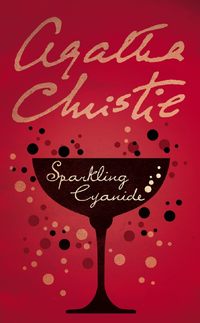
Kitabı oku: «Sparkling Cyanide»


Copyright
Published by HarperCollinsPublishers Ltd
1 London Bridge Street
London SE1 9GF
www.harpercollins.co.uk
First published in Great Britain by Collins, The Crime Club 1945
Sparkling Cyanide™ is a trade mark of Agatha Christie Limited and Agatha Christie® and the Agatha Christie Signature are registered trade marks of Agatha Christie Limited in the UK and elsewhere.
Copyright © 1945 Agatha Christie Limited. All rights reserved.
www.agathachristie.com
Cover by juliejenkinsdesign.com © HarperCollins/Agatha Christie Ltd 2017
Agatha Christie asserts the moral right to be identified as the author of this work.
A catalogue copy of this book is available from the British Library.
This novel is entirely a work of fiction. The names, characters and incidents portrayed in it are the work of the author’s imagination. Any resemblance to actual persons, living or dead, events or localities is entirely coincidental.
All rights reserved under International and Pan-American Copyright Conventions. By payment of the required fees, you have been granted the non-exclusive, non-transferable right to access and read the text of this e-book on screen. No part of this text may be reproduced, transmitted, down-loaded, decompiled, reverse engineered, or stored in or introduced into any information storage and retrieval system, in any form or by any means, whether electronic or mechanical, now known or hereinafter invented, without the express written permission of HarperCollins.
Source ISBN: 9780008196332
Ebook Edition © February 2017 ISBN: 9780007422821
Version: 2017-04-13
Contents
Cover
Title Page
Copyright
BOOK I: Rosemary
Chapter 1: Iris Marle
Chapter 2: Ruth Lessing
Chapter 3: Anthony Browne
Chapter 4: Stephen Farraday
Chapter 5: Alexandra Farraday
Chapter 6: George Barton
BOOK II: All Souls’ Day
Chapter 1
Chapter 2
Chapter 3
Chapter 4
Chapter 5
Chapter 6
BOOK III: Iris
Chapter 1
Chapter 2
Chapter 3
Chapter 4
Chapter 5
Chapter 6
Chapter 7
Chapter 8
Chapter 9
Chapter 10
Chapter 11
Chapter 12
Chapter 13
Chapter 14
Also by Agatha Christie
About the Publisher
BOOK I
Rosemary
‘What can I do to drive away remembrance from mine eyes?’
Six people were thinking of Rosemary Barton who had died nearly a year ago …
CHAPTER 1
Iris Marle
Iris Marle was thinking about her sister, Rosemary.
For nearly a year she had deliberately tried to put the thought of Rosemary away from her. She hadn’t wanted to remember.
It was too painful—too horrible!
The blue cyanosed face, the convulsed clutching fingers …
The contrast between that and the gay lovely Rosemary of the day before … Well, perhaps not exactly gay. She had had ’flu—she had been depressed, run down … All that had been brought out at the inquest. Iris herself had laid stress on it. It accounted, didn’t it, for Rosemary’s suicide?
Once the inquest was over, Iris had deliberately tried to put the whole thing out of her mind. Of what good was remembrance? Forget it all! Forget the whole horrible business.
But now, she realized, she had got to remember. She had got to think back into the past … To remember carefully every slight unimportant seeming incident …
That extraordinary interview with George last night necessitated remembrance.
It had been so unexpected, so frightening. Wait—had it been so unexpected? Hadn’t there been indications beforehand? George’s growing absorption, his absent-mindedness, his unaccountable actions—his—well, queerness was the only word for it! All leading up to that moment last night when he had called her into the study and taken the letters from the drawer of the desk.
So now there was no help for it. She had got to think about Rosemary—to remember.
Rosemary—her sister …
With a shock Iris realized suddenly that it was the first time in her life she had ever thought about Rosemary. Thought about her, that is, objectively, as a person.
She had always accepted Rosemary without thinking about her. You didn’t think about your mother or your father or your sister or your aunt. They just existed, unquestioned, in those relationships.
You didn’t think about them as people. You didn’t ask yourself, even, what they were like.
What had Rosemary been like?
That might be very important now. A lot might depend upon it. Iris cast her mind back into the past. Herself and Rosemary as children …
Rosemary had been the elder by six years.
Glimpses of the past came back—brief flashes—short scenes. Herself as a small child eating bread and milk, and Rosemary, important in pig tails, ‘doing lessons’ at a table.
The seaside one summer—Iris envying Rosemary who was a ‘big girl’ and could swim!
Rosemary going to boarding school—coming home for the holidays. Then she herself at school, and Rosemary being ‘finished’ in Paris. Schoolgirl Rosemary; clumsy, all arms and legs. ‘Finished’ Rosemary coming back from Paris with a strange new frightening elegance, soft voiced, graceful, with a swaying undulating figure, with red gold chestnut hair and big black fringed dark blue eyes. A disturbing beautiful creature—grown up—in a different world!
From then on they had seen very little of each other, the six-year gap had been at its widest.
Iris had been still at school, Rosemary in the full swing of a ‘season.’ Even when Iris came home, the gap remained. Rosemary’s life was one of late mornings in bed, fork luncheons with other débutantes, dances most evenings of the week. Iris had been in the schoolroom with Mademoiselle, had gone for walks in the park, had had supper at nine o’clock and gone to bed at ten. The intercourse between the sisters had been limited to such brief interchanges as:
‘Hullo, Iris, telephone for a taxi for me, there’s a lamb, I’m going to be devastatingly late,’ or
‘I don’t like that new frock, Rosemary. It doesn’t suit you. It’s all bunch and fuss.’
Then had come Rosemary’s engagement to George Barton. Excitement, shopping, streams of parcels, bridesmaids’ dresses.
The wedding. Walking up the aisle behind Rosemary, hearing whispers:
‘What a beautiful bride she makes …’
Why had Rosemary married George? Even at the time Iris had been vaguely surprised. There had been so many exciting young men, ringing Rosemary up, taking her out. Why choose George Barton, fifteen years older than herself, kindly, pleasant, but definitely dull?
George was well off, but it wasn’t money. Rosemary had her own money, a great deal of it.
Uncle Paul’s money …
Iris searched her mind carefully, seeking to differentiate between what she knew now and what she had known then: Uncle Paul, for instance?
He wasn’t really an uncle, she had always known that. Without ever having been definitely told them she knew certain facts. Paul Bennett had been in love with their mother. She had preferred another and a poorer man. Paul Bennett had taken his defeat in a romantic spirit. He had remained the family friend, adopted an attitude of romantic platonic devotion. He had become Uncle Paul, had stood godfather to the first-born child, Rosemary. When he died, it was found that he had left his entire fortune to his little god-daughter, then a child of thirteen.
Rosemary, besides her beauty, had been an heiress. And she had married nice dull George Barton.
Why? Iris had wondered then. She wondered now. Iris didn’t believe that Rosemary had ever been in love with him. But she had seemed very happy with him and she had been fond of him—yes, definitely fond of him. Iris had good opportunities for knowing, for a year after the marriage, their mother, lovely delicate Viola Marle, had died, and Iris, a girl of seventeen, had gone to live with Rosemary Barton and her husband.
A girl of seventeen. Iris pondered over the picture of herself. What had she been like? What had she felt, thought, seen?
She came to the conclusion that that young Iris Marle had been slow of development—unthinking, acquiescing in things as they were. Had she resented, for instance, her mother’s earlier absorption in Rosemary? On the whole she thought not. She had accepted, unhesitatingly, the fact that Rosemary was the important one. Rosemary was ‘out’—naturally her mother was occupied as far as her health permitted with her elder daughter. That had been natural enough. Her own turn would come some day. Viola Marle had always been a somewhat remote mother, preoccupied mainly with her own health, relegating her children to nurses, governesses, schools, but invariably charming to them in those brief moments when she came across them. Hector Marle had died when Iris was five years old. The knowledge that he drank more than was good for him had permeated so subtly that she had not the least idea how it had actually come to her.
Seventeen-year-old Iris Marle had accepted life as it came, had duly mourned for her mother, had worn black clothes, had gone to live with her sister and her sister’s husband at their house in Elvaston Square.
Sometimes it had been rather dull in that house. Iris wasn’t to come out, officially, until the following year. In the meantime she took French and German lessons three times a week, and also attended domestic science classes. There were times when she had nothing much to do and nobody to talk to. George was kind, invariably affectionate and brotherly. His attitude had never varied. He was the same now.
And Rosemary? Iris had seen very little of Rosemary. Rosemary had been out a good deal. Dressmakers, cocktail parties, bridge …
What did she really know about Rosemary when she came to think of it? Of her tastes, of her hopes, of her fears? Frightening, really, how little you might know of a person after living in the same house with them! There had been little or no intimacy between the sisters.
But she’d got to think now. She’d got to remember. It might be important.
Certainly Rosemary had seemed happy enough …
Until that day—a week before it happened.
She, Iris, would never forget that day. It stood out crystal clear—each detail, each word. The shining mahogany table, the pushed back chair, the hurried characteristic writing …
Iris closed her eyes and let the scene come back …
Her own entry into Rosemary’s sitting-room, her sudden stop.
It had startled her so; what she saw! Rosemary, sitting at the writing table, her head laid down on her outstretched arms. Rosemary weeping with a deep abandoned sobbing. She’d never seen Rosemary cry before—and this bitter, violent weeping frightened her.
True, Rosemary had had a bad go of ’flu. She’d only been up a day or two. And everyone knew that ’flu did leave you depressed. Still—
Iris had cried out, her voice childish, startled:
‘Oh, Rosemary, what is it?’
Rosemary sat up, swept the hair back from her disfigured face. She struggled to regain command of herself. She said quickly:
‘It’s nothing—nothing—don’t stare at me like that!’
She got up and passing her sister, she ran out of the room.
Puzzled, upset, Iris went farther into the room. Her eyes, drawn wonderingly to the writing table, caught sight of her own name in her sister’s handwriting. Had Rosemary been writing to her then?
She drew nearer, looked down on the sheet of blue notepaper with the big characteristic sprawling writing, even more sprawling than usual owing to the haste and agitation behind the hand that held the pen.
Darling Iris,
There isn’t any point in my making a will because my money goes to you anyway, but I’d like certain of my things to be given to certain people.
To George, the jewellery he’s given me, and the little enamel casket we bought together when we were engaged.
To Gloria King, my platinum cigarette case.
To Maisie, my Chinese Pottery horse that she’s always admir—
It stopped there, with a frantic scrawl of the pen as Rosemary had dashed it down and given way to uncontrollable weeping.
Iris stood as though turned to stone.
What did it mean? Rosemary wasn’t going to die, was she? She’d been very ill with influenza, but she was all right now. And anyway people didn’t die of ’flu—at least sometimes they did, but Rosemary hadn’t. She was quite well now, only weak and run down.
Iris’s eyes went over the words again and this time a phrase stood out with startling effect:
‘… my money goes to you anyway …’
It was the first intimation she had had of the terms of Paul Bennett’s will. She had known since she was a child that Rosemary had inherited Uncle Paul’s money, that Rosemary was rich whilst she herself was comparatively poor. But until this moment she had never questioned what would happen to that money on Rosemary’s death.
If she had been asked, she would have replied that she supposed it would go to George as Rosemary’s husband, but would have added that it seemed absurd to think of Rosemary dying before George!
But here it was, set down in black and white, in Rosemary’s own hand. At Rosemary’s death the money came to her, Iris. But surely that wasn’t legal? A husband or wife got any money, not a sister. Unless, of course, Paul Bennett had left it that way in his will. Yes, that must be it. Uncle Paul had said the money was to go to her if Rosemary died. That did make it rather less unfair—
Unfair? She was startled as the word leapt to her thoughts. Had she then been thinking that it was unfair for Rosemary to get all Uncle Paul’s money? She supposed that, deep down, she must have been feeling just that. It was unfair. They were sisters, she and Rosemary. They were both her mother’s children. Why should Uncle Paul give it all to Rosemary?
Rosemary always had everything!
Parties and frocks and young men in love with her and an adoring husband.
The only unpleasant thing that ever happened to Rosemary was having an attack of ’flu! And even that hadn’t lasted longer than a week!
Iris hesitated, standing by the desk. That sheet of paper—would Rosemary want it left about for the servants to see?
After a minute’s hesitation she picked it up, folded it in two and slipped it into one of the drawers of the desk.
It was found there after the fatal birthday party, and provided an additional proof, if proof was necessary, that Rosemary had been in a depressed and unhappy state of mind after her illness, and had possibly been thinking of suicide even then.
Depression after influenza. That was the motive brought forward at the inquest, the motive that Iris’s evidence helped to establish. An inadequate motive, perhaps, but the only one available, and consequently accepted. It had been a bad type of influenza that year.
Neither Iris nor George Barton could have suggested any other motive—then.
Now, thinking back over the incident in the attic, Iris wondered that she could have been so blind.
The whole thing must have been going on under her eyes! And she had seen nothing, noticed nothing!
Her mind took a quick leap over the tragedy of the birthday party. No need to think of that! That was over—done with. Put away the horror of that and the inquest and George’s twitching face and bloodshot eyes. Go straight on to the incident of the trunk in the attic.
That had been about six months after Rosemary’s death.
Iris had continued to live at the house in Elvaston Square. After the funeral the Marle family solicitor, a courtly old gentleman with a shining bald head and unexpectedly shrewd eyes, had had an interview with Iris. He had explained with admirable clarity that under the will of Paul Bennett, Rosemary had inherited his estate in trust to pass at her death to any children she might have. If Rosemary died childless, the estate was to go to Iris absolutely. It was, the solicitor explained, a very large fortune which would belong to her absolutely upon attaining the age of twenty-one or on her marriage.
In the meantime, the first thing to settle was her place of residence. Mr George Barton had shown himself anxious for her to continue living with him and had suggested that her father’s sister, Mrs Drake, who was in impoverished circumstances owing to the financial claims of a son (the black sheep of the Marle family), should make her home with them and chaperon Iris in society. Did Iris approve of this plan?
Iris had been quite willing, thankful not to have to make new plans. Aunt Lucilla she remembered as an amiable friendly sheep with little will of her own.
So the matter had been settled. George Barton had been touchingly pleased to have his wife’s sister still with him and treated her affectionately as a younger sister. Mrs Drake, if not a stimulating companion, was completely subservient to Iris’s wishes. The household settled down amicably.
It was nearly six months later that Iris made her discovery in the attic.
The attics of the Elvaston Square house were used as storage rooms for odds and ends of furniture, and a number of trunks and suitcases.
Iris had gone up there one day after an unsuccessful hunt for an old red pullover for which she had an affection. George had begged her not to wear mourning for Rosemary, Rosemary had always been opposed to the idea, he said. This, Iris knew, was true, so she acquiesced and continued to wear ordinary clothes, somewhat to the disapproval of Lucilla Drake, who was old-fashioned and liked what she called ‘the decencies’ to be observed. Mrs Drake herself was still inclined to wear crêpe for a husband deceased some twenty-odd years ago!
Various unwanted clothes, Iris knew, had been packed away in a trunk upstairs. She started hunting through it for her pullover, coming across, as she did so, various forgotten belongings, a grey coat and skirt, a pile of stockings, her skiing kit and one or two old bathing dresses.
It was then that she came across an old dressing-gown that had belonged to Rosemary and which had somehow or other escaped being given away with the rest of Rosemary’s things. It was a mannish affair of spotted silk with big pockets.
Iris shook it out, noting that it was in perfectly good condition. Then she folded it carefully and returned it to the trunk. As she did so, her hand felt something crackle in one of the pockets. She thrust in her hand and drew out a crumpled-up piece of paper. It was in Rosemary’s handwriting and she smoothed it out and read it.
Leopard darling, you can’t mean it … You can’t—you can’t … We love each other! We belong together! You must know that just as I know it! We can’t just say goodbye and go on coolly with our own lives. You know that’s impossible, darling—quite impossible. You and I belong together—for ever and ever. I’m not a conventional woman—I don’t mind about what people say. Love matters more to me than anything else. We’ll go away together—and be happy—I’ll make you happy. You said to me once that life without me was dust and ashes to you—do you remember, Leopard darling? And now you write calmly that all this had better end—that it’s only fair to me. Fair to me? But I can’t live without you! I’m sorry about George—he’s always been sweet to me—but he’ll understand. He’ll want to give me my freedom. It isn’t right to live together if you don’t love each other any more. God meant us for each other, darling—I know He did. We’re going to be wonderfully happy—but we must be brave. I shall tell George myself—I want to be quite straight about the whole thing—but not until after my birthday.
I know I’m doing what’s right, Leopard darling—and I can’t live without you—can’t, can’t—CAN’T. How stupid it is of me to write all this. Two lines would have done. Just ‘I love you. I’m never going to let you go.’ Oh darling—
The letter broke off.
Iris stood motionless, staring down at it.
How little one knew of one’s own sister!
So Rosemary had had a lover—had written him passionate love letters—had planned to go away with him?
What had happened? Rosemary had never sent the letter after all. What letter had she sent? What had been finally decided between Rosemary and this unknown man?
(‘Leopard!’ What extraordinary fancies people had when they were in love. So silly. Leopard indeed!)
Who was this man? Did he love Rosemary as much as she loved him? Surely he must have done. Rosemary was so unbelievably lovely. And yet, according to Rosemary’s letter, he had suggested ‘ending it all’. That suggested—what? Caution? He had evidently said that the break was for Rosemary’s sake. That it was only fair to her. Yes, but didn’t men say that sort of thing to save their faces? Didn’t it really mean that the man, whoever he was, was tired of it all? Perhaps it had been to him a mere passing distraction. Perhaps he had never really cared. Somehow Iris got the impression that the unknown man had been very determined to break with Rosemary finally …
But Rosemary had thought differently. Rosemary wasn’t going to count the cost. Rosemary had been determined, too …
Iris shivered.
And she, Iris, hadn’t known a thing about it! Hadn’t even guessed! Had taken it for granted that Rosemary was happy and contented and that she and George were quite satisfied with one another. Blind! She must have been blind not to know a thing like that about her own sister.
But who was the man?
She cast her mind back, thinking, remembering. There had been so many men about, admiring Rosemary, taking her out, ringing her up. There had been no one special. But there must have been—the rest of the bunch were mere camouflage for the one, the only one, that mattered. Iris frowned perplexedly, sorting her remembrances carefully.
Two names stood out. It must, yes, positively it must, be one or the other. Stephen Farraday? It must be Stephen Farraday. What could Rosemary have seen in him? A stiff pompous young man—and not so very young either. Of course people did say he was brilliant. A rising politician, an under-secretaryship prophesied in the near future, and all the weight of the influential Kidderminster connection behind him. A possible future Prime Minister! Was that what had given him glamour in Rosemary’s eyes? Surely she couldn’t care so desperately for the man himself—such a cold self-contained creature? But they said that his own wife was passionately in love with him, that she had gone against all the wishes of her powerful family in marrying him—a mere nobody with political ambitions! If one woman felt like that about him, another woman might also. Yes, it must be Stephen Farraday.
Because, if it wasn’t Stephen Farraday, it must be Anthony Browne.
And Iris didn’t want it to be Anthony Browne.
True, he’d been very much Rosemary’s slave, constantly at her beck and call, his dark good-looking face expressing a kind of humorous desperation. But surely that devotion had been too open, too freely declared to go really deep?
Odd the way he had disappeared after Rosemary’s death. They had none of them seen him since.
Still not so odd really—he was a man who travelled a lot. He had talked about the Argentine and Canada and Uganda and the USA. She had an idea that he was actually an American or a Canadian, though he had hardly any accent. No, it wasn’t really strange that they shouldn’t have seen anything of him since.
It was Rosemary who had been his friend. There was no reason why he should go on coming to see the rest of them. He had been Rosemary’s friend. But not Rosemary’s lover! She didn’t want him to have been Rosemary’s lover. That would hurt—that would hurt terribly …
She looked down at the letter in her hand. She crumpled it up. She’d throw it away, burn it …
It was sheer instinct that stopped her.
Some day it might be important to produce that letter …
She smoothed it out, took it down with her and locked it away in her jewel case.
It might be important, some day, to show why Rosemary took her own life.
‘And the next thing, please?’
The ridiculous phrase came unbidden into Iris’s mind and twisted her lips into a wry smile. The glib shop-keeper’s question seemed to represent so exactly her own carefully directed mental processes.
Was not that exactly what she was trying to do in her survey of the past? She had dealt with the surprising discovery in the attic. And now—on to ‘the next thing, please!’ What was the next thing?
Surely the increasingly odd behaviour of George. That dated back for a long time. Little things that had puzzled her became clear now in the light of the surprising interview last night. Disconnected remarks and actions took their proper place in the course of events.
And there was the reappearance of Anthony Browne. Yes, perhaps that ought to come next in sequence, since it had followed the finding of the letter by just one week.
Iris could recall her sensations exactly …
Rosemary had died in November. In the following May, Iris, under the wing of Lucilla Drake, had started her social young girl’s life. She had gone to luncheons and teas and dances without, however, enjoying them very much. She had felt listless and unsatisfied. It was at a somewhat dull dance towards the end of June that she heard a voice say behind her:
‘It is Iris Marle, isn’t it?’
She had turned, flushing, to look into Anthony’s—Tony’s—dark quizzical face.
He said:
‘I don’t expect you remember me, but—’
She interrupted.
‘Oh, but I do remember you. Of course I do!’
‘Splendid. I was afraid you’d have forgotten me. It’s such a long time since I saw you.’
‘I know. Not since Rosemary’s birthday par—’
She stopped. The words had come gaily, unthinkingly, to her lips. Now the colour rushed away from her cheeks, leaving them white and drained of blood. Her lips quivered. Her eyes were suddenly wide and dismayed.
Anthony Browne said quickly:
‘I’m terribly sorry. I’m a brute to have reminded you.’
Iris swallowed. She said:
‘It’s all right.’
(Not since the night of Rosemary’s birthday party. Not since the night of Rosemary’s suicide. She wouldn’t think of it. She would not think of it!)
Anthony Browne said again:
‘I’m terribly sorry. Please forgive me. Shall we dance?’
She nodded. Although already engaged for the dance that was just beginning, she had floated on to the floor in his arms. She saw her partner, a blushing immature young man whose collar seemed too big for him, peering about for her. The sort of partner, she thought scornfully, that debs have to put up with. Not like this man—Rosemary’s friend.
A sharp pang went through her. Rosemary’s friend. That letter. Had it been written to this man she was dancing with now? Something in the easy feline grace with which he danced lent substance to the nickname ‘Leopard’. Had he and Rosemary—
She said sharply:
‘Where have you been all this time?’
He held her a little way from him, looking down into her face. He was unsmiling now, his voice held coldness.
‘I’ve been travelling—on business.’
‘I see.’ She went on uncontrollably, ‘Why have you come back?’
He smiled then. He said lightly:
‘Perhaps—to see you, Iris Marle.’
And suddenly gathering her up a little closer, he executed a long daring glide through the dancers, a miracle of timing and steering. Iris wondered why, with a sensation that was almost wholly pleasure, she should feel afraid.
Since then Anthony had definitely become part of her life. She saw him at least once a week.
She met him in the park, at various dances, found him put next to her at dinner.
The only place he never came to was the house in Elvaston Square. It was some time before she noticed this, so adroitly did he manage to evade or refuse invitations there. When she did realize it she began to wonder why. Was it because he and Rosemary—
Then, to her astonishment, George, easy-going, non-interfering George, spoke to her about him.
‘Who’s this fellow, Anthony Browne, you’re going about with? What do you know about him?’
She stared at him.
‘Know about him? Why, he was a friend of Rosemary’s!’
George’s face twitched. He blinked. He said in a dull heavy voice:
‘Yes, of course, so he was.’
Iris cried remorsefully:
‘I’m sorry. I shouldn’t have reminded you.’
George Barton shook his head. He said gently:
‘No, no, I don’t want her forgotten. Never that. After all,’ he spoke awkwardly, his eyes averted, ‘that’s what her name means. Rosemary—remembrance.’ He looked full at her. ‘I don’t want you to forget your sister, Iris.’
She caught her breath.
‘I never shall.’
George went on:
‘But about this young fellow, Anthony Browne. Rosemary may have liked him, but I don’t believe she knew much about him. You know, you’ve got to be careful, Iris. You’re a very rich young woman.’
A kind of burning anger swept over her.
‘Tony—Anthony—has plenty of money himself. Why, he stays at Claridge’s when he’s in London.’
George Barton smiled a little. He murmured:
‘Eminently respectable—as well as costly. All the same, my dear, nobody seems to know much about this fellow.’
CHAPTER 2
Ruth Lessing
Ruth Lessing, during a momentary lull in her busy day, was remembering her employer’s wife, Rosemary Barton.
She had disliked Rosemary Barton a good deal. She had never known quite how much until that November morning when she had first talked with Victor Drake.
That interview with Victor had been the beginning of it all, had set the whole train in motion. Before then, the things she had felt and thought had been so far below the stream of her consciousness that she hadn’t really known about them.
She was devoted to George Barton. She always had been. When she had first come to him, a cool, competent young woman of twenty-three, she had seen that he needed taking charge of. She had taken charge of him. She had saved him time, money and worry. She had chosen his friends for him, and directed him to suitable hobbies. She had restrained him from ill-advised business adventures, and encouraged him to take judicious risks on occasions. Never once in their long association had George suspected her of being anything other than subservient, attentive and entirely directed by himself. He took a distinct pleasure in her appearance, the neat shining dark head, the smart tailor-mades and crisp shirts, the small pearls in her well-shaped ears, the pale discreetly powdered face and the faint restrained rose shade of her lip-stick.
Ruth, he felt, was absolutely right.
He liked her detached impersonal manner, her complete absence of sentiment or familiarity. In consequence he talked to her a good deal about his private affairs and she listened sympathetically and always put in a useful word of advice.
She had nothing to do, however, with his marriage. She did not like it. However, she accepted it and was invaluable in helping with the wedding arrangements, relieving Mrs Marle of a great deal of work.
For a time after the marriage, Ruth was on slightly less confidential terms with her employer. She confined herself strictly to the office affairs. George left a good deal in her hands.
Nevertheless such was her efficiency that Rosemary soon found that George’s Miss Lessing was an invaluable aid in all sorts of ways. Miss Lessing was always pleasant, smiling and polite.
George, Rosemary and Iris all called her Ruth and she often came to Elvaston Square to lunch. She was now twenty-nine and looked exactly the same as she had looked at twenty-three.
Without an intimate word ever passing between them, she was always perfectly aware of George’s slightest emotional reactions. She knew when the first elation of his married life passed into an ecstatic content, she was aware when that content gave way to something else that was not so easy to define. A certain inattention to detail shown by him at this time was corrected by her own forethought.
However distrait George might be, Ruth Lessing never seemed to be aware of it. He was grateful to her for that.
It was on a November morning that he spoke to her of Victor Drake.
‘I want you to do a rather unpleasant job for me, Ruth?’
She looked at him inquiringly. No need to say that certainly she would do it. That was understood.
‘Every family’s got a black sheep,’ said George.
She nodded comprehendingly.
‘This is a cousin of my wife’s—a thorough bad hat, I’m afraid. He’s half ruined his mother—a fatuous sentimental soul who has sold out most of what few shares she has on his behalf. He started by forging a cheque at Oxford—they got that hushed up and since then he’s been shipped about the world—never making good anywhere.’
Ruth listened without much interest. She was familiar with the type. They grew oranges, started chicken farms, went as jackaroos to Australian stations, got jobs with meat-freezing concerns in New Zealand. They never made good, never stayed anywhere long, and invariably got through any money that had been invested on their behalf. They had never interested her much. She preferred success.
‘He’s turned up now in London and I find he’s been worrying my wife. She hadn’t set eyes on him since she was a schoolgirl, but he’s a plausible sort of scoundrel and he’s been writing to her for money, and I’m not going to stand for that. I’ve made an appointment with him for twelve o’clock this morning at his hotel. I want you to deal with it for me. The fact is I don’t want to get into contact with the fellow. I’ve never met him and I never want to and I don’t want Rosemary to meet him. I think the whole thing can be kept absolutely businesslike if it’s fixed up through a third party.’
‘Yes, that is always a good plan. What is the arrangement to be?’
‘A hundred pounds cash and a ticket to Buenos Aires. The money to be given to him actually on board the boat.’
Ruth smiled.
‘Quite so. You want to be sure he actually sails!’
‘I see you understand.’
‘It’s not an uncommon case,’ she said indifferently.
‘No, plenty of that type about.’ He hesitated. ‘Are you sure you don’t mind doing this?’
‘Of course not.’ She was a little amused. ‘I can assure you I am quite capable of dealing with the matter.’
‘You’re capable of anything.’
‘What about booking his passage? What’s his name, by the way?’
‘Victor Drake. The ticket’s here. I rang up the steamship company yesterday. It’s the San Cristobal, sails from Tilbury tomorrow.’
Ruth took the ticket, glanced over it to make sure of its correctness and put it into her handbag.
‘That’s settled. I’ll see to it. Twelve o’clock. What address?’
‘The Rupert, off Russell Square.’
She made a note of it.
‘Ruth, my dear, I don’t know what I should do without you—’ He put a hand on her shoulder affectionately; it was the first time he had ever done such a thing. ‘You’re my right hand, my other self.’
She flushed, pleased.
‘I’ve never been able to say much—I’ve taken all you do for granted—but it’s not really like that. You don’t know how much I rely on you for everything—’ he repeated: ‘everything. You’re the kindest, dearest, most helpful girl in the world!’
Ruth said, laughing to hide her pleasure and embarrassment, ‘You’ll spoil me saying such nice things.’
‘Oh, but I mean them. You’re part of the firm, Ruth. Life without you would be unthinkable.’
She went out feeling a warm glow at his words. It was still with her when she arrived at the Rupert Hotel on her errand.
Ruth felt no embarrassment at what lay before her. She was quite confident of her powers to deal with any situation. Hard-luck stories and people never appealed to her. She was prepared to take Victor Drake as all in the day’s work.
He was very much as she had pictured him, though perhaps definitely more attractive. She made no mistake in her estimate of his character. There was not much good in Victor Drake. As cold-hearted and calculating a personality as could exist, well masked behind an agreeable devilry. What she had not allowed for was his power of reading other people’s souls, and the practised ease with which he could play on the emotions. Perhaps, too, she had underestimated her own resistance to his charm. For he had charm.
He greeted her with an air of delighted surprise.
‘George’s emissary? But how wonderful. What a surprise!’
In dry even tones, she set out George’s terms. Victor agreed to them in the most amiable manner.
‘A hundred pounds? Not bad at all. Poor old George. I’d have taken sixty—but don’t tell him so! Conditions:—“Do not worry lovely Cousin Rosemary—do not contaminate innocent Cousin Iris—do not embarrass worthy Cousin George.” All agreed to! Who is coming to see me off on the San Cristobal? You are, my dear Miss Lessing? Delightful.’ He wrinkled up his nose, his dark eyes twinkled sympathetically. He had a lean brown face and there was a suggestion about him of a toreador—romantic conception! He was attractive to women and knew it!
‘You’ve been with Barton some time, haven’t you, Miss Lessing?’
‘Six years.’
‘And he wouldn’t know what to do without you. Oh yes, I know all about it. And I know all about you, Miss Lessing.’
‘How do you know?’ asked Ruth sharply.
Victor grinned. ‘Rosemary told me.’
‘Rosemary? But—’
‘That’s all right. I don’t propose to worry Rosemary any further. She’s already been very nice to me—quite sympathetic. I got a hundred out of her, as a matter of fact.’
‘You—’
Ruth stopped and Victor laughed. His laugh was infectious. She found herself laughing too.
‘That’s too bad of you, Mr Drake.’
‘I’m a very accomplished sponger. Highly finished technique. The mater, for instance, will always come across if I send a wire hinting at imminent suicide.’
‘You ought to be ashamed of yourself.’
‘I disapprove of myself very deeply. I’m a bad lot, Miss Lessing. I’d like you to know just how bad.’
‘Why?’ She was curious.
‘I don’t know. You’re different. I couldn’t play up the usual technique to you. Those clear eyes of yours—you wouldn’t fall for it. No, “More sinned against than sinning, poor fellow,” wouldn’t cut any ice with you. You’ve no pity in you.’
Her face hardened.
‘I despise pity.’
‘In spite of your name? Ruth is your name, isn’t it? Piquant that. Ruth the ruthless.’
She said, ‘I’ve no sympathy with weakness!’
‘Who said I was weak? No, no, you’re wrong there, my dear. Wicked, perhaps. But there’s one thing to be said for me.’
Her lip curled a little. The inevitable excuse.
‘Yes?’
‘I enjoy myself. Yes,’ he nodded, ‘I enjoy myself immensely. I’ve seen a good deal of life, Ruth. I’ve done almost everything. I’ve been an actor and a storekeeper and a waiter and an odd job man, and a luggage porter, and a property man in a circus! I’ve sailed before the mast in a tramp steamer. I’ve been in the running for President in a South American Republic. I’ve been in prison! There are only two things I’ve never done, an honest day’s work, or paid my own way.’
He looked at her, laughing. She ought, she felt, to have been revolted. But the strength of Victor Drake was the strength of the devil. He could make evil seem amusing. He was looking at her now with that uncanny penetration.
‘You needn’t look so smug, Ruth! You haven’t as many morals as you think you have! Success is your fetish. You’re the kind of girl who ends up by marrying the boss. That’s what you ought to have done with George. George oughtn’t to have married that little ass Rosemary. He ought to have married you. He’d have done a damned sight better for himself if he had.’
‘I think you’re rather insulting.’
‘Rosemary’s a damned fool, always has been. Lovely as paradise and dumb as a rabbit. She’s the kind men fall for but never stick to. Now you—you’re different. My God, if a man fell in love with you—he’d never tire.’
He had reached the vulnerable spot. She said with sudden raw sincerity:
‘If! But he wouldn’t fall in love with me!’
‘You mean George didn’t? Don’t fool yourself, Ruth. If anything happened to Rosemary, George would marry you like a shot.’
(Yes, that was it. That was the beginning of it all.)
Victor said, watching her:
‘But you know that as well as I do.’
(George’s hand on hers, his voice affectionate, warm—Yes, surely it was true … He turned to her, depended on her …)
Victor said gently: ‘You ought to have more confidence in yourself, my dear girl. You could twist George round your little finger. Rosemary’s only a silly little fool.’
‘It’s true,’ Ruth thought. ‘If it weren’t for Rosemary, I could make George ask me to marry him. I’d be good to him. I’d look after him well.’
She felt a sudden blind anger, an uprushing of passionate resentment. Victor Drake was watching her with a good deal of amusement. He liked putting ideas into people’s heads. Or, as in this case, showing them the ideas that were already there …
Yes, that was how it started—that chance meeting with the man who was going to the other side of the globe on the following day. The Ruth who came back to the office was not quite the same Ruth who had left it, though no one could have noticed anything different in her manner or appearance.
Shortly after she had returned to the office Rosemary Barton rang up on the telephone.
‘Mr Barton has just gone out to lunch. Can I do anything?’
‘Oh, Ruth, would you? That tiresome Colonel Race has sent a telegram to say he won’t be back in time for my party. Ask George who he’d like to ask instead. We really ought to have another man. There are four women—Iris is coming as a treat and Sandra Farraday and—who on earth’s the other? I can’t remember.’
‘I’m the fourth, I think. You very kindly asked me.’
‘Oh, of course. I’d forgotten all about you!’
Rosemary’s laugh came light and tinkling. She could not see the sudden flush, the hard line of Ruth Lessing’s jaw.
Asked to Rosemary’s party as a favour—a concession to George! ‘Oh, yes, we’ll have your Ruth Lessing. After all she’ll be pleased to be asked, and she is awfully useful. She looks quite presentable too.’
In that moment Ruth Lessing knew that she hated Rosemary Barton.
Hated her for being rich and beautiful and careless and brainless. No routine hard work in an office for Rosemary—everything handed to her on a golden platter. Love affairs, a doting husband—no need to work or plan—
Hateful, condescending, stuck-up, frivolous beauty …
‘I wish you were dead,’ said Ruth Lessing in a low voice to the silent telephone.
Her own words startled her. They were so unlike her. She had never been passionate, never vehement, never been anything but cool and controlled and efficient.
She said to herself: ‘What’s happening to me?’
She had hated Rosemary Barton that afternoon. She still hated Rosemary Barton on this day a year later.
Some day, perhaps, she would be able to forget Rosemary Barton. But not yet.
She deliberately sent her mind back to those November days.
Sitting looking at the telephone—feeling hatred surge up in her heart …
Giving Rosemary’s message to George in her pleasant controlled voice. Suggesting that she herself should not come so as to leave the number even. George had quickly over-ridden that!
Coming in to report next morning on the sailing of the San Cristobal. George’s relief and gratitude.
‘So he’s sailed on her all right?’
‘Yes. I handed him the money just before the gang-way was taken up.’ She hesitated and said, ‘He waved his hand as the boat backed away from the quay and called out “Love and kisses to George and tell him I’ll drink his health tonight.”’
‘Impudence!’ said George. He asked curiously, ‘What did you think of him, Ruth?’
Her voice was deliberately colourless as she replied:
‘Oh—much as I expected. A weak type.’
And George saw nothing, noticed nothing! She felt like crying out: ‘Why did you send me to see him? Didn’t you know what he might do to me? Don’t you realize that I’m a different person since yesterday? Can’t you see that I’m dangerous? That there’s no knowing what I may do?’
Instead she said in her businesslike voice, ‘About that San Paulo letter—’
She was the competent efficient secretary …
Five more days.
Rosemary’s birthday.
A quiet day at the office—a visit to the hairdresser—the putting on of a new black frock, a touch of make-up skilfully applied. A face looking at her in the glass that was not quite her own face. A pale, determined, bitter face.
It was true what Victor Drake had said. There was no pity in her.
Later, when she was staring across the table at Rosemary Barton’s blue convulsed face, she still felt no pity.
Now, eleven months later, thinking of Rosemary Barton, she felt suddenly afraid …
CHAPTER 3
Anthony Browne
Anthony Browne was frowning into the middle distance as he thought about Rosemary Barton.
A damned fool he had been ever to get mixed up with her. Though a man might be excused for that! Certainly she was easy upon the eyes. That evening at the Dorchester he’d been able to look at nothing else. As beautiful as a houri—and probably just about as intelligent!
Still he’d fallen for her rather badly. Used up a lot of energy trying to find someone who would introduce him. Quite unforgivable really when he ought to have been attending strictly to business. After all, he wasn’t idling his days away at Claridge’s for pleasure.
But Rosemary Barton was lovely enough in all conscience to excuse any momentary lapse from duty. All very well to kick himself now and wonder why he’d been such a fool. Fortunately there was nothing to regret. Almost as soon as he spoke to her the charm had faded a little. Things resumed their normal proportions. This wasn’t love—nor yet infatuation. A good time was to be had by all, no more, no less.
Well, he’d enjoyed it. And Rosemary had enjoyed it too. She danced like an angel and wherever he took her men turned round to stare at her. It gave a fellow a pleasant feeling. So long as you didn’t expect her to talk. He thanked his stars he wasn’t married to her. Once you got used to all that perfection of face and form where would you be? She couldn’t even listen intelligently. The sort of girl who would expect you to tell her every morning at the breakfast table that you loved her passionately!
Oh, all very well to think those things now.
He’d fallen for her all right, hadn’t he?
Danced attendance on her. Rung her up, taken her out, danced with her, kissed her in the taxi. Been in a fair way to making rather a fool of himself over her until that startling, that incredible day.
He could remember just how she had looked, the piece of chestnut hair that had fallen loose over one ear, the lowered lashes and the gleam of her dark blue eyes through them. The pout of the soft red lips.
‘Anthony Browne. It’s a nice name!’
He said lightly:
‘Eminently well established and respectable. There was a chamberlain to Henry the Eighth called Anthony Browne.’
‘An ancestor, I suppose?’
‘I wouldn’t swear to that.’
‘You’d better not!’
He raised his eyebrows.
‘I’m the Colonial branch.’
‘Not the Italian one?’
‘Oh,’ he laughed. ‘My olive complexion? I had a Spanish mother.’
‘That explains it.’
‘Explains what?’
‘A great deal, Mr Anthony Browne.’
‘You’re very fond of my name.’
‘I said so. It’s a nice name.’
And then quickly like a bolt from the blue: ‘Nicer than Tony Morelli.’
For a moment he could hardly believe his ears! It was incredible! Impossible!
He caught her by the arm. In the harshness of his grip she winced away.
‘Oh, you’re hurting me!’
‘Where did you get hold of that name?’
His voice was harsh, menacing.
She laughed, delighted with the effect she had produced. The incredible little fool!
‘Who told you?’
‘Someone who recognized you.’
‘Who was it? This is serious, Rosemary. I’ve got to know.’
She shot a sideways glance at him.
‘A disreputable cousin of mine, Victor Drake.’
‘I’ve never met anyone of that name.’
‘I imagine he wasn’t using that name at the time you knew him. Saving the family feelings.’
Anthony said slowly. ‘I see. It was—in prison?’
‘Yes. I was reading Victor the riot act—telling him he was a disgrace to us all. He didn’t care, of course. Then he grinned and said, “You aren’t always so particular yourself, sweetheart. I saw you the other night dancing with an ex-gaol-bird—one of your best boy friends, in fact. Calls himself Anthony Browne, I hear, but in stir he was Tony Morelli.”’
Anthony said in a light voice:
‘I must renew my acquaintance with this friend of my youth. We old prison ties must stick together.’
Rosemary shook her head. ‘Too late. He’s been shipped off to South America. He sailed yesterday.’
‘I see.’ Anthony drew a deep breath. ‘So you’re the only person who knows my guilty secret?’
She nodded. ‘I won’t tell on you.’
‘You’d better not.’ His voice grew stern. ‘Look here, Rosemary, this is dangerous. You don’t want your lovely face carved up, do you? There are people who don’t stick at a little thing like ruining a girl’s beauty. And there’s such a thing as being bumped off. It doesn’t only happen in books and films. It happens in real life, too.’
‘Are you threatening me, Tony?’
‘Warning you.’
Would she take the warning? Did she realize that he was in deadly earnest? Silly little fool. No sense in that lovely empty head. You couldn’t rely on her to keep her mouth shut. All the same he’d have to try and ram his meaning home.
‘Forget you ever heard the name of Tony Morelli, do you understand?’
‘But I don’t mind a bit, Tony. I’m quite broad-minded. It’s quite a thrill for me to meet a criminal. You needn’t feel ashamed of it.’
The absurd little idiot. He looked at her coldly. He wondered in that moment how he could ever have fancied he cared. He’d never been able to suffer fools gladly—not even fools with pretty faces.
‘Forget about Tony Morelli,’ he said grimly. ‘I mean it. Never mention that name again.’
He’d have to get out. That was the only thing to do. There was no relying on this girl’s silence. She’d talk whenever she felt inclined.
She was smiling at him—an enchanting smile, but it left him unmoved.
‘Don’t be so fierce. Take me to the Jarrows’ dance next week.’
‘I shan’t be here. I’m going away.’
‘Not before my birthday party. You can’t let me down. I’m counting on you. Now don’t say no. I’ve been miserably ill with that horrid ’flu and I’m still feeling terribly weak. I musn’t be crossed. You’ve got to come.’
He might have stood firm. He might have chucked it all—gone right away.
Instead, through an open door, he saw Iris coming down the stairs. Iris, very straight and slim, with her pale face and black hair and grey eyes. Iris with much less than Rosemary’s beauty and with all the character that Rosemary would never have.
In that moment he hated himself for having fallen a victim, in however small a degree, to Rosemary’s facile charm. He felt as Romeo felt remembering Rosaline when he had first seen Juliet.
Anthony Browne changed his mind.
In the flash of a second he committed himself to a totally different course of action.
Ücretsiz ön izlemeyi tamamladınız.