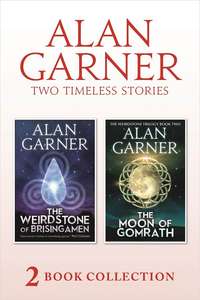
Kitabı oku: «The Weirdstone of Brisingamen and The Moon of Gomrath»


COPYRIGHT
This ebook bundle edition published by HarperCollins Children’s Books in 2015
HarperCollins Children’s Books is a division of HarperCollinsPublishers Ltd
1 London Bridge Street
London SE1 9GF
The HarperCollins Children’s Books website address is
www.harpercollinschildrensbooks.co.uk
The Weirdstone of Brisingamen Text © Alan Garner 1960 The Moon of Gomrath Text © Alan Garner 1963
Cover design © HarperCollinsPublishers 2015 Cover art © Nik Keevil
Alan Garner asserts the moral right to be identified as the author of the work.
All rights reserved under International and Pan-American Copyright Conventions. By payment of the required fees, you have been granted the non-exclusive, non-transferable right to access and read the text of this e-book on screen. No part of this text may be reproduced, transmitted, down-loaded, decompiled, reverse engineered, or stored in or introduced into any information storage and retrieval system, in any form or by any means, whether electronic or mechanical, now known or hereinafter invented, without the express written permission of HarperCollins.
Source ISBNs:
9780007539062 (The Weirdstone of Brisingamen), 9780007539048 (The Moon of Gomrath)
Ebook edition © SEPTEMBER 2015 ISBN 9780008164386
Version 2015-08-20
HarperCollinsPublishers has made every reasonable effort to ensure that any picture content and written content in this ebook has been included or removed in accordance with the contractual and technological constraints in operation at the time of publication.
CONTENTS
Cover
Title Page
Copyright
The Weirdstone Of Brisingamen
The Moon of Gomrath
Keep Reading
About the Publisher


CONTENTS
Cover
Title Page
Map
Epigraph
The Legend of Alderley
PART ONE
1. Highmost Redmanhey
2. The Edge
3. Maggot-breed of Ymir
4. The Fundindelve
5. Miching Mallecho
6. A Ring of Stones
7. Fenodyree
PART TWO
8. Mist over Llyn-dhu
9. St Mary’s Clyffe
10. Plankshaft
11. Prince of the Huldrafolk
12. In the Cave of the Svartmoot
13. “Where No Svart Will Ever Tread”
14. The Earldelving
15. A Stromkarl Sings
16. The Wood of Radnor
17. Mara
18. Angharad Goldenhand
19. Gaberlunzie
20. Shuttlingslow
21. The Headless Cross
MAP

In every prayer I offer up, Alderley, and all belonging to it, will be ever a living thought in my heart.
REV. EDWARD STANLEY: 1837
THE LEGEND OF ALDERLEY
At dawn one still October day in the long ago of the world, across the hill of Alderley, a farmer from Mobberley was riding to Macclesfield fair.
The morning was dull, but mild; light mists bedimmed his way; the woods were hushed; the day promised fine. The farmer was in good spirits, and he let his horse, a milk-white mare, set her own pace, for he wanted her to arrive fresh for the market. A rich man would walk back to Mobberley that night.
So, his mind in the town while he was yet on the hill, the farmer drew near to the place known as Thieves’ Hole. And there the horse stood still and would answer to neither spur nor rein. The spur and rein she understood, and her master’s stern command, but the eyes that held her were stronger than all of these.
In the middle of the path, where surely there had been no one, was an old man, tall, with long hair and beard. “You go to sell this mare,” he said. “I come here to buy. What is your price?”
But the farmer wished to sell only at the market, where he would have a choice of many offers, so he rudely bade the stranger quit the path and let him through, for if he stayed longer he would be late to the fair.
“Then go your way,” said the old man. “None will buy. And I shall await you here at sunset.”
The next moment he was gone, and the farmer could not tell how or where.
The day was warm, and the tavern cool, and all who saw the mare agreed that she was a splendid animal, the pride of Cheshire, a queen among horses; and everyone said that there was no finer beast in the town. But no one offered to buy. A sour-eyed farmer rode out of Macclesfield at the end of the day.
At Thieves’ Hole the mare stopped: the stranger was there.
Thinking any price was now better than none, the farmer agreed to sell. “How much will you give?” he said.
“Enough. Now come with me.”
By Seven Firs and Goldenstone they went, to Stormy Point and Saddlebole. And they halted before a great rock embedded in the hillside. The old man lifted his staff and lightly touched the rock, and it split with the noise of thunder.
At this, the farmer toppled from his plunging horse and, on his knees, begged the other to have mercy on him and let him go his way unharmed. The horse should stay; he did not want her. Only spare his life, that was enough.
The wizard, for such he was, commanded the farmer to rise. “I promise you safe conduct,” he said. “Do not be afraid; for living wonders you shall see here.”
Beyond the rock stood a pair of iron gates. These the wizard opened, and took the farmer and his horse down a narrow tunnel deep into the hill. A light, subdued but beautiful, marked their way. The passage ended, and they stepped into a cave, and there a wondrous sight met the farmer’s eyes – a hundred and forty knights in silver armour, and by the side of all but one a milk-white mare.
“Here they lie in enchanted sleep,” said the wizard, “until the day will come – and come it will – when England shall be in direst peril, and England’s mothers weep. Then out from the hill these must ride and, in a battle thrice lost, thrice won, upon the plain, drive the enemy into the sea.”
The farmer, dumb with awe, turned with the wizard into a further cavern, and here mounds of gold and silver and precious stones lay strewn along the ground.
“Take what you can carry in payment for the horse.”
And when the farmer had crammed his pockets (ample as his lands!), his shirt, and his fists with jewels, the wizard hurried him up the long tunnel and thrust him out of the gates. The farmer stumbled, the thunder rolled, he looked, and there was only the rock above him. He was alone on the hill, near Stormy Point. The broad full moon was up, and it was night.
And although in later years he tried to find the place, neither he nor any after him ever saw the iron gates again. Nell Beck swore she saw them once, but she was said to be mad, and when she died they buried her under a hollow bank near Brindlow wood in the field that bears her name to this day.
PART ONE
CHAPTER 1
HIGHMOST REDMANHEY
The guard knocked on the door of the compartment as he went past. “Wilmslow fifteen minutes!”
“Thank you!” shouted Colin.
Susan began to clear away the debris of the journey – apple cores, orange peel, food wrappings, magazines, while Colin pulled down their luggage from the rack. And within three minutes they were both poised on the edge of their seats, case in hand and mackintosh over one arm, caught, like every traveller before or since, in that limbo of journey’s end, when there is nothing to do and no time to relax. Those last miles were the longest of all.
The platform of Wilmslow station was thick with people, and more spilled off the train, but Colin and Susan had no difficulty in recognising Gowther Mossock among those waiting. As the tide of passengers broke round him and surged through the gates, leaving the children lonely at the far end of the platform, he waved his hand and came striding towards them. He was an oak of a man: not over tall, but solid as a crag, and barrelled with flesh, bone, and muscle. His face was round and polished; blue eyes crinkled to the humour of his mouth. A tweed jacket strained across his back, and his legs, curved like the timbers of an old house, were clad in breeches, which tucked into thick woollen stockings just above the swelling calves. A felt hat, old and formless, was on his head, and hobnailed boots struck sparks from the platform as he walked.
“Hallo! I’m thinking you mun be Colin and Susan.” His voice was gusty and high-pitched, yet mellow, like an autumn gale.
“That’s right,” said Colin. “And are you Mr Mossock?”
“I am – but we’ll have none of your ‘Mr Mossock’, if you please. Gowther’s my name. Now come on, let’s be having you. Bess is getting us some supper, and we’re not home yet.”
He picked up their cases, and they made their way down the steps to the station yard, where there stood a green farm-cart with high red wheels, and between the shafts was a white horse, with shaggy mane and fetlock.
“Eh up, Scamp!” said Gowther as he heaved the cases into the back of the cart. A brindled lurcher, which had been asleep on a rug, stood and eyed the children warily while they climbed to the seat. Gowther took his place between them, and away they drove under the station bridge on the last stage of their travels.
They soon left the village behind and were riding down a tree-bordered lane between fields. They talked of this and that, and the children were gradually accepted by Scamp, who came and thrust his head on to the seat between Susan and Gowther. Then, “What on earth’s that?” said Colin.
They had just rounded a corner: before them, rising abruptly out of the fields a mile away, was a long-backed hill. It was high, and sombre, and black. On the extreme right-hand flank, outlined against the sky, were the towers and spires of big houses showing above the trees, which covered much of the hill like a blanket.
“Yon’s th’Edge,” said Gowther. “Six hundred feet high and three mile long. You’ll have some grand times theer, I con tell you. Folks think as how Cheshire’s flat as a poncake, and so it is for the most part, but no wheer we live!”
Nearer they came to the Edge, until it towered above them, then they turned to the right along a road which kept to the foot of the hill. On one side lay the fields, and on the other the steep slopes. The trees came right down to the road, tall beeches which seemed to be whispering to each other in the breeze.
“It’s a bit creepy, isn’t it?” said Susan.
“Ay, theer’s some as reckons it is, but you munner always listen to what folks say.
“We’re getting close to Alderley village now, sithee: we’ve not come the shortest way, but I dunner care much for the main road, with its clatter and smoke, nor does Prince here. We shanner be going reet into the village; you’ll see more of yon when we do our shopping of a Friday. Now here’s wheer we come to a bit of steep.”
They were at a crossroad. Gowther swung the cart round to the left, and they began to climb. On either side were the walled gardens of the houses that covered the western slope of the Edge. It was very steep, but the horse plodded along until, quite suddenly, the road levelled out, and Prince snorted and quickened his pace.
“He knows his supper’s waiting on him, dunner thee, lad?”
They were on top of the Edge now, and through gaps in the trees they caught occasional glimpses of lights twinkling on the plain far below. Then they turned down a narrow lane which ran over hills and hollows and brought them, at the last light of day, to a small farmhouse lodged in a fold of the Edge. It was built round a framework of black oak, with white plaster showing between the gnarled beams: there were diamond-patterned, lamp-yellow windows and a stone flagged roof: the whole building seemed to be a natural part of the hillside, as if it had grown there. This was the end of the children’s journey: Highmost Redmanhey, where a Mossock had farmed for three centuries and more.
“Hurry on in,” said Gowther. “Bess’ll be waiting supper for us. I’m just going to give Prince his oats.”
Bess Mossock, before her marriage, had been nurse to the children’s mother; and although it was all of twelve years since their last meeting they still wrote to each other from time to time and sent gifts at Christmas. So it was to Bess that their mother had turned when she had been called to join her husband abroad for six months, and Bess, ever the nurse, had been happy to offer what help she could. “And it’ll do this owd farmhouse a world of good to have a couple of childer brighten it up for a few months.”
She greeted the children warmly, and after asking how their parents were, she took them upstairs and showed them their rooms.
When Gowther came in they all sat round the table in the broad, low-ceilinged kitchen were Bess served up a monstrous Cheshire pie. The heavy meal, on top of the strain of travelling, could have only one effect, and before long Colin and Susan were falling asleep on their chairs. So they said good night and went upstairs to bed, each carrying a candle, for there was no electricity at Highmost Redmanhey.
“Gosh, I’m tired!”
“Oh, me too!”
“This looks all right, doesn’t it?”
“Mm.”
“Glad we came now, aren’t you?”
“Ye-es …”
CHAPTER 2
THE EDGE
“If you like,” said Gowther at breakfast, “we’ve time for a stroll round before Sam comes, then we’ll have to get in that last load of hay while the weather holds, for we could have thunder today as easy as not.”
Sam Harlbutt, a lean young man of twenty-four, was Gowther’s labourer, and a craftsman with a pitchfork. That morning he lifted three times as much as Colin and Susan combined, and with a quarter of the effort. By eleven o’clock the stack was complete, and they lay in its shade and drank rough cider out of an earthenware jar.
Later, at the end of the midday meal, Gowther asked the children if they had any plans for the afternoon.
“Well,” said Colin, “if it’s all right with you, we thought we’d like to go in the wood and see what there is there.”
“Good idea! Sam and I are going to mend the pig-cote wall, and it inner a big job. You go and enjoy yourselves. But when you’re up th’Edge sees you dunner venture down ony caves you might find, and keep an eye open for holes in the ground. Yon place is riddled with tunnels and shafts from the owd copper mines. If you went down theer and got lost that’d be the end of you, for even if you missed falling down a hole you’d wander about in the dark until you upped and died.”
“Thanks for telling us,” said Colin. “We’ll be careful.”
“Tea’s at five o’clock,” said Bess.
“And think on you keep away from them mine-holes!” Gowther called after them as they went out of the gate.
It was strange to find an inn there on that road. Its white walls and stone roof had nestled into the woods for centuries, isolated, with no other house in sight: a village inn, without a village. Colin and Susan came to it after a mile and a half of dust and wet tar in the heat of the day. It was named The Wizard, and above the door was fixed a painted sign which held the children’s attention. The painting showed a man, dressed like a monk, with long white hair and beard: behind him a figure in old-fashioned peasant garb struggled with the reins of a white horse which was rearing on its hind legs. In the background were trees.
“I wonder what all that means,” said Susan. “Remember to ask Gowther – he’s bound to know.”
They left the shimmering road for the green wood, and The Wizard was soon lost behind them as they walked among fir and pine, oak, ash, and silver birch, along tracks through bracken, and across sleek hummocks of grass. There was no end to the peace and beauty. And then, abruptly, they came upon a stretch of rock and sand from which the heat vibrated as if from an oven. To the north, the Cheshire plain spread before them like a green and yellow patchwork quilt dotted with toy farms and houses. Here the Edge dropped steeply for several hundred feet, while away to their right the country rose in folds and wrinkles until it joined the bulk of the Pennines, which loomed eight miles away through the haze.
The children stood for some minutes, held by the splendour of the view. Then Susan, noticing something closer to hand, said, “Look here! This must be one of the mines.”
Almost at their feet a narrow trench sloped into the rock.
“Come on,” said Colin, “there’s no harm in going down a little way – just as far as the daylight reaches.”
Gingerly they walked down the trench, and were rather disappointed to find that it ended in a small cave, shaped roughly like a discus, and full of cold, damp air. There were no tunnels or shafts: the only thing of note was a round hole in the roof, about a yard across, which was blocked by an oblong stone.
“Huh!” said Colin. “There’s nothing dangerous about this, anyway.”
All through the afternoon Colin and Susan roamed up and down the wooded hillside and along the valleys of the Edge, sometimes going where only the tall beech stood, and in such places all was still. On the ground lay dead leaves, nothing more: no grass or bracken grew; winter seemed to linger there among the grey, green beeches. When the children came out of such a wood it was like coming into a garden from a musty cellar.
In their wanderings they saw many caves and openings in the hill, but they never explored further than the limits of daylight.
Just as they were about to turn for home after a climb from the foot of the Edge, the children came upon a stone trough into which water was dripping from an overhanging cliff, and harmigh in the rock was carved the face of a bearded man, and underneath was engraved:
DRINK OF THIS
AND TAKE THY FILL FOR THE WATER FALLS BY THE WIZHARDS WILL
“The wizard again!” said Susan. “We really must find out from Gowther what all this is about. Let’s go straight home now and ask him. It’s probably nearly tea-time, anyway.”
They were within a hundred yards of the farm when a car overtook them and pulled up sharply. The driver, a woman, got out and stood waiting for the children. She looked about forty-five years old, was powerfully built (“fat” was the word Susan used to describe her), and her head rested firmly on her shoulders without appearing to have much of a neck at all. Two lines ran from either side of her nose to the corners of her wide, thin-lipped mouth, and her eyes were rather too small for her broad head. Strangely enough, her legs were thin and spindly, so that in outline she resembled a well-fed sparrow, but again that was Susan’s description.
All this Colin and Susan took in as they approached the car, while the driver eyed them up and down more obviously.
“Is this the road to Macclesfield?” she said when the children came up to her.
“I’m afraid I don’t know,” said Colin. “We’ve only just come to stay here.”
“Oh? Then you’ll want a lift. Jump in!”
“Thanks,” said Colin, “but we’re living at this next farm.”
“Get into the back.”
“No, really. It’s only a few yards.”
“Get in!”
“But we …”
The woman’s eyes glinted and the colour rose in her cheeks.
“You – will – get – into – the back!”
“Honestly, it’s not worth the bother! We’d only hold you up.”
The woman drew breath through her teeth. Her eyes rolled upwards and the lids came down until only an unpleasant white line showed; and then she began to whisper to herself.
Colin felt most uncomfortable. They could not just walk off and leave this peculiar woman in the middle of the road, yet her manner was so embarrassing that he wanted to hurry away, to disassociate himself from her strangeness.
“Omptator,” said the woman.
“I … beg your pardon.”
“Lapidator.”
“I’m sorry …”
“Somniator.”
“Are you …?”
“Qui libertar opera facitis …”
“I’m not much good at Latin …”
Colin wanted to run now. She must be mad. He could not cope. His brow was damp with sweat, and pins and needles were taking all awareness out of his body.
Then, close at hand, a dog barked loudly. The woman gave a suppressed cry of rage and spun round. The tension broke; and Colin saw that his fingers were round the handle of the car door, and the door was half-open.
“Howd thy noise, Scamp,” said Gowther sharply.
He was crossing the road opposite the farm gate, and Scamp stood a little way up the hill nearer the car, snarling nastily.
“Come on! Heel!”
Scamp slunk unwillingly back towards Gowther, who waved to the children and pointed to the house to show that tea was ready.
“Th – that’s Mr Mossock,” said Colin. “He’ll be able to tell you the way to Macclesfield.”
“No doubt!” snapped the woman. And, without another word, she threw herself into the car, and drove away.
“Well!” said Colin. “What was all that about? She must be off her head! I thought she was having a fit! What do you think was up with her?”
Susan made no comment. She gave a wan smile and shrugged her shoulders, but it was not until Colin and she were at the farm gate that she spoke.
“I don’t know,” she said. “It may be the heat, or because we’ve walked so far, but all the time you were talking to her I thought I was going to faint. But what’s so strange is that my Tear has gone all misty.”
Susan was fond of her Tear. It was a small piece of crystal, shaped like a raindrop, and had been given to her by her mother, who had had it mounted in a socket fastened to a silver chain bracelet which Susan always wore. It was a flawless stone, but, when she was very young, Susan had discovered that if she held it in a certain way, so that it caught the light just … so, she could see, deep in the heart of the crystal, miles away, or so it seemed, a twisting column of blue fire, always moving, never ending, alive, and very beautiful.
Bess Mossock clapped her hands in delight when she saw the Tear on Susan’s wrist. “Oh, if it inner the Bridestone! And after all these years!”
Susan was mystified, but Bess went on to explain that “yon pretty dewdrop” had been given to her by her mother, who had had it from her mother, and so on, till its origin and the meaning of the name had become lost among the distant generations. She had given it to the children’s mother because “it always used to catch the childer’s eyes, and thy mother were no exception!”
At this, Susan’s face fell. “Well then,” she said, “it must go back to you now, because it’s obviously a family heirloom and …”
“Nay, nay, lass! Thee keep it. I’ve no childer of my own, and thy mother was the same as a daughter to me. I con see as how it’s in good hands.”
So Susan’s Tear had continued to sparkle at her wrist until that moment at the car, when it had suddenly clouded over, the colour of whey.
“Oh, hurry up, Sue!” said Colin over his shoulder. “You’ll feel better after a meal. Let’s go and find Gowther.”
“But Colin!” cried Susan, holding up her wrist. She was about to say, “Do look!” but the words died in her throat, for the crystal now winked at her as pure as it had ever been.
CHAPTER 3
MAGGOT-BREED OF YMIR
“And what did owd Selina Place want with you?” said Gowther at tea.
“Selina Place?” said Colin. “Who’s she?”
“You were talking to her just before you came in, and it’s not often you see her bothering with folks.”
“But how do you know her? She seemed to be a stranger round here, because she stopped to ask the way to Macclesfield.”
“She did what? But that’s daft! Selina Place has lived in Alderley for as long as I con remember.”
“She has?”
“Ay, hers is one of the big houses on the back hill – a rambling barn of a place it is, stuck on the edge of a cliff. She lives alone theer with what are supposed to be three dogs, but they’re more like wolves, to my way of thinking, though I conner rightly say as I’ve ever seen them. She never takes them out with her. But I’ve heard them howling of a winter’s night, and it’s a noise I shanner forget in a hurry!
“And was that all she wanted? Just to know how to get to Macclesfield?”
“Yes. Oh, and she seemed to think that because we’d only recently come to live here we’d want a lift. But as soon as she saw you she jumped into the car and drove away. I think she’s not quite all there.”
“Happen you’d best have a word with yon,” said Bess. “It all sounds a bit rum to me. I think she’s up to summat.”
“Get away with your bother! Dick Thornicroft’s always said as she’s a bit cracked, and it looks as though he’s reet. Still, it’s as well to keep clear of the likes of her, and I shouldner accept ony lifts, if I were you.
“Now then, from what you tell me, I con see as how you’ve been a tidy step this afternoon, so let’s start near the beginning and then we shanner get ourselves lost. Well, you place wheer you say theer was such a grand view is Stormy Point, and the cave with the hole in the roof is the Devil’s Grave. If you run round theer three times widdershins Owd Nick’s supposed to come up and fetch you.”
And so, all through their meal, Gowther entertained Colin and Susan with stories and explanations of the things they had seen in their wanderings, and at last, after frequent badgering, he turned to the subject of the wizard.
“I’ve been saving the wizard till the end. Yon’s quite a long story, and now tea’s finished I con talk and you con listen and we needner bother about owt else.”
And Gowther told Colin and Susan the legend of Alderley.
“Well, it seems as how theer was once a farmer from Mobberley as had a milk-white mare …
“… and from that day to this no one has ever seen the gates of the wizard again.”
“Is that a true story?” said Colin.
“Theer’s some as reckons it is. But if it did happen it was so long ago that even the place wheer the iron gates are supposed to be has been forgotten. I say yon’s nobbut a legend; but it makes fair telling after a good meal.”
“Yes,” said Susan, “but you know, our father has always said that there’s no smoke without a fire.”
“Ay, happen he’s getten summat theer!” laughed Gowther.
The meal over, Colin and Susan went with Gowther to take some eggs to an old widow who lived in a tiny cottage a little beyond the farm boundary. And when they were returning across the Riddings, which was the name of the steep hill-field above Highmost Redmanhey, Gowther pointed to a large black bird that was circling about the farmyard.
“Hey! Sithee yon carrion crow! I wonder what he’s after. If he dunner shift himself soon I’ll take my shotgun to him. We dunner want ony of his sort round here, for they’re a reet menace in the lambing season.”
Early in the evening Colin, who had been very taken with the legend of the wizard, suggested another walk on the Edge, this time to find the iron gates.
“Ay, well I wish you luck! You’re not the first to try, and I dunner suppose you’ll be the last.”
“Take your coats with you,” said Bess. “It gets chilly on the top at this time o’day.”
Colin and Susan roamed all over Stormy Point, and beyond, but there were so many rocks and boulders, any of which could have hidden the gates, that they soon tired of shouting “Abracadabra!” and “Open Sesame!” and instead lay down to rest upon a grassy bank just beneath the crest of a spur of the Edge, and watched the sun drop towards the rim of the plain.
“I think it’s time we were going, Colin,” said Susan when the sun had almost disappeared. “If we don’t reach the road before dark we could easily lose our way.”
“All right: but let’s go back to Stormy Point along the other side of this ridge, just for a change. We’ve not been over there yet.”
He turned, and Susan followed him over the crest of the hill into the trees.
Once over the ridge, they found themselves in a dell, bracken and boulder filled, and edged with rocks, in which were cracks, and fissures, and small caves; and before them a high-vaulted beech wood marched steeply down into the dusk. The air was still and heavy, as though waiting for thunder; the only sound the concentrated whine of mosquitoes; and the thick sweet smell of bracken and flies was everywhere.
“I … I don’t like this place, Colin,” said Susan: “I feel that we’re being watched.”
Colin did not laugh at her as he might normally have done. He, too, had that feeling between the shoulder blades; and he could easily have imagined that something was moving among the shadows of the rocks: something that managed to keep out of sight. So he gladly turned to climb back to the path.
They had moved barely a yard up the dell when Colin stopped and laughed.
“Look! Somebody is watching us!”
Perched on a rock in front of them was a bird. Its head was thrust forward, and it stared unwinkingly at the two children.
“It’s the carrion crow that was round the farm after tea!” cried Susan.
“Talk sense! How can you tell it’s the same one? There are probably dozens of them about here.”
All the same, Colin did not like the way the bird sat hunched there so tensely, almost eagerly, and they had to pass it if they wanted to regain the path. He took a step forward, waved his arms in the air, and cried “Shoo!” in a voice that sounded woefully thin and unfrightening.
The crow did not move.
Colin and Susan moved forward, longing to run, but held by the crow’s eye. And as they reached the centre of the dell the bird gave a loud, sharp croak. Immediately a cry answered from among the rocks, and out of the shadows on either side of the children rose a score of outlandish figures.
They stood about three feet high and were man-shaped, with thin, wiry bodies and limbs, and broad, flat feet and hands. Their heads were large, having pointed ears, round saucer eyes, and gaping mouths which showed teeth. Some had pug-noses, others thin snouts reaching to their chins. Their hides were generally of fish-white colour, though some were black, and all were practically hairless. Some held coils of black rope, while out of one of the caves advanced a group carrying a net woven in the shape of a spider’s web.
For a second the children were rooted; but only for a second. Instinct took control of their wits. They raced back along the dell and flung themselves through the gap into the beech wood. Fingers clawed, and ropes hissed like snakes, but they were through and plunging down the slope in a flurry of dead leaves.
“Stop, Sue!” yelled Colin.
He realised that their only hope of escape lay in reaching open ground and the path that led from Stormy Point to the road, where their longer legs might outdistance their pursuers’, and even that seemed a slim chance.
“Stop, Sue! We must … not go … down … any further! Find … Stormy Point … somehow!”
All the while he was looking for a recognisable landmark, since in the fear and dusk he had lost his bearings, and all he knew was that their way lay uphill and not down.
Then, through the trees, he saw what he needed. About a hundred feet above them and to their right a tooth-shaped boulder stood against the sky: its distinctive shape had caught his eye when they had walked past it along a track coming from Stormy Point!
“That boulder! Make for that boulder!”
Susan looked where he was pointing, and nodded.
They began to flounder up the hill, groping for firm ground with hands and feet beneath the knee-high sea of dead leaves. Their plunge had taken them diagonally across the slope, and their upward path led away from the dell, otherwise they would not have survived.
The others had come skimming lightly down over the surface of the leaves, and had found it difficult to check their speed when they saw the quick change of direction. Now they scurried across to intercept the children, bending low over the ground as they ran.
Slowly Colin and Susan gained height until they were at the same level as the pursuit, then above it, and the danger of being cut off from the path was no longer with them. But their lead was a bare ten yards, and shortening rapidly, until Colin’s fingers, scrabbling beneath the leaves closed round something firm. It was a fallen branch, still bushy with twigs, and he tore it from the soil and swung it straight into the leaders, who went clamouring, head over heels, into those behind in a tangle of ropes and nets.
This gained Colin and Susan precious yards and seconds, though their flight was still nightmare: for unseen twigs rolled beneath their feet, and leaves dragged leadenly about their knees. But at last they pulled themselves on to the path.
“Come on, Sue!” Colin gasped. “Run for it! They’re … not far … behind … now!”
The children drew energy from their fear. Above their heads a bird cried harshly three times, and at once the air was filled with the beating of a gong. The sound seemed to come from a distance, yet it was all about them, in the air and under the ground.
Then they ran clear of the trees and on to Stormy Point. But their relief was short-lived; for whereas till that moment they had been fleeing from twenty or so, they were now confronted with several hundred of the creatures as they came out of Devil’s Grave like ants from a nest.
Colin and Susan halted: gone was their last hope of reaching the road: the way was blocked to front and rear: on their left was the grim beech wood: to the right an almost sheer slope dropped between pines into a valley. But at least there was no known danger there, so the children turned their faces that way and fled, stumbling and slithering down a sandy path, till at last they landed at the bottom – only to splash knee-deep in the mud and leaf-mould of the swamp that sprawled unseen down the opposite wall of the valley and out across the floor.
They lurched forward a few paces, spurred on by the sound of what was following all too close behind, but then Susan staggered and collapsed against a fallen tree.
“I can’t go on!” she sobbed. “My legs won’t move.”
“Oh yes you can! Only a few more yards!”
Colin had spotted a huge boulder sticking out of the swamp a little way up the hill from where they were, and, if only they could reach it, it would offer more protection than their present position, which could hardly be worse. He grabbed his sister’s arm and dragged her through the mud to the base of the rock.
“Now climb!”
And, while Susan hauled herself up to the flat summit, Colin put his back to the rock, like a fox at bay turning to face the hunt.
The edge of the swamp was a mass of bodies. The rising moon shone on their leathery hides and was reflected in their eyes. Colin could see white shapes spreading out on either side to encircle the rock; they were in no hurry now, for they knew that escape was impossible.
Colin climbed after his sister. He ached in every muscle and was trembling with fatigue.
When the circle was complete the creatures began to advance across the swamp, moving easily over the mire on their splayed feet. Ever closer they came, till the rock was surrounded.
From all sides at once the ropes came snaking through the air, as soft as silk, as strong as iron, and clung to the children as though coated with glue; so that in no time at all Colin and Susan fell helpless beneath the sticky coils, and over them swarmed the mob, pinching and poking, and binding and trussing, until the children lay with only their heads exposed, like two cocoons upon the rock.
But as they were being hoisted on to bony shoulders it seemed as though a miracle happened. There was a flash, and the whole rock was lapped about by a lake of blue fire. The children could feel no heat, but their captors fell, hissing and spitting, into the swamp, and the ropes charred and crumbled into ash, while pandemonium broke loose through all the assembly.
Then, from the darkness above, a voice rang out.
“Since when have men-children grown so mighty that you must needs meet two with hundreds? Run, maggot-breed of Ymir, ere I lose my patience!”
The crowd had fallen silent at the first sound of that voice, and now it drew back slowly, snarling and blinking in the blue light, wavered, turned, and fled. The dazed children listened to the rushing feet as though in a dream: soon there was only the rattle of stones on the opposite slope; then nothing. The cold flames about the rock flickered and died. The moon shone peacefully upon the quiet valley.
And as their eyes grew accustomed to this paler light the children saw standing on the path beneath a cliff some way above them an old man, taller than any they had ever known, and thin. He was clad in a white robe, his hair and beard were white, and in his hand was a white staff. He was looking at Colin and Susan, and, as they sat upright, he spoke again, but this time there was no anger in his voice.
“Come quickly, children, lest there be worse than svarts abroad; for indeed I smell much evil in the night. Come, you need not fear me.”
He smiled and stretched out his hand. Colin and Susan climbed down from the rock and squelched their way up to join him. They were shivering in spite of their coats and recent exertions.
“Stay close to me. Your troubles are over though I fear it may be only for this night, but we must take no risks.”
And he touched the cliff with his staff. There was a hollow rumble, and a crack appeared in the rock, through which a slender ray of light shone. The crack widened to reveal a tunnel leading down into the earth: it was lit by a soft light, much the same as that which had scattered the mob in the swamp.
The old man herded Colin and Susan into the tunnel, and, as soon as they were past the threshold, the opening closed behind them, shutting out the night and its fears.
The tunnel was quite short, and soon they came to a door. The children stood aside while the old man fumbled with the lock.
“Where High Magic fails, oak and iron may yet prevail,” he said. “Ah! That has it! Now enter, and be refreshed.”
CHAPTER 4
THE FUNDINDELVE
They were in a cave, sparsely but comfortably furnished. There was a long wooden table in the centre, and a few carved chairs, and in one corner lay a pile of animal skins. Through the middle of the cave a stream of water babbled in the channel it had cut in the sandstone floor, and as it disappeared under the cave wall it formed a pool, into which the old man dipped two bronze cups, and offered them to Colin and Susan.
“Rest,” he said, pointing to the heap of skins, “and drink of this.”
The children sank down upon the bed and sipped the ice-cold water. And at the first draught their tiredness vanished, and a warmth spread through their limbs; their befuddled, shock-numbed brains cleared, their spirits soared.
“Oh,” cried Susan, as she gazed at their surroundings as though seeing them for the first time, “this can’t be real! We must be dreaming. Colin, how do we wake up?”
But Colin was staring at the old man, and seemed not to have heard. He saw an old man, true, but one whose body was as firm and upright as a youth’s; whose keen, grey eyes were full of the sadness of the wise; whose mouth, though stern, was kind and capable of laughter.
“Then the legend is true,” said Colin.
“It is,” said the wizard. “And I would it were not; for that was a luckless day for me.
“But enough of my troubles. We must discover now what is in you to draw the attentions of the svart-alfar, since it is indeed strange that men-children should cause them such concern.”
“Oh please,” interrupted Susan, “this is so bewildering! Can’t you tell us first what’s been happening and what these things were in the marsh? We don’t even know who you are, though I suppose you must be the wizard.”
The old man smiled. “Forgive me. In my disquiet I had forgotten that you have seen much that has been unknown to you.
“Who am I? I have had many names among many peoples through the long ages of the earth, and of those names some may not now be spoken, or would be foreign to your tongue; but you shall call me Cadellin, after the fashion of the men of Elthan, in the days to come, for I believe our paths will run together for a while.
“The creatures you encountered are of the goblin race – the svart-alfar, in their own tongue. They are a cowardly people, night-loving, and sun-loathing, much given to throttlings in dark places, and seldom venturing above ground unless they have good cause. They have no magic, and so, alone, are no danger to me; but it would have fared ill with you had I not known their alarm echoing through the hollow hill.
“And now you must tell me who you are, and what it is that has brought you into such danger this night.”
Colin and Susan gave an account of the events leading to their arrival in Alderley, and of their movements since.
“And this afternoon,” said Colin finally, “we explored the Edge, and spent the rest of the day on the farm until we came here again about half past seven, so I don’t see that we can have done anything to attract anybody’s attention.”
“Hm,” said Cadellin thoughtfully. “Now tell me what happened this evening, for at present I can find no reason in this.”
The children told the story of their flight and capture, and when they had finished the wizard was silent for some time.
“This is indeed puzzling,” he said at last. “The crow was sent to arrange your taking, and I do not have to guess by whom it was sent. But why the morthbrood should be concerned with you defeats me utterly; yet I must discover this reason, both for your safety and my own, for my destruction is their aim, and somehow I fear you could advance them in their work. Still, perhaps the next move will tell us more, for they will soon hear of what took place this night, and will be much alarmed. But I shall give you what protection I can, and you will find friends as well as enemies in these woods.”
“But why are you in danger?” said Susan. “And who are the – what is it? – morthbrood?”
“Ah, that is a long story for this hour, and one of which I am ashamed. But it is also, I suppose, one that you must hear. So, if you are rested, let us go together, and I shall show you part of the answer to your question.”
Cadellin led the children out of the cave and down a long winding tunnel into the very heart of the hill. And as they went the air grew colder and the strange light fiercer, turning from blue to white, until at last they came into a long, low cavern. An echoing sigh, like waves slowly rippling on a summer shore, rose and fell upon the air; and before the children’s eyes were the sleeping knights in their silver armour, each beside his milk-white mare, just as Gowther had described them in the legend, their gentle breathing filling the cave with its sweet sound. And all around and over the motionless figures the cold, white flames played silently.
In the middle of the cave the floor rose in the shape of a natural, tomb-like couch of stone; and here lay a knight comelier than all his fellows. His head rested upon a helmet enriched with jewels and circlets of gold, and its crest was a dragon. By his side was placed a naked sword, and on the blade was the image of two serpents in gold, and so brightly did the blade gleam that it was as if two flames of fire started from the serpents’ heads.
“Long years ago,” said Cadellin, “beyond the memory or books of men, Nastrond, the Great Spirit of Darkness, rode forth in war upon the plain. But there came against him a mighty king, and Nastrond fell. He cast off his earth-shape and fled into the Abyss of Ragnarok, and all men rejoiced, thinking that evil had vanished from the world for ever; yet the king knew in his heart that this could never be.
“So he called together a great assembly of wizards and wise men and asked what should be done to guard against the enemy’s return. And it was prophesied that, when the day should come, Nastrond must be victorious, for there would be none pure enough to withstand him since, by that time, he would have put a little of himself into the hearts of all men. Even now, it was said, he was pouring black thoughts from his lair in Ragnarok, and these would flow unceasingly about mankind until the strongest were tainted and he had a foothold in every mind.
“Yet there was hope. For the world might still be saved if a band of warriors, pure in heart, and brave, could defy him in his hour and compel him to sink once more into the Abyss. Their strength would not be in numbers, but in purity and valour. And so was devised the following plan.
“The king chose the worthiest of his knights, and went with them to Fundindelve, the ancient dwarf-halls, where they were put into enchanted sleep. This done, the most powerful magicians of the age began to weave a spell. Day and night they worked together, pausing for neither food nor sleep, and, at the end, Fundindelve was guarded by the strongest magic the world has known, magic that would stay the sleeping warriors from growing old or weak, and that no evil could ever break.
“The heart of the magic was sealed with Firefrost, the weirdstone of Brisingamen, and it and the warriors became my charge. Here I must stay, for ever keeping watch, until the time shall come for me to rouse the Sleepers and send them forth against the malice of Nastrond.”
“But, Cadellin,” asked Susan, “in these days how can you hope to win a fight with only a hundred and forty men on horseback?”
“Ah,” said the wizard, “you must remember that the hour of Nastrond is not yet at hand. It was prophesied that these few could prove his desolation, and I have faith: the wheel may turn full circle ere that day will come.”
This cryptic reply was hardly satisfying, but by the time Susan had tried to make sense of it and found that she could not, the wizard had resumed his tale.
“Now it happened that, at the Sealing of Fundindelve, there were not more than one hundred and thirty-nine pure white mares, in the prime of life, to be found anywhere. Therefore I was forced to wait for that one horse to complete my company, and when at last such a horse came my way, I little knew that it would be so dearly bought.
“But now I must leave this matter and speak of Nastrond. Word of what we had done at Fundindelve soon reached him, and he was both angry and afraid: yet his black art was of no avail against our stronghold. So he too devised a plan.
“In the next chamber to that of the Sleepers had been stored jewels and precious metals for the use of the king to help put right the ills of the world, if he should conquer Nastrond. This treasure, since it lay in Fundindelve, was safe as long as the spell remained unbroken; and although Nastrond had no thought for the treasure, he did desire most furiously to break the spell, for, if this were achieved, the Sleepers would wake and become normal men, who would grow old, and die, and pass away centuries before his return, since there would no longer be magic left upon the earth powerful to hold them once more ageless in Fundindelve.
“To this end he summoned the witches and warlocks of the morthbrood, and the lords of the svart-alfar, together with many of his own ministers, and put greed and a craving for riches in their hearts by telling them of the treasure that would be theirs if they could only reach it. And from that hour they have striven to find a way to break the spell. At first I had no need to fear, for the sorcery of the morthbrood, though powerful, and the hammers and shovels of svarts could have no effect where the art of Nastrond had failed. But then, on the day that I found the last white mare, disaster fell upon me.
“This light around us is the magic that guards all here, and its flames are torment to the followers of Nastrond: and the source of the magic, as I have said, rests in the stone Firefrost. While Firefrost remains, and there is light in Fundindelve, the Sleepers lie here in safety. Yet each day I dread that I shall see the flames tremble and give way to shadows, and hear the murmur of men roused from sleep, and the neigh of horses. For I have lost the weirdstone of Brisingamen!”
Cadellin’s voice trembled with rage and shame as he spoke, and he crashed the butt of his staff against the rock floor.
“Lost it?” cried Susan. “You can’t have done! I mean, if it’s a special stone it should be easy to find if it’s lying around somewhere in here … shouldn’t it?”
The wizard smiled grimly. “But it is not here. Of that, at least, I am certain. Come, and I shall show you proof of what I say.”
He beckoned the children towards an opening in the wall and into a short tunnel not more than thirty feet in length, and halfway down Cadellin stopped before a bowl-shaped recess about six inches high and a yard above the level of the floor.
“There is the throne of Firefrost,” he said, “and you will see that it is now vacant.”
They passed through into a cavern similar to the last, and Colin and Susan halted in awe.
Here lay the treasure, piled in banks of jewels, and gold, and silver, which stretched away into the distance like sand dunes in a desert.
“Oh,” gasped Susan, “how beautiful! Look at those colours!”
“You would not think them so beautiful,” said Cadellin, “if you had run through your fingers every diamond, pearl, sapphire, amethyst, opal, carbuncle, garnet, topaz, emerald, and ruby in the whole of this all too spacious cave, in search of a stone that is not there!
“I spent five years labouring in this cave, and as many weeks scouring every gallery and path in Fundindelve, but without success. I can only think that that knave of a farmer was a greedier and more cunning rogue than he appeared, and that, as he followed me from here, laden as he was with wealth, his eyes fell upon the stone, and he slyly took it without a word. Perhaps he thought it was merely a pretty bauble, or he may even have seen me replace it after I had tethered his horse with sleep while he crammed his pockets here.
“Seldom have I need to visit these quarters, and it was a hundred years before I next came this way and found that the stone had gone. First I searched here; then I went out into the world to seek the farmer or his family. But, of course, by this time he was dead, and I could not trace his descendants; and although my quest was discreet the morthbrood came to hear of it, and they were not long in guessing the truth. Throughout the region of the plain they coursed, and even to the bleak uplands of the east, towards Ragnarok, but neither they nor the ferreting svarts found what they sought. Nor, for that matter, did I.
“Should Firefrost come into Nastrond’s hand my danger would be great indeed; for although he is powerless against the magic it contains, if he could destroy the stone then the magic, too, would die away.
“Firefrost was an ancient spellstone of great strength before the present magic was sealed within, and it would not readily suffer destruction; so while the light shines here I know that somewhere the stone still lives, and there is hope.
“There you have the story of my troubles, and, I trust, the answer to your questions. Now you must return to your home, for the hour is late and your friends will be anxious – and they may have ample cause for worry if we cannot solve this evening’s problems soon!”
They went back into the Cave of the Sleepers, and from there climbed upwards by tunnels and vast caverns till the way was blocked by a pair of iron gates, behind which the tunnel ended in a sheer rock wall. The wizard touched the gates with his staff, and slowly they swung open.
“These were wrought by dwarfs to guard their treasures from the thievish burrowings of svarts, but without magic they would be of little use against what seeks to enter now.”
So saying, Cadellin laid his hand upon the wall, and a dark gap appeared in the blue rock, through which the night air flowed, cold and dew-laden.
It looked very black outside, and the memory of their recent fear made Colin and Susan unwilling to leave the light and safety of Fundindelve; but, keeping close to the wizard, they stepped through the gap, and stood once more beneath the trees on the hillside.
The gates and the opening closed behind them with a sound that made the earth shake, and as they grew used to the moonlight the children saw that they were standing before the tooth of rock that they had striven to reach as they floundered in the depths of the beech wood, with svart-claws grasping at their heels.
Away to the left they could make out the shape of the ridge above the dell.
“That’s where the svarts attacked us,” said Colin, pointing.
“You do not surprise me!” laughed the wizard. “Saddlebole was ever a svart-warren; a good place to watch the sun set, indeed!”
They walked up the path to Stormy Point. All was quiet: just the grey rocks, and the moonlight. When they passed the dark slit of the Devil’s Grave, Colin and Susan instinctively huddled closer to the wizard, but nothing stirred within the blackness of the cave.
Ücretsiz ön izlemeyi tamamladınız.