Kitabı oku: «Seven Days»
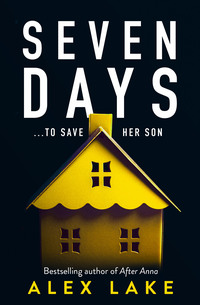
SEVEN DAYS
Alex Lake

Copyright
Published by HarperCollinsPublishers Ltd
1 London Bridge Street
London SE1 9GF
www.harpercollins.co.uk
First published in Great Britain by HarperCollinsPublishers 2019
Copyright © Alex Lake 2019
Cover design © HarperCollinsPublishers Ltd 2019
Cover photograph © Laura Kate Bradley / Trevillion Images
Alex Lake asserts the moral right to be identified as the author of this work.
A catalogue copy of this book is available from the British Library.
This novel is entirely a work of fiction. The names, characters and incidents portrayed in it are the work of the author’s imagination. Any resemblance to actual persons, living or dead, events or localities is entirely coincidental.
All rights reserved under International and Pan-American Copyright Conventions. By payment of the required fees, you have been granted the non-exclusive, non-transferable right to access and read the text of this e-book on screen. No part of this text may be reproduced, transmitted, down-loaded, decompiled, reverse engineered, or stored in or introduced into any information storage and retrieval system, in any form or by any means, whether electronic or mechanical, now known or hereinafter invented, without the express written permission of HarperCollins.
Source ISBN: 9780008272364
Ebook Edition © October 2019 ISBN: 9780008272388
Version: 2020-04-21
Dedication
To Norman: we miss you.
Rest in peace, old friend.
Contents
Cover
Title Page
Copyright
Dedication
Saturday, 16 June 2018: Seven Days to Go
Twelve Years Earlier, 7 July 2006
Chapter 1
Chapter 2
Chapter 3
Sunday, 17 June 2018: Six Days to Go
Chapter 1
Chapter 2
Chapter 3
Twelve Years Earlier, 7 July 2006: Evening
Chapter 1
Chapter 2
Chapter 3
Chapter 4
Chapter 5
Twelve Years Earlier, 7 July 2006: Evening
Chapter 1
Chapter 2
Monday, 18 June 2018: Five Days to Go
Chapter 1
Chapter 2
Chapter 3
Chapter 4
Twelve Years Earlier, 9 July 2006
Chapter 1
Chapter 2
Chapter 3
Chapter 4
Twelve Years Earlier, 9 July 2006
Chapter 1
Chapter 2
Chapter 3
Chapter 4
Twelve Years Earlier, 9 July 2006: Evening
Chapter 1
Tuesday, 19 June 2018: Four Days to Go
Chapter 1
Chapter 2
Chapter 3
Chapter 4
Twelve Years Earlier, 29 July 2006
Chapter 1
Chapter 2
Chapter 3
Chapter 4
Chapter 5
Chapter 6
Twelve Years Earlier, 30 July 2006
Chapter 1
Chapter 2
Chapter 3
Twelve Years Earlier, 31 July 2006
Chapter 1
Chapter 2
Chapter 3
Chapter 4
Chapter 5
Chapter 6
Chapter 7
Wednesday, 20 June 2018: Three Days to Go
Chapter 1
Chapter 2
Chapter 3
Chapter 4
Eleven Years Earlier: Sunday Morning, 1 July 2007
Chapter 1
Chapter 2
Chapter 3
Chapter 4
Eleven Years Earlier: Sunday Morning, 1 July 2007: Maggie
Chapter 1
Chapter 2
Chapter 3
Chapter 4
Chapter 5
Thursday, 21 June 2018: Two Days to Go
Chapter 1
Chapter 2
Chapter 3
Eight Years Earlier: Friday, 18 June 2010
Chapter 1
Chapter 2
Chapter 3
Chapter 4
Chapter 5
Chapter 6
Chapter 7
Chapter 8
Chapter 9
Eight Years Earlier: Sunday, 27 June 2010
Chapter 1
Chapter 2
Chapter 3
Eight Years Earlier: Thursday, 1 July 2010
Chapter 1
Eight Years Earlier: Thursday, 1 July 2010
Chapter 1
Chapter 2
Eight Years Earlier: Wednesday, 18 August 2010
Chapter 1
Chapter 2
Friday, 22 June 2018: One Day to Go
Chapter 1
Chapter 2
Chapter 3
Chapter 4
Four Years Earlier: July 2014: James
Chapter 1
Chapter 2
Chapter 3
Chapter 4
Four Years Earlier: July 2014: DI Wynne
Chapter 1
Chapter 2
Chapter 3
Chapter 4
Chapter 5
Four Years Earlier: July 2014: Martin
Chapter 1
Chapter 2
Four Years Earlier: July 2014: Maggie
Chapter 1
Chapter 2
Chapter 3
Four Years Earlier: July 2014: Sandra
Chapter 1
Chapter 2
Four Years Earlier: July 2014: James
Chapter 1
Four Years Earlier: July 2014: Maggie
Chapter 1
Saturday, 23 June 2018: No Days to Go
Chapter 1
Chapter 2
Chapter 3
Saturday, 23 June 2018: James
Chapter 1
Chapter 2
Chapter 3
Martin
DI Wynne
Sandra
Maggie
Chapter 1
Chapter 2
Martin
Maggie
James
Maggie
DI Wynne
Martin
Wynne
Martin
Wynne
Martin
Wynne
Martin
Wynne
Sandra
Wynne
Martin
James
Wynne
Saturday, 23 June 2018: Evening
Maggie
Wynne
PC Oliver Reid
Maggie
PC Oliver Reid
Maggie
Maggie
Maggie
Martin
Epilogue: Six months later
Read on for a sneak preview of Alex Lake’s new novel
Acknowledgements
Keep Reading …
About the Author
Also by Alex Lake
About the Publisher
Saturday, 16 June 2018
Seven Days to Go
Suddenly it was so close.
Max’s birthday – his third birthday, the one that counted – was right below the date she had just crossed out.
| S | Su | M | Tu | W | Th | F |
| 1 | ||||||
| 2 | 3 | 4 | 5 | 6 | 7 | 8 |
| 9 | 10 | 11 | 12 | 13 | 14 | 15 |
| 16 | 17 | 18 | 19 | 20 | 21 | 22 |
| 23 | 24 | 25 | 26 | 27 | 28 | 29 |
| 30 |
Which meant it was one week until the twenty-third of June.
Seven days away. That was all. Seven more days until it happened. She had been trying to ignore it, but seeing it there, the very next Saturday, made that impossible.
It was a wonder she had the calendar at all. She had started keeping it on the fifth day after she had been locked in this basement. If she hadn’t, there was no doubt she would have completely lost track of how long she’d been held captive. There had been times – terrible, terrible times – when she had been unable to record the passing days and weeks as accurately as she would have liked. But as it was, she knew more or less how much time had passed, how many years – eleven, soon to be twelve – since she had seen her parents and brother and older cousin, Anne, who she had been on the way to meet when she made the mistake of speaking to the man in the car that slowed to a stop next to her.
When she’d started the calendar, she’d had no idea that more than a decade later she would still be using it. She’d expected – foolishly, as it turned out – to be back with her family and friends well before this much time had gone by, although even after five days she was starting to understand that this might be something that lasted longer than she could have ever anticipated. She was glad she had the calendar though, glad she had asked for some paper and a pencil – the pencil was a short, yellow one from Ikea, she recalled – and sketched out a calendar in tiny figures on one side. It was her only link to the outside world. Even though it was not totally accurate, on the days she thought were the birthdays and anniversaries of her friends and relatives, she imagined them having parties and opening presents, and in doing so, she felt, in a way, that she was with them.
Since Max was born, the calendar had assumed a new importance; she’d become obsessed with ensuring it was accurate. Her son – named after the boy in Where the Wild Things Are, because the storybook Max was able to escape his room through a magic door and travel to the island where the Wild Things lived, and freedom was something she longed for her little boy to experience – had been born on 23 June 2015. And ever since that day she’d had one dread eye on his third birthday.
On the day her first son, Seb, turned three, the door to the basement had opened and he – the man whose name she still did not know and whom she thought of only as ‘the man’ – had come in. Unsmiling, as usual, but with a nervousness which was new.
He had said it was time Seb left. Time to let him go.
But not her. She was staying here.
She did not believe the man. What would he do with Seb? How would he explain the sudden appearance of a three-year-old in his life?
He was not going to set him free at all.
So she refused, but the man took him anyway. Quickly, and brutally. She barely had time to resist.
It was the last time she saw her firstborn. The next time the man came to the room he was alone.
She asked for Seb hundreds – thousands, maybe – of times, but he just shook his head, refusing to say where her boy was. Once, he told her, Don’t worry, he’s safe, but she didn’t believe it. If a three-year-old boy had suddenly appeared in his life, people would have asked where the child came from, who the mother was. There was no way he wanted those questions, so she thought she knew what had happened.
The man had made the problem disappear.
He’d taken her little boy and killed him, then disposed of his body somewhere it would never be found.
Beside herself with grief, she’d lost weight – a lot of weight, enough that her skin grew loose and she could almost see the shape of the bones in her arms and legs – but it didn’t stop the man coming to the basement and gesturing to the bed in the corner with that curt little nod of his, then waiting for her to lie down and undress before he lay on top of her and did what he did while she closed her eyes and waited for it to be over and for him to be back upstairs in his house where she didn’t have to look at him.
And, of course, the thing she had feared most came to pass. Another child. She tried to stop it. Tried to starve the baby to death inside her, but all that happened was she grew thinner and thinner herself until the man figured out what was going on and forced her to eat. Why, she didn’t know. Why he wanted the baby to be born was a mystery to her, but then most of what he did was a mystery to her. How could you understand a man who locked a fifteen-year-old girl in a basement for years, then stole her son? Why even try?
And then the new baby was born. A boy again. Pink and beautiful and red-haired. She hadn’t wanted him, but now he was there she loved him uncontrollably. Leo, she called him. Leo the lion, with his mane of red hair.
He was different to Seb. Smaller. More watchful. Quicker. By the time he was two he could talk, whole sentences. At two and a half he could read the alphabet. She had taught him by writing out tiny letters on a scrap of paper.
At three he was gone. On his birthday, the man came. He pointed at Leo.
Give him to me, he said.
No, she replied. Not this time.
Yes, he said, in his heavy, slow voice. Yes.
This time she fought, but it was no use. It had never been any use, not since the first time she had tried and he had taught her – in the most awful, awful way – never to try again. But she had. She had held Leo to her chest, but the man hit her and forced her on to her back and held his forearm against her throat then prised her arms apart until he had Leo and she was unconscious. The last thing she saw before she passed out was her beautiful boy wriggling from his arms and running away.
But there was only one place for Leo to go, and he went there.
Through the open door and up the stairs, to the place the man lived.
The next time she saw him she didn’t bother asking where Leo was. There was no point.
And then, as though the universe was punishing her, the cycle repeated itself. The door opening. The nod at the bed. The disgusting act.
Then the missed period and the cramps and the feeling of being bloated and uncomfortable. And nine months later, another baby.
Another boy.
Max, after the boy in Where the Wild Things Are.
Max, the curly-haired, ever-smiling, bright-eyed button of joy who she loved with an intensity that surpassed anything she had felt before, even with Seb and Leo, if only because since the day he had arrived she had known she would only have three years with him, three short years into which she had to cram a lifetime of love.
Max, who would turn three on Saturday, 23 June.
She looked at him, sleeping on the mattress they shared, spread-eagled on his back, mouth slightly open and she shook her head.
It couldn’t happen again. It couldn’t.
But it would. She was powerless. The man would come and open the door and take Max from her, whatever she did. And even if she stopped him somehow, it would only be a temporary respite. He would put sleeping pills in her food or knock her unconscious and take her little boy.
She couldn’t fight him every day of Max’s life.
And so she had seven days left. Seven days with her son.
Seven days until he was ripped from her arms.
Or seven days to find a way to save him.
Twelve Years Earlier, 7 July 2006
1
Maggie pulled on the baby-blue Doc Martens her boyfriend, Kevin, had bought her for her fifteenth birthday. She’d had mixed emotions when she unwrapped the present a week before; she really, really wanted the boots, but they were expensive, and although Kevin was sweet and she was very fond of him, she already knew he wasn’t the one – she couldn’t see him as the first person she’d have sex with. What they had wasn’t special enough, at least not to her, and she’d decided she was going to break up with him. Knowing that, accepting the boots didn’t seem fair. She’d seen it on her mum’s face, too. When Maggie pulled the boots from the box, her mum had glanced at her, her forehead creased in a frown.
For a moment, Maggie had considered refusing, but that would have been even more awkward. She’d have had to explain why, and she wasn’t quite ready for that, wasn’t quite ready to break his heart, not on her birthday.
Besides, they really were amazing boots.
She stood up and looked in the hallway mirror. She pulled her hair – recently dyed jet black from her natural copper-tinged brown – into a ponytail, considered it, then let it fall loose around her neck. She could never make up her mind what was better. It was long and thick, and wearing it down showed it off. It meant more care though, or at least a more expensive haircut, and she didn’t feel like asking her parents for money. Though they both worked, things were tight – they didn’t talk about it in front of her and James, her little brother, but she picked up on comments they made about being careful buying groceries and saw how her dad only put in ten pounds’ worth of petrol at a time.
Anyway, that didn’t matter at the moment. She was going to see Anne, her nineteen-year-old cousin, to get some advice on what to do about Kevin. She grabbed her backpack and walked down the hall.
‘Maggie!’
It was her dad. She paused at the front door. He was probably going to tell her to tidy her room or ask if she’d done her homework. If she left immediately, all he would hear was the door closing. When she got home she could say she hadn’t heard him.
She gripped the handle. Behind her, the door to the living room opened.
‘Maggie.’ Her dad was standing there, a piece of paper in his hand. ‘Before you go, we need to talk.’
She rolled her eyes. She knew it was immature, and she hated it – she wasn’t a little girl any more, she had grown-up decisions to make about things like Kevin, and when it was right to have sex with someone, which was one of the things she was going to ask Anne about – but somehow her parents always brought out her childish side. She hated it, but she simply couldn’t help it.
Ironically, on the way home from Gran’s the other day, her mum had admitted, You know, Mags, I’m forty-one years old, but I still feel like a naughty teenager when I’m talking to your gran.
So maybe it would always be this way.
‘What is it, Dad? I’m late.’
‘Oh,’ he said. ‘You’re late? I’ve never known you to worry about that before, but I’m glad you’ve finally seen the value in punctuality. Let’s hope this new approach lasts until Monday morning when it’s time to leave for school.’
‘Very funny, Dad.’ It actually was quite funny. Her friends all thought her dad was hilarious, but she wasn’t going to tell him that. ‘You do know that sarcasm is the lowest form of wit, don’t you?’
‘I’ve heard that,’ he said. ‘And I’m sorry to cause you distress by violating your new-found sense of punctuality by making you even later, but we need to discuss this.’ He shook the piece of paper. ‘It’s the phone bill, in case you were wondering.’
The phone bill. Of all things, that was what he wanted to talk about?
‘Do we have to do it now, Dad? Can’t it wait? It’s only a phone bill.’
‘Only a phone bill for one hundred and’ – he peered at the total – ‘seventy-six pounds, and nineteen pence.’
‘So?’ Maggie said. ‘I didn’t make all the calls.’
‘No,’ he said. ‘Not all of them. But the majority.’
‘There’s no way I made the majority of calls,’ Maggie replied. ‘James is always on the phone.’
‘That’s probably how it appears to you. In the few gaps you leave each evening, he manages to squeeze in and grab a few minutes before you wrestle the phone back from him. But I think it’s fair to say you’re the primary phone user in this house.’
There was a long pause, which Maggie filled by shaking her head, the slowness of the shake indicating the depth of her disbelief.
‘That is so unfair,’ she said.
‘Really?’ Her dad smiled. It was a smile she hated, smug and pleased with himself. ‘One of the things you should know about phone bills is that they are itemized,’ he said. ‘Every call. Number and duration.’ He tapped the phone bill. ‘Take this number, called on the seventh of April at seven minutes past five for sixty-one minutes. And again that same evening, at eight twenty-two, this time for ninety-six minutes. It appears the following day, then the day after that, then there’s a break for a day, and then it appears again – every evening until the twenty-fourth of April.’ He read out the number. ‘Do you recognize it?’
‘You know I do,’ Maggie said. It was Chrissie, one of her best friends. Chrissie had moved to Nottingham – which made it a long-distance call from Stockton Heath – and was having trouble settling in. ‘Chrissie needs me, Dad.’
‘Then perhaps she should call you.’
‘Her parents won’t let her! They put a pin code on the phone.’
‘Look,’ her dad said, ‘I understand you want—’
‘Need,’ Maggie said.
‘Need to talk to your friends. But it costs a lot of money. And apart from anything else, what if someone needs to call us? The phone’s always engaged.’
‘It wouldn’t be if you bought me a mobile,’ Maggie said. ‘Then you wouldn’t have to worry about your precious phone being tied up.’
‘I’m not sure that would save any money,’ he replied. ‘Mobiles are more expensive than land lines. And we talked about it. You can get a phone when you’re sixteen.’
‘My friends all have mobile phones!’ she said. ‘It’s not fair!’
‘When you’re sixteen,’ her dad said. ‘Or when you can pay for it yourself.’
‘Fine,’ Maggie said. This was so annoying. ‘Whatever.’
‘Maggie,’ her dad said. ‘I know it’s important to you to talk to your friends, and I know this is your house too, but you have to be prepared to compromise. I think maybe one and a half hours a night should be the maximum you spend on the phone. I don’t think I’m being unreasonable.’
‘Sure. Can we talk about it later, Dad? I need to leave.’
‘You want a lift?’
Maggie considered it for a second, then shook her head. ‘I can walk. I’m only going to Anne’s.’
‘OK,’ he said. ‘Are you back for dinner?’
‘Yeah. See you then.’
‘See you too, Fruitcake. Love you.’
Fruitcake. He’d called her that since she was a little girl. She kind of hated it, but she also knew that one day there’d be a last time he called her Fruitcake.
And she wasn’t sure she was ready for that day just yet.
2
Maggie’s Cousin Anne lived on the other side of the village. It was a short walk – no more than half a mile – which she had made many times. The road outside her house led to the village centre, but she turned off it after about a hundred yards and walked along a quiet residential street towards a small park. It was a short cut, of sorts, but the main reason she wanted to go through the park was so she could smoke a cigarette. A stream bordered one edge of the park; it was slow moving and full of litter and nobody – no adults, at least – ever bothered with it. It was the perfect place to hide while you smoked.
It was Kevin who had got her started; the first few times she’d coughed and spluttered and wondered how anyone got addicted to something so disgusting, but after a while she’d grown to quite enjoy it. There was something about the ritual that appealed to her – the flare of the match, the crackle of the paper when it lit, the rush of the nicotine – although what she really enjoyed was the feeling that she was doing something her parents didn’t know about. Something grown-up.
She felt in her bag for the cigarettes and matches and smiled as her fingers closed around them. She took one out and held it in her hand, unlit. She’d share one with Anne later. Anne smoked, too; she didn’t know yet that her younger cousin had taken it up. Maggie was looking forward to telling her.
She was also looking forward to what Anne had to say about Kevin. He was going to be devastated, Maggie already knew that. They’d been together nearly six months, and, a few weeks back he’d said how it seemed like a month or two, max.
Maybe that’s what it’ll be like for us, he said. The years will fly by.
Years? It was then that Maggie realized they were not in the same place when it came to their relationship. For her, it had been a bit of fun that had lasted six months because Kevin made it work. For him, it was something a lot more significant.
Have you ever thought about taking … she said, and hesitated, about like, maybe taking a break?
They were lying on her couch and he tensed.
What do you mean? Do you want to take a break?
No, she said. I was wondering if you want to. If you’ve had enough of me. I don’t want to. Of course not.
He relaxed, a little.
No, he said. I’ve never thought about that. The opposite, in fact. You know I love you, Maggie.
He had started telling her all the time that he loved her. She found it very irritating. She felt she had to reply in kind.
I know, she said. I know you do.
Do you love me?
You don’t need to ask, Maggie said. All of a sudden she didn’t want to say it. Before, it had felt like an imposition; now it felt like a lie.
Do you? he said. Do you love me, Mags?
He’d also started calling her Mags. That was what her dad called her, when he wasn’t calling her Fruitcake. It wasn’t for Kevin.
Maybe for someone else, later, but not for Kevin.
Mags? he said. What’s wrong?
She pushed him away and stood up. Nothing. I’m getting my period. I’m going to get some water.
That had been his reaction to a vague question about taking a break. She dreaded to think what it would be when she told him she wanted to break up. Anne would have some advice.
The realization that a car had pulled up beside her broke her reverie. She started, and dropped her cigarette. She crushed it under her foot, in case it was someone who knew her parents, although if it was, it was probably too late. They’d have seen it in her hand as they stopped next to her.
The car was dark blue and nondescript. A Ford or something. Maybe a Volkswagen. Nothing too fancy, either way. She didn’t recognize it, thankfully. She glanced inside. There was a man behind the wheel, a road atlas in his hands. He was reaching for some glasses and peering at the page. He turned to look at her and smiled. He was about fifty and reminded her of a geography teacher.
No one she knew. She took her foot off the cigarette. No need to worry about that now.
The man looked at the panel by the gearstick and selected a button, his gestures very deliberate, as though new to the technology and needing to think about what he was doing. The passenger-side window rolled down.
‘Sorry,’ he said. He had a quiet, soft voice and a worried expression. She felt a little sorry for him. ‘I’m a bit lost, I’m afraid. Do you know where Ackers Lane is? Is it near here?’
It was on the other side of the park, but to get there by car you had to go through the village.
‘You’ll have to turn around,’ Maggie said. ‘When you get to the main road, turn right, and then right again at the traffic lights. I think it’s second – or maybe third – left after that. Ackers Lane is about half a mile down there.’
‘What’s the name of the road I turn into?’ he said.
‘I’m not sure,’ Maggie replied.
‘And you said it’s second left?’
‘Maybe third.’
‘OK,’ the man said. ‘Thank you.’ He paused. ‘Sorry to bother you. It’s a friend of my mother’s. She’s very frail and she had a fall. I need to get to her as soon as I can.’
‘That’s fine,’ Maggie said. ‘No problem. And good luck.’
The man shook his head. ‘Dash it,’ he said. ‘I’m so sorry. I can’t quite remember what you said. Was it left on the main road?’
‘Right,’ Maggie said. ‘Then right again at the lights.’
‘I thought it was second left? Or third?’
‘That’s after you go right at the lights.’ It was obvious from the man’s blank expression that he wasn’t following her. ‘Look,’ she said. ‘It’s easy. Let’s start again.’
He held up the road atlas. ‘Would you mind showing me on the map?’
‘Of course,’ Maggie said. ‘Pass it over.’
The man unbuckled and twisted in his chair so he could pass the atlas over the passenger seat. She noticed that he held it in his right hand, which was weird, since his left hand was closer to her.
His left hand which, with a sudden, unexpected speed, snaked out and grabbed her wrist and yanked her towards the window.
Then he dropped the atlas, and she saw the syringe in his hand, and felt the prick of the needle in her arm. She just had time to read the front page of the atlas and think it was odd that he had a map of Cornwall when he was in Stockton Heath, and then everything went dark.
3
Her first thought was that she had a hangover. She recognized the sensation – throbbing temples, dry mouth, disorientation – from the time that she and Chrissie had drunk a bottle of cheap white cider in the park, and then, somehow, made their way to Chrissie’s house and passed out in her bedroom. Maggie had woken when it was still dark out and thought What happened? before the memories of the cider and the park and the two boys that had bought it for them came slowly back.
This was different, though. This time the memories that surfaced were not of cider and boys and the park.
They were of a car, and a man asking for directions and a syringe.
Holy shit.
Her eyes flew open.
She was looking at a low ceiling, covered in some kind of dark carpet tile.
A ceiling she did not recognize.
The dryness in her mouth intensified and her stomach tightened. Her pulse sped up and pounded in her neck. She sat up too quickly and felt suddenly dizzy; for a moment she thought she was going to pass out, but then her head cleared and she saw where she was.
She was on a narrow, thin mattress in a room lit by a dim lamp on a table by the bed. The room was small; the ends of the mattress were against the walls. There was an area about twice the size of the mattress covered in a brown carpet. In one corner were two blue, plastic buckets, a pink bowl with a jug inside it, and a tall wooden, barrel.
What the fuck were they there for? Maggie stared at them, aware that, in the back of her mind, she knew exactly what they were. She just didn’t want to face it.
They were the toilet, sink and bath.
She looked away. In the other corner was a door. Beside it was a box that looked like it contained a towel and possibly some clothes.
And that was it. Other than that, the room was empty.
It was also windowless, which explained the dank, musty smell.
Maggie folded her arms protectively. She was still clothed, still wearing the grey jeans and Gap hoodie she’d left the house in.
But there was something missing. She glanced at her feet. Her blue Doc Martens had been removed.
Which meant someone – the man – had touched her while she was unconscious.
Her stomach heaved and she tasted bile in her mouth. She fought the urge to be sick, but she retched again and realized she was not going to be able to stop it. She staggered to the pink bowl and leaned over it and threw up, over and over, until her stomach was empty.
Then she sat back on the mattress. The room was silent and empty, unchanged apart from the sour smell of vomit that cut through the stale air.
‘Hello?’ she said. ‘Hello?’
The words seemed to vanish, swallowed up by the walls. There were no echoes, no reverberations, no indications that the sound of her voice had left the room.
She looked at the door and got to her feet. There was some explanation for this. Maybe she’d fallen ill, or been hit by a car and the man who looked like her geography teacher had brought her here to keep her safe, unaware of her name or address. He was probably upstairs – she was sure the room was underground – waiting for her to wake up so he could take her home.
If that was the case – and it had to be, it simply had to be, because the alternative was too awful to contemplate, which was why she was ignoring it and pretending that there was an innocent explanation here – if that was the case then the door would be unlocked and would open when she tried it and she would walk up the stairs and in an hour or so she’d be at home with her mum and dad, sitting with them on the sofa and never, never leaving them again.
She took the few steps – three, she counted – to the door and reached out. The silver metal handle was cold.
And it did not move. She tried it a few times, each time with more and more force, but it was pointless.
She was in a locked room.
The thought did not quite register.
She was in a locked room.
She was – the word forced itself into her consciousness for the first time – a prisoner.
She reached in her pocket for her cigarettes. She had a sudden need for the rush of nicotine, of something familiar.
They were gone.
She sat heavily on the mattress. Despite the carpet, the floor was cold on her feet and she looked for her boots, but they were gone. Clearly the man did not think she would have much use for them here.
Her boots had been taken off and the door was locked and there was a bucket for a toilet and a bowl for a sink and a barrel for a bath, which meant that the man who looked like her geography teacher – the man who had, she now understood, kidnapped her – intended to keep her here for a very long time.
Forever, she thought. He wants me here forever. He can’t let me go because then I’d tell people what he did and he’d be in trouble. So he has to keep me here.
She pulled her knees up and hugged them to her chest. She looked around the room, taking in the brown carpet that covered the floor and ran up the walls and over the ceiling, the locked door and the lumpy mattress lit by the weak yellow light pooling out from the one lamp by the bed.
And she understood something else.
He had prepared the room for this purpose. He had a plan.
And she was now part of it.
Sunday, 17 June 2018
Six Days to Go
1
She crossed off another day.
| S | Su | M | Tu | W | Th | F |
| 1 | ||||||
| 2 | 3 | 4 | 5 | 6 | 7 | 8 |
| 9 | 10 | 11 | 12 | 13 | 14 | 15 |
| 16 | 17 | 18 | 19 | 20 | 21 | 22 |
| 23 | 24 | 25 | 26 | 27 | 28 | 29 |
| 30 |
Six days to go until his birthday. She watched him stack his Duplo blocks into a tower, then knock it down, giggle, and build it again. God, his world was so small.
A low ceiling, four carpeted walls – she hated that carpet, hated its dust and smell and drab brown colour, and she had vowed that when she was out of here she was going to have a house with clean, wooden floors in every room – the sink-bowl and toilet-bucket and barrel-bath and a door he had never been through.
That was it. That was Max’s world. He didn’t even understand what the door was for. As far as he knew, it was for the man to come in and out of. He had no idea he could use it, had no experience of all the things that were out there.
No experience of fields and ponds and schools and roads and houses and shops. All he had was what she had told him. She’d asked for books and photos but the man had told her there was no point. He was too young to understand.
And he’ll be gone when he’s three.
The man hadn’t said that, but he didn’t need to. It was implicit in his refusal. He rarely gave her anything. It was only after weeks of begging when Seb was born that he’d brought a box of Lego, the large ones for little kids. Duplo, they were called. There weren’t many, but Max – as Seb had – loved them. He played with them for hours, arranging them into towers and arches and walls. Once he had made a rectangle filled with odd-shaped objects and Maggie had asked him what it was.
Our house, he replied. Look. That’s the bath. That’s you and me. That’s the bed.
She had to bite back the tears. Other kids were building space rockets or gardens or trains. Max was building the only thing he knew.
This shitty prison.
And so she took him places in his imagination, described the blue of the sea by pointing to his blue socks, but told him the sea was a different blue, a brilliant blue, a beautiful shining blue, words that he didn’t understand but which reminded her of the world out there, of what she too was missing. She explained the coolness of the breeze by moistening his forehead and blowing on it, and the warmth of the sun by rubbing her hands until they were hot and placing them on his chest. All of it was a pale imitation of the real thing, but it was all she had.
She didn’t stop there; she told stories of magical palaces and boats and rivers where Max and she had wild adventures. Along the way they met heroic people with the names Grandpa Martin and Grandma Sandra and Uncle James and Aunty Anne and Chrissie and Fern. She told him how Chrissie was brave and loyal but could be grumpy and Fern was funny and clever but left things wherever she went. She told him how Uncle James was kind of grumpy but sweet and well-meaning, and how Aunty Anne was wise and Grandpa and Grandma were kind and loving, and how they loved him in particular. The stories ended with huge parties where there was every kind of food and all the toys a boy could wish for. She wondered what Max thought chocolate and jelly beans and burgers and milkshakes tasted like. She wondered whether he would ever find out.
She sat on the mattress and watched him play with the Duplo. Behind him, by the door, were two plates. Max had left half of the mashed potato and baked beans the man had brought; Maggie had barely touched hers.
‘OK, Max,’ she said. ‘Time for our exercises.’
She was worried he didn’t get enough activity – of course he didn’t, living in a cell – so for the last year or so she had been doing exercises with him. They began with jogging on the spot – he found that amusing – and then they dropped to the floor and did press-ups and sit-ups. Max’s press-ups mainly consisted of him raising his bottom in the air and then collapsing to the floor, but it was something. Maggie had found that, as the months went by, she could do more and more of them; now it was no trouble to do fifty at a stretch. She also did tricep dips and planks; she could hold the plank for over four minutes.
Maggie took off her T-shirt and shorts – it was always uncomfortably hot in the room, the air still and cloying; the only time there was any fresh air was when the man came and cooler air gusted in through the open door – and knelt on the floor. She dropped into the press-up position and did twenty press-ups, then held herself on her elbows.
‘OK, Max,’ she said. ‘Come and join me.’
Max toddled over. He was in a pair of dirty underpants – she tried to keep them clean, but it was hard with only soap and cold water – and lay on his belly next to her. On the back of the underpants was a Superman logo she’d drawn once, after telling him the story of how Superman had come from the planet Krypton to save people on Earth from their own folly. As she recounted the story she had been gripped by a powerful feeling that Superman would burst into the room and rescue them at any moment. He hadn’t, but for days she had been left with a vague sensation of hope.
Max levered himself up into the plank position. He was still some way off a four-minute plank. Once he had managed about twenty seconds, but this time it was closer to four seconds before his buttocks started to quiver with the effort. After a few more seconds his hips slowly lowered to the carpet.
‘Watch, Mummy,’ he said, looking up at her. ‘Watch what I can do.’
He started to wiggle his legs and arms and shake his head from side to side.
‘Wow,’ she said. She paused while she searched for an appropriate description of his gyrations. ‘You’re break-dancing!’
‘No,’ he said. ‘I’m being a snake. A snake doing yoga.’
‘Oh,’ she said. ‘Of course.’ For a while they’d done some stretches she remembered from PE and she’d told him they were doing yoga, and it had obviously stuck with him.
He wiggled around for a while, a look of triumph on his face, then stood up and ran to Maggie. He jumped on her back and pressed his cheek to her skin.
‘OK,’ he said. ‘Ride the horsey!’
Maggie twisted and bucked in an attempt to throw him off. It was a game they had played since he was very small. She had done it with Seb and Leo, but they had not enjoyed it nearly as much as Max. He shrieked with pleasure, laughing uncontrollably. It was a strange thing; despite the circumstances, he was a very happy child. Of course, he had no sense that he was missing out on anything, because he knew no different. In some ways it was the perfect set-up for a toddler: unfettered access to his mum and a guarantee of her undivided attention. Nonetheless, Seb and Leo had not been as happy as Max was. Seb was quiet, and prone to outbursts of crying. He’d been like that ever since he was born, sleeping fitfully and whimpering in his crib during the day. Leo was more like Max, but had a wild temper. From time to time, and without apparent reason, he would have screaming fits during which he was totally unreachable. He would hit her, and, if she tried to hold him, claw at her cheeks.
She had put it down to living in a tiny room, but then Max came along, and she wondered whether it was simply the way Seb and Leo were. Nature, not nurture. After all, if it was all down to circumstances, they should all have been the same – this was the perfect way to test. In normal life there were other things that could influence a child’s development, but not here. This was like a cruel experiment designed to examine how three children in the exact same environment turned out differently.
And Max, unlike the brothers he would never meet, was as happy as they came. Perhaps Seb and Leo got it from their dad – she hated even thinking of him as their father, but it was true, at least biologically – and Max took after someone else. He certainly had a look of her brother, the same fair hair and innocent, questioning blue eyes, the same goofy smile and easy laugh.
That was one of the things she regretted most, when she looked at her third son: that he would never meet his uncle, and that her brother, who had been a constant, daily irritation through her unfairly truncated teenage years, would never get to be the mentor to his nephew that he would, in her imagination, have become.
James would have loved him. He would have loved all three of her sons, with the same fierce, painful love that she did.
But Max was the only one she had left. He was the only one James would ever be able to love, and all she wanted in the entire universe was to save him so he could meet his uncle and have the life he deserved.
And she was going to.
Somehow.
Ücretsiz ön izlemeyi tamamladınız.