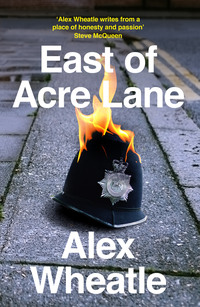
Kitabı oku: «East of Acre Lane»
EAST OF ACRE LANE
Alex Wheatle

Copyright
4th Estate
An imprint of HarperCollinsPublishers 1 London Bridge Street London SE1 9GF www.4thEstate.co.uk
First published in Great Britain by 4th Estate in 2001
Copyright © Alex Wheatle 2001
PS Section copyright © Joanne Finney 2006, except ‘Brixton Hot!’ by Alex Wheatle © Alex Wheatle 2006
Introduction © Paul Gilroy 2020
Police helmet © Getty Images / Peter Dazeley
Street © Getty Images / onebluelight
Flame © Shutterstock
Alex Wheatle asserts the moral right to be identified as the author of this work.
A catalogue record for this book is available from the British Library
This novel is entirely a work of fiction. The names, characters and incidents portrayed in it are the work of the author’s imagination. Any resemblance to actual persons, living or dead, events or localities is entirely coincidental.
All rights reserved under International and Pan-American Copyright Conventions. By payment of the required fees, you have been granted the non-exclusive, non-transferable right to access and read the text of this e-book on screen. No part of this text may be reproduced, transmitted, down-loaded, decompiled, reverse engineered, or stored in or introduced into any information storage and retrieval system, in any form or by any means, whether electronic or mechanical, now known or hereinafter invented, without the express written permission of HarperCollins.
Source ISBN: 9780007225620
Ebook Edition © 2020 ISBN: 9780007405794
Version: 2020-08-14
Praise
‘Wheatle has a compelling prose style and the heady, dope-soaked, scarily aggressive atmosphere of south London is conveyed extremely well. Wheatle’s style and command of language and plot ensure he is a writer to watch’
Observer
‘Beautifully written, funny and full of insight, this is one of the best novels about post-war London to have been written in recent years’
The Times
‘Alex Wheatle weaves witty patois dialogue and cool, crisp narrative into a tone of playful irony, wholly free of rant or rancour’
Saturday Telegraph
‘A welcome trip down memory lane by the Brixton bard … the musical references make you jump and prance and the hard-edged dialogue brilliantly captures that London vibe’
Courttia Newland
‘In East of Acre Lane Alex Wheatle has managed far more than simply pulling off a fast, punchy morality tale centring on a young man’s dilemma about going straight or opting for a life of crime … Action packed, funny and filled with cocky banter between its teenage male characters, references to reggae music and street stye, it’s a cool, credible read’
Big Issue
‘The dialogue … has rhythm and inventiveness. And the violent climax is a cathartic one, the logical and positive first stage of a revolution’
Independent on Sunday
‘This gripping second novel by Wheatle gives a searing account of a young man’s attempt to do the right thing, set against the backdrop of one of the most explosive moments in London’s history – the Brixton Riot. You simply will not want to put this book down until you have finished reading it’
The Voice
‘Treading a Dubliners-esque terrain which swallows up the Brixton landscape, the novel spits out the simmering frustrations of being young, black and British during the Thatcher years … A trademark naturalistic style and a clarity of prose ensure that Wheatle retells a shaping episode in recent British history and tellingly, captures as much of today’s mood as he does of an unforgettable ‘81’
Pride
Dedication
This novel is dedicated to the life
and musical legacy of
Dennis Emmanuelle Brown
Contents
Cover
Title Page
Copyright
Praise
Dedication
Introduction by Paul Gilroy
1 Heady Heights
2 Homestead
3 Roadblock
4 The Front Line
5 Oh Carol
6 Delivery
7 Sons of SW9
8 Sisters
9 Six Babylon
10 Crisis
11 The Wedding
12 Gunman Connection
13 The Teachings of Jah Nelson
14 Queen Majesty
15 Babylon Pressure
16 Bounty Hunting
17 Sister Love
18 Herb Man Hustling
19 The Shitstem
20 Brixtonian Females
21 Truths and Rights
22 Enter the Pimp Don
23 The Brixtoniad
24 Confrontation
25 The Blessing of Jah Nelson
P.S. Ideas, Interviews & Features …
About the Author
Unfinished Stories: Joanne Finney talks to Alex Wheatle
Life at a Glance
Top Ten Books
A Writing Life
About the Book
Brixton Hot! by Alex Wheatle
Read On
Have You Read?
If You Loved This, You Might Like …
Find Out More
Acknowledgements
About the Author
About the Publisher
INTRODUCTION BY PAUL GILROY
Alex Wheatle and I belong to the same small and highly exclusive club. Like him, I once livicated a book to the memory of Reggae’s crown prince, Dennis Brown – a philosophical hero and visionary. It is not a spoiler to tell you that his rootical anthem ‘Deliverance Will Come’ is among the tunes that feature in the story you’re holding. That particular Jamaican classic opened the epoch-making 1978 album Visions of Dennis Brown. It matched the honeyed anguish of Dennis’s melodious vocal to Lloyd Park’s rugged bass and some positively rude rockers drumming. ‘Deliverance Will Come’ remains a big tune because it captures the historical texture of the vexed period covered by this rich and rewarding novel. Even now, Dennis’s exquisite projection of the sufferers’ utopian imagining of a world transformed is powerfully evocative. His words offered an invitation to join a collective process of reasoning that promises to bring a better world closer and contribute to repairing all the damage done in this one by the works of Babylon. Alex Wheatle’s novel enacts the same upful possibility.
East of Acre Lane is not about music, but reggae music flows through it, supplying the vital fluid to its pressured veins. Wheatle uses that sound and song to open a spot in time and to identify the moral conflicts and boundaries of the community that provided him with this pageant of characters. During this pivotal period, Dub reached its creative peak. Music was still more than merely entertainment. It afforded ethical guidance and delivered precious, useful access to ancestral, I-thiopian truths that could be applied to the dilemmas and conflicts generated in and around black life by exploitation, marginalization and oppression. The social, cultural and moral roles of music became more significant as the bitterness that had built up over the previous decades eventually began to flare. The dance was a place of instruction, of healing, and potentially, of insurgency, constantly surveilled and regulated under the watchful eyes of the police, as corrupt as they were brutal.
This novel’s historical and geographical setting should be carefully specified. It can be defined by the immediate aftermath of the New Cross Massacre, which occurred 18 January 1981 and claimed the lives of thirteen young people. That terrible tragedy had been met with governmental indifference and judicial hostility. The traumatised victims were treated as criminals, and the stories callously spun about them in the press by the police studiously and provocatively ignored the history of racist attacks and fascist organizing in the area.
The New Cross Massacre Action Committee supported the victims and denounced the empty response of the authorities. They called the Black People’s Day of Action on 02 March and galvanized Britain’s black communities into action. They formed a unified political body that carried a welcome glimpse of positive future possibilities. Thousands marched northwards in the rain from New Cross Rd., through an attempted police blockade at Blackfriar’s Bridge, and headed up Fleet Street where they were showered with contempt and hostility delivered from the headquarters of the newspapers that had orchestrated the criminalization of a whole generation.
After that initial fightback, South London’s notorious ‘nigger-hunting’ police were determined to exact symbolic revenge upon the local youth who, we’re told, had been emboldened by the triumphant day of action. To put them back in their proper, lowly place, Brixton police launched their ‘stop-and-search’ response: Operation Swamp 81 on 06 April. Its heavy-handed aggression precipitated unprecedented outbreaks of collective violence that came eventually to express the bleak predicament of all of this country’s young people. The eruptions were certainly the culmination of a longer conflict between the police and the militant layer of rebel youth, an explosive instance of the black communities’ bitter struggles against the habitual racism of Britain’s criminal justice system.
The burning and looting extended from April until July. They spread from Brixton to encompass the whole country, which was changed in profound and lasting ways as a result of what the violence revealed. As we approach the fortieth anniversary of those riots, it is important to reflect upon the meaning, character and importance of them, especially given the current conditions are not always hospitable to historical sensibility. Wheatle’s tale is set in the recent past. His history links with present circumstances, which have in turn been shaped by it. Contemporary conditions are in some ways better and in some ways worse. We look at the present in relation to the past, which is recast here, in the words of Dennis Brown, as ‘the half that has never been told’.
The official statistics say that at that time there was 50 per cent youth unemployment among young black people in Lambeth. However, the nationwide arrest data from 1981 show that participation in the riots was far from narrowly confined to what were then called ‘ethnic minorities’. The Economist trumpeted that the scale of those events conclusively demonstrated the failure of Britain’s welfare-state settlement. In July, the New York Times published a notably more accurate and considered interpretation of the disturbances than any that the British press could muster:
Spreading urban violence erupted in more than a dozen cities and towns across England yesterday and early today as policemen and firemen fought to control thousands of black, white and Asian youths on a spree of rioting, burning and looting. A senior Government official said that the disturbances, which came as the epidemic of violence in the dilapidated inner cities entered its second week, were the most widespread to date. In some cities, he said, “we are facing anarchy.” By 5 A.M., most of the violence had been brought under control, but sirens and burglar alarms could still be heard through the streets of London, and palls of smoke rose from half a dozen districts. From Battersea and Brixton in the south to Stoke Newington in the north, and from Chiswick in the west to Walthamstow in the east, rocks and shattered glass littered at least ten multiracial neighborhoods.
(R. W. Apple, ‘New Riots Sweep England’s Cities; “Anarchy” Feared’, New York Times, 11 July 1981)
Mass antipolice violence clustered around the carnival in Ladbroke Grove had first exploded in 1976. Five years later, because the rioting continued for so long, and could apparently unfold anywhere, the national mood became increasingly anxious and fearful. Perhaps the race war so apocalyptically predicted by the populist Conservative politician Enoch Powell, in his 1968 bid to become party leader, appeared more plausible after the scale of rioting had shifted from smoldering quotidian resentment against police harassment to more spectacular varieties of resistance.
The riots were rooted in young people’s experiences of inequality and injustice. They were also configured by youth’s slowly dawning sense of the chronic character of the crisis that engulfed them and of the unholy forces unleashed by accelerating de-industrialization of urban zones. Once the flames and the adrenaline subsided, the sense of hopelessness was pervasive. Here again, music supplied healing, reparative therapy. There is a balm in Gilead. This was not a crisis of identity but rather the steady birth of a particular dissident culture assembled with love and care from fragments donated by Black Power, Rastafari livity and the combative, insolent resources found in local working-class life.
It is difficult now to judge whether those events should still be considered contemporary. Social life in Britain has evolved. Amplified by the internet, the gaudy dreamscape of consumer culture has discovered new value in iconized and celebrity-faced diversity. Convivial interaction across the axes of class, gender and marginality is often unremarkable. In sharp contrast, the political imagination of the most recent rioters has supposedly contracted to the point that their assaults on power and injustice brought only the transient pleasures of wholesale shopping without money. So we must ask whether changes in the politics of race, and in the way that racism conditions both culture and politics, have been sufficient to draw a line – to create a strong sense of a before and an after. That possibility is pending in this novel.
Remembering this period in the city’s life has become difficult not least because the neoliberal moods that hold sway these days require a disaggregation of the past. It deteriorates into an undifferentiated, abstract sense of history which can be glimpsed intermittently, in fragmentary form, on YouTube, but does not appear to be connected to the world we inhabit. If history reappears at all, it is likely to be no more than an aimless plethora of firmly localized ‘back stories’ that lack an overarching narrative apart from some half-articulated notion of inevitable progress towards a fairer and richer way of life enhanced perhaps by a new generation of technological toys. Those very mechanisms of mass distraction obstruct the insurgent operations of countermemory. This is where the imaginative work accomplished artfully by East of Acre Lane comes in.
It is sometimes easier, more popular and even remunerative for black writers to dwell on the injuries and injustices that result directly from racial downpression than to open up the difficult and painful questions that surround the hurt that downpressed people routinely do to one another. These different dimensions of racialized life in difficult circumstances are knotted together. It takes a special bravery and responsibility imaginatively to enter and explore their entanglement. In his poetic, Fanonian surveys of the conditions that gave rise to bitterness and violence, another Brixtonian, Linton Kwesi Johnson, has described the lateral violence found among racism’s victims as merely the first, transitional phase of their reaction against the institutional power that demeans and confines them. They turn on those they love and vent the effects of racial stress into the vulnerable lives of their nearest and dearest. Wheatle heads straight into the unforgiving territory located beyond the options of protest and affirmation. Armed with an ear for the language of the streets and a refined appreciation of its comic aspects, he mines that unsettling space and has unearthed a gem.
1 Heady Heights
27 January 1981
It was 3am and Biscuit found himself being driven through the bad lands of South London. He was in the back seat, his heartbeat accelerating, flanked on the right by this big grizzly thing called Muttley, who looked like a young George Foreman with untamed facial hair. On Biscuit’s left was the evil cackling dread nicknamed Ratmout’, whose face would crease into a mask of sadism if anything humoured him. Nunchaks, the Brixtonian crime lord, was behind the wheel, displaying perfect calm. How de fuck am I gonna get out of this? Biscuit thought.
He wondered what he’d done to warm Nunchaks’ wrath, and regretted leaving the party without Coffin Head and Floyd. It had been a dread rave. Plenty girls to dance with, strong lagers free flowing, and Winston, the top notch selector of Crucial Rocker sound, spinning some dangerous tunes.
‘Jus’ ah liccle drive to tek in de sights,’ Nunchaks said, smiling.
‘Forget ’bout de herb, man,’ Biscuit suggested, ‘I’m too busy nex’ week to do any selling, an’ I was riding a serious crub wid a fit girl at de party.’
‘De bitch can wait,’ Nunchaks responded grimly.
‘Don’t fuck about, Chaks,’ Biscuit fretted. ‘Lemme outta de car, man, I ain’t in de mood for one of your jokes.’
‘Who de rarse says I’m joking. An’, more time, I don’t like yout’ who joke wid me.’
The Cortina Mark Two pulled up at the foot of a cloud-seeking tower block, somewhere behind Stockwell Tube Station. The thick-necked Muttley yanked Biscuit out of the car as Nunchaks, in his cashmere coat and beaver-skinned hat, observed the skyline. He looked like a character from Shaft.
‘What de fuck ’ave I done, man?’ Biscuit panicked. ‘I beg you. I ain’t done nutten to you. Dis has gone too far.’
‘You made ah wrong move, yout’,’ Chaks growled. ‘If you can’t listen good, den you mus’ feel pain.’
‘Wha’ wrong move, Chaks, man? Wha’ ’ave I done? I’m one of your best customers. My brethrens will be wondering where I am. Gi’ me a chance to explain whatever I’ve done.’
‘Stop grovelling, yout’, you sound like weak-heart bwai inna beast cell.’
Ratmout’ and Muttley dragged Biscuit towards the lift of the tower block. Before him Biscuit read the graffiti that decorated the bruised, hardwood swing doors of the entrance. Che Guevara, you’re wanted in Brixton, demanded one line. Biscuit looked up and saw hundreds of windows embedded in dark concrete reflecting the blackness of the night. He wanted to scream, but knew that if he did, his forehead would kiss Chak’s steel-studded Nunchakoos. Ghetto youths, especially in Brixton, flocked to the late-night Ace cinema to watch the latest Martial Arts films, and they all considered the top ranking scene of all time was when Bruce Lee wielded his Nunchakoos in Enter the Dragon, mincing the brains of five assailants. The scene was not lost on Nunchaks.
How did I ever get hook up wid dis bad man? Biscuit thought. A cold sweat snaked down from his temples. He thought of his hard-working mother and his younger sister and brother, wondering if he would see them again. Only half an hour ago he was smoking a spliff and enjoying a serious smooch with a fit girl. Now he felt like he was approaching the end of his short life.
Muttley, wondering if the lift was in order, thumbed for the top floor and then ran his eyes over Biscuit, as if he was sizing up which part of the body he should eat first. As the mechanism of the lift echoed into a downward motion, Ratmout’ emitted a throaty cackle, displaying his black gums and two missing front teeth. To add to Biscuit’s torment, and to pass the time, he slowly ran his right index finger along his throat. Nunchaks was flicking his lighter on and off, cursing that it had run out of gas.
When the lift arrived and the steel doors had juddered open, Biscuit caught the scent of something a dog had left in the corner of the cramped compartment. They entered the confined cabin, Biscuit scouring Nunchaks’ coat for any glint of custom-built brain scrambler. On the back wall of the lift was more graffiti in bold, red letters: legalise it.
A red-lit circle indicated that the lift had reached the 25th floor. The two flunkies shunted Biscuit through a wire-meshed door that led the way to the balcony. Biscuit ran the scene through his mind in trepidation. This was the end; he could see his eighteen-year-old body crumpled upon the concrete forecourt below, as lifeless as a black bag of rubbish. He felt an asthma attack gathering force in his chest and his fear rendered him speechless. Nunchaks was still fiddling with his lighter.
‘Wha’ yard number did you raid the uder day?’ Nunchaks demanded.
‘You can ’ave all de t’ings, man. Stereo, telly, everyt’ing. You can ’ave de lot, man. Jus’ lemme go. Der’s dis yard I’m working on nex’ week an’ you can ’ave all de t’ings we t’ief from der as well.’
‘Wha’ number!’
‘Er, you told me twenty-seven, innit.’
Nunchaks turned to his cronies. ‘My mudder always teach me dat if me can’t hear, I mus’ feel.’
‘Don’t frig about, Chaks, you’ll get de t’ings back, no worries.’
Nunchaks managed to get his lighter working. He paused, took out a cigarette and lit it. ‘Twenty-seven, you say?’
‘Yeah, man. Dat’s de number you gave me.’
‘Can you remember me saying twenty-seven?’ Nunchaks asked his goons.
‘No, boss,’ Muttley answered gleefully.
‘I swear you told me twenty-seven. I swear, man.’
‘You calling me a liar, yout’? You already raised your voice to me once. Do it again and you’re flying t’rough de air.’
Biscuit glanced behind him and saw the communication towers of Crystal Palace blinking away on the horizon, overlooking the myriad of tiny illuminations that peppered South London. He could just make out the grey, flat tops of his home estate along Brixton Road. His eyes went eastwards and he took in the Oval cricket ground, backdropped by huge round gas tanks that looked like the crowns of poor giants. Surrounding all this were cousins upon cousins of council blocks. Biscuit wondered if there was anybody around to hear him scream. Maybe someone who lived below had witnessed his plight and would come to the rescue.
‘I told you seventy-seven, yout’,’ Nunchaks said coldly.
‘Does it matter?’ Biscuit asked. ‘De yard ’ad a top of de range JVC system, an’ you can ’ave it, man. Free of charge wid nuff compliments an’ t’ing.’
‘Do you know who lives at twenty-seven?’ Nunchaks asked eerily.
Biscuit hadn’t a clue and wondered why it mattered so much to Chaks. He sensed his knees were buckling under the weight of his body, as if they knew he was going to die. My days are fucked, he thought. Knowing my luck I burgled a dealer’s yard.
‘My brudder’s woman lives der,’ Nunchaks revealed. ‘When I sight her she was ah liccle upset. She couldn’t believe dat while she was sleeping, some bastard bruk into her yard an’ tek away her t’ings dem. You even t’ieved de friggin’ ornaments!’
‘Sorry, Chaks, man. If we did know we wouldn’t ’ave gone near her yard. I’m sorry, man.’
‘Shall we bruk him up, boss?’ the smirking Ratmout’ suggested, eager to earn his money for the night.
‘Yeah, mon,’ Muttley added, pulling up his sleeves and preparing his right fist. ‘Mash up his knee cap to rarted.’
Nunchaks was more concerned with his lighter. He threw it over the balcony and into the night. Biscuit turned his head to watch it spiral towards the ground. He closed his eyes at the moment of impact.
‘Fockin’ wort’less piece of rubbish. I’m gonna drapes de bwai who sold me dat.’
He studied Biscuit and sensed the fear in the boy’s lean body. Biscuit’s petrified, narrow eyes were trained on Nunchaks’ coat, yet Nunchaks knew that if he revealed what was concealed inside he would get an altogether different reaction from the youth. He looked at Biscuit’s rangy legs and had to admit that he would never catch him in a long chase. He searched the teenager’s features again. Biscuit’s brown eyes were set in a diamond-shaped, chocolate-mousse-coloured face that showed the hint of a moustache. His top lip bore the scar of a recent spliff and infant sideburns lined his jawbone. Nunchaks had Biscuit cornered now; he could really frighten him.
Biscuit awaited his fate, breathing heavily and wondering if it wouldn’t look too pitiful if he used his inhaler.
‘Me ’ave ah liccle business in Handswort’ to attend to,’ Nunchaks announced. ‘I should be back by de end ah nex’ week. An’ when I reach, if me don’t see de t’ings dat you t’iefed, I’m gonna personally peel your fingers like raw carrot wid my machete to rarted. Y’hear me, yout’?’
‘De t’ings will be back before your ’pon de motorway, man. Considered done.’
Nunchaks glared at Biscuit for five seconds, before reaching into the inside pocket of his coat. He pulled out a polythene bag of top-range cannabis, rubbing the fingers of his free hand together. ‘You ’ave de corn, yout’?’
‘Yeah, course.’
Biscuit took out the wad of notes, totalling £250, from the back pocket of his Farahs and made the exchange. Nunchaks about turned and made his way to the lift, tailed by his minders.
‘By de end ah nex’ week, yout’.’
Biscuit watched them enter the lift and sighed heavily as the door closed. He shuddered at what might have been and tried to get the image of Nunchaks’ lighter dropping to the ground out of his mind. ‘Fuck my days,’ he whispered. ‘Dat was close.’ He felt a ridiculous urge to peer down to the concrete below, but stopped himself. ‘Fuck my days.’ He attempted to compose himself, and after a few minutes of trying to get his breathing together, he decided he would have to step back to the party and alert Coffin Head. ‘Shit! A one mile trod in my crocs.’
He made tentative steps to the lift, afraid that Nunchaks and his crew were lurking about in the shadows. Impatiently, he pressed the button, then wondered if it would be a better idea to run down the concrete steps. Before he made his mind up the lift arrived. He stepped inside, comparing the metal box to a square coffin. On reaching the ground floor, he made a quick check to see who was about before sprinting to Stockwell Tube Station. He remembered the many times he had partied and smoked good herb with his crew in the buildings adjacent to the tower block. Now the place had an altogether different atmosphere. He wondered if this was Nunchaks’ regular site for scaring the shit out of youths. Perhaps he had killed someone here. He looked behind at the great monolith and raised his sight to its highest point. ‘Fuck my days.’ He christened the building mentally, calling it Nunchaks’ killing block.
He turned right into Clapham Road, only too aware of the dangers that might come from any lane, shadow or building, but this was a hazard he had come to accept as a natural aspect of living in the ghetto. He passed a supermarket on his right and noticed ten or so trolleys keeled over on their side. Vandalism touches everything around here, he thought. He pondered on taking a short cut through a council estate but decided against it; he had seen enough council blocks on this night. On his way, he mentally cursed the boarded-up housing, the rubbish on the streets, the graffiti that covered the railway bridges that made up his habitat. Nevertheless, it was home, and he was a part of his environment just as much as the rundown church he now passed by.
Cars were parked and double parked around him as Biscuit heard the music thumping out to greet the morning. Gregory Isaacs’ ‘Soon Forward’ filtered through the snappy Brixton air, the smooth and delicate vocals riding over a slow, murderous bass-line with a one-drop drum.
He knocked on the door of the house, its windows covered by blockboard.
‘Pound fe come in, an’ if you nah have the entrance fee, I will cuss your behind for wasting my time.’
‘Paid my pound already, man. You don’t recognise me?’
‘Don’t boder try fool me. One pound fifty fe come in, especially for you. I don’t like ginall.’
‘Crook your ear, man. I entered de dance wid Nunchaks.’
The doorman thought for a moment.
‘Alright, enter, yout’.’
The stench of Mary Jane made Biscuit’s nostrils flare as he made his way to the jam-packed room he had left with Nunchaks, his sight aided only by a blue light-bulb. Girls were dressed in thin, ankle-length, pleated dresses. Most of them sported hot-combed hairstyles; black sculptured art finished off with lacquer. By this time of night, a generous share of the girls found themselves enveloped by their men, smooching away to the dub version of ‘Soon Forward’. Sweet-bwais were dressed in loose-fitting shirts that were often unbuttoned to reveal gold rope chains. The latest hairstyle was semi-afro which was shampooed and ‘blown out’, giving an appearance of carved black candyfloss. No one calling themselves a sweet-bwai would go to a party without their Farah slacks and reptile skin shoes.
As Biscuit threaded his way to the room in which he’d last seen Coffin Head, the ghetto messenger Yardman Irie grabbed hold of the Crucial Rocker sound system microphone, ready to deliver his sermon. Dressed in green army garb and topped by a black cloth beret, Yardman Irie waited for the selector, Winston, to spin the rabble-rousing instrumental ‘Johnny Dollar’.
‘Crowd ah people, de Private Yardman Irie is ’ere ’pon de scene. Dis one special request to all ghetto foot soldier.’
Me seh life inna Brixton nah easy
Me seh life inna Brixton nah easy
Me daddy cannot afford de money fe me tea
Me mudder cannot pay de electricity
De council nah fix de roof above we
De bird dem a fly in an’ shit ’pon me
Me daddy sick an’ tired of redundancy
We ’ad to sell our new black and white TV
De rat dem ah come in an’ ’ave ah party
Me look out me window an’ see ah plane nex’ to me
Me feel de flat ah sway when we get de strong breeze
We are so high we cyan’t see de trees
De flat is so damp dat me brudder start wheeze
De shitstem is bringing us down to our knees
But de politician dem nah listen to our pleas
Me seh life inna Brixton nah easy
Me seh life inna Brixton nah easy
Me don’t know why we left from de Caribbean sea.
The crowd hollered their approval of Yardman Irie’s lyrics while flicking their lighters in the air; those without clenched their fists in raised salutes. Everyone wanted an encore. ‘FORWARD YARDMAN IRIE, FORWARD!’ Yardman Irie refreshed himself with a swig of Lucozade and a toke from Winston’s spliff.
Amidst the excited throng, butted against the wall, Biscuit made out Coffin Head, riding a disgusting crub that sorely examined the wallpaper.
‘Coff! Coff!’
Coffin Head looked up and saw his spar threading his way towards him. What does he want now, he thought. Probably needs a pen so he can write down a girl’s digits.
‘Coff, need to chat to you. Urgent, man. Step outside.’
Coffin Head’s dance partner, who was wearing a flowing pleated dress that was thin enough to expose her bra, looked upon Biscuit. ‘Can’t you wait till de record done?’
‘Who’s chatting to you? Jus’ quiet your beak an’ lemme chat to my spar.’ Coffin Head had read the worry upon Biscuit’s face. ‘Dis better be important, man. I was gonna ask de girl back to my gates an’ deal wid it proper. She’s fit, man!’
‘Trus’ me brethren, dis is important. Where’s Floyd?’
‘He jus’ chip. He lef’ wid some light skin girl. Said to me he’s gonna service her if possible.’
The two friends walked out of the party and Coffin Head led the way to his Triumph Dolomite. ‘You get de herb?’ he asked.
‘Yeah, yeah, but don’t worry ’bout dat. We’re in serious shit.’
‘Whatya mean?’
‘De yard we burgled the uder day …’
‘Wha’ about it?’
‘It was de friggin’ wrong yard!’
‘Who cares a fuckin’ damn? Got some nice t’ings, innit.’
‘It’s Nunchaks. His brudder’s woman yard!’
Coffin Head looked disbelievingly out through the windscreen. ‘You’re not ramping, are you?’
‘Course I ain’t friggin’ ramping. He told me dis as he was jus’ ’bout to fling me over de balcony of some dirty tower block. I t’ought my forehead was gonna kiss de friggin’ concrete. We’ve got to get de t’ings back.’
Coffin Head shook his head in dismay ‘I always said don’t deal wid dat man, I always said. But oh no, you jus’ wouldn’t listen. It’ll be cool, you said. Well, fuck my days. I’m fucked, we’re fucked. You jus’ don’t wanna listen to reason, man. Didn’t I say Chaks is into all sorts of shit. Pimping, money-lending, protection racket, drugs, cheque book. He even owns a Rottweiler dat fights uder dogs in Brockwell Park, to rarted. De man’s well versatile.’
‘Look, Coff, we can chat to Smiley an’ he might give us de t’ings back. We jus’ got to give ’im back his corn.’
‘Did you tell Chaks we sold de t’ings to Smiley?’
‘Are you cuckoo? Course I never! If I did you t’ink I’d be here now?’
Coffin Head turned the ignition key and pulled away. Barrington Levy’s ‘Bounty Hunter’ came on the car stereo, the lyrics backed by a hot-stepping rhythm that was full of menace. The song filled the two teenagers with dread.
‘Wha’ we gonna do, man?’ Coffin Head asked, turning into Brixton Road.
‘Check Smiley tomorrow.’
2 Homestead
The council estate that housed Biscuit’s family and countless others, stretched between two bus stops along Brixton Road, and was three blocks deep. Biscuit made his way to his home slab and climbed four flights of concrete stairs, eyeing the graffiti that seemed to have been written when the block was built. The sight of the dark brown brickwork brought a powerful relief that not even the filthy syringes that were breeding in dark corners could repel. He winced as he observed the panoramic view of the tower block where Nunchaks had threatened his life. The sky was a malevolent grey, and to the east, beyond Kennington, he saw the hint of a threatening sunrise creeping over the tower blocks of Elephant and Castle. ‘A new day,’ Biscuit thought to himself and smiled. It was a phrase his mother had taught him when he was young. ‘A new day is full of hope.’
As a child, Biscuit had witnessed at first hand the eroding of his mother’s dignity, set in motion by the death of his father from pneumonia in 1963 after one of the worse winters the country had ever suffered. Biscuit could not remember his father at all, but his mother had described the details of his death. Working outdoors to service telephone lines, Mr Huggins had battled with the ferocious winter that chilled the country for nearly six months. In April of that year, flu claimed him first.
Pneumonia paid him a visit soon after, sending him to his grave in Streatham cemetery in early May. Biscuit’s mother had hated the sight of snow ever since, and she still swept it away, cursing under her breath, whenever it made an appearance by her front door. Immediately following her husband’s death she also vowed never to enter a church again, citing that God had made her suffer too much. During his childhood, Biscuit was sometimes awakened by his mother’s rantings against the Most High. He would creep along the hallway and spy her holding her head between her hands in the front room, crying.
Biscuit turned the key and entered the flat.
‘Lincoln! Is dat you? Wha’ kinda party gwarn till de lark dem sing inna tree top? Ah seven ah clock ah marnin y’know. You know me caan’t sleep when you out der ’pon street ah night-time.’
‘I keep telling you don’t wait up for me, Mummy. Didn’t I say I wouldn’t be back till morning?’
He took off his leather jacket and hung it on a peg in the hallway, which was lit by a naked bulb. Last summer, he had bought and put up the cheap white wallpaper and glossed the skirting in an attempt to brighten up the corridor. Unfortunately, he had forgotten to pull up the wild-patterned, multi-coloured carpet while he was decorating, and it still bore the white paint and paste stains.
The bedroom that he shared with his brother, Royston, was nearest to the front door with the entrance to the right of the hallway. On the left-hand side, two paces further up, was Denise’s room, which was next door to his mother’s chamber. Moving on, the bathroom was situated on the right. Beyond this and to the right was the lounge.
The centrepiece of this room, sitting on a mantelpiece above the gas heater, was a large framed, black and white photo of Mr and Mr Huggins on their wedding day. Other photos, propped on the black and white television set or peering out of an old wooden china cabinet and sitting on a window ledge, were mostly of a young Biscuit. The wallpaper in this room was a more stylish pink and white pattern, disturbed only by a Jamaican tourist poster, boasting a golden beach and turquoise sea. To the rear of the room was the kitchen door, where a calendar, published by a Jamaican rum company, was hanging from a nail.
‘You waan some breakfast?’ Biscuit’s mother called from the lounge. ‘I’m gonna cook up some cornmeal porridge after me done de washing up.’
‘Nah, t’anks. I jus’ wanna get some sleep, Mummy.’
‘Den tek off your clothes dem. Me gone ah bagwash when it open. Me nah like to reach too late, cah de place cork up come de afternoon.’
Biscuit sat on the bed and smiled as he witnessed his brother Royston trying to pretend he was asleep. He looked upon his round-headed, dimple-cheeked sibling as he peeled off his crocodile skin shoes, then ambled into the kitchen where his mother was busy rinsing pots and dishes.
Biscuit kissed his mother on her left cheek and offered her a home-coming smile. Her hair was braided into short plaits, all pointing in different directions. The hue of her black skin was dark and rich, but her eyes sparkled whenever she looked upon Lincoln, her first born and only child from her beloved husband.
‘Here, Mummy, control dis,’ he offered, presenting his mother with a five-pound note. ‘For de bagwash.’
‘But you jus’ gi’ me ah ten pound yesterday fe do ah liccle shopping.’
‘Jus’ tek it, Mummy.’
She took the note and placed it on top of the fridge, her face curving into the kind of smile that mothers only reserved for their children. Biscuit acknowledged her silent thanks. ‘I’m gonna ketch some sleep.’ He turned and made for his bedroom.
The room was dominated by the double bed he shared with his nine-year-old brother. A single wardrobe housed Biscuit’s garments and Royston’s school uniform. A simple blue mat was the racing ground for Royston’s matchbox cars, and a small chest of drawers had both siblings’ underwear fighting for breath. On one side of the room, above Biscuit’s side of the bed, spawning from the join of ceiling and wall was a damp stain in the shape of South America.
‘Royston, I know you’re awake,’ Biscuit said.
‘No I’m not.’
‘Den how comes you answer me?’
‘You waked me up.’
‘You was awake from time.’
‘No I wasn’t, you waked me up.’
‘Go on! Admit it. You were waiting up for me.’
‘So … It’s horrible when I wake up in the middle of the night and you ain’t der.’
‘Come ’ere you little brat.’ Royston leaped up and viced his brother’s neck with his chubby arms. ‘Well, you ain’t got no excuse now. Go back to sleep.’
Biscuit undressed down to his Y-fronts and slipped under the covers. Royston was still sitting up, and watched as his brother’s head hit the pillow. He tried to think of something with which to restart the conversation.
‘Did you get any rub-a-dub at the party?’ he asked, wondering how his brother would react to the latest addition to his vocabulary.
‘Stop using word if you don’t know wha’ dey mean. Quiet yout’ an’ go back to sleep.’
‘I do know what it means.’
‘Good fe you. But you don’t ask dem kinda question to big man. Know your size.’
‘You ain’t a big man.’
‘I’m a lot bigger dan you.’
‘But you ain’t a man yet. A man goes out to work. You don’t work.’
‘Royston, quiet your beak. Why is it every weekend I come back from somewhere, you wanna keep me up?’
‘Not my fault your bedtime’s when everyone else is getting up.’
‘Look, Royston, I’m tired, an’ der’s a lot of t’ings ’pon my mind. I’ll talk to you later on. Oh, one last t’ing, I want you to help Mummy at de bagwash.’
‘I ain’t going. Last time I went my friend saw me and made fun out of me at school.’
‘You’re going.’
‘No I ain’t.’
‘Yes, you are.’
‘No I ain’t. Mummy’s always cussing me cos I drop the clothes on the floor.’
‘Den be more careful.’
‘Why can’t Denise go?’
‘Cos she ’as to help wid de cooking.’
‘Don’t wanna go.’
‘Look, if you go, I’ll buy you some sweets.’
‘I wanna Mars Bar and a Kit-Kat.’
‘You liccle blackmailer,’ Biscuit sighed. ‘Alright den, but make sure you go.’
Several hours later, Biscuit’s mother was ironing Royston’s school uniform in the lounge, watching The Waltons on the black and white telly. She draped the pressed clothes over a worn armchair and kissed her teeth as Royston played around her feet, jumping on her nerves.
Denise was sprawled on the sofa, thinking of what her friends, Hilary and Jackie, would wear to a forthcoming party. Perhaps those new split skirts with a small, gold-coloured chain at the front which were catching on fast. Or maybe them fashionable waffle slacks.
The owner of an Olympic swimmer’s physique, Denise had a complexion that looked like dark honey. Her Siamese cat-like eyes, framed by perfectly arched eyebrows, were seductively attractive, making her a just challenge for a top-notch sweet-bwai. Her cheeks were not blessed with flesh but her lips were generous and sexy. Her pitch-black hair was beautifully styled in corn-row plaits, lending her an appearance of innocence. Dressed in seamed jeans and an oversized pullover, Denise wondered if Hilary and her boyfriend had patched things up after their argument.
‘Mummy, can I have some money to buy a dress dis week,’ she asked. ‘I’ve been invited to a party Saturday.’
‘You ’ave plenty dress inna your wardrobe – wha’ is wrong wid dem?’
‘Nutten. But I’ve ’ad dem from time an’ I wanna wear somet’ing different for once.’
‘Waan dis, waan dat. You always waan somet’ing. Electric bill affe pay nex’ week but you nuh worry ’bout dat.’
‘I haven’t asked you money for clothes for long time. Anybody t’ink me ask you every week.’
‘Why don’t you find ah nice gentleman fe buy dem t’ings der.’
‘Cah men don’t give somet’ing fe nutten.’
‘You say dat cos you mixed inna de wrong crowd. Pure rude bwai you ah deal wid.’
‘What d’you expect! Dis is SW9 not SW1. No gentlemen ’round dese sides.’
‘You would meet some nice gentlemen if you gwarn ah church wid Auntie Jenny.’
‘Dem man who go Auntie Jenny’s church – most of dem go raving on a Saturday night. Besides, why should I go to Auntie Jenny’s church when you never go?’
Hortense rested her ironing arm for a while, sat on the limb of a chair and tried to look meaningfully at her daughter. ‘Me nuh see why you ’ave problem getting ah nice man fe court wid,’ she said, ignoring her daughter’s last remark. ‘You pretty in your own way an’ not fatty or maaga. Y’know me caan’t feed two big people inna de yard.’
Denise shook her head. ‘But you’ll always feed Lincoln, innit.’
‘Me nuh say dat.’
‘You might as well.’
‘Stop putting word inna me mout’.’
Biscuit entered the lounge, rubbing his eyes, not at all embarrassed at wearing only his Y-fronts. ‘Bwai, every Sunday you two ketch up inna argument. What’s de beef now?’ he asked.
‘Mummy wants to marry me off quick time,’ Denise blurted out, getting in first.
‘Me tell you before, stop putting words inna me mout’.’
‘It might not be de exact words, but I get de drift.’
‘You’re so damn facety!’ Hortense barked, getting back to her ironing. ‘You’re jus’ looking argument.’
‘It tek two to ’ave one.’
‘Quiet your mout’, girl! Me ’ave nutten more fe say to you.’
Denise cut her eyes at her mother and then turned her fierce gaze to the TV.
Royston, who was rolling about underneath the ironing board, playing with a matchbox car, sprung up on sight of his brother. ‘Where’s my Mars Bar and Kit-Kat?’
‘What’s wrong wid you? I jus’ get up, an’ stop ramping under de ironing board.’
‘You waan ah cup ah tea, Lincoln? Mebbe some toast?’
‘Please, Mummy. But I have to dally soon and link up wid Coffin Head.’
‘Never mek me a cup of tea when I get up,’ Denise snapped.
‘An’ you never mek me one!’ Hortense retaliated.
Biscuit ate his breakfast of cornmeal porridge standing up in the kitchen, his worries interrupted by the stop-start bickering of his mother and sister. He knew it all came down to money; that was the bottom line. He wouldn’t have to wake up to family debates so often if there was more of it around. Maybe he could give Denise the money for the dress if he sold a decent amount of herb in the next few days. That would get her off her mother’s back. Perhaps he could even buy Royston his much-needed new shoes for school if things went alright. Biscuit’s mother had mentioned to him a few days before how she had had to box the young bwai for kicking stones. He knew it was a hint he couldn’t ignore. How much is dat? he asked himself. A pair of new shoes might cost a tenner – and a new dress? Maybe twenty notes for a decent one. Might be cheaper if Denise could be persuaded to shop at the market.
He weighed up his financial position as he took Royston to the sweet shop. If Coffin Head and himself sold their herb on the Front Line in Brixton, they could clear £400, especially if he bagged the weed sparingly. I’ve got a few loyal customers around this area, he thought, but no serious herb man would rely for his corn in and about Cowley estate.
When they got to Vassal Road, Biscuit grabbed his brother’s hand so they could cross together. At that moment he saw Wilson Walker, an old school brethren who now lived in Stockwell Park, depart the off-licence.
‘Walker! Walker! Yo!’
Wilson crossed the road, brew in his hand, looking like he had two years of sleep to catch up on. Biscuit and Wilson had been firm friends at school but their paths split when Wilson won an apprenticeship at British Aerospace. Now Biscuit only checked Wilson when he had herb to sell.
‘Wha’appen Walker. Where you rave last night?’
‘Diamonds blues near Fiveways. Cork me ah tell you. Checked a leg-back fe de morning. Said to her I’m going shop but I’m dallying home. I got my delights so I t’ought, why ’ang around? She lives in your estate … wasser-name? Katrina Conley – used to go Stockwell Manor.’
‘Yeah, I know her. Ain’t seen her for a while t’ough. She got her own yard?’ Biscuit queried.
‘Yeah, well, she ’ave pickney now. Eight months old.’
‘Who pumped the seed?’ Biscuit asked, keeping an eye on his impatient brother.
‘Some Filthy Rocker sound bwai, don’t know which one but I feel so it could be Liccle Axe.’
‘Bwai! She’s playing wid fire.’
‘Yeah, well. She got a flat out of it.’
‘Man! De t’ings girl do to get flat.’
‘I could do wid my own yard. Maybe I would do the same t’ing if I was a girl!’
Biscuit laughed as Royston tugged his arm. Wilson offered his brethren a cigarette as his face turned serious.
‘Katrina knows one of de people who dead in de fire last week.’
‘Dat t’ing at Deptford?’
‘Yeah, friend of friend business. Everyone was chatting ’bout it at de dance last night. Maybe dey were t’inking dat some National Front bwai would fling petrol bomb inna de dance. It’s like all an’ all so vex y’know. Me sight a white yout’ get bus’ up down Acre Lane de uder day. De poor sap only went to buy a pattie, but when he came out, some man who were in de bookie jump on ’im an’ mash up his claat. People are vex me ah tell you.’
‘So how many are dead now?’ Biscuit asked solemnly.
‘Ten. T’irty are injured or inna hospital. De beast ain’t made no arres’ yet an dat’s why people are so vex. Der’s talk of some kinda march if de beast don’t do nutten. An’ de nex’ National Front march der’s going to be nuff trouble.’
‘So nobody sight who did it?’
‘Nah. It was dark an’ t’ing an’ one minute everybody’s wining an’ dining, de nex’ minute de yard ketch a fire. Some jus’ escape. A serious business.’
‘So if it was de beef’eads, you t’ink dey will try de same t’ing?’
‘Nobody knows. I can’t see dem trying it in Brixton. If dey do it will be pure almshouse business. Some beef’ead mus’ ah dead, believe.’
‘Yeah, it’s dat. But somet’ing gonna snap, man. So many yout’ get bus’ up inna cell dese days. Y’hear wha’ ’appen to Sceptic? Beastman arres’ ’im outside Kentucky inna Brixton, tek ’im to cell an’ bruk up ’im nose an’ boot up his rib-cage. An’ now, fockin’ beef’ead might ’ave fling petrol bomb inna one of our dance. Man an’ man waan life fe life. Dat’s wha’ dem Brixton panther man say, innit.’
‘Seen. Somet’ings gonna blow up … Listen, man. You dealing?’
‘Yeah, man. Jus’ get me batch last night.’
‘I wanna check you for an eighth later on, yeah.’
‘Seen. You know where to check me, innit.’
‘Yeah, man. But don’t gi’ me a draw wid too much seed in it. Laters.’
Biscuit and Royston watched Wilson cross the road before they entered the sweet shop. Royston had listened attentively to the conversation, as he did when his brother’s friends turned up at home. He was scared for his brother but didn’t know what to say. He had heard how Biscuit’s friends were beat up by the beast, locked up in jail, or stabbed by some bad man. He knew the tale of Brenton Brown and Terry Flynn, which went down in the annals of Brixtonian folklore as one of the most violent confrontations anyone had ever heard of. Whenever Brenton visited the Huggins’ home, Royston’s eyes could not be deflected from the scar upon the man’s neck as he listened attentively to every word the ‘Stepping Volcano’ uttered. A real life Brixtonian bad man in my house, he told himself. He repeated the description of Brenton to his classmates, and would go into detail on how his hero walked.
As the brothers ambled towards home, Royston munched his Kit-Kat and asked, ‘Do white people always throw fire in black homes?’
‘No. But dey might do it more often if we let dem.’
‘The beast won’t catch the white people who done it, will they?’
3 Roadblock
Coffin Head palmed his car horn and waited for Biscuit. Dressed in thick, green corduroy trousers and a cream-coloured puffy anorak, he had time to smoke a cigarette before Biscuit came down. He looked out of the passenger window and thought to himself that Cowley was the ugliest council estate in the area. Why did they use the colour of old shit for bricks, he wondered. An elderly black woman passed his view, wearing a Sunday-best white dress underneath her unbuttoned blue trench coat. His eyes tailed her as Biscuit, dressed in blue seamed jeans and a thick black sweater, filled the passenger seat.
‘You’re an hour late,’ Biscuit rebuked.
‘Char, I ’ad t’ings to do, innit. Drop my mum to church.’
‘Church! I can’t see why so many of our mudders forward to dem boring service,’ Biscuit remarked.
‘Your mudder don’t.’
‘Cos she’s always busy ’pon Sundays wid bagwash, cooking an’ dem t’ing der.’
Coffin Head restarted the car and drove south along Brixton Road, turning left into Mostyn Road.
‘I’ve been to Smiley’s flat before one time wid Floyd,’ Biscuit said. ‘But you know what Myatts Field is like – one big friggin’ maze. I’ll never find it again.’
‘Yeah, but I know where Dyer’s flat is,’ replied Coffin Head. ‘We’ll head der first. He lives wid his mudder.’
Biscuit scanned the interior of the car. ‘When you gonna fix up dis car, man? Look how my seat is eaten out! No girl will sit ’pon dis. Dat yellow fluffy stuff is all coming out. An’ when you gonna get a new handle for de window? An’ bwai, you better get some more carpet to cover up de rust an’ t’ing ’pon de floor.’
‘I’ll fix it up nex’ week wid de corn I’ll make off de herb. An’ stop your complaining; dis car has saved you nuff trods on a cold night. We coulda walked to Myatts Field anyway, it’s only a five-minute trek.’
‘I don’t like walking across dat green wid all de amount of untold dog shit … An’ who de rarse is Dyer?’
‘Luther Dyer, jus’ come out of Borstal. He went to Kennington Boys an’ used to walk wid de Sledgehammer posse.’
‘Wha’ did he go Borstal for?’
‘Drapes a handbag an’ t’ing off a girl at Cats Whiskers. Beastman were waiting for him outside de club and he tried to chip but dey caught him jus’ outside Brixton Bus Garage. He shoulda known dat de beast always patrol outside de club. I t’ought it was a bit extra for de beast to ’ave van, nuff dog and truncheons blazing.’
‘How much bird did he get?’
‘’Bout a year. Beast went to his yard an’ found whole ’eap of uder t’ings. His mudder went cuckoo, cos she didn’t know nutten.’
Coffin Head turned into the Myatts Field Estate, driving down a narrow road with alleyways and paths leading off in all directions. Tiny sections of grass, dissected by cheap wooden partitions, fronted two- and three-storey blocks that seemed to have been built by an agoraphobic architect.
Coffin Head found a parking space and eyed a trio of black teenagers smoking cigarettes and shooting the breeze. ‘I ain’t leaving my car here for long,’ he commented.
They climbed out of the car and surveyed the low-level concrete jungle around them. Coffin Head led the way up two flights of stairs to a path that offered no view outside the estate and was hardly touched by the sun. It was hard to tell where one home started and another finished. They kept a close watch over their shoulders, only too aware that even bad men got mugged around here. After many turns, they finally arrived at Dyer’s fortressed door. Coffin Head knocked impatiently.
‘Who dat?’
‘Coffin Head an’ Biscuit.’
‘I ain’t got no corn to buy telly, hi-fi or anyt’ing like dat.’
‘But we’re selling some nice collie, what you saying?’
The callers heard two mortice locks click back. The door swung open to reveal Dyer wearing a thick pullover and woolly hat.
‘Gas man cut off de gas to rarted,’ he began. ‘My mudder tried to reason wid dem but dey weren’t ’aving it. Friggin’ stinkin’ gas man dem. I have it in mind to break in to one of der yards an’ turn de gas on, fling a match an’ chip. Dey couldn’t wait ah nex’ week for us to pay de bill. An’ my mudder gets bronchitis … What herb you ’ave? Sinsemilla?’
‘Nah, jus’ collie,’ Coffin Head answered. ‘What d’you want? Ten pound draw?’
‘Yeah, but I wanna sample it first. Nuff imitation herb ’pon street.’
Dyer led his acquaintances along the narrow hallway to his bedroom. Once inside, Biscuit took out his rizlas and built a smooth spliff.
‘So what brings you two ’round ’ere? Don’t usually get ’ome delivery – more time I affe get my herb ’pon de Line. An’ you know dat’s a dangerous t’ing.’
While rolling the joint, Biscuit gazed at the Che Guevara poster that overlooked the bed. ‘Well, apart from dealing,’ he replied, ‘we’re trying to find Smiley.’
‘Smiley! Dat ginall. He’s trying to check my sister. Told my sister dat he’s got six pickney already but she ain’t listening.’
‘So where’s his yard?’ Coffin Head butted in.
‘Five doors away, an’ if you see him tell him to stay away from Chantelle. She’s only sixteen.’
After tasting the herb, Dyer nodded with a half-grinned satisfaction and paid for the merchandise.
‘It’s alright,’ he remarked. ‘Ain’t got too much seed in it an’ burns OK.’
‘Yeah,’ Coffin Head agreed. ‘It’s de best herb we’ve ’ad for a while. You should buy up some more before we sell out.’
‘Nah, my budget’s kinda sad right now.’
‘So you’ve come out of de import – export business,’ laughed Coffin Head.
‘Yeah, I got to see a friggin’ probation officer every Friday. An’ my mudder says dat if she finds out I’m t’iefing again, she’ll fling me out wid de chicken bones.’
‘Well, wish I could stay an’ chat but we’ve got some runnings to do,’ announced Biscuit, and the two wasted no time in leaving.
Following Dyer’s instruction, they found Smiley’s flat. The door was made of a varnished hardwood and had two spy-holes. Looking at the three locks, Coffin Head thought it funny that Smiley worried about burglars. Biscuit knocked ferociously.
‘Ah, who de backside beat down me door!’ stormed a voice on the inside.
‘It’s Biscuit. Open de door nuh, man.’
Smiley opened the door, wearing only his football shorts and a not-this-time-of-morning expression on his face.
‘Look, right, I ain’t buying nutten. Dis is Sunday, man. You wanna observe de rarted Sabbath.’
‘Char! Shut your mout’ an’ let us in de yard. Serious business we come to discuss,’ announced Coffin Head.
Smiley, taken aback by Coffin Head’s temper and wondering if his two associates had had a recent visit from the police, stood aside and let Biscuit and an impatient Coffin Head pass inside. Reaching the lounge, the visitors recognised the expensive furniture and top-of-the-range Sony hi-fi system from a burglary they’d done two months back. The hardware was totally out of sync with the crudely painted blue walls, the home-made coffee table and ageing burgundy carpet.
‘If you ain’t selling den why are you beating down my gates,’ inquired Smiley.
‘Dose t’ings we sold you the uder day – we got to ’ave dem back,’ answered Biscuit.
‘What d’you mean ’ave dem back?’
‘We raided the wrong friggin’ yard! It turned out to be Nunchaks’ brudder’s woman yard.’
Smiley fell on the sofa in hysterics. ‘You two raided the wrong yard! What a palaver. Nunchaks mus’ ah been well happy.’
Biscuit and Coffin Head looked at one another, both thinking that a punch on Smiley’s jaw was not totally out of the question.
‘Dis might be a joke to you but I nearly get fling over a friggin’ balcony cos of dis,’ said a solemn Biscuit. ‘Where’s de t’ings, man? You ain’t sold dem on yet ’ave you?’
Smiley needed a few seconds to compose himself. In his mind, Biscuit was suddenly transported back to the top of the tower block and his confrontation with Nunchaks. Coffin Head shifted his feet uneasily, fearing Smiley’s reply.
‘No, not yet,’ he finally answered. ‘Lucky you, innit. Der still in my van. I ain’t had time to put dem in my lock-up yet.’
‘Thank fuck fe dat,’ sighed Biscuit. ‘Where’s de van?’
‘Behind the block. But before we go down, we affe chat ’bout de money side.’
‘Char,’ Coffin Head scoffed. ‘You paid us two hundred notes for de t’ings an’ we jus’ gi’ you de money back, innit.’
‘No, dat can’t work, man,’ Smiley argued. ‘You affe gi’ me a nex’ twenty notes for my inconvenience.’ He rubbed his fingers together, gesturing a little payback.
‘Inconvenience? Char! Wha’ inconvenience? Your backside weren’t on the job so fuck your inconvenience. I should inconvenience your fockin’ backside wid a drill to rarted,’ Coffin Head threatened.
‘I had to cancel some runnings I had to do dat T’ursday night. Like my sound was s’posed to be playing up Settlement in Peckham, but I had to reschedule.’
‘Reschedule which part!’ contested Coffin Head. ‘Since when your sound plays in Settlement? You’ve got barely got enough boxes to play in a t’ree room blues, let alone a hall like Settlement.’
‘Look, I ain’t arguing wid you. Gimme a nex’ twenty notes.’
‘Char! After all de favours we done you.’
‘Give ’im his twenty notes, Coff. You know how he’s grabilicious from time.’
‘Char!’
Coffin Head pulled up his trouser leg, rolled down his sock and took out a wad of notes bound with elastic bands. He carefully counted out £220 and begrudgingly handed it to Smiley, who checked the amount again.
‘It’s nice doing business wid you,’ grinned Smiley. ‘I’m gonna rinse off my BO, pull on one of my Cecil Gees, den I’ll drive de van ’round to your lock-up. You can follow me in your mash-up car.’
‘Fuck you! It gets me from A to B,’ Coffin Head argued. ‘Jus’ ’urry up, man.’
Twenty minutes later, Smiley was opening up the back of his van. ‘No damage,’ he proclaimed. ‘You can check everyt’ing. I even got one of my girl to polish an’ clean de goods de uder night. Bwai, you wanna see de legs she’s got; Dawn’s her name.’
Coffin Head, not entirely convinced by Smiley’s assurances, leaped into the back of the vehicle and cast a critical eye over the stolen goods. He noticed a small tear on the back of one of the armchairs, but remembered that was done while loading the van. He hoped Nunchaks wouldn’t see it. ‘Yeah, he’s right, man, everyt’ing looks alright.’
Keeping a keen eye out for any nosey-parkers, Biscuit caught sight of a moving net curtain. ‘Coff, ’urry up an’ close de shutters, man. Don’t trus’ de people in dis estate. Some of dem are squealers.’
‘Wha’ did you see?’ asked Smiley.
‘Someone’s watching us,’ replied Biscuit.
Coffin Head jumped down and hurriedly closed the shutters behind him. ‘Let’s remove from dis place, man. I’m parked up jus’ ’round de corner. Follow us, yeah. We’re going to Biscuit’s lock-up behind Cowley.’
‘Yeah, I ’ear you. Don’t boder drive off too fast cos dis van is a crawler – second gear don’t work.’
‘Seen.’
On their way to the car, Coffin Head and Biscuit walked past the teenagers they had seen earlier, who glared at the two as if they wanted trouble. They returned the challenge with cut eyes of their own before jumping into the Dolomite.
‘Better be careful, Coff,’ advised Biscuit. ‘Dey could be members of de Field crew.’
‘Char! If dey wanted to start somet’ing, dey would ’ave!’
Coffin Head U-turned and drove slowly out of the estate, waiting for Smiley to catch up with him. Biscuit, more concerned about the twitching net curtain than the ever watchful gang, silently urged him to speed up; he didn’t trust anybody from this place.
Turning right into Brixton Road, Coffin Head pulled out in front of a police car. Shit! Why didn’t I see de beast wagon? he cursed himself. ‘Char, beast. Let’s hope dey jus’ drive past.’
Biscuit slapped his palm on the dashboard in irritation and glanced over his shoulder to see if Smiley was immediately behind. He was. ‘Shit!’
‘I’ll slow down,’ Coffin Head said. ‘Hopefully, de beast will jus’ drive past.’
The patrol car accelerated ahead then veered across the road, forcing Coffin Head to brake sharply. Smiley, in the van behind, bottomed his brake pedal to stop himself from driving into the back of the Dolomite. The stolen cargo shifted forward and Smiley heard a faint crushing sound. He looked out through the windscreen and saw he had missed the back end of Coffin Head’s car by six inches. He then met Biscuit’s frantic gaze before looking ahead to the white and blue Allegro with two officers inside.
‘Ah wha de blouse an’ skirt!’ screamed Smiley. ‘You waan kill me?’
‘Oh my fucking days,’ cried Biscuit, shaking his head. ‘We’re fucking jinxed, man.’
Coffin Head looked down to the floor of the car and closed his eyes. ‘We’re fucked, totally fucked. An’ Smiley’s gonna go into one.’
A tall, twenty-something officer, sporting a crew cut with long ginger sideburns, stepped out of the patrol car and surveyed the scene in front of him. He quickly strode past Coffin Head’s car to Smiley’s vehicle. Smiley looked to the heavens and prayed that the hot goods had not yet been reported to the beast. The policeman stood in front of the window and gestured for Smiley to wind it down. Coffin Head and Biscuit looked on, their heartbeats resonating through to their throats.
‘Good morning, sir,’ the officer said. ‘I take it you do have the relevant documents for this vehicle?’
Smiley regretted ever opening his door to Biscuit and Coffin Head, wishing he had taken up the offer to stay at Dawn’s yard for the night. He would be nice and cosy in bed still, probably having a breakfast of fried plantain, eggs and ardough bread. ‘Yeah, I’m legal,’ he finally replied, staring ahead through the windscreen, refusing to meet the eyes of the policeman.
‘Do you have your licence on you, sir?’
‘I don’t carry it ’round wid me, it’s at my yard.’
‘Let’s hope it is. But all the same, I will give you a producer. If you have your documents, then you will have nothing to worry about.’
‘Can’t you take my word? I don’t lie y’know, I’m a Christian.’
‘Now, sir, if I did that all the time, eighty per cent of people around here would drive safely in the knowledge that they were not legal.’
‘Look,’ Smiley said, shaking his head in exasperation. ‘Your people ’ave stopped me before, man. I’m safe. Ain’t you got nutten better to do? Shouldn’t you be finding out who fling a petrol bomb in dat party at Deptford de uder day.’
Coffin Head had wound down his window in an attempt to eavesdrop on the exchange. He couldn’t hear much, but saw Smiley apparently being asked to step out of the van.
‘And what do you have in the back,’ the officer demanded in a superior tone.
‘I’m jus’ helping my brethrens move, innit. Jus’ doing a favour.’
‘Open it up!’
Biscuit and Coffin Head heard the demand. They looked at each other and decided to emerge from the car, their minds furiously whirring as to what to do. On seeing Biscuit and Coffin Head approach his colleague, the second policeman, who had remained in the patrol car, busied himself with his radio before stepping out, imagining the worst of scenarios.
‘Do you understand English!? Open it up!’ the ginger-crowned officer repeated.
Smiley’s delay gave Biscuit time to think. ‘He’s jus’ helping me move, innit. Nutten going on funny, officer.’
‘I’ll be the judge of that. Open it.’
Smiley lifted the shutters, thinking he was going back to his home of four months ago: Wormwood Scrubs. The two officers peered inside. ‘I hope you’ve got receipts for this lot?’
‘You know how it is, officer,’ Biscuit answered. ‘When you’re moving house, t’ings get lost an’ t’ing.’
‘Do you have the receipts or not?’
‘It’ll take a while to look for dem. Let it pass an’ I’ll come up to de station tomorrow an’ show you nuff receipts.’
‘Let it pass! Do you take me for a fucking idiot? This van stays with us until we complete our checks.’
‘What d’you mean de van stays wid you?’ Smiley bemoaned. ‘I was jus’ helping a brethren move. My van’s got nutten to do wid it.’
‘We don’t even know if the van belongs to you, do we?’ the officer snapped.
‘You lot ’ave stopped me untold times already an’ gi’ me producers,’ Smiley argued again. ‘I’ve ’ad more producers dan Hollywood.’
‘Wanna entertain my colleagues with your remarks down the station, do you?’
The policeman doing all the talking turned to his colleague and together they ambled out of Smiley’s earshot. ‘Have you got the form, Denis? Make out one for that Dolomite over there as well. Look at the state of it. I bet that thing never passed an MOT – it looks like it’s been in a stock car rally.’
Coffin Head wasn’t amused. The policeman scribbled down the registration numbers of the van and the Dolomite, then handed it to his colleague who returned to the Allegro and picked up the car’s radio.
‘Right, you lot, names and addresses, and don’t give me no bullshit because it ain’t worth it.’
Smiley responded first. ‘My first an’ middle name is Smiley Stopped-By-Beast. My surname is Suspect.’
The policeman paced towards Smiley with menace. Biscuit shook his head while Coffin Head whispered, ‘We’re fucked, totally fucked.’
‘Now, you might think you’re funny,’ the policeman said soberly. ‘Perhaps you want to be charged with obstructing police inquiries?’
‘Stop friggin’ about, Smiley,’ rebuked Biscuit. ‘Tell him what he wants, we ain’t done nutten.’
‘Jus’ winding you up, officer,’ Smiley laughed.
‘Name and address!’
‘Charlton Forbes,’ Smiley answered. He gave the officer his address and Coffin Head and Biscuit did likewise.
After a five-minute wait, during which the officer wrote in his notebook, the other policeman emerged from his car and spoke quietly to his colleague. The three black youths crooked their ears in an attempt to listen. Coffin Head knew he was legal, but he wasn’t sure about Smiley.
‘Seems like you lot are who you say you are,’ one of the officers stated. ‘But both vehicle owners will be required to produce their documents to a police station of their choice. The form tells you exactly what to do.’
‘I’m an expert,’ Smiley grinned.
‘Within seven days,’ the policeman added.
Biscuit thought of Nunchaks’ ultimatum: seven days to get the stolen goods back to him. He produced a wry smile as he realised he was halfway out of the hole he had got himself into.
After a check on Coffin Head’s car lights, indicators and tyres, the policemen returned to their car and were on their way. The black youths watched them drive northbound, towards Kennington.
Biscuit sighed. ‘Dat was fucking close. It’s a good t’ing de goods weren’t reported, otherwise we’d be yamming oats for breakfast.’
‘Speak for yourself,’ said Smiley.
The trio continued their journey into Cowley estate, turning into a side road where blue-painted garages with flat-topped roofs stretched out for a hundred yards or so. None of the pull-up garage doors had escaped the signature of a graffiti artist called Howling Lion. Biscuit was especially careful as he off-loaded their cache from the back of the lorry into the garage, telling Smiley and Coffin Head to cover the stereo with black bin liners and look out for any passers-by who might have an interest. Soon Smiley was on his way, telling his spars that some girl was expecting him. Coffin Head and Biscuit remained in the lock-up, surrounded by car parts, odd bits of furniture, all sorts of hi-fi equipment, a top of the range camera, a brand-new food mixer and other miscellaneous items, all overlooked by a huge poster of Bob Marley, the Gong.
‘So what’s your plans for de rest of de day?’ Coffin Head asked.
‘I’m going up de Line, try an’ sell some herb, den after dat I will check Carol. Ain’t seen her all week.’
‘You going up de Line?’ Coffin Head said in alarm. ‘Why don’t we jus’ sell the herb to people we know?’
‘Cos I wanna mek up de corn we lost on dat burglary.’
‘Bit drastic, innit? You don’t know who you’re going to meet up der so.’
‘I’ll be safe, man.’
‘Char. Sometimes you’re so headstrong. I’ll catch you tomorrow.’
4 The Front Line
Biscuit made his way to the Front Line – Railton Road – which led from the heart of Brixton to Herne Hill. It was just after 6pm. The wind was growing wilder by the hour, blowing empty lager cans and failed betting shop receipts along the kerb. Biscuit pulled his brown leather beret further down and pushed his hands deeper into the pockets of his black leather jacket. He turned left from Coldharbour Lane, heard a John Holt song as he walked past Desmond’s Hip City record store, and nodded to a rasta cyclist he recognised.
As he reached his destination he clicked into cautionary mode, looking out for the police, bad men, madmen, or any other occurrence that might need a swift reaction. Almost all the housing on this terraced street was in need of repair. Every other house seemed to be boarded up, and the pavements were full of rubble and bits of wood. As he walked on, he knew he was being watched from countless windows and slightly open doors. ‘Man, de t’ings a man ’ave to do to sell ah liccle herb,’ he whispered to himself.
Biscuit knew this environment well, and his eyes were keen and his hearing acute as he found himself a clear spot from which to sell his wares, near to a row of four shops that sold West Indian produce such as tinned ackee, fish fritters, fried dumplings and rum cakes. One of the outlets was an off-licence. He sat on a wall outside a crumbling house, ignoring the comings and goings of suspicious men. He took out an already rolled spliff and lit it, observing the street for any potential customers. A green 3.5 Rover pulled up and out stepped the beaver-skin hatted Sammy Samurai, wrapped in an ankle-length black leather coat. The gangster walked past Biscuit, his metal-tipped soles echoing on the concrete, and offered him a faint smile of recognition as he disappeared into the residence. From somewhere above, Biscuit heard the shouts and yelps of a domino game in progress: ‘Your double five dead to bloodclaat,’ growled a voice. ‘Gi me de rarse money now!’
Biscuit watched the Filthy Rocker sound bwai DJ Pancho Dread, whose dreadlocks were tucked into a moth-eaten sombrero, practising his latest rhymes about ten feet away, sitting on an unstable milk crate. ‘Beast affe dead, me seh de beast affe dead, cos dem raid de party where me sister get wed, dem mash up de front room an’ push over me bed, me gwarn tek me ratchet knife an’ cut dem in dem head …’
Biscuit’s eyes lingered on a trio of whores walking up the street in perverse dignity. Their faces were caked in white powder and burgundy lipstick. The imitation fur jackets they wore were not long enough to cover their ridiculously short skirts, and the holes in their fishnet stockings were big enough for a hand to slip through. Black Uhuru’s ‘Shine Eye Gal’ blared from a ghetto-blaster that Biscuit couldn’t quite locate.
Zigzagging across the road in a drunken stupor was a bare-footed man dressed in only a string vest and stained trousers that were cut off at the calves. ‘Everyone’s gonna die,’ he cried, his face giving way to an enormous smile as he waved his arms about. ‘Do you know wha’appened in Sodom an’ Gomorra? Sleeping wid Satan will be de sinners reward. I am de reincarnation of John de Baptist, so mark my words, Judgement Day will be soon upon us.’ The population of the street jeered and laughed as the wild-haired man followed his haphazard course.
Biscuit didn’t have to wait long for custom. A white girl in an African-type head-wrap approached him. ‘You selling?’ she whispered.
‘Might be,’ he replied.
‘I’ve got ten pound and I want some grass.’
‘Happy to oblige, madam.’
‘It better be good stuff.’
‘Char, man. You want de t’ings or not?’
The girl, no older than fifteen, showed Biscuit her ten-pound note. He nodded and delved into his inside pocket. He’d already portioned his weed into matchbox size polythene bags. His inside right pocket contained his five-pound draws, his inside left the tens.
Not bothering to check her merchandise, the girl turned and disappeared into the passenger seat of a Cortina Mark Two with tinted windows. ‘Poor bitch,’ Biscuit whispered to himself. ‘What’s she doing out ’pon dis street at her age?’
Within two hours, he had made over £160. He still had over seventy-five per cent of the herb left, and guessed that if he continued at this rate, he and Coffin Head would make over double their outlay. He knew he’d been fortunate because Soferno B sound system had wired up their set in a run-down terrace about 100 yards away, testing out some new speakers. They had attracted a sizeable crowd which proved to be a good customer base for ganga, and Biscuit got his share.
He was preparing to depart the Front Line when he saw a familiar face approach him. His greying locks falling over a large forehead, Jah Nelson fixed Biscuit with the glare of one eye. His other eye was misshapen and half closed. A familiar figure to Brixtonians, Biscuit always saw Jah Nelson at Town Hall dances, especially when Shaka sound system was playing. But he wasn’t sure whether to believe a story that his friend, Floyd, had told him.
Apparently, Nelson had been arrested at the front door of Westminster Abbey with a ‘disciple’ of his, both of them carrying pick-axes. Defending himself and his disciple in court, Nelson told the magistrate that since European man had continually desecrated the tombs of ancient Egyptian royalty and got away with it, he didn’t see no reason why he couldn’t destroy the tomb of an English monarch. The magistrate sentenced him to six months in prison.
‘Biscuit’s de name, innit?’ Nelson asked.
Biscuit nodded at the dread. The rasta was dressed in what could only be described as Jesus Christ’s line of fashion, but on this particular street he didn’t look out of place. ‘Wha’appened to de army trousers, dread? You gone all African ’pon me.’
‘I haven’t gone all African ’pon you. I’s been an African from time.’
‘So, Jah Nelson, you come up here for your supply of collie?’
‘What’s it to you?’
‘Might be able to help you out, dread,’ Biscuit said with a wink.
Nelson glared at him accusingly. ‘Ain’t you ah bit young to walk an’ go’ long dis street an’ sell ’erb?’
‘What’s it to you?’
‘Cah dis is ah dangerous place. You mus’ know dat all kinda man get jook up on dis road fe liccle more dan nutten.’
‘Look, right, a man’s got to survive an’ I’m old enough to do wha’ I want fe do.’
‘Ah man you call yourself. Ah man would try fe do somet’ing better, and nah get ’imself moulded by de environment where ’im live.’ Nelson watched Sammy Samurai return to his car, then set his one eye upon a whore who was idling on the pavement. Realising that her employer was waiting in the car, the prostitute ran to the 3.5 Rover and climbed inside. Biscuit tailed the car as it pulled away, heading to Herne Hill.
‘I don’t get involved in dat kinda shit,’ he finally replied. ‘I’m jus’ ’ere to sell my liccle herb.’
‘But you will. Given time.’
‘Wha’ you on ’bout, Nelson? You’ve lost me. Do you want to buy or not? If not, den stop wasting my time.’
‘I want ah quarter ounce, but on one condition.’
‘A quarter! Dat will be 50 notes. What’s de condition?’
‘Dat we mek de exchange in my yard.’
‘Where you live? I ain’t trodding nuff miles, I’ve ’ad a busy day.’
‘Jus’ up near Fiveways.’
Biscuit knew the place, it was not two minutes’ walk from where he lived. ‘Alright den, lead off.’
He followed the dread, thinking of his mother’s smile when he would give her the money to buy Royston’s new shoes, and his sister’s grin when he handed her the cash for her new dress. He felt it wasn’t an ideal situation and suffered a tinge of guilt, but it was the best he could do for now. Survival was the game.
Jah Nelson walked slowly, looking like a modern-day Nazarene, satisfied with a flock of one. The dread didn’t talk much on the way along Coldharbour Lane, choosing to survey the people he passed, which only added to Biscuit’s suspicion. Ah well, he thought, if the dread was gonna give him fifty notes, he didn’t care how weird he looked. But he hoped the police wouldn’t see him. They were more likely to stop or arrest somebody who walked with Jah Nelson.
Following his release from prison in the summer of 1979, Nelson had taken to delivering lectures on racial pride in Brockwell Park. His audience would sometimes consist of a few dreads and curious kids, but the police deemed him a stirrer of racial hatred, asking him to leave the park at every opportunity. Recently, Nelson had decided to protest about his persecution on the steps of Brixton Police Station. This led to a charge of disturbance of the peace. He served another month’s sentence.
On reaching Fiveways, Nelson led Biscuit down a narrow road to the entrance of Loughborough estate. The dread lived on the third floor of a faded yellow-bricked council block. About forty paces along a rubber walkway from the flight of concrete stairs, he unfastened the mortice locks to his front door and led Biscuit inside.
Biscuit was immediately drawn to the pictures and paintings that hung in the hallway. He ambled slowly along, taking in images of Haile Selassie, Malcolm X, Bob Marley, Mahatma Gandhi and the great pyramids of Giza. Nelson looked at Biscuit’s wonderment and smiled, then led the way to his front room. On entering, Biscuit thought to himself that the dread should rename it a library. There were books everywhere: upon shelves, covering the home-made coffee table, beside the hi-fi and on a table where Biscuit thought a telly should have been.
Nelson told him to sit down in an armchair while he went to ignite an incense stick jutting out of a vase that was resting on another home-made table in the corner of the room. Biscuit made himself comfortable and began to study the walls. In front of him, hanging over a gas heater, was a large painting of an African woman breastfeeding her child. Scanning clockwise, he saw a smaller sketched drawing of a slave ship crossing the Atlantic. In the corner of the room was a painting that depicted the selling of slaves in a Western market, while staring from the adjacent wall was a photo of Jack Johnson, the first black heavy-weight champion, and beside that was a portrait of Malcolm X. Biscuit looked behind him and a huge map of ancient Africa filled his sight. He felt as if he had stepped into a different world. Nelson smiled as he studied Biscuit’s face.
‘You’re pretty serious ’bout your stuff, innit?’ Biscuit said, still looking around.
Nelson took out his rizlas. ‘Yeah, mon. Being a rastaman is not my religion, it’s my life.’
Biscuit felt uncomfortable and wanted to finish the deal. ‘You said you wanna quarter?’
‘Dat can wait. Hol’ on ah liccle.’ Nelson went to his bedroom and returned with a red, gold and green scarf in his hand. ‘Get up,’ he ordered.
Biscuit did as he was told.
‘Right, walk to the door,’ Nelson instructed.
‘Wha’ for?’
‘Jus’ do wha’ I say, man. I want to show you somet’ing.’
Biscuit walked to the door. ‘Hey, Nelson, man. You’ve been smoking too much herb, dread. Wha’ kinda tomfoolery is dis?’
‘It’s tomfoolery dat so many yout’s don’t know dem history.’ Nelson stood impassive. ‘Now, walk to de middle of de room.’
‘What? Wha’ you up to, dread? You mus’ tek me for fool.’
‘Jus’ do what I say, an’ be patient.’
Nonplussed, Biscuit walked to the centre of the room. ‘Right, now we got the palaver out of the way, show me your corn, dread, and I will give you de herb.’
‘Patience, man, you mus’ ’ave patience. Attum-Ra, why de yout’s dem nuh ’ave no patience?’
‘Wha’ now?’ Biscuit asked. ‘If I knew you’d ’ave me prancing about like an idiot I wouldn’t of come here.’ What is de dread up to? he asked himself. I’m friggin’ glad dat Sceptic ain’t ’ere, he’d be rolling on de floor by now, laughing his head off.
‘Jus’ hol’ on,’ the dread persuaded. ‘I jus’ wan’ to teach you somet’ing.’
Nelson approached Biscuit with the scarf in his hand. ‘I’m gonna put dis scarf to cover your eye dem. Den, you try an’ do wha’ you jus’ done before. Start from de door an’ walk to de middle of de room.’
‘Nelson, man! I t’ink you’ve gone too many days without socks, dread. It’s turning you fool to rarted.’
‘Jus’ do what I say.’
Biscuit took the scarf and covered his eyes, securing it at the back of his head. He then tried to make his way to the centre of the room, feeling his way around the furniture and stepping uneasily around the coffee table. Nelson laughed heartily, but Biscuit tolerated the humiliation, thinking it was worth his while if he was going to make fifty notes.
After stumbling twice, he found the door. ‘Right, now try an’ walk over to de under side of de room,’ Nelson ordered.
Biscuit felt his feet brush against the sofa, and as he went further he suffered a sharp pain as his hand met the corner of a hardback book resting on the arm of the sofa. The book fell and Biscuit almost felt himself follow it to the floor.
Nelson had seen enough. ‘Alright, tek de scarf off an’ si’ down.’
Satisfied that the dread had had his entertainment, Biscuit sat on the sofa. Nelson disappeared off to his bedroom and returned with fifty pounds in his hand. He gave the money to Biscuit and sat beside him, grinning like a smug teacher. ‘Now, you might t’ink I’m jus’ teking de piss, as de Cockney man say. But de image of you stumbling around an’ not knowing quite where you were is somet’ing you should remember.’
Biscuit was still none the wiser, gently shaking his head. Nelson eyed the boy’s confusion.
‘Now, ’ear dis,’ the dread continued, pointing a scholarly finger at Biscuit. ‘A long time ago, two different nations were virtually wiped off de earth by a terrible flood, hardly anybody survive. One of de nations used to keep records an’ books written on tablets an’ so forth. But de uder nation never kept nutten like dis. De survivors from de nation dat keep records an’ books rebuilt der country by using old documents dat dey found, an’ dey became prosperous again. De uder nation, although once ah great civilised country, der survivors were forever blinded by de flood an’ dey did nuh know how to build nutten. To dis day dey are living like cave man.’
Nelson pointed to the map of Africa. Biscuit took no notice and decided to fish out his client’s herb. The dread needs serious help, he thought. He’s probably been licking de chalice too much.
Nelson seemed disappointed at the lack of interest Biscuit took in his lesson. He examined the herb and nodded when he felt satisfied. ‘When ah man wanders far an’ decides to settle down near ah village of huts,’ he resumed, ‘should he do wha’ de locals do an’ buil’ ’imself ah hut? Or should he do somet’ing new an’ buil’ ah ’ouse wid brick?’
‘Wha’?’ Biscuit replied, preparing to leave. ‘Nelson, man. I ain’t got time for your funny stories dem. I affe dally.’
Nelson stroked his stringy beard. ‘You t’ink you could come to my yard every two weeks an’ sell me some collie?’
‘Yeah, dat could be arranged. But don’t expect me to walk ’round wid some scarf over my face.’
The dread laughed, but shook his head as he watched Biscuit depart.
5 Oh Carol
‘Shouldn’t you be sleeping?’ Biscuit rebuked his younger brother. It was past nine when he finally made it home from Jah Nelson’s estate. The flat was quiet for once and he had found Royston alone, sitting on their bed.
‘Shouldn’t you have been home for dinner?’ asked Royston mischievously.
‘Put de damn cars away an’ go to your bed. I wish I never bought you de damn t’ings. De uder day I went to my bed an’ one of your blasted cars ’cratched me in my back.’
Royston hid himself under the covers, but his brother could still hear the stifled laughter coming from under the blankets. Biscuit ignored him and placed his herb and money on top of his wardrobe. He then took off his zip-up bomber jacket and pulled off his beret, revealing knotty, tangled hair. He headed for the lounge.
His mother was sewing buttons on one of Royston’s grey school shirts, occasionally looking up at the news bulletin on the telly. Denise was sitting on the sofa, chatting away to one of her friends on the phone. She was talking about some party or other and asking if she could borrow a pair of shoes.
‘You waan me to warm up your dinner, Lincoln?’ Hortense offered.
‘No, it’s alright, Mummy, I can do it.’
Biscuit went to the kitchen and lit two gas rings. He put a dab of margarine in the rice and peas saucepan and replaced the lid, then poured half a cup of water into the boiled chicken pot, stirring it with a fork. He checked his watch, wondering if it wasn’t too late to travel up to Brixton Hill and call on Carol. She was expecting him and he hated letting her down. His thoughts were interrupted by a manic banging on the front door.
‘Who ah bang ’pon me door so?’ Hortense queried. ‘Lincoln, ’ow many times ’ave me tell you fe tell your friends dem not to bang down me door!’
Biscuit went to the door. ‘Easy nuh, man. You sound like beast to rarted.’
A frantic thirty-something white woman, whose elfin-like face didn’t quite match her heavy frame, stood on the balcony. The woman seemed to have been crying for days. Her long auburn hair wouldn’t have recognised a comb, and underneath the tear stains her face was a pink mass of sadness. She was wearing a tatty dressing gown and slippers.
‘Where’s your mum, Lincoln?’ she asked desperately.
Before Biscuit could reply, the lady was past him and inside the lounge. Hortense stopped sewing and looked up in concern. Biscuit returned to the kitchen and peered through the doorway as his mother got to her feet and switched off the telly. Denise paused in her conversation and ran her eyes over the white woman’s blotched face.
‘Hortense, I just don’t know what I’m gonna do,’ the white woman whimpered, holding her temples within her palms and then shaking her head. ‘I haven’t seen Frank for two days, they cut off the electric yesterday, the kids are hungry, I ain’t got no money.’ She covered her face with her hands, shifting her feet in an unsteady semicircle. ‘I just can’t carry on, Hortense. I’ve had it up to ’ere. Fucking social are no use, the gas people are on my case and Frank’s gone. He’s fucking gone, without a fucking word. He’s just fucking gone!’
‘Stella, slow down, you’re talking too fast,’ Hortense replied, ushering her friend to sit beside her. Stella wrapped her arms around her stomach as if she was suffering some cramp, then dropped herself on the sofa.
‘I might as well fucking kill myself. Frank’s gone, how could he just go like that? I’m at my wits’ end. I dunno where I’m turning. How could he fucking leave me like this!’
Hortense put her arms around the shoulders of her friend. Biscuit watched from the kitchen, embarrassed by Stella’s sobbing and cursing Frank under his breath. Denise said a quick goodbye to her friend and looked on, wondering what she could do to help.
‘Denise! Don’t jus’ sit der! Run downstairs an’ get Tommy an’ Sarah. Den gi’ dem somet’ing to eat,’ Hortense ordered her daughter aggressively. ‘An’ mek Stella ah cup ah tea.’
Royston poked his face around the door frame to see what the commotion was all about. ‘Royston!’ Hortense yelled. ‘Go back to your bed before me bus’ your backside.’
‘I just can’t take it no more,’ Stella wept. ‘Frank went for a job interview for a labouring job the other day, but he didn’t get it. Since then he’s been acting all funny. I thought he might snap out of it after a while. But he’s gone. I’ve phoned his mum but he ain’t been ’round there. I even phoned his brother in Birmingham. I dunno where he is.’
Denise returned with two bewildered children in tow. The youngest child, a girl, gripped her teddy tightly as her brother held on grimly to an old Beano magazine. They edged into the room as if embarrassed to see their mother in such a state. The girl covered her face with the bear.
‘Hiya, Tommy,’ Royston greeted, braving the hallway once again. ‘Hiya, Sarah.’
‘Royston!’ Hortense screamed. ‘If me ’ave fe tell you again your backside will be sizzling like fried chicken-back! Go to your bed!’
On sight of her children, Stella palmed away her tears, trying to regain her composure. Hortense tenderly stroked her friend’s hair. Denise stood at the kitchen doorway waiting for instructions, while Biscuit guiltily prepared his dinner. ‘Gi de pickney dem some bun an’ cheese,’ Hortense ordered. ‘De last time we baby-sit fe dem, dey did favour it.’
Biscuit didn’t want to get stuck with all this woman’s business. He took his dinner to his bedroom on a tray, catching Royston standing by the door, feeling pushed out of the drama.
‘Wha’ did Mummy say?’ Biscuit scolded. ‘Get to your blasted bed.’
Royston did as he was told while he watched his brother eat his dinner. ‘Why was Stella crying?’ he asked.
‘Cos Frank’s gone missing an’ she ain’t got no money.’
‘Did Frank go missing cos he can’t find a job?’
‘Somet’ing like dat.’
‘So, when people been looking for a job for a long time, and they can’t find one, do they do what Frank done? Just go somewhere and go missing?’
Biscuit didn’t answer. In a strange way, he thought his brother was right. People did go missing when they couldn’t find work. They went missing in the head. Some, like Biscuit himself, sought to provide by illegal means. Every Saturday morning he witnessed the exodus of single mothers to various prisons throughout the country to visit their providers, rationing the week’s social security cheque to afford the fares. He knew that some of these desperate women, especially the ones with children, had already shacked up with other men who came by their incomes via illegal means, starting the cycle all over again. He wondered when the day would come when his mother would have to visit him only on Saturdays.
Frank was a decent guy, always offering Biscuit a can of beer if he could afford it. And he loved his kids, forever taking them out to the park. But he hadn’t worked in a steady job for nearly three years. From the smart-dressed guy Biscuit knew as a child, Frank had transformed into an unshaven figure who raged at the staff in the job centre for a chance of work, any work. With Frank’s brooding and getting under his wife’s feet at home, the rows with Stella had increased, and so did the money they owed.
Biscuit dropped a naked chicken bone on his plate then reached up to take two tenners from the top of his wardrobe, calling out to his mother, ‘Mummy, come ’ere for a sec, I waan chat to you.’
Hortense ambled into her sons’ room, shaking her head as she searched her eldest son’s eyes. ‘She’s inna right state,’ she said softly, bringing her gaze down to the carpet. ‘Me nuh know wha fe say to her, I really don’t. She jus’ bawlin’ an bawlin’. Frank dis an’ Frank dat. If me see ’im me gwarn gi’ ’im two bitch lick. Me cyan’t tek Stella noise inna me ’ead. An’ de two pickney dem jus’ ah si’ down quiet like mice, looking at dem mudder.’
Biscuit glanced quickly at the top of the wardrobe to check if his bags of herb were out of his mother’s sight. A powerful surge of guilt took hold of him as he slowly raised his right hand that clutched two ten-pound notes. ‘Control dis for her,’ he offered.
Hortense looked at the cash for five seconds before opening her left palm. ‘Y’know Lincoln, yu ’ave ah ’eart. Like I said before, me nuh waan to know weh yu get your money from. But yu ’ave ah ’eart. God bless.’ She departed with a stolen glance at the top of the wardrobe.
Half an hour later, Biscuit caught a 109 bus, climbing up Brixton Hill to visit Carol. He had time to think about what he had done, and although moral questions echoed inside his head, he satisfied himself that survival was the game. He got off in front of a high steepled church opposite the narrow road that led to Brixton prison; he could just make out the high walls and spotlights in the distance. Walking into Carol’s road, he heard the familiar screaming of police cars. Carol lived in the shadow of Strand secondary school, a building that could have been used for Gothic horror films with its pointed arches and sharp angles. She was one of the only friends Biscuit had who lived in a decent-sized house with a garden, which her father tended faithfully. Biscuit thought that if his own father was still alive, then perhaps his family would be living on a street like this.
Mentally polishing his manners, he rang the buzzer once. The door opened to reveal Carol with a comb in her hair, one half of it plaited, the other half afro. The hue of her skin was like perfect milk chocolate and her height was suitable for the catwalk. Her figure was slender, giving way to curves just where men liked them. Her onyx-coloured eyes were generous and kind, giving her an all-round appearance of sensitivity. Wearing seamed blue jeans and a white polo-neck sweater, she smiled at her visitor. ‘Alright, Biscuit,’ she greeted. ‘I was expecting you a liccle earlier. I’m jus’ plaiting up my hair.’
‘Yeah, well,’ Biscuit said, his face yielding to a full grin. ‘Got a liccle delayed.’
‘Come in.’ She gestured him through the door. She touched his arm as he passed and leant her face next to his, whispering, ‘Remember to say hello to my parents.’
Biscuit followed her through the hallway, looking up to the high, white-glossed ceiling then dropping his sight to the richly embossed, beige wallpaper. Intimidation crept within him. Carol led him to the kitchen at the end of the hallway where her parents were sitting around a circular glass table, sipping coffee. Her father was a tall man with a neat, trimmed moustache. The hair he had was combed back behind his ears, leaving the top of his head naked. Carol’s mother was wearing a black head scarf that crowned an unlined, angular face. She had the same dark eyes as her daughter.
Biscuit took in his surroundings and thought that his own mother would love to possess a washing machine and wash up her dishes in the two sinks he saw in front of him. He doubted that all the cupboards in Carol’s kitchen would fit in the cramped cubicle where his mother cooked.
‘Evening MrWindett, evening Mrs Windett,’ he greeted them.
‘Evening, Lincoln,’ Mrs Windett returned. ‘An’ a late one it is, too.’
Biscuit looked up at the clock that stood high over the double sink: nearly half past ten.
‘Don’t worry, Mrs Windett, I won’t keep Carol long. I know she’s got work in the morning.’
‘You ’ave no work to go to inna de morning, Lincoln?’ Mr Windett asked, peering over his reading glasses.
‘No, but I have to get up early an’ look about some interviews.’
‘Good, dat is good,’ MrWindett replied, before returning to his gardening magazine.
Carol led Biscuit upstairs to her bedroom. It was decorated in peach-coloured wallpaper that gave it a warm feel. The burgundy carpet was deep enough to lose your toes in, and alongside the double bed was a white rug. The twin wardrobes each had a full-length mirror, and Biscuit lost count of the perfumes and toiletries upon the dressing table. On one side of the bed was a small, white-painted cabinet with a lamp resting on it, and in the corner of the room was a JVC stereo. Denise would love all this, he thought.
She invited him to sit at the foot of her double bed and then went over to her stereo system where she inserted a cassette tape. The Cool Notes’ ‘My Tune’ sang softly from the speakers.
‘Biscuit, you look troubled, man. Wha’s de hard time pressure?’ Carol asked, joining him on the bed and snuggling up close to his side while adjusting his brown beret.
‘Nutten dat I can’t sort out,’ he replied, twirling his right index finger around one of Carol’s plaits. ‘T’ings are running smoothly, man.’
‘You know I don’t like de business you’re in.’
‘Den wha’ is a yout’ like me s’posed to do?’ Biscuit asked, dropping his hands to his thighs. ‘You know my liccle hustling helps out my mudder. If it weren’t for me we’d never pay de bills an’ t’ing.’
‘So wha’ you gonna do in twenty years’ time?’ Carol asked, now fingering Biscuit’s hair. ‘Still sell herb down de Line?’
‘No,’ he answered, his eyes now shut. ‘Hopefully I’ll ’ave some kinda job by den.’
‘You’ll have to. Cos I told you before, I ain’t going out wid no man who’s hustling. One day we’ll be raving out somewhere, de nex’ you might be locked up. I ain’t dealing wid dat, Biscuit. An’ I don’t business how much money you mek.’
‘Wha’s your problem, Carol? We rave together anyway, we spend a lot of time together, innit. An’ besides, nuff innocent man get jail up by de beast.’
‘Yeah, well. But wha’ you’re doing you ’ave more chance being jailed up. An’ we rave as friends, only as friends. An’ besides, Floyd an’ Sharon would always come wid us, an’ Coffin Head an’ Brenton.’
‘Wha’s wrong wid dat? Dat’s always been the case. Our posse always go everywhere together, innit.’
‘Biscuit, listen to me proper, man,’ Carol asserted, removing her fingers from his hair. ‘You said you wanted to marry me one day. Now tell me, how can I marry a somebody who meks his money selling herb or doing whatever. Me an’ you won’t even get to first base if you’re still carrying on wid dem t’ings der.’
Biscuit searched her eyes and realised she wouldn’t back down. He’d been after her a long time, since the third year of secondary school. After the school day finished, Biscuit would make a detour across Brockwell Park in the hope of seeing her after school hours. She and a few of her friends would walk from Dick Shepherd school into the park and shoot the breeze, sometimes fending off apprentice sweet-bwais. On the few occasions Biscuit did see her, fearful of rejection in front of his crew, he wouldn’t say much, just a hi and a hello, but it made his day. One afternoon, he plucked up the courage to wait outside Carol’s school gates, with the intention of asking her out for a date. She said no, telling him he was not her type. It felt like a mortal blow, but one his pride accepted after time healed his ego. When they both finished their education, they lost touch for a while; Biscuit knew where she lived but was too shy to knock on her door. It was only when Floyd started to go out with Carol’s friend Sharon that Biscuit decided he’d better make a move, especially when Coffin Head expressed an interest in her. Now he wanted her as much, if not more, than ever before.
Louisa Mark’s ‘Caught You In A Lie’ played quietly from the stereo, the anguished vocals giving the lyrics extra power. Carol studied her long-time friend and thought of the many if onlys between them. Biscuit’s commitment to her she never doubted. Her wish was for him to rid himself of all crime and search for a career or a worthwhile job. Then they could make plans for the future, and perhaps even marry.
Deep down, she loved Biscuit. He had kind of grown on her through the years, like getting on terms with a glass of Guinness – the first you could hardly swallow, but by the seventh it’s a cool taste. She dared not tell him of her true feelings, however. Things might get complicated.
‘Some youts are going on dat YOP scheme run by the Government,’ Carol suddenly announced. ‘De money ain’t brilliant but at least dey’ve got a chance of getting a permanent job when dey finish de six months course.’
‘Yeah, I know,’ Biscuit replied. ‘Sceptic tried it. He quit after two weeks. He told me de money is only seven pounds a week better dan dole money. De government are only doing it to cut down on de unemployment figures, innit. An’ besides, dem employers who use de scheme are jus’ using de youts dem – a kinda slave labour. After de six months done dey don’t offer any yout’ a permanent job, dey jus’ get anoder yout’ to do a nex’ six months, innit.’
‘Yeah, I s’pose,’ Carol agreed. ‘It’s depressing all ’round, innit?’
‘How ’bout you?’ Biscuit asked. ‘How’s your job? You get promotion yet? Got your own office an’ t’ing wid your name ’pon de door?’
Carol laughed, thinking that there was absolutely no chance of promotion with all the white girls at her place of work. For the time being she could see no way of climbing up from her VDU operator title, although checking orders and typing invoices was getting a little boring. Her bosses at the mail order catalogue company made it clear to her that she was lucky to even have a job. ‘Nah, I’ll ’ave to be der a long time for dat. Probably when I’m a greyback.’
‘How’s Sharon getting on at college?’ Biscuit asked, wanting to deflect any attention from his career prospects.
‘She’s doing alright y’know. You know dat last year she got all her O levels, well, she’s jus’ done her mocks for her A levels an’ she reckon she done alright. She told me she wants to be a social worker.’
‘Social worker? Rarted. At least one of us is going places.’
‘Yeah, well, you know Sharon, always reading book an’ t’ing. She don’t even rave too much dese days. Wha’ about Floyd? When is he gonna change his ways?’
‘Floyd’s the same, man. Den again he ain’t the same. He’s getting more vex by de day. He really hates white people y’know. All he does dese days is listen to Peter Tosh an’ Burning Spear, an’ last week he went down to the library down Brixton an takes out dese books ’bout communism an’ dat Marxist t’ing. He’s got talking to some of dem man who sell dat newspaper outside de tube station. He better mind ’imself cos man an’ man say dat dem newspaper man get followed by spy an’ shit.’
‘Wha’ about Brenton? I haven’t seen ’im for a few weeks.’
‘He’s jus’ got a flat in Palace Road. Don’t see him too much meself dese days, he kinda keeps ’imself to ’imself. You noticed he’s calmed down a bit since de Terry Flynn t’ing. He’s doing alright y’know.’
‘You see,’ Carol said. ‘If Brenton can get his runnings alright, den why can’t you?’
‘Cos I’m not good at nutten. I dunno wha’ I can do. An’ even if I did know, der’s many youts all in de same queue for de one job.’
‘Keep trying, man. You can’t carry on what you’re doing, an’ dat goes to Coffin Head too.’
‘Yeah, I know. But I got to survive, man. Wid all dis talk of de future I’ve got to pay for today. I don’t like to see my mudder go widout.’
Carol had heard these words about Biscuit’s mother often. It was a bond she found overbearing. With all the cash Biscuit accumulated, he didn’t drive a car or overindulge in clothes. He had no expensive rings or heavy gold chains. And he didn’t have an expansive music catalogue. She knew his money went to the maintenance and well-being of his family and she respected him for it.
‘I better chip now, your parents will start cussing soon.’
‘Yeah, alright den. You going to Maxine’s wedding in two weeks’ time? Floyd an’ Sharon are going and I t’ought your mum would get an invitation. She knows Maxine’s mum, innit?’
‘Oh yeah, I forgot ’bout dat. Yeah, I should reach, all my family should reach.’
Carol escorted Biscuit downstairs where he bade goodbye to her parents. He met the cold Brixton air with a heaviness in his heart, wondering why Carol kicked up such a fuss about where his money came from. If we both like each uder, den wha’s de problem, he asked himself. I s’pose I’ll jus’ ’ave to ’ave patience, he sighed. He recalled the thoughts of his brother: when a man hasn’t got any work, they go missing. He felt that Royston should also have added that a man without work can’t have the girl he loves. He looked into his future and dreaded that Carol might not be in it.
‘Wha’ de fuck am I gonna do?’
6 Delivery
2 February 1981
‘Why can’t we jus’ tell Nunchaks where to pick up the goods?’ asked Coffin Head, bracing his shoulders to protect himself from the biting wind.
‘Cos I don’t trus’ him,’ replied Biscuit. ‘I want man an’ man to sight us leave together.’
‘You’re too para, man.’
‘It wasn’t you who was standing ’pon de top of de tallest tower block inna SW9.’
The pair were walking into Brixton High Street, leaving behind them the police station on their left-hand side just as twenty policemen emerged.
‘Hey, Coff, we’d better step it up,’ whispered Biscuit.
Coffin Head looked over his shoulder. ‘Char! You’re right.’
The heavens tried their best to offload a Christmas card amount of snow, but the storm clouds were shoved by a strong-armed wind. Beggars outside the tube station rubbed their mittened hands in resignation, for they knew that a cold day meant less offerings; people couldn’t be bothered to take off their gloves to search for their loose change. The doom-mongers and bible addicts that usually frequented the lobby of Brixton Tube Station had obviously decided that the world would not end on this day.
‘You sure Nunchaks will be in Soferno Bs record shack?’ queried Coffin Head.
‘Yeah, he always checks de place out on a Saturday afternoon. He don’t buy much tune but he poses off his jewellery at the counter, innit, an’ passes ’im comment to any girl who steps by.’
‘He might not be der-ya today cos it’s so friggin’ cold,’ replied Coffin Head, inwardly pining for his car.
‘Stop bitchin’, man,’ Biscuit scolded. ‘Anybody t’ink you were born in Jamaica, de way you go on. You been bitchin’ since you left my gates, screwing up your face ’bout de cold.’
Passing underneath the railway bridge, the friends turned left into Atlantic Road where they saw a familiar face peering into a menswear shop window.
‘Mikey, long time me nuh see you, brethren,’ hailed Biscuit.
Mikey, Sharon’s cousin, was wearing a sheepskin coat and a woollen hat. ‘Biscuit, Coffin Head,’ he greeted. ‘Wha’s appening? Still in de garden game?’
‘Yeah, man,’ Biscuit replied. ‘So if you want your plants don’t go to no one else.’
‘If me get a discount …’
‘Could work out somet’ing. Listen, yeah, we ’ave to step so we’ll sight you later.’
‘Seen.’
Coffin Head and Biscuit, now strutting like bad men, passed the section of Brixton market that was behind the main-line train station. Shoppers were studying a variety of wares that ranged from cheap digital watches to multicoloured rugs. The street was carpeted with bits of soiled fruit, broken palettes and food wrappings. But even this could not wipe out the smell of fresh fish wafting through the air from the doorway that led to the arcade area of the market.
Soferno Bs record shack, on the corner of Atlantic Road and Coldharbour Lane, was populated by sound men and idlers who were all nodding their heads like stepping chickens. The shop boomed out Johnny Osbourne’s ‘To Kiss Somebody’, a hot-steppers favourite with a relentless drum and bass rhythm. Sound boys leant over the counter giving affirmative nods to the busy assistant whenever they liked a tune. On the counter were stacks of seven-inch import records that were marked down to play at numerous blues and raves all over London over the weekend. Jamaican patois filled the air as sound men tried to make themselves heard over the murderous bass-line. Reggae album sleeves covered the walls, along with flyers promoting the gigs of untold sound systems.
Nunchaks stood in the corner of the shop, wearing his cashmere coat and his black felt Stetson hat. The sound boys kept a respectable distance from him as he bopped his head and drummed his gold-clad fingers on the counter.
Coffin Head, taller than Biscuit, peered over the crowd and saw Nunchaks first. ‘See ’im der. In his corner.’
Biscuit was surprised to see Nunchaks without his minders. He suddenly felt more confident and threaded his way through the horde, Coffin Head in tow.
‘Chaks, Chaks,’ Biscuit greeted. ‘Wha’appen?’
Nunchaks turned around and grinned a dangerous grin. ‘So yout’, you find me. Me ’ope you can deliver.’
‘Yeah, I can,’ answered Biscuit confidently, his eyes darting east and west, conscious of all eyes on him.
‘Let’s step outside, yout’.’
The trio walked out of the shop and made their way inside the arcade. Standing outside a West Indian bread shop, Nunchaks had trouble torching his cigarette with his lighter. ‘If de t’ings are damage in any way, yout’, den you haf fe get damage.’
Biscuit smiled nervously. ‘No, man. Everyt’ing in working order an’ t’ing. Don’t worry yourself ’bout dat.’
‘Yeah, man,’ Coffin Head concurred. ‘Not even a stain.’
‘Well, I ’ope so. Cos if you’re wrong, you know wha’ it like to try an’ walk wid no kneecap?’
Biscuit didn’t answer. He stood silently as the smell of recently baked ardough bread laced the air. Coffin Head shifted his feet uneasily.
‘De t’ings are in my lock-up,’ revealed Biscuit. ‘Pick dem up when you’re ready. Try an’ mek it early morning cos de beast send cars up and down my estate during de night. An’ in afternoon time der der-ya ’pon foot, sometimes t’ree ah dem together.’
‘Why should I boder ’bout radication? Me nuh t’ief nutten – ah my family’s property me ah come for.’
‘Yeah, but we don’t want no beast to sight us off-loading t’ings from the lock-up,’ said Coffin Head. ‘If dey do, der gonna mark us down, man. Char.’
‘Alright,’ Nunchaks agreed. ‘I’ll send ah van first t’ing tomorrow. An’ you’d better be der-ya. Cos I don’t like wasting my people dem time. Y’hear me, yout’?’
‘Understood, man,’ Biscuit said.
‘Alright, dat is settled,’ Nunchaks concluded. ‘But de warning is der: me find anyt’ing wrong wid de goods, you know wha’ will ’appen.’
Biscuit, his gaze dropping to the concrete, remembered what Bruce Lee had done with his Nunchakoos in Enter the Dragon, while Coffin Head took a deep breath.
‘I might wan’ you two fe a liccle job down by Dorset Road sides,’ Nunchaks suddenly announced. ‘Y’hear me, yout’?’
‘I don’t know, Chaks, man,’ Coffin Head fretted. Dorset Road, within throwing distance of the Oval cricket ground, was home to Nunchaks’ rival, Cutlass Blake. Cutlass called his gang the ‘Trodding Blades’ and any visitors to their turf were not greeted warmly.
‘Wha’ you mean you don’t know? Remember it’s me who put money inna your pocket! An’ me de reason no one trouble you. When people know you working fe me, dey lef’ you alone. You don’t fockin’ know, you ah say. When I tell you fe do somet’ing, you don’t rarse tell me you don’t fockin’ know!’
Coffin Head shook his head in submission. Biscuit looked at his friend in surprise.
‘I ’ope we understand each uder,’ Nunchaks said ominously.
Biscuit nodded.
‘Alright, dat is out of de way,’ Nunchaks said. ‘Come, follow me to me car.’
Biscuit and Coffin Head were led up Railton Road, listening to the Lone Ranger’s ‘M-16’ resounding from Desmond’s Hip City record shack. The Front Line was relatively quiet at this time of day, apart from one doom-monger dressed only in cut-down jeans and a smart waistcoat. Marching down the middle of the road, he shouted, ‘Brimstone an’ fire will soon come. Believe it!’
Ignoring the doom merchant, Nunchaks turned to the teenagers. ‘Come, yout’s. Me car is jus’ parked up by T’umper’s takeaway.’
The trio walked on, Biscuit wondering where all the whores and bad men went to during the day-time. Nunchaks opened the door to his car and ushered his two employees into the back seat. He pulled away and drove along the Front Line before turning left into a quiet road. Although the Line was quiet, Nunchaks knew there was always a chance that an informant or rival dealer could be watching, so he stopped the car a half mile away. He got out and opened the boot then returned to the driver’s seat with a small plastic bag. ‘You sell de last bag alright?’ he asked.
‘Yeah,’ replied Biscuit. ‘No problem. Sold de last draw T’ursday night.’
‘You ’ave de corn?’
Coffin Head stooped to remove the elastic band that gripped the wad of two hundred pounds inside his sock. He passed the cash to Nunchaks who didn’t bother counting it; there was no way his juniors would cut him short.
‘Right, remove ya,’ Nunchaks ordered.
Biscuit and Coffin Head vacated the car and watched as Nunchaks performed a three-point turn and headed off to central Brixton.
‘Char,’ Coffin Head grouched. ‘He’s always doing dat, telling us to get out of his car an’ trod.’
‘Would you expect anyt’ing different?’ said Biscuit.
‘Can’t we get our herb off someone else?’
‘Oh yeah, like who? To rarted.’
‘Slim Lamb Harry, innit. He lives up Palace Road, in de estate up der. Brenton knows him.’
‘Nah, he’s too hot, man. An’ he deals wid dem white man down Rotherhithe sides. He’s into cocaine, speed an’ all kinds of shit. An’ he charges ’bout two t’irty for an ounce of herb. An’ he carries a fockin’ Remington. I ain’t dealing wid no man who’s got a rarse gun under his trench.’
The friends walked along Shakespeare Road, both looking at the huge council block on their left. With its lack of windows, locals called this expanse of concrete ‘The Prison’.They could hear some rootshead testing out his bass speakers in a third-floor flat. On another floor, they heard a child being severely disciplined by his mother. The various noises intermingled into a soundtrack of foreboding. Coffin Head wondered what Nunchaks would do to him if he knew what Coffin Head was thinking.
‘Coff, your turn to sell at de Line dis week,’ said Biscuit, knowing his spar hated to trade his stock there.
‘Char, in dis fockin’ weder?’
‘I done it last time. Stop your moaning, man. I t’ought you wanted to buy some garms for de wedding?’
‘Yeah, I do. I jus’ don’t like de Front Line. Too much man who ’ave gone cuckoo. Too much man wid a blade who would wet you for nutten.’
‘You’ll get used to it, man.’
‘How can you get used to madman who tell you dat your heart’s gonna be melted by de rarse fires of hell?’
The pair turned left into Loughborough Road. Coffin Head dwelt on the perilous act of selling herb on the Front Line. Just two months ago, while idling with Brenton and Floyd, he had seen a youth get his stomach carved with a machete. Coffin Head had seen men get cut before, but this incident had disturbed him. In the middle of an argument about the quantity of herb the youth had bought, the dealer walked calmly up to the naïve teenager and, without warning, took a mighty swing.
Biscuit’s mind was on Nunchaks and the next assignment. ‘I ain’t doing it,’ he announced. ‘I ain’t bruking into no more yards. I’ve had enough of dat shit. It’s too dangerous, man. We don’t know whose yards we bruking into. Say we run into a man who’s got a friggin’ gun or somet’ing? Especially if we do a job up Dorset Road. Gonna ’appen one day, y’know. Jus’ a matter of time. An’ it ain’t like we’re meking too much out of it, eider. Nunchaks jus’ gives us half what we sell. Nah, man. I ain’t doing it again. Fock dat runnings.’
‘I didn’t wan’ to do it in de first place,’ revealed Coffin Head. ‘How we gonna get out of it?’
‘I affe think ’bout it, man. I’ll come up wid some excuse.’
The friends reached Mostyn Road where they went their separate ways. Biscuit headed off home and Coffin Head to his place off Denmark Road. Back at the flat, Biscuit found his mother placing food in the cupboards after a shopping trip. Royston was helping her, glad to be inside the warmth of his home. He loathed the queues in Brixton market.
‘Lincoln, you’re ’ome,’ Hortense greeted. ‘Wha’ you waan’ fe your dinner today? Mutton or some beef.’
‘Don’t mind, Mummy. Whatever.’
‘My God it col’ outside. Why you nuh wear de scarf me knit fe you. Col’ will ketch your backside if you nuh wrap up.’
‘I’m alright, Mummy. I’m wearing two T-shirt, innit.’
He retired to the lounge, where he turned on the television and watched the wrestling. His mother prepared the dinner as Royston played with his favourite toy cars.
Denise arrived home two hours later, and immediately made for the gas heater in the lounge. ‘T’anks for the twenty notes you gi’ me. Controlled a nice dress for de party.’ Still standing in her black wool coat and beige corduroy trousers, Denise switched the heater to its full capacity.
‘Dat’s alright,’ replied Biscuit. ‘Jus’ when you need somet’ing, don’t run to Mummy. She’s got enough worries already.’
‘So, wha’ you saying? When I need somet’ing I affe run to you?’
‘Widin reason.’
‘Wha’ gives you de right to tell me when I should ask my mudder fe somet’ing?’ Denise asked hotly. She placed her hands on her hips and primed her tongue. ‘I’m sick an’ tired of you playing daddy for me. Don’t you remember? I ain’t got no daddy, never ’ad one. Not like you.’
‘I’m not trying to act like a daddy, I jus’ don’t like it when you an’ Mummy ketch up inna argument ’bout money. Besides, you know Mummy don’t earn much at de cleaning job.’
‘At least I know it’s legal corn she’s bringing ’ome!’
‘Survival’s de game.’
‘Don’t t’ink I don’t know where you get your money from. You t’ink I like buying clothes wid your money?’
Biscuit paused, refusing to look his sister in the eye. ‘Instead of worrying ’bout dat, why don’t you look a job. Even a part-time job would help a liccle … An’ keep your voice down.’
‘Why don’t you look a job,’ returned Denise, leaning towards her brother aggressively. ‘Cos wha’ you doing ain’t no blasted job.’
‘But it buys you a friggin’ dress t’ough, innit,’ Biscuit retorted, pointing his right index finger near to his sister’s face.
‘If I did wha’ you do, you would soon complain.’
‘Dat’s cos you’re more brainy dan me. Why don’t you put dose CSEs to use instead of loafing around.’
‘You t’ink cos me ’ave some CSEs dat will get me a job? You don’t see de news lately. Even people who jus’ come out of university wid initials after dem name can’t find work. I went job centre yesterday an’ de only jobs dey had was for chambermaid in some hotel. Ain’t no way I’m cleaning up after people who can afford to stay inna top-ranking hotel.’
‘Our mudder cleans up after people.’
‘Don’t mean I affe do it. It’s humiliating.’
‘An’ our mudder’s humiliation put food on de table.’
‘Me nuh partial. Don’t mean I affe do de same t’ing.’
‘You can’t satisfy, man.’
‘I don’t call satisfaction wid a rarse broom in me ’and,’ dismissed Denise, swishing her left hand in front of her face contemptuously.
Knowing her brother loved to watch Saturday afternoon wrestling, Denise switched channels on purpose, trying to gain his full attention. Biscuit stopped himself from giving her a severe cussing; he hated to argue with his sister within earshot of his mother.
‘It’s alright for you t’ough, innit,’ she whispered through pursed lips. ‘Doing wha’ you like cos Mummy t’inks dat liccle halos an’ expensive perfumes comes out of your batty. You can’t do nutten wrong in her eyes. It mek me sick when she says Lincoln dis an’ Lincoln dat, describing you as some liccle Jesus. Maybe she would treat me de same if we ’ad de same daddy.’
Biscuit fidgeted uneasily. His tongue wanted to answer the charges with venom, but his common sense decided otherwise. ‘I’m going to my room, can’t tek your shit, man. Sometimes you’re so red eye you’re coming like devil pickney, to rarted.’ He kissed his teeth, got to his feet and cut his eye at his sister.
Denise laughed. ‘Like mudder like son, innit. She tells me nuff times I come from de devil.’
‘She mus’ be right wid de mout’ you got.’
‘Yeah? Why don’t you all jus’ call me Jezebel.’
Biscuit departed the lounge.
Ücretsiz ön izlemeyi tamamladınız.