Kitabı oku: «Regency: Mischief & Marriage»

About the Author
Award-winning author ANNE HERRIES lives in Cambridgeshire. She is fond of watching wildlife and spoils the birds and squirrels that are frequent visitors to her garden. Anne loves to write about the beauty of nature and sometimes puts a little into her books—although they are mostly about love and romance. She writes for her own enjoyment and to give pleasure to her readers. She invites readers to contact her on her website, www.lindasole.co.uk.
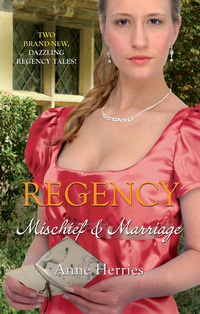
Regency
Mischief & Marriage
Secret Heiress
Bartered Bride
Anne Herries

www.millsandboon.co.uk
MILLS & BOON
Before you start reading, why not sign up?
Thank you for downloading this Mills & Boon book. If you want to hear about exclusive discounts, special offers and competitions, sign up to our email newsletter today!
SIGN ME UP!
Or simply visit
signup.millsandboon.co.uk
Mills & Boon emails are completely free to receive and you can unsubscribe at any time via the link in any email we send you.
Secret Heiress
Anne Herries
Prologue

Autumn 1818
‘Eliza, my dearest.’ Mrs Bancroft held out her hand to her beloved adopted daughter. ‘Sit with me, my love. I have something to tell you.’
Eliza smiled and did as she was bid, sitting on the edge of the bed and reaching for her mother’s hand. ‘What is it, dearest Mama? Are you feeling worse? Is there anything I can do for you?’
‘No, I am just as always, but I think we should talk. You know that it is unlikely I shall see the winter out…’
‘Mama, please…’ Eliza begged. ‘Doctor Morris said that you were a little better when he called. When the spring comes you will start to get up again and then…’
Mrs Bancroft squeezed her daughter’s hand. ‘I know it is hard for you, dearest. We lost Papa two years since and now…’ She shook her head as tears sprang to Eliza’s eyes. ‘No, you must not grieve for me, Eliza. I have loved you dearly, but I fear we have not been quite fair to you. We should have tried harder to discover the name of your true mother.’
‘You are my mama,’ Eliza said. ‘I know that you did not give birth to me, but I love you dearly.’
‘You have been everything a daughter should be,’ Mrs Bancroft said. ‘You have been ours since Papa found you left in the church behind the altar one Sunday morning, but somewhere out there you have a mother and a father. Don’t forget that Papa saw a gentleman’s carriage driving away and I believe you are the daughter of quality. Your clothes were of the finest materials and the ring I found tucked in with them is beautiful. I have kept it safe for you, Eliza.’
‘You showed it to me,’ Eliza said. ‘It is very beautiful, but I do not see what use it can be. If my mother abandoned me, she must have had her reasons.’
‘Perhaps she had no choice. I do not think that any mother would give up their own baby willingly.’
‘I dare say you are right.’ Eliza smiled and kissed her. ‘I only know that I was fortunate to have been found and raised by you and Papa.’
‘The ring is at the bottom of my sewing box if you should need it.’
Mrs Bancroft sighed. ‘My head aches again. I think I should like a tisane if you would make it for me, dearest.’
‘Yes, of course.’
Eliza rose and went downstairs to the kitchen. She had always known she was not the true child of her parents, but their kindness meant that she lacked nothing. However, if she were truthful, she had sometimes thought of her birth mother and wondered who she was and why she had been forced to abandon her newly born baby.
Her mama had mentioned a valuable ring amongst her clothes. Why had her birth mother placed it there—was it in the hope that one day her daughter would look for her?
Eliza had wondered if her mother would one day come to visit and tell her why she had given her up. Since she had not, there was no way of knowing who she was or where she lived. It would be almost impossible to find her—unless she could find someone who recognised the ring, of course.
If her papa had been right about the carriage he had seen driving away belonging to a wealthy man, then her parents might be gentry or even aristocrats. Eliza was not used to moving in those circles, except for the occasional invitation to the local landowner’s house at Christmas for the tenants’ party. How could she ever hope to find her mother?
She put the bothersome thoughts from her mind as she entered the kitchen. It was small like the rest of the cottage, but there were only the two of them these days; though they had missed the beautiful rectory that had been their home, they had become accustomed to their situation. Eliza did most of the work and the nursing herself, though Betty came in once or twice a week to clean. She had been the Bancrofts’s maid for years and insisted on doing what she could for them even though they could pay her very little.
‘I would work for nothing,’ Betty had told Eliza a few days previously. ‘If your mama were not so proud, I would never have left her at all.’
‘Mama does not wish to be a burden.’
‘It is hardly right that you should do everything, love,’ Betty said. ‘You know where I am if you need me.’
While the kettle was heating, Eliza gathered the ingredients for a blackcurrant tisane, her mother’s favourite. Despite the unfortunate start to her life, she had been loved, cared for and guided in the way she should go. At the moment all her thoughts must be centred on the sick woman upstairs. There would be time enough to think of her future when she was alone.
Chapter One
Summer 1819
Daniel, Lord Seaton, stared out of the window of his London house. It was situated in one of the best areas of the city, in a quiet garden square. It suited him when he visited the capitol. However, he would probably have to sell the property to meet his debts, rather than let it to a tenant, as he had intended when he came up to town.
‘Damn you, Marcus,’ he muttered. ‘Why did you have to land me with your mess?’
He frowned at the letter in his hand. As if he did not have enough problems trying to bring his own estate back from the brink of ruin! His father had died of a putrid fever six months earlier, after foolishly losing more than ten thousand pounds at the tables—and to a man Daniel believed might be both a cheat and a rogue. Cheadle was known for his ruthless play, so what his father had imagined he was about, Daniel did not know. Yet it was not the only mistake the late Lord Seaton had made. Several poor investments meant that Daniel had mortgages on at least half the land. His father had settled the gambling debt, but the mortgages meant that Daniel would struggle for years to put the estate back on its feet again. While his father had every right to spend his fortune as he pleased, Cousin Marcus was another matter.
Daniel scanned the letter again.
Only you can help me, Daniel. His cousin had written the letter two days before the accident that had caused his death just three months previously.
My debts are more than ten thousand and I cannot pay unless I sell my estate. Father might cough up the readies, but he has been ill for months and I think if he knew what I have been about, it would kill him.
To tell the truth, cousin, I have been a damned fool. I got in over my head—-things I am ashamed to own. If you knew all, you would consign me to the devil and think that I deserve whatever is coming. I may be in some danger and if you hear I have died in an accident, I give you leave to doubt it.
There is someone I fear, but I dare not write his name. He would certainly kill me then. Believe me, cousin, I have done things of which I am ashamed—but I did not know the worst of him when he persuaded me to help him. I want to get away, to start again, but I fear he will not let me go. The debt is another matter and the marquis must be paid. Your father was not the only one to fall foul of Cheadle’s damnable luck. Forgive me for asking if you can help.
Your wretched cousin,
Marcus
What was he to make of the letter? Marcus had sent it to Daniel’s London club and, busy at his estate, he had not received it until he paid a flying visit to town to speak with lawyers about his London property. Now he would have to contact Cheadle and ask for the extent of his cousin’s debt to him. At this moment he was not sure if he could find the money without reference to his uncle, but he would certainly speak to the marquis.
However, the remainder of his cousin’s letter was a riddle. What had Marcus been trying to tell him? He knew Marcus well enough to be sure that his cousin would not write such a letter without good cause. Who was the man who would not let him go—and, more importantly, had his cousin’s death truly been an accident?
At the time of the funeral he had not questioned it. The Earl of Standish told him it was a riding accident, and Daniel had accepted his uncle’s explanation without question. Now, his cousin’s letter had made him suspect foul play. Marcus had always been an excellent rider. As young men they had been great friends, though in past years they had grown apart. Daniel had chosen to take up a military career and spent eight years fighting with Wellington in various campaigns. It was during his time away that his mother had died and his father had started to drink and gamble. He blamed himself for not being at home when he was needed, and though he had returned when his father became ill, resigning his commission, it had already been too late.
The last thing Daniel needed or wanted at this moment was a mystery to uncover. Yet he knew that he could not simply ignore his cousin’s cry for help. Marcus was dead, and perhaps he had done things that would not bear the light of day, but if he had been murdered… Daniel’s mouth thinned. His memories of a young man he had loved as a brother demanded that he seek out Marcus’s murderer and bring him to justice.
As for Cheadle, well, he would pay a visit to his club that evening and discover if the marquis was in town.
‘You said I could come to you, Betty,’ Eliza said when her mother’s former maid opened the door of her cottage that evening. ‘I am sorry to ask, and I will find work as soon as I can—but may I stay here for a few days?’
‘Put you out of the cottage has, he?’ Betty shook her head sadly. ‘You’ve no need to ask, my lovely. Come you in and sit by the fire while I make you something to eat. I was afraid Mr Jones would say you couldn’t stop there alone once your dearest mother was gone. It only surprises me that he let you stay this long.’
‘It isn’t his fault,’ Eliza said. ‘I know the earl would have told him it was his duty to put me out and take another tenant. I can’t afford to pay the rent now that Mama’s allowance has stopped unless I work—and I shall not find work here. I have asked but no one will take me on. They take one look at my hands and say I’m not suitable.’
‘Your hands are not as white as they once were,’ Betty replied with a fond glance. ‘You worked hard to keep your mama neat and clean and do the cooking. It wasn’t easy at the last.’
‘Poor Mama. I fear she suffered a great deal,’ Eliza said and sighed. She had grieved for the past six months, but knew now she must put her personal feelings aside and look for work. ‘What do you think I should do, Betty? If I am not suitable as a maid what can I do—should I try for a governess?’
‘I don’t think most mothers would take you on, Eliza. You are too pretty and you might tempt their husbands or their older sons.’ Betty looked thoughtful. ‘If I were you I should advertise. Offer your services as a companion to an elderly lady.’
‘Yes, I suppose that might answer…’ Eliza sighed. Her mama’s illness had kept her tied to the house for many months, and though she didn’t begrudge her mama a minute of her time, she had hoped for something a little more lively in her future. ‘I suppose I might find it difficult to find work as a governess, for I have no training—except that I know how to make pillows comfortable and how to mix tisanes that ease discomfort and induce sleep.’
‘You are also a good little cook, for I taught you myself,’ Betty told her. ‘If you take your time and choose the right position, it might be just the thing for you.’
‘Yes, I dare say you are right. I have little choice; there is no one to help me.’
‘Are there no relatives of your papa who might take you in?’ Betty asked. ‘You are welcome to stay with me, my love, but it isn’t fitting for you. I am sure your mother would like you to mix with people of your own class. She was the daughter of country gentry, as was your father.’
‘Yes…’
Eliza did not answer fully. Betty had never been told that she was not the birth child of her parents, and therefore had no claim on their families, though there was a letter from Mama’s brother in India. She had found it at the bottom of her mother’s sewing box with the ring. Of course she would not dream of approaching him, for they were in no way related.
The ring was valuable. Fashioned of a thick band of gold in which a large deep red ruby had been inset, it had an inscription on the gold band. It was a romantic inscription, which made her think that her parents must have loved each other—but why had they given her up? Leaving her behind the altar on a Sunday had ensured that she was found quickly, but the person who placed her there could not have known that the Bancrofts would adopt her. Had the mystery gentleman been so ruthless that he did not care?
Who had put the ring on the ribbon and hung it about her neck, hiding it beneath her baby clothes? It must have been a woman—her mother? Had she wanted her child to have something of hers—something that Eliza suspected must have been very precious to her?
Why had her mother given her away? Her mama had had no knowledge, of course, but had told Eliza during one of their last discussions that she believed Eliza was a love child.
‘Your mother may have been forced to give you up, Eliza. Indeed, I am sure she was, for no woman would give up her baby willingly. I know that I should not, whatever the consequences.’
Eliza had tried to brush the subject under the carpet. Her mama was the only mother she had known and she loved her dearly. While she lived, Eliza had given hardly a second thought to who her birth parents were, even if she could not help wanting to know more about her mother. Now her thoughts turned more and more to her true mother and she wondered if she ever thought of her… wished to see her. Yet how could she hope to discover the truth? Living in the country quietly, as she did, she had no chance of meeting anyone who might recognise the ring.
‘I shall send my advertisement to the papers in London and Bath,’ she told Betty with sudden decision. ‘The kind of position you suggest may be found amongst fashionable ladies who can afford to employ a companion to run around after them.’
‘That is the spirit, my love,’ Betty said and smiled at her. ‘The curate was here earlier. He asked me if I had seen anything of you recently, Eliza.’
‘I usually help with the church fête,’ Eliza said and looked rueful. ‘He has been a little too attentive of late and I have tried to avoid seeing him other than on Sunday morning, when it is impossible not to meet.’
Betty arched her brows at her. ‘Your papa was a vicar, Eliza. Young Mr Stanley will have his own living one day. You could do worse than encourage him. Not that you need think of marriage just yet, of course. You are only twenty this summer and there is plenty of time, but being the wife of a clergyman may be better than a companion’s life.’
‘If I liked Mr Stanley, I should think it an ideal life, Betty—but he is too prissy in his ways. Had he been like Papa, I should have encouraged him long since.’
‘Well, I suppose he has some odd mannerisms—and he isn’t good enough for a lovely girl like you.’
‘I am not pretty, Betty.’ Eliza blushed delicately. She was tall and slender, her hair a rich dark brown and her eyes the colour some people called hazel. Her complexion was a little on the pale side, but she had a wonderful smile, and it was when she smiled that she was at her best.
‘No, you’re not pretty in the accepted sense,’ Betty agreed. ‘But you have a beautiful nature, Eliza. Any man worth his salt would be fortunate to have you for a wife.’
Eliza laughed, her eyes bright with amusement. ‘Betty, you are so good for me. I feel much better being here. I should have given up the cottage sooner instead of trying to keep it on. I have arranged for the few things that I decided to keep to be brought here on the cart. The rest of it will be sold at the market and I shall use it to pay for my keep until I can find work.’
‘That you will not unless you want to have a falling out with me and my Ted,’ Betty said stoutly. ‘He’s as fond of you as I am and he won’t take a penny of your money, Eliza. You write out your advertisement, my love, and Ted will take it to town this very afternoon when he goes, and send it off for you, but take money for your keep he will not—and that’s final.’
Eliza felt tears sting her eyes. She was so lucky to have such good friends. ‘I do not know what I should have done without you both while Mama was ill.’
‘You would have managed, for you bore the brunt of it,’ Betty told her. ‘I helped where I could and so did my Ted. He was only saying last night as it was time you had some luck, and so it is.’
‘Well, who knows what may happen?’ Eliza said. ‘I shall advertise for a post and perhaps fortune will smile on me.’
‘Go through to the parlour and write your letter in peace and I’ll make us some toast and a nice pot of tea for a treat.’
Eliza thanked her and did as she was bid, going into the neat room that was used on Sundays and for company. She sat down at the writing table in front of the window and picked up the pen. There was paper and ink in the drawer; Ted worked as a clerk at the office of the Earl of Standish’s estate manager and occasionally brought his work home to finish in the evenings.
She wrote out two adverts, one for The Times in London and another for a paper that published in Bath. The receiving office in Norwich would send them off and accept the fee on behalf of the paper.
Eliza sat for a moment, staring out at the view. Betty’s garden was a riot of early summer flowers and their perfume floated in through the open window. While she was here she could at least help with the garden—it was one of her chief pleasures.
Should she also write to Mama’s brother and tell him of his sister’s death? She was not sure if he already knew or even if he were still alive and living in India. She did not wish to appear as if she were asking for help. However, perhaps it was only polite to inform him.
She hesitated and then picked up her pen once more. She would write a brief note giving the bare facts and leave it at that—surely there could be nothing wrong in informing Mr Henry Jarvis of Mrs Bancroft’s death?
Sealing her letter, she picked up her reticule and put on her pelisse. If she hurried to the estate manager’s office, she might be in time to catch Mr Wright before he visited the ancient wool town of Norwich this afternoon.
She wondered how long it would be before she received an answer to her request for work. Would anyone be interested in employing a girl like her? She had no experience, except for a little nursing. Perhaps someone would think that sufficient. She could only hope she would receive an answer; despite what Betty had told her, she could not be a burden to her friends for ever.
Betty smiled when she went through to the kitchen. ‘Have you written your letters?’
‘Yes, I have. I shall walk down to the estate office with them now—unless you need me?’
‘There is nothing for you to do,’ Betty assured her. ‘It is a nice afternoon and the walk will do you good.’
A few minutes later, Eliza set out for the earl’s estate office. It was not too far, for the Wrights’ cottage was on the Standish estate and the morning was pleasantly warm. Eliza liked to walk whenever she could, though she had had little opportunity the previous summer when her mother was first ill, and had been making the most of this one. In consequence, her complexion was not as pale as it had been.
Perhaps because she was dreaming a little, she did not become aware of the horseman until he was almost on her. Startled, she turned to see the great black stallion racing towards her at speed, so she threw herself to the side of the narrow road, landing on her hands and knees in a bramble bush.
‘Damn you, sir! I said whoa,’ a voice cried loudly. She heard more cursing and a horse neighing as if in protest as it was reined in, then, moments later, ‘Forgive me, miss. My mind was elsewhere and I was not thinking that someone might be around that bend in the lane.’
Eliza rose to her feet as a gentleman in riding dress bent over her. He gave her his hand to steady her and she blushed as she found herself looking up into the bluest eyes she had ever seen. He stood head and shoulders above her and Eliza considered herself tall for a woman. The stranger was broad shouldered and of a powerful build; she thought him one of the handsomest men she had met.
‘I… was dreaming myself,’ she confessed. ‘Had I heard you sooner, I should have moved out of your way, sir. I trust your horse has suffered no harm?’
‘That is generously said.’ The gentleman smiled at her, a hint of relief in those devastating eyes. ‘Are you hurt, Miss…? Forgive me, I do not know your name.’
‘I am Eliza Bancroft,’ she replied and her cheeks were pink as he continued to hold her hand for longer than necessary. ‘I grazed my hands as I fell, but they will soon mend.’
‘May I see your hands?’ He turned her hands over and saw the slight graze on the right one and the spot of blood. Bending his head, he licked the wound with his tongue, sending a spasm of shock and incredible feeling curling through her. Eliza jerked and removed her hand from his grasp instantly. He looked surprised, then conscious, as if just realising what he had done. ‘Forgive me. I meant nothing wrong. My mother always said that licking the wound took the sting away. I have nothing to help you—unless my neckcloth as a bandage…’
‘No! It is not necessary,’ she said, feeling embarrassed by her feelings, which were quite inappropriate. ‘Thank you, I shall be home soon enough and my friend Betty will tend my hand for me, though I think it is no more than a scratch from the bramble.’
His eyes seemed to burn into her for long moments, then, ‘My apologies, Miss Bancroft. My mind was elsewhere. I am on my way to visit my uncle. He is expecting me and I did not wish to be late…’ He hesitated, as if unsure of what to do next. ‘If there is anything I can do…?’
‘No, sir,’ she replied instantly. ‘I am perfectly able to manage alone, thank you. Pray continue. I should not wish to make you late for your appointment.’
‘Standish is a testy old devil at times, but he has been ill and I am anxious about him, so I should go…’ He seemed unwilling to leave her, but in quite a hurry.
‘Yes, of course, please do,’ Eliza replied. ‘I would not keep you. I am perfectly able to continue.’
‘If only every lady were as forgiving,’ he said and, then belatedly, ‘My name is Daniel Seaton, Miss Bancroft. I am happy to make your acquaintance. Perhaps another time…’
Eliza was not sure what he meant by that. She inclined her head, dipping a curtsy as he caught the reins and swung up into the saddle, smiling at her once more before giving the horse its head.
Her heart beat faster than normal as she watched the handsome stranger ride off down the lane at a rather more sedate pace. If the earl was his uncle, then he was a man of some rank and would not be interested in the daughter of a parson. His remark could mean nothing. Indeed, it was much better if he had been mouthing a mere politeness, because any attentions from a gentleman of quality would be of the wrong kind.
The earl sometimes held house parties and in the past her mama had warned her not to go walking alone when young gentlemen were staying up at the big house.
‘You would not encourage their attentions, my love,’ Mrs Bancroft had told her more than once. ‘Yet you are attractive enough to arouse the interest of wild young bucks and they are not to be trusted.’
Eliza’s instincts told her that Daniel Seaton, as he had named himself, was perhaps the kind of gentleman her mama had warned her of. He had been perfectly polite and behaved respectably enough, apart from the incident when he had licked her hand. No gentleman would do that to a respectable young woman of his own class, but as the daughter of a clergyman she was fair game! She knew that the earl’s own son had been both wild and reckless, and he was reputed to have had low morals and had been fond of romping with farm or tavern wenches and drinking a great deal, which was why his violent death while out riding had not been a surprise to the local people. Still, Ted had told them that the earl had been devastated by his son’s death and was only half the man he had been before it.
Eliza felt sad for the earl, whom she knew only by slight acquaintance, having seen him at church and the fête that was held once a year in his gardens, as well as a Christmas party he gave for his neighbours. Her papa had been invited to dine occasionally, as the parish priest, but the earl had ceased to entertain in the months following his son’s death. It was a terrible thing to lose his only son, though he had a daughter who had given him two young grandsons.
She supposed that one of his grandsons would inherit both the title and the estate, though both were still in leading strings. If the earl were to die before they were grown… but he was only in his late middle years and would surely live until he was sixty at least?
Seeing the estate office ahead of her, she put the thought out of her mind and increased her pace.
‘It was good of you to come down again so soon, Daniel,’ the earl said and sighed heavily. ‘Will you take a glass of madeira with me before nuncheon?’
‘If it is that excellent stuff you usually keep, I shall be delighted, sir,’ Daniel said and smiled at his mother’s brother. He was fond of his uncle, which was one of the reasons he refused to burden him with financial problems. ‘How are you, sir?’
‘Not too clever, Daniel.’ The earl passed him a glass of the rich wine. ‘I’m not sure I shall live long enough to see my grandchildren grow to manhood.’ He held up his hand as Daniel would have protested. ‘No, don’t deny it. My heart took a knock when Marcus was killed…’
‘He would not want you to grieve too hard, sir. Marcus cared for you deeply.’
‘Did he? I am not sure… once, perhaps, but we had grown apart of late. He seemed odd, as though something was on his mind.’ The earl sighed heavily. ‘I know the lad sowed his wild oats and I cannot approve of things he did, but he was my son. If he had asked for my help, I would have given it.’
‘I have spoken to Cheadle, sir. He tells me that you settled my cousin’s gambling debt immediately?’
‘The damned fellow approached me before my son was cold in his grave. I dislike that man intensely, Daniel.’
‘I, too,’ Daniel agreed. ‘I played a hand with him at my club. He lost heavily that night and was forced to give me this.’ Daniel took a ring from his pocket and showed the earl. ‘He asked me to keep it and intends to redeem it at his earliest convenience. I shall of course oblige him.’
‘I am surprised that you played with him after what happened to your father?’
‘I was not drunk, neither was I desperate. I know my limits and when to rise from the table. I had my reasons, sir.’
‘I dare say you did.’ The earl looked at him through narrowed eyes. ‘Did Marcus approach you for help? The young fool! He should have come to me immediately.’
‘He did not wish to distress you, sir. He sent me a letter. It was waiting at my club. I did not discover it until I went to visit my lawyer recently.’
‘Your father left a damned mess for you, Daniel. You have only to ask if you need help.’
‘Thank you, sir. I know it, but I believe I shall manage. I thought I might sell the London house, but for the moment I shall let it to tenants. I shall not be able to afford to visit London much until I have the estate on an even keel again.’
‘You won’t tell me, but I dare say your father took a mortgage.’ The earl nodded as Daniel remained silent. ‘Not my business—but you might look for an heiress? If she suits you and her father is on the catch for a title you might save yourself years of penny pinching. Besides, you will wish to marry in a year or two, if not now.’
‘Yes, perhaps.’ Daniel laughed ruefully. ‘Marry a fortune to pay my debts—that would be a little hard on the young woman, do you not think so?’
‘It is often the case that a young woman of fortune has little else to commend her to a husband. Look for a plain chit, my boy, and she will be grateful to you. She will give you a couple of sons and then you may both live as you please. It is done all the time.’
‘I know you are right, sir, but I shall try to sort my problems myself if I can.’
‘Well, you don’t need advice from me.’ The earl frowned, suddenly seeming very toubled. ‘It was odd the way Marcus died… His groom told me that he found a sore beneath the saddle when he groomed the wretched beast, which might explain why a man who was an excellent rider fell and broke his neck. I just can’t understand how it happened. He should not have taken the horse out in such a state—though Jed swears there was nothing there when he saddled up that morning. If something caused the horse to chafe, it must have got there between Marcus leaving home and returning that evening. He had, of course, been drinking in the village inn, though I have been told he was not drunk when he left.’
‘Is the groom still in your employ, sir?’
‘No, he left me a week or two back. Lives in the village, name of Jed Bailey—why?’
‘Marcus was a damned good rider, but something must have made his horse bolt the way it did…’ Daniel frowned, remembering his cousin’s confusing letter ‘The coroner brought in a verdict of misadventure. Is there any reason to think there might have been foul play?’
‘None then and none now,’ the earl admitted. ‘Marcus was in with a bad crowd, though I do not know who they were—but I sensed he was hiding something from me.’
‘I should like your permission to investigate a little, sir.’
The earl looked at him thoughtfully. ‘You know something I don’t, of course. Don’t want to tell me?’
‘I know very little, sir—but I intend to find out.’
‘Take care, then. If whoever was behind what happened to Marcus learns you are poking your nose in, he won’t stop there. I would rather nothing happened to you, Daniel.’
‘I shall be on my guard. Besides, there may be nothing in it.’
‘You wouldn’t be bothering to investigate if you thought that. Is Cheadle behind this, Daniel?’
‘What makes you think that, sir?’
‘No reason. Just don’t trust the man.’
‘Well, neither do I—but I don’t think him a murderer. He may be ruthless at cards, perhaps even a cheat, though he played fair with me the other night—but I doubt he was involved in my cousin’s death.’
‘Well, I wish you good luck, but don’t get killed, my boy. I am relying on you to guide my heir if I pop off before he is old enough to manage the estate.’
‘I shall be delighted to help young Paul if I can.’
‘That was my hope. You will tell me whatever you discover?’
‘Of course. When I am certain.’
‘You have no immediate plans for marriage, I take it?’
‘None at the moment, sir. I am not sure any young woman would put up with me. I have little to offer.’
The earl shook his head. ‘Do not put yourself down, my boy. Walk down to the estate office with me, Daniel. I have a building project I should like your advice on.’
‘Willingly.’ Daniel set his glass down. ‘I shall be pleased to see your plans for the new cottages.’
‘Well, Miss Eliza, so we shall be losing you soon.’ Mr Jones, the estate manager, smiled at her as she explained her reason for bringing in the letter. ‘But you will enjoy living in Bath or London, I dare say—more life for you there than here, I imagine.’
‘I like being in the country, sir,’ Eliza replied. ‘I shall miss my friends here, but it is time I started to support myself.’
‘Mrs Jones would have taken you at the house if there were a mistress,’ the manager said. ‘I had a word with her a while ago, but there was only menial work and she didn’t think it right that Parson Bancroft’s daughter should scrub floors. She will be very pleased to learn you are to apply for a position as a companion to a lady. She was only saying last night that it was what you ought to do.’
‘That was kind of her,’ Eliza replied. She knew the estate manager had let her have the cottage for longer than he truly ought, because there were estate workers needing a place to live. ‘Give your wife my good wishes, sir. I should get back now. I want to give Betty a hand with the garden.’
‘I’ll send your letters later this afternoon,’ Ted Wright promised. ‘Take care now, lass.’
‘Yes, I shall,’ Eliza said and opened the door to leave. She was startled by the arrival of two gentlemen who had been about to enter, flushing as she saw the earl and the man whose horse had almost knocked her down earlier. ‘I beg your pardon, my lord.’
‘No matter,’ the earl said, his eyes narrowing in recognition. ‘Ah, yes, Miss Eliza Bancroft. I was sorry to have to ask you to leave the cottage, but Jones told you we had a family waiting for it, I dare say? And I did not feel it was quite safe for you to stay there alone, considering the situation locally. You will have heard of the missing girls, not girls of quality, of course, but still it is worrying. You have settled in with Wright and his wife, I believe?’
‘Yes, my lord.’ Eliza dipped a curtsy, understanding his reasoning for more than one young village girl had gone missing over the past two years. ‘I knew I could not stay for ever, sir. Besides, I hope to find work soon, perhaps in London or Bath.’
‘Well, that is excellent news,’ the earl said. ‘Ah, Jones, I am glad I caught you. I wanted to take another look at the plans for the new cottages.’
As the earl moved off to speak with his manager, Eliza looked at the younger man. His eyes went over her, brows lifted in a question.
‘You are recovered from your fright, Miss Bancroft?’
‘Yes, thank you, sir. I was not truly hurt at all,’ she said, but her heart did a little flip as she caught the pleasant scent of cologne that hung about him. She recalled the feeling that had shot through her when he licked her hand and felt her cheeks burn. ‘Excuse me, I must not keep you from your business.’
He inclined his head and moved aside, but she felt his eyes on her as she went out through the open door. After a few steps she looked back and saw he was still watching her. She had never seen eyes quite as arresting as his before. Not knowing why, she gave him a wide smile and a little wave before turning back and walking away. Her heart was beating too fast and she wondered why this second meeting within a short space of time should affect her so much?
Eliza smiled to herself. If Daniel Seaton were going to visit his uncle more often, it might be best that she would soon be leaving Norfolk. It would not do for her to meet him too often, because she could easily begin to like him more than was wise for a young woman of her station.
Chapter Two
‘Oh, that is a nuisance,’ Betty said as she looked at the milk jug she had taken from the cold pantry the following morning. ‘The milk has curdled and I was going to make a rice pudding for Ted’s supper.’
‘May I go to the farm for you?’ Eliza asked. ‘I can be there and back in an hour; there will still be plenty of time for you to make that pudding.’
‘What a thoughtful girl you are,’ Betty said approvingly. ‘If you would not mind, it would be a big help to me.’
‘It is no trouble at all,’ Eliza said, taking sixpence from the shelf and the big jug from the pantry.
She set out for the farm, which was just across the fields from her friend’s cottage. Somewhere above her head a lark was singing and the grass in the wild meadow was almost waist high. She was singing to herself, enjoying the warmth of the sun when she suddenly saw the man walking towards her through the long grass. Her heart caught a beat as he smiled and came up to her.
‘Good morning, Miss Bancroft. You seem happy this morning?’
‘It is such a lovely day,’ she replied. She could not help remarking how blue his eyes were, thinking them a match for the cloudless sky. His smile brought an answering one from her. ‘How do you go on at your uncle’s? Do you mean to stay long?’
‘Only a few days, unfortunately,’ Daniel Seaton replied and then frowned. ‘I think my uncle mends, but he is not as well as I should like.’
‘I am sorry to hear that, sir.’
Eliza found that he was walking beside her, clearly intending to accompany her to the farm.
‘He took my cousin’s death hard,’ he continued. ‘However, he is better than he was the last time I was down.’
‘Did you come at Christmas? I know the earl felt unable to host his usual celebrations.’
‘Yes, I was down at Christmas, but I have not seen him since. I have been in London and at my estate…’ His eyes darkened, making Eliza think he dwelled on something that pained him.
They had reached the farm gate. He opened it for her and stood back. She felt that he had withdrawn into himself.
‘I shall leave you here, Miss Bancroft. I have an errand to run…’
‘Goodbye, sir. I hope your uncle will soon be well again.’ Eliza watched him walk away, feeling puzzled. For a few moments he had seemed as if he meant to flirt with her, but then something had changed him. It was just as well, for she found him far too attractive.
***
Daniel was thoughtful as he left the young woman. He had just come from visiting the home of Jed Bailey. Unfortunately, the groom had disappeared two days previously. His mother said he had been restless and she thought he had taken it into his head to visit his cousin in Bristol.
‘There’s been something on his mind for weeks, sir,’ Mrs Bailey said. ‘I asked him what had upset him—and why he left the earl’s employ—but he wouldn’t tell me. He seemed excited and then… well, to tell you the truth I thought he was scared, sir. Then he came in, in a hurry, like, took his horse and said he was off to Bristol to see his cousin.’
‘If he should return, please ask him to come and see me.’ Daniel gave her one of his cards.
‘Yes, sir, of course.’ Mrs Bailey smiled as Daniel slipped a coin into her hand. ‘I expect it is just restless feet—you know how young men are, sir.’
Daniel agreed he did and left her. His enquiries in the village so far had been of some help, though he was troubled by what he had discovered. Marcus had certainly been at the inn for two hours on the afternoon of his death. The landlord said he was in a bad mood, and that he sat talking to a gentleman in the corner for an hour or more before the stranger left.
‘Did you know the man?’ Daniel asked.
‘No, sir. He was not local—but a gentleman, I would say. A surly cove. When one of my serving wenches went over to the table and asked if they wanted more wine he told her to stay away, for their talk was private.’
‘Is the girl here, landlord?’
‘No, sir, more’s the pity. Molly was a good worker. She went off the day after your cousin was killed—and never even told her mother where she was going. She’s not the first, but I didn’t think Molly was the flighty sort. There have been others go off, some would say gone missing, but I reckon they went to London to make their fortune—if you understand me. Still, Molly were a quiet girl and I thought she had a local lad.’
‘If you should hear anything you think might interest me, please send me word.’ Daniel gave him his calling card and two guineas for his trouble.
‘Yes, sir. I will let you know if Molly comes back.’ The landlord was thoughtful for a moment. ‘Does the name Cheadle mean anything to you, sir?’
‘Yes, it does—why?’ Daniel’s gaze narrowed intently.
‘The name was mentioned between them, sir. Molly heard them arguing—and your cousin said, “I can’t ask Cheadle to wait for ever.” The other man said, “Cheadle is dangerous. If you cross him, you may regret it, but he is a poodle compared to you know who…” I don’t know if that is useful, sir?’
‘It may be,’ Daniel said and frowned as he nodded to the landlord and gave him another guinea. ‘Thank you. Please contact me if you remember more.’
‘You may be certain I shall, sir.’ The landlord pocketed the money and smiled to himself.
There Daniel had left his investigations for the moment. He thought he might have to employ the ser vices of an investigative agent to search for Molly and Jed Bailey. It was strange that two young people had gone off without a word—unless they had run off together?
His thoughts were busy after his brief meeting with Miss Eliza Bancroft. The pieces had been all jumbled up at the start, but they seemed to be coming together in his mind. He was reaching for something, but was not quite there.
He was determined to discover more about his cousin’s death, because he was almost certain now that Marcus had been murdered. The horse had been left outside the inn for some time and it was perfectly possible that someone had tampered with the saddle while it was there.
So the opportunity was obvious, and the likely suspect the man Marcus had been arguing with in the inn—but where was the motive?
It was after meeting Miss Bancroft that Daniel suddenly remembered that both his uncle and the landlord had spoken of other young local women going missing. Could the disappearance of these girls and his cousin’s death be linked? It hardly seemed likely and yet Marcus had hinted at something dark and sinister in his letter.
It would bear investigation, even though the truth might be hard to swallow. Drinking, gambling and tumbling the local girls were things that many young gentlemen indulged in—but snatching girls from their homes was quite another. Daniel had no illusions about what happened to the young girls; they would be taken either to whorehouses or, even worse, sent abroad to be sold into the harems of rich potentates.
No, surely Marcus would never become involved in something like that—or had he been drawn into it innocently and then felt trapped? Daniel knew that his cousin had had a wild side, but he did not think him evil. Perhaps he had not known what was going on—and when he had found out he threatened to expose those behind it?
Daniel felt cold. He had no proof whatsoever, but he believed he might have stumbled on a clue.
He was not sure what part the Marquis of Cheadle might have played in this shady business. His name had been mentioned between Marcus and the stranger—but whether he was actually involved with the snatching of local girls was dubious. Daniel would not have thought it—but then, he would not have expected his cousin to become involved in such a disgusting traffic.
The marquis would bear watching. Daniel had been inclined to send back the ring he had won from him to Cheadle’s London address, but now thought he would hang on to it. There was an inscription inside it that must be called romantic and therefore it might have some significance to the marquis. Perhaps it might be used as a bargaining tool, for if Cheadle knew something of this murky business he would not disclose it without persuasion.
Having settled the business in his mind, Daniel let his thoughts stray once more to the lovely Miss Eliza Bancroft. He was not sure why she had lingered in his mind. There were other more beautiful girls of his acquaintance who would not be averse to some attention from him, but most of them left him cold. Miss Bancroft interested him.
He would have liked to get to know her better while he was here, but his present situation was not conducive to any kind of relationship with a decent young woman. Had things been otherwise, he might have stayed longer with his uncle and found excuses to indulge in some light dalliance with the young lady—not that she would have permitted more than a kiss or two. He had no doubt that she was chaste, hence the delicious blush he had noticed on earlier occasions.
He would not go out of his way to seek another meeting with her, Daniel decided, though he could not pretend that he was not intrigued.
No, he must not let his purpose wander! He must seek another meeting with Cheadle at the earliest opportunity and ask him what he knew of Marcus’s affairs. If Cheadle lied, Daniel would know—and then he would leave no stone unturned to bring down all those responsible for his cousin’s death.
‘You asked me to call?’ Henry, Marquis of Cheadle, looked at the woman sitting so calmly in her boudoir. In her lilac-lace peignoir and a fetching cap she was as beautiful as she had been years ago when he had fallen madly in love with her. He had not seen her for some years, because she had lived quietly in the country, seldom visiting London or Bath, but it seemed that she intended to make a change now that she was a widow. ‘I was sorry to hear about the death of your husband, Sarah. Manners was no friend of mine but I dare say you will miss him?’
‘You know my feelings about Lord Manners,’ Sarah, Lady Manners, replied, only a tiny pulse in her throat giving a hint of the emotion she was keeping in check. ‘I stayed with him because of my son, and for no other reason.’
‘You were a fool, Sarah. You should have called his bluff—how often do you see Howard now?’
‘Very rarely,’ she admitted and sighed deeply. ‘My son is exactly like his father. I have seen him once since he inherited the estate. We quarrelled after his father’s death and he declines to visit me. Besides, I choose to live in the country and he prefers London.’
‘Where he squanders the fortune he inherited. You should speak to him, Sarah. If he continues as he is, he will come unstuck and lose everything.’
‘Howard takes no notice of anything I say.’ She raised her eyes to his. ‘You know what I want, my lord. You have always known. My health is not good. Soon it will be too late for me to get to know our child…’
‘I’ve told you before, I do not know where the child is now, Sarah. I promised that I would make no attempt to find the babe and I have kept my word. The lawyer saw to everything. I merely paid for the arrangements, as your husband demanded in settlement of his terms. I have never known the name of the people to whom the lawyer gave our child. Had I not agreed to his terms, Manners would have treated you more harshly than he did.’
‘But you know the lawyer involved, do you not?’
‘Yes, for I made payments for the child’s upkeep until last year…’ he admitted it reluctantly. ‘Are you sure you wish to do this, Sarah? Your reputation has remained spotless. Only a few friends knew of your confinement. Do you truly wish to risk exposure at this stage?’
‘I am lonely, Henry. And I wish to atone for my earlier wrongdoings.’
‘But how long will it be before the truth comes out?’
‘Why should it ever be known? Do not fear that I shall reveal your name, Henry. Even if my part were suspected, you would remain anonymous.’
He looked at her in silence for some moments, then inclined his head. ‘Very well. I shall look out the lawyer’s address. I believe I have it somewhere.’
‘Thank you. I am grateful. I was not sure you would come today.’
The marquis raised his brows. ‘I am not the monster rumour would have me, Sarah. I could not refuse you such a request, though I gave my word to Manners that I would never tell you anything.’
Sarah stood up. She moved towards him, laying her hand on his arm. ‘Has life been terrible for you, Henry? I thought of you so often, wished that things had been otherwise. Especially when I heard…’
‘That I had gone to the devil?’ A wry smile touched his mouth. ‘I decided that I would never give my heart again and so I married for money, though later I inherited more than I could ever need. My wife hates me and I have no love for her. I care only for my daughter, Marianne. I ask you not to tell me if you discover the truth about the child. Manners never told me whether we had a daughter or a son—’ He put out his hand to silence her as she would have told him. ‘It was for the best. I put the whole thing from my mind and to know now might be to open Pandora’s box. I cannot afford scandal for Marianne’s sake. I have hopes that she will marry into the peerage.’
‘I have heard that she is a very beautiful girl,’ Sarah said. ‘I am glad you have someone, Henry.’
‘My daughter is both lovely and innocent. If it were not for her, I should have asked my wife for a divorce long ago.’
‘Is there someone else you care for?’ Sarah looked at him steadily, without revealing a flicker of emotion.
‘You know there was only one woman I loved. If, after Marianne is married, I could arrange a divorce…?’
‘No, Henry. It was too long ago, my dear. Once I would have given everything to be with you, but it is too late.’
‘We could still be together. We were lovers once. Why not again?’
‘Because I was younger then. I am older than you, Henry. It was one of the reasons I refused to leave my husband. I did not wish to ruin your life.’
‘How could you have ruined my life? It meant nothing to me without you. Let me take care of you, Sarah—let me make up for the lost years.’
‘It is too late. My health is not good, Henry. I have settled for a quiet life in the country. You are still young enough to find a new love. I ask nothing more of you than the address I need.’
‘I would ask no more of you than affection.’ For a moment his eyes beseeched her, then, as he saw the answer in her face, his expression became cold, withdrawn. ‘Very well, madam. I shall send you what you need. I do not expect to hear from you again.’
Sarah sank back into her elegant elbow chair, her hands to her face as the door closed behind him. He was still angry and bitter, blaming her because she had given into her husband’s blackmail.
If only she had been stronger. How different her life might have been if she had been brave enough to leave her husband and go with Henry, as he had begged her.
Her marriage to Manners had been a disaster from the start. Her husband had never loved her. He had had a mistress in London and spent all his time with her. Once Sarah had given him his heir, he had not bothered to visit her bed again. Lonely and unhappy, she had turned to a young man who gave her everything she lacked from her husband. Henry had been the most generous of lovers, sweet and giving.
At the time of their affair he had not yet inherited his uncle’s title and had had little in the way of fortune. He was also three years her junior and on the verge of making his career in the army. Lord Manners had known at once that her child was not his. He’d forced her to reveal the name of her lover and then threatened to ruin Henry if she went off with him. She had been forced to break off their affair and to give up her lovechild as soon as she was born. Her daughter had been snatched from her arms only hours after she had given birth, taken from her cruelly by her unforgiving husband. Lord Manners had never told her where the child had been taken; even after his death, he had tried to keep the secret from her.
He had inserted a clause in his will to make certain that she could not find her daughter. If she made the attempt, she would give up the right to live in the Dower House at Trowbridge and she would lose her jointure. She would have nothing left but the fortune her grandfather had left in trust for her, which her husband had refused her for as long as he could. Now that he was dead, half the capital and the income was hers entirely, the remainder of the capital to be divided between her children on her death. Her son had not known of the existence of a half-sister until he read the will, and he had accused her of vile things before storming out of the house and taking himself off to London.
Her husband’s vindictiveness had not hurt Sarah; she had long ceased to care and nothing he did could surprise or distress her. She would be sorry to leave the house she had moved to after his death, for it was pleasant and enabled her to see her son on the rare visits he paid to his estate. However, she had no intention of letting her husband’s unkindness stop her at least trying to discover the whereabouts of her lovechild.
A smile touched her lips. She had loved Henry and in those days he had loved her deeply. The tales she had since heard of him had been distressing; her husband had made certain she heard of the worst of his excesses, but the young man she remembered was still dear to her.
She had reached her decision with the calm deliberation that was her way these days. She would use some of the capital to purchase a house in Bath, a city that suited her much better than London and where she still had a few friends. Then she would try to find her daughter and be damned to the consequences.
‘I am sorry, Eliza,’ Ted Wright said as she looked at him expectantly. ‘There was nothing for you at the reception office again today.’
‘Oh…’ Eliza sighed. It had been ten days now and she was beginning to think that she would never receive an answer to her advertisement. It seemed as if she might have to go into Norwich and ask at the employment agency for domestic servants. Perhaps she had set her sights too high and would have to settle for something more menial. ‘Thank you. I had hoped, but I suppose these things take time.’
‘You may need to put in a second notice, but there is no hurry, Eliza. You are very welcome to stay with us for as long as you please.’
Eliza thanked him, but her spirits sank a little for she did not wish to be a burden to her friends for too long. She would wait one more week, then, if she heard nothing, she would look for employment through the agency.
Lady Sarah looked through her post when it was brought up to her by her maid and sighed. Most of it would be invitations to dine or attend the theatre or some other function. She had been in Bath for just three weeks and already she was inundated by invitations. It was very kind and generous of her friends, but she was used to a quieter life and uncertain whether the new social circle she had found here would suit her on a permanent basis.
She could return to the Dower House and give up her search for her daughter, but that would be to admit defeat. She had been waiting for a letter these past several weeks, but so far the lawyer had not replied to her request for details of her daughter’s whereabouts. He was being very stubborn and she could not think why.
She opened the newspapers that had been delivered that morning. The Times was always a day late, because it was sent through the post from London, and the local paper had lain unnoticed on her dressing chest all the previous day. She had spent the whole day visiting and had decided to keep to her bed a little longer this morning.
She poured a cup of the dark chocolate she enjoyed, sipping from the delicate cup that was part of a Dresden breakfast set. The chocolate was a little bitter, but she preferred it to tea or coffee at this hour. Sipping its richness, she opened The Times and turned to the page she was interested in. Although her maid, who had been with her for years, had been perfectly adequate for her needs in the country, Sarah had become aware that she required a companion here in Bath. She had hoped to find her daughter and ask her to stay, but as yet that was beyond her, though if the lawyer did not soon answer her letter she would employ an agent to find the child… girl. Her daughter would be twenty by now.
Running her finger down the list of young women searching for a position as a companion, Sarah stopped at one that appealed to her.
The headline read:
Sensible young woman recently bereaved seeks a position as companion.
I have nursed my mother and am well able to make beds comfortable, prepare tisanes and read in a pleasant voice. I can cook, embroider and mend and I do not mind light cleaning in the house. I am happy to run errands and look after an invalid. However, I have no previous experience of employment in this field.
Sarah smiled as she read the few lines. They seemed to speak from the heart and told her that the writer had never applied for a position before. The advert was a little naïve, perhaps, but that made it all the more appealing.
Sarah was not yet in need of a nurse, merely someone to run her errands and accompany her to the Pump Room and other functions. The young woman who called herself Eliza Bancroft seemed eminently able to fulfil that duty, and, if Sarah’s health grew worse, might be just the person she needed.
She was not going to give up the search for her daughter. Sarah was quite firm about that, but she saw no reason why she should not employ a companion in the meantime. She could afford it; she had the income from her grandfather’s estate. Because her husband had withheld it from her for so many years it had grown to a considerable amount. She had been quite shocked when her lawyer told her how much the accumulated capital was. Had her husband been able to touch it, she was sure he would have gambled it away to spite her, but her grandfather had been a canny Scottish gentleman. He had made sure that the capital and income could not be accessed by anyone but Sarah, or her children if she were dead. How that must have irked her husband. He had the power to prevent her from benefiting from the money while he lived, but he could not take it for himself.
Well, she had it now and no one to gainsay her. As yet her son, Howard, had not run through the fortune his father had left him, though she had heard from more than one source that he was likely to do so in time. Well, she would face that when the time came.
Getting up, she slipped on her peignoir, went over to the pretty lady’s desk near the window and sat in the elbow chair. She picked up her pen, dipped it in the glass inkwell and began to write. She would invite the young woman to come to her for a trial period of three months. If they suited she would continue the contract. In the meantime she might find her daughter.
Having written the polite invitation to join her in Bath and offered a salary of two guineas a month and her keep, Sarah felt satisfied that she would secure the services of the young woman. A girl of little experience was hardly likely to get a better offer. She hesitated for a moment, then took out a fresh sheet of paper.
My dear Marquis,
I had not intended to ask anything more of you, and I assure you this is the very last thing I shall ask, but I wondered if you could arrange to have a young woman fetched from Norwich? I have given her a day, place and time, which I have copied here for you. I am residing in Bath and it is a long way to send my carriage, which I need here. I know you have several carriages at your disposal—perhaps you would be kind enough to have Miss Bancroft brought here to me in the Crescent? I am not yet sure she will accept the position, but as the town of Norwich is not far from your Norfolk estate it might not be too much trouble to send the carriage on the off chance. I shall write again if Miss Bancroft accepts, but if you do not hear please send anyway.
Ücretsiz ön izlemeyi tamamladınız.