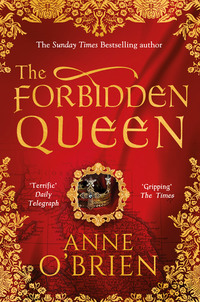
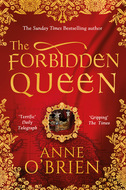
Kitabı oku: «The Forbidden Queen»
Praise for the author
ANNE
O’BRIEN
‘The characters are larger than life…and the author
a compulsive storyteller. A little fictional embroidery
has been worked into history but the bones of the
book are true.’
—Sunday Express
‘O’Brien has excellent control over the historical
material and a rich sense of characterisation, making
for a fascinating and surprisingly female-focused look
at one of the most turbulent periods of English history.’
—Publishers Weekly
‘Better than Philippa Gregory’
—The Bookseller
‘Anne O’Brien is fast becoming one of Britain’s most
popular and talented writers of medieval novels. Her
in-depth knowledge and silky skills with the pen help
to bring the past to life and put the focus firmly on
some of history’s most fascinating characters.’
—Pam Norfolk, Lancashire Evening Post
‘Anne O’Brien is definitely an author to watch for
historical fiction fans and I look forward to
reading more of her work in the future.’
—One More Page…
‘Ms O’Brien’s prose is smooth and uncomplicated.
Her characters’ speech is not overburdened with
archaic expressions, yet still evokes the time period.
She has obviously done a good deal of research and it
makes this story pleasurable to someone like myself,
who loves all things medieval…’
—Cynthia Robertson, Literarydaze
Also by
ANNE
O’BRIEN
VIRGIN WIDOW
DEVIL’S CONSORT
THE KING’S CONCUBINE
About the Author
ANNE O’BRIEN taught history in the East Riding of Yorkshire before deciding to fulfil an ambition to write historical fiction. She now lives in an eighteenth-century timbered cottage with her husband in the Welsh Marches, a wild, beautiful place renowned for its black-and-white timbered houses, ruined castles and priories and magnificent churches. Steeped in history, famous people and bloody deeds, as well as ghosts and folklore, the Marches provide inspiration for her interest in medieval England.
Visit her at www.anneobrienbooks.com
The Forbidden Queen
Anne O’Brien

This is a work of fiction. References to historical events, real people or real places are used fictitiously. Other names, characters, places and incidents are the product of the author’s imagination, and any resemblance to actual persons, living or dead, events or locales is entirely coincidental.
All Rights Reserved including the right of reproduction in whole or in part in any form. This edition is published by arrangement with Harlequin Enterprises II B.V./S.à.r.l. The text of this publication or any part thereof may not be reproduced or transmitted in any form or by any means, electronic or mechanical, including photocopying, recording, storage in an information retrieval system, or otherwise, without the written permission of the publisher.
This book is sold subject to the condition that it shall not, by way of trade or otherwise, be lent, resold, hired out or otherwise circulated without the prior consent of the publisher in any form of binding or cover other than that in which it is published and without a similar condition including this condition being imposed on the subsequent purchaser.
HQ is an imprint of HarperCollinsPublishers Ltd
Published in Great Britain 2013
HQ
1 London Bridge Street
London
SE1 9GF
© Anne O’Brien 2013
eISBN 978-1-472-01023-0
Version: 2019-04-12
Table of Contents
Cover
Praise
Also by Anne O’Brien
About the Author
Title Page
Copyright
Dedication
Acknowledgements
Chapter One
Chapter Two
Chapter Three
Chapter Four
Chapter Five
Chapter Six
Chapter Seven
Chapter Eight
Chapter Nine
Chapter Ten
Chapter Eleven
Chapter Twelve
Chapter Thirteen
Chapter Fourteen
Chapter Fifteen
Chapter Sixteen
Chapter Seventeen
Chapter Eighteen
Epilogue
Other titles by the author
Extract
Author Note
Read All About It…
About the Publishers


To George, as ever, whose knowledge of English
medieval history is improving in leaps and bounds
ACKNOWLEDGEMENTS
All my thanks to my agent, Jane Judd, whose support for me
and the courageous women of the Middle Ages continues
to be invaluable.
To Jenny Hutton and all the staff at HQ, without whose
guidance and commitment the real Katherine de Valois
would never have emerged from the mists of the past.
To Helen Bowden and all at Orphans Press without whom
my website would not exist, and who come to my rescue to
create professional masterpieces out of my genealogy
and maps.
‘You have witchcraft in your lips, Kate.’
King Henry to Katherine: Shakespeare’s Henry V
‘[a woman] unable to curb fully her carnal passions’
Contemporary comment on Katherine de Valois: J. A.
Giles, ed., Incerti scriptoris chronicon Angliae de regnis trium regum Lancastrensium (1848)
CHAPTER ONE
It was in the Hôtel de St Pol in Paris, where I was born, that I chased my sister through the rooms of the palace, shrieking like some demented creature in torment. Michelle ran, agile as a hare pursued by a pack of hounds, and because of her advantage of years I was not catching her. She leapt up the great staircase and along a deserted gallery into an antechamber, where she tried to slam the door against me. There was no one to witness our clamorous, unedifying rampage.
I flung back the heavy door so that it crashed against the wall. My breath was short, my side clenched with pain, but my belly was so empty that I would not surrender. I pounded in my sister’s wake, triumphant when I heard Michelle whimpering in distress as her feet slid and she cannoned into the corner of a vast oak press set against the wall. From there she lurched into yet another audience chamber, and I howled with imminent victory. There was no way out from that carved and gilded room. I had her. Or, more importantly, I would have what she gripped in her hand.
And there she was, standing at bay, eyes blazing, teeth bared.
‘Share it!’ I demanded.
When, despite her laboured breathing, she stuffed a piece of bread into her mouth, I sprang at her, and we fell to the floor to roll in a tangle of foul skirts, unwashed legs and greasy, unbraided hair. Teeth and nails were applied indiscriminately, sharp elbows coming into play until, ploughing my fist into Michelle’s belly with all my five-year-old weight, I snatched the prize from her. A stale crust and a charred bone of some unidentifiable animal that she had filched from the kitchens when the cook’s back was turned. Scrambling up, I backed away, cramming the hard bread into my mouth, sinking my teeth into the flesh on the bone, my belly rumbling. I turned from the fury in her face to flee back the way we had come.
‘What’s this?’
Despite the mild query, it was a voice of authority who spoke. I pulled up short because my way was barred, yet I would still have fled except that Michelle had crept to my side. In our terrible preoccupation we had not heard the approach, and my heart was hammering so loudly in my ears that I was all but deafened. And there, beating against my temples, was the little pressure, the little flutter of pain, that often afflicted me when I was perturbed.
‘Stop that!’
The mildness had vanished, and I stood quietly at last, curtseying without grace so that I smeared my skirts even more with grease and crumbs. There was no governess to busy herself about our manners or our education. There was never any money in our household to pay for such luxuries.
‘Well?’ The King, our father, lifted agitated eyes to the servant who accompanied him.
‘Your daughters, Sire,’ the man replied promptly, barely respectful.
‘Really?’ The King blinked at us. Then smiled brightly. ‘Come here,’ he said, at the same time as he drew a jewelled knife from his belt.
We flinched, our eyes on the blade, where the light slid with evil intent as the King slashed indiscriminately at the space before him. Our father was known to lash out at those nearest to him when the mood was on him, and we were not encouraged even when the servant removed the knife from our father’s hand—no cleaner than mine—and tucked the weapon into his own belt. Our father’s eyes were alight with a strange, knowing gleam. Unperturbed when I shrank away, he stretched out his hand to lift a lank curl of my hair from where it clung against my neck in matted hanks, like the fleece of a sheep after a long winter. His fingers tightened and I tensed all my muscles, waiting for the pain when he forgot his strength.
‘Which one are you?’ he asked, gently enough.
‘Katherine, Sire.’
‘Yes, you would be. You are very small.’ He quirked a brow. ‘And you?’
‘Michelle, Sire.’
‘Why are you not at your lessons?’
I slid a glance at Michelle, who simply hung her head. There had been no one to teach us anything for at least a month.
‘Well?’ A familiar harshness again coloured his demand. ‘Cat got your tongue?’
‘Madame, our governess, has gone away,’ I ventured.
‘Has she? Who dressed you this morning? No, don’t bother to answer that.’ The fire in his eyes dimmed as he swung round to address the servant. ‘Why are they like this? Little better than animals?’
‘There is no one, Sire.’
‘Why not? Do they not have their own household? Where are their servants?’
‘They too have gone, Sire. They have not been paid for many weeks now.’
The King bent his stare on me. The rapid blinking was unnerving but his question was both lucid and clear. ‘What are you hiding behind your back, Katherine?’ And when I showed him, he seized my hand and growled, ‘When did you last eat—apart from that?’
‘Yesterday, Sire.’ It was Michelle who answered. Words were beyond me in my fright.
‘And you stole the bread and meat? Be silent, both of you!’ the King roared before we had even begun to make our excuses, and we were silenced. ‘Before God! You’re no better than gutter urchins from the Paris stews! I should have you whipped.’
I sidled up to Michelle and clutched at her skirts, almost faint in my terror. Would our father truly beat us for our sin? I let the bread and meat fall to the floor as the trembling in my limbs became uncontrollable. I was never a brave child.
‘Where is their mother?’ he demanded. The servant shook his head. ‘Wait here!’
The King marched from the room, leaving the three of us an uneasy trio. What if he never came back? What if he forgot about us? Yet, indeed, it might be to our advantage if he did. I glanced at Michelle. Should we escape while we had the chance? She shook her head, and so we remained, listening to his footsteps fading into the distance. A little silence fell, broken only by my feet scuffing the floor and Michelle sniffing. The servant sighed heavily. And then in the distance footsteps returned. Our father strode back through the door, bringing a gust of wild, unfettered energy as he circled his arms like the sails of a windmill.
I whimpered.
‘Here!’ He thrust a goblet, heavy with gold and the glimmer of precious stones, into the servant’s hand. ‘Sell it!’ the King snarled with a show of uneven, discoloured teeth. ‘Pay a servant to tend to them. They need food and garments, fitting for my daughters.’ He stared down at us for a brief moment, puzzlement in his face, before marching once more from the room.
We were duly fed. I don’t recall if we were given new clothes.
So that is what I remember, the most vivid memory of my childhood. The cold, the hunger, the deprivation and neglect. The constant fear. The stark misery, product of the heedlessness of those who were set to care for us. Were Valois princesses allowed to suffer from misery? We were. We wallowed in it. For a little time matters improved for us, but how long could the coin raised by the sale of one gold cup last? Within a matter of weeks the coin had slipped into the hands of the servants and we were as starving and filthy as before as we roamed the palace like lost souls, bellies clapped hard against spines.
Who were we, Michelle and I? Was it accepted that Valois princesses should be raised in such squalor? Even though we were daughters of King Charles and Queen Isabeau, there was no one to plead our cause. Michelle and I were part of a vast family, of six brothers and five sisters, offspring of that most puissant King Charles VI of France and his even more powerful wife, Queen Isabeau of Bavaria.
Vastly fruitful in their marriage, the King and Queen were now estranged beyond repair. We, the younger children, trapped between them, became the victims of their hatred. My brothers were all dead, except for baby Charles, my sisters wed or had taken the veil, and Michelle and I were left to survive the shocking detachment of both parents.
Why should they care so little?
That was easy to understand as we grew older. The King our father suffered from an indisposition, increasing in virulence, that robbed him of his wits. He swung from incomprehension to lucidity, from violence to grinning insouciance, with terrifying regularity. In his worst moments he detested the Queen, hurling abuse and blows indiscriminately. As a wife who shared his bed and his Court, he had cast her off entirely. Some whispered that he had every right.
What scandal reached our ears, with its burden of sin and depravity.
For our mother, robbed of a husband who could be guaranteed to know her name, kept a separate court from our father, where she entertained a procession of lascivious amours. I might be young but the gossip was ribald and indiscreet, the innuendo clear enough to be within my understanding. I might lack a pair of shoes that were not worn through, but the Queen spent money with a lavish hand on her clothes and her courtiers, enjoying a life full of affairs of passion that horrified the courts of Europe.
A woman of outrageous physical need, it was said that she lured an endless stream of handsome, well-born men to warm her sheets. Even, it was whispered, my own father’s young brother, Louis of Orléans—until he was done to death by assassins under the orders of John the Fearless, my father’s Burgundian cousin. My own little brother Charles, the Dauphin since his brothers’ deaths, it was whispered, might not be my father’s son.
These were my parents, I their daughter Katherine. What an inheritance for a young girl to shoulder. Madness on one side, wanton lewdness on the other. The lurid rumours filled my young mind. Would I become like Charles and Isabeau? Would I inherit my parents’ natures, as I had inherited my mother’s fair hair?
‘Will I be mad and wicked too?’ I whispered to Michelle, naïve and afraid, appalled at the prospect that I would be pointed at, sneered over, ridiculed. I could not bear that.
‘I don’t see why you should,’ she pointed out with good common sense. ‘Our sister Marie was born pious—and smug about it. Why else would a woman take the veil? I have no intention of running amok or stripping to my shift for every man I see. Why do you think you should be tainted with our family shortcomings?’
This comforted me a little, until hunger and neglect forced me once more to acknowledge that my life, my hopes and fears, had no meaning for anyone. Isabeau’s reputation might paint her a woman of heat and passion, but none of it ever overlapped into maternal warmth. With the King enclosed in his chambers, and the Queen engaged in her own pursuits, Michelle and I survived as best we might, like the animals that the King had called us.
Until without warning our mother, Queen Isabeau, descended. It was not a happy reunion.
‘Holy Mother of God!’
My mother the Queen took one look at us. Even she, after her initial outburst, was silenced. Keeping her distance from the lice and squalor, she issued orders in a tone that brooked no disobedience. We were swept up, as if we ourselves were despised vermin, bundled into cloaks as filthy as we were and packed into a litter. The Queen, understandably, travelled separately and luxuriously in an eye-catching palanquin, whilst Michelle and I huddled in our hard carriage, cold and frightened, shivering with fear like a pair of terrified mice since no one had bothered to tell us of our destination. In this manner we, the two youngest of the Valois princesses, were delivered to the convent at Poissy.
‘These are the last of my two daughters. I leave them with you. They have sore need of discipline,’ the Queen announced on arrival.
It was after dark and the sisters were preparing to attend Compline, so there was no welcome for a child. I was frightened into silence. The figures in their white tunics and scapulars were ghostly, the Dominican black veils and cloaks threatening to my mind. My sister, smug and pious Marie, might already have taken her vows and be one of these shadowy beings but, so much older than I, I did not know her.
‘This is Michelle,’ the Queen continued. ‘Her marriage is arranged to Philip of Burgundy. Do what you can with her.’
I clutched Michelle’s hand, my fears multiplying at the thought of being alone with these magpie-clad creatures in so cold and bleak a place. How could I survive here, alone, when Michelle left to marry? My great-aunt, Marie of Bourbon, Prioress of Poissy, eyed us with chilly hauteur, much like one of my father’s raptors.
‘They are filthy.’ Supercilious, fastidious, her pale eyes flitted over us, disapproving. ‘And this one?’
‘This is Katherine. She is five years or thereabouts.’ Isabeau did not even know my age. ‘All I ask is that she be clean and well mannered. Suitable for a bride. There must be some high-blooded prince who will look favourably on her in return for a Valois alliance.’
The Prioress looked at me as if it might be a task beyond her abilities. ‘We will do our best for her too,’ she announced. ‘Does she read? Write?’
‘Not that I am aware.’
‘She must be taught.’
‘Is it necessary? Such skills are irrelevant for her future role, and I doubt she has the mental capacity to learn. Look at her.’ The Queen was cruel in her contempt as I snivelled in terror, wiping my face on my sleeve. ‘She will be wed for her blood, not for her ability to wield a pen.’
‘You would have her remain ignorant?’
‘I would not have her made a pedant. As long as she can catch a prince’s eye and grace his bed, someone will take her.’
They talked over my head, but I understood the tone of it and cringed from the shame that I knew I must feel. And then, the arrangements at an end, Isabeau looked at me directly for the first time.
‘Learn obedience and humility, Katherine. Be a credit to your name. You will be whipped if you choose to run wild here.’
I looked at the floor.
‘If you are sullen, who will wed you, Valois or not? No husband wants a sullen wife. And without a husband you will remain here and take the veil with your sister Marie.’
Those were her final words. She left without touching me. I was not sullen, but how could I explain? I dreaded a life I did not know or understand.
I was taken to a cell with Michelle. I could not complain, for we were not separated and it was suitably if sparsely furnished. Were we not princesses? I was given instructions to lie down, not to speak but to go to sleep, to rise the next morning at the bell for Lauds before dawn. My life at Poissy would begin.
And so it did. I lacked for nothing materially in those years. I was scrubbed and fed and given a modicum of instruction, I attended the services and learned to sing the responses. I learned obedience and humility, but no confidence such as blessed Michelle. All in all, it was a life of mind-numbing monotony as the years passed, coupled with anxiety over the strange prince who would one day take me if I proved to be pretty enough and humble enough. It was a cold existence.
‘They have need of discipline,’ the Queen had said.
And that was what we got. No love. No affection. Great-Aunt Marie’s rule was uncompromising, so that living at Poissy for me was like being encased in a stone tomb.
‘Which sins have you committed this week, Katherine?’ the Prioress asked, as she did every week.
‘I broke the Greater Silence, Mother.’
‘On one night?’
‘Every night, Mother,’ I admitted, eyes on the hem of her fine habit.
‘And why did you do that?’
‘To speak to Michelle, Mother.’
Michelle was my strength and my comfort. My solace. I needed her in the dark hours when the rats pattered over the floor and the shadows encroached. I needed to hear her voice and hold tight to her hand. If I had no confidence as a child, I had no courage either.
The Prioress’s white veil shivered with awful indifference to my plight. ‘Have you made confession?’
‘Yes, Mother.’
‘You will spend two hours on your knees before the altar. You will learn the value of the Greater Silence and you will keep the rules. If you persist, Katherine, I will put you in a cell of your own, away from your sister.’
I shuddered, my mind full of the horror of that threatened isolation. I made my penance, my knees sore and my anguish great as I knelt in the silent, dark-shadowed church, but I learned a hard lesson. I never broke the rule again, the fear of separation from Michelle a far greater deterrent than any whipping. My mind did not have the strength to encompass such shattering loneliness. So I did not speak, but I wept silently against Michelle’s robust shoulder, until I learned that tears were of no value. There was no escape for us from the dank walls and rigid rules of Poissy.
‘You will not speak,’ the Prioress admonished. ‘Neither do I wish to hear you weeping. Give thanks to God for His goodness in giving you this roof over your head and food in your mouth.’
The silent threat was all too apparent. I wept no more.
Thus was the tenor of my young days as I grew into adolescence, becoming no more poised or self-reliant as the years of my life crawled past. I learned to control my emotions, my features and every word I uttered, in fear that I might give offence. I had no map or chart to guide me in what love, or even affection, might mean. How to measure it, how to respond to it.
How could a child, who had never tasted the warmth of her mother’s arms or the casual affection of a father, or even the studied care of a governess, understand the power, the delights of love given freely and unconditionally? I did not know love in all its intricacies.
All that was made plain to me in those years was that to keep my feet on a narrow path and obey the dictates of those in authority over me earned me recognition and, very occasionally, praise.
‘I hear that you have learned to play the lute with some minor skill,’ the Prioress observed.
‘Yes, Mother.’ I flushed with pleasure.
‘That is good.’ She eyed my heated cheeks. ‘But pride is a sin. You will say three Aves and a Paternoster before Vespers.’
If I tried hard enough to follow the rules, to live as good a life as the Prioress expected, would I not become a creature worthy of love? Perhaps my father the King would recognise me and lavish affection on me. Perhaps the Queen would grow to love me and smile on me. Perhaps someone would rescue me from Poissy so that I might live as a Valois princess should live, to my immature mind, wrapped around with luxury, with silk robes and a soft bed.
I could never control my dreams of a better future. My heart remained a useless, tender thing, yearning for love, even when my childish dreams of rescue came to naught. For no one came to release me from my convent cell. No viable husband appeared on my horizon, however obedient I might be.
I did not see the Queen again for more years than I could count.
Then, when I was nearing my fifteenth year, Isabeau, our unpredictable and absent mother, found her way back to Poissy. I was summoned to her presence, where I went, drawing on all my hard-learned composure. I no longer had Michelle, now wed to our Burgundian cousin, to stand at my side, and regretted it.
‘You have grown, Katherine,’ she observed. ‘In the circumstances I suppose I must open my coffers for some new garments for you.’
Her gaze travelled over me, from the coarse cloth that strained over my developing body down to the well-worn leather on my feet. Voluptuously plump, her own extravagant curves clothed in silk and damask, the Queen’s mouth tightened at the prospect of spending money on any project not for her own pleasure. But then, startling me, she smiled, stepped close and took my chin in her hand, to lift my face to the weak light struggling through the high window slit in the nuns’ parlour.
I tried to bear her firm grip and close scrutiny with an inner calm I did not possess. I found that I was holding my breath. Certainly I dared not raise my eyes to her face.
‘How old are you now?’ she mused. ‘Fourteen? Fifteen? Almost a woman grown.’ Now I risked a glance. Isabeau had pursed her lips, eyes, always speculative, taking assessment of my features, as her fingers combed through a lock of hair that had strayed from my coif. ‘Your features are pure Valois. Not bad on the whole. There is elegance about you I would not have expected.’ She smiled a little. ‘The colour of your hair is mine—spun gold—and perhaps your nature too will be mine. Should I pity you or commend you?’ Her eyes sharpened. ‘Yes, it is time that you were wed. And I have a husband in mind for you, if I can catch him and hold him tight. What do you think of that?’
A husband. My eyes widened, a little weight of anticipation settling in my belly like a cup of warm ale on a frosty morning, but since it was entirely a surprise, I could not say what I thought about it. I had expected it, prayed for it to happen one day, but now that the moment had come…
‘Do you ever have anything to say, Katherine?’ Isabeau asked caustically.
This I considered unfair, since she had had no occasion to ask my opinion on any matter since the day she had delivered me to Poissy. Not that I would dare to give it.
‘I would like to be wed,’ I managed, as a dutiful daughter must.
‘But will you make a good wife? You should be perfect for my purposes. You’re pretty enough, your blood is Valois, you’re well formed and there’s nothing to suggest that you will not be fertile,’ she mused as my cheeks flushed. ‘It is unfortunate, of course, that he has refused you once.’
‘Who has refused me, maman?’
‘That blood-drenched butcher Henry.’
I blinked, all attention. All shock.
‘Henry of England,’ Isabeau retorted, as if I were ignorant rather than astonished. ‘Your dowry wasn’t good enough, high enough, rich enough, for his august consideration.’
This robbed me of all responses. The weight in my chest became a flutter of nerves. I had been offered to the King of England, my dowry negotiated and my hand rejected. All without my knowing.
‘The question is, can we change his mind?’ She released me with a snap of her fingers as if she might magic some solution from the cold room.
I was free to step back, away. And did so, but found the words to ask, ‘Does he still consider me, if he has refused me once?’
‘He wants France,’ Isabeau responded willingly enough, as if pleased to have an audience, but the sneer in her voice put me in my place. ‘It wasn’t enough for him to drain our lifeblood at Agincourt. He wants France for himself and his heirs, by some ancient line of descent from his long-dead Valois ancestress Isabella, who wed an English king.’ She turned her stare back on me. ‘He offered to wed you but only on condition that you came with two million gold crowns sewn into your shift as your dower. Two million.’
So much. My breath slammed into my throat. I could not imagine so many gold coins.
‘Am I worth so much, maman?’ It was beyond belief to me.
‘No. Of course you are not. We offered six hundred thousand crowns, and told the English King he was lucky to get as much, considering the state of our finances. So he demanded eight hundred thousand, and a trousseau, but no less. And that was the end of that. We haven’t got it, and the King is too witless to be able to don his own hose, much less debate a treaty.’
‘So he does not want me.’ My hopes, once soaring, now dipped like a summer swallow. ‘I will not be Queen of England.’
‘You might if we are able to remind him of your existence. So how do we remind your prince, ma petite?’ Her endearment might be tender but her tone was brittle mockery as she grasped my shoulders and forced me to face her. ‘Do we trail you onto a battlefield, so that he might catch a glimpse of your qualities as his sword cuts a vicious path through our French subjects? Or do we exhibit you at a siege, where he can peruse a possible bride on his right while he starves our people to death on his left?’ She released me abruptly.
‘Sometimes I see no way forward with such a man. But I must be persuasive. We need him. We need him in an alliance with Valois against those who would reduce France to civil war. And perhaps I see a way. We could send him a portrait, so that he can see your prized Valois features for himself, before his eye begins to stray elsewhere.’ Isabeau tapped a foot as her gaze once more rested thoughtfully on my face.
‘Will my father allow it?’ I gasped.
‘Your father will have nothing to say in the matter. How should he? He hasn’t the wits to string two words together.’
So she had taken the decision on her own authority. ‘You will disinherit my brother Charles?’
‘Without compunction.’ Her strong hands closed on my shoulders, and with only the barest hesitation she kissed me lightly, unexpectedly, on each cheek. ‘You carry all our hopes, Katherine. He will not refuse you now. How could he, when you hold his heart’s desire in your pretty hands? He wants the French Crown—and this is how he can get it without spilling one more drop of blood, English or French. He will smile all the length of the aisle to the high altar where you will stand with him and exchange your vows.’ Her smile grew.
‘You will present yourself in the audience chamber within the hour, and there we will discuss exactly how you will conduct yourself when you meet with Henry of England. Nothing—absolutely nothing, Katherine—must be allowed to stand in the way of this alliance. You will be the perfect bride.’
Her conviction as she strode from the room was a magnificent thing. And so was the implied threat, so that I subsided into an inelegant heap on my bed, careless of any damage to the fine cloth. All my tentative delight in this marriage drained away as her words struck home. Of course he would accept me, and not for my face and virginal hair, my becoming gown or because I could say ‘Good morrow, my lord!’ in English. He would accept me if I were in my dotage with a face as creased as a walnut.
What had Isabeau said? Henry would be a fool to refuse me, and he was no fool. Who would refuse a Valois princess who came with the whole extent of her country as her dower? For the first time in my life I felt compassion for Charles, who would be heir no longer.
I thought, sardonically, that I must start my English lessons again.
My lord, I am honoured that you will stoop to wed me, so unworthy as I am. But I do bring with me an inestimable gift.
Hopeless!
As I informed Michelle, who came to commiserate. ‘Henry will not care whether I can speak with him or not. I could be the ugliest of old crones, and he would accept me. He would wed me if he found me on my deathbed.’
Michelle hugged me. ‘He won’t want an ugly old crone, Kat. He needs a young wife to carry a son for him.’ She pushed a ring, its dark stone encased in gold, glowing with untold powers, onto the forefinger on my right hand. ‘Wear this, a beryl to guard against melancholy and poison. And remember me when you are Queen of England, for who’s to say that we will meet again?’
And that was no comfort to me at all.
Within the week I received a gift from my betrothed, which this time found its way into my hands: a formal portrait of the King of England in an intricately worked gilded frame, set around with enamelling and precious stones. I studied it, allowing the soft wrappings to fall to the floor.
‘Now, why do you suppose he has sent me this?’ I asked Michelle.
‘To impress you?’
‘He doesn’t have to.’
‘To remind you how imperious he is?’
‘I have not forgotten that.’
I held the painting at arm’s length, perplexed. I knew what he looked like, so why reacquaint me with it? He had no need to win my hand or my admiration. I would do as I was told. So why this little masterpiece of artistry? With it came a folded piece of manuscript.
‘Read it for me,’ I said, as Michelle’s learning was a good few steps above mine. All I had ever absorbed at Poissy had been the ability to pluck a semblance of a tune from the strings of a lute.
‘“To the Princess Katherine. In expectation of our imminent marriage,”’ Michelle read. ‘It is signed by Henry too.’
A nice thought. I carried it to the light to inspect it further. It was a fine representation of Henry in profile, and one I could endorse, as I had seen much of Henry’s profile at our only meeting: a high brow; a straight nose; a dark, level gaze. The artist had caught the heavy eyelids and the well-marked winging brows. He had captured the firm lips, a little full, leaving the viewer with the impression of an iron will, but with a hint of passion too perhaps. And the wealth. The importance.
The portrait left no stone unturned to announce the man’s superiority. A gold collar, rings and jewelled chain, the glimpse of a paned sleeve in figured damask. It was impressive.
I touched the painted surface with my fingertip, wishing not for the first time that he smiled more readily. But, then, neither had I in my portrait. I smiled at his painted features, encouraged by what I had just noticed.
‘Well? What do you think?’ Michelle asked, tilting her head to see what had made me smile.
‘I think he is a man who knows his own mind. He is very proud.’ And I held the portrait up for her to see more clearly. The artist had left out the scar on his face. And was that very bad? It made him appear very human to me. Perhaps he had sent the little painting because he simply wanted to acknowledge me as his new wife, giving me ownership of a very personal likeness. If so, it hinted at a depth of kindness beneath the austere exterior. I hoped that Isabeau was wrong. I hoped that I meant something more to King Henry than a means to a political end, a living and breathing title deed to the Kingdom of France. ‘I like him,’ I said simply.
‘And I think that you must grow up quickly, Kat. Or you might get hurt.’
I did not listen. There was no room for any emotion in my heart but joy.
CHAPTER TWO
I made it to the altar at last in spite of all obstacles. Henry Plantagenet waited there for me, regally magnificent.
‘My lady Katherine.’ He welcomed me with a chivalric bow. ‘I rejoice. You are even more beautiful than my memory recalled. Your new English subjects will honour my choice of bride.’
His words were formal, but I could not doubt the admiration in his gaze. Clothed in a cloth-of-gold bodice, I allowed myself to feel beautiful, my body transformed by Isabeau’s tirewomen into a royal offering fit for a King. I was scoured from head to toe, my hair washed and brushed until it drifted like a fall of pure silk. My brows plucked, my nails pared, my skin cleansed with tincture of cowslip to remove any hint of a freckle, I was polished and burnished until I glowed like a silver plate for Henry’s delectation. Beneath a translucent veil my hair spread over my shoulders, as brightly gold as the cloth beneath, proclaiming my virginity to God and the high blood of England and France.
Thus arrayed, I stood before the altar in the Church of St John in Troyes, my hand enclosed in that of Henry of England. His clasp was firm, his expression grimly austere as we faced the bishop, but perhaps he was simply preoccupied with the solemnity of the occasion.
Intense cold rose up from the floor and descended from the roof beams and I shivered with it. Henry’s hand around mine too was cold, and I was trembling so hard that I thought the whole congregation must see it, my veil shivering before my eyes like sycamore flowers in a stiff breeze. Oh, I had no fear of his rejection at this eleventh hour. When Henry had been required to place on the bishop’s missal the customary sum of thirteen pence, in symbolic payment from the groom for his bride, my eyes had widened as a stream of gold coins had slid from his hand. Thirteen gold nobles, so vast a sum. But, then, perhaps thirteen gold nobles was a small price to pay for the Kingdom of France.
Another shiver shook me from head to foot.
‘There’s no need to tremble,’ he whispered as the bishop took a breath. ‘There’s nothing to fear.’
‘No,’ I whispered back, glancing up, grateful for the reassurance, pleased that he was smiling down at me. How considerate he was of my apprehension. Of course he would understand that a young girl raised in a convent would be overawed.
The bishop beamed at us. Turning to Henry, the phrases rolled around us.
‘Vis accípere Katherine, hic praeséntem in tuam legítiman uxórem juxta ritum sanctae matris Ecclésiae?’
‘Volo.’
There was not one moment of hesitation; neither was there any lover-like glance in acknowledgement of our union. Staring straight ahead as if sighting an enemy army approaching over a hill, hand still gripping mine, Henry made his response so firmly that it echoed up into the vaulting above our heads, to return a thousand times.
‘Volo, volo, volo.’
It rippled along my arms, down the length of my spine. Henry was as proud as a raptor, an eagle, his response a statement of ownership, of both me and of his new inheritance.
I swallowed against the rock that had become lodged in my throat. My mouth was so dry that I feared I would be hopelessly silent when my moment came, and my mind would not stay still, but danced like a butterfly on newly dried wings over the disconcerting facets of my marriage.
The royal Valois crown was my dowry. Henry would become the heir of France. The right to rule France would pass to our offspring—Henry’s and mine—in perpetuity as the legitimate successors. I had been handed to him on a golden salver with the whole Kingdom of France in my lap for him to snatch up. My Valois blood was worth a king’s ransom to him.
The butterfly alighting for a brief moment, I glanced across at Henry. Even he, a past master as he was at the art of cold negotiation, could not govern his features enough to hide the glitter of victory as he took the vow.
The bishop, who was staring encouragingly at me, coughed. Had he been addressing me? I forced myself to concentrate. Within the half-hour I would be Henry’s wife.
‘Vis accípere Henry, hic praeséntem in tuum legítimun maritum juxta ritum sanctae matris Ecclésiae?’
I ran my tongue over my dry lips.
‘Volo.’
It was clear, not ringing as Henry’s response but clear enough. I had not shamed myself or the decision that had been made in my name. Many of the French nobility would wish that it had never come to pass. When my mother had offered me and the French Crown in the same sentence, there had been a sharp inhalation from the Valois court. But to save face, to dilute the shame of deposing the reigning King, my father was to wear the crown for the rest of his natural life. A sop to some, but a poor one.
The bishop’s voice, ringing in triumph, recalled me once more to the culmination of that hard bargaining.
‘Ego conjúngo vos in matrimónium. In nomine Patris, et Fílii, et Spíritus Sancti. Amen.’
All done. Henry and I were legally bound. As the musicians and singers, lavishly paid for and brought all the way from England by Henry, began a paean of praise, and we turned to face the congregation, the clouds without grew darker, and rain began to beat against the great west window.
I shivered, denying that it was a presentiment of things to come, as, perhaps in impatience to get the business finished, Henry’s hand held mine even tighter and I slid a glance beneath my veil. Not an eagle, I decided, but a lion, one of his own leopards that sprang on his breast. He positively glowed, as well he might. This was a triumph as great as Agincourt, and I was the prize, the spoils of war, giving Henry all he had hoped for.
There would still be war of course. My brother Charles, the Dauphin, and his supporters would never bend the knee. Did my new husband realise that? I was sure he did, but for now Henry, head held high, looked as if he were King of all the world. And in that moment realisation came to me. I, the much-desired bride, was not the centrepiece of this bright tapestry. Henry was the focus of attention, the cynosure for all present, and so it would always be in our marriage.
‘You’re trembling again,’ Henry said quietly.
The nerves in my belly tensed, leapt. I had not expected him to speak to me as he led me down the aisle to the great west door; his eye was still quartering the congregation, as if searching out weaknesses on a battlefield.
‘No,’ I denied. I stiffened my muscles, holding my breath—but to no avail. ‘Yes,’ I amended. He would know that I was lying anyway.
‘Are you afraid?’ he asked.
‘No,’ I lied again.
‘No need. This will soon be over.’
This increased my fear tenfold, for then I would be alone with him. ‘I’m just cold,’ I said.
And at that moment a break in the clouds allowed a shaft of pure gold to strike through the window to our right as if a blessing from God. It engulfed him in fire, glittering over the jewelled chain that lay on his breast. The leopards flexed their golden muscles as he breathed and his dark hair shone with the brilliance of a stallion’s coat. The light glimmering along the folds of my veil were of nothing in comparison.
He was magnificent, and I found that I was clinging to his hand with a grip like that of a knight upon his sword. Henry, reading the apprehension in my face and in my grip on him, smiled, all the severity vanishing.
‘A cup of wine will warm you.’ The hard contours of his face softened. ‘It is done at last,’ he said, and raised my fingers to his mouth. ‘You are my wife, Katherine, and my Queen, and I honour you. It is God’s will that we be together.’ And there in the centre of the church with every eye on us, he kissed my mouth with his. ‘You have made me the happiest man in the world.’
My trembling heart promptly melted in the heat of flame, and I could feel the blood beating through me, to my fingertips, to the arches of my feet. Surprising me, a little bubble of joy grew in my belly, stirred into life by no more than a salute to my hand and lips from the man at my side, and I felt happy and beautiful and desired.
Beguiled by the idea that I was Henry’s wife and he had honoured me before all, I smiled on the massed ranks as we passed them, confidence surging within me. I would never feel unworthy or unwanted or neglected again, for Henry had rescued me and given me a place in his life and in his kingdom.
We waited at the point where, the arches soaring above us, the chancel crossed into the nave of the church. Behind us the procession of English and Valois notables took its time in beginning to form, allowing us a few words.
‘England waits to greet her new Queen,’ Henry said, nodding towards a face he recognised to his left.
‘I hope to see England soon,’ I replied, relieved that my voice was quite calm with no hint of the sudden dread that gripped me that I would have to live in England, a country I knew nothing of, with people who were strangers to me. My overwhelming happiness had been short-lived indeed.
‘You will enjoy the welcome I have prepared for you. You will be fêted from one end of the country to the other.’
Turned back from the crowd to me, his face was illuminated by his smile. Handsome in feature, power rested on his shoulders as easily as a summer-weight silk cloak. But what did he see in me? What would he wish to see in me? With what I hoped was intuition, I lifted my chin with all the pride and dignity of a Queen of England, and smiled back.
‘Thank you, my lord,’ I replied. And in the light of his obvious pleasure, a newborn certainty that Henry would care for me and protect me from my inexplicable anxieties, prompted me to add, ‘And thank you for the gift, sir. I value it. It was very kind…’
My words dried up as his brows twitched. ‘I sent no gift, Lady.’
‘But yes.’ Had not the note with it made the fact explicit? ‘You sent the portrait.’ But I saw the lack of comprehension, the hint of censure in the flat stare, and realised that I had made a mistake. Pride and dignity fled. I instantly floundered into an incomprehensible reply, making matters worse, furious with myself, despairing of my inability to hold tight to confident tranquillity as Michelle would have done.
‘Forgive me. Perhaps I was mistaken,’ I managed, flushing to the roots of my hair. I prayed, my thoughts scrambling, that Isabeau was not close enough to hear me exhibit my desperate lack of sophistication.
‘I expect my brother Bedford sent it,’ Henry remarked.
‘Y-yes,’ I stammered. ‘I expect that was so.’ I dropped into clumsy silence as our procession shuffled in an impatience to move. His brother. Of course. I remembered John of Bedford’s kindness at our first meeting. Henry had seen no need to give me such a symbol of his esteem. I swallowed hard against the hurt that it meant so little to him, but chided myself. I was too easily hurt. I must grow up quickly, as Michelle had warned. It was not Henry’s fault that my happiness was so transient a thing. It was mine.
Perhaps sensing the turbulence in me, Henry patted my hand as if I were a child, before looking back over his shoulder to address those who pressed close behind. His three brothers, Bedford, Gloucester and Clarence. His uncle, Bishop Henry of Winchester. And he grinned.
‘Are you ready? My dear wife is near frozen to death. Her health is my prime concern. If you intend to stay in my good books, you’ll walk sprightly now.’ His grin encompassed me too. ‘Lend her your cloak, John. You can manage without.’
Lord John obeyed with a laugh, and I found myself wrapped around in heavy folds of velvet. Henry himself fastened the furred collar close against my neck.
‘There. I should have thought of it. It becomes you better than it does my brother.’
My dear wife. His fingers were brisk and clever, his kiss between my brows light, and still I shivered, but now with pleasure at the depth of his consideration. I was wed to Henry of England. I had a family. For the first time in my life I belonged to someone who put my happiness before anything else, and his touch heated my skin.
Was this love? I was certain that it must be, as my heart was swamped with unnamed longings. I looked up at my new husband as we paced slowly towards the now open door, to discover that Henry was still looking at me, coolly assessing his new possession, until his beautiful mouth curved in a renewed smile and his eyes gleamed with the candles’ reflected light. His grip was sure, resonating with authority: I knew he wanted me and would not let me go, and I was glad of it.
I was truly dazzled. My hopes for this marriage were beyond any woman’s dreams. And it was God’s will—had Henry not said so? All would be well. I knew it.
‘Well, all in all, it could be worse. Or could it?’ A sly chuckle followed.
I was sitting in the place of honour for my wedding banquet.
‘She’s young.’
‘But Valois.’
‘She’s handsome enough.’
‘If you like pale and insipid.’
‘I’m surprised Henry does. I thought a more robust wife would bring him to heel at last.’
I flushed uncomfortably. Whatever I was, I was not a robust wife. The burgeoning confidence that had stiffened my spine at my wedding was draining away like floodwater into a winter sluice. Do they not say that eavesdroppers never hear any good of themselves? How true. Unfortunately, my understanding of English had improved sufficiently for me to grasp the gist of the conversation between the little huddle of three English ladies.
Blue-blooded and arrogant, they had accompanied the English court to my marriage, and now as my bridal feast drew to its close, when I knew that I must stand to make a dignified exit beneath the prurient gaze of the feasting masses, they had moved to sit together and gossip, as women will. They were not wilfully cruel, I decided. I supposed they thought I would not understand.
‘Do you suppose she’s inherited the Valois…problems?’
‘There are so many.’
‘Madness, forsooth. Have you seen her father? No wonder they shut him away.’ The owner of that voice was a rosy-cheeked brunette with decided opinions, and none to my advantage.
I glanced at Henry, to sense his reaction, but he was deep in some discussion with his brothers Bedford and Clarence to his right that necessitated the manoeuvring of knives and platters on the table.
‘And treachery…’
‘Extravagance…’
‘Adultery…’
The eyes turned as one to Isabeau, who was leaning to attract some man’s attention, and the voices dropped to a whisper, but not enough for me to be deaf to their judgements.
‘She likes young men, the younger the better. Nought but a whore. And an interfering bitch when it comes to politics.’
‘We must hope there’s nothing of her mother in her.’ The brunette’s eyes flicked back to me. I stared stolidly before me, concentrating on the crumbs on the table as if they held some message. ‘Madness would be better than uncontrollable lust.’ A soft laugh drove the blade into my unsuspecting flesh.
The heads were together again. ‘It’s always a problem if the bride is foreign and of a managing disposition. She’ll want to introduce French ways. Pursue French policies.’ There was an inhalation of scandalised breath. ‘Will she expect us to speak French with her?’
‘Will she seduce our young courtiers, do you suppose, climbing into their beds when the King is away?’
By this time I was horror-struck. Was this what the English thought of me, before the knot was barely tied? A dabbling French whore? And would I be expected to take these women as my damsels? Would I have no choice in the matter?
‘She doesn’t have much to say for herself. Barely two words.’
They are cruel, a voice whispered in my head. They don’t like you. They mean to hurt you.
I knew it to be true. They had already damned me, dismissed me as inadequate for my new role. I tried to close my ears but a little interlude of quietness fell, while the minstrels quaffed ale and the musicians tucked into any passing platter they could waylay.
‘She doesn’t look like a managing woman. More a timid mouse.’
Resentment surged beneath my black and gold bodice. This should have been a moment of spectacular satisfaction for me, a celebratory feast. The Mayor of Paris had sent Henry wagons full to the brim with barrels of wine in grateful thanks that he had not razed their city walls to the ground. My mother’s lips might twist at their treacherous pandering as she drank the fine vintage, but the quality was beyond compare.
Above my head the banners of English leopards and Valois fleurs-de-lys hung heavy in the hot air. I should have been exultant. At my side sat the most powerful man in Europe, and to my mind the most handsome, so how could I be so foolish as to allow these English women to destroy my pleasure? The clear voices continued in inexhaustible complaint.
‘She looks cold.’
‘Do you suppose our Henry can thaw her?’
‘He’ll need to. He’ll expect a son before the year is out.’
‘But can he be sure that any child is his?’
I grew even colder, isolated on a little island in the midst of a sea of conversation that did not include me, any reply I might have sought to make frozen in my mouth. Momentarily I felt the urge to stretch out a hand to touch Henry’s sleeve, for him to come and rescue me from this unkindness, and I almost did, but Henry was tearing a flat round of bread, placing the pieces at right angles to each other to represent—well, I wasn’t sure what.
‘There’s trouble brewing here,’ he pointed out. ‘And here.’
‘It’s not insoluble,’ Clarence stated. ‘If we can take the town of Sens.’
More warfare. Dismay was a hard knot in my belly. I drew my hand back.
‘Sens—that’s the fortress that’s the key to this.’ Henry nodded. ‘We can’t postpone it. Their defiance will only encourage others.’
‘There’s still time to celebrate your wedding, Hal.’ And I discovered that Henry’s brother, Lord John, was smiling at me. ‘You have a young bride to entertain.’
‘Of course.’ Henry turned his head, his eyes alight, his face animated, his smile quick and warm when he saw I had been listening. ‘But my wife will understand. I need to be at Sens. You do understand, don’t you, Katherine?’
‘Yes, my lord.’ I wasn’t sure what it was that he hoped I would understand, but it seemed to be the answer he required from me, for he began once more to reorganise the items on the table.
‘And after Sens has capitulated…’
I sighed and kept my eyes lowered to the gold plate before me. Where had that come from? I wondered. Any gold plate we had had been sold or pawned—or was in Isabeau’s personal treasury. So probably it was English, brought for this occasion so that they could impress us with their magnanimity. Perhaps I would always eat from gold platters. I was Queen of England now.
A whisper hissed, an unmistakable undercurrent, breaking once again into my thoughts. ‘She’ll not keep our Henry’s interest. Look at him! He’s already talking warfare and he hasn’t yet got her into bed!’
‘Not exactly smitten, is he?’
I tried not to be wounded by the gurgle of laughter.
‘He’ll want a woman with red blood in her veins, not milk and water. Someone lively and seductive. She looks like a prinked and painted doll.’
Lively? Seductive?
Of course I was not lively! Did they expect me to run amok? As for seductive—if that meant to use my female arts to attract a man, I did not know how to, and dared not try. What did these women expect of me when every possible rule for my good behaviour had been drilled into me by my mother after the failure of that first attempt to make a marriage at Melun? Nothing must jeopardise this negotiation at Troyes. Nothing! My conversation and my deportment must be perfect. I had been so buried under instruction that I had become rigid with fear of Isabeau’s revenge if Henry should reject me.
But of course these haughty English women did not know. How would they? And neither did Henry—for I would never admit it to him. I could not bear to see the condemnation in his face that I should be so weak and malleable.
I could feel my mother’s eye on me even as she sat along the table and conversed with someone I could not see. Dry-mouthed, I lifted the cup to my lips, but it was empty except for the dregs. I replaced it, awkward with nerves under her stare, so that the gold-stemmed goblet fell on its side and rolled a little, the remnants of the wine staining the white cloth, before it fell to the floor with a thud of metal against wood.
I held my breath at my lack of grace, praying that no one had noticed. A hopeless prayer: it seemed that every guest in the room had noticed that the new French wife was so gauche that she must drop her jewelled cup on the floor in the middle of her wedding feast.
Isabeau frowned. Bedford looked away. Michelle raised her brows. Gloucester inhaled sharply. An almost inaudible ripple of laughter from the ladies informed me that they had noted my lapse of good manners and added it to my list of faults. I clasped my hands tightly in my lap, not even attempting to rescue the vessel. If only the floor beneath my feet would open up and swallow me and the cup from view.
And then my heart sank, for Henry forsook his planning. Stretching down, without expression, he picked up the gleaming object, tossed it and caught it in one hand and placed it before me once more. And that drew everyone’s attention, even if they had missed my inelegance in the first place.
‘Shall I pour you more wine, Katherine?’ Henry asked.
I dared not look at him—or at anyone. ‘Thank you, sir.’
I had no intention of drinking it. That way would be madness, drinking to oblivion, to hide the speculative attention, but it was easier to agree than refuse. I had learned that people were far happier when I agreed.
He looked at me quizzically. ‘Are you content?’
‘Yes, my lord.’ I even smiled, a curve of my lips that I hoped would fool everyone.
‘This interminable feast will soon be over.’
‘Yes, my lord. I expect it will.’
‘You will become used to such occasions.’
‘Yes.’
I opened my mouth to say something more flattering, but he had turned away—and I caught my mother’s eye again. Like that of a snake: flatly cold and lethally vicious. Her earlier instructions rushed over me in a black wave, delivered in her curt, clear voice as if she were sitting at my side, even drowning out the female gossips.
Don’t speak unless you have something to say, or are spoken to.
Smile, but don’t laugh loudly. Don’t show your teeth.
Eat and drink delicately, and not too much. A man does not wish to see a woman scooping up every scrap and crumb on her plate, or licking her fingers.
I would not, even though my starving childhood had given me a respect for the food on my plate.
Modesty is a virtue. Don’t express strong opinions or argue. Men don’t like a woman to argue with them.
Don’t be critical of the English.
Don’t flirt or ogle the minstrels.
I did not know how to flirt.
If this marriage does not come to fruition because he takes a dislike to you, I’ll send you back to Poissy. You can take the veil under the rule of your sister. I will wash my hands of you.
‘I suppose she is still a virgin. Can she possibly still be a virgin—from that debauched French court?’ The brunette’s whisper reached me like an arrow to my heart.
Pray God this feast came to an end soon.
Henry bowed me from the dais with gratifying chivalry, kissing my fingers, and handed me back into the care of my mother for the final time. Wrapped around in my own anxieties, I noted that the trio of English women rose too: they were indeed to be part of my new household.
And so I was escorted ceremonially to my bedchamber, with much waspish chivvying at how any lack of experience would soon be put to rights, but my mother silenced any more silliness when she promptly closed the door, without any word of apology, on their startled faces. Outside the door they twittered their displeasure. Inside I flinched at the prospect of another homily. I could not escape it, so must withstand whatever advice she saw fit to administer. Soon I would be my own woman. Soon I would be Henry’s wife in more than name and God’s blessing. Soon I would be beyond my mother’s control and Henry would not be unkind to me.
Ücretsiz ön izlemeyi tamamladınız.