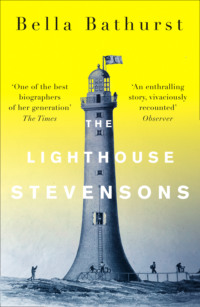
Kitabı oku: «The Lighthouse Stevensons»

The Lighthouse Stevensons
The extraordinary story ofthe building of the Scottish lighthousesby the ancestors ofRobert Louis Stevenson
Bella Bathurst

Copyright
William Collins
An imprint of HarperCollinsPublishers
1 London Bridge Street
London SE1 9GF
WilliamCollinsBook.com
This eBook first published in Great Britain by William Collins in 2020
Copyright © Bella Bathurst 1999; 2020
Cover photograph © Northern Lighthouse Board
Bella Bathust asserts the moral right to be identified as the author of this work
A catalogue record for this book is available from the British Library
Information on previously published material appears here
ll rights reserved under International and Pan-American Copyright Conventions. By payment of the required fees, you have been granted the non-exclusive, non-transferable right to access and read the text of this e-book on-screen. No part of this text may be reproduced, transmitted, down-loaded, decompiled, reverse engineered, or stored in or introduced into any information storage and retrieval system, in any form or by any means, whether electronic or mechanical, now known or hereinafter invented, without the express written permission of HarperCollins
Source ISBN: 9780007204434
Ebook Edition © November 2009 ISBN: 9780007358977
Version: 2020-07-29
To my mother, and to Lucy and Flora.
There are spaces still to be filled before the map is completed – though these days it’s only in the explored territories that men write, sadly, Here live monsters.
NORMAN MCCAIG, Old Maps and New
Table of Contents
Cover Page
Title Page
Copyright
Dedication
Epigraph
Map
Preface
Foreword
Introduction
One Yarmouth
Two Northern Lights
Three Eddystone
Four The Bell Rock
Five Edinburgh
Six Skerryvore
Seven Muckle Flugga
Eight Dhu Heartach
Nine The Keepers
Ten Epilogue
Bibliography
Index
Acknowledgements
About the Author
Praise
Previously Published List
About the Publisher

PREFACE
This is not – nor was it ever intended to be – a definitive biography of the Lighthouse Stevensons. When I began research in January 1996, I realised that any attempt to write a comprehensive biography of all four generations of the Stevensons would be both futile and, given the range and technicality of their work, probably quite wearing as well. And yet to write the history of just one of their lives would be to leave an incomplete picture. The Stevensons were, in the best and worst of senses, a family business and are perhaps most easily understood in that context. The solution I came to was to concentrate on the time between 1786 and 1890 when the first four Lighthouse Stevensons were working around the Scottish coastline, and to focus in detail on those four lights that were most closely associated with their respective engineers. The result of this selection is not quite biography and not quite history. If my selections at times seem arbitrary or incomplete, I can only apologise. The life and works of Robert Louis Stevenson have been the subject of innumerable biographies, studies, critiques and analyses, not to mention his own autobiographical writings. The story of his ancestors, by comparison, remains a relatively unworn path. I would hope therefore that this book would be seen as a kind of taster for the subject, and that anyone wanting to search further would be able to do so. There is more, much more, in the lives and works of the Lighthouse Stevensons than any one book could ever hope to encompass.
FOREWORD
The ferryman has a hangover. I have a hangover. At the hotel last night there was a wedding party which was topped off with a bar-wide debate on whether a man walking at three miles an hour down the deck of a ship travelling at 20 knots would, technically speaking, be doing 23 knots or 20 knots or 17 knots or actually not travelling across the surface of the earth at all. The left side of the bar argued that to arrive at a fair calculation, variables such as tide and current should be taken into account. The right half was trying to dance to Mariah Carey.
It is 7 a.m. and the wind is already slapping at the sides of the jetty. The clouds are filthy grey, and the forecast says there’s a storm coming. The ferryman pulls the cord on the outboard and subsides into the stern, hood down. The boat cuts a raw white line across the Kyle of Durness, and I look out to the weather as a little blue yacht on the far side of the bay vanishes beneath a hill of water before re-emerging at its summit, hull almost clean of water. The Wrath in the Cape is drawn from the old Norse word for turning point, hvarf, but on a day like this there could be no more apt description, particularly since the MoD has turned the whole area into a live firing range. To me this already looks like the middle of a storm. Has the ferryman seen worse?
He looks up. ‘Oh, for goodness’ sakes, yes.’
The Northern Lighthouse Board’s Land Rover is waiting by the mooring on the other side, its windscreen wipers plinking. Wordlessly, the ferryman hands up a couple of boxes, hauls round and heads back in the direction of the bar. The Cape’s last Principal Keeper Iain Roberton has driven the 11 miles along the track partly to collect supplies and partly because he wants to get away from all the building works – people clumping in and out of the cottages, routine all over the place. This light is one of the last to be automated. As part of the process, the old diesel generators need to be removed and replaced with computerised monitoring equipment linked to the NLB’s HQ in Edinburgh. Where necessary the lighting apparatus itself has also been changed: big old lenses replaced with smaller modern alternatives, tungsten bulbs substituted for the first generation of LEDs.
We pass a notice: London 746 Miles. Then a recent bomb crater. The MoD generally leave the keepers in peace, but once in a while pilots find the temptations of a large white tower pinned to a large stone coast overwhelming. The keepers haven’t been shot yet, but they do sometimes get lightly strafed. From the other direction there are different hazards: sea, wind, fog, all the things a lighthouse is designed to stand against. The buildings here are tight-fitted to this treeless, sheep-swept corner of the country, but there’s a cracked window pane in the kitchen from the last gale when the sea reached up 130 feet and tapped out the glass. The previous month a force nine lasted for four days (‘a bit breezy’), during which Iain had to make a grab for the railings to stop himself from going over the cliff. ‘It’s a right funny feeling being lifted off your feet. I lost my glasses, it was blowing that hard.
’The track broadens out to a wide green field, a tower topped with a black diamond lantern and one of the most astounding views in the world; two coasts, two oceans, and the eastward opening to the Pentland Firth. In the foreground a Bond helicopter is suspended just over the edge of the cliff, several reels of electrical cabling swinging from its underside. It has been picking up construction materials from the deck of the NLB ship Pharos in the Firth below and transferring them to the light. These are the last disrupted days before the changeover, the end of a profession, the removal men taking out one era and replacing it with the next.
In November 1996, as the process of de-manning the Scottish lights was reaching its peak, I was 746 miles away on the third floor of the Science Museum. An exhibition of lighthouse optics had been set up and in a corner one of the old threeand-a-half-ton Fresnel lenses was revolving on its brass pivot with a low-watt bulb shining inside. I stood and watched it for a long time, entranced. If you looked directly towards the bulb it would vanish for a second and then reappear, LARGE and small, LARGE and small, its beam tinted with green or haloed with rainbows of prismatic light. If you turned towards the black partition wall, the same light swept round in a smooth circle, strongest in the centre but blurring out towards its edges. Its circuit was broken by three shutters interrupting the beam and making it appear to flash once, twice, three times. Then a long flash, then the same interruption: flash, flash, flash. Then round again, smooth and unperturbed, as sure of itself as any point of science could ever be.
Below was a sign explaining that this particular lens had originally been used at one of the Scottish lights built by Robert Stevenson. I studied the sign for a while. Stevenson with a V, not a PH. A distant half-memory surfaced – hadn’t the writer Robert Louis Stevenson had some sort of connection with engineering or architecture?
Downstairs in the shop I asked if they had any books on the Stevensons. They were helpful – looked up things on the microfiche, found plenty on Robert Stephenson, Rocket scientist, but drew a blank on lighthouses. There seemed to be nothing about the man who had made that light upstairs or how he might be connected to RLS. I walked across Hyde Park possessed by a single, idiotic idea. That lens was a piece of pure magic, as rational as anything the Scottish Enlightenment ever produced but as mythic as Prometheus. Those lights would be difficult to build even now, so how on earth had they managed it two centuries ago? Robert Stevenson – whoever he was – had obviously done something astounding, so why weren’t he and his family better known?
That evening at home I picked through bits of RLS’s autobiographical writing – gleams of history in Kidnapped, forewords and introductions. It wasn’t just Robert who had been an engineer, I discovered, it was all of them, four generations, virtually every male in the family except for a couple of cousins and RLS himself. Though the Stevensons had been general engineers, they had stuck to lighthouses for so long that lighthouses had eventually stuck to them. That was who they were – Lighthouse Stevensons.
Except, of course, for the one who wasn’t. Even in fragments RLS’s ambivalence was audible, sometimes directed at specific individuals and sometimes at – well, who? History? His peers? His wife, Fanny? Himself? My God, I thought, he writes so beautifully, and he sounds so torn. As you would be. If all your family – grandfather, two uncles, father, cousins – were firefighters or paramedics, if what they did was wild and pioneering and every day it made a difference to the lives of others, and if you then decided to turn aside from keeping people alive and become a writer, and if all your stories then ate the fame you knew was due to your family, you’d probably feel ambivalent, too. The more I read, the more astounding I found these four generations who had changed the shape of Scotland and then vanished, occluded by a brighter star. The following morning, I had decided. I might know nothing about engineering or the sea, but so what? I was going to write this.
It was the first book I wrote, and I knew even then that I’d got lucky. It wasn’t just that I arrived at the point when the last of the Scottish lights were being automated, it was all of it. Sitting bowed in the basement of the Northern Lighthouse Board with an elephant folio of Cook’s Voyages splayed on the shelves, or sifting through boxes of Stevenson papers in the National Library of Scotland while the Edinburgh Festival rioted outside. For a few months I went every day. Something about the routine of it made it possible to build up a kind of retrospective intimacy with each Stevenson just through their handwriting – not just the words, but the words behind the words, the way they spoke and wrote: Robert by turns direct, commanding or circumlocutory, the way Alan’s hand could slip from health to sickness to seasickness, writing in bed or from the lighthouse yacht or from some forsaken end-of-the-road croft. Often his writing looks agonised, the drift of ink and its disorder reminding me of Robert Falcon Scott’s final journal entry from the Antarctic: ‘For God’s sake, look after our people.’ Occasionally, too ill even to hold a pen, he dictated through a scribe.
Either way Alan was always more tempered than his father, more tolerant, but somehow further back. Robert was a master both of detail and of the grand design who worked to a hard view of human nature but remained thrilled by the lift of adventure. As RLS noted, ‘What he felt himself, he continued to attribute to all around him.’ RLS’s best known literary character is Jekyll/Hyde, still considered the ultimate delineation of a split personality: public and private, light and shadow, secret and revealed. His grandfather embodied all of those things, a composite of opposites contained within a singular man. In the hush of the library’s manuscript section, this family rose from the page alive and loud again. From the stains of rainwater blots to family squabbles over rent payments and eating habits, the reality of their lives took on form and weather.
Meanwhile, out at the edges, the last of the keepers were packing up and preparing to leave.
The cottages are cosy and the kettle has recently boiled. The Assistant Keepers Kenny and Alan appear, recently woken from the last watch. Interest in the automation process has been increasing and all three have recently grown accustomed to being persons of interest. Most keepers recognise the sense of automation, but they wouldn’t be professionals if they weren’t discomfited by some of its results: drystone dykes patched with remedial fencing, cement bags all over the place, the watched coast now not seen at all.
Kenny opens a packet of Rich Tea from the stores and pulls the milk out of the new fridge. Beside him in one of the cupboards are the dry stores, the 1990s equivalent of ship’s biscuit, designed to prevent the keepers from starving in the event that the relief cannot be made. When circumstances permit, fresh veg or meat can be brought over from Durness. Alcohol is not permitted, and from the beginning of the service all the lights were supposed to be dry, though like everything else this was occasionally subject to interpretation. Some time later, one of the last keepers at the Bell Rock, sends me a picture of a Hogmanay celebration which included twenty-one cans of McEwan’s Export, eight bottles of whisky, one of Drambuie, a wall of lager and a Tennent’s Special extension. No food at all.
Outside, the backdraft from the helicopter’s rotors rattles the double glazing. Iain Roberton has been with the NLB for thirty years and cannot bring himself to think beyond the moment of ‘closure’. None of the keepers have begun to look for other jobs since they say there’s no point this far in advance. ‘I’ll miss it’, says Alan, even though the Cape was seen as one of the worst postings. ‘I hate people saying you must be lonely out here. I’ve never been lonely.’ He looks out towards the space where Orkney should be. ‘Still,’ he says, ‘I wish I was coming with you.’
A couple of hours later the Scotsman’s photographer and I are on the helicopter. He is harnessed to the seat with the door open, taking photographs of the sea and the slabby coast while the pilot does wheelies round the light, running tight to the north walls of Scotland and then pulling up so hard that the controls spark red in alarm and the rotors chop at the air. The wind is already strengthening. Below us the surface of the Firth now wears wrackish strands of white and the helicopter prances from side to side while all the air I had in my lungs disappears in an almost-scream of exhilaration.
Several hours later on the Pharos, the weather has worsened. The ship was scheduled to take further supplies up to Fair Isle, but instead we are running for shelter in Scapa Flow. From the ship’s bridge the Pentland Firth rises and rises. The wind speed is now at 50 knots and the forecast is severe gale force 9 or 10. The captain Bryce Henderson finds a spot near St Margaret’s Hope close by three lights and lowers both anchors. The helicopter stopped being able to fly once the wind speed exceeded 40 knots, so there’s now no question of us leaving until this is over.
Opening the steel door out onto deck has become increasingly difficult. The wind pitches from a song to a shriek and the division between sea and air softens and dissolves. Water appears from above in gouts, or sideways as projectiles, or from below as sudden rearing mountains lifting over the bow and smashing towards us over the decks. Sea has become sky, and the sky has vanished. A kind of darkness falls, broken by the beams of lighthouses. Beside us or behind us or abruptly in front the high-up, squared-off lights of oil tankers loom, implacable as office blocks, sliding past us on their way out of the Flotta terminal. For long moments the ships just seem to stand there, the tankers’ engines insisting they are doing 15, 20 knots but the force of the water holding them almost stationary.
The forecast is now at force 11, the wind at between 55 to 60 knots, and though there are two anchors down the one at the stern is dragging. Henderson has been an NLB man for a long time and in between the urgent punctuations of Mayday calls he stares out of the window, listening. Beneath his uniform, in through his feet and his fingertips, he is tuned to the sound of the ship so acutely he could trace it down to the last semitone. In the silences the rest of us can pick up the faint gravelly scuffle as the back anchor drags. Below us is foul ground, bits of seabed which haven’t been surveyed since the Stevensons’ day. Henderson thinks the anchor is snagged on something and isn’t holding ground. He’d like to move the ship to a more secure anchorage but Scapa Flow is strewn with old ship and submarine carcasses, and there’s no guarantee he wouldn’t just catch on another wreck. Beneath the bridge the cable of the bow anchor is pulled so tight we can feel a hard, high thrum sounding through the ship’s steel plates. Behind there are other sounds, bangs and wrenches, the discordance of metal played out to the end of its tether.
Later that evening I go in search of a view that doesn’t include bits of diagonal sea. Sitting chatting in the canteen, I’m struck by the almost naval divisions on board. In total there are twenty-four crew, all male, but three separate dining areas – one for crew, one for officers and one for the NLB’s Commissioners. Is it a military culture, I ask Jake, at thirty-six the youngest person on board. ‘No,’ he says, ‘more like prison.’ In the commissioners’ dining room a portrait of the NLB’s patron Princess Anne looks down from her wood-panelled wall, over a grand dining table and a set of old photo albums stuck with pictures of past inspection voyages – sunlit games of deck quoits, tall men with moustaches handing up guns and fishing rods. The bookshelf downstairs is not stocked for reassurance. All I can find are commentaries on Job and Isaiah, and a couple of books on lobbying Parliament. Behind me, the glass decanters clink within their silver-fenced tray.
This – the storm – is bad, but it’s not unusual. This is the Pentland Firth, this is the weather, here is what happens when you pass the end of Scotland. Two hundred years ago when there were no roads or ferries or oil terminals or hundred-horsepower engines or anything much except real horsepower, the Stevensons came and built lights. They built them for this, and frequently they built them in this. Marooned at the Bell Rock in 1824, the superintending artificer MacDonald wrote to Robert Stevenson: ‘While at work on the rock the water came upon the house in an unbroken state to the height of the kitchen windows (64ft above the rock) and green seas as high as the bedroom windows (76ft). At times, seas, for I cannot call them sprays … came above the library windows and struck the cornice (90ft) with such force that on separating they darted to leeward of the house, which was left, if I may so express it, at one end of an avenue of water. Indeed the appearance in all directions around us was at times more dreadful and terrific than I have ever seen it before.’ Robert was unimpressed. This was mere business as usual.
It is a reminder that when the Stevensons started, they really did start from scratch. This wasn’t just arriving by a coast and building a lighthouse to an established template. This was making roads, bridges, wharves, moorings – all the civilisaton to get the materials there in the first place. It was drawing maps, or surveying the seabed, or changing coloured glass, or advancing the technology of optics. It was finding ways of landing stone dressed to within millimetres from a tipping boat to a jaggedy rock without breaking it or any of the men who made it. It was building a tiny nation state to form a structure around a structure. It was doing all that and more – always more – to build something which represented in stone the best of both the 18th century and all the ages after.
In the time since this book was published I’ve been lucky enough to speak to many people who know about the Stevenson lights either because they served in them, or because they grew up around them, or because as sailors they had cause to be thankful for them. Lighthouses still fascinate. But the Stevensons didn’t build them to be admired – the reverse, in fact. A lighthouse’s true job is to warn you to go away. The only people who ever see the Bell or Skerryvore close up are maintenance engineers and shipwreck victims. All of those lights, every single one of them, were miracles, built to be avoided.
It was three days before the wind dropped enough for us to leave and a further three days before the Pharos resumed her journey towards Fair Isle: a force 11 fairly ordinary hurricane.
Back in Edinburgh the debate had started then and still rumbles on now: in the age of satellites, why do we need these things, these expensive lights with their dues and their maintenance issues? But as we sat swinging in the Pharos by one overstrained chain, watching for the false lights and the true, all any of us felt was an absolute gratitude for the fact that someone – not just someone, but a Stevenson – had gone out in seas like this and reached out over the centuries to raise a light in the dark.
INTRODUCTION
‘Whenever I smell salt water, I know that I am not far from one of the works of my ancestors,’ wrote Robert Louis Stevenson in 1880. ‘The Bell Rock stands monument for my grandfather, the Skerry Vhor for my Uncle Alan; and when the lights come out at sundown along the shores of Scotland, I am proud to think they burn more brightly for the genius of my father.’ Louis might have been the most famous of the Stevensons, but he was not the most productive. Between 1790 and 1940, eight members of the Stevenson family planned, designed and constructed the ninety-seven manned lighthouses that still speckle the Scottish coast, working in conditions and places that would be daunting even for modern engineers. The same driven energy that Louis put into writing, his ancestors put into lighting the darkness of the seas. The Lighthouse Stevensons, as they became known, were also responsible for a slew of inventions in both construction and optics and for an extraordinary series of developments in architecture, design and mechanics. As well as lighthouses, they built harbours, roads, railways, docks and canals all over Scotland and beyond. They, as much as anyone, are responsible for their country’s appearance today.
But the Lighthouse Stevensons have gone down in history for a very different profession. Robert, the first of the Stevenson dynasty, despised literature; his grandson perpetuated his family’s name with it. The author of Kidnapped, Treasure Island and The Strange Case of Dr Jekyll & Mr Hyde initially trained as an engineer. To his father’s dismay, Louis escaped aged twenty-one, first into law and then into writing. As he later confessed in The Education of an Engineer, his training had not been used in quite the way his father intended. ‘What I gleaned, I am sure I do not know; but in deed I had already my own private determination to be an author; I loved the art of words and the appearances of life; and travellers, and headers, and rubble, and polished ashlar, and pierres perdues, and even the thrilling question of the string course, interested me only (if they interested me at all) as properties for some possible romance or as words to add to my vocabulary.’
With age and distance, Louis recovered pride and affection in the Stevenson trade. He wrote with awe of his grandfather’s work on the Bell Rock lighthouse, and of his father’s melancholic genius for design and experimentation. He wrote about almost every aspect of his own brief and unhappy time as an apprentice, in essays, letters, introductions and memoirs. Most importantly, Louis alchemised his experiences around the ragged coasts of the north into the gold of his best fiction. Treasure Island and Kidnapped both contain salvaged traces of his early career. The further he grew away from engineering, the more he felt towards it. He was sea-marked, and he knew it. He also recognised, with some discomfiture, that his own fame was swallowing up the recognition his family deserved. In 1886, far from Edinburgh, he wrote crossly to his American publishers,
My father is not an ‘inspector’ of lighthouses; he, two of my uncles, my grandfather, and my great grandfather in succession, have been engineers to the Scotch Lighthouse service; all the sea lights in Scotland are signed with our name; and my father’s services to lighthouse optics have been distinguished indeed. I might write books till 1900 and not serve humanity so well; and it moves me to a certain impatience, to see the little, frothy bubble that attends the author his son, and compare it with the obscurity in which that better man finds his reward.
Louis was being only a little disingenuous. He liked recognition and, to an extent, courted it. But his plaintive belief that his family deserved the same acknowledgement seems farsighted now. Even at the height of the Victorian engineering boom, great men went unnoticed and exceptional feats unacknowledged. Louis did his best to remedy the injustice, but also recognised that the Stevensons hardly helped themselves. Not one member of the family ever took out a patent on any of their inventions in design, optics or architecture. All of them believed that their works were for the benefit of the nation as a whole and therefore unworthy of private gain. They were only engineers, after all; they worked to order or conscience, and were only rarely disposed to flightier moments of reflection. What pride they had in their creations they put down to the advantages of forward planning and the benevolence of the Almighty. And Louis, the tricky, charming black sheep of the family, stole all the fame that posterity had to give.
Two hundred years ago, when the first lights were built around the Scottish coast, no one talked much of security. The first beacons for mariners were either coal fires or high coastal towers in which candles burned through the night. Only a few of these fires were ever constructed in Scotland, since they consumed fuel at a voracious pace and were usually extinguished by bad weather. Thus by the mid-eighteenth century, the Scottish coast had become notorious for shipwrecks. In 1799, seventy vessels were lost in the Firth of Tay alone. Along with the physical dangers, there were also the human ones. Bands of wreckers would lie in wait for beached ships, hoping for chances of loot. Something, it was becoming obvious, would have to be done. Those engineers who did come forward were more like pioneers than bureaucrats. To place a building on a rock in the Atlantic ocean was, after all, a formidable endeavour. The pressures of wind, wave, tide and weather on a lighthouse were exceptional. No other building, not even a harbour, had to have quite the same mixture of tenacity and flexibility as the sea-towers did. Any construction in mid-ocean had to be capable of resisting waves which, when roused, could hurl several hundred tons of water at anything in their way. Every one of the rock lighthouses in Scotland was built with stone walls at least nine feet thick at the base; anything less, and they would not have lasted the first gale of winter. To build something under such pressures at a time when the only materials available were stone, wood, glass and metal was nothing short of miraculous. There was no concrete, or cranes, or hydraulic lifting equipment; there were no helicopters or pneumatic drills. Dynamite was a new and fickle builder’s tool to be treated with extreme caution. Mortar was strong but unpredictable, requiring expert mixing and split-second timing. Haulage, in many cases, was provided by horses, who did not take kindly to precipitous cliffs and needed as much tending as any of the workmen. Equipment and materials were brought by sailboat, which ran exactly the same risks as any other ship. As the early engineers discovered, building 130-foot pillars in the middle of a hostile ocean required skills and tools that had not yet been invented. As often as not, they had to make it up as they went along.
From its slow beginnings, the organisation of lights was divided by nation: the English, the Scots and the Irish all had, and still have, separate administrations. The English service, which was founded in 1514 as the Most Glorious and Undivided Trinity of St Clement in the Parish of Deptford Strond in the County of Kent (later foreshortened to Trinity House), developed in piecemeal fashion. For a period of 300 years or so, most of its lights were built and maintained by individuals who had been granted charters. Although it did mean that the most hazardous parts of the English coast were lit, the lights’ construction was erratic and their maintenance wayward. Pepys, who was Master of Trinity House from 1676 to 1689, found private charters disgraceful. While still at the Admiralty, he wrote critically of ‘the evil of having lights raised for the profit of private men, not for the good of the public seamen, their widows and orphans’. In theory, the private owners could build, light and staff the towers in any way they chose in return for a small annual rent. Several were taken over by Trinity House once the lease had expired or had become suitably profitable. By 1800, the combination of extortionate private dues and inconsistent public ones was causing uproar among shipowners plying the English coastline. The situation had, in effect, become a form of legalised extortion: by 1818, Trinity House was reaping an annual profit of around £50,000. The few attempts to reform the situation usually resulted in an undignified tussle between Trinity House, the Crown and the landowners for a portion of the money. It was not until 1836 that Trinity House bought back all the lighthouses in private hands, an undertaking which cost them over £1 million.
The Scottish lights, by contrast, were almost all built within the space of a century. The archetypal lighthouse on its lonely rock in a lonely sea is largely the product of a Scottish imagination and a Scottish sense of endeavour. Augustin Fresnel’s nineteenth-century refinements to oil lighting and high-powered lenses were matched by equally significant developments in lighthouse construction and marine technology. The Stevenson family took up the challenge of their times, blended it with the scientific breakthroughs of their day and brought both to a point of near-perfection. As Louis later noted, engineering ‘was not a science then. It was a living art, and it visibly grew under the eyes and between the hands of its practitioners.’
In 1786 Louis’s grandfather, Robert, went into partnership with his stepfather Thomas Smith, then the Engineer to the Board of Northern Lighthouses. The two began replacing the flickering and unreliable fires first with oil lamps and later with a system of fixed lights using either gas or oil. In 1807, Robert started work on the Bell Rock, a vicious granite reef off the coast of Arbroath. The reef was submerged at high tide and only partially exposed at low tide, so Robert and his staff were forced to play a nervous game of waiting with the sea and the weather. Lighthouses were not Robert’s only preoccupation, however. ‘Scotland itself,’ as a biographer of his grandson later remarked, ‘was his drawing board.’ He was also responsible for the construction of the east side of Edinburgh, driving a route from Prince’s Street to the Calton Hill and constructing the Georgian order of Waterloo Place and Regent Road. Robert was also a man of a most particular mood and time, a self-made bootstrap businessman who, like many of his engineering contemporaries, used the opportunities of the post-Enlightenment world to haul himself out of poverty and into society. He placed his faith in improvement and industry, and remained to the end a devout believer in the most conservative of virtues. He was, according to Louis, ‘a man of the most zealous industry, greedy of occupation, greedy of knowledge, a stern husband of time, a reader, a writer, unflagging in his task of self-improvement.’ Louis, it would seem, was not the only person to be daunted by him.
Robert had three sons who became engineers, Alan, David and Thomas. Alan was a classical scholar, musical, gifted and noted for his early championing of Wordsworth. Nevertheless, he suppressed the artistic side of himself to go into the family firm, becoming, like his father before him, the Commissioner of the Board of Northern Lights. He is remembered as a shrewd and brilliant engineer, whose greatest professional triumph was the construction of Skerryvore lighthouse on a ragged clump of rocks twelve miles west of Tiree. As Sir Walter Scott noted when he visited the site, ‘It will be a most desolate position for a lighthouse – the Bell Rock and Eddystone a joke to it.’ The light took five years to build, and, despite a fire in the 1950s, still stands today. Louis considered it ‘the noblest of all extant deep-sea lights’.
David Stevenson took up Alan’s position on his retirement. His greatest achievement was the construction of the light at Muckle Flugga, the most northerly of all the Scottish lighthouses. Constructed as a temporary light to aid British naval convoys on their way to the Crimea, it was placed on the summit of a wave-washed miniature Matterhorn. Westminster insisted that the light should be working within six months; David’s exceptional skill as an engineer ensured that, even with winter seas crashing 200 feet over the rock, it was finished in time.
Thomas Stevenson, Louis’s father, was responsible for the construction of twenty-seven on-shore and twenty-five offshore lighthouses. He built the light at Dhu Heartach, an isolated mass of rock off the coast of Mull, which Louis later used as source material for Kidnapped. At one point during its construction, fourteen men were trapped for five days in a temporary barracks while a ferocious gale pounded the rock. Louis records the foreman desperately playing his fiddle to quell the sound of the sea’s rage. Thomas is also remembered for having taken Fresnel’s optical developments several stages further, harnessing the strange new science of electricity and building a series of revolving lights in a bright and sturdy circuit which finally enclosed the whole of Scotland. Thomas was ‘a man of somewhat antique strain’, recalled Louis after his death, ‘with a blended sternness and softness that was wholly Scottish and at first somewhat bewildering; with a profound essential melancholy of disposition and (what often accompanies it) the most humorous geniality in company; shrewd and childish; passionately attached, passionately prejudiced; a man of many extremes, many faults of temper, and no very stable foothold for himself among life’s troubles.’ For much of the time, he was working in conjunction with David. The two brothers complemented each other well; David tended towards details, Thomas towards inventiveness. Both were also preoccupied with more prosaic matters, including the establishment of precise and reliable systems for constructing, surveying, lighting, supplying and staffing their fast-growing constellation of lights. Thomas’s weakest point, of course, was Louis, his only child, sickly, contrary and a source of constant worry. Thomas’s wistful attempts to entice Louis into the family firm were fruitless. The rest is literary history.
David had two sons, David A. and Charles. Both are mainly now known for their refinements to the existing systems and their shrewd maintenance of the NLB. Most of the gaudier feats of engineering had been completed by Robert, Alan, David and Thomas. There seemed little for the grandchildren to do but tinker with what already existed. But the Stevensons’ achievements in engineering, science and optics have lasted far beyond their lifespan. Anyone who has ever travelled the coast of Scotland has probably had cause to thank them. Their lights, built into the rocks of the most inhospitable land in Britain, have gone on shining for almost two centuries. Listen to the Shipping News today, and you are listening to part of the legacy of the Lighthouse Stevensons.
ONE Yarmouth
Captain George Manby had reached the age of forty without having contributed significantly to life. His childhood in Yarmouth had been undistinguished, his military career nondescript, and by early middle age he had sunk deeply into debt. Apart from an incident in 1800 when he appeared wild-eyed at the Secretary at War’s door offering to assassinate Napoleon – an offer which the Secretary politely declined – Manby seemed an unlikely candidate for immortality. His naval colleagues also noted cynically that the only battle scar he had yet earned was a gunshot wound, allegedly sustained while running away from a duel.
The death of Nelson during the Battle of Trafalgar in 1805 changed all that. Manby had been at school with Nelson, and although the two had not been friends, Manby still regarded the admiral with affection. When Nelson died, Manby was spurred into action. Inspired by his hero’s example and impressed by the public grief over his loss, Manby concluded that his best chance of fame lay in saving lives; in particular, saving lives at sea. It was a startling choice. Manby’s only marine experience until then had been an unsuccessful spell as a naval lay captain on a frigate heading for Dublin. The ship had foundered off the Irish coast, and, once embedded upon the lee shore, began sinking fast. Manby wrote later that ‘the striking of the ship was the most awful and momentous period I had hitherto experienced. The immediate hallooing of all hands on deck; to the pumps, plumb the well, cut away the masts, throw the guns overboard. And amid all this activity, the dismal moans of some, the screams of the women.’ The crew hurled everything moveable over the sides and the rising tide finally pulled the ship back to the sea’s uneasy safety. Once back in Portsmouth, Manby reflected on his experience and concluded that the sea and he were not well suited to each other. Instead, he applied for a post as barrack master, a position which allowed him to keep his military honours while staying safely on dry land.
Manby did admittedly have good reason to be cautious. Two centuries ago, almost a third of all British seamen died pursuing their trade, being either killed by the punishment of life on board ship or sacrificed to storms and drownings. Nearly everything the modern mariner relies upon – competent maps, accurate instruments and adequate communication – was either unreliable or non-existent. The major sea lanes around Britain were crowded and collisions were frequent. What is now fixed and understood was then debatable, and navigation was more a matter of art than science. Sailors depended on experience or luck to avoid danger, and when they did run into trouble there was no kindly lifeboat service to deliver them. Until the mid-nineteenth century, it was made harder to assist victims than it was to collect the proceeds from wrecks. Previous legislation had defended the salvagers, not the mariners, and neither government nor shipowners devoted much attention to the consequences of nautical disaster. Most efforts were aimed at protecting cargo rather than ensuring that the crew returned intact with the goods. For several long centuries, lives lost at sea were regarded by much of Europe as so much natural wastage. Accounts still exist of sailors watching slack-handed from the gunwhales while one of their colleagues drowned. Once a person had fallen overboard, so the thinking went, he had been claimed by the sea, and it was not for mankind to challenge that claim. Such superstition was only an ideological response to an uncomfortable fact; the sea did kill people in great numbers, year after year. And, short of refusing to leave the safe shores of Britain, there was almost nothing that could be done about it.
Manby seized on the belief that something more must be done to prevent the deaths of shipwreck victims beached on the indifferent shores of Britain, if not for compassionate reasons, then certainly for civilised ones. The destruction of the gun-brig Snipe off the coast of Yarmouth in 1807 only confirmed his views. One hundred and forty-four lives were lost after the ship ran aground during a gale less than one hundred yards from the shore. Manby watched the ship beat itself to death on the rocks, and listened impotently to the cries of those still on board as they died. Over the next few months, he began experimenting with possible solutions. He concentrated his efforts on the idea of throwing a line from the shore to a distressed ship, using a rope fixed to the end of a canon ball. Several early versions failed spectacularly: the rope was either burned through by the gunpowder, or, in those rare instances when the ball and rope successfully reached their target, only managed to set what remained of the ship on fire. At the same time, he tinkered with the notion of an unsinkable boat. During a storm, small row-boats which were used to ferry survivors from the wreck to the shore almost invariably sank, either capsized by the seas or flooded by waves. Manby sealed several small wooden barrels with pitch and fixed them to the sides of a small, undecked boat, providing primitive but workable buoyancy chambers.
By the summer of 1807, his prototype mortar line was ready for testing. Until then, his colleagues and neighbours had watched Manby’s eccentric experiments with derision. But once he produced something that threatened the wreckers, who took their livelihoods from the plunder of injured ships, he became a more serious danger. As the wreckers saw it, he was not only removing their prized source of income, he was also directly contradicting the will of God. God, they reasoned, had sent the storm that had wrecked the ship which they took as their reward. Any interference was therefore a form of devilish meddling. And so, helped by the knowledge that Manby could not swim, the wreckers tried to drown him. Several local sailors volunteered to help Manby demonstrate his boat and mortar line, and, when the boat was a good way from the shore, deliberately capsized it. Manby, just managing to keep afloat, was finally saved by his own efforts and two conscience-stricken spectators.
His determination was, if anything, increased. In 1808, the small brig Elizabeth, carrying a crew of seven sailors, became snared on the sandbanks near Yarmouth during a storm. Manby, seizing his opportunity, positioned himself and his mortar line on the shore and managed to fire the line successfully onto the ship. To do so required accurate calculation, since visibility was minimal and the mortar risked being damaged by both rain and salt water. Manby fired; the rope coiled outwards to sea. There was a pause, and then, slowly, the rope tautened. Someone, it seemed, was still alive and had taken up the line. Once he was confident that the link from ship to shore was secure, Manby sent out one of his ballasted row-boats. When it finally groped its way back to shore, seven sodden survivors crawled exhausted onto the beach. As they later testified, all of them would have almost certainly drowned without the help of the mortar line. Manby, all his heroic intentions vindicated, knelt on the sand and wept.
During the next forty years, it was later calculated, upwards of 1,000 people were rescued from disabled ships by the mortar line. But if Manby thought that his battles had ended there on the darkened beach, he was wrong. His inventions did not meet with the esteem he had hoped for. Despite his energetic lobbying in Parliament, the Admiralty remained suspicious, and the local sailors agitated loudly for his removal. Other, more credible competitors came forward, claiming either to have invented the line before Manby or to have improved it far beyond his original designs. Even his later attempts to establish a lifeboat service to rescue those victims of shipwreck who were stranded farther out to sea met with disapproval or silence. Manby was present at the inaugural meeting of the Royal Society for the Preservation of Life from Shipwreck in 1824, at which the first decision was to award five gold medals: one to the King, one to the Duke of York, one to the Archbishop of Canterbury, and one each to Manby and Sir William Hillary. Manby took the medal, but not the credit. Hillary, a boastful but enterprising Yorkshireman whose career bore a strong resemblance to Manby’s, is now generally honoured as the founding father of the Royal National Lifeboat Institution. Admittedly, Manby did not always help his own cause. He could be pompous and grasping, and was hopelessly vain. His journals and letters are littered with moments when he ‘considered his fortune made’ by the platitudes of a minister or the flattery of a courtier. His efforts often had more to do with his own self-advancement than they did with more generous motives. But for all his deluded grandeur, Manby did achieve great things. After the invention of the mortar line, he spent the rest of his life searching for the recognition he felt he deserved. Just before his death aged eighty-nine, he decided to build a monument commemorating both himself and the mortar line. When completed, he offered it to the town of Yarmouth, which had already built and paid for a statue of Nelson in the town centre. Manby’s memorial was rejected; he was left with nowhere to put it but his own front garden.
From Berwick to the Solway, including the sea lochs of the west, the Scottish coast runs for 4,467 nautical miles. By the late eighteenth century, that coast had gained an ominous reputation. Most mariners stayed well clear, and those who sailed there often chose to continue travelling all night instead of looking for landfall after dark. Not only is Scotland girdled by two opposing seas – the North Sea and the Atlantic – but her ragged island archipelago provides a major obstacle course for the best of sailors, even now. In the past, the sea was considered so dangerous in winter that one early Act had forbidden ships stocked with essential goods from leaving Scottish ports between the end of October and the beginning of February. The reasoning was obvious. As well as the sandbanks and treachery of the English coast, Scotland is moated by an awkward brew of conflicting tides and currents. The North Sea, which in the eighteenth century gave the only access to the Continent, Scandinavia and Russia, is a dark place of streams and sudden climatic switches. In the Pentland Firth, where the North Sea meets the Atlantic, sailors face riptides, cross winds and breakwaters on the water, and sandbanks, skerries and reefs underneath. Often, the competing tides set up currents that run at ten knots or more, each of which is troublesome enough to have earned its own title: Duncansby Bore, the Merry Men of Mey or the Swilkie. The Pentland Firth itself is still known simply as ‘Hell’s Mouth’. The names that still speckle marine maps represent more than just picturesque history. The Black Deeps and Blackstone Banks took their percentage of dead, year after year. Farther south, the Solway Firth is riddled with quicksands and the Firths of Tay and Forth are notorious for rocks. In the 1870s, Thomas Stevenson, a man not given to hyperbole, calculated the pressure of the breakers on the coast at up to 6,000 pounds per square foot.
Even when captains were confident they were clear of the cross-currents near the isles, there were reefs and rocks – Sule Skerry off Cape Wrath, the Torran Rocks off the coast of Iona and Skerryvore beyond Tiree. The entrance to the Forth is guarded by three separate obstacles – the Isle of May, the Bass Rock and Inchkeith – all of which stick directly in the path of shipping on its way to the port of Leith. A little farther northeast, there is the infamous Bell Rock, submerged at high tide and a confusion of serrated rocks at low tide. Round on the west coast, the entrance to the Clyde is calmer but prone to shallows and awkward weather patterns thrown off by the surrounding islands. Where the placid Gulf Stream soaks into the Atlantic, the area is notorious for races, currents and ‘standing waves’ (water flowing over submerged objects which gives the impression of immobility), while the whirlpool of Corrievreckan between Jura and Scarba is considered the most dangerous tide in Europe. Even on a clear day, crossing Corrievreckan involves careful calculation. Boats making the passage cling nervously to the shoreline only to find themselves speeding through at fifteen knots or more. In a dirty sea, the gully resembles Scylla and Charybdis, sucking boats down into the eddy or spitting them out to the shores on either side. Sailors who know the area well enough to avoid the centre frequently wreck themselves on the nearby coasts trying to escape.
Until the mid-nineteenth century, navigation remained a ramshackle skill. Sailors within sight of the shore depended on being able to recognise the coastline. A church roof, a solitary copice or a coastal hamlet were reference points as dependable as any more thorough knowledge of the sea’s geography. In England, Elizabeth I had made altering or dismantling the most significant coastal landmarks a criminal offence. The law had little effect. After dark, without lights, landmarks were of only the most limited help. Many accounts of shipwrecks from the time note laconically that the pilot had mistaken one bay or harbour for another, and ended up paying for it. Even when the first primitive fires were lit on headlands to mark the way, they could easily be confused with stubble fires or temporary beacons. Nor was it possible to rely on written evidence. Even now, with the benefits of sonar and satellite surveying, there is no such thing as a definitive chart. Some parts of the Scottish coastline have not been surveyed for 150 years or more; others could be surveyed till the end of time and still not keep pace with the shiftiness of the sea. In the late eighteenth century, charts, maps and pilot books were drawn up by trial and painful error, and they were as often produced by merchants or traders as by any regularised state system. It was not until 1750 that Murdoch Mackenzie published a sea chart of Orkney and Lewis based on a rigid triangulation framework. Farther south, the situation remained poor for several more decades. In 1788, Murdo Downie, the Master of HM Champion at Leith, was complaining to the government that he could find ‘no chart published of the East Coast of Scotland that could in any degree be relied upon’. The old cherub-covered maps, with their foreshortened coasts and squint-eyed headlands, might look endearing now, but for several long centuries they were the only detailed information on the British coast available. When Daniel Defoe made his tour of Scotland in the 1720s, he discovered that the Forth and Clyde did not, in fact, run into one another, as his map suggested. ‘When I came more critically to survey the ground,’ he complained, ‘I found the map-makers greatly mistaken, and that they had not only given the situation and courses of the rivers wrong, but the distances also.’ Farther north, in ‘that mountainous, barren and frightful country’, the Highlands, things were even worse. ‘Our geographers seem to be almost as much at a loss in the description of this north part of Scotland, as the Romans were to conquer it,’ Defoe noted disconsolately, ‘and they are obliged to fill it up with hills and mountains, as they do the inner parts of Africa with lions and elephants, for want of knowing what else to place there.’
Ücretsiz ön izlemeyi tamamladınız.