Kitabı oku: «Waterloo: The History of Four Days, Three Armies and Three Battles»


Copyright
Published by HarperCollinsPublishers Ltd 1 London Bridge Street London SE1 9GF
www.harpercollins.co.uk
This eBook edition published by William Collins in 2014
Text © Bernard Cornwell 2014
Illustrations © individual copyright holders
Maps created by Martin Brown
Bernard Cornwell asserts the moral right to be identified as the author of this work.
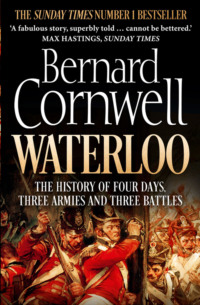
Cover shows a detail from Closing the Gates at Hougoumont, 1815 by Robert Gibb R.S.A., 1903 © National Museums Scotland
A catalogue record for this book is available from the British Library.
All rights reserved under International and Pan-American Copyright Conventions. By payment of the required fees, you have been granted the non-exclusive, non-transferable right to access and read the text of this eBook on-screen. No part of this text may be reproduced, transmitted, downloaded, decompiled, reverse engineered, or stored in or introduced into any information storage and retrieval system, in any form or by any means, whether electronic or mechanical, now known or hereinafter invented, without the express written permission of HarperCollins Publishers.
Source ISBN: 9780007539383
Ebook Edition © September 2014 ISBN: 9780007539390
Version: 2017-10-18
TO WILL AND ANNE CLEVELAND
CONTENTS
Cover
Title Page
Copyright
Dedication
Foreword
Preface
1 Glorious news! Nap’s landed again in France, Hurrah!
2 Napoleon has humbugged me, by God!
3 The fate of France is in your hands!
4 Avancez, mes enfants, courage, encore une fois, Français!
5 Ah! Now I’ve got them, those English!
6 A cannon ball came from the Lord knows where and took the head off our right-hand man
7 The Big Boots don’t like rough stuff!
8 Those terrible grey horses, how they fight!
9 We had our revenge! Such slaughtering!
10 The most beautiful troops in the world
11 Defend yourselves! Defend yourselves! They are coming in everywhere!
12 Next to a battle lost, the greatest misery is a battle gained
Aftermath: A thousand shall fall beside thee, and ten thousand at thy right hand, but it shall not come nigh thee
Afterword
Bibliography
Index
Acknowledgements
Picture Credits
About the Publisher

‘The Field of Waterloo, from the Picton Tree’, by J. M. W. Turner, circa 1833. The painting severely exaggerates the steepness of the valley’s slopes, but does convey the small size of the battlefield.
FOREWORD

WHY ANOTHER BOOK ON Waterloo? It is a good question. There is no shortage of accounts of the battle, indeed it is one of the most studied and written-about battles in history. From the close of that dreadful day in June 1815, everyone who took part in the slaughter knew that they had survived something significant, and the result was hundreds of memoirs and letters describing the experience. Yet the Duke of Wellington was surely right when he said that a man might as well tell the history of a ball, meaning a dance, as write the story of a battle. Everyone who attends a ball has a different memory of the event, some happy, some disappointing, and how, in the swirl of music and ball gowns and flirtations, could anyone hope to make a coherent account of exactly what happened and when and to whom? Yet Waterloo was the deciding event at the beginning of the nineteenth century, and ever since men and women have tried to provide that coherent account.
There is an agreed story. Napoleon attacks Wellington’s right in an attempt to draw the Duke’s reserves to that part of the battlefield, then launches a massive attack on the Duke’s left. That attack fails. Act Two is the great cavalry assault on the Duke’s centre-right, and Act Three, as the Prussians arrive stage left, is the desperate last assault by the undefeated Imperial Guard. To those can be added the subplots of the assaults on Hougoumont and the fall of La Haie Sainte. As a framework that has some merit, but the battle was far more complicated than that simple story suggests. To the men who were present it did not seem simple, or explicable, and one reason to write this book is to try and give an impression of what it was like to be on that field on that confusing day.
The survivors of that confusion would surely be bemused by the argument that Waterloo really was not that important, that if Napoleon had won then he would have still faced overwhelming enemies and ultimate defeat. That is probably, though not certainly, true. If the Emperor had forced the ridge of Mont St Jean and driven Wellington back into a precipitate retreat, he would still have had to cope with the mighty armies of Austria and Russia that were marching towards France. Yet that did not happen. Napoleon was stopped at Waterloo, and that gives the battle its significance. It is a turning point of history, and to say history would have turned anyway is not to reduce the importance of the moment it happened. Some battles change nothing. Waterloo changed almost everything.
Military history can be confusing. Roman numerals (IV Corps) march to meet Arabic numerals (3rd Div), and such labels tend to blur in the non-military mind. I have tried to avoid too much confusion, though perhaps I have added to it by using the words ‘battalion’ and ‘regiment’ to mean the same thing, when plainly they do not. The regiment was an administrative unit in the British army. Some regiments consisted of a single battalion, most had two battalions, and a few had three or even more. It was extremely rare for two British battalions of the same regiment to fight alongside each other in the same campaign, and at Waterloo only two regiments had that distinction. The 1st Regiment of Foot Guards had its 2nd and 3rd battalions at the battle, while the 95th Rifles had three battalions present. Every other battalion was the sole representative of its regiment, so if I refer to the 52nd Regiment I am meaning the 1st Battalion of that regiment. I sometimes use the term Guardsman for clarity, though in 1815 the privates of the British Guards were still referred to as ‘Private’.
All three armies at Waterloo were divided into Corps, thus both the British–Dutch army and the Prussian army were divided into three Corps. The French had four, because the Imperial Guard, though not referred to as a Corps, was effectively the same thing. A Corps could be anything from 10,000 to 30,000 men or more, and was intended to be an independent force, capable of deploying cavalry, infantry and artillery. In turn a Corps was divided into divisions, thus the French 1st Army Corps was divided into four infantry divisions, each between 4,000 and 5,000 strong, and one cavalry division with just over 1,000 men. Each division contained its own supporting artillery. A division might then be further split into brigades, thus the 2nd Infantry Division of the 1st Army Corps contained two brigades, one of seven battalions, the other of six. Battalions were split into companies; a French battalion had eight companies, a British had ten. The most common term in this book will be battalion (sometimes called a regiment). The largest British infantry battalion at Waterloo had over 1,000 men, but the average battalion, in all three armies, was around 500 men. So, in brief, the hierarchy was Army, Corps, Division, Brigade, Battalion, Company.
Some readers may be offended by the usage ‘English army’ when plainly the reference is to the British army. I have used the term ‘English army’ only where it occurs in original sources, choosing not to translate Anglais as British. There was no such thing as the English army, but in the early nineteenth century it was a term in common usage.
The battles of 16 June and 18 June 1815 make for a magnificent story. History is rarely kind to historical novelists by providing a neat plot with great characters who act within a defined time-period, so we are forced to manipulate history to make our own plots work. Yet when I wrote Sharpe’s Waterloo my plot almost entirely vanished to be taken over by the great story of the battle itself. Because it is a great story, not only in its combatants but in its shape. It is a cliffhanger. No matter how often I read accounts of that day, the ending is still full of suspense. The undefeated Imperial Guard climbs the ridge to where Wellington’s battered forces are almost at breaking point. Off to the east the Prussians are clawing at Napoleon’s right, but if the Guard can break Wellington’s men then Napoleon still has time to turn against Blücher’s arriving troops. It is almost the longest day of the year, there are two hours of daylight left and time enough for one or even two armies to be destroyed. We might know how it ends, but like all good stories it bears repetition.
So here it is again, the story of a battle.
PREFACE
IN THE SUMMER OF 1814 His Grace the Duke of Wellington was on his way from London to Paris to take up his appointment as British ambassador to the new regime of Louis XVIII. He might have been expected to take the short route from Dover to Calais, but instead a Royal Navy brig, HMS Griffon, carried him across the North Sea to Bergen-op-Zoom. He was visiting the newly created Kingdom of the Netherlands, an awkward invention, half French, half Dutch, half Catholic and half Protestant, which lay to the north of France. British troops had been posted in the new nation as guarantors of its existence, and the Duke had been asked to inspect the defences along the French border. He was accompanied by ‘Slender Billy’, also known as the ‘Young Frog’, the 23-year-old Prince William, who was Crown Prince of the new kingdom and who, because he had served on the Duke’s staff in the Peninsular War, believed himself to possess military talent. The Duke spent a fortnight touring the borderlands and suggested restoring the fortifications of a handful of towns, but it is hard to believe he took the prospect of a renewed French war too seriously.
Napoleon, after all, was defeated and had been exiled to the Mediterranean island of Elba. France was a monarchy again. The wars were over, and in Vienna the diplomats were forging the treaty that would remake the boundaries of Europe to ensure that another war did not ravage the continent.
And Europe had been ravaged. Napoleon’s abdication had ended twenty-one years of warfare that had begun in the wake of the French Revolution. The old regimes of Europe, the monarchies, had been horrified by the events in France and shocked by the executions of Louis XVI and his queen, Marie Antoinette. Fearing that the ideas of the Revolution would spread to their own countries, they had gone to war.
They had expected a swift victory over the ragged armies of Revolutionary France, but instead they sparked a world war which saw both Washington and Moscow burned. There had been fighting in India, Palestine, the West Indies, Egypt and South America, but Europe had suffered the worst. France had survived the initial onslaught, and from the chaos of revolution there emerged a genius, a warlord, an Emperor. Napoleon’s armies had shattered the Prussians, the Austrians and the Russians, they had marched from the Baltic to the southern shores of Spain, and the Emperor’s feckless brothers had been placed on half the thrones of Europe. Millions had died, but after two decades it was all over. The warlord was caged.
Napoleon had dominated Europe, but there was one enemy he had never met and whom he had never defeated, and that was the Duke of Wellington, whose military reputation was second only to Napoleon’s. He had been born Arthur Wesley, the fourth son of the Earl and Countess of Mornington. The Wesley family were part of the Anglo-Irish aristocracy and Arthur spent most of his youth in Ireland, the country of his birth, though most of his education was at Eton, where he was not happy. His mother, Anne, despaired of him. ‘I don’t know what I shall do with my awkward son Arthur,’ she complained, but the answer, as for so many younger sons of the nobility, was to arrange a commission in the army. And so began an extraordinary career as the awkward Arthur discovered a talent for soldiering. The army recognized that talent and rewarded it. He first commanded an army in India, where he won a series of astonishing victories, then he was recalled to Britain and entrusted with the small expeditionary army that was trying to keep the French from occupying Portugal. That small army had grown into the mighty force that liberated Portugal and Spain and invaded southern France. It had won victory after victory. Arthur Wellesley (the family had changed the surname from Wesley) had become the Duke of Wellington and was recognized as one of the two greatest soldiers of the age. Alexander I, the Czar of Russia, was to call him ‘Le vainqueur du vainqueur du monde’, the conqueror of the world’s conqueror, and the world’s conqueror was, of course, Napoleon. And in twenty-one years of war the Duke and the Emperor had never fought each other.
The Duke was constantly being compared to Napoleon, but when in 1814 he was asked whether he regretted that he had never fought the Emperor in battle, he replied, ‘No, and I am very glad.’ He despised Napoleon the man, but admired Napoleon the soldier, reckoning the Emperor’s presence on a battlefield was worth 40,000 men. And the Duke of Wellington, unlike Napoleon, had never lost a battle, but facing the Emperor might well mean losing that extraordinary record.
Yet in the summer of 1814 the Duke could be forgiven for thinking that his fighting days were over. He knew he was good at warfare, but, unlike Napoleon, he had never taken delight in battle. War was a regrettable necessity. If it was to be fought then it should be fought efficiently and well, but the object of war was peace. He was a diplomat now, not a general, yet old habits die hard and as his entourage travelled across the Kingdom of the Netherlands the Duke found many places which, as he noted, were ‘good positions for an army’. One of those good positions was a valley which, to most people’s eyes, was merely an unremarkable stretch of farmland. He had always possessed a keen eye for ground, for judging how slopes and valleys, streams and woodland might help or hinder a man commanding troops, and something about that valley south of Brussels caught his attention.
It was a wide valley, its slopes not particularly pronounced. A small roadside tavern called La Belle Alliance, ‘the beautiful friendship’, stood on the ridge marking the valley’s southern side, which was mostly higher than the crest of the northern ridge that rose about 30 metres above the valley floor, say 100 feet, though the slope was never steep. The two ridges were not quite parallel. In some places they were fairly close together, though where the road ran northwards from ridge to ridge the distance between the crests was 1,000 metres, or just over half a mile. It was a half-mile of good farmland, and when the Duke saw the valley in the summer of 1814, he would have seen tall crops of rye growing either side of the road, which was heavily used by wagons carrying coal from the mines around Charleroi to the fireplaces of Brussels.
The Duke saw a lot more than that. The road was one of the main routes from France to Brussels, so if war was to break out again this was a possible invasion route. A French army coming north on the road would cross the southern crest by the tavern and see the wide valley ahead. And they would see the northern ridge. Ridge is really too strong a word; they would have seen the straight road dropping gently into the valley and then rising, just as gently, to the long swell of farmland, the northern ridge. Think of that ridge as a wall, and now give the wall three bastions. To the east was a village of stone houses huddled about a church. If those buildings and the village’s outlying farms were occupied by troops it would be the devil’s own job to get them out. Beyond those stone houses the land became more rugged, the hills steeper and valleys deeper, no place for troops to manoeuvre, so the village stood like a fortress at the eastern end of the ridge. In the centre of the ridge, and standing halfway down the far slope, was a farm called La Haie Sainte. It was a substantial building, made of stone, and its house, barns and yard were surrounded by a high stone wall. La Haie Sainte blocked an attack straight up the road, while off to the west was a great house with a walled garden, the Château Hougoumont. So the northern ridge is an obstacle with three outlying bastions, the village, the farm and the château. Suppose an army came out of France and suppose that army wanted to capture Brussels, then that ridge and those bastions were blocking their advance. The enemy would either have to capture those bastions or else ignore them, but if he ignored them his troops would be squeezed between them as they attacked the northern ridge, vulnerable to crossfire.
The invaders would see the ridge and its bastions, yet just as important was what they could not see. They could not see what lay beyond the crest of the northern ridge. They would have seen treetops in the country beyond, but the ground to the north was hidden, and if that French army decided to attack troops on that northern ridge they would never know what happened on that far hidden slope. Were the defenders moving reinforcements from one flank to the other? Was an attack assembling there? Was cavalry waiting out of sight? The ridge, even though it was low and its slopes were gentle, was deceptive. It offered a defender enormous advantages. Of course an enemy might not be obliging and make a simple frontal assault. He might try to march around the western flank of the ridge where the countryside was flatter, but nevertheless the Duke made a mental note of the place. Why? So far as he knew, indeed so far as all Europe knew, the wars were over. Napoleon was exiled, the diplomats were codifying the peace in Vienna, yet still the Duke made a point of remembering this place where an invading army, marching from France towards Brussels, would find life horribly difficult. It was not the only route an invading army might follow, and not the only defensive position the Duke noted in his two weeks of reconnaissance, but the ridge and its bastions stood athwart one of the possible invasion routes a French army might follow.
The Duke rode on, passing La Haie Sainte, to find a crossroads at the top of the ridge and, just beyond, a small village. If the Duke had asked what the place was called they would have said Mont St Jean, which was mildly amusing because the mountain of Saint John was nothing but that gentle swell in the wide fields of rye, wheat and barley. North of the village the road was swallowed into the great forest of Soignes and a couple of miles up that road there was a small town, another unremarkable place, though it possessed a handsomely domed church and a large number of inns for thirsty and tired travellers. In 1814 fewer than two thousand people lived in the town, though they had lost at least twenty young men to the long wars, all of them fighting for France, because this was the French-speaking area of the province of Belgium.
We do not know whether the Duke stopped in the small town in the summer of 1814. We do know he had taken notice of Mont St Jean, but the nearby country town with its fine church and lavish inns? Did he remember that place?
In time he would never forget it.
It was called Waterloo.

CHAPTER ONE

Glorious news! Nap’s landed again in France, Hurrah!
‘MY ISLAND IS NONE TOO BIG!’ Napoleon declared when he found himself ruler of Elba, the tiny island that lies between Corsica and Italy. He had been Emperor of France and ruler of 44 million people, yet now, in 1814, he governed just 86 square miles and 11,000 subjects. Yet he was determined to be a good ruler, and no sooner had he arrived than he began issuing a string of decrees that would reform the island’s mining industry and its agriculture. Little escaped his attention; ‘Inform the intendant’, he wrote, ‘of my dissatisfaction at the dirty state of the streets.’
His plans extended far beyond street-cleaning. He wanted to build a new hospital, new schools and new roads, but there was never enough money. The restored monarchy in France had agreed to pay Napoleon a subsidy of 2 million francs a year, but it soon became apparent that the money would never be paid, and without money there could be no new hospitals, schools or roads. Frustrated by this failure, the Emperor retired into a sulk, passing the days by playing cards with his attendants, and all the while aware of the British and French warships that guarded Elba’s coast to make certain he did not leave his Lilliputian kingdom.
The Emperor was bored. He missed his wife and son. He missed Josephine too and he was inconsolable when the news of her death reached Elba. Poor Josephine, with her black teeth, languid manner and lissom body, a woman who was adored by every man who met her, who was unfaithful to Napoleon, yet was always forgiven. He loved her even though, for dynastic reasons, he had divorced her. ‘I have not passed a day without loving you,’ he wrote to her after her death as though she still lived, ‘I have not spent a night without clasping you in my arms … no woman was ever loved with such devotion!’
He was bored and he was angry. He was angry at Louis XVIII, who was not paying the agreed subsidy, and furious at Talleyrand, once his own Foreign Minister, who now negotiated for the French monarchy at the Congress of Vienna. Talleyrand, sly, clever and duplicitous, was warning the other European envoys that Napoleon could never be kept safe on a small Mediterranean island so close to France. He wanted the Emperor sent far away to some remote place like the Azores, or better still to a West Indian island where the yellow fever raged, or perhaps to some speck in a distant ocean like Saint Helena.
Talleyrand was right while the British Commissioner, sent to Elba to keep a watchful eye on the Emperor, was wrong. Sir Neil Campbell believed that Napoleon had accepted his fate and wrote as much to Lord Castlereagh, Britain’s Foreign Minister. ‘I begin to think’, he reported, ‘that he is quite resigned to his retreat.’
The Emperor was anything but resigned. He followed the news from France and noted the dissatisfaction with the restored monarchy. There was widespread unemployment, the price of bread was high, and people who had greeted the Emperor’s abdication with relief now looked back on his regime with regret. And so he began to make plans. He had been allowed a puny navy, nothing large enough to threaten the French and British ships that guarded him, and in mid-February 1815, he ordered the Inconstant, the largest of his brigs, brought into port; ‘have its copper bottom overhauled,’ he commanded, ‘its leaks stopped and … have it painted like the English brigs. I want it in the bay and ready by the 24th or 25th of this month.’ He ordered two other large ships to be chartered. He had been allowed to take 1,000 soldiers to Elba, including 400 veterans of his old Imperial Guard and a battalion of Polish lancers, and with those troops he would attempt to invade France.
And Sir Neil Campbell suspected nothing. Sir Neil was a decent man, thirty-nine years old in 1815, with a successful military career which almost ended in 1814 when he was appointed Military Attaché to the Russian army invading France. He had survived battles in Spain, but at Fère-Champenoise he was mistaken by an over-enthusiastic Cossack for a French officer and savagely wounded.
He survived his wounds and was appointed British Commissioner to His Highness the Emperor Napoleon, ruler of Elba. Lord Castlereagh stressed that Sir Neil was not the Emperor’s jailer, but of course part of his job was to keep a close eye on Napoleon. Yet Sir Neil had been lulled, and in February 1815, while the Inconstant was being disguised as a British ship, he told the Emperor that he needed to sail to Italy to consult with his doctor. That may well have been true, but it is also true that Signora Bartoli, Sir Neil’s mistress, lived in Leghorn, and that is where he sailed.
The Emperor wished Sir Neil well and hoped he would return by the end of the month because the Princess Borghese was giving a ball, and Sir Neil promised he would do his best to attend. The Princess Borghese was Napoleon’s beguiling sister, the lovely Pauline, who had joined her brother in exile. Penury had forced the sale of her lavish house in Paris, which had been purchased by the British government for use as their embassy. That meant that for five months it had been home to the Duke of Wellington, who had been appointed Britain’s ambassador to the court of Louis XVIII. The house, on the rue du Faubourg St-Honoré, is a jewel, and is still Britain’s embassy.
Sir Neil sailed to Leghorn in the Royal Navy brig Partridge, which usually blockaded Elba’s main harbour. With the Partridge flown the Emperor could put his plans into effect and on 26 February his small fleet sailed for France with just 1,026 troops, 40 horses and 2 cannon. The voyage lasted two days and on 28 February the Emperor landed in France again. He led a puny army, but Napoleon was nothing if not confident. ‘I will arrive in Paris’, he told his troops, ‘without firing a shot!’
The peace was over, struck by a thunderbolt.
* * *
During the winter of 1814 to 1815 many women in Paris wore violet-coloured dresses. It was not just fashion, but rather a code which suggested that the violet would return in the spring. The violet was Napoleon. His beloved Josephine had carried violets at their wedding, and he sent her a bouquet of the flowers on every anniversary. Before his exile to Elba he had said he would be modest, like the violet. Everyone in Paris knew what the colour violet represented, and if at first the French had been relieved that the Emperor was dethroned and that the long destructive wars were over, they soon found much to dislike in the Emperor’s replacement. The restored monarchy, under the grossly obese Louis XVIII, proved rapacious and unpopular.
Then the violet returned. Most people expected that the Royalist army would swiftly defeat Napoleon’s risible little force, but instead the King’s troops deserted in droves to the returned Emperor and within days French newspapers were printing a witty description of his triumphant journey. There are various versions, but this one is typical:
The Tiger has left his den.
The Ogre has been three days at sea.
The Wretch has landed at Fréjus.
The Buzzard has reached Antibes.
The Invader has arrived at Grenoble.
The Tyrant has entered Lyon.
The Usurper has been glimpsed fifty miles from Paris.
Tomorrow Napoleon will be at our gates!
The Emperor will proceed to the Tuileries today.
His Imperial Majesty will address his loyal subjects tomorrow.
His Imperial Majesty, Napoleon Bonaparte, was forty-six years old as he entered the Tuileries Palace in Paris, where an excited crowd awaited his arrival. They had been gathered for hours. The King, fat Louis XVIII, had fled Paris, going to Ghent in the Kingdom of the Netherlands, and the carpet of his abandoned throne room was tufted with embroidered crowns. Someone in the waiting crowd gave one of the crowns a dismissive kick and so loosened it to reveal that the royal tuft hid a woven bee. The honey-bee was another of Napoleon’s symbols, and the excited crowd went to its knees to tear off the crowns, thus restoring the carpet to its old imperial splendour.
It was evening before Napoleon arrived at the palace. The waiting crowd could hear the cheering getting closer, then came the clatter of hoofs on the forecourt and finally the Emperor was there, being carried shoulder-high up the stairs to the audience chamber. An eyewitness said ‘his eyes were closed, his hands reaching forward like a blind man’s, his happiness betrayed only by his smile’.
What a journey it had been! Not just from Elba, but from Napoleon’s unpromising birth in 1769 (the same year as the Duke of Wellington’s birth). He was christened Nabulion Buonaparte, a name that betrays his Corsican origin. His family, which claimed noble lineage, was impoverished and the young Nabulion flirted with those Corsicans who plotted for independence from France and even thought of joining Britain’s Royal Navy, France’s most formidable foe. Instead he emigrated to France, frenchified his name and joined the army. In 1792 he was a Lieutenant, a year later, aged twenty-four, a Brigadier-General.
There is a famous painting of the young Napoleon crossing the St Bernard Pass on his way to the Italian campaign which rocketed him to fame. Louis David’s canvas shows him on a rearing horse, and everything about the painting is motion; the horse rears, its mouth open and eyes wide, its mane is wind-whipped, the sky is stormy and the General’s cloak is a lavish swirl of gale-driven colour. Yet in the centre of that frenzied paint is Napoleon’s calm face. He looks sullen and unsmiling, but above all, calm. That was what he demanded of the painter, and David delivered a picture of a man at home amidst chaos.
The man who was carried up the Tuileries staircase was much changed from the young hero who had possessed rock-star good looks. By 1814 the handsome, slim young man was gone, replaced by a pot-bellied, short-haired figure with sallow skin and very small hands and feet. He was not tall, a little over five foot seven inches, but he was still hypnotic. This was the man who had risen to dominate all Europe, a man who had conquered and lost an empire, who had redrawn the maps, remade the constitution and rewritten the laws of France. He was supremely intelligent, quick-witted, easily bored, but rarely vengeful. The world would not see his like again until the twentieth century, but unlike Mao or Hitler or Stalin, Napoleon was not a murderous tyrant, although like them he was a man who changed history.
He was a superb administrator, but that was not how he wanted to be remembered. Above all, he was a warlord. His idol was Alexander the Great. In the middle of the nineteenth century, in the American Civil War, Robert E. Lee, the great Confederate General, watched his troops executing a brilliant and battle-winning manoeuvre and said, memorably, ‘It is well that war is so terrible, or we should grow too fond of it.’ Napoleon had grown too fond of it, he loved war. Perhaps it was his first love, because it combined the excitement of supreme risk with the joy of victory. He had the incisive mind of a great strategist, yet when the marching was done and the enemy was outflanked he still demanded enormous sacrifices of his men. After Austerlitz, when one of his generals lamented the French lying dead on that frozen battlefield, the Emperor retorted that ‘the women of Paris can replace those men in one night’. When Metternich, the clever Austrian Foreign Minister, offered Napoleon honourable peace terms in 1813 and reminded the Emperor of the human cost of refusal, he received the scornful answer that Napoleon would happily sacrifice a million men to gain his ambitions. Napoleon was careless with the lives of his troops, yet his soldiers adored him because he had the common touch. He knew how to speak to them, how to jest with them and how to inspire them. His soldiers might adore him, but his generals feared him. Marshal Augereau, a foul-mouthed disciplinarian, said, ‘This little bastard of a general actually scares me!’, and General Vandamme, a hard man, said he ‘trembled like a child’ when he approached Napoleon. Yet Napoleon led them all to glory. That was his drug, la Gloire! And in search of it he broke peace treaty after peace treaty, and his armies marched beneath their Eagle standards from Madrid to Moscow, from the Baltic to the Red Sea. He astonished Europe with victories like Austerlitz and Friedland, but he also led his Grande Armée to disaster in the Russian snow. Even his defeats were on a gargantuan scale.
Now he must march again, and he knew it. He sent peace feelers to the other European powers, saying that he had returned to France in response to the public will, that he meant no aggression, and that if they accepted his return then he would live in peace, but he must have known those overtures would be rejected.
So the Eagles would fly again.
* * *
The Duke of Wellington’s life was in danger. Appointing him as Ambassador to France was not, perhaps, the most tactful move the British government made, and Paris was filled with rumours about impending assassination attempts. The government in London wanted the Duke to leave Paris, but he refused because such a move would look like cowardice. Then came the perfect excuse. Lord Castlereagh, the Foreign Secretary and the chief British negotiator at the Congress in Vienna, was urgently needed in London and the Duke was appointed as his replacement. No one could depict that move as a fearful flight from danger because it was plainly a promotion, and so the Duke joined the diplomats who laboriously attempted to redraw the maps of Europe.
And while they talked Napoleon escaped.
Count Metternich, the cold, clever, handsome Foreign Minister of Austria, was perhaps the most influential diplomat in Vienna. He had gone to bed very late on the night of 6 March 1815 because a meeting of the most important plenipotentiaries had lasted until 3 a.m. He was tired, and so he instructed his valet that he was not to be disturbed, but the man woke the Count anyway at 6 a.m. because a courier had arrived with an express despatch marked ‘URGENT’. The envelope bore the inscription ‘From the Imperial and Royal Consulate at Genoa’, and the Count, perhaps thinking that nothing vital would be communicated from such a minor consulate, put it on his bedside table and tried to go to sleep again. Finally, at around 7.30 in the morning, he broke the seal and read the despatch. It was very short:
The English commissioner Campbell has just entered the harbour asking whether anyone has seen Napoleon at Genoa, in view of the fact that he had disappeared from the island of Elba. The answer being in the negative, the English frigate put to sea without further delay.
It might seem strange that Sir Neil Campbell had sailed to Italy in search of the missing Napoleon rather than looking for the errant Emperor in France, but there was a widely held assumption that Napoleon, if he landed in France, would be swiftly captured by Royalist forces. ‘None would hear of France,’ the Duke of Wellington recalled, ‘all were sure that in France he would be massacred by the people when he appeared there. I remember Talleyrand’s words so well, “Pour la France? Non!”’ A landing in Italy seemed far more likely, especially as his brother-in-law, Joachim Murat, was King of Naples. Murat, who owed his throne to Napoleon’s generosity, had made his peace with the Austrians, but realized the Congress in Vienna would almost certainly strip him of his petty kingdom. As soon as he heard of Napoleon’s escape he changed sides again, attacking the Austrians, an adventure that failed utterly and led eventually to a firing squad.
Napoleon, of course, did go to France, but for days the diplomats in Vienna had no idea where he was, only that he was on the loose. The Congress, which had dithered and dallied and danced and debated, suddenly became decisive. ‘War’, Metternich recalled, ‘was decided in less than an hour.’ That swiftness was made possible because almost everyone that mattered, the decision-makers, were present at Vienna. The King of Prussia, the Emperor of Austria, the Czar of Russia, all were there, and Napoleon’s reappearance galvanized them. They did not declare war on France, because so far as the powers at Vienna were concerned France was still a monarchy ruled by Louis XVIII; instead they declared war on one man, Napoleon.
Four countries, Russia, Prussia, Austria and Great Britain, each agreed to raise an army of 150,000 men. Those armies would converge on France. Great Britain was unable to raise such a large army, so she agreed to pay subsidies to the other three instead. By now couriers were criss-crossing Europe, and one of them brought a letter to the Duke of Wellington from Lord Castlereagh: ‘Your Grace can judge where your personal presence is likely to be of the most use to the public service … either to remain at Vienna or to put yourself at the head of the army in Flanders.’
The Czar of Russia, Alexander I, had no doubt what the Duke’s choice would be. ‘It is up to you’, he told the Duke, ‘to save the world again.’
The Duke was doubtless flattered, but probably rather suspicious of such high-flown sentiments. Nor did he have any difficulty in deciding where he was likely to be of the most use to the public service. He replied to the government in London, ‘I am going into the Low Countries to take command of the army.’ He left Vienna at the end of March and was in Brussels by 6 April.
History rarely provides such a striking confrontation. The two greatest soldiers of the era, two men who had never fought against each other, were now gathering armies just 160 miles apart. The world’s conqueror was in Paris while the conqueror of the world’s conqueror was in Brussels.
Did Napoleon know that Wellington had been described as his conqueror? Diplomats are rarely discreet about such things, and it is more than possible, even likely, that the Emperor was told of that derisory remark. It would have angered him. He had something to prove.
And so the armies gathered.
* * *
There was confusion in France when Napoleon returned. Who ruled? Who should rule? For a few days no one could be sure what was happening. Colonel Girod de l’Ain was typical of many of the officers who had fought under Napoleon. With the return of the monarchy he had been forced to retire on half-pay and, though he was newly married, he wanted to rejoin the Emperor as soon as he could. He was living in the French Alps, but decided he should go to Paris:
The whole country was in turmoil. I travelled in uniform, but I took the precaution of providing myself with two cockades, one white and the other a tricolour, and depending on which colour flag I saw flying from the bell-towers of any town or village we passed through, I quickly decorated my hat with the appropriate cockade.
Colonel de l’Ain reached Paris and discovered his old regimental commander had already declared for Napoleon, as did almost the whole of the royal army, despite the oaths of loyalty they had sworn to Louis XVIII. Their officers might stay loyal to their royal oath, but the men had different ideas. Count Alfred-Armand de Saint-Chamans commanded the 7th Chasseurs, and as soon as he heard of Napoleon’s return he told his regiment to be ready to campaign, ‘because I believed we were going to fight the ex-Emperor’. His battalion, though, had a quite different objective:
Someone told me that several officers had gathered in the café and were determined to take their troops to join the Light Infantry of the Guard to support the Emperor, that others were having tricolour flags made which they planned to give to the men and so provoke a mutiny … I began to see the true state of affairs and to feel the misery of my position. What could I do? Any hopes I had of giving the King a fine loyal regiment to support the throne at this fateful hour were dashed to the ground.
The loyalty of the French army to Louis XVIII melted in a moment, giving Napoleon 200,000 troops. Thousands of veterans, like Colonel de l’Ain, were also volunteering, but Napoleon knew he needed an even larger army to defend against the attack that would surely come. One of Louis XVIII’s few popular measures had been the abolition of conscription, and Napoleon hesitated to reintroduce it, knowing how much people hated it, but he had no option, and that would raise another 100,000 men, though all would need training and equipping before they were ready to march, so the Emperor decreed that the National Guard, a local-based militia, would give him 150,000 troops. It was still not enough. The allies, he knew, would bring over half a million men to attack him.
France, in those first weeks, was frantic with preparations. Horses were requisitioned, uniforms made and weapons repaired. It was a compelling display of Napoleon’s administrative genius because, by early summer, he had one army ready to march and others placed to defend France’s frontiers. He still had too few men to resist the onslaught he knew was coming, and he needed yet more troops to suppress Royalist unrest in the Vendée, a region in the west of France which had always been Catholic and Monarchist, but by early summer Napoleon had a total force of 360,000 trained men, the best of whom were destined to assemble in northern France, where 125,000 experienced soldiers would form l’Armée du Nord, the army of the north.
Napoleon could have remained on the defensive that summer, stationing most of his men behind massive fortifications and hoping that the allied armies would batter themselves to destruction. That was not appealing. Such a war would be fought on French soil and Napoleon had never been a passive general. His skill was manoeuvre. In 1814 he had faced overwhelming odds as the Prussians, Austrians and Russians approached Paris from the north and east, and he had dazzled them with the speed of his marches and the suddenness of his attacks. To military professionals that campaign was Napoleon’s finest, even though it did end in defeat, and the Duke of Wellington took care to study it. Napoleon himself claimed:
The art of war does not need complicated manoeuvre; the simplest are the best, and common sense is fundamental. From which one might wonder why generals make blunders; it is because they try to be clever. The most difficult thing is to guess the enemy’s plan, to find the truth from all the reports. The rest merely requires common sense; it is like a boxing match, the more you punch the better it is.
The Emperor was being disingenuous. War was never quite that simple, but in essence his strategy was simple. It was to divide his enemies, then pin one down while the other was attacked hard and, like a boxing match, the harder he punched the quicker the result. Then, once one enemy was destroyed, he would turn on the next. The best defence for Napoleon in 1815 was attack, and the obvious enemy to attack was the closest.
It would take time for the massive Russian army to cross Europe and reach the French frontier, and the Austrians were still not ready in May. But just to the north of France, in the old province of Belgium that was now part of the Kingdom of the Netherlands, two armies were gathering: the British and the Prussian. Napoleon calculated that if he could beat those two armies then the other allies would lose heart. If he defeated Wellington and drove the British back to the sea, there could even be a change of government in London which might bring a Whig administration inclined to let him stay as ruler of France. The enemy alliance would then fall apart. It was a gamble, of course, but all war is a gamble. He could have waited to raise and train more men until the French army almost matched the allies in number, but those two armies north of the border were too tempting. If they could be divided then they could be beaten, and if they could be beaten then the enemy coalition might collapse. It had happened before, so why not now?
The army he would take north was a good one, filled with experienced troops. If it had a weakness it was in the high command. Napoleon had always depended on his Marshals, but of the twenty Marshals still living four remained loyal to Louis XVIII, four more defected to the allies and two simply lay low. One of those two was Marshal Berthier, who had been Napoleon’s Chief of Staff and had a genius for organization. He fled to Bavaria, where on 1 June he fell to his death from a third-floor window of Bamberg Castle. Some suspect murder, but the most likely explanation is that he simply leaned too far out to watch some Russian cavalry pass through the square beneath. He was replaced by Nicolas Jean de Dieu Soult, a hugely experienced soldier who had risen from the ranks. Napoleon once called him ‘the greatest manoeuvrer in Europe’, but when Soult commanded armies in Spain he found himself constantly outfought by Wellington. He was a difficult man, prickly and proud, and it remained to be seen whether he possessed Berthier’s administrative talents.
Two of the Emperor’s most brilliant Marshals, Davout and Suchet, did not accompany l’Armée du Nord. Davout, a grim and relentless fighter, was made Minister for War and stayed in Paris, while Suchet was appointed commander of the Army of the Alps, a grand name for a small and ill-equipped force. Napoleon, asked which were his greatest generals, named André Masséna and Louis-Gabriel Suchet, but the first was in ill health and Suchet was left behind to defend France’s eastern frontier against an Austrian attack.
Napoleon created one new Marshal for the coming campaign: Emmanuel, Marquis de Grouchy. Davout advised against the appointment, but Napoleon insisted. Grouchy was an aristocrat from the ancien régime and had been fortunate to survive the slaughters of the French Revolution. He had made his reputation as a cavalryman; now he would be given command of one third of l’Armée du Nord.
Then there was the Marshal who was called the ‘bravest of the brave’, the mercurial and fearsome Michel Ney, who, like Soult, had risen from the ranks. He was fiery, red-haired and passionate, the son of a barrel-maker. He was forty-six years old in 1815, the same age as Napoleon and Wellington, and he had made his reputation on some of the bloodiest battlefields of the long war. No one doubted his courage. He was a soldier’s soldier, a warrior who, when Napoleon landed from Elba, had famously promised Louis XVIII to bring the Emperor back to Paris in an iron cage. Instead he had defected with his troops. He was renowned for his extraordinary courage and inspiring leadership, but no one would ever call Ney cool-headed. And, ominously, Soult detested Ney, and Ney detested Soult, yet the two were expected to work together in that fateful summer.
The Marshals were important, and none more so than the Chief of Staff, because it was his job to translate the Emperor’s wishes into mundane orders of march. Berthier had been a brilliant administrator, foreseeing problems and sorting them efficiently, and it remained to be seen whether Marshal Soult had the same ability to organize over a hundred thousand men, to feed them, move them and bring them to battle according to his Emperor’s wishes. The other Marshals would have the heavy responsibility of independent command. If the Emperor’s tactic was to pin one enemy army and keep it in place while he defeated the other, then a Marshal would be the man doing the pinning. At the opening of hostilities it was Marshal Ney’s job to keep Wellington busy while Napoleon fought the Prussians, and two days later Marshal Grouchy had to divert the Prussians while Napoleon destroyed Wellington’s men. Those tasks were not done by just following orders, but by imaginative soldiering. A Marshal was expected to take the difficult decisions, and Napoleon was entrusting them to Grouchy, new to his high rank and nervous of failure, and to Ney, whose only mode of battle was to fight like the devil.
L’Armée du Nord would face two armies in Belgium, of which the largest was the Prussian. It was led by the 74-year-old Prince Gebhard Leberecht von Blücher, who had first fought for Sweden against the Prussians, but after being captured was commissioned into the Prussian army by Frederick the Great. He was vastly experienced, a cavalryman with the nickname of Marschall Vorwärts, Marshal Forwards, because of his habit of shouting his men forward. He was popular, much loved by his troops and, famously, prone to bouts of mental illness during which he believed himself pregnant with an elephant fathered by a French infantryman. There was no trace of this madness during the summer of 1815; instead Blücher marched with a fanatical determination to defeat Napoleon. He was bluff, courageous, and if he was not the smartest general he had the sense to employ brilliant staff officers. In 1815 his Chief of Staff was August von Gneisenau, a man of vast ability and long experience, some of which had been gained fighting alongside the British during the American Revolution. That had soured his views of the British army, and Gneisenau was extremely suspicious of British abilities and intentions. When Baron von Müffling was appointed as the liaison officer to Wellington he was summoned by Gneisenau, who warned him:
Ücretsiz ön izlemeyi tamamladınız.