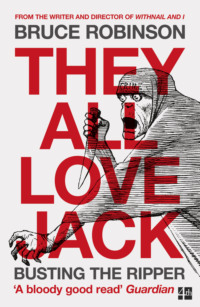
Kitabı oku: «They All Love Jack: Busting the Ripper»

Copyright
First published in Great Britain in 2015 by
Fourth Estate
An imprint of HarperCollinsPublishers
1 London Bridge Street
London SE1 9GF
www.4thestate.co.uk
Copyright © Punditbest Ltd 2015
The right of Bruce Robinson to be identified as the author
of this work has been asserted by him in accordance
with the Copyright, Design and Patents Act 1988
A catalogue record for this book is
available from the British Library
Cover image © Getty Images
All rights reserved under International and Pan-American Copyright Conventions. By payment of the required fees, you have been granted the non-exclusive, non-transferable right to access and read the text of this e-book on-screen. No part of this text may be reproduced, transmitted, down-loaded, decompiled, reverse engineered, or stored in or introduced into any information storage and retrieval system, in any form or by any means, whether electronic or mechanical, now known or hereinafter invented, without the express written permission of HarperCollins.
Source ISBN: 9780007548873
Ebook Edition © October 2015 ISBN: 9780007548897
Version: 2016-07-08
Dedication
In memory of Sergeant T. J. Hageboeck
of the Los Angeles Police
Epigraph
Power, like a desolating pestilence,
Pollutes whate’er it touches, and obedience,
Bane of all genius, virtue, freedom, truth,
Makes slaves of men, and, of the human frame
A mechanised automaton.
Shelley, 1813
Contents
Cover
Title Page
Copyright
Dedication
Epigraph
Author’s Note
1 All the Widow’s Men
2 A Conspiracy of Bafflement
3 The Mystic Tie
4 The Funny Little Game
5 The Savages
6 On the Square
7 The Ink-Stained Hack
8 The Double Event: Part Two
9 Rotten to the Core
10 ‘They All Love Jack’
11 On Her Majesty’s Service
12 The Mouth of the Maggot
13 A Gentleman’s Lair
14 ‘Orpheus’
15 ‘The Ezekiel Hit’
16 ‘Red Tape’
17 ‘The Spirit of Evil’
18 ‘The Maybrick Mystery’
19 Victorian Values
Appendix I: The Parnell Frame-Up
Appendix II: A Very Curious Letter
Acknowledgements
Sources
Picture Credits
Index
Also by Bruce Robinson
About the Publisher
Author’s Note
There is an aphorism. When you see a giant, make sure it isn’t a dwarf standing in a favourable light. Thus we approach ‘the mystery of Jack the Ripper’.
He’s in a house of smoke and shifting mirrors. There are glimpses of amorphous faces. Many Jack the Rippers are in here, feeding off what historical fragments their keeper can throw into the pit.
Middle-aged men with disturbing expressions lean over the safety rail, clutching files. These are the Ripperologists. They are waiting for the Rippers to come out.
‘There he is!’ bellows one. ‘It’s the wall-eyed onanist from Zadonsk! Look at him, he’s playing with himself! Can’t you see him? He’s got a satchel of wombs!’
Nobody can see him. Attention migrates to another man, and he’s just seen somebody else. ‘There, there,’ he barks, shuffling his Metropolitan Police files. ‘The Jew! The Jew!! Mark the Jew!!’
An inflamed, bespectacled authority fights his way to the front. ‘Shut this farce down!’ he demands. ‘You are all duped!’ He struggles to get a pedometer past a pack of egg sandwiches. ‘I’ve measured his routes,’ he charges, thrusting his instrument as proof. ‘I challenge you all with the routes!’
Insults begin to fly, and argument breaks out between him and a man with a compass. But the lights have already started to dim, and the shutters have gone up. It’s time for the Ripperologists to go home and save their arguments for another day.
This book has no interest in the house of mirrors, and despite selective admiration for some, no interest in Ripperologists. I don’t believe this collective could catch the object of its aspiration in a thousand years, and furthermore, I don’t believe in ‘the mystery of Jack the Ripper’ either.
We all know the story, at least the blurb on the paperbacks.
It is the autumn of 1888. The cobbled streets of Whitechapel echo to the chilling footsteps of a ruthless killer … Out of the foetid darkness came this subhuman nemesis of blood-hungry evil. Taunting the frantic police, he visited merciless death on five desperate women, nothing to speak as his witness but their hideously mutilated remains. He left no clue, but went as silently as he came, leaving nothing but a name that will forever be etched into the annals of criminal infamy: ‘Jack the Ripper’. Ah! Jack the Ripper. (Fog to taste.)
This book is a repudiation of virtually everything Ripperology has ever written. Anyone who wishes is welcome to have their Ripper back, and retire with him to the nearest gaslit alley. I tend towards a cynical point of view. In politics I expect the worst, and usually get it. But I had no idea of what I was in for with this. Buried in the ‘mystery’ of the Ripper atrocities is a scandal that ain’t much short of incredible. Exploring it was like pulling at a small, wizened root that as it disinters is discovered to be connected to an enormous root-system, deeper and more protectively concealed than I could ever have imagined.
I’ve spent rather a while enquiring into this ‘mystery’, and incrementally I have learned to loathe much of what was the Victorian governing class. Wealth was a deity in Victorian England, and everything was subservient to the maintenance of it. Underpinned by their ‘right to rule’, their cupidity and institutionalised hypocrisy, these defects constituted a potent amalgamation of the forces that conspired to turn this monster into a ‘mystery’.
There’s a perverse, almost heroic status that has evolved around this prick, as though he were someone special, rather than the epitome of all that is cruel, and a God-damned repugnance. His only claim to the extraordinary is his anonymity, his so-called ‘mystery’; and even that doesn’t belong to him, but was the gift of others.
There’s a hybrid of Ripperology responsible for a dizzying variety of publications over the last half-century. By a process of attrition and endless industry, this coterie of authors has come to ‘own’ this history. They are self-appointed ‘experts’ and guardians of flat-earth thinking. Under constrictions of the herd (and by some by design) they have constructed a formidable camouflage around this criminal. It is necessary to break through it before there is any possibility of discovering the identity of our Victorian psychopath.
Busting Jack entails an unravelling of the root-system that is way beyond the constipated strictures of Ripperology.
During the Second World War there was an interrogator for Army Counter-Intelligence by the name of Lieutenant Colonel Oreste Pinto. It was his task to break the cover of enemy spies, and he’s one of my weirder heroes. In 1942 Pinto had a man at the other side of his desk who instinct told him had to be an enemy agent. Before arriving at the Colonel’s office (just off The Strand in central London), this suspect had been through many searing investigations and survived them all. Notwithstanding that, the authorities continued to harbour suspicions; but nobody could break him. So what did Pinto think?
Pinto interrogated his man over a period of days. The suspect had an impeccable Oxford accent, excellent socio-geographic knowledge, backed up by documentation that was as good as it gets. Down to the last little parochial nuance, he had an answer for everything, and seemed totally and utterly kosher.
Even so, Pinto was convinced he was dealing with an exceptionally talented spy whose true provenance was Berlin. But he couldn’t crack him, so he invited him out to lunch. Ten minutes later they were walking up The Strand, about to cross it to go to the chosen restaurant when, as they stepped off the kerb, Pinto screamed, ‘Look out!’ – and he got his German because the bastard looked the wrong way.
‘We drive on the left in England, old boy.’
That is an expert in action. In that one inspired moment, all the lies, all the carefully contrived subterfuge, and all the mystery fell to bits. I’m afraid my narrative will take rather longer to make its point than that flash of inspiration from Pinto. But I believe that the Ripper is just as vulnerable. Nailing this aberration means looking beyond the masquerade and requires but a single word. So look out, Jack! We’re stepping off the kerb, and I’m going to bust your arse.
B.R.
2 May 2015
1
All the Widow’s Men
We must return to Victorian values.
Margaret Thatcher, 1983
Reactionary nostalgia for the proprieties of Victorian England is unfortunate, like a whore looking under the bed for her virginity. Thatcher was perhaps confused because there were no drug busts in nineteenth-century England, few prosecutions for cruelty to children, and little recorded sex crime.
But who needs to force his attentions, with twelve hundred harlots on the streets? There was sex aplenty, at prices all could afford. At the bargain end you could fuck for the price of a mug of tea.
As far as narcotics were concerned there was even less of a problem, because getting smashed wasn’t illegal. Any toff on his way to the Athenaeum could stroll into Harrods and demand half an ounce of their finest cocaine. There was no ‘war on drugs’. The only drug wars in the Victorian epoch were those conducted by Englishmen in soldiers’ uniforms trying to get the Chinese hooked. If they refused to become junkies, they murdered them. Hundreds were strung up outside their own homes. When Victoria’s Prime Minister Lord Palmerston had finally achieved stability of the market, the dealers moved in, shipping their opium out of British Calcutta – 5,000 tons a year by 1866. What today are quaintly called ‘street values’ were astounding, and the revenues to the Crown require no less a word. British ‘administrators’, i.e. pushers, computed that in Fukien province eight out of ten adults were addicted, and nine out of ten in Canton. A complete marketing success.1
One of the outstanding paradoxes of the Victorian age was its obsession with morality, when morality there was none. When it came to sex, Victorian hypocrisy rose to the very ether. The age of consent (determined by an all-male Parliament) was twelve. More often than not, however, consent didn’t come into it. Children were regularly sold into upmarket brothels as a leisure facility for gentlemen (little girls sometimes having their genitals surgically repaired to sustain the fiction of fresh goods). Champagne on the house, of course, padded chambers available on request. The beating of a common child into bloody insensibility with a whip may not have gained you the epithet of a ‘good egg’ at the club, but it wouldn’t have put you into prison either.2 It was men like W.T. Stead who got banged up for trying to do something about it.
William Thomas Stead was one of the great Victorians, a powerful and influential journalist, frequently vilified by the midgets of his trade who were anxious of his sincerity and success. He and Bramwell Booth, of Salvation Army fame, attempted to expose upper-class depravities by going out and buying a thirteen-year-old girl for a fiver. He published a full report of it in the Pall Mall Gazette, titled ‘The Modern Babylon’.3 This didn’t go down at all well with the Establishment (many politicians being punters), and the pair of them ended up in the dock at the Old Bailey.
‘Nothing less than imprisonment’, farted The Times. Mr Justice Lopes got on with it. ‘William Thomas Stead – I regret to say that you thought it fit to publish, blah, blah … and that you deluged our streets and the whole country with an amount of filth, blah, blah, blah … and I don’t hesitate to say, will ever be a disgrace to journalism.’4
Three months’ hard labour.
In 1888 you could fuck a child for five shillings, but you couldn’t read Zola. What the Establishment didn’t like about Emile Zola was his treatment of the working class, who he had the French neck to represent as human.
In his novel Germinal, for example, a coalminer not only falls in love with a girl Capital has reduced to an animal, but he also forms an embryonic trade union. Good God, two horrors in one! The Right Honourable’s wig must have lifted six inches into the air. Like Stead, Ernest Vizetelly (the British translator and publisher of Zola) got three months.
But there was a darker, deeper fear abroad in Zola’s mines, indeed in the minds of the Victorian Establishment. It was the voice from the abyss, the voice of Socialism, howling, ‘Enough, enough. Get off your all fours in the darkness, and stand on two feet like men.’
London was the richest city on earth. Bar none. A Baedeker guide of the period wrote: ‘Nothing will convey a better idea of the stupendous wealth of London than a visit to its docks.’ Eighteen months after an unprecedented working-class riot in Trafalgar Square in November 1887, London’s docks were hit by a cataclysmic strike.5 A Mr Norwood, for management, put it down to ‘dark deliberations of a Socialist Congress in Switzerland’. He was believed then, and might even be now. But I think the strike was more likely to have been caused by the habitual agony of three hundred men fighting over one job, the ‘most ravenous, that is, potentially the cheapest’, getting it. The rest could crawl off and die. And many did, one man actually starving to death on Cannon Street Road.
Enquiries were made into his accommodation:
In it is a woman lying on some sacking and a little straw, her breast half eaten away with cancer. She is naked but for an old red handkerchief over her breast and a bit of sail over her legs. By her side a baby of three and three other children. Four of them. The eldest is just nine years old. The husband tried to ‘pick up’ a few pence at the docks – the last refuge of the desperate – and the children are howling for bread. That poor woman who in all her agony tries to tend her little ones …6
The Queen sent a bunch of posies to the East End – not for the dying woman, but for the Sisters of Jesus, who were teaching girls to sew. In 1888, at Swan & Edgar, Piccadilly, you could order an evening gown and have these scrofulous, albeit industrious little Whitechapel fingers make it for you to wear at the soirée that very night. That very year, the Earl of Dudley threw a party for his ever-hungry but already overfed friend Edward, the Prince of Wales. The dinner service was specially made for the occasion by Sèvres. It had the royal glutton’s crest on it, and cost £22,000.
At about the time of the description of the dying woman in Whitechapel, historians liked to kid the British that they went to war over such outrages. Victorian schoolchildren were informed of one such escapade. It featured a stinking cellar full of men, women and children, and was colloquially known as ‘the Black Hole of Calcutta’.
I’ve read extensively about this ‘hole’, but details of its myth needn’t trouble us here. I raise it merely to point out that if Victorian educators wanted a hole to get uptight about, they could have had as many as would satisfy their indignation without the inconvenience of sending an army to India. A penny ride on a London omnibus would have taken them to Aldgate (Jack’s nearest and frequently used underground station), east of which were thousands of black holes more permanently frightful than anything in Bengal.
Here, the sub-British ate, slept and wiped their arses in cellars full of vermin and promiscuous death. It was a state of affairs nobody in government got into a particular tizz about, making one wonder if the outrage over sanitary conditions in Calcutta wasn’t something of a theatrical overreaction to get at something else.
In 1877 Victoria became Empress of India, but not of London’s East End. There was no money in it. Thus the Victorians managed to persuade themselves that this suburb of hell was nothing to do with them, and that poverty was somehow engendered by evil. Poverty was portrayed as a lack of morality, rather than a byproduct of greed. These bastards were conniving, thieving, degenerate, congenital criminals, born sinners, and if they’d only stop fucking each other, cherry blossom would sprout spontaneously up the Mile End Road.
One West End Nazi offered businesslike solutions to deal with the maggot-coloured infants sullying London’s streets. The following is from an elegantly produced little guidebook for tourists published by the Grosvenor Press in the 1880s, at the height of Victoria’s reign.
Observe the East End streets, and you will notice hundreds, and thousands of little children wandering about in mobs. Their food is scant and they come ten in a family. Like the wretched Hindus, whom a famine, that is really well deserved, has overtaken, and who supinely breed up to the last pound of rice, these Hindus of the East End take no thought for the morrow, and bring into existence swarms of children for a life of barbarism, brutality, and want in the midst of plenty. Yet our civilisation prates at the sanctity of this human life, and in the same breath speaks of the mercifulness of putting a horse with a broken leg ‘out of its misery’.7
In other words, kill them. Was the writer of the above mentally ill, or simply inured to the cruelties of his time? His words are quoted verbatim (only the emphasis is mine), but they give a kind of perspective. Of course there were giants of the philanthropic trades who fought against such ‘values’. But this book isn’t about the genius of Victorian England. It’s about the bad guys, and even the bad side of the good guys.
The nineteenth century was on its famous roll, and the name of the game was gain. Glittering times for those at the top, not so cosy for those pushing the juggernaut. A confederacy of enterprising Englishmen fought their way up – heroes and cowards, saints and shysters – dragging buckets for the gold. ‘I would annex the planets if I could,’ said Cecil Rhodes, staring up at Africa’s stars. On a more prosaic level, the common herd were required to stand behind cordons of policemen and wave little flags at the passing millionaires.
From time to time they were also required to shell out. Somehow the Victorian elite had managed to amend the mythological affection the peasants had for Robin Hood. It will be remembered that he robbed the rich and gave to the poor. The richest family on earth had turned that on its head. In advance of a Royal Wedding – ‘the Fairest Scene in all Creation’ – the nuptials of the Queen’s grandson George, Duke of York, the mob were instructed to buy the bride a present.
Dockyard labourers, longshoremen, river boat men, village peasants, mechanics, miners, parish school children, cottagers, weavers, carpenters, bricklayers – the whole, in a word, of the poorest and hardest worked members of the nation – were bidden, in terms which admitted no denial, to give up a day’s wage or the price of a week’s meals to assist in purchasing some necklace, bracelet, or other jewel for a young lady who is to be the future wearer of the crown jewels of Great Britain. Royalty in England makes a nation of snobs and sycophants out of a nation that otherwise would be sturdy and self-respecting.8
Not from my pen, but from that of a brilliant, now neglected writer of the time, ‘Ouida’ (Marie Louise de la Ramée), who couldn’t be dismissed as a horrid Continental republican, because she was British. She continues, under the subheading ‘Physical Defects of the Royal Breed’:
Given their consanguinity in marriage, their hereditary nervous maladies, their imprisonment in a narrow circle, their illimitable opportunity of self-indulgence, the monotony, the acquisitiveness, which lie like curses on their lives, we must give them the honor that they remain as entirely sane as some of them do. They are, moreover, heavily and cruelly handicapped by the alliances which they are compelled to form, and the hereditary diseases which they are thus forced to receive and transmit. The fatal corporeal and mental injuries of the royal families due to what the raisers of horses call ‘breeding in and in’ cannot be overrated, and yet seem scarcely to attract any attention from the nations over which they reign. Mental and physical diseases are common to them, and so are certain attitudes, moral and political. They are almost all great feeders, and tenacious of arbitrary precedence and distinction. No one ever tells them the truth, they are surrounded by persons who all desire to please, that they may profit by them.9
Needless to say, this piece was never published in England, but in the American edition of Review of Reviews. If I were obliged to agree with only one phrase of it, it would be the last: ‘that they may profit from them’.
Victorian royalty was a gigantic conjuring trick, pomp and pretty circumstance designed to keep your eye off the ball: precisely the reason conjurors use a blonde with big tits. The trick was mother love (and love of mother). Victoria loved her people, and 310 million people loved her.
But this proposition sweats a bit under analysis. Her family feared her. Half the world feared her armies and her avarice – young men flocking to heaven in a brainwashed patriotic stupor at the bugle-call of her greed.
‘We must with our Indian Empire and large Colonies,’ wrote the Queen, ‘be prepared for attacks and wars somewhere or other CONTINUALLY.’ Her emphasis, but not her blood.10
By 1887 Victoria had been queen for fifty years. At her Jubilee celebrations she wept joyously at the battalions of young soldiers, but got a bit fraught when asked to contribute to the cost of the festivities. Marching feet might bring a sting of imperial hubris, but underlying it was the sentiment of a clapped-out cash register. It was made clear to ministers that if she had to pay, she’d never celebrate again.
She didn’t want to pay for her swarm, either. Victoria had twenty-two grandchildren, and by the time of her death, thirty-seven great-grandchildren.11 That’s fifty-nine junior royals with their hands in the till. By the late 1880s this regal cavalcade of indulgence at public expense was stretching political and fiscal credibility to breaking point. It had become too much even for the Conservatives. In an attempt to navigate cross-party dissent, the government quietly suggested that the Palace might want to police its own finances. Nothing radical, you understand: Fat Ed would still get his £128k a year; but could not the Queen herself see a way to appoint a committee that might, very delicately, ‘recommend economies, which, without interfering with your Majesty’s personal comfort, state, or dignity, [the loyal throat was cleared] might be made available as a fund out of which provision could be made either wholly or in part for the young members of the Royal Family?’12
In other words, can you cough up a bit for the kids?
This was construed by the Queen as a piece of common insolence, as was made pretty evident by the tone in which she batted it back. Clearly she thought it iniquitous that she should be expected to shell out. Her Prime Minister, Viscount Lord Salisbury, was the recipient of the bleat. It was ‘most unjust’, wrote the Queen, ‘that she, in her old age, with endless expenses, should be asked to contribute’. Furthermore, she considered herself ‘very shamefully used in having no real assistance for the enormous expense of entertaining’ (at her own Golden Jubilee). Did not Salisbury realise what all this guzzling cost?
Next day she had another seethe at the ingratitude of the masses, via their Parliament. ‘The constant dread of the House of Commons is a bugbear. What ever is done you will not and cannot conciliate a certain set of fools and wicked people who will attack whatever is done.’13
These ‘fools and wicked people’ were actually the taxpayers, a large number of whom were living in abject poverty – which in Her Majesty’s view was about all the excuse they had for not understanding the price of Cristal champagne. Is this letter not as illuminating as it is astonishing? The richest woman on earth considered poor people who wouldn’t give her money ‘wicked’.
‘Oh, but she was a wrenching, grasping, clutching covetous old sinner, and closed as an oyster.’ I vandalise Dickens’s Christmas masterpiece, but his description of Ebenezer Scrooge is appropriate here. I think Dickens found his Miss Havisham in Queen Victoria – his creation a bitter old woman in white, and his muse this caustic old broken heart in endless black. Since the death of her husband Albert in 1861 she had lived in a perpetual funeral, grieving for her lost love and cut off from reality like Havisham in her rotting wedding gown.
The Victorians were subjects of this wretched widow, and in her presence kept a straight face. You had to polish your boots, assume a stiffened aspect, and pretend that everything in the world was serious. Fun was behind her back. In my view, Victoria’s permanent grief invented Victorian hypocrisy. You couldn’t get your hand up at an endless funeral, and had to pretend outrage if somebody else did. This ethic of counterfeit rectitude survives in not a few British newspapers to this very day.
But then, the name of the game is expediency: what do you want to make people think? Politics is reducible to that last defining question: who do you prefer, our liars or theirs?
I reproduce the following because they save me writing a paragraph (and also because they serve as a vivid metaphor for the so-called official ‘Ripper Files’ of the Metropolitan Police). They come from the same newspaper, on the same day, but for a different audience. I always imagined a ‘balanced view’ at Mr Rupert Murdoch’s Sun meant a big pair of tits given equal prominence towards the camera. But this demonstrates that it too is capable of a little political sophistication. These two front pages concern the introduction of the euro. The one on the left is for the British reader, whose government is anti-European, and that on the right is for the Irish, whose government is pro.

The problem for the Victorians (and some of the wilder of the Ripperologists) was that they equated ‘evil’ with ‘insane’. In terms of nailing our Whitechapel monster, this is a mistake; but the Victorian public were conditioned to think in this direction by the police and by the newspapers.
Jack the Ripper was no more ‘insane’ than you or me. A psychopath, yes, but not insane. Was Satan insane? I don’t think so. For a while he was part of the in-crowd, a dazzling angel, Lucifer, the Bringer of Light. God didn’t kick him out of heaven because he was a nut, but simply because he was a nasty piece of work. During his reign, Henry VIII had 72,000 people put to death, and he also liked to cut ears and noses off. Was Henry insane? Probably not, just a Tudor despot who was intolerant of Catholics and others who didn’t subscribe to his theological diktat.14
Is Iago insane? Not noted for his difficulty with words, the greatest writer who ever lived gave this infinitely evil bastard but one line of explanation: ‘I hate the Moor.’ What if it’s as simple as that? With all reverence to Shakespeare, I will change one word: ‘I hate the Whore.’
Jack wasn’t the first, or the last, to make women a target of hate.
He went over there, ripped her clothes off, and took a knife and cut her from the vagina almost all the way up, just about to her breast and pulled the organs out, completely out of her cavity, and threw them out. Then he stooped and knelt over and commenced to peel every bit of skin off her body and left her there as a sign for something or other.
The italics aren’t mine, but Jane Caputi’s, whose book The Age of Sex Crime this comes from.
‘Left her there as a sign for something or other’.
As with much in Caputi’s book, her judgement here is precise. Although her description echoes aspects of the Ripper’s crime scenes, she’s actually writing about a squad of American soldiers who have just beaten and shot a Vietnamese woman to death. The perpetrator here is a representative of USAID. ‘Such crimes are indistinguishable from the crimes of Jack the Ripper,’ writes Caputi; ‘both are meant to signify the same thing – the utter vanquishment and annihilation of the enemy.’15
You don’t have to be ‘insane’ to cut people up, no matter how fiendishly you do it. You just have to hate enough. The Whitechapel Murderer was a beast who hated women (one young American woman in particular), but no way was he insane.
In 1889 an American lawyer wrote about the Ripper scandal in a Boston legal journal called the Green Bag. Considering his piece is contemporary, it is quite remarkable in its perceptions, and is not remotely taken in by the forest of nonsense being put out at the time. It’s far too long to reproduce in its entirety. This edited version therefore is mine, as are the emphases.
This was too ridiculous a falsehood for even Sir Richard Webster to swallow, and although Russell was on the same bent agenda, he replied, ‘The Honourable and Learned Gentleman’s memory misleads him,’ which is another way of saying, ‘You are lying like the label on a bottle of snake-oil.’
Indeed he was. Russell had appeared for a man called Newton (this on behalf of the Prince of Wales). On the application to move the case to the Queen’s Bench, Newton’s affidavit stated ‘that he had been a party to getting Hammond to go away on account of the blackmail he was levying on people in England’.
Who might these ‘people in England’ be? And rather than the police sending Partridge (and the mysterious Tyrell) to America with wads of cash, why wasn’t Hammond extradited from Belgium and prosecuted for the very serious crime of blackmail? It was a question for which the Establishment didn’t require an answer; and anyway, it was all over bar the shouting, the business of the House complete except for the ritual expulsion of Labouchère.
He was finally ordered out of the pantomime by means of a parliamentary device enforced from time to time against Members who persisted in telling the truth.
LABOUCHÈRE: I am obliged to speak frankly and truly in this matter. I assert, if I am obliged to do it, that I do not believe Lord Salisbury.
THE SPEAKER: I must call on the Honourable Member to withdraw the expression.
LABOUCHÈRE: I decline, sir, to withdraw.
And as a matter of fact he repeated it. The First Lord of the Treasury, the successful newsagent W.H. Smith, got to his feet.
‘It is my duty to move that Mr Henry Labouchère be suspended from the service of this House.’
MPs call themselves ‘Honourable’ because nobody else would. The House divided. There was a vote. Ayes 177, Nos ninety-six. The Ayes had it, and out Labouchère went.82
The End.
The Scandal of Cleveland Street affords an opportunity to take a look at the Victorian ruling class on the run. With survival in mind, extremes of criminal behaviour were no problem. It was ruthless as Herod. After a breather of two or three weeks, on 3 March 1890 Salisbury got up in the Lords and fibbed like a slut, and that was just about that. As his recent biographer Andrew Roberts tells us, ‘He shrugged it off.’
The thrust of Salisbury’s speech was immediately to raise the matter over which his conduct ‘had been called into question’: ‘My Lords, it is said that I met with Sir Dighton Probyn, with the view of enabling a person who was exposed to a serious charge to escape from justice.’ He then went on to describe how he had done precisely that, while insisting that he hadn’t. He’d just come back from France, he said, where at Dover, he found a telegram from Probyn, asking if he could meet Salisbury in London.
I had no notion what it was about … I replied that I should be passing through town, and that he would find me at the Great Northern Railway Station in time for the 7 o’clock train … Sir Dighton Probyn came to see me there. He then informed me what he wanted to do was to ask whether there was any ground for certain charges which had been made in the newspapers against sundry persons whom he named. My reply was, that so far as I knew, there was no ground whatever for them … I think I added – but of that I am not quite certain – that rumours had reached me that further evidence had been obtained, but I did not know what its character was. My Lords, I am not ashamed to say that is all I recollect of a casual interview for which I was in no degree prepared, to which I did not attach the slightest importance … and I may add that I can aver in the most confident manner that the suggestion which has been made that a man of Sir Dighton Probyn’s character and career could have appointed an interview with me for the purpose of worming out matter which he might use for the purpose of defeating the ends of justice is the wildest and most malignant imagination that has ever been conceived.83
Note how this most expert liar transfers the accusation onto Sir Dighton Probyn. Is this not the most astonishing casuistry? Salisbury had deflected criticism of his own propriety into a question of the honour of Sir Dighton Probyn.
Except, that same night, Probyn had tipped ‘Podge’ Somerset off, and he had quit London with the alacrity of a rat up a drainpipe. The next day, Probyn had written to the Prime Minister, ‘I fear what you told me last night was all too true,’ a mystery of circumstance confirmed by a letter to Probyn from the Prince of Wales: ‘Your interview with Somerset must have been a very painful one.’
In reality, Sir Dighton Probyn and the Prince’s Private Secretary, Sir Francis Knollys, had been rushing around like a pair of hysterical waiters for months, battling for the homosexual corner in the wildest and most malignant way to defeat the ends of justice.
Salisbury’s fiefdom was intoxicated with corruption, poisoned with its own iniquity. A year before, the Liberal leader Gladstone had put his knuckles on his hips and surveyed the Conservative benches opposite. His contention was ‘that no government during the past half century had shown so unblushing and unscrupulous a contempt for the law as had that of Lord Salisbury’.
He was alluding here to another great and concurrent scandal, the conspiracy to defame and destroy Charles Parnell. The Parnell scandal featured government perjury, forgery, slander, bent courts and imprisonment of the innocent, establishing new benchmarks of political deceit by what Gladstone called ‘the foulest and wickedest means’.
The Cleveland Street and Jack the Ripper scandals were from the same stable, and were managed with no less élan, requiring little more from the ruling elite than instinct. If the Crown was under threat – be it from a nancy prince or a Monster with a Blade – it was a threat to them all. And they all knew – every baron, every earl, every duke – that, provided the monarch remained supreme, then so did its most ardent beneficiaries, this to include Queen’s Councillors, Most Honourable Judges, senior policemen and arse-licking MPs. They were the Royal Courts of Justice, not the people’s courts, and I do not exaggerate when I say they were almost exclusively staffed by Freemasons.
In respect of Cleveland Street, the victims, low-class working boys, went to prison, and the perpetrators, guilty as it got, walked free. Bro Euston, Bro Clarence and his dad, Bro the King-to-be, were all Freemasons, and that was not without significance. To join the Masons in the nineteenth century wasn’t like signing up at the golf club, because Victorian golf clubs didn’t exercise the power of the state. Golf clubs couldn’t hang people, or incarcerate them for life. In the matter of Clarence, we are talking about the ability of Freemasonry to seriously interfere with the administration of the law. The most senior Law Lord in England, the Lord Chancellor Lord Halsbury, was a Freemason. The man who framed charges on behalf of the government, the Solicitor General Sir Edward Clarke QC MP, was also a Freemason. In his memoir, Bro Clarke tells us: ‘I kept up my Masonic work until I became a Member for Plymouth. Then I practically abandoned it for twenty years.’84
And why was that?
‘Because I wished to avoid the slightest possibility of it being connected with politics.’
In which case, he must have had less sentient aptitude than the three famous monkeys. By the late nineteenth century Freemasonry and politics were inextricable, the Houses of Parliament resembling an enormous and permanent Freemasonic lodge. To vote Conservative in the late 1880s was to vote for the Conservative (Freemasonic) and Unionist Party. Without effort, I was able to identify 338 Freemasons in the Parliament of 1889. You could safely add another fifty.
Freemasonry likes to kid itself, or perhaps others, that it is apolitical, a bit like Henry Ford’s dictum concerning the colour of his cars: ‘Any politics, providing it’s Conservative.’ From its invention in the early eighteenth century, Freemasonry has been a deeply reactionary proposition, clandestinely linking the authorities of state. It isn’t necessary to read between the lines to understand this – just read the lines themselves: ‘Freemasons have always shown an unshaken devotion to the Crown’; ‘Loyalty to the King is an essential principle of Freemasonry.’85 Thus, when Labouchère told his certain truth, there might well have been a fraternal tendency to squash it and kick the Honourable Member out. To lie on behalf of the royals had become a noble requisite, a means by which one demonstrated one’s ‘loyalty’, not to the British people, but to the ruling system; and that included Prince Albert Victor, the Duke of Clarence.
‘In order to serve in the Commons and Cabinet, I had to tell eighteen lies under oath,’ wrote ex-Labour Cabinet Minister Tony Benn in 2003.86 He says he found this ‘deeply offensive’. ‘Above all,’ he continued, ‘the existence of an hereditary monarchy helps to prop up all the privilege and patronage that corrupts our society; that is why the Crown is seen as being of such importance to those that run the country – or enjoy the privileges it affords.’
One of the founders of Mr Benn’s party had a not dissimilar point of view, although his was posted over a century before. ‘In these modern days,’ wrote Keir Hardie, ‘there is nothing for a King to do except to aid in the work of hoodwinking the common people. The role assigned to him is that of leading mime in the pantomime in which the great unthinking multitude is kept amused while it is being imposed upon. A King is an anachronism, and is only kept in being as a valuable asset of the ruling class.’87 Like Mr Benn, Mr Hardie had difficulties with his sovereign oath.
Now let’s add another one. It’s the Masonic oath:
I do solemnly promise, vow, and swear, that I will always and at all times love the Brotherhood heartily and therefore will charitably hide and conceal and cover all the sins, frailties and errors of every Brother to the utmost of my power.88
It doesn’t come clearer than that, and at least half of Queen Victoria’s Parliament had sworn to this. One can either believe that these promises were useful to the state, or one can believe that they were not. For those inclined to the latter opinion, the question must surely be, what then was the purpose of them? Why take such an oath if the corporate intention was to dishonour it?
Was Bro the Duke of Clarence not in trouble? Was Bro the Earl of Euston not in the same boat? Had not these parliamentary Brethren taken their Freemasonic oath? Did they not ‘hide and conceal and cover, all the sins, frailties and errors of every Brother’ to the utmost of their power? And if not, why not? If they did not, their treachery is doubly compounded.
Courtiers Bro Sir Francis Knollys and Bro Sir Dighton Probyn had taken this oath, as had a ruling executive with supremely vested interests in making it stick.
When His Royal Highness the Prince of Wales first heard of Euston’s complicity in the Cleveland Street scandal, he wrote, ‘It is really too shocking! A married man whose hospitality I have frequently accepted!’ So shocked was he that he invited him to dinner. On 13 March 1890, Euston was a guest of His Highness at a banquet celebrating one hundred years of the Prince of Wales Freemasonic lodge.89 Some interesting names were present, including many we shall be hearing more of. They included the Chamberlain to the Queen the Earl of Lathom, and Colonel Thomas Henry Shadwell Clerke, Secretary to the English Freemasons and Masonic Secretary to Edward himself. Like Euston, Shadwell Clerke was a personal friend of my candidate, both enjoying membership of the Knights Templar ‘Encampment of the Cross of Christ’.
Bro the Prince of Wales and Bro Lathom were to be found once again at another Masonic celebration at the very heart of the English law, in Lincoln’s Inn. The evening was devoted to the consecration of a new lodge, the Chancery Bar, its membership restricted to the legal profession. The other guests included the Lord Chancellor, Bro Lord Halsbury, and the First Lord of the Admiralty, Bro Lord George Hamilton, plus a galaxy of wigs: Bro Judge Sir H. Lloyd, Bro Sir Forrest Foulton, Bro Sir Frank Lockwood QC MP, Bro Mr Staveny Hill QC MP, Bro Mr Jones QC MP, Bro E.H. Pember QC, Bro D.R. Littler QC, Bro F.A. Philbrick QC, and Bro Colonel Le Grande Starkie.
Bro the Prince of Wales, who had just been made an Honorary Member of the Chancery Bar, said in a speech of thanks: ‘I am a Mason. I am glad to think that on this occasion the great legal profession and the great Masonic Brotherhood are more intimately connected tonight than perhaps they have ever been before. (Cheers from all.)’90
Arsonists in charge of the firehose.
Which brings us to our last esteemed guest at that occasion, a man of whom it was written, ‘Englishmen are far from purists in judging the manners and life of their aristocracy. What they cannot tolerate is the sight of names which they have been accustomed to regard with respect surrounded by low and contaminating associations.’91 The guest was, of course, Bro the Earl of Euston.
The function of the Establishment was to look after the Establishment. Prying journalists could be jailed, and lippy MPs shown the door. Cleveland Street was a rank perversion of the course of justice, its puppet-masters senior Freemasons, and its puppets the Masonic herd.
‘The Mystic Tie’.
We must move on from Euston and his brothel, leaving the final comment on Cleveland Street to a journalist of the day: ‘The determination of men of rank to stand by scoundrels of their order, no matter what their crimes are, and the certainty with which they can count upon men who have merely a brevet claim to associate with them to help them out.’92
I think that is precisely put, and worth repeating. ‘The determination of men of rank to stand by scoundrels of their order, no matter what their crimes are’ is a statement of inestimable importance when trying to come to terms with the scandal of Jack the Ripper.
* See Appendix I, ‘The Parnell Frame-Up’.
2
A Conspiracy of Bafflement
Customary use of artifice is the sign of a small mind, and it almost always happens that he who uses it to cover one spot uncovers himself in another.
La Rochefoucauld, Maxims
It is impossible to understand ‘the mystery of Jack the Ripper’ without an understanding of the Freemasonry. Masonry permeates every fibre of this conundrum, both as its inspiration and its stooge. To acquiesce to the proposition of this scandal as an impenetrable mystery is to prostrate one’s intellect before the savageries of Victorian spin. The ‘mystery’ is a manipulation, a piece of propaganda, like calling Nixon’s great felony ‘the Watergate mystery’, as I’m sure many among that gentleman’s associates would have been pleased to do.
‘We are all the President’s men,’ said Henry Kissinger, and no less were England’s ruling elite ‘all the Widow’s men’.
The degree of control this unique criminal exercised is indicated by the efforts of those who would still seek to protect him. Like courtiers from beyond the grave, they are essentially blameless, but also fools. Freemasonry may never have asked for Jack the Ripper (it certainly did not), but a combination of circumstance and moral turpitude made it his stupefied guardian.
Concealing the Ripper was not a Masonic conspiracy, but a conspiracy of Her Majesty’s executive, who almost without exception were Freemasons. In other words, it was a conspiracy of the System. The man they were required to be baffled by was ‘in house’, and unquestionably revelling in the security he’d spun about himself. The Ripper was smart, but not that smart. It is simply an insult to the Victorian police to believe that detectives like Moore, Reid and Abberline couldn’t have caught this prick in their sleep.
It goes without saying that there was nothing illaudable about being a Victorian Mason, any more than it was improper to enjoy membership of a tricycle club. But as I have said, this narrative is about the bad guys, and about one in particular who went rotten, and what that did to the rest of the barrel. Beyond that, I have no opinion on Freemasonry, no animosity towards it, no motive to wish it ill. My interest in Masonry is only inasmuch as it relates to ‘the mystery of Jack the Ripper’.
By the late nineteenth century this quasi-religious, highly conservative society was a power in the land, perhaps the most powerful, because of its ability to insinuate itself into powerful institutions – Parliament, the police, the press, the judiciary and the Crown. It’s worth reiterating that the heir to the throne, Bro Edward, Prince of Wales, was the most powerful Freemason on earth. His Chancellor, Bro Lord Halsbury, was the most powerful Law Lord, and Bro Sir Charles Warren the most senior copper in the Metropolitan Police. Excepting Home Secretary Matthews (and possibly Salisbury himself), every man at the Viscount’s cabinet table had sworn the Masonic oath.
The Prime Minister’s organic antipathy to democracy was generally well served by this cabal. In parallel with the elected government, the hidden constructs of Freemasonry facilitated a clandestine executive underpinning the power of the ruling class. ‘A government within a government’, as the American historian Henry Austin called it. At its head were the royals and estate-owning aristocrats, with their House of Lords – its laws, bishops and judges – at its servile root, an army of Pecksniffs: the town councillors, provincial chief constables, coroners, aldermen, magistrates and mayors. Throughout the kingdom, Freemasonry had managed a truly breathtaking infiltration of municipal and political representation, the Provincial Grand Master more often than not an area’s MP. Thus, from the remotest little town to the grandest of cities, the English political system was inalienably connected to a terminus of power of which the electorate knew nothing, and nobody was saying anything about. It was the secrecy of Freemasonry that allowed this occult telegraph to survive, which at the time of Jack the Ripper was hard-wired into the nucleus of government.1

It is a paradox of this narrative that before investigating a murderer, we must investigate the policeman who was pretending to hunt him.
London’s Commissioner of Metropolitan Police, Sir Charles Warren, was a forty-eight-year-old ex-military man and a Freemasonic obsessive. He was a lousy cop and a worse soldier;2 his God inclined to the hard right – probably something like Kitchener in freshly laundered clouds. Warren was an aggressive authoritarian who imagined all social ills could be solved with a truncheon. If you were superfluous to the System – sick, unemployed or Irish, for example – then you weren’t much better than a wog. In 1887 he went berserk on the back of a horse in London’s West End, and shafted the riff-raff as if he was up a delta in Matabeleland.
In was in Africa only two years before that Warren had lost the plot. The Prime Minister didn’t have a lot of time for ethnics, but so alarmed was Salisbury at Warren’s ‘overzealousness’ in Bechuanaland Protectorate that in September 1885 he personally recalled him. ‘His continuance in power was a real danger,’3 Salisbury wrote, and this ‘danger’ returned to London to be appointed Commissioner of the Metropolitan Police.
Like many in politics with energetic mouths, the Establishment had created the very circumstance it most feared. Without enough war to soak up the rabble, the plebs were getting frisky. On Sunday, 13 November 1887 a huge contingent of the Untermenschen, the starving and exasperated underclass, had descended on Trafalgar Square.
Warren’s intention was to kick them back to the slums where they belonged. Twelve hundred troops and sabre-wielding cavalry supplemented an army of truncheon-wielding cops. ‘I’ve never seen such police brutality,’ recalled Karl Marx’s daughter – but then, she would say that, wouldn’t she. Notwithstanding that, Warren’s subsequent replacement as Police Commissioner James Monro summed up the inevitable consequences of trusting anything on the street to his colleague. ‘I am bound to say,’ he wrote, ‘Sir C. Warren was just the man to have injudiciously, in some way or other, caused the very panic I was anxious to avoid.’4 Dozens were injured, and at least one man lost his life.
Warren managed to close down Trafalgar Square, but it’s perhaps worth noting that just a year later, in the dead of night, with not a mouse about, he was to claim that he couldn’t shut down a doorway in the East End. We shall be coming to the lamentable events of Goulston Street by and by.
The Establishment lauded Warren for his violence, and he went down on a knee for his Queen in May 1888. ‘Among the recipients of honours,’ beamed the weekly The Freemason, ‘were … Bro Sir Charles Warren, who was invested with the insignia of KCB [Knight of the Bath].’
Not everyone was quite so delighted. ‘In a single twelvemonth,’ reported the Daily News,
the martinet whose record of meddling and muddling extends over a good part of the British Empire, has destroyed the good feeling between the London police and the public, and replaced it by a feeling of bitter antagonism. It is not a case of Trafalgar Square only; that would be bad enough. But what the Square did wholesale, Sir CHARLES’s men, under the brutal initiative from Scotland Yard, have done in detail. During the last few weeks hardly a day has passed when some constable has not been convicted of gross insult and harshness to some peaceful inhabitant, supported by still grosser perjury. The London Magistrates have for the most part given up the police and rejected their evidence as worthless. The moral Miracle has become the Miracle of Lying … Major General Sir CHARLES WARREN, K.C.B., G.C.M.G., was far too lofty a personage to look after petty larcenies and street inebriates. His first Pyrrhic victory in bludgeoning the people out of the Square intoxicated him, and henceforth we have had nothing but a carnival of perjury, violence and discontent.
This condemnation of police ‘perjury’ and ‘lying’ was published on 1 September 1888, only a matter of days before Jack got his show on the street. We shall see how the perjury and lying escalated by increment as the assassin got into his stride.
I haven’t got much in the way of compliments for Warren as a policeman, but he must sincerely be celebrated in the arena in which he excelled. All too often he is characterised as an authoritarian disaster. Although merit attaches to the vignette, it is ultimately shallow, hawked by authors who interminably reiterate the content of each other’s books. By this corporate myopia they miss a fundamental that all but defines motive in the Ripper’s thinking. Warren was a ‘martinet’, sure, as Ripperology never tires of telling us. But he was also a talented and undeniably brave archaeologist, and it was Warren underground that was of subliminal interest to Jack.
As a young man, Captain Warren of the Royal Engineers was motivated by a duo of passions. It distorts neither to construe them as one. They were, as he saw them, the complementary sciences of Biblical and Freemasonic research. He was driven to prove that Freemasonry was of similar stuff to the Bible, and that by investigation of one, the other could somehow be validated. Such wishful thinking came together in the Holy Land, and here Warren is, in his own words, exploring a 3,000-year-old subterranean conduit in the guts of Jerusalem:
The water was running with great violence, one foot in height, and we, crawling full-length, were up to our necks in it, one hand necessarily wet and dirty, the other holding a pencil, compass, and field book, the candle for the most part in my mouth. Another fifty feet brought us to a place where we had to run the gauntlet of the waters, the passage being only one foot four inches high, we had just four inches of breathing space.5
Warren was digging his way into the Old Testament under the auspices of the Palestine Exploration Fund. The PEF had been funded by various worthies and religious executives, including the Freemasons, as ‘a Society for the accurate and systematic investigation of the Archaeology, the Topography, the Geology and Physical Geography, the Manners and Customs of the Holy Land, for Biblical instruction’. Founded in 1865, its membership grew rapidly, with signatures that would include a roll-call of notables, including the Archbishop of Canterbury and the great sculptor/painter Sir Frederick Leighton.
From its inception the Society had an advocate of ‘burning enthusiasm’ in its co-founder and first secretary, the forty-four-year-old George Grove. Trained originally as an engineer, Grove emerged as one of the Great Victorians, a man capable of transforming enthusiasm into practicality in whatever area his humanity pleased. He was said to have known much of the Bible by heart, thus it was natural for him to write a Concordance, plus about 1,000 pages of the Standard Bible Dictionary. If it interested him, Grove got it done. ‘His work from first to last,’ wrote the novelist and historian Walter Besant, ‘was literally a labour of love.’
Knighted in 1883, Sir George Grove comes out of the nineteenth century like an engine of benevolence. His infatuation with all things musical brought London its Royal College of Music, and his Dictionary of Music and Musicians (1879–89) is still internationally recognised as the standard work on the subject. ‘I have always been a mere amateur in music,’ he claimed with customary modesty. ‘I wrote about symphonies and concertos because I wished to try and make them clear to myself and to discover the secret of the things that charmed me.’
Short on charm but full of secrets were the vast underground ruins of what some believed were the remains of Solomon’s Temple at Jerusalem. In 1866 Grove approached the War Office on behalf of the PEF for archaeological assistance, and got twenty-six-year-old Captain Warren in response. It was a fortuitous liaison. The following year, together with his wife and little daughter and a handful of NCOs, Bro Warren and his party set sail for the Holy Land.
‘It was somewhat in the role of a Crusader that Warren accepted the charge,’ wrote his grandson and biographer Watkin Williams, ‘as he was stirred by a longing to reveal to the Christian world those sacred places hidden in the debris of many a siege and jealously guarded by the Turkish Mussulmans.’6 More accurately, Warren’s eagerness was in no small part because he was a member of the Knights Templar.
The story of that body’s godforsaken origins at the time of the Crusades needs little retelling here. For about two hundred years in the Middle Ages, the good guys (Christians) fought the bad guys (Muslims) for possession of the Holy Lands around Jerusalem. In the eleventh century the Turks had usurped control of Palestine and put their god in charge. Christian pilgrims were no longer welcome, and the proposition of liberating ‘the birthplace of the cross from the thraldom of the crescent’ began to resonate as a good idea. A mentally abnormal priest called Peter the Hermit went about Europe inciting a Holy War. ‘It’s the voice of God!’ he shrieked, when in fact it was the voice of the Pope, Urban II in Rome. The result was misery without end for a God that didn’t give a monkey’s. Urged on in atrocity by religious fanatics called Popes, the insanity went on and on. Tens of thousands would bleed their lives away, suffering every conceivable inhumanity. In 1099, under the banner of a French knight called Godfrey de Bouillon, the Muslims were temporarily driven from the Holy City, and the real estate returned to Christ.
Great congratulation and instant myth were bestowed upon the Soldiers of the Cross. After the usual protocols of butchery and rape, a barracks was constructed in their honour on the site of Solomon’s Temple, the exalted House of the Lord, and the ‘fame of the Knighthood of the Temple of Solomon began to spread through the enlightened [i.e. Christian] world’.
It was primarily in Europe, most especially France, that the returning knights evolved into the Templars. Initially received as heroes, but later reviled, outcast, imprisoned, and sometimes burnt to a cinder by papal diktat, the Knights Templar had to put up shutters to survive. They became a secret society, and over the centuries they developed into what is understood (in the higher degrees) as Christian Freemasonry.7
Below is the Earl of Euston, resplendent in his Knights Templar togs. Given his brush with the law, it was perhaps a happy circumstance that from the first, English jurisprudence shared an embryo with this cabal of covert Masonic tradition.

The Inner and Middle Temples at the ancient Inns of Court (off Fleet Street in the City of London) take their names from the House of the Lord in Jerusalem. ‘Within these precincts have lived and toiled many of our great statesmen,’ wrote barrister at law Colonel Robert Blackham, ‘to say nothing of a long unbroken line of eminent lawyers who in their turn succeeded in the illustrious order of the Knights Templars of Medieval fame.’8
That Freemasonry and the law should conflate so intimately is no accident. By the time of Victoria it would take a very long day to discover any member of the judiciary who wasn’t heir to that not entirely impartial root.
Captain Warren became a Templar in 1863, installed in the Cape Preceptory (60) while he was at Gibraltar with the Royal Engineers. Four years later, on the morning of 17 February 1867, he climbed to the summit of Mount Moriah (better known today as the Temple Mount) and looked across the city of Jerusalem from where the Crusaders had gasped their first short breath of victory. His guide would have told him what he already knew, that the plateau had been ‘flattened by centuries of disaster and detrition’, and that the mosque of Qubbat as-Sakhra now stood on the site of Solomon’s glorious temple. It was here that de Bouillon had raised his banners to Jesus Christ, and that the mysteries of the Templars had begun.
Ücretsiz ön izlemeyi tamamladınız.