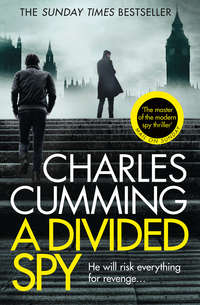
Kitabı oku: «A Divided Spy: A gripping espionage thriller from the master of the modern spy novel»


Copyright

Harper
An imprint of HarperCollinsPublishers
1 London Bridge Street,
London, SE1 9GF
www.harpercollins.co.uk
First published in Great Britain by HarperCollinsPublishers 2016
Copyright © Charles Cumming 2016
Cover layout design © HarperCollinsPublishers 2017
Cover photographs © Mark Owen/Trevillion Images (man, right); Tim Robinson/Arcangel Images (man, left and steps); Roy Bishop/Arcangel Images (London scene); Shutterstock.com (shoes)
Charles Cumming asserts the moral right to be identified as the author of this work
A catalogue record for this book is available from the British Library
This novel is entirely a work of fiction. The names, characters and incidents portrayed in it are the work of the author’s imagination. Any resemblance to actual persons, living or dead, events or localities is entirely coincidental.
All rights reserved under International and Pan-American Copyright Conventions. By payment of the required fees, you have been granted the non-exclusive, non-transferable right to access and read the text of this e-book on screen. No part of this text may be reproduced, transmitted, downloaded, decompiled, reverse engineered, or stored in or introduced into any information storage and retrieval system, in any form or by any means, whether electronic or mechanical, now known or hereinafter invented, without the express written permission of HarperCollins.
Source ISBN: 9780007467549
Ebook Edition © June 2016 ISBN: 9780007467532
Version: 2017-03-22
Dedication
For Julia Wisdom
Epigraph
‘We are, I know not how, somewhat double in ourselves, so that what we believe we disbelieve, and cannot rid ourselves of what we condemn.’
Michel de Montaigne
‘Truth doesn’t always come from truthful men.’
James Salter
Contents
Cover
Title Page
Copyright
Dedication
Epigraph
London
Chapter 1
Five Weeks Later
Chapter 2
Chapter 3
Chapter 4
Chapter 5
Chapter 6
Chapter 7
Chapter 8
Chapter 9
Chapter 10
Chapter 11
Chapter 12
Chapter 13
Chapter 14
Chapter 15
Chapter 16
Chapter 17
Chapter 18
Chapter 19
Chapter 20
Chapter 21
Chapter 22
Chapter 23
Chapter 24
Chapter 25
Chapter 26
Chapter 27
Chapter 28
Chapter 29
Chapter 30
Chapter 31
Chapter 32
Chapter 33
Chapter 34
Chapter 35
Chapter 36
Chapter 37
Chapter 38
Chapter 39
Chapter 40
Chapter 41
Chapter 42
Chapter 43
Chapter 44
Chapter 45
Chapter 46
Chapter 47
Chapter 48
Chapter 49
Chapter 50
Chapter 51
Chapter 52
Chapter 53
Chapter 54
Chapter 55
Chapter 56
Chapter 57
Chapter 58
Chapter 59
Chapter 60
Chapter 61
Chapter 62
Chapter 63
Chapter 64
Chapter 65
Chapter 66
Chapter 67
Acknowledgements
Read on for an extract from the first book in the Thomas Kell series …
About the Author
By Charles Cumming
About the Publisher
London
1
Put it all on red. Put it all on black.
Jim Martinelli stacked five thousand pounds of chips into two six-inch piles. He held each of the piles in the tips of his fingers. One of them was fractionally higher than the other, the other slightly crooked at the base. He stared at them. His whole future, the mountain of his debt, just twenty discs of plastic in a casino. Double the money and he could keep Chapman at bay. Lose it and he was finished.
Arms across the baize, a blur of hands as the players around him reached out to place their bets. The suit from Dubai putting single chips on eighteen through thirty-six, the other Arab putting a grand on red. The Chinese tourist to Martinelli’s left put a carpet of blue chips in the upper third, smothering the table with piles of five and six. Big wins for him tonight, big losses. Then he put twenty grand on ten and walked away from the table. Twenty thousand pounds on a one in thirty-five chance. Even in the worst times, in the craziest urges of the last two years, Martinelli had never been stupid enough to do something like that. Perhaps he wasn’t as messed up as he thought. Maybe he still had things under control.
The wheel was spinning. Martinelli stayed out of the play. It didn’t feel right; he wasn’t getting a clear reading on the numbers. The Chinese tourist was hovering near the bar, now almost twenty feet away from the table. Martinelli tried to imagine what it must be like to have so much money that you could afford to blow twenty grand on a single moment of chance. Twenty grand was four months’ salary at the Passport Office, more than half of his debt to Chapman. Two wins in the next two rounds and he would be holding that kind of dough. Then he could cash out, go home, call Chapman. He could start to pay back what he owed.
The croupier was tidying up. Centring chips, straightening piles. In a low, firm voice he said: ‘No further bets, please, gentlemen,’ and turned towards the wheel.
The house always wins, Martinelli told himself. The house always wins …
The ball was beginning to slow. The Chinese tourist was still hovering near the bar, back turned to the play, his little chimney of twenty grand on ten. The ball dropped and began to jump in the channels, the quiet innocent clatter as it popped from box to box. Martinelli laid a private bet with himself. Red. It’s going to be red. He looked down at his pile of chips and wished that he had staked it all.
‘Twenty-seven, red,’ said the croupier, placing the wooden dolly on a low pile of chips in the centre of the baize. Martinelli felt a sting of irritation. He had missed his chance. Across the room, the tourist was returning from the bar, watching the croupier clear away the losing bets, the cheap plastic rustle of thousands of pounds being dragged across the baize and scooped into the tube. There was no expression on his face as the stack on ten was pulled; nothing to indicate loss or sorrow. Washed-out and inscrutable. The face of a gambler.
Martinelli stood up, nodded at the inspector. He left his chips on the table and walked downstairs to the bathroom. They were playing Abba on the sound system, a song that reminded Martinelli of driving long distances with his father as a child. The door of the gents was ajar, paper towels littering the floor. Martinelli scraped them to one side with his foot and checked his reflection in the mirror.
His skin was pallid and gleaming with sweat. In the bright fluorescent light of the bathroom the tiredness under his eyes looked like bruises from a fight. He had worn the same shirt two nights in a row and could see that a thin brown line of dirt had formed inside the collar. He bared his teeth, wondering if a chunk of olive or peanut had been lodged in his gums all night. But there was nothing. Just the pale yellow stains on his front teeth and a sense that his breath was stale. He took out a piece of gum and popped it into his mouth. He was exhausted.
‘All right, Jim? How’s it going for you tonight?’
Martinelli swung around.
‘Kyle.’
It was Chapman. He was standing in the door, looking at a stack of leaflets in a plastic box beside the sink. Advice for gamblers, advice for addicts. Chapman picked one up.
‘What does it say here?’ he began, reading from the leaflet in his abrasive London accent. ‘How to play responsibly.’
Chapman smiled at Martinelli, but the eyes were dead, menacing. He turned the page.
‘Remember. Gambling is a way for responsible adults to have some fun.’
Martinelli had never had the balls to read the leaflet. They said that the addict had to want to quit. He felt his stomach dissolve and had to steady himself against the wall.
‘Most of our customers do not see gambling as a problem. But for a very small minority, Jim, we know that this is not the case.’
Chapman looked up. He moved the side of his mouth in a way that made Martinelli feel like he was going to spit at him.
‘If you think you are having trouble controlling your gambling, this leaflet contains important information on where to seek help.’ Chapman lowered the leaflet and looked into Martinelli’s eyes. ‘Do you need help, Jim?’ He tilted his head to one side and grinned. ‘Do you want to talk to someone?’
‘I’ve got five grand on the table. Upstairs.’
‘Five? Have you?’ Chapman sniffed loudly, as if he was struggling to clear his sinuses. ‘You and I both know that’s not what we’re talking about, don’t we? You’re not being straight, Jim.’
Chapman took a step forward. He raised the leaflet and held it in front of him, like a man singing a hymn in church.
‘Only gamble what you can afford to lose,’ he said. ‘Set yourself personal limits. Only spend a certain amount of time at the tables.’ He stared at Martinelli. ‘Time, Jim. That’s what you’ve run out of, isn’t it?’
‘I’ve told you,’ he said. ‘Five grand. Upstairs. Let me play.’
Chapman walked towards the basins. He looked at himself in the mirror, admiring what he saw. Then he kicked out his leg behind him and slammed the bathroom door.
‘I can tell you that you’ve got a problem,’ he said. ‘I can tell you that if you don’t give me what’s owed by tomorrow morning, I won’t be – how do they say – responsible for my actions.’
‘I understand that.’ Martinelli could feel himself freezing up, his mind going numb.
‘Oh you understand that, do you?’
‘Can you just let me past?’ Martinelli pressed away from the wall and moved towards the basins. ‘Can you open the door, please? I want to go upstairs.’
Chapman appeared to admire his display of courage. He nodded and opened the door. An ominous smile was playing on his face as he indicated that Martinelli could leave.
‘Don’t let me stop you,’ he said, stepping to one side with the flourish of a matador. ‘You go and see what you can do, Jim. Be lucky.’
Martinelli climbed the stairs two at a time. He needed to be back at the tables in the way that a man who has been held underwater craves to reach the surface and to suck in a deep breath of air. He headed back to his seat and saw that a play was coming to an end. The pop and clatter of the ball, the rapt attention of the gamblers waiting for it to settle.
‘Six. Black,’ said the croupier.
Martinelli saw that the Chinese tourist had a split of five grand on five and six. A small fortune. The croupier placed the dolly on the winning square and began to sweep the losing chips from across the table. Then he paid out what he owed – more than eighty grand to the Chinese in a stack of twenty, with no discernible reaction from either man.
Martinelli took it as a sign. He waited until the table was clear, then moved his stack of chips on to black. All or nothing. Take it or leave it. The house always wins. Fuck Kyle Chapman.
Then it was just a question of waiting. The bloke from Dubai put his usual spread on eighteen through thirty-six, the other Arab going big on six-way splits along the baize. It worried Martinelli that the Chinese stayed out of the play, wandering over to the bar. It was like a bad omen. Maybe he should take back his chips.
‘No more bets, please, gentlemen,’ said the croupier.
Too late. Martinelli could do nothing but stare at the wheel, praying for the chance on black, mesmerized – as he had always been – by the counterpoint of spokes and ball, the one hypnotically slow, the other a blur as it raced beneath the rim.
Slowing now, the ball about to drop. Nauseous with anxiety, Martinelli took his eyes away from the wheel and saw Kyle Chapman standing in his eyeline. He had come back upstairs. He wasn’t looking at the wheel. He wasn’t looking at the baize. He was looking directly at the man who owed him thirty thousand pounds.
Martinelli’s eyes went back to the table. All or nothing. Feast or famine. He heard the rattle and click of the ball, watched it drop and vanish beneath the rim like a magic trick.
The inspector looked down. He would see it first. The croupier leaned over the wheel, preparing to call the number.
Martinelli closed his eyes. It was like an axe falling. He always felt sick at this moment.
I should have put it all on red, he thought. The house always wins.
Five Weeks Later
2
Thomas Kell stood on the westbound platform at Bayswater station, one eye on a copy of the Evening Standard, the other on the man standing three metres to his left wearing faded denim jeans and a brown tweed jacket. Kell had seen him first on Praed Street, reflected in the window of a Chinese restaurant, then again twenty minutes later coming out of a branch of Starbucks on Queensway. Average height, average build, average features. Tapping his Oyster card on the reader at Bayswater, Kell had turned to find the man walking into the station a few paces behind him. He had ducked the eye contact, staring at his well-worn shoes. That was when Kell sensed he had a problem.
It was just after three o’clock on a Wednesday afternoon in June. Kell counted eleven other people waiting on the platform, two of them standing directly behind him. Drawing on a long-forgotten piece of self-defence, he placed his right leg further forward than his left, shifted his weight back on to his rear heel as the train clattered into the station – and waited for the shove in the back.
It never came. No crowding up, no crazed Chechen errand boy trying to push him on to the tracks as a favour to the SVR. Instead the District Line train deposited half a dozen passengers on to the platform and eased away. When Kell looked left, he saw that the man in the faded jeans had gone. The two men who had been standing behind him had also boarded the train. Kell allowed himself a half smile. His occasional outbreaks of paranoia were a kind of madness, a yearning for the old days; the corrupted sixth sense of a forty-six-year-old spy who knew that the game was over.
A second train, moments later. Kell stepped on board, took a fold-down seat and re-opened the Standard. Royal pregnancies. Property prices. Electoral conspiracies. He was just another traveller on the Tube, traceless and nondescript. Nobody knew who he was nor who he had ever been. On the fifth page, a photograph of an aid worker murdered by the maniacs of ISIS; on the seventh, more wretched news from Ukraine. It was of no consolation to Kell that in the twelve months he had spent as a private citizen following the murder of his girlfriend, Rachel Wallinger, the regions on which he had worked for the greater part of his adult life had further disintegrated into violence and criminality. Though Kell had deliberately avoided making contact with anyone in the Service, he had occasionally run into former colleagues in the supermarket or on the street, only to be treated to lengthy discourses on the ‘impossible task’ facing SIS in Russia, Syria, Yemen and beyond.
‘The best we can hope for is a kind of stasis, somehow to keep a lid on things,’ a former colleague had told him when they bumped into one another at a Christmas party. ‘God knows it was easier in the age of the despots. There are some mornings, Tom, when I’m as nostalgic for Mubarak and Gaddafi as a Dunkirk Tommy for the white cliffs of Dover. At least Saddam gave us something to aim for.’
The train pulled into Notting Hill Gate. In the same conversation, the colleague had offered his ‘sincere condolences’ over Rachel’s death and intimated to Kell how ‘devastated’ the ‘entire Service’ had been over the circumstances of her assassination in Istanbul. Kell had changed the subject. Rachel’s memory was his alone to curate; he wanted no part in others’ recollections of the woman to whom he had lost his heart. Perhaps he had been naive to fall so quickly for a woman he had barely known, yet he guarded the memory of his love as jealously as a starving animal with a scrap of food. Every morning, for months, Kell had thought of Rachel at the moment of waking, then steadily throughout the day, a debilitating punctuation to his solitary, unchanging existence. He had raged at her, he had talked with her, he had drenched himself in memories of the short period in which they had been involved with one another. The loss of the potential that Rachel had possessed to knit together the broken strands of Kell’s life constituted the most acute suffering he had ever known. Yet he had survived it.
‘You must be having a mid-life crisis,’ his ex-wife, Claire, had told him at one of their occasional reunion lunches, commenting on the fact that Kell had given up alcohol, was taking himself off to the gym three times a week and had broken a twenty-year, twenty-a-day smoking habit. ‘No alcohol, no fags. No spying? Next thing you’ll be buying an open-topped Porsche and taking twenty-two-year-olds to the polo at Windsor Great Park.’
Kell had laughed at the joke even as he inwardly acknowledged how little Claire understood him. She knew nothing, of course, about his relationship with Rachel, nothing about the operation that had led to her death. This was just the latest in a lifetime of secrets between them. As far as Claire was concerned, Kell would always be the same man: an intelligence officer through and through, a spy who had spent more than two decades in thrall to the lustre and intrigue of the secret world. She believed that their marriage had failed because he had loved the game more than he had loved her.
‘You’re wedded to your agents, Tom,’ Claire had said during one of many similarly unequivocal conversations that had heralded the end of the marriage. ‘Amelia Levene is your family, not me. If you had to choose between us, I have no doubt that you would pick MI6.’
Amelia. The woman whose career Kell had saved and whose reputation he had salvaged. The Chief of the Secret Intelligence Service, appointed three years earlier, now approaching the end of her tenure, with the Middle East on fire, Russia in political and economic turmoil and Africa ravaged by Islamist terror. Kell had neither seen nor heard from her since the afternoon of Rachel’s funeral, an occasion at which they had deliberately ignored one another. By recruiting Rachel to work for SIS behind his back, Amelia had effectively signed her death warrant.
Earl’s Court. Kell stepped off the train and registered the familiar acid taste of his implacable resentment. It was the one thing he had been unable to control. He had come to terms with the end of his marriage, he had mastered his grief, reasoned that his professional future lay beyond the walls of Vauxhall Cross. Yet he could not still a yearning for vengeance. Kell wanted to seek out those in Moscow who had given the order for Rachel’s assassination. He wanted justice.
The Richmond service was due in a few minutes. A pigeon swooped in low from the Warwick Road, flapped towards the opposite platform and settled beside a bench. There was a District Line train standing empty behind it. The pigeon hopped on board. As if on cue, the doors slid shut and the train moved out of the station.
Kell turned and joined the huddle of passengers on platform 4, heads ducked down in text messages, Twitter feeds, games of Angry Birds. A huge bearded man with a ‘Baby on Board’ badge attached to the lapel of his jacket stood beside him. Kell half-expected to spot his old friend from Bayswater: faded denim jeans and a brown tweed jacket. A woman behind him was talking in Polish on a mobile phone; another, shrouded in a black niqab, was scolding a small child in Arabic. These were the citizens of the new London, the international masses whom Amelia Levene was charged to protect. More than twenty years earlier, Kell had joined SIS in a spirit of undiluted patriotism. To save lives, to defend and protect the kingdom, had seemed to him both a noble and an exhilarating pursuit for a young man with adventure in his blood. Now that London was a city of Africans and Americans, of Hollande-fleeing French, of Eastern Europeans too young to have known the impediments of Communism, he felt no different. The landscape had changed, yet Kell still felt wedded to an idea of England, even as that idea shifted and slipped beneath his feet. There were days when he longed to return to active duty, to stand once again at Amelia’s side, but Rachel’s death had pushed him into exile. He had allowed the personal to overcome the political.
The train pulled into the platform. Carriages as empty as his days flickered in the afternoon light. Kell stepped aside to allow an elderly woman to board the train, then took his seat, and waited.
3
Kell was at his flat in Sinclair Road within twenty minutes. He had been inside for less than five when his phone rang, a rare landline call that Kell assumed would be from Claire. The number was otherwise known only to SIS Personnel.
‘Guv?’
It didn’t take long for Kell to pick the voice. Born and raised in Elephant and Castle, then two decades in Tech-Ops at MI5.
‘Harold?’
‘The one and only.’
‘How did you get this number?’
‘Nice to hear from you, too.’
‘How?’ Kell asked again.
‘Do we have to do this?’
It was a fair question. With half a dozen clicks of a mouse, Harold Mowbray could have found out Kell’s blood type and credit rating. Now private sector, he had worked closely with Amelia on two occasions in the previous three years: Kell’s home number might even have come directly from ‘C’.
‘OK. So how have you been?’
‘Good, guv. Good.’
‘Arsenal doing all right?’
‘Nah. Gave them up for Lent. Too many pretty boys in midfield.’
Kell found himself reaching for a cigarette that wasn’t there. He thought back to the previous summer, sitting with Mowbray in a Bayswater safe house killing time waiting for a mole. Harold had known that Kell was in love with Rachel. He had come to the funeral, paid his respects. Kell trusted him insomuch as he had always been efficient and reliable, but knew that theirs was a professional relationship that would never transcend Mowbray’s loyalty to whoever was paying his bills.
‘So what’s up?’ he asked. ‘You selling something? Want me to buy your season ticket to Highbury?’
‘Keep up. Arsenal moved out of Highbury years ago. Been playing at the Emirates since 2006.’ It occurred to Kell that, save for a perfunctory exchange in Pret A Manger, this was the first conversation he had held with another human being in over twenty-four hours. The night before he had cooked spaghetti bolognese at home and watched back-to-back episodes of House of Cards. In the morning he had gone to the gym, then wandered alone around an exhibition at the National Portrait Gallery. Sometimes he would go for days without any meaningful interaction whatsoever.
‘Still,’ said Mowbray, ‘we need to have a chat.’
‘Isn’t that what we’re doing?’
‘Face to face. Mano a mano. Too long and complicated for the phone.’
That could mean only one thing. Work. Blowback from a previous operation, or a dangled carrot on something new. Either way, Mowbray didn’t trust Kell’s landline to keep it a secret. Anybody could be listening in. London. Paris. Moscow.
‘You remember that Middle Eastern place we used to go to on the American gig?’
‘Which one?’ ‘The American gig’ had been the molehunt. Ryan Kleckner. A CIA officer in the pay of the SVR, Russia’s foreign intelligence service.
‘The one with the waitress.’
‘Oh, that one.’ Kell made a joke of it, but understood that Mowbray was being deliberately obscure. There was only one Middle Eastern restaurant that both of them had been to on the Kleckner operation. Westbourne Grove. Persian. Kell had no recollection of the waitress, pretty or otherwise. Mowbray was simply making sure that their table wouldn’t be covered in advance.
‘Can you make dinner tonight?’ he asked.
Kell thought about stalling but was too intrigued by the invitation. Besides, he was looking at another night of leftovers and House of Cards. Dinner with Harold would be a fillip.
‘Meet you there at eight?’ he suggested.
‘You will know me by the smell of my cologne.’
4
Kell arrived at the restaurant at quarter to eight, early enough to ask for a quiet spot at the back with line of sight to the entrance. To his surprise, Mowbray was already seated at a table in the centre of the small, brick-lined room, his back to a group of jabbering Spaniards.
It was fiercely hot, the open mouth of a tanoor blowing a furnace heat into Kell’s face as he walked inside. A waitress, whom he vaguely recognized, smiled at him as Mowbray stood up behind her. Iranian music was playing at a volume seemingly designed to guarantee a degree of conversational privacy.
‘Harold. How are you?’
‘Salam, guv.’
‘Salam, khoobi,’ Kell replied. The heat of the tanoor as he sat down was like a summer sun against his back.
‘You speak Farsi?’ They were shaking hands.
‘I was showing off,’ Kell said. ‘Enough to get by in restaurants.’
‘Menu Farsi,’ Mowbray replied, smiling at his own remark. ‘Iranians don’t like being confused for Arabs, do they?’
‘They do not.’
Mowbray looked to be recovering from a bad case of sunburn. His forehead was scalded red and there were flaking patches of dry skin around his mouth and nose.
‘Been away?’ Kell asked.
‘Funny you should mention that.’ Mowbray flapped a napkin into his lap and grinned. ‘Went to Egypt with the wife.’
‘Why funny?’
‘You’ll see. Shall we order?’
Kell wondered why he was playing hard to get. He opened his menu as the waitress passed their table. Mowbray looked up, caught Kell’s eye and winked.
‘So,’ he said, spring-loading another joke. ‘You can have a skewer of minced lamb with taftoon bread, two skewers of minced lamb with taftoon bread, a skewer of marinated lamb cubes with taftoon bread, two skewers of marinated lamb cubes with taftoon bread, a skewer of minced lamb and a skewer of marinated lamb cubes with taftoon …’
‘I get it,’ said Kell, smiling as he closed the menu. ‘You order. I’m going to the bathroom.’
There was a strong smell of hashish leading up to the gents. Kell stopped to look at a wall of turquoise tiles inlaid on the staircase, breathing in the smoke. He wanted to trace the source of the smell, to find whoever had rolled the joint in a backroom office and to share it with them. In the bathroom he washed his hands and glanced in the mirror, wondering why Mowbray was coming to him with tall tales from Egypt. What was the scoop? ISIS? Muslim Brotherhood? Maybe he was the bagman for a job offer in the private sector, an ex-SIS suit using Kell’s friendship with Mowbray as a lure. There had been five or six such offers in the previous twelve months, all of which Kell had turned down. He wasn’t interested in private security, nor did he want to be a nodding donkey on the board of Barclays or BP. On the other hand, if the pitch was something Russian, something that would get Kell close to the men who had ordered Rachel’s assassination, he would give it serious consideration.
‘I forgot,’ Mowbray announced, as Kell settled back into his seat. ‘They don’t serve booze.’
‘Don’t worry about it. I gave up.’
‘Fuck off.’
‘Seven months dry.’
‘Now why would you want to go and do a thing like that?’
‘Tell me about Egypt.’
Mowbray leaned forward and put a hand in his pocket. Kell thought he was going to produce a photograph or a flash drive, but he kept it there as he spoke. If Kell hadn’t known that Mowbray was capable of far greater subtleties, he might have assumed that he was triggering a recording device.
‘Hurghada.’
‘What about it?’
‘One-horse town on the east coast. Mainland Egypt. Red Sea, facing Sinai.’
‘I know where it is, Harold.’
‘Last three years, Karen and me have been flying there for a bit of winter sun; easyJet goes three times a week. Car picks us up and drives us an hour south to a place called Soma Bay. Four hotels and a golf course, back-to-back, arse end of nowhere. Fresh water piped in from the Nile, turns the fairways green, fills the swimming pools. Coral reefs and scuba diving for the grown-ups, camel rides on the beach for the kids. In the tourist industry they call it a “hot flop”.’
The food arrived. Mashed aubergines with garlic and herbs. Feta cheese mixed with tarragon and fresh mint. A bowl of hummus was placed in front of Kell, nestled beside a basket of flatbread.
‘There’s your taftoon,’ he said, encouraging Mowbray to continue.
‘Anyway, we always stay at the same place. German-owned, German efficient, German-occupied sunbeds. Never seen a Yank there, never met a Frog. The occasional Brit, from time to time, but mostly German pensioners and Russian oligarch types with dyed hair and third wives who probably weren’t alive under Gorbachev. Am I painting the picture?’
‘Vividly,’ said Kell, and took a bite of taftoon.
‘So, guv, here’s the thing. Here’s the reason I wanted to see you. Something very strange happened, something I can still hardly believe.’
Mowbray looked like he meant it. There was an expression of amused consternation on his face.
‘They do breakfasts,’ he said, nodding slowly and looking across the table, as though half-expecting Kell to finish his sentence. ‘They do breakfasts every morning …’
‘What a breakthrough in hospitality,’ Kell replied. ‘I must go and stay there.’
Mowbray didn’t laugh. His eyes were fixed somewhere around Kell’s left ear.
‘On the second last day we were there, this couple walks in. Two men. You get that kind of thing at the hotel. They’re comfortable with gays, lots of it about, even for a Muslim country.’ Mowbray sipped his tap water, trying to slow himself down. ‘Karen looks up and makes a noise of disapproval.’ He checked himself. ‘No, not disapproval, she’s not homophobic or anything. More conspiratorial than that. Like a joke between us. “Look at the fruits”, you know?’
‘Sure,’ said Kell.
‘They were both dressed in white shirts and white trousers. That’s very German, too. Ninety per cent of the guests look like they’re playing at Wimbledon or members of some cult. Pristine white, like an advert for one of those soap powders that really deliver at low temperatures.’ Kell resisted telling Mowbray to ‘get on with it’ because he knew how he liked to operate. ‘And there’s an age gap between them,’ he said, ‘maybe fifteen or twenty years. The older bloke is the one facing me. German money, you can tell. He sits down with what looks like a fruit salad, black-rimmed glasses, suntan. I can’t see the boyfriend, but he’s younger, fitter. Late thirties, at a guess. The old boy is camp, a bit effeminate, but this one looks straight, macho. There’s something about him that triggers me, but I can’t yet tell what it is.’
Kell had stopped eating. He knew what Mowbray was going to tell him, a giddy premonition of something so improbable that he dismissed it out of hand.
‘Anyway, Karen had finished her orange juice. Wanted to get another one. She’d hurt her foot on the coral so I offered to go instead. There’s an egg station at the buffet and I waited there while the chef made me an omelette. Got the wife’s orange juice, got some yogurt, then started to walk back towards our table. That was when I saw his face. That was when I recognized him.’
‘Who?’ said Kell. ‘Who was it?’
‘The boyfriend was Alexander Minasian.’
5
Kell stared at Mowbray in disbelief.
‘Don’t fuck around,’ he said, because the chance sighting was so sensational that Kell had to reckon that Mowbray was making a joke.
‘As clear as I’m sitting here facing you,’ he said. ‘No way it was anybody else.’
Alexander Minasian was the SVR officer responsible for the recruitment of Ryan Kleckner, a high-level CIA mole in the Middle East who had funnelled Western secrets to Moscow for more than two years. In an operation instigated by Amelia Levene, Kell had identified Kleckner, run him to ground in Odessa and handed him over to Langley. In response to the loss of Kleckner, Moscow had given the order to kill Rachel. Kell held Minasian personally responsible. He wanted his head on a plate.
‘Minasian has a wife,’ Kell said quietly. The heat of the kiln was burning into his back. ‘At least that’s what we thought. It never entered the equation that he was gay. It’s not SVR house style. They wouldn’t countenance it. They’re not big on homosexuality in Putin’s Russia. You probably noticed.’
Mowbray’s reaction – a slow shake of the head, mouth pursed so that minute traces of food were visible on the inside of his lips – told Kell that he was convinced by what he had seen. He picked up his glass and turned it in his hand, a man waiting to be believed. Kell began to work from memory, his knowledge of Minasian still as insubstantial as the official SIS file. Nobody knew where Minasian had come from, where he was currently stationed, how he had recruited Kleckner.
‘Minasian’s wife is the daughter of a St Petersburg oligarch. Andrei Eremenko. Draws a lot of water in Moscow. Close to the Kremlin.’ Kell had spent long hours looking into Eremenko’s business affairs, searching for any overlap with Minasian, any clue as to his whereabouts or personality. ‘If he finds out his son-in-law is gay …’
‘He’s not going to be very happy about it.’ Mowbray finished Kell’s sentence and set his glass back on the table. ‘Nor is Mrs Minasian, for that matter. Wives can be sensitive about that sort of thing.’
‘Perhaps she already knows,’ Kell suggested. In his experience, wives often knew far more of their husband’s misdemeanours than they ever publicly acknowledged. Many of them preferred to exist in a state of denial. Let the man philander, let him play his vain and tawdry games. Just keep it in-house. At all costs, protect the nest.
‘That’s what I wondered.’
Kell was silent as he continued to analyse what he had been told. It was unthinkable that the SVR would have a gay officer on its books, married or otherwise. SIS had only begun recruiting openly homosexual employees in the previous ten or fifteen years; modern Russia was antediluvian by comparison. If Minasian’s secret were exposed, his career would end overnight.
‘Who else have you spoken to about this?’
Kell dreaded the simple reply: ‘C’ because it would instantly shrink his options. The wheels of his imagination had begun to turn, a dormant ruthlessness circling Minasian’s vulnerability like a bird of prey. If his nemesis was hiding a secret of this magnitude, he was vulnerable to an extent that was almost beyond belief. But if Amelia knew about it, she would sideline Kell on any subsequent operation, doubtless citing ‘personal issues’ and ‘clouded judgment’.
‘I haven’t told a soul,’ Mowbray replied, though his eyes slid to one side and he tapped his mouth with a napkin as he spoke. Kell studied the face and could not be certain that Mowbray was telling the truth. A tiny section of sunburned skin around his nose looked as if it was about to flake off.
‘Not even Karen?’ he asked. Spousal pillow talk was an occupational hazard among veteran spies; the habit of secrecy became harder and harder to sustain as the years went by.
‘Never discuss work with the wife,’ Mowbray replied quickly. ‘Never. Something we agreed on from day one. Last time she asked me was ninety-one or ninety-two, when they arrested a bunch of IRA in London. She was watching John Simpson on the Nine O’Clock News, said: “Did you have something to do with this?” I told her to mind her own business.’
‘But she saw Minasian?’
‘Oh yeah. All the time.’
‘What does that mean? She met him?’
‘No. Neither of us did. But we were staying at the same hotel. Caught the whole show.’
Kell saw the glint in Mowbray’s eye, the suggestion of an even greater prize.
‘Call it trouble in paradise,’ he explained with a predictable grin. ‘Our man from Moscow wasn’t getting on very well with his boyfriend. They kept fighting. Arguing.’
‘All of this played out in public?’ Kell was beginning to wonder if Harold had stumbled on a set-up, Minasian role-playing the moody boyfriend for the purpose of an undisclosed SVR operation at the hotel. Perhaps the relationship had even been staged for Mowbray’s benefit, or Harold himself had been turned by the Russians.
‘Not exactly.’ Mowbray was leaning forward again, still grinning. ‘You see, I made a point of watching them whenever I could. Surreptitious photos, eavesdropping in the bar.’
‘Jesus.’ Kell had an image of Mowbray prowling around a sun-blasted Egyptian tourist resort with a long-lens camera and a boom microphone. ‘Any chance I could see those photos?’
Mowbray had been biding his time, waiting for the invitation. Setting his knife and fork to one side, he shot Kell a look of mischievous self-satisfaction and reached back into his jacket pocket. Inside were half a dozen colour photographs, the size of postcards, four of which spilled on to the ground as he retrieved them.
‘Fuck,’ he muttered. It was like watching a conjuror trying to learn a new trick. ‘Here you go.’
Kell took the photographs and experienced an extraordinary feeling of exhilaration. He turned to check his background. A chef in stained check trousers was standing three feet behind him, stretching a ball of dough on a small cushion. Kell’s body was cloaked in heat. He craved alcohol.
The first photograph showed Minasian standing alone at the edge of a swimming pool, in bright sunlight. He was wearing Rayban sunglasses and navy blue swimming shorts. Fit for his age, defined musculature, an expressionless mouth. The man who had given the order to kill Rachel. He felt a visceral hatred towards him. There was a woman’s blurred shoulder in the left foreground of the shot, presumably Karen. Mowbray had used her as a decoy.
The next three photographs were all taken by long lens from an elevated position, angled down towards a garden in which Minasian was standing with his lover. When Kell asked, Mowbray confirmed that he had been sitting on the balcony of his room at the back of the hotel and had overheard the two men arguing. In the first shot of the sequence, they were embracing, Minasian topless, the older man wearing a pale pink short-sleeved shirt, white shorts and plimsolls. He was tanned with chalk-white hair that was bald at the crown. In the second shot, the older man appeared to be extremely upset, his eyes stained with tears, Minasian leaning back as if to disengage from what was happening in front of him. In the third shot – Kell assumed that he had looked at the sequence out of chronological order – Minasian was gesticulating with his right arm in a manner deemed threatening enough for the older man to be shielding himself by raising his hand and turning to one side. Was he afraid of being hit? The next photograph, apparently taken with a different lens, from a new angle, showed the older man crouching down in a separate section of the garden, hands covering his face.
‘What was going on?’ Kell asked.
‘They were shouting at each other like a couple of teenagers.’ The waitress removed the bowls of hummus and mashed aubergine. There was a clatter as something fell over in the kitchen. ‘Big fight between two queens about “lying” and “broken promises” and Minasian being a “prick”. I couldn’t make much of it out.’
‘They were always speaking English?’
‘Mostly. Far as I could tell, the old boy didn’t speak Russian. He’s German. From Hamburg.’
‘How do you know that?’
‘Because I’m not an idiot, guv.’
‘Nobody said you were, Harold.’
Kell took a bite of lamb and invited Mowbray to continue. He was about to order a beer when he remembered that the restaurant was dry. A single glimpse of the secret world had been enough to strip him of a seven-month commitment to remain booze free.
‘His name is Bernhard Riedle.’
‘How are you spelling that?’
Mowbray wrote down the name on a piece of paper and passed it to Kell.
‘I got into the hotel email. Piece of piss. Jumped on their wi-fi, hacked into the account used by the reservations manager, read Riedle’s messages.’
‘Undetected?’
Kell felt uneasy. Mowbray wasn’t trained in surveillance. If Minasian had caught even a scent of his interest – the eavesdropped conversations, the clandestine photographs – he might have turned the tables and engineered an investigation of his own into the nosey couple from England.
‘Of course undetected. Did the whole thing from my room. Took fifteen minutes. Anyway, here’s the interesting bit. Minasian stayed under a pseudonym. Riedle called him “my partner Dmitri” in the emails.’
‘Makes sense,’ said Kell. ‘He’s married. Riedle could be covering for him. Did you get a passport? A surname?’
‘No, sir.’
‘But Minasian would have had to show one when he checked in. So either Riedle really does think his boyfriend is called “Dmitri” or he’s conscious that Alexander Minasian works for the SVR and is travelling under alias.’
‘How do you figure that?’
Mowbray looked momentarily confused, as if Kell had identified a flaw in his thesis. For his own part, Kell was surprised that Mowbray had failed to join the dots.
‘If I go on holiday with my girlfriend “Anne Smith” and she travels on a passport calling herself “Betty Jones”, I’m going to ask her how come she has two identities. Unless she’s from the Office.’
‘True,’ said Mowbray. ‘You are.’ There was a sheepish pause while he made a silent calculation. Kell sensed his embarrassment and urged him to continue.
‘Well,’ he said, rubbing the back of his head. ‘We can discount the idea that Riedle is a spook. Once I got home I did some digging around. He’s an architect.’
‘From Hamburg?’
‘Originally, yes. That’s where he has his practice, anyway. Right now, though, he’s spending a lot of time in Brussels.’
‘Reason?’
‘Some kind of office building. Swish headquarters for a Belgian television company. He’s designing it, living in an apartment there while it goes up.’
‘With Minasian paying him the occasional visit?’
‘Negative, Houston.’
‘They broke up?’
‘They broke up,’ Mowbray replied.
Kell immediately saw this not as a setback, but as an opportunity. A man in love is less likely to betray his partner. A man with a broken heart can be manipulated into acts of vengeance.
‘You said Riedle was feeling sorry for himself? That’s what you meant? Minasian dumped him?’
Mowbray squeezed his chafed nose and looked to one side, timing the delivery of a chunk of bad news. The waitress, who had passed their table several times in the preceding minutes, trying to ascertain if the two middle-aged gentlemen intended to finish their meals, finally made her decision and began collecting their plates of half-eaten food.
‘He dumped him,’ said Mowbray. ‘Gigantic lover’s tiff.’
‘After the argument you witnessed? That was it? They separated?’
Mowbray nodded, staring at the table.
‘The photos you saw, then Riedle crying on his own in the garden. That was the last time we saw Minasian. I assume he left that night. There was a twenty-two hundred Air Egypt flight from Hurghada to Cairo. He could have gone anywhere after that.’
‘And Riedle?’
‘Stayed another two days. Had breakfast in his room, ate dinner alone with a look on his face like his life was over.’
‘How do you figure that?’ Kell asked. ‘Just from a look on his face? Maybe he’s that kind of person.’
Mowbray pitched backwards in his seat, as if Kell had been unnecessarily confrontational. Kell apologized with a raised hand and took the opportunity to order two glasses of mint tea. He was aware that his adrenaline was running high, an eagerness to ensnare Minasian clashing against long-practised instincts for caution and context.
‘What I meant was …’
‘Don’t worry, guv.’ Mowbray offered a conciliatory hand of his own. ‘I know what you meant. How did we know he was suffering? Why was he wandering around like a lovestruck adolescent?’
‘Precisely. How did you know?’
Mowbray pulled out a packet of cigarettes and set them on the table. Kell looked at them and resented his own self-discipline.
‘Riedle spent a lot of time at the pool, reading off an iPad. Struck up a friendship with one of the boys down there. Egyptian kid, good-looking.’
‘Gay?’
Mowbray realized what he had said and shook his head vigorously, chasing off the inference.
‘No. Nothing like that. Married, wife and kid in Luxor. Early thirties. Laid out our sunbeds in the morning. Brought us drinks. Put up the umbrellas when the sun got too hot. You know the kind of thing.’
‘Sure.’
‘Well, I got talking to him and he said how Riedle was unhappy. He’d broken up with his boyfriend. They’d been seeing each other for over three years, had the latest in a long line of nasty rows. “Dmitri” had left the hotel, gone off with a new man.’
‘He told all that to a pool boy?’
Mowbray seemed to be aware that the interaction sounded far-fetched.
‘Bernhard struck me as the confessional sort. Needy, artistic, you know? Any sympathetic ear will do for a type like that. “I’m in pain, come and listen to me. I’ve built a new house, come and look at it. I’m miserable, make me feel better.” And we tell strangers our secrets, don’t we? He’s never going to see the pool boy again, never going to build him a house in Luxor. He was a convenient shoulder to cry on for a couple of miserable days in paradise.’
Kell felt a strange and disorienting sense of kinship with Riedle, the empathy of the broken-hearted man. He remembered his own dismay at Rachel’s treachery, then the long months of grieving that followed her death. He accepted the mint tea from the waitress, who smiled at Mowbray as she placed a glass on the table in front of him. Kell was surprised when Mowbray asked for the bill. What was the hurry?
‘You’ve told nobody about this?’ he asked.
‘Nobody, guv. Just you. I knew what it would mean to you, after everything that happened. Wanted to give you the opportunity.’
Kell found himself saying ‘Thank you’ in a way that caused Mowbray to produce a conspiratorial nod. A small burden of complicity had been established between them. Yet it was disconcerting to consider that choice of word: ‘opportunity’. An opportunity for what? Kell knew that nothing would ever erase the pain he had suffered over the loss of Rachel. Vengeance would not bring her back to life, nor alter the dynamics of his relationship with Amelia. Recruiting Minasian would bring Kell a modicum of respect from colleagues at SIS for whom he felt little but contempt. So why do it? Why not stand up, shake Mowbray’s hand, put fifty quid on the table to cover the bill and walk out of the restaurant? His better future lay outside SIS – he knew this, he had come to terms with it – and yet Kell felt powerless to suppress his hunger for revenge.
‘You know that I’m going to go after him, don’t you?’ he said.
‘I assumed that, yes,’ Mowbray replied.
The waitress brought the bill.
Ücretsiz ön izlemeyi tamamladınız.