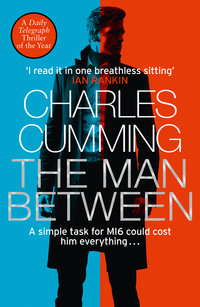
Kitabı oku: «The Man Between»


Copyright
HarperCollinsPublishers
1 London Bridge Street
London SE1 9GF
www.harpercollins.co.uk
Published by HarperCollinsPublishers 2019
Copyright © Charles Cumming 2018
Cover jacket design by Claire Ward © HarperCollinsPublishers Ltd 2019
Cover photographs © Collaboration JS/Arcangel Images
Charles Cumming asserts the moral right to be identified as the author of this work
A catalogue record for this book is available from the British Library
This is entirely a work of fiction. The names, characters and incidents portrayed in it are the work of the author’s imagination. Any resemblance to actual persons, living or dead, events or localities is entirely coincidental.
All rights reserved under International and Pan-American Copyright Conventions. By payment of the required fees, you have been granted the non-exclusive, non-transferable right to access and read the text of this e-book on-screen. No part of this text may be reproduced, transmitted, down-loaded, decompiled, reverse engineered, or stored in or introduced into any information storage and retrieval system, in any form or by any means, whether electronic or mechanical, now known or hereinafter invented, without the express written permission of HarperCollins e-books
Source ISBN: 9780008200312
Ebook Edition © JUNE 2018 ISBN: 9780008200336
Version: 2020-01-23
Dedication
For Luke Janklow and Will Francis
Epigraph
‘There is a point of no return, unremarked at the time, in most lives.’
Graham Greene, The Comedians
Contents
Cover
Title Page
Copyright
Dedication
Epigraph
Moscow
London: Eighteen Months Later
Chapter 1
Chapter 2
Chapter 3
Chapter 4
Chapter 5
Chapter 6
Chapter 7
Chapter 8
Chapter 9
Chapter 10
Chapter 11
Chapter 12
Chapter 13
Chapter 14
Chapter 15
Chapter 16
Chapter 17
Chapter 18
Chapter 19
Chapter 20
Chapter 21
Chapter 22
Chapter 23
Chapter 24
Chapter 25
Chapter 26
Chapter 27
Chapter 28
Chapter 29
Chapter 30
Chapter 31
Chapter 32
Chapter 33
Chapter 34
Chapter 35
Chapter 36
Chapter 37
Chapter 38
Chapter 39
Chapter 40
Chapter 41
Chapter 42
Chapter 43
Chapter 44
Chapter 45
Chapter 46
Chapter 47
Chapter 48
Chapter 49
Chapter 50
Chapter 51
Acknowledgements
Keep Reading …
About the Author
By Charles Cumming
About the Publisher
‘Would you prefer to talk or to write everything down?’
‘Talk,’ she said.
Somerville crossed the room and activated the voice recorder. The American had brought it from the Embassy. There was a small microphone attached to a stand, a glass of tap water and a plate of biscuits on the table.
‘Ready?’ he asked.
‘Ready.’
Somerville leaned over the microphone. His voice was clear, his language concise.
‘Statement by LASZLO. Chapel Street, SW1. August nineteenth. Officer presiding: L4. Begins now.’ He checked his watch. ‘Seventeen hundred hours.’
Lara Bartok adjusted the collar of her shirt. She caught Somerville’s eye. He nodded at her, indicating that she should start. She brought the microphone slightly closer to her and took a sip of water. The American realised that he was standing in her eyeline. He moved to a chair on the far side of the room. Bartok did not continue until he was still and completely silent.
‘In the beginning, there were seven,’ she said.
SECRET INTELLIGENCE SERVICE EYES ONLY / STRAP 1
STATEMENT BY LARA BARTOK (‘LASZLO’)
CASE OFFICERS: J.W.S./S.T.H. – CHAPEL STREET
REF: RESURRECTION/SIMAKOV/CARRADINE
FILE: RE2768X
PART 1 of 5
‘In the beginning there were seven. Ivan [Simakov], of course, who is still rightly regarded as the intellectual and moral architect of Resurrection;  and , both American citizens whom Simakov had met in Zuccotti Park at the height of Occupy Wall Street. , formerly of the Service; , the cyber expert who had been active in Anonymous for several years and was instrumental in planning and orchestrating many of Resurrection’s most effective operations in the United States. Ivan had a way of contacting such people on the dark web, of gaining their trust over time, of drawing them out into the open. I used to say that he was like a child on a beach, pouring salt onto the sand so that the creatures of the deep would rise to the surface. He enjoyed this image very much. It is no secret that Ivan Simakov liked to think of himself as a man with extraordinary capabilities.
Also present that day were Thomas Frattura, former assistant to Republican Senator Catherine McKendrick, who had been a prominent figure in Disrupt J20; and me, Lara Bartok, originally from Gyula, in eastern Hungary, about whom you know almost everything.
These seven individuals met only once, in a suite at the Redbury Hotel on East 29th Street in Manhattan. Of course, no cellphones, laptops or Wi-Fi enabled devices of any kind were permitted to be brought to the hotel. Each of the guests who entered the suite was searched by Ivan and myself and asked to remove watches and other items of jewellery, all of which we then took – along with personal belongings including bags and shoes – to a room on a separate floor of the hotel for the duration of the meeting. Ivan, who was meeting and for the first time, introduced himself as a Russian citizen, born in Moscow and educated in Paris, who was hoping to effect political change in his own country by inspiring ‘an international resistance movement directed against the advocates and enablers of autocratic and quasi-fascist regimes around the world’.
Frattura asked him to explain in more detail what he meant by this. I remember that Ivan paused. He always had a good sense of theatre. He crossed the suite and opened the curtains. It was a wet morning, there had been heavy rain all night. Through the glass it looked as though the thick fog of the New York skyline was going to seep into the room. What he said next was the best of him. In fact his response to Frattura would form the basis of all the early statements released on behalf of Resurrection outlining our movement’s basic goals and rationale.
‘Those who know that they have done wrong,’ he said. ‘Those who have lied in order to achieve their political goals. Those who consciously spread fear and hate. Those who knowingly benefit from greed and corruption. Any person who has helped to bring about the current political crisis in the United States by spreading propaganda and misinformation. Those who aid and abet the criminal regime in Moscow. Those who lied and manipulated in order to see England (sic) break from the European Union. Those who support and actively benefit from the collapse of secular Islamic states; who crush dissent and free speech and willingly erode basic human rights. Any person seeking to spread the virus of male white supremacy or deliberately to stoke anti-Semitism or to suppress women’s rights in any form. All of these people – we will begin in the United States and countries such as Russia, the Netherlands, Turkey and the United Kingdom – are legitimate targets for acts of retribution. Bankers. Journalists. Businessmen. Bloggers. Lobbyists. Politicians. Broadcasters. They are to be chosen by us – by you – on a case-by-case basis and their crimes exposed to the widest possible audience.’
The beauty of Ivan’s idea was that it was individually targeted. This is what made it different to Antifa, to Black Lives Matter, to Occupy, to all those other groups who were only ever interested in public protest, in rioting, in civil disorder for its own sake. Those groups changed nothing in terms of people’s behaviour but instead gave various parties a chance merely to pose, to demonstrate their own virtue. There is a great difference between people of action and people of words, no? One thing you can say about Ivan Simakov, without a shadow of doubt, is that he was a man of action.
At no point did anybody suggest that the targets for Resurrection were too broadly defined. We were all what you would call in English ‘fellow travellers’. We were all – with the exception of Mr Frattura – in our twenties or early thirties. We were angry. Very angry. We wanted to do something. We wanted to fight back. We had grown up with the illegal wars in Iraq and Syria. We had lived through the financial crisis and seen not one man nor woman imprisoned for their crimes. All of us had been touched by the manifest corruption and greed of the first two decades of the new century. We felt powerless. We felt that the world as we knew it was being taken away from us. We lived and breathed this conviction and yearned to do something about it. Ivan was a brilliant man, possessed of fanatical zeal, as well as what I always recognised as considerable vanity. But nobody could ever accuse him of lacking passion and the yearning for change.
A policy of non-violence was immediately and enthusiastically endorsed by the group. At that stage nobody thought of themselves as the sort of people who would be involved in assassinations, in bombings, in terrorist behaviour of any kind. Everybody knew that deaths – accidental or otherwise – of innocent civilians would quickly strip the movement of popular support and allow the very people who were being targeted for retribution to accuse Resurrection of ‘fascism’, of murder, of association with nihilistic, left-wing paramilitary groups. This, of course, is exactly what happened.
Ivan spoke about his ideas for evading capture, eluding law enforcement and intelligence services, men such as yourselves. ‘This is the only meeting of its kind between us that will ever take place,’ he said. There were silent nods of understanding. People already respected him. They had experienced at first-hand the force of his personality. Once you had met Ivan Simakov, you never forgot him. ‘We will never again communicate or speak face-to-face. Nothing may come from what we discuss today. I have a plan for our first attacks, all of which may be prevented from taking place or fail to have the desired effect on international opinion. I cannot tell you about these plans, just as I would not expect you to divulge details of your own operations as you create them. The Resurrection movement could burn out. The Resurrection movement could have a seismic effect on public attitudes to the liars and enablers of the alt-Right. Who knows? Personally, I am not interested in fame. I have no interest in notoriety or my place in the history books. I have no wish to spend the rest of my life under surveillance or in prison, to live as the guest of a foreign embassy in London, or to save my own skin by making a deal with the devils in Moscow. I wish to be invisible, as you should all wish to be invisible.’
So much has happened since then. I have been through many lives and many cities because of my relationship with Ivan Simakov. At that moment I was proud to be at his side. He was in the prime of life. I was honoured to be his girlfriend and to be associated with Resurrection. Now, of course, the movement has moved deeper and deeper into violence, further and further away from the goals and ideals expressed on that first day in New York.
They were so different, but when I think of Ivan, I cannot help thinking of Kit. On the boat he told me that I was like Ingrid Bergman in Casablanca, the faithless woman at the side of a revolutionary zealot. Kit was romantic like that, always living at the edge of what was real, as if life was a book he had written, a movie he had seen, and all of us were characters in the story. He was kinder than Ivan, in many ways also braver. I confess to you that I miss him in a way that I did not expect to. I wish you would tell me what happened to him. In his company, I felt safe. It had been a very long time since any man had made me feel that way.
MOSCOW
The apartment was on a quiet street in the Tverskoy district of Moscow, about two kilometres from the Kremlin, a five-minute walk from Lubyanka Square. From the third floor, Curtis could hear the ripple of snow tyres on the wet winter streets. He told Simakov that for the first few days in the city he had thought that all the cars had punctures.
‘Sounds like they’re driving on bubble wrap,’ he said. ‘I keep wanting to tell them to put air in their tyres.’
‘But you don’t speak Russian,’ Simakov replied.
‘No,’ said Curtis. ‘I guess I don’t.’
He was twenty-nine years old, born and raised in San Diego, the only son of a software salesman who had died when Curtis was fourteen. His mother had been working as a nurse at Scripps Mercy for the past fifteen years. He had graduated from Cal Tech, taken a job at Google, quit at twenty-seven with more than four hundred thousand dollars in the bank thanks to a smart investment in a start-up. Simakov had used Curtis in the Euclidis kidnapping. Moscow was to be his second job.
If he was honest, the plan sounded vague. With Euclidis, every detail had been worked out in advance. Where the target was staying, what time his cab was booked to take him over to Berkeley, how to shut off the CCTV outside the hotel, where to switch the cars. The Moscow job was different. Maybe it was because Curtis didn’t know the city; maybe it was because he didn’t speak Russian. He felt out of the loop. Ivan was always leaving the apartment and going off to meet people; he said there were other Resurrection activists taking care of the details. All Curtis had been told was that Ambassador Jeffers always sat in the same spot at Café Pushkin, at the same time, on the same night of the week. Curtis was to position himself a few tables away, with the woman from St Petersburg role-playing his girlfriend, keep an eye on Jeffers and make an assessment of the security around him. Simakov would be in the van outside, watching the phones, waiting for Curtis to give the signal that Jeffers was leaving. Two other Resurrection volunteers would be working the sidewalk in the event that anybody tried to step in and help. One of them would have the Glock, the other a Ruger.
‘What if there’s more security than we’re expecting?’ he asked. ‘What if they have plain clothes in the restaurant I don’t know about?’
Curtis did not want to seem distrustful or unsure, but he knew Ivan well enough to speak up when he had doubts.
‘What are you so worried about?’ Simakov replied. He was slim and athletic with shoulder-length black hair tied back in a ponytail. ‘Things go wrong, you walk away. All you have to do is eat your borscht, talk to the girl, let me know what time Ambassador Fuck pays his cheque.’
‘I know. I just don’t like all the uncertainty.’
‘What uncertainty?’ Simakov took one of the Rugers off the table and packed it into the bag. Curtis couldn’t tell if he was angry or just trying to concentrate on the thousand plans and ideas running through his mind. It was always hard to judge Simakov’s mood. He was so controlled, so sharp, lacking in any kind of hesitation or self-doubt. ‘I told you, Zack. This is my city. These are my people. Besides, it’s my ass on the line if things go wrong. Whatever happens, you two lovebirds can stay inside, drink some vodka, try the stroganoff. The Pushkin is famous for it.’
Curtis knew that there was nothing more to be said about Jeffers. He tried to change the subject by talking about the weather in Moscow, how as a Californian he couldn’t get used to going from hot to cold to hot all the time when he was out in the city. He didn’t want Ivan thinking he didn’t have the stomach for the fight.
‘What’s that?’
‘I said it’s weird the way a lot of the old buildings have three sets of doors.’ Curtis kept talking as he followed Simakov into the kitchen. ‘What’s that about? To keep out the cold?’
‘Trap the heat,’ Simakov replied. He was carrying the Glock.
Curtis couldn’t think of anything else to say. He was in awe of Simakov. He didn’t know how to challenge him or to tell him how proud he was to be serving alongside him in the front ranks of Resurrection. Ivan gave off an aura of otherworldly calm and expertise which was almost impossible to penetrate. Curtis knew that he had styled himself as a mere foot soldier, one of tens of thousands of people around the world with the desire to confront bigotry and injustice. But to Curtis, Simakov was the Leader. There was nothing conventional or routine about him. He was extraordinary.
‘I just want to say that I’m glad you got me out here,’ he said.
‘That’s OK, Zack. You were the right man for the job.’
Simakov opened one of the cupboards in the kitchen. He was looking for something.
‘I need some oil, clean this thing,’ he said, indicating the gun.
‘I could go out and get you some,’ Curtis suggested.
‘Don’t you worry about it.’ He slapped him on the back, tugging him forwards, like a bear hug from a big brother. ‘Anyway, haven’t you forgotten? You don’t speak Russian.’
The bomb detonated six minutes later, at twenty-three minutes past four in the afternoon. The explosion, which also took the life of a young mother and her baby daughter in a corner apartment on the fourth floor of the building, was initially believed to have been caused by a faulty gas cylinder. When it was discovered that Zack Curtis and Ivan Simakov had been killed in the incident, a division of Alpha Group, Russia’s counter-terrorism task force, was dispatched to the scene. Russian television reported that Simakov had been killed by an improvised explosive device which detonated accidentally only hours before a planned Resurrection strike against the American ambassador to the Russian Federation, Walter P. Jeffers, former chairman of the Jeffers Company and a prominent donor to the Republican party.
News of Simakov’s death spread quickly. Some believed that the founder of Resurrection had died while in the process of building a home-made bomb; others were convinced that Russian intelligence had been watching Simakov and that he had been assassinated on the orders of the Kremlin. To deter Resurrection opponents and sympathisers alike, Simakov’s remains were interred in an unmarked grave in Kuntsevo Cemetery on the outskirts of Moscow. Curtis was buried two weeks later in San Diego. More than three thousand Resurrection supporters lined the route taken by the funeral cortège.
LONDON
1
Like a lot of things that later become very complicated, the situation began very simply.
A few days short of his thirty-sixth birthday, Christopher ‘Kit’ Carradine – known professionally as C.K. Carradine – was walking along Bayswater Road en route to a cinema in Notting Hill, smoking a cigarette and thinking about nothing much in particular, when he was stopped by a tall, bearded man wearing a dark blue suit and carrying a worn leather briefcase.
‘Excuse me?’ he said. ‘Are you C.K. Carradine?’
Carradine had been writing thrillers professionally for almost five years. In that time he had published three novels and been recognised by members of the public precisely twice: the first time while buying a pot of Marmite in a branch of Tesco Metro in Marylebone; the second while queuing for a drink after a gig at the Brixton Academy.
‘I am,’ he said.
‘I’m sorry to stop you,’ said the man. He was at least fifteen years older than Carradine with thinning hair and slightly beady eyes which had the effect of making him seem strung out and flustered. ‘I’m a huge fan. I absolutely love your books.’
‘That’s really great to hear.’ Carradine had become a writer almost by accident. Being recognised on the street was surely one of the perks of the job, but he was so surprised by the compliment that he couldn’t think of anything to say.
‘Your research, your characters, your descriptions. All first class.’
‘Thank you.’
‘The tradecraft. The technology. Rings absolutely true.’
‘I really appreciate you saying that.’
‘I should know. I work in that world.’ Carradine was suddenly in a different conversation altogether. His father had worked for British Intelligence in the 1960s. Though he had told Carradine very little about his life as a spy, his career had fired his son’s interest in the secret world. ‘You must have too, judging by your inside knowledge. You seem to understand espionage extraordinarily well.’
The opportunist in Carradine, the writer hungry for contacts and inspiration, took a half-step forward.
‘No. I roamed around in my twenties. Met a few spies along the way, but never got the tap on the shoulder.’
The bearded man stared with his beady eyes. ‘I see. Well, that surprises me.’ He had a polished English accent, un-ashamedly upper-class. ‘So you haven’t always been a writer?’
‘No.’
Given that he was such a fan, Carradine was intrigued that the man hadn’t known this. His biography was all over the books: Born in Bristol, C.K. Carradine was educated at the University of Manchester. After working as a teacher in Istanbul, he joined the BBC as a graduate trainee. His first novel, Equal and Opposite, became an international bestseller. C.K. Carradine lives in London. Perhaps people didn’t bother reading the jacket blurbs.
‘And do you live around here?’
‘I do.’ Four years earlier, he had sold the film rights to his first novel to a Hollywood studio. The film had been made, the film had bombed, but the money he had earned had allowed him to get a mortgage on a small flat in Lancaster Gate. Carradine didn’t anticipate being able to pay off the mortgage until sometime around his eighty-fifth birthday, but at least it was home. ‘And you?’ he said. ‘Are you private sector? HMG?’
The bearded man stepped to one side as a pedestrian walked past. A brief moment of eye contact suggested that he was not in a position to answer Carradine’s question with any degree of candour. Instead he said: ‘I’m working in London at present’ and allowed the noise from a passing bus to take the enquiry away down the street.
‘Robert,’ he said, raising his voice slightly as a second bus applied air brakes on the opposite side of the road. ‘You go by “Kit” in the real world, is that correct?’
‘That’s right,’ Carradine replied, shaking his hand.
‘Tell you what. Take my card.’
Somewhat unexpectedly, the man lifted up his briefcase, balanced it precariously on a raised knee, rolled his thumb over the three-digit combination locks and opened it. As he reached inside, lowering his head and searching for a card, Carradine caught sight of a pair of swimming goggles. By force of habit he took notes with his eyes: flecks of grey hair in the beard; bitten fingernails; the suit jacket slightly frayed at the neck. It was hard to get a sense of Robert’s personality; he was like a foreigner’s idea of an eccentric Englishman.
‘Here you are,’ he said, withdrawing his hand with the flourish of an amateur magician. The card, like the man, was slightly creased and worn, but the authenticity of the die-stamped government logo unmistakable:
FOREIGN AND COMMONWEALTH OFFICE
ROBERT MANTIS
OPERATIONAL CONTROL CENTRE SPECIALIST
A mobile phone number and email address were printed in the bottom left-hand corner. Carradine knew better than to ask how an ‘Operational Control Centre Specialist’ passed his time; it was obviously a cover job. As, surely, was the surname: ‘Mantis’ sounded like a pseudonym.
‘Thank you,’ he said. ‘I’d offer you one of my own but I’m afraid writers don’t carry business cards.’
‘They should,’ said Mantis quickly, slamming the briefcase shut. Carradine caught a sudden glimpse of impatience in his character.
‘You’re right,’ he said. He made a private vow to go to Ryman’s and have five hundred cards printed up. ‘So how did you come across my books?’
The question appeared to catch Mantis off guard.
‘Oh, those.’ He set the briefcase down on the pavement. ‘I can’t remember. My wife, possibly? She may have recommended you. Are you married?’
‘No.’ Carradine had lived with two women in his life – one a little older, one a little younger – but the relationships hadn’t worked out. He wondered why Mantis was enquiring about his personal life but added ‘I haven’t met the right person yet’ because it seemed necessary to elaborate on his answer.
‘Oh, you will,’ said Mantis wistfully. ‘You will.’
They had reached a natural break in the conversation. Carradine looked along the street in the direction of Notting Hill Gate, trying to suggest with his body language that he was running late for an important meeting. Mantis, sensing this, picked up the briefcase.
‘Well, it was very nice to meet the famous author,’ he gushed. ‘I really am a huge fan.’ Something in the way he said this caused Carradine suddenly to doubt that Mantis was telling the truth. ‘Do stay in touch,’ he added. ‘You have my details.’
Carradine touched the pocket where he had placed the business card. ‘Why don’t I phone you?’ he suggested. ‘That way you’ll have my number.’
Mantis snuffed the idea out as quickly and as efficiently as he had snapped shut his briefcase.
‘Perhaps not,’ he said. ‘Do you use WhatsApp?’
‘I do.’
Of course. End-to-end encryption. No prying eyes at the Service establishing a link between an active intelligence officer and a spy novelist hungry for ideas.
‘Then let’s do it that way.’ A family of jabbering Spanish tourists bustled past pulling a huge number of wheeled suitcases. ‘I’d love to carry on our conversation. Perhaps we can have a pint one of these days?’
‘I’d like that,’ Carradine replied.
Mantis was already several feet away when he turned around.
‘You must tell me how you do it,’ he called out.
‘Do what?’
‘Make it all up. Out of thin air. You must tell me the secret.’
Writers have a lot of time on their hands. Time to brood. Time to ponder. Time to waste. In the years since he had given up his job at the BBC, Carradine had become a master of procrastination. Faced with a blank page at nine o’clock in the morning, he could find half a dozen ways of deferring the moment at which he had to start work. A quick game of FIFA on the Xbox; a run in the park; a couple of sets of darts on Sky Sports 3. These were the standard – and, as far as Carradine was concerned, entirely legitimate – tactics he employed in order to avoid his desk. There wasn’t an Emmy award-winning box set or classic movie on Netflix that he hadn’t watched when he should have been trying to reach his target of a thousand words per day.
‘It’s a miracle you get any work done,’ his father had said when Carradine unwisely confessed to the techniques he had mastered for circumventing deadlines. ‘Are you bored or something? Sounds as though you’re going out of your tree.’
He wasn’t bored, exactly. He had tried to explain to his father that the feeling was more akin to restlessness, to curiosity, a sense that he had unfinished business with the world.
‘I’m stalled,’ he said. ‘I’ve been very lucky with the books so far, but it turns out being a writer is a strange business. We’re outliers. Solitude is forced on us. If I was a book, I’d be stuck at the halfway stage.’
‘It’s perfectly normal,’ his father had replied. ‘You’re still young. There are bits of you that have not yet been written. What you need is an adventure, something to get you out of the office.’
He was right. Although Carradine managed to work quickly and effectively when he put his mind to it, he had come to realise that each day of his professional life was almost exactly the same as the last. He was often nostalgic for Istanbul and the slightly chaotic life of his twenties, for the possibility that something surprising could happen at any given moment. He missed his old colleagues at the BBC: the camaraderie, the feuds, the gossip. Although writing had been good to him, he had not expected it to become his full-time career at such a comparatively early stage in his life. In his twenties Carradine had worked in a vast, monolithic corporation with thousands of employees, frequently travelling overseas to make programmes and documentaries. In his thirties, he had lived and worked mostly alone, existing for the most part within a five-hundred-metre radius of his flat in Lancaster Gate. He had yet fully to adjust to the change or to accept that the rest of his professional life would likely be spent in the company of a keyboard, a mouse and a Dell Inspiron 3000. To the outside world, the life of a writer was romantic and liberating; to Carradine it sometimes resembled a gilded cage.
All of which made the encounter with Mantis that much more intriguing. Their conversation had been a welcome distraction from the established rhythms and responsibilities of his day-to-day life. At frequent moments over the next twenty-four hours, Carradine found himself thinking about their chat on Bayswater Road. Had it been pre-arranged? Did the ‘Foreign and Commonwealth Office’ – surely a euphemism for the Service – know that C.K. Carradine lived and worked in the area? Had Mantis been sent to feel him out about something? Had the plot of one of his books come too close to a real-world operation? Or was he acting in a private capacity, looking for a writer who might tell a sensitive story using the screen of fiction? An aficionado of conspiracy thrillers, Carradine didn’t want to believe that their meeting had been merely a chance encounter. He wondered why Mantis had declared himself an avid fan of his books without being able to say where or how he had come across them. And surely he was aware of his father’s career in the Service?
He wanted to know the truth about the man from the FCO. To that end he took out Mantis’s business card, tapped the number into his phone and sent a message on WhatsApp.
Very good to meet you. Glad you’ve enjoyed the books. This is my number. Let’s have that pint.
Carradine saw that Mantis had come online. The message he had sent quickly acquired two blue ticks. Mantis was ‘typing’.
Likewise, delighted to run into you. Lunch Wednesday?
Carradine replied immediately.
Sounds good. My neck of the woods or yours?
Two blue ticks.
Mine.
2
‘Mine’ turned out to be a small, one-bedroom flat in Marylebone. Carradine had expected to be invited to lunch at Wheelers or White’s; that was how he had written similar scenes in his books. Spook meeting spook at the Traveller’s Club, talking sotto voce about ‘the threat from Russia’ over Chablis and fishcakes. Instead Mantis sent him an address on Lisson Grove. He was very precise about the timing and character of the meeting.
Please don’t be late. It goes without saying that this is a private matter, not for wider circulation.
Carradine was about halfway through writing his latest book, still four months from deadline, so on the day of the meeting he took the morning off. He went for a dawn run in Hyde Park, had a shower back at his flat and ate breakfast at the Italian Gardens Café. He was excited by the prospect of seeing Mantis for the second time and wondered what the meeting would hold. The possibility of some sort of involvement with the Service? A scoop that he could fictionalise in a book? Perhaps the whole thing would turn out to be a waste of time. By ten o’clock Carradine was walking east along Sussex Gardens, planning to catch a train from Edgware Road to Angel. With a couple of hours to spare before he was due to meet Mantis, he wanted to rummage around in his favourite record store on Essex Road looking for a rare vinyl for a friend’s birthday.
He was halfway to the station when it began to rain. Carradine had no umbrella and quickened his pace towards Edgware Road. What happened in the next few minutes was an anomaly, a moment that might, in different circumstances, have been designed by Mantis as a test of Carradine’s temperament under pressure. Certainly, in the context of what followed over the next two weeks, it was a chance encounter so extraordinary that Carradine came to wonder whether it had been staged solely for his benefit. Had he written such a scene in one of his novels, it would have been dismissed as a freak coincidence.
He had reached the south-west corner of the busy intersection between Sussex Gardens and Edgware Road. He was waiting to cross at the lights. A teenage girl beside him was nattering away to a friend about boyfriend trouble. ‘So I says to him, I’m like, no way is that happening, yeah? I’m like, he needs to get his shit together because I’m like just not going through with that bullshit again.’ A stooped old man standing to Carradine’s left was holding an umbrella in his right hand. Water was dripping from the umbrella onto the shoulders of Carradine’s jacket; he could feel droplets of rain on the back of his neck. In the next instant he became aware of shouting on the opposite corner of the street, about twenty metres from where he was standing. A well-built man wearing a motorcycle helmet was raining punches through the passenger door of a black BMW. The driver – a blonde woman in her forties – was being dragged from the vehicle by a second man wearing an identical helmet and torn blue jeans. The woman was screaming and swearing. Carradine thought that he recognised her as a public figure but could not put a name to the face. Her assailant, who was at least six feet tall, was dragging her by the hair shouting, ‘Move, you fucking bitch’, and wielding what looked like a hammer.
Carradine had the sense of a moment suspended in time. There seemed to be at least twenty people standing within a few feet of the car. None of them moved. The rest of the traffic at the intersection had come to a standstill. A large white Transit van was parked in front of the BMW. The first man opened a side panel in the van and helped his accomplice to drag the woman inside. Carradine was aware of somebody shouting ‘Stop them! Somebody fucking stop them!’ and of the teenage girl beside him muttering ‘Fucking hell, what the fuck is this, this is bad’ as the door of the van slammed shut. The middle-aged man who had been seated on the driver’s side of the BMW now stumbled out of the car, his hair matted with blood, his face bruised and bleeding, hands raised in the air, imploring his attackers to release the woman. Instead, the man in the torn jeans walked back towards him and swung a single, merciless punch that knocked him out cold. Somebody screamed as he slumped to the ground.
Carradine stepped off the pavement. He had been taking boxing lessons for the past eighteen months: he was tall and fit and wanted to help. He was not sure precisely what he intended to do but recognised that he had to act. Then, as he moved forwards, he saw a pedestrian, standing much closer to the van, approach one of the two assailants. Carradine heard him cry: ‘Stop! Enough!’
‘Hey!’ Carradine added his own voice to the confrontation. ‘Let her go!’
Things then happened very quickly. Carradine felt a hand on his arm, holding him back. He turned to see the girl looking at him, shaking her head, imploring him not to get involved. Carradine would have ignored her had it not been for what came next. A third man suddenly emerged from the Transit van. He was wearing a black balaclava and carrying what looked like a short metal pole. He was much larger than the others, slower in his movements, but went towards the pedestrian and swung the pole first into his knees and then across his shoulders. The pedestrian screamed out in pain and fell onto the street.
At that moment Carradine’s courage deserted him. The man in the balaclava entered the van via the side door and slammed it shut. His two helmeted accomplices also climbed inside and drove quickly away. By the time Carradine could hear a police siren in the distance, the van was already out of sight, accelerating north along Edgware Road.
There was a momentary silence. Several onlookers moved towards the middle-aged man who had been knocked out. He was soon surrounded by the very people who, moments earlier, might have defended him against attack and prevented the abduction of his companion. Through the mêlée, Carradine could see a woman kneeling on the damp street, raising the victim’s head onto a balled-up jacket. For every bystander who was talking on their phone – presumably having called the police – there was another filming the scene, most of them as emotionally detached as a group of tourists photographing a sunset. With the traffic still not moving, Carradine walked across the intersection and tried to reach the BMW. His route was blocked. Car horns were sounding in the distance as a police vehicle appeared at the eastern end of Sussex Gardens. Two uniformed officers jogged towards the fallen men. Carradine realised that he could do nothing other than gawp and stare; it was pointless to hang around, just another passer-by rubbernecking the incident. He was beginning to feel the first quiet thuds of shame that he had failed to act when he heard the word ‘Resurrection’ muttered in the crowd. A woman standing next to him said: ‘Did you see who it was? That journalist from the Express, wasn’t it? Whatserface?’ and Carradine found that he could provide the answer.
‘Lisa Redmond.’
‘That’s right. Poor cow.’
Carradine walked away. It was clear that activists associated with Resurrection had staged the kidnapping. Redmond was a hate figure for the Left, frequently identified as a potential target for the group. So many right-wing journalists and broadcasters had been attacked around the world that it was a miracle she had not been confronted before. Carradine felt wretched that he had not done more. He had witnessed street brawls in the past but never the nerveless brutality displayed by the men who had taken Redmond. He was not due to meet Mantis for another hour and a half. He thought about cancelling the meeting and going home. Carradine told himself that it would have been rash to try to take on three armed men on his own, but wished that he had acted more decisively; his instinct for survival had been stronger than his desire to help.
He wandered down Edgware Road in a daze, eventually going into a café and checking the BBC for a report on what had happened. Sure enough it was confirmed that the ‘right-wing columnist’ Lisa Redmond had been kidnapped by activists associated with Resurrection and her husband beaten up in the act of trying to protect her. Carradine opened Twitter. ‘Fucking bitch had it coming’ was the first of several tweets he saw in defence of the attack, most of which carried the now-familiar hashtags #Resurrection #Alt-RightScum #RememberSimakov #ZackCurtisLives and #FuckOtis. The latter was a reference to the first – and most notorious – Resurrection kidnapping, in San Francisco, of Otis Euclidis, a senior editor at Breitbart News who had been seized from outside his hotel shortly before he had been due to make a speech at Berkeley University. The kidnapping of Redmond was merely the latest in a spate of copycat attacks that had taken place in Atlanta, Sydney, Budapest and beyond. Many of the victims had been held for several weeks and then killed. Some of the recovered bodies had been mutilated. Others, including Euclidis, had never been found.
3
Carradine’s apprehensiveness in the build-up to the meeting with Mantis had been completely erased by what had happened on Sussex Gardens. Arriving at the address on Lisson Grove, he felt numb and dazed. Mantis buzzed him inside without speaking on the intercom. Carradine walked up six flights of stairs to the third floor, slightly out of breath and sweating from the climb. The landing carpet was stained. There was a faux Dutch oil painting on the wall.
‘Kit. Good to see you. Do come in.’ Mantis was standing back from the door, as though wary of being spotted by neighbours. ‘Thank you so much for coming.’
Carradine was led into a sparsely furnished sitting room. He laid his jacket on the back of a brand-new cream leather sofa wrapped in clear plastic. Sunlight was streaming through the windows. The sight of the plastic made him feel constricted and hot.
‘Are you moving in?’ he asked. The flat smelled of old milk and toilet cleaner. There was no indication that Mantis had prepared any food.
‘It’s not my place,’ he replied, closing a connecting door into the hall.
‘Ah.’
So what was it? A safe house? If so, why had Mantis arranged to meet on Service territory? Carradine had assumed they were just going to have a friendly lunch. He looked around. Two mobile phones were charging on the floor by the window. There was a vase of plastic flowers on a table in the centre of the room. Two self-assembly stools were positioned in front of a breakfast bar linking the sitting room to a small kitchen. Carradine could see a jar of instant coffee, a box of teabags and a kettle near the sink. The kitchen was otherwise spotlessly clean.
‘Did you hear about Lisa Redmond?’ Mantis asked.
Carradine hesitated.
‘No,’ he said, feigning surprise. ‘What’s happened?’
‘Grabbed by Resurrection.’ Mantis opened a double-glazed window on to a small parking area at the rear of the building. Cool air poured into the room. ‘Thrown in the back of a Transit van and driven off – in broad bloody daylight.’
‘Christ,’ said Carradine.
He was not a natural liar. In fact, he could not remember the last time he had deliberately concealed the truth in such a way. It occurred to him that it was a bad idea to do so in front of a man who was professionally trained in the darker arts of obfuscation and deceit. Mantis gestured outside in the direction of Edgware Road.
‘A mile away,’ he said. ‘Less! Three men kicked the living shit out of her poor husband, who’s apparently some kind of hotshot TV producer. One of them had a pop at a have-a-go-hero who tried to save the day. It’s all over the news.’
‘What do you think will happen to her?’ Carradine asked, though he knew the answer to his own question.
‘Curtains,’ said Mantis. ‘Another Aldo Moro job.’
Moro, the Italian Prime Minister kidnapped by the Red Brigades in 1978, had been murdered in captivity, his body discovered in the back of a Renault two months later. Carradine wondered why Mantis had made such an obscure historical connection but conceded his point with a nod.
‘I’m surprised she didn’t have any security,’ he said. ‘People kept saying she was a target. In America, employees in the White House, staff at Fox News, prominent Republican officials, they’ve all been carrying guns for months.’
‘Quite right too,’ said Mantis with an impatience that reminded Carradine of the way his temper had flared on Bayswater Road. ‘People have a right to defend themselves. You never know who’s going to come out of the woodwork and take a pop at you.’
Carradine looked at the sofa. Mantis understood that he wanted to sit down and invited him to do so ‘on the plastic cover’. He asked Carradine to switch off his mobile phone. He was not particularly surprised by the request and did as he had been asked.
‘Now if you wouldn’t mind passing it to me.’
Carradine handed over the phone. He was delighted to see Mantis place it inside a cocktail shaker that he had removed from one of the cupboards in the kitchen. He had used an identical piece of tradecraft in his most recent novel, stealing the idea from an article about Edward Snowden.
‘A Faraday cage,’ he said, smiling.
‘If you say so.’ Mantis opened the door of the fridge and put the cocktail shaker inside it. The fridge was completely empty. ‘And if you could just sign this.’ He crossed the room and passed Carradine a pen and a piece of paper. ‘We insist on the Official Secrets Act.’
Carradine’s heart skipped. Without pausing to read the document in any detail, he rested the piece of paper on the table and signed his name at the bottom. It occurred to him that his father must have done exactly the same thing some fifty years earlier.
‘Thank you. You might want to take a look at this.’
Mantis was holding what appeared to be a driving licence. Carradine took it and turned it over. Mantis’s photograph and personal details, as well as a Foreign Office logo and a sample of his signature, were laminated against a pale grey background.
‘This wouldn’t be enough to get you into Vauxhall Cross,’ he said. It was necessary to demonstrate to Mantis that he did not fully trust him. ‘Do you have any other forms of ID?’
As though he had been expecting Carradine’s question, Mantis dipped into the pocket of his trousers and pulled out a moulded plastic security pass.
‘Access all areas,’ he said. Carradine had wanted to inspect the pass, if only to experience the buzz of holding a genuine piece of Service kit, but Mantis immediately put it back in his pocket.
‘Always worried about losing it on the number nineteen bus,’ he said.
‘I’m not surprised,’ Carradine replied.
He asked for a glass of water. Mantis produced a chipped William and Kate mug and turned on the cold tap in the kitchen. It spluttered and coughed, spraying water onto his hand. He swore quietly under his breath – ‘fucking thing’ – filled the mug and passed it to Carradine.
‘Who owns this place?’
‘One of ours,’ he replied.
Carradine had met spies before but never in these circumstances and never in such a furtive atmosphere. He leaned back against the thick plastic cover and took a sip from the mug. The water was lukewarm and tasted of battery fluid. He did not want to swallow it but did so. Mantis sat in the only other available seat, a white wooden chair positioned in front of the window.
‘Did you tell anybody that you were coming here today?’ he asked. ‘A girlfriend?’
‘I’m single,’ Carradine replied. He was surprised that Mantis had already forgotten this.
‘Oh, that’s right. You said.’ He crossed his legs. ‘What about your father?’
Carradine wondered how much Mantis knew about William Carradine. A rising star in the Service, forced out by Kim Philby, who had given his name – as well as the identities of dozens of other members of staff – to Moscow. Surely somebody at Vauxhall Cross had told him?
‘He doesn’t know.’
‘And your mother?’ Mantis quickly checked himself. ‘Oh, I’m so sorry. Of course …’
Carradine’s mother had died of breast cancer when he was a teenager. His father had never remarried. He had recently suffered a stroke that had left him paralysed on one side of his body. Carradine made a point of visiting him regularly at his flat in Swiss Cottage. He was his only surviving blood family and they were very close.
‘I haven’t told anybody,’ he said.
‘Good. So nobody has been made aware of our chat in the street?’
‘Nobody.’
Carradine looked more closely at his interlocutor. He was wearing pale blue chinos and a white Ralph Lauren polo shirt. Carradine was reminded of a line judge at Wimbledon. Mantis’s hair had been cut and his beard trimmed; as a consequence, he no longer looked quite so tired and dishevelled. Nevertheless, there was something second-rate about him. He could not help but give the impression of being very slightly out of his depth. Carradine suspected that he was not the sort of officer handed ‘hot’ postings in Amman or Baghdad. No, Robert Mantis was surely lower down the food chain, tied to a desk in London, obliged to take orders from Service upstarts half his age.
‘Let me get straight to the point.’ The man from the FCO made deliberate and sustained eye contact. ‘My colleagues and I have been talking about you. For some time.’
‘I had a feeling our meeting the other day wasn’t an accident.’
‘It wasn’t.’
Carradine looked around the room. The flat was exactly the sort of place in which a man might be quietly bumped off. No record of the meeting ever happening. CCTV footage from the lobby conveniently erased. Hair samples hoovered up and fingerprints wiped away by a Service support team. The body then placed inside a thick plastic sheet – perhaps the one covering the sofa – and taken outside to the car park. Should he say this in an effort to break the ice? Probably not. Carradine sensed that Mantis wouldn’t find it funny.
‘Don’t look so worried.’
‘What’s that?’
‘You look concerned.’
‘I’m fine.’ Carradine was surprised that Mantis had failed to read his mood. ‘In fact, it did seem a bit odd to me that a serving intelligence officer would talk so openly about working for the Service.’
‘Good.’
‘What do you mean “good”?’
‘I mean that you obviously have sound instincts.’ Carradine felt the plastic rippling beneath him. It was like sitting on a waterbed. ‘You obviously have an aptitude for this sort of thing. It’s what we wanted to talk to you about.’
‘Go on.’
‘You have a Facebook page.’
‘I do.’
‘The other day you were asking for tips about Marrakech. Advertising a talk you’re doing at a literary festival in Morocco.’
Despite the fact that C.K. Carradine’s Facebook page was publicly available, he experienced the numbing realisation that the Service had most probably strip-mined every conversation, email and text message he had sent in the previous six months. He was grateful that he hadn’t run the name ‘Robert Mantis’ through Google.
‘That’s right,’ he said.
‘Get much of a response?’
‘Uh, some restaurant tips. A lot of people recommended the Majorelle Gardens. Why?’
‘How long are you going for?’
‘About three days. I’m doing a panel discussion with another author. We’re being put up in a riad.’
‘Would you be prepared to spend slightly longer in Morocco if we asked?’
It took Carradine a moment to absorb what Mantis had said. Other writers – Somerset Maugham, Graham Greene, Frederick Forsyth – had worked as support agents for the Service at various points in their careers. Was he being offered the chance to do what his father had done?
‘There’s no reason why I can’t stay there a bit longer,’ he said, trying to make his expression appear as relaxed as possible while his heart began to pound like a jungle drum. ‘Why?’
Mantis laid it out.
‘You may have noticed that we’re somewhat stretched at the moment. Cyber attacks. Islamist terror. Resurrection. The list goes on …’
‘Sure.’ Carradine felt his throat go dry. He wanted to take a sip of water but was worried that Mantis would see his hand shaking.
‘Increasingly, things fall through the gaps. Agents don’t have the support they need. Messages struggle to get through. Information can’t travel in the way that we want it to travel.’
Carradine was nodding. He knew that it was better at this stage to listen rather than to ask questions. At the same time he could feel his vanity jumping up and down with excitement; the flattery implicit in Mantis’s offer, coupled with the chance to honour his father’s career, perhaps even to surpass his achievements, was hitting a sweet spot inside him that he hadn’t known existed.
‘We had a station in Rabat. It was wound up. Folded in with the Americans. Manpower issues, budgetary restrictions. I’m sure I don’t have to tell you that all of this is strictly between you and me.’
‘Of course.’
‘I have a desk responsibility for the region. I need to be able to put somebody in front of one or two of our agents out there, just to reassure them that they’re a priority for London. Even though that may not be entirely the case.’
Mantis flashed Carradine a knowing look. Carradine was obliged to return it in kind, nodding as though he was on intimate terms with the complexities of agent-running.
‘I’m afraid it would require you to go to Casablanca as well as Marrakech. Ever been?’
Carradine had heard that modern Casablanca was far removed from the romantic image of the city conjured by Hollywood: a crowded, choking industrial conurbation entirely devoid of charm and interest.
‘Never. But I’ve always wanted to check it out.’
He set the mug of water to one side. In the distance Carradine could hear the sound of sirens, the familiar background soundtrack to life in twenty-first-century London. He wondered if Redmond had already been found and could scarcely believe that within hours of witnessing her kidnapping, he was being offered a chance to work as a support agent for the Service. It was as though Mantis was handing him an opportunity to prove the courage that had so recently been found wanting.
‘Can you be more precise about what exactly you need me to do?’
Mantis seemed pleased that Carradine had asked the question.
‘Writers on research trips provide perfect cover for clandestine work,’ he explained. ‘The inquisitive novelist always has a watertight excuse for poking his nose around. Any unusual or suspicious activity can be justified as part of the artistic process. You know the sort of thing. Atmosphere, authenticity, detail.’
‘I know the sort of thing,’ said Carradine.
‘All you have to do is pack a couple of your paperbacks, make sure your website and Wikipedia page are up to date. In the highly unlikely event that you encounter somebody who doubts your bona fides, just point them to the Internet and hand over a signed copy of Equal and Opposite. Easy.’
‘Sounds like you’ve got it all worked out.’
‘We do!’ Mantis beamed with his beady eyes. Carradine must have looked concerned because he added: ‘Don’t be alarmed. Your responsibilities will be comparatively minimal and require very little exertion on your part.’
‘I’m not alarmed.’
‘There’s no need – indeed no time – for detailed preparation or training. You’ll simply be required to make your way to Casablanca on Monday with various items which will be provided to you by the Service.’
‘What sort of items?’
‘Oh, just some money. Three thousand euros to be paid to a locally based agent. Also a book, most likely a novel or biography of some sort, to be passed on as a cipher.’
‘Who to?’
‘Yassine. A contact of mine from Rabat. Feeling slightly neglected, needs to have his tummy tickled but I’m too busy to fly down. We usually meet up in a restaurant, Blaine’s, which is popular with businessmen and – well – young women of low social responsibility.’ Mantis grinned at the euphemism. ‘Yassine will recognise you, greet you with the phrase, “I remember you from the wedding in London.” You reply: “The wedding was in Scotland.” And your meeting can proceed.’
Carradine was surprised that Mantis was moving at such a pace.
‘You really do have everything worked out,’ he said.
‘I can assure you this is all very normal and straightforward, as long as you can remember what to do.’
‘I can remember …’
‘As for the money, you are to leave that at the reception desk of a five-star hotel under the name “Abdullah Aziz”. A very important contact. He is owed money.’
‘Abdullah Aziz,’ Carradine was trying to remember his answer to Yassine’s question about the wedding. He wondered why Mantis was flooding him with so much information so quickly and wished that he was free to write things down.
‘Sounds easy enough,’ he said. ‘Which five-star hotel?’
‘I’ll let you know in due course.’
Carradine was seated with his palms face down on the sofa’s plastic cover. He became aware that they were soaked in sweat.
‘And what about Marrakech? What am I doing there?’
Mantis was suddenly at a loss for words. Having rushed through Carradine’s responsibilities in Casablanca, he became hesitant to the point of anxiety. Twice he appeared to be on the brink of replying to Carradine’s question only to stop himself, biting the nail on the index finger of his left hand. Eventually he stood up and looked out onto the car park.
‘Marrakech,’ he revealed at last. ‘Well, that’s where things will become slightly more … nuanced.’ The man from the FCO turned and looked into the room, slowly rubbing his hands together as he moved towards the sofa. ‘It’s why we’ve picked you, Kit. We’re going to need you to use your initiative.’
Ücretsiz ön izlemeyi tamamladınız.