Kitabı oku: «Redemption Song: The Definitive Biography of Joe Strummer»

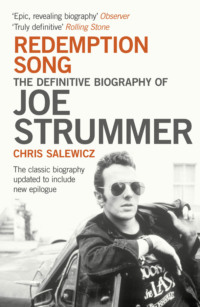
Redemption Song
The Definitive Biography of Joe Strummer
Chris Salewicz

CONTENTS
COVER
TITLE PAGE
1 STRAIGHT TO HEAVEN
2 R.I.PUNK
3 INDIAN SUMMER
4 STEPPING OUT OF BABYLON (ONE MORE TIME)
5 BE TRUE TO YOUR SCHOOL (LIKE YOU WOULD TO YOUR GIRL)
6 BLUE APPLES
7 THE MAGIC VEST
8 THE BAD SHOPLIFTER GOES GRAVEDIGGING
9 PILLARS OF WISDOM
10 ‘THIS MAN IS A STAR!’
11 I’M GOING TO BE A PUNK ROCKER
12 UNDER HEAVY MANNERS
13 THE ALL-NIGHT DRUG-PROWLING WOLF
14 RED HAND OF FATE
15 NEWS OF CLOCK NINE
16 1 MAY TAKE A HOLIDAY
17 THE NEWS BEHIND THE NEWS
18 ANGER WAS COOLER
19 SPANISH BOMBS
20 MAN OF MYSTERY
21 SOLDIERS OF MISFORTUNE
22 ON THE OTHER HAND …
23 THE RECKLESS ALTERNATIVE
24 THE COOL IMPOSSIBLE
25 THE EXCITEMENT GANG
26 LET’S ROCK AGAIN!
27 CAMPFIRE TALES
28 BRINGING IT ALL BACK HOME
29 CODA (THE WEST)
EULOGY
PICTURE SECTION
INDEX
ACKNOWLEDGEMENTS
PRAISE FOR CHRIS SALEWICZ’S REDEMPTION SONG
BY THE SAME AUTHOR
ROOTS OF HEATHEN
COPYRIGHT
ABOUT THE PUBLISHER
1
STRAIGHT TO HEAVEN
2002
This is how I heard about Joe’s death: Don Letts, the Rastafarian film director who had made all the Clash videos, called me at around 9.30 on the evening of 22 December 2002.
‘I’ve got to tell you, Chris: Joe’s died – of a heart attack.’
‘Oh-fuckin’-hell-Oh-fuckin’-hell-Oh-fuckin’-hell,’ was all I could say.
I poured a large glass of rum and stuck Don’s documentary about the group, Westway to the World, on the video. I called up Mick Jones, who in between sobs was his usual funny self, telling me how glad he was he’d played with Joe at the benefit for the Fire Brigades Union five weeks before.
‘I don’t even know what religion he was,’ Mick said.
‘Some kind of Scottish low-church Presbyterian, I imagine,’ I suggested.
‘Church of Beer, probably,’ laughed Mick, tearfully.
I went to bed late, and although I hardly slept I didn’t get up until around 9.30. At around 9.55 the phone rang: ITN News. Could they interview me for the 10.00 bulletin? I sat down on the sofa and made some quick soundbite-sized notes. I’m not even sure what I said. The phone rang again: the Independent wanted me to write an obituary, a long one, 2,000 words, by 4 o’clock. I started up the computer, opening up my assorted Strummer files, pulling out quotes and phrases. Then the phone rang once more: ITN News again. Could they send a car for me to be on the 12.30 News? Call me back in a minute, I said: I need to work out whether I can do it – the obituary is what counts most. I put the phone down. Someone’s got to do this for Joe, I thought, but I don’t want to blow the obit by doing too much. I called Joe’s home in Somerset and left a message of condolence for Lucinda, his widow.
By the time the car came for me at half eleven, I’d got a good amount done. As it always does, the TV stuff took much longer than it was meant to – they wanted to record something more for the evening news. It was 2.00 p.m. before I was home again. I still had a lot to do. But somehow time stretched, giving me many more minutes an hour than I might have expected. I e-mailed the obituary through at ten minutes to four. This is what I wrote:
The job of being Joe Strummer, spokesman for the punk generation and front-man for the Clash, never sat easily with the former John Mellor. Always prepared to give of himself to his fans, he still felt a weight of responsibility on his shoulders that often made him crave anonymity, as much as the natural performer within him needed the spotlight.
But when – after a hiatus of almost a decade and a half – he returned to recording and performing with his new group the Mescaleros in 1999, it was business as usual: seemingly the same huge amounts of energy, passion and heart-on-sleeve belief that were his trademark with the Clash and that drew a worldwide audience for him and the group. After a show the dressing-room or backstage bar still would be crammed with fans and friends as Joe held forth on the issues of the day, in his preferred role of pub philosopher and articulate rabble-rouser for the dispossessed. (But even here was the endless paradox of Joe Strummer: he could argue the case for Yorkshire pitworkers or homeless Latinos in Los Angeles, but if obliged to reveal himself through any interior observation, he would generally freeze. Even other members of the Clash would complain about his hopelessness at soul-baring.)
Yet when he played a show at London’s 100 Club two years ago, he was so exhausted afterwards that he had to lie down on the floor of the dressing-room: his Mescaleros’ set included a good percentage of Clash songs, and you worried that the frenetic speed at which they were performed would test the health of a man approaching his fiftieth birthday. In an irony that Joe Strummer no doubt would have appreciated, his death last Sunday afternoon came not from the stock rock’n’roll killers of drugs, drink or travel accidents, but after taking his dog for a walk at his home in Somerset: sitting down on a chair in his kitchen, he suffered a fatal heart attack. [I later learnt it was in his living-room, and it was ‘dogs’, not ‘dog’.]
Neither of his parents had lived to a ripe old age. Joe Strummer, who earned his sobriquet from his crunchy rhythm guitar style, was born in Ankara, Turkey, in 1952 to a career diplomat. Christened John Graham Mellor, he was sent at the age of ten [nine] to a minor public school, the City of London Freemen’s School at Ashtead Park in Surrey. He had already lived in Cairo, Mexico City (‘I remember the 1956 earthquake vividly; running to hide behind a brick wall, which was the worst thing to do,’ he once told me) and Bonn. Strummer’s father’s profession of career diplomat didn’t arise from any position of privilege – quite the opposite, in fact. ‘He was a self-made man, and we could never get on,’ said Strummer. ‘He couldn’t understand why I was last in every class at school. He didn’t understand there were different shapes to every piece of wood, different grains to people. I don’t blame him, because all he knew was that he pulled himself out of it by studying really hard.’
All the same, such a background was not especially appropriate in the mid-1970s punk world of supposed working-class heroes, which may explain why Strummer always seemed even more anarchic than his contemporaries. Mick Jones, like Strummer a former art-school student, discovered Joe when he was singing with squat-rock R’n’B group The 101’ers, and poached him for a group he was forming called the Clash, becoming his songwriting partner: matched to Jones’s zeitgeist musical arrangements, Strummer’s lyrics were the words of a satirical poet, and often hilariously funny – one of his first creative contributions on linking up with Mick Jones was to change the title of a love-song called ‘I’m So Bored with You’ to ‘I’m So Bored with the USA’. Verbal non-sequiturs were a speciality: his gasped aside of ‘vacuum-cleaner sucks up budgie’ at the end of ‘Magnificent Seven’, inspired by a newspaper headline on the studio floor, is one of the funniest lines in rock’n’roll.
Strummer had one brother, David, who was eighteen months older than himself. By the time he reached sixteen, the younger boy had become accustomed to his brother’s far-right leanings – he had joined the National Front – and to the fact that he was obsessed, ‘in a cheap paperback way’, with the occult. Was it this unpleasant cocktail that led David to commit suicide? Whatever, it was clearly a cathartic moment for his younger brother: Joe Strummer often seemed overhung by a mood of mild depression, a constant struggle.
After dropping out of Central College of Art (‘after about a week,’ [he lied about this]), he threw himself into the alternative world of squatting. Moving for a time to Wales, he spent one Christmas on acid listening to Big Youth’s Screaming Target classic and so discovered reggae. One of the main themes propagated by the Clash was the rise of a multi-cultural Britain; in the group’s early music reggae rhythms jostled with an almost puritan sense of rock’n’roll heritage; as the group progressed, it osmosed and absorbed Latin, blues and early hiphop sounds, with Strummer’s never-less-than-heartfelt lyrics making him a modern-day protest singer, in a tradition stretching back to Woody Guthrie.
Positive light to the darkness of the Sex Pistols, the Clash released an incendiary, eponymously titled first album in 1977, the year of punk, a Top Ten hit. With Strummer at the helm, the group toured incessantly: at a show that year at Leeds University, he delivered the customary diatribe of the times: ‘No Elvis, Beatles or Rolling Stones … but John Lennon rules, OK?’ he barked, revealing a principal influence and hero of his own. The next year, after a night spent at a reggae concert, he wrote what he himself felt was his finest song, ‘White Man in Hammersmith Palais’, a blues-ballad that opened up the musical gates for the future of the group. In that song, however, was contained the seeds of a paradox that would become more and more uncomfortable for Strummer: one line spoke of ‘new groups … turning rebellion into money’. Through writing such outsider lyrics, he became a millionaire; his problem was one common to many radical figureheads: how do you remain a folk hero when you have succeeded in your aim and are no longer the underdog? Touring the country that summer of 1978, the group’s concerts were shot for a feature film, Rude Boy, directed by David Mingay and Jack Hazan. ‘He already seemed to be suffering terribly from the notion of being Joe Strummer,’ said Mingay. ‘He wasn’t exactly lying back and having a great time. Joe was always full of contradictions, one of which was that he managed to be both ultra-British and anti-British at the same time.’
With London Calling, their third album, the group achieved commercial American success. Sandinista!, a sprawling three-record set, followed. When it became clear that the album was commercial folly, Joe Strummer demanded the return of their original manager, Bernard Rhodes, a business colleague of Malcolm McLaren and someone with whom Mick Jones had always had an awkward relationship. With Rhodes’s sense of wily situationism powering the group, the potential disaster of Sandinista! was turned into a triumph after the group played seventeen nights at Bond’s in New York’s Times Square. The group were the toast of the town, and only a big commercial hit stood between them and superstardom.
That came in 1982 with Combat Rock, a huge international success, selling five million copies. Strummer bought a substantial terrace house in London’s Notting Hill, yet seemed to feel obliged to justify this possession by explaining that it reminded him of the houses in which he used to squat. By 1983, the Clash had begun to disintegrate; first, heroin-addicted drummer Topper Headon was replaced; then, extraordinarily, Mick Jones was fired, Strummer having gone along with Rhodes’s perversely iconoclastic desire to get rid of the founder of the group. New members were brought in, but the Clash finally fizzled out in 1986.
Strummer’s sense of guilt over the sacking of Jones developed to a point of almost clinical complexity. In the late summer of 1985 he asked me to go for a drink with him. After much alcohol had been consumed, he suddenly announced: ‘I’ve got a big problem: Mick was right about Bernie [Rhodes].’ He had finally realized he had been manipulated. He caught a plane to the Bahamas, where Mick Jones was on holiday: an ounce of grass in his hand, he sought out the guitarist’s hotel, and presented him with this tribute, asking to get the Clash back together. But it was too late: Jones had already formed a new group, Big Audio Dynamite; although Joe Strummer ended up co-producing BAD’s second album, his own plans came to nothing.
A familiar figure on the streets and in the bars of Notting Hill, Joe Strummer was mired – as he later admitted to me – in depression. He tried acting, with a passable role in Alex Cox’s Straight to Hell (1987), and a minor part in the same director’s Walker (1987), for which he also wrote the music; he made a much more significant impression in 1989, playing an English Elvis-like rocker in Jim Jarmusch’s Mystery Train. That same year he released an impressive solo album, Earthquake Weather, and toured. But apart from briefly filling in as singer with the Pogues, he was hardly heard of again. For a time Tim Clark, who now manages Robbie Williams, attempted to guide his career. ‘He was obviously in bad shape,’ Clark told me. ‘He’d turn up for meetings the worse for wear. You could see he was going through a bad time, but you also felt there was probably no one he could really talk to about it.’
After moving out of Notting Hill to a house in Hampshire – he had become worried about his two daughters, he said, after one of them found a syringe in a west London playground – he subsequently split up with his long-term partner Gaby. Remarrying in 1995, to Lucinda Tait, and moving to Bridgwater in Somerset, Joe seemed to find a relative peace. He formed the Mescaleros and began recording again, releasing two excellent albums, Rock Art and the X-Ray Style (1999) and Global A Go-Go (2001), that title a reflection of his interests in world music, about which he presented a regular show on the BBC’s World Service. Strummer was once again touring, incessantly and on a worldwide basis: he was playing to sold-out audiences, with a set that contained a large amount of Clash material. ‘All that’s happening for me now is just a chancer’s bluff,’ he told me in 1999. ‘This is my Indian summer … I learnt that fame is an illusion and everything about it is just a joke. I’m far more dangerous now, because I don’t care at all.’
One of Joe Strummer’s last concerts was at Acton Town Hall last month, a benefit for the Fire Brigades Union. Andy Gilchrist, the leader of the FBU, was apparently politicized after seeing the Clash perform a ‘Rock Against Racism’ concert in Hackney in 1978, and had asked Strummer if he would play the Acton show. That night Mick Jones joined him onstage, the first time they had performed live together since Jones had been so unfairly booted out of the Clash. ‘I nearly didn’t go. I’m glad I did,’ said the guitarist, the poetry of that reunion clear to him.
Bitterly critical that the present Labour government has betrayed many of its former ideals, Joe Strummer was delighted at the show for the firemen; a smile came over his face at the idea that, if only tangentially, his former group was still capable of causing discomfort for those in power. His death, however, comes as a deep shock. After considerable time in the wilderness, Joe Strummer seemed to have reinvented himself as a kind of Johnny Cash-like elder statesman of British rock’n’roll, a much-loved artist and everyman figure. ‘I still thought he’d be doing this in thirty years time,’ said his friend, the film director Don Letts.
2
R.I.PUNK
2002
Christmas Day 2002. Driving through south London, I am wondering if Joe Strummer had known how much people loved him. Pulling up at traffic lights, I glance to my left; there, spray-painted across a building in large scarlet letters, seems to be some sort of answer to my meditations: JOE STRUMMER R.I.PUNK. I call Mick Jones and leave a message, telling him what I’d seen. Joe’s funeral, eight days after he died, polarized all my thoughts and feelings. The following day I wrote this:
Monday, 30 December 2002
The sky is a slab of dark, gravestone grey; rain belts down in bucketfuls, leaving enormous pools of water on the roadside: Thomas Hardy funeral weather. Ready for the funeral’s 2.00 p.m. kick-off, I find myself at the entrance to the West London crematorium on Harrow Road. A voice calls to me from one of the parked cars: it is Chrissie Hynde and Jeannette Lee (formerly of PIL, now co-managing director of Rough Trade, a punk era girlfriend of Joe). Chrissie is clearly in a bad state. ‘Not great,’ she answers my question.
On the main driveway I bump straight into the music journalist Charles Shaar Murray and Anna Chen, his girlfriend: he looks fraught. It is pouring with rain. I take a half-spliff out of my jacket pocket and light it, take a few tokes, and hand it to Charlie. Out of the hundreds of hours I had spent with Joe I don’t think I had been with him on a single occasion when marijuana had not been consumed, so it seems appropriate, even important, to get in the right frame of mind to be with him again.
The spliff is still burning when I see massed ranks of uniformed men. Not police, but firemen, two ranks of a dozen, standing to attention in Joe’s honour. With Charlie and Anna, I walk between them. Standing under the shelter of a window arch I see Bob Gruen, the photographer, and walk over to him. We hug. Then Chrissie and Jeannette arrive; Jeannette and I hug. Soon Don Letts also arrives. I roll him a cigarette.
Suddenly it seems time to walk inside the building, into the main vestibule. That’s where everyone has been waiting. I see Jim Jarmusch, who directed Joe in Mystery Train, Clash road manager Johnny Greene, and – next to him – the stick-thin, Stan Laurel-like figure of Topper Headon. We hug; there is a lot of hugging today. Against the wall I see an acoustic guitar, covered in white roses, really beautiful. In its hollowed-out centre is a message: R.I.P. JOE STRUMMER HEAVEN CALLING 1952–2002. A large beatbox, next to it, is similarly covered in white roses. All the seats in the chapel are full. I find a gap against the rear wall. A lot of people are snuffling.
Then the sound of bagpipes sails in through the door, lengthily, growing nearer. (Later I learn that the music is The Mist-covered Mountains of Home, also played at the funeral of President John F Kennedy.) At last Joe’s coffin slowly comes in, held aloft by half a dozen pallbearers. It is placed down at the far end of the chapel. Keith Allen, the actor and comedian, steps forward and positions a cowboy hat on top of it. There’s a big sticker on the nearest end: ‘Question Authority’, it reads, then in smaller letters: ‘Ask Me Anything’. Next to it is a smaller sticker: ‘Vinyl Rules’. On the sides of the coffin are more messages: ‘Get In, Hold On, Sit Down, Shut Up’ and ‘Musicians Can’t Dance’. Around the end wall of the chapel are flags of all nations. More people are ushered in, like the kids Joe would make sure got through the stage-door at Clash gigs, until the place is crammed. In the crush I catch a glimpse of Lucinda, Joe’s beautiful widow: she carries herself with immense dignity but – hardly surprisingly – has an aura of almost indescribable grief, pain and shock. People are standing right up by the coffin. The aisle is packed: suddenly a tall blonde woman, looking half-gorgeous, a Macbeth witch, is pushed through the throng, to kneel on the stone floor at the front of the aisle – it’s not until later on that I realize this is Courtney Love.
The service begins. I don’t know who the MC is, a man in his late fifties, a vague cross between Gene Hackman and Woody Allen. He’s good, tells us how much love we are all part of, stresses how honoured we are that our lives were so touched by Joe, says that he’s never seen a bigger turn-out for a funeral. (There is a sound system outside, relaying the proceedings to the several hundred people now there.) Then he says we’ll hear the first piece of music, and we should turn our meditations on Joe: it is ‘White Man in Hammersmith Palais’.
Paul Simonon gets up to speak. He tells a story about how when the Clash first formed in 1976, he and Joe had been in Portobello Road, discussing the merits of mirror shades, as worn by Jimmy Cliff in The Harder They Come. If anyone showed you any aggro while you were wearing such a pair, Joe decided, then their anger would be reflected back at them. Immediately he stepped into a store that sold such sunglasses. Paul didn’t follow: he was completely broke, having been chucked off social security benefits; Joe, however, had just cashed that week’s social security cheque. He came out of the store wearing his brand-new mirror shades. Then they set off to bunk the tube fare to Rehearsal Rehearsals in Camden. As they walked towards Ladbroke Grove tube station, Joe dug into his pocket. ‘Here,’ he said, ‘I bought you a pair too.’ Although Joe was now completely broke and with no money to eat for three days, he’d helped out his mate. This story increases the collective tear in the chapel.
Maeri, a female cousin, gets up to speak. Joe’s mother had been a crofter’s daughter, who became a nurse and met Joe’s father in India during the war. Joe’s dad liked to have a great time: a real rebel himself, it seems, not at all the posh diplomat he has been made out to be, a man who pulled himself up by his bootstraps. We are told a story about Joe as a ten-year-old at a family gathering: he is told that he can go anywhere but ‘the barn’; immediately he wants to know where ‘the barn’ is. Then another female cousin, Anna, reads a poem, in English, by the Gaelic poet Sorley MacLean.
Dick Rude, an old friend of Joe’s from LA who has been making a documentary about the Mescaleros, speaks. Keith Allen reads out the lyrics of a song about Nelson Mandela, part of an AIDS charity project for South Africa organized by Bono of U2, that Joe had just finished writing. A Joe demo-tape, just him and a guitar, a slow blues-like song, is played. And the Mescaleros tune, ‘From Willesden to Cricklewood’. The MC suggests that as we file past the coffin to leave, we say a few words to Joe. ‘Wandering Star’ begins to play. ‘See you later, Joe,’ someone says. Yeah, see you later, Joe.
After the extraordinary tension that has built up to the funeral since Joe’s death eight days ago – my sleep is disturbed and troubled the night before the service – it feels like a release when the service concludes. (I have felt Joe around ever since he passed on: Gaby, his former long-term partner, has felt the same thing, she tells me on the phone the previous Friday, and I tell her that a mystic friend of mine has spoken of Joe ‘ascending’ very clearly – according to Buddhism, there is a period of forty-eight days following a death before the soul returns in another form; Gaby feels the same, saying she feels he is very at peace; job done, on to the next incarnation. Until someone reminds me, I have forgotten that Gaby has had plenty of experience of death, her brother having committed suicide while she was still with Joe – as his brother did.) Somehow I expect almost a party atmosphere outside the chapel, with the sound system maybe blaring out some Studio One. But everyone is wandering around in a daze. The wake is being held at the Paradise bar in nearby Kensal Rise.
Outside the Paradise a bloke in a suit and black tie asks if I have any change so he can park his car. He looks familiar; it is Terry Chimes, the original Clash drummer, who had resigned from the group after making the first album, leaving the way open for Topper Headon. Terry is now a superstar of chiropractry, giving seminars on the subject.
The bar is packed with people and a grey atmosphere of grief. I see Lucinda and hold her for a moment. Simultaneously she feels as frail as a feather and as strong as an oak beam. But she is clearly floating in trauma. I tell her how sorry I am, and as I speak my words feel inadequate and pathetic. From a stage at one end speakers are batting out reggae. The pair of pretty barmaids are struggling with the crush. I am handed a beer, which I down, pushed into a corner. I see a woman with a familiar face: Marcia, the wife of Jem Finer, effectively leader of The Pogues – I used to enjoy spending time with them at evenings and parties at Joe’s house when he still lived in Notting Hill. I am incredibly flattered by what she says to me. She says, ‘Joe always used to say that you were the only journalist he trusted. And he said he loved you as a friend. He really loved you.’ I am unbelievably touched by this. I want to talk to her more, but she is clearly looking for someone. I nearly burst into tears when what she has said fully registers with me. (I’m not unusual in being in such a state: all around me I see men putting their hands to their eyes, sobbing for a few moments.) Later Jem Finer, Marcia with him, deliberately seeks me out and tells me this again, both of them together this time.
Next to the cloakroom I find a couple more rooms, where food has been laid out. I grab a plate: smoked salmon, feta cheese salad, pasta – good nosh. And sitting down I find a middle-aged woman. The sister of Joe’s mum, and a great person, Sheena Yeats now lives in Leeds, where she teaches at the university. She’s very Scottish, however: ‘Well, this is the best funeral I’ve ever been to,’ she burrs, with a smile. ‘Joe would have really appreciated it.’ She tells me how Joe had been up to Scotland a month ago, to a wedding, and that he had been in touch with everyone in his family recently. She reminds me that Joe’s mum Anna had passed on in January 1987. ‘Although he chose to call himself Joe, because it was such an everyman name, his real name was John, a name with the common touch,’ she explains.
Bob Gruen tells me how Joe had been in New York a couple of months ago, in some bar, leading the assembled throng in revelry and having a great time. Seated nearby is Gerry Harrington, a Los Angeles agent who had guided Joe’s career when he was working on Walker and Mystery Train and releasing 1989’s Earthquake Weather. Joe had written a song for Johnny Cash last April, at Gerry’s house in LA, entitled ‘Long Shadow’: he plays it for me on an I-Pod, an extraordinary valedictory work that could have been about Joe himself, with lines about crawling up the mountain to the top.
I talk to Rat Scabies, former drummer with the Damned. He tells me he and Joe had been working together in 1995 on the soundtrack of Grosse Pointe Blank, but that they fell out over that hoary old rock’n’roll chestnut – money. ‘I was stupid,’ he admits. ‘I thought I knew everything from playing with the Damned. But working with Joe was like an entirely new education. He understood how to trust his instincts and go with them every time. I couldn’t believe how fast he worked.’
I run into Mick Jones. He puts his arms around me and kisses me on the cheek. We hold each other. He tells me how he’d loved the message I’d left on his voice-mail after seeing the JOE STRUMMER R.I.PUNK graffiti on Christmas Day; it had touched Mick as deeply as it touched me. He tells me how great the Fire Brigades Union have been, and that the police have behaved similarly. At the Chapel of Rest where Joe had been laid in Somerset a sound system had blared out 24-7. When the police came round in response to complaints from neighbours, and were told it was Joe who was lying there, instead of telling them they must turn down the music they responded by placing a permanent two-man unit outside the chapel: a Great Briton getting a fitting guard of honour, an irony Joe would have appreciated as his mourning bredren consumed several pounds of herb.
Pearl Harbour, Paul’s ex-wife, is there, talking to Joe Ely, the Texan rockabilly star who had often played with the Clash. She tells me how this trip has brought closure for her by bringing her back to what, she admits, was the happiest time in her life.
A moment later Tricia – Mrs Simonon – comes over as Pearl departs and proceeds to tell me how the absent Clash manager Bernie Rhodes had been contacted and invited to come to the funeral, but after the usual over-lengthy conversation it was impossible to discover what Bernie really felt or thought. ‘It seemed that he was more intent on getting on to the next agenda, which was that he desperately wanted to be invited to the Rock and Roll Hall of Fame induction for the Clash next March. What he didn’t realize was that it was already decided that he would be invited.’
‘I always had a soft spot for Joe,’ Bernie later told me. ‘But I couldn’t go to the funeral because I didn’t like the people he was hanging around with.’
Joe and Mick had both wanted a re-formed Clash to play at the Rock and Roll Hall of Fame induction. But the one refusenik? Paul Simonon, painter of Notting Hill. Trish admits that the last communication Paul had from Joe was on the morning that he died. Joe sent Paul a fax – he loved faxes, hated e-mails – saying, ‘You should try it – it could be fun.’ Paul, however, was adamant that the group shouldn’t re-form for the show.

Never too computer-literate, Joe wrote on a typewriter to the end. (Lucinda Mellor)
Next I find myself in a long conversation with Jim Jarmusch’s partner, Sara Driver, who commissioned Joe to write the music for When Pigs Fly, a film she made in 1993, starring Marianne Faithfull, that suffered only a limited release after business problems, and Bob Gruen’s wife Elizabeth. Jim is sitting next to us, deep in conversation with Cosmic Tim, a mutual friend of Joe and myself, from completely separate angles of entry. I had walked into the main upstairs bar as Cosmic Tim was standing on the stage with a microphone. It was the usual stuff that had gained him his sobriquet, and I groaned inwardly. ‘And this man Baba had been to the mountains of Tibet and lived there for twenty-five years, meditating.’ Other people in the packed crowd were groaning too (‘Get on with it.’). But then Cosmic Tim turned it around: ‘And one day when he returned to London, I was walking down Portobello Road with Baba when I see Joe walking towards us. I cross the road, and Baba and Joe look at each other. Suddenly, Baba calls out, “Woody!” (Joe’s nickname from The 101’ers.) And Joe looks up and shouts, “Baba!”’ According to Tim, Baba and Joe had known each other at art college. At length Sara, Elizabeth and myself discuss the state of depression in which Joe was regularly mired, and that most of the tributes to him that day are utterly omitting. Sara says how Jim used to refer to him as ‘Big Chief Thundercloud’. She also tells me how Joe had an enormous crisis when he was on tour in the States singing with the Pogues: he had fallen deeply in love with a girl and wanted to leave Gaby for her. Although he didn’t, in some ways it was the end of his relationship with the mother of his children. (This was a period when I remember Joe seemed even more in turmoil than usual, an air of great anger about him.)
The party is thinning out a little. It is 11 o’clock. I’ve got a slight headache. I leave and walk down to Ladbroke Grove tube station with Flea, Mick’s guitar roadie, and get home around midnight. I fall asleep on the sofa.
3
INDIAN SUMMER
1999
7 November 1999
In a shrine-like case in the seedily glitzy foyer of Las Vegas’s Hard Rock casino stands a guitar once owned by Elvis Presley. ‘What would Elvis think?’ groans Joe Strummer, here to play a show on his first solo tour in ten years. This distress seems a trifle exaggerated, as though Strummer is trying to force himself into the character of a 47-year-old bad boy rocker. ‘This case is only plexiglass: we could smash it open and have the guitar out of there before anyone noticed,’ he continues. Is this a confrontational posture he feels he should adopt in his job of Last Active Punk Star?
The frozen grins on the faces of those around him – his wife, an old friend from San Francisco, myself – suggest this is not what we want to hear: there seems a certain anxiety amongst us that, to prove his point, Strummer might carry out his threat, and that within seconds we will be shot to death by security guards. Thankfully, a fan approaches him for an autograph, the moment passes, and he makes his way backstage for his performance.
As a stage act, the reputation of the Clash was almost unsurpassed. Championed by many as the most exciting performing rock’n’roll group ever, there’s recently been the release of a live record, accompanied by a Don Letts’ documentary, Westway To The World. If ever there was a time to jump-start his solo career, this was it. Strummer seized the moment: he released an excellent album, Rock Art and the X-Ray Style; and took off on a seemingly endless tour, which is how I come to find him in Las Vegas.
Standing with him at the Hard Rock casino’s central bar at 4 in the morning after many post-show drinks, I tell him I’d had the impression that for years he had been going through an ongoing minor nervous breakdown. He balks at this, but initially will admit to having been locked into a state of long-term depression: ‘When people have nervous breakdowns, they really flip out. We shouldn’t treat them flippantly. It was more like depression, miserable-old-gitness.’
How long were you depressed for?
‘About five minutes. Until I had a spliff.’
A moment later he tries to wriggle out of even this admission: ‘I’m not claiming to have been depressed. All I’ll allow is that I didn’t have any confidence and I thought the whole show was over: you can wear your brain out – like on a knife-sharpening stone, run it until it shatters – and I just wanted to have some of it left.
Assisted by his now four-year-old marriage to Lucinda, his second wife, Strummer seems to have found a relative peace; Lucinda is credited by many around him with pulling him out of his malaise.
Christened John Mellor (‘without an “s” on the end, unfortunately: if there was, I’d have pulled more women,’ referring to the game-keeper’s surname in Lady Chatterley’s Lover), he was born in Ankara. His background would seem to show why Mick Jones once expressed amazement to me at how hard and tough a worker Strummer could be. For his father’s profession of career diplomat didn’t arise from any position of privilege, quite the opposite. ‘He was a self-made man, and we could never get on,’ says Strummer.
The musician’s grandparents had worked as management on the colonial railway network in India. ‘My father was a smart dude: he won a scholarship to a good school, then won another scholarship to university. When the war broke out, he joined the Indian army. My mother and father met in a casualty ward in India – she was working in the nursing battalion. After the war he joined the Civil Service at a lowly rank.’
Strummer’s earliest memory was of his brother, who was eighteen months older, ‘giving me a digestive biscuit in the pram’. He still is unable to assess what it was that led David to commit suicide. ‘Who knows? You can’t say, can you?’
Clearly this would have seemed a crucial, motivating catalyst in the life of the person who became Joe Strummer. How did it affect him? ‘I don’t know how it affects people. It’s a terrible thing for parents.’ He pauses for a very long time, until it becomes evident that this is all he is prepared to offer.
If it hadn’t been for punk, what on earth would have happened to Joe? He didn’t last too long at art school. After that, the only upward career move he seemed to have made was when he decided to stop being a busker’s money-collector and to become a busker himself – but even that worried him, he tells me, because he thought it might prove too difficult. It was this that led to him playing with The 101’ers, from which he was poached to become the Clash’s singer. ‘There is a part of Joe that is a real loser,’ says Jon Savage, author of England’s Dreaming, the definitive account of the punk era. ‘That’s what he was in his days as a squatter. And it’s that that comes across in his vocals, which was why people could identify with them so much.’
I tell Joe that Kosmo Vinyl, the unlikely named ‘creative director’ of the Clash, once said to me that if it hadn’t been for punk the singer would have ended up a tramp.
‘Yeah,’ he agrees, without a moment’s thought. ‘When I was a kid I knew that I was never going to make it in the thrusting executive world. I love picking stuff out of skips. A few bum records and I’ll be away with my shopping-trolley.’
I ask Joe Strummer what he learnt from his years in the wilderness. ‘Any pimple-encrusted kid can jump up and become king of the rock’n’roll world,’ he says, voicing something to which he has clearly given much thought. ‘But when you’re a young man like that you really do glow in the light of everyone’s attention. It becomes a sustaining part of your life – which is something that is rotten to the core: you cannot have that as a crutch, because one day you’re going to be over. So obviously I learnt that fame is an illusion and everything about it is just a joke.
‘I don’t give a damn any more. I’ve learnt not to take it seriously – that’s what I’ve learnt. And I’ve also learnt that because what you do is sort of interesting, doesn’t mean you’re any better than anyone else: after all, we’re not exactly devising new forms of protein. If they say, “Release this record because otherwise your career is finished,” and I don’t want them to, then I just won’t do it. I’m far more dangerous now, because I don’t care at all.’
4
STEPPING OUT OF BABYLON (ONE MORE TIME)
2003 (1952–1957)
Moving at a fast pace, Paul Simonon and I are cutting along a narrow rocky mud path that splits the wet grass on this high stretch of Scottish flatland. In a soaking spray of fine rain we have been climbing for twenty minutes. But the moment that we had stepped onto this level plateau the downpour had stopped: damp odours and mysterious scents are all that saturate us now. In the dagger-cold water of a lochan, we stash two cans of beer for our return journey. On the far bank a frog croaks irregularly.
Lusher and even more magical than its much larger, bleaker neighbour of Skye, this is the remote Inner Hebrides island of Raasay, up towards the northern tip of its twelve mile length. Thanks to an abiding impression of all-pervading strangeness, however, we feel we could as easily be on the other side of the moon as on the far north-western periphery of Europe. But you can’t avoid that feeling of being out on the edge. For miles around there are no other human beings, only a vast, amorphous silence, the soundtrack to the greyish-blue wild mountain scenery that juts around us; you can almost hear the clouds clashing on the highland rock and rustling on the purple heather.
As we push on each turn of a corner seems to brings a new microclimate, announced by a gasp of angular wind, like a message from a spirit: now the cloud cover is dashed away and a crisp blue sky sets in relief the Cuillin, Skye’s looming mountain peaks, a few miles across the Sound of Raasay; in this sudden sunlight the sea turns azure, the rough breakers crackling and glistening. After our steep, wet, upward hike, the flat stretch has come as a relief. We don’t know there is a far more arduous climb still to come: finally perched on a rock cairn at the top of that tough ascent, we can see both east and west coasts of the isle of Raasay, three miles apart.
Tough, gritty, awkward, dangerous, an astonishing terrain of primal, pure, mysterious beauty … It is little surprise that one of the descendants of Raasay – John Graham Mellor, known to those outside his blood family as Joe Strummer – has many of the same qualities as the island itself. Although he’d marked it in his diary for the summer of 2003, Joe himself never made it to Raasay; in the years immediately preceding he had been making a conscious effort to reacquaint himself with the Scottish roots on his mother’s side, an effort to redeem the previous thirty or so years when he admitted he had neglected this part of his past. ‘I’ve been a terrible Scotsman, but I’m going to be better,’ Joe said to his cousin Alasdair Gillies at the wedding of their cousin George in Bonar Bridge, three weeks before he died.
To the east, across the deepest inshore water in Britain, sits the mainland of Scotland and the mountain peaks of the Applecross peninsula, rising to over 2,000 feet and tipped by streaks of white quartzite. Opposite it, down towards the Raasay shoreline, lies our destination. Paul Simonon and I are here to find the earliest known home of Joe Strummer’s Scottish ancestors: the rocky, heathery, hilly path that at times we have to hang on to with our fingertips that we are following is the same one that Joe’s grandmother, Jane Mackenzie, would have taken to school. Donald Gilliejesus (‘servant of Jesus’), a stone mason, from near Mallaig on the Scottish mainland, arrived to repair Raasay House, destroyed by English Redcoats after ‘Bonnie’ Prince Charlie hid on the island in 1746 following the Jacobite Rebellion against the English crown. The house at Umachan was built in the early 1850s after the Gillies fled from the ‘clearances’ – the savage requisitioning of small-holdings by landowners – on the south of Raasay. Built by Angus Gillies, the great-grandson of Donald, it was inherited by his son Alastair Gillies. The second of Alastair’s ten children was Jane, born in 1883; Joe’s grandmother would walk barefoot to school along the same path Paul and I had clung to.
We head sharply down, across a lazy burn, past further cairns of stone. On our right there is what appears to be a natural amphitheatre, and a clearly evident ancient burial mound rising out of the greeny-brown terrain. Finally we are standing amidst waist-high bracken on a precipitous ledge, looking down on where we have been told Umachan should be. Between us we have distributed Paul’s canvases, paints and an easel, which have become a burden: we hide them in some undergrowth. Paul, something of a gourmet, tells me how in London he had popped into Bentley’s Oyster Bar in Swallow Street for a dozen oysters and a bottle of Chablis whilst buying the hiking shoes he’s wearing; it’s a long way from heating up flour-water poster-paste on a saw to eat, as Paul did in the early days of the Clash at Rehearsal Rehearsals. But a nourished belly and well-shod feet can only mark us out as the useless city slickers we are: we can find no trace of the home of Joe Strummer’s ancestor.
At a quarter to one, lunchtime on Friday 12 September 2003, my phone rings. It is Paul Simonon. ‘I think you’d better pack your bag, Chris. On Sunday I’m going up to Raasay off the Isle of Skye to do a painting of the house Joe’s grandmother used to live in. You should come with me.’
The Scottish Herald has commissioned Paul to paint a landscape of Rebel Wood, the forest on the Isle of Skye dedicated to Joe Strummer. Paul Simonon is the only member of the Clash to have carved out a non-musical career; returning to his original love of painting, and utilizing contacts he caught along the way as a member of such a prestigious British group, he has made a name and money as a figurative painter. Paul has agreed to paint the wood, but also will supply what he believes is a better idea: a picture of the ruined house in Umachan on Raasay. Iain Gillies, Joe’s cousin, had told us about these ruins.
As I am to discover, our expedition forms part of an experience that will bring some form of ending to the former Clash bass player for the thoroughly unexpected death of his former lead singer. During our time together, Paul emphasizes on several occasions that Joe was his brother, ‘my older brother’.
Every year film director Don Letts and his wife Grace throw a garden barbecue at their Queen’s Park home on August Bank Holiday Monday – a sort of refuge for the over-forties and under-tens from the Notting Hill carnival taking place a mile or so to the south. At the event in 2003, eighteen days before he made that Friday lunchtime call to me to come up to Scotland, I’d last seen Paul Simonon. The smaller 1976 Notting Hill carnival, when black youths and police had violently clashed beneath the elevated Westway in front of Joe Strummer and Paul Simonon, had led to the writing of ‘White Riot’, one of the most contentious songs in the Clash’s canon of work, a tune that at first – before people understood that its lyrics expressed the envy of white outsiders that black kids could so successfully rebel against the forces of law and order – led to suspicions that the group had a fascist political agenda. The 1976 event and the Westway became part of Clash mythology.
In the early days of the group Paul had always seemed shy. In 2001, however, when I had written the text for a picture-book about the Clash by Bob Gruen, the New York photographer, I had been surprised by a change that had overcome the group’s former bass player; as Bob Gruen and I went through hundreds of photographs with each of the group members, he was by far the most articulate. Mick was as warm as ever, but his comments were more jokey and less specific; and although Joe had insisted to Bob Gruen that I should write the text for his book, he surprised me by being the worst of the three interview subjects. Perhaps the photographs, which encapsulated almost the entire span of the career of the Clash, drew up too many memories; he ended up by saying he would write captions himself – and never did. Global A Go-Go, his second CD with the Mescaleros, was being readied for release and Joe was exhaustively – the only way he knew how to anything – promoting it; I could feel tension from Lucinda, on the couple of occasions when I rang up and spoke to her, trying to press Joe to come up with some text. A couple of months later, in the upstairs office that served as a dressing-room at the HMV Megastore on London’s Oxford Street, where Joe and the Mescaleros had just aired the new Global A Go-Go songs to a housefull crowd, he came up and apologized to me for not having come up with the goods.
‘It’s fine,’ I said, telling him I’d used quotes he’d given me over the years. ‘I know you had a lot on your plate, and we came up with something anyway.’
‘But you shouldn’t let down your mates,’ he shook his head at himself.
Anyway, in Don Letts’s back garden it dawned on me that – contrary to everything that you might have expected in 1977 – even before Joe’s passing Paul had become the spokesman and historian of the Clash. At Don’s home that August evening he was especially communicative and open and seemed to feel an urge to talk about the group.
Paul Gustave Simonon was born on 15 December 1955 to Gustave Antoine Simonon and Elaine Florence Braithwaite. Gustave, who preferred to call himself Anthony, was a 20-year-old soldier who later opened a bookshop; Elaine worked at Brixton Library. As happened to Mick Jones, Paul’s bohemian parents split up when he was eight; he and his brother were taken to Italy when about ten, where they lived for six months in Siena, and six months in Rome. There his mother took him to see all the latest Spaghetti Westerns – not just Sergio Leone, but all the Django films also. In London, Paul moved to live with his father in Notting Hill. His father, once an ardent Roman Catholic churchgoer, joined the Communist Party: ‘Suddenly we’re being told we’re not going to church any more. I’m being sent off to stuff leaflets for the Communist Party through people’s letterboxes in Ladbroke Grove. You can imagine what it was like: all these rough Irish or West Indians, hanging out on the steps, and I’m coming up to their letterboxes: “What’s that you’re putting through there?” “Oh, it’s just something about the Communist Party.” Then I figured out, if my dad was such a passionate Communist, how come he was sitting at home and sending me off to do this?
‘The Clash was a bit like the Communist Party,’ Paul free-associates, drawing up mention of manager Bernie Rhodes, ‘with Bernie as Stalin. We were his playthings. Bernie is a total original, it’s impossible to pin down exactly what he is – he’s absolutely unique.
‘What happened to Topper,’ he brings up the subject of the firing in 1982 of Topper Headon, ‘was that Mick, Joe and myself had an absolute belief in what we were setting out to do, and Topper came along later, when our attitudes were already set in stone. It’s like Topper said in Don’s documentary, Westway to the World, he thought he’d play with the Clash for a bit and use it as a stepping-stone for the rest of his career. He had a different attitude to it all.
‘But the Clash really was made up of Mick with his rock-star attitudes, Joe with his hippy beliefs, and me. And I was out there on my own: I wasn’t caught up in anything. I didn’t even really have any friends, only Nigel from Whirlwind.
‘I was angry at the time when it all came to a halt. It seemed such a waste. But now I’m glad we stopped at a point when we were about to be mega-huge and enormously rich. I’m glad we never re-formed. We proved we could come through it all. None of us were casualties, even though we came close to it. We came out the other side and survived, and people still love our music. Twelve year olds love the Clash now, so we must have done something right.’
Up on Raasay, Paul and I return to the site of Umachan with a guide, the ranger who looks after Rebel Wood. In fact, we had been right all along about the location of the settlement. The ranger shows us how we should have gone backwards along a trail to go forwards, a lesson in Highland zen. When we finally round a sheer mountain cliff and find Umachan a hundred yards in front of us, a lonely and haunting place, a tiny hamlet of eight homes, we rush through the ferns. On the scurrying high winds a golden eagle sails past us, its wings seeming to wave to us from the solitude in the sky, before it disappears behind a headland.
Among the ruins that have been reduced almost to rubble since the settlement was abandoned during the 1930s, Angus Gillies’s house is still standing, although its heather roof is long gone. A sturdy building, it is clearly the largest of those in the settlement, with an intact chimney gable and upper window. In the fireplace, Paul places a gift to the building, a copy of the Clash On Broadway boxed set, which sits like an icon amidst the rubble. There are two rooms on the ground floor – the smaller second room was used for keeping livestock warm in winter. In the late September sun the building’s pink sandstone is warm, vibrating with pulses of energy. The house is held together with lime mortar – beach sand – which allows moisture to be absorbed. Above it is a small, flat pasture. In front, towards the sea, a hundred yards below, is a walled-off yard, where kale and potatoes were grown to supplement the salt herring that was the staple diet of the islands. Out of the rear wall grows a red-berried rowan tree, which legendarily keeps away such bad spirits as witches. In this house was where Joe’s grandmother Jane lived.
Paul Simonon immediately sets up his easel and starts work, slipping off his jeans jacket and his shoes, which have been giving him blisters. As he stands painting in his white V-neck T-shirt, grey Levi 501s and bare feet Paul seems to be method-painting, swaying and rocking and feeling with the elements. He always paints standing, physically getting into it. ‘I act as a conduit: it’s not really me painting. I just stand there and something goes on, and it ends up on the canvas,’ he says.
In the sunlight the view across the sea of the mainland and the Applecross mountains is awesome. A lone yacht ploughs the water, edging the coastline, bounced back almost vertically by each crashing wave, a warning. Suddenly the weather changes. Thick dark-grey cloud gusts across the mountaintops. The view vanishes as we are engulfed in a haze of instant mist. It starts to piss down: thick, drenching rain direct from a Scottish heritage film. Struggling with the billowing wind, Paul even more assiduously straps his canvas to the easel.
The only spot in the roofless house to give any rain protection is in the shadow of the gable. When his canvas is running with rainwater, Paul brings it down to the house and slips it into the fireplace. Our guide produces a flask of malt whisky, mint tea, chocolate cake; we also consume a Joe Strummer Memorial Spliff. Our conversation veers to the practical: where did Joe’s ancestors keep the house whisky still, common to every Highland croft? Paul reveals that in his mid-teens he and his father had gone on holiday to Skye, hitch-hiking the seven hundred miles from London.
When the downpour eases, Paul picks up his canvas and steps back out again into the blustery fray. But the elements are simply too extreme for any more work. Again, he stashes his canvas in the fireplace, next to the Clash boxed set, turning the painted side away from the wind and rain. On the back, in red paint, he adds a warning note: Back later! Paul!
For travellers heading up the east coast of Scotland, Bonar Bridge, birthplace of Joe’s mother Anna Mackenzie, was the crossing-point over the Kyle of Sutherland – looking at the map it is the last significant indentation on the coastline. Nestling on the north bank of the estuary, the east of the area still hosts the ancient woodland planted by James IV to replace the oak forest that had been decimated in the fourteenth and fifteenth centuries by the village’s iron foundry. Five miles from Bonar Bridge is Skibo Castle, the scene in 2000 of the wedding of Madonna to Guy Ritchie; at the handyman shop in Bonar Bridge the stepladders were all sold out, having been bought by paparazzi photographers trying to snap pictures over the wall of the castle. At Spinning Dale, on the edge of Bonar Bridge, the actor James Robertson Justice lived overlooking the water; when Joe’s Aunt Jennie worked for him there was a certain amount of local gossip after he was once alleged to have pinched her on the bottom. Nearby is the battlefield at which the Marquis of Montrose was defeated in 1650, forcing the later Charles II of England to accept the Scots’ demands for Presbyterianism if he was also to be accepted as King of Scotland; the ethos of Presbyterianism runs strongly in Bonar Bridge. A further battle affected Joe’s family history: after Culloden, which marked the defeat of the Jacobite army in 1746, four brothers from the Mackenzie clan hid in this remote corner from the savage reprisals.
When speaking to any of Joe’s Scottish relatives, I sometimes feel I am wandering in a fog of confusion: the same Christian names recur throughout the generations. But to compound my bewilderment the Gillies relatives I met weren’t always related to Joe’s grandmother, Jane Gillies. When Jane moved to Bonar Bridge at the start of the twentieth century, she married David Mackenzie – Jane did not pass on until Joe was fourteen. The Mackenzies form a large extended family. Anna Mackenzie, who was born 13 January 1915 and married Ron Mellor in 1949, was one of nine brothers and sisters. At the wake I spoke to Sheena Yeats, one of Joe’s eighteen cousins: the two women who gave eulogies at the funeral were Maeri, who works for the BBC, and Anna, a teacher, the sister of Iain, Rona and Alasdair Gillies, who were especially close to Joe.
It was amidst the wood-panelled surrounds of Carbisdale Castle that, three weeks before he died, Joe Strummer spent his last night at Bonar Bridge – on 30 November 2002, St Andrew’s Night, at the wedding banquet of cousin George to his partner Fiona. Folded in his pocket Joe had a copy of the family tree that his cousin Anna Gillies had drawn up. From time to time he would put down his ever-present can of cider and pull out the chart as another of his countless relatives hove into view; and he would show his willowy blonde wife Lucinda how this person fitted into his life.
Joe and Lucinda had rented a car at Inverness train station. Disdaining to take the new, faster motorway, he had driven over the highland route of the Struie, which he loved for its wildness and fabulous views of the Dornoch firth, past the inn on the road that is open all night and which serves soup and haggis until seven in the morning. ‘That’s the only way you can come,’ he would say. Arriving in Bonar Bridge that afternoon he and Luce had taken a room at the Dunrobin pub on the high street to rest up: ‘He seemed so healthy, so debonair, relaxed, healthy and fit, and young,’ said Alasdair Gillies, who was five years younger. ‘I remember saying, “You look younger than me.”’ ‘He was in good shape,’ confirmed his aunt Jessie, his mother’s younger sister, and the only surviving female amongst her siblings. Aunt Jenny, who had been married to the late David Mackenzie, one of Joe’s mother’s three younger brothers, thought Joe looked ‘terribly tired’, though she added ‘but they hadn’t eaten and were starving’.
At the wedding party at Carbisdale Castle Joe was fascinated by the traditional Scottish melodies of the Carach Showband, and spent time talking with the piper. At Carbisdale Castle Joe was distressed to find that an LP sleeve of the Bonar Bridge Pipe Band, on which the cover photograph showed the musicians posing outside the castle, contained no record inside it: writing down its details he vowed to trace the LP and get hold of a copy. ‘Unfortunately he didn’t have time,’ said Alasdair.
Fiona, George’s bride, and two of her friends sang unaccompanied versions of Gaelic songs at the party. ‘I looked over at Joe and he was in tears,’ recalled Alasdair. ‘A few minutes later he was saying, “Wouldn’t it be great if you could get twelve of those tunes and put them on a CD.” I was very moved. He said, “You don’t get songs like that now: they last forever.”’ Lucinda had mentioned that in New York on Tartan Day the previous April Joe had insisted on marching all the way up Fifth Avenue, determined to see the pipe bands, and again he had been so moved that tears had run down his face. To the amusement of some of his relatives, Joe and Luce danced their own, not very accurate versions of the Highland ‘Skip the Reel’.
The following day, Joe visited a property called West Airdens, a croft with a startling view that belonged to his aunt Jessie and her shepherd husband Ken, an extraordinary house that seemed magical to Joe. When he learnt that Jessie and her husband Ken had decided it was time to move down to Bonar Bridge, Joe made an instant decision: ‘Let’s buy it now, all of us, all the cousins.’ ‘“For each according to his means,” he said,’ Alasdair remembered, ‘quoting Marx. I said, “What would Engels say?” And he laughed. “What would Jessie say?” I wondered. “She’ll be up for it,” said Joe. Then it was 5 p.m., and he had to go the station.’
Joe was already a day late. He had to be in Rockfield studio in South Wales, where he was to record his next album with The Mescaleros. But he had learnt something that was strongly drawing him back to Bonar Bridge: that day, 1 December, was the birthday of Uncle John Mackenzie, the brother of Anna, his mother, and the man Joe always called ‘the original punk rocker’. As he grew older Joe Strummer felt close to all his Bonar Bridge relatives, but Uncle John held a special meaning for him and touched his heart. Johnny Mellor was even christened after Uncle John. ‘In a perfect world, I wouldn’t go home,’ he stated. ‘Uncle John told me he’s 77 today. In a perfect world I’d go to the Dunrobin for the evening. Maybe I could go back tomorrow.’ ‘He knew he had to go,’ said Alasdair, ‘but didn’t want to. But at the last minute, he said, “I’d better go. In a perfect world, I’d stay. But this is not a perfect world.”’ (When we call round, Uncle John pours us each ‘a wee dram’ of the Irish whiskey that Joe had despatched up to him as a birthday gift as soon as he arrived at Rockfield.)
Minutes into Joe and Luce’s hour-long drive to Inverness station, he phoned Alasdair, fired up with enthusiasm, reminding him they had to buy the house. Moments later he called again, repeating this insistence, and – filled with the emotion of the weekend – reminding his cousin he would waste no time in tracking down the LP by the Bonar Bridge Pipe Band. ‘The Bonar Bridge magnetism holds you: you don’t want to go back to the city. On his last visit Joe exhibited all the symptoms of that condition. Then he phoned me at the station, saying he had made it, and we’d sort out the house. “Love to all,” he said. And that was the last time I saw him. The next thing I knew I got a call from Amanda Temple, the wife of Julien Temple, the film director, who lived near him in Somerset, three weeks later.
5
BE TRUE TO YOUR SCHOOL (LIKE YOU WOULD TO YOUR GIRL)
1957–1964
Before 1957 was over, the Mellor family again was on the move overseas: Ron was posted to work with the British embassy in Bonn, the then capital of West Germany. ‘I was eight when I came back to England, after Germany,’ Joe Strummer told me, forty years later. ‘Germany was frightening, man: it was only ten years after the war, and what do you think the young kids were doing? They were still fighting the Germans, obviously. We lived in Bonn on a housing estate filled with foreign legation families. The German youth knew there was a bunch of foreigners there, and it was kind of terrifying. We’d been told by the other kids that if Germans saw us they would beat us up. So be on your toes. And we were dead young.’
Aware of the need for some kind of stability in the lives of his family members, Ron Mellor decided that he must establish a permanent home in England, his adopted country; his sons lost a new circle of friends with every overseas move. One consequence of this seemed to be Johnny’s almost acute sense of self-reliance and self-awareness. But for David, Ron and Anna’s eldest son, the constant break-up of friendships, accompanied by that nagging wonder of whether everyone would always disappear from his life with such sudden ease, seemed to be having a negative effect: increasingly quiet, he often seemed lost in thought. This struck a nerve with Ron: his memories of his own traumatic childhood would rise when confronted by the hushed sense of ‘otherness’ that floated about David. In turn it was hard for sensitive David to be unaffected by the way this unhappy childhood was so deeply etched in his father’s being; it was as though they were cross-infecting each other with indeterminate but undeniable suffering. Yet David showed no evidence of Ron Mellor’s tendency towards volatile mood swings. ‘Ron loved being able to just reminisce,’ said Gerry King, Joe’s paternal cousin, remembering her visits to the Mellors. ‘But he would go into moroseness. I felt it once or twice – some pity. I think he’d had such a sad life, really.’
Ron Mellor’s plan to buy a house in London hit a problem: he had no savings, so where could he raise the money for a deposit on a property? There was a potential solution. In India he had always been the favourite of his half-aunt Mary, who had married a rich Pakistani man by the name of Shujath Rizvi, and had no children of her own. (The somewhat formidable Mary Rizvi lived in a state of pasha-like splendour, with one room in her palatial home reserved simply for her Pekinese dogs.) Ron mustered up his courage and wrote a letter to his half-aunt: could he borrow £600 for the deposit on a house? Aunt Mary immediately gave him the money. Back in London in 1959 for what he knew would be a three-year stint in Whitehall, Ron Mellor made a down-payment on a three-bedroomed single-storey house just outside Croydon in the south-east of London. The property, at 15 Court Farm Road in Upper Warlingham in Surrey, was being sold for £3,500, cheap even by property prices of the day, a reflection of its dolls-house size. A cul-de-sac, Court Farm Road wound round the side of a steep hill that formed one side of a valley that sloped down to the main Godstone Road. Located on a corner of Court Farm Road, No.15 was the last of four identical bungalows, built in the 1930s and – partially due to their hillside perch – having something of the appearance of Swiss mountain chalets, a look that distinguished them all the more from the larger detached and semi-detached houses that made up the rest of the street.
When the Mellor family moved into the bungalow, David and Johnny were sent to the local state primary school in nearby Whyteleafe. Joe Strummer would later seem to dismiss the home bought by his father as ‘a bungalow in south Croydon’. But this is exactly what it was; for once he was not disguising his past. Presumably dictated to by the maxim that location is everything, Ron Mellor had bought what was essentially a miniature version of the adjacent properties in the neighbourhood. In fact, it was typical of English houses built in the 1930s, and – as did much of Britain at the beginning of the 1960s – it still had much flavour from that decade. Through the black-and-white front door was a hallway-like corridor: to the left was Ron and Anna’s bedroom. Opposite, on the right-hand side, was a small kitchen whose window faced the road; further along on the left was David’s bedroom and the bathroom; and on the right was the sitting room and Johnny’s small bedroom. ‘They never spent a lot of time worrying about pretty carpets or furniture. It was just kind of bricks and mortar and that’s where they were,’ said a visitor. On display at 15 Court Farm Road were exotic artefacts gathered at Ron’s various international ports of call: bongo drums, a wooden framed camel’s saddle, pouffes made of Persian leather. Although a television did not appear at first, there was a large radiogram of the type later featured on the sleeve of the ‘London Calling’ single. ‘My parents weren’t musical at all,’ Joe later told Mal Peachy. ‘They had sort of Can-Can records, from the Folies Bergère, and that was about it. Maybe a few show tunes like “Oklahoma”, that sort of thing. I remember hearing Children’s Favourites [a request show broadcast at nine o’clock every Saturday morning] on the BBC, things like “Sixteen Tons” by Tennessee Ernie Ford.’
Visitors would sometimes feel the house seemed run down – the diplomat and his wife, after all, had been used to servants and had lost the habit of home maintenance. Some improvements were made. French windows were installed, letting in far more light and a view of the disproportionately large garden and lovely apple orchard. The patio that separated the living-room and garden was extended. But little else was done to the home that would serve the Mellors for over two decades. Although slightly shabby, 15 Court Farm Road was an extremely comfortable house. But the sense of alienation in the area was reflected inside it. ‘I think Ron and Anna lived this very weird, isolated life,’ Gerry King remembered of a visit there in the late 1960s. ‘You could imagine them in the times of the Raj, as though he had been posted to some obscure place in India, and they are there, sipping their sherry, and going on to whisky. That sort of thing: a feeling of not being real. But there was something very wonderful and lovely about them both. And Uncle Ron also had that gentleness. I felt that he didn’t cope with reality well. But he was a lovely man.’ Yet Ron and Anna’s loneliness was not surprising: like their sons, Ron and Anna had suffered disappearing diplomatic service relationships, and had few friends in London.
Living at 54 Oakley Road, some 500 yards from 15 Court Farm Road, was the Evans family. Richard, the youngest child, was a few months younger than David Mellor and a year older than Johnny Mellor. Soon after the Mellor family had moved into their new home, the Evans and Mellors met up – he too attended Whyteleafe primary school. ‘It’s just a village primary at the bottom of the hill. That’s where I went. That must’ve been where we met.’ The two families became close; Richard quickly came to regard David Mellor as his best friend. ‘It was Johnny-and-David, a kind of Scottish thing. “Johnny” – that’s what his mother always called him. David is nine, I’m nine. He’s very quiet, very withdrawn, but there’s something very comfortable about being with him. And I would literally sit there with him not saying anything for half an hour and it was OK, you didn’t have to. He was my mate, my best mate. But all three of us played together.’
Hardly a day would go by when Richard Evans was not over at the Mellor house: ‘My recollection of it was that I was always there and it was always a very warm house. They never locked it up. The door was always open. My parents were really security conscious: our house had been burgled. But Anna was not, the house was always open, they never locked the door. Yet they never got turned over. Maybe it was just the atmosphere of the place. But it was always an open house.’
Anna’s engaging and welcoming personality meant that Richard very quickly grew close to her (‘hugely’), and she took on the role of a surrogate aunt. ‘I was closer to her than I was to my own mother, emotionally. It was Anna I spoke to about my issues, my successes and failures. No disrespect to my mum, who was hugely strong in other ways, but it was Anna who was the emotional pillow or rock or whatever. She was tiny, not more than about five feet one, but one of those people who is physically diminutive but whose heart is huge. She was very quiet, and whenever you went there there was always a cup of tea or sandwiches. She’d be fussing around, making you feel comfortable, and would have just made a cake or whatever. She was constantly caring for you. I’m absolutely sure – and it was one of the great joys of Joe – that he had his mother’s huge generosity.’
As he grew into his late teenage years, Johnny Mellor and his father were in increasing conflict, as they played out a classic scenario of a son wanting to escape from his father to find his own course in life. To Iain Gillies Johnny once glumly described Ron Mellor as being like ‘an old bear in a bad mood’. Richard Evans agreed: ‘Like a bear. Sometimes quite angry. You walked around him and weren’t quite sure how it was going to be. If he was purring, it was OK, you could have a really good time with him. But if he was growling you just got the hell out of there. I think Joe and David were wary of him too. There was a weird juxtaposition between the soft, downy-faced mother, with really soft skin, and the dad. I think that’s how they got along.’
As Johnny Mellor grew into Joe Strummer, he displayed considerable behavioural similarities to his father, rendering the earlier conflict between them even more archetypal. ‘Joe and I had this big gap from around the time of the Clash until the last three years of his life, one of about twenty years,’ said Richard. ‘The first thing I noticed when I saw Joe as a grown man was, “Fuck, he’s got his dad’s eyes.” His dad’s eyes were always quite wild and quite irritated-looking, quite red, as though he needed to have an eye-bath. The eyelids were almost separated from the eyeball. Joe’s were the same. It was bizarre, because I looked at Joe as a 47-year-old man, and I went straight back to his dad. His dad was wild-eyed and erratic.
‘Joe’s dad was very critical. God knows why he was in the diplomatic corps. [Joe’s ex-partner, Gaby Salter, says that she once heard a story that Ron was being assessed for suitability as a spy but was prevented from doing so because of Anna’s drinking.] He’d rant about inequality. There’s something in there that didn’t add up – as a child I was wary of him. He was a diplomat, but not diplomatic. He was passionate, full of conviction: he was a socialist. That’s Joe’s political aspect – came from his dad. Somehow that doesn’t fit. If you looked at the man, this was not a sharp-suited, smooth-talking diplomat. He was passionate and volatile. He was also exciting – there was an attraction to the man. You can see what that was for Anna: the international lifestyle, but also that the man was mysterious. It could be beautiful or it could be harmful.
‘There was a huge positiveness about Joe, an energy, that everybody liked. I found myself more and more attracted away from David towards Joe, his younger brother. Being a year younger is an issue as a nine-year-old. But I felt drawn towards Joe, as everybody did. He was just a good person, he had a wonderful capacity to just make you feel better about everything. If he had a good idea – “Let’s do this or that” – somehow he turned it into your idea. He’d be the one saying, “Great idea, I wish I’d thought about that.” You’re going, “Did I think of it? Oh, brilliant.” He had that huge ability to make people feel much better about themselves. It was remarkable: at eight years old he had that. It was nothing to do with the Clash: he just had that gift.’
It was a gift, however, that was about to be sorely tested, at the new school that Ron and Anna Mellor had chosen for their two sons, City of London Freemen’s School in Ashtead in Surrey, 20 miles to the south-west of Upper Warlingham.
The school had been founded in 1854 as the City of London Freemen’s Orphan School. In 1926 the Corporation of London moved the school into the country and it reopened in Ashtead Park in Surrey, a gorgeous estate of 57 acres of landscaped grounds, approached by an avenue of lime trees. You might feel that the idea of being sent to a school established to educate parentless children would have struck a sad chord within Johnny Mellor: he spoke later of how he felt abandoned by Ron and Anna when he was sent to CLFS as a boarding pupil, their solution to the dilemma of how the overseas postings were affecting the boys’ education. After the light discipline at Whyteleafe, CLFS would prove traumatic for both the Mellor boys; Johnny Mellor would never sufficiently come to terms with having been sent away to boarding school by his parents for him to forgive them for the wounding created by this apparent desertion in his childhood. So great had been that hurt that, according to Gaby Salter, Joe’s long-term partner for fifteen years, he was still berating his mother over being sent to CLFS as she lay dying in a cancer hospice twenty-five years later. Part of him felt that his entire life would have been different if he had not been sent there – though that experience was a formative one for the person he was eventually to become.
But naturally Johnny was not showing any indication of such emotion on his first visit to the school. ‘Loudmouth!’ was Paul Buck’s very first impression of John Mellor when he saw him at the entrance examination. Of all the fifty or so boys there, aged between eight and ten, the short-trousered John Mellor – one of the youngest and smallest present – seemed the only candidate unbowed by the exam worries: he didn’t seem to be taking it seriously, laughing and making cracks. ‘I just remember him as being a kid who wasn’t bowed by having to take an exam – which can be daunting for a nine-year-old kid.’
At the beginning of September 1961, dressed in the navy-blue blazers that bore the CLFS coat of arms on the badge pocket, the red-and-blue striped ties of the school neatly knotted at the collars of their white shirts, the regulation blue caps pulled down over their freshly shorn hair, David and Johnny Mellor bade farewell to their parents. Johnny was just nine – because of where his birthday fell he was almost always the youngest in his year – and David ten and a half. Later, in the days of punk, when such a skewed background counted, Joe would claim he had failed the school’s entrance examination and was only accepted because he had a sibling who was already there. This was not true. Because City of London Freemen’s was a public school, however, this led his punk peers to snipe at Joe. Joe never fell back on an easy let-out clause: that his place at the school was a perk of Ron’s job. The Foreign Office paid for David and John Mellor’s school fees, an acknowledgement of the need for some stability in a diplomat’s peripatetic life. (Part of Ron’s employment package was summer-holiday plane tickets to wherever he was stationed; Ron and Anna would add to this themselves with fares paid out for their sons to visit them every Christmas holiday.) There was a number of boys and girls at CLFS whose parents were diplomats or in the military, ten per cent of the school’s 400 pupils. There were many more day-pupils than boarders at CLFS, which added to the boarders’ sense of embattled remoteness; equally unusually for a British boarding school, CLFS was co-educational.

John Mellor in his regulation school uniform. (Pablo Labritain)
Later Joe Strummer recalled his years at CLFS guardedly and defensively, not even mentioning its name until October 1981, when he revealed it in an interview with Paul Rambali in the NME. To Caroline Coon he lied for a Melody Maker article in 1976 that the school had been ‘in Yorkshire’. ‘I went on my ninth birthday’ – in fact it was a couple of weeks after his birthday – ‘into a weird Dickensian Victorian world with sub-corridors under sub-basements, one light bulb every 100 yards, and people coming down ’em beating wooden coat hangers on our heads,’ he told the NME’s Lucy O’Brien in 1986. Paul Buck, who was in the same boarding house as John Mellor, confirmed this. ‘Joe spoke of dark corridors, and basements, and he wasn’t exaggerating. When we started we used to spend most of our time in a dark basement corridor in our boarding house mucking about. There was a recreation room, at the top of the building, very cold and uncomfortable. You didn’t go up there because if the seniors needed to get anybody to do anything they’d go straight there. So we preferred the corridor.’
‘On the first day,’ Joe Strummer said in an interview with Record Mirror in 1977, ‘I was surrounded and taken to the bathroom where I was confronted by a bath full of used toilet paper. I had to either get in or get beaten up. I got beaten up.’ In a Melody Maker article written in 1979 by Chris Bohn, he continued this theme: ‘I was a dwarf when I was younger, grew to my normal size later on. But before then I had to fight my way through school.’
During his first year at CLFS, the nine-year-old Johnny Mellor tried to run away from the school with another boy. ‘We got about five miles before a teacher found us. I remember being taken back to school and the vice-headmaster came out and shouted at us for not wearing our caps. I was thinking, “You idiot. Do you really think we’re going to run away with our caps on?” I just couldn’t believe it.’
Years later Sara Driver, the American film director, told me of how she saw Joe behaving at the end of the 1980s: ‘He was very much wallowing in darkness and talking about growing up and being beaten up at public school when he was a kid and how rough that was.’ As time went by Joe worked out a standard line on his school days: ‘I had to become a bully to survive.’
Paul Buck dismisses this self-assessment: ‘He wasn’t a bully. He was full of life and very funny.’ Nor, he says, was John Mellor a participant in the fights that are often a feature of coexisting adolescent boys. ‘I might have forgotten or maybe I wasn’t there, but it certainly wasn’t “Oh, Mellor’s in a fight again.” No way. He was boisterous but he wasn’t dominant. He was one of us.’
As though making a statement to Ron and Anna, Johnny Mellor refused to participate in school-work for much of his time at CLFS; his mystification at having been taken away from his parents seemed to have created a befuddle of stubbornness that simply did not allow him to find any interest in his studies; he had had an exciting and exotic family life which overnight had stopped: why? Like a punishment, he would never post the letter to his parents that he was compelled to write once a week. The self-confident persona seen by Paul Buck at that entrance exam was a front, something that the quietly sensitive and sometimes easily hurt Johnny Mellor had learnt as a social art on the diplomatic cocktail circuit. When Gaby Salter went through Ron Mellor’s papers at 15 Court Farm Road, she found that almost every year until the Sixth Form the headmaster had written to Johnny’s father, apologizing for the school’s failure to make any headway with his academic progress – he flunked his GCE ‘O’ levels, and had to repeat them.
Although Paul Buck was a year below John Mellor, the boy – who also had an older brother at the school – was to become one of his closest friends, a relationship that continued into the early days of the Clash. ‘He was his best friend,’ the writer Peter Silverton, friends with both of them, confirms of Buck’s relationship to Joe. ‘I saw him and thought, “Oh, I remember you at that entrance exam,”’ said Paul Buck, who formed a double-act with John Mellor, bound together by an absurdist view of life and a common love of music. ‘I remember getting on with him all through school. We were as thick as thieves.’ At first, John would be referred to – as were all junior boys in the school – by his surname, Mellor, frequently contorted into the jokey Mee-lor.
But how did the other Mee-lor boy, whose personality seemed the diametric opposite of his younger brother, fit into this dog-eat-dog world? ‘My brother and I were sent to school,’ Joe Strummer told Mal Peachey for Don Letts’ Westway To The World documentary, ‘and it was a little strange in my case because my brother was very shy. He was the opposite of me – I mean the complete and utter opposite. The running joke in school was that he hadn’t said a word all term – which was more or less true. He was really shy, and I was the opposite, like a big-mouthed ringleader up to no good.
‘I often think about my parents,’ he continued, ‘and how I must have felt about it, because being sent away and seeing them only once a year, it was rather weird. [He misses out the Christmas trips here.] When you’re a child you just deal with what you have to deal with, and it really changed my life because I realized I just had to forget about my parents in order to keep my head above water in this situation. When you’re a kid you go straight to the heart of the matter. There’s no procrastination. I mean, I feel bad now because I was a bad son to them. When they came back to eventually live in England, I’d never go to see them, and I feel bad about that.
‘I would say that going to school in a place like that you became independent. You didn’t expect anybody to do anything for you. And that was a big part of punk: do the damn thing yourself and don’t expect anything from anybody.’
The boy boarders were lodged in four dormitories, according to age. For the younger boys bedtimes were strict: they had to be in bed by 7.30. The seniors did not have an official bedtime. The junior dormitory, where John Mellor first slept, lodged ten boys and two prefects. The dormitory had fifteen-feet-high windows, from which the more adventurous pupils, like Mellor, would climb out onto the building’s flat roof.
Life for CLFS boarders was regimented: day-pupils had to arrive at 8.45 a.m. for assembly, held in the main hall that doubled as diningroom; by then the boarders already had gathered for ‘Boarders’ Assembly’, at which they had to account for what they would do at the end of that day’s lessons, which started at 9.00. Games or homework were all that were on offer. ‘We usually put down games, as this would get us out of the school buildings,’ said Adrian Greaves, who had joined the school the year after Johnny Mellor, also as a boarder. While a ‘Grub’, as Juniors were known, John Mellor wore short trousers for two years and was so diminutive in stature that he was known as ‘little Johnny Mellor’. At first he remained in the fantasy world of small boys in which role-playing games are a norm; in the grounds of the school Adrian Greaves remembered Johnny and himself making ‘tiny villages of mud huts with twig people. He was very normal – bright, enthusiastic and mixed well.’ As a member of the school’s Boy Scout troop, Johnny Mellor learnt to put up a tent and sleep the night outdoors, a skill he would later harness to enhance his love of the festival outdoor life; his woodwork classes had given him the facility to knock up lean-tos and small sheds. Adrian Greaves recalled how even as a ‘Grub’ Johnny would immerse himself in the world of art that had led to the cowboy painting that hung on the wall at Carnmhor: ‘Johnny was very good at drawing. I can remember as early as 1962 him drawing cartoon-strips on long rolls of paper. They were good stories, cowboy and Indian stuff. Certainly I didn’t expect him to be a musician. He would often be in the art-room. I think the art teacher had a lot of time for him.’
In 1962 Ron Mellor had been given another overseas posting, to Tehran, the capital of Persia, a Moslem state ruled in a feudal manner by the king-like Shah, whose family had been installed by American oil interests. Ron and Anna drove down to CLFS and spent a Saturday afternoon with their two sons, explaining where they would be living for the next two years. In the interview he gave to Caroline Coon in November 1976, Joe vented anger at the notion of boarding school: ‘It’s easier, isn’t it? I mean, it gets kids out of the way. And I’m really glad I went, because my dad’s a bastard. I shudder to think what would have happened if I hadn’t gone to boarding school. I only saw him once a year. If I’d seen him all the time, I’d probably have murdered him by now. He was very strict.’
The ‘old bear’ had plenty of spirit, however. He decided that he and Anna would get to Persia by driving, taking the boys with them during the summer holiday. While they were traversing Italy, Anna’s suitcase slipped from where it was strapped to the top of Ron’s Renault: they had to go to a children’s shop to find replacement clothes that would fit her slight stature. In Tehran Ron and Anna lived in an embassy compound. But Anna was not at all taken with the country. ‘She didn’t like Tehran,’ said her sister Jessie. ‘She said she had been spat at in the street. The locals didn’t like her walking out on her own.’ Unfortunately for Anna, Ron was stationed in Tehran for almost four years. During school holidays and even for the half-term break, she would often return to Britain. The next time that David and John went to Persia, they flew. Arriving in a taxi at their parents’ residence, they climbed out of the vehicle to pay their driver, at which point he drove off, stealing their luggage. John Mellor thought this was hilarious, spluttering as he recounted the story back at school.

John (right) and David Mellor (left) share a donkey ride in Tehran with an unknown friend. (Phyllis Netherway)
In 1963 John Mellor and Adrian Greaves appeared together onstage at a school drama evening; previously, John had performed in an ensemble, playing recorder onstage at the age of ten. Inspired by the satire craze of the time, the evening’s performance took current television advertisements and twisted them into skits. A regular appearance during ‘commercial breaks’ was an ad for indigestion tablets called Settlers, which concluded with the catch-line ‘Settlers bring express relief’. Johnny Mellor and Adrian Greaves took to the stage in cowboy outfits as they acted out a scene in which they were part of a wagon-train besieged by Indians. ‘What we need is some settlers,’ said Adrian. ‘Settlers bring express relief,’ Johnny delivered the punchline. At the carol service that Christmas, Johnny and Adrian sang ‘In the Deep Midwinter’ to the tune of ‘Twist and Shout’, a recent hit for The Beatles.
By the autumn of 1963, in the sports’ changing-rooms and in the showers after games, Johnny Mellor, Adrian Greaves and their cohorts would join in off-key spontaneous renditions of a song that had swept the country late that summer, ‘She Loves You’ by the Beatles. ‘We’d all sing along to “She loves you, yeah, yeah, yeah,”’ remembered Paul Buck. ‘The first record I bought would have been probably “I Want to Hold Your Hand” by the Beatles,’ said Joe Strummer of the follow-up to “She Loves You”. Throughout Britain the image of the Fab Four was ubiquitous by the end of that year; and at CLFS John Mellor’s illustrative skills played a small part. ‘He had a job drawing The Beatles on the covers of everyone’s rough book,’ said Buck. ‘And he’d get the guitars the right way round.’ Plugging earphones into their tinny transistor radios, the boarders would listen in bed to the newest pop sounds on Radio Luxembourg’s evening English service, sailing through the airwaves and clouds of static from the European royal principality; this was especially popular on Thursday nights, to drown out the weekly bell-ringing practice in the nearby church. There was greater listening choice after Easter 1964 and the launch of Radio Caroline, from a converted fishing-boat anchored outside the three-mile limit of the British legal restrictions, pumping out the British ‘Beat Boom’ non-stop; soon Caroline’s 24-hour pop service, a symbol of rebellion for teenagers against the staid BBC, was joined by a flotilla of competitors, including Radio London, Radio City and Swinging Radio England, whose name alone defined the cultural change taking place. On Sunday afternoons the boarders could watch the ATV pop programme Thank Your Lucky Stars, presented by Brian Matthew. ‘That’s the first time I saw the Stones, way down the bill on Thank Your Lucky Stars in the sort of dead-end slot, singing “Come On” by Chuck Berry,’ Joe told Mal Peachey. ‘And we just flipped when we saw it: the whole school was sort of gathered in the day room to watch it and we didn’t need anyone to tell us this was the new thing. We all flipped, and likewise with the Beatles. In fact, I can’t imagine how we would’ve got through being at that school without that explosion going off in London: the Beatles, the Stones, the Yardbirds, the Kinks. Without that rock explosion, I don’t think we would have been able to stand it. It just got us through. Every Friday a new great record. We couldn’t have survived without that music, definitely. We were very young at the time this really happened, and the older boys would bring in the records and on Saturdays they’d let them play them on this huge radiogram that had speakers all over the hall.’
It was not the Beatles or other avatars of the ‘Beat Boom’ who inspired Johnny Mellor to become obsessive about popular music. This came through the California group who became great rivals to the Liverpool quartet, the Beach Boys. ‘Johnny came back to school one term with a copy of a Beach Boys’ Greatest Hits compilation. It knocked him and me out,’ says Paul Buck. John Mellor began to try and grow his hair as long as he could, which was not very long at all, tucking it behind his ears to avoid the attention of teachers.
The boarders’ communal room, a small, badly heated square space intended for the reading of improving books and serious newspapers, also contained a Grundig mono record-player and a large valve radio, both put to purposeful use by Johnny Mellor and his cohorts. Another contemporary, Andy Ward, recalls hearing ‘Little Red Rooster’ by the Rolling Stones blasting out of the window, Johnny Mellor silhouetted in the frame as he mimed exaggeratedly to the Stones’ cover of the blues classic. (‘Johnny Mellor was actually a strong little man, a tough little bugger with a quiet strength,’ he said. ‘He would surprise people, because he was small.’)
In 1988 Joe Strummer told the NME’s Sean O’Hagan that one record had changed his life, the Rolling Stones’ ‘Not Fade Away’, which came out in February 1964, about a year before ‘Little Red Rooster’: “Not Fade Away” sounded like the road to freedom! Seriously. It said, “LIVE! ENJOY LIFE! FUCK CHARTERED ACOUNTANCY!”’ Later he expanded on this: ‘I remember hearing “Not Fade Away” by the Rolling Stones coming out of this huge wooden radio in the day-room. Very loud – they always kept it on very loud. And I remember walking into the room and that’s the moment I thought, “This is something else! This is completely opposite all the other stuff we’re having to suffer here.” It was really a brutal situation. That’s the moment I think I decided here is at least a gap in the clouds, or here’s a light shining. And that’s the moment I think I fell for music. I think I made a subconscious decision to only follow music forever.’
Although Johnny Mellor was a willing participant in the annual school dances, held in the dining-hall, this was the extent of the boy’s musical education: ‘I was non-musical all my childhood. I wasn’t in any choir, didn’t learn any instrument, couldn’t be more completely away from the music. But we were fervent listeners and it was only after I left school that I began to think that I could actually play. I mean, I had a big problem with getting over that, which is why I called myself Joe Strummer. Because I can still only play six strings or none, and not all the fiddly bits. That was part of my make-up, that it was really impossible to play music, and so when I managed to get some chords together I was chuffed. That’s all I ever wanted to do: play chords. Jimi Hendrix said that if you can’t play rhythm guitar you can’t play lead, and I think he’s right, but I haven’t got to the lead guitar playing. But, still, rhythm guitar-playing is an art.’
Anne Day, who was two years below him, insists John Mellor was a member of the fifteen-strong school choir who sang in St Giles church on Sunday mornings – he also seems to forget his ability with the recorder. There were advantages to being a choir member. ‘You had about half an hour’s start on everyone in going over to the church and having a sneaky cigarette if you were in the choir,’ she said.
One abiding memory of life at City of London Freemen’s for Adrian Greaves was the appearance in 1964 of him and John Mellor ‘as woodland sprites in The Merry Wives of Windsor: it was just an excuse to get off school. He was very keen on amateur dramatics. Especially from around fifteen upwards.’ The plays would be staged in the Ashtead Peace Memorial Hall, off Ashtead High Street, and parents would be invited – though Johnny Mellor’s could never attend.
6
BLUE APPLES
1965–1969
When the two Mellor boys went out to Tehran in the summer of 1965, Johnny came across a Chuck Berry EP that included the great American R’n’B performer’s version of a song that he thought was a Beatles’ original on their For Sale album, released the previous Christmas. ‘I remember putting on Chuck Berry’s “Rock’n’Roll Music” and comparing it to the Beatles and being a bit surprised that they hadn’t written it,’ Joe said. Discovering that both the Beatles and the Rolling Stones spoke openly of their allegiance to American R’n’B, Johnny Mellor, who had just turned thirteen, further investigated Berry’s music when he returned to the UK, also discovering the unique shuffling sound of Bo Diddley. He loved these artists.
After a brief stint back in London, in 1966 Ron was promoted to Second Secretary of Information and despatched to Blantyre, Malawi, in southern Africa, where he and Anna would spend the next two years. In Malawi, Johnny discovered the BBC World Service which kept him in touch with the new big releases. He was also very interested in the local Malawian musicians. A stamp in his passport also shows a visit to Rhodesia. ‘Ron and Anna quite liked Malawi,’ said Jessie. ‘But then independence came and they came back to England, pretty much for good. They used to say that Johnny had really liked Malawi. But David found it somehow troubling and unsettling.’
In memories of Johnny Mellor at CLFS an etiolated, almost spectral figure stands off to one side, indistinct, passive and vague. It is David Mellor, Johnny’s older brother. At CLFS the younger Mellor boy spent little time with his elder sibling. Later, according to Gaby Salter, he had regrets over this. But no one really seems to have any sense at all of David Mellor, even those who shared living accommodation with him. ‘Although we were in the same boarding house for two years, we hardly spoke at all,’ admitted David Bardsley. ‘Dave Mellor was very quiet, very shy, very introverted – the complete opposite to John. I suspect David was put upon by the world in general.’ ‘David was in my elder brother’s year,’ Andy Ward told me. ‘He was floppy-fringed and quiet, although he wasn’t someone who was bullied. But no one remembers much about him.’
In the cloistered bowels of the British Museum, where he now works as a clock conserver, Paul Buck produces a photograph of David Mellor; my heart leaps as he hands it to me, as though I have made a great find. But the teenage boy in the photograph seems shrouded in gloom and so indistinct as to be almost transparent; his image is so imprecise that he looks like a ghost, or at least a man who isn’t there. My elation vanishes and instead a chill runs through me. In a set of five photographs of the Mellors at Court Farm Road in 1965, the mystery is repeated: in three of them, taken as the family work in the back garden, David is turned away from the camera – all you see is an anonymous back. In the one picture of the two boys with Anna and Ron, Johnny squats between his parents, while David stands, leaning off to one side of Anna. In the printing process a tiny blue smudge has appeared in his right eye, like a tear, a portent.
‘I do have to agree with what most people say about David Mellor,’ considered Adrian Greaves. ‘I didn’t talk to him much at first. He was a nice chap, but you had to initiate the conversation. He seemed very calm but very shy.’ They both read the works of Cyril Henry Hoskins, who wrote, he claimed, under the direction of the spirit of a deceased lama, Lobsang Rampa: a mishmash of occult, theosophical and meta-physical speculation dressed up in a Tibetan robe, his books read like adventure stories, and enjoyed great popularity during the 1960s. David Mellor devoured them. In 1999 Joe Strummer had mentioned to me his brother’s fondness for bodice-ripper black magic novels like those of Dennis Wheatley. But would he have included Lobsang Rampa among the occult works that fascinated David Mellor in what Joe referred to as ‘a cheap paperback way’?
The interests of the younger Mellor boy were also broadening. When he was fifteen, studying for his ‘O’ level GCEs in the fifth form, John Mellor was a member of the school’s rugby Second XV team, playing in the line, either as a winger or a three-quarter, a reflection of the stamina that he would later show on stage and which was already evident in his ability at cross-country running: he was developing into one of the most accomplished long-distance athletes in the school. Perhaps he should have devoted more time to his studies. When he sat his ‘O’ levels in July 1968, he only passed four subjects, English Literature and History (both of which he scraped with the lowest acceptable grade, a 6, which meant 45 to 50 per cent), Art (one grade higher), and a more respectable grade 3 – 60 to 65 per cent – in English Language; in the November re-sits that year, he added a grade 6 in Economics and Public Affairs, giving him a total of five ‘O’ levels, the minimum requirement for further education.
By the time ‘Strawberry Fields Forever’ and ‘Penny Lane’ were released as a double A-side in February 1967, John Mellor’s fondness for the Beatles had evaporated. Now he hungrily devoured both the latest ‘underground rock’ music and its early blues progenitors, much of it from revered DJ John Peel’s late-night Perfumed Garden show on Radio London; every week he read Melody Maker from cover to cover, the former jazz-based music weekly having reinvented itself to find a new readership with long articles about ‘serious’ album artists. Like many other adolescent boys in Britain, he was immersing himself in ‘blues’ music, although – as with most of his contemporaries – at first it was a case of white-men-sing-the-blues: John Mellor incessantly played an iconic LP of the time, John Mayall’s 1966 Blues Breakers album, featuring Britain’s first guitar hero, Eric Clapton. Soon he was seeking out the available American imports by Robert Johnson, the godfather of rural blues, as well as records by the British-based American blues artists Sonny Terry and Brownie McGhee. He was already in awe of the work of another American expatriate, Jimi Hendrix. When Clapton quit the Mayall group to form Cream with Jack Bruce and Ginger Baker, John Mellor bought all their releases. Other records became part of his daily diet: the iconoclastic first LP by the Velvet Underground, Blood, Sweat and Tears’ Child is Father to the Man, and, the next year, the first album by Led Zeppelin.
Secreted away in their Surrey school, the boarders were not entirely removed from the modern world. There was, for example, that access to a television set: ‘We got a special dispensation,’ remembered fellow diplomat’s son Ken Powell, ‘to watch The Frost Show when the Stones performed “Sympathy for the Devil”.’ On Saturday evenings they were permitted to watch whichever film – usually a war movie or Western – was being screened. ‘Joe and I were allowed one night to watch Psycho. I can remember being terrified in this cavernous room. I can also recall how I once brought back from Cape Town – where my father had been posted – this shark’s tooth that I would wear around my neck. The next thing I saw he was wearing it. And then I reacquired it. He saw this, and a week later he reacquired it. Then I did. This went on for possibly a year. We never discussed it.’ The shark’s tooth drew attention to Johnny’s own teeth. He refused to ever clean them, or visit a dentist. ‘I’ve decided,’ he announced, ‘to let them fall out, then get false ones. It’ll save time.’
Intriguingly, at this zenith of apartheid, Johnny Mellor never questioned Ken Powell about the political situation in South Africa. ‘We weren’t big into social commentary – it was more girls and music,’ said Adrian Greaves. ‘But Johnny Mellor did have a poster up saying, “I’m Backing out of Britain”.’ This poster, a twist on Prime Minister Harold Wilson’s ‘I’m Backing Britain’ campaign, was fixed to the wall of the study that Greaves by now shared with Mellor and Paul Buck. The psychedelic poster images of the Beatles that formed part of the British packaging of The White Album also adorned the study’s walls after the record’s release in autumn 1968. Whatever his thoughts on the collective output of John Lennon’s group, Johnny Mellor was taken with the man himself, the ‘difficult’ Beatle forever firing off his judgements on injustice or his thoughts on great rock’n’roll, his hip attitudinizing filtered through a patchouli-oil-stained cloak of state-of-the-art psycho-babble. The study’s facilities included a mono record player, ‘a portable plastic thing, with a speaker in the lid,’ recalled Paul Buck, who remembered the affection that he and Mellor had for Elmer Gantry’s Velvet Opera and for Frank Zappa’s protégé Captain Beefheart and His Magic Band, who had been championed by John Peel when his Safe as Milk album was released in 1967. By the time he was in the Sixth Form John Mellor had suffered a personality change, not necessarily for the better. ‘He had become a distinct Dramatic Society arty type, a bit Marlon Brando-like, a sneer to his lip, no respect for convention,’ remembered Adrian Greaves. ‘When he was around eighteen I found him rather obnoxious. He and Paul Buck got on well, because they were both sneerers.’ Greaves remembered Paul Buck and John Mellor falling for an underground myth by drying banana skins over a Bunsen burner before attempting to smoke them in an effort to get high, to no discernible benefit.
In 1968 a brief scandal had billowed through the school when a girl had been expelled for possession of a small lump of hashish. John Mellor became partial to smoking joints whenever he possibly could – he and Ken Powell had got high that year before they went to their first rock concert, the American blues revivalists Canned Heat, at the Fairfield Hall in Croydon, travelling up from the Mellor house just to the south. Richard Evans also remembered going with Johnny Mellor to the same venue to see a show by the group Free.
‘Messing about in the study at school, everything seemed to relate to music,’ said Powell. ‘John would play a game in which he would mime different artists. Two of these I can remember distinctly: he put his hands over his head like an onion-shaped dome, and then he put them out again, as though they were shimmering like water. Who is he referring to? Taj Mahal, of course! Then he mimed some very humble, Uriah Heep-like behaviour, and then tapped his bum – the Humblebums, which was Billy Connolly’s group.’
In the school summer holidays the next year Johnny Mellor, Ken Powell and Paul Buck went to the Jazz and Blues Festival held at Plumpton race track in south-east London, convenient for Upper Warlingham. Among the other Jazz and Blues acts on the bill were those avatars of progressive rock, King Crimson and Yes, and Family, featuring the bleating vocals and manic performance of Roger Chapman, for long a favourite of Johnny Mellor. ‘We slept on the race track in sleeping-bags,’ remembered Ken Powell. ‘The festival ran for three days. We ate lentils from the Hare Krishna tent: we were hardly the types to take food with us.’
That summer was eventful for Johnny Mellor. Richard Evans had long noted Johnny’s skills as a visual artist, endlessly drawing and doodling. ‘He was good, a hugely talented cartoonist. Cartoons were his thing – he had that creativity to do Gerald Scarfe-type satire. Even when very young he had a political awareness in what he was drawing.’ Several of his friends and relatives assumed this was the direction in which Johnny Mellor would pursue a career. Increasingly influenced by pop art and notions of surrealism, as well as by the consumption of cannabis and occasional LSD trips, the youngest Mellor boy would sometimes disappear into creative flights of fancy. One of the most imaginative of these, which created a major furore at 15 Court Farm Road, was when – assisted by Richard Evans – he took a can of blue emulsion paint into the garden and painted all the apples on the trees blue. ‘His father went mad. But we thought it was great. We spent days over this, painting blue emulsion on these apples.’ Before Ron Mellor discovered what his son had done, Johnny took photographs of the trees; later he included them as an example of his work in his application to art school.
By now Richard Evans was known more usually as ‘Dick the Shit’; the sobriquet was not a character assessment – ‘shit’ was a contemporary term used to describe cannabis and marijuana. After taking his O-levels, Dick the Shit had left school, joining a computer company in Croydon. He had just enough money to buy the cheapest available ‘wreck of a car’, a black Austin A40. Wouldn’t it be a good idea to paint the vehicle a more interesting colour? suggested Johnny Mellor. ‘When he said that, I thought of going to the shop and picking out something like metallic silver. But Joe wasn’t having any of that. He was on a different planet.’ Johnny had a better idea: that they use up the rest of the gallon of blue emulsion he had bought to paint the apples; to add some variety he produced more paint, white emulsion this time. ‘We literally just threw this paint over the car. It went rippling down it, in a Gaudi-esque pattern. We painted in the windows like round TV screens. So now I had this blue and white car. Joe signed it, on the front, just above the window-screen.’
That summer Pink Floyd played a free concert in London’s Hyde Park. The pair of Upper Warlingham boys drove up to it in the blue-and-white Austin. ‘We didn’t bother parking, we just drove over the grass and got out of it. It was like art, we just left it,’ recalled Richard Evans. Predictably stoned, they were heading home across the King’s Road and over Albert Bridge when the car’s unusual paint scheme drew the attention of a police vehicle. ‘A policeman says to Joe, “We can do this the easy way or the difficult way. Where’s the acid?” The car hasn’t got any acid in it, but there’s dope. Joe says, “OK, officer, it’s a fair cop. It’s in the battery.” They searched us and the car, but they never found the hash.’
Had the visit to Plumpton festival and the Hyde Park one-day event been a test-run for Johnny Mellor? At the end of those 1969 school holidays the Isle of Wight festival was held, an epic event that had Bob Dylan topping an extraordinary bill, among them the Who, and attracted an audience of a quarter of a million. Johnny went with Dick the Shit in the psychedelic Austin. ‘We went to the Isle of Wight a week before, like the way Joe would go to Glastonbury later,’ said Richard Evans. ‘And we stayed there afterwards. We lived there for at least two weeks, building a little camp. It was great.’ The Isle of Wight festival marked Johnny Mellor’s first long-term immersion in an alternative existence. He found that he liked it. And the next year, which featured an equally stellar bill, culminating in the last performance in Britain by Jimi Hendrix, he and Dick the Shit went back again. This time the musical extravaganza ended in a state of nearanarchy as Ladbroke Grove agit-prop hippie group Hawkwind established an alternative festival on a hill overlooking the site. Johnny Mellor liked that even more: Hawkwind became for long one of his favourite groups.
Late in 1969 Ron and Anna Mellor returned to Britain from their posting in Malawi. From now on Ron, who was now fifty-three, would travel daily up to the Foreign Office in Whitehall: in the 1970 New Year’s Day honours list he received an MBE. That Christmas of 1969 Johnny Mellor persuaded Ron and Anna to let him throw a party at 15 Court Farm Road, the only one he held there. The event turned out to be a little different from the social events with which his parents had been familiar at overseas diplomatic functions. Their son photocopied invitations describing how to get to the Mellor family home. Like any apprehensive host he was concerned that the event would run smoothly. Anxiously he wrote to Paul Buck, who had left CLFS the previous summer, at his home in East Sussex. He’d invited ninety people, he told his friend, before getting to the heart of his worries: ‘“How long does it take to drink a pint of beer? About 10 minutes,” he said. So he’s imagining the whole party running dry in ten minutes. It didn’t.’
‘By 8.30 in the evening no one was left standing,’ said Ken Powell, ‘not because of alcohol or other substances, but because of romantic inclinations. People were all over each other: there wasn’t a single space on the couch, or on the floor.’ Ron and Anna kept discreetly out of the way, until at the end of the evening there was some disagreement between Ron and his youngest son. ‘I remember at the end,’ said Paul Buck, ‘his father wasn’t happy about something, and Joe said, “Yeah, well it’s my pigeon now, isn’t it?” I can remember that phrase, because I hadn’t heard it before.’
Earlier that year Adrian Greaves had also thrown a party. By now Joe had a steady girlfriend at CLFS, ‘a lovely girl called Melanie Meakins, with curly black hair and freckles and fresh skin, who was younger than him’. Johnny Mellor spent his entire time at the party in the garden, snuggled up with Melanie inside the tent he had pitched that afternoon. ‘Sexual relationships were mainly between the boarders,’ said Ken Powell. ‘You didn’t have any parental control. And there would be people you were close to, with hormones running around. A highly charged and exciting situation. Nice, really. We were all on heat.’ Johnny Mellor told his friends that he lost his virginity on another weekend visit to Adrian Greaves’ parents’ house. (It is not clear whether or not this was with Melanie.)
In the summer of 1969, when Johnny Mellor was still sixteen, he had gone with his family to the wedding of Stephen Macfarland, a cousin on his father’s side. The Macfarlands lived in Acton in west London. Another guest at the wedding was Gerry King, another paternal cousin, a pretty girl: ‘John was there, and I had never met him before. He was about sixteen, and I was about twenty-four. We were chatting, and hit it off. We spent the whole wedding day together. In the evening, after all the other guests had left, we all stayed together behind at Stephen’s, all the young people. I really, really liked him. I could feel his charisma. I could feel that he was different. He told me about all his dreams, that he was really going to do something with his life – though he didn’t say what. He seemed very restless, and he was very articulate. At the end he gave me a coral necklace that he had with him.’

Sixteen-year-old Johnny Mellor, at the wedding of his cousin Stephen Macfarland – Anna Mellor, his mother, is on the left. (Gerry King)
At the wedding reception John Mellor learnt that his cousin had been to school with the Who’s Pete Townshend, and that an early version of the Who had even played in the basement of the house in which the wedding reception was held; Jonathan showed his cousin an acoustic guitar he owned, on which he said Townshend had occasionally played. Johnny Mellor took the guitar back to school and tried out rudimentary chords, notably those of Cream’s version of blues master Willie Dixon’s ‘Spoonful’; although Paul Buck made a bass guitar in woodwork, and would attempt to play with Johnny in their joint study, the Mellor boy was defeated by the need for assiduous practice. But he acquired another ‘instrument’, a feature of his corner of the CLFS study, a portable typewriter, an unusual possession for an English schoolboy: in later life a portable typewriter would often accompany him. Its acquisition at this stage could be an indication that he saw some form of writing as his future.
John Mellor spent the summer of 1969 suitably fuelled on pints of bitter and quid-deals of Lebanese hash, with Paul Buck and two of his friends, Steve White and Pete Silverton, cruising the pubs and lanes of Sussex and Kent in Steve White’s Vauxhall Viva van, close to Pete Silverton’s home town of Tunbridge Wells, looking for parties and girls. ‘It was always good fun,’ remembered White, ‘going to these parties where you’d end up staying for three or four days, lying around in gardens and fields, especially after The Man had come up from Hastings with the gear.’ (Another friend, Andy Secombe, recalls, ‘I remember fetching up in a field in Betchworth in Surrey – I’ve no idea why – at about 2 a.m., and he was jumping up and down with a Party 7 beer can and being very “lit up”.’) ‘I’ve no visual memory of what Joe looked like when I first met him,’ said Silverton, ‘except his hair was long. We all had long hair. This was the late 1960s. But I can remember him writing and doodling in this curled way, with his left hand. He and Paul Buck would incessantly play Gloria by Them, as though it was the only record in the world.’
Like his new crew of compadres, Johnny Mellor was attired in the uniform of the day: flared jeans and jeans jackets, worn with coloured, often check shirts and reasonably tight crew-neck sweaters; an army surplus greatcoat was considered highly desirable, as was a second-hand fur coat, preferably moth-eaten: Johnny Mellor went out of his way to acquire one of these.
Significantly, both Steve White and Pete Silverton remembered being introduced to Johnny Mellor as ‘Woody’. ‘Paul Buck was known as Pablo then,’ added Silverton. ‘He didn’t suddenly become Pablo Labritain in the days of punk – that was something that was going on since he was sixteen.’ Later, Paul Buck – Pablo, as he still prefers to be known – gave me an explanation, suggesting Steve and Pete might be slightly inaccurate. ‘All Captain Beefheart’s Magic Band changed their names. So we did. My name was Pablo, and he was Woolly Census. Next time I saw him after he’d left school, he said “No, no: I’m Woody now.” It was just kids’ stuff.’
In the mythology of Joe Strummer, his ‘Woody’ nickname has always been said to be a tribute to the great American left-wing folk-singer Woody Guthrie, which Joe was happy to go along with – but there seems to have been a much simpler, rather less romantic explanation. It’s easy to see how ‘Woolly’ could mutate to the more direct ‘Woody’ – to Pablo, Johnny Mellor wrote letters signed ‘Wood’. Such nicknaming is an everyday feature of public school life, almost part of a rite of passage in which pupils are given a new identity – as Johnny became ‘Mee-lor’, for example.
Years later, in 1999, Pete Silverton bumped into Joe Strummer in a pub in Primrose Hill. ‘He started telling stories about when I first knew him, which he remembered in great detail, but I don’t. Many of these involved drug-taking in teenage years and police raiding parties – that sort of normal thing. Specifically, he remembered a party at which I convinced the police that nothing untoward was taking place while being totally off my head. Joe remembered that I explained very logically and convincingly to the police there was nothing going on out of the ordinary despite the fact that Pablo was in the bath with his girlfriend. Perhaps that was why the police prolonged the interview, on the grounds that there was a naked woman in the place.’
With Woody, Pablo and Steve White, Pete Silverton gatecrashed parties throughout the summer of 1969. It was, he said, ‘the kind of area where you count the staircases: most of the parties we went to were in two-staircase houses. None of us were rich, but we went to rich girls’ homes on the edge of the country. We were always welcome gatecrashers, but also always over in the corner with the drugs. There was lots of hash around, lots of acid.’ The consumption of drugs, in fact, seemed to take precedence over sex. ‘There was not a high level of sexual activity,’ according to Pete Silverton. ‘A bit, but not a lot. It was more people having sex with their girlfriends, and even then not everybody.’
I mentioned to Silverton that in the opinion of Adrian Greaves Johnny Mellor had by this time become sardonic and sneering, an attitude in which he shared companionship with Paul Buck. ‘That explains how they fitted in with our circle. In our circle they were warm, generous people. There was a sense of superiority amongst all of us of being the coolest people around.’
In a class below Johnny at CLFS was Anne, or Annie, Day, from an army family based in Germany. By the time Annie got to know John in the school choir, he was in the Sixth Form, known as either ‘Woody’ or – another nickname – ‘Johnny Red’. Annie Day became a ‘sort of girlfriend’ of Johnny Mellor: ‘We snogged a bit, but we weren’t full on.’ Perhaps the state of his teeth held him back: ‘When he kissed you he didn’t quite open his mouth. He was always really embarrassed about his teeth.’ There was a considerable age gap between Annie Day and Johnny Mellor; as he matured into the character of Joe Strummer, this became a pattern.
‘We clicked. We just got on well. I think what really cemented our friendship was that every Wednesday afternoon at school, every single class did games. I was excused from games pretty much the whole of the summer. Instead of Joe doing games, he was given free range to use the art department whenever he liked: he was in the Upper Sixth, doing his art A-level, so he used to spend all his time in the art room. At the time he was doing a 27-foot-long painting, and I became his artist’s assistant. I thought he was a really talented artist. I had a conversation with him where I said: “You are going to be really famous and I think you will be famous for your art.”’
For the Christmas celebrations in his final year at CLFS, Johnny Mellor did a series of pop-art-style, comic-strip-like paintings which were put up on display in the school dining-hall. In the manner of Roy Lichtenstein, whose examples of the genre were widely popular, he adorned them with speech bubbles bearing such Marvel-type utterances as ‘BIFF!’ and ‘POW!’ These did not meet with the approval of Mr Michael Kemp, the headmaster. The paintings were only passed for public consumption after each one of them had been altered to the more seasonal ‘Happy Christmas!’
In the Lent edition of The Ashteadian (‘The Journal of City of London Freemen’s School’), in his last year at the school, ‘J.G. Mellor’ is listed as one of the nine boys and eight girls who are school prefects. On page 10, beneath the heading of ‘Dramatic Society’, there is a brief appeal: ‘Again I would like to make a strong plea for material, in the form of songs, sketches or jokes which should be handed into the prefects’ room,’ signed, ‘JOHN MELLOR (Chairman)’. Elsewhere, John Mellor is listed as ‘School cross-country running champion’; surprisingly, as he was hardly the tallest of competitors, on Sports’ Day he also won the high jump. But his approach to school games was flexible; he picked the volleyball teams on the basis of whoever he felt like hanging out and talking with, perfunctorily playing the game whenever teachers turned up.
Ücretsiz ön izlemeyi tamamladınız.