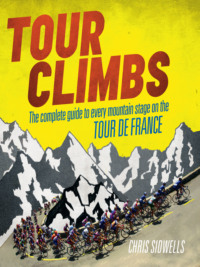
Kitabı oku: «Tour Climbs: The complete guide to every mountain stage on the Tour de France»
Tour Climbs
THE COMPLETE GUIDE TO EVERY
TOUR DE FRANCE MOUNTAIN CLIMB
Chris Sidwells

Contents
1 THE TOUR DE FRANCE ITS MEN AND ITS MOUNTAINS
2 THE MOUNTAINS OF THE TOUR DE FRANCE HOW TO RIDE THEM
3 EASTERN PYRENEES
4 WESTERN PYRENEES
5 VOSGES AND JURA
6 MASSIF CENTRAL
7 NORTHERN ALPS
8 CENTRAL ALPS
9 SOUTHERN ALPS
LIST OF SEARCHABLE TERMS
PICTURE CREDITS AND KEY
COPYRIGHT
ABOUT THE PUBLISHER

© Universal/TempSport/Corbis
The Tour de France

The Tour de France is the biggest annual sporting event in the world. For three weeks it has priority over a nation’s roads. As long ago as the 1960s a French writer said that President De Gaulle might run the country for eleven months but in July, France was ruled by the Tour.
A social scientist could probably come up with a clever reason why a bike race has captured the hearts of a nation. But I think that one reason could be the setting. France is a beautiful country, and any sporting event run off against a backdrop of stunning scenery is onto a winner for a start.
Another reason could be that July is holiday time in France. People associate the Tour with being away from the every day, being free and having fun. To realise how true this is, you only have to visit any village when the Tour passes by. On a flat stage the riders stream past in seconds, but in each village an all-day party will be held.
Then there are the riders themselves. The Tour de France is hard, maybe the hardest sporting event in the world. There are flat days of super fast racing, a painful crash in the tight pack of 200 riders is only a moment’s inattention away. In contrast the mountains split up the race, with every rider having to fight on his own battle against nature.
The race forges heroes, it creates colourful characters. Hard workers who people identify with. You don’t fluke the Tour de France. Just finishing is a triumph, and winning places a man in the pantheon of champions. The race has its faults. Some riders want to win too much and have cheated. But the Tour de France is fighting that, and the race has somehow become nobler because of it.
The Tour de France
‘ITS MEN AND ITS MOUNTAINS’
The Tour de France is a stretch of anyone’s imagination. It is the biggest annual sporting event in the world; 15 million spectators line the road to watch it pass by, while many more sit glued to a thousand hours of television beamed during its three weeks to all four corners of the world. The Tour is long and gruelling, its course is spectacular, its infrastructure huge. And mountain climbs have been part of the Tour de France almost since it began.
The race was born out of a turn of the twentieth century battle to increase newspaper circulation. Count de Dion was the fiery tempered owner of a magazine called Le Velo, but when its editor criticised De Dion’s stance over the Dreyfuss Affair, a case that rocked France where a Jewish army officer was wrongly accused of spying, he withdrew his cash and set up a new magazine that he called L’Auto.
Bicycle racing had been going in France since 1867, encouraged by manufacturers who set up works teams to compete in long races that were the perfect stage on which to demonstrate the durability of their machines. Something about the struggle that competitors had with the elements, and the speed with which they ate kilometre after kilometre of dreadful roads, struck a chord with French people, and the sport became hugely popular.
It’s no surprise then that the editor of a new sports magazine should turn to bike racing as a way of boosting his sales figures. And even less of a surprise given that the editor of L’Auto, Henri Desgrange, had been a professional racer in his youth.
However, although he is known as the ‘Father of the Tour’, it wasn’t Desgrange who first thought up the Tour de France. That was L’Auto’s chief cycling reporter, Geo Lefevre who had the mad idea of a bike race around the whole of France, and at first Desgrange was reluctant.
There were a lot of long races already in existence. ‘Paris–Brest–Paris’ for example, a trip of well over 1000 kilometres in one go from the French capital to the tip of the Breton peninsula and back again. But this? The race Lefevre was planning was 2500 kilometres long and would take its competitors to all six corners of France. As well as a sporting challenge it was a going to be a logistics nightmare.
The race takes shape
But the more Desgrange thought about it, the more he liked it. Split the distance down into stages, and soon the race began to seem possible. So, on 1st July 1903, at the Café du Réveil du Matin in the village of Montgeron, which is now a suburb of Paris, the Tour de France was born.
Sixty men, some of them full-time professionals but most self-financed amateurs, lined up to ride the first stage of 467 kilometres from Paris to Lyon. Strong of arm and leg, sound of body, men with tough minds and even tougher handlebar moustaches, these modern-day knights of the road pedalled their heavy machines into history.

The Eagle of Toledo, Frederico Bahamontes © Universal/TempSport/Corbis
A Parisian chimney sweep called Maurice Garin won the first Tour de France. It was 2428 kilometres long and split into six stages. Paris to Lyon, Lyon to Marseille, Marseille to Toulouse then on to Bordeaux, Nantes and back to Paris. Garin’s prize was 6125 gold francs, and his victory margin over second place Louis Pothier was getting on for three hours. Interest in the race was huge, France had fallen for the Tour
The race has changed a lot since 1903, but its basic template was laid down in that first edition. No matter how many stages there are, or how many a rider wins, the Tour de France winner is the man who completes the whole route in the least time. So it’s possible to win the race without winning a single stage. And it’s been done, although not very often. The only thing that was missing from the first event really was the mountains. But once the organisers saw that racing around France was possible, they decided to make it harder. And to do that they headed for the hills.
Going into the mountains
France has four mountain areas; in order of increasing height, the Vosges, the Massif Central, the huge peaks of the Pyrenees and the giant Alps. To see how cyclists would fare in them, the organisers decided to include a stage through the Vosges in the 1905 race, and to visit the very edge of the Alps.
They had climbed the Col de la Republique during the first Tour, but that is a pass over the low shoulder of a mountain range, and there was no way around it. Now though, the riders would take on a real mountain, virtually crossing its summit, and its name was the Ballon d’Alsace.

© Universal/TempSport/Corbis
In his editorial before the race, Desgrange predicted that no competitor would be able to ride all the way to the top. They would have to dismount and walk for at least part of it, he thought. But Ren Pottier proved him wrong. He was the only one to do it, but Pottier pedalled all the way to the top. He even overtook Desgrange, who was sitting in the lead motor vehicle at the head of the race.
The effort he made destroyed Pottier’s chances. He was caught by other more prudent riders on the descent and later forced to retire from the stage through exhaustion. But as the riders pedalled on to the stage finish in Besancon, right on the edge of the Jura, Pottier had made a point to Desgrange
On the next but one stage the race climbed the Col Bayard, while travelling from the Alpine gateway city of Grenoble to Toulon on the Mediterranean coast. Everyone wanted to know if the riders would beat the stage coach that went over the climb from Grenoble and south to Gap. The coach was drawn by six horses on the flat and ten on the climbs, but the riders beat it by hours, and then carried on to Toulon.
Before the first Tour de France the daily circulation of L’Auto was 140,000. By 1910 the race had grabbed people’s interest to the point where Desgrange was selling 300,000 copies a day. But he wasn’t satisfied with that. The mountains were a big success. The pedalling heroes could conquer them, so in 1910 the Father of the Tour planned an epic stage, a stage to top all others, a stage that would capture the imaginations of everyone in France.
It was 326 kilometres long, it ran east to west from Luchon to Bayonne and crossed some of the most famous mountain passes in the Pyrenees; the Col de Peyresourde, Col d’Aspin, Col du Tourmalet and Col d’Aubisque. Almost no one had climbed these passes on a bike, and certainly no one had climbed one after the other on a single ride. In 1910 there were passes used by mountain people to get from one valley to the next, and often they were not much more than rutted tracks.

© Universal/TempSport/Corbis
It was a big adventure, and one guaranteed to make L’Auto the number one sports publication in France, but the thought of the challenge that lay ahead of the riders filled Desgrange and his staff with dread. Desgrange wasn’t any more at ease when he drove to the top of the Peyresourde to see the riders on the first climb.
He had an anxious wait. It was the first time that Desgrange had seen the climb. All he had to go on before were reports from his staff, who had visited the Pyrenees to see if the stage was possible. He learned that morning that there had been reports of bear attacks in the area. The news didn’t make him feel any better while he waited
Then he saw a dishevelled figure trudging towards him pushing a bike. It was a Tour de France rider, but Desgrange couldn’t identify him as he was covered in mud and he refused to speak to the race organiser. The next rider was easy to identify, and had a little more to say. He was Octave Lapize, a great rider and one of the favourites to win the 1910 Tour. Desgrange asked him what had happened to the others, but Lapize looked straight through him and spat out a single word: “Murderer!”
Desgrange loved that. He once said that his perfect Tour de France would have only one finisher, one hero who had battled through it all to the end. Lapize won the first Pyrenean stage at an average speed of 23 kph, and over 40 riders managed to haul themselves over the mountains, the last three admittedly over seven hours behind the winner. Every rider hated Desgrange, but no one had died. His race was now the most important and most popular sporting event in France. The mountains would be part of it for ever.
The yellow jersey
The First World War called a halt to the Tour shortly after the 1914 race, but as soon as was humanly possible, Desgrange and the Tour were back again. In 1919 the riders raced across the bombed-out battle fields of northern France, a symbol of hope in a grey rubble-strewn wasteland.
But the colour of the 1919 Tour de France was yellow. Desgrange always looked for ways to improve his race. One criticism he’d heard was that spectators could never tell which of the riders was the overall race leader when they pedalled by, so Desgrange decided that the Tour leader should wear a distinctive jersey. The legend goes that yellow was chosen because it was the colour of L’Auto’s pages. However, it is also said that yellow was the only colour left in suitable numbers when Desgrange needed the jerseys in a hurry.

© Luc Claessen
The Tour grew into the number one international cycling event between the two World Wars. Cycle road racing was very a popular sport in many European countries and in 1909 the Tour had its first foreign winner, Francois Faber of Luxembourg. The Tour of Italy was born in the same year. Odile Defraye of Belgium won the 1912 Tour de France, and his countrymen followed him to victory in the next six editions of the race.
Ottavio Bottechia was the first Italian to win in 1924, and he did it again in 1925. Then in 1949 the Tour de France was won by cycling’s first really big international superstar, a compatriot of Bottechia’s, Fausto Coppi. Coppi could win every kind of race, he was a superb athlete, but he was more than a cyclist.
Media stars
The media had grown by 1949. Fans could read about Coppi, and they could see films of him racing, as well as watch by the roadside. He had more coverage than any other cyclist before him. This made Coppi a celebrity, and a controversial celebrity at that.
Coppi earned more money than any other cyclist had before him, and money gave him a lifestyle to be envied, but it was also one that fascinated his fans. He fell in love with the beautiful wife of his doctor. He left his own wife to live with her. They had a son, and Coppi was excommunicated from the Catholic church.
Coppi won the Tour de France again in 1952, before Frenchman Louison Bobet became the first man to win the race three times in a row. Bobet was another rider who made a lot of money from cycling, so much that he often piloted his own aircraft to races. Cycling had come of age, its top riders were wealthy men, and even though it was, and still is, a brutal struggle to succeed, professional cycling now carried with it a gloss of glamour.
In the 1960s the sport was dominated by Jacques Anquetil, a Frenchman, who from humble beginnings as a strawberry grower’s son in Normandy became the first five-time winner of the Tour, the first French winner of the Tour of Italy, and when he won the Tour of Spain, which had started up in 1935, Anquetil was the first cyclist ever to win all three major stage races during his career.
New management
The Tour de France saw a change of direction after the Second World War. When the race started up again in 1947, Henri Desgrange had fallen ill and his place was taken by Jacques Goddet, the son of L’Auto’s first company accountant. Goddet was a well-educated man who had spent part of his youth in England, and who spoke several languages.
L’Auto was shut down by the allies when they liberated Paris in 1945, but Goddet just upped sticks and set up a new newspaper across the road. He called it L’Equipe, and today it is one of the biggest and best-known daily sports newspapers in the world.
Goddet took the Tour de France with him, and L’Equipe owned the race until they sold it to the Amaury Sport Organisation in the mid-1980s. Amaury are still the company behind the Tour de France, and the whole thing, along with a number of other international bike races and other sporting events, is run from a modern office block in the Paris suburb of Issy-les-Molineux.
The Tour prospered under Goddet. He was quite modern, even though he didn’t look it, especially when the race was in the hot south of France when Goddet used to wear his tropical gear of pith helmet, shorts, long socks and a Safari shirt. Goddet also had a shrewd assistant called Felix Levitan, who looked after the commercial side of the race. Between them they ruled with a rod of iron, and despite there being official referees and judges on the race, Goddet and Levitan’s word on anything was final.
Going global
An Australian team raced in the Tour de France way back in 1928, but up until the mid-1950s Tour competitors were almost exclusively from mainland Europe. Then a British team, sponsored by a bike manufacturer called Hercules, raced in the 1955 event. Only two of their riders, Brian Robinson and Tony Hoar, finished, but Robinson graduated into mainstream European pro racing and won stages in the 1958 and 1959 Tours.
More Britons followed Robinson. Tom Simpson wore the leader’s Yellow Jersey in 1962, and Barry Hoban won eight Tour stages during his long pro career. Robert Millar then became the Britain’s most successful Tour de France rider when he finished fourth overall and won the King of the Mountains competition in 1984.
While this was going on Australians, Irish, Americans and Canadians continued to swell the English-speaking presence on the race. Other nations joined in too, most notably the Colombians and Scandinavians began to write themselves into Tour history. The Tour de France was going global.
Its fame and appeal exploded in 1986 when an American Greg Lemond won the Tour. His victory was followed by Stephen Roche from Ireland in 1987. New interest in the race from all over the world meant a flood of new sponsors. Major names like Coca Cola wanted a piece of the Tour. An American, Lance Armstrong set a record in 2005 with seven consecutive victories in the Tour, and a Frenchman hasn’t won since 1985.
Twenty-first century Tour
Today the Tour de France is huge. London paid £1.5 million to host the start of the race in 2007, but got far more than that back from the visitors who came to watch. The prize list for the race totals €3 million, with €400,000 euros going to the winner. Not that he sees any of it. Traditionally he splits it among his team, because the winner of the Tour de France automatically becomes the highest earner in the sport. Lance Armstrong is reputed to have earned $17 million in product endorsements alone during 2005.
The Tour de France has its own motorcycle police force and a travelling bank, the only one allowed by law to open on the nation’s Bastille Day holiday. Each year there are 2300 accredited journalists on the race, 1100 technicians and chauffeurs, many of them ex-competitors who drive race officials and guests on the race. On top of that 1500 vehicles accompany the riders on the road in the form of a publicity cavalcade that companies pay dearly to be part of. Another 4500 support staff work on the Tour, either in race routing, hospitality or assembling and taking down the temporary Tour village that goes from town to town between the stages.
At the heart of all this activity are the riders. As many as 200 of the world’s best pro road racers start the Tour, although every year there are a good few that don’t make it through to the finish. Like the race, the riders’ personal statistics are prodigious. For example, it’s reckoned that a competitor will burn around 123,000 calories if he gets through to the end of the race. He will make getting on for 500,000 pedal revolutions, wear out three bicycle chains, and every year the whole field gets through 700 ultra-light racing tyres.
How it works
The Tour de France is big, and it’s getting bigger with a prosperous and exciting future ahead of it, but it is a race that is firmly rooted in tradition. It has always been what in cycling is called a stage race. That is a race decided on total time to complete the whole course, but with the course broken up into individual stages. The rider who completes the whole course in the least time is the overall winner, and at any given point after the first stage the race has an overall leader who wears the yellow jersey.
Most of the stages are straightforward races. They are referred to as road stages, where all the riders start together and the first over the line wins the stage. A few stages are time trials; riders start individually at intervals and the one who covers the course on his own in the fastest time wins the stage. Team time trails work on the same principle, but the individual teams complete the course together and their times are added to each team member’s overall time for the race.

The Alpe d’Huez all-day Tour party © Luc Claessen
Soon after the first editions were run, the Tour de France settled into a pattern that is preserved today. It usually occupies the first three weeks of July, which covers the time that French people traditionally take their summer holidays. Since 1967 it has started with a short prologue time trial, which provides some order for the first few stages. The prologue winner wears the yellow jersey on the first road stage.
Most years see the first few stages run off over flat to undulating countryside, giving riders who don’t shine in the mountains the chance for some glory. A longish time trial comes after this first phase, and then the mountains. To win the Tour de France a rider must be good at the time trials, but he must also excel in the mountains. He certainly can’t be a specialist in one to the exclusion of the other, although many Tour winners have leant towards one or other speciality.
Since they were first visited, the Alps and Pyrenees have been included in every race and the Tour tries to visit the Vosges and Massif Central whenever it can. The race always finishes in Paris, and the others stage towns and cities are decided by geography and by the various municipalities pitching to be hosts. Many places, including towns and cities in neighbouring countries, want to be visited by the Tour. Each year the organisers have a notional idea of where they would like to go, what climbs they would like to include, then they look at who wants the race and come up with a route.
The first long time trial and the first day in the mountains are when the Tour de France begins to take shape each year. The riders and pundits say that while you cannot tell who will win in Paris after the first mountain stage, you can always tell who will not. A number of favourites invariably fall out of the running on this crucial day.
The importance of mountain climbs
Why should this be? Why are mountain climbs so important in shaping the outcome of the Tour de France? Part of the reason is to do with wind resistance. As a cyclist’s speed increases linearly, the air resistance that cyclist has to overcome increases exponentially. So bike racers have to overcome far more air resistance to increase their speed by one mile per hour when travelling at 25 mph than they do when travelling at 10 mph. This means that when they are travelling fairly fast, on a flat stage for example, the riders find it very difficult to break away from each other. The whole field can slipstream each other, saving energy, and will often finish virtually together.
Going uphill though, involves a different set of physics. It’s the force of gravity rather than air resistance that has to be overcome. No cyclist can travel faster uphill than on the flat, so the reduced speeds mean that air resistance and slipstreaming have less of an effect when climbing. In the mountains a rider has to fight against his own weight, so the mountains favour riders with the highest power to weight ratio.

But that isn’t the whole story. Cycling is a complicated sport, and long stage races like the Tour de France are its most complicated arena. A good mountain climber might have a phenomenally high power to weight ratio, but that could be because he is incredibly light and his absolute power is quite low, which is a limiting factor in a time trial. So although a Tour de France winner must excel in the mountains, and climbing specialists have won the race, he must still be able to ride a fair time trial. In fact, broadly speaking, there are two kinds of Tour winners; time trial specialists who can limit their losses in the mountains, and climbers who can do the same in a time trial.
There are also differences in the way overall contenders go about racing uphill. Some riders, the ones who are good at time trials and can climb well, favour setting a high average pace in an attempt to slowly burn off all the others. Whereas climbing specialists will make violent changes of pace, attacking and being caught before attacking again until their rivals are exhausted by chasing them.
They are the riders who win the King of the Mountains title in the Tour de France, The competition started in the 1933 Tour de France, and is based on points awarded for the first riders over each climb of the Tour. The number of points and how far down the field they go depends on the severity of each climb. They are ranked from third category for hills and small passes, to first category for bigger climbs. Then there is a category the French call Hors Categorie, or beyond category, for the real giants.
The leader of the King of the Mountains competition wears a distinctive red and white polka-dot jersey. The design for that came from the fact that when it was first awarded as the symbol of leadership in this section of the race, the sponsor of the mountains competition was a chocolate manufacturer, whose wrappers were white with red polka-dots on them.
The King’s story
A Spaniard called Vicente Trueba, who was nicknamed the Torrelavega Flea because he was so slight, was the first winner of the King of the Mountains title. Many great climbers and Tour winners have gone on to win the title, including the Italians Gino Bartali and Fausto Coppi, but in the mid-1950s the title was taken by two of the greatest climbers the Tour de France has ever seen, Frederico Bahamontes of Spain and Luxembourg’s Charly Gaul.
Bahamontes, who journalists christened the Eagle of Toledo, and Gaul, who they referred to as the Angel of the Mountains, both went on to win the Tour de France overall, and Bahamontes was six times the King of the Mountains champion. They were both capable of attacking early on a mountain stage and decimating the entire field. That was how they won their Tours.
Bahamontes might have won more than once, only his career overlapped that of Jacques Anquetil, and their battles were a classic confrontation of a time trial specialist who could climb against a pure climber. Anquetil was the time trial specialist and was content to limit his losses on the climbs, but on occasions, and especially against Bahamontes, he had to climb incredibly well to do that.
Their battles came to a head in the 1963 Tour de France on the Col de la Forclaz. Bahamontes, in the yellow jersey, was determined to destroy Anquetil that day and win his second Tour de France, but Anquetil knew that he couldn’t let him have any more of a lead. He had to stay with the Spanish climbing star, and he had to summon all of his strength to do it. Anquetil suffered, but he clung onto the Spaniard, surviving all his attacks. He even beat Bahamontes to the line at the end of the stage. Later, Anquetil won the final time trial and his fourth Tour de France.
The best ever
There have been many such epic contests over the years, but who is the best Tour de France climber ever? There are many candidates, but I’ll go for the man who Bahamontes says is best. After all, can there be a better judge? His name is Lucien Van Impe. He is from the flat fields of Flanders in Belgium, but no one could accelerate uphill like Van Impe could.
He is a short man, light but not a featherweight. He won the King of the Mountains six times, but always says he backed off winning a seventh because of respect for Bahamontes. Van Impe also won the Tour overall in 1976. He often says that climbing mountains is an art rather than a science, and spent weeks each year before the Tour de France training in the Alps or Pyrenees to try and discover his climbing rhythm.
The Tour de France still throws up great climbers. Lucho Herrera from Colombia and Claudio Chiappucci of Italy were two of the best. In 2004 Frenchman Richard Virenque completed a record seven King of the Mountains titles, which he usually won by attacking early on the first day in the mountains to get a strangle hold on the competition, then chasing every point on offer after that. Marco Pantani never was King of the Mountains, although he was a climber who won the Tour overall for Italy in 1998. The Tour winner in 2007, Alberto Contador of Spain, is an excellent climber, and the winner of the 2007 mountains title, Colombian Mauricio Soler, looks to have a good future ahead of him.

A cyclist’s eye view of the start of a Tour climb
Blueprint for a Tour
Every year the Tour de France plays out to a pattern. After the first range of mountains, which in some years are the Pyrenees and in others the Alps, there are usually some flattish stages. On these the sprinters in the race, who never have a good time when the roads go upwards, fight for the stage victories, while the overall contenders try to stay out of trouble and conserve their energy for the next set of mountains. These stages are called transition stages, and they are often in the south of France, so are characterised by sun and warm weather and the compelling picture of glittering bikes and bright colours streaming through a patchwork of vineyards, sunflowers and lavender fields.
The second major mountain range often decides the winner of the Tour de France. Most years there are a number of riders who still have a chance at the beginning of this part of the race, but coming out of the second mountains there is often just one man left with a commanding lead. On the occasions where that doesn‘t happen, a time trial held on the penultimate or even last day of the race will decide the outcome.
Many things can cause riders to come unstuck in the second set of big mountain stages. Riders who are strong in the Alps can find the Pyrenees less to their liking, because the climbs of the two ranges are different. Alpine climbs tend to have uniform gradients, the Pyrenees don’t, and even the weather can be different. Another problem is cumulative fatigue. Most pro riders perform well for two weeks, but only the best are strong in the third week of the Tour de France.
The mountains are crucial to the Tour. Their evocative names; the Galibier, Alpe d’Huez, Mont Ventoux, the Tourmalet and Peyresourde are mentioned in the sporting press for months before and after each race. They roll from the tongue as fans argue about who will be strong and where. Fathers tell their children stories about these places, and old men look back at when they raced and dreamed of conquering their lofty peaks.
The mountains are theatre in which the Tour de France is played out in front of its most loyal fans. On the biggest peaks the diehards will arrive with their tents and camper vans up to three days before the race is due to pass. On the day there can be as many as half a million people on one climb, all cheering, drinking, eating and sharing the moment in a big party.
The mountains are where the greatest battles of this historic race have been enacted, and its tragedies played out. In the heat of competition they are fearsome places to be, but away from that, taken at whatever pace you decide, conquering their slopes is something that any reasonably fit cyclist with the proper equipment can do. I hope that this book will help you on your way.

Lucien Van Impe – simply the best © Universal/TempSport/Corbis
The mountains of the Tour de France

They have been part of the Tour almost since it started. The mountains of France have been the Tour’s theatre, where its dramas, its successes, failures and tragedies have been played out.
Anyone with designs on winning the race has to master the mountains, has to be able to soar upwards in defiance of gravity. To see some of the great climbers of this race is to witness a combination of brute force and ballet. Such men appear to have wings on their feet as they dance effortlessly upwards.
Of course it’s not like that at all. It takes years of hard work and application, natural talent, supreme physical fitness and sometimes shear bravery to take on these giant climbs at race pace.
But the bike is a truly beautiful machine. While the racers of this world will use theirs to force their way up the gradients, set records, break personal bests and punish the opposition, others prefer to shift down a gear and take their time.
The mountains belong to both, to all of us really. If you enjoy cycling you can enjoy climbing the mountains of the Tour de France in your own way, and what a lot there is waiting for you.
From the intimacy of the Vosges, through the dark and rugged Massif Central, to the unpredictable Pyrenees and the off-the-scale splendour of the Alps, all of the French mountains are accessible to cyclists. A bit of training, a bit of application, a bit of know how, a sound bike and the mountains are yours for ever. Enjoy!
The mountains of the Tour de France
‘HOW TO RIDE THEM’
Climb every mountain, or so the song goes. And with the right equipment, preparation, a bit of technique and the correct mental approach you can do just that. You can climb every mountain of the Tour de France.
The mountains are a huge challenge in a race, they separate the champions from the very best in the sport, but any averagely fit person who has done a bit of training can get to the top of them, too. Slower yes, much slower in many cases, but that’s not the point. Mountain climbs are a personal challenge and all that matters is that you enjoy your journey to the top.
So what is needed to take on the mountains of the Tour de France? The first answer is obviously a bike. But just any bike? Well, basically yes. The pros in the Tour de France ride on road race bikes made from the latest space-age materials at a cost of thousands of pounds a piece, but you can climb the Tour de France mountains on a road bike, a mountain bike or a hybrid bike. The latter being a bike with some of the features of both road and mountain bikes. All these bikes are suitable for climbing mountains, although you might want to swap some of the equipment on yours to make life easier when you do.
Road bikes
These are what are classically called race bikes. They have dropped handlebars, thin tyres and multiple gears. Entry level models costs about £400 and the amount you pay, as with most things in life, reflects the quality and sophistication of the machine. However, you don’t have to break the bank to buy a good bike. What you are looking for in a road bike suitable for climbing mountains are lightness and gear ratios low enough to allow you to pedal up the climbs in a seated position, and at a reasonably high cadence.
This is the crux of climbing up mountains. You can muscle your way up a short hill by climbing out of the saddle to put more power into the pedals, but you can’t climb the mountains of the Tour de France like that. Not even the pros can. The Tour de France climbs are long, and sometimes they are long and steep. You have to take your time with them. You have to gear down and ride within yourself.
There are two options that give you the low gear ratios you need for climbing Tour de France mountains: triple or compact chainsets. Chainsets are the part of a bike’s drive train that the pedals are attached to. Gear ratios are determined by the size of the chainring on a chainset and the size of the teethed sprockets on the rear wheel. Small chainrings and large sprockets give you low gears, so on a triple chainset there is an extra small chainring, and on compact chainsets both chainrings are smaller than standard.

What goes up must come down
The best system is the compact system because it is the simplest to use, and it’s lighter. You don’t lose high gears either, because most road bikes now have nine or ten sprockets on the rear wheel, more than enough to provide a wide range of gear ratios.
You can buy bikes with triple or compact chainsets, but it’s quite a simple procedure to fit one and adapt almost any road bike to work with them. A good bike shop will advise you on the swap, and happily take on the job if you don’t want to do it.
Touring bikes and cyclo-cross bikes are classified by shops with road bikes. These come equipped with low gears already, so there is no problem there in using either of them to climb mountains. However, cyclo-cross bike have tyres with heavy knobbly treads to give you grip when riding on loose or muddy cross-country surfaces. You should swap these tyres for smooth road tyres if you want to use a cyclo-cross bike in the mountains.
Mountain bikes
Mountain bikes have triple chainsets and very low gears, but their tyres are designed to grip in even worse conditions than cyclo-cross tyres, so they are especially heavy and will cause excessive drag on the hard-surfaced roads of the mountain climbs.
You need to swap these for what mountain bikers call slicks. They are the same diameter as normal mountain bike tyres, but come in a number of widths. As a general point wider tyres are more comfortable to ride on than narrow ones, but no mountain bike slicks are that narrow for this to become an issue. So go for the narrowest you can get.
Otherwise your mountain bike is excellent for climbing mountains, and especially good for descending them. Mountain bikes have a low centre of gravity and they are longer than the equivalent-sized road bike, so they are very secure when cornering.
Hybrid bikes
In many respects these are a best of both worlds bike. They have the flat handlebars of a mountain bike, a wide range of gear ratios provided by triple chainsets. And if you get a more street-oriented hybrid bike, which most new ones are today, it will have slick tyres on it already.
Pedals
Bikes have three sorts of pedals. Flat pedals on which you just place your feet and push down. Pedals with toe clips and straps, where your feet can pull up on the clips as well as push down on the pedals. And by far the best system for climbing mountains, clipless pedals.
These work by inserting a cleat, which is fixed to the sole of a specialist cycling shoe, into a spring-loaded retaining mechanism on the pedal. Once engaged your foot is always in contact with the pedal, and the muscles of your legs can input power throughout the whole 360 degrees of every pedal revolution. All you do to disengage your foot from the pedal is twist it sideways. They take a bit of practice to get used to but are very efficient and totally safe.
Bike preparation
No matter how light and sophisticated your bike is, it needs to be well maintained at all times, and it needs some extra close attention before you venture into the mountains. But before that it pays to get into the habit of going through some basic safety checks before every ride.
Check your bike’s frame for cracks. Apply each brake in turn while pushing your bike forward. With the front brake on the front wheel should not turn. The same goes for the rear brake with the rear wheel. Check all brake cables and housings for signs of wear, and replace them if you see any. Check your tyres, replacing them if you find any excessive wear, cuts or bulges. Finally, shift through all the gears and make sure that they mesh properly and that the chain doesn’t jump around.

Elbows out, shoulders relaxed and breathe deeply © Luc Claessen
Do a more detailed check whenever you clean your bike, which is something you should do regularly anyway. You must also carry out a regular service on your bike. There are many good bike maintenance books available to help you, but most bike shops will look after your bike if you don’t want to do it yourself.
Before a ride check that your tyres are pumped up to the recommendations that are usually printed on the tyre. Make sure anything you have fastened onto the bike, like a drinking bottle, a bag or a tyre inflator is safe. And always have another shift through all your gears while riding on the flat somewhere before you start to climb. If you can’t get bottom gear the whole experience might be ruined.
Physical preparation
Climbing some of the easier Tour de France mountains is within the scope of almost any reasonably fit and healthy person, given a bike that is in good condition, is fitted with low enough gears, and provided the rider takes his or her time. However, some of the bigger climbs, the most famous ones in fact, do require some physical training. And in any case, the fitter you are the more enjoyable the whole experience will be.
Without trying to state the obvious, the best way to get fit for cycling is to ride your bike regularly, but that doesn’t mean that other physical exercise is of no use. One of the biggest factors that will impact how quickly you can ride a bike uphill is your body weight, or more particularly your power to weight ratio.
There is no doubt that being active helps to keep your weight down, so any activity is good activity as far as this is concerned. Linked with a varied diet of good wholesome food, and perhaps a little restraint with regard to eating the classic weight-gaining foods like cakes and chocolate, plenty of varied physical activity is a good foundation on which to build some specific cycling fitness.
If possible you should add some form of resistance training to your varied programme, concentrating on your leg muscles. This helps to build up the power side of the power to weight equation. Then if you include three or more bike-riding sessions a week for about two months before tackling the mountain climbs, you should be ready. The bike sessions don’t all have to be on the road, although at least one should be. You can use a gym fitness bike or put your own bike on a turbo trainer and ride indoors.
Once you are riding regularly you should start to seek out some hills in your neighbourhood. The longer these are the more benefit they will have on your ability to master Tour de France mountains. You can also simulate long climbs on indoor bikes by upping the resistance on the machine you are using.
Whatever way you choose to begin your specific mountain climbing preparation, try to ride all the uphill parts on your routes by sitting on your saddle and spinning your legs in a low gear. Concentrate on relaxing your upper body and breathing deeply and rhythmically. Occasionally you should ride a hill in a little higher gear, both in the seated position and out of the saddle, to help build up some functional muscular strength. And there is nothing wrong with riding up a hill, turning around carefully at the top, descending and doing it again.
All the advice in the last paragraph comes from the man who many recognise as the best mountain racer ever, Lucien Van Impe of Belgium. He says; “I spent weeks before every Tour de France learning to spin my legs quickly on the climbs. I would try to match my breathing with the rhythm of my legs. When I was a pro rider I practised in the Pyrenees, but when I was a young amateur I trained near where I live in the north of Belgium. There are no mountains there, so I would ride up and down the same hill maybe ten times.”

Sit up to breathe easy – 2007 King of the Mountains Mauricio Soler shows how © Luc Claessen
Ücretsiz ön izlemeyi tamamladınız.