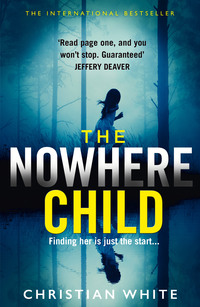
Kitabı oku: «The Nowhere Child»


Copyright
Published by HarperCollinsPublishers Ltd
1 London Bridge Street
London SE1 9GF
www.harpercollins.co.uk
First published in Great Britain by HarperCollinsPublishers 2019
First published in the Australia by Affirm Press 2018
Copyright © Christian White 2018
Cover design by Micaela Alcaino © HarperCollinsPublishers Ltd 2018
Cover photographs © Jake Olson/Trevillion Images (church), © Shutterstock.com (sky, trees)
Christian White asserts the moral right to be identified as the author of this work.
A catalogue copy of this book is available from the British Library.
This novel is entirely a work of fiction. The names, characters and incidents portrayed in it are the work of the author’s imagination. Any resemblance to actual persons, living or dead, events or localities is entirely coincidental.
All rights reserved under International and Pan-American Copyright Conventions. By payment of the required fees, you have been granted the non-exclusive, non-transferable right to access and read the text of this e-book on screen. No part of this text may be reproduced, transmitted, down-loaded, decompiled, reverse engineered, or stored in or introduced into any information storage and retrieval system, in any form or by any means, whether electronic or mechanical, now known or hereinafter invented, without the express written permission of HarperCollins.
Source ISBN: 9780008276539
Ebook Edition © January 2019 ISBN: 9780008276553
Version: 2018-11-27
Praise for The Nowhere Child:
‘A nervy, soulful, genuinely surprising it-could-happen-to-you thriller – a book to make you peer over your shoulder for days afterwards’
A. J. Finn
‘The personification of a high-concept thriller, brilliantly executed. Author White raises the bar on psychological suspense, telling Kim Leamy’s tale in a stylish voice and with a heart-pounding pace. Read page one, and you won’t stop. Guaranteed’
Jeffery Deaver
‘Packed with tension, twists and tremendous pace, it’s hard to believe that this is the work of a debut author. The Nowhere Child is stunning and flawless. I can’t recommend it enough’
Thomas Enger
‘Beautifully written, perfectly suspenseful and wonderfully dark. I could not put this book down’
Susi Holliday
‘Such a clever idea, which grips from the very first chapter’
Ragnar Jonasson
‘White skilfully builds an uncertain, noxious world of dysfunctional families and small-town secrets – The Nowhere Child is a gripping debut from an exceptional new talent’
Mark Brandi
‘The Nowhere Child is a fabulous read, populated by such well-drawn and identifiable characters that I felt I knew them. I was desperate to know how the story unfolded. Brilliant!’
Louise Voss
‘The Nowhere Child lures you in, its teeth disguised in remarkably compelling prose, and gnaws down to the marrow of your bones’
Matt Wesolowski
‘I literally could not put this down once I started. A cracking read!’
Michael J. Malone
‘The Nowhere Child is a well-written thriller that avoids the clichés of the genre. The characters are interesting and believable and the book kept me reading up to the satisfying conclusion’
Phillip Margolin
‘The Nowhere Child is a page-turning labyrinth of twists and turns that moves seamlessly between the past and the present, revealing the story in parts and successfully keeping the reader guessing until the final unexpected reveal … It’s an exhilarating ride and a thrilling debut’
Books + Publishing magazine
‘How do any of us know that we are who we are told we are? This gripping read takes you to the very edge of reality’
Jane Caro
‘The Nowhere Child is a twisty, emotional read filled with suspense and intrigue. The gripping narrative and natural dialogue held me captive all the way through. Dark secrets buried away for years are gradually unearthed, leading to a dramatic, breath-holding climax’
Off-the-Shelf Books
‘I read The Nowhere Child in one gulp of a sitting. From the emotionally stunning opening until the final heart-stopping resolution, this tale of loss, discovery and what makes a family held me in its thrall first page to last’
Liz Loves Books
‘Utterly compelling, emotional and a stunning debut’
Bibliophile Book Club
Dedication
for my parents, Ivan and Keera White.
Contents
Cover
Title Page
Copyright
Praise for The Nowhere Child
Dedication
Melbourne, Australia: Now
Manson, Kentucky: Then
Melbourne, Australia: Now
Manson, Kentucky: Then
Melbourne, Australia: Now
Manson, Kentucky: Then
Melbourne, Australia: Now
Manson, Kentucky: Then
Hartford County, Connecticut: Now
Manson, Kentucky: Then
Somewhere In Pennsylvania: Now
Manson, Kentucky: Then
Martha, West Virginia: Now
Manson, Kentucky: Then
Manson, Kentucky: Now
Manson, Kentucky: Then
Manson, Kentucky: Now
Manson, Kentucky: Then
Manson, Kentucky: Now
Manson, Kentucky: Then
Manson, Kentucky: Now
Manson, Kentucky: Then
Manson, Kentucky: Now
Manson, Kentucky: Then
Manson, Kentucky: Now
Redwater, Kentucky: Then
Manson, Kentucky: Now
Manson, Kentucky: Then
Manson, Kentucky: Now
Manson, Kentucky: Then
Manson, Kentucky: Now
Manson, Kentucky: Then
Somewhere Over the Pacific Ocean: Now
Author’s Note
Acknowledgements
About the Author
About the Publisher
MELBOURNE, AUSTRALIA
Now
‘Mind if I join you?’ the stranger asked. He was somewhere in his forties, with shy good looks and an American accent. He wore a slick wet parka and bright yellow sneakers. The shoes must have been new because they squeaked when he moved his feet. He sat down at my table before waiting for an answer and said, ‘You’re Kimberly Leamy, right?’
I was between classes at Northampton Community TAFE, where I taught photography three nights a week. The cafeteria was usually bustling with students, but tonight it had taken on an eerie, post-apocalyptic emptiness. It had been raining nearly six days straight but the double-glazed glass kept the noise out.
‘Just Kim,’ I said, feeling mildly frustrated. I didn’t have long left on my break and had been enjoying my solitude. Earlier that week I’d found a worn old copy of Stephen King’s Pet Sematary propping up the leg of a table in the staffroom, and since then I’d been busily consuming it. I’ve always been a big reader, and horror is a particular favourite of mine. My younger sister, Amy, would often watch in frustration as I finished three books in the same time it took her to read one. The key to fast reading is to have a boring life, I once told her. Amy had a fiancé and a three-year-old daughter; I had Stephen King.
‘My name is James Finn,’ the man said. He placed a manila folder on the table between us and closed his eyes for a moment, like an Olympic diver mentally preparing to leap.
‘Are you a teacher or a student?’ I asked.
‘Neither, actually.’
He opened the folder, removed an eight-by-ten-inch photo and slid it across the table. There was something mechanical about the way he moved. Every gesture was measured and confident.
The eight-by-ten showed a young girl sitting on a lush green lawn, with deep blue eyes and a mop of shaggy dark hair. She was smiling but it was perfunctory, like she was sick of having her picture taken.
‘Does she look familiar to you?’ he asked.
‘No, I don’t think so. Should she?’
‘Would you mind looking again?’
He leaned back in his chair, closely gauging my response. Indulging him, I looked at the photo again. The blue eyes, the over-exposed face, the smile that wasn’t really a smile. Perhaps she did look familiar now. ‘I don’t know. I’m sorry. Who is she?’
‘Her name is Sammy Went. This photo was taken on her second birthday. Three days later she was gone.’
‘Gone?’
‘Taken from her home in Manson, Kentucky. Right out of her second-floor bedroom. Police found no evidence of an intruder. There were no witnesses, no ransom note. She just vanished.’
‘I think you’re looking for Edna,’ I said. ‘She teaches Crime and Justice Studies. I’m just a photography teacher but Edna lives for all this true crime stuff.’
‘I’m here to see you,’ he said, then cleared his throat before continuing. ‘Some people thought she wandered into the woods, got taken by a coyote or mountain lion, but how far could a two-year-old wander? The most likely scenario is Sammy was abducted.’
‘… Okay. So, are you an investigator?’
‘Actually, I’m an accountant.’ He exhaled deeply and I caught the smell of spearmint on his breath. ‘But I grew up in Manson and know the Went family pretty well.’
My class was set to start in five minutes so I made a point of checking my watch. ‘I’m very sorry to hear about this girl, but I’m afraid I have a class to teach. Of course I’m happy to help. What kind of donation did you have in mind?’
‘Donation?’
‘Aren’t you raising money for the family? Isn’t that what this is about?’
‘I don’t need your money,’ he said with a chilly tone. He stared at me with a pinched, curious expression. ‘I’m here because I believe you’re … connected to all this.’
‘Connected to the abduction of a two-year-old girl?’ I laughed. ‘Don’t tell me you came all the way from the States to accuse me of kidnap?’
‘You misunderstand,’ he said. ‘This little girl disappeared on April 3rd, 1990. She’s been missing for twenty-eight years. I don’t think you kidnapped Sammy Went. I think you are Sammy Went.’
There were seventeen students in my photography class, a mix of age, race and gender. On one end of the spectrum was Lucy Cho, so fresh out of high school she still wore a hoodie with Mornington Secondary emblazoned on the back. On the other end was Murray Palfrey, a 74-year-old retiree who had a habit of cracking his knuckles before he raised his hand.
It was folio presentation night, when students stood before the class to display and discuss the photos they’d taken that semester. Most of the presentations were unremarkable. The majority were technically sound, which meant I was doing something right, but the subject matter was largely the same as the folios in the previous semester, and the one before that. I saw the same graffiti on the same dilapidated brick wall; the same vine-strangled cabin in Carlton Gardens; the same dark and spooky storm drain dribbling dirty brown water into Egan River.
I spent most of the class on autopilot.
My encounter with the American accountant had left me rattled, but not because I believed what he said. My mother, Carol Leamy, was a lot of things – four years dead among them – but an abductor of children she was not. To spend one minute with my mother was to know she wasn’t capable of maintaining a lie, much less international child abduction.
James Finn was wrong about me and I was fairly certain he’d never find that little girl, but he had reminded me of an uncomfortable truth: control is an illusion. Sammy Went’s parents had learned that the hard way, with the loss of a child. I had learned it the hard way too, through the death of my mother. She went suddenly, relatively speaking: I was twenty-four when she was diagnosed with cancer and twenty-six when it killed her.
In my experience most people come out of something like that saying one of two things: ‘everything happens for a reason’ or ‘chaos reigns’. There are variations, of course: ‘God works in mysterious ways’ and ‘life’s a bitch’. For me, it was the latter. My mother didn’t smoke or spend her working life in a textiles factory. She ate well and exercised, and in the end it made exactly zero difference.
See, control is an illusion.
I realised I was daydreaming my way through the folio presentations so I downed a cup of cold coffee and tried to focus.
It was Simon Daumier-Smith’s turn to show his work. Simon was a shy kid in his early twenties who spent most of his time staring at his feet when he talked. When he did look up, his lazy eye bobbed around behind his reading glasses like a fish.
He spent a few minutes awkwardly setting up a series of photos on the display easels at the front of the class. The other students were starting to get restless, so I asked Simon to talk us through the series as he set up.
‘Uh, yeah, sure, okay,’ he said, struggling with one of the prints. It escaped from his hand and he chased it across the floor. ‘So, I know that we were meant to look for, uh, juxtaposition and, uh, well, I’m not exactly sure I have, you know, a grasp of what that is or whatever.’ He placed the last photo on the easel and stepped back to let the class see. ‘I guess you could say this series shows the juxtaposition of ugliness and beauty.’
To my complete surprise, Simon Daumier-Smith’s photo series was … breathtaking.
There were six photos in total, each framed in the exact same way. He must have locked the camera off with a tripod and taken a photo every few hours. The composition was stark and simple: a bed, a woman and her child. The woman was Simon’s age, with a pockmarked but pretty face. The child was around three, with unnaturally red cheeks and a sick, furrowed brow.
‘I took them all over one night,’ Simon explained. ‘The woman is my wife, Joanie, and that’s our little girl, Simone. We didn’t name her after me, by the way. A lot of people think we named her after me, but Joanie had a grandma called Simone.’
‘Tell us more about the series, Simon,’ I said.
‘Right, uh, so Simone was up all night with whooping cough and I guess she was pretty fussy, so Joanie spent the night in bed with her.’
The first photo showed mother spooning child. In the second the little girl was awake and crying, pushing away from her mother. The third looked as though Simon’s wife was getting fed up with her photo being taken. The series went on like that until the sixth photo, which showed both mother and child fast asleep.
‘Where’s the ugliness?’ I asked.
‘Well, uh, see in this one, little Simone, ah, the younger subject, is drooling. And obviously you can’t tell from the photo, but in this one my wife was snoring like crazy.’
‘I don’t see ugliness,’ I said. ‘I see something … ordinary. But beautiful.’
Simon Daumier-Smith would never go on to become a professional photographer. I was almost certain of that. But with his plainly named series, Sick Girl, he had created something true and real.
‘Are you alright, Miss Leamy?’ he asked.
‘It’s Kim,’ I reminded him. ‘And I’m fine. Why do you ask?’
‘Well, you’re, uh. You’re crying.’
It was after ten when I drove home through the gloomy landscape of Coburg. Rain fell in fat, drenching sheets against the roof of the Subaru. Ten minutes later I was home, parked, and dashing through the rain toward my apartment building, holding my bag over my head instead of an umbrella.
The third-floor landing was thick with the smell of garlic and spice; the oddly comforting scent of neighbours I’d never actually met. As I headed for my door, Georgia Evvie from across the hall poked her head out.
‘Kimberly, I thought that was you.’ She was a rotund woman in her early sixties with bloodshot, bleary eyes – ‘Heavy Evvie’, I once heard a neighbour call her behind her back. ‘I heard the elevator ding and looked at my watch and thought, who else would be coming home this close to midnight?’
It was ten-thirty.
‘Sorry, Mrs Evvie. Did I wake you?’
‘No, no. I’m a night owl. Of course, Bill’s in bed by nine so he might have stirred but he didn’t complain.’ She waved a dismissive hand. ‘And if he did I’d have reminded him you’re young. Young people come home late nowadays, even on weeknights apparently.’
‘Uh huh.’
Nobody had ever actually seen Georgia’s husband and there was little to no evidence he truly existed. Of course, he might have just been buried under all of Georgia’s crap. From the glimpses I caught of her apartment when she came to her door, I knew that 3E was lined with swaying towers of junk: books, bills, files and over-stuffed boxes. The only window I could see from the hall was covered with newspaper, and although I never actually saw one, I’m sure there were one or two tinfoil hats floating around in all that chaos.
‘Well, seeing as how you’re already awake …’ she started. Georgia was about to invite herself in for a nightcap. All I wanted was to turn the heat up, lounge on the sofa with Stephen King and listen to the soothing, predictable sounds of my apartment – the hum of the refrigerator, the whisper of ducted heating, the quiet buzz of my laptop charger. ‘… how about a nightcap?’
With a sigh I said, ‘Sure.’ Ever since my mother’s death I’ve found it near impossible to say no to a lonely woman.
My one-bedroom apartment was sparsely furnished, giving the impression that the place was huge. Even Heavy Evvie looked small sitting in the green armchair by the rain-streaked window of the living room, picking lint from her tracksuit pants and dropping it onto my hardwood floor.
I fetched a bottle of wine from the kitchen and fixed us both a glass. The one good thing about having Georgia over was I didn’t have to drink alone.
‘What do you think they’re cooking up over there, Kim?’ she asked.
‘Who?’
‘Who do you think? 3C. I hear them chattering all day in Iraqian or whatever.’
‘Oh, 3C. Smells like some kind of curry.’ My stomach growled. I had searched the kitchen for something to eat but all I could find were condiments. Wine would have to suffice.
‘I’m not talking about their supper.’ She lowered her voice to a whisper: ‘I’m talking about their plan.’
Georgia was convinced the occupants of 3C were terrorists based on two things: they were from the Middle East, and the name on their mailbox was Mohamed. On a number of occasions I’d explained to her that not all people with light-brown skin were terrorists and, regardless, I doubted Coburg, Australia would rate high on anyone’s list of targets. But every time, Georgia just shook her head gravely and said, ‘You’ll see.’
‘So what brings you home so late, Kim? I suppose you’ve been out clubbing.’
‘I work nights, Mrs Evvie. You know this.’
She sipped her wine and screwed her nose up at the taste. ‘I don’t know how you kids do it. Out all hours doing God knows what.’
I finished my wine fast and poured another one, reminding myself to take slower, more contemplative sips this time around. I was only after a warm, foggy buzz that would make it easier to sleep.
‘So something weird happened to me tonight, Mrs Evvie,’ I said. ‘A man approached me at work.’
‘Finally,’ she said, helping herself to more wine. ‘It’s about time, Kim. A woman only has a small window to bag a man. Between fifteen and twenty-five. That’s all you get. I was seventeen when I met Bill, eighteen when I married him.’
Georgia found a remote control stuffed between the green cushions of the armchair and turned on the television. Tinfoil hat and casual racism aside, all she really wanted was some company.
I curled up on the sofa nearby and opened up my laptop while she flicked through the stations at full volume.
I had intended to casually browse the internet, maybe stalk a high-school friend or purge my email inbox, but my curiosity soon grew too strong. When I opened a new tab and searched Sammy Went + Manson, Kentucky, it was as if my fingers were acting independently. It reminded me of the mechanical way James Finn had moved his manila folder about.
The first link took me to an archived newspaper article from 7 April 1990. The article had been electronically scanned in, complete with creases and inkblots. The words bled together in places, making me feel like an old-timey researcher poring through microfilm.
POLICE SEARCH FOR MISSING GIRL
The search for a two-year-old girl missing in the Manson area resumed on Friday with volunteers and law enforcement officers.
Sammy Went of Manson disappeared from her home Tuesday afternoon and has not been found despite a search of the town and its vicinity.
‘We have faith we’re going to find Sammy and bring her home safe,’ Manson Sheriff Chester Ellis said. ‘We’re currently working under the assumption this is a search and rescue operation.’
Police do not believe the girl’s disappearance was the result of foul play, but refused to rule anything out.
Hundreds of Manson residents searched the extensive wooded areas surrounding the Went residence on Friday.
Search volunteer Karen Peady, a long-time resident of Manson, expressed her fears: ‘The nights are cold and there are a lot of wild animals in the area, but the idea she was taken by a man is what scares me the most. It’s tempting to think the evils of modern America haven’t reached us out here in Manson yet, but there are plenty of sick people in this world, even in a town as small as this.’
Sammy was last seen wearing a long-sleeved yellow T-shirt and blue pyjama shorts. Police are asking for any information that may assist their investigation.
The article was accompanied by the same photo that James Finn had shown me, only this version was in black and white. Sammy’s deep blue eyes appeared black, and her over-exposed face was stark white and mostly featureless.
A little more internet research took me to a photo of Jack and Molly Went, Sammy’s parents. The picture had been taken in the days directly following Sammy’s disappearance, and showed them standing on the steps outside the Manson Sheriff’s Station.
They looked desperately tired, faces tense, fear etched in their eyes. Molly Went in particular looked permanently damaged, as if her spirit had left the body to run on autopilot. Her mouth was twisted into a frown so severe it made her look deranged.
Tracing her features on the screen, I compared Molly Went’s face to my own. We shared the same long, angular nose and droopy eyelids. She seemed much shorter than me, but Jack Went looked well over six foot. The harder I looked the more I could see myself in both of them: Jack Went’s small, pale ears, Molly Went’s posture, Jack’s broad shoulders, Molly’s pointed chin. A little DNA from column A, a little from column B.
Of course, that didn’t mean anything. I feel the same way when I read horoscopes – they’re designed to allow the reader to see what they want.
Do I want to see myself in Jack and Molly Went? I wondered. The question came to me by surprise and soon my mind was buzzing with more. Hadn’t Sammy’s eyes been the same deep blue as mine, and couldn’t those chubby legs of hers have transformed into long skinny pegs like my own, and if Sammy were alive today, wouldn’t we be roughly the same age?
Were Jack and Molly Went still waiting for answers? Did every phone call or knock at the door fill them with hope or dread or some bitter mixture of both? Did they see Sammy’s face in every woman they passed on the street, or had they found a way to move on?
The biggest question of all came like a shard of glass to my consciousness: could Carol Leamy, a woman with a background in social work who spent most of her working life as an HR rep for a company that sold and manufactured picture hooks, really, honestly, ever be capable of—
I stopped myself from going any further. The implications were too great and, frankly, too absurd.
The sound of heavy snoring pulled me from my laptop. Georgia had fallen fast asleep in the green armchair, her glass of wine balanced precariously between thumb and forefinger. I took the wine, switched off the television and covered her legs with a fluffy red throw rug. If history was any guide she’d be asleep for a few hours. She’d then wake around three am to use the toilet before waddling back across the hall.
Leaving Georgia where she was, I crept into my bedroom and climbed into bed. When I fell asleep, I dreamed about a tall man made entirely of shadows. The shadow man appeared outside my bedroom window and reached in with impossibly long arms. He carried me away, down a long, narrow dirt path lined with tall trees.
MANSON, KENTUCKY
Then
On Tuesday 3 April 1990, Jack Went emptied his bladder in the upstairs bathroom. His wife was in the shower a few feet away. There was something fitting about watching her through frosted glass. The vague shape of the woman he once knew. That sounded about right.
Molly shut the water off but stayed behind the screen. ‘You about done, Jack?’
‘Just about.’ He washed his hands. ‘You don’t have to hide in there. You don’t have anything I haven’t quite literally seen before.’
‘That’s alright. I’ll wait.’ She stood behind the screen with her shoulders hunched forward. Her posture reminded Jack of something from his World War Two books – a Holocaust survivor with a broken spirit, or a simple village girl standing in a field of bodies.
Her clothes for the day were hanging on the back of the bathroom door: a pastel-pink sweater with long sleeves and a heavy denim skirt that fell an inch above her ankles. Pentecostal chic.
Once upon a time, before Sammy was born, Molly had been warm-blooded and tangible, but lately she seemed watered down. Haunting the halls of their home instead of living in them. She was a remarkable woman in that way: even with the family drugstore doing well enough that she didn’t have to work, three beautiful children and the support of her faith, she could still find something to be sad about.
Molly opened the shower screen an inch to peer out. Her shoulders were pinched with gooseflesh. ‘Come on, hun. I’m freezing here.’
‘I’m going, I’m going,’ he said, stepping out into the hall and closing the door behind him.
He found two of his children downstairs in front of the television, engrossed in an episode of Teenage Mutant Ninja Turtles. Neither said good morning. Stu, the lumpy nine-year-old, was getting over a cold. He sat under a woollen blanket with a box of Kleenex, staring at the screen with eyes wide and mouth slack.
‘Feeling any better, buddy?’ Jack asked, placing the back of his hand against Stu’s forehead. He didn’t reply. The Turtles had him transfixed.
Sammy, the two-year-old cherub, was also watching, but she seemed just as interested in her big brother. Her eyes darted from the cartoon to Stu’s face. When Michelangelo made a wisecrack and Stu laughed, she copied him, parroting not just the volume of the laugh, but the rhythm too. When Shredder put some sinister plan into action and Stu gasped, Sammy gasped with him.
Not wanting to disturb the scene of domestic bliss he’d stumbled into, Jack backed quietly out of the room.
His eldest daughter, Emma, was eating cornflakes at the kitchen counter, one arm forming a wall around her bowl, the way he imagined prison inmates would eat.
Is that how she sees this house? He wondered. A sentence she needs to wait out. Sometimes it felt that way for Jack too.
‘Good morning, sweetheart,’ he said, making coffee. ‘Coach Harris came by the drugstore yesterday. He says you had PMS again so you couldn’t participate in gym. Need me to bring you home some naproxen?’
Emma grunted. ‘I don’t know why two grown men think it’s okay to talk about my period.’
‘Isn’t using your period to get out of gym sort of cliché?’
‘It’s not cliché, Dad – it’s a classic. Besides, Coach Harris is a creep. He always makes us climb the gym ropes so he can “spot” us. That reminds me, I need you to sign this.’
She dug deep into her backpack, pulled out a permission slip and handed it to Jack.
‘For permission to participate in the study of science and evolution?’ he read. ‘You need a parent’s permission to take a class nowadays?’
‘You do when half the kids are fucking fundies.’
He lowered his voice. ‘Has your mother seen this?’
‘No.’
He took a pen from his breast pocket and signed the permission slip quickly. ‘Let’s keep it that way. And don’t let her catch you saying the F-word.’
‘Fucking?’
‘Fundie.’
Emma folded the slip and tucked it safely back into her backpack.
While both Jack and Molly were technically members of the Church of the Light Within – Molly through conversion and Jack through blood – Molly took it far more seriously than he did. She attended all three weekly services. That was common for members who found the faith later in life: usually they already had a hole that needed filling.
Jack had started drifting from the Light Within as a teenager and had stopped attending services altogether when Emma was born. He’d justified it by calling it a safety issue: like many Pentecostal fundamentalists, the Light Within handled venomous snakes and ingested different kinds of poison as part of their worship – not exactly a healthy environment for children. So he had stayed home to babysit and let Molly do her thing. He still called himself a Light Withiner to keep Molly from leaving him and his parents from disowning him – although at times neither of those possibilities sounded too bad – but in truth he had long ago lost his faith.
Molly came downstairs, pulling on her pastel-pink sweater. ‘Morning, Em.’
Emma grunted a reply.
‘Coach Harris told your father you’re using PMS to get out of gym. Is this true?’
‘Dad’s already given me the lecture, so you can cool it.’
‘Well, I hope he told you that lying is a sin and your studies are the most important thing in your life right now.’
‘Jesus, here we go.’
‘Em.’ Molly drummed her fist on the kitchen counter. ‘Each tree is recognised by its own fruit. The mouth speaks what the heart is full of. When you say His name in vain—’
‘—you dishonour the faith,’ Emma finished in a tired monotone. ‘Words testify to our devotion to God and words are the truth of what we are. I got it. Thanks.’ She put her bowl in the sink. ‘I have to go. I’m meeting Shelley.’
She picked up her backpack, clomped across the kitchen in her dirty Chuck Taylors and disappeared out the door.
‘Some back-up would have been nice,’ Molly said to Jack.
‘I thought you handled it pretty well.’ He put an arm around her shoulders and tried to ignore the way she stiffened under his touch.
‘I worry about her, Jack.’
‘She’s not a lost soul just yet,’ he said. ‘Just a little lost. Remember what you were like at her age? Besides, I won’t be the favourite for long. I read somewhere that when girls hit puberty something is triggered inside their brain and they’re reprogrammed to hate the smell of their father. They say it’s an evolutionary thing. To prevent incest.’
Molly’s face turned sour. ‘Just one more reason not to believe in evolution.’
Sammy yanked on one of Jack’s pant legs. She had waddled into the kitchen, dragging a stuffed gorilla behind her. ‘Dada,’ she said. ‘Incest?’
Molly laughed. It felt good to hear her laugh. ‘Good luck with that one. I have to check up on Stu.’
When Molly left the kitchen, Jack hoisted his little girl into his arms and drew her tight toward his face. His whiskers and hot breath made her giggle and squirm. She smelled like fresh talcum powder.
‘Incest?’ Sammy said again.
‘Insects,’ Jack said. ‘You know, like ants and beetles.’
Went Drugs, the family business, was situated on the corner of Main Street and Barkly, in the middle of Manson’s shopping district. The store also provided a shortcut between a large parking lot and Main Street, which meant plenty of foot traffic. People always got sick and business was always good.
When Jack arrived, Deborah Shoshlefski was bagging up a customer’s order at the front counter. Deborah was the youngest and most reliable of Jack’s shop assistants, a dowdy girl with wide-set eyes that made her seem perpetually surprised.
‘Morning, boss. There’s a load of scripts need filling. They’re on your spike.’
‘Thanks, Debbie.’
She rolled her eyes, laughing, and told her customer, ‘He knows I hate it when people call me Debbie, so he calls me Debbie every chance he gets.’
Jack smiled politely at the woman as he slipped behind the counter. He barely had time to button on his white tunic before a skeletal hand reached over the counter and grabbed his forearm.
‘My joints are hurting something awful, Jack,’ an old voice wheezed. Graham Kasey had lived in Manson forever and had seemed ancient even when Jack was a boy. He spoke through loose false teeth in that old-timer death-gurgle that Jack’s grandfather had taken on in his final years. ‘My bones feel like they’re punishing me for something I can’t remember. None of the stuff you keep on the shelf is working for me, Jack. Give me something harder than this pussy shit.’ He held up an empty packet of Pain-Away, an extra-strength heat rub designed for superficial pain relief.
‘Have you seen a doctor, Graham?’
‘You expect me to drive all the way to Coleman just so Dr Arter can send me back here with a scrap of paper? Come on, Jack. I know you got what I need.’
‘I’m not a drug dealer. And who says you have to go all the way to Coleman? We’ve got Dr Redmond right here in Manson.’
‘Redmond and I don’t see eye to eye.’
Jack threw a subtle wink at Deborah, who chortled in return. Graham Kasey was the sort who would rather drive twenty miles to Coleman in his gas-guzzling old Statesman than have Dr Redmond – who was both black and a woman – give him a prescription.
‘Sorry, Graham. I don’t write the scripts. I just fill ’em.’
In the whole time they had been talking, Graham hadn’t let go of Jack’s arm. His fingers were cold and bony, reminding Jack of dead white caterpillars. ‘Don’t you know you’re s’posed to respect your elders?’
‘It’s illegal.’
‘Oh, illegal my ear. I know how it works, Jack. You can write off anything you keep behind your little counter there. Things get lost all the time. They go missing or get chewed up by rats or they expire.’
‘And how might you know that?’
‘Well, let’s just say it wasn’t so damn uptight round here when Sandy ran things.’
At hearing his mother’s name, Jack felt hot energy rise in the back of his neck. Went Drugs was opened two years before Jack was born, as the sign above the door – WENT DRUGS EST. 1949 – reminded him daily. He had bought into it fair and square just four years out of college, but it never really felt wholly his.
It didn’t help that his mother – a druggist too and technically retired – popped in every other week under the pretence of picking up a bottle of Aspirin or a jumbo-sized pack of toilet paper, only to wander the aisles saying things like, ‘Oh, why did you put the antihistamines here?’ One time she even ran her index finger along the rear shelf to check for dust, like an uptight British nanny.
Graham might have seen a little too much fire in Jack’s eyes because he softened and finally released Jack’s arm. There were pale marks in the skin where his fingers had been. ‘Ah, hell. I’ll just take another pack of this pussy shit.’
Jack flashed a smile and clapped a hand against Graham’s shoulder. He could have sworn he saw dust rise off the old coot’s blazer.
‘You heard the man, Debbie,’ Jack said. ‘One pack of pussy shit for Mr Kasey here. Bag it up.’
‘Right away, boss.’
Jack went back to his station to fill some scripts but couldn’t quite relax. Graham Kasey had picked at an old scab and now he was irritated.
A grown man with mommy issues, he thought. Talk about cliché.
It’s not cliché, he heard his daughter say. It’s a classic.
Jack tried to focus on work, but as he pulled the first script from the spike, he nearly tore it in half. Luckily the important parts were still readable: Andrea Albee, fluoxetine, maintenance dose.
He took a small plastic cup and wandered among the towering pill shelves out back, then returned to his desk with Andrea Albee’s Prozac and powered up the fat computer on his desk. It buzzed and struggled. A few minutes later a black screen appeared with a green directory. He found fluoxetine on the database and hit the PRINT SIDE EFFECTS button for the side of the bottle.
The printer shook and screamed as the list emerged. Hives, restlessness, chills, fever, drowsiness, irregular heartbeat, convulsions, dry skin, dry mouth. Just how sad was this Andrea Albee anyway? Was turning her brain numb – and that’s exactly what she was doing: contrary to popular opinion, Prozac didn’t make you feel happy or right – truly worth the side effects?
Deborah poked her head into his station. ‘Phone call for you, boss. Wanna take it in here?’
‘Thanks, Deborah.’
Her eyes grew even wider than usual. ‘You didn’t call me Debbie!’
Jack flashed the same smile he’d given Graham Kasey, and Deborah connected the call to the phone on his desk.
‘Jack Went speaking.’
‘Hi, Jack.’ He recognised the voice right away. ‘Free for lunch?’
At two pm, Jack pulled in to the parking lot at the east end of Lake Merri and stood waiting against his red Buick Reatta convertible – a car Emma lovingly referred to as his mid-life-crisis-mobile. The lot was hidden from the highway by a quarter-mile of shaggy bushland. It was almost always empty, even at this time of year when the spring weather started to bring people back to the water.
Travis Eckles arrived ten minutes later in his industrial cleaning work van. He got out of the van in a pair of baggy white coveralls and checked his windblown hair in the windscreen reflection. He had a nasty-looking black eye.
‘Heck, what happened to you?’ Jack asked.
Travis gave the bruise an exploratory poke and winced. ‘It’s not as bad as it looks.’
Jack took Travis’s head between his hands and examined the injury. It puffed out his face, made him look thuggish like his older brother. ‘How’s the pain? Need some Advil?’
Travis shrugged. ‘No. It’s alright.’
‘Did Ava do this to you?’
Travis ignored him, which was as good as answering in the affirmative.
Ava Eckles was Travis’s mother, a wild drunk who liked to talk with her fists from time to time. If the rumours could be believed she had also slept her way through half the men in Manson.
Travis’s father was a crewman in the air force and was inside a CH-53 Sea Stallion helicopter when it crashed during a training exercise off the southeast coast of North Carolina in 1983. Everyone on board was killed.
Travis had an elder brother too – Patrick – but he was currently serving time in Greenwood Corrections on an aggravated assault charge. Then there were his cousins, a collection of college dropouts, drug dealers and delinquents.
Some family, Jack thought. But Travis was alright. At twenty-two he was still young enough to get out of Manson, and while being a janitor wasn’t anyone’s dream job, it was solid work for a solid paycheck. He was crude and abrasive sometimes, but he was kind and funny too. Not many people saw that side of him.
Travis slid the side door of the work van open. CLINICAL CLEANING printed on the side in big red letters turned into CL ING. He stood aside. ‘After you.’
Jack looked over the lake. The evergreens on the Coleman side shifted as a stiff breeze swept through them, but the water was still and empty. They were alone. He climbed into the back of the van and Travis followed, pulling the door shut behind them. It was warm inside. Travis rolled his coveralls down to the waist and Jack unbuttoned his pants.
MELBOURNE, AUSTRALIA
Now
My sister’s townhouse was in a labyrinth of identical-looking homes in Caroline Springs. I’d been there at least a dozen times already but I wasn’t sure I had the right place until Amy rushed out to meet me.
‘What is it?’ she called. ‘What’s wrong? What’s going on?’
‘What are you talking about? Nothing’s wrong. Who said anything was wrong?’
She bent over at the waist and braced herself on her knees, heaving with melodramatic relief. ‘When I saw you out front I just … I didn’t know you were coming and … I’m sorry. I guess I have a habit of assuming the worst.’
‘Yikes. Can’t a girl just visit her sister?’
‘Not when that girl is you, Kim. You’re not exactly the pop-in type.’
I made a big show of rolling my eyes because I didn’t want her to know she was right – which, of course, she was. I’m generally solitary by nature. I feel much more comfortable alone, staying in and reading a book or wandering the aisles of the supermarket for an hour trying to find the perfect brand of linguine.
Amy was five years younger than me, with a warm, round face and full body. ‘Bumps in all the right places’, our mother used to say. It was as if my sister’s genes had defined themselves in opposition to my own. Nobody in school ever stopped her to say, ‘Excuse me but I think your boobs are on backwards.’
Technically Amy and I were only half-sisters. Her father (my stepdad) met my mother when I was two, and they had Amy when I was five. But blood and DNA aside, there was no half about it. Amy was my sister, for better or worse.
Dean had been around long enough to earn the position of official, bona fide Dad. Of course, never knowing my real father meant there was no basis for comparison.
‘Aunty Kim!’ Lisa, my three-year-old niece, had hurried out through the open front door and onto the lawn, two fingers wedged into her mouth. The grass was wet and her socks were immediately soaked through, but that didn’t slow her down. She crossed the lawn as fast as she could. I grabbed her under the armpits, hoisted her into the air and turned her upside down. She screamed in delight, giggling until snot came out of her nose.
I set Lisa down on the front step and let her run into the house, her wet socks leaving tiny footprints on the hardwood floors. As usual, the house was a mess. Dishes were piled six plates high in the sink, Lisa’s toys were strewn up and down the hallway, and the living-room sofa was covered with coloured crayon, its creases foaming with forgotten chalk and food crumbs.
The television, a brand new fifty-two-inch, was blaring at full volume. Lisa was lured to it like a zombie. She stopped less than a foot from the screen, mouth agape, as if the cartoon characters on the screen were whispering all the secrets of the universe.
In the middle of the living-room floor was an Ikea box, roughly torn down the middle to expose a mad tangle of cheap wood and plastic brackets.
If I spent just one day in Amy’s shoes my mind would melt with sensory overload, but she seemed to thrive in the chaos.
‘It’s a goddamn toy chest for Lisa’s room,’ she said, picking up an L-shaped bracket and turning it over in her hands, as if it were some mysterious archaeological artefact. ‘Or at least it will be a toy chest … one day. In the far off, distant future.’
‘Need some help putting it together?’
‘Nah, I’ll leave it for Wayne to finish. And I don’t even care what that says about me as a woman. Coffee?’
‘Sure.’
As she prepared coffee in the adjoining kitchen, she talked about the toy chest for a full five minutes. Shouting over the sound of the percolator, she told me how much the toy chest cost, which section of Ikea she found it in, what it should look like after its construction and the complex series of decisions that led to its purchase. She told me all of this without a break as I waited in the living room. I could have left, gone to the bathroom and come back, and she wouldn’t have noticed. Instead I used the time to scan her bookshelves, searching for her photo albums.
In particular I was looking for a fat pink folder with EARLIEST MEMORIES spelled out in purple block letters on the cover. The album had belonged to our mother, and should really have been kept at Dean’s place, but Amy went a little nutty with photos after Mum died.
The photos were the whole reason I was here. Last night I’d half-convinced myself that I could have been the kid in James Finn’s photograph, and I was eager to knock that speculation on the head.
The bookshelf was packed with DVDs, magazines, a framed cast of two tiny feet marked Lisa, age 6 months, but there were no albums.
‘What are you looking for?’ Amy had snuck up behind me. She handed me a cup of black coffee. ‘We’re outta milk.’
‘That’s fine. And nothing. I was just looking.’
‘You’re lying.’
Damn it, I thought. Ever since we were kids Amy could always tell when I was trying to hide something. She had a knack for it that bordered on psychic. The morning after I’d lost my virginity to Rowan Kipling I told my parents that I had stayed over at my friend Charlotte’s place. Amy, at all of eleven years old, looked at me over her breakfast cereal and said, ‘She’s lying.’
Assuming Amy knew something they didn’t, Mum and Dean started picking at my lie until the whole damn story came unravelled. It wasn’t that I was a bad liar; Amy was just an exceptional lie detector.
Sighing, I came clean. ‘I’m looking for the photo album with the baby pictures.’
Amy clicked her tongue, a thinking technique she’d used since she was a kid. The wet click-click sound briefly transported me back in time to my bedroom at number fourteen Greenlaw Street. The memory was hazy and fragmented, lacking context like a fading dream. But I could see Amy clearly, at four or five years old, in pink-and-green striped pyjamas. She was climbing into my single bed and I was pulling back the covers to let her in.
As the memory drifted away a heavy sadness remained.
‘All the photos are probably in the garage someplace,’ Amy said. ‘We still haven’t totally unpacked the garage, if you’d believe it. Six months later. It’s Wayne’s job but every time I bring it up he does this big sigh. You know that sigh he does that sounds like a deflating tyre? Like you just asked him for a kidney.’
‘So you have it?’
‘Why do you want it?’
‘This’ll sound strange, but it’s a secret.’
Amy sipped her coffee, searching my face for whatever hidden tell or psychic signal she usually used to catch me out. Then her eyes lit up. ‘Does this have something to do with my birthday? Did Wayne tell you about the photo collages we saw at the shopping centre? Forget it. Don’t tell me. I want it to be a surprise. Follow me.’
The garage smelled of old paint and methylated spirits. Amy found a pull-string in the darkness and a fluorescent light flickered on overhead, revealing a cramped concrete room with a low ceiling.
Several rows of packing boxes occupied the space between the far wall and Amy’s little red Honda Jazz. We spent the next forty minutes carrying out each box, setting it down on the small patch of unused concrete floor and poring through its contents.
Most boxes contained miscellaneous stuff: year-old energy bills, a roll of expired coupons, a tattered apron, a chipped ceramic ashtray with a single English penny sliding around inside, a grocery bag full of magnets that Amy snatched gleefully from my hands saying, ‘I’ve been looking for these.’
One of the boxes was full of my old photography projects, many embarrassingly similar to the ones my students had presented the night before. I found a first-year uni photo-series called Scars: Physical and Emotional. Amy had organised the collection into a binder. I flicked through it, cringing; it was more like a high school project than a university folio.
One photo showed the small nick I got on my pinkie toe while climbing out of a friend’s pool one summer; another showed the grizzly slice running across Amy’s thigh from when she fell off her ten-speed. Here was a nasty burn on my mother’s hand, and the fading ghost of an old housemate’s cleft palate. Next came several photos showing subjects who looked sad or rejected or angry. It was a pretentious, highly unoriginal project designed to force the audience to consider the scars people carry on the inside as well as on the outside.
‘Oh, hey, how’s it going with Frank?’ Amy asked, leafing through an old school report.
‘Eh.’
‘What’s that mean?’
‘We stopped seeing each other.’
‘Why?’ Amy said in a high-pitched, whining voice.
‘No one thing. Just, you know. It wasn’t a love connection.’
‘You’re too fussy, Kim. You know that. And you’re running out of time to make babies.’
Amy was aggressively maternal. Reproducing was her sole purpose in life. She and her fiancé Wayne pumped out Lisa as fast as they could and were planning for a second. I, on the other hand, had never once felt the urge to procreate.
We eventually found the family albums in the ninth or tenth box and sat cross-legged on the floor to look through them. Each album was titled with big block letters, written in colours that somehow matched the theme of the photos within. PERTH HOLIDAY ’93 was black and yellow to match the emblem on the state flag. NEW HOME, which chronicled Mum and Dean’s move from their old place on Osborne Avenue to their smaller but much newer pad on Benjamin Street, was written in blue and green: the blue matched the porch steps of Osborne, the green matched the bedroom walls of Benjamin. The humorously named OUR FIRST WEDDING was written in bright orange – the same shade my mother wore on the big day.
It’d be easy to assume that my mother was the one who meticulously matched each colour and labelled each photo, but it was Dean. Even before our mother died he obsessed over photographing, categorising and recording each and every memory for safekeeping.
Amy grabbed the wedding album the second she saw it. With a sad smile she turned the pages, tracing our mother’s face.
At the bottom of the box I found the fat pink baby album, EARLIEST MEMORIES, written in the same shade of purple as my childhood headboard. Inside were photos of birthday parties, holidays, Christmases; all lost to time. There was a picture of me in the old flat we lived in before Amy was born: smiling broadly, framed against the ugly yellow wallpaper that lined every single room. Another showed my first day of kindergarten, my mother holding my hand and grinning.
A third of the way through I came across a bright, pudgy little girl staring at me through the plastic sleeve. She was standing in the shallow end of a hotel pool, dressed in sagging yellow bathers. She looked somehow contemplative and wise. Below the shot, printed in neat black letters was, Kim, age 2. I had a vague memory of that day in the pool, riding Dean’s shoulders into the deep end.
The remaining pages were blank. There were no baby photos, and nothing else before the age of three. I hadn’t been expecting more. My biological father wasn’t a nice man – that’s how my mother had phrased it on one of the few occasions we discussed him. When she had left him she left in a hurry, a toddler under one arm and an overnight bag slung over the other, with no time and no room for baby pictures. That story sounded worryingly convenient now.
‘Are you okay?’ Amy asked. ‘You look like you’ve seen a ghost.’
In a way I had. Suddenly the ghost of Sammy Went was haunting each and every childhood photo. Even before I brought up a photo of Sammy on my phone I could see it was more than just a passing resemblance. The deep blue eyes, the dark hair, the tight-lipped smile, the curved chin, the large nose, the small white ears. It wasn’t just uncanny; either Sammy was my exact doppelgänger, or I was looking at photos of the same girl.
Why hadn’t I seen it before? Was it simply that I couldn’t remember what I looked like as a kid, or had I not been ready to see it? Was I ready now?
‘Jesus, Kim, what is it?’
‘Amy, I came here to compare photos from when I was a kid to a little American girl who went missing in the ’90s.’
‘Hold up. So you’re not making me a photo collage for my birthday?’
I closed my eyes, took a deep breath and started from the beginning. Sitting cross-legged on the floor of the garage, surrounded by packing boxes and the smell of old paint and methylated spirits, I opened up the Sammy Went door and invited Amy inside.
She listened silently with a cool expression that gave nothing away. When I had finished she sat blinking like an owl; buffering. Then she laughed. It wasn’t a chuckle or giggle, but a heavy ha ha. She put one hand against her belly, threw her head back and cackled, guffawed, snorted. ‘So let me get this straight: you think Mum – the woman who bawled her eyes out when the horse died in The Neverending Story – was a kidnapper. And you were the kid she napped? She abducted you from someplace in the States and raised you as her own. And never once, not even on her deathbed, revealed the truth.’
‘I don’t know, I …’
‘Maybe she bought you on the black market. Makes perfect sense when you think about it. Oh, or maybe she lowered herself down to your cot on one of those wire harness things like Tom Cruise or trained a dingo to—’
I showed her my phone. She froze, silenced by the photo of Sammy Went on the screen. She took the phone from me and stared, her smile quickly fading. ‘Shit, Kim.’
‘Yeah. Shit.’
‘What did this guy say, exactly?’ She was squeezing the phone so hard I thought it might shatter. ‘How did he find you? What evidence does he have?’
‘I don’t know. I didn’t really give him time to tell me. I thought he was a nutter.’
After a string of increasingly exasperated expletives, Amy said, ‘Do you wanna smoke a joint?’
We left Lisa inside watching TV and sat together on the back step. Amy’s yard was small and well-manicured. A blue plastic sandbox had filled with rainwater, turning the sand inside to sludge. The flat grey walls of the houses on either side of Amy’s fence blocked out half the sky.
She lit the joint and took a long, deep drag before handing it to me. ‘It’s a scam. That’s what it is.’
‘How would that work?’ I said. ‘He didn’t ask me for money or personal details or—’
Ücretsiz ön izlemeyi tamamladınız.