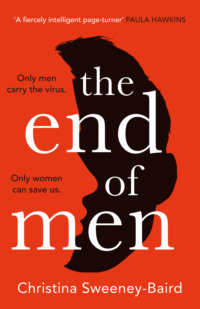
Kitabı oku: «The End of Men»
THE END OF MEN
Christina Sweeney-Baird

Copyright
The Borough Press
An imprint of HarperCollinsPublishers Ltd
1 London Bridge Street
London SE1 9GF
www.harpercollins.co.uk
First published by HarperCollinsPublishers 2021
Copyright © Christina Sweeney-Baird 2021
Christina Sweeney-Baird asserts the moral right to be identified as the author of this work
Jacket design © HarperCollinsPublishers Ltd 2021
Jacket design concept by David Litman
Back cover photograph © Nic Skerton/Arcangel Images
A catalogue copy of this book is available from the British Library
This novel is entirely a work of fiction. The names, characters and incidents portrayed in it are the work of the author’s imagination. Any resemblance to actual persons, living or dead, events or localities is entirely coincidental.
All rights reserved under International and Pan-American Copyright Conventions. By payment of the required fees, you have been granted the non-exclusive, non-transferable right to access and read the text of this e-book on screen. No part of this text may be reproduced, transmitted, down-loaded, decompiled, reverse engineered, or stored in or introduced into any information storage and retrieval system, in any form or by any means, whether electronic or mechanical, now known or hereinafter invented, without the express written permission of HarperCollins.
Source ISBN: 9780008407926
Ebook Edition © APRIL 2021 ISBN: 9780008407940
Version: 2021-04-10
Dedication
For my mum, Margarita.
I’m so very glad to be your daughter.
Contents
Cover
Title Page
Copyright
Dedication
Author’s Note
Before
Catherine
Outbreak
Amanda
Catherine
Amanda
Lisa
Amanda
Article in The Times of London on 20 November 2025
Catherine
Elizabeth
Panic
Article in the Washington Post on 15 December 2025
Dawn
Clare
Amanda
Catherine
Morven
Catherine
Rosamie
Lisa
Elizabeth
Amanda
Helen
Catherine
Rosamie
Despair
Catherine
Toby Williams
Amanda
The Gynarchy Resistance Blog
Dawn
Article in the Washington Post on 14 March 2026
Catherine
Elizabeth
Lisa
Survival
Morven
Amanda
Elizabeth
Irina
Article in the Washington Post on 30 June 2026
Rachel
Toby Williams
Lisa
Elizabeth
Catherine
Amanda
Faith
Dawn
Frances
Toby
Dawn
Recovery
Lisa
Catherine
Elizabeth
Amanda
Lisa
Catherine
Strength
Helen
Article in the Washington Post on 13 March 2029
Dawn
Elizabeth
Adaptation
Article in the Washington Post on 8 December 2029
Dawn
Catherine
Amanda
Catherine
Jamie
Catherine
Amanda
Rosamie
Elizabeth
Article in the Washington Post on 30 June 2030
Dawn
Catherine
Lisa
Dawn
Remembrance
Catherine
Foreword to ‘Stories of the Great Male Plague’ by Catherine Lawrence
Acknowledgements
About the Author
About the Publisher
Author’s Note
I first heard about coronavirus as most people likely did, through snippets of news and emails from friends saying, ‘Have you seen this? So weird!’ For a number of weeks, it felt distant in that way so many foreign news stories do. Something awful and scary but ultimately a disease I would remain personally unaffected by.
Only a few months on from those emails and news reports, I’m sitting in my flat in central London in lockdown. I leave the house once a day for exercise, and shop for food and other essentials once a week. I don’t know when I’ll next see my family, my friends or my colleagues. Billions of people around the world are in the same position. I feel immeasurably fortunate to still be employed and to have recovered from suspected coronavirus (I have not been tested but experienced the virus’s tell-tale cough, breathlessness and extreme fatigue after returning to London from a trip to Northern Italy). I know you’re meant to ‘live your truth’ through art and everything, but contracting coronavirus was a step towards authenticity I could have done without.
It’s an understatement to say it feels surreal that I wrote a book about a viral pandemic just as a viral pandemic swept the world. More than one person has half-jokingly called me Cassandra. When I started writing The End of Men in September 2018 it felt like the ultimate thought experiment. How far could I take my imagination? How would a global pandemic with an enormous death rate change the world? What would the world look like without men, or the majority of them? I wrote the first draft of the book in nine months, finishing with a burst of intense writing in June 2019. Now, as I edit the book for my publishers, I find myself testing my imaginary world against the real one. I gauge the distance between what I have written and what is happening. As a writer of speculative fiction, this is not something I ever expected.
Coronavirus doesn’t have a death rate as high as the virus I have imagined in my novel. Nonetheless, we are experiencing in real life the greatest pandemic of our lifetimes, which is more than I ever could have imagined in my wildest nightmares. The world I wrote about was meant to stay safely within the pages of my novel; it is now far more closely reflected by the world than I ever could have expected. I hope that by the time you’re reading this, there is a vaccine. I hope our healthcare systems survive and economies recover. I hope your loved ones are safe and that the world has returned to that wonderful, boring, nostalgic state I now crave: normality.
Christina Sweeney-Baird
12 April 2020
BEFORE
Catherine
London, United Kingdom Five Days Before
Do you need to dress up for Halloween if you’re a parent? This has never been an issue before. Theodore turned three a few months ago so until now I’ve just dressed him up as something cute (a carrot, then a lion and then an adorable fireman with a fuzzy helmet) and taken photos of him in the house. I don’t want to be a boring parent who everyone thinks is snooty and above the joy of dressing up. I also don’t want to be embarrassingly keen. Do all the other parents make an effort? Do any of them? Why does no one ever explain this stuff to you in advance?
Beatrice, my only real friend at Theodore’s nursery, said she would rather die than dress up in something flammable but she works in investment banking and buys £2,000 handbags ‘when she’s had a bad day’ so I don’t think she’s necessarily a good indication of what the other mothers in this quiet part of South London will do.
I’m eyeing up the costumes uneasily. ‘Sexy witch’. No. ‘Sexy Handmaid’s Tale Handmaid’. Will get me banned from the St Joseph’s Parent Teacher Association for life. ‘Sexy pumpkin’. Nonsense. What would Phoebe do? She’s the most sensible and pragmatic of my friends, with an uncanny ability to conjure up an easy answer to a problem as if it had been there, waiting for you all along. Phoebe would say to just wear black and throw on a witch hat, so that’s what I decide to do. I suspect the results of Phoebe’s daughters’ trick-or-treating will be slightly more upmarket than the sweets we’ll be collecting tonight. She lives in a terrifyingly expensive area of Battersea thanks to a huge inheritance from her father last year. He left her his five-bedroom house with a massive garden but, as she likes to joke, her Roman nose was a steep price to pay.
Looking down at my watch I realise I’m running late for pick-up again. I take the hat and leg it to the nursery. I’m charged £20 per five minutes that I’m late, a rate so extortionate I’m tempted to set up my own nursery because it must be the highest legal interest rate in the country.
I do the rushed Hi, hi, hello, yes, I know, late again, despite working from home a lot! Ha! Yes, I am disorganised, funny, hilarious, such humour interaction with the other mothers as I throw myself through the door and pick up a forlorn Theodore.
‘Mummy was late again,’ he sighs.
‘Sorry darling, I was buying a witch hat for tomorrow.’
His face lights up. The power of distraction. Halloween has suddenly flipped from being a thing he had a remote understanding of last year to being the most exciting event imaginable. At least until Christmas. This is what I always imagined being a parent would be like. My parents died when I was ten and I don’t have any siblings so babyhood was an unpleasant series of surprises. I’m how tired? He’s getting sick how often? I feel this lonely? Halloween, Christmas and birthdays are safe spaces in which my dreams of being a perfect, Pinterest mother can be briefly indulged.
We bundle in the door from the cold, and I dive straight into cooking. I’ve been trying to feed him before Anthony gets home and the chaos of seeing his father leaves vegetables and the appeal of eating forgotten on a sad-looking plate. The negotiations required to ensure a three-year-old eats a reasonably balanced diet know no bounds and tonight’s are particularly excruciating. One more pea, and then you can have two more pieces of pasta. Five peas and then you can watch a movie on Saturday.
Anthony arrives home just as Theodore has trudged up the stairs, weary of the requirement to bathe before bed, yet again. He’s still on the phone finishing up a work call as he walks in the door. He looks tired and worn. We need a holiday. Now that we’re in our mid-thirties I seem to say that every fortnight, even when we’ve just had a holiday.
Anthony is finally off the call. Something to do with blockchains and other indecipherable words that mean nothing to me. After a decade of marriage, I’ve happily moved from feeling guilty about my lack of understanding about my husband’s work to being merrily ignorant. If an in-depth understanding of your spouse’s job was a requirement for a long-lasting and happy marriage, no one would stay married. Besides, Anthony could no more name one of my most recent published papers than I could write a script in Java, a word which never fails to make me think of body lotion before it leads my mind to programming.
I get a hello, kiss on the cheek and a quick hug before Anthony makes his way upstairs. Bath and bedtime are his. School pick-up and dinner are mine. It’s a rare and wonderful night when they’re shared. As I pour out a glass of red wine – stacking the dishwasher can wait, although answering emails can’t – the thought pops into my head that I couldn’t do this if we had another baby. No quiet, tidy-ish kitchen with a glass of wine in hand. No evening stretching ahead of me for conversation with my husband, watching TV undisturbed and a long night of brain-enhancing, relationship-maintaining sleep.
‘How was your day?’ Anthony is back downstairs. No wine for him tonight, I notice, as he throws some of the pasta I left for him into a bowl.
‘Editing, editing, editing. My favourite bit of writing a paper,’ I say, my sarcasm heavy. One of my tutors at Oxford once told me that becoming an academic meant a lifetime of homework and I didn’t believe her at the time, but God she was right. Three beta readers have all read my latest paper on the differences between parenting styles in Denmark and the UK and their impacts on educational attainment and somehow they all want the paper to change in different, conflicting ways. By the end of an eight-hour day deciphering the comments, I was so exhausted I wanted to throw my laptop out of the window. I suggested hopefully to my lovely boss, Margaret, that this probably meant I could ignore them, but she just tutted sternly and told me ‘Rome wasn’t built in a day.’
I explain the witch-costume situation and Anthony looks at me seriously. ‘That’s a good plan,’ he says. ‘Plan A: Witch. Plan B: Normal lady in black.’ The gravity with which he approaches these issues when we discuss them is one of the many things I love about him. He would never say, ‘This is such a silly conversation, why are we having it?’ Once, my friend Libby’s ex-boyfriend told her she was being ridiculous raising something – I can’t remember what now – when we were having a double date at a sushi place in Soho. Anthony said, without a trace of humour in his voice, ‘If she’s bringing it up then it’s not ridiculous. She’s not ridiculous.’
Libby says Anthony is one of the reasons she’s single, because she can see what love should be like. I try to remind her of what we were like at university. We’ve been together half our lifetimes now. You don’t become two halves of a whole overnight. I think I once might have said something about a relationship being a ‘journey’ and Libby refused to talk to me until I’d bought her a double gin and tonic.
After Anthony has finished clearing the plates away, which I kind of, sort of, definitely left for him to do because he’s tidier than I am, I sit back with a contented sigh. He’s looking at me intensely. He either wants to have sex or he wants to have the big F conversation. To have IVF or not to have IVF? The question that couples have only had the luxury of pondering for forty years. I saw in Anthony’s work diary a capital F in the corner of the page for Friday a few months ago. Immediately I assumed, despite no evidence whatsoever, that he was having an affair. Freya? Flora? Felicity? Who is she? For a few weeks I kept dropping women’s names starting with F into conversation, worrying that he’d go a bit pink and look guilty, but he just thought I was trying to subtly suggest baby names.
I kept checking his diary every few weeks after that, and kept seeing the F. I don’t know why I didn’t just ask him what the F was. He doesn’t lie to me and it was probably some boring work thing but something about it stuck in my brain. I wanted to figure it out for myself. And then, a fortnight ago I realised. The F was always on a day that we ended up having a conversation about fertility, or my lack thereof. I went back through my journals and there it was. On the day he would mark F, we would somehow end up sliding into our recurring conversation. Anthony is a planner and cannot let things just take their course. It’s wonderful for holidays as I don’t have to do anything and before I know it, I’m in a beautiful hotel in Lisbon that he booked for a decent rate eight months ago. It’s even better for date nights and school admissions. But for the Big Conversations that can ruin a Wednesday evening when you were hoping your husband was trying to seduce you, it’s a bit of let-down.
In some ways I envy the women who were in my position before the torturous miracle of fertility treatment. Lots of women had one child, or no children, and that was that. There would be tears and prayers, maybe some self-pitying wondering: ‘Why me?’ But there would be no choice in the matter. It would be out of my hands. I dream of such a lack of control.
We’ve been having these conversations for nearly a year now. We tried for a year before that, assuming it would happen. But then, nothing. Radio silence from my ovaries. I tried a drug called Clomid to ‘wake them up’ but they pressed the snooze button and rudely ignored my pleas for cooperation.
‘I was talking to my boss, at work today.’ I flinch at the mention of her; not again. She’s always trying to persuade Anthony to persuade me to start IVF. I’ve never met her but I loathe her. It’s none of her business. But I promised in our wedding vows to always listen and never judge. I was twenty-four! I didn’t know anything about how annoying it can be to have to listen when you just want to have a glass of wine. But I did promise, so I smile and ask, ‘What about?’
‘She was saying how much better things are for Alfie now that he has a sibling. He’s more sociable. Talks more. She thinks it’s made him more empathetic.’
I bristle at the implied criticism of my family set-up from this awful woman. As though I’m raising a creepily silent future sociopath because I haven’t produced multiple children. I make a non-committal noise and drain my wine glass; an act of defiance in the face of alcohol’s fertility-busting qualities.
‘We should do it,’ he says with a burst of reckless energy. I’ve heard this before. ‘I’ve really thought about it. We need to stop going back and forth on it. Neither of us is getting any younger. You turn thirty-four in two months’ time and the statistics for IVF only get worse as you get older.’ He’s looking at me as though the answer is simple, I just need to get on board and everything will be fine!
‘We’ve had this discussion before. We know about the statistics, but …’ I don’t really have anything to say that I haven’t said a thousand times before. If I could guarantee that a round of IVF would give me a baby – that new member of the family we’ve wanted for so long – I would do it in a heartbeat. But that’s not a promise anyone can make me. I know the odds of it working. They’re not good and I’ve never liked gambling. It feels nauseatingly reckless to start IVF when we already have Theodore and I can devote all my time to him and I’ve learnt to accept our family the way it is. What if I can’t look after him when I’m sick from the hormones they’d pump me full of or emotionally drained from the disappointment? What if in pursuit of a sibling I stop being as good a mother to the child I already have? Still, the desire for another Theodore, and to see him playing with another child, sometimes punches me in the gut and for a day I’ll understand Anthony’s steadfast certainty that we need another baby.
I go through phases. Sometimes I feel determined and ready. I can do this. Send me the needles, shoot me up, strap me down. I will do anything for a baby. Other weeks, the idea of all of those people and objects and wires and things being inside me makes me want to curl myself in a protective hunch. No, my body says. This is not right. Anthony’s more prone to baby-induced broodiness than I am. A friend’s snuffly newborn or his godchild doing something adorable will inevitably lead to an earnest declaration that we should just do it, let’s do it, what have we got to lose? Like tonight.
What do we have to lose? Everything, Anthony, I want to cry each time. Occasionally I’ll convince myself I can do this whole IVF thing but I can’t do it flippantly. For a man so keen on planning, he can be remarkably gung-ho about the impact of IVF and babies or, worse, IVF and no babies, on our lives. I need an acknowledgement of the potential worst-case scenario. I need him to understand how hard it’s going to be for me. Because, as with all things involved in the growing of a human child, it will be the woman in this equation who experiences the negatives. And that assumes it would even work; what if it was for nothing?
‘I need some more time to weigh it up, think about the pros and cons.’
‘Why do you always assume it will go wrong?’
‘I don’t.’
‘You do,’ he says, frustration moving right to the front of his voice and staying put. ‘You talk about the financial cost and the emotional cost and the physical cost as if it’s guaranteed you’re going to be having IVF for the next three years. What if it works first time? What if it’s a success? What if having a baby is completely within our grasp but we just don’t take the chance?’
‘Easy for you to say,’ I mutter.
‘What was that?’ he asks, even though he heard me. Of course he heard me.
‘I said, it’s easy for you to say. You’re not the one who it’s going to happen to.’
‘We’re in this together, Cat. Please, I can’t do this for you. I know it’s unfair but I can’t. Please. Just think about it.’
We settle in to the sofa next to each other to watch something Anthony says is meant to be good and I realise that my heart rate isn’t up. I’m calm. These conversations used to leave me tear stained and weepy but now, the sting has dissipated. What does that mean? That I’ve accepted that we’re going to have just one child? Does it mean I’m happy about it? Can I make this decision for us when the question of children is something that affects him as much as it does me?
The thing is, Anthony is asking me to do something I cannot do. I cannot make a decision on this. A significant part of me hopes, secretly, that it will just happen. If we keep waiting and pushing it off for another month, and another, and another, maybe this month will be the one. I fell pregnant with Theodore after six months of entirely enjoyable regular attempts at baby-making, and just as I was starting to panic there it was. Morning sickness so bad it could have felled a horse. I know it’s been two and a half years of trying with no success. I know that my egg reserve isn’t great and my uterus is a weird shape that makes it less ‘hospitable’ to an embryo (a word so cruel, in the context of fertility, that I wanted to strangle the haughty consultant insulting my anatomy with his tie). I know all of these things and I wish I didn’t. I wish we could be ignorant and hopeful because it might happen. We just don’t know yet.
That night, passing the photos of us on my way up the stairs, I marvel, as I often do after our fertility conversations, at this thing we’ve constructed. A family from the ground up. From the photo of us in our first year together, limbs easily entwined in the College bar, gazing at each other, to the photo of the three of us Phoebe took a few months ago in Battersea park. My dark curls flying in the breeze contrasted with Theodore’s perfect chestnut mop inherited from Anthony.
Later, I’m lying in bed reading. Anthony climbs in after me and I fall into our routine. My book to one side, I pass him his eye mask, light off, my head on his shoulder, my arm on his chest, his hand on my elbow, safe.
‘Anthony,’ I whisper.
‘Yes,’ he replies. I love this about him. He doesn’t say ‘what’ or even ‘hmm’. He says yes to whatever I might want to say.
‘I don’t want to make a decision. I can’t.’ A lump is in my throat. I rarely cry now about our years of infertility. I try to swallow it down because really, you cannot spend every night crying for two years. It’s too depressing for words. ‘What if it happens naturally? I want it to—’
‘Oh Cat,’ Anthony says softly and his voice undoes me. By revealing it, my secret has lost its power. It’s a sad, small, silly hope. And yet, who knows?
‘I understand,’ he says. ‘We’ll give it one more month.’
In that moment, I have never loved my husband more.
OUTBREAK
Amanda
Glasgow, United Kingdom Day 1
November is always busy but this is ridiculous. The area around Gartnavel has never shown its divisions more apparently. The ice-induced falls and chesty coughs of Glasgow’s polished, middle-class West End residents appear in A&E in a flurry of expensive highlights, knowledge of different kinds of antibiotics and clipped accents which make clear they want their parents and grandparents to be seen now. The other side of this tale of two cities is liver cirrhosis, chronic poverty and the unglamorous side effects of a life of smoking.
‘It’s another SLS,’ Kirsty, an excellent young nurse, says gaily as she swings past me, unceremoniously plonking a chart into my arms. Shit Life Syndrome. Doctor speak for, ‘There’s actually nothing wrong with you. You’re just really sad because your life is really, really hard and there’s nothing I can do about that.’ I used to try and help, little naive waif that I was. What if they have nobody else? I would think desperately to myself, as I phoned social services seven times in one night until they stopped answering me. As a consultant, my approach is a bit different.
‘Why am I seeing them then?’ I ask. This is a waste of my time – a classic, shit junior doctor task if there ever was one.
‘They’ve specifically asked to see a consultant and won’t talk to anyone else.’ Ah. Unfair as it is, being loud, insistent and generally a pain in the arse will often get you better care in hospital. Not because we respect those kinds of antics. We just want to get you out the door.
I walk into the cubicle, the curtain providing a thin semblance of privacy. ‘What can I do for you?’ I ask in my special chirpy but curt voice that I save for the healthy in my overcrowded, underfunded A&E department.
‘He’s naw well,’ the pasty woman to my left growls pointing at a child who, while bored, looks to be in rude health.
‘What appears to be the problem?’ I ask sitting in front of him. From his notes I can see his vitals are all normal. He doesn’t even have a temperature. He’s fine.
‘He keeps sleepin’ til late an’ he’s got a cough.’ The child has literally not made a sound.
A few harmless questions later and all is revealed. He’s going through a growth spurt and tried a cheeky cigarette on the way home from school with a fellow wayward friend. Somebody call Sherlock, I have a gift.
As I’m waving the sheepish boy and his mother out the door, I hear the ring of the trauma phone. I take the call. A two-month-old child, suspected sepsis. On the way in.
There’s an adrenaline rush when the phone rings for an incoming trauma that even after twenty years as a doctor, I’m never immune to. After forty-five minutes of breathless work stabilising the baby, he’s being whisked upstairs to the ICU. There’s barely a moment to turn around and think before another trauma comes in. This one’s more routine. A road-traffic collision has resulted in some nasty gashes and suspected internal bleeding. That one’s off upstairs to a CT scan within twenty minutes. I’m washing my hands and trying to remember what time my son’s parents’ evening starts when one of my first-year junior doctors grabs me.
She’s babbling about a patient crashing who had been fine and now he’s not fine and help. She’s a mess. I’ve seen it so many times before. She’s only been on the ward for ten weeks and she has a patient deteriorating and she’s panicking. I know I should be respectful and aware of the fact that she’s only a junior doctor and we all have to learn but really, it’s just annoying. I can understand a lack of knowledge and I can tolerate the mistakes made due to exhaustion. But sheer panic in an A&E department is as useful as a papier mâché boat with a trapdoor. It sounds unkind even as I think it but my immediate thought is, she’s never going to be an A&E doctor. If you can’t keep your head screwed on when a patient’s crashing then an area of medicine devoted to emergencies is not for you.
I run with her back to the cubicle. The patient’s wife is standing next to the bed with him, crying. I practically hiss at Fiona to get him into Resus and ask as quietly, and furiously, as possible why he isn’t there already. Even a cursory look at this man and his vitals shows that he’s seriously unwell. Jesus, you don’t even need to look at him. Every machine is beeping in persistent, whining concern.
Fiona says he’s had the flu, and he was fine when he arrived, just fine! She gave him fluids and paracetamol and had clearly hoped that he’d go away after a while, having been convinced that it was in fact, just the flu and nothing more.
By this point the patient is dying. His breathing is laboured with the shallow pant of a body not coping with the basic requirements of taking in air. His skin has the grey pallor of someone whose bodily systems are shutting down and his temperature is climbing higher and higher. There are now seven members of staff surrounding him. Matron is taking his temperature at two-minute intervals and announcing with barely disguised disbelief that it’s climbing this quickly. We strip him and surround him with ice and cold towels. I examine his entire body looking for a wound, an insect bite, a shaving cut, a scratch. Anything that could be causing sepsis. There’s nothing. No rash so meningitis is unlikely. By this point I’m starting to think he’s past the point of no return. There’s not a huge amount you can do once the organs start shutting down. We catheterise him, give him fluids and oxygen. We pump him full of massive amounts of antibiotics and antivirals to start fighting whatever it is that’s burning him up, we give him steroids for his breathing, we do everything we can. We take bloods to screen for infection and if he can at least survive until we get those back, we can tailor the antibiotics or antivirals we’re giving him but now his kidneys are shutting down. There’s zero urine output – the bag under the bed from the catheter is flapping in the air, depressingly empty. I often tell my friends when they half-jokingly ask me if they’re dying, if you still need to pee, you’re fine.
As I stand back and watch the scene unfolding in front of me, I keep my face arranged in an expression of grave calm. He’s a handsome lad. Dark hair, stubble across his chin, he looks kind. His wife keeps getting in the way, crying and crying, inconsolable. She can see the writing on the wall. We all can. She occasionally shouts at us to do more but there’s nothing more we can do but wait and hope that by some miracle his body will turn itself around. Three hours after he arrived in A&E, the machine we’ve all been waiting for begins its long shriek. His heart has stopped. In an odd way it’s a relief. The tension in the room has dissipated. Finally, we can all do something. Matron starts with compressions. I order for the epinephrine to be given. We shock him once, twice, three times. A nurse has his wife, mute now with shock, in the corner of Resus keeping her upright and away from the bed. The violence of an electric shock is not something a loved one should see if it can be helped. In the effort to bring someone back from death we pulverise them, shock them, try to fight their hearts back into a grudging rhythm.
It’s not working but we all knew this would be the outcome. This is a man whose body has been ravaged by something, but we don’t know what yet. Our arms tire. Matron looks at me questioningly with the paddles in her hands. I shake my head. We have done everything we can and should. To keep going now would be to inflict unnecessary torture on the body of a dead man. After fifty-two minutes I make the order. ‘Everybody stop. Enough.’
‘Time of death, 12.34 p.m., 3 November 2025.’ I leave one of my senior registrars to complete the admin that comes with death and comfort this poor man’s grieving widow. Only a matter of minutes ago she was a wife.
Fiona, my panicking junior doctor, is distraught. It’s the first young patient she’s lost in the department and it’s different when they’re young. It’s never easy to lose a patient but when someone’s eighty-five and they’ve had a long life and suffered a stroke or a massive heart attack, you’re sad but there’s a sense that this is part of life. Death comes for us all and you’ve had a good innings. Godspeed and see you on the other side.
But when someone young dies it’s because something has gone seriously wrong and we have been unable to fix it. The patient was called Fraser McAlpine. His wife is sobbing over and over again that it was just the flu.
I take Fraser’s chart and lead Fiona to the staff room. I sit her down so she can recover from the stress and go over what happened and why. It’s a technique I learnt from a consultant when I was training in Edinburgh. When you’ve lost a patient, you go through the chart straight away from start to finish, step by step. What did you do, when did you do it, why did you do it, how did you do it? Normally it makes the junior doctor realise that they did everything right and it was completely beyond their control. And if they did something wrong, it provides a learning experience. It’s a win-win.
We go through the chart with a fine-tooth comb. Fraser arrived at A&E at 8.39 a.m., so far so normal. He was seen by a triage nurse at 9.02 a.m. who deemed him to be low-urgency based on him appearing to have the flu. He only had a slightly elevated temperature and was breathing normally. He complained of feeling lethargic and having a headache. He saw Fiona at 10.15 a.m. who put him on fluids and gave him paracetamol. She offered to run a blood test to see if he had a bacterial infection or a virus, and to treat him accordingly. He was put on the list for the nurse to take blood. His temperature at 10.15 a.m. was 38.8 degrees. That’s barely elevated. Even a new parent with a six-week-old baby wouldn’t lose sleep over that.
Thirty minutes later, at 10.45 a.m., three quarters of an hour before his heart stopped, his temperature was 42 degrees. At that point you’re basically dead. That’s when Fiona came to get me. My blood runs cold. His body went from being normal to near dead in under an hour.
I can see Fiona relaxing as we review his notes. I haven’t mentioned a mistake she made and I’m clearly unnerved. This is not a simple case of junior doctor error. This is horrifying. This wasn’t flu and it doesn’t appear to be sepsis. He was a healthy young man. People drop dead sometimes, even young healthy people. But normally it’s clear what has gone wrong.
Then I see something that causes a wave of nausea to roll through my stomach. He was in the hospital two days ago. My immediate thought is that we must have missed something. One of my team, my doctors or nurses, must have missed something that caused this man to lose his life. I read the notes – he was in with a sprained ankle after a rugby match.
Death is not a side effect of X-raying and icing a sprained ankle.
Then the thought of MRSA pings itself in to my brain. It’s one of the deep fears of any doctor. But this … I don’t know. I haven’t seen an MRSA case before, thank God. But this doesn’t match up.
I’m poring over the notes, trying to find something, anything that would explain what happened. There’s a jagged edge to a memory. Something is nagging at me but I can’t quite bring it to the front of my mind. What is it? It’s not from yesterday. Maybe the day before? It dawns on me. A patient I treated two days ago. An older man, sixty-two, who was flown down from the Isle of Bute. He was gravely ill when he arrived. They’d intubated him on the helicopter. Kidneys had packed up. I wasn’t entirely sure why they had bothered moving him but the paramedic seemed pretty flustered and said, ‘He wasn’t this bad when we picked him up. His temperature has shot up.’ I didn’t think much of it at the time. Sick person’s temperature goes up. It’s not a huge surprise.
He had died about quarter of an hour after arriving. We had done the same thing as we did with Fraser McAlpine – we took bloods to identify what bacteria or virus was attacking the patient. We never followed up on the results though because he died. That was something for the morgue to look at. I check the bed numbers. They weren’t even close. Patients with sprained ankles don’t go into Resus. Then I check the staff who treated the man from Bute. I was the consultant who treated him along with a junior, Ross. One of the nurses, though, was the same. Kirsty treated the man from Bute and Fraser McAlpine.
Please God let Kirsty be a murderer because that would be so much less stressful than this being a contagious infection or a hygiene problem. No, what am I thinking? Murders involve a lot of paperwork.
I can feel the anxiety rising. It’s not the deaths – I’m used to those. It’s the uncertainty. The thing I like most about medicine is the certainty. There are plans and systems, lists and protocols. There are autopsies and inquests. No question is left unanswered. I try to remember how bad things were in my third year at university after Mum died. It’s like exposure therapy I do in my brain. I survived that so I can survive this. I survived panic attacks so if I have one now, I will survive it. I thought I was going to die then but I didn’t. Just because I think I might die now doesn’t mean I will. I didn’t know if I could be a doctor then but I am a doctor now. Be wary of that little voice that tries to twist one scary thing into a spiral of despair.
Do not panic, Amanda. This is just my anxiety talking. Two patients are not an outbreak of an antibiotic-resistant infection. Two patients are not a pandemic. Two patients don’t even comprise a pattern.
Fiona says she has to go. I stare at her blankly, unsure how long we’ve been sitting here. It’s OK, you can take a few minutes, I reassure her. Losing a patient is a lot to deal with. She says that she can’t, because someone’s called in sick. ‘Ross isn’t feeling well so we’re down a doctor.’
In a split second I do something that’s completely insane. If my husband was there, he would say that I need to book in to see my psychotherapist and that my anxiety has gotten completely out of control. But he’s not and I don’t because what if? My mum always told me to trust my gut and my gut is telling me this is a fucking disaster. I can feel the weight of the knowledge on my chest. I need to tell other people. I need to do things and not just worry in silence.
I go back out to the ward. I tell Matron to ask all the patients in the department if they were in A&E two days previously. She just looks at me disapprovingly and I don’t have the time to have a discussion with her so I move on to the waiting room. I ask who was here two days ago and two men stand up. One man just raises his arm. He’s paler than the other two. I get him on a stretcher. My heart is starting to do the clenching thing it does when I’m getting a panic attack but there’s actually a reason for the panic. This has never happened before. It’s always been a panic attack because I was panicking about nothing, it’s not meant to be legitimate panic. I want to cry, slump down in one of the staff room chairs and leave someone else to deal with whatever this is.
They all have flu-like symptoms. Either they or their wives are concerned it’s something sinister like sepsis – there was a sepsis campaign put out by the Government in October. It’s saved around twenty lives in this hospital alone and has also single-handedly increased waiting times. Everyone and their mother are convinced they have sepsis.
I want to tell these men that actually I think this might be a lot worse than sepsis, ten times more terrifying than one of the nation’s biggest killers, but I don’t. I stay quiet and determined and outwardly calm. No one dares to question what I’m doing until I chuck everyone out of the Minor Injuries Unit and place the suspected infection patients in there. One of the nurses starts spluttering at me but I just tell her to go to Resus. I can’t explain things right now, there’s no time. Matron has done as I asked and found two patients who were in A&E two days ago and are now back. I have three from the waiting room. That makes five. Fraser McAlpine makes six. The man from the Isle of Bute makes seven. This isn’t a coincidence.
Fiona bursts through the doors of the Unit. ‘Ross has been brought in by ambulance.’
Eight.
It’s not my anxiety, I know that now. With freezing fingers, I phone my husband.
‘There’s an infection. It’s really bad.’
‘Wait, what? What kind? MRSA?’
‘No, something I’ve not seen before. It’s spreading too fast. You have to go home. Now.’
‘Are you sure it’s not your anxiety talk—’
‘Fuck. Off. I have eight patients dying in a row lined up like we’re in World War Fucking Two. They’re all men, I don’t know if that means anything yet but it’s not a good sign. Go home. I swear to God if you don’t claim you’ve just thrown up and go home I will divorce you.’
I’m hysterical. I have never threatened to leave my lovely, supportive, oncologist husband before. I never imagined anything could drive me to such a threat. But I never imagined this.
‘Go home. Touch no one, speak to no one, just go. Pick up the boys on your way home. Get them to come out to you. Don’t go into the school. Please go get them.’ I’m begging now. Will agrees. I don’t know if he’s terrified of me or for me. I don’t care. He just has to be home safe with our sons. I punch out a text to my boys telling them their dad is on his way to pick them up and they’re to go outside and wait for him. I’ll write whatever note they need. I’ll say anything.
I vaguely know someone who works at Health Protection Scotland. We were at university together and now she’s a deputy director there. She’s always been a bit snippy but I don’t care. I need her to listen to me. I call her and try to sound calm as I speak to the switchboard. When I tell her everything in a rush she keeps making small noises as though she wants to get off the phone. She doesn’t sound worried but also, it seems like she thinks she’s seen this all before. She’s not been a doctor for over ten years but somehow it sounds like she just doesn’t trust me. Maybe the urgency isn’t translating when I explain. It’s so clear to me but it sounds so minor – eight people are sick, OK, we’ll see what happens and we’ll look into it. I put everything down in an email as well and say that, at the very least, they need to send someone to look into it, just in case. I sit down by one of the patients and check his pulse. It is 45. He will die soon. They all will. Breathe, Amanda. The cavalry will charge in soon. I won’t have to deal with all of this on my own. There will be someone I can hand the reins over to. Someone qualified who wears a hazmat suit for a living will come and make everything better and let me go home and forget that this ever happened.
The doors of the Minor Injury Unit swing open. It’s Matron.
‘There’s four more just arrived in ambulances. Two were here two days ago, and the other two were here yesterday. I don’t know what to do.’
My worst nightmare is coming true.
Email from Amanda Maclean (amanda.maclean@nhs.net) to Leah Spicer (l.spicer@healthprotectionscotland.org) 6.42 p.m. 3 November 2025
Leah,
Found your email online. Realised that you forgot to give it to me on the phone after you said to email you. I’ve just arrived home from my shift. When I left there were nineteen live patients in A&E all showing symptoms of what I think is a virus (antibiotics made no difference although obviously need pathology to confirm what’s going on. Is that easier for your lab to do over at HPS or is it quicker for us to just crack on here at Gartnavel?) Of the twenty-six I think we’ve seen so far, five died before I left the hospital. One man, the first I saw, from the Isle of Bute two days ago. Fraser McAlpine this afternoon. Three other men died quickly after coming in including one of my junior doctors, Ross.
They’re all men. Too small a sample size so far obviously but I’ve never seen that before. Maybe men are more vulnerable to it? Can we have a call to discuss all of this please, also maybe loop someone more senior in? This is very bad, Leah. You need to understand how quickly the disease affects them. They go from having normal flu symptoms and feeling quite unwell to being dead with a temperature of over 43 degrees in a few hours.
Please get back to me as soon as you can.
Amanda
Email from Amanda Maclean (amanda.maclean@nhs.net) to Leah Spicer (l.spicer@healthprotectionscotland.org) 6.48 p.m. 3 November 2025
Leah, there was a baby as well, I just realised. We thought it was sepsis. He was in before Fraser McAlpine. He was only two months old. I thought he was stable when we sent him up to the Paediatric ICU but I just called them and he died a few minutes after they wheeled him out of the lift. He was here a few days ago, being treated in A&E.
That makes twenty-seven I saw today. Six deaths. Oldest aged 62. Youngest aged two months.
Amanda
FW: Email from Amanda Maclean (amanda.maclean@nhs.net) to Leah Spicer (l.spicer@healthprotectionscotland.org) 6.48 p.m. 3 November 2025. FW to Raymond McNab (r.mcnab@healthprotectionscotland.org) 10.30 a.m. 4 November 2025
Ray,
See below two emails from a woman I went to Uni with. She’s a consultant at Gartnavel. I think she’s mistaking a bad case of the flu (it’s November after all …) with ensuing sepsis/likely death from other, complicating factors for something more serious. There’s been no other reports of anything on the Category 1 list so I think we’re safe on the SARS /MRSA/Ebola front.
Between you and me, she had a breakdown at university. Completely cracked up and had to take a year out. I think one of her parents died or something? Anyway, she’s quite fragile. I intend to send a holding email advising good infection-control practice and to get in touch if anything further. Flag if you disagree.
Thanks,
Leah
Email from Raymond McNab (r.mcnab@healthprotectionscotland) to Leah Spicer (l.spicer@healthprotectionscotland.org) 10.42 a.m. 4 November 2025
Thanks Leah.
By the sounds of it, a stark raving lunatic who’s trying to waste the limited resources and time of this institution. Not to mention my patience. Ignore please.
Ray
Ücretsiz ön izlemeyi tamamladınız.