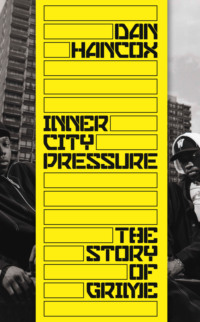
Kitabı oku: «Inner City Pressure: The Story of Grime»

Copyright
William Collins
An imprint of HarperCollinsPublishers
1 London Bridge Street
London SE1 9GF
WilliamCollinsBooks.com
This eBook first published in Great Britain by William Collins in 2018
Copyright © 2018 by Dan Hancox
Cover design by Jonathan Pelham
Cover image © Getty
Dan Hancox asserts the moral right to be identified as the author of this work
A catalogue record for this book is available from the British Library
All rights reserved under International and Pan-American Copyright Conventions. By payment of the required fees, you have been granted the non-exclusive, non-transferable right to access and read the text of this e-book on-screen. No part of this text may be reproduced, transmitted, down-loaded, decompiled, reverse engineered, or stored in or introduced into any information storage and retrieval system, in any form or by any means, whether electronic or mechanical, now known or hereinafter invented, without the express written permission of HarperCollins..
Source ISBN: 9780008257132
Ebook Edition © May 2018 ISBN: 9780008257149
Version: 2018-07-18
Dedication
For my parents, Helen and Rod: thank you for bringing me up in London, among other things.
Contents
Cover
Title Page
Copyright
Dedication
PROLOGUE: DON’T HOLD HIM BACK!
ONE: THE CITY AND THE CITY
TWO: IN THE ROOTS
THREE: THE NEW ICE AGE
FOUR: THE LAST OF THE PIRATES
FIVE: THE MAINSTREAM AND THE MANOR
SIX: GRIME WAVES AND THE RESPECT AGENDA
SEVEN: NEIGHBOURHOOD NATIONALISM
EIGHT: SHUTDOWN
NINE: DIY AND REDEMPTION SONGS
TEN: WE RUN THE STREETS TODAY
ELEVEN: GENTRIFICATION AND THE MANOR REMADE
TWELVE: A TRUE URBAN RENAISSANCE
THIRTEEN: THE REAL PRIME MINISTERS
EPILOGUE: BACK YOUR CITY
Notes
Acknowledgements
List of Images
Index
Also by Dan Hancox
About the Author
About the Publisher

Dizzee and Wiley in front of Crossways Estate, aka ‘the three flats’, 2002
PROLOGUE
DON’T HOLD HIM BACK!
It’s dusk on a spring evening in 2003, and the start of something exceptional: the hottest summer in years, a sweltering heatwave lifting temperatures in London above 100 degrees Fahrenheit. But it’s cooler when you’re high up on a rooftop, and windy, so hoods are up and beanies are on. Around 20 members of the legendary east London crews Roll Deep, East Connection, Boyz in da Hood and Nasty Crew are squeezed into a makeshift pirate-radio studio, the occupied box room being used by Deja Vu FM. The average age in the room is about 17. A few hangers-on lean against the walls watching, part-time MCs nodding their heads to the beat, hoping to be given some time on the mic or just there to witness, without realising it, a seminal moment in the history of British music.
On the decks is Roll Deep’s DJ Karnage, who slowly builds momentum with his freshly cut vinyl, exclusive unreleased instrumentals unavailable to the general public, and the mic is passed from MC to MC, each of them spitting their bars over the new dubplates.
The MC line-up ranges from graduates of the jungle and UK garage scenes such as Wiley, Maxwell D, God’s Gift and D Double E – each of them veterans already, by virtue of being in their early twenties – to early grime heroes Demon, Sharky Major and Lady Fury. There’s even a minuscule, half-squeaking, Tinchy Stryder, then only 16 years old.
The event is being filmed for an amateur DVD called Conflict by Troy ‘A Plus’ Miller, who has begged his girlfriend to borrow the camera from her university media department for the summer, to shoot some footage of his mates on the east London pirate-radio scene. Miller, from far-away Hackney, has met Bow boys Wiley, Geeneus and Slimzee in the nineties through their shared love of jungle, and become involved with their station, Rinse FM, Deja Vu’s neighbour and rival. Wiley suggested he come down that day and film at Deja. ‘No one had given me a tip, I wasn’t expecting anything,’ he says.
In its early days grime really was a scene, with its own institutions and infrastructure, friendships and rivalries, independent record labels and shops, as well as the pirate stations. It was also a community, in which the (mostly teenage) MCs and DJs all knew each other: if not from school, from youth clubs or just from hanging around the local area, then through ‘doing music’. Their rejection by the older, more refined, aspirational and grown-up UK garage scene forged a unique camaraderie, and drove the music to new heights of innovation – the competitive bravado forcing MCs to keep writing new, bolder, better lyrics.
Like all pirate stations, Deja Vu FM is by definition illegal, and its secret studio location has been moved regularly to escape the Department for Trade and Industry. In summer 2003, it’s in a grotty whitewashed box room – one window boarded up with chipboard, another blocked out with a bin bag – up on the rooftop of the same building that housed the notorious EQ Club, where numerous seminal UK garage nights took place. ‘Deja was the maddest one,’ MC Shystie says. ‘Because the studio was on a rooftop, and the roof literally had no edge: so if you take one wrong move, you’re dead. We should not have been up there! Because it would be late at night, and dark – so if someone gets pushed, or someone trips and falls back, they’re going to fall off that fucking roof and die. It’s mad when you look back at it now: nowadays the radio stations all look like how 1Xtra looks, all nice and shit – and they’re all in flipping Shoreditch.’
When Conflict was filmed, the geographical horizons were as narrow as the sonic ones were wide: ‘That’s where I’m from, Bow E3,’ Wiley boasts into the Deja Vu mic at one point. ‘I’m like the 38 bus, because I never turn up!’ he continues, shouting out north-east London’s least reliable bus service. This closed-world intensity, bordering on claustrophobia, vibrates outwards from the crowded little Deja Vu studio, in the MCs’ clamour for a turn on the microphone.
The Conflict video is grime at the point of its creative eruption – still unnamed, but undeniably alive – as the futuristic mutations of UK garage’s slinky charm settled into the shape of an explosive new genre. This was the exact moment when the effusive charisma and hype of the MCs began to take over the show. Prior to that, anyone with a mic in their hand was first of all answerable to the beat, to the producer-DJ auteur, and pirate radio was all about ‘rolling out’ the instrumentals – building a steady, if restless momentum. The MC was a performer, and a host: a master of ceremonies, but also, in the parasitic sense, possessed by those pioneering early grime beats and their subdivisions – Wiley’s ‘eskimo’, Jon E Cash’s ‘sublow’ – all of them summoning a kind of macabre, horror-show minimalism.
There’s D Double E, the lanky, cheeky fans’ favourite, also known as the Newham General, not in military fatigues tonight but shrouded in a black boxer’s hoodie, with a skippy, idiosyncratic flow and his own verbal audio-logo, ‘the D Double signal’, which is not easily transcribed, but sounds something like: ‘Ooooerhhhhhh, ooooerhhhhhh – it’s muuuuweee, muuuuuweee.’ There’s Maxwell D, who in his early twenties has already been to hell and back, survived an upbringing of domestic violence, sheltered accommodation, hostels and foster care, been on TV – on Crimewatch – gone to jail for armed robbery, come out, become a major UK garage MC and a major drug dealer (at the same time), had hits and gone back on primetime TV, but as a pop star. There’s Lady Fury, unmoved by being – as she often was – the only woman in a room full of jostling male egos, getting plaudits for her ferocity: ‘I don’t give head, but I give headbutts,’ she spits, and the record playing underneath, ‘Ho’ by Dizzee Rascal, is wheeled back as her male peers throw their hands up. ‘Dun no I represent for the ladies,’ she says, as the stuttering gunshots of the instrumental start up again. There’s Tinchy Stryder, still in school, expounding the strange wisdom of youth, ‘brand new energy, same old Stryder,’ he spits, like he’s been doing this for years – he has – clutching the microphone with both hands like his life depends on it. And then there’s Wiley, the godfather of grime, whose manic enthusiasm and hilarious non-sequiturs suddenly give way to moments of sublime clarity, like when he captures the whole bizarre and uniquely skittish practice of grime MCing: ‘I’m futuristic, quantum leaping/there’s no defeating E3 tiger/see me creep on the riddim like a spider/kill them with a 16-liner.’ Grime ‘spitting’ is twice the speed of US-style rap: typically, you had just 16 bars to show your skills (or 21 seconds, in So Solid Crew’s case), before passing the mic to the next MC – it is the most thrilling, exhausting, ADHD onslaught of a genre: a tension headache you can dance to. Andy Warhol’s generation should count themselves lucky they got fifteen entire minutes to make an impact. But for all the idiosyncratic talents, they’re in it together. The powerful conviviality and kinship in a genre where lyrical threats of violence are one of the primary means of communication may be surprising, but it’s there all the same – a chain created between artists every time the mic is passed from one MC to the next.
As the energy of the set mounts, Crazy Titch is bopping with cartoonish energy, his face screwed up at the sheer meanness of the track playing underneath, his blitzkrieg of bars including the lyric, ‘Draw for me, you’ll be on the Ten O’Clock News.’ Only three years later, he actually was on the Ten O’Clock News, when he was charged with murder: a moment when grime’s casual lyrical brutality was horribly borne out in reality. ‘When Titch came in, I could feel there was an edge,’ Troy Miller says. ‘He changed the dynamics of the room. Everything got a bit more serious, whereas it was all fun and banter before.’
Throughout the Conflict video Dizzee’s voice has that lean, straining, high-pitched teenager’s tone, altogether gone from his songs now that his throat’s been fleshed out by success, and time. He is visibly defensive, an outsider even among his peers, the boy in the corner of the room, just as he was at school. Titch is much less guarded, happily lost in the music, grinning when he passes the mic to Dizzee, nodding his head to his rival’s bars, adding a cheerful ‘what!’ to Dizzee’s lyrics in choral emphasis.
There’s no sense of a fight in the offing for the first, enthralling 35 minutes of the video – it explodes from absolutely nowhere. Dizzee asks for the mic, is refused by Titch, who is still in full flow, and somehow in a split second the two of them are yelling at each other and squaring up, fingers are pointed, and the music underneath cuts out abruptly, like in a spaghetti western; the card tables are flipped over, the piano stops playing and the saloon doors are left swinging in the breeze.
Wiley and Maxwell D are immediately in between the two young MCs – the elder statesmen who’ve seen this kind of bullshit before, and seen it get out of hand before. Wiley takes charge, the man who has always behaved like he cares more for the scene’s collective success than his own. (‘What’s the highlight of your career so far?’ Wiley was asked in 2017. ‘Skepta making it.’ ‘No, your highlight,’ the interviewer pressed. Wiley wouldn’t change track: ‘Skepta. I took him from a DJ to an MC.’1) He holds them back, instructing them to ‘seckle, seckle’, his eyes darting all around the room as other MCs move in to either help or hinder the rapprochement. Dizzee and Titch are pulled apart still shouting at each other, and everyone spills out onto the rooftop from the TARDIS-like studio, silhouetted against the dark blue east London gloaming, as friends attempt to calm them down.
‘Don’t hold him back, don’t hold him back,’ Dizzee yelps, as the struggle to defuse the anger continues. He was still so young at this point – still barking his anger out, straining passionately, defensively, hungry both on the mic and in the fight with Titch. ‘I’M NOT A MOOK, I don’t know what they told you but I’m not a mook!’ he yells repeatedly at an equally aggressive Titch. He’s scowling, livid – determined to defend his reputation. No one seems to agree on the etymology of ‘mook’ here (it might be a throwback to Scorsese’s Mean Streets), but it’s clear from the rage in Dizzee’s eyes, and in his voice, that he’s not one, right?
The clash looks serious, and is taken seriously by all the others present on the rooftop – and it was soon followed up by diss tracks from each MC to the other. As menacing as they both look when they’re screaming at each other, the scrap is underscored by grime’s quintessential, frequently comic tendency to the melodramatic. When the scuffle starts, it could almost be a scene from EastEnders – appropriately, given the location. When the music cuts out abruptly, amid the clamour of raised voices and bravado we hear ‘step outside!’, ‘leave it, man’.
Three years later, Carl ‘Crazy Titch’ Dobson was sentenced to life imprisonment for his involvement in the murder of 21-year-old Richard Holmes, a crime that supposedly originated in a disrespectful grime lyric. In that Deja Vu show, Crazy Titch is captivating, going a hundred miles an hour on the mic, arms pumping, grinning ear to ear, wiping the sweat from his brow with his T-shirt. It’s not a stretch to suppose that the gleeful, reckless energy he displays on the mic came from the same place as his manic, unhinged tendencies.
There’s no blue plaque on the building commemorating this pivotal evening in the history of British music, because there is no building left at all. In 2003 Deja Vu was on the edge of an industrial estate, in a scrappy, marshy part of Stratford that was about to be wiped off the map – grime’s machine gun snares and adolescent yelps were among the final, spluttering cries of the informal city. The pirate studio only lasted a few months there before moving on again, and the block that housed it was soon bulldozed to make way for the mannered and manicured London 2012 site, and the £486-million Olympic stadium.
Dizzee was back in the same spot that summer, nine years after his fight with Crazy Titch, to perform his number-one hit ‘Bonkers’ at the £27m London 2012 opening ceremony, to an estimated global TV audience of 900 million people. He wore a specially embroidered E3 baseball jacket, honouring the east London postcode that will forever be synonymous with grime.
‘Forget all this, man, forget all this,’ one MC is heard saying after the fight breaks out, attempting to subdue the rising temperature. He meant they should forget the beef – and soon enough, they did. But as this hyper-local rhythm began to reverberate beyond the narrow radius of the pirate transmitters, a great deal more was forgotten with it.

Canary Wharf and Limehouse, 2002
ONE
THE CITY AND THE CITY
I’m from where Reggie Kray got rich as fuck
East London, who am I to mess tradition up?
Jellied eels, pie and mash, two pints of that Pride on tap
Polo top, pair of Stans, flat cap and a Burberry mac
Back when Lethal Bizzle was Lethal B
This is how we used to dun the dance in East
We used to spit 16s till they called police
Probably somewhere in a party or a dark shebeen
Kano, ‘This Is England’
In the Museum of London Docklands, five minutes from One Canada Square and the shimmering glass totems of Canary Wharf, among the exhibits on slave owners and sailors’ rebellions, tall ships and frost fairs, hangs a painting of the river made in 1883 by William Lionel Wyllie. It shows barge workers shovelling coal in the shadow of a clutter of trade ships, the river alive with noise, fumes and activity – the painting is titled: Toil, Glitter, Grime and Wealth on a Flowing Tide.
It’s easy now to forget that London was, for most of its 2,000-odd years of life, not just a working city, not just an industrial city, but specifically, a port city. The world’s dry dock; the shoving-off point for innocent expeditions and brutal subjugation. And as the title of Wyllie’s painting suggests, port cities have a few consistent attributes: one is transience, a constant clamour of people leaving and arriving, drifting in and out with the tides. Another is inequality – rags and riches, a halo of insalubrious low-level criminality, insobriety and dirt hovering around the glittering cargo – or a halo of enriching gold around the squalor and decadence, depending on which way around you look at it. Either way, one travels with the other, one lives with the other. A hundred and twenty years later, Wyllie’s namesake would use some cheap computer software and a microphone to document the same toil, glitter, grime and wealth flowing through twenty-first-century London, at 140 beats per minute.
Some cities are divided between distinct geographical binaries. North and south. The centre and the suburbs. Uptown and downtown. The shanty towns and the gated communities. London is not easily disentangled: it weaves its divisions into a fine mesh, like the netting that stops pigeons gathering underneath railway bridges. The council tower blocks are mingled in with the multimillion-pound mansions. The greasy-spoon caff that’s been there since the seventies stands next door to the refurbished gastropub charging £15 for a Sunday roast. The grandiose seventeenth-century church faces down the night-time den of iniquity.
When widespread rioting erupted across London and several other English cities in August 2011, the writer James Meek reflected on an incident that he’d witnessed a few years before in one of Hackney’s most prominent new bouji enclaves, Broadway Market – when a group of 30 tooled-up black teenagers, chasing two enemies with a hand gun, suddenly entered (and quickly departed from) the lives of the white middle-class people sipping wine at the outdoor tables. ‘It is as if the council-owned tower blocks and estates behind, around and in-between the gentrified patches, where less well-off and poor people live, belong to some other dimension,’ he wrote. ‘Loving the cultural diversity of London as a spectator-inhabitant is not the same as mingling with it. The yuppies don’t go to the white working-class pubs, and the white working class don’t go to the yuppie pubs … this isn’t mixing. It’s the ingredients for something – nobody knows what – laid out side by side and not being mixed, not touching.’1
London was in an unsettled temper at the start of the new millennium. It had survived the much-feared but unknowable threat of the Millennium Bug, but suffered the embarrassment of the Millennium Dome, and the damp squib of a Millennium Eve ‘river of fire’ on the Thames that was supposed to be visible from space, and wasn’t even visible from the Embankment. The clock ticked over from 1999 to 2000, planes did not fall out of the sky, and the world didn’t end – but some more slow-burn changes were starting to take shape. In May, the British capital acquired an elected Mayor for the first time in its history: Ken Livingstone shook off the contempt of Prime Minister Tony Blair, resigned from the Labour Party, and ran as an independent against the Conservative Steve Norris, and the candidate from his own party, Frank Dobson – beating both comfortably. London had a new City Hall, and a maverick left-winger and newt obsessive in the Mayor’s chair.
Two days after Livingstone’s victory, to the annoyance of maturing dance music sophisticates everywhere, Oxide and Neutrino’s frantic ‘Bound 4 Da Reload’ – with a chorus built around the theme tune from TV hospital drama Casualty, sampling a silly line from gangster flick Lock, Stock and Two Smoking Barrels, and peppered with gunshot noises – entered the charts straight at number one, flicking a V-sign at the music establishment. The UK garage scene which the two young south Londoners had emerged from had previously prized refinement, romance, aspiration and an urbane multiculturalism above all else. But clean lines, shiny shoes and champagne were being replaced with something much darker, and murkier – just as the city itself was about to start moving in the opposite direction. A new sound was about to muddy the waters of UK garage’s infinity pool, just as the new Labour government, indeed the New Labour government, were hatching grand plans to drastically smarten up the inner city forever.
In the late 2010s, we tend to look at the cranes going up around London and assume they sprouted from the city’s chalky soil, or we gaze wearily upon the prettified glass towers of luxury flats, the pop-ups and the hipster cereal cafes and assume they landed out of the clear blue sky. But urban change is not like the weather, and gentrification is not organic, inevitable or natural. The new millennium began with grime’s inner city on one side, and an entirely different, largely new kind of inner city growing rapidly to take its place: expensive, monocultural, private, surveilled and planned from the very top by Tony Blair’s government.
At the time, inner London was the richest region in the European Union, yet alongside citadels of banking wealth like the City of London and Canary Wharf were some of the most deprived council estates in the country. Long-standing economic and social divisions were intensifying, as the changing winds of late capitalism induced the middle classes to begin moving back from the suburbs and the home counties. They were about to get a big push from the government, who wanted to make the inner city the engine of bourgeois modernity, cosmopolitan culture and aspiration – the essential spirit of what was self-consciously referred to as the New Labour ‘project’.
The reality on the ground as Blair took office was not good. After 18 years of Conservative government, social problems and hardship were thriving in British cities, and in the country at large. By the mid-nineties Britain had more children growing up in unemployed households than anywhere else in Europe, and the highest teenage pregnancy rate. Child poverty had trebled between 1979 and 1995, the number of drug addicts quadruped in the decade to 1996, and the number of homeless people sleeping on the streets had soared.
Since the deregulation of the City in the late 1980s, London’s role as Britain’s primary economic engine had been greatly magnified: by the millennium, earnings in the capital were on average a third higher than the rest of the country. But the divisions were greater, too: Londoners had a higher unemployment rate than the national average, and a much higher proportion of children growing up in households with no income: 36 per cent of children in inner London lived in workless homes in 1999 – compared to 17 per cent nationally. London households were also more likely to be overcrowded: 16 per cent compared to 6 per cent in other English cities.
In east London, the area that will always be most associated with grime, the boroughs of Hackney, Tower Hamlets and Newham have consistently appeared among the most deprived local authorities in the entire country; in 2000, the government used a new, complex model for analysing different aspects of poverty, from housing to health, which they called Indices of Multiple Deprivation. Across all of England, the grime boroughs were ranked at 1, 2 and 3. A medal-winning podium of poverty.
‘East London is in need’ has been the received wisdom of London local government ever since it was first introduced in 1888. A century and a half ago, Tower Hamlets was home to the disease-ridden squalor, vice, filth and overcrowded warrens of the infamous Old Nicol slum, before it was finally demolished in the 1890s, following the Housing for the Working Classes Act. The slum clearance programmes continued for decades, both before and after the devastation of the Blitz; some residents moved out to the suburbs, others were given low-rent social housing in the modern new council estates being built. Between 1964–74, the last of the slums were demolished and the Greater London Council built 384 tower blocks of ten storeys or more, providing 68,500 new flats. They were accompanied by utopian rhetoric about a new way of living and ‘streets in the sky’, changes that would finally grant the dignity London’s working-class communities deserved, and dramatically lift the quality of life. In 1981, at the peak of the social-housing boom, there were over 75,000 council homes in London, housing nearly 31 per cent of the capital’s population. It is no coincidence that they were heavily concentrated in exactly the boroughs where grime and UK rap would later thrive: 42 per cent of London’s social housing was in ‘Inner East London’: the boroughs of Hackney, Newham, Tower Hamlets, Islington, Haringey, Southwark, Lambeth and Lewisham.
London has historically been a fairly low-rise city, with relatively few skyscrapers, landmark blocks of luxury apartments, or high-end hotels and offices – it has not looked like Manhattan, or latter-day Dubai, Hong Kong or Shanghai. Largely this was by design: planning laws have prohibited tall structures which obscure certain ‘protected views’ of iconic old London landmarks like St Paul’s and the Palace of Westminster, as seen from certain high points on the fringes of the capital, like Parliament Hill, Richmond Park and Alexandra Palace – it’s not the specific views themselves which matter so much, but their utility as insurance against a cluttered skyline.
But at the start of the new millennium, a new kind of high-rise building started arriving in the capital: one much less likely to produce exuberant forms of youth culture, clad in glass rather than concrete. Most obvious amongst them was the Shard – Mordor-upon-Thames, owned by Qatar, an obscene 72 storeys high, built with the enthusiastic support of Ken Livingstone, and the backing of New Labour. This directly contravened the ‘protected views’ regulations; English Heritage objected at a public inquiry, and were ignored. At the time of writing, five years after opening, all ten of the £30–50m flats on the tower’s upper floors remain unsold, and empty. Even a visit to the viewing deck costs more than £30. Since then, the trickle has become a flood: in 2017 a survey found that 455 new high-rise blocks were either planned or already under construction in London: ‘safety deposit boxes’ for wealthy investors, expensive hotels, high-end office space and luxury flats. Blocks like the ickily-named Manhattan Loft Gardens in Stratford followed the Shard’s lead and caused controversy by ruining another sight line of St Paul’s. More importantly, not a single one of the 455 was being built to provide housing for London’s poorest.
The Shard started a bold new trend – building hideous neoliberal obelisks which London didn’t need – but the major precedent had already been set: the planting of Canary Wharf’s towers of misbegotten riches, right in grime’s back yard, in place of the city’s abandoned docks. Today, underneath the white office lights and CCTV cameras of what is sometimes known as the ‘second City’, teem the ghosts of empire, hard labour, hard liquor, opium dens, sailors and sex workers. Even as it enters adolescence, Canary Wharf’s cluster of gleaming skyscrapers still feels like a life-size artist’s impression, rendered in three dimensions; free from clutter, free from litter – and free from heavy explosives, you presume, if the security presence is anything to go by.
Look closer, and some of the police aren’t actually the police at all – they’re private security guards, in uniforms designed to look exactly like real police uniforms. The whole area is unnervingly clean. As close as it is, Canary Wharf is almost completely sealed off from its neighbours to the north, where grime erupted into life – Poplar, Limehouse, Bow, and eventually Hackney and Newham – separated by the huge A13 and A1261 dual carriageways, and a no man’s land of train lines, Docklands Light Railway sidings and buildings, business parks, car parks, blind alleys and dead-ends, all of which act as further barricades. It is almost as if the builders of Canary Wharf wanted it that way. ‘That’s where all the yuppies are,’ MC Breeze from Roll Deep says in a 2003 documentary, pointing up at One Canada Square. ‘We’re just over the road, and it’s one of the worst boroughs in England.’2 On the south side of the skyscrapers, in a part of the Isle of Dogs which used to be known as ‘The Land of Plenty’ during Britain’s colonial heyday, the Anchor & Hope pub (Est. 1829) sits boarded up and unloved, its business perhaps swallowed by the two-storey Thai restaurant next door – the hope is gone and the boat is adrift. Commerce spares little attention for sentimental attachment to the past – even its own.
‘Most of us make our money from thin air,’ wrote Charles Leadbetter, a friend of Mandelson and Blair, capturing the spirit of the times – as music switched from heavy pieces of wax and shiny plastic discs to the intangibles of mp3s, and capitalism moved on from buying physical products with coins and notes to buying and selling complex, abstract ‘financial products’ like collateralised debt obligations, futures and derivatives. By 2007, the character Jez in the sitcom Peep Show would be summing it up in more day-to-day language: ‘I’m a creative. We don’t make steam engines out of pig iron in this country anymore, yeah? We hang out, we fuck around on the PlayStation, we have some Ben & Jerry’s, that’s how everyone makes their money now.’17
But even while New Labour were placing culture and creativity on a pedestal and garlanding it with £50 notes, other government changes were making it harder than ever for working-class people to develop careers out of their creative impulses and talents. In March 1998, changes to unemployment benefits that came in with the New Deal made it much harder for artists to live on the dole while honing and improving their craft – a part of the welfare state that had historically been a lifeline for working-class musicians. The NME ran a cover story about the threat to grassroots music, arts and culture these changes posed, with the banner, ‘Ever get the feeling you’ve been cheated?’ Inside, Jarvis Cocker recounted that, without the dole during the eighties, Pulp never would have made it as far as the nineties, and their vastly better and more popular albums. There were countless other musicians, artists and writers like him. Free education, a strong welfare state and affordable housing had given working-class creativity the space to breathe in the post-war years. For New Labour, it was too much like a hand-out: money for nothing.
The grime kids went without those state subsidies – but still never succumbed to the rampant individualism of their neighbours in Canary Wharf, or their political masters. For all that we should celebrate their independent, DIY spirit and sheer self-motivated perseverance – teenagers with nothing, making something more dazzling and millennial-modern than anyone could ever have imagined – they did so with the help of youth clubs, school teachers, and a collective, communitarian spirit that was being pummelled by a government determined to dismantle it, in the name of remaking the inner city.

Notting Hill Carnival, 1999
TWO
IN THE ROOTS
The irony of grime being derided as antisocial by its critics – all that clatter, hostility and bad attitude – is that it has always been community music: invented and developed collectively and collaboratively, by people whose lives and roots are deeply entwined, and who made music because it was the sociable thing to do. Community can mean a lot of different things, but whichever way you draw the diagram, grime emerged from a spider’s web of intergenerational influences, schoolmates, neighbours, friends, family, and people who knew people – from school, from the estate, from the local area.
The more you dig into its past, the more you realise grime’s social networks precede the music entirely, not just by years but by generations. Grime is black music (even if it’s not always made by black people), and its roots spread across London, and the world. While east London has for centuries been one of the most multicultural parts of the country, and a first port of call for new arrivals, the generation of Caribbean migrants who began arriving in Britain after the Empire Windrush docked in the Thames in 1948 tended to settle in Notting Hill in the west, and Brixton in the south. But with east London depopulating rapidly in the post-war decades, owing to decay, bombing, slum clearances and degeneration, housing became relatively cheap. Manufacturing jobs in places like the Dagenham Ford car plant, and Tate and Lyle, Unilever and ITT around the docks, encouraged newly arriving Caribbean nationals, now British citizens, to look to the east.
In the tightly bound geography of working-class inner London of the 1960s, 70s and 80s, many of the grime kids’ parents, and in some cases grandparents, knew each other before the kids even arrived – and as a result some of east London’s most important foundational MCs actually played together as children. D Double E’s dad went to school with Jammer’s dad. Jammer’s dad and Footsie’s dad were at Sunday school together. Footsie’s dad was in a reggae band in the 1980s with Wiley’s dad, and taught young Richard Cowie Jr how to play the drums.
‘We’ve known each other before before,’ Footsie says.1 A ridiculous number of MCs, DJs, producers and key behind-the-scenes figures met as children, at school or a playscheme; or playing football, or in someone’s aunt’s house, or at a party, or night fishing in the Hertford Union Canal, between Wiley’s estate and Victoria Park. Roll Deep’s first paid job was working for Wiley’s dad’s patty factory (they were subsequently fired when Richard Cowie Sr caught them having a food fight). ‘It’s so deep,’ Footsie continued. ‘Sometimes I think I’m not doing nothing special, other than carrying on what was already done.’
Grime’s lineage is suffused with this sense of kinship that precedes any sense of desire to make music – of being mates first, and lyrical sparring partners second. It’s easy to romanticise, but not easy to romanticise well: Kano’s nostalgic 2016 album which signalled his return to grime, Made in the Manor, does so brilliantly, telling sincere and evocative stories about his youth in his childhood home, 69 Manor Road in Plaistow, E15. On ‘T-Shirt Weather In The Manor’, Kano vividly describes multigenerational summer barbecues where the kids are listening to UK garage titans MJ Cole and Heartless Crew, and ‘the olders want some [reggae singer] Dennis Brown’, a prelapsarian community idyll, before fame, beefs and adulthood came along and complicated everything.
That kinship was formed, in part, out of marginality. Crazy Titch says he knew brothers Mak 10 and Marcus Nasty when they were children because ‘there was like three black families in Plaistow when I was growing up, and theirs was one of them’.2 In parts of inner London with more substantial black communities, grime’s originators were bound through pre-internet social networks formed by geography and background, by a sense of being marginalised by poverty, or racism. ‘It was a nice little community here,’ Kano recalled, smiling, in a short documentary accompanying Made in the Manor. ‘There was definitely a feeling that we weren’t supposed to be shit, or have shit, or become anything great. An underlying attitude that people grow up with, from around here.’3 Those narrow horizons enforced by poverty keep people down, but they bind people together, too – and when the kids at those barbecues started making music, by themselves, for each other, those bonds provided the foundations for something powerful, and lasting.
Sometimes grime’s ancestral links didn’t become apparent till years later. Footsie recently told his dad who Wiley’s dad was, and he responded that they’d played together as children. ‘I was there with Will, running around as kids, I just don’t really remember it.’4
Sitting in a pub beer garden in Bethnal Green in 2017 with Roony Keefe, creator of the seminal Risky Roadz DVD series, he told a story about Devlin, who he first filmed for his DVD in 2006, when he was a teenage MC from Barking, still only 16:
‘I’ve known Devs all these years but … my dad went to this funeral last year, and he was talking to one of his old mates there, and he said, “Oh, how’s your boy?”, and he said, “Yeah all right, still doing the music.” My dad was like, “Oh yeah, what music does he do?” Turns out my dad grew up with Devlin’s dad in Hackney, they’ve been mates all these years. But we didn’t know that until last year. It’s a really tight-knit kind of thing.’ Devlin wrote lyrics to describe this story of their dads drinking together in their favourite Hackney pub, before its gentrification-makeover, in a freestyle for Keefe’s YouTube channel: ‘Oi Roony, do me a favour and let ’em all know we’ve been around from day: like mine and your old mans, down the Kenton pub before it sold grub, just beer and grams. Funny how it all turns out … damn.’5
Wiley would watch his dad’s VHS copies of famous Jamaican sound-clash events like Sting, where rival sound-systems (with a team of engineers, hosts and selectors) would compete by offering up their biggest dubplates – also known as dubs, or white labels, because the vinyl was freshly cut from a new recording, and specially made for the occasion, rather than released to the general public by a record company. These did not have a sleeve or any artwork, just the naked simplicity of the record, its title inscribed on the white label in marker pen.
‘I sometimes heard my dad listening to Sugar Hill and the Gang,’ Wiley recalled in 2016, ‘[there was] some American rap. But it was minimal compared to all the reggae.’
Wiley had already learned to play the drums, and began to try and copy some of his dad’s reggae jams, using a Yamaha CX5, ‘the one with the big stick-in cartridge thing on top. I would go on there and see if I could play what he had just been playing.’ Reggae suffused the general atmosphere that the grime generation grew up in, tracing direct ancestral links from Britain’s pre-acid house reggae culture, some of it imported from the Caribbean, some of it created by black Britons. South London grime and dancehall MC Doctor – known for his ‘yardie flow’ – was managed by one of London’s most famous sound-systems, Saxon. Dreadlocked grime icon Jammer – a stalwart behind the scenes, a pioneering producer and a zany presence on the mic – grew up in a house immersed in this culture: his parents ran the ELRICS (East London Rastafarian Information and Community Services), which helps Rastafarians with housing, and incorporates work with young people (Jammer himself has spoken at schools and colleges, and been involved in their mentoring programmes). Iconic black British dub poet Benjamin Zephaniah was a family friend. The connections go on: Spyro’s dad is St Lucian reggae singer Nereus Joseph, Scorcher’s dad is jungle MC Mad P from early nineties crew Top Buzz.
It’s not just a family connection, or an abstract component of the musical bloodline: grime echoes its Jamaican reggae heritage in its structure, in its tropes, in its slang, in the way it’s performed, and stylistically: particularly harking back to the ‘fast chat’ reggae style of the likes of Smiley Culture, a black British MC who made it into the charts two decades before Dizzee Rascal did the same. Grime is a direct product of Caribbean sound-system culture. The legacy is more implicit than explicit a lot of the time, but it’s there in so much of what is integral to grime: in the dubplate white label culture of exclusive new tracks, in the competition of rival sound-systems or crews, in the MC responding live to the selector or DJ’s choices of instrumental tracks, or riddims. It is there in the song structures, in the sense they often do not have clearly demarcated structures: rather than the verse-bridge-chorus-verse architecture of the traditional three-minute pop song, MCs begin their careers ‘riding the riddim’, usually a steady tempo from beginning to end, that only changes when the next one is faded in.
Academic Nabeel Zuberi makes the point that MCs are middle points between the music and the audience – they have to ride the rhythm but also ‘conduct the choir’ on the dancefloor, and move the crowd to respond. In this sense the MC’s voice is ‘a social voice that includes the voice of others’, Zuberi writes.6 The performance function is more complex than simply, ‘I’m going to talk, and you’re going to listen’.
There’s a unique and productive cultural tension at the heart of grime that comes directly from its inner-London geography, of working-class cultures from the African and Caribbean diasporas intermingling with working-class London slang and culture, rubbing up against each other, borrowing, collaborating and adapting freely and fruitfully. It’s a tension familiar to fans of 1980s British reggae, where the duality is referred to as ‘Cockney and Yardie’, taken from Peter Metro and Dominic’s 1987 tune of the same name. In this song white reggae MC Dominic, born in west London, and black MC Peter Metro, born in Kingston (Jamaica, not Surrey), trade and translate slang from Jamaica (‘yardie’) and east London (‘cockney’).7 Smiley Culture’s 1984 single ‘Cockney Translation’ had performed the same ludic act of cultural elaboration, and become a surprise hit.
Grime has often been described as dazzlingly innovative, alien, groundbreaking, avant-garde, and it is all those things; one factor which explains its newness, perhaps, is not just the individual and collective daring of its creators, but the exact point at which it arrived: in a new millennium, from mostly second- or third-generation black Britons who were just estranged enough from their cultural roots in the Caribbean, or Africa, or both, and far enough along the lineage of unique British dance styles – acid house, jungle, drum ’n’ bass, UK garage – that they could draw from them all, while never being too in thrall to any of them. Just the right amount of respect for what had gone before, and just the right amount of healthy disregard for it, too – a mingling of conflicting and cooperating identities.8 ‘This is something new for your ears,’ runs the chorus of Roll Deep’s 2007 track ‘Something New’, ‘you ain’t heard beats or spitters like this: no American accents, straight English.’
Grime lyrics and vernacular – grime grammar, even – draws on a wide range of roots and influences, but Caribbean English is unsurprisingly prominent, along with grime’s own neologisms, cockney rhyming slang and other pieces of what is known to linguists as MLE (Multicultural London English). There is a minority of grime MCs who use what’s known as a ‘yardie flow’, a proudly Jamaican, often ragga-influenced, gruff, patois-heavy delivery, but a more musical one too – and some, like Riko Dan, who switch in and out of cockney and yardie as they feel the rhythm demands. Meeting cheerful Pay As U Go MC Maxwell D in a pub in Peckham recently, he lists off the MCs who would deliver ‘that extra bashment, yard vibe’ in the grime scene: ‘There’s Riko Dan, myself, Jamakabi, Flow Dan, Armour, Doctor, Durrty Goodz, God’s Gift … but the top MCs in grime were not dancehall, people like Wiley and Dizzee. My style, the dancehall reggae style, grime doesn’t sit on it, the way it’s meant to, because it’s an English way. It actually helped me develop another style, because I started doing less of the bashment style and more of the English style, because I realised the kids, the black kids, weren’t really in tune with their culture no more, it was like an English culture. In my opinion even garage was more dancehall-orientated than grime, it was still rootified. But when grime came along, Dizzee and Wiley, they changed the lyrical style.’ He barks an impression of Dizzee’s halting, staccato flow: ‘“Take that Nokia! Get that, what!” It was like rap, but an English vibe.’
While the roots of grime’s vocal style and a great deal of its slang and idioms travelled across the Atlantic with the Windrush migrants, it’s a telling part of grime’s unique flavour that its accent is so often London English – especially as ‘UK hip-hop’ (a genre in itself, distinct from grime) has often borrowed not just the genre tropes – turntablism, a fetishisation of ‘realness’ and roots – from the United States, but its accent too.9 ‘I thought it would be heavy to sound English,’ Dizzee Rascal told Sound on Sound magazine in 2004. ‘I listen to a lot of US hip-hop, and I know that is how they talk in real life, but a lot of UK hip-hop doesn’t do that. My influences are from jungle, and many of those artists still keep their English accent, and I respected that.’
Indeed, some of Dizzee’s biggest early singles, tracks like ‘Fix Up, Look Sharp’, ‘Stand Up Tall’ and ‘Jus’ A Rascal’ were not only the grimier precursors to hits like ‘Bonkers’, that made him Britain’s first black pop superstar, but in their boisterous, playful style, they also reproduced a kind of east London barrow-boy charisma, even perhaps music hall in its sensibility. How many Top 20 hits can claim to have opened with a battle-cry of ‘Oiiiiii!’ and a Carry On-style cackle? Too few, certainly. Dizzee’s delivery was so English, in fact, that it actually tripped him up on the road to international success. When he toured the US for the first time in 2004, appearing on Los Angeles’ famous rap station Power 106 with DJ Felli Fel, he spat his yelping, double-time flow over classic US rap beats from Brooklyn’s M.O.P. All was well until the end of the slot, when, chatting with Felli Fel on air, there was a telling obstacle: the DJ could literally not understand Dizzee’s accent. He asked Dizzee to repeat the name of his debut album no fewer than three times in a row. Eventually Dizzee, sounding slightly exasperated, just spelled it out: ‘B-O-Y …’
First-wave grime MC Bruza, also from east London, is the name that first comes to mind for ‘cockney grime’: for his especially boisterous delivery, frequent use of cockney rhyming slang, and proud claim that he is ‘brutal and British’. And then there are the white MCs: crews like OT Crew, from Barking, created what you could call ‘geezer grime’ – MCs like Syer B and Dogzilla, repping ‘Barking and Dogenham’, had some underground success with tunes charting their heartfelt quests for the finer things in life: ‘Where’s All The Beer?’ and ‘Where’s The Money?’. Dogzilla is one of those overlooked first-wave MCs who may not be to everyone’s taste, but he is evidence that, in the early days, distinctive voices, flows and vocal styles abounded on pirate radio. Dogzilla flipped the MC’s typical self-aggrandisement to a new level of lyrical honesty, too: ‘I’m obese, white, I smoke too much, I’m a bum, I’m a drunk … I live on strictly takeaways … I like girls in PVC, I support West Ham, UFC … here’s my fat white arse, I bet it makes you laugh.’ The pinnacle of white-boy geezer grime was a track called ‘Straight Cockney’ by an MC called Phenomenon, who it seems no one has heard of since, but whose legend lives on with over a million views on YouTube, where comments mock him to this day.
US rap has had numerous discussions of the phenomenon of the ‘wigga’, and the disproportionate media prominence and industry support given, Elvis Presley-style, to white rappers from Vanilla Ice to Eminem, by an at best cynical and at worst racist music industry. But grime has seen relatively little discussion of racial tension or cultural appropriation. It might be that the genre’s long languishing on the underground meant that, if you were a white DJ or MC taking part in the scene, your participation was implicitly understood to be out of authentic love for the music, rather than calculated profiteering or co-option – the same goes for Mr Wong, a much-loved first-wave MC and producer, the self-described ‘rude boy Chinese wigga’. It might be that the relative lack of racial segregation in Britain’s council estates and poorer areas, compared to the black ghettoised geography of ‘the projects’ in America’s big cities, had something to do with making race less of an issue. It might simply be that – while the likes of Geeneus and Slimzee were instrumental from day one – the biggest talents and crossover stars produced in grime’s early days, for several years, were all black British: Dizzee Rascal, Wiley, Kano, Shystie, Lethal Bizzle. With the exception of Lady Sovereign in 2005 – always a bit of an outsider to the scene in any case – and some years later, Devlin, the few white MCs weren’t the ones getting record deals.
There is something utopian in grime’s collectivist origins, of ‘kids hanging out together making something they enjoy’, as Jammer described it to me recently, and this is a rich part of its musical roots too. Academic Jeremy Gilbert has said that the relative weakness of neo-Nazi street thugs in British cities in the nineties, while such groups were on the rise elsewhere in Europe, owes a lot to the ‘cosmopolitan hybridity’ blooming (and booming) out of the speaker stacks and pirate-radio aerials where hardcore, jungle and UK garage were created. State-led multiculturalism takes the form of abstract government initiatives and directives, more progressive school curricula and better community and arts funding – and these things are all essential, and should be done right – but in terms of creating a more harmonious society, its impact looks fairly tepid compared to what young, working-class people of different ethnic backgrounds cooked up together on London’s council estates. In fact, to tweak James Meek’s pessimism about our class-riven, divided city, where the ingredients are laid out side by side, not touching, not mixing, perhaps the solitary demographic where multiculturalism is an organic, lived experience, rather than an idealised illusion, is in young, working-class communities where schools, youth clubs, estates and later workplaces make a shared and convivial culture not just realistic, but the unforced reality.
‘I was one of the only white kids on my estate growing up,’ recalled Nyke from white UK garage and grime duo Milkymans (humorously named, they explain, by a Caribbean bouncer, surprised to see them at a mostly black nightclub). ‘The Irish community had moved out, and me and Nikki grew up in the Afro-Caribbean communities in Peckham and Stockwell – so I lived between Ghanaians and Jamaicans; if I couldn’t smell fufu, I could hear Capleton blasting. My radiator used to shake off the wall! And even if I didn’t know what some of the artists meant, in a kind of black culture context, I was still feeling the vibrations of the music from young. I remember I used to wash my mum’s car, and I’d be blaring Kool FM – if I think back to it now, I’m lucky it was a noisy estate, because I love jungle, but that was noise. Like that was not easy listening.’ He laughed. ‘But when you’re a 13- to 14-year-old obnoxious, rebellious kid, that’s all you want to hear. It’s kinda the equivalent of someone listening to really dark heavy metal. That was our version of that.’
As with punk’s extensive late-seventies love affair with reggae, and the ‘two tone’ ska of the early 1980s, jungle saw urban multiculturalism manifested in youthful conviviality. It channelled a mixture of cultural influences into a novel, fiercely experimental form, created by a rich ethnic mix of producers, DJs and promoters, and enjoyed by a similarly diverse assembly of ravers. It transcended the difference in junglists’ backgrounds, but it did not forget those origins – something you can hear in the music, with soul and ragga samples and fierce basslines high in the mix.
In a 1994 BBC jungle documentary, UK Apache, the MC behind the superlative jungle anthem ‘Original Nuttah’, highlighted the power these styles had in forging a sense of belonging for second- or third-generation immigrants. Growing up as a working-class child of an Indian-South African mother and Iraqi father in Tooting in the 1970s and 80s, when the National Front were a menacing presence on the streets of south London, Apache made friends with kids of Jamaican heritage and went to reggae sound-system dances with them in some of the same estates in Battersea from which So Solid Crew would later emerge. He told the BBC documentary crew:
‘Jungle, because it’s from England, I can really relate to it, it’s important to me because I’m born here. I’m from England, and London, and nobody can tell me I’m not from here. Once I was ashamed of being British, but it’s like the jungle’s drawn me back into my roots, where I’m from. Although my parents are – I’m half Arab, half Asian, African – I can relate to those countries only up to a point. When I talk to my children, I say, “You’re born in England, be proud of it,” and don’t let nobody tell you different, no BNP or anything like that.’
There is another key cultural lineage to grime that is too easily overlooked. Long before Afrobeats (with an ‘s’) and its rap, R&B and bashment hybrids made their way into popular consciousness in the UK, the children of African migrants to the UK, in particular from Ghana and Nigeria, were making grime, and slipping in references to this heritage. Among others, Dizzee Rascal, Tinchy Stryder and Lethal Bizzle all have Ghanaian parents; there were musical links from London to West Africa too – genre-hopping producer, singer and MC Donaeo and grime-adjacent rapper Sway were performing big shows in Accra and collaborating with Ghanaian rapper Sarkodie in the late 2000s. Skepta, in particular, made it clear in his most well-known early radio and rave bars, that he was ‘Joseph Junior Adenuga, from Nigeria, not St Lucia – big lips, African hooter’. This didn’t preclude an upbringing in which he obsessed over Ninjaman and Jamaican sound-clash culture, but it coexisted with the West African music he heard at home. By the time I interviewed him for a second time, in 2015, black British youth culture was changing – a diasporic shift in emphasis away from Caribbean dominance had been slowly taking place in the UK. ‘When I was a yute, to be called African was a diss,’ he recalled, sadly. ‘At school the African kids used to lie and say they were Jamaican. So when I first came in the game and I’m saying lyrics like “I make Nigerians proud of their tribal scars/my bars make you push up your chest like bras”, that was a big deal for me.’
Even saying his full name in his lyrics was an act of defiant pride with a very personal context. ‘In school, when a teacher would try and read my name, as soon as she goes to try and say it, I’d be trying to say it first, to stop the embarrassment of her not being able to pronounce it. Eventually I grew up. I remember one day when I was about fifteen, my mum told me, “Junior, your name means something – just because your name isn’t some standard English name.” I remember going back into school and it started to power me up. Bare self-hate vibes was pushed into me as a kid at school, trust me. That’s why it makes me happy to see all these kids today just love Afrobeats, because since the start I’ve been trying to fucking fight this ting, for them to be able to stand up.’ He mentioned ‘Sweet Mother’, his single released in 2007 for Mother’s Day, a reworking of Prince Nico Mbarga’s 1970s hit of the same name, an early pointer to the way black British music might be going next, with Nico’s sweetly sung, Nigerian-accented chorus sitting alongside Skepta’s grimy London beats and MCing.
The ‘Black Atlantic’10 pathways between Africa, Britain, America and the Caribbean have seen cultural exchange, revision and refinement in numerous iterations, but it should be no surprise, given their histories, that black British MC culture has evolved along very different lines to American hip-hop culture. South London rappers Krept and Konan, schoolmates of Stormzy, are situated very much on the rap side of the rap-grime divide, in terms of the slower, hip-hop tempo of their beats and rhymes: and yet, they explained to me, there wasn’t that much of a divide at all – that just as black Britishness embraced its diverse roots, it also produced a family of different, coexisting genres. I’d been sent by the Observer to ask them what separated British microphone culture from its American equivalent. Konan didn’t hesitate in saying that it was essentially ‘everything’ – fairly or not, he viewed American hip-hop culture and identity as monolithic in a way black British culture never was:
‘What’s different? Our accents, our lifestyle, our culture. When we was in America we’d say “Where are you from?” and they’d say “America”. But over here if someone said where are you from you might say “Jamaica”, or “Africa” or something else – maybe “British” and adding something else. We bring different cultures to our music, and different slang, a different way of doing things. And there’s different-sounding beats: in their clubs there’s a lot of just hip-hop, in our clubs you’ll have house, dance, Afrobeats, bashment, you’ve got a blend of styles.’
Jungle was the teenage apprenticeship for the pioneers of grime. They snuck into the raves while still underage just to hear it, persuaded mums and dads to let them go with older brothers or sisters, obsessed about it on pirate radio (usually Hackney’s Kool FM, the leading jungle station), made tapes in their bedrooms and swapped them at school and college, and through that shared community forged friendships that would last into the end of the nineties, to the evolution of 2-step garage and later their own sound. The family tree is robust enough that many of grime’s first wave of MCs started out in music spitting over jungle – it was their first experiences in writing rhymes, performing in a dance. D Double E started out MCing at jungle raves aged only 14. Wiley did too, and Riko Dan. There are recordings now on YouTube of the three of them spitting at jungle’s frenetic tempo – these items themselves a beautiful low-fidelity chronology of the last 20 years of technology and urban music: an illegal and unofficial pirate-radio broadcast, recorded onto a tape cassette, stored in an attic somewhere presumably, and then years later linked up via a cable to a computer, the audio converted to mp3, then uploaded to YouTube. Many of the personnel playing jungle at house parties, raves and on radio in SS (Silver Storm) Crew – the likes of Wiley, Maxwell D and Target – would go on to form seminal garage-into-grime crew Pay As U Go Cartel.

Pass the mic. Chrisp Street Youth Club, Poplar, 2005
THREE
THE NEW ICE AGE
If it takes a village to raise a child, it definitely takes a village to raise a scene. It’s one of the fallacies of the bedroom-producer trope in grime’s origin story, that a wild and pioneering auteur creativity was born out of solitude. Grime was created in bedrooms – but not alone, or in isolation: it didn’t allow for eccentric hermits, because the London it came from didn’t either: boroughs of densely populated flats on densely populated estates, where a tower block is itself a kind of vertical community, and both in it and around it, everyone knows everyone’s business – and their bars. The inner-city kids who came up through jungle and UK garage in the nineties learned how to DJ it, how to MC on it and how to dance to it together.
When they were ready to make their own sound, they taught each other, vibed off each other, and absorbed each other’s ideas and idioms, hanging out in vital if unglamorous hubs like Limehouse basketball court and Jammer’s parents’ basement. Shystie only started to write lyrics because her friends at sixth-form college pushed her to. ‘They taught me how to put words together, which instrumentals to spit over, and I’d spit in front of them. There was no YouTube, no Twitter, no SoundCloud, there was nothing – instead it was word of mouth: it was about getting big in your own area, your friends bigging you up, practising at sixth form with them – then you have other local schools, they would kind of support you too, because you’re seeing them on the way home; you’re building up your local fanbase, really. I started performing locally at parties, and my name got around more. I’d do little local raves, and it just spiralled and domino-effected and spread like wildfire. Those practice hours were so important man – I put in so many hours, it’s not a joke.’
School outside of classroom hours was instrumental – it was a key location, a vital node in the network, in an embryonic scene populated largely by teenagers and exclusively by under-25s, where local connections were everything. In a sense, it might be said to be the last truly local scene: these were the final years before social media and web 2.0 collapsed distances between strangers, and forged brand new kinds of instant networks across geographical boundaries. In grime’s formative years, it was the people who you knew from the area – neighbours, schoolmates, brothers and sisters – that created the platform on which a scene was built. Crews like Ruff Sqwad were formed through school in the first place, and MC practice took place in a group, in the playground – after school, during lunch break, whenever there was time. There’s a reason all those hood videos and ‘freestyles’ show the MCs with their crew and their mates gathered around them, whooping and popping gunfingers: because that’s how the bars are written, refined, practised and improved to begin with: it’s not so much a gathering for a performance, to camera, as an – albeit slightly exaggerated – mirror on the day-to-day reality of where the music comes from.
The story of grime in east London in particular is a dense family tree of friendships that initially preceded music, and then as the protagonists’ teenage years proceeded, developed because of it. When I asked Target about the lineage that led him to Wiley, and the rest of Roll Deep, it went back to primary school: by the age of ten, they were playing with the vinyl decks in Wiley’s dad’s flat in Bow, ten minutes from Target’s childhood home. ‘We literally didn’t leave the bedroom all weekend, we were just playing on these decks. We couldn’t mix or anything, but we were just having the best time ever.’ By the final year of primary school they’d formed a new jack swing meets rap group called Cross Colours, inspired by Kriss Kross and Snoop Dogg, and Wiley’s dad was taking them to meet an A&R.
By the mid-nineties, still only in their mid-teens, they were already veterans, and Target and Wiley formed SS (Silver Storm) Crew with Breeze, Maxwell D and others. They would hang out on Limehouse basketball court and practise their jungle bars, or go to each other’s houses to record tapes, streaming up the stairs of Slimzee’s mum’s house, where Geeneus and Slimzee were for a while broadcasting Rinse FM, illicitly – the authorities didn’t know, and nor did Slimzee’s mum. ‘She kept saying to me, “What’s going on up there?” Them times I was only young, so they didn’t really want me to go out – it weren’t a bad area, but … things was going on, you know? So they’d rather me stay in, than go out, taking drugs and all that stuff.’
More than one MC or DJ has recounted that, as much as grime would soon lyrically reflect the trials and tribulations of petty crime, drug dealing and violence, many of their parents supported their teenage musical experiments for the very reason that, if they were all making a ruckus in the bedroom, they weren’t out on the street getting up to no good. Tinchy Stryder’s older brother was a DJ and had turntables in the bedroom they shared in the Crossways Estate. ‘We all used to come back to my mum’s house and practise there. I’m always grateful to my mum and dad, because I don’t know if many people would’ve let loads of boys come in the house and make that noise,’ he laughed. ‘Because grime ain’t nothing calm, and it wasn’t a big house.’ So much was developed in childhood bedrooms with hand-me-down decks, or even less. In Shystie’s case, her mic skills were developed as a teenager with a karaoke machine and a £9.99 microphone from Argos.
That neighbourhood scene in the nineties thrived via word of mouth, pirate-radio broadcasts, and one critical performance arena: ‘The root of all this grime business, of grime MCing, was house parties,’ Wiley said to me in 2016, while recording The Godfather, his eleventh album (or fortieth, if you count all the mixtapes). ‘Proper house parties, with a proper system, all across Bow and Newham when we were teenagers. We’d go and jump on the mic, and clash each other.’ SS Crew would get invited to perform at any house parties around E3; they’d be walking around Bow carrying their decks and boxes of records.
‘That was the first taste of when you get that energy back from the crowd,’ Target recalled. ‘We couldn’t believe it, like, “Whoa, this is sick!” At that stage we didn’t ever think we could get paid, there was no future plan: just the excitement of participating. It was a sense of community, definitely, it was. At the time we wouldn’t have used words like that, but that’s what it was. We were all from the same area, loads of us were into music, DJing or MCing, and when Rinse started we actually had a base, and the chance to be heard by people who didn’t already know us. Going on Rinse and having a text from say, Stacey in East Ham, felt incredible – it was like going international. It was like having your track go Top 10 in Spain or something, it was that exciting.’
As London’s millennium wheel first began to turn, the sun began to set on UK garage, its glossy pop moment cast in shadow. The younger generation of MCs and DJs had had years of training on the mic and on the decks, but if they were being pushed out by their elders, the response was to turn their outcast status into something they could be proud of and control. Before it had acquired a genre name, grime’s young talents, those too young or too angry to feel UK garage was theirs, began creating a new sound, riffing on some of that weirder, darker garage, the kind with broken beats instead of 2-step’s shuffle and swing: the kind that was too awkwardly shaped to wear designer-label shirts and smart shoes to the club. They would eventually overwhelm British pop, doing so with the barest minimum of equipment, and in most cases with almost no formal musical training. They taught themselves and each other, and used software like Napster, Kazaa and Limewire to downloaded illegal ‘cracked’ versions of simple music production software like FruityLoops Studio. To begin with, that was the closest grime’s pioneers would come to a studio.
Grime, in its first years, sounded as if it had crash-landed in the present with no past, and no future – a time-travelling experiment gone horribly, fascinatingly wrong; a broken flux capacitor glowing amidst the smouldering wreckage, a neon light pulsing in the mist. While on one side of the A13, Canary Wharf’s tenants enriched themselves to dizzying new heights, the sounds emanating from the tower blocks barely a mile away declaimed through the airwaves that there was more than one east London. There was an alien futurism to a lot of the computer-generated aesthetics – the reason why some of the bleeps and bloops sounded like noises made by spaceships from computer games was because they were in fact made on games consoles: most famously a piece of software for the first PlayStation, called Music 2000. A lot of So Solid Crew’s first album was built on this very elementary software; as was Dizzee’s ‘Stand Up Tall’. Producers like Jme and Smasher made their first tunes on it, recorded them to MiniDisc, and then had vinyl dubplates cut straight from the MiniDisc – without going anywhere near a recording studio.
Mixdowns are usually seen as a crucial stage of the recording process even for the most entry-level producer, where the elements created are refined and balanced out to create a clean and coherent whole – but with grime they sometimes didn’t happen at all, before the tunes were cut to vinyl and released, either as dubplates or for general release to record shops. This applies even to the instrumental frequently cited as the first proper grime tune, Youngstar’s ‘Pulse X’. The spirit of the period echoes the famous punk mantra, ‘Here’s a chord. Here’s another. Here’s a third. Now form a band.’
DJ Logan Sama, for one, was happy enough with the devil-may-care approach to technical proficiency. ‘I don’t give a shit if a record is mastered well or not,’ Sama said to me back in 2006, then a new graduate from the pirate-radio scene to the legit world and new sofas of KISS FM. ‘All I care about is the reaction it gets when I play it in a club. How technically well-made art is doesn’t matter: it’s art. Why would you want to analyse it on its technical merits? It’s not an exam. My white label of “Pulse X” still has the hiss from the AV-out cables from the PlayStation they took it off to record it onto CD, when they took it to master it. You can hear it! The ‘bawm’s are all distorted. That record sold over 10,000 copies; it was fucking massive. Half of So Solid’s first album was produced on Music 2000, they then took it into the studio on a memory card to re-engineer it. That album sold over one million copies. A lot of people loved jungle when it was shit – when the quality of it was shit! Personally I like “jump up” stuff, and if I get that out of a technically well-made record, then cool; if I get that out of a record that’s been made on FruityLoops and not mixed-down properly, so be it.’
Grime’s canon of cult classics is full of music made by producers who were unwilling or unable to do things ‘properly’. One of Ruff Sqwad’s most famous instrumental productions, ‘Functions On The Low’ by XTC, took on a life of its own when, 11 years after its release, Stormzy used it as the instrumental for a freestyle recorded in his local park. That freestyle, ‘Shut Up’, would go on to take the charts by storm and propel him to pop superstardom. XTC is one of many of grime’s ephemeral geniuses1: for most of the crew’s existence, he was barely even in Ruff Sqwad; more just a mate from the area who made a few tunes and spat a few bars, and the older brother to MC Fuda Guy. XTC finished only a handful of tracks, and only ever released one 12 inch of three tracks with ‘Functions’ on the B-side – it just happened to be a masterpiece. It’s a breathtaking five minutes of longing, like a fleeting glimpse of the love of your life disappearing into the Hong Kong night – neon lights seen through a torrent of tears. It’s so heartbreaking, and yet so addictive, so humane, that the moment it stops, you’re desperate to have it back. It took him half an hour to write, on FruityLoops, one morning before college, while the rest of his family were still asleep. He used the computer keyboard in place of an actual keyboard, never got it mastered, rendered the audio file, burned a CD, and took it straight to the vinyl pressing plant.2 And that was that.
Other more prolific producers, like Dexplicit, who made the instrumental ‘Forward Riddim’ that would be used for Lethal Bizzle’s ‘Pow!’, an underground smash and later a Top 10 hit, began writing music on even more basic equipment: a pre-app, pre-internet ‘brick’ of a mobile phone. ‘When I was in secondary school, everyone used to get me to create ringtones of their favourite songs on the old Nokia 3310’s,’ he laughed, when I interviewed him for a piece about ‘sodcasting’, the much-maligned mid-2000s phenomenon where people (usually young teenagers) would play music off their phones on public transport. Grime’s birth coincided with the popularisation of new kinds of cheap, low-end, unsophisticated audio technology. Of course there had been TDK cassettes and home-taping off the radio in previous decades, but the explosion of rapidly evolving mobile-phone technology, mp3 players and cheap ear-bud headphones skewed a lot of listening towards treble-focused audio – a paradox for grime, with its ‘bass culture’ lineage through reggae, jungle and UK garage. I asked Dexplicit if the technological and consumer changes were conditioning how he made tracks. ‘My primary focus is how it’s going to sound on a club system,’ he replied, ‘but I am aware there are sections of the frequency spectrum that won’t be picked up well via iPod headphones, TVs and phones. I make “heavy-bass” music. And listening to a 50–100hz, very low bass on a iPod is like trying to hear ants walking. I’ve always tried to create a balance in my music, and often have “pretty” melodies going on upstairs, the treble, accompanied by a kind of nasty low end.’
Ask 20 different grime fans what they consider to be the first grime tune, and you’ll get, if not 20 different answers, probably about ten: a good half of them will either say ‘Pulse X’, or Wiley’s ‘Eskimo’. I actually carried out this test, entirely unscientifically, on Twitter. Other answers included a smattering of late-garage crew cuts: More Fire Crew’s ‘Oi’ (2001), So Solid Crew singles ‘Dilemma’ and ‘Oh No’ (2000), as well as one shout for Danny Weed’s ‘Creeper’ (2002). Rinse FM founder, grime svengali and long-standing producer Geeneus, who ought to know, maintains that the first grime track is Pay As U Go’s ‘Know We’, the crew’s underground anthem released in 2000. ‘Wiley was the one who was like “we’re going to put the MCs on the songs”, and I was like “MCs on songs, that’s a bit mad innit? No one does that,”’ Geeneus said in 2016. The aggressive tone of the MCs, and the unsettling, urgent momentum of the keyboard riff all mark the track out as grime, but most of all it was the structure which shifted the paradigm: tracks like ‘Know We’ created clearly demarcated space for MCs to fill with complex rhymes – to tell stories and to dominate proceedings, rather than merely accompany an instrumental. They weren’t hosting the rave for the DJ/producer anymore: this was their show. The Pay As U Go MCs brought the track straight from the studio to Rhythm Division on Roman Road, where it was played out at top volume to the two dozen people hanging around there. ‘I was like “What is this music?”’ Geeneus recalled. ‘It was 16 bars, then chorus, 16 bars, a chorus. We just went off on one. Every tune was formatted like that after that. That’s grime! That was the template. And it’s still going now, same format.’3
Youngstar’s ‘Pulse X’, released in January 2002 but on the airwaves for some time before that, offered its own template: it was arranged in functional 8-bar segments, switching quickly and with little variation – which briefly led to ‘8-bar’ as the designated genre name for this new, untested mutant strain of UK garage. The format was vital for grime’s evolution as an MC-led genre, in that they would write lyrics in either 8, 16, 32 or 64 bar sections, with the style varying for each of those lengths. ‘Your 8s are your reload bars,’ Shystie explained to me recently, ‘or it can even just be a 4, repeated twice’: they had to be memorable, crowd-pleasing and catchy – held in reserve for when the DJ brings in a particularly brilliant instrumental. These are your silver bullets, your punchlines, powerful and simple shots of lyrical adrenaline – the bars that could make you underground-famous. 16s and 32s are for your more detailed or thoughtful content, ‘for spraying’, and they need more space to breathe: they’re better suited to slower burning, less sugar-rush hectic instrumentals – but because they’ll take longer, you need to start them at the right time, too, early on in a track, unless you’re confident about continuing them over the hump of two tracks, during the DJ’s blend. Judging the mood, and the rhythm, and anticipating the DJ can be fiendishly difficult, especially when you have to make split-second decisions about switching up the pace while also in the middle of spitting. It requires a pretty remarkable level of mental dexterity, the more you think about it. Eighteen-year-old MC Streema from latter-day Lewisham crew The Square explained the challenge to American podcast Afropop Worldwide: ‘There could be a hype beat coming in, and you’re already spraying a 32, and not really know what 8 to spray … The person listening is going to think, “All right, cool, this beat coming in is gassed, this beat is a hype tune, I want to hear someone do a madness on this,” so if you’re on your own at the [radio] set, it would be good to draw for your 8 … but sometimes it’s better to wait, to get into the beat, to then drop the 8, because it doesn’t always work instantly as the beat comes in.’
It’s an under-explored facet of grime’s playful theatricality that as well as a canny knack for inventing its own slang and idiolects, often the MCs would push the boundaries of language altogether – although this has its own history too. Simon Reynolds, describing pirate-radio MC patter in the early nineties, points to the sensual thrill of hearing ‘an arsenal of non-verbal, incantatory techniques, bringing spoken language closer to the state of music: intonation, syncopation, alliteration, internal rhyme, slurring, rolling of ‘r’s, stuttering of consonants, twisting and stretching of vowels, comic accents, onomatopoeia.’4 It’s a legacy carried down the continuum of pirate sounds into grime’s cast of players – especially in the early years when their faces weren’t so well known, and MCs had to make their voices stand out on crowded pirate sets, with familiar bars but also stylistic tics, accents and affectations. Like characters in computer games, most MCs developed their own overblown catchphrases to help identify themselves, bat signals beaming from the pirate transmitters into the night sky over Bow. Scratchy had his self-described ‘warrior charge’ (‘brreee brreee!’), Jammer a range of absurd and playful nonsense poetry (‘are you dhaaaaaaauum?!’ [dumb] ‘Seckk-kulllll – draw for the neckk-kulll’), Jme the comically over-pronounced ‘Serious!’ and ‘Shhhhut Yuh Mouth’, and in a category of his own was Flirta D, whose extraordinary rhythmic sound effects and imitations took in computer-game noises, explosions, snatches of sweetly sung R&B, jungle-style trilling and more – somewhere between scatting, beat-boxing and a malfunctioning sample pack.
We’ve already heard about D Double E and his ‘D Double sig-a-nal’, the immediately recognisable announcement of his arrival, like a music hall performer peering his head around the side of the curtain, before stepping out onto the stage. Written non-phonetically, in standard English, it looks camp and comical – ‘Ooh! Ooh! It’s me, me!’ (where, we might ask, is D Double E’s washboard?) – but it’s spread out over about seven or eight syllables, a visceral vocal exorcism from somewhere deep in the lungs. ‘That’s very original – never heard that from another individual,’ runs another old-school D Double bar, in meta commentary on his own idiosyncrasy. ‘At raves, sometimes I don’t even have to MC,’ he told the Guardian in 2004. ‘I just go on stage and hear the echoes coming out the crowd. It’s a deep signal.’
Skepta (pirate radio catchphrase: ‘Go on then, go on then!’), by contrast, very deliberately chose the most clear-voiced, discernible flow he could – ‘put me up against gimmick, sound effect or skippy-flow man,’5 he taunted (and I’ll merk all three of them). On diss tracks ‘Swag MC Burial’ and ‘The End’, he took on several rival MCs in sequence, mocking them by imitating their flows and quoting their catchphrases. A pre-planned live MC clash on Logan Sama’s KISS FM show in 2007,6 with Skepta facing down the super-fast skippy flow and ‘technical’ lyricism of Ghetts, highlights an interesting tension between different styles of MCing. Speaking about himself in the third person, Skepta goes after Ghetts’ technique specifically: ‘Skepta how did you kill him like that, when he’s skipping all over the riddim like that? You will never hear me spitting like that … I like the basic shit, I don’t like too many words in a sentence,’ he announces. Skepta is punk trashing prog rock: why is long and convoluted inherently better? ‘Go on then, spit a 32-bar lyric, I’ll rustle up an 8-bar lyric, to dun your lyric,’ he tells Ghetts, dismissing his crew The Movement’s fondness for complex lyricism, punning and wordplay. He castigates this kind of borrowing from US hip-hop (and Kano) – it’s foreign, and intrinsically inauthentic for a London grime MC: ‘I make the best grime music: some man run up in the booth and lose it, start spitting like Dipset, D Block and G Unit/Kano brought a new flow to the game, now I look around: 10 million MCs in the grime scene want to use it/It’s my job to make them look stupid.’ The counterpoint is put by a fan in the YouTube comments on the audio clip, who prefers Ghetts and his crew: ‘Skepta just has basic one-line flows.’
For all grime’s non-verbal and semi-verbal vocal dynamism, the significant break in the tradition of rave-based British MC culture was the grime generation’s turn away from the functional role of (party or radio) host towards storytelling. And as the MCs developed their voices, producers began their own world-building, too – sketching out new rules, and changing the entire emotional register of what had gone before. (Significantly, in the beginning, there was a huge overlap; in fact the overwhelming majority of MCs have recorded and released at least one instrumental record as producers, at some point.)
Alongside transitional darker garage instrumentals by the likes of So Solid Crew, in 2001 and 2002 there were also beats being made that sounded like nothing that had gone before.
After learning the drums as a child, experimenting with copying his dad’s reggae jams on the keyboard, and dabbling – quite excellently – with making the sweetest of straight-up vocal UK garage on ‘Nicole’s Groove’, under the pseudonym Phaze One, Wiley moved on to making his own sound. Geeneus and Slimzee had bought a Korg Triton, a new synthesiser that went on sale in 1999, a piece of equipment that would become synonymous with the quintessential grime sound, and Wiley would pop around and use it. In the first years of the 2000s, he created a sound, ‘eskibeat’ or ‘eskimo’, that was characterised by its sparse arrangements, futuristic, icy cold synths, devastating basslines and awkward, off-kilter rhythms. Like UK garage before it, it was generally 140 beats per minute – the consistency was important for DJs to be able to mix records seamlessly. (Dubstep and grime producer Plastician is not the only one to have observed that FruityLoops’ default tempo is set to 140bpm, which ‘may have a lot to answer for’.) But the world it conjured – the same city, from a totally different perspective – had a completely different atmosphere.
In this crucible moment, around 2002–03, the taxonomy of what would become ‘grime’ was greatly contested – and even debated on one of Wiley’s first label-released singles, ‘Wot Do U Call It?’. (‘Garage? Urban? 2 Step?’ he speculates derisively, without providing a definitive answer.) Eskibeat quickly became a one-man sonic empire, a distinctive sound all branded with an arctic theme: the track titles from that era include Ice Rink, Igloo, Ice Pole, Blizzard, Ice Cream Man, Snowman, Frostbite, Freeze, Colder and Morgue. ‘Sometimes I just feel cold hearted,’ he said in 2003, by way of explanation. ‘I felt cold at that time, towards my family, towards everyone. That’s why I used those names … I am a nice person but sometimes I switch off and I’m just cold. I feel angry and cold.’7 The narcotically-enhanced, loved-up bliss of the eighties and nineties rave predecessors, and the giddy utopian place-making that made raves ‘temporary autonomous zones’ had been wiped off the map. Wiley offered another explanation in 2005, which pegged the claustrophobia, emotional dislocation and rage of his and his peers’ music to the city around him: ‘The music reflects what’s going on in society. Everyone’s so angry at the world and each other. And they don’t know why,’ he told American magazine Spin. ‘As things went bad, away from music, the music’s just got darker and darker.’8
‘Eskimo’ was the first of his eski-oeuvre, the most game-changing, and the most enduring: a few minimal drum skirmishes, some artificial synth stabs, and the sound of a hollow metal pole rolling around a construction yard. Docklands after the docks, and before Canary Wharf – just a wasteland – but maybe with a hint of the bankers’ blocks’ futuristic glint, too. During the Pay As U Go school tour, they would play ‘Eskimo’ as an instrumental bed, and the kids would come up and freestyle over them. ‘The kids were going mad over that beat,’ Maxwell D recalled – this alien soundtrack was appropriate to the mood of the age. Its sheer newness is startling, and unsettling: it is easily situated in the context of millenarian anxiety, with all the apocalyptic fears that had accompanied that mystical calendar change, made worse by an ambient sense of dread about the new era that lay ahead. The frosty wastelands and open space reaching out ahead in the twenty-first century provoked a kind of psychic agoraphobia, triggered by the seismic jolt of the 9/11 attacks on the World Trade Center in New York, and the rush to war that followed, with the growing likelihood of unavoidable climate catastrophe ahead. Wiley wrote one of his formative eskimo tracks, ‘Ground Zero’, on the day of the attacks. ‘Imagine travelling through the streets, through all that dust. I want [Americans] to understand that I understand. I felt it,’ he told Martin Clark in 2003. ‘If we were in West End and the BT tower fell down and we were on that street. The fear – you can’t imagine the fear that would be in someone. “Am I going to die? Am I going to live?” Your heart would pop out of your chest. I’ve had that feeling: where you feel like death.’9
There is a case for saying that grime’s sonics are grounded in the material experience of east London life, that grime sounds like its environment; as Hattie Collins says in the documentary Open Mic10 – producers sample snippets of police sirens and gunshots, and perhaps in some of its clanking metallic sounds we can hear the heavy security gates on council flat front doors closing. But beyond this quotidian, literal testament to urban claustrophobia and noise pollution, is a sense that a historic rupture is happening, and that is audible in the music. You can hear it in some of Dizzee’s instinctive ad-libs on radio sets and Sidewinder mixes with DJ Slimzee in the 2001–03 period, his off-the-cuff reactions to the year zero tunes being faded in by his DJ: ‘two thousand and slew … this is the new ice age’, ‘playing all these end of the world beats … all these tunes sound like judgement day’, ‘this is divine intervention stupid … now we’re going to start getting space age’. Embracing those unknown frontiers was a mark of pride for the grime generation: ‘Millennium time!’ one of the Diamond Click MCs announces as the tectonic bass drops on Jammer’s 2003 classic ‘Don’t Ya Know’ – millennium time for those brave enough to be ready for it, even though ‘nuff man still stuck in 1990s’.11
There is a kind of shlocky horror show melodrama to many of grime’s formative instrumentals, often reflected in the naming as well as the sonics: Danny Weed’s seminal and irresistible ‘Creeper’, a kind of prancing Halloween ghoul lurking in the shadows, Target’s ‘Poltergeist’, tracks by Macabre Unit, or Terror Danjah’s work, tracks like ‘Creepy Crawler’ and ‘Gremlin’, stamped with his trademark sinister chuckle. The same goes for much of the sublow sound of west London’s Jon E Cash and his crew Black Ops, where, on ‘Spanish Fly’, a 1950s B-movie quality is granted by an unnerving tickle of Spanish guitar, before the glowering bassline kicks in. Other pioneering producers like Waifer and Young Dot created maximal, militaristic instrumental assaults, turning strings, hiccups and other sound effects into deadly weapons – anthems like the former’s ‘Grime’ and the latter’s ‘Bazooka VIP’ left little space for the MC; or at the very least, demanded a huge effort and big lungs to keep up.
What is unnerving and uncanny and which differentiates grime’s sonics from darker garage, is the sheer alien newness of the bass sound (dark bass was not invented by grime, as any junglist will tell you) and frequently off-kilter arrangements, all jolts, awkward gaps and juddering surprises. Wiley’s eskimo creations were perhaps the pinnacle of this: taken to the extreme on his ‘devil mixes’. These were remixes of tracks like ‘Eskimo’, ‘Colder’ and ‘Avalanche’ made even more sinister by stripping the drums out, inspired partly by the dub versions his dad’s reggae sound system had created, but so named because they ‘sounded evil’. As if to highlight the ungodly power they had, the devil mixes sold really well, and Wiley used the proceeds to buy a car, which he then crashed. Convinced that his creations were cursed and too powerful to control, he insisted on calling them ‘bass mixes’ after that.
Before it hardened down into the fabric, Jammer, Dizzee, Danny Weed and Wiley drew another strain of futurism into this creatively molten moment: what’s come to be known as sinogrime, a glitch of Chinese instrumentation in grime’s normally stable sonic geography (the UK and Jamaica, with a bit of US rap swagger, house from Chicago and syncopation from West Africa). Grime’s instinctive (and functional) tech-positivity is what always helped it feel like sonic futurism incarnate: rejecting the organic clutter of live instrumentation in favour of empty space, dehumanised synths and cyborg basslines. I was unlucky enough to see Roll Deep play a one-off show with a live band at the Stratford Rex in 2005, and it was all kinds of wrong – the wholesome twang of the live bass guitar the antithesis to grime’s aesthetic (let us not even deign to discuss Ed Sheeran’s strumming collaborations with grime MCs). Grime is situated in the future aesthetically, and perhaps embedded in sinogrime’s Chinese elements is a sort of intuition about where the future lies, geopolitically. In looking east beyond the blinking light of One Canada Square, sinogrime producers were offering a kind of accidental socio-political prophecy, taking grime’s acquisitive tendencies and sending them east on a journey beyond Britain’s pre-2008 bubble.
Following the history of slum clearances, Luftwaffe bombing, empty warehouses and managed decline, by the early 2000s east London had become the archetype of the post-industrial city. The future had gone to China, and grime instinctively followed. You can hear it in the delicate sino scales on Dizzee’s ‘Do It’, a minor lament, as the rough and tough drums try and put a brave face on the poignant instrumentation and deeply depressive lyrics (‘Feds don’t understand us, adults don’t understand us, no one understands us’, he mumbles, forlorn, on the intro12). On the stunning ‘I Luv U Remix’, what might be a MIDI (digitised) version of a guzheng or guqin – Chinese stringed instruments – is used to play out a light but intensely melodic bed for the MCs’ heartfelt lyrical sketches, accompanied only by the sparest, subtlest snatches of bass and drum. Wiley and Danny Weed’s ‘Blue Rizla’, Jammer’s ‘Weed Man’, and Kode9’s ‘Sinogrime Minimix’ are all in this category. Of course, there is a direct influence from the staple teenage boy’s cultural diet of Wu Tang Clan, kung-fu movies, and video games like Mortal Kombat: indeed one of Dizzee’s best teenage productions, ‘Street Fighter’, was lifted directly from the game’s theme tune.
Another pinnacle of emotive sinogrime built this connection in a more direct way. Watching a video of the 1993 Jet Li film Twin Warriors with his dad, Jammer was struck by the heartstrings-tugging theme music, in particular one ear-worm of a snippet. He was determined to sample it, and after playing around with TV leads and Scart plugs, he managed to wire the VHS to his mixing desk. ‘It came straight off the VHS,’ he told me, justifiably proud of his teenage ingenuity. ‘That’s why it sounds so grainy – but it kind of adds to the emotional power of it. Now music’s very digital and very focused, and cleaner – but in those days, that’s what you had to do, to improvise to build the sound you wanted, and it was rougher, but had a lot of heart too. Like a lot of the records I made at that time, it was emotional, orchestral stuff – when that underground sound was flourishing.’ The MCs didn’t miss an opportunity to respond to the emotional vulnerabilities in the instrumental, ‘Chinaman’, built around a beautiful, elegiac flute loop – there’s a clip from Deja Vu in 2003 of MC Stormin spitting: ‘Where do I go from here? Shed a little tear for my friend that I lost this year, back in the day we used to go everywhere/Same things that make you love make you cry, everybody that you seem to love seems to die.’13 ‘Chinaman’ became the instrumental to Sharky Major’s ‘This Ain’t A Game’ – the perfect partner for Sharky’s soul-searching lyrics. ‘I feel like I’m not as good as people say I am, I know I can spit ten times better than I’ve ever done – see me rise with the morning sun,’14 he pleads. He’s surrounded by criminals, cops and people who’ve ‘never seen a day’s work’, and the dream of ‘superstar status’ is his only possible option. He never did get there, or even very close, but he did make one of the greatest reflective grime tunes of all time.
Swept up in the creative ferment of the early millennium, other young producers who had grown up on jungle and UK garage started making music that sounded nothing like them. Skepta’s first release, more than a year before he ever picked up the mic, was a reworking of ‘Pulse X’ and ‘Eskimo’, released in 2002 on Wiley’s label as ‘Pulse Eskimo’. It’s an utterly ferocious instrumental track, and accompanied by an appropriately grimy conception story. It was built with Music 2000 on the PlayStation One (at this stage Skepta and his brother Jme were even making beats using the game Mario Paint) – and before Wiley signed it up, Skepta was playing it on his show on a pirate-radio station in Tottenham, Heat 96.6 FM. ‘I gave it to a few DJs in the hope they’d start playing it,’ Skepta recalled, ‘and one of them, I don’t know if it was Mac 10 from Nasty Crew, or Karnage from Roll Deep, well they played it at Sidewinder, and when they played it, on the drop, someone started letting off gunshots in the dance.’ Chaos ensued, mercifully no one was injured – and ever since, the tune has been known by the nickname Gunshot Riddim. It’s an appropriate testament to the sheer power of a grime instrumental.
While these new creations were honed by more experienced former junglists like Wiley and Geeneus, a younger generation, still in their mid-teens, were just starting out with making music, developing the new sound and their mic skills in schools and youth clubs. Grime as a genre, and a scene, was built on an astonishing level of youthful autonomy and self-sufficiency – but for all its entrepreneurial, DIY vigour and self-starting rhetoric, the state played a little-noticed role in some of its earliest developments. For one thing, there was the youth clubs. Dizzee describes an informal circuit of them as his apprenticeship on the mic, ‘going from youth club to youth club, it started there’ – they would travel to youth clubs in Canning Town (east London), Deptford (south-east) and further east to Beckton, Kano’s local. It was at Lincoln Arches youth club in Bow (long since closed down), part of the Lincoln North Estate, where Wiley, Dizzee, Nasty Crew and Ruff Sqwad among others would hang out, play table tennis and pool, and then sometimes be allowed to have raves, where they’d practise spitting over garage and proto-grime. ‘Friday night after school you’d think, “Yes, I need to go to the Linc, I need to go clubbing, I need to impress everyone and the girls there,”’ Tinchy Stryder recalled a few years later.
Another youth club, across the other side of Canary Wharf in the Isle of Dogs, was responsible for financing Ruff Sqwad’s first ever release, the squalling, punky ‘Tings In Boots’. ‘Obviously you needed money to put out a song, and we were still in school. Jeff and Jo, who ran that youth club on the Isle of Dogs, they were sort of the unsung heroes of grime,’ Rapid said. ‘They saw our talents, they sort of managed us, they thought yeah we’ll put a couple of hundred quid into actually bringing this out.’ Other times they’d pool their dinner money to fund their early vinyl releases. And the elders on the nascent local scene were always there to help them too, with advice, practical hands-on tips and financial support: ‘When we got further down the line with our productions, we used to go down to Jammer’s basement and give him the parts, I remember he was like, “Raps, Dirt, your tunes are banging, but you have to get mixdowns,” and we were like, “What’s that?” We didn’t know what that was! We were like “What do you do?” – by then he was already well into making grime and releasing records. From people like Jammer and Wiley we got a lot of energy around then.’
And then there was school, as a meeting point for practice, socialising and developing musical skills. Shystie’s transformative experience, taking her from hobbyist MC with a 9–5 job she hated, was the decision to study sound engineering at FE College, ‘[where] I realised: I could really do this!’ – after a whirlwind year, she signed to Polydor, and didn’t go back for the second year of the course. The most famous example of the importance of school comes from Dizzee Rascal’s teacher Tim Smith, who garnered some press attention after Boy in da Corner won the Mercury Prize in 2003; the story resonated as a redemptive one, of the singular faith of a mentor who refused to abandon hope – Dizzee had been expelled from two secondary schools already, and was placed at Langdon Park in Poplar, where Tim Smith was Head of Arts; he gave him the space to get on with his music, even after he had been expelled from all his other classes. Sent home from school one day for misbehaviour, angry and frustrated, Dizzee wrote some of his most well-known rave bars: ‘lyrical tank, box an MC like my name was Frank/going on dirty, going on stank.’15 ‘You could vent, I think that’s why I loved MCing,’ he told Radio 1 recently. The school was, like most state comprehensives, chronically short of resources, and the music department’s PCs had been donated by Morgan Stanley, and some of the other major banking corporations in Canary Wharf – via the LDDC, in fact.
On Dizzee’s first day, Smith left him to his own devices, sitting at a PC playing with Cubase. ‘After about 20 minutes, one of the pair of teachers said, “You’ve got to come over and see this.” Most kids are happy to have got a few bars down, but he had already zoomed ahead. He could quickly get information down, but what was most unusual was he would then spend a lot of time refining it – a lot of youngsters wanted to create music, but weren’t as interested in total refinement of a sound. He could string quite a complex rhythmic pattern together, in 20 to 30 minutes, but then be quite happy to spend a week refining and editing.’ On Monday evenings after school, a drop-in session funded by Tower Hamlets Summer University gave him a further opportunity to work on beats; Smith loaned Dizzee Philip Glass, Steve Reich and John Adams CDs, minimalist composers and favourites of his – there was some connection there, in the use of space, he thought. (Hyperdub founder and musical and academic polymath Steve ‘Kode9’ Goodman once said of dubstep that you should ‘dance to the gaps’, a sonic architecture which was shared with some of the more sparse early grime instrumentals, when neither had ‘taken the name’.)
Towards the end of Year 11, Dylan Mills was excluded from all his lessons, after more misbehaviour – but a forgiving headmaster knew that three expulsions, statistically, would most likely lead to a bad downwards spiral, and asked Smith if Dizzee could just sit quietly in the music room with him. So Dizzee would sit alone and work on his music for those last months, and occasionally help Smith teach Cubase to the Year 7s.
‘The music was awesome,’ Smith told me, who has retired from teaching, but now sits on the board of Rinse FM. ‘Nobody else had written music like that, with those really sharp, intricate beats, but sometimes just dropping out to nothing. And that is the hardest thing in music, to create space. And that showed particular talent, especially for someone so young, and you can hear it on Boy in da Corner, to know that you shouldn’t overload it. In Cubase you get quite a visual image of what you’re going to hear – and he would colour code, so you can see when something’s going to be repeated.’
Boy in da Corner was a significant development from the music he made at school, but those basics of creating space were definitely learned there. ‘The giveaways were the very very sharp beats,’ Smith told me. ‘He would compose at about 80bpm – most youngsters were into about 120 – but he would have a deliberately slow beat, so that you could sub-divide each beat, not into 2 but into 4. That’s where you get the really sharp, interesting sound. He would draw it in, so it was filled, and erase certain bits of it, so it had a gap. That’s where that unexpected break in the music came from.’
Many of Dizzee’s instrumental creations in his mid-teens were unfiltered, unvarnished beats, breaks and synths. He spun gold from the most basic and unadorned of sound palettes: the songs he wrote in Langdon Park School were constructed from their kit of a small mixer and Cubase software on the second-hand PCs, using the Cubase sound pack. Simplicity, and the idea of having the beat already ringing around his head, seemed to lead to a very methodical, straightforward composition process. It was the least of experimental techniques to achieve the most ‘experimental’ of sounds – an inborn tendency to the avant-garde, no oblique strategies required:
‘I was always fucking about with some weird noise,’ he said to me a decade or so later, in a break from rehearsing the Boy in da Corner revival show. ‘All the samples were just lined up on the keyboard, I never used an MPC, so each key is a different sample. Those times I would usually start with the drums. “I Luv U”, I definitely started with the drums, and then built around it.’ On both Boy in da Corner and Showtime there are moments that reject not only simple pop structures and sensibilities, but any ‘songiness’ at all – part of his desire to move London electronic music on from UK garage, Dizzee once said, was because it was ‘all too nice-sounding’. Even the regularity and order of a simple 8-bar grime track is absent from tracks like ‘Knock, Knock’, on Showtime, a beat that constantly splits off at awkward angles and refuses to settle down. On ‘Brand New Day’, from his debut, Dizzee juxtaposes the most desperately depressive, real-world lyrical narratives with production of breathtaking otherworldliness. It is almost indescribable: effortlessly light, like someone running their finger around the rim of a glass, but it also makes you queasy, like you’re spinning down a plughole, out of control. In Dizzee’s teenage hands, the Japanese three-stringed shamisen becomes something between an earworm and an inner-ear infection.
‘I think it’s really important that you shouldn’t be afraid to use something if you like it, no matter how fucked the sound,’ Dizzee told Sound on Sound magazine in 2004, explaining his use of the shamisen. ‘Some people process sounds too much, but to me, that defeats the object … I felt that it was a really interesting sound, which didn’t remind me of anything else. I like using sounds that are about as “out there” as they come.’
Tim Smith noted that when Dizzee arrived in his GCSE music class at 14 he was already very comfortable with creating clear structures, and balancing rhythm, bass and melody – that he knew what the song sounded like in his head already, and the only challenge would be making it a reality. Tellingly, and unusually, many of the vocal recordings on Boy in da Corner were first takes: Dizzee’s pirate-radio training – as well as the street hustle of practising in the playground or around the estate – meant he could just walk in and get it right first time. But that one-take skill also helps explain the album’s vocal rawness, and its freshness. ‘I’ll never forget da way you kept the faith in me, even when things looked grim,’ he wrote in tribute to Smith on the album sleeve. Smith casually mentioned to me that he still had 33 tracks Dizzee composed back then. ‘I couldn’t pass them on to anyone,’ he said, seeing the glint in my eye, but reassured me they were at least fully backed up (many classic instrumentals have been lost over the years in hard-drive meltdowns). We agreed maybe some kind of donation to the British Library sound archive would be in order.
It takes a village to raise a scene, and it gives that scene an extraordinary power and coherence when everyone in the village suddenly becomes obsessed with it. Appearing on Commander B’s Choice FM show in 2002, Wiley was asked about his ongoing beef with Durrty Doogz (later Goodz) – who did the fans think was winning, of the two of them? He told the radio host he ‘wasn’t really interested’ in what listeners in the world at large thought – there was only one audience which counted. ‘Home is where it matters,’ he said. ‘I care about my own area, I’d rather be the top boy in my own area – I want to be the top boy in east.’
MC Griminal, one of the younger of several members of the Ramsay family to become a key figure in the grime scene (older brothers Marcus Nasty and Mak 10 were founders and legendary DJs with Nasty Crew), tells a story of being an 11-year-old at St Bonaventure’s School in Forest Gate, when Tinchy Stryder, several years his senior, and already well known on the local scene, approached him, handed him a CD of his tracks, and a £10 note for his troubles, telling him to make sure Mak 10 got it. ‘None of my mates could believe that Tinchy was coming up to me, or that Dizzee was at my house,’ Griminal told local paper the Newham Recorder eight years later, in 2010. It was the era of hyper-local celebrity, even while almost all of the celebrities in question were living in cramped council homes with their parents, or sharing bedrooms with their siblings. When Slimzee’s gran went to the Woolworths on Roman Road, five minutes walk from their house, to buy his Bingo Beats CD, she saw two teenage girls enthusiastically pawing it. ‘That DJ Slimzee is my grandson,’ she told them, much to their excitement.
‘We started to become local-famous,’ Kano recalled in the Made in the Manor documentary. These years of dedicated community-based underground music making, in youth clubs, pirate-radio sets and house parties, made for a unique kind of apprenticeship, and a quietly confident mindset, once the stage unexpectedly became much bigger a few years later. ‘What helped when we broke through,’ Kano continued, ‘was the practice hours that we put in, performing in front of like, 20 people.’ When he was signed to 679, and was booked to do his first proper gig outside the manor, opening for The Streets, he wasn’t overly worried. ‘It was my first time performing in front of that many people, but I had put in so much hours, and made all my mistakes behind closed doors, that it was cool. We got to make our mistakes in someone’s kitchen, on a pirate radio.’

‘Let us know you’re locked.’ Rinse FM aerial, 2009
FOUR
THE LAST OF THE PIRATES
The first few years of the new millennium were also the end of an era. Grime’s first flush of youth, before it took the name, took place in the last days of a wilder, rougher metropolis; before a swathe of council estate regenerations began and others were demolished altogether. The demographics in areas like Bow, Stratford and Lewisham would grow ever more affluent, as richer people moved in, and New Labour plastered London with CCTV – a change intimately connected to their Urban Renaissance strategy to bring the middle classes back to the inner cities.
Until that point, illegal and semi-legal economies, black markets, cottage industries and thriving sub-cultures circling around inner London were essential to the informal city. In east London in particular, coping strategies in the face of entrenched poverty had long been part of the fabric: ducking and diving, wheeling and dealing, while the proximity to the Thames and docks meant historically the black market was always thriving.1 There is very little left of the informal city now, and pirate radio in the grime era might be the last bastion of truly autonomous, urban working-class self-expression – autonomous in the sense that it is possible to make a living from it, without the approval, or profit extraction, of the whiter, wealthier established British culture industries.
Mostly, it wasn’t about making money at all. In fact, DJs would pay monthly ‘subs’ of £20 or £25 for the upkeep of their station, and broadcast to a narrow radius of only a few miles, for the sheer love of it – although, in return for their subs, equipment and dubplates, came rave bookings, record sales, and a just-about-sustainable living. It’s hard to overstate how vital the pirates have been to the incubation and growth of eighties and nineties dance genres, from acid house and soul through ragga, jungle, happy hardcore, dubstep, UK garage, bassline, funky house, and so much else of the UK dance family tree. Their proliferation had reached a high point by the early 2000s, and they were the lifeblood of grime in its embryonic period: a meeting point; a testing and rehearsal ground for new and established talent, live on the mic and on the decks; a place where hits and stars were made; a communication channel and a binding agent, for the community contained within earshot. ‘I came from nothing. I came from the underground, the pirate-radio scene,’ Dizzee Rascal said in his Mercury Prize acceptance speech in 2003. ‘If you don’t acknowledge it, it will creep up anyway.’
Some arms of the British establishment were more than happy to acknowledge the pirates. Using the 1949 Wireless Telegraph Act, the government’s Radiocommunications Agency (part of the DTI), and later Ofcom, were the Wile E. Coyote to the pirates’ Road Runner: always on the hunt for their secret locations, shaking their fists, threatening prosecutions, raiding studios, shutting them down, or more often just seizing transmitters (worth a few hundred pounds) to disrupt and penalise their activity. DTI operations more than doubled between 1991 and 2002, reflecting the spread of pirate stations as the equipment got cheaper, and the music evolving live on the broadcasts flourished. In 2002, the Radiocommunications Agency raided 209 pirate stations, 181 of them in London. It’s hard to imagine how grime could ever have developed without them.
It’s also hard to convey to people who’ve never heard them just how exciting and unpredictable listening to the pirates could be. Unexpected guest cameos, collaborations and musical detours were commonplace: they worked to reasonably consistent, though changeable schedules – but you never quite knew who was going to be brought along to ‘touch mic’ on any particular set; or whether your favourite station might suddenly disappear completely, without, of course, any warning or explanation. The premiere of a new anthem on pirate radio could be a genuine event: the jaw-dropping sonic newness of some of the hot-off-the-vinyl-press dubplates, the sheer hype of the latest club banger being reloaded, two, three, five times or more – with no prospect of hearing it anywhere else until the next rave featuring the same crew, possibly no prospect of hearing it again full stop. Each show was a unique broadcast, especially when the MCs were inside: it’s why so many fans had a TDK recording while listening. It helped that as a listener, you too could be a participant in the hype: by joining the ‘phone line crew’ and quickly texting in or dropping a missed call, or a ‘one dinger’, to show approval (one ding, because you only let it ring once, so it displayed on the screen of whatever Nokia ‘brick’ phone they had in the studio).
‘I want ten missed calls for the reload’ would be a common injunction as the DJ flicked the cross-fader to a new dubplate: they would be strict about this, too – if the tune got about a minute or so in, with only eight or nine, they’d chide the audience as a group for their decadence: ‘You’re too slow man … nah sorry you’re too slow, it’s not coming back now – I can see you still ringing in, yeah big up the 392, but it’s not coming back.’ It was a conversation: a peculiar, imbalanced conversation, but a conversation nonetheless. Sometimes the conversation was more detailed, or even stretched to call-ins: I dimly recall the banter during the African Cup of Nations, maybe in 2006, as two MCs of African descent debated the relative merits of Ghana and Nigeria’s chances and abilities with each other and the audience. Shystie first got her break from ringing in to her local station Heat FM and spitting bars down the phone, live on air. Eventually another aspiring female MC called in to do the same, and they had a slightly stilted clash, taking it in turns to call in. ‘It was literally just hunger,’ she told me later, ‘I practised and practised and practised and I wanted people to hear me.’
The pirates developed very specific codes, rituals and semantics, bringing listeners closer into the in-group – the one ding for the reload, the shout-out via three final digits of a mobile-phone number, ‘hit us up on the text’, ‘hold tight the Plumstead massive’, ‘this one’s a persie’ (personal favourite) – even down to knowing to tune in at 20 past the hour, because there will usually be 20 minutes of continuous adverts at the start of a two-hour show, but then none after that. The slang evolves between the MCs, DJ and the listeners with little managerial input or oversight, with the exception of some stations prohibiting swearing – ostensibly confusing, given the whole thing is illegal – or the need to read out information about a rave organised by the station. There are times when requests to ‘let us know you’re locked’ takes on a plaintive air – because without that, how would you ever know anyone was listening? There are no official RAJAR figures (those used by legal stations to determine listenership), and there’s always been a chance some scruffy herbert has nicked or broken a vital part of your £300 rig during the night.
Listening to the pirates can be a romantic experience, as anyone who has waltzed around their bedroom with the aerial clutched in their arms can attest – all the more so when the signal plays hard to get, and you can hear the unique, one-of-a-kind musical moment you were looking forward to all week being swallowed up by static and crackle, the MC holding the mic aloft as the ship tragically disappears beneath the waves. Then there is the beguiling patter of shout-outs, and the adverts for raves voiced by MEN WHO MUST HAVE SOME KIND OF HEARING IMPAIRMENT, THE WAY THEY’RE SHOUTING. Most of all it is the sheer gusto the DJs have for the music they play; molten-fresh new music direct from the artists themselves, tunes that would maybe become the club, or even, occasionally, mainstream hits of weeks, months or years hence. Turning that mind-bending innovation into mainstream money would often take a comically long time; turning it into cash-in-hand wads from club promoters, or sale-or-return deals with independent record shops, much less so.
Pirate broadcasting has always been a perilous business. The stations have been positioned against cultural gatekeepers, state authorities and dodgy rivals for their entire history – and have always been stoically determined to broadcast to their public, no matter what, ever since the broadcasting was done from actual boats. One early pirate station, Radio North Sea, was attacked by fire bombs in 1971, lobbed aboard from a small boat owned by a rival station, and had to be rescued by the Dutch navy – with the ship ablaze, the DJ on air broadcast a Mayday call while pop music continued to play underneath.
Famous 1960s nautical pirate stations like Radio Caroline transmitted pop music from the sea to European listeners when there were only three stuffy BBC stations on the legal airwaves in the UK; as the voice of the establishment, the BBC was hostile to youth culture in general. Like latter-day dance and black-music pirate stations, the subversive activity of the pop pirates of the 1960s and 70s was always at risk of co-option or assimilation – when the big ships on the mainland finally conceded defeat, and offered young people at least some of what they wanted to hear. The point is that the pirates have always been the site of rebellious or marginal culture, operating outside managed or official creative avenues, and often ending up changing them – when the music, DJs and even the stations themselves move from the pirates’ rickety schooners to HMS Culture Industry. Famously, Radio Caroline’s illicit success led directly to the creation of BBC Radio 1. 1980s acid house pirate station KISS FM became a legal station in 1990, and today is a well-established media brand and platform (because that’s what we have these days) – it also hosted Logan Sama’s weekly grime show from 2004–14, for most of that period the only grime show anywhere on legal radio.
Even while they remained hounded by the establishment, and illegal, pirate stations effectively became the feeder stations and cultivation grounds – of new artists, DJs and entire genres – that would sustain their commercial counterparts, and the entire ‘legit’ music industry, in years to come. And while the grand histories of the pirate stations that made it big – KISS FM and Rinse, primarily, or Kool FM, during the jungle era – are told in documentaries, with justification, there were literally hundreds of others, some short-lived, others not, some amateurish, some bound up in criminal activity, but most just doing it for the love, never making any profit. Rinse FM founder Geeneus got his first show on east London jungle station Pressure FM, and met his fellow founders Slimzee and Wiley at Chillin FM; it was an ever-changing constellation of cheap, illegal hubs for new music.
Ücretsiz ön izlemeyi tamamladınız.