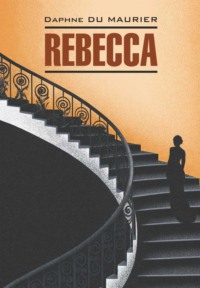
Kitabı oku: «Rebecca / Ребекка. Книга для чтения на английском языке»
© КАРО, 2025
Об авторе
Дафна Дю Морье (1907–1989) – знаменитая английская писательница. Ее предки эмигрировали из Франции во время Французской революции. Дафна росла в Лондоне и Париже. В восемнадцать лет она начала писать рассказы, в двадцать один год опубликовала свой первый роман «Дух любви», гонорар за который составил десять фунтов. Ее перу принадлежат романы «Французов ручей» и «Козел отпущения», «Моя кузина Рэйчел» и «Королевский генерал», но, конечно же, прославил писательницу роман «Ребекка».
«Ребекка» – это любовная драма с элементами готики. Юная компаньонка пожилой взбалмошной американки встречает на Французской Ривьере импозантного английского аристократа Максимилиана де Винтера и влюбляется в него. Когда настает момент расставания, он предлагает девушке выйти за него замуж. Она принимает предложение, и молодые супруги уезжают в имение Мэндерли, огромный старинный замок, в котором, как вскоре понимает героиня, живет какая-то страшная тайна, связанная с покойной Ребеккой, первой женой Максимилиана. Странное поведение мужа, настороженность, а подчас и враждебность прислуги, всеобщие недомолвки, явно призванные скрыть тайну смерти прежней владелицы Мэндерли, повергают героиню в трепет. После нескольких месяцев мучительных переживаний ей довелось узнать страшную правду о прошлом обитателей Мэндерли.
Творчество Дафны Дю Морье вдохновило знаменитого кинорежиссера, мастера саспенса Альфреда Хичкока. В 1939 году он экранизировал роман «Трактир „Ямайка“», в 1940-м появился оскароносный фильм «Ребекка», в 1963-м – «Птицы» по одноименному рассказу писательницы, получивший премию «Золотой глобус».
Chapter One
Last night I dreamt I went to Manderley again. It seemed to me I stood by the iron gate leading to the drive, and for a while I could not enter, for the way was barred to me. There was a padlock and chain upon the gate. I called in my dream to the lodge-keeper, and had no answer, and peering closer through the rusted spokes of the gate I saw that the lodge was uninhabited.
No smoke came from the chimney, and the little lattice windows gaped forlorn. Then, like all dreamers, I was possessed of a sudden with supernatural powers and passed like a spirit through the barrier before me. The drive wound away in front of me, twisting and turning as it had always done, but as I advanced I was aware that a change had come upon it; it was narrow and unkempt, not the drive that we had known. At first I was puzzled and did not understand, and it was only when I bent my head to avoid the low swinging branch of a tree that I realized what had happened. Nature had come into her own again and, little by little, in her stealthy, insidious way had encroached upon the drive with long, tenacious fingers. The woods, always a menace even in the past, had triumphed in the end. They crowded, dark and uncontrolled, to the borders of the drive. The beeches with white, naked limbs leant close to one another, their branches intermingled in a strange embrace, making a vault above my head like the archway of a church. And there were other trees as well, trees that I did not recognize, squat oaks and tortured elms that straggled cheek-by-jowl1 with the beeches, and had thrust themselves out of the quiet earth, along with monster shrubs and plants, none of which I remembered.
The drive was a ribbon now, a thread of its former self, with gravel surface gone, and choked with grass and moss. The trees had thrown out low branches, making an impediment to progress; the gnarled roots looked like skeleton claws. Scattered here and again amongst this jungle growth I would recognize shrubs that had been landmarks in our time, things of culture and grace, hydrangeas whose blue heads had been famous. No hand had checked their progress, and they had gone native now, rearing to monster height without a bloom, black and ugly as the nameless parasites that grew beside them.
On and on, now east now west, wound the poor thread that once had been our drive. Sometimes I thought it lost, but it appeared again, beneath a fallen tree perhaps, or struggling on the other side of a muddied ditch created by the winter rains. I had not thought the way so long. Surely the miles had multiplied, even as the trees had done, and this path led but to a labyrinth, some choked wilderness, and not to the house at all. I came upon it suddenly; the approach masked by the unnatural growth of a vast shrub that spread in all directions, and I stood, my heart thumping in my breast, the strange prick of tears behind my eyes2.
There was Manderley, our Manderley, secretive and silent as it had always been, the grey stone shining in the moonlight of my dream, the mullioned windows reflecting the green lawns and the terrace. Time could not wreck the perfect symmetry of those walls, nor the site itself, a jewel in the hollow of a hand.
The terrace sloped to the lawns, and the lawns stretched to the sea, and turning I could see the sheet of silver placid under the moon, like a lake undisturbed by wind or storm. No waves would come to ruffle this dream water, and no bulk of cloud, wind-driven from the west, obscure the clarity of this pale sky. I turned again to the house, and though it stood inviolate, untouched, as though we ourselves had left but yesterday, I saw that the garden had obeyed the jungle law, even as the woods had done. The rhododendrons stood fifty feet high, twisted and entwined with bracken, and they had entered into alien marriage with a host of nameless shrubs, poor, bastard things that clung about their roots as though conscious of their spurious origin. A lilac had mated with a copper beech, and to bind them yet more closely to one another the malevolent ivy, always an enemy to grace, had thrown her tendrils about the pair and made them prisoners. Ivy held prior place in this lost garden, the long strands crept across the lawns, and soon would encroach upon the house itself. There was another plant too, some half-breed from the woods, whose seed had been scattered long ago beneath the trees and then forgotten, and now, marching in unison with the ivy, thrust its ugly form like a giant rhubarb towards the soft grass where the daffodils had blown. Nettles were everywhere, the vanguard of the army. They choked the terrace, they sprawled about the paths, they leant, vulgar and lanky, against the very windows of the house. They made indifferent sentinels, for in many places their ranks had been broken by the rhubarb plant, and they lay with crumpled heads and listless stems, making a pathway for the rabbits. I left the drive and went on to the terrace, for the nettles were no barrier to me, a dreamer. I walked enchanted, and nothing held me back.
Moonlight can play odd tricks upon the fancy, even upon a dreamer’s fancy.
As I stood there, hushed and still, I could swear that the house was not an empty shell but lived and breathed as it had lived before. Light came from the windows, the curtains blew softly in the night air, and there, in the library, the door would stand half open as we had left it, with my handkerchief on the table beside the bowl of autumn roses. The room would bear witness to our presence. The little heap of library books marked ready to return, and the discarded copy of The Times. Ashtrays, with the stub of a cigarette; cushions, with the imprint of our heads upon them, lolling in the chairs; the charred embers of our log fire still smouldering against the morning. And Jasper, dear Jasper, with his soulful eyes and great, sagging jowl, would be stretched upon the floor, his tail a-thump when he heard his master’s footsteps.
A cloud, hitherto unseen, came upon the moon, and hovered an instant like a dark hand before a face. The illusion went with it, and the lights in the windows were extinguished. I looked upon a desolate shell, soulless at last, unhaunted, with no whisper of the past about its staring walls. The house was a sepulchre, our fear and suffering lay buried in the ruins. There would be no resurrection. When I thought of Manderley in my waking hours I would not be bitter. I should think of it as it might have been, could I have lived there without fear. I should remember the rose-garden in summer, and the birds that sang at dawn. Tea under the chestnut tree, and the murmur of the sea coming up to us from the lawns below. I would think of the blown lilac, and the Happy Valley. These things were permanent, they could not be dissolved. They were memories that cannot hurt. All this I resolved in my dream, while the clouds lay across the face of the moon, for like most sleepers I knew that I dreamed. In reality I lay many hundred miles away in an alien land, and would wake, before many seconds had passed, in the bare little hotel bedroom, comforting in its very lack of atmosphere3. I would sigh a moment, stretch myself and turn, and opening my eyes, be bewildered at that glittering sun, that hard, clean sky, so different from the soft moonlight of my dream. The day would lie before us both, long no doubt, and uneventful, but fraught with a certain stillness, a dear tranquillity we had not known before. We would not talk of Manderley, I would not tell my dream. For Manderley was ours no longer. Manderley was no more.
Chapter Two
We can never go back again, that much is certain. The past is still too close to us. The things we have tried to forget and put behind us would stir again, and that sense of fear, of furtive unrest, struggling at length to blind unreasoning panic – now mercifully stilled, thank God – might in some manner unforeseen become a living companion, as it had been before. He is wonderfully patient and never complains, not even when he remembers… which happens, I think, rather more often than he would have me know.
I can tell by the way he will look lost and puzzled suddenly, all expression dying away from his dear face as though swept clean by an unseen hand, and in its place a mask will form, a sculptured thing, formal and cold, beautiful still but lifeless. He will fall to smoking cigarette after cigarette, not bothering to extinguish them, and the glowing stubs will lie around on the ground like petals. He will talk quickly and eagerly about nothing at all, snatching at any subject as a panacea to pain. I believe there is a theory that men and women emerge finer and stronger after suffering, and that to advance in this or any world we must endure ordeal by fire1. This we have done in full measure, ironic though it seems. We have both known fear, and loneliness, and very endure ordeal by fire – (разг.) пройти очищение огнем great distress. I suppose sooner or later in the life of everyone comes a moment of trial. We all of us have our particular devil who rides us and torments us, and we must give battle in the end. We have conquered ours, or so we believe. The devil does not ride us any more. We have come through our crisis, not unscathed of course. His premonition of disaster was correct from the beginning; and like a ranting actress in an indifferent play, I might say that we have paid for freedom. But I have had enough melodrama in this life, and would willingly give my five senses if they could ensure us our present peace and security. Happiness is not a possession to be prized, it is a quality of thought, a state of mind. Of course we have our moments of depression; but there are other moments too, when time, unmeasured by the clock, runs on into eternity and, catching his smile, I know we are together, we march in unison, no clash of thought or of opinion makes a barrier between us.
We have no secrets now from one another. All things are shared4. Granted that our little hotel is dull, and the food indifferent, and that day after day dawns very much the same, yet we would not have it otherwise. We should meet too many of the people he knows in any of the big hotels. We both appreciate simplicity, and we are sometimes bored – well, boredom is a pleasing antidote to fear. We live very much by routine, and I–I have developed a genius for reading aloud. The only time I have known him show impatience is when the postman lags, for it means we must wait another day before the arrival of our English mail. We have tried wireless, but the noise is such an irritant, and we prefer to store up our excitement; the result of a cricket match played many days ago means much to us. Oh, the Test matches that have saved us from ennui, the boxing bouts, even the billiard scores. Finals of schoolboy sports, dog racing, strange little competitions in the remoter counties, all these are grist to our hungry mill. Sometimes old copies of the Field come my way, and I am transported from this indifferent island to the realities of an English spring. I read of chalk streams, of the mayfly, of sorrel growing in green meadows, of rooks circling above the woods as they used to do at Manderley. The smell of wet earth comes to me from those thumbed and tattered pages, the sour tang of moorland peat, the feel of soggy moss spattered white in places by a heron’s droppings.
Once there was an article on wood pigeons, and as I read it aloud it seemed to me that once again I was in the deep woods at Manderley, with pigeons fluttering above my head. I heard their soft, complacent call, so comfortable and cool on a hot summer’s afternoon, and there would be no disturbing of their peace until Jasper came loping through the undergrowth to find me, his damp muzzle questing the ground. Like old ladies caught at their ablutions, the pigeons would flutter from their hiding-place, shocked into silly agitation, and, making a monstrous to- do with their wings, streak away from us above the tree- tops, and so out of sight and sound. When they were gone a new silence would come upon the place, and I – uneasy for no known reason – would realize that the sun no longer wove a pattern on the rustling leaves, that the branches had grown darker, the shadows longer; and back at the house there would be fresh raspberries for tea. I would rise from my bed of bracken then, shaking the feathery dust of last year’s leaves from my skirt and whistling to Jasper, set off towards the house, despising myself even as I walked for my hurrying feet, my one swift glance behind.
How strange that an article on wood pigeons could so recall the past and make me falter as I read aloud. It was the grey look on his face that made me stop abruptly, and turn the pages until I found a paragraph on cricket, very practical and dull – Middlesex batting on a dry wicket at the Oval and piling up interminable dreary runs. How I blessed those solid, flannelled figures, for in a few minutes his face had settled back into repose, the colour had returned, and he was deriding the Surrey bowling in healthy irritation.
We were saved a retreat into the past, and I had learnt my lesson. Read English news, yes, and English sport, politics, and pomposity, but in future keep the things that hurt to myself alone. They can be my secret indulgence. Colour and scent and sound, rain and the lapping of water, even the mists of autumn, and the smell of the flood tide, these are memories of Manderley that will not be denied. Some people have a vice of reading Bradshaws5. They plan innumerable journeys across country for the fun of linking up impossible connexions. My hobby is less tedious, if as strange. I am a mine of information on the English countryside. I know the name of every owner of every British moor, yes – and their tenants too. I know how many grouse are killed, how many partridge, how many head of deer. I know where trout are rising, and where the salmon leap. I attend all meets, I follow every run. Even the names of those who walk hound puppies are familiar to me. The state of the crops, the price of fat cattle, the mysterious ailments of swine, I relish them all.
A poor pastime, perhaps, and not a very intellectual one, but I breathe the air of England as I read, and can face this glittering sky with greater courage.
The scrubby vineyards and the crumbling stones become things of no account, for if I wish I can give rein to my imagination, and pick foxgloves and pale campions from a wet, streaking hedge.
Poor whims of fancy, tender and un-harsh. They are the enemy to bitterness and regret, and sweeten this exile we have brought upon ourselves. Because of them I can enjoy my afternoon, and return, smiling and refreshed, to face the little ritual of our tea. The order never varies. Two slices of bread and butter each, and China tea. What a hide-bound couple we must seem, clinging to custom because we did so in England. Here, on this clean balcony, white and impersonal with centuries of sun, I think of half past four at Manderley, and the table drawn before the library fire. The door flung open, punctual to the minute, and the performance, never-varying, of the laying of the tea, the silver tray, the kettle, the snowy cloth. While Jasper, his spaniel ears a-droop, feigns indifference to the arrival of the cakes. That feast was laid before us always, and yet we ate so little.
Those dripping crumpets, I can see them now. Tiny crisp wedges of toast, and piping-hot, floury scones. Sandwiches of unknown nature, mysteriously flavoured and quite delectable, and that very special gingerbread. Angel cake, that melted in the mouth, and his rather stodgier companion, bursting with peel and raisins. There was enough food there to keep a starving family for a week. I never knew what happened to it all, and the waste used to worry me sometimes.
But I never dared ask Mrs Danvers what she did about it6. She would have looked at me in scorn, smiling that freezing, superior smile of hers, and I can imagine her saying: ‘There were never any complaints when Mrs de Winter was alive' Mrs Danvers. I wonder what she is doing now. She and Favell. I think it was the expression on her face that gave me my first feeling of unrest. Instinctively I thought, ‘She is comparing me to Rebecca’; and sharp as a sword the shadow came between us…
Well, it is over now, finished and done with. I ride no more tormented, and both of us are free. Even my faithful Jasper has gone to the happy hunting grounds, and Manderley is no more. It lies like an empty shell amidst the tangle of the deep woods, even as I saw it in my dream. A multitude of weeds, a colony of birds. Sometimes perhaps a tramp will wander there, seeking shelter from a sudden shower of rain and, if he is stout-hearted, he may walk there with impunity. But your timid fellow, your nervous poacher – the woods of Manderley are not for him. He might stumble upon the little cottage in the cove and he would not be happy beneath its tumbled roof, the thin rain beating a tattoo. There might linger there still a certain atmosphere of stress. That corner in the drive, too, where the trees encroach upon the gravel, is not a place in which to pause, not after the sun has set. When the leaves rustle, they sound very much like the stealthy movement of a woman in evening dress, and when they shiver suddenly, and fall, and scatter away along the ground, they might be the patter, patter, of a woman’s hurrying footstep, and the mark in the gravel the imprint of a high-heeled satin shoe.
It is when I remember these things that I return with relief to the prospect from our balcony. No shadows steal upon this hard glare, the stony vineyards shimmer in the sun and the bougainvillaea is white with dust. I may one day look upon it with affection. At the moment it inspires me, if not with love, at least with confidence. And confidence is a quality I prize, although it has come to me a little late in the day7. I suppose it is his dependence upon me that has made me bold at last. At any rate I have lost my diffidence, my timidity, my shyness with strangers. I am very different from that self who drove to Manderley for the first time, hopeful and eager, handicapped by a rather desperate gaucherie and filled with an intense desire to please. It was my lack of poise of course that made such a bad impression on people like Mrs Danvers. What must I have seemed like after Rebecca? I can see myself now, memory spanning the years like a bridge, with straight, bobbed hair and youthful, unpowdered face, dressed in an ill-fitting coat and skirt and a jumper of my own creation, trailing in the wake8 of Mrs Van Hopper like a shy, uneasy colt. She would precede me in to lunch, her short body ill-balanced upon tottering, high heels, her fussy, frilly blouse a compliment to her large bosom and swinging hips, her new hat pierced with a monster quill aslant upon her head, exposing a wide expanse of forehead bare as a schoolboy’s knee. One hand carried a gigantic bag, the kind that holds passports, engagement diaries, and bridge scores, while the other hand toyed with that inevitable lorgnette, the enemy to other people’s privacy.
She would make for her usual table in the corner of the restaurant, close to the window, and lifting her lorgnette to her small pig’s eyes survey the scene to right and left of her, then she would let the lorgnette fall at length upon its black ribbon and utter a little exclamation of disgust: ‘Not a single well-known personality, I shall tell the management they must make a reduction on my bill. What do they think I come here for? To look at the page boys?’ And she would summon the waiter to her side, her voice sharp and staccato, cutting the air like a saw.
How different the little restaurant where we are today to that vast dining-room, ornate and ostentatious, the Hotel Cote d’Azur at Monte Carlo; and how different my present companion, his steady, well-shaped hands peeling a mandarin in quiet, methodical fashion, looking up now and again from his task to smile at me, compared to Mrs Van Hopper, her fat, bejewelled fingers questing a plate heaped high with ravioli, her eyes darting suspiciously from her plate to mine for fear I should have made the better choice. She need not have disturbed herself, for the waiter, with the uncanny swiftness of his kind, had long sensed my position as inferior and subservient to hers, and had placed before me a plate of ham and tongue that somebody had sent back to the cold buffet half an hour before as badly carved. Odd, that resentment of servants, and their obvious impatience. I remember staying once with Mrs Van Hopper in a country house, and the maid never answered my timid bell, or brought up my shoes, and early morning tea, stone cold, was dumped outside my bedroom door. It was the same at the Cote d’Azur, though to a lesser degree, and sometimes the studied indifference turned to familiarity, smirking and offensive, which made buying stamps from the reception clerk an ordeal I would avoid. How young and inexperienced I must have seemed, and how I felt it, too. One was too sensitive, too raw, there were thorns and pinpricks in so many words that in reality fell lightly on the air. I remember well that plate of ham and tongue. It was dry, unappetizing, cut in a wedge from the outside, but I had not the courage to refuse it. We ate in silence, for Mrs Van Hopper liked to concentrate on food, and I could tell by the way the sauce ran down her chin that her dish of ravioli pleased her.
It was not a sight that engendered into me great appetite for my own cold choice, and looking away from her I saw that the table next to ours, left vacant for three days, was to be occupied once more. The maitre d’hotel9, with the particular bow reserved for his more special patrons, was ushering the new arrival to his place.
Mrs Van Hopper put down her fork, and reached for her lorgnette. I blushed for her while she stared, and the newcomer, unconscious of her interest, cast a wandering eye over the menu. Then Mrs Van Hopper folded her lorgnette with a snap, and leant across the table to me, her small eyes bright with excitement, her voice a shade too loud.
‘It’s Max de Winter,’ she said. ‘The man who owns Manderley. You’ve heard of it, of course. He looks ill, doesn’t he? They say he can’t get over10 his wife’s death…
Chapter Three
I wonder what my life would be today, if Mrs Van Hopper had not been a snob.
Funny to think that the course of my existence hung like a thread upon that quality of hers. Her curiosity was a disease, almost a mania. At first I had been shocked, wretchedly embarrassed; I would feel like a whipping-boy who must bear his master’s pains when I watched people laugh behind her back, leave a room hurriedly upon her entrance, or even vanish behind a Service door on the corridor upstairs. For many years now she had come to the Hotel Cote d’Azur, and, apart from bridge, her one pastime which was notorious by now in Monte Carlo, was to claim visitors of distinction as her friends had she but seen them once at the other end of the post-office. Somehow she would manage to introduce herself, and before her victim had scented danger she had proffered an invitation to her suite. Her method of attack was so downright and sudden that there was seldom opportunity to escape11. At the Cote d’Azur she staked a claim upon a certain sofa in the lounge, midway between the reception hall and the passage to the restaurant, and she would have her coffee there after luncheon and dinner, and all who came and went must pass her by. Sometimes she would employ me as a bait to draw her prey, and, hating my errand, I would be sent across the lounge with a verbal message, the loan of a book or paper, the address of some shop or other, the sudden discovery of a mutual friend. It seemed as though notables must be fed to her, much as invalids are spooned their jelly; and though titles were preferred by her, any face once seen in a social paper served as well. Names scattered in a gossip column, authors, artists, actors, and their kind, even the mediocre ones, as long as she had learnt of them in print.
I can see her as though it were but yesterday, on that unforgettable afternoon – never mind how many years ago – when she sat at her favourite sofa in the lounge, debating her method of attack12. I could tell by her abrupt manner, and the way she tapped her lorgnette against her teeth, that she was questing possibilities. I knew, too, when she had missed the sweet and rushed through dessert, that she had wished to finish luncheon before the new arrival and so install herself where he must pass. Suddenly she turned to me, her small eyes alight.
‘Go upstairs quickly and find that letter from my nephew. You remember, the one written on his honeymoon, with the snapshot. Bring it down to me right away'
I saw then that her plans were formed, and the nephew was to be the means of introduction. Not for the first time I resented the part that I must play in her schemes. Like a juggler’s assistant I produced the props, then silent and attentive I waited on my cue. This newcomer would not welcome intrusion, I felt certain of that. In the little I had learnt of him at luncheon, a smattering of hearsay garnered by her ten months ago from the daily papers and stored in her memory for future use, I could imagine, in spite of my youth and inexperience of the world, that he would resent this sudden bursting in upon his solitude. Why he should have chosen to come to the Cote d’Azur at Monte Carlo was not our concern, his problems were his own, and anyone but Mrs Van Hopper would have understood. Tact was a quality unknown to her, discretion too, and because gossip was the breath of life to her this stranger must be served for her dissection. I found the letter in a pigeon-hole in her desk, and hesitated a moment before going down again to the lounge.
It seemed to me, rather senselessly, that I was allowing him a few more moments of seclusion.
I wished I had the courage to go by the Service staircase and so by roundabout way to the restaurant, and there warn him of the ambush. Convention was too strong for me though, nor did I know how I should frame my sentence. There was nothing for it but to sit in my usual place beside Mrs Van Hopper while she, like a large, complacent spider, spun her wide net of tedium about the stranger’s person.
I had been longer than I thought, for when I returned to the lounge I saw he had already left the dining-room, and she, fearful of losing him, had not waited for the letter, but had risked a bare-faced introduction on her own. He was even now sitting beside her on the sofa. I walked across to them, and gave her the letter without a word. He rose to his feet at once, while Mrs Van Hopper, flushed with her success, waved a vague hand in my direction and mumbled my name.
‘Mr de Winter is having coffee with us, go and ask the waiter for another cup,’ she said, her tone just casual enough to warn him of my footing. It meant I was a youthful thing and unimportant, and that there was no need to include me in the conversation. She always spoke in that tone when she wished to be impressive, and her method of introduction was a form of self-protection, for once I had been taken for her daughter, an acute embarrassment for us both. This abruptness showed that I could safely be ignored, and women would give me a brief nod which served as a greeting and a dismissal in one, while men, with large relief, would realize they could sink back into a comfortable chair without offending courtesy13.
It was a surprise, therefore, to find that this newcomer remained standing on his feet, and it was he who made a signal to the waiter. ‘I’m afraid I must contradict you’ he said to her, ‘you are both having coffee with me’; and before I knew what had happened he was sitting in my usual hard chair, and I was on the sofa beside Mrs Van Hopper. For a moment she looked annoyed – this was not what she had intended – but she soon composed her face, and thrusting her large self between me and the table she leant forward to his chair, talking eagerly and loudly, fluttering the letter in her hand.
‘You know I recognized you just as soon as you walked into the restaurant,’ she said, ‘and I thought, “Why, there’s Mr de Winter, Billy’s friend, I simply must show him those snaps of Billy and his bride taken on their honeymoon”, and here they are. There’s Dora. Isn’t she just adorable? That little, slim waist, those great big eyes. Here they are sunbathing at Palm Beach. Billy is crazy about her, you can imagine. He had not met her of course when he gave that party at Claridge’s, and where I saw you first. But I dare say you don’t remember an old woman like me?’
This with a provocative glance and a gleam of teeth.
‘On the contrary I remember you very well' he said, and before she could trap him into a resurrection of their first meeting he had handed her his cigarette case, and the business of lighting-up stalled her for the moment. ‘I don’t think I should care for Palm Beach,’ he said, blowing the match, and glancing at him I thought how unreal he would look against a Florida background. He belonged to a walled city of the fifteenth century, a city of narrow, cobbled streets, and thin spires, where the inhabitants wore pointed shoes and worsted hose14. His face was arresting, sensitive, medieval in some strange inexplicable way, and I was reminded of a portrait seen in a gallery, I had forgotten where, of a certain Gentleman Unknown. Could one but rob him of his English tweeds, and put him in black, with lace at his throat and wrists, he would stare down at us in our new world from a long-distant past – a past where men walked cloaked at night, and stood in the shadow of old doorways, a past of narrow stairways and dim dungeons, a past of whispers in the dark, of shimmering rapier blades, of silent, exquisite courtesy.
I wished I could remember the Old Master who had painted that portrait. It stood in a corner of the gallery, and the eyes followed one from the dusky frame…
They were talking though, and I had lost the thread of conversation. ‘No, not even twenty years ago' he was saying. ‘That sort of thing has never amused me.’
I heard Mrs Van Hopper give her fat, complacent laugh. ‘If Billy had a home like Manderley he would not want to play around in Palm Beach,’ she said. ‘I’m told it’s like fairyland, there’s no other word for it.’
She paused, expecting him to smile, but he went on smoking his cigarette, and I noticed, faint as gossamer, the line between his brows.
‘I’ve seen pictures of it, of course’ she persisted, ‘and it looks perfectly enchanting. I remember Billy telling me it had all those big places beat for beauty. I wonder you can ever bear to leave it.’
His silence now was painful, and would have been patent to anyone else, but she ran on like a clumsy goat, trampling and trespassing on land that was preserved, and I felt the colour flood my face, dragged with her as I was into humiliation.
‘Of course you Englishmen are all the same about your homes,’ she said, her voice becoming louder and louder, ‘you depreciate them so as not to seem proud. Isn’t there a minstrels’ gallery at Manderley, and some very valuable portraits?’ She turned to me by way of explanation. ‘Mr de Winter is so modest he won’t admit to it, but I believe that lovely home of his has been in his family’s possession since the Conquest15. They say that minstrels’ gallery is a gem. I suppose your ancestors often entertained royalty at Manderley, Mr de Winter?’
This was more than I had hitherto endured, even from her, but the swift lash of his reply was unexpected. ‘Not since Ethelred16’ he said. ‘The one who was called Unready. In fact, it was while staying with my family that the name was given him. He was invariably late for dinner.’
She deserved it, of course, and I waited for her change of face, but incredible as it may seem his words were lost on her, and I was left to writhe in her stead, feeling like a child that had been smacked.
‘Is that really so?’ she blundered. ‘I’d no idea. My history is very shaky and the kings of England always muddled me. How interesting, though. I must write and tell my daughter; she’s a great scholar.’
There was a pause, and I felt the colour flood into my face. I was too young, that was the trouble. Had I been older I would have caught his eye and smiled, her unbelievable behaviour making a bond between us; but as it was I was stricken into shame, and endured one of the frequent agonies of youth.
I think he realized my distress, for he leant forward in his chair and spoke to me, his voice gentle, asking if I would have more coffee, and when I refused and shook my head I felt his eyes were still on me, puzzled, reflective. He was pondering my exact relationship to her, and wondering whether he must bracket us together in futility.
‘What do you think of Monte Carlo, or don’t you think of it at all?’ he said. This including of me in the conversation found me at my worst, the raw ex-schoolgirl, red-elbowed and lanky-haired, and I said something obvious and idiotic about the place being artificial, but before I could finish my halting sentence Mrs Van Hopper interrupted.
‘She’s spoilt, Mr de Winter, that’s her trouble. Most girls would give their eyes for the chance17 of seeing Monte.’
‘Wouldn’t that rather defeat the purpose?’ he said, smiling.
She shrugged her shoulders, blowing a great cloud of cigarette smoke into the air. I don’t think she understood him for a moment. ‘I’m faithful to Monte,’ she told him. ‘The English winter gets me down, and my constitution just won’t stand it. What brings you here? You’re not one of the regulars. Are you going to play “Chemy”, or have you brought your golf clubs?’
‘I have not made up my mind,’ he said, ‘I came away in rather a hurry.’ His own words must have jolted a memory, for his face clouded again and he frowned very slightly.
She babbled on, impervious. ‘Of course you miss the fogs at Manderley; it’s quite another matter; the west country must be delightful in the spring.’
He reached for the ashtray, squashing his cigarette, and I noticed the subtle change in his eyes, the indefinable something that lingered there, momentarily, and I felt I had looked upon something personal to himself with which I had no concern.
‘Yes,’ he said shortly, ‘Manderley was looking its best.’ A silence fell upon us during a moment or two, a silence that brought something of discomfort in its train, and stealing a glance at him I was reminded more than ever of my Gentleman Unknown who, cloaked and secret, walked a corridor by night. Mrs Van Hopper’s voice pierced my dream like an electric bell.
‘I suppose you know a crowd of people here, though I must say Monte is very dull this winter. One sees so few well-known faces. The Duke of Middlesex is here in his yacht, but I haven’t been aboard yet.’ She never had, to my knowledge18. ‘You know Nell Middlesex of course,’ she went on. ‘What a charmer she is. They always say that second child isn’t his, but I don’t believe it. People will say anything, won’t they, when a woman is attractive? And she is so very lovely. Tell me, is it true the Caxton-Hyslop marriage is not a success?’ She ran on, through a tangled fringe of gossip, never seeing that these names were alien to him, they meant nothing, and that as she prattled unaware he grew colder and more silent. Never for a moment did he interrupt or glance at his watch; it was as though he had set himself a standard of behaviour, since the original lapse when he had made a fool of her in front of me, and clung to it grimly rather than offend again. It was a page-boy in the end who released him, with the news that a dressmaker awaited Mrs Van Hopper in the suite. He got up at once, pushing back his chair. ‘Don’t let me keep you,’ he said. ‘Fashions change so quickly nowadays they may even have altered by the time you get upstairs.’
The sting did not touch her19, she accepted it as a pleasantry. ‘It’s so delightful to have run into you like this, Mr de Winter,’ she said, as we went towards the lift; ‘now I’ve been brave enough to break the ice I hope I shall see something of you. You must come and have a drink some time in the suite. I may have one or two people coming in tomorrow evening. Why not join us?’ I turned away so that I should not watch him search for an excuse.
‘I’m so sorry,’ he said, ‘tomorrow I am probably driving to Sospel, I’m not sure when I shall get back.’
Reluctantly she left it, but we still hovered at the entrance to the lift. ‘I hope they’ve given you a good room; the place is half empty, so if you are uncomfortable mind you make a fuss. Your valet has unpacked for you, I suppose?’ This familiarity was excessive, even for her, and I caught a glimpse of his expression.
‘I don’t possess one,’ he said quietly, ‘perhaps you would like to do it for me?’
This time his shaft had found its mark, for she reddened, and laughed a little awkwardly.
‘Why, I hardly think… she began, and then suddenly, and unbelievably, she turned upon me, ‘Perhaps you could make yourself useful to Mr de Winter, if he wants anything done. You’re a capable child in many ways.’ There was a momentary pause, while I stood stricken, waiting for his answer. He looked down at us, mocking, faintly sardonic, a ghost of a smile on his lips.
‘A charming suggestion,’ he said, ‘but I cling to the family motto. He travels the fastest who travels alone. Perhaps you have not heard of it.’ And without waiting for her answer he turned and left us.
‘What a funny thing,’ said Mrs Van Hopper, as we went upstairs in the lift. ‘Do you suppose that sudden departure was a form of humour? Men do such extraordinary things. I remember a well-known writer once who used to dart down the Service staircase whenever he saw me coming. I suppose he had a penchant for me and wasn’t sure of himself. However, I was younger then.’
The lift stopped with a jerk. We arrived at our floor. The page-boy flung open the gates. ‘By the way, dear,’ she said, as we walked along the corridor, ‘don’t think I mean to be unkind, but you put yourself just a teeny bit forward20 this afternoon. Your efforts to monopolize the conversation quite embarrassed me, and I’m sure it did him. Men loathe that sort of thing.’
I said nothing. There seemed no possible reply. ‘Oh, come, don’t sulk,’ she laughed, and shrugged her shoulders; ‘after all, I am responsible for your behaviour here, and surely you can accept advice from a woman old enough to be your mother. Eh bien, Blaize, je viens21. and humming a tune she went into the bedroom where the dressmaker was waiting for her.
I knelt on the window-seat and looked out upon the afternoon. The sun shone very brightly still, and there was a gay high wind. In half an hour we should be sitting to our bridge, the windows tightly closed, the central heating turned to the full. I thought of the ashtrays I would have to clear, and how the squashed stubs, stained with lipstick, would sprawl in company with discarded chocolate creams. Bridge does not come easily to a mind brought up on Snap and Happy Families; besides, it bored her friends to play with me.
I felt my youthful presence put a curb upon their conversation22, much as a parlour-maid does until the arrival of dessert, and they could not fling themselves so easily into the melting-pot of scandal and insinuation. Her menfriends would assume a sort of forced heartiness and ask me jocular questions about history or painting, guessing I had not long left school and that this would be my only form of conversation.
I sighed, and turned away from the window. The sun was so full of promise, and the sea was whipped white with a merry wind. I thought of that corner of Monaco which I had passed a day or two ago, and where a crooked house leant to a cobbled square. High up in the tumbled roof there was a window, narrow as a slit. It might have held a presence medieval; and, reaching to the desk for pencil and paper, I sketched in fancy with an absent mind a profile, pale and aquiline. A sombre eye, a high-bridged nose, a scornful upper lip. And I added a pointed beard and lace at the throat, as the painter had done, long ago in a different time.
Someone knocked at the door, and the lift-boy came in with a note in his hand. ‘Madame is in the bedroom,’ I told him but he shook his head and said it was for me. I opened it, and found a single sheet of note-paper inside, with a few words written in an unfamiliar hand.
‘Forgive me. I was very rude this afternoon’ That was all. No signature, and no beginning. But my name was on the envelope, and spelt correctly, an unusual thing.
‘Is there an answer?’ asked the boy.
I looked up from the scrawled words. ‘No,’ I said. ‘No, there isn’t any answer.’
When he had gone I put the note away in my pocket, and turned once more to my pencil drawing, but for no known reason it did not please me any more; the face was stiff and lifeless, and the lace collar and the beard were like props in a charade.
Chapter Four
The morning after the bridge party Mrs Van Hopper woke with a sore throat and a temperature of a hundred and two. I rang up her doctor, who came round at once and diagnosed the usual influenza. ‘You are to stay in bed until I allow you to get up,’ he told her; ‘I don’t like the sound of that heart of yours, and it won’t get better unless you keep perfectly quiet and still. I should prefer, he went on, turning to me, ‘that Mrs Van Hopper had a trained nurse. You can’t possibly lift her. It will only be for a fortnight or so.’
I thought this rather absurd, and protested, but to my surprise she agreed with him. I think she enjoyed the fuss it would create, the sympathy of people, the visits and messages from friends, and the arrival of flowers. Monte Carlo had begun to bore her, and this little illness would make a distraction23.
The nurse would give her injections, and a light massage, and she would have a diet. I left her quite happy after the arrival of the nurse, propped up on pillows with a falling temperature, her best bed-jacket round her shoulders and be-ribboned boudoir cap upon her head. Rather ashamed of my light heart, I telephoned her friends, putting off the small party she had arranged for the evening, and went down to the restaurant for lunch, a good half hour before our usual time. I expected the room to be empty – nobody lunched generally before one o’clock. It was empty, except for the table next to ours. This was a contingency for which I was unprepared. I thought he had gone to Sospel. No doubt he was lunching early because he hoped to avoid us at one o’clock. I was already half-way across the room and could not go back. I had not seen him since we disappeared in the lift the day before, for wisely he had avoided dinner in the restaurant, possibly for the same reason that he lunched early now.
It was a situation for which I was ill-trained. I wished I was older, different. I went to our table, looking straight before me, and immediately paid the penalty of gaucherie by knocking over the vase of stiff anemones as I unfolded my napkin. The water soaked the cloth, and ran down on to my lap. The waiter was at the other end of the room, nor had he seen. In a second though my neighbour was by my side, dry napkin in hand.
‘You can’t sit at a wet tablecloth,’ he said brusquely, ‘it will put you off your food. Get out of the way.’
He began to mop the cloth, while the waiter, seeing the disturbance, came swiftly to the rescue.
‘I don’t mind,’ I said, ‘it doesn’t matter a bit. I’m all alone.’
He said nothing, and then the waiter arrived and whipped away the vase and the sprawling flowers.
‘Leave that,’ he said suddenly, ‘and lay another place at my table. Mademoiselle will have luncheon with me.’
I looked up in confusion. ‘Oh, no,’ I said, ‘I couldn’t possibly.’
‘Why not?’ he said.
I tried to think of an excuse. I knew he did not want to lunch with me. It was his form of courtesy. I should ruin his meal. I determined to be bold and speak the truth.
‘Please' I begged, ‘don’t be polite. It’s very kind of you but I shall be quite all right if the waiter just wipes the cloth.’
‘But I’m not being polite,’ he insisted. ‘I would like you to have luncheon with me. Even if you had not knocked over that vase so clumsily I should have asked you' I suppose my face told him my doubt, for he smiled. ‘You don’t believe me,’ he said, ‘never mind, come and sit down. We needn’t talk to each other unless we feel like it.’
We sat down, and he gave me the menu, leaving me to choose, and went on with his hors dcEuvre24 as though nothing had happened. His quality of detachment was peculiar to himself, and I knew that we might continue thus, without speaking, throughout the meal and it would not matter. There would be no sense of strain. He would not ask me questions on history.
‘What’s happened to your friend?’ he said. I told him about the influenza. ‘I’m so sorry,’ he said, and then, after pausing a moment, ‘you got my note, I suppose. I felt very much ashamed of myself. My manners were atrocious. The only excuse I can make is that I’ve become boorish through living alone. That’s why it’s so kind of you to lunch with me today.’
‘You weren’t rude,’ I said, ‘at least, not the sort of rudeness she would understand. That curiosity of hers – she does not mean to be offensive, but she does it to everyone. That is, everyone of importance.’
‘I ought to be flattered then,’ he said, ‘why should she consider me of any importance?’
I hesitated a moment before replying.
‘I think because of Manderley,’ I said.
He did not answer, and I was aware again of that feeling of discomfort, as though I had trespassed on forbidden ground. I wondered why it was that this home of his, known to so many people by hearsay, even to me, should so inevitably silence him, making as it were a barrier between him and others.
We ate for a while without talking, and I thought of a picture postcard I had bought once at a village shop, when on holiday as a child in the west country. It was the painting of a house, crudely done of course and highly coloured, but even those faults could not destroy the symmetry of the building, the wide stone steps before the terrace, the green lawns stretching to the sea. I paid twopence for the painting – half my weekly pocket money – and then asked the wrinkled shop woman what it was meant to be. She looked astonished at my ignorance.
‘That’s Manderley,’ she said, and I remember coming out of the shop feeling rebuffed, yet hardly wiser than before.
Perhaps it was the memory of this postcard, lost long ago in some forgotten book, that made me sympathize with his defensive attitude. He resented Mrs Van Hopper and her like25 with their intruding questions. Maybe there was something inviolate about Manderley that made it a place apart; it would not bear discussion. I could imagine her tramping through the rooms, perhaps paying sixpence for admission, ripping the quietude with her sharp, staccato laugh. Our minds must have run in the same channel, for he began to talk about her.
‘Your friend,’ he began, ‘she is very much older than you. Is she a relation? Have you known her long?’ I saw he was still puzzled by us26.
‘She’s not really a friend’ I told him, ‘she’s an employer. She’s training me to be a thing called a companion, and she pays me ninety pounds a year.’
‘I did not know one could buy companionship’ he said, ‘it sounds a primitive idea. Rather like the Eastern slave market.’
‘I looked up the word “companion” once in the dictionary,’ I admitted, ‘and it said “a companion is a friend of the bosom”. ’
‘You haven’t much in common with her,’ he said. He laughed, looking quite different, younger somehow and less detached. ‘What do you do it for?’ he asked me.
‘Ninety pounds is a lot of money to me,’ I said.
‘Haven’t you any family?’
‘No – they’re dead’
‘You have a very lovely and unusual name.’
‘My father was a lovely and unusual person.’
‘Tell me about him,’ he said.
I looked at him over my glass of citronade. It was not easy to explain my father and usually I never talked about him. He was my secret property. Preserved for me alone, much as Manderley was preserved for my neighbour. I had no wish to introduce him casually over a table in a Monte Carlo restaurant.
There was a strange air of unreality about that luncheon, and looking back upon it now it is invested for me with a curious glamour. There was I, so much of a schoolgirl still, who only the day before had sat with Mrs Van Hopper, prim, silent, and subdued, and twenty-four hours afterwards my family history was mine no longer, I shared it with a man I did not know. For some reason I felt impelled to speak, because his eyes followed me in sympathy like the Gentleman Unknown.
My shyness fell away from me, loosening as it did so my reluctant tongue, and out they all came, the little secrets of childhood, the pleasures and the pains. It seemed to me as though he understood, from my poor description, something of the vibrant personality that had been my father’s, and something too of the love my mother had for him, making it a vital, living force, with a spark of divinity about it, so much that when he died that desperate winter, struck down by pneumonia, she lingered behind him for five short weeks and stayed no more. I remember pausing, a little breathless, a little dazed. The restaurant was filled now with people who chatted and laughed to an orchestral background and a clatter of plates, and glancing at the clock above the door I saw that it was two o’clock. We had been sitting there an hour and a half, and the conversation had been mine alone27.
I tumbled down into reality, hot-handed and selfconscious, with my face aflame, and began to stammer my apologies. He would not listen to me.
‘I told you at the beginning of lunch you had a lovely and unusual name,’ he said. ‘I shall go further, if you will forgive me, and say that it becomes you as well as it became your father. I’ve enjoyed this hour with you more than I have enjoyed anything for a very long time. You’ve taken me out of myself, out of despondency and introspection, both of which have been my devils for a year.’
I looked at him, and believed he spoke the truth; he seemed less fettered than he had been before, more modern, more human; he was not hemmed in by shadows.
‘You know,’ he said, ‘we’ve got a bond in common, you and I. We are both alone in the world. Oh, I’ve got a sister, though we don’t see much of each other, and an ancient grandmother whom I pay duty visits to three times a year, but neither of them make for companionship. I shall have to congratulate Mrs Van Hopper. You’re cheap at ninety pounds a year28.’
‘You forget’, I said, ‘you have a home and I have none.’
The moment I spoke I regretted my words, for the secret, inscrutable look came back in his eyes again, and once again I suffered the intolerable discomfort that floods one after lack of tact. He bent his head to light a cigarette, and did not reply immediately.
‘An empty house can be as lonely as a full hotel,’ he said at length. ‘The trouble is that it is less impersonal.’ He hesitated, and for a moment I thought he was going to talk of Manderley at last, but something held him back29, some phobia that struggled to the surface of his mind and won supremacy, for he blew out his match and his flash of confidence at the same time.
‘So the friend of the bosom has a holiday?’ he said, on a level plane again, an easy camaraderie between us. ‘What does she propose to do with it?’
I thought of the cobbled square in Monaco and the house with the narrow window. I could be off there by three o’clock with my sketchbook and pencil, and I told him as much, a little shyly perhaps, like all untalented persons with a pet hobby.
‘I’ll drive you there in the car,’ he said, and would not listen to protests.
I remembered Mrs Van Hopper’s warning of the night before about putting myself forward and was embarrassed that he might think my talk of Monaco was a subterfuge to win a lift. It was so blatantly the type of thing that she would do herself, and I did not want him to bracket us together. I had already risen in importance from my lunch with him, for as we got up from the table the little maitre d’hotel rushed forward to pull away my chair. He bowed and smiled – a total change from his usual attitude of indifference – picked up my handkerchief that had fallen on the floor, and hoped ‘Mademoiselle had enjoyed her lunch. Even the page-boy by the swing doors glanced at me with respect. My companion accepted it as natural, of course; he knew nothing of the ill-carved ham of yesterday. I found the change depressing, it made me despise myself. I remembered my father and his scorn of superficial snobbery.
‘What are you thinking about?’ We were walking along the corridor to the lounge, and looking up I saw his eyes fixed on me in curiosity. ‘Has something annoyed you?’ he said.
The attentions of the maitre d’hotel had opened up a train of thought, and as we drank coffee I told him about Blaize, the dressmaker. She had been so pleased when Mrs Van Hopper had bought three frocks, and I, taking her to the lift afterwards, had pictured her working upon them in her own small salon, behind the stuffy little shop, with a consumptive son wasting upon her sofa. I could see her, with tired eyes, threading needles, and the floor covered with snippets of material.
‘Well?’ he said smiling, ‘wasn’t your picture true?’
‘I don’t know,’ I said, ‘I never found out30.’ And I told him how I had rung the bell for the lift, and as I had done so she had fumbled in her bag and gave me a note for a hundred francs. ‘Here,’ she had whispered, her tone intimate and unpleasant, ‘I want you to accept this small commission in return for bringing your patron to my shop.’ When I had refused, scarlet with embarrassment, she had shrugged her shoulders disagreeably. ‘Just as you like,’ she had said, ‘but I assure you it’s quite usual. Perhaps you would rather have a frock. Come along to the shop some time without Madame and I will fix you up without charging you a sou. Somehow, I don’t know why, I had been aware of that sick, unhealthy feeling I had experienced as a child when turning the pages of a forbidden book. The vision of the consumptive son faded, and in its stead arose the picture of myself had I been different, pocketing that greasy note with an understanding smile, and perhaps slipping round to Blaize’s shop on this my free afternoon and coming away with a frock I had not paid for.
I expected him to laugh, it was a stupid story, I don’t know why I told him, but he looked at me thoughtfully as he stirred his coffee.
‘I think you’ve made a big mistake,’ he said, after a moment.
‘In refusing that hundred francs?’ I asked, revolted.
‘No – good heavens, what do you take me for? I think you’ve made a mistake in coming here, in joining forces with Mrs Van Hopper. You are not made for that sort of job. You’re too young, for one thing, and too soft. Blaize and her commission, that’s nothing. The first of many similar incidents from other Blaizes. You will either have to give in, and become a sort of Blaize yourself, or stay as you are and be broken. Who suggested you took on this thing in the first place?’ It seemed natural for him to question me, nor did I mind. It was as though we had known one another for a long time, and had met again after a lapse of years.
‘Have you ever thought about the future?’ he asked me, ‘and what this sort of thing will lead to? Supposing Mrs Van Hopper gets tired of her “friend of the bosom”, what then?’
I smiled, and told him that I did not mind very much31. There would be other Mrs Van Hoppers, and I was young, and confident, and strong. But even as he spoke I remembered those advertisements seen often in good class magazines where a friendly society demands succour for young women in reduced circumstances; I thought of the type of boarding-house that answers the advertisement and gives temporary shelter, and then I saw myself, useless sketch-book in hand, without qualifications of any kind, stammering replies to stern employment agents. Perhaps I should have accepted Blaize’s ten per cent.
‘How old are you?’ he said, and when I told him he laughed, and got up from his chair. ‘I know that age, it’s a particularly obstinate one, and a thousand bogies won’t make you fear the future. A pity we can’t change over. Go upstairs and put your hat on, and I’ll have the car brought round.’
As he watched me into the lift I thought of yesterday, Mrs Van Hopper’s chattering tongue, and his cold courtesy. I had ill-judged him, he was neither hard nor sardonic, he was already my friend of many years, the brother I had never possessed. Mine was a happy mood that afternoon, and I remember it well. I can see the rippled sky, fluffy with cloud, and the white whipped sea. I can feel again the wind on my face, and hear my laugh, and his that echoed it. It was not the Monte Carlo I had known, or perhaps the truth was that it pleased me better. There was a glamour about it that had not been before. I must have looked upon it before with dull eyes32. The harbour was a dancing thing, with fluttering paper boats, and the sailors on the quay were jovial, smiling fellows, merry as the wind. We passed the yacht, beloved of Mrs Van Hopper because of its ducal owner, and snapped our fingers at the glistening brass, and looked at one another and laughed again. I can remember as though I wore it still my comfortable, ill-fitting flannel suit, and how the skirt was lighter than the coat through harder wear. My shabby hat, too broad about the brim, and my low-heeled shoes, fastened with a single strap. A pair of gauntlet gloves clutched in a grubby hand. I had never looked more youthful, I had never felt so old. Mrs Van Hopper and her influenza did not exist for me. The bridge and the cocktail parties were forgotten, and with them my own humble status.
I was a person of importance, I was grown up at last. That girl who, tortured by shyness, would stand outside the sitting-room door twisting a handkerchief in her hands, while from within came that babble of confused chatter so unnerving to the intruder – she had gone with the wind that afternoon. She was a poor creature, and I thought of her with scorn if I considered her at all.
The wind was too high for sketching, it tore in cheerful gusts around the corner of my cobbled square, and back to the car we went and drove I know not where. The long road climbed the hills, and the car climbed with it, and we circled in the heights like a bird in the air. How different his car to Mrs Van Hopper’s hireling for the season, a square old- fashioned Daimler that took us to Mentone on placid afternoons, when I, sitting on the little seat with my back to the driver, must crane my neck to see the view. This car had the wings of Mercury, I thought, for higher yet we climbed, and dangerously fast, and the danger pleased me because it was new to me, because I was young.
I remember laughing aloud, and the laugh being carried by the wind away from me; and looking at him, I realized he laughed no longer, he was once more silent and detached, the man of yesterday wrapped in his secret self33.
I realized, too, that the car could climb no more, we had reached the summit, and below us stretched the way that we had come, precipitous and hollow. He stopped the car, and I could see that the edge of the road bordered a vertical slope that crumbled into vacancy, a fall of perhaps two thousand feet. We got out of the car and looked beneath us. This sobered me at last. I knew that but half the car’s length had lain between us and the fall. The sea, like a crinkled chart, spread to the horizon, and lapped the sharp outline of the coast, while the houses were white shells in a rounded grotto, pricked here and there by a great orange sun. We knew another sunlight on our hill, and the silence made it harder, more austere. A change had come upon our afternoon; it was not the thing of gossamer it had been. The wind dropped, and it suddenly grew cold.
When I spoke my voice was far too casual, the silly, nervous voice of someone ill at ease. ‘Do you know this place?’ I said. ‘Have you been here before?’ He looked down at me without recognition, and I realized with a little stab of anxiety that he must have forgotten all about me, perhaps for some considerable time, and that he himself was so lost in the labyrinth of his own unquiet thoughts that I did not exist. He had the face of one who walks in his sleep, and for a wild moment the idea came to me that perhaps he was not normal, not altogether sane. There were people who had trances, I had surely heard of them, and they followed strange laws of which we could know nothing, they obeyed the tangled orders of their own subconscious minds. Perhaps he was one of them, and here we were within six feet of death.
‘It’s getting late, shall we go home?’ I said, and my careless tone, my little ineffectual smile would scarcely have deceived a child.
I had misjudged him, of course, there was nothing wrong after all, for as soon as I spoke this second time he came clear of his dream and began to apologize. I had gone white, I suppose, and he had noticed it.
‘That was an unforgivable thing for me to do,’ he said, and taking my arm he pushed me back towards the car, and we climbed in again, and he slammed the door. ‘Don’t be frightened, the turn is far easier than it looks,’ he said, and while I, sick and giddy, clung to the seat with both hands, he manoeuvred the car gently, very gently, until it faced the sloping road once more.
‘Then you have been here before?’ I said to him, my sense of strain departing, as the car crept away down the twisting narrow road.
‘Yes’ he said, and then, after pausing a moment, ‘but not for many years. I wanted to see if it had changed.’
‘And has it?’ I asked him.
‘No’ he said. ‘No, it has not changed’
I wondered what had driven him to this retreat into the past, with me an unconscious witness of his mood. What gulf of years stretched between him and that other time, what deed of thought and action, what difference in temperament? I did not want to know. I wished I had not come34.
Down the twisting road we went without a check, without a word, a great ridge of cloud stretched above the setting sun, and the air was cold and clean. Suddenly he began to talk about Manderley. He said nothing of his life there, no word about himself, but he told me how the sun set there, on a spring afternoon, leaving a glow upon the headland. The sea would look like slate, cold still from the long winter, and from the terrace you could hear the ripple of the coming tide washing in the little bay. The daffodils were in bloom, stirring in the evening breeze, golden heads cupped upon lean stalks, and however many you might pick there would be no thinning of the ranks, they were massed like an army, shoulder to shoulder. On a bank below the lawns, crocuses were planted, golden, pink, and mauve, but by this time they would be past their best, dropping and fading, like pallid snowdrops. The primrose was more vulgar, a homely pleasant creature who appeared in every cranny like a weed. Too early yet for bluebells, their heads were still hidden beneath last year’s leaves, but when they came, dwarfing the more humble violet, they choked the very bracken in the woods, and with their colour made a challenge to the sky.
He never would have them in the house, he said. Thrust into vases they became dank and listless, and to see them at their best you must walk in the woods in the morning, about twelve o’clock, when the sun was overhead. They had a smoky, rather bitter smell, as though a wild sap ran in their stalks, pungent and juicy. People who plucked bluebells from the woods were vandals; he had forbidden it at Manderley. Sometimes, driving in the country, he had seen bicyclists with huge bunches strapped before them on the handles, the bloom already fading from the dying heads, the ravaged stalks straggling naked and unclean.
The primrose did not mind it quite so much; although a creature of the wilds it had a leaning towards civilization, and preened and smiled in a jam-jar in some cottage window without resentment, living quite a week if given water. No wild flowers came in the house at Manderley. He had special cultivated flowers, grown for the house alone, in the walled garden. A rose was one of the few flowers, he said, that looked better picked than growing. A bowl of roses in a drawing-room had a depth of colour and scent they had not possessed in the open. There was something rather blousy about roses in full bloom, something shallow and raucous, like women with untidy hair. In the house they became mysterious and subtle. He had roses in the house at Manderley for eight months in the year. Did I like syringa, he asked me? There was a tree on the edge of the lawn he could smell from his bedroom window. His sister, who was a hard, rather practical person, used to complain that there were too many scents at Manderley, they made her drunk. Perhaps she was right. He did not care. It was the only form of intoxication that appealed to him. His earliest recollection was of great branches of lilac, standing in white jars, and they filled the house with a wistful, poignant smell.
The little pathway down the valley to the bay had clumps of azalea and rhododendron planted to the left of it, and if you wandered down it on a May evening after dinner it was just as though the shrubs had sweated in the air. You could stoop down and pick a fallen petal, crush it between your fingers, and you had there, in the hollow of your hand, the essence of a thousand scents, unbearable and sweet. All from a curled and crumpled petal. And you came out of the valley, heady and rather dazed, to the hard white shingle of the beach and the still water. A curious, perhaps too sudden contrast…
As he spoke the car became one of many once again35, dusk had fallen without my noticing it, and we were in the midst of light and sound in the streets of Monte Carlo. The clatter jagged on my nerves, and the lights were far too brilliant, far too yellow. It was a swift, unwelcome anticlimax.
Soon we would come to the hotel, and I felt for my gloves in the pocket of the car. I found them, and my fingers closed upon a book as well, whose slim covers told of poetry. I peered to read the title as the car slowed down before the door of the hotel. ‘You can take it and read it if you like,’ he said, his voice casual and indifferent now that the drive was over, and we were back again, and Manderley was many hundreds of miles distant.
I was glad, and held it tightly with my gloves. I felt I wanted some possession of his, now that the day was finished.
‘Hop out,’ he said. ‘I must go and put the car away. I shan’t see you in the restaurant this evening as I’m dining out. But thank you for today.’
I went up the hotel steps alone, with all the despondency of a child whose treat is over. My afternoon had spoilt me for the hours that still remained, and I thought how long they would seem until my bed-time, how empty too my supper all alone. Somehow I could not face the bright inquiries of the nurse upstairs, or the possibilities of Mrs Van Hopper’s husky interrogation, so I sat down in the corner of the lounge behind a pillar and ordered tea.
The waiter appeared bored; seeing me alone there was no need for him to press, and anyway it was that dragging time of day, a few minutes after half past five, when the normal tea is finished and the hour for drinks remote.
Rather forlorn, more than a little dissatisfied, I leant back in my chair and took up the book of poems. The volume was well worn, well thumbed, falling open automatically at what must be a much-frequented page.
I fled Him, down the nights and down the days;
I fled Him, down the arches of the years;
I fled Him, down the labyrinthine ways
Of my own mind; and in the midst of tears
I hid from Him, and under running laughter.
Up vistaed slopes I sped
And shot, precipited
A-down Titanic glooms of chasmed fears,
From those strong feet that followed, followed after.
I felt rather like someone peering through the keyhole of a locked door, and a little furtively I laid the book aside. What hound of heaven had driven him to the high hills this afternoon? I thought of his car, with half a length between it and that drop of two thousand feet, and the blank expression on his face. What footsteps echoed in his mind, what whispers, and what memories, and why, of all poems, must he keep this one in the pocket of his car? I wished he were less remote; and I anything but the creature that I was in my shabby coat and skirt, my broad- brimmed schoolgirl hat.
The sulky waiter brought my tea, and while I ate bread- and-butter dull as sawdust36 I thought of the pathway through the valley he had described to me this afternoon, the smell of the azaleas, and the white shingle of the bay. If he loved it all so much why did he seek the superficial froth of Monte Carlo? He had told Mrs Van Hopper he had made no plans, he came away in rather a hurry.
And I picked him running down that pathway in the valley with his own hound of heaven at his heels. I picked up the book again, and this time it opened at the title-page, and I read the dedication. ‘Max – from Rebecca. 17 May’, written in a curious slanting hand. A little blob of ink marred the white page opposite, as though the writer, in impatience, had shaken her pen to make the ink flow freely. And then as it bubbled through the nib, it came a little thick, so that the name Rebecca stood out black and strong, the tall and sloping R dwarfing the other letters.
I shut the book with a snap, and put it away under my gloves; and stretching to a nearby chair, I took up an old copy of L’lllustration and turned the pages. There were some fine photographs of the chateaux of the Loire, and an article as well. I read it carefully, referring to the photographs, but when I finished I knew I had not understood a word. It was not Blois with its thin turrets and its spires that stared up at me from the printed page. It was the face of Mrs Van Hopper in the restaurant the day before, her small pig’s eyes darting to the neighbouring table, her fork, heaped high with ravioli, pausing in mid-air.
An appalling tragedy,’ she was saying. ‘The papers were full of it of course. They say he never talks about it, never mentions her name. She was drowned you know, in the bay near Manderley…’
Chapter Five
I am glad it cannot happen twice, the fever of first love. For it is a fever, and a burden, too, whatever the poets may say. They are not brave, the days when we are twenty-one. They are full of little cowardices, little fears without foundation, and one is so easily bruised, so swiftly wounded, one falls to the first barbed word. Today, wrapped in the complacent armour of approaching middle age, the infinitesimal pricks of day by day brush one lightly and are soon forgotten, but then – how a careless word would linger, becoming a fiery stigma, and how a look, a glance over a shoulder, branded themselves as things eternal. A denial heralded the thrice crowing of a cock, and an insincerity was like the kiss of Judas37. The adult mind can lie with untroubled conscience and a gay composure, but in those days even a small deception scoured the tongue, lashing one against the stake itself.
‘What have you been doing this morning?’ I can hear her now, propped against her pillows, with all the small irritability of the patient who is not really ill, who has lain in bed too long, and I, reaching to the bedside drawer for the pack of cards, would feel the guilty flush form patches on my neck.
‘I’ve been playing tennis with the professional,’ I told her, the false words bringing me to panic, even as I spoke, for what if the professional himself should come up to the suite, then, that very afternoon, and bursting in upon her complain that I had missed my lesson now for many days?
‘The trouble is with me laid up like this you haven’t got enough to do’ she said, mashing her cigarette in a jar of cleansing cream, and taking the cards in her hand she mixed them in the deft, irritating shuffle of the inveterate player, shaking them in threes, snapping the backs.
‘I don’t know what you find to do with yourself all day,’ she went on; ‘you never have any sketches to show me, and when I do ask you to do some shopping for me you forget to buy my Taxol. All I can say is that I hope your tennis will improve; it will be useful to you later on. A poor player is a great bore. Do you still serve underhand?’ She flipped the Queen of Spades into the pool, and the dark face stared up at me like Jezebel38.
‘Yes,’ I said, stung by her question, thinking how just and appropriate her word. It described me well. I was underhand. I had not played tennis with the professional at all. I had not once played since she had lain in bed, and that was a little over a fortnight now. I wondered why it was I clung to this reserve, and why it was I did not tell her that every morning I drove with de Winter in his car, and lunched with him, too, at his table in the restaurant.
‘You must come up to the net more; you will never play a good game until you do,’ she continued, and I agreed, flinching at my own hypocrisy, covering the Queen with the weak-chinned Knave of Hearts.
I have forgotten much of Monte Carlo, of those morning drives, of where we went, even our conversation; but I have not forgotten how my fingers trembled, cramming on my hat, and how I ran along the corridor and down the stairs, too impatient to wait for the slow whining of the lift, and so outside, brushing the swing doors before the commissionaire could help me.
He would be there, in the driver’s seat, reading a paper while he waited, and when he saw me he would smile, and toss it behind him in the back seat, and open the door, saying, ‘Well, how is the friend-of-the-bosom this morning, and where does she want to go?’ If he had driven round in circles it would not have mattered to me, for I was in that first flushed stage when to climb into the seat beside him, and lean forward to the wind-screen hugging my knees, was almost too much to bear. I was like a little scrubby schoolboy with a passion for a sixth-form prefect, and he kinder, and far more inaccessible.
‘There’s a cold wind this morning, you had better put on my coat.’
I remember that, for I was young enough to win happiness in the wearing of his clothes, playing the schoolboy again who carries his hero’s sweater and ties it about his throat choking, with pride, and this borrowing of his coat, wearing it around my shoulders for even a few minutes at a time, was a triumph in itself, and made a glow about my morning.
Not for me the languor and the subtlety I had read about in books. The challenge and the chase. The sword-play, the swift glance, the stimulating smile. The art of provocation was unknown to me, and I would sit with his map upon my lap, the wind blowing my dull, lanky hair, happy in his silence yet eager for his words. Whether he talked or not made little difference to my mood. My only enemy was the clock on the dashboard, whose hands would move relentlessly to one o’clock. We drove east, we drove west, amidst the myriad villages that cling like limpets39 to the Mediterranean shore, and today I remember none of them.
All I remember is the feel of the leather seats, the texture of the map upon my knee, its frayed edges, its worn seams, and how one day, looking at the clock, I thought to myself, ‘This moment now, at twenty past eleven, this must never be lost,’ and I shut my eyes to make the experience more lasting. When I opened my eyes we were by a bend in the road, and a peasant girl in a black shawl waved to us; I can see her now, her dusty skirt, her gleaming, friendly smile, and in a second we had passed the bend and could see her no more. Already she belonged to the past, she was only a memory.
I wanted to go back again, to recapture the moment that had gone, and then it came to me that if we did it would not be the same, even the sun would be changed in the sky, casting another shadow, and the peasant girl would trudge past us along the road in a different way, not waving this time, perhaps not even seeing us. There was something chilling in the thought, something a little melancholy, and looking at the clock I saw that five more minutes had gone by. Soon we would have reached our time limit, and must return to the hotel.
‘If only there could be an invention, I said impulsively, ‘that bottled up a memory40, like scent. And it never faded, and it never got stale. And then, when one wanted it, the bottle could be uncorked, and it would be like living the moment all over again.’ I looked up at him, to see what he would say. He did not turn to me, he went on watching the road ahead.
‘What particular moments in your young life do you wish uncorked?’ he said. I could not tell from his voice whether he was teasing me or not.
‘I’m not sure,’ I began, and then blundered on, rather foolishly, not thinking of my words, ‘I’d like to keep this moment and never forget it.’
‘Is that meant to be a compliment to the day, or to my driving?’ he said, and as he laughed, like a mocking brother, I became silent, overwhelmed suddenly by the great gulf between us, and how his very kindness to me widened it.
I knew then that I would never tell Mrs Van Hopper about these morning expeditions, for her smile would hurt me as his laugh had done. She would not be angry, nor would she be shocked; she would raise her eyebrows very faintly as though she did not altogether believe my story, and then with a tolerant shrug of the shoulder she would say, ‘My dear child, it’s extremely sweet and kind of him to take you driving; the only thing is – are you sure it does not bore him dreadfully?’ And then she would send me out to buy Taxol, patting me on the shoulder. What degradation lay in being young41, I thought, and fell to tearing my nails.
‘I wish,’ I said savagely, still mindful of his laugh and throwing discretion to the wind, ‘I wish I was a woman of about thirty-six dressed in black satin with a string of pearls.’
‘You would not be in this car with me if you were,’ he said, ‘and stop biting those nails, they are ugly enough already’
‘You’ll think me impertinent and rude I dare say,’ I went on, ‘but I would like to know why you ask me to come out in the car, day after day. You are being kind, that’s obvious, but why do you choose me for your charity?’ I sat up stiff and straight in my seat and with all the poor pomposity of youth.
‘I ask you,’ he said gravely, ‘because you are not dressed in black satin, with a string of pearls, nor are you thirty-six’ His face was without expression, I could not tell whether he laughed inwardly or not.
‘It’s all very well,’ I said, ‘you know everything there is to know about me. There’s not much, I admit, because I have not been alive for very long, and nothing much has happened to me, except people dying, but you – I know nothing more about you than I did the first day we met.’
‘And what did you know then?’ he asked.
‘Why, that you lived at Manderley and – and that you had lost your wife.’ There, I had said it at last, the word that had hovered on my tongue for days. Your wife. It came out with ease, without reluctance, as though the mere mention of her must be the most casual thing in all the world. Your wife. The word lingered in the air once I had uttered it, dancing before me, and because he received it silently, making no comment, the word magnified itself into something heinous and appalling, a forbidden word, unnatural to the tongue. And I could not call it back, it could never be unsaid. Once again I saw the inscription on the fly-leaf of that book of poems, and the curious slanting R. I felt sick at heart and cold. He would never forgive me, and this would be the end of our friendship.
I remember staring straight in front of me at the windscreen, seeing nothing of the flying road, my ears still tingling with that spoken word. The silence became minutes, and the minutes became miles, and everything is over now, I thought, I shall never drive with him again. Tomorrow he will go away. And Mrs Van Hopper will be up again. She and I will walk along the terrace as we did before. The porter will bring down his trunks, I shall catch a glimpse of them in the luggage lift, with new-plastered labels. The bustle and finality of departure. The sound of the car changing gear as it turned the corner, and then even that sound merging into the common traffic, and being lost, and so absorbed for ever.
I was so deep in my picture, I even saw the porter pocketing his tip and going back through the swing-door of the hotel, saying something over his shoulder to the commissionaire, that I did not notice the slowing-down of the car, and it was only when we stopped, drawing up by the side of the road, that I brought myselfback to the present once again. He sat motionless, looking without his hat and with his white scarf round his neck, more than ever like someone medieval who lived within a frame. He did not belong to the bright landscape, he should be standing on the steps of a gaunt cathedral, his cloak flung back, while a beggar at his feet scrambled for gold coins.
The friend had gone, with his kindliness and his easy camaraderie, and the brother too, who had mocked me for nibbling at my nails. This man was a stranger. I wondered why I was sitting beside him in the car.
Then he turned to me and spoke. A little while ago you talked about an invention,’ he said, ‘some scheme for capturing a memory. You would like, you told me, at a chosen moment to live the past again. I’m afraid I think rather differently from you. All memories are bitter, and I prefer to ignore them. Something happened a year ago that altered my whole life, and I want to forget every phase in my existence up to that time. Those days are finished. They are blotted out. I must begin living all over again. The first day we met, your Mrs Van Hopper asked me why I came to Monte Carlo. It put a stopper on those memories you would like to resurrect. It does not always work, of course; sometimes the scent is too strong for the bottle, and too strong for me. And then the devil in one, like a furtive peeping Tom42, tries to draw the cork. I did that in the first drive we took together. When we climbed the hills and looked down over the precipice. I was there some years ago, with my wife. You asked me if it was still the same, if it had changed at all. It was just the same, but – I was thankful to realize – oddly impersonal. There was no suggestion of the other time. She and I had left no record. It may have been because you were with me. You have blotted out the past for me, you know, far more effectively than all the bright lights of Monte Carlo. But for you43 I should have left long ago, gone on to Italy, and Greece, and further still perhaps. You have spared me all those wanderings. Damn your puritanical little tight-lipped speech to me. Damn your idea of my kindness and my charity. I ask you to come with me because I want you and your company, and if you don’t believe me you can leave the car now and find your own way home. Go on, open the door, and get out.’
I sat still, my hands in my lap, not knowing whether he meant it or not.
‘Well’ he said, ‘what are you going to do about it?’
Had I been a year or two younger I think I should have cried. Children’s tears are very near the surface, and come at the first crisis. As it was I felt them prick behind my eyes, felt the ready colour flood my face, and catching a sudden glimpse of myself in the glass above the windscreen saw in full the sorry spectacle that I made, with troubled eyes and scarlet cheeks, lank hair flopping under broad felt hat.
‘I want to go home,’ I said, my voice perilously near to trembling, and without a word he started up the engine, let in the clutch, and turned the car round the way that we had come.
Swiftly we covered the ground, far too swiftly, I thought, far too easily, and the callous countryside watched us with indifference. We came to the bend in the road that I had wished to imprison as a memory, and the peasant girl was gone, and the colour was flat, and it was no more after all than any bend in any road passed by a hundred motorists. The glamour of it had gone with my happy mood, and at the thought of it my frozen face quivered into feeling, my adult pride was lost, and those despicable tears rejoicing at their conquest welled into my eyes and strayed upon my cheeks.
I could not check them, for they came unbidden, and had I reached in my pocket for a handkerchief he would have seen I must let them fall untouched, and suffer the bitter salt upon my lips, plumbing the depths of humiliation. Whether he had turned his head to look at me I do not know, for I watched the road ahead with blurred and steady stare, but suddenly he put out his hand and took hold of mine, and kissed it, still saying nothing, and then he threw his handkerchief on my lap, which I was too ashamed to touch.
I thought of all those heroines of fiction who looked pretty when they cried, and what a contrast I must make with blotched and swollen face, and red rims to my eyes. It was a dismal finish to my morning, and the day that stretched ahead of me was long. I had to lunch with Mrs Van Hopper in her room because the nurse was going out, and afterwards she would make me play bezique with all the tireless energy of the convalescent. I knew I should stifle in that room. There was something sordid about the tumbled sheets, the sprawling blankets, and the thumped pillows, and that bedside table dusty with powder, spilt scent, and melting liquid rouge. Her bed would be littered with the separated sheets of the daily papers folded anyhow44, while French novels with curling edges and the covers torn kept company with American magazines. The mashed stubs of cigarettes lay everywhere – in cleansing cream, in a dish of grapes, and on the floor beneath the bed. Visitors were lavish with their flowers, and the vases stood cheek-by-jowl in any fashion, hot-house exotics crammed beside mimosa, while a great beribboned casket crowned them all, with tier upon tier of crystallized fruit. Later her friends would come in for a drink, which I must mix for them, hating my task, shy and ill-at-ease in my corner hemmed in by their parrot chatter, and I would be a whipping-boy again45, blushing for her when, excited by her little crowd, she must sit up in bed and talk too loudly, laugh too long, reach to the portable gramophone and start a record, shrugging her large shoulders to the tune. I preferred her irritable and snappy, her hair done up in pins, scolding me for forgetting her Taxol. All this awaited me in the suite, while he, once he had left me at the hotel, would go away somewhere alone, towards the sea perhaps, feel the wind on his cheek, follow the sun; and it might happen that he would lose himself in those memories that I knew nothing of, that I could not share, he would wander down the years that were gone.
The gulf that lay between us was wider now than it had ever been, and he stood away from me, with his back turned, on the further shore. I felt young and small and very much alone, and now, in spite of my pride, I found his handkerchief and blew my nose, throwing my drab appearance to the winds. It could never matter.
‘To hell with this’ he said suddenly, as though angry, as though bored, and he pulled me beside him, and put his arm round my shoulder, still looking straight ahead of him, his right hand on the wheel. He drove, I remember, even faster than before. ‘I suppose you are young enough to be my daughter, and I don’t know how to deal with you,’ he said. The road narrowed then to a corner, and he had to swerve to avoid a dog. I thought he would release me, but he went on holding me beside him, and when the corner was passed, and the road came straight again he did not let me go. ‘You can forget all I said to you this morning,’ he said; ‘that’s all finished and done with. Don’t let’s ever think of it again. My family always call me Maxim, I’d like you to do the same. You’ve been formal with me long enough.’ He felt for the brim of my hat, and took hold of it, throwing it over his shoulder to the back seat, and then bent down and kissed the top of my head. ‘Promise me you will never wear black satin,’ he said.
I smiled then, and he laughed back at me, and the morning was gay again, the morning was a shining thing. Mrs Van Hopper and the afternoon did not matter a flip of the finger. It would pass so quickly, and there would be tonight, and another day tomorrow. I was cocksure, jubilant; at that moment I almost had the courage to claim equality. I saw myself strolling into Mrs Van Hopper’s bedroom rather late for my bezique, and when questioned by her, yawning carelessly, saying, ‘I forgot the time. I’ve been lunching with Maxim.’
I was still child enough to consider a Christian name like a plume in the hat, though from the very first he had called me by mine. The morning, for all its shadowed moments, had promoted me to a new level of friendship, I did not lag so far behind as I had thought. He had kissed me too, a natural business, comforting and quiet. Not dramatic as in books. Not embarrassing. It seemed to bring about an ease in our relationship, it made everything more simple. The gulf between us had been bridged after all. I was to call him Maxim. And that afternoon playing bezique with Mrs Van Hopper was not so tedious as it might have been, though my courage failed me and I said nothing of my morning. For when, gathering her cards together at the end, and reaching for the box, she said casually, ‘Tell me, is Max de Winter still in the hotel?’ I hesitated a moment, like a diver on the brink, then lost my nerve and my tutored self-possession, saying, ‘Yes, I believe so – he comes into the restaurant for his meals.’
Someone has told her, I thought, someone has seen us together, the tennis professional has complained, the manager has sent a note, and I waited for her attack. But she went on putting the cards back into the box, yawning a little, while I straightened the tumbled bed. I gave her the bowl of powder, the rouge compact, and the lipstick, and she put away the cards and took up the hand glass from the table by her side. ‘Attractive creature,’ she said, ‘but queer- tempered I should think, difficult to know. I thought he might have made some gesture of asking one to Manderley that day in the lounge, but he was very close.’
I said nothing. I watched her pick up the lipstick and outline a bow upon her hard mouth. ‘I never saw her,’ she said, holding the glass away to see the effect, ‘but I believe she was very lovely. Exquisitely turned out46, and brilliant in every way. They used to give tremendous parties at Manderley. It was all very sudden and tragic, and I believe he adored her. I need the darker shade of powder with this brilliant red, my dear: fetch it, will you, and put this box back in the drawer?’
And we were busy then with powder, scent, and rouge, until the bell rang and her visitors came in. I handed them their drinks, dully, saying little; I changed the records on the gramophone, I threw away the stubs of cigarettes.
‘Been doing any sketching lately, little lady?’ The forced heartiness of an old banker, his monocle dangling on a string, and my bright smile of insincerity: ‘No, not very lately; will you have another cigarette?’
It was not I that answered, I was not there at all. I was following a phantom in my mind, whose shadowy form had taken shape at last. Her features were blurred, her colouring indistinct, the setting of her eyes and the texture of her hair was still uncertain, still to be revealed.
She had beauty that endured, and a smile that was not forgotten. Somewhere her voice still lingered, and the memory of her words. There were places she had visited, and things that she had touched. Perhaps in cupboards there were clothes that she had worn, with the scent about them still. In my bedroom, under my pillow, I had a book that she had taken in her hands, and I could see her turning to that first white page, smiling as she wrote, and shaking the bent nib. Max from Rebecca. It must have been his birthday, and she had put it amongst her other presents on the breakfast table. And they had laughed together as he tore off the paper and string. She leant, perhaps, over his shoulder, while he read. Max. She called him Max. It was familiar, gay, and easy on the tongue. The family could call him Maxim if they liked. Grandmothers and aunts. And people like myself, quiet and dull and youthful, who did not matter. Max was her choice, the word was her possession; she had written it with so great a confidence on the fly-leaf of that book. That bold, slanting hand, stabbing the white paper, the symbol of herself, so certain, so assured.
How many times she must have written to him thus, in how many varied moods.
Little notes, scrawled on half-sheets of paper, and letters, when he was away, page after page, intimate, their news. Her voice, echoing through the house, and down the garden, careless and familiar like the writing in the book.
And I had to call him Maxim.
Chapter Six
Packing up. The nagging worry of departure. Lost keys, unwritten labels, tissue paper lying on the floor. I hate it all. Even now, when I have done so much of it, when I live, as the saying goes, in my boxes47. Even today, when shutting drawers and flinging wide an hotel wardrobe, or the impersonal shelves of a furnished villa, is a methodical matter of routine, I am aware of sadness, of a sense of loss. Here, I say, we have lived, we have been happy. This has been ours, however brief the time. Though two nights only have been spent beneath a roof, yet we leave something of ourselves behind. Nothing material, not a hair-pin on a dressing- table, not an empty bottle of Aspirin tablets, not a handkerchief beneath a pillow, but something indefinable, a moment of our lives, a thought, a mood.
This house sheltered us, we spoke, we loved within those walls. That was yesterday. Today we pass on, we see it no more, and we are different, changed in some infinitesimal way. We can never be quite the same again. Even stopping for luncheon at a wayside inn, and going to a dark, unfamiliar room to wash my hands, the handle of the door unknown to me, the wallpaper peeling in strips, a funny little cracked mirror above the basin; for this moment, it is mine, it belongs to me. We know one another. This is the present. There is no past and no future. Here I am washing my hands, and the cracked mirror shows me to myself, suspended as it were, in time; this is me, this moment will not pass.
And then I open the door and go to the dining-room, where he is sitting waiting for me at a table, and I think how in that moment I have aged, passed on, how I have advanced one step towards an unknown destiny.
We smile, we choose our lunch, we speak of this and that, but – I say to myself – I am not she who left him five minutes ago. She stayed behind. I am another woman, older, more mature…
I saw in a paper the other day that the Hotel Cote d’Azur at Monte Carlo had gone to new management, and had a different name. The rooms have been redecorated, and the whole interior changed. Perhaps Mrs Van Hopper’s suite on the first floor exists no more. Perhaps there is no trace of the small bedroom that was mine. I knew I should never go back, that day I knelt on the floor and fumbled with the awkward catch of her trunk48.
The episode was finished, with the snapping of the lock. I glanced out of the window, and it was like turning the page of a photograph album. Those roof-tops and that sea were mine no more. They belonged to yesterday, to the past. The rooms already wore an empty air, stripped of our possessions, and there was something hungry about the suite, as though it wished us gone, and the new arrivals, who would come tomorrow, in our place. The heavy luggage stood ready strapped and locked in the corridor outside. The smaller stuff would be finished later. Waste-paper baskets groaned under litter. All her half empty medicine bottles and discarded face-cream jars, with torn-up bills and letters. Drawers in tables gaped, the bureau was stripped bare.
She had flung a letter at me the morning before, as I poured out her coffee at breakfast. ‘Helen is sailing for New York on Saturday. Little Nancy has a threatened appendix, and they’ve cabled her to go home. That’s decided me49. We’re going too. I’m tired to death of Europe, and we can come back in the early fall. How d’you like the idea of seeing New York?’
The thought was worse than prison. Something of my misery must have shown in my face, for at first she looked astonished, then annoyed.
‘What an odd, unsatisfactory child you are. I can’t make you out. Don’t you realize that at home girls in your position without any money can have the grandest fun? Plenty of boys and excitement. All in your own class50. You can have your own little set of friends, and needn’t be at my beck and call51 as much as you are here. I thought you didn’t care for Monte?’
‘I’ve got used to it,’ I said lamely, wretchedly, my mind a conflict.
‘Well, you’ll just have to get used to New York, that’s all. We’re going to catch that boat of Helen’s, and it means seeing about our passage at once. Go down to the reception office right away, and make that young clerk show some sign of efficiency. Your day will be so full that you won’t have time to have any pangs about leaving Monte!’ She laughed disagreeably, squashing her cigarette in the butter, and went to the telephone to ring up all her friends.
I could not face the office right away. I went into the bathroom and locked the door, and sat down on the cork mat, my head in my hands. It had happened at last, the business of going away. It was all over. Tomorrow evening I should be in the train, holding her jewel case and her rug, like a maid, and she in that monstrous new hat with the single quill, dwarfed in her fur-coat, sitting opposite me in the wagon-lit. We would wash and clean our teeth in that stuffy little compartment with the rattling doors, the splashed basin, the damp towel, the soap with a single hair on it, the carafe half-filled with water, the inevitable notice on the wall ‘Sous le lavabo se trouve un vase52’, while every rattle, every throb and jerk of the screaming train would tell me that the miles carried me away from him, sitting alone in the restaurant of the hotel, at the table I had known, reading a book, not minding, not thinking. I should say good-bye to him in the lounge, perhaps, before we left. A furtive, scrambled farewell, because of her, and there would be a pause, and a smile, and words like ‘Yes, of course, do write, and ‘I’ve never thanked you properly for being so kind’, and ‘You must forward those snapshots’, ‘What about your address?’ ‘Well, I’ll have to let you know’. And he would light a cigarette casually, asking a passing waiter for a light, while I thought, ‘Four and a half more minutes to go. I shall never see him again.’
Because I was going, because it was over, there would suddenly be nothing more to say, we would be strangers, meeting for the last and only time, while my mind clamoured painfully, crying ‘I love you so much. I’m terribly unhappy. This has never come to me before, and never will again.’ My face would be set in a prim, conventional smile, my voice would be saying, ‘Look at that funny old man over there; I wonder who he is; he must be new here' And we would waste the last moments laughing at a stranger, because we were already strangers to one another. ‘I hope the snapshots come out well,’ repeating oneself in desperation, and he ‘Yes, that one of the square ought to be good; the light was just right' Having both of us gone into all that at the time, having agreed upon it, and anyway I would not care if the result was fogged and black, because this was the last moment, the final good-bye had been attained.
‘Well,’ my dreadful smile stretching across my face, ‘Thanks most awfully once again, it’s been so ripping…’ using words I had never used before. Ripping: what did it mean? – God knows, I did not care; it was the sort of word that schoolgirls had for hockey, wildly inappropriate to those past weeks of misery and exultation. Then the doors of the lift would open upon Mrs Van Hopper and I would cross the lounge to meet her, and he would stroll back again to his corner and pick up a paper. Sitting there, ridiculously, on the cork mat of the bathroom floor, I lived it all, and our journey too, and our arrival in New York. The shrill voice of Helen, a narrower edition of her mother, and Nancy, her horrid little child. The college boys that Mrs Van Hopper would have me know, and the young bank clerks, suitable to my station. ‘Let’s make Wednesday night a date.’ ‘D’you like Hot music?53’ Snub-nosed boys, with shiny faces. Having to be polite. And wanting to be alone with my own thoughts as I was now, locked behind the bathroom door.
She came and rattled on the door. ‘What are you doing?’
‘All right – I’m sorry, I’m coming now,’ and I made a pretence of turning on the tap, ofbustling about and folding a towel on a rail.
She glanced at me curiously as I opened the door. ‘What a time you’ve been. You can’t afford to dream this morning, you know, there’s too much to be done.’
He would go back to Manderley, of course, in a few weeks; I felt certain of that. There would be a great pile of letters waiting for him in the hall, and mine amongst them, scribbled on the boat. A forced letter, trying to amuse, describing my fellow passengers. It would lie about inside his blotter, and he would answer it weeks later, one Sunday morning in a hurry, before lunch, having come across it when he paid some bills. And then no more. Nothing until the final degradation of the Christmas card. Manderley itself perhaps, against a frosted background. The message printed, saying ‘A happy Christmas and a prosperous New Year from Maximilian de Winter.’ Gold lettering. But to be kind he would have run his pen through the printed name and written in ink underneath ‘from Maxim, as a sort of sop, and if there was space, a message, ‘I hope you are enjoying New York. A lick of the envelope, a stamp, and tossed in a pile of a hundred others.
‘It’s too bad you are leaving tomorrow,’ said the reception clerk, telephone in hand. ‘The Ballet starts next week, you know. Does Mrs Van Hopper know?’ I dragged myself back from Christmas at Manderley to the realities of the wagon-lit.
Mrs Van Hopper lunched in the restaurant for the first time since her influenza, and I had a pain in the pit of my stomach as I followed her into the room. He had gone to Cannes for the day, that much I knew, for he had warned me the day before, but I kept thinking the waiter might commit an indiscretion and say: ‘Will Mademoiselle be dining with Monsieur tonight as usual?’ I felt a little sick whenever he came near the table, but he said nothing.
The day was spent in packing, and in the evening people came to say good-bye. We dined in the sitting-room, and she went to bed directly afterwards. Still I had not seen him. I went down to the lounge about half past nine on the pretext of getting luggage labels and he was not there. The odious reception clerk smiled when he saw me. ‘If you are looking for Mr de Winter we had a message from Cannes to say he would not be back before midnight.’
‘I want a packet of luggage labels,’ I said, but I saw by his eye54 that he was not deceived. So there would be no last evening after all. The hour I had looked forward to all day must be spent by myself alone, in my own bedroom, gazing at my Revelation suit-case and the stout hold-all. Perhaps it was just as well, for I should have made a poor companion, and he must have read my face.
I know I cried that night, bitter youthful tears that could not come from me today. That kind of crying, deep into a pillow, does not happen after we are twenty-one. The throbbing head, the swollen eyes, the tight, contracted throat. And the wild anxiety in the morning to hide all traces from the world, sponging with cold water, dabbing eau-de-Cologne, the furtive dash of powder that is significant in itself. The panic, too, that one might cry again, the tears swelling without control, and a fatal trembling of the mouth lead one to disaster. I remember opening wide my window and leaning out, hoping the fresh morning air would blow away the tell-tale pink under the powder, and the sun had never seemed so bright, nor the day so full of promise. Monte Carlo was suddenly full of kindliness and charm, the one place in the world that held sincerity. I loved it. Affection overwhelmed me. I wanted to live there all my life. And I was leaving it today. This is the last time I brush my hair before the looking-glass, the last time I shall clean my teeth into the basin. Never again sleep in that bed. Never more turn off the switch of that electric light. There I was, padding about in a dressing-gown, making a slough of sentiment out of a commonplace hotel bedroom.
‘You haven’t started a cold, have you?’ she said at breakfast.
‘No,’ I told her, ‘I don’t think so,’ clutching at a straw, for this might serve as an excuse later, if I was over-pink about the eyes.
‘I hate hanging about once everything is packed,’ she grumbled; ‘we ought to have decided on the earlier train. We could get it if we made the effort, and then have longer in Paris. Wire Helen not to meet us, but arrange another rendezvous55. I wonder’ – she glanced at her watch – ‘I suppose they could change the reservations. Anyway it’s worth trying56. Go down to the office and see.’
‘Yes,’ I said, a dummy to her moods going into my bedroom and flinging off my dressing-gown, fastening my inevitable flannel skirt and stretching my home-made jumper over my head. My indifference to her turned to hatred. This was the end then, even my morning must be taken from me. No last half-hour on the terrace, not even ten minutes perhaps to say good-bye. Because she had finished breakfast earlier than she expected, because she was bored. Well then, I would fling away restraint and modesty, I would not be proud any more. I slammed the door of the sitting-room and ran along the passage. I did not wait for the lift, I climbed the stairs, three at a time, up to the third floor. I knew the number of his room, 148, and I hammered at the door, very flushed in the face57 and breathless.
‘Come in,’ he shouted, and I opened the door, repenting already, my nerve failing me; for perhaps he had only just woken up, having been late last night, and would be still in bed, tousled in the head and irritable.
He was shaving by the open window, a camel-hair jacket over his pyjamas, and I in my flannel suit and heavy shoes felt clumsy and over dressed. I was merely foolish, when I had felt myself dramatic.
‘What do you want?’ he said. ‘Is something the matter?’
‘I’ve come to say good-bye,’ I said, ‘we’re going this morning.’
He stared at me, then put his razor down on the washstand. ‘Shut the door,’ he said.
I closed it behind me, and stood there, rather selfconscious, my hands hanging by my side.
‘What on earth are you talking about?’ he asked.
‘It’s true, we’re leaving today. We were going by the later train, and now she wants to catch the earlier one, and I was afraid I shouldn’t see you again. I felt I must see you before I left, to thank you.’
They tumbled out, the idiotic words, just as I had imagined them. I was stiff and awkward; in a moment I should say he had been ripping.
‘Why didn’t you tell me about this before?’ he said
‘She only decided yesterday. It was all done in a hurry. Her daughter sails for New York on Saturday, and we are going with her. We’re joining her in Paris, and going through to Cherbourg.’
‘She’s taking you with her to New York?’
‘Yes, and I don’t want to go. I shall hate it; I shall be miserable.’
‘Why in heaven’s name go with her then?’
‘I have to, you know that. I work for a salary. I can’t afford to leave her.’
He picked up his razor again, and took the soap off his face. ‘Sit down,’ he said. ‘I shan’t be long. I’ll dress in the bathroom, and be ready in five minutes.’
He took his clothes off the chair and threw them on the bathroom floor, and went inside, slamming the door. I sat down on the bed and began biting my nails. The situation was unreal, and I felt like a lay-figure58. I wondered what he was thinking, what he was going to do. I glanced round the room, it was the room of any man, untidy and impersonal. Lots of shoes, more than ever were needed, and strings of ties. The dressing-table was bare, except for a large bottle of hair-wash and a pair of ivory hair-brushes. No photographs. No snapshots. Nothing like that. Instinctively I had looked for them, thinking there would be one photograph at least beside his bed, or in the middle of the mantelpiece. One large one, in a leather frame. There were only books though, and a box of cigarettes.
He was ready, as he had promised, in five minutes. ‘Come down to the terrace while I eat my breakfast,’ he said.
I looked at my watch. ‘I haven’t time,’ I told him. ‘I ought to be in the office now, changing the reservations.’
‘Never mind about that, I’ve got to talk to you,’ he said.
We walked down the corridor and he rang for the lift. He can’t realize, I thought, that the early train leaves in about an hour and a half. Mrs Van Hopper will ring up the office, in a moment, and ask if I am there. We went down in the lift, not talking, and so out to the terrace, where the tables were laid for breakfast.
‘What are you going to have?’ he said.
‘I’ve had mine already,’ I told him, ‘and I can only stay four minutes anyway.’
‘Bring me coffee, a boiled egg, toast, marmalade, and a tangerine’ he said to the waiter. And he took an emery board out of his pocket and began filing his nails.
‘So Mrs Van Hopper has had enough of Monte Carlo’ he said, ‘and now she wants to go home. So do I. She to New York and I to Manderley. Which would you prefer? You can take your choice.’
‘Don’t make a joke about it, it’s unfair’ I said; ‘and I think I had better see about those tickets, and say good-bye now.’
‘If you think I’m one of the people who try to be funny at breakfast you’re wrong,’ he said. ‘I’m invariably ill- tempered in the early morning59. I repeat to you, the choice is open to you. Either you go to America with Mrs Van Hopper or you come home to Manderley with me.’
‘Do you mean you want a secretary or something?’
‘No, I’m asking you to marry me, you little fool.’
The waiter came with the breakfast, and I sat with my hands in my lap, watching while he put down the pot of coffee and the jug of milk.
‘You don’t understand,’ I said, when the waiter had gone, ‘I’m not the sort of person men marry.’
‘What the devil do you mean?’ he said, staring at me, laying down his spoon.
I watched a fly settle on the marmalade, and he brushed it away impatiently.
‘I’m not sure,’ I said slowly. ‘I don’t think I know how to explain. I don’t belong to your sort of world for one thing.’
‘What is my world?’
‘Well – Manderley. You know what I mean.’
He picked up his spoon again and helped himself to marmalade.
‘You are almost as ignorant as Mrs Van Hopper, and just as unintelligent. What do you know of Manderley? I’m the person to judge that, whether you would belong there or not. You think I ask you this on the spur of the moment60, don’t you? Because you say you don’t want to go to New York. You think I ask you to marry me for the same reason you believed I drove you about in the car, yes, and gave you dinner that first evening. To be kind. Don’t you?’
‘Yes,’ I said.
‘One day,’ he went on, spreading his toast thick, ‘you may realize that philanthropy is not my strongest quality. At the moment I don’t think you realize anything at all. You haven’t answered my question. Are you going to marry me?’
I don’t believe, even in my fiercest moments, I had considered this possibility. I had once, when driving with him and we had been silent for many miles, started a rambling story in my head about him being very ill, delirious I think, and sending for me and I having to nurse him. I had reached the point in my story where I was putting eau-de-Cologne on his head when we arrived at the hotel, and so it finished there. And another time I had imagined living in a lodge in the grounds of Manderley, and how he would visit me sometimes, and sit in front of the fire. This sudden talk of marriage bewildered me, even shocked me I think. It was as though the King asked one. It did not ring true61. And he went on eating his marmalade as though everything were natural. In books men knelt to women, and it would be moonlight. Not at breakfast, not like this.
‘My suggestion doesn’t seem to have gone too well,’ he said. ‘I’m sorry. I rather thought you loved me. A fine blow to my conceit.’
‘I do love you,’ I said. ‘I love you dreadfully. You’ve made me very unhappy and I’ve been crying all night because I thought I should never see you again.’
When I said this I remember he laughed, and stretched his hand to me across the breakfast table. ‘Bless you for that’ he said; ‘one day, when you reach that exalted age of thirty- six which you told me was your ambition, I’ll remind you of this moment. And you won’t believe me. It’s a pity you have to grow up.’
I was ashamed already, and angry with him for laughing. So women did not make those confessions to men. I had a lot to learn.
‘So that’s settled, isn’t it?’ he said, going on with his toast and marmalade; ‘instead of being companion to Mrs Van Hopper you become mine, and your duties will be almost exactly the same. I also like new library books, and flowers in the drawing-room, and bezique after dinner. And someone to pour out my tea. The only difference is that I don’t take Taxol, I prefer Eno’s, and you must never let me run out of my particular brand of toothpaste.’
I drummed with my fingers on the table, uncertain of myself and of him. Was he still laughing at me, was it all a joke? He looked up, and saw the anxiety on my face. ‘I’m being rather a brute to you, aren’t I?’ he said. ‘This isn’t your idea of a proposal. We ought to be in a conservatory, you in a white frock with a rose in your hand, and a violin playing a waltz in the distance. And I should make violent love to you behind a palm tree. You would feel then you were getting your money’s worth. Poor darling, what a shame62. Never mind, I’ll take you to Venice for our honeymoon and we’ll hold hands in the gondola. But we won’t stay too long, because I want to show you Manderley.’
He wanted to show me Manderley… And suddenly I realized that it would all happen; I would be his wife, we would walk in the garden together, we would stroll down that path in the valley to the shingle beach. I knew how I would stand on the steps after breakfast, looking at the day, throwing crumbs to the birds, and later wander out in a shady hat with long scissors in my hand, and cut flowers for the house. I knew now why I had bought that picture postcard as a child; it was a premonition, a blank step into the future. He wanted to show me Manderley. My mind ran riot then, figures came before me and picture after picture – and all the while he ate his tangerine, giving me a piece now and then, and watching me. We would be in a crowd of people, and he would say, ‘I don’t think you have met my wife.’ Mrs de Winter. I would be Mrs de Winter. I considered my name, and the signature on cheques, to tradesmen, and in letters asking people to dinner. I heard myself talking on the telephone: ‘Why not come down to Manderley next weekend?’ People, always a throng of people. ‘Oh, but she’s simply charming, you must meet her —’ This about me, a whisper on the fringe of a crowd, and I would turn away, pretending I had not heard.
Going down to the lodge with a basket on my arm, grapes and peaches for the old lady who was sick. Her hands stretched out to me, ‘The Lord bless you, Madam, for being so good,’ and my saying, ‘Just send up to the house for anything you want.’ Mrs de Winter. I would be Mrs de Winter. I saw the polished table in the dining-room, and the long candles. Maxim sitting at the end. A party of twenty-four. I had a flower in my hair. Everyone looked towards me, holding up his glass. ‘We must drink the health of the bride’ and Maxim saying afterwards, ‘I have never seen you look so lovely.’ Great cool rooms, filled with flowers. My bedroom, with a fire in the winter, someone knocking at the door. And a woman comes in, smiling; she is Maxim’s sister, and she is saying, ‘It’s really wonderful how happy you have made him; everyone is so pleased, you are such a success.’ Mrs de Winter. I would be Mrs de Winter.
‘The rest of the tangerine is sour, I shouldn’t eat it,’ he said, and I stared at him, the words going slowly to my head, then looked down at the fruit on my plate. The quarter was hard and pale. He was right. The tangerine was very sour. I had a sharp, bitter taste in my mouth, and I had only just noticed it.
‘Am I going to break the news to Mrs Van Hopper or are you?’ he said.
He was folding up his napkin, pushing back his plate, and I wondered how it was he spoke so casually, as though the matter was of little consequence, a mere adjustment of plans. Whereas to me it was a bombshell, exploding in a thousand fragments.
‘You tell her’ I said, ‘she’ll be so angry.’
We got up from the table, I excited and flushed, trembling already in anticipation. I wondered if he would tell the waiter, take my arm smilingly and say, ‘You must congratulate us, Mademoiselle and I are going to be married.’ And all the other waiters would hear, would bow to us, would smile, and we would pass into the lounge, a wave of excitement following us, a flutter of expectation. But he said nothing. He left the terrace without a word, and I followed him to the lift. We passed the reception desk and no one even looked at us. The clerk was busy with a sheaf of papers, he was talking over his shoulder to his junior. He does not know, I thought, that I am going to be Mrs de Winter. I am going to live at Manderley. Manderley will belong to me. We went up in the lift to the first floor, and so along the passage. He took my hand and swung it as we went along.
‘Does forty-two seem very old to you?’ he said.
‘Oh, no,’ I told him, quickly, too eagerly perhaps. ‘I don’t like young men’
‘You’ve never known any,’ he said.
We came to the door of the suite. ‘I think I had better deal with this alone,’ he said. ‘Tell me something – do you mind how soon you marry me? You don’t want a trousseau, do you, or any of that nonsense? Because the whole thing can be so easily arranged in a few days. Over a desk, with a licence, and then off in the car to Venice or anywhere you fancy.’
‘Not in a church?’ I asked. ‘Not in white, with bridesmaids, and bells, and choir boys? What about your relations, and all your friends?’
‘You forget,’ he said, ‘I had that sort of wedding before.’
We went on standing in front of the door of the suite, and I noticed that the daily paper was still thrust through the letterbox. We had been too busy to read it at breakfast.
‘Well?’ he said, ‘what about it?’
‘Of course,’ I answered, ‘I was thinking for the moment we would be married at home. Naturally I don’t expect a church, or people, or anything like that.’ And I smiled at him. I made a cheerful face. ‘Won’t it be fun?’ I said.
He had turned to the door though, and opened it, and we were inside the suite in the little entrance passage.
‘Is that you?’ called Mrs Van Hopper from the sitting- room. ‘What in the name of Mike have you been doing? I’ve rung the office three times and they said they hadn’t seen you.”
I was seized with a sudden desire to laugh, to cry, to do both, and I had a pain, too, at the pit of my stomach. I wished, for one wild moment, that none of this had happened, that I was alone somewhere going for a walk, and whistling.
‘I’m afraid it’s all my fault,’ he said, going into the sitting- room, shutting the door behind him, and I heard her exclamation of surprise.
Then I went into my bedroom and sat down by the open window. It was like waiting in the ante-room at a doctor’s. I ought to turn over the pages of a magazine, look at photographs that did not matter and read articles I should never remember, until the nurse came, bright and efficient, all humanity washed away by years of disinfectant: ‘It’s all right, the operation was quite successful. There is no need to worry at all. I should go home and have some sleep.’
The walls of the suite were thick, I could hear no hum of voices. I wondered what he was saying to her, how he phrased his words. Perhaps he said, ‘I fell in love with her, you know, the very first time we met. We’ve been seeing one another every day.’ And she in answer, ‘Why, Mr de Winter, it’s quite the most romantic thing I’ve ever heard.’ Romantic, that was the word I had tried to remember coming up in the lift. Yes, of course. Romantic. That was what people would say. It was all very sudden and romantic. They suddenly decided to get married and there it was. Such an adventure. I smiled to myself as I hugged my knees on the window seat, thinking how wonderful it was, how happy I was going to be. I was to marry the man I loved. I was to be Mrs de Winter. It was foolish to go on having that pain in the pit of my stomach when I was so happy. Nerves of course. Waiting like this; the doctor’s ante-room. It would have been better, after all, more natural surely to have gone into the sitting-room hand in hand, laughing, smiling at one another and for him to say ‘We’re going to be married, we’re very much in love.’
In love. He had not said anything yet about being in love. No time perhaps. It was all so hurried at the breakfast table. Marmalade, and coffee, and that tangerine. No time. The tangerine was very bitter. No, he had not said anything about being in love. Just that we would be married. Short and definite, very original. Original proposals were much better. More genuine. Not like other people. Not like younger men who talked nonsense probably, not meaning half they said. Not like younger men being very incoherent, very passionate, swearing impossibilities. Not like him the first time, asking Rebecca… I must not think of that. Put it away. A thought forbidden, prompted by demons. Get thee behind me, Satan63. I must never think about that, never, never, never. He loves me, he wants to show me Manderley. Would they ever have done with their talking, would they ever call me into the room?
There was the book of poems lying beside my bed. He had forgotten he had ever lent them to me. They could not mean much to him then. ‘Go on' whispered the demon, ‘open the title-page; that’s what you want to do, isn’t it? Open the title-page.’ Nonsense, I said, I’m only going to put the book with the rest of the things. I yawned. I wandered to the table beside the bed. I picked up the book. I caught my foot in the flex of the bedside lamp, and stumbled, the book falling from my hands on to the floor. It fell open, at the title-page. ‘Max from Rebecca.’ She was dead, and one must not have thoughts about the dead. They slept in peace, the grass blew over their graves. How alive was her writing though, how full of force. Those curious, sloping letters. The blob of ink. Done yesterday. It was just as if it had been written yesterday. I took my nail scissors from the dressing- case and cut the page, looking over my shoulder like a criminal.
I cut the page right out of the book. I left no jagged edges, and the book looked white and clean when the page was gone. A new book, that had not been touched. I tore the page up in many little fragments and threw them into the waste-paper basket. Then I went and sat on the window seat again. But I kept thinking of the torn scraps in the basket, and after a moment I had to get up and look in the basket once more. Even now the ink stood up on the fragments thick and black, the writing was not destroyed. I took a box of matches and set fire to the fragments. The flame had a lovely light, staining the paper, curling the edges, making the slanting writing impossible to distinguish. The fragments fluttered to grey ashes. The letter R was the last to go, it twisted in the flame, it curled outwards for a moment, becoming larger than ever. Then it crumpled too; the flame destroyed it. It was not ashes even, it was feathery dust… I went and washed my hands in the basin. I felt better, much better. I had the clean new feeling that one has when the calendar is hung on the wall at the beginning of the year. January the 1st. I was aware of the same freshness, the same gay confidence. The door opened and he came into the room.
‘All’s well’ he said, ‘shock made her speechless at first, but she’s beginning to recover, so I’m going downstairs to the office, to make certain she will catch the first train. For a moment she wavered; I think she had hopes of acting witness at the wedding, but I was very firm. Go and talk to her’
He said nothing about being glad, about being happy. He did not take my arm and go into the sitting-room with me. He smiled, and waved his hand, and went off down the corridor alone. I went to Mrs Van Hopper, uncertain, rather self-conscious, like a maid who has handed in her notice64 through a friend.
She was standing by the window, smoking a cigarette, an odd, dumpy little figure I should not see again, her coat stretched tight over her large breasts, her ridiculous hat perched sideways on her head.
‘Well,’ she said, her voice dry and hard, not the voice she would have used to him. ‘I suppose I’ve got to hand it to you for a double-time worker. Still waters certainly run deep65 in your case. How did you manage it?’ I did not know what to answer. I did not like her smile. ‘It was a lucky thing for you I had the influenza’ she said. ‘I realize now how you spent your days, and why you were so forgetful. Tennis lessons my eye. You might have told me, you know'
‘I’m sorry,’ I said.
She looked at me curiously, she ran her eyes over my figure. ‘And he tells me he wants to marry you in a few days. Lucky again for you that you haven’t a family to ask questions. Well, it’s nothing to do with me any more, I wash my hands of the whole affair. I rather wonder what his friends will think, but I suppose that’s up to him. You realize he’s years older than you?’
‘He’s only forty-two,’ I said, ‘and I’m old for my age.’
She laughed, she dropped cigarette ash on the floor. ‘You certainly are,’ she said. She went on looking at me in a way she had never done before. Appraising me, running her eyes over my points like a judge at a cattle show. There was something inquisitive about her eyes, something unpleasant.
‘Tell me,’ she said, intimate, a friend to a friend, ‘have you been doing anything you shouldn’t?’ She was like Blaize, the dressmaker, who had offered me that ten per cent.
‘I don’t know what you mean,’ I said.
She laughed, she shrugged her shoulders. ‘Oh, well… never mind. But I always said English girls were dark horses, for all their hockey-playing attitude. So I’m supposed to travel to Paris alone, and leave you here while your beau gets a marriage licence? I notice he doesn’t ask me to the wedding.’
‘I don’t think he wants anyone, and anyway you would have sailed,’ I said.
‘H’m, h’m,’ she said. She took out her vanity case and began powdering her nose. ‘I suppose you really do know your own mind,’ she went on; ‘after all, the whole thing has been very hurried, hasn’t it? A matter of a few weeks. I don’t suppose he’s too easy, and you’ll have to adapt yourself to his ways66. You’ve led an extremely sheltered life up to now, you know, and you can’t say that I’ve run you off your feet. You will have your work cut out as mistress of Manderley. To be perfectly frank, my dear, I simply can’t see you doing it.’
Her words sounded like the echo of my own an hour before.
‘You haven’t the experience,’ she continued, ‘you don’t know that milieu. You can scarcely string two sentences together67 at my bridge teas, what are you going to say to all his friends? The Manderley parties were famous when she was alive. Of course he’s told you all about them?’
I hesitated, but she went on, thank heaven, not waiting for my answer.
‘Naturally one wants you to be happy, and I grant you he’s a very attractive creature but – well, I’m sorry; and personally I think you are making a big mistake – one you will bitterly regret.’
She put down the box of powder, and looked at me over her shoulder. Perhaps she was being sincere at last, but I did not want that sort of honesty. I did not say anything. I looked sullen, perhaps, for she shrugged her shoulders and wandered to the looking-glass, straightening her little mushroom hat. I was glad she was going, glad I should not see her again. I grudged the months I had spent with her, employed by her, taking her money, trotting in her wake like a shadow, drab and dumb. Of course I was inexperienced, of course I was idiotic, shy, and young. I knew all that. She did not have to tell me. I suppose her attitude was deliberate, and for some odd feminine reason she resented this marriage; her scale of values had received a shock.
Well, I would not care, I would forget her and her barbed words. A new confidence had been born in me when I burnt that page and scattered the fragments. The past would not exist for either of us; we were starting afresh, he and I. The past had blown away like the ashes in the waste-paper basket. I was going to be Mrs de Winter. I was going to live at Manderley.
Soon she would be gone, rattling alone in the wagon- lit without me, and he and I would be together in the diningroom of the hotel, lunching at the same table, planning the future. The brink of a big adventure. Perhaps, once she had gone, he would talk to me at last, about loving me, about being happy. Up to now there had been no time, and anyway those things are not easily said, they must wait their moment. I looked up, and caught her reflection in the looking-glass. She was watching me, a little tolerant smile on her lips. I thought she was going to be generous after all, hold out her hand and wish me luck, give me encouragement and tell me that everything was going to be all right. But she went on smiling, twisting a stray hair into place beneath her hat.
‘Of course' she said, ‘you know why he is marrying you, don’t you? You haven’t flattered yourself he’s in love with you? The fact is that empty house got on his nerves to such an extent he nearly went off his head1. He admitted as much before you came into the room. He just can’t go on living there alone…’
Chapter Seven
We came to Manderley in early May, arriving, so Maxim said, with the first swallows and the bluebells. It would be the best moment, before the full flush of summer, and in the valley the azaleas would be prodigal of scent, and the blood- red rhododendrons in bloom. We motored, I remember, leaving London in the morning in a heavy shower of rain, coming to Manderley about five o’clock, in time for tea. I can see myself now, unsuitably dressed as usual, although a bride of seven weeks, in a tan-coloured stockinette frock, a small fur known as a stone marten round my neck, and over all a shapeless mackintosh, far too big for me and dragging to my ankles. It was, I thought, a gesture to the weather, and the length added inches to my height. I clutched a pair of gauntlet gloves in my hands, and carried a large leather handbag.
‘This is London rain,’ said Maxim when we left, ‘you wait, the sun will be shining for you when we come to Manderley’; and he was right, for the clouds left us at Exeter, they rolled away behind us, leaving a great blue sky above our heads and a white road in front of us.
I was glad to see the sun, for in superstitious fashion I looked upon rain as an omen of ill-will68, and the leaden skies of London had made me silent.
‘Feeling better?’ said Maxim, and I smiled at him, taking his hand, thinking how easy it was for him, going to his own home, wandering into the hall, picking up letters, ringing a bell for tea, and I wondered how much he guessed of my nervousness, and whether his question ‘Feeling better?’ meant that he understood. ‘Never mind, we’ll soon be there. I expect you want your tea,’ he said, and he let go my hand because we had reached a bend in the road, and must slow down.
I knew then that he had mistaken my silence for fatigue, and it had not occurred to him I dreaded this arrival at Manderley as much as I had longed for it in theory. Now the moment was upon me I wished it delayed. I wanted to draw up at some wayside inn and stay there, in a coffee- room, by an impersonal fire. I wanted to be a traveller on the road, a bride in love with her husband. Not myself coming to Manderley for the first time, the wife of Maxim de Winter. We passed many friendly villages where the cottage windows had a kindly air. A woman, holding a baby in her arms, smiled at me from a doorway, while a man clanked across a road to a well, carrying a pail.
I wished we could have been one with them, perhaps their neighbours, and that Maxim could lean over a cottage gate in the evenings, smoking a pipe, proud of a very tall hollyhock he had grown himself, while I bustled in my kitchen, clean as a pin, laying the table for supper. There would be an alarm clock on the dresser ticking loudly, and a row of shining plates, while after supper Maxim would read his paper, boots on the fender, and I reach for a great pile of mending in the dresser drawer. Surely it would be peaceful and steady, that way of living, and easier, too, demanding no set standard?
‘Only two miles further,’ said Maxim; ‘you see that great belt of trees on the brow of the hill there, sloping to the valley, with a scrap of sea beyond? That’s Manderley, in there. Those are the woods.’ I forced a smile, and did not answer him, aware now of a stab of panic, an uneasy sickness that could not be controlled. Gone was my glad excitement, vanished my happy pride. I was like a child brought to her first school, or a little untrained maid who has never left home before, seeking a situation. Any measure of selfpossession I had gained hitherto during the brief seven weeks of marriage, was like a rag now, fluttering before the wind; it seemed to me that even the most elementary knowledge of behaviour was unknown to me now, I should not know my right hand from my left, whether to stand or sit, what spoons and forks to use at dinner.
‘I should shed that mackintosh,’ he said, glancing down at me, ‘it has not rained down here at all, and put your funny little fur straight. Poor lamb, I’ve bustled you down here69 like this, and you probably ought to have bought a lot of clothes in London.’
‘It doesn’t matter to me, as long as you don’t mind,’ I said.
‘Most women think of nothing but clothes,’ he said absently, and turning a corner we came to a crossroad, and the beginning of a high wall.
‘Here we are,’ he said, a new note of excitement in his voice, and I gripped the leather seat of the car with my two hands.
The road curved, and before us, on the left, were two high iron gates beside a lodge, open wide to the long drive beyond. As we drove through I saw faces peering through the dark window of the lodge, and a child ran round from the back, staring curiously. I shrank back against the seat, my heart beating quickly, knowing why the faces were at the window, and why the child stared.
They wanted to see what I was like. I could imagine them now, talking excitedly, laughing in the little kitchen. ‘Only caught sight of the top of her hat’ they would say, ‘she wouldn’t show her face. Oh, well, we’ll know by tomorrow. Word will come from the house.’ Perhaps he guessed something of my shyness at last, for he took my hand, and kissed it, and laughed a little, even as he spoke.
‘You mustn’t mind if there’s a certain amount of curiosity,’ he said, ‘everyone will want to know what you are like. They have probably talked of nothing else for weeks. You’ve only got to be yourself and they will all adore you. And you don’t have to worry about the house, Mrs Danvers does everything. Just leave it all to her. She’ll be stiff with you at first, I dare say, she’s an extraordinary character70, but you mustn’t let it worry you. It’s just her manner. See those shrubs? It’s like a blue wall along here when the hydrangeas are in bloom.’
I did not answer him, for I was thinking of that self who long ago bought a picture postcard in a village shop, and came out into the bright sunlight twisting it in her hands, pleased with her purchase, thinking ‘This will do for my album. “Manderley”, what a lovely name.’ And now I belonged here, this was my home. I would write letters to people saying, ‘We shall be down at Manderley all the summer, you must come and see us,’ and I would walk along this drive, strange and unfamiliar to me now, with perfect knowledge, conscious of every twist and turn, marking and approving where the gardeners had worked, here a cutting back of the shrubs, there a lopping of a branch, calling at the lodge by the iron gates on some friendly errand, saying, ‘Well, how’s the leg today?’ while the old woman, curious no longer, bade me welcome to her kitchen. I envied Maxim, careless and at ease, and the little smile on his lips which meant he was happy to be coming home.
It seemed remote to me, and far too distant, the time when I too should smile and be at ease, and I wished it could come quickly; that I could be old even, with grey hair and slow of step, having lived here many years – anything but the timid, foolish creature I felt myself to be.
The gates had shut to with a crash behind us, the dusty high road was out of sight, and I became aware that this was not the drive I had imagined would be Manderley’s, this was not a broad and spacious thing of gravel, flanked with neat turf at either side, kept smooth with rake and brush.
This drive twisted and turned as a serpent, scarce wider in places than a path, and above our heads was a great colonnade oftrees, whose branches nodded and intermingled with one another, making an archway for us, like the roof of a church. Even the midday sun would not penetrate the interlacing of those green leaves, they were too thickly entwined, one with another, and only little flickering patches of warm light would come in intermittent waves to dapple the drive with gold. It was very silent, very still. On the high road there had been a gay west wind blowing in my face, making the grass on the hedges dance in unison, but here there was no wind. Even the engine of the car had taken a new note, throbbing low, quieter than before. As the drive descended to the valley so the trees came in upon us, great beeches with lovely smooth white stems, lifting their myriad branches to one another, and other trees, trees I could not name, coming close, so close that I could touch them with my hands. On we went71, over a little bridge that spanned a narrow stream, and still this drive that was no drive twisted and turned like an enchanted ribbon through the dark and silent woods, penetrating even deeper to the very heart surely of the forest itself, and still there was no clearing, no space to hold a house.
The length of it began to nag at my nerves; it must be this turn, I thought, or round that further bend; but as I leant forward in my seat I was for ever disappointed, there was no house, no field, no broad and friendly garden, nothing but the silence and deep woods. The lodge gates were a memory, and the high road something belonging to another time, another world.
Suddenly I saw a clearing in the dark drive ahead, and a patch of sky, and in a moment the dark trees had thinned, the nameless shrubs had disappeared, and on either side of us was a wall of colour, blood-red, reaching far above our heads. We were amongst the rhododendrons. There was something bewildering, even shocking, about the suddenness of their discovery. The woods had not prepared me for them. They startled me with their crimson faces, massed one upon the other in incredible profusion, showing no leaf, no twig, nothing but the slaughterous red, luscious and fantastic, unlike any rhododendron plant I had seen before.
I glanced at Maxim. He was smiling. ‘Like them?’ he said.
I told him ‘Yes,’ a little breathlessly, uncertain whether I was speaking the truth or not, for to me a rhododendron was a homely, domestic thing, strictly conventional, mauve or pink in colour, standing one beside the other in a neat round bed. And these were monsters, rearing to the sky, massed like a battalion, too beautiful I thought, too powerful; they were not plants at all.
We were not far from the house now, I saw the drive broaden to the sweep I had expected, and with the blood- red wall still flanking us on either side, we turned the last corner, and so came to Manderley. Yes, there it was, the Manderley I had expected, the Manderley of my picture postcard long ago. A thing of grace and beauty, exquisite and faultless, lovelier even than I had ever dreamed, built in its hollow of smooth grassland and mossy lawns, the terraces sloping to the gardens, and the gardens to the sea. As we drove up to the wide stone steps and stopped before the open door, I saw through one of the mullioned windows that the hall was full of people, and I heard Maxim swear under his breath. ‘Damn that woman’ he said, ‘she knows perfectly well I did not want this sort of thing72,’ and he put on the brakes with a jerk.
‘What’s the matter?’ I said. ‘Who are all those people?’ ‘I’m afraid you will have to face it now,’ he said, in irritation. ‘Mrs Danvers has collected the whole damned staff in the house and on the estate to welcome us. It’s all right, you won’t have to say anything, I’ll do it all.’
I fumbled for the handle of the door, feeling slightly sick, and cold now too from the long drive, and as I fumbled with the catch the butler came down the steps, followed by a footman, and he opened the door for me.
He was old, he had a kind face, and I smiled up at him, holding out my hand, but I don’t think he could have seen, for he took the rug instead, and my small dressing-case, and turned to Maxim, helping me from the car at the same time.
‘Well, here we are, Frith,’ said Maxim, taking off his gloves. ‘It was raining when we left London. You don’t seem to have had it here. Everyone well?’
‘Yes, sir, thank you, sir. No, we have had a dry month on the whole. Glad to see you home, and hope you have been keeping well. And Madam too.’
‘Yes, we are both well, thank you, Frith. Rather tired from the drive, and wanting our tea. I didn’t expect this business.’ He jerked his head to the hall.
‘Mrs Danvers’ orders, sir,’ said the man, his face expressionless.
‘I might have guessed it,’ said Maxim abruptly. ‘Come on’ – he turned to me – ‘it won’t take long, and then you shall have your tea.’
We went together up the flight of steps, Frith and the footman following with the rug and my mackintosh, and I was aware of a little pain at the pit of my stomach, and a nervous contraction in my throat.
I can close my eyes now, and look back on it, and see myself as I must have been, standing on the threshold of the house, a slim, awkward figure in my stockinette dress, clutching in my sticky hands a pair of gauntlet gloves. I can see the great stone hall, the wide doors open to the library, the Peter Lelys73 and the Vandykes74 on the walls, the exquisite staircase leading to the minstrels’ gallery, and there, ranged one behind the other in the hall, overflowing to the stone passages beyond, and to the dining-room, a sea of faces, open-mouthed and curious, gazing at me as though they were the watching crowd about the block, and I the victim with my hands behind my back. Someone advanced from the sea of faces, someone tall and gaunt, dressed in deep black, whose prominent cheek-bones and great, hollow eyes gave her a skull’s face, parchment-white, set on a skeleton’s frame.
She came towards me, and I held out my hand, envying her for her dignity and her composure; but when she took my hand hers was limp and heavy, deathly cold, and it lay in mine like a lifeless thing. ‘This is Mrs Danvers,’ said Maxim, and she began to speak, still leaving that dead hand in mine, her hollow eyes never leaving my eyes, so that my own wavered and would not meet hers, and as they did so her hand moved in mine, the life returned to it, and I was aware of a sensation of discomfort and of shame.
I cannot remember her words now, but I know that she bade me welcome to Manderley, in the name of herself and the staff, a stiff, conventional speech rehearsed for the occasion, spoken in a voice as cold and lifeless as her hands had been. When she had finished she waited, as though for a reply, and I remember blushing scarlet, stammering some sort of thanks in return, and dropping both my gloves in my confusion. She stooped to pick them up, and as she handed them to me I saw a little smile of scorn upon her lips, and I guessed at once she considered me ill-bred75. Something, in the expression of her face, gave me a feeling of unrest, and even when she had stepped back, and taken her place amongst the rest, I could see that black figure standing out alone, individual and apart, and for all her silence I knew her eye to be upon me. Maxim took my arm and made a little speech of thanks, perfectly easy and free from embarrassment, as though the making of it was no effort to him at all, and then he bore me off to the library to tea, closing the doors behind us, and we were alone again.
Two cocker spaniels came from the fireside to greet us. They pawed at Maxim, their long, silken ears strained back with affection, their noses questing his hands, and then they left him and came to me, sniffing at my heels, rather uncertain, rather suspicious. One was the mother, blind in one eye, and soon she had enough of me, and took herself with a grunt to the fire again, but Jasper, the younger, put his nose into my hand, and laid a chin upon my knee, his eyes deep with meaning, his tail a-thump76 when I stroked his silken ears.
I felt better when I had taken my hat off, and my wretched little fur, and thrown them both beside my gloves and my bag on to the window-seat. It was a deep, comfortable room, with books lining the walls to the ceiling, the sort of room a man would move from never, did he live alone, solid chairs beside a great open fireplace, baskets for the two dogs in which I felt they never sat, for the hollows in the chairs had tell-tale marks. The long windows looked out upon the lawns, and beyond the lawns to the distant shimmer of the sea.
There was an old quiet smell about the room, as though the air in it was little changed, for all the sweet lilac scent and the roses brought to it throughout the early summer. Whatever air came to this room, whether from the garden or from the sea, would lose its first freshness, becoming part of the unchanging room itself, one with the books, musty and never read, one with the scrolled ceiling, the dark panelling, the heavy curtains.
It was an ancient mossy smell, the smell of a silent church where services are seldom held, where rusty lichen grows upon the stones and ivy tendrils creep to the very windows. A room for peace, a room for meditation.
Soon tea was brought to us, a stately little performance enacted by Frith and the young footman, in which I played no part until they had gone, and while Maxim glanced through his great pile of letters I played with two dripping crumpets, crumbled cake with my hands, and swallowed my scalding tea.
Now and again he looked up at me and smiled, and then returned to his letters, the accumulation of the last months I supposed, and I thought how little I knew of his life here at Manderley, of how it went day by day, of the people he knew, of his friends, men and women, of what bills he paid, what orders he gave about his household. The last weeks had gone so swiftly, and I – driving by his side through France and Italy – thought only of how I loved him, seeing Venice with his eyes, echoing his words, asking no questions of the past and future, content with the little glory of the living present.
For he was gayer than I had thought, more tender than I had dreamed, youthful and ardent in a hundred happy ways, not the Maxim I had first met, not the stranger who sat alone at the table in the restaurant, staring before him, wrapped in his secret self77. My Maxim laughed and sang, threw stones into the water, took my hand, wore no frown between his eyes, carried no burden on his shoulder. I knew him as a lover, as a friend, and during those weeks I had forgotten that he had a life, orderly, methodical, a life which must be taken up again, continued as before, making vanished weeks a brief discarded holiday.
I watched him read his letters, saw him frown at one, smile at another, dismiss the next with no expression, and but for the grace of God I thought, my letter would be lying there, written from New York, and he would read it in the same indifferent fashion, puzzled at first perhaps by the signature, and then tossing it with a yawn to the pile of others in the basket, reaching for his cup of tea. The knowledge of this chilled me; how narrow a chance had stood between me and what might-have-been, for he would have sat here to his tea, as he sat now, continuing his home life as he would in any case, and perhaps he would not have thought of me much, not with regret anyway, while I, in New York, playing bridge with Mrs Van Hopper, would wait day after day for a letter that never came.
I leant back in my chair, glancing about the room, trying to instil into myself some measure of confidence, some genuine realization that I was here, at Manderley, the house of the picture postcard, the Manderley that was famous. I had to teach myself that all this was mine now, mine as much as his, the deep chair I was sitting in, that mass of books stretching to the ceiling, the pictures on the walls, the gardens, the woods, the Manderley I had read about, all of this was mine now because I was married to Maxim.
We should grow old here together, we should sit like this to our tea as old people, Maxim and I, with other dogs, the successors of these, and the library would wear the same ancient musty smell that it did now. It would know a period of glorious shabbiness and wear when the boys were young – our boys – for I saw them sprawling on the sofa with muddy boots, bringing with them always a litter of rods, and cricket bats, great clasp-knives, bows-and- arrows.
On the table there, polished now and plain, an ugly case would stand containing butterflies and moths, and another one with birds’ eggs, wrapped in cotton wool. ‘Not all this junk in here,’ I would say, ‘Take them to the schoolroom, darlings,’ and they would run off, shouting, calling to one another, but the little one staying behind, pottering on his own, quister than others.
My vision was disturbed by the opening of the door, and Frith came in with the footman to clear the tea. ‘Mrs Danvers wondered, Madam, whether you would like to see your room’ he said to me, when the tea had been taken away.
Maxim glanced up from his letters. ‘What sort of job have they made of the east wing?’ he said.
‘Very nice indeed, sir, it seems to me; the men made a mess when they were working, of course, and for a time Mrs Danvers was rather afraid it would not be finished by your return. But they cleared out78 last Monday. I should imagine you would be very comfortable there, sir; it’s a lot lighter of course on that side of the house.’
‘Have you been making alterations?’ I asked.
‘Oh, nothing much’ said Maxim briefly, ‘only redecorating and painting the suite in the east wing, which I thought we would use for ours. As Frith says, it’s much more cheerful on that side of the house, and it has a lovely view of the rose-garden. It was the visitors’ wing when my mother was alive. I’ll just finish these letters and then I’ll come up and join you. Run along and make friends with Mrs Danvers; it’s a good opportunity.’
I got up slowly, my old nervousness returning, and went out into the hall. I wished I could have waited for him, and then, taking his arm, seen the rooms together. I did not want to go alone, with Mrs Danvers. How vast the great hall looked now that it was empty. My feet rang on the flagged stones, echoing to the ceiling, and I felt guilty at the sound, as one does in church, self-conscious, aware of the same constraint. My feet made a stupid pitter-patter as I walked, and I thought that Frith, with his felt soles, must have thought me foolish.
‘It’s very big, isn’t it?’ I said, too brightly, too forced, a schoolgirl still, but he answered me in all solemnity. ‘Yes, Madam, Manderley is a big place. Not so big as some, of course, but big enough. This was the old banqueting hall, in old days. It is used still on great occasions, such as a big dinner, or a ball. And the public are admitted here, you know, once a week.’
‘Yes,’ I said, still aware of my loud footsteps, feeling, as I followed him, that he considered me as he would one of the public visitors, and I behaved like a visitor too, glancing politely to right and left, taking in the weapons on the wall, and the pictures, touching the carved staircase with my hands.
Ücretsiz ön izlemeyi tamamladınız.