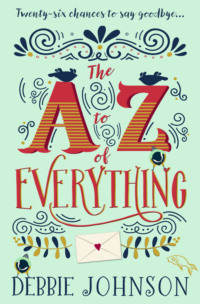
Kitabı oku: «The A–Z of Everything: A gorgeously emotional and uplifting book that will make you laugh and cry»


Copyright

Harper
An imprint of HarperCollinsPublishers Ltd
The News Building
1 London Bridge Street
London SE1 9GF
www.harpercollins.co.uk
First published in Great Britain by Harper 2017
Copyright © Debbie Johnson 2017
Cover design by Holly Macdonald © HarperCollinsPublishers Ltd 2017
Cover images © iStock.com (stairs and street light); Shutterstock.com (all other images)
Debbie Johnson asserts the moral right to be identified as the author of this work.
A catalogue record for this book is available from the British Library
This novel is entirely a work of fiction. The names, characters and incidents portrayed in it are the work of the author’s imagination. Any resemblance to actual persons, living or dead, events or localities is entirely coincidental.
All rights reserved under International and Pan-American Copyright Conventions. By payment of the required fees, you have been granted the non-exclusive, non-transferable right to access and read the text of this e-book on screen. No part of this text may be reproduced, transmitted, downloaded, decompiled, reverse engineered, or stored in or introduced into any information storage and retrieval system, in any form or by any means, whether electronic or mechanical, now known or hereinafter invented, without the express written permission of HarperCollins.
Source ISBN: 9780008150198
Ebook Edition © May 2017 ISBN: 9780008150204
Version: 2018-02-15
Dedication
For my mother – five years gone, and part of me still expects it to be her when the phone rings late at night.
Contents
Cover
Title Page
Copyright
Dedication
Part One: The Stage Is Set
Prologue
Chapter 1
Chapter 2
Chapter 3
Chapter 4
Chapter 5
Chapter 6
Chapter 7
Chapter 8
Chapter 9
Chapter 10
Chapter 11
Chapter 12
Chapter 13
Chapter 14
Chapter 15
Chapter 16
Chapter 17
Chapter 18
Chapter 19
Part Two: The Curtain Opens: The A–Z Begins
Chapter 20
Chapter 21
Chapter 22
Chapter 23
Chapter 24
Chapter 25
Chapter 26
Chapter 27
Chapter 28
Chapter 29
Chapter 30
Chapter 31
Chapter 32
Chapter 33
Chapter 34
Chapter 35
Chapter 36
Chapter 37
Chapter 38
Chapter 39
Chapter 40
Chapter 41
Chapter 42
Chapter 43
Chapter 44
Chapter 45
Chapter 46
Chapter 47
Chapter 48
Chapter 49
Chapter 50
Chapter 51
Chapter 52
Chapter 53
Chapter 54
Chapter 55
Chapter 56
Chapter 57
Chapter 58
Chapter 59
Chapter 60
Chapter 61
Chapter 62
Chapter 63
Chapter 64
Chapter 65
Chapter 66
Chapter 67
Chapter 68
Chapter 69
Chapter 70
Chapter 71
Part Three: The Final Curtain
Chapter 72
Acknowledgements
About the Author
Also by Debbie Johnson
About the Publisher
PART ONE
Prologue
Andrea
Forty years have passed since my own mother died, and yet I can still remember it like it was yesterday. I can still recall the sounds and the smells and the way her tiny hand felt in mine as she finally gave up the fight, as the light faded from her eyes.
I can remember the hollow feeling inside me as I made my way home to my own children, crying on the bus and ignoring the kindness of strangers as the double-decker trundled across London.
Walking through the door to our flat, overwhelmed with the need to bundle them up and keep them safe and love them so much that no harm would ever come to them. Protect them from the cruel torments of the world.
Four whole decades later, it is still so vivid. When it comes to the people you love, and the people you lose, the passage of time is irrelevant – some things simply stay with you forever.
I’m thinking about this so much more now, because this morning I was told that I am dying. Not in the slow and certain way that we are all dying – but in a two-months-if-you’re-lucky way.
The look of practised sympathy on the consultant’s face as he explained was enough to kick-start my stiff upper lip, and I silenced him with a smile. I’ve been an actress for the whole of my life, and I’ve done many a death scene.
Now, I’ve got to decide how to play my own – and what good can come out of it.
My last diary entry was a reminder to tell my friend Lewis that his ancient dog, Betty, needed a flea treatment, pronto. The one before that seemed to revolve entirely around buying a new hat for our trip to the races.
Funny how quickly things can change.
Now, I have a few weeks left – and I have to make them count. I have to scheme and work and plan like I’ve never schemed and worked and planned before. In those few weeks, God willing, I will be directing my own play – and performing a minor miracle.
Because, of course, I couldn’t actually bundle up my own children for the rest of their lives – no mother can. I couldn’t keep those two girls safe, and I couldn’t protect them from the cruellest torment of all – the way we can hurt the ones we love.
If it’s the very last thing I manage, I am determined that I will make the impossible happen. I will bang my daughters’ heads together, and make them whole. I will do as much as I can to heal them, and their future, as I have time to do.
Because they’re going to need each other, so very much. One day, very soon, they are going to wake up to a world without their mother – and, like I say, I still remember how that feels.
Her tiny hand, holding mine.
Chapter 1
1984 – Farewell to Templeton Peck
Dead goldfish are pretty revolting items, thinks Andrea, as she lovingly wraps up the body of the late, great pet known as Faceman. Once a delightful creature dashing through his fake coral reef and pirate castle, he’s now slippy and cold and far too reminiscent of three-day-old Chinese food that’s starting to disintegrate.
Once he’s enveloped in tissue paper, he is placed in a shoebox, which the girls have decorated in the style of the little Corvette that The A-Team character drives around in. It’s a masterwork of red felt-tip pen and blobby white paint that is barely dry, so some of it has smudged pink.
Patch, their cross-eyed Jack Russell terrier, is yipping and snapping at her ankles, desperate to get at the box. It’s just food to him, and Andrea shoos him away. He disappears to the side of the garden, and starts digging a hole in the flowerbeds.
Poppy is sobbing uncontrollably, her wild dark hair plastered to the tears running down the sides of her cheeks. Seven years old and already a drama queen. Rose is hugging her, making soothing noises to try and calm her down. They’re both barefoot, still in their nighties, and look impossibly small and forlorn as they traipse through the dew-soaked grass of the cottage garden.
It’s easier for Rose to be calm, of course. Her fish, B. A. Baracus, is still happily swimming around in the bowl, calling people ‘fool’ and looking tough. Poor Faceman has lasted less than three months. This is their first encounter with death, and emotions are running high, in the way that they do when little girls are involved.
There is a small hole, which Andrea dug earlier that morning, and a cassette player next to it, running on batteries. Andrea hands the shoebox to Poppy, who drags herself out of her hysteria long enough to accept it with tiny, shaking hands. Andrea reaches out and strokes her face clear of tears. Her skin is clammy and pale and moist, and although at least some of the performance is for effect, Andrea knows her baby girl is genuinely devastated.
Next time, she thinks, I’ll get them a pet with a longer shelf life. Like one of those tortoises that live for a hundred years.
‘Go on, Popcorn,’ she says gently, gesturing to the hole. ‘We need to say goodbye to Faceman now. Would you like to say a little prayer for him?’
‘I c-c-c-an’t!’ she stutters, trembling so much the box starts to shake as well. Andrea has visions of the goldfish making a bid for freedom, flying through the sky and landing on the head of one of their garden gnomes. This, for some reason, amuses her, and she fights to keep her face straight. She can’t laugh. Not now. This is a big, serious thing. The way she plays this will affect their outlook on the Grim Reaper for the rest of their lives. She has to at least try and get it right.
‘I’ll do it,’ says Rose, who is two years older and already displaying the kind of alarming maternal instincts that make Andrea think she might end up as a grandma by the time she’s 40. She’ll have to lock her in the broom cupboard before long, or make her take a bite from an enchanted apple.
Poppy nods, and leans down to place the box in the ground. It tilts as she does it, but luckily no goldfish corpses slosh out and scare them all. Patch is watching them from the hole he’s now sitting in, and Andrea silently says her own prayer: please do not let that stinky little dog gallop over here and run off with the dead fish’s body.
They stand back respectfully, and place their hands together in the prayer position they’ve been taught at school. Andrea’s not at all sure she believes in God, or the afterlife, but it’s certainly useful where small children are concerned. Much more comforting than the alternative.
‘Dear Jesus,’ says Rose, bowing her head so her brown curls swing around her chubby face, ‘please take this wonderful fish, Faceman, into heaven. He was a good fish and we all loved him. Please give him a nice bowl to swim in, and lots of other fish to play with, and let him know that we will never forget him. Amen.’
It is a lovely prayer, simple and heartfelt and innocent, and Andrea feels tears filling her eyes. They are so precious, these two beauties. These two grubby angels who have enriched her life beyond belief. In moments like these, she can forget all her worries: the bills, her lacklustre acting career, the sheer exhaustion of being a single mum in a world built for couples. She can ignore it all, and focus on what matters – her Rosehip and her Popcorn. Best girls in the world.
Poppy looks up at her big sister, and offers a small, tremulous smile.
‘It’ll be all right, Pop,’ says Rose, reaching out and holding her hand. ‘Heaven is a beautiful and perfect place, and Faceman will be happy there.’
Poppy frowns, and Andrea recognises her Thinking Face. It’s the look that usually goes before a very tricky question – like Where Do Babies Come From? (said very loudly in the park after seeing a lady with a pram), or Why Is That Man Bald? (said very loudly on the bus behind the town’s answer to Kojak), or her particular favourite, Why Don’t I Have A Dad? (said very loudly at Parents’ Evening).
‘Mummy,’ she says, with a voice far firmer than her tearful expression, ‘how does Faceman get to heaven? If he’s buried in a box in a garden? And is there a different part of heaven for everything – you know, like a Sheep Heaven and a People Heaven and a Goldfish Heaven, all in separate bits? Because sheep would need grass, and fish would need water, and people would need the pub …’
Again, Andrea bites down on her lip to stop herself from laughing. The pub? That’s what she thinks people heaven would be like? She’s clearly been on one too many trips to the Farmer’s Arms …
‘Well it’s all a bit of a mystery, my love,’ Andrea replies. ‘Nobody has ever come back from heaven to tell us about it – because they’re just too happy there. Personally I think that angels will come down and fly Faceman up with them tonight, while we’re asleep.’
As she says this, she sees Rose’s face also screw up into a thoughtful frown. Oh no, she thinks. They’re too old for such an outrageous fib. They don’t believe me, and now they’ll want to dig up the bloody box again tomorrow and check if he’s gone. That’s my night sorted – a glass of red wine and an impromptu goldfish exhumation.
‘But do they always fly to heaven?’ asks Rose, her gaze flicking back to the house. ‘Because B. A. Baracus hates to fly, you know that, don’t you?’
It’s actually an easier question than she’d anticipated, which is a relief. This whole thing is a minefield.
‘Well, when B. A.’s time has come, we’ll … flush him down the toilet? And then he can swim to heaven.’
‘Goldfish heaven?’ asks Poppy again, obviously not letting go of her idea of a compartmentalised afterlife.
‘Exactly. Now,’ says Andrea decisively, keen to avoid any more of the Junior Tag Team Spanish Inquisition. ‘Shall we play the music?’
Both girls nod, and their mum presses the button on the cassette player. The A-Team theme music blares out, echoing around the garden and drowning out the birdsong and the sound of a lawnmower in the distance and the faint rumble of traffic heading into the village. They all stand to attention, singing along and doing the ‘duh-duh-duh-duh’ noises at the right places. It’s their favourite TV show, and is a fittingly rousing end to Faceman’s short, soggy life.
With the final ritual completed, Andrea reaches out for both their hands, hoping that they’ll be happy and not too confused by all of this mortality nonsense. The three of them walk together towards the cottage, winding their way through the maze of potted lavender and garden gnomes and buzzing bees.
Just as they’re about to go back inside and hopefully settle down for their usual Saturday morning cartoons, Poppy pulls on Andrea’s hand, and comes to a halt.
‘Mum,’ she says, in a tone that means business. ‘What will happen to us when you go to heaven?’
Andrea kneels down on the cracked crazy paving, and takes both girls into her arms. She feels small hands and skinny limbs wrap around her, and squeezes them as hard as she possibly can without popping their ribs. Like she never, ever wants to let them go.
‘Oh, darling – don’t worry about that. There’s a very long time before your mummy goes to heaven.’
She pulls back, still on her knees so she is at eye level with the children, keeping one hand on each of their shoulders. She looks from face to face, and sees the way that Poppy’s hand has already crept into Rose’s; sees their strength and their wonder and their potential. How did she ever create two such perfect creatures?
‘And even when I do,’ she adds, giving them both a reassuring smile, ‘you’ll always have each other.’
Chapter 2
The Present Day
‘I know you’re aiming for Scarlett-O’Hara-on-her-deathbed, darling, but with those earrings, you’re landing closer to Pat Butcher leaving the Queen Vic in a black cab.’
Lewis is perched on the end of the bed, trying to ignore the machines and the wires and the dreaded drip stand. He’s feeling a little queasy because of the smell. That unmistakable hospital smell: that hideous combination of death and disinfectant.
He can hear the nurses outside, chatting away about their night out at the weekend, and has a deeply uncivilised urge to run through the door and clang their heads together. He realises it’s unfair – God knows, if anybody is entitled to a life-affirming booze-up, it’s people who care for the dying. But still. A little decorum wouldn’t go amiss.
Andrea manages to kick him, though it barely registers – she is very weak, and his behind is very well padded. It’s like a gnat biting a T. Rex. He pats her foot beneath the green blanket, and gives her a smile.
‘I hate you,’ she says, ‘with an absolute passion.’
‘Careful, my sweet,’ he replies, noticing that she is removing the gaudy drop earrings with shaking hands. ‘You could pop your clogs at any moment. Would you really want those to be your last words?’
‘No,’ she answers, throwing the jewellery down, ignoring the fact that the fake ruby drops skitter across the floor, one disappearing beneath the bed and another taking up residence under the cabinet.
‘If they’re going to be my last words, I’d make it “an absolute fucking passion”. Now, are you ready? How’s the lighting? Honestly, you’d think they’d spare more thought, wouldn’t you? A few gentle spots instead of all this … fluorescence?’
‘Spare more thought to lighting? In hospital? I suppose they’re concentrating on more important things.’
‘Ha! I’ve reached the stage where there is no more important thing. Lighting makes all the difference, you know. There was this time, on set, with John Nettles …’
‘Oh lord!’ Lewis exclaims, standing to his size-12 feet and throwing his arms in the air in a gesture that is half pleading, half surrender, ‘if you tell me another story about bloody Bergerac, I swear to God you won’t get the chance to die naturally – I will take that pillow and smother you with it!’
She manages a smile, but it is a sad thing. Like her skin doesn’t have enough life left in it to give it any conviction. She’s always been slim, as long as he’s known her, but now there is barely anything left.
Within the space of six weeks, the disease and the drugs have ravaged her like a Viking horde, leaving this grey, skinny streak of a human being behind. He’d do anything to pass on some of his solid bulk, but apparently the boffins haven’t yet come up with a way to transplant the health and vitality of a 68-year-old man to his dying friend.
He feels like crying, and gives himself a stern talking to. There will be time for self-pity later – right now needs to be all about her.
‘Maybe you should, Lewis,’ she says, rooting around in the make-up bag that sits on her lap. ‘And I can’t say that I’d mind. I’d much rather say my farewells to this cruel world with a handsome man in my bed …’
‘Well,’ he replies, fussing around with the camera, ‘I’ll pop out later and see if I can find you one, then. What do you fancy, Daniel Craig? Or something a bit more old-school with a lot of chest hair, like Burt Reynolds?’
She’s not listening now, he can tell. She has her little compact mirror out, and is inspecting her reflection. The grimace on her face implies she’s not entirely delighted with what she sees. With a shaking hand, she tries to grip a brush, dip it in powder, touch herself up for her final scene. It is pitiful to watch, and he can’t bear it.
He puts the camera down, lumbers towards her, and sits at her side. There is, sadly, plenty of room for both of them. He takes the brush and the powder, and goes to work. He adds some blush, and a touch of colour to her lips. They are cracked and thin, dehydrated. Like her body is rejecting anything that will sustain it.
Patiently, she endures his fussing without a single word of abuse. She must be feeling bad, he knows, to miss an opportunity to mock him for his make-up skills. All those years in the village amateur dramatics have not been wasted.
‘Are you done, Max Factor?’ she says, her head lolling back on to the pillow, as though holding it up has drained her of all energy. ‘How do I look?’
He reaches out, and smooths down her hair. It is a dazzling shade of silver-grey, closely cropped to her skull in one of those boyish styles that only the very beautiful can carry off. And Andrea is beautiful – or at least she had been. Now, the once-stylish cheekbones – the type his mother always said ‘aged well’ – are poking out like wires, and her skin is stretched taut, like the world’s worst facelift.
Her eyes are clouded by pain – she’s refused to take any medication this morning, saying she needs her wits about her – but are still the same striking shade he will always remember. Such a deep blue they are almost violet. Elizabeth Taylor eyes.
He’s seen Andrea in many of her TV roles, from back in her heyday, and she was what they would have called a ‘stunner’ back then. She was never a star, and hasn’t appeared on screen in anything new since 2005, but she still occasionally gets fan mail, or an invitation to appear at a convention. A lot of people would recognise her – those eyes. That face. All the roles she played in the 1970s and 1980s, usually as someone’s love interest, or a feisty barmaid, or what she called Posh Totty.
Never quite the leading lady – but then again, interesting roles for women were sadly lacking then, and she had two kids to look after as well. These days, she’d have smashed it, he thinks – been a Keeley Hawes or a Rachel Weisz or a Kate Winslet. Still, even when she was playing the Tart with a Heart on The Sweeney or a Sexy Alien Sidekick in Doctor Who, she was always good. Always stupendously glamorous. Always unforgettable.
In fact, the only people who seemed to have been able to forget Andrea are the two people she loves the most. The two people she’s about to record her final message for, after weeks of preparation. Of field trips for him. Of rooting through photo albums, making cassette tapes, emptying out bin bags, setting up video-sharing accounts, drawing on maps with red pen, pilfering from scrapbooks. Pillaging their past, in the determined hope that she can change their future.
He has no idea if it will work. He has no idea if he even cares – they’re not real to him, Rosehip and Popcorn. He’s never met them, and has no real desire to. She banned him from contacting them to explain that she really is ill this time (from that, he deduces that Andrea may have tried to scam them with dramatic hospital visits before now, just to get their attention), and that suits him just fine. He’s been friends with Andrea for more than ten years and never been introduced to them, which says it all.
Partly, he thinks, looking on as she sucks in breath, eyes closed, fingers weakly clinging on to the blanket with her coral-painted nails, she didn’t want them to see her like this. Reduced to skin and bones held together with sheer force of will. Partly, she is so focused on this crazy plan of hers that it has now become more real to her than anything else, clinging to it and pinning all her hopes on it.
She is convinced that this is her legacy. That this will work. That she will be able to achieve in her death the one thing she was never able to achieve in life – bringing her daughters back together again.
As far as Lewis is concerned, those two deserve less of a second chance, and more of a good whipping – so caught up in the past, in their own petty bitterness, that neither of them could see what it was doing to their mother. It had been destroying her, from the inside out, just as surely as the cancer, and neither of them seemed to notice or care.
She’s seen them, of course – there have been weekends away, trips to their homes, nights out at shows in London. But never at the cottage. Never in the same room. Never together – and that’s what did the damage. That’s what caused the internal injuries that all the MRI scans in the world wouldn’t show up.
He still has no idea what the two of them were even feuding about – Andrea has always cast a dramatic glance skyward, and uttered something vague. But surely it wasn’t serious enough to cause this – to leave their own mother spending her last weeks on this earth coming up with some crazy plan to reunite them?
Maybe, he thinks, she is right not to have told them. She wants to be remembered as she was, not as she is. And perhaps, deep down, she doubts that even a call to her deathbed will bring them together, and that would be more than she could bear.
His motives, his reasons for being grateful for their absence, are less pure. Lewis thinks they simply don’t deserve her. But what does he know? He’s never had children. It would be possible now, in this day and age – he’d find a nice lesbian couple and come to some arrangement, or even do an Elton John and David Furnish and maybe adopt. But back in his era … well, confirmed bachelors didn’t become fathers, simple as that. And from what he’s seen of Andrea’s life, he’s quite glad about it.
He reaches out and takes one of her hands in his. He has huge hands – he is built like a grizzly bear – and hers are tiny. Her skin is fragile, like the dusty paper in an antique book, and he holds it gently, scared it might disintegrate and fly away with the slightest touch. He feels her fingers twine into his, and is grateful to be there. She might not have her daughters, but she is not alone.
‘Is it all sorted, do you think, Lewis?’ she whispers, startling him from his thoughts. He’d assumed she was on the verge of another fitful bout of sleep.
‘Do you think I’ve done enough?’ she says, her fingers clinging to his, looking for reassurance.
‘Darling, it is all beyond sorted. I have never seen you display such organisational skills as I have in the last few weeks. It will be enough, I promise. So don’t worry about a thing – I know what to do. Everything is ready, and I’ll play my part to perfection.’
‘Ha! That’ll be a first, then …’ she murmurs, sarcastically. Ever the critic. Just because once – once – he dropped the bloody skull during his am-dram Hamlet.
She tries to sit up, and he sees she is struggling. He helps her move forward, and adjusts the bed so she is propped upright. He casts one last glance over her – the hair as neat as it can be, the make-up done, the dreaded earrings gone. She’s insisted on wearing ‘proper clothes’, even though her cream-silk blouse is now hanging off her shoulders, and has doused herself in Chanel Coco, as though the girls will have some kind of sniff-o-vision when they watch this.
‘Okay,’ she says, drawing in a big breath. ‘I think I’m ready. I can practically see a man with a scythe lurking in the corridor by the vending machine, my love, so we’d better get on with it. The show must go on. All set?’
He nods, and switches the camera on. He’s never been much of a one for technology, and he’s had to learn fast. Now, if he ever tires of playing the Solid Rural Lawyer, he can become an internet whizz-kid instead.
‘Testing, testing, uno-dos-tres …’ Andrea says, her voice high and firm; stronger than he’s heard it for days. What a trouper.
He adjust his angles, knowing that she will insist on reshooting this if it doesn’t meet her high standards, and gives her the thumbs-up.
She turns those brilliant eyes towards him, and smiles into the lens. It’s a perfect close-up, and she plays it exactly right.
‘My darlings. Rosehip, Popcorn, my only true loves. Not to be too Hollywood about this, but if you’re watching this tape, that can mean only one thing: I have shuffled off this mortal coil … and you two are going to need each other more than ever. You need to set aside your differences, and look out for each other – just like you always used to.’
Chapter 3
Beacon C of E Primary School, 1986
‘I’m going to rub your nose in that dog poo, you stuck-up cow,’ says Jackie Wells, holding Rose’s face down on the grass by the scruff of her neck.
It’s Rose’s last year at little school, and she has committed the cardinal sin of being clever. She’s won all the prizes; she’s pretty and popular and even good at netball. Of course Jackie Wells hates her.
‘You don’t even have a dad, and if you did, my dad would beat him up,’ adds Jackie, sitting on Rose’s back. Rose has no doubt about that; Jackie’s dad looks like a Tonka truck.
She struggles, trying to throw her 11-year-old nemesis off her back, but only succeeding in wriggling ineffectually on the school playing field. She glances ahead, sees flat green grass and, not very far away, a lovely pile of dog mess is buzzing with flies.
If she was on her feet, she might stand a chance against Jackie – but unfortunately for her (and for Jackie), the child takes after her father and already weighs as much as that baby hippo they saw on the school trip to Chester Zoo.
Naturally enough, there are no teachers in sight, and the small circle of kids gathered around the spectacle seem to be enjoying it. The ones that aren’t – Rose’s friends – look twitchy and embarrassed and worried, but too scared of Jackie to intervene.
Rose tries to remind herself of her mother’s oft-repeated words, the ones about jealousy being the mother of all aggression.
That might be true, Rose thinks, but it’s not much of a consolation right now. Not when her uniform is covered in grass stains and her face is smeared with soil and she’ll be eating poo for lunch.
She flails around, trying to kick Jackie with her Clark’s shoes, but can’t manage it. All that happens is that Jackie presses her face even harder into the ground, and for a terrifying few moments, she can’t breathe at all. She can hear jeers and shouts and the brave, solitary cry of her best friend, Tasmin: ‘Leave her alone, or I’ll fetch Miss Cunningham!’
That is followed by a small, sad yelp, so Rose has to assume that Tasmin has paid the price for her courage.
Jackie pulls her head up, using Rose’s long, curly ponytail like a handle, and slams her face back down into the damp ground. She feels soil smash between her teeth and into her mouth, and again panics as the world goes dark.
Just as she is about to give up and accept her early death, there is an ear-splitting screech, and Jackie’s hefty weight is suddenly gone.
Rose takes a brief moment to suck in air, then rolls around so she can see what is going on. Poppy has arrived, in a blur of violence and fury, and is holding Jackie down while she punches her in the head. Rose has no idea how she is doing that, as she is not only two years younger than Jackie, but most of a baby hippo lighter.
‘Don’t!’ she yells, punctuating each word with a blow from her screwed-up fists, ‘Ever! Touch! My! Sister!’
Obviously, it’s at that point that Miss Cunningham arrives, and the group of spectators magically all disappear off to play football or collect ladybirds or talk about Zammo in last night’s episode of Grange Hill.
Miss Cunningham physically drags Poppy away from Jackie, who is left cowering and crying and, yes, Rose notices with some satisfaction, covered in smears of the exact same dog poo she was threatening her with just moments ago.
Poppy is trembling with anger, her long, scrawny body vibrating with emotion. She looks over at Rose, who is getting to her feet now, and is instantly calmed by her big sister’s smile. The smile that tells her that everything is okay, that it will all be fine, and that there is nothing to worry about.
Rose knows that Poppy is going to get into trouble for this. But she also knows, deep down, that she wouldn’t have it any other way. Rose might be the one who seems to look after them both – but when push comes to shove, it’s always Poppy who is willing to rush right in and batter someone. She’s her avenging angel, and anyone who crosses her pays the price.
Rose dusts herself down, and prepares the case for the defence. As soon as she is upright, Poppy flees from Miss Cunningham’s lecture, and throws herself into her arms. She’s so skinny, and she’s crying, and her hair is all messed up, and she looks a bit like a tramp.
Rose hugs her, and smooths her hair down, and whispers into her ear: ‘Thank you, Popcorn. And don’t worry – it’s all going to be okay.’
‘Mum’s going to kill me …’ Poppy mutters, the reality of the situation starting to sink in as Miss Cunningham prowls towards them, hands on hips and scowl on face.
‘Mum,’ replies Rose, 100 per cent sure this is true, ‘will completely understand. And she’ll probably take us out for tea to celebrate.’
Chapter 4
The Present Day
Lewis is sitting on a traffic bollard, a few feet outside the hospital foyer. It’s not very comfortable, despite his bulk, and he wishes there was somewhere more pleasant to sit. Maybe he’ll donate a bench, he thinks, in memory of Andrea.
The Andrea Barnard Memorial Bench. It would welcome the arses of the cold, the lonely, the ill, the desperate. She’d absolutely hate it, he decides, and the thought of the look of contempt on her face makes him smile. If there’s a heaven, she’ll be shaking her fists and uttering dire threats. ‘Something with a bit more class, please, darling,’ she’d say. ‘A nice little tequila bar, perhaps? God knows these poor people need a drink!’
It’s late now – somewhere after 10 p.m. on what has been a very long day. By now, he’d usually be tucked up in bed with an episode of Antiques Roadshow, or reading a good Barbara Cartland.
It’s a Friday, so he’d have a nice lie-in the next morning, before taking a brisk constitutional in the valley. Maybe he’d persuade Andrea to come with him. Perhaps, if the weather was good, they’d go for a paddle in the lake with his ancient springer spaniel, Betty.
For Lewis, and for poor old Betty, there will at least be another morning. Another sunrise. Another chance to wonder at the world – not that it looks very impressive when all you can see is a neon-drenched hospital car park and frazzled paramedics on a fag break.
For Andrea, there will be nothing. No more sunrises. No more tequila. No more Antiques Roadshow, unless she’s been shown Downstairs, where she’ll be taunted by scary-looking dolls and ugly pottery for all of eternity.
She’s gone, and he’s struggling to believe it can possibly be true – that somehow the world continues on as normal. There should be a black hole in the sky; a swarm of shooting stars to mark her passing, a murder of crows lined up on the bus stop cawing her name. Not just this … mundane reality.
She made her film, and he had marvelled at her. At her strength and her resolve and her determination. He knew how ill she was, how much pain she was in – but you couldn’t tell from that video. She somehow managed to be loving and firm and even funny. Quite frankly, it had been the performance of a lifetime.
He’d been the liability, not her, with his shaking hands and constant need to blink tears from his eyes. Pathetic. He was a mess – she was a powerhouse.
Once she’d done it, though (one take, miraculously making it sound spontaneous even though he knew she’d rehearsed it), it seemed like whatever life and energy she had left drained out of her. It was her last hurrah, and within minutes of filming that one last close-up, her grey head dropped back into the lumps and bumps of the pillow as she fell into a long, staring silence.
There’d been a few sniffles after that, a few quick, breathless questions asking how she’d done, but he knew – he knew that it was all she had left to give, and she’d given it to her daughters. After that, it was silence and morphine all the way to the end.
It was a strange experience, seeing someone die. He wasn’t even sure she’d gone when it finally happened, after several false alarms.
On one occasion, she went what felt like minutes without drawing in a breath, then when he went to check on her, she suddenly opened her eyes and made him scream like a big, fat girl. At least that provoked a laugh – albeit one that ended in a coughing fit.
Almost an hour ago, though, it ended. It all ended. That glorious life, that wicked sense of humour, that vigorous bundle of vitality. Sixty-five years of love and laughter and experience – all gone. One papery hand fell away from the blanket to dangle loosely over the edge of the bed, coral nails vivid against the white sheets, and the other – clutched into his – became limp and lifeless.
He waited, and waited, and waited some more. Part of him had been desperate for this moment – for her to be put out of her torment. But part of him felt like he had simply died with her, which wouldn’t have been the world’s biggest tragedy. He’d wanted to crawl into that bed, pull the sheets over them both, and just stop breathing. Stop existing.
A world without Andrea was, right then, too terrible to even imagine.
Lewis had made a lot of friends during his long, rich life – but none of them had ever come close to Andrea. She was like a beacon of energy, a rainbow shining into a grey world, a blast of dazzling light scattering away the darkness. She was his soul mate, his true love without being his lover, his partner in crime.
He’d first encountered her when he moved to the village years ago, and their eyes met over a crowded giant vegetable stand at the annual fete. They’d both been staring at the same collection of ridiculously large marrows, and they both had the same raised eyebrows and ‘oo-er missus’ expressions, straight from a Carry On movie.
That had led to coffee. Coffee had led to a night in the pub. And a night in the pub had led to an unshakeable friendship, based on a rude sense of humour, a love of banter, and, if he was entirely honest, on mutual loneliness.
And now she was gone, and he was sitting with a concrete bollard up his bum, and it was dark and cold and rainy. The height of the inglorious English summer. He’d left his mac on the back seat of his car, his tweed jacket was soaked through, and he knew his shirt would be plastered to his skin in ways that were far from flattering. She’d be thoroughly shocked at him showing off his man boobs in such an unbecoming way, he was sure.
His fingers were shaking and his carefully combed hair was wet and flat to his skull, letting all the bald patches peek out.
Somehow, though, he just didn’t seem able to care. All his life, he’d done the right thing – been properly turned out, played his part, done what was expected of him. Now, he wouldn’t be bothered if he was naked, covered in woad and speaking in tongues. Everything felt heavy, and useless, and empty. Especially him.
None of it felt real yet. He’d done some paperwork, accepted sweet tea and sympathy from kind nurses who never really knew her, and been forced to eat some over-buttered toast. Eventually, after ‘giving him some time’, they gently suggested he needed to leave the room.
It was only decades of training and conditioning and pure English politeness that stopped him from yelling at them. From kicking them out, and barricading the door with his recliner chair, and wailing like those Middle Eastern ladies you see on the news.
He understood now, for the first time, how grief could make you wail like that. How pain could be so pure and so livid that it took on a life of its own, a small, furious animal that wanted to howl at the top of its lungs. To scream and scream and scream until the whole world shattered with the sheer force of its misery.
His own parents had died after long, full lives, and they were never especially close anyway – they were merely the people who visited him at boarding school, and insisted he became a lawyer. It had hurt when they passed on, but nothing had prepared him for this.
Ücretsiz ön izlemeyi tamamladınız.