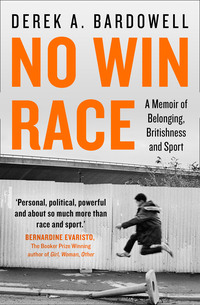
Kitabı oku: «No Win Race»

COPYRIGHT
Mudlark
An imprint of HarperCollinsPublishers
1 London Bridge Street
London SE1 9GF
www.harpercollins.co.uk
First published by Mudlark 2020
FIRST EDITION
© Derek A. Bardowell 2020
Cover design by Holly Macdonald © HarperCollinsPublishers Ltd 2020
Cover photograph © Getty Images
Author photograph © Charlie Hopkinson
A catalogue record of this book is available from the British Library
Derek A. Bardowell asserts the moral right to be identified as the author of this work
All rights reserved under International and Pan-American Copyright Conventions. By payment of the required fees, you have been granted the nonexclusive, non-transferable right to access and read the text of this e-book on screen. No part of this text may be reproduced, transmitted, downloaded, decompiled, reverse engineered, or stored in or introduced into any information storage retrieval system, in any form or by any means, whether electronic or mechanical, now known or hereinafter invented, without the express written permission of HarperCollins e-books.
Find out about HarperCollins and the environment at www.harpercollins.co.uk/green
Source ISBN: 9780008305147
Ebook Edition © April 2020 ISBN: 9780008305154
Version 2020-04-09
PRAISE
DEREK A. BARDOWELL is a writer, philanthropy adviser and former director of programmes at the Stephen Lawrence Trust and Laureus Sport for Good. He has contributed to the BBC World Service, The Source and MTV, and currently hosts the podcast Just Cause, which explores the intersections of race, culture and social justice. No Win Race, his first book, was a Sunday Times Sports Book of the Year and was longlisted for the William Hill Sports Book of the Year Award in 2019. Derek is a Churchill Fellow.
Twitter: @DerekABard
‘Personal, political, powerful and about so much more than race and sport.’
BERNARDINE EVARISTO, author of the Booker Prize-winning novel Girl, Woman, Other
‘This searching exploration uses sport to examine questions of race and identity … Bardowell does an excellent and passionate job of refracting the issues within sport – the dearth of black football managers, the lack of activism from black athletes who have made it into the spotlight – into wider society.’
Financial Times
‘A painful reflection of racism in British sport … Bardowell ably demonstrates the power of the media to determine the narratives around these sporting lives. He flags up the false binaries often promoted between good (patriotic) and bad (self-centred) black sportswomen and men … it’s a valuable act of remembrance of sporting stars who put their careers on the line in pursuit of a moral right.’
Observer
‘No Win Race has the feel of James Baldwin’s The Fire Next Time … No Win Race will stimulate much discussion across generations of readers – both black and white. I would love to see it on secondary school and university curriculums, and with the breadth of what it covers, it should feature on the reading list of many creative disciplines.’
Words of Colour
‘And before you think it’s some kind of sociological tome, that is best left for A-Level students studying Race and Sport – it’s a really good read. There’s lots of very personal recollections about sport, and the beauty of sport, and the power of sport to inspire and bring families together, and plenty of you will reminisce about watching sport growing up with your own parents and watching great sporting moments. You won’t be reading this book and feel like you’re being lectured at, trust me on that one, it’s an enjoyable read.’
NIHAL ARTHANAYAKE, BBC Radio 5 Live
‘A must-read for anyone interested in the cultural politics of sport, the question of English and British nationalism, and what sport can (and can’t) do to produce a more convivial society.’
BEN CARRINGTON, Associate Professor of
Sociology and Journalism in the USC
Annenberg School for
Communication and Journalism
CONTENTS
COVER
TITLE PAGE
COPYRIGHT
PRAISE
DEDICATION
INTRODUCTION
1. HYMN OF HATE
2. BLACKWASHED
3. THE SHOT
4. SO MANY TIERS
5. NEW NATION
6. BEYOND SPORT
7. THE GREATEST WEEK EVER IN BLACK HISTORY?
8. POOR PEOPLE’S OLYMPICS
9. DRIVEN TO THE POINT OF MADNESS
10. MORE THAN MAGICAL
11. IS IT IN THE BLOOD?
ENDNOTES
ACKNOWLEDGEMENTS
ABOUT THE PUBLISHER
DEDICATION
To Elle & Keithus
For Meadow & Marlowe
INTRODUCTION
MY TWO KIDS RAN UP the stairs to wash their faces, clean their teeth and put on their pyjamas while I stayed downstairs to pour a shot of rum. I turned on the television. A documentary about Margaret Thatcher had just started. Couldn’t think why she’d be on the telly. Had a feeling she’d died. So, I grabbed my iPhone to find out if that was indeed the case. She had died of a stroke, aged 87.
It had been our first night on holiday in an old cottage in Suffolk. The cottage, beautifully worn with creaky floors, low-hanging ceilings, stained rugs, and dusty, stale smells also featured all the modern trimmings required to make it a contemporary holiday retreat for kids, like a PlayStation and an iPad docking station.
I stood, ceiling hovering close over my head, watching the documentary, which covered Thatcher’s unlikely rise to Conservative Party leadership in 1975, her battles with ‘Heathite’ Tories, her election victory in 1979, Bobby Sands, the IRA, the recession, the Brixton Riots, the Falklands War, the Miners’ Strike, her battles with the trade unions, the breakthroughs she made for women in politics, the grinding shift from ‘society to self’, her loathing of the European Community, the end of the Cold War, the introduction of the Poll Tax, the Poll Tax Riots and her eventual downfall at the hands of her Tory Party colleagues.
My son, two and a half years old at the time, cute and rashy, smiley and whiney, came down the stairs, walked up to me, rubbed his eyes and said in a dull voice, ‘Take me [to] bed.’
He put his arms up, so I picked him up.
‘You watching TV?’ he asked.
‘Yes,’ I replied, ‘it’s about Margaret Thatcher.’ Didn’t elaborate, eyes barely shifted from the television screen.
Paused.
I realised I had started to squeeze him tightly. The back of my throat had started to tickle. My hands and my toes were cold and clammy. Not the rum. Should have been thinking about the immediate future, like playing games with the kids in the morning, country walks and beautiful landscapes. Instead, my mind was situated in the past. Always is. I took my son upstairs to bed, the documentary swirling through my head. I thought less about Thatcher’s death and more about her legacy.
I remembered what it had been like as a child in the eighties. I grew up in Newham in the East End, which for many black and brown folks meant racially motivated attacks and police harassment, and a general denial that these problems existed from the services that were there to help you. It had been a time when fear, paranoia and insecurity consumed me. From a young age, I felt like an outsider. Felt as if my options, crafted by the grit and hard work of my Jamaican parents, were impossibly narrow. Felt like a problem to the state. Never knew comfort. Never really felt at ease. Bus stops, shops, school, trains, my everyday spaces, brought conflict, stares, stop and searches, anxiety, false accusations and a fear of other people’s fear. I liked my home, my birthplace. England. But never quite felt at home in my birthplace. Never made to feel at home in my birthplace. It had been difficult to feel like a true citizen in a place where you were considered an outsider, in a place where many of the nation’s heroes were often my forefathers’ oppressors.
Too late for me, I thought. Always be this way for me. Caged, enraged. But what should I tell my son? Things have changed. Things have improved. He is unlikely to experience racism in the same way I had when I was growing up. So how do I prepare him without infecting him?
For me, sport had always been a great leveller. Something that brought me solace, an escape in times of trouble.
It was how my father, Keith, and I bonded. Before I could grip a mug, my father had already shoved a cricket bat and ball in my hands. We would go into our 30-foot back garden and play, my father bowling, me batting. He’d always bowl googlies at me, a deceptive delivery where the ball spins into the batsmen’s legs instead of going straight. A magic trick. As my father watched me swing wildly, and miss, his shifty eyes would tighten, and his soft, narrow, light-brown face would break into a cheeky smile before he’d launch into a story about ‘back home’ – in Jamaica. My father’s yearning for Jamaica and the role cricket played in transporting him ‘back home’, albeit for brief moments, made me recognise that sport was more than a game.
It had often been the case that white people assumed that the colour of my skin and my height ensured athletic excellence. Upon first meeting me, most would ask, ‘Do you play basketball?’ ‘No,’ I’d reply, never knowing what else to say. I would later come to realise that, for well-meaning white folks, in bowing to a more favourable stereotype (black people being good at sport) they were addressing their own discomfort. For them, a conversation starter and some solace. For me, a conversation closer and anxiety.
Sport offered positive images of black folks at a time when we were bombarded with negative images in the media. Back in the seventies and early eighties, the few shows that featured black actors like Mixed Blessings, Rising Damp and Love Thy Neighbour always emphasised the difference between Caribbean or African culture and the English. They forever depicted us as aliens – sources of fundamental difference, conflict and unrest. The gags were often cheap, cruel and exploitative. Sport, to some degree, balanced out these negative images.
It has always been difficult for me to separate ‘race’ and sport. Alongside music, sport has for many years been a platform where blacks have excelled. Where we’ve been allowed to excel. Whether you liked sport or not, black athletes were the most visible contributors to British society. Black people had of course built Britain, literally. We had constructed, supplemented and indeed strengthened the country. We had done so under forced labour, under poor conditions, with little or no rights, little or no credit. The black athlete’s impact had been more difficult to conceal, their contributions measurable. Goals. Runs. Times. Wickets. Knockouts. Tries. This led to wins, which led to larger audiences, which led to more money, which led to more media coverage, which led to more sponsorship, which led to a higher profile for the black athlete. They were symbolic. Symbolic of everything we had achieved in this country, for this country. In addition, they seemed to be the only black people in the public eye who were embraced by whites, even if they had to win adoration through a torrent of boos and unconditional allegiance to Jack or George.
Yet at the same time, so much of what happened to black athletes on the field of play reflected the issues faced by black people in British society.
Growing up in the eighties, the popular racism being trumpeted by the mainstream media – moral panics about blacks being a threat to cohesion, to jobs, to safety – weaved its way into sport. The crowds were often hostile towards black athletes and commentary was often stereotypical, preoccupied with our physical attributes while constantly underestimating our sporting IQ. Institutional racism also restricted any hope of black people attaining positions of power or commanding the authority to complain about their treatment.
Thatcher told the nation how Britain had given so much to the world. She told the masses how much she loved Britain, wanted to protect Britain, valued Britain. Didn’t doubt it for a second. But she also encouraged a climate where you were either with us (Britain) or against us. She made it a point that to question power and privilege as a root cause of social disparities would only make you an enemy of the state. Not the state’s fault. Your fault. You are free to dream, free to succeed in a cage. Not our fault you can’t break free.
You were in or out. Immigrants, well, those of colour and/or those who spoke a different language, were out. You want in? Shut up, be happy. Be grateful that Britain has given you a safe place, safe from the police, safe working conditions, safe housing. Safe. You are here because we saved you, not because you are helping the British economy, not because of slavery, not because the Empire had left your country in ruins through colonialism. Don’t worry about the fact that Britain compensated the slavers and not the enslaved, justified oppression in the name of God, in the name of science, in the name of the arts.
I had for many years understood that for any outsider Britain would always promise more than it could deliver. You achieved despite the system, not because of it. Yet the eighties appeared to make an already unequal society even more unfair, even more divided.
Later that evening, while reading Handa’s Surprise* to my son, Turner Prize-winning artist Jeremy Deller’s Joy in People exhibition popped into my head. At London’s Hayward Gallery I had seen, amid the colours and the quirks, amid the joy and the pain, the joy in pain, images of the Miners’ Strike and police brutality. It brought the eighties back to me again and revealed just how many people across the UK Thatcher had displeased. Yet she remained in power for such a long time. Three election victories, remember? Impressive. Why did so many people vote for someone deemed so divisive? Must have found a way to appeal to the true blue within, right? Must have played patriotic games better than any other politician. Enough, therefore, for people to forget what the policies and the economy had really been doing to them all along.
Suddenly I felt guilty and anxious. How could I let Thatcher interfere with this moment with my son? She had already interfered with my childhood. How could such feelings that I thought I had long since buried resurface so swiftly? The thoughts came, they went. They hurt. They died. Like my soul.
My soul finds solace in sport and indeed the success of black athletes. Rio Ferdinand on a football field, as smooth as Rakim on the mic. Lennox Lewis, an under-appreciated champion despite being Britain’s greatest post-war boxer. Ian Wright, the working-class hero who taught everyone that you could succeed with hard work and without compromise. Anthony Joshua, Denise Lewis and Jessica Ennis-Hill, each winning with class. Lewis Hamilton, winning with style. Well, not just winning but transcending. He may be British sport’s GOAT (greatest of all time). Don’t care about their politics. Or how they self-identify. I need sport like I need friendships. I need to see those positive images, because it always feels as if they represent something more than athletic excellence. They represent you. The best of you; the you that the media and history tend to ignore, deny, conceal, suppress, revile.
The reality for people of colour in Britain is that our skin tone is a barrier. It limits opportunities. Things have improved. But for all the success displayed on the field of play, black people remain the poor relations in British society. We are still over-represented in the criminal justice system, in unemployment, in mental health institutions, in school exclusions. We remain absent in positions of power, around decision-making tables, in government. The black athlete may often be triumphant, they may create an illusion that we make up a more significant percentage of the population, but some gross disparities still exist in Britain for black people.
For all our success on the playing field, it is still hard for me to use the word ‘we’ and ‘us’ when referring to my place of birth. Why? Because in so many British people’s eyes, we (black people) remain outsiders, visitors, not the ideal conception of Britishness or Englishness. As a friend once said to me, ‘I only feel English when I’m abroad.’ Another friend recently said to me, ‘The only time I’ve ever seen true diversity on television was during the coverage of the Grenfell disaster.’ So, while sport provides a remedy in the form of positive images of black people, does this also mask society’s deep-rooted rejection and ignorance of Black-Britishness? Can blackness and Britishness ever be compatible?
This book aims to answer these questions. Primarily covering the period between the Brixton Riots (1981) and the Brexit referendum (2016), it looks at ‘race’ and racism in modern Britain through the prism of sport. It explores sport’s role in reflecting, reinforcing or challenging common ideologies about ‘race’.
I use the West Indies cricket team to explore the conflict of supporting colour (shared experiences) over your country (shared birthplace), I look at how London 2012 concealed the racial tensions of the time, I examine the Americanisation of Black-British culture through Michael Jordan and the re-emergence of athlete activism. I profile some of our major sporting heroes such as Lewis Hamilton, Eniola Aluko and Ian Wright. I also revisit major sporting events, such as Lennox Lewis v. Frank Bruno and some of our major sporting conflicts, like Linford Christie v. Lord Coe, and John Terry v. Anton and Rio Ferdinand. In each case, I uncover what these athletes and these events told me about ‘race’ relations in modern Britain.
This is not a history of, or a who’s who, of black people in British sport. It does not attempt to cover every single event and every single athlete. Nor is this an academic study of ‘race’ relations through sport even if, at times, it draws on the excellent work of scholars such as Ben Carrington and Kevin Hylton. This is personal, telling true stories from a black perspective, my perspective, one informed by having worked as a journalist and in civil society for over 25 years. One informed by having loved sport practically all my life, because it is something that has bonded three generations of males in my family.
I cannot be saved. It will always be this way for me. Enraged, caged. Frustrated. Frustrated knowing that ‘race’ does not exist. Knowing it is a social construct. One of the biggest lies in history. That is why I refer to ‘race’ in this way. Cannot give it credence. Yet it is real: real in the minds of people, real in history, real in the way it equates Britishness to whiteness. The Empire state of mind.*
My partner once said to me, the only thing that exists is the way people see ‘race’. See me. Limit me. I’m frustrated knowing that Britishness for many people isn’t blackness. Well, Britishness nor Englishness isn’t blackness. I veer between the two. My experience, the experiences in this book, are English. But the Empire state of mind is British.
Yet for him, my son, ‘race’ will affect his life chances. For him, my son, the playing field will also look extremely different to mine. He does not see colour. But people see his colour. As he gets older, those perceptions of his colour will become more vivid, more twisted, more restrictive.
So how do I prepare him for a society that, on the surface, is great, functions well, provides opportunities; a society I am glad to be in, yet I also understand will disadvantage him due to the colour of his skin? How should I impart knowledge without sinking his confidence? How do I achieve this without giving him my baggage, without afflicting? Without infecting?
How and when exactly do you tell a child that so much of what they will hear in school and read in newspapers is only half the truth; not our truth but a clouded, colour-blind version of the truth? How do I give him the confidence to fight when everyone around him will think that you can’t win with ‘race’, that the only race you can win is on the playing field?
I often struggle to convey this to my white friends with children. We all have our problems. We all have our issues. I understand that. But I also know that they will never have to worry about whether their children will be welcome in some neighbourhoods or not. My white friends are unlikely to teach their kids about how to deal with the police, because their child will less likely be profiled and stopped without reason. They will not have to instruct their kids about the way they walk, through fear that this may reflect badly on how their behaviour is perceived. They will not have to worry about their child wearing a hoodie or having their child’s athletic achievements being attributed to natural ability. They will not have to worry about their child being exposed to an overwhelming number of negative images in the media or having any academic failure implicitly attributed to ‘race’. They will never have to edit their child’s assertiveness in public through fear of their child being perceived as angry or aggressive. They will not have to prepare them for multiple taxis driving past them, low expectations and stereotypes from teachers, or multiple clubs, restaurants and bars refusing them entry. It is unlikely that their children will ever be mistaken for ‘the help’ at fancy gatherings. They will not have to worry about how ‘race’ is represented in school, or if their history is non-existent in textbooks. They will not have to worry about their child’s skin being a determining factor around whether an employer thinks s/he can fit in or not, or whether they are deemed suitable for housing. They will not have to prepare their child for a society where white folks will continually explain how you (as a black person) should feel about racism.
My father grew up in the era of West Indian batsman Collie Smith, under colonial rule where the divides in society and on the playing field were written in the law. I grew up in the John Barnes era under Thatcherism, where the violence of racism enabled me to see how discrimination made the playing field uneven. My son is growing up in the Anthony Joshua era where the uneven playing field is not quite so clear, not quite so blatant, but the impact on black people remains overwhelmingly negative.
How, then, do you prepare your children for a society where they will be sent ‘to the crease, only for them to find, as the first balls are being bowled, that their bats have been broken before the game …’1
* Handa’s Surprise is an illustrated children’s book, set in southwest Kenya. Handa is taking fruit to her friend Akeyo in a basket on her head. One by one, various animals take a piece of fruit from her basket without Handa realising. Will she have any fruit left by the time she finally sees Akeyo?
* ‘Empire State of Mind’ was a song performed by Jay-Z featuring vocals by Alicia Keys. In the song, ‘Empire State’ means New York. Here, the West Indies exposed the fragility of the British Empire.
CHAPTER 1
HYMN OF HATE
THE FIRST TIME IS OFTEN THE WORST. You never forget that feeling. Never quite forget how you responded or how you wish you’d responded. You hate yourself. Hate yourself for the way you felt. And that hate, hatred of the incident, hatred of your response to the incident, it never leaves you. Always stays, always scars. It never leaves you because every time an incident like it happens again, whether explicit or implicit, your immediate emotion harks back to that first feeling, back to that first response. Fright. Fight. Distrust. Disgust. You may know how to respond differently now, how to be more assertive, maybe more passive. But fundamentally, at that moment when you are confronted by racism, you dive right back to that first feeling, to that first response. Fight. Fright. Disgust. Distrust.
My first time occurred at Wembley Arena on 27 September 1980. I was seven. Wasn’t there in person. Observed it on TV. On screen, the Arena resembled a backstreet pub in the East End: smoky, uninviting, hostile and undeniably white and working class. You didn’t need to see the faces of the patrons in attendance to grasp their attitudes. Their fanatical moans painted a picture of flushed-faced, testosterone-charged, agitated men. The Arena may have been playing host to the world middleweight championship fight between Alan Minter and Marvin Hagler, but on this night, the world-famous venue had been transformed into a scowling theatre of hate.
I watched the fight with my father in our comfy living room in Second Avenue in Manor Park. We were one of maybe seven black families on the street, which was in the north side of Newham, one of the most racially mixed parts of the East End. My father was a painter and decorator while my mother had just started working for Laker Airways. I lived in the three-bedroom terrace with my two older sisters and my grandmother, who had her own bedroom and kitchen in the extension. I planted myself chest down on our rug in my usual posture, elbows grinding into the rug to support my head, which was perched on my hands. My father took his place behind me on our sofa, with its black synthetic armrests and orange seat covers, which sat in front of our lantern-patterned wallpaper, coloured three shades of brown.
I didn’t know Minter or Hagler at the time. However, I remember my father putting down his newspaper to concentrate on the fight, which signified its importance. It wasn’t too often that our 19-inch colour television commanded my father’s full attention. He had purchased it with my mother’s premium bonds winnings in 1970, just in time for the World Cup in Mexico, the first finals to be televised in colour. Ever since, it had become the most vocal member of our family. It was always on, whether anyone was watching it or not. It drowned out the noise of cars speeding down our street, the screeches of kids playing knock down ginger and the metal on metal bangs from our neighbours working on their cars. My father controlled the TV, always claiming to be watching something even if he was asleep or reading the Sun. I was his personal remote control.
On screen, the fighters were standing in opposite corners in the ring. Minter, a white boxer from Crawley in West Sussex was the reigning world middleweight champion, having wrestled the title from Italian-American Vito Antuofermo in Caesars Palace, Las Vegas in March 1980. Minter’s victory had been controversial. Most of the boxing writers sitting ringside thought Antuofermo won the fight. An informal poll of ringside writers had 10 siding with the Italian-American, five with Minter with two scoring it even. Two of the three judges on the night were split in their scoring between Minter and Antuofermo. However, the third judge, Roland Dakin from England, gave Minter 13 rounds to just one to Antuofermo with one round even, causing Boston Globe writer Bud Collins to remark: ‘He [Dakin] wasn’t the usual burglar, stealing in the comfort of the home precinct. He had gone into another man’s country to perform the overwhelming act of larceny, and never tiptoed.’
So, Minter had to defend his title against Antuofermo in June. The return, at Wembley Arena, was not controversial. Minter dominated, slicing Antuofermo’s face to pieces and causing the referee to stop the fight in the Brit’s favour in round eight.
Minter had been the golden boy of British boxing. A 1972 Olympic bronze medalist, he looked like a young Clint Eastwood, with a hard face but pretty features and a constant expression as if the sun was shining directly in his eyes. Out of the ring he wore tight flashy suits with his shirts unbuttoned to reveal his chest and gold chains. Minter had a flat nose, a wide face with a natural tan and a bouncer’s confident posture. His victory over Antuofermo made him the most famous sports star in Britain, sought after for sponsorship deals and ads. American fight critics didn’t think much of him though. Not surprising. American fight critics didn’t think much of most British fighters. These writers tended to load their articles with lazy jibes about what British fighters did outside of the ring (primarily drinking tea) and insults about how they fought in the ring (stiff and upright). Minter certainly did not move with the fluidity of fighters like the American Sugar Ray Leonard or Mexico’s Salvador Sanchez. And his biggest problem through the seventies had been his susceptibility to cuts, the core reason behind most of his defeats. But he was a gutsy performer, relatively light on his feet, with a piercing jab.
His opponent Marvin Hagler was bald, black and expressionless. Brought up in Brockton, Massachusetts, Hagler had earned his title shot the hard way, fighting for little or no money against a series of the division’s toughest contenders, many of them from Philadelphia. He too had fought Antuofermo, in 1979, but failed to win the title after their contest had been declared a draw. Most boxing critics thought Hagler had won the fight. Hagler thought he’d won too. But Antuofermo’s camp had refused to grant a rematch, instead preferring a contest against Minter. The result left Hagler bitter, moody and even more menacing. He even claimed credit for Minter’s title victory stating, ‘Minter is only champion because he gained the benefit of the beating I gave to Antuofermo in Las Vegas.’1 Hagler had an immovable presence on screen. Though his features were soft, his bald head, sharp cheekbones and steely glare gave him an intimidating look.
At Wembley the fighters bobbed and weaved in their corners as they readied themselves for the national anthems. The crowd heartily booed the ‘Star-Spangled Banner’ while their slurred, groaning harmonies accompanied the British anthem. ‘Minter led the singing of the British anthem, which was bellowed out with such intensity by the capacity crowd that it was more a hymn of hate than an expression of pure patriotism,’ recalled Harry Mullan in Boxing News.
I didn’t understand the crowd’s hostility. Indeed, the anthems and the pageantry of boxing were all a blur to me, lost in the murky setting. Wembley Arena looked little more than a school gym. The spotlights were straining to shed light on the ring. Maybe it had been our television. Either way, I had no idea how big the arena was because it looked so dark, so congested. The entire crowd seemed as if it was within spitting distance of the ring.
As I watched Minter and Hagler in the ring that night, I knew who I wanted to win. So, when my father asked me to select my favourite, my response was instant and firm.
‘Minter.’
My father was taken aback. ‘Minter? Do you know what he said?’
‘What?’
‘He said a black man can’t beat a white man. Can you really support someone who says that about us?’
I had no way of checking if it was true or false. I had no response. As far as I was concerned, Minter was English, and being English myself, I wanted him to win.
Nineteen eighty had, so far, been a fantastic year for sport. In my mind, Minter–Hagler was not at this point living up to the other sporting events I had watched. It was the first year that sports stars rivalled Batman and Superman as the heroes we all wanted to be on the school playground.
It started in May when West Ham United, my local football team, won the FA Cup. Football in the late seventies and early eighties was not glamorous. The balls rarely moved, rarely bounced because the pitches were always so muddy. The players didn’t look like athletes: a combination of wild facial hair, unkempt Afros, mullets and perms, thick ‘porn’ ’taches, rolled-down socks and ill-fitting football kits made it unattractive.
Trevor Brooking, the Hammers’ stylish midfielder with the leathery face of a miner, had been one of the few players during that period to shine on those boggy pitches. Brooking scored the winning goal against Cup favourites Arsenal. He was already a hero to football fans in the East End. But when he scored that goal, he became a sporting idol to every East Ender.
After the FA Cup, I spent most of the summer watching sport. Not really by choice. My parents rarely let me out to play in the street. Didn’t know why, but I kind of knew. They never told me directly, but my sisters’ stories revealed that the environment I had been growing up in was violent.
Manor Park was bleak. People were nice. But Manor Park seemed to lack ambition. Most of the older kids I knew would leave school at 16, find work, get married and, if they had airs about them, move 20 minutes up the road to Ilford. Nothing wrong with that, but it didn’t feel as if much existed beyond Newham’s borders.
Manor Park suffered from the usual inner-city problems: kids carrying knives, frequent robberies, high unemployment, little or no green space, little for kids to do. But racism had been among the borough’s biggest problems. Felt it. Nothing direct. Heard the rumours. Saw the looks. Sensed the tension.
The National Front (NF), a violent, extremist, far-right movement, used to distribute racist leaflets outside my primary school (Avenue) and my two older sisters’ secondary school (Little Ilford). I had heard rumours about black families, not far from where I lived, who had petrol poured through their letterboxes and had their houses set alight. I overheard the story of some white youths who had dressed in Ku Klux Klan outfits and set alight either a four-foot cross or a black kid. Didn’t know which. The term ‘P*ki bashing’, which would involve skinheads beating up Asian people, had been a part of the daily vocabulary in primary school. Indian and Bengali kids were frequently beaten up by white youths on their way home from Little Ilford, our local secondary school. At my school, some white kids just wouldn’t befriend you. I could take the constant questioning, about the colour of my skin (‘were you burnt?’), about my heritage (‘where are you really from?’), about my name. But some kids would just flat out refuse to play with me (‘you must stick to your own’).
My reality was not so bad in comparison to other black and brown people in Newham. Blacks and Asians had been regularly terrorised throughout the borough. There had been unsolved racially motivated murders, school children violently beaten up inside the school gates (not just outside), arson, and frequent unjustified assaults and arrests by the police. You never knew the names of the victims. No one, it appeared, was ever caught. Didn’t seem to make the news. Only made the news if blacks and Asians fought back, which would then be reported more as a reason for moral panic than a right to protest.
Black and Asian families had also been historically discriminated against by Newham Council and other local services. They were systematically put to the back of the housing priority line. They faced problems at work, often enduring the worst conditions. They had to cope with an education administration that followed the Minister of Education’s policy that ‘no one school should have more than 30 per cent of immigrants’.2 I didn’t know there had been a policy that problematised black and brown kids. I didn’t know that black and brown kids were regarded as a threat to cohesion. I didn’t know that schools were deliberately excluding black or brown pupils to keep numbers down or sending them to schools for the educationally subnormal. That’s what alternative provision for ‘troubled’ pupils was called back then. Always wondered what happened to some of my school mates. They didn’t do what was best for black pupils. We were treated as unwanted statistics.
I didn’t know about the Virk brothers, the Ramsey family, Akhtar Ali Baig, Kennith Singh, the Toussaint brothers.* They were the victims or survivors with no names. The sources of rumours that were in fact a reality.
No freedom. That’s what it meant for me. My parents had clearly been aware of the challenges in Newham, so they essentially locked me in the house during the evenings and in the holidays.
During the summer of 1980, I watched England fail miserably at the European football championships in Italy. My only memories were of Ray Wilkins lobbing two defenders and then casually lifting the ball over the goalkeeper in England’s draw against Belgium and the tear gas used by police to restrain English football hooligans. Crowd violence would be the norm in English football through the eighties.
I saw my first live sports event that summer, when my father took me to Lord’s to watch the second Test between West Indies and England. West Indies’ opening batsman Desmond Haynes hit his highest Test score in that game with 184, while Viv Richards won man of the match for a typically destructive 145.
The Moscow Olympics followed, my abiding memories being Seb Coe’s sulky face after surprisingly losing the 800 metres final to Steve Ovett, Scottish sprinter Allan Wells running as if breaking down a door in a police raid to win the 100 metres gold and Ethiopian Miruts Yifter ‘The Shifter’, who looked about 50, winning the 5,000 and 10,000 metres double with finishing bursts that Mo Farah would have been proud of.
By the time I returned to school that September, sport had taken on greater meaning. I would re-live sporting contests in my mind in the classroom, while walking down the street, while eating dinner, and pretty much at most points during the day. My love of sport required no dependency on other people, except of course my father, who controlled the television. There were no restrictions on my imagination. And television was never boring because there was always another major sporting event around the corner.
In the lead up to the Minter–Hagler fight, Minter had reportedly said: ‘It has taken me 17 years to become champion of the world. I’m not going to let a black man take it away from me.’ Minter later claimed that he ‘didn’t mean it the way it might sound’.3 If it had been a ploy to sell more tickets or gain more support, it was ill advised.
The rivalry between the two fighters allegedly began in Las Vegas when Hagler refused to shake Minter’s hand. Minter’s stablemate Kevin Finnegan, a former Hagler victim, added fuel to the fire by claiming that Hagler once told him, ‘I don’t touch white flesh.’4 These were unsubstantiated claims from a man who had admitted to hating Hagler. Hagler had previously said, ‘I make a point of never shaking hands with future opponents.’5 He preferred to shake hands with his rivals after they had fought.
Minter’s reported racial comment set the tone for the contest. By also wearing Union Jack underpants at the weigh-in for the fight and then entering the ring with an oversized Union Jack and St George banner, Minter did little to subdue the jingoistic atmosphere that had built up at a time when England had been bursting with racial tension.
England’s economic depression made race relations sink to one of its lowest points. By 1980, England had entered recession and unemployment topped two million. The blame for the country’s lack of jobs quickly turned to immigrant populations, fuelled further by Thatcher’s Tory government and the mainstream press. Demonising blacks and immigrants of colour sold papers, won votes. How perverse. The National Front and their supporters needed no excuse to instigate random acts of violence against blacks and Asians; the people they blamed for just about every problem in society.
Minter’s words and actions came across as anti-black, not patriotic. By fight night, the contest was not just the United States versus the United Kingdom. It was black versus white.
With the anthems out of the way, the MC took centre stage. He announced that the fight would be for the ‘undisputed middleweight title of the world’ as if presenting the next act at a circus. The MC then introduced Minter, who wore dark red shorts with a thick white trim. Before the announcer could finish his name, the crowd let out a lusty cheer as Minter, hands held aloft, drifted to the centre of the ring to acknowledge them.
‘And from Brockton in the United States, the challenger …’ The crowd dampened the atmosphere with boos before the MC could announce Hagler’s name. Hagler, bobbing up and down and with his head bowed, half-heartedly pumped his left fist in the air, but it was unclear whom he was acknowledging.
Minter towered over Hagler as they met face to face in the middle of the ring for the referee’s instructions. Some fighters look away, shaking their nerves loose by moving from side to side. Others will stare at their opponent and try to intimidate them. Minter and Hagler barely moved as they gazed at each other in the misty arena. They looked as if they were each about to avenge a friend’s murder.
Once the bell rang, Minter came out aggressively, hoping to impose his will, but Hagler kept catching him with leaping right hooks. Every time Hagler caught him with a punch, Minter looked distressed. It was like he couldn’t see the punches coming. Within a minute, Hagler opened a cut under the champion’s left eye. This had been common for Minter. Most of his six previous losses had been due to severe facial cuts. Undeterred, the Brit pressed forward, although Hagler’s jerky movements and compact stance appeared to confuse him. Minter offered little movement. His head stuck out like a pelican’s. Every time they exchanged, Minter appeared to throw more punches but Hagler landed the more damaging blows. Minter was bigger and quicker, but his punches were more like slaps than real decisive hits.
The two traded blows as if in a street fight. There was no rhythm to it, just malice and anger. They’d throw scrappy punches in close, take a breather, and then go tearing into each other again. By round two, Hagler’s slashing overhand lefts and uppercuts were hurting Minter. The American’s shot selection was mesmerising. Hagler could slug or box. He could fight on the back foot or come forward, or from an orthodox (leading with his left hand) or southpaw (leading with his right hand) stance. Hagler’s ability to adapt in a fight was also legendary, so it was unsurprising that he became the aggressor to neutralise Minter’s attacks. The challenger had been winning the brawl, making the champion look amateurish, when Minter caught Hagler with a clubbing right hook. The punch stopped the American from advancing forward and momentarily buckled his knees. Minter had finally derailed Hagler’s charge and he moved in for the kill.
This appeared to be the turning point of the fight, the defining moment when the contest would be won or lost. Would Minter finish the job? How would Hagler react? I thought Minter was about to knock Hagler out. But Marvellous Marvin was a bitter and determined man. He’d waited years to get a world title. If the hostility of the crowd could not deter him, nothing Minter could throw at him would push him back. As that right hook landed, Hagler probably had flashbacks to his early days fighting in grimy Philadelphian gyms, picking up little or no money. I’m sure he didn’t want to go back to those days. So Hagler came right back at Minter. The American stole the initiative away from the Brit, who was now bleeding from the nose and had a mark under his right eye.
According to Harry Carpenter, commentating for the BBC, Hagler had said before the contest that the title was rightfully his. In round three, he became the stalker, throwing double jabs with his snaking arms, moving around, always changing angles, never allowing Minter to relax or ease his way into the fight. Minter could not set his feet, which would allow him to generate enough power into his punches to push Hagler back. Every time Minter planted himself, Hagler would either hit him or move out of punching range. Minter’s hands were quick, but his feet and reactions were slow.
The crowd, undeterred, chanted ‘Miiiin-tuh, Miiiin-tuh, Miiiin-tuh!’ But Minter’s face was a bloody mess. He now had a cut over his left eye. I wondered how he could see Hagler through all the blood. Midway through the round, Hagler bludgeoned Minter with a right hook; the Brit grabbed his face with his gloves as if his nose, lips, eyes and cheekbones were about to collapse. I didn’t know whether he was trying to stop his gum shield from flying out or his face from crumbling onto the canvas.
When you see fighters in pain or hurt while watching a contest on television, you’re detached. You cannot smell the metallic fragrance of blood. You cannot hear the abused squeals of grown men in pain. You cannot see the saliva flying from the mouths of the fighters after absorbing a punch. You cannot hear the trainers shouting instructions or the audience urging their man to win. You cannot see the fighters’ distorted expressions or the way their eyes roll aimlessly like a metal ball in a pinball machine. But after that shot, I could feel Minter’s pain.
Soon after, the referee called timeout. He tugged a reluctant Minter to his corner for the ringside doctor to inspect the facial damage. Minter’s face looked like someone had slashed him above and below each eye with a knife. The crowd’s mood changed. Chants turned to grunts. Minter’s father-in-law and trainer Doug Bidwell had seen enough. Bidwell stopped the fight. Minter lodged his arms on the ropes in frustration. Hagler sank to his knees in the middle of the ring as if in prayer. The title was finally his.
Then a beer can whistled towards Hagler’s head. Before Hagler could get to his feet, another object flew over his bald dome, then another missile and another. Soon bottles and cans rained. The new champ curled into the canvas like a scared child at a fireworks display. The police jumped into the ring to apprehend a man who tried to attack Hagler.
I couldn’t believe how quickly the crowd had soured. Nor could I tear my eyes away from the screen. Hagler’s corner men Goody and Pat Petronelli came into the ring to protect him. They formed a human pyramid over the fighter as the crowd gathered ringside to shout racist abuse. Most of the press sitting ringside sheltered under tables or held chairs above their heads to avoid being hit by the alcoholic missiles. Objects struck Carpenter and ITV’s Reg Gutteridge, British boxing’s foremost commentators. These fans, it appeared, had not thrown empty cans and bottles. They had thrown half-full weapons in disgust and hatred.
I did not see Hagler again that night, maybe a knee on canvas or the shining glint of his beer-stained bald head. But his corner men, some officials in suits and the police scraped him through the bottom rope. ‘He had to be smuggled away like a criminal from the scene of his triumph,’ said the Daily Mirror’s Frank McGhee. They dragged him through the hostile crowd to his changing room as remnants of blood and beer sizzled in the ring.
‘Disgusting!’ was the headline on the front cover of the 3 October issue of Boxing News. Mullan opened his report by stating: ‘The long-dead myth of British sportsmanship was finally buried at Wembley as a cascade of beer bottles and cans showered the ring and a racist mob howled obscenities at the black fighter who had taken Alan Minter’s world middleweight title and at the black referee who had stopped the fight after one minute 45 seconds of the third round.’
In the same edition of Boxing News, American promoter Bob Arum, who staged the Minter–Hagler fight, had stronger words. ‘This was a disgrace … It was ridiculous the way this nationalism was built up before the fight.’
Once Minter had drawn the colour line, the fight had taken on a sinister tone. Black had beaten white. Black had beaten up white. Embarrassed white. England’s ego had been bruised. And they couldn’t accept it. My father was happy for Hagler, but the racial conflict had disturbed him into silence. England had lost more than just a boxing contest.
Until the first beer can flashed past Hagler’s head, I had not completely inherited my father’s support for the American. I couldn’t grasp how Hagler’s skin colour could be the cause of such fury. And sport seemed like such an inappropriate platform for such clashes. Didn’t seem real. But then this was the first time I’d ever witnessed racially motivated violence.
Fright.
The fight sullied my impression of sport. Couldn’t quite re-live sport in my mind anymore. Couldn’t quite use sport to alleviate the boredom of school anymore. Couldn’t quite hide as freely behind my daydreams anymore.
Distrust. Fright.
A year after the fight, my sisters were talking about a fight at Little Ilford where a white girl had called a black girl a ‘black bitch’. When I heard this, I laughed. Paula, my eldest sister, turned to me and snapped, ‘Why are you laughing?’ I didn’t know. I probably thought the word ‘bitch’ was naughty. ‘Don’t you understand?’ Paula said, before explaining that the term was a racist insult. I didn’t understand and walked off in a sulk.
The Minter–Hagler fight flashed back into my head a few months later, when my television screen was on fire. That was all I could see, flames bursting through our 19-inch canvas. I had been lying passively on the floor, waiting for the blaze to engulf me. However, my television was not about to burn down. My house was in no immediate danger. I just couldn’t digest the images on the news. I felt troubled and anxious as I watched scenes from the 1981 Brixton uprising.
The ‘riots’ had been sparked by ‘Swamp 81’, a police operation launched in Brixton that allowed officers to stop and question anyone they thought looked suspicious of committing a street crime. The police stopped 943 people (over half were black) of which 118 were arrested in four days.6 ‘Swamp 81’ had followed years of over-policing in black communities and over-policing at any events or venues frequented primarily by black people. This had followed years of mainstream press linking crime to black people as if an inherent character trait. This had followed Thatcher’s warning that British people feared being ‘swamped’ by people from different cultures. This had followed the New Cross Fire in January 1981, when 13 black partygoers aged between 14 and 22 lost their lives. There was little or no mainstream press. No outcry, no mourning outside of the black and local communities. Despite New Cross being a hub for the National Front, police investigations had been swift, too swift, to rule the incident as an accident. To the wider public, the victims had no names, the incident went unnoticed. This led to the ‘Black People’s Day of Action’, a ‘general strike of blacks’ where 20,000 people marched from Fordham Park in New Cross to Hyde Park on 2 March. The march had been largely peaceful. Despite this, the Sun’s headline read: ‘Day the blacks ran riot in London.’
The New Cross Fire had been vague but haunting to me. I knew of it, but without detail. ‘Thirteen Dead and Nothing Said.’ The Brixton ‘riots’ had been more vivid. But my mind could not absorb the extreme violence and rioting taking place in my city. I was only eight and didn’t know much about anything. All I knew was that I had never seen the night distorted so alarmingly as I watched the images on the news of overturned vehicles set alight, and blackened and shelled buildings. There were hundreds of police cowering under riot shields, pelted with Molotov cocktails and bricks, distressed black people dragged by coppers in riot gear, a pub with an erupting roof, incessant sirens, rushing crowds and confusion.
The morning after the uprising, the streets were dusty and empty, as though desperate for sleep. The skeletons of cars threw mournful shadows. Shops and houses were doorless, windowless and war torn. Brixton looked haunted and exhausted.
On the final day of the ‘riots’, I was having a late afternoon bath when my mother entered the bathroom. I stepped out of the bath while the washing machine, which was in our bathroom, was convulsing. My mother helped me dry myself. As I stood there, damp and naked, I said, ‘Mum, I want to bleach my skin white.’
‘Why?’ my mother replied calmly, although startled by my confession. ‘People don’t like us,’ I replied. I was too scared to say white people through fear they might be listening. She replied, ‘Listen, your skin is beautiful, dark and smooth. You must always be proud of your skin and who you are.’
I listened. I took note. But I was entering a phase when racism would become part of my daily reality.
For some time after the Brixton ‘riots’, I could not sleep. Paranoid, I would listen for sirens. Couldn’t hear much. But the slightest sound would make me shiver as if someone had been breaking into our house. Walking to school, I inspected nearby shops, trying to detect any visible signs of damage. My eyes flickered constantly as if someone had been waving a sword an inch from my face. My skin terrified me. Everyday experiences of racism, the period when rumour turned to reality, made me even more cagey, even more withdrawn, never quite knowing where I stood, never quite knowing how people perceived me. What did white folks really think of me? Didn’t know. But my skin tone made me feel apologetic, guilty, watched, scrutinised, as if a constant Spotlight had been covering my every move.
I didn’t know at the time, but this had been the double-consciousness American sociologist W E B Du Bois referred to, the conflict between trying to develop your own character while being cognisant of how you are perceived by white society.
Fright.
During my final years at primary school, as Hagler bullied his way through the middleweight division and Minter faded into retirement, racism had become an everyday struggle. Shopkeepers frequently told me to leave their shops for no reason or they would call the police, bus drivers refused to let me on their buses, old ladies clutched their bags in my presence and police stopped and searched me for no reason (ignoring my best friend, who happened to be white). I had an older white youth threaten to slash my throat with a bulb if I didn’t shout a racist obscenity, and another older kid, a neighbour who I had invited round to my house to play, pin me down in my own living room and call me a black bastard.
It wasn’t just the frequency of these incidents that troubled me. The settings, the timings, added to my distress. These incidents happened in the daytime, in sweet shops, at bus stops, on the way to school, on the high street, outside the school gates, in my home.
I tried to minimise my presence when out in public. Walked soft. As I was attempting to do so, Newham’s black and Asian youths had started to fight back. This time I knew their names and I could see their faces.
Fight.
A group of elder Asian youths had taken to protecting younger children from racist attacks by accompanying them home from Little Ilford school. On 24 September 1982, three ‘scruffily dressed’ white men in bomber jackets and jeans jumped out of their car and started abusing this group of young and elder Asian youths, which led to a fight. Uniformed police were on the scene swiftly, resulting in eight Asian youths being badly beaten and taken to Forest Gate police station. It turned out that the ‘scruffily dressed’7 white men were plain-clothes policemen. The community mobilised swiftly around what became known as the Newham 8. This led to demonstrations largely frequented by Asian children and young people. The resulting national media coverage exposed Newham policing for what it had been at the time: meek in the face of racism and aggressive in its policing against black and Asian communities. The police had been placing the blame on the victims.
By the summer of 1984, racist violence had not subsided. I had been transitioning from primary to secondary school. At this point, Little Ilford had a mobile police unit situated within its school grounds. It had also erected spiked metal frames on the periphery of the school. My parents decided that it would be safer sending me to Langdon Secondary School in East Ham, some 30 minutes away from our house, instead of Little Ilford.
Disgust.
On 7 August 1984, a group of white youths randomly started carrying out acts of violence against black and Asian people. In one incident, a disabled Asian youth was hit on the head with a hammer. A group of Asian youths decided to confront the alleged white culprits outside the Duke of Edinburgh pub. A fight ensued but whereas five of the Asian youths spent seven weeks on remand for offences that did not warrant such length, their white counterparts were immediately let out on bail.
On 29 November 1984, 16-year-old black youth Eustace Pryce was stabbed in the head outside the Greengate pub in Plaistow. Pryce, his brother Gerald and some friends had confronted racists, which led to a fight in which Eustace was fatally stabbed. The police, on arrival, arrested Gerald and not Eustace’s killer despite plain-clothes officers allegedly witnessing the tail end of the fight. Eustace’s killer Martin Newhouse was eventually arrested. Yet while Newhouse had been let out on bail because ‘it would be wrong to keep him in jail over Christmas’, Gerald had been denied bail. He spent Christmas in prison and on release Gerald was prevented from going back into Newham, despite his girlfriend being pregnant at the time.
Fight.
The black and Asian communities rallied behind both cases under the guises of the Newham 7 Defence Campaign and the Justice for the Pryce Family Support Committee. This led to the National Demonstration Against Racism on 27 April 1985 with 3,000 demonstrators. A further 2,000 demonstrators marched on 11 May. The pressure from both campaigns led to national coverage about poor policing in Newham. This exerted pressure, symbolised by the demonstrations uniting blacks and Asians while also highlighting institutionally racist policing, contributed to justice being done. Newhouse was sentenced to four and a half years’ youth custody for manslaughter and two years for affray, running concurrently. Gerald had not been criminalised. While some of the Newham 7 did time, the case highlighted that reasonable physical resistance against attacks would not automatically result in prison. The coverage of the Newham 7 and Eustace Pryce campaigns also demonstrated that cases like these could no longer be swept under the carpet and that blacks and Asians had the right to defend themselves.8
Black was not just a term that unified the African diaspora, it also became a term that united all black and brown people in the fight against racism. This had been my London. The London I grew up in. A London that had been hostile towards me from the beginning, a London where black and brown resistance had been unified and emphatic.
Minter–Hagler symbolised more than the racial divides of the time. It symbolised the choice you had to make growing up back then. Blackness or Britishness? Colour or country? Do you side with those with shared experiences or those with a shared birthplace? I had to choose. Rebel or comply. Be bold or be shy. Risk exclusion or be subservient.
I knew it would be impossible for me to remain anonymous being black. No middle ground. There were no hiding places for black athletes. No hiding place for blacks. And no hiding place for me.
* The Virk brothers were racially abused and attacked by five white youths in East Ham. The brothers fought back and one of the white youths was stabbed. The Virks called the police and they were arrested. When they went to trial, the police’s chief prosecution witnesses were the white youths. The Virks were found guilty and served time. The Ramsey family had been subjected to frequent harassment from the police including a raid on their home when 11 family members were arrested. Akhtar Ali Baig was killed in East Ham by two young men and two young women aged 15 to 17 years who spat in his face, racially abused him before stabbing him in the heart. One of the assailants allegedly said, ‘I’ve just gutted a P*ki.’ Ten-year-old Kennith Singh never returned home after going to the shops in Plaistow. His dead body was found under some old carpets several days after he went missing. The Touissant brothers were racially abused and attacked by the police and eventually taken to a police station for no apparent reason.
CHAPTER 2
BLACKWASHED
IN MY HOUSE, THE ATHLETES my father and mother admired did not try to hide. The foremost sporting names had been the boxer Muhammad Ali and the West Indies cricket team. I kind of missed the Ali era, only catching the tragic tail end of the most magnificent career in sport’s history. I grew up at a time when Larry Holmes ruled boxing’s heavyweight division, from 1978 to 1985. In truth, there was little to choose between Ali and Holmes. Both were wonderful boxers, great thinkers, with piercing jabs and an ability to control the narrative in the ring, to improvise, to ensure they had the final say in the storyline. Both were technically gifted and incredibly tough with a frightening ability to absorb huge punishment without being knocked out. Both looked good too, like lighter-weight fighters. Most heavyweights are lumbering, crude, one-dimensional, mechanical. Imposing. But difficult to watch. Ali and Holmes had speed, mobility, fluidity.
Holmes couldn’t scale to Ali’s heights though. Couldn’t come close. He didn’t have the charisma. He didn’t fight with the same balletic grace. Didn’t have Ali’s back story, the way he stood up for black people, his eloquence, his beauty, his ability to be vocal in situations when he had been expected to be compliant. Holmes, it seemed to many, stood more for money than politics. And rarely would his fights have as much drama as Ali’s. Holmes’ fights were well scripted, technically sound, not expansive, unrepeatable, intimidating in their excellence. Ali won against the odds. Performed miracles. Against Sonny Liston in 1964. Against George Foreman in 1974. On both occasions people feared for Ali’s health because, like Mike Tyson in the eighties, Liston and Foreman were frightening, more than human. Ali mocked fear and his opponents before the fight. He cracked jokes, made up poems, all while talking black politics, black liberation. All while spending as much time with ordinary people – signing autographs, delivering magic tricks, listening to their stories – as he was in training. Then he’d control the narrative in the ring. Perform a miracle. Then he’d crack more jokes afterwards. Talk more black politics, spend more time with people. Ali was the most grassroots megastar ever. Likely the first and only sports star crowned the most famous person on the planet.
Budd Schulberg, the Academy Award winning screenwriter of On the Waterfront, once wrote: ‘Nothing reflects character more nakedly than boxing.’ Schulberg once regarded the heavyweight champion of the world ‘with a reverence just this side of religious fervour’. According to Schulberg: ‘The heavyweight champion was no mortal man but stood with Lancelot and Galahad.’ Ali stood with Lancelot and Galahad, perhaps more so than any of the great heavyweights, from Jack Johnson and Jack Dempsey to Joe Louis and Rocky Marciano.
Ali and Holmes faced each other on 2 October 1980, a few days after the Minter–Hagler fight. Ali was 38, Holmes 30. Ali had been retired for about two years. Holmes had graduated from being Ali’s former sparring partner to world champion. Ali by this point had already started slurring his words, walking slower, talking slower.
Ali’s biographer, Thomas Hauser, recalled on ESPN’s 30 for 30 documentary episode Muhammad and Larry: ‘Before the Nevada State Athletic Commission licensed Ali to fight, they asked him to go to the Mayo Clinic for a full report. That report said that when Ali tried to touch his finger to his nose, there was a slight degree of missing the target. He couldn’t hop with the agility that doctors expected he would. He had trouble coordinating the muscles he used in speech. This is before he fought Larry Holmes.’
By fight night, Ali looked sedated. He was Chief Bromden from One Flew Over the Cuckoo’s Nest. For ten rounds, Holmes hit him. Over and over. In round nine, Ali screamed. Ali didn’t fight back, couldn’t fight back. But he wouldn’t give up, wouldn’t go down. Holmes kept looking at the referee, he wanted him to stop the fight. He wouldn’t. Eventually Angelo Dundee, Ali’s long-time trainer, threw in the towel. Holmes cried.
I remember when highlights of the fight were shown on television. Not so much the details of what happened, more my father’s response to the fight. I had little to no conception of Ali’s full history, the 1960 Olympics, the poetry, Henry Cooper, Liston, the Nation of Islam, the Vietnam War, ‘The Rumble in the Jungle’, ‘The Thrilla in Manilla’. My father cherished Ali’s defiance and willingness to confront mainstream America, to defeat white America. If the Black-British footballers in the seventies, often victims of abuse from crowds, had symbolised what black people were going through in their everyday lives, Ali had been emblematic of what we could be. He did not bow when criticised for changing his name from Cassius Clay to Muhammad Ali and converting to Islam. He did not bow when he had been threatened with jail and lost his world titles because he refused to fight in the Vietnam War. He had been the highest profile athlete across the globe, yet he did not minimise his politics to attain or retain fame. He used his platform to highlight the plight of black people across the globe. With black history having been bleached, silenced and obscured, in education, on television, Ali was our great hero, our great king, a symbol of a heritage that had been denied, the black messiah.
I knew Ali had been an important figure to my father. My father would often pull an Ali pose in photographs with me. He’d pretend to be Ali when play-boxing against me. When Leon Spinks, a man who had no front teeth and the scowl of a demoted worker, defeated Ali in ’78, our house mourned as if a major political figure had been assassinated or something.
At the point when the Ali–Holmes fight was about to start, my father put on his coat to leave the house. I thought my father’s memory must have been fading. This was Ali. This was boxing. This was how we bonded. Yet what I had been seeing on the screen was not always what my father had been feeling. What I witnessed on the surface rarely reflected the reality of the situation. We were, in many ways, bonded by sport, but at times miles apart.
Maybe my dad knew the result. Maybe he knew the inevitability of the result. I didn’t. I asked where he was going. Informed him that the Ali fight was about to start. He turned, and I’ll never forget the look on his face. Anger mixed with hurt. A kind of disempowering look. Must have been the first time I’d seen my father display any level of vulnerability. When he said something like I don’t want to see that fight, and then left, something sank inside of me.
Ali retired in 1981. At the time, I was still at an age where my parents’ Jamaican culture conflicted with my external environment. I preferred chips to my mother’s rice and peas. At home, the sounds of Max Romeo and Bob Marley were a constant. But I preferred Adam and the Ants. In my house, my father had two large speakers (roughly the height of an average year four pupil) in our living room. Never saw speakers that size in my white friends’ houses. My father liked cricket. I preferred football. I was more cockney than Jamaican. Like two different worlds.
My attitude changed between 1981 and 1984. I had started to become more comfortable with my home world and friends with shared experiences. This gave me a sense of belonging, it welcomed me, strengthened me, put me at ease. Unlike the external environment – school, shops, transport – it had not been hostile or limiting. My emerging love of the West Indies cricket team played a fundamental role in that shift. The West Indies represented strength, they represented my parents’ history, my heritage. No single team captivated me more than the West Indies side that toured England in 1984.
Cricket had always been a feature in the stories that my parents told me about Jamaica. They grew up in Galina, a small district in the hilly parish of St Mary in the northeast. St Mary had been the former residence of playwright Noël Coward who lived in a place called Firefly. Apparently, Coward did not like to entertain guests there, so he kept a guesthouse by the sea called Blue Harbour where he hosted major public figures such as Errol Flynn and Sir Winston Churchill. Author Ian Fleming’s 15-acre Goldeneye estate was also in St Mary. As a teenager in the fifties, my mother, Magnore, would ride her bike from Galina to Goldeneye to deliver Fleming’s groceries. It was not until my mother moved to England in 1961, a year after my father, that she found out that Fleming had been famous.
At an age when I was studying for my GCSE exams, my father had already left school, lived alone, and had been earning money by selling stones and limes by the side of Galina’s dusty main road. His one-room shack had no running water, no toilet. My mother during her school years had been doing the books and shopkeeping for her uncle Frank or ‘thumbing’ a lift to go to the places where she could sell fabrics.
For my father, his childhood had been full of little ventures to earn money. He would go ‘crabbing’ at night, hoping that a little rain would entice the crabs to emerge from their burrows. Without a torch, my father made a light by filling a bottle three-quarters full of kerosene oil. He then wrapped a sardine tin lid round an eight-inch string of crocus, leaving about an inch exposed. My father dipped the tin covered crocus into the bottle leaving the inch-exposed crocus hanging outside of the bottle. To prevent kerosene leakage, he covered the bottle lid in soap and lit the exposed crocus to provide enough light to view and catch the crabs.
By morning, he would sell the crabs to people in the district or to local hotels. Once he’d made enough money, he bought a small rowing boat with his friend Jack Johnson to catch more fish to sell. They made wire fish pots (holes on either side) and used stale mackerel as bait. The method worked, but the only problem had been my father’s limited tolerance for inhaling stale fish while moving back and forth on a boat. He aborted the scheme and turned to selling bananas. He would go to the port in Oracabessa to scrounge for bruised or small bananas. Then he’d load them into a wheelbarrow, wheel it four miles back to Galina and sell the fruit by the roadside.
None of these ventures were particularly lucrative, but my father never went without food. He’d also pick mangoes, sweetsop, soursop, paw or custard apples; he’d drink coconut water and eat the white jelly of the coconut with some sugar if he had no money to buy food. If he wanted a hot meal, he’d pick ackees and breadfruit or he’d dig up yams or plantain from the fields to cook in the bushes. He’d also play competitive games of dominoes for a loaf of bread or something to eat. My parents worked hard, living off their wits and imagination.
Cricket had given my father some conception of a world beyond Galina. He had been one of the best cricketers in the district, nicknamed ‘HH’ after bowler HH Hines Johnson and then ‘Collie’ after batsman O’Neil ‘Collie’ Smith. HH only played three times for the West Indies, all coming against England, when he was 37 years of age. Despite his advanced years, he had taken 13 wickets in those Tests. Collie was nearly as good a batsman as Sir Garfield Sobers. Sobers is universally regarded as the greatest all-round cricketer in the history of the sport. Smith and Sobers were good friends. Sadly, Smith died aged 26 in 1959 when a car driven by Sobers on the A34 near Staffordshire crashed into a 10-ton cattle truck. Jamaica was in shock. They took Smith’s body back to Jamaica where an estimated 30,000 people mourned his death.1
Galina had no cricket coaches or scouts fawning over young talent because it was such a small district. Fantasies remained fantasies when you had to worry about what you were going to eat the following day. Cricket represented something much purer. The British elite had the money, the resources and the facilities. My father and his friends could not even afford cricket bats. They would cut a coconut branch and, when it dried, shape it into a bat. They did not have professional cricket balls (made of cork, wound by string and coated with leather) so they used tennis balls. There were no cricket grounds or even-surfaced pitches, so they played in the street, on the sidewalk or on any patch of open land, private or not. It would be those same qualities – enterprise, hard work, toughness, pride, resilience – that would underpin the West Indian cricket team’s success and their determination not to hide. ‘Cricket was a part of you,’ my father would say. ‘We played it every day, rain or shine.’
When the West Indies’ matches were broadcast on the wireless, all the kids in Galina would gather round at Mr Reuben’s grocery store to listen to the likes of HH, Collie and Sobers play. Those early West Indian teams were pioneers but also children of the colonial era. They played with pride and with passion, but there was little they could do to combat the history, the stereotypes and the infrastructure that governed their every move. The West Indies players were treated more like subjects than peers. They had some respect because of their sporting prowess. Not quite like other blacks. Beyond black. But not equal.
Cricket had been brought over to the Caribbean in part to demonstrate English dominance. The early West Indian players were pioneers, the first black players to break through internationally. The cricketing authorities admired them. Not only their brilliance and their resilience, but the way in which they conducted themselves. Compliant. Integrative. Rarely did they overtly challenge. This served to appease cricket’s overwhelmingly white-led authorities, as they didn’t perceive the growing presence of blacks in international cricket as a threat to the existing power structures of the game. In Simon Lister’s book Fire in Babylon, he quotes what former England cricket captain Sir Pelham Warner said in 1950: ‘The West Indies are among the oldest of our possessions, and the Caribbean Sea resounds to the exploits of the British Navy. Nowhere in the world is there a greater loyalty to, love of, and admiration for England.’
As such, those early West Indian teams endured stereotypes with little recourse to counter such views. They were regarded as subservient, ill-disciplined, likeable but a little lazy, jovial, enthusiastic. ‘The erratic quality of West Indian cricket is surely true to racial type. At one moment these players are eager, confident and quite masterful; then as circumstances go against them you can see them losing heart.’2 They were known throughout the world as ‘Calypso Cricketers’, a team that played for fun, a team that played to entertain.
West Indian cricket had also been governed as if a colony. There would not be a black president of the West Indies cricket board until the eighties. Black players were not allowed or indeed trusted to captain the team until 1959, when Sir Frank Worrell, after years of lobbying by writer, activist and historian C L R James, became the first black captain of the West Indies. James had been supported in his efforts by Sir Learie Constantine, a cricketer, lawyer and politician who fought against racial discrimination during his years living in England and a man who would become the UK’s first black peer.
There had also likely been a quota system in the West Indian team too, which meant that a certain percentage of the side had to be white. It’s unlikely that the white West Indians earned their place on merit. From 1928, when the West Indies played their first Test match to 1960, when Worrell became captain, against the England team, white players only had a minor impact on the team in comparison to their black counterparts. A look at the batting and bowling averages during this period illustrates the point that black Test cricketers outperformed their white peers.3
These early black and brown West Indian players put the Caribbean on the map long before Bob Marley. And nothing was as sweet as a victory over England. Jamaica did not become ‘independent’ of British rule until 1962. So, every victory had been significant. Defeating the rulers went beyond national pride. It caused mayhem, hysteria. Galina would have a street party. The cricket team were the soldiers; cricket had been the tool to undermine the rulers.
By the time my father arrived in England in 1960, the West Indian team served another purpose; they incubated him and his peers from the hostile reception of English folks. Caribbean immigrants huddled together, sharing houses, jobs, money and resources to survive. For sure, my father attempted to fit in. Like the many workers from the Caribbean who arrived between 1948, when the SS Empire Windrush docked, through to the sixties, my father had arrived from a country in Jamaica that had been like a little Britain, with brown faces. He learnt more about the Empire than anything else. Black history obsolete. He had no major anxieties about being black in England. This was the mother country. Another country. He would be as much a citizen in England as he had been in Jamaica. He felt a great sense of loyalty before he had arrived on these shores. It was only in cricket where he felt any resentment towards his new homeland. Cricket had been the platform where England flexed its authority, epitomising its supremacy. A platform where, more than any sport, colonial attitudes had been reinforced.
Against this backdrop, it had been no surprise that my father started a cricket team in Balham on his arrival. It had been no surprise that he put a cricket bat and ball in my hands at such an early age. Couldn’t say I liked cricket that much. But cricket soon became a part of me. The West Indies became a part of me. When I played cricket, I was not pretending to be Ian Botham. I was Michael Holding, Joel Garner or Malcolm Marshall.
If the West Indian teams that my father grew up listening to in the fifties were more compliant, the seventies’ teams set the tone for the squad that toured England in 1984.
When Clive Lloyd captained the West Indies on its tour of Australia in 1975, they were humiliated by the pace and aggression of Aussie fast bowlers Dennis Lillee and Jeff Thomson. The West Indies lost the series 5–1. Soon after that tour, Lloyd realised he needed to change tactics. He started employing four quick bowlers to keep batsmen under constant pressure.
India toured the West Indies in 1975–76 and Lloyd unleashed four fast bowlers in the final Test, much to the dismay of the visitors. On an uneven Sabina Park surface in Jamaica, Michael Holding, Wayne Daniel, Bernard Julien and Vanburn Holder terrorised India, injuring three batsmen. By the time the Indian team came out to bat for a second time, they were battered and bruised. With five wickets down and only 97 runs on the board, Indian captain Bishan Bedi surrendered and ended the innings, losing the match. Three of his players were still injured from the first innings, two more were suffering from injuries too, so Bedi could not put any more players out. The West Indies won the series in brutal fashion and a new era was about to begin.
Had there been any doubt that Lloyd would use the same tactics against England later that summer, it was all but erased when England’s South African born captain Tony Greig said: ‘I think people tend to forget it wasn’t that long ago they [the West Indies] were beaten 5–1 by the Australians and only just managed to keep their heads above water against the Indians just a short time ago as well … You must remember that the West Indians, these guys, if they get on top are magnificent cricketers. But if they’re down, they grovel, and I intend, with the help of Closey and a few others, to make them grovel.’
Coming from a South African commenting on a team comprising black and Asian players, Greig’s statement carried racist connotations. The West Indies would make Greig grovel with one of the most brutal displays of fast bowling witnessed in England and one of the greatest batting performances by Viv Richards. During the Test matches in 1976, Richards scored 829 runs at an average of 118. The West Indian team won the five-match Test series 3–0 (two games were drawn) and all three one-day matches. The seventies version of the West Indies had been brought up in an independent Caribbean. They were more politicised, less willing to comply and keen, once and for all, to erase the image of Calypso Cricketers.
The West Indies’ ascendancy coincided with a period of increased activism by Britain’s black communities. The Windrush generation, the first set of Caribbean migrants to enter these shores en masse, were amenable. They had been ‘hunted’ down by the British. Post-war prosperity meant that Britain did not have enough workers, or at least enough willing workers to fulfil labour-market shortages in the new NHS, in transport. So, they sold the ‘British Dream’ to Caribbean citizens. The prospect of a new life, a better life. Britain did not have to pay for their schooling, their health or their housing up to that point. They were ‘ready-made workers’. But Britain was not prepared for its new arrivals. Didn’t think they needed to adjust. Wanted them to integrate. No questions asked. Shut up, be happy. All the run-down places and spaces that the now affluent white working-class people had vacated were now populated by the emergent Caribbean community.
For many of the Windrush generation, England had not been a dream. By the early seventies, opportunities and living conditions for their children had not vastly improved either. Jamaican-born poet Linton Kwesi Johnson encapsulated how many black people felt throughout the seventies when he sang ‘Inglan is a bitch’. Two generations were fed up. Fed up of being forced to integrate without a say, to de-colourise; fed up of poor working conditions, fed up of poor schooling, poor housing; fed up of having to minimise to progress.
By the seventies, it had become difficult for Britain to ignore the rising cultural and political presence of black Britain. This included cultural theorist and sociologist Stuart Hall, the rise of the Notting Hill Carnival, the continued wisdom, writing and leadership of C L R James, the activism of Darcus Howe and Althea Jones-Lecointe, the victory of the Mangrove Nine which led to the first acknowledgement of racial hatred within the Metropolitan Police, the music of Aswad, Janet Kay and Steel Pulse.
Whether it was the poetry of Linton Kwesi Johnson, the rise of the Organisation for Women of Asian and African Descent and the Black Parents Movement, the proliferation of supplementary schools, the black publications that saw the light of day through Margaret Busby’s Allison & Busby and John La Rose’s New Beacon Books, or the Race Today Collective and the Institute of Race Relations holding power to account, black Britain had been gaining its identity, growing confident in its identity, creating platforms for self-knowledge and self-determination. So much of what these academics, artists, original intersectional feminists and activists fashioned had originally been ignored by mainstream institutions. We didn’t exist. Black didn’t exist. But these pioneers shoved their way through, often with minimal resource and against extreme opposition.
Ücretsiz ön izlemeyi tamamladınız.