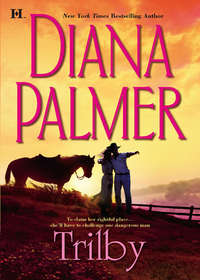
Kitabı oku: «Trilby»
DIANA PALMER
Trilby

Contents
Chapter One
Chapter Two
Chapter Three
Chapter Four
Chapter Five
Chapter Six
Chapter Seven
Chapter Eight
Chapter Nine
Chapter Ten
Chapter Eleven
Chapter Twelve
Chapter Thirteen
Chapter Fourteen
Chapter Fifteen
Chapter Sixteen
Chapter Seventeen
Chapter Eighteen
Chapter Nineteen
Chapter Twenty
Chapter Twenty-One
Chapter One
There was a yellow dust cloud on the horizon. Trilby stared at it with subdued excitement. In the months she’d spent on the ranch, in this vast territory of Arizona, even a dust cloud had the potential to lift her boredom. Compared to the social whirl of New Orleans and Baton Rouge, this country was uncivilized. October was almost over, but the heat hadn’t lifted. If anything, it was worse. To a genteel young woman of impeccable Eastern breeding, the living conditions were trying. It was a long way from the family mansion in Louisiana to this isolated wooden frame house near Douglas, Arizona. And the men who inhabited this wasteland were as near to barbarians as a red Indian. There were plenty of those around, too. An old Apache and a young Yaqui worked for her father. They never spoke, but they stared. So did the dusty, unbathed cowboys.
Trilby spent a great deal of time inside, except on wash days. One day a week, she had to go outside, where she and her mother dealt with a big black cast-iron pot in which white things—like her father’s shirts—were boiled, and two Number Two tin washtubs in which the remainder of the clothes were, respectively, washed by hand against a scrub board and rinsed.
“Is it going to be dust or rain?” her little brother Teddy asked from behind, scattering her thoughts.
She glanced at him over her thin shoulder and smiled gently. “Dust, I expect. What they call the monsoon season has passed and it is dry again. What else could it be?” she asked.
“Well, it could be Colonel Blanco and some of the insurrectos, the Mexican rebels fighting Díaz’s government,” he suggested. “Gosh, remember the day that cavalry patrol rode onto the ranch and asked for water and I got them a bucket?”
Ted was only twelve, and the memory was the high point of his young life. Their family’s ranch was near the Mexican border, and on October 10, Porfirio Díaz had been reelected president of Mexico. But the strongman was under attack from Francisco Madero, who had campaigned against him and lost. Now Mexico was in a state of violent unrest. Sometimes the rebels—who might or might not belong to a band of insurrectos—raided local ranches. The cavalry watched over the border. The situation in Mexico was becoming even more explosive than it usually was.
It had already been an interesting year up until that point, too, with Halley’s Comet terrorizing the world in May and the sad event of King Edward’s death on its heels. In the months that followed, there had been a volcanic eruption in Alaska and a devastating earthquake in Costa Rica. Now there was this border trouble, which made life interesting for Teddy, but deeply upset ranchers and private citizens. Everyone knew people who were connected with mining down in Sonora, because six Sonoran mining companies had their headquarters in Douglas. And plenty of local ranchers also owned land over in Mexico; foreign ownership of Mexican land to exploit mining interests and ranching was one of the root causes of the growing unrest over the border.
A detachment of khaki-clad U.S. Cavalry soldiers from the encampment at Fort Huachuca had come riding through only today, their officers in a snappy touring car with mounted troops behind them, scouting for trouble and looking so attractive that Trilby had to choke down a wildly uncharacteristic impulse to smile and wave at them. Teddy had no such inhibitions. He almost fell off the porch waving as they filed by. This column didn’t stop to ask for water, which had disappointed her young brother.
Teddy was so unlike her. She had blond hair and gray eyes; he had red hair and blue eyes. She smiled as she remembered the grandfather for whom he was a dead ringer.
“Two of our Mexican cowboys admire Mr. Madero very much. They say Díaz is a dictator and that he should be thrown out,” he told her.
“I do hope the matter is settled before it ends in a total war,” she said worriedly, “so that we don’t get caught in the middle of any fighting. It worries Mama, too, so don’t talk about it much, will you?”
“All right,” he said reluctantly. Airplanes, baseball, Mexican unrest, and the often related memories of his elderly friend, Mosby Torrance, were his biggest thrill at the moment, but he didn’t want to worry Trilby with just how serious the situation down in Mexico was becoming. She had no idea what the cowboys talked about. Teddy wasn’t supposed to know, either, but he’d overheard a good deal. It was frightening to him; it would be more frightening to his sheltered older sister.
Trilby had always been protected from rough language and rough people. Being in Arizona, around Westerners who had to cope with the desert and livestock and the weather—and the threat of rustling to stay alive—had changed her. She didn’t smile as often as she had back in Louisiana, and there was less mischief about her. Teddy missed the Trilby of years past. This new older sister was so reserved and quiet that sometimes he wasn’t sure she was even in the house.
Even now she was staring out over the barren landscape, into the distance, with that faraway look in her eyes. “I expect Richard is back from Europe by now,” she murmured. “I wish he could have come out to see us. Perhaps in a month or so, when he’s settled at home, he can. It will be pleasant to be in the company of a gentleman again.”
Richard Bates had been Trilby’s big love interest back home, but Teddy had never liked the man. He might be a gentleman, but compared to these Arizonamen, he seemed pretty anemic and silly.
He didn’t say so, though. Even at his age, he was learning diplomacy. It wouldn’t do to antagonize poor Trilby. She was having a hard enough time adjusting to Arizona as it was.
“I love the desert,” Teddy said. “Don’t you like it, just the least bit?”
“Well, I suppose I’m getting used to it,” she said quietly. “But I haven’t yet developed a taste for this horrible yellow dust. It gets into everything I cook,” she said, “as well as into our clothes.”
“It’s better to do girl stuff than brand cattle, I tell you,” he said, sounding just like their father. “All that blood and dust and noise. The cowboys curse, too.”
Trilby smiled at him. “I expect they do; Papa, too. But never around us. Only when it’s an accident.”
“There’s lots of accidents when you’re branding cattle, Trilby,” he drawled dryly, imitating his hero Mosby Torrance. He was a retired Texas Ranger and the ranch’s oldest hand. Teddy looked at her, frowning. “Trilby, are you ever going to marry? You’re old.”
“I’m only twenty-four,” she said self-consciously. Most of her girlfriends back home in Louisiana were married and had babies. Trilby had been waiting patiently for five years for Richard to propose. So far, he was no more than a friend, and her heart was heavy.
She might have been swayed if other young men had come courting, but Trilby wasn’t beautiful on the outside, even if she did have a warm, gentle heart and a sweet nature. She didn’t have the kind of face that set male hearts quivering, even back home. Here on a cattle ranch there weren’t many eligible men who were marriage worthy. Not that she wanted to marry anyone she’d met in Arizona. She thought of cowboys as a lazy lot, and many of them drank, and used tobacco and alcohol, and never bathed.
Her heart ached as she thought about how fastidious Richard always was. She wished they’d never left Louisiana. Her father had inherited the ranch from his late brother. He and her mother had sunk every dime they had into the place, and it took all the family, plus the hired help, to run it. It had been a dry year, despite the floods, and ranchers were losing cattle across the border. All this trouble, Trilby thought, when Arizona was on its way to becoming a state. So uncivilized.
The desert was a drastic change for people more used to swamps and bayous and humidity. Trilby and her mother and father, too, had come from money, which was the only reason Jack Lang had enough to stock the ranch. But their finances had suffered over the past few months, and things were no better now than they had been. But they’d all adapted amazingly well— even Trilby, who’d hated it on sight and swore she’d never be happy on a ranch in the middle of a desert with only two lone paloverde trees for shade.
“Look, isn’t that Mr. Vance?” Ted asked, shading his eyes as he spotted a solitary rider on a big buckskin horse.
Trilby ground her perfect teeth at the sight of him. Yes, it was Thornton Vance, all right. Nobody else around Blackwater Springs rode a horse with that kind of lithe, superior arrogance, or tilted his Stetson at just that slant across his tanned brow.
“I do wish his saddle would fall out from under him,” she muttered wickedly.
“I don’t know why you don’t like him, Trilby,” Ted said sadly. “He’s very nice to me.”
“I suppose he is, Teddy.” But he and Trilby were enemies. Mr. Vance had seemed to take an instant dislike to Trilby the day they were introduced.
The Langs had lived in Blackwater Springs for almost three weeks by the time they made Thornton Vance’s acquaintance. Trilby remembered his delicate, faintly haughty wife holding carelessly to his arm as the introductions were made at a church social. Thornton Vance’s cold, dark eyes had narrowed with unexpected antagonism the minute they’d spotted Trilby.
She’d never understood that animosity. His wife had been faintly condescending when they were introduced. Mrs. Vance was beautiful and knew it. Her dress was ready-made and expensive, like her purse and lace-up shoes. She had blond hair and blue eyes— and her well-bred contempt for Trilby’s inexpensive clothing had been infuriating. Her little girl looked subdued. No wonder.
Back in Louisiana, Trilby had worn good clothes herself. But now there was no money for frivolities, and she had to make do with what she had. The implied insult in Mrs. Vance’s cold eyes had gone straight to her heart. Perhaps unconsciously she’d extended her hostility toward the woman to include Thornton Vance himself.
Thornton Vance had frightened Trilby from the beginning. He was a tall, rough, fiery sort of man who said exactly what he thought and didn’t have any of the usual social graces. He was an outlaw in a land of outlaws, for all his wealth, and Trilby had no use for him. He was as different from her Richard as night was from day. Not exactly her Richard, she had to admit, not yet. But if she’d been able to stay in Louisiana for just a little longer, if she’d been a little older…She groaned inwardly as she tried to understand why fate had cast her into Thornton Vance’s path.
Vance’s cousin Curt had been totally different from Thorn, and Trilby had warmed to him at once. She liked Curt Vance because he was cultured and gentlemanly, and he somehow reminded her of Richard. She didn’t see him often, but she was fond of him.
Curt had seemed fond of Mr. Vance’s wife, too. Sally Vance had managed to interfere every time Trilby had spoken to Curt, holding his arm with a faintly proprietorial air. Her antagonism for Trilby had been more evident every time they met, so that finally Trilby managed not to attend any function where she was likely to see the other woman.
Sally had died in a very suspicious accident just two months after the Langs arrived in Blackwater Springs. Mr. Vance had accepted the routine condolences from her family, but when Trilby offered hers, he actually turned on his booted heel and walked away in what was a visible and very public snub, motioning his little girl along with him.
Trilby had never had the nerve to ask how she’d managed to offend a man she’d only just met. She hadn’t even looked at him properly. He’d avoided her like the plague, even when they met socially and he had his little girl with him. The little girl had seemed to like Trilby, but she couldn’t get near her because of the icy Mr. Vance. She seemed uncomfortable in her father’s company, and Trilby could understand that. He intimidated people.
He’d mellowed in the past two months, though, because he often came to the ranch to see her father. He always talked about water rights and how the drought was affecting his great herds of cattle. Mr. Vance owned an enormous tract of land, thousands of acres of it, with part in the United States and part in Mexico, in the state of Sonora. Apparently Blackwater Springs Ranch sat smack-dab in the middle of the only reliable water source nearby, and Mr. Vance wanted it. Her father wouldn’t discuss selling any land. That was like him. He wouldn’t give up those water rights, either.
Trilby’s busy mind coasted when Thornton Vance reined in just in front of the steps and crossed his tanned wrists over the pommel. Though a wealthy man, he dressed like one of his cowboys. He wore old denim jeans with worn leather bat-wing chaps. His shirt was checked and old, too, with scratched leather wristbands over the cuffs. A huge red bandanna drooped around his strong neck. It was stained and dusty now, and wrinkled. His tan hat wasn’t in much better shape, looking as if it had been twisted, rained on, and stomped a few times. His boots were disreputable, like Teddy’s after he’d been working cattle, the toes curled up from too much dampness and the heels worn down on either side in back. Mr. Vance didn’t look very elegant, she decided, and her distaste for him showed in her face.
“Good morning, Mr. Vance,” Trilby said quietly, remembering her manners, belatedly and reluctantly.
He stared at her without speaking. “Is your father at home?”
She shook her head. He had the kind of voice that was soft as velvet and deep as night, but it could cut like a whip when he wanted it to. He did now.
“Your mother?” he tried again.
“They’re off with Mr. Torrance at the store,” Teddy volunteered. “He drove them in on the buckboard. Dad says Mr. Torrance is used up, but it isn’t true, Mr. Vance. He isn’t at all used up. He was once a Texas Ranger, did you know?”
“Yes, I knew, Ted.” Mr. Vance let his dark eyes slide back to Trilby. They were set in a keen, sharply defined face with a straight nose and darkly tanned skin, black eyebrows matching the equally thick, straight black hair under his hat.
Trilby felt inadequately covered for some reason, even though her neat calico dress was very demure. She wiped her hands unnecessarily on her apron. “I should get back to the kitchen before I burn my apple pie,” she began, hoping he might take the hint and go.
“Am I being offered a slice of it?” he drawled instead.
She almost panicked. Teddy answered for her, his young voice excited. “Surely!” he said enthusiastically. “Trilby bakes the best pie, Mr. Vance! I like it with cream, but our cow’s gone dry just lately and we’ve had to do without.”
“Your father didn’t mention the cow,” Vance said as he swung lithely out of the saddle and tied the reins to the porch post. He came up onto the porch with a bound, his long, lithe body as graceful out of the saddle as in it. He towered over Teddy and Trilby, too tall and forceful.
She turned quickly and went back into the house. At least her blond hair was up in its neat braid, not loose and uninhibited as she usually wore it around the house. She looked much more cool and collected than she felt. She wished she had some red cayenne pepper; she’d fill Mr. Vance’s pie full of it. He probably thrived on hot peppers and arsenic, she thought wickedly.
“We got another cow yesterday, from Mr. Barnes down the road,” Teddy volunteered. “But sis got busy baking and hasn’t milked her. I’ll go and do it for you, Trilby, while you check the pie. It will only take a little while.”
She tried to protest, but Teddy had grabbed the tin milking pail and rushed out the back door before she could stop him. She was left alone, and frightened, with the hostile Mr. Vance.
He wasn’t bothering to camouflage his hostility now, either, with Teddy out of the way. He pulled a Bull Durham pouch out of his pocket, along with a small folder of tissue papers, and proceeded to roll a cigarette with quick, deft movements of his long-fingered hands.
Trilby busied herself checking inside the wood stove to see if her pie was finished. Back home, there had been a gas stove. Trilby had been secretly afraid of it, but she sometimes missed it now that she had to cook on the wood-burning one, the best they could afford. Stocking the ranch had been expensive. Keeping it going was getting harder by the day. Teddy should never have mentioned the cow going dry.
She saw the brown crust even as she smelled the mingled cinnamon and sugar and butter smell of baking apples. Just right. She took her cloths and got it quickly out of the oven and onto the long cooking table that ran almost from wall to wall. Her hands shook, but thank heaven, she didn’t drop the pie.
“Do I make you nervous, Miss Lang?” he asked, pulling up a chair. He straddled it, his powerful body coiled like a snake’s as he folded it down onto the chair and rested his forearms over its back. He looked very masculine, and the very set of his muscular body, with the chaps and jeans drawn tight over long, powerful legs, made Trilby feel awkward and shy. She’d never noticed Richard’s legs at all. Her sudden interest in Thorn’s unsettled her, made her defensive.
“Oh, no, Mr. Lang,” she replied, with a vacant smile. “I find hostility so invigorating.”
His eyebrows lifted and he had to stifle a smile. “Do you? Yet, your hands shake.”
“I have little experience of men…except for my father and brother. Perhaps I’m ill at ease.”
He watched her push back a wisp of blond hair with eyes that held nothing but contempt. “I thought you found my cousin quite irresistible at that social gathering last month.”
“Curt?” She nodded, missing the look that flared in his dark eyes. “I like him very much. He has a pleasant manner and a nice smile. He gave Teddy a peppermint stick.” She smiled at the memory. “My brother never forgets a kindness.” She glanced at him warily. “Your cousin reminds me of someone back home. He’s a kind man. And a gentleman,” she added pointedly, her eyes making her opinion of his garb, and himself, perfectly plain without a word being spoken.
He wanted to laugh out loud. Sally had told him about seeing Curt and Miss Lang here in a passionate embrace. She wasn’t the first to mention the relationship, either. A lady from the church—a notorious gossip—had mentioned seeing Curt and a blond woman in an embrace at a gathering. He’d taken the gossip home to Sally, who’d told him about Trilby. She’d done it quickly, but almost reluctantly, too. Thorn remembered that she’d gone quite pale at the time.
The revelation had left him with a fine contempt for Trilby. His cousin Curt was a married man, but Miss Lang didn’t seem to mind shattering convention. Funny, a woman who acted as ladylike as she did, behaving like that. But then, he knew too well what deceivers women were. Sally had pretended to love him, when she’d only wanted a life of wealth and comfort.
“Curt’s wife also admires him,” he said pointedly.
When she didn’t react, he sighed roughly and took a long draw from the cigarette, his eyes never leaving hers. “The wrong type of woman can ruin a good man and his life.”
“I have found very few good men out here,” she said flatly. She busied herself slicing the pie. Her hands shook and she hated the fact that he watched them, his smile mocking and unkind.
“You don’t seem to find the desert too hot, Miss Lang. Most Easterners detest it.”
“I’m a Southerner, Mr. Vance,” she reminded him. “Louisiana is hot in the summer.”
“Arizona is hot year-round. But you won’t find an overabundance of mosquitoes. We don’t have swamps here.”
She glared at him. “The yellow dust makes up for it.”
“Does it, truly?” he asked, mocking that very correct Southern accent that brought to mind cotillions and masked balls and mansions.
She wiped her hands and put the knife aside. She wouldn’t throw it at him, she wouldn’t!
“I suppose so.” She went to get the dishes for the pie from the china cabinet, praying silently that she wouldn’t drop any of them. “Do you care for iced tea, Mr. Vance?” And if I only had some hemlock…
“Yes, thank you.”
She opened the small icebox and with an ice pick chipped off several pieces of ice to go in the tall plain glasses. She covered the small block of ice with its cloth again and closed the door. “Ice is wonderful in this heat. I wish I had a houseful of it.”
He didn’t reply. She took the ceramic jug of tea she’d made for dinner and poured some of the sweetened amber liquid into the glasses. She’d fixed three, because surely Teddy would be back soon. She’d skin him if he wasn’t! Her nerves were strung like barbed wire.
She put a perfect slice of pie on a saucer and placed it before him at the table with one of the old silver forks her grandmother had given them before they’d left Baton Rouge. She placed a linen napkin with it and put the glass of tea on it. The ice shook and made a noise like tiny bells against the glass.
His lean hand shot out as she withdrew hers and caught her small wrist in a hot, strong grasp. She caught her breath audibly and stared at him with wide, wary eyes.
He scowled faintly at her reaction. His gaze went to her hand as he turned it in his and rubbed the soft palm gently with his big callused thumb. “Red and worn, but a lady’s hand, just the same. Why did you come out here with your family, Trilby?”
The unfamiliar sound of her name on his lips, in that deep, soft tone, made her knees weak. She stared at his work-toughened hand, at the darkness of his skin against the paleness of her fingers. His touch excited her.
“I had nowhere else to go. Besides, Mama needed me. She isn’t that well.”
“A fragile woman, your mother. A real Southern lady. Just like you,” he added contemptuously.
She lifted her eyes to his. “What do you mean?”
“Don’t you know?” he replied coldly, and the dark eyes that met hers were full of distaste. “You won’t find much polite society out West, my girl. It’s a hard life, and we’re hard people. When you live on the fringe of the desert, you get tough or you get dead. A little bit of fluff like you won’t last long. If the political situation here gets much worse, you’ll wish you’d never left Louisiana.”
“I’m hardly a bit of fluff,” she said angrily, thinking that his late wife fit that description far more than she did, although she was too polite to say it. “Why do you dislike me so?”
He grew more somber as he looked at her. He wanted to throw his contempt in her face, but he didn’t speak. A minute later, Teddy came in the back door with half a pail of milk, and Thornton Vance slowly released Trilby’s hand. She rubbed it instinctively, thinking that she’d surely have a bruise on the back of it by morning. She had delicate, thin skin, and his grip hadn’t been gentle.
“Here’s the milk. Did you cut me a slice of that pie, Trilby?”
“Yes, Teddy. Sit down and I’ll get it.”
Teddy pretended not to notice Trilby’s unease, putting it down to the presence of Mr. Vance….
“There, wasn’t that good?” Teddy asked the visitor when they’d finished the delicious pie. Thorn had wolfed his down with delight.
“Not bad,” Thorn agreed. His dark eyes narrowed on Trilby’s pale face. “I think your sister finds me hard going, Ted.”
“Not at all,” Trilby said, denying it. “One learns to take headaches in one’s stride.” She got up abruptly and gathered the dishes, taking them quickly to the sink with the iron pump attached. She pumped it to get water into a pan and then poured water into the kettle and set it on the wood stove to boil.
“The stove sure does make it uncomfortable in the summer, doesn’t it, Mr. Vance?” Teddy asked.
Thorn had smothered a grin at Trilby’s last riposte. “You get used to things when you have to, Ted,” Thorn said.
Trilby felt a twinge of sympathy for him. He’d lost his wife, and he had probably cared about her a great deal. He couldn’t help being rough and uncivilized. He hadn’t had the advantages of an Eastern man.
“That was good pie,” Thorn said directly, and sounded surprised.
“Thank you,” she said. “Grandmother taught me how to cook when I was just a little girl.”
“You’re not a little girl now, are you?” Vance asked curtly.
“That’s right,” Teddy agreed, not realizing that the question was more mockery than query. “Trilby’s old. She’s twenty-four.”
Trilby could have gone right through the floor. “Ted!”
Thorn stared at her for a long moment. “I thought you were much younger.”
She flushed. “How you do go on, Mr. Vance,” she said stiffly. “Speaking of going on…”
Vance smiled at her. It changed his face, made it less formidable, charming as his black eyes sparkled. “Yes?” he prodded.
“How old are you, Mr. Vance?” Teddy interrupted.
“I’m thirty-two,” he told the boy. “I suppose that puts me in the class with your grandparents?”
Teddy laughed. “Right into the rocking chair.”
Vance laughed, too. He got up from the table and pulled his pocket watch out of the slit above the pocket of his jeans. He opened it and grimaced. “I’ve got an Eastern visitor arriving on the train this afternoon. I must go.”
“Come again,” Teddy invited.
“I will, when your father’s home.” He glanced at Trilby speculatively. “I’m having a party Friday evening, a get-together for my Eastern visitor. He was a relation of my wife’s, and he’s somewhat famous in academic circles. He’s an anthropologist. I’d like you all to come.”
“Me, too?” Teddy asked excitedly.
Vance nodded. “There’ll be other youngsters around. And Curt will be there, with his wife,” he added, with a pointed glance at Trilby.
Trilby didn’t know what to say. She hadn’t attended an evening party since they’d been in Arizona, although they’d been invited to several. Her mother didn’t like social gatherings. She might agree to this one, because it wouldn’t do to offend someone as wealthy and powerful as Thornton Vance, even if he did look and act like some sort of desperado.
“I’ll mention it to Mama and Papa,” she told him.
“You do that.” He took his hat in hand and walked with easy strides to the front door with Trilby and Teddy behind him.
It was tilted at the usual rakish angle when he swung lazily into the saddle. “Thanks for the pie,” he told Trilby.
She tilted her chin at just the right angle and smiled at him coldly. “Oh, it was no trouble at all. I’m sorry I couldn’t offer you some cream with it.”
“Had you lapped it up already?” he tormented.
She glared at him. “No. I expect you curdled it.”
He chuckled with reluctant pleasure. He tipped his hat, wheeled the horse gently, and eased him into a nice trot. Trilby and Teddy watched him until he was out of sight.
“He likes you,” he teased her.
She lifted an eyebrow. “I’m not at all the kind of woman he’d be interested in.”
“Why not?”
She glared at Thorn’s back with mingled excitement and resentment. “I expect he likes his women with their necks on the ground under his boot.”
“Oh, Trilby, you’re silly! Do you like Mr. Vance?” he persisted.
“No, I do not,” she said tersely, and turned back into the house. “I have a lot of things to do, Teddy.”
“If that’s a hint, sis, I’ll go find something to do myself. But I still say Mr. Vance is sweet on you!”
He ran off, down the long porch. Trilby stood with the screen door open watching after him, worried. She didn’t think Mr. Vance was sweet on her. She thought he was up to something, and she didn’t know what. But she was worried.
When her mother and father came home, Teddy related Mr. Vance’s visit to them, and they smiled in that same knowing way. Trilby flushed like a beet.
“He isn’t interested in me, I tell you. He wanted to see the both of you,” she told her parents.
“Why?” her father asked.
“He’s having a party Friday night,” Teddy said excitedly. “He said we’re all invited, and I can come, too. Can’t we go? It’s been ever so long since we’ve been to a party.” He glowered at them. “And you won’t let me go to see Mr. Cody’s show Thursday afternoon. They said it will be his very last show—and he’s got Pawnee Bill’s Far East Show on the same bill, with real elephants!”
“I’m sorry, Teddy,” his father said, “but we really can’t spare the time, I’m afraid. We’re shipping cattle to California this week, and we’re still behind some of the other cattle companies getting ours en route.”
“Buffalo Bill’s last show and I’ll miss it,” Teddy groaned.
“Perhaps he isn’t really retiring. Besides,” Mary Lang said gently, “there’s sure to be one of those new Boy Scout troops starting up soon in Douglas, what with all the publicity the movement is getting. You could join that, perhaps.”
“I suppose. Can we go to the party? It’s at night. You can’t work at night,” he added.
“I agree,” Mrs. Lang said. “Besides, dear, it really wouldn’t do to offend Mr. Vance when we’re neighbors.”
“And I suppose,” her husband said mischievously as he looked at his daughter, “there won’t be anyone for Thorn to dance with if Trilby doesn’t go.”
Which called to Trilby’s mind an image of the reprehensible Mr. Vance dancing by himself. She had to smother a grin.
“Trilby calls him Mr. Vance,” Teddy pointed out.
“Trilby is being respectful, as she should be,” Mr. Lang replied. “But Thorn and I are cattlemen. We use first names.”
Thorn suits him, Trilby thought to herself. He was just as sharp as one, and could draw blood as easily.
She didn’t say it. Her father wouldn’t approve of blatant rudeness.
“We’re going, then?” Trilby asked.
“Yes,” Mrs. Lang replied, smiling at her daughter. She was a pretty woman. She was almost forty, but she looked ten years younger. “You still have a nice dress that you haven’t worn since we’ve been out here,” she reminded Trilby.
“I wish I still had my lovely silk ensemble,” Trilby replied, smiling back. “It was lost on the way here.”
“Why is it called such a silly thing?” Teddy muttered.
“Well, I never!” Trilby laughed. “And don’t you think naming a stuffed bear for Teddy Roosevelt is silly?” Trilby asked absently.
“Of course not! Hoorah for Teddy!” Teddy chuckled. “His birthday is Thursday, the same day of Buffalo Bill’s show; I read it in the paper. He’ll be fifty-two. I was named for him, wasn’t I, Dad?”
“Indeed you were. He’s a hero of mine. He was a sickly, weak child, but he built himself up and became a rugged soldier, a cowboy, a politician…I suppose Colonel Teddy Roosevelt has been everything, including president.”
“I’m sorry he wasn’t reelected,” Mrs. Lang replied. “I would have voted for him,” she added, with a meaningful look at her husband. “If women could vote.”
“A wrong that will one day soon be righted, you mark my words,” Mr. Lang said affectionately, and put his arm around his wife’s thin shoulders. “President Taft signed the Arizona statehood bill in June, praise God, and many changes will now occur as they work to get the constitution ready for ratification. But whatever happens, you’re still my best girl.”
She laughed and nuzzled her cheek against his shoulder. “And you’re my best boy.”
Trilby smiled and left with Teddy, leaving her parents to themselves. Years and years of marriage, and they were still like newlyweds. She hoped that someday she would be as fortunate in her marriage.
Chapter Two
Thorn was halfway back to the ranch when a cloud of dust caught up to him. He turned his head in time to see Naki, one of the two Apache men who worked for him, rein in to match his speed. The other man was tall and had long, shoulder-length black hair. He wore a breechclout and high-topped buckskin moccasins with a red-checked shirt and a thick, red-patterned cotton band tied around his forehead to keep his hair out of his eyes.
“Been hunting?” Thorn asked him.
The other man nodded.
“Find anything?”
The Apache didn’t even glance at him. He held up one hand, displaying a thick, bound book. “I’ve been looking for it everywhere.”
“I mean, did you shoot anything that we could eat for supper?” he said, glowering.
Naki’s eyebrows lifted. “Me? Shoot something?” He sounded horrified. “Kill a helpless animal?”
“You’re an Apache Indian,” Thorn reminded him, with exaggerated patience. “A hunter. Master of the bow and arrow.”
“Not me. I prefer a Remington repeater rifle,” he said in perfect English.
“I thought you were going to get us something in buckskin.”
“I did.” He held up the book again. “Leatherstocking Tales, by James Fenimore Cooper.”
“Oh, my God!” Thorn groaned. “What kind of Apache are you?”
“An educated one, of course,” Naki replied pleasantly. “You’re going to have to do something about Jorge’s cousin,” he added, the lightness gone from his tone and the smile from his deep-set black eyes as he stopped and faced the other man. “You lost five head of cattle this morning, and not to drought and lack of water. Ricardo confiscated them.”
“Damn the luck!” Thorn cursed. “Again?”
“Again. He’s feeding some revolutionary comrades hidden out in the hills. I can’t fault his loyalty to his family, but he’s carrying it to extremes and on stolen beef.”
“I’ll have it out with him.” He glared at the horizon. “This damned war is coming too close.”
“I won’t argue.” Naki tucked the book in his saddlebags. He produced two rabbits on a tether and tossed them to Thorn. “Supper,” he announced.
“Are you coming down to share it?”
“Share it?” Naki looked horrified. “Eat a rabbit? I’d rather starve!”
“What did you have in mind, or dare I ask?”
Naki’s white teeth gleamed in a face like sculpted bronze. “Fried rattler,” he said, his eyes glittering.
“Snob,” Thorn accused.
Naki shrugged. “One can hardly expect a man of European ancestry to measure up to a culture as ancient and sophisticated as mine,” he said, eyes sparkling with humor. “Meanwhile, I’ll track Jorge’s cousin down for you and bring him along.”
“Don’t, please, do anything nasty to him.”
“I?”
“No need to look so innocent, if you please. Or wasn’t it you who staked out that drummer on an anthill with wet rawhide when he sold you some snakebite medicine that didn’t work?”
“A doctor should stand behind his cures.”
“He didn’t know you were a Latin scholar,” Thorn reminded him. “Much less that you knew more about herbal medicine than he’d ever learned.”
“He won’t forget.”
“I daresay he won’t,” Thorn agreed. “And I believe he led a lynch mob after you…?”
“From which you were kind enough to save me,” Naki recalled. It had been the beginning of their friendship, and it went back a long, long way. Naki had reformed a little. Not much.
“Bring your snake and I’ll have Tiza cook it for us.”
“He cooks like he rides,” Naki muttered.
“I’ll cook it, then.”
“I’ll bring Ricardo along directly.”
He turned his paint pony and rode leisurely away.
The rest of the week passed all too quickly. Trilby dressed for Thornton Vance’s party with fingers that were all thumbs. She didn’t want to go to Thorn’s house. She dreaded the evening as she’d never dreaded anything else.
The only expensive gown she owned that had made it out from Louisiana with her was a lacy beige one. A vicious dust storm had destroyed most of their possessions on the drive from the train to their new home on Blackwater Springs Ranch. Even now, Trilby could feel the smothering sting of yellow sand as it had blanketed them, almost buried them, on the way from Douglas. One of their acquaintances had only smiled when he was told of their ordeal, remarking that they’d best get used to dust storms out here.
They had, after a fashion. But Trilby sometimes longed for the cool green bayous of her youth and the sound of Cajun patois being spoken on the streets as she went to the bakery each Saturday for a sack of beignets and to shop for new dresses.
With a full purse, it had been fun to go to town in the chauffeured T-model that Rene Marquis drove for the family. Her cousins had always been her friends as well, and there were parties and afternoon teas and picnics…and then, so suddenly, there had been Richard. But before he’d done more than hold her hand in his, her uncle had died, and her father had announced that the family was moving to Arizona.
Trilby had cried for days, but it hadn’t swayed her parents. Richard had gone off to Europe with his own family, with flattering reluctance and a promise to write. But to date, Trilby had written dozens of letters and she had only a card from Richard, from England. It wasn’t even remotely loving. Only a friendly note. Sometimes she despaired of ever gaining his love.
She pulled herself up short. It really wouldn’t do to let herself look back. This was home now. She had to adjust to being an Arizonan, to a different kind of life. But Richard might still come to stay; he might discover passionate feelings for her. She sighed dreamily.
She put on the gown, longing for the old days when she’d had plenty of fine clothes to wear. Money was no longer plentiful. She wanted to leave her hair loose around her shoulders, but Mr. Vance being Mr. Vance, it was better, she supposed, to appear dignified and conservative, so that she didn’t give him any special reasons for mocking her. He sometimes looked at her as if he actually considered her in the same light as a lady of the evening. It puzzled and hurt her. Not that she ever let it show.
She braided her soft blond hair with a blue ribbon and piled it on top of her head, grimacing at the severe thinness of her face. The heat had worn her down just lately. She had little appetite, and her slenderness had exaggerated itself.
When she finished dressing, she pinched her cheeks and lips to put a little color in them and picked up the lacy black shawl the Mexican ladies called a “mantilla.” Her father had brought it to her from Mexico the last time he’d been down there to buy cattle.
“You look lovely, Trilby,” her mother said warmly.
“So do you.” She hugged the older woman, approving the neat, elegant black dress her mother was wearing.
Her father, in his black suit, and Teddy, in his short pants and jacket, looked uncomfortable but fashionable. They climbed into the Model-T and waited while the man of the house fiddled around until it finally cranked. Then Trilby prayed all the way to Mr. Vance’s ranch that it wouldn’t snap a band, or break down, or have a flat tire on the deeply rutted road. It was drizzling rain, and it would be terrible to have to get wet waiting and hoping to be rescued.
Fortunately everything went without a hitch. They pulled up in the long dirt driveway that led to Los Santos Ranch. It was an adobe structure, two stories high, with balconies all around the upper level and patios and gardens surrounding the lower one. Every plant near it seemed to be blooming, even the tall, thin ocotillo that made a natural fence near the front. It was the first time Trilby had seen it, and she was enchanted. Most of the structures she’d seen in Arizona were made of adobe, but they were usually simple and very small. This showplace was something out of a slick Eastern magazine, elegant and expensive.
Thornton Vance was waiting for them on the front porch, which was long and cool-looking with its hammock on one end and comfortable chairs on the other. Light blazed out of the glass windows, spilling in patterns on the sandy, cactus-studded front yard. There was a breeze, but it was a warm night despite the faint mist of rain. The house looked warm and inviting. Incredible, Trilby thought, considering how uninviting its master looked when his dark eyes rested on her. In his dark suit and white shirt, he looked a little severe. His black hair was neatly combed. He looked as elegant as any New Orleans gentleman. Trilby was surprised at how handsome he was when he dressed up.
“Nice of you to invite us, Thorn,” her father said, with easy courtesy, as he helped first Trilby’s mother, then Trilby, out of the car.
“My pleasure. Watch your step, Trilby. You’re headed for a mudhole,” he said abruptly. “Here, Ted, hold this.”
He handed Teddy his glass and abruptly swung Trilby up in his arms—to her shock and her parents’ quickly concealed delight.
He turned, carrying her up onto the porch as if she weighed nothing at all. It didn’t seem to affect him, either, having her so close. But it affected her. She could barely breathe. His cologne was faint and barely detectable, but she seemed to be engulfed in its manly scent. His arms were strong and warm around her. She could feel the muscles in them despite the covering of his long-sleeved shirt and dark jacket. He wasn’t breathing hard at all, as if her weight was unnoticeable.
“Better hold on,” he murmured, with faint amusement. She was holding herself so stiffly that she felt brittle, and he knew she was barely breathing. It puzzled him that a woman of her character should be so nervous in a man’s arms. He didn’t imagine she’d been nervous in Curt’s! “It’s a bit of a steep climb up this porch.”
That slow drawl was seductive. The pitch of his voice had dropped, just enough to stroke her ears like velvet. She’d never been so close to a man before, and the steely Mr. Vance was devastating even at a distance. This was hardly conventional behavior, and she wanted to protest, but her parents were chiding her for being so wary.
“Relax, girl,” her father said, chuckling. “Thorn won’t drop you.”
Defeated, her thin arms climbed jerkily until they rested on his broad shoulders.
His head turned. His eyes met hers in the faint light from the windows, and the sounds of music and laughter and talking died suddenly as she was caught and held in their dark glitter.
His step didn’t falter, but he wasn’t watching as he carried her slowly up onto the porch. And before he stopped to put her down, his arm contracted very slowly, very deliberately, to bring her breasts hard against his chest.
She shivered at the unexpectedly stirring contact, so vulnerable that she was unable to conceal the reaction of her body to the faint caress.
He didn’t speak. Slowly he let her feet down on the floor. As he bent to release her, his mouth was only scant inches from her lips. He searched her eyes, and she felt her body grow warm at the look on his face. It was expressionless, except for the explicit longing in his eyes, the single-minded intent. He stood straight, releasing her, and she stood before him helpless, unable to move, to speak, to act.
Thorn watched her curiously. For a woman of her type, she was amazingly sensitive to his touch. Not that he found it strange that the apparently very correct and puritan Miss Lang should fall apart because of the attentions of a rough cattleman. She was obviously putting on a good act. And why not? She knew he was rich.
“Would you care for some punch, Trilby?” he asked, but his eyes had dropped to her mouth—and he looked as if he might bend and take it under his any second.
Trilby could hardly find her voice. She was so shaken that her purse almost fell from her fingers. “Yes,” she choked. “I would.”
If only he would stop staring at her lips! He made her trembly with an emotion she didn’t understand at all. Her legs would hardly support her. It was difficult to breathe. Her heart was beating like a hummingbird’s wings against her rib cage. All because Thornton Vance was looking at her mouth!
He took her arm, aware of her parents’ exchanged smiles. So they were thinking along those lines. He smiled faintly to himself. He was glad that Trilby was vulnerable to him. He found her very attractive, and he’d been a long time without a woman. He hadn’t wandered up to the wrong side of Tucson for entertainment, or anywhere else since his wife’s death. He was beginning to feel that abstinence. He knew what Trilby was. He wouldn’t need to worry about her reputation.
And if she fell in love with him a little, that wouldn’t hurt, either. He might enjoy having her become serious about him just before he cut it off. Trilby had all but destroyed his cousin’s marriage. The gossip hadn’t been lost on him, and Curt’s wife, Lou, had cried on his shoulder more than once. Lou didn’t know the identity of Curt’s clandestine lover, but she did know that the woman was a blonde. Vance had never doubted that it was Trilby. After all, Sally had seen her with Curt.
It was too bad about Jack Lang inheriting that ranch, he thought bitterly. If it hadn’t been for the Langs coming here to claim Blackwater Springs Ranch, Thorn would have been able to buy it. Then he wouldn’t be losing cattle right and left to drought. He had water on his Mexican property, but it was getting too dangerous to try to run cattle down there. He’d had one raid after another on his stock since the fighting had begun after Díaz’s reelection. Here, water was running out.
Thorn had to find a way to save Los Santos from ruin. The land came first. His father and his grandfather had instilled in him a terrible sense of responsibility for the land, for the heritage it represented, for the need to preserve it at any cost.
For just a moment, it flashed through his mind that he could solve all his problems by marrying Trilby. But he dismissed it at once. She wasn’t the sort of woman he wanted in his home. He wasn’t sure he ever wanted another woman that close.
Sally had sworn eternal love until he’d married her and taken her to bed. Afterward, she’d been a bubbling caldron of excuses. She enjoyed her wealthy way of life, but not her ardent husband. After a few weeks of her utter coldness, he lost most of his feeling for her. Her pregnancy had been the last straw. She hadn’t wanted a child, and she never fully adjusted to motherhood. For the few months before her death, she’d been different. There had been a new light in her eyes, a new radiance to her face. But not when her husband was near. She hated him, and never lost a chance to tell him so. Even Samantha suffered her hostility. At the last, Sally had seemed to resent her family bitterly.
The accident that had claimed her life had been in a buggy one rainy night. She’d gone to sit with a sick neighbor. When she hadn’t come home the next morning, he’d gone looking for her. He’d found her body in the wreckage of the buggy, half lying in a creek. It was on an out-of-the-way road, though, and nowhere near the sick neighbor. He’d assumed that she’d gotten lost in the dark, and his conscience had hurt him for letting her go alone. There was little love in their marriage, but he had loved her until her selfishness and greed killed his feelings for her.
He glanced toward his daughter Samantha, who was standing against the wall just inside the house, looking hunted. She was so fragile-looking, he thought. Odd, she’d been less high-strung since her mother’s death, but she was sad and shy, and, odd thing, she was very nervous around Curt and Lou. He did care for his child, but there was little love left in him. What was love, after all, he thought bitterly, but an illusion. A marriage for practical reasons had a better chance of success. As for the bedroom, there was no shortage of willing women to satisfy his hunger. He didn’t need a wife for that. His eyes sought Trilby, dark with masculine appreciation of her slenderness and grace.
Samantha approached the adults warily, managing a shy smile for Trilby. “Hello,” she said.
“Hello. It’s Samantha, isn’t it? You look very pretty,” Trilby said gently.
Samantha looked surprised at the compliment. “Thank you,” she mumbled self-consciously. “May I go to bed, now, Father?” she asked, with painful shyness.
“Certainly,” he said. He sounded very stiff and uncomfortable. Not like Trilby’s loving, affectionate father. “Maria will go with you.” He motioned to his housekeeper, who nodded and came forward quickly to herd the child upstairs.
“Don’t you tuck her in at night?” she asked, without thinking.
“I do not,” he answered, his voice hardly inviting further questions. “Will you have lime or fruit punch?”
“Lime, please.”
He filled a cup for her and placed it in a saucer. Her hands shook, though, and he had to hold them to help steady it. His eyes met hers again, narrow this time, and probing.
“Your hands are like ice. You can’t be cold?”
“Why can’t I?” she said defensively. “I’m thin. I feel chill more than most people.”
“Is it that, Trilby?” He lowered his voice, and his head, so that his eyes were very close to hers. His lean hands smoothed over the backs of hers. “Or is it this?” His thumb found the damp palm of one and drew over it in what was a blatantly sensual gesture, while his eyes kindled panic in her bosom.
The punch overflowed, fortunately missing her dress and his trousers.
“Oh, I’m—I’m so sorry!” she stammered, flushing.
“No harm done.” He motioned for one of the waiters and drew her out of the way while the man cleaned it up. Her parents and Ted were already mixing with the huge crowd, and no one seemed to have noticed the accident.
“I never used to be so clumsy,” she said nervously.
He drew her back into a small alcove that led to the lighted patio, its paper lanterns making artificial moons in the darkness. His hands framed her face and tilted it up to his dark eyes. “I don’t think it was clumsiness.”
He bent then, and she felt the warm, slow brush of a man’s mouth for the first time in her life. Even Richard had never once tried to kiss her. She’d had only dreams…She stiffened helplessly at the intimacy and a faint gasp passed her dry lips.
Thorn lifted his head. The expression on her face, in her eyes, was one she couldn’t have pretended. It was genuine surprise, mingled with awe, fascination. He had more than enough experience to recognize what she was feeling—and to know that it was new to her. Incredible, he thought, a woman of her experience being so stunned. Unless it was a pretense…
He bent again to make sure, but she jerked away from him, one slender hand going to her mouth. Above it, her gray eyes were like saucers in a delicately etched face blanched with uncertainty.
Thorn grew irritated with her for that dramatic facade. His face hardened; his eyes went cold. He stood watching Trilby, contempt in his very posture as he stared at her slender body.
“Don’t tell me you usually react that way to a man’s caress?” he asked, with smiling mockery. “There’s no need to pretend for me, Trilby. We both know that you aren’t unfamiliar with the feel of a man’s mouth on yours—even on your body.”
The sheer effrontery of the remark made her hand twitch. Her eyes flashed at him and she straightened. “If I had a gun, I’d shoot you, I swear I would! How dare you make such a statement to me!”
He raised his eyebrows. “What kind of treatment did you expect, Miss Lang? Do you think that prim act fooled me?”
She stared at him blankly. “What prim act?”
He looked vaguely mocking. “It’s not very effective coming from your sort of woman,” he drawled. “We both know you want a hell of a lot more from me than kisses.”
She gasped with furious indignation and gave him a fierce glare before she abruptly moved away from him, almost running. He poured himself a cup of punch and wandered off to mingle with his guests. But even as he smiled and wound through the crowd, he was thinking about Trilby. He really shouldn’t have baited her like that. Even if she’d been having a blatant affair with Curt, it didn’t make her a prostitute. She might actually love the man.
He didn’t understand why he’d said the things he had, except that thinking of her with his cousin made him angry.
His eyes finally found her, dancing with, of all people, Curt. The other man was about his height but much heavier and less abrasive. Curt had a ready smile and he liked women. They liked him, too, with his city manners and gentlemanly ways.
Thorn had been fond of him until his wife had thrown Curt up to him as an example of what she called a “civilized man.” He was tired of coming off second when compared to a dandy. Seeing Trilby in his arms made something explode inside him, especially when an icy, resentful Lou, Curt’s wife, sat seething as she watched them dance.
“How’s the Mexican problem?” Jack Lang asked, pausing beside him long enough to divert his attention.
“Getting worse, I think,” Thorn replied. He glanced at Trilby and away again. It was all he could do not to throw a punch at Curt for his duplicity. “Don’t let the women stray far from the house. We’ve had a few cattle stolen. One of my men tracked them down into Mexico. We never did catch the thieves.”
“You can’t fault the peons for taking the side of the insurgents,” Jack said patiently. “Conditions under Díaz are intolerable for the Mexican people, from what we hear from our vaqueros.”
“They’ve always been intolerable. They always will be,” Thorn said impatiently. “The average Mexican peasant has centuries of oppression behind him, from the Aztecs all the way up through Cortés and the Spanish and French, and, eventually, Díaz. These are a perennially oppressed people. They’ve been forced to knuckle under to everyone, especially the Spanish. It takes generations to overcome a suppressed attitude. They haven’t had enough time yet to break the pattern.”
“Madero seems to be doing it.”
“Madero is a little rooster,” Thorn mused. “His heart’s in the right place. I think he may surprise the Federales. They underestimate him. They’ll regret it.”
“His army is ragtag,” Jack protested.
“You need to read history,” came the dry reply. “It’s chock-full of ragtag armies taking over continents.”
Jack pursed his lips. “You’re amazingly astute.”
“Why, because I live on a ranch and spend my life around cattle and dust? I’m well read, and I have a friend who knows more about the past than he knows about the present. Did you meet my Eastern guest over there? McCollum’s an anthropologist, although he also teaches archaeology. He comes out with his students every spring to interview people from local Indian tribes and look for evidence of ancient cultures.”
“You don’t say! He never told me any of that,” Jack murmured, eyeing the tall, rough-looking blond man who was talking to an area businessman.
“McCollum won’t talk about his work. He’s opinionated enough about everything else,” Thorn said, with an amused smile.
McCollum glanced at Thorn and glowered. A minute later, he excused himself to the man with whom he was speaking and joined his host. “You’re talking about me, aren’t you?” McCollum demanded bluntly. “Behind my back, too.”
“I was telling my neighbor how much you know about the past,” he said, smiling. “This is Jack Lang. He owns Blackwater Springs Ranch. Jack, this is Dr. Craig McCollum.”
“Glad to know you,” Jack said. “Are you here to dig around?”
“No, more’s the pity. I’m in town on business, so I stopped in to see Thorn. What do you think about the Mexican situation?”
Jack told him. McCollum, a tall, dignified man, pursed his lips and his dark eyes narrowed. “You think the peons have a chance?”
“Yes,” Jack said. “Do you?”
McCollum shrugged. “I don’t know,” he said. “Thorn has probably mentioned that he has several Mexican cowboys who work for him. Their fathers worked for his father. To them, being dominated by foreigners is a bitter way of life. Change takes time.”
“Is Madero going to win?”
“Yes, I think so,” Thorn said after a minute. “He genuinely cares about his people and he wants something better than they have for them. He’s managed to win the support of most of his people, and they’ll fight. Yes, I imagine he’ll win. But before he does, a lot of good blood is going to be spilled. What concerns me is that some of it may be ours. We’re in a sticky position here, on the border.”
“We don’t have to get involved,” Jack said stubbornly.
Thorn smiled indulgently. “We’re already involved. Or haven’t you noticed that some of your vaqueros disappear for a day or two at a time?”
Jack cocked his head and shrugged. “Yes. They go to see their families.”
Thorn chuckled and drained his punch glass. “They go to ride with the Maderistas and help raid neighboring ranches. Be careful they don’t raid yours. You’ve lost some cattle recently, too, I believe?”
“A few head. Nothing serious.”
“Perhaps those few were to see if you’d give chase,” Thorn cautioned. “Keep a close watch on your herd.”
“Yes. I’ll do that.” Jack sighed heavily, his eyes going to his wife, who was talking animatedly to some neighbors. “I dragged my family out here without realizing the gravity of the situation, you know. I had no idea the Mexicans would revolt. I put every dime we had into this operation, but it isn’t going as I thought it would. I’m losing my shirt, Vance.”
“Give it time,” Thorn said, mentally weighing his own chances to latch on to the ranch if Jack looked like he was losing it. “Things generally work out by themselves.”
“Yes, if I have anything left by then.”
“No need to sound so pessimistic,” Thorn reminded him. “If things heat up, there are plenty of U.S. troops ready to combat any threat. And besides the local militia, there’s support from Fort Huachuca if it’s needed. Buck up. Come on, I’ll introduce you to a couple of my bankers. You may need a friend in commerce one day. Craig, you can keep us company.”
From her position with Curt, talking to two unmarried young women talking about the upcoming marriage of a third, Trilby watched Thorn Vance and Craig McCollum with her father. Dr. McCollum wasn’t at all bad-looking, but it was Thorn who caught her eye. He was nice-looking when he made the effort, she thought reluctantly. Black suited him; it made him look more muscular, even taller than he was.
While she stared at him, he suddenly turned his head and caught her staring in his direction. A cold anger contracted his brows, and she flushed and looked quickly away. Her heartbeat was unusually fast and she wished she didn’t feel or look quite so breathless. It hadn’t been like this with Richard. She’d been so fond of him, but he hadn’t made her knees go weak. For heaven’s sake, all she’d thought about since she’d arrived was how it would feel if Thorn kissed her with real passion—not that faint brushing contact that had unnerved her. She almost wished that she’d given in to him, but that was unseemly, unladylike, and totally impossible. She couldn’t encourage him. A widower like Thorn Vance would certainly want more than she was prepared to offer, and he was hardly likely to offer her marriage. He was something of a ladies’ man, she gathered from their conversation, and he seemed already to think her a woman of loose morals. She had no thought of ending up a scarlet woman because of her body’s helpless reaction to him. She’d simply have to keep her distance from now on.
“Look at her,” Lou bristled minutes later when Thorn took her onto the dance floor. She was glaring toward Trilby, who was still standing beside Curt. “Has she no shame?”
Ücretsiz ön izlemeyi tamamladınız.