Kitabı oku: «The Chrestomanci Series: Entire Collection Books 1-7»
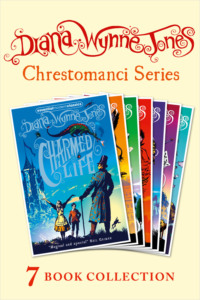
THE CHRESTOMANCI SERIES: ENTIRE COLLECTION BOOKS 1-7
Charmed Life
The Magicians of Caprona
Witch Week
The Lives of Christopher Chant
Mixed Magics
Conrad’s Fate
The Pinhoe Egg
Diana Wynne Jones

Copyright
Charmed Life. Text copyright © Diana Wynne Jones 1977
Illustrations copyright © Tim Stevens 2000
Ebook Edition © DECEMBER 2012 ISBN 9780007393930
Version 1
The Magicians of Caprona. Text copyright © Diana Wynne Jones 1980
Illustrations copyright © Tim Stevens 2000
Ebook Edition © DECEMBER 2012 ISBN 9780007369096
Version 1
Witch Week. Text copyright © Diana Wynne Jones 1982
Illustrations copyright © Tim Stevens 2000
Ebook Edition © DECEMBER 2012 ISBN 9780007369102
Version 1
The Lives of Christopher Chant. Text copyright © Diana Wynne Jones 1988
Illustrations copyright © Tim Stevens 2000
Ebook Edition © DECEMBER 2012 ISBN 9780007389018
Version 1
Mixed Magics. collection © Diana Wynne Jones 2000
Warlock at the Wheel © Diana Wynne Jones 1984 Carol Oneir’s Hundreth Dream © Diana Wynne Jones 1986 The Sage of Theare © Diana Wynne Jones 1982 Stealer of Souls © Diana Wynne Jones 2000 Illustrations copyright © Tim Stevens 2000
Ebook Edition © DECEMBER 2012 ISBN 9780007389025
Version 1
Conrad’s Fate. Copyright © Diana Wynne Jones 2005
Illustrations copyright © Tim Stevens 2005
Ebook Edition © DECEMBER 2012 ISBN 9780007383511
Version 1
The Pinhoe Egg. Copyright © Diana Wynne Jones 2006
Illustrations copyright © Tim Stevens 2006
Ebook Edition © SEPTEMBER 2009 ISBN: 9780007349951
Version 1
All rights reserved under International and Pan-American Copyright Conventions. By payment of the required fees, you have been granted the nonexclusive, nontransferable right to access and read the text of this ebook on screen. No part of this text may be reproduced, transmitted, downloaded, decompiled, reverse-engineered, or stored in or introduced into any information storage and retrieval system, in any form or by any means, whether electronic or mechanical, now known or hereinafter invented, without the express written permission of HarperCollins ebooks
HarperCollinsPublishers has made every reasonable effort to ensure that any picture content or written content in this ebook has been included or removed in accordance with the contractual and technological constraints in operation at the time of publication
Ebook Edition © AUGUST 2013 ISBN: 9780007537921
Version: 2018-12-03
Contents
Title Page
Copyright
Charmed Life
The Magicians of Caprona
Witch Week
The Lives of Christopher Chant
Mixed Magics
Conrad’s Fate
The Pinhoe Egg
Keep Reading
About the Author
About the Publisher


For Claire, Nicholas and Frances
Contents
Title Page
Dedication
Chapter 1
Chapter 2
Chapter 3
Chapter 4
Chapter 5
Chapter 6
Chapter 7
Chapter 8
Chapter 9
Chapter 10
Chapter 11
Chapter 12
Chapter 13
Chapter 14
Chapter 15
Chapter 16

Cat Chant admired his elder sister Gwendolen. She was a witch. He admired her and he clung to her. Great changes came about in their lives and left him no one else to cling to.
The first great change came about when their parents took them out for a day trip down the river in a paddle steamer. They set out in great style, Gwendolen and her mother in white dresses with ribbons, Cat and his father in prickly blue serge Sunday suits. It was a hot day. The steamer was crammed with other people in holiday clothes, talking, laughing, eating whelks with thin slices of white bread and butter, while the paddle boat steam organ wheezed out popular tunes so that no one could hear themselves talk.
In fact the steamer was too crowded and too old. Something went wrong with the steering. The whole laughing, whelk-eating Sunday-dressed crowd was swept away in the current from the weir. They hit one of the posts which were supposed to stop people being swept away, and the paddle steamer, being old, simply broke into pieces. Cat remembered the organ playing and the paddles beating the blue sky. Clouds of steam screamed from broken pipes and drowned the screams from the crowd, as every single person aboard was swept away through the weir.
It was a terrible accident. The papers called it the Saucy Nancy Disaster. The ladies in their clinging skirts were quite unable to swim. The men in tight blue serge were very little better off. But Gwendolen was a witch, so she could not drown. And Cat, who flung his arms around Gwendolen when the boat hit the post, survived too. There were very few other survivors.
The whole country was shocked by it. The paddle boat company and the town of Wolvercote between them paid for the funerals. Gwendolen and Cat were given heavy black clothes at public expense, and rode behind the procession of hearses in a carriage pulled by black horses with black plumes on their heads. The other survivors rode with them. Cat looked at them and wondered if they were witches and warlocks, but he never found out. The Mayor of Wolvercote had set up a Fund for the survivors. Money poured in from all over the country. All the other survivors took their share and went away to start new lives elsewhere. Only Cat and Gwendolen were left and, since nobody could discover any of their relations, they stayed in Wolvercote.
They became celebrities for a time. Everyone was very kind. Everyone said what beautiful little orphans they were. It was true. They were both fair and pale, with blue eyes, and looked good in black. Gwendolen was very pretty, and tall for her age. Cat was small for his age. Gwendolen was very motherly to Cat, and people were touched.
Cat did not mind. It made up a little for the empty, lost way he was feeling. Ladies gave him cake and toys. Town Councillors came and asked how he was getting on; and the Mayor called and patted him on the head. The Mayor explained that the money from the Fund was being put into a Trust for them until they were grown up. Meanwhile, the town would pay for their education and upbringing.
“And where would you little people like to live?” he asked kindly.
Gwendolen at once said that old Mrs Sharp downstairs had offered to take them in. “She’s been ever so kind to us,” she explained. “We’d love to live with her.”
Mrs Sharp had been very kind. She was a witch too – the printed sign in her parlour said Certified Witch – and interested in Gwendolen. The Mayor was a little dubious. Like all people who had no talent for witchcraft, he did not approve of those who had. He asked Cat how he felt about Gwendolen’s plan. Cat did not mind. He preferred living in the house he was used to, even if it was downstairs. Since the Mayor felt that the two orphans ought to be made as happy as possible, he agreed. Gwendolen and Cat moved in with Mrs Sharp.
Looking back on it, Cat supposed that it was from this time on that he was certain Gwendolen was a witch. He had not been sure before. When he had asked his parents, they had shaken their heads, sighed, and looked unhappy. Cat had been puzzled, because he remembered the terrible trouble there had been when Gwendolen gave him cramps. He could not see how his parents could blame Gwendolen for it unless she truly was a witch. But all that was changed now. Mrs Sharp made no secret of it.
“You’ve a real talent for magic, dearie,” she said, beaming at Gwendolen, “and I wouldn’t be doing my duty by you if I let it go to waste. We must see about a teacher for you right away. You could do worse than go to Mr Nostrum next door for a start. He may be the worst necromancer in town, but he knows how to teach. He’ll give you a good grounding, my love.”
Mr Nostrum’s charges for teaching magic turned out to be £1 an hour for the Elementary Grades, and a guinea an hour for the Advanced Grades beyond. Rather expensive, as Mrs Sharp said. She put on her best hat with black beads and ran round to the Town Hall to see if the Fund would pay for Gwendolen’s lessons.
To her annoyance, the Mayor refused. He told Mrs Sharp that witchcraft was not part of an ordinary education. Mrs Sharp came back rattling the beads on her hat with irritation, and carrying a flat cardboard box the Mayor had given her, full of odds and ends the kind ladies had cleared out of Gwendolen’s parents’ bedroom.
“Blind prejudice!” Mrs Sharp said, dumping the box on the kitchen table. “If a person has a gift, they have a right to have it developed – and so I told him! But don’t worry, dearie,” she said, seeing that Gwendolen was looking decidedly stormy. “There’s a way round everything. Mr Nostrum would teach you for nothing, if we found the right thing to tempt him with. Let’s have a look in this box. Your poor Ma and Pa may have left something that might be just the thing.”
Accordingly, Mrs Sharp turned the box out on to the table. It was a queer collection of things – letters and lace and souvenirs. Cat did not remember having seen half of them before. There was a marriage certificate, saying that Francis John Chant had married Caroline Mary Chant twelve years ago at St Margaret’s Church, Wolvercote, and a withered nosegay his mother must have carried at the wedding. Underneath that, he found some glittery earrings he had never seen his mother wear.
Mrs Sharp’s hat rattled as she bent swiftly over these. “Those are diamond earrings!” she said. “Your Ma must have had money! Now, if I took those to Mr Nostrum – But we’d get more for them if I took them round to Mr Larkins.”
Mr Larkins kept the junk shop on the corner of the street – except that it was not always exactly junk. Among the brass fenders and chipped crockery, you could find quite valuable things and also a discreet notice saying Exotic Supplies – which meant that Mr Larkins also stocked bats’ wings, dried newts and other ingredients of magic. There was no question that Mr Larkins would be very interested in a pair of diamond earrings. Mrs Sharp’s eyes pouched up, greedy and beady, as she put out her hand to pick up the earrings.
Gwendolen put out her hand for them at the same moment. She did not say anything. Neither did Mrs Sharp. Both their hands stood still in the air. There was a feeling of fierce invisible struggle. Then Mrs Sharp took her hand away. “Thank you,” said Gwendolen coldly, and put the earrings away in the pocket of her black dress.
“You see what I mean?” Mrs Sharp said, making the best of it. “You have real talent, dearie!” She went back to sorting the other things in the box. She turned over an old pipe, ribbons, a spray of white heather, menus, concert tickets, and picked up a bundle of old letters. She ran her thumb down the edge of it. “Love letters,” she said. “His to her.” She put the bundle down without looking at it and picked up another. “Hers to him. No use.” Cat, watching Mrs Sharp’s broad mauve thumb whirring down a third bundle of letters, thought that being a witch must save a great deal of time. “Business letters,” said Mrs Sharp. Her thumb paused, and went slowly back up the pile again. “Now what have we here?” she said. She untied the pink tape round the bundle and carefully took out three letters. She unfolded them.
“Chrestomanci!” she exclaimed. And, as soon as she said it, she clapped one hand over her mouth and mumbled behind it. Her face was red. Cat could see she was surprised, frightened and greedy, all at the same time. “Now what was he doing writing to your Pa?” she said, as soon as she had recovered.
“Let’s see,” said Gwendolen.
Mrs Sharp spread the three letters out on the kitchen table, and Gwendolen and Cat bent over them. The first thing that struck Cat was the energy of the signature on all three:

The next thing he saw was that two of the letters were written in the same energetic writing as the signature. The first was dated twelve years ago, soon after his parents had been married. It said:
Dear Frank,
Now don’t get on your high horse. I only offered because I thought it might help. I still will help, in any way I can, if you let me know what I can do. I feel you have a claim on me.
Yrs ever,
Chrestomanci
The second letter was shorter:
Dear Chant,
The same to you. Go to blazes.
Chrestomanci
The third letter was dated six years ago, and it was written by someone else. Chrestomanci had only signed it.
Sir,
You were warned six years ago that something like what you relate might come to pass, and you made it quite clear that you wished for no help from this quarter. We are not interested in your troubles. Nor is this a charitable institution.
Chrestomanci
“What did your Pa say to him?” Mrs Sharp wondered, curious and awestruck. “Well – what do you think, dearie?”
Gwendolen held her hands spread out above the letters, rather as if she was warming them at a fire. Both her little fingers twitched. “I don’t know. They feel important – specially the first one and the last one – awfully important.”
“Who’s Chrestomanci?” Cat asked. It was a hard name to say. He said it in pieces, trying to remember the way Mrs Sharp had said it: KREST-OH-MAN-SEE. “Is that the right way?”
“Yes, that’s right – and never you mind who he is, my love,” said Mrs Sharp. “And important’s a weak word for it, dearie. I wish I knew what your Pa had said. Something not many people’d dare say, by the sound of it. And look at what he got in return! Three genuine signatures! Mr Nostrum would give his eyes for those, dearie. Oh, you’re in luck! He’ll teach you for those all right! So would any necromancer in the country.”
Gleefully, Mrs Sharp began packing the things away in the box again. “What have we here?” A little red book of matches had fallen out of the bundle of business letters. Mrs Sharp took it up carefully and, quite as carefully, opened it. It was less than half full of flimsy cardboard matches. But three of the matches had been burnt, without being torn out of the book first. The third one along was so very burnt that Cat supposed it must have set light to the other two.
“Hm,” said Mrs Sharp. “I think you’d better keep this, dearie.” She passed the little red book to Gwendolen, who put it in the pocket of her dress along with the earrings. “And what about you having this, my love?” Mrs Sharp said to Cat, remembering that he had a claim too. She gave him the spray of white heather. Cat wore it in his buttonhole until it fell to pieces.
Living with Mrs Sharp, Gwendolen seemed to expand. Her hair seemed brighter gold, her eyes deeper blue, and her whole manner was glad and confident. Perhaps Cat contracted a little to make room for her – he did not know. Not that he was unhappy. Mrs Sharp was quite as kind to him as she was to Gwendolen. Town Councillors and their wives called several times a week and patted him on the head in the parlour. They sent him and Gwendolen to the best school in Wolvercote.
Cat was happy there. The only drawback was that Cat was left-handed, and schoolmasters always punished him if they caught him writing with his left hand. But they did that at all the schools Cat had been to, and he was used to it. He had dozens of friends. All the same, at the heart of everything, he felt lost and lonely. So he clung to Gwendolen, because she was the only family he had.
Gwendolen was often rather impatient with him, though usually she was too busy and happy to be downright cross. “Just leave me alone, Cat,” she would say. “Or else.” Then she would pack exercise books into a music-case and hasten next door for a lesson with Mr Nostrum.
Mr Nostrum was delighted to teach Gwendolen for the letters. Mrs Sharp gave him one every term for a year, starting with the last. “Not all at once, in case he gets greedy,” she said. “And we’ll give him the best last.”
Gwendolen made excellent progress. Such a promising witch was she, indeed, that she skipped the First Grade Magic exam and went straight on to the Second. She took the Third and Fourth Grades together just after Christmas, and, by the following summer, she was starting on Advanced Magic. Mr Nostrum regarded her as his favourite pupil – he told Mrs Sharp so over the wall – and Gwendolen always came back from her lessons with him pleased and golden and glowing. She went to Mr Nostrum two evenings a week, with her magic-case under her arm, just as many people might go to music lessons. In fact, music lessons were what Mrs Sharp put Gwendolen down as having, on the accounts she kept for the Town Council. Since Mr Nostrum never got paid, except by the letters, Cat thought this was rather dishonest of Mrs Sharp.
“I have to put something by for my old age,” Mrs Sharp told him crossly. “I don’t get much for myself out of keeping you, do I? And I can’t trust your sister to remember me when she’s grown up and famous. Oh dear me no – I’ve no illusions about that!”
Cat knew Mrs Sharp was probably right. He was a little sorry for her, for she had certainly been kind, and he knew by now that she was not a very good witch herself. The Certified Witch which the notice in Mrs Sharp’s parlour window claimed her to be was, in fact, the very lowest qualification. People only came to Mrs Sharp for charms when they could not afford the three Accredited Witches further down the street. Mrs Sharp eked out her earnings by acting as an agent for Mr Larkins at the junk shop. She got him Exotic Supplies – that is to say, the stranger ingredients needed for spells – from as far away as London. She was very proud of her contacts in London. “Oh yes,” she often said to Gwendolen, “I’ve got the contacts, I have. I know those that can get me a pound of dragon’s blood any time I ask, for all it’s illegal. While you have me, you’ll never be in need.”
Perhaps, in spite of having no illusions about Gwendolen, Mrs Sharp was really hoping to become Gwendolen’s manager when Gwendolen grew up. Cat suspected she was, anyway. And he was sorry for Mrs Sharp. He was sure that Gwendolen would cast her off like an old coat when she became famous – like Mrs Sharp, Cat had no doubt that Gwendolen would be famous. So he said, “There’s me to look after you, though.” He did not fancy the idea, but he felt he ought to say it.
Mrs Sharp was warmly grateful. As a reward, she arranged for Cat to have real music lessons. “Then that Mayor will have nothing to complain of,” she said. She believed in killing two birds with one stone.
Cat started to learn the violin. He thought he was making good progress. He practised diligently. He never could understand why the new people living upstairs always banged on the floor when he started to play. Mrs Sharp, being tone-deaf herself, nodded and smiled when he played, and encouraged him greatly.
He was practising away one evening, when Gwendolen stormed in and shrieked a spell in his face. Cat found, to his dismay, that he was holding a large striped cat by the tail. He had its head tucked under his chin, and he was sawing at its back with the violin bow. He dropped it hurriedly. Even so, it bit him under the chin and scratched him painfully.
“What did you do that for?” he said. The cat stood in an arch, glaring at him.
“Because that’s just what it sounded like!” said Gwendolen. “I couldn’t stand it a moment longer. Here, pussy, pussy!” The cat did not like Gwendolen either. It scratched the hand she held out to it. Gwendolen smacked it. It ran away, with Cat in hot pursuit, shouting, “Stop it! That’s my fiddle! Stop it!” But the cat escaped, and that was the end of the violin lessons.
Mrs Sharp was very impressed with this display of talent from Gwendolen. She climbed on a chair in the yard and told Mr Nostrum about it over the wall. From there, the story spread to every witch and necromancer in the neighbourhood.
That neighbourhood was full of witches. People in the same trade like to cluster together. If Cat came out of Mrs Sharp’s front door and turned right down Coven Street, he passed, besides the three Accredited Witches, two Necromancy Offered, a Soothsayer, a Diviner, and a Willing Warlock. If he turned left, he passed MR HENRY NOSTRUM A.R.C.M. Tuition in Necromancy, a Fortune-teller, a Sorcery For All Occasions, a Clairvoyant, and lastly Mr Larkins’ shop. The air in the street, and for several streets around, was heavy with the scent of magic being done.
All these people took a great and friendly interest in Gwendolen. The story of the cat impressed them enormously. They made a great pet of the creature – naturally, it was called Fiddle. Though it remained bad-tempered, captious and unfriendly, it never went short of food. They made an even greater pet of Gwendolen. Mr Larkins gave her presents. The Willing Warlock, who was a muscular young man always in need of a shave, popped out of his house whenever he saw Gwendolen passing and presented her with a bullseye. The various witches were always looking out simple spells for her.
Gwendolen was very scornful of these spells. “Do they think I’m a baby or something? I’m miles beyond this stuff!” she would say, casting the latest spell aside.
Mrs Sharp, who was glad of any aid to witchcraft, usually gathered the spell up carefully and hid it. But once or twice, Cat found the odd spell lying about. Then he could not resist trying it. He would have liked to have had just a little of Gwendolen’s talent. He always hoped that he was a late-developer and that, some day, a spell would work for him. But they never did – not even the one for turning brass buttons into gold, which Cat particularly fancied.
The various fortune-tellers gave Gwendolen presents too. She got an old crystal ball from the Diviner and a pack of cards from the Soothsayer. The Fortune-teller told her fortune for her. Gwendolen came in golden and exultant from that.
“I’m going to be famous! He said I could rule the world if I go the right way about it!” she told Cat.
Though Cat had no doubt that Gwendolen would be famous, he could not see how she could rule the world, and he said so. “You’d only rule one country, even if you married the King,” he objected. “And the Prince of Wales got married last year.”
“There are more ways of ruling than that, stupid!” Gwendolen retorted. “Mr Nostrum has lots of ideas for me, for a start. Mind you, there are some snags. There’s a change for the worse that I have to surmount, and a dominant Dark Stranger. But when he told me I’d rule the world my fingers all twitched, so I know it’s true!” There seemed no limit to Gwendolen’s glowing confidence.
The next day, Miss Larkins the Clairvoyant called Cat into her house and offered to tell his fortune too.
“I warn you,” said Mr Saunders. “That is the most spoilt dragon in the world.”
“I’m the only dragon in the world,” the dragon said smugly.
Janet was still inclined to be tearful. “My dear, we do understand,” said Millie, “and we’re so very sorry.”
“I can send you back,” said Chrestomanci. “It’s not quite so easy with Gwendolen’s world missing from the series, but don’t think it can’t be done.”
“No, no. That’s all right,” Janet gulped. “At least, it will be all right when I’m used to it. I was hoping to come back here – but it is rather a wrench. You see—” Her eyes filled and her mouth trembled. A handkerchief came out of the air and pushed itself into her hand. Cat did not know who had done it, but he wished he had thought of it.
“Thanks,” said Janet. “You see, Mum and Dad haven’t noticed the difference.” She blew her nose furiously. “I got back to my bedroom, and the other girl – she’s called Romillia really – had been writing her diary. She got called away in mid-sentence and left it lying there, so I read it. And it was all about how scared she had been in case my parents noticed she wasn’t me, and how glad she was when she was clever enough to make sure they didn’t. She was utterly terrified of being sent back. She’d had a dreadful life as an orphan in her own world, and she was miserable there. She’d written things that made me feel sorry for her. Mind you,” Janet said severely, “she was just asking for trouble keeping a diary in the same house as my parents. I wrote a note in it telling her so, and I said if she must keep one, she’d better put it in one of my good hiding places. And then – and then I sat there and rather hoped I’d come back.”
“That was kind of you,” said Cat.
“It was, and you’re truly welcome, my love,” said Millie.
“You’re sure?” Chrestomanci asked, looking searchingly at Janet over the chicken leg he was eating.
Janet nodded, quite firmly, though most of her face was still hidden in the handkerchief.
“You were the one I was most worried about,” Chrestomanci said. “I’m afraid I didn’t realise at once what had happened. Gwendolen had found out about the mirror, you see, and she worked the change in her bathroom. And anyway, none of us had the slightest idea Cat’s powers were that strong. The truth only dawned on me during the unfortunate affair of the frog, and then of course I took a look at once to see what had happened to Gwendolen and the seven other girls. Gwendolen was in her element. And Jennifer, who came after Romillia, is as tough as Gwendolen and has always wished she was an orphan; whereas Queen Caroline, whom Gwendolen displaced, was as miserable as Romillia, and had run away three times already. And it was the same with the other five. They were all much better suited – except perhaps you.”
Janet took her face out of the handkerchief and looked at him in large indignation. “Why couldn’t you have told me you knew? I wouldn’t have been nearly so scared of you! And you wouldn’t believe the troubles Cat got into because of it, not to speak of me owing Mr Bagwash twenty pounds and not knowing the Geography and History here! And you needn’t laugh!” she said, as nearly everyone did.
“I apologise,” said Chrestomanci. “Believe me, it was one of the most troubling decisions I’ve ever had to make. But who on earth is Mr Bagwash?”
“Mr Baslam,” Cat explained reluctantly. “Gwendolen bought some dragon’s blood from him and didn’t really pay.”
“He’s asking outrageously much,” said Millie. “And it is illegal, you know.”
“I’ll go and have a word with him tomorrow,” Bernard said from his hammock. “Though he’ll probably be gone by then. He knows I’ve got my eye on him.”
“Why was it a troubling decision?” Janet asked Chrestomanci.
Chrestomanci tossed his chicken bone to the dragon and slowly wiped his fingers on a handkerchief with a gold-embroidered C in one corner. This gave him an excuse to turn Cat’s way and stare, in his vaguest way, into the air above Cat’s head. Since Cat was fairly clear by now that the vaguer Chrestomanci seemed about something, the more acutely he was attending to it, he was not altogether surprised when Chrestomanci said, “Because of Cat. We would have felt a good deal easier if Cat could have brought himself to tell someone what had happened. We gave him a number of opportunities to. But when he held his tongue, we thought perhaps he did know the extent of his powers after all.”
“But I don’t,” said Cat. And Janet, who was becoming thoroughly cheerful now she was being allowed to ask questions, said, “I think you were quite wrong. We both got so frightened that we came into this garden and nearly got you and Cat killed. You should have said.”
“Perhaps,” agreed Chrestomanci, and peeled a banana in a thoughtful way. He was still turned towards Cat. “Normally we’re more than a match here for people like the Nostrums. I knew they were planning something through Gwendolen, and I thought Cat knew it too – my apologies, Cat. I wouldn’t have had Gwendolen here for a minute, except that we had to have Cat. Chrestomanci has to be a nine-lifed enchanter. No one else is strong enough for the post.”
“Post?” said Janet. “Isn’t it a hereditary title then?”
Mr Saunders laughed, and threw his bone to the dragon, too. “Heavens no! We’re all Government employees here. The job Chrestomanci has is to make sure this world isn’t run entirely by witches. Ordinary people have rights too. And he has to make sure witches don’t get out into worlds where there isn’t so much magic and play havoc there. It’s a big job. And we’re the staff that helps him.”
“And he needs us like he needs two left legs,” Bernard remarked, jerking about in the hammock as he tried to eat a jelly.
“Oh, come now!” said Chrestomanci. “I’d have been sunk without you today.”
“I was thinking of the way you found the next Chrestomanci,” Bernard said, spooning jelly off his waistcoat. “You did it, when we were just going round in circles.”
“Nine-lifed enchanters are not easy to find,” Chrestomanci explained to Janet. “In the first place, they’re very rare, and in the second, they have to use their magic before they can be found. And Cat didn’t. We were actually thinking of bringing someone in from another world, when Cat happened to fall into the hands of a clairvoyant. Even then, we only knew where he was, not who. I’d no idea he was Eric Chant, or any relation of mine at all – though I suppose I might have remembered that his parents were cousins, which doubled the chance of their children being witches. And I must confess that Frank Chant wrote to me to say his daughter was a witch and seemed to be using her younger brother in some way. Forgive me, Cat. I ignored that letter, because your father had been so very rude when I offered to make sure his children would be born without witchcraft.”
“Just as well he was rude, you know,” Bernard said.
“Was that what the letters were about?” said Cat.
“I don’t understand,” said Janet, “why you didn’t say anything at all to Cat. Why couldn’t you?”
Chrestomanci was still looking vaguely in Cat’s direction. Cat could tell he was very wary indeed. “Like this,” he said. “Remember we hadn’t known one another very long. Cat appears to have no magic at all. Yet his sister works magic far beyond her own abilities, and goes on doing it even when her witchcraft is taken away. What am I to think? Does Cat know what he’s doing? If he doesn’t, why doesn’t he? And if he does know, what is he up to? When Gwendolen removed herself, and nobody mentioned the fact, I hoped some of the answers might emerge. And Cat still does nothing—”
“What do you mean, nothing?” said Janet. “There were some fabulous conkers, and he kept stopping Julia.”
“Yes, and I couldn’t think what was happening,” Julia said, rather shamed.
Cat felt hurt and uncomfortable. “Leave me alone!” he said, and he stood up. Everyone, even Chrestomanci, went tense. The only person who did not was Janet, and Cat could hardly count her, because she was not used to magic. He found he was trying not to cry, which made him very much ashamed. “Stop treating me so carefully!” he said. “I’m not a fool, or a baby. You’re all afraid of me, aren’t you? You didn’t tell me things and you didn’t punish Gwendolen because you were afraid I’d do something dreadful. And I haven’t. I don’t know how to. I didn’t know I could.”
“My love, it was just that no one was sure,” said Millie.
“Well, be sure now!” said Cat. “The only things I did were by mistake, like coming here in this garden – and turning Euphemia into a frog, I suppose, but I didn’t know it was me.”
“You’re not to worry about that, Eric,” said Euphemia from the hillside, where she was sitting with Will Suggins. “It was the shock upset me. I know enchanters are different from us witches. And I’ll speak to Mary. I promise.”
“Speak to Will Suggins too, while you’re at it,” said Janet. “Because he’s going to turn Cat into a frog in revenge any minute now.”
Euphemia bounced round on the hillside to look at Will. “What?” she said.
“What is this, Will?” Chrestomanci asked.
“I laid it on him – for three o’clock, sir,” Will Suggins said apprehensively, “if he didn’t meet me as a tiger.”
Chrestomanci took out a large gold watch. “Hm. It’s about due now. If you don’t mind my saying so, that was a little foolish of you, Will. Suppose you carry on. Turn Cat into a frog, or yourself into a tiger, or both. I shan’t interfere.”
Will Suggins climbed heavily to his feet and stood facing Cat, looking as if he would prefer to be several miles away. “Let the dough work, then,” he said.
Cat was still feeling so upset and tearful that he wondered whether to oblige Will Suggins and become a frog. Or he could try being a flea instead. But it all seemed rather silly. “Why don’t you be a tiger?” he said.
As Cat expected, Will Suggins made a beautiful tiger, long-backed and sleek and sharply striped. He was heavy as he padded up and down the slope, but his legs slid so easily in the silky folds of his hide that he almost seemed light. But Will Suggins himself spoilt the effect by rubbing a distressed paw over his huge cat face and staring appealingly at Chrestomanci. Chrestomanci simply laughed. The dragon trotted up the hill to investigate this new beast. Will Suggins was so alarmed that he reared up on his great hind legs to get away from it. It looked so ungainly for a tiger to be doing that, that Cat turned him back to Will Suggins on the spot.
“It wasn’t real?” asked the dragon.
“No!” said Will Suggins, mopping his face with his sleeve. “All right, lad, you win. How did you do it so quick?”
“I don’t know,” Cat said apologetically. “I’ve really no idea. Shall I learn when you teach me magic?” he asked Mr Saunders.
Mr Saunders looked a little blank. “Well—”
“No, Michael,” said Chrestomanci, “is the right answer. It’s quite clear elementary magic isn’t going to mean much to Cat. I’ll have to teach you myself, Cat, and we’ll be starting on Advanced Theory, I think, by the look of it. You seem to start where most people leave off.”
“But why didn’t he know?” Janet demanded. “It always makes me angry not to know things, and I feel specially angry about this, because it seems so hard on Cat.”
“It is, I agree,” said Chrestomanci. “But it’s something in the nature of enchanters’ magic, I think. Something the same happened to me. I couldn’t do magic either. I couldn’t do anything. But they found I had nine lives – I lost them at such a rate that it soon became obvious – and they told me I had to be the next Chrestomanci when I grew up, which absolutely appalled me, because I couldn’t work the simplest spell. So they sent me to a tutor, the most terrifying old person, who was supposed to find what the trouble was. And he took one look at me and snarled, ‘Empty your pockets, Chant!’ Which I did. I was too scared not to. I took out my silver watch, and one and sixpence, and a silver charm from my godmother, and a silver tie pin I had forgotten to wear, and a silver brace I was supposed to wear in my teeth. And as soon as they were gone, I did some truly startling things. As I remember, the roof of the tutor’s house came off.”
“Is it really true about silver then?” Janet said.
“For me, yes,” said Chrestomanci.
“Yes, poor darling,” Millie said, smiling at him. “It’s so awkward with money. He can only handle pound notes and coppers.”
“He has to give us our pocket-money in pennies, if Michael hasn’t got it,” said Roger. “Imagine sixty pennies in your pocket.”
“The really difficult thing is mealtimes,” said Millie. “He can’t do a thing with a knife and fork in his hands – and Gwendolen would do awful things during dinner.”
“How stupid!” said Janet. “Why on earth don’t you use stainless steel cutlery?”
Millie and Chrestomanci looked at one another. “I never thought of it!” said Millie. “Janet, my love, it’s a good thing you’re staying here!”
Janet looked at Cat and laughed. And Cat, though he was still a little lonely and tearful, managed to laugh too.


For John
CONTENTS
Title Page
Dedication
Chapter 1
Chapter 2
Chapter 3
Chapter 4
Chapter 5
Chapter 6
Chapter 7
Chapter 8
Chapter 9
Chapter 10
Chapter 11
Chapter 12
Chapter 13
Chapter 14
Chapter 15

Spells are the hardest thing in the world to get right. This was one of the first things the Montana children learnt. Anyone can hang up a charm, but when it comes to making that charm, whether it is written or spoken or sung, everything has to be just right, or the most impossible things happen.
An example of this is young Angelica Petrocchi, who turned her father bright green by singing a wrong note. It was the talk of all Caprona – indeed of all Italy – for weeks.
The best spells still come from Caprona, in spite of the recent troubles, from the Casa Montana or the Casa Petrocchi. If you are using words that really work, to improve reception on your radio or to grow tomatoes, then the chances are that someone in your family has been on a holiday to Caprona and brought the spell back. The Old Bridge in Caprona is lined with little stone booths, where long coloured envelopes, scrips and scrolls hang from strings like bunting.
You can get spells there from every spell-house in Italy. Each spell is labelled as to its use and stamped with the sign of the house which made it. If you want to find out who made your spell, look among your family papers. If you find a long cherry-coloured scrip stamped with a black leopard, then it came from the Casa Petrocchi. If you find a leaf-green envelope bearing a winged horse, then the House of Montana made it. The spells of both houses are so good that ignorant people think that even the envelopes can work magic. This, of course, is nonsense. For, as Paolo and Tonino Montana were told over and over again, a spell is the right words delivered in the right way.
The great houses of Petrocchi and Montana go back to the first founding of the State of Caprona, seven hundred years or more ago. And they are bitter rivals. They are not even on speaking terms. If a Petrocchi and a Montana meet in one of Caprona’s narrow golden-stone streets, they turn their eyes aside and edge past as if they were both walking past a pig-sty. Their children are sent to different schools and warned never, ever to exchange a word with a child from the other house.
Sometimes, however, parties of young men and women of the Montanas and the Petrocchis happen to meet when they are strolling on the wide street called the Corso in the evenings. When that happens, other citizens take shelter at once. If they fight with fists and stones, that is bad enough, but if they fight with spells, it can be appalling.
An example of this is when the dashing Rinaldo Montana caused the sky to rain cowpats on the Corso for three days. It created great distress among the tourists.
“A Petrocchi insulted me,” Rinaldo explained, with his most flashing smile. “And I happened to have a new spell in my pocket.”
The Petrocchis unkindly claimed that Rinaldo had misquoted his spell in the heat of the battle. Everyone knew that all Rinaldo’s spells were love-charms.
The grown-ups of both houses never explained to the children just what had made the Montanas and the Petrocchis hate one another so. That was a task traditionally left to the older brothers, sisters and cousins. Paolo and Tonino were told the story repeatedly, by their sisters Rosa, Corinna and Lucia, by their cousins Luigi, Carlo, Domenico and Anna, and again by their second-cousins Piero, Luca, Giovanni, Paula, Teresa, Bella, Angelo and Francesco. They told it themselves to six smaller cousins as they grew up. The Montanas were a large family.
Two hundred years ago, the story went, old Ricardo Petrocchi took it into his head that the Duke of Caprona was ordering more spells from the Montanas than from the Petrocchis, and he wrote old Francesco Montana a very insulting letter about it. Old Francesco was so angry that he promptly invited all the Petrocchis to a feast. He had, he said, a new dish he wanted them to try. Then he rolled Ricardo Petrocchi’s letter up into long spills and cast one of his strongest spells over it. And it turned into spaghetti. The Petrocchis ate it greedily and were all taken ill, particularly old Ricardo – for nothing disagrees with a person so much as having to eat his own words. He never forgave Francesco Montana, and the two families had been enemies ever since.
“And that,” said Lucia, who told the story oftenest, being only a year older than Paolo, “was the origin of spaghetti.”
It was Lucia who whispered to them all the terrible heathen customs the Petrocchis had: how they never went to Mass or confessed; how they never had baths or changed their clothes; how none of them ever got married but just – in an even lower whisper – had babies like kittens; how they were apt to drown their unwanted babies, again like kittens, and had even been known to eat unwanted uncles and aunts; and how they were so dirty that you could smell the Casa Petrocchi and hear the flies buzzing right down the Via Sant’ Angelo.
There were many other things besides, some of them far worse than these, for Lucia had a vivid imagination. Paolo and Tonino believed every one, and they hated the Petrocchis heartily, though it was years before either of them set eyes on a Petrocchi. When they were both quite small, they did sneak off one morning, down the Via Sant’ Angelo almost as far as the New Bridge, to look at the Casa Petrocchi. But there was no smell and no flies buzzing to guide them, and their sister Rosa found them before they found it. Rosa, who was eight years older than Paolo and quite grown-up even then, laughed when they explained their difficulty, and good-naturedly took them to the Casa Petrocchi. It was in the Via Cantello, not the Via Sant’ Angelo at all.
Paolo and Tonino were most disappointed in it. It was just like the Casa Montana. It was large, like the Casa Montana, and built of the same golden stone of Caprona, and probably just as old. The great front gate was old knotty wood, just like their own, and there was even the same golden figure of the Angel on the wall above the gate. Rosa told them that both Angels were in memory of the Angel who had come to the first Duke of Caprona bringing a scroll of music from Heaven – but the boys knew that. When Paolo pointed out that the Casa Petrocchi did not seem to smell much, Rosa bit her lip and said gravely that there were not many windows in the outside walls, and they were all shut.
“I expect everything happens round the yard inside, just like it does in our Casa,” she said. “Probably all the smelling goes on in there.”
They agreed that it probably did, and wanted to wait to see a Petrocchi come out. But Rosa said she thought that would be most unwise, and pulled them away. The boys looked over their shoulders as she dragged them off and saw that the Casa Petrocchi had four golden-stone towers, one at each corner, where the Casa Montana only had one, over the gate.
“It’s because the Petrocchis are show-offs,” Rosa said, dragging. “Come on.”
Since the towers were each roofed with a little hat of red pantiles, just like their own roofs or the roofs of all the houses in Caprona, Paolo and Tonino did not think they were particularly grand, but they did not like to argue with Rosa. Feeling very let down, they let her drag them back to the Casa Montana and pull them through their own large knotty gate into the bustling yard beyond. There Rosa left them and ran up the steps to the gallery, shouting, “Lucia! Lucia, where are you? I want to talk to you!”
Doors and windows opened into the yard all round, and the gallery, with its wooden railings and pantiled roof, ran round three sides of the yard and led to the rooms on the top floor. Uncles, aunts, cousins large and small, and cats were busy everywhere, laughing, cooking, discussing spells, washing, sunning themselves or playing. Paolo gave a sigh of contentment and picked up the nearest cat.
“I don’t think the Casa Petrocchi can be anything like this inside.”
Before Tonino could agree, they were swooped on lovingly by Aunt Maria, who was fatter than Aunt Gina, but not as fat as Aunt Anna. “Where have you been, my loves? I’ve been ready for your lessons for half an hour or more!”
Everyone in the Casa Montana worked very hard. Paolo and Tonino were already being taught the first rules for making spells. When Aunt Maria was busy, they were taught by their father, Antonio. Antonio was the eldest son of Old Niccolo, and would be head of the Casa Montana when Old Niccolo died. Paolo thought this weighed on his father. Antonio was a thin, worried person who laughed less often than the other Montanas. He was different. One of the differences was that, instead of letting Old Niccolo carefully choose a wife for him from a spell-house in Italy, Antonio had gone on a visit to England and come back married to Elizabeth. Elizabeth taught the boys music.
“If I’d been teaching that Angelica Petrocchi,” she was fond of saying, “she’d never have turned anything green.”
Old Niccolo said Elizabeth was the best musician in Caprona. And that, Lucia told the boys, was why Antonio got away with marrying her. But Rosa told them to take no notice. Rosa was proud of being half English.
Paolo and Tonino were probably prouder to be Montanas. It was a grand thing to know you were born into a family that was known world-wide as the greatest spell-house in Europe – if you did not count the Petrocchis. There were times when Paolo could hardly wait to grow up and be like his cousin, dashing Rinaldo. Everything came easily to Rinaldo. Girls fell in love with him, spells dripped from his pen. He had composed seven new charms before he left school. And these days, as Old Niccolo said, making a new spell was not easy. There were so many already. Paolo admired Rinaldo desperately. He told Tonino that Rinaldo was a true Montana.
Tonino agreed, because he was more than a year younger than Paolo and valued Paolo’s opinions, but it always seemed to him that it was Paolo who was the true Montana. Paolo was as quick as Rinaldo. He could learn without trying spells which took Tonino days to acquire. Tonino was slow. He could only remember things if he went over them again and again. It seemed to him that Paolo had been born with an instinct for magic which he just did not have himself.
Tonino was sometimes quite depressed about his slowness. Nobody else minded in the least. All his sisters, even the studious Corinna, spent hours helping him. Elizabeth assured him he never sang out of tune. His father scolded him for working too hard, and Paolo assured him that he would be streets ahead of the other children when he went to school. Paolo had just started school. He was as quick at ordinary lessons as he was at spells.
But when Tonino started school, he was just as slow there as he was at home. School bewildered him. He did not understand what the teachers wanted him to do. By the first Saturday he was so miserable that he had to slip away from the Casa and wander round Caprona in tears. He was missing for hours.
“I can’t help being quicker than he is!” Paolo said, almost in tears too.
Aunt Maria rushed at Paolo and hugged him. “Now, now, don’t you start too! You’re as clever as my Rinaldo, and we’re all proud of you.”
“Lucia, go and look for Tonino,” said Elizabeth. “Paolo, you mustn’t worry so. Tonino’s soaking up spells without knowing he is. I did the same when I came here. Should I tell Tonino?” she asked Antonio. Antonio had hurried in from the gallery. In the Casa Montana, if anyone was in distress, it always fetched the rest of the family.
Antonio rubbed his forehead. “Perhaps. Let’s go and ask Old Niccolo. Come on, Paolo.”
Paolo followed his thin, brisk father through the patterns of sunlight in the gallery and into the blue coolness of the Scriptorium. Here his other two sisters, Rinaldo and five other cousins, and two of his uncles, were all standing at tall desks copying spells out of big leather-bound books. Each book had a brass lock on it so that the family secrets could not be stolen. Antonio and Paolo tiptoed through. Rinaldo smiled at them without pausing in his copying. Where other pens scratched and paused, Rinaldo’s raced.
In the room beyond the Scriptorium, Uncle Lorenzo and Cousin Domenico were stamping winged horses on leaf-green envelopes. Uncle Lorenzo looked keenly at their faces as they passed and decided that the trouble was not too much for Old Niccolo alone. He winked at Paolo and threatened to stamp a winged horse on him.
Old Niccolo was in the warm mildewy library beyond, consulting over a book on a stand with Aunt Francesca. She was Old Niccolo’s sister, and therefore really a great-aunt. She was a barrel of a lady, twice as fat as Aunt Anna and even more passionate than Aunt Gina. She was saying passionately, “But the spells of the Casa Montana always have a certain elegance. This is graceless! This is—”
Both round old faces turned towards Antonio and Paolo. Old Niccolo’s face, and his eyes in it, were round and wondering as the latest baby’s. Aunt Francesca’s face was too small for her huge body, and her eyes were small and shrewd. “I was just coming,” said Old Niccolo. “I thought it was Tonino in trouble, but you bring me Paolo.”
“Paolo’s not in trouble,” said Aunt Francesca.
Old Niccolo’s round eyes blinked at Paolo. “Paolo,” he said, “what your brother feels is not your fault.”
“No,” said Paolo. “I think it’s school really.”
“We thought that perhaps Elizabeth could explain to Tonino that he can’t avoid learning spells in this Casa,” Antonio suggested.
“But Tonino has ambition!” cried Aunt Francesca.
“I don’t think he does,” said Paolo.
“No, but he is unhappy,” said his grandfather. “And we must think how best to comfort him. I know.” His baby face beamed. “Benvenuto.”
Though Old Niccolo did not say this loudly, someone in the gallery immediately shouted, “Old Niccolo wants Benvenuto!” There was running and calling down in the yard. Somebody beat on a water butt with a stick. “Benvenuto! Where’s that cat got to? Benvenuto!”
Naturally, Benvenuto took his time coming. He was boss cat at the Casa Montana. It was five minutes before Paolo heard his firm pads trotting along the tiles of the gallery roof. This was followed by a heavy thump as Benvenuto made the difficult leap down, across the gallery railing on to the floor of the gallery. Shortly, he appeared on the library windowsill.
“So there you are,” said Old Niccolo. “I was just going to get impatient.”
Benvenuto at once shot forward a shaggy black hind leg and settled down to wash it, as if that was what he had come there to do.
“Ah no, please,” said Old Niccolo. “I need your help.”
Benvenuto’s wide yellow eyes turned to Old Niccolo. He was not a handsome cat. His head was unusually wide and blunt, with grey gnarled patches on it left over from many, many fights. Those fights had pulled his ears down over his eyes, so that Benvenuto always looked as if he were wearing a ragged brown cap. A hundred bites had left those ears notched like holly leaves. Just over his nose, giving his face a leering, lop-sided look, were three white patches. Those had nothing to do with Benvenuto’s position as boss cat in a spell-house. They were the result of his partiality for steak. He had got under Aunt Gina’s feet when she was cooking, and Aunt Gina had spilt hot fat on his head. For this reason, Benvenuto and Aunt Gina always pointedly ignored one another.
“Tonino is unhappy,” said Old Niccolo.
Benvenuto seemed to feel this worthy of his attention. He withdrew his projecting leg, dropped to the library floor and arrived on top of the bookstand, all in one movement, without seeming to flex a muscle. There he stood, politely waving the one beautiful thing about him – his bushy black tail. The rest of his coat had worn to a ragged brown. Apart from the tail, the only thing which showed Benvenuto had once been a magnificent black Persian was the fluffy fur on his hind legs. And, as every other cat in Caprona knew to its cost, those fluffy breeches concealed muscles like a bulldog’s.
Paolo stared at his grandfather talking face to face with Benvenuto. He had always treated Benvenuto with respect himself, of course. It was well known that Benvenuto would not sit on your knee, and scratched you if you tried to pick him up. He knew all cats helped spells on wonderfully. But he had not realised before that cats understood so much. And he was sure Benvenuto was answering Old Niccolo, from the listening sort of pauses his grandfather made. Paolo looked at his father to see if this was true. Antonio was very ill at ease. And Paolo understood from his father’s worried face, that it was very important to be able to understand what cats said, and that Antonio never could. I shall have to start learning to understand Benvenuto, Paolo thought, very troubled.
Paolo’s face fired with shame as he ran. Of all the awful things to happen!
The Casa Montana came in sight, with the familiar Angel safely over the gate. Paolo shot in under it, and ran into his father. Antonio was standing under the archway, panting as if he too had run all the way home.
“Who!? Oh, Paolo,” said Antonio. “Stay where you are.”
“Why?” asked Paolo. He wanted to get in, where it was safe, and perhaps eat a large lump of bread and honey. He was surprised his father did not feel the same. Antonio looked tired out, and his clothes were torn and muddy rags. The arm he stretched out to keep Paolo in the gateway was half bare and covered with scratches. Paolo was going to protest, when he saw that something was indeed wrong. Most of the cats were in the gateway too, crouching around with their ears flattened. Benvenuto was patrolling the entrance to the yard, like a lean brown ferret. Paolo could hear him growling.
Antonio’s scratched hand took Paolo by the shoulder and pulled him forward so that he could see into the yard. “Look.”
Paolo found himself blinking at foot-high letters, which seemed to hang in the air in the middle of the yard. In the fading light, they were glowing an unpleasant, sick yellow.
STOP ALL SPELLS OR YOUR CHILD SUFFERS.
CASA PETROCCHI
The name was in sicker and brighter letters. They were meant to make no mistake about who had sent the message.
After what Renata had said, Paolo knew it was wrong. “It wasn’t the Petrocchis,” he said. “It’s that enchanter Chrestomanci told us about.”
“Yes, to be sure,” said Antonio.
Paolo looked up at him and saw that his father did not believe him – probably had not even attended to him. “But it’s true!” he said. “He wants us to stop making war-spells.”
Antonio sighed, and drew himself together to explain to Paolo. “Paolo,” he said, “nobody but Chrestomanci believes in this enchanter. In magic, as in everything else, the simplest explanation is always best. In other words, why invent an unknown enchanter, when you have a known enemy with known reasons for hating you? Why shouldn’t it be the Petrocchis?”
Paolo wanted to protest, but he was still too embarrassed about Renata to say that Angelica Petrocchi was missing too. He was struggling to find something that he could say, which might convince his father, when a square of light sprang up in the gallery as a door there opened.
“Rosa!” shouted Antonio. His voice cracked with anxiety.
The shape of Rosa appeared in the light, carrying Cousin Claudia’s baby. The light itself was so orange and so bright, beside the sick glow of the letters floating in the yard, that Paolo was flooded with relief.
Behind Rosa, there was Marco, carrying another little one.
“Praised be!” said Antonio. He shouted, “Are you all right, Rosa? How did those words come here?”
“We don’t know,” Rosa called back. “They just appeared. We’ve been trying to get rid of them, but we can’t.”
Marco leant over the rails and called, “It’s not true, Antonio. The Petrocchis wouldn’t do a thing like this.”
Antonio called back, “Don’t go around saying that, Marco.” He said it so forbiddingly that Paolo knew nothing he said was going to be believed. If he had had a chance of convincing Antonio, he had now lost it.

When Tonino came to his senses – at, incidentally, the precise moment when the enchanted book began to shrivel away – he had, at first, a nightmare feeling that he was shut in a cardboard box. He rolled his head sideways on his arms. He seemed to be lying on his face on a hard but faintly furry floor. In the far distance, he could blurrily see someone else, leaning up against a wall like a doll, but he felt too queer to be very interested in that. He rolled his head round the other way and saw the panels of a wall quite near. That told him he was in a fairly long room. He rolled his head to stare down at the furry floor. It was patterned, in a pattern too big for his eyes to grasp, and he supposed it was a carpet of some kind. He shut his blurry eyes and tried to think what had happened.
He remembered going down near the New Bridge. He had been full of excitement. He had read a book which he thought was telling him how to save Caprona. He knew he had to find an alleyway with a peeling blue house at the end of it. It seemed a bit silly now. Tonino knew things never happened the way they did in books. Even then, he had been rather amazed to find that there was an alleyway with, really and truly, a peeling blue house at the end of it. And, to his huge excitement, there was a scrap of paper fluttering down at his feet. The book was coming true. Tonino had bent down and picked up the paper.
And, after that, he had known nothing till this moment.
That was really true. Tonino took himself through what had happened several times, but each time his memories stopped in exactly the same place – with himself picking up the scrap of paper. After that, it was all a vague sense of nightmare. By this time, he was fairly sure he had been the victim of a spell. He began to feel ashamed of himself. So he sat up.
He saw at once why he had seemed to dream he was shut up in a cardboard box. The room he was in was long and low, almost exactly the shape of a shoebox. The walls and ceiling were painted cream-colour – a sort of whitish cardboard-colour, in fact – but they seemed to be wood, because there were carvings picked out in gold paint on them. There was a crystal chandelier hanging from the ceiling, although the light came from four long windows in one of the longer walls; a rich carpet on the floor, and a very elegant dining-table and chairs by the wall opposite the windows. There were two silver candlesticks on the table. Altogether the place was extremely elegant – and wrong, somehow.
Tonino sat trying to puzzle out just what was wrong. The room was awfully bare. But that was not quite it. There was something strange about the daylight coming through the four long windows, as if the sun was somehow further away than it should be. But that was not quite it either. Tonino’s eyes went to the four bands of too-faded sunlight falling through the windows on to the carpet, and then travelled along the carpet. At the end, he came to the person leaning up against the wall. It was Angelica Petrocchi, who had been at the Palace. Her eyes were closed beneath her bulge of forehead, and she looked ill. So she had been caught too.
Tonino looked back at the carpet. That was an odd thing. It was not really a carpet. It had been painted on the slightly furry substance of the floor. Tonino could see the brush-strokes in the sprawling pattern. And the reason he had thought the pattern was too big, was because it was too big. It was the wrong size for the rest of the room.
More puzzled than ever, Tonino struggled to his feet. He felt a little wobbly, so he put a hand on the gilded panels of the wall to steady himself. That felt furry too, except where it was gold. The gold was flat, but not quite hard, like – Tonino thought, but no other likeness came to him – like paint. He ran his hand over the apparently carved panel. It was a total cheat. It was not even wood, and the carving was painted on, in lines of brown, blue and gold. Whoever had caught him was trying to seem richer than they were, but doing it very badly.
There were movements at the other end of the room. Angelica Petrocchi was wavering to her feet, and she too was running her hand over the painted carving. Very anxiously and cautiously, she turned and looked at Tonino.
“Will you let me go now, please?” she said.
There was a little wobble in her voice that showed Tonino she was very frightened. So was he, now he came to think of it. “I can’t let you go,” he said. “I didn’t catch you. Neither of us can go. There isn’t a door.”
That was the wrong thing he had been trying not to notice. And as soon as he said it, he wished he had kept his mouth shut. Angelica screamed. And the sound sent Tonino into a panic too. There was no door! He was shut into a cardboard box with a Petrocchi child!
Tonino may have screamed as well – he was not sure. When he caught up with himself, he had one of the elegant chairs in his hands and was battering at the nearest window with it. That was more frightening than ever. The glass did not break. It was made of some slightly rubbery stuff, and the chair bounced off. Beyond him, the Petrocchi girl was banging away at another window with one of the silver candlesticks, screaming all the time. Outside the window, Tonino could clearly see the smug spire-shape of a little cypress tree, lit by afternoon sun. So they were in one of those rich villas near the Palace, were they? Just let him get out! He lifted the chair and smashed it against the window with all his strength.
He made no impression on the window, but the chair came to pieces. Two ill-glued legs fell off it, and the rest crumpled to splintery matchwood. Tonino thought it was disgustingly badly made. He threw it to the painted carpet and fetched another chair. This time, for variety, he attacked the wall beside the window. Pieces of that chair came away and flew about, and Tonino was left with its painted seat – painted to look like embroidery, just as the floor was painted to look like carpet. He drove it into the wall, again and again. It made large brown dents. Better still, the wall shook and leapt about, sounding muffled and hollow, as if it were made of something very cheap. Tonino beat at it and yelled. Angelica beat at the wall and the window impartially with her candlestick, and went on screaming.
They were stopped by a terrible hammering. Someone seemed to be dealing hundreds of thunderous blows on the ceiling. The room was like the inside of a drum. It was too loud to bear. The Petrocchi girl dropped her candlestick and rolled on the floor. Tonino found himself crouching down, with his hands to his ears, looking up at the chandelier jiggling overhead. He thought his head would burst.
The pounding stopped. There was no sound except a whimper, which Tonino rather thought came from him.
A great huge voice spoke through the ceiling. “That’s better. Now be quiet, or you won’t get any food. And if you try any more tricks, you’ll be punished. Understand?”
Tonino and Angelica both sat up. “Let us out!” they screamed.
There was no answer, only a distant shuffling. The owner of the huge voice seemed to be going away.
“A mean trick with an amplifying spell,” Angelica said. She picked up the candlestick and looked at it with disgust. The branched part was bent at right-angles to the base. “What is this place?” she said. “Everything’s so shoddy.”
They got up and went to the windows again, in hopes of a clue. Several little spire-shaped trees were clearly to be seen, just outside, and a sort of terrace beyond that. But, peer as they might, all they could make out further off was queer blue distance, with one or two square-shaped mountains catching the sun on a glossy corner or so. There seemed to be no sky.
“It’s a spell,” said Angelica. Her voice suggested she might be going to panic again. “A spell to stop us knowing where we are.”
Tonino supposed it must be. There was no other way of accounting for the strange absence of view. “But I’m sure I know,” he said, “by those trees. We’re in one of those rich villas by the Palace.”
“You’re right,” agreed Angelica. The panic had left her voice. “I shall never envy those people again. Their lives are all show.”
They turned from the windows and discovered that the vast banging had dislodged one of the wall panels behind the dining-table. It hung open like a door. They shoved one another out of the way to reach it first. But there was only a cupboard-sized bathroom, without a window.
“Good,” said Angelica. “I was wondering what we’d do. And at least we’ll have water.” She reached out to one of the taps over the small washbasin. It came away in her hand. Under it was a blob of glue on white china. It was clear the tap had never been meant to be used. Angelica stared at it with such a ridiculous look of bewilderment that Tonino laughed. She drew herself up at that. “Don’t you laugh at me, you beastly Montana!” She stalked out into the main room and threw the useless tap on to the table with a clump. Then she sat in one of the two remaining chairs and rested her elbows gloomily on the table.
After a while, Tonino did the same. The chair creaked under him. So did the table. Though its surface was painted to look like smooth mahogany, close to, it was all blobs of varnish and huge splinters. “There’s nothing that’s not shoddy,” he said.
“Including you, Whatyoumecall Montana!” Angelica said. She was still angry.
“My name’s Tonino,” Tonino said.
“It’s the last twist of the knife, being shut up with a Montana!” Angelica said. “Whatever your name is. I shall have to put up with all your filthy habits.”
“Well, I’ve got to put up with yours,” Tonino said irritably. It suddenly struck him that he was all alone, far from the friendly bustle of the Casa Montana. Even when he was hidden in a corner of the Casa with a book, he knew the rest of the family was all round him. And Benvenuto would be purring and pricking him, to remind him he was not alone. Dear old Benvenuto. Tonino was afraid he was going to cry – in front of a Petrocchi too. “How did they catch you?” he said, to take his mind off it.
“With a book.” A slight, woeful smile appeared on Angelica’s tight white face. “It was called The Girl Who Saved Her Country, and I thought it was from Great-Uncle Luigi. I still think it was a good story.” She looked defiantly at Tonino.
Tonino was annoyed. It was not pleasant to think he had been caught by the same spell as a Petrocchi. “Me too,” he said gruffly.
“And I haven’t got any filthy habits!” snapped Angelica.
“Yes you have. All the Petrocchis have,” said Tonino. “But I expect you don’t realise because they’re normal to you.”
“I like that!” Angelica picked up the broken tap, as if she had half a mind to throw it.
“I don’t care about your habits,” said Tonino. Nor did he. All he wanted to do was find some way out of this nightmare room and go home. “How shall we get out of here?”
“Through the ceiling,” Angelica said sarcastically.
Tonino looked upwards. There was that chandelier. If they could give it a pull, it might well rip a hole in the shoddy ceiling.
“Don’t be stupid,” said Angelica. “If there’s a spell out in front, there’s bound to be one up there to stop us getting out.”
Tonino feared she was right, but it was worth a try. He climbed from his chair on to the table. He thought he could reach the chandelier from there if he stood up. There was a violent creaking. Before Tonino could begin to stand up, the table swayed away sideways, as if all four of its legs were loose.
“Get down!” said Angelica.
Tonino got down. It was clear the table would fall to pieces if he stayed on it. Gloomily he pushed the crooked legs straight again. “So that’s no good,” he said.
“Unless,” said Angelica, suddenly bright and pert, “we steady it with a spell.”
Tonino transferred his miserable look from the table legs to her sharp little face. He sighed. The subject had been bound to come up. “You’ll have to do the spell,” he said. Angelica stared at him. He could feel his face heating up. “I hardly know any spells,” he said. “I – I’m slow.”
He had expected Angelica to laugh, and she did. But he thought she need not have laughed in such a mean, exultant way, nor keep saying, “Oh that’s good!” like that.
“What’s so funny?” he said. “You can laugh! I know all about you turning your father green. You’re no better than me!”
“Want to bet?” said Angelica, still laughing.
“No,” said Tonino. “Just make the spell.”
“I can’t,” said Angelica. It was Tonino’s turn to stare, and Angelica’s turn to blush. A thin bright pink spread right up the bulge of her forehead, and she put her chin up defiantly. “I’m hopeless at spells,” she said. “I’ve never got a spell right in my life.” Seeing Tonino still staring, she said, “It’s a pity you didn’t bet. I’m much worse than you are.”
Tonino could not credit it. “How?” he said. “Why? Can’t you learn spells either, then?”
“Oh, I can learn them all right.” Angelica took up the broken tap again and scribbled angrily with it, great yellow scratches in the varnished top of the table. “I know hundreds of spells,” she said, “but I always get them wrong. For a start, I’m tone-deaf. I can’t sing a tune right to save my life. Like now.” Carefully, as if she was a craftsman doing a fine carving, she peeled up a long yellow curl of varnish from the table, using the tap as a gouge. “But it’s not only that,” she said angrily, following her work intently. “I get words wrong too – everything wrong. And my spells always work, that’s the worst of it. I’ve turned all my family all colours of the rainbow. I’ve turned the baby’s bath into wine, and the wine into gravy. I turned my own head back to front once. I’m much worse than you. I daren’t do spells. About all I’m good for is understanding cats. And I even turned my cat purple too.”
Tonino watched her working away with the tap, with rather mixed feelings. If you looked at it practically, this was the worst possible news. Neither of them had a hope against the powerful spell-maker who had caught them. On the other hand, he had never met anyone who was worse at spells than he was. He thought, a little smugly, that at least he had never made a mistake in a spell, and that made him feel good. He wondered how the Casa Montana would feel if he kept turning them all colours of the rainbow. He imagined the stern Petrocchis must hate it. “Doesn’t your family mind?” he asked.
“Not much,” Angelica said, surprisingly. “They don’t mind it half as much as I do. Everyone has a good laugh every time I make a new mistake – but they don’t let anyone talk about it outside the Casa. Papa says I’m notorious enough for turning him green, and he doesn’t like me to be even seen anywhere until I’ve grown out of it.”
“But you went to the Palace,” said Tonino. He thought Angelica must be exaggerating.
“Only because Cousin Monica was having her baby and everyone was so busy on the Old Bridge,” said Angelica. “He had to take Renata off her shift and get my brother out of bed to drive the coach, in order to have enough of us.”
“There were five of us,” Tonino said, smugly.
“Our horses collapsed in the rain.” Angelica turned from her gouging and looked at Tonino keenly. “So my brother said yours were bound to have collapsed too, because you only had a cardboard coachman.”
Uncomfortably, Tonino knew Angelica had scored a point. “Our coachman collapsed too,” he admitted.
“I thought so,” said Angelica, “from the look on your face.” She went back to scraping the table, conscious of victory.
“It wasn’t our fault!” Tonino protested. “Chrestomanci says there’s an enemy enchanter.”
Angelica took such a slice out of the varnish that the table swooped sideways and Tonino had to push it straight. “And he’s got us now,” she said. “And he’s taken care to get the two who are no good at spells. So how do we get out of here and spite him, Tonino Montana? Any ideas?”
Tonino sat with his chin in his hands and thought. He had read enough books, for goodness’ sake. People were always being kidnapped in books. And in his favourite books – this was like a bad joke – they escaped without using magic of any kind. But there was no door. That was what made it seem impossible. Wait a moment! The vast voice had promised them food. “If they think we’re behaving,” he said, “they’ll bring us supper probably. And they’ve got to bring the food in somehow. If we watch where it comes in, we ought to be able to get out the same way.”
“There’s bound to be a spell on the entrance,” Angelica said gloomily.
“Do stop bleating away about spells,” said Tonino. “Don’t you Petrocchis ever talk about anything else?”
Angelica did not reply, but simply scraped away with her tap. Tonino sat wanly in his creaking chair thinking over the few spells he really knew. The most useful seemed to be a simple cancel-spell.
“A cancel-spell,” Angelica said irritatingly, scratching carefully with the tap. The floor round her feet was heaped with yellow curls of varnish. “That might hold the entrance open. Or isn’t a cancel-spell one of the ones you know?”
“I know a cancel-spell,” said Tonino.
“So does my baby brother,” said Angelica. “He’d probably be more use.”
Their supper arrived. It appeared, without warning, on a tray, floating towards them from the windows. It took Tonino completely by surprise.
“Spell!” Angelica squawked at him. “Don’t just stare!”
Tonino sang the spell. Hurried and surprised though he was, he was sure he got it right. But it was the tray the spell worked on. The tray, and the food on it, began to grow. Within seconds, it was bigger than the table-top. And it still floated towards the table, growing as it came. Tonino found himself backing away from two steaming bath-sized bowls of soup and two great orange thickets of spaghetti, all of which were getting steadily vaster the nearer they came. By now, there was not much room round the edges of the tray. Tonino backed against the end wall, wondering if Angelica’s trouble with spells was catching. Angelica herself was squashed against the bathroom door. Both of them were in danger of being cut in two.
“Get down on the floor!” Tonino shouted.
They slithered hurriedly down the wall, underneath the tray, which hung over them like a too-low ceiling. The huge odour of spaghetti was quite oppressive.
“What have you done?” Angelica said, coming towards Tonino on hands and knees. “You didn’t get it right.”
“Yes, but if it gets much bigger, it might break the room open,” said Tonino.
Angelica sank back on her knees and looked at him with what was nearly respect. “That’s almost a good idea.”
But it was only almost. The tray certainly met all four walls. They heard it thump against them. There was a deal of swaying, creaking and squeezing, from the tray and from the walls, but the walls did not give. After a moment it was clear that the tray was not being allowed to get any bigger.
“There is a spell on this room,” Angelica said. It was not meant to be I-told-you-so. She was miserable.
Tonino gave up and sang the cancel-spell, carefully and correctly. The tray shrank at once. They were left kneeling on the floor looking at a reasonable-sized supper laid neatly in the centre of the table. “We might as well eat it,” he said.
Angelica annoyed him thoroughly again by saying, as she picked up her spoon, “Well, I’m glad to know I’m not the only person who gets my spells wrong.”
“I know I got it right,” Tonino muttered into his spoon, but Angelica chose not to hear.
After a while, he was even more annoyed to find, every time he looked up, that Angelica was staring at him curiously. “What’s the matter now?” he said at last, quite exasperated.
“I was waiting to see your filthy eating habits,” she said. “But I think you must be on your best behaviour.”
“I always eat like this!” Tonino saw that he had wound far too much spaghetti on his fork. He hurriedly unwound it.
The bulge of Angelica’s forehead was wavy with frown-lines. “No you don’t. Montanas always eat disgustingly because of the way Old Ricardo Petrocchi made them eat their words.”
“Don’t talk nonsense,” said Tonino. “Anyway, it was Old Francesco Montana who made the Petrocchis eat their words.”
“It was not!” Angelica said heatedly. “It was the first story I ever learnt. The Petrocchis made the Montanas eat their spells disguised as spaghetti.”
“No they didn’t. It was the other way round!” said Tonino. “It was the first story I ever learnt too.”
Somehow, neither of them felt like finishing their spaghetti. They laid their forks down and went on arguing.
“And because of eating those spells,” said Angelica, “the Montanas went quite disgusting and started eating their uncles and aunts when they died.”
“We do not!” said Tonino. “You eat babies.”
“How dare you!” said Angelica. “You eat cowpats for pizzas, and you can smell the Casa Montana right on the Corso.”
“The Casa Petrocchi smells all down the Via Sant’ Angelo,” said Tonino, “and you can hear the flies buzzing from the New Bridge. You have babies like kittens and—”
“That’s a lie!” shrieked Angelica. “You just put that about because you don’t want people to know that the Montanas never get married properly!”
“Yes we do!” bawled Tonino. “It’s you who don’t!”
“I like that!” yelled Angelica. “I’ll have you know, my brother got married, in church, just after Christmas. So there!”
“I don’t believe you,” said Tonino. “And my sister’s going to get married in Spring, so—”
“I was a bridesmaid!” screamed Angelica.
While they argued, the tray quietly floated off the table and vanished somewhere near the windows. Tonino and Angelica looked irritably round for it, extremely annoyed that they had once again missed noticing how it got in and out.
“Now look what you’ve done!” said Angelica.
“It’s your fault for telling lies about my family,” said Tonino.
Ücretsiz ön izlemeyi tamamladınız.