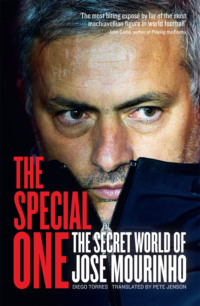
Kitabı oku: «The Special One: The Dark Side of Jose Mourinho»

Contents
Title Page
1 Crying
2 Eyjafjallajökull
3 Market
4 Fight
5 Humiliation
6 Fear
7 Prepare to Lose
8 Rebellion
9 Triumph
10 Sadness
11 Unreal
12 Blue
Copyright
About the Publisher
Chapter 1
Crying
‘Think of this: When they present you with a watch they are giving you a tiny flowering hell, a wreath of roses, a dungeon of air.’
Julio Cortázar, ‘Preamble to the Instructions for Winding a Watch’
‘He was crying! He was crying …!’
Gestifute employee
On 8 May 2013, the employees of Gestão de Carreiras de Profissionais Desportivos S.A., Gestifute, the most important agency in the football industry, were to be found in a state of unusual excitement. José Mourinho kept calling employees. They had heard him sobbing loudly down the line and word quickly spread. The man most feared by many in the company had been crushed.
The news that Sir Alex Ferguson had named David Moyes as his successor as manager of Manchester United had caused an earthquake. United, the most valuable club in the world according to the stock market, were the equivalent of the great imperial crown of football marketing, and the position of manager, occupied for almost 27 years by a magnificent patriarch, had mythical connotations.
The terms of Ferguson’s abdication were the ‘scoop’ most coveted by the traffickers of the Premier League’s secrets. There were those who had toiled for years preparing a web of privileged connections to enable them to guess before anyone else when the vacancy would occur. Jorge Mendes, president and owner of Gestifute, had more ties with Old Trafford than any other agent. No agent had done as many deals, nor such strange ones, with Ferguson. No one had more painstakingly prepared an heir to the throne or succeeded in conveying the idea to the media that there was a predestined successor. If this propaganda had seeped into the consciousness of one man, that man was the aspiring applicant himself. Mourinho, encouraged by his devoted agent, believed that Ferguson was also an ally, a friend and protector. He became convinced that they were united by a relationship of genuine trust. He thought his own fabulous collection of trophies – two European Champion Leagues, one UEFA Cup, seven league titles and four domestic cups in four different countries – constituted a portfolio far outstripping those of the other suitors. When he learned that Ferguson had chosen David Moyes, the Everton manager, he was struck by an awful sense of disbelief. Moyes had never won anything!
These were the most miserable hours of Mourinho’s time as manager of Real Madrid. He endured them half asleep, half awake, glued to his mobile phone in search of clarification during the night of 7 to 8 May in the Sheraton Madrid Mirasierra hotel. He had arrived in his silver Audi in the afternoon along with his 12-year-old son, José Mario, with no suspicion of what was coming. On his left wrist he wore his €20,000 deLaCour ‘Mourinho City Ego’ watch, with the words ‘I am not afraid of the consequences of my decisions’ inscribed on the casing of sapphire crystal.
Mourinho was fascinated by luxury watches. He not only wore his sponsor’s brand – he collected watches compulsively. He maintained that you could not wear just any object on your wrist, stressing the need for something unique and distinguished intimately touching your skin.
That afternoon he was preparing to meet up with his team before playing the 36th league game of the season against Málaga at the Bernabéu. He was more than a little upset. He knew that his reputation as a charismatic leader was damaged, something he attributed to his stay in Chamartín. The behaviour of the Spanish seemed suffocating: the organisation of the club had never come up to his expectations and he was sick of his players. He had told the president, Florentino Pérez, that they had been disloyal, and to show his contempt he had decided not to travel with them on the team bus but make his own way to the hotel in a symbolic gesture that cut him off from the squad. He was met by members of the radical supporters’ group ‘Ultras Sur’, who unravelled a 60-foot banner near the entrance of the Sheraton. ‘Mou, we love you’, it said. When the squad arrived and the players began to file off the bus, one of the fans, hidden behind the banner, expressed the widespread feeling in this, the most violent sector of Madrid’s supporters.
‘Casillas! Stop blabbing and go fuck yourself!’
The suspicion that Casillas, the captain and the player closest to the fans, was a source of leaks had been formulated by Mourinho and the idea had penetrated to the heart of the club. Perez and his advisors claimed that for months the coach had insisted that the goalkeeper had a pernicious nature. When the suspicion was reported in certain sections of the media, the club did very little to rebuff it. The subject was the topic of radio and television sports debate programmes; everyone had an opinion on the matter except the goalkeeper himself, whose silence was enough to make many fans believe he was guilty. To complete his work of discrediting Casillas, Mourinho gave a press conference that same afternoon, suggesting that the goalkeeper was capable of trying to manipulate coaches to win his place in the team.
‘Just as Casillas can come and say, “I’d like a coach such as Del Bosque or Pellegrini, a more manageable coach,”’ he said, ‘it’s also legitimate for me to say the same thing. As the coach it’s legitimate for me to say, “I like Diego López.” And with me in charge, while I’m the coach of Madrid, Diego López will play. There’s no story.’
The atmosphere at the Sheraton was gloomy that night, with contradictory rumours from England circulating about the retirement of Ferguson. The online pages of the Mirror and Sun offered a disturbing picture. Mourinho was certain that if Sir Alex had taken such a decision he would have at least called to tell him. But there had been nothing. According to the people from Gestifute who lent him logistical support he had not received as much as a text message. The hours of anxiety were slowly getting to him, and he made calls until dawn to try to confirm the details with journalists and British friends. Mendes heard the definitive news about Ferguson straight away from another Gestifute employee but did not dare tell Mourinho the truth – that he had never stood the slightest chance.
Mourinho was tormented by the memory of Sir Bobby Charlton’s interview in the Guardian in December 2012. The verdict of the legendary former player and member of the United board had greatly unsettled him. When asked if he saw Mourinho as a successor to Ferguson, Charlton said, ‘A United manager would not do what he did to Tito Vilanova,’ referring to the finger in the eye incident. ‘Mourinho is a really good coach, but that’s as far as I’d go.’ And as far as the admiration Ferguson had for Mourinho was concerned, the veteran said it was a fiction: ‘He does not like him too much.’
Mourinho preferred to believe the things that Ferguson had personally told him rather than be bothered by what a newspaper claimed Charlton had said. But that night, the venerable figure of Sir Bobby assaulted his imagination with telling force. Mourinho had turned 50 and perhaps thoughts of his own mortality crossed his mind. There would be no more Manchester United for him. No more colossal dreams. Only reality. Only his decline in Spain devouring his prestige by the minute. Only Abramovich’s outstretched hand.
In the morning he called Mendes, asking him to get in touch with United urgently. Right until the end, he wanted his agent to exert pressure on the English club in an attempt to block any deal. It was an act of desperation. Both men knew that Mendes had put Mourinho on the market a year ago. David Gill, United’s chief executive, had held regular talks with Gestifute and was aware of Mourinho’s availability but he was not interested in him as a manager. He had told Mendes in the autumn of 2012 that Ferguson’s first choice was Pep Guardiola and had explained the reasons. At Gestifute, the message of one United executive seemed particularly pertinent: ‘The problem is, when things don’t go well for “Mou”, he does not follow the club’s line. He follows José’s line.’
What most frightened Mourinho was that public opinion would conclude he had made a fool of himself. He felt cheated by Ferguson and feared people might stop taking him seriously. For years, the propaganda machine acting on his behalf had made quite a fuss of the friendship between the two men; this was now revealed to be a fantasy. To make these latest events seem coherent, Gestifute advisors told him to say that he already knew everything because Ferguson had called to inform him. On 9 May someone at Gestifute got in touch with a journalist at the daily newspaper Record to tell them that Ferguson had offered his crown to Mourinho four months ago, but that he had rejected it because his wife preferred to live in London, and for that reason he was now leaning towards going back to Chelsea. Meanwhile, Mourinho gave an interview on Sky in which he stated that Ferguson had made him aware of his intentions, but never made him the offer because he knew that he wanted to coach Chelsea. The contradictions were not planned.
From that fateful 7 May onwards Mourinho was weighed down by something approaching a deep depression. For two weeks he disappeared from the public eye and barely spoke to his players. For the first time in years, the Spanish and the Portuguese press – watching from a distance – agreed that they were watching a lunatic. On 17 May Real played the final of the Copa del Rey against Atlético Madrid. The preparation for the game made the players anticipate the worst. The sense of mutual resentment was overbearing. If Mourinho felt betrayed, the squad saw him as someone whose influence could destroy anyone’s career. If he had jeopardised Casillas’s future, the most formidable captain in the history of Spanish football, how were the other players to feel? A witness who watched events unfold from within Valdebebas described the appalling situation: the players didn’t mind losing because it meant that Mourinho lost. It didn’t matter to Mourinho, either, and so they lost.
On 16 May the manager showed up at the team hotel with a sketch of a trivote under his arm. ‘Trivote’ was the term the players used to describe the tactical model that Mourinho claimed to have invented. It was executed by different players according to the circumstances. The plan, presented on the screen of the hotel, had Modrić, Alonso and Khedira as the chosen trio in midfield. This meant that the team’s most creative player, Özil, was shifted out to the right to a position where he felt isolated. Benzema and Ronaldo were up front. Essien, Albiol, Ramos and Coentrão were to play at the back, with Diego López in goal.
Mourinho’s team-talks had always been characterised by a hypnotic inflammation. The man vibrated. Every idea that he transmitted seemed to be coming directly from the core of his nervous system. That day this did not happen. He had spent a long time isolated in his office – absorbed, sunken-eyed, pale, melancholic. The players were at a loss as to why. Some interpreted it as sheer indolence, others saw him as quite simply lost, as if he were saying things he did not understand.
‘He looked like a hologram,’ recalled one assistant.
‘All that was missing was a yawn,’ said another.
The room fell into a tense silence. The coach was proposing something on the board that they had not practised all week. Incomprehensible, maybe, but a regular occurrence in recent months. He told them that after years implementing this system they should understand it so well that they didn’t need to practise it. They would have to content themselves with understanding how he wanted them to attack. As usual, the most complex job was allocated to Özil. The German had to cover the wing when the team did not have the ball. When possession was regained he had to move to a more central position and link up with Modrić.
The players understood that to gain width and get behind Atlético the logical thing would have been to put a winger on the right, somebody like Di María, leave Özil in the centre and drop Modrić back into Khedira’s position. But the coach believed that because Modrić lacked the necessary physical attributes, he needed to support the defensive base of the team with Khedira. No one spoke up against the plan. For years the communication between the leader and his subordinates had been a one-way street.
This time, however, it was because there was just nothing to say. The team-talk was brief. The players were left wondering why on earth they had to defensively reinforce the midfield with Khedira against an Atlético side who were hardly going to attack them. But, mute, they merely obeyed.
For the club with the largest budget in the world, the Copa del Rey was a lesser objective. Finding out that the final would be played in their stadium distressed the directors. After losing the league and the Champions League, the season had little left to offer. A final against Atlético in Chamartín was in many ways a no-win situation. The joke had been doing the rounds since the team beat Barça at the Camp Nou to qualify, that the president had been heard to say that a final in the Bernabéu against Atlético was about as attractive as a ‘punch bag’.
The ticket prices fixed by the clubs and the Spanish Football Federation set a new record. Despite the economic crisis that was crushing Spain this was the most expensive cup final in history. Prices ranged from €50 to €275. Attending the FA Cup at Wembley cost between €53 and €136, and German cup final tickets went from between €35 and €125. At the Coppa Italia the price ranged from €30 to €120. That afternoon, as was to be expected, there were empty seats.
Ronaldo headed in a Modrić corner, putting Madrid 1–0 up in the 14th minute. Following to the letter instructions that were now three years old, the team retreated to protect the lead, giving up space and possession to their opponents. Their opponents’ situation looked impossible. Madrid had a more expensive constellation of star players than had ever been brought together. And against them they did not have the Atlético of Schuster, Vizcaíno, Donato, Manolo and Futre that had faced them in the final of 1992. Here instead were was Koke Resurrección, Gabi Fernández, Mario Suárez, Falcao, Arda and Costa. For an hour and a half, both teams cancelled each other out in the most extravagant manner possible. They tried to see who could go for longer without the ball. It was a fierce competition. Atlético dropped their level of possession to 40 per cent. Madrid had the remaining 60 per cent, but did not know how to manage it because Marcelo had been marginalised, Alonso was tired, Özil was suffering off-radar and Khedira was unable to channel the team’s attacks. Atlético took cover and in two lightning counter-attacks settled the match. First, Diego Costa scored after Falcao had taken advantage of a mistake by Albiol. Then, in extra time, Miranda headed in to make it 2–1, after Diego López made an error coming off his line.
Albiol had replaced Pepe, left out and watching from the stands because of his insurrection. Pepe called for more ‘respect’ to be shown to Casillas and in response was cleansed. Within hours the defender went from being the manager’s right-hand man on the pitch to becoming the object of a public trial.
The emergence of rising star Varane was the excuse. ‘It’s not easy for a man of 31 years, with a standing and a past, being steamrollered by a child of 19 like Varane,’ said Mourinho. ‘But it’s the law of life.’
Varane could not play in the final because of injury. Even so, Pepe watched the game from the stands, giving up his place to Albiol, who had not played regularly for months. Some of the players believed they recognised in this decision the clearest evidence that part of Mourinho’s selection-process was based on a dark code of loyalty even when it was to the detriment of the functioning of the team.
When the referee sent Mourinho off for protesting, Pepe went down to the bench and, in complete violation of the regulations, installed himself in the technical area. It was unprecedented behaviour as he took over from Aitor Karanka, the assistant coach, giving instructions to his colleagues from the touchline as if he were the manager. Not that it prevented an Atlético victory.
Karanka remained confused all evening. His boss had departed the stage, leaving him alone. Breaking protocol, Mourinho did not go up to receive the medal that King Juan Carlos had prepared to honour the coach of the losing team. Instead, it was Karanka who came up the stairs in front of the defeated players. On seeing him, the king grabbed the piece of silver and turned to the Spanish Football Federation president Ángel María Villar, seeking clarification:
‘Shall I give it to him?’
And so it was an embarrassed Karanka who received the salver, while Mourinho went to the press conference room to pronounce his final words as the official representative of Madrid. Three years of stirring rhetoric, shrill speeches, sessions of indoctrination, warnings, complaints and entertaining monologues were interrupted by a confession. There was no hiding from the fact that in his final year he had won nothing.
Never in the history of Real Madrid had a coach been more powerful and yet more miserable; nor one more willing to terminate his contract with the club, happy to end an adventure that had become a torment.
‘This is the worst season of my career,’ he said.
Chapter 2
Eyjafjallajökull
‘It is easy to see thou art a clown, Sancho,’ said Don Quixote, ‘and one of that sort that cry “Long life to the conqueror!”’
Miguel de Cervantes, Don Quixote
The objective qualities of José Mourinho the coach were not what led Real Madrid to sign him in 2010. It was more that they considered him to be a magical, providential figure blessed with an unfathomable and mysterious wisdom.
Madrid’s director general, José Ángel Sánchez, was the main driving force behind the recruitment and the process took years to reach its conclusion. Perhaps it started in the first months of 2007 when Sánchez made contact with Jorge Mendes, Mourinho’s agent, to negotiate the transfer of Pepe. Képler Laverán Lima, nicknamed ‘Pepe’, was the Porto defender who cost €30 million, becoming the third-most expensive central defender in history after Rio Ferdinand and Alessandro Nesta. It was the highest price ever paid for a defender who had not played in his national team, and the first transaction concluded by Mendes and Sánchez, laying the foundations for a new order. From that moment on the super-agent began to redirect his strategy from England to Spain, those ties of friendship with Sánchez paving the way for the change.
Mendes did not delay building his relationship with Ramón Calderón, Madrid’s president between 2006 and 2009. Bold by nature, the Portuguese agent made him the inevitable offer: he would bring his star coach – at the time, running down his third season at Chelsea – to Madrid.
‘Once you get to know him you’ll not want to hire anyone else,’ Mendes encouraged. ‘If you want to prolong your spell at Madrid, you’ll have to bring in the best coach in the world.’
That is how Calderón remembers it, recalling how Mendes tried to organise a dinner with Mourinho. They promised him a lightning trip to a meeting in a chalet on the outskirts of Madrid in the dead of night to avoid photographers and maintain absolute secrecy. ‘José Ángel was utterly convinced,’ recalls Calderón, who says he looked into the idea with the director general and with Pedrag Mijatović, who at the time was Madrid’s sporting director.
‘This guy is going to drive us crazy!’ said the president. ‘With Mourinho here you won’t last a minute, Pedrag!’
Calderón did not employ any particularly logical reasoning to reject Mourinho. He simply thought of him as a difficult character with outdated ideas. ‘He’s like a young Capello,’ he said, vaguely alluding to a way of playing the game that bored the average fan. The ex-president did not account for the importance of charisma in arousing a crowd eager for Spanish football to regain its pre-eminence. A multitude increasingly in need of a messiah.
Mendes’s capacity for hard work is renowned. He promoted Mourinho in various European clubs when he had still not ended his relationship with Chelsea and continued to offer him around with even greater zeal from the winter of 2007 to 2008. At that time Barça were looking for a coach. Ferrán Soriano, now the executive director of Manchester City, was Barcelona’s economic vice president. Soriano explains that the selection process began with a list of five men and came down to a simple choice: Guardiola or Mourinho.
‘It was a technical decision,’ emphasises Soriano. ‘Football is full of folklore but in this instance you cannot say that it was an intuitive choice. Instead, it was more the product of rational and rigorous analysis. In Frank Rijkaard we had a coach who we liked a lot but we could see that his time was coming to an end. Frank took a team that was nothing and won the Champions League. He inherited a side with Saviola, Kluivert and Riquelme that had finished sixth, and then he won the league and the Champions League.
‘The following year the team’s level dropped a little. A 5 per cent drop in commitment at the highest level creates difficulties and Frank didn’t know how to re-energise the group. In December we decided to make a change. Mourinho had left Chelsea and there were possibilities to bring him in in January but we thought that it made no sense. We had to finish the season with Frank and give the new coach the opportunity to begin from scratch. Txiki was charged with the task of exploring alternatives and he went to various people: to Valverde, to Blanc, to Mourinho …’
Joan Laporta was the Barça president who conducted the operation and Txiki Begiristain, ex-Barcelona player and the then technical director, organised the interviews. Txiki met Mourinho in Lisbon and, after hearing his presentation, told him that Johan Cruyff would have the last word. The legendary Dutch player was at the time the club’s oracle. In the political climate that had always enveloped Barcelona, the presence of a figure whose legitimacy transcended the periodic presidential elections served to prop up risky decisions. The only person who enjoyed the necessary prestige to play that role was Cruyff.
Impatient ahead of the possibility of a return to the club in which he had worked between 1996 and 2000, Mourinho called Laporta: ‘President, allow me to speak with Johan. I’m going to convince him …’ Laporta got straight to the point and confessed that the decision had already been taken. The new coach would be Pep Guardiola. The news completely threw Mourinho, who told him that he had made a serious mistake. Guardiola, in his opinion, was not ready for the job.
Soriano describes the decisive moment: ‘After going through all the coaches that Txiki had examined, the conclusion was that it came down to two. In the end there was a meeting in which it was decided that it would be Guardiola, based on certain criteria.
‘We had put together a presentation and produced a document: what are the criteria for choosing the coach? It was clear that Mourinho was a great coach but we thought Guardiola would be even better. There was the important issue of knowledge of the club. Mourinho had it, but Guardiola had more of it, and he enjoyed a greater affinity with the club. Mourinho is a winner, but in order to win he generates a level of tension that becomes a problem. It’s a problem he chooses … It’s positive tension, but we didn’t want it. Mourinho has generated this tension at Chelsea, at Inter, at Madrid, everywhere. It’s his management style.’
In his book The Ball Doesn’t Go In By Chance, published in 2010, Soriano details the principles that led the club to choose Guardiola: 1. Respects the sports-management model and the role of the technical director; 2. Playing style; 3. Values to promote in the first team, with special attention to the development of young players; 4. Training and performance; 5. Proactive management of the dressing room; 6. Other responsibilities with, and commitments to, the club, including maintaining a conservative profile and avoiding overuse of the media; 7. Has experience as a player and coach at the highest level; 8. Supports the good governance of the club; 9. Knowledge of the Spanish league, the club and European competition.
Guardiola did not meet the seventh criterion, but then neither did Mourinho. What is more it was very unlikely, given past behaviour, that Mourinho could do the job without violating the second, third, sixth and eighth criteria.
The naming of Pep Guardiola as the Barça coach on 29 May 2008 marked Spanish football’s drift towards politicisation. This was paradoxical because Guardiola, one of the coaches most obsessed with the technical details of the game, an empiricist whose strength lay in his work on the pitch, began to be perceived by a certain section of Madrid supporters as an agitator, a manipulative communicator whose propaganda needed to be countered off the pitch. Distracted by this misconception, Madrid would expend much of its institutional energy on taking the necessary steps to wage war in the media.
While Guardiola started an epic landslide that would transform football across half the planet and contribute to reinforcing Spain’s national team as it conquered the world in 2010, institutional and social peace at Madrid became ever more scarce. Calderón, who hired Bernd Schuster, resigned a year and a half later amid accusations of corruption. Florentino Pérez, returning to the presidency in 2009, prompted a criminal investigation that led only to a ruling that Calderón had been the victim of slander and that he was not corrupt.
The return of Pérez to the Bernabéu signalled major changes. The president of the multinational construction firm ACS possessed an incomparable combination of determination and influence. In 2010 Forbes classified his fortune as the tenth largest in Spain. His origins, however, conform more to the petty bourgeoisie. A graduate of Madrid’s School of Civil Engineering, he formed part of a line of technocrats who have nurtured Spanish administration over the last two centuries. Affiliated to the Union of the Democratic Centre (UCD), he entered politics in 1979, becoming a Madrid councillor, director general of the Ministry for Transport and Tourism, and undersecretary at the Ministry of Agriculture between 1979 and 1982. In 1986 he abandoned politics to begin a career in the private sector.
Unorthodox and adventurous in the management of sporting affairs, Pérez’s reputation was being increasingly challenged by his followers. Madrid had followed a downward trajectory under his direction between 2000 and 2006. From the initial peak of winning two league titles and a Champions League, the club had stagnated. After three years of failing to win a trophy, he handed in his resignation in February 2006, claiming that he had indulged his players like spoiled children and that it was necessary to install another helmsman, who, without the same sentimental attachment, would be capable of purging the dressing room. Never before in Madrid’s history had a president resigned in the middle of his mandate. But with a stubbornness to regain control of the directors’ box, and an avowed sense of mission, he returned to the club in 2009, although he was not chosen by members because the absence of any other candidates meant there was no election. He was 62 years old and assured supporters that, thanks to his intervention, Madrid had been saved from administrative crisis and financial ruin.
Back in power, Pérez set about hiring a new coach. He began the selection process advised by his right-hand man, the sporting director Jorge Valdano. After failed attempts to sign first Arsène Wenger and then Carlo Ancelotti, Pérez signed Manuel Pellegrini. The Chilean’s switch to Chamartín was preceded by suspicion and disaffection. He had still not completed half a season as first-team coach, and the idea of signing Mourinho was occupying Sánchez’s mind more than ever. The operation had been thought through over a period of several years and he was now close to convincing the president to take the plunge. In meetings with friends the director general sighed: ‘I love him!’
Valdano, however, insisted on protecting Pellegrini. The coach had been the subject of a smear campaign in the press, encouraged from within the club. During internal debates Sánchez identified Pellegrini as being inherently weak and too fragile to resist the rigours of the Madrid job. To convince Pérez, the director general reasoned, ‘Pellegrini needs protection because he’s weak. A strong man would not need protection.’
Sánchez took a two-pronged approach. He maintained contact with Mendes and he established a direct line of communication between the Inter coach and Pérez. When some raised suspicions over the suitability of Mourinho’s technical footballing knowledge to the Madrid team, Sánchez confessed that he believed Mourinho’s personality alone would make him worthy of a blockbuster production, while producing statistics to support his technical expertise.
‘I don’t know how much he knows about football,’ he said, ‘but a man who’s not lost a home game in six years must have something. Six years without losing in his own stadium! If he doesn’t know anything about football then he must know a lot about human beings. In his last game for Chelsea both Terry and Lampard ran to embrace him. That’s just not normal. Both of the team’s leaders!’
Sánchez is the mastermind behind the project that, between 2000 and 2007, turned Madrid into the richest football institution on the planet. His keen sense of humour co-exists with his zeal for his position. On one occasion in 2010 he presented himself in the following written terms: ‘I have been an executive director general for the last five years. Before that I was marketing director general for five years. My responsibility is corporate: the administration, the management, the resources, the facilities and infrastructure of the club, the general services, the purchasing, the information systems and technology, the human resources, the commercial and marketing department, areas of content, internal media, use of facilities, sponsors, etc. I am responsible for 141 of the 190 employees at the club. I am responsible for the economic results, the accounts, etc. I direct the club in these areas and take a certain pride that for six years we have topped the income ranking, including in the bad years or through periods of institutional crisis. I have negotiated the signings and the sales made by the club over the last 10 years … maybe 70 transactions in total. I negotiate the players’ contracts, the tours, the TV rights. I represent the club in the LFP (Professional Football League) and in the relevant international bodies. I have a certain disregard for the role of protagonist; I would even say I resent it … I have worked with different presidents, something that is significant in itself. In this transition (certainly an unusual experience in football) you make many friends, from Platini to Rummenigge, from Galliani to Raúl, from the president of Volkswagen to Tebas through to Roures, or a government minister, many businessmen, and football agents … That expanse of contacts just a phone call away is one of the strengths of the club.’
A philosophy graduate who cut his teeth in business administration with Sega, the electronic games company, serving as head of operations in Southern Europe, Sánchez is the most influential executive in Spanish football. When Pérez hired him for the club in the spring of 2000 he was 32 years old. Nobody imagined then that Pérez was preparing the ground for the development of someone who would dominate the Spanish league with an iron fist from 2006 onwards, contributing to the rapid enrichment of Madrid – and Barça – and, as a consequence, putting the finances of the other clubs in the Spanish league at serious risk. If the unequal distribution of TV income in Spain is something unique in Europe then that is in large part thanks to Sánchez’s ability to take advantage of the entanglement of delay, carelessness and incompetence spun by the three institutions that should be ensuring football’s economic health: the Ministry for Sport, the Spanish Football Federation and the Professional Football League.
Madrid’s chief executive since 2006, Sánchez radiated all the enthusiasm of a young lover as he considered Madrid’s future: the possibility of fusing the economic power of the world’s most popular club with the taste for propaganda of a coach capable of surpassing the publicity extravaganzas of any of the companies with which he had previously been involved. His spirit of curiosity was intrigued. Enthusiastic by nature, this master of marketing understood that he had uncovered possibilities hitherto untapped in the world of sport. It would be a pioneering experiment.
Sánchez needed to finish convincing Pérez when events took an intimidating turn. The elimination of Madrid from the Champions League last-16 against Lyon in March 2010 began to erode the president’s normally serene spirit. Barcelona were still on their way to a final that this year would be played at the Bernabéu. The possibility of an arch-rival – and Guardiola – winning their fourth Champions League in Chamartín was an outrage for Madrid’s more closed-minded supporters and an unbearable affront to Pérez.
Barcelona’s advance shifted the balance of power in Spanish football away from the capital. For the first time in 50 years Real Madrid, the club with the greatest number of European trophies, were no longer the reference point. This change in dominance, just when the Spanish national team was enjoying a golden era at all levels, led to inevitable political consequences. In many sectors of Spanish society, heavily influenced by nationalist sentiment, the presence of a Catalan club at the vanguard of the most popular sport in the country inspired a dark malaise.
UEFA had given the 2010 final to Madrid as a reward for Calderón’s efforts to improve the institutional relations between the Spanish Football Federation and the officials of European football’s governing body, headed by Michel Platini. For Pérez, since taking over as president, the organisation of the event – an uncomfortable inheritance from his predecessor – had become an unpleasant obligation and, ultimately, a trap.
The Madrid president’s overriding concern that Barcelona would end up playing in the final meant Mourinho became an object of veneration as soon as the draw had been made. If Barça wanted to get past the semi-finals they would have to overcome Inter, the team managed by the director general’s favourite. At this point, disappointed with Valdano after Pellegrini’s failings in domestic cup competition and in Europe, Sánchez and Pérez began to share the same technocratic feeling. A type of force-field united them in one vision in which football as a business was far too important to be left in the hands of mere football people such as Valdano, the sporting director and principal sporting authority at the club.
Valdano had an extensive CV. A world champion with Argentina in 1986, a league champion and UEFA Cup winner as a player, and a league winner as a coach, he knew all the mechanisms that moved Madrid. He used to say – and his opinion was shared by those agents who knew all concerned parties – that neither Pérez nor Sánchez had any deep analytical understanding of the game. Both marvelled at the stand-out players, the most elegant or the most skilful ones, but they struggled to understand why things happened the way they did during a match. In a crisis, under pressure, they would end up rejecting anything that didn’t dazzle and simply rely on their intuition. The models, the formulas and the sixth sense that had made them renowned executives fused with the historical necessity of stopping Barça. Mourinho, the man with the wistful gaze, was seen as the providential hero.
The repetitive discussions about Mendes and Mourinho had hit their target. There is no doubt that Pérez met with his future coach when Mourinho was still working at Inter. And even more certain is that the president had to listen to his director general explain why Mourinho was a great coach. ‘He has an intelligence for football that I’ve never seen in anyone else,’ said Sánchez at the time. He insisted that Mourinho knew exactly what each player could give and that he was able to anticipate what was going to happen in a game – that he was able to predict what would take place after half an hour, an hour, an hour and a half of play. He was ‘amazing’. Sánchez’s awe for a man he described as an omniscient magician always seemed genuine. Mourinho never went into too much detail, at least not in public. He never talked about what the training sessions were like or what his principles were, or what exactly was to be expected of his teams when planning matches. The only thing he knew for sure was that he had won a lot. Why ask so many questions when the trophies speak for themselves?
The eruption of the Eyjafjallajökull volcano in the south of Iceland on 20 March 2010 was an unexpected stroke of good fortune. The ash ejected into the atmosphere meant European air space was closed and Barcelona had to travel to Milan by bus. The team took a day getting there and spent two nights sleeping in hotels before the match. That would be significant in terms of performance levels in a competition decided by the smallest details. The 3–1 win from the first leg and the 1–0 defeat in the return gave Inter victory over 180 minutes of football in which they rarely dominated Barça. The fact that Inter finished the second leg with 10 men, hemmed into their own area, desperate, saved by the incorrect ruling-out of a Bojan goal, was not enough to make Pérez and Sánchez suspect that luck had played an important part. Barcelona’s defeat was such a relief to the president that he immediately closed the deal with Mourinho, convinced he was acquiring two magic spells for the price of one: the universal antidote to failure, and the ‘know how’ that would destroy Guardiola’s team.
‘Ilusión’ is the key word in all of Pérez’s public addresses since first becoming president. It means ‘excitement’, ‘hopeful anticipation’, ‘enthusiasm’. In his speech after winning the election on 17 July 2000 he said, ‘We have in front of us, just as we said in our election campaign, an exciting job full of ilusión.’ On 13 May 2009, when he presented his candidacy for the presidency, he spoke beneath a poster that displayed the project’s slogan, ‘The Ilusión Returns’, as if everything that had occurred since he had been away had been turgid and sterile. In his speech at the Salón Real at the Ritz Hotel he confided that he felt capable of ‘almost everything’, and warned he had ‘spectacular’ plans. The word ‘spectacular’ appeared five times in his speech. The day he announced the signing of Mourinho he insisted, ‘What I love about Mourinho are the same things that you are going to love: ilusión, effort, professionalism, motivation, aptitude … everything that makes him the best coach.’
Pérez’s communications advisors understood from the outset that he set great store in the concept of fantasy. Ilusión and the spectacular are connected concepts. The dictionary defines the word ‘spectacular’ as an adjective applied to things that, because of the ‘apparatus’ that accompanies them, impress whosoever is in their presence. The meaning can even be extended to imply ‘gimmicky’. The first definition of ‘ilusión’ in the Royal Academy’s Dictionary of the Spanish Language is emphatic: ‘concept, image or representation without an actual reality, suggested by the imagination or caused by a delusion of the senses’.
José Luis Nueno, professor of commercial management at the IESE (Institute of Higher Business Studies) and author of a study of Madrid’s business model for Harvard Business School in 2004, questioned the logic of the choice of Mourinho and considered that in a traditional enterprise his signing would at the very least be seen as unorthodox. It would be an error, says Nueno, ‘for a company to imitate another in terms of who its leader is: to believe that one person is responsible for everything is like believing that the carrying out of one task is responsible for everything. It’s like saying: if I buy the shop-window displays of Zara I am Zara. Or even, if I copy everything that Zara does I am Zara. You miss the relationships between all the bits and pieces in the system. And you lose the acquired experience of developing that system.’
Traditional industry is less sensitive to the mythology that fills the minds of football fans. Inter’s defeat of Bayern to win the Champions League gave Mourinho another trophy, but, more importantly, it gave him a magical glow in the eyes of many Madrid supporters and the feeling that they had finally found their essential authoritarian patriarch for these difficult times. Somebody who could part the Red Sea. Is there anything more exciting, more full of ilusión, than beautiful superstition?
Nobody knew how to exploit this better than Mourinho, ever more conscious of the fact that his collection of trophies gave him an incalculable capacity to influence the minds of fans and directors: two Portuguese leagues, two English leagues, two Italian leagues, a Portuguese Cup, an English Cup, an Italian Cup, a UEFA Cup, two Champions Leagues … Success is exciting. Continual success, skilfully promoted, is persuasion’s most seductive calling card. It is then that ‘magical thinking’ comes in to play.
In The Golden Bough, the anthropological classic published in 1890, James Frazer writes that primitive societies linked themselves to a ‘magical man-god’ who exercised ‘public magic’, primarily to provide food and control the rain. We don’t expect anything less from the director generals who control the big multinationals, nor of certain football managers. Frazer argues that magic works by imitation: what appears to be, influences what appears to be. Like causes like. If you want more muscle, eat more meat; if you want to fly, eat birds; if you want success, attach yourself to someone successful, touch him, ask for his autograph. Magic works through symbols and symbols work by metonymy and metaphor – Mourinho is a symbol of the social leader and a metaphor for triumph.
Magical thinking establishes a mystical relationship that very few people in the world of football are capable of resisting, as nobody is wholly free from superstition. Players can’t stop themselves, always taking their first step onto the pitch with their right foot. Roman Abramovich cannot suppress it, trying to import the Guardiola model to Chelsea, but without the ‘Masia’, without the culture of youth development, without the Camp Nou, and to an environment completely different to that of Spanish football. Neither could Pérez restrain himself when he coupled his desire to win the Champions League to a coach who had won it twice.
Champions League statistics brought Mourinho closer to Madrid. But those same numbers made it mathematically less likely that he would win it again. Bob Paisley is the only coach to have won three European Cups, and he did it from within a very stable club: the Liverpool of the seventies and eighties, a club that had been built on the firm foundations laid by Bill Shankly with a continuity that went back to 1959.
Mourinho himself must have noted a degree of rage from within the club when two months after arriving in Spain, after an unexpected 0–0 draw on his league debut in Mallorca, he felt obliged to clarify that he was not a magician.
‘Look,’ he said, ‘I’m a coach. I’m not Harry Potter. He’s magic but in reality magic doesn’t exist. Magic is fiction and I live in the football world, which is the real world.’
Mourinho wanted to lower the levels of expectation. But he always knew that his signing was intimately related to marketing, a science that studies how to take advantage of expectations for economic ends. Harry Potter is not just a fictional character. He is a commercial system learned in the business schools well known to José Ángel Sánchez. When Madrid signed the Brazilian forward Ronaldo in 2002 the director general compared his impact on the economy of the club to the bespectacled boy wizard, saying that ‘Ronaldo is Harry Potter’.
The commercial model of the Madrid brand that Sánchez inspired when he joined the club is the same that Disney used to promote The Lion King. Following a sequence outlined by the concept’s inventor, Professor Hal Varian, Google’s chief economist and a specialist in the economics of information, Disney developed an exploitation chain that multiplied the number of times a product could be offered to the public. The way a product was presented was expected to evolve, generating new expectations and new demand. Varian called these ‘windows’. The first window of a film is at the cinema. The second is the showing of the film on passenger airlines; then, the release of the DVD; next, the barrage of articles with the image of the characters on patented toys, games, electronics, textiles, furniture, etc. And finally, the musical, or any other commodity that the imagination is capable of conceiving.
‘Disney is a content producer, and we’re another content producer,’ Sánchez explained during the galáticos era, as he maximised profits from Figo, Zidane, Ronaldo and Beckham as if they were characters in a cartoon series. The director general glimpsed a universe in which supporters were transformed into ‘audiences’ and became consumers of legend. During a game, these excited customers could be divided into three blocks, according to how they consumed the product. In the stadium are those who have paid at the turnstiles; the people who have bought a private box, the companies that hire out their boxes; or private individuals who have hired VIP areas, everyone in their consumer ‘window’. In the second block outside the stadium are companies paying broadcasting rights for live and subsequent transmission on TV and the internet.
But the spectacle does not finish at the end of the game: the club’s in-house media, Real Madrid TV, the official web page and the various club shops go on drawing in a third wave of customers. In this last block are the sponsors. The players lend their image for the promotion of companies who have contracts with the club, such as Audi, Telefónica, Coca-Cola, adidas, Babybel, Nivea, Samsung, Bwin and Fly Emirates. And then comes the film, a climax promising to break through the final frontier. Real: The Movie, released in 2005, was the ultimate example of putting Varian’s theory into practice. At this point Real Madrid were more like Disney than Disney could ever be like Real Madrid.
More than creating new icons capable of raising the market value of the product, from 2000 Sánchez and Pérez were looking for people who were already famous, established celebrities prepared to incorporate their own mythology into the club. Before signing for Paris Saint-Germain, a Brazilian international was offered to the club, his name Ronaldinho Gaúcho. A high-ranking Madrid official, however, dismissed the idea after passing judgement on the player’s prominent teeth. Ronaldinho was – within Disney parameters – an absolute unknown and the casting was not being done by a football expert. As a result, David Beckham was the only signing of the 2003–04 season. The Englishman possessed an image that had, in the words of the president, ‘universal projection’.
Along with the sale of the land on the Avenida Castellana to build skyscrapers where the old training ground had stood – a real-estate operation that transformed Madrid’s horizons dramatically – Sánchez and Pérez’s formula helped the club make a great deal of money. In the financial year ending in 2005 Madrid became the highest-grossing club in the world. The sum of €276 million entered the Bernabéu coffers, €30 million more than that earned by Manchester United, until this point the world’s most financially powerful club. Negotiation of TV rights in 2006 concluded with an unequal distribution of funds, to the detriment of all first and second division clubs apart from Barcelona and Madrid, who were blessed with the biggest contracts in Europe.
Not even when the economic bubble burst did the club’s income stop growing. At the end of the 2011–12 season it exceeded €500 million, and Pérez was also able to show off a league title, his first as president since 2003. It was the first and last Spanish league won by Mourinho.
Chapter 3
Market
‘You are Peter, the rock on which I will build my church, and the gates of Hell will not prevail against her. To you I give the keys to the Kingdom of Heaven; and what you bind on earth shall be bound in heaven, and whatever you loose on earth shall be loosed in heaven.’
Matthew, 16:18–19
‘The foundations of this our city are as firm as the convictions of all who love Real Madrid. An institution that respects its past, learns from its present and is firmly committed to its future.’
Inscription on the foundation stone at Valdebebas
Football nights at the Ciutat de València stadium have a distinctive feel. The salty sea air, the smell of sunflower seeds from the stands, the penetrating aroma of liniment on the ceramic-tile floors of the dressing rooms, boots scattered on the ground, incandescent lamps giving off slightly less light in the visitors’ dressing room than in the home one, the kind of lamps you find in hospital rooms, lighting up the face of Pedro León as he gets changed, reasonably satisfied after the game on 25 September 2010.
The crowd had just applauded him off the pitch in recognition of the time he spent at Levante three seasons ago. He had been Madrid’s best player and had done what his coach had asked, or so he thought.
Mourinho had brought him on after 61 minutes in place of Di María in an attempt to break down Levante’s defence. He told him to hug the touchline, to open up the pitch, to take people on and try to get around the outside of the opposition’s defence; and if there was space to do so, to make diagonal runs inside, combining with Benzema and Higuaín. The substitute carried out his coach’s instructions although from the bench he was being stared at by a clearly annoyed Mourinho. Furious, he grabbed a bottle of water and threw it to the ground. Despite the fact that he had created a chance for himself and served up another simple opportunity for Benzema to score, the match ended 0–0.
Pedro León was preparing to go to the bus when Mourinho stopped him in the dressing room and, calling the attention of the other players, pointed the finger of blame at the hapless Spaniard.
‘I’ve heard you’re going around like a star, saying you have to be starting games and doing whatever the hell you like. Your friends in the press, that Santiago Segurola … they say you’re a star. But what you’ve got to learn is to train hard and to not go around saying you have to be a starter. You’re going to be left out of the squad for several games. On Monday you won’t be going to Auxerre …’
‘I didn’t say that,’ the accused responded, stunned. ‘Tell me. Who have I told that I should be starting? We should talk in private. Please, boss, let’s talk in private …’
Mourinho sneered before turning around. The dressing room was electrified. The players did not understand what had happened to suddenly make the coach ruthlessly belittle someone who seemed so vulnerable. A 23-year-old newcomer to the team. A talented footballer who the group saw as a solution to the creative problems the team sometimes faced in away games. A player who had just shown against Levante that he was up to the task had been accused by the manager of being a kind of traitor, based on some idle gossip that it seemed only Mourinho had heard.
On Monday 27 September Madrid travelled to the French city of Auxerre to play their second group game in the Champions League. The absence of Pedro León caught the attention of both directors and journalists. That evening, during the official press conference, someone asked Mourinho the technical reasons behind his decision not to call up one of the players who had most impressed in the previous match. The question was either to be evaded or invited a football-based refection, but the answer Mourinho gave suggested the most powerful man at the club was almost out of control.
‘Speculation is your profession,’ he told reporters in a steely, inflexible tone that was then new but which, over time, would become almost routine. ‘In very pragmatic terms I could say that Pedro León has not been called up because the coach didn’t want to call him up. If President Florentino comes to ask me why Pedro León hasn’t been called up I have to answer him. But he’s not asked me. You’re talking about Pedro León as if he’s Zidane or Maradona. Pedro León is an excellent player but not so long ago he was playing for Getafe. He’s not been called up for one game and it feels like you’re talking about Zidane, Maradona or Di Stéfano.
‘You’re talking about Pedro León. You have to work to play. If you work as I want you to, then it will be easier to play. If not, it will be more difficult.’
Mourinho spoke with a mixture of cruelty and pleasure. The sadistic nature of the rant unsettled the squad. It was the first time that the players felt their manager represented a threat. Gradually, they began to follow his every public appearance: on TV, on the web, via Twitter, with iPhones or BlackBerries. They didn’t miss a single appearance because they understood that in the press room a different game was being played out, one that would have a major effect on them professionally; a game that could ennoble or degrade them, place them in the spotlight or bury them with indifference, conceal their misery or entirely disregard their merits – a ritual of four weekly appearances that they only had access to as spectators.
Real Madrid’s statute book establishes the board as the executive body of government responsible for directing the administration of the club. In practice, it works as a small, homogeneous parliament that meets regularly to discuss issues proposed by the president for approval. With the exception of the group closest to the president, whose position enables direct channels of inquiry, the confidential information handled by board members is usually limited to sources in the offices of the Bernabéu, offices well removed from the football team. Because directors are hand-picked by the president, Florentino Pérez, he has never met with overwhelming opposition and, except on rare occasions, the board unanimously agrees.
José Manuel Otero Ballasts, recognised by Best Lawyers magazine as the top intellectual property lawyer in Spain, is Professor of Law at the University of Alcalá de Henares, a former dean of the Faculty of Law of the University of León, author of detective novels and one of the 17 members of the board of directors. Asked in November 2010 about the character of José Mourinho, this most intellectual of Madrid’s directors turned to the Bible for reference:
‘When Jesus named the man who was to lead his Church he did not choose the even-tempered calm John, but Peter, the passionate, hot-blooded fisherman. Mourinho plans everything, everything, everything … his intelligence enables him to analyse the reality of a situation and project his own solutions. I had never before heard Casillas say that a coach had been “great” during half-time [the goalkeeper said this to the media after the victory in Alicante in October 2010]. They all adore him. He’s a communicator. He encloses the players verbally. He’s been successful in all the signings. It’s the first time I’ve seen this level of calm at the club.’
José Ángel Sánchez, the corporate director general, offered an equally complimentary account of Mourinho:
‘The coach,’ said Sánchez, ‘is like Kant. When Immanuel Kant went out for his walk in Königsberg everyone set their watches because he always did it on time. When the coach arrives in the morning at Valdebebas everyone knows that it’s 7.30 a.m. without looking at the clock.’
Sánchez felt that Madrid had its first coach who could be trusted to sign wisely. He cited the example of Khedira and Di María, whom the coach – showing what a clinical eye he had – asked for before the 2010 World Cup. He argued that his compendium of virtues made him exactly the solid figure that the club had needed for so many years. Mourinho, in the opinion of the chief executive, had ‘brought calm’ to Madrid.
The sports complex Valdebebas, known as Real Madrid City, is one of the most advanced centres of football technology in the world. It occupies an area of 1.2 million square metres, of which only a quarter has been developed, at a cost of some €98 million. The work of the architectural studio of Antonio Lamela, it has 12 playing fields, a stadium and, at its heart, a ‘T-shape’ of standardised units whose functionalist design of flat layers and clean lines projects a mysteriously moral message.
The main entrance, at the foot of the ‘T’, is at the lowest point of the facility. From there the complex unfolds, beginning with the dressing rooms of the youngest age categories (8- to 9-year-olds) and going through, in accordance with age group, the dressing rooms of each category, using the natural slope of the hill on the south side of the valley of Jarama. The architects, in collaboration with the then director of the academy, Alberto Giráldez, gave the main building an educational message for young people: the idea of an arduous climb from the dressing rooms of the youngest to those of the professionals. On top of this great parable of conquest – and indeed of the whole production – sits the first-team dressing room. And above the dressing room, with the best views of all, sits the coach’s office, defining its occupier as the highest possible authority. As Vicente del Bosque said of his predecessor as head of the academy, Luis Molowny: ‘He was a moral leader.’
Something in Mourinho’s arrival at Valdebebas surprised those who worked there. As well as Rui Faria, fitness coach, Silvino Louro, the goalkeeping coach, Aitor Karanka, the assistant coach, and José Morais, the analyst of the opposition, the Portuguese coach brought his agent and friend, Jorge Mendes. Gradually, the squad became convinced that Mendes worked in the building. Not so much as another one of the coaches but as the ultimate handyman.
Impeccably fitted out in a light woollen Italian suit, with a tie that never moved and a fashionable but unpretentious haircut, tanned even in the gloomiest of winter days, Jorge Paulo Agostinho Mendes was the first players’ agent who saw himself as a powerful businessman, often speaking as a self-styled agent of the ‘industry’ of football. Mourinho also used the term ‘industry’ in his speeches, seasoning his turns of phrase with expressions from the world of financial technocracy. For many other football agents, this was an artificial pose. ‘They think they’re executives at Standard & Poor’s,’ said one Madrid player’s FIFA agent.
Chapter 4
Fight
‘In short, there is nothing mysterious, romantic or necessarily laudable about leadership. Indeed, some of the most effective leaders have been those who, merely through having more than their fair share of psychopathic traits, were able to release antisocial behaviour in others. Their secret is that by setting an example they release a way of acting that is normally inhibited. This gives pleasure to their followers, thus reinforcing their leadership.’
Norman Dixon, On the Psychology of Military Incompetence
José Mourinho skirted the technical area and, covering his mouth so no one could read his lips, turned to the Levante left-back and insulted him.
It was about 8.30 p.m. on 25 September 2010 and Madrid were playing their fifth league match of the season. The Levante left-back, Asier del Horno, had gone to the touchline to take a throw-in late in the first half. He held the ball in his hands when, from the visitors’ bench, Mourinho could be heard directing a tirade of abuse his way, referring to his private life.
Del Horno tried to ignore it but the coach hammered him throughout the whole match, making del Horno feel sorry primarily for the coaching staff and the substitutes. Just a few feet away, sitting on the bench, the players looked on, perplexed and embarrassed. They could not believe Mourinho was capable of so viciously insulting a footballer.
That night at the Ciutat de Valencía stadium they began to realise that the most powerful man at the club, the person they would depend on professionally in the coming years, had a mysterious and chaotic side. Something that verged on the delinquent. Granero, Mateos, Dudek, Pedro León, Lass and Benzema, lined up in the dugout and almost all stunned at what they saw, said they had never had a coach like this before. This taunting of an opponent was a new experience. The only one who was not surprised by his behaviour was Lass, who between 2005 and 2007 had played for Mourinho at Chelsea.
The game provided a summary of some of the main problems that Madrid would face from there on in. The league championship, with its draining routine, would be psychologically exhausting, as they would mainly be up against against modest opponents who would be inclined to give up all attacking ambitions.
In the Ciutat de Valencía tactical situations were encountered that, despite their extreme simplicity, were not easy to resolve. With Levante having fully retreated and seeming impenetrable in their own penalty area, Madrid had no choice but to try to pass their way around their opponents until a gap finally appeared. Committed to playing on the counter-attack, as had been the case since pre-season, it was not long before Madrid displayed symptoms of extreme sluggishness. The distance between Levante’s back four, led by Ballesteros, and the goalkeeper Reina was minimal.
Mourinho was immediately aware of the situation. That opening-day draw against Mallorca had left his team only one point ahead of Barcelona. They could lose their lead over Guardiola’s side, who were playing in Bilbao at 10 p.m. that evening.
The nerves in the Madrid camp were palpable, even at the team hotel. That same morning a group of journalists, alerted by Mourinho’s entourage, had gone to the stadium to discuss and film the state of the pitch. Levante’s press officer, Emilio Nadal, was astonished to see them take out a ruler and measure the exact length of the grass, which was long and dry to slow down the ball. It was nothing new in the catalogue of tactics employed by smaller teams to deprive their more skilful opponents of the advantage of a fast pitch. Nothing illegal. A detail, however, that hardly helped keep Mourinho calm. Once the game started it was not long before he left his seat. Seeing Del Horno clearly irritated him.
What Del Horno really liked was pelota vasca, a traditional, fast-moving Basque sport played with a small rubber ball. Football was not so much his passion, more his trade. He had always been a formidable athlete and stood out at youth level for his strength, his power and his ability to arrive late in the penalty area. He was a tenacious man-marker and was surprisingly good in the air. He also stood out for his audacity, both on and off the field. The qualities that enabled him to face any game without the fear of failure also allowed him to live carelessly. A native of Biscay – and wholly attached to the town of Gallarta in the mining heart of the Somorrostro Valley – he would do anything so as not to miss the annual local festivities. One day he signed for Chelsea, Mourinho having personally requested the signing.
‘I signed for Chelsea for four years in 2005,’ he recalls. ‘In 2006, after a season in London, Valencia offered me the same salary but for twice as long. It was an important club – it was Valencia – and it meant returning to Spain. The offer was very good and, although it was a difficult decision, I accepted.’
For the Basque, Mourinho was the coach who opened the doors to the Premier League, the most attractive market in world football, a showcase that allowed him to transform his career. ‘Mourinho was a very accessible coach who took care of everything,’ he says. ‘He was great with me and my family when we arrived in England. I have a very good memory of that year because I had the opportunity to win two trophies. I was very young, and the truth is that he and the people working with him welcomed me and helped me. I’ll always be grateful for the opportunity he gave me to be part of a team like Chelsea. For the way he took a chance on me and how he behaved towards me.’
Between 2006 and 2008, Del Horno became the best left-back in Spain. He was regularly called up to the Spanish national squad by Luis Aragonés, participating in the process of qualifying for the World Cup but missing out on the final cut. Sources from the Spanish Football Federation confirm that he suffered a chronic inflammation in his right Achilles tendon during his season at Chelsea, the kind of injury that requires rest to prevent the irreversible deterioration of the affected tissue. The player played on with pain-killing injections. A year after signing his contract at Stamford Bridge, Del Horno could not jump without experiencing severe pain. He did not go to the World Cup but joined Valencia for €8 million. The tendon was badly torn. The two operations that he had on it could, at best, only prolong his career a little, and at great cost. He would have very few games left by the time he came to play Madrid: just 34 more matches in the top division.
On the night of 25 September an enduring football discovery was made as to how to frustrate Madrid. Levante’s game plan was an exercise in renunciation, a strange approach in the Spanish league, where pride in retaining possession of the ball usually prevails over any recognition of inferiority, any dedication to defending or playing on the break. Directed by Sergio Ballesteros, Levante sat back, allowed their opponents to have the ball and dug an impassable trench. They had just three shots on Casillas’s goal, each going wide. But Madrid only managed two shots on target. Never again that season did they have fewer than three shots at goal, proof of the success of Levante’s tactics, and a symptom of the deficiencies in Madrid’s functioning that would persist in subsequent years. These were the reasons for Mourinho’s exasperation and why he turned his anger towards Del Horno. But unlike his colleagues and several members of the opposition, the player did not take Mourinho seriously.
‘Everybody knows,’ says Del Horno, ‘that everyone takes their own path, and when you come together on a football pitch things completely change. That day we had a chance to get the draw; they just couldn’t figure us out. They weren’t counting on dropping two points at a ground like Levante’s. We made things difficult for them and in order to do that we had to use all the weapons available to us. Just as Mourinho used the weapons available to him. He saw he could unsettle a player to get a response from his own team, that’s all there is to it … He is a coach who likes to be close to the players, the matches … Well, he looks after his own interests.’
Mourinho’s attempt to rebuke his former player caught everyone’s attention as the night went on. Del Horno clashed with Ronaldo, claiming a foul, and provoking a free-for-all involving players from both teams. The Madrid coach intervened again against his former player. They exchanged insults. The tension continued until the end. Violence is contagious.
But referee Carlos Delgado Ferreiro only dared to send off Dr Juan Carlos Hernández. A sports medicine specialist with over 10 years of honest service to Madrid, if there was one thing you would never associate with Dr Hernández it was brawling.
More attentive to the developments than Delgado Ferreiro was Sergio Ballesteros, the Levante captain, who had just turned 35. His story is one of local boy made good, although he had to first leave his home town before he could enjoy success. Emerging from somewhere in the ‘Garden of Burjassot’ in Valencia, his talent honed in the harbour club’s youth team, he made his début in 1994 and then went in search of his fortune: four years in Tenerife, one at Rayo Vallecano, three in Villarreal and eight in Mallorca. Then he returned home, well worn both inside and out. He signed a contract with Levante in the summer of 2008, after the club filed for bankruptcy. The alternatives were both extreme: end his career surrounded by debris and decay, or get the team promoted against all odds. On 13 June 2010 the impossible happened. The club with one of the lowest budgets in the second division, and still in administration, won its fourth promotion. At the head of the company stood Ballesteros.
Long and wide like a piece of industrial pipe, Ballesteros stands six foot two. His body resembles a turret from which a leathery head sticks out, turning, featureless, on his not inconsiderable neck. The nickname of ‘Papá’ sums up everything he means to the dressing room. Ballesteros is their natural leader: his presidential voice, his watchful green eyes commanding respect. Everyone see him as the great provider. He misses nothing – and that includes the provocations from the Madrid coach, to whom he quickly conveyed a simple warning. At the final whistle he approached him in the tunnel and repeated it several times.
‘Respect your fellow professionals,’ he said. ‘Respect your fellow professionals …!’
In the 2010–11 season Levante’s players were the lowest paid in the first division. According to a report by Professor José María Liébana Gay for the University of Barcelona, spending on Levante’s staff for that year amounted to €7 million in total. This was followed by €11.7 million at Almería, and €14.4 million in salaries and bonuses at Real Sociedad. All a world away from Barcelona, who set aside €240.6 million of their budget for the payment of salaries, and from Madrid, with €216.1 million as the second highest spenders on personnel in the league behind Barça. Mourinho’s salary alone – about €14 million – was double the wage bill of the Levante team. In this time of fiscal crisis Levante were the club with the smallest total debt to the government. The bankruptcy action had forced them to settle their accounts with the tax authorities.
‘The professionals’ to whom Ballesteros was referring live according to the law of the marketplace; a law that is crueller to the smaller clubs. Eight of the eleven Levante players who played against Madrid in 2010 were in the final days of their careers in the top flight. Del Horno has been without a club since 2012; David Cerrajería, right-back, signed for Cordoba in 2011; Sergio González Soriano, midfielder, retired in 2011; Xisco Nadal signed for Alqueires in the third tier in 2011; Nano, who played in the centre of defence alongside Ballesteros, went to Guizhou in the Chinese league in 2012; the goalkeeper Manolo Reina ended up at Atromitos, a team on the outskirts of Athens in 2011; Nacho González, midfielder, played for Standard Liège and in 2012 signed for Hércules in the second division; after a brief period in the Chinese League, Rubén Suárez, the striker, returned to play for Almería in the second division.
Levante’s training ground is located in the Comarca region of Hoya de Buñol on a plateau surrounded by mountains, dotted with almond trees and lined with ditches. The horizon is marked by the giant metal cylinders of the Cemex cement plant, closed due to a lack of demand. In early 2013 the future of the 150 workers at the plant hung in the balance of rather grim negotiations. Dust particles of crushed materials floated in the air. It was a cold February day with a chill wind, normal in the microclimate of the plain of Buñol, and Vicente Iborra sat in a small room next to the dressing room to explain what kind of club he served.
‘We’re aware of our limitations,’ says Levante’s second vice-captain. ‘The club cannot pay transfers and we’re forced to wait for loan players or free transfers. Because the club that pays the most is the first to choose, we have to wait until the end of the summer. It’s an uncomfortable situation because you start the season with only half the squad guaranteed, and after the league starts two or three more players come in.’
Born in Moncada, Valencia, in 1988 and brought up through Levante’s youth team, Iborra spent his formative years at the club during that crucial time of administration and promotion. Since he was 24 years old he has been a loyal lieutenant to Ballesteros and Juanfran, sharing a sense of administrative duty and talking about the club with the solemnity of an entrepreneur speaking about his investments. Listening to Quico Catalan, the president, was not much different to listening to the players. In his conversation he referred to the crisis, the austerity and the structural problems that constitute the daily struggle in the vast majority of Spanish clubs.
‘We often resort to players who don’t have an important role at the clubs they’re at and who are keen to continue enjoying their football,’ Iborra says. ‘They come here and I think the club’s friendliness is a great calming influence – and now we also have economic stability. People who come feel very comfortable, and they perform to a much higher level. It’s very easy to become committed to the cause.’
The match on 25 September plotted the course for the years ahead when Madrid would come up against many teams who surrendered most of the pitch, together with the ball. It was also an indication of how Mourinho would go about explaining such bad results. The coach’s explanations of the draw in the press room at the Ciutat de Valencía drew subtly on his players’ lack of accuracy in front of goal, obscuring the fact that Madrid had had fewer chances to score than he acknowledged: a meagre balance of just two shots on target meant Mourinho had to avoid recognising that his team had played poorly.
‘I’m concerned about not turning so much attacking football and chances into goals,’ he said. ‘It’s not normal to need so many opportunities. If from six chances we score two or three goals, then OK … But this has been happening from the first game. It was like this against Mallorca, Osasuna … And now against Levante we had some big opportunities but didn’t take them.’
In the draw for the knockout stages of the Copa del Rey, Madrid again found themselves up against Levante. The first leg was played at the Bernabéu on 22 December. If Mourinho had shown signs of nervousness in September, three months later he was bordering on neurotic. After the 5–0 rout suffered against Barcelona at the Camp Nou on 29 November he had embarked on a flurry of team-talks and training sessions that kept the team on constant alert. The preparation for matches had become a continual source of surprise for the squad; the resources drawn on by the coach to motivate the players amazed them and the close proximity of Christmas provided new ammunition to fire up the team. In the dressing room the players interpreted Mourinho’s preparations as his revenge for the two points they had dropped in the league.
Taking advantage of the fact that it was the last game of 2010, Mourinho promised to prolong the Christmas holidays in proportion to the number of goals put past their opponents. To complete the message, he named most of his first team: Casillas, Lass, Pepe, Albiol, Marcelo, Alonso, Granero, Di María, Özil, Ronaldo and Benzema all started. The pre-match team-talk was a masterpiece of motivation. Even the most sceptical of players took to the pitch like men possessed.
Benzema, Özil, Benzema, Ronaldo, Benzema, Ronaldo, Ronaldo and Pedro León scored in that order from the fifth minute to the ninetieth to deliver a historic win: 8–0. The process was painful for the Levante players. Some said that Di María, Marcelo, Özil and Pepe had openly mocked them, repeating the phrase ‘Don’t touch the shirt. You’ll make it dirty,’ which to the ears of the visiting players sounded like a rehearsed insult. Nobody at Madrid would acknowledged this to be true, but the accusations were never officially denied.
‘We were a little annoyed that when they had already scored six goals, the seventh and eighth were celebrated with such enthusiasm,’ recalls Iborra, although those involved in the game itself were not so aware of this. But the watching Levante directors were amazed by the public reaction in the stadium. The Bernabéu, as electrified as the players, celebrated the thrashing and called for Levante to be relegated with the familiar chant: ‘To the Second! To the Second …’
‘I’m very happy with the attitude of my team,’ Mourinho said in the press room with uncharacteristic serenity. ‘I’m happy with the way the year ended. A 2010 that for me, personally, has been fantastic. It’s ended in the best way possible. And also for us – because we played 25 official matches, we won 20, we drew four, and we lost one [the 5–0 against Barcelona] … It’s a very nice record.’
‘I didn’t know that Madrid were that annoyed by Levante,’ confessed their perplexed coach Luis García. ‘We’re a small club but with big values. I’d like it to be remembered that a team with a budget of €450 million drew against one with the most limited budget in the division. Thanks to that point we’re out of the relegation zone and they’re not leaders.’
Madrid were through to the next round but in the Levante dressing room there remained a prevailing feeling of humiliation. Luis García had given the result up and rested Robusté, Xavi Torres, Javi Venta, Juanlu and Ballesteros.
The game was played on Thursday 6 January. Mourinho watched Madrid concede two goals before the final whistle. It was the team’s second defeat of the season, after the 5–0 at the Camp Nou. The aggregate result, however, assured Madrid of a spot in the quarter-finals of the cup.
It was all Levante could do to finish the season in 14th position. Not many teams are better prepared for the annual routine of resistance. It is hard to imagine a club any further removed from Madrid. Their matches played against each other in the league are sporadic clashes that, rather than cranking up any fierce rivalry, have historically served to cement a sense of fraternity. Most of the Levante directors are Madridistas. The family of Vicente Boluda, a former president of Madrid, comes from a long line of Levante directors. As with many provincial clubs, fans’ sentiments are split. The older supporters remember with admiration the visits of the Madrid team of Di Stéfano in the sixties. They were festive occasions. The matches were held at the Mestalla to maximise the size of the crowd, and fans mixed in an atmosphere of brotherhood.
‘We’ve only spent a few years in the first division and people want to follow a team that fights for titles, wins leagues and Champions Leagues,’ says Vicente Iborra. ‘Many Levante fans also follow Madrid or Barça because, after all, they’re the biggest clubs in Spain – and supporting nearby Valencia is out of the question. When they come here to play, the ground is invariably full of people backing those teams. We have no choice but to accept it and play well on the pitch to increase our own support base.’
Madrid returned to the Ciutat de Valencía to play the fourth game of the 2011–12 season on 18 September. They lost 1–0 in what was another heated match. With new coach Juan Ignacio Martínez in charge, Levante refined the approach they had taken the previous year.
‘We knew that if we went after them they’d be better than us both physically and in terms of quality,’ recalls Iborra. ‘We tried to deny them space because we knew that on the counter-attack – and especially in one-on-one situations – they’re the best team out there. We tried to stay very close together on the pitch, help each other, be very committed and take our chances. Fortunately, it went well. We were able to beat them, and other teams realised that if you play them on their terms then you lose 99 per cent of the time. It’s an intelligent way to play them. Don’t allow them space, until they end up feeling uncomfortable. Perhaps in that sense Barcelona are a better side; they know how to find the space while in possession, waiting for the opportunity. Madrid don’t, and teams have realised that you can’t allow them space to run into.’
That second stumble against Levante renewed Madrid’s rivalry with them, hardening the grudge held by Mourinho. He kept up the provocation, although he pursued it via other means, employing Pepe to irritate opposing players and prevent them from concentrating on competing during the game. Casillas’s appeal to colleagues in the Levante dressing room to try to end the resentment between the teams had very limited effect. By the time Madrid showed up at the Ciutat de Valencía to play a league match on 11 November 2012, Ballesteros and his team-mates had identified whom they considered to be the Madrid coach’s enforcers. In particular they singled out Pepe, but also Ronaldo, Di María and Coentrão, all represented by Mendes, Mourinho’s agent and friend, calling them ‘Mourinho’s puppets’. In the first minute Navarro went for a loose ball with Ronaldo and gashed his opponent’s eyebrow with his elbow. Ronaldo took it very sportingly; the bleeding was stopped, a bandage was fixed and he began to play football as best he could. He even scored a goal.
Levante lost the game 1–2. After the match the home players say they saw Pepe dancing in the tunnel. ‘It was as if he were dancing the “jota”,’ said a witness, referring to a traditional Spanish dance, usually accompanied by castanets. ‘He was yelling, “Take that! Take that! Take that …!”’ When he heard about this, Ballesteros went straight to the dressing room and found Pepe heading for the treatment room. Versions of what happened next are conflicting. The Madrid players say Pepe fought bravely, but the Levante players say their captain grabbed Pepe by the neck with one hand while repeatedly hitting him in the head with the other. When he released him, Pepe ran for cover. ‘Dance now!’ roared Ballesteros. ‘Call your boss to defend you.’
The small medical room quickly filled up with about 30 people. Adán, the Madrid goalkeeper, was the first to intervene on Pepe’s behalf, aided by his team-mates. Soon, all the Levante squad were there. Some Madrid players, like Casillas and Albiol, tried to separate the scuffling players. Others took the opportunity to settle old scores. Ballesteros was going around warning Madrid players, ‘Tell Pepe that today he’s laughed and danced, but in two weeks’ time when you go to Barcelona we’ll be the ones laughing.’ Ballesteros, for his part, denied being part of any fight when he was interviewed by several radio journalists as he left the stadium.
The melée had cooled when Juanfran, Juanlu and Iborra exchanged words with some Madrid players. Someone remembered Mourinho.
‘Do you notice that there’s one person missing here? We’re all killing each other and the one who started it all is nowhere to be seen!’
Barça won 0–4 two match days later on the same stage. Levante turned in a serious and rigorous performance, but there were no over-the-top challenges, the two teams exchanged shirts, and at the end of the game Xavi, Puyol and Iniesta asked the senior Levante players about the situation at the club. As ambassadors observing the basic rules of etiquette, they knew that showing some warmth also made practical sense.
The victory helped Barça consolidate their lead in the table on what was a particularly happy weekend for the team. The day before, on 24 November, Madrid lost 1–0 in Seville against Betis, dropping 11 points behind in the table. It was still a month before Christmas but the league was virtually resolved – and Madrid were facing an unexpected crisis. Ever since Sunday morning, Pérez had been making calls to various figures at different levels of the club, from the offices of the Bernabéu to Valdebebas. He consulted officials, technicians, players, as well as his friends and advisors, people who were not legally tied to Madrid. He asked everyone if they believed sacking Mourinho would solve the problems of a squad that was sinking fast in the league.
The games against Levante – the most unlikely of direct rivals – and the Madrid supporters’ urgent need for success meant that the team’s directors, instead of processing serenely as usual through good times and bad, had responded with all the fervour of a firebrand preacher. Ramón Calderón had behaved in a similar way when he took the stand to celebrate his election as president one hot evening in 2006 in the Plaza de Lima. All around, the talk was of the need to copy Rijkaard’s Barcelona, who had lifted the Champions League a month earlier, and the new president was busy trying to please voters by announcing that the hiring of Fabio Capello would guarantee success. Excited, he proclaimed that in 2007 the fans would go to the Plaza de Cibeles to celebrate winning the league ‘any way we can!’
Calderón did not have any written speech but spoke from his heart. The words read by Pérez the day after he began his third term on 1 June 2009, a week after Guardiola’s Barcelona had won their first Champions League, were unusually melodramatic for an executive who had made modesty and calm his trademark between 2000 and 2006. But in the new era there was no room for formalities.
‘We must recover our dreams, our stability and the time we have lost as soon as we can,’ said the new president. ‘Real Madrid has to leave all doubts behind and tirelessly work towards the lofty goal that should always be present in its spirit – to endeavour at all times to be considered the best club of the 21st century. For this board, contributing to the achievement of that goal will be a real obsession.’
Pérez acknowledged that his strategy had two elements: first, the urgent need to make up lost ground on Barcelona, whom he did not name; second, to act with restraint in order not to harm the club’s heritage.
‘Our club has been – and still is – an essential part of football’s history and therefore we must always set a good example,’ he warned. ‘Do not forget that our reputation and our image are the most precious treasures we have earned over the 107 years of our history.
‘In this club our ethics will always be unyielding,’ he concluded. ‘Solidarity will forever be the basic reference point for our behaviour. The challenge that’s now beginning for all of us is possibly the biggest and toughest we’ve ever taken. But I assure you that we’ll make this Real Madrid a great symbol and an example.’
A year and a half after this pronouncement, and spurred on by the coach he had hired to put an end once and for all to Barça’s dominance, Madrid set forth on a series of riotous confrontations with Levante. ‘It was like Madrid wanted to win any way they could,’ recalled Iborra, ‘because they feared that Barcelona were getting away from them.’
For young Iborra the astonishment was clear. He had grown up in a club in administration and could not conceive of being so passionate about anything other than keeping his job. Barcelona, in any case, pulled away from the field in the 2010–11 season. Perhaps because of the strains of competition and the tensions thereby generated, the breaking of the code of co-existence between the two teams seriously threatened to destroy the majestic image that Real Madrid had maintained for over a century.
Ücretsiz ön izlemeyi tamamladınız.