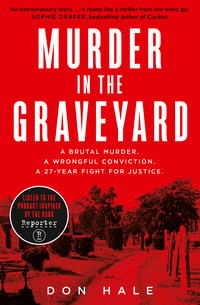
Kitabı oku: «Murder in the Graveyard»

Copyright
HarperElement
An imprint of HarperCollinsPublishers
1 London Bridge Street
London SE1 9GF
www.harpercollins.co.uk
First published as Town Without Pity by Century,
an imprint of Random House 2002
This revised and updated edition published by HarperElement 2019
FIRST EDITION
© Don Hale 2019
Cover design by Ellie Game © HarperCollinsPublishers Ltd 2019
Cover photograph supplied by the author
While every effort has been made to trace the owners of copyright material reproduced herein and secure permissions, the publishers would like to apologise for any omissions and will be pleased to incorporate missing acknowledgements in any future edition of this book.
A catalogue record of this book is available from the British Library
Don Hale asserts the moral right to be identified as the author of this work
All rights reserved under International and Pan-American Copyright Conventions. By payment of the required fees, you have been granted the nonexclusive, non-transferable right to access and read the text of this e-book on screen. No part of this text may be reproduced, transmitted, downloaded, decompiled, reverse engineered, or stored in or introduced into any information storage retrieval system, in any form or by any means, whether electronic or mechanical, now known or hereinafter invented, without the express written permission of HarperCollins e-books.
Find out about HarperCollins and the environment at
www.harpercollins.co.uk/green
Source ISBN: 9780008331627
Ebook Edition © June 2019 ISBN: 9780008331634
Version: 2019-05-22
Dedication
Contents
1 Cover
2 Title Page
3 Copyright
4 Dedication
5 Contents
6 Cast of Characters
7 Map of Bakewell Cemetery
8 INTRODUCTION
9 1 ‘STEPHEN WHO?’
10 2 THE DOWNINGS
11 3 WHAT RAY SAW
12 4 THE CONFESSION
13 5 THE WITNESSES
14 6 STEPHEN’S VERSION
15 7 BELIEVING THE BEEBES
16 8 THE RUNNING MAN
17 9 PERSONS OF INTEREST: MR ORANGE, MR OULSNAM AND MR RED
18 10 WHO WAS WENDY SEWELL?
19 11 ANATOMY OF A FALSE CONFESSION
20 12 ON THE TRAIL OF MR ORANGE
21 13 WALKING WITH WITNESSES
22 14 THE BOMBSHELL
23 15 THE SMOKING GUN
24 16 GETTING TO KNOW STEPHEN DOWNING
25 17 FACE TO FACE AT LAST
26 18 JUST BECAUSE YOU’RE PARANOID DOESN’T MEAN THEY’RE NOT AFTER YOU
27 19 WALKING IN ROBERT ERVIN’S SHADOW
28 20 CLANDESTINE MEETINGS
29 21 BATTLING BUREAUCRACY
30 22 THE TEA AND CAKES DEPARTMENT
31 23 THE COVER-UP
32 24 MULTIPLE MURDERS
33 25 THE NATIONAL INTEREST
34 26 THE WAITING GAME
35 27 THE LONGEST DAY
36 28 FACE TO FACE AGAIN
37 29 WELCOME HOME
38 30 FREEDOM
39 Epilogue
40 Enjoyed the Book?
41 About the Publisher
LandmarksCoverFrontmatterStart of ContentBackmatter
List of Pagesiiiivvixxxixii123456789101112131415161718192021222324252627282930313233343536373839404142434445464748495051525354555657585960616263646566676869707172737475767778798081828384858687888990919293949596979899100101102103104105106107108109110111112113114115116117118119120121122123124125126127128129130131132133134135136137138139140141142143144145146147148149150151152153154155156157158159160161162163164165166167168169170171172173174175176177178179180181182183184185186187188189190191192193194195196197198199200201202203204205206207208209210211212213214215216217218219220221222223224225226227228229230231232233234235236237238239240241242243244245246247248249250251252253254255256257258259260261262263264265266267268269270271272273274275276277278279280281282283284285286287288289290291292293294295296297298299300301302303304305306307308309310311312313314315316317318319320321322323324325326327328329330331332333334335336337338
Cast of Characters
THE VICTIM AND HER FAMILY
Wendy Sewell
David Sewell
John Marshall
THE MAIN SUSPECT AND HIS FAMILY
Stephen Downing
Ray Downing
Juanita Downing
Christine Downing
PERSONS OF INTEREST
Mr Orange
Syd Oulsnam
Mr Red
Mr Blue (the running man)
The businessman
PRIVATE INVESTIGATOR AND INFORMANTS
Robert Ervin
Port Vale
Chelsea
Spurs
DERBYSHIRE POLICE
PC Ernie Charlesworth
PC Ball
Detective Younger
Detective Johnson
Detective Rodney Jones
Detective Superintendent Tom Naylor
Chief Constable John Newing
Deputy Chief Constable Don Dovaston
MATLOCK MERCURY STAFF
Sam Fay
Jackie Dunn
Norman Taylor
Marcus Edwards
Matt Barlow
OTHER JOURNALISTS
Nick Pryer (Mail on Sunday)
Frank Curran (Daily Star)
Matthew Parris (The Times)
Rob Hollingsworth (Sheffield Star)
Allan Taylor (Central Television)
OFFICIALS
Patrick McLoughlin MP
CCRC Commissioner Barry Capon
WITNESSES
Charlie Carman
Wilf Walker
Peter Moran
Mr Watts
Mr Dawson
Louisa Hadfield
George Paling
Marie Bright
Jayne Atkins
Margaret Beebe
Ian Beebe
Lucy Beebe
John Osmaston
Rita
Ms Yellow
Cynthia Smithurst
Yvonne Spencer
Crabby
Steven Martin
Map of Bakewell Cemetery
A: Anthony Naylor’s grave on the lower path where Wendy was attacked, and where Stephen found her.
B: Sarah Bradbury’s grave where Wendy had moved to after Stephen returned with Wilf Walker, and where she was seen by the workmen.
C: The consecrated chapel. Jayne Atkins saw Wendy on the path behind here embracing a man.
D: The spot where little Ian Beebe saw Wendy as he cycled up the middle path.
E: The unconsecrated chapel used as the workmen’s store.
F: The Garden of Remembrance.
G: The Kissing Gate
H: The Gatekeeper’s Lodge, home of Wilf Walker.
I: The main cemetery gates.
J: The phone box.
K: The back gate to the cemetery through which Jayne Atkins entered and left.
L: Syd Oulsnam’s van was seen parked here.
M: Bakewell Methodist Junior School.
N: The spot where Louisa Hadfield saw the running man going towards Lady Manners School.

Introduction
It was a cold, drizzly night in March 1995, and I was working late at the Matlock Mercury office, with no one but my dog Jess for company, when the phone rang. It was a young woman on the other end of the line. She said there was a large fire at a nearby farm, which sounded serious and newsworthy to me.
I quickly grabbed my gear, cameras and all, and jumped in my car with Jess, who snuggled in her blanket on the back seat as we travelled through the bleak Derbyshire hills in the direction of the fire.
It was a challenging road at times, snaking its way through a barren landscape and miles upon miles of desperately bleak moorland. The road seemed totally deserted, and I was in an almost dream-like state navigating the deep dips of this roller-coaster track, when suddenly out of nowhere an enormous truck appeared right behind me, with its powerful headlights and a top searchlight burning into my rear-view mirror.
Dazzled by the lights, I slowed to let it pass, but the truck driver also slackened his speed, and remained directly behind me.
As I reached the location of the fire, all was calm and there wasn’t even a whiff of smoke. I realised I had been the victim of a hoax. It was time to turn the car round and head for home. I swung into a lay-by, steering in a wide arc, and almost clipped the lorry as it clattered past.
That’s the last I’ll see of him, I thought, as I changed up into third gear. But then, to my surprise and shock, I saw this monster in my mirror, with its roaring engine, hissing air brakes and screeching tyres, also perform a spectacular U-turn in my wake.
The darkened cab was now illuminated. The driver appeared to be talking into a CB radio. I pressed down on the accelerator but the lorry was still gaining speed on me, and very rapidly. Jess whimpered softly, so I reached back and patted her head, taking my eyes off the road for a split second – and we almost took off on one of the major dips I subsequently misjudged.
It took a second or two to adjust my vision as the headlight beams bounced back off the dark, shiny road surface. There were no other vehicles on the road; it was just me and my pursuer. I turned off onto the narrow road which led back to Cromford and Matlock, and home – but still he followed.
I put my foot down, but I was now sweating with fear, my hands and legs trembling. It was pitch black apart from the dim lights of some distant farmhouse, and I knew I would have to slow down soon.
I decided to cut off the main road to the left, which would take me back down the valley towards the picturesque villages of Winster and Elton, on an even narrower road. If I could reach there, I’d surely be safe.
The lorry was so close it was almost in the back seat with Jess, and again its bright lights blazed into my mirrors.
I jumped out of my skin when its horn, a deep and very loud siren, blared repeatedly into my ears … and then came the impact. A juddering bump in the rear, jolting my car forward.
The horn sounded again and again, and then another sickening bump. I had to think quickly. In a minute or so the junction down to Elton would appear on my left. Suddenly, I had an idea.
As the fork approached I signalled right then, at the very last moment, jerked the wheel and turned hard left. But the lorry driver copied my actions, clipping a signpost and ploughing over the grass verge in the process.
My head was throbbing, my blood pumping, and, as I wiped the sweat from my face, I knew the road would come to another T-junction in less than two miles. I was pushing 55 mph, as fast as I dared – it was too dark and the road too narrow to go any faster.
The horn sounded again, then another bang. As I was pushed away from each shunt, I noticed the driver was back on his CB radio again. It dawned on me that someone else must be involved.
The junction was now fast approaching, less than half a mile away. I could see a signpost in the distance and noticed a large, dark shape in the middle of the road, which seemed to be growing in size rapidly.
What the hell is it? I wondered, peering into the blackness. Five hundred yards and closing, three hundred and fifty yards and closing quickly.
Two hundred and fifty yards – and I was still travelling fast.
Christ, it’s another truck!
A tipper truck was parked sideways across the road, totally blocking the way. There was a shadowy outline of someone standing near the front of the vehicle. He had some kind of large object in his hand. One hundred yards and my heart was racing. Where could I go?
As if in answer to my desperate plea, my headlights picked out a reflector on a small gatepost about fifty yards ahead. Maybe there was an open gateway into a field. It was too late for anything else. I touched the accelerator then immediately hit the brake and yanked the wheel hard left, ramming the car through the open gateway into a rain-sodden field. There was a terrific bang as the lorry hurtled past. Its airbrakes hissed, screeched and locked, but it was too late for it to stop. It skidded on the wet surface and slid hard into the side of the other truck.
The field sloped downwards slightly and away from the gate. It was a sea of wet grass and mud. I gripped the steering wheel with all my might in a desperate attempt to keep control and somehow managed to turn the car round in a large horseshoe to face the gate again. The rear wheels spun wildly, but I kept up the revs, spun back up the field and hastily drove back out of the same gate.
I didn’t bother to look either way as I pulled out and roared back down the road. I was soaked with sweat, and through my rear-view mirror I could see white smoke and steam pouring from one of the lorries. Jess barked in defiance and, as I turned to offer a comforting hand, I noticed the driver-side mirror now hanging by a thread – just as my life had been.
All the way home I kept checking the rear-view mirror, any headlights causing my mind to whirl in a frenzy of paranoia and anxiety. The adrenaline continued to pour through my body.
Someone was definitely trying to kill me. I knew they had tried before, and it seemed certain that they would try again.
Yet I kept asking myself, if Stephen Downing had killed Wendy Sewell, why would anyone want to get rid of me?
CHAPTER 1
‘Stephen Who?’
There was nothing auspicious about that particular Monday, 14 March 1994. Certainly nothing to suggest that it would put in motion events that would help to change so many lives, and make an indelible mark on both British and European law.
In fact, the day started in domestic chaos, as I forgot to set the alarm following a late-night return from Amsterdam. My wife, Kath, had no choice but to dash off for work, while I did the school run, dropping off my youngest boy at Highfields School, and on the way back admired the spectacular panoramic view across Matlock and the Derbyshire Dales.
After a few days of luxury in Amsterdam it felt good to be home, and I was relieved to be heading back to reality at the Matlock Mercury. I was termed a ‘foreigner’ by many of the locals when I first moved to Matlock from Manchester. I was an outsider. But it was home for me now, the latest stop in a career in journalism that had seen me work for the likes of the BBC, the Manchester Evening News, and most recently the Bury Messenger, before the opportunity to head up the Mercury came along.
I parked up at the side of the office, and said hello to our stray tabby cat, who would often perch precariously on the upper window ledge, looking at us with a mischievous grin and probably thanking his lucky stars he didn’t have to work in our building, a former print works that had definitely seen better days.
As I entered via the back door, I could hear the old typewriters clattering away and see my reporters going about their business.
‘Good morning, everyone,’ I said cheerfully, hoping they hadn’t noticed that I was ten minutes late. ‘Anything special happened since I’ve been away?’
Jackie Dunn, one of my young journalists, cheekily asked if my flight had been delayed, before she gave me a brief summary of events from the previous week.
My sports editor Norman Taylor, a retired train driver, said Matlock Town had still not scored – but had won a corner, a comment that earned a glare from Sam Fay, my deputy editor. A war veteran in his late sixties, he worked on a part-time basis, covering match reports and local politics.
I took my jacket off, settled down and began to plough my way through all the paperwork, while I asked Sam for a meeting to discuss stories for the next edition.
The small sliding window in the frosted glass partition, which divided editorial from the advertising department, suddenly slid open with a loud bang.
The receptionist announced, ‘Don, there’s a man wanting to make an appointment with you. He says it’s something about a murder.’
She cupped her hand over the receiver. ‘Do you want to take the call?’ she asked. ‘It’s something to do with his son, Stephen.’
I beckoned to her to put the call through.
When I answered, the man chatted away at ten to the dozen. It was like trying to decipher a verbal machine gun. ‘Stephen who?’ I asked.
‘Stephen Downing,’ came the reply, sounding rather agitated, as if I should know all about him. The man explained that he was his father, Ray, and claimed his son was still in jail after 20-something years for a murder he didn’t commit.
He said the murder had occurred in the cemetery at Bakewell, a pretty, picture-postcard market town in the Peak District, about eight miles away. I let him continue for a while before I interrupted, saying, ‘It’s all right, Mr Downing …’
‘Call me Ray,’ he quickly replied.
‘Okay then, Ray. You don’t have to make an appointment to see me. I’m usually here from dawn till dusk.’ I found it very difficult to take in half of what he’d said to me over the phone. ‘Yes, Ray, 2.30 p.m. today is fine. And bring some paperwork with you if you wish. I’m not sure what I can do but I’ll have a look.’
I looked round to see that some of my team were also listening. I told them, ‘It’s a Mr Downing, who says it’s something to do with an old murder involving his son. I think he said it was in 1973. He’s a local taxi driver, and both he and his wife want to see me today. This afternoon, in fact.’
Sam pulled out a cigarette and lit it. He frowned at me, and half spluttered, ‘Don, I will have to go out for a short while but I’ll speak with you later. We must have a chat about this Stephen Downing.’ With that he disappeared in a trail of smoke.
* * *
At precisely 2.30 p.m. there was a knock on my office door. ‘A Mr and Mrs Downing to see you, Don. They have an appointment?’ said Susan, one of our advertising reps.
‘Yes, of course, show them in, please,’ I replied, and ushered the pair into my private office. Ray Downing was struggling to hold a large pile of documents, which he then dumped firmly on my desk. I had to move them aside slightly so I could see their faces.
Ray was a fairly small man with a bald head and a worried expression. I guessed he was probably in his late fifties or early sixties. His wife, whom he introduced as Juanita, was about the same age. She looked quite frail and had sharp, almost bird-like features. She was very nervous and extremely thin. Both wore their Sunday best.
Ray outlined his reasons for contacting me. He claimed his son Stephen had been jailed in 1974 for the murder of a woman in the town cemetery the previous year. Ray kept saying he was innocent, and that everyone in Bakewell knew he was innocent. He kept stressing that word.
‘What’s more,’ said Ray, ‘I can probably tell you who was responsible. Nearly everyone in Bakewell seems to know who did it.’
I was taken aback by his comments. Ray didn’t mention any name, but I was puzzled by his claim and wondered, If it was all so obvious, why was his lad still in jail?
Ray alleged that Stephen had been framed for the murder as part of a conspiracy because the town needed someone else to blame. He claimed the police forced Stephen to wrongfully confess to an assault on a young, married woman, who later died from her injuries.
Ray claimed the woman, Wendy Sewell, was promiscuous, and had taken several prominent local businessmen as lovers. He suggested a long list of individuals, and said they were all well known in the Bakewell area. He believed the powers that be in the town had conspired to protect the victim’s secret life, and perhaps themselves, from a massive scandal.
He explained that several other characters had been seen in or around the cemetery on the day of the attack, and that potential witnesses had either been ignored by the police or deliberately warned off.
He strongly believed that one particular officer, who ‘had it in for Stephen’, went flat-out to get a quick confession. Ray said that although his son quickly retracted it, the confession still formed the main plank of the prosecution evidence from which he was convicted.
Ray said there had been some previous attempts to obtain an appeal against conviction, the first being in October 1974, a few months after his trial, and the second some 13 years before, in 1981. Both failed. He then admitted to hiring a private investigator, Robert Ervin, a former army investigator, who worked on the case for about ten years but died some time ago.
Juanita let Ray do most of the talking. She looked uncomfortable and agitated, and began fumbling through the paperwork, before extracting some old cuttings that reported the previous attempts to appeal. She explained that the rest of the paperwork included court papers, copies of some old witness statements from years ago and various other official reports she thought I might find of interest.
Ray was anxious to continue, and he confirmed that the reason they wanted to see me that day was because a woman had telephoned them anonymously to say she had sent both me and the editor of the Star some fresh evidence that could help clear their son’s name.
‘The Star?’ I asked. ‘Do you mean the Sheffield Star or the Daily Star?’
‘Don’t know, she just said the Star.’
‘Look, I’ve just returned from a short break,’ I said. ‘I don’t think anything’s arrived here, nobody has mentioned anything, but I’ll go and check.’ I brushed past them and made my way to the main office.
‘Does anyone know anything about a letter concerning Stephen Downing?’ I asked. ‘His parents think some fresh evidence may have been sent here.’ Everyone shook their heads.
Jackie said, ‘Whatever came in that we couldn’t deal with is on your desk. I don’t recall anything about a Stephen Downing, though.’
‘What’s this all about?’ asked Norman.
‘I’m not quite sure at this stage, but their son Stephen has been in jail for murder for over 20 years. They are desperate and need a lifeline. I’ll ask Sam when he comes back,’ I replied.
I returned to my office and told the Downings that nothing had been received so far, but that I had contacts at both newspapers and would get back to them as soon as I could. We made arrangements to meet a day or two later at their home in Bakewell.
I was intrigued by what they had said. They were obviously biased, but it seemed worthy of investigation – particularly if some fresh evidence had come to light.
The Downings seemed a likeable couple, who genuinely believed in their son’s innocence. Ray had spoken of numerous conspiracy theories, while Juanita had maintained a more dignified stance, sitting there patiently listening to her husband’s defiant explanations.
I was apprehensive about getting involved, but my youngest son was now about the same age as Stephen was when he was convicted of murder.
Sam returned with another cigarette in his mouth. The ash was hovering precariously. ‘Did Ray Downing come in?’ he asked.
‘Yes, Sam. So what do you know about the case?’
Sam grabbed my arm and led me back into my office. ‘Ray’s well known around here,’ he explained, closing the door. ‘He drives people crazy with this tale about his son’s innocence. He has spent years trying to solve the crime and clear his lad. Poor sod. I really can’t blame him, though. Stephen was only a kid, and a bit simple too, from memory.’
In his hat and coat, Sam looked like a detective from a 1950s movie. I explained about the family’s current claim of an anonymous caller and some potential fresh evidence. He wasn’t too impressed. He had two or three more drags on his cigarette, then started to talk about the case through a haze.
‘It was all a long time ago, but I was on the story leading up to the trial. As far as I can recall, there was a slight feeling of surprise when he was convicted. He was only 16 or 17, I think?’
‘Seventeen, Sam,’ I confirmed.
‘Yes, whatever. I know other names were bandied about and the murdered woman was well known in the area, if you see what I mean?’
‘No, not really, Sam.’
‘She’d left her husband and I think there was some sort of scandal. You know what Bakewell is like. I think Stephen admitted something, then retracted it.’
‘I’m going to their house on Thursday. They want to show me a few other things of interest.’
Sam stared at me. ‘Be careful, be very careful,’ he said. ‘It’s a minefield. Don’t get sucked into it.’
CHAPTER 2
The Downings
I contacted my friend Frank Curran at the Daily Star and Rob Hollingworth at the Sheffield Star. Neither had seen any letters relating to the Downing case, but said they would call if anything turned up.
My reporters were keen to become involved with something out of the ordinary and willingly helped with my investigations. Jackie spent a lot of time collating information from old newspaper cuttings from the early 1970s, trying to build up a true picture of the Wendy Sewell murder. She also contacted all the official channels for copies of any important paperwork. I tried to track down any relevant forensic or medical reports, and between us we soon built a substantial portfolio about the case.
Over the next few weeks we held several case conferences to discuss updates or developments. Following my initial review, I wrote to the Chief Constable at Ripley, asking for the release of some paperwork and any other relevant information regarding the murder.
It appeared the murder had naturally made quite an impact locally, but not necessarily nationally. And most of the press reports were fairly consistent.
On Friday 14 September 1973, the Derbyshire Times declared:
MURDER BID CHARGE
Critically ill in Chesterfield Royal Hospital with serious head injuries is an attractive 32-year-old housewife, who was found unconscious in a Bakewell cemetery just after lunchtime on Wednesday.
Yesterday morning, Derbyshire police said that a young man had been charged with attempted murder and would appear at a special court in Bakewell later that day. The accused is understood to be 17-year-old Stephen Downing, a gardener from a Bakewell council estate.
The woman, Mrs Wendy Sewell of Middleton-by-Youlgreave, was found just after 1.15 p.m. She was rushed to Chesterfield Royal Hospital but early yesterday morning had still not regained consciousness. Police are waiting at her bedside.
She was discovered lying face downwards between gravestones in an old part of the churchyard, close to dense woodland. The cemetery was sealed off as police began their investigations.
Fifty CID and uniformed officers were drafted into the quiet market town and the area surrounding the cemetery was combed by tracker-dogs. Detective Supt Peter Bayliss announced that a 17-year-old youth had been formally charged with attempted murder.
Mrs Sewell worked for the Forestry Commission. She left the office just after midday and was seen walking along the ‘Butts’ in the direction of the cemetery shortly after 12.30 pm. Neighbours said on Wednesday night that Mrs Sewell often visited her mother at Haddon Road, Bakewell, after finishing work.
A slightly later cutting, dated Friday 21 September, explained:
WOMAN DIES AFTER ATTACK IN CEMETERY
Stephen Downing (17), a gardener, is due to appear in court following an eight-day remand in custody.
The papers for the case have been forwarded to the Director of Public Prosecutions, but no information was available this week as to whether the charge would be increased to one of murder. Downing made a two-minute appearance before a special court in Bakewell last Thursday and was charged that he did attempt to murder Mrs Wendy Sewell.
On 22 February 1974, following the trial at Nottingham Crown Court, the same paper reported:
YOUTH ON MURDER CHARGE IS FOUND GUILTY
Stephen Downing, aged 17, was found guilty of murdering 32-year-old typist Mrs Wendy Sewell in a cemetery in Bakewell, Derbyshire, by a unanimous verdict.
Downing, who was alleged to have bludgeoned his victim with a pickaxe shaft and sexually assaulted her before leaving the body among the tombstones, was ordered to be detained at the Queen’s pleasure. They took only an hour to reach their unanimous verdict last Friday.
Passing sentence, Mr Justice Nield told Downing, who worked in the cemetery as a gardener, ‘You have been convicted on the clearest evidence of this very serious offence.’
Mr Patrick Bennett QC, prosecuting, had described how Downing had followed Mrs Sewell in the cemetery before carrying out the savage attack with a pickaxe handle. Downing claimed that he had found Mrs Sewell’s half-naked body and then sexually assaulted her.
Mrs Sewell, who lived at Green Farm, Middleton-by-Youlgreave, died in hospital two days after the attack from skull and brain injuries. Downing was alleged to have admitted the assault late at night after spending several hours in the police station. He was alleged to have described how he struck Mrs Sewell with the pick shaft on the back of the head and undressed her.
Police officers denied that Downing had been shaken to keep him awake after spending hours at Bakewell police station. His mother, Mrs Juanita Downing, told the jury that her son had never gone out with girls and only had one good friend.
Downing said that bloodspots on his clothing got there when Mrs Sewell raised herself on the ground and shook her head violently. He had told the jury that he found the victim lying semi-conscious in the graveyard after going home during his lunch hour, but the prosecution said that his lunchtime walk was only an alibi after he had carried out the attack. Downing had pleaded not guilty to the murder.
Other regional papers carried similar copy, stating, ‘A savage assault by a teenager with a pickaxe handle. She sustained repeated blows as many as seven or eight to the head – and had then fallen against tombstones.’
Many papers made a reference to Judge Nield, who kept referring to Downing’s statement, which was ‘signed over and over again’ and formed the main plank of evidence for the prosecution.
To all intents and purposes, it seemed like a fairly straightforward conviction. A confession had been obtained on the day the attack took place, and although Downing retracted it before trial the prosecution case still relied very heavily on this admission.
The trial lasted three days. The jury heard just one day of evidence and took less than an hour to reach their unanimous verdict of guilty. It all seemed so quick, clean and convenient. This alone made me consider it curious and worthy of initial investigation.
* * *
A few days later, I set out on the short but pleasant drive along the A6 to Bakewell. The Downings lived at Stanton View, just a few hundred yards from the cemetery – the scene of the crime. They lived in a small semi-detached house on the council estate. It was the same property that Ray, Juanita, Stephen and his sister Christine had all lived in together until that fateful day in 1973.
Despite the fact that Stephen had remained in custody ever since his arrest, his mother kept his room just as it was. The family had campaigned for his freedom ever since his conviction. Ray never looked well, and at first he probably thought I was just another journalist who would write a brief update and then disappear into oblivion.
Ray told me about his work as a taxi driver and, over a cup of tea, explained how he and Juanita first met in a Blackpool ballroom in 1952, when he was completing his national service in the RAF.
Juanita, who had been watching me like a hawk, told me to call her Nita, and explained how she had been adopted from the age of three and never really knew her parents. Born Juanita Williams, she was brought up near Liverpool. She and Ray later married and moved to Burton Edge in Ray’s home town of Bakewell.
Following national service Ray obtained a job at Cintride, as a first-aid attendant, before he left to drive ambulances and coaches. Stephen was born at their home in March 1956, with their daughter Christine born exactly three years later.
Ray said Stephen had a quiet, reserved nature, just like his mother, and was good with his hands but struggled academically. He confirmed that Stephen had the reading ability of an 11-year-old at the time of the murder, and said he believed himself to be a failure at school, with few friends, and preferred his own company.
Nita, though, explained how Stephen loved animals, and said that on the day of the attack he returned home to change his boots and to feed some baby hedgehogs found abandoned just a few days earlier.
She also said Stephen was a bit lazy and a poor time-keeper – a worrying problem that had cost him several jobs. On the day of the cemetery attack Stephen was employed there as a gardener for Bakewell Urban District Council.
I knew that if I were to have any hope of understanding this case and the Downings’ allegations, I would need to examine the crime scene myself. Ray agreed to give me a tour of the cemetery, and we walked across the road to it. It was hard to imagine how such a gruesome murder could have been committed in broad daylight, and so close to a busy housing estate, with much of the area overlooked by dozens of houses. Ray was somewhat disappointed that I had not read much of his paperwork, and at first seemed quite abrupt. I told him that I needed to keep an open mind.
The cemetery was situated at the top of a steep hill overlooking Bakewell. The main access was via two large iron gates. Just inside was a gatekeeper’s lodge. It was quite a compact area, probably about 450 yards in length, with two main tarmacked pathways running parallel, one adjacent to Catcliff Wood and the other close to a large beech hedge. The woodland area included a dark, secluded section. The main path ran directly towards the old chapel, and a bit further on and to the rear was the unconsecrated chapel, where Stephen worked at the time of the murder.
Ray showed me where Wendy Sewell was attacked. He then indicated where Stephen said he found her, lying on the path next to an old grave. The headstone bore the inscription ‘In the Midst of Life We Are in Death’. It was the grave of Anthony Naylor, who died in 1872.
Immediately behind the grave was a low drystone wall, and a few feet below was Catcliff Wood. I could see how someone could easily escape if they had attacked Wendy, disappearing into thick undergrowth.
As we wandered further along, Ray pointed out another spot across some displaced gravestones, back towards the centre path. ‘Now here is where Wendy moved to,’ he explained.
‘Moved to?’ I asked, as we carefully negotiated our way around a number of ancient and broken graves.
‘Yes. After Stephen found her he went to get help, but when he returned she’d moved,’ he said. Ray then stopped next to the grave of Sarah Bradbury. ‘Wendy was found just here.’
I was surprised. ‘So how did she move, Ray?’ I asked, wondering how a seriously injured woman could drag herself 25 yards or so along the path, and across several gravestones.
‘Well, there’s the mystery,’ said Ray. ‘No one has been able to answer that one. It didn’t come up at trial either, and the police never queried it.’
Ray then showed me Stephen’s former workplace inside the unconsecrated chapel. He explained that this was where the council workers stored their tools, and that it had been used by quite a few men at the time of the murder.
We turned and headed back out towards the main gates, and I tried to put the case into some sort of perspective as I listened to Ray. He kept mentioning the names of several individuals who had supposedly been identified near the cemetery at that time. I realised I would need to read his papers for any of this to make sense.
As we headed part way down the Butts, a very steep walkway heading back into town, Ray showed me the Kissing Gate, an old two-way iron contraption that led back into Catcliff Wood.
It was the reverse route to that taken by the victim as she approached the cemetery during her lunch break. It was also the path taken by a number of key witnesses, who could perhaps have helped confirm Stephen’s alibi and his movements on the day.
As I tried to consider all the probabilities and possibilities offered by Ray, I thought this so-called remote location appeared more like Piccadilly Circus immediately prior to and just after the attack, with people coming and going back to work after lunch. It seemed to be a simple routine, and yet, according to Ray, everyone reported different timings and information within their statements.
We returned to the Downings’ home, where the kettle was already whistling on the stove. Nita had seen us both walking back, and as we walked in she said, ‘I thought you would have been back before now.’
‘There’s a lot to see,’ Ray replied. ‘And Mr Hale wanted to see everything.’
‘It’s Don, Ray. Call me Don. This Mr Hale sounds more like a bailiff.’
Ray laughed. ‘Don’t mention bailiffs. There’s one round here that we don’t care for at all, isn’t that right, Nita?’
She laughed too. It was obviously some in-joke. Nita handed me a hot mug of tea. It was a family home full of personal mementoes and treasured photographs, yet Stephen’s face was always missing, apart from a few childhood snaps. Their only contact with him now was on infrequent visits to a distant prison several hours’ drive away.
This thought of Stephen suddenly reminded Ray of something, and he scurried away into the lounge before returning with a large basket. He said excitedly, ‘This is Stephen’s clothing from the day of the attack,’ and tipped out the contents on to the table.
I was shocked to see Stephen’s old jeans, T-shirt and work boots, together with rings, a watch and a leather wrist strap.
I couldn’t understand why the police had returned these items, and why the family still retained his clothes after all these years. Incredibly, as I looked much closer, I could just about see some very tiny spots of blood on his T-shirt, but only because they were highlighted by a yellow forensic marker.
Ray pointed out a particular dark stain on the left knee of these discoloured and dirty jeans, which he said was congealed blood. No other stains were obvious to the naked eye. ‘Look at all these clothes,’ he said. ‘They are not drenched in blood. And yet our Stephen was said to have battered this poor woman to death.
‘If he had, he would have been covered in blood from head to toe. The only blood he got on his clothes was from kneeling next to her when he found her. What’s more, I know the ambulanceman who took Wendy to hospital that day. He carried her into the ambulance.
‘He said he was covered in blood, as she was bleeding so much. He had to burn all his clothes afterwards, they were completely ruined. They were absolutely soaked in blood. You can talk to him. His name is Clyde Bateman. I used to work with him at Bakewell ambulance station. I was a senior ambulance driver and he was my boss.
‘He was summoned to attend an appeal eight months after the trial but was never called as a witness. He wanted to talk about the bloodstaining. He’s now retired, but every time I see him he maintains that Stephen didn’t have enough bloodstaining on him to have committed the attack.’
Ray was still excited. He was sweating and slightly breathless. He eventually paused as I queried, ‘How come you have Stephen’s clothes?’
‘They told me to take him down a change of clothes to the police station, and then they sent these off for testing. They gave us back the watch and the jewellery on the same night as the attack,’ Ray said.
‘The clothes came back later. It’s obvious there’s not enough blood on them, though.’
It was beginning to get dark and, as I had now spent several hours with the Downings, I decided to make a move, but Ray motioned me to sit back down. ‘I’ve a lot more to show you. I’ve got more files and notes. You’ll need to see them all,’ he pleaded.
I had to take an urgent step back. It had been quite an afternoon. The Downing family had made this a personal crusade for the past 20-odd years, but I didn’t want to be drawn in or build up their hopes before I got my bearings.
I politely declined Ray’s offer. I told the pair I had to get back to work. I wanted to spend some time going through the files so that I could examine their claims in more detail. I decided I would make an early start the next day, and cancelled my weekend engagements.
For a split second I felt complete panic. Ray’s papers were piled high next to my desk, and I wondered, What if the cleaner has arrived early and dumped them, not realising their importance?
When I returned to the office, the pile was thankfully still intact. I phoned Ray to arrange another meeting. He suggested I should go the day after next, as Stephen was due to ring from prison. He thought it would be good to speak to him directly.
By then everyone else had left the office. I had my coat on ready to follow them, my hand on the door handle to leave, when suddenly the phone rang. After such a busy day I was in two minds whether to answer it, but I reluctantly picked up in the end.
‘Good evening, Matlock Mercury. Don Hale. Can I help you?’
There was complete silence.
I asked again, ‘Hello, hello? Matlock Mercury.’ Still silence, although I had the impression someone was listening at the other end. I thought I could hear someone breathing, and a slight background noise.
Then a mature man’s husky voice shouted angrily, ‘Keep your fucking nose out of the Downing case if you know what’s good for you! Do you get my meaning?’
Before I had the chance to answer, he slammed down the phone.
CHAPTER 3
What Ray Saw
I returned to the Downing household a day or two later. I decided not to mention my anonymous caller. I thought he was probably a local crank who had spotted me on the estate and just wanted to rattle my cage. Besides, there was a more important phone call at hand.
Nita put the kettle on and within a few minutes she had a piping-hot cup of tea ready. Stephen was going to phone from prison but would only have a few minutes to chat. The couple said all his calls were monitored and restricted to a few short minutes via a special phone card during breaks from work.
I knew very little about their son, other than what I had read in those dusty old cuttings and from listening to Ray and Nita’s descriptions of him. I asked Nita, ‘Had Stephen been working long as a gardener for the council?’
‘No, no,’ she replied with a knowing smile. ‘He’d only been there for about seven weeks. He liked it, though. They’d shown him how to keep the hedges tidy, prune the trees, mow the lawns, keep the graves tidy, that kind of thing.
‘Although he was left to his own devices, other workmen regularly visited him and Stephen would help them out. To be honest, though, he didn’t seem able to stay in any kind of job for very long.’
As they spoke, I tried to imagine a young, immature Stephen Downing – a boy in many ways – convicted of brutally killing a married woman nearly twice his age at his place of work.
It seemed clear that he was not as bright as many other children of a similar age, and to me it seemed his struggle to cope with life continued into his teens and early working career.
Ray said Stephen loved model-making, needlework and cooking. Nita added that sometimes he would take over the kitchen to make everyone a meal, and he enjoyed baking. It appeared however, that Stephen had little in common with other teenage lads, and to many people he was considered odd and a loner.
As we chatted, I was startled out of my thoughts by the loud ringing of the telephone from the adjoining room. Nita rushed through and picked up the receiver, while Ray and I trailed after her.
She quickly passed the phone to Ray, who explained that I was there with them and wanted a quick chat. He then thrust the receiver into my chest.
Stephen sounded much younger on the phone than I had imagined. He was quite friendly but nervous, as he had never spoken with a journalist before. Initially he was slightly excitable, speaking at thirteen to the dozen, and it seemed he wanted to tell me his life story in one go, probably due to the limited time restrictions for a prison call. He seemed keen to accept my help and was almost emotional as he thanked me for my interest.
I told him I would appreciate as much help as possible from him and asked him to send me his personal account from the day of the attack. His parents seemed elated that after all those years someone had finally agreed to look into the case.
After the call, we sat back down in the kitchen, where Ray agreed to share his own recollections from the day of the attack. He grabbed another cup of tea and began.
‘It was bitter cold that morning, that I do remember. I had woken early – about 5.30 a.m. I was a bus driver in those days for Hulleys of Baslow. I had the early morning route that day. I remember pulling back the curtains and being surprised to see a heavy frost.
‘I had a wash and went down to the kitchen for some breakfast. Nita had come down by then.’ He looked across to his wife for support. She must have heard the story many times before. ‘You asked Stephen if he was going in to work, didn’t you, Nita?’ he said.
‘Yes, there was a sleepy response, if I remember correctly,’ Nita admitted. ‘Stephen just couldn’t get up in the morning. He had been off work on Monday and Tuesday with a heavy cold. I doubted whether he would make it to work that day.’
Ray continued, ‘I knew Nita would wake him early enough, but she couldn’t be behind him all the time. She also had to look after Christine. That day was important, because it was her first day back after the summer term. Christine wanted to be early, so Stephen had to fend for himself.
‘He seemed okay the night before, and said he wanted to go back. I asked Nita before I left if she thought he’d be fit for work. She wasn’t sure, but said she had his sandwiches ready if he decided to go in.’
‘So, did Stephen get off to work on time?’ I asked.
Nita was grinning, ‘He was at the very last minute as usual. I called him at 7.20, and told him that Ray had been gone for ages and Christine was checking her school stuff. Even though we only lived a few minutes from his work, he was often still late.
‘In fact, he was in such a rush that day that he put on the wrong boots. They were probably the first pair he could find in the half-light, but they were his best blue dress boots.
‘He only realised this on his way in to work, and panicked, thinking his dad would shout at him. In any case, he changed them when he came home at lunchtime.’
‘Anyway,’ Ray coughed, resuming his story. ‘By that time I reached the depot. I was pleased to see the coaches weren’t frosted over.
‘I was driving our old faithful bus Nell, which operated on the daily service round the local villages. I checked her over. She was always reliable, and I thought, What a pity Stephen couldn’t be more like her.
‘She started first time, and I drove out of the main yard but took it steady in case there was any ice about.
‘As I approached Middleton-by-Youlgreave, I noticed some people huddled in a small group by the bus stop. One woman was stamping her feet to keep warm, and they were all wrapped against the bitter chill wind.
‘“All aboard the skylark!” I shouted as the door swung open, and a cold breeze came in with the first passenger. I checked my change and adjusted the ticket machine ready for the next stop. The clock on the dashboard was visible to all, and the minute hand clicked to 8.05 a.m.
‘I had arrived on time just before 8 a.m., but couldn’t leave until the scheduled time of 8.10. I closed the door again, and while we waited I took a quick glance to admire the view.
‘The engine shivered against the cold. The clock suddenly clicked, and it was 8.10 a.m. precisely.
‘I asked if everyone was on – not really expecting a reply. I glanced in the rear-view mirror as I set off, and then suddenly this woman appeared directly in front of me. I had to stand back hard on the brakes, and the passengers were all tipped forward in their seats.
‘I opened the door again and let on this young woman I recognised as Wendy Sewell. She had been totally oblivious to any danger and was fiddling for change inside her purse. She had actually brushed against the front radiator of the bus just as I was setting off. Still breathless with shock, I said to her, “You were lucky!”
‘She replied, “Yes, I’d laddered my tights and had to look for another pair. I thought I’d miss the bus!”
‘No, I don’t mean that,’ I said. ‘I nearly knocked you over!’ She seemed totally unconcerned, and then it dawned on me – she hadn’t even realised her lucky escape.
‘I then said, “You’re not usually on this bus.” And she replied, “No, but I’ve some business to attend to in Bakewell.”
‘Wendy sat on the front passenger seat by the door. She looked straight ahead and didn’t acknowledge anyone. I glanced at her again as she sat down. She had long, dark-brown hair, which curled just above her shoulders. She was wearing a beige trouser suit with a black jumper.
‘As she crossed her legs, her left trouser leg ran up slightly and I noticed that she was wearing tights underneath with small white ankle socks and rather dingy-looking white plimsolls.
‘I thought she had probably put on the tights to guard against the cold. She carried a light-brown wicker-type shopping basket over one arm, and put her purse into a small handbag, which she placed under a cloth in her basket. I shook my head slightly and thought, What a pity. A pretty young woman – shame about the shoes!’
I stopped Ray for a moment. ‘You’re sure about the purse, tights and basket?’ I asked. I needed to be sure because I couldn’t find any record of these items in the police scene-of-crime report. There was also no mention of any diary, which again was supposed to have been in her handbag – allegedly together with a black book.
It seemed rather odd that the victim was found without her handbag or any other important personal effects. I recalled that there was no mention either of finding her tights.
Ray thought for a moment and then said, ‘Yes, I am absolutely certain. That very morning, she placed her purse into the basket and then covered it with a cloth.’
‘So, what do you think happened to these things?’ I asked him, adding, ‘They were not found at her office, so are they still in Catcliff Wood?’
‘Why not?’ Ray replied. ‘I don’t think anyone bothered to look, despite it being right next to the cemetery. After they forced a confession out of Stephen the police made little effort to find anything, or to question anyone else.’
He was keen to continue with his story. ‘I exchanged a few more pleasantries with Wendy but we were fast approaching Bakewell town centre. She was more intense as we came into Rutland Square. She seemed to have some things on her mind. As soon as we stopped, she was up and out in one, and ran down the street without saying a word. I shouted, “Cheerio!”, half expecting her to wave back, but she didn’t. I never saw her alive again.’
Ray wiped a tear from his eye – he was still emotional as he recalled these details – but soon regained his composure. He dipped his biscuit into his tea. ‘I had a funny feeling it would be a memorable day. The strange thing is that I could have killed Wendy Sewell myself that morning, quite by accident, of course, and then we wouldn’t have had 20-odd years of this bloody nonsense.’
Nita said she arrived home from work on the bus just after 1 p.m. She had only put the kettle on a few minutes before when she heard Stephen’s key in the door. ‘I shouted to him that it wasn’t locked,’ she said. ‘Stephen said the shop had already closed for lunch, and he asked me if I could get him another bottle of pop and take it across to him later at the cemetery. He had an empty bottle with him to collect the refund, and he put it on the kitchen table with some money.
‘I asked him if he was staying for a cuppa as I was making one for myself. He said no, as he had just come back to change his boots and feed the hedgehogs.
‘I told him I had already fed them, and said I would get him another bottle of pop when the shop opened and take it down to him later. He stayed for maybe another minute or so, but said he had to get back to his work and would see me later – but he too never returned home.’
Ücretsiz ön izlemeyi tamamladınız.