Kitabı oku: «Deadly Payload»
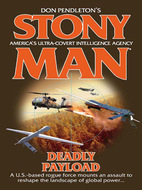
Deadly Payload
DON PENDLETON’S
Stony Man® AMERICA'S ULTRA-COVERT INTELLIGENCE AGENCY
 www.mirabooks.co.uk
Special thanks and acknowledgment to
Douglas P. Wojtowicz for his contribution to this work.
CONTENTS
PROLOGUE
CHAPTER ONE
CHAPTER TWO
CHAPTER THREE
CHAPTER FOUR
CHAPTER FIVE
CHAPTER SIX
CHAPTER SEVEN
CHAPTER EIGHT
CHAPTER NINE
CHAPTER TEN
CHAPTER ELEVEN
CHAPTER TWELVE
CHAPTER THIRTEEN
CHAPTER FOURTEEN
CHAPTER FIFTEEN
CHAPTER SIXTEEN
CHAPTER SEVENTEEN
CHAPTER EIGHTEEN
CHAPTER NINETEEN
CHAPTER TWENTY
CHAPTER TWENTY-ONE
CHAPTER TWENTY-TWO
CHAPTER TWENTY-THREE
EPILOGUE
PROLOGUE
Jason Kovak ran his fingertips across the smooth shell of the unmanned aircraft, a smile coming unbidden to his lips. It was a simple machine, with a standard propeller engine mounted under a housing that protected it from detection by thermal imagers. Even so, it ran much more coolly than a rocket thruster. The powerful computer in its bulbous nose would steer according to data flowing from its forward-looking radar, avoiding collision with terrain. That was only on autopilot, while utilizing an artificial intelligence program. Inside the sloped head there was also a tight beam transceiver, capable of picking up signals from a thousand miles away to be directed by remote control. Riding beneath wing mounts on two hard points were six high-powered missiles, their noses fitted with television cameras for precision fire.
“How many do we have?” the Israeli asked.
“Enough for what you wish,” Cortez answered. His handsome, tanned features and black, silken suit reminded Kovak of an unmasked Zorro.
Kovak nodded. “We’ll need quite a few. With some optional payloads. You’re sure you can get enough?”
“Generosity, promises whispered,” the Argentinian said, stroking his neatly trimmed pencil mustache. “I have my means.”
Kovak nodded. “I won’t dig too deeply, then.”
“This is a big step for your side,” Cortez said.
“My side?” Kovak asked. “I don’t have a side anymore. Not after we’ve been betrayed.”
“And so you’re turning to us,” the Argentinian concluded. “You can’t get much more anti-Israel than our consortium.”
“Israel and the Arab nations are partners now,” Kovak said. “Bedfellows, seeking out peace accords when for millennia they’ve assailed the land promised to our people. They forget the Holocaust. It was a blip in history, done by a German madman long dead.”
“So you’re going to destroy your country?” Cortez asked. “Not that we mind. After all, Mossad’s been hunting the Consortium’s family and membership for decades.”
Kovak chuckled. “There’s a little sting, I’ll admit. But the Mossad is a joke, knuckling to political correctness and cowardice. The Consortium isn’t on an anti-Jew kick now, because it has other problems. Both of us have other things to worry about. Betrayals, weakness and weakened, corrupted leadership that needs a slap in the face to wake up. We have the same goal. We are one, building a better future.”
Cortez nodded and held out his hand to the Israeli. “A world without our different headaches.”
“Engineering the new tomorrow,” Kovak said, referring to the name of the alliance. “If anyone wishes to stop us, they’ll run face-first into a united front.”
T HE FIRST STRIKE of the united front known only to a few as the Engineers of the New Tomorrow came at dawn at a terrorist camp just five miles north of Damascus, Syria, in the mountains that formed a natural border with Lebanon. The camp was used by Syria to train and arm members of the Popular Front for the Righteous Liberation of Lebanon, a splintered offshoot of the Palestinian forces in the Lebanese countryside.
The strike was preceded only instants before by the soft hum of propeller-driven unmanned aerial vehicles, which drew the attention of the sleepy camp guard. The guards were used to being buzzed and observed by the Americans with their Predator drones, but every so often the Pentagon wanted to look as if it was taking a more offensive stance, and dropped a couple Maverick missiles into their backyard. Nothing that would obliterate the widely dispersed camp. Still, the groggy guard called out a warning, but by the time the words left his mouth, it was too late.
The first three rounds were white phosphorous, which burst thirty yards above the ground. They had been perfectly spaced and timed, clawing trails of burning waxy smoke spreading wide and arcing down into the unprepared camp. Half-dressed men, hearing the cries of alarm from the sentries, had burst from their tents and run right into the searing rain. As the WP struck their flesh, whether or not it was exposed or protected by clothing, it melted through, destroying skin and muscle until it burrowed down to the bone.
The lucky ones passed out immediately, while dozens of others ran screaming in horror at a pain that could only be torn out on the point of a knife. Lebanese insurgents and Syrian advisers twisted and writhed, grinding into the muddy ground, trying to drown the burning fragments of white phosphorous, but once exposed to air, the deadly element was unquenchable. Flesh around the fragments cooked and peeled away from bone in a slow, murderous torture.
The second wave of missiles from the UAV drones came unheard, the screams of the wounded and dying filling the air until the shrill rattle of 77 mm artillery rockets was right on them. These landed amid the semipermanent prefabricated buildings where supplies were stored. Thermobaric warheads struck with earth-shattering force, ripping Quonset huts to pieces and destroying anything and anyone still inside. Assault rifles and rocket launchers meant to slay the enemies of Syria in Lebanon were turned to pulped and mangled piles of wreckage.
A lone round sizzled into the communications hut and scoured it from existence with a blast equal to six sticks of dynamite. A radioman inside was cut off in midrequest, begging for help and support from the Syrian military when he and the hut were blasted into oblivion. The largest piece remaining of the Syrian communications officer was the size of a pencil eraser.
As smoke roiled into the sky, the circling drones whirled into position to launch phase three. Like hightech vultures, the quartet of drones pumped out a sheet of staggered rockets. It would have seemed overkill had it been conventional explosives or white phosphorous, but instead, cakey yellow clouds erupted from each artillery rocket strike. The ugly ocher fog spread across the camp. The cries of the wounded suddenly fell silent as the cloud washed over them.
One rocket round had landed, unexploded, its fuse apparently having malfunctioned. While the manufacture was undeniably American, the writing on the side was Arabic. The unmanned drones themselves were identical to the machines given to Egypt by the United States government as part of a multibillion-dollar lend-lease agreement.
Syria, stung with betrayal over the loss of dozens of its troops to an Egyptian sneak attack, threw out accusations, crying out in hatred against politicians in Cairo and Washington, D.C., vowing revenge.
Shock waves rippled across the globe.
P HASE TWO OCCURRED within thirty minutes of the attack in Syria, but it occurred in Panama. Memories of the invasion that had deposed Manuel Noriega decades earlier had never really left the public’s mind. The full might of the United States armed forces had crushed down and taken out Noriega’s government and forces. The American liberal elite had accused the Reagan administration of using overkill against the Panamanians, to the point where AC-130 gunships were said to have slaughtered citizens and soldiers alike as they raked neighborhoods with dozens of machine guns and cannon in synchronized fire.
Those wounds were yet fresh and raw, despite the long years since 1989. The United States consulate still had its share of protesters out front, anger sharp and focused over lost loved ones. They were peaceful, and they carried candles for a midnight vigil commemorating the anniversary of the invasion. Mournful hymns in Spanish hung in the air as the protesters said goodbye to loved ones once more and called upon God for justice in an unjust world.
The Marines at the front gate had grown used to this, and relaxed only a little. Policy had been to keep their rifles cold at all times, but the warrior elite knew better. Cold weapons in Beirut had cost 249 brothers their lives, and even though the Panamanians were armed with nothing more dangerous than candles, there were enough of them that the guards had their M-16 A 4s hot and ready.
Somewhere behind them, a weapon opened up, and the armed Marines whirled at the sound. It took only a few moments for them to recognize the roar and chatter of an M-240 medium machine gun—standard Marine and Army issue, as well as being hugely popular throughout Europe. It could burn off 7.62 mm rounds at 850 rounds per minute, and was deadly out to a thousand yards. The Marines crouched, believing themselves to be under attack, but the haunting hymns had been turned to screeches, a horrifying wail, as if someone had dragged a needle off one track and let it go on a recording of hell itself.
The Marine guards whirled and saw unarmed civilians twist and thrash as 7.62 mm NATO rounds chopped brutally into them. Bodies collapsed and screams of panic filled the air. By the time the Marines realized what was going on, the unmanned drones swung over their heads, brass raining from their belly-mounted machine guns. The two, sleek UAV craft climbed to swing around for another strafing run. The embassy protectors took shots at the airborne marauders. However, the killer drones had climbed out of the effective range of their M-16s.
The aerial predators whirled and sliced down again, streams of high-powered lead erupting from their gun pods and ripping into the helpless crowd.
Marine Sergeant Zachary Admunsen pulled out his equalizer—an AT-4 antitank rocket. Hitting an aerial craft would be difficult, but Admunsen wouldn’t let civilians die without an effort. He triggered the rocket, giving one of the two drones some lead time. The warhead connected with the high-tech aircraft and blew it in two. The tail end whirled like a dervish and chopped off the right wing of the second Predator. It speared forward and crashed, relatively harmlessly, into the roof of the U.S. consulate, bursting apart into splinters. The semidisposable drones hadn’t been intended to survive heavy ground resistance, but being unmanned, their loss was only a small monetary setback, not the life of a skilled pilot.
Still, Admunsen was stunned to see that he’d taken out both attackers with a single shot.
By then, though, it was too late. The damage had been done and the throng of protesters had been dispersed. Corpses littered the ground, forty-seven dead and another dozen wounded. Most had been victims of gunfire, but others had been trampled in the mad flight to get out of the machine gun’s thunderous scythe of lead and fire.
Once more, accusations flew.
CHAPTER ONE
“So why are we investigating the destruction of a terrorist camp in Syria again?” T.J. Hawkins whispered to Calvin James as the Zodiac boat hummed toward the Lebanese coast. “If you ask me—”
“Well, I didn’t,” James retorted.
“Well, if you did, whoever took them out did us a favor,” Hawkins answered.
“Really, mate?” David McCarter asked as he scanned the shore with his field glasses. “A chemical weapons attack on an unfriendly country, using American materials. That’s a favor to the U.S.? I’d hate to see what you’d call a slap in the face.”
“The PFRLL were some of the sickest bastards in the Lebanese equation, though,” Hawkins stated. “They never cared about civilian casualties when they made their attacks. It’d have been our job, sooner or later, to take them out.”
“Sooner or later, sure,” Rafael Encizo answered as he worked the rudder’s till, keeping them on course despite a crosscurrent. “But then, we also need to figure out who has a small automated air force. The drones responsible for the attack could end up in the hands of someone who might turn them against a city.”
“Well then, that’d be a whole new mess o’ pig shit,” Hawkins admitted.
Encizo nodded, returning his attention to guiding the inflatable raft. The muscular little Cuban’s steady steering was born of years spent by the sea, either diving or working boats. Between him and Calvin James, Phoenix Force had the training to handle almost anything on the water. The inflatable raft would be collapsed on the shore and buried before they went inland. If necessary, the raft could be dug up and used to exfiltrate from the country, but McCarter had other avenues out of Lebanon, just in case the investigation took them on a new path.
“Welcoming party,” Gary Manning announced as he spied the beach through the scope of his Heckler & Koch PSG-1 rifle.
Hawkins’s hand tightened on the grip of his G-36, but his trigger finger rested on the receiver.
“Keep your booger hook off the bang switch,” he remembered his drill instructor bellowing in basic training. It was second nature for the Southerner, by now. Even as a Ranger, he practiced as a professional, not until he got it right once, but until he never got it wrong. That mentality was pushed even further as a veteran member of Phoenix Force, one of the most elite combat units in the world. The five handpicked Stony Man warriors had been chosen for their experience and ability. All of them were highly trained commandos.
“They spot us yet?” McCarter asked Manning.
“No. They seem to be waiting for someone else,” Manning said. “Their attention is more to the north.”
McCarter drew his finger across his throat and the Stony Man commandos fell silent. Only the muffled Mercury engine made any sound, and even then, it was a soft hum that was easily swallowed by the lap of waves. Phoenix Force lowered its profile, lying in the bottom of the raft, only Encizo and Manning breaching the tops of the inflated Kevlar pontoons to steer and to observe the mysterious group on the shore.
McCarter pointed to James and patted the grip of his knife. He nodded to Encizo. The stocky Cuban flicked a thumbs-up to the fox-faced Briton and adjusted their course a little farther to the south.
So much for the plan of burying the raft, Hawkins mused. With unknown forces on the shore, they would have to scuttle the inflatable raft, slashing through the rigid nylon pontoons. The weight of the motor would drag it down, and Phoenix Force would swim a hundred yards to shore.
Hawkins fed Encizo’s rifle into a water-tight bag, since he was steering. He did the same for Manning’s PSG-1, while the powerfully built Canadian switched to McCarter’s field glasses to maintain surveillance of the unknown enemy.
“There,” Encizo stated softly. He turned off the engine and James slashed the inflated tubes to starboard while McCarter took out the port side. The raft collapsed almost instantly, Mediterranean seawater rushing in and engulfing Hawkins. Within a few kicks, Phoenix Force had swum free of the sinking raft, and Hawkins handed Encizo and Manning their waterproof packs.
So far, their plans had been preempted, but then, an average day of work for Phoenix Force rarely went as they hoped. However, the team had been formed to take care of things when nothing had gone right. Adapt and overcome was their forte.
H ERMANN “G ADGETS ” S CHWARZ was no stranger to Central America, and he was no stranger to the morass of its constant threats and violence. Going over the files that described the evidence of the Panama assault, he tried to gain the measure of who they were up against this time out. In the past, the warriors of Stony Man Farm had battled all manner of threats in the canal nation, from renegade secret policemen who killed for their fascist beliefs to Chinese espionage agents trying to gain control of the canal to drug dealers who had flourished under the former dictator. Often, multiple parties entwined, and even forces theoretically on the same side, like Communist rebels and the Red Chinese government, were at odds against each other. Then again, whenever Able Team went south of the border, it was never simple and easy.
“Never a lack of targets on these operations,” Carl Lyons said. “Shoot in any direction and you’ll hit a bad guy.”
“Just the way you like it,” Schwarz replied sardonically, putting the file away. “Simple and bloody.”
Lyons grunted. “If I wanted to fuss over geopolitics, I’d have joined Phoenix Force.”
Rosario Blancanales, fondly known as Pol, looked back at the pair from the balcony and sighed. “As if a caveman like you could run with that bunch.”
“I am a pretty good detective, you know,” Lyons responded. He looked at the list of murdered civilians, his heavy brow furrowed. “It could have been an assassination attempt.”
“But making it look like the U.S. did it?” Schwarz asked.
“Well, the Venezuelan government has no love for our leadership in Washington,” Lyons replied.
“Leadership in Wonderland?” Schwarz asked.
“Well, you know what I mean,” Lyons returned. “But no one on the list of the dead fits in with people who’d have pissed off the head Communists in Caracas.”
“Just women and children,” Schwarz said. “Killed to smear America’s name across the headlines in innocent blood.”
Lyons shrugged. “The papers are already full of the U.S. being bloodthirsty brutes for Iraq. Like we needed any more vilification?”
Blancanales cocked an eyebrow.
“Sorry,” Lyons said. “That last caveman comment got me breaking out my five-dollar words.”
Blancanales grinned, but the smile didn’t last long. “But why UAVs?”
“It has to be linked to the mess Phoenix is investigating over in Lebanon,” Schwarz said. “And don’t forget, we’ve had our own encounters with rogue drones in the past.”
“The Farm never did figure out who supplied that Egyptian general with so many Predators,” Blancanales answered. “This might be more of the same.”
Lyons frowned, “Then we can find out who’s behind it and shut it all down.”
“Before they start a global war,” Schwarz mentioned. He looked at the files on the attack. “We just need to figure out where the drones launched from. Maybe then we could learn who made them and work our way up the food chain.”
He pored over detailed photographs of the wrecked unmanned drones that had hit the crowd at the consulate. Nothing identifiable had survived the crash of the second, and the AT-4 rocket had blasted everything to garbage.
“Nothing on the technology front?” Blancanales asked.
“Bulk, cheap Chinese electronics, rewired to handle the demands of duplicating Predator UAV technology. Some brilliant improvisation, but no evidence of who put it together,” Schwarz said. He shook his head. “Untraceable.”
“Nothing is untraceable,” Lyons retorted. “We’ll find a handle. And when we do, we’ll twist until we get some answers.”
There was a knock at the door and all three Able warriors’ hands fell to the grips of their holstered handguns. Lyons answered the door and admitted their contact, Susana Arquillo. She was a CIA field agent assigned to Panama. Her skin was darkened and bronzed by the near equatorial sun. Her hair had been long and dark in her file photograph, but in person, it was trimmed short and pulled back into a tight bun. A few strands of white feathered through it to make it seem lighter. Arquillo’s full, lush lips parted in a smile.
“Carl Ryder?” she asked.
“That’s me,” Lyons said.
“And you can confirm who I am?” Arquillo asked.
“Gadgets, run her prints,” Lyons told Schwarz. “If you’re not who you’re supposed to be…”
Arquillo’s eyes dropped to the rubber Pachmayer grips poking out of Lyons’s waistband. “I won’t be walking out of here. But what if I’m packing explosives?”
Lyons looked her over, hard blue eyes scanning the way her jeans hugged her curvaceous hips. Her blouse hung, unbuttoned and tied together at the bottom, a dark red tank top constraining her full breasts. His hand patted around her waist and found her compact 9 mm Glock on one side and a tiny .38 Special tucked away on the other. “I don’t think you could be hiding too much under there.”
Arquillo was relatively tall, five foot nine, and athletically built. She cocked an eyebrow as she pressed her fingertips to the flat scan plate Schwarz held out for her. “Ever hear of a charger?”
“You don’t strike me as the kind of woman who’d want to go out with an eighth of a stick of C-4 detonating in her ass,” Lyons said.
“Besides,” Blancanales added, holding up a portable “sniffer.” “This thing would have smelled explosive residue on you.”
“Thorough,” Arquillo noted.
“She’s clean,” Schwarz declared.
CHAPTER TWO
Gary Manning observed the unknown group on the beach, ignoring the salt drying and congealing with sand in his soaked BDUs. There would be time to change into fresh clothing later, and it was a minor discomfort. The group’s activity was clearer now from their position on the beach. It was a work crew, unloading containers from transport trucks onto a beached barge. His lips drew into a tight line.
“Unmarked containers,” he said. “But the shape is unmistakable.”
“UAV transport crating,” David McCarter answered as he lowered his binoculars. “We lucked out here.”
“Except, if we were lucky, we would have a Zodiac raft to shadow the barge to its destination,” Manning said.
“I’ll contact the Farm,” McCarter suggested. “It’ll be a breach of radio discipline, but they can keep an eye on the craft while we continue our inland push.”
“We’re still going into Lebanon?” Hawkins asked.
“These things were delivered somewhere. And we still have to touch base with Unit 777 and the Mossad. They’ve been noticing some unusual activity in Lebanon.”
“UFO sightings,” Calvin James muttered. “If they weren’t one of the crack units in the region, I’d have thought they’d gone nuts.”
“Unidentified aircraft aren’t always spawned by little green men, hermano ,” Rafael Encizo chided his partner. “And some of those UFOs might have dropped chemical weapons into Syria. I’d still like to keep a tail on them.”
McCarter lowered the satellite radio. “Barb has a Keyhole watching the barge. The Farm isn’t going to lose track of it.”
James nodded. “Which means we can concentrate on keeping up with the trucks.”
“Not necessarily,” Manning interjected. McCarter and James regarded their partner quizzically as the brawny Canadian observed the convoy through his sniper scope. “The trucks aren’t moving.”
McCarter ran a mental tally of the enemy vehicles. There were three tractor-trailer combinations and half a dozen pickup trucks. The pickups had six men a piece, and who knew how many crewed the eighteen-wheelers, but the Phoenix Force commander figured between forty and fifty men for this operation. The rules of engagement for this mission had nominally been to avoid enemy contact, and any unavoidable conflict had to be undertaken with a maximum of stealth. Five against fifty was not going to be a silent struggle, no matter if all of their weapons had been suppressed. The element of surprise only went so far.
“Even more bad news,” Encizo noted as he lowered his scope-equipped MP-5. “That barge didn’t go more than five hundred yards out into the water.”
McCarter glanced back, then watched the trailers. He swept them with his binoculars, eschewing optics for his machine pistol. He lowered them. “They set up a transmission antenna.”
James looked out toward the barge. “We only saw them unload one of the trailers onto the barge, with workers who had come out of the back of a second.”
“The third is a control center,” Hawkins said. He took a deep breath and lifted his binoculars to watch the barge along with James and Encizo. “It’s parked?”
“Looks like they’re setting up to launch the UAVs,” James noted.
“Get on the horn to the Farm,” McCarter said. “We’ve got a major emergency. Rafe, Cal. Time to hit the water.”
Encizo grimaced. “Both of us?”
“I appreciate the offer, but that barge has to be put down before they can launch,” McCarter ordered.
Hawkins looked up from his satellite phone. “Got the Farm.”
“Barb?” McCarter asked.
“What is it, David?” Barbara Price asked.
“Have the Israeli air force go on alert. We’ve stumbled on another bit of provocation,” he told her. “That barge is a floating launch pad.”
“Should we get someone scrambled out to you?” Price asked.
“Syria is on full alert as it is. Any friendly aircraft who’d hit this place would only provoke them and their allies in Lebanon,” the Briton explained.
“What kind of enemy forces are you looking at?” Price continued.
“Thirty to forty ground troops. Lord know how many in the trucks, but a group went out on the barge,” McCarter explained.
Price covered the mouthpiece on her end for a moment, then spoke to McCarter again. “An air strike might make Damascus squirrelly, but we have a way around that.”
“What’ve you got?” McCarter inquired.
“An artillery unit in northern Israel. They lob some explosives across the border into Lebanon every so often,” Price mentioned.
McCarter frowned. “We’re danger close, and I’d like to take one of the trailers intact. If we can get hold of the hardware and servers used to operate their drones, we could slip you chaps into the back door for some deep-down digging.”
“Ten to one’s tough odds, David,” Price said.
“Worse than that,” McCarter admitted. “I sent Cal and Rafe to the barge to sink it.”
“We drop one shell in the vicinity. It’ll cut the odds, and less likely to blow everything to hell.”
The Briton handed the phone to Hawkins and contacted James and Encizo on his Los Angeles SWAT Headset—LASH. “How soon to the barge?”
“Another two minutes,” Encizo said.
McCarter took the phone back from Hawkins. “How far is the artillery site from here?”
Price gave the coordinates.
“A minute and a half flight,” McCarter figured.
“That’s what we figured. Coordinates?” Price asked.
McCarter handed the phone to Manning, who had been observing the operation. The Canadian read off coordinates he figured through his map skills. Manning’s mathematical skills and navigational abilities were second to none, and if anyone had a chance to spot for an artillery shell fired from dozens of miles away without benefits of laser targeting, it was him. Manning gave the Briton the phone.
“Your artillery is on its way,” Price promised. “It’ll be there by the time the others make their move on the barge.”
“What can we expect?” McCarter asked.
“We have a reserve unit dropping some payback on a Palestinian group. You’ll get a 155 mm Copperhead from a Doher,” Price said.
“Cover your heads, lads. It’s going to get loud,” McCarter promised.
Manning slung his sniper rifle and drew his Glock 34. He’d eschewed a machine pistol for the precision rifle, but compromised by carrying two of the chosen sidearm for this mission. The second Glock was set up for close-quarters combat, equipped with a blunt four-inch suppressor, a 20-round extended magazine and, on a rail under the barrel, a mounted gun light. The suppressor provided a semblance of stealth without sacrificing stopping power for the hollowpoint rounds within, and the light, even if it wasn’t activated, served as a means of steadying the already mild recoil of the G-34 in rapid fire. The Glock was also one of the most accurate and easy-to-shoot handguns on the planet, second only to McCarter’s own beloved Browning Hi-Power.
McCarter relegated his MP-5 to a backup role, drawing his Browning in anticipation of a fast, nasty mop-up. And it would be quick and nasty. While an artillery shell would take out a good number of the enemy force, no barrage would ever completely obliterate opposition. But it would soften them up. Hawkins stuck with his MP-5, not trusting his skill with a handgun to be as high as Phoenix veterans Manning and McCarter.
The Briton looked out over the water.
The two minutes that James and Encizo had estimated were almost up.
K NIFING THROUGH THE WATER like they were born to it, Rafael Encizo and Calvin James closed on the barge. The Phoenix Force pair drew their fighting knives in anticipation of first contact with the crew of the barge, but their observations showed that the men on board were busy preparing unmanned aerial vehicles for launch. Just before they reached the hull, they noted canisters labeled with the universal symbol for biohazard.
Encizo and James shared a nervous, knowing glance as they realized the implications of their failure. Whoever these men were, they were planning to launch an attack, utilizing a similar lethal contamination that devastated the Syrian camp. Four UAVs sat on the deck of the barge, laden with four canisters each on underwing mounts normally meant for Maverick antitank missiles. The size of the containers promised a potential of death for thousands if they struck in a metropolitan center.
Both Phoenix force commandos realized that Israel had many port cities that would provide tempting targets for the airborne death-bringers.
On the shore, a thunderclap split the air, which served as the starting gun for their assault.
Encizo gripped the rail of the barge with one hand and hauled himself onto its deck, staying low. In his off hand, the Cold Steel Tanto Combat knife was held in an icepick grip, the chisel-pointed, razor-sharp blade shielded against his forearm so it wouldn’t reflect the work lights on the deck, even though he had the concealment of a crate. James surfaced and crawled onto the barge fifteen feet away, also behind a transport container. The barge itself was twenty yards long, but much narrower by a factor of four to one, five yards wide. It was a garbage scow that had been pressed into service as an aircraft carrier to launch the drones. Since the UAVs were designed for short takeoff and landing, even with underwing payloads, the length would be enough for the launching task.
The engines on the first one strummed to life and Encizo realized that if it started moving, tragedy would fall on an Israeli city. The stocky Cuban sheathed his combat blade and shouldered his machine pistol, quickly detaching the suppressor on the MP-5, knowing that he’d need every ounce of power to damage even the relatively flimsy and disposable aircraft.
He focused on the engine cowling, situated two feet above and away from the biohazard canisters mounted underwing, and opened fire as soon as he had a clear sight picture. The German-made machine pistol chattered out its popping death song. Men on deck dived for cover at the sound of Encizo’s attack, shocked at his sudden appearance. The engine cowling perforated in a dozen places as full-metal-jacketed bullets smashed through the pistons running its propeller.
The Predator knockoff lurched forward a few feet, smoke pouring from the damaged engine, but it rolled to a halt as the propeller caught and froze on broken pistons.
James moved from behind cover as soon as Encizo opened fire and concentrated on two of the enemy who were reaching for their weapons. All the men on the barge were armed with at least handguns, and the two who were reacting had AKM folding-stock assault rifles. James ripped a burst of suppressed fire into one of them, stitching him through the face and shoulders. The other man had gotten to his knees and fired a quick salvo from the hip that missed the black Phoenix Force pro by inches. James tucked down deeper and sliced the rifleman from crotch to throat with a half dozen Parabellum slugs. The enemy gunner flopped over the side of the barge, disappearing into the Mediterranean.
Encizo scurried behind the cover of his crates, keeping one step ahead of the handgun fire that chased him. The Cuban took a few potshots, but was hampered by the fact that four drones were parked on the deck laden with poison-packed containers. He didn’t want to risk dumping contagion into the Mediterranean to have it wash ashore in a populated area.
Saving one city would have been a waste if other civilians were sacrificed because of sloppy work. He still fired a few shots, high and wide, to keep their attention on him and give James, who had a better angle on the defenders, a chance to take them out.
James didn’t envy Encizo’s position as human target, and he ripped off more bursts from his machine pistol, tagging every enemy target he could find. Unfortunately the enemy had realized that as long as they cowered behind the biohazard containers, they were relatively safe.
James disabused them of that concept by dropping prone and targeting legs and feet with his machine pistol. Bullets smashed violently through tarsal bones and kneecaps with equally devastating and crippling results. The conspirators crashed helplessly to the deck, falling away from the lethal cylinders of contagion that they sought to use as shields. Flat on their backs and bellies, they were easy targets for James and Encizo to finish off.
The Cuban crouched behind a crate and swept fallen survivors with submachine-gun fire. It was a cruel and callous effort, gunning down the injured, but these men still held handguns that they could use in a last-ditch effort to breach one of the bioweapon containers as a final act of revenge.
“All clear?” James asked, moving swiftly around the bodies of the dead and the inert drones.
“No movement,” Encizo answered.
“We can’t leave these things,” James stated, looking toward the shore.
“No,” Encizo agreed, “but we can take them with us.”
James looked at the deckhouse. “I’ve got it.”
“Maybe we won’t be too late to help out,” Encizo concluded as the barge turned toward the shore.
I T WAS NO DIFFICULT TRICK to misdirect a laser-guided 155 mm artillery shell utilizing a broadcast pulse from a satellite slaved to Stony Man Farm’s control. The M-712 Copperhead was one of the first and most successful of laser-guided, cannon-launched munitions, with a range of ten miles, and carrying nearly fifteen pounds of Composition B as its warhead. With a velocity of detonation at 8050 meters per second, 1100 meters per second faster than TNT, the Copperhead shell possessed awesome destructive ability. Aaron “The Bear” Kurtzman distracted the single Copperhead round from a flight of twenty aimed across the northern border between Israel and Lebanon against a Syrian-backed militia. Well within the ten-mile range of the laser-guided shell, the M-712 altered its guide path and split off from the main flight.
Kurtzman continued to track their hijacked shell in flight, painting Manning’s target via a satellite-mounted laser. The computer genius took into account atmospheric refraction, but he held his breath as the warhead, loaded with the equivalent of fifteen pounds of TNT, was dropped, as McCarter had noted, “danger close” to the men of Phoenix Force. One variation in humidity or air temperature and there was a strong possibility that there wouldn’t be enough left of McCarter, Manning and Hawkins to scoop up inside a matchbox.
The satellite registered the detonation of the Copperhead, and Kurtzman looked at his screen for the IFF codes on Phoenix Force’s LASH communicators.
They were still in operation, unmoved by the concussive eruption of the deadly warhead. However, even as the dust cloud rose and thickened over the battle scene, obscuring the reconnaissance satellite’s visual coverage of the battle scene, McCarter’s, Manning’s and Hawkins’s signals burst into motion toward the convoy of conspirators.
“Good luck,” Kurtzman whispered.
W HEN 138 POUNDS OF LASER-GUIDED missile landed, even if only fifteen pounds of it was made of high explosives, it made an impression.
The impact and detonation kicked up a wind that blew harshly over the heads of McCarter and his partners. The convoy itself was rocked as riflemen standing guard in the open and their pickups were lifted and hurled by a concussion wave that traveled at 26,000 feet per second. The tractor-trailer rigs shook mightily, but their enormous bulk had protected them from being flung around like children’s toys. A column of dust and smoke rose from the impact crater, and bodies were strewed about. A pickup that had been two yards from the Copperhead’s landing point was compressed as if it were an empty beer can, and rolled toward the beach. Other trucks were simply flipped to varying degrees.
While some of the drivers inside might have survived, McCarter felt confident that those inside the crushed pickup kicked toward the Mediterranean like a gigantic metal beach ball were instantly dead. Rushing from behind cover with his sound-suppressed Browning in fist, McCarter was first into action. Manning and Hawkins were only heartbeats behind him, their own weapons at the ready.
The Phoenix Force commander charged toward the remnants of the convoy. A stunned rifleman jerked to his hands and knees, wagging his head to shake out the cobwebs. McCarter, not needing to have an armed soldier at his back, cleared those cobwebs away with a fast double-tap of Para bellum rounds, coring the gunner’s skull. Hawkins and Manning sighted other potential enemies, ripping suppressed fire into them before they could return to their senses and form a defense of their Predator ground-control operation. It was fast and brutal butcher’s work, but considering that the odds against them could still be twenty against three, there was no doubts slowing the three professional warriors.
The closer to the blast crater they got, the less movement they encountered, though McCarter paused for a half step at the sight of one survivor. A soldier guarding the convoy gasped, holding the almost skeletal remains of his right arm out to the Briton. The Arab’s face was a sticky red mess and his jaw worked up and down, unintelligible sounds waiting through shredded lips. McCarter hammered three shots into the ghastly figure, ending the man’s suffering as he continued in his hard charge toward the trailer that Manning had identified as the main control center.
Here, the guards had managed to recover much more quickly, even if they did sway uneasily on their feet, senses reeling from the hammer blow dropped by an angry god into their laps. McCarter dropped to one knee and pivoted like a human turret, his Browning sweeping enemy heads, trigger breaking like a glass rod every time his front sight crossed a body. At six shots a second, he wasn’t going to approximate the rate of fire of a submachine gun, but each round went exactly where McCarter needed it to go, faces exploding as 9 mm bullets smashed into them with blinding speed.
With eight shots dead on target in a shade over a second, McCarter rose from his kneeling position and continued his rush. In the heartbeat between kneeling and accelerating to a full run, he automatically replenished the partially emptied Browning with a new 13-round magazine.
Manning and Hawkins raked the flanking survivors among the guard force with their own weapons, giving McCarter the freedom to continue toward the operations control trailer. He was three feet from the top of the steps at the back of it when the door slammed open, a dazed, bloodied technician staggering into view. The Briton lashed out with his left hand, grabbing a fistful of the man’s shirt and shoving him back into the control center, the Browning in his right chugging two shots through the technician’s heart. The flap holster on the man’s hip might only have been for show, but he was armed and was going to send a weapon-laden flight of drones to attack an Israeli city. Cored through the heart, the technician was now a lifeless shield of flesh and bone as the Briton heaved him through the doorway.
Someone inside had some presence of mind and cut loose with a Makarov pistol, but the low-powered 9 mm bullets couldn’t penetrate the dead man McCarter held in front of him. Most of the lights inside the trailer had been knocked out, only one bulb illuminating the far end, though liquid crystal display screens threw a soft but dim blue glow over the interior. Shaken technicians struggled to get out of the way of the Phoenix Force commander’s stampede through their quarters. The Briton tapped off three shots at the gunman who’d drilled his own dead comrade. One shot was a miss, but the second and third shots were as straight as a line of rivets, cutting two gory holes in the shooter’s throat. Head nearly severed, the armed technician flopped across his computer table, keyboard and liquid crystal monitor crashing to the floor of the trailer.
A drone operator lunged at McCarter from behind, his arms spread wide to grab the wily fox-faced Briton. Instead of catching him in a bear hug, the technician caught the point of McCarter’s elbow in his solar plexus with bone-breaking force. Suddenly unable to breathe, the man collapsed to his knees, giving McCarter a moment of freedom to shove his corpse shield into a second feisty drone operator who tried to swing his chair as a club. Both men’s bodies collapsed to the floor, McCarter pinning the chair-wielding technician down forever with two rounds from his Browning.
The choking operator reached out, trying to grab McCarter again, and this time the Stony Man commando whirled and snapped his heel into the conspirator’s nose, crushing it flat and driving the bone into his brain. Four down, he thought, looking around the shadowy trailer, scanning for more opponents. He’d almost completed a full circle of his search when two Makarov bullets stung his armored load-bearing vest. The enemy gunman had some training, and that saved the former SAS commando, since most people concentrate on the center of mass when shooting. McCarter’s center was protected by Kevlar and polymer mesh chain link calibrated to stop a .44 Magnum or AK-47 bullet. Lightning reflexes spurred the Phoenix Force leader to return fire, zipping five shots into the gunman from crotch to sternum.
Opened up like a gutted calf, the last drone operator fell to his knees, folding over his spilling entrails and dying.
“Report in,” McCarter called over his com-link.
The others reported “all clear.”
“T.J., bring the sat phone in here and hook these control computers up to the Farm,” the Briton ordered.
He looked around the trailer, at the five bodies. The death toll for this mission was sure to climb. And given that even the technicians were willing to fight to the death, this conflict was going to be brutal.
McCarter took a deep breath and reloaded his partially spent Browning.
“So what else is bloody new?” he asked tiredly, holstering his pistol.
Ücretsiz ön izlemeyi tamamladınız.