Kitabı oku: «Doomsday Conquest»
TRAITORS
There were few villains Hal Brognola detested more than those who sold out their country, and he didn’t give a damn what the reason.
A man chooses a side, sticks with his choice no matter what the challenges, the temptations, the internal conflicts that might have him turn his back and seek what might be greener pastures.
Right then, as he slipped the rest of the sat photos and a copy of Orion’s disk into the manila envelope, the big Fed felt a little sick to his stomach. He gave the computer team a last look. They were hard at it, juggling the action—of the coming and certain firestorms—with professional resolve, skill and determination.
And with honor.
For the moment, there was nothing more he could do here, but he had someplace to go in search of possible answers to some dark and troubling realities.
Other titles in this series:
#14 DEADLY AGENT
#15 BLOOD DEBT
#16 DEEP ALERT
#17 VORTEX
#18 STINGER
#19 NUCLEAR NIGHTMARE
#20 TERMS OF SURVIVAL
#21 SATAN’S THRUST
#22 SUNFLASH
#23 THE PERISHING GAME
#24 BIRD OF PREY
#25 SKYLANCE
#26 FLASHBACK
#27 ASIAN STORM
#28 BLOOD STAR
#29 EYE OF THE RUBY
#30 VIRTUAL PERIL
#31 NIGHT OF THE JAGUAR
#32 LAW OF LAST RESORT
#33 PUNITIVE MEASURES
#34 REPRISAL
#35 MESSAGE TO AMERICA
#36 STRANGLEHOLD
#37 TRIPLE STRIKE
#38 ENEMY WITHIN
#39 BREACH OF TRUST
#40 BETRAYAL
#41 SILENT INVADER
#42 EDGE OF NIGHT
#43 ZERO HOUR
#44 THIRST FOR POWER
#45 STAR VENTURE
46 HOSTILE INSTINCT
##47 COMMAND FORCE
#48 CONFLICT IMPERATIVE
#49 DRAGON FIRE
#50 JUDGMENT IN BLOOD
#51 DOOMSDAY DIRECTIVE
#52 TACTICAL RESPONSE
#53 COUNTDOWN TO TERROR
#54 VECTOR THREE
#55 EXTREME MEASURES
#56 STATE OF AGGRESSION
#57 SKY KILLERS
#58 CONDITION HOSTILE
#59 PRELUDE TO WAR
#60 DEFENSIVE ACTION
#61 ROGUE STATE
#62 DEEP RAMPAGE
#63 FREEDOM WATCH
#64 ROOTS OF TERROR
#65 THE THIRD PROTOCOL
#66 AXIS OF CONFLICT
#67 ECHOES OF WAR
#68 OUTBREAK
#69 DAY OF DECISION
#70 RAMROD INTERCEPT
#71 TERMS OF CONTROL
#72 ROLLING THUNDER
#73 COLD OBJECTIVE
#74 THE CHAMELEON FACTOR
#75 SILENT ARSENAL
#76 GATHERING STORM
#77 FULL BLAST
#78 MAELSTROM
#79 PROMISE TO DEFEND
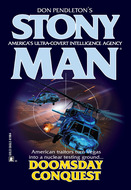
Doomsday Conquest
STONY MAN®
AMERICA’S ULTRA-COVERT INTELLIGENCE AGENCY
Don Pendleton

CONTENTS
CHAPTER ONE
CHAPTER TWO
CHAPTER THREE
CHAPTER FOUR
CHAPTER FIVE
CHAPTER SIX
CHAPTER SEVEN
CHAPTER EIGHT
CHAPTER NINE
CHAPTER TEN
CHAPTER ELEVEN
CHAPTER TWELVE
CHAPTER THIRTEEN
CHAPTER FOURTEEN
CHAPTER FIFTEEN
CHAPTER SIXTEEN
CHAPTER SEVENTEEN
CHAPTER EIGHTEEN
CHAPTER NINETEEN
EPILOGUE
CHAPTER ONE
Whatever the awful truth about the molten storm falling to earth under his command and control, Colonel Ytri Kolinko wasn’t all that sure he cared to know. A veteran of the Afghan war and a staunch believer in the Communist dictates of pre-Wall Russia, he trusted simplicity in all its forms, be it on the battlefield or in the high-tech laboratories of his current post. What the eye saw, in other words, the mind fathomed, whether his hand was dipped in the blood of slain mujahideen or held a test tube with microorganisms from outer space. Grinding his teeth as the warning siren blared, he slung the AK-74 assault rifle across his shoulder. Ignorance might truly prove bliss.
Or would it? he had to wonder as he torqued himself to a double-time march, propelled by a heady blend of fear, anxiety and excitement, heard his lieutenants of Command Red Lightning barking for the conscripts and the science detail beyond the steel door to move faster for the transport helicopters. This was his command, his protectorate in this remote and desolate abyss of Tajikistan, after all, the responsibility heaped square on his shoulders to get to the bottom of what had traveled from deep space to previously land in Uzbekistan, Turkmenistan and Kyrgystan. And what was now breaching Earth’s atmosphere was neither comet, falling star, meteor shower nor any other space phenomenon identified by Man. If it played true to prior and—what, supernatural?—form, it would not only swamp roughly a dozen square acres, as it had in each of the former Soviet republics, thus forcing a military quarantine, but chances were the event would sear yet another terrifying memory at the sight of human beings…
He shuddered, shoved away the frightening images, cursing the young soldier who allowed the door to thud shut, near smashing his scowl to pulp. Forget the angry albeit sorry fact Moscow had dumped him in hostile country that made his former Chechen post look a Black Sea resort by comparison, the Minister of Defense wanted answers to mysteries that came from another galaxy, perhaps another world, even another dimension, if he believed what his astronomers told him about black holes, shrinking mass and evolving protostars.
Tajikistan, he knew, was marked off by the political and military barons of Moscow as a buffer zone between the Muslim extremists of Afghanistan and Russia, but another image easily leaped to mind when he thought about his woeful post. As Moscow’s man in-country, braving the cold, fighting drug traffickers, often engaged in pitched battles with both rebels and narcothugs—and often both were one and the same—he saw Tajikistan as a vast moat between Afghanistan and Russia, teeming with crocodiles—hungry and poised to devour those who would further erode the moral fiber of his country with the slow white death or outright attacking Mother Russia through terrorism and sabotage.
Prepared to tackle the night’s grim business, whatever the case, Kolinko used a bootheel to thunder open the door, barely breaking stride as he swept onto the sprawling helipads.
“Move, move, move!”
He took in the controlled frenzy of soldiers, urged on by his officers as they rushed to board three Mi-26 transports, then spotted the gaggle of spacesuits lumbering for the high-tech cocoon of the custom-built black Mi-14 search-and-rescue chopper at the deep north end. There, a squad of his black-clad Red Lightning commandos lugged the tubular lead containers with fastened vacuum hoses, muled various and sundry metal crates that housed detection and sampling verification ordnance.
As if, he thought, what was streaking for Earth could be understood by finite puny Man.
And Kolinko looked to the heavens, stood his ground, some two thousand feet high on the western edge of the Pamir Range. The scudding gray cloud banks seemed low enough to reach up and grab. Where the billows broke in roiling tendrils, he made out the faint sheen of moonlight, then stared at countless stars twinkling from galaxies both known and yet to be named.
After another few moments of stargazing, aware he was stalling, Kolinko looked back at the compound, briefly wondered if he would return to see its foreboding steel walls, see through to fruition the prototypes of future secret weapons being engineered in its labyrinth. Panning the mammoth complex, north to south, he almost envied the soldiers and science crews remaining behind, nestled as they were, safe from potential lethal doses of radiation or the terrifying clutches of antigravity, deep in the rock-hewn bowels.
Safe, yes, unless the celestial storm changed course and…
At least half the base was burrowed deep into the mountain range that rose from the plateau, the imposing peaks jutting higher, it seemed, forming a natural barrier the farther south they stretched to meet the northern edge of the Fedchenko Glacier, one of the world’s longest continental ice river. A final sweep, spying the concrete dome of the observatory looming dead center from the roof where its telescopes—Russian versions of the American Hubble, he knew—monitored the coming tempest, and Kolinko fastened the com link over his black beret.
His team of astrophysicists, he recalled, believed they had pinpointed the core source of the space ore. Give or take a thousand light-years, they claimed its origins in something called the Eagle Nebula, recent but evolving star formations about 6,500 light-years away in a stellar region called Serpens, near the Star Gamma Scuti. Whatever its genesis, for a moment Kolinko wished the observatory a silo, imagined the scope magically morphing into a nuclear warhead, a time-delay fuse that would erupt a thermonuclear blanket, all but vaporizing the extraterrestrial stew.
Kolinko swept back to reality as he felt the icy touch of rotor wash slashing his face. All set and ready, but for what? he wondered, grunting as he bent his head, forging toward the lead transport chopper.
Watching the first two transports lifting off, he suddenly found something both fearsome and absurd that a simple soldier should be forced to confront, much less explain the improbable and the preposterous. Boarding the Mi-26, he realized he was touching the emblem on the front of his beret and wishing what they were going to encounter was as simple to explain as lightning.
FAYSUD DOZMUJ WAS ashamed of his comrades.
As he cradled the AK-47, watching the caravan of mules and horses from the rearguard, he began to consider how much different he was than his fellow clansmen. One disturbing for instance, he wasn’t a terrorist, much less a cold-blooded killer, as many of them had proved themselves to be. The fact he didn’t carry a heart pumping with murderous wrath round-the-clock like his cousins for any human being other than Tajik—especially Russians and westerners—left him wondering if he was better than the others, or simply weak. Granted, circumstance dictated the road many of them had chosen, but the circumstance of the desperate poor or the oppressed—as they saw themselves—was a sad and sorry eternal plight the world over.
Always had been, always would be.
The blood of the innocent, he knew, was on many hands here in the Grbukt Pass. Be it Israel, Iraq or Kabul, and as family men themselves, did it not prey on their minds that they had shattered the lives of lambs who only wished to live in peace, perhaps slaughtering children and thus extinguishing future bloodlines? Did they not see that their violence and brutality made them an abomination in the eyes of God? Was there not one even half-righteous man among their lot?
And how did they see him? As a coward, always making himself scarce when an ambush was in the wings, having never fired a shot in anger against their hated Russian oppressors?
Shucking the heavy wool coat higher up his shoulders, he shivered against the icy wind that howled like a thousand banshees, or the giant hairy almasty, he thought, the man-thing rarely seen but often heard baying from the black depths of mountain forests. He sidestepped another pile of dung steaming in the snow, thinking this was the last time he would follow his cousins when they hired themselves out as drug mules for men, he knew, who clearly had no regard who suffered, directly or indirectly, from the evil they peddled, as long as they lived on, rich-fattened swine indulging their every vile transgression.
It wasn’t the long and dangerous drive by truck to the border, picking up something like two to three tons of heroin from Afghan warlords and their corrupt Russian counterparts each trip. The consignments were paid for in advance, their tribal leader, Ghazin, having won the trust of Russian gangsters long ago to deliver the cargo to designated rendezvous points in the Pamirs. Nor did the grueling three- or four-day march on foot when they were forced to abandon their vehicles in exchange for pack animals to trudge out the final leg of the journey bother him. Hardship was an accepted way of life for the Tajik.
Rather, it was his fear of God and the dreaded loss of eternal Paradise that disturbed him to no end, his heart and soul burdened by the weight of guilt, far exceeding, he imagined, the combined load of burlap sacks now being hauled out of the gorge. Way beyond the earthly consideration of a few paltry American dollars, by which he could feed a family of seven during the coming months, his conscience admonished him that what he did was wrong in the eyes of his Maker.
No more.
This was his last journey for the Devil, aware that what he did only enabled the spawning of evil, that was gain of illicit money to advance the slaughter of lambs.
He was trudging up the rise, searching the forested high ground, wondering if any of his cousins could forsake this wrong and find redemption before it was too late, when the animals began crying, shuffling and bucking against their burdens. The line lurched to a sudden halt, his cousins cursing the beasts as the braying and snorting rose in what he sensed was panic. He was wondering if the animals were spooked by the sudden arrival of the two giant black transport choppers as they appeared, hovering over the tree line of the high plateau, Ghazin on the field radio, confirming, he assumed, the helicopters ferried the Russian gangsters, when the sky erupted in a brilliant white light. Something inexplicable happened next to the helicopters, Dozmuj watching, shocked, as what appeared like a web of blue sparks began shooting, dancing around the hulls of the choppers. A heartbeat and one of the choppers was thrown into a whirling dervish, then propelled, it seemed, by the shroud of blue lightning, aimed on a course to smash into the heart of the caravan.
Whether it was instinct or some haunting premonition of doom he’d gnawed on since the border, Dozmuj knew something far out of the ordinary was blanketing the sky.
Terror then gripped him as the animals burst in a pellmell scatter off the trail, his cousins shouting, torn between chasing after the beasts of burden and staring, frozen in fear, at the heaven’s spread of dazzling—
Fire?
Dozmuj backpedaled, the assault rifle slipping off his shoulder, falling to ground as his mind tried to conceive that he bore witness to a vast sheet of white fire blossoming but rolling like ocean waves in a great storm across the width of the sky. And it powered the heavens above into instant day, as if the sun had burst through the celestial blackness, light so piercing he was forced to shut his eyes, afraid for a moment he was blind.
When he opened his eyes, he found the world on fire, the seeing all but beyond any belief.
Shouts of panic flaying the air and animals braying loud enough to further warp his senses, Dozmuj turned away and ran.
“PULL BACK!”
For all of their—what was to him—incoherent physics babble, it hardly explained the blue lightning shooting from the comm and tracking station amidships the transport chopper. More conjecture than anything else, the best his science people could come up with by way of explanation was that the storm of space lava created a supercharged electromagnetic field. Highly charged alpha particles, the most powerful of ionizing agents, the way he understood it, were in the process of fusing, splitting deuterium nuclei as they collided, but somehow creating antienergy in the process. One of the end fantastic results was that the ore emitted EMP—electromagnetic pulse—similar, but vastly more powerful in ways they couldn’t yet explain than those produced by a nuclear blast. Had he believed in God, angels or even an afterlife, he might have agreed with his scientists when they referred to the phenomenon as Heaven’s Vomit.
The pilot didn’t need to be told even once, Kolinko roaring the order again, though, through the cockpit hatchway just when the bird was thrown to a steep dip to port. He tumbled to the floorboard, his soldiers falling from their stations in a thrashing heap of limbs, Kolinko still fearing the fire in the sky would overtake them. As opposed to arriving on-site after the three previous showers, this was the first time he’d been eyewitness to the falling space matter. Cursing the horrifying unexplainable, he hoped it would be his last, but he wasn’t about to see his choppers bathed in celestial soup, sure to send them crashing to earth.
Jumping to his feet as his pilot straightened the chopper, Kolinko marched to the door, hollering for one of his men to pull the plug to their monitors from the battery-powered generator. He was just in time to find the two black Mi-14s—drug ships, he suspected, taking the high ground and waiting on the Tajiks to climb up the trail from the gorge—erupt into fireballs that defied any blast he’d ever seen on the battlefield. It was all lightning and blue flame along the plateau, two giant, sizzling orbs that appeared like electrical charges gone haywire, blinding-white explosions touching off, one after the other, inside the spheres, the jagged streaks seeming to gather renewed angry force, as if whatever energy they consumed from the doomed birds inside the blue furnace fed their unearthly power core.
It was the rolling molten tidal wave in the sky, though, that commanded his full and terrified attention. Patching through to his other flight crews, he confirmed them engaged in evasive maneuvers, all of them falling back in southerly vectors at top speed.
Kolinko watched, squinting against the brilliant sheen as the molten rain washed over the forested plateau, then pounded a path down the gorge. With nowhere to run or hide, he saw the sea of molten stew drench man and animal. The Tajiks and their Russian end purchasers were little more than criminal scum, but Kolinko wondered, just the same, if they died quick, or slow and in great pain as they drowned in the ore.
“IN TERMS OF PURE scientific theory, as defined by Isaac Newton and Einstein, the laws of gravity and inertial mass being proportional to gravitational mass—G-Force—this shouldn’t even exist. Alpha particles, if that’s what they even are, will yield their energy quickly, but whatever the particles, they are fusing, multiplying and growing in mass and strength, creating in the process what I can only describe as…antimatter?”
Kolinko bared his teeth, stepping toward the hastily erected work area. He found himself growing exasperated to the point of boiling anger, what with their lack of plausible scientific explanations, but realized, under the circumstances, he needed them more than they needed him.
The good news was that the laser field, a reverse electromagnetic barrier, as he understood it, held back the undefined particles that created this purported antigravity. With the extended poles rising forty feet high, laser beams interlocked at the speed of light, the abominable stench of sulfur was held in check, but the unreality of the moment was still there for his eyes to behold. Unable to look at the frightening spectacles farther down the gorge and just inside the laser wall, he watched his eight best and brightest, still donning hazmat suits, while striding closer to the banks of monitors, his science detail having informed him the lethal doses of radiation were cocooned behind the bars of blue laser light and presently dying off at an inexplicable rate. Only flaring back to life, fusing together again, they told him, at a speed faster than light, mounting in hyper-strength, though giving off no measurable radiation! Impossible, he decided, would be the most preposterous understatement he’d ever heard. Moscow would never buy it.
Geiger counters, he saw, were hooked into a radiation monitor, the clicks no longer audible, but Kolinko stole a read on the digital screen just the same, confirming he was in no danger of coming down with cancer in the near future. The last problem—no, the last nail—he needed was another Chernobyl in what was, essentially, a militarily occupied Russian protectorate. His own anger and mounting fear fusing like those particles they mentioned, Kolinko looked at their dark baffled faces inside the bubbled helmets as several of the geniuses filled test tubes with white crystals collected from the ground near the field station, then mixed them with a clear liquid. With syringes, they extracted the concoction, squirting drops on Petri dishes, sliding them under microscopes.
“It makes no sense at all how this could be happening.”
“But it is happening, Comrade Bukov!” Kolinko snapped, forcing himself to not even glance at the figure no more than twelve feet in front of him to confirm the terrible truth. Should this happen again, he dreaded, and in a heavily populated area…
Kolinko keyed his com link, scoured the skies with an anxious search. When informed by his flight crews that soldiers were now on the ground and securing a wide perimeter, erecting more laser walls, he turned back to his scientists. Two of them were hunched over the control panel of a solid aluminum cylinder they called a gravitational wave detector. When he saw them shaking their heads at each other, he nearly erupted, aware the mystery was only growing as they appeared to understand less with each passing second.
“I want answers, and within the hour, do you understand me, Comrade Bukov?”
“Then we’ll need to return to our laboratories for further and more accurate testing, Comrade Colonel. I am thinking this substance will first need a laser burst of at least a hundred picoseconds…”
“Picoseconds?”
“Measurements of trillionths of a second, done in a laser fusion chamber, therefore determining, if we are lucky, if these nuclei of atoms initiate fusion on their own, which, I already fear, they do.”
“You fear? What do you mean by that?”
Bukov went on as if he hadn’t heard the question. “Beyond that I am afraid that what, or part of what we are looking at, judging the previous samples and testing is an ongoing, unexplained fusion-fission reaction, but far more fusion than fission.”
The enormity of what he believed Bukov implied left Kolinko speechless for a long moment. “You are telling me that what is inside this force field is…that what came from deep space is…”
“Yes. We are perhaps looking at the possibility of a thermonuclear explosion. Developing critical mass as we speak, from, as you said, the far reaches of the galaxy.”
Kolinko swallowed his terror, wondering how long he could keep this from Moscow. The truth, of course, would get buried, but if Tajikistan was wiped off the map in a nuclear mushroom cloud with its unknown origins from deep space, there would be no way to hide it from the rest of the world. There would be international outrage. There would be sanctions. There would be much threatening noise, to say the very least, from the Americans. There would be fallout, and clear up the Ukraine, depending on the prevailing winds, with thousands, perhaps hundreds of thousands dropping dead in their zombied tracks from radiation poisoning so high it would be off the charts of gigajoule and human-sievert measurements. There would be…
Numb, he was about to turn away, return to his chopper, when he found Dovkna pulling his visor away from his microscope. “What is it?” he barked.
Dovkna muttered something, shaking his head.
“Speak!”
Dovkna pointed a rubber-tipped finger at the crystallized rock formations on the ground, where the snow was still melting to puddles, a faint trace of sulfur still lingering in the air. “This white substance?” he said, and paused.
“Yes?”
“It’s sodium chloride.”
“Salt? You are telling me, comrade,” Kolinko said, throwing an arm at what was at the deep end of the pass, “that those men were—what? Turned into pillars of salt from outer space?”
Dovkna nodded inside his bubbled head. “That is precisely what I am saying.”
Kolinko staggered back a step, then froze, aware of the pleas and pitiful cries he’d up to then forced deaf ears to. Now, his mind tumbling with questions and fears holding no foreseeable answers or solutions, he stared up at the Tajik rebel, hovering some twenty feet in the air.
CHAPTER TWO
Nuclear power was a disaster begging to happen. Off the top of his head, he thought of Three Mile Island and Chernobyl, the most notable of grotesque nuclear reactor accidents, or the ones at least known to the world at large. Where they were concerned, he pictured—from an educated guess based on experience and access to classified intel—their reactor cores blew, most likely, due to incompetence, quasi-ignorance of the volatile nature of fission reaction under extreme stress, and the brazen zeal of self-proclaimed genius in search of the next quantum leap, that bold but proved foolish notion that Science Man adhered to the belief they could learn more about nuclear power through trial and error. Tell all that, he scoffed to himself, to those dying in protracted misery under radioactive clouds that were most likely still spreading to God only knew how far and wide.
Madness, he decided, and for what? All in the name of progress? The advancement of civilization or global annihilation? Either way, Man may prove someday to be his own worst enemy, but he hoped he wasn’t around to see it, though his three children might. No tree-hugger or global-warming doomsayer, he was an ace Stealth pilot of two Gulf wars, in fact, who’d churned up whole square miles of earth into smoking craters where not even a dandelion could sprout in the next foreseeable generation. But he still believed Man either took care of Mother Earth, or Mother Earth would take care of Man. That in mind, nuclear-powered submarines and battleships, he weighed, were nightmare scenario enough, but easily dispensed with as far as cover-ups went. Scuttle the works and the truth sank to the bottom of the ocean, where only a few in the loop were the wiser.
All those potential catastrophic voyages, but vessels chugging along over vast stretches of empty ocean?
No sweat.
Try flying, he thought, a supersonic fighter jet with a nuclear reactor’s guts cored with U-238, meant to torque up the yield of Pu-239 to keep on giving the gift of record-shattering speed and hang-time. Talk about flying Armageddon, but the doomsday potential for such a craft, he knew, hijacked and commandeered by the enemies of America, was less than zero.
At least for the immediate future.
Still, the more United States Air Force Major Michael Holloran pondered the facts as he knew them, considered what was housed, aft in their superbird, the more he believed he harbored some dark bent toward suicide. Or was it simply his nature, he wondered, a hyperachiever in his own right, pushing the limits of personal reality and talents to the edge, a middle-finger salute to fate to dare force him to stare into the abyss, face his own mortality? Certainly, he knew, whatever drove him to chase the next figurative or literal horizon had cost him two marriages, rendering him a man alone now among the gods of ultratech, transcended in some way beyond the norm he couldn’t quite define, but could surmise he wasn’t sure he liked all that much, given what he knew.
Get a grip, he told himself. He had a job to do.
They were sailing along at supersonic speed, Mach 5 to be exact, eighty thousand feet and change above the Canadian province of Saskatchewan, bearing down on the U.S. border; ETA a little over three minutes and counting. With what he knew lay ahead, those anxious thoughts began whispering louder over everything that could go wrong, near hissing, he imagined, like the highly flammable pure oxygen being pumped into his helmet. This was, after all, the maiden voyage of a classified prototype and ultrafighter jet that shouldn’t—and officially didn’t—exist.
Three years earlier a celestial mystery had fallen to the continental U.S., and it now powered the craft. And lent it properties far exceeding the narrow prism of Man’s understanding.
Thus, lack of knowledge about unknown properties and alloys—and he knew whatever the truth was being jealously guarded from those who now bore the task of flying the thing, as in himself and his copilot—should provide fear enough for him to reconsider the sanity of all involved.
For instance, the reinforced glass—if that’s what it even was—was as classified as the fuel that could propel them to Mach 10, more than three times faster than the now-retired SR-71 Blackbird, which had previously owned the world’s speed record of plus Mach 3. Officially—sort of—the fuel was classified as supergrade JP-7, the juice that kept the Blackbird aloft and a streaking black blur beneath the heavens. Why, then, was it pumped into the wings from a massive lead-encased tanker by hazmat suits in a hangar guarded by both armed sentries and batteries of surface-to-air missiles and M-1 Abrams tanks? Or was the answer so obvious…
The visor trapped the sound of his own grim chuckle.
In practical working theory, he knew they shouldn’t have even gotten off the ground, but the superjet and its power source defied all laws of aerodynamics, nuclear physics and gravity. Whether or not the reactor was a prototype, for instance, scaled down to near-dwarf stature in comparison to the mammoths that powered nuclear plants, it was still housed in a steel container, wrapped, in turn, by thick concrete walls. Therefore, the tremendous weight alone should have created drag enough to virtually snap off the tail.
Oh, but there were answers, he knew, as unbelievable as they might sound.
Yes, perhaps they believed him, in the dark and blissfully ignorant, those black-suited DOD superiors, their armed goons and aerospace engineers contracted out by Lockheed, but he’d caught on the sly the floating rumors. Since no secret was really ever such, he’d come to know that what they referred to as “the Divine Alloy” was a molten ore of some type from deep space. Whatever the unknown substance, he knew it was blended somehow with carbon-fiber laminates and aluminum and titanium, stem to stern on their ultratech ride. Likewise, cockpit and reactor housing were coated with the Divine Alloy. Which, believe it or not, made the superjet, code-named Lightning Bat, lighter than air, but able to withstand all the mass, thrust and gravity that Earth could pound mortal flesh with, once the shield was activated prior to takeoff. Moreover, their shield, sealed inside by the alloy, converted the cockpit into some vacuum of space, spared them G-force that should have crushed their insides to pulp. Rendered weightless by the Divine Alloy, they would have floated to the ceiling, pinned there, if not harnessed into their seats.
Holloran checked the instrument panel. All green, all systems go, he found. Comprised of intricate supercomputers, once the codes were punched in, he knew from two years of 24/7 training and virtual reality flight simulators that technology did roughly ninety percent of the work. From speed to navigation, down to calibrating the payload in the fuselage, Lightning Bat nearly had a mind all its own.
So why did that disturb him?
It was just about time, he knew, checking the digital readout to countdown, aware their audience was anxiously waiting back at Eagle Nebula, ready to monitor the test flight via camera link-up, once Lightning Bat descended and leveled out within a hundred miles of the area in question.
He was about to look over at Captain Thomas Sayers when he glimpsed something flash across the cockpit shield.
“Did you see that?”
“What the hell?” Holloran wasn’t sure what it was, but he would have sworn blue lightning had just streaked past Lightning Bat’s tapered nose. They weren’t low enough for any bolts of lightning, no storm systems to factor in, according to their Doppler radar. A shooting star, then? Meteor fragments?
Sayers repeated the question over the com link, Holloran staring up into the infinite black of the cosmos, when blue light jagged, but flashing this time, he believed, from inside the cockpit. Or did it shoot from the instrument panel? he wondered. After too many sorties in combat to count, having seen flying “things” he had more than once been warned by nameless spooks to never speak of, he wasn’t one to push panic buttons. But he felt the hairs rising on the back of his neck just the same, instinct warning him that something was either wrong or about to go south.
“Check all of our computer systems, Tom,” he told his copilot. “A to Z.”
“Roger, sir.”
“While you do that,” he said, wrapping one black-gloved hand around the side-arm controller, while tapping in the access code to the electro-optical navigational computer, “I’ll start dropping us down and prepping this puppy for its big audition.”
Holloran hoped he sounded confident, relatively gung-ho to the younger man, but he’d been dumped on the receiving end of too many SNAFUs to not trust his churning gut.
“PROTOSTAR EAGLE NEBULA Central Command to Lightning Bat Alpha. We are confirming your altitude and speed. Four thousand feet and holding steady, but you will have to decrease your speed to well below subsonic. Give us four hundred, Lightning Bat Alpha, and we can track you with visual confirmation.”
As the pneumatic doors hissed shut behind him, Gabriel Horn found he was just in time for the big show. The ground control station of Eagle Nebula wasn’t exactly the sprawling network of NASA’s command nerve center, he knew, but there was eyes-only supersophistication enough here to warrant all hands signing blood pacts for a black project so secret only a dozen men in Washington were aware of Lightning Bat’s existence. And, as head of Special Action Service, it was his duty to make damn certain all knowledge here either stayed under the compound’s roof or went to the grave with these people.
In that exclusive realm, however, there was critical mass, and building beyond the Eagle Nebula nest.
Easing up on their six, his rubber-soled combat boots padding silent as a ghost over sheer white concrete, Horn counted twelve aerospace brainiacs. The Chosen, he thought. Or the damned, depending on how well they held their tongues in check, though in his experience, considering at least three of the Seven Deadly Sins—pride, greed and envy—a couple of them, maybe more, would find a nasty and mysterious fatal accident in their futures. He could always count on the worst in human nature.
They appeared little more than shrouds at Horn’s first glance, white lab coats casting off a sort of glimmering hue as the fabric, woven out of nylon-silk, seemed to reflect light from the workstation with its running bank of monitors. Com links tying them all to Lightning Bat Alpha, their voices were a mixed babble to his ears as they relayed instructions to Major Holloran, confirming this and that.
Showtime.
Horn ignored the Air Force colonel boring daggers into the side of his head, focused instead on the cameras as they locked in on the arrowhead-shaped fighter jet. Briefed as thoroughly by Eagle Nebula’s commanding officer as he had expected, Horn knew the test flight was now monitored by four, long-range camera-fitted Black Hawks and two prototype Gulfstream SBJs. The supersonic executive jets, customized for military purposes, had the sleek Stealth hybrid covered, fore and aft, with the only variant being altitude at each end. To cover the fireworks, the Black Hawks were ranged around the compass, hovering now over the blast area.
All set for bombs away.
When the payloads were launched, gun cameras in the guidance systems of each nose, he knew, would track their flight paths, speeding bullets, near skimming U.S. government-owned prairie of North Dakota, until impact flashed obliteration then oblivion across the screens. Four payloads all told, he thought, what were technically cruise missiles, streaking at low altitude for the mock-ups, powered at subsonic speed to target by jet engines. Digital contour maps, born from radar and aerial and sat imagery, told the computer navigational systems in the warheads where to go.
Predestined supertech boogie-woogie.
Only these mothers of annihilation, code-named the Four Points, Horn knew, housed a series of thermal cluster bombs, eight to a package, two more inside each eight. As he did the math, recalling the computer graphics outlining the blast radius, he pictured smoking craters—or dozens of raging infernos—eating up something in the combined neighborhood of four to five square miles.
Sweet.
Welcome to the war of the future, he thought, aware that if this test run was successful, the empty wastelands of Nevada were next up, and in for a whole other galaxy of big bangs.
As Horn glimpsed Colonel Jeffreys moving his way, he pulled the pack of Camel unfiltered cigarettes from his pants pocket, stuck one on his lip. Clacking open his Zippo lighter and torching up, spitting tobacco flecks then dragging deep, he saw the head aerospace genius, Dr. Benjamin Keitel, glaring his way.
“Hey! Are you nuts? There’s no smoking in here!”
Horn washed a dragon’s spray of smoke toward Keitel, the man flapping his arms like a headless chicken, a couple more of his comrades jumping into the act. The geek was squawking out the virtues of nonsmoking to Jeffreys when Horn blew another cloud in his face and told the colonel, “Maybe you want to remind Dr. Frankenstein here who’s really in charge?” He ignored Keitel’s diatribe, adding, “Maybe you want to inform him I don’t exactly hand out pink slips at the end of the day for insubordination?”
“Get back to work,” Jeffreys told the aerospace engineer, who muttered something to himself then returned to his monitors.
Horn stared ahead, puffing, as the good colonel scowled him up and down. He could almost hear the man’s thoughts. Beyond the shoulder-holstered Beretta 92-F, if not for the white star emblem over his heart on his blacksuit, Jeffreys could pull rank.
“If I were you, I wouldn’t be so free in issuing implied threats like that, Mr. Orion,” the colonel said, layering disdain on his code name like a curse word.
“Well, you’re not me.”
“And I pray every night that blessing will continue.”
“Really?” Horn smoked, bobbed his head, got the message, hoping the day came when Jeffreys crossed into what he liked to call the Black Hole. “Fear not, Colonel. I’m not about to turn my quarters into a torture chamber,” he said, then, looking at the two female engineers, smiled and added, “or a rape room.”
“You son of a… Don’t you have some business to attend to, regarding an AWOL and, may I add, critical employee of this program?”
“We’re working on it. Something this sensitive, Colonel, it takes time,” Horn said as Jeffreys moved into his personal space.
“Time better served if you were, I would imagine, out there as point man in the hunt.”
Horn was searching for some threatening reply when he caught the change in tone from Keitel, questions hurled from his work bay, edged with concern as they were snapped into his com link. The SAS commander took a few steps forward, sensing a problem as he peered into the monitors where the executive jets mirrored Lightning Bat. The air became lanced, he felt, with rising panic as he saw what he believed were blue flames—or sparks?—leaping from the black ferrite-painted surface of the fighter jet, dancing next, nose to tail, there then gone. What the hell had just happened? he wondered, Kietel barking the same question to Major Holloran. Lightning Bat’s coating, he knew, was meant to absorb radar radiation, standard for any Stealth fighter to render it near invisible. Only he was privy there was more to the fighter jet’s body, from nose to swept-back Delta wings to tail, than earthly alloys.
Jeffreys banging out questions, Horn rolled up Keitel’s back. And clearly saw what looked like blue lightning shooting from the cockpit.
“Lightning Bat Alpha!” Keitel nearly shouted. “You are nowhere near the targets.”
“Why are the bomb bays opening?” Jeffreys demanded, checking his watch. “They’re way ahead of their scheduled launch!”
Horn heard Keitel gasp an oath as he saw the missiles lowered from their bay by the robotic arms. “Lightning Bat Alpha, respond!” he hollered, eyes darting from a digital readout to the play-by-play screens, snarling next as he pulled the com link from his ears, static crackling through the room like a string of firecrackers. “Colonel,” Keitel said, eyes bugged to white orbs, “all Four Points are recalibrating their targets!”
“What? How?” he demanded, flying up on Keitel’s rear. “Where?”
Horn was crowding Keitel and Jeffreys when he heard Holloran patch through, the panic in the major’s voice loud and clear through the static. “Ground Control, come in, dammit! We have a colossal and definite problem!”
Keitel looked about to vomit, sounding on the verge of hyperventilating as he tapped the keyboard on his computer. As a digital grid map of North Dakota flashed onto the monitor, Keitel paused, staring in horror at the blinking red dots. “Oh, God, no. This can’t be happening!”
“What?”
Keitel turned to Jeffreys, his face ashen, and told him, “All four missiles are recalibrated to strike civilian targets.”
“SWITCH TO MANUAL override!”
Targets Engaged flashing in red on the head up display from the holographic image illuminated by laser light on the inside of his visor, Holloran stifled the urge to smash his fist into the instrument panel.
“I can’t,” Sayers told him, his fingers flying over the keypad that would shut the targeting computer system down. “Dammit to hell, it’s locked up!”
Holloran swore under his breath. This was the next-to-ultimate nightmare scenario—four cruise missiles with cluster bombs set to launch and take out civilian targets—as he heard ground control telling him what he already knew.
The two of them were on their own.
Do something!
For all the four-digit Einstein IQ between them—there was nothing Eagle Nebula could do on its end. Short of blowing them out of the sky with a SAM—and he wouldn’t put it past them—there was one other option, he knew, waiting now for those three dreaded words.
Initiate Fatal Abort.
From the beginning, no ejector seats, no self-destruct button had been designed for Lightning Bat. There was good reason for that, he knew, fully accepting from the onset the twisted reasoning that IFA meant finding a vast and wide-open stretch of nothing and slamming Lightning Bat to Earth. A suicide ditching, a fireball spewing radiation, but hopefully nowhere close to a populated area. Or, at worst, only a few souls hopefully still wandering around outside Ground Zero, until Eagle Nebula could ferry in the hazmat platoons while soldiers quarantined God only knew how many square miles around the compass.
Holloran switched his HUD to the inside of the cockpit shield, wondering why some systems worked and others were—well, acting on their own, rebelling, as if they had willpower, defiantly commandeering the vessel. He grabbed the side-arm controller, hoping to God if he could throw the wings to a quick dip, forty-five degrees, port and starboard, the missiles might impact on what was empty prairie. Provided, of course, he got the timing right, but with everything else unraveling…
The stick was jammed!
And the blue lightning came back, leaping from the instrument panel, as Holloran found their own retractable cameras lower from each side of the hull’s underbelly amidships, zooming in on the two robotic arms lowering their payloads.
Targets Engaged freeze-framed on the shield.
Holloran cursed, rechecking the new calibrations, locked in still, he discovered, ground control screaming in his ear as the payloads fanned out into crossbars on their monitors.
Covering north, south, east and west, two on an arm, one frame hung a few meters lower than the other, and for the sake of what was now doomsday clearance. Just as they pulled the damn things up on their computers, he knew, they were held for the moment by titanium clamps, talons that would release them at any second as he watched the numbers fall to single digits on his readout.
Holloran stared at the vast prairie, looked to a long, sweeping horizon that seemed to run straight into the setting sun. They were still some fifty miles from the Badlands, Holloran certain, or rather praying, they were as empty as the lunar landscape he knew them to be.
“They’re going to fire, Major!”
And Holloran watched in helpless rage and disbelief as four cones of flame shot out beyond the stabilizing fins. The missiles released and went streaking away on four points of the compass.
GROUND CONTROL, Horn knew, was an obscene misnomer, and by galactic degrees in this case. There were no command guidance systems, at least for this initial outing, to depend on laser beams to pin down the targets to within a few meters, steer and keep the missiles locked in to impact. No passive system, either, meaning they homed in specifically on infrared radiation, as in heat-seeking the likes of auto or jet engines—or warm bodies. The Four Points were their own Alpha and Omega, relying solely on active systems, which was radar already engineered into the missiles, their guidance computers flying them on, unstoppable and untouchable, to vaporize the targets. Keitel was in the process of pointing this out to Colonel Jeffreys, they were little more than limp baggage on this end.
“Sweet Holy Virgin Mother of…”
“I’m afraid we are way past any hand of God, Colonel.”
“Don’t get smart on me, Keitel! Where are those missiles fixed to strike, mister?” the colonel rasped, clear to all now he realized he had become a master of the obvious by rattling off questions he already had the answers to from double-digit briefs.
The good Major Holloran seemingly all but forgotten for the moment, Horn watched as Keitel slammed in a series of numbers on one of his readouts, then hit his computer keyboard, informing the colonel he would bring up the targets on the wall. Looking past the workstation, Horn stared at the project’s emblem, thirty feet by twenty, painted on the stark white wall, dead ahead. The Eagle Nebula, he recalled, was a bright cluster of young evolving stars, but a massive gas formation, still condensing though not nearly thermonuclear enough to shine like Earth’s sun. Imaged by the Hubble Space Telescope only as recently as 1995, the dark nebulosity was more widely known among the deep space stargazers as “the Pillars of Creation.”
Keitel flashed the digital wall map of North Dakota over the emblem, framing four red circles, then enlarging the targets with a few taps on his keyboard.
With one ear, chain-smoking now that all the PC air was cleared, Horn listened to the colonel shout a litany of questions laced with orders, but he was more intent, fascinated, in fact, by the sight of the gun cameras framing in real-time the prairie sweeping below. Again, Jeffreys demanded to know the new targets, what might be the number of projected civilian casualties, railing next at Keitel to initiate some sort of abort action.
“It’s too late for that, Colonel! The damage is already done!”
“The hell you say. You people created it, do something to uncreate it! Or we are all in a world of hurt none of us can begin to even fathom!”
Horn smiled around his smoke, enjoying their sweat and panic, these pompous asses who often looked down their noses at him, a wolf among sheep who held the power of life and death. The snooty broads, too, often thinking they needed some R and R with a real man who could launch them into some deep space they couldn’t begin to get from their wonder toys. Maybe soon, figure the ladies might need a comforting shoulder to lay their distress on. Hope sprang eternal, and now on more fronts, he knew, than in his loins.
The gathered herd here didn’t know it, but he had his own plans.
He listened to Keitel’s ominous report. It looked like the Fort Berthold Indian Reservation was slated for one big bang, Jeffreys groaning as he heard the guesstimate for dead and maimed Native Americans. If there was any good news to be grabbed from this vision of hell, it appeared the westbound warhead would detonate on some rancher’s spread near the eastern leading edge of the Badlands. On that front, Jeffreys barked for numbers on family members, Horn now sensing the colonel was on the verge of fainting as the virtual reality of the body count kept on piling up in his churning desk-lifer mind, higher, he imagined with a puff and grin, than every piece of shredded document or deleted CDROM he was probably the first blast away from racing to. Another ranch on the Four Points’ feeding frenzy, but far larger in terms of cattle as imaged by a satellite parked over the state, was up for some more cluster dusting. Finally, there was a town, population twenty-six, but one of the geeks informed them at that hour the saloon was a big-ticket draw, Horn filing the man’s name away, wondering how he came by that information. When Horn caught the town’s name, another grin tugged at the corner of his lip.
Little Big Horn.
It was most definitely cover-the-assets time before some twenty-first-century scalping got in full swing, he knew, perfectly albeit horribly understandable, given that more than careers were at stake.
Talk about Black Holes.
Already, though, as he saw the watching eye on the Black Hawk closest to one of the civilian targets framing what was a row of small wooden buildings on a barren stretch of plain—assume Little Big Horn—the solution to the grim problems of the immediate future was shaping up, and in sweet accord with his own dreams. Funny, he thought, how a little patience and fortitude could find destiny smiling when a man decided to stand his ground.
As the Black Hawk closed to monitor the coming inferno, Jeffreys reached a level of near hysterics, ordering Keitel to fall to Plan IFA.
“You’re kidding, right? Unless you want to order Major Holloran to crash Lightning Bat out there, and with what’s going to happen if they do, do you really want to explain one more nightmare than we already have to deal with? You do know what’s on board that craft? You do know what fuels that jet?”
“I’m fully aware of the gravity of the situation, mister!” Jeffreys fumed, Horn again believing he could read the man’s tortured thoughts, what with all that gyrating body language and panic like neon signs in the eyes. Damage control, without question, time to place the SOS to DOD, the Pentagon, get the blame game cranked up, heating to thermonuclear critical mass, but in all directions other than his starched uniform.
Horn heard Holloran shouting from Keitel’s com link, the hooked-in intercom likewise now blaring the major’s voice. But he was locked on to the monitors, worked his spectating view between the gun camera and the Black Hawk relay.
And it happened, but far more spectacular than he could have imagined.
The gun camera winked out first as its cluster avalanche slammed into what Horn believed was the broadside of the first building in a Little Big Horn replay of that fateful and very gruesome day for the white man, but with total annihilation here for all present, indiscriminate of race, sex and age.
Complete and absolute obliteration, Horn saw, boiled like the smoke and fire of the Apocalypse, straight for the Black Hawk’s relay.
Just about all done, he knew, except for the cover-up.
Apparently, Horn found, Jeffreys had seen more than enough, the colonel wheeling, striding for the exit. A finger flick of his smoke, arcing it across the room, and he was marching hard for the intercept. Barking for Colonel No-Stones to halt, Horn grabbed him by the arm as the doors hissed open.
“Get your hands off me,” Jeffreys warned, wrenching his arm free.
“Listen to me, Colonel, and hear me but good. This fiasco, which, technically, falls under your responsibility, has a solution.”
“Solution?” He paused, the jaw going slack, the dark look betraying thoughts he knew what was about to be dumped in his lap. “No…”
“Yes. Now, you want to make some phone calls. I’ll give you a number you’re already aware of to someone who will, in no uncertain terms, inform you that what just happened lands square in my department.” It was Horn’s turn to breach personal space, as he put himself nose-to-nose with Jeffreys, and said, “The next words out of your mouth, Colonel, better be what I—what we all—know we need to hear, or, ‘sir,’ there could be more for you to dread than testifying before a bunch of fattened calves on the Hill. Oh. I see I have your full attention.”
“I’m listening.”
“Okay. Now, if it makes you happy, here’s what I propose to do….”
Ücretsiz ön izlemeyi tamamladınız.