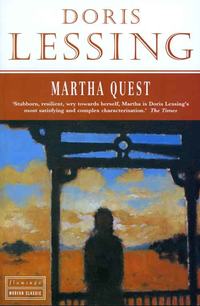
Kitabı oku: «Martha Quest»

Martha Quest
Doris Lessing

Table of Contents
Cover Page
Title Page
Part One
Chapter One
Chapter Two
Chapter Three
Part Two
Chapter One
Chapter Two
Chapter Three
Part Three
Chapter One
Chapter Two
Chapter Three
Part Four
Chapter One
Chapter Two
Chapter Three
About the Author
By the same Author
Read On
The Grass is Singing
The Golden Notebook
The Good Terrorist
Love, Again
The Fifth Child
Copyright
About the Publisher
Part One
I am so tired of it, and also tired of the future before it comes
– OLIVE SCHREINER
Chapter One
Two elderly women sat knitting on that part of the veranda which was screened from the sun by a golden shower creeper; the tough stems were so thick with flower it was as if the glaring afternoon was dammed against them in a surf of its own light made visible in the dripping, orangecoloured clusters. Inside this coloured barrier was a darkened recess, rough mud walls (the outer walls of the house itself) forming two sides, the third consisting of a bench loaded with painted petrol tins which held pink and white geraniums. The sun splashed liberal gold through the foliage, over the red cement floor, and over the ladies. They had been here since lunchtime, and would remain until sunset, talking, talking incessantly, their tongues mercifully let off the leash. They were Mrs Quest and Mrs Van Rensberg; and Martha Quest, a girl of fifteen, sat on the steps in full sunshine, clumsily twisting herself to keep the glare from her book with her own shadow.
She frowned, and from time to time glanced up irritably at the women, indicating that their gossip made it difficult to concentrate. But then, there was nothing to prevent her moving somewhere else; and her spasms of resentment when she was asked a question, or her name was used in the family chronicling, were therefore unreasonable. As for the ladies, they sometimes allowed their eyes to rest on the girl with that glazed look which excludes a third person, or even dropped their voices; and at these moments, she lifted her head to give them a glare of positive contempt; for they were seasoning the dull staple of their lives – servants, children, cooking – with a confinement or scandal of some kind; and since she was reading Havelock Ellis on sex, and had taken good care they should know it, the dropped voices had the quality of an anomaly. Or rather, she was not actually reading it: she read a book that had been lent to her by the Cohen boys at the station, while Ellis lay, like an irritant, on the top step, with its title well in view. However, there are certain rites in the talk of matrons and Martha, having listened to such talk for a large part of her life, should have learned that there was nothing insulting, or even personal, intended. She was merely expected to play the part ‘young girl’ against their own familiar roles.
At the other end of the veranda, on two deck-chairs planted side by side and looking away over the bush and the mealie fields, were Mr Quest and Mr Van Rensberg; and they were talking about crops and the weather and the native problem. But their backs were turned on the women with a firmness which said how welcome was this impersonal talk to men who lived shut into the heated atmosphere of the family for weeks at a time, with no refuge but the farmwork. Their talk was as familiar to Martha as the women’s talk; the two currents ran sleepily on inside her, like the movements of her own blood, of which she was not conscious except as an ache of irritation when her cramped position made her shift her long, bare and sunburnt legs. Then, when she heard the nagging phrases ‘the Government expects the farmers to …’ and ‘The kaffirs are losing all respect because …’ she sat up sharply; and the irritation overflowed into a flood of dislike for both her parents. Everything was the same; intolerable that they should have been saying the same things ever since she could remember; and she looked away from them, over the veld.
In the literature that was her tradition, the word farm evokes an image of something orderly, compact, cultivated; a neat farm-house in a pattern of fields. Martha looked over a mile or so of bush to a strip of pink ploughed land; and then the bush, dark green and sombre, climbed a ridge to another patch of exposed earth, this time a clayish yellow; and then, ridge after ridge, fold after fold, the bush stretched to a line of blue kopjes. The fields were a timid intrusion on a landscape hardly marked by man; and the hawk which circled in mile-wide sweeps over her head saw the house, crouched on its long hill, the cluster of grass huts which was the native compound huddled on a lower rise half a mile away; perhaps a dozen patches of naked soil – and then nothing to disturb that ancient, down-peering eye, nothing that a thousand generations of his hawk ancestors had not seen.
The house, raised high on its eminence into the blue and sweeping currents of air, was in the centre of a vast basin, which was bounded by mountains. In front, there were seven miles to the Dumfries Hills; west, seven miles of rising ground to the Oxford Range; seven miles east, a long swelling mountain which was named Jacob’s Burg. Behind, there was no defining chain of kopjes, but the land travelled endlessly, without limit, and faded into a bluish haze, like that hinterland to the imagination we cannot do without – the great declivity was open to the north.
Over it all curved the cloudless African sky, but Martha could not look at it, for it pulsed with light; she must lower her eyes to the bush; and that was so familiar the vast landscape caused her only the prickling feeling of claustrophobia.
She looked down at her book. She did not want to read it; it was a book on popular science, and even the title stiffened her into a faint but unmistakable resentment. Perhaps, if she could have expressed what she felt, she would have said that the calm factual air of the writing was too distant from the uncomfortable emotions that filled her; perhaps she was so resentful of her surroundings and her parents that the resentment overflowed into everything near her. She put that book down and picked up Ellis. Now, it is hardly possible to be bored by a book on sex when one is fifteen, but she was restless because this collection of interesting facts seemed to have so little to do with her own problems. She lifted her eyes and gazed speculatively at Mrs Van Rensberg who had had eleven children.
She was a fat, good-natured, altogether pleasant woman in a neat flowered cotton dress, which was rather full and long, and, with the white kerchief folded at the neck, gave her the appearance of a picture of one of her own grandmothers. It was fashionable to wear long skirts and tie a scarf loosely at the neck, but in Mrs Van Rensberg the fashion arranged itself obstinately into that other pattern. Martha saw this, and was charmed by it; but she was looking at the older woman’s legs. They were large and shapeless, veined purple under the mask of sunburn, and ended in green sandals, through which her calloused feet unashamedly splayed for comfort. Martha was thinking with repugnance, Her legs are like that because she has had so many children.
Mrs Van Rensberg was what is described as uneducated; and for this she might apologize, without seeming or feeling in the slightest apologetic, when a social occasion demanded it – for instance, when Mrs Quest aggressively stated that Martha was clever and would have a career. That the Dutchwoman could remain calm and good-natured on such occasions was proof of considerable inner strength, for Mrs Quest used the word ‘career’ not in terms of something that Martha might actually do, such as doctoring, or the law, but as a kind of stick to beat the world with, as if she were saying, ‘My daughter will be somebody, whereas yours will only be married.’ Mrs Quest had been a pretty and athletic-looking English girl with light-brown hair and blue eyes as candid as spring sunshine; and she was now exactly as she would have been had she remained in England: a rather tired and disappointed but decided matron, with ambitious plans for her children.
Both ladies had been living in this farming district for many years, seventy miles from the nearest town, which was itself a backwater; but no part of the world can be considered remote these days; their homes had the radio, and newspapers coming regularly from what they respectively considered as Home – Tory newspapers from England for the Quests, nationalist journals from the Union of South Africa for the Van Rensbergs. They had absorbed sufficient of the spirit of the times to know that their children might behave in a way which they instinctively thought shocking, and as for the book Martha now held, its title had a clinical sound quite outside their own experience. In fact, Martha would have earned nothing but a good-natured and traditional sigh of protest, had not her remaining on the steps been in itself something of a challenge. Just as Mrs Quest found it necessary to protest, at half-hourly intervals, that Martha would get sunstroke if she did not come into the shade, so she eventually remarked that she supposed it did no harm for girls to read that sort of book; and once again Martha directed towards them a profoundly scornful glare, which was also unhappy and exasperated; for she felt that in some contradictory way she had been driven to use this book as a means of asserting herself, and now found the weapon had gone limp and useless in her hands.
Three months before, her mother had said angrily that Epstein and Havelock Ellis were disgusting. ‘If people dug up the remains of this civilization a thousand years hence, and found Epstein’s statues and that man Ellis, they would think we were just savages.’ This was at the time when the inhabitants of the colony, introduced unwillingly through the chances of diplomacy and finance to what they referred to as ‘modern art’, were behaving as if they had been severally and collectively insulted. Epstein’s statues were not fit, they averred, to represent them even indirectly. Mrs Quest took that remark from a leader in the Zambesia News; it was probably the first time she had made any comment on art or literature for twenty years. Martha then had borrowed a book on Epstein from the Cohen boys at the station. Now, one of the advantages of not having one’s taste formed in a particular school is that one may look at work of an Epstein with the same excited interest as at a Michelangelo. And this is what Martha did. She felt puzzled, and took the book of reproductions to her mother. Mrs Quest was busy at the time, and had never found an opportunity since to tell Martha what was so shocking and disgusting in these works of art. And so with Havelock Ellis.
Now Martha was feeling foolish, even let down. She knew, too, that she was bad-tempered and boorish. She made resolutions day after day that from now on she would be quite different. And yet a fatal demon always took possession of her, so that at the slightest remark from her mother she was impelled to take it up, examine it, and hand it back, like a challenge – and by then the antagonist was no longer there; Mrs Quest was simply not interested.
‘Ach,’ said Mrs Van Rensberg, after a pause, ‘it’s not what you read that matters, but how you behave.’ And she looked with good-natured affection towards Martha, who was flushed with anger and with sunshine. ‘You’ll have a headache, my girl,’ she added automatically; and Martha bent stubbornly to her book, without moving, and her eyes filled with tears.
The two women began discussing, as was natural, how they had behaved when young, but with reservations, for Mrs Van Rensberg sensed that her own experience included a good deal that might shock the English lady; so what they exchanged were not the memories of their behaviour, but the phrases of their respective traditions, which sounded very similar – Mrs Van Rensberg was a member of the Dutch Reformed Church; the Quests, Church of England. Just as they never discussed politics, so they never discussed – but what did they discuss? Martha often reflected that their years-old friendship had survived just because of what had been left out, everything of importance, that is; and the thought caused the girl the swelling dislike of her surroundings which was her driving emotion. On the other hand, since one lady was conservative British and the other conservative Afrikaans, this friendship could be considered a triumph of tact and good feeling over almost insuperable obstacles, since they were bound, by those same traditions, to dislike each other. This view naturally did not recommend itself to Martha, whose standards of friendship were so high she was still waiting for that real, that ideal friend to present himself.
‘The Friend,’ she had copied in her diary, ‘is some fair floating isle of palms eluding the mariner in Pacific seas …’ And so down the page to the next underlined sentence: ‘There goes a rumour that the earth is inhabited, but the shipwrecked mariner has not seen a footprint on the shore.’ And the next: ‘Our actual friends are but distant relations of those to whom we pledged.’
And could Mrs Van Rensberg be considered even as a distant relation? Clearly not. It would be a betrayal of the sacred name of friendship.
Martha listened (not for the first time) to Mrs Van Rensberg’s long account of how she had been courted by Mr Van Rensberg, given with a humorous deprecation of everything that might be described (though not by Martha, instinctively obedient to the taboos of the time) as Romance. Mrs Quest then offered an equally humorous though rather drier account of her own engagement. These two heavily, though unconsciously, censored tales at an end, they looked towards Martha, and sighed, resignedly, at the same moment. Tradition demanded from them a cautionary moral helpful to the young, the fruit of their sensible and respectable lives; and the look on Martha’s face inhibited them both.
Mrs Van Rensberg hesitated, and then said firmly (the firmness was directed against her own hesitation), ‘A girl must make men respect her.’ She was startled at the hatred and contempt in Martha’s suddenly raised eyes, and looked for support towards Mrs Quest.
‘That’s right,’ said Mrs Quest, rather uncertainly. ‘A man will never marry a girl he does not respect.’
Martha slowly sat up, closing her book as if it were of no more use to her, and stared composedly at them. She was now quite white with the effort of controlling that hatred. She got up, and said in a low tight voice, ‘You are loathsome, bargaining and calculating and …’ She was unable to continue. ‘You are disgusting,’ she ended lamely, with trembling lips. Then she marched off down the garden, and ran into the bush.
The two ladies watched her in silence. Mrs Quest was upset, for she did not know why her daughter thought her disgusting, while Mrs Van Rensberg was trying to find a sympathetic remark likely to be acceptable to her friend.
‘She’s so difficult,’ murmured Mrs Quest apologetically; and Mrs Van Rensberg said, ‘It’s the age, my Marnie’s just as bad.’ She did not know she had failed to find the right remark: Mrs Quest did not consider her daughter to be on a level with Marnie, whom she found in altogether bad taste, wearing grown-up clothes and lipstick at fifteen, and talking about ‘boys’. Mrs Van Rensberg was quite unconscious of the force of her friend’s feeling. She dismissed her strictness with Martha as one of those English foibles; and besides, she knew Marnie to be potentially a sensible woman, a good wife and mother. She continued to talk about Marnie, while Mrs Quest listened with the embarrassment due to a social gaffe, saying ‘Quite’ or ‘Exactly’, thinking that her daughter’s difficulty was caused by having to associate with the wrong type of child, meaning Marnie herself. But the Dutchwoman was unsnubbable, since her national pride was as deep as the Englishwoman’s snobbishness, and soon their conversation drifted back to servants and cooking. That evening, each would complain to her husband – one, with the English articulateness over matters of class, that Mrs Van Rensberg was ‘really so trying’, while the other, quite frankly, said that these rooineks got her down, they were all the same, they thought they owned the earth they walked on. Then, from unacknowledged guilt, they would ring each other up on the district telephone, and talk for half an hour or so about cooking and servants. Everything would continue as usual, in fact.
In the meantime, Martha, in an agony of adolescent misery, was lying among the long grass under a tree, repeating to herself that her mother was hateful, all these old women hateful, every one of these relationships, with their lies, evasions, compromises, wholly disgusting. For she was suffering that misery peculiar to the young, that they are going to be cheated by circumstances out of the full life every nerve and instinct is clamouring for.
After a short time, she grew more composed. A self-preserving nerve had tightened in her brain, and with it her limbs and even the muscles of her face became set and hardened. It was with a bleak and puzzled look that she stared at a sunlit and glittering bush which stood at her feet; for she did not see it, she was seeing herself, and in the only way she was equipped to do this – through literature. For if one reads novels from earlier times, and if novels accurately reflect, as we hope and trust they do, the life of their era, then one is forced to conclude that being young was much easier then than it is now. Did X and Y and Z, those blithe heroes and heroines, loathe school, despise their parents and teachers who never understood them, spend years of their lives fighting to free themselves from an environment they considered altogether beneath them? No, they did not; while in a hundred years’ time people will read the novels of this century and conclude that everyone (no less) suffered adolescence like a disease, for they will hardly be able to lay hands on a novel which does not describe the condition. What then? For Martha was tormented, and there was no escaping it.
Perhaps, she thought (retreating into the sour humour that was her refuge at such moments), one should simply take the years from, let us say, fourteen to twenty as read, until those happier times arrive when adolescents may, and with a perfectly clear conscience, again enjoy themselves? How lucky, she thought, those coming novelists, who would be able to write cheerfully, and without the feeling that they were evading a problem: ‘Martha went to school in the usual way, liked the teachers, was amiable with her parents, and looked forward with confidence to a happy and well-spent life!’ But then (and here she suffered a twisting spasm of spite against those cold-minded mentors who so persistently analysed her state, and in so many volumes), what would they have to write about?
That defensive spite released her, and it was almost with confidence that she again lay back, and began to consider herself. For if she was often resentfully conscious that she was expected to carry a burden that young people of earlier times knew nothing about, then she was no less conscious that she was developing a weapon which would enable her to carry it. She was not only miserable, she could focus a dispassionate eye on that misery. This detached observer, felt perhaps as a clear-lit space situated just behind the forehead, was the gift of the Cohen boys at the station, who had been lending her books for the last two years. Joss Cohen tended towards economics and sociology, which she read without feeling personally implicated. Solly Cohen was in love (there is no other word for it) with psychology; he passionately defended everything to do with it, even when his heroes contradicted each other. And from these books Martha had gained a clear picture of herself, from the outside. She was adolescent, and therefore bound to be unhappy; British, and therefore uneasy and defensive; in the fourth decade of the twentieth century, and therefore inescapably beset with problems of race and class; female, and obliged to repudiate the shackled women of the past. She was tormented with guilt and responsibility and self-consciousness; and she did not regret the torment, though there were moments when she saw quite clearly that in making her see herself thus the Cohen boys took a malicious delight which was only too natural. There were moments, in fact, when she hated them.
But what they perhaps had not foreseen was that this sternly objective picture of herself merely made her think, no doubt unreasonably, Well, if all this has been said, why do I have to go through with it? If we know it, why do we have to go through the painful business of living it? She felt, though dimly, that now it was time to move on to something new, the act of giving names to things should be enough.
Besides, the experts themselves seemed to be in doubt as to how she should see herself. There was the group which stated that her life was already determined when she still crouched sightless in the womb of Mrs Quest. She grew through phases of fish and lizard and monkey, rocked in the waters of ancient seas, her ears lulled by the rhythm of the tides. But these tides, the pulsing blood of Mrs Quest, sang no uncertain messages to Martha, but songs of anger, or love, or fear or resentment, which sank into the passive brain of the infant, like a doom.
Then there were those who said it was the birth itself which set Martha on a fated road. It was during the long night of terror, the night of the difficult birth, when the womb of Mrs Quest convulsed and fought to expel its burden through the unwilling gates of bone (for Mrs Quest was rather old to bear a first child), it was during that birth, from which Martha emerged shocked and weary, her face temporarily scarred purple from the forceps, that her character and therefore her life were determined for her.
And what of the numerous sects who agreed on only one thing, that it was the first five years of life which laid an unalterable basis for everything that followed? During those years (though she could not remember them), events had occurred which had marked her fatally forever. For the feeling of fate, of doom, was the one message they all had in common. Martha, in violent opposition to her parents, was continually being informed that their influence on her was unalterable, and that it was much too late to change herself. She had reached the point where she could not read one of these books without feeling as exhausted as if she had just concluded one of her arguments with her mother. When a native bearer came hastening over the veld with yet another parcel of books from the Cohen boys, she felt angry at the mere sight of them, and had to fight against a tired reluctance before she could bring herself to read them. There were, at this very moment, half a dozen books lying neglected in her bedroom, for she knew quite well that if she read them she would only be in possession of yet more information about herself, and with even less idea of how to use it.
But if to read their books made her unhappy, those occasions when she could visit them at the store were the happiest of her life. Talking to them exhilarated her, everything seemed easy. She walked over to the kaffir store when her parents made the trip into the station; sometimes she got a lift from a passing car. Sometimes, though secretly, since this was forbidden, she rode in on her bicycle. But there was always an uneasiness about this friendship, because of Mrs Quest; only last week, she had challenged Martha. Being what she was, she could not say outright, ‘I don’t want you to know Jewish shopkeepers.’ She launched into a tirade about how Jews and Greeks exploited the natives worse than anyone, and ended by saying that she did not know what to do with Martha, who seemed bent on behaving so as to make her mother as unhappy as possible. And for the first time that Martha could remember, she wept; and though her words were dishonest, her emotion was not. Martha had been deeply disturbed by those tears.
Yesterday, Martha had been on the point of getting out her bicycle in order to ride in to the station, so badly did she need to see the Cohen boys; when the thought of another scene with her mother checked her. Guiltily, she left the bicycle where it was. And now, although she wanted more than anything else to tell them about her silly and exaggerated behaviour in front of Mrs Van Rensberg, so that they might laugh good-naturedly at it, and restore it to proportion, she could not make the effort to rise from under the big tree, let alone get out the bicycle and go secretly into the station, hoping she would not be missed. And so she remained under the tree, whose roots were hard under her back, like a second spine, and looked up through the leaves to the sky, which shone in a bronze clamour of light. She ripped the fleshy leaves between her fingers, and thought again of her mother and Mrs Van Rensberg. She would not be like Mrs Van Rensberg, a fat and earthy housekeeping woman; she would not be bitter and nagging and dissatisfied like her mother. But then, who was she to be like? Her mind turned towards the heroines she had been offered, and discarded them. There seemed to be a gap between herself and the past, and so her thoughts swam in a mazed and unfed way through her mind, and she sat up, rubbing her stiffened back, and looked down the aisles of stunted trees, over a wash of pink feathery grass, to the red clods of a field which was invisible from the house.
There moved a team of oxen, a plough, a native driver with his long whip, and at the head of the team a small black child, naked except for a loincloth, tugging at the strings which passed through the nostrils of the leaders of the team. The driver she did not like – he was a harsh and violent man who used that whip with too much zest; but the pity she refused herself flooded out and surrounded the black child like a protective blanket. And again her mind swam and shook, like clearing water, and now, instead of one black child, she saw a multitude, and so lapsed easily into her familiar daydream. She looked away over the ploughed land, across the veld to the Dumfries Hills, and refashioned that unused country to the scale of her imagination. There arose, glimmering whitely over the harsh scrub and the stunted trees, a noble city, set foursquare and colonnaded along its falling flower-bordered terraces. There were splashing fountains, and the sound of flutes; and its citizens moved, grave and beautiful, black and white and brown together; and these groups of elders paused, and smiled with pleasure at the sight of the children – the blue-eyed, fair-skinned children of the North playing hand in hand with the bronze-skinned, dark-eyed children of the South. Yes, they smiled and approved these many-fathered children, running and playing among the flowers and the terraces, through the white pillars and tall trees of this fabulous and ancient city …
It was about a year later. Martha was seated beneath the same tree, and in rather the same position, her hands full of leaves which she was unconsciously rubbing to a green and sticky mess. Her head was filled with the same vision, only more detailed. She could have drawn a plan of that city, from the central market place to the four gates. Outside one of the gates stood her parents, the Van Rensbergs, in fact most of the people of the district, forever excluded from the golden city because of their pettiness of vision and small understanding; they stood grieving, longing to enter, but barred by a stern and remorseless Martha – for unfortunately one gets nothing, not even a dream, without paying heavily for it, and in Martha’s version of the golden age there must always be at least one person standing at the gate to exclude the unworthy. She heard footsteps, and turned her head to find Marnie picking her way down the native path, her high heels rocking over the stones.
‘Hey,’ said Marnie excitedly, ‘heard the news?’
Martha blinked her eyes clear of the dream, and said, rather stiffly, ‘Oh, hullo.’ She was immediately conscious of the difference between herself and Marnie, whose hair was waved, who wore lipstick and nail varnish, and whose face was forced into an effect of simpering maturity, which continually vanished under pressure from her innate good sense. Now she was excited she was like a healthy schoolgirl who had been dressing up for fun; but at the sight of the sprawling and undignified Martha, who looked rather like an overgrown child of eleven, with a ribbon tying her lanky blonde hair, and a yoked dress in flowered print, she remembered her own fashionable dress, and sat primly on the grass, placed her black heels together, and looked down at her silk-stockinged legs with satisfaction.
‘My sister’s getting married,’ she announced.
There were five sisters, two already married, and Martha asked, ‘Who, Marie?’ For Marie was next, according to age.
Chapter Two
Early in her sixteenth year, Martha was expected to pass the matric – it goes without saying, quite brilliantly. She did not even sit the examination; and it was not the first time she had withdrawn from a situation through circumstances which it occurred to no one, particularly Martha herself, to call anything but bad luck. At eleven, for instance, there had been just such a vital examination, and she had become ill the week before. She was supposed to be exceptionally musical, but by some fatality was always prevented from proving it by gaining the right number of marks. She was prepared for confirmation three times, and in the end the whole thing was allowed to drop, for it appeared that in the meantime she had become an agnostic. And now here was this important examination. For months Mrs Quest was talking about university and scholarships, while Martha listened, sometimes eagerly, but more often writhing with embarrassment. A week before the vital date, Martha got pink eye, which happened to be raging through the school. Not a very serious affliction, but in this case it appeared Martha’s eyes were weakened.
It was October, the month of heat and flowers, and dust and tension. October: the little town where Martha was at school was hung with flowers, as for a festival. Every street was banked with purple-blooming trees, the jacarandas held their airy clouds of blossom over every sidewalk and garden; and beneath them blew, like a descant, the pale pink-and-white bauhinias; and behind, like a deep note from the trumpet, the occasional splash of screaming magenta where a bougainvillaea unloaded its weight of colour down a wall. Colour and light: the town was bombarded by light, the heat beat down from a whitish sky, beat up from the grey and glittering streets, hung over the roofs in shimmering waves. The greens of the foliage were deep and solid and shining, but filmed with dust; like neglected water where debris gathers. As one walked past a tree, the light shifted glittering from facet to facet of a branch or leaf. How terrible October is! Terrible because so beautiful, and the beauty springs from the loaded heat, the dust, the tension; for everyone watches the sky, and the heavy trees along the avenues, and the sullen clouds, while for weeks nothing happens; the wind lifts an eddy of dust at a street corner, and subsides, exhausted. One cannot remember the smell of flowers without the smell of dust and petrol; one cannot remember that triumphant orchestra of colour without the angry, white-hot sky. One cannot remember … Afterwards Martha remembered that her eyes had ached badly, then they closed and festered, and she lay in half-darkness making jokes about her condition because she was so afraid of going blind. She was even more afraid of her fear, because nothing could have been more absurd, since half the girls in the school were similarly afflicted. It was merely a question of waiting till her eyes grew better. She could not bear to lie in bed and wait, so she pestered the nurse until she could sit on a veranda, screened by a thick curtain of golden shower from the street, because she could assure herself she was not blind by looking through her glowing eyelids at the light from the sky. She sat there all day, and felt the waves of heat and perfume break across her in shock after shock of shuddering nostalgia. But nostalgia for what? She sat and sniffed painfully at the weighted air, as if it were dealing her blows like an invisible enemy. Also, there was the examination to be taken; she always relied on intensive study during the last fortnight before an examination, for she was the kind of person with a memory that holds anything, almost photographically, for about a month; afterwards what she had learned disappeared as if she had never known it. Therefore, if she took the examination, she would probably pass, but in a mediocre way.
Mrs Quest was told that her daughter had pink eye. Then she got a letter from Martha, a very hysterical letter; then another, this time flat and laconic. Mrs Quest went into town, and took her daughter to an oculist, who tested her and said there was nothing wrong with the eyes. Mrs Quest was very angry and took her to another oculist; the anger was the same as that she directed towards those doctors who did not immediately accept her diagnoses of her husband’s condition. The second oculist was patient and ironical and agreed to everything Mrs Quest said.
Curious that Mrs Quest, whose will for years had been directed towards Martha distinguishing herself – curious that she should accept those damaged eyes so easily, even insist that they were permanently injured when Martha began to vacillate. For as soon as Mrs Quest arrived in town and took the situation in hand, Martha found herself swept along in a way she had not foreseen. If one can use the word ‘see’ in connection with anything so confused and contradictory. The end of it was that Martha went back to the farm – ‘to rest her eyes,’ as Mrs Quest explained to the neighbours, with a queer pride in the thing that made Martha uneasy.
So here was Martha at home, ‘resting her eyes’ but reading as much as ever. And how curious were the arguments between the two women over this illogical behaviour. For Mrs Quest did not say, ‘You are supposed to have strained your eyes, why are you reading?’ She made such remarks as ‘You do it on purpose to upset me!’ Or ‘Why do you have to read that kind of book?’ Or ‘You are ruining your whole life, and you won’t take my advice.’ Martha maintained a stubborn but ironical silence, and continued to read.
So here was Martha, at sixteen, idle and bored, and sometimes secretly wondering (though only for a moment, the thought always vanished at once) why she had not sat that examination, which she could have passed with such ease. For she had gone up the school head of her class, without even having to work. But these thoughts could not be clearly faced, so she shut them out. But why was she condemning herself to live on this farm, which more than anything in the world she wanted to leave? The matric was a simple passport to the outside world, while without it escape seemed so difficult she was having terrible nightmares of being tied hand and foot under the wheels of a locomotive, or struggling waist-deep in quicksands, or eternally climbing a staircase that moved backwards under her. She felt as if some kind of spell had been put on her.
Then Mrs Quest began saying that Marnie had just passed the matric, and she said it unpleasantly: Look, if she can pass it, why not you?
Martha did not want to see Marnie, and it was easy to avoid doing so, for the Van Rensbergs and the Quests were drifting apart. It was more than one of those inexplicable changes of feeling between neighbours; there was a good reason for it. Mr Van Rensberg was becoming violently nationalist, and Mrs Van Rensberg had an apologetic look on her face when she saw Mrs Quest at the station. And so, by a natural reaction, the Quests began saying, ‘These damned Afrikaners,’ although the two families had been friends, shelving the question of nationality for so many years.
Martha did not want to think of these things, she was turned in on herself, in a heavy trancelike state. Afterwards she was to think of this time as the worst in her life. What was so frightening was this feeling of being dragged, being weighted. She did not understand why she was acting against her will, her intellect, everything she believed. It was as if her body and brain were numbed.
There was nothing to do. The farm lay about her like a loved country which refused her citizenship. She repeated the incantatory names of childhood like a spell which had lost its force. The Twenty Acres, the Big Tobacco Land, the Field on the Ridge, the Hundred Acres, the Kaffir Patch, the Bush by the Fence, the Pumpkin Patch – these words became words; and, walking by herself across the Twenty Acres, which was bounded on three sides by a straggle of gum trees (a memory of her father’s afforestation phase), a patch of sloping land tinted pink and yellow, full of quartz reefs and loose white pebbles, she said to herself scornfully, Why Twenty Acres? It’s about twelve acres. Why the Hundred Acres, when it is only seventy-six? Why has the family always given large-sounding names to things ordinary and even shabby? For everything had shrunk for her. The house showed as if an unkind light had been shone on it. It was not only shabby, it was sordid. Everything decayed and declined, and leaned inwards.
And, worse, far worse, she was watching her father with horror, for he was coming to have, for her, a fatal lethargy of a dream-locked figure. He had the look of a person half claimed by sleep. He was middle-aged, she told herself, neither young nor old; he was in the long middle period of life when people do not change, but his changelessness was imposed, not by a resisting vigour but by – what? He was rising late in the morning, he dreamed over his breakfast, wandered off into the bedroom to test himself for his real disease and for various imaginary ones; returned early from the farmwork to lunch, slept after it, and for a longer time every day, and then sat immobile in his deck-chair, waiting for the sunset. After it, supper – a calculatedly healthy meal – and an early bed. Sleep, sleep, the house was saturated by it; and Mrs Quest’s voice murmured like the spells of a witch, ‘You must be tired, darling; don’t overtire yourself, dear.’ And when these remarks were directed at Martha, she felt herself claimed by the nightmare, as if she were standing beside her father; and, in fact, at the word ‘tired’ she felt herself tired and had to shake herself.
‘I will not be tired,’ she snapped to her mother, ‘it’s no good trying to make me tired’: extraordinary words; and even more extraordinary that Mrs Quest did not question them. Her face fell in patient and sorrowful lines, the eternal mother, holding sleep and death in her twin hands like a sweet and poisonous cloud of forgetfulness – that was how Martha saw her, like a baneful figure in the nightmare in which she herself was caught.
But sometimes their arguments were more sensible. ‘You are terribly unfair to your father,’ Mrs Quest complained. ‘He’s ill, he’s really ill.’
‘I know he’s ill,’ said Martha, miserably, feeling guilty. Then she roused herself to say, ‘Look at Mr Blank, he’s got it, too, he’s quite different.’ Mr Blank, over the other side of the district, had the same disease, and much more seriously than Mr Quest, and led an active life, as if this business of injecting oneself with substitute gland juices once a day was on the same level as cleaning one’s teeth or making a point of eating fruit for breakfast. But Mr Quest was completely absorbed in the ritual of being ill, he talked of nothing else – his illness and the war, the war and illness; it was as if a twin channel drove across his brain, and if his thoughts switched from one subject, they must enter the other, like a double track leading to the same destination.
It even seemed to Martha that her father was pleased that the Van Rensbergs no longer visited them, because with Mr Van Rensberg he talked about the farm, while with Mr McDougall, who took his place, he shared memories of the trenches.
Martha, coming down the veranda, a silent and critical figure, would see her father at one end, leaning back in his deck-chair like a contemplative philosopher, and hear his voice: ‘We were out in no man’s land, six of us, when the star shells went up, and we saw we weren’t three paces from the Boche trenches and …’
At the other end of the veranda, Mrs Quest was talking to Mrs McDougall. ‘That’s when we got the wounded in from Gallipoli and …’
Martha listened, absorbed in these twin litanies of suffering in spite of herself, for they been murmuring down her childhood as far back as she could remember, and were twined with her deepest self. She was watching, fearfully, the effect on herself of the poetry of suffering; the words ‘no man’s land’, ‘star shells’, ‘Boche’, touched off in her images like those of poetry; no man’s land was the black and wasted desert between the living forces; star shells exploded in coloured light, like fireworks, across her brain, drenched in reminiscence; Boche was fearful and gigantic, nothing human, a night figure; the tripping word ‘Gallipoli’ was like a heroic dance. She was afraid because of the power of these words, which affected her so strongly, who had nothing to do with what they stood for.
On one such afternoon, when she was standing on the steps, listening, her father called out to her, ‘Matty, did I ever tell you about –’ and she said ungraciously, but with discomfort, ‘Quite a thousand times, I should think.’
He jerked up his head and stared at her, and on to his face came that look of baffled anger. ‘It’s all very well for you,’ he said. ‘We came out of the trenches, and then suddenly the war was bad form. The Great Unmentionable, that’s what you called it.’
‘I didn’t call it anything,’ she remarked at last, sullenly humorous.
She moved away, but he called after her, ‘All you pacifists, there were pacifists before the last war, but when it started, you all fought. You’ll fight, too, you’ll see.’
Martha had never thought of herself as a pacifist, but it seemed she was one: she played this part against her father’s need, just as, for him, she was that group of people in the Twenties who refused to honour the war, although the Twenties were the first decade of her life, and she could hardly remember them. She was creating them, however, for herself, through reading, and because of this, the mere sound of the word young, which had apparently been some sort of symbol or talisman during that decade, sprung in her a feeling of defiance and recklessness.
Similarly, when Mr Quest complained about the international ring of Jews who controlled the world (which he had taken to doing lately, after reading some pamphlet sent to him through the post), Martha argued against him, in the most reasonable and logical manner; for one does not learn so young that against some things reason is powerless. And when Mrs Quest said that all the kaffirs were dirty and lazy and inherently stupid, she defended them. And when both parents said that Hitler was no gentleman, an upstart without principles, Martha found herself defending Hitler too; it was this which made her think a little and question her feeling of being used, her conviction that when her parents raised their voices and argued at her, on a complaining and irritable note, insisting that there was going to be another war with Germany and Russia soon (this was at a time when everyone was saying another war was impossible, because whom would it benefit?), this new war was in some way necessary to punish her, Martha, who talked of the last one so critically.
Jonathan Quest, the younger brother, came home for the holidays from his expensive school, like a visitor from a more prosperous world. For the first time, Martha found herself consciously resenting him. Why, she asked herself, was it that he, with half her brains, should be sent to a ‘good school’, why was it he should inevitably be given the advantages? There was something uneasy in this criticism, for she had been telling her mother fiercely that nothing would induce her to go to a snob school, even if her eyes did get better. She was becoming aware of several disconnected strands of her thinking. And this was brought to a climax by Jonathan himself. He was a simple, good-natured boy, very like his father to look at, who spent his holidays visiting the neighbouring farmers, riding in to the station to visit Socrates the Greek, and the Cohen family at the little kaffir store. He was on the best of terms with everyone. But it struck Martha as unjust that this brother of hers who despised the Afrikaners (or rather, who took up the orthodox British attitude towards them, which was the same thing) should spend the day at the Van Rensbergs’ house like a second son, and drop in for a chat with the Cohen brothers as if it was the most natural thing in the world.
Martha asked him sarcastically. ‘How do you reconcile the Jews ruining the world with going to see Solly and Joss?’
Jonathan looked uncomfortable and said, ‘But we’ve known them all our lives.’
When she looked pointedly quizzical, he said, ‘But you never go and see them at all.’
‘That’s not because I feel the way you do.’
Jonathan was embarrassed, because he would not have said he felt any way rather than another; he merely repeated what his parents said, and what he had heard at school. ‘Well, if you think Hitler all right, how do you reconcile that?’
‘But I never said he was all right, all I said was –’ She stopped and blushed; and it was his turn to look quizzical. It was true that all she had said was that Hitler’s being an upstart was no criticism of his capabilities, but in this household it was as good as a defence.
She began a long rational argument; he refused to argue, merely teasing her, ‘Matty’s lost her temper, Matty’s lost her temper,’ singing it like a child.
‘You’re nothing but a baby,’ she concluded scornfully, which was how their arguments always ended, and she turned away. Now, that act of turning away implies something one turns towards – and she picked up a book, at random, from the bookcase. This was also a familiar act. How many times had she not simply reached for the nearest book, as if to remark, ‘I have authority for what I say’?
It occurred to her that the phrase ‘Martha is a great reader’ was being used by herself exactly as her mother used it, and with as little reason. For what was she reading? She read the same books over and over again, in between intervals of distracted daydreaming, in a trance of recognition, and in always the same place, under the big tree that was her refuge, through which the heat pumped like a narcotic. She read poetry, not for the sense of the words, but for the melodies which confirmed the rhythm of the moving grasses and the swaying of the leaves over her head, or that ideal landscape of white cities and noble people which lay over the actual vistas of harsh grass and stunted trees like a golden mirage.
She went through the house searching for something different. It was full of books. Her own room had shelves packed with fairy stories from her childhood, and with poetry. In the living room, her parents’ bookcases were filled with the classics, Dickens and Scott and Thackeray and the rest, inherited from prosperous Victorian households. These she had read years before, and she now read them again, and with a feeling of being starved. One might equate the small black child with Oliver Twist – but what then? There were also, lying everywhere, books on ‘politics’ in her parents’ sense of the word, such as the memoirs of Lloyd George, or histories of the Great War. None of these seemed to have any reference to the farm, to the gangs of native labour, to what was described in the newspapers, or even to Mein Kampf, which had started this restless condition of mind.
But one day, slipped behind the rows of dusty books, she found a volume of H G Wells, and, as she held it in her hand, was very conscious of a dull feeling of resistance, a disinclination. It was so strong that she nearly put it down and reached as usual for Shelley or for Whitman; then she became conscious of what she was doing and stood wondering at herself. For she had felt this before. She looked at the book again. It was the Concise History of the World, and the name on the flyleaf was ‘Joshua Cohen’. Now, she had dropped her childish friendship with the Cohen boys from the moment Marnie had said, ‘Joss Cohen is sweet on you.’ She missed them. And yet she could not face them. At first it was because the relief of escaping the barrage of criticism was so great: there was no longer any necessity to read their books, examine her own ideas. Recently it had been because of some obscure and unadmitted shame about her strained eyes. She took the book to her refuge, the tree, and read it through; and wondered why it was that she could read the most obscure and complicated poetry with ease, while she could not read the simplest sort of book on what she called ‘facts’ without the greatest effort to concentration. She brought herself to decide she would make an effort to renew that friendship with the Cohens, for there was no one else who could help her. She wanted them to tell her what she must read. For there are two ways of reading: one of them deepens and intensifies what one already knows; from the other, one takes new facts, new views to weave into one’s life. She was saturated with the first, and needed the second. All those books she had borrowed, two years before – she had read them, oh yes; but she had not been ready to receive them.
And now what was she to do? For she had behaved very badly to the Cohen boys. She saw them at the station sometimes. Now, to avoid seeing people one has known for years is something of a feat, and Martha achieved it by the simple device of saying to herself, They wouldn’t think that of me – ‘that’ being anti-Semitism – and smiling at them constrainedly, like an acquaintance. They nodded back, and left her alone, as she apparently desired.
The village held about fifty souls, and had sprung up untidily around the first store, owned by Socrates the Greek, who was known to the farmers as Sock. There was a garage, run by a Welshman; a farmers’ hall; the station beside the railway, a long tin-roofed shack on wooden piles; a ganger’s cottage; and a hotel, also owned by Socrates, in which there was a bar, which was the real social centre of the district. These buildings were scattered over a few acres of red dust; and along the railway line was a stretch of brownish water, where ducks swam until Mrs Socrates came out to catch one for the hotel dinner, and where the oxen from the farmers’ wagons were unyoked while the wagons were loaded, and stood knee-deep in green scum, raising their eyes tranquilly as the train thundered past over their heads. There were two trains a week, and twenty miles away was the end of the line, for beyond was the long ascent to the great escarpment at the verge of the Zambesi Valley. But there was a great deal of road traffic, and all day the cars stood in the dust outside the bar.
Years before, the Quests used to make the trip in to the station twice a week, for Mrs Quest was sociable; but Mr Quest disliked being disturbed so much that now they went once a month, and Mrs Quest must begin fighting with her husband at least a week before.
‘Alfred,’ she would say, with a sort of offhand defiance, ‘remember, we are going in to the station tomorrow.’
He did not hear. Or rather, he raised vaguely irritable eyes towards her, and dropped them again, hunching his shoulders against her voice.
‘Do listen, dear. I told you, we are out of flour, and the boys need new aprons, and the sugar’s practically finished.’
He kept his eyes lowered, and his face was stubborn.
‘Alfred!’ she shouted.
‘What is it?’ he demanded, and glared at her.
Startled by the glare, which nevertheless she had been provoking and facing with obdurate strength for years, she murmured, abashed but determined, ‘We must go to the station.’
‘We can send the wagon,’ he said hastily, getting up to escape.
‘No, Alfred, you know you always say you can’t spare the wagon, and it’s silly to send the wagon for two sacks of …’ He was at the door, on his way out; but she raised her voice after him: ‘Besides, I want to see if they’ve any nice materials: I’m really down to my last rag.’
And now he stopped, and gave her another glare, in which there was guilt and reproach, for she was using the weapon he dreaded most: she was saying, The very least you can do is to let me have a little trip once a month, when you’ve made me live on this awful farm, and we’re so poor, and my children have been dragged down to the level of the Van Rensbergs and …
‘Oh, all right, all right, have it your own way,’ he said, and sat down, reached for the newspaper, and covered himself with it.
‘Tomorrow,’ she said. ‘We will go in after lunch, and Martha can help me get ready.’
Her husband’s defiant eyes were hidden by the newspaper, which nevertheless gave a small protesting shake; but Martha’s eyes were lifted towards her, with the sullen enquiry. ‘Why do we have to get ready for half an hour’s trip?’
‘Oh well – you know – with everything …’ Mrs Quest lapsed into confusion.
‘Good Lord,’ said Martha irritably, ‘to hear us talk, you’d think we were off to England or something.’
This was a familiar joke, and allowed Mrs Quest to give her girlish and rather charming laugh; though no one else laughed. ‘Well, with this family I’ve got, and no one lifts a finger but me …’ This was not a grumble, but an appeal that please, please, for pity’s sake, they should laugh, this irritable, resisting couple, and make things easier. She sighed, as Martha’s face remained glum and the newspaper was held firmly upright against her.
Next morning at breakfast she said, ‘Don’t forget we’re going to the station.’
Now he was resigned, ‘Must we?’
‘Yes, we must. Besides, you know you’ll enjoy it once we get there.’
This was a mistake. ‘I do not enjoy it. I loathe it. Besides, we haven’t any petrol.’
‘There’s a spare tin in the storeroom,’ said Mrs Quest firmly. And now there was no help for it; Mr Quest groaned, and accepted his fate; and as he went off to the garage he even looked interested; the cloud of introspection was lifting, and his eyes intently followed what his hands did. It always worried Martha, made her uneasy, to see how those brooding eyes must concentrate, force themselves outwards, watching his hands as if they were clumsy creatures that were separate from himself.
The garage was a roof of tin over two walls of plastered logs, open at each end; and he reversed the car slowly out into the bush, so that it bounced and jerked over the rough ground, and then forwards into an empty space. Then he got out, and stood frowning at the car. It was a very old Ford; the paint had gone; there were no side curtains – they had been lost somewhere; one door was tied with rope; and a part of the canvas hood, which had decayed into holes, was thatched over. He had bought it for thirty pounds, ten years before.
‘The engine’s as good as ever,’ he murmured proudly. And he called Martha to say, ‘It isn’t the body of a car that matters. Only fools pay good money for paint and varnish. What matters is the engine.’ He liked to have Martha there when he attended to the car; he would even send the servant to fetch her. Now, Martha did not mind about how cars looked; but she was irritated because of this one’s extreme slowness; so her face was as absent and dreamy as his own while he fetched water in a watering can, and fed the radiator, and took off the rope from the useless handle and retied it. Slowly, because he got no response to his remarks, he began glaring at her. ‘It’s all very well,’ he would begin, ‘it’s all very well for you …’ More often than not, the sentence was never finished, for a humorous look would come over her face, and their eyes met.
‘Oh, Daddy,’ she protested, grumbling, ‘why is it all very well, I haven’t said a word!’ Here she might begin edging away, with longing glances at the house. It was so hot; the heat and light glittered into her eyes from the battered old car. ‘Where are you going?’ he demanded, sounding offended; and she returned to sit on the running board, opening the book she had held in her hand. Now he was mollified, and he sounded cheerful, as he stroked the warm thatch on the roof, and said, ‘I always did like thatching, there’s something about the look of a nice piece of thatch. I remember my cousin George – he was an expert thatcher, back home. Of course, he knew his job, not like these damned niggers, they slam it on any old how. When you go back to England, Matty, the first thing you must do is go to Colchester and see if George’s kids are half the man their father was – if so, you’ll see a piece of thatching you’ll find nowhere else in the world. Matty!’ he shouted at her bent and absorbed head.
‘What?’ she asked, exasperated, lifting her eyes from the book.
‘You’re not listening.’
‘I am listening.’
‘It’s all very well for you,’ came the grumbling voice.
When he had fiddled with the car for an hour or so, he came back to the house, followed by Martha, and demanded tea. He would not go down the farm that day. And then, about twelve o’clock, he began worrying that the lunch was late and they would never get off that afternoon.
‘But Alfred,’ said poor Mrs Quest, ‘first you won’t go at all, and then you start fussing hours before –’
‘It’s all very well, you haven’t got to nurse a twenty-year-old car over these roads.’
Martha gritted her teeth in anger. Standing on the hill, one could see the other farmers’ cars racing through the trees, like tiny black beetles, the red dust spurting up behind them. Other people made the journey to the station in a few minutes.
After lunch, the anxious Mr Quest went to the car and again tested the radiator. It was likely to be empty; and then he would call for half a dozen eggs, and break them one after another into the cavity. The eggs would form a sticky sediment over the leaky bottom of the radiator. Once someone had suggested mealie meal, which he had tried immediately, with all the cautious enthusiasm of the scientific experimenter. ‘There must be something in it,’ he murmured as he poured handfuls of the white floury stuff into the car. But halfway along the track, the cap shot off with an explosion, and lumps of porridge flew all over the windscreen, so that the car came to a blind and sliding stop against a large tree. ‘Well,’ said Mr Quest thoughtfully, ‘that’s interesting. Perhaps if one used a finer grain it might …’
‘Yes, that’s all you think of, provided all the lies and ugliness are covered up.’
Mrs Quest raised her voice in anger, and the battle was on; mother and daughter said the things both had said so often before; not even waiting for the other to finish a sentence, until the noise caused Mr Quest to snap out, ‘Shut up, both of you.’
They looked at him immediately, and with relief; one might have supposed this was the result they intended. But Mr Quest said no more; after a baffled and exasperated glare, he dropped his eyes and continued to eat.
‘You hear what your father says?’ demanded Mrs Quest unfairly.
Martha was filled with frightened pain, at this alliance against her; and she exclaimed loudly, ‘Anything for peace, you and your Christianity, and then what you do in practice …’ But almost at once she became ashamed, because of the childishness of what she was saying. But the things we say are usually on a far lower level than what we think; it seemed to Martha that perhaps her chief grievance against her parents was this: that in her exchanges with them she was held down at a level she had long since outgrown, even on this subject, which, to her parents, was the terrifying extreme outpost of her development.
But her remark at least had had the power to pierce her father’s defences, for he raised his head and said angrily, ‘Well, if we’re so rotten, and you haven’t time for us, you can leave. Go on,’ he shouted, carried away by the emotions his words generated, ‘go on, then, get out and leave us in peace.’
Martha caught her breath in horror; on the surface of her mind she was pointing out to herself that her own father was throwing her out of her home – she, a girl of seventeen. Deeper down, however, she recognized this for what it was, an emotional release, which she should ignore. ‘Very well,’ she said angrily, ‘I will leave.’ She and her father looked at each other across the breadth of the table – her mother sat in her usual place at the head; and those two pairs of dark and angry eyes stared each other out.
It was Mr Quest who dropped his head and muttered, half-guiltily, ‘I simply cannot stand this damned fight, fight, fight!’ And he pettishly threw down his napkin. Immediately the servant bent and picked it up, and handed it to his master. ‘Thanks,’ said Mr Quest automatically, arranging it again across his lap.
‘My dear,’ said Mrs Quest, in a small appealing voice to her husband.
He replied grumblingly, ‘Well, fight if you like, but not when I’m around, for God’s sake.’
Now they all remained silent; and immediately after the meal Martha went to her bedroom, saying to herself that she would leave home at once, imagining various delightful rescues. The parcel of books lay unopened on her bed. She cut the string and looked at the titles, and her feeling of being let down deepened. They were all on economics. She had wished for books which might explain this confusion of violent feeling she found herself in.
Next day she rose early, and went out with the gun and killed a duiker on the edge of the Big Tobacco Land (where her father had grown tobacco during his season’s phase of believing in it). She called a passing native to carry the carcase home to the kitchen which, as it happened, was already full of meat.
But put this way it implies too much purpose. Martha woke early, and could not sleep; she decided to go for a walk because the sunrise was spread so exquisitely across the sky; she took the gun because it was her habit to carry it, though she hardly ever used it; she shot at the buck almost half-heartedly, because it happened to present itself; she was surprised when it fell dead; and when it was dead, it was a pity to waste the meat. The incident was quite different from actually planning the thing, or so she felt; and she thought half-guiltily, Oh, well what does it matter, anyway?
After breakfast she again looked at Joss’s books, skimming through them rapidly. They were written by clearly well-meaning people who disliked poverty. Her feeling was, I know this already; which did not only mean that she agreed with any conclusion which proved hopelessly unfair a system which condemned her, Martha Quest, to live on the farm, instead of in London with people she could talk to. She made this joke against herself rather irritably, for she knew it to be half true. What she felt was, Yes, of course poverty is stupid so why say it again? How do you propose to alter all this? And ‘all this’ meant the farm, the hordes of deprived natives who worked it, the people in the district, who assumed they had every right to live as they did and use the natives as they pleased. The reasonable persuasiveness of the books seemed merely absurd when one thought of violent passions ranged against them. She imagined the author of books like these as a clean, plump, suave gentleman, shut in a firelit study behind drawn curtains, with no sound in his ears but the movement of his own thoughts.
She kept the books a week, and then returned them on a mail day with the postboy. She also sent a note saying: ‘I wish you would let me have some books about the emancipation of women.’ It was only after the man had left that the request struck her as naive, a hopeless self-exposure; and she could hardly bear to open the parcel which was sent to her. Inside was the note she had expected: ‘I’m glad you have absorbed so much knowledge of economics in three days. What a clever girl you are. I enclose a helpful handbook on sexual problems. I could ask Solly, who has a fine collection of psychology, etc., but alas, he has gone off to “live his own life”, and our relations are not such that I could handle his books without asking him.’ The enclosed book was Engels’ Origin of the Family. Martha read it, and agreed with every word of it – or rather, with what she gained from it, which was a confirmation of her belief that the marriages of the district were ridiculous and even sordid, and most of all old-fashioned.
She sat under her tree, hugging her sun-warmed arms, feeling the firm soft flesh with approval, and the sight of her long and shapely legs made her remember the swollen bodies of the pregnant women she had seen, with shuddering anger, as at the sight of a cage designed for herself. Never, never, never, she swore to herself, but with a creeping premonition; and she thought of Solly’s books, now out of bounds, because he and Joss so unreasonably insisted on quarrelling; and she thought of Joss, for whom she was feeling a most irrational dislike. At one moment she scorned him because he had dared to treat her like an attractive young female; and the next because he had taken her at her word, and simply offered books; and the confusion hardened into a nervous repulsion: Well, she could do without Joss!
She returned Engels with such a formal note that no further word came from Joss, though she was waiting for one; and then melancholy settled over her, and she wandered around the farm like a girl under a spell of silence.
One morning she came on her father, seated on a log of wood at the edge of a field, watching the natives dig a furrow for storm water. Mr Quest held his pipe between his teeth, and slowly rolled plugs of rich dark tobacco between his palms, while his eyes rested distantly on his labourers.
‘Well, old son?’ he inquired, as Martha sat beside him; for he might call either his male or his female child ‘old son’.
Martha rested the rifle across her knees, pulled herself some chewing grass, and lapsed into his silence; for these two, away from Mrs Quest, were quite easy together.
But she could not maintain it; she had to worry at him for his attention; and soon she began to complain about her mother, while Mr Quest uneasily listened. ‘Yes, I daresay,’ he agreed, and ‘Yes, I suppose you are right’; and with every agreement his face expressed only the wish that she might remove this pressure on him to consider not only her position but his own. But Martha did not desist; and at last the usual irritability crept into his voice, and he said, ‘Your mother’s a good woman,’ and he gave her a look which meant ‘Now, that’s enough.’
‘Good?’ said Martha, inviting him to define the word.
‘That’s all very well,’ he said, shifting himself slightly away.
‘What do you mean by “good”?’ she persisted. ‘You know quite well she’s – I mean, if goodness is just doing what you want to do, behaving in a conventional way, without thinking, then goodness is easy enough to come by!’ Here she flung a stone crossly at the trunk of a tree.
‘I don’t see where you end, when you start like this,’ said Mr Quest, complainingly. For this was by no means the first time this conversation had taken place, and he dreaded it. They were both remembering that first occasion, when he had demanded angrily, ‘Well, don’t you love your mother, then?’ and Martha had burst into peals of angry laughter, saying ‘Love? What’s love got to do with it? She does exactly as she wants, and says, “Look how I sacrifice myself,” she never stops trying to get her own way, and then you talk about love.’
After a long silence, during which Mr Quest slowly slid away into his private thoughts, Martha said defiantly, ‘Well, I don’t see it. You just use words and – it’s got nothing to do with what actually goes on …’ She stopped, confused; though what she felt was clear enough; not only that people’s motives were not what they imagined them to be, but that they should be made to see the truth.
‘Oh Lord, Matty,’ said Mr Quest, suddenly bursting into that helpless anger, ‘What do you want me to do? The last year has been hell on earth, you never stop bickering.’
‘So you want me to go away?’ asked Martha pathetically and her heart sang at the idea of it.
‘I never said anything of the sort,’ said poor Mr Quest, ‘you’re always so extreme.’ Then, after a pause, hopefully: ‘It wouldn’t be a bad idea, would it? You always say you’ve out-grown your mother, and I daresay you have.’
Martha waited, and it was with the same hopeful inquiry she had felt with Joss: she was wanting someone to take the responsibility for her; she needed a rescue. Mr Quest should have suggested some practical plan, and at once, very much to his surprise, he would have found an amenable and grateful daughter. Instead, the silence prolonged itself into minutes. He sighed with pleasure, as he looked over the sunlit field, the silent, heat-slowed bush; then he lowered his eyes to his feet, where there were some ants at work in an old piece of wood.
Suddenly he remarked, in a dreamy voice, ‘Makes you think, doesn’t it, seeing these ants? I wonder how they see us, like God, I shouldn’t be surprised? When that soil specialist was out last year, he said ants have a language, and a police force – that sort of thing.’
There was no reply from Martha. At last he shot her an apprehensive glance sideways, and met eyes that were half angry, half amused, but with a persistent criticism that caused him to rise to his feet, saying, ‘How about going up to the house and asking for some tea? Weather makes you thirsty.’
And in silence the father and daughter returned to the house on the hill.
Chapter Three
Mrs Quest watched her daughter and husband returning from the fields, with nervous anticipation. The night before, in the dark bedroom, she had demanded that he must speak to Martha, who wouldn’t listen to her own mother, she was ruining her future. Mr Quest’s cigarette glowed exasperatedly, illuminating his bent and troubled face; and at the sight of that face, Mrs Quest leaned over the edge of the bed towards him, and her voice rose into peevish insistence; for as long as the darkness allowed her to forget her husband’s real nature, she spoke with confidence. And what was he expected to say? he demanded. ‘Yes, yes, I daresay,’ and ‘I am quite sure you’re right,’ and ‘Yes, but, May, old girl, surely that’s putting it a bit strongly?’
Mrs Quest had lain awake most of the night, framing those angry complaints against him in her mind that she could not say aloud. Since it had always been understood that only bad luck and ill-health had brought the family to such irremediable if picturesque poverty, how could she say now what she thought: For heaven’s sake, pull yourself together, and run the farm properly, and then we can send Martha to a good school which will undo the bad effects caused by the Van Rensbergs and the Cohen boys?
She thought of writing to her brother; she even made this decision; then the picture of Martha in a well-regulated suburban London household, attending a school for nice English girls, entered her mind with uncomfortable force. She remembered, too, that Martha was seventeen; and her anger was switched against the girl herself; it was too late, it was much too late, and she knew it. Thoughts of Martha always filled her with such violent and supplicating and angry emotions that she could not sustain them; she began to pray for Martha: please help me to save her, please let her forget her silly ideas, please let her be like her brother. Mrs Quest fell asleep, soothed by tender thoughts of her son.
But it seemed that half an hour’s angry and urgent pleading last night had after all pricked Alfred into action. There was something in the faces of these two (they were both uncomfortable, and rather flushed) that made her hopeful. She called for tea and arranged herself by the tea table on the veranda, while Martha and Mr Quest fell into chairs, and each reached for a book.
‘Well, dear?’ asked Mrs Quest at last, looking at them both. Neither heard her. Martha turned a page; Mr Quest was filling his pipe, while his eyes frowningly followed the print on the pages balanced against his knee. The servant brought tea, and Mrs Quest filled the cups.
She handed one to Mr Quest, and asked again, ‘Well, dear?’
‘Very nice, thank you,’ said Mr Quest, without looking up.
Her lips tightened, and as she gave Martha her cup she demanded jealously, ‘Had a nice talk?’
‘Very nice, thank you,’ said Martha vaguely.
Mrs Quest regarded them both, and with a look of conscious but forgiving bitterness. Her husband was half hidden in a cloud of lazy blue smoke. He was the very picture of a hard-working farmer taking his repose. Martha, at first sight, might pass for that marriageable and accomplished daughter it seemed that Mrs Quest, after all, desired. In her bright-yellow linen dress, her face tinted carefully with cosmetics, she appeared twenty. But the dress had grass stains on it, was crumpled, she was smoking hungrily, and her fingers were already stained with nicotine, her rifle was lying carelessly across her lap, and on it was balanced a book which, as Mrs Quest could see, was called The Decay of the British Empire. That Martha should be reading this book struck her mother as criticism of herself; she began to think of the hard and disappointing life she had led since she came to the colony; and she lay back in her chair, and onto her broad square, rather masculine face came a look of patient regret; her small blue eyes clouded, and she sighed deeply.
The sigh, it appeared, had the power to reach where her words could not. Both Martha and Mr Quest glanced up, guiltily. Mrs Quest had forgotten them; she was looking through them at some picture of her own; she was leaning her untidy grey head against the mud wall of the house; she was twiddling a lock of that limp grey hair round and round one finger – a mannerism which always stung Mr Quest – while with the other hand she stroked her skirt, in a tired hard, nervous movement which affected Martha like a direct criticism of ingratitude.
‘Well, old girl?’ demanded Mr Quest, with guilty affection.
She withdrew her eyes from her private vision, and rested them on her husband. ‘Well?’ she returned, and with a different intonation, dry and ironic, and patient.
Martha saw her parents exchange a look which caused her to rise from her chair, in order to escape. It was a look of such sardonic understanding that she could not bear it, for it filled her with a violent and intolerable pity for them. Also, she thought, How can you be so resigned about it? and became fearful for her own future, which she was determined would never include a marriage whose only basis was that ironic mutual pity. Never, never, she vowed; and as she picked up her rifle and was moving towards the steps she heard a car approaching.
‘Visitors,’ she said warningly; and her parents sighed at the same moment, ‘Oh, Lord!’
But it was Marnie sitting beside one of her sisters’ husbands.
‘Oh, Lord,’ said Mr Quest again. ‘If she’s wearing those damned indecent shorts, then …’ He got up, and hastily escaped.
The car did not come close to the house, but remained waiting on the edge of the small plateau in front. Marnie approached. She was not wearing shorts, but a bright floral dress, with a bunch of flowers and lace at the neck. She was now very fat, almost as large as her mother; and her heavy browned arms and legs came out of the tight dyed crepe like the limbs of an imprisoned Brünhilde. Her hair was crimped into tight ridges around the good-natured housewife’s face.
‘I haven’t come to stay,’ she called from a distance, and quickened her steps. Martha waited for her, wishing that her mother also would go away; but Mrs Quest remained watchful above the teacups. So she walked down to meet Marnie, where they might both be out of earshot.
Marnie said hastily, ‘Listen, Matty, man, we’re having a dance, well, just friends, sort of, and would you like to come. Next Saturday?’ she looked apprehensively at Mrs Quest, past Martha’s shoulder.
Martha hesitated, and found herself framing excuses; then she agreed rather stiffly, so that Marnie coloured, as if she had been snubbed. Seeing this, Martha, with a pang of self-dislike, said how much she had been longing to dance, that in this district there was nothing to do – even that she was lonely. Her voice, to her own surprise, was emotional; so that she too coloured, as at a self-betrayal.
Marnie’s good heart responded at once to what must be an appeal, even a reproach, and she said, ‘But Matty, I’ve been wanting to ask you for ages, really, but I thought that …’ She stumbled over the unsayable truth, which was half a complaint against the snobbish English and half an explanation of her father’s attitude. She went on in a rush, falling back into the easy, suggestive raillery: ‘If you knew what my brother Billy thinks of you, oh, man! He thinks you’re the tops.’ She giggled, but Martha’s face stopped her.
The two girls, scarlet as poinsettias, were standing in silence, in the most confusing state of goodwill and hostility, when Mrs Quest came down the path. From a distance, they might have been on the point of either striking each other or falling into each other’s arms; but as she arrived beside them Martha turned and exclaimed vivaciously, ‘I’m going to dance at Marnie’s place on Saturday night!’
‘That’s nice, dear,’ she said doubtfully, after a pause.
‘It’s only just informal, Mrs Quest, nothing grand,’ and Marnie squeezed Martha’s arm. ‘Well, be seeing you, we’ll come and fetch you about eight.’ She ran off, calling back, ‘My mom says Matty can stay the night, if that’s all right.’ She climbed heavily into the car, sending back beaming smiles and large waves of the hand; and in a moment the car had slid down off the hill into the trees.
‘So you’re making friends with the Van Rensbergs,’ said Mrs Quest reproachfully, as if this confirmed all her worst fears; and a familiar note was struck for both of them when Martha said coldly, ‘I thought you and the Van Rensbergs had been friends for years?’
‘What’s all this about Billy?’ asked Mrs Quest, trying to disinfect sex, as always, with a humorous teasing voice.
‘What about him?’ asked Martha, and added, ‘He’s a very nice boy.’ She walked off towards her bedroom in such a state of exaltation that a voice within her was already inquiring, Why are you so happy? For this condition could be maintained only as long as she forgot Billy himself. She had not seen him for two or three years, but it occurred to her that he might have caught sight of her somewhere; for surely he could not have tender memories of their last encounter? Martha, on a hot, wet, steamy afternoon, had spent two hours wriggling on her stomach through the undergrowth to reach a point where she might shoot a big koodoo that was grazing in a corner of the Hundred Acres. Just as she rested the rifle to fire, a shot rang out, the koodoo fell, and Billy Van Rensberg walked out from the tree a few paces away, to stand over the carcase like a conqueror. ‘That’s my koodoo!’ said Martha shrilly. She was covered with red mud, her hair hung lank to her shoulders, her eyes trickled dirty tears. Billy was apologetic but firm, and made things worse by offering her half; for it was not the meat she cared about. He bestrode the carcase, and began stripping off the hide: a brown, shock-headed lad, who occasionally lifted puzzled blue eyes towards this girl who walked around and around him, crying with rage, and insisting, ‘It’s not fair, it’s not fair!’ Finally she said, as the hot smell of blood reeked across the sunlight, ‘You’re no better than a butcher!’ With this, she marched away across the red clods of the field, trying to look indifferent. Martha had long since decided that this incident belonged to her childhood, and therefore no longer concerned her; and it made her uncomfortable that Billy might still be remembering it. Altogether the mere idea of Billy aroused in her an altogether remarkable resentment; and she chose not to think of him.
This was on a Wednesday. During the next day or two she could scarcely eat or sleep; she was in a condition of restless expectation that was almost unbearable. The Saturday dance seemed like an entrance into another sort of life, for she was seeing the Van Rensbergs’ house magnified, and peopled with youthful beings who had less to do with what was likely than with that vision of legendary cities which occupied so much of her imagination. The Quests were watching, with fearful amazement, a daughter who was no longer silent and critical, but bright-eyed and chattering and nervous: a proper condition for a girl going to her first dance.
Martha was agonized over what to wear, for Marnie, who had been wearing grown-up clothes since she was about thirteen, would of course have evening dresses. Mrs Quest hopefully offered a frilly pink affair which had belonged to a ten-year-old cousin, saying that it came from Harrods, which was a guarantee of good taste. Martha merely laughed, which was what Mrs Quest deserved for she was seeing her daughter as about twelve, with a ribbon in her hair, an Alice-in-Wonderland child, for this vision made the idea of Billy less dangerous. There was a quarrel: Martha began sarcastically to explain why it was that even if she had been twelve she could not have worn this pink frilled georgette to the Van Rensbergs’ house, since nice little English girls were not for export. At length, Mrs Quest withdrew, saying bitterly that Martha was only trying to be difficult, that she needn’t think they could afford to buy her a new one. She had the pink dress ironed and put on Martha’s bed; Martha quickly hid it, for she was really terrified at what the Van Rensbergs might say if they ever caught sight of that charming, coy, childish frock.
On the Friday morning she telephoned Mr McFarline, and was down at the turn-off waiting for him before nine in the morning.
Mr McFarline drove more slowly than usual to the station. He was nervous of Martha, who had accepted ten shillings from him, like a child, but who was now using him with the calm unscrupulousness of a good-looking woman who takes it for granted that men enjoy being used. She was looking, not at him, but out of the window at the veld; and he asked at last, ‘And what’s the great attraction at the station?’
‘I’m going to buy material for a dress,’ she announced.
He could think of no approach after that impersonal statement that might make it possible to joke with her, or even ask her for a kiss; and it occurred to him that the stern young profile, averted from him as if he were not there, was not that of a girl one might kiss. Mr McFarline was made to think, in fact, of his age, which was not usual for him. Two years before, this girl and her brother had come riding on their bicycles, over to his mine, eating chocolate biscuits, and listening to his tales of adventurous living, accepting his generous tips with an equally generous embarrassment. No more than two years ago, he had slapped Martha across the bottom, pulled her hair, and called her his lassie.
He said sentimentally, ‘Your father has no luck, but he’s got something better than money.’
‘What’s that?’ asked Martha politely.
He was driving along a piece of road that was dust between ruts, on a dangerous slant, and it was not for several seconds that he could turn his eye to her face. She was looking at him direct, with a slow quizzical gleam that made him redden. An outrageous idea occurred to him but he dismissed it at once, not because he was afraid of his neighbours knowing his life, but because Martha was too young to acknowledge that she knew: there was something in her face which made him think of his children in the compound, and even more of their mothers.
With a short, amused laugh, Martha again turned to the window.
He said gruffly, ‘It’s a fine thing for your father, a daughter like you. When I look at you, lassie, I wish I had married.’
Once again Martha turned to look at him, her eyebrows raised, her mouth most comically twisted. ‘Well,’ she said, ‘you couldn’t marry them all, one can see that.’
They had reached the station, and he dragged at the brakes. His heavy, handsome face, with its network of tiny red veins, was now a uniform purple. Martha opened the door, got out and said, very politely, ‘Thanks for the lift.’ She turned away, then over her shoulder gave him a delightful amused smile, which at once infuriated Mr McFarline and absolved him of guilt. He watched her walk away, in her rather stiff awkward manner, to Socrates’ store; and he was swearing, Damn little … Then he, too, laughed and went off to town in the best of spirits, though at bottom he was very shocked; for when he was drunk he enjoyed thinking of himself as a sinner, and it was in these moods that the local charities were sent such generous cheques.
Martha went into the Greek store. It was empty. Socrates was behind the counter, as usual, reading a murder story. He greeted her as ‘Miss Quest’, and showed her what materials he had, apologizing for not having anything good enough for such a fine young lady. He was a short, plump man, with black eyes like raisins, and a pale, smooth skin, and a manner of suggesting that Mr Quest owed him a hundred pounds; and Martha said coldly, ‘No, I’m afraid you’re quite right, you have nothing very attractive, have you?’ She walked out, reluctantly, for there was a piece of green figured silk she would have liked to buy.
On the veranda she stood hesitating, before plunging into the glare of that dusty space, where the sunlight lashed up from tin roofs and from the shrinking pond. A dark greasy cloud held light like a vast sponge, for the sun rayed out whitely from behind it, like incandescent swords across the sky. She was thinking apprehensively, I hope he doesn’t get angry and send Daddy a bill. She was also thinking, Damned little dago; and checked herself, with guilt, for ‘dago’ was a word she had outlawed.
She narrowed her eyes to a slit of light, and walked out towards the Cohens’ store. She parted the bead curtain with relief, though blindly, and expected her eyes to clear on the sight of Mr Cohen; but it was Joss who stood there, palms down on the counter, like a veritable salesman, waiting for a native to make up his mind over a banjo. This man, seeing a white person enter, moved aside for her, but she saw Joss’s eyes on her, and said in kitchen kaffir, ‘No, when you’ve finished.’ Joss gave a small approving nod; and she watched the man finger the instrument, and then another, until at last he began counting sixpences and shillings from a piece of dirty cloth that was suspended from his neck. The banjo cost thirty shillings, which was two months’ wages to this farm-worker, and when he left, clutching the instrument with a childlike pleasure, she and Joss exchanged looks which left nothing to say. She even felt guilty that she was coming to buy anything so frivolous as an evening frock; and with this feeling was another, an older one: helpless anger that her father’s debt of a hundred pounds at Sock’s store was more than the farm-worker might earn in the whole of his short life.
Joss said, ‘And what can I do for you?’ and she watched him pull out the heavy rolls of stuff and stack them along the counter.
‘Why are you still here?’ she asked, acknowledging to herself that she had come to get some news of him.
‘Delay over the sale. Sock’s working a pretty point. He knows we’re keen to sell out.’
‘And so you can’t start university. I don’t see why you should sacrifice yourself,’ she said indignantly.
‘My, my, listen to the rebel who never leaves home,’ he remarked, raising his eyes to the fly-covered ceiling, while he competently slipped yards of pink cotton from hand to hand.
‘That isn’t why I don’t leave home,’ said Martha stiffly, as if he had been accusing her of wrong feelings.
‘You don’t say,’ he said, sarcastically; and then, more gently, when she lifted troubled eyes to his face: ‘Why don’t you be a brave girl and get into town, and learn a thing or two?’
‘Sorry,’ he said at once, and let her go, with a humility that made her loathe him.
She walked away in front, leaving him to follow as he wished, and walked confusedly up the steps, because the few couples that were watching them with derisive smiles, and none of the communal teasing that had been drawn by the other couples. Martha saw the eyes drop to her skirt, and looked down, and saw that the hem was dragging heavy wth red mud.
Marnie came running forward, exclaiming, ‘But Matty, your lovely dress, you’ve spoilt it …’ She clicked over Martha for a moment, then tugged her through the house on her hand, saying, ‘Come and wash it off, before it dries.’
Martha went, without so much as a glance at the unfortunate Billy, grateful for Marnie, who thus took her back into the group.
‘You’d better take that dress off,’ said Marnie. ‘You’re staying the night, so it doesn’t matter.’
‘I forgot my suitcase,’ said Martha awkwardly, leaving herself completely in Marnie’s hands. For she had forgotten to pack her night things; her imagination had reached no further forward than the dancing and the exaltation.
‘Doesn’t matter, I’ll lend my pyjamas.’
Mrs Van Rensberg came fussing in, pleasant and maternal, saying she would ring Mrs Quest. It seemed that Martha ruining her dress while making love to her son was the most natural thing in the world. She kissed Martha, and said she hoped she would sleep well, and she mustn’t worry, everything was all right. The warm and comfortable words made Martha want to cry, and she embraced Mrs Van Rensberg like a child, and like a child allowed herself to be led to her room, and left alone.
It was a larger room built to the back of the house, lit by two tall candles, one on either side of the vast double bed spread with white. The windows were open to the veld, which was already greying to the dawn, and the moon had a pallid, exhausted look. A sheet of silver, inclining at the end of the room, took Martha’s attention, and she looked again, and saw it was a mirror. She had never been alone in a room with a full-length mirror before, and she stripped off her clothes and went to stand before it. It was as if she saw a vision of someone not herself; or rather, herself transfigured to the measure of a burningly insistent future. The white naked girl with the high small breasts that leaned forward out of the mirror was like a girl from a legend; she put forward her hands to touch, then as they encountered the cold glass, she saw the naked arms of the girl slowly rise to fold defensively across those breasts. She did not know herself. She left the mirror, and stood at the window for a moment, bitterly criticizing herself for allowing Billy, that impostor, to take possession of her at all, even for an evening, even under another’s features.
Next day she took breakfast with the Van Rensbergs, a clan of fifteen, cousins and uncles and aunts, all cheerfully mingled.
She walked home through the bush, carrying the dress in a brown paper bag, and, halfway, took off her shoes for the pleasure of feeling the mud squeeze and mould around her feet. She arrived untidy and flushed and healthy, and Mrs Quest, in a flush of relief, kissed her and said she hoped she had enjoyed herself.
For a few days, Martha suffered a reaction like a dulling of all her nerves. She must be tired, murmured Mrs Quest, over and over again, you must be tired, you must sleep, sleep, sleep. And Martha slept, hypnotized.
Then she came to herself and began to read, hungrily, for some kind of balance. And more and more, what she read seemed remote; or rather, it seemed that through reading she created a self-contained world which had nothing to do with what lay around her; that what she believed was separated from her problems by an invisible wall; or that she was guided by a great marsh light – but no, that she could not afford, not for a moment, to accept. But not merely was she continuously being flooded by emotions that came from outside, or so it seemed; continuously other people refused to recognize the roles they themselves had first suggested. When Joss, for instance, or Mr Van Rensberg, posed their catechism, and received answers qualifying her for their respective brotherhoods, surely at that moment some door should have opened, so that she might walk in, a welcomed daughter into that realm of generous and freely exchanged emotion for which she had been born – and not only herself, but every human being; for what she believed had been built for her by the books she read, and those books had been written by citizens of that other country; for how can one feel exiled from something that does not exist?
She felt as if a phase of her life had ended, and that now a new one should begin; and it was about a fortnight after the Van Rensbergs’ dance that Joss wrote: ‘I heard there was a job going, at the firm of lawyers where my uncles are both partners. I spoke to them about you. Get a lift into town and interview Uncle Jasper. Do it quickly. You must get yourself out of this setup. Yours, Joss.’ This was hastily scribbled, as if in a hurry; and there followed a neat and sober postscript: ‘If I’m interfering, I’m sorry.’
She wrote back that she would at once apply for the job, and gratefully thanked him. She sent this letter by the cook, so urgent did it seem that he should at once know her reaction.
With Joss’s letter in her hand, she walked onto the veranda, and informed her parents, in a hasty way, that she was taking a job in town; and she hardly heard their startled queries. It all seemed so easy now. ‘But you can’t expect me to stay here for the rest of my life!’ she demanded incredulously, just as if she had not been ‘here’ for two years, apparently as if she considered there could be no possible end to it.
‘But why Joss – I mean, if you felt like this, we could ask our friends …’ protested poor Mrs Quest, helplessly.
She was thinking in terms of the future, something unpleasant to be faced, perhaps, next week; and when she heard that Martha intended to go into town, with Mr McFarline, the very next morning, she said she forbade it. Martha made no reply, and she suddenly announced she was coming into town with her.
‘Oh, no, you’re not,’ said Martha, in the deadly tone of unmistakable hatred which always disarmed Mrs Quest, who had never admitted that hatred inside a family was even possible.
Martha was not in the house that last afternoon, so Mrs Quest went into her bedroom, and looked helplessly around it for some kind of clue to her daughter’s state of mind. She found Joss’s note, which struck her unpleasantly; she found the soiled white dress, still crushed into the paper bag and already going green with mildew; she looked at the books on the table by the bed, with a feeling that they must be responsible; but they were Shelley and Byron and Tennyson and William Morris; and though she had not read them herself since she was a girl, she thought of them as too respectable to be in any way dangerous.
Martha, in the meantime, was consciously bidding farewell to her childhood. She visited the ant heap where she had knelt in ecstatic prayer during her ‘religious phase’; and she walked through the thick scrub to the quartz reef under which a spring came bubbling clear and cold, where she had lain thinking of the stream that must reach the sea hundreds of miles away; she walked through the compound, where she had secretly played with the native children against her mother’s orders. She paid a last visit to the big tree. It was all useless; her childhood, it seemed, had already said goodbye to her, nothing had power to move her.
Next day she went to town with Mr McFarline, who tried to impress her with the fact that he had just been elected member of Parliament for one of the city constituencies, but received only an abstracted politeness for his pains. She interviewed Mr Cohen, the uncle, got the job, and found herself a room before nightfall. Her parents expected her home. She sent them a wire saying would they please send on her books and clothes. ‘Do not worry, everything fine.’
And a door had closed, finally; and behind it was the farm, and the girl who had been created by it. It no longer concerned her. Finished. She could forget it.
She was a new person, and an extraordinary, magnificent, an altogether new life was beginning.
Part Two
The worst of a woman is that she expects you to make love to her, or to pretend to make love to her.
– BARON CORVO
Chapter One
The offices of Robinson, Daniel and Cohen were crushed into the top floor of a building on Founders’ Street, a thoroughfare which marked the division between that part of the town built in the 1890s and the centre, which was modern. From the windows one looked away left over the low tin roofs and shantylike structures which were now kaffir stores, Indian stores, and the slum of the coloured quarter. To the right rose gleaming white buildings fronted with glass, and at the end of the street was the rambling, pillared, balconied brown mansion known as McGrath’s Hotel, whose erection was remembered by old inhabitants as a sign of the triumph of progress: the first modern hotel in the colony. Founders’ Street was narrow and shabby; and although it was named to commemorate those adventurers who had come riding over the veld to plant the Union Jack, regardless of the consequences to themselves or to anybody else, it was now synonymous in the minds of the present citizens with dubious boardinghouses and third-rate shops. This building shared the doubtful quality. On the ground floor was a large wholesale business, so that as one mounted the central iron staircase, which spiralled up like an outsized corkscrew, it was to look down on a warren of little offices, each inhabited by a man in shirtsleeves, half buried in papers, or by a girl with a typewriter; while at the back was a narrow strip of counter where the ‘samples’ were stacked. With what relief did the romantic eye turn to that counter, past the hive of impersonal offices! For the half-dozen coloured blankets, the dozen rolls of material, which surely, from a practical point of view, were as good as useless, seemed to suggest that the owner, a brother of Mr Cohen upstairs, a cousin of Mr Cohen from the kaffir store, also felt a need to remind himself and others of the physical existence of machinery, textiles, and a thousand other fascinating things which were sold through this office by means of those little bits of paper. Perhaps Mr Cohen, who had made his fortune in another small native store just down the street, regretted those days when he handled beads and bicycles and stuffs, and kept that counter embedded among the desks and filing cabinets as a nostalgic reminder of personal trading, trade as it should be. On the counter were big tinted pictures of shipping, locomotives, the ports of the world. No one seemed to penetrate to it save old Mr Samuel Cohen himself, who might be observed (by someone climbing the iron staircase) handling the blankets and rearranging the pictures.
The first and second floors were let as rooms, and the less said about them, the better. Clients ascending to the sober legal offices above might catch sight of a woman in a dressing-gown hurrying (but aggressively, since she had paid her rent and had the right to it) to the bathroom. At night, working late the partners had been known to telephone the police to quell a brawl or eject an improper person. In fact, this layer of the building was altogether undignified and unsuitable; but, as the partners were waiting to rebuild, everything was allowed to remain. Martha discovered a familiar atmosphere almost at once when she heard Mr Cohen say to a client, ‘I must apologize for the surroundings, but we really aren’t responsible.’ This although the building was owned and controlled by him; because he planned a change, he could not be considered as really being here.
On the other hand, the very age of the place gave it dignity. People from older countries might think it strange to describe a building dated 1900 as old; but it had been the first to raise its three storeys above the bungalows and for this it was affectionately remembered, and one entered it with a comforting sense of antiquity – as in Spain one lifts one’s eyes from the guidebook murmuring reverently, ‘This was first built three centuries before Christ, think of that!’ and afterwards poverty and squalor seem merely picturesque.
This, the oldest legal firm in the city, was known as Robinson’s on account of the first Mr Robinson, now dead; for the young Mr Robinson gave precedence to both Mr Cohens, and to Mr Daniel when he was there, which was seldom, for he was a member of Parliament, and therefore very busy. But all this became clear to Martha slowly; for she was too confused, to begin with, to understand more than her own position, and even that was not so simple.
The partners each had a small room, reached by squeezing through the main room, which was packed tight with typewriters and filing cabinets and telephones; but though this main room at first sight looked like chaos, holding as it did fifteen women of varying ages, certain divisions soon became apparent. The chief one was that the four senior secretaries sat at one end, with telephones on their desks; but Martha was so ignorant of office routine she did not at first notice this. She arrived on the first morning in a state of keyed desire to show impossible heights of efficiency: arrived half an hour before anyone else, and sat waiting for the demands on her to begin. But the other girls drifted in, talked a little; and then came the partners; and still no one asked her for anything. She was left sitting until a slight, sparrowlike woman, with bright fringed hair and round blue eyes, came past and remarked warningly that she should keep her eyes open and learn the ropes. From which Martha gathered that she had already failed in her first duty, and opened them again from a vision of herself receiving quantities of illegible scrawl and transforming it, as if by magic, into sober and dignified legal documents of the kind Mrs Buss produced from her typewriter. She forced herself to watch what was going on around her.
At lunch hour she stayed at her desk, because she had ten shillings between herself and the end of the month, and told herself it would be good for her figure. She went from typewriter to typewriter to see what kind of work she would be asked to do, and felt dismayed in spite of her large intentions; for these legal documents – no, no, it was as if she, Martha, were being bound and straightened by the formal moribund language of legality.
Just before the others were due back, the door marked ‘Mr Jasper Cohen’ opened, and he came out, stopping in surprise when he saw her. He laid some documents on Mrs Buss’s desk and went back again. Almost at once a buzzer sounded, and then, while she confusedly looked for the right instrument, the door opened again and he said, ‘Never mind the telephone. You won’t mind my asking – have you any money, Miss Quest?’
For some reason she protested, ‘Oh, yes, quite a lot,’ and then blushed because it sounded so childish.
He looked at her dubiously, and said, ‘Come into my office for a moment,’ and she followed him. It was very small; he had to squeeze past the corner of the big desk to the corner he sat in. He told her to sit down.
Mr Jasper Cohen already owned her heart because of a quality one might imagine would make it impossible: he was hideously ugly. No, not hideously: he was fantastically ugly, so ugly the word hardly applied. He was short, he was squat, he was pale; but these were words one might as justly use for Joss, his nephew, or his brother, Max. His body was broad beyond squareness; it had a swelling, humped look. His head enormous; a vast, pale, domed forehead reached to a peak where the hair began, covering a white, damp scalp in faint oily streaks, and breaking above the ears into a black fuzz that seemed to Martha pathetic, like the tender, defenceless fuzz of a baby’s head. His face was inordinately broad, a pale, lumpy expanse, with a flat, lumpy nose, wide, mauvish lips, and ears rioting out on either side like scrolls. His hands were equally extraordinary: broad, deep palms puffed themselves into rolls of thick white flesh, ending in short, spatulate fingers almost as broad as long. They were the hands of a grotesque; and as they moved clumsily in a drawer, looking for something, Martha watched them in suspense, wishing she might offer to help him. She longed to do something for him; for this ugly man had something so tender and sweet in his face, together with the stubborn dignity of an afflicted person who intends to make no apologies or claims for something he cannot help, that she was asking herself, What is ugliness? She was asking it indignantly, the protest directed against nature itself; and perhaps for the first time in her life, she wondered with secret gratitude what it would be like to be born plain, born ugly, instead of into, if not the aristocracy, at least the middle classes of good looks.
He at last found what he wanted. It was a roll of notes, and he took five of them, sliding them free of each other with an awkward movement; and said, ‘You are only getting a small salary, and so …’ As Martha hesitated, he continued quickly, ‘It was my fault for not remembering you might be short of money, coming in from the farm like that. Besides, you are an old friend of my nephew.’ That clinched the thing for him; and Martha took the money, feeling guilty because she had not been a good friend to Joss. She thanked him with emotion, which seemed to upset him, and he said hurriedly, ‘In a day or two we’ll give you something to do. Just pick up what you can, it must be strange to you if you’ve never been in an office before.’
The interview was over. She went to the door and, as she opened it, heard him say, ‘I shall be pleased if you do not mention this to Mrs Buss. There is no reason why she should know.’ She glanced incredulously at him, for he sounded apprehensive; she was even ready to laugh. But he was looking at some papers.
She went out, and met the other Mr Cohen returning. She disliked him as much as she liked his brother. He was ordinary in appearance, smartly commonplace: a neat, pale, respectable Jewish-looking person, in a striped business suit, and his manner was snappy but formal, as if he tried to cover a natural ill-humour by the forms of good feeling. And where his brother swelled and protruded into large shapes, he seemed concerned to give the opposite impression. His hair lay in a smooth black cap; his hands were neatly moving, and weighted on either little finger with a heavy signet ring; his lie lay safely behind a narrow gold chain; a gold watch chain confined his neat little stomach.
Martha returned to her desk as the other girls came in, and spent the afternoon watching them. There was no need to be told (as Mrs Buss made a point of telling her) that this was an easy office to work in. There was no feeling of haste; and if they paused in what they were doing for a chat, or a cigarette, they did not pretend otherwise if one of the partners came through. When Mr Max Cohen entered with work for his secretary, he asked politely, ‘Would you mind doing this for me, when you’ve finished your tea?’ And his secretary finished her tea before even looking to see what he had brought her to do. All this was strange to Martha, although she had not known what she must expect. Perhaps she was remembering what her father had said of his days in an office in England, for it was to escape from that office that he had come farming: ‘I simply couldn’t stick it. Day in and day out, damned routine, and then, thank God, there was the war, and then, after that, going back to the office was nothing but purgatory, sitting at a desk like a mouse in a hole.’ So it may have been that Martha was unconsciously expecting a purgatory, and had now found this pleasant working place; but of course she had not yet so much as lifted her fingers to the typewriter.
Two incidents occurred that first afternoon. At a table near the door where the clients came in sat a young woman whose task it was to take money from debtors. They came in, one after another, white, black and coloured, to pay off small sums on what they owed. The young woman was strictly impersonal; and because of this, Martha’s first impulse towards pity was dulled. But almost immediately after the midday break a shabby woman entered, with a small child on either hand, and began to cry, saying she could not pay what was due and perhaps her creditor would let her off that month? The impersonal young woman argued with her in a warningly low voice, as if to persuade the shabby one to lower hers. But all the typists were watching, and Martha saw they glanced towards Mrs Buss.
Sure enough, it was not very long before the dues collector went to Mrs Buss and said, ‘Can you talk to Mr Cohen? You know, she really does have a hard time, and she’s having another kid, too.’
Mrs Buss said flatly, ‘Well, whose fault is it she has a new kid every year?’
‘But –’
‘I’m not going to ask Mr Cohen, he’ll give in to her again, and anyway she’s a fraud – she was drunk in McGrath’s last night, I saw her.’
The shabby woman began to cry. ‘Let me explain to Mr Cohen, just let me explain,’ she pleaded.
Mrs Buss kept her head stoically down over the typewriter and her fingers drummed angrily, until the door behind her opened and Mr Jasper Cohen came out.
‘What’s all this?’ he demanded mildly.
‘Nothing,’ said Mrs Buss indignantly, ‘nothing at all.’
Mr Cohen looked over the listening heads of his staff to the weeping woman.
‘Mr Cohen,’ she wept, ‘Mr Cohen, you’ve got a good heart, you know I try my best, you can put in a good word for me.’
‘You did promise, you know,’ said Mr Cohen, and then hastily: ‘Very well, don’t cry, I’ll write to our clients. Make a note of it, Mrs Buss.’ And he escaped quickly into his room.
The woman left the office, wiping her eyes, with a triumphant look at Mrs Buss; while Mrs Buss let her hands fall dramatically from her machine, like a pianist at the end of a piece, and exclaimed, ‘There, what did I tell you?’
The dues collector looked positively guilty under that blue and accusing stare, and murmured, ‘Well, he’s got a right to decide.’
‘Yes,’ said Mrs Buss tragically. ‘Yes, and that’s what always happens. I do my best to protect him, but … Well, when we get into the new offices this sort of thing won’t happen, believe me!’ And she lifted her hands to the keys again.
The second incident was similar. Charlie, the office-boy, came round with a tray of tea, and then went to speak to Mrs Buss, while she let those dedicated hands rest on the keys like someone not prepared to be interrupted.
‘No,’ she said loudly, ‘no, Charlie, it’s no good.’ And she began typing.
Charlie raised his voice over the noise; she typed faster; he cried, ‘Madam!’
She stopped suddenly, in a dramatic silence, glared at him, shouted ‘No!’ and at once rattled on.
Charlie gave an immense, good-natured shrug, and went out. Immediately, Mrs Buss rested her hands, looked around the office, and demanded breathlessly, ‘What do you think of that for cheek?’ The girls laughed sympathetically and, it seemed, did not need to be told why it was cheek.
Martha, who was at sea, looked closely at Charlie when he came back to collect the empty cups. He was a tall and handsome young man, with a dark bronze skin, a small toothbrush moustache, and careless eyes. He was whistling a dance tune under his breath.
Mrs Buss watched him over her jigging hands, and then protested sharply, ‘Charlie!’
‘Yes, madam?’ he answered at once, turning to her.
‘We know you’re a dancing champion, you don’t have to whistle like that,’ she said, without expecting an answer, for she tore a sheet of paper out of her machine and inserted another without looking at him.
Charlie stopped his muted whistle; and then, with his black and gallant eyes fixed on her, sidled past her towards Mr Cohen’s door.
‘It’s all right, I’ll get his cup,’ she said firmly, flushed with anger. She glared at him; he looked back with, it seemed, appreciation of the duel, for his eyes were snapping with amusement.
‘Charlie,’ she said furiously, ‘you’re not going to ask Mr Cohen for that money!’
‘No, madam,’ he agreed, and gave a large and fatalistic shrug. With a humorous look at her, he went out and began a shrill whistle just outside the door.
‘Did you ever see anything like it?’ asked Mrs Buss, faint with indignation. ‘He’d go past me, into Mr Cohen’s office, and ask for an advance!’
Suddenly Martha asked, ‘What does he earn?’ and knew at once she should not have asked, or at least not in that tone of voice.
Mrs Buss said aggressively, ‘He earns five pounds a month. It’s more than he’s worth, by about four pounds. Have you ever heard of an office-boy earning that much? Why, even the head cook at McGrath’s earns only seven! Mr Cohen’s so softhearted …’ She was overcome by inarticulate indignation, and continued to type like a demon.
Martha reflected uneasily that she herself was to earn twelve pounds ten shillings, and an altogether unreasonable protest was aroused in her; for if she supported the complete equality of all races, then she must applaud this small advance towards it. On the other hand, because of her upbringing, she was shocked. She asked the blonde young woman next to her what Charlie did in the office, and was told that he delivered letters by hand, sent others to the post, made the tea and ran errands for the girls in the office.
‘He’s a real character, Charlie is,’ the girl added good-humouredly.
‘Mr Cohen makes a joke. He says, “The two best-dressed men in town are my brother” – that’s Max, you know – “and my office-boy.”’ She looked at Martha to make sure she would laugh, and when Martha did she continued, ‘I like Charlie. He’s much better than most of the niggers, and that’s saying something, isn’t it?’
Martha agreed absent-mindedly that it was, while she argued with the voices of her upbringing. She had never heard of a native being paid more than twenty shillings a month. Her father’s boss-boy earned twenty, after ten years’ service. With half her emotions she commended Mr Cohen for his generosity, both to herself and to Charlie, and with the other she fought down an entirely new fear – new to her, that is: she could not help feeling afraid that the gap between her and Charlie was seven pounds and ten shillings, in hard cash.
At half past four something happened which cannot be described as an incident, since she understood it occurred every day. The girls were covering their typewriters when the door swung open and in came a tall, fair woman, who simply nodded at Mrs Buss and stood waiting. Mrs Buss lifted her telephone receiver.
‘Here’s our beauty,’ muttered the blonde girl to Martha. ‘I wouldn’t mind her clothes, would you? These Jews always give their wives everything they want.’
Well, of course; what could Mr Cohen’s wife be called, if not ‘beauty’? But Martha was troubled by something else – that she was not the only female creature prepared to overlook Mr Cohen’s appearance. It had never entered her head that there could be a Mrs Cohen; but almost immediately the balance was redressed by a fresh conviction of injustice. Mrs Cohen was not, Martha decided, in the least beautiful; whereas Mr Cohen was – in any sense that mattered. Conventionally, she might be called tall, slim and elegant; Martha preferred to describe her as bony, brassyhaired and over-dressed. She wore a clinging white crepe afternoon suit, a white cap with dangling black plumes, and a great deal of jewellery. The jewellery was sound, but colourful. When Mr Cohen came out in answer to Mrs Buss’s call, Martha was still able to feel sorry for him; but she was at once forced to examine this emotion when she understood that all the women around her were feeling the same thing.
‘Poor man,’ said Mrs Buss calmly, as she came pushing her own narrow hips this way and that around the sharp desks, and pulling on black suede gloves. ‘Poor man. Oh, well, it’s not my affair.’ And she went out, at a discreet distance from her employer and his wife, watching them jealously.
Chapter Two
When Martha arrived in the room she was prepared to call her home, her mother and father were there, and she was angry. She had not expected them for at least a week; it seemed to be monstrously unfair that she had been tormented for years by those terrible preparations for the excursions over a seventy-mile stretch of road, and now, it seemed, there was no more necessity for preparations. Mr and Mrs Quest, like anybody else, had ‘come in for the afternoon’. Mr Quest was talking about the Great War with Mrs Gunn, the landlady, when Mrs Quest gave him an opportunity, for she was concerned to get Mrs Gunn to agree that girls were headstrong and unsatisfactory. Martha could hear this talk going on in the back veranda, through the fanlight of her room, which opened on to it. She sulkily refused to join them, but sat on her bed, waiting for what she expected would be a battle.
The room was large, and plainly furnished. The iron bed was low and spread with white, and reminded her of her own. There was simple brown coconut matting on the red cement floor, and a French door opened into a small garden filled with flowers. Beyond the garden lay a main road, and the noise was difficult for a country person who had learned not to hear only the din of thunder, the song of the frogs, the chirping crickets. As she sat waiting on her bed, Martha was conscious of strain. She understood that her eardrums, like separate beings, were making difficult and painful movements to armour themselves against the sound of traffic. There was a quivering sensitiveness inside her ears. A big lorry roaring down the tarmac ripped across tender flesh, or so it felt; the ching-ching of a bicycle bell came sharply, almost as if it were in the room. She sat listening and painfully attentive, and at the same time marked the progress of the conversation next door. Her father was winning Mrs Gunn’s attention; it was becoming a monologue.
‘Yes, that was two weeks before Passchendaele,’ she heard. ‘And I had foreknowledge of it, believe it or not. I wrote to my people, saying I expected to be killed. I felt as if there was a black cloud pressing down on me, as if I was inside a kind of black velvet hood. I was out inspecting the wire – and then the next thing I knew, I was on the hospital ship.’
That these words should be following her still made Martha feel not only resentful but afraid. In spite of herself, even as she isolated each traffic sound in a difficult attempt to assimilate it, even while she looked at the rough and hairy surface of the coconut matting, she was seeing, too, the landscape of devastation, shattered trees, churned and muddy earth, a tangle of barbed wire, with a piece of cloth fluttering from it that had once been part of a man’s uniform. She understood that the roar of a starting car outside had become the sound of an approaching shell, and tried to shake herself free of the compulsion. She was weighted with a terrible, tired, dragging feeling, like a doom. It was all so familiar, so horribly familiar, even to the exact words her father would use next, the exact tone of his voice, which was querulous, but nevertheless held a frightening excitement.
When the door opened and her parents came in, Martha rose to meet them with the energy of one prepared to face the extremities of moral and physical persuasion; but all she heard was a grumbling note in Mrs Quest’s voice as she said, ‘It wasn’t polite of you not to come and have tea when you were asked.’ It was exactly as she might complain of Martha’s rude behaviour to visitors on the farm; and Martha was surprised into silence. ‘Well, dear,’ continued Mrs Quest, briskly moving around the room as if it were her own, ‘I’ve unpacked your things and arranged them, I don’t know whether you’ve noticed, and I moved the bed, it was in a draught, and you must be careful to sleep a lot.’ Noticing the look on Martha’s face, she hurried on: ‘And now Daddy and I must go back to the farm, we really hadn’t time to leave it, but you’re such a helpless creature, you look tired, do go to bed early.’
Martha, as usual, pushed away the invading feeling of tiredness and pointed out to herself that her sudden guilt was irrational, since she had not asked them to leave the farm and come in after her. She decided to leave this room at once for another which would be free of her mother’s atmosphere and influence.
Mr Quest was standing at the french door, his back to the women. ‘Mr Gunn must have been an interesting chap,’ he said thoughtfully. ‘He was in the Somme country. Must have missed him by two weeks. Get Mrs Gunn to tell you about him some time, Matty, old chap. Died of gas from the war, she says. Pity those War Office blokes never understood that people could be ill because of the war, and it only showed afterwards. He got no compensation, she says. Damned unfair.’ He turned himself around, and his face had put on its absorbed, devoted look. He reached for a bottle in the skirts of his bush shirt – he always refused to change from his farm clothes when he came into town – and stood holding it, helplessly looking around. ‘A glass?’ he asked. Mrs Quest took it from him, measured his dose at the washstand, and he drank it down. ‘Well?’ he asked irritably, ‘it’s quite a way back, you know, with our old car.’
‘Coming,’ said Mrs Quest, guiltily, ‘coming.’ She moved Martha’s things on the dressing table to her own liking, and changed the position of a chair. Then she went across to Martha, who stood stiffly, in nervous hostility, and began patting her shoulders, her hair, her arms, in a series of fussy little pushes, as a bad sculptor might ineffectually push and pat a botched piece of work. ‘You look tired,’ she murmured, her voice sinking. ‘You look tired, you must sleep, you must go to bed early.’
‘May!’ exclaimed Mr Quest irritatedly, and Mrs Quest flew to join him. Martha watched them drive away, the thatched, rattling, string-bound machine jogging through the modern traffic. People turned and smiled indulgently at this reminder that it was a farming country – even, still, a pioneer country. Martha could not manage a smile. She stood tensely in the middle of the room and decided to leave at once.
Mrs Gunn knocked. The knock, a courtesy to which she was not accustomed, soothed Martha, and she said politely, ‘Come in.’
Mrs Gunn was a tall, large-framed woman with abundant loose flesh. She had faded reddish hair, pale, pretty blue eyes, and an air of tired good nature. ‘It was nice to speak to your mother,’ she said. ‘I couldn’t help wondering, a young thing like you by yourself.’
Martha was trying to frame words, which would convey, politely, that she was leaving, and that it was no fault of Mrs Gunn that she must. But Mrs Gunn talked on, and she found herself without the courage to say it.
’… your mother says you don’t eat, and I must make you. I said you were providing for yourself, but I’d do what I could.’
‘There’s no need, Mrs Van Rens –’ Martha stopped, confused. ‘I mean, Mrs Gunn. I eat like a horse.’
Mrs Gunn nodded comfortably. ‘You look as if you had a head on your shoulders. I told her, girls have sense these days. My Rosie was out and about two years before she married, and I never had to raise my voice to her. The thing is you must keep men in their place, so they know from the start they’re not getting something for nothing.’
Martha was ready to be sarcastic at this remark; but Mrs Gunn came over and kissed her, and she was warmed by gratitude into good humour.
‘If you want anything, just come to me. I know young things don’t want to be nagged at, but think of me like a mother.’
‘Thank you, Mrs Van R – Mrs Gunn,’ said Martha gratefully, and Mrs Gunn went out.
Martha gazed around the room with as much dislike as if it had been contaminated. She looked into her drawers, and every crease and fold of her clothing spoke of her mother’s will. But she had paid the rent till the end of the month, and she could not afford to move. She flung all the clothes out onto the floor, and then rearranged them to her own taste, though no outsider would have seen any difference; she pushed the bed back to what she imagined had been its old position, but she was unobservant and did not accurately know what that position had been. Having finished, she was very tired; and although it was early, she undressed, and stood by the door and watched the cars go racing past, while their lights spun over her in blotches and streaks of gold, and over the flowers in the garden, touching them into sudden colour. Beyond the garden and the street, there were black shapes of trees against a dim night sky. It was the park. And beyond, the city; but she imagined its delights in terms of what she had read of London and New York. She dreamed of the moment when she would be invited to join these pleasures, while her eyes remained on the trees and she unconsciously compared their shapes with those of the skyline on the farm; and soon it was as if the farm had stretched itself out, like a long and shadowy arm across the night, and at its end, as in the hollow of a large, enfolding palm, Martha stood like a pigmy and safely surveyed her new life. And when she awoke in the morning and saw the sunlight warm and yellow over the coconut matting, she wondered sleepily if the water-cart brakes had given, for it was making such a noise; and she sat up, while the new room rearranged itself about her; and now her ears had been informed by her brain that this was not the water-cart but a delivery van, they began to ache in protest.
At the office that day, she was left to ‘keep her eyes open’ until after the lunch hour. Then Mr Max Cohen brought her a document to copy. She was so nervous, she had to start afresh three time; and when he came to fetch it, all that had been achieved were the words ‘Memorandum of an Agreement of Sale’ typed raggedly across the top of the sheet. She shrank under his impatient assurance that it did not matter in the least, and she must take her time. Her fingers were heavy and trembling, and her head was thick. To type two pages of his small neat writing into something clean and pleasant to look at seemed to her, just then, an impossibly difficult task. He went home without coming to her desk again; and she flung a dozen sheets of paper into the wastepaper basket, and decided she would come early next morning and do it before anyone else arrived.
Mrs Buss, on her way out, asked, ‘Have you got any certificates?’ Martha said no, she had learned to type at home. Mrs Buss said nothing consoling, but merely nodded absent-mindedly, for her eyes were on the elegant Mrs Jasper Cohen.
Martha left the office so humiliated she could hardly see where she was going. She was filled with a violent revulsion against the law and everything connected with it. What she said to herself was, I won’t spend the rest of my life typing this stupid jargon.
She stood at the corner of the street, with Mr Jasper Cohen’s money – or rather what was left of it – in her handbag, and watched a crowd of carefree young people going into McGrath’s Hotel, and felt sick with envy. Then she crossed the street and went into the offices of the Zambesi News. She was going to see Mr Spur, an old journalist, whom she had known ‘as a child’ – that is to say, she had spent a month’s holiday with him and his wife about four years before. She was in the building about half an hour, and when she came out her face was hot with embarrassment. It had been so painful she could not bear to remember what had happened. What she must remember was that she had no qualifications whatsoever.
She understood, finally, the extent of the favour Mr Cohen was doing her; and next morning she was at her desk in a very chastened frame of mind. Her eyes were certainly opened, but she had no time to use them, for long before that first document was finished, several more arrived on her desk, and it was lunchtime before she knew it. She was very incompetent. She tried to persuade herself that the papers she sent in, neatly clipped and tied with green tape in the form of the exquisite, faultless documents Mrs Buss turned out with such ease, were satisfactory. Mr Max Cohen received them with a noncommittal glance and a nod; and later Martha saw Mrs Buss doing them again. She was given no more. For a whole day she sat idle at her desk, feeling sick and useless, wishing that she could run away, wondering what would happen.
The fair, plump girl, Miss Maisie Gale, who sat next to her said consolingly, ‘Don’t lose any sleep over it. Just do what you can get away with, that’s my motto.’
Martha was offended, and replied with a stiff smile. Later, she was told to go to Mr Jasper Cohen’s office, and she went, while her heart beat painfully.
The ugly man was waiting quietly in his chair. It seemed to Martha that the pale face was paler than ever, and the flat, brownish-mauve lips moved several times before any sound came out. Then he pulled himself together. He settled the ungainly body firmly back in his chair, lifted a pencil with that fat protuberant hand, and said gently, ‘Miss Quest, I think we were mistaken in putting you on to skilled work so soon. I thought you said you had learned to type.’
‘I thought I had,’ said Martha ruefully; and she was conscious that in using that tone she was again trading on the personal relation.
‘Well, well, it doesn’t matter; it couldn’t have been easy, learning by yourself, and I propose you take the following course. Will you go down to the Polytechnic and take lessons in shorthand and typing for a few months, and in the meantime you can work with Miss Gale. You must learn to file too, and it won’t be wasted, in the long run.’
Martha eagerly assented, and at the same time registered the fact that working with Miss Gale was beneath her. She was surprised and flattered, for all the women in the office seemed so immeasurably above her, in their self-assurance and skill, that she saw them through a glowing illusion. She understood, too, that Mr Cohen was now about to give her a lesson, very kindly and tactfully, and she must listen carefully.
‘You see, Miss Quest, you are very young – you won’t mind me saying that, I hope? It is obvious you are intelligent, and – well, if I may put it like this, you’re not considering getting married next week, are you?’ He was smiling, in the hopeful but uncertain way of a person who finds it hard to make amusing remarks; and Martha quickly laughed, and he gratefully joined in. ‘No. Of course not. At eighteen there’s plenty of time. You shouldn’t marry too quickly. In this country I think there’s a tendency – however, that’s not my affair. Well, most girls work in an office simply to pass the time until they get married – nothing wrong with that,’ he hastened to assure her. ‘But my policy – our policy – is, I think, rather unusual: that we do not believe married women make bad workers. Some firms dismiss women as soon as they marry, but you will have noticed that all our senior girls are married.’
Martha saw, with fresh humiliation, that she had been expected to notice things of this sort, and she had not.
‘My policy – our policy – is, that there is no reason why girls should not have a good time and work well too, but I would suggest to you that you don’t get into the way of some girls we have – oh, they’re very useful, and we couldn’t do without them, but they seem to think that because they will get married one day, that is all that can reasonably be expected of them.’ Here Martha glanced quickly at him; there was a resentful note that could have nothing to do with herself. Again Mr Cohen eased his great body in his chair, fingered the pencil, seemed to be on the point of speaking, and then said abruptly, ‘I think that’s all. You will forgive me for making these remarks. I feel, we feel – in short, you have undoubted capacities, Miss Quest, and I hope you will use them, for efficient secretaries are rare. Which is remarkable, when you think of it, since most women these days seem to train to be secretaries?’ On that query he paused and reflected and then said, ‘I hope you don’t feel that being a secretary is not a worth-while career?’
Martha assured him that she wanted to be an efficient secretary, even while she felt quite indignant; she felt herself capable of much more. She thanked him, went back to her desk, and once again sat idle. She was waiting for someone to direct her; then she understood she was now expected to direct herself, and went to Mrs Buss, asking for information about the Polytechnic.
Mrs Buss’s face cleared into a gratified relief that seemed to Martha offensive; and she took a piece of paper from her desk, with clear directions as to classes and times. Then she delivered herself – with a pause between each, for assent – of the following remarks: ‘I’m glad you’ve got some sense … You don’t want to get like these girls here, sitting with their eyes on the clock, just waiting till their boy friends fetch them at half past four, and out all night and then so tired next day they just sit yawning … There’s plenty of work here, believe me, for those with the intention to do it.’ And finally, her china-blue eyes fixed on Martha’s: ‘When you’ve got someone to work for as good as Mr Cohen, then you work your best?’ Martha said yes; but it was not enough. ‘I’ve worked for my living since I was fifteen, and in England till two years ago, and in England girls are expected to be efficient, it’s not like here, where they can get married for the asking, and I’ve never known anyone like Mr Cohen.’ Martha said yes; and Mrs Buss insisted challengingly, ‘He’s got a heart as big as his body,’ and this time Martha said yes with real feeling, and she was released.
And now Martha was able to understand – but only since it had been pointed out to her – the real division in this closely packed mass of women. When Miss Gale leaned over and whispered, like a schoolgirl, ‘Get off easily?’ she replied coldly, ‘I’m going to the Polytechnic,’ and Miss Gale shrugged and looked indifferently away, like one who does not intend to show she feels her cause has been deserted. But Martha looked away from this group she had been put into with envy and admiration for the four secretaries and for the two accountants who sat side by side over their big ledgers. She intended, in fact, to emulate the skilled; and her eyes, when she regarded the complacent Miss Gale, were scornful. These women had in common not that they were younger, or even more attractive, than the others, but a certain air of tolerance; they were paying fee to something whose necessity they entirely deplored.
After work, Martha walked the hundred yards or so to the Polytechnic, which was further down Founders’ Street. It was a low brown building, though now it swarmed with activity; and its front was barricaded by stacked bicycles. Martha, as usual doing nothing by halves, enrolled herself for classes which would take up every evening of her week, and walked home through the park, where the paths already glimmered pale among the darkening trees, her mind filled with visions of herself in Mrs Buss’s place, though they were certainly lit by the highly coloured experimental glow that had coloured earlier visions of herself as a painter, a ballet dancer or an opera singer, for like most people of her age and generation she had already tasted every profession, in mind at least.
When she reached her room, she imagined for a moment she had come to the wrong place, for through the light curtains across the french door she could see a shape she did not know. She hesitantly entered at last, and there stood a young man who asked, ‘Martha Quest? My mother had a letter from your mother and –’ He stopped, and looked appreciatively at Martha; for until then he had been speaking with a politeness that said quite plainly, ‘I’m doing this because I’ve been told to.’
He was a youth of about twenty. Martha, who had known only the physical, open-air men of the district, and the Cohen boys, who were all she had met of the student type, and her brother, who was a student because it was expected of him, found in Donovan Anderson something quite new. He was a rather tall, broad-framed handsome young man, wearing a sharply-cut light summer suit, and a heavy gold signet ring on one hand. She was not observant, but because of this impression of broad-shouldered masculinity she was instinctively looking for resemblances, and her eyes lingered on the way his shirt front caved inwards under the flowing blue tie; for if Billy or her brother had been wearing that suit it would have bulged out, and the sleeves would have been filled with muscle. Looking upwards from the hollow chest, she received from that correctly arranged healthily sunburned face – large nose, square jaw, open brow – an altogether incongruous impression of weakness.
He said gracefully, ‘We were expecting a nice girl from the wide-open spaces, we heard you were sporting and hunted big game.’
At first Martha started at the ‘we’; then she laughed, and averred that she loathed sport of any kind, as if this was a claim to grace in itself.
‘That’s a relief, because I’m ever such an indoor type, and I was expecting to have to take you to something energetic.’
Martha said spitefully that she was surprised he did as he was ordered; to which he returned a politely appreciative laugh, and said, ‘Well, then, I’ll take you to the pictures instead. You must come and meet my mamma. It is what both our mammas would expect.’
Martha agreed that she would like to do this, and it was arranged that it would all take place the following evening – which, incidentally, meant that she must postpone her first lesson in shorthand. They informed each other that they insisted on being called respectively Don and Matty. His mamma, said Donovan, called him Donny, but one knew what mammas were. He most elegantly shook her hand, and told her that she must not be late tomorrow, for if there was one thing he could not endure it was being kept waiting by girls. He then took his leave.
Martha wandered around her room in a state of breathless exhilaration, already picturing Donovan as a lover, but in an extraordinarily romantic light, considering the nature of the books she read. The time between the present and tomorrow evening must be lived through; she felt she could not bear it, and just as she had decided she would go to sleep, in order to dispose of as much of it as possible in oblivion, Mrs Gunn knocked and asked anxiously if she would like some supper. Martha refused, because of the anxious note, which automatically stiffened her resistance. Yet she had hardly eaten since she came to town; she had too little money to ‘waste on food’ – in other words, she was by no means finished with that phase of her life when she was continuously thinking about food, not because she intended to eat any, but because she meant to refuse it. She would think of the next meal due to her according to convention, assess it in terms of flesh, and then nervously pass her hands downwards over her hips, as if stroking their outlines smaller.
Before she went to bed that night, she ironed the dress she intended to wear the following evening. An instinct she did not know she possessed chose it from the point of view of a Donovan, and the same instinct made the downward-stroking movement over hips and thighs appreciative and satisfied. She had slimmed herself during the past two years so that the bones of her pelvis were prominent, and this gave her great pleasure; and she went to bed vowing she must not put on weight.
At the office next day she helped Miss Gale with the filing, and found that she liked her after all; for some reason, there was a flow of sympathy between them, and more than once Mrs Buss looked sharply towards them and they lowered their voices guiltily.
Half past four soon came, and Martha flew home to dress, though Donovan was not expected until six. She annointed and prepared herself with the aid of mirrors large and small, a bathroom next door, and no Mrs Quest likely to interrupt. She bathed, painted her fingernails and – for the first time, and with a delicious sense of sinfulness – her toenails, powdered her body, plucked her eyebrows, which did not need it, and arranged her hair; and all this under the power of that compulsion that seemed to come from outside, as if Donovan’s dark and languid eyes were dictating what she must do, even to the way her hair should lie on her shoulders. For the first time, she knew the delight of dressing for a man: her father never noticed what she wore, unless it was pointed out; her brother had not gone beyond the stage of defensive derision, or at least not with her; and a Billy Van Rensberg was likely to approve anything she wore.
But when Donovan arrived and she presented herself to him (still in the power of that outside necessity), he behaved in a way she had never imagined any man might behave. He looked at her, critically narrowed his eyes, and even walked around her thoughtfully, his head rather on one side. She could not resent it, for it was quite impersonal. ‘Yes,’ he murmured, ‘yes, but …’ He lifted her hair back from her face, studied her anew, then let it fall back, and nodded. To Martha it was an extraordinary sensation, as if he were not only receiving her appearance as an impact, but as if he were, for the moment, herself, and her clothing covered him, and he felt the shape and lines of her dress with the sympathy of his own flesh. It was like being possessed by another personality; it was disturbing, and left her with a faint but pronounced distaste.
Donovan emerged from this prolonged study, saying thoughtfully, ‘You know what this dress needs, my dear? What you need is …’ He went to the wardrobe as if he had been using it for years, flung it open, and searched for something that already existed in his mind. ‘You must buy a black patent belt tomorrow,’ he announced firmly. ‘About an inch and a half wide, with a small, flat buckle.’ And he was right, Martha saw that at once. ‘You must ask my mamma about clothes,’ he continued pleasantly. ‘She’s very good at them. Now come on, she doesn’t like being kept waiting.’ And he led the way to his car.
It was a small open car, dark green, shabby but highly polished and when he climbed into the front seat and sat languidly waiting for her to join him, the man and the car instantly became a unit. ‘Like it?’ he enquired indifferently. ‘Got it for twelve pounds ten last month. We junior civil servants must make do on other people’s leavings.’ Yet he was indifferent because he knew he might be quite satisfied with both himself and the car.
They drove a short way out of town; that is to say, when they had left behind them the avenues of old houses that had been built between 1900 and 1920, there was about half a mile of tree-lined dust track to cover before they came to a signboard which said ‘The Wellington Housing Estate’. Here they turned off on to another dust track which would one day be a street between houses, because the foundations of the houses were already lightly sketched, in cement, in the raw-surfaced earth; and piles of red brick lay everywhere.
‘We got in early and bought the first lot while it was dirt cheap, but it’s already expensive, this is going to be ever such a smart place to live,’ Donovan said; and she saw that he was politely pointing out what things she should admire, as he had done over the car. And so it was when they reached the house, the only completed house, which stood like a narrow brick box, spotted with round windows like portholes, and laced with a great deal of scrolled iron-work. ‘My mamma thought she would like a Spanish house,’ said Donovan, apparently meaning the iron; and again Martha knew she was being instructed.
Inside while they waited for Mrs Anderson, Martha was shown the ground-floor rooms, and found them smart and expensive, as Donovan said they were; and apparently he was satisfied with her response, for her politeness might easily be taken for the same thing as that negligence he was careful to maintain. Now, Martha was adapting herself to Donovan according to that outside pressure which said that she must; and yet this pliability was possible only because something was still informing her, in a small voice but a clear one, that this had nothing to do with her; in fact, it could be said she was so easy and comfortable with him just because of this fundamental indifference.
When they had finally settled in the big drawing room, an incident occurred which was final as far as Martha was concerned. She reached for a book from the big bookcase, to see what kind of people these were, as she always did in a new house, and heard Donovan say, ‘Oh, my dear, it’s no use looking at the books. We have nothing new in the place.’
Martha left her hand on the book, while she turned her stern, derisive eyes on Donovan as if she could not possibly have heard aright. ‘What do you mean, nothing new?’ she inquired, in a voice he had not heard from her and was not likely to, or at any rate, not yet.
‘My mamma forgot to send to England for the new books. All these are last year’s best sellers.’
Martha stared, then a movement of laughter disturbed her face, but at once vanished; she dropped her hand from the book, and in the same movement sank into a chair, in a pose that suggested a compliant willingness to be everything he might wish. And so Mrs Anderson found them when she came sweeping into the room, her hands outstretched so that she might pull Martha to her feet and give her a quick, assessing glance that took in everything, before laying a perfumed cheek against hers, in lieu of the kiss which might disturb her make-up. Then she allowed Martha to fall back on the chair, and turned to her son so that he might kiss her.
Ücretsiz ön izlemeyi tamamladınız.