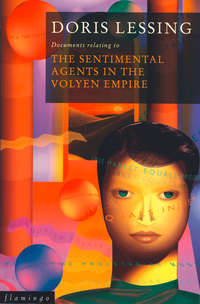
Kitabı oku: «The Sentimental Agents in the Volyen Empire»

DORIS LESSING
CANOPUS IN ARGOS: ARCHIVES
Documents relating to
THE SENTIMENTAL AGENTS IN THE VOLYEN EMPIRE

CONTENTS
Cover
Title Page
KLORATHY, FROM INDEPENDENT PLANET VOLYEN, TO JOHOR ON CANOPUS.
KLORATHY TO JOHOR, FROM MOON II OF VOLYEN, VOLYENDESTA.
KLORATHY TO JOHOR, FROM MOON I OF VOLYEN, VOLYENADNA.
KLORATHY TO JOHOR, FROM VOLYENDESTA.
FROM KLORATHY, IN VATUN ON VOLYEN, TO JOHOR.
KLORATHY IN VATUN TO JOHOR.
KLORATHY ON VOLYEN, TO JOHOR.
KLORATHY ON VOLYENADNA, TO JOHOR.
KLORATHY TO JOHOR. FROM VOLYEN.
REPORT FROM AM 5.
KLORATHY, ON SLOVIN, TO JOHOR.
AM 5 ON MOTZ, TO KLORATHY.
KLORATHY ON VOLYEN TO JOHOR.
EXTRACTS FROM A REPORT FROM AM 5.
KLORATHY TO JOHOR FROM VOLYEN.
AM 5 TO KLORATHY.
KLORATHY TO JOHOR, FROM VATUN.
GRICE VS. VOLYEN
KLORATHY TO JOHOR. FROM VOLYEN DESTA.
ORMARIN TO KLORATHY.
KLORATHY TO JOHOR, ENCLOSING THE ABOVE.
KLORATHY TO JOHOR, FROM HIS SPACE TRAVELLER, EN ROUTE TO SHAMMAT.
About the Author
By the same author
Read On
The Grass is Singing
The Golden Notebook
The Good Terrorist
Love, Again
The Fifth Child
Copyright
About the Publisher
The Sentimental Agents in the Volyen Empire is the fifth in a series of novels with the overall title ‘Canopus in Argos: Archives’; the first is Shikasta (1979); the second The Marriages Between Zones Three, Four and Five (1980); the third The Sirian Experiments (1981); and the fourth The Making of the Representative for Planet 8 (1982).
KLORATHY, FROM INDEPENDENT PLANET VOLYEN, TO JOHOR ON CANOPUS.
I requested leave from service on Shikasta; I find myself on a planet whose dominant feature is the same as Shikasta’s. Very well! I will stick it out for this term of duty. But I hereby give notice, formally, that I am applying to be sent, when I’m finished here, to a planet as backward as you like, as challenging as you like, but not one whose populations seem permanently afflicted by self-destructive dementia.
Now for my initial report. I have been here five V-years, and can confirm recent reports that our agent Incent did succumb to an attack of Rhetoric – not, after all, unknown, and not, as I may remind you, always unwelcome if regarded as an inoculation against worse – but unfortunately he did not recover, and suffers still from a stubborn condition of Undulant Rhetoric.
It was ten V-years ago that he fell to the wiles of Shammat, reporting his reactions in a letter which I attach herewith. Please see that it reaches the Archives.
Klorathy, I am taking the liberty of writing to you direct, instead of to the Colonial Office, because of our meeting when I came home to Canopus on leave last year and you said you had been assigned my supervision. I feel that what I want to ask is so important it goes beyond my little personal problems, but on the other hand I have no actual administrative problems as such to report.
To come to the point, I met someone on this planet’s second planet, Volyendesta, when I was there because of the riots, which necessitated the withdrawal of Volyen’s Imperial Forces. I do not have to tell you that all through my training as Colonial Servant, and during my briefing session, the dangers of Shammat were drummed into me – and everyone else! But imagine my surprise after the most inspiring evening of my whole life when I found that my companion was from Shammat! When he said he was Krolgul of Shammat I thought he was joking. I was awake all night in torment, Klorathy; I can’t remember ever spending such an awful night. Then I met him again by chance in the courts as the rebels were being sentenced, and I saw a man of such compassion, such warmth of heart, such sensitivity to others’ sufferings. This was the terrible Shammat! This wonderful being who wept as the rebels were led out to execution! I spent the next weeks with him. I was given a view of, first, Volyen, and then of the Volyen ‘Empire.’ I put it in inverted commas as is our Canopean way – but does this not show arrogance on our part? The Volyen Empire, consisting of the two moons, Volyenadna and Volyendesta, and two neighbouring planets, Maken and Slovin in Volyen terminology (the Sirian planets PE 70 and PE 71), hardly stands comparison with our Rule, or that of the Sirian Empire, but from their point of view it is something, an achievement. I was quite ashamed to see Krolgul’s ironic but kind smile when I spoke of the Volyen Empire with what I am afraid I now see as something not far from contempt.
And it was not only of Volyen affairs but of Sirius and ourselves as well that I was introduced to a very different view.
So different there was a point when I realized, and with what shock and distress I hardly dare to say, that my attitude was no longer consistent with that of a loyal servant of Canopus.
I am prepared to offer my resignation. What shall I do?
Your always grateful pupil,
Incent.
I did not reply to this, though, of course, had he resigned I would have asked him to reconsider. But he did not. I heard he was sufficiently involved with the rebel forces on Volyendesta, to the point where he was wounded in the arm and had to be hospitalized. Since I was due in the Volyen system, I decided to wait till I had seen him.
Volyen itself seethes with emotions of all kinds, its four colonies no less – to the extent that there is nowhere I could place Incent hoping he would be free from the stimulus of words long enough to recover his balance. No, I had either to send him home to Canopus with the recommendation that he was unfit for Colonial Service, and this I was reluctant to do – as you know, I am always unwilling to waste such experiences in young officials who might be strengthened by them in the long run – or to regard it as a case where we must decide to exercise patience.
Of course we can decide to submit him to the Total Immersion Cure, but that does seem rather a last resort. Meanwhile, he is still in hospital.
THE HISTORY OF THE VOLYEN EMPIRE. SUMMARY CHAPTER. (EXCERPTS.)
This is the largest planet of a Class 18 Star situated on the remotest verges of the Galaxy, on the outside edge of its outer spiral arm. It is in a very poor position for Harmonic Cosmic Development; and for this reason it has never been part of the Canopean Empire. We did not do more than maintain Basic Surveillance for thirty thousand Canopean years. At the beginning of this period an evolutionary leap had taken the population from Type 11 to Type 4 (that is to say, Galactian Basic), and a predominantly gathering-and-hunting type soon developed agriculture, trade, and the beginnings of metallurgy, and built towns. There was little contact between Volyen and near planets. Then, because of a cosmic disturbance resulting from the violent ‘soul-searchings’ of the neighbouring Sirian Empire, the population increased rapidly, material development accelerated, and a ruling caste came to dominate the entire planet, making slaves of nine-tenths of the population. All the planets in that sector were similarly affected, and there began a period of history during which they have been invading and settling one another, as short-lived and unstable ‘Empires,’ for twenty-one C-years.
Volyen has several times been dominant, and several times a subject.
The Sirian Empire, like us, had never made any attempt to absorb Volyen. During Volyen’s stable period, Sirius was more or less stable and had made a decision not to expand. When Sirian influences upset the balances of Volyen, it was because of the turmoil, from end to end of the Sirian Empire, attendant upon the conflict between the two parties known as the Conservers and the Questioners, a conflict that split even the governing oligarchy of Sirius, the Five. Some of their outlying planets rebelled, and were instantly punished. Some asked to be permitted to secede and become self-governing. There were reprisals. These energetic, not to say savage, measures caused the Questioners to redouble their protests and demands that Sirius should be studying its own nature and potentialities from points of view not exploitative. For a short period the Conservers were dominant, and the Questioners were also punished. While all this upheaval went on, the fact that Volyen, in a dominant phase again, had developed its armies and sent them out to conquer its two moons, or planet’s planets, went virtually unnoticed. When Volyen dubbed itself the Volyen Empire, Sirius, like us, merely noted the fact, as we had done before. But when Volyen expanded beyond its own planets and sent armies into the two other planets of its solar system, Sirius did take notice. For these two planets had been for S-millenniums subjects of sharp debate and disagreement. When the Sirian Empire, long before this time, had made a decision not to expand further, it was these two planets (Maken and Slovin) that had been next on the list for conquest and colonization. Neither we nor Sirius had named these planets; in their system they were designated PE 70 and PE 71 (Possible Expansion). The Questioners volubly, not to say violently, objected to having any attention whatsoever paid to this ‘Empire,’ which from their point of view was useless because of its backwardness, but they were overruled. The decision of the Sirian governing body, the Four, to ‘punish’ Volyen, and to claim PE 70 and PE 71, marked the beginning of a renewed Sirian expansion, which was nothing like the planned and controlled developments of Sirian expansion under the Five but was the result of internal convulsions. The Sirian Empire made a wild surge outwards, intensifying its own instability, and leading inevitably to its collapse.
NOTE BY ARCHIVIST. Klorathy arrived in the Volyen ‘Empire’ when its two planets and Sirian PE 70 and PE 71 were in revolt and rebellion against Volyen, and before Sirius invaded.
KLORATHY TO JOHOR, FROM MOON II OF VOLYEN, VOLYENDESTA.
Apologies. I have been engaged in cultivating Shammat on Volyen’s planets, found myself afflicted by brief attack of Shammatis, put myself into Restorative Detention while it lasted, and came out to deal with Incent, as a priority. This because of the key role he is now in with Shammat. I told you Incent was hospitalized for a flesh wound. I had him transferred to the Hospital for Rhetorical Diseases, and went to visit him there.
I positioned this hospital on Volyendesta because of probability forecasts that Volyen itself, as its ‘Empire’ collapses, will be savagely overrun, whereas Volyendesta will be little affected. As indication of the healthy state of Volyendesta: Agent 23 was able to have the hospital built and equipped by the rebellious party that is led by a rather remarkable character, one Ormarin, of whom more later, on whose comparative freedom from illusions I am learning to rely. The concept of the hospital, as I explained it to him, amounting to a (for him) completely new outlook on (as he put it, in the current Volyen mode) ‘the nature of the class struggle’ – but we must not expect too much too soon – caused in him a sharp but fortunately short attack of Elation. You will of course have seen that his agreement to build this hospital was partly due to a misunderstanding of our purposes. By the time he had really understood, the place was up and in use. There followed the routine riots and protests. But the effort at attempting to understand this hospital, the discussions and debates, some of them violent: this process itself caused the creation of a new faction, political in expression, which came to support and strengthen Ormarin.
Volyendesta is a watery planet, with a large, rapidly circumgyrating moon afflicting its inhabitants with a vast variety of unstable moods; but the sheer effort needed to cope with these conditions has evolved a breed (partly originating, as you will recall, from the Volyen stock) able to withstand rapid changes of emotional condition while ostensibly succumbing to them. On my first visit to this planet I was disheartened by its inhabitants’ violent reactions to everything, but soon came to see that these could be regarded, rather, as surface storms over a comparatively untouched interior. And I saw that a few of the inhabitants had even been able to use this condition of constant stimulation to evolve and strengthen inner calm. Ormarin is one.
I went straight to the Hospital for Rhetorical Diseases. This, on advice from Ormarin which Agent 23 was quick to take, is called by them the Institute for Historical Studies. I was in the guise of a lecturer visiting the place to judge whether I wished to take up an appointment.
The site was chosen after consultation with their geographers to provide the maximum opportunities for natural stimulation. It is on a short and very high peninsula on a stormy coast, where the ocean is permanently in a tumultuous roar, and where its moon has full effect. Immediately behind the peninsula the mainland affords, within achievable limits, extremes of terrain. On one side rise grandiose and gloomy mountains, full of the graves of overambitious mountaineers. On the other reach vast and ancient forests, guaranteed to bring on thoughts of age, the passing of time, inevitable decay. And, extending almost to the hospital itself, a ridge of barren, rocky sand which, if followed, leads to the beginnings of a desert so very hot, cold, bleak, blistering, and hostile; so full of escarpments emphasizing skies sometimes scarlet, sometimes lilac, often a sulphurous yellow, but always changing; so thickly piled with sands, shales, gravels, and dusts incessantly moved from place to place by ever-shifting winds, that reflections on the futility and vanity of all effort are automatically provoked – leading, if the sufferer persists in his stumblings through and over dried bones, bits of stick that were once forest, or the remains of ships (for this desert was once, fortuitously, the bed of an ocean), and rocks in which one may find entombed the imprints of long-dead species, to a most satisfactory and salubrious reaction. This has been named by our Agent 23 as the Law of Instant Reversal, describing what happens when, in the words of the inhabitants themselves, ‘there is too much of a good thing,’ causing a stubborn inward strengthening which they express thus: And so what? One still has to eat!
I surveyed all this terrain by Space Traveller, comfortably and with enjoyment, and was set down on the ridge of sand far enough from the hospital to enable me to say I had been conducted thither by local means of transport.
Large parts of the building still lie unused. I told Ormarin that the intensifying crisis in the ‘Empire’ would fill them soon enough, and he kept his followers quiet with excuses about faulty planning, unreliable contractors. Who was paying for it? He told them a cock-and-bull story about Sirian spies who were offering money for secret support, and this is close enough to things actually happening for it to be believed. His supposed cleverness in outwitting the Sirians has gone to his credit.
The building does not differ much from others we have devised in similar conditions on several of our colonized planets.
With what dislike I enter these places you know full well: and yes, I have, believe me, understood why I find myself in them so often. I have even mastered myself to the extent of contributing somewhat to the science: I shall shortly come to the Department of Rhetorical Logic which I devised.
I have to report that Incent is in a bad way. I found him in Basic Rhetoric, for he has not progressed beyond it. This ward is at the front of the building, on balconies built over continual crashing, moaning, or murmuring waves. The winds whine and roar all day and all night. To augment this we have arranged background music of the most debilitating kind, largely originating from Shikasta. (See History of Shikasta, Nineteenth Century Emoters and Complainers: Music.) Most of the patients – a good many of them our agents, for it will not have escaped your notice how many are succumbing during this phase of heady partisan enthusiasms – have advanced beyond this basic and infantile condition and were in other wards, so poor Incent was by himself. I found him gazing out over the ocean, where a morbid sunset tinted the waves scarlet, his inner condition aptly expressed by a robe of red-and-pink silk, its luxuriousness emphasized and made striking by his soldierly bandaged arm. Tears flooded down his pale and tragic face. You will recall that his choice was for large black soulful eyes, an indication we might have taken more notice of (it comes into my mind for the first time that perhaps you did). But it was a bad sign … Yes, large tragic black eyes mourned over the wastes of water – a sentence I might have found in the book that lay open on his knee, again from Shikasta, entitled The Hero of a Lost Cause. He was not looking at the screen on which was being projected his medication for the day, which happened to be a programme I am rather proud of: Shikasta again! How invaluable is that poor planet to our Canopean treatment for these conditions! Two vast armies, equipped for killing to the limits of current technology, fight each other for four Shikastan years with the utmost heroism and devotion to duty and in the most vile and brutal conditions, for aims that are to be judged as stupid, self-deluding, and greedy by their own immediate descendants a generation later, urged on by words used to inflame violent rival nationalism, each nation convinced, hypnotized by words to believe that it is in the right. Millions die, weakening both nations irreparably.
‘Incent,’ said I, ‘you are not taking your medicine!’
‘No,’ he cried, and he started up and clutched a pillar of the balcony with both hands, gazing with streaming eyes into the crashing and booming waters that flung spray up as high as the hospital windows. ‘No, I can’t stand it. I can’t and I won’t! I cannot endure the horror of this universe! And as for sitting here hour after hour and watching this record of tragic loss and waste –’
‘Well,’ I remarked, ‘you are not actually throwing yourself into the sea, are you?’
This was a mistake, Johor. I had underestimated his demoralization, for I was just in time to catch him by the arm as he flung himself over.
‘Really,’ I heard myself scolding him, ‘how irresponsible can you get? You know quite well you would only have to come back and do it again! You know how much it costs, having to refit you with a new outfit, getting you into the right place at the right time …’ I record this little tirade to show you how quickly I was affected by the general atmosphere; are you sure I am really suitable for this work? But he at once collapsed into self-pity and self-accusation, said he was fit for nothing (yes, I have seen the echo here – thanks!), not up to it, and unworthy of Canopus. Yes, he was prepared to agree, if I insisted, because he knew I could not be wrong, that Shammat was evil; but it was merely an intellectual assent, his emotions were at odds with his thoughts, he could not believe that he would ever be a whole person again … All this to the accompaniment of Tchaikovsky and Wagner.
I switched on a particularly therapeutic programme illustrated by newsreels of a recent disturbance on a planet situated on the very edge of the Sirian Empire where it borders the Puttioran Empire. Constantly invaded by one or the other of the two Great Powers, sometimes described as Sirian and sometimes as Puttioran, the inhabitants of Polshi, because of these continual strains and tensions and persecutions, because of the efforts they have always had to make to preserve their planetary identity and their sense of being Polshan, have evolved a dashing, heroic, audacious planetary character for which they have long been famous. Throughout two vast Empires (I do not mention our own) the Polshans are known for this peculiarly dramatic and even self-immolating nature. Their more prudent neighbours criticize them for it, notably those most firmly under the heel of (forgive me) Puttiora or Sirius; but they are admired by other, less pressured, planets, usually in inverse proportion to their distance from centres of power and oppression. Thus, ‘the Polshan cause’ tends to be celebrated most passionately in planets like Volyen, which has not itself been recently invaded.
The wars and massacres that have always afflicted Polshi have recently been absent, long enough for a generation to grow up with no personal experience of anything but the verbal stimulations of Sirian Rhetoric, the ideas generated by Sirian Virtue. And these most admirably brave people announced to Sirius that, by definition, Sirian Virtue and the custodians of it must admire planetary self-determination, justice, freedom, democracy (and so on and so forth). Therefore, Polshi intended forthwith to take control of its own affairs. At the same time, these intrepid ones invited all the neighbouring Sirian colonies to follow the roads of self-determination, democracy, justice, Virtue (and so on and so forth). Sirius (in this case the Conservers) watched all this without surprise, since rebellion is the main thing they study and what they expect, and did nothing whatsoever, refraining from intervention until that moment when the heroes were on the verge of setting up a government that repudiated Sirian Virtue in favour of their own. And then the Sirians moved in. By delaying as they did, they allowed every individual with the potential for Subversion/Self-determination/Heroism/Sedition/ Anti-Sirian feelings / Polshan Virtue (and so on and so forth) to expose himself or herself, and were thus enabled to arrest, destroy, isolate, and make harmless the possible opposition. For that generation, at least.
‘Klorathy!’ demanded Incent, his eyes streaming, ‘are you saying that tyranny should never be resisted?’
‘When have you ever heard me say so?’
‘Ah, what nobility! What self-sacrifice! What daring! What reckless heroism! And you stand there dry-eyed, Klorathy! Empires rise and Empires fall, you say, and I remember your cool exposition of the subject in our classes on Canopus. But they fall, surely, because subject peoples rebel?’
‘Incent, would you not agree that the outcome of this particular heroic episode was not all that hard to foresee?’
‘I don’t want to think about it! I can’t bear it! I wish I was dead! I don’t want to know! Switch that beastly thing off.’
‘Incent,’ I said, ‘you are going to have to take it from me that you are very ill. But you will recover, I assure you.’
I withdrew, leaving him sobbing and wringing his hands, then stretching out his arms to the waves as if he needed to embrace the ocean itself.
On consultation with doctors, I discovered that no one before had ever resisted such treatment for so long. I could see they were at a loss. After all, this intense variety of homoeopathic medicine is the best – or worst – we can do. We have never, in short, had a case like Incent’s. In every other acute case the stage of ‘So what!’ followed by rapid recovery, has been reached fairly quickly.
The doctors having said they had no suggestions, I reassured them that I would think it all over and take responsibility.
I then briefly visited the Department of Rhetorical Logic, which works on the opposite principle, withdrawal of emotional stimulus.
High in the wing of the building away from the ocean, overlooking the beginnings of the desert, with the mountain peaks on one side and the dark stillness of the forest on the other, we have built rooms of stark white that are kept silent except for the clicking and ticking of the computers, into which are fed by remote control historical propositions such as capitalism equals injustice, communism equals injustice, a free market equals progress, a monarchy is the guarantee of stability, the dictatorship of the proletariat must be followed by the withering away of the state. And so on.
But this ward was empty: its time has not yet come.
I did not take Agent 23 with me to visit Ormarin. He reported unmistakable symptoms of Rhetoric, asked to be put into curative custody, and then showed that the disease had indeed set in seriously by ceasing to see that he was ill and announcing with much emotion that the elevated language of the Constitution of the Volyen ‘Empire,’ which promises happiness, freedom, and justice to every one of its citizens as inherent, inalienable rights, seemed to him the ‘most moving’ thing he had ever encountered. He is drying off in Mild Rhetoric and will soon be normal.
Ormarin.
I can most quickly characterize him by saying that he embodies a number of contradictions: his situation is one of high tension, and this is his strength as well as his weakness.
You will recall that when Volyen conquered Volyendesta, the indigenous inhabitants were murdered or enslaved, and their land was taken from them. You might not remember, because of its basic improbability, that this cruel process was accomplished to the tune of Rhetoric claiming that it was for the benefit of the said natives. The ability to disguise truth by the processes of Rhetoric is of course one in which our Canopean Historical Psychologists are particularly interested in connection with the Sirian Empire, but I feel that they have overlooked the extremities of this pathological condition as exemplified in the Volyen ‘Empire.’ At any rate, I am drawing attention to this now because it is of vital importance to what I am finding out as I move (for the most part secretly) about Volyen and its four colonies.
Ormarin has all his life represented ‘the underdog,’ though this does not mean the miserable semi-slaves but, rather, the less fortunate of the conquering minority. As an intelligent being he is well aware of the anomaly and, to compensate, is capable, at the slightest stimulus, of providing floods of compassionate and sorrowing words describing their condition. This ability to, as it were, mourn verbally is appreciated by his fellow settlers, who demand from him on ceremonial occasions set pieces of grief on behalf of the exploited, beginning with words such as these: ‘And now I want to say that the condition of our fellow beings who are workers like ourselves is always in the forefront of my mind …’ And so on.
That, then, is the first and worst contradiction in Ormarin.
The next is that, while he represents the worse-off of the settlers, some of whom are indeed deprived, his own way of living can hardly be described as lacking in anything. His tastes are those of the fortunate minority everywhere in the Volyen ‘Empire’; but he has to conceal this. There was a period when he saw this as hypocrisy and went through some uneasy reversals: making a point of living at one time on the basic wage of the poor, at another on his wage as an employed official; at yet another time making speeches saying that although his position necessitated his living better than the average, this was only to demonstrate what was possible for everyone – and so on. But then there entered another factor – you will have guessed what and who – Shammat, the Father of Lies, in the person of Krolgul. Up and down and around the five units of this ‘Empire’ went Krolgul, as he still does, at his work of making black white, white black.
He is a personable creature, with all the attractions of a robust and unconscious vitality, and he won Ormarin over by his rumbustious enjoyment in putting in clear and unlikable terms the uneasy compromise of which Ormarin’s life is composed.
‘You’ve got to face it,’ said he. ‘In the times in which we have to live, bad luck for us all, we must go with the tide and adapt ourselves to circumstances.’
He evolved for Ormarin a persona that would reassure the people who kept him in power, actually an image of themselves, or of how they like to see themselves. Ormarin was taught to present himself as a solid, reliable, affable man – genially tolerant of his own deficiencies with regard to the fleshpots – though these were not allowed to be visible as more than the merest peccadilloes – humorous, slow-speaking, full of common sense.
In fact, in the case of Ormarin the picture is not wildly inaccurate: Ormarin does possess many of these qualities. But Krolgul has been creating these personae by the score, all over the ‘Empire,’ so that everywhere you go you meet representatives of ‘the workers’ or ‘the people’ who are affable, solid, et cetera, and who all, without exception, smoke a pipe and drink beer and whisky (in moderation, of course), these habits being associated with sound and reliable behaviour.
Ormarin soon stopped pointing out that he loathed pipes and beer, did not care for whisky, and preferred a certain brand of cigarettes captured by space raiders from Sirian cargo ships, along with Sirian (Mother Planet) nectar similarly acquired. He is uneasy about his acquired personality, and apologizes for it if he thinks you are likely to be critical. This, then, is a second strain, or contradiction.
Third, he is of Volyen stock, yet all his life has resisted – verbally – Volyen domination, though he is at the same time a welcome visitor on Volyen, where his children were educated. Volyen drains wealth from its four colonies while presenting itself as their benefactor under such slogans as ‘Aid to the Unfortunate’ and ‘Development for the Backward.’ Ormarin, then, is continually involved with schemes to ‘advance’ Volyendesta, originating from Volyen, but he protests continually, in magnificent speeches that draw tears from every eye (even my own if I don’t watch myself, and yes, I am conscious of the dangers), that these schemes are hypocritical.
Fourth. Sirius. Because Volyen itself is comparatively resistant, with a high morale among the population, who are well fed and well housed and educated, compared with the four colonies, Sirius ignores it (except for infiltrating Volyen with spies) and is putting its pressure first and foremost on the colonies, particularly Volyendesta. Ormarin, hating the ‘crude imperialism’ of Volyen – which is how he, on behalf of his constituents, has always described Volyen, the birthplace of some of his recent forebears – is able more easily than the inhabitants of Volyen itself to be sympathetic to Sirius, whose approaches are always in terms of ‘aid’ or ‘advice,’ and of course in interminable and highly developed rhetorical descriptions of the colonial situation of Volyendesta.
Volyendesta, like Volyenadna, like Maken and Slovin, is short of hospitals, physical and emotional, short of every kind of educational institution, lacking in amenities Volyen takes for granted – and these Sirius offers, ‘without strings.’
Sometimes, among the proliferations of Volyen Rhetoric, we find pithy and accurate phrases. One of them is ‘There is no such thing as a free lunch.’ Unfortunately Ormarin was not applying this mnemonic to his own situation.
My situation was complicated by the fact that I didn’t want him to apply it to me, where it doesn’t apply.
I found him on an official occasion: he was standing on a low hillside, with a group of associates, watching a section of road being built by a Sirian contractor. The road, an admirable construction, a double highway, is to stretch from capital to seaport. Sirius flies in continually renewed supplies of labour from her Planets 46 and 51, houses them in adequate compounds, oversees and guards them. These unfortunates are permitted no contact with the locals, on the request of the Volyendestan government. And thus it was that I approached Ormarin in yet another of the ambiguous roles that characterize him: he and his mates could not possibly approve of the use of this slave labour or of how they were treated, and yet they were there to applaud the ‘gift’ of the road. As I approached, all the male officials took out pipes and began to smoke them, and the two females hastily hid some attractive scarves and jewellery of Sirian origin. I was just in time to hear Ormarin’s speech, which was being broadcast for the benefit of the workers, their guards, and the Sirian delegation.
‘Speaking on behalf of the working men and women of this planet, I have the great pleasure to open this section of the highway and to express gratitude to our generous benefactors the Sirian …’ etcetera. Ormarin had seen who it was by then.
Ormarin likes me and is always pleased to see me. This is because he knows he does not have to disguise himself from me. Yet he suspects me of being a Sirian spy, or sometimes does; or of being some kind of a spy from somewhere, the central Volyen government perhaps. He jokes sometimes that he ‘should not be associating with spies,’ giving me looks that compound the ‘frank honest modesty’ of his public persona with the inner uneasiness of his role. Or roles …
I joke that at any given time among his associates there is at least one spy from the Volyen central government, one from the Volyendestan central government, probably one each from Volyenadna, PE 70, and PE 71, and several from Sirius. He jokes that if that were true then half of his associates at any given time would be spies. I joke that he surely understands that this is an accurate statement of his position. He puts on the look obligatory at such moments, when one is forced to admit impossible truths – that of a wry, worldly-wise regret, tinged with a scepticism that makes it possible to dismiss the necessity of doing anything about it.
He is in fact surrounded by spies of all kinds, some of them his most efficient associates. Spies who have certain talents for, let’s say, administration, and who are in administration for the purposes of espionage, often enjoy this secondary occupation and even rise to a high position, at which point they may regret that they didn’t start off in a career of simple ‘public service,’ as this kind of work is styled, and they suffer private sessions of ‘Oh, if only I had seen early enough that I was fit for real work, and didn’t have to settle for spying.’ But that is another story.
Ormarin soon ended the official part of the occasion; his colleagues went off; he shed his public self with a small smile of complicity with me; and we sat down together on the hilltop. On the hilltop opposite us the Sirian contingent were heading back to their spacecraft. The several hundred Sirian workers swarmed over and around the road, and we could hear the barks and yelps of the supervisors.
This planet’s weather is unstable, but one may enjoy intervals without needing to adjust to unpleasant heat, cold, or assaults of various substances from the skies.
We watched, without comment, one of the men who had just been with us running to join the group of Sirians: a report on me and my arrival.
I was relieved that Ormarin decided against a ritual lament along the lines of ‘Oh, what a terrible thing it is to have to work with deceivers …’ and so on. Instead, he said to me, on a questioning note, ‘That’s a very fine road they are making down there?’
‘Indeed it is. If there is one thing the Sirians know how to do, it is road-building. This is a first-class, grade I road, for War, Type II, Total Occupation.’
This was deliberate: I wanted him to ask at last, But where are you from?
‘I am sure it could be used for any number of purposes!’ said he hastily, and looked about for something neutral to comment on.
‘No, no,’ I said firmly. ‘When Sirius builds, she builds to an accurately defined purpose. This is for the purposes of Total Occupation, after Type II War.’
Was he now going to ask me? No! ‘Oh, come come, you don’t have to look all gift horses in the mouth.’
‘Yes, you do. Particularly this one.’
Alas, I had miscalculated my stimulus, for he assumed a heroic posture, seated as he was on a small rock beside a rather attractive flowering bush, and declaimed: ‘We shall fight them on the beaches, we shall fight them on the roads, we shall fight them in the air …’
‘I don’t think you’ll get very far, fighting Sirius in the air,’ I said in a sensible voice, designed to dissolve this declamatory mode into which all of them fall so easily.
A silence. He kept sending me short anxious glances. He didn’t know what to ask, though. Rather, he didn’t want to ask me the key question, and perhaps it was just as well. The trouble is, ‘Canopus’ has become a concept so dense with mythic association that perhaps he would not have been able to take it in, or not as fast as I needed.
I made it easy for him to think of me as Sirian, at least temporarily. ‘I’ve seen this type of road on a dozen planets before a takeover.’
A silence.
‘Oh, no, no,’ he said, ‘I really can’t accept it. I mean, we all know that Sirius has quite enough trouble as it is, keeping her outlying planets in subjection; she’s not going to add to her troubles … and anyway … they needn’t think they are going to prevail over …’ There followed a few minutes in the ritual patriotic mode.
After which, since I said nothing, he said, in a different voice, low, appalled: ‘But I can’t face it; I really don’t think I would want to live under Sirian occupation.’
I recited a portion of the history of Volyendesta, as it appears in our annals.
‘Of the fourteen planets of Star P 79 three are inhabited, Planet 3 and its two moons. The central feature of their history is that they have been invading and settling one another for millenniums. The longest stable period was of several thousand millenniums, when Moon II overran and conquered the other two and maintained by a particularly savage despotism –’
He interrupted, as I wanted him to: ‘Excuse me, Moon II, is that this planet or …?’
‘You. Volyenadna is Moon I.’
It was wonderful to see the look of satisfied pride, which he was unaware of. ‘We, Volyendesta, administered all three planets? Volyen was an underdog then?’
‘As you so graphically put it, Volyen and your brother planet Volyenadna were underdogs.’
He became conscious that his reaction of exulting pride was hardly becoming to an opponent of Empires, adjusted his expression, and said, ‘There is nothing of that in our history. And besides …’ The opponent of Empires was struggling for the appropriate words. ‘The locals here, the natives, they are pretty backward. I mean, it is not their fault’ – and here he cast fearful glances right and left, in case he might have been overheard – ‘there are sound historical reasons for it, but they are just a little, let us say …’
‘Backward,’ I said firmly, and he looked relieved.
‘As always happens,’ I went on, ‘there came a time when the peoples of your two enslaved planets grew strong and self-reliant through overcoming hardships, and they evolved in secret the methods and technologies to overthrow – not you, but your predecessors, who were almost entirely wiped out. A rather unpleasant race, they were. Not much loss, or at least so it was felt by those whom they had subjugated. But one may still see traces of them in these natives here, if one knows how to look.’
‘Extraordinary,’ he murmured, his broad and honest face (genuinely honest, on the whole) showing the tensions of historical perspective. ‘And we know nothing of all that!’
This was my clue to say, ‘But luckily we do …’ but I had decided against the subject of Canopus, for the time being. I saw his eyes most shrewdly and thoughtfully at work on my face; he knew a good deal more than he was saying, and more, perhaps, than he was admitting to himself.
‘You don’t want to know the rest?’ I asked.
‘It is all a bit of a shock; you must realize that.’
‘What I am going to say now is in your histories, though certainly very differently from how it appears in ours. I shall continue, then. Moon II – you – and Moon I were occupied for several V-centuries by Volyen. It was not entirely a bad thing. Moon II, this planet, was sunk in barbarism, so thoroughly had your former subjects from Volyen defeated you. Volyen’s inhabitants, so recently your slaves, were full of confidence, knew all kinds of skills and techniques, most of them learned from you. You could say that it was they who preserved your inheritance for you, at least partly. These qualities were introduced, reintroduced if you like, and maintained by Volyens – though interbreeding soon made it hard to say what was native and what Volyen in what had become a vigorous new people. And the same process was going on in the more temperate parts of Volyenadna. Even faster there, because the awful hardships of life on that icy planet had always produced strong and enduring people. Very soon Moon I, or Volyenadna, partly threw off, partly absorbed its Volyen invaders, and then conquered Volyen, and settled this planet.’
‘One of my ancestors,’ said he, with pride, ‘was a Westerman from Volyenadna.’
‘I can see it in you,’ said I.
He looked modest, while holding out his hands for me to admire. They are very large strong hands, the distinguishing mark of Westermen from Volyenadna.
‘Mind you, we gave them a good fight, it wasn’t just a walkover,’ he boasted.
‘No, an army of one thousand Volyendestans met them as they landed, and every one of the Volyendestans was killed. You died to a man, all blasted to cinders by the weapons of Moon I.’
‘That’s right. Our Gallant One Thousand. And as for the invaders, nine-tenths of us were killed, even though the Volyendestans had only primitive weapons in comparison.’
‘What a massacre that was – of both invaders and invaded.’
‘Yes.’
‘A glorious chapter in the annals of both sides.’
‘Yes.’
‘I was admiring today the two memorials standing side by side in your main town square, commemorating that glorious day, one for the Gallant One Thousand, the Volyendestans, or Moon II, and the other for the Heroic Volyenadnans, or Moon I. Your ancestors, whose blood runs in your veins. Together, of course, with the blood of the Volyens, and many others.’
He was regarding me steadily, with a thoughtful expression tinged with bitterness.
‘Right, mate,’ he said. ‘I know you well enough by now. What is it you are warning me about?’
‘Well, what do you think, Ormarin?’
‘You really think Sirius will …?’
‘You are weak, divided, declining.’
‘We’ll fight them on the –’
‘Yes, yes, but don’t you think …’
‘How is it you are so sure of it, if you aren’t a Sirian agent, that is? I’m beginning to think –’
‘No, I am not, Ormarin. And I am sure that you don’t really think anything of the kind. Why should I have to have any special sources of information to enable me to see what is obvious? When a planet is weak, divided, declining, nearly always it is taken over by a stronger planet or group of planets. If not Sirius, then some other power. What makes you think you are immune to this law, Ormarin?’
Down in the valley dark was falling. The hundreds of slave labourers were being pushed into a double file on the new road by the guards who ran and scampered all around them: they were being marched off for the night.
‘Poor creatures,’ he said suddenly, his voice hot with pity. ‘And is that going to be our fate?’
I said, ‘The Sirian Empire is well past its peak. It has been expanding slowly, for – But if I told you how many millenniums, would you be able to take it in? Your history covers a few thousand of your years. The Sirian Empire is the greatest in size in our galaxy. There have been periods when its growth was checked, periods when it was reduced, because of indecision on the part of the rulers of Sirius. But, looked at overall, it has grown. This last period is one of frenetic and frantic unplanned growth, because of the internal battles going on inside the Sirian ruling classes. It is an interesting fact that the theory governing the Sirian Empire at this time does not include the idea of expansion! Expansion is not on its agenda. They are not stupid, the Sirians, or not all of them: some at least know they are not in control of what they do, and they have just begun to understand that such a thing is possible, that an Empire may control its development according to … but that is another story.’ I was watching his face for a glimmer of understanding, and if he had showed any sign I would have gone on to talk of Canopus, and what governs us. But there was nothing there but the strain of trying to follow ideas, if not beyond him, at least too new for easy assimilation. ‘Recently – talking comparatively, of course – Sirius has conquered several new planets, not as a result of a planned and considered decision, no, but because of some hasty decision made to meet an emergency.’
‘Hasty,’ murmured Ormarin, indicating the fine road below us, along which the slave labourers were being marched to their barracks for the night.
‘The decision to build this road was made a year ago – a Sirian year. When Volyen conquered the two planets that Sirius considered were part of their Empire.’
‘You didn’t finish that history.’
‘The Westermen, those unscrupulous conquerors of whose blood you are so proud, created here and on Volyen a highly structured society of multifarious skills.’ Here I saw him smile wryly down at those formidable Westerman hands. ‘But, as always has to happen, Moon I and its two colonies lost impetus … This time it was Volyen’s turn to rise again and conquer. A quite interesting little Empire it has been, the recent Volyen Empire, with some mild ideas of justice, not indifferent to the welfare of its inhabitants, at least in theory, trying to absorb into its ruling classes the upper echelons of the conquered …’
I saw him begin to feel ashamed, and heard him sigh.
‘Well,’ I said, ‘you could have chosen to live in the compounds and barracks with the natives, rather than compromise, but you didn’t …’
‘Oh, believe me,’ said he, in the hoarse, suffering voice I had almost deliberately invoked, ‘I have lain awake night after night, hating myself.’
‘Yes, yes, yes,’ I said, ‘but the fact is, you did do what you’ve done, and as a result your position on this planet is a key one. And when the Sirians invade –’
But I had miscalculated. The stimulus had been too much.
He leaped to his feet on the now dark hill, with the stars coming up bright behind him – one of them Volyen, his present master – and, holding up his right fist, his Westerman or Volyenadnan fist, he orated: ‘I stand here as a free man, breathing free air, my feet on my own soil! Rather than submit to the tyrannies of alien invaders I will pick up stones from the hillside if need be, and sticks from the forest, and fight until death overcomes me and –’
‘Ormarin!’ I tried to interrupt. ‘What have all those fine words got to do with your situation? For one thing, you have efficient modern weapons, you free peoples of the Volyen Empire …’ But it was no use.
‘Who with real manhood in his veins would choose to live as a slave when he can die on his feet fighting? Which man, woman, or child among you who has known what it is to stand upright……’
I am afraid I must report that this was a bad attack. I had to have him confined to the hospital for a few days.
But I have worse to tell you. While there, I went to see how poor Incent was and, finding him comparatively sensible and able to talk about his situation, asked for his permission to administer a test.
It was the simplest possible test, based on the word history.
At this word itself, he was able to maintain composure. The word historical caused his pulse to quicken, but then it steadied. At historical processes, he remained firm. Perspective of history – so far so good. Winds of history – he showed signs of agitation. These did not decrease. I then decided, wrongly, to increase the dose, trying logic of history. At this point I began to realize the hopelessness of it, for his breathing was rapid, his face pale, his pupils dilating. Inevitability of … lessons of … historical tasks……
But it was not until dustbin of history that I gave up. He was on his feet, wildly exultant, both arms held up, preparatory to launching himself into declamation, and I said, ‘Incent, what are we going to do with you?’
Which flight of Rhetoric must be excused by the circumstances.
I gave instructions for him to have the best of care.
He has escaped. I did not have to be told where. I am leaving for Volyenadna, where Krolgul is active. I shall report again from there.
KLORATHY TO JOHOR, FROM MOON I OF VOLYEN, VOLYENADNA.
This is not the most attractive of planets. The ice sheets which until recently covered it have retreated to the poles, leaving behind a characteristic landscape. This is harsh and dry, scarred by the violent movements of ice and of wind. The vegetation is meagre and dull. The rivers are savage, still carrying melting snow and ice, hard to navigate, offering little in the way of pleasure and relaxation.
The original inhabitants, evolved from creatures of the ice, were heavy, thick, slow, and strong. The great hands that Ormarin is so proud of built walls of ice blocks and hauled animals from half-frozen water, strangled, hammered, wrenched, broke, tore, made tools from antlers and bones. Invasions of less hardy peoples (unlike Moon II, this planet was conquered and settled more than once by Planets S-PE 70 and S-PE 71) did not weaken the stock, because the conditions continued harsh, and those who did not adapt died.
The history of this planet, then, not so unlike that of Volyendesta, exemplifies the power of the natural environment. This is a dour and melancholy people, slow to move, but with terrible rages and fits of madness, and even now, in the wary turn of a head, the glare of eyes that seem to listen as much as to look, you can see how their ancestors waited for sounds that could never be anything but warnings and threats – the whining howl of the wind, the creak of straining ice, the thud of snow massing on snow.
The latest conquest, by Volyen, has worsened conditions. Because of the planet’s abundant minerals, everywhere you look are factories, mines, whole cities that exist only to extract and process minerals for the use of Volyen. The natives who work these mines live in slave conditions, and die young of diseases caused mostly by poverty or dusts and radiations resulting from the processing of the minerals. The ruling class of the planet lives either on Volyen or in the few more favoured areas of this moon supported and maintained by Volyen; its members do their best not to know about the terrible lives of their compatriots.
So extreme are the conditions on Volyenadna that I think it is permissible to call it a slave planet, and this, as I am sure you are not surprised to hear, is how Krolgul apostrophizes it: ‘O slave planet, how long will you bear your chains?’
I arrived on a grim and grey day near a grim and grey city, walked into the central square and found Krolgul addressing a grey, grim, and silent crowd: ‘O slave planet, O Volyenadna, how long will you bear your chains?’
There was a long groan from the crowd, but then it fell silent again. Listening.
Krolgul was standing on a plinth, that supported an imposing statue of a miner holding up clenched fists and glaring over the heads of the crowd; he was deliberately copying this pose – a famous one, for the statue is used as a symbol for the workers’ movements. Near Krolgul, his nervous, agitated stance in sharp contrast to Krolgul’s, stood Incent, sometimes smiling, sometimes scowling, for he was not able to find or maintain a satisfactory public pose. Krolgul saw me, as I intended. In this crowd of heavy, slow people, there were three who stood out: me, basic Canopean, but here seen as ‘Volyen,’ as anything alien has to be; Incent, so slight and lithe and nervous; and Krolgul, though he does everything to look Volyenadnan.
You may remember Krolgul as a large, not to say fleshy, easygoing, affable goodfellow, all eagerness to please: his adaptation on this planet is quite a triumph of self-discipline, for he has created a dedicated, brooding, heroic personal known to live in a bare room on less than a worker’s wage, he has a smile so rare that it has inspired ballads.
… Volyen’s minions fired.
Our dead lay on the ground.
Krolgul frowned.
‘We shall march,’ we cried,
In accents stern and wild.
And Krolgul smiled.
The trouble here is that these people are so slow to move, and Krolgul has been given little occasion for smiling. What he wants them to do is ‘rise all at once, once and for all’ and take over everything.
What is preventing this is the basic common sense of the Volyenadnans, who know from the bitterest experience that the Volyen armies are efficient and ruthless.
So Krolgul started to build up a head of hate, at first directed towards ‘all Volyen,’ and then, this proving too general a target to be effective, at Lord Grice, the Volyen Governor, whose name has acquired, like additional titles, epithets such as Greasy, Gross, Greatfat, Greenguts. To such a point that a citizen may be heard saying something like ‘Lord Grice Greatfat visited so-and-so yesterday,’ but so much a matter of habit has this become that he himself might not be aware of it. And even Lord Grice, so the rumour has it, was once heard to introduce himself on a ceremonial visit to a local governor, ‘I’m Grice the Greasy, don’t you know……’
As a matter of fact, he is a tall, dry, rather weedy fellow, of a natural melancholy much enhanced by the rigours of this planet, and full of doubts as to his role as Governor.
This genuine representative of Volyen was at a window of the Residency that stands on the square, listening to Krolgul and making no attempt at all to conceal himself.
He was a threat to Krolgul’s oratory, because the people in the square had only to turn their heads to see this criminal …
‘And what are we to say about that arch-charlatan Grice the Greedy! In one person we see embodied the whole villainy of the Volyen tyranny! Sucking the blood of the …’ And so on.
The crowd had begun to growl and stir. These lethargic, stolid people were at last showing signs of action.
Krolgul, however, did not want them actually to storm the Residency. He intended to use Grice as a means for a good while yet. Therefore, he skilfully swung them into song. We will march, We will march, We will overthrow … and the mass roared into song.
A few youths at the back of the crowd, longing for action, turned towards the Residency, saw in a window on the first floor a solitary figure, swarmed up onto the balcony, and confronted this observer with shouts of ‘We’ve come to get him! Don’t try to hide him. Where’s Grice the Guts?’
‘Here,’ said Grice, coming forward with modest alacrity.
At which the louts spat at him, aimed a kick or two in his direction, and told him to warn Grice-Guts they were ‘coming to do him.’ They then jumped back into the crowd and joined in the singing.
The singing was less fervent, however, than Krolgul wanted. The faces I looked at, while entranced by the singing, were still patient, even thoughtful.
I went into a little eating place on the square and watched the crowds disperse.
Down from the plinth came Krolgul, smiling and acknowledging homage (comradely greetings) from the crowd. With him Incent, eyes flashing, aroused, palpitating, but doing his best to present the stern and dedicated seriousness appropriate to the military look he aspired to. Like two soldiers they came towards the café, followed by the usual adoring females and some younger males.
They had seated themselves before Incent saw me. Far from showing guilt, he seemed delighted. He came, first running, and then, remembering his new role, striding across. ‘Wasn’t that just the most moving thing you have ever seen?’ he demanded, and sat down opposite me, beaming.
Newspapers were brought in. Headlines: ‘Inspiring … Moving … Inspirational …’ Incent seized one, and although he had for the past several hours been involved in this meeting, sat poring over an account of it.
Krolgul, who had seen me, met my eyes with a sardonic, almost cynical smile, which he instantly abolished in favour of his revolutionary sternness. There he sat, in the corner, positioned so that he could watch through the windows how the crowd dispersed, and at the same time survey the interior of the café. Into which now came a group of the miners’ leaders, headed by Calder, who sat down in a corner, having nodded at Krolgul, but no more.
Incent did not notice this. He was gazing at the men with such passionate admiration that Krolgul directed towards him a cold, warning stare.
‘They are such marvellous, wonderful people,’ said Incent, trying to attract the attention of Calder, who at last gave him a friendly nod.
‘Incent,’ I said.
‘Oh, I know, you are going to punish me. You are going to send me back to that dreadful hospital!’
‘You seemed to me to be rather enjoying it.’
‘Ah, but that was different. Now I am in the thick of the real thing.’
The café was packed. Everyone in it was a miner; Volyenadnans every one, except for three – me, Incent, Krolgul. All foreigners are assumed to be of the Volyen administration, or spies from either Volyen or – but these suspicions were recent – Sirius. The miners, fifty or so of them, here after the rally to discuss their situation, to feel their plight, were obviously wondering how they came to be represented by Krolgul and by his shadow, Incent.
Krolgul, sensing how people were looking at him, occupied himself in earnest, frowning discussion with a young woman from this town, a native, and in moving papers about, the image of efficiency.
But it was easy to see that Calder was not satisfied. He exchanged a few words with his associates and stood up.
‘Krolgul,’ he said. It was not a large place, and by standing and speaking, he unified it.
Krolgul acknowledged him with a modification of the fist-high salute: he lifted a loose fist from the table to half shoulder height, and opened it and shut it once or twice like a mouth.
‘I and the mates here are not altogether happy with the way things are going,’ Calder said.
‘But we concretized the agreed objectives,’ said Krolgul.
‘That is for us to say, isn’t it?’
Given this confrontation, for it was one, Krolgul could only agree; but Incent was half up, holding on to his chair, his face dimmed by disappointment. ‘Oh,’ he said, ‘but that was the most moving … the most … the most moving …’
Ücretsiz ön izlemeyi tamamladınız.