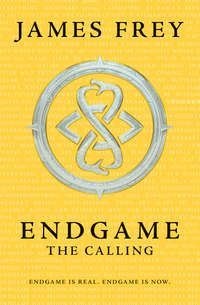
Kitabı oku: «The Calling»

This book is a puzzle.i
Within its pages lie clues that lead to a key hidden somewhere on Earth.
Decipher, decode, and interpret.
Search and seek.
The first to find the key and deliver it to its proper home will be rewarded with gold.ii
Stacks and stacks of gold.iii
$$$  . $.iv


Copyright
Published by HarperCollinsPublishers Ltd
77–85 Fulham Palace Road
Hammersmith, London W6 8JB
www.harpercollins.co.uk
First published in Great Britain by HarperCollins Publishers 2014
Endgame: The Calling
Copyright © 2014 by Third Floor Fun, LLC.
“Ballad for Gloom” excerpt here by Ezra Pound, from Collected Early Poems, copyright
© 1926, 1935, 1954, 1965, 1967, 1976 by The Ezra Pound Literary Property Trust. Reprinted by permission of New Directions Publishing Corp.
Puzzle hunt experience by Futuruption LLC.
Additional character icon design by John Taylor Dismukes Assoc., a Division of Capstone Studios, Inc.
NO PURCHASE NECESSARY TO ENTER OR WIN. You do not need to prove that you purchased this book to enter. Copies of the book may be available to you through other resources, such as your local library. Contest begins 9:00 a.m. EST, October 7, 2014, and ends when the puzzle has been solved or on October 7, 2016, whichever is earlier. Open to ages 13 and older. Entrants under 18 must have consent from a parent or guardian. Void where prohibited. Total value of prize: approximately $500,000.00. Sponsor: Third Floor Fun, LLC, 25 Old Kings Hwy N, Ste 13, PO Box #254, Darien, CT 06820-4608. For Contest details, prize description, and Official Rules, visit www.endgamerules.com
HarperCollins Publishers is not responsible for the design or operation of any contests related to Endgame, and is not the sponsor of any such contest. All such contests have been designed, managed, and sponsored by Third Floor Fun, LLC, which is solely responsible for their content and operation.
A catalogue copy of this book is available from the British Library.
All rights reserved under International and Pan-American Copyright Conventions. By payment of the required fees, you have been granted the non-exclusive, non-transferable right to access and read the text of this e-book on screen. No part of this text may be reproduced, transmitted, down-loaded, decompiled, reverse engineered, or stored in or introduced into any information storage and retrieval system, in any form or by any means, whether electronic or mechanical, now known or hereinafter invented, without the express written permission of HarperCollins.
Source HB ISBN: 9780007585168
Source TPB ISBN: 9780007586448
Ebook Edition © 2014 ISBN: 9780007585212
Version: 2014-09-22
Contents
Cover
Title Page
Copyright
Marcus Loxias Megalos
Chiyoko Takeda
Sarah Alopay
Jago Tlaloc
Baitsakhan
Sarah Alopay
Maccabee Adlai
Sarah Alopay
An Liu
Jago Tlaloc, Sarah Alopay
Christopher Vanderkamp
Chiyoko Takeda
Christopher Vanderkamp
Marcus Loxias Megalos
Kepler 22B
All Players
Christopher Vanderkamp
Kala Mozami
Christopher Vanderkamp
Sarah Alopay, Jago Tlaloc
Chiyoko Takeda
Hilal Ibn Isa Al-Salt
Sarah Alopay, Jago Tlaloc
Chiyoko Takeda
Shari Chopra
Sarah Alopay, Jago Tlaloc
Christopher Vanderkamp
An Liu
Chiyoko Takeda
An Liu
Jago Tlaloc
An Liu
Maccabee Adlai
Baitsakhan
Hilal Ibn Isa Al-Salt
Sarah Alopay, Jago Tlaloc, Chiyoko Takeda, An Liu
Shari Chopra, Baitsakhan
An Liu, Chiyoko Takeda, Sarah Alopay, Jago Tlaloc
Aisling Kopp
Christopher Vanderkamp
Sarah Alopay, Jago Tlaloc
Christopher Vanderkamp
Chiyoko Takeda
Sarah Alopay, Jago Tlaloc
Alice Ulapala
Chiyoko Takeda
Kala Mozami
Sarah Alopay, Jago Tlaloc
An Liu
J. Deepak Singh
Aisling Kopp
Kala Mozami
Alice Ulapala
Kala Mozami
Sarah Alopay, Jago Tlaloc
Christopher Vanderkamp, Kala Mozami
Chiyoko Takeda
Baitsakhan
Kala Mozami, Christopher Vanderkamp
Baitsakhan, Maccabee Adlai
Aisling Kopp
Sarah Alopay, Jago Tlaloc
Christopher Vanderkamp, Kala Mozami
Chiyoko Takeda, Kala Mozami, Christopher Vanderkamp
Hilal Ibn Isa Al-Salt
Chiyoko Takeda
Sarah Alopay, Jago Tlaloc
Baitsakhan, Maccabee Adlai
Kala Mozami, Christopher Vanderkamp
Chiyoko Takeda
Kala Mozami, Christopher Vanderkamp
Baitsakhan, Maccabee Adlai
Chiyoko Takeda
Kala Mozami, Christopher Vanderkamp, Baitsakhan, Maccabee Adlai, Chiyoko Takeda
An Liu
Kala Mozami, Christopher Vanderkamp, Baitsakhan, Maccabee Adlai, Chiyoko Takeda
Alice Ulapala
Chiyoko Takeda, Kala Mozami, Maccabee Adlai, Baitsakhan, Christopher Vanderkamp
Christopher Vanderkamp
Sarah Alopay, Jago Tlaloc, Chiyoko Takeda
Baitsakhan, Maccabee Adlai
Shari Chopra
Sarah Alopay, Jago Tlaloc, Chiyoko Takeda, Christopher Vanderkamp
Aisling Kopp
Hilal Ibn Isa Al-Salt
Maccabee Adlai, Baitsakhan
Sarah Alopay, Jago Tlaloc, Chiyoko Takeda, Christopher Vanderkamp
Maccabee Adlai, Baitsakhan
Sarah Alopay, Jago Tlaloc, Chiyoko Takeda, Christopher Vanderkamp
Hilal Ibn Isa Al-Salt
Sarah Alopay
Chiyoko Takeda
Hilal Ibn Isa Al-Salt
Sarah Alopay, Jago Tlaloc, Christopher Vanderkamp
Chiyoko Takeda
Aisling Kopp, Sarah Alopay, Jago Tlaloc, Christopher Vanderkamp
Chiyoko Takeda
Hilal Ibn Isa Al-Salt
An Liu
Sarah Alopay, Jago Tlaloc, Christopher Vanderkamp
Maccabee Adlai, Baitsakhan
Sarah Alopay, Jago Tlaloc, Christopher Vanderkamp
An Liu
Sarah Alopay, Jago Tlaloc, Christopher Vanderkamp
Chiyoko Takeda
Christopher Vanderkamp, An Liu
Sarah Alopay, Jago Tlaloc, Chiyoko Takeda, An Liu, Christopher Vanderkamp
All Players
Shari Chopra
Endnotes
About the Publisher
Much of this book is fiction, but much of the information in it is not. Endgame is real. And Endgame is coming.
Everything, all the time, every word, name, number, place, distance, color, time, every letter on every page, everything, always. So says, and so has been said, and so will be said again. Everything.
ʿ Ēlv 12 12 12vi
Endgame has begun. Our future is unwritten. Our future is your future. What will be will be.
We each believe some version of how we got here. God made us. Aliens beamed us. Lightning split us, or portals delivered us. In the end, the how doesn’t matter. We have this planet, this world, this Earth. We came here, we have been here, and we are here now. You, me, us, the whole of humanity. Whatever you believe happened in the beginning is not important. The end, however. The end is.
This is Endgame.
We are 12 in number. Young in body, but of ancient people. Our lines were chosen thousands of years ago. We have been preparing every day since. Once the game begins, we must deliberate and decipher, move and murder. Some of us are less ready than others, and the lessers will be the first to die. Endgame is simple this way. What is not simple is that when one of us dies, it will mean the deaths of countless others. The Event, and what comes after, will see to that. You are the unwitting billions. You are the innocent bystanders. You are the lucky losers and the unlucky winners. You are the audience at a play that will determine your fate.
We are the Players. Your Players. We have to Play. We must be older than 13 and younger than 20. It is the rule, and it has always been this way. We are not supernatural. None of us can fly, or turn lead to gold, or heal ourselves. When death comes, it comes. We are mortal. Human. We are the inheritors of the Earth. The Great Puzzle of Salvation is ours to solve, and one of us must do it, or we will all be lost. Together we are everything: strong, kind, ruthless, loyal, smart, stupid, ugly, lustful, mean, fickle, beautiful, calculating, lazy, exuberant, weak.
We are good and evil. Like you.
Like all.
But we are not together. We are not friends. We do not call one another, and we do not text one another. We do not chat on the internet or meet for coffee. We are separated and scattered, spread around the world. We have been raised and trained since birth to be wary and wise, cunning and deceptive, ruthless and merciless. We will stop at nothing to find the keys to the Great Puzzle. We cannot fail. Failure is death. Failure is the End of All, the End of Everything.
Will exuberance beat strength? Stupidity top kindness? Laziness thwart beauty? Will the winner be good or evil? There is only one way to find out.
Play.
Survive.
Solve.
Our future is unwritten. Our future is your future. What will be will be.
So listen.
Follow.
Cheer.
Hope.
Pray.
Pray hard if that is what you believe.
We are the Players. Your Players. We Play for you.
Come Play with us.
People of Earth.
Endgame has begun.
MARCUS LOXIAS MEGALOS
Hafız Alipaşa Sk, Aziz Mahmut Hüdayi Mh, Istanbul, Turkey

Marcus Loxias Megalos is bored. He cannot remember a time before the boredom. School is boring. Girls are boring. Football is boring. Especially when his team, his favorite team, Fenerbahçe, is losing, as they are now, to Manisaspor.
Marcus sneers at the TV in his small, undecorated room. He is slouched in a plush black leather chair that sticks to his skin whenever he sits up. It is night, but Marcus keeps the lights in his room off. The window is open. Heat passes through it like an oppressive ghost as the sounds of the Bosporus—the long, low calls of ships, the bells of buoys—groan and tinkle over Istanbul.
Marcus wears baggy black gym shorts and is shirtless. His 24 ribs show through his tanned skin. His arms are sinewy and hard. His breathing is easy. His stomach is taut and his hair is close-cropped and black and his eyes are green. A bead of sweat rolls down the tip of his nose. All of Istanbul simmers on this night, and Marcus is no different. A book lies open in his lap, ancient and leather-bound. The words on its pages are Greek. Marcus has handwritten something in English on a scrap of paper that lies across the open page: From broad Crete I declare that I am come by lineage, the son of a wealthy man. He has read the old book over and over. It’s a tale of war, exploration, betrayal, love, and death. It always makes him smile.
What Marcus wouldn’t give to take a journey of his own, to escape the oppressive heat of this dull city. He imagines an endless sea spread out before him, the wind cool against his skin, adventures and enemies arrayed on the horizon.
Marcus sighs and touches the scrap of paper. In his other hand he holds a 9,000-year-old knife, made of a single piece of bronze forged in the fires of Knossos. He brings the blade across his body and lets its edge rest against his right forearm. He pushes it into the skin, but not all the way. He knows the limits of this blade. He has trained with it since he could hold it. He has slept with it under his pillow since he was six. He has killed chickens, rats, dogs, cats, pigs, horses, hawks, and lambs with it. He has killed 11 people with it.
He is 16, in his prime for Playing. If he turns 20, he will be ineligible. He wants to Play. He would rather die than be ineligible.
The odds are almost nil that he will get his chance, though, and he knows it. Unlike Odysseus, war will never find Marcus. There will be no grand journey.
His line has been waiting for 9,000 years. Since the day the knife was forged. For all Marcus knows, his line will wait for another 9,000 years, long after Marcus is gone and the pages of his book have disintegrated.
So Marcus is bored.
The crowd on the TV cheers, and Marcus looks up from the knife. The Fenerbahçe goalie has cleared a rainbow up the right sideline, the ball finding the head of a burly midfielder. The ball bounces forward, over a line of defenders, near the last two men before the Manisaspor keeper. The players rush for the ball, and the forward comes away with it, 20 meters from the goal, free and clear of the defender. The keeper gets ready.
Marcus leans forward. Match time is 83:34. Fenerbahçe has yet to score, and doing so in such a dramatic way would save some face. The old book slides to the floor. The scrap of paper drifts free of the page and slips through the air like a falling leaf. The crowd begins to rise. The sky suddenly brightens, as if the gods, the Gods of the Sky themselves, are coming down to offer help. The keeper backpedals. The forward collects himself and takes the shot, and the ball blasts off.
As it punches the back of the net, the stadium lights up and the crowd screams, first in exaltation for the goal, but immediately afterward in terror and confusion—deep, true, and profound terror and confusion. A massive fireball, a giant burning meteor, explodes above the crowd and tears across the field, obliterating the Fenerbahçe defense and blasting a hole through the end of the stadium grandstand.
Marcus’s eyes widen. He is looking at total carnage. It is butchery on the scale of those American disaster movies. Half the stadium, tens of thousands of people dead, burning, lit up, on fire.
It is the most beautiful thing Marcus has ever seen.
He breathes hard. Sweat pours off his brow. People outside are yelling, screaming. A woman wails from the café below. Sirens ring out across the ancient city on the Bosporus, between the Marmara and the Black. On TV, the stadium is awash in flames. Players, police, spectators, coaches run around, burning like crazed matchsticks. The commentators cry for help, for God, because they don’t understand. Those not dead or on their way to being dead trample one another as they try to escape. There’s another explosion and the screen goes black.
Marcus’s heart wants out of his chest. Marcus’s brain is as hot as the football pitch. Marcus’s stomach is full of rocks and acid. His palms feel hot and sticky. He looks down and sees that he has dug the ancient blade into his forearm, and a rivulet of blood is trickling off his hand, onto the chair, onto his book. The book is ruined, but it doesn’t matter; he won’t need it anymore. Because now, Marcus will have his Odyssey. Marcus looks back to the darkened TV. He knows there’s something waiting for him there amidst the wreckage. He must find it.
A single piece.
For himself, for his line.
He smiles. Marcus has trained all of his life for this moment. When he wasn’t training, he was dreaming of the Calling. All the visions of destruction that his teenage mind concocted could not touch what Marcus has witnessed tonight. A meteor destroying a football stadium and killing 38,676 people. The legends said it would be a grand announcement. For once, the legends have become a beautiful reality.
Marcus has wanted, waited, and prepared for Endgame his entire life. He is no longer bored, and he won’t be again until he either wins or dies.
This is it.
He knows it.
This is it.

CHIYOKO TAKEDA
22B Hateshinai Tōri, Naha, Okinawa, Japan

Three chimes of a small pewter bell awake Chiyoko Takeda. Her head lolls to the side. The time on her digital clock: 5:24. She makes a note of it. These are heavy numbers now. Significant. She imagines it is the same for those who ascribe meaning to numbers like 11:03 or 9:11 or 7:07. For the rest of her life she will see these numbers, 5:24, and for the rest of her life they will carry weight, meaning, significance.
Chiyoko turns from the clock on her side table and stares into the darkness. She lies naked on top of the sheets. She licks her full lips. She scrutinizes the shadows on her ceiling as if some message will appear there.
The bell should not have rung. Not for her.
All her life she has been told of Endgame and her peculiar and fantastical ancestry. Before the bell rang, she was 17 years old, a homeschooled outcast, a master sailor and navigator, an able gardener, a limber climber. Skilled at symbols, languages, and words. An interpreter of signs. An assassin able to wield the wakizashi, the hojo, and the shuriken. Now that the bell has rung, she feels 100. She feels 1,000. She feels 10,000, and getting older by the second. The heavy burden of the centuries presses down upon her.
Chiyoko closes her eyes. Darkness returns. She wants to be somewhere else. A cave. Underwater. In the oldest forest on Earth. But she is here, and she must get used to it. Darkness will be everywhere soon, and everyone will know it. She must master it. Befriend it. Love it. She has prepared for 17 years and she’s ready, even if she never wanted it or expected it. The darkness. It will be like a loving silence, which for Chiyoko is easy. The silence is part of who she is. For she can hear, but she has never spoken.
She looks out her open window, breathes. It rained during the night, and she can feel the humidity in her nose and throat and chest. The air smells good.
There is a gentle rapping on the sliding door leading to her room. Chiyoko sits in her Western-style bed, her slight back facing the door. She stamps her foot twice. Twice means Come in.
The sound of wood sliding across wood. The quiet of the screen stopping. The faint shuffle of feet.
“I rang the bell,” her uncle says, his head bowed low to the ground, according the young Player the highest level of respect, as is the custom, the rule. “I had to,” he says. “They’re coming. All of them.” Chiyoko nods.
He keeps his gaze lowered. “I am sorry,” he says. “It is time.”
Chiyoko stamps five arrhythmic times with her foot. Okay. Glass of water.
“Yes, of course.” Her uncle backs out of the doorway and quietly moves away.
Chiyoko stands, smells the air again, and moves to the window. The faint glow from the city’s lights blankets her pale skin. She looks out over Naha. There is the park. The hospital. The harbor. There is the sea, black, broad, and calm. There is the soft breeze. The palm trees below her window whisper. The low gray clouds begin to light up, as if a spaceship is coming to visit. Old people must be awake, Chiyoko thinks. Old people get up early. They are having tea and rice and radish pickles. Eggs and fish and warm milk. Some will remember the war. The fire from the sky that destroyed and decimated everything. And allowed for a rebirth. What is about to happen will remind them of those days. But a rebirth? Their survival and their future depend entirely on Chiyoko.
A dog begins to bark frantically.
Birds trill.
A car alarm goes off.
The sky gets very bright, and the clouds break downward as a massive fireball bursts over the edge of town. It screams, burns, and crashes into the marina. A great explosion and a billow of scalding steam illuminate the early morning. Rain made of dust and rock and plastic and metal hurls upward over Naha. Trees die. Fish die. Children, dreams, and fortunes die. The lucky ones are snuffed out in their slumber. The unlucky are burned or maimed.
Initially it will be mistaken for an earthquake.
But they will see.
It is just the beginning.
The debris falls all over town. Chiyoko senses her piece coming for her. She takes a large step away from her window, and a bright ember shaped like a mackerel falls onto her floor, burning a hole in the tatami mat.
Her uncle knocks on the door again. Chiyoko stomps her foot twice. Come in. The door is still open. Her uncle keeps his gaze lowered as he stops at her side and hands her first a simple blue silk kimono, which she steps into, and, after she’s in the kimono, a glass of very cold water. She pours the water over the ember. It sizzles, spurts, and steams, the water immediately boiling. What is left is a shiny, black, jagged rock. She looks at her uncle. He looks back at her, sadness in his eyes. It is the sadness of many centuries, of lifetimes coming to an end. She gives him a slight bow of thanks. He tries to smile. He used to be like her, waiting for Endgame to begin, but it passed him over, like it did countless others, for thousands and thousands of years.
Not so for Chiyoko.
“I am sorry,” he says. “For you, for all of us. What will be will be.”

SARAH ALOPAY
Bryan High School, Omaha, Nebraska, United States

The principal stands, smiling, and looks out over the crowd. “And so it is with great honor that I present your class valedictorian, Sarah Alopay!”
The crowd cheers, applauds, whistles.
Sarah stands. She’s wearing a red cap and gown with the valedictorian’s blue sash across her chest. She smiles. She’s been smiling all day. Her face hurts, she’s been smiling so much. She’s happy. She’ll be 18 in less than a month. She’s going to spend her summer at an archeological dig in Bolivia with her boyfriend, Christopher, and in the fall it’s off to college at Princeton. As soon as she turns 20, she can start the rest of her life.
In 742.43625 days she’ll be free.
No longer eligible.
She’s in the 2nd row, behind a group of administrators, PTA board members, and football coaches. She’s a few seats from the aisle. Next to her is Reena Smithson, her best friend since 3rd grade, and four rows behind her is Christopher. She steals a look at him. Blond hair, five-o’clock shadow, green eyes. An even temper and a huge heart. The best-looking boy in her school, her town, maybe the state, and, as far as she’s concerned, the world.
“Go get ’em, tiger,” Christopher says, grinning.
Sarah and Christopher have been together since the 7th grade. Inseparable. Christopher’s family is one of the wealthiest in Omaha. So wealthy, in fact, that his mom and dad couldn’t be bothered to fly back from business in Europe to attend their own son’s graduation. When Christopher crosses the stage, it will be Sarah’s family cheering the loudest. Christopher could’ve gone to private school, or the boarding school where his father went, but he refused, not wanting to be apart from Sarah. It is one of the many reasons she loves him and believes they will be together for their entire lives. She wants it, and she knows he does as well. And in 742.43539 days it will be possible.
Sarah gets into the aisle. She has on the pink Ray-Ban Wayfarers her dad gave her for Christmas, a pair of glasses that obscures her brown, wide-set eyes. Her long auburn hair is pulled into a tight ponytail. Her smooth, bronze skin is luminous. Under her gown she is dressed like all the others.
Yet how many others in her graduating class will bear the weight of an artifact onto the stage with them? Sarah wears it around her neck, just as Tate had worn it when he was eligible, as it has been, passed from Player to Player, for 300 generations. Hanging from the chain is a polished black stone that has seen 6,000 years of love, sorrow, beauty, light, sadness, and death. Sarah has been wearing the necklace since the moment Tate got hurt and her line’s council decided she should be the Player. She was 14. She hasn’t taken the amulet off since, and she’s so used to it that she hardly feels it.
As she makes the trip to the stage, a chant begins in the back of the assembly. “Sar-ah! Sar-ah! Sar-ah!” She smiles, turns, and looks at all her friends; her classmates; Christopher; her older brother, Tate; and her parents. Her mom has her arm around her dad, and they look proud, happy. Sarah makes an I’m nervous face, and her dad smiles and gives her a thumbs-up. She steps onto the stage, and Mrs. Shoemaker, the principal, hands Sarah her diploma. “I’ll miss you, Sarah.”
“I’m not leaving forever, Mrs. Shoe! You’ll see me again.”
Mrs. Shoemaker knows better. Sarah Alopay has never gotten a grade lower than an A. She was All-State in soccer and track, and got a perfect score on her SATs. She’s funny, kind, generous, and helpful, and clearly meant for bigger things. “Give ’em hell, Alopay,” she says.
“I always do,” says Sarah.
She steps to the mic, looks west over her class, her school. Behind the last line of 319 students is a stand of tall green-leafed oaks. The sun is shining and it’s hot, but she doesn’t care. None of them do. They’re finishing one part of their lives, and another is about to begin. They’re all excited. They’re imagining the future, and the dreams they have and hope to realize. Sarah has worked hard on her speech. She’s to be the voice of her classmates and wants to give them something that will inspire them, something that will drive them forward as they embark on this new chapter. It’s a lot of pressure, but Sarah is used to that.
Sarah leans forward and clears her throat. “Congratulations and welcome to the best day of our lives, or at least the best day so far!” The kids go crazy, and a few prematurely toss their caps into the air. Some laugh. More cheer, “Sar-ah! Sar-ah! Sar-ah!”
“While I was thinking about my speech,” Sarah says, her heart pounding, “I decided to try to answer a question. Immediately I thought, ‘What question is most often asked of me?’ and though it’s a little embarrassing, it was easy to answer. People are always asking me if I have a secret!”
Laughter. Because it’s true. If there was ever a perfect student at the school, it was Sarah. And at least once a week, someone asked what her secret was.
“After thinking long and hard, I realized it was a very simple answer. My secret is that I have no secrets.”
Of course, that is a lie. Sarah has deep secrets. Profound secrets. Secrets that have been kept among her people for thousands and thousands of years. And though she’s done all the things she’s popular for, earned every A and trophy and award, she’s done so much more. Things they can’t even imagine. Like make fire with ice. Hunt and kill a wolf with her bare hands. Walk on hot coals. She has stayed awake for a week straight; she has shot deer from a mile away; she speaks nine languages, has five passports. While they think of her as Sarah Alopay, homecoming queen and all-American girl, the reality is that she is as highly trained and as deadly as any soldier on Earth.
“I am as you see me. I am happy and able because I allow myself to be happy. I learned young that being active breeds more activity. That the gift of studying is knowledge. That seeing grants sight. That if you don’t feed anger, you won’t be angry. Sadness and frustration, even tragedy, are inevitable, but that doesn’t mean that happiness isn’t there for us, for all of us. My secret is that I choose to be the person that I want to be. That I don’t believe in destiny or predetermination, but in choice, and that each of us chooses to be the person we are. Whatever you want to be you can be; whatever you want to do you can do; wherever you want to go you can go. The world, and the life ahead, is ours for the taking. The future is unwritten, and you can make it whatever you want it to be.”
The kids are quiet now. Everyone is quiet.
“I’m looking west. Behind you, above the bleachers, is a bunch of oaks. Behind the trees are the plains, the land of my ancestors, but really the ancestral land of all humans. Past the plains are the mountains, from where the water flows. Over the mountains is the sea, the source of life. Above is the sky. Below is the earth. All around is life, and life is—” Sarah is interrupted by a sonic boom overhead. Everyone cranes their necks. A bright streak breaks over the oaks, scarring the blue sky. It doesn’t appear to be moving, just getting bigger. For a moment everyone stares in awe. A few people gasp. One person very clearly says, “What is that?”
Everyone stares until a solitary scream comes from the back row, and it hits the whole assembly at once. It’s like someone has flipped a switch for panic. The sounds of chairs tipping over, people screaming, total confusion. Sarah gasps. Instinctively, she reaches through her gown and grabs the stone around her neck.
It’s heavier than it has ever been. The asteroid or meteor or comet or whatever it is, is changing it. She’s frozen. Staring as the streak moves toward her. The stone on the chain changes again, feeling suddenly light. Sarah realizes that it’s lifting into the air under her robe. It works itself free of her clothing, pulls in the direction of the thing that is coming for them.
This is what it looks like.
This is what it feels like.
Endgame.
The sounds of terror fall away from her ears, replaced by stunned silence.
Though she has trained for it for almost her entire life, she never thought it would happen.
She was hoping it wouldn’t. 742.42898 days. She was supposed to be free.
The stone pulls at her neck.
“SARAH!” Someone yanks her arm hard. The fireball is riveting, terrible, and suddenly audible. She can literally hear it moving through the air, burning, raging.
“Come on! NOW!” It’s Christopher. Kind, brave, strong Christopher. His face is red with alarm and heat, his eyes watering, spit flying from his lips. She can see her parents and her brother at the bottom of the steps.
They have seconds.
Maybe less.
The morning sky darkens, turns black, and the fireball is upon them.
The heat is overwhelming. The sound is paralyzing.
They are going to die.
At the last moment Christopher vaults off the stage, pulling Sarah with him. The air fills with the smells of burning hair, wood, plastic. The necklace pulls so hard in the direction of the meteor that the chain digs into the skin of Sarah’s neck.
They shut their eyes and crumple onto the grass. Sarah feels the stone pull free. It sails into the air, seeking out the meteor, and at the last minute the huge fireball changes direction, stopping a thousand feet short and skipping over them like a flat rock on a smooth lake. It happens so quickly that no one can see it, but somehow, some way, for some reason, the ancient little stone has spared them.
The meteor flies over the cement grandstand and impacts a quarter mile to the east. The school building is there. The parking lot. Some basketball courts. The tennis courts.
Not anymore.
The meteor destroys them all.
Boom.
They’re gone.
Those comforting and familiar places where Sarah has spent her life—her normal life, anyway—are gone in an instant. Everything wiped away. A new chapter has begun, just not the one Sarah hoped for. A shock wave rushes out and over the field, carrying dust and darkness. It hits them hard, flattens them, knocks them down, blows out their eardrums.
The air is hot and choked with particles, gray and brown and black. It’s hard to see. Christopher is still with Sarah. Holding her. Shielding her. He pulls her close as they’re pelted with stones and dirt, fist-sized chunks of god-knows-what. There are others around them, some hurt. They cough. They can’t stop crying. They can’t stop shaking. It’s hard to breathe. Another shock wave passes through and pushes them farther into the ground. Sarah gets the wind knocked from her. Spears of fleeting light illuminate the dust. The ground shakes as things begin to fall around them. Hunks of cement and steel, twisted cars, furniture. They can do nothing but wait, praying that nothing lands on top of them. Christopher is holding her so hard it hurts. She is digging her nails into his back.
They have no idea how much time has elapsed when the air begins to clear and smaller sounds begin to return. People are wailing in pain. Names are being called. One of them is hers.
Her father.
“Sarah. SARAH!”
“Here!” she yells. Her voice sounds muffled and distant, even to herself.
Her ears are still ringing. “I’m here!”
Her father emerges from the dust cloud. His face is covered in blood and ash. Against the filth on his face, she can see the whites of his eyes, brilliant and clear. He knows what she knows.
Endgame.
“Sarah!” Her dad stumbles toward them and falls to his knees, wrapping both of them in his arms. They cry. Their bodies heave. People scream in every direction. Sarah opens her eyes for a second and sees Reena in front of her, dazed, in shock. Her best friend’s left arm is gone above the elbow; all that remains is blood and shredded skin and jagged bone. The graduation gown has been torn from her body, but somehow her cap has stayed on. She’s covered in soot. Sarah calls, “Reena! Reena!” but Reena doesn’t hear. She disappears back into the dust, and Sarah knows that she’ll never see Reena again.
“Where’s Mom?” she whispers, her lips on her dad’s ear.
“I was with her. I don’t know.”
“The stone, it … it …”
“I know.”
“Sarah?” her mom calls out.
“Here!” the three say together.
Sarah’s mom crawls toward them. All the hair on the right side of her head is gone. Her face is burned but not too badly. When she sees them she looks so happy. Her look is different from the one she gave Sarah when she walked onto the stage.
I was giving a speech, Sarah thinks. I was giving a speech at graduation. People were happy. So happy.
“Olowa,” Simon says quietly, reaching for his wife. “Tate?” Olowa shakes her head. “I don’t know.”
An explosion in the distance.
The air starts to clear, the carnage becoming more evident. There are bodies everywhere. The Alopays and Christopher are the lucky ones. Sarah sees a head. A leg. A torso. A cap falls to the ground near them. “Sarah, it’s on. It’s on for real.”
It’s Tate, walking toward them, his arms extended. One hand is in a fist; the other holds a grapefruit-sized hunk of gold-and-green rock streaked with black veins of metal.
He is amazingly clean, as if the whole thing passed him over. He smiles. His mouth is full of blood. Tate was a Player once, but no longer. Now he looks almost excited for his sister, in spite of all that’s happened around them. All the death, all the destruction, all that they know is coming.
“I found them!” Tate is 10 feet away now. Another small explosion from somewhere. He opens his fist and puts the small piece of stone that was around her neck into the bigger multicolored rock. “It fits perfectly.”
“Nukumi,” Simon says reverently.
“Nukumi,” Sarah says, much less reverently.
“What?” Christopher asks.
Sarah says, “Nothing—”
But she is cut short as an explosion sends shards of metal flying through the air. A six-foot-long piece of steel embeds itself into the middle of Tate’s chest. He is dead. Gone. Killed in an instant. He falls backward, Sarah’s stone pendant and the piece of green-veined rock still in his hand. Her mother screams; her father yells, “No!”
Sarah cannot speak. Christopher stares in shock. Blood oozes out of Tate’s chest. His eyes are open and staring, lifeless, to the sky. His feet twitch, the last bits of life leaving him. But the stone and the pendant, they are safe.
This is not accidental.
The stones have meaning.
Carry a message.
This is Endgame.

JAGO TLALOC
Tlaloc Residence, 12 Santa Elisa, Juliaca, Puno, Peru

Jago Tlaloc’s sneakers crunch across broken glass. It is night and the streetlights are out. Sirens wail in the distance, but otherwise Juliaca is quiet. It was chaos before, when Jago first headed for the crater in the city center to claim what had been sent for him. In the madness, survivors poured into the streets, shattering shop windows, taking whatever they wanted.
The looting will not sit well with Jago’s father, who runs protection for many of the local businesses. But Jago does not blame his people. Let them enjoy some comforts now, while there is still time. Jago has a treasure of his own: the stone, still warm, wrapped in his satchel and tossed over his shoulder.
A hot wind rushes through the buildings, carrying ash and the smell of fire. They call Juliaca the Windy City of Peru for good reason. Unlike many of his people, Jago has traveled well beyond the city limits. He has killed at least twice on every continent, and still he finds it strange to visit a place where the wind is missing.
Jago is the Player of the 21st line. Born to Guitarrero and Hayu Marca just over 19 years ago. Once Players themselves, several years apart, his parents now run this part of the city. From the legitimate businesses to the illicit materials that flow through the neighborhood’s back alleys, his parents take a cut of everything. They are also philanthropists, in a way, turning around their often ill-gotten money to open schools and maintain hospitals. The law does not touch them, refuses to come near them; the Tlaloc family is too much of a resource. In just a few more months, Jago would have become ineligible and joined his parents in the family business. Yet all empires must crumble.
A trio of shadows peels from the mouth of a nearby alley. The figures block the sidewalk in front of Jago, looking wolfish and dangerous. “What you got there, my friend?” hisses one of the shadows, nodding at Jago’s satchel.
In response, Jago flashes his teeth, which are perfectly straight and white. His maxillary lateral incisors are each capped with gold, and each inset with a small diamond. These gems glint in the moonlight. The three scavengers shrink back. “Sorry, Feo,” says the leader, “we didn’t recognize you.”
They should be scared, but not of Jago or the power of his family, though Jago is strong and merciless, and his family more so. They should be scared of what is to come. They don’t know it, but Jago is the only hope these people have. Once, the power of his family was enough to keep this neighborhood and its people alive and happy. Now that responsibility falls to Jago.
He passes by the thugs without a word. He is lost in thoughts of the 11 other Players, scattered around the world, each with a meteor of their own. He wonders what they will be like, what lines they come from. For the lines do not know the other lines. They cannot know. Not until the Calling.
And the Calling is coming.
Will some be stronger than him? Smarter? Will one even be uglier? Perhaps, but it is no matter.
Because Jago knows that he can, and will, kill them all.
Not the first not the last. vii
BAITSAKHAN
Gobi Desert, 222 km South of Ulaanbaatar, Mongolia

Baitsakhan wants it, and he’s going to get it.
He rides hard south into the Gobi Desert with his twin cousins, Bat and Bold, both 12.5, and his brother, Jalair, 24.55.
Baitsakhan has been 13 for 7.23456 days and is just eligible for Endgame.
He is happy about this.
Very happy.
The meteor fell in the middle of the night two days ago in the vast central nothingness of the Mongolian steppe. A small group of old yak herders saw it, and they called it in to Baitsakhan’s grandfather Suhkbataar, who told them to leave it alone or they would be sorry. The herders listened. Everyone in the steppe knows to listen to Suhkbataar in strange matters like these.
Because of this, Baitsakhan knows that the space rock will be there, waiting, alone. But when they are about a half mile from the impact zone they see a small group of people, and a worn Toyota Hilux, sitting in the distance.
Baitsakhan reins his horse and slows it to a walk. The other riders pull alongside him. Jalair draws a brass telescope from a saddlebag and looks across the plain. He makes a low sound.
“Who are they?” Baitsakhan asks.
“Don’t know. One wears an ushanka. Another has a rifle. The truck has three external gas cans. One of the men is leaning on a long pry bar. Two are bending to the ground. The one with the rifle is going toward the Hilux.”
Bat rests a longbow across his lap. Bold absently checks his smartphone. No signal, of course, not this far out. He opens Temple Run and starts a new game.
“Do they have the rock?” Baitsakhan asks.
“Hard to tell … wait. Yes. Two are carrying something small but heavy. It’s wrapped in hide.”
“Have they seen us?” Bat asks. “Not yet,” Jalair says.
“Let’s introduce ourselves,” Baitsakhan says.
Baitsakhan kicks his horse and it launches into a canter. The others follow. Each of the horses is light brown with a braided mane and black tail. Dust rises behind the beasts. The group around the meteorite notices them, but they don’t show any alarm.
When they draw very near, Baitsakhan reins his horse and, before it stops, jumps from the saddle. “Hello, friends!” he calls. “What have you found?”
“Why should we tell you?” the man with the pry bar says cockily. He has a low, raspy voice and a thick, excessively groomed mustache. Next to him is the man in the Russian hat. Between them on the ground is the hide-wrapped bundle.
“Because I asked,” Baitsakhan answers politely.
Bat gets off his horse and begins to casually check his animal’s shoes and hooves for rocks. Bold, still in the saddle, gets his phone out and restarts Temple Run.
A short grizzled man with horribly pockmarked skin steps forward.
“Forgive him. He’s like that with everyone,” he says.
“Shut up, Terbish,” Pry Bar says.
“We think we found a shooting star,” Terbish says, ignoring Pry Bar.
Baitsakhan leans toward the bundle. “Can we see it?”
“Yeah, not every day you get to see a meteorite,” Jalair says from atop his horse.
“What’s going on?” someone calls. It’s the man returning from the Hilux. He’s tall and casually holds a .30-06 at his side.
“These kids want to see the rock,” Terbish says, studying Baitsakhan.
“And I don’t see why not.”
“Cool!” Baitsakhan exclaims. “Jalair, check out this crater!”
“I see it.”
Baitsakhan doesn’t know, but this meteorite is the smallest of the 12. Less than 0.2112 meters. The smallest rock for the youngest Player. Terbish smiles. “I found one of these when I was about your age,” he says to Baitsakhan. “Near the Chinese border. The Soviets took it, of course. They took everything in those days.”
“So they say.” Baitsakhan sticks his hands in his jean pockets. Jalair dismounts, his feet crunching on the gravel.
Terbish turns toward the bundle. “Altan, unwrap the thing.”
The man in the ushanka bends and peels back the pony hide.
Baitsakhan peers into it. The thing is a hunk of black metal the size of a small shoe box, pockmarked with glowing lattices of gold and verdigris ingots, like extraterrestrial stained glass. Baitsakhan removes his hands from his pockets and drops to a knee. Terbish stands over him. Pry Bar sighs. Rifleman takes a few steps forward. Bat’s horse whinnies as Bat adjusts the girth.
“It is beautiful, isn’t it?” Terbish says.
“Looks valuable,” Baitsakhan says innocently.
Jalair points. “Is that gold?”
“I knew we shouldn’t have shown it to them,” Pry Bar says.
“They’re boys,” Terbish says. “This is like a dream come true. They can tell their friends at school about it.”
Baitsakhan stands. “We don’t go to school.”
“No?” Terbish wonders. “What do you do then?”
“Train,” Jalair says.
“For what?” Pry Bar asks.
Baitsakhan takes a pack of gum out of his vest and pops a piece in his mouth. “Do you mind if we check something, Terbish?”
Terbish frowns. “What?”
“Go ahead, Jalair,” Baitsakhan says.
But Jalair has already started. He quickly bends over the meteorite. He has a small black stone in his hand. It has a series of perfectly cut T-shaped holes in it. He runs his hand over the rock, underneath it. His eyes widen. “Yes, this is it,” he says.
Bold turns off his smartphone, puts it in a cargo pocket on his pant leg, spits.
“Bubble gum?” Baitsakhan holds the pack of gum out for Terbish. Rifleman frowns and moves the gun across his body, holding it with two hands.
Terbish shakes his head. “No thanks. We’re going to be going now.” Baitsakhan pockets the gum. “Okay.”
Jalair stands as Altan starts to rewrap the boulder.
“Don’t bother,” Jalair orders.
Pry Bar huffs. “You little shits seriously aren’t trying to say you’re taking this thing, are you?”
Baitsakhan blows a pink bubble. It bursts across his face and he gobbles it back into his mouth. “That’s exactly what we’re saying.” Terbish draws a skinning knife from his belt and takes a step backward. “I’m sorry, kid, but I don’t think so. We found it first.”
“Some yak herders found it first.”
“I don’t see any yak herders around here,” Pry Bar says.
“We told them to leave. And they know to listen. The rock belongs to us.”
“He’s being modest,” Jalair adds. “It actually belongs to him.”
“You?” Terbish asks doubtfully.
“Yes.”
“Ha!” Pry Bar says, holding the rod like a quarterstaff. “I’ve never heard anything so ridicu—”
Jalair cuts Pry Bar short by grabbing the rod, twisting it free, and slamming the pointed end into Pry Bar’s sternum, knocking the wind out of him. Rifleman shoulders the .30-06, but before he can fire, an arrow strikes him cleanly through the neck.
They’d forgotten about Bat behind his horse.
Altan, the man in the hat, gets his hands around the bundle, but Bold throws a black metal dart at him, about eight inches long and a half inch in diameter. It strikes Altan through the hat’s earflap and drives a few inches into his head. He collapses and begins to foam at the mouth. His arms and legs dance. His eyes roll.
Terbish is full of terror and disbelief. He turns and sprints for the truck.
Baitsakhan blows a short whistle through his teeth. His horse trots next to him; he jumps on, kicks it in its side. It catches Terbish in seconds. Baitsakhan pulls hard, and the horse rears and comes down on Terbish’s shoulders and neck. The man is crushed into the earth as the horse turns a tight circle first one way then the next, prancing over Terbish’s body, crushing his bones, taking his fading life.
When Baitsakhan returns to the crater, Pry Bar is sitting on the ground, his legs in front of him, his nose bloody, his hands tied behind him. The rod is under his elbows, and Jalair is pulling up on it.
Baitsakhan jumps from his horse.
The man spits. “What did we ever do to—”
Baitsakhan puts his fingers to his lips. “Shh.” He holds out his other hand, and Bat appears as if from nowhere and places a long and gleaming blade in it. “Don’t talk.”
“What are you doing?” the man pleads.
“Playing,” Baitsakhan says.
“What? Why?” Pry Bar asks.
Baitsakhan puts the knife against the man’s neck and slowly slices the man’s throat open.
“This is Endgame,” Baitsakhan says. “There is no why.”

Ücretsiz ön izlemeyi tamamladınız.