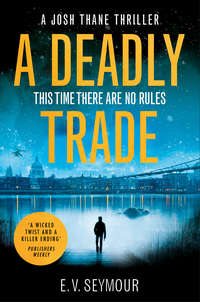
Kitabı oku: «A Deadly Trade: A gripping espionage thriller»
A Deadly Trade
E. V. SEYMOUR

A division of HarperCollinsPublishers
www.harpercollins.co.uk
Copyright

Killer Reads
An imprint of HarperCollinsPublishers
1 London Bridge Street
London SE1 9GF
www.harpercollins.co.uk
First published in Great Britain by Cutting Edge Press 2013
This ebook edition published by HarperCollinsPublishers 2017
Copyright © Eve Seymour 2017
Cover design © HarperCollinsPublishers 2017
Cover images © Shutterstock.com
Eve Seymour asserts the moral right to be identified as the author of this work.
A catalogue record for this book is available from the British Library
This novel is entirely a work of fiction.
The names, characters and incidents portrayed in it are the work of the author’s imagination. Any resemblance to actual persons, living or dead, events or localities is entirely coincidental.
All rights reserved under International
and Pan-American Copyright Conventions.
By payment of the required fees, you have been granted
the non-exclusive, non-transferable right to access
and read the text of this e-book on screen.
No part of this text may be reproduced, transmitted,
downloaded, decompiled, reverse engineered, or
stored in or introduced into any information storage and
retrieval system, in any form or by any means,
whether electronic or mechanical, now known or
hereinafter invented, without the express
written permission of HarperCollins ebooks.
ISBN: 9780008271527
Ebook Edition © November 2017
Version 2017-09-21
Table of Contents
Cover
Title Page
Copyright
Chapter One
Chapter Two
Chapter Three
Chapter Four
Chapter Five
Chapter Six
Chapter Seven
Chapter Eight
Chapter Nine
Chapter Ten
Chapter Eleven
Chapter Twelve
Chapter Thirteen
Chapter Fourteen
Chapter Fifteen
Chapter Sixteen
Chapter Seventeen
Chapter Eighteen
Chapter Nineteen
Chapter Twenty
Chapter Twenty-One
Chapter Twenty-Two
Chapter Twenty-Three
Chapter Twenty-Four
Chapter Twenty-Five
Chapter Twenty-Six
Chapter Twenty-Seven
Chapter Twenty-Eight
Chapter Twenty-Nine
Chapter Thirty
Chapter Thirty-One
Chapter Thirty-Two
Chapter Thirty-Three
Chapter Thirty-Four
Chapter Thirty-Five
Chapter Thirty-Six
Keep Reading …
About the Author
Also by E. V. Seymour
About the Publisher
CHAPTER ONE
Female blowflies can scent the moment of death. I don’t understand how this works. But like the blowfly, I had a premonition that the woman I’d come to kill was already dead. I sensed it from the moment I slipped into the darkened room.
Yet I couldn’t be certain.
Senses alive, I crossed the floor without sound. Silence is important in this wicked game. And preparation. I’d memorised the precise location of the wardrobe and dressing table and the rocking chair that crouched in the corner. I’d charted the distance from the doorway to the bed: four point eight seven metres. A man my height and build with a smooth gait and a size eight shoe should cover it in less than six seconds. Basic law of motion. I had no fear of interruption. On entry I’d double-locked the front door.
The room was November cold. I could smell booze, brandy at a guess, the fainter scent of expensive perfume almost entirely smothered. When watching her I’d noticed the target appreciated expensive clothes, good quality shoes. She was particularly fond of a charcoal-coloured leather jacket. Personally I never wear leather for a job. It makes too much noise. I’m a clean, crisply ironed open neck dress-shirt with jeans and loafers kind of guy. When flush I buy my suits from Cad and the Dandy, Canary Wharf.
She lay on her back, one limp arm hanging down. Light from a fading four o’clock moon illuminated her face, neck and the fleshy slope of her shoulders. I leaned over – my eyes are pretty quick at adjusting to night vision – and stretched out a hand towards her, the same hand that would have smothered and suffocated and extinguished life. The cool skin felt inert against the latex of the surgical glove. No breath. No movement. No pulse.
Did I feel cheated? No. Was I angry? No way. I was confused and bunched up with alarm. I had been sent to kill her. Chances were so had someone else. And maybe they’d come for the same reason. Not easily fazed, something coiled slowly in the pit of my stomach.
I crouched down beside her. In death she neither looked serene nor at peace. Her mouth was ajar as if she were mid-snore. Marionette lines ran from each corner to her chin like two deep incisions. The blonde hair splayed across the pillow, dark at the roots, indicated a woman who once cared about her appearance but had lost interest. To establish the rigidity of her flesh, I touched her mouth and jaw. There was some stiffness but not much. There were no visible signs of violence that I could see. No vomit or bruises. No broken nails. No lacerations. I suppressed an involuntary shudder, an earlier memory threatening to erupt. This was now, I reminded myself, not then, not with the blood on the wall and…
Part of me wondered if by strange coincidence she’d died from natural causes. Unusual, not impossible, but as a general rule people in middle age don’t succumb with the same unexpected haste as those in the first flush of fickle youth. There was, of course, another possibility.
I took out a pocket torch, slid open the drawer of the bedside table and found a pack of Temazepam. Commonly used to treat those with a history of severe depression, the pills are seldom prescribed for insomnia although many insomniacs take them. Habit-forming and potentially dangerous when mixed in large enough quantities with alcohol and other medications they can kill you. Had she taken her own life? I checked out the blister pack and saw that only three were missing. Not suicide then.
A glance at my watch told me that ninety-five seconds had passed, eighty-five to go. Ideally, I like to be in and out within three minutes.
Moving noiselessly across the floor, I glided out onto the thickly carpeted landing and headed for the study. Ranks of laptops and a high-security computer, massive and squat, glowered accusingly as I sped past. The intelligence stated that the safe, concealed by a rug, was set into the floor at the back of the room. As I approached the combination numbers clattered through my brain like windows in a fruit machine. It would take twenty seconds to open, leaving a little over a minute to steal the portable hard drive and escape. With fingers pumping like a honky-tonk pianist, the door opened and I reached in and connected with empty space. I peered inside, shone the torch around.
Nothing.
Then it hit me; this was no ordinary killing. Anyone can commit murder, but to fake death, to make it look like natural causes, requires skill and subtlety. Whoever had carried it out was a professional assassin, a class act, someone like me.
Footsteps.
Retreating into the shadows behind the now open door, I slowed my breathing, listened hard. This was not part of the plan. But the plan was already fucked. Anything could happen. In readiness I took out the length of cord carried in my jacket pocket for emergencies.
Then I heard the sound of singing, low and haunting, like a chant.
It was so unexpected, so out of key with the situation, my mouth dried as though I’d swallowed coffee grinds. Stranger still, the quiet desperation of the lyrics coupled with the singsong melody awoke sleeping and painful memories of my mother. At that moment it felt as if her ghost were right beside me. But this was not my mother’s voice, not even a woman’s.
The singing stopped. So did the footsteps. I held my breath. I could almost hear the brain of the person less than a metre away making the calculations: door open, rug askew, safe open, trouble.
The light went on. On reflex, my hands flew up, each end of the cord coiled around fists prepared to viper-strike. Raw adrenalin spurted through my veins as the figure shambled into the room. It gave me a couple of seconds to observe the back of my quarry: male, around five nine, a couple of inches shorter than me, wearing a denim jacket, skinny jeans hanging low and exposing the top of the boxers beneath, trainers. I lunged. He turned. Christ.
Pale blue eyes stared out of a long-jawed and heavy-lidded face that had only recently made the transition to manhood. His hair was a mess of bleached blonde over brown. In that split-second I recognised that he was his mother’s son.
He gaped, managed to eject one word. ‘What?’
Instinct told me to kill him. No pointing fingers. No witness. No loose ends. I took a single, silent step forward.
His eyes were wide now, pained, the knuckles on his clenched hands white and shiny. He was probably working out that his mother was either dead or in mortal danger. Suddenly all the dusty years between the boy I was and the man I am now faded away. It was as if the lad had grabbed hold of my sleeve and, against my will, yanked me back to a darker and unholy time. Memories of old grief, misery, rage and helplessness, the seeds for transforming me from an ordinary teenager into a professional killer, swamped me.
‘Who sent you?’ He hissed.
I blinked, confused, the question odd in the context.
‘Are you going to kill me?’ Sweat beaded his top lip. His wild eyes flicked from me to the open door and back again.
My answer should have been yes.
CHAPTER TWO
I fled. Feet punching the stairs, the floor felt on fire, the air around me sucked dry of oxygen. I exited out of the back door the same way that I’d broken in, and tore alongside the fence at the rear, scaling a wall, landing on the other side, feet square. Not too many people about at that time of the morning. Even if there were I’m not sure I’d have paid them attention. The boy had knocked me way off course.
I was more than baffled by my own incompetence. How could I have missed something so fundamental? I did not make mistakes. I was unaccustomed to failure. I did the homework. As the Americans say, I did the math. Except, on this damn job, I hadn’t. Too little time and paid too much money. Greed had made me lazy.
Chill air brought me briefly back to my senses. I needed to get off the streets. I needed cash. Any attempt to access one of my numerous accounts too risky because it would tie me to a location.
I considered my options, which right that moment seemed limited. Truth was, I’d never found myself in this situation before.
It was still dark. Somewhere a dog howled. Shoulders back, I pushed my hands deep into my pockets, affecting a confident stride. No more than five minutes to the underground station, it would allow the wildness to pass and give me time to think. Inexorably, my thoughts returned to the dead woman.
The target, Dr Mary Wilding, a scientist based at Imperial College, London, had crossed up a crime lord. Not so bizarre as it sounds. Fake pharmaceuticals are hot big business, product piracy a prospering market. Without scientists there would be no drugs trade. Rumour had it that Wilding had been paid an exceptional amount of loot and reneged on a deal. My employer clearly wanted what he’d paid for. As for the hard drive, I had no idea what was on it. Not my business. But it was my business to know that Wilding had a son who lived in the house with her. I’d truly screwed up on that score and, if word got out, not only would I be finished, I’d be a dead man. The realisation that I’d committed professional suicide punched me hard in the gut. Whatever could be said about my existence, it beat to its own sick and twisted rhythm. I was used to living out of a suitcase, on the run, stakes high, as if each day were my last. What I’d do if I didn’t do this I had no idea.
What now?
I strode into the underground at Ealing Broadway. It was two minutes past five in the morning. Conscious of close circuit television cameras, I pulled down my cap to conceal my face, and calmed myself that for CCTV to be effective the cameras need to be positioned at the right angle, most CCTV is recorded over every four days so there is a one in four chance the film will be wiped before it is taken out and studied and, even if an image is captured, it still needs to be identified. A lot of film is grainy, of poor quality and indecipherable. Staring at reels of film hour upon hour will send even the most conscientious viewer into snooze-time. I wasn’t really consoled. I’m usually the hunter not the hunted.
Boarding a district line train, I hunkered down in the compartment and glanced around me. My only companions at that hour were solitary, desolate figures wrapped up against the cold and dark, heads down, the kind of people who were scraping by and clinging on by their fingernails, who bust their balls for nothing and knew it was all for nothing.
Like a disorientated homing pigeon, I stumbled out after a couple of stops. Under normal circumstances I’d be covering my tracks and making the all-important call to Wes. I did neither. The boy had seen to that. That I’d let him live when I could so easily have killed him meant that I was unmasked, no longer invisible, that I could no longer hide, not even from myself. From now on it would be like walking down the street stark bollock-naked.
Keen to go to ground, I turned a corner, my eye automatically clocking a café and dossers’ establishment, all white and red plastic furnishings. A wall of heat engulfed me as if I’d walked into a bank in Saudi with the air-conditioning bust. Rammed with men who’d slept rough the night before, their clothes stained, gnarled hands clutching mugs of tea, grease and sweat hung tenaciously in the air. Among the vagabond throng a number of unfortunate Eastern Europeans with beaten expressions. I didn’t exactly fit in, but it was the best place to go to avoid the attention I had no wish to attract.
I ordered tea, builder’s brew, the type you can stand a spade in. When I spoke my voice, so rarely used, felt strangely detached from the rest of me. Low in pitch and without obvious accent, it certainly contained no trace of my middle-class Gloucestershire roots.
‘You, alright, mate?’
I turned towards the man serving, the one who asked the question. He had a fleshy face ripe with folds and creases. All I wanted was a mug of tea. I did not welcome chat. I did not want be his mate. I nodded slowly once. His tongue flicked out, touched the side of his mouth, nervous. As he poured the beverage from an urn the size of a household boiler, I glanced at my reflection in the mirrored glass behind the counter expecting a drastic change in my appearance, some giveaway expression in the eyes betraying the disarray in my head, but I looked the same: cropped dark hair, blue eyes, wide nose that had once been broken in a game of rugby and reset, high Slavic cheekbones care of some genetic kink down my father’s line.
Counting out the exact change, I paid and took the mug to a corner table with a good visual on the door. Wes would be wondering why I hadn’t called. That got me thinking. Wes had insisted that Wilding was unmarried and childless. Had Wes been aware of this crucial piece of information but for darker reasons withheld it from me? Did he presume that any inconveniences would be ruthlessly taken care of? Knowing Wes, he would describe it as ‘collateral damage.’ This did not alter the simple fact that he had a fucking duty to tell me.
Uninvited, my thoughts cascaded, washing me up next to the wretched boy. No doubt about it, he’d supply a description to the police and thereby identify me. My face grew cold at the thought of a squad of armed coppers lifting me off the street, if I were lucky marching me to a station and Wilding’s son picking me out from a line-up. By sparing his life, I’d left myself wide open. I ought to go back, finish what I’d started, except…
Wired, I gulped the tea, scalding the roof of my mouth. By now the lad would have discovered his mother’s body. The thought genuinely appalled me, which came as a surprise. Not because Wilding was female – women can be twice as cruel and vicious and calculating as men – but because I wasn’t accustomed to this level of introspection concerning the relatives of the targets I’d removed. It was as if some unseen force had taken me over and brainwashed my mind. Truth is, over the years, I’d ripped men from life. Some had been rogues and murderers, some cruel and psychopathic. Some were good men who turned into bad men. Mostly motivated by greed and pride, always vanity, many strayed too far on the wrong side of the tracks and paid the ultimate price. Dr Mary Wilding was one of them. But the boy…
He was like a fly buzzing around my head. I couldn’t help but picture his anguish and pain and his devastation at losing his mother. No doubt about it, his life would be changed forever. If he became vengeful one day he’d come after me.
The door swung open and closed. My eyes flicked to the woman who’d entered. Middle-aged, stout, tired around the eyes, something in her manner reminded me of the woman I was sent to kill. Had I not skimped on the job, I’d be able to run through the strap lines of Mary Wilding’s life in my head: what she spent her money on, her medical and family history, her career path, her…
The mobile phone I used for the job vibrated. I snatched at it. It was Wes. Coldly furious, I pictured the pretty-boy American with his dark hair, and soft brown down-turned eyes inferring sensitivity that he didn’t possess but rendered women helpless. Part of me was looking forward to breaking the news that I’d aborted the job. It would be Wes’s stupid fault for screwing with me. The other part was not so keen.
‘You didn’t call,’ he said.
I said nothing.
‘What the fuck is going on?’
Good question. I didn’t answer. You learn more from staying quiet and letting others do the talking. Frankly, I was too livid to speak.
‘You all right?’ he began, clearly mystified.
No, I was not all right. ‘There’s been a problem.’
‘What sort of problem?’
‘She was already dead.’
‘Shit, you sure?’ I pulled a face at Wes’s loss of volume control. ‘What about the merchandise?’ he ranted.
Wes had an annoying tendency to imitate lines from the latest action adventure film or crime show. This was not an episode of The Wire. ‘The safe was empty.’
‘Fucking holy hell.’
I dislike excitable reactions, but often they lead to the kind of loose mouth talk that yields vital information. I wasn’t to be disappointed.
He lowered his voice in a way that I imagined he might if he were phoning Dial-A-Wank. ‘What about the boy?’
I felt a pulse in my jaw tick, Wes’s lapse in intelligence unforgivable. ‘What boy?’
‘The fucking son, you moron.’
I let the insult pass. I’d been called worse. I kept my voice low and controlled to conceal my rage. ‘You never mentioned a son,’ I growled. ‘The deal was for one target only. If there had been two the price would have been considerably more. Your lack of attention to detail could have compromised me. It could cost me my life.’ I didn’t admit that I, too, had screwed up, that I’d made monumental mistakes.
Faced with the irrefutable logic of my argument, he backed off. I also think he was afraid of me, which was good. ‘Look, I knew about the kid, right?’
‘You fucking lied to me.’
‘I’m sorry, man, but I was ordered not to tell you,’ he whined.
‘Who by?’
‘The guy who’s paying.’
What sort of half-brained lunatic was this man? I said something to that effect.
‘I know,’ Wes said, trying to appease me. ‘So there was no boy?’ he pressed.
One good lie deserves another. ‘No.’
‘Holy Christ, that’s going to be a problem’. Yours, not mine, I thought. ‘The boy is a loose end. He has to be removed.’
This was the equivalent of pouring a can of petrol over my very personal fire. ‘Fuck you. I’m out.’
Wes let rip with what could be best described as a full-on curse. I maintained a contrived and dignified silence so that he could calm down, which he did. ‘Can’t, man. You have no idea who you’re dealing with.’
‘Who am I dealing with exactly?’
‘One nasty son-of-a-bitch.’
My laugh was cold. They were all nasty sons-of-bitches. Came with the territory.
‘And there’s the small matter of the merchandise,’ Wes said.
‘Which is missing,’ I reminded him.
‘Says who?’
I neither cared for the tone nor the inference. ‘Says I. Don’t get smart, Wes. I can track you down any time I like.’ And kill you, I inferred. Wes got the drift.
‘Hey, I’m not taking a pop at you, I’m only saying how the employer is gonna see it, bud. He’s one suspicious dude.’
Most of them were paranoid fuckers. ‘So who do you think beat me to it, apart from me, that is?’ I added acerbically.
‘Search me. You really sure it’s missing?’ The whine had returned.
‘Certain,’ I said, clipped.
Wes let out a big sigh. ‘You gotta find it.’
I swelled with anger. ‘I’m not a private detective.’
‘Yeah, I know, but please, you’ve gotta help me out here. I…’
‘What was on the hard drive?’ I now realised that the hard drive was more than straight business. The hard drive held the key.
‘I don’t know.’
Wes was the kind of guy who says no and does yes and vice-versa. I didn’t believe him. ‘If you want me to find it I need to know.’ I had no intention of doing Wes or anyone else a favour. I was done with them. I was only concerned with me.
Silence descended like a safety curtain at a theatre. I imagined Wes feverishly trying to worm his way out of the mess he was in. Finally, he spoke.
‘Data.’
‘What kind of data?’
‘Chemical, drugs, just stuff,’ he said unconvincingly, ‘Look, I’ll see what I can do, talk to the employer, or something. So you’re in?’
‘It will cost. Stay tuned.’ And I hung up.
First rule of the game: don’t botch the job. Second rule: don’t get caught. I’d broken the first and had no intention of breaking the second, but for what I hoped would be the only time in my life I was going to break the third. Insane, maybe, but I had no choice.
Finishing my tea, I stepped outside. Sun trickled through the cloud. My breath made smoke-rings in the cold morning air. Nice day for a walk. Me, I had other ideas: I was going back.
CHAPTER THREE
Less than four hours after I’d fled, I was holed up on the upper storey of a small boutique hotel, and on the opposite side of the road with a clear view of Dr Wilding’s home, a modest but attractive 1930’s red brick semi-detached property with a casement window in the front and triple-glazed French windows at the rear. Cutting corners on the job did not mean I’d failed to carry out basic groundwork. Days before, I’d already ascertained that her next-door neighbours were away on holiday and the attached property the subject of a repossession order, the occupants long gone following the collapse of their electrical business.
I’d expected the area to be cordoned off. I’d anticipated rafts of police officers. The view before me was a picture of the mundane, ordinary and commonplace. It spooked me.
As I saw it there were a couple of explanations for the lack of activity. Perhaps the killer had returned, or maybe Wes and his employer had interpreted my response as too negative, swung into action and appointed another assassin to finish off the boy. Doubtful, I thought. Too knee-jerk, too dangerous. Involving more people than you need always fraught with risk. And pointless – the boy’s death would not reveal the whereabouts of the hard drive. The gnawing desire to know what was on it made my skin itch, and it occurred to me then that Wilding’s murderer had come within a split-second of crossing my path, an awesome thought. If we’d both showed up for the same job at the same time we’d probably have ended up killing each other.
So who was he and who had employed him? If I could trace the guy I’d find his employer and then I could get my hands on the information. Best man to approach for that type of low-down would be Billy Franke. I let out a liquid breath. Easy to say, less easy to do: asking questions would draw attention to my failure, and Billy, one my main employers, didn’t like mistakes. I was still chewing this over when almost twenty minutes later the cops arrived. To tell the truth, I was almost relieved.
There were two police patrol units, an unmarked Mondeo with four plain-clothes guys inside, and a police Range Rover. I watched as the occupants piled out and into the house. Within ten minutes or so, a plod appeared doing what plods do: spooling crime scene tape around the front of the building. My stomach clenched. How many bodies?
I leant back then straight back up as a black Land Rover with tinted windows hove into view. It prowled down the street, paused outside the crime scene area for enough time to be significant, and drove on. The number plate bore the prefix 248D, assigned to all Russian diplomatic vehicles. While I swallowed this indigestible piece of information, another less assuming Toyota Land Cruiser with two men inside pulled up on double yellow lines and parked twenty-five metres from the property. Both occupants watched silently, unashamedly, as though they did this every day of the week, as if they operated by a different set of laws to the ordinary citizen. Next, racing down the road, a navy-blue Lexus, one male driver, and one female passenger. I could almost smell the rubber from the tyres as the vehicle cut and swerved into a tight space and parked between two patrol cars. The driver shot out a split-second before the woman. He glanced up the road, jerking his head in the direction of the stationary Land Cruiser.
‘What the hell is Mossad doing here?’ he said to her.
‘Doing what they do best: watching.’
At this, I froze. I have no particularly fluency in languages bar the bare rub-along stuff that buys me a beer and gets me out of tricky situations, but I can lip-read. I’ve no idea how I do this. Put it down to a predominantly solitary and lonely childhood. Lip-reading aside, I guessed that the woman and her sidekick were British Intelligence. To see so many security services congregated in one place made me more than uneasy. I felt as if I had chipped ice in my blood. Had Wilding been involved in some kind of industrial espionage? Selling trade secrets, maybe? Didn’t really compute with what I’d been led to believe.
But then what I’d been told was a pack of lies.
Painfully I tried to force connections, but my mind was swamped with the boy, the dead woman, the damned Israelis whose attendance closely reminded me of someone who taught me everything I knew. Cold sweat nestled in the small of my back. Feelings, alien emotions, played no part in my life. They were a luxury I could not afford.
Think, for Chrissakes. Think clearly.
I’d learnt a long time ago that Mossad had a habit of showing up either at or in the aftermath of all major events. Most recently and to name a few: the death of Princess Diana, the murder of Robert Maxwell, the suicide or murder, depending on your point of view, of Dr David Kelly. Their presence here confirmed that there was more to Wilding than I’d taken the time and trouble to find out. Now I saw why the hit on the scientist had been a rush job: Wilding was a big fish.
I turned my attention back to the woman. Tall, around five eight, full-figured without being overweight, probably a dress size twelve. She had a pale complexion, with a shock of short copper-coloured hair, side parting so that a lock fell over the right side of her face, which was a perfect oval. The lips matched the full figure, voluptuous with a nipped in waist, and she had a neat nose, neat everything. I couldn’t yet tell the colour of her eyes but I guessed they were green. She moved with feline stealth, fluid, impressive for a woman of her build and stature. From the way she threw her head back at the Israelis and blew them a kiss, the way she strode ahead of her male colleague, the way he deferred, this was her gig.
I followed her path to the door, half-mesmerised, then she took me by surprise. She turned, looked up, eyes scanning. I chilled. It was as if she were looking not straight at me but into me. I stared back, aroused. Then she turned and was gone.
An hour and a half passed. Forensics came. A white van appeared. Two men got out and disappeared inside, re-emerging twenty minutes later with computer boxes. Two trips later they were packed and gone. The patrol cars left. An ambulance showed. The Israelis stayed, mute, unyielding. The driver smoked incessantly. I never saw the Russians again. Then my mobile vibrated for a second time in as many hours.
‘Yes, Wes.’
‘Where are you?’
‘Out and about.’
‘Is that smart?’
I didn’t respond.
‘You still there?’ Wes’s voice, low and tense, scraped down the line.
‘Uh-huh.’ My deliberately Neanderthal response suggested that he’d overplayed his card and he knew it.
‘That’s great,’ he said, effusive now. ‘Can you meet? Charing Cross Hotel.’
‘When?’
‘Noon.’
‘Make it one. I’m taking an early lunch.’ I cut the call and switched off the phone. I don’t eat lunch. It makes me sleepy.
At half past ten the house opposite erupted into activity. Two men in plain-clothes came out first, closely followed by the woman’s sidekick. Next, the redhead, with the boy bunched up next to her. I let out a breath. He was alive. From this height and distance, armed with a Heckler and Koch military sniping rifle, I could ‘remove’ the problem at the click of a trigger. Not subtle, but effective. It gave me pause for thought. Would it even do the lad a favour? After the sudden death of his mother what would become his story later on? Would he turn to booze or drugs or sex to relieve his pain? Would he seek meaning in violence, as I had done? I wondered how he’d negotiate a path through a lifetime’s maze of hidden obstacles and mantraps and people out to get you. This was not my problem, I reminded myself. What did I care? Except now I realised that I cared more than was good for me, that even if I’d had the necessary kit I lacked the necessary ruthlessness.
Worrying.
A snarling phalanx of hangers-on, grim-faced, came out of the building last. Clear and easy in her movements, the woman directed the boy into the rear of the Lexus, climbed in next to him, but not before turning her back and issuing orders to the others who received their instructions as though ordered to eat dirt. I smiled in spite of everything. The woman running the show came across as direct, in cold control, authoritative and, yes, sexy. If anyone were going to hunt me down it would be her.
The main cavalcade drove away. The boy was out of immediate danger, whisked off by his minders no doubt to a safe house on some godforsaken housing estate where nobody asked questions. I almost envied him.
As for me, there was only one place to go, one man to see, the last person alive familiar with my real name and who could help me. I briefly wondered whether he’d think the time he’d devoted to my education in the Dark Arts wasted.
CHAPTER FOUR
Even in winter and under a sullen sky, Chiswick, moneyed and classy, oozed vibrancy and colour, aspiration and style. Treading an unfamiliar path through a crush of dead leaves, my senses alert to every police siren, every copper on the street, I turned right and left until finally I found myself in a maze of streets and homes that in summer would be hidden from view. It was as quiet as a desert night. Row upon row of classy red brick houses with white railings and balconies lined the wide tree-lined avenue. Suburbia at its finest.
It didn’t take long to locate the house right at the end. Screened from the street by a hedge, detached, it was a building of entrances and exits, a metaphor for life and death. It never occurred to me that Reuben might have moved or even died. Reuben, somehow, seemed indestructible.
Murmuring good morning to a young pretty mother pushing a baby-buggy, I followed the line of the wall to the rear of the building. A heavy wrought iron gate divided the boundary between the property and the pavement. As I walked back round to the front, the teal-coloured front door with the lion’s head brass knocker swung open and a woman stepped out.
In her mid to late thirties, her dark blue coat buttoned up, only the perilously high heels and pointed toes gave the game away. Actually, I lie. She had a satiated, just-fucked expression on her face. And I knew why. Even in middle age, Reuben had projected a strong sense of his own sexuality. A man’s man, Reuben adored women. Seemed like this peculiarity of his personality remained unchanged, his enthusiasm undimmed. Before she closed the door I bowled up to her and turned on my most winning smile.
‘Private parcel delivery for Mr Greene.’ I took out the dummy set of keys I carry with me, rattled them and pointed as if my van was parked around the corner.
She started, a flush of colour spreading across her cheeks. ‘Oh right,’ she said. ‘You want me to take it? Only I’m in a bit of a hurry.’ She shifted her weight from one foot to the other.
‘It’s heavy,’ I said. ‘No worries, I’ll pop inside and get Mr Greene to sign for it first.’
She smiled, grateful. ‘Thanks.’
‘You’re welcome. Sorry to have held you up,’ I called after her, closing the door silently behind me.
I stood in the inner porch. I don’t know why but I felt as if my lungs were being crushed from the inside. I could hardly draw breath. I hadn’t seen the man in more than fifteen years and just because he’d worked for Mossad a long time ago did not mean that he could throw light on current events. Would my unexpected appearance trigger a negative reaction? Would he welcome a voyage into the past? I guessed there was only one way to find out.
The house was long and narrow with pale laminate flooring. Stairs to the right, two doors to the left, ahead a light and airy kitchen with a glass roof and two steps down into a dining area with a view of a pretty walled garden.
I could hear water running. The sound came from upstairs. I crossed to the kitchen, helped myself to a mug of coffee from a pot, still hot, and pulled up a chair near the window. After spending so much time out in the cold Reuben’s home felt unnaturally warm.
I saw Reuben before he saw me. The skin under his dark, intelligent eyes was more pouched than before, and his hair, now uniformly grey, thinner on top, yet he was still recognisable. An imposing figure, with a body built to last in spite of being a couple of stone heavier, he wore a dark shirt of needle-cord buttoned to his throat. The sleeves turned back exposed formidable forearms. I’d always believed that he could strangle a man with his bare hands.
I stayed absolutely still and watched as he suddenly registered that I was there. He had total mastery of his physical responses. Only someone who knew him well would be able to divine the thoughts and emotions running through his mind. I read shock in his eyes as if he believed that the day of reckoning had finally arrived and he was to be eliminated by one of his many enemies. Next, recognition, puzzlement, suspicion, and finally pleasure. His full lips drew back into a smile as he crossed the floor and down the steps, arms outstretched. I stood up, opened my arms wide, showing in that one small gesture that I had come in peace. He held me tight, clapping me on the back like a long lost son. His embrace aroused a brief, fleeting need in me to belong. As inconceivable as it was, an infinitesimal part of me flirted with the idea of rejoining the human race even though I knew deep in my heart it was impossible. Reuben was the only person in the world who knew me before and after. He was aware of what I’d become and what I was. He would not judge me. He would not ask awkward questions. He would not ask me to explain. We were never going to have one of those mundane conversations about what I’d done the previous day, week or year. We would not waste time discussing my choice of holiday destination. Relationships were off limits because I had none.
‘Joshua Thane, the young man I once described as shimmering with menace,’ he let out a loud laugh. ‘My God, I thought you were dead. What brings you here? We must eat. We must celebrate. You are hungry, yes? I have pastries and eggs. What would you like? Name it and you shall have it.’
If anyone could give me what I wanted Reuben could, but first he needed to be finessed. As far as brunch was concerned, I settled for eggs, poached, and more coffee. While he hustled around the kitchen he rattled on about the old days. He made no mention of my unorthodox entry. Reuben only ever voiced criticism.
‘Remember you asking what it felt like to kill someone?’ he said at last with a chuckle. ‘I told you that it doesn’t feel like anything. It’s…’
‘Business not personal,’ I chipped in.
Reuben cast me a slow sideways look. He knew where I was going with this. My first kill broke the cardinal rule. It was personal and it was supposed to be my last. The fact that I was here sitting in his kitchen meant events had come full circle. I don’t believe in karma. If I did I’d be dead a thousand times over, but I definitely felt the pull of something outside my very ordinary human powers. Disturbing.
‘Eat,’ Reuben said, putting a plate down in front of me. ‘Then we will talk.’
We ate in silence. In spite of the unusual and tricky circumstances in which I found myself, I was calm. I trusted nobody, but I trusted Reuben. If I pitched it right, Reuben with his extensive contacts would provide me with the answers I so urgently needed.
At last, when the plates were cleared, I told Reuben what had taken place that morning. I delivered the account without emotion, as he had taught me. I kept my pitch neutral, the information factual, giving as clear a description of events as possible. At this stage, I didn’t identify the target. He listened with the acuity I expected from him. He did not express surprise or comment upon my low diversification into theft. He frowned only once, but when I mentioned the surviving witness, he grew angry.
‘You did not know about the boy?’ Condemnatory, Reuben’s dark eyes turned as black as the sharps and flats on a keyboard.
My jaw ground but I said nothing. I’d broken a fundamental rule. ‘I…’
‘Didn’t do your homework,’ he barked. ‘What have I always taught you: surveillance, knowledge, survival. You check the intelligence then you check it again.’
He was right, of course. It was not Wes’s fault. The blame lay with me.
‘Have you forgotten the art?’ Reuben snarled.
What could I say? Even if I’d elicited screeds of personal details, something told me that I would have missed the one that counted. ‘It was a one-off, an unusual job.’ More unusual than I could ever imagine, and one I never wished to repeat. Ever.
‘How could you be so remiss?’ he growled. ‘What was it, greed?’
I met his eye. He had a point but I’m not sure it fully explained my incompetence. I’ve heard it said that there is a particular time in a serial killer’s life when he wants to be found and stopped. To facilitate his discovery, he makes a mistake. I was not a serial killer in the sense that the term was generally applied so I didn’t believe I fell into this category.
‘I slipped up, took my eye off the ball,’ I said lamely.
‘You got complacent,’ Reuben said, contempt in his eyes. After all I’ve taught you, his expression implied.
‘I admit I was reckless,’ I said, stubbornly defending my reputation.
‘And you let the boy go?’ Reuben saw me for the fool I was. This rattled me.
‘I did.’
‘Why?’ In Reuben’s book, you took no prisoners.
Stumped for an answer, I said. ‘If ordered to kill him I would have done. Nobody gave the order.’
‘Then you have taken an unacceptable risk.’
‘Yes.’ No point in denial.
‘The police will be all over it and now they will have a description of you.’
‘A description but not an identity.’ They couldn’t exactly issue a warrant for the arrest of a man without a name. Even so, the boy had dragged me kicking and screaming out of the shadows. Did Reuben of all people recognise this? If so, he didn’t enlighten me.
Reuben took out cigarettes and a lighter. I sensed he was playing for time. He offered me the pack. I rarely smoked but this seemed like the right occasion. I took one, lit it. Reuben did the same.
‘You need money?’
‘Yes.’
‘I will see to it.
‘Somewhere to hide?’
I hesitated. It would be the smart move yet I could see now that it would be too easy for Reuben to slip back into his old role as mentor and me as pupil. I no longer responded well to criticism. ‘No, just give me the cash, I’ll be fine.’
‘As you please.’ Dark-eyed, he took a drag of his cigarette, drawing the tobacco deep into his lungs.
‘The reason I’m here,’ I confessed, ‘is that I went back.’
‘Back?’ he spat, ‘Are you out of your mind?’
‘To finish the job,’ I lied.
Reuben met my gaze with watchful eyes. He nodded briefly.
‘After I arrived,’ I continued, ‘the place teemed with British, Russian and Israeli security services.’
Most people would have reacted. Reuben was not most people. He barely flinched. ‘The woman,’ he began. ‘You said she worked at Imperial College.’
‘That’s right.’ I inhaled deeply. ‘Dr Mary Wilding.’ I floated her name as if it were a smoke ring. A pulse fluttered in Reuben’s thick neck. I checked any natural response of my own.
‘The microbiologist,’ he said slowly, as though his brain had suddenly filled with sludge.
I blinked. ‘She was a research scientist.’
His eyes narrowed. ‘You didn’t bother to look into this aspect of her background?’
Unforgivably, I had not. I glared at him. He said nothing, his expression one of sheer disbelief. He took another drag of his cigarette, flicked a flake of tobacco from his tongue. ‘So who did she upset? What was her crime exactly?’ A shrewd glint entered his eyes.
I told him what I’d been told, then I said, ‘As the security services are all over it, I assume she committed industrial espionage.’
‘Assume?’ Reuben’s damning expression ripped right through me.
‘It’s a fair…’
‘Clearly you were not familiar with her sphere of work.’
I said nothing. My brain was in overdrive, misfiring and failing to make connections.
‘She worked at the Department of Virology at Imperial College,’ Reuben said.
‘Virology,’ I repeated, sounding leaden.
‘The department she allegedly worked in was a front,’ he added, darkness in his tone.
‘For what?’
Reuben did not answer my question directly. ‘The college has many departments,’ he continued, cool-eyed. ‘Some more secret than you can ever imagine.’ His voice assumed a forbidding note. It felt as if a chill easterly wind gusted across the room. I felt faintly nauseous and it was unconnected with brunch.
‘Meaning?’ I said.
‘Bio-weapons,’ he snapped. ‘Chemicals that kill,’ he added as though I didn’t get it the first time. ‘As deadly as nuclear but more vile in its application.’
‘And illegal,’ I flung back at him. This was Britain, for God’s sake, not some far flung Russian outpost.
Reuben threw me a contemptuous look. ‘Yes, which is precisely why any sane government ensures that it has counter-measures in the event of a biological attack. Wilding was working in strategic defence.’
I contained a groan. This had catastrophe written all over it. No wonder the security services were all over it like typhoid in an Indian slum. Christ Almighty, what was on the hard drive? Reuben read my expression and asked the same question. I shook my head.
‘Why don’t you know, and when the hell did you become a common thief?’
I opened my mouth to protest. Reuben waved away any attempt at excuses with a flick of his wrist. ‘And your American friend, how does he fit?’
I gave no names. I explained that Wes was the fixer, the guy who acted as a middleman. ‘Crime lords have their own contract killers on the payroll, but sometimes they need a specialist job that puts enough distance between them and the intended victim.’ Safe to say, I usually got involved in the dirtier end of the business although I drew a line at abduction and torture.
Reuben stared at me with distaste. ‘And this character, you have operated with him before? He is reliable?’
‘As much as anyone.’ Except, of course, he’d lied royally to me.
Reuben nodded slowly. I realised he was trying to work out a way to save my reputation, my skin. Thank God for that.
‘You want out?’
I did my best to conceal my shock. How could I? Was it really possible for me to rub out the past, get a nine to five job, settle down and start over? Straight answer: no. My silence lurked like a restless ghost in the room.
Reuben gave voice to what I was thinking. ‘We all want out at some time in our lives but it isn’t always possible. Few have the necessary requirements for this type of activity,’ he added with false delicacy. ‘What I am trying to tell you, Joshua, is that you cannot change who you are. You can change your name, your address, your friends and you can run away from problems, but not from yourself.’
This I already knew. I didn’t want a lecture. ‘Then I’d appreciate your help. You could find out what the Israelis are after. It would give me a lead to find those responsible for the theft.’
‘And then what?”
Take them out. I shrugged, a go figure expression on my face.
He shook his head. ‘I no longer have those type of contacts. Your only option is to finish what you started.’
‘What the hell do you mean?’
Reuben hiked both shoulders, raised both hands, palms up in supplication. ‘It will be difficult but…’
‘I will not kill the boy.’ This took both of us by surprise. I cleared my throat, drew heavily on the cigarette. ‘It would be too tricky,’ I added. ‘He’s probably in a safe house.’ Seconds thudded past. Silence washed into the room like sea invading a stricken vessel.
At last, seemingly forgetting the boy, Reuben asked, ‘Who took out the contract?’
I shook my head. ‘His anonymity was part of the deal.’
‘You were paid well?’ Reuben’s voice thronged with cynicism.
‘Handsomely.’
He thought for a moment. Easy to guess what he was turning over in his mind: that no paymaster would rest easy with such a poor return on his investment. I was, in effect, a dead man walking.
‘What was on the hard drive, Reuben?’
He didn’t answer straight away. He seemed to be weighing something up in his mind. The stillness in the room was so tangible you could have heard a feather fall.
‘Have you heard of Project Coast?’ he said tentatively.
I shook my head, perplexed by the sudden change of subject. Once more he stared at me for a moment with what seemed genuine indecision, then when he finally spoke he had a certainty about him that I normally found reassuring. That morning I wasn’t reassured.
‘Project Coast was a programme that originated in South Africa. It involved the creation of an ethnic specific biological weapon. The weapon only attacked blacks.’
I wanted to interject, to lean forward. I didn’t flicker so much as an eyebrow. Reuben had taught me well.
‘The project was run by the Pretoria government. Deeply secret, it ran during the 1980’s. The then Defence Minister oversaw it. The work was still at the embryonic stage when the apartheid regime collapsed. Certain individuals assisted in the government’s twisted endeavours. One was an American, Dr Larry Ford, a gynaecologist who allegedly worked for the CIA, his role to create and develop biological weapons. Years later, he was found dead with a gunshot wound to his head. The official version was suicide, his involvement with the CIA, as one would expect, denied. When the police opened the refrigerator in his home they found enough toxins to poison the entire state of California.’
I wondered why Reuben was telling me this. His information seemed rehearsed and readily given, a little too pat. Irrationally, I had the sudden sick sensation of being played. Resisting the temptation to speak for a second time and with a deep, growing sense of unease, I nodded patiently for Reuben to continue.
‘You knew nothing of this?’ he said, a sharp edge to his voice.
I shrugged my ignorance. It was Reuben’s turn to go silent. I realised what he was driving at. ‘You think I had a hand in Ford’s murder?’ Suddenly I saw the connection to Wilding.
He did not answer straightaway. He studied my face with the same penetrating gaze as a man shining a spotlight into my eyes. I hoped that he was satisfied with what he saw. I am a gifted liar, but I wasn’t lying this time. ‘It was a particularly inept piece of work,’ he admitted. ‘I would have been disappointed in you.’
‘When was this, exactly?’
‘Spring 2000.’
My mind reeled back. I was twenty-four. Russia. My first gig for Mikhail Yakovlevich, a Russian thug. ‘Nowhere near. I can prove it.’
Reuben sipped his drink, nodded in agreement, accepting my explanation at face value. Glad we’d cleared it up, I was less happy that I’d fallen under suspicion. ‘You think there’s a pattern, someone bumping off scientists?’
‘Perhaps.’
Shit, and now the security services were on my tail. ‘You were saying,’ I said, trying to lose the thought and get him back on track.
‘Certain groups of people have individual genetic characteristics. As you probably know, there is an entire industry devoted to the creation of drugs to target specific genes responsible for certain genetic disorders.’
I nodded.
‘An entirely commendable endeavour, of course, it involves the precise sequencing of DNA. But there is a less benign application. By a rigorous process of selection, there are those who hope to develop pathogens to attack targeted individuals based on either their racial orientation or their sex.’
‘Hope? You mean it’s been developed?’ I said.
Reuben’s accompanying smile was claustrophobic. What was once a sick dream had assumed a reality of nightmarish proportions and, well out of my normal sphere of operation, I confess it shook me. ‘Think how such a thing could be turned into a military weapon,’ he continued, without missing a beat. ‘So obsessed with the threat of nuclear destruction, most politicians retain a blind spot for other more diabolical possibilities.’
I had no tremendous interest in politics, but I was certain this wasn’t true. Governments knew, all right. Only the general populace remained ignorant. And thank God for that. Reuben picked up on my dismay. With cool, he disregarded it.
‘Which is why there are secret departments to counter the possibility of such an odious attack.’
‘You think Wilding was involved in this type of research?’
Reuben shrugged his massive shoulders. ‘Never a good idea to jump to conclusions, but it is credible.’
I blinked and cursed my stupidity. Even for a man like me there’s a big moral distinction between slotting bad people one at a time and annihilating innocent individuals en masse. What if such a weapon fell into the hands of a rogue state or terrorists? Aside from what they could do with it, it would provide the perfect means for blackmail. Christ, you could hold entire countries to ransom with that kind of leverage.
‘You think this was why she had to die?’ Already I was thinking her death politically motivated and unconnected to organised crime. For sure, the security services would be after my hide.
Reuben did not answer, just looked. I scratched my ear. ‘The U.K. is a melting pot of races. Which target group are we talking about?’
‘That I can’t tell you.’
‘Can’t?’
‘Because I genuinely don’t know,’ he spread his hands.
‘But, surely, there are treaties and agreements…’
‘Which can be broken.’ He leant towards me once more. ‘Government exists to protect its people. One has to fight any threat, however vile, accordingly.’
Ücretsiz ön izlemeyi tamamladınız.