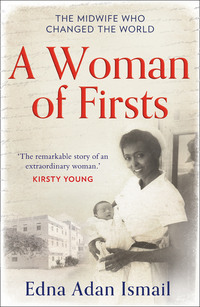
Kitabı oku: «A Woman of Firsts»
EDNA ADAN ISMAIL was Foreign Minister of Somaliland from 2003 to 2006, and had previously served as Somaliland’s Minister of Family Welfare and Social Development.
She is the director and founder of the Edna Adan Maternity Hospital in Hargeisa, which opened in 2002, and an activist and pioneer in the struggle for the abolition of female genital mutilation. She is also President of the Somaliland Association for Victims of Torture.
In 2010, she opened the Edna Adan Ismail University in Hargeisa, Somaliland. She was married to Mohamed Haji Ibrahim Egal who was Head of Government in British Somaliland five days prior to Italian Somalia’s independence and later the Prime Minister of Somalia (1967–69) and President of Somaliland from 1993 to 2002.
A Woman of Firsts
Edna Adan Ismail

Copyright

An imprint of HarperCollins Publishers Ltd
1 London Bridge Street
London SE1 9GF
First published in Great Britain by HQ in 2019
Copyright © Edna Adan Ismail 2019
Edna Adan Ismail asserts the moral right to be identified as the author of this work.
A catalogue record for this book is available from the British Library.
This novel is entirely a work of fiction. The names, characters and incidents portrayed in it are the work of the author’s imagination. Any resemblance to actual persons, living or dead, events or localities is entirely coincidental.
All rights reserved under International and Pan-American Copyright Conventions. By payment of the required fees, you have been granted the non-exclusive, non-transferable right to access and read the text of this e-book on-screen. No part of this text may be reproduced, transmitted, downloaded, decompiled, reverse engineered, or stored in or introduced into any information storage and retrieval system, in any form or by any means, whether electronic or mechanical, now known or hereinafter invented, without the express written permission of HarperCollins.
Ebook Edition © July 2019 ISBN: 9780008305369
Note to Readers
This ebook contains the following accessibility features which, if supported by your device, can be accessed via your ereader/accessibility settings:
Change of font size and line height
Change of background and font colours
Change of font
Change justification
Text to speech
This book is dedicated to my father Adan Ismail and to all those, like him, who devote their lives to caring for others with humanity, compassion and kindness.
This memoir is based on my recollection of events which may not be as others recall them. Where conversations cannot be remembered precisely, I have re-created them to the best of my ability. Any mistakes are my own.

The borders of Somaliland
Contents
Cover
About the Author
Title Page
Copyright
Note to Readers
Dedication
Map
Prologue
CHAPTER ONE
CHAPTER TWO
CHAPTER THREE
CHAPTER FOUR
CHAPTER FIVE
CHAPTER SIX
CHAPTER SEVEN
CHAPTER EIGHT
CHAPTER NINE
CHAPTER TEN
CHAPTER ELEVEN
CHAPTER TWELVE
CHAPTER THIRTEEN
CHAPTER FOURTEEN
CHAPTER FIFTEEN
CHAPTER SIXTEEN
CHAPTER SEVENTEEN
Epilogue
Give
Acknowledgements
About the Publisher
Prologue
Mogadishu, Somalia, 1975
‘Come with me,’ I told the military director of Medina Hospital, seconds after bursting into his office unannounced. ‘I need you to shoot a baby.’
The colonel, sitting at his desk in uniform with gold braid and pips on his epaulettes, looked up at me aghast. ‘What?’
Spotting a weapon lying on his desk, I grabbed it and waved it at him. ‘Is this your pistol? I presume it’s loaded?’
‘Y-yes, Edna,’ he faltered, as his lieutenant drew his own gun and stepped forward protectively. ‘B-but…’
‘Then bring it with you, follow me back to the maternity ward, and shoot a premature baby,’ I repeated. ‘Isn’t that what you carry a gun for – to kill people?’
‘I don’t understand,’ he pleaded, palms turned to the ceiling.
Leaning across his desk and staring straight into his eyes, I told him, ‘Then let me explain. I haven’t slept for the last three days. I’ve been caring for a premature baby in the only incubator I possess, a generous gift from a patient. I’ve been feeding this tiny infant through a pipette. She’s a fighter and she’s trying to stay alive but the oxygen level on the incubator is running out. I sent a nurse to you twice this morning to ask for a replacement cylinder. Half an hour ago it was returned unfilled with the message that we’re using too much oxygen and putting your hospital in the red.’
I paused to watch him squirming in his seat. ‘When the oxygen runs out in less than an hour,’ I continued, ‘that little baby weighing less than a kilo will gasp painfully for her final breath as I watch helplessly with her mother. If you’re really planning to murder this baby then I must insist you come with me now and end it quickly. Then you can show the whole world how brave you really are.’
The colonel’s face froze. He didn’t move or speak. Seething, I grabbed the document he’d been reading, flipped it over and scribbled on the back the following promise: ‘If I don’t receive oxygen within the next fifteen minutes and – without question – every time that I ask for it thereafter, I, Edna Adan Ismail, herewith declare that I will take no more responsibility for the patients in my care at this hospital.’ I signed and dated my declaration and, before anyone could stop me, I picked up a bottle of Superglue, squirted it generously over the back of the piece of paper, and stuck it with force to the door on my way out.
Still fuming, I drove back as fast as I could in my little Fiat to the maternity ward that was at the far end of the vast hospital grounds. The facility had been built by the Italians when my husband, Mohamed Egal, was Prime Minister. I’d attended its grand opening and visited as First Lady. There were still photos of me hanging on the walls. Since 1972, I’d been a mere employee – the head of the maternity department until today, when I looked set to quit for the sake of a premature baby.
I didn’t much care about the consequences at that point. I was far too weary to worry. I’d empty my desk and walk away. After all, what more could the regime do to me? They’d already taken my home and my belongings; they’d broken up my marriage; they’d imprisoned, harassed and interrogated both my husband and me. They’d even shot my beloved cheetah. My only concern was for the three-day-old girl fighting for her life in an incubator.
I hurried to the ward where the baby’s mother was waiting anxiously for news. Her hands in supplication, she asked, ‘Will they send more oxygen?’
I shrugged. ‘I don’t honestly know, but let’s prepare to take your baby to the Martini Hospital just in case. The doctors there won’t let your daughter die.’
Before we could unplug the machine and wrap the baby in a blanket with a portable oxygen mask, a breathless soldier appeared carrying the cylinder I’d requested. ‘The director sent me,’ he said, wiping the sweat from his brow as he put down the heavy canister.
‘About time,’ I said, pointing to where I needed it to be rolled so that I could connect it to the machine. ‘You can tell him from me that he must never, ever refuse me anything like this again. This oxygen isn’t for me, it is for a sick little baby and I never want to fight about this again.’
The soldier agreed to carry my message but then stood around sheepishly.
‘Yes?’
‘The director says to tell you one last thing,’ he added, looking ready to make a run for it. ‘He asks that next time you promise not to use Superglue.’
Turning away to hide my smile, I nodded and waved him away.
Erigavo, British Somaliland, 1950
It was twenty-five years earlier, in the Year of Red Dust, known as Siigacaase, that my journey to nursing really began. The April rains in our part of Africa had failed again and the desert winds had dried the land to a powdered rust that choked and stifled. We were well accustomed to the dry season or jiilal from December to March each year; it was a time of thirst and suffering. In this our worst drought in years, though, more than seventy per cent of the livestock had perished and our nomadic people were penniless and starving.
I would turn thirteen that autumn, but even at such a tender age I saw for myself what famine and malnutrition did to the human body. As the eldest daughter of Adan Ismail – the most senior Somali medical professional in the country and its so-called ‘Father of Healthcare’ – I accompanied him every day of that long, hot summer to the forty-bed hospital where he worked tirelessly to treat people and try to save lives. Hour after hour I’d follow him on his rounds, taking instructions to feed a weak child or making sure that an elderly patient had their saline drip renewed. I cut up old sheets for bandages, washed syringes, and sterilized instruments long blunted. Although the city of Erigavo was the capital of the Sanaag region and part of the British Somaliland Protectorate, it was – as Dad said – ‘too far from the cooking pot’ – which translated to limited supplies and little support from the authorities based in Hargeisa.
As the man in charge of health services for the entire region, my father often had to leave town and drive long distances alone in his ex-British Army Bedford ambulance to tend to destitute families in the outlying refugee camps. In his absence he had no choice but to entrust the running of his hospital to the largely illiterate auxiliaries, only a few of whom were qualified. Fearing for his patients, he’d ask me to oversee them until his return. I was still only a child but his hospitals had always been my playground and I knew my way around. Whenever he was away, he’d leave me little notes telling me what to do so that I wouldn’t forget. ‘Make sure they remove the catheter from that patient tomorrow, Shukri,’ he’d say using the name only he called me. Or he’d remind me, ‘That mother’s sutures need to come out on Monday… and don’t forget to change the dressings on the child with burns in Ward 3.’
Known to all as ‘Adan Dhakhtar’, my father had been trained as a medical assistant by the British in the Crown Colony of Aden before the Second World War, and then later in England. He’d hoped to become a doctor, but a medical degree was never open to someone like him because it would have taken too long and cost the British taxpayer too much money. Instead, he was sent back to his country to take on the full responsibilities of a doctor (on a fraction of the salary), in a series of postings around the country that generally only lasted two years before he was moved on to a new home and a new hospital and new patients to treat. In each new city he was expected to do all this seven days a week and run an entire hospital compound in a role designated as a Compounder.
Far more revered than any British doctor and a versatile all-rounder, Dad treated every patient he encountered– no matter how poor, dirty, smelly or sick – with the utmost dignity and respect. I remember being enlisted by him once to hold a bowl under the face of a hawk-faced old man with an infected abscess in his jaw. The patient was elderly and unclean and my disgust at the pus my father lanced must have shown in my expression because once the old man had been cleaned up and left the room, Dad closed the door and turned on me.
‘Don’t you ever show such an ugly face to any of my patients again!’ he said, his eyes flashing. ‘If you cannot show respect, then stay away from this hospital.’ His reprimand marked me for life and was my first important lesson in nursing care. It was then that I fell in love with medicine. The dirty old nomad was more precious to Adan Doctor than me, his first-born. To this day, if I see something smelly or disgusting or oozing I make a point of diving right in with both hands. It’s my way of training my students that a nurse has to do whatever it takes and treat everyone with the same respect and care.
My father worked seven days a week, 365 days a year, and he loved every minute. Adan Ismail was my hero. He still is. I will never be as compassionate as he was. I will never be as kind and generous as he was with his time, his emotions, and his affection. My father was a very good man. Every day he was hindered by a chronic lack of funds and supplies, many of which he ended up paying for himself. And yet every day he still put on his uniform and went to work with a smile on his face. My mother used to call him ‘the man with holes in the palms of his hands’ because money slipped through them, usually spent on his hospital or his patients. Every day he’d say, ‘If only I had more medicines’, or ‘I wish I had a better sterilizer.’ He’d have happily bought these things himself but they weren’t easily available in our forgotten part of Africa, so he was forever asking me to wash a pair of scissors or some other instrument because he didn’t have enough or the quality was too poor. ‘Not those ones,’ he’d say, gently. ‘They don’t cut well. Bring me the others.’ I wished I could have bought him a whole tray of sharp scissors, a box of gleaming new scalpels, or a pair of forceps that actually worked.
Watching him deal with these challenges every day planted a fertile seed inside my head: a quite fantastical thought for any little girl, but especially one growing up in a developing country. I can’t recall the exact moment when I decided that I would one day build him a hospital, but I do know I had a very clear idea of how it would be run. My only image of the outside was that it was large and white, but I never sketched out any drawings or plans. My dream had much more to do with it being the right kind of place – a perfect new medical centre that would do my father proud. In my head it had all the equipment, instruments and trained staff that he’d need. It was a place where he would be delighted to work. And where I would happily work alongside him.
Back in 1950, my fantasy was little more than a child’s wish to please her beloved father. It was far from realistic in a Muslim country that didn’t even allow schooling for girls. Education for girls was unavailable in case we dared form any opinions or – worse – voice them. Anyway, there was little point when every Somali woman was expected to be a dutiful wife and mother, bound by archaic social traditions as well as often harmful traditional practices. Dad never saw me that way. I was his adored Shukri, his first child and one of three to survive out of five. He called me the ‘apple of his eye’ and encouraged me to read English from an early age. It was he who arranged for me to go to school in French Somaliland, determined that I should have the kind of opportunities he’d been given as a child. Like me, he dreamed that I would one day train as a nurse and help him offer the kind of healthcare he longed to provide for the people he loved. My father wanted me to be the best I could possibly be.
If I were to fulfil that wish then what better gift could I give him than his own hospital? How I would achieve it, I didn’t know. What money I’d use to make it happen, I had no idea. Neither of us knew that political turmoil and civil war would soon devastate our country. We could never have foreseen the suffering. At twelve years old, I only knew that one day my father’s name would be placed for all to see on a large white hospital built in his honour. I didn’t even tell him of my secret plan. Yet the idea sprang into my young head so clear and bright and certain. It lodged in my subconscious like tumbleweed caught on a thorn, and that’s where it remained for more than fifty years until I finally had the time and resources to do something about it. This is the story of how I made that happen, against insurmountable odds.
CHAPTER ONE
Hargeisa, British Somaliland Protectorate, 1937
Seven days after I was born at 9 p.m. on 8 September 1937 following a long and difficult delivery, my father gave me the name ‘Shukri’, which means thanks. This was because I was considered something of a miracle after two years of my mother’s infertility.
The only reason I know the date of my birth is because I was born in a hospital in Hargeisa, unlike the majority of Somalilanders. We didn’t mark birthdays in the same way as people in the West because we didn’t then have a written language, very few people could read, and no one knew what a calendar was. Many my age don’t know when they were born and say simply ‘the time of bad floods’, or ‘the month before the long drought’. Age was counted by the rainy seasons, of which there are two, so a child who has seen two rains would be described as two years old when they were really only one.
I was a big, healthy baby although I carry two scars on my head from the forceps used by the English obstetrician who delivered me. Perhaps the miracle of my survival in a country where infant mortality is still the fourth highest in the world is the reason I became such a headstrong child and a stubborn adult – to which many will attest. With ninety-four in every 1,000 babies dying at birth in Somaliland (compared with four or five in the UK and the US), it is customary for newborns never to be named until they are a week old for fear their parents become too emotionally attached.
At my naming ceremony on 15 September, my mother Marian, a Somali who’d been raised a Catholic, called me Edna in honour of a Greek girlfriend who insisted that if I was a girl then I should take her name. It was a moniker Dad never once used. My arrival ended what my mother feared was a curse against her ever since she’d married my father two years earlier. Many of those who liked my father disapproved of his marriage and believed that he should have chosen a Muslim wife. This view only gained currency when Mum hadn’t yet borne him a child, as, in our culture, it is normal for a wife to conceive straight away. If she doesn’t it is usually blamed on ‘the evil eye’ or some other bad spirit and Allah is prayed to, so when Mum finally became pregnant with me the evil eye was considered to have blinked.
My father was over six feet tall, charismatic, generous, fluent in several languages and the best doctor and communicator I’ve ever met. To him, teaching people about healthcare was not only a duty but also a pleasure, and he threw his heart and soul into educating anyone he came across. One of his favourite expressions was, ‘If you cannot do it with your heart then your hands will never learn to do it.’
His own father, Ismail Guleed, was something of a legend in Somaliland. A successful, silver-haired merchant from the noble Arap Isaaq clan of nomadic warriors and camel herders, he was known as Ismail Gaado Cadde, which means White Chest. This referred to the white hair on his chest that spilled over his tunic.
Wealth in my country is measured in camels – a female and her calf can cost £1,000 in today’s terms – and my grandfather exported large herds of them. Independently wealthy, he hired traditional dhow boats to carry goods destined for Ethiopia and service his lucrative contract to supply livestock, firewood and ghee to the British garrison in the Aden Colony, sixty kilometres across the Gulf of Aden – the gateway to the Red Sea.
Grandfather Ismail naturally expected that his two sons – my uncle Mohamed and my father Adan, born in 1906 – would help run his business. He and his wife Baada had moved to Aden once their sons were of school age specifically so that they could be educated at St Joseph’s, a Roman Catholic Mission School, the only place in the region where they could learn to read and write in English. Little did he know that my uncle Mohamed would jump on a ship bound for the Indian Ocean aged sixteen to become a merchant seaman for the rest of his life, while my father would choose medicine. Sadly, Grandfather died in his early sixties, so I never knew him. After his death my father tried to keep the family business going but it became too difficult to manage on top of his medical duties.
I sorely wished I’d asked Dad what made him decide to study medicine because it was truly a vocation for him and something he dedicated his whole life to. Perhaps there was an incident that inspired him. As far as I’m aware, he was never ill, but he did have multiple scars on his legs from playing football and hockey so perhaps that was how he encountered the miracle of medicine.
***
My earliest childhood memories are of my grandmothers’ faces, fleeting images of their beaming smiles. These women were perhaps the most influential in my immediate family, although the men in our vast extended clan traditionally exerted the most control. As another Somali girl child my infancy was rather uneventful, apart from the day I disappeared as a baby. Mum left me sleeping on her bed with cushions stacked all around me to prevent me from falling off, then went to the outdoor kitchen at the back of our house to prepare lunch – probably sabaya flatbreads with some curry or beans and rice. Our single-storey detached house had two bedrooms as well as a living/dining room. There was no flushing toilet, just a shaded pit latrine in the yard, and my mother, the cook and a maid heated water over firewood laid on stones and cooked meat over a charcoal burner made from oil drums.
When my mother came to check on me a little while later, she found me missing and the pillows undisturbed. Perplexed, she thought my father must have come home from the hospital in his break and carried me outside. When she couldn’t find us in the yard, she believed he’d taken me back to his hospital without telling her. In a country with regular epidemics of smallpox and other diseases she, like most Somali women of her generation, had a terrible fear of taking a healthy child to a place full of sick people so – furious – she hurried to the hospital only to find Dad alone. He was just as surprised to see her because she never visited unless for a medical emergency. Mum immediately started wailing that I had been stolen. They hurried back home and they, the servants, our neighbours, and eventually the police looked frantically for me and traces of my ‘kidnapper’. Amidst the hubbub, no one thought to look under our dining room table to which I had crawled beneath the tablecloth to resume my nap. Once I was discovered my mother never lived down the embarrassment and Dad would often tell me how lucky I was that I wasn’t chained to the bed after that.
I was only two when the Italians declared war on the Allies in June 1940 and in August invaded British Somaliland and Ethiopia. I have no recollection of the events of the Second World War or the impact upon our family. Nor do I recall the events just before that when my mother’s next child, my unnamed infant sister, died a few minutes after birth following another harrowing forceps delivery. Mum was frail and still recovering when the British declared that all the wives and children of civil servants should evacuate to a small fishing village on the Gulf of Aden. From there we’d board a British naval destroyer for Aden.
My grandmother Clara, my mother’s mother, supervised everything. As they were only allowed to take minimal luggage she wrapped cash, jewellery and the family’s most precious things in a bag she tied around her waist. In the fishing village we were placed in different huts to await the signal that the warship had arrived in the dead of night. My mother, grandmother and I were shivering together in one such hut with several others when a band of thieves burst in brandishing knives and demanding valuables. Clara quickly blew out the kerosene lamp, which plunged the hut into darkness. The women started screaming, which alerted the local villagers who arrived just as the robbers fled. Many claimed afterwards that if it wasn’t for my grandmother they’d have lost everything they possessed.
Once in Aden, Clara once again took charge, selling possessions to rent us a comfortable property. She and my mother had no idea what had happened to my father and grandfather, who’d remained behind to serve the Allies. It was months before we learned that they’d been captured and imprisoned by the Italians and packed into cells in a makeshift prisoner-of-war camp in Hargeisa. Dad spoke of his experiences later and told me that they were treated badly, with little food or water and no toilet facilities. Their cell was hot and crowded with nowhere to sit. ‘If you ever have to go to prison be sure to take a hat with you, Shukri,’ he advised. ‘To urinate we’d stand on each other’s backs and pee out of the window, but the only receptacle we had for bigger business was a fellow prisoner’s hat!’
Hargeisa had fallen to the Italians on 5 August 1940, despite repeated RAF sorties that dropped more than sixty tons of bombs on Somaliland. The rest of the country fell two weeks later with the loss of thirty-eight Allied soldiers and more than two hundred wounded. It was another few months before the operation to recapture it began in early 1941. Hargeisa was liberated – along with my father and grandfather – and the famous Somaliland Camel Corps (a British Army unit based in Somaliland) resumed its military operations. The Italians were pushed out and we were free to go home.
Once back home, my parents discovered that although our government-owned house was still standing, it had been ransacked and the looters had done more damage than the shelling. Hargeisa Hospital, which was erected by the British military during the Second World War and initially comprised mostly tents, had been partly damaged too, so Dad lived in quarters until my mother could get things straight at home. Many friends and relatives had been killed or injured and the only event that brightened our lives was the birth of my brother in late 1941. Farah was born prematurely and was more than four years my junior, but he became my joy as well as the pride of our family.
***
Having survived the Italians my first proper memories are of Berbera, a major coastal town we lived in until I was six years old and where the smell of the ocean pervaded everything. A key character in those recollections was a man known as ‘Mohammed Hindi’ or Mohammed the Indian who ran a dukaan or general store on a corner not far from where we lived. In it, he sold every kind of foodstuff.
As Somali women didn’t often leave their homes, Dad did most of the shopping and would often take me with him as a treat. Mohammed would see me and, with a huge grin, cry, ‘Ah! A biscuit for the doctor’s daughter!’ before handing me a custard cream from a counter cluttered with sweets. Nothing has ever tasted as nice before or since even though I have had them in every country I have visited; I am still looking for the divine taste of those old-fashioned British custard creams. My second big treat in that corner shop was to be allowed to stir the ice cream while Dad shopped for the weekly provisions of sugar, rice, flour, corned beef, tins of beans, butter and jam. Mohammed made the ice cream in a huge bowl packed in blocks of ice, adding eggs, milk, sugar and cardamom that had to be churned the old-fashioned way. If I was lucky, he’d also let me lick the bowl.
I remember that wooden shack of a store so clearly with its high tin roof and dry goods piled to the rafters. It was in the area of town where the Europeans lived, so the shopkeeper cleverly catered to their needs with foreign goods. To me, it seemed as if he sold every item in the world stacked haphazardly, and yet he knew exactly where everything was. I loved that kind, smiling Indian and I loved being spoiled, much to the consternation of my mother Marian. She was, I think, disappointed in me her whole life. From the day I crawled under the dining room table to my later more controversial years I was trouble in her eyes. From the outset I was a rebellious child, devoted to my father, and favoured by both grandmothers. My hooyo (mother), expected me to stay inside and do household chores such as peel potatoes, prepare onions or help wash the sheets. I hated such tasks and would much rather play barefoot outside with my pets, seek out wild animals, climb a tree, or wrestle with the neighbourhood boys. The only job I did enjoy was to accompany the house help down to the well by the river to refill the empty water barrels, something he did at least twice a day. Whenever he had to stop and rest in the heat as he rolled the filled barrel back up the hill to replenish our tank, I had to wedge a large stone under it to stop it rolling away. This felt to me like important, valuable work.
I once found a snake in our household water tank and spent ages trying to get it out with a stick, but was roundly scolded by my mother who was terrified I’d be bitten. Mum kept insisting that I needed to be trained as to how a Somali girl should be correctly brought up. She bought me pretty dresses that were quickly ruined and did her best to tame my Afro hair, tugging at it with a wide-toothed comb until I screamed, or trying to twist it into plaits which quickly came undone. Whenever I was made to stay inside with her, I showed such little aptitude for cooking or sewing that she’d soon release me from my chore. Sulking I’d sit on the verandah peering out and measuring the time of day by the eedhaan, the traditional call to prayer at dawn, midday, mid-afternoon, dusk and at night. If I was really bored I’d flick through my parents’ precious English books wondering what the strange symbols meant, only to be accused of ruining them with dirty fingers when I had no business looking at them, being an ‘illiterate girl’.
I loved it best when Dad came home from work at the end of the day and sat to eat with us by the light of a kerosene lamp as giant moths flapped noisily at the mosquito screens. He’d instruct that the fire be lit on cold nights and burned frankincense to fill the house with the heavenly scent that is thought to be spiritually healing and chase away evil spirits. Sadly, Dad worked so hard that he never seemed to have time to linger, running back to the hospital at the slightest emergency after a hug and a kiss. He was an unusually affectionate man in a society where men are not supposed to show affection in case it’s seen as a sign of weakness. My father loved my mother very much and put up with a lot from her. The youngest and most spoilt of two daughters raised in Aden by Somali parents who were from a small community of Catholics, she was more English than the Queen in many ways and always envisaged a better life. Her sister Cecilia had married a successful businessman from French Somaliland and the couple had moved there to raise a family. By marrying a Muslim and remaining in Somaliland, my mother had tied herself to a life that dictated she should have little of any importance to occupy her days. I know she loved my father very much and it can’t have been easy married to a workaholic who was moved from town to town every two years, but she was often depressed and never stopped complaining.
From an early age I began to appreciate that boys and girls were different, and by that I mean that girls only ever played in small groups in their own homes or back yards up until the age of about eight and the older ones were rarely spotted outside. Instead they were expected to remain inside learning how to be a good wife. That wasn’t for me, so I had no choice but to play on my own until my father erected a long rope swing in our yard, the only one in the neighbourhood, to which local boys would flock. I loved running around with these fellow children of government officials. One of these was Hassan Abdillahi Walanwal Kayd, who was two or three years older than me, taller and more handsome than the others, and one of those I was determined to keep up with. Little did I know then how our paths would collide for much of my life.
Unfortunately, most of them were embarrassed to be seen playing with a girl and chased me away whenever I tried to join in. The only exception was when it came to foraging. Near our house was a little garden that surrounded the grave of some prominent person, and it had a mighty gob tree. Gob means noble and these noble trees not only look majestic but give us shade, food, shelter and wood. The yellow berries are like sweet little cherries so the boys and I would clamber over the wall and throw stones to bring down those delicious fruits.
Neighbours and relatives would often complain to my mother that they had seen me running barefoot in the sandy streets again. ‘How can you allow that, Marian?’ they’d berate. ‘It’s not proper. A girl isn’t brought up to run wild outside and play with boys.’ But my mother couldn’t control me and my father didn’t intend to. Mum would simply chastise me constantly with, ‘Where have you been, Edna?’ Or, ‘Where are you going now? Playing with the boys again, I suppose? Ugh. Well, at least put on some shoes!’ I hated wearing shoes and one of my arguments against them was that spiders and scorpions frequently crawled inside so I was safer without. This meant that my feet were permanently dirty and grazed (along with my knees) and a daily pastime was asking my mother or a servant to pull acacia thorns from my soles.
The neighbourhood girls who’d heard their mothers complain about my inappropriate behaviour soon followed suit, insultingly calling me a ‘wiilo’, which means tomboy. My response was to fight them, which only got me into more trouble. If I couldn’t play with the boys I’d go off exploring and looking for animals in the thorn bushes, only returning to the house to eat some papaya, help myself to some tiin or prickly pear from the yard, or to water from the tank. Nature had always fascinated me and I knew every little lizard, squirrel, frog, rabbit or beetle that lived around our property. On hot languid days in the dry season I liked to sit in the shade of a tree, inhaling the scent of jasmine and listening to the chatter of the yaryaro birds. When it was cooler I’d chase the mini tornados known as sand devils that danced down our street. I was repeatedly warned against the hyenas that came at night looking for food, and wasn’t supposed to stray too far.
My parents never once gave me any pocket money to spend but they did buy me toys, usually blonde blue-eyed dolls, which were fun for a short while. I also had a wooden camel on wheels made by a kind British carpenter. I soon grew tired of these playthings, though, because they didn’t move or interact like my cat or my pet goat Orggi or the wild creatures out in the yard. Something that amused me for hours was making drinking glasses from empty bottles, and little lanterns out of old Player’s cigarettes tins, with a kerosene-soaked wick stuffed inside and a hole in the lid for it to poke through. There were severe shortages after the war and many household items were no longer available in the market, so we learned to improvise. The lanterns were easy to make but their wicks smelled even more noxious than the usual paraffin lamps and were a fire hazard, plus they stained Mum’s white walls with black smoke. I much preferred these kinds of activities to peeling onions or potatoes or beating the dust from the rugs.
From the earliest age I longed for a sibling and, although I was thrilled when my brother Farah arrived, I was crushed when I realized that he was too little to play with. Then my mother fell pregnant again. It is only with the wisdom of hindsight that I have come to understand why she chose to have this child at home with a traditional ‘midwife’ rather than in the safety of a hospital run by her husband. In spite of her cosmopolitan upbringing, in the nine years since her marriage to my father she’d remodelled herself into the archetypal Somali housewife who kept close counsel with her female friends and took too great a heed of their scaremongering. ‘Don’t tell your husband when you go into labour,’ they warned her. ‘He will only take you to hospital and put things inside you. The British doctors already killed one daughter and put a scar on Edna’s face. Call us instead. We’ll bring the midwife and she’ll help you deliver naturally at home.’
The morning that Mum’s waters broke she didn’t say a word to Dad as he completed his customary 6 a.m. ablutions, shaved, and slicked back his hair. As the head of the household, he always had priority in the bathroom. While experiencing labour pains, she cooked his laxoox pancakes made from sorghum flour for breakfast, which we smothered in ghee, honey or jam. She waited for him to dress in his regulation white shorts, white shirt, white socks and polished shoes, knowing that he would then walk to work to arrive punctually at 7 a.m. His hospital was really only a series of Army tents around two brick buildings, one of which was the operating theatre, but whenever I could, I’d walk with Dad all the way down the sandy street to the hospital gate, immensely proud of the meticulously dressed man holding my hand who commanded so much respect in our community. The only thing that would tempt me to break from his side was if I saw the local boys running somewhere, then I’d kiss him goodbye and hurtle off in their direction while he laughed.
Back at home that morning, my mother’s labour pains intensified so she summoned her girlfriends as instructed and they called an umulisso, an elderly woman known as a ‘traditional midwife’ who had no nursing training or qualifications. The servants kept me out of the way as I listened in horror to my mother wailing and grunting for hours, wondering what on earth they were doing to her. The ‘midwife’ finally delivered Mum of a healthy baby boy, but then accidentally dropped the slippery baby, killing him instantly when he landed on his head. I was six years old and will never forget my mother’s screams. The women tried to calm her as the midwife wrapped her otherwise perfect baby boy in the tiny blanket that would become his shroud.
‘He’s so beautiful!’ I declared, when I crept into the room and stood over the tiny body in the crib, not much bigger than my doll. ‘Can I keep him?’ Someone pushed me out of the room and told a servant to run to the hospital and tell my father the news. The message Dad received was, ‘Come home and bury your son.’ In the Muslim faith, a body is buried within twenty-four hours of death. As my father knew nothing of the birth he immediately assumed that Farah had been killed in an accident and half-expected to find his mangled body. Running home, a thousand possibilities raced through his mind, he was overwhelmed with relief when – in a house of weeping women – he discovered Farah alive and well, but then shattered to learn that the infant son he didn’t know he had was dead because of the carelessness of an untrained woman.
At such a tender age, I was appalled at the idea of my baby brother being taken away to be buried in the ground, and created quite a scene at the house. ‘Why do you have to take him? Don’t take him away! I want to keep him!’ I cried, until my grandmother Baada pulled me away and the burial proceeded as planned.
My paternal grandmother Baada was kindness itself and I learned so much from her. She was an eloquent woman who taught me my first words and the names of plants, as well as songs, rhymes and stories. She lived close by all her life and would come to our house every morning, bringing me treats she hid from my mother. One look at her face and I’d know she was carrying something – most likely sweets made out of caramel with lumps of sugar and nuts. She also taught me how to be curious, offering me a choice between something I knew or something I didn’t. I’d almost always opt for the thing I didn’t know. I still do.
My disapproving mother frequently guessed that she had given me something and would protest, but I didn’t care. I loved my grandmother. We had a conspiracy together behind my mother’s back. It was our little secret. What I didn’t yet know was how many other secrets there were in female Somali society, the darkest of which was being kept from me.
CHAPTER TWO
Borama, British Somaliland, 1945
Some of my happiest childhood memories are of drinking fresh cow’s milk during our long summer holidays in Borama, near the border with Ethiopia, where my grandmother Clara and grandfather Yusuf lived. I remember going with the maid to collect the frothy warm nectar from Granddad’s cows and helping myself to as much as I liked. I’m sure my father would have disapproved. He always insisted – as I do now – that any milk intended for his children had to be boiled first to avoid contamination. To this day, though, and even after all my years of training as a nurse and public health practitioner, I occasionally sneak a drink of fresh, unboiled camel milk.
The reason we spent so much time in Borama in the northwestern Awdal province was because the British had posted my grandfather there after the Italians left Somaliland. Having trained as a signalman and radio operator Yusuf had served the British in both wars and was awarded a military medal for ‘meritorious service to the Crown’. Then he became Somaliland’s Postmaster-General. Although our country was liberated, the war was still raging elsewhere and his expertise in logistics was needed to facilitate the East Africa Campaign. He soon fell in love with the lush green meadows of Borama fringed by purple mountains and decided to buy a farm and some milking cows, summoning Clara to join him.
My mother would leave us with our grandparents for two months each summer so that she could visit friends in Aden, or her sister Cecilia in Djibouti City in French Somaliland. She may have become a good Muslim and embraced all the traditions and rituals, but she sorely missed the country and lifestyle of her childhood in Aden. Sending us away each year must have been a welcome respite from the nuisance I’d become. Not that I was any less of a problem for my grandparents. Borama was a holiday town and kids from all over Somaliland and from Djibouti City descended for the summer months. I sometimes hung out with girls, but it was still the company of boys that I liked the best. When one time the local gang wouldn’t let me play football with them I retaliated by snatching their ball made of bound rags and ran home with it. I locked myself in the toilet and threatened to throw their ball into the pit unless they agreed to let me join in. My mother was still there then and she had to intervene. After much pleading, she got me to open the door and give back the ball. From then on, one of the boys would grab it whenever I approached their game, afraid that I’d snatch it once more.
One day these boys came to me with an unusual gesture of friendship and asked if I wanted to join them. This was too good to be true and I jumped at the chance. A few minutes after our game of football started on a patch of waste ground, they told me they were going to pick some watermelons from a nearby field and that if I helped carry some home, we’d return to our game sooner. Naturally I agreed, hoping that I’d finally been accepted. I innocently followed them through a gap in a fence and offered to carry the largest of the watermelons in my upturned skirt, as it was too heavy to carry in my arms. As I was tottering back with a fruit that weighed almost as much as I did, the farmer suddenly grabbed me by the scruff of my dress.
The boys melted away, leaving me to face the irate landowner who marched me back to my grandparents’ house carrying the melon as proof of my guilt. I tried to explain and swore that I’d never stolen anything, but my grandparents almost died of shame. When he complained that kids trespassed almost daily to help themselves to his crop, they had no option but to compensate him for the loss of God knows how many melons he claimed I’d taken. The disappointment on my grandparents’ faces was worse than any punishment they could have meted out. I had to listen to them telling me over and over that they couldn’t understand why I’d steal when everything I could want to eat was available on our own table.
In spite of this salutary lesson, as the oldest in our group of neighbourhood friends and the big sister to Farah, I was the Pied Piper for all our adventures. These included the time a group of us unknowingly picked poisonous berries and all returned home with swollen lips. I took the blame for not supervising the others carefully enough, and from then on we weren’t allowed to eat anything we picked until we’d brought it home for adults to inspect and either confirm or confiscate.
Then there was the day that nine of us wandered into the bush and completely lost our way. Boy, I never lived that one down. Even though we’d eaten a full breakfast, we always had room for delicious wild berries. As we picked more and more, we wandered near the path of the donkey caravans on their way to collect water at the wells on the outskirts of town. The herders instantly identified us as town kids because of the way we dressed, and were surprised to find us still in the forest several hours later when they returned.
Seeing that some of the younger ones were crying, and others had slumped down through exhaustion and thirst, they stopped to ask what we were doing there so late in the afternoon. ‘Who brought you here? Why aren’t you at home?’ they asked, clearly concerned. I told them that although I knew where the sun rose and set, I couldn’t tell in the woods and none of us had a clue how to get back to town. With night falling and knowing that hyenas or lions could start to pick us off, the donkey herders scooped up the youngest children and sat them on their beasts while telling we older ones to walk fast, stick together, and follow their caravan. We trudged along the dusty track used by generations of nomads, past colonies of noisy baboons, and finally reached town just before sunset. We found the whole district in a state of panic, and distressed parents who’d been searching everywhere for us berated me. ‘How could you be so stupid to stray so far?’ As the eldest child, I was given the harshest scolding but the worst punishment was that our neighbours warned their kids never to follow ‘crazy Edna’ again if I ever tried to lead them beyond the trees they then set as landmarks at the edge of the forest.
Despite these occasional mishaps, Farah and I loved it in Borama far from the heat of a city, especially when we were able to have as much fresh milk as we liked. My grandmother made the most delicious butter, boiling the milk then skimming off the cream and churning it just like Mohammed the Indian had done with ice cream. When she wasn’t cooking or caring for us, Clara worked in the local hospital, interpreting for the English-speaking medical staff, so I would happily tag along with her in her long Somali dress, eager to hear their cries when we approached of ‘Ayeeyo timid!’ (Grandma is here!). I watched as she’d sit with the patients before translating for the staff. It was painstaking work but she was caring, kind and gentle. How could I not go into medicine with such remarkable role models?
Her only sadness, I think, was the way my grandfather treated her. She was unusually meek in his presence and still he picked on her. He’d complain, ‘Why is lunch cold?’ or ‘Where’s my coat, woman?’ My mother took after him far more than she did Clara. If ever I had a problem, I’d go to my grandmother, who was my ally and my friend.
***
Coming from a household of two different religions was an interesting experience for a child. My father was very religious and at every call to prayer he would stop what he was doing to kneel on his mat. He also attended the mosque every Friday and, as a family, we marked Ramadan and Eid.
My grandparents – and occasionally my mother – would go to mass, sing hymns and receive a blessing from the priest, and we also celebrated Christmas and Easter, showing respect for all. Then for the Islamic feasts the cook Ali would slaughter a sheep and people would come to our house to help break the fast. My father was always extremely generous to those who had less than us and usually invited six or seven poor families to take away packages of meat, dates and bread – food many of them came to rely on.
One day when we were expecting guests for lunch, I came upon Ali about to carve up my pet goat Orggi, which he’d already caught and slaughtered. When I became hysterical and tried to stop him, he told me that my kid was to be cooked for the feast. I was eventually pulled away from the scene kicking and screaming, but continued to howl until Dad came home. ‘They killed my friend and are going to feed him to the guests!’ I wailed. Goodness alone knows what he thought. In spite of his attempts to comfort me, I couldn’t understand how Dad could allow them do such a thing to my playmate. I never got over it.
Even though my father worked every day and stayed late, people who needed him out of hours would still seek him out, so there was often someone knocking at the door with a problem. No matter if he was hungry and about to put a spoon to his mouth, if someone called he’d put it down, rise from his chair and tend to their needs. My mother hated that. She often claimed that the hospital was his first wife and that he spent more time there than with us. ‘Where are you running off to again? Why even bother to come home?’ she’d say, or ask, ‘Why do you have to do this? Why can’t someone else do it?’ She considered the patients who called at our house trespassers on our privacy and complained bitterly that this was our home, not a hospital. ‘Besides, what if one of them brings disease into our house?’ she’d cry, exasperated.
Dad never argued with her and tried to explain that people couldn’t help it if they got sick at all times of the day and night. He was passionate about his work and he loved to be needed. With an open face and an open heart, smiling and happy, he’d never turn someone away or tell them, ‘I’m too busy, come and see me tomorrow.’ Instead, he’d sit and listen to their problems. My father was just as generous with his money. There were so many people on his list of charitable donations each month that he must surely have lost count. People I thought were relatives often turned out to be the orphans of a school friend or the wife of a football teammate who was on hard times whose bills were being paid for by Dad.
Everyone assumed he was extremely wealthy, which only led to more name calling by some of the kids in my neighborhood, who’d say, ‘Why do you want to play with us, rich girl?’ I remember running home to ask my mother what their insult meant. She explained that we weren’t as poor as many others, adding somewhat bitterly that we’d be even richer if my father wasn’t quite so generous with our money.
In the same magnanimous way, Dad decided to help improve the education of some local boys and our younger male cousins by hiring a teacher to come to our house every afternoon, except Friday. These boys already attended the local school – forbidden for girls – but the teaching there was limited and Dad hoped to expand their horizons. He paid for a blackboard, chalk and textbooks, and set everything up on our verandah where the pupils squatted on the cement floor with their books on their knees. Many of them were the boys I tagged along with, including Hassan Kayd, so whenever they stopped kicking an old tennis ball around in the dust to hurry to lessons at my house, I would follow. I think now that this was my father’s intention all along.
It was for me to choose whether to carry on playing outside or be curious enough to see what the boys were doing. He knew I had an enquiring mind and hoped that this would pull me in the right direction. So, from the age of six or seven I’d sit on the edge of the verandah listening in or writing out my alphabet as I learned English, how to do calculations, and discovered a bit more about the world. The teacher never told me that I couldn’t be there, but if I ever tried to answer a question he’d shush me and tell me not to interfere. I knew my place; I was allowed to stay because it was my father’s house but I couldn’t take part – even if I knew more of the answers than the rest. My mother didn’t mind me joining in either because it meant a couple of hours’ peace, and stopped me from running wild in the streets.
Those lessons were such a revelation to me. In a colonial region where people spoke and wrote in either Arabic, English, Italian or French, we Somalis didn’t yet have a written language of our own, just an oral one. It seemed like magic then that I could put letters from the English alphabet together to make a word, and then words together to make a sentence. Newly inspired, I’d pick up a book from my father’s bookcase and flick through the pages looking for a ‘T’ or an ‘S’ and then – oh my gosh – there they were! Every day brought a new discovery and I remember the moment I spelled out the word for cat, and was so excited because I had one of those. Reading opened up the miracle of forming something meaningful in my head. I’d always spoken a little English, but now I was able to decipher the mysteries of the alphabet and the secret language between my parents.
‘Could you leave me some M-O-N-E-Y before you go?’ Mum would ask my dad, and I could finally understand what she was asking for. Enthused with my newfound knowledge, I began to read my mother’s Illustrated London News, Woman, and Woman’s Own magazines, which had to be read with the greatest care and passed on unspoiled to the next woman whose name was listed on the cover. I loved those 1940s magazines with their Western fashions, hats and colourful clothes. The lives they depicted seemed like a million miles away from my own in hot, dusty Somaliland.
I wanted to read everything I could after that. I still do. My brain was hungry for knowledge and information. I needed to feed that hunger and when my parents saw me staring intently at the pages of a book, they asked what I was doing. ‘Reading, of course,’ I replied.
‘Let’s see what you’re reading,’ my father said, thinking I was just pretending but, to his amazement, he found that I was reading and learning to pronounce new words. There then began an ongoing family discussion about what to do with a girl who was teaching herself to read in a country where there were no schools for girls. Both my parents had been educated and recognized my yearning. After much debate, they decided to send me to a mission school. I think my mother hoped that the discipline would be the making of me, while my father hoped it would open the door to higher education and eventually nursing. Little did he know.
***
Djibouti City was four hundred kilometres away from Hargeisa, but it was the natural choice for my schooling rather than Aden because I could lodge with my Aunt Cecilia. Her businessman husband had been killed several years earlier in a road accident while she was pregnant with her fourth child. When the shipment he was transporting to Ethiopia was looted after the accident, she lost the income from it too. Widowed and penniless, she never remarried and single-handedly raised all her children – Rita, Sonny, Tony and Madeleine who were older than me but familiar from family visits.
The first I knew that I was going to be educated was when my parents asked me if I’d like to go home with my cousins after their summer holiday that year. It must have been 1945, and although the war was still going on elsewhere, our corner of Africa was safe.
‘Really?’ I asked, astonished.
‘Yes, really,’ my father confirmed. ‘Well, you want to go to school, don’t you?’
This momentous event happened in my eighth year, which proved to be the most significant of my entire life. Going to a proper school for the first time felt like such a milestone. I had never been out of Somaliland, so from the moment I left my eyes were like saucers at the wonder of it all. To make ends meet, Aunt Cecilia worked as a dressmaker and a teacher in a domestic science school. For extra income, she took me in and, later, my brother Farah. She also homed my cousins Gracie and her brother Maurice – the motherless children of an uncle whose wife had died in childbirth – all of us sharing one large apartment that was permanently filled with music, chatter and noise. My aunt was a most resourceful woman and another powerful role model. She had the energy of twenty horses and her determination helped shape me.
Cecilia ran our lives like a military operation. Speaking only English and French so that I’d learn my two new languages quickly, she paired me up with the older kids to do chores such as polish our shoes and make our own beds. We sat at the big table in the living room to do our homework after school, and in the evenings we learned how to crochet or knit by the light of Tilley lamps. If we wanted her to make us something to wear then we had to hem it ourselves, sew the buttons on, and fold it neatly for her – or there would be no garment. My mother never taught me things like that, so I didn’t take to everything at first but soon got the hang of it.
My first day at the École de la Nativité run by Franciscan nuns in white habits was overwhelming chiefly because it was full of white kids, and most of them boys. I had only ever seen one or two white people before – men who sometimes worked with Dad – but I don’t think I’d ever seen white children. There must have been over a hundred pupils in the school – French, Somali, American, Italian, Greek, Jewish, Armenian, Ethiopian, and a few Arabs from Yemen. I was the only girl from Somaliland. Boys and girls sat together in the same class, a fact that further inflamed my relatives back in Somaliland who considered this lack of segregation scandalous. My mother Marian, already the target of their criticism, could only sigh and blame my father once more. How she must have longed for a ‘normal’ daughter who’d stay home, learn to cook, marry young and produce a healthy brood of grandchildren.
There was so much to take in at the École and my brain was like a sponge, soaking up everything. My cousin Madeleine, who was four years my senior (and my childhood heroine), attended the same school, so I didn’t have to face it alone. The hardest thing to deal with was that overnight my world suddenly became French and I learned about Napoleon, Jeanne d’Arc, the three Louis’ and Charlemagne in a language that was foreign to me. I studied the geography of France, recited the prayers of the French catechism and learned more about Islam. I was taught respect for all beings, all faiths. After a faltering start, I did well enough to jump up a year in my class and then again.
Life in Djibouti City opened up a whole new world to me. I couldn’t wait to start my day and learn something new; I wanted to experience all that life had to offer. I was forever running around with loads of energy and few, if any, inhibitions. The nuns, each known as Sister (or in French Soeur) were all very different. I met one of them, Marie Thérèse who taught us maths and became Mother Superior, again in 1991 and asked if she remembered me. She grimaced, ‘Of course, Edna – you were toujours turbulente!’
Little did she know just how turbulent I would become.
Ücretsiz ön izlemeyi tamamladınız.