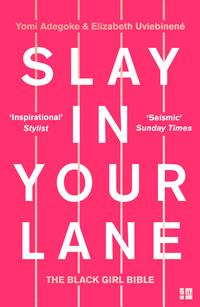
Kitabı oku: «Slay In Your Lane»


Copyright
4th Estate
An imprint of HarperCollinsPublishers
1 London Bridge Street
London SE1 9GF
www.4thEstate.co.uk
This eBook first published in Great Britain by 4th Estate in 2018
Copyright © Yomi Adegoke & Elizabeth Uviebinené
Picture section photographs: here, here, here and here by Dorothy Oginni; here, here, here and here by Tish Greenaway.
Yomi Adegoke & Elizabeth Uviebinené assert the moral right to be identified as the authors of this work
A catalogue record for this book is available from the British Library
All rights reserved under International and Pan-American Copyright Conventions. By payment of the required fees, you have been granted the non-exclusive, non-transferable right to access and read the text of this e-book on-screen. No part of this text may be reproduced, transmitted, down-loaded, decompiled, reverse engineered, or stored in or introduced into any information storage and retrieval system, in any form or by any means, whether electronic or mechanical, now known or hereinafter invented, without the express written permission of HarperCollins
Source ISBN: 9780008235628
Ebook Edition © July 2018 ISBN: 9780008235611
Version: 2020-08-28
Dedication
For Yem, who taught me to ‘Slay In My Lane’ before I knew what it meant to, and for Yinks, who inspires me to do so daily, and more than she will ever know.
Yomi
......................
In loving memory of Ingrid & Sidwell, thank you for everything.
Elizabeth
Contents
Cover
Title Page
Copyright
Dedication
Interviewees
Foreword by Karen Blackett
Introduction
‘It’s Always a Race Thing With Her’
Education
Lawyer, Doctor, Engineer
Black Faces in White Spaces
Work
Work Twice as Hard to Get Half as Good
Water Cooler Microaggressions
***Flawless
Getting Ahead
Independent Women
When Life Gives You Lemons, Make Lemonade
Representation
Being Susan Storm
Fifty Shades of Beige
#RepresentationMatters
Dating
Does He Like Black Girls?
No Scrubs
Health
Black Girls Don’t Cry
TLC
Afterword
Picture Section
Endnotes
Bibliography
Acknowledgements
About the Authors
About the Publisher
INTERVIEWEES
Ade Hassan MBE
.....................................................
Afua Hirsch
.....................................................
AJ Odudu
.....................................................
Alexis Oladipo
.....................................................
Althea Efunshile CBE
.....................................................
Amma Asante MBE
.....................................................
Dr Anne-Marie Imafidon MBE
.....................................................
Bola Agbaje
.....................................................
Charlene White
.....................................................
Clara Amfo
.....................................................
Dr Clare Anyiam-Osigwe BEM
.....................................................
Cynthia Erivo
.....................................................
Dawn Butler MP
.....................................................
Denise Lewis OBE
.....................................................
Estelle
.....................................................
Florence Adepoju
.....................................................
Funke Abimbola MBE
.....................................................
Gemma Cairney
.....................................................
Irene Agbontaen
.....................................................
Jamelia
.....................................................
June Sarpong MBE
.....................................................
Dr Karen Blackett OBE
.....................................................
Keisha Buchanan
.....................................................
Lady Leshurr
.....................................................
Lakwena
.....................................................
Laura Mvula
.....................................................
Dr Maggie Aderin-Pocock MBE
.....................................................
Malorie Blackman OBE
.....................................................
Margaret Busby OBE
.....................................................
Melanie Eusebe
.....................................................
Dr Nicola Rollock
.....................................................
Patricia Bright
.....................................................
Sarah-Jane Crawford
.....................................................
Sharmadean Reid MBE
.....................................................
Sharmaine Lovegrove
.....................................................
Susan Wokoma
.....................................................
Vanessa Kingori MBE
.....................................................
Vannessa Amadi
.....................................................
VV Brown
FOREWORD
Teacher or nurse?
These were the only jobs that my career advisor at school thought I would be able to achieve. Both vocations are admirable and worthy, but come on, just two career options for a working-class girl from Reading?
I had several passions growing up in the UK as the second daughter of two Bajan immigrants. I loved sport, specifically athletics, and I loved travel. The excitement of going to the airport, getting on a plane and flying to a new destination was a very special and rare occurrence in my household. I treasured it. I also loved TV advertising as much as I loved the TV programmes. I would critique the ads, think about whom they were trying to talk to, and think of better ideas as to how they could get their message across.
I ended up running for my athletics club, and I was good, but not good enough to pursue a career in it. When I was eight, I wanted to be an air traffic controller or an air stewardess, but I rapidly went off both ideas as I got older, when I realised that I would just be staring at a screen all day (or night), and I might not get time to enjoy the exotic places that I would be flying to. But my love for advertising never wavered. Back then, though, advertising was (and to a certain extent, still is) a very white-male, middle-class domain. So how would I carve out a career for myself as a young, black, working-class woman?
My dad was a very wise man. He knew nothing about the industry that I entered, nor did he know anyone in this field. My dad wanted myself and my sister to be doctors, lawyers or accountants – vocations that had a high standing back home in Barbados. These were professions that would earn us respect and, most importantly, a salary that meant we could have a good life. My older sister became an accountant and is now a university lecturer. She inspires me every day; she is strong-willed, bright and has a joy for life. I am the black sheep of the family. I didn’t go into medicine, law or finance. I pursued my love of advertising.
My dad knew how difficult it would be to be successful in the UK. It would be a marathon with many obstacles and challenges. He would often say,
‘You’re black and you’re female, you have to try twice as hard as anyone else.’
I did. I worked extremely hard. My athletics training made me focused. I am naturally competitive.
My dad would also say,
‘You have two ears and one mouth; use them in that proportion.’
I listened, I learned, and then I spoke up. I progressed.
I was fortunate to have my parents as role models and to influence me. So few young black women have role models outside of their immediate family and friends to help them navigate the inevitable hurdles that do exist. To give them valuable advice, encouragement, and support. I firmly believe that you need to See it to be it. It is no wonder that my careers advisor, all those years ago, thought that my future ahead was as a nurse or a teacher (in fairness, I do a bit of both in my current role!). They couldn’t see anything else for a young West Indian woman. Black female role models were just not visible then to inspire them or me.
It is no coincidence that I personally know so many of the women featured in Slay In Your Lane. There are too few of us who are visible and known. I admire and respect all of them. A number of these amazing women I count as my cheerleaders, and I am theirs. They encourage and support me in my journey, and I try to do the same for them.
This book needed to be written. It is a book of inspiration, a book that tells the story of struggle, of resilience and, most importantly, of achievement. It answers so many questions that I had when I started my own career journey and looked around and had few people to ask. I wish this book had existed then, I am so glad that it exists now.
If you are a young black woman you should read Slay In Your Lane. Elizabeth and Yomi have put together an incredibly valuable resource for you. They have collated the stories of women who have pioneered and gone before you. These women give their honest reflections and pearls of wisdom.
We are your cheerleaders. Now go SLAY!
Dr Karen Blackett OBE
INTRODUCTION
‘It’s Always a Race Thing With Her’
ELIZABETH
‘Work twice as hard to be considered half as good’ was a saying that I, like most black women, grew up with. But it was only as I began my twenties and started to experience more of the world that it really started to hit home.
Slay In Your Lane is the love child of exasperation and optimism. I can’t pinpoint the exact incident that tipped me over the edge – the various microaggressions start to blur into one after some time – but after one particularly frustrating week at work, I realised I was done. Done with feeling conscious of my blackness and femaleness and apologising for just existing. Like me, my black female friends have the ambition and drive to succeed within spaces that were not initially set up for us to excel in, but we have all found that navigating them has proved to be a challenge at times.
I sought advice where so many women do: in books. I bought Sheryl Sandberg’s Lean In, and although there were parts that I learned from and related to, I felt it failed to address the uniquely challenging experiences faced by me and women like me. And why would it? Sandberg can only speak to one facet of my being, my womanhood, which, for me, is wholly intertwined with my identity as a black woman.
So I went looking for black women at networking events who could speak to my experience, and advise me on how best to navigate my way through the challenges I saw ahead of me. I still felt optimistic and positive about the black female experience and I met successful and inspiring black women from a variety of industries – from a tech entrepreneur turning over six figures to a Magic Circle lawyer carving out her place in a male-dominated field. We shared stories about the challenges we encountered and the triumphs we could see on the horizon. These women were not the finger-snapping stereotypes from a TV series, to which society often reduces the black female experience. They were not monolithic; they were awe-inspiring, amazing and relatable. But something just didn’t add up: why were they only celebrated at ticketed events with limited numbers of seats?
I would leave these events feeling reassured that I wasn’t alone, but also saddened that this sense of sisterhood ended with the event. This longing led me to call my best friend, Yomi, who is a journalist, to persuade her to be the one to take on the challenge of amplifying these women’s voices and utilising their priceless advice on a bigger scale. I asked her to write a book that spoke to me, and other young, black, twenty-something women navigating life. Later, we decided to work on this campaign together.
Role models matter to the next generation more than ever, and black British women and girls have them in vast amounts, but you wouldn’t guess that from a glance at the shelf of your average bookstore. We need a movement that amplifies the voices and increases the visibility of black women who have been made thoroughly invisible by the mainstream. That’s what Slay In Your Lane hopes to be; we hope to offer confidence and inspiration, but also, most importantly, support to other black women who are in the process of building their own foundation and who will, if the world has its way, be constrained by the limitations society tries to place upon us.
There is a saying: ‘It takes a village to raise a child,’ but how about 39 of the most trailblazing black women in Britain? Slay In Your Lane is the personal-development course I never knew I needed; as you read this book I hope it gives you the tools and support to be in the driving seat of your life and not a mere passenger. Slay In Your Lane is #BlackGirlMagic personified. It is exactly what we’ve been waiting for: a chance to revel in the achievements of those who ran so we could fly, as well as to encourage those who are just about to take flight.
YOMI
I owe a great deal to the TV medical comedy, Scrubs.
In an episode in Season 3, the white female doctor Elliot Reid turns to the black male doctor Christopher Turk and says he has ‘no idea how hard it is’ being a woman in their profession. ‘I have no idea?’ he says, eyebrow raised. ‘Look, I’m not gonna fight about whether in medicine it’s harder being black or a woman,’ she responds. ‘Black!’ Turk shouts. ‘Woman!’ Elliot retorts. At that very moment, a black female doctor passes them slowly. ‘Much props, Dr Rhodes,’ says an awkward Turk. The pair shuffle on the spot.
Something that my then 13-year-old self had already frequently experienced but had never been able to articulate was perfectly captured in a 30-second skit: that the different facets of my identity – being black, being a woman – impact on who I am, and what my experience in this country is. It explained why I only somewhat related to stories focused on black men and white women. It highlighted why seeing my identity and my experience reflected mattered. Scrubs had just explained what, years later, I would realise went by the name of ‘intersectionality’ – and I immediately felt seen.
Being black and British, people know our parents are from somewhere else before we even open our mouths. Or if not our parents, our grandparents. Or great grandparents. We are tattooed with our otherness. We are hypervisible in predominantly white spaces, but somehow, we often remain unseen. Growing up, I felt keenly the dearth of visible black British women in the stories our society consumed and it made me feel all sorts of things. It made me feel as if I was invisible, too. It made me feel frustrated. It made me feel annoyed, upset and, most of all, restless. Restless, because I knew (or at least hoped) that when I was old enough, I’d one day be a part of changing things.
I attempted to do something about it when I turned 21, breathlessly starting up a publication aimed at young black girls in the UK. Birthday Magazine was the primordial goop from which Slay In Your Lane was indirectly spawned. Its aims were similar: to outline the black female experience as well as excellence, and offer equal amounts of realism and optimism. It was a small-scale attempt to uplift; its distribution was local and the team was small, but its impact was larger than I expected. Slay In Your Lane was the next logical step that I didn’t see coming, but Elizabeth did, animated by the very frustration, annoyance and restlessness that my younger self had felt.
Now, at 26, the same sense of restlessness has begun to set in, but this time it is without the anger, or even the upset. The current overriding emotion I feel is unbounded hopefulness, because black British women in 2018 are well past making waves – we’re currently creating something of a tsunami. From authors to politicians, to entrepreneurs to artists, black women in the UK continue to thrive against all odds and well outside of the world’s expectations. Women who look and talk like me, grew up in similar places to me, are shaping almost every societal sector, from the bottom and, finally, from all the way up at the top. All a younger Yomi would’ve wished for was the ability to learn from them; an older Yomi wishes for pretty much exactly the same thing.
If white women fear the glass ceiling, black women fear a seemingly impenetrable glasshouse. We’re blockaded from all sides and there is little to no literature on offer to advise us as to how we’re supposed to push on. So much is currently happening on an individual level to combat this, and it’s of paramount importance that it is recorded, noted and passed on. We almost never hear of the persistence, perseverance and drive that fosters such success. Perhaps more importantly, we rarely hear of the failures, the flops and the insecurities that black British women have managed to push through to get to where they are today. We rarely hear about black British women, full stop. And this silence can be just as damaging as the negativity of which we’re so often on the receiving end.
Throughout my teenage years I was a keen reader, and I am no anomaly – findings from a 2014 study by the National Literacy Trust show that black girls are more likely to read than any other ethnic group in the UK.1 Yet books rarely touch meaningfully on the black British experience – and even less so the black British female experience. As a part of this group, I have a vested interest in Slay In Your Lane that goes beyond simply wanting to write a book. I guess you could say that Elizabeth and I are writing this as much for ourselves as we are for other black women. Just like our peers, our friends and our sisters, we are still learning how to navigate the workplace, the dating world and life in general.
We’re not here to tell you that if you simply go for gold, put your mind to it and believe, that you can will yourself out of systemic racism. As pointed out by Elizabeth, even your parents would’ve no doubt once said that you’d have to work ‘twice as hard’ and meritocracy is a myth – and stats continually prove this. But what we are saying is that there is much empowerment and inspiration to be gained from the many women who have jumped over the very hurdles that you too will find yourself up against. There are practical ways to aid you to win, and admitting that there will be difficulties and challenges along the way doesn’t mean submitting to defeat. It means coming to battle armed and prepared.
EDUCATION
‘I also remember thinking that there was often a double standard between the black girls and white girls in school. We were punished when they would be given second chances.’
Elizabeth
.....................................................
‘For instance, there was the time the cheerleading club decided to give its annual “slave auction” a Django Unchained theme …’
Yomi
Lawyer, Doctor, Engineer
ELIZABETH
.....................................................
‘Even today when I get into a taxi and someone says “What do you do?” and I say “I’m a space scientist”, they do a double take. I’m a woman and I’m black. “How come you’re a space scientist? That doesn’t add up.”’
Dr Maggie Aderin-Pocock MBE
.....................................................
When I was 16 I thought I was going to fail all my GCSEs. The grades I had been predicted suggested that wasn’t going to be the case, but I still had a deep and looming fear that I wasn’t going to pass a single one. At home, the pressure to do well in school and in my exams was immense. Results day in my household was set to be an unfair cup final between two rival football teams: on one side were my parents, armed with all the best players and expecting straight As. On the other was me, with my mediocre players and a subpar defence, trying not to crumble under pressure and get annihilated. As the weeks passed and results day got ever closer, the tension increased, and so, to mitigate what I felt sure would be my parents’ imminent disappointment, and rather than wait to be caught out on the big day, I naively started to job hunt. With no GCSEs and no experience, I knew I was probably fighting a losing battle, but it still felt less frightening to me than the real battle that I was convinced I had coming my way on results day.
I partly grew up in Dulwich – a suburb of South London, home to Dulwich Picture Gallery. I would often pass the gallery, so I had noticed that they hosted a range of events aimed at their usual demographic – middle class, middle-aged and white – nothing that 16-year-old me particularly fancied. But I needed work experience, and I had an idea, so I went on Google, did a quick search and found the email address of the person who headed up the gallery’s events and marketing and sent her an email. In it, I said I believed their events could do with appealing more to young people. I asked to meet her and, much to my surprise, she agreed – obviously she had no idea she was arranging to see a teenager. On the day of the meeting, as I sat there waiting for her to arrive, I was so nervous. To say I felt out of my depth is an understatement. I was thinking, ‘This middle-aged white woman is not expecting some inexperienced 16-year-old black girl asking to be involved in her events.’ But when she did arrive she looked pleasantly surprised. It just so happened that during that summer the gallery was introducing outdoor cinema screenings, and she wanted my input to help bring the idea to life. And that’s what I spent my summer doing. It became my first experience in marketing.
Results day came and, much to my surprise, I did well and my parents were pleased. My panic had propelled me into finding work experience that would go on to prove valuable in my career, so I don’t regret that move, but looking back on that summer, what I do regret, and find depressing, is how I let my crippling fear of not doing well and letting other people down take over my life. Instead of making the most of those weeks I spent them waiting anxiously and fretting about my future. Why? Where did my lack of faith in myself come from? On balance, when I look back on it, the work experience was a good thing for me to do, it was just the circumstances that drove me to do it that were far from ideal.
In my school, unless you were identified as a gifted and talented student achieving straight As and exhibiting model behaviour, it was almost inevitable that you would fall through the cracks and be forgotten about. By the time it came to making decisions about your future, you could find yourself in a no-man’s land, caught between your parents’ very high expectations and the lower opinions of the teachers who doubted your ability – not forgetting the usual teenage peer pressures. For me, this self-doubt then developed into a loss of self-esteem, and anxiety crept in about what I was good at and how I could translate that into a future.
When the time came to take the exams, I had noticed that some of my friends didn’t believe they could possibly do well, so they just started to give up and misbehave – because this seemed to be what was expected anyway. This tension often became a ‘one-way ticket’ to disengagement, and so they began to succumb to that feeling – whether they had started out well-behaved and ambitious, or not. Being doubted by your teachers and put under great pressure from your parents created a sometimes toxic combination. The truth about educational achievements is often more complex than the stats suggest.
When the topic of race and education is covered by the media it is usually cast in an overwhelmingly negative light. When they aren’t focusing on the low achievement of white working-class boys, the experiences of ethnic minorities are characterised by low aspirations, high exclusion rates and subsequent underachievement. With black children, the spotlight tends to be focused on black boys – perhaps understandably, because their educational attainment levels are shockingly low compared to black girls. As a result black girls are largely rendered invisible within the education conversation, so there has been little contemporary research and literature that looks into their experience of our education system, asking the question: how are black girls in the UK really doing in school?
.....................................................
‘My friend, face your books, not this Facebook.’
Unknown African parent
.....................................................
It’s not hard to see why an extremely high value was placed on education in my childhood home and in the homes of my friends, as well as in those of many of the women we interviewed for this book. We are a generation of people who grew up with parents – or grandparents – who had gained professional qualifications in the countries they had migrated from, but who often found it difficult to get jobs in the UK that reflected their skill sets because those qualifications weren’t always recognised when they went to job interviews. Educated though they were, they often faced discrimination as they entered the labour market, and many had to take jobs for which they were overqualified.
Our parents appreciated the value of education and the opportunities it could bring. As mine would often remind me: ‘Back home we do not have the same opportunity that you children have here. Education makes a way for you.’ Despite this, they also weren’t in the dark about how difficult it was going to be for us to navigate our future in Britain, and so they would also make us aware that ‘this isn’t our country; we have to work harder’. My parents had extremely high ambitions for me and my siblings. In their eyes, ‘the sky’s the limit’– if you worked hard, you would go far. I would hear them talk to their friends in true Nigerian style about how I would be doing a masters, when I hadn’t even got into university yet. They believed that education led to job opportunities, and, perhaps unsurprisingly, as Karen Blackett’s father did, they often steered us towards careers such as law and medicine – professions in which no one can deny your qualifications, regardless of the colour of your skin and the prejudice you might come across. From our parents’ perspectives these traditional professions would give you job security.
Bola Agbaje, Olivier Award-winning playwright and writer, had a similar experience growing up: ‘For African parents, I think it was just that thing that they wanted stability. A lot of parents who are first generation, they want their kids to be lawyers and doctors and things like that because those are the jobs that create stability, and also you can be wealthier with those type of jobs. So for them, they want their kids to have better lives than they had, so that’s why they push their children into those types of careers.’
Educational researchers acknowledge that, of all factors within the home, parental values and aspirations have the largest positive effect on children in school. However, the high aspirations and motivations of ethnic minority parents do not always translate into the greatest achievement in the classroom, and there has been little research into why this might be the case. When black children enter the school system at five they perform as well as white and Asian children in literacy and numeracy tests. Their results are largely in line with the UK average, with literacy at 67 per cent and numeracy at 75 per cent, compared to the national averages of 69 per cent and 76 per cent respectively. However, by the end of primary school as they enter secondary school, aged 11, black pupils’ attainment falls behind.1
When we look a little deeper, it’s noticeable that there are differences in achievement levels between the different black groups. In the 2013–14 academic year, 56.8 per cent of British African students achieved A*–C grades – slightly above the national average of 56.6 per cent. This attainment level places them alongside Indian and Chinese pupils as the country’s highest ethnic achievers. However, in sharp contrast, Black Caribbean pupils have a 47 per cent pass rate, trailing by nearly ten percentage points. On the whole, black pupils achieved the least in the five top GCSE grades out of all ethnic groups, but it is the performance of Caribbean pupils that averages out at 53.1 per cent.2 There has been a corresponding lack of research into the differences in attainment levels between Black African and Black Caribbean pupils.
Not enough has been done to try to understand why a disparity exists between different black groups. Instead, the two groups are often amalgamated into one, which means we are unable to see emerging patterns and there’s a tendency for many children to be left sidelined unless they are doing really badly. This lack of substantial research is especially apparent when it comes to the attainment levels of black girls. Althea Efunshile CBE, former deputy chief executive of Arts Council England, explains: ‘I have sometimes wondered if black girls who don’t do as badly as black boys are invisible in the education system. Because if you compare them to black boys, they’re doing better, and so people say, “Right, okay, we don’t need to worry about them so much.” But if you compare them to white girls, they’re not doing as well.’
Young black girls appear to value education highly: they want to succeed and try their best to navigate the school system. But as they progress through secondary school it seems that factors come into play that often lead to them not fulfilling their potential. Heidi Mirza is Professor of Race, Faith and Culture at Goldsmiths College, University of London, and has written extensively on ethnicity, gender and identity in education, most notably in her book Young, Female and Black (1992). As she pointed out when we spoke to her, ‘Everyone says black girls do well, there’s no problem for them. They do better than the boys, they do better than black boys, they do better than white working-class boys, and they’re doing better than white working-class girls, what’s the deal? We don’t even need to look at them; in education they’re kind of sorted. But actually, when you look down and you drill down, as I did for Young, Female and Black, what I found was that there are so many mythologies around black womanhood, and the fact that there’s always the “strong black woman that survives narrative”. All the theories and studies were saying was that, because they’ve got that inner strength, they do well, and what I found was, yes, they have that inner strength, yes, their parents really valued education enormously, and pushed them to do well – some did, some didn’t, but at the same time there were structural things like racism, schools with not very good teachers, issues around poverty, resourcing, government policies, that they had to contend with, and the fact that they do well is because they overcame that, they learnt to navigate the system.
‘They had very high aspirations, but as they got a bit older and they realised that they weren’t getting the support at school to get through, they would make very strategic choices, so they would say, “I’m not going to get my GCSE, but I will go to college and I will get it in another institution, and I will go for nursery nursing because I can get on that course, but I don’t necessarily want to be a nursery nurse. I want to go to university and study sociology, that might be a stepping stone for me.”
‘They knew the system didn’t work for them and so they made many choices to accommodate – I call it the “long, backdoor route into success” – so they have to make many, many more different steps to sidestep the racism and the lack of support in the system by making strategic choices. So it takes some much longer to get into higher education, into university. They’re usually older; nearly all my students when I was teaching at places like Southbank and Middlesex, all the black women were, you know, already in their mid-twenties, where the white young people would be 17, 18, 19. They were much younger because they didn’t have to navigate the system as much.’
If black parents do notice that their kids are struggling in school, they often look for alternative methods to compensate for the failure of mainstream schools, rather than trying to effect change in the schools themselves. Some black parents choose to send their children overseas during their secondary school years as soon as they start to see a pattern of bad grades or disruptive behaviour. When I was in Year 9 in secondary school, I was constantly warned that I would be sent to Nigeria if my grades didn’t pick up in maths and science, and my brother and sister were sent to boarding school there for a few years. This was in contrast with the faith they placed in the education system in the UK. I had friends who were in class on a Monday morning but by Friday they would have been taken out of school.
Private school is another option for parents who can afford it. Dr Nicola Rollock, Reader in Equity and Education at Goldsmiths College, University of London, started off in state education but her parents soon made the decision to send her to an independent school when they realised she wasn’t being stretched academically. ‘We used to read Peter and Jane books and they had a sequence – 1a, 1b, 1c – and I would get through the sequence quite quickly. Then, rather than being allowed to go on to the next sequence, 2 or 3 or 4, the teacher would ask me to go back to the beginning, so I was incredibly bored.’ Rather than move her into a higher class, Nicola was expected to wait for the rest of the class to catch up: ‘There was one black teacher who advised my parents to move me because I wasn’t flourishing there. I had been held back by my class teacher, a white woman, so my parents moved me and I went to an independent all-girls school.’
Some black parents supplement their kids’ education with tutoring. I went to a Saturday school for many years, run by two black women who employed highly motivated black teachers. There, parents had a say in the curriculum and the school was committed to raising the achievement levels of black students whose mainstream schools had often given up on them.
.....................................................
Attitude gal
.....................................................
So what do we know about why so many black girls are underachieving at school? We know that institutional racism plays a part and that bias in teachers’ perceptions and expectations contributes to some black pupils’ underperformance and attainment. Studies have revealed that bias can manifest itself in a number of ways. There is evidence that teachers have routinely underestimated the abilities of black students and that assumptions about behavioural problems are overshadowing their academic talents. In essence, low achievement among some black students is made worse because their teachers don’t actually expect them to succeed. Dr Steve Strand from Warwick University, the author of one study, said: ‘After accounting for all measured factors, the under-representation is specific to this one ethnic group and indicates that, all other things being equal, for every three white British pupils entered for the higher tiers, only two black Caribbean pupils are entered.’3
It’s no surprise then that, according to the same study, black children are also the most concerned about how teachers view them and are less likely to feel their teachers would describe them as clever.4
Dr Maggie Aderin-Pocock MBE, space scientist and co-host of BBC2’s astronomy show, The Sky at Night, can relate to these findings: ‘At school I wasn’t considered to be very bright, I suffer from dyslexia and so when you first go to school it’s all about reading and writing. When I started the teachers said, “Oh yeah, okay, Maggie’s not very bright,” and they put me in the remedial class, and so I was in the back there with the safety scissors and the glue tucked out of the way and they didn’t see me as having much potential at all. This is quite in contrast with what I was getting at home, because I was speaking with my father and he was saying, “Ah yes, you should go to university, you should study,” and so the two were very much at odds. I didn’t speak much at school about what I wanted to do because usually when I did I think the teachers would try to be kind, but they would look at me with little disappointed faces, like, “Oh Maggie, science is for clever people, you should consider something like nursing, nursing is good, and that’s science, too.” So I think they were trying to mitigate my expectations. I felt a bit disillusioned; I felt that school wasn’t for me, so I would sit in remedial class. But things turned round at one specific moment for me, when I was sitting in a science class and a teacher asked a question. The question was “If one litre of water weighs 1kg, how much does one cubic centimetre of water weigh?” Now a cubic centimetre is one-1000th of a litre and I worked out, “Oh, that would be 1 gram.” So I put my hand up to answer the question and I looked around the class and no one else had their hand up. Now knowing that I was the dumb one in the remedial class I put my hand back down, because I thought I couldn’t be right. But then I decided to give it a go and I answered the question and got it right, and suddenly I thought, maybe I’m not as dumb as I thought. And science is a subject that gets people into space and so I thought “if I study science maybe I can go into space”. That was a real turnaround for me, so I started paying more attention in science classes, and as my science grades started going up, my other grades went up, too. After that I got lots of encouragement at school, because that’s when they saw I had an aptitude.’
Manifestations of unconscious bias in the classroom also extend to black girls being shown fewer leniencies than their white counterparts, and written off as problem children more quickly. The groundbreaking Swann Report in 1985 pointed out: ‘Teachers’ attitudes towards, and expectations of, West Indian pupils may be subconsciously influenced by stereotyped, negative or patronising views of their abilities and potential, which may prove a self-fulfilling prophecy, and can be seen as a form of unintentional racism.’ In the UK, black children are almost four times more likely to be suspended from school than white children. In the 2013–2014 school year, 18 per cent of black boys and 10 per cent of black girls were suspended from school. This is compared to 5 per cent of white boys and 2 per cent of white girls.5 In my school, I remember pupils being excluded because of their hair. Black kids were penalised for their hairstyles, whereas the white middle-class kids with floppy long hair were left alone. At the time I couldn’t understand why one kind of hair was policed and the other not. If someone’s hair doesn’t affect their ability to learn, why should it matter?
I also remember thinking that there was often a double standard between the black girls and white girls in school. We were punished when they would be given second chances. Alarmingly, this is borne out in a study published in 2017 by Georgetown Law Center on Poverty and Inequality. It revealed that, starting as young as age five, young black girls are viewed by adults as being less innocent and more adult-like than white girls.
Heidi Mirza elaborates: ‘If you just step out of line a little bit, if you’re white and you laugh in the class they might laugh with you; it’s kind of a joke. If you laugh, it’s like, you’re laughing at somebody, get up and go out of the room. So what they found was that there is a kind of stereotype of blacks being more aggressive, and it’s like you said, this subconscious bias goes on, so any little thing is escalated much quicker.’
Dawn Butler explains how perceptions of teachers left her at odds aged 12: ‘There was a girl, a white girl, called Andrea in my school, and she would always get As, no matter what she did she would always get As, so I decided I was going to buckle down and get an A. It was a history assignment and so I worked really hard on this history homework. It was a really good piece of work, and I remember going into school and I was really chuffed, and I brought it in, and then I got a D for it. And I compared it to Andrea’s work, and we both compared it because we were actually in competition to see who could write the neatest and the smallest.
The teacher said that I had cheated. There was no way I could prove that I didn’t cheat, that it was my bit of work and that I worked really hard at it. And I just thought, “things are never going to change” – I even had this discussion with Andrea. We decided one day we were going to swap work, because we knew that no matter what I put in I was never going to get an A and whatever she put in she was always going to get an A. Looking back I was so frustrated that I couldn’t do anything to change this, but it was the first time, I suppose, that I realised that once somebody has an impression of you, it’s very difficult for them to change that impression. So, you know, Andrea the white girl was always going to get an A, Dawn the black girl was never going to get an A. It was a hard thing to accept – I kind of didn’t want to try my best anymore because it was just never going to be rewarded.’
Being an opinionated confident black girl was a no-no in my school, and as Jamelia, singer and TV presenter explains, her daughter’s experience sounds similar: ‘I’ve noticed it in their school, being in a private-school environment, they’re still the minorities there, and I’m being called in and I’ve had a meeting where they’ve said, Oh, you know, she’s just acting too confident. Yesterday, my eldest, she tested out a sociology class, because she wants to do it for A-level – she’s finishing her GCSEs but they get a taster class – and the teacher said he showed her a statistic, a table, and at the bottom, it showed ethnicity and their success in exams, and he said black boys and black girls were at the bottom of the table. My daughter was like, I don’t even know how he thinks that might have made me feel, and it shows that he just didn’t even think, but, what I said to her is that at least he had a statistic. What he then went on to say was that the reason black boys are at the bottom is because they don’t have father figures and my daughter called him out, and she got in trouble.’
There’s evidence to suggest that if your teacher looks like you, you might do better in school. An American study revealed that when black students have black teachers, those students are more likely to graduate high school. ‘The study found that when students had teachers of the same race as them, they reported feeling more cared for, more interested in their schoolwork and more confident in their teachers’ abilities to communicate with them. These students also reported putting forth more effort in school and having higher college aspirations. When students had teachers who didn’t look like them, the study found, they reported lower levels of these feelings and attitudes. These trends were most visible in black students, especially black girls.’6 So it is particularly frustrating that in the UK, we don’t have enough black teachers. According to the National College for Teaching and Leadership, only 12 per cent of trainee teachers in 2013–14 were from minority ethnic groups – a statistic that has not really changed in five years.7 The lack of black teachers across the country means that there could be a lack of understanding as to how to motivate and work with black children. In 2007, Catherine Rothon argued that a lack of co-ethnic role models may explain poor performance from Black Caribbean boys,8 and those teachers who do come from ethnic minorities report difficulties that include casual racism, lack of role models for black and minority ethnic (BAME) children, and being forced to deal with microaggressions from other staff. I go into more detail about the impact of casual racism in the ‘Water Cooler Microaggressions’ chapter.9
.....................................................
When I grow up …
.....................................................
What did you want to be when you grew up? Who were your role models? We can all remember what it felt like to be full of hopes, dreams and ambitions about what jobs we were going to have when we were old enough. But as the years passed, society – and school – often shut down those ambitions and set limitations before we had time to really know what it was we wanted to do. According to a BBC Newsround’s study, about one in five black children believe their skin colour could damage their job prospects. One child told Newsround’s reporter, ‘This generation is still being judged and stereotyped, so it’s going to be difficult for us to do what we want to do when we’re older.’10
For black women, this is exacerbated by the fact that we tend only to be shown a narrow range of possibilities for ourselves, and are bombarded with the idea that there are only certain roles for certain people. Heidi understands this all too well from her research: ‘There is so little representation of you, as a young black girl, in school, so you don’t see your image in a positive way in the textbooks, in the history. A student of mine, she did her PhD on black history, and she said that when she interviewed black kids, boys and girls, and their parents, they said, “We don’t want black history to be taught in schools because it’s always about slavery and the enslaved, and then we get teased.” She said it’s the way that it’s taught that is the problem. Not that it’s taught as part of the horrors of the colonial and imperial system, no. Or how it fuelled the industrial revolution, no. It’s taught as a separate thing, which is degrading, and so the only images that you do see are in chains, being lynched or something, and you’ll never see positive images.’
One of the things we hope to achieve with Slay In Your Lane is to show young black girls that there is no limit to the roles they can carve for themselves in the world.
Malorie Blackman OBE is an award-winning children’s author who held the position of Children’s Laureate from 2013 to 2015. She believes it’s incredibly important for black children to have these visible role models. ‘When I was a child, even though I loved reading and I loved writing, it didn’t occur to me that I could be a writer because I’d never seen any black writers, and in fact, the first time I read a book by a black author was The Color Purple, and that was when I was 21 or 22. Now, that’s a ridiculous age to get to before you actually read about black characters written by a black author, and it was only reading that that led me to the black bookshop in Islington, when it was there, and that’s where all my money went. I remember in one lesson, I said to my teacher, “How come you never talk about black achievers, and scientists, and inventors?” And she looked at me smugly and said, “’Cos there aren’t any.” And, I didn’t know any better, I had never been taught about them, so I felt there was a huge gap in my knowledge about my own history: never been taught it, never come across any books about my own history, so when I found a black bookshop, it was non-fiction books, it was mostly African-American writers, but I devoured them.’
Sharing Malorie’s views on the necessity of visible role models, Dr Maggie Aderin-Pocock has relentlessly pursued a schedule of school visits alongside her academic work: ‘This is quite a multi-pronged challenge. My goal is to get more, especially black, girls into STEM [Science, Technology, Engineering and Maths], because it’s the same across the board really, there are internal challenges and external challenges. Internally, I think many girls don’t consider STEM, especially black girls, but it’s the same with black boys really. When they see role models or black role models they see footballers, they see singers, they see people who are doing brilliant jobs, but they don’t see many scientists. They see maybe a few more medical doctors now, but sort of within a limited catchment. And so it’s trying to expose them to as many role models as possible in as many different disciplines as possible. It’s funny, when I go to schools, I talk about science and I talk about space but I do not necessarily want them to become space scientists like me, I just want them to know that they have amazing opportunities and there are amazing careers out there that might be suited to them. Some of the children might be great as space scientists, but some of them might want to do something totally different. But it’s showing them that as a black girl in a school, the sky’s the limit, you can do anything you set your mind to, but you’ve got to actually know what the opportunities are. It’s trying to get them exposure to opportunities. I think it doesn’t happen quite so often, but I think in some places they still try to limit people’s expectations. And that’s especially true for girls and I think especially true for black girls. So it’s sort of like the situation I was in – “Oh Maggie, don’t aim too high” – almost know your place in life, and I find that quite frustrating. So I like to show my story as an example, you know, I started off exactly where you are sitting and now I’m up here and I’m doing really exciting things and I love my work. So it’s showing them that there are amazing things that they can do, that they have the potential, and the thing is to believe in themselves. So it’s trying to tackle away the external barriers and the internal barriers.’
And positive changes are happening. Natasha Codiroli finds that female students of mixed ethnicity and Black Caribbean origin are more likely to study STEM A-levels than white female students.11 Indeed, black girls are the only ethnic group that outnumbers their male peers in STEM A-levels.12 STEM is important in driving innovation and is the fastest-growing sector in the UK. There’s never been a better time to encourage young girls into this industry. Role models like Dr Maggie Aderin-Pocock understand the need to be visible to school children, and outreach projects are becoming increasingly important in encouraging more black women into all sorts of industries.
Malorie agrees: ‘So, as far as representation is concerned, I think it is absolutely vital, because if I hadn’t read those books, it still wouldn’t be in my head that I could be a writer because I’d never seen any! I remember, for example, when I first started writing, and I wrote a book called Whizziwig, and it was on CITV (Children’s ITV) for a while. I remember going into a school – and this was really instructive to me in terms of representation, because I went into a school in Wandsworth – and I’d say about a third of the pupils were black, or children of colour, and two-thirds were white. I remember that I was talking about Whizziwig, and the idea, and it was on TV and a number of them had watched it, and a black boy put his hand up and he said, “Excuse me, so, Whizziwig was on the television and then you wrote it?” And I said, “No, I wrote it, and then it was on the television.” He said, “But, it was someone else who did it, and then you did it?” And I said, “No, it was my idea and then I wrote the book and then it was made into a TV programme.” And he asked me about five or six questions, all on the same theme, and I was like, “No, I wrote it.” I know exactly what you’re thinking, and I just thought, I loved it, because I was sitting with a sort of smile inside, thinking, I want you to look at me and think, hell, she ain’t all that, so if she can do it, I can do it! And that’s what it was, “You did it? You wrote it?” And I thought, that’s exactly the point! And so I just love that, and that’s why, especially to begin with, sometimes it was two or three school visits a week, and I got out there, oh my God, and I was up and down the country and I made sure I got out there to show, not just children of colour, but all children, that writers can be diverse, that I was a writer. Here I was as a black woman and a writer!’
Similarly, in 2017, Yomi and I were invited by London’s Southbank to mentor young girls between the ages of 11 and 16 for the International Day of the Girl festival. It took me back to my school years and the fear of not knowing what was ahead of me past GCSE results day. Unlike when I was growing up, these girls seemed more confident about what they wanted to do, and asked us interesting questions about our careers and why we made the decisions we did. They didn’t seem lost like I did at their age and that filled me with great hope that things seem to be slowly but surely improving.
In summary, we’ve spoken about the need for an increase in black teachers, the need to tackle the bias held in some pockets of teaching staff through training and accountability, and that parents also need to better understand the school system so they can best support their children in the face of these obstacles. The general feeling of being lost that I experienced throughout school, and especially over that summer as I waited for my GCSEs, came from a lack of confidence in myself that originated in the school system. Changes are slowly happening, but we need to do more to raise the self-esteem of young black girls, so that they know that the sky is indeed the limit, and to actively give them the tools to help them realise their ambitions.
Black Faces in White Spaces
YOMI
.....................................................
‘Lol my sisters oyinbo flatmates threw her yam in the bin cause they thought it was a tree log’
@ToluDk
.....................................................
When I learned I had got a place at Warwick University, I burst into tears. Not tears of joy, mind you: tears of fear. Aged 18, I had flat-out refused to apply to Oxford or Cambridge, my stomach churning at the stories of elitism, racism and all other kinds of ‘isms’ I wasn’t sure I would be able to handle on top of a dissertation. I thought I would much rather learn about those things in a history course than opt into being on the receiving end of them, thank you very much. So instead I applied to SOAS, a very good London-based uni (which even taught Yoruba) as well as Warwick, to please my league-table-obsessed parents. Once I was offered my place, I was ‘advised’ (read ‘ordered’) to go to Warwick by them; it was a decision for which I’m now thankful, but at the time it felt like a form of punishment. I was absolutely petrified I would end up being the only black girl within a 400-mile radius. Even the term ‘Russell Group’ was offputting: it sounded to me like a band of 60-plus cigar-smoking ‘Russells’ for whom fox hunting and racial ‘horseplay’ was an enjoyable pastime. It didn’t exactly scream ‘inclusion’. Of course, when I got there, I realised I wasn’t the only black girl. There weren’t many of us by any measure, but there were enough of us to warrant a populous and popular annual African-Caribbean Society (ACS) ball – and even its Nigerian equivalent.
University was one of the greatest times of my life, but it wasn’t without its challenges. If you are on your way to uni or are considering going there in the future, you will no doubt have already been given lots of advice from websites, teachers and those who have already graduated: don’t leave your dissertation to the last minute; label your food in the shared fridge; rinse the Freshers’ Fair for as many free highlighters and notebooks as you can; always accept the Domino’s vouchers – you will need them. But often one very important topic is left off this generic list of well-meaning wisdom, and that’s how to deal with racism. And when I say racism, I don’t just mean blackface Bob Marley costumes at every conceivable event (there will always be one). As I’ll come back to, statistics show that, like the police force, the health service and the workplace, university is a space where racism is embedded – beginning with the application process and continuing right up to graduation. From often alienating curricula to downright ignorance from flatmates, uni can be intimidating for any student, but this is especially so when you’re black and female.
.....................................................
‘We’re not in Kansas anymore, Toto.’
.....................................................
For many black students, university will be their first time living away from home and also often their first time living in a predominantly white area or environment. The beauty of university is that it often thrusts you into the midst of people who are vastly different from yourself, broadening your mind in the process. But this can also sometimes leave you feeling seriously homesick, isolated and generally disconnected.
Little recognition is given to the culture shock experienced by many students coming from predominantly ethnic areas. Maggi cubes become as rare as precious minerals, and weaves often stay on far longer than you’re used to, pretty much growing right off your head for want of a nearby hairdresser. People ask questions you may not be used to answering; for some students you’ll be the very first, real-life, 3D black person they’ve ever met and they will have endless questions about your apparently baffling existence – which has been taking place just two hours down the M40 for the past 18 years – questions which, by the way, you are under no obligation to answer.
When I went to university, my fear that I would be the only black kid on campus wasn’t quite realised, but on the other hand, Warwick wasn’t exactly Croydon in terms of diversity. It is normal for freshers to struggle initially with making friends, but by the end of week one, when one of my first conversations had been with someone who told me he believed there was ‘Me black’ and ‘Rihanna/Beyoncé black’, I had already decided I wouldn’t be spending much time at my halls or with my flatmates. Instead I found solace in the halls a stone’s throw away from me, which housed about half of the uni’s black female intake (again, this wasn’t much). But in those halls I soon found myself a best friend, a boyfriend and a community. Together we searched for hair shops and discovered the clubs that played black music (as much of a banger as The Killers’ ‘Mr Brightside’ was, we heard it more times during the entirety of our nights out than we did anything remotely ‘ethnic’). ‘Black music’ was relegated to a Thursday night and primarily consisted of Sean Paul’s discography.
We swapped eye-roll-worthy anecdotes on microaggressions and lamented the lack of available seasoning in our nearest supermarket. And the best friend I made? I could never have foreseen that eight years, several, several hours of phone calls and even more nights out later, we’d be co-writing a book together. Uni can really be the making of you, even if you don’t always realise it at the time.
Dr Nicola Rollock went to university many years before me and it’s interesting how similar her experience was:
‘I think there were quite a lot of things I took for granted growing up in South-West London, even though I went to this mainly white and very middle-class school. Going to find a black hairdresser’s or Black Caribbean food was normal. Brixton was down the road, Tooting … it was completely normal. I didn’t have to go out of my way to find these things, yet going to Liverpool in the early 90s – and remember this was before it was the European Capital of Culture – was a real challenge, and at 18 I didn’t actually know that I needed those things in my life. I didn’t know they were important to me because I’d really taken them for granted. Even going out was a challenge, in terms of the kind of music I was listening to as a young woman. I had to go out of my way to find venues that would play music I was interested in; there was something called “Wild Life” that happened once a month that played R&B, soul and hip hop – this was once a month at university. So we – me and the few other black girls – ended up befriending black local Liverpudlians and going to “blues”, as they were called, or “shebeens”,13 outside of the university context, because we were really hungry for and looking for places where our culture and identity was recognised and we could just relax.
‘I remember with “Wild Life” we went to enjoy the music, and it felt like some of our counterparts went to drink, and again this was something I wasn’t used to; I didn’t grow up in a house where our parents would say “Go and have a drink,” or, “Here’s some money, go down to the pub.” I didn’t step into a pub until university, and even then I remember saying, “But I’m not thirsty!” Which completely misses the point of going to the pub, as it’s not only about that, it’s about connecting and sitting down and a place to meet, but for me it was just outside of my cultural frame of reference. So I found, in terms of food, music, hair – because my hair was relaxed and straightened at the time – finding a space in which I could be myself and be with others was a deep, deep challenge, so I felt very, very isolated. Then there were the things that many students experience, such as not having any money. I ended up needing to work as well as study … I just found it incredibly difficult and isolating. I would get the train back from Lime Street to London and I would come via Brixton (this was before Brixton was gentrified) and I would walk up the steps at Brixton station and literally, quite literally, exhale, because foods were there, black hair shops were there, my culture and identity was all around me. It was as if I had arrived home.’
.....................................................
‘Ah, the racially insensitive party. A mainstay of primarily white institutions since time immemorial.’
Dear White People
.....................................................
For me and my group at uni, our friendship was a wonderful buffer between us and a lot of things that didn’t have nearly the effect on us as they might have done, had we not had each other. For instance, there was the time the cheerleading club decided to give its annual ‘slave auction’ (which in itself was a problem) a Django Unchained theme. Or when a Snapchat picture was uploaded to one of our university community pages on Facebook featuring a black man wrapped in a net with the caption, ‘I caught me a nigger!’ And let’s not even start on the Stockholm syndrome of other black students who would tell the predominantly black women who kicked up a fuss to ‘chill out’.
And the black face. My gosh, the black face.
Microaggressions (defined as a statement, action, or incident regarded as an instance of indirect, subtle or unintentional discrimination against members of a marginalised group) can range from a flatmate throwing out your plantain because they think they’re rotten bananas, all the way to outright flagrant slurs. And in recent years, the racism that was once only whispered about among students has become a talking point on and off campus. Universities put to bed the dangerous myth that racism is the preserve of the ‘uneducated’ and ‘ignorant’ – in fact, it is often those in power who are the ones perpetuating it. Universities are, at times, so racist that they make headlines. The country gasped at the story of a black first-year student at my old university who had found the words ‘monkey’ and ‘nigga’ written on a bunch of bananas she had stored in her shared kitchen. Many black students tutted and sighed, not in surprise but in recognition.
Sometimes the racism is more subtle and underhand, as Afua Hirsch, a barrister, award-winning journalist and author, experienced at Oxford:
‘People always asked for weed, especially when I was with my friends, especially my male friends. They would just assume that they were local drug dealers. And it was always those really posh boys. In their brain, the only function of black men is to buy drugs from. That was one of the most infuriating and offensive things. Or you’d arrive at a party and they’d just assume that you were the local dealers showing up to supply. I hated that, I really hated that.’
A more ‘in-your-black-face’ form of racism is, well, black face. It was a costume staple at parties when I was a student, but at Cardiff University it actually made its way into a play written by medical students in 2016. A student actor blacked up and wore an oversized dildo to make fun of a black lecturer at the university, which unsurprisingly caused a feeling of ‘segregation’ between groups of different ethnic backgrounds.14 Eight students of African heritage complained, and this, according to the independent report commissioned by the university as a result of the incident, led to a ‘major backlash’. Some of the complainants were told by their fellow students they were being ‘very and unduly sensitive’ and that they should accept it as ‘tradition’, as the play was an annual occurrence. The students who had raised the objections felt they had been ‘ostracised’ and some decided to leave Cardiff.
Three years before, a couple of hundred miles away in York, four male students donned black face, too.15 They were depicting the Jamaican bobsled team from the film Cool Runnings. Over in Edinburgh, law students painted their faces to dress as Somali pirates for an ‘around the world’ themed party.16 Meanwhile, at the University of London, a student was actually rewarded with a bottle of wine for their racial insensitivity when they won a fancy dress competition at a union event by donning black face.17 And in Loughborough last year, students organising freshers’ events had to issue an apology after planning a ‘slave auction’ and ‘slave night’ as part of the entertainment for the university’s new intake.18 It is important to note that this kind of flippant racism is as common among those educated in the most elite of institutions as it is anywhere else. These are not isolated incidents but part of the very foundation of British society. They are being perpetrated by the bankers, lawyers and doctors of tomorrow: people who will become the managers who throw out CVs because they can’t be bothered to pronounce ‘Akua’.
A recent report19 by race-equality think-tank the Runnymede Trust highlighted the feelings of exclusion and rejection felt by many black university students as they navigate alienating curricula, come up against lower expectations from professors, and experience brazen racism on campus. The report emphasised the importance of universities becoming ‘actively anti-racist institutions’ – something that, as bastions of ‘progressive thought’ and ‘talented minds’, shouldn’t be such a big ask.
But very few universities have taken appropriate measures to prevent or punish racism, and students are often forced to take matters into their own hands. It was racist incidents such as those outlined above that led to the creation in 2013 of the Anti-Racism Society at my old university, run voluntarily by a group of undergraduates. It offers students advice or someone to talk to about race-related issues, and puts on events such as sleepovers, movie nights and panels offering often cathartic discussions about race and racism. Many students feel more comfortable reporting incidents to their peers, as opposed to their institution’s reporting systems, but those who run societies like this are under the same pressures – in terms of racial tensions and university work – as those who come to them for help. The frequency of racial abuse on campus is something that universities, not students, should handle better, but even so, these spaces, groups and organisations are important. Anti-racist societies are different to an African-Caribbean Society, where the basis of meetings isn’t always necessarily political; these societies exist specifically for tackling racism. Don’t be afraid to be the person to create that space at your university if it doesn’t already exist.
Sometimes the microaggressions can occur at the hands of the universities themselves. Femi Nylander was a recent graduate of Oxford when he found himself racially profiled. He was visiting a friend’s office in Harris Manchester College and was locked out, so he went to the office’s kitchen to do some writing, chatted briefly with staff and students he knew and then left. Later that day, a CCTV image of Nylander walking around the college was emailed to all of its staff and students, along with a message warning them to ‘be vigilant’ and to ‘alert a member of staff […] or call Oxford security services’ if they saw him. His presence, it warned them, was a reminder that the college’s ‘wonderful and safe environment’ can be taken advantage of, adding that its security officers ‘do not know [his] intentions’. No one once asked Femi who he was or why he was there.
Afua remembers her visitors also being on the receiving end of similarly racist treatment at Oxford years before:
‘I had this boyfriend in London who was black and I coped by running away a lot on the weekends and hanging out with him, and then he’d come and visit me and that was a big issue because he was a dark-skinned black man. One time when he came to my college, they wouldn’t let him in and the porter rang me and said: “You should’ve warned us if you were expecting someone who looked like a criminal,” and I’ll never forget that. Even then, I was like, I cannot believe I’m having to put up with this. It was like there was no sense that … It was really bad and I was very conscious of being with him at Oxford because it kind of drew further attention to me as a black woman.’
These types of everyday microaggressions have sparked several conversations and motivated various campaigns, one of the most high-profile being the ‘I, too, am Oxford’ series, inspired by the ‘I, too, am Harvard’ initiative in America. In 2014, Oxford students organised a photoshoot consisting of 65 portraits of BAME attendees of the university, with the hopes of highlighting the ignorance they came across at Oxford – and confronting it. ‘How did you get into Oxford? Jamaicans don’t study’, ‘But wait, where are you really from?’ and ‘I was pleasantly surprised … you actually speak well!’ were just some of the choice quotes written on the placards they held in front of them, forcing their peers to encounter the ugly face of university racism. It is hugely important that black students continue to have these conversations and to hold their universities to account, especially when white students so often centre racial discourse around themselves. During Afua’s time at university, even the ACS wasn’t a black safe space:
‘I joined the African-Caribbean Society only to discover that it was run by a white boy from one of the elite private schools in the country because he loved going to Jamaica to his dad’s villa in the summer holidays and he had fancied being a “DJ reggae man”. At the time, I was just like, this is completely off, but I couldn’t articulate it. It was classic white privilege, exoticisation.’
Perhaps as a result of the slowly increasing black student population, the voice of black students is beginning to be heard in universities in a way it hasn’t been before, as Afua explains:
‘For my book, I interviewed some black female students and it was interesting listening to them, because on one level they were describing the same microaggressions that we experienced, i.e. getting IDd when you were going to different colleges whereas white people weren’t, or porters confusing you with the one other black person in the college even though you looked nothing alike, that kind of thing. But their attitudes were so different: they had names for it. We didn’t have a word for microaggression and they had a confidence and ability to articulate their sense of oppression that I really admired. Even though on one level it was an acknowledgement that a lot of things hadn’t changed, I found it really positive and uplifting speaking to these students because they were much more organised and assertive and they called things out when they saw them, whereas we just didn’t feel able to. We would talk about it amongst ourselves but we just kind of had a defeatism about it.’
It may be that we now feel less apologetic about taking up space in a country that is rigged against us but which many of us still consider ours. But even with our newfound ability to speak up, some students still remain negatively affected by racism at university. In fact, the government was called on to take ‘urgent’ action after it emerged that black students are more than 50 per cent more likely to drop out of university than their white and Asian counterparts. More than one in ten black students drop out of university in England, compared with 6.9 per cent of the whole student population, according to a report by the UPP and Social Market Foundations.20 The government have made a whole heap of noise about increasing the numbers of black students enrolled at certain British universities, but the problem of how to keep them has been largely neglected. London universities are more likely to have a higher proportion of black students in attendance – and it’s no coincidence that London has the highest drop-out rate of all the English regions, with nearly one in ten students dropping out during their first year of study.
‘My best friend at Oxford, she dropped out in the third year,’ Afua says. ‘She was doing a four-year degree and she dropped out because she felt like she wasn’t good enough. She just didn’t believe in herself enough, she couldn’t cope. It was literally just Imposter Syndrome, like, “Everyone else is better than me, cleverer than me and they deserve to be here.” She went to a state school, she had a multiple sense of illegitimacy there and she took a year out, she came back and she got a first. I found that interesting because there was no question about her intelligence or her deserving to be there; it was just that sense of acceptance. I think it’s really common – I was reading a report about how drop-out rates are higher for black students, and I’ve been mentoring a student, who, ironically, is from a very similar background to my friend and doing the same degree, and who just dropped out last year. It’s so frustrating that you can’t tell someone to stay somewhere that makes them feel unhappy but you do wonder, if this person had been supported, would this have happened?
‘I think universities just assume that their jobs are to just get a few black people through the door. They have no sense of the extra emotional burden that we carry by being there, so they don’t do anything proactive to support us. I nearly dropped out in my first year and it was basically like: if you’re not up for it, then good riddance. There was no “How can we support you?”, “What’s going on here?”, you know? There was just no intellectual curiosity as to what this phenomenon was, which ironically just confirmed why I wasn’t supposed to be there anyway, because the possibility of me not being here doesn’t remotely bother anyone.’
The reasons why black students’ drop-out rate is higher than other groups are complicated and multifaceted. According to one report,21 many universities struggle to respond to the ‘complex’ issues related to ethnicity, which tend to be ‘structural, organisational, attitudinal, cultural and financial’. Other factors mentioned were a lack of cultural connection to the curriculum, difficulties making friends with students from other ethnic groups and difficulties forming relationships with academic staff, due to the differences in background and customs. The report also cited research showing that students from ethnic backgrounds are much more likely to live at home during their studies, perhaps making it less easy to immerse themselves in campus life. But Dr Nicola Rollock believes that not enough is being done to investigate the underlying causes of this:
‘My concern is that these issues aren’t looked at in any fundamental way: when they are, all black ethnic groups are amalgamated into one mass, and they shouldn’t be. The data doesn’t speak to distinct differences. And there’s also a fear of talking about race. If they’re talking about black and minority ethnic students, race needs to be a fundamental part of that conversation, but I would argue that as a society, and certainly within the academy and within education policy, race is a taboo subject. People are scared of talking about race and when they do, they do so in very limited terms. They believe that treating everybody exactly the same is the answer. Or particular tropes will come out for example: “These groups need mentoring,” or “These groups lack confidence,” or that “There are not enough groups coming through the education pipeline,” and while I’m certainly not rejecting any of these points, I argue that to only focus on such issues is to miss the wider picture. Some people do have confidence but yet they are not progressing. How do you explain that? So I think there is a real limited and poor engagement with race both within the academy and education more broadly.’
.....................................................
‘Sound so smart, like you graduated college.’
.....................................................
Going on to higher education, wherever it may be, and for whatever period of time, is an achievement. To choose to extend your full-time education, to opt in to taking more exams and willingly take on ever-increasing student debt, is deserving of a pat on the back. But it’s notable that while black British youths are more likely to go to university than their white British peers,22 they are also much less likely to attend the UK’s most selective universities. This is not an indictment of the universities that aren’t ranked at the top of the league tables, nor is it an endorsement of the frankly elitist system that sees some universities undervalued. Further education is just that: the furthering of education, and wherever that happens it should be valued. But it’s important to interrogate why the under-representation of black people in these institutions occurs, especially when statistics show that there are more young men from black backgrounds in prison in the UK than there are undergraduate black male students attending Russell Group universities.23 Black Britons of Caribbean heritage make up 1.1 per cent of all 15- to 29-year-olds in England and Wales and made up 1.5 per cent of all British students attending UK universities in 2012–13.24 Yet just 0.5 per cent of UK students at Russell Group universities are from Black Caribbean backgrounds,25 and there is little understanding of why this is the case.
One given reason is grades: black students are less likely to achieve the required results for entry to highly selective universities, which could help account for their lower rates of application.26 The stumbling blocks that affect black students in school are outlined in the previous chapter, and help contextualise why this often happens. But the more pressing issue that many gloss over is that even when they do achieve the same results,27 black applicants are less likely to be offered places than their white peers. In 2016, despite record numbers of applications and better predicted A-level grades (and the fact that UCAS predicted 73 per cent of black applications should have been successful),28 only 70 per cent of black applicants received offers of places, compared to 78 per cent of white applicants.
Ücretsiz ön izlemeyi tamamladınız.