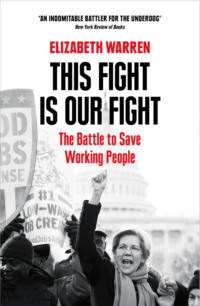
Kitabı oku: «This Fight is Our Fight: The Battle to Save Working People»


Copyright
William Collins
An imprint of HarperCollinsPublishers
1 London Bridge Street
London SE1 9GF
WilliamCollinsBooks.com
First published in Great Britain by William Collins in 2017
First published in the United States by Henry Holt and Company in 2017
Copyright © Elizabeth Warren 2017
Afterword copyright © Elizabeth Warren 2018
Cover photograph by Alex Wong / Staff / Getty Images
Elizabeth Warren assert the moral right to be identified as the author of this work.
A catalogue record for this book is available from the British Library
All rights reserved under International and Pan-American Copyright Conventions. By payment of the required fees, you have been granted the non-exclusive, non-transferable right to access and read the text of this e-book on screen. No part of this text may be reproduced, transmitted, down-loaded, decompiled, reverse engineered, or stored in or introduced into any information storage and retrieval system, in any form or by any means, whether electronic or mechanical, now known or hereinafter invented, without the express written permission of HarperCollins.
Source ISBN: 9780008254575
Ebook Edition © 2018 ISBN: 9780008254544
Version: 2018-05-12
Praise for Elizabeth Warren:
‘This Fight Is Our Fight is a smart, tough-minded book … What Democrats need right now is a reason to keep fighting. And that’s something Warren’s muscular, unapologetic book definitely offers. It’s an important contribution’
New York Times
‘This Fight Is Our Fight provides an insider’s look at the machinations that are undermining the US economy and political system. Warren spells out what is happening and what needs to be done to reverse the slide … It is unusual for any politician to be so open’
New York Journal of Books
‘Girded for battle, the senior senator from Massachusetts forcefully lays out the bleak picture of an American government increasingly controlled by corporate greed and special interests … The author sounds the alarm that an oligarchy is in the making, and her urgency is palpable and necessary. Inspiring words to empower Warren’s marching army’
Kirkus, starred review
‘Warren’s moment has arrived … To understand why Senator Elizabeth Warren is the fastest-rising new star in the Democratic Party … read her new book’
The Hill
‘A startling account of the elusiveness of the American Dream’
TIME
‘She is still the fiery advocate who called for a bureau to protect consumers’
New York Times
‘After reading this book, it is comforting to know that Elizabeth Warren, with her passion, anger and bluntness, will not be silenced’
Washington Post
‘Intelligent and informative … [Warren is] good, plainspoken company who makes you feel smarter for having spent such easy time with her’
Entertainment Weekly
‘As a politician and activist, Warren’s great strength is that she retains the outsider’s perspective, and the outsider’s sense of moral outrage … she doesn’t take no for an answer’
New York Review of Books
‘The Wall Street watchdog and US senator has produced a readable and sometimes infuriating explanation of the biggest financial crisis of our time’
People
‘[Warren] has a compelling story to tell … She is also entertaining about professional politics’
Economist
‘Revealing … Warren’s book describes the troubling patterns and practices of high-level Washington’
GRETCHEN MORGENSON, New York Times
‘Warren has written a good book … Frank and quite strong’
The Nation
‘[A] call to arms … you can hear the sound of the crowd roaring with approval’
Mother Jones
‘[Warren] displays a down-home charm and an effortless rapport with everyday people … Warren emerges as a committed advocate with real world sensibility, who tasted tough economic times at an early age and did not forget its bitterness’
Publishers Weekly, starred review
Dedication
To the people of Massachusetts, who sent me into this fight
Contents
Cover
Title Page
Copyright
Praise for Elizabeth Warren
Dedication
Prologue
1. The Disappearing Middle Class
2. A Safer Economy
3. Making—and Breaking—the Middle Class
4. The Rich and Powerful Tighten Their Grip
5. The Moment of Upheaval
Epilogue
Afterword to the 2018 Edition
Notes
Index
Acknowledgments
About the Author
Also by Elizabeth Warren
About the Publisher
Prologue
“I’ll get the popcorn.”
I yelled up the stairs to let Bruce know I was coming. I also had the beer and my laptop.
He had the television on, with the second season of Ballers lined up. Our son had hooked us on it the year before, and we’d been saving the shows until tonight—Election Night.
It was November 8, 2016. The polls were about to close in Massachusetts, and we were about to start our Election Night ritual: clicking back and forth between news reports and binge-watching something really fun on television. I had my laptop so I could check on the local races, and my phone so, assuming the night went well, I could make some congratulatory calls.
Yeah, until I won my Senate race in 2012 I’d have guessed that a senator would watch election returns like a pro: a big group of people in a war room somewhere, multiple television screens on the walls, phones ringing, people rushing in with last-minute information. Lots of coffee cups and pizza boxes strewn over desks. Someone making pithy remarks about what it means that with 2 percent of Illinois reporting, Duckworth has a four-point lead, and turnout in the Seventh Precinct is high, and so on. In fact, I think I’ve seen that scene in the movies.
But not Bruce and me, not tonight. I wasn’t on the ballot this year, so I wouldn’t be huddling with a campaign team. Besides, by this point, there wasn’t anything else I could do to affect the election’s outcome. And with so much on the line, I knew that watching the numbers drift in over the next few hours would be agony.
For so many of these races, I’d been out there with the candidates—cheered them on, given speeches standing next to them, frozen and sweated and stepped in muck right along with them. Hillary Clinton’s race, of course, was the night’s biggest, but I would be chewing my fingernails watching the Senate races as well. There was Catherine Cortez Masto, a former attorney general in Nevada whom I’d worked with while fighting the banks during the housing crisis eight years ago. Katie McGinty, a former environmental policy official in Pennsylvania who was trying to unseat a Republican who seemed to be funded by an endless supply of Wall Street money. Russ Feingold, the former senator from Wisconsin who had been in the trenches with me as we’d fought to save families from predatory lenders fifteen years earlier and was making a strong push to get his old seat back. Maggie Hassan, the governor from just across the border in New Hampshire, where I had gone time after time to help out. Jason Kander, a progressive Democrat in Missouri who was running uphill hard. Tammy Duckworth, a vet in Illinois who had lost both legs in Iraq and, no surprise, turned out to be a fierce campaigner. Kamala Harris, the California AG I’d gone into battle with shoulder to shoulder many times. And so many more. For months, these candidates had put it all on the line. Faces, names, stories—they all crowded in that night, and I was anxious and hopeful and fearful for every one of them.
No, I didn’t want to watch the numbers trickle in with a big group. I just wanted to be at home with Bruce. That night we did what we always did—toggled back and forth between a television show and the election results. Sitting on the couch eating popcorn, drinking beer, and hoping for the best.
Ballers was terrific. The 2016 election, not so much.
The first sign of trouble was how quickly several Senate races were called for Republicans. Indiana. Florida. Suddenly candidates we thought would win were struggling—Russ in Wisconsin and Katie in Pennsylvania. And then it looked like Hillary was in trouble, too.
It was like watching a train wreck in slow motion. One car hurtled off the tracks, then another crumpled, then fires and explosions and bodies flying everywhere.
As I watched the White House slip away and the Democratic losses mount, I knew that a lot of people would spend weeks analyzing what had gone wrong, how this moment had come to pass. There would be lots of pundits. (“I always knew …”) Lots of partisans. (“Of course this loss happened because they …”) Lots of political types certain that they could have done it all much, much better.
Sure, there would be endless autopsies of the 2016 campaigns, but as that long night wore on, I found myself thinking less about the political winds and more about how the fallout from this election would deliver one more body blow to so many working families. The television showed crowds of candidates and supporters celebrating or grieving, but what haunted me was the thought that for tens of millions of Americans, life was about to get a whole lot tougher.
LONG BEFORE I ever came within a hundred miles of politics, I had been a teacher and a researcher. I had spent years tracking what was happening to America’s middle class, what was happening to working families and families that wanted to be working families. It was a great and terrible story.
The tale of America coming out of the Great Depression and not only surviving but actually transforming itself into an economic giant is the stuff of legend. But the part that gives me goose bumps is what we did with all that wealth: over several generations, our country built the greatest middle class the world had ever known.
We built it ourselves, using our own hard work and the tools of government to open up more opportunities for millions of people. We used it all—tax policy, investments in public education, new infrastructure, support for research, rules that protected consumers and investors, antitrust laws—to promote and expand our middle class. The spectacular, shoot-off-the-fireworks fact is that we succeeded. Income growth was widespread, and the people who did most of the work—the 90 percent of America—also got most of the gains. In the 1960s and 1970s, I was one of the lucky beneficiaries of everything America was building, and to this day, I am grateful to the bottom of my soul.
But now, in a new century and a different time, that great middle class is on the ropes. All across the country, people are worried—worried and angry.
They are angry because they bust their tails and their income barely budges. Angry because their budget is stretched to the breaking point by housing and health care. Angry because the cost of sending their kid to day care or college is out of sight.
People are angry because trade deals seem to be building jobs and opportunities for workers in other parts of the world, while leaving abandoned factories here at home. Angry because young people are getting destroyed by student loans, working people are deep in debt, and seniors can’t make their Social Security checks cover their basic living expenses. Angry because we can’t even count on the fundamentals—roads, bridges, safe water, reliable power—from our government. Angry because we’re afraid that our children’s chances for a better life won’t be as good as our own.
People are angry, and they are right to be angry. Because this hard-won, ruggedly built, infinitely precious democracy of ours has been hijacked.
Today this country works great for those at the top. It works great for every corporation rich enough to hire an army of lobbyists and lawyers. It works great for every billionaire who pays taxes at lower rates than the hired help. It works great for everyone with the money to buy favors in Washington. Government works great for them, but for everyone else, this country is no longer working very well.
This is the most dangerous kind of corruption. No, it’s not old-school bribery with envelopes full of cash. This much smoother, slicker, and better-dressed form of corruption is perverting our government and making sure that day after day, decision after decision, the rich and powerful are always taken care of. This corruption is turning government into a tool of those who have already gathered wealth and influence. This corruption is hollowing out America’s middle class and tearing down our democracy.
In 2016, into this tangle of worry and anger, came a showman who made big promises. A man who swore he would drain the swamp, then surrounded himself with the lobbyists and billionaires who run the swamp and feed off government favors. A man who talked the talk of populism but offered the very worst of trickle-down economics. A man who said he knew how the corrupt system worked because he had worked it for himself many times. A man who vowed to make America great again and followed up with attacks on immigrants, minorities, and women. A man who was always on the hunt for his next big con.
In the months ahead, it would become clear that this man was even more divisive and dishonest than his presidential campaign revealed. But on election night, I stared at the television as it sank in that this man was about to become the next president of the United States.
The election results kept rolling in, and I knew that plenty of people would be eager to describe the special appeal of Donald Trump and explain all the reasons why he won. But we need more than an explanation of just one election; we also need to understand how and why our country has gone so thoroughly wrong. We need a plan to put us back on track—and then we need to get to work and make it happen.
We need to live our values, to be the kind of nation that invests in opportunity, not just for some of us, but for all of us. We need to take our democracy back from those who would pervert it for their own benefit. We need to build the America of our best dreams.
Sitting on the couch with Bruce, I watched Donald Trump say that his presidency would be “a beautiful thing.” No, I thought, it won’t be anything like beautiful. Worse, the man who would soon move into the White House had the capacity to bear down on a middle class that was already on the ropes and deliver the knockout punch.
If ever there was a time to fight, this was it.

1
The Disappearing Middle Class
I was ready to go.
It was a Thursday morning in March 2013. I’d been in the Senate for two and a half months, and this was our first hearing on the minimum wage. For close to four years, the federal minimum wage had been frozen at $7.25 an hour. The rate was already low by historic standards, and a lot of workers were sinking. Minimum wage is just that—the minimum.
When I am home in Massachusetts, I make a point of speaking with as many Bay Staters as I can. This includes the people who do the service work in big buildings. These are the workers who stock the office kitchens, keep the buildings clean, provide security. I’ve been struck by how many of them hold down two or three jobs just to stay afloat. Women who take the T into Boston, work a full shift cleaning buildings, then stay to work a morning shift at one of the counters at South Station. Men who push wheelchairs and haul bags at Logan Airport all day, then drive cabs or work security in the evening. And I meet them outside Boston too. Mothers and fathers in New Bedford and Fall River, in Worcester and Springfield, who work at fast-food places in town or on the highway, piecing together a living from whatever jobs they can find. A woman up on the North Shore told me she sleeps in her car in the parking lot in the hours between when one job ends and the other begins. She said she’s so tired that when she drives to her mother’s house to pick up her baby daughter, she falls asleep on the couch the minute she gets there. Low-wage workers—in Massachusetts and in all the other states too—are among the hardest working people in America.
I’m pretty hard-core about this issue. The way I see it, no one in this country should work full-time and still live in poverty—period. But at $7.25 an hour, a mom working a forty-hour-a-week minimum-wage job cannot keep herself and her baby above the poverty line. This is wrong—and this was something the U.S. Congress could make better if we’d just raise the minimum wage. We could fix this now.
Ten weeks on the job, and it still gave me a thrill to walk into the Senate hearing rooms, notebook tucked under my arm. This room was like a stage set: high ceilings, heavy paneling, and dark blue carpets. The lights were mounted on the walls, giant art deco torches that looked like they were illuminating an ancient temple. The room was so vast that everyone had to use microphones just to hear each other.
Senators were seated on a raised platform, assigned places around a giant, wood-paneled horseshoe-shaped dais. Our chairs were huge, high-backed leather affairs, sort of ancient king meets modern CEO. Witnesses sat at a low table in the open part of the U, with the audience behind them. The room’s design is intended to evoke the grandeur and solemnity of the Senate, a not-very-subtle reminder of the power of this body.
In keeping with the Senate’s rigid deference to seniority and my junior status, my chair was the farthest from center stage, out on one end of the horseshoe. I didn’t care. I was aware that this was pretty routine stuff for most senators. And okay, I understood that this committee wasn’t going to do a movie moment and suddenly jump up and demand in the name of working people everywhere that Congress increase the minimum wage.
I knew that, but I also knew that the move to raise the minimum wage was gaining traction around the country. And I knew that this hearing was a pretty good platform to move that fight forward. After all, this committee really did have the power to recommend a raise for thirty million Americans, and even if we weren’t going to do it today, I wanted to make sure we made some progress. If you don’t fight, you can’t win.

Committee hearing on the minimum wage. That’s me at the far right end of the horseshoe.
I also understood that for more than forty years, workers’ pay hadn’t kept pace with inflation. Productivity had gone up. Profits had gone up. Executives had gotten raises. Couldn’t we at last come together to make sure that the people who did some of the hardest, dirtiest work in the nation got at least a chance to build a little security?
And couldn’t we also give this whole “bipartisan” thing another try? Since the 1930s, Republicans had joined Democrats to support periodic increases to the minimum wage, and now, after four years of holding steady, I thought we might come together for some kind of increase. Okay, it probably wouldn’t be as much as I wanted, but couldn’t we at least do something?
No. The Republicans were locked in: they would block any efforts to increase the minimum wage by even a few nickels.
The hearing produced some sharp back-and-forth about the impact that raising the minimum wage might have on jobs. The data are clear: study after study shows that there are no large adverse effects on jobs when the minimum wage goes up—and one of the country’s leading experts was sitting right in front of us testifying to exactly that point. I battled a couple of the other witnesses, and I got in my licks about how far the real minimum wage had fallen, but after about an hour and a half, the hearing began winding down.
I gathered up my papers, ready to leave as soon as the gavel fell. Lamar Alexander, the senator from Tennessee and the most senior Republican on the committee, was asking his last questions when a witness interrupted him to point out that Congress was responsible for setting the right level for the minimum wage.
Senator Alexander replied that if he could decide, there would be no minimum.
No minimum wage at all. Not $15.00. Not $10.00. Not $7.25. Not $5.00. Not $1.00.
The comment was delivered quite casually. It wasn’t a grand pronouncement shouted by a crazy, hair-on-fire ideologue. Instead, a longtime U.S. senator stated with calm confidence that if an employer could find someone desperate enough to take a job for fifty cents an hour, then that employer should have the right to pay that wage and not a penny more. He might as well have said that employers could eat cake and the workers could scramble for whatever crumbs fall off the table.
For just a blink, I wasn’t in a heavily paneled Senate hearing room. I wasn’t sitting at an elevated dais. I didn’t have an aide seated behind me and cameras pointed my way.
FOR JUST A blink, I was a skinny sixteen-year-old girl, back in Oklahoma City. It was early in the fall, and I had just started my senior year of high school.
By then we were a small family: all that was left of us was Mother, Daddy, and me. My three older brothers had each in turn left for the military, gotten married, and were starting families of their own.
Like every family, we’d had our ups and downs, but from my teenage perspective, life felt a little steadier again. Mother answered phones at Sears, and Daddy sold lawn mowers and fences. Two paychecks. It had been a couple of years since the bill collectors had called or people had threatened to take away our home. Late at night, I no longer heard the muffled sounds of my mother crying.
But it was still tough. There was no extra money, no breathing room. I waited tables and babysat. I picked up a few dollars sewing and ironing, although nothing regular. I was sixteen—sixteen and watching the world slip away. This was my last year of high school, and it looked like everyone at Northwest Classen had a future, everyone except me. All my friends were talking about college. They went on nonstop as they compared schools and sororities and possible majors. No one seemed to worry about what it would cost. Me? I didn’t have the money for a college application, much less tuition and books. Some days it seemed like college might as well have been on the moon.
It was a miserable time in my life.
One night my mother and I had another fight about what I should do after high school. I look back now and realize that she was trying her best. She worked long hours, and she sometimes seemed stretched to the breaking point.
On this one night, it all spun out of control. She had been yelling at me. Why was I so special that I had to go to college? Did I think I was better than everyone else in the family? Where would the money come from? I did the usual: I stared at the floor in silence, and when I’d had enough, I retreated to my bedroom. But this time, retreat wasn’t enough. She followed me into my room and kept yelling. I finally jumped up from my desk and screamed at her to leave me alone.
Quick as lightning, she hit me hard in the face.
I think we were both stunned. She backed out of my room. I stuffed a handful of clothes into a canvas bag and raced out the front door.
Hours later, Daddy found me downtown, sitting on a bench at the bus station. My face was red, and I was still shaking. I was hurt—hurt and discouraged.
Everything in my life seemed wrong.
Daddy sat down beside me on the bench, and for a long time he said nothing. Both of us stared ahead. After a while, he asked if I was hungry. He walked over to a vending machine and brought back some cracker sandwiches. Then he asked me if I remembered the time after his heart attack, those hard months when he and Mother were sure they were about to lose the house.
I remembered.
It had been nearly four years earlier. After his heart attack, Daddy had been in the hospital for a long time, and when he came home he was gray and even quieter than usual. He spent hours sitting alone, smoking cigarettes and looking off into space. He moved into the tiny bedroom that had been left empty when my brother David joined the army.
For months, my mother carried around Kleenex or the cheap off-brand she usually bought. She worked the tissues into shreds, leaving them balled up in ashtrays and on her dresser. But she always had one ready in case she started to cry. And she cried a lot.
Daddy said it was the worst time in his life. Worse than when the doctors thought the lumps on his neck were cancer. Worse than when his best friend, Claude, died. Worse than when he was in a terrible car crash and smashed through the windshield and tore his shoulder open.
“Your mother was at home when they took the station wagon,” he said, his voice low. “And then they said they were going to take the house. She cried every night.”
He paused for a long time. “I just couldn’t face it.”
Sitting there on the bench in the bus station, he told me that he had failed and that the shame had nearly killed him. He wanted to die. He wanted to disappear from our lives and from the earth and from everything that had gone wrong. He would think about how bad things were and ask whether this was the night to leave my mother and me.
What happened? I asked.
Daddy sat silently for a long time, caught somewhere in his memories of those awful days. He still didn’t look at me. Finally, he took my hand in both of his and held it tightly.
It got better, he said. Your mother found work. We made some payments. After a while, I went back to work. We had less money, but it was enough to get by. We got caught up on the mortgage. You seemed to do okay.
Finally he turned and looked at me. “Life gets better, punkin.”

My daddy said, “Life gets better, punkin.”
And that’s how I’d always remembered this moment: my daddy telling me to hang on, that no matter how bad it feels, life gets better. I had carried that story in my pocket for decades. It was how I made it through the painful parts. Divorce. Disappointments. Deaths. Whenever things got really tough, I would pull out that story and hold it in my mind. I’d hear my daddy’s voice, and I’d always feel better. By now, his line was a part of me.
Life gets better, punkin.
IT WAS JUST a blink before I was back in that fancy hearing room again. But that’s all it takes—just a blink—to change someone’s life. My daddy’s life. My mother’s life. My life.
As I walked back to my office, I thought about how close my family had come to disaster. After my daddy’s heart attack, we were tumbling down a hill toward a cliff, and we had been just about to go over the edge when my mother grabbed a branch—a job at Sears. She was fifty years old, and for the first time in her life she had a job with a paycheck. She answered phones and took catalog orders. In a cramped room with no windows, eight women, mostly hard-pressed mothers like her, sat all day long, ready to help customers who called. She wore high heels and hose, and every day she and her coworkers took forty minutes for lunch and two breaks that lasted exactly ten minutes each.
And she was paid minimum wage.
So when Senator Alexander said there would be no minimum wage if it were up to him, I thought about how much that job had meant to Mother and Daddy and me. My mother’s minimum-wage job not only saved our house—it saved our family. No, it didn’t make our lives perfect. It took years to work off the medical bills from my father’s heart attack. My mother worked and reworked her grocery list to squeeze out every last nickel. The carpet in the living room got worn through to the bare floor. And there were times when my mother’s anxieties took over and she lashed out, and times when my daddy got scary quiet. But we hung together. We made it—shaken, but still standing.
What if Mother hadn’t earned enough money to keep us going after Daddy got sick? We’d already lost the family station wagon. What if we’d lost the house? What would the shame have done to my daddy? And if he had left us forever? What would the loss have done to Mother and me? Would I have ever made it to college? Or would she and I have clung to each other, both so fatally wounded that neither of us could ever have recovered?
I don’t know what would have happened if Mother hadn’t been able to break our fall with a minimum-wage job at Sears. But I do know that policy decisions about important issues like the minimum wage matter. Those decisions—made in far-off Washington, reached in elegant rooms by confident, well-fed men and women—really matter.
Back in the 1960s, when my mother worked at Sears, a minimum-wage job could keep a family of three afloat. Mother had a high school education and no work experience, but when Sears needed someone to answer the phones, the law required the company to pay her an hourly rate that was enough to keep our family of three up and on our feet.
And that’s where the sick-in-the-back-of-the-throat unfairness of it nearly chokes me. In the years since my mother went to work at Sears, America has gotten richer. In fact, the country’s total wealth is at an all-time high.
My mother wasn’t much into politics, but I’m sure she would have assumed that fifty years later, the minimum wage would be a lot higher. If it could feed a family of three and pay a mortgage in 1965, surely by now a minimum wage would let a family afford, say, a home and a car—and maybe even a little money for college applications for a skinny daughter. Right?
Wrong. Way wrong.
Adjusted for inflation, the minimum wage today is lower than it was in 1965—about 24 percent lower. That job at Sears allowed my mother to eke out a living for a family of three; today, a mother working full-time and getting paid the minimum wage cannot afford the rent on the average two-bedroom apartment anywhere in America. In Oklahoma, where I grew up, that mother wouldn’t even come close to providing a poverty-level income for her family. Paying rent, keeping groceries on the table, having a little money left over for school shoes or lunch money—those are all out of reach. Today a mother who tries to break her family’s fall simply can’t grab the same branch that was there for my family.
Today, Washington has decided to turn away as more families than ever tumble over a financial cliff and crash on the rocks below. I’m in my fifth year in the United States Senate, and during my time in office I’ve learned a bitter lesson: a Republican-led Congress just doesn’t care.
Where people end up in life is about more than hard work and good fortune. The rules matter, too. It matters whether the government blows tens of billions of dollars on tax loopholes for billionaires or whether that same money is used to lower costs for students who have to borrow money to go to college. It matters whether Wall Street can pocket billions of dollars by cheating people on mortgages and tricking them on credit cards or if there’s a cop on the beat to keep them honest. It matters whether the minimum wage is set so low that a full-time worker still lives in poverty or if minimum wage also means a livable wage.
When I sit in meetings or conferences and listen to people who have investment portfolios and second homes worry about the impact of raising the minimum wage on giant businesses like McDonald’s and Best Buy without a single thought about how the fry cooks or checkout clerks support themselves and their families from week to week, I grind my teeth until my head hurts. When I hear senators make oh-so-clever theoretical economic arguments while ignoring rock-solid data, I want to scream. When President Trump nominates a labor secretary who opposes a living wage and who made his own fortune by squeezing fast-food workers, I get the urge to bang my head on the table. And when I hear my colleagues in Congress express their deep concern for those who have already made it even as they cheerfully dismiss everyone who is busting their rear just to get by, the fury rises in me like a physical force.
The America of opportunity is under assault. We once ran this country to benefit hardworking people who didn’t have much, to grow a middle class, to create opportunities for our kids. We once held up the ideal that poor kids would get the same chances in life as everyone else.
We once believed that opportunity was not a zero-sum game; more for me didn’t have to mean less for you.
We once believed that the greatest country on earth could bend our future toward more opportunity for more of our people. But today every decision in Washington has a tilt. Politicians think about how they will fund their next campaigns, lobbyists press for every advantage, and armies of fancy corporate lawyers encircle government agencies. Big-deal executives earn millions on Wall Street, then spin through a revolving door that puts them in charge of government policy for a few years before they go back to the corporate side to make even more money. Think tanks support so-called experts who will offer an opinion on anything—if the price is right. The result is that the rich and powerful flourish, while everyone else is left further and further behind. The cumulative impact of decades of these decisions has been to hollow out America’s middle class and to leave us, as a nation, weakened.
The game is rigged. It is deliberately, persistently, and aggressively rigged to help the rich and powerful get richer and more powerful. Whether mild-mannered men or crazy demagogues are pushing policy decisions, it matters what those decisions are and who they are designed to help.
MIDDLE-CLASS AND BROKE
A lot of people say the game isn’t rigged. Some very smart people who are fully committed to making this a better country sing the praises of the American economic system. And they have a lot of numbers to back them up. Yes, there was a dip around the time of the 2008 crash, but the big picture looks great. As a country, America keeps getting richer and richer and richer.
There are so many happy stories to tell:
The stock market is up up up.
Corporate profits are breaking new records.
Inflation has remained low for years.
The amount of wealth we produce every year is double what it was a generation ago.
Unemployment is down, and a lot of people thrown out of work after the financial crash now have jobs.
It’s gotten so good that even lavish Wall Street parties have ratcheted up. Citadel, a major hedge fund, had a good 2015. It celebrated with a party featuring Katy Perry (for a rumored $500,000) and another party starring Maroon 5 (also $500,000 or so) along with—my favorite touch—violinists suspended from the ceiling by cables. Maroon 5 and Katy Perry are hugely talented, and both have fought hard for progressive causes. If a billionaire wants to pay them and an army of violinists a fortune, they should all take the money. But good grief, a party where just the entertainment costs as much as it would take to feed a family of four for half a century? The next year, according to news reports, Citadel’s CEO was buying a new condo spanning three floors of a high-rise overlooking Central Park, a pad priced at a cool $200 million. This condo in the sky has about the same square footage as twelve typical American homes. And why shouldn’t he go for it? He had already set the records for the most expensive home purchases in Chicago and Miami, so obviously it was time to upgrade his New York digs.
Pop the champagne corks!
But before we clink our glasses and exchange air kisses, let’s slide past all those cheery headlines and swanky celebrations and take a close look at the reality that is lived by millions of American families. Even a quick glance is enough to cause whiplash. What we see are people who get up when it’s still dark outside, work all day, go on to a second job in the evening, and then fold a pile of laundry late at night so they can accomplish that one last thing before they fall into bed. We see men and women who work as hard as they possibly can and still fall behind a little more every month. We see lives that look nothing like those lived by billionaires in eighteen-thousand-square-foot condos, because these people don’t live in some fairy tale—they live in today’s reality.
NOT LONG AFTER I started writing this book, I talked with a woman I’ll call Gina. She is fifty—the same age my mother was when she headed off to Sears. Gina wanted to tell her story, but she asked for her name and some details about her life to be changed in the book so her neighbors and her employer wouldn’t recognize her, and I promised to do that.
Gina is full of nervous energy—quick bursts of laughter, quick flashes of anger. Short, compact, and sandy-haired, she’s the kind of woman who talks to people around her in the grocery store line and who knows every clerk by name. She’s a loyal friend and a proud American.
Gina grew up with four sisters. Her dad died when she was a teenager, and from then on her mom ran the family business, a local bar. Gina gives a throaty laugh as she claims that “her mother knew every single dirty joke” ever told.
Her story starts out well. Gina went to college and got a business degree. She met Darren and fell in love. They had both lived all over the country, and they decided to settle in a small town in North Carolina because it seemed like such a nice place to raise a family. Soon they had two boys, but for Gina and Darren, the grown-up, we-have-found-our-place-in-the-middle-class moment arrived when they bought their home. It was a tidy, almost-new mobile home, permanently set on a large lot with a long gravel driveway.
Gina speaks in a rush, wanting to make very clear the importance of this house—what it says about who she is and what she has accomplished. “I love the house,” Gina says. “We keep it immaculate. We live on the corner here. The whole world sees us.”
Gina had a good education, but when their two boys were small she decided to stay home with them. She volunteered at the boys’ school and took up scrapbooking, making little treasures out of bits of nothing. It was a good time for their family.

One of Gina’s artistic handiworks, a Christmas decoration.
Once both boys were in school, Gina headed off to work. She got a job as a sales rep for a big national company, making calls on retailers across a three-county area. Darren was doing well as a roofer. He owned a truck, Gina had a car, and by the late 2000s, they were bringing in about $70,000 a year.
Their income put Gina and Darren smack in the middle; they earned more than about half of all four-person families in America and less than about half—which is about as solidly middle-class as it gets. But even with a good, solid income, Gina and Darren were mostly stay-at-home people. They shopped at discount stores. An occasional meal out usually meant Denny’s or Chili’s. Most of all, Gina and Darren were careful people. They contributed to their 401(k), bought a few stocks, made extra payments on their mortgage, and put away some cash savings. They were a perfect picture of what it meant to be a member of a huge tribe: solid, middle-class America.
Today, Gina is still married to Darren, still living in the same house, still gluing buttons and bits of lace into her scrapbooks. Is she still middle-class? Her answer is short and bitter:
“I don’t think there is a middle class anymore. If there was a middle class, we wouldn’t need to go to a food pantry.”
Darren’s work as a roofer has been spotty, and he’s had trouble with his back and knees. Gina works at Walmart now, and that’s what keeps them going.
Their stocks and their savings are gone, used to fill in during the stretches when one or both of them were out of work. The small 401(k) has nearly disappeared. There was no money to help either of the boys pay for college, and now their sons are nearly grown men. Both work odd hours and live at home because neither one can afford a place of his own.
Gina’s car is now seventeen years old. She and Darren have talked about selling their home, but she says their mortgage is less than they’d pay in rent, and a mobile home like theirs—even though it’s on a big lot—doesn’t appreciate much. They have a stack of bills that, in her quietest moments, Gina admits to herself they will never pay off. Why? Because today Gina and Darren’s combined income is less than $36,000.
What happened? What’s the tale of shocking personal tragedy and extraordinary misfortune that landed a solidly middle-class woman like Gina at the doorstep of the food pantry?
Nothing.
No crisis. No accident. No tale of woe. Just the grinding wear and tear of an economy that doesn’t work anymore for families like Gina’s.
And that’s the part of this story that makes me want to pound the table in frustration. What happened to Gina and Darren is the modern economy—the one that produces all those bubbly stock market records and corporate profits and private concerts with Katy Perry. What happened is an economic boa constrictor that is squeezing working families so hard they can’t breathe.
Gina’s basic story could be repeated in millions of households across America with only small variations. Could be? Shoot, it is repeated, again and again and again.
But the part of her story that bothers me the most is that Gina did everything just the way she was supposed to. She worked hard—no, she worked herself into the ground for years, getting up for a two-and-a-half-hour commute to work and stretching her food budget so they could pay a little extra on the mortgage. She played by every rule: savings, insurance, retirement. And now she’s fifty years old and on a long slide down. The family that used to eat out occasionally now needs to visit the food pantry to make it to the end of the month.
Fortune smiles on some more than others, and no one is guaranteed smooth sailing. I get that. But Gina is not alone. Instead, she’s part of the collateral damage of a mostly invisible dismantling of America’s middle class. She and millions of other once-middle-class families may keep up appearances, they may keep their lawns mowed and smile and wave to their neighbors, but their economic lives have become a new kind of hell.
When Gina talks, her voice says as much as her words. The pride in her home. The worry over her sons. The bravado, the gravelly I-can-take-whatever-life-dishes-out attitude. And the small tremor of desperation.
What comes next for Gina? What happens when Darren can’t work anymore? When they can’t hold it together? What will they do when the doctor thinks it’s time to start on a medication for high blood pressure that has a $50 copay or when the transmission finally falls out of the car? No wonder Gina talks fast and sometimes sounds like she can barely breathe.
Consider a few other facts—the not-so-smiley-face facts—about the American economy:
Nearly one in four Americans can’t pay their bills on time.
Nearly half of Americans would not be able to cover an unexpected expense of $400.
A lower proportion of Americans own their homes than at any time in the past half century—63.5 percent.
The typical man working full-time earns less today than his counterpart did in 1972.
Nearly one-third of the country’s adult population—76 million Americans—describe themselves as either “struggling to get by” or “just getting by.”
The overall economic statistics—the GDP, the stock market, corporate profitability, unemployment—are powerfully important, but the rosy picture they paint has huge blind spots, and those blind spots hide much of America’s lived experience. As America’s middle class is hollowed out, these numbers become even less accurate in describing what is happening to Gina or millions of other people like her. Growth in GDP said something far more revealing about America back when that growth was widely shared. Stock prices better reflected the growing security of the middle class when more people saved and when their companies invested in pensions for them. Corporate profitability meant a lot more when it wasn’t a function of massive layoffs and moving operations overseas. Unemployment statistics were more useful indicators when people were offered full-time jobs with benefits, rather than twenty random hours at Walmart. Unemployment figures also mattered more when the minimum wage kept people out of poverty.
I’m happy that the GDP is up and unemployment is down. Yay! But I’m not drinking champagne. In fact, I’m hitting alarm buttons everywhere I can. Our once-solid middle class is in mortal danger—in danger and running out of time. Every one of those happy numbers is used by nearly every economic reporter and pundit and politician, but those numbers paper over the fact that America’s middle class is literally disappearing.
NO MONEY, NO TIME
Gina says she feels lucky to have a job, but she is pretty blunt about what it is like to work at Walmart: she hates it. She’s worked at the local Walmart for nine years now, spending long hours on her feet waiting on customers and wrestling heavy merchandise around the store. But that’s not the part that galls her.
Last year, management told the employees that they would get a significant raise. While driving to work or sorting laundry, Gina thought about how she could spend that extra money. Do some repairs around the house. Or set aside a few dollars in case of an emergency. Or help her sons, because “that’s what moms do.” And just before drifting off to sleep, she’d think about how she hadn’t had any new clothes in years. Maybe, just maybe.
For weeks, she smiled at the notion. She thought about how Walmart was finally going to show some sign of respect for the work she and her coworkers did. She rolled the phrase over in her mind: “significant raise.” She imagined what that might mean. Maybe $2.00 more an hour? Or $2.50? That could add up to $80 a week, even $100. The thought was delicious.
Then the day arrived when she received the letter informing her of the raise: 21 cents an hour. A whopping 21 cents. For a grand total of $1.68 a day, $8.40 a week.
Gina described holding the letter and looking at it and feeling like it was “a spit in the face.” As she talked about the minuscule raise, her voice filled with anger. Anger, tinged with fear. Walmart could dump all over her, but she knew she would take it. She still needed this job. They could treat her like dirt, and she would still have to show up. And that’s exactly what they did.
In 2015, Walmart made $14.69 billion in profits, and Walmart’s investors pocketed $10.4 billion from dividends and share repurchases—and Gina got 21 cents an hour more. This isn’t a story of shared sacrifice. It’s not a story about a company that is struggling to keep its doors open in tough times. This isn’t a small business that can’t afford generous raises. Just the opposite: this is a fabulously wealthy company making big bucks off the Ginas of the world.
There are seven members of the Walton family, Walmart’s major shareholders, on the Forbes list of the country’s four hundred richest people, and together these seven Waltons have as much wealth as about 130 million other Americans. Seven people—not enough to fill the lineup of a softball team—and they have more money than 40 percent of our nation’s population put together. Walmart routinely squeezes its workers, not because it has to, but because it can. The idea that when the company does well, the employees do well, too, clearly doesn’t apply to giants like this one.
Walmart is the largest employer in the country. More than a million and a half Americans are working to make this corporation among the most profitable in the world. Meanwhile, Gina points out that at her store, “almost all the young people are on food stamps.” And it’s not just her store. Across the country, Walmart pays such low wages that many of its employees rely on food stamps, rent assistance, Medicaid, and a mix of other government benefits, just to stay out of poverty.
The next time you drive into a Walmart parking lot, pause for a second to note that this Walmart—like the more than five thousand other Walmarts across the country—costs taxpayers about $1 million in direct subsidies to the employees who don’t earn enough money to pay for an apartment, buy food, or get even the most basic health care for their children. In total, Walmart benefits from more than $7 billion in subsidies each year from taxpayers like you. Those “low, low prices” are made possible by low, low wages—and by the taxes you pay to keep those workers alive on their low, low pay.
As I said earlier, I don’t think that anyone who works full-time should live in poverty. I also don’t think that bazillion-dollar companies like Walmart ought to funnel profits to shareholders while paying such low wages that taxpayers must pick up the ticket for their employees’ food, shelter, and medical care. I listen to right-wing loudmouths sound off about what an outrage welfare is and I think, “Yeah, it stinks that Walmart has been sucking up so much government assistance for so long.” But somehow I suspect that these guys aren’t talking about Walmart the Welfare Queen.
Walmart isn’t alone. Every year, employers like retailers and fast-food outlets pay wages that are so low that the rest of America ponies up a collective $153 billion to subsidize their workers. That’s $153 billion every year. Anyone want to guess what we could do with that mountain of money? We could make every public college tuition-free and pay for preschool for every child—and still have tens of billions left over. We could almost double the amount we spend on services for veterans, such as disability, long-term care, and ending homelessness. We could double all federal research and development—everything: medical, scientific, engineering, climate science, behavioral health, chemistry, brain mapping, drug addiction, even defense research. Or we could more than double federal spending on transportation and water infrastructure—roads, bridges, airports, mass transit, dams and levees, water treatment plants, safe new water pipes.
Yeah, the point I’m making is blindingly obvious. America could do a lot with the money taxpayers spend to keep afloat people who are working full-time but whose employers don’t pay a living wage.
Of course, giant corporations know they have a sweet deal—and they plan to keep it, thank you very much. They have deployed armies of lobbyists and lawyers to fight off any efforts to give workers a chance to organize or fight for a higher wage. Giant corporations have used their mouthpiece, the national Chamber of Commerce, to oppose any increase in the minimum wage, calling it a “distraction” and a “cynical effort” to increase union membership. Lobbyists grow rich making sure that people like Gina don’t get paid more.
The result is that for decades, the policies and rules that once served to build a robust middle class no longer offer the same kind of foundation.
EARLIER I MENTIONED that when I was a kid, my mother’s minimum-wage job paid enough to let us cover our mortgage and keep food on the table. We didn’t need welfare or food stamps because the minimum wage set a floor that would support us without taxpayer help. But there was something else different about my mother’s job. When she got hired by Sears two generations ago, she worked for a predictable forty hours a week. If Sears was busy, she got a paycheck. If Sears wasn’t busy, she still got a paycheck.

My mother is the tall one in the plaid dress. Her minimum-wage job at Sears covered our mortgage and put food on the table.
Gina describes life at Walmart as a constant fight to get enough hours to support her family. Walmart deliberately overhires, which then puts workers in competition for shifts. Even though she’s worked at the store for nearly a decade, Gina doesn’t get her work schedule far enough in advance to plan a trip to the dentist. And she doesn’t know how many hours she will get each week or whether her paycheck will be enough to cover the basics.
Gina thinks the crazy Walmart system of scheduling work isn’t just about keeping the store open. She believes it’s about raw power. She talks about her friend named Nicole, who is trying to support herself and her little boy on a Walmart paycheck. “She needs more hours. She was trying to do better, so she was taking classes at the local community college at night,” Gina says. Nicole was available every day and five evenings every week, but “she needed Tuesdays and Thursdays off at night” so she could go to class. “They wouldn’t give them to her.”
Why? Gina says that management wanted to show Nicole that she wasn’t any better than anyone else. “They use [the schedule] as punishment,” Gina says. “They were going to teach her a lesson.”
Once Gina starts talking about her coworkers, the examples tumble out one after the other. There are stories about workers whose schedules are changed without notice. Stories about workers who have anxiety attacks. Stories about workers who burst into tears in the break room because of bullying from higher up the food chain.
Gina has become a sort of anxious den mother. She started a food collection for the coworker living in his car. She sweet-talked one of the store managers into changing the work assignment for an elderly coworker who couldn’t do much heavy lifting after his bout of pneumonia. Gina tries to help her coworkers every chance she gets, but it’s never enough.
Even though she’s worked at Walmart for years now, her position at the company always feels unsteady. Talking to me didn’t help things. I repeatedly promised I wouldn’t use her name or tell anyone how to find her. She was always willing to talk—in fact, she would say, in a near shout, “We need to tell this story!” Then, in a much smaller voice, she would add, “But I really need this job.”
Employers in other industries have invented new models that are every bit as effective as Walmart’s efforts to eliminate guaranteed hours, fixed schedules, minimum wages, and benefits. They classify workers as subcontractors, independent contractors, or gig workers. Today, millions of hardworking people live in a world in which their incomes go up and down, their schedules shift from day to day, and they take whatever work is available. The much-touted virtues of independence and the creativity of the “flexible workforce” are undoubtedly true for some workers under some conditions. But for millions more, the new work economy adds up to little more than another setback in a losing effort to build some economic security in a world that is tilted against working families.
To get a sufficient number of hours, workers need to be available. But that availability comes at a cost. If she can’t go to community college, how will Nicole ever build up her skills and get a better job to support herself and her baby? How will she ever make enough to let go of her rent subsidy or food stamps? How will she ever move to a better neighborhood, one with nice parks and good schools?
It’s not just Nicole. How does the guy in the stockroom sign up for auto-repair classes at a nearby vo-tech school if McDonald’s won’t give him his schedule more than a week in advance? How does the woman working the front office set up a time to take her elderly mother in for checkups and physical therapy if her hours change every three days?
What about the food-service people and office cleaners I speak with in Massachusetts? Working two or three jobs is an economic necessity for them as they try to support their families, but with shifting hours in most places, it’s hard for them to piece together schedules that will let them show up when called. Some say they look for all-night cleaning jobs so they can have their days free to take second and third jobs. Childcare is a nightmare. No wonder that woman I met falls asleep the minute she gets to her mother’s house.
It’s a vicious double crunch: low wages and unpredictable schedules combine to make life an unending struggle for millions of Americans. It all works great for Walmart or the food-service company, but for people like Gina and her friend Nicole, it means they can barely scratch by. And it also means they are likely to keep on scratching by for the rest of their lives.
ANOTHER ONE-TWO PUNCH
I think a lot about the risks families face. Maybe anyone would do the same if she had watched her family go from driving around town in an almost-new station wagon to hearing her mother cry for days at a time as she faced the possibility that the family would be put out on the street. But what strikes me now is how much risk has changed. Long before I was born, people lost jobs and got sick and made bad decisions. My family lived through a very tough time when my daddy had a heart attack, but we recovered. The difference is that today’s families live much closer to the edge of a financial cliff—so close that millions of people can feel the bits of rock slipping under their feet long before big trouble strikes.
I’ve described this change before. I’ve written more than one book about it. I’ve talked about it. Sometimes I’ve even shouted about it. But the problem keeps getting worse.
Families today have been hit by a one-two punch. First, income. The best available apples-to-apples comparison of inflation-adjusted earnings shows what the typical fully employed man earned back in the 1970s and what that same fully employed man earns today. The picture isn’t pretty. As the GDP has doubled and almost doubled again, as corporations have piled up record profits, as the country has gotten wealthier, and as the number of billionaires has exploded, the average man working full-time today earns about what the average man earned back in 1970. Nearly half a century has gone by, and the guy right in the middle of the pack is making about what his granddad did.
The second punch that’s landed on families is expenses. If costs had stayed the same over the past few decades, families would be okay—or, at least, they would be in about the same position as they were thirty-five years ago. Not advancing but not falling behind, either. But that didn’t happen. Total costs are up, way up. True, families have cut back on some kinds of expenses. Today, the average family spends less on food (including eating out), less on clothing, less on appliances, and less on furniture than a comparable family did back in 1971. In other words, families have been pretty careful about their day-to-day spending, but it hasn’t saved them.
The problem is that the other expenses—the big, fixed expenses—have shot through the roof and blown apart the family budget. Adjusted for inflation, families today spend more on transportation, more on housing, and more on health insurance. And for all those families with small children and no one at home during the day, the cost of childcare has doubled, doubled again, and doubled once more. Families have pinched pennies on groceries and clothing, but these big, recurring expenses have blown them right over a financial cliff.

From 1970 to 2015, families cut some expenses and income went up a little, but big, fixed expenses skyrocketed.
This one-two punch—flat incomes and rising expenses—has hit the middle class squarely in the gut.
Beginning in the 1970s, many families responded to the growing financial pressure by sending everyone to work. Before then, it was usually just Dad. But as his paycheck flattened, everyone looked for ways to earn—Dad, Mom, and sometimes even the kids. And it helped. As more women took jobs, family incomes went up, and the family-income curve kept rising from the 1970s until the early 2000s. More family members drawing paychecks meant the family made more money overall.
But this new solution came with its own problems. First, many families don’t have two people who can go to work. A lot of couples can pull in two incomes, but plenty of them can’t. And America has lots of singles—single moms, single dads, singles on their own—and they are flat out of luck. Nicole would love to have someone else in her life who could help pay the rent and raise her baby, but that someone took off a long time ago—and she’s got to build some security right now.
And that’s one more double bind: Nicole and every other single person trying to make it face the same rising expenses that couples face. They struggle with more expensive health care, more expensive housing, more expensive education—the same costs that led other households to send both Dad and Mom to work—but they can’t send more than one person to work. Instead, they have only one paycheck to keep them afloat.
Even two-income families began to struggle. There were new costs for childcare, transportation, and work clothes. There was more eating out and less mending. That second paycheck wasn’t all gravy. On average, full-time care for kids under four now costs more than in-state college tuition.
With everyone in the workforce, new risks began creeping in at the edges. My stay-at-home mom hadn’t planned it that way, but when trouble hit, she was our family’s safety net. After Daddy had a heart attack, she went to work and brought home a paycheck. No, it wasn’t a big paycheck, but it was a new paycheck. Today all those single parents flying solo and couples with both partners already working don’t have someone new to send to work if there’s a crisis. So if the baby gets sick or Grandma falls and breaks her hip, someone has to stay home—and that will cost the family money. And if one of the wage earners becomes seriously ill or is laid off, there’s no additional partner to earn a new paycheck. The risks are high, and the safety net has disappeared.
Back in the early 1970s, when the typical family was earning just one income, they were able to put away about 11 percent of their take-home pay in savings. They also had only a sliver of credit card debt—less than 1 percent of their disposable income. But the income/expenses squeeze today means that families have cut their savings by two-thirds while their debt has multiplied a shocking fifteen times.
Now when something goes wrong, they have no savings to fall back on and they are already loaded with debt. (This was the story I told in The Two-Income Trap, a book I wrote in 2003 with my daughter, Amelia Tyagi.) Suddenly, when anything goes wrong, all those good, hardworking, solidly middle-class families are tumbling over a cliff.
Gina and Darren fell off that cliff. When both of them had good jobs, they bought a home and then poured every nickel, including their savings and retirement accounts, into keeping it. When Darren couldn’t get work or when Gina got sick, it hit their budget like a grenade. And they never had a way to pick up the slack—when they needed extra cash, there was no one else to send out into the workplace. For years they’ve been working harder and harder, but sometimes she lets out a deep sigh. “The longer I work here,” she says, “the farther behind in the bills we are getting.”
Gina is the modern-day version of my mother: years ago, she stayed home to raise the kids, but now she’s a breadwinner who works long hours for a major retailer. In fact, Gina is better educated and has more work experience than my mom did. Truth be told, she’s also a lot feistier. But unlike my mother, Gina can’t earn enough to put dinner on the table without help from a food pantry. My mom found a way to save us, but the odds are stacked much higher against Gina and her family.
EVEN HARDER
When America’s middle class is under assault, there’s pain everywhere, but much of that pain rains down harder on black and Latino families.
The evidence of this assault is especially clear when it comes to homes. Homes are good indicators of stability: when a family has its own home, the kids can go to the neighborhood school and the parents will usually take time to meet the neighbors and maybe even work together to spruce up the playground. Tiny condos and center-hall colonials, triple-deckers and Cape Cod farmhouses—homes are the tangible sign that a family is living the American dream.
Michael had the dream.
He was ready to tell me his story. Unlike Gina, he said, Sure, use my name—Michael J. Smith. Use my picture, too. I’m out there.
Michael is African American, married, and in his fifties. He’s a big guy, solidly built, with large hands. His smile is soft and almost sweet, and his voice is deep and reassuring; the gentle rhythms of his speech evoke his early years growing up in the South. For decades, Michael has been very involved in his church. More than once, he said to me, “It truly is our faith that keeps us going.”
When Michael’s family moved from Atlanta to the Woodlawn neighborhood of Chicago in the 1960s, his family and church held him close. There were gangs in his neighborhood, but Michael stayed on the path he believed in—God and family—and he never made a big decision without praying on it first.
As Michael tells his story, he warms up to all the good memories. In his twenties, he got a good job, married his high school sweetheart, and had three kids. They divorced, but he remarried soon after, and he and his wife, Janet, have a daughter named Ashley. From the first paycheck he ever took home, Michael started saving to make a down payment on a home. He and Janet bought their first home in Richton Park, a suburb of Chicago. As Michael put it, he always wanted “a neighborhood that was safe, that I could raise my children in, that was fenced in in the front and the back.” He particularly wanted his kids to have a yard to play in.
He kept those dreams front and center. Michael had a good job with DHL delivering packages and loading planes. Sometimes he was called on to do a lot of heavy lifting and there was pressure to get things done quickly, but he describes his time at DHL as “the most satisfying work I’ve ever done.” Janet worked at Chase for twenty-seven years, and she was proud that she had never missed a payment on any bill—ever. They kept right on saving, and after a few years Michael moved his family again, first to Hazel Crest, a predominantly African American suburb, and then to Homewood, which was more diverse.
When Michael spoke to me about the move to Homewood, he said, “We thought that we could do a little better.” But he and Janet didn’t jump right in. “We thought about it, prayed about it, looked at the numbers, and we had more than enough.”
Michael talks about the house he and Janet bought like it’s a beloved child. He tells about the three arches at the front of the house and about the pine trees in the backyard. He also wants me to know about the hedges out front where robins built a nest every spring. “We never clipped the hedges while the robins were there,” he notes. “They like their privacy.”
His conclusion: “We had kind of a great American story.”
Then the crash of 2008 hit and the bottom fell out. In the space of a few months, DHL eliminated 14,900 jobs—including Michael’s.
After sixteen years on the job, he felt like he’d been run over by one of his own trucks. Frantically, he spent the months that followed looking for part-time work wherever he could find it. But no one was hiring, and he quickly understood that he had no chance of getting a full-time job that paid as well as his old one and offered health insurance. By this time, Janet was no longer working at the bank, and Michael’s unemployment checks didn’t cover even their basic expenses. In the blink of an eye, Michael’s whole world had turned upside down.
A lousy mortgage made a bad situation worse. Michael and Janet had started out with a plain-vanilla, fixed-rate thirty-year mortgage. They weren’t in the house long when a mortgage broker talked them into refinancing, which meant that they agreed to take on a complex mortgage. Michael now realizes that it was a great deal for the bank, but not so much for his family. Once the mortgage payments ballooned and he lost his job, it was the kind of double blow that almost no family can survive. Somewhere in his heart, Michael knew that his family was doomed. Even so, he held out for as long as he could.
Ashley was now in high school and deeply engaged in her music, playing both the piano and the viola. Michael told me that when it was time to go to school in the mornings, “We did not need to wake her up, because she was so passionate about her instruments, she’d get up on her own.” Ashley was beginning to dream that she could pursue a music career; someday maybe she could play with a major symphony orchestra. Michael and Janet paid for extra music lessons for their daughter. “It was important to us to keep her encouraged and inspired,” Michael said. To make ends meet, they sold one of their two cars, as well as some of Janet’s jewelry. Michael even sold his wedding ring.
While they cut their expenses to the bone, their financial situation kept sliding downhill. Michael looked everywhere for work, taking anything anyone offered. They kept scrambling, but the numbers just wouldn’t add up.
Then the phone rang. Did Michael want to come back to DHL? The company was hiring back twelve people. That was twelve out of nine hundred former employees from his branch. Michael was sorry about the other people, but it felt good—very good—to be one of the chosen twelve.
The offer seemed like a godsend—a good job doing work he loved. And somewhere down deep, it felt like respect as well. It meant that someone like Michael who tried hard and did a great job would be rewarded for the extra energy he put into his work.
But the story turned out a little differently. This time DHL wasn’t offering him his old full-time job with benefits. This time he was offered part-time work, no guaranteed hours, no benefits.
Welcome to work—twenty-first century–style.
Yes, the job moved Michael from “unemployed” to “employed” on the government statistics. Yes, he had a paycheck. Yes, he was grateful.
But Michael didn’t fool himself. “I knew right away it wasn’t enough, because my mortgage was too much for me to pay. It was not enough to sustain myself and my family.” He shook his head. “It was just an unbearable situation.”
As Michael and Janet spiraled toward foreclosure, they desperately tried to work things out with the bank. With hindsight, Michael reflected on how the broker had persuaded him to take on the new mortgage: “I felt like I had been scammed.” At one point, he considered suing, but he backed away from the idea after he thought about how much money it would cost to hire a lawyer and how fast his home was slipping away.
Finally the bank moved in to foreclose on the family’s home. Michael described his growing depression: “I can remember myself many, many times looking out the window of the house in despair, praying, ‘What am I going to do?’”
And then this big, prayerful man—this strong man who had kept the gangs at bay, this determined man who had saved and scratched and purchased a home for his family—this man just gave up.
When Michael and Janet lost their home in foreclosure, their $17,000 down payment disappeared. Their credit rating was trashed. Their financial lives were destroyed.
Michael repeats the date his life changed like a mantra: 10/10/10. That’s the day the family moved out and Michael handed the keys over to the bank.
But for Michael, it still wasn’t over. He and Janet rented a place nearby. Their former home sat vacant, and every time Michael went to the grocery store or one of the local shops, he would pass the house. When it snowed, the snow just piled up. Every time he saw the place, he relived the failure. His house—his house—sat abandoned. So finally he went back to the house again, this time with a shovel, and removed the snow from the driveway and the front walk.
As winter gave way to spring and then to summer, Michael looked after the house and mowed the lawn. He checked on the robins. After he swept up around the place, he would talk with his old neighbors. Several of them had stored the family’s belongings, and when they had garage sales, they included Michael and Janet’s things and passed along the cash to the family.

Michael still keeps a picture of the door of his foreclosed home, with Ashley peeking through the window.
Month after month, Michael kept going by the house, thinking about the life he and his family had once built there. Shaking his head, he told me, “I just got this horrible pain in the pit of my stomach every time I went past it.”
How does Michael describe the 2008 crash? “It broke my heart.”
I CAN’T LOOK at photos of smiling mortgage company CEOs or read about the latest multimillion-dollar bonuses for Goldman Sachs partners without thinking of Michael and his beloved house with the robins in the hedges. The executives of the giant financial institutions figured they had invented gold. The formula was simple: first, make a fortune by tricking families into signing on to really lousy mortgages; next, make another fortune by bundling those mortgages together and selling them to unsuspecting pension funds and municipalities; and finally, when it all blows up, go to the government for a gigantic handout.
I guarantee that not one of those corporate executives who crashed the economy lost his home. It’s also a pretty safe bet that while Michael was shoveling snow or mowing the grass at a house he no longer owned, they had already moved on to their next big financial deal. And now those big banks and those same insiders are partying hard again. They don’t care about the Michaels of the world—they didn’t on 10/10/10, and they don’t now.
There’s another layer to the foreclosure story of black and Latino families around the country: discrimination. Ugly, nasty, vile discrimination.
What did mortgage discrimination against black and Latino families look like? Did mortgage brokers sit around and say, “Here are some really stinky mortgages—let’s push these off to black families”? Or did they think, “Here’s a Latino family, and they probably won’t notice if we just shovel some crazy fees and the highest possible prices on them”? Or did they tell each other, “Here’s zip code such-and-such, and we can sell a lot of garbage mortgages there,” and zip code such-and-such turned out to be a predominantly black or heavily Hispanic neighborhood?
I don’t know what happened in the back office, and the mortgage brokers aren’t talking. But I do know that regardless of what they were thinking, the impact was the same. Whether the brokers targeted black and Latino families or whether they just stumbled over them, they destroyed the lives of a lot of people.
As the eventual investigations showed, even when adjusted for credit ratings, African American and Latino families consistently got the worst of the worst in mortgage deals around. Countrywide, now a subsidiary of Bank of America, admitted that in just five years, it discriminated against two hundred thousand black and Latino families, systematically targeting them for higher-priced, more dangerous loans than it offered to white families with the same credit histories. And that was just one lender.
Mortgage discrimination often starts with redlining—avoiding zip codes where African American or Latino borrowers are more likely to live. For instance, people analyzing loan data say that the California-based OneWest Bank has shunned nonwhite mortgage borrowers for years. And in city after city, from Los Angeles and Chicago to Miami and New York, banks have paid millions of dollars in fines over discriminatory lending practices. The list is long and shameful.
Did Michael’s lender target him because he was black or because of where he lived or just because he was unlucky enough to get the next crappy loan Chase was pushing out to anyone who answered the phone? However it happened, once his mortgage payments started ratcheting up, there was no way Michael could keep that home. And here’s the part that really rubs hard: the banks knew that the chances that he would lose his house were high from the day he signed the mortgage refinancing papers—high, but well hidden in the fine print. Michael had been sold a mortgage that was like a grenade with the pin already pulled out.
As he slid toward foreclosure, Michael suspected that he’d been targeted because he was black. “I really did,” he told me. “When they found out who I was, especially when it came time to redoing the loan …” His voice trailed off.
For Michael, confirmation came later, when he was struggling to hang on to his home. It was at the height of the financial crisis, and he had gone to the Chicago convention center for an event for people in trouble with their home mortgages. He described the scene: thousands of people were lined up, all facing foreclosures and all hoping to find a way to save their homes. He was there for thirteen hours, and as he waited his turn for advice, he looked around. “Thousands of African Americans were there at that time,” he recalled. “The place was just filled with African Americans and Hispanics. That told me who was targeted.”
Latinos were crushed by the housing crash as well. In the wake of the Great Recession of 2008, nearly one in three Hispanic households had zero or negative net worth. Over the period from 2005 to 2009, Hispanic household wealth dropped 66 percent. Research showed, as the Washington Post reported, that “blacks and Latinos were more than 70 percent more likely to lose their homes to foreclosure during that period.”
Years after the financial crash, signs of housing discrimination persist. After analyzing its extensive 2013 data, Zillow reported that compared to whites, African Americans and Latinos are more than twice as likely to be turned down for a mortgage. Government data from 2015 also shows that the hurdles for homeownership are higher for both blacks and Latinos.
Discrimination in the rental market is also widely documented. In 2016, a Connecticut real estate firm paid thousands of dollars to settle allegations that it had discriminated against minority applicants for apartments, including offering a white applicant an apartment tour while denying a tour to an African American applicant. Also in 2016, the Department of Housing and Urban Development settled with a California apartment complex that discriminated against Mexican applicants by refusing their forms of identification while accepting a Canadian’s ID. And this sort of discrimination has been going on for a long time: favoring white renters while turning away black renters, for instance, is pretty much what was happening in some of President Trump’s apartment buildings back in the 1960s and 1970s—and which ultimately resulted in a settlement with the Department of Justice.
The housing collapse wiped out trillions of dollars in family wealth nationwide, but the crash hit African Americans and Latinos like a tidal wave. And the hit was doubly hard because these were the families that, generation after generation, had already been aggressively discriminated against in housing. Restrictive deeds, land sales contracts, redlining—American history is littered with examples of housing laws and lending strategies that were designed to deny black and Hispanic families mortgages and that prevented them from building housing wealth.
For most middle-class families in America, purchasing a home is the best way to build financial security. A home isn’t just a place to live; it’s also a retirement plan: pay off the house and live on Social Security. A home provides financial credibility and reassures a banker that someone is a good risk to start a business. A home provides a way to help the kids make it through college and a safety net if someone gets really sick. And, if all goes well and the grandparents can stay in their home until they die, a home can give the next generation a boost. Selling that home can provide a family with the money needed to move up the ladder, which, in turn, means that the grandchildren will have better chances in life.
That was the big and brilliant idea. Start with homeownership, build a little more security, and then build a little more and a little more. Diversify into retirement savings, maybe get a better job or start a business, help the kids, and then the grandkids—and keep the ball rolling forward. And it worked that way, one generation after another, for much of the twentieth century, at least for white Americans. But for black and Latino Americans, it was like swimming with rocks in your pocket: possible, but a lot harder.
Housing discrimination isn’t the only way systemic racism pulls black and Latino families down. Discrimination has been thoroughly documented in criminal justice, in employment, in education, in auto lending, in access to bankruptcy relief, and in health care—even in access to stores that sell fresh produce. The cumulative impact of decade after decade of discrimination becomes painfully obvious in just a handful of economic snapshots:
Among those who work full-time, African Americans earn 59 cents and Latinos earn 70 cents for every dollar earned by whites.
For each dollar a college degree adds to the income of a black or Latino graduate, the same degree adds about $11 to $13 for whites.
Compared to whites, African Americans are 80 percent more likely to be unemployed; for Latinos, that figure is 37 percent.
Compared to white families, black families are 68 percent more likely, and Latino families twice as likely, to have nothing in retirement savings.
The financial crash pounded all families, regardless of race. The devastation wasn’t, however, evenly spread out. Everyone—blacks, Latinos, whites—got cheated on mortgages, but a much higher proportion of blacks and Latinos got cheated. And when they got cheated, everyone—blacks, Latinos, whites—often got wiped out, but a higher proportion of blacks and Latinos had nothing else to fall back on. Blacks and Latinos had lower incomes and less in savings, and they got less help from other family members. The lesson is clear: economic racism makes every other problem worse.
Michael will never get over the 2008 crash. The memory of the day he and his family packed up and moved out will be with him forever. Whatever else happens in his life, he will always recall shoveling the snow and mowing the lawn and checking on the robins long after the bank had taken away his home.
A handful of Wall Street insiders boosted their companies’ short-term profits and pumped up their own fat bonuses by selling financial grenades with the pins pulled out, and millions of people like Michael ended up with their lives blown apart. I know life isn’t fair, but how did our country get to the point where this much unfairness became business as usual? Surely we are a better people than that.
Ücretsiz ön izlemeyi tamamladınız.