Kitabı oku: «Born Trump»


Copyright
William Collins
An imprint of HarperCollinsPublishers
1 London Bridge Street
London SE1 9GF
www.WilliamCollinsBooks.com
This eBook first published in Great Britain by William Collins in 2018
Copyright © Emily Jane Fox 2018
Cover designed by Milan Bozic
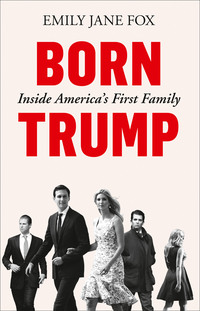
Cover photographs, from left: © Manny Hernandez/Getty Images; © BERND VON JUTRCZENKA/AFP/Getty Images; © Jeff J Mitchell/Getty Images; © DOMINICK REUTER/AFP/Getty Images
Emily Jane Fox asserts the moral right to be identified as the author of this work
A catalogue record for this book is available from the British Library
All rights reserved under International and Pan-American Copyright Conventions. By payment of the required fees, you have been granted the non-exclusive, non-transferable right to access and read the text of this e-book on-screen. No part of this text may be reproduced, transmitted, down-loaded, decompiled, reverse engineered, or stored in or introduced into any information storage and retrieval system, in any form or by any means, whether electronic or mechanical, now known or hereinafter invented, without the express written permission of HarperCollins
Source ISBN: 9780008292492
Ebook Edition © June 2018 ISBN: 9780008292478
Version: 2019-05-09
Dedication
To my mom, dad, and sister, who gave their unconditional and selfless, protective, and present love so freely and with such ease that I had little inkling of what it would be like to grow up any other way. I am grateful for that now more than ever.
Contents
Cover
Title Page
Copyright
Dedication
Chapter 1: Inauguration
Chapter 2: Campaign/Transition
Chapter 3: Election Day
Chapter 4: Born/Married/Divorced/Married/Divorced/Married/Raised Trump
Chapter 5: Meet the Mini-Voltrons
Chapter 6: Ivanka—Voltron Number One: The Media Mastermind
Chapter 7: “Bashert”
Chapter 8: You Are Who You Marry
Chapter 9: Don Jr.—Voltron Number Two: The Attack Dog
Chapter 10: Eric—Voltron Number Three: The Builder
Chapter 11: Tiffany—The Voltron from Another Universe
Author’s Note
Acknowledgments
About the Author
About the Publisher
CHAPTER 1

Inauguration
IVANKA TRUMP and Jared Kushner hustled themselves and their children up to the second floor of the residence in the White House, to the southeastern corner of her father’s new sixteen-room home. She was still in the white Oscar de la Renta pantsuit she’d worn all day—through the rain washing over her father’s swearing-in ceremony and the parade down Pennsylvania Avenue marking his inauguration—and chilled to her bones. She would soon change into a glittery champagne gown for the inaugural balls. Her hair would be teased and swept and sprayed into an ornate knot at the nape of her neck. She would prick teardrop diamonds into her ears and slather highlighter onto her cheekbones and underneath her eyebrow and onto her bare clavicle, exposed by the deep V of her dress.
All of that would have to wait. The Trump-Kushners sped into the Lincoln Bedroom, where they had stayed through her dad’s first weekend as the president of the United States of America. The traditional parade flirted dangerously close to sundown, which, on January 20, 2017, fell at 4:59 p.m. eastern standard time. As practicing Modern Orthodox Jews, Ivanka and Jared needed to light Shabbat candles as day turned into night in order to observe their own tradition, which Jared had been doing his whole life and Ivanka had joined him in when she converted, years earlier, before they married. She had arranged with the White House usher to have candlesticks waiting in their borrowed room. Usually she would have brought her own, as she typically did for a weekend away, but this weekend, in just about every way, was not typical for the Trumps. She figured the White House must have suitable candelabras lying around. She was correct.
The immediate family of five formed a semicircle around the White House’s candlesticks, and Ivanka struck a match to light the wicks. There they were, in a room Abraham Lincoln had once used as an office; which the Trumans had rebuilt in 1945, Jackie Kennedy had spiffed up in 1961, Hillary Clinton had freshened in the 1990s, and Laura Bush had again refurbished in 2004. The eight-by-six-foot rosewood Lincoln bed, with its six-foot-tall carved headboard—the bed that Presidents Franklin Roosevelt and Calvin Coolidge had slept in—was at their backs; a holograph copy of the Gettysburg Address, one of only five signed, dated, and titled by Lincoln, sat on the desk nearby. Ivanka covered her eyes and recited the blessing over the candles: “Baruch ata Adonai, Eloheinu Melech ha-olam, asher kidshanu b’mitzvotav vitzivanu l’hadlik ner shel at.” Blessed are You, God, Ruler of the universe, who sanctified us with the commandment of lighting Shabbat candles.
It was the first time Shabbat had been welcomed this way in the history of the residence.
SOME FIVE hours earlier, as light sheets of rain fell over Washington, DC, Donald J. Trump had pressed his right hand to two Bibles on the West Lawn of the Capitol and became the forty-fifth person to recite the oath of office, as prescribed by Article II, Section 1, of the Constitution. One of the Bibles he chose was used by Lincoln when he was sworn in at his first inauguration in 1861, as the nation hung on the precipice of the Civil War. The other had been given to him by his mother in 1955, two days before his ninth birthday, just after he graduated from the Sunday Church Primary School at the First Presbyterian Church in Jamaica, Queens. Its cover is embossed with his name and, on the inside, signed by church officials.
After taking the oath, Trump turned his back on the crowd and swung his arms open toward his family, who had encircled him as he made his vow to the American people. He first locked eyes with Ivanka, who had positioned herself directly at the center of the dais, with her brother Eric slightly behind her to her left and her half sister Tiffany next to him. Don Jr. was just to Ivanka’s back on the other side, her half brother Barron and stepmother turned First Lady Melania beside him. Ivanka cocked her head at her dad, the president, her lips and cheeks pulled so tightly by her smile that her facial muscles contorted themselves into an aptly bronzed rectangle. She dove forward to kiss him, but his instinct kicked in quick. He had never been on this sort of world stage before, but he had spent enough years with his family life chronicled in the papers to know well enough to greet his wife before his favorite daughter. So before she reached him, he swooped to his left and pecked his wife, and then worked his way through his children—Barron, Donny, Ivanka, Eric, Tiffany—to let them congratulate him, tell him how great he’d done, how much they loved him.
The family soon gathered in a motorcade for the inaugural parade. Ivanka and Jared quickly realized that their infant car seat did not fit in their armored car—an inconvenient, startlingly normal fact that held up the entire motorcade and parade on this historic day. “What’s the holdup?” everyone kept asking. At last, they figured it out. Everyone got moving. At a quarter after four in the afternoon—following the custom President Jimmy Carter began in 1977, when he got out of his limousine and walked for more than a mile en route to the White House—Donald, Melania, and Barron stepped out of “the Beast,” the armored car the president travels in, in front of the Trump International Hotel. Elsewhere along the route, crowds were sparse and protesters had gathered. But in front of the hotel bearing Trump’s name, revelers were packed onto risers, a dozen deep. There were cheers and signs and a sea of red “Make America Great Again” hats. Ivanka and Don Jr. and Eric and their spouses and most of their children followed in cars of their own, and, once he got out of his car, walked alongside their dad, greeting the supporters who’d waited outside for hours in the forty-degree Washington winter.
The family stayed outside for about three minutes before getting back in their cars, which moved along slowly for another half hour, until they arrived at a viewing stand near the White House. Ivanka and Jared whisked inside around sunset.
None of them had expected to be there that day. When their father decided to run—and frankly up until they saw him start winning states on November 8 from the campaign headquarters on the twenty-fourth floor of Trump Tower, a few months earlier—they’d assumed that he would lose and that they would get back to their normal lives and businesses. They would have spent that gray, winter day with the broadcast of the inauguration on in the background as they headed off for weekends at Mar-a-Lago, or at their homes in Bedminster, or Westchester, or the Catskills. It would have been an otherwise normal winter weekend for an otherwise perfectly happy moneyed family, trying to get back into the swing of their old normal. Apart from the fact that it meant that he’d won something, Donald didn’t much want to be there. As the reality of the election dawned on him in the weeks leading up to his move, he frequently asked advisers how often he could leave Washington to return to his triplex on Fifth Avenue, and in the weeks after the move he spent most weekends flying on Air Force One down to his private club in Palm Beach.
But it was not a normal weekend, and their old normal was swiftly replaced by an extraordinary new existence—one that they not only didn’t predict but also never could have imagined. Nevertheless, that is where they found themselves on January 20. And once they were there, the Trump kids made damn sure that they were at the front and center of everything.
THERE WERE thousands of things to do once the Trump family woke up bleary-eyed and bewildered on the morning of November 9, barely a few hours after Donald gave his victory speech, scraped together with the kids’ help just before they all rushed over to the ballroom at the Midtown Manhattan Hilton Hotel. A concession speech had been written in advance. Ivanka had plans to get her fashion line back on track come Wednesday morning. She would lay low for a while and let the rhetoric and rancor die down a bit, so that what her team expected to be strong holiday season sales would speak for themselves, starting a whole new narrative. The manuscript for her book for working women would also require her attention; she had just turned it in, and it was set to go to print around the inauguration. Jared would begin a reputational recovery tour. Friends had told him that would be a feat, now that people viewed him as an asshole; no one would be lining up to do business with him, at least not right after the election loss. Don Jr. and Eric were starting talks with investors and partners about a new, lower-tier chain of hotels in heartland cities that would appeal to the Trump supporters they’d met on the trail, turning their MAGA zeal into Trump Organization patronage. Tiffany would be able to focus on her law school applications. Barron could go to school on Manhattan’s Upper West Side without the Secret Service agents who were clogging up drop-off and pickup traffic, enraging the uptown parents and drivers and nannies (to say nothing of back-to-school night, when Melania and her protection locked down the school’s only elevator so she could get to Barron’s classroom; this left the rest of the parents to hoof it up the stairs, rocketing the school rageometer to full-scale fury). There was very little in place for what would happen if Donald actually won.
Now an inaugural weekend had to be put together, which required months of planning and millions of dollars and at least a basic understanding of its history and traditions. Trump tapped Tom Barrack, his friend of three decades, to chair the committee. In a statement on November 15, Donald announced that Barrack—a private equity billionaire who had served as deputy undersecretary of the Department of Interior under Reagan and been one of Donald’s cheeriest surrogates and advisers throughout the campaign (and the man who urged Ivanka and Jared to get Donald to hire Paul Manafort)—would be “responsible for the planning and coordination of all official events and activities surrounding the inauguration.”
Barrack and Trump had first crossed paths in 1987, when Donald summoned him to Trump Tower. At the time, Barrack was working for a rich Texas family that owned a department store chain Donald wanted to buy a piece of, which he did, thanks to Barrack’s help. The family also owned the Plaza Hotel, which Donald could see from his office window in Trump Tower and itched to add to his growing Manhattan empire. The problem was that Barrack’s bosses wanted $410 million for the property. It was a bum deal for Donald, but it was a New York institution, the kind of storied figure in New York Donald himself wanted to become. It was a crown jewel. And Donald—a Queens outsider and something of a punch line—wanted it for his crown. So he agreed to pay the price—in cash, no less. And after he’d thrown his kids’ birthday parties in the hotel, and later met with Ivana there to hash out the early details of their separation, and later married Marla Maples there, the place dragged him near financial ruin. In 1994 a guy Barrack knew from Chase Manhattan Bank called to tell him Donald was in trouble. He had a $100 million loan with Chase, and a mountain of other debts, and at the very least he needed to unload the Plaza. Barrack persuaded the bank to give Donald a little breathing room to find financing before they foreclosed. In the time that bought, they found a Saudi Arabian prince and a hotel group out of Singapore to take it off his hands. More than a decade later Donald asked Jared, who, in his own Trumpian outer-borough desire to make it in Manhattan, had bought a forty-one-story office tower on Fifth Avenue for what was then the highest price for a commercial building in US history and was struggling to make the loan payments. Jared flew to Los Angeles to ask Barrack for his advice, and Barrack obliged, helping him restructure his debt and holding some of it himself.
The inauguration gig was a high-profile thank-you for Barrack, and a relief for Donald, who’d been saved by Barrack enough times before that he trusted him to do it again. Barrack brought on a team of other billionaires and Trump loyalists, including Sheldon Adelson, Woody Johnson, Anthony Scaramucci, Steve Wynn, Elliott Broidy, and Laurie Perlmutter, to help him out. He asked Stephanie Winston Wolkoff, a former Vogue editor and friend of Melania’s known around the Condé Nast office as General Winston for the military efficiency with which she planned the annual Met Gala, to serve as an editor-at-large for the inauguration. She took on all the heavy lifting—securing venues and event planners, deciding on table settings, arranging broadcast rights and social media filters, figuring out how to move heavy equipment around Washington, and—perhaps the heaviest lift of all—getting talent to perform at events throughout the weekend. Inaugurations past had been filled with megawatt star power. At Barack Obama’s, Beyoncé, Aretha Franklin, Yo-Yo Ma, and Kelly Clarkson performed; at George W. Bush’s, Ricky Martin, 98 Degrees, and Jessica Simpson; for Bill Clinton’s, Fleetwood Mac got back together again for a rare performance. Virtually no celebrities wanted to perform at a Trump inauguration. That would have been an issue for any incoming president, but it was particularly sticky for Trump, whose fragile ego cracked at the slightest of insults from nobodies.
Wolkoff asked Mark Burnett, the creator of The Apprentice, to comb through his Rolodex to convince stars to take part in the weekend—if not in support of Donald, out of patriotic duty. Still, they couldn’t get a big name. In fact, everyone whose name was so much as floated as a possible inaugural performer immediately disassociated themselves. When a rumor circulated that Elton John would give a concert on the Mall, his spokesperson quickly threw water on it. Garth Brooks initially appeared open to the idea, since “it’s always about serving,” but soon afterward declined an offer to appear. The same happened with Andrea Bocelli, Kiss, and Jennifer Holliday. The Mormon Tabernacle Choir, however, did accept the invitation to sing at the swearing-in ceremony. They booked America’s Got Talent runner-up Jackie Evancho for the national anthem. The Rockettes agreed to perform at the inaugural balls, though some dancers refused to partake, complaining to their union about being asked to perform for what one Rockette described as a man who “stands for everything we’re against.”
At the same time, millions of people, including Katy Perry, Cher, and Madonna, were preparing to walk in women’s marches around the country. In fact, reports stated that DC issued far more permits for city buses for the march on Saturday than for Donald’s swearing-in on Friday. And in the weeks leading up to the inauguration, nearly seventy lawmakers vowed to boycott the events to protest the messages Donald had run on and the rhetoric he used during the campaign and after the election.
With protests looming and virtually no one famous set to attend, the inaugural committee’s message shifted. As Barrack spun it, with “the biggest celebrity in the world” as president, other stars were superfluous. “So what we’ve done,” Barrack said, “instead of trying to surround him with what people consider A-listers, is we are going to surround him with the soft sensuality of the place. It’s a much more poetic cadence than having a circuslike celebration that’s a coronation. That’s the way this president-elect wanted it.”
It was, in a word, a disaster, and they needed all hands on deck. The Trump kids jumped into the planning, though not necessarily to aid in the process or to take on some of the burden. They each wanted to make sure that they individually would be involved in each public event, and took great pains to make sure not only that they would be present but that their seating arrangements were satisfactory. Their proximity to Donald on that day, and thus their presence in photographs that would be telegraphed all over the world that weekend and in history books for centuries, was paramount.
Melania, as the incoming First Lady, tried to organize a weekend that kept them all together. That meant all five kids, all eight grandchildren, would be welcome to stay the Thursday evening before the inauguration at the Blair House, just across the road from the White House, and spend the rest of the weekend in the residence once the Obamas moved out and the Trumps moved in. No one would sleep on couches or double up; Melania made sure that each sibling had his or her own room and determined who would sleep where, though Ivanka did put in a request to stay in the Lincoln Bedroom. Melania arranged enough time for breakfasts and lunches and dinners together as a family, to anchor everyone in the headiest of weekends. She had buffets to be set up throughout the weekend so that no one would go hungry.
Melania was less certain when it came to the parade, which would have the family making the same walk toward the White House on the twentieth of January that presidents have made for nearly half a century. There have been few American political climates so vitriolic and acerbically divided as the one that existed after Donald’s election, and she had deep concerns about getting out of the car and marching alongside her eleven-year-old in the open, even with the Secret Service and protection teams that would surround them.
Ivanka was set on the parade. “It’s happening,” she insisted. It was tradition. It was presidential. It was not something her father and the family were going to miss out on.
There was a sense among those who worked on the transition that the legacy aspect of the inauguration was critical for Ivanka. This was a chance for the Trumps to have their Kennedy moment—one that looked a lot like Camelot. Melania, in her Ralph Lauren powder-blue suit with matching blue gloves, her hair teased into a bouffant, consciously channeled Jackie on inauguration day. (Initially, she had toyed with the idea of wearing the now infamous red, white, and blue Gucci ensemble that Kellyanne wore and got panned for, but a fashion editor and adviser to Melania nixed it, reminding her of the importance of wearing American designers that weekend.) Ivanka looked to establish the Trumps as the new American royal family. She worked with a stylist and told friends that she wanted a princess moment, particularly for the inaugural balls, for which she chose a sparkly tulle confection. “I told her it’s an inauguration, not a coronation,” one friend recalled. “The sentiment was that Americans wanted a royal family.” (A blown-up photograph of her in that gown, dancing with Jared onstage, hangs outside her office in the West Wing, with a note scrawled across it in metallic Sharpie. “To the most beautiful couple in the world,” her father wrote across the image. “I am so proud of you. Love, Dad.”) There was less meaning ascribed to the Oscar de la Renta white pantsuit Ivanka chose for the actual swearing-in ceremony. Of course, the choice raised eyebrows. White pantsuits were a Hillary Clinton thing, so much so that Hillary Clinton herself wore one on inauguration day. When advisers brought that up to Ivanka in advance of the day, she shrugged it off. “It definitely was not intentional, her choosing to wear that,” one adviser remembered. “She was like, ‘oh shit,’ not in a stupid way, but she didn’t mean to make it a thing. It really wasn’t.”
THAT IVANKA wanted to harken back to the Kennedys was no surprise. Certainly her mother, Ivana, who had longed for a place in the world of old-money American royalty, played a role in this, at least during her daughter’s childhood. For years, Ivana told people that Ivanka’s beloved Irish nanny, Bridget Carroll, had nannied for John Kennedy Jr. before moving in with the Trump family, though there is no proof of that, other than Ivana’s mentions. She took credit for choosing her daughter’s schools, first Chapin, the all-girls private school that Jacqueline Bouvier attended, and then Choate, the boarding school from which John Kennedy graduated. In Ivana’s recent book about her children, she noted that the Kennedy family would travel to Aspen for holidays at the same time the Trump family did, engaging in side-by-side slalom races against one another. “It was the Trumps vs. the Kennedys,” she wrote, “and Trump always won.” At Choate, Ivanka told classmates, particularly when it came up in her political history classes, of her admiration for Jackie Kennedy as a leader. (One classmate remembers that she always took an interest in the Roosevelt family, too, and in Anna Roosevelt in particular. Franklin Roosevelt tapped Anna, his only daughter—who, like her father, had a somewhat sticky relationship with the First Lady—to work in his West Wing after she and her young children had lived with him in the White House during the early years of his presidency. She served as his personal assistant, accompanying her father to the Yalta Conference in World War II, while Eleanor Roosevelt stayed behind.)
Jared and his family had their own affinity for the Kennedys. Jared’s father Charlie keenly referred to himself as the “Jewish Kennedy,” seeing himself as both a king and kingmaker in the northern New Jersey religious community in which, thanks to healthy donations, many of the buildings bore his name. When it came time for Jared to apply to Harvard as a high school senior, Charlie nudged his senator, Frank Lautenberg, to ask his colleague Ted Kennedy to put in a good word with the dean of admissions in Cambridge. When Jared moved into a corner office overlooking St. Patrick’s Cathedral, where the family baptized Caroline Kennedy and eulogized Bobby Kennedy after his death, he hung just one photo on the wall next to his desk. It was a framed Garry Winogrand snap of Jack Kennedy delivering his speech at the 1960 Democratic National Convention in Los Angeles. The shot catches JFK from behind, camera lights creating a halo around the side of his head and contours of his jaw. A television set propped up just behind the desk broadcasts his face again in black and white for the viewer to see. “I love the juxtaposition of him looking that way and seeing him the other way,” Jared told New York Magazine of the photo in 2009. “I love the glow in his face. I look at it all the time.” He bought all the photos in the series, but kept the rest in a box. (Later, once he and Ivanka had married and moved into a Trump building on Park Avenue, Winogrand photographs lined the hallways of their apartment.) After Jared was sworn in as senior adviser to the president at the tail end of inauguration weekend, he and his brother Josh posed for a photo underneath the somber portrait of JFK hanging in the White House.
When Ivanka and Jared got married, they decided to release one photo after the nuptials, in the style of John F. Kennedy Jr. and Carolyn Bessette, rather than selling them to a magazine. When they had children, all the names they chose evoked Kennedy family ties—Arabella Rose, Joseph, and Theodore. Jackie Kennedy unofficially referred to her and JFK’s stillborn daughter as Arabella, though the baby was never given a birth certificate, and when she was later moved to be buried alongside her father, her gravestone simply read “Daughter,” along with her birthday. Rose, of course, was the name of the Kennedy matriarch.
“I have always loved the name Arabella,” Ivanka said in an interview with The Today Show a month after her daughter was born. Childhood friends remember her always coming back to the name when they were growing up and brainstorming what they would name their future children someday. They were hardly surprised when she settled on it as her first child’s name decades later. “Jared’s grandmothers had names beginning with an A and an R. We wanted to pay subtle homage to those two strong and wonderful women while also adopting a name that was very unique. Plus, we thought that the initials, ARK, were cool!”
Joseph was the name of both JFK’s father and Jared’s grandfather, and Frederick, their son’s middle name, was Donald’s father’s name. Ivanka posted on her Tumblr when her son was born in 2013 that they chose to name him after their paternal grandfathers, “both master builders of their generation and inspiring patriarchs of their families.”
“Jared’s grandfather, Joseph, was a rock. His indomitable spirit, his sense of family, and his work ethic are the values we hope to hand down to our son. My grandfather, Frederick, was a builder not just of tens of thousands of homes throughout this city, but of a tight-knit family that honors to this day the traditions he established. Both men set the standards that have been passed down through the generations and which we hope to impart upon Joseph and Arabella. They created a legacy for our family that inspires our careers as well as our love and respect for one another. We are honored to name our son after these two distinguished men. We feel so blessed with the newest member of the family!”
Theodore is not as exact a match—Ted Kennedy’s first name was short for Edward—but the similarity, after an Arabella Rose and a Joseph, is hard to ignore, especially among those who believe the couple viewed their own gilded, millennialized, social-media-propagated version of Camelot as the end game.
It goes without saying that the clearest and most recent cribbing of Kennedyesque behavior came after the election. Donald chose to tap his son-in-law to serve in his West Wing, and not long after, his daughter joined them in an official capacity as well. Ethics experts sounded the alarms immediately; this violated an anti-nepotism law that had come to be known as the Bobby Kennedy Law, because it took effect six years after JFK appointed his brother Bobby to be his attorney general in 1961. The law was upheld for fifty years, until the Trumps’ lawyers found a work-around. The way they read it, the White House is not an agency, and the president enjoys broad executive powers. In the Trump administration, 1600 Pennsylvania Avenue would be just like the twenty-sixth floor of Trump Tower, with a little touch of Kennedy-era nostalgia lawmakers thought they’d banned five decades earlier.
IN THE midst of all the inauguration jostling, Jared and Ivanka decided to move to Washington. Not only would they have to figure out how to divest themselves of portions of their businesses, set up trusts, and figure out who would take over their responsibilities within their family businesses and outside ventures; they’d also need to find somewhere to live and a school for their kids. Melania was having a hard enough time getting the schools to which presidents typically send their young children to even let Barron apply. Ivanka and Jared had two kids who needed to be in school, and they needed to find a Jewish day school. So Seryl Kushner, Jared’s mother, took on the task. Jared and Ivanka hired a broker and made a few day trips down to DC to look at houses. Jared’s father, Charles, was the one to negotiate the lease. Sometimes dad knows best.
AS PROTOCOL dictated, the whole family boarded a military plane that would take them from New York to Washington on Thursday afternoon. At Joint Base Andrews, Barron made his way down the stairs off the plane first, followed by Don Jr., his wife Vanessa, and their five children, and Eric and his wife Lara. Then came Ivanka, with her little baby boy in her arms, her emerald-green Oscar de la Renta dress and matching coat with its drapy collar blowing in the wind on the tarmac, her big black Jackie O. sunglasses resting on the bridge of her nose. Jared and Ivanka’s two older kids trailed behind her. Tiffany came next, followed by Melania and Donald.
The family soon hopped in a motorcade headed for Arlington National Cemetery in Virginia, where Donald and Mike Pence would lay a wreath on the Tomb of the Unknowns. Before her father came out, Ivanka, Jared, and her daughter, Arabella, descended the stairs toward the memorial, in the open plaza overlooking Washington, DC. Ivanka positioned herself closest to the center of the staircase, where her father would later stand, all but ensuring that she would be in almost every frame wide enough to take in the scene. Eric and Tiffany were farther to her left, and Don Jr. and his wife and daughter got stuck behind them.
Then there was the Make America Great Again! Welcome Celebration on the ninety-eight granite and marble stairs at the base of the Lincoln Memorial. The highlight, perhaps, was Lee Greenwood’s rendition of “Proud to Be an American,” to which the Trump family, who were off to the side of the stage on seats arranged for them, sang along. Donald and Melania sat in the front row, with the two seats next to them reserved for Ivanka and Jared, as they had requested. Her siblings filled in the rows behind them.
That evening they headed over to Union Station for a black-tie candlelight dinner with Donald’s cabinet nominees and Republican megadonors. The kids had tables reserved for their friends, where they ate grilled white and green asparagus, roasted branzino with lemon and thyme, and vanilla meringue cakes. They sipped wine out of gilded glasses specifically chosen with Camelot in mind, while listening to their father rehash “this beautiful map” that had emerged on the eve of the election. He thanked Ivanka, who sat next to Wendi Murdoch, wearing a white cap-sleeved Oscar de la Renta column gown with an oversize black bow tied in the back at her waist. He thanked his siblings and their spouses, and boasted that he had a family who actually got along. He then went on to acknowledge his children. “My sons, look at them, standing there,” he said, pointing their way. “I say ‘Why aren’t you campaigning today?’ Eric and Don and Tiffany, who was incredible. And Barron is home.” He then went on to praise Patriots owner Bob Kraft and tell the crowd that his quarterback Tom Brady, who, a decade earlier, Trump told reporters had dated Ivanka, had called to congratulate him.
Separately, he singled out Ivanka. “We have in the audience a special person who’s worked very hard, who married very well. It’s my daughter Ivanka. Where is she?” Then, spotting her in the crowd, he said, “I sort of stole her husband. He is so great. If you can’t produce peace in the Middle East, nobody can.”
After a night’s rest in Blair House, the positioning continued on Friday in the swearing-in ceremony, where again Ivanka moved toward the center of the frame when her father approached Chief Justice John Roberts to recite his oath of office. That evening, since it was Shabbat, the Secret Service had to work with the couple to develop a special security plan. Traditionally, those observing the Sabbath do not travel in cars from sundown on Friday to sundown on Saturday. But that would have meant they would not be able to attend any of Friday’s balls or the events on the following day—which, for a couple who wanted to be part of everything, was not an option. Walking was out of the question; their detail told them it was not safe, given the vitriol and the protests. Plus, Ivanka had her princess gown and heels on, and the balls were not exactly a hop and a skip away from the White House. So they asked special permission from their rabbi to break the rules of Shabbat, since it was a matter of safety, and what they argued was a once-in-a-lifetime familial opportunity.
They made the most of it. Donald and Melania were meant to share their first dance on stage alone. Planners had no idea that the children would later join them onstage for a family-wide slow dance; Donald, who knew that he was not a skilled dancer and was aware of just how long the song was, asked his children to come out onstage to cut some of the lingering awkwardness. By the second ball that evening, once they’d seen just how uncomfortable he looked the first go around, they joined him out there even earlier in the song. Afterward Tiffany and her boyfriend went back to the Trump Hotel, where they met her mother, Marla, and a few friends from New York. The rest of the family spent the night at the White House.
The next morning, the family attended a service at the National Cathedral. They were all exhausted by that point, especially the grandchildren. They’d patiently sat through the wreath-laying and the concert and the parade in preceding days, but a long, early morning in church was asking too much. Ivanka handed her son Joseph toy cars to keep him occupied, which she quickly regretted. He shot one straight down the aisle, past all the pews, confusing the people gathered there to pray and pay tribute to the presidential rite of passage.
The extended family had settled into the White House by Saturday afternoon. Don Jr.’s son slurped cereal out of a bowl in the dining room wearing his Teenage Mutant Ninja Turtles pajamas. Theodore, Ivanka’s youngest, crawled for the first time in the state dining room as they all had a buffet lunch that Melania made sure was set up for them after the church service. Don Jr. and his wife and kids took a spin in the bowling alley in the basement.
By Sunday afternoon there was one official event left, in the East Room of the White House. Donald swore in members of his senior staff, including Jared, who would serve as his senior adviser. Jared’s parents and brother Josh tried to keep Jared and Ivanka’s kids quiet while their dad recited his oath. Josh handed the kids a container of jellybeans, which they promptly spilled on the floor of the East Room. Josh quietly swept them up, hoping no one would notice.
By Sunday evening Don Jr. and Eric and their families and Tiffany had flown back to New York. So had Melania and Barron, who wouldn’t move down to Washington for another five months. When Melania got back to the Trump Tower triplex, it was empty. There was no Donald, no frantic campaign staff or inauguration committees. There was nothing more to plan, at least for the time being. She called one of her closest friends to come over to keep her company. She was now the First Lady of the United States. She was also completely, utterly alone.
Ivanka and Jared stayed behind in DC, arriving at the nearly century-old, 6,800-square-foot home they rented, with six bedrooms, seven baths, five wood-burning fireplaces, a two-car garage, a sunroom, a garden, and a terrace off their bedroom. This was their first night there, and they hadn’t yet picked out all of their furniture. So they ordered in pizza and ate dinner on the hardwood floor. The sun set on life as they knew it. A new normal dawned.
CHAPTER 2
Campaign/Transition
ON JUNE 16, 2015, Ivanka glided down the gilded escalators into the lobby of Trump Tower, her father’s crown jewel in Midtown Manhattan, where she and her brothers had grown up and now worked as executives in the Trump Organization. She slipped past the crowd gathered with the burnished mauve marble walls, adorned on that day with royal blue signs emblazoned with “TRUMP Make America Great Again.” Wearing a white sheath dress, her corn-yellow hair parted down the center and swept into a bun, revealing two dangly silver hoop earrings that swayed as she took her place behind the dais, she smiled at the hundred or so people awaiting an announcement and inhaled. Flanked by a half dozen American flags, she began: “Today, I have the honor of introducing a man who needs no introduction. This man,” she said, “is my father.” The crowd erupted, and her pink-painted lips parted in a toothy grin. Her nose crinkled, and after a particularly raucous shout from the floor above, she let out a little giggle. She went on to praise her father—for his career success, for his negotiating prowess, for his say-it-like-he-means-it candor, for his loyalty to friends. “I’ve enjoyed the good fortune of working alongside my father for ten years now, and I’ve seen these principles in action daily,” she said. But before she worked for him—in a technical function, that is; the Trump kids have been employees serving his brand in some capacity since they arrived on earth—he told his children they had to work hard and strive for excellence in all that they did, she said: “I remember him telling me when I was a little girl, ‘Ivanka, if you’re going to be thinking anyway, you might as well be thinking big.’” There was no better person to have in your corner when you were facing tough opponents or making tough decisions. “Ladies and gentlemen,” she said, dipping closer to the microphone, “it is my pleasure to introduce to you today a man who I have loved and respected my entire life, Donald J. Trump.”
She beamed at the crowd as Neil Young’s “Rockin’ in the Free World” blasted from the speakers, bouncing off all that marble. For two minutes and forty-five seconds—a full two verses and two choruses of the song and into the bridge—she stood there, nodding and smiling and fidgeting onstage, before Donald Trump emerged from the escalator. Don Jr. and Jared and Tiffany kept staring at her from just off stage right, where they’d watched her introduction, appearing as uncomfortable about her languishing up there waiting as she was. Finally Donald greeted her, gave his speech, and announced his candidacy, which was mostly received as a joke and a branding opportunity by the media and anyone who knew or watched the Donald on television or in the tabloids or around New York for decades.
It was not the first time Donald had flirted with a presidential run. Or the second or third time, either. He did this periodically, when it served his company or stroked his ego, or when he tapped into a message that resonated. And his children had responded in kind each time they were asked over the years about their father’s political ambitions. Don Jr. showed up to a town hall in the fall of 1999 on campus at the University of Pennsylvania, where he was an undergraduate at the time. His dad was toying with the idea of running as a candidate for the Reform Party, and he let Chris Matthews interview him live for Hardball in front of 1,200 students, including Don Jr., who was made to stand up in front of the crowd. “He’s much better looking than I am,” Donald told the audience. Ivanka was also repeatedly asked about her dad’s presidential aspirations over the years. In an interview with Harper’s Bazaar in 2011, she said that her father was “exactly what we need” in the leader of the free world. “He’s the best equipped to deal with the most important issues this nation has, which is ultimately that we’re suffering under a massive burden of debt,” she said. “We need a very acute financial mind to get us out of this mire. America is the largest corporation on the planet. You wouldn’t hire a novice to run a similarly sized company in the private markets.” Despite their praise, he never made the leap.
This time, though, their father had actually gone through with it. Ivanka reveled in the moment. Don Jr. radiated excitement as he rode up in the elevator after his dad’s speech. His phone would not stop dinging. “My Special Forces friend just texted me,” he told former Trump Organization employee Sam Nunberg in the elevator going back up to his office. “He loved it.” A handful of the people he hunted with sent him similar laudatory messages. “They fucking loved it.”
FROM THERE, Don Jr. was dispatched onto the trail. He was perhaps the only real conservative out of the whole lot of them. He had a little bit of red state under the Patrick Batemanesque exterior—the slicked-back hair, the veneers, the big fat tie knots. He went on weeks-long hunting trips and spent time in the middle of the country and somewhat understood life outside of Trump Tower and golf courses and gilded everything. So operatives deployed him to make campaign stops. Ivanka often introduced her father—a tightly wound blond spoonful of sugar leading into his acerbic, rambling speeches. Eric would go on Fox News, as would his wife, Lara. They sat in the family sections at the debates, and participated in town halls, and had dinner at diners in the freezing cold New Hampshire winter. They had a sense that this moment was both fleeting and once-in-a-lifetime, inviting childhood friends and close associates to come with them backstage at debates or other key rallies, knowing full well that this was probably the only time they would get anywhere near this close to the political process, and it would all be over in a flash.
OF COURSE it wasn’t. By the time Donald started actually winning primaries, the Trump kids, in part filling in for their stepmother, who loathed the trail and preferred to stay in New York with Barron, took on their roles in the campaign as near full-time jobs.
Donald just about clinched the nomination in early May, winning the Indiana primary. Ted Cruz, one of the last Republican men standing by that point, bowed out that evening. Donald rode those escalators once again down into that mauve marble lobby to give a victory speech. Melania stood to his left, Ivanka and Jared, Eric and Lara, Don Jr. and Vanessa to his right, all closed-mouth smiles and shine.
“I want to start by, as always, thanking my family.” Donald leaned into the microphone his campaign had set up on a makeshift stage in front of a cheering crowd in his red baseball hats. “My wife, my kids. They’re not kids anymore, but as far as I’m concerned, they’re kids. They’ll always be my kids,” he joked. “It’s a beautiful thing to watch and it’s a beautiful thing to behold and we’re going to make America great again.”
He singled out his son-in-law, praising him for the work he had done to get him to that point. “Honestly, Jared is a very successful real estate person, but I actually think he likes politics more than he likes real estate,” he told the audience, sending Ivanka into a laughing fit. “But he’s very good at politics.”
A few days later Ohio governor John Kasich dropped out of the race, making him the sixteenth opponent Donald had put a pin in. As the presumptive nominee, he would soon start receiving intelligence briefings on national security matters and immediately shift to a general election plan. Life beyond the primaries smacked the Trumps in the face. There was a level of planning and organization that the tiny Trump team of novices could not themselves begin to fathom, but they had enough sense and outside advice to start making incremental plans on specific, necessary next steps. That’s when Donald put another load on Jared’s shoulders. He asked him to come up with a blueprint for a transition team, though Jared himself would not be involved with transition activities should his father-in-law win in November. Jared, campaign manager Corey Lewandowski, and senior adviser Paul Manafort started pulling together ideas for who could join the team and what the priorities should be.
Donald set his mind on New Jersey governor Chris Christie as the guy he wanted to lead the transition. Sure, Christie had been critical of Donald when he ran his own bid for the presidency, but he was among the first former opponents to endorse him in February. The complicating factor was that Jared, assigned to lead the charge here, despised the guy. Christie had put Jared’s father behind bars a little more than a decade earlier, after all, and kept him there for twenty-eight days longer than the Kushner family expected. The simmering tension was no secret, and Donald was sensitive to it, particularly because he knew Ivanka would be sensitive to it as well. But it was Donald’s campaign, and at least in this instance, no one could talk him out of it.
By May 9 Donald had already made the offer to Christie. He asked the governor to come to his office on the twenty-sixth floor of Trump Tower, where Donald did most of his campaign work when he was in New York, amid a crush of sports memorabilia—Tom Brady’s Super Bowl helmet, Mike Tyson’s belt, Shaquille O’Neal’s size 22 black and white basketball sneaker. A photo of Donald’s father Fred shared the desk with stacks of paper, framed magazine covers bearing his likeness lined the walls, and the red leather armless chair he’d sat in as the host of The Apprentice was tucked into the room’s far end. Corey Lewandowski came, too, and they began to hammer out the parameters of how the transition would work and what notes they wanted to hit in a press release announcing his appointment.
Jared joined them, too, and he tried to pump the brakes. “Well, we don’t have to rush this,” he chimed in. “Let’s take our time with this.”
Lewandowski interrupted him. Actually, they did have to rush this. The White House had already asked for the name of a transition head, and it was sure to come up at the meeting scheduled in a few weeks. They needed to decide this and get it out there already. Donald agreed with him. What was the point in waiting, anyway? The choice was made. Let’s get on with it.
Unlike Charlie Kushner, whose temper flashed and burned a whole room down in an instant, Jared simmered. The angrier he got, the quieter he became. So when he opened his mouth to respond, he was at little more than a whisper. It was rare for him to talk about his father’s stint in prison so openly, but on this day Jared unleashed. What came out was an impassioned monologue that went on so long that his father-in-law ultimately had to interrupt him. “It’s unfair,” Jared said. “He took advantage of my family members for his own ambition, and you don’t understand what he did to us.”
Christie, no shrinking violet, either, boiled in his seat. Before he could open his mouth, though, Donald jumped to his defense. “The guy was just doing his job. If you were there, you would have done the same thing,” he told his son-in-law. “You really should be mad at your own family here. They are the ones who turned over all that information to Chris.” Jared’s real problem, he added, was that he hadn’t known Donald at the time of his father’s trial; Donald and Christie were such good friends that things would have turned out differently. Christie would have taken it easier on his friend’s family. “No, no, no,” Christie interrupted. “I like you a lot, but I assure you it would not have been any different.”
“No, no, no,” Donald retorted. “It would have been different.” Donald then suggested that Jared, Charlie, Donald, and Christie go out to dinner together, to clear the air. Jared suggested that that might not be the best idea.
“Jared, you and I have talked about this,” Donald said soothingly. “Chris is the guy.”
“Fine,” Jared told him. “If that’s your decision, that’s your decision.” He turned around and walked out. Soon after, Lewandowski asked to be excused, too.
That afternoon the campaign sent out the release announcing Christie’s appointment. “Governor Christie is an extremely knowledgeable and loyal person with the tools and resources to put together an unparalleled Transition Team, one that will be prepared to take over the White House when we win in November. I am grateful to Governor Christie for his contributions to this movement,” Donald said in a statement.
ONCE THE decision was made, Donald and Jared called Charlie Kushner to let him know about Christie officially heading the transition, both asking for his blessing and making sure that it would not irreparably damage the in-laws’ relationship. It was a move out of respect and necessity, and one made with a great deal of anxiety. Charlie’s temper was a thing of legend in the tristate area. He would rip into anybody anywhere, burning his victims’ eardrums with the volume of his bellow.
Charlie played it cool when Donald called to let him know about the transition choice. He listened patiently to what his machatunim had to say. He took a breath. “Listen,” he said into the phone. “The most important thing is that you win and that you are prepared.” To those who heard the phone call, or how Donald and Jared recounted it, Charlie seemed genuinely magnanimous. Helpful and kind, even. The private father-son follow-up conversation went differently. Those close to the family recalled that Charlie told Jared they could let Christie do his thing now. This would get taken care of down the road. And indeed, six months later, just days after the election, Christie got canned from his gig, after months of working without pay, traveling to the transition offices in Washington every Wednesday, planning for the day when he would be able to execute on all the preparation he and his team had built up. Many believed the decision in large part stemmed from Jared, which they believed had been his plan from the get-go.
THE FIRST conversation between Jared and Christie about the transition role was not a walk in the park. It allayed no concerns over their ability to play nice as they worked to build one of the most complex, consuming, technical, and hugely vital aspects of a general election campaign, and prepare for a potential thereafter. So they talked it out. Don. Jr. was away from Trump Tower for the day they were due to meet during the summer of 2016, leaving his office on the twenty-fifth floor open. Jared asked Christie to meet him there. Across a round table, he admitted that he had not handled their last interaction as well as he had hoped to. He had reflected on it, he said, and come to the conclusion that the most important thing was that Donald win and be as well prepared to be president as he could be. He had put the past behind him, and he wanted them to work together throughout this whole thing.
Christie was skeptical. Just how past it could a guy who carried the wallet his dad made him while he was in prison really be? Christie himself had not totally put it behind him, particularly months later, long after Jared had a hand in firing him from his role, and reports of Jared’s meetings with Russian officials and involvement in the firing of FBI director James Comey caught the attention of investigators in the Robert Mueller probe. “Good thing I saved his father’s prison number,” Christie would joke with friends.
The two would be working together whether Jared and Christie had let it go or not. They were both professionals, who both wanted the transition planning to go smoothly. Neither wanted to spend their time sparring when there was so much daunting work to get done in short order.
A few factors made Christie’s eventual ouster a slick operation to pull off. Donald not only declined to be involved in the transition plans but also refused to hear about, read about, or talk about them. He had no clue whether Christie had done a good job getting everything together, whether the team he’d assembled knew their stuff, whether enough of the right materials were produced, and whether the policies and protocols and frameworks they spent months detailing jibed with how he would want to form his government after November 9. He could only rely on what other people he trusted—like, say, his children and their spouses—told him about the process.
Donald’s choice to stay removed from the transition had nothing to do with ethical concerns, time constraints, or a mental compartmentalization that pushed him to focus on only one goal at a time. He wanted nothing to do with transition talk because he thought it was “bad karma.” When he read in the papers or saw on the news any detail of the transition planning, he’d call his friends and staffers, screaming bloody murder. They would explain to him that, bad karma or not, they were complying with a federal law on the books since the 1960s that required a transition team for an orderly transfer of power between an outgoing and an incoming administration. If he didn’t want to have a hand in that, that was fine. But they couldn’t just not go forward with the whole thing.
Jared, by contrast, involved himself in the minutia. He ran a meeting every Monday on the twenty-sixth floor of Trump Tower, at which he, Christie, Jeff Sessions, and Rich Bagger, Christie’s former chief of staff, who he brought on to serve as the transition’s executive director, discussed staffing, policy priorities, and the various aspects of the planning. If for some reason they could not all meet in person, a conference call was set up. Rarely, if ever, did this check-in get canceled entirely. Jared reviewed the résumés and signed off on every staffer transition officials wanted to bring on, from secretaries up to national security and economic team members. All the vetting they were doing on potential Cabinet picks also needed his approval.
BY JUNE, the Trump kids had grown tired of Lewandowski. They thought he appealed to their father’s worst instincts; they knew to pull their dad back when he was running full speed toward the deep end and steer him in the other direction, but they felt Lewandowski egged him on to cannonball right in. He was a yes man when Donald desperately needed no guys around him, particularly as the campaign neared the general election phase.
They also hated the fact that Lewandowski was always the first to board Trump Force One with the candidate and travel with him to every rally, every campaign stop, kicking his feet up on the plane and settling in rather too comfortably, as they saw it. Plus, he was a mooch, who would order cases of Red Bull and blow through a full case daily, leaving his breath reeking of the energy drink. It did not sit well with the family that Donald was letting him stay in a Trump apartment. “He was the campaign manager, and all he cared about was the plane and being close to the boss, and he’d constantly take,” one associate remembered. “Why wasn’t he back in Trump Tower actually running the campaign instead of freeloading off the Trump attention?”
There was also the issue of all the negative headlines Lewandowski generated that spring. First he grabbed a reporter by the arm at an event in Florida and was arrested, but the charges were dropped. Then there was the shouting match with communications director Hope Hicks on Sixty-First and Park Avenue in mid-May, which was chronicled in the New York Post gossip column Page Six. Lewandowski was married, and Hope was the Trump family darling—a PR girl who worked on Ivanka’s brand before she was brought in-house and, later, got hired by Donald to work in the Trump Organization. That she fell into a romantic relationship with Lewandowski during the campaign became a sore spot between Hope and Ivanka and her siblings, who saw Hope as one of them. That it spilled out into a public spat in the very paper that had published every last detail of their father’s affair was unacceptable.
It wasn’t just the Trump kids who had problems with Lewandowski. Reince Priebus, then the chairman of the Republican National Committee, bristled around him. So did other key Trump loyalists, who viewed him as both unreliable and unable to pivot to a general election campaign. And so on June 20, before Donald even got down to the twenty-sixth floor, Don Jr., Michael Cohen, and Matt Calamari called in Lewandowski at seven o’clock in the morning. Why have him work a full day if they knew he was going to be out? And why give Donald the opportunity to vacillate and change his mind? “It’s over,” Don Jr. told Corey. Calamari walked him out.
“Things had to change,” Don Jr. said in an interview on Good Morning America after the ouster. “No, he didn’t see this coming … There was nothing malicious or even vicious about it.” He added that his father needed to transition to the general. “I think there’s also time to move on. Those are the tough decisions you have to make when you’re running for president.”
AS THE Republican National Convention in Cleveland inched closer, all the kids wheedled their way into the process of deciding who their father would choose as his vice presidential pick. By July 11, Donald and his team had whittled down the list to three names. Chris Christie was in there. So was Newt Gingrich, the former Speaker of the House turned cable news pundit and Trump cheerleader. Indiana governor Mike Pence, a Christian conservative straight out of central casting, made the short list, too, as the clear favorite of many members of the Trump team, as well as Republican leaders like House Speaker Paul Ryan and Senate majority leader Mitch McConnell. The first two, however, had proved themselves not only loyal friends but people Donald actually liked and wanted to shoot the shit with, two of the most valued qualities to Donald. Pence, he barely knew beyond the political boxes he checked and the polling numbers his aides presented him with. They certainly made an odd couple: a thrice-married adulterer who boasted about grabbing women’s genitals, and a man who would not even go to a dinner with a woman who wasn’t his wife (whom he affectionately calls “Mother”).
Ücretsiz ön izlemeyi tamamladınız.