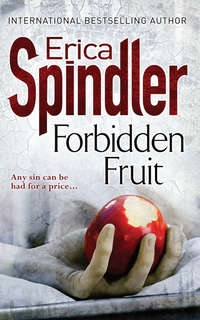
Kitabı oku: «Forbidden Fruit»
The author of over twenty-five books, Erica Spindler is best known for her spine-tingling thrillers. Her novels have been published all over the world, selling over eleven million copies, and critics have dubbed her stories “thrill-packed page turners, white-knuckle rides, and edge-of-your-seat whodunits.”
Erica is a New York Times and USA TODAY bestselling author. In 2002, her novel Bone Cold won the prestigious Daphne du Maurier Award for excellence.
Also by Erica Spindler
BREAKNECK
LAST KNOWN VICTIM
COPYCAT
KILLER TAKES ALL
SEE JANE DIE
IN SILENCE
DEAD RUN
BONE COLD
ALL FALL DOWN
CAUSE FOR ALARM
SHOCKING PINK
Forbidden Fruit
By Erica Spindler

www.mirabooks.co.uk
To Melissa Senate For all the years and all the books
Acknowledgements
My heartfelt thanks to the following people for their part in bringing Forbidden Fruit to life:
Linda Kay West
Lieutenant John Jackson
Sergeant Michael Pfeiffer
Metsy Hingle
Jan Hamilton Powell
Karen Stone
Cary Weissert
Dianne Moggy
Melissa Senate
Nathan Hoffman
Evan Marshall and MIRA Books
Part 1 Hope
Prologue
Vacherie, Louisiana 1959
Hope Pierron sat in the window seat of her third floor bedroom and gazed out at the Mississippi River. She smiled to herself, anxiousness and excitement coiling in the pit of her gut. She controlled both with icy determination. She had waited all her life for this day; now that it had come, she would not reveal herself by appearing too eager.
She pressed a hand to the sun-warmed glass, wishing she could break it, leap out and fly to freedom. How many times during her fourteen years, years spent trapped within the red walls of this house, had she wished the same thing? To be a bird, to leap from the window and fly to freedom?
After today, she wouldn’t need to wish for wings. After today, she would be free of this house. Of the stigma of sin. Free of her mother and all who she had known.
Today she would be reborn.
Hope closed her eyes, thinking of her future, yet picturing her past and this hated house, instead. The Pierron House had been a fixture on River Road, a part of the culture of southern Louisiana since the summer of 1917. That had been just before the demise of Storyville, when her grandmother Camellia, the first Pierron madam, had moved her daughter and her girls here.
Surprisingly, neither hue nor cry had erupted then, nor when the gentlemen began calling. All these years later, this house, the activities within, were still accepted, just as the heat and mosquitos of August were accepted—with resigned dismay and sugar-sweet disdain.
Hope supposed one could expect no less; after all, this was Louisiana, a place where food, drink and other sensory intoxicants were as much a part of day-to-day living as mass and confession. Louisianians accepted their penance with as much joie de vivre as they did their pleasure; they understood that in a strange way, The Pierron House represented both.
The building itself, a Greek Revival structure with twenty-eight imposing Doric columns and sweeping wraparound galleries, was an architectural wonder. Ironically, when the afternoon sun struck it just so, the house glowed a virginal, almost holy white. When the sun set, however, the illusion of holiness ended. The house came alive with the music of men the likes of Jelly Roll Morton and Tony Jackson, the walls rang with the laughter of those who had come to taste the forbidden fruit and of those who sold it.
Every evening of her life she had been forced to hear that laughter, had been forced to witness the regularity with which her mother’s girls led their gentlemen up the serpentine staircase. Cloaked in a sinfully plush, bloodred carpet, those stairs led to the six large bedrooms on the second floor, bedrooms outfitted opulently with silks and brocades and large, soft beds.
Beds designed to make a man feel like a king or, on a particularly good night, a god.
For as long as she could remember, Hope had known what went on in those bedrooms. Just as she had known who and what she was—the whore’s daughter, a trick baby, tainted by sin.
From secret places and small, unnoticed peepholes, Hope had watched with a mixture of fascination and horror the things that men and women did with each other. And sometimes, while the couple writhed on the bed, she would rock back and forth, her thighs pressed tightly together, her breath coming in small, uneven gasps.
Those were the times The Darkness held her in its grip, clamoring for unholy release.
Afterward, guilty and ashamed, Hope would punish herself. The way she touched herself, the things she watched, were wrong. Sinful. She had learned of her sin at mass and in catechism, as she sat alone because none of the other children would come near her. Yet, outside the church walls and inside these, such behavior was lauded—especially by the men who laughed by night and averted their eyes by day.
At the creak of the stairs that led to her bedroom, Hope turned away from her window and faced the door. A moment later, her mother appeared in the doorway.
Lily Pierron was an incredible beauty, same as all the Pierron women had been. Her face and figure seemed not to have aged with the years; her hair was the same velvety blue-black it had been in Hope’s childhood. The other whores commented on it behind her mother’s back; Hope had heard them whispering. They speculated that Lily had made a pact with the devil. They speculated that all the Pierron women had.
All except Hope. Hope was not nearly as beautiful as her mother—her own hair was a deep brown instead of black, her eyes a watery rather than brilliant blue, her features sharp instead of soft.
She was not as beautiful because The Darkness was not as strong in her.
“Hello, Mama,” Hope murmured, fixing a sweet, sad smile on her mouth.
The older woman returned her melancholy smile and took a step into the room. “You look so grown-up standing there like that. For a moment, I hardly recognized you.”
Hope’s heart began to thud against the wall of her chest. “It’s just me, Mama.”
Her mother laughed softly and shook her head. “I know. But it seems only yesterday you were a baby.”
And only an eternity of yesterdays that she was a prisoner of this place. “To me, too, Mama.”
Lily crossed to the bed and the suitcase that lay open on top of it. Hope saw the effort it took her mother to keep from falling apart, and wondered if her mother noticed that her daughter’s eyes were dry, her hands and voice steady. She wondered what her mother would say if she knew the truth, if she knew that her only daughter planned to never see her again.
“Is this the last one?” her mother asked. “The car will be here any moment.”
“Yes. I’ve already taken the others down.”
Lily carefully tucked the final few items into the case, then closed the bag and fastened the clasps. “There.” She lifted her swimming gaze to Hope’s. “All ready to…go.” Her throat closed over the last, and the word came out choked.
Hope forced herself to cross to her mother. She caught Lily’s hands with her own and brought them to her cheek. “It’s going to be all right, Mama. Memphis isn’t that far.”
“I know. It’s just that—” Her mother drew in a ragged breath. “How am I going to manage without you? You’re the best thing…the only good thing in my life. I’m going to miss you desperately.”
Hope curved her arms around her mother, fighting a smile. She hid her face against her mother’s shoulder. “I’m going to miss you, too. So much. Maybe I shouldn’t go. Maybe I should stay and help—”
“No! Never!” Lily cupped Hope’s face. “You will not end up like me. I won’t allow it, do you hear? This is your chance to escape. It’s what I’ve always wanted for you. It’s why I named you Hope.” She tightened her fingers. “You were always my hope for the future. You mustn’t stay.”
This time Hope couldn’t contain her smile. “I’ll make you proud, Mama. You wait and see.”
“I know you will.” Lily dropped her hands. “Everything’s set. St. Mary’s Academy is expecting you. You’re from Meridian, Mississippi, the only child of wealthy parents.”
“Who travel abroad,” Hope filled in. She laced her fingers together, nervous suddenly. “What if someone discovers the truth? What if one of my classmates is from Meridian? What if—”
“No one will discover the truth. My friend has seen to everything. Not one other girl from Mississippi attends the academy. Even the headmistress believes you’re Hope Penelope Perkins. No one will question your story. Feel better now?”
Hope searched her mother’s expression, then nodded. She knew her mother’s “friend” to be none other than the Governor of Tennessee. He and her mother went way back; Lily knew many—if not all—of his darkest secrets. Secrets she would go to her grave with. Of course, such loyalty sometimes demanded return—in the form of favors.
The sound of a horn sliced through the humid afternoon. Hope’s heart flew to her throat, and she raced to the window. Three stories below, the airport shuttle idled in the driveway while Tom, the houseman, helped the driver load the bags.
Lily followed her to the window. “Dear Lord, it’s time already.” She laid her hands on Hope’s shoulders, her cheek against her hair. “I don’t know how I’m going to bear this.”
Hope sucked in a deep breath, joy a living thing inside her. Almost free. Just a few more minutes and she would never see her mother or this hated house again. She struggled to keep from laughing out loud.
Her mother sighed, dropped her hands and took a step away. “We’d better go.”
“Yes, Mama.” Hope collected the suitcase, then she and her mother started for the stairs. Her mother’s girls were waiting for them in the foyer. They each hugged and kissed Hope, they each wished her well and made her promise to write.
The youngest of the group—a girl not much older than Hope—handed her an apple, lush and red and ripe. “In case you get hungry,” she said softly, her eyes bright with tears.
Hope took the girl’s offering though the fruit burned like acid against her palm. She longed to fling it away and run, but forced herself to meet the whore’s eyes and smile. “Thank you, Georgie. It was sweet of you to think of me.”
Hope stepped outside, her mother beside her. The breeze off the River was hot and slow, but sweet still; it washed over her, cleansing her of the stench of the house and its history. Her history.
Her mother drew her into her arms and clung to her. “My darling, darling baby, I will miss you so much.”
Hope fought the urge to tear herself from her mother’s arms and race to the waiting vehicle. She allowed her mother to kiss her one last time, promising herself that she would never again have to endure her vile touch.
The touch of sin.
The driver cleared his throat. Hope said a silent thank-you and eased from her mother’s grasp. “I have to go, Mama.”
“I know.” Lily curved her arms around her middle, battling tears. “Call me when you arrive.”
“I will,” Hope lied. “I promise.”
She started for the car, counting the steps. With each she felt as if another piece of her past was falling away from her, like layers of smothering clothing, ones made of wet, rotting wool.
The driver opened the door. She moved to get in, then stopped and looked over her shoulder at The House, at her mother standing in its shadow, at the whores, clustered in the doorway. Her lips curved into a small, satisfied smile.
Today she was reborn as Hope Penelope Perkins. Today she left The Darkness behind.
Letting the apple slip from her fingers, she turned and stepped into the car.
Chapter 1
New Orleans, Louisiana 1967
The perfume of flowers hung in the air, almost overpowering in its sweetness. The scent mixed strangely with those of the maternity ward, creating another that was both appealing and repugnant. Even so, fresh arrangements arrived hourly, enthusiastic offerings sent to herald the birth of Philip St. Germaine III’s first child.
The excitement was understandable. After all, this child would be heir to the family’s wealth and social position, this child would be heir to the venerable St. Charles, the small luxury hotel built in 1908 by the first Philip St. Germaine.
For this child, nothing was too much.
Hope gazed down at the newborn, nestled in the bassinet beside her bed. Despair and disappointment, so bitter they burned her tongue, roiled inside her. She had prayed for a boy. She had done the rosary, she had done penance. She had been so certain her prayers would be answered that she had refused to consider names for a girl.
Her prayers had not been answered; she had been cursed instead.
She had given birth to a daughter, not a son. Just as her mother and grandmother had, just as every Pierron woman had for as many generations back as she could recall.
Hope drew a deep breath, bile rising like a poison inside her. She hadn’t escaped the Pierron legacy, after all. She had managed to believe, to convince herself for a while, that she had. In the eight years that had passed since she’d walked away from the house on River Road, she had brought each of her plans to fruition: she had left behind her mother and the stigma of being the whore’s daughter; she had married Philip St. Germaine III, a wealthy man, a man from an impeccable and prominent family; she was now one of New Orleans’s premier matrons.
But today she saw that although she had left her past behind, she hadn’t escaped it. The Pierron curse had followed her.
The baby girl was already a beauty, with light skin, vivid blue eyes and velvety dark hair. As with all the Pierron women, this one would possess the ability to bewitch and enslave men; she, too, would have the great, ugly darkness inside her. The ugliness that would chain her to a life of sin and an afterlife of eternal damnation.
Hope shuddered. For didn’t she, too, have The Darkness inside her? Didn’t it sometimes burst free, despite how hard she fought to keep it locked way?
Philip entered the room, his face wreathed in a beatific smile, his arms laden with a huge bouquet of pink roses. “My darling. She’s beautiful. Perfect.” The florist’s paper crackled as he laid the bouquet on the bed. He bent and pressed a kiss to Hope’s forehead, careful not to disturb his sleeping child. “I’m so proud of you.”
Hope turned her face away, afraid he would see her true feelings, afraid he would see the depth of her despair and revulsion.
He sat on the edge of the bed. “What is it? Hope, darling…” He turned her face to his. He searched her expression, his own concerned. “I know you wanted a son for me. But it doesn’t matter. Our little one is the most perfect child ever born.”
Tears stung her eyes, and she blinked against them. Still, one slipped past her guard and rolled down her cheek.
“Oh, love, don’t cry.” He drew her against his chest. “It really doesn’t matter. Don’t you see? Besides, we’ll have other children. Many more.”
The pain inside her grew almost unbearable. Hope knew what her husband did not: there would be no more children for them. She, like her ancestors, would be unable to carry another child to term. That was a part of the curse, the Pierron women were allowed only one child, always a daughter. To that daughter they would pass The House and the legacy of sin.
Hope curled her fingers into the soft, fine fabric of his jacket. She longed to share her thoughts with him, but knew he would be shocked, horrified, to learn the truth about his perfect wife. And now, his perfect daughter, too.
He could never know. She swallowed hard and pressed her face to his shoulder, breathing in the scent of the rain that lingered on his jacket, preferring it to the cloying atmosphere of the room. No one could ever know.
“I just wish,” she whispered, working to achieve just the right mixture of grief and wistfulness in her tone, “that my parents could have lived to see her. It’s so unfair. Sometimes it hurts so much, I…I almost can’t bear it.”
“I know, my darling.” For several moments, he cradled her against his chest, then eased her away, his lips lifting into a small smile. “I have something for you.” From his jacket pocket he drew out a jeweler’s box. Stamped on the lid of the midnight-blue leather case was the name of New Orleans’s finest jeweler.
With trembling fingers, Hope opened the box. Inside, nestled on the white velvet, lay a strand of perfectly matched pearls. “Oh, Philip.” She took out the necklace and brought it to her cheek. The pearls were cool and smooth against her skin. “They’re exquisite.”
His lips lifted, and he shifted his gaze to the baby, who had begun to stir. “They’ll be hers one day. I thought it appropriate.”
Hope’s pleasure in the gift vanished, and she replaced the necklace in its box. He adored his daughter already, Hope thought, following his gaze. He had been bewitched, snared by The Darkness. And the fool didn’t even know it.
“She’s caused a sensation in the nursery,” he continued, not tearing his gaze from the bassinet. “Nurses from all the floors have heard about her, about her beauty, and have come to see her. She’s caused a traffic jam at the viewing window.” He turned back to his wife, covering her hand with his, curving his fingers reassuringly around hers. “I’m the luckiest man in the world.”
The baby stirred and whimpered, then began to cry. Hope shrank back against the pillows, knowing what was expected of her but unable to bear the thought of holding the child to her breast.
The baby’s cries, at first small, pitiable mewls, became shrill, angry demands.
Philip frowned, obviously confused. “Hope, darling…she’s hungry. You have to feed her.”
Hope shook her head, cringing deeper into the pillows. To her horror, her breasts, engorged and aching, began leaking milk. The baby’s face grew red as the fury of her wails increased. Her features contorted into something ugly and terrifying. Something Hope recognized from her nightmares.
The Darkness. Dear God, it was strong in this child.
Philip tightened his fingers over Hope’s. “Darling…she needs you. You must feed her.”
When Hope didn’t move, Philip scooped up his daughter. He rocked her awkwardly, but her cries didn’t diminish. He held the child out to Hope. “You must.”
Hope looked wildly about the room, desperate for a way to escape. Everywhere she looked, she saw The Darkness, everything reminded her what a fool she had been.
She hadn’t escaped the Pierron legacy. She never would.
Trapped, she thought, a frantic hopelessness beating inside her. She was trapped. Just as she had been all those years ago.
“I can’t,” she said, hearing the hysteria in her own voice. “I won’t.”
“Darling—”
“Mrs. St. Germaine?” The nurse rushed in. “What’s wrong?”
“She won’t feed her,” Philip said, turning to the nurse. “She won’t take her from me. I don’t know what to do.”
“Mrs. St. Germaine,” the nurse said crisply, her voice brooking no disobedience. “Your daughter is hungry. You must feed her. She will stop crying the minute—”
“No!” Hope drew the blanket to her chin, her fingers curled so tightly into the fabric that they went numb, panic pumping through her until she shook with it. “I can’t.” She turned to her husband, tears slipping down her cheeks. “Please, Philip, don’t make me do this. I can’t do it. I won’t.”
He stared at her as if she had sprouted horns. “Hope? What’s wrong? Sweetheart, this is our child, our baby. She needs you.”
“You don’t understand…you don—” The last caught on a sob and she turned her face to the pillows. “Go…away. Please, just leave me alone.”
Chapter 2
Philip August St. Germaine III had an idyllic life, one of those existences so untroubled that others commented enviously on it. He had the right family, all the right and best things; he was healthy, athletic and handsome enough. He had sailed through school, in part because of native intelligence, but more because of the charm he had acquired through breeding.
In truth, Philip had never had to work for anything, not for grades or girls or a living. Everything had been handed to him not only on a sterling platter—the St. Charles being the crown jewel on that platter of glittering gems—but with an adoring smile. For Philip, the years flowed effortlessly one into the other.
Far from being bothered by his lack of effort in shaping his own life, he accepted it all graciously, as his due and his wonderful lot in life. He did feel for those poor souls who struggled and suffered, and he never forgot to give—and give plentifully—to the Church, both in thanks for his bounty and as a sort of insurance policy against guilt.
Frankly, until thirty-six hours ago, Philip August St. Germaine III had thought, with justifiable arrogance, that nothing ugly or unhappy could ever touch him.
Now, as he stood at the maternity ward’s nursery window and watched a stranger feed his baby, his beautiful, perfect daughter, that same arrogance mocked him. Now, he felt as if his idyllic life was crumbling around him.
The last day and a half had been like a nightmare from which he couldn’t awaken. The wife he adored, usually sweet-tempered and genteel, had become a person he didn’t recognize. A person who frightened him.
He brought a hand to his head, heavy and aching from stress and lack of sleep. It wasn’t only that she had cursed at him, spitting out words he would have sworn she didn’t, and couldn’t, know. It was more than the fact that she had told him she hated him when he had tried insisting they pick out a name for their child.
No. It was the way she had looked at him, an almost maniacal light burning in her eyes, that frightened him. Because when she’d looked at him that way, he had felt, deep down in his gut, that the life he had known was gone forever.
Philip jammed his hands deep into his trouser pockets and gazed at his daughter, sucking greedily on a bottle of formula. She was the image of her mother already. He couldn’t understand how Hope could look at her with such horror, how she could recoil from touching her. He pressed the heels of his hands to his burning eyes. When she looked at their precious daughter, what did she see that he didn’t?
If only he could understand, if only he could crawl inside his wife’s head, maybe he would be able to help her. And then, maybe, his world would stop rocking around him.
Her behavior had come out of nowhere. She had looked forward to the birth of their first child. Her pregnancy had been an easy one; she had suffered from neither morning sickness nor mood swings. They had talked about all the things this child would do and be. Other than her absolute conviction that she carried a boy, her attitude about motherhood had seemed completely normal.
Now this. A shudder of fear moved over him. What would he do if he had lost her? If the woman he had known and loved so desperately had ceased to exist forever? How would he go on? He loved her beyond reason; he had from the first.
Inside the nursery, the attendant finished feeding and burping Philip’s daughter and laid her in her crib. Philip watched, seeing instead Hope as she had looked the night they first met. He had been in Memphis on business; they’d been introduced by friends. She had been laughing, her head tipped to the side, her long, silky hair falling softly against her cheek. He’d had the urge to touch it, to bring the dark strands to his lips to test their texture and taste. He could recall the exact rose shade of her mouth, could recall the way she’d pursed her lips in amusement, could remember that he had become aroused just watching her speak.
She had turned and met his eyes. He’d sensed that she knew exactly what he was thinking, that she was glad he was thinking it. In that moment, he had fallen madly in love with her. It had been as simple, and as complicated, as that.
That night and for the remainder of his business trip, they had been inseparable. He had told her everything about himself, and she had shared her life with him. The tragic story of her parents’ accidental death while traveling in Italy, of how she had been left alone in the world at seventeen, had touched him deeply.
Something about her had made him feel like the most powerful, the most important man in the world. He had wanted to shield her from the harsh world, had wanted to protect her from all of life’s unpleasantness. He had wanted to bring her into his charmed circle.
If he had been a less cautious man, he would have proposed on the spot. Instead, he had waited six long, agonizing weeks.
Family and friends had thought him insane until they met her. Then they, too, had fallen under her sweet spell. Even his demanding, ever-critical parents had thought her the perfect choice.
Not that it had mattered what they thought. He had been prepared to defy them, he had been prepared to give up everything for her.
Their wedding night had been an experience beyond his fantasies. She had done unimaginable, incredible things to his body, yet with such sweet, almost tentative innocence, that he had felt as if he were deflowering a virgin. Even now, standing in plain view of the world, his life in turmoil, thinking of that night brought swift, stunning arousal.
Sometimes he felt as if his life revolved from night to night, from one opportunity to make love with her to the next. Those times when she couldn’t—or wouldn’t—were a kind of torture beyond his previous experience. No woman before Hope had had such a hold on him; it was as if without her his heart couldn’t beat.
“There you are.” Hope’s doctor came up to stand beside him. Harland LeBlanc had delivered a host of St. Germaine babies, and although nearly sixty, he looked a decade younger. Since the man was considered the top obstetrician in New Orleans, Philip took some comfort in knowing Hope had the best care available.
The older man motioned to the nursery. “You have a beautiful daughter, Philip. In fact, I don’t think I’ve ever seen a more beautiful infant.”
Philip looked at the other man, then returned his gaze to the nursery window. “Yet, Hope can’t bear to look at her. She’s yet to hold her. She won’t even consider a name.”
“I know it’s been difficult, but—”
“Difficult?” Philip said, his tone caustic. “I don’t think you do know, Harland. I don’t see how you can. You weren’t there this morning when Hope swore at me. When she told me she hated me. All because I wanted to pick out a name for our daughter.” He drew a painful breath. “The way she looked at me was…chilling. I never thought my wife would look at me that way.”
The physician laid a hand reassuringly on Philip’s shoulder. “Believe it or not, I do understand what you’re going through. I’ve seen this type of behavior before, and it will pass. Everything is going to be all right, Philip.”
“Are you so certain of that?” Philip drew a hand across his forehead. “What if it doesn’t pass? I couldn’t bear to lose her. She’s everything to me, she’s—” He cleared the lump from his throat, feeling exposed and foolish. He shifted his gaze to the nursery and his sleeping daughter. “I love my wife, Harland. Too much, I sometimes think.”
The doctor gave Philip’s shoulder a comforting squeeze, then dropped his hand. “What Hope’s going through isn’t as uncommon as you might imagine. A surprising number of women experience depression after childbirth. On occasion, the depression is so severe, so all-encompassing, the woman abandons her family. Or worse.”
Philip met the other man’s gaze once again. He lifted his eyebrows at the physician’s solemn expression. “Worse, Harland?”
“Women in the grip of this blackness have killed their newborns, Philip. As horrifying and foreign as that may seem.”
Philip made a sound of shocked disbelief. “Surely you’re not suggesting that Hope might…that she could…kill our child?”
“Of course not,” Harland said quickly, his tone confident. “But I do think we should keep her here a few more days. We need to monitor her. Just to be sure.”
Dear Lord. Just to be sure? Of what?
Fear thundered through Philip, taking his breath, stealing the remnants of his peace of mind. Harland LeBlanc, Philip realized, considered top in his field, a doctor who had seen everything, was worried. More worried than he wanted to let on.
Philip breathed deeply through his nose, working to steady himself. But Harland didn’t know Hope the way he, her husband, did. All she needed was a return to normalcy. She needed to be surrounded by her things and the people who cared about her.
“Do you really think that’s necessary, Harland? Hope needs to be home. Our baby needs to be home. Once there, Hope will adjust. I know she will.”
“What if she doesn’t? Postpartum depression is caused by the tremendous imbalance of hormones in a woman’s body. Hope has no control over these feelings she’s having, she’s awash in them. She’s not trying to be difficult or unreasonable.”
The doctor shook his head. “What if I send her home too early and she doesn’t adjust? What if I send her home and the unspeakable happens? I don’t want to take that chance.” He met Philip’s gaze evenly. “Do you, Philip?”
The unspeakable. Or worse. Philip swallowed hard. “No. Of course not.”
“Good. Your wife needs you now. You say you love her, well, now’s the time to prove it.”
Philip willed away his frustration and selfish fears. Hope needed him. His daughter needed him. He had to be strong. “What can I do?” he asked. “Just tell me what I can do.”
“Be supportive. Understanding and loving. I know it’s hard, but you must remember that Hope is not in control of her emotions. She’s as frightened as you are right now. Probably more. She needs time. She needs your patience and love.”
Philip turned his gaze to his sleeping daughter, so tiny and helpless his heart broke for her. She needed her mother. She needed to go home. “And if my love and support aren’t enough? What then, Harland?”
For a moment, the physician said nothing. Then he sighed. “They’ll have to be, Philip. Right now, you don’t have any other options.”
Chapter 3
Hope awakened with a start. Breathing hard, clammy with sweat, she moved her gaze over the dimly lit room, expecting to see the outfittings of the third-story bedroom she had grown up in. Instead, she saw the simple, functional furnishings of her hospital room.
Hope drew in a deep, shuddering breath, relief spiraling through her. She was in New Orleans. She was Hope St. Germaine; the River Road house was far away. Part of a previous lifetime, someone else’s lifetime.
Hope drew in another deep breath, the effects of the nightmare still clawing at her. In it, she had been back at The House, crouched low and spying on a couple having sex. Only, in the dream, it had been her daughter on the bed, her daughter performing the lewd sex acts.
Yet, when her whore-child had looked over her shoulder, as if sensing Hope’s spying gaze, it was her own face Hope had seen staring back at her.
Making a helpless sound of fright, Hope pulled herself into a sitting position. She clutched the bedding, willing away the image from the dream. She knew what was happening to her; she knew why, night after night, she was being tormented with nightmares of the past she had left behind.
The Darkness was upon her, taunting and challenging. It thought it had won already.
No! Hope brought her trembling hands to her face. She wouldn’t let The Darkness win. She couldn’t. She had worked too hard for all she had achieved to succumb now.
Hope hugged her knees to her chest. She rocked, her head pressed to her knees, her mind whirling. Who could she turn to for help? Who could she trust? Philip was losing patience with her. Their family and friends were acting strangely, distant and suspicious. She saw the questions in their eyes. She saw the disapproval in their expressions. How long until someone uncovered the truth about her past? How long until the life she had built for herself crumbled to bits beneath her feet?
She had to accept her child; she had to behave like a doting, besotted mother. She had to behave as if she didn’t see her daughter’s vile core, pretend she didn’t see that the beautiful fruit was spoiled by worms.
Tears, hot and bitter, welled up in her eyes and slipped down her cheeks. But when she held her daughter, how would she keep her revulsion from showing? How would she be able to hide her despair and feign affection? She couldn’t; she knew she couldn’t.
Hope threw aside the covers and climbed out of bed. She crossed to her half-open door, the linoleum floor cool against her bare feet. She peeked out at the deserted hallway and nurses’ station. She heard a woman’s weeping from down the hall, heard another’s comforting murmur.
The Vincent woman had lost her baby. Philip had shared that information with her earlier today, she supposed in the hope of making her thankful for their own baby’s good health. Instead, she had wished it was her own child who had been taken. If the Lord had chosen her baby, her problems would have been solved.
But the Pierron daughters were strong with The Darkness that beat inside them; the Pierron daughters never died.
She had to escape, she thought, frantic suddenly. She had to get out of this place and breathe fresh air; she needed to be away from the constant prying, the insufferable compassion, of the hospital staff. She had to find someone who would understand and help her.
The church. She could turn to the church. The priest would help her. He would understand.
And in the anonymity of the confessional, she would be safe. Her secret would be safe.
Whimpering with relief, Hope turned away from the door and moved blindly to her closet. She rifled through it, pulling out her street clothes, tugging them on as quickly as she could, fumbling in her haste. Throughout her life the Church had been her solace, her rock during times of turmoil and confusion. Surely this time would be no different. Surely the priest would know what she should do.
But what if, this time, the priest couldn’t help her? What would she do then?
Fear pumped through her, taking her breath, her ability to think, to act. She struggled to get control of her emotions; she couldn’t afford to fall apart now. If she did, The Darkness would have her.
Never. Taking a deep, steadying breath, Hope crossed to the phone and as quietly as she could, called a cab. That done, she collected her purse and tiptoed to the door. Luck was on her side—the nurses’ station was still empty. Smiling to herself, she ducked out of the room and went quickly to the elevator. She didn’t want Philip alerted to the fact she was leaving the hospital. He would try to stop her; the hospital staff would try to stop her. None of them understood.
As she had hoped, the elevator was unoccupied. It whisked her to the lobby; she stepped out and started for the double glass doors directly ahead. A security guard stood at the front desk, flirting with the receptionist. Neither spared her more than a glance.
Hope pushed through the doors and stepped out into the humid New Orleans night. Air, thick with moisture, enveloped her like a womb. She breathed deeply, grateful, so grateful, to be free.
She moved away from the building, out of its circle of light, and the dark swallowed her. Moonlight glistened on the wet pavement; tree branches, their leaves heavy with a recent rain, hung low, their loaded leaves splattering her as she walked beneath them.
A streetcar rumbled past; a youth darted across the avenue, shouting a greeting to another passing in a car. From the canopy of oak leaves above her came the sound of some small animal scurrying for deeper cover.
The cab drew to the curb. Hope slid inside. “St. Louis Cathedral,” she instructed, then settled against the worn seat. In hopes of catching the faithful either in anticipation of their sin or in repentance of it, the Jackson Square cathedral heard confessions into the night. She had always thought it ironic that New Orleans’s oldest, and to her mind, most awe-inspiring cathedral stood sentinel at the very heart of debauchery.
Hope clenched her hands in her lap. The cab smelled stale, like old cigarettes and mildew. The driver said little; his silence saved her having to rebuff him. She turned her face to the window and watched as the grand residences of uptown gave way to the high rises of downtown, then to the old-world architecture of the Vieux Carré, or French Quarter.
Within minutes, the driver drew the cab to a stop beside the cathedral. Hope asked him to wait, then stepped out into the night. She lifted her gaze to the church’s mighty spire, feeling a measure of relief already. St. Louis Cathedral stood watch over Jackson Square, just as a chaperon would over a pair of anxious teenagers, just as the Catholic church had always stood watch over the eternal souls of the faithful. Rebuilt twice from ashes and once from the rubble wrought by a hurricane, its rigid lines provided a stark contrast to the whimsical ironwork of the buildings adjacent to it. Hope had always thought of this church as a type of anchor, its rigidity balancing and securing the lives of the laissez bon temps roullé Creoles who had once inhabited the Vieux Carré.
Taking a deep breath, she hurried toward the church’s welcoming portal, her heels clicking on the cobblestone walkway. From the Mississippi River, located just beyond the square to the east, came the lonely call of a barge; from nearby Bourbon Street, she caught the strains of Dixieland jazz and raucous laughter.
As she entered the church, those sounds faded, leaving a silence that echoed, that reassured. A sense of calm, a feeling of serenity flowed over Hope. Her agitation, the desperation that had held her in its grip for days now, melted away. Here, The Darkness couldn’t touch her. Here, nestled in the arms of the church, she would find her answers.
A marble cistern stood inside the entrance. Hope dipped her fingers into the holy water. She crossed herself, and started for the confessionals that flanked each side of the sanctuary at the front.
She slipped into the first she came to and drew the curtain closed behind her. She knelt, facing the interior wall, and bowed her head. A moment later, the panel slid open. Obscured by a screen, she could make out the priest’s form, but not his features. Just as he could not make out hers.
“Bless me, Father, for I have sinned. It’s been two weeks since my last confession.”
“What sins do you have to confess, my child?”
Hope twisted her fingers together, her heart thundering so hard it hurt to breathe. “Father, I…I’ve come to you under false pretenses. I’ve come not to confess my sins, but to seek your counsel. You see, I—” Her throat closed over the words, and she fought to clear it, fear and despair rising in her again, threatening to swallow her.
“I have nowhere else to turn, Father. No one to turn to. If you can’t help me, I don’t know what I’ll do. I’ll be lost.” Hope brought her hands to her face and wept into them. “Please, Father. Please help me.”
“Calm yourself, child. Of course I’ll help you. Tell me what’s troubling you.”
Hope shuddered. “The women of my family are evil and wanton, Father. They’re sinners, they sell themselves, their bodies. It’s always been so in my family, we are cursed women.”
She swiped at the tears on her cheeks. “I escaped, but now I fear for my baby daughter’s eternal soul. I fear she, too, will grow up evil and wanton. I see The Darkness in her, Father, and I’m so afraid.”
For a moment, the priest said nothing. Then he began to speak, softly but with a strength and surety that filled Hope with calm.
“We are all in possession of the darkness, child. Eve offered Adam the apple, he took the Forbidden Fruit and Original Sin was born. Each of us come into the world tainted by that act of Original Sin. We are all unclean. But God sent His only son to die for us, for our sin. Christ is our promise of salvation.”
The priest shifted, Hope heard the rustle of his robes and the click of his rosary beads. “You must help your daughter. You must show her the right path. You must teach her to fight the Serpent.”
“But how, Father?” Hope leaned toward the partition. “How can I help her?”
“You’re her mother. You have the power to mold this child into a woman of high moral character. Only you. You show her the way, teach her right from wrong, holy from unclean. God has sent you this child as a test. Of your strength and of your faith. This child can be your glory or your defeat.”
Hope’s heart began to thunder, and suddenly her path—her purpose—was clear. It wasn’t the Lord who was testing her, it was The Darkness.
She curved her hands into fists, so tightly her nails dug into her palms. Let The Darkness test her, let it taunt and mock her. She wouldn’t lose to it; she wouldn’t let it have her daughter. She would stamp the Bad Seed out of her child, just as she had worked to stamp it out of herself.
This child could be her glory or her defeat.
Glory, she thought, determination rising like a tidal wave inside her. This child would be her Glory.
Part 2 Santos
Chapter 4
New Orleans, Louisiana 1979
Living in New Orleans’s French Quarter suited fifteenyear-old Victor Santos just fine. No place else he had lived was quite like it. Day and night, the Quarter vibrated with energy and excitement; he never lacked for something to do or someone to hang out with. He liked the sounds and the smells, he liked the old buildings whose cracked plaster walls were always damp, he liked the lush, hidden courtyards and the fanciful iron balconies.
But most of all, Santos—called that by everyone but his mother—liked the people. The Quarter was home to all ages, persuasions and colors, home to the good, the bad and the ugly. Even the crush who flocked to Bourbon Street at night—most of them dedicated party animals, the rest curiosity seekers come to ogle the outrageous—fascinated him.
His school counselors were always telling his mom that the Quarter was no place to raise a kid because of the bad element. Of course, they would lump her into that category, too, if they knew she was an exotic dancer and not the waitress she had told them she was.
As far as Santos was concerned, those counselors were a bunch of full-of-crap know-it-alls. As far as he was concerned, hookers, junkies and runaways had a lot more heart than no-good sons-of-bitches like his daddy. No, from what he had seen of life, the folks who’d had nothing but hard times and hurts didn’t have room inside them for hate.
Santos crossed Bourbon Street and shouted a greeting to Bubba, the guy who worked the door of Club 69, the place his mother danced nights.
“Hey, Santos,” the burly bouncer called back. “You got any smokes? I’m out.”
Santos laughed and lifted his hands, empty palms up. “Gave it up, man. Haven’t you heard? Those things’ll kill you.”
The man flipped Santos a friendly bird, then turned his attention to a couple of tourists who had stopped outside the club and were craning their necks to get a peek at the show.
Victor continued down Bourbon, then cut across to St. Peter, hoping to shave a few minutes off his walk. He had promised his mother he would pick up a couple shrimp po’boys on his way home.
His mouth started to water at the thought of the big, sloppy sandwiches, and he stepped up his pace, though not too much. August in New Orleans didn’t lend itself to hurrying. Although the sun had begun its descent more than an hour ago, the sidewalk was still hot enough to fry an egg. Heat emanated from the concrete in sweltering waves, and the air, heavy with the ninety-plus-percent humidity, could suffocate the overzealous. Just last week, a touristbuggy horse had fallen over dead in the street, a victim of August in New Orleans.
“Hey, Santos, baby,” a woman said from behind him. “Where you goin’ in such a hurry?”
He stopped, looked over his shoulder and smiled. “Hey, Sugar. Going to the Central Grocery, then home. Mom’s waiting.” Until about six months ago, Sugar had danced at the club with his mother. She’d been forced to start working the streets full-time when her man had taken off, leaving her and their three kids.
“Your mama always did like them sandwiches. Bet you do, too, a big boy like yourself.” She laughed and patted his cheek. “You tell your mama I said hello. You tell her Brown Sugar’s doin’ okay.”
“I will. She’ll be glad to hear it.”
Santos watched her walk away, then shook his head and started off again. Sugar was an example of the kind of folks those do-gooder school counselors called a bad influence. The way he saw it, she was doing the best she could to take care of her family. The way he saw it, sometimes life didn’t offer anything better than a shit sandwich. When that happened, you had to eat it or starve.
Not that there weren’t some bad people in the Quarter. There were plenty; just like everyplace else. He figured folks came in three varieties: the haves, the have-nots and the want-to-haves. The way he saw it, the lines between these three groups were very clearly drawn. It was economics, pure and simple.
The haves were easy. They liked their lives, and as long as members of the other two groups stayed out of their way, they weren’t any bother at all. But the want-to-haves were trouble. They came from all walks of life, they grappled for money and power, they would do anything to anyone to get it; the want-to-haves burned in their gut to lord it over somebody else.
Santos considered himself a pretty tough kid, but he steered clear of that kind. Experience had taught him well. His daddy had been like that, always hungry for what he didn’t have, always yearning to lord it over somebody else, ready to raise his fist to somebody smaller or weaker. Like that would make him a big man.
His daddy. Santos curled his lips in distaste. He had nothing but bad memories of Samuel “Willy” Smith. The man had been pure oil-field trash, but too good to marry the “spic-squaw” girlfriend he had knocked up, too good to give their baby his name. He used to call Victor and his mama half-breed wetbacks and tell them they were no good.
Santos remembered feeling little but relief the morning the sheriff had come by their trailer to tell them Willy Smith had been killed—his throat slit from ear to ear—in a barroom fight. Every now and then, however, Santos did wonder about his old man—he wondered how he was enjoying hell.
Santos reached the grocery and went inside, grateful for the blast of cold air that hit him as he opened the door. He ordered the sandwiches, shot the breeze with the counter girl while he waited, and ten minutes later was back on the street, the po’boys and a couple bottles of Barq’s in a brown take-out sack.
He and his mother lived on Ursuline, in a small, secondfloor apartment. The place was clean, cheap and unairconditioned. They endured the summer months with two small window-units, one for each bedroom. Sometimes it was so hot in the kitchen and living room, they ate on their beds.
Santos reached their building, jogged up the one flight of stairs, then let himself into their apartment. “Mom,” he called. “I’m home.”
His mother stepped out of her bedroom, a brush in her hand, her features masked by the thick layer of makeup she wore to work. She had told him once that she liked wearing the makeup when she danced, because it made her feel as if it was somebody else up on the stage, as if it wasn’t really her the men were staring at. She had told him, too, that those guys, the ones that came to the club, liked her to look cheap. Like a whore, or something. It was part of their thrill. Santos thought it was really fucked-up. He wished his mother didn’t have to put up with it.
She shut the bedroom door behind her, careful not to let the cool air escape. “Hi, darlin’. How was your day?”
“Okay.” He fastened the safety chain. “I have the sandwiches.”
“Great. I’m starving.” She motioned toward her bedroom. “Let’s eat in here. It’s hot as hellfire today.”
He followed her and they sat down on the floor, then dug into the sandwiches. While they ate, Victor studied his mother. Lucia Santos was a beautiful woman. Half American Indian—Cherokee, she thought—and half Mexican, she had dark hair and eyes, and an exotic-looking, highcheekboned face. He had seen men look at her, when they’d been out together, just the two of them, her in her blue jeans, her hair pulled back into a girlish ponytail, her face free of the makeup that exaggerated and hardened her features.
He took after her; everybody said so. And every time he looked in a mirror, he said a silent thank-you for it. He didn’t think he could have faced getting up every day, looking in the mirror and being reminded of Willy Smith.
“Mrs. Rosewood called today.”
One of those know-it-all do-gooder counselors. “Great,” Santos uttered. “Just what we need.”
She put down her po’boy and wiped her mouth with a paper napkin. “You start school next week. You need some things.”
His gut tightened. He knew what that meant. Tonight, tomorrow night or the next, she would come home with a “friend.” Suddenly, there would be plenty of money for clothes and doctor’s visits and book bags. He hated it. “I don’t need anything.”
“No?” She took another bite of her po’boy, chewed slowly, then washed it down with a long swallow of the root beer. “What about the two inches you’ve grown over the summer? Don’t you think your pants are going to be a little short?”
“Don’t worry about it.” He crushed the paper his po’boy had come wrapped in and shoved it into the empty take-out bag. “I’ve got some money saved from my job, I’ll get new clothes myself.”
“You also need to visit the dentist. And Mrs. Rosewood said your records show that you’re due for—”
“What does she know?” he interrupted, angry suddenly. He jumped to his feet and glared at his mother. “Why can’t she just leave us alone? She’s just an old busybody.”
Lucia frowned and followed him to his feet. She met his gaze evenly. “What’s the problem, Victor?”
“School’s a waste of time. I don’t see why I can’t just quit.”
“Because you can’t. And you won’t, not while I’m alive.” She narrowed her gaze, her expression fierce. “You need an education if you’re ever going to get out of this dump. You quit school and you’ll end up just like your daddy. You want that?”
Victor clenched his hands into fists. “That really sucks, Mom. I’m nothing like him, and you know it.”
“Then prove it,” she countered. “Stay in school.”
He flexed his fingers, frustrated. “I’m big enough to pass for sixteen. I could quit school and get a full-time job. We need the money.”
“We don’t need the money. We’re doing fine.”
“Right.”
At his sarcasm, she flushed, obviously angry. “What’s that supposed to mean? Huh?” She poked her index finger into his shoulder. “What do you want that you don’t have?”
He said nothing, just stared at his feet and the remnants of their meal, an ugly mess on the pieces of white butcher paper. Like this whole, fucking situation. Anger and helpless frustration balled in his chest until he thought he might explode with it.
“What?” she asked, poking him again, this time harder. “You want some high-priced stereo system? Or maybe you need some of those fancy, name-brand jeans or a color TV in your room?”
He lifted his head and met her eyes, the blood pumping furiously in his head, “Maybe what I want, maybe what I need, is a mother who doesn’t have to turn tricks every time she has to buy her son a new pair of shoes or take him to the doctor.”
She took an involuntary step back, as if he had slapped her, her face going white under her foundation and blush.
He held a hand out to her, contrite. “I shouldn’t have said that, Mom. I’m sorry.”
“Don’t.” She took another step back from him, working to get control of herself. “How did you know about the…tricks?”
Santos dragged his hands through his hair, frustrated, wishing he had never started this. “Give me a break, Mom. I mean, I’m not blind. Or dumb. I’m not a kid anymore. I’ve known for a long time.”
“I see.” She gazed at him another moment, then turned and crossed slowly to the one window in the small room. She stared out at the street below, her view partially obstructed by the small air conditioner. The seconds ticked past, seeming more like minutes. Still, she said nothing.
He took a step toward her, then stopped, cursing himself. Why hadn’t he held his tongue? Why hadn’t he just let her believe he didn’t know her little secret? He couldn’t take his words back now, and her silence hurt him more than one of his daddy’s blows.
“What did you expect?” he said, softly now. “Every time I needed something, you came home with a friend. He would stay an hour or two, then leave. Of course, we’d never see him again.”
She bowed her head. “I’m sorry.”
A catch in his chest, he crossed to her and wrapped his arms around her. He pressed his face to her sweet-smelling hair. Tonight when she returned from work, it would reek of cigarettes and the dirty old men who had pawed at her. “Sorry for what?” he asked, choked.
“For being a…whore. You must think—”
“You’re not! I think you’re the greatest. I’m not…” His voice thickened, and he struggled for a moment to clear it. “I’m not ashamed of you. It’s just that I know how much you hate it. You’re always so quiet after. You always look so sad.”
He breathed deeply through his nose. “And I hate that you do it for me. I hate that I’m the reason why you let those guys…” His words trailed off.
“I’m sorry,” she said again, her voice small and broken. “I didn’t want you to know about the tricks. I thought…” She shook her head. “This isn’t the kind of life I wanted you to have. I’m not the kind of mother you deserve.”
“Don’t say that.” He tightened his arms around her, wishing he could protect her, wishing he could take care of her. “You have nothing to be sorry for. I just wish you…if I quit school, you wouldn’t have to do it anymore.”
She turned and faced him, her eyes and cheeks wet with tears. “I would do anything for you, Victor. Don’t you see? You’re the best thing I’ve ever done. The best thing in my life.”
She cupped his face in her palms. “Promise me you’ll stay in school.” She tightened her grip, her gaze on his intense. “Promise me, Victor. It’s important.”
He hesitated, then nodded. “I’ll stay in school. I promise.”
“Thank you.” She smiled, but he saw that her mouth trembled. “You always keep your promises. You always have, ever since you were old enough to make them to me.” She shook her head. “Sometimes I wonder how you can be so honorable, coming like you did from Willy and me.”
She made a move to lower her hands; he caught them. “I’ll take care of you someday,” he said fiercely. “You won’t have to put all that crap on your face, you won’t have to work the way you do now. I’ll take care of you,” he said again. “I give you my word on that.”
Chapter 5
“Victor, darlin’, I’m off.”
Santos tore his gaze from the small black-and-white TV on his dresser to glance at his mother. “See you.”
She hooked her purse strap over her shoulder. “You going to get up and come give your mama a kiss?” He made a face, and she laughed. “I know, you’re too grown-up for that now.”
She crossed to him, bent and planted a light kiss on the top of his head, then threaded her fingers through his hair. “You know the rules, right?”
He tipped his face up to hers and arched his eyebrows in exaggerated exasperation. “How could I not? You repeat them every night.”
“Don’t be a smart ass. Let’s hear ’em.”
“Put the chain on,” he said in the sassiest voice he could manage. “And don’t answer the door for anybody. Not even God.”
She rapped her knuckles against the top of his head. “And don’t leave the apartment. Except if it’s on fire.”
“Right.”
“Don’t you look at me that way.” She narrowed her eyes, all traces of amusement gone. “You think my rules are a big joke. But take it from me, there are some real creeps on the streets. And if the creeps don’t get you, the state will. Merry, from down at the club, lost her kid that way. Social Services found out she left him alone at night and took him away.”
“Yeah, but Merry’s a doper and her kid’s only six.” He swung his legs over the side of the bed and stood. “It’s not going to happen, Mom. You worry too much.”
“Is that so, Mr. I’m-fifteen-and-know-everything?” Hands on hips, she leaned toward him. “When I was your age, I was damn cocky, too. I sure as hell never imagined I’d have to make a living by shaking my tits and ass for a roomful of strangers. I didn’t even know women like me existed.”
She shook her head, her expression sad suddenly, resigned. “That’s one of the things life teaches you, darlin’, one bad choice can screw up your entire life. Remember that the next time you think you know everything.”
Santos knew the mistake she was talking about—hooking up with Willy Smith, getting pregnant by him. Her family had disowned her, and Willy had taken to using her for a punching bag. Bad choice, all right. A real doozy.
He swallowed hard. “I’ll be careful, Mom.”
“You do that.” She touched his cheek with her fingertips, lightly, lovingly stroking. “I couldn’t bear to lose you, Victor.”
He opened his mouth to say the same to her, then feeling silly, he swallowed the words. “You won’t,” he said instead, covering her fingers with his own, squeezing them. “You’re stuck with me.”
She smiled and motioned with her head toward the front door. “I’ve got to go. You know how Milton is if I’m late.”
Santos nodded and followed her to the front door, watching as she walked down the hall. When she reached the top of the stairs, she looked back at him, smiled and waved. A lump in his throat, he returned her smile, then closed the door. He reached for the safety chain, then stopped, taken by the urge to run after her and give her the hug and kiss she had asked for earlier, taken by the sudden and overwhelming need to hold on to her, the way he hadn’t allowed himself to in a long time, to hold on to her and tell her he loved her.
What would he do if he lost her?
He opened the door and started into the hall, but caught himself short, feeling more than a little bit silly. He was too old to cling to his mother the way a baby would, too old to need her coddling and reassurance. He laughed to himself. All her talk of losing him, all her worries and warnings, had momentarily unnerved him. He laughed again. Next, she would have him believing in the bogeyman and the kid-eating monster in the closet.
With a snort of amusement at his own imagination, Santos fastened the chain, and made a beeline for his room. He dug his shoes out from under the bed, put them on, then sat to wait.
He checked his watch. He would give his mother a tenminute head start before he left to meet his buddies. He met them every night at the abandoned elementary school on Esplanade and Burgundy, at the northern edge of the Quarter.
His mother’s words filtered through his head, the ones about Social Services, about her fear of losing him, and he pushed them away. His mother worried too much; she treated him like a baby. He had been meeting his friends this way for the entire summer and weekend nights during the previous school year. He always made sure he beat his mother home; he, like all the kids, steered cleared of both the cops and trouble. And as he had promised his mother, he was always careful. He had never even come close to getting caught.
Exactly ten minutes later, Santos unlocked the door again and headed out into the hallway. Moments later, the hot New Orleans night enveloped him. He muttered an oath. Nine-thirty at night and it was still hot.
Santos brought a hand to the back of his already damp neck. That was the thing people didn’t get about New Orleans summers, the thing that made those long months nearly unbearable—it never cooled down. Sure, other places got hot during the summer, some got hotter. But those places got some relief when the sun set.
New Orleans remained at the boiling point, May through September. In August, they were all nothing more than human crawdaddies. The tourists he talked to acted so surprised by the heat. Invariably, they asked how he stood it. New Orleanians didn’t “stand” the heat, they just got used to it. To his mind, there was a difference.
Santos lifted his face to the black sky, and breathed deeply through his nose. The air may not have cooled, but in the last few hours it had changed, the Quarter with it. He found the difference both subtle and glaring—like the difference between natural light and neon, between the scent of flowers and perfume. Like the difference between saints and sinners.
Indeed, the shoppers and businesspeople had disappeared with the day, making way for the night people. Night people came in two varieties, those who lived on the fringe, and those who lived on the edge. Fringe people were people like his mother, ones who didn’t quite fit into the standard, all-American, Norman Rockwell mold, though they wished they did. Those who lived on the edge did so by choice, because they liked the life.
Music, bluesy and sad, trickled from an open balcony somewhere above him, from another the sounds of sex. Santos jogged past them, ducking down an alley, choosing the less-traveled streets, careful to avoid the paths his mother might choose, careful to avoid being seen by anyone who might report back to her.
From a corner restaurant came the clatter and clank of pots and pans, the enticing smell of boiling seafood. Santos passed behind the restaurant, then wrinkled his nose as he dodged a particularly ripe garbage bin. Nothing like a day or two in the heat to transform crabs and shrimp from enticing to sickening.
The school in sight now, he slowed his pace. It wouldn’t do to be seen running in this neighborhood—with the amount of poverty and crime here, the cops were always cruising the area, always on the lookout for a young male fleeing the scene.
Santos circled around to the back of the school. After making sure nobody was watching, he ducked behind a row of wildly overgrown oleander and sweet olive bushes. There, as he knew he would, he found a window propped open with a brick. He hoisted himself up to the ledge and swung inside. From deep within the building he heard the sound of laughter; his buddies had already arrived. He dropped to his feet.
A match flared. Startled, Santos swung around. A kid called Scout—so named because he was always on the lookout for cops, pushers, winos or anyone else who might intrude on the group—stood in the corner, his amused expression illuminated by the match’s flame.
“What gives?” Santos asked, frowning. “You scared the shit out of me.”
Scout lit a cigarette, then tossed the match. “Sorry, man. You’re late tonight.”
“I got hung up with my mother.”
“Drag.” Scout pulled on his cigarette, then blew out a stream of the acrid smoke. He indicated the length of iron pipe propped against the wall beside him. “Glad it was you. For a minute, I thought I was going to war. Got to protect our turf.”
And he would have, Santos knew. Most of the kids Santos hung with, including Scout, lived on the street full-time. They were runaways, either from their families or the foster-care system. A few, like Santos, were neighborhood kids who didn’t have adult supervision at night. They ranged in age from eleven to sixteen, and the group shrank and swelled in size on an almost daily basis. New runaways joined the group, others moved on or were caught and returned to wherever—or whomever—they had tried to escape. Santos and a handful of the others had been part of the group since its beginning.
“Where is everybody?” Santos asked.
“Homeroom. Lenny and Tish lifted a bag of crawfish from the back of a truck. They’re still hot. They were thirty minutes ago, anyway.”
Santos nodded. “You coming?”
“Nah. I’m going to stand watch for a while.”
Santos nodded again and started for the area they called homeroom. Because the school was so large, they had selected four rooms to be their regular meeting places and had given each a name—drama club, arts and crafts, sex ed. and homeroom.
Homeroom was located on the second floor at the end of the main hall. Santos made his way there, picking around rubble and weak spots in the flooring. As he expected, he found the group gathered around the bag of crawfish, laughing and talking as they shucked, sucked and generally made pigs of themselves on the stolen mud-bugs.
Razor, the oldest of the group, saw Santos first and motioned him in. Nicknamed Razor for obvious reasons, he had been on the street the longest of anyone in the group. He was a good guy, but he didn’t take any crap from anybody. Living on the street did that to a kid. Toughened him. Santos figured Razor wouldn’t be hanging out with them much longer. At sixteen, he was ready to move on.
“Nice score, Tish, Lenny.” Santos exchanged high-fives with the two teenagers, then took a seat on the floor.
Conversation flowed around him. Social Services had picked up Ben again and sent him back to his foster family; a pimp had cornered Claire and had tried to scare her into tricking for him; Doreen had caught Sam and Leah making out; and Tiger and Rick had left New Orleans, planning to hitch their way to the good life in southern California.
After a time, Santos noticed that there was a new girl with them tonight. She sat just outside their circle, joining in neither the talk nor the crawfish, her arms wrapped tightly around her middle. Santos nudged Scout, who had joined the group and taken the place on the floor next to him. He motioned the new girl. “Who’s that?”
The other boy followed his gaze. “Tina,” he said. “Claire brought her. She hasn’t said more than two words since she got here.”
“She new to the street? A runaway?”
“Yeah, I think so.”
No “think” about it, Santos decided, cocking his head slightly as he studied her. She had lost, alone, and scared to death written all over her. She kept her eyes downcast and repeatedly bit down on her lower lip, as if to keep it from trembling. Whatever she was running from, he would bet his meager summer earnings that it was pretty bad.
He felt for her, the way he did for all his friends. Over the years, they had told him stories that made his daddy’s beatings seem tame. Santos peeled a crawfish and popped the tail into his mouth. He tossed the head and shell onto a pile of others, and reached for another. Every time he heard a new kid’s story, he appreciated his life—and his mother—more.
He thought of the discussion he’d had with his mother earlier that day, remembered her shame at his knowing that she sometimes hooked. She just didn’t get it. She might not be Mrs. C from “Happy Days,” but she loved him. They might not have much, but they had each other. And his friends made him realize that in this mostly rotten world, having someone, having love, was something special, something worth holding on to.
The crawfish gone, the group began to shift, some splitting into smaller groups, some of the kids heading out to the streets, some crashing. Tina didn’t move; she sat as if frozen to the spot. Frozen by fear, no doubt. By uncertainty.
Santos stood and made his way across the room to her.
“Hi,” he murmured, shooting her an easy smile. “I’m San tos.”
She lifted her gaze to his, then dropped it once more. “Hi.”
Her voice was soft and sweet and scared. Too soft, too sweet for a girl on the streets. It would harden up fast, just as she would. If she was going to survive. He sat down next to her, though careful to leave plenty of distance between them. “Your name’s Tina. Right?”
She nodded but offered nothing more.
“Scout says Claire brought you in.” She nodded again. “First thing you’ll learn about us,” he said, smiling, “is Scout knows everything. The second thing is, we’re a good group. We watch out for each other.”
When she still didn’t look up, he figured she would rather be alone. He started to his feet. “If you get in a jam, let me know. I’ll do what I can to help you.”
She lifted her face, and he saw that her eyes and cheeks were wet. He saw, too, that she was pretty, with light brown hair and big blue eyes. He guessed her to be his age, maybe a little older.
“Th…thank you,” she whispered.
“No problem.” He smiled again. “I’ll see you around.”
“Wait!”
Santos stopped and met her gaze.
“I—” Her throat closed over the words, and he saw her struggle to clear it. “I don’t know where to…go. I don’t know…what I should do now. Can you…help me?”
“I’ll try,” Santos said, though he doubted he could give her what she really wanted—a safe place to sleep, freedom from fear. He sat back down. “Where do you want to go, Tina?”
“Home,” she whispered, her eyes filling. She clasped her hands tightly in her lap, fighting the tears. “But I can’t.”
He understood. He pursed his lips in thought. “Where are you from?”
“Algiers. My mother and—”
The scream of a police siren ripped through the night, stealing her words, punctuating the quiet like an obscenity.
“Oh, my God!” Tina leaped to her feet. She looked wildly around her, the way a trapped animal would, as if seeing her surroundings for the first time.
Santos followed her to her feet. “Hey, Tina…chill. It’s okay. It’s just—”
A second siren followed the first, then another after that. The squad cars passed close to the building, flashes of redand-white light penetrated the darkness, squeezing through cracks and crannies, creating a weird, frightening kaleidoscope. It was as if a dozen cop cars had descended directly on top of them.
“No!” Tina screamed, covering her ears. “No!”
“It’s okay…Tina—” Santos put his hand on her arm, and she whirled to face him, her face a mask of horror. In the next instant, she tore free of his grasp and ran for the door. Santos ran after her, catching her a moment before she reached it. He put his arms around her and held her tightly.
Hysterical, she fought him, kicking and crying, pummeling him with her fists. “Don’t! You have to let me go! You have to!”
“You’ll hurt yourself.” Santos dodged her blows as best he could, wincing as her fist caught him in the side of the neck. “Dammit, Tina, the stairs are—”
“They’re coming…he sent them! He—”
“He who?” Santos got a hold of her upper arms and shook her. “Tina, nobody’s coming. Nobody’s going to hurt you. Listen, they’re gone, the sirens are gone.”
She crumpled against him, sobbing, shaking so badly he thought she was having convulsions. “You don’t understand. You don’t understand.” She curled her fingers into his T-shirt. “He’ll send them…he said he would.”
Ücretsiz ön izlemeyi tamamladınız.