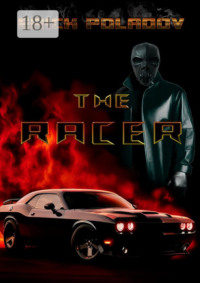
Kitabı oku: «The Racer»
© Erick Poladov, 2026
ISBN 978-5-0060-9882-4
Created with Ridero smart publishing system
Note
Speed measurements are given in the metric system. This novel is intended for a wide audience, the majority of whom live in countries that use the metric system. For readers in the USA, a conversion guide between metric and imperial units is provided below for convenience:
1 kilometer (km) (Distance) = 0.62 miles (mi)
1 meter (m) (Distance) = 3.28 feet (ft)
1 centimeter (cm) (Distance) = 0.39 inches (in)
1 metric ton (tonne) (Mass / Weight) = 1.10 US short tons
1 kilogram (kg) (Mass / Weight) = 2.20 pounds (lbs)
1 gram (g) (Mass / Weight) = 0.035 ounces (oz)
1 liter (L) (Volume) = 0.26 US liquid gallons (gal)
1 kilometer per hour (km/h) (Speed) = 0.62 miles per hour (mph)
Prologue
In the absolute darkness of the night, the roar of the engine grew louder, pushing the speedometer needle far from zero. The Dodge Challenger was cutting through the air at a speed of two hundred thirty-five kilometers per hour. In black, its body was lost on the road. The headlights cast an unnatural reddish glow, not illuminating the road but serving another purpose. The headlights were intended for something else. These were the eyes of the Racer, whose hands, hidden under black leather gloves, tightly grasped the steering wheel. He wielded an infernal power, capable of turning the Dodge into a beast that hunted souls. This beast raced relentlessly, and no car could escape it.
It was a hot summer in two thousand and one. The night offered a slight reprieve from the heat. But that night, the Racer planned to chill the air to a point where blood would freeze in veins, racing through the body as hearts pounded at their limits. Soon the whole of Heartstone will feel this temperature, and the sultry heat will no longer seem so exhausting. A small town two hundred kilometers northwest of Austin met a stranger cruising its streets under the dim glow of streetlights.
After finishing her shift, Vivienne Ham, a twenty-nine-year-old waitress at a local restaurant, walked along the sidewalk towards the intersection. She crossed her arms, shivering slightly and rubbing her shoulders. The sudden chill deepened her exhaustion. She wanted to get home as soon as possible and wrap herself in a warm blanket. She had already approached the crosswalk and began to cross to the other side, but after taking a few steps, Vivienne froze right between the stripes in the middle of the road and cast a gaze to her left. On the other side of the intersection the light was red, and under the traffic light there was a black car with scarlet headlights. Vivienne understood that there was nothing strange in the fact that at such a late time someone was still moving along the streets of Heartstone. But this car caused her internal discomfort. She could hear the faint rumble of an engine. At the traffic lights, yellow was added to red, and a second later they went out and green turned on. Immediately the rumble of the engine became louder and the Dodge started moving. Vivienne instinctively clutched the straps of her purse, letting out a sharp cry. The girl’s eyelids opened wider than ever, making it seem as if her eyeballs were about to pop out of their sockets. The Dodge turned left, quickly disappearing from sight. Vivienne’s ears heard the fading sound of a car moving away and the sounds of her own breathing, which became faster along with her heart beating against her ribs.
Unlike Vivienne Ham, twenty-four-year-old Conchita Sugarman was in no hurry to go home. The working day had long ended, but she was in no hurry to close the pharmacy. She was waiting for her boyfriend to arrive and be free. There were parents, grandmother and younger sister at home. Here no one bothered her. Conchita had already prepared the best contraceptives available, which would not spoil the thrill of sensations, but at the same time would give peace of mind in the face of the fear of receiving a surprise greater than any jackpot. She stood on the street not far from the entrance, finishing her cigarette and looking around the night street. Suddenly the roar of a running engine began to be heard from somewhere. Conchita knew this driving style, which boiled down to not giving a damn about medians, traffic lights and speed limits. Yes, it was Freddie Rogers. He was only two years older, but in terms of mental maturity he was much inferior to Conchita, and she was aware of this, although she did not expect much from this relationship. As a pharmacist, she understood one thing: there is an organism that requires the exchange of fluids and this need must be satisfied. Freddie was a more than tolerable option for a relationship without the commitment of marriage. Conchita did not count on a bright future with him. Before him, she already had two, and each time it was an affair with no plans for the future. Freddie parked in front of the pharmacy, performing a spectacular drift, which he thought added to the coolness. Conchita was not impressed by such show-offs. Her only reaction to the drift of the green ’78 Mustang was that she hurried to close the front door, since she had just washed the floor. The cloud of dust rose so strong and thick that Conchita did not even notice how Freddie blew a kiss her way.
— Come on quickly, before the family starts calling — Conchita urged, putting out the cigarette under the sole of her sandal.
— I’m already running, my peach.
Peach, strawberry, baby, cherry, candy. Freddie used these words so often that Conchita sometimes wondered if Freddie had simply forgotten her name.
Conchita closed the door from the inside, after which they attacked each other. Freddie’s lips pressed to Conchita’s neck, and Conchita’s eyes to the window. She looked somewhere into emptiness, into the unknown, because her thoughts were occupied by Freddy’s touch. But then her eyes took in something specific. She thought someone had come for medicine and decided to ignore it. Conchita was sure that he would stand a little longer and turn back. But the Dodge continued to park in the parking lot right next to the Mustang. The scarlet headlights began to unnerve Conchita and she began to push Freddie away with her hands.
— Wait.
— What’s the matter?
Conchita nodded towards the window.
— Some creep? — she asked with some trembling in her voice, without taking her eyes off the scarlet glow of the headlights.
— Wait here — Freddie said and headed towards the door. He turned the lock twice and went out into the street, but after a couple of steps he froze when an incredibly loud roar was heard from under the hood of the Dodge. The car started moving and drove away. Freddie stood for some time, following the dwindling taillights of the Dodge with his eyes.
Conchita was still not against continuing, but Freddie was no longer able to finish what he started, no matter how hard he tried, and he responded to Conchita’s offer about Viagra with a decisive refusal.
Forty-seven-year-old construction worker Elmo Fisher, who led a crew of five, stayed late on site to calculate the amount of paint for each room after they adjusted the layout at the owner’s request. He had eaten one hot dog and drunk one cup of coffee all day, so Elmo looked utterly exhausted. He was not interested in anything other than dinner and a soft bed so he could pass out until tomorrow morning. Even behind the wheel of his working van, worn over the years, Elmo doubted that his eyes would not close until he got home. His eyelids felt weighed down by steel. After some thought, he got out and knelt down in front of the open door to do as many push-ups as he could manage, then returned to the driver’s seat and turned the key in the ignition.
Elmo started off with a strong feeling that he needed to press on the gas until the drowsiness subsided. Ten minutes should have been enough for him to get home, and there he could leave the car outside the garage, just to quickly have dinner and go to bed.
But before Elmo had time to drive onto the asphalt, a car rushed along the road. He immediately hurried to the stranger, who, half a kilometer later, stopped at a red traffic light. Elmo drove a little forward to make sure once again that he wasn’t imagining things. The stranger’s headlights were indeed off. He got out of the van, walked up to the Dodge and knocked on the heavily tinted window. The glass didn’t go down. Then Elmo stood in front of the bumper opposite the windshield, gestured to the headlights and shouted a little louder:
— Moron, turn on the headlights!
Then the headlights came on, but the light was like red spotlights. The traffic light turned green and the Dodge began to drive. Elmo stepped aside, following the unfamiliar car with his eyes. The driver’s seat window was rolled down. Elmo looked inside and was stuck in place, rooted to the spot. When he was released from his stupor, on the way home, Elmo understood that he would not go to bed soon. The drowsiness disappeared as if it had never existed.
1. Not a godfather
The local church in Heartstone was led by a full-blooded Italian Leonardo Benetti. At fifty-two, he had no gray hair, keeping his head closely cropped. Jet-black hair, neatly trimmed and a clean-shaven face made Father Benetti’s appearance unchanged for many years in a row. Frequent sports in his youth still affected the priest’s size. Standing at 182 cm, he had broad shoulders, but his arms, which were larger in girth than many hips, were not so noticeable under clothes. His most striking feature was his deep-set eyes, which were set deeper than usual. On the one hand, this feature made his face fearsome, but after the first acquaintance with him, this effect faded after meeting him, as his soothing voice worked like a balm for the soul, because everyone remembered his manner of speech, which was soothing as a prayer.
As darkness fell several residents came to the Father for confession. The first was deputy Jenna Kramer. For months, she was haunted by memories of her loss. She told Father Benetti about her boyfriend Pierce Branigan, who was mauled to death by a black bear in the forest. She had a hard time coping with this loss. As soon as she came to her senses, Jenna began to be torn apart by a dilemma about her pregnancy. She didn’t want to do this, but she wanted even less to raise a child without a Father, not because it would be more difficult, but because the child simply wouldn’t know who his Father was. This was also compounded by the fact that Jenna became pregnant out of wedlock, and this also affected her. She could have hidden it with a quick marriage. But the stars aligned differently. Until recently Jenna pushed away thoughts of an abortion, but in the end she decided to go for it. Now for four days she was tormented by insomnia.
— I keep thinking about him — Jenna muttered, tears streaming down her trembling cheeks. — Constantly. What would this child be like if he were born? — A tremble ran through her voice. Tears continued to leak even through drooping eyelids. The grief in Jenna’s body reached such a state that her lips stretched to the limit, revealing bared teeth. — It was part of him. His blood… And mine…
Jenna’s crying could be heard even outside the confessional.
— He left a part of himself, and I got rid of… — Because of the crying, Jenna’s words were cut off in the middle. — I killed the last thing he left me. He could have lived on through this child. I could…
Compared to other Catholic priests, Father Benetti had a much more progressive view of things. He understood one simple truth: there is no need to force people to follow the Bible literally, but it is better to show flexibility and give a person the opportunity to turn to God so that he does not have to radically disrupt his daily life and give up the natural benefits of modern life. Father Benetti never judged his parishioners. He didn’t see the point in conveying to people the idea that they were very guilty, because what’s done is done, and you can’t turn back time. Therefore, he believed that instead it was better to help the person survive what happened so that mental anguish did not have a detrimental effect on the psyche. After all, if a person comes for confession, this is already a sign of his repentance. The Father believed that it was better to help a person live with a light heart than to dump a burden on him, because of which the person would then experience such torment around the clock, as if he had killed or raped someone. And people went to church to get rid of the burden from their souls. As people came to church more and more often, over time they were imbued with religion more and more deeply, even if they had previously been avowed atheists. Through this, Father Benetti earned immense respect among residents and parishioners became more and more over the years, so the rise in religion’s popularity in Heartstone was entirely due to Leonardo Benetti. Knowing that the Father would not condemn them for what they had done, the residents willingly went to confession. For parishioners he was a servant of God, a psychotherapist, and a friend.
Second in line was Mandy Troy. She admitted to breaking the commandment against adultery. She sincerely repented of the betrayal, but another question bothered her. She wanted advice on whether to confess everything to her husband. Father Benetti said that she must decide for herself what she should do, and suggested that this burden on her soul might grow heavier with each passing year and each time it would become more and more difficult to bear. In fact, Father Benetti knew that Castor Troy — Mandy’s husband — had frequent sexual relations with another woman, which he admitted during the same confession and was unlikely to destroy the family if he learned that his wife had followed his example.
Twenty-four-year-old Riggan Brooks, who worked as a cashier at a gas station, told how he found a wallet with no ID, lost by a customer, and when he showed up and asked if he had seen the wallet, Riggan answered in the negative, since his boss was present in the hall, who was an inveterate swindler and would not forgive him for returning such valuable property. Riggan did not have time to assess the consequences of this or that decision, so he responded as quickly as possible, so as not to arouse suspicion.
— Father, I don’t want anything that isn’t mine. I really don’t want to keep this to myself. Just what was I supposed to do when… when…
Father Benetti advised him to take the wallet to the sheriff, and said that there was nothing shameful in Riggan’s behavior, since he lied in order to save someone else’s property and avoid a conflict with his superiors and there was nothing wrong with that.
Next, forty-four-year-old Emma Cooper confessed to the Father. Her relationship with her fifteen-year-old adopted son had become too complicated, she has ceased to find a common language with him and every conversation leads to shouting, thereby prolonging the ongoing quarrel. Emma admitted that on this basis, recently she involuntarily began to remind herself more and more often that for her this is not her own blood and such thoughts only inflame her anger towards her son. But because such thoughts come into her head about the lack of common blood with the boy whom Emma has been raising since the day he was seven months old, she begins to despise herself.
— I believed that I would become his mother, that he would accept me as his own. How can I sleep after such thoughts? Yesterday I almost said it out loud. Do you understand? I was half a step away from shouting in his face about how good it was that I wasn’t the one who gave birth to him. And most importantly, I can’t help it. I am unable to control my emotions. I don’t know what will happen next, but I feel like it’s more than I can handle.
Father Benetti tactfully convinced her that any teenager at this age shows resentment and dissatisfaction with many of the demands of their parents and all Emma needs is just to show a little patience and soon she will notice that her son’s outbursts of anger have disappeared just as quickly, as they appeared. He also explained to her that she shouldn’t hate herself for thoughts alone; he said that this was stupid, since she took in someone else’s child and gave him love and maternal warmth, which already speaks of her true nature, and therefore she should not take fleeting thoughts seriously.
So every day, Heartstone residents of all ages and professions came to Father Benetti to pour out their souls and take the weight off their shoulders. In a sense, they were very lucky, since Father Benetti, in addition to his duties as a priest, also performed the work of a psychoanalyst, the only difference being that he did not take a cent for it. In other cities, people shell out a lot of money for such services, which not only does not make their souls lighter, but, on the contrary, only adds to the pain of how much a chat with a stranger costs.
The trust in Father Benetti was immense, especially considering the secrets parishioners revealed during confession — gave him a reputation as the most respected man in the town. Sometimes it seemed to those around him that he personally knew more than half of the local population by name and face. Every parishioner looked to the Father as the greatest authority in Heartstone. The town’s sheriff, judge, and wealthiest merchants paled in comparison to the influence of a man who wore a black jacket, trousers, shoes, shirt, and a white clerical collar year-round.
2. He is the law here
Jenna Kramer returned to the sheriff’s office, which matched the scale of the small town. In addition to the sheriff the staff included three deputies, a janitor and a medical examiner, part-time who worked as a pathologist at the local hospital. Jenna was one of three deputies. Everyone around believed that she was born to wear the uniform of a guardian of the law, but not in the sense of her vocation, but because the uniform simply suited her. She always tried to keep her dark brown hair gathered at the back of her head, but as a rule, towards the end of the working day, out of fatigue, she straightened her hair, which had a slightly wavy shape, falling well below her shoulders. However, she did not have to prove her competence in the work of a guardian of the law day after day. She had long earned her reputation. The sheriff valued in her a combination of such qualities as an amazing ability to find a common language with people and composure in extreme situations. It might be a stretch to call it composure, but Jenna maintained her sanity much better than her two colleagues. The sheriff always joked about her ability to communicate with people of all different personalities, saying that if it weren’t for her large brown eyes mesmerize like magic, her communication skills would not be so outstanding. In fact, there was a huge amount of truth in this, because in addition to her eyes, Jenna had perfectly shaped eyebrows, a neat nose and slightly protruding lips. In addition, she did not have an ounce of excess weight, because in addition to the fact that this added feminine beauty to her, this made chasing criminals much easier. That’s why the sheriff appointed Jenna chief deputy after two years of service.
Pierce’s death still tormented her soul and the feeling of grief was still far from fading. Only work helped Jenna to at least a little escape from thoughts about Pierce and the loss of her pregnancy.
The man on duty that evening was Harry Devon. Thin, thirty years old, one hundred and seventy-nine centimeters tall. As a child, he always dreamed of thick stubble, as he considered it a sign of brutality. But when the time came, Harry noticed that the stubble on his face was not only sparse, but also growing only on a small area of skin under his lower jaw, barely touching his cheeks. Because of this, Harry got into the habit of shaving smooth to avoid anyone noticing, not allowing his stubble to grow long enough for anyone to notice. In this way, he disguised the inferiority of stubble, passing off its absence as a penchant for personal hygiene and caring for one’s appearance. Harry followed orders perfectly, was absolutely manageable, meticulously filled out all the paperwork, arrived at the office half an hour before the start of the working day — he believed that it was better to arrive half an hour early than two seconds late — and never questioned the authority of the sheriff in his eyes. From the first day in the service Harry even acquired exactly the same hat as the sheriff’s, which was always worn by movie sheriffs in provincial towns, in order to match the image of a real law enforcement officer. According to the sheriff himself Harry lacked the core, which was necessary in those cases when it was necessary to show toughness in relations with certain people. To the locals, Harry was the friendliest lawman. If he came to the call, then the offenders rejoiced and the victims were disappointed. However, such traits as punctuality, accuracy and complete obedience became sufficient grounds for the sheriff to highly value Harry as a deputy. If the sheriff was like a father or mentor to Harry, whose opinion was never in doubt, then he perceived Jenna almost as an older sister. Despite the fact that Harry began working as a deputy sheriff a year and a half earlier than Jenna, he never considered challenging her seniority, especially since he understood perfectly well that he would not be able to exercise the functions of a leader. At least not now.
Suddenly the front door opened and two people entered the office. Sheriff Desmond Poe led the handcuffed criminal inside. With a sharp movement, pressing on his shoulder, he forced the detainee to sit down on a chair in front of his desk.
— Harry, book him — the sheriff said, removing the handcuffs.
Spencer Fox, sixty-four years old, sat in front of Harry. He didn’t like the way three tourists who were passing through were rowdy in the cafe. Considering that he was showing concern for the peace of the local residents, Spencer approached the tourists and, at first in a rude manner, asked them to shut up and eat in silence, and upon hearing a refusal in response, he took out his short-barreled revolver and fired a warning shot. Spencer almost got it because he was just a few millimeters short of the chandelier. The owner of the establishment and part-time cook cursed Spencer three times, but Spencer demanded that he shut up too.
All his life Spencer Fox worked as a security guard at a bank, where he had the opportunity to eliminate the threat four times. Once he even had to deal with a robber, having neutralized whom he received the Order of Courage and written gratitude from the hands of the governor himself for the prevented robbery. Whenever a commotion broke out in the bank, it was a breath of fresh air for Spencer. After such excesses, he felt blood flowing through his veins and he began to live. Having resolved the next situation, Spencer realized his importance for the office and the next day began to search every visitor right from the doorstep, and he did it in a way that any customs officer would envy. Even if his neighbor or cousin crossed the threshold of the bank office, he demanded they empty their pockets, or he’d pull out his baton and begin to lay him face down on the floor, and his below-average height and the presence of a rather large belly were not a hindrance to him. On this basis, management regularly received complaints about the security guard, and the bank director each time had to put Spencer on the ground, issuing fines and reprimands. But that didn’t stop Spencer. He could slow down for a while, but as soon as someone gave him a reason, he immediately reminded who was in charge and began to bring everyone to attention. And now it’s been more than a year since Spencer retired and life had lost its spark for him.
While Harry tapped the keys, registering Spencer, the sheriff, leaning on the edge of the table, examined the revolver taken from Spencer and said:
— Say thank you, because next time I will send you to serve administrative arrest. Got it?
Leaning back in his chair and spreading his legs wide, Spencer said:
— What, you think you’re the law here? — At this point, Spencer began to remind the sheriff how fifteen years ago the governor himself awarded him the Order of Courage and that in this town all the creatures are ungrateful, after which he loudly and confidently summed up: — So don’t give me that crap, Desmond!
Harry handed over a printed signature sheet. The sheriff snatched it and crushed it with the fingers of one hand, after which he abruptly took Spencer by the arm and pulled him away from the chair.
— That’s it, that’s enough! You’ll be sitting here forever, half-baked Rambo! — With these words, Desmond took Spencer to the temporary holding cell.
Harry watched them with a worried look. Jenna noticed his reaction and said, without looking up from the back of the chair:
— Forget it. Spencer’s been itching for trouble for a while.
Jenna’s hands then went to the back of her head to unwind the elastic. Her hair came loose, after which she lightly straightened it with her fingers.
Desmond closed the cell door once Spencer was inside and, without a moment’s hesitation, walked back to the office.
Desmond Poe was fifty-nine. Some gray hair appeared at the temples. Unlike Spencer, the sheriff did not have a protruding belly all his life, which appeared only after fifty-five. Desmond spent his entire life maintaining order in Heartstone. His ironclad self-belief began to take shape when he was twenty-eight and a deputy to the previous sheriff. That day, Desmond was sitting in his official car on the side of the highway, where he was conducting patrol. Day as day, until a red Mercedes, wanted for a bank robbery in Dallas, sped past, as mentioned on the radio. Three robbers had taken out a bank in Dallas and were now hurrying somewhere. Signs of the car were sent to all police stations in the state in the hope that somewhere the Mercedes would catch the eye of law enforcement officers. He caught the eye of Desmond Poe. Even before Desmond pressed the gas pedal, he remembered that the robbers were armed and they were unlikely to stop at his request, but at that moment he thought that even a broken clock is right twice a day and demanded through the loudspeaker to park at the side of the road. Desmond’s assumptions were correct. Instead of obeying his demands, the Mercedes only increased its speed, and a face with a shotgun appeared from the rear passenger window. Stopping the red Mercedes, which was wanted throughout the state, cost Desmond the front bumper, the windshield, the right side mirror, the right front fender, the right front door, the radiator, four cartridges and one corpse out of three potential ones. After what happened, no one doubted that this guy had a great future. The chase lasted only fourteen seconds before Desmond pulled out his revolver and fired the first shot, and forty-two seconds later the chase was over. He not only believed in himself, but believed that there was no person who could make him falter. After one of the robbers emerged from the window of the Mercedes and fired the first shot, Desmond began to sink into such a state of stress that he could hardly remember much of what happened next. But when the chase ended and he pinned down two, discovering the corpse of the third, the realization came to him that there was nothing to be afraid of. Desmond was convinced that he had done something that no Hollywood action movie could show. This was the first and only time Desmond killed someone. He felt no regret or guilt for not taking all three alive. The driver leaned back, pressed against the steering wheel with a hole in the back of his head, but Desmond perceived this turn of events as a necessary price of fighting crime. It happens that you cannot do without murder and the only question is who will be killed: the criminal or the policeman. From that day on, every time any difficulties arose at work, Desmond reminded himself that it was he who alone took on the gang in the red Mercedes. For example, when his boss raised his voice at him, Desmond immediately remembered the gang in the red Mercedes, thereby reminding himself of the level of his professionalism, and along with these thoughts came to him the realization of what a nonentity his boss was, who have never done anything even remotely similar throughout his miserable life. Such thoughts about the past were the most effective way to combat stress. The day the gang in the red Mercedes was defeated at the hands of Desmond Poe, the future sheriff learned what he was capable of. Although his reputation preceded him, a couple of years later he still had to remind others of who he was when a call came in about a gas station robbery. At that moment, Desmond had finished lunch at a cafe, which was located three blocks from the gas station and was already approaching the car when a radio message arrived. Seven and a half minutes later, Desmond rammed a yellow Chevrolet Cheville and dragged two would-be robbers into the office. The sheriff found a reason to vent his dissatisfaction on him, they say, he smashed up the entire front part of the body of his official car. But Desmond… No, he didn’t remember the gang in the red Mercedes. He asked himself why the hell this bald hog, who was trying to be his boss, was sitting out his ass instead of doing his job and catching robbers. Such thoughts made Desmond believe in his own superiority over his boss.
His natural essence boiled down to the fact that he strictly followed the law and had a cool enough head that nothing in this world could force him to break the law.
The departure of his boss from his post was an event that occupied a special place in Desmond’s biography. This was a separate, special chapter in his life. After winning the election, watching as he crossed the threshold of the office saying goodbye to the sheriff’s service, Desmond barely restrained himself from spitting on the bald back of his former boss and giving him a kick in the ass so that he would quickly get out. That day he felt that this was his finest hour. Now he’s the sheriff. Now this is his town. Desmond ordered everything that in any way reminded him of his predecessor to be thrown out of the office. He began to spend a lot of effort and time to develop courage, organization and self-control in his charges. This was not always possible, since many people could not meet such standards due to their nature. Using Harry as an example, Desmond was clearly convinced of this. But unlike his predecessor, Desmond knew how to find in his subordinates those skills for which they should be valued. In the end he understood that his town was not Vietnam, where people were being killed on every corner. Among other things, you also need to do paperwork, be able to find a common language with people and resolve everyday conflicts.
After the previous sheriff left, Desmond began to properly restore order. He proceeded from the fact that for Heartstone, given its scale, the level of chaos and violence was too great. Several times a week we received calls about something stolen or missing. Every couple of days there would be some kind of row in a public place. Rarely did an entire calendar year go by without some kind of murder. The only restaurant in downtown Heartstone, called Angel’s Heart, was a real sore spot; in it, every evening — especially on weekends — the atmosphere at first became relaxed, and after a few hours, when the alcohol began to take effect, it was already tense and plates, knives, forks, bottles and everything that could somehow be used to rip open someone’s body. Moreover, a showdown could start between people who had hardly known each other before and had never spoken, but who came to the Angel’s Heart and sat at tables in opposite corners. And so almost every evening, Angel’s Heart put someone in a hospital bed, and someone was sent to a temporary holding cell. From the very first day Desmond first took on the most problematic areas of the town, including the restaurant. For three weeks, he spent every evening at Angel’s Heart, bringing one of his assistants with him. Not to say that Angel’s Heart has ceased to instill courage in the drunken heads of visitors, but showdowns began to occur much less frequently, and over time the situation calmed down completely. The owner of the establishment did not particularly like this, because he noticed how much alcohol sales had fallen. People began to drink less so as not to give the new sheriff a reason to attack them. But the restaurant owner also found a bright side in this, because now he didn’t have to install new windows so often, buy new sets of dishes, repair door hinges and walk around the entire room in search of unnoticed traces of blood after the next showdown. And the chairs in the central hall began to last much longer, since now no one would grab them to hit someone on the back, after which, as a rule, the chairs would shatter into splinters.
And so, day after day, Desmond improved the crime situation in the town. He did something that his predecessor didn’t even bother with.
In less than a year as sheriff Desmond had gotten the situation to the point where no one was afraid to walk the streets of Heartstone in the dead of night without being raped or robbed. That year in the service for Desmond was not work, but a real fairy tale. Every single day he showed who was boss in this town. And then, over time, everything began to somehow calm down and there were no longer any particular reasons to take a revolver out of the holster and wave it in front of someone’s nose. But he didn’t have to be bored, because over time Desmond made another discovery in himself, noticing how much he liked leading other people. He saw in his subordinates a kind of complex mechanism that needed to be made to work harmoniously and cope with all tasks, hence Desmond’s understanding that if not all his people are cool and fearless, then this is not a reason to reject their professionalism. Then he began to work on his leadership skills.
It is interesting that, having taken the position of sheriff at the age of thirty-eight, Desmond began to strive to show others how much nerves of steel and a cool head he had. His reputation was loud, but there were still some things he didn’t like. Almost all residents of Heartstone perceived him as the most reliable protection against crime, turning the name of Desmond Poe into a brand, a sign of quality that guaranteed safety and order. They believed they could let their guard down while this guy was around. The attitude of citizens towards him was extremely positive, since for all his toughness there was no such case that Desmond exceeded his authority. He liked to solve problems as independently as possible, as this pleased his pride, but the law and the safety of others were a sacred matter for him. Therefore, Desmond decided that it would be necessary to convey to those around him the idea that in front of them is the one who is responsible for their safety, and not some commando with post-traumatic syndrome. Since then, Desmond Poe has guarded his image, even though from time to time he was itching to remind himself of what he was capable of.
After a few years of marriage, his wife was disappointed that her husband did not live up to her expectations and turned out to be too calm and balanced. But somewhere after the birth of her second child, Rhonda Poe realized how lucky she was that her husband did not turn out to be the hotheaded jerk she expected him to be, living under the same roof with him.
Everyone who had ever worked under Desmond needed no enlightenment about who they should be and how a guardian of the law should act in a given situation. They had a living example and standard — Sheriff Poe. Few people managed to get closer to Desmond in terms of his set of personal qualities, but everyone strived for this. And even in his late fifties, Desmond managed not to slow down, demonstrating absolute self-control and promptly solving any problems that surfaced in his town.
But lately Desmond has been faced with a problem. Not to say that it was an age crisis, but the years took their toll and age no longer allowed him to feel as vigorous and daring as in his best years. Despite the fact that Desmond managed to restore order in the town during the first years of his tenure as sheriff and now there was not much work in this sense, he still felt bad at heart that there was not even a reason to sweat to solve any problem more serious than domestic violence or chasing a violator who is exceeding the speed limit. Desmond needed a reason to declare himself in his late fifties, because the last time he had to show who was the law was eleven years ago, when he was forty-eight and still full of fire.
3. Gomorrah
Inside, the music had not yet died down, customers kept drinking the bar dry, balls rolled into pockets, and there were fewer and fewer parking spaces. Gomorrah was a one-size-fits-all establishment. There was a striptease and a bar; here they played poker for money over a glass of beer and made bets at the billiard table. This was perhaps the only place in Heartstone where the sheriff did not come due to regular violence, because Gomorrah always had two bouncers. No shift went by without a brawl, so the bouncers were never idle. Perhaps fights would not have occurred so often if the institution was not located outside the town near the federal highway, which ensured a constant influx of customers passing by, among whom were trailer drivers, students, travelers with motorhomes, rodeo participants, farmers, hunters and fishermen. But a special category of clients were bikers. One day, a whole gang of seventy-eight bikers, who were on their way from Louisiana to California, parked in front of the establishment and decided to make a short pit stop when they saw a sign glowing from green neon tubes with the inscription Gomorrah, on both sides of which a pair of spread women’s legs glowing red on either side. The atmosphere that night was tense. This was the only time when Sheriff Poe came to the strip club to establish order, because alcohol was running low, and the dancers from strippers almost retrained as prostitutes, and against their will. The owner of the establishment, Luther Grissom, with trembling in his heart, was already beginning to count the losses from broken glasses, broken cues, cracked chairs and tables requiring replacement. But the damage was not as great as it could have been. All the chaos stopped the moment Sheriff Poe walked in and threw one of the bikers out the window, after which he fired a warning shot into the ceiling, and thus adding his two cents to the damage. But Luther not only didn’t take a cent for the broken window and ventilation in the attic, but also treated the Sheriff to free beer because it had become so quiet here since his arrival. The bikers lay with their faces to the floor, and the sheriff’s deputy placed the especially active ones in the back seats of official cars. This was eleven years ago. Since then, there have been enough internal forces to ensure order in Gomorrah.
That night Dana Host earned almost four times more than usual thanks to the fact that she was invited to perform a dance right at the table where the birthday boy was among the guests. After the music stopped and the next track began to play, the guy admitted to her that he would remember this gift for the rest of his life. In fact, you couldn’t dream up a better gift for an eighteen-year-old.
Dana constantly worked in public establishments. She started out as a waitress in a cafe in the heart of Heartstone; a couple of years later she moved to a bar, where the clientele was a rougher crowd, but the higher salary allowed her to turn a blind eye to this shortcoming. She hadn’t even worked at the bar for six months before Luther Grissom, over a couple of visits, noticed how quickly she handled the delivery of orders, and at the same time knew how to talk with visitors who liked to loosen their tongues when drunk. Luther invited Dana to work for him. The fourfold jump in salary made Dana forget about everything in the world. She was not yet twenty then. Working in Gomorrah, at first Dana did not pay attention to anything other than her duties, counting money that she could not even dream of either in the cafe or in the bar. Then she began to look more and more closely at the details. She made friends among the strippers, with whom she sometimes shared a glass in her free moments, and then — when she was taught — she smoked a cigarette with them several times a shift at the service entrance. As the strippers became Dana’s bosom friends, they began to take notice of her amber hair, long legs and toned skin. They offered her something that was supposed to happen someday. After the establishment closed with the departure of the last customer, her friends began to teach Dana the basics of dance, and when her skills developed to the “passed” level, Luther still agreed to give her the opportunity to perform one dance. Before her debut, Dana was nervous, as usual, but a shot of absinthe was always an effective stress reliever. That evening Luther had one less waitress, and when everyone at home learned about the real reason for the busy schedule and rising wages, Dana’s mother was horrified. Father had no time to be indignant. He simply kicked her out of the house. Fortunately, the money that the pole brought Dana was more than enough for an independent life, including rented housing, and six months later she was even able to buy a small house in installments. Honing her skills on the pole year after year, Dana began to enjoy considerable popularity among men. But she rarely went on dates. As a rule, all her intimate relationships were sudden, and the men were often those men she’d known for barely half an hour. Dana was only worried about money and applause in the hall. As Dana’s skills developed, Luther noticed that there were noticeably more local residents among the clients, while Gomorrah was meant mostly for passersby.
Dana Host had one feature, unlike the other dancers in Gomorrah. She could never hit the stage completely sober. But if she throws in a glass or two, everything would go smoothly, and she herself liked to dance, but she still didn’t dare do it without alcohol.
That evening was out of the ordinary. In the afternoon, all the dancers sat down to play cards, where the loser had to dance topless. The agreement was for one dance, but not less than five minutes. Dana was the worst poker player that day, who never came across a winning combination, and she always had problems with bluffing, both at the table and in life. She had to perform the nude dance. But Dana couldn’t do this at first. Her second performance was no different. The third one is the same story. Realizing that it would not be easy for her to do this, Dana drank one glass before each exit. Rum, whiskey, vodka, martini. On the eighth attempt, the booze in her system finally gave her courage and she still did it. But closer to midnight, Dana became too bold and she was sent to the dressing room, where she lay down on a sofa, and woke up closer to two in the morning. Luther ordered her to go home and sleep it off. Alcohol affected Dana not only quickly, but, at times, very strangely. She drank more than half a liter of strong drinks, then slept for several hours, but, having recovered a little from sleep, she immediately perked up, as if she had been drinking coffee instead of alcohol. One of the dancers, whose name was Janine Malone, sat Dana on the sofa, squeezed her cheeks with her palms and said:
— Sit and don’t move anywhere. It’s my set now. Wait, I’ll come and take you, okay?
Dana nodded somehow, and as soon as Janine left the dressing room, she immediately stuck her tongue out, put on her red leather jacket, took her purse from her personal locker and hobbled towards the exit.
So tipsy, Dana left through the service door and went to the parking lot, where her Mini Cooper was parked. She walked mostly steady, but her pace was uneven. She walked more than fifty meters and only then realized that she was slightly off course. The car remained in the service parking lot behind the building, and Dana was already a few steps from the road. She was about to turn her body one hundred and eighty degrees, when suddenly she began to hear a roar of a running engine, which was growing with every second. Soon bright scarlet lights of the headlights appeared on the right. Then the car began to slow down, and on the approaches to the turn that led to Gomorrah, the car began to move off the road, stopping right in front of Dana. The driver’s seat window was rolled down. Dana looked at the stranger and said:
— Hey, hot stuff. Having a good night?
There was silence in response. Dana asked:
— Can’t sleep? Or just cruising for some fun?
Having not received an answer this time either, Dana came close to the car, leaned her elbows on the door and said:
— Not much of a talker, huh? How about giving the lady a lift?
The stranger nodded affirmatively. Dana smiled and then began to walk around the front of the car. She walked, holding her purse in one hand, and ran her free palm along the curves of the body, feeling the coldness of the metal. She walked in front of the headlights, their scarlet glow didn’t faze her one bit. Dana saw a lot of different cars used by truckers and various car enthusiasts with whom she had promiscuous sex when they visited Gomorrah. Therefore, the appearance of the car, whatever it was, never seemed strange to Dana.
She placed her fingers on the door handle, pulled, slid into the front passenger seat, and closed the door behind her.
— So, ready for a ride? — Dana asked in a playful voice under the influence of alcohol.
This was followed by a loud roar from the engine. The car set off, rapidly picking up speed, accelerating along the federal highway at night.
This was the last trip for Dana Host, while for the Racer the journey was just beginning.
4. Sighted and fast
Norman Hughes was another deputy sheriff. At thirty-three years old, he achieved what was quite enough for him for the life that suited him. Stable work; not huge, but decent income; an occupation that, when it came to morals, did not raise any doubts at all, because Norman maintained order and fought against lawlessness. He wasn’t shooting for the stars. A single life seemed to him a very comfortable scenario, when there were no obligations to anyone and all his attention could be focused on work and his personal interests, without being distracted by anything else. Norman couldn’t stand being seen as a womanizer. He saw in this something that discredited the honor of the uniform. So he just started affairs that dragged on for several years, and then suddenly something went wrong and Norman breathed a sigh of relief. So he seemed to those around him to be a man who was sincerely trying to improve his personal life in search of the one, but he was simply unlucky.
When Norman got a job with the sheriff, he had only one drawback — post-traumatic stress disorder. But since Norman was taking pills to suppress his trauma, Desmond Poe gladly hired him. The sheriff valued his experience in the army. Norman managed to fight in Somalia and Bosnia and Herzegovina. He refused further service after five children were killed in front of his eyes. He served out the remainder of his contract and returned home from service. Peaceful life became a problem for Norman. He knew nothing but fighting. Therefore, the first thing that came to his mind was to get a job with the sheriff. A week after starting work, Norman realized that he had found his calling.
He was sitting in a patrol car near the federal highway when the clock showed half past two in the morning. There were often reckless drivers in this area, so there was no need to doze for too long. But as luck would have it, it was this time that Norman started to doze off and slept for over an hour. Opening his eyes, he experienced a feeling of intense thirst. Before his hand could reach for the thermos, a car sped past his eyes. Norman realized that there was no time for coffee now. He started the engine and followed, turning on the siren. Driving out onto the highway, Norman thought that he could not remember a time when he had seen a speeding driver in the middle of the night with headlights off. He caught up with the suspect and began to demand through the loudspeaker to pull over. The reckless driver didn’t even think about stopping, but only increased his speed. Norman managed to notice that it was not his imagination and the headlights were indeed turned off. He continued to press on the gas and demand to leave the road. Getting the most out of the car, Norman began to close the distance and soon saw the outline of the taillights, from which he assumed that a Dodge Challenger was in front of him.
He again caught up with the pursued and repeated:
— Pull over!
The Dodge rammed and hit the patrol car in the front fender. Norman didn’t say anything into the loudspeaker, but instead reached for the walkie-talkie. There was a second blow, causing Norman to drop the radio. He forgot about the connection and took a revolver from his holster. Norman began to overtake on the left, but at the same time the Dodge began to slow down. Having caught up, he hit the patrol car again in the side, and then again, but now at the very edge of the front fender near the bumper. The final impact was much stronger, causing Norman’s car to be thrown off the track. He began to return to the road, but the Dodge pressed him to the side of the road and did not let go for several more seconds, until an obstacle appeared ahead. Norman began to hit the brakes only when the bottom of the car was already sliding along the guardrail. At a speed of one hundred and forty-five kilometers per hour, the guardrail launched Norman’s car into the air. The grinding of metal was interrupted quickly, followed by the idling roar of the engine until the patrol car flew off the road, falling off a cliff in the darkness of the night, pierced by flashes of the explosion when Deputy Heartstone’s car collided with the ground.
And the Racer continued to press on the gas. Nothing could stop him now.
5. Good morning, great boss
His office visits never caused anxiety or discontent among his subordinates. Working for him in Heartstone was a dream. Not only did he pay several times more than the average salary in the town, which is why employees held on to their jobs with both hands, but he also had an innate talent for working with people. Carter Beckran walked through each of the departments and asked if everything was going according to plan and if anything was needed.
— So, do the numbers add up, or should we think about going offshore? — Carter asked after greeting the chief accountant.
When the housekeeping manager said that new materials were needed to clean the premises, Carter replied that cleaning was too expensive and suggested ordering a couple of flamethrowers for complete disinfection in order to sterilize the office for the next six months and forget about cleaning. A couple of minutes later, another deputy reported that, most likely, the expected volume of wheat would be too large for which the existing storage facilities would not be sufficient.
— No problem — Carter said. — Let’s start a parrot farm. My daughter has two. They eat like pigs. — And then he added quite seriously: — We’ll order a new warehouse. We’ll put it there and sell this part first.
Carter Beckran in the eyes of his subordinates was not a boss, but a dream. He never ignored requests from employees, and at the same time he taught everyone to come with specific proposals to resolve the issue. Everyone could joke with him or speak in a way that felt natural to them. Carter knew how to get on everyone’s wavelength, using slang to match his conversational partner.
At forty-two, Carter continued to maintain his usual appearance. He wore short black hair without bangs and always had light stubble. With a stocky build and a height of one hundred and eighty centimeters, Carter’s light blue irises especially stood out. Even with a wide lower jaw and a dimple on his chin, his brutal appearance became much softer. Carter also did not change his clothing habits over the years. He always wore either light blue jeans or comfy track pants. He had approximately equal numbers of shirts and T-shirts in his wardrobe, but if every single T-shirt had short sleeves, then on his shirts he always rolled up the sleeves to the elbow, hating long sleeves. There was a little more variety on Carter’s feet, but no matter the color, material or thickness of the shoes, they were always sneakers.
After the office, Carter got back behind the wheel of his blue Toyota Land Cruiser and drove to the next facility, located two kilometers from the office building. It was a garage with a car repair shop where all equipment was serviced. On the way to the garage, Carter thought about redistributing part of the profits from the sale of excess wheat through the payroll as bonuses to motivate him for the future.
Once in the workshop, Carter came across two mechanics and the chief engineer, who were sitting at a makeshift table made from a truck tire and a meter-long piece of plywood, playing poker. Since Carter highly valued work, he forbade gambling, which is why the workshop stocked a bunch of coins in denominations of one, five and ten cents, which replaced the gaming chips.
— Hello everyone — Carter said, raising his open palm.
Everyone greeted loudly and in unison, and chief engineer Seth Crawford, age forty-five, added:
— Boss, how’s it hangin’?
Carter answered, looking at the equipment around him:
— Not much, just chillin’.
— Would you like to join us? asked twenty-nine-year-old mechanic Matthew Rabb.
— Come on, Mr. Beckran — called the second mechanic, twenty-seven-year-old Edmund Kaps.
Carter took a deep breath and said:
— Eh, you guys are strange.
— Why is this, boss?
— What do you mean “why”? How else can we explain your proposal to sit down at the table and punish you? — With these words, Carter began counting out twenty coins from three jars.
Poker coins were a kind of common fund. They were sorted into three-liter jars, from which they were taken out each time and counted out for the game.
Sitting down at the table, Carter slammed his palms and said decisively:
— Well, deal the cards. Now the authorities will punish you.
While Edmund was distributing, Carter asked:
— Are we ready to mow the lawn?
The phrase “mowing the lawn” in the workshop meant harvesting when the harvester left bare soil.
— Chief, you’re a little late. It’s been three days since we brought our weapons into combat readiness.
— And you must be punished for being late — Edmund said in a slightly timid tone, dealing out the last card.
— Don’t get cocky, kids. — There was synchronized laughter at the table, and Carter added: — You have already been told that I will be the one doing the punishment here.
Along with the game, Seth talked in detail about what they had done with the equipment over the past two weeks. Carter asked about the components required for subsequent repairs and the condition of the equipment, taking into account wear and tear. Seth said that one of the pickups needed new tires, and also that all passenger cars would be better off switching to a different motor oil, which he had recently spotted at the store. The two combines were almost at the end of their working capacity, but Seth convinced that it was better to buy only one next year, since one of the two old ones could be disassembled for spare parts and put some of them on the second one, and thus make it work for a couple more seasons.
After Carter’s father left his job due to spinal problems, Carter began rapidly making changes to his company. He purchased slightly different equipment and updated grain storage facilities; the crop was sold in other places, where they paid two or three times more for each ton, since Carter also delayed the sale, waiting for the most opportune moment when prices soared to the limit. This was the only gambling streak in Carter’s character, which could have cost him great financial losses. But his instincts never let him down, and no one understood how he knew when to wait to sell and when to get rid of the goods as soon as possible. One way or another, Carter never miscalculated the timing of the sale. Carter completely abandoned some types of crops. Now he didn’t even want to hear about cabbage or corn. He was interested in wheat, barley, rice, potatoes, beets, tomatoes, cucumbers, pumpkins and watermelons. Having taken over the business from his father’s hands, Carter redistributed the crops and planted one plot with trees, which he also made good money on, recouping the costs in the third year. Now his plans included vineyards. Recently he even inspected a wine cellar in Arizona to start creating his own brand and produce a product that, in ten to fifteen years, could be sold to high rollers willing to pay top dollar for a bottle.
Carter had very far-reaching plans.
6. Closed lake
The boat station was Heartstone’s only way to access the lake. There were no households along the entire coastline. The only public beach was adjacent to the boat station. The owner of the station, Ruben Hustler, decided from the very beginning to make a deal with the authorities, refusing to charge residents for visiting the beach in exchange for tax breaks, pledging to take care of the beach. There was not a day that Ruben regretted this decision. With the opening of the season, the beach was always full of people, among whom there were always those who wanted to ride a boat, speedboat or catamaran.
Even at sixty-five years old, with mild arthritis and varicose veins, Ruben did not want to think about retiring. The boat station was the meaning of his life. He was constantly changing something at his facility. Ruben’s proudest acquisition was launching a cabin boat, which became very popular with many unfaithful husbands and wives in Heartstone. In a longboat in the center of the lake, no one will definitely catch you. This was the safest place to cheat on your other half without leaving any evidence behind. Inside, the covered cabin had quite comfortable fold-out seats, although Ruben had not thought that it would be precisely these types of clients who would be interested in his best vessel. He bought a longboat with the expectation that it would be rented on some holidays and birthdays, which is why he selected a vessel with a spacious deck for celebrations.
Over the years, Ruben Hustler became more and more attached to the boat station. After one of the two administrators quit, he did not look for a new one, but preferred to work half the time on his own. Spending time on the beach in the sun with a newspaper and cold lemonade is everything you need to ensure that old age is not wasted. At least that’s what Ruben thought. Even in his youth, he treated material possessions with trepidation. More than his property, Ruben valued only his friends, who did not allow him to become completely lonely in his old age. This was what he feared most. Ruben was literally obsessed with not inconveniencing anyone, being as helpful as possible, and never refusing to help anyone. In this regard, he succeeded greatly and was still far from having stopped finding a common language with people one or two generations younger than him. Despite being engaged in commerce, hardly anyone could call him greedy. On the day he received a call from New York and was told that his daughter had given birth to a grandson, Ruben posted an ad that all rowing boats and catamarans were available for rent for free for three days. He wanted to see happy people, because he himself felt warm in his soul, and it didn’t matter for what reason others were happy. All that matters is that they all had a good time. Ruben began to value such moments especially strongly after he was widowed at forty-nine.
Early in the morning he drove up to the office in his pickup truck. Ruben pulled over in front of the entrance to get out and open the gate. But he only managed to get out of the car, after which his jaw dropped, and his knees buckled. In front of his eyes the body of a girl hung on the gate in a crucified position. Her hands were impaled on the spikes atop the wrought-iron fence, and fixed in a horizontal position, and her head hung down, her chin buried in her chest.
— You’re armed to the teeth, and this is your town, I get it. I already understood — Spencer spoke through the bars of his cell after spending the night in the cell. — That’s it, come on, let me out.
— Shut your mouth! — Harry shouted.
— You guys are untouchable, huh? — Spencer barked displeasedly, after which he headed towards the couch at the opposite end of the cell.
The phone rang in the office. After the third ring, Harry arrived and picked up the phone:
— Sheriff’s office. How can I help?
— … — Didn’t understand
— …
— Mr. Hustler, try to calm down. Let’s do it again, as slowly as possible.
Nothing is as annoying as the phone ringing at six-thirty in the morning, and even being on the nightstand right next to the bed.
— Hello? — Sheriff Poe said in a sleepy voice, rubbing his closed eyelids with his thumb and forefinger.
The conversation lasted two minutes, after which, patiently waiting for Desmond to hang up, Rhonda said languidly:
— Well, what could happen there at this time? You could lie around for another hour.
— Trust me, honey, plenty can happen — Desmond said, yawning widely.
Forty minutes later, the sheriff, Jenna, and fifty-five-year-old pathologist Larry Green, who worked part-time as a medical examiner, arrived at the boat station. He and Desmond were bosom friends, so even if not a single dead man was found in Heartstone in ten years, they still found a reason to meet.
— My God — said Larry, taking off his cap to take a better look. — Under other circumstances, I would have thought that a movie was being filmed here.
Desmond came up and looked at the hanging head with his narrowed eyes. It was difficult to see anything because of the hanging hair that covered the face.
While Jenna was calming Ruben, Larry came to the gate, wearing latex gloves. He carefully pulled back the victim’s hair to examine her face.
— Dana Host — Desmond said affirmatively.
— Yes, that’s her. Eh, she was a cute girl.
— And she chose an unsafe occupation — Desmond added, continuing to examine the corpse from under the visor of his straw hat, with his hands busily placed on his belt.
— Do you think one of her casual friends?
— So many lustful men flock to Gomorrah every evening. I wouldn’t be surprised if among them suddenly there’s at least one preoccupied psycho with a sick imagination. It is quite possible that this time she was simply unlucky in choosing her next lover. She had a loud reputation and she says that so many travelers and truckers roll into Gomorrah that she always found herself some kind of male for half an hour. Imagine how many of them she had and who was not among them. — After a short pause, the sheriff added: — As soon as they bring it to the morgue, check for DNA evidence right away. If this is rape, then at least the motives will be clear.
Sheriff Poe then thought for a moment, imagining various options. He thought that he would need to get the addresses of all the waitresses and dancers working at Gomorrah in order to interview them. He also thought it would be a good idea to talk to Luther too.
Meanwhile, a van was arriving, from which a stretcher and a black plastic bag with a zipper were already being taken out.
Having calmed Ruben a little, who was sitting on the edge of the back seat of the patrol car, Jenna heard the creaking of the radio. She came up, answered, and half a minute later went to the sheriff.
— Chief, Harry reports that some tourists found Norman’s patrol car at the foot of the cliff, not far from the eastern entrance.
— And Norman? — Desmond asked anxiously.
After a painful pause, Jenna still said:
— He burned. Apparently he drove off the road, and after the fall the tank exploded.
Desmond covered his face with both hands, and when he scratched his skin with them, he took a deep breath, as if he was about to say something, but then changed his mind. A few seconds later he turned to Jenna:
— Call the transport company. Order a tow truck and a crane. Tell them to meet us at the eastern exit. And I will inform the hospital so that they can send a second car.
After waiting for Larry to finish examining the corpse of Dana Host, the sheriff said:
— Let’s move on.
Having reached the foot of the cliff, where he had to walk for several minutes, Desmond could not contain his emotions, although they were not so violent:
— Norman. How did you even manage to…
The closer Desmond got to his assistant’s burnt-out car, the clearer the image of the burnt body became.
Jenna couldn’t get too close. It wasn’t even that she couldn’t stand the sight of burnt flesh. She wasn’t sensitive that way. She could not bear the sight of a dead man with whom she worked and treated like a family member. She never dared look at Pierce’s body after he was mauled by the bear. Even at the funeral, she barely found the strength to walk up to the closed coffin, imagining what was hidden underneath. Strangers are another matter. Here she always had enough self-control to do her job.
A stretcher and a bag were brought to the spot, waiting for Larry to finish his part of the job. The crane and tow truck also began to look for a way to get as close to the place as possible.
Meanwhile, the sheriff said:
— Okay Larry. For now, you work, and so as not to waste time, we’ll go and see what’s up there.
— Accepted.
The sheriff and Jenna reached the official car and returned back to the highway. They drove to the section of the road that was closest to the scene of the incident.
Jenna walked up to the guardrail and drew the sheriff’s attention:
— Look!
— You’ve got sharp eyes — said Desmond, slightly lifting the visor of his hat with his index finger. — Well done.
They began to trace the scratch, which only lasted a couple of meters.
— What do you think? — Jenna asked. — What speed must be developed to cover such a distance in the air?
— Yes, this is an interesting question. But even more interesting is “why?”
— It’s unlikely he fell asleep if he was flying at high speed. Maybe he was chasing someone? Someone was driving in the oncoming lane and didn’t notice the guardrail?
The sheriff considered the assistant’s words.
— I like the way you think. If he was chasing someone and managed to catch up, then he could not go to the right, and to the left there was an obstacle that was not visible due to the darkness and the headlights of an oncoming car.
— Accident?
The sheriff shook his head and said:
— I don’t know, Jenna. Let Larry finish the job, then we’ll inspect the car. Maybe we’ll find something. In the meantime, take a photo of the scratches on the guardrail to attach to the case.
7. The books are closed
That evening, thirty-six-year-old Gloria Nelson was late at work and it was bad for her. Gloria constantly strived to lead a pedantic lifestyle, where everything was scheduled almost to the minute. As a rule, she managed to maintain the usual order of things at the usual time. But sometimes her finely tuned schedule fell apart, and it pissed her off. That day was exactly like that. Because of one lost receipt, she was unable to prepare preliminary figures for upcoming reporting. This could have been done the next day, but for Gloria it was fundamentally important to bring together all the numbers every day, so that after a couple of months she would not have to look for a lost couple of dollars that do not match the documents and rummage through a stack of papers to find documents for the required period. Compiling numbers every day was a guarantee for Gloria that the work would run like a well-oiled machine and there would be no problems with accounting in the future. Gloria spent an extra hour and a half searching for the receipt, which forced her to be delayed and significantly spoiled her usual schedule. In such cases, her husband or one of her daughters always called her at work, realizing that such a delay by Gloria looked suspicious and that perhaps something had happened.
She usually finished her work day between 18:00 and 18:10. This time she left the transport company office at 20:42. If Gloria usually warmed up the engine for five minutes before leaving the parking lot, this time she immediately she took off the parking brake and headed home.
Gloria looked exhausted, but not so much because of the delay at work, but because of that damned receipt got on her last nerve. She was going to come as usual, cook dinner, and now she didn’t even have time to stop at the supermarket for food for dinner and asked her husband to do it. She then had to iron and hang two of the nine curtains. Next she had to take a bath. Following this, she planned to read the eighteenth and nineteenth chapters of The Night Cabby1. Gloria always set a deadline for reading a book, estimating the number of pages and chapters, distributing an average plan for each day, thus calculating the time in which the book should be read. Now, in her busy evening, she could barely fit in a quick dinner, or rather a snack, and a bathroom, or rather a shower, because she still had to be in bed on time.
When the light turned red ahead, Gloria decided to slow down and approach the traffic light slowly, so that at the moment when the light turned green, she could simply press the gas pedal a little harder and thus spend less time accelerating.
Now every second counted. Her white Ford was barely rolling, and the yellow one still didn’t want to light up.
But in the rearview mirror a black Dodge was rapidly picking up speed. Its piercing headlights grew larger in the mirror every second. The roar of the engine grew. But Gloria was so absorbed in waiting for the yellow traffic light that she didn’t even notice the growing noise outside her car.
But then the yellow light came on and Gloria stepped on the gas. By the time she arrived at the traffic light, it had already turned green. The needle on the Ford’s speedometer began to creep up and it seemed to Gloria that she was gaining precious seconds without wasting time on the brake, clutch and gear shift. She saved a lot of time. By the standards of her attitude towards managing time, this was a lot.
Gloria was in a hurry to accelerate to the maximum permissible speed as quickly as possible. But there was no speed limit that evening because there was the Dodge on the road. At a speed of one hundred and seventy-one kilometers per hour, it slammed into the back of the Ford and added speed that this car could not develop on its own. By this moment, a slight rise loomed ahead and the Ford lifted off the asphalt for a second, making a short flight. Gloria didn’t have time to realize that something was wrong. She didn’t waste time stopping at traffic lights or wearing her seat belt. Her head first suddenly stuck to the headrest, and then sharply rushed forward. The Ford logo in the center of the steering wheel was the last thing Gloria saw, but she didn’t even have time to realize it. The Racer driving the Dodge left no time for that.
8. Day of cash and debauchery
Carter Beckran attached special symbolism to the end of each month. For him it was like a flag at the start, like a green traffic light or a command to go ahead. This was the moment when many of his employees seemed to break loose and turn into ancient Romans during an orgy. Considering the fact that his company’s employees received salaries three to four times higher than the average in Heartstone (this is in the off-season), they allowed themselves to forget on payday that they were people and partied like animals; others stocked their refrigerators with the most expensive delicacies; someone went to Gomorrah and preferred to get lost somewhere between alcohol and women’s bodies.
Chief engineer Seth Crawford for the last four years, after each paycheck, he visited the most expensive, most elite and most sought-after call girl in Heartstone, whom he hired for the entire night, although for all other clients the payment was hourly.
The economist, accountant, logistician, storekeeper and agronomist finally set aside the necessary amount for Las Vegas so that during a joint vacation they could indulge in sin without knowing any boundaries.
Among Carter’s employees was a security guard who fulfilled his dream and bought an eleven-year-old Porsche 911, and repaid the loan in a year and a half.
The head of the HR department, a lady of forty-seven years old, always bought herself some kind of jewelry at various intervals. Over the course of a couple of years, she accumulated so much jewelry that the work team began to say that it was better to give up the New Year tree at the end of the year, because they had their own blinged-out Christmas tree dripping with sparkle from top to bottom. No matter what day she came to work, her neck, earlobes, wrists and fingers were thoroughly hidden under a decent layer of gold and precious stones.
Another lady of mature years, a deputy chief accountant in her fifties, also had her own hobby. She set aside money every six months for her biggest expense item. Every vacation she went to a Mexican resort, which was especially popular with divorcees and wives disillusioned with family life, where they were seduced by dozens of young studs who were ready, for the money of rich women who were old enough to be their mother, to make any of their fantasies come true.
Every birthday, bachelor party, bachelorette party or any other event requiring a wild celebration, where the culprit is a person working for Carter Beckran, turned into a feast for the stomach and a test of strength for the liver, because in these cases the amount of alcohol and exotic dishes was greatly exceeded far beyond what’s typical in Heartstone. The whole town knew what you could achieve by working for Carter Beckran, and so working for the Beckran & Co. was a dream for most Heartstone residents.
In conversations at home with his father, although Carter joked, saying: “I sense that soon they will have to cut their salaries, otherwise they will soon spend all their savings on alcohol and whores”, — he himself was not against indulging in something from time to time. However, what was noteworthy was that all his pranks regarding spending money were either small-time splurges or epic blowouts. Sometimes it was a bottle of the most expensive alcohol he could find. But one day Carter bought a Cadillac Gage Commando armored personnel carrier and drove it for six months until he got tired of it, after which he sold it to a private military company.
9. Dancing with death
Leonardo Benetti couldn’t recall the last time he had to hold two funeral services in one day. After the coffin with the body of Norman Hughes is taken out of the church, the farewell ceremony for Dana Host will begin. Father Benetti did not sit down from the moment the coffin was carried into the church. He approached each of those who were close to the deceased. Relatives, neighbors, acquaintances, friends, his classmates and school teachers. When Father Benetti came up to express his condolences to Norman’s mother, she hugged the priest tightly and did not let go for about fifteen minutes. Father Benetti stood patiently and patted Martha Hughes on the shoulder, offered words of comfort few could muster. But Leonardo Benetti knew how to do this and could speak mournful speeches without stopping, trying to alleviate the mental suffering of the mourners. It’s unlikely that anything can comfort the souls of those grieving after the loss of a loved one, but when there is someone whose hugs and words of sympathy give at least a drop of warmth, it becomes very important. It was this kind of warmth that emanated from Father Benetti.
More and more people were arriving at the funeral every few minutes. Norman was buried in a closed coffin. His identity was identified using the results of a genetic examination, comparing the DNA of the corpse with the DNA of Bernard Hughes, Norman’s father. The closed coffin gave some the impression that a ghost was being buried here today.
Desmond, Jenna and Harry crossed the threshold of the church. The sheriff and his deputies arrived in the same car. Each of them had a bouquet left in the car, which was to be laid at the cemetery. In addition to the red carnations, Desmond bought a wreath on which was written: “To the bravest guy in Heartstone from his colleagues”. Although Desmond paid for the wreath entirely out of his own pocket, he nevertheless considered it necessary to present it on behalf of the entire team. Jenna bought ten red roses on her own. Having crossed the threshold of the church, she remembered how she had recently buried Pierce, and this made her feel doubly bad. Harry admitted that he doesn’t understand anything about flowers and asked Jenna to help him choose. She picked out a dozen roses for him in a dozen pale scarlet hue. Leaving the flowers and wreath in the trunk, they entered the church, heading straight to Norman’s family. They shook hands and hugged Bernard, Martha, and Norman’s twenty-nine-year-old sister Sabrina. Martha reacted the same way to hugs from her son’s colleagues, not letting go of each of them for several minutes. Wrapping her arms around Desmond’s neck and pressing herself against his shoulder, Martha’s crying became stronger. Seeing Sabrina’s face pink from endless tears, Jenna fell into an even greater sense of grief and, hugging her, did not let go of her for some time. Next came relatives who came from Austin, Houston and Oklahoma.
The number of people grew faster and faster as the time at which the farewell ceremony was scheduled to begin approached.
Soon Father Benetti began to walk around the arrivals and invite them to sit down so that they could begin.
The first eight rows were filled to capacity. Silence reigned in the church and Father Benetti began his speech:
— Today we’ve gathered here because we’ve lost a son in this world. There is one less brother. Sometimes life ends suddenly, and the more painful this loss becomes…
Riggan Brooks sat by the phone in the sheriff’s office. When cases arose that neither the sheriff nor any of his deputies were in the office, Desmond asked Riggan to sit on the telephone as the person on duty. In this sense, he enjoyed the trust of the sheriff, which he occasionally allowed himself to show off in front of his acquaintances. The feeling of being alone in the law enforcement office with the approval of the sheriff himself caused him to experience a sharp increase in self-esteem and self-confidence. Now he is in charge here, albeit without official authority.
Before leaving, Desmond warned Riggan not to go into the corridor with the temporary holding cells where Spencer was sitting, who, if he found out that there was a young boy on duty, could mess with his head, hoping for something there. The sheriff made such warnings all the time, although he did not doubt the guy.
In all this time, Riggan had never had to take any kind of emergency call about an incident, although deep down Riggan felt that this was exactly what he needed to complete the sensations, to realize that he was in a real office of a real sheriff, especially that this time there is also a prisoner in the cell.
That day, Riggan just had a day off. While the sheriff and his deputies were at the funeral, he reclined more comfortably in Harry’s chair, folded his legs on the table and unfolded a magazine dedicated to events in the world of cinema in front of him. Riggan was stuck on an article that described the details of the filming process for “Gone in 60 Seconds”, which had been released a year earlier. Having read it to the end, he once again looked at the photographs from the set and a joint photograph of Dominic Sena and Jerry Bruckheimer. Next was a biography of Clint Eastwood with a dozen photographs in different images in which he was filmed, arranged in chronological order. After it there were articles about new technologies in the field of visual effects, analysis of the film market, articles by film critics, plans of Hollywood studios, and on the back there was a table with a schedule of world premieres of some films in the coming months, which, according to surveys, are the most anticipated. After the article about “Gone in 60 Seconds” Riggan lost interest in the magazine and took the latest issue of Playboy out of his backpack, immediately after which the day got lively. After half an hour Riggan began to notice that the reaction to naked female bodies was too strong and he decided to return to the film magazine. He ran through the movie schedule and noticing “The Lord of the Rings: The Fellowship of the Ring” on the list, thought about taking his girlfriend to the cinema, but when he saw that the premiere was still six months away, his enthusiasm immediately faded.
Suddenly the bell rang. Riggan put the phone to his ear, without taking his eyes off the magazine.
— Sheriff’s Office. How can I help?
Riggan listened to the person on the other end of the line for a couple of minutes, then hung up and hurriedly began calling the sheriff’s car over the radio. Without waiting for an answer, he grabbed the keys to the front doors and ran to the exit.
When Bernard Hughes gave a speech to those present, often wiping the damp skin under his eyes with a handkerchief, the distinct sounds of someone’s footsteps began to be heard inside the church. Despite the fact that Riggan was wearing sneakers, his steps still echoed throughout the entire room, because he no longer bothered about decency and all that. He hurried quietly and stopped between the rows, looking for the sheriff’s head. Like everyone else, Desmond also looked back when he heard loud footsteps. He saw Riggan’s face, very alarmed by something, who motioned for him to come out for a few words. Desmond was greatly surprised by this. He understood that the guy would not just leave the office and rush here with all his might, as evidenced by his deep and frequent sighs, which were so difficult for him. The sheriff immediately stood up from his seat, heading towards the exit.
Maurice Callaham worked as a security guard at a dance school. At the age of sixty-three he was no longer particularly worried about spasms throughout his body and pain in his knees. It is unlikely that with such a physical form he would be able to repel unauthorized entry into the building. But since he was not guarding gold and foreign exchange reserves, the school management decided not to deprive him of his job. Instead, they paid attention to the conscientiousness with which Maurice approached his work. Even the fact that, with a height of one hundred and sixty-four he already weighed more than eighty, did not cause any concern to the school director or his deputy. They valued the reliability of employees, since a new security guard, like a potential employee for any other position, was perceived by them as an unknown quantity.
Maurice was in the habit of constantly smoothing his mustache in both directions, thereby checking its smoothness and levelness, so that he knew when it was time to cut it. For his age, Maurice had a rare quality: he had a good knowledge of modern musical art. In addition to the fact that the school taught dances to various music, across the street there was a video and music rental store, where an acoustic speaker was installed on the street side, from which some kind of music was constantly playing. Maurice liked most of the compositions, so when he got bored, he went out onto the terrace or opened the entrance doors, after which he began to walk around the nearest rooms and dance, and when the music was already familiar to him, he also began to silently move his lips, as if singing along. These were one of the few times Maurice put stress on his knees, but did not experience absolutely any discomfort. He simply danced and sang, and his soul rejoiced. At the same time, he did not go through any particular genres or styles. He liked pop, retro, blues, jazz, rock, disco and much more.
That morning Maurice started his next shift. He stepped off the bus, holding his lunch bag in his hand, heading towards the dance school, which was a two-minute walk from the bus stop. Every time he got off the bus, Maurice was interested in his sixty-four-year-old colleague Anthony Herb, whom he most often replaced. He wondered how soundly Anthony slept, since only twice in Maurice’s memory had he found Anthony awake when he went on shift. As soon as the noise of the bus died down, music began to reach Maurice’s ears. It was still difficult for him to understand what kind of song it was, but he was already in a hurry to find out. Halfway through, he recognized the notes of “Stop” by Sam Brown. And from that moment on, Maurice’s steps slowed down. He did not walk, but glided to the music’s rhythm. At moments he even lowered his eyelids and made more characteristic movements with his hands, moving to the beat of the music. While Maurice walked to school at this pace, Sam Brown had just finished singing. She was replaced by Rammstein, and the eyes of Maurice Callaham saw the body of Gloria Nelson on the main staircase with her face battered and caked under a layer of dried blood.
10. The shortest path
Darkness hadn’t yet settled the streets of Heartstone, but the last rays of the sun had already dissolved. There was less and less traffic on the roads. Streetlights and neon signs stood out, while house windows glowed brightly.
Deborah Minton bustled around the kitchen like a whirlwind, not stopping for a minute. Watching her from the outside, there would hardly be anyone who would believe that this woman was an art teacher for kids. In terms of her activity, Deborah was more suitable for the work of an athlete or a courier who, even on her own two feet, would never be late with a delivery. She was almost finishing stuffing the chicken with vegetables when she suddenly decided to check the top shelf on the refrigerator door. Deborah discovered that she had no yeast and called her daughter:
— Ursula.
A twelve-year-old golden-blond girl in a blue long-sleeved T-shirt and maroon breeches came running at her mother’s voice. Ursula had dozens of thin braids on her head. She had been begging for such a hairstyle for a long time, although the parents did not understand where their child saw such a style, because Ursula had no clue where she got the idea. Since Deborah was very late at work those days and did not have time to braid her daughter’s hair, she asked Ursula to wait until the end of the week. But the husband, running his hand over his hair, said that it was time for him to get a haircut and it would be better for him to take his daughter with him, so that while he was getting his hair cut, someone would do the girl’s braids at the same time. John Minton owned a local bakery, so he never spared money for his daughter. He told Ursula that her hair should be done by a professional stylist, although he knew that three of the four stylists were amateurs. But it was more important for him to make his daughter feel like a princess.
Ursula ran up to her mother and said, looking at her with a questioning glance:
— What?
Without lowering her head, Deborah took out a few coins from the box, gave them to her daughter and said:
— Bunny, go to the supermarket for yeast.
— I’m on it! — the girl barely said before she immediately rushed off.
— Ursula! — Deborah slowed her down. — No running, walk! And look both ways when you cross the street.
— Okay — the girl answered on autopilot.
Deborah said the same words every time she sent Ursula to the store. Despite the fact that the supermarket was located directly opposite the house, and there were almost no cars on the street, Deborah blindly followed her habit.
Ursula entered the sales area and said, waving to the cashier:
— Hello.
— Hey, cutie — nineteen-year-old Cassandra Bello answered with sleepy eyes, yawning at the end of the phrase.
— How are you? — Ursula asked, approaching the cash register.
Cassandra rested her head on her palm, leaning on a relaxed elbow, and answered, almost closing her eyes:
— I am sleepy.
— Well, what about the rest?
— The rest is fine.
— Well, make sure that no one robs the cash register.
Cassandra smiled and replied:
— Yes, it will be a Greek tragedy.
Each trip, even for the smallest purchase, kept Ursula in the supermarket for at least half an hour. All the employees here knew her, with whom she chatted out of habit, without missing a beat.
Ursula began to walk between the aisles, where along the way she came across the owner of the store, Yann Leblanc, who, standing on a stepladder and leafing through documents in his hands, checked the purchase prices with the prices on the shelves.
— Hello Mr. Leblanc.
— Hey there! — he replied.
— How are you doing?
— Eh, could be better. But no fires or robberies, so that’s something.
They both laughed and Ursula added:
— I don’t know about the fire, but without a robbery it’s great.
These words caused even more laughter from the supermarket owner.
Ursula walked a little deeper into the trading floor. There she met Raymond Rafferty, who, like Cassandra, sometimes worked at the checkout, but most often either laid out goods in the hall or worked in the warehouse. At that moment, Raymond was arranging goods on shelves with dairy products.
— Oh! Diva — Raymond almost exclaimed when he noticed the approaching girl.
When Ursula had just started school, one day Raymond asked her, arranging goods in the next row: “What do you want to become when you grow up and finish studying?”, — to which Ursula replied: “A diva”. Since then, Raymond has called Ursula a diva.
Raymond was twenty-six. After school, he got a job at Leblanc’s supermarket and since then he has only known one job in his life. This is largely why Raymond knew all the visitors by sight. But for Yann Leblanc, what was more important was that this guy knew every corner of the store, every rack, every product item. He could place goods on a shelf without taking his eyes off the box, and the goods would be arranged with pinpoint precision. The speed of servicing the trading floor at Raymond’s was perfected to the point of automaticity. He alone, in a couple of hours, could complete the amount of work that three other people could do in half a day. For this reason, Yann rarely put Raymond at the checkout, knowing how much productivity he would lose on the sales floor.
— How are you? — Raymond asked, continuing to arrange packets of cookies.
— Tolerable. And you?
— Same old, same old. Diva, where’ve you been? I haven’t seen you for a couple of weeks?
— Weeks. But not years.
Raymond smiled as he put the empty box in his cart and pulled out a new one.
— So do not worry. I can’t live without you — Ursula said. — In the end who will get me fresh yogurt, and not the two-week old trash that is on the shelf?
After these words, Raymond laughed louder, answering:
— So that’s why you’re friends with me: just for the sake of fresh yogurt and chocolate.
— What else is it for? If friends cannot bring you benefits, then they are no longer friends.
Raymond was struck by the thought that if he had seen this girl for the first time, he would have decided that she was the daughter of some Jew. But Ursula’s sassy wit always came with a bite.
The girl chatted with Raymond for some more time, after which she took the yeast and went to the checkout, where she paid and advised Cassandra to drink coffee instead of nodding off.
Ursula went out into the street and, out of habit, began to cross the sidewalk, approaching the curb. She never looked around at night because it seemed to her that she would definitely notice car headlights if they appeared. But that evening an unusual car was approaching from the right. Its headlights were barely visible from afar. But Ursula felt the car approaching even before her eyes noticed the dim glow of the headlights. The car drove slowly along the adjacent lane. Ursula froze, as if her legs were covered with a thick layer of ice, which could not be said about her heart. Her heart, racing with fear, pounded like it might burst.
Passing in front of the supermarket building, the car turned around, moving from the far lane to the near one and stopped in front of the curb opposite the supermarket, where Ursula was standing.
On any other day, it wouldn’t have seemed odd. But that evening was unusual. Because it was that Dodge.
11. Gambler
On the day of cash and debauchery, Carter Beckran decided, if not to indulge in sin, then at least to stop one step away from it. He bought two lottery tickets for himself and his father, thereby trying to chase a mild thrill. Carter treated excitement as a kind of need and preferred to satisfy it on a harmless scale, so as not to cause significant harm to his pocket. In many ways, Saul Beckran developed this trait in his son. He was already in his seventy-second year. He was half a head shorter than Carter, with gray hair around a wide bald spot on his head, a beard that was never completely shaved, and a noticeable paunch that had begun to appear since Saul began to experience problems with his back and legs, which is why he stopped running the business, leaving everything to Carter. After retiring, Saul became interested in fishing and literature. His collection consisted of more than a thousand books in the field of history and philosophy. Saul also began to develop skills in assembling ships in glass bottles. But not all the time was spent on entertainment and hobbies. Saul was constantly looking for where and what to repair. When his youngest granddaughter had a flat tire on her bicycle, he was happy because there could be nothing better for him than restoring his granddaughter’s favorite toy. True, a week later Saul decided to buy a new bicycle for the girl. But over the years, the opportunity to work around the house began to narrow. The back and joints in the legs were making themselves felt more and more. He lost his wife at thirty-two to a cerebral hemorrhage. Saul endured the tragedy with difficulty. Having raised his only son, he considered his grandson and two granddaughters as fair compensation for losing his wife too soon. Carter’s wife, Giselle, became like a daughter to him. Sometimes Saul thought that his relationship with his daughter-in-law worked out from the first day due to the fact that Giselle practically did not know her father, who abandoned her mother when she was three and a half, and her mother was then still pregnant with her sister. This was partly true. Having met such a smiling and friendly father-in-law, who at every meeting hugged her like his own daughter, Giselle highly appreciated this attitude and for the first time understood what paternal warmth was. The presence of her mother became something natural for her, but she never knew her father’s warmth and could hardly imagine what it was.
Since her student days, Giselle wore the same hairstyle, slightly shortening her hair, which fell about twenty centimeters below her shoulders. For all thirty-nine years, Giselle’s hair never dyed, always chestnut. She had large black irises, neat eyebrows with a graceful curve at the outer edge, slightly convex pinkish lips with small dimples on her cheeks and eyelashes so thick that if Giselle had become some kind of celebrity, the whole world would have forgotten about Elizabeth Taylor.
She perfectly mastered the entire list of her husband’s addictions and passions and therefore, until the last moment, she tried not to distract him from the lottery, but too many dishes had accumulated after dinner and she could no longer wait:
— Carter, — she called from the kitchen, — the sink is clogged.
Carefully monitoring the numbers popping up on the screen and their presence on the tickets, Carter answered without looking up from the tickets:
— Five minutes.
— Honey, the dishes have been waiting since dinner.
Completely immersed in the game, Carter did not really hear his wife’s words and muttered:
— Yeah, yeah — he muttered.
There was a short pause between the spouses.
— Carter — Giselle called, but there was no response from Carter.
Then Giselle said:
— OK. Until he loses, it’s useless. — Then she turned to Ines: — I’ll go to the studio. When the lottery ends, remind him about the sink.
— Okay — Ines answered.
Giselle was a professional painter, for which, after her marriage, Saul allocated for her one of the largest rooms in their three-story house, where she set up a workshop. Fifty-seven paintings that came out from under her hand left the walls of this house. Some were bought by private art connoisseurs; some paintings travel to various exhibitions. Six years ago, Giselle was first invited to an exhibition in San Francisco, where she was offered to exhibit her work. That day, to congratulate his wife, Carter went to a jewelry store and just grabbed the priciest ring, because he did not understand anything about the quality of jewelry, but saw only one criterion for determining the value of jewelry. Two years later, Giselle visited Los Angeles and New York. Another six months passed and she received an offer from Rome. After visiting Europe, she received an order for two dozen paintings from a private gallery. Giselle was already finishing work on the eighteenth canvas and was planning to go to Paris next year, and she was especially looking forward to this trip because she had made Carter promise that he would fly with her.
Ines was seventeen years old. She, and twelve-year-old Rebecca, were youthful versions of their mother, except that they did not have as thick eyelashes. For days on end she studied the works of Freud, Jung, Fromm, Le Bon and Bekhterev, preparing to enter the psych department at Princeton. Since childhood, Ines had a keen interest in observing people, studying their manners, voices, gestures, facial expressions, and she was especially interested in how different people react to the same external stimuli. For her, a person has always been a certain object of research and an experimental sample, from whose behavior certain conclusions can be drawn. Ines was especially interested in cold reading grounded in science. When meeting a new person, each time she tries to assess the person’s appearance as quickly as possible and from this make a description of the psychological portrait, so that later, as the acquaintance develops, she can compare her primary conclusions with verified facts.
Giselle had already climbed the stairs to the workshop, which was located on the third floor. As soon as she was out of sight, Ines immediately came up behind the chair in which Carter was sitting, leaned over, touching his shoulder with her loose brown hair, and asked in a soft voice:
— Dad, can you clean the sink?
— Now, honey. I’m almost there.
Ines leaned even lower, hugged Carter’s neck with both hands, pressed her cheek to his and said:
— Please. I’ll play for you.
Sitting in another chair, which was a couple of meters away, Saul looked at his granddaughter from under his brows and said:
— Ines, it’s better for you not to start. God forbid you get hooked. Your father and I have fought the gambling itch all our lives. Cards, checkers, backgammon, chess, racing are our curse. Can’t resist betting on something.
Carter added:
— Our happiness is that we are father and son. Otherwise, one of us would have been bankrupt a long time ago.
All three of them laughed, looking at each other.
— Well, I must inherit something from my dad — said Ines, which caused Saul to laugh out loud, and Carter proudly said:
— That’s my girl.
After a couple of seconds, another number appeared on the screen. Carter looked at the ticket and realized that he would not have time to cover all the numbers.
— Damn it — he said and got up from his chair, going to the basement to get some tools.
Ines approached Saul, kneeling down and folding her hands on the armrest. She asked, looking at the ticket:
— Grandpa, what do you have?
Staring tensely at the screen through half-closed glasses, Saul replied, maintaining his concentration:
— Let’s see.
The number flashed on the screen and Saul shouted:
— We won!
Ines hugged her grandfather tightly and kissed his bearded cheek. Without getting up from his chair, Saul hugged his granddaughter to him with both arms and added:
— Three hundred fourteen dollars. God, it’s been a while since I hit such a jackpot. — Then he handed the ticket to Ines and said: — Here, sweetie. Share with Rebecca.
Then, hearing footsteps coming from the direction of the stairs, Saul turned half sideways and shouted:
— Carter!?
Carter appeared in the hall with a set of tools.
— Yes?
— You’re a loser.
Opening his arms, Carter said sarcastically:
— Thank you, dad. Real supportive.
12. Attention! Smoking kills!
Fourteen’s not the age to come clean about smoking to your parents. Despite the fact that classmates Gordon and Quentin tried to hide and smoke without prying eyes, they nevertheless held a cigarette quite professionally. They tried all types of tobacco products: strong, weak, filtered, unfiltered, Marlboro, Camel, Winston, Bond Street. At the initial stage, when preferences haven’t settled, you try the entire range. But as the lungs gain experience, a completely conscious choice arises. For Quentin and Gordon, the choice fell on Marlboro.
They were motivated to become intimately familiar with tobacco smoke by Nicolas Cage in the film “Wild at Heart”. To be more precise, it was a scene in which he and Laura Dern tear up the dance floor, with Cage, all fired up, boxing the air in front of him, then doing some vigorous kicking. But what was most memorable was how effectively Nicolas Cage got rid of his cigarette before laying out a guy pestering his girl. These were the shots that predetermined Quentin and Gordon’s passion for cigarettes.
It was a day off, but not a day off for their smoke session. They usually did this after school, but on weekends and vacations they gathered in a variety of places. However, the diversity was not due to their desire to somehow dilute the scenery, but simply due to the fact that in most places someone was constantly looming: either some young mother with a stroller, or old ladies gossiping about everyone in the area, or young punks will gather on the playground, or lovers of a healthy lifestyle will set up a running track. So they had to rush around all sorts of nooks and crannies. This time fate turned out to be more favorable to Gordon and Quentin and there was no one in central park. But it would be strange to meet someone in the park at ten-thirty at night who would like to get some fresh air. The teenagers walked deeper into the park and, once again making sure that there was no one nearby, began to light up. They took a drag on their cigarettes and continued walking, moving towards the playground.
— Oh-oh-oh-oh-oh… — Gordon said with a face as if he had experienced ecstasy, exhaling tobacco smoke. — No, it’s impossible without this. Dude, how are we going to get off this? — he asked, looking at Quentin walking next to him.
— Who is forcing you to quit?
— Dude, if my father finds out, he’ll kill me, and before that he’ll make me quit this crap.
— Oh, well, yes — answered Quentin. — Well, here’s an incentive for you to try not to get caught. So watch your back to not get caught.
Gordon took a long drag and even before exhaling said:
— Why should everything that is addictive be prohibited?
— Everyone thinks that this is supposedly harmful to health.
— Why then was it necessary to invent? All the lame stuff’s allowed, but all the things without which you begin to experience withdrawal are immediately banned. Damn, no logic. Why are there no harmless drugs?
Exhaling smoke, Quentin replied:
— Who said that they don’t exist?
— For example?
— Hmm… — Quentin smirked, and then added: — Sex. What is it not a drug? True, without safety precautions there are consequences.
— Dude, that’s what I’m talking about! To hell with cigarettes and alcohol. People came up with them on their own. But SEX! Where a person is not involved at all, nature itself punishes with syphilis, herpes, or knocking someone up.
— You’re dropping truth — answered Quentin, looking at the tree crowns dissolving in the darkness.
They approached the balance swing.
— There are pitfalls everywhere in this life — Gordon stated.
— Hey, what is this? — Quentin said in a muffled voice.
— Where? — Gordon asked, narrowing his eyes.
Quentin stuck out his index finger, pointed into the darkness and said:
— Over there.
Without sitting on the balance swing, the friends walked a little further to the merry-go-round. With each step the darkness became less dense, and the picture became more clear. They came close and took a better look. Quentin put his hand on it, shook it slightly and said:
— Hey, you okay?
A few seconds later, Quentin was already tugging at her shoulder, but there was no reaction.
— Quentin? — Gordon said frozen. Having received no answer, he repeated without looking away: — Quentin?
— What?
— Check your pulse.
Hearing about this, Quentin seemed to be overwhelmed and uneasy.
That evening Father Benetti stayed at Bernard Hughes’s house. It was common practice for him to occasionally visit homes where a family had suffered a loss. And in every home Leonardo Benetti became a welcome guest, especially in such difficult days. Martha topped up the tea every time the cup was empty, as bartenders do with alcohol, so that a client keeps going. She didn’t want the priest to leave. His presence softened the mental pain and Father Benetti understood this, but he also could not sit endlessly.
The next morning, a funeral ceremony for Gloria Nelson was to be held and it was necessary to get some sleep, although such a series of unnatural deaths plunged the priest into depression, which resulted in insomnia. At the same time, the craving for sleep arose unexpectedly and several times a day. Against this background, the Father sharply increased the dose of coffee he consumed, which he now drank every five to six hours. And all of this in total was already beginning to affect him.
Before leaving the Hughes family home, he asked for a cup of coffee when he felt sleepy again. It is possible that thanks to this, the priest noticed in time a boy who had jumped out onto the road, waving his arms above his head and shouting something. The figure of a teenager suddenly appeared in front of the car’s headlights and the Father managed to brake. He jumped out of the car in a hurry and didn’t even have time to utter a sound when the boy began to shout through his gasping breaths:
— Fa… Father Benetti! Help!
— What? What’s happened?
— Th… There… — Gordon was breathing deeply and couldn’t really say anything coherent. He simply pointed his finger towards the park and called for the priest. Father Benetti put his hand on the boy’s shoulder and said:
— Let’s go.
From Gordon’s appearance, he understood that it was easier to follow him than to wait until he calmed down and the ability to formulate thoughts returned to him.
Two minutes later they found themselves on the playground, where Quentin was squatting, hidden behind a tree, looking fearfully out of the corner of his eye towards the beam carousel. Gordon never managed to bring him to his senses enough to force him to go with him. Father Benetti came up to him, sat down and, placing one hand on Quentin’s shoulder, said:
— Look at me. Hey. Can you hear me?
— Father Benetti — Gordon said nervously, grabbing the priest’s hand. — It’s there. Come on.
Gordon led the priest through the darkness, which was thickening literally every minute and it was already possible to navigate only by bare outlines. Gordon felt the frame of the swing with his hand and said:
— Here. She is here.
Father Benetti took a lighter from his pocket, which he always kept with him in case he needed to light a candle, and lit it in front of him. The corpse of Ursula Minton appeared before him. She was lying on her back between the handrails, and her legs were hanging from the centrifuge. Her braided hair fanned out around her head, which was tilted to the right side. Her skin color still retained a slight shade of pink, but she was already cold. The priest put his hand to his lips, which began to tremble. This sight shattered him as quickly as it did the teens.
A minute later, Father Benetti pulled himself together, took a handful of coins from his pocket, handed Gordon a few pieces and said:
— Run, call the sheriff.
— I’ll be fast — Gordon said, sprinting to the payphone.
Fourteen and a half minutes later, tires screeched as the sheriff’s car stopped. Next came Jenna and forensic scientist Larry Green. A van has already been sent from the morgue.
Desmond ran up to the beam carousel with the flashlight on and asked:
— Father, you didn’t touch anything?
The priest moved his lips silently for a while, but then he shook his head and answered:
— No-no. I… I just sent the boy to call you at the office, and I stayed here.
— Fine.
After a short silence, Father Benetti said with a trembling voice:
— What is it? God, she’s still a child.
Jenna came up to him and took him to the nearest bench, sitting down next to him. She stroked the sobbing priest’s shoulder, trying to calm him down just as he had helped her find calm.
13. Chance, coincidence, pattern and fate
— Some sick bastard has started up in my town! — Desmond snarled furiously as he and Jenna stormed into the office.
Harry, on duty that night, snapped to attention, listening to the sheriff’s voice.
— When did this happen!? What kind of monster does that!?
Late at night, Desmond, Jenna, and Harry speculated about the killer’s motives — if there were any. The four victims had no connection. There were no injuries with a common pattern. It looked like different people committed the murders, and some could pass for accidents. Deductively, it was pure chaos.
The sheriff doubted anyone local did this, so he ordered Jenna and Harry to call Heartstone’s only hotel and three motels. He was sure it was an outsider’s work.
Calls to motel and hotel managers came up empty. No one stayed longer than a day. After jotting down the names of guests from the past five days, Harry and Jenna found no repeats, like the killer was switching places to avoid being tracked.
When the motel and hotel managers couldn’t help, the sheriff ordered Jenna and Harry to canvass in the morning every café, restaurant, bank, post office, train station, shop, supermarket, gas station, hospital, and other busy places. If anyone spotted someone remotely suspicious who’s not local, they were to report it to the sheriff’s office immediately. Desmond also ordered them to notify everyone to report anyone who moved to Heartstone in the last year, in case he’d missed something.
14. Always in touch
Ever since Rebecca started reaching for the phone mounted on the wall in the kitchen, she constantly tried to be the first to pick up the receiver. No one in the family could figure out which parent the girl, who loved to talk for hours, took after. In such cases Saul always joked, saying that it was not necessary to be like their parents, thereby hinting that the granddaughter took after her grandfather, who firmly believed in the great power of her gift of gab, which never rested. Rebecca was even jokingly called “Radio” at home. If a call rang and Carter was closest to the phone, and he was too lazy to leave his seat, he called Rebecca: « Radio, you are being called”. Even if Rebecca was in the basement or on the veranda, this did not stop her and she ran towards the phone. But this trait explained her success in learning languages, and not only English. When Rebecca was eight, Giselle noticed that the girl picked words apart and dove into their meanings. This led to her frequently correcting adults when someone used a word in an inappropriate manner. By eleven she could speak fluently in Spanish and a little French. Rebecca was bothered by her thick French accent. Carter gave her a collection of French hits from recent years, which the girl listened to from morning to evening. She didn’t get rid of her accent completely, but she began to understand some slang words better. Everyone understood that in the case of Rebecca the issue of choosing a profession had already been resolved.
Around noon the phone rang. Rebecca picked up the phone in the living room.
— Hello?
— Heartstone, Boston speaking. Can you hear me? — said Roger.
He was the eldest of Carter and Giselle’s three children. Roger studied at Boston University to become a surgeon. When Roger decided on his choice of profession, that evening, while lying in bed, Carter said to Giselle: “Well, we can breathe a sigh of relief. It’s not for nothing that he loved watching horror films since childhood. Turns out, our boy was training his nerves so his hand wouldn’t shake cutting people. And most importantly, it’s legal”. Since the eighth grade, Roger deliberately focused his attention on biology and chemistry. His knowledge of chemistry was truly appreciated by Saul when, five years ago, his grandson assembled homemade explosives, with which he helped his grandfather get rid of the withered trunk of an old cedar tree. Saul patted his grandson on the shoulder and said that he saved him a lot of time, effort and nerves. That tree had long been an eyesore for Saul. True, Carter and Giselle did not appreciate such talents of their son and Carter forbade Roger to even try to mix everything that in total could be explosive, but without specifying, because he had no idea what exactly and in what proportions his son mixed; and at the end Carter added: “I forbid you to even make flaming cocktails”. For some time after this, Ines called her brother “dynamite”. True, Giselle soon saw how useful Roger’s knowledge was when he removed a stain from a white tablecloth that no detergent could touch.
Growing up, Roger was more easygoing than most boys until thirteen. Carter or Giselle didn’t have to work very hard to influence their son, even though he was less flexible than the two sisters. But after the process of adolescence was in full swing, Roger’s character changed greatly. He was bursting with energy that needed an outlet. He did long distance running and some swimming. But he was especially interested in cycling. Having become a student, in his first year he joined the university cycling team. Roger didn’t get cycling’s appeal until Kayla dragged him to the track.
Kayla Freeze was the only daughter of Carter’s maternal cousin, Vanessa. Kayla’s parents were in a car accident when she was four years old. A couple of weeks after the funeral of Vanessa and her husband, Saul was going to offer his son custody of the girl, but Carter got ahead of his thoughts. So Carter and Giselle raised Kayla as their own daughter. If she called Carter and Giselle aunt and uncle, then Saul became her grandfather, because while she remembered her parents, at least very vaguely, she never knew her grandparents. Kayla was three years older than Roger and became that big sister to all three of them, helping them with homework, flying a kite, teaching them how to play chess, ride a bike, and shoot a basketball. When Giselle began teaching Kayla to draw at an early age and saw her success, she was delighted and decided that she had revealed the girl’s talent and determined the business to which Kayla would devote her life. But since from time to time Carter loved to pick fights with his wife just to mess with her, he immediately bought a piano and hired a tutor, because he knew about Kayla’s love for musicals. Then he bet with his wife that his niece would become a musician. The subject of the dispute was the choice of place for a summer holiday: Giselle dreamed of Barcelona, and Carter dreamed of Monte Carlo, although he did not intend to spend money in a casino. So the husband and wife waited for the day when their niece would graduate from school and decide on her choice of profession. As a result, both lost because Kayla decided to become a cardiologist.
They studied at the same university as Roger and shared a rented apartment. Overall, their lives have changed little. Kayla kept the apartment running — cleaning, cooking, and ironing. Roger spent a little more time at the university because he was part of the cycling team. Kayla was involved in swimming, but did not strive to reach any sports or professional level, but rather did it for her own pleasure.
— Heartstone is listening — Rebecca answered.
— Radio, how are you?
— Fine. Should I call mom? Oh wait…
Ines answered the phone, after which Rebecca ran back to the TV.
— Hello — Ines greeted. — How is it?
— Fine. Better tell me why Rebecca left me?
— Um… don’t pay attention. The commercials are over.
— What does she watch?
— “One Hundred And One Dalmatians”. Hold on a sec. — Ines turned in the direction of the open window and shouted:
— Mom!
— Yes?
— Boston’s on the line!
— I’m coming now!
Ines returned to the conversation:
— So, what news?
Roger sighed and replied:
— News? I haven’t won a gold medal yet. I still haven’t cut up the patient. I didn’t meet my love either; no one worth dating. And so everything remains unchanged.
— How’s Kayla?
— Like at a resort — Roger said and looked at Kayla standing at the stove, who showed with a sarcastic facial expression: « I’ll deal with you later, you total freeloader”. This brought a slight smile to Roger’s face.
Giselle answered the phone.
— Roger?
— Hi, Mom.
— Hello dear. How are you?
— All according to plan.
— How was it at the university?
— Well, it seems they are not going to kick me out yet.
— This is good, because if they kick you out of the university, then dad and I will kick you out of the house. — Giselle said, deadpan, though she chuckled inside. She always understood Roger’s humor in a way that the three girls did not. How is Kayla?
Roger looked at his cousin.
— Kayla? Experimenting with food again. And at the same time, over my stomach, taking this opportunity.
At that moment, a dishrag flew at Roger and he let go of the receiver as soon as Giselle said:
— Pass the phone to her.
Kayla turned down the heat on the gas stove and walked over to the phone, straightening her long, wavy, chocolate-colored hair.
— Hello?
— Hi dear.
— Hello Aunt Giselle. How are you doing there?
— Alive and healthy. How are you?
— Everything is great. How is grandpa?
— Grandpa in a chair on the veranda. Basking in the sun. I didn’t wake him up.
— No-no. Let him rest. Kiss him for me.
— Necessarily. What are you cooking?
— I’m frying minced meat for julienne.
— You are my golden one. How’s the budget? Send more?
— It is not necessary. We have enough.
— Listen, Kayla, what about the holidays?
— Aunt Giselle, I have some difficulties. — Every year, Kayla and Roger took their exams earlier than scheduled so they could leave early and be in time for Giselle’s birthday. — We probably won’t make it on time and will be a couple days late. You won’t be too mad, will you?
— What are you talking about, sweetie? Of course not. Decide your affairs calmly and take your time.
— How’s Uncle Carter?
— All at work. They have something to do with a shortage of granaries there. He is engaged in the construction of a warehouse. The season is in full swing.
— As always. Say hi to him.
— I’ll definitely pass it on.
— How are things going with your paintings? Haven’t finished your collection yet?
— No, what are you talking about? There are still a lot of things that need to be finalized. But I think I’ll meet the deadline. — Giselle took a deep breath and said: “Okay, honey.” I will not distract you. Keep cooking.
Kayla smiled and replied:
— Fine. A big hello to Ines and Rebecca.
— I’ll definitely tell them, honey. Love you. Bye-bye.
15. Beach, moon, sea of blood
Jerry Ings and Alexa Monroe decided to spend a late evening on the beach by the lake. To do this, Jerry requisitioned his father’s van. As the school year neared its end, their dates picked up. Apparently, this summer Jerry and Alexa will go to universities located on different coasts of the country. A year ago, they seriously expected to enter the same university. But things turned out differently. They saw separation as worse than any nightmare. Deep down, they both understood that parting for such a long period would probably mean the end of their love story. Years at different universities, surrounded by thousands of students, would likely lead them to new partners, as a result of which they will forget about their four-year whirlwind romance. But in their hearts, hope was still far from dying.
They parked close to the boat station. Stopping right on the sand, Jerry put the handbrake on the van, after which his fingers released the lever and lay on Alexa’s smoky caramel hair, lowering down to her neck, casting a gaze into her honey-colored eyes. Alexa wrapped both hands around Jerry’s forearm and pressed it to her cheek. She was about to lean towards him, but suddenly stopped and said:
— Let’s go to the lake. The heat has already subsided.
— Let’s go.
They stopped a few meters from the water and sat down on the sand. Alexa leaned against Jerry’s chest, wrapping her arms around his waist like a little girl cuddling a teddy bear before bed. Glancing somewhere into the distance between the stars and the lake, the opposite shore of which was too far to see even during the day, Alexa began to think deeply.
— You know, I was thinking, — Jerry began, — we’re not leaving soon. Maybe we can go somewhere? I’ll ask my dad for the Chrysler and we’ll head to Corpus Christi or Galveston. If you don’t want the Gulf of Mexico, we can choose something else.
Alexa didn’t make a sound in response.
— Do you hear?
A few more seconds passed before Alexa said:
— I didn’t know how… when…
Alexa hesitated for a long time. As a result, she sat down, straightened her back and only then said, hiding a strand of hair behind her ear:
— I’ve missed a period.
Jerry moved his lips silently for a while, but still asked:
— A-and-and… how long has it been?
— About a month and a half.
— Didn’t you take the test?
Alexa covered her trembling lips with the back of her hand, and then answered:
— I’m afraid.
— Come on. What’s there to be scared of? We need to know for sure.
Alexa wiped away the tears that had accumulated in her eyes, and then said:
— We need to discuss this with parents. I’m afraid to tell mine. My father will kill me. I wanted to ask if yours could help?
— You want…
— Yes. Think about it. What future awaits us? Me? I can forget about university education. There’s only one option.
The guy thought for a moment and said decisively:
— Why do we even need to tell the parents? We will decide everything ourselves.
— Jerry, we are two seventeen-year-old teenagers. We’re not old enough to figure this out.
After a pause, Jerry said:
— Perhaps you’re right. — After a short pause, he added: — I really don’t know…
Jerry’s voice was cut off by a low rumble coming from behind and gradually turning into the roar of an engine. Soon the scarlet lights of the headlights appeared. A black car drove onto the beach and stopped right next to the van. The engine stalled. The headlights went out.
— Do you know who is that? — Alexa asked anxiously.
With some trembling in his chest, Jerry shook his head negatively several times.
The driver’s door of the Dodge opened. His foot landed on the sand. Then the second one. Soon a dark silhouette emerged from behind the door. The Stranger walked around the door, leaving it open and headed towards the teenagers.
— Sit here — Jerry said and walked towards the stranger. Alexa stood up and remained standing there.
As he approached, Jerry began to more clearly examine the Racer’s appearance. One meter eighty centimeters. Oversized shoulders. He was wearing a dark green leather raincoat that reached his knees, a black jumper and black jeans. His hands were hidden under leather gloves, and his face was hidden under a black mask. There were cutouts for the eyes, but inside there was complete darkness. His steps were long, but unhurried. There was a sense of firmness and determination in them.
— Can I help you? — Jerry asked.
The Racer suddenly quickened his pace as he passed Jerry and continued towards Alexa.
— What’s the matter? Hey!? — Alexa shouted at the end and reflexively began to back away, without taking her bulging eyes off the Racer.
But the Racer did not stop, but only continued to speed up his pace.
Alexa turned around in fear and ran along the shore about twenty meters past the boat station office, after which she stopped and turned around. She hardly swallowed the lump that had risen in her throat, continuing to look at the Racer walking on her heels.
— Hey guy? Don’t touch her! I’m talking to you! — Jerry shouted, chasing after the Racer. He ran up to him from behind and said, grabbing his shoulder: — If you have something to say, say it…
His voice broke as the Racer grabbed his hand and squeezed it with his powerful fingers. He crushed the bones in Jerry’s palm, clenching his fingers into a fist. Jerry’s face was hidden under a grimace of silent but hellish pain. Soon he could not stand it and a scream was heard. At that moment, the Racer grabbed Jerry by the neck with his other hand and lifted him, tearing his legs off the sand.
— JERRY! — Alexa screamed hysterically, frozen in place.
The Racer made a sharp movement with his hand and a loud crunch was heard in Jerry’s neck. Then he lifted the guy’s immobilized body a little more and threw it to the side with some ease. Jerry’s body flew through a steel mesh fence and into the boathouse office window. There was a crash of breaking glass, shattered into shards. Jerry’s head, arms and torso were inside on the other side of the broken window, while Jerry’s legs were left dangling outside. His body remained hanging on the windowsill.
Alexa screamed even louder. This scream did not become quieter even after she continued to run away, noticing how the Racer continued to follow her at a fast pace. He did not run, but his steps were long. Each footprint in the sand seemed to leave a trace of death, which was already rushing towards the inhabitants of Heartstone. Alexa felt the full weight of these steps. Her chest was squeezing and her heart was pounding against her ribs. She continued to run in hysterics until she ran into the fence that separated the boat station area from the public beach. The steel mesh was attached to iron pipes of small diameter. Alexa jumped onto the mesh, hooked her fingers on it and began to desperately crawl up it.
She screamed something incoherent and called for help. Tears rolled down her cheeks, and the trembling in her voice made the scream not as loud as she would have liked. Before her eyes there was still Jerry, flying over the fence, as if he had jumped from a trampoline.
Three meters of the fence separated Alexa from entering the territory of the boat station. She caught on to the very edge of the fence mesh and had already begun to drag her body over the pipe to which the mesh was attached. Suddenly she felt something grab her left leg, like a ring that was squeezing like a vice. Feeling this touch, the girl experienced a coldness that sent a shiver through her entire skin from her heels to her head. The Racer’s hand held Alexa’s leg in an iron grip. The girl’s screams became stronger, but immediately stopped as soon as the Racer sharply pulled her leg down, causing the pipe’s end to pierce her lower jaw, pass through her mouth, and puncture her palate, reaching her skull through her brain. Alexa’s pupils rolled back, leaving only the whites of her eyes.
16. When God and death come together
John Minton was carving up freshly killed nutria carcasses while Deborah washed the dishes after putting the chicken in the oven. After dinner, she planned to start working on the cake so she could let it soak overnight. But Ursula was still not there.
— That little rascal is stuck in the supermarket again — said Deborah. Then she looked at the digital clock on the kitchen set and added: — She’s been gone going on two hours.
— Come on — John answered, cutting the nutria’s ribs with pruning shears. — As if you don’t know how much she loves to talk. Store across the road. She didn’t go to the other end of the town. I’ll finish now and go get her.
Deborah finished drying the dishes and looked at the watch once again. Then she turned to husband:
— John, go get her. I’ll cut up the nutria.
John handed the pruning shears to his wife and went into the hallway. He looked at the stains from the meat on his T-shirt and decided to wear a shirt instead.
He went outside and thought about how suspiciously cool the nights were this summer. Having lived in Heartstone all his life, he had never seen anything like it. It seemed to him that if he had known in advance what the temperature was outside, he would have wanted to throw on something warmer. But it was not far to go. John crossed the road and entered the supermarket, which was soon to close. Entering the store, he saw one working cash register, on which Cassandra Bello was dozing. He walked up to her and gently placed his hand on the girl’s shoulder. But she still got scared and jumped up with a slight exclamation:
— No, no, I don’t… I don’t, it’s…
— Quiet, quiet.
Only then, having looked a little closer, she said in a calmer tone:
— Oh, Mr. Minton.
— Don’t sleep, Sandra. Yann could show up at any second.
She looked at her wristwatch, counting down the minutes until the end of the work day.
— Yes. It’s good that it turned out to be you — Cassandra answered, struggling to keep her eyes open.
— I’m picking up Ursula.
— Yes, okay — Cassandra said, not quite recovering from sleep. But suddenly she said: — Wait, Mr. Minton. Hasn’t she come home?
— No.
Cassandra began to strain her memory.
— She went through the cash register. Well, yes. I remember exactly. Yes, she also took yeast.
— Are you sure? — the girl’s father asked, narrowing his eyes.
— Quite. But I couldn’t have dreamed it. Just a second — Cassandra added at the end and went deeper into the trading floor.
She approached her partner.
— Raymond.
Having finished arranging the bottles of mineral water, he responded:
— Hm-yes.
— Is the boss nearby? — Cassandra asked in a whisper.
Raymond looked back and said:
— Relax, friend. What’s happened?
Raymond began unpacking the lemonade box while listening to Cassandra.
— Was Ursula in the store?
He looked at his partner and said:
— Well, yes. I chatted with her for another ten minutes. As usual, we shot the breeze for a bit, then she took something from the shelf near the powdered sugar and walked towards the cash register. Did you fall asleep and now you can’t tell if it was a dream or not? — Raymond said the last words with a slight smile.
— Mr. Minton has arrived. He says she didn’t return home.
Raymond thought about it. After a short pause, he broke the silence:
— That’s odd. It’s right across the road. What could have happened?
— That’s what I think.
Soon Cassandra returned to the checkout, where Ursula’s father was still waiting.
— Sorry, Mr. Minton. — Then Cassandra spoke, staring off as if piecing it together: — Ursula was definitely here. She definitely took the yeast and paid at the checkout. We exchanged words before saying goodbye, and after that she left.
John touched his closed eyelids with his fingers, then lowered his palm, closed his lips and opened his eyes. His face showed complete confusion.
Noticing this grimace, Cassandra asked:
— Are there any friends nearby that she could meet and hang out with?
John silently shook his head and then asked for a phone to call the sheriff’s office.
Leonardo Benetti watched through tears as Ursula Minton’s body in a body bag was loaded into a van that would take the body to the morgue. Her identity was identified after Harry reported on the radio that he had received a call from a man who reported his lost daughter. The description — height, age, hairstyle, hair color and clothing — everything matched.
Lowering his head and burying his face in the ground illuminated by spotlights, Sheriff Desmond Poe said in a faded voice:
— We need to tell the parents.
After these words, Father Benetti braced himself. He said:
— Sheriff, trust me with this. I know the Mintons. Especially John. I will try to soften this blow for the parents’ hearts, if this is at all possible.
The sheriff did not object. He doubted that he could find the words to convey such terrible news to the girl’s parents.
Father Benetti hurried back to his blue ’77 Chevrolet Nova, which he had left on the side of the road, started the engine and hurried to the Minton family home. Along the way, the Father ran a handkerchief over his face twenty times, wiping away tears. Having driven halfway, he noticed that the eyes already looked normal. All that was left was redness around his eyes.
Soon the priest’s Chevrolet was parked in front of the Minton family’s home. He looked in the rearview mirror again, took a deep breath, exhaled sharply and glanced at the windshield. He wanted to wait another minute to let his heart calm down a little. But John Minton appeared ahead, leaving the supermarket building and shuffling across the road in the dim light of the street lamps. Father Benetti hurried out of the car and headed towards John.
Every time he saw Father Benetti, his head was overcome by the thought that in front of him was a man who would give him support, peace of mind, and consolation. This man could give practical and very wise advice. Meeting with the Father always filled John with warm feelings. This time the meeting was so unexpected; he first met Father Benetti under circumstances in which he was not seeking this meeting.
— Mr. Minton.
— Did something happen, Father? — John asked in a timid voice, frozen in place.
Father Benetti continued to walk at a calm pace. In the twilight of the night, only his palms, face and white clergy collar around his neck were visible. His suit and shoes blended completely into the darkness. He walked up, carefully took Ursula’s father’s hand, pressed it to him, and he leaned forward and hugged him, clasping his shoulders with his other hand, and then, resting his chin on John’s shoulder, Father Benetti said, unable to hold back another tear:
— Be strong, Mr. Minton. Be strong.
John’s body went completely limp, and his voice trembled, like that of a frightened child waiting for horror:
— W… what… what’s wrong with my girl? Fath…
17. Corpse puzzle
Before seven in the morning, the school principal called the sheriff’s office and reported a body discovered on the porch of the building, identifying her as a recent graduate, and one of the teachers confirmed the identity of Alexa Monroe.
As Larry worked on the body, examining the hole in the lower jaw, Jenna called the sheriff. Desmond walked up to the official car, took the radio, pulled it out and said:
— This is Desmond. Go ahead, Jenna.
— Chief, Ruben found another corpse at his station. A young guy, about eighteen years old.
The sheriff threw the radio into the car with all his might. There was a crash from the impact on the dashboard. Desmond said, turning to Harry:
— These corpses are piling up so fast we’ll need a waiting list for the morgue. — After half a minute, Desmond pulled himself together and said: — So, Harry. We’re done here and head to Ruben’s. Contact the morgue. Have them send a second van to the boat station.
After waiting for Larry to finish examining the corpse, Desmond asked him to go with them to the boat station.
Already looking around the beach by the lake, Desmond asked as the medical examiner descended the stairs that led to Ruben’s office:
— Well, Larry, what are your thoughts?
Larry took off his second latex glove and said, putting his glasses in the side pocket of his jacket:
— I know one thing. If it turns out that all these victims are the work of one person, then it is difficult for me to imagine his height and dimensions. This guy — pointing to the broken window with a hanging corpse — is no lightweight. How much power do you need to throw this mass to such a height? There will be a couple of meters from the window to the ground, no less. And it flew in from outside, because most of the glass fragments lie inside the room. That is, this is not an attempt to confuse the investigation. This actually happened. I had a decent practice in the Bronx at one time; I’ve seen a lot, but I couldn’t dream this up.
At this moment, the voice of Ruben was heard, who in a hurry approached the sheriff, Larry and Harry:
— Guys, that’s not all. Let’s go. I found something else there.
Ruben grabbed a stepladder, which he placed close to the fence and invited Larry to climb up to examine the bloody mark on the pipe to which the steel mesh was attached.
Larry examined the trail and immediately said:
— And this matches the diameter of the girl’s wound. And the length of the mark is the same as the depth of the wound.
— Yes, great. Harry, find the girl’s parents and find out through them who this guy is. We need to inform his family.
— Got it, chief.
After packing up his tools, Larry and the sheriff went to the car. Leaving the case in the car, they returned to the pier, awaiting the arrival of the car from the morgue. Sitting down on the bench, Larry said, lighting a cigarette:
— Listen, Desmond. We’re getting nowhere.
— In what sense? What are you talking about?
Larry’s face was very puzzled, as if he was solving a puzzle.
— There is nothing similar between the deaths, and their number is already extraordinary. Norman, the transport company employee, the girl, the dancer from Gomorrah, the girl at the school and this guy. Six victims who don’t just have different injuries. No sign of sadism. All different ages. I’ll say even more: I’m more than sure that the girl who was found near the school hit this pole with her jaw — pointing to the pipe with the bloodstain — by accident, when she ran away and tried to climb over the fence. I’d rather believe that this psycho just wanted to kill her, but how — it doesn’t matter. This is a dead end.
The sheriff clasped his hands, closed his eyes and lowered his head for a few seconds, and then said, raising his head again:
— Yes, Larry. Way to lift my spirits, Larry. The maniac who kills without logic.
— That’s it. It’s like looking for a needle in a haystack. The only thing I have no doubt about is his crazy physical strength. Look at the size of this guy. To cope with it, you need to sweat a lot, and to throw it to such a height…
18. Heartbreak at Heartstone
Father Benetti emptied his flask of whiskey. For the first time in his life, he found himself overwhelmed by the weight of events, unable to stay composed. He couldn’t remember anything like this happening before in the nineteen years he’d been in charge of the Heartstone church. Ursula Minton, Alexa Monroe and Jerry Ings — three victims in one morning. Those arriving at the church mourned the loss of two teenagers and a very young girl. Father Benetti insisted that they be buried in closed coffins, because otherwise he would not be able to utter a word with the lifeless bodies of the three children before his eyes.
Father Benetti never drank socially. The priest could not live without alcoholic beverages for completely different reasons. It happened that some of the life difficulties that befell him turned out to be beyond his willpower to endure the losses of people he knew well with fortitude. Coffins with children appeared in the church, but those cases could be listed on one hand. Only in such cases did the Father allow himself small doses of alcohol to control his trembling in the presence of parishioners during the funeral speech. But the speed with which corpses had appeared over the past week gave the priest the feeling that a demon in the flesh had come to Heartstone, taking lives indiscriminately. And now Father Benetti had lost count of the amount of alcohol he had drunk over the past 24 hours, although for most people such volumes of drinking will seem ridiculous.
He looked at his watch. He had to meet with the mourners and speak with many of them one-on-one before starting the ceremony.
Among those present, in addition to the relatives and friends of the deceased, were Desmond, Harry and Jenna, leaving Riggan on duty in the office; all the teachers from the school where Alexa and Jerry studied arrived, and from the school that Ursula did not manage to graduate from; Yann Leblanc closed his supermarket for the first time in two years to allow all employees to say goodbye to Ursula; with the permission of John Minton, the entire bakery staff did not show up for work and left the bakery to attend the church.
In the presence of more than three hundred people, Father Benetti no longer felt a trembling in his chest. It became much easier to say words of support and express condolences to him. Relatives and friends approached him one after another. The priest soon realized that he would have to be a little late in starting the ceremony, since he could not refuse those who wanted to talk to him. He felt the pain of the parishioners. It was a shared grief.
Many of those who came to say goodbye to a particular deceased quickly became acquainted and warmed to those who were mourning someone else. Ursula, Alexa, Jerry — it no longer mattered who they came to mourn. They approached each other and expressed deep compassion, experiencing the same feeling of sorrow. They were equally heartbroken and could hardly provide moral support to anyone when they themselves needed it. Trouble came to everyone’s house. The bitterness of loss united them as strongly as nothing else could. People who did not know each other crossed the threshold of the church, but with every minute there were fewer and fewer of them. This was a time when the entrance was only for those who belonged, even if someone was a stranger.
Particular attention among those present was drawn to Catalina Cass, who taught French. During the last six months of school, she was especially demanding towards Alexa and Jerry, constantly repeating the same words: “l’amour peut attendre2”. She was excellent at demanding that her students try as hard as possible in their studies. If someone openly neglected the tasks that Catalina gave, she would immediately begin to address the student in French, saying phrases like “bienvenue, monsieur3”, “désolé de vous déranger4”, “Dumas se pendrait5” and other things in that spirit. On the one hand, this was how Catalina scolded a student, on the other hand, it made the others laugh, and the “victims” of her educational methods never held a grudge against her and tried to at least say something in French in response to the teacher, which is what she actually wanted. More often than not, it worked, and to her humorous reprimands, the students responded with “au nom de Louis, je te demande pardon6”, “oh, ne m’envoie pas à l'échafaud7”, “ayez pitié, mademoiselle8”. Among all the teaching staff, she was the most beloved teacher in the entire school, and not only because of her teaching talents. But more on that later.
Catalina understood love better than anyone in this town, and therefore knew in advance that her calls for more diligent study in the run-up to exams would not be heard by either Alexa or Jerry. The teenagers in love, whom she had taught to speak French not so long ago, now lay before her eyes in coffins. Catalina felt her knees tremble as she looked at this picture and she nearly collapsed, clutching the door frame. The school principal, who had entered the church with her, caught Catalina and helped her step over the threshold, which at that moment had become too high for this. Tears ran down her cheeks with renewed vigor. The trembling on the lips of the French teacher did not stop. After walking past several rows, she asked the director to stop and let her sit on the nearest bench, as she realized that she could not stand too close to the coffins, feeling how each step felt heavier for her. Only occasionally did Catalina find the strength to raise her gaze and look at the three coffins, to make sure once again that this was not a dream.
Father Benetti approached Desmond, greeted him and asked:
— Sheriff, is there any news?
Desmond hesitated.
— Anything?
The sheriff lowered his heavy gaze and shook his head negatively.
The Father’s lost eyes began to dart around. After a while he put his hand on the sheriff’s shoulder and then said, and tried to make it as reassuring as possible:
— You’ll get him.
With these words, Father Benetti went to the principal of the school where Alexa and Jerry studied to express his gratitude for attending the memorial service, as he did to all the teachers.
After twenty minutes, the Father decided to end the conversation with each of his interlocutors in the same way. Expressing gratitude for the presence and support of the relatives of the deceased, he tactfully invited them to sit down. Father Benetti chose the most numerous groups of people. So he approached the teaching staff from the school where Ursula studied; then to the bakery employees. In a couple of rounds, he managed to seat over twenty people. Next were again the director and teachers of the second school; Father Benetti would come up with a reason to resume the conversation, and then suggest that they sit down. The fifty people present had already sat down. Others began to follow their example. So minute by minute, over the course of half an hour, Father Benetti began to cause a chain reaction and people took their places in an organized manner. After waiting for the last person to sit down, Father Benetti decided to begin.
He took his seat, wiped under his eyes with a handkerchief and looked at the hundreds of people present. The thought flashed through his head that he had never seen so many people in his church at one time, and it was only more painful because the reason was sorrow, not joy.
— Unfortunately, this is not the first time some of you have been here recently. And the reasons are the saddest. Sometimes we think that people should be united, but, unfortunately, no one even considers the price of this unity. It is a pain. Sorrow. Grief. It becomes unbearable when people are united by what they fear most in life. But it happens. And it happened to all of us. Sometimes it seems that nothing could be worse. But what makes it worse is that this could happen too soon. And it still happens. It happens beyond our control.
19. It’s biting!
Spending his fifth year of retirement, long-widowed Neil Singer had no problem finding something to do to his liking. He dismantled and reassembled a pendulum wall clock that had been in disrepair for several years. He was glad that he had been able to repair it, not so much because he saved money, but because he succeeded where he seemed to understand nothing. Neil always tried to avoid the electricity, water and gas supply systems. He was afraid that after his efforts there would definitely be a gas explosion, a short circuit, or a leak somewhere. But when there was a lot of free time, he little by little, step by step, but still got involved in something that he’d steered clear of his whole life. True, he has not yet gotten to the gas equipment, but replacing the sink, two taps and electrical wiring went smoothly.
But most of all Neil preferred to improve his fishing skills. He had an abundance of fishing rods, nets, grips, spoons, floats, hooks, lines, and reels. In just a couple of years he has increased his collection so much that there is hardly a fishing ace in Heartstone like Neil. In his shed, he laid out all his gear in strict sequence and according to a pre-thought-out system. Neil was meticulous throughout the years he worked at the sawmill. He didn’t cut the branch until he was sure the chainsaw was in the right position, and finally he assessed the shape of the pine trunk he had felled. Every tree he felled had an almost perfect shape. No protrusions or irregularities. Even during lunch, he arranged everything in strict accordance with his obsession. The plate, cup, fork and bread had their own specially designated place. When filling in brake fluid, antifreeze or motor oil, Neil also measured the fluid level almost by millimeter, determining for himself the ideal level in each of the containers, and this process could drag on for half an hour.
He drove his old pickup truck to a variety of places outside of Heartstone, and every year Neil expanded the geography of his fishing. He seldom returned to the same spot more than five times, preferring to be like Columbus and explore new shores. Sometimes it happened that Neil left the house for five or six days, arranging a real vacation for himself, because in a sense, that’s how it was. On those occasions when Neil moved far enough from Heartstone to pass by some unfamiliar town, he always stayed at some motel, toured local attractions, stopped at cafes and bars, where he eagerly met the local residents, exploring new corners of the state. However, Neil Singer’s main reason for touring was still fishing, and acquaintances with local residents often brought him into contact with avid fishermen who could tell exactly where it was better to go for a big catch, so as not to throw fishing rods in vain.
This time, Neil traveled more than a hundred kilometers west to go fishing near San Angelo, where he was stuck for a week. Now he was returning home, thinking about the grass, which was probably time to mow, and about the house, which needed a thorough cleaning. Neil passed a sign that said it was eleven kilometers to Heartstone. Inside his pickup truck, the avid retired fisherman was already feeling tired. And over the past few days he hasn’t gotten much sleep. Now he was looking forward to getting home, driving the pickup into the garage, and crashing in front of the TV with a bottle of cold beer, where he would pass out, and the TV would broadcast into his closed eyes until the morning.
Having looked a little better through the windshield, Neil noticed that it was time to change the bulbs in the headlights, which were too weak to penetrate the darkness. The clock showed half past ten. The sky was shrouded in a dense veil of clouds, casting dense darkness on the night road.
Neil yawned, spreading his jaw wide, and then noticed something flashing in front. After a couple of seconds, the glow appeared again, but if the first time it looked like a short-term glare or a light flash, now it was two distinct lights that lasted a couple of seconds. Then they appeared again, but did not disappear anywhere, constantly being in sight. Neil found this strange. He looked at the dashboard, where the needle showed eighty kilometers per hour. It was unlikely that he could catch up with someone so quickly at such speed, unless that someone was standing still. But the tail lights of the car in front were quickly approaching. Neil was sure that someone must have broken down or some kind of force majeure had occurred. Confident of this, he slowed down slightly, but very soon noticed that the distance between him and the unfamiliar car was somehow shrinking suspiciously quickly, as if Neil was not slowing down, but accelerating. But these were taillights and they were shining in his lane. He lifted himself off the back of the seat and leaned forward a little. He squinted and peered through the windshield. The glow became brighter. It was brighter than the rear lights usually are, but also too dim for the front ones. Neil wanted to slow down even more when the needle had already reached forty kilometers per hour. And he still didn’t understand why the unfamiliar car was approaching so much, as if it was driving towards the pickup truck. It was like some kind of illusion.
But the Racer was not an illusion. The Dodge Challenger was driving at full speed. The scarlet glow of its headlights resembled the bloodthirsty eyes of an animal that notices nothing but its prey. And like any hungry predator, he longed for a confrontation with his prey.
20. Face to face
Harry remained in the office as an overnight attendant. Desmond said as he passed by:
— Till tomorrow. Don’t have too much fun.
— Don’t worry, boss — Harry answered, sitting on the sofa and covering himself with a blanket. — Damn, these summer nights are cold.
— Yes — Desmond drawled, stopping in front of the street door window. The sheriff looked thoughtfully at the dark street, the road illuminated by lanterns, and added, deep in thought and folding his hands on his belt: — This summer is too strange.
Suddenly Harry raised his head and said:
— Boss, can you do me a favor?
— Speak.
— Can you turn off my lamp and turn it on on Jenna’s table, otherwise it’s shining right into my eyes?
— No problem.
The sheriff walked past two office desks, turning off one desk lamp and turning on the other, after which he once again said goodbye to Harry and walked out the door, locking the front door.
Desmond took a deep breath and went to the parking lot in front of the office building where his car was parked. The sheriff and all his assistants received cars of the same model for their service — a Ford Crown Victoria. In Desmond’s case, it was a ’92 model year. The car was equipped with a forced V8 engine with a 4.6-liter V8 engine, which produced about two hundred and forty horsepower instead of the declared one hundred and ninety-three thanks to a turbo and modified camshaft and a modified camshaft. The cabin was equipped with airbags in the front, opposite the knees, on the sides in the front and in the rear seat, unlike the factory versions, in which the safety system was much more modest. The front part of the car body was reinforced with an additional reinforced steel frame under the fenders and bumper, which covered the space under the wings and bumper. The design served as additional protection for the engine compartment in cases where it was necessary to ram. However, from the day Desmond received this car, this design has never been used. Perhaps such tuning had practical benefits in big cities, but in provincial towns there was a different level of crime situation.
The sheriff got behind the wheel and ran his hands over his tired face. Thoughts about what was happening in his town did not let go. Because of this, Desmond carried out all his daily activities on autopilot. He put the key in the ignition, started the engine and backed up a little. Hitting the brake, Desmond zoned out again, thinking about the murders. He stood there like that for almost a full minute until he realized that he was standing in the middle of the road and only then moved the selector and pressed the gas, heading home.
The first traffic light gave the sheriff another half a minute to think about the painful issue. Desmond’s attention was attracted by subtle reflections in the rearview mirror, which came from the body of a car in the moonlight, which was driving with its headlights off. He’d nail the guy as soon as he reached the light. But the problem was that the stranger also refused to notice the red signal at the traffic light. The sheriff turned on the siren and flashing lights and chased after the reckless driver. He picked up speed as quickly as possible, since only the intruder’s rear lights were on and he could easily lose sight of the object if it turned and started moving in a different direction. They drove along one of the central streets of Heartstone, where there were practically no residential buildings, but only commercial real estate, offices, public institutions and buildings of various government services. If this had happened in a residential area, they would have woken up half the residents, because the guy who was trying to hide from Sheriff Poe had some kind of monster hiding under the hood and the roar that came from his engine drowned out the sheriff’s siren. Having significantly reduced the distance, Desmond carefully looked at the shape of the taillights and assumed that in front of him, most likely, was a Dodge Challenger in a highly modernized body, the likes of which he had never seen before. In addition, the car had no license plates.
Desmond said into the loudspeaker:
— That’s it, the chase is over! Quickly pull over to the side of the road!
Not noticing a reaction, the sheriff tried to further reduce the distance, which he succeeded in, although he had to push a fair amount of power out of the engine, while it seemed that the Dodge was flying at low speed and had not yet even squeezed out half of its power. Slowly, but still, Desmond began to catch up with the Dodge. Having caught up with him, he once again said into the loudspeaker:
— I count to three and…
The Dodge jerked sharply to the left and struck the front fender of the sheriff’s car. The car shook violently to the side, making Desmond unable to finish his sentence. But he realized that this was unnecessary. He dropped the speaker remote and grabbed the steering wheel with both hands, pressing the gas pedal to the floor. He needed to catch up with the Dodge, which had come off slightly after the impact. Desmond decided not to approach from the side, but began by hitting the rear bumper, slightly jerking the steering wheel at the very end to change the angle of impact and knock the Dodge off course in order to push it out of the road. The Dodge’s trajectory was disrupted and it began to wobble, but quickly leveled its position. Seeing how quickly the car leveled out, the sheriff was already sure that either a professional racer or a self-taught driver with a lot of experience should be behind the wheel. Desmond continued to hit the rear of the Dodge. The first two hits did not particularly affect the progress of the Challenger, but hitting the third time turned out to be problematic. Dodge made a very insignificant and very easy jerk for itself, but which was extremely difficult for the sheriff’s car to catch up with. It took Desmond eighteen seconds to catch up with the Dodge. They were already in the suburbs, where the density of houses was very low. When it seemed that there were only a few centimeters left to the object, the Dodge increased its speed and pulled away ten meters, and then sharply slowed down. There was a roar of compressed metal. Desmond made an incredible effort to avoid hitting his face on the steering wheel. Perhaps this would have happened if the Dodge had braked completely, but it only slowed down to a value much less than that reflected by the Ford Crown’s speedometer.
Having recovered from the impact, Desmond swallowed the lump that had risen in his throat and noticed how the luminous dimensions of the Dodge began to very quickly shrink in size. He accelerated to a completely incredible speed.
The sheriff didn’t remember anyone ever managing to throw him off balance the way the stranger did. From the day Desmond took up the task of protecting order, he held everyone to attention and no one dared even raise their eyes without his knowledge. Times change. The reckless drivers on the roads are also changing.
After a couple of seconds, the rear lights disappeared.
Trying to overcome his shortness of breath, Desmond continued to drive forward. He accelerated the car to one hundred and forty kilometers per hour, peering carefully through the windshield. Suddenly he remembered that the Dodge’s headlights were off and immediately slowed down to one hundred and ten. The thought flashed through his mind about how lucky he was that at his age he still did not need magnifying glasses. His sharp vision came in handy now.
Desmond remembered that in this section, for half a kilometer, the road smoothly turns at an angle of ten to fifteen degrees. As soon as he thought about it, light flashed in the distance. A second later, again. He was returning. The smooth body of the black Dodge sparkled several times in the darkness. By how quickly the location of the glare changed, one could judge the speed of movement. He was doing one hundred and eighty-two kilometers per hour and taking a very sharp turn. Due to the smooth curve of the road and the speed increasing to crazy levels, it seemed as if the Dodge was jumping out from somewhere from the side, as if from a pneumatic tube.
Desmond noticed a bridge fifty meters away and increased his speed. He pushed his car to the limit.
The Dodge had already appeared under the glow of the headlights of the official Ford. This appearance was similar to a road demon with no headlights, but who saw better in the dark than a sighted person. It grew in size as it moved along the oncoming lane.
The sheriff never had any problems with drifting. But this time, before making a sharp turn in front of the bridge, his car skidded heavily. Only a few fractions of a second separated him from a collision with the Dodge, when he managed to pull over to the side of the road and go down the slope, after which he turned under the bridge along which cars crossed the river. Desmond had mixed feelings. He was worried, but at the same time what was happening got on his nerves and therefore made him thirsty to track down that bastard.
The sheriff backed up, turned around and drove up, driving back onto the road. He drove in the direction of Heartstone, where the Dodge had taken off. But the persecution, apparently, was over. And not because the sheriff didn’t want to continue the chase. The Racer called the shots.
21. Three days to die
Remembering that From Dusk Till Dawn needed to be returned to the video store, Riggan Brooks decided to take a different route to work. He detoured around his usual commute neighborhoods. The first step was to return the tape to the video rental store, and only then go to work.
He drank a cup of coffee, to which he constantly added half a spoon of cocoa, after which he took the cassette, slung on his backpack with lunch and stuff and left the house.
Riggan poured his earnings into styling his burgundy ’69 Camaro, a true muscle car with a white stripe wrapping its doors and fenders.
The clock showed twenty minutes to nine. The video store had been open for forty minutes, and his shift at the gas station started in twenty minutes. To avoid being late and his boss’s nagging, Riggan floored the gas, the roar likely waking anyone still asleep. Although his swallow was already at a respectable age, the engine still roared as befits a real beast.
Riggan lit a cigarette, sticking his hand with the cigarette out through the window. In this position he always felt like a tough mafioso. But sometimes he felt the desire to grip the wheel and pull off light drifts, escaping an imaginary pursuer. In general, movies shaped Riggan’s vibe and his attitude towards things. Having once watched Scarface, he was inspired to cover his room with exactly the same wallpaper that covered the walls in Frank Lopez’s office. Now he was haunted by the movie Dirty Mary, Crazy Larry, or rather by those scenes where Larry evaded dozens of police cars, performing some unthinkable stunts. Even the fact that the ending for Larry turned out to be unenviable did not stop Riggan at all. He noticed only the best in movies and ignored everything that made him depressed.
That morning, Riggan’s route passed through a neighborhood where over thirty percent of the houses were empty or long abandoned. Riggan shook his head from side to side, glancing left and right. Under other circumstances, he would not have slowed down, but the balcony of an abandoned house attracted his attention. This was not a thriller or horror film, of which Riggan had watched hundreds. Everything was real. He hoped to the last that it was all just his imagination. There was never anyone here. The house was completely abandoned and the appearance of the facade remained unchanged. He stopped, got out of the car and crept forward, heart pounding, toward the balcony of the house. Riggan approached the house slower than tense scenes in thrillers, but bolted faster than his Camaro could rev.
Returning to the wheel, he hurriedly started the engine and drove to the nearest payphone.
Twenty-four minutes later, the sheriff, Larry and Jenna were already arriving at the abandoned house.
Approaching almost close to the corpse, Jenna was hit by the reek of rotting flesh. She covered her lips with her hand and hurriedly descended from the balcony, barely making it before she vomited.
— It’s been more than two days — said Larry, examining the condition of the corpse in latex gloves.
The sheriff identified him as Neil Singer. Larry’s words coincided with the fact that Neil’s wrecked pickup had been found on the side of the road three days ago. There were stains of dried blood on the steering wheel and dashboard.
Neil’s corpse was in a wooden chair. Half the skin on his face was peeled away. First, the injury was caused by a collision with the steering wheel, and after two days of standing in the sultry heat, the remaining part of the skin began to gradually decompose and slide. There was almost nothing left of the lips. Rotting skin has already begun to stick and seep between the teeth. The cheekbones and frontal part of the skull were visible. The lower jaw was greatly moved out of place. After a detailed examination, Larry felt the fracture in two places. He also examined the crack on the bare cheekbone on the right side. He found fourteen open fractures on the arms, legs and ribs. Three ribs poked out from under the skin, piercing the shirt.
— I wouldn’t be surprised if it turns out that there are five times more closed fractures — said Larry, taking off his gloves. Then he looked at Desmond and, taking a deep breath, said: — I was even more convinced of my words. There is no connection between the corpses. It was as if they had decided to simply kill them, but by what means didn’t matter. It’s the same as if these deaths occurred as a result of an accident. Every single one. Because that’s exactly what it looks like.
Desmond’s eyes looked somewhere to the side. Larry’s words didn’t bother him much. The sheriff was already busy making guesses.
22. Corrosion for the greedy
Night was falling on Heartstone. It was approaching ten o’clock. Traffic on the streets almost stopped. The silence dragged on longer and longer, and the temperature dropped lower and lower. Somewhere near the town center, a dark green Mack Titan rig with a silver trailer continued to stand. Rupert Gibbs drove this road monster to different towns and collected scrap metal, selling it at a premium in Austin, Houston and Dallas. By the age of forty, Rupert knew of no other source of income. He started with his father’s pickup truck, which he used to buy and resell in small quantities. After earning a little money, he bought a medium-sized trailer and his turnover doubled. But having earned extra money for his first truck with a trailer, half as much as the current Mac, Rupert began to make big money. Having understood a little about non-ferrous metals, he expanded the range. When inspecting the metal that was being fitted by residents of the towns he visited, Rupert always began by pointing out the poor condition of the metal, huge rust spots or the presence of plastic; if there was an aluminum milk container in the iron separator, he would definitely use it and say that it would take too long to separate the aluminum from the iron, because at all points they only accept it separately. So, pointing his finger at every little detail, Rupert ended up pretending that such scrap did not even interest him. That’s when Rupert’s favorite part came: the client began to beg him to buy at least for less than the price indicated on the pavement sign. And then Rupert, after several “maybe”, “if only” and “well, I don’t even know” began to do a favor and agreed to buy something that the next day he flipped at a major scrapyard for five or six times the price.
Talking big and paying peanuts was Rupert Gibbs’ life motto. If steel was accepted anywhere for a dollar, Rupert would go out of his way to buy it for a quarter. He sincerely believed that the provinces were inhabited entirely by idiots who were too far from civilization to know the real value of things. “Suckers are born to be scammed” was another principle that Rupert followed. He saw chumps as key players in society, because otherwise people like him would not be able to earn a living. They had their place in the social hierarchy.
It seemed that the last customer had left and Rupert was about to light a cigarette when two teenagers drove up in a van. Each was sixteen years old. In the car lay several heavy rings of copper wires, which used to be wires with a high-quality insulating sheath and were left after a fire at several objects in the suburbs, where the boys rushed in and took out everything that was of any value. Although the copper wires were covered with soot, they were in excellent condition. And Rupert understood this, and after he cut the tip of the wire with wire cutters, he was once again convinced by examining the sparkling metal at the place of the cut. But he had to buy from suckers, and it’s never too late to become one.
— I’ll give you eighty cents a kilo — said Rupert, throwing away the coil of wire with a dissatisfied look.
— What? — one guy was indignant. — You have one and a half dollars written here.
— Yes. What kinda rip-off is this? — added the second.
Rupert replied, trying his best to look unhappy and tired:
— How tired of you all are to me. It should be normal copper. It should have a copper color. How else can I explain it to you? Normal aluminum should be the color of aluminum, just like copper should be the color of copper. Pure copper is not covered with such a coating.
The second of the guys, who thought that they were about to be scammed, said:
— Do you think that if we haven’t finished school yet, then we can be taken for suckers? We didn’t fall from another planet.
— Yes, even from an oak tree.
The teenager stuck out his finger and continued:
— Listen, don’t fuck with us. Want to get platinum and pay a few cents? In this life you have to pay for everything. I already learned this at my age, but it’s time for you to do so.
Rupert lit a cigarette with an indifferent look, then looked up at the boys and said:
— It was not enough for some fucking kid to teach me about life. You haven’t grown the balls for that yet.
— Do you want to check?
— Let’s go back — the first of the teenagers called, trying to stop the skirmish before it got to the point of sin.
— Calm down. He’s probably some wannabe tough guy, hauling scrap solo with no game.
The guy didn’t have time to notice how Rupert’s hand twitched in the darkness and lay on his neck. He grabbed the boy by the collar of his T-shirt and said in a threatening voice:
— Shut your trap, you little punk, or I’ll make sure you’ve got nothing to brag about. Now either take the money or leave while there is something to check.
With these words, Rupert sharply pulled the guy by the collar towards him and then away from him, resulting in a push.
The boys picked up the spools of wires and left.
On the one hand, Rupert was hurt by the arrogance and rudeness of the boys, but on the other hand, he missed the opportunity to get a good profit from those copper wires. Pure copper with no extra junk to clean off. But screw it, life’s a grind.
Rupert knew one thing: he had to get out of this town immediately.
23. Traces in the eyes of Father Benetti
Father Benetti was always one of the first people in Heartstone to get the news as a priority. Father Benetti’s circle included countless residents who flocked to church, and when they encountered the priest on a street or somewhere else, they would definitely come up, say hello and chat for a few minutes. Father Benetti didn’t need the local paper to stay in the loop. It was enough to simply look outside or appear in front of parishioners, who themselves would tell about everything. In this sense, Leonardo Benetti could be compared to a server that collected information from each client connected to it, having a hard drive of incredible capacity. If there had been some radio presenter in Father Benetti’s place, there wouldn’t be a single sneeze left in the town that the whole of Heartstone wouldn’t know about.
Father Benetti learned of town deaths within a couple of hours from the minute the news reached the first person outside the sheriff’s office.
Over the past couple of days, the Father managed to pull himself together. Even when he was informed of the death of Neil Singer, he accepted the news more steadfastly. He would have perceived this death as the previous ones, but Father Benetti had a sharp mind and picked up on subtle clues others missed. He did not know whether the sheriff or any of his deputies had noticed this. But he decided that he needed to dig into it. The priest felt that in this whole story everything was not so random and chaotic. He felt that there was a certain pattern and logic. All it took was a fresh perspective.
But for now this was only a hypothesis and Father Benetti wanted to test it.
He parked in front of the sheriff’s office. Going inside, the priest called:
— Anyone here?
Jenna appeared from behind the door frame of the next room. The Father wanted to see her, because he knew that she would definitely not refuse him.
Seeing him, Jenna was delighted. However, her smile only lasted a few seconds. She remembered that she was at work and assumed that the priest urgently needed help from law enforcement. She asked with a grimace of worry on her face:
— Father Benetti, did something happen?
Continuing to walk towards her with a calm step, Father Benetti answered as if nothing had happened:
— No-no. Everything is fine.
Jenna’s face changed once again. She immediately felt better.
Then the Father added in a cautious tone:
— Miss Kramer, can we talk?
— Yes, sure.
Jenna invited the priest to go to the archives, since besides her, Harry was also in the office, who was lying on the sofa and trying to sleep off after insomnia during the night shift.
After Jenna closed the door from the inside, he asked in a tactful manner:
— Can I ask you a favor, if this is possible, of course?
— Anything for you — Jenna said firmly, with a warm nod.
After a few seconds, Father Benetti said:
— Do you have any info in your files about the house where Mr. Singer’s body was found?
This question confused the deputy sheriff. But she answered very quickly:
— Yes. Would you like me to share with you?
— Miss Kramer, if this is impossible, you will not offend me at all. That’s why I actually said from the very beginning, if possible.
Jenna smiled and said:
— It’s okay, Father Benetti. It’s not a problem. Do you only need this house? Or something else?
— No. Only this one.
— Fine. Wait for me in the parking lot, I’ll be out in five minutes.
Father Benetti left the archives, going outside to where he was waiting for Jenna next to his Chevrolet. His plan turned out to be completely justified. Jenna willingly agreed to satisfy his request. Under other circumstances, this could have been called an abuse of her position, but Father Benetti’s reputation was so untarnished and his intentions pure that hardly anyone could call it an abuse on the part of Jenna.
Handing the printout to the priest, Jenna said:
— Just in case, Father Benetti, we have already checked this information. There is no connection between the victims and the places where they were found. There is no logic at all in all these deaths. Every serial killer has at least some pattern that can be traced to each of his victims. But there is absolutely nothing here.
The Father immediately answered, maintaining a suspiciously calm appearance:
— I can promise one thing: if I find something, I will immediately come running to you.
His words drew a quiet chuckle from Jenna, revealing her even, snow-white teeth.
Father Benetti thanked her, climbed into his Chevy, and set out to unravel the mystery of the Racer in the black Dodge.
24. The family gathering
Saul’s favorite place was the rocking chair, which stood on the veranda all year round. He could sit there for hours, basking in the warm rays of the sun or hiding from them under the canopy of the veranda in particularly hot weather. This became especially noticeable in the last year or two, when the joints hurt more and more often and rest was required. Rocking on the porch and mulling over his life was the best pastime for a man his age, he figured. When he sat down in the rocking chair, Saul always took some newspaper or book from the pile that was handy on the coffee table. True, over time, reading became more and more of a problem for him. A page or two in, and he was nodding off. Noticing this in cool weather, one of the grandchildren, Carter or Giselle would always bring a blanket and cover him.
That afternoon, Saul dozed off with a newspaper, which slipped from his hands. Under the shade of the veranda canopy, he was in a pleasant deep sleep, which was disturbed by someone’s touch. Saul felt something pressed against his forehead. It was something soft. He lifted his leaden eyelids and saw that these were the lips of Kayla, who, standing to his left, was already pressed against his bearded gray cheek. Roger stood to his right. At that moment they said in unison:
— Surprise!
A week earlier, when Giselle said Roger and Kayla couldn’t make it to her birthday, Saul was the most heartbroken. He wanted his whole family around the table — his greatest joy. For him this was the greatest happiness. And now, when Kayla and Roger delighted him with their sudden appearance, Saul hugged his grandchildren tightly with both arms, without even trying to get up from the rocking chair. He rocked back under their weight, ready to tumble back. He shouted with joy, hugging them tight.
Giselle rushed in at the sound of their voices. She grabbed her son and niece by the shoulders with a grin she couldn’t hide, teasing:
— Don’t squish Grandpa!
Kayla turned around first. Giselle kissed her firmly on the cheek and said, hugging her:
— You sure know how to surprise us.
Ines and Rebecca burst onto the porch and threw themselves at Roger and Kayla like wild.
The sudden arrival of his niece and son was to come as a surprise to Carter later. He’d left at dawn, saying he’d be back for dinner.
The reunion jolted Saul awake better than any coffee. They sat down to drink tea. While unpacking, Kayla handed Ines a gift collection of the works of Sigmund Freud. Rebecca got a new audio player, way more compact than her old one. Saul got a cigarette case with an image of an eagle and a lighter in the shape of a miniature revolver.
— What for me? — Giselle said with a smile. — It’s my anniversary after all.
— Patience — Kayla answered.
— You’ll have to wait another six hours or so — Roger teased, glancing at the kitchen clock.
About an hour and a half later, the guests began to arrive. Giselle’s sister Eileen and her husband Simon Teach arrived first.
— Black-eyed! — Eileen shouted as soon as she crossed the threshold of the house when Giselle caught her eye. Each of their meetings was reminiscent of a meeting between two girls who had not left their teenage years and still shouted and made fun of each other.
The appearance of the younger sister was not much different from Giselle, with the exception of her hair — it was a dark chocolate shade and had a wavy shape, which Giselle always envied. Another difference was hidden in Eileen’s eyes, whose iris had hazel-colored specks, which greatly affected the color of her eyes. Eileen did not leave her sister far and also devoted herself to art. Dancing from an early age, Eileen managed to work for some time as a teacher at a dance school. Also, from childhood, she learned to play several musical instruments at once, including the piano, saxophone and flute; but she paid special attention to playing the violin and, after getting married, went to Austin, where she beat out thirty-seven others to join Austin’s symphony orchestra. Since then, Eileen has been participating in concerts with full halls and often tours with the orchestra around the country. The orchestra recently made its first trip to Europe in four years.
Together with Simon, they came to Heartstone several times a year, which prevented the sisters from growing too far apart. During their marriage, they raised two girls, whom they decided to send to Simon’s parents in Sacramento during the holidays.
— Where is Carter? — asked Simon.
— He will be here for dinner — Giselle replied, receiving the flowers from his hands.
This news greatly upset Simon. From the day he met Carter, he considered him his most unusual friend. He was interested in the stories Carter told during fishing trips or playing cards. He never imagined farming could be so fascinating, as Carter described it. Simon was an architect and ran his own business, contracting for projects ranging from small office centers to children’s playgrounds. He managed to build a couple of objects in Heartstone, during which he met Eileen. From the moment he met his brother-in-law, he received a lot of useful advice from Carter, which helped him significantly reduce costs while achieving a noticeable increase in productivity from his employees. One day, surprised by the effectiveness of the advice he received, Simon even said to Carter straight in the eye: “You’re like the devil — you know all the weak points of a person in order to make him do what you need”, to which Carter replied: “It’s better that I do it than the devil in the flesh”. At that moment, Simon had a glass with the remains of cognac in his hands, and after looking at it, he proposed a toast: “May the devil never come our way”.
A little less than an hour passed before Giselle noticed something touching her neck, and judging by the size, it was not the chain Carter had given her for their wedding anniversary. She looked in the mirror in the living room and saw the necklace that Eileen had put on so discreetly that any illusionist would be jealous. Everyone around laughed, and Giselle smiled, only now understanding why Eileen repeatedly showed everyone her index finger to her lips. She walked up to Giselle, put one hand on her shoulders, and with the other walked over the stones on the necklace and said:
— This is from the homeland of Louis. So wear it for good luck, darling — and Eileen kissed Giselle loudly on the cheek.
Almost immediately after Eileen and Simon, Anna Tweet arrived, with whom Giselle had become friends after it was time to take Rebecca to school. Anna’s son also went to the same class. While meeting at parent-teacher conferences, Giselle and Anna often lingered, visiting a bar two blocks from the school. There, over a glass of martini, Anna could talk in more detail about what a womanizer her ex turned out to be and what a careless current one is, who is not interested in anything except his damned insurance company, which he dreams of developing so much as to move it somewhere to Houston in pursuit for big ambitions. Anna regularly complained about how his business runs like clockwork, leaving her less and less time. “It’s like I’m living with a ghost” — she repeated, pouring out her soul to Giselle. She even admitted she was tempted to cheat on her guy. “All he thinks about is a new car, a new TV, a new poker set. He is thinking about becoming a member of a golf club. But nothing. My golf hole won’t wait for him to remember it”. Giselle valued such friendship. For her, Anna was like a housewife straight out of books and films, who lives only for hedonism and hates who and what ensures a consistently high level of cash expenses. Communicating with Anna, Giselle began to value her marriage with Carter more, while not missing the opportunity to point out to her friend that she should pay attention to other aspects of her life, spend more time on her child and find herself some kind of hobby. One year for Christmas, Giselle gave her a painting where she painted Anne as an empress on a throne, whose hand was being kissed by a certain nobleman, behind whom dozens of others were lined up. From Anna’s reaction alone, Giselle realized that she had hit the bull’s eye, having guessed her friend’s secret desires. She really wanted to be like the one who sat on the throne in the painting.
Next came twenty-eight-year-old Nicolas Nash. With him was his girlfriend Francesca Nero, who appeared as a guest at the Beckran family house every time Nicolas came for some special occasion. He lived in the next block and worked as a mechanic in a car repair shop. He was perhaps Carter’s only friend who was not associated with him at work. It all started when Carter took the car to Nicolas for repairs when he discovered that the engine’s oil level was starting to drop. Arriving at the auto repair shop, Carter saw a Renault 4 parked. He was impressed by the compact body and the generally flawed appearance of the car compared to his Cadillac Eldorado. Then Nicolas explained that he bought this car for himself and advised him not to attach importance to appearance, because Nicolas threw out the factory engine and installed an eight-cylinder engine under the hood, which he bought from the owner of a broken Charger. After that story, Carter had an epiphany. He decided to get rid of his Eldorado to hell and bought a Volkswagen Beetle with corrosion all over the body, after which he drove it to Nicolas’s workshop and asked him to find and install an engine similar to the one in the Renault, only to make a forced version so that its power exceeds at least five hundred. When the swallow was ready, Carter began to ride only the Beetle. There, he overtook the most sophisticated cars with engines that were supposed to produce four hundred horsepower. But no one suspected what was hiding under the hood of that seemingly junk car, in which Carter accelerated to hundreds in less than four seconds. To accommodate the engine, Nicolas had to make room and throw out a large number of parts from the engine compartment that were of little importance, as a result of which the hood, although with difficulty, was still able to be closed. Driving the Beetle at high speeds was more fun for Carter than the rides for children. Every time he overtook some super-fast and powerful car, he imagined the driver’s face; and he was even more amused when drivers began to try to overtake him, but the Beetle accelerated like a feather and rather resembled a bullet with gunpowder in the exhaust pipe. From then on, Carter highly valued Nicolas’s skills as an auto mechanic. Carter trusted only him with any slightest breakdown.
Nicolas presented Giselle with a picture frame coated with platinum-colored paint and made in the shape of a meander.
Francesca did a unique job because what she created could not be found anywhere else. She developed new varieties of flowers. Some flower growers from neighboring towns were willing to pay an amount equal to the cost of a thousand flowers for bulbs of the flower variety they liked. For Giselle, she put together a special bouquet of thirty aquamarine gladioli and eleven bright red ones in the very center. Taking the bouquet, Giselle called the flowers a fairy tale through a shocked grimace. Simon looked back at the vase containing the bouquet of yellow tulips he had given to Giselle, then looked again at Francesca’s gladioli. For a moment, he thought that it would be better not to buy flowers at all, but then he still resigned himself to the thought that he simply could not know what other bouquet Giselle would be given that day.
An hour later, the table was all set, needing only the hot dishes.
Everyone was waiting for Carter.
25. Private French lessons
Eighteen months earlier.
Every woman dreams of living and not losing her attractiveness despite time. Catalina Cass was the living embodiment of this dream. At thirty-eight years old, she had the appearance of a real sex bomb. The trail of this reputation followed her from the ninth grade, when the maturing forms of a growing girl began to be added to her pretty face. Women often saw Catalina — through no fault of her own — as the kind of vixen who stole husbands. Purely formally, Catalina did not take anyone away. Her lovers stayed married, acting like nothing happened, while their wives played dumb, just like their kids who went along with the shaky family charade.
But if among women Catalina Cass caused sheer black envy and hatred, then among the men everything was much simpler. Every man in Heartstone, seeing her, swore they’d be faithful forever, honoring the holiest commandments. If adultery was a sin in the Bible, cheating on a woman like her would be an unforgivable crime. Still, Catalina didn’t have many lovers in her life, despite how many men wanted her — she never lost her allure.
Her face hadn’t aged a bit since her teenage years. She still had the same prominent pale pink lips, slightly thicker eyelashes than usual, large dark brown eyes and graceful eyebrows with almost perfect curves in exactly the places where they were needed. Catalina always came to work with her black hair gathered at the back of her head. She always dressed decently and did not show off anything. But the trouble was, no outfit could hide her curves, practically begging for unwanted attention. Such women are always doomed to involuntarily attract attention to themselves. In her seventeen years at the school, Catalina Cass had been the fantasy of every grown man — students and teachers alike; even those teachers who, due to age, were no longer capable of sexual intercourse, were suddenly surprised to discover how their potency was restored.
But over the past year and a half only Dan Berg has managed to move from fantasy to real action. He owned a jewelry workshop, which also housed a jewelry store. By forty-two, the pads of his fingers were so blackened from working with gold, they looked like they’d been dipped in tar. Dan couldn’t care less about his blackened fingers if he wasn’t such a player. For this reason he had to compensate for the unaesthetic appearance of his fingers with cool clothes, expensive cologne, an Audemars Piguet on his left wrist, a fifty-gram chain with a twenty-gram cross on his neck, two rings on each hand and a green Jeep Cherokee from 1995. Sure, he’d been faithful for the past eighteen months — just not to his wife.
That day Dan’s wife was late at work and he had to go to school himself to figure out what his fifteen-year-old son Russell had done there. After asking the security guard where the French classroom was, Dan walked up, knocked, and stepped inside. He just walked in. His jaw dropped — he meant to say hello, but froze.
Only occasionally did Catalina let her hair down. It always happened after class, when she had to keep a few students behind for acting up.
She sat cross-legged, checking spelling tests. Her posture indicated that Catalina was very tired after the whole day. Her right hand, holding a red gel pen, pressed against her temple as she read each paper, lifting it to mark an error. Catalina’s face was detached from emotions and only slightly frowning eyebrows betrayed the fatigue that had accumulated during the day.
Hearing a knock on the door, she said, “Come in,” but the stranger entered even before that, barely having time to knock.
— Hello — Catalina said after a long pause, during which the man did not utter a word.
Only after hearing her angelic voice did Dan finally manage to say:
— Hello. I’m Daniel Berg.
— Oh, are you Russell’s father? — Catalina asked as if in the affirmative.
Sitting at the last table at the back of the class, Russell looked tensely towards his father. But Dan completely forgot that he had a son, and only when he had to respond to the teacher’s remark did he say, with his hands on his sides:
— Yes, ma’am. Where’s this troublemaker?
Catalina did not move a single part of her body, but only directed her pupils towards the back of the class.
Dan looked at his son, who clenched his shoulders with tension. He had rarely seen his father so excited. In the end regular promiscuous sexual intercourse provided a timely outburst of negativity and did not allow it to spill out on relatives.
— What did he do again? — he asked in an energetic tone, as if he was ready to shake the soul out of his son. — Did he break the window? Cursed someone? Got into a fight? Who’d he drive up the wall?
In a calm tone, but with unprecedented surprise on her face, Catalina answered:
— In general, nothing like that. Russell is an adequate teenager. He never gave any reason to apply harsh educational methods to him. This is just fine.
— And then what? — Dan asked in confusion.
— Over the past couple of months, his French grades have tanked. He used to rarely dip below an A. I see that there is something wrong with him. So I decided to discuss this with you. Maybe something is bothering him or some sources of stress at home? This is what I wanted to talk about.
Dan looked at Russell and said:
— Wait in the corridor. I need to talk to Miss…
— Cass — the teacher said.
— Miss Cass. Go on, step outside quick.
Russell left the classroom.
To begin with, Dan assured the teacher that he would talk to his son and Russell, like a man to a man, would entrust any personal problems to him, after which he’d do everything to sort things out. Catalina was not filled with calm because of the tone in which her student’s father began to talk about his son right from the doorway. She firmly insisted that he not put any pressure on her student.
— I am a teacher with seventeen years of experience and I know what I’m talking about.
Seventeen… — Dan thought, calculating Catalina’s approximate age.
— If you talk to him in that tone you started with, it won’t do any good. Your son is an excellent student, he cares about his studies, but something just started to bother him. I want you to figure out what’s wrong and help him get back on his feet.
— I promise Miss Cass — Dan answered and was about to expose his twenty-gram cross to swear on it, but he slowed down in time.
Now Dan had to quickly figure out how to steer the conversation, building up to his real pitch.
— Miss Cass, I apologize for my son. — Then he realized that he had blurted out the wrong thing and quickly corrected himself: — That is, I meant, for his academic performance. But these days, words no longer mean anything. People do not attach any value to words, and sometimes for good reason.
— Well, I agree.
— So here it is. — Dan cleared his throat with a slight cough and continued: — To make up for it, how about I take you to dinner.
The fact that the conversation with the student’s father took such a turn was not unexpected for Catalina. This happens to her too often to continue to be surprised. But this time the student’s father looked respectable and had an appearance that Catalina appreciated highly. But in such cases there was one rule that could not be deviated from under any circumstances. Over many years, Catalina has learned that she must always refuse the first three proposals, since accepting the first offer would make her feel like she’s leading the man into cheating, but after four or more attempts, his obsession takes the blame and Catalina can completely abdicate moral responsibility for potential family squabbles. Dan was the type to keep trying, even if it took twenty attempts, until he got what he wanted.
26. Stainless metal
Watching the van’s headlights fade into the distance, Rupert felt exhaustion hit and decided to pack up. But before setting off, it was necessary to stock up on everything that would be needed along the way.
He walked down the street for a couple of minutes until he reached a gas station. Walking between the shelves, Rupert thought about the hole he found himself in, observing the meager assortment of goods. His usual Escobar cigarettes were nowhere on the shelves, so he settled for Parliament. From the refrigerator, Rupert took out a pack of cans of beer and a two-liter bottle of still water, and from the nearby shelves he picked up several bags of squid and anchovies. To all this were added two Snickers, Nuts, Stimorol gum, and strawberry-flavored Orbit candies.
Nineteen-year-old Melissa Craig, Riggan’s partner, was sitting at the register that evening. She greeted the stranger on autopilot, ignoring the fact whether the visitor responded to her at all. Her attention was glued to the TV, playing Dario Argento’s Tenebrae.
Having punched all the barcodes, Melissa said without looking up, continuing to listen carefully to the voices coming from the TV:
— That’ll be fourteen thirty-five.
Rupert didn’t take his eyes off the girl’s face for a long time. He didn’t like it when the salesman, waiter, or cashier didn’t pay enough attention to him. Rupert always believed that when he pays at the checkout, he pays not only for the goods, but also for the service. He was also paying to be treated like a king. Now he was fed up with this girl who wouldn’t give him the time of day. She greeted as if through force. No politeness, no attention.
He counted out nine one-dollar bills and five thirty-five in change, then collected the purchases in a paper bag and heard: “See you,” she droned, fueling his anger even more. Therefore, reaching the door, before crossing the threshold, Rupert loudly spat on the floor. But Melissa was all about the TV. That pushed Rupert’s frustration over the edge.
He walked back and mentally cursed the whole of Heartstone.
But the main surprise awaited him ahead. Back at his Mack, tossing his purchases into the cab, the scrap buyer realized he’d left the trailer unlocked. Rupert ran quickly to the open doors. Inside the trailer it was completely dark. The scrap metal inside was swallowed by total darkness and it was difficult to remember what was there and what wasn’t. The scrap buyer looked around, trying to spot the thieves. But there was darkness around and no one else.
Rupert felt his pulse rise sharply. His breathing quickened. Then he remembered the boys with the copper wires and began to wonder how much they could steal while he was out shopping. These thoughts made him even more nervous.
After waiting for the nervousness to subside, Rupert took a deep breath and began to get ready. He assembled the pavement sign and carefully folded it at the very edge of the trailer, after which he closed the first door. He moved away to take hold of the second door of the trailer, when a sudden noise caught his ear, growing louder by the second. Rupert didn’t have time to grab the trailer door handle. Curiosity filled him and he glanced in the direction where the sound came from. But by the time he turned around, the roar of the engine had already become deafening, and the unknown car, starting to slow down, made a sharp turn.
After a sharp skid, a cloud of dust kicked up in front of the trailer. Rupert squinted, shielding his face from the swirling dust, seeing nothing but two glowing red taillights. Soon there was a muffled sound of a door opening. A silhouette emerged through the haze of dust. Noticing him approaching, Rupert said sharply:
— If you’ve got something for me, spit it out — otherwise, don’t waste my time.
A few seconds later, when the silhouette became even clearer and closer, Rupert added, continuing to stand at the open door of the trailer:
— So, where’s your scrap?
Suddenly a huge and powerful hand rushed towards Rupert.
— Any problems? — that was all Rupert managed to say.
The stranger slammed his hand against Rupert’s cheek, shoving his head toward the trailer. The impact was so strong that Rupert’s head was literally stuck in the edge of the trailer threshold. The left cheekbone was shattered, the left eye was covered in bone fragments from the cheekbone, the upper jaw was cracked, fourteen teeth were knocked out or broken, and the threshold of the trailer was covered in blood from its owner’s head. The blood hadn’t even hit the ground when the stranger yanked Rupert’s head back by his hair, ripping him off the trailer’s edge. It sounded like something sticky was binding his skull to the metal, now tearing apart with a sickening rip. Blood and saliva mingled, stringing out like thick slime. The broken face bore the smooth outline of the imprint left by the threshold of the trailer.
He dragged the corpse, holding it by the collar of his shirt. Approaching the Dodge, the Racer tossed the body into the trunk, slammed the lid, and slid back behind the wheel.
The cloud of dust had not yet cleared. The Dodge pulled out of it, after which the glow of its headlights immediately cleared up.
Heartstone’s quiet nights lingered.
But its days grew darker.
27. “Rambo” Unchained
That morning, Desmond looked worn out. He walked over and literally collapsed into his chair. For days now, the same thoughts had been eating at him, leaving him zoned out.
— Chief? — said Harry, shuffling through the papers on his desk.
There was no reaction from Desmond.
Harry and Jenna exchanged puzzled glances.
— Chief?
As if emerging from a deep sleep, Desmond looked at his assistant and said:
— Yes, Harry.
— What should we do with Spencer?
Desmond made an indifferent gesture with his palm and said:
— To hell with him. Let him go.
Harry went to the section where the temporary holding cells were located. There, behind the bars of one of the cells, Spencer was snoring on a cot. Harry inserted the key into the keyhole, turned it twice and went inside. He lightly slapped his palm across Spencer’s hairy cheek. The steady snoring turned into ragged for a couple of seconds, and then continued. Then Harry hit a little harder. There was a distinct slap, after which Spencer jumped and shouted, opening his eyelids wide:
— I won’t go down easy!
Looking at the deputy sheriff in front of him, Spencer said a little more quietly:
— And it’s you. — After a short pause, he continued almost in a whisper: — Nightmare, nightmare. Ever pictured a vampire apostle? Trust me, you don’t wanna — it’ll freak you out.
— You’d better hustle to church and wash away those sins. And at the same time, dirt.
Spencer froze for a moment and then asked:
— I can go?
— No. You must run. And quickly, before I change my mind.
The fear that the Apostle Peter sowed in a dream was replaced by joy in reality. He shouted even louder, getting up from the couch:
— I’m on my way! I’m flying!
Watching Spencer bolt out of his cell, Harry was amazed that a retired man was in such excellent physical shape. Usually, Spencer’s peers can barely move their legs.
The only detainee rushed past the sheriff and Jenna without making a sound and ran out into the street, rushing to the church to thank the Almighty.
— Chief, are you okay? — Jenna asked, not taking her eyes off the sheriff’s puzzled face.
The assistant’s words reached Desmond very late. He turned his head sharply, realizing that they had just addressed him and said:
— What? Yes.
Desmond then returned his head to its previous position and continued to develop his obsessive thought, which was firmly ingrained in his brain.
— Are you sure? You’re kind of lost — Jenna continued.
— Yes. — Desmond waved his hand and added: — Just home problems. Do not pay attention.
The only problem that ate Sheriff Desmond Poe’s mind was the black Dodge Challenger with no license plates.
Meanwhile, Spencer Fox was approaching the church, where he intended to get rid of the sins that had accumulated lately. He didn’t think he’d broken the law by shooting up the cafe’s ceiling, but in church during confession he always confessed to everything. The reason was Leonardo Benetti. He remained the only person in Heartstone who could influence Spencer. After retiring, he ran to church on the first day and began to beg Father Benetti to help him not get lost on the path of life. From a purely rational point of view, Father Benetti knew what Spencer needed, knew about his weaknesses and passions. He advised him to go hunting, and after a week to come and share his impressions. A week later, the priest saw the happiest resident of Heartstone. Spencer convinced the Father that he had found his true path. Spencer also admitted that he began to wonder why he didn’t retire earlier.
Father Benetti was the only person around whom Spencer carefully chose his words and with superhuman efforts restrained his impulses towards a disparaging form of conversation. These were two different people — inside the church and outside it. Perhaps Father Benetti could have made Spencer more restrained in his impulses to seek adventures outside the church, but the priest followed his principle: “Never try to change human nature”. He knew that Spencer was an impulsive person, but in the same way, Father Benetti knew that if he was given a reason to turn away from God and stop going to church, then Spencer would begin to create a lot of problems not only for those around him, but also for himself. It was the Father who became the very person who solved the problem associated with Spencer’s depression and boredom due to the lack of reasons for affray, which he found with unprecedented ease during the years when he worked as a security guard at a bank.
After serving more than a week in the cell, Spencer has grown an impressive amount of stubble. His hair turned greasy and matted, looking like he’d slept in a chicken coop.
In such a shabby state, he hurriedly came to the church and hastily began to look for the priest.
Father Benetti at this time had already put aside the papers that contained information about the victims of the mysterious murders and went to the confessional. While he listened to a woman’s confession, Spencer approached the altar, where there was a large cross with the crucified Jesus. He knelt down and began to pray, closing his eyes. So he knelt for more than seven minutes, silently asking the Lord for forgiveness. Soon Spencer felt a touch on his shoulder. He opened his eyes and looked up. Father Benetti stood next to him. Before the priest could finish his greeting, Spencer cut in:
— Father, I need to confess. Please.
Father Benetti took him by the hand and invited him to go into the confessional. Before lifting his knees off the floor, Spencer managed to look again at the cross with Jesus and cross himself.
Entering the confessional, he took a deep breath and began:
— Forgive me, Father, for I have sinned.
— What exactly have you done wrong, my son?
Spencer told about the incident in the cafe, that he shot into the ceiling, scared the tourists and mouthed off to the cafe owner. Spencer also shared his fear that now he might never be allowed into this cafe.
Father Benetti suggested that he take a bottle of Bacardi and present it to the owner along with his apology. As time has shown, Father Benetti was right. He knew not only about Spencer’s passions, but also about what the owner of the cafe, Clarence Azazello, has a weakness for.
Having cleansed his soul, Spencer hurried home to do the same with his skin and beard. He took a shower, shaved, poured half a liter of dark unfiltered beer, then crashed on the sofa. Spencer turned on the TV, but stared blankly at the screen. He didn’t see or hear anything. He simply got a thrill from being in a home environment, where there was comfort and coziness. Spencer was stuck in this state for a while, and when he remembered that he was on the sofa at home, he remembered something else.
Spencer turned off the TV and went to the store to buy some Bacardi. After leaving the store, Spencer went to the cafe and apologized to Clarence at seventy-five and a half percent strength. The apology was accepted so readily that after half an hour there was nothing left of the seven hundred milliliters of rum. There, in the company of seven visitors who were drinking rum, Spencer was told about the murders that had occurred in Heartstone while he was in captivity. One of the visitors even said that he found out one very interesting detail: according to him, medical examiner Larry Green identified one pattern regarding the time of death; he found that in all cases, with the exception of one (where there cannot be one hundred percent certainty due to the long period of time between the moment of death and the moment of discovery of the corpse), the murders happened after dark.
The stories of the visitors hooked Spencer so much that after the feast was over, he got behind the wheel and rushed home in a hurry at full speed. He barely remembered how he drove back.
Once in the hall, Spencer hurried down the stairs. The light in the basement was bright enough to see every detail. The atmosphere here was always more sterile than on a surgeon’s operating table. No windows and the best soundproofing Spencer could find. Here he kept everything that was used least often on the farm, but at the same time, everything that was most valuable lay here. On one of the walls there were wooden doors in the form of shutters, with general parameters of two by two meters. They had rings through which a chain passed, and a lock hung on the chain. Spencer removed the cord from his neck that had the key on it. On that cord there was no key to the house, and not even to the basement; there was a key to only part of the basement. He opened the lock, removed the chain and opened the doors. Behind them was a large recess in the wall, which was covered by the next level of protection, which was a safe. Spencer entered the combination, after which there was a loud click. The doors on the safe were exactly the same shape as the first level of security. Spencer opened the safe in which all his savings were hidden. He didn’t trust the bank, but not because it had a less capable security guard than him. It’s just that, in addition to money, Colt Anaconda, Colt King Cobra and Magnum 44 revolvers were stored here. Among the pistols were Glock 24 and Glock 30, Benelli 76, Walther PPK/E, Sphinx AT-2000 and the king in the guise of a Beretta 92F. There was also no shortage of rifles to complain about. There were M16 modifications A4, Type-64 and VSK-94. There were also a Kalashnikov light machine gun, a Thompson machine gun, an Uzi, an M4 with an optical sight and an under-barrel grenade launcher, a Steyer A3, Remington 1100 and Mossberg 500 shotguns. There was also a box with a dozen and a half M67 fragmentation grenades. All of this was acquired from smugglers near the Mexican border over the past few years. This is how the collection began to grow, which would now be enough to create a small private army.
Spencer’s eyes sparkled with happiness. Finally, something worthwhile appeared in his life. Suddenly he caught himself thinking that he had never been so overwhelmed with enthusiasm. He felt like he’d finally make up for missing Vietnam. Now he didn’t need anyone’s permission. He intended to take the situation under his personal control.
Spencer loaded half of his existing arsenal into his orange ’75 Plymouth Duster and returned to the house.
Sitting in front of the TV with a can of beer, he switched channels until he came across Commando with Schwarzenegger. Then there was Die Hard. And then it got dark and Spencer went out into the yard.
He got behind the wheel, started the engine and said, tightly gripping the steering wheel with both hands:
— Dad goes hunting.
28. Red like tomato
Shortly before Nicolas and Francesca arrived, when it was time to put the chicken in the oven, Giselle realized she was out of tomato sauce. Given Kayla’s knack for cooking tricky dishes, Giselle sent her to grab some tomato sauce. Overhearing the conversation, Ines decided to tag along with her sister.
Kayla only clarified what exactly the tomato paste was for. She was well versed in the differences between tomato paste, which one was more suitable for what. The color of the paste — if the jar was transparent — also spoke volumes to her, and Kayla was never wrong in her conclusions.
The sun blazed outside. The heat scorched their skin, forcing them to keep the doors open. Forty-three-year-old Sean Harper was driving. His hair was cropped in a military buzz cut. Through the growing stubble on his face, a tattoo in the form of streams of blood on the corners of his lips was barely visible. His hands endlessly opened, closed and turned the wooden-handled folding knife. This knife seemed childish to him compared to the blades he’d used to stab and dismember nineteen victims, feasting on chunks of their flesh afterward. He intended to add to this collection, but to do this, he believed he needed the best tools.
Ernesto Morales, twelve years younger, languished in the back seat. He was no longer bothered much by his left ear, where his earlobe had been sliced off not long ago, earning him the nickname Van Gogh. The wound had almost healed, only occasionally itching. He was still haunted by his damp palms, which he kept wiping on the upholstery and jeans. Inspecting his worn-out jeans, Ernesto recalled the times when he had smuggled much better quality jeans across the border. This was long before he started transporting cocaine, which had to be hidden everywhere: car tires, coffee bags, spice bags, beer tanks, a sewer tank in a mobile home, bottles of wine, a church bus, a school bus, refrigerated seafood traile. Ernesto would have remained a smuggler if one day he had not had to kidnap two people for blackmail in order to get his cocaine back. As a result, neither the cocaine nor the hostages were returned. At least alive.
In the front passenger seat was the leader, Marco Gruber, age thirty-seven. Since he was sixteen, he had not worn any hair, but his slanting and wide sideburns did not disappear from his face. In his town, Marco was a monopolist in the field of pimping and arms trafficking. He also dabbled in rape from time to time. He didn’t care who was in front of him. If Marco Gruber decided to take a woman by force, then no status and no immunity saved her, as happened with forty-year-old federal senator Clarissa Hofmeier, whom Marco strangled to death, literally, while he was raping, then had her body dumped at a landfill, where her body was found three weeks later. But Marco felt like a master not only in pimping and arms trafficking. If someone showed a desire to take away his freedom, then Marco perceived this as an attack on the sacred. He was untouchable. This is exactly what he made clear to the judge, the prosecutor, two detectives and three witnesses, who ended up on the coroner’s slab at his command.
— Quit flashing that knife around — Marco snapped, casting a displeased glance at Sean.
Despite the fact that his reputation as a cannibal made the blood run cold in the veins of those around him, Marco was the only person who himself struck fear into Sean. Sean has not parted with this fear since the day when Marco, in front of his eyes, killed one of his subordinates with a pencil, jamming it into both eyes, an ear, the neck, then stabbing the stomach and groin over and over. The murder did little to surprise him. Sean allowed himself even worse atrocities. But he was frightened by how abruptly Marco decided to kill someone with whom he seemed to be talking in a normal voice and without any complaints. That surprise henceforth forced Sean to watch his speech and movements.
So now he spread his open palms, making it clear that he understood everything, after which he folded the knife and put it in his pocket.
— Well, where should we go now? — Ernesto asked, shaking his right knee in the back seat.
Marco ran his hand over his face, sighed and answered:
— Don’t make plans, and tomorrow won’t screw you over.
In general, Marco loved to show off his wit. When asked where he learned this, Marco always joked that his three months of studying at the institute to become a psychiatrist were not wasted. Despite the fact that the words about three months and a psychiatrist were true, Marco was nevertheless thrown out of the institute even before he learned to spew out aphorisms.
After looking through six jars of different brands, Kayla chose tomato paste, then they each grabbed an ice cream and headed to the register. Ines tried to walk quickly, but Kayla slowed her down:
— Do not pay attention.
From the moment they crossed the threshold of the supermarket, a suspicious guy with a mohawk on his head, tattoos all over his body, a denim vest and bulky boots was following them around the entire trading floor. This made Ines very nervous, but not Kayla. During her studies in Boston, she managed to see enough of all sorts of freaks, against the background of which she developed indifference to them.
They paid at the checkout and walked to the exit.
Six years ago, on the eve of his thirtieth birthday, Vernon Figueroa finished cleaning up the mess of his boss, who had ordered the prosecutor, the judge, and three witnesses to be disposed of. Along with the witnesses, the two detectives who were guarding them had to be removed, since they were set to testify against a major crime boss and needed protection until the trial. At that time, Vernon still had nerves of steel and a cold mind enough to take on dangerous work and complete it without leaving any traces. But then, after meeting punks at a music festival, some kind of shift occurred in his psyche. He grew a mohawk, stopped wearing anything other than bulky boots with wide soles and got a bunch of tattoos of naked women, African predators, the names of the women who’d left a mark on his life and the face of Che Guevara. His behavior became less appropriate and Vernon was no longer suitable for work that required iron self-control. As his mental problems worsened, Vernon began to sniff more, rape more often, kill more slowly, and fuck faster and harder. As a result, he stopped serving as a full-time killer six months after his thirtieth birthday. Vernon turned into an ordinary thug, another fighter of his boss, extra arms, an additional unit with a gun. But Vernon himself didn’t seem to notice. Everything suited him.
He followed the two girls all the way to the exit and only then, on the third try, heard the voice of a fifty-two-year-old well-fed man sitting in the cashier’s place:
— That’ll be seventy-seven forty!
Vernon turned his head so sharply that the cross-shaped earring in his right ear began to wobble. His jaws did not stop chewing gum with vigorous movements. He looked with cold eyes at the cashier, took a revolver from his belt and put it to his forehead.
— My bills are too big — said Vernon. — I’ll need some change.
— Y… yes. Of course. Now — the cashier said in a trembling voice, taking out the entire cash register.
But as soon as the cash register opened, Vernon pulled the trigger and fired a bullet into the wall, passing through the cashier’s skull. The bloody fountain left its smeared mark on the wall and shelves behind.
Vernon tore all the bills from the cash register, not having time to take one dollar bill before it fluttered to the floor. Removing his hands from the empty cash register, Vernon touched something with his hand, and a few seconds later he discovered that a liter of whiskey had spilled on the floor between the shards of a broken bottle. He turned around and went back for a new bottle. Taking the whiskey, he set his sights on the second bottle. As Vernon walked past the register, he put the gun back into his belt and took a lollipop from the rack by the register. He put the lollipop in his mouth and, feeling the taste, let out a wild, delighted cackle, after which he headed towards the exit.
Sean and Ernesto suddenly jumped up when a crash was heard. It was Vernon’s hand, which he slammed onto the car’s roof with a bang. In it he held a lollipop. There was a bottle of whiskey in his other hand and a second bottle under his armpit. Marco was sitting on the opposite side and Vernon’s sudden appearance did not frighten him at all. He took one of the two bottles and began to open it.
Meanwhile, Vernon asked, sucking on a lollipop:
— Didn’t two chicks pass by here?
A semblance of ecstasy appeared on Marco’s face after two sips of whiskey. Taking the money from the cash register from Vernon’s hands, he replied:
— Get your ass in the car, or those girls will slip through our fingers.
Sean started the engine and, waiting for Vernon to jump into the back seat, drove off in the direction where Kayla and Ines had gone a few minutes earlier.
— Yes, we know how to choose cars — said Sean, commenting on the roar of a powerful engine. — You gotta steal from parking lots — better pickings there.
— It’s easier to get away from the cops with it — Ernesto interjected.
— Speaking of the cops — Sean said, and after a sip of whiskey he continued, returning the bottle to Marco: — Maybe it’s time to take out some bank?
Marco took a sip, clamped the bottle with his feet and answered, continuing to count the bills:
— We have no time for that yet. We’ll take the bank out when we decide to get out of here.
Sticking half his body out the window, Vernon shook his head like a dog, drumming his hands on the door and saying:
— Chick-chick-chick. — Then he dragged his body back, sat down on the seat and said in a frustrated voice: — Where is my chick?
Suddenly Sean slowed down and said, pointing his finger at the windshield:
— Oh, there they are.
In the distance the flickering figures of two girls could be seen.
Vernon, like an animal, grabbed the edges of the front seats and dived forward sharply, as if preparing to grab his prey. He watched the girls crossing the road with bulging eyes and said:
— Speed up, or I’m gonna lose it!
— Yes, yes — said Marco. Looks like we’re all about to blow.
Everyone except Vernon let out a small laugh. Even Ernesto, who had an itchy ear, smiled.
Sean kept his speed low until the girls were out of sight. He accelerated so as not to lose Kayla and Ines. At the next turn, he went left and continued driving almost at walking speed.
So they drove until they came across a large spacious house, into which the girls entered.
Marco put the twice-counted money into the breast pocket of his denim shirt, after which he pulled out a pistol from under his seat and commanded:
— Let’s roll…
29. Duelist
In previous years, Desmond would never have thought that he, the Sheriff of Heartstone, would have to escape during a chase in his own town. Under other circumstances, what happened that night would have hurt Sheriff Poe’s pride, and that was all. But given the pile of bodies that keeps growing, the chase with the Dodge gave him all sorts of thoughts. It seemed to him that if this happened in a dream, the Dodge would turn into some kind of monster that would open its mouth, equipped with huge fangs, and use it to crush the Ford Crown Vic of Heartstone’s sheriff. At least the Dodge really moved like a monster, and the attempt to intercept it now seemed ridiculous to the sheriff. It was like a cheetah — untouchable when it bolted. A cheetah is reachable only when it attacks.
Suddenly the sheriff felt a light bulb light up above his head. He grabbed his hat from the table and left the office in a hurry.
After the door had closed behind the sheriff, Harry said, shuffling papers at his desk.
— Looks like our boss is in deep trouble.
— Why do you think so? — Jenna asked, not looking up from the computer monitor and tapping her fingers on the keyboard.
— Have you seen his car today?
— What’s wrong with it?
— It’s beat to hell — scratches and dents all over the body.
A thoughtful grimace covered Jenna’s face. She said, looking somewhere to the side:
— Interesting.
This topic that Harry brought up even made her forget about the locket on her neck, which she’d picked up from the jeweler three days ago and often took out from under her clothes to look at. Inside the locket was a photograph of Pierce. Now, waking up every morning, Jenna raised her fingers to her neck and checked if the medallion was in place, after which she opened it and looked at Pierce. And now every day for her began with sorrow, sometimes accompanied by a couple of drops of tears. She closed the medallion, kissed it and hid it under her clothes, and then did the same thing twenty times throughout the day. She’d lost her soulmate and couldn’t let him go. Love for Pierce continued to eat Jenna from the inside.
Desmond stopped in front of a car repair shop. Getting out of the car, he barely had time to say hello to the bodyworker when thirty-year-old Skip Mason came up to him, shook his hand and began to slowly walk around his car from all sides, appreciating every little detail on the body. After examining Desmond’s official car, he concluded:
— It’s not a problem, Sheriff. We’ll fix everything. But I’ll give you a discount if you satisfy my curiosity and tell me who had the guts to mess with you like this?
Desmond raised his hat, pointing his index finger at the visor in front of his eyes, and then replied:
— No Skip, I’m not here for repairs.
— And for what then? — Skip was perplexed. He was wearing a black T-shirt with blue overalls over it.
The sheriff scratched his chin, thought for a while and asked:
— Tell me, do you still have Gloria Nelson’s car?
— Well, yes — Skip said, pointing toward the lot of wrecked cars he hadn’t gotten to yet. — I still have some work to do. I’ve gotta fix and repaint the fender on that Lexus. Although the spare parts for her Ford still haven’t arrived yet. And Mrs. Nelson’s husband also said he was in no hurry.
— Shall I take another look?
— No problem.
Skip took the sheriff behind the workshop. As Desmond passed by, he said hello to the guys who were doing electrical work and tire fitting. The electricians were working on a Peugeot 406, and the tire guys were swapping out tires on a ’97 Range Rover.
They came to the parking lot where three cars were parked awaiting body repairs. Among them was Gloria Nelson’s Ford.
Desmond walked to the back of the Ford, squatted down and began to carefully examine the deformed body. He looked closely at every dent, every fragment of metal free from paint. For several minutes he looked at the crumpled body and delved into his own memory. Then Desmond stood up and asked, looking at Skip:
— Listen, haven’t you tried to imagine what kind of car could’ve done this damage?
Skip began to spin the rag he was using to wipe his hands. This helped him concentrate and think out loud:
— Look, Sheriff, I don’t wanna play expert here, but the problem is that even the best master won’t tell you anything definitive. This damage is too unusual. More precisely, an unusual trail.
— So, — Desmond said intrigued, folding his hands on his belt, — and in more detail?
— It sounds strange, but among the damage there are too even and smooth marks. — Skip’s hand stopped and the rag suddenly stopped rotating. He walked up to the body and continued speaking, pointing to individual fragments: — Here, look. Perfectly straight line. The same one is slightly lower, from which there is a slightly smooth descent. If we look a little from afar, we will find a small round depression in several places at once. Take a look. It’s almost a perfect circle. Do you understand?
There was a deep sigh from the sheriff and a question:
— And what could have left such a mark?
Skip sighed, shook his head and said:
— Even if it was a passenger car, in any case it was big and wide — way broader than this Ford. Also, that car should probably have a heavy-duty bumper or something like that. — Skip was silent for a while, imagining the appearance of the car, and then said: — Or it should be, I don’t know… an armored body. — After a couple of seconds Skip added: — Armored as hell.
30. Half a meter of dangerous depth
Desmond slid behind the wheel of his Crown Vic and started the engine when Jenna’s voice came over the radio:
— Sheriff, you copy?
— Yes, Jenna. Speak.
A second of silence gave way to a new crackling sound coming from the radio:
— A call came in. A body is found in the fountain in front of the library.
Desmond was not interested in this information. He didn’t want to explore new bodies only to run into another dead end. Therefore, he decided to entrust this task to the assistant.
— Jenna, go to the place and tell Larry. It’s supposed to be his day off today, so I’m sure he’ll be a little late.
— Accepted.
The sheriff himself did not intend to waste time and went home to sleep in order to meet the sunset ready to tackle the night.
Spencer Fox just wanted to drive to the nearest store for cigarettes, but the bustle near the library couldn’t help but arouse his curiosity. He pulled over at the side of the road and was about to jump out of the car when he suddenly remembered the Glock 24 in his belt and immediately slowed down. Ultimately, Spencer came to the conclusion that he was not shooting at anyone, and the gun was simply under his clothes and no reason to end up back in the slammer. So Spencer boldly stepped out of his Duster and walked towards the crowd. As he approached, he began to push people aside and grumble:
— Move it, move it! Let me through!
He was brave and determined. Spencer moved forward like an icebreaker, clearing away everyone who stood in his way.
Having reached the fountain, he fell into a stupor. In front of him, someone’s legs were hanging from the side of the fountain. The body was immersed with its torso and arms in the water. His arms and head bobbed gently in the fountain’s faint current.
Spencer looked at the corpse for a moment, and then turned around and shouted, waving his arms above his head:
— That’s it! Why are you crowded!? Go about your business! Show’s over, folks! Keep moving!
At that moment, Jenna drove up to the place. Approaching the fountain, she turned to Spencer:
— Good. Keep everyone back.
She thought it would be better to give Spencer something to do and keep him occupied rather than have him get in the way.
Such words seemed to him like a call for help, and Spencer began to scream even louder and wave his arms even more energetically.
— Hey, I know him! — someone shouted from the crowd.
Jenna turned around and asked:
— And who is it?
— Junk hauler — answered the paunchy man in overalls. — That bastard scammed me out of twenty bucks.
Jenna motioned for calm and said:
— So, let’s start first. What’s his name?
The man in the overalls continued to speak:
— Rupert Gibbs.
— Fine. How do you know him?
— Every six months, he rolls into Heartstone with his rig.
— Yes, this is his Mac that still stands not far from the gas station — someone from the crowd added.
Jenna remembered driving past a large truck on her way home late at night.
At this time, two teenagers who had failed to pass copper last night were standing somewhere at the end of the crowd. Hearing the name of the junk hauler, they looked at each other, after which one of them proposed urgently going to Rupert’s truck and taking out at least something valuable from the tractor cab.
— That jerk’s gonna pay for running his mouth — one of the guys added at the end, after which they hurriedly got into their van and rushed to the place where they had quarreled with the scrap buyer the previous evening.
Jenna, meanwhile, continued to question the man in overalls:
— How do you know that it’s him? His face is not visible.
— On clothes, ma’am.
Soon Larry arrived. Pulling on latex gloves, he asked for help. Hearing about this, Spencer hurried, turning to Jenna:
— Ma’am, allow me.
He put his hands in the water, grabbed the shoulders of the corpse and pulled the upper body out of the water.
— So, carefully. Lay him on his back.
Spencer laid the body on the side of the fountain, after which Larry began to examine the face. It was smashed to a pulp. The medical examiner never ceased to be amazed as he examined each new corpse. He was surprised not so much by the even shape of the damage, but by the depth. This indicated that the damage was caused by one blow. Although Larry admitted that it could have been the result of a collision with a car or something like that, he still told Jenna that it was likely done by hand.
— This is deliberately inflicted damage. The rest of the body is undamaged. No scratches, no bruises, no cuts.
A few minutes later, the corpse began to be packed into a body bag and loaded into a van sent from the morgue.
Jenna and Larry drove to the place where the Mac and trailer had been parked the previous evening.
Arriving at the place, they encountered another crowd, but a little smaller.
— Well, quickly everyone moved aside! I said make way!
Hearing her commanding voice, the crowd of onlookers immediately parted. To begin with, Jenna and Larry walked around the truck and found bloodstains smeared across the trailer’s edge. They then approached the tractor from different directions and were surprised to find that the cab was not locked. Pulling the door handles, they were even more surprised when it turned out that someone had already been inside. All things were scattered around the cabin. Someone was clearly looking for something there. Jenna silently cursed the one who had been here before them, and Larry sardonically pointed out that in this situation they might not have to wear gloves, since who knows whose prints are all over this place.
After inspecting the cabin, they went to the trailer. Larry opened the doors and immediately said in a confident tone:
— Oh, what did I say? There’s the thing our victim ran into. He hardly knocked himself. It takes crazy power to make the wound that deep. I told Desmond exactly this when we went to the boat station. So it didn’t seem to me.
Jenna tried to imagine someone who would have the strength to inflict such a blow.
Larry added:
— I don’t know how this is possible, but this has to be the work of some damn Terminator. No person can do this.
After the inspection of the truck was completed, Jenna was approached by a guy approximately her age, of average height and strong build. He was wearing a black police uniform and a sports cap with a curved visor. He took off his sunglasses and extended his hand:
— Good morning. Captain Vincent Duff.
— Senior Deputy Kramer — Jenna answered, shaking hands.
Vincent began to expound, pointing at Jenna’s car:
— I saw your car and thought I should slow down and start right here. I was sent from Dallas to replace Norman Hughes.
Jenna looked at Vincent with some relief and said:
— Oh, you’re on time. Can you help?
— Of course. Just tell me what to do?
— We need to drive the Mac into the parking lot. Can you?
— No problem. I’ll just park. It will take literally half a minute.
Vincent walked towards a white 1995 BMW E34. Three point six liters, eight cylinders, three hundred fifteen horsepower, zero to one hundred in six point three seconds, top speed two hundred fifty kilometers per hour. It was a beast on wheels.
Jenna thought that this guy must be a real ace behind the wheel, otherwise there was no point in risking his own car at work when he could get an official car for these purposes. And, biting her lower lip, she thought that this car suited him perfectly.
31. Play it again
Despite the fact that Karin Reims worked at the music school, where she taught children to play the guitar, she saw her job more as a passion project. This could be explained at least by the fact that she earned the bulk of her living money by participating in various music competitions. Every year Karin took part in at least seven competitions, among which she always took a prize in at least five, and won in at least two and took the main cash prize. This year was the first time she had to take part in a music competition outside the United States. In a month, an international Spanish guitar competition for young talents kicks of. The best guitarists from all over the world under the age of twenty-eight will come to Seville. For this reason, for the last six months, when returning from work, Karin picked up only a Spanish guitar. Having learned that Karin was invited to the competition in Europe, Alphonse gave her a new guitar made in Madrid for her birthday, the delivery of which he waited for more than two months. If the performance was successful, Karin hoped to achieve some fame and give a concert on a big stage somewhere in Spain. She was so obsessed with the upcoming competition that she almost fired from the music school to spend more time on herself and improve her guitar skills before traveling to Seville. But her love for children still forced her to abandon this idea. She loved watching how children who knew nothing about the guitar came to her and, thanks to her teaching talents, over time began to pluck the strings faster and faster, mastering more and more complex chords. Over the past year Karin has established one tradition. Before sending her students off for the weekend, she would play a tune that encapsulated much of what they had been going through over the past week; The kids were blown away by their teacher’s performance and became even more eager to reach the same level. In this way, Karin tried to motivate the children to work hard with an instrument on weekends so that they practice constantly and two days off from school do not turn into something after which they would have to remember for some time about those elements of the playing that she taught last week. As a musician, Karin adhered to one sacred rule: “Rest is the main enemy of the pursuit of perfection”. One day after lessons she decided to stay in class and practice with one composition, which was designed for Spanish guitar. She strummed with such fire that, as it turned out later, most of the students did not want to leave the school building. Those, who were stuck in the building for a couple of minutes longer, heard the sounds of the playing that was too cool for their level. Out of curiosity, they returned to the threshold of the classroom and looked at the teacher as if paralyzed. Karin played with her eyes closed, trying not to waste the thrill in vain, and only after playing the last note did she notice that a little more than a dozen students and the same number of parents had gathered at the exit of the classroom. Then there was applause. Deciding not to stop the rhythm, Karin began to play the “paso doble” with all her heart, a smile breaking through.
In a sense, Karin’s passion for the Spanish guitar was in her genes. Both parents had more than half of their ancestry from Spaniards, Mexicans, Colombians and Chileans. She had long dark caramel hair that reached almost to her waist, prominent pink lips, slightly dark skin and brown eyes. A true Latina through and through?
But Karin’s interest in popular culture was not limited to music alone. Considering the number of films she has watched and books she has read, she could very well become a film or literary critic. There were over one and a half thousand books on the shelves in her bedroom, some of which had to be lowered into the living room due to the fact that they no longer physically fit. She visited a video store a couple of times a week, leaving with at least two cassettes. Karin knew the history of the Roman Republic, Venice and Ancient Mesopotamia like the back of her hand. If she wanted, she could, with her eyes closed, write a detailed biography of Augustus Octavian, or produce an analysis of the transition to the imperial period, detailing the reasons why the Republic ceased to exist.
Karin Reims’s professional successes earned her a reputation as a rock star in Heartstone. Not only did they begin to perceive her at work as an invaluable asset, but everyone who knew her personally, or at least heard about her, was proud to live in the same town with the winner of many music awards.
A couple of days ago, Karin had returned from California, where she had won the top prize at a competition for young guitarists. Of course, everyone in Heartstone already knew about it. The town’s “news network” worked like a charm — no radio or newspaper needed. It was the first working day after the trip. Karin had finished her last lesson and was already packing her things to go home. All that was left was to wait for one of the parents to pick up the last student. It was It was eight-year-old Nicole.
The opening door brought the sound of an approaching visitor’s footsteps. It was Larry Green. He knocked, pausing at the threshold.
Due to his flexible work schedule, Larry was the most convenient member of the family to pick up Nicole.
— Am I disturbing you?
Karin looked toward the exit.
— Hey, Mr. Green! Not at all — step right in.
By this time, Nicole was already rushing into her grandfather’s arms, and Larry, as if congratulating Karin on her next music award, said sarcastically:
— Miss Reims, of course, I am immensely glad, but when will you receive a Grammy? We are tired of waiting.
Karin smiled, and a second later gave a philosophical answer:
— You know, Mr. Green, they say that not all that glitters is gold.
Larry raised his open palms and said:
— Guess I’m out of comebacks.
As he left the classroom, Larry said one last thing:
— Congratulations, Ms. Reims.
— Thank you — Karin replied with a smile.
— Goodbye — Nicole said, looking at the teacher.
— See you tomorrow, sweetie. Great job today — keep rocking it!
32. The gift for Giselle
For the past two weeks, Carter has not allowed anyone into his office, because all this time a painting of one and a half by two meters, rolled in a gift wrapper, was resting inside. It was a portrait of Giselle, created by an Italian artist who has been living in America for the past eight years and is already planning to return to his homeland. Carter was lucky with the order, as he became the last client whose order was accepted by Maurizio Fiorentini. The prices for his services were astronomical, since he was an internationally recognized master of complex portraits, who gave his work an almost photographic appearance. But since Carter did not understand anything about painting, he was guided solely by the price tag that this or that artist put up. When it turned out that the maestro was also Italian, Carter realized that he had made the right decision, because Giselle was most interested in the works of Italian and French artists.
Carter had no idea what exactly was depicted on the canvas. He gave Fiorentini a photograph of Giselle and asked that she be depicted in some unusual setting and that everything would look as beautiful as possible, noting that Giselle herself makes pictures and understands painting. Maurizio Fiorentini looked at the photograph and told Carter that he was asking for too much because his wife was too beautiful for anyone to notice the surroundings of her in the portrait. Carter appreciated the compliment, but still insisted.
Five months later the work was completed. Giselle was depicted in a crimson evening gown, sitting on the edge of a three-tiered fountain before a neoclassical marble palace illuminated by the full moon. But all that Carter knew was that in the lower right corner Maurizio Fiorentini indicated his name and autograph, which, according to Carter, should have impressed his wife.
He was so worried about Giselle’s anniversary gift that even if he left the office for a minute, he still locked the door. After a couple of hours, he began to be haunted by paranoia that someone would pay attention to this and think that he was hiding something pricey in the office.
But now the day has come when Carter will breathe a sigh of relief and get rid of such neurosis. However, Carter was not going to congratulate his wife too soon. He wanted everyone to watch Giselle unpack the painting and turn green with jealousy when they saw the portrait. Giselle will have to be shocked by such the surprise, because she knew who Maurizio Fiorentini was and had been to his exhibitions. Now his work will hang before her eyes every day. From such thoughts, Carter couldn’t wait to see Giselle’s face when she unpacked the painting. Patience was not his strong point, but he loved taking risks, even if just for fun, and this still contributed to some patience.
Carter folded the back seats of his Toyota Land Cruiser to neatly accommodate the painting. This was one of the few times when Carter monitored the speedometer and kept his foot off the gas. The only, but very convincing limiter was what was in the trunk.
Approaching the house, he saw several cars and realized that it was time. Now he will come in with a massive gift in tow and kiss the birthday girl, after which everyone else will go crazy. Carter loved to surprise those around him, and he was not interested in how much attention he would attract to himself. It was much more interesting to watch live how people’s faces changed dramatically, and the awareness of the fact that it was he who had a hand in this caused sensations close to ecstasy. It beat any rush of power hands down.
He carefully removed the painting from the car, being careful not to touch the edges of the frame. Carter left the trunk open and headed straight for the house.
On the approaches to the threshold, he did not make a single sound, preferring to do everything quietly and let the gathered guests be the first to break the silence. He entered the hall and was surprised at the eerie stillness. For a second, Carter even wanted to shout to call someone.
But there was no one to call.
Before even reaching the threshold of the living room, Carter froze, as if his feet were covered in a thick layer of concrete. His hands became weak and the painting fell to the floor with a crash. Under Carter’s feet, there were shards of broken dishes everywhere, through which drops and pools of blood stood out starkly. There were bodies in the living room, which he did not immediately recognize as Simon and Nicolas. He came closer to the threshold of the living room when he noticed Rebecca’s body on the right. Carter’s chin trembled, his knees stopped supporting him and he almost fell, quickly approaching his daughter’s body. He put his hands on her cheeks and seemed to be trying to scream, but his wide-open jaws froze, his scream caught in his throat. Hugging the still warm body of the twelve-year-old girl, Carter let out a groan, which gradually grew, turning into a scream. He pressed his lips to Rebecca’s forehead, then pressed her to his chest, continuing to look around. A little further he saw familiar outlines, but did not understand who it was. Only when he got closer did he recognize Roger and regret that his and Kayla’s words turned out to be a joke.
It would be better if you could not come.
He kissed Roger on the cheeks, but his arms were unable to hold him close. Carter’s fingers were shaking, barely touching his arms, shoulders, torso. The real scream came after Carter noticed a deep cut in his son’s neck.
Everything around was a bloody mess. The tablecloth was almost completely pulled off the table and lay on the floor. There were shards of crystal, fragments of plates and cutlery everywhere. At the opposite end of the table, where Saul always sat, his body rested on the floor. Two bullet holes pierced his shirt of the head of the family, around which a huge crimson stain spread.
Before he could approach his father’s body, Carter looked back and noticed that he was not watching the women. He rushed around the house and through the flowing tears shouted the names of Giselle, Ines, Kayla. Running towards the kitchen, Carter noticed someone on the stairs. Having examined that part of the clothing that was not yet stained with blood, he recognized Ines. There were several large abrasions on her face and a single, slender stab wound in her neck. The steps on the stairs were literally drenched in blood, which had not yet dried. While Carter carefully ran his fingers through Ines’s hair with a trembling hand, he did not notice anything. His screams stopped a couple of minutes later when he noticed another body around the bend. Carter saw Anna Tweet very rarely, but she was always at Giselle’s birthday party, so he knew who was in front of him. Carter went up to the second floor and lowered his eyes to the floor. Crimson stains covered one of the bedrooms. This was Rebecca and Ines’s room. Francesca and Kayla lay cut up inside. Their clothes were shredded, their bodies slashed to ribbons. Noticing this, Carter screamed as he had never screamed in his entire life. What he saw made him let out the loudest scream that his vocal cords were capable of producing, and his eyelids seemed to be filled with lead and did not want to open.
Then horrors worse than any nightmare filled his head. Behind the overturned wardrobe lay Giselle. Her stomach was gutted, but Carter tried not to look at it. He looked at her face. He carefully removed a strand of brown hair from his face, stained with crimson spots, and then touched it with his lips, holding it tightly to himself. His heart shattered, unable to bear the grief. Carter sat holding Giselle’s body for more than half an hour and cried through his tears. Even after losing his voice a few minutes later, he still continued to scream, because his soul was screaming.
33. A toast to beginnings
The end of the working day was nearing. One could feel the approach of twilight. Exhausted, Jenna tossed the folders aside. She tried for a long time to understand what Father Benetti had found, but it was more than a puzzle. Jenna remembered the locket, took it out from under her shirt, opened it and began to look at the photograph of Pierce. Although the pupils were directed at a static small image, vivid images of the recent past appeared before Jenna’s eyes. She saw how she and Pierce went to the lake, where they rode on catamarans; she saw a clear sunny day when the two of them walked along the main streets of Austin; like a film, she watched footage from the birthday when Pierce gave her a moonstone bracelet; and then Pierce’s disfigured body, which the bear had left behind after gnawing off part of the soft tissue on his face, torso and legs, appeared before her eyes. The last frames on the film again brought tears to Jenna’s eyes. They slowly welled up, forcing her to hide the medallion under her clothes and wipe her eyes until the drops rolled down her cheeks.
She made it on time. Vincent approached her. After the first meeting, it was unusual to look at him without a cap. He wore short hair and light stubble, which he never completely shaved off to mask the scattering of moles across his face.
— Well, how is it? — Vincent asked.
— We’re waiting for a new incident — Jenna answered, leaning back in her chair.
Vincent smiled. Coming close, he leaned his hands on the edge of the tabletop, hovered over the table and said:
— Got any plans tonight?
Jenna looked around, looking for Harry’s empty desk.
— It seems like none. I just have to wait until Harry arrives for night duty and I can head home.
— Then maybe I can treat you to a cup of something? Or a glass of wine? — After a couple of seconds, Vincent raised his open palms and added: — I don’t have dirty thoughts, honestly.
Jenna almost smiled. She has already forgotten what it’s like when you are invited somewhere. Without thinking for a long time, she answered:
— Why not.
— Great. We’ll leave your car. Let’s go in mine, and tomorrow on the way to work I’ll pick you up. — A couple of seconds passed and Vincent said after him: — No dirty thoughts.
This time Jenna did not hide her emotions and stretched her lips, slightly exposing her teeth.
Seven minutes later, Harry returned and Vincent and Jenna left the office.
— Cool.
— In what sense? — Vincent asked puzzled.
— It’s just that I’m already used to the fact that we constantly travel in official cars, and yours feels like a Ferrari compared to those clunkers — Jenna answered, examining the interior of the BMW.
Vincent took this as a compliment, but did not say anything about it. Instead, he asked:
— So, where are we going? Where’s the best spot in town?
— Let’s go to the right, and then I’ll tell you where.
They arrived at the same cafe where Spencer had made the hole in the ceiling not long ago. The waiter brought coffee and croissants for Vincent and black tea with tiramisu for Jenna.
— Well, tell me. How did it happen that they decided to transfer you from service in a rapidly developing city to a distant province?
Taking a sip from his cup, Vincent looked out the window for a second, where there was a table with a U-shaped sofa going around it, and then answered:
— To be honest, I’ve felt for a long time that something like this was going to happen. The chief in our department is not particularly respected among his subordinates, and I was the one who hid this antipathy less than others. However, I have never been able to pretend. In this sense, I am a bad actor.
— Really? Why did everyone dislike him? — Jenna asked, plunging a piece of cake into her mouth.
— He constantly tries to ruin the lives of all employees. This was noticed even earlier, before his promotion. Few believed that he would be put in charge of the department, but everyone agrees that he probably sucked up to someone big-time in the department, thanks to which he begged for the promotion. Even then, knowing about the imminent retirement of the boss, he understood that the day was approaching when one of the deputies would be promoted. On this basis, he began to ruin the lives of other candidates for the position of chief of police. Having taken this position, he continued to ruin the lives of the same people who were now HIS deputies. He tries his best to spoil the personal performance of those who may threaten his career. This idiot doesn’t even ask the question that the whole department is suffering from his personal ambitions, and then they will ask him, and then he will definitely be threatened with demotion, and that’d be a fate worse than death for him, because then a new boss will take it out on him in full.
— So what about you?
— Oh yes. While in the toilet, in a conversation with my partner, I mentioned the boss, but not by name. I called him “bald hog”. — After a short pause, Vincent continued: — And he was sitting in one of the booths, as it turned out.
Jenna laughed silently, while at the same time raising her eyebrows in surprise. She looked at Vincent and tried to imagine the picture he was describing.
— I constantly covered him with all sorts of insults in conversations with other policemen. He just happened to be there that time. A week later, a request was received from Heartstone to send someone to replace the deceased officer. So the hog decided to get rid of the most objectionable element.
Jenna shook her head, taking a sip of tea.
— How did it happen that such a beauty decided to become a guardian of law and order? — Vincent asked, putting his hand to his cheek.
Jenna put on a semblance of a smile, and then began to tell:
— I served five and a half years in the army.
— Come on? — Vincent said, bulging his eyes.
Jenna nodded affirmatively several times and then added:
— Navy. Lieutenant Commander.
Vincent let out a slight whistle in surprise.
— So it was easier for me to go into civil service in law enforcement agencies than to undergo retraining in another direction.
— Now I understand why you are the senior assistant.
Jenna nodded negatively, picking up her cup of tea.
— I wouldn’t become one. Harry just doesn’t have the temperament to exercise real power over people when the situation demands it. He is great at following orders and very disciplined. But it is difficult to imagine him as a commander. Surely this was what guided the sheriff when he made his decision.
— What about the sheriff? What kind of person is he?
Jenna thought about it.
— How to say. In any case, he does not ruin the lives of his subordinates. He values qualified personnel. Tough, but sane and fair. You should have seen what this town was like before he took over as sheriff. It’s like an advertisement for a weight loss product — before and after. In short, he knows how to restore order. That’s just… — At this point Jenna hesitated. She looked for a long time into the cup, which was still half full, and thought a little before continuing: — A nightmare’s been unfolding here for the last couple of weeks. There are a lot of deaths with such injuries that not everyone can watch. And if you listen to the forensic expert, you just want to fail and not hear or see anything. And no traces. No clues.
— What now, are we looking for Jack the Ripper?
Jenna took a deep breath and replied:
— If we don’t find him, he will definitely become one.
Vincent noticed how Jenna’s face became too gloomy and immediately tried to change the subject.
— Tell me better about the town.
— What would you like to know?
— What is its highlight?
Jenna slightly stretched her lips, depicting a smile. She pointed to the building outside the window.
— Do you see that house with the white fence?
— Yes, I do.
— There was a brothel there at one time.
— Are you kidding.
— Not at all. True, it was a long time ago, when I had just started school. But the point is not that it was a brothel, but who the owner was. He never worked officially. At first he set up a brothel, hiring a few women who drew a crowd, and when he was brought to justice and the shop was closed, he started a gambling business with a sweepstakes and several poker tables. His business was going so well that after serving a short sentence, he was released, took out all the money he had saved and hightailed it to California, and before that he sent his children to study at Harvard.
— So it was worth it? — Vincent said simultaneously asking and affirming.
— At least most people think so. — Taking a sip from the cup, Jenna continued: — An athlete lives a couple of blocks away. Must go to the Olympic Games as part of the national gymnastics team. He’s something of a local celebrity here and everyone expects a gold medal from him in the future, although he hasn’t even started fighting for a spot yet.
Jenna told several more interesting stories about Heartstone’s life and about Spencer and the latest incident in the cafe.
Soon Vincent paid the bill and took Jenna home, and before that they drove to several places that could be used to navigate Heartstone. Along the way, Jenna continued to talk:
— I wouldn’t like to tell you everything. You’ll work here a little, you’ll get to know some people and you’ll learn a lot of interesting things, and there, believe me, there’s plenty to chew on. In a small town, many people know each other like the back of their hands and often bump into each other on the street or somewhere in public places. Like any person, everyone has enough skeletons, but since the town is small, God forbid if at least one comes out. You won’t get rid of the shame soon.
Vincent smiled and said:
— You intrigued me. I spent my whole life in Dallas, and this will all be new to me.
Jenna glanced out the window at the lampposts floating past, when she suddenly remembered and asked:
— So, have you familiarized yourself with the case materials?
— Yes. For me personally, the situation is a dead end. Although, to be honest, I am mainly in the field of operational response, not investigation.
— Now it’s clear why you have such a car — Jenna said.
They laughed.
Jenna suddenly realized how much her mood had improved. The last hour and a half spent in Vincent’s company turned out to be like a balm for the soul. She took her mind off everything, even Pierce. She was interested in listening to her new colleague’s stories about the adventures he had while serving in Dallas and about the grenade shard they had to dig out of his wrist. At first she didn’t believe it, which made Vincent show his hand so she could look at the scar.
— Do you have a family? — Jenna asked unexpectedly for herself.
— I got divorced last year.
Jenna looked at Vincent’s profile, who did not take his eyes off the road. She asked curiously:
— Unjustified expectations?
Vincent took a deep breath and said:
— More likely, I just came across a bitch. Either I was in a hurry with the decision, or the hormones hit my brain too hard. I just didn’t want people to wipe their feet on me, so I decided to throw off the shackles of marriage.
— How long did you live together?
— Two month.
— Seriously?
Vincent nodded, still not taking his eyes off the road, continuing to talk:
— I’ll tell you more. The next week after registering the marriage, she said that I should change jobs because the policeman would not be able to afford a luxurious house and a penthouse on the roof of a skyscraper. She let me know about it very timely. I was awarded the rank of captain and my ambitions jumped, and the next day my missus says that this is not a job, but bullshit.
— Who is her profession?
— A-ah-ah… — Vincent drawled, waving his hand. — Minority investor in fashion houses.
— Did you mean shareholder?
— No. It’s the investor.
— Wow.
— Yes. True, fashion houses themselves don’t know about this.
Jenna was surprised and asked:
— Like this?
— She spends a ton of money on all sorts of rags, each of which costs as much as our six-month salary. This is how she stimulates sales of fashion brands and invests in the production of branded junk. True, no one will pay her dividends for this. And they won’t say thank you.
— And who paid for all this?
— Father-in-law. He owns a pasta factory and has taught his daughter to drop money like water. They thought that I would quit my police service and run to work as a servant for my father-in-law.
After these words, Jenna greatly respected Vincent. His reputation rose sharply in her eyes.
They were already approaching her house and Jenna immediately caught herself thinking that she didn’t want to get out of the car. But it was necessary to go out.
Before closing the door, she said:
— So, will you pick me up?
— Of course — Vincent answered sharply and almost apologetically. — As agreed, I will be at your house at the indicated time, accurate to the second.
— Well, good night.
— Good night — Vincent answered.
— Thank you for the tea and cake.
Jenna had almost closed the door when Vincent suddenly said in a voice as if suggesting a casual night out:
— Maybe we can repeat it tomorrow?
Jenna thought about Vincent’s joke about dirty thoughts and how it wouldn’t be bad if they weren’t just thoughts. She remembered Pierce again. Then she looked at Vincent and finally answered:
— I am for it.
— Agreed.
Jenna headed towards the porch, hearing behind her the fading sound of the engine of the retreating BMW. She walked inside, closed the front door and abruptly pressed her back against it. Her legs suddenly trembled and she began to sink to the floor, rubbing the door with her back. Jenna sank to the floor, bending her knees, and then folded her hands over her face. There was complete chaos in her head. All emotions were mixed up and it seemed to her that tears were about to roll down her cheeks again. She thought about the photo of Pierce in the locket that she vowed to wear without taking it off. Then she thought about the last two hours with Vincent.
Suddenly Jenna realized this emotional whirlwind was overwhelming.
34. Attraction across the abyss
Many people in this world can chat on the phone for hours. But this hardly applied to Catalina Cass. However, in the last few days she had been spending more than an hour on phone calls, and the reason for all this was Dan Berg, who had gone to New York on business, and now they were like two powerful magnets rushing towards each other through the universe, and nothing could stop this movement. With none of her previous lovers had Catalina felt a great desire for empty communication. As a rule, everything came down to intimate closeness, and nothing more. But with Dan, as it seemed to her, constant chatter felt like a lifeline.
On the fourth day after Dan left town, late in the evening, the phone rang at Catalina’s house. She hadn’t thought that being separated from yet another lover would be anything like the picture you see between two teenagers in love. But when she picked up the phone and heard Dan’s voice, she suddenly realized that four days felt like an eternity in a cold, empty bed. She used to go to bed alone for two months at a time, but now it had become a problem. A problem called Dan. Catalina was only able to hang up after a seventy-two-minute marathon, and when the line was cut off, the longing for Dan’s body became even stronger.
This time, when she knew the phone number of the hotel where Dan had been staying for over a week, Catalina dialed the number herself.
Not a minute had passed before Dan started to persuade her to have phone sex.
— I’m not a pervert. At least, not that much.
— How much? — Dan asked in an aroused voice.
In a flirtatious whisper, Catalina replied:
— When you arrive, I’ll show you. So it’s in your best interest to fly here as quickly as possible.
— And if not, then what?
— And if not, then I’ll start to burn so much that you can get burned, and you’ll need ice.
— Then chill the champagne — it’ll need the ice.
They laughed silently.
Dan continued:
— If only you knew how everything is burning with me. You can even melt the chocolate.
— Well, — Catalina answered, sighing deeply, — I already owe you the champagne, so the chocolate is on you. You’ll melt it on me.
— O-o-o… — Dan began to speak in a sharply aroused voice, jumping up slightly on the bed in his hotel room. — Believe me, this will be the most expensive, the best chocolate.
— M-m-m… — Catalina moaned erotically.
— Exactly. Because only the most elite chocolate should be melted on the best stove.
Eventually, Catalina didn’t even have time to notice how her conversation with Dan was barely distinguishable from a steamy phone fling. It wasn’t that Dan was deliberately clouding her mind, it was just that over time, during the days of prolonged separation, conversations in this manner between them became more and more frequent. Sometimes, after they hung up and Catalina began to involuntarily analyze their conversation, she would think that at this rate she would soon be able to write erotic novels that the Marquis de Sade would drool over. All this went so far that sometimes Catalina forgot that she’d let the house gather dust for days, while usually not a single day went by without her checking for dust on the windowsills and garbage on the floor. She also stopped bothering with cooking. Salads, cakes, stuffed chicken, meat rolls, battered fillet, pizza, spaghetti with tomato sauce, stewed mussels, julienne, French-style meat (well, that goes without saying), baked trout, fruit and chocolate cocktails — all of this was a daily occurrence. Now, Catalina didn’t really care what she put in her stomach. Since Dan left town, her menu was limited to things like fried eggs, pasta (without even grated cheese), butter, honey, hot dogs, sausage, chocolate spread, confectionery semi-finished products, ice cream, and anything she could scarf down without effort.
Dan didn’t ruin Catalina’s appetite, he simply stole her urge to cook. During one of the conversations, she mentioned this very fact as an argument why Dan should return as early as possible, so that a mountain of dust would not accumulate in her house, and the stove would not stand idle without use. In response, Dan promised to come and give Catalina a wild romp in bed, after which she wouldn’t be able to cross the threshold of the church.
The attraction was so strong that no force of gravity could rival it. Although they never said it to each other, Catalina was silently grateful to Russell for the fact that he began to do worse in his French assignments, and Dan, in addition to his son, also thanked his wife, who was too busy that day to go to school. If it weren’t for Russell, they would never have met each other; Catalina would never have known the kind of touches that Dan covered her body with; Dan, meanwhile, would never know how sexy the teacher teaching his son French is.
But soon, Dan will fade from her mind. This will happen in three days, when news of Alexa Monroe and Jerry Ings’ brutal deaths reaches her.
35. Dust of decades past
After picking up the printouts from Jenna in the office, Father Benetti drove to the town library. He parked not far from the building and remained in the car for some time. The priest studied the contents of the printouts in detail. He pored over the contents for nearly half an hour, and this could have lasted even longer, but there was too much information nd the Father skimmed for only the most crucial details. The data was clearly systematized and sorted, which made it easy to navigate the pages.
Having quickly skimmed through the lines of papers, Father Benetti headed towards the library building.
Once inside, the priest went to look for the department where the documentary archives were kept.
A twenty-one-year-old girl sat by the entrance in a red T-shirt sporting a bold slogan: ‘Take it if you can’, — and in faded jeans with holes in the hips. She had long hair, dyed an unnatural shade of silver. She had a metal bracelet with a skull on her left wrist, a ring in her right nostril, and a thin chain hanging from her navel under her T-shirt. From her appearance, one would hardly be able to guess who she works if it weren’t for the badge on her T-shirt, which said Amanda Leaver. But she coped with the work of a librarian with a bang. Amanda managed to work in all departments and could replace anyone among her colleagues.
— Hello.
Amanda took her eyes off the book and looked ahead. Before her lay Richard Laymon’s novel “Island”.
— Good afternoon, Father. Need a hand?
The girl’s voice sounded pleasant and was somewhat sonorous.
— Yes, miss. I am interested in the archives of periodicals from 1971.
— Oh, well, that’s easy — Amanda answered and left the table, calling on Father Benetti to follow her.
The further they walked, the less light became. Mountains of newspapers and magazines filled dozens of shelves. Amanda looked at the tags, counting down approximately where the 1971 issues should begin.
— Oh, here — she said, pointing to a shelf with a sticking out sign “1971”. — From here all the way to… there! — Amanda added, stopping after passing seven shelves.
Watching Father Benetti’s eyes dart, the girl realized that something was wrong here.
— Maybe you are interested in something specific? I can show you exactly where and what is.
Father Benetti hesitated a little, transferring the printouts from one hand to the other, and then said:
— Yes, please.
— So look. These are the issues dedicated to the achievements and biographies of the most prominent residents of the town. Here is the place of Heartstone in the political life of the state. Then there are sketches about the history of the town, how it appeared and developed and where it all began. And here is the crime chronicle…
After these words, Father Benetti interrupted Amanda:
— Yes, I think this is it.
Amanda glowed with a quiet sense of pride that she was able to benefit the Father.
— If you find what you need, grab any table. If you need anything, call me. I’ll be in my place — the girl said.
— Thank you very much.
After these words, Amanda left.
The crime chronicle for 1971 was not such a large array, like the entire section as a whole, which was much smaller than the others. Father Benetti took out a stack of newspapers and looked at the month. Then to the second and so on until he found something that could fit. Taking out a stack of newspapers that he might have been looking for, the priest put the first bunch on a table, sat down on a chair and began to untie the thread, after which he began to leaf through the newspapers, looking for something that could clarify the question that interested him. Flipping through the pages one after another, Father Benetti suddenly came across a newspaper where on the title page was written: “MASS MURDER OF A FARMER’S FAMILY”. Father Benetti looked at the very top of the page. This was the July 4, 1971 issue. The next newspaper was dated July 12, 1971 and had the headline: “HEARTSTONE MASSACRE: 11 PEOPLE BRUTALLY SLAIN”. Then came the issue dated July 14, 1971, where it was written: “DEATH DAY ON BIRTHDAY”. Then the July 16, 1971 issue: “HEARTSTONE MANIAC WANTED BY STATE POLICE”. And so all subsequent newspapers had similar headlines, and the articles talked about the same thing: how in the summer of 1971 the Beckran family and their guests were savagely slaughtered. Eleven victims of mass murder. All newspapers noted that the head of the family was not at home at the time of the murder, which happened on his wife’s birthday. Another newspaper provided a complete list with the names of victims and dates of birth. One of the issues was entirely dedicated to the murder of the Beckran family. Somewhere in the middle of the heap, Father Benetti came across a whole pile of newspapers, which were a series of issues, each of which was dedicated to one of the murder victims. It told a short biography, occupation and hobbies during life. The releases featured detailed interviews with local residents who were personally acquainted with the family and could tell many details about the personalities of the victims. Each individual episode essentially told an entire biography of each of the eleven victims of the massacre at the Beckran family home. Other newspapers described the actions of law enforcement officers, the reaction of the general public and the panic that the tragedy sowed among local residents.

Father Benetti examined the pages of the newspapers, where there was a huge amount of information that the printouts given to him by Jenna could not provide. In order not to lose the chronological thread, the priest laid out the newspapers in strict order by time of issue and began to read. Those newspapers that contained significant information, Father Benetti put aside, continuing to read others. His eyes darted across the pages of thirty-year-old paper publications. There was too much going on. But after spending the whole day and sitting until the evening, Father Benetti still managed to select the most important newspapers. Making notes in advance in his notebook indicating the pages and titles of articles, he sorted the newspapers in a certain sequence, moving on to the next issues.
Thus, Father Benetti studied four bulky bundles of newspapers for July and August 1971, where he unearthed a trove of buried secrets that still had to be systematized and studied in detail.

This rarely happened, but Leonardo Benetti, even before becoming a clergyman, drew attention to a keenly honed sixth sense. It never let him down. And now he felt that in this mountain of information there lay a key to unlock a dark truth to a solution that could explain the reason for what was happening in Heartstone.
Father Benetti once again checked that he had put aside everything from the newspapers he had read, so as not to miss anything important. He then went looking for Amanda to make photocopies of the pages he had his eye on.
Amanda began to make the first copies, when suddenly Father Benetti said in a caring tone:
— Thank you, but I’d manage just fine myself. Let’s not distract you, I’ll just pay for the paper and continue copying, and you can go about your business.
At that time, Amanda had only one thing to do in the form of a novel by Richard Laymon, which, in principle, could wait. But she tried to behave as politely as possible in her conversation with the Father and answered:
— As you say, Father. If you need anything, call me. I’ll be right there.
In truth, Amanda was already six chapters away from the ending and she couldn’t wait to find out how it would all end, and with each page she became more and more drawn in. Therefore, she was not at all opposed to leaving the photocopier at the disposal of Father Benetti, and she herself went to finish reading Richard Lymon.
Fifty-six minutes later, Father Benetti assessed the volume. The stack turned out impressive. The thickness of it was more than half of one of the middle bundles that contained newspapers.
Father Benetti took the newspapers back, sorted them in the same order in which he took them out, tied them up and returned them to the shelf.
Noticing a huge pile in the hands of the priest as he left the hall, Amanda turned to him before the Father could open his mouth:
— Wait.
The girl went into the next room, and a few seconds later she came out with a paper bag and said:
— It will be more convenient.
She opened the package for Father Benetti to drop in a thick stack of papers.
— Thank you very much — said Father Benetti and, saying goodbye, went to the parking lot, from where he hurried home, where he intended to find the key to solving the Racer’s mystery.
36. The climax of Sheriff Poe
Two hours after the sun disappeared below the horizon, the sheriff was still cruising his Ford in the hope that he would come across the night rider. Desmond has already thought through everything to the smallest detail. During the previous chase, he realized that it was useless to compete with the Racer in a straight line; there was some kind of monster hiding under the hood. But on the winding roads, of which there were plenty in Heartstone, Desmond expected to deprive him of this advantage. Therefore, he moved around the town, but tried to stay close to those places where there were roads with impressive bends, sharp and frequent turns. So Desmond thought through all the potential routes of his movement, along which he could even out the balance of power in the fight with the Racer.
Having slept for eleven hours after drinking sleeping pills, the sheriff downed two cups of coffee and was now determined to stay up all night, maintaining a combat-ready state. Desmond was turning over new route options in his head, remembering the position of roads and objects in the town. But it seemed to him that he had already gone through all the options.
The late evening darkness was diluted by street lamps and windows of houses in which some townspeople were still awake. The clock showed half past ten, and Desmond was still driving around the streets of Heartstone. The coffee was not drunk in vain. He remained absolutely alert and felt no trace of fatigue.
Desmond stopped near the water tower when the traffic light turned red. Then two more reds blinked unnoticed. Desmond forgot about the traffic light and followed. But as soon as he turned, his foot immediately released the gas pedal and pressed the brake. The sheriff watched through the windshield as the Dodge turned across a solid line, and as soon as it completed the turn, it immediately began to pick up speed, moving in the oncoming lane towards the patrol car of the town sheriff.
At this point, Desmond noticed that the Dodge’s headlights began to change. Some split seconds ago they had a slight pink glow, and then the light began to thicken and shift to a deep scarlet glow. It was like the end of a cigarette that someone lit, and after a couple of seconds it turned fiery red as if someone inhaled fiercely.
The roar of the Dodge engine intensified and with the windows open, the sound came into the interior of the sheriff’s car especially clearly. He turned around and immediately turned back to the left where he had come out to force the Racer to slow down for the turn. This only partially worked out. Through the rearview mirror, watching the movement of the red headlights, Desmond saw how the Dodge entered the turn using drift, due to which the Racer did not have to slow down much. This circumstance forced Desmond to come to another conclusion. He realized that it was worth choosing those roads that were as narrow as possible and too narrow for a wide turn.
A hundred meters later, the sheriff came to a T-intersection and, through the headlights, noticed a gap between two office buildings that lay beyond the road. There was no fence between the buildings, which greatly simplified the task. There were no curbs either. The only bump along the way was the sidewalk. It formed a slight rise and was slightly higher than the road asphalt. Desmond considered that these were minor things and pressed the gas pedal a little harder. The arrow on the speedometer was creeping up despite the pavement, which would turn, in a sense, into a springboard and, at high speed, could lift the car off the ground. But Desmond did not want to give the Racer the opportunity to get too close to him. The sheriff’s Ford Crown took off after hitting the sidewalk and flew about five meters above the ground. Through the mirror it was clear that the Dodge had barely left the ground. It was too heavy for this. Desmond became even more interested in what exactly was under the hood of the car, that with such a mass it accelerates without problems.
Fitting into the alley, Desmond looked out for its end and was delighted when he noticed a narrow turn. He was even more delighted when he saw a small fragment of a homemade fence made of metal sheets, which looked like some kind of ledge, and the road sharply went around it. But the joy was short-lived. While Desmond was driving around the ledge, the Dodge, without changing course, rammed the fence, shattering the metal sheets and two iron pipes on which they were supported. There was a crazy roar from flying metal parts. There wasn’t a single scratch on the Dodge’s body, and its speed held steady without a hitch. And this was another important detail that the sheriff had to take into account.
After the intersection appeared, Desmond made a sharp turn and decided to take advantage of a couple of free seconds. As the Racer approached the turn, the sheriff pulled out a revolver and fired two shots into the windshield — nothing budged. A few seconds later they caught up on the asphalt and the sheriff fired another shot, but this time at the wheels. The bullet whistled past. The roar of the Dodge became deafening, and the headlights sparkled even brighter, emitting a truly fiery light. He immediately went for a ram and slammed into the sheriff’s Ford’s front fender, leaving a good dent. It could have been even deeper if not for the reinforced frame installed under the body around the engine compartment. All at once the Racer suddenly slowed down, pulled away a few meters, swerved to the right and went around the sheriff’s car on the back side, after which he hit the second front fender. Then again. And again.
Desmond looked for the next turn. To gain some time, he slowed down slightly and began to carefully press against the rear of the Dodge. Approaching closely, Desmond stepped on the gas, pushing on the rear wing. The Dodge began to skid and spun at speed on the asphalt around its axis, making circles with traces of rubber worn out from the tires.
The sheriff rejoiced throughout the salon. He has already forgotten how to prevail over bullies when non-violent methods do not help. His face was hidden under a grimace of thirst for affrays. He felt on top and wanted to show who was boss in this town. He even had time to remove spent cartridges from the revolver drum and insert new cartridges in their place.
But the Dodge caught up with him instantly. At that moment, Desmond faced a sharp and narrow turn. In appearance it looked like a turn that led to another street. But this was a turn into private territory, where a wholesale distribution center was once located. Now the area was abandoned. The fence that once separated the area from the street had long since been torn down and now the entrance was like a passageway, and the sheriff took advantage of this. Desmond was not at all embarrassed that the turn led him to an abandoned trading base. He was even glad, because there was still a lot of materials left on the base, which were scattered throughout the area. Old heavy truck tires, rusted four containers, thousands of pallets, a dismantled forklift, reinforced concrete piles, empty fuel tanks and much more. Desmond weaved between the scattered rubbish, not allowing the Racer to accelerate much.
Soon a warehouse building appeared ahead. Desmond stopped in front of an iron staircase that was adjacent to the side wall of the warehouse outside and led to the second floor. The sheriff jumped out of the car and ran up the stairs, drawing his revolver from his holster as he went. Having reached the eleventh step, Desmond turned around and froze in anticipation.
The Dodge braked sharply, stopping close to the sheriff’s car. The sheriff peered intently at the door near the driver’s seat, which opened and something flashed under it. A foot fell to the ground. Then the second one. And he showed up.
The Sheriff carefully assessed the Racer’s appearance. Clad entirely in black, with a dark green knee-length leather coat and black leather gloves. But his mask attracted special attention.
The Racer walked towards the stairs with a decisive step, but was in no hurry.
Without hesitation, Desmond took aim and opened fire. He fired two shots directly into the chest. The bullets flew as if into emptiness. The Racer continued to walk as if nothing had happened. Then the sheriff thought that no body armor would protect his legs. Slightly lowering the muzzle of the revolver, he shot in the right leg, and then duplicated it in the left. But the Racer’s body seemed to be made of wood. The bullet didn’t stop him or even slow him down.
As soon as his foot stepped onto the first step, Desmond ran up in a hurry. He reached the end of the stairs and ran inside. Without waiting for the Racer to appear, the sheriff continued to run forward, going down to the first floor, passing scaffolding with boards and other materials. He hoped that he would be able to lure the driver out of the armored body and shoot him. But the Racer seemed to have come from the other world and was already dead enough to kill him again.
A can of paint that fell under his feet in the twilight knocked Desmond to the ground.
Soon the heavy steps of the Racer were heard. He entered the warehouse building and went down the stairs after Desmond, who still spent precious seconds trying to find the revolver that had fallen from his hands.
Desmond ran with all his might towards the exit. The Racer slowed down and stopped in the middle of construction equipment. He grabbed the base of the scaffolding from the edge with his hand and began to lift it off the ground until the entire structure was tilted enough that the boards with tools laid out on top began to fall. A tower of scaffolding rushed towards the sheriff. Already noticing how the last level of the structure was falling on him, Desmond jumped forward with all his might, falling on his stomach. The landing turned out to be too hard. Elbows, knees and ribs felt it especially strongly. But it was an acceptable price to pay for not getting caught between the ground and the scaffolding.
Gathering his courage and remaining strength, Desmond stood up and ran outside, with some difficulty pushing away the door, whose hinges had already rusted. Once outside, Desmond walked towards the car. He counted six shots, so the revolver’s cylinder was empty and he reached into the glove compartment for his ninety-second Beretta. It was his personal pistol, as opposed to the revolver, which was his service pistol. Desmond took out the Beretta, released the safety, pushed the bolt and climbed out of the cabin, heading towards the Dodge. To be more precise, he was interested in tires. But as soon as a couple of steps were taken in the direction of the car, a deafening roar was heard from under the hood of the Dodge, after which the headlights came on and the car sharply moved back in the direction of the entrance to the warehouse. The Dodge braked right in front of the entrance, and the door to the driver’s seat immediately opened wide. A couple of seconds later the Racer appeared, stopping a couple of meters from the Dodge and turning his head in the direction of the sheriff. His figure created discomfort in Desmond’s head. This dark green cloak, which sparkled with gloss in the twilight of the night, under which everything was black and blended into the darkness, like the mask. It felt like a spectral wraith draped in a cloak.
Observing this picture, Desmond decided that the balance of power was clearly unequal, but he was still far from giving up. He dived behind the wheel of the Ford, started the engine and hit the gas pedal.
Having left the base, the sheriff began to implement that part of the plan that he had replayed in his head many times, trying to figure out what could be counteracted to the power that was hidden under the hood of the Dodge.
He rushed towards the lake, which was several kilometers away. Desmond continued to move straight. The roadway gradually turned into a bridge, which had to be built due to the high cost of the embankment, as an alternative to extend the road further. The Racer was in no hurry to overtake the Ford. Instead, he simply rammed the body from behind and on the sides, constantly changing lanes to the left and to the right. Due to the incessant impacts, the sheriff had to keep his hands straight on the steering wheel so as not to nod into the steering wheel when the Dodge once again hit from behind.
But Desmond decided that if his plan worked, then it would be worth turning into a punching bag for a while. He pushed the Ford to the limit, while the Dodge was like jogging.
The moment was approaching. Soon Desmond turned off the headlights, after which he began to look closely at the dimensions and pray that he would not miss the moment. The eyes gradually got used to the darkness. After half a kilometer, he swerved to the side to change lanes and began to quickly slow down. The braking distance was barely enough for him. But due to the fact that he blocked the view, the Racer did not have time to notice how the road ends and a T-shaped intersection appears, into which he runs into. The Dodge continued to move by inertia, demolishing the wooden fence of the bridge and flying into the lake.
Desmond turned on his headlights and drove off the bridge in a hurry. He parked on the shore so that his headlights illuminated the area of water where the Dodge dived. He literally jumped out of the cabin and came closer to the water.
The sheriff’s head was in complete chaos. He felt nothing but puzzlement. After he saw the armor of the body, how the Racer’s body did not react to bullets and how the Dodge started up on its own and began to move as if it had come to life, Desmond was in no hurry to rejoice. He still didn’t understand what the catch was, but he was sure that his eyes were not deceiving him.
After the Dodge jumped, the ripples above the water faded to stillness and the surface of the water loomed. Time passed, and Desmond cursed everything in the world that he could not check, at least now, when the thick darkness of night was over Heartstone.
Nevertheless, the sheriff began to feel a slight sense of satisfaction that he had managed to teach even this fiend a lesson, despite the fact that, most likely, this lesson would be ignored. There was even a fleeting smile on his face, however, it quickly disappeared and confusion and lack of understanding of what he should do now began to return.
His gaze did not leave the water, which had already completely calmed down. But suddenly, somewhere ahead, where the glow of the headlights of a service Ford could barely reach, Desmond saw some kind of unevenness in the water. Then this deformed section of water began to approach and was already clearly visible under the headlights of the Ford. In shape it was something resembling the top of a sphere that was about to rise out of the water. Soon, somewhere under the water, the sheriff saw two very weak and small lights. But with each passing second, these lights became larger, brighter and redder, and the unevenness on the surface in the form of a wave was caused by the windshield, which put pressure on the water, displacing it to the surface. The lights became thicker and brighter. A barely audible roar of the engine began to emerge from under the water. The Dodge was driving along the bottom straight in the direction of the Ford.
Desmond ran to the door, jumped into the cabin and rushed away. The heavily dented Ford was at full speed and there was still hope for it.
Meanwhile, the Dodge Challenger changed course and turned in the direction of the sheriff’s retreating Ford. Its roof has already appeared above the water. The roar of the engine grew, and when the hood appeared on the surface, the sound became so crazy, as if a monster was swimming out of Heartstone’s lake and declaring a hunt for its inhabitants. It was not a monster, but the hunt had begun a long time ago.
For some time, the Dodge raced through the water along the shore, without completely reaching the dry surface. Splashes from under it flew in all directions, as if a boat was rushing through the water. The splashes diminished as the Dodge’s wheels moved from the water to the shore. Now that there was hard, dry soil under the wheels, the Racer was able to accelerate properly and was no longer slowed down by the wet surface in which the wheels got stuck. Now the roar of the engine increased simultaneously with the speed.
Returning to the asphalt, the sheriff drove no more than half a kilometer before the lights of the Dodge appeared in the rearview mirror. He closed the distance as if the sheriff’s Ford was standing still. The roar of its engine drowned out the roar of the Ford engine a hundred meters away. Having caught up with the sheriff, the Racer began, without sparing, to ram the official Ford from all sides. In places it dented the body so badly that the rear left window crumbled from the impact. For the first time in all his years in the service, after the seventh blow, Desmond Poe reached for his seat belt. He felt that a little more and he would hit something, the car was shaking so much as a result of the ramming that the Racer was organizing. The turn signals and right taillight were broken. After a dozen hits, pieces of the rear bumper began to fall off. The front fenders were dented to such an extent that the outline of the iron frame was visible through them, which was precisely supposed to protect the engine compartment in the event of a ram. True, it was assumed that the guardian of the law would do the ramming.
The Racer came in from the left, swerved away from the Ford and immediately turned the steering wheel sharply back, crashing into the fender of the sheriff’s car. The frame bent greatly in this place, and when the Racer duplicated it, the deformation became even deeper and steam began to escape from under the hood.
Feeling that this story would not end well, Desmond sharply slowed down and left the main road at the first turn, but did it in a very short period of time, thanks to which the Racer did not have time to brake and let go of the sheriff. While the Dodge was turning around, Desmond took advantage of the handicap provided and raced as hard as he could. There was a railway ahead. He saw this as an opportunity to pull off another trick, if only the car would last at least five more minutes.
The steam poured out from under the hood stronger and became thicker. In the side mirror it was noticeable that the Racer was still far away.
The railway crossing was approaching. Desmond began to turn the steering wheel, when suddenly the car began to peck and move jerkily for several seconds, after which the engine stalled. The Ford managed to turn, but it stopped. And it was very conveniently positioned so that it could be rammed at high speed. Desmond began to turn the key in the ignition, but the lingering, intermittent capricious sound immediately fell silent. On the fifth attempt, the engine still refused to obey.
A train appeared ahead. The noise of the train did not last long, because the Dodge was approaching and the roar became louder, only this time, along with the roar under the hood of the Challenger, Desmond’s feeling of fear grew. This is not how he imagined leaving the service.
He made another attempt, turned the key, but the engine refused to start. The distance separating him from the flying Dodge was closing too quickly. The sheriff understood that it was useless and decided to leave the car. His hand reached for the doorknob. He was worried that the lock might have been damaged by the dents the Dodge had made, but the door gave way. But the seat belt did not give in. Desmond never strapped it on and couldn’t remember doing so. The blazing red headlights of the Dodge were already blinding his eyes. He was nearby and tried to squeeze him into his arms. Desmond’s right hand reached out to remove his belt from the buckle, but the Dodge was too fast to give the sheriff time to leave the car. This roar was already very close and made everything around fall silent, just as the headlights made the whole world fade.
A few meters before the collision, the Dodge sharply adjusted course and drove onto a railroad crossing. He left the ground and flew over the rails a split second before the locomotive rushed past the crossing.
Where the Racer aimed, a white BMW E34 stood in his path.
37. The rival of the sheriff
Where the Racer aimed, a white BMW E34 stood in his path. His right side became deformed after colliding with the Dodge. A uniformed officer, cap pulled low, stepped out. He had chewing gum in his mouth, which he chewed without opening his lips. Taking the pistol out of its holster, he headed towards the railroad crossing, scanning for the Dodge amid the rushing train cars.
The sheriff ran up to him, grabbed him by the shoulder and pulled him towards him, after which he said loudly, trying to shout over the noise of the train:
— Move it, now!
A little puzzled, Vincent went back behind the wheel, returning the gun to its holster.
— Gas! Gas! — the sheriff shouted, looking back through the rear window at the passing cars. — Floor it while the train holds him back!
Having recovered a little from the experience, when they had already driven a couple of kilometers from the railway, gasping for breath, the sheriff asked, turning to the stranger and examining his uniform:
— Well, who are you?
— Captain Vincent Duff. I was sent from Dallas to replace Norman Hughes.
— How did you end up here?
The needle on the speedometer showed one hundred and ten.
Vincent shrugged and said:
— Well, I just arrived and I don’t know anything about this town. I was a little late at work, and then decided to take a ride through the streets and get acquainted with the local infrastructure, so that I could better navigate later. I’m driving around calmly, and I see two cars rushing ahead. At first I thought that maybe these were just some local street racers showing off. Well, I pressed the pedal to the floor to catch up. Then I looked at your car and realized that this chase was not for fun at all. In more than ten years of service in Dallas, I have seen a lot, but, frankly, this is the first time I have seen this.
Still overcoming the effects of adrenaline, Desmond looked at Vincent with suspicion and clarified:
— In what sense?
Vincent looked at the sheriff and said as if nothing had happened:
— So that the policeman runs away from the criminal, and not vice versa.
Desmond said nothing. Suddenly he caught himself thinking that this had never happened to him before. He believed that the guy was right about something. In the end his pride was hurt. Disgrace was still too far away, but Desmond was depressed by the outcome of the fight with the Racer. It didn’t matter to him how unequal the balance was between him — from flesh and blood — with an ordinary car and what mimicked a car and faintly echoed a human from a completely different flesh. Desmond is used to the fact that he is the boss in this town and no one dares to open his mouth without his knowledge. He did not want to admit the idea that his watch was over and he was no longer able to rule the town.
After a short pause, Vincent asked, holding the steering wheel with one hand at a speed of one hundred and fifteen:
— So what was it all about? And the most interesting thing is who?
The sheriff looked up, took a deep breath and replied:
— That’s what I would like to know.
Then Desmond looked back through the rear window once again. The road was empty. Turning to Vincent, he still insisted:
— Speed up.
— As you say, boss — Vincent answered, still continuing to chew gum, which reflected a dead calm in him. He returned his second hand to the steering wheel, pressed the gas pedal a little harder, and in a couple of seconds the BMW showed something that the Ford Crown would never have claimed. The speedometer needle surged past one hundred and seventy and with the same ease continued to creep further. The sheriff wanted to raise his right hand to grab the handrail, but then he thought that he’d had enough of looking weak today. He definitely didn’t want to show weakness in front of his new subordinate, especially after what this young man had shown, Desmond began to think that now he would stop respecting himself.
Along the way, Vincent slowed down only three times. This happened when he needed to fit into a turn. At the same time, he kept the needle from dipping too low. To do this, he entered the turn while drifting. The first two turns made Desmond slightly nauseous. After the third, he raised his hand to his lips. Noticing this, Vincent asked, without taking his eyes off the boss:
— Maybe slow down?
Already feeling humiliated that night, Desmond decided to fight for the remnants of his pride and answered, overcoming nausea:
— Step on the gas.
Under different circumstances, Desmond would have regretted his words. But he had to endure, even at the cost of his stomach.
We’d better come soon — the sheriff thought, pressing his hand to his lips.
38. The Dodge Challenger 1970
Insurance, service, a spare tire, a second set of tires and much more were offered at the car dealership in Austin.
— Gimme everything you’ve got — he told the salesman, just to speed up the paperwork.
Its dimensions and curves seemed to say that this device was not in the mood and it was best to steer clear of it. The headlights, hidden deep into the body, resembled an aggressive human gaze. Snow-white on the outside, pure predator on the inside.
This Challenger was the latest model and in the maximum configuration.
— Soon — Carter whispered, carefully running his palm over the front fender and imagining this beast in motion, which had been kept on a chain for too long.
A little more than half an hour later, they brought him all the necessary papers, after signing which the manager of the car dealership personally shook his hand and congratulated him on the purchase. Carter was then handed the keys and signaled that he could drive away.
At first they tried to convince him that leaving the showroom was only possible from the warehouse or through the parking lot, where there were exactly the same models that had just rolled off the assembly line. But the manager ordered the seller to fulfill all the wishes of the client, who buys the most expensive model with maximum configuration and a full package of additional services. To do this, mechanics who were involved in servicing previously sold cars took tools and went to remove three-meter-long glass from the facade frame.
Carter turned the key in the ignition and the engine began to whisper. The roar of the engine, although louder than usual, was still a whisper. He moved the selector and pressed the gas pedal. The rumble became louder and the wheels began to roll the Dodge out of the dealership. Having driven through the front window, Carter pressed the pedal a little harder and the Dodge roared onto the road, barely managing to fit in front of a bus.
He was heading straight down Fifth Street. After a few blocks, he had to pull off at the interchange where the federal highway began and where the Dodge would be free.
But sometimes dark days happen. That day turned out to be exactly that for Carter. To be more precise, this is how the morning turned out, because an impressive traffic jam formed at the exit from the city. After sitting through two and a half hours, Carter mentally cursed the blonde and the old woman who collided right at the turn, almost completely blocking three lanes, including the exit.
But fortunately by noon the stripe became exclusively white. The needle on the speedometer did not drop below one hundred and thirty and a tailwind fueled Carter’s ride.
Having traveled a little over a hundred kilometers, he decided to stop at a roadside bar for a cup of coffee and fried chicken and potatoes. After lunch, Carter went up to the bartender, bought a Coca-Cola in a can and went to the parking lot. While he was sitting inside, dozens of bikers swarmed the parking lot. Seeing him heading towards the Dodge, eight bikers immediately approached him. A two-meter-tall man of forty-five in a bandana, sunglasses, with a half-gray beard below the neck, in a leather vest, worn jeans and with tattoos of jagged inscriptions on his arms came up to Carter and shook his hand. An earring in the shape of a cross dangled from the biker’s left ear. He was not overweight, but he was very stocky and had very broad shoulders, which looked impressive given his height.
— Hello. I’m Lewis — the biker introduced himself.
— Carter.
Pointing to his friends, Lewis added:
— These are my homies. We, like, travel around the country.
— What club do you represent? — Carter asked.
— Arizona Heretics.
With his lips pursed, Carter shook his head and said:
— Sounds powerful.
— Well, of course — Lewis answered, spreading his open palms. He then pointed his finger at the Dodge and continued: — Carter, would you mind if I looked under the hood? I’m a mechanic and I have a ’69 Mustang at home, and before that I had a ’64. As you can imagine, cool cars are my weakness. I would like to admire your beauty.
— Yes, no problem. I just picked it up from the dealership.
— It can be seen even from afar. The baby is simply beaming. So virginal.
Carter opened the hood, after which Lewis lifted it and immediately everyone else pulled up to the engine compartment. Judging by the reaction of the other bikers, the words and prolonged whistles, Lewis was not the only one among them who knew about cars.
— Wow — Lewis moaned as if with a note of delight. — Two carburetors, “V8” of seven liters, four hundred and twenty-five horses, consumption of about thirty liters. Atomic bomb. — Without taking his hands off the engine, Lewis looked at Carter and asked: — How much did you push on the track?
— One hundred seventy.
— It can easily reach two and a half. It’s minimum. But if you want to boost up the engine, then not a single patrol will catch up with you. You can safely break traffic rules.
Lewis’s words caused laughter from the crowd. He shook Carter’s hand and congratulated him on his purchase. Heading towards the bar, the bikers continued to stare at the Dodge with their eyes.
Such enthusiastic words from the lips of the biker-techie amused Carter. He got behind the wheel and drove on.
After seven kilometers he caught up with a blue ’68 Pontiac Firebird. Carter sat behind him and looked at the speedometer. The Dodge was doing one hundred and forty-five kilometers per hour. Carter didn’t know how much was under the hood of the Pontiac, but he wanted to fight it. He pulled into the oncoming lane and pushed the needle to one hundred and seventy. The young guy driving the Pontiac didn’t let such insolence pass by, or maybe he just didn’t want to seem like a loser in front of the beauty sitting next to him. He began to accelerate. Carter watched the approaching Pontiac through the rearview mirror, and each time the distance was shortened enough to begin to overtake the Dodge, Carter immediately accelerated. In a few minutes they both jumped over two hundred. It seemed to Carter that acceleration was starting to be too difficult for the Pontiac. He waited half a minute and, without waiting for a serious jerk from the Pontiac, turned on the emergency lights, after which he slowly began to move away.
The smile and laughter still did not leave Carter’s face. But before he had time to move away from the story with his victim, a crimson Alfa Romeo 33 Stradale from the year sixty-seven appeared in the side mirror. It accelerated impressively. At least that’s what Carter thought. But then he looked at the speedometer and realized that the Dodge had slowed down to one hundred and forty kilometers. However, for the sake of interest, Carter did not twitch until the Alfa Romeo passed him. It didn’t look offensive to him. Carter was just a gambling man. As soon as the Alfa Romeo passed him on the left, Carter pressed the gas pedal deeper and, through the mouth of Lewis, four hundred and twenty-five mares made their presence felt. The Alfa Romeo owner quickly became disillusioned with the capabilities of his car. The beast burst out. The Dodge seemed to be in a hurry to catch up with the shuttle. The speedometer needle crossed the two hundred mark with unprecedented ease, and after that Carter began to wonder whether his Challenger was capable of becoming a cheetah on the track. Lewis was right. Two hundred and fifty kilometers were within the power of the Dodge.
Carter decided that after the next stop he should measure the acceleration time to hundreds.
But there was no next stop. He was so carried away by overtaking competitors on the track that he did not notice how he was already approaching Heartstone. Parking in front of the house, he pressed the pedal to the floor for the last time to jolt the neighborhood with a thunderous roar.
— Mom! Dad’s home with a bang! — Rebecca shouted and with delight on her face she ran out to look at her father’s new Dodge Challenger.
39. Heartstone radio wave
Forty-eight-year-old music school principal Clementine Farr was reading a newspaper filled with headlines about the latest news in the state, although she knew perfectly well that the main events were unfolding on the streets of her town, and the paper in her hands barely hinted at the real drama. But reading the latest issues of newspapers for Clementine has become a habit that has been developed over the years. But what was different from her usual routine was that she spent less and less time in her office and hung out more and more in the common office for teachers. She did not want any of the teachers to escalate the situation in the light of what was happening. Likewise, Clementine understood that people should not be silenced, since conversations obviously always start with what is on everyone’s mind. Another thing is that such topics should not lead the interlocutors too far. After all, the headmistress tried her best to maintain a normal working atmosphere as much as possible, to shield the educational process from collapse due to external circumstances, and the children would not experience the presence of the negativity that seemed to permeate the entire town. The holidays were about to begin and it was imperative that the nervousness in her school not increase, even for this short period of time.
Also in the staff room was keyboard teacher Barbara Sinclair, pouring steaming water over tea bags with a steady hand.
— Mrs. Farr, two sugars, as usual? — Barbara asked.
— Yes, thank you.
At forty-one, Barbara had not changed her habit of wearing pantsuits. Even Clementine, her boss from day one, never caught her in a skirt, jeans or anything else. Another established attribute of Barbara’s personal style was her hair carefully gathered at the back of her head. She did not seek to change her style even though Clementine had abolished any dress code from the first day of her leadership of the school.
— And what happened next? — asked Clementine.
— So — Barbara continued her thought. — The sheriff’s car looks like a tank chewed it up. And the most interesting thing is that it’s still there, and he himself is not there. My husband says that even the security guard at their sawmill jumped from such sounds. Judging by the words of this guard, there was a whole chase and, apparently, someone was too tough for our sheriff.
— The main thing, — Clementine added, — is not to say anything like that in front of the sheriff. God forbid anyone should hurt his reputation.
Barbara put the cup in front of the headmistress and said:
— What are you talking about? It seems to me that this man has watched too many westerns. He certainly brought order to the town, and no one argues with that, but his manners sometimes leave much to be desired. Few people get involved with such people of their own free will, because people like the sheriff like to dominate, to show strength. This is already some kind of unhealthy attraction to power.
There was a sound from the door handle.
— Hello, Karin. Tea? — Barbara asked.
Karin walked up to the bookcase and, rummaging through the shelves, answered without taking her eyes off the papers:
— No, Mrs. Sinclair. Thank you. I have a lesson now, and I… and I… — Karin drawled, examining the contents of the shelves: — … and I can’t find the tests.
Unlike Barbara, Karin took advantage of the fact that teachers at the music school were allowed to follow a free style of dress. Therefore, Karin always came to work in a T-shirt, and could often afford to wear jeans, sports shoes, and walk with her hair down. Among all the teaching staff, Karin was the most relaxed. That is why she was not at all interested in Barbara’s words when she asked:
— Did you hear about the incident with the sheriff?
Karin’s mind was completely occupied with searching for the papers with the students’ tests that she had graded the night before last. The only thing that made her respond to Barbara’s words was the desire to follow the tact of politeness. However, how indifferent she was to the topic that her senior colleague had suggested supporting could be judged by how monotonously Karin answered the question, never lifting her eyes from the shelf with papers, where she continued to rummage:
— I heard something while I was standing in line at the cafe. But, to be honest, I didn’t particularly listen to this conversation.
The headmistress was pleased with the reaction of her youngest and, as she considered, most talented employee. However, she did not show her reaction outwardly.
Karin continued, without taking her eyes off the shelf:
— After all, we do not have a sheriff, but a walking Chuck Norris. What is there to be surprised about?
A couple of seconds before, sixty-seven-year-old Cameron Gates entered the room. He was tall, broad-shouldered, slightly overweight and had a bald spot framed by gray hair. His voice was so high that it seemed he should be teaching vocals. But the oldest member of the teaching staff taught the children to play wind instruments.
Adjusting his black-rimmed glasses, Cameron walked up to Karin and, lightly patting her on the shoulder, said:
— Well done. And I’ve lived in this town for so many years and I can’t figure out who to compare our sheriff to. Chuck Norris!
Karin looked at Cameron and smiled back. Barbara noticed this change in Karin’s behavior, after which her face immediately became gloomy. She felt as if the entire work collective was deliberately ignoring her presence.
— He should learn to do the splits, grow a beard, and he’ll be the spitting image of Norris. — Only then, looking at the headmistress and Barbara, Cameron greeted everyone: — Good day, everyone. — Then Cameron suddenly froze, glared at everyone from under his brows and said questioningly: — It is good to everyone, isn’t it?
Everyone laughed, except Barbara, who tried her best not to show her hurt, but unlike the music, she was a bad actress. It seemed to her that no one was taking her conversation seriously. Karin, in fact, ignored her attempt to draw her into the conversation, and Cameron, with his eternal jokes, finally buried Barbara’s desire to continue the discussion of what she considered a serious and very important topic.
Cameron added:
— The main thing is to remember every morning that we could’ve dodged a worse bullet.
Karin liked Cameron’s jokes. In this way, he constantly reminded her of her father.
She gathered the papers with the tests, took her bag and addressed everyone, heading for the door:
— Have a nice day, everyone. I’m going to class.
— Good luck — Cameron answered loudly, pouring sugar into his cup.
Last year Felix Lane reached his fifth decade, of which he had suffered from insomnia for the last thirteen years. However, he was used to seeing continuous advantages in this and therefore did not even think about seeing a doctor, since this anomaly did not cause him any discomfort. During the daytime Felix worked as a crane operator for a construction company, and the rest of the time he tackled more tasks than most could dream of. He stayed awake around the clock without closing his eyes and therefore life did not pass by. For Felix, this was a good reason to rejoice at this feature of his body. After work he returned to his bachelor house, put things in order, wiped off the dust, started the washing machine, watched films, read books and mastered new areas of knowledge. In the first year after insomnia began to manifest itself, Felix decided to seriously take up the study of management theory. Losing interest after four years, he took up philosophy and, along the way, began to pay particular attention to postmodern studies. Over the course of several years, Felix mastered a new reading technique, which allowed him to speed up the reading process by two to three times. Considering the speed with which he devoured entire book volumes, as well as the time that insomnia provided him, Felix studied a volume of scientific literature that was comparable to the baggage of an experienced scientist. So he could have intellectual conversations with any skilled theorist. In addition, Felix acquired machines for processing wood and began making good furniture, which he distributed to charities for victims of floods and hurricanes. And so every passing day convinced Felix that time’s too precious to waste on sleep, and sleep takes it away. But this continued until someone at work began to ruin his life.
Jerome Kidman worked as a roofer before Felix joined the company. Although he was not the main one at the construction site, he still tried to show his importance in the absence of the foreman and constantly tried to give instructions to the other roofers. True, they turned a deaf ear to his every instruction, and Jerome added to his words that he would rather handle it himself than trust those clowns. By age fifty-two, Jerome still believed in two things: God and a global conspiracy. He did not believe in simple coincidences, which was the reason why he never participated in lotteries or gambled; he was sure that these matters could not be done without cheating. The Masons, the Illuminati, the Committee of Three Hundred, the Bilderberg Club and the Templars were the main enemies of humanity in Jerome’s opinion. He sincerely believed that they were to blame for all the problems that surround ordinary citizens. Unreliable electric kettles, distorted mass media, the imposition of a consumer lifestyle on society, labor automation to cut jobs, new types of viruses, financial crises, wars — the work of secret organizations. If Jerome finds dog excrement on the porch of his house in the morning, he would rather believe that this is part of the implementation of one global plan than that the neighbor’s dog simply liked the smell of his front door.
Dana Host, who was Jerome’s neighbor, considered his obsession with a global conspiracy to be a funny quirk, but only until he began to blow her mind with his theories. This happened last year when the roof leaked and urgently needed to be repaired. On the weekend, from morning until late evening, Jerome worked on the roof of Dana’s house. After she paid him and said goodnight, she cursed everything in the world for asking him to repair the roof. True, with the very first rain she realized that perhaps it was worth it to endure Jerome’s company.
Jerome treated Dana with great sympathy. Despite the fact that he was a deeply religious man, he did not condemn her for doing striptease. To Jerome, she was a sweet young girl who was looking for her American dream and not ruining anyone’s life. He liked her manners and how polite she was when she said hello in the morning or when he had to go to her to find out if she had electricity.
The news of Dana’s death threw Jerome into a deep funk that lasted for a whole week. He couldn’t believe that someone dared to do to her what everyone around was saying. This nice girl, who has never offended anyone, would never greet him again and say hello with her friendly voice, and Jerome will not see her smile with dimples on her cheeks.
Days passed, and the thoughts of killing his neighbor did not let go of Jerome. Then he, with his characteristic suspicion of everyone and everything, began to make guesses about who it could be. And so a couple of days ago, Jerome decided to have lunch not at home, but went to a cafe, where one of the visitors told a very interesting thing that all the murders were committed at night. This fact was established by forensic expert Larry Green. That same day, although not immediately, Jerome had an epiphany. He thought about the crane operator, who had not slept for more than ten years. Not caring that the break ended in ten minutes, Jerome got behind the wheel and hurried to the sheriff’s office, where he desperately tried to convince the sheriff that it was HIM! Everything is so obvious. However, the sheriff made it clear and open that he did not want to hear any such nonsense. Then Jerome decided that he had to act and decided to figure it out on his own. From that moment on, every time he remembered Felix’s face, the blood in Jerome’s veins boiled. The next day, he decided to be late in arriving at the site, where the gutters remained to be fixed, in order to inform Felix that he knew about everything and that it was better if he himself went to the sheriff and confessed everything. Everyone in the company knew about Jerome’s conspiracy theories and eccentricities, and for this reason few took him seriously. Felix was no exception. He pretended not to hear anything and began to climb onto the crane. But Jerome’s behavior this time was more than eccentric. He pushed Felix on the shoulder. It was a brave move, considering that Felix was half a head taller and fifteen kilograms heavier. But, knowing about the peculiarities of Jerome’s psyche, he did not answer, but only asked to disappear.
It was time for a break and Felix went to the parking lot to go to the cafe. A surprise awaited him here. He found the front left tire flat. He didn’t want to deal with the roofing fool so as not to waste extra time. He simply changed the tire and went for a break, and when he returned, he parked the car closer to the crane, from where he looked at it from time to time.
But for Jerome, more than one car was a target. He got a second surprise when Felix returned home that afternoon to find the front window broken and a brick lying in the living room. He dialed the sheriff’s office and told Harry, who was on duty that evening, about everything in detail. The next morning, Harry told Jenna everything, since the sheriff was absent from work for a long time. Jenna suggested that Vincent not miss this opportunity to begin to settle into the town, getting acquainted with the peculiarities of life of the local population. Vincent’s appearance pretty much shook Jerome’s nerves when, at the very beginning of the working day, a man arrived at the construction site in a white BMW and in a police uniform, just like in the movies, and began looking for a certain Jerome Kidman. Vincent took Jerome to the sheriff’s office, where he took his fingerprints to rattle him, and then interrogated him with passion and forced him to sign papers that, purely legally, were ordinary waste paper, but Jerome never really read the contents of these papers, and therefore this added him nervousness. Vincent released him, warning him not to leave the town without asking his permission while the investigation was underway. When Jerome left the office, Jenna and Harry asked Vincent what all the fuss was about. Vincent said that in Dallas such methods worked flawlessly on those who were afraid of law enforcement like hell, and it seemed to him that Jerome was exactly that type of person. At least Jerome calmed down for a couple of days and didn’t make a sound. But then he began to spread various rumors, which, however, were lapped up by like-minded skeptics.
Luther Grissom could not have imagined that the time would come when in his establishment, where people come to watch a striptease, drink and relax, instead of relaxing people would share a lot of news about what was happening on the streets. The town is flooded with such rumors that a script for an exciting thriller could be written. In recent days it seemed to Luther that if he turned off the music and removed the girls from the stage, the visitors would not notice anything. The situation has changed so much that a brutal cash crunch hit the dancers in Gomorrah, since no one paid as much attention to them as before, and accordingly, no one stuffed bills in their thongs anymore. The establishment was saved from its plight only by visitors who were passing through. They had no idea what kind of horror was happening in Heartstone.
Forty-five-year-old Clarence Azazello, who owned the cafe in the center of Heartstone, while working as a chef, saw his establishment literally before his eyes become a magnet for gossip hounds. Sometimes there were people who reported verified information, because they never questioned their reputation and did not talk in vain. However, in most cases these were heated and passionate discussions about what was happening in the town at night. Builder Elmo Fisher insisted that it could be several people, which means it’s useless to guess.
— Maybe someone decided to arrange a quest for themselves or something like that? We don’t know. This scum may not even be from here.
Sitting behind the counter was Riggan, who interjected:
— By the way, it may very well be so. I read about a case in Philadelphia the other day. From 1979 to 1982, fourteen bodies of people of different ages, professions, skin colors and with completely different injuries were discovered throughout the city. There was nothing in common between these victims. So the investigation reached a dead end and the case would have remained unsolved if one retired marine had not gotten drunk and spilled the beans about how he and his colleagues started a business for sick moneybags. They kidnapped people and put them at the complete disposal of their customers. Most often, a victim was released to run around some area, which was carefully watched so that the victim did not escape; a customer was given some type of weapon and he shot at the victim until he killed. They were selling the opportunity to hunt people. Sometimes there were cases where a victim was simply tied to a chair and a customer tortured the person using a variety of bladed instruments. If someone, for example, disliked dark-skinned people for something, then he ordered a black man to disembowel him and satisfy his thirst for violence. And one of these clients wanted to send to the other world an attractive beauty, whom he had previously raped, and before that he had beaten her and cut her skin so that she was covered in blood from head to toe, and all only because this psycho had read a lot of splatterpunk and he wanted to do something exactly the same, only for real.
Living alone in retirement created a huge void in her soul that Teresa Singer now struggled to fill. Having worked as a post office cashier all her life, she was used to constant communication and serving someone else’s needs. People always came to her and needed her help. And so, from morning to evening, she helped to process and receive letters with parcels. Now, at eighty-two, Teresa Singer watches travel programs, televised Democratic-Republican debates, participates in campaign promotions, and is a member of the Ronald Reagan Club (for this purpose, she makes sure to travel to Austin once a month for meetings of club members, the distinctive feature of which is 75+) and attends church every single day. But most of all Miss Singer loved to watch “The Jerry Springer Show”. Every day at exactly nine o’clock in the evening she would sit in her chair in front of the television, waiting for the cherished words with which Jerry Springer begins every episode immediately after the applause dies down: “What’s going on?”
For the past five years Teresa Singer has been subscribing to magazines for knitters. If one of her favorite programs started on TV, then she did not sit in the chair empty-handed, but always took her knitting needles and got to work, at the same time focusing her hearing on the voice that was coming from the TV. At the same time, she had already become so skilled in her hand that she knitted almost by touch, directing her eyes most of the time to the TV screen. She was actively preparing for the one hundred and fiftieth anniversary of the founding of the Republican Party; to do this, she began knitting a Republican flag, which she planned to hang on the wall behind the TV. Miss Singer distributed the remaining masterpieces of her work, among which were mainly sweaters, to everyone she knew. So that no one could refuse her gifts, she acted unusually and took the sweater to some holiday, so that she would not have to look for a far-fetched reason.
After two months of continuous depression after retirement, Teresa Singer decided to remember her old acquaintances and school friends. She began writing letters to all available addresses. Of the thirty-two addresses, five responded, eight letters were returned due to an incorrect addressee’s name, and the rest remained unanswered. Then she began writing letters to the Texas governor’s office with suggestions for improving life in the state.
Sooner or later (given Teresa’s small social circle, in this case too late) she still had to find out about the murders that took place in Heartstone. She fussed and asked almost everyone who caught her eye. A neighbor recommended that she have lunch at Clarence’s cafe between twelve and one in the afternoon, where lately a crowd of visitors had been gathering and heatedly discussing what was happening. Teresa Singer was not a rich lady, so she could only afford to fork out money for one trip to a cafe. She bought a cup of coffee, but Clarence treated her to two croissants with chocolate and strawberry jam as a token of gratitude for the sweater that the old woman had knitted for his thirteen-year-old son. She was very excited about this, but she was even more excited when she tasted it and realized that this was her tastiest treat in a decade. It hooked her in a way that coke doesn’t hook any hardened drug addict.
Although the hearing, like any person at this age, was not perfect and the TV had to be turned on as loud as possible, nevertheless, in the cafe, Miss Singer’s ears worked like a clock and signal reception went without interference.
After lunch was over and there were only a few people left in Clarence’s cafe, she rushed home as quickly as her arthritic joints would allow and sat down to watch TV to take her mind off such thoughts. However, then an idea came into her head. There was a news broadcast on NBC on TV and she decided to call the channel’s studio.
At the other end of the line she was asked to wait and Miss Singer patiently listened to the music on hold for fifteen minutes, after which a female voice was heard:
— Samantha Mann. Editorial staff of NBC. Hello.
The old woman answered in a leisurely but very concentrated voice:
— Good afternoon, Samantha. My name is Teresa. Teresa Singer.
— Hello Miss Singer.
— I’m calling you from Heartstone, Texas.
Miss Singer spoke in detail about the series of brutal murders that had occurred in the town in a short time; expressed dissatisfaction with the way local law enforcement officers act, who, among other things, are probably hiding a lot of things from residents; she tried to convey in all colors the atmosphere of nervousness that covers the local residents.
— The residents of our unusually peaceful town are very scared. I wanted to ask you to send your colleagues here so that they can film a report and tell the whole country about our grief in detail. It would also be nice to convey this information to the president; he should have been aware of such events. Perhaps the White House will be able to develop an effective solution and send in FBI units, because our sheriff is clearly not coping with the monstrous threat that hangs over our town.
For about three more minutes Miss Singer poured out raspy pleas, after which Samantha hung up and headed to the news editor-in-chief. She found her well-fed and tall shaven-headed boss in the corridor, talking with a photographer and looking through recent photographs.
— Max, an old-timer from Texas rang in. She says that in a small town, in a couple of weeks, someone processed about a dozen corpses. She was spouting some more bullshit about brutally mutilated bodies.
— So where is this, you say? — Max asked, without taking his eyes off the pictures.
— Texas.
— Texas. Texas. Texas. Who do we have in Texas?
On the way to Max, Samantha had already turned this question over in her head and said:
— There is a group, but they are in Corpus Christi. It’s a bit far. But Dreyfus is now in eastern New Mexico. It will be closer from there.
— Well, — Max drawled, examining the last picture, — then call him. Tell him to go and find out what and how. If the buzz is worthwhile, we will attract more people.
The clock showed half past ten in the evening. Forty-three-year-old cameraman Eddie Becker yawned for the sixth time in the last forty minutes. The eyelids were not yet sticking together, but fatigue was accumulating.
— This coffee’s pure swill — Eddie said, turning to Dreyfus Keene, who was sitting next to him, when he picked up an empty paper cup from the coffee he had drunk and twirled it before his eyes. — It doesn’t invigorate me at all.
— This is a province — Dreyfus replied, pointing out the window. — Wilderness. Ass of the world. What did you expect? Be thankful you didn’t get an upset stomach.
— Perhaps I would be grateful if only this swill was a couple of times cheaper than normal coffee, which is able to cheer me up. — After a couple of seconds, in order to take his mind off the tiring road, Eddie asked: — So, is there really some kind of maniac there?
— Who knows? Samantha said the call came from an old woman. Maybe she got bored, had no one to chat with, so she dialed the editorial office, or maybe there really is ground for a news story and it’s worth making a fuss.
Eddie sighed loudly and said:
— It would be nice if there really is something to travel so long for.
Dreyfus looked at his cameraman and said:
— I hasten to disappoint you. This situation should stress you out, because then we will be marooned in this backwater hell for a long time, which means we will be drinking all sorts of slop instead of coffee for a long time.
— I won’t care about coffee and tea anymore. I wish I could switch off quickly.
Scarlet lights appeared in the side mirror of the van, which bore the symbols of the NBC studio. They rapidly increased in size. Eddie only noticed the headlights behind him when the roar of an approaching car’s engine began to filter into the van’s interior.
A twenty-meter bridge made of reinforced concrete appeared ahead, which served as a crossing not only across the river, the depth of which was barely more than one and a half meters, but also across an abyss, the height of which was more than eighty meters.
The Dodge entered the oncoming lane and began to align with the van.
Dreyfus moved closer to the driver’s seat window, trying not to block the operator’s view. Looking closely at the car under the moonlight, he said:
— Looks like a Challenger.
— It’ll pass now, — Eddie answered, — we’ll recognize it by the taillights. But the dimensions are really like those of a Challenger.
The Dodge caught up with the van and made a sharp jerk to the right to ram it. The impact hit the front fender, hitting the wheel.
— Damn! What… — Dreyfus burst out when, after the impact, he lost his balance and fell on Eddie, whose hands, by inertia, swerved to the left and, tilting the body, the van rushed into the oncoming lane.
The Dodge duplicated, hitting the same place, after which the van changed direction and began to slide off the asphalt onto the side of the road. Eddie and Dreyfus felt how the smooth asphalt was replaced by a rough surface, because of which everything inside began to rattle. Meanwhile the Dodge hit for the third time and finally moved the van off the road, causing it to not fit into the bridge.
After the third impact Eddie and Dreyfus became disorientated for several seconds, during which the van rushed past the barrier that connected to the bridge and flew off the cliff. Now their bodies lay on the windshield, which served as the bottom. The engine rumbled, but the wheels idled. It was a free fall that gave the van a speed that the engine was unable to provide on the road. Only on this path and on this route did the NBC company car manage to jump above its head.
The correspondent and the cameraman looked first at the ceiling, then at the dashboard, then at the seats. Their view of the windshield was blocked. This is a private route, the destination of which is rarely known to anyone. Most often, people do not even know the approximate time of arrival. The correspondent and the cameraman didn’t know this either.
Dreyfus Keene, Eddie Becker. Heartstone, Texas. Especially for NBC News.
Two hundred meters after the bridge there was a sign that said: “Heartstone 3 kilometers”.
The Racer pressed the gas pedal harder and the Challenger’s speed increased to two hundred and thirty kilometers per hour.
40. The best date is the last date
Catalina craved these embraces. She needed to feel Dan’s touch, to hold him as tightly as possible. She wanted it from the very beginning. But after the news of Alexa and Jerry’s death, after those coffins that Catalina saw in the church, she needed to forget about this nightmare. She was beside herself. Only Dan and his masterful touch could erase about this horror.
Catalina did not accept a single gift of jewelry that Dan gave her. She did this for many reasons. Firstly, she refused to feel like a paid mistress. Catalina perceived her relationships with men as love affairs, where one is replaced by another. This is what attracted her to a life free from marriage, when she can afford to end her relationship with one lover, for whom her feelings are beginning to fade, and indulge in passion with another. Thanks to this attitude, passionate relationships never stopped in Catalina’s life: as soon as one thing became commonplace, she immediately acquired something new. Secondly, she didn’t want to give men any reason to demand anything from her in the future when she decided to stop dating. If she did not accept any expensive gifts, this gave her the upper hand to assert that she did not owe anyone anything.
But that evening became one of the few times when Catalina Cass accepted an expensive gift from her lover. It was a gold bracelet weighing thirty grams. And she accepted this gift because she and Dan were meeting on her birthday, which means the reason was completely justified.
Ten kilometers from Heartstone there were dense forests. It was here that Dan decided to pull off to the side of the road and drive a little deeper between the trees. There he folded out the back seat of his Jeep Cherokee, after which the plush mobile love nest was primed for action.
Dan played a collection of slow songs, which greatly helped to relax the atmosphere. And now Catalina, in a cowgirl position, demonstrated the correct sound of an orgasm in French. Dan’s ability with languages always left much to be desired. The only language he understood was the language of touching, kissing and mating. But he mastered this language perfectly. Catalina rarely dated one man for more than eight months. Dan, in this sense, opened her eyes to things that she had never even suspected before. Dan’s trip to New York lasted three weeks and now his body was burning to the very tips of his fingers. As the second hour of their intercourse came to an end, the thought flashed through Catalina’s head that perhaps now she would understand the state in which men leave prison after many years of imprisonment. It seemed to her that she would soon be in heaven. No one had ever brought her to such a degree of delight before. She felt Dan’s touch on her neck, stomach, back, breast, hips, buttocks. Catalina felt as if she was being possessed by some foreign creature with a swarm of hands teasing every curve simultaneously in all sensitive areas.
It was as if there was an explosion of light in Catalina’s eyes. She felt it. Flames seemed to sear her pupils even when her eyelids were lowered. Her eyes burned with ecstasy. That’s what she thought. But the light was not born from the feeling of euphoria into which Dan plunged her. Because it happened in reality.
Reluctantly, Catalina opened her eyes, while her lips still remained parted. Her body was still unable to control itself. But she was able to lift her eyelids. And she saw the glow of car headlights through the trunk lid window. The headlights approached slowly, and the light became brighter.
— Dan — Catalina said, gasping through her moans. — Dan.
Gradually, Catalina slowed down the pace of her movements until she stopped completely. Feeling this, Dan lifted his back off the floor, assumed a sitting position and, clasping Catalina’s sweaty body with both hands, continued the process with his own efforts.
— There’s someone there — Catalina continued to say, pointing her finger at the back window, behind Dan’s back, out of his sight anything. However, he didn’t want to see it. Nothing but the naked body of her son’s teacher.
Catalina almost stopped experiencing sensations from copulation, but Dan, on the contrary, sped up the rhythm, tightly clenching his eyelids and baring his teeth.
— Dan! — Catalina said with frank anxiety and a firm voice.
Dan’s pupils rolled upward a moment before ecstasy. But Catalina didn’t even feel how Dan began to erupt into her. All she noticed was the headlights of the car that stopped a few meters from the Jeep and a stranger getting out of it.
— Someone is coming.
After a couple of seconds Dan began to recover from the thrill and finally noticed that Catalina was pushing him on both shoulders. He noticed the light coming into the car’s interior and how some shadow flashed outside the window of his Jeep. Dan casually laid Catalina down, crawling out from under her hips, and then hurried outside, ignoring his nakedness. He pulled the back door handle, opened it and began to get out of the car. But before Dan had time to properly lean on the first leg, the Racer’s hand, hidden under a black leather glove, collided with his cheek. The force of the blow was such that the fist resembled reinforced concrete falling from a great height. The Racer’s fingers turned out to be just as hard and heavy. From the impact, Dan’s head swung in the opposite direction shattering the open door’s window.
Catalina screamed through her hands raised to her lips. Her eyeballs bulged as if ready to burst of their sockets. She watched as glass fragments fell onto Dan’s naked body. His legs sagged and could no longer support him.
The Racer grabbed Dan by the hair at the back of his head and with a sharp movement pushed his neck against what was left of the glass in the window. The fragments cut into his throat like a blade. Gushing streams of blood spilled across the body outside the door and along the interior upholstery.
While Dan’s body continued to hang by his neck from the back door window of the Jeep, Catalina screamed even more when she saw spasms running through Dan’s limbs.
Her heart hammered against her ribs so that it seemed as if it would soon burst out and take the soul with it. Her arms and legs moved on their own, reflexively looking for a way out. Catalina pulled the inside handle and opened the trunk lid, after which her cries for help came out much better and more clearly. But her screams echoed into the void.
The Racer began to climb inside, but, noticing the open trunk, began to walk around the outside of the Jeep.
Catalina jumped to the ground and ran towards the highway. She looked back only once. She didn’t see Dan’s body then. She examined the stocky stranger in the dark green leather cloak down to his knees and the black mask. The pulse increased, but Catalina was no longer able to run faster. She continued to call for help, glancing both ways, looking for any headlights in the distance.
He walked with long strides, but was in no hurry. His cloak hung like a shroud, his mask did not turn away from the target, and his steps were as heavy as the steps of death. It goes. It goes on without stopping. Each step of death on the way to the victim took a second of life. A person feels these last seconds in life completely and does not miss a single moment. The fewer seconds left before meeting death, the more they cost. Seconds in the middle of life’s journey are usually worth nothing. But those that flash before your eyes at the end outvalue any king’s ransom. Only the awareness of the approaching end sharply increases the value of lived moments. Death alone can create a thirst for life.
Already on the approaches to the rise on the highway, Catalina suddenly felt something stabbed her foot. She screamed, but this time from the pain, which became so sharp that her body fell to the ground. But as soon as the Racer appeared before her eyes, she immediately forgot about the branch that had stuck into her foot. Now it was screams of fear. These were screams in the face of death.
The Racer placed his left hand on the back of her neck and brought his right hand to the mouth, covering her lips and pinching her nose with his thumb and forefinger. Catalina twitched, swinging her legs in panic. Her hands reflexively knocked on the Racer’s body, as if bumping into steel, and her torso squirmed with all its strength. But the Racer’s fingers still tightly held back Catalina’s breathing. Her ardent heart, so often and violently kindled over many years, began to fade away.
41. Time for heaven
After a detailed study of excerpts from the newspapers, a sixth sense gnawed at Father Benetti even deeper. He didn’t find what he was looking for. But he was sure that this was precisely the information in which the key lay buried in shadows. Father Benetti thought that he had only one half of the puzzle in front of him. To get the full picture, he needed a second part, for which he had to go back to the sheriff’s office.
Left on duty in the office in the morning, Jenna was drowning in her thoughts, like a zombie locked on the wall. She fiddled with the medallion on her breast with her fingers and became more and more lost in thought. After Vincent appeared in the office, her work became much easier, like everyone else, but real chaos grew in her head. While Vincent was close and talking to her, she felt such warmth that she had not known for a long time, but as soon as Vincent moved away, Pierce immediately appeared before her eyes and Jenna felt ready to rip her heart out, which would burst and cause unbearable pain.
Her thoughts were interrupted by a visitor’s voice. It was Father Benetti.
— Anyone here? — he called, peering through the cracked door.
Jenna shuddered and hurried towards the priest.
— Come in, Father.
The Father entered, moving toward the senior deputy with measured steps. He read people’s faces perfectly and when he asked how things were going, it was just his polite nod. Father Benetti knew who was doing well with just one glance at their face. This time, a lot was written on Jenna’s face. But the problem for the priest himself was that at that moment his head was too full of other things to sit down and talk with Jenna.
— Is everything OK?
— It could have been better — Jenna answered. Having said these words, she was actually keeping in mind her own moral state, which was indeed much better. However, the state of affairs at work and in the head of the senior deputy sheriff coincided perfectly. It was a mess both at work and in her mind.
Father Benetti looked around and asked:
— Are you alone?
— Yes. Harry was here about five minutes ago, but he had to leave for a while.
Father Benetti ran his index finger over his lower lip, thinking about how lucky he had been at the office.
— Miss Kramer, can you help me out again? Name your price.
Jenna smiled and said:
— Certainly.
— Could you give me at least briefly the information that you have about the victims?
Jenna turned around and looked at the file cabinet in the far corner of the room.
— Give me a sec.
She came up and took a folder from the shelf, a second, a third, and so on until she reached the last one. She returned and placed a stack of folders on the table, asking:
— What exactly are you interested in?
— The details of the autopsy and the report on the injuries are not important to me. I would like everything that concerns personal data: full names, dates of birth and death, place of birth and place of discovery of the body, any clues to their lives.
Jenna glanced through the first two folders and said:
— Well, that’s not a problem. Each case yields two, maybe three sheets.
She walked up to the table on which the photocopier stood, placed folders next to it and began copying sheets one by one.
While waiting, Father Benetti decided not to waste his time. He once again looked at the girl’s face and asked:
— Miss Kramer, did something happen to you?
She looked at the priest in surprise.
— Why do you think so?
— You know, in the confessional, of course, I don’t see the faces of the parishioners, but I can read the concern on their faces better than a book. — After a short pause, he added: — Tell me.
Jenna rubbed her finger over the eyelid of her left eye, maintaining a long pause, and then answered:
— I just didn’t get enough sleep.
Father Benetti did not insist. Instead, he decided to just hope that Jenna would come out of this blues quickly.
Having made a copy of the last sheet, Jenna leveled the stack on the tabletop and handed it to the priest with the words:
— Well, here everything is in strict sequence. — A second later, a thought came to her and she added: — Let me separate each case with a paper clip to make it easier for you.
— No need, Miss Kramer. You’ve saved me already. And then, most likely, I will still take out separate sheets from each case.
Jenna handed the stack into the hands of the priest. As soon as her hand was free of the papers, Pierce finally left her head and she wondered a question that she said out loud:
— So, what did you uncover? Something big?
— I’m not sure yet. But I think I’ll have to look at you again. — Father Benetti focused on Jenna’s sad face, thought and added: — But if I solve this case, you don’t have to worry, because I don’t pretend to take your place and I won’t take your bread.
— If you reveal it, we’ll give you a bonus ourselves — Jenna joked to Father Benetti’s surprise. Her face distorted with a slight laugh. The Father liked the way she smiled. It seemed to him that he had managed to break through her gloom.
After saying goodbye, Father Benetti returned home and, after making a cup of coffee, continued to study the printouts. For the first couple of hours, he carefully read the contents of the copies, scanning each sheet with a keen eye. After some more time it seemed to Father Benetti that he had found some connections, but did not fully understand what exactly. Then the Father took a blank sheet of paper and began to write down the names of the victims of 1971 on a column, making some notes next to each name, and then on the second sheet he did the same with the recent victims. For many measures, no associations were observed. Then Father Benetti took out a calculator and began to do calculations. He counted all the contents on both sheets, and when he began to compare, he stumbled on a chilling link. But the Father only counted the years. Then he began to calculate the difference down to days and found that there was no difference.
Father Benetti’s body broke out in goosebumps. He began to breathe more often. Refusing to believe, he recounted the first few numbers, but the calculator readings did not change. His palms covered the face as he collapsed to the floor, back against the wall. He didn’t want to see or hear anything. It seemed to him that he was sleeping, and the devil twisted his dreams with a cruel laugh. The Father wondered: “Why this family? What do these unfortunate people have to do with the current victims?”
Having come to his senses a little, Father Benetti noticed that it was already evening outside the window. He collected all the necessary papers and went to the sheriff’s office.
42. Wanted
Shortly before Father Benetti arrived at Jenna’s, the sheriff and Vincent drove to the railroad crossing, where Desmond’s car was still parked. The sheriff took the wheel, and Vincent towed the car to the auto repair shop.
The mechanics were eager to hear about the sheriff’s adventures, but Desmond chose not to risk damaging his reputation further. He even ordered Vincent to wait outside so he wouldn’t hear the story of how his boss dozed off at the wheel the night before. For Desmond, it was utterly unacceptable for those around him to know the truth. To him, wounded pride was a luxury he could not afford. For him hurt pride was an unaffordable luxury. He had built his reputation at a great cost, and now it was in jeopardy. Desmond realized he was no longer thirty, yet he was still far from being an old man. So he should have had more than enough drive to prove to himself that the night duel was just an accident. However, there was one hitch. The guy appeared who showed him, his boss, how a real man should drive. His new subordinate’s toughness impressed Desmond greatly, and Vincent’s composure only deepened the sheriff’s doubts about who was now the town’s most powerful law enforcer.
After inspecting the car, the mechanics reported that both radiators needed replacing, and as for the bodywork, they warned the sheriff it would take significant effort and time. But Desmond firmly stated he wouldn’t repair the body — at least not yet. He set the mechanics the task of making his swallow run as before.
Leaving the car, Desmond got out and he and Vincent drove back to the office.
On the way back, the sheriff realized there was no point in hiding his nightly adventures.
Upon returning to the office, Desmond gathered all three assistants and, steeling himself, began to speak:
— So, it seems clear who to look for. A black car that looks like a Dodge Challenger. He drives without license plates. The headlights give off a reddish light. The driver wears a mask, so his identity remains in question.
Desmond glanced at Vincent, trying to guess his thoughts as he listened. But Vincent’s face was so imperturbable that it was hardly possible to read anything on it.
— That’s odd — Harry cut in. — I’ve never seen a Challenger around here in my life.
— Don’t be too surprised — Desmond said. — He seems to show up on the roads at night.
— But this fits with Larry’s conclusion — Jenna said, crossing her legs and putting her mind to work to connect the details: — He calculated that the murders happened at night. If we account for the time before the bodies were found, every murder occurred at night.
Desmond took pride in Jenna and remained delighted with her as an assistant. While Harry sought flaws and doubtful details in everything, Jenna always spotted connections.
Vincent listened attentively to the ensuing discussion, without commenting in any way. He acted the same as at his previous post. He was interested in information, but only from the point of view of its application, not its search. Vincent still saw himself as an operative tasked with chasing, shooting, wrestling suspects, and cuffing them.
— Chief, — Harry began, — if we know the time when he goes hunting, then perhaps we should declare a curfew?
— You’re thinking logically, Harry, but you’re overlooking the consequences. Imagine the panic we will cause. No. Let’s act differently. — Desmond paused for a while, then continued: — Though we’re few in number, it’s still worth patrolling the streets at night. One will stay on duty in the office, while the other three will cruise Heartstone nonstop.
There was silence in the room.
— And yes — Desmond added, raising his index finger. — Remember one more thing. It’s the most important. The car is armored. The driver appears to be wearing a bulletproof vest, and there is also some kind of armor on his legs. So keep in mind that if you find him, immediately report on the radio the route he is following so that we can all pursue him together. Once you see him, start pursuing while reporting the location for others to follow. One by one he will kill us. And be sure to keep your distance.
Great. We have a bulletproof cyborg driving around our town — Jenna thought.
The phone rang. Harry answered, interrupting the sheriff half a minute later:
— Excuse me, boss.
— Yes.
Swallowing the lump in his throat, Harry said, still holding the phone to his ear:
— They’ve found another body.
— Where?
— Near the art school.
Taking a deep breath, Desmond ran his hand through his hair, then said, shaking his head:
— Let’s move, Harry.
All Jenna thought about was that she was staying in the office with Vincent. She had already forgotten the new murder, the sheriff’s instructions, and everything around her at work. But her calm thoughts were shattered when Vincent turned to her:
— What do you prefer?
She looked around sharply. Neither the sheriff nor Harry was in the office anymore. Only the two of them were left.
— What, excuse me?
— I’m heading to the cafe. What’ll you drink? Tea, coffee, cocoa, or lemonade?
— Tea. Black. — After a short pause, she added, as if she had forgotten something or had an epiphany: — Thank you, Vince.
Vincent left the office, and Jenna raised her fingers to her forehead, lowering her eyelids and mentally wondering when this would all end. But these thoughts held no the Racer, no the Dodge, no the victims.
That morning, Larry was driving Nicole to school and decided to stop at the supermarket on the way. On their way back to the parking lot, they encountered Karin Reims passing by.
— Hello, Ms. Reims. What a pleasant surprise.
— Hello — Karin answered.
— Would you like a ride?
— Yes, Ms. Reims — Nicole called through the window from the back seat. — Come with us.
Karin adjusted her bag slightly on her shoulder, then spread her open palms and replied:
— I’d love to, but I’m not headed to work — just stopping by a couple of places.
— But I don’t see a problem. Just tell me where, and we’ll be at your service.
Karin smiled brightly and said:
— Thank you. But, unfortunately, I have to go to the movie rental store. So a couple of minutes of walking won’t make a difference.
— Grandpa! — Nicole almost shouted. — They’re calling you.
— I’m sorry — Larry said, turning to the teacher, and then hurried into the car. The sheriff was calling him on the radio.
Karin heard Larry exchange a few words with the person on the other end of the line, then put the radio back in place and got out of the car. It was noticeable how his face changed.
— Miss Reims, does your route by any chance go through the art school?
Karin frowned.
— Well, no. Ahh… why are you asking?
— The thing is, another corpse was found there, and apparently, the sight is not for the faint of heart.
Karin’s face stayed calm. Realizing how long the line of corpses was, she asked:
— Nothing known yet?
Taking a deep breath, Larry said:
— A lot is known. But it all creates one big puzzle, which is quite a task to solve. — After a short pause, Larry added: — Are you sure you don’t want to go for a ride? Save a couple of minutes.
Karin stretched her lips into a slight smile and replied:
— Well, I have plenty of time.
— Then, have a nice day.
— And the same to you.
— Goodbye, Ms. Reims — Nicole said from the car window.
— Hey! What do you mean, “goodbye”? — Karin asked her student with a teacher’s reprimand. — In our case, “see you in the afternoon”.
— Oh… — Nicole mumbled guiltily. But as soon as Karin winked, the girl immediately cheered up. Larry got back behind the wheel and drove on.
Karin continued walking toward the movie theater, thinking how odd it was that Larry, after so many years of being a medical examiner, had yet to develop the composure to hear of yet another dead body. Then she thought that perhaps the body that had been reported was in such a state that even a highly experienced medical examiner would not be able to look at it without trembling.
If this is true, then what kind of monster has appeared in this town? — Karin wondered.
At that moment, the movie rental store’s entrance came into view, and Karin realized she might’ve overdone it watching The Fly again last night.
— Well, Larry — Desmond said, standing over the medical examiner, who was squatting and examining the body of Catalina Cass.
Her body was covered up to the neck to hide her nakedness from passersby. The crowd outside the art school kept growing, with many openly voicing their discontent. True, all the words were directed at Harry, who was making sure that no one crossed the tape that was used to fence off the place where the corpse was found. Only a few would dare to say anything to the sheriff.
— She was simply strangled — Larry replied. — Do you see these marks around the mouth and on the wings of the nose?
— Well, yes.
— Her oxygen was blocked from both sides. No wounds or abrasions.
The school director politely urged the sheriff to finish quickly, as the dead woman’s presence near the building was unsettling the atmosphere inside. Desmond was sympathetic to this request and assured that they were about to finish.
Within five minutes, Catalina Cass’s body was bagged and loaded into a van. But as soon as he got behind the wheel, Harry heard a creak on the radio. He answered Jenna’s call, and half a minute later turned to the sheriff before reaching the passenger door:
— Chief, another body turned up next to a car — Green Jeep Cherokee.
— That’s Dan Berg.
— Yes — answered Harry. — He’s the only one with this model in all of Heartstone.
Half an hour later, the same team worked at the site where the green Cherokee and Dan’s body lay.
While Larry inspected the corpse and blood traces on the door, Desmond and Harry searched the car’s interior. Noticing women’s clothes on the unfolded back seat, Harry said:
— It seems that these two corpses are connected in the most direct way.
— Imagine what his wife would experience — Desmond said. — Not only was her husband killed, but it turns out he cheated on her.
Hesitantly, Harry added:
— Well, at least they enjoyed themselves before dying.
— That’s enough humor — the sheriff snapped. — We’re in complete trouble. No time for jokes now.
After working with the bodies into the night, the sheriff and Harry headed to the workshop. Desmond’s car was already repaired by then, running smoothly despite its battered body.
After picking up the car, they returned to the office.
On his return, the sheriff planned to announce a muster to spread the team across town. He had already planned to ask Riggan Brooks to spend the night in the office as an attendant. But the moment Desmond entered the office, Father Benetti rushed in moments later, his face tense. He greeted those present, came close to the sheriff, shook hands and said:
— Sheriff, do you have five minutes for me?
After being slightly confused for some time, he said:
— For you, Father, as long as you need. It’s just… — Swallowing a lump of saliva, he added: — Don’t say that you found another corpse.
Waving the papers he’d brought from home lightly before the sheriff’s face, he answered in a low voice:
— I’ve solved your case.
43. Posthumous discharge
Her shift ended two hours ago, but Charlize Zang stayed late at another nurse Marla Roth’s request after Marla caused a small kitchen fire by forgetting her new whistle-less kettle and returning to the stove too late. This was more than just routine. From the day they met, Charlize and Marla became such friends that they had no problem staying at work longer than usual. So this time, with Marla arriving two and a half hours late, Charlize planned to hang out for another hour or two over tea or coffee with her friend.
The last two patients remained. The first one had to be put on an IV. While Charlize felt the vein and inserted the needle, sixty-one-year-old Otis Mousse asked:
— Miss Zang, tell me, do you still have many of these IVs in your warehouse?
— Don’t worry, Mr. Mousse, there’s definitely enough for you. You’re our top priority among all our patients.
— Of course, I am very grateful for such care, I just don’t want to seem selfish.
Throughout her time working at the hospital, Charlize has honed her skills in communicating with a variety of people. Otis Mousse was an inveterate comedian and Charlize caught his wave right away. Otis liked it when his interlocutors had a sense of humor. However, in this sense, he was unlucky with his roommate, who was five years older. Duncan Lerner spent his entire life worrying about every little thing. Now, two days after having his tonsils removed, he overwhelmed the nurses and doctor with questions at every appointment. While Charlize was preparing a syringe for an anesthetic injection, turning over on his stomach, Duncan felt a stabbing in his lower back and hurried to complain to Charlize. Otis, who was lying across from him, heard this and could not restrain himself from commenting:
— My grandfather felt the same pain a couple of days before his death.
Knowing every little thing about Duncan’s panic attacks, Charlize turned to Otis without taking her eyes off the syringe:
— Mr. Mousse, stop with such jokes, or I will demonstrate to you how to overcome drowsiness with an enema: quickly, effectively and for free.
Otis laughed.
— Got it, Miss Zang. My radio’s off the air. — With these words, Otis made a gesture imitating a zipper on his lips, which he seemed to be fastening.
By the time Charlize returned to her post, Marla was already waiting for her with two cups of tea and a box of chocolate.
— Mousse under an IV. You’ll see him later.
— No problem — Marla answered, looking at her watch to count down the time.
Sitting down and raising her cup, Charlize asked:
— So, was the fire pretty bad or what?
Breaking off a piece of chocolate with her teeth, Marla replied:
— No, not really. Nothing burned, thankfully. The kettle just boiled dry and turned red-hot. I didn’t want to put it under water. I had to wait until it cooled down to take it out. — Sighing, she added: — It’s a pity. I bought it this week.
Having clarified how personal affairs were going, Charlize continued to inform Marla about the patients who would need to be visited during the night to check on their well-being; who was hospitalized and with what, and who was discharged. In short, Charlize carried out a complete inventory before handing over her shift, after which they spent some time whispering about their personal lives; about what studs all the men around them had become and complained that none of these studs had jumped into their bed for a long time.
— Well, — Charlize said, taking a deep breath, straightening her posture, — if anything happens, call me.
Marla nodded.
— Then I’m off.
Marla led her to the exit and returned to her post.
There were only a few cars parked in the parking lot behind the hospital building, belonging to those who were on duty that night. Charlize drove a beige ’88 Cadillac Deville. Her parents gave her this car when she was in college. Since then, she has not known another car and has not even thought about buying a new one. Charlize was one of those people who did not ask questions about parameters of a car and capabilities of an engine. She noticed the design and the absence of serious damage. The rest didn’t interest her.
Charlize opened the door, threw her bag on the opposite seat and sat behind the wheel. She noticed a light dust layer on the dashboard and thought she’d set the alarm half an hour early to wipe down the interior.
The clock showed almost half past ten.
Charlize inserted the key into the ignition and turned it, after which the sound of the engine running was heard. She yawned thoroughly, had time to think about the soft pillow that was waiting for her at home, and only then moved off. The barrier rose and she waved to the guard before leaving.
Despite having a V8 under the hood, the Cadillac only had one hundred and twenty-five horsepower. But it was a suitable car for Charlize, who had never practiced driving fast. She moved leisurely along the road and moved very slowly around the turns. Emergency care for newly arrived patients is the only thing Charlize was always in a hurry to do.
She drove through the night streets of Heartstone, hidden in the twilight. The way home from the hospital ran through the center, and therefore it was the most illuminated part of the town. Therefore, there was no need to complain about poor visibility here.
Charlize stopped at a traffic light, waiting for the green signal. She tapped her fingers on the steering wheel, glancing around and scanning the empty streets. The Kiss song “Detroit rock city” was playing on the radio. In the rearview mirror, headlights of an unfamiliar car appeared, speeding through the oncoming lane against a red light. It was some kind of minivan. Even with the stereo on and windows closed, Charlize heard rowdy teenagers packed into the minivan turning left. Charlize looked after it with an indifferent gaze.
While seeing off the minivan, her eyes came across another car that was driving in the opposite lane. The car drove past the minivan and somehow stopped suspiciously, not reaching the traffic light about a hundred meters. Against its black body, the headlights’ scarlet glow drew sharp attention.
Charlize began to experience some discomfort inside. The appearance of this car made her nerves slightly tense. She turned off the radio. Now she began to hear the roar of the engine of the unfamiliar car. A couple of seconds later there was a loud roar of the engine. Then another one. Suddenly Charlize trembled and looked at the traffic light. There was a green light.
Idling, the Racer kept stepping on the gas, challenging Charlize to go first.
Sliding the selector on the steering column, Charlize pressed the gas pedal and began to turn right. Outside the window there was a crazy roar of the Dodge, which reached the intersection before Charlize had time to start turning. Having reached the intersection, the Racer began to make a turn using drift, going to the left. He drove straight away from the Cadillac, and Charlize, breathing quickly, completed the turn and reflexively pressed the gas harder than ever. Fueled by an adrenaline rush, she couldn’t gauge her real speed and barely glanced at the speedometer. She swallowed the lump that had risen in her throat several times. Her heart was pounding like a spring.
In such a stupor, Charlize drove the whole block. Passing the next intersection, she didn’t think about anything and didn’t look anywhere. And in the same way, she did not look to the left, where the red headlights of the Dodge were flashing. The Racer pressed on the gas, at the same time calculating the speed in order to properly calibrate his sight. The Cadillac has already begun to cross the intersection. The front part of the body appeared. It was a shot. The slightest fraction of a second determined how accurate it would be. A moving target is the toughest challenge. This can only be solved by moving faster than the target.
If not for the deafening roar of the engine, Charlize would not have even noticed the Dodge approaching her. At the last second, such a sound could no longer be ignored. She turned her head. This is all that Charlize managed to do, because she no longer had enough time to look at what was before her eyes. The Dodge rammed the Cadillac, crushing the driver’s side door inward. Her femur, ribs, and arm were ground up in the impact. The metal that tore the upholstery with sharp edges entered under her skin, after which the deformation of the body continued and cuts appeared on the body. All this took half a second. After that, the left side of the Cadillac came off the asphalt along with the front wheels of the Dodge. The car began to roll over, making revolutions one after another until it stopped after eighteen meters. The Cadillac landed on all four wheels but hardly looked like a car anymore. Small fragments of glass lay everywhere. The roof was dented into the interior, the front left fender had fallen off along with the bumper, and the crumpled hood was hanging from one bracket.
The Dodge stopped a few meters from what was left of the Cadillac. The Racer came out of it. As he walked, the crunch of glass shards could be heard under his feet. He walked up to the driver’s seat, which was clearly visible from the outside. Gloved hands grabbed the door’s edge, jammed in the frame. A metallic screech followed, and the door tore from the Racer’s grip, crashing onto the asphalt. He took Charlize’s corpse out of the car, threw it over his shoulder and went back. Approaching the trunk, he lifted the lid, lowered the body inside, closed it and sat behind the wheel.
After a moment of silence, the Dodge’s engine roared to life again.
44. The masked Dodge Challenger
Nicolas didn’t need long to convince Carter. He’d repaired Carter’s cars several times, so he never gave any reason to doubt his skills. He appreciated the purchase of the Dodge, but added:
— Just so you know, sometimes you can make a silk purse out of a sow’s ear. But if in front of you is not shit, but a pretty decent machine, then you can make a real masterpiece out of it.
They got into the Dodge and drove to Austin. There, Nicolas ordered a new four-liter twelve-cylinder engine, which is installed in a Lamborghini Islero. He also planned to disassemble the V12 to create a unique hybrid engine using their new parts and the one already under the Dodge’s hood. He also selected a top-notch turbine, a hydraulic lift, some iron sheets, and a new welding machine to overhaul the body. Along with this there was a little secret even for Carter. Nicolas made him just pay the separate bill and not look at the second order list.
A week later, the order was delivered to Heartstone. To transform the Dodge, Carter cleared the garage of everything unnecessary, leaving other cars on the street first. From that day on, the entire garage was dedicated only to the Dodge. Having gotten involved in this adventure, Nicolas took a vacation and on the first day he removed the engine from the car and began to disassemble it, after which he took up the V12.
After eleven days, the hybrid was ready. The number of cylinders was increased to ten, and the volume was eight and a half liters. Power was hard to estimate, but Nicolas was sure this baby now packs at least seven hundred horsepower.
Carter felt some annoyance at the sight of the Dodge.
— My girl, what has this monster done to you? — he said, approaching the engine compartment where the hood was missing and all the insides were exposed. Then Carter’s face became more serious, and there was no longer any sarcasm in his voice: — I don’t understand. I don’t get it. Nick, how are you going to put the hood back on? Or will you order me to drive like this?
The top of the engine was sticking out so much that the hood, which had yet to be put back in place, was an obstacle.
— Don’t panic about this. I will cut the old hood and make a new one.
Carter spoke ironically again, stroking the body of the car with his hands:
— My baby. That is OK. A little patience. We’ll take you out for a walk soon.
— What do you mean soon? — Nicolas asked. We need to test the engine before I overhaul the body.
Carter got behind the wheel and Nicolas sat in the passenger seat. As soon as Carter inserted the key into the ignition, Nicolas said
— Better close the window. Take care of your eardrums.
Closing the window, Carter started the engine. It felt like he’d brought in an untamed novice, transformed by Nicolas into a real beast. The engine roared so that at the slightest pressure on the gas pedal, a crazy vibration was felt from inside, which Carter had not noticed before.
They left the town to test the capabilities of the new engine on the federal highway.
It was indescribable. Carter felt like he was literally being sucked into the seat when accelerating, as if something was pushing him from behind. The ease with which the Dodge picked up speed made it feel like it was defying the law of gravity. It was like free fall.
Since work began on transforming the Dodge, Nicolas had lunch and dinner at Carter’s house. By that time, he had already begun to be perceived as a full-fledged member of the family.
— Is our swallow ready to soar? — Giselle asked, placing a dish of baked quail stuffed with rice in the table’s center.
Swallowing a half-chewed piece of steak, Nicolas replied:
— It seems like yes, but it is not desirable.
— In what sense? — Giselle clarified in bewilderment. The fork with rice in her hand froze in front of her lips.
To begin with, Nicolas drained half a glass of grape juice to free his tongue to speak.
— On the road, the Dodge glides like a feather, as if it weighs nothing. Nothing is holding it back. But I still need to work on its appearance. We need to strengthen the body, otherwise it rattles too much from such power; it is necessary to reduce the penetration of noise into the interior. The hood no longer fits back and will have to be sawed apart in order to weld a new one and fit it to shape. We need a wider air intake than the old one; paint, add something here, remove something somewhere. In general, your swallow should become a masterpiece, and not a tin can on wheels, so that any sports car major will die of envy. Plus, we haven’t picked a paint color yet.
Giselle looked at Carter and said:
— Blue. I don’t want to hear anything. — And then she repeated louder and with an exclamation: — I said blue!
After a painful pause, Carter answered, looking at Giselle on the sly:
— Yellow.
She answered with restraint, self-confident:
— I’ll give you a yellow keychain for your birthday, and the Challenger — pointing the fork out the window — will be blue.
Saul, who was sitting at the head of the table, said, taking a glass of wine:
— So, let’s drink to the fact that family squabbles will always be limited to disputes about a color of paint.
Nicolas, Ines and Rebecca laughed. Giselle tried her best to keep a serious look on her face, but her lips, which were distorted by Saul’s joke, betrayed her true emotions. And only Carter sat with a calm face and continued to eat the rice that he picked out from the quail.
— Dad, — Ines put in the word, — can I learn to drive the Dodge before I go to take my license?
— No, darling. The pedal’s too sensitive. We’ll start with my grandfather’s station wagon.
Before Ines had time to get upset, Saul said, turning to her:
— Who are you listening to? I am the boss in this house. Of course you can.
— Dad, that’s enough already — Carter said pleadingly.
— Come on, keep quiet — Saul said sarcastically. — I already have one of the two keys to the Dodge. Do you want me to take the second one?
This time Giselle laughed along with the others.
Ines smiled and continued cutting the steak with a knife. She, Rebecca, Roger and Kayla always knew that if grandfather began to contradict their father for their sake, then he would definitely bend his line.
After his vacation ended, Nicolas worked on the body every weekend, and sometimes after work during the week. To begin with, he worked to reduce the penetration of noise into the interior. To do this, he had to literally take out the entire interior: seats, mats, upholstery, panel. Seeing the Dodge like this, Carter said it hurt him to look at his car. Nicolas suggested not entering the garage until he’d tightened the last screw and painted the body, making the baby ready to hit the open road. Carter liked Nicolas’s suggestion. He went into the house and informed everyone that no family members should enter the garage until Nicolas finished work.
Nicolas actually managed to arrange a surprise. It took him almost three months in total. The body looked very exclusive. He sawed the old hood and welded an almost new one with a central protrusion, making it resemble a rectangular cap suggesting something lurked beneath. In the new hood, he made two symmetrical air intakes and a solid grille in front of the windshield to release incoming air. The front bumper, rear bumper and side sills were greatly increased, including in thickness, which resulted in a reduction in ground clearance. On the trunk there was a spoiler six centimeters high with downward curved edges. Nicolas painted the body to Giselle’s order; true, before this she was forced to concede something to her husband and agree to sporty white stripes on the roof, hood, trunk and bumpers. Once inside the car, Carter received an answer to the question of what secret Nicolas was hiding from him when he forced him to blindly pay for a separate order. Now the gearbox had a whole new look. Nicolas modeled it after the Lamborghini Miura design, radically reshaping the space between the seats. Now this part resembled a sports car. Nicolas also installed a Maserati Bora steering wheel, removing the emblem. But the most serious visual change concerned the dashboard: it was copied from the Ferrari 250.
In a hurry, Ines dove behind the wheel, and Rebecca jumped into the passenger seat. Giselle was unable to take her eyes off the updated body for a long time, examining every curve. Saul peered at the shape of the original hood, which he recognized as truly creative. And Carter grabbed Nicolas’s cheeks so hard he flattened them, lifting his lower eyelids until Nicolas’s eyes nearly vanished. Holding his cheeks, he said:
— Ask whatever your heart desires — after which he loudly kissed Nicolas on one cheek, and Saul took the other.
The Dodge gleamed and sparkled. It was born again. Now it was the only one in the whole world. An adamant that has been carefully cut and turned into a diamond. It hid power and aesthetics, strength and grace. It was an angel on the outside and a monster on the inside.
45. To the starting line
There was never anything extremely valuable in the hardware store warehouse. With one exception. That object was Harvey Price, an untouchable local icon, the only one of his kind in town, treated like a VIP at any store or cafe. He wasn’t the store manager or the son of some wealthy man.
One hundred eighty-nine centimeters and ninety-five kilograms. From his shoulders to his calves, his body was built with an impressive layer of muscle. Harvey Price had impressive dimensions, although for a gymnast, if not typical, then close to standard. He was something of a local celebrity in Heartstone. The previous time, he fell just short of making the national team and going to the Olympic Games. Then it was shown on television throughout the country and the name of the town was heard in all fifty states.
At the beginning of his sports career, for the sake of the national gymnastics championship, Harvey left boxing, where his passion for sports began. In anticipation of the competition, all the time was spent on gymnastics.
Harvey appreciated the treatment he received from the people of Heartstone; People’s passion for the local idol grew because he didn’t want to move anywhere. At least for now.
The star gymnast worked as a storekeeper in a warehouse. His partner was Tucker Yaz, a thirty-year-old African American. Thin, with six-centimeter braids and a sweatshirt always tied around his waist, Tucker wandered the warehouse non-stop. He was a real workaholic, so he kept the entire warehouse under his thumb, and nothing ever disappeared.
Tucker also had a sense of humor. As he passed Harvey, who was snoring at the desk with his head on some paperwork, he said:
— Go ahead and sleep, boy. Tucker will do everything. Tucker will take care of it all. — Moving slightly away from the table, Tucker continued speaking a little louder, counting the plastic buckets stacked on the shelf: — That’s right, what’s Tucker here for? While Harvey sleeps, Tucker will grind away. His ancestors didn’t complain, and he has no cause to either. And Harvey can rest. The work can wait. Why should Harvey strain himself when there’s Tucker for it. Right, Harvey?
Tucker walked up to his sleeping partner, leaned over, resting his palms on his knees, and whistled quietly but sharply. Harvey showed no reaction. Then Tucker whistled again, but a little louder. Harvey let out a painful groan. Tucker was greatly amused by this. He laughed almost silently, baring his teeth, then picked up another stack of papers from the desk and went on counting the goods.
The owner and manager of the store, Rudy Miller, fifty-one, appeared in the warehouse. As he entered the warehouse, he almost ran into Tucker, who was counting the goods on the nearest shelf.
Rudy looked at the work table and said, without taking his eyes off Harvey:
— Sleeping?
Not without sarcasm, in his usual manner, Tucker replied:
— While Musk gears up to launch spaceships, he’s out cold, boss.
Realizing that Harvey had to defend the honor of the entire town, Rudy Miller gave him the opportunity to be a couple of hours late for work. True, this realization came to him only when he noticed that Harvey had started snoring at his desk too often. Rudy wasn’t one for jokes, but standing next to Tucker, it felt contagious. Rudy said:
— Heaven help him if he doesn’t reach the winners’ podium — I’ll fire him for chronic lateness. Rudy’s wife had made sure to buy tickets for the whole family to the competition Harvey would be competing in so they could cheer him on in person. Now Rudy’s expectations were skyrocketing. He really didn’t want to drive eleven hours looking disappointed on the way back.
When one of the store’s employees suggested installing a TV in the sales area, Rudy didn’t hesitate for a second. He understood that such an event was like the millennium for Heartstone: they would not live to see the next one. Rudy bought the biggest screen he could find, but he also turned to the girl at the checkout and said in a warning tone:
— No reality shows.
This was one case where the staff easily convinced their boss to improve working conditions, the real reason being to catch the live broadcast on national TV when the cameras captured a close-up of the guy working in that very building.
Besides Rudy and his family, more than forty people were preparing to go and cheer for their resident, among whom were three families, each in full force. Meanwhile, Harvey was fast asleep, ready to head out for another training session in the evening to show the whole country who was the main athlete here and who they should line up behind for the gold medal.
46. Unmasking the mask
Waving the papers he’d brought from home lightly before the sheriff’s face, he answered in a low voice:
— I’ve solved your case.
Desmond’s curiosity surged. He invited the priest into the archive room, bringing a chair along.
They sat across from each other at the table’s corner. The sheriff turned on the lamp, took off his hat, put it on the table and said:
— I’m all ears.
Father Benetti began his story with how his attention was drawn to the house on the veranda of which the body of Neil Singer was discovered, after which he began to become interested in the history of this house. He shared all he’d uncovered in the library, which led him to investigate the horrific family murder in 1971.
— I thoroughly researched this story and studied the biographies of all the victims. — Father Benetti paused for a second and said with maximum concentration: — Now look. The first victim was Dana Host. Her exact age was 33 years, 132 days. One of the 1971 murder victims was a girl, Anna Tweet. Her age was 33 years and 132 days. The second victim is Gloria Nelson. She was 36 years and 97 days old. Among the victims of 1971 was Eileen Teach. She died at 36 years and 97 days. The girl, Ursula Minton. She was 12 years and 220 days old. Carter Beckran had a younger daughter. On the day of the murder she was 12 years and 220 days old. Next was Alexa Monroe. 17 years and 301 days. Carter Beckran’s eldest daughter Ines was killed at 17 years and 301 days. And so it is with everyone. Absolute identity by gender and age. There are, however, a few exceptions. For example, Norman and the young man, Jerry Ings. No one here fits their age. But, I believe, they could well become accidental victims due to the fact that they simply interfered with the criminal. For the remaining victims, everything agrees. If you don’t believe me, grab a calculator and check it yourself.
The sheriff shook his head, removing his fingers from his lips and making a gesture for the priest to continue.
— There’s another pattern. If the first case reveals how victims are chosen, then another clue emerges. Look. Ursula Minton’s body was found on the park’s beam carousel. The newspapers say that Rebecca Beckran loved to ride on the merry-go-round. Rupert Gibbs was found in the fountain. Simon Teach, who was killed in seventy-one, was an architect. He designed that very fountain. Gloria Nelson was found near the dance school. Eileen Teach taught dance lessons at this school for some time. Dana Host was found at the boat station, where Anna Tweet worked for some time as an administrator in her youth. Alexa Monroe’s body lay near the school where Ines Beckran went. Here, — pointing to a photocopy of a page from one of the newspapers, — the newspaper writes from the words of neighbors that Saul Beckran most of all loved to spend time on the veranda, basking in the sun in his rocking chair. Neil Singer’s body was also found on the rocking chair. Given the chair’s dilapidated state, it’s safe to say this was the same chair.
There was a pause. Desmond was lost in thought when he suddenly recalled:
— Today, a woman’s body was found near the art school. She was exactly forty years old.
Father Benetti tensed, but the answer came quickly:
— Giselle Beckran. The day of the murder was her anniversary. She turned exactly forty years old. Right on the day.
— What about the art school? Does Giselle Beckran have anything to do with the school?
Father Benetti recalled the contents of the article dedicated to the personality of Giselle. He knew each of the articles, if not by heart, then at least in very small details.
— She was an artist and painted — something’s mentioned about the school too. Give me a sec.
Father Benetti began to rummage through the stack of papers. Having found a photocopy of an article about Giselle, he quickly ran his eyes along the lines.
— Here! — exclaimed the priest. — “During her lifetime, Giselle Beckran decorated the facade wall of the Heartstone Art School”. There’s even a photo here.
The Father handed the sheet to the sheriff. Desmond recognized the building of the current art school in the photograph, which had not changed in so many years, except that now there was a different drawing on the facade.
— Apparently the old drawing faded over time and was replaced with a new one,” said Father Benetti, to which Desmond nodded subtly, his eyes fixed on the black-and-white photo. Then he put the paper on the table, rubbed his chin with his fingers and said:
— I… I don’t even know where to start… Obviously, no one can refute your observations. But… but I still don’t believe it.
— Don’t believe in what? — Father Benetti asked, puzzled.
Shaking his head negatively and directing his gaze somewhere at one point, Desmond replied:
— It couldn’t be Carter Beckran.
47. Ghost of the Dodge
After her marriage, she left Heartstone and changed her last name to Mercader. Michelle and Carter were third cousins but close as family. Michelle was almost a year younger than Carter, which allowed them to study in the same class. They parted ways when Michelle was twenty-five. It was then that she met her husband and went to live in Spain. Since then, they have seen each other no more than once a year, making frequent phone calls to each other.
After finding his family murdered, Carter couldn’t bring himself to talk to anyone, least of all about his children, father, or Giselle. So, one of Carter’s employees, who visited him for two weeks to help, asked which relative to contact about the tragedy. Carter mentioned Michelle. She remained the only relative, since during her residence in Spain her parents had already died. Chief mechanic Seth Crawford found Michelle’s number in Carter’s notebook, wrote it down on a separate piece of paper and drove home so that Carter would not hear his conversation with Michelle. He called Madrid, introduced himself, and spent twenty-three minutes detailing the events.
Forty-one hours later, Michelle was already in Heartstone. As soon as she reached the threshold, her face was already flushed from constant tears. But when she saw Carter, she cried again. Clutching her with all his might, Carter held his third cousin tight for a while. It felt like relaxing his grip on Michelle would make him lose his footing. He felt the presence of a dear person. After all, there is no one else left. No one can replace Giselle, his father, Roger, Ines, Rebecca, Kayla. But Michelle, appearing at the threshold, became a faint comfort, easing his grief. Carter felt incredibly lonely. It felt like he’d lost not just his family, but the whole planet, leaving him alone in the universe. There was no one here. Only he and Michelle, who did not let him lose touch with the world. After all, there was no one and nothing left.
The funeral took place. Michelle stayed in Heartstone for almost a month. Neither she nor Carter dared cross the threshold of the children’s bedrooms, where every personal item felt like a dagger to the heart. In the same way, they did not want to enter Giselle’s workshop. Although the paintings she painted were hung around the house, they still did not evoke such a deep association with Giselle, since these paintings caught the eye twenty times a day and had already become a common occurrence.
That month felt like a lethargic haze. Carter and Michelle barely ate or slept. Every day they got into the Dodge and drove to the cemetery. Eleven fresh graves — his family and loved ones. Everything that made sense in life for Carter, what he lived for, what he was happy about, what kept his heart from being empty, was now buried on a small piece of land. It’s as if someone tore out his heart from his chest, which can no longer be returned, but his body still refuses to die.
By the fifth week, Michelle felt Carter started to seem less devastated. He had a slight appetite. He began to talk more, and sometimes even turned the conversation to completely trivial topics. She decided to return to Spain, promising to come in six months and call much more often than before, and she extracted a promise from Carter to stay strong
After seeing Michelle off, Carter stopped by the office. He hoped that work would help him take his mind off things. Unable to concentrate on work in the office, he went to check the situation in the garage with equipment, fields, gardens, barns and granaries. He asked questions to the workers and listened to detailed answers. He listened but heard nothing — just a jumble of sounds.
Late in the evening, Carter returned home. He parked on the front lawn, turning off the Dodge engine. The Dodge’s blue finish reminded him of Giselle. This brought back memories of that dinner when Giselle demanded that the car be painted blue and Ines asked him to teach her how to drive the Dodge.
Is our swallow ready to soar?
Blue. I don’t want to hear anything. I said blue!
I’ll give you a yellow keychain for your birthday, and the Challenger will be blue.
So, let’s drink to the fact that family squabbles will always be limited to disputes about a color of paint.
Dad, can I learn to drive the Dodge before I go to take my license?
It felt like it was yesterday. This dinner came to life in his memory in all its colors. Before Carter’s eyes was the serious face of Giselle, who demanded the color blue. He saw in reality Ines, who begged to put her behind the wheel of the Dodge, and his father, who with sarcastic threats demanded that his granddaughter’s wishes be fulfilled.
A tear traced down Carter’s left cheek, his lips trembling. He squeezed his eyelids with all his might, but they were no longer able to stop the flow of tears. His head leaned forward, resting his forehead on the steering wheel. Soon Carter raised his head and looked out the windshield. Before him stood the house, blurred by the tears welling in his eyes. But this was no longer his home. In his house were Giselle, father, Roger, Kayla, Ines, Rebecca. They are not inside. So this house is no longer his.
Carter started the engine, pulled the gear selector and pressed the gas pedal to the floor. The engine roared louder than a grenade blast. This deafening sound reached the neighboring blocks, and windows in nearby houses rattled. The wheels spun idly for a moment before the blue 1970 Dodge Challenger lurched forward. The car was heading straight towards the house. A few meters before hitting the porch, Carter let out a cry of despair. The Dodge drowned out any sound within a radius of hundreds of meters, but nothing could drown out this cry of a bloodied soul. The Dodge tore down the boards that made up the porch. Ramming the veranda, the Challenger crashed downward. The boards and beams that separated the basement from the first floor were breaking under the weight of the Dodge. It fell into the basement, touching electrical wires. As it fell, the Dodge smashed into a wooden tool rack, splintering it, and a screwdriver pierced the gas tank. Torn and exposed wires lay close to the body, and sparks flying from the electrical panel reached the growing puddle of gasoline.
The explosion shattered the entire basement and half the back of the house. Firefighters who responded to a call from neighbors prevented the fire from engulfing the rest of the house. The facade was not damaged at all. If no one paid attention to the huge hole under the veranda, then no signs of fire were visible.
The firefighters had enough time to save seventy percent of the house, but that same time was enough for a person to burn alive without hope of survival or a car to be totaled.
48. Faceless
— It couldn’t be Carter Beckran — the sheriff replied.
Father Benetti studied Desmond’s expression, trying to grasp his words’ meaning.
— Sheriff, what do you mean?
Desmond brushed his fingers across his lips, recalling events from the distant past.
— Over the past week, I have already encountered Dodge several times. I was a deputy sheriff back in ’71. I remember very well that Dodge Challenger that Carter Beckran had. That car was unforgettable. But there’s one catch. About a month later, the Dodge drove into the house. There was an explosion and a fire started. The driver was burned alive, and the car was completely destroyed. Carter’s second cousin, who was the only relative, had not yet returned to Europe when she was informed of his death and had to return to the United States She insisted on a DNA test, refusing to believe the burned body was Carter’s. A DNA test confirmed Carter’s identity and the second cousin decided to cremate the body and then scatter the ashes over the family grave. I personally witnessed all this. I saw the results of the genetic examination and was present at the cremation. This is out of the question. — After a short pause, the sheriff continued: — But this Dodge I encountered is a different color and heavily modified, though I’ll never forget Carter’s Dodge — back then, it seemed no car could top it. Two nights ago, I lured the driver out of the car. He was wearing a mask, but that doesn’t change anything because Beсkran is dead. His body turned to dust.
Father Benetti pondered the sheriff’s story for a long time. He was looking for connecting links in this chain.
Suddenly the sheriff raised his index finger and said sharply:
— Father, the results of your first-class investigation will help us a lot. You can’t fathom how much easier you made my job. If you don’t mind, I would like you to tell my assistants the same thing in every detail. We need to decide our next move.
— Yes, sure. Anything you ask.
Father Benetti collected all the papers and followed the sheriff to the main office building, where Desmond ordered Jenna, Harry and Vincent to stop everything and listen extremely carefully to every word of Father Benetti.
The Father took about fifteen minutes to explain the situation, after which the sheriff provided context for the ’71 events mentioned by Father Benetti and detailed what happened to the Dodge and Carter.
The first thing Harry did was to propose looking into the Beckran family murder case. The sheriff asked to find and bring the folder. Having received the case file from the archive, Desmond began studying the contents. It turned out the case was closed, which didn’t align with newspaper reports. Desmond remembered that he did not know everything about the murder. He dialed the number for the Austin Police Department, which was on the last page of the folder. After Desmond formulated the question, the officer on the other end of the line said he needed some time and hung up. Soon, the officer from Austin called back and began to talk. Listening attentively, the sheriff made notes on paper. The conversation lasted twelve minutes, during which the officer faxed copies of several documents to confirm his words. Desmond thanked the officer and hung up, after which he began to tell those present:
— A day after the murder of the Beckran family, all police stations in Texas received information about four fugitive prisoners. All of them were sentenced to death. They were being transported to the Travis County Jail, where the sentence was to be carried out, but on the way the bus overturned. They freed themselves from the handcuffs, took the weapons from the guards and ran away. Eleven days after their escape, they were arrested by Georgetown police and transported to Austin. There they were kept in prison for another eight months while the investigation continued, after which they were executed. — Then the sheriff said, already standing at the map of Texas: — If you compare on the map the place where the overturned bus was found with Georgetown, then Heartstone is located right between them. Eventually, the prosecutor proved their involvement in the Beckran family murder, leading to the case being closed in Heartstone — yet that dim-witted sheriff back then neglected to clarify why the case was dropped. Instead, he simply indicated that the investigation had been closed at the request of Austin police. — As if summing up, Desmond added, folding his hands on his sides: — I immediately remembered that incident, so I decided that these atrocities were the work of visitors. But something like this could never have occurred to me.
— So now, — Vincent said, hands clasped, — after all these years, is someone seeking revenge for the family’s murder? A relative, maybe?
The sheriff immediately dismissed this version:
— That’s out of the question. The second cousin who lives in Europe is the only relative of the family.
Harry asked:
— If Carter Beckran is dead, then who is driving the car?
With a downward glance, the sheriff answered in a thoughtful voice:
— But this is an interesting question. The car really looks like the Dodge Challenger that Carter drove. Only this one is a different color and a little larger.
Leaning her hip on the edge of her desk, Jenna said:
— I don’t want to seem a source of heresy, but since he can’t be shot and the car rams everything unscathed, maybe we should consider irrational theories?
Everyone looked at Father Benetti, but it was the sheriff who addressed him:
— Father, I still refuse to believe that there is some kind of devilry behind all this. Even unloading my revolver into him, with no blood despite shots to his legs — where no vest could hide — changes nothing. But we also don’t find a rational explanation. So now, after your subtle observations, I am ready to listen to any guesses.
Father Benetti’s eyes darted around. He himself did not want to allow such versions until the last moment, but sometimes the most phantasmagoric events happen in reality and break any critique of pure reason. To his surprise, the sheriff and his assistant themselves spoke about this side of the issue.
The Father cleared his throat, looked at Desmond and said somewhat tensely, as if he was trying to overcome his own reluctance to talk about it:
— You’re right, Sheriff, I’m in the same boat with just guesses. If we assume this, — he said, gesturing to himself, then the sheriff and Jenna, — I think he won’t rest until he drags someone to the afterlife…
The priest’s speech was interrupted by a telephone call. Vincent was the closest, but since he had not yet really settled into the town, Harry answered the phone. Father Benetti did not continue. Everyone froze in anticipation, as if they knew who was talking about what on the other end of the line.
Harry hung up and said to the sheriff:
— Found the judge’s daughter’s car, wrecked beyond recognition at Seventh and Sixteenth.
With such a grimace, as if inspiration had come to Desmond, he went to the phone and dialed the number of the town judge Oswald Zang. His wife answered the phone. It was clear from the voice that the parents had already been informed about the accident and traces of blood in the car. But the grief-stricken mother still found the strength to answer one single question from the sheriff.
Once again apologizing for having to distract her at such an inopportune hour and promising to find whoever did this, Desmond hung up. Then he took the piece of paper and read the note he made from the words of the wife of the town judge:
— Charlize Zang. Twenty-six years four months and… some days. — Then Desmond looked at the Father and asked: — Father, any matches?
Father Benetti remembered to leaf through his papers. Having found a suitable piece of paper, he read, approximately calculating the age of one of the murder victims thirty years ago:
— Francesca Nero. Twenty six years old. She was among the guests. Girlfriend of family friend Nicolas Nash.
The sheriff immediately asked:
— And where might we find her?
Father Benetti began to look at the notes on other papers that contained information about Francesca Nero. The priest highlighted particularly important lines with a red marker. He remembered the contents of the article, but, in order to avoid mistakes, he decided to play it safe. Having discovered what he was looking for, Father Benetti said loudly:
— Here! She was busy developing new varieties of flowers.
— Great! — Desmond exclaimed with a burst of enthusiasm. He immediately began giving instructions: — Harry, you’ll go to the flower bed near the courthouse. Jenna, check out the flower shop and the park. Vincent, stay on duty on the phone. Father Benetti, would you do me a favor?
— That’s the only reason I’m here.
— Check the flowerbed near the central square. And I will take over the schools and the hospital. — Then Desmond added, glancing at everyone in turn: — Move out! To the cars!
49. Aggrieved court
— BASTARDS!!! — Judge Oswald Zang shouted, pointing at the sheriff, with tears streaming down his quivering lips. — You’re not doing a damn thing! Why the hell are you sitting here!? How many more citizens must die in this town before you get moving and act!?
Truth be told, Oswald Zang hadn’t cared deeply about Heartstone’s residents until the sheriff informed him Charlize’s body was found in the central square flower bed, confirming the parents’ worst fears. It was then the judge felt compassion stir for others’ grief.
— I’ll manage my job without you! — the sheriff shouted. Despite trying to empathize with the grieving father, Desmond lost his nerve. He’d long forgotten the last time someone pushed him to such rage. — Get out of my office!
— Your time is up! — Oswald continued. — Get out of this chair! Free up your position for someone who will be more useful! All of you brainless scum, sitting in your chairs while people in this town are slammed like insects!
— Get the fuck out of here and don’t piss me off! — Desmond shouted even louder.
As tension rose, Vincent approached the judge, placed a hand on Oswald’s shoulder, and said softly:
— Sir, this won’t help. Let’s…
Oswald recoiled, but this was exactly the reaction Vincent expected, and therefore continued to speak in a restrained, calm tone:
— Mr. Zhang, we are doing everything we can. The conflicts are just…
— Back off! — the judge snapped.
In less than a minute, Vincent finally got Oswald Zang out of the office and home, convincing him to leave his car outside the sheriff’s office.
Harry and Jenna were very surprised by the persistence that Vincent demonstrated in trying to persuade the judge to leave the office. They were struck that Vincent dared to approach and urge calm — not just an angry man, but the town judge himself.
Father Benetti found the nurse’s body in just eight minutes.
He was sitting at Jenna’s desk, who noticed how he was examining something in his hands in detail. It was a cream-colored rose with dark red speckles on the edges of the petals. Holding the rose by its stem, Father Benetti turned it slowly in his left hand, his eyes fixed on it.
Jenna came up and asked:
— What’s that you’ve got?
The Father raised his head to look at Jenna, then lowered his eyes again and answered:
— Francesca Nero bred a rose variety known as the “Crimson Crown”. Father Benetti held the rose up between them and added: — I plucked this from the flowerbed where I found Miss Zang.
— “Crimson Crown?” — Jenna clarified.
— There are no photographs in the newspapers, but according to the description it is very similar.
50. Finish line
The night Charlize Zang died, sixty-year-old Marcus Lock, a security guard at the sports complex, left the building on schedule and was already gone. Knowing one of the sports school’s students had been training late for weeks, aiming for a shot at the Summer Olympics, Marcus left a duplicate key for the athlete and headed home without waiting for the last visitor to leave.
After work, leaving the warehouse with household goods, Harvey trained in the gym until midnight. But today he excelled at the ring exercises and decided to stay later than usual. The clock read half past two. Jumping off the rings, Harvey went to the shower. Then he began to get ready to go home.
After changing into a clean T-shirt and shorts, Harvey put his dirty uniform in a sports bag and was about to leave, but he remembered that he forgot to close the windows in the sports equipment room. Returning to the locker room, Harvey heard a noise that grew louder, soon sounding like footsteps.
— Marcus, is that you?
Harvey walked out into the hallway and looked around. A figure appeared at the opposite end of the corridor. It was a strangely clad figure wearing black pants, a black jumper, a dark green trench coat to his knees, and a black mask over his face. He was also wearing leather gloves.
— Lost?
There was no answer.
— Heading to a masquerade?
The stranger was still silent and continued to walk towards Harvey.
— I’m talking to you, clown — Harvey said in a dissatisfied tone.
But the Racer was still silent.
Without a response, Harvey advanced toward him, reaching for the mask but missing his chance. The Racer grabbed his wrist before the athlete could touch the mask, twisted his arm and hit Harvey in the face with his other hand. The blow sent Harvey reeling, yet he felt no fear. He was almost a head taller than the Racer and was confident in his abilities. He seized the Racer’s coat collar with both hands and hurled him aside. The Racer’s body broke through the wall and flew into the locker room. Pieces of drywall fell off to the sides, kicking up a little dust. Soon a leg appeared from the cloud of dust. His right shoe landed loudly on the floor, and then his whole body appeared. He was on his feet again.
As Harvey threw his first punch, it crashed into the Racer’s palm. The fist clung to the glove like a magnet. The Racer, like a press, slowly but unhinderedly squeezed his hand, soon after which four of Harvey’s five fingers cracked in several places. Then the index and middle fingers literally split into several smaller pieces. In two places, exposed bone shards jutted out from under the skin. An uncontrollable scream escaped Harvey’s throat. Not a single injury in his entire career has forced him to experience such strong feelings. Gripping the crushed fingers, the Racer stamped Harvey’s knee, twisting the patella, then broke the tibia with a second strike, the sharp edges of which pierced the muscle tissue. The Racer struck Harvey’s face with his free hand, damaging his cheekbone. A crack appeared from the orbit to the upper jaw. Another blow followed in the same place. Now a small bone fragment broke off his cheekbone, piercing his eyeball.
Harvey’s screams were loud like a grown man’s, but endless like a child’s. His shouts didn’t last long. Releasing the compressed hand, the Racer hit the torso just below the chest, breaking two ribs, crumbling one into two pieces, and the other into four, after which Harvey was no longer able to scream.
All the strikes took the Racer three and a half seconds. It was very fast. But for a victim there is no short-term suffering. After a dozen bones have been ground in a meat grinder, the shortest moment drags for the victim slower than centuries pass through history. These are the cases when nature mocks man. Whether time is short or drawn out is determined not by hands on a clock, but by degree of delight and intensity of torment.
Harvey fell to the floor. A barely audible painful groan came from his lips. One eye was damaged by the fragment of the skeleton, and the other was tightly closed from unbearable pain.
The Racer bent down, seized Harvey by the scalp to hold his head steady, and pummeled his face until the torment ended.
He took the athlete by the ankle of his right leg and began to drag him along with unprecedented ease. A smeared blood trail marked the floor from Harvey’s face, as if it had collided with an iron sledgehammer. Half the teeth remained in his mouth; the other half were broken or displaced. The lower jaw was divided into three uneven parts. The nasal opening of the skull was exposed, and the edges were crushed.
The Racer dragged the victim’s body beyond the front door. There was a Challenger parked in front of the building. As he approached the Dodge, dragging the body behind, the engine rumbled from under the hood, and the headlights flared, casting a scarlet glow ahead.
51. Schedule for a victim
Having politely cleared the judge’s office, Vincent returned at once. Though the streets were empty at night, Vincent kept his speed in check. Just one hundred and twenty-five kilometers per hour was all he could afford within the town.
After waiting for Vincent to return, the sheriff announced a meeting, which, in addition to the assistants, was attended by Father Benetti.
— Here’s what we’ve got: we know who he’s after. He selects victims by gender and exact age down to the day. With the list limited and, cynical as it sounds, he’s already taken more than half, we can compile a shortlist of those at risk. — Turning to the priest, Desmond asked: — Father Benetti, how many more does he need for the full set?
The Father searched for the needed sheet with the victim list and said, scanning for the right line:
— We have two men, twenty and twenty-eight, and a twenty-three-year-old girl.
— So, — Desmond continued, hands on his hips, — that makes three. It is necessary to clarify the age to the day. We also need to make a list of all residents who match their gender and date of birth. Harry, go through the database and make a list.
— Will be done.
As Harry sat down at the computer, Father Benetti walked toward him. He took a blank piece of paper from the table, where he wrote down the exact age on the day of death of Roger Beckran, Kayla Freeze and Nicolas Nash with a gender designation.
— Um, boss — Jenna said suddenly.
The sheriff looked at her and motioned for her to speak.
— I think we need to take into account people not only by age, which falls in the evening, but also after midnight. Some will drop off at midnight, turning a day older, while others will be too young to target until midnight. But midnight will come, and they will be just right.
Desmond pondered Jenna’s train of thought for a couple of seconds, after which he said in a satisfied tone, pointing his index finger at his assistant:
— Clever girl. — Then he turned to Harry, who was already running potential victims through the database: — Harry, did you hear?
— Yes sir.
A few minutes later, Harry printed a list of citizens the computer flagged by gender and birth date. There were twenty-two names on the list.
— We’ll be driving till dawn — the sheriff said, scanning the list. Then he continued a little louder: — So, our task is to gather everyone whose names are on this list in one place before sunset. The rider strikes at night. Let’s gather everyone in one spot and hold it till dawn. Questions?
The first was Father Benetti:
— Sheriff, I would insist that people be gathered in the church. There’s ample space for everyone, with room out front to position guards at the entrance.
Desmond thought for a moment and said:
— Perhaps you are right, Father. That’s what we’ll do. — After a second pause, the sheriff continued: — We also need two things: more heavy equipment and the entire arsenal of weapons that we have. Revolvers, pistols, shotguns, hunting rifles. All.
Hearing those last words, Harry began to wonder about the scale of the problem they were facing. He immediately asked:
— Chief, I thought we could use some extra help. Well…
Harry’s hesitant voice, as he often does, was already unnerving the sheriff.
— Come on, speak up.
— Maybe it’s time to call the national guard?
The sheriff’s answer was not long in coming:
— What’ll we tell them? That a maniac’s driving an armored, bulletproof tank through town?
Next, the sheriff ordered one copy of the list to be made for each person, turning to the priest:
— Father Benetti, are you with us?
— Of course, Sheriff. We’ll need to approach residents with a strange request, sure to raise eyebrows. I enjoy people’s trust, so my help will be very useful.
Harry stood up and began handing out printouts, one for each person.
— Jenna, — Desmond said, — Vincent is still poorly oriented in the town, so take him with you.
Jenna looked at Vincent and said:
— Yes, I’m all for it. — She said it with genuine enthusiasm, no pretense.
— Is there anyone on the list at the western entrance to the town? — Vincent asked. — I’ve already mastered several blocks there.
The sheriff looked at the list, skimming the address column.
Jenna felt a flicker of irritation but tried hard to hide it. Nobody noticed this. Only Father Benetti caught the slight change on her face. Sometimes the priest needed only a glance to grasp what stirred in a person’s soul. He understood what was happening with Jenna from her facial reaction to Vincent’s words and from the way she looked at the newcomer.
— Yes, there is something for you — said Desmond. He took the list from Vincent’s hands and circled three numbers with a pen. The sheriff then added another name and explained how to find the address, indicating that the house was located near the post office building. After that Desmond announced the task for everyone. He chose addresses clustered together, letting each person tackle their task quickly without crisscrossing Heartstone.
Before leaving the sheriff added:
— He’s after something specific. We’ll control the situation — let him come and try to take it.
52. Crimson gaze
When the sheriff called, Riggan Brooks leapt from bed, hopped into his Camaro, and sped to the office, after which Harry left his post and headed to the addresses on his list.
By 3:30 a.m., five addresses remained. Father Benetti finished first and headed to the church to set up for fifty people, as relatives — often entire families — insisted on accompanying their sons or daughters.
Harry had two addresses left. The sheriff informed him that he was taking one of these two addresses because he had already finished his list.
Jenna drove along one of the central streets that crossed Heartstone, connecting two entrances from opposite sides. As it was a transit route, the road was noticeably broader than most in Heartstone.
The last address remained. He was a twenty-year-old boy who lived with his parents not far from the pet store.
After the turn, a sharp rise loomed ahead, forcing Jenna to push the gas pedal harder.
Just meters from the peak, a red light flashed into Jenna’s eyes, vanishing as it sped past in the oncoming lane. Jenna turned the car around and looked at the Dodge’s taillights.
— He’s here! — Jenna almost shouted over the radio. — I found him!
A crash followed, giving way to the sharp voice of the sheriff:
— Jenna, stay back! Keep your distance! Understood!?
Watching the Challenger’s taillights like a zombie, Jenna replied:
— I’m keeping my distance. I understand, boss.
— Where are you now?
— He turns east on Central Avenue.
— Don’t lose sight, but keep your distance! How did you understand?
— That’s right, I’m keeping my distance.
— Hold on! I’m on my way! Everyone on Central Avenue, Quickly!
The Dodge was moving at a speed of ninety kilometers per hour. Jenna heard the roar of the engine, which made its way into the interior of her car, drowning out the roar of her Ford even at a speed of ninety. She felt a strange vibration grip her heart, intensifying as she stared at the Dodge’s taillights. The pulse slowly increased. Jenna gripped the steering wheel as tightly as possible to fight the trembling in her fingers.
Distracted by her emotions, Jenna missed the closing distance until she saw the Dodge idling, engine running. She pressed the brake pedal all the way and stopped.
— Jenna, report the situation — the sheriff’s voice sounded over the radio. — How do you hear? Welcome.
Without taking her eyes off the Dodge in front, Jenna picked up the radio and answered:
— He pulled over and is standing on Central Avenue.
— What’s this about him stopping? — Harry’s voice cut in.
A few seconds of silence on the air were replaced by a loud crash followed by a sharp exclamation from the sheriff:
— Jenna! Get out of there! INSTANTLY!
The moment the sheriff’s voice faded, the Dodge’s taillights flared, signaling the Racer’s advance. The engine roared, which could be heard inside Jenna’s Ford. The Racer turned so sharply the wheels spun uselessly, and the rear skidded slightly at the turn’s end.
— Jenna, do you hear!? — Desmond’s voice was still heard from the radio.
She turned the car around, pushing it to its limit.
— JENNA!!! — Desmond tore his throat.
But before the Ford Crown could complete the turn, the Dodge easily closed the gap and struck the first blow, breaking both of the Ford’s taillights, after which several bare bulbs appeared. There was a roar that sounded like hitting metal. Having broken through the rear bumper, the Dodge reached the iron. Jenna experienced a sharp jolt and miraculously did not hit the steering wheel. Noticing how she was drifting to the right, she pulled out to the center of the road, continuing to press on the gas.
The roar of the Dodge engine burst into the cabin and drowned out the voices of everyone who tried to call Jenna on the radio.
The Racer released the gas pedal slightly and then pressed it a little deeper. The engine roared even louder. The front wheels of the Dodge came off the asphalt. For a moment the Challenger hung on its rear wheels. In the side mirror Jenna noticed how clearly the bottom of the Dodge appeared. On the rear wheels the Racer drove for some distance, after which he dropped down and continued to pick up speed, turning to the left.
Jenna pulled the steering wheel to the left, trying to prevent the Racer from maneuvering, but the Dodge engine did everything too quickly and the Ford simply couldn’t keep up. He went to ram and hit the front fender first. After the impact, the Ford began to skid and the Racer struck a second blow to the rear fender to prevent the Ford from flying off the road.
The race must go on.
Steadying the Ford, he kept hammering the left side.
For the first time in years, fear crept into Jenna. It wasn’t panic yet, but Jenna was half a step away from it.
Approaching the next intersection, the Racer made a jerk and hit the front fender, but now so that the Ford skidded and drove off the road. Jenna was unable to correct the direction of the car and her Ford was moving straight towards a pine pole on which an electrical distribution panel was attached. She yanked the handbrake and managed to brake. Jenna reflexively bared her teeth, preparing for a collision.
BANG!
As a result of the impact, the rear part of the body was slightly carried to the side. The fact that the pole turned out to be wooden, and not reinforced concrete, significantly softened the collision. The blow turned out to be much softer than it could have been. The hood was only slightly dented, and the bumper was broken in half.
Jenna tried her best to press on the steering wheel with both hands, but it wasn’t enough. Her torso was pulled forward and her forehead hit the steering wheel like a weight. She sat pressed against the steering wheel, unable to move a finger. Jenna’s eyelids came off with difficulty, but they couldn’t rise. Out of the corner of her ear she heard the growing roar of someone else’s engine, which was drowning out the still running Ford.
The Dodge was backing up, returning to the Ford. Having stopped, he got out of the car and went straight towards the driver’s door of the Ford. His steps were clearly audible. The dull, heavy thud of his sole hit the damp night asphalt.
A few steps from the Ford, brightening headlights flashed in the driver’s window. The engine under the hood of the sheriff’s car was much weaker, it was not as loud and its roar began to be heard only at the last moment. For the first time a weak engine worked to Desmond’s advantage. He managed to get to the Racer before he noticed him. A few precious seconds were given to him by the engine of Jenna’s car not stalling.
— No, no, no, no! — the sheriff shouted, without taking his eyes off the figure in the dark green cloak, which was approaching his assistant’s car. — Take it!
At a speed of one hundred and ten Desmond put the Racer on the hood and continued to drive forward.
— Well! How’s that feel!? — Desmond roared, adrenaline and thrill surging through him. But even adrenaline did not prevent him from noticing how the Racer tightly grabbed the inner edge of the hood with his left hand, and with his right hand was already preparing to break through the windshield. Desmond hit the brakes and began to make a sharp turn. A leather glove slid across the hood and the Racer fell off the body. The impact was blurred and the windshield only cracked, almost without changing its shape.
Tumbling several yards, the Racer rolled across the asphalt. About twenty meters separated him from the sheriff’s car. After completing the turn Desmond’s Ford turned its taillights towards the Racer. He shifted into gear and turned toward the Racer. Turning the steering wheel, Desmond almost shouted under his breath:
— Now you won’t leave me.
Standing still the Racer clenched the fingers of his right hand into a fist. The Dodge engine started. Then the Racer sharply spread his fingers. The engine roared and the wheels carried the Dodge forward.
Desmond turned the car around and pressed the gas pedal to the floor. He looked longingly at the Racer, who didn’t even twitch from his place, as if he was mocking him. At that moment the sheriff noticed the rapidly increasing size of the Dodge’s headlights in the rearview mirror. The Racer stood in front of him as if on a silver platter, motionless and without obstacles in his way. Desmond wanted this. He wanted to run him over with his dented Ford and didn’t care that the Dodge was about to hit him from behind. Even under pain of death, Desmond refused to change course.
Upon reaching it, the Dodge moved slightly to the side and immediately swerved to the right, striking the left side of the official vehicle, causing Desmond’s Ford to list and begin to move out of the road. He turned the steering wheel, trying to cope with the loss of control. The Ford made several circles around its axis and stopped at the edge of the road facing the Racer.
At this time Harry had already stopped at the corner near Jenna’s car.
Desmond noticed that the engine had stalled. He turned the key, but the engine only made a long, capricious wheeze.
Half a meter away from the Racer there were traces of worn-out Ford tires. He continued to stand there without moving until the Dodge drove up to him from the other side. The door swung open. The fingers, hidden under the leather glove, rested on the upper edge of the door. He had already begun to sit down inside, when he suddenly froze and turned his head to the east. A second later the Racer leisurely got behind the wheel and slammed the door.
Seeing this, the sheriff began to twitch, continuing to frantically turn the key in the ignition with sweat-soaked fingers.
The Dodge slowly turned around. The Ford engine refused to start. Having completed the turn, the Racer pressed the gas a little harder and rushed forward, passing the sheriff’s Ford.
As Desmond watched the Dodge retreat, fading into a dark blur, the first rays of dawn broke. He continued to reflexively turn the key, when suddenly the engine started.
53. Plus one
Last Friday night was long and very good9. Traveling around the entire town according to the list, everyone was exhausted. Only the encounter with the Racer sparked a surge of vigor, keeping the sheriff awake.
Harry and Vincent took Jenna to the hospital while Desmond thought about his plan for the evening. He found it extremely difficult to concentrate. He couldn’t get those few seconds out of his head. A moment more and the Racer would’ve been under his Ford’s wheels. But this Dodge…
It couldn’t be any other way. The Racer sees everything that is in front of the Dodge headlights, as well as controls every part of the car.
Just a few meters. But Desmond consoled himself with the fact that, in any case, even if he ran over the Racer, it still wouldn’t kill him. He also thought that he managed to save Jenna from this maniac. That was the main thing.
Now the sheriff needed to distract himself from any extraneous thoughts and think carefully about preparing for the events that were yet to come and in comparison with which the past night might seem like a resort. He had to figure out how to stop the Racer in his armored personnel carrier.
Suddenly footsteps were heard. They began to be heard from the street. The door opened and the sounds became louder. His steps were slow and deliberate, yet the stomping felt wild. It felt like clicking erupted beside his ears, shaking his head with the sound. Every step echoed throughout the office, as if it were one giant empty room with two lead weights walking through it. The sounds became louder. Soon the light became less bright. The air seemed much colder. There was a strange feeling under his feet, like a vibration, as if the entire floor was shaking and was about to give out from under his feet. Then it became clear that a shadow had fallen over Desmond. The shadow loomed unnaturally vast, more than just blocking the light. Desmond felt it. He felt the touch of the shadow. It was a touch of cold and trembling that passed through the skin and permeated the blood and bones to the very marrow. The nights in Heartstone had indeed been unusually cold this summer, but this seemed too strange. Soon there was a feeling that something was approaching. Desmond raised his head and froze. The Racer stood in front of him. His hand was raised above the sheriff. Fingers clad in black leather gloves reached out to Desmond, grabbing his face. It was worse than touching a flame. The Sheriff felt something burning his face through the Racer’s glove. He wanted to scream, but instead of voice a roar of an engine that was idling began to come from his lips.
Desmond let out an intermittent, short, loud groan and jumped up from his seat. He reflexively lifted his face from the tabletop. The roar of the engine still sounded in his head, but soon it was replaced by a phone call. Blinking awake, Desmond grabbed the phone.
— Hello.
— Chief, this is Harry.
— Ah, Harry. So, what about Jenna?
— The doctor said everything is fine. There seems to be no concussion. They treated the wound and applied a bandage. The doctor ordered rest and recovery, saying our soldier would be back in a week.
— Fine. So, — Desmond rubbed his eyelids with his thumb and forefinger, — you’ll tell her that I ordered her to stay at home until I call her. You take her home and there are no options. Do you understand?
— Of course, boss.
Despite Harry’s reply, the sheriff knew he wouldn’t follow through. Harry is not the one who can bend someone like Jenna to his will.
However, Jenna still did not appear in the office and this greatly surprised the sheriff. But then it turned out that Vincent had talked her into going home. He treated everyone to breakfast in the hospital cafeteria, easing Jenna’s frustration, then tactfully suggested she take at least a day off. Jenna protested for a while, asserting her rank among the three. They then went outside, where Harry immediately got into his car, and Vincent and Jenna continued talking near his BMW. Vincent put his hands on Jenna’s cheeks and said almost in a whisper:
— Understand, I can’t chase this bastard if you’re next to me with such a wound. I need to make sure you don’t get hurt so I can focus on the case.
Jenna almost disappeared into Vincent’s eyes as he said those words. What she saw became her entire world, leaving nothing beyond it. For her everything around her darkened.
— I won’t be able to catch him and look after you at the same time. — With these words, Vincent ran his thumb along the edge of Jenna’s lips, after which he brushed them with his own lips, and then added: — Don’t give me another reason to worry.
For some time, Jenna stuck to Vincent’s lips and only then asked to take her home.
The official version, voiced to the sheriff, was that Jenna was the senior deputy, but not without brains. That is why it was not difficult to persuade her to stay at home.
Listening to a brief report from the returning Harry and Vincent, the sheriff began to give instructions for the coming day, when suddenly the phone rang. Having finished a very short conversation, the sheriff turned to Harry:
— You’ll remain on duty. — Then he turned his head to Vincent and said: — Do you know where the church is?
— Yes.
— Go there and find Father Benetti. Let him find some free time and drive up to the grocery store near the flower shop.
Half an hour later, the sheriff, Vincent, and Father Benetti stood outside the grocery store, where Larry Green examined a body. The seller had reported to the sheriff that, from the town symbols on the T-shirt and build, it was none other than Harvey Price.
Father Benetti looked at the printouts he took with him and showed them to the sheriff, commenting:
— Here. Nicolas Nash. Same age. But why the grocery store?
Straining his memory, Desmond asked:
— I don’t remember him well. Does it say what his profession was?
— He’s a car mechanic.
Delving into the depths of his memory, Desmond said:
— Then everything is clear. Back then, where this grocery now stands, there was an auto shop. Apparently, he worked there.
Father Benetti showed the sheriff a printout with a black and white photograph of the auto repair shop where Nicolas worked. Desmond remembered and confirmed this fact:
— Yes. This is exactly the car service. I think I remember this guy now.
After briefly considering the implications of Harvey Price’s death, Father Benetti asked:
— Sheriff, what are we going to do with someone who is twenty-eight years old?
— Nothing, Father. Let them come to the church according to plan. If we send them home, then unnecessary questions will begin.
During the entire time he was at the grocery store, Desmond did not ask Larry a single question about the corpse, offering to simply comply with all the formalities. Instead, he informed the forensic expert that they were already on the trail of the murderer and there was no need to bother too much with the corpse. But Larry was used to noting every little detail in his reports, and with so many physical wounds and fractures, there were more than enough little things.
The sheriff’s face looked as cold and carefree as possible. The only thing that bothered Desmond was that he failed to block access to three victims from the general list. There were two left. Now Desmond tracked survivors like a score. The Racer had nine to his name, not counting incidental victims. The first point that Desmond could have earned slipped away, and it was already almost in his hands. When he already understood which doors needed locks, he still missed the Racer’s next victim. He was annoyed that people were dying. But it was not compassion for human loss that made him feel angry, but the fact that for the first time in his life he was fleeing from someone who himself must suffer at the hands of the sheriff for the crimes he had committed. Now Desmond was increasingly visited by thoughts every day that this town ceased to belong to him; he cannot guarantee order and security, people are crushed like on an assembly line, the criminal attacks him instead of hiding, and the sheriff himself almost becomes a victim. Desmond Poe is used to the exact opposite order of things. It’s common practice in Heartstone to fear Sheriff Poe, who doesn’t care who you are. Any guardian of the law would like to leave service with a crystal clear reputation and at the peak of his professionalism. Desmond was faced with a problem that called into question his entire reputation, which he had earned over many decades.
The coming night the sheriff intended to make things worse than in Vietnam, if necessary. He remembers the years he spent in Vietnam, but now even the whole war seemed to him a harmless skirmish compared to the Racer.
54. Place your bets, gentlemen
A couple of hours after Harvey Price’s body was taken away, a silver 1974 AMC Javelin was parked in front of Clarence Azazello’s cafe. Seventy-two-year-old Len Frost was driving. Having taught math all his life, Len enjoyed a leisurely retirement. He began every day by taking a walk, covering at least five kilometers. But from time to time he took his baby out for a walk. The Javelin was in perfect condition for its age. There was not a single mark on the body, the headlights sparkled, the upholstery on the seats had slight scuffs. However, there was little surprise here, given the fact that the meter on the dashboard recorded a mileage of two hundred and ten thousand kilometers. Len drove the Javelin to California only twice. The rest of the time the car did not move further than five kilometers from Heartstone. In other cases, Len preferred to use regular buses. Every year he treated the Javelin with more and more frugality and trepidation, because the further, the more valuable the automobile classics of the seventies became.
But no Javelin has experienced such affection and care. The pedantry in Len’s head bordered on mental disorder. He parked so the two wheels were evenly spaced from the curb. Stacking notebooks while working at school, Len aligned the stacks so evenly that he would have built a dizzying career as a dealer in any casino. When checking the students’ work, Len paid considerable attention to the design and how neatly each number, letter and symbol was placed. If he was satisfied with everything, then he would add half a point, and if he was dissatisfied, he would take it away.
After retiring, Len stopped shaving, only occasionally trimming his beard at the barber. Seeing him with a beard weeks after retirement, Clarence said: “New life — new style”, — to which Len quipped: “Wrinkles vanished fast, no makeup needed”.
The tall, thin pensioner in the vintage car seemed not so old, unlike those days when he walked.
When Len entered the cafe, he always began by checking the third chair on the right at the counter. He always felt uncomfortable sitting anywhere else. If the chair was free, Len always took off his cap and said hello loudly, wishing everyone a Bon Appetit. This time too, the chair was free, and therefore those around him heard traditional wishes from him:
— Bon Appetit everyone.
True, Len’s voice lacked its usual cheer, his face etched with concern.
Everyone around thanked him.
Len walked towards the chair. He had no idea that when Clarence saw the Javelin pull up, he asked for his chair to be vacated. Now Len was flanked by two plumbers, Casper Glass and Darren Anderson. Casper was sixty-four and Darren was sixty-one. Both had a slightly protruding belly, which is where their similarities ended. Darren was already half bald, and Casper was in no hurry in this regard. Darren had a long face and a thin nose, while Casper’s face resembled Danny DeVito.
Hearing that Len had arrived, Casper said, turning to Clarence:
— No problem. The professor comes into class, which means we need to get off our ass.
Shifting to the next chair, Casper glanced back to size up the honored guest, then hurriedly wiped crumbs from the counter where Len would sit.
Darren, mindful of Len’s reaction to others’ manners, focused on sipping his cup, avoiding a snort.
After Len sat down at the counter, Darren asked:
— Have you heard about Harvey Price?
— I grieve for him — Len answered. — I often scolded him for his clumsy handwriting, but when he began to demonstrate his success in sports about ten years ago, for the first time in my life I regretted not turning a blind eye to those minor mistakes. Over the years, I begin to understand what a grumpy teacher I was, although due to my age I am only now supposed to start. I was bursting with pride from the fact that I taught this athlete, that I put my little bit of work into him. — After a pause, Len added in a slightly upset voice: — I can’t even believe it. What kind of bastard is there in this town?
Spencer was sitting at the other end of the counter. He was finishing his chicken chop. Washing down the last bite with Coca-Cola, he nearly slammed the counter with his fist:
— The bastard who needs to be quartered. After this, the electric chair cries for him.
Twenty-five-year-old waitress Anabelle Monson, who was serving customers behind the counter, approached Len. She knew that Len Frost drank black coffee with a spoonful of sugar and two spoons of cream. Anabelle poured the coffee, mixed the cream and sugar, and placed the cup in front of Len. One choice remained: battered chicken cutlet or French-style meat? That morning Len opted for meat the French way.
At one of the tables to the left of the counter sat fifty-year-old electrician Paul Kruger. He diluted the conversation with his own thoughts:
— Wait. After the murder of the judge’s daughter, they will begin to stir. I won’t claim Zang will push the sheriff to work harder. The sheriff doesn’t even care about the judge, but I bet there was some kind of simmering between them and the sheriff will have another motive to resolve this issue as quickly as possible so that the judge stops messing with his brains.
At the next table, Melissa Craig, who worked as the gas station cashier, turned her head, alternately looking at Paul and the customers behind the counter as she shared her sources:
— By the way, Riggan told me he overheard a deputy mention a heated exchange between the sheriff and judge while on duty.
— What am I saying? — Paul said approvingly.
The second waitress, Luna Graff, twenty-seven years old, was serving the customers sitting at the tables. She poured coffee into Paul Kruger’s cup, trying not to miss a single word.
— This won’t change anything — Spencer inserted the word again. — The guy had a bloody mess instead of a face. If not for his outstanding dimensions, no one would have identified him without genetic testing. And what? Did you see the sheriff’s face when they found Harvey? He looked like he didn’t care about the guy. There was no pity there at all. It’s as if the guy was put through a meat grinder…
— Spencer! — Clarence snapped, handing a French-style meat plate to Anabelle. With a glance indicating Len’s presence, Clarence demanded that Spencer not talk too much.
Casper voiced his thoughts next:
— Clearly, the sheriff’s seen so many bodies in weeks that he’s lost normal human reaction.
— You’d better be afraid to say such things about him — Clarence said. — If word reaches him…
Paul interrupted Clarence:
— Who cares about us? If the sheriff was not affected by the death of the young guy, then he certainly doesn’t care about our conversations.
— What does the guy’s death and conversations have to do with it? asked Clarence.
— His reputation takes a hit not from gossip, but from failing to restore order. Now his image has suffered so much that he needs to perform a real feat to regain his former authority. Reputation is created by actions, not words.
Luna approached the owner of the boat station, Ruben Hustler, and asked:
— Do you need some more?
— Yes, please.
The girl filled the cup with tea. Ruben thought about everything that was said in the cafe, remembering the corpses that were discovered on his territory. Because of this, it was difficult for him to join such a heated discussion. But suddenly Spencer turned to him:
— Hey, Ruben? I hear several corpses were found at your place at once?
— Spencer, — Clarence turned to him, — don’t touch him. He has nothing to do with it at all.
— Honestly, — said Casper, finishing his lemonade, — I’m actually surprised that the feds haven’t come here yet. So many deaths in such a short period of time. What if journalists find out about this? How much noise will there be?
Len stared at his plate, appetite fading as he pictured vividly the injuries witnesses described on his student’s body. He took the cup, barely pushing the coffee in small sips.
Paul commented on Casper’s words about journalists, picking his teeth with the nail of his right little finger:
— Might sound harsh, but at least our town will gain some fame.
After speaking, Paul looked at his little finger and wiped his nail on his shirt.
Wind chimes began to play above the front door. Karin Reims entered the cafe. She approached the counter, but only managed to say hello when Anabelle asked:
— Double?
— Yes.
The cafe staff knew the preferences of all the regular customers. For example, Anabelle knew that Karin always ordered a double latte, and ninety percent of the time she took the drink to go and ordered nothing else.
Considering Karin’s musical successes, everyone in Heartstone had heard about her and many knew her by sight. So it was no surprise that all the customers in the café paid attention to her.
After Anabelle went to get her order, a voice was heard behind Karin:
— Miss Reims, how are you?
Without turning, Karin replied in a restrained tone:
— It’s fine.
She felt this reply should signal clearly her disinterest in the discussion.
Taking a few steps from the door, Karin already realized how heatedly the situation in the town was being discussed here, which meant that the gossip about the sheriff was in full swing. She wanted to get her coffee and leave as quickly as possible. When such talks arise around her, she recalls Barbara Sinclair’s pushiness.
— Here you go — Anabelle said, placing the paper cup on the counter.
Karin paid, thanked her and walked towards the exit with an energetic gait.
— Thank you — Anabelle said after her. Karin didn’t say anything extra because she bought lattes and didn’t take change so often that it had become a habit, and Anabelle knew that Karin was leaving her a tip.
Downing the last of his Coca-Cola, Spencer belched loudly, then said confidently:
— I know one thing: if I had come across this scum, I would have made a couple of holes in his head.
— Don’t overestimate your capabilities — Clarence answered, standing at the stove. — If Desmond hasn’t, it’s clear we’re dealing with a formidable opponent. And for you he will be too cool.
Spencer said in a raised tone, as if someone had hurt his pride:
— We’ll see!
Shaking his head, Clarence added:
— I do not even know. Personally, I’ve forbidden my children and my wife from leaving after sunset.
— That’s right — said Casper. — You’re already starting to wonder who in this town will be found tomorrow with a slit throat or a broken skull.
— You should place some more bets — Spencer said in a dissatisfied tone.
— Actually, — Clarence began, turning the eggs in the pan, — I would bet on you, because you are the only one who is not friends with the instinct of self-preservation.
In a restrained but confident voice, Spencer replied:
— I’m the only one not trembling with fear.
Len never touched his food. He drank coffee, paid and went outside. Approaching the car, the pensioner examined every detail of the body with trepidation. Already sitting inside, Len tenderly stroked the steering wheel, inspecting the interior as though it might be his last time behind the wheel of his beloved Javelin beauty.
55. Apocalypse in the evening
— YOU’RE DOING NOTHING!!! — roared Harvey Price’s coach, sixty-one-year-old Morgan Wilson. — If you and your sheriff can’t solve this, let the feds handle it! You can’t do a damn thing! Or don’t want to!
Morgan’s face was pretty red and his voice was hoarse as he stood outside the sheriff’s office and cursed at Harry, who no longer knew how to fight off the crowd. Several dozen residents stood in front of the building and each shouted something, but they were unable to outshout Morgan. People were outraged by the local celebrity’s death, unlike any other Heartstone resident’s murder. Morgan was overcome with feelings of grief and anger. Harvey’s relatives were not here, who could not even find the strength to tear themselves away from the sofa when they were informed of their son’s death. With a height of one meter seventy, Morgan was still the most noticeable in the crowd. Veins stood out on his neck as he continued to scream after Harry’s mumbled answer to yet another question or reproach.
— Where is Desmond! Where is this sheriff from God!? I want to see him!
— The sheriff is busy! IS IT CLEAR!? — Harry shouted so suddenly that he didn’t expect it from himself. — What do you think he’s doing!? Sitting idle!? He has matters that cannot be solved if he sits his ass in place!
The crowd’s discontent began to sound even louder.
— Oh, you brat! — someone shouted from the crowd. — I will complain about you!
— You will open your mouth when I give you permission! — Harry snapped. He didn’t recognize himself, but to some extent he even liked the way the conversation was going. In those seconds, he grasped the weight of authority. He felt a surge of energy and confidence, although the situation was bad.
Father Benetti’s car pulled into the parking lot first, after which the sheriff and Vincent pulled up. The priest was depressingly affected by the way Harry was attacked by the angry crowd. Such a task overwhelmed Harry, and Father Benetti knew it as well as his boss. He approached dissatisfied citizens and began to establish contact with them. As soon as he stood between Morgan and Harry, the crowd immediately quieted down. The very appearance of the Father already encouraged people to lower their voices and slow down. It was immediately apparent that it was Morgan who was the front man for the expression of public discontent and the priest turned to him. Everyone froze and tried not to make unnecessary noises in order to hear Father Benetti’s words.
While the priest was establishing a dialogue with the crowd, the sheriff entered the office unhindered, followed by Vincent and Harry. Seeing the Father take charge and effectively subdue the crowd, Desmond felt silent gratitude, though he’d never admit it.
As soon as the sheriff grabbed the handle of the front door, someone from the crowd approached him and said:
— Sheriff, where are you going? You don’t want to explain anything…
Neighbor Harvey Price’s speech was interrupted when Desmond grabbed him by the edge of his collar and almost shouted:
— Shut your mouth!
Lately, the sheriff has generally been acting much tougher than usual. Even his wife, Rhonda, couldn’t recall the last time he lost his temper over her asking about garlic or cheese sauce for spaghetti. Desmond was annoyed by the judge who dared to doubt his abilities. Now there was the indignant crowd in front of the office building, at the sight of which Desmond was preparing to tell everyone who was dissatisfied with anything to hell. A state of anger took possession of Desmond more and more often, and his official discipline was melting away with each passing hour. He highly appreciated Father Benetti’s help, but he would never say a word about it. The entire reputation that Desmond had accumulated over decades was on the verge of collapse in just a couple of weeks. Previously, no one in Heartstone could have imagined that there would be someone who would convince citizens that Sheriff Desmond Poe was a weak-willed guardian of the law who should long ago be written off. But such a day has come. There was a feeling that there was a line of corpses in this town, and all because there was no sheriff here. The fact that the next victim was the local celebrity greatly increased tension among citizens, which eventually resulted in open discontent. But Desmond didn’t care about riots and rallies. He was interested in the one who dared to lower him below the plinth. Building a brilliant career cost him too much effort to come to terms with the current state of affairs. He didn’t need the state police, the feds, or the national guard. He needed more weapons and another meeting with the Racer.
Entering the office, the sheriff was very surprised and said, passing by:
— I told you to stay at home.
Continuing to sort through the papers, Jenna replied:
— Sorry, boss, but this is one case where I couldn’t care less about your orders.
Jenna was the only one Desmond could forgive for such insolence. He even showed a fleeting smile, looking at the medical plaster above Jenna’s right eyebrow.
After that Jenna looked at Vincent from under her brows. There was concern on his face, while Jenna liked it. She liked the way he looked at her in the hospital and did not want to move away from him. Since the night chase, she hadn’t thought of Pierce once.
Vincent caught himself thinking that if the chase had not happened and Jenna had not been injured, he would hardly have risked revealing his soul to her, but it happened. It seemed easier now to confess his feelings, yet Vincent remained gripped by indecision. After her words to the sheriff that she did not care about his orders, Vincent began to feel even more afraid in order to talk to Jenna about a matter that was not related to work.
Only Harry felt uplifted. He silenced those pests who dared raise their voices at him. It was difficult for him to compare these emotions with anything else, he felt so good. For a moment, Harry even regretted leaving Father Benetti and entering the office. He thought about going outside, but at that moment the door opened and Father Benetti entered. Meeting the priest, Harry continued to hold onto his belt and holster with both hands, feeling real power for the first time in his life.
The sheriff and Father Benetti talked for a few minutes about something, taking notes, after which Desmond began to outline his plan of action for the coming day:
— So it is. We need to find those who have experience handling heavy equipment. Grader, excavator, tractor and everything like that. Jenna, — Desmond said, looking at his assistant, — since you won’t lounge at home, you’ll join Father Benetti to convince skilled drivers to aid our tough mission.
After these words, the sheriff’s speech was interrupted by a knock on the door. It was Len Frost. He asked the sheriff to give him some time. Len addressed him in a very soft and polite manner, which did not give Desmond a reason to respond in a rude tone.
The sheriff left the office, closing the door behind him.
They were standing on the porch when Len began to speak:
— Sheriff, I’m not going to demand anything from you or reproach you for anything. I offer help. But before you think that this feeble pensioner will be of no use, let me finish. Harvey Price, whose body was found today, was my student. I was proud to teach him. Yes, I didn’t teach him gymnastics. I’m just a math teacher, but I also contributed to his upbringing. I care about this loss. I was proud of him and cherished hopes for his outstanding future. However, fate turned out to be cruel to him. I know that you have some problems and your car has been badly dented. Like I said, I’m here to offer my help. Don’t take it as an insult, but your car is no longer very suitable for catching criminals. My Javelin will outpace it. I’ll lend it to you until you catch this killer.
Len handed over the keys to the Javelin.
— Mr. Frost, I understand your feelings, but… — the sheriff didn’t have time to finish.
— Sheriff, you don’t understand. Six-point-six liters. Three hundred thirty horsepower. This is not a Ford. I’m not saying you’re a bad law enforcement officer, I’m just trying to give you a great tool for the job. I don’t want my car driven by an old man scared of high speeds, and my baby was created precisely for this. This is exactly what you need at the moment.
Desmond looked askance at the Javelin’s headlights, its radiator grille, and its bumper. He then looked at Len’s grieving face.
— I’ll really try to take care of it — Desmond said before taking the keys. In fact, he was not worried about the condition in which he returned the car to the owner. He knew that one encounter with the Racer would mar the Javelin with more than a scratch. Desmond took the keys, seeing Len’s resolve — he wouldn’t back down. Secondly, if Len himself asks for it, then why not really get a more powerful car. It is unlikely that he will be able to catch up with the Racer, but with the Javelin on the road it will be much easier for him than with the service Ford.
— No! — Len suddenly raised his voice sharply, clenching his fingers into a fist and pulling the keys away from the sheriff. -You don’t listen to me well. I want you to squeeze every last drop out of my car so that it can bring maximum benefit. The cost to her future condition doesn’t matter.
Desmond carefully and slowly reached out and picked up the keys from Len’s palm. He looked at the Javelin once again, imagining what was hiding under its hood. After Len left, the sheriff entered, tossed the Javelin keys up, and snatched them back with a swift move, thinking about how much faster he would now gain.
56. Harmless arsenal
It was an ordinary day, no different from the rest. No biblical plagues could shake the peace of mind of sixty-five-year-old Regio Moore. Even if forests burn, mountains shake and ocean roars, Regio still won’t notice. For him, any crisis is merely a factor that adjusts market dynamics. If for some people natural disasters pose a risk to life and health, then for Regio this is an opportunity to start selling what is in greatest demand. To do this, he just needed to quickly acquire something that everyone around him would have their eyes on. If there was a flood and lifeboats were needed, everything would have to be done to ensure that they could be found off Regio, and precisely when the water level was too high and people would be willing to pay any money, and lifeboats would be in short supply. Medicines, food, water, a ventilator — all this was a means of profit. True, Regio Moore did not sell food or medicine. Regio owned a transport company. His company’s balance sheet included all types of transport: cars, minibuses, pickups, passenger buses, dump trucks, tractors, trucks, freezer trailers, excavators, graders and many other heavy equipment. Any purpose and any size.
He is one meter sixty-nine tall, well-fed, half grey, always bearded and always dressed to the nines. Few people in Heartstone saw Regio without a tie, shirt and suit. His voice was quite sonorous, but at the same time he made every effort to make his speech sound soft and be like music to the ears of his interlocutors, so that they would want to listen to him again, again and again. Regio’s life credo has always centered on the desire to demonstrate positivity and good nature. These qualities combined to make him one of the richest people in Heartstone.
But it all started back in 1971. When Carter Beckran died, Regio swiftly identified his closest relative, then tracked the hotel and room where Michelle Mercader stayed. The first visit was a mere formality, a necessary gesture. He arrived at the hotel, knocked on the room and, introducing himself, in a very tactful manner offered his condolences on the death of Mr. Beckran and left his telephone number, assuring that Michelle could count on him and call him at any time of the day. Michelle was heartbroken and did not come out of her depression, and therefore she ignored such words from strangers, responding out of habit with words of gratitude. Regio knew that the Beckran family had no one in Heartstone and Michelle was supposed to inherit. She could fly to Spain at any moment, and therefore Regio decided not to waste time. He patiently waited for the day of the funeral, trying not to disturb Michelle until then, so that his personality did not irritate her. Learning by sheer chance of no funeral and Carter’s cremation, Regio cursed all and sprinted off, abandoning his tasks. He understood that he would not have a second such opportunity when huge assets passed into the hands of a grief-stricken woman who, in the current situation, was not interested in what the real price of the inheritance was, and the heiress herself lived overseas and had no intention of leaving the inheritance for herself. Regio chose his words carefully, trying to speak very tactfully. He made a thousand apologies for bothering her with such trifles in her current situation, and then in a gentle manner tried to convince Michelle that he, like no one else, would be able to honorably continue the life’s work of her late second cousin and make sure that the company prospered. Heartbroken Michelle did not want to waste time ordering a professional assessment to evaluate the property, but simply agreed to the first offer, just to quickly leave this country, where now nothing was holding her back and return to Spain to her husband and children. Regio closed the deal simply brilliantly, purchasing Beckran & Co. for twenty-eight percent of the real price. He couldn’t pay more, since the deal amounted to ninety-five percent of all his savings, which he had accumulated over the years that he had been collecting and disposing of garbage in Heartstone. Of course, he could not remain silent and in a conversation with Michelle indicated that he was giving her the last shirt. With her face red from tears, Michelle signed the papers and, without saying a word, went to pack her things, closing the doors in Regio’s face, who continued to say something and express condolences for the thousandth time. He knew of the Dodge Challenger too; he’d have claimed it if it hadn’t been destroyed. But Regio also hit the jackpot in the deal to purchase the company.
On the first day, upon arriving at the office, Regio told the employees that he soon wouldn’t be able to pay bonuses and that they would have to wait until the first crop was harvested. Only then could it be sold, and part of the profits used to pay the bonuses The salary was standard, just like any other job in Heartstone. The employees of Beckran & Co. had a high income due to the generous bonuses paid by Saul Beckran, and after him by Carter. The employees knew very well that the company had money, since the chief accountant was aware of what amounts were kept in the company’s bank accounts. But everyone decided not to show it and wait, hoping for the new owner’s word of honor. After the harvest, Regio reported that the market for grain, barley, potatoes, beets, cabbage and corn was in very poor condition and he was unable to earn as much for the sale as he expected and, due to the prevailing circumstances, asked to wait until spring. Carter did not hire fools, so everyone understood the true intentions of the new owner. A series of conflicts followed between Regio and his deputies, who openly expressed their dissatisfaction with him. But this did not bother Regio, because when it came to money, he followed his line to the last. As Regio Moore’s reputation not only walked, but raced ahead of him, employees already sensed where things were headed and were once again convinced of how invaluable an employer Carter Beckran was. He cared for all who worked under him. But Regio Moore… as time passed, people saw he meant to drain them dry and in this sense he was perceived as worse than a vampire. Regio intended to keep the company operating further, but at minimal cost. He did not allocate money either for the repair of equipment or for the renovation of granaries planned a year earlier. Everyone knew who Regio was. When the new season came and Regio ordered the fields sown, every employee struck. They demanded that he pay them back to the last cent for the entire time he owned the company. Regio firmly believed that as soon as you bend over to someone’s demands, they will immediately begin to suck more and more out of you. He did not refuse to fulfill the demands put forward to him, but on the condition that he would pay everyone off from the sale of the first batch of the new harvest. But no one believed in these fairy tales anymore. In half an hour, one hundred forty-five resignation letters piled onto Regio’s desk. Empty promises could no longer convince anyone. Perhaps these promises of Regio were not empty, but no one wanted to check this. After this story in the eyes of the entire town Regio’s reputation as a greedy Jew was not only confirmed, but also took on a completely new scale.
The company lost all its employees. But Regio did not despair. He was an enterprising man. He sold all seed stocks and rented out two buildings. Then, on the basis of the old company, which Regio so impressive and no less effectively destroyed to hell, he opened the transport company. The vehicles owned by Carter Beckran’s company included five pickup trucks, four SUVs and nine trucks. He bought some more transport equipment and collected a very wide range. The abandoned farming equipment, left unused for a long time, eventually became unusable. Regio found a very simple use for this and sold the main part for scrap metal, and took what could still be useful as spare parts for the repair of the main vehicle.
Regio Moore sucked every last penny out of Beckran & Co.
That afternoon, Desmond Poe knocked on the door of Regio’s office. Seeing the sheriff at the door, Regio leapt from his chair and approached.
— It’s so nice to see you — Regio said through a wide smile.
Few people would rejoice at the appearance of a guardian of the law at their doorstep, but Regio did his best to show that he was truly sincerely happy. First he shook Desmond’s hand, then greeted Harry, who came in next.
— Have a seat. Tea? Coffee?
The sheriff and Harry refused, after which Regio continued speaking with joy and politeness:
— So, how can I help you?
Desmond took off his hat. Harry followed suit. The sheriff crossed his right leg over his left in the shape of a figure four, after which he lowered his hat to his knee and began to speak, straightening his hair:
— As you know, Regio, a serial murderer is loose in town. People are scared. Everyone is afraid to go out on the streets and worry about their loved ones. For a long time we could not find the trail, but quite recently we achieved something. We’ve got a plan needing powerful, massive machinery.
With a smile, Regio reached for the report, which indicated the names of vehicles and the number of available units.
— So, what do we have? — Regio began with a feeling of deep enthusiasm. — Bus, tractor, dump truck, grader, garbage truck, excavator. Will it fit?
— Quite — Desmond answered coldly.
— In what quantity?
— Everything that is.
The smile on Regio’s face grew even wider. He started tapping the keys on the calculator and then said:
— The total daily rental will cost you three thousand seven hundred seventy-five dollars.
Desmond knew in advance that Regio would bill him. It couldn’t have been any other way.
— I hasten to disappoint you, Regio. You won’t get a dime.
Regio maintained a carefree appearance and continued to speak as if nothing had happened:
— Sheriff, I understand everything. You are on duty, empowered and armed to the teeth. But there is a law, and I do business, observing every point of it on my part.
These words made Harry itch to draw his revolver and shoot Regio between the eyes. His grandfather was among those jobless due to Regio Moore’s ruthless greed. It was always not enough for him and he wanted more.
Desmond returned his hat to his head, stood up from his chair and, leaning both hands on the edge of the table, began to speak in a completely different tone, looking down at Regio:
— How you obey the laws — the whole town knows about it. You don’t need to tell me fairy tales about the law and the rights it gives you. You know perfectly well what these machines are for. Your employee was among the victims, but you really don’t care about that. If no one dies in this town today, then one of the potential victims tomorrow will be your son, and I won’t lift a finger if the night rider wants to ride on his neck. You can scream about the law all you want, but I can requisition any vehicle for an emergency, and I will take all heavy equipment, with or without your permission. So get off your Jewish ass and get the keys, or I’ll do it by force.
Harry closely watched the nosy old merchant’s reaction.
Out of habit, Regio wanted to make a counteroffer, as he always did, trying to negotiate the best terms for himself before concluding a deal. But then he remembered that the sheriff did not make him any offer, but simply informed him. Seeing the sheriff’s threatening stance, he realized risking a clash with authorities wasn’t worth it and willingly admitted that if he began to persist, it would cost him dearly.
Reluctantly, silently and with a creaking heart, Regio still ordered that the gentlemen be given the keys to all the transports they were interested in.
Escorting the sheriff and Harry out, Regio’s smile — fake for the first time in years — would’ve fooled no child. Returning to his office, Regio walked to the window, watching as some vultures were stealing his rightful property.
In front of the entrance to the sheriff’s transport company office building two and a half dozen men of different ages were waiting to ride passenger buses, bulldozers, graders, garbage trucks, dump trucks, tractors, excavators and cranes. As soon as Jenna and Father Benetti drove to two addresses where they could find experienced drivers of heavy equipment, the rumor began to spread around the town faster than the wind. An hour later a crowd of residents had already gathered near the sheriff’s office, ready to help Desmond Poe make Heartstone safe again. The men, ranging in age from thirty-two to seventy, waited impatiently to be given the keys. One by one they climbed into the cabins and started the engines. The parking lot echoed with the roar of engines. One by one they left the territory of the transport company and headed towards the church.
Regio was still standing at the window of his office and watched with goosebumps as his property was snatched from his hands. He tallied the machines exiting through the gate, recalling he wouldn’t earn a penny for them. Along with the number of machines he calculated the amount that he could… SHOULD! have received.
For the first time in his life Regio Moore gave away his property for use without receiving anything in return.
But this was not the only event that happened for the first time in Regio’s life. That evening, his blood pressure soared, forcing him to start pills.
57. Invitation under the dome
Sunset loomed just hours away. All meant to gather at the church were already inside.
Even before the sheriff and drivers deployed heavy machinery, dozens of townsfolk flocked to the church. What they all had in common was that they were armed to the teeth. Together they resembled a private army that could easily take a small town the size of Heartstone by storm. Among the armed crowd, Spencer especially stood out. He behaved like a typical action-hungry soldier from Hollywood action movies, who had amassed a collection of weapons and was actively looking for any available target just to shoot, completely turning off his brain and not wondering about the safety of those around him; he just wanted to start a little war. Getting out of the car, he looked around and experienced an unearthly thrill from what kind of movement was planned in this place. The situation is turbulent, everyone has a weapon in their bosom, everyone is fussing and on edge. For Spencer it was cooler than any party. No Christmas could give him such a storm of emotions.
Desmond stood before the Javelin’s hood, sketching a map spanning three blocks around the church. He planned to arrange the equipment in such a way as to create a defense of several levels. According to his plan, the cars were supposed to be located near houses near all intersections through which the path to the church ran. As soon as the Racer passes the intersections, drivers must receive the command to start driving cars onto the road and thereby block traffic. To achieve this, all drivers were given walkie-talkies to keep in touch.
All the drivers gathered around the sheriff, next to whom his deputies stood, who had to place the cars at the indicated points on the map. Desmond turned to the first one who caught his eye and pointed to a point on the map where to take a position. With each driver assigned a spot, the sheriff tackled the weapons issue. He gave instructions to each individual who came with a weapon to accompany a specific driver. Since there were several times more armed citizens than drivers, the sheriff decided to assign two people with weapons to each driver. The arrival of volunteers with weapons made the sheriff’s job much easier. Initially Desmond planned to immediately place all the equipment on the road in a checkerboard pattern so that it would be impossible to drive in a straight line and thus force the Racer to drive at low speed, avoiding obstacles. Moreover, after arranging the transport, the drivers had to leave the cabs and hide in the church, since Desmond did not want to risk their lives. The arrival of armed citizens made it possible to adjust the plan and move heavy equipment onto the road on command. The bullets couldn’t stop the Racer, but that wasn’t necessary. The sheriff gave instructions to shoot at the wheels, and under no circumstances to leave the cab, but on the contrary, to ram the Dodge to the last.
When everyone began to get into their cars, Spencer realized that he had been left out of attention, even though there were about two dozen other armed people in addition to law enforcement officers. He walked up to his Duster, leaned his elbows on the trunk, folded his arms on his chest and thought:
Well, I do not! I’m not fucking leaving! So I will take a position here! This holiday will not pass without me!
After some time, he noticed that the sheriff was heading towards him. Several other people followed the sheriff. Before anyone had time to utter a sound, Spencer had already straightened up and began to speak in an indignant tone:
— What’s the matter? Why are you looking at me like you came to a showdown?
— Don’t panic — Desmond reassured. — Open the trunk. I know you have a lot of supplies.
Spencer looked at the sheriff with suspicion.
— Relax — the sheriff added. — I need it for business.
With his nose in the air slightly, Spencer opened the trunk. A prolonged whistle was heard from behind the sheriff. It seemed that the town had its own Rambo. Desmond lifted the brim of his hat to get a better look at the contents of the trunk, and then said:
— I won’t check your documents for your nuclear arsenal if you tell me where you got it all from.
— Do you promise?
— Even if you had to kill someone for it.
Looking pleased, Spencer put his hands on his hips and said busily:
— Well, no one was killed with these weapons. At least not from my hands. Maybe someone was killed before me. As for the source… — Spreading his hands, Spencer solemnly said: — Long live the three thousand kilometers of the Mexican border.
Desmond kept his word, but on the condition that Spencer stop smuggling. He then took a rifle with a telescopic sight from the trunk.
— I’ll borrow it.
— Yes, no problem — Spencer answered, waving his hand with indifference.
Desmond walked up to Vincent and, calling out to him, threw the rifle into his hands.
— Didn’t you mention being a sniper in the army?
Inspecting the weapon, Vincent replied:
— Yes, it happened.
Vincent took out the magazine, made sure it was loaded, inserted it back and pulled back the bolt to place the bullet in the barrel. Then he pointed the muzzle forward, peering into the optics of the rifle.
— As soon as you spot him coming, — said the sheriff, — shoot at the wheels.
— Accepted.
Returning to Spencer, the sheriff said:
— You will take a position in front of the entrance to the church with me. I need you here.
Spencer felt that this wording greatly boosted his self-esteem.
Desmond’s true aim was keeping Spencer under watch to avoid trouble.
Two hours after sunset, Father Benetti continued checking on those spending the night in the church. To do so, they moved benches apart to make room for mattresses. Some of those, who offered to help the priest, served hot tea. Usually, parishioners who came to turn to God sat in these places. Those filling the church that night were regular visitors. The reason has changed, but not the people who crossed the threshold.
The Father approached everyone and asked if everything was okay. If he received a clear affirmative answer, he would immediately stop and strike up a conversation in order to distract a person from the oppressive situation.
Forty-four-year-old Rodrigo Caceres sat on the edge of the bench, lost in thought.
— Mr. Caceres?
Rodrigo shuddered, then looked at the Father.
— How are you?
— Thank you, Father — Rodrigo replied, looking piercingly into the priest’s eyes. He shook Father Benetti’s hand, cupping it on both sides, and added: — For everything you do.
— Thank you, Father — added Rodrigo’s wife, Angela.
Glancing a little further, Father Benetti asked:
— How are your girls?
Twin sisters Camila and Elena were already asleep, covered with blankets. They were nervous for a long time until Father Benetti sat between them and began talking about banal topics that occupied the human brain at twenty-three. Father Benetti could always steer a conversation and shift topics if needed, and in this case it was a practical necessity.
In this case, the priest was helped by school psychologist Agnes De Palma. Having learned about what was happening, she came to the church and asked Father Benetti to give her the opportunity to provide her professional assistance to those present. Within a minute, Agnes twice stressed she was a professional, because she is a certified specialist with extensive professional experience and is able to talk to people like a professional, and a professional psychologist is extremely necessary in a stressful situation. And she is a professional. Father Benetti highly appreciated her impulse to help those present, who were almost going crazy. It became much easier for him and now he could spend a little more time on each family, since everyone came with their families, not wanting to let their children go.
— The doors of God’s house are always open — Father Benetti answered, stroking Angela’s hand. He looked at the sleeping faces of Camila and Elena and said: — Soon we will dim the lights.
After the Caceres family, the Father approached Ingrid Borg, who was one of the most frequent parishioners in the town. She attended church and the confessional as if on schedule. Even if she did not have time to sin over the past week, she tried to present some of her actions in such a way that it resembled a sin; for example, Ingrid said that she praised the cake that her daughter-in-law baked, although it tasted far from a quality dessert, and then added that in this way she violated one of the commandments, which instructs not to lie. Stories like this from Ingrid’s lips sometimes made Father Benetti try not to laugh. At sixty-six years old Ingrid Borg looked quite young and cheerful. She was an exemplary grandmother. After her son and his wife went to Miami a week earlier, the number of victims was not so frightening and the situation was much calmer. But during the last telephone conversation Ingrid decided not to say anything to her son and daughter-in-law, but simply advised her granddaughter to pack her things and quietly, silently go to the church, so as not to give her parents another reason to worry. Ingrid convincingly conveyed to her granddaughter the idea that if her parents immediately returned to Heartstone like a bullet, then they would not be able to influence anything; instead, they should just rely on the sheriff to protect them better than any parent. Granddaughter of Ingrid, who was named after Ornella Muti, was still far from sleep. During summer holidays, she stayed up late watching rental movies, which she could watch several times, and went to bed well after midnight. Since there was no TV or VCR nearby, Ornella decided to take Alexander Belyaev’s novel “Amphibian Man” and a flashlight with her to the church so that she could read even in the dark until drowsiness prevailed. The book captivated the girl so much that, just by its appearance, Father Benetti understood that he would be superfluous here and Ornella was of little concern about what was happening outside the pages of the book. Therefore, after talking a little with Ingrid, the priest moved on.
Twenty-year-old Sam Tate was accompanied by the largest group. Relatives from Atlanta, who came to visit, decided not to stay at home and kept him company along with his parents and younger sister. But his peer Pollux Moon came alone, because his parents took his younger brother to Los Angeles, where he was to study for the next four years at one of the universities. Pollux himself was on vacation and all his thoughts were occupied with the fact that for all the days spent at home in Heartstone, he still had not slept with anyone, while at university there were no problems with this, since there was a choice of thousands of girls around, where one hundred percent sex is guaranteed to everyone. Yet the last 24 hours dampened his focus on women, since Pollux could not help but think about it at all due to the vicious human nature. In this sense, hormones saved Pollux from his state of nervousness. Therefore, it was not surprising that, once here, he set his sights on the Caceres sisters, even though they were three years older than him.
But Conrad Briggs has never suffered from insomnia until today. He slept like a baby even during a powerful thunderstorm. No pill can provide such sound sleep. But the Racer stole Conrad’s desire to close his eyes. Conrad couldn’t concentrate on anything for more than ten seconds. Upon arrival at the church, the feeling of discomfort only intensified, and remembering how many heavily armed people were on the street, it began to seem to him that this place had become the most guarded facility in the country after the White House. Conrad Briggs was twenty-eight years old and in no danger because Harvey Price had already taken his place. But no one told him about this.
At this time while Camila and Elena Caceres were fast asleep, Ornella Borg was finishing the second chapter of the book, and Conrad Briggs was trying to close his eyes, there was absolute silence on the street.
Sitting on the bumper of a dump truck, Spencer almost fell asleep, holding a Kalashnikov machine gun in his hands. Looking around, Spencer thought that it would be nice to shoot a couple of times in the air now to cheer him up.
Days passed, with sunsets and dawns blending into one another. Life in Heartstone continued as usual without any changes. And only around the church was the presence of someone who disturbed the peace felt. They felt him, but no one had seen him for several days.
58. The acrid smell of fear
For six days straight, Heartstone’s residents remained at ease, except Regio Moore, who tallied his losses. Not lost profits, but outright losses — so he saw it.
On the third day the Sheriff decided that it would be much better to post notices around the town indicating the time of arrival at the church, the gender and date of birth of those residents to whom the appeal was addressed. About an hour before sunset one of the sheriff’s deputies checked those present in the church, checking the number of names against the list. If someone was absent, then Desmond immediately ordered to go to a residential address, seize by force, if necessary, and bring a person to the church.
The seventh night was approaching. More than eighty people providing security around the church continued to live with a lost routine, increasingly awake at night and getting enough sleep during the day.
As the sun dipped below the horizon, Jenna alerted the sheriff that someone was missing from the list. He turned out to be the twenty-year-old son of bank director Terry Osborne. Desmond sent Jenna and Vincent to get the guy.
On their terrace, Jenna and Vincent were greeted by Frank Osborne and his wife, Beatrice. They drank coffee, sitting on opposite sides of the coffee table. When they met the sheriff’s deputies, they stood up to greet them, after which Frank offered to sit on the bench on the other side of the coffee table. Beatrice offered tea and coffee. Terry’s parents seemed utterly calm, their demeanor betraying no shock at the deputies’ arrival. Jenna and Vincent refused Beatrice’s offer, after which Jenna got straight to the point.
Jenna spoke tactfully, though inwardly she yearned to infuse more authority into her voice. The forehead wound weighed less on her than the need to maintain composure. She tried to remind herself that some people in this life are not close enough to the instinct of self-preservation.
— And when exactly? — Jenna asked, shivering with dread as Frank revealed Terry had been with friends in California for three weeks and was due back.
Lounging on a sun chair with coffee, legs crossed, Frank spoke as if all were normal:
— We talked on the phone this morning. I think, tonight.
59. Chevrolet Corvette vs Dodge Challenger
The track to Heartstone was engulfed in night, obscuring all sight. The air became cold, but the blood still boiled. Inside, Metallica’s “The Four Horsemen” blared at full volume. Rising streams of tobacco smoke disappeared through the open sunroof. Hands gripping the wheel wore fingerless biker gloves. The headlights worked on high beams, because the cherry-colored Chevrolet Corvette was doing one and a half hundred kilometers per hour. On the highway, Terry kept the needle above that mark, unable to stand wasting time. Even when turning, he tried to maintain the maximum permissible speed. Sometimes this ended with the fact that even his Corvette with its wide track several times made turns on two wheels, lifting off the asphalt with its inner side.
Terry studied at Stanford, spending his holidays in Heartstone. This time it was not possible to stay at home for long. Terry went to Los Angeles for the birthday of his classmate, whose parents, as if to order, were away. In fact, the birthday resembled a bachelor party teetering on the edge of an orgy. There was music, punch, weed, a little cocaine and even some blood. But the strippers did not allow themselves to be touched, so it never came to physical friction. However, the main events came after the birthday, when a series of parties began. If the vacation of Terry and his friends did not reach the level of the entertainment that the emperors indulged in in Ancient Rome, then, in any case, they took a very big step towards this. The result of the wild parties was a beer-stained Renaissance painting, “Fabio was here” written in blood on a wall, a broken Ming Dynasty vase, a dried-out wine cellar of seventy-three bottles worth one hundred and nineteen thousand dollars, Bob Marley’s graffiti on the toilet door, a sacrificed six-month-old alligator and two hospitalized friends.
Now, after three days of abstinence from alcohol and weed, when his body completely obeyed him, Terry made the engine roar, in which four hundred and eleven horsepower were buried. At twenty years old he did not see the limits on the speedometer and simply pressed on the gas. Terry had been driving the Corvette for three years now and had a great feel for the car, which had no problems driving. He loved making sharp turns, when he had to sharply slow down, and then also sharply raise the needle on the speedometer.
Irked by an itch, Terry kept the cigarette between clenched lips to scratch his left ear, where the earring was located. Another result of the birthday celebration. About seven minutes into the song, when the electric guitar began to play, Terry began bobbing his head to the beat of the music, squinting his eyes slightly as tobacco smoke floated before his eyes. He soon saw the cigarette was nearly down to the filter. Terry took out the cigarette and threw it out the open sunroof, continuing to maintain the speed of one hundred and fifty.
In the night’s void, the red light flickered on the damp asphalt, becoming more and more noticeable as the lights of the Corvette quickly moved away. The cigarette continued to smolder, but the light became less noticeable. Extraneous noise grew, along with which a faint glow appeared somewhere in the distance. The noise intensified and the light source became closer. A strong gust struck within half a meter, snuffing the cigarette, bouncing to the side of the road.
For the last half-minute, the guitarist’s high notes sparked a rush of energy and slight ecstasy in Terry. He wanted to push the needle on the speedometer as far as possible, because to such music he had to move and not stand still. And, shaking his head to the music, he pressed the pedal a little harder and the needle crept further, breaking the one hundred and sixty mark.
The speed of the Corvette increased. But Terry bristled as a pair of headlights closed in the rearview, as if he’d stalled. The speedometer showed one hundred and sixty-four. His max speed hit two hundred ten in that ride, and he was ready to repeat this figure, and if necessary, even break his personal record. In the end the asphalt on the highway was changed relatively recently and the road was of the highest quality. He pressed the pedal deeper and the Corvette continued to pick up speed. One hundred seventy. The rumble coming from the engine compartment increased. One hundred and eighty. The wind rushing into the cabin through the open sunroof became stronger. One hundred and ninety. Terry grabbed the steering wheel as tightly as he could. Two hundred. Overcoming shallow depressions, which occurred with little frequency, gave the feeling that the Corvette was hovering over the asphalt and was about to rise into the air. Two hundred five. The scarlet headlights trembled and receded in the rearview. Terry glanced at the speedometer. The needle was approaching two hundred and ten. Then he looked in the rearview mirror again, but saw nothing but black emptiness. A satisfied smile spread across his face. Passing Terry while he was driving the Corvette was the biggest humiliation possible for him and therefore he could not allow anyone to do something like that.
The music ended and Terry turned off the tape recorder, not wanting to listen to the next song. Metallica felt so powerful to him that other music seemed cheap and second-rate.
Terry looked at the speedometer once again and decided that since the road was repaired and he raised the needle so high, he should test the limits of his baby’s capabilities. The gas pedal began to go deeper and the needle went further. Soon the Corvette was already doing two hundred and twenty-three, when suddenly the glow of the headlights appeared in the rearview mirror, as if someone had been driving behind all this time, a few meters from the bumper, but with the headlights off, which only now turned on. The high beams of the pursuing car blinded Terry. He would like to do the same, letting the stranger go ahead, but he could not allow someone to overtake him. Therefore there was only one choice. Searching for the limits of the Corvette’s capabilities, Terry pressed the pedal to the floor.
Where once the rear headlights blinded, now they dimmed. Now instead of bright scarlet headlights there were four pale red rings. The glow became more dense. Their outline shrank, and Terry realized he was pulling ahead.
The speedometer showed two hundred thirty-five and the speed continued to increase.
— COME ON! — Terry yelled, looking in the rearview mirror. — It was a bad idea to start!
The Corvette made two and a half hundred an hour.
Suddenly the headlights behind the Corvette became distinctly red, immediately after which they began to increase in size. The Dodge began to close the distance again.
Terry looked at the speedometer with his eyes wide. Two hundred and sixty.
The Dodge closed fast on the Corvette. Soon the Dodge’s headlights disappeared from the rearview mirror, hiding behind the trunk, after which Terry felt a jolt. The pulse jumped. Terry’s breathing quickened. The Corvette crossed the two hundred and seventy mark. But this was not enough. The Dodge picked up speed too easily.
Soon a road sign loomed, blurred by speed, but as far as Terry could remember it said: “WELCOME TO HEARTSTONE”. A few seconds later the town lights appeared and Terry began to slow down to one hundred and fifty.
The Dodge was moving neither faster nor slower. The speed of the car gave the impression that it was accompanying the Corvette.
Terry focused on the nearest intersection. His hands gripped the steering wheel with all his might. As Terry squeezed his fingers on the steering wheel, he felt the car more and more. It was a touch that no woman could know.
The intersection was approaching. There was more and more lighting on the asphalt. Terry slowed down a little more, reducing the distance between him and the Dodge to a minimum, and after a few seconds he took his foot off the gas pedal and began to brake, drifting sharply, using the handbrake. He nailed the turn while the Dodge barreled straight.
Terry hit the gas pedal again, circling the block. Less than half a minute later, he drove back onto the same street where he said goodbye to the Racer.
The Dodge halted under a traffic light. Without taking his eyes off him, Terry wasted no time and hurried until the traffic light turned green. Fingers sticking out of gloves rubbed the steering wheel, like the throttle handle on a motorcycle. The speedometer showed one hundred twenty-seven. The traffic light turned yellow. The Dodge was already moving, but Terry managed to shorten the distance and get close, after which he turned on the high beams.
— Well, do you like it, bastard!? — Terry shouted. His eyes sparkled with delight. For a moment, he did not slow down on principle, but the Dodge was accelerating too quickly and Terry was unable to reach the rear bumper. The distance began to increase.
— No-no-no! Not so fast! — Terry shouted with extreme delight. He pressed on the gas, not paying any attention to the dashboard. His eyelids remained wide open and his teeth bared. His heart pounded against his ribs, pumping blood to the brink. But if a couple of minutes ago the blood was running through the body from fear, now it was a feeling of thirst to ride over the head of someone who decided to doubt Terry’s skills.
The Corvette accelerated as fast as four hundred horsepower would allow, while the Dodge began to sharply slow down. At a speed of seventy-eight kilometers per hour the Racer hit the brakes and sharply pulled the steering wheel to the left, shifting the selector to reverse gear. After a few seconds he continued to pick up speed in reverse.
Terry watched the Dodge execute a J-turn in motion, torn with mixed feelings. He consoled himself with the thought that this would buy him some time and shorten the distance, and when he saw that the distance had stopped closing, Terry began to scream in anger and bang on the steering wheel. Several intermittent horn sounds were heard. His bared teeth opened for a moment, allowing a cry of hatred to come out, before closing again. Terry’s eyes seemed about to pop out of their sockets in anger.
— FUCK!!!
The Racer continued to reverse, turning right at the next intersection. Terry did a small drift so as not to lose too much speed and continued to accelerate. He still couldn’t get to the Dodge. The Corvette’s speedometer showed one hundred forty-six. A few seconds later, the Racer duplicated his trick, but in the opposite direction and continued moving.
The Dodge began to move to the right, at the same time reducing its speed to bank to the left. The turn was passed suspiciously simply. But Terry, blinded by rage, missed the looming steel fence. Only after the Dodge disappeared around the bend did he realize that there was a T-intersection ahead of him. But it was necessary to go to the left, behind the Dodge. Terry took his foot off the gas pedal and pulled the handbrake, turning the steering wheel to the left. As soon as the Corvette spun enough to begin to turn into the corner, Terry stepped on the gas pedal. The wheels flashed a couple of centimeters from the curb. Tire tracks on the asphalt traced the car’s wild trajectory.
Terry rejoiced, almost tearing his throat with delight. He screamed and felt like the king of the road. The sensations he experienced were impossible to convey with any obscene vocabulary. Terry felt like the blood was boiling in his veins and he was living because he was in crazy motion.
But after half a kilometer the movement stopped. Terry stopped. The speedometer needle froze at zero. The Corvette’s engine made a sound like a whisper.
Terry found himself near the central town square. Ahead loomed the Dodge, its headlights staring down the Corvette, casting a pale scarlet light. Terry fastened his seat belt, then grabbed the steering wheel tightly, trying to collect his thoughts. His eyes, like zombies, were glued to the scarlet headlights, which looked at him as if they were trying to break into his soul.
The Dodge continued to stand still, as if it was waiting for something. Suddenly its engine roared. Its deafening sound burst into the interior of the Corvette through the open sunroof. But that wasn’t what made Terry shiver. He winced as he felt the Corvette’s steering wheel, the seat upholstery and the carpet under his feet vibrate. Vibration shook the car’s entire frame. This did not happen even at a speed of two hundred. Until recently bared teeth were hidden behind open lips. The lower jaw hung. A bead of cold sweat ran down his right temple. His heart beat against his ribs, as if someone fleeing a maniac was knocking on the door. The blood ran through the veins as never before, but life froze, as did movement. Time stood still for Terry. These scarlet headlights seemed to him like someone’s eyes.
A few seconds later the roar repeated, but this time it was much weaker. Yet this left Terry on edge as the Dodge barreled toward him. He pulled the selector towards himself and walked away. The Corvette hit a winding stretch with two sharp bends in less than two hundred meters. Through the rearview mirror, Terry noticed that the Dodge was losing advantage on these turns. At least that’s what he thought. This allowed him to understand which route to take.
As the roundabout appeared ahead, Terry had a thought. He planned a stunt, deeming it the perfect moment. Previously, he often practiced idle drifting, when the car turned around almost on the spot. Terry grabbed the steering wheel as tightly as possible, causing his leather biker gloves to squeak. He licked his upper lip, measuring with his eyes the distance that remained to the desired point. The Dodge drove out onto a flat, straight section of the road and quickly closed the distance without any problems. But Terry needed very little. Just a few more split seconds.
Before reaching the roundabout, exhaling sharply through pursed lips, Terry almost completely relaxed the gas pedal, pulled the handbrake and turned the steering wheel one full turn. Smoke billowed from under the Corvette’s tires. There was a squeal of rubbing rubber. The car was moving in a circle with a diameter of a couple of meters. Terry made an almost complete circle when he took in the dimensions of the approaching Dodge. He caught the moment in which the Challenger was perfectly positioned as a target. He added gas and rushed towards the left front fender.
There was a din, after which the Corvette turned almost three hundred and sixty degrees. The front bumper was shattered into pieces. But it was worth it. The impact greatly changed the Dodge’s trajectory, sending it slightly to the right, where the ditch was located. A cloud of dust rose over the side of the road after the Dodge.
The ninth novel in the Fantomas series by French authors Pierre Souvestre and Marcel Allain.
[Закрыть]
“Love can wait” — fr.
[Закрыть]
“Welcome, monsieur” — fr.
[Закрыть]
“Sorry to disturb you” — fr.
[Закрыть]
“Dumas would hang himself” — fr.
[Закрыть]
“In the name of Louis, I beg your pardon” — fr.
[Закрыть]
“Oh, please don’t send me to the guillotine” — fr.
[Закрыть]
“Have mercy, mademoiselle” — fr.
[Закрыть]
Allusion to John Mackenzie’s film “The Long Good Friday”, 1980.
[Закрыть]