Kitabı oku: «Murder 101»


Copyright
HarperCollinsPublishers
1 London Bridge Street
London SE1 9GF
www.harpercollins.co.uk
Published by HarperCollinsPublishers 2014
Copyright © Plotline, Inc. 2014
Cover layout design © HarperCollinsPublishers 2014
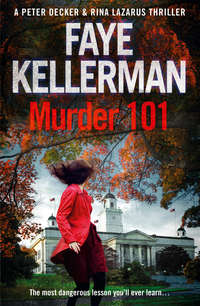
Cover photographs © Barrett & Mackay / Getty Images (campus); Susan Fox / Trevillion Images (woman)
Faye Kellerman asserts the moral right to be identified as the author of this work.
A catalogue record for this book is available from the British Library.
This novel is entirely a work of fiction. The names, characters and incidents portrayed in it are the work of the author’s imagination. Any resemblance to actual persons, living or dead, events or localities is entirely coincidental.
All rights reserved under International and Pan-American Copyright Conventions. By payment of the required fees, you have been granted the non-exclusive, non-transferable right to access and read the text of this e-book on screen. No part of this text may be reproduced, transmitted, down-loaded, decompiled, reverse engineered, or stored in or introduced into any information storage and retrieval system, in any form or by any means, whether electronic or mechanical, now known or hereinafter invented, without the express written permission of HarperCollins.
Source ISBN: 9780007517671
Ebook Edition © SEPTEMBER 2014 ISBN: 9780007517688
Version: 2015-09-16
Dedication
To Jonathan
And to Lila, Oscar, Eva, and Judah
Contents
Cover
Title Page
Copyright
Dedication
Chapter One
Chapter Two
Chapter Three
Chapter Four
Chapter Five
Chapter Six
Chapter Seven
Chapter Eight
Chapter Nine
Chapter Ten
Chapter Eleven
Chapter Twelve
Chapter Thirteen
Chapter Fourteen
Chapter Fifteen
Chapter Sixteen
Chapter Seventeen
Chapter Eighteen
Chapter Nineteen
Chapter Twenty
Chapter Twenty-One
Chapter Twenty-Two
Chapter Twenty-Three
Chapter Twenty-Four
Chapter Twenty-Five
Chapter Twenty-Six
Chapter Twenty-Seven
Chapter Twenty-Eight
Chapter Twenty-Nine
Chapter Thirty
Chapter Thirty-One
Chapter Thirty-Two
Chapter Thirty-Three
Chapter Thirty-Four
Chapter Thirty-Five
Chapter Thirty-Six
Chapter Thirty-Seven
Chapter Thirty-Eight
About the Author
Also by Faye Kellerman
About the Publisher
CHAPTER ONE
As he inspected the final work, holding it up to a bare bulb, he was blinded by the array of brilliant hues in every color of the rainbow. The opalescent glass was lovely, but it was the handblown clear glass in the emerald greens, the ruby reds, and the sapphire blues that gave the piece its pop, casting tinted rays of spectacular light onto his walls and furniture.
The stained glass was first-rate: the execution of the piece … not so much. The caning between the shards was sloppy and the little painting that was on the glass was one step above Art 101. Not that anyone would notice the difference between the genuine and its imposter in its current dark and dank location. Certainly the moronic caretakers weren’t a problem. And in this case, making the switch was a walk in the park because the work could be concealed in a briefcase. His toolbox was bigger and bulkier. But he’d done it before. He could do it again.
Sometimes he didn’t even know why he bothered with the small stuff. Maybe just to keep his brain alive because this little bit of intrigue was nothing compared to his future plans. But to pull off something that big took time and he was fine with that. He’d wait patiently.
The bells were tolling two in the morning: it was time. First, with a makeup sponge, he painted his face brown. Next, he called Angeline on a throwaway cell and told her to wait outside, that he’d be over in five. Carefully, he swathed the piece in bubble wrap and then slid it into his leather briefcase. His tools were already in the car.
He checked his watch again. Then he slipped on his black gloves and covered his head and face with a black ski cap. Next came the black scarf around his neck: good camouflage but also necessary in the cold. A last-minute check in the mirror and what he saw looked perfect. He was nothing more than an inky shadow floating through the night.
Just the way he wanted it.
Be careful what you wish for.
After three decades of police work as a detective lieutenant in Los Angeles, Peter Decker had always imagined a quieter existence in his sixties, something in between retirement and an eighty-hour workweek that had been his former life. He knew that with his active mind and his penchant for restlessness that he wasn’t ready to hang up his shield just yet. In his brain, the ideal job was something with a regular schedule with nights and weekends off.
The good news was he now had a manageable desk job, fielding calls that centered on senior citizens with chest pains, missing pets, and controlling drunken teenagers following Saturday night binges. In the last six months, the closest he had come to real crimes were the calls concerning several house break-ins where the burglars pilfered electronics—cell phones, laptops, and tablets. None of the thefts were surprising because Greenbury was a town that swelled with students in September and then cleared them out by June.
The Five Colleges of Upstate New York was a consortium of liberal arts schools, each with its own identity. One specialized in math and science, another in business and econ. A third was a girls’ school and the fourth focused on fine arts, theater, and languages. The fifth college—Duxbury—was ranked as an elite academy founded in 1859 a few years before the Civil War. The sprawling campuses made up of brick and stone buildings sat on hundreds of acres of dense, bucolic landscape: parks, natural springs, and open forest. It was a world unto itself with its own police force. That made Decker’s job as a cop and detective even more limited.
There were very few issues of town and gown because Greenbury’s population consisted of retirees and working-class families. They owned most of the independent stores and restaurants that fueled the town’s economy. The students, by and large, were from swanky homes and were pretty well behaved even if they often partied at all hours of the night.
The Old Town of Greenbury was a typical college burg with streets named Harvard, Yale, and Princeton. There were blocks of franchise stores: Outsider Sportswear, Yogurtville, Rentaday Car Service, Quikburger. It had a triplex movie theater, a half-dozen cheap dress boutiques, several nail salons, bike rentals, a health food store, and lots and lots and lots of bars, grills, and restaurants. Every popular cuisine was represented, including a kosher eat-in or take-out storefront café that Rina frequented almost daily.
Decker thought about his wife.
If anyone would have adjustment problems, he thought it would be Rina. Instead, she had adapted far quicker than he had. Immediately she threw herself into the local Hillel that serviced all five colleges. She offered to host Friday night dinners in her house for any student who was interested. When too many students became interested, the dinners were moved to a catering hall at the Hillel. The meals were prepared by the local students, but Rina was there almost every Thursday and Friday pitching in with the cooking and baking. When that still didn’t fill up her time, she volunteered her services as a Chumash teacher if Hillel would provide a room. She posted a sign-up sheet. She expected five kids if she was lucky.
She got seven.
Word got around and a month later, she had eighteen kids. They asked her if she was willing to teach a class in elementary Hebrew. She agreed. Most of the times, her evenings were busier than his. Decker hated to admit it but he was bored. It was bad enough that his days were stultifying but then the captain, Mike Radar, asked him to pair up with the kid and take him into the field, and the days became even longer and even more stultifying.
Tyler McAdams, aged twenty-six and Harvard educated, was five ten, one fifty, with hazel eyes and dark brown hair that was expertly cut. His aquiline features included a Roman nose. He wasn’t slight, but he wasn’t muscular, either. He looked like what he was—an Ivy League kid from a wealthy family. His clothes were expensive, his overcoat was cashmere, and he rotated gold watches on his wrist with the days of the week.
Within a very short period of time, McAdams had managed to alienate everyone in the department with his endless carping that he was smarter, better looking, and better educated than anyone around. There was truth in his complaints—he was smart and good-looking—but his constant whining diminished any of his discernible assets. McAdams claimed that he had originally taken up the job because he was curious about police work even though he had been accepted to Harvard Law. He decided to defer the acceptance for a few years, figuring the job would give him a leg up from any of the other wonks and dorks.
Or so was his story.
Decker didn’t press him; he wasn’t interested.
McAdams’s hiring had been nepotism. His father was a major contributor to Duxbury College. The dean had called in a favor from the mayor, Logan Brettly, who, in turn, called in a favor from Radar. McAdams had no experience in law enforcement, but he didn’t need it because nothing much happened that required extensive know-how.
So Decker agreed to let the kid ride with him, listening to him bitch and moan. This time he was complaining about their next visit on the roster: a senior with chest pains. The fire department was having its monthly drill so the call came into the police. Patrol could have handled it, but Decker volunteered his services. He didn’t mention the call to McAdams, but as he was leaving the kid jumped up and grabbed his fancy schmancy coat to come with. He always did that. Maybe it was because Decker let McAdams bend his ear.
Lucy Jamison was eighty-six, a pale and thin widow. When Decker offered to take her to the hospital, she demurred. She was feeling better. Decker fetched her a glass of water, making sure that she drank it all. Wintertime was deceptive and seniors easily became dehydrated because of the dryness indoors and outdoors.
The old woman talked about her life as a young girl in Michigan. She showed Decker and Tyler pictures of her children, her grandchildren, her great-grandchildren. Decker turned the heat from 80 to 74. When she said she was fine, Decker left his card. She opened the front door and waved good-bye as the two of them walked back to the car, their boots crunching the snow.
Heading back to the station, Decker cranked up the heat as McAdams rubbed his hands under the warm air of the car’s heater. The kid was wearing a coat and gloves, but his head was bare. Not that he needed a hat. It was in the midthirties with a full sun and an iridescent blue sky, the scent of pines and burning wood wafting through the town. White-covered hills undulated in the distance. The Hudson wasn’t too far away but the area was miles from the nearest coastline, something that Decker had yet to get used to.
“How’d you do this for thirty years, Old Man?” Tyler asked him.
Decker hated when the kid called him Old Man. He wasn’t young but he wasn’t ready for the glue factory, either. He still had a head of thick, gray hair, a full mustache with traces of its former red color, and a mind that was quick and perceptive. So instead of answering the rhetorical question, he said, “That was the third chest pain case in a month. You really need to learn CPR.”
“I’m not putting my mouth on that old crone. Her breath was rank.”
“Acetone,” Decker said. “Diabetes that’s not very well controlled.”
“Whatever,” McAdams said. “Anyway, if it was between you and me performing CPR, you’d do it anyway.”
“That’s not the point. It’s a skill you should have. Everyone expects a cop to know CPR just like everyone expects a cop to know how to shoot a gun.”
“We don’t carry guns.”
“We don’t carry them, but we have them if we need them. You do know how to shoot a gun … or did they let you slide with that one as well?”
“If we’re playing one-upmanship, you’re going to lose.”
“You have youth and education on your side. I have real experience. That must be worth a few brownie points.”
“No one uses the term brownie points anymore and no need to be snide, especially because I’m out here in the trenches with you.”
“Trenches?”
“Stop pulling rank. I have seniority.” McAdams looked out the side window. “I’m not putting you down, Decker, but if I were actually insane enough to want to do this as a career, I’d probably be upper brass in NYPD within … say, four to six years?”
“You think so?”
“I know so. It’s not about experience or passing tests or paying your dues. It’s all about how to work the system, which is something I excel at. I learn exactly what I need to get the job done. Stuffing my brain with useless knowledge is inefficient. Like learning CPR. We get called out, I know you’re going to handle it. You or Roiters or Mann or Milkweed—”
“Nickweed.”
“Whatever. We get called out and CPR needs to be done, I’m not the go-to guy. Why should I waste my time learning something that I’ll never do?”
“Because it is possible that we won’t be around and then you’ll look like a jackass. If I were your superior, I’d insist on it.”
“But you’re not. And since I’m not asking for your opinion or advice, I suggest you stop wasting your breath. Need I remind you that a guy your age doesn’t have that much left.”
Decker stifled a smile. He was riling up the kid on purpose and enjoying it. “You have a short fuse. You should work on that as well.”
“Remind me why I volunteered to ride with you.”
“Let me guess,” Decker said. “I think you’re one of those dudes hoping to glean something from my vast repertoire of police work. I think you’re figuring that just maybe I’ll tell you something truly original and fascinating and then you can write a novel about it. Or better yet, a screenplay. I can see you living in Hollywood. You’d fit in nicely.”
“You’re being condescending. That’s fine. It must be hard to be the junior partner and intellectually inferior to someone as young as I am.”
“Nah, I’m used to that. You’ve never met my kids.”
“But you don’t work with your kids, do you?”
“Nope. I don’t. And I really don’t work with you, McAdams. We just kind of ride around together. Not much in the way of meaningful conversation going on.”
“You want to talk Proust, I’m in.”
“Sure, talk to me about Proust. I like madeleines. My wife bakes them sometimes.”
“He was boring and I hate philosophy. It’s very mathematical and that’s never been my strong suit. I mean I got a 720 on the SAT but that’s about average for Harvard.” When Decker said nothing, the kid squirmed and said, “So what was your favorite case as a detective?”
“No go, Harvard. You’re just going to have to use your own experience for movie material, although God help us both if we ever caught a real case. Not a plain homicide … a whodunit.”
“A whodunit? That’s what you call homicides?”
“Not all homicides, just whodunits. Do you have even the slightest idea how to begin an investigation?”
“Just from TV … is it that different?”
“You are joking, right?” When McAdams went quiet, Decker felt a little bad. Why was he even bothering? The kid remained blissfully silent for the rest of the ride back, sulking and moping around until he clocked out at five.
If he wasn’t such a twit, Decker might have felt sorry for him. The kid didn’t fit in at work: he really didn’t fit in anywhere. He wasn’t a student anymore and he was too young for the average resident living in Greenbury. So where did that leave his social life? Had he shown any genuine curiosity about police work, Decker would have invited him over for dinner. But Decker wasn’t in the charity business. You reap what you sow and that’s a fact.
Living in a small town had its perks, particularly when selling real estate in L.A. and buying in Greenbury. He and Rina had walked away with a nice nest egg in their pockets. Their new house on Minnow Lane was built at the turn of the twentieth century, bungalow style with three bedrooms, two and a half baths, and a wood-burning fireplace with erratic radiator heating. The selling point was the previous owner’s remodel. He had opened up the ceiling and exposed the beams. It was not only aesthetically pleasing, it allowed Decker and his six-four frame to move about the house without bumping into door headers. The yard was now brown and lifeless but they had bought the house in the fall when autumn leaves were ablaze with color and the weather had been brisk and beautiful. Spring was going to be a true spring, not an L.A. spring with fog and smog.
The house had only a one-car garage where Decker parked the Porsche, leaving Rina’s old Volvo in the driveway. Every morning, Decker cleared the windshield and moved the car to the street so he could get out. It was the least he could do for schlepping her to pursue his dream.
The advantage of the new location was driving distance to their four biological children—two were hers, one was his, and one was shared—as well as their foster son, Gabe Whitman, who was busy touring as a classical pianist. Two of the five were married so there were spouses and grandchildren in the mix. Decker’s daughter, Cindy, who had been a GTA detective in L.A., was working patrol in Philadelphia. But it was just a matter of time before she was promoted back up to being a gumshoe.
The house was warm with wafting cooking aromas, immediately putting Decker in a good mood. Inside the compact but modernized kitchen, Rina was working, her hair tucked into a knitted tam that she wore for religious reasons. She was garbed in a thin blue cotton sweater and a knee-length denim skirt, stirring a soup for tomorrow night’s Shabbat dinner. She was using a big cauldron, which meant guests.
“How many are we expecting?” Decker kissed her cheek.
Rina kissed him back on the lips. “Six to eight. But lunch will be just the two of us, so don’t fret.”
“I like company.”
“Liar. But you’re a good sport. Go change. Dinner will be ready in about ten minutes.”
Decker sat on a chair at the breakfast bar. “I’d rather talk to you and get some pleasant company for a change.”
“The kid is still getting on your nerves.”
“He gets on everyone’s nerves.”
“Why don’t you invite him over for tomor—”
“No.”
“Take the high road, Peter.”
“I’m taking no road. He’s nasty and condescending. It’s bad enough that I have to deal with him at work. Why should I let him ruin my weekend or, even worse, inflict him on you? He’d only wind up needling me for being observant, narrow-minded, and provincial.”
“Or maybe he’d see another side of you.”
“If I invited him over, it would only feed his delusions that he really is my superior.”
“The kid might be a snot, but I guarantee you he knows who the real cop is. He probably feels like an imposter.”
“He is an imposter.”
“Give him a chance.”
“He won’t accept the invitation from me.”
“So maybe he’ll accept it from me.” Rina picked up the phone. “What’s his cell?”
After Decker gave her the number, she punched it in and waited. “Hi. I’m looking for Tyler McAdams?”
Over the line, the kid said, “You called my cell so you found me. Who is this?”
Decker heard his response and mouthed, I told you so.
Rina blithely continued. “This is Rina Decker. My husband and I wanted to invite you over for dinner tomorrow night.” There was a long pause over the line. She went on. “I don’t know if Peter told you but we’re Jewish and we’re observant. I’m having six to eight students here from the colleges and I thought they might be interested in what people do postgraduation, even if it’s a temporary job.”
McAdams still didn’t speak. Finally, he said, “Uh, thank you.”
“You’re welcome. If it’s an inconvenient time, we’ll take a rain check. We usually have people over Friday night, so it’s open-ended. But I’d love to meet you. I always check out my husband’s partners.”
“No, you don’t,” Decker whispered.
She gave him a playful slap. “Please come.”
“Sure … great. What time?”
Decker was making a face. Rina wagged her finger. “Six-thirty. It’s pretty informal. And I’m a great cook.”
“Sounds like a win-win situation because I like to eat. Thank you.”
“You’re welcome. We look forward to seeing you. Bye.” She hung up. “Done.”
“It’s not enough that he’s a leech at work. Once he’s tasted your food, I’ll never get him off my back.”
Rina took the casserole out of the oven. “Lots of people have ridden on your back and you’re none the worse for wear. You’ve got a strong set of shoulders. One more kid certainly won’t break your spine.”
CHAPTER TWO
The kid was on time, which would have been fine except that the students were on Jewish Standard Time. Rina answered the door and proceeded to charm while Decker elected to sulk. It seemed like a lifetime until the other guests arrived. The group—four guys and two girls—brought flowers and wine, leaving the empty-handed McAdams feeling a little sheepish. “I thought this was informal. I would have brought something.”
Decker said, “Don’t worry about it.”
“I’m not worried, but I just don’t want to look like a clod.”
“If only you could remedy that with a bottle of wine.” Decker smiled and put his arm around the kid as he led him to the table. “C’mon, Harvard. Just relax.” Introductions were made all around. Decker whispered, “There are a couple of ritual blessings we need to make. The first one is over the wine—”
“I know what Kiddush is,” McAdams said. “There are one or two Jews in the Ivies. I had a Jewish girlfriend at one point.”
“What happened?”
“She’s not my girlfriend anymore, that’s what happened.”
“She dumped you.” When McAdams shot him a dirty look, Decker said, “It happens.” He seated himself at the head of the table.
Rina said, “Tyler, why don’t you sit here between Adam and Jennifer. Both of them are interested in law and I know you’ve gotten into Harvard Law.”
“Adam and McAdams,” Decker said. “Already sounds like a law firm.”
Rina smiled. “It does.” She placed the other four students at the table and then Decker made Kiddush. There once was a time where he stumbled over the Hebrew words. But after twenty-five years of embracing her culture and his genetics, he recited the blessing fluently. After drinking wine, the group washed their hands and said the ritual blessing, and then Decker made the HaMotzi, the prayer over the bread.
Finally, the meal could begin in earnest: soup, salad, rib roast, lentils with red peppers and onions, green beans with hazelnuts, and mixed berry cobbler for dessert. It was enough to break the zippers and pop buttons on any waistline. There was lively conversation between the students and Rina as they discussed the parashat hashavua: the weekly chapter of bible. The kids were intelligent and opinionated. McAdams, on the other hand, was quiet. Like a lot of secular, upper-crust kids of his generation, he was probably scripture impaired. But he was polite and spoke when he was spoken to.
By nine o’clock, things were starting to wrap up and that’s when Decker’s landline rang. Rina and he exchanged glances. Decker’s father had died a year ago, but his mother was still alive and in her nineties. Rina’s parents were both in their nineties. Whenever they got a phone call on Shabbat, it was a reason to worry. Decker held up his finger and went to the answering machine, which identified phone numbers. “It’s local.”
“Thank God,” Rina said. “Probably a robocall.”
The voice kicked in. It was Mike Radar and Decker picked up the phone. “It’s Decker. What’s up, Captain?” He listened intently over the phone. “When? … Okay … okay.” He checked his watch. “Does he know when the lock was broken? No idea? All right, I’ll look into it. Do you know how far it is from my house? … no, I’ll handle it. Just tell me how to get there on foot … no, I don’t mind walking if it’s not too far. A mile away is no problem, Mike … no, really, you stay put. I just ate the equivalent of half a cow and it would be good for me to get a little exercise. Unless it’s something more, I’ll call you on Sunday.”
Decker hung up the phone. “There was a break-in at the local cemetery and the watchman is all up in arms. The other detectives are ice fishing in Canada for the weekend so the captain wondered if I wouldn’t mind handling it.”
Rina feigned mock outrage. “You mean your colleagues didn’t invite you with them?”
Decker grinned. “Actually, I made the cut, but I declined. Maybe next time.”
McAdams said, “I would have gone. Nobody asked me.”
“They probably thought your blue blood couldn’t handle the cold.” Decker sighed inwardly. He had to make the offer to look like a good guy. “Come if you want.”
“Of course, I’ll come.”
“Take the car. I’ll meet you there in about a half hour.”
“I’ll walk with you, Old Man.”
“Harvard, it’s really cold outside. I’m doing it for religious reasons. No reason for you to suffer.”
“I’m not gonna let you outmacho me.”
“Suit yourself. Let me grab a few things and we’ll be on our way.”
“I’ll get your jacket, Tyler,” Rina said.
“Thanks.” McAdams jammed his hands into his pants pockets. His eyes were darting back and forth and he walked in itty-bitty circles. When Rina brought over his outerwear, he bundled up and then forced a smile. “Thank you for dinner. It was delicious.”
“You’re welcome.”
“Do you want some package warmers for your feet and hands?” Decker asked. “I’m taking some with me. No sense getting frostbite.”
“Yeah, sure.”
Decker gave a wave and he and the kid were off. The night was moonless with thousands of stars sprinkling the dark sky like salt on black velvet. Without the cloud cover, the temperature had dropped to the teens. No wind … just cold air and the mist of warm breath wafting through darkness.
McAdams said, “Thanks for dinner.”
“You’re welcome. It was my wife’s idea.”
“Yeah, I intuited that. She is a good cook. She’s also lovely … I mean personality.”
“She’s lovely all the way around. I’m very lucky.”
McAdams said, “You have a large family. I counted like seven different people my age in the various pictures.”
“Five kids, two spouses, twin grandsons, and a granddaughter.”
“Wow.” A pause. “I take it the black guy is a son-in-law? Or maybe you were married before.”
“I was married before, but not to Koby’s mother. He’s married to my elder daughter, Cindy, who’s a cop in Philadelphia. Koby is in medical school at the University of Pennsylvania. They have twin boys. The older two white boys are my stepsons. The girls are my biological daughters and the youngest kid is our foster son who’s been with us for the last four years. He is a classical pianist who just graduated from Juilliard.”
“Impressive. What do the other kids do?”
“Sam and his wife are both doctors. They have Lily. They live in Brooklyn. Jacob—the one who looks like Rina—just finished his Ph.D. in public policy. He’s still …” Decker laughed. “He’s still finding himself. My other daughter, Hannah, is in a Ph.D. program at the Ferkauf School of Psychology in New York.”
“Not bad … but no Crimson.”
“Yeah, you Harvard guys think that there’s only one school in the world.”
“No, we do accept Princeton or Yale. But that’s about it.”
Decker smiled. “What about yourself, McAdams?”
“What do you mean?”
“Parents, brothers, sisters, city of birth? For as much as you yap when we’re driving, I don’t know anything about you.”
“Nothing much to tell. I grew up in the city. By the city, that means Manhattan. My parents divorced when I was ten, and both of them were remarried by the time I was fourteen. A couple of half sibs, a couple of stepsibs, all of them younger and none of them as smart as I am. I don’t have much of a relationship with any of them.”
Talking about family was obviously painful for him so Decker didn’t ask any more questions. They walked the next ten minutes in silence until the local graveyard came into view. That was another thing about small towns. Cemeteries were right in your face, not like L.A. where they’re situated in no-man’s-land off the freeway. This one was several blocks of upright headstones with a secluded, gated portion for the mausoleums: domed structures with fluted columns. Since the captain had mentioned something being broken into, it had to be one of the crypts.
Decker said, “Do you want a hand or foot warmer package? My feet are ice at this point.”
“Yeah, sure.”
After handing him the packets, Decker took a couple for himself, broke them in half, and dropped them into his snow boots. “Ah … better. I’m not really cold—after eating that much meat you can’t be cold—but my hands and feet get numb.”
“Why did you insist on walking? Surely there’s some religious dispensation that allows you to drive the car when working.”
“Yeah, I could have taken the car. Probably would have been smarter. What can I say, McAdams? Without a Harvard B.A., I guess I’m just handicapped.”
The watchman was a dead ringer for Ichabod Crane with a long face and extended skeletal frame and sunken eyes unsuitable for daylight. Any minute, Decker expected to see the headless horseman. His given name was Isaiah Pellman and his family had been living in Greenbury for two hundred years. The history was given by way of introduction to his good character. There were a lot of loquacious people in Greenbury as well as a lot of odd ducks. Eccentrics were everywhere in the world, but they were more noticeable in smaller populations.
They were chatting while standing between rows of headstones. Pellman said, “I check the Bergman crypt all the time, so I was really surprised when this happened.”
Decker pulled out a notebook. “What specifically happened?”
“My key doesn’t work the lock: that’s what happened.”
“Okay … so the lock wasn’t broken off?”
“No, it was broken off and exchanged for a different lock.”
“And your key always worked the lock before?”
“Yes, sir, it did.”
“Are you sure the lock just didn’t freeze?”
“I’m sure. First thing I did was heat it and oil it. The key goes in, but the tumblers don’t move. Everything worked perfectly four days ago. I called up the family and explained the situation a few hours ago. They told me to cut the lock and make sure everything inside is okay. But I told them I was gonna call the police. So I called the police. And now you’re up to date.”
“Who does the crypt belong to again? Bergman?”
“Ye-ah. They’re all buried inside—Moses and Ruth and their three children, Leon, Helen, and Harold along with their spouses—Gladys, Earl, and Mary. Ken Sobel’s the one I deal with. He’s a grandson from Helen Bergman, who became a Sobel when she married Earl. Ken’s older cousin, Jack Sobel, was buried here around six months ago. He was seventy-three.”
The man knew his local history. “How old is the crypt?”
“Erected in 1895.”
“And the family visited the crypt for a funeral about six months ago?”
“Ye-ah. Then Ken Sobel came back in the fall. Ken’s in his late sixties. He comes down four times a year as regular as clockwork. And he always makes sure the lock’s on tight.”
“So he has a key.”
“He does. Others as well but they don’t come down.”
“Could Ken have changed the lock?”
“No, sir, I asked when my key wouldn’t work. And he said no, he didn’t change the lock. And he’s the one who’s in charge. He told me to break the lock and make sure everything’s okay inside. So that’s when I called you—the police.”
“Anything of value inside the crypt?”
“No. Unless the bodies were buried with jewelry.”
Decker said, “Jewish custom is not to bury bodies with anything material.”
“So there you have it!” Pellman exclaimed.
“Indeed,” Decker said although he really wasn’t sure what Pellman was talking about. “Has this ever happened before? That your key didn’t work the lock?”
“No, sir, not on my watch.”
During the interview, McAdams’s toe was constantly tapping. Finally, he said, “Why don’t we just go and see what’s going on? If everything looks fine, we can all go home.” He looked at Pellman. “Well, not you, but I’m not getting paid to freeze my ass off.”
Decker was annoyed, not just at the kid’s rudeness, but at the disruption of the interview. He always collected as much information as possible before he witnessed the crime scene … if there even was a crime scene. “Mr. Pellman, do you have anything else you want to tell me before we look around?”
“No.” The man was stunned. “Should I be telling you something?”
“It wasn’t a trick question,” McAdams said. “No is a perfectly acceptable answer.”
“Take your time, Mr. Pellman,” Decker said.
“No, nothing else.”
“Okay. Thanks.” Decker folded his notebook. “Do you have a pair of bolt cutters?”
“I do.” He shuffled his feet and didn’t move.
“Could you get them for me?”
“Uh, sure. I don’t know if they’re strong enough to cut the lock.”
“Only one way to find out.”
Pellman said, “I guess you’re right about that.” Slowly he headed toward a shed that sat about two hundred yards away.
“Queer old guy but then again they’re all odd over here.”
Decker turned to the kid. “Don’t interrupt when I’m interviewing. It distracts me.”
“Just trying to move things along.”
“Tyler, this is probably nothing, so it’s no big deal. But if you have a chance to investigate a real crime, you can’t rush it along. You’ll miss things. You’ve got to slow down.”
Before McAdams could respond, Pellman came back with the bolt cutters and handed them to Decker. “You want to see the crypt and the lock?”
“That would be helpful.”
Slowly Pellman took them over to the Bergman crypt, an enormous rectangular stone vault with a dome ceiling. Each of the four outside walls hosted a leaded glass window that would have lit up the interior had it been daylight. Five stone steps led down to a padlocked concrete door. No foul odors seemed to emanate from the ground, but it was so cold that everything was frozen solid including dead matter. Decker looked at the bolt cutters and looked at the thin shank of the padlock, something that teens would use on their school lockers. With a little muscle, he should be able to make a clean cut through the U-shaped metal.
Decker said, “Can I try your key just to make sure?”
“Sure.”
Decker inserted the Schlage into the key slot. He could move it a millimeter to the left and right. The insides didn’t appear to be frozen, just that the key didn’t work the lock. He handed it back to Pellman. Then he handed the cutters to McAdams. “Go ahead, Harvard.”
“Me?”
“Yeah, take a whack at it.”
McAdams threw dagger eyes, but he secured the blades of the cutter around the U-shaped metal. “Okay.” He took a deep breath. “Okay.” He pressed down hard and the lock slipped under the blades. McAdams swore.
“If you don’t get it on three, I’ll do it,” Decker told him.
“Chill, Old Man. I’ll get it, I’ll get it.”
Number three was the charm. The kid used all his muscle, the blades cut through the shank, and the lock snapped off. When McAdams started to go in, Decker held him back.
“How about if we pick up the lock from the floor and stow it in the paper evidence bag. Just perhaps there is a crime scene involved and maybe the lock has a fingerprint. And as luck would have it, I just happen to have a few bags in my pocket.” Decker handed him a small paper bag. “Or would you prefer that I pick it up, boss?”
McAdams swore, but he bent down and picked it up with his gloved hand.
Decker said, “Place it in the bag. Then you write your name, the date, the time, and the location.”
McAdams did as he was told then gave the bag back to Decker. “Only because your wife fed me.”
“And fed you well.” Decker took out a flashlight and a magnifying glass. He peered through the lens and studied the door. “No pry marks.” He pushed the door open and swept the beam across the crypt. There were a number of horizontal marble headstones in the ground, but no bodies that weren’t six feet under. Decker counted the marble tombstones. At current, the crypt was hosting ten graves with room for more. Decker handed McAdams an extra flashlight. “In case you didn’t bring one. Keep it.” He turned to Pellman. “Could I borrow your light? It’s stronger than mine.”
“You betcha.” The watchman handed him his battery pack.
“Thanks.” Decker crossed over the threshold and stepped inside. The temperature wasn’t as cold as he thought it would be. Thick walls kept out the sunlight and heat but they also kept out the extreme cold. Decker swept the beam around to get the lay of the land.
The space was as big as his current living room, around two hundred square feet, and beautifully adorned. There was carved molding on the ceiling, and jeweled stripes of iridescent colored glass tiles were inset into the walls. Each gravestone was marked by the inhabitant inside—name, beloved husband/wife father/mother, grandfather/grandmother/date of birth/date of death. Nothing unusual except that the headstones of the matriarch and the patriarch were inset with tile work—two different pastoral scenes elegantly laid out in tiny pieces of glass mosaic. He squatted down to study the artwork. McAdams kneeled next to him. Decker whispered, “Doesn’t matter now, but for the record, don’t kneel. It might mess up something. You want as little contact with the ground as possible.”
McAdams squatted. “Not only am I a solid chunk of ice, I’m gonna be sore.”
Decker ignored him. “Nice tile work, no?”
“It’s okay … actually more than okay. It’s done well.”
“Somebody put money into these headstones.” Decker stood up and inched the light up and across the walls until he reached the windows. They stood about ten feet above the floor. Hanging just under the dome in the upper four windows were stained-glass panels. Decker didn’t notice them when he first came in because it was dark. He illuminated each panel with his flashlight, letting the beam rest on each for a minute or so before moving onto the next one. They probably sparkled beautifully in the daylight.
“It’s the four seasons.” Decker turned to McAdams. “See, that one’s winter, that’s spring, and summer and autumn.” He regarded the kid. “I think they were custom made.” He turned to Pellman. “Have those stained-glass windows always been inside the crypt?”
“For as long as I’ve been here and even before.”
Decker turned to the kid. “What do you think?”
McAdams shone his light on the four panels. “My mother has some Tiffany lamps. I’m not saying they are Tiffany, but it looks like good quality.”
“Agreed,” Decker said.
“You do know that the company made stained-glass windows for religious purposes.”
“Go on.”
“Just that the studio made a lot of devotional items for churches and synagogues. Do you know Manhattan at all?”
“Not too well.”
“There’s a famous synagogue on Fifth Avenue that has an original Tiffany. As does the Portuguese synagogue on the west side.”
“Courtesy of your ex-Jewish girlfriend?”
“You have a honed mind, Old Man. The studio also made windows for wealthy people’s mausoleums. So if they were real, I wouldn’t be surprised.”
“Could you tell if those are Tiffany or not?”
“Not at this distance. You could look for a signature, but that can be forged. It happened all the time. Mostly you tell by quality.”
Decker turned to Pellman. “Do you have a ladder?”
“Not on me, but I can get you a ladder.”
“Thank you. That would help.”
“Be right back.”
After he left, McAdams said, “Why in the world are you climbing up there? Are you that bored with the job?”
“Harvard, it always helps to get up close and personal. I’ll do the climbing, you just hold the ladder.” The two men didn’t speak. McAdams was fidgety. Decker said, “You okay?”
“Kinda creepy in here.”
“Yeah, cemeteries are a little spooky.” Decker paused. “Not this place, though. Someone took the time to make it pretty.”
Pellman came back with the ladder. “Here you go.”
Decker handed him his big, bulky battery pack flashlight and took his smaller light. He started climbing toward the windows. “Guys, shine the lights on the window, okay? I want to see them up close.”
The two men focused the light on the “autumn” stained-glass window. It was about fourteen by twenty inches in size and was hanging from two chains that were hooked into the ceiling.
“Is there a signature?” McAdams shouted.
“What kind of signature should I look for?”
“Tiffany Studios … something like that.”
Decker was face-to-face with the artwork. He shone his light through the colored glass. He wasn’t an expert, but it looked pretty good to his eye. It took him a few seconds to find the signature: Tiffany Studio. New York.
“Do you think it’s real?” McAdams asked from below.
“No idea.”
McAdams said, “There must be someone in one of the colleges who could authenticate it.”
“Good thinking.” Decker continued to study the work: each cut piece of glass, each thread of metal that held the glass into place. All the metal, including the frame, was dark bronze in color but with a hint of dark green peeking through. He knew from watching those antique shows that the patina—the way the metal aged over time—was important in authentication and to his eye, the metal work between the glass pieces and frame had plenty of patina. So did the chain from which the panels hung.
All the links had plenty of patina except for the two metal loops soldered to the frame and attached to the hanging chains. Those two loops were darker than the frame and looked flat when compared to the rest of the metal. Decker saw a raised chip of what he thought was a metal shard poking up, but when he touched it, dark paint flicked off and fell onto the back of his hand. Carefully, he climbed down the ladder and folded it up. “Uh, with the family’s permission, I’d like to get an art expert down here to look at all four windows.”
McAdams said, “Why? What did you find?”
“I’m not sure, but I’d like someone to take a closer look.”
Pellman shuffled his feet. “I suppose I can call up the family.” He hemmed. “Maybe it would sound better if it came from the police.”
“I’d be happy to call them up and tell them my thoughts.” Even in the dark shadows, Decker could tell that Pellman was relieved. The watchman gave Decker Ken Sobel’s telephone number. “Do you have something to secure the door with?”
“No, not on me.”
“I don’t suppose there’s a hardware store open at this time of night?”
Pellman said, “Just call up Glenn Dutch. I’m sure he has something around his house. If not, he’ll open the store for you.”
McAdams said, “Dutch’s Hardware is on Gable Street.”
“Do you have the number?” Decker asked Pellman.
“I don’t have it, but Roy might have it. Roy’s a friend of Glenn’s and I have Roy’s number.”
“Could you get Glenn’s number from Roy, then?”
“Surely, I can.” He checked his contact list on his phone. “I must have it at home … Roy’s number. I’ll call up my wife and she can get me Roy’s number who can get you Glenn’s number.” Pellman walked a few feet away to make his calls.
McAdams said, “You want to tell me what you found or are you going to make me play twenty questions?”
Decker said, “I found paint.”
“Paint?”
“Paint flicked off on one of the loops soldered onto the frame. It was painted to make the solder joints look old. And, come to think of it, whoever put those loops on the frames did a sloppy job of soldering. Now it could have been a recent repair. I’m just saying it wasn’t in keeping with the original work.”
McAdams said, “What did the glass look like? The individual pieces, I mean.”
“The glass was beautiful … really iridescent.”
“Did you find any cracks?”
Decker regarded him in the shadows. “Interesting you should ask. I remember thinking that the glass was in really good shape. Why?”
“This may not be true for window panels, but my mom always said that the lamps have been around for a while. It’s nearly impossible to find something in pristine shape—without any cracks—that hasn’t been forged.”
“Good to know,” Decker said. “On the other hand, the panels have been hanging in the same place for over a hundred years untouched.” A pause. “On the third hand, the works are hanging in a noncontrolled environment. With all the weather fluctuations, you might expect a few cracks. On the fourth hand, I only looked at one panel so maybe the others have cracks in the glass.”
“So that’s the way you do it. You just keep talking to yourself until you hit on something.”
“Sure, I talk to myself if no one else is around. When I was head of the detectives’ division, I used to talk to my other detectives. We’d bounce stuff off one another and we were right more than we were wrong.”
“You know, I am standing right here, freezing my ass off. You could bounce shit off me.”
“McAdams, I’ve been trying to bounce shit off you for the last six months and all I’ve had to show for it was a face full of crap. S’right. I know I’m a terrific detective. If you want to learn, I’ll be happy to share what I know. And if there’s something that I don’t know but you do know, well, that’s fine with me also. A great detective starts by being a great listener.”
Ücretsiz ön izlemeyi tamamladınız.