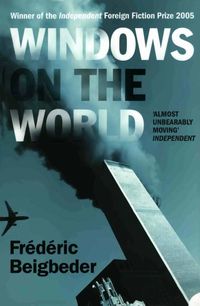
Kitap dosya olarak indirilemez ancak uygulamamız üzerinden veya online olarak web sitemizden okunabilir.
Kitabı oku: «Windows on the World», sayfa 4
8:44
If they could carefully study the photos they’re taking (photos that will never be developed), behind the Empire State Building, Jerry and David would notice a white dot moving on the horizon. Like a dazzling white gull against the blue skyline. But birds don’t fly this high, nor this fast. Sunlight ricochets off the silver shape like when one of the FBI guys in Mission Impossible flashes a mirror in his partner’s eyes to silently signal to him.
In Le Ciel de Paris, everything is designed to constantly remind you that you are higher that the normal. Even in the restrooms, the walls with the urinals depict the skyline of the City of Light, so that male customers can piss all over it.
I should come back and have dinner here: the menu is pretty tempting. “Autumn in Le Ciel de Paris as interpreted by Jean-François Oyon and his team”: among the appetizers is Seared foie gras on pain d’épices with a cream of ceps (€25.50); fish dishes include Fillet of grey mullet à la plancha with a bouillabaisse reduction and eggplant remoulade (€26.00); if you prefer meat, Jean-François Oyon suggests Pigeon roasted in honey and spices with caramelized cabbage (€33.00). For dessert I’d be tempted to go for the Luxurious warm, chocolate “Guanaja” with hazelnut cream ice. I realize it’s hardly good for your health—Karl Lagerfeld would disapprove—but I prefer something luxurious to the Tonka and morello cherry surprise or even the Roasted figs with Bourbon vanilla butter.
Behind me, a terrible drama is unfolding: an American couple are demanding ham and eggs with mushrooms for their breakfast, but the waitress in her orange uniform says, “I’m sorry, nous ne servons que du continental breakfast.” A repast composed of toast, croissants or pains au chocolat, fruit juice and coffee, the continental breakfast is rather less substantial than the breakfast Americans are accustomed to ingesting in the mornings. Accordingly, they stand up, cursing loudly, and walk out of the restaurant. They can’t understand how such a touristy place can be incapable of serving a decent, ample breakfast. From a strictly commercial viewpoint, they’re not wrong. But what’s the point in traveling if it’s to eat the same things you eat at home? In fact, it’s a terrible misunderstanding—everyone is right. Le Ciel de Paris should give its customers a choice, offer as wide a selection at breakfast as they do at dinner. And Americans should stop trying to export their lifestyle to the entire planet. That said, that’s two people who would survive if an airplane did crash into the Tour Montparnasse at 8:46 this morning, as it did into the North Tower of the World Trade Center on September 11,2001.
What is staggering is that a plane had already flown into a New York skyscraper. On a foggy night in 1945, an American B-52 bomber crashed into the Empire State Building between floors 78 and 79. Fourteen dead and a colossal inferno several hundred feet high. But the Empire State did not collapse because the building’s steel structure did not buckle as the World Trade Center did (steel loses its rigidity at 840°F and melts at 2,500°F, whereas the heat given off by the two Boeings is estimated to have been 3,600°F). In 2001, the 10,500 gallons of flaming jet fuel destroyed the metallic structure of the buildings, and the upper floors collapsed onto those beneath. In order to build the Twin Towers, Yamasaki had used a new technique: instead of using a maze of internal columns, he chose to rest the greater part of the weight on the external walls, which were composed of tightly spaced vertical steel pillars connected by horizontal girders which girdled the towers at each floor. This architecture allowed him to maximize the interior space (and thereby earn more money for the property developers). It was these pillars, covered with a thin coating of aluminum, which gave the two towers the banded appearance of two hi-fi speakers.
Conclusion: the Twin Towers were built to withstand the impact of a plane without fuel.
Welcome to the minute before. The point at which everything is still possible. They could decide to leave on the spur of the moment. But Carthew thinks they still have time, they should make the most of their New York jaunt; the kids seem happy. Customers are leaving: at any moment, customers come and go. Look, the old lady Jerry and David were pestering earlier—the one with the lilac hair—is getting up; she’s already paid the check (not forgetting to leave a five-dollar tip); slowly she makes her way to the elevator, the two badly behaved children have reminded her that she needs to buy a present for her grandson’s birthday; she says “Have a nice day” to the receptionist and presses the button marked “Mezzanine,” the button lights up, a bell goes “ding;” she decides she’ll stroll around the mall for a little. She thinks she remembers seeing a branch of Toys
Us but can’t remember whether it was in the basement or the mezzanine, this is what she is thinking as the doors to the elevator close noiselessly. For the rest of her life, she will believe it was the Lord God who told her to leave at this precise moment; for the rest of her life she will wonder why He did so, why He spared her life, why He made her think of toys, why He chose her and not the two little boys.
8:45
A minute before, the state of affairs was recoverable. Then suddenly I got the jitters.
“Hey, what’s the difference between David Lynch and Merrill Lynch?” asks the guy in Kenneth Cole.
“Um…no, don’t know that one,” says the blonde in Ralph Lauren.
“There isn’t one: nobody has a clue what either of them are doing and both of them are losing money,” says the guy in Kenneth Cole.
They burst out laughing, then think better of it and revert to their professionalism.
“It’s more volatile but the volumes are down,” says the blonde in Ralph Lauren.
“Standard & Poor’s futures are scary,” says the guy in Kenneth Cole.
“The margins are killing us all,” says the blonde in Ralph Lauren.
“I’m going long on the NASDAQ,” says the guy in Kenneth Cole.
“The squiggly lines aren’t looking good,” says the blonde in Ralph Lauren.
“Sometimes you gotta know when to cut your arm off,” says the guy in Kenneth Cole.
“We got whacked on the yen,” says the blonde in Ralph Lauren.
“Well, my position on the Nikkei is covered,” says the guy in Kenneth Cole.
“Oh my God,” says the blonde in Ralph Lauren. “OH MY GOD!”
Her eyes grow wide, her bottom lip has fallen as far from her upper lip as it can, she’s brought her trembling hand up to her frozen mouth.
“What? What is it? WHAT’S THE PROBLEM?” demands the guy in Kenneth Cole, before turning round.
The weather had been so beautiful: through the telescope, Jerry could count the rivets on the fuselage. He turned to me, all excited.
‘Look, Dad! See the plane?”
…but already my hands had betrayed me. In a split second I’d contracted Parkinson’s. Other customers realized what was happening: an American Airlines jet, a fucking Boeing, was flying low through New York, heading straight for us.
“Shit! What the fuck is he doing? He’s far too low!”
I hate disaster movies: the good-natured blond guy with the square jaw, the pregnant woman whose waters break, the paranoid guy who freaks out, the coward who turns out to be a hero, the priest giving the last rites. There’s always some idiot who gets sick and the stewardess goes looking for a doctor:
“Is there a doctor on the plane?”
And some medical student puts his hand up, he feels really useful. “Don’t sweat it, guys, everything’s gonna be fine.”
This is what you think when there’s a Boeing heading straight for you. What a pain in the ass, starring in a turkey like that. You don’t think anything, you hang onto the armrests. You don’t believe your eyes. You hope what’s happening isn’t happening. You hope your body is lying to you. For once, you hope your senses are wrong, that your eyes are deceiving you. I’d like to tell you my first thought was for Jerry and David, but it wasn’t. I didn’t instinctively try to protect them. When I dived under the table, I wasn’t thinking of anyone except little old me.
8:46
We now know with reasonable certainty what happened at 8:46 AM. An American Airlines Boeing 767 with ninety-two people on board, eleven of them crew, flew into the north face of One World Trade Center, between floors 94 and 98, and 10,500 gallons of jet fuel immediately burst into flames in the offices of Marsh & McLennan Companies. It was flight AA11 (Boston-Los Angeles) which had taken off from Logan airport at 7.59 AM and was moving at 500 m.p.h. The force of such an impact is estimated as being equivalent to an explosion of 265 tons of dynamite (a twelve-second shock wave measuring 0.9 on the Richter scale). We also know that none of the 1,344 people trapped on the nineteen floors above survived. Obviously, this piece of information removes any element of suspense from this book. So much the better: this isn’t a thriller; it is simply an attempt—doomed, perhaps—to describe the indescribable.
“Now the whole earth had one language and few words. And as men migrated from the east, they found a plain in the land of Shinar and settled there. And they said to one another, ‘Come, let us make bricks, and burn them thoroughly.’ And they had brick for stone, and bitumen for mortar.”*
8:47
When a American Airlines Boeing 767 slams into a building below your feet, there are two immediate consequences. Firstly, the skyscraper becomes a metronome and I can assure you that when One World Trade Center starts to think it’s the Leaning Tower of Pisa, it feels pretty strange. This is what experts refer to as the shock wave; it makes you feel like you’re in a boat in a roaring storm or, to use a metaphor my kids would understand, like being inside a giant blender for three or four seconds. Glasses of juice shatter on the floor, lights come away from the walls and dangle from wires; wooden ceilings collapse and the sound of breaking crockery comes from the kitchens. In the bar, bottles roll and explode. Bouquets of sunflowers topple and vases shatter into a thousand pieces. Champagne buckets spill onto the carpet. Dessert trolleys skate down the aisles. Faces tremble as much as the walls.
Secondly, your ears burn as the fireball passes the window, then everything is swathed in thick smoke; it seeps from the floor, the walls, the elevator shafts, the air vents; tracking down an incredible number of openings designed to let in fresh air and now doing the reverse: the ventilation system becomes a fumigation system. Immediately, people start to cough and cover their mouths with napkins. This time, I remember the existence of Jerry and David: all three of us were huddled under the table. I doused napkins in the jug of orange juice before giving one to each of them.
“Breathe through the cloth. It’s a test: they do this kind of thing in New York—they call it a fire drill. There’s nothing to worry about, darlings, actually it’s pretty fun, isn’t it?”
“Dad, did the plane crash into the tower, Dad, WHASHAPPNINGDAAD?”
“No, of course not,” I smile. “Don’t worry, boys, it’s all special effects, but I wanted it to be a surprise: it’s a new attraction, the plane was a hologram—George Lucas did the special effects, they do a false alert here every morning. Really scared you though, huh?”
“But, Dad, the whole place is shaking, and the waitresses are scared and they’re screaming…”
“Don’t worry, they use hydraulics to make the restaurant shake, like they do in theme parks. And the waitresses are actors, they’re just plants put in among the paying customers, like in Pirates of the Caribbean! Remember Pirates of the Caribbean, Dave?”
“Sure, Dad. So what’s this ride called?”
“‘Tower Inferno’.”
“Right…Fuck, sure feels real…”
“Dave, we don’t say fuck, even in a towering inferno, okay?”
Jerry seemed less reassured than David by my Benigni-style playacting, but since it was the first thing I could think of, I decide I have to run with it, so that he wouldn’t immediately start crying. If Jerry started crying, I couldn’t be sure that I wouldn’t cry too and then David was likely to get in on the act. But David never cries, and he certainly wasn’t going to start now.
“You have to admit the special effects are pretty mind-blowing: the smoke coming out of everywhere, and all the customers who’re paid to panic, it’s pretty well put together!”
Around us, people were getting to their feet, still staring at each other, petrified. Some, who’d dived under the table like we did, look up now, a little embarrassed that they weren’t hero material. Jerry’s pancakes were lying on the floor, covered with bits of porcelain. The pot of maple syrup dripped between the overturned chairs. Outside the Windows on the World, you couldn’t see a thing: a dense black curtain blocked the view. Night had fallen, New York had disappeared and the ground rumbled. I can tell you, everyone in the place had only one idea, neatly summed up by the head chef:
“We’ve got to get the hell out of here.”
Now I think about it, I would like to have been in one of those brainless disaster-movie blockbusters. Because pretty much all of them have a happy ending.
8:48
Other possible names for the World Trade Center restaurant:
Windows on the Planes
Windows on the Crash
Windows on the Smoke
Broken Windows
Sorry for that bout of black humor: a momentary defense against the atrocity.
The New York Times collated a number of eyewitness accounts of Windows on the World at that moment. Two amateur videos show smoke seeping into the upper floors at incredible speed. Paradoxically, the restaurant is more smoky than the floors just above the point of impact because the smoke has taken some fifty feet to thicken. We have fragments of a call made by Rajesh Mirpuri to his boss, Peter Lee at Data Synapse. He says he can’t see more than fifteen feet. The situation is rapidly deteriorating. At Cantor Fitzgerald (on the 104th floor), fire blocks the elevators. Employees take refuge in the offices on the north face, fifty of them in a single conference room.
At that moment, the majority still believe this is an accident. There is considerable evidence to suggest that most of them were still alive until the building collapsed at 10:28 AM. They suffered for 102 minutes, the average running time of a Hollywood film.
Extract from Against the Grain by Huysmans:
It was the vast, foul bagnio of America transported to our Continent; it was, in a word, the limitless, unfathomable, incommensurable firmament of blackguardism of the financier and the self-made man, beaming down, like a despicable sun, on the idolatrous city that grovelled on its belly, hymning vile songs of praise before the impious tabernacle of Commerce.
“Well, crumble then, society! perish, old world!” cried Des Esseintes, indignant at the ignominy of the spectacle he had conjured up…
I knew it. The person really responsible for this attack wasn’t Osama bin Laden, but the incorrigible Des Esseintes. I thought that decadent dandy was behaving a little oddly. Having for so long found nihilism cool, spoiled children now root for serial killers. All those weird little boys who sniggeringly advocate hatred now have blood on their shirt fronts. No dry cleaner will ever get the blood spatters out of their designer vests. Dandyism is inhuman; the eccentrics, too cowardly to act, prefer to suicide others rather than themselves. They murder the ill-dressed. Des Esseintes, with his pale hands, murders children whose only crime is to be ordinary. His snobbish contempt is a flamethrower. How can anyone forgive the murder of the old woman in Florida on page 201 of my previous novel? We point the finger at those who are indirectly guilty, anonymous, impersonal pension funds, dummy organizations. But at the end of the day, those who scream, who plead, who bleed, are real. At the end of the world, satire becomes reality, metaphor becomes truth, even political cartoonists feel embarrassed…
8:49
Your first instinct is to grab your cellphone. But since it’s a first instinct, everyone else has had the same idea and the networks are jammed. As I anxiously press the green “redial” button, I try to convince the boys that this suffocating darkness is just a funfair ride.
“You’ll see: any minute now they’ll send in a fake rescue team, it’s gonna be wicked! That black cloud’s really well done, isn’t it?”
The stockbroker couple look at me pityingly.
“Jesus!” says the blonde in Ralph Lauren. “Let’s get the hell out of this sauna.”
The dark-haired guy gets up and runs for the elevators, dragging his lover by the hand. I fall in behind, a child on each arm. But the elevators are out of order. Behind her desk, the receptionist is sobbing.
“I’m not trained for this kind of thing…We’re supposed to evacuate via the stairs. Follow me…”
The majority of Windows on the World customers haven’t waited for her. They’re already crammed into the smoke-filled stairwell. They cough in single file. A black security guard throws up in a trash can. He’s already been down four floors.
“I’ve just been down there, it’s hell, don’t go, the whole place is blazing!”
We go anyway. It’s utter chaos: the crash has knocked out all means of communication with the outside world. I turn to Jerry and David who have started whimpering.
“C’mon, kids, if we’re gonna win the game, we can’t let them think they’ve fooled us. So, no panicking, please, otherwise we’ll be eliminated. Just follow your dad and we’ll try and get downstairs. You both played Dungeons and Dragons, right? The winners are always the ones who are best at bluffing the enemy. If we show any signs of weakness, we’ll lose the game, got it?”
The two brothers nod politely.
I realize I’ve forgotten to describe myself. I used to be striking, later I was handsome, later still, not so bad, now I’m all right. I read a lot of books, and underline the sentences I like (like all autodidacts) (that’s why autodidacts are often the most cultivated people: they spend their whole life preparing for an exam they never took). On a good day I look like Bill Pullman, the actor (he was the President in Independence Day). On a bad day I look more like Robin Williams if he was prepared to play a Texan realtor with a funny walk, a receding hairline, and crow’s feet around the eyes (too much sun, yeah!). In a couple of years’ time, I’ll be a perfectly good candidate for the “George W. Bush lookalike contest”; if I survive, that is.
Jerry’s my oldest son, that’s why he’s so serious. The first-born have to put up with the teething problems. He reminds me of my mother. I like the way he takes everything so seriously. I can get him to believe anything, he’ll swallow anything, but afterwards, he hates me for lying to him. Honest, sincere, brave: Jerry is the man I should have been. Sometimes I think he despises me. I think I disappoint him. Oh well: it’s a father’s destiny to disappoint his son. Look at Luke Skywalker, his father is Darth Vader! Jerry is exactly like I was at his age: he believes in the order of things, he’s impatient for everything to come good. Later, he’ll lose his illusions. I hope he doesn’t. I hope his eyes will always be so honest, so blue. I need you, Jerry. In the old days, kids depended on their parents to guide them. Now it’s the opposite.
David, well, of course, being two years younger, David constantly doubts everything: his blond bangs, the point of going to school, the existence of Santa Claus or the Hanson Brothers. He hardly ever talks, except to yank his brother’s chain. In the beginning, Mary and I thought there might be something wrong with him: he’s never cried in his life, even when he was born. He doesn’t ask for anything, doesn’t say anything, remains eloquently silent; but I know that doesn’t mean he agrees. He spends his life in front of a video game and sometimes manages to cream the machine. His favorite hobby is winding up Jerry, but I know that he would die for him. What would he be without his big bro? Anything he wanted probably, just as I am now I’ve moved away from my sister. David bites his nails, and when his fingernails are down to the quick, he starts in on his toenails. If he had nails anywhere else—his nose, his elbows, his knees—he’d bite those too, you can count on it. He does it in silence. It’s great having a kid who never cries, I’m not complaining, but it’s a bit scary sometimes. I like it when he scratches his head, pretending to think. I’m forty-three and recently I’ve started to imitate him. As I said before: these days, parents imitate their kids. Do you know a better way of staying young? David is a little monkey: grouchy, scrawny, pale, irritable, and misanthropic. He reminds me of my father. Maybe he is my father! Jerry’s my mother and David’s my father. “MOM, DAD, COME AND GIMME A BIG HUG!” “Oh God, David—” Jerry sounds alarmed—”the old man’s lost it.”
David looks at me and frowns but says nothing, as usual. We’ve just reached the 105th floor.
Ücretsiz ön izlemeyi tamamladınız.