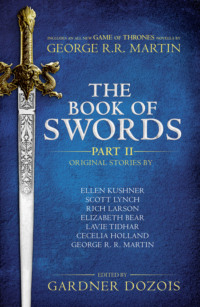
Kitabı oku: «The Book of Swords: Part 2»


Copyright
HarperVoyager
an imprint of HarperCollinsPublishers Ltd
1 London Bridge Street
London SE1 9GF
www.harpercollins.co.uk
First published in Great Britain by HarperVoyager 2017
Copyright © 2017 by Gardner Dozois
Introduction © 2017 by Gardner Dozois
Individual story copyrights appear here
Cover design by Mike Topping © HarperCollinsPublishers Ltd 2018
Cover images © Shutterstock.com
The author of each individual story asserts their moral rights, including the right to be identified as the author of their work.
A catalogue copy of this book is available from the British Library.
These stories are entirely works of fiction. The names, characters and incidents portrayed in them are the work of the authors’ imagination. Any resemblance to actual persons, living or dead, events or localities is entirely coincidental.
All rights reserved under International and Pan-American Copyright Conventions. By payment of the required fees, you have been granted the non-exclusive, non-transferable right to access and read the text of this e-book on screen. No part of this text may be reproduced, transmitted, down-loaded, decompiled, reverse engineered, or stored in or introduced into any information storage and retrieval system, in any form or by any means, whether electronic or mechanical, now known or hereinafter invented, without the express written permission of HarperCollins.
Source ISBN: 9780008274702
Ebook Edition © February 2018 ISBN: 9780008274733
Version: 2018-03-14
Copyright Acknowledgements
“When I Was a Highwayman” by Ellen Kushner. Copyright © 2017 by Ellen Kushner.
“The Smoke of Gold Is Glory” by Scott Lynch. Copyright © 2017 by Scott Lynch.
“The Colgrid Connundrum” by Rich Larson. Copyright © 2017 by Rich Larson.
“The King’s Evil” by Elizabeth Bear. Copyright © 2017 by Sarah Wishnevsky (Elizabeth Bear).
“Waterfalling” by Lavie Tidhar. Copyright © 2017 by Lavie Tidhar.
“The Sword Tyraste” by Cecelia Holland. Copyright © 2017 by Cecelia Holland.
“The Sons of the Dragon” by George R.R. Martin. Copyright © 2017 by George R.R. Martin.
Dedication
For George R.R. Martin, Fritz Leiber, Jack Vance, Robert E. Howard, C. L. Moore, Leigh Brackett, L. Sprague de Camp, Roger Zelazny, and all the other authors who ever wielded an imaginary sword, and for Kay McCauley, Anne Groell, and Sean Swanwick, for helping me bring this to you.
Contents
Cover
Title Page
Copyright
Copyright Acknowledgements
Dedication
Introduction by Gardner Dozois
When I Was a Highwayman by Ellen Kushner
The Smoke of Gold Is Glory by Scott Lynch
The Colgrid Conundrum by Rich Larson
The King’s Evil by Elizabeth Bear
Waterfalling by Lavie Tidhar
The Sword Tyraste by Cecelia Holland
The Sons of the Dragon by George R.R. Martin
About the Publisher
Introduction by Gardner Dozois
One day in 1963, I stopped in a drugstore on the way home from high school (at that point in time, spinner racks full of mass-market paperbacks in drugstores were one of the few places in our town where books were available; there was no actual bookstore), and spotted on the rack an anthology called The Unknown, edited by D. R. Bensen. I picked it up, bought it, and was immediately enthralled by it; it was the first anthology I ever bought, and a purchase that would have a long-term effect on my future career although I didn’t know that at the time. What it was was a collection of stories that Bensen had culled from the legendary (if short-lived) fantasy magazine Unknown, edited by equally legendary editor John W. Campbell, Jr., who at about the same time as he was revolutionizing science fiction as the editor of Astounding was revolutionizing fantasy in the pages of Astounding’s sister magazine Unknown from 1939 to 1943, when the magazine was killed by wartime paper shortages. In the early sixties, in a decade when the publishing industry was still coming out from under the shadow of postwar grim social realism, there was very little fantasy being published in a format affordable to purchase by a short-of-funds high-school student (except for the stories in genre magazines such as The Magazine of Fantasy & Science Fiction, which I didn’t know about at the time), and the rich harvest of different types of fantasy story available in Unknown was a revelation to me.
The story that had the biggest effect on me, though, was a bizarre, richly atmospheric story called “The Bleak Shore,” by Fritz Leiber, in which two seemingly mismatched adventurers, a giant swordsman from the icy North named Fafhrd and a sly, clever, nimble little man from the Southern climes called the Gray Mouser, are compelled to go on a doomed mission which seems destined to send them to their death (which fate, however, they cleverly avoid). It was a story unlike anything I’d ever read before, and I immediately wanted to read more stories like that.
Fortunately, it wasn’t long before I discovered another anthology on the drugstore spinner racks, Swords & Sorcery, edited by L. Sprague de Camp, this one not only containing another Fafhrd and the Gray Mouser story, but dedicated entirely to the same kind of fantasy story, which I learned was called “Sword & Sorcery,” a name for the subgenre coined by Leiber himself; in the pages of this anthology, I read for the first time one of the adventures of Robert E. Howard’s Conan the Barbarian and C. L. Moore’s Jirel of Joiry, as well as stories by Poul Anderson, Lord Dunsany, Clark Ashton Smith, and others. And I was hooked, becoming a lifelong fan of Sword & Sorcery, soon haunting used-book stores in what was then Scollay Square in Boston (now buried under the grim mass of Government Center), hunting through piles of moldering old pulp magazines for back issues of Unknown and Weird Tales that featured stories of Conan the Barbarian and Fafhrd and the Gray Mouser and other swashbuckling heroes.
What I had blundered into was the first great revival of interest in Sword & Sorcery, a subgenre of fantasy that had at that point lain fallow for decades, with almost all of the material in those anthologies and those old pulp magazines having been published in the thirties or forties or even earlier, about the time that stories that took place in distinct fantasy worlds instead of seventeenth-century France or imaginary Central European countries began to precipitate out from the larger and older body of work about swashbuckling, sword-swinging adventurers written by authors such as Alexandre Dumas, Rafael Sabatini, Talbot Mundy, and Harold Lamb. After Edgar Rice Burroughs in A Princess of Mars and its many sequels sent adventurer John Carter to his own version of Mars, called Barsoom, to rescue princesses and have sword fights with giant four-armed Tharks, a closely parallel form to Sword & Sorcery sometimes called “Planetary Romance” or “Sword & Planet” stories developed, most prominently in the pages of pulp magazine Planet Stories between 1939 and 1955, with the two subgenres exchanging influences, and even many of the same authors, including authors such as C. L. Moore and Leigh Brackett, who were highly influential in both forms. The richly colored tales that made up Jack Vance’s classic The Dying Earth, also published about then, were also technically science fiction, but with their interdimensional intrusions, strange creatures, and mages who wielded what could either be looked at as magic or the highest of high technology, they could also function as fantasy as well.
Then, at the end of the nineties, things began to turn around.
Why they did is difficult to pinpoint. Perhaps it was the enormous commercial success of George R.R. Martin’s A Game of Thrones, published in 1996, and its sequels, which influenced newer writers by showing them a grittier, more realistic, harder-edged kind of Epic Fantasy, one with characters who were often so morally ambiguous that it was impossible to tell the good guys from the bad guys. Perhaps it was just time for a new generation of writers, who had been influenced by the classic work of writers like Leiber and Howard and Moorcock, to take the stage and produce their own new variations on the form.
Whatever the reason, the ice began to thaw. Soon people began to talk about “The New Sword and Sorcery,” and in the last few years of the twentieth century and the early years of the twenty-first century, there were writers such as Joe Abercrombie, K. J. Parker, Scott Lynch, Elizabeth Bear, Steven Erikson, Garth Nix, Patrick Rothfuss, Kate Elliott, Daniel Abraham, Brandon Sanderson, and James Enge making names for themselves, there were new markets in addition to existing ones such as F&SF for Sword & Sorcery, such as the online magazine Beneath Ceaseless Skies and print magazine Black Gate, and new anthologies began to appear, such as my own Modern Classics of Fantasy in 1997, which featured classic Sword & Sorcery stories by Fritz Leiber and Jack Vance, The Sword & Sorcery Anthology, edited by David G. Hartwell and Jacob Weisman, a retrospective of some of the best old stories of the form, and Epic: Legends of Fantasy, edited by John Joseph Adams, an anthology reprinting newer work by newer authors. Most importantly, new short work began to appear, collected in anthologies such as Legends and Legends II, edited by Robert Silverberg, and later in Fast Ships, Black Sails, edited by Ann VanderMeer and Jeff VanderMeer, and Swords & Dark Magic: The New Sword and Sorcery, edited by Jonathan Strahan and Lou Anders, the first dedicated anthology of the New Sword and Sorcery.
All at once, we were in the middle of another great revival of interest in Sword & Sorcery, one which has so far not faded again as we progress deeper into the second decade of the twenty-first century. Already there’s another generation of newer writers such as Ken Liu, Rich Larson, Carrie Vaughn, Aliette de Bodard, Lavie Tidhar, and others, taking up the challenges of the form, and sometimes evolving it in unexpected directions—and behind them are yet more new generations.
So, call it Sword & Sorcery, or call it Epic Fantasy, it looks like this kind of story is going to be around for a while for us to enjoy.
I’ve edited other anthologies with new Sword & Sorcery stories in them, such as the Jack Vance tribute anthology Songs of the Dying Earth, Warriors, Dangerous Women, and Rogues (all edited with that other big-time Sword & Sorcery fan, George R.R. Martin), but I’ve always wanted to edit an anthology of nothing but such stories, which is what I’ve done here with The Book of Swords, bringing you the best work of some of the best writers working in the form today, from across several different literary generations.
I hope that you enjoy it. And it’s my hope that to some young kid out there, it will prove as enthralling and inspirational as Unknown and Swords & Sorcery did to me back in 1963—and so a new Sword & Sorcery fan will be born, to carry the love of this kind of swashbuckling fantasy tale on into the distant future.
Ellen Kushner
Ellen Kushner’s first novel, Swordspoint, introduced readers to Riverside, home of the city to which she has since returned in The Privilege of the Sword (a Locus Award winner and Nebula nominee), The Fall of the Kings (written with Delia Sherman), a handful of related short stories, and, most recently, the collaborative Riverside prequel Tremontaine for SerialBox.com and Saga Press. The author herself recorded all three novels in audiobook form for Neil Gaiman Presents / Audible.com, winning a 2012 Audie Award for Swordspoint. With Holly Black, she coedited Welcome to Bordertown, a revival of the original urban-fantasy shared-world series created by Terri Windling. A popular performer and public speaker, Ellen Kushner created and hosted the long-running public radio show Sound & Spirit, which Bill Moyers called “the best thing on public radio.” She has taught creative writing at the Clarion and Odyssey workshops, and is an instructor in Hollins University’s Children’s Literature M.F.A. program. She lives in New York City with Delia Sherman and no cats whatsoever, in an apartment full of theater and airplane ticket stubs.
Here she introduces us to a young man newly arrived in Riverside to seek his fortune, one who, like many young men come to the big city before him, finds that he’s got a lot to learn to succeed—and that many of the lessons aren’t pleasant.
WHEN I WAS A HIGHWAYMAN
“Do it,” Jess said. “It’ll be fun.”
I had no wish to be a highwayman, even for a day, but we needed the money. So I considered it.
Since I had come to Riverside, I had learned that not everyone there gives a stranger from the country good advice. If Riversiders advise a new blade to challenge that guy over there by the fire to a duel—you can take him, no problem!—well, it’s lucky that you do turn out to be better than he is. Of course, now he hates you and won’t recommend you for any jobs uptown, which is where the glory and the money are. Bad advice.
But since Jessamyn and I had begun keeping company toward the end of winter, I’d learned she usually had my best interests at heart, especially when it came to advice about making money. She was expert at that herself: the cleverest con artist the city had to offer, according to her admirers, and the slyest shyster ever to pick a pocket, according to the others.
Jessamyn was pretty, too. A mane of moon-pale hair such as I’d never seen before, fun to get tangled in at night, fun to braid up tight in the morning so she looked like a middle-city girl, decent yet delectable. That was how she played her game.
We made a good pair. Silver and smoke; ice and steel, people said. I could go anywhere with her: suddenly, all the taverns of Riverside were open to me, even the Maiden’s Fancy, where women like Flash Annie and Kathy Blount told one another their secrets. Everyone knew Jess, and if they didn’t like her, at least they admired her skill—and the way she took marks in uptown. She knew the handkerchief trick, the Lost Baby trick, the Pigeon Drop, and the Lover’s Dare.
I never went on jobs with her, though, because it was important for people to know my face if I was going to get work—and it was very, very important that no one remember hers.
Jessamyn had a wardrobe a duchess would envy, for quantity if not for quality: velvet with the nap rubbed away in back, raveled silk stockings, lace frontlets and silk shawls stained underneath, ribbons in every color imaginable to trim and retrim her many hats, feathers picked up on the street—
“It just has to look right, Richard,” she’d explain. “No one’s going to lift up my fine linen skirt to see the patched petticoats underneath. If I paint a thing gold, and wear it like it’s gold, only a jeweler will know it’s not.” She arched her neck, laughing. “And I never get anywhere near a real jeweler, so that’s no problem.”
I stroked the nape of her smooth neck, where the soft hair grew in an arrow shape. “I’ll get you near a real one. We’re going to make money, Jessamyn—I’m going to make it. A swordsman can get rich in this town. Look at Rivers. And de Maris, before his last fight. I’m going to be better than them. And then we’ll go up to Lassiter’s Row and buy you gold earrings with jewels in them, the biggest they’ve got!”
Ücretsiz ön izlemeyi tamamladınız.