Kitabı oku: «The Ship of Dreams»
THE SHIP OF DREAMS
The Sinking of the Titanic and the End of the Edwardian Era
Gareth Russell

Copyright
William Collins
An imprint of HarperCollinsPublishers
1 London Bridge Street
London SE1 9GF
WilliamCollinsBooks.com
This eBook first published in Great Britain by William Collins in 2019 as The Darksome Bounds of a Failing World
Copyright © Gareth Russell 2019
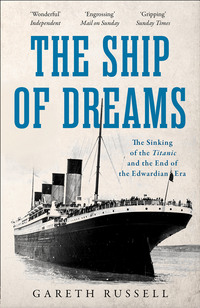
Cover Image © Universal History Archive/UIG/Bridgeman Images
Gareth Russell asserts the moral right to be identified as the author of this work
A catalogue record for this book is available from the British Library
All rights reserved under International and Pan-American Copyright Conventions. By payment of the required fees, you have been granted the non-exclusive, non-transferable right to access and read the text of this e-book on-screen. No part of this text may be reproduced, transmitted, down-loaded, decompiled, reverse engineered, or stored in or introduced into any information storage and retrieval system, in any form or by any means, whether electronic or mechanical, now known or hereinafter invented, without the express written permission of HarperCollins
Source ISBN: 9780008263201
Ebook Edition © March 2020 ISBN: 9780008263171
Version: 2020-02-03
Praise
‘[The Ship of Dreams] installs a fresh lens onto a drama that most of us first heard as children … As Mr Russell moves to the fateful Sunday of the voyage, the suspense becomes terrifying.’
Roger Lowenstein, The Wall Street Journal
‘The Titanic sinking does offer a metaphor for its era … Many authors have referenced this, but Gareth Russell is the first I am aware of who has comprehensively explored these and charted in detail the context … Russell does this deftly and intriguingly.’
Irish Independent
‘A fascinating look at life during a doomed era … Russell’s observations are sharp and witty … The wider history he presents is packed with interesting details.’
The Times, Book of the Week
‘Russell relates this drama in thrilling, vivid detail – an extraordinary story of human courage.’
Times Literary Supplement
‘Russell explores the tragedy of the sinking of the Titanic both as a human reality and a metaphor … to sketch the world beyond the ship in this engrossing history … The detail richly evokes the scale and texture of Titanic life … This masterly reconstruction renders the Titanic story vital again.’
Mail on Sunday
‘Brilliantly narrates the story of the Titanic … with admirable research and rhetoric … Anyone fascinated by Erik Larson’s Dead Wake or by James Cameron’s Titanic will be drawn in by Russell’s well-crafted wit and reportage.’
Publishers Weekly
‘Russell tells these stories in gripping detail … The attention to detail is astonishing, if you’ve ever wondered how passengers booked a hot bath, look no further.’
Sunday Times
‘Gareth Russell has chosen a handful of passengers on the doomed liner and by training a spotlight on every detail of their lives, he has given us a meticulous, sensitive, and at times harsh picture of the early 20th century in Britain and America. A marvellous piece of work.’
Julian Fellowes, creator of Downton Abbey
‘Deeply researched and lushly detailed, the book shines new light on both the bygone Golden Age and the iconic tragedy that marked the beginning of its end.’
Lynn Vincent, #1 New York Times bestselling author of Indianapolis
‘This absorbing account proves that there are many levels to the endless fascination of the Titanic story … Gareth Russell skilfully constructs an eloquent and gripping narrative that is essentially a microcosm of the moribund Edwardian class system that would go down with the Titanic and finally be obliterated by war in 1914.’
Helen Rappaport, author of Four Sisters: The Lost Lives of the Romanov Grand Duchesses
‘A meticulously researched retelling of history’s most infamous voyage … Through the eyes of this select group of privileged individuals, we are witness to the end of a glamorous crossing and an era, neither of which could be sustained or remain afloat.’
Denise Kiernan, New York Times bestselling author of The Last Castle and The Girls of Atomic City
Dedication
For my great-grandparents,
Thomas Hutton and Elizabeth Johnston-Clarke,
The first to tell me stories of the Titanic,
And my father,
Who encouraged me to write them.
Epigraph
And as the smart ship grew
In stature, grace, and hue,
In shadowy silent distance grew the Iceberg too.
Alien they seemed to be;
No mortal eye could see
The intimate welding of their later history,
Or sign that they were bent
By paths coincident
On being anon two halves of one august event,
Till the Spinner of the Years
Said ‘Now!’ And each one hears,
And consummation comes, and jars two hemispheres.
Thomas Hardy, The Convergence of the Twain
(Lines on the loss of the ‘Titanic’) (1912)
CONTENTS
Cover
Title Page
Copyright
Praise
Dedication
Epigraph
Dramatis Personae
Author’s Note
1. The Lords Act
2. The Sash My Father Wore
3. Southampton
4. A Contest of Sea Giants
5. A Safe Harbour for Ships
6. The Lucky Holdup
7. A Decent Wee Man
8. A Kind of Hieroglyphic World
9. Its Own Appointed Limits Keep
10. Two More Boilers
11. A Thousand Uneasy Sparks of Light
12. Going Up to See the Fun
13. Music in the First-Class Lounge
14. Vox faucibus haesit
15. Be British
16. Over the Top Together
17. The Awful Spectacle
18. Grip Fast
19. Where’s Daddy?
20. Extend Heartfelt Sympathy to All
21. The Spinner of the Years
Picture Section
Footnotes
Notes
Glossary
Bibliography
Index
Acknowledgements
About the Author
By the Same Author
About the Publisher
DRAMATIS PERSONAE
THE COUNTESS OF ROTHES
LUCY-NOËLLE-MARTHA LESLIE, Countess of Rothes
NORMAN LESLIE, 19TH EARL OF ROTHES, her husband
MALCOLM, VISCOUNT LESLIE, their eldest son, later 20th Earl of Rothes
THE HONOURABLE JOHN LESLIE, their youngest son
GLADYS CHERRY, the Earl’s cousin and the Countess’s travelling companion
CLEMENTINA and THOMAS DYER-EDWARDES, the Countess’s parents
ROBERTA (‘CISSY’) MAIONI, the Countess’s lady’s maid
THOMAS ANDREWS
THOMAS ANDREWS, Managing Director of the Harland and Wolff shipyard
HELEN ANDREWS, his wife
ELIZABETH ANDREWS, their daughter
WILLIAM, 1ST LORD PIRRIE, Thomas’s uncle, Chairman of Harland and Wolff
THE STRAUSES
IDA STRAUS, a philanthropist
ISIDOR STRAUS, Ida’s husband, a former congressman for New York and co-owner of Macy’s department store
ELLEN BIRD, Ida’s lady’s maid
JOHN FARTHING, Isidor’s valet
| JESSE STRAUS CLARENCE STRAUS PERCY STRAUS SARA HESS MINNIE WEIL HERBERT STRAUS VIVIAN SCHEFTEL |  | Ida and Isidor’s children |
THE THAYERS
JOHN BORLAND THAYER, Second Vice-President of the Pennsylvania Railroad
MARIAN THAYER, his wife
JOHN BORLAND THAYER III (‘JACK’), their eldest child
MARGARET FLEMING, Marian’s lady’s maid
| FREDERICK THAYER MARGARET THAYER (LATER TALBOTT) PAULINE THAYER (LATER DOLAN) |  | The Thayers’ younger children |
DOROTHY GIBSON
DOROTHY GIBSON, an actress
PAULINE GIBSON, her mother
GEORGE BATTIER, Dorothy’s husband
JULES BRULATOUR, a movie producer and Dorothy’s lover
LEONARD GIBSON, Dorothy’s stepfather
OTHER RELEVANT PASSENGERS
RHODA ABBOTT, a Salvation Army officer, travelling in Third Class
MADELEINE and COLONEL JOHN JACOB ASTOR IV
ALGERNON BARKWORTH, a landowner from Yorkshire
LAWRENCE BEESLEY, a science teacher, travelling in Second Class, subsequently author of The Loss of the S.S. Titanic
MAJOR ARCHIBALD BUTT, Military Aide to President William Howard Taft
CHARLOTTE DRAKE CARDEZA, a socialite from Pennsylvania
ELEANOR CASSEBEER, returning home to New York
LUCY, LADY DUFF GORDON, a fashion designer
ELIZABETH EUSTIS and MARTHA STEPHENSON, sisters and neighbours of the Thayers
COLONEL ARCHIBALD GRACIE IV, an historian and friend of the Strauses
J. BRUCE ISMAY, Managing Director of the White Star Line
FRANCIS (‘FRANK’) MILLET, a painter, author and sculptor
ALFRED NOURNEY, a car salesman travelling under the pseudonym of a German baron
EMILY and ARTHUR RYERSON, friends of the Thayers, returning home after their son’s death
FREDERIC SEWARD, a New York-based lawyer and a bridge partner of Dorothy Gibson
WILLIAM SLOPER, an American stockbroker, who also played bridge with Dorothy Gibson
ELEANOR and GEORGE WIDENER, prominent members of Philadelphia Society and friends of the Thayers
RELEVANT MEMBERS OF THE CREW
HAROLD BRIDE, the Titanic’s Junior Wireless Operator
HARRY ETCHES, a steward in First Class
VIOLET JESSOP, a stewardess in First Class
THOMAS JONES, Able Seaman, put in charge of Lifeboat 8
MARY SLOAN, a stewardess in First Class
ANNIE ROBINSON, a stewardess in First Class
CAPTAIN EDWARD J. SMITH, Commander of the Titanic
CAPTAIN ARTHUR ROSTRON, Commander of the Carpathia
DR FRANCIS (‘FRANK’) MCGEE, the Carpathia’s Surgeon
DR WILLIAM O’LOUGHLIN, the Titanic’s Surgeon
HENRY WILDE, the Titanic’s Chief Officer
WILLIAM MURDOCH, the Titanic’s First Officer
CHARLES LIGHTOLLER, the Titanic’s Second Officer
HERBERT PITMAN, the Titanic’s Third Officer
JOSEPH BOXHALL, the Titanic’s Fourth Officer
HAROLD LOWE, the Titanic’s Fifth Officer
JAMES MOODY, the Titanic’s Sixth Officer
AUTHOR’S NOTE
On Sunday 14 April 1912, at about 11.40 p.m., the Titanic, an ocean liner operated by a British shipping company with American owners, struck an iceberg. Two hours and forty minutes later, she sank with a loss of life that was variably estimated at 1,502, 1,503, 1,512, 1,517 and 1,522 but which has recently been established at 1,496.[1] A total of 712 survivors in lifeboats were rescued by another British ship, the Carpathia, between two and six hours after the Titanic disappeared. Two inquiries were held, in each of her homelands, and they reached broadly similar conclusions about what had been done in the past and should be done in the future. In 1985, the wreck of the Titanic was discovered 2½ miles under by an expedition led by American oceanographer Robert Ballard.[2]
These are the bare facts surrounding a ship that is, arguably, the most famous vessel in history. When compared to nearly any other contender for that epithet, the Titanic’s popular appeal outstrips that of Cleopatra’s barge, the Mayflower, the Lusitania and perhaps even Noah’s Ark. Her name has become a synonym for catastrophe. The story of the largest and most luxurious ship ever built, racing across the Atlantic Ocean in an attempt to break the record for that journey, ignoring numerous ice warnings and then sinking with the loss of thousands, is an entrenched narrative, the belittling of which is surprisingly easy, if one is so inclined. Had she survived her first voyage, the Titanic would have dated like other ocean liners. While she was the largest man-made moving object when she eased off from her Southampton pier in 1912, she would only have held that accolade for the next thirteen months, until the arrival of a German passenger liner with room for a thousand more passengers amid 6,000 more tons.[3] Some of the Titanic’s second-class passengers preferred the accommodation on the Mauretania.[4] Before she sank, the Titanic was eclipsed in fame by her elder and slightly smaller sister ship, the Olympic, which had captured the attention of the world’s press when she set sail a year earlier.[5] Her passenger quarters, while splendid in many places, were soon surpassed – the march of comfort on the sea lanes did not halt in the spring of 1912.
The exceptionalism of the Titanic can be rubbished in other ways. On a more macabre note, she was neither the only great seafaring tragedy of the Edwardian era – two years after her, the Empress of Ireland sank following a collision with another ship as she departed Quebec City, with the loss of just over a thousand lives.[6] Nor, arguably, was she the most important. In 1915, the Titanic’s one-time rival, the Lusitania, foundered off the coast of Ireland with marginally fewer casualties, but far greater and more tangible a political impact. The attack on the Lusitania by the German submarine U-20 irrevocably hardened attitudes towards Imperial Germany in the United States at the height of the First World War, forcing an emergency meeting of the Crown Council in Berlin which effectively altered German naval policy for the next eighteen months and prepared the mood that would bring America into the war against Germany two years later.[7]
However, although the Titanic’s dreadful allure may be easy to unpick, it is impossible to dispel. There are societies dedicated to the study of the Titanic across the world, along with numerous museums, souvenirs, novels, musicals, children’s cartoons, computer games, television shows and movies. The first Titanic motion picture was produced in the weeks immediately after the sinking, another silent movie was produced in Germany later that same year, and an early ‘talkie’, Atlantic, appeared in 1929, heavily inspired by the sinking but with the ship’s name and appearance altered after the Titanic’s still-operational owners, the White Star Line, allegedly threatened a lawsuit.[8] A project in the late 1930s between David O. Selznick and Alfred Hitchcock to dramatise the disaster never moved beyond pre-production, with the result that after Atlantic it was another fourteen years before a motion picture that was both filmed in sound and unambiguously about the Titanic appeared.[9]
On 30 April 1943, Josef Goebbels, the Nazi Minister of Propaganda, banned the movie Titanic, the production of which he had initially authorised.[10] Following the outbreak of the Second World War, Goebbels had overseen a series of anti-British costume dramas that were released in Germany and then, despite some concerns about their potential impact, in various Nazi-occupied territories. Titanic proved to be the last of this politicised genre, which had begun with 1940’s Der Fuchs von Glenarvon and 1941’s Mein Leben für Irland, both dramatising the Irish struggle for independence from Britain. They were joined by Ohm Krüger, set during the Boer wars, and by a biographical drama loosely based on the life of Mary, Queen of Scots, with her English kinswoman, Elizabeth I, cast as a villain who was manipulative to the point of depravity. By the time Titanic went into production, American entry into the war on the Allied side had widened the target of these historical didactics, for which the sinking of the Anglo-American Titanic offered seemingly perfect fodder. The allocated budget made Titanic one of the most expensive motion pictures produced thus far in Germany, dozens of naval personnel were transferred from active duty at the front to serve as extras, and the decommissioned German passenger liner Cap Arcona was provided as a set for much of the filming. Prior to the war, the Cap Arcona had been the most luxurious ship to ply the route to South America, sailing from Hamburg to Buenos Aires, but like many vessels she had been removed from commercial service upon the outbreak of hostilities.
Goebbels wanted Titanic to depict Teutonic heroism, to which end a fictional German officer was inserted into the ship’s roster and shown in the final scenes dashing bravely through flooding corridors to rescue trapped children, but the movie was also intended to highlight the corruption of Germany’s enemies. In one particularly memorable scene, showing a dinner during the Titanic’s voyage, the shipping line’s owner, J. Bruce Ismay, gives a speech to the Dining Saloon boasting of the liner’s record-breaking speed. At his announcement, several American financiers scuttle away from their tables to send telegrams ordering their brokers to buy shares in the White Star Line while, back in the Saloon, the Titanic’s privileged passengers stand as the ship’s orchestra plays ‘God Save the King’. As a depiction of German perceptions of British arrogance and American greed, the scene had all the subtlety of a sledgehammer – although that, of course, was not the reason Goebbels vetoed his own creation.
Filming had been plagued with difficulties from the start. The director, Herbert Selpin, privately complained about the military extras’ sexual harassment of the actresses, comments that may have widened into criticism of the armed forces. The scriptwriter reported Selpin’s comments to the Gestapo, who had him arrested and imprisoned, at which point Goebbels almost certainly gave the order that Selpin was to be found hanged in his cell, as if from suicide. Certainly, almost nobody believed Selpin had died by his own hand.[11] Back on set, the production costs were spiralling beyond the generous allowance and several Allied bombing raids on nearby towns intermittently disrupted filming. By the time Goebbels saw the movie at a private screening, those bombing raids had helped turn the tide of the war against Nazi Germany and Goebbels was concerned that the scenes of passengers screaming in panic during the evacuation would remind too many moviegoers of their own experiences during the air raids. He also allegedly worried that German civilians might sympathise with the plight of the British and American passengers as they struggled to escape the Titanic, no matter how repugnant their on-screen leaders.[12] Titanic was the last of the anti-British Nazi historical dramas, after which productions shrank as the Reich stuttered towards oblivion.[13]
During the regime’s depraved unravelling, the Cap Arcona was once again pressed into service, this time to move 9,000 people from Nazi Poland, most of them prisoners from local camps. Whether the SS knew that the Cap Arcona had been identified as a target by the Royal Air Force before they herded the prisoners on board and if that was the reason they herded all the prisoners below deck to make sure the British pilots did not cease fire is unclear. According to the fullest modern account of the Cap Arcona’s career, the surviving evidence suggests that if the British aeroplanes had not turned up as expected to attack the ship the SS would have bombed it themselves and placed the blame on the Allies, the main reason for moving the prisoners on to known targets being the guards’ hopes of destroying living evidence of the existence of the neighbouring concentration camps.[14] As the RAF attacked the ship, small German boats near by evacuated only fleeing camp guards and SS personnel, who were also the only passengers to have been provided with lifebelts. The Cap Arcona burned, capsized and sank with the lost of about 5,000 lives, meaning that the Titanic’s one-time cinematic stand-in became the first ship to break her record for the greatest loss of life at sea.
Goebbels’ Titanic is one of the least-known if most repellently intriguing interpretations of the Titanic as both a symbol of Anglo-American cooperation and a damning indictment of its elites. Although no subsequent dramatisations of the disaster have mined the depths of national stereotypes seen in the 1943 version, the story of the Titanic’s owners pushing her to break the record for the fastest crossing of the Atlantic has been replicated ad nauseam. Where Goebbels sought to excoriate, others have sympathised or simply remained fascinated. As a child growing up in Belfast, I heard stories from my great-grandfather, who had seen the Titanic’s construction and departure from the city and remembered men and women weeping in the streets when the news broke of the sinking. For him, something had shattered, some certainty had vanished, in that moment. He had never seen his father cry before that morning and he did not remember seeing him do so again. Admittedly, many are unimpressed by the allure of the Titanic to its own or subsequent generations. When he edited the memoirs of one of the Titanic’s surviving crew members, Stewardess Violet Jessop, the late historian John Maxtone-Graham was unmoved by the liner’s appeal, positing, ‘Ostensibly sinkable in life, she has proved positively unsinkable posthumously … My sense is that we should view the vessel as neither symbol nor metaphor but merely an imprudently captained vessel lost at sea. Leave Titanic as she was, one of hundreds of wrecks littering the Atlantic depths.’[15]
With respect to a fine historian, this sounds unduly curmudgeonly. The Titanic has become both cultural touchstone and looking glass. There is an enduring sense that what happened to the Titanic in April 1912 was somehow totemic, a process which began during her construction, when the Titanic was woven into a political debate over the future of the United Kingdom. The Titanic, like her sister ships, was a child of Anglo-American capitalism. In response to the disaster, King George V sent a public telegram of condolence to President Taft in which he expressed how he and his wife were ‘anxious to assure you and the American nation of the great sorrow which we experienced at the terrible loss of life that has occurred among the American citizens, as well as many of my own subjects, by the foundering of the Titanic. Our two countries are so intimately allied by ties of friendship and brotherhood that any misfortunes which affect the one must necessarily affect the other, and on the present terrible occasion they are both equally sufferers.’[16]
The 2012 centenary of the disaster significantly increased the corpus of Titanic literature, with several excellent panoramic accounts of the voyage appearing in print, including the immensely thorough On a Sea of Glass, product of the research and authorship of Tad Fitch, J. Kent Layton and Bill Wormstedt. In the strictest sense, The Ship of Dreams is not solely an account of the Titanic disaster, nor a striving to replace the works of earlier scholars who examined the catastrophe as a whole. As its subtitle suggests, it is an attempt to look at her sinking as a fin de siècle, with a deliberate exploration of the voyage as a microcosm of the unsettled world of the Edwardian upper classes. With the admittedly dubious benefit of hindsight, the Titanic’s story functions like the Lady of Shalott’s mirror, reflecting shadows of the world around it, its splendours and injustices. Since its maiden voyage, the ship has been inextricably linked in popular culture with the question of class. British taste and American money built the Titanic, which had room for more first-class passengers, even as a percentage, than almost any other ship then at sea, and the perceived symbiosis between the Titanic and the elites who designed her and sailed on her is compelling.[17] In the years before the Titanic’s creation, the Industrial Revolution and the corresponding expansions of both the British Empire and the American economy had created new kinds of wealth. Modernity had shaken the class system. There were many different kinds of privilege in pre-war Britain and America, the Titanic’s respective spiritual and economic homelands, and all of these elites would be, as individuals and a class, changed by the decade that lay ahead.
The focus of this narrative is six first-class passengers and their families: a British aristocrat, a patriotic maritime architect, an American plutocrat and his son, a first-generation American philanthropist, and one of the first movie stars. By examining its story through the experiences of these six first-class passengers, it is not only possible to explore the ways in which the upper classes were changing by 1912 but also to reflect on how the isolation created by privilege left many of them unaware or indifferent to the coming danger, until it was too late. Some first-class passengers did not realise anything was seriously wrong with the Titanic until they spotted pyjama legs poking from beneath the trousers of the White Star Line’s normally fastidiously well-dressed Managing Director. Others belatedly guessed that a crisis was looming when they realised that some of the people standing next to them on the Promenade Deck were from Third Class. The Titanic’s only commercial voyage is a window into a world that was by turns victim and author of the tragedies that overtook it.
Sources from the Titanic’s passengers and crew are numerous. There are inevitable problems in reliability arising from eyewitness testimonies by those who were participants in something deeply traumatic. It is not always possible or advisable to construct a precise chronology of what happened between the Titanic’s collision with the iceberg and the rescue of her survivors. One can, however, query the improbable or dismiss the impossible and, by comparing eyewitness accounts with modern research, particularly after the discovery of the Titanic’s wreck, offer a convincing account of the Titanic’s short career.
1
The Lords Act
In a dream I saw territories,
So broad, so rich and handsome,
Lapped by the blue sea,
Rimmed by mountains’ crest.
And at the centre of the territories
Stood a tall oak tree,
Of venerable appearance,
Almost as old as its country.
Storms and weather
Had already taken their toll;
Almost bare of leaves it was,
Its bark rough and shaggy.
Only its crown on high
Had not been blown away,
Woven of parched twigs,
Skeleton of former splendour …
Elisabeth of Bavaria (1837–98), Empress of Austria and Queen of Hungary, ‘Neujahrsnacht 1887’
FLOWING IN FROM NORTH AND WEST, WEAVING PAST Roman and Celtic monuments of obscure purpose, two streams joined with the River Leven to ring the ‘magnificently wooded gardens’ of Leslie House, the thirty-seven-bedroom country seat of Norman Leslie, 19th Earl of Rothes.[fn1] Nestling in 10,000 acres of ‘excellent arable land’, in 1911 Leslie House dominated the encircling parish, as it had for centuries. The minister of the local Church of Scotland drew his salary from the Earl’s coffers. So complete was the Leslie family’s influence in this part of eastern Scotland that the parish’s ancient recorded name of Fetkill had faded to become the parish of Leslie.
It had been predominantly a benign local absolutism. When an amateur historian arrived in Leslie in the 1830s, in the hope of unearthing grisly anecdotes from the village archives, he was, in his own words, distressed to find ‘nothing generally interesting in them’, with no perceptible drama having occurred in Leslie over the course of the last 300 years. The 800-seat chapel was built, the flax mills spun, whisky houses and inns were opened, closed and renamed, and local legend had it that King James V had written his poem ‘Christ’s Kirk on the Green’, in celebration of a Caledonian pastoral idyll, after his hunting trip near the village in the 1530s.[1]
As the Edwardian era drew to its close, the then Countess of Rothes, Lucy NoÉlle Martha Leslie, had busied herself with the renovation and preservation of Leslie House. Given the spiralling cost of maintaining a stately home, expansion, in the hope of restoring the house to what it had been in the previous centuries, would have been financially lunatic, although even at that the young Countess had sunk nearly £11,000 of her natal family’s money into the preservation and beautification of her husband’s ancestral home.[2] She had married into the Leslie family on a ‘delightfully bright and genial’ day in 1900, with a service at St Mary Abbots Church in Kensington, near the London townhouse of her parents where the future countess had been born on Christmas Day twenty-two years earlier.[3] Christ’s Nativity gave Lucy Dyer-Edwardes the first of her two middle names, Noël (the spelling on her birth certificate, but commonly spelled in Society columns and by various relatives as Noëlle); the other was Martha. These names and spellings were used variably throughout her life, although by adulthood she increasingly seemed to prefer her middle name of Noëlle. Her education had been entrusted to governesses and tutors who moved with the family as they oscillated between the Kensington house, their château in Normandy and their favourite home, Prinknash Park, the Dyer-Edwardeses’ country seat in Gloucestershire. Prinknash, pronounced ‘Prinnage’ as one of the thousands of anti-phonetic nomenclatures that form the pleasurable minefield of English place names, was originally a Benedictine monastery founded, with spectacularly poor luck on the Order’s part, only thirteen years before England’s break with Rome. Secularised and sold by the Tudors, Prinknash Park had become a beautiful stately pile in idyllic countryside, where Noëlle’s father, Thomas, was free to pursue his fascination with his home’s long-dead original owners and, bit by bit, their Catholic faith, to the distress of his wife, who regarded the Church of Rome as a foreigner’s creed.[4]
An only child and thus sole heiress to a substantial fortune, Noëlle also had the added benefit of blossoming into what one family member called ‘a true English rose beauty’ by the time she turned eighteen and could be launched into the ballrooms and on to the marriage market of the upper classes as part of the debutante Season. After a formal presentation at Buckingham Palace, which marked their ‘coming out’ into Society, the debutantes were, in the words of an Irish peer’s daughter, paraded ‘to shooting and tennis parties, polo matches, tea with the Viceroy in Dublin’ or, in Noëlle’s case, with the who’s who of the London beau monde.[5] The ultimate goal of this whirlwind of merrymaking was a wedding announcement in The Times, but although Noëlle was a popular ‘deb’, she resisted many of the offers of marriage that came her way until she met Norman Leslie, 19th Earl of Rothes, an infantry officer with a ‘pleasant face and manners’, who proposed to her in 1899.[6]

‘One of the most beautiful young women seen at the Court this season’: the Countess of Rothes, shortly after her marriage.
Countess of Rothes. Unknown photographer (The Picture Art Collection/Alamy Stock Photo)
Married the following spring in ‘a pretty gown of white satin covered with exquisite Brussels lace’ and carrying a bouquet of carnations and white heather, Noëlle honeymooned on the Isle of Wight, before returning to London for her first audience at Court as the new Countess of Rothes.[7] A young, wealthy and good-looking couple, who were clearly very much in love, the Rotheses became a fixture in Society columns. The aristocracy were obsessive points of interest for the British, and certain sections of the American, press – the ‘beautiful people’ of the era, according to a critical study of their long decline.[8] It made the press’s job easier when, like Noëlle, the subject actually was physically beautiful, with even the Washington Post informing its readers, 3,000 miles away, that on her second trip to Buckingham Palace when she curtseyed to the Princess of Wales for the first time as a countess Noëlle was, by general agreement, ‘one of the most beautiful young women seen at the Court this season’.[9]
After their honeymoon, the newlyweds had spent most of their time at the Rotheses’ country house in Devonshire and their mansion in Chelsea, where their first son, Malcolm, was born on 8 February 1902 and the couple attended King Edward VII’s coronation in the capital on 9 August of that year. By the time their second son, John, was born in December 1909, the death of Norman’s great-uncle had freed up Leslie House for their use and Noëlle was enraptured with her husband’s fiefdom. With the piqued pride of a jilted friend who cannot quite believe the world exists beyond the sparkle of London, the Bystander reported that the Countess of Rothes, who had been the toast of the capital at the time of Edward VII’s succession, was now ‘so devoted to her Scottish home, Leslie House, that neither she nor Lord Rothes are often to be seen in London or anywhere else [where] the world of amusement foregathers’.[10] A journalist from the Scotsman observed that within a few years of her residency at Leslie House ‘not a Christmastide passed but the Countess celebrated her birthday, Dec. 25, by treating all the children in the parish to an entertainment in Leslie Town Hall, and presenting each with a Christmas gift’.[11] Convinced of the benefits created by clean air, Noëlle organised trips for young women employed in local factories to visit the beach or the countryside. She funded the creation of Fife’s first ambulance corps, the Countess of Rothes Voluntary Aid Detachment, she paid for the neighbouring parish of Kinglassie’s first clinic, organised parties to raise money for veterans from her husband’s regiment, and two years after John’s birth she began training with the Red Cross as a nurse.
Despite the Bystander’s gripes, London was not quite abandoned by the Rotheses and Noëlle often returned for the Season. She joined the committee that organised the Royal Caledonian Ball, an annual highlight for the capital’s socialites with its insistence on proper Highland attire and music. The funds raised were channelled to the Royal Caledonian Educational Trust’s care for Scottish orphanages.[12] She worked for the YMCA Bazaar and the Children’s Guild; she sat on the foundation boards for the Randolph Wemyss Memorial Hospital and the Queen Victoria School in Dunblane, which taught the sons of Scottish military personnel, and her passion for preserving a rural way of life in Britain brought her to serve the Village Clubs Association. The young Countess’s charitable activities were a mixture of the more glittering variety of philanthropy and intense hands-on work, and the former solidified many of her relationships with fellow like-minded aristocrats – Evelyn Cavendish, Duchess of Devonshire, Consuelo Spencer-Churchill (née Vanderbilt), Duchess of Marlborough, Kathleen Wellesley, Duchess of Wellington, and Constance Sackville, the Dowager Countess De La Warr, became close friends. With Millicent Leveson-Gower, Duchess of Sutherland, Noëlle helped raise a substantial amount of money for the National Milk Hostels’ quest to provide ‘wholesome milk for poor families’, through a series of Society masquerade balls and garden parties, at which tickets were costly and donations firmly encouraged.[13]
One of Noëlle’s philanthropic connections was Louise, Duchess of Fife, who alone of King Edward VII’s daughters had married into the native aristocracy.[14] Through her, Noëlle met, and was sincerely liked by, King Edward’s daughter-in-law Mary, Princess of Wales. Her friendships within the Royal Family added a personal affection to the feudal obligations that brought Norman and Noëlle to most major state occasions, including the funeral of Edward VII, after his death at Buckingham Palace was announced on 6 May 1910. Over the course of the next three days, a quarter of a million people filed past the royal coffin to pay their respects. Despite a reign of only nine years, Edward VII had, in his Foreign Secretary’s observation, grown ‘intensely and increasingly popular’ and grief at his passing was judged stronger than the mourning surrounding Queen Victoria’s death nine years earlier.[15] The first people in the queue to pass King Edward’s bier, ‘guarded by household cavalry, soldiers of the line and men from Indian and Colonial contingents, all in the characteristic pose of mourning, that is with bowed heads with their hands crossed over rifle butts and the hilts of their swords’, had been ‘three women of the seamstress class: very poorly dressed and very reverent’.[16] When the Liberal Prime Minister, Herbert Asquith, was caught leaning against a pillar during the lying in state, courtiers judged ‘his attitude and general demeanour rather offensive’ and concluded that he must have been tipsy to behave so atrociously or, as one of them put it with leaden subtext, ‘I fear he had dined well.’[17]
There were no comparable faux pas at the funeral procession three days later. Many of the mourners had camped out overnight to vouchsafe their place in the crowds, which in places stood 100 yards deep, to watch Edward VII’s body being conducted from Westminster Hall to Windsor. As the catafalque passed Hyde Park, where nearly 300,000 had congregated, cigarettes were stubbed out and a forest of caps rose into the air. After the body, the first being to receive these gestures of deference was Caesar, Edward VII’s white terrier, who with the Queen Mother’s permission trotted by his dead master’s side.[18] Caesar was followed by nine monarchs on horseback, leading perhaps the largest gathering of royalty in history, with one of the emperors joking that this was the first time in his life he had yielded precedence to a canine.[19] Monarchy, the cause in which Edward VII had been such a devout believer, had come to inter ‘the uncle of Europe’. His son and heir, now George V, rode with two of the late King’s brothers-in-law, Denmark’s Frederick VIII and Greece’s George I, with one of his sons-in-law, King Haakon VII of Norway, and with two of his nephews – one by birth, the other by marriage, both heroically moustached – the German Kaiser Wilhelm II and King Alfonso XIII of Spain. They and their glinting medals were joined by the young Portuguese and Belgian sovereigns, Manuel II and Albert I, both on their respective thrones for less than two years. If Prime Minister Asquith’s slouching had been noted at the lying in state, so too were other things that mattered deeply to the Edwardian upper classes – it was observed by one civil servant that the rotund Tsar Ferdinand of Bulgaria had the worst seat on a horse of any royal present; the phrase ‘like a sack’ was tossed around with uncharitable accuracy.[20]
Affection rippled through the crowd as the fantastic spectacle of the Golden State Coach trundled into view, carrying four women transformed into black pillars by clouds of mourning lace and veil. Edward VII’s sixty-five-year-old widow, Alexandra of Denmark, one of the most consistently popular members of the British Royal Family since her arrival in 1863, had borne five children and buried two, but she retained the slender beauty of a person twenty or thirty years her junior. The Prime Minister’s daughter-in-law, who watched as Alexandra went by and saw her later at the interment, wrote in her diary that evening, ‘She has the finest carriage and walks better than anyone of our time and not only has she grace, charm and real beauty but all the atmosphere of a fascinating female queen for whom men and women die.’[21] Joined in the coach by her younger sister the Dowager Empress of Russia, her daughter Queen Maud of Norway and her daughter-in-law the new Queen consort, Alexandra was so moved by the sight of the crowds that at Hyde Park she broke with protocol by lifting her veil to bow her head to them, at which point hundreds of people began shouting variations of ‘God bless you!’[22] Most unusually in a country that still prided itself on its proverbial stiff upper lip when in public, the Queen Mother’s gesture produced sobbing from dozens, if not hundreds, of people.[23] Behind her carriage came coaches attended by scarlet-liveried footmen and transporting the men who were one day expected to inherit the thrones of Austria-Hungary, the Ottoman Empire, Greece, Romania, Serbia and Montenegro. They were followed by representatives from the reigning houses of Russia, China, Italy, Japan, the Netherlands, Persia and Siam. With this dynastic confraternity sat members of the deposed royal houses of France and Brazil, as proudly and conspicuously as if their families still reigned from the Tuileries and São Cristóvão – as though nothing had ever really changed and the republics that had toppled them were an aberration, a nightmarish blip from which the world might soon recover. Noëlle’s husband marched with the dukes, marquesses and earls of Edward’s nobilities, custodians of the hereditary compact that stretched back to before the three British kingdoms and one principality had been ruled by a single house.[fn2] Far behind these princes and potentates, America’s President Theodore Roosevelt rode with delegates sent by other republics, in a horse-drawn carriage without gilding and manned by footmen in a duller colour of livery. The French republic’s Foreign Minister was incandescent at the slight; Roosevelt, at least publicly, insisted that he did not care.[24]

After the funeral: the monarchs who gathered to mourn Edward VII, standing from left to right King Haakon VII of Norway, Tsar Ferdinand of Bulgaria, King Manuel II of Portugal, Germany’s Kaiser Wilhelm II, Greece’s King George I and King Albert I of the Belgians. Sitting from left to right are kings Alfonso XIII of Spain, George V of the United Kingdom and Frederick VIII of Denmark.
Sovereign funeral (The Protected Art Archive/Alamy Stock Photo)
With the benefit of hindsight, Edward VII’s funeral took on the appearance of an entire world gathering to bury itself alongside the man whose name had been given to their era, but at the time it appeared instead as the appropriate grief of an immutable order. When a peer who had taken his little daughter to watch the royal funeral asked her to say her prayers before bedtime, she replied, ‘It won’t be any use. God will be too busy unpacking King Edward.’[25]
Nonetheless, Edward VII’s death heightened the general sense of unease in his country. The King’s passing could not have come at a more politically delicate moment for Britain, one that Edward’s subtle influence and considerable experience had, rightly or wrongly, been trusted by many to ameliorate. Seven months before bronchitis took Edward VII, the United Kingdom had collided with a constitutional crisis through the deployment of their veto by the House of Lords, the upper chamber of Parliament consisting of the Lords Spiritual, the bishops of the devolved branches of the Anglican churches in England, Scotland, and Wales, and the Lords Temporal, the hereditary peers. The Lords’ use of the veto was well within their constitutional rights, but their decision to wield it against the Liberal government’s Budget was vibrant testament to the difference between the permissible and the sensible. The House of Lords had not vetoed any financial Bill sent to them by the elected House of Commons since the seventeenth century and so their decision to do so in the winter of 1909 focused attention on whether the veto should have survived into the twentieth.
The new Budget raised taxes substantially on the wealthiest of King Edward’s subjects, ostensibly in furtherance of the aim of providing funds for old age pensions and to meet the cost of naval rearmament. The surtax of 2.5 per cent on the amount by which all incomes of £5,000 or more exceeded £3,000 might seem laughably low today, but the four new kinds of tax levied on land struck the peers as a deliberate piece of class warfare, with the majority of the shrapnel aimed squarely at those whose ancient privileges were tied to their positions as landowners. That taxes were not being raised as significantly on those made rich by the factories of the Industrial Revolution did not go unnoticed; likewise invoked were dark mutterings that the Budget represented a grossly untenable expansion of the state’s powers. The upper chamber’s rejection of the Budget forced the King to call another election at which, incredibly, the Lords seemed to receive some limited form of popular approval when the Conservatives, who dominated the hereditary Lords but had lost their majority in the elected Commons, won back 100 of the seats they had lost in the 1906 election. The Liberals had, however, still won enough to be returned to office and they immediately allied themselves with two smaller parties, Labour and the Irish Parliamentary Party, to outnumber the Tories decisively in the House of Commons. In a victorious mood, the Liberal coalition tabled three resolutions to prevent a repeat of 1909 – firstly, the Lords would lose the right to amend or reject a financial Bill; secondly, the lifespan of a Parliament was decreased from seven years to five, thus enabling more frequent elections; and, finally, the Lords’ veto was to vanish, to be replaced by the right to delay by a maximum of twenty-five months any piece of legislation passed in the Commons.
It was as this dilemma over the greatest change to the British Constitution in centuries accelerated that Edward VII died. Expectations that his reactionary son would lend royal support to the nobility were crushed when George V made it clear that he saw his job as brokering a peaceful settlement rather than favouring one side against the other, whatever his personal opinions might be. Lord Haldane, the Liberal government’s Secretary of State for War, who had initially expected subtle Tory politicking from the new monarch, was touched and impressed by how George V walked the tightrope of his first few steps as monarch: ‘I have in these days come to greatly admire the King. He has shown himself to have far more of his father’s qualities of tact and judgement than I supposed. He is being bombarded by Tory extremists with all sorts of suggestions.’[26] The proposal that George V should withhold the Royal Assent, something which had not been done since the reign of his distant predecessor Queen Anne, was shot down by the King, who rightly predicted it would divide the nation even further.[27]
Noëlle’s husband Norman threw himself into working with the bloc in the Lords who opposed the impending Parliament Bill, or the ‘Lords Act’ as it was more generally known.[28] At first, cold logic dictated that the House of Lords had one immeasurable advantage in their favour: to pass this Bill neutering them, Prime Minister Asquith needed the victims’ acquiescence. They, fairly obviously, were expected to veto the Parliament Bill with savage alacrity, piously arguing that not to do so would ensure that their legacies ‘would be degraded by our failure to be faithful to our trust’.[29] Asquith and his allies threatened to pull the monarchy into the maelstrom by pressuring the King who was, after all, the hereditary guardian of the elected government; they wanted him to flood the House of Lords with an unprecedented number of newly created peerages, all awarded to prominent Liberal sympathisers. Privately, George V regarded Asquith’s plan as ‘a dirty, low-down trick’, but practically he had no intention of seeing the Crown dragged into the mire of an ugly political quarrel, particularly after one fraught prime ministerial audience at the Palace, during which Asquith reiterated that, if his demands were not met, ‘I should immediately resign and at the next election should make the cry, “The King and the Peers against the people.”’[30] This threat to the monarchy reawakened feelings of chivalric loyalty in a sufficient number of peers, including Noëlle’s husband and her friend’s husband, the Duke of Sutherland, who fell on their swords for their king by agreeing either to abstain or vote for the Bill that would castrate them. A less charitable interpretation of their actions might be that they chose to surrender decorously only once they realised they could not win at anything but the most pyrrhic of costs.
The Lords Act was a critical moment in the decline of the British aristocracy, indeed arguably its most significant single event. Their power had been waning since 1832, thanks to a series of prerogative-clipping Reform Acts, while a sustained period of agricultural recession, beginning in the 1870s, had caused irreparable damage to a caste that still generally drew most of its income from the rural economies. There was also a sense of malaise and victimhood within the aristocracy that accelerated, and perhaps secured, their decline, while the rise of capitalism had left many of them confused and, for the first time, familiar with the uncomfortable sensation of not being the chief beneficiaries of the passing of the ages. Noëlle Rothes had a political mind which, like her husband’s, leaned strongly towards Toryism. She was also a supporter of the suffragettes, a cause she shared with her friend Edith Vane-Tempest-Stewart, Viscountess Castlereagh, whose husband Charles was heir to the marquessate of Londonderry, one of the most prestigious peerages in Ireland. Edith, like Noëlle, was aghast at the Lords Act, not just because it was their class’s legislative equivalent of seppuku, but also for what it meant to the other great crisis of Edwardian Britain – Irish Home Rule, the movement born in the nineteenth century that sought some form of governmental independence for Ireland. Initially, the proposal had called for a Dublin Parliament that had jurisdiction over local matters, within a system that remained tied to Britain through foreign policy, which was to be left to the London Parliament at Westminster, and through the Crown, with the King and his heirs remaining kings and queens of Ireland.

Lady Rothes in the outfit she wore to George V’s coronation.
Countess of Rothes, 1911 (© The Randy Bryan Bigham Collection)
This seemingly mild proposal was hugely popular in Ireland’s southern three provinces and intensely feared in most of Ulster, Ireland’s northern segment. The Irish branch of the aristocracy, often referred to as the Ascendancy, were similarly alarmed, seeing in the Home Rule movement the first whisper of their requiem; as a result, the House of Lords had twice vetoed Home Rule Bills. Now, with that power of destruction softened simply to one of delay, Asquith had promised his Irish nationalist allies a Third Home Rule Bill which this time would almost certainly pass. Plans to prevent Home Rule being granted to any part of Ireland now looked hopeless, resulting in Ulster unionists adjusting their focus to populist agitation in the north of Ireland and, if necessary, arming their supporters as part of the new ‘Save Ulster’ campaign, the de facto headquarters of which were to be the north’s industrial centre, the city of Belfast.
The Parliament Bill was reintroduced to the House of Commons on 21 February 1911 and it had passed all its necessary stages there by 15 May. A brief lull in proceedings ensued, generated by cross-party deference for the kaleidoscope of patriotic festivities surrounding the opening of the Festival of Empire in London and George V’s coronation at Westminster Abbey five weeks later, alongside his Anglo-German wife, Mary of Teck, the first British queen consort to be born in the country since Katherine Parr, four centuries earlier.[31] As the morning of the coronation dawned, with his typical pragmatism the King noted in his diary that it was ‘Overcast and cloudy, with some showers and a strongish cool breeze, but better for the people than great heat’.[32] By the time Noëlle and her husband boarded the train to return north to Leslie House for the start of the grouse-shooting season on 12 August, the King had signed the Bill, the Home Rule crisis was one step closer and the British aristocracy’s greatest remaining form of tangible political clout was dead.
*
Between the Festival of Empire and the coronation, Belfast, the nexus of the coming crisis, celebrated the launch of a ship. Two minutes before she slid into the Lagan river for the first time, the Titanic claimed her sixth victim.[33] As workers wove in and out beneath the 26,000-ton hull, knocking away the massive timber supports which had cradled the Titanic’s belly during her construction, one collapsed on to James Dobbin, shattering his pelvis. The forty-three-year-old shipwright had worked at the Harland and Wolff shipyards for nearly two decades; he was carried to the company car, which rushed him to the Royal Victoria Hospital, recently completed thanks to the fund-raising of Harland and Wolff’s owner William, Lord Pirrie.[34] Pirrie himself, unaware that one of his employees was fatally haemorrhaging, remained in the specially erected stands with the 100,000-strong crowd, an extraordinary turn-out considering it was nearly one-third the size of the total population of Belfast; they had gathered to watch the launching ceremony of what would, within a year, become the largest moving object in human history.[35] Flags spelling out the word ‘SUCCESS’ fluttered from the grandstand.[36] Proceeds from ticket sales for the launch would be gifted to the hospital where James Dobbin was now fighting for his life.[37] Within twenty-four hours, Dobbin was another subject for the grim joke that did the rounds at Harland and Wolff when a colleague perished on the job: ‘He’s gone to another yard.’[38]
Joining Pirrie at the launch were his wife Margaret; his nephew Thomas Andrews, the yard’s Managing Director and a man largely responsible for designing the ship; the slender Joseph Bruce Ismay, Managing Director of the White Star Line, the new vessel’s operators; Ismay’s New York-born wife Florence, who had never quite accustomed herself to giving up a life spent shuttling pleasurably between homes on Madison Avenue and Tuxedo Park for residency in the Ismays’ faux-baronial pile outside Liverpool, and the Titanic’s de facto owner, the imposing American financier J. Pierpont Morgan, in declining health and painfully conscious of the inflammation of his nose caused by rhinophyma.[39] Morgan’s cabal of shipping companies, the International Mercantile Marine, had bought the White Star Line as the jewel in its crown in 1903, after several years of bumper revenue for the transatlantic passenger trade.[40] Eight years on, Morgan’s capital had created the Titanic, the second in a three-ship design that would give IMM the largest and most luxurious vessels in the world, operating a weekly run between Britain and America. Her elder sister, the Olympic, would be handed over from builders to owners that same afternoon, in preparation for her maiden voyage from Southampton to New York two weeks later.[41]
Despite their American ownership, White Star ships were still built by a British firm, were staffed predominantly by British crews and flew the British flag. The Titanic was thus the most recent child of Anglo-American cooperation, a product of British sensibilities and American money or, as the Belfast News-Letter put it, a demonstration of how the empire and ‘the mighty Republic in the West’ had produced a ‘pre-eminent example of the vitality and the progressive instincts of the Anglo-Saxon race’.[42] Keeping with White Star tradition of no inaugural speech or shattering-on-the-bow champagne, at 12.13 p.m. a firework streaked into ‘the glow of the turquoise sky, from which the piercing rays of the sun descended, making the heat exceedingly trying’.[43] With the signal given, two foremen turned the release valve. It took sixty-two seconds for the Titanic’s 882-foot hull to move through 21 tons of lubricating tallow as she ‘glided down to the river with a grace and dignity which for the moment gave one the impression that she was conscious of her own strength and beauty’.[44]

‘Down to the river with a grace and dignity’: the launch of the Titanic.
Launch of the RMS Titanic at Belfast, 31 May 1911 (By kind permission of Daniel Klistorner from his personal collection)
Cheers erupted from the onlookers, hats and handkerchiefs were waved in the air; small river craft sounded their sirens, as chains created enough drag to stop the Titanic slamming into the other side of the river.[45] With no funnels or masts and empty interiors, she came to a gentle stop in the water and attention turned to the completed Olympic, which the Titanic would one day so closely resemble. A journalist from the Shipbuilder, the industry’s most respected trade journal, waxed lyrical about White Star’s new flagship, half as heavy again as the previous record holder, the Cunard Line’s Mauretania:
The Olympic is the most beautiful boat ever built on Queen’s Island. The grace and harmony of her lines were admired by the thousands of enthusiasts who saw her on the day of her launch, but since then the work on her has been advanced, and her four massive funnels seem to add immeasurably to her splendour and dignity. Her majestic proportions and her unparalleled dimensions tend to enhance her picturesqueness and power, and one can well understand the interest with which the builders and owners are anticipating her maiden voyage … In her equipment she possesses features that are not to be found on any other boat.[46]
Among the new features celebrated in the press, the Olympic offered the first lift for second-class passengers and the first swimming pool at sea, in First Class.[47] Three weeks later, she arrived to a rapturous welcome in New York, returning eastward on 28 June with a record-breaking number of first-class passengers.[48] Both the Olympic and the Titanic had nearly as many berths for first-class travellers as for Third, a reflection of the growing number of wealthy people travelling across the North Atlantic on a regular basis, apparently justifying the White Star Line’s investment in the future earning potential of the privileged. For all the talk of an assault on the established order, the world spun onwards, simultaneously contented in the accumulated treasures of a century of economic progress and tense at the uncertainty of what lay ahead. When the grouse-shooting season was over, the King and Queen sailed to India for a theatrical and manufactured ceremony at which they were crowned Emperor and Empress of India. One peer’s daughter in attendance marvelled at the maharajahs’ jewels as ‘a thing to dream of – great ropes of pearls and emeralds as large as pigeon eggs such as I have never seen before’, though she thought it ‘so strange to see them adorning men’.[49] The old boys’ network flourished in the King’s absence when, to the surprise of many, including himself, the recently elected MP Sir Robert Sanders was invited to become one of the Conservative and Unionist whips. In his diary, he stated with crushing self-honesty, ‘I believe I owe it mainly to the fact that I was a successful Master of the Devon and Somerset [Staghounds].’[50]
In Russia, the Tsar’s eldest daughter, the Grand Duchess Olga, made her debut into Society with a 140-guest candlelight supper at her family’s Crimean summer palace. At the ball that followed, wearing her first floor-length evening gown, its sash pinned by roses, the Grand Duchess was partnered in her first waltz by her father. The sixteen-year-old had her first sip of champagne and one of her mother’s ladies-in-waiting rhapsodised over ‘the music of the unseen orchestra floating in from the rose garden like a breath of its own wondrous fragrance. It was a perfect night, clear and warm, and the gowns and jewels of the women and the brilliant uniforms of the men made a striking spectacle under the blaze of the electric lights.’[51]
In Austria, hat-wear changed as usual with the Vienna Derby marking the point at which it became de rigueur for gentlemen to switch from derbies to summer boaters, while later in the Season the country’s octogenarian Emperor, Franz Josef, was seen in a rare public good mood when he visited the village of Schwarzau for the wedding of his great-nephew, the twenty-four-year-old Archduke Karl, to Princess Zita of Bourbon-Parma.[52] That evening, cheering villagers processed in torchlight celebration past the imperial couple as a prelude to a fireworks display over the castle.[53] Born in Italy to a French family, educated at a Catholic boarding school in Britain, fluent in six languages, walked down the aisle by the Duke of Madrid, married by the Pope’s personal representative, granddaughter of a king of Portugal, great-great-granddaughter of the last Bourbon king of France, first cousin of the Queen consort of the Belgians and sister-in-law of the Bulgarian Tsar, the new Archduchess Zita was a reassuring return to marital form for a Habsburg heir, after the first in line had caused collective palpitations a decade earlier by proposing to a commoner.[54] She had been a countess, but to the Habsburgs he might as well have walked up the aisle with Rosa Luxemburg.
As summer bled into autumn and winter, the great migrations began. After ‘two terrible years’ watching her marriage disintegrate under the strain of her husband’s mental ill-health, the American novelist Edith Wharton went skiing in St Moritz, where she was joined by her friend, the Italian nobleman Prince Alfonso Doria-Pamphilj.[55] The new American Ambassador to Germany, a former vice-president of Carnegie Steel, invited the Second Vice-President of the Pennsylvania Railroad and his wife to visit him and the Consul General in Berlin. Crossing the Atlantic not long after them was the co-owner of Macy’s department store and his wife, fleeing the Manhattan blizzards for the restorative warmth of Cannes. They arrived in France as another of their compatriots was leaving it: the London dinner-party circuit had it that the American socialite Gladys Deacon had quit Paris to rent an apartment at 11 Savile Row in London, above Huntsman the Tailor, fuelling rumours of a reconciliation with her unhappily married lover, the Duke of Marlborough.[56]
Noëlle and Lord Rothes spent a week as guests at a hunting party given by their friend the Marquess of Bute and they hosted their own autumnal shooting weekends at Leslie House as usual.[57] It was a splendid home for entertaining and despite the recent financial and political pressures on the aristocracy, to outward appearances it remained as majestic and tranquil as it had been for centuries. Leslie House had, within a generation of its construction in the seventeenth century, been referred to as a palace by visitors, who favourably compared it to William III’s residence at Kensington Palace and his controversial imitation of Versailles, for which he had ordered the demolition of half of the original Tudor wings at Hampton Court Palace.[58] Leslie House had boasted two courtyards, an entrance hall ‘pav’d with black and white Marble’, and one of the finest private libraries in Great Britain. Then, early in the reign of George III, much of that splendour went up in flames.[59] Snow was falling as three-quarters of Leslie House burned in the night air, immolating one of the courtyards and the entirety of the library. Some sources give the date of the fire as Christmas Day 1763; others say it was three days later, on the Feast of the Holy Innocents. Either way, there is a general agreement of a Yuletide conflagration.
One feature that survived the 1763 Leslie House fire was a magnificent gallery, three feet longer than its counterpart at Edinburgh’s Palace of Holyroodhouse, the Royal Family’s official residence in Scotland. There, in paint and tapestry and silver, unfurled the genealogical and political history of the Leslies. Like most ancient aristocratic families, the Leslies have their own contested origin myth in the mist-shrouded centuries of document-deficient antiquity. In their case, that a Flemish or Hungarian baron called Bartholomew arrived in Scotland in the entourage of Margaret of Wessex, an eleventh-century English princess and subsequent saint, who had been raised in exile in Hungary before her marriage to King Malcolm III, and a series of legends arose about his subsequent career in Scotland.[fn3] Much of the more lovely nonsense associated with Bartholomew’s life was politely disbelieved by many of the later Leslies themselves who, in 1910, submitted evidence to The Scots Peerage that their first recorded grant of land had arrived at some respectably distant juncture in the 1170s, when a Malcolm Leslie, traditionally described as Bartholomew’s son, had been a recipient of royal largesse from William the Lion, King of Scots.[60]
From there, a fusion of family legend and historical evidence placed a Leslie on the Crusades, another pledging allegiance to Robert the Bruce in his quarrel with England’s Edward Longshanks, and others representing Scotland on diplomatic missions to the courts of Pope John XXII and King Edward III of England. A spirit of ferocious devotion to the Crown, seemingly equally nurtured by loyalty and ambition, had pushed the Leslies upwards as the centuries wore on. The first recorded mention of them in possession of the earldom of Rothes dates from March 1458, after they supported King James II in his torturous dispute over the earldom of Mar. In the next generation, they continued to aid the consolidation of royal authority under the Stewart monarchs, who ruled Scotland from 1371 to 1714. The 3rd Earl of Rothes fell in combat at the Battle of Flodden, while supporting James IV’s failed invasion of England; his son, the 4th Earl, himself tussled unsuccessfully with Henry VIII’s armies, this time at the Battle of Solway Moss in 1542, but survived to attend James V at his deathbed, and later represented his kingdom at the Parisian wedding of Mary, Queen of Scots, to the future King François II of France. That Earl’s death, on his way home, from food poisoning was, probably erroneously, attributed to the French family of Scotland’s Queen Mother, Marie de Guise, in retribution for the Leslies’ vigorous involvement in the assassination of her adviser, Cardinal Beaton. The dagger used to stab His Eminence was still, in 1911, mounted in the Leslie House gallery, next to a portrait of the accidentally poisoned Earl’s son, the 5th Earl of Rothes, who had ended the family’s brief flirtation with disloyalty by holding his allegiance to Mary, Queen of Scots, long after her deposition and despite finding themselves on different sides of the confessional aisle created by the Protestant Reformation.
A generation later, when Mary’s son, James VI, inherited the English and Irish thrones as their King James I, the Leslies’ fidelity to the reigning house eventually catapulted them into the national trauma that English histories refer to as ‘the English Civil War’, but which might more properly be remembered by its British name of ‘the War of the Three Kingdoms’, given its appalling impacts on all the constituent parts of what later became the United Kingdom. The Leslies supported King Charles I even as the monarchy entered freefall. Also mounted on their gallery walls was the Sword of State carried by the 7th Earl at the first coronation of King Charles II at Scone in 1651, after Scotland had refused to accept the legality of Charles I’s execution or the English republican regime that had arisen in its wake. Ruinously fined for their loyalty to the deposed royals, the restoration of the monarchy in 1660 brought the Leslies back into the sunlight of governmental favour. Next to the portrait of the 7th Earl and his monarchy-affirming sword, the gallery boasted, near one of Rembrandt’s self-portraits, a likeness of Mary of Modena, the last Catholic queen consort in Britain.[61] In recognition of their steadfastness to the royalist cause, Charles II had granted the ‘able and magnificent’ 7th Earl of Rothes the unusual honour of allowing his title to descend through or to the female line. This royal gratitude had prevented the Leslies from stuttering into oblivion thanks to the lack of a Y-chromosome, on which rock so many other noble families had perished. Through the 7th Earl’s overzealous defence of royal-led Anglicanism in Scotland in the seventeenth century, his immediate descendants’ refusal to support either of the Jacobite rebellions in the eighteenth, or the service of the 10th Earl – rendered for the gallery’s posterity by the brush of Joshua Reynolds – who had accompanied George II as one of his generals to the Battle of Dettingen, the Leslies had remained conspicuously loyal to the British monarchy, regardless of the head of the family’s gender. Also in their gallery was a beautiful old tapestry that depicted the mythical, fatal voyage of Leander, crossing a darkened, storm-struck stretch of sea in pursuit of Hero.[62]
Clan Leslie and the Rothes earldom had a history that tied them to the developments of the Scottish kingdom, then Great Britain, the United Kingdom and its empire. They had faced many obstacles over the centuries and it was clear that after 1911 they would face more. To maintain Leslie House, not only had Noëlle invested a substantial amount of her own inheritance but Norman had sold various parcels of land and considered other income-generating projects. After the frantic social whirl surrounding the coronation, Norman planned to skip the next London Season with a prolonged trip to America where he would undertake a fact-finding mission for the British government and also explore the possibility of investing in the New World.
2
The Sash My Father Wore
Cursèd be he that curses his mother. I cannot be
Anyone else than what this land engendered me:
… I can say Ireland is hooey, Ireland is
A gallery of fake tapestries,
But I cannot deny my past to which my self is wed,
The woven figure cannot undo its thread.
Louis MacNeice, ‘Valediction’ (1934)
IN THE SMALL HOURS OF THE MORNING OF TUESDAY 2 April 1912, before the electric trams with their recently added roofs commenced their shuttle into the city centre, a Renault motor car waited on tree-lined Windsor Avenue in south Belfast.[1] The residential street, full of alternating white and redbrick mansions, ran between the Lisburn and Malone roads, the axis of upwardly mobile prosperity that was both child and parent of the city’s most affluent suburb. Like Windsor Avenue’s homage to Britain’s most famous castle, many of Malone’s public spaces had adopted royally inspired names which proclaimed the area’s loyalty to the throne along with, perhaps, a faint sense of self-identified social kinship with its incumbent. Twenty years earlier, the residents had ditched the workaday address of Stockman’s Lane, at the bottom of the Malone Road, to rechristen it Balmoral Avenue, in a nod to Queen Victoria’s favourite home.[2] Near by, various streets and stations were named in honour of Adelaide of Saxe-Meiningen, William IV’s queen; Belvoir and Deramore honoured a late Tory baron; the Annadale embankment, which lines the slow-flowing waters of the Lagan river where young medical students practised their rowing on weekend mornings, was named for another deceased local aristocrat, Anne Wellesley, Countess of Mornington.[3] Later, when a school was founded near the Annadale embankment, it was called Wellington after Anne Wellesley’s son, the 1st Duke of Wellington.[4] Shaftesbury Square, the urban gateway to south Belfast, bore the name of an earldom with historic influence in the north of Ireland, while multiple streets and buildings paid tribute to the Chichester family and their marquessate of Donegall.[fn1] There were various parks, roads and avenues with the prefix of Osborne in honour of Queen Victoria’s former summer house on the Isle of Wight, while Sans Souci Park, near the top of the Malone Road, widened the geography of homage, if not the class, by choosing as its inspiration the baroque palace built for King Friedrich the Great of Prussia.
In neighbouring Stranmillis, the suburb that intersects Malone, newly completed streets were given the name Pretoria to commemorate imperial victories in southern Africa. On the other side of the river, the Ormeau neighbourhood created roads called Agra, Baroda and Delhi, after areas of the British Empire in India. Botanic, the final stretch of land before south Belfast gave way to the city centre, contained new avenues after seventeenth-century British generals or, like Candahar Street, to celebrate successful colonial expeditions into Afghanistan.[5]
From his home on Windsor Avenue, Thomas Andrews, the thirty-nine-year-old Managing Director of the Harland and Wolff shipyards, stepped into his waiting car before it turned towards the Malone Road.[6] He left behind his wife of four years, Helen, and their two-year-old daughter, Elizabeth. Andrews, who would be gone for several weeks supervising the maiden voyage of the Titanic, was ambitious and almost fanatically dedicated to his career, but when he travelled he suffered dreadfully from homesickness, particularly after the arrival of little Elizabeth.[7] One of the five servants they employed was a nurse for the toddler.[8] His car turned left on to Malone to continue its journey towards east Belfast, where the Titanic was docked in preparation for her sea trials.

Thomas Andrews, c.1912.
Thomas Andrews Jr (Historic Images/Alamy Stock Photos)
Tall and softly handsome, with a trim build, dark hair and brown eyes, Andrews – known as Tommy to his family and closest friends – had the elegant manners and unfailing kindness with which even the most exacting of aristocratic etiquette experts would have struggled to find fault. His work in the shipyards brought him into regular contact with men from all walks of life – be they industrialists, like his uncle Lord Pirrie, or semi-literate labourers from east Belfast, some of whom brought their seven- or eight-year-old sons to work in the shipyard because they could not afford to send them to school. Andrews’ total lack of snobbery, his sense of fairness and his gentle tone in conversation endeared him to most of his colleagues and helped spare him from accusations of nepotism.[9]
As Andrews’ automobile moved down the gentle slope that marked the end of the Malone Road, he passed the still-slumbering accommodation of the 400 or so students of Methodist College.[10] A boarding school with a white Maltese cross for its crest, ‘Methody’, as it was known by locals and alumni, had a stellar reputation for academics and sports. Two weeks earlier, its rugby team had competed in the Ulster Schools’ Cup Final, a match held annually in Belfast on St Patrick’s Day, in which the two best squads in the north of Ireland played against one another. That March, rather gratifyingly for Tommy Andrews, Methody had played and lost 11–3 against his own alma mater, the Royal Belfast Academical Institute.[11]
‘Inst’, as it was and is referred to for reasons of ease, laziness and affection, lay less than a mile from Methody. Tommy Andrews, like his brothers John, James and William, was proud of their status as ‘Old Instonians’, regularly contributing to fund-raising for the school sports and prizes. Cricket had been one of Andrews’ favourite clubs as a pupil and he retained a keen interest in the sport.[12] Between them, Methody, Inst and Victoria, the all-girls school which then had its campus halfway between them, were consciously turning out sons and daughters of the British Empire.[13] It was one generation’s duty to prepare the next. In east Belfast, the late textile magnate Henry Campbell had left a bequest to found an all-boys college that bore his name. Every year, Campbell College, which operated an Officer Training Corps as part of its extracurricular activities, celebrated Empire Day, during which the head prefect would plant a tree in the school grounds, symbolising with each passing year and each new tree the empire’s continued growth and the shelter it would provide to its obedient subjects. Its founder’s will stated that Campbell was ‘to be used as a College for the purpose of giving there a superior liberal Protestant education’ and, flowing from all the schools that dotted the emerging or established suburbs of middle- and upper-class Belfast, there was a steady stream of young men and women who would ‘Fear God and serve the King’.[14]
Tommy Andrews had benefited from this kind of education that inculcated Protestantism, patriotism and propriety in almost equal measure. Like many residents of Malone in 1912, Andrews displayed the easy-going grace popularly associated with the patrician classes but, again like Malone itself, he was in reality a product rendered in its final form by the plutocracy, the expansion of the British Empire and its Industrial Revolution. The other prominent families in Malone were, like Andrews, tied to trade. His wife, Helen, came from the Barbour family of linen merchants. The Johnstons and MacNeices had been made rich by tea; the Andrewses’ immediate neighbours, the Corrys, were in timber. The Stevensons ran Ireland’s largest printing press and its second-largest glue factory. The McDonnells, father, son and grandson, were lawyers. Most of Maryville Park’s grand homes were occupied by Andrews’ similarly well-paid colleagues from Harland and Wolff. The former south Belfast home of Lord Deramore was now rented by the Wilsons, who had made their fortune in the property boom of the 1890s. By 1912, the aristocracy’s influence in the day-to-day life of Belfast looked set to contract to matters of taste and prestige by proxy.
It was a trend in time that had worked in the Andrewses’ favour. Tommy had learned to ride to hounds, becoming a skilled horseman and hunter, and he had played cricket at his local club – where his love of the sea earned him the nickname ‘the Admiral’ – but despite these activities neither he nor his ancestors had ever been part of the Ascendancy.[15] The family had been based in the village of Comber, 11 miles outside Belfast, since the seventeenth century, when another Thomas Andrews had established the local corn mill, which turned near their pretty house, Ardara, product of its profits. By the time Tommy Andrews was born at Ardara in 1873, the house and its lawns had acquired a mature grace, reached by an avenue lined with rhododendrons leading down to the gleaming waters of Strangford Lough.[16] The Andrewses’ sustained upward trajectory over the course of the nineteenth century had been part of Britain’s quiet revolution in local government, as the increasing complexity and size of modern bureaucracy saw power shift permanently from the hands of the landed classes to those of useful local businessmen, who became loyal politicians. Along with ownership of the mill and serving as Chairman of the Belfast and County Down Railway Company, Tommy’s father was High Sheriff of the county, Chairman of the Down County Council and President of the Ulster Liberal Unionist Association.[17] His uncle, William Andrews, was a judge in the Irish High Court; both had been made Privy Councillors during the celebrations for Queen Victoria’s Diamond Jubilee in 1897.[18] Tommy’s maternal uncle, Lord Pirrie, remained Chairman of Harland and Wolff while being twice elected Lord Mayor of Belfast and elevated to the peerage for his philanthropy, and Edward VII had approved his induction into the Most Illustrious Order of St Patrick, a chivalric order of knighthood once reserved for sons of the Hibernian nobility.[19]
Tommy’s car progressed from the quiet avenues of Malone to a city centre dominated by sprawling temples to commerce. During working hours, this part of Belfast was a hive of activity, described by The Industries of Ireland as a place of ‘crowded rushing thoroughfares [where] we find the pulsing heart of a mighty commercial organisation, whose vitality is ever augmenting, and whose influence is already world-wide’.[20] No other town in Ireland had benefited so significantly and unambiguously from the successes of the British Empire. As Britannia’s boundaries were set ‘wider still and wider’, Belfast had boomed and its growth seemed only to accelerate. Its population had risen seventeen-fold over the nineteenth century, with the biggest spurt occurring in the final twenty-five years, when it had doubled.[21] From a town that still, in 1800, had operated as a fiefdom of the marquesses of Donegall, Belfast had, by 1900, become one of the largest urban centres in the United Kingdom, dominated and defined by its industries.[22] Granted city status in 1888, a mere three years later Belfast had outstripped Dublin in terms of population and living standards.[23] To celebrate, Belfast’s City Council, with the hungry and gaudy vitality of a newly enfranchised adolescent, approved the construction of a Grand Opera House, where audiences sat beneath a dome decorated with paintings of cheerfully obedient life throughout Queen Victoria’s Indian dominions as goldleafed elephants gazed down from the front-facing corners of the proscenium arch.[24]
The Opera House had been part of a building mania that swept Belfast in the twenty years preceding the Titanic’s construction. The spires of the seven-year-old Protestant St Anne’s Cathedral were visible as Tommy Andrews’ car turned right from his former school to motor down Wellington Place and pass the new City Hall, a looming quadrangle in Portland stone, with ornamental gardens, stained-glass windows, turrets and a soaring copper dome. Completed two years after St Anne’s, the City Hall had cost more than £350,000, a sum that had not been without controversy, especially for some of the city’s more parsimonious Presbyterians. But there were many more, including Belfast’s Chamber of Commerce, who had applauded the council’s extravagance on the grounds that a powerhouse like Belfast, ‘a great, wide, vigorous, prosperous, growing city’, needed to be represented with appropriate splendour.[25]
As a younger man, Andrews had been there to witness the surge of capitalist confidence in Belfast’s heartlands. The journey from Comber to the city was too long for the early-morning starts required by the shipyards, so after he had secured his apprenticeship aged sixteen Andrews became a boarder in the home of a middle-aged dressmaker and her sister on Wellington Place.[26] From there, he had witnessed the construction of the City Hall in the same years as Belfast inaugurated its new Customs House, a Water Office built to imitate an Italian Renaissance palazzo, and four banking headquarters.

Belfast’s Donegall Square North. Robinson and Cleaver is on the left.
Panoramic view from the corner of Donegall Square West, by Robert John Welch (© National Museums NI)
Directly in front of City Hall, between its imposing entrance and its wrought-iron gates, a statue of Queen Victoria stared unseeing towards the sandstone turrets of Robinson and Cleaver, one of the most expensive and prestigious department stores in the United Kingdom. Inside the ‘Harrods of Ireland’, 3,000 square feet of polished mirrors lined the shop’s interiors, spread over four working floors, all connected by white marble staircases, at the top of which stood statues of Britannia.[27] Belfast’s well-heeled customers flocked to Robinson and Cleaver, as did prosperous members of county Society, who were prepared to pay for goods shipped ‘from every corner of His Majesty’s Empire’. Reflected in Robinson and Cleaver’s mirrors were busts of the store’s most august clients, including the late Lady Lily Beresford and Hariot Hamilton-Temple-Blackwood, one of the bluest of the Ascendancy’s blue bloods as Marchioness of Dufferin and Ava, who had used her time in India as wife of the British Viceroy to campaign for better medical care for Indian women and introduce Robinson and Cleaver’s produce to the Maharajah of Cooch-Behar, who now also stood beside her in bust form, along with Queen Victoria’s German grandson, Kaiser Wilhelm II, and his consort, Augusta Victoria of Schleswig-Holstein, who had temporarily overcome her pathological hatred of Britain to place repeated orders with the firm.[28]
Many of the craftsmen who worked on the construction and decoration of Robinson and Cleaver, and then on the interiors of City Hall, had also laboured on the ships designed by Tommy Andrews for Harland and Wolff.[29] His car passed the earliest rising of these workers as they travelled on foot, by bicycle or by tram over the bridges linking the city centre to the east, Queen’s Island, and the shipyards. The majority of these dawn risers were on their way to work on Andrews’ latest and grandest creation, the Britannic, whose hull had been laid amid the driving Belfast winter rains six months earlier.[30] As the journey of a million miles begins with a single step, the foundation of the largest ship built on British soil for the next two decades was already taking shape in her embryonic form. Britannic was not scheduled to grace the waters of Belfast Lough for another two years and her maiden voyage to New York was timetabled for the spring of 1915, at which point she would become the flagship of the White Star Line, completing the Olympic-class.[31]

End of the day: workers from Harland and Wolff with an under-construction Titanic in the background.
Queen’s Island workmen homeward bound, by Robert John Welch (© National Museums NI)
The relationship with White Star Line was a source of pride to many in Belfast, which was hardly surprising considering the employment and revenue it generated, both of which were regularly cited in speeches by city officials and businessmen as among the many reasons for Belfast’s superiority over other Irish cities, a conclusion with which Andrews wholeheartedly concurred.[32] Even in the very poorest parts of Belfast, all houses were single-occupancy units for families. Unlike Dublin or Cork, Belfast’s leaders had worked hard to avoid the horrors associated with the special strain of poverty bred in tenements. Alongside the thick brogue of natives, Scottish and English accents could be heard in the jostling crowds that poured from the Protestant working-class neighbourhoods, their owners lured to Ulster by promises of affordable, good-quality housing through jobs at Harland and Wolff, in one of Belfast’s 192 linen manufacturers or in its behemoth-like rope or tobacco factories.[33] Belfast had one of the lowest urban rates of infant mortality in the British Empire; with eighty-two state-funded schools, it also had the highest rate of literacy for any area in Ireland, and it implemented provisions for the care of the deaf and dumb long before most other towns.[34] As its two synagogues, built by the migrant-turned-merchant-turned-city mayor Sir Otto Jaffe, attested, Belfast was also so far the only section of Ireland to welcome and nurture a Jewish community.[35] In the eyes of the loyal, all this was abundant proof that Belfast had benefited from the spirit of dynamic, self-fulfilling conservatism that guided its civic authorities and indelibly separated it – in spirit and soon, God willing, in law – from the south.[36]
Ücretsiz ön izlemeyi tamamladınız.