Kitabı oku: «Flashman on the March»


Copyright
Harper
An imprint of HarperCollinsPublishers
1 London Bridge Street
London SE1 9GF
www.harpercollins.co.uk
First published in Great Britain by HarperCollinsPublishers 2005
Copyright © George MacDonald Fraser 2005
How Did I Get the Idea of Flashman? © The Beneficiaries of the Literary
Estate of George MacDonald Fraser 2015
Map © John Gilkes 2015
Cover layout design © HarperCollinsPublishers Ltd 2015
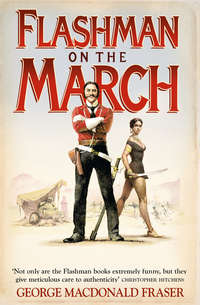
Cover illustration © Gino D’Achille
George MacDonald Fraser asserts the moral right to be identified as the author of this work.
A catalogue record for this book is available from the British Library.
This novel is entirely a work of fiction. The names, characters and incidents portrayed in it, while at times based on historical events and figures, are the work of the author’s imagination.
All rights reserved under International and Pan-American Copyright Conventions. By payment of the required fees, you have been granted the non-exclusive, non-transferable right to access and read the text of this e-book on-screen. No part of this text may be reproduced, transmitted, down-loaded, decompiled, reverse engineered, or stored in or introduced into any information storage and retrieval system, in any form or by any means, whether electronic or mechanical, now known or hereinafter invented, without the express written permission of HarperCollins.
Source ISBN: 9780007197408
Ebook Edition © 2015 ISBN: 9780007325627
Version: 2015-07-22
The following piece was found in the author’s study in 2013 by the Estate of George MacDonald Fraser.
How Did I Get the Idea of Flashman?
‘How did you get the idea of Flashman?’ and ‘When are we going to get his U.S. Civil War memoirs?’ are questions which I have ducked more often than I can count. To the second, my invariable response is ‘Oh, one of these days’. Followed, when the inquirer is an impatient American, by the gentle reminder that to an old British soldier like Flashman the unpleasantness between the States is not quite the most important event of the nineteenth century, but rather a sideshow compared to the Mutiny or Crimea. Before they can get indignant I add hastily that his Civil War itinerary is already mapped out; this is the only way of preventing them from telling me what it ought to be.
To the question, how did I get the idea, I simply reply that I don’t know. Who ever knows? Anthony Hope conceived The Prisoner of Zenda on a walk from Westminster to the Temple, but I doubt if he could have said, after the calendar month it took him to write the book, what triggered the idea. In my case, Flashman came thundering out of the mists of forty years living and dreaming, and while I can list the ingredients that went to his making, heaven only knows how and when they combined.
One thing is sure: the Flashman Papers would never have been written if my fellow clansman Hugh Fraser, Lord Allander, had confirmed me as editor of the Glasgow Herald in 1966. But he didn’t, the canny little bandit, and I won’t say he was wrong. I wouldn’t have lasted in the job, for I’d been trained in a journalistic school where editors were gods, and in three months as acting chief my attitude to management, front office, and directors had been that of a seigneur to his serfs – I had even put Fraser’s entry to the House of Lords on an inside page, assuring him that it was not for the Herald, his own paper, to flaunt his elevation, and that a two-column picture of him was quite big enough. How cavalier can you get?
And doubtless I had other editorial shortcomings. In any event, faced with twenty years as deputy editor (which means doing all the work without getting to the big dinners), I promised my wife I would ‘write us out of it’. In a few weeks of thrashing the typewriter at the kitchen table in the small hours, Flashman was half-finished, and likely to stay that way, for I fell down a waterfall, broke my arm, and lost interest – until my wife asked to read what I had written. Her reaction galvanised me into finishing it, one draft, no revisions, and for the next two years it rebounded from publisher after publisher, British and American.
I can’t blame them: the purported memoir of an unregenerate blackguard, bully, and coward resurrected from a Victorian school story is a pretty eccentric subject. By 1968 I was ready to call it a day, but thanks to my wife’s insistence and George Greenfield’s matchless knowledge of the publishing scene, it found a home at last with Herbert Jenkins, the manuscript looking, to quote Christopher MacLehose, as though it had been round the world twice. It dam’ nearly had.
They published it as it stood, with (to me) bewildering results. It wasn’t a bestseller in the blockbuster sense, but the reviewers were enthusiastic, foreign rights (starting with Finland) were sold, and when it appeared in the U.S.A. one-third of forty-odd critics accepted it as a genuine historical memoir, to the undisguised glee of the New York Times, which wickedly assembled their reviews. ‘The most important discovery since the Boswell Papers’ is the one that haunts me still, for if I was human enough to feel my lower ribs parting under the strain, I was appalled, sort of.
You see, while I had written a straightforward introduction describing the ‘discovery’ of the ‘Papers’ in a saleroom in Ashby-de-la-Zouche (that ought to have warned them), and larded it with editorial ‘foot-notes’, there had been no intent to deceive; for one thing, while I’d done my best to write, first-person, in Victorian style, I’d never imagined that it would fool anybody. Nor did Herbert Jenkins. And fifty British critics had recognised it as a conceit. (The only one who was half-doubtful was my old chief sub on the Herald; called on to review it for another paper, he demanded of the Herald’s literary editor: ‘This book o’ Geordie’s isnae true, is it?’ and on being assured that it wasn’t, exclaimed: ‘The conniving bastard!’, which I still regard as a high compliment.)
With the exception of one left-wing journal which hailed it as a scathing attack on British imperialism, the press and public took Flashman, quite rightly, at face value, as an adventure story dressed up as the memoirs of an unrepentant old cad who, despite his cowardice, depravity and deceit, had managed to emerge from fearful ordeals and perils an acclaimed hero, his only redeeming qualities being his humour and shameless honesty as a memorialist. I was gratified, if slightly puzzled, to learn that the great American publisher, Alfred Knopf, had said of the book: ‘I haven’t heard this voice in fifty years’, and that the Commissioner of Metropolitan Police was recommending it to his subordinates. My interest increased as I wrote more Flashman books, and noted the reactions.
I was, several critics agreed, a satirist. Taking revenge on the nineteenth century on behalf of the twentieth, said one. Waging war on Victorian hypocrisy, said another. Plainly under the influence of Conrad, said yet another. A full-page review in a German paper took me flat aback when my eye fell on the word ‘Proust’ in the middle of it. I don’t read German, so for all I know the review may have been maintaining that Proust was a better stand-off half than I was, or used more semi-colons. But there it was, and it makes you think. And a few years ago a highly respected religious journal said that the Flashman Papers deserved recognition as the work of a sensitive moralist, and spoke of service not only to literature and history, but to the study of ethics.
My instant reaction to this was to paraphrase Poins: ‘God send me no worse fortune, but I never said so!’ while feeling delighted that someone else had said it, and then reflecting solemnly that this was a far cry from long nights with cold tea and cigarettes, scheming to get Flashman into the passionate embrace of the Empress of China, or out of the toils of a demented dwarf on the edge of a snake-pit. But now, beyond remarking that the anti-imperial left-winger was sadly off the mark, that the Victorians were mere amateurs in hypocrisy compared to our own brainwashed, sanctimonious, self-censoring and terrified generation, and that I hadn’t read a word of Conrad by 1966 (and my interest in him since has been confined to Under Western Eyes, in the hope that I might persuade Dick Lester to film it as only he could), I have no comments to offer on opinions of my work. I know what I’m doing – at least, I think I do – and the aim is to entertain (myself, for a start) while being true to history, to let Flashman comment on human and inhuman nature, and devil take the romantics and the politically correct revisionists both. But my job is writing, not explaining what I’ve written, and I’m well content and grateful to have others find in Flashy whatever they will (I’ve even had letters psychoanalysing the brute), and return to the question with which I began this article.
A life-long love affair with British imperial adventure, fed on tupenny bloods, the Wolf of Kabul and Lionheart Logan (where are they now?), the Barrack-Room Ballads, films like Lives of a Bengal Lancer and The Four Feathers, and the stout-hearted stories for boys which my father won as school prizes in the 1890s; the discovery, through Scott and Sabatini and Macaulay, that history is one tremendous adventure story; soldiering in Burma, and seeing the twilight of the Raj in all its splendour; a newspaper-trained lust for finding the truth behind the received opinion; being a Highlander from a family that would rather spin yarns than eat … I suppose Flashman was born out of all these things, and from reading Tom Brown’s Schooldays as a child – and having a wayward cast of mind.
Thanks to that contrary streak (I always half-hoped that Rathbone would kill Flynn, confounding convention and turning the story upside down – Basil gets Olivia, Claude Rains triumphs, wow!), I recognised Flashman on sight as the star of Hughes’ book. Fag-roasting rotter and poltroon he might be, he was nevertheless plainly box-office, for he had the looks, swagger and style (‘big and strong’, ‘a bluff, offhand manner’, and ‘considerable powers of being pleasant’, according to his creator) which never fail to cast a glamour on villainy. I suspect Hughes knew it, too, and got rid of him before he could take over the book – which loses all its spirit and zest once Flashy has made his disgraced and drunken exit.
[He was, by the way, a real person; this I learned only recently. A letter exists from one of Hughes’ Rugby contemporaries which is definite on the point, but tactfully does not identify him. I have sometimes speculated about one boy who was at Rugby in Hughes’ day, and who later became a distinguished soldier and something of a ruffian, but since I haven’t a shred of evidence to back up the speculation, I keep it to myself.]
What became of him after Rugby seemed to me an obvious question, which probably first occurred to me when I was about nine, and then waited thirty years for an answer. The Army, inevitably, and since Hughes had given me a starting-point by expelling him in the late 1830s, when Lord Cardigan was in full haw-haw, and the Afghan War was impending … just so. I began with no idea of where the story might take me, but with Victorian history to point the way, and that has been my method ever since: choose an incident or campaign, dig into every contemporary source available, letters, diaries, histories, reports, eye-witness, trivia (and fictions, which like the early Punch are mines of detail), find the milestones for Flashy to follow, more or less, get impatient to be writing, and turn him loose with the research incomplete, digging for it as I go and changing course as history dictates or fancy suggests.
In short, letting history do the work, with an eye open for the unexpected nuggets and coincidences that emerge in the mining process – for example, that the Cabinet were plastered when they took their final resolve on the Crimea, that Pinkerton the detective had been a trade union agitator in the very place where Flashman was stationed in the first book, that Kipling’s The Man Who Would Be King had a factual basis, or that Bismarck and Lola Montez were in London in the same week (of 1842, if memory serves, which it often doesn’t: whenever Flashman has been a subject on Mastermind I have invariably scored less than the contestants).
Visiting the scenes helps; I’d not have missed Little Big Horn, the Borneo jungle rivers, Bent’s Fort, or the scruffy, wonderful Gold Road to Samarkand, for anything. Seeking out is half the fun, which is one reason why I decline all offers of help with research (from America, mostly). But the main reason is that I’m a soloist, giving no hints beforehand, even to publishers, and permitting no editorial interference afterwards. It may be tripe, but it’s my tripe – and I do strongly urge authors to resist encroachments on their brain-children, and trust their own judgment rather than that of some zealous meddler with a diploma in creative punctuation who is just dying to get into the act.
One of the great rewards of writing about my old ruffian has been getting and answering letters, and marvelling at the kindness of readers who take the trouble to let me know they have enjoyed his adventures, or that he has cheered them up, or turned them to history. Sitting on the stairs at 4 a.m. talking to a group of students who have phoned from the American Midwest is as gratifying as learning from a university lecturer that he is using Flashman as a teaching aid. Even those who want to write the books for you, or complain that he’s a racist (of course he is; why should he be different from the rest of humanity?), or insist that he isn’t a coward at all, but just modest, and they’re in love with him, are compensated for by the stalwarts who’ve named pubs after him (in Monte Carlo, and somewhere in South Africa, I’m told), or have formed societies in his honour. They’re out there, believe me, the Gandamack Delopers of Oklahoma, and Rowbotham’s Mosstroopers, and the Royal Society of Upper Canada, with appropriate T-shirts.
I have discovered that when you create – or in my case, adopt and develop – a fictional character, and take him through a series of books, an odd thing happens. He assumes, in a strange way, a life of his own. I don’t mean that he takes you over; far from it, he tends to hive off on his own. At any rate, you find that you’re not just writing about him: you are becoming responsible for him. You’re not just his chronicler: you are also his manager, trainer, and public relations man. It’s your own fault – my own fault – for pretending that he’s real, for presenting his adventures as though they were his memoirs, putting him in historical situations, giving him foot-notes and appendices, and inviting the reader to accept him as a historical character. The result is that about half the letters I get treat him as though he were a person in his own right – of course, people who write to me know that he’s nothing of the sort – well, most of them realise it: I occasionally get indignant letters from people complaining that they can’t find him in the Army List or the D.N.B., but nearly all of them know he’s fiction, and when they pretend that he isn’t, they’re just playing the game. I started it, so I can’t complain.
When Hughes axed Flashman from Tom Brown’s Schooldays, brutally and suddenly (on page 170, if I remember rightly), it seemed a pretty callous act to abandon him with all his sins upon him, just at the stage of adolescence when a young fellow needs all the help and understanding he can get. So I adopted him, not from any charitable motives, but because I realised that there was good stuff in the lad, and that with proper care and guidance something could be made out of him.
And I have to say that with all his faults (what am I saying, because of his faults) young Flashy has justified the faith I showed in him. Over the years he and I have gone through several campaigns and assorted adventures, and I can say unhesitatingly that coward, scoundrel, toady, lecher and dissembler though he may be, he is a good man to go into the jungle with.
George MacDonald Fraser
Dedication
For Kath, twelve in a row
Contents
Cover
Title Page
Copyright
How Did I Get the Idea of Flashman?
Dedication
Biographical Note
Explanatory Note
Map
Chapter 1
Chapter 2
Chapter 3
Chapter 4
Chapter 5
Chapter 6
Chapter 7
Chapter 8
Chapter 9
Chapter 10
Chapter 11
Chapter 12
Chapter 13
Chapter 14
Chapter 15
Chapter 16
Chapter 17
Chapter 18
Chapter 19
Appendix I
Appendix II
Appendix III
Footnotes
Notes
About the Author
The FLASHMAN Papers: In chronological order
The FLASHMAN Papers: In order of publication
Also by George MacDonald Fraser
About the Publisher
BIOGRAPHICAL NOTE
FLASHMAN, Harry Paget, brigadier-general, V.C., K.C.B., K.C.I.E.: Chevalier, Legion of Honour; Order of Maria Theresa, Austria; Order of the Elephant, Denmark (temporary); U.S. Medal of Honor; San Serafino Order of Purity and Truth, 4th class; b. May 5, 1822, s. of H. Buckley Flashman, Esq., Ashby, and Hon. Alicia Paget; m. Elspeth Rennie Morrison, d. of Lord Paisley, one s., one d. Educ. Rugby School, 11th Hussars, 17th Lancers. Served Afghanistan 1841–2 (medals, thanks of Parliament); chief of staff to H.M. James Brooke, Rajah of Sarawak, Batang Lupar expedn, 1844; milit. adviser with unique rank of sergeant-general to H.M. Queen Ranavalona of Madagascar, 1844–5; Sutlej campaign, 1845–6 (Ferozeshah, Sobraon, envoy extraordinary to Maharani Jeendan, Court of Lahore); polit. adviser to Herr (later Chancellor Prince) von Bismarck, Schleswig-Holstein, 1847–8; Crimea, staff (Alma, Sevastopol, Balaclava), prisoner of war, 1854; artillery adviser to Atalik Ghazi, Syr Daria campaign, 1855; India, Sepoy Mutiny, 1857–8, dip. envoy to H.R.H. the Maharani of Jhansi, trooper 3rd Native Cavalry, Meerut, subseq. att. Rowbotham’s Mosstroopers, Cawnpore (Lucknow, Gwalior, etc., V.C.); adjutant to Captain John Brown, Harper’s Ferry, 1859; China campaign 1860, polit. mission to Nanking, Taiping Rebellion, polit. and other services, Imperial Court, Pekin; U.S. Army (major, Union forces, 1862, colonel (staff) Army of the Confederacy, 1863); a.d.c. to H.I.M. Maximilian, Emperor of Mexico, 1867; interpreter and observer Sioux campaign, U.S., 1875–6 (Camp Robinson conference, Little Big Horn, etc.); Zulu War, 1879 (Isandhlwana, Rorke’s Drift); Egypt 1882 (Kassassin, Tel-el-Kebir); personal bodyguard to H.I.M. Franz-Josef, Emperor of Austria, 1883; Sudan 1884–5 (Khartoum); Pekin Legations, 1900. Travelled widely in military and civilian capacities, among them supercargo, merchant marine (West Africa), agriculturist (Mississippi valley), wagon captain and hotelier (Santa Fe Trail); buffalo hunter and scout (Oregon Trail); courier (Underground Railroad); majordomo (India), prospector (Australia); trader and missionary (Solomon Islands, Fly River, etc.), lottery supervisor (Manila), diamond broker and horse coper (Punjab), dep. marshal (U.S.), occasional actor and impersonator. Hon. mbr of numerous societies and clubs, including Sons of the Volsungs (Strackenz), Mimbreno Apache Copper Mines band (New Mexico), Khokand Horde (Central Asia), Kit Carson’s Boys (Colorado), Brown’s Lambs (Maryland), M.C.C., White’s and United Service (London, both resigned), Blackjack (Batavia). Chmn, Flashman and Bottomley, Ltd; dir. British Opium Trading Co.; governor, Rugby School; hon. pres. Mission for Reclamation of Reduced Females. Publications: Dawns and Departures of a Soldier’s Life; Twixt Cossack and Cannon; The Case Against Army Reform. Recreations: Oriental studies, angling, cricket (performed first recorded ‘hat trick’, wickets of Felix, Pilch, Mynn, for 14 runs, Rugby Past and Present v. Kent, Lord’s 1842; five for 12, Mynn’s Casuals v. All-England XI, 1843). Add: Gandamack Lodge, Ashby, Leics.
EXPLANATORY NOTE
In the campaigns covered by the first eleven packets of his autobiographical Papers – Afghanistan, First Sikh War, Crimea, Indian Mutiny, Brooke’s expedition against the Borneo pirates, the march to Pekin, Custer’s Little Big Horn debacle – Sir Harry Flashman, V.C., etc., the notorious Victorian hero and poltroon, has always been at or near the heart of the action, a reluctant and often jaundiced eye-witness of people and events, and uncomfortably aware of history unfolding about him.
Not so in the Abyssinian War of 1868, surely the strangest of all imperial campaigns, when a British Indian army invaded one of the least known and most dangerous countries on earth, and in the face of apparently insuperable hazards, and predictions of certain failure, marched and fought their way across a trackless wilderness of rocky chasm and jagged mountain to their goal, did what they had come to do, and marched out again with hardly a casualty. There has never perhaps been a success like it in the history of war. It took twelve thousand men, a mighty fleet, nine million pounds (a staggering sum at that time), a meticulous if extravagant organisation, and a remarkable old soldier – and all to rescue a tiny group of British citizens held captive by a mad monster of an African king. Those were, to quote Flashman, the days.
But if he bore no share in the campaign proper, Flashman’s was still the vital part on which success or failure hung – the intelligence mission which was to take him into a series of fearful perils (some of them new even to him) in a war-torn land of mystery, treachery, intrigue, lonely castles, ghost cities, the most beautiful (and savage) women in Africa, and at last into the power of the demented tyrant in his stronghold at the back of beyond. All of which he records with his customary shameless honesty, and it may be that along with the light he casts on a unique chapter of imperial history, he invites a comparison with a later and less glorious day.
For Flashman’s story is about a British army sent out in a good and honest cause by a government who knew what honour meant. It was not sent without initial follies and hesitations in high places, or until every hope of a peaceful issue was gone. It went with the fear of disaster hanging over it, but with the British public in no doubt that it was right. It served no politician’s vanity or interest. It went without messianic rhetoric. There were no false excuses, no deceits, no cover-ups or lies, just a decent resolve to do a government’s first duty: to protect its people, whatever the cost. To quote Flashman again, those were the days.
As with previous Papers, I have merely corrected his spelling, which in this instance meant introducing consistency into his bizarre renderings of Abyssinian names.
G.M.F.

‘Half a million in silver, did you say?’
‘In Maria Theresa dollars. Worth a hundred thou’ in quids.’ He held up a gleaming coin, broad as a crown, with the old girl double-chinned on one side and the Austrian arms on t’other. ‘Dam’ disinheritin’ old bitch, what? Mind, they say she was a plum in her youth, blonde and buxom, just your sort, Flashy—’
‘Ne’er mind my sort. The cash must reach this place in Africa within four weeks? And the chap who was to have escorted it is laid up in Venice with yellow jack?’
‘Or the clap, or the sailor’s itch, or heaven knows what.’ He spun the coin, grinning foxy-like. ‘You’ve changed your mind, haven’t you? You’re game to do it yourself! Good old Flash!’
‘Don’t rush your fences, Speed, my boy. When’s it due to be shipped out?’
‘Wednesday. Lloyd packet to Alexandria. But with Sturgess comin’ all over yellow in Venice, that won’t do, and there ain’t another Alex boat for a fortnight – far too late, and the Embassy’ll run my guts up the flagpole, as though ’twas my fault, confound ’em—’
‘Aye, it’s hell in the diplomatic. Well, tell you what, Speed – I’ll ride guard on your dollars to Alex for you, but I ain’t waiting till Wednesday. I want to be clear of this blasted town by dawn tomorrow, so you’d best drum up a steam-launch and crew, and get your precious treasure aboard tonight – where is it just now?’
‘At the station, the Strada Ferrata – but dammit, Flash, a private charter’ll cost the moon—’
‘You’ve got Embassy dibs, haven’t you? Then use ’em! The station ain’t spitting distance from the Klutsch mole, and if you get a move on you can have the gelt loaded by midnight. Heavens, man, steam craft and spaghetti sailors are ten a penny in Trieste! If you’re in such a sweat to get the dollars to Africa—’
‘You may believe it! Let me see … quick run to Alex, then train to Cairo and on to Suez – no camel caravans across the desert these days, but you’ll need to hire nigger porters—’
‘For which you’ll furnish me cash!’
He waved a hand. ‘Sturgess would’ve had to hire ’em, anyway. At Suez one of our Navy sloops’ll take you down the Red Sea – there are shoals of ’em, chasin’ the slavers, and I’ll give you an Embassy order. They’ll have you at Zoola – that’s the port for Abyssinia – by the middle of February, and it can’t take above a week to get the silver up-country to this place called Attegrat. That’s where General Napier will be.’
‘Napier? Not Bob the Bughunter? What the blazes is he doing in Abyssinia? We haven’t got a station there.’
‘We have by now, you may be sure!’ He was laughing in disbelief. ‘D’you mean to tell me you haven’t heard? Why, he’s invadin’ the place! With an army from India! The silver is to help fund his campaign, don’t you see? Good God, Flashy, where have you been? Oh, I was forgettin’ – Mexico. Dash it, don’t they have newspapers there?’
‘Hold up, can’t you? Why is he invading?’
‘To rescue the captives – our consul, envoys, missionaries! They’re held prisoner by this mad cannibal king, and he’s chainin’ ’em, and floggin’ ’em, and kickin’ up no end of a row! Theodore, his name is – and you mean to say you’ve not heard of him? I’ll be damned – why, there’s been uproar in Parliament, our gracious Queen writin’ letters, a penny or more on the income tax – it’s true! Now d’you see why this silver must reach Napier double quick – if it don’t, he’ll be adrift in the middle of nowhere with not a penny to his name, and your old chum Speedicut will be a human sacrifice at the openin’ of the new Foreign Office!’
‘But why should Napier need Austrian silver? Hasn’t he got any sterling?’
‘Abyssinian niggers won’t touch it, or anythin’ except Maria Theresas. Purest silver,1 you see, and Napier must have it for food and forage when he marches up-country to fight his war.’
‘So it’s a war-chest? You never said a dam’ word about war last night.’
‘You never gave me a chance, did you? Soon as I told you I was in Dickie’s meadow,2 with this damned fortune to be shipped and Sturgess in dock, what sympathy did dear old friend Flashy offer? The horse’s laugh, and wished me joy! All for England, home, and the beauteous Elspeth, you were … and now,’ says he, with that old leery Speedicut look, ‘all of a sudden, you’re in the dooce of a hurry to oblige … What’s up, Flash?’
‘Not a dam’ thing. I’m sick of Trieste and want away, that’s all!’
‘And can’t wait a day? You and Hookey Walker!’
‘Now, see here, Speed, d’ye want me to shift your blasted bullion, or don’t you? Well, I go tonight or not at all, and since this cash is so all-fired important to Napier, your Embassy funds can stand the row for my passage home, too, when the thing’s done! Well, what d’ye say?’
‘That something is up, no error!’ His eyes widened. ‘I say, the Austrian traps ain’t after you, are they – ’cos if they were I daren’t assist your flight, silver or no silver! Dash it, I’m a diplomat—’
‘Of course ’tain’t the traps! What sort of fellow d’ye think I am? Good God, ha’nt we been chums since boyhood?’
‘Yes, and it’s ’cos I know what kind of chum you can be that I repeat “What’s up, Flash?”’ He filled my glass and pushed it across. ‘Come up, old boy! This is old Speed, remember, and you can’t humbug him.’
Well, true enough, I couldn’t, and since you, dear reader, may be sharing his curiosity, I’ll tell you what I told him that night in the Hôtel Victoria – not the smartest pub in Trieste, but as a patriotic little minion of our Vienna Embassy, Speedicut was bound to put up there – and it should explain the somewhat cryptic exchanges with which I’ve begun this chapter of my memoirs. If they’ve seemed a mite bewildering you’ll see presently that they were the simplest way of setting out the preliminaries to my tale of the strangest campaign in the whole history of British arms – and that takes in some damned odd affairs, a few of which I’ve borne a reluctant hand in myself. But Abyssinia took the cake, currants and all. Never anything like it, and never will be again.
For me, the business began in the summer of ’67, on the day when that almighty idiot, the Emperor Maximilian of Mexico, strode out before a Juarista firing squad, unbuttoned his shirt cool as a trout, and cried ‘Viva Mejico! Viva la independencia! Shoot, soldiers, through the heart!’ Which they did, with surprising accuracy for a platoon of dagoes, thereby depriving Mexico of its crowned head and Flashy of his employer and protector. I was an anxious spectator skulking in cover on a rooftop nearby, and when I saw Max take a header into the dust I knew that the time had come for me to slip my cable.
You see, I’d been his fairly loyal aide-de-camp in his recent futile struggle against Juarez’s republicans – not a post I’d taken from choice, but I’d been a deserter from the French Foreign Legion at the time.3 They were polluting Mexico with their presence in those days, supporting Max on behalf of his sponsor, that ghastly louse Louis Napoleon, and I’d been only too glad of the refuge Max had offered me – he’d been under the mistaken impression that I’d saved his life in an ambush at Texatl, poor ass, when in fact I’d been one of Jesus Montero’s gang of ambushers, but we needn’t go into that at the moment. What mattered was that Max had taken me on the strength, and had given the Legion peelers the rightabout when they’d come clamouring for my unhappy carcase.
Then the Frogs cleared out in March of ’67, leaving Max in the lurch with typical Gallic loyalty, but while that removed one menace to my wellbeing, there remained others from which Max could be no protection, quick or dead – like the Juaristas, who’d rather have strung up a royalist a.d.c. than eaten their dinners, or that persevering old bandolero Jesus Montero, who was bound to find out eventually that I didn’t know where Montezuma’s treasure was. Hell of a place, Mexico, and dam’ confused.
But all you need to know for the present is that after Max bought the bullet I’d have joined him in the dead-cart if it hadn’t been for the delectable Princess Agnes Salm-Salm, and the still happily ignorant Jesus. They’d been my associates in a botched attempt to rescue Max on the eve of his execution. We’d failed because (you’ll hardly credit this) the great clown had refused point-blank to escape because it didn’t sort with his imperial dignity, Austro-Hungarian royalty preferring to die rather than go over the wall. Well, hell mend ’em, I say, and if the House of Hapsburg goes to the knackers it won’t be my fault; I’ve done my unwilling best for them, ungrateful bastards.4
At all events, darling Aggie and greasy Jesus had seen me safe to Vera Cruz, where she had devised the most capital scheme for getting me out of the country. Max having been brother to the Austrian Emperor Franz-Josef, his death had caused a sensation in Vienna; they hadn’t done a dam’ thing useful to save his life, but they made up for it with his corpse, sending a warship to ferry it home, with a real live admiral and a great retinue of court reptiles. And since Aggie was the wife of a German princeling, a heroine of the royalist campaign, and handsome as Hebe, they were all over her when we went aboard the Novara frigate at Sacraficios. Admiral Tegethoff, a bluff old sport, all beard and belly, munched her knuckles and gave glad welcome even to the begrimed and ragged peon whom she presented as the hoch und wohlgeboren Oberst Sir Harry Flashman, former aide, champion, and all-round hero of the campaign and the ill-starred attempt to snatch his imperial majesty from the firing squad.
‘The Emperor’s English right arm, gentlemen!’ says Aggie, who was a great hand at the flashing-eyed flourish. ‘So his majesty called him. Who more fitting to guard his royal master and friend on his last journey home?’
Blessed if they could think of anyone fitter, and I was received with polite enthusiasm: the reptiles left off sneering at my beastly peasant appearance and clicked their heels, old Tegethoff stopped just short of embracing me, and I was aware of the awestruck admiration in the wide blue eyes of the enchanting blonde poppet whom he presented as his great-niece, Gertrude von und zum something-or-other. My worldly Aggie noticed it too, and observed afterwards, when we made our adieus at the ship’s rail, that if I looked like a scarecrow I was at least a most romantic one.
‘The poor little idiot will doubtless break her foolish heart over you en voyage,’ says she. ‘And afterwards wonder what she saw in the so dashing English rascal.’
‘Jealous of her, princess?’ says I, and she burst out laughing.
‘Of her youth, perhaps – not of her infatuation.’ She gave that slantendicular smile that had been driving me wild for months. ‘Well, not very much. But if I were sixteen again, like her, who knows? Adios, dear Harry.’ And being royally careless of propriety, she kissed me full on the lips before the startled squareheads – and for a delightful moment it was the kiss of the lover she’d never been, which I still count a real conquest. Pity she was so crazy about her husband, I remember thinking, as she waved an elegant hand from her carriage and was gone.5
After that they towed Max’s coffin out to the ship in a barge and hoisted it inboard, and as the newly appointed escort to his cadaver I was bound to give Tegethoff and his entourage a squint at the deceased, so that they could be sure they’d got the right chap. It was no end of a business, for his Mexican courtiers had done him proud with no fewer than three coffins, one of rosewood, a second of zinc, and the third of cedar, with Max inside the last like one of those Russian dolls. He’d been embalmed, and I must say he looked in capital fettle, bar being a touch yellow and his hair starting to fall out. We screwed him in again, a chaplain said a prayer, and all that remained was to weigh anchor to thunderous salutes from various attendant warships, and for me to remind Tegethoff that a bath and a change of clobber would be in order.
I’ve never had any great love for the cabbage-chewers, having been given my bellyful by Bismarck and his gang in the Schleswig-Holstein affair,fn1 and Tegethoff’s party included more than one of the crop-headed schlager-swingers whom I find especially detestable, but I’m bound to say that on that voyage, which lasted from late November ’67 to the middle of January, they couldn’t have been more amiable and hospitable – until the very morning we dropped anchor off Trieste, when Tegethoff discovered that I’d been giving his great-niece a few exercises they don’t usually teach in young ladies’ seminaries.
Aggie had been right, you see: the silly chit had gone nutty on me at first sight, and who’s to blame her? Stalwart Flashy all bronzed and war-weary in sombrero and whiskers might well flutter a maiden heart, and if at forty-five I was old enough to be her father, that never stopped an adoring innocent yet, and you may be sure it don’t stop me either. Puppy-fat and golden sausage curls ain’t my style as a rule, but combined with a creamy complexion, parted rosebud lips, and great forget-me-not eyes alight with idiotic worship, they have their attraction. For one thing they awoke blissful memories of Elspeth on that balmy evening when I first rattled her in the bushes by the Clyde. The resemblance was more than physical, for both were brainless, although my darling half-wit is not without a certain native cunning, but what made dear little Fraulein Gertrude specially irresistible was her truly unfathomable ignorance of the more interesting facts of life, and her touching faith in me as a guide and mentor.
Her attachment to me on the voyage was treated as something of a joke by Tegethoff’s people, who seemed to regard her as a child still, more fool they, and since her duenna was usually too sea-sick to interfere, we were together a good deal. She was the most artless prattler, and was soon confiding her girlish secrets, dreams, and fears; I learned that her doting great-uncle had brought her on the cruise as a betrothal present, and that on her return to Vienna she was to be married to a most aristocratic swell, a graf no less, whom she had never seen and who was on the brink of the grave, being all of thirty years old.
‘It is such an honour,’ sighs she, ‘and my duty, Mama says, but how am I to be worthy of it? I know nothing of how to be a wife, much less a great lady. I am too young, and foolish, and … and little! He is a great man, a cousin to the Emperor, and I am only a lesser person! How do I know how to please him, or what it is that men like, and who is to tell me?’ Yearning, dammit, drowning me in her blue limpid pools, with her fat young juggs heaving like blancmange. Strip off, lie back, and enjoy it, would have been the soundest advice, but I patted her hand, smiled paternally, and said she mustn’t worry her pretty little head, her graf was sure to like her.
‘Oh, so easy to say!’ cries she. ‘But if he should not? How to win his affection?’ She rounded on me eagerly. ‘If it were you –’ and from her soulful flutter she plainly wished it was, sensible girl ‘– if it were you, how could I best win your heart? How make you … oh, admire me, and honour me, and … and love me! What would delight you most that I could do?’
You may talk about sitting birds, but where a lesser man might have taken swift advantage of that guileless purity, I’m proud to say that I did not. She might be the answer to a lecher’s prayer, but I knew it would take delicate management and patience before we could have her setting to partners in the Calcutta Quadrille. So I went gently to work, indulgent uncle in the first week, brotherly arm about her shoulders in the second, peck on the cheek in the third, touch on the lips at Christmas to make her think, sudden lustful growl and passionate kiss for New Year, meeting her startled-fawn bewilderment with a nice blend of wistful adoration and unholy desire which melted the little simpleton altogether, and bulled her speechless all the way along the Adriatic. Very discreet, mind; a ship’s a small place, and chaste young ladies tend to be excitable the first few times and need to be hushed. Elspeth, and my second wife, Duchess Irma, were like ecstatic banshees, I remember.
Unfortunately, she shared another characteristic with Elspeth – she had no more discretion than the town crier, and just as Elspeth had babbled joyfully of our jolly rogering to her elder sister, who had promptly relayed it to her horrified parents, so sweet imbecile Gertrude had confided in her duenna, who had swooned before passing on the glad news to old Tegethoff.
This must have been on the very morning we dropped anchor off the Molo St Carlo at Trieste and I was supervising the lifting of the coffin from below decks, and in the very act of securing Max’s crown and archducal cap to the lid, when Tegethoff damned near fell down the companion, with a couple of aides at his heels trying to restrain him. He was in full fig, cocked hat and ceremonial sword which he was trying to lug out, purple with rage, and bellowing ‘Verräter! Vergewaltiger! Pirat!’fn2 which summed up things nicely and explained why he was behaving like Attila with apoplexy.
One of the aides clung to his sword-arm and hauled him back by main force, while the other, a hulking junkerish brute with scars all over his ugly dial, whipped his glove across my face before dashing it at my feet and stamping off. That was all they had time for just then, what with the barge coming alongside to take Max on shore leave, the Duke of Wurtemburg and all the other big guns lined up on the landing stage, the waterfront swathed in black, and muted brass bands playing a cheery Wagnerian air. But I can take a hint, and saw that by the time they’d finished escorting Max to the Vienna train, I had best be in the nearest deep cover, lying doggo.
So I let the pall-bearers get their load on deck, waited until the guns of the assembled shipping had started their salutes and Tegethoff and Co. would be safely away, and slunk ashore with a hastily packed valise. The cortège was proceeding along the boulevard beyond the Grand Canal which runs into the heart of the city; solemn music, mobs of chanting clergy, friars carrying crosses, battalions of infantry, and I thought ‘Hasta la vista, old Max’ and hurried up-town to lose myself for a few hours.6 Tegethoff’s gang would be off to Vienna with the corpse presently, nursing their wrath against me, no doubt, but unable to indulge it, and then I could consider how the devil I was to raise the blunt for a passage to England, for bar a few pesos and Yankee dollars my pockets were to let.
Trieste ain’t much of a town unless you’re in trade or banking or some other shady pursuit; Napoleon’s spymaster, Fouché, is buried there, and Richard the Lionheart did time in jail, but the only other excitements are the Tergesteum bazaar and the Corso, which is the main drag between the new and old cities, and you can stare at shop windows and drink coffee to bursting point.
At evening I mooched up to the Exchange plaza and into the casino club, where the smart set foregathered and I thought I might run across some sporting rich widow eager for carnal amusement, but I’d barely begun to survey the fashionable throng when I found myself face to face with the last man I’d have thought to meet, my old chum of Rugby and the Cider Cellars, Speedicut, whom I’d barely seen since the night the Minor Club in St James’s was raided, and we’d fled from the peelers and I’d found refuge in the carriage (and later the bed) of Lola Montez, bless her black heart. That had been all of twenty-five years before, but we knew each other on the instant, and there was great rejoicing, in a wary sort of way, for we’d never been your usual bosom pals, both being leery by nature.
So now I learned that he was in the diplomatic, which didn’t surprise me, for he was a born toad-eater with a great gift of genteel sponging and an aversion to work. He was full of woe because, as you’ll already have gathered, he’d brought this fortune in silver down from Vienna for shipment to Abyssinia, and lo! the appointed escort had fallen by the way and he was at his wits’ end to find another – couldn’t go himself, diplomatic duty bound him to Austrian soil, etc., etc… . It was at that point that it dawned on him that here was good old Harry, knight of the realm, hero of Crimea and the Mutiny, darling of Horse Guards, and just the chap who could be trusted with a vital mission in his country’s service. Why, I was heaven-sent and no mistake, dear old lad that I was!
There wasn’t a hope of touching him for a loan to see me home, for coming of nabob wealth he was as mean as Solomon Levi, but by pretending interest I was able to take a decent dinner off him at the Locanda Granda before telling him, fairly politely, for one hates to offend, what he could do with his cargo of dollars. He howled a bit, but didn’t press me, for he hadn’t really expected me to agree, and we parted on fair terms, he to visit the station to see that his minions were taking care of the doubloons, I to find a cheap bed for the night. And I hadn’t turned the corner before I saw something that had me skipping for the nearest alleyway with my undigested dinner in sudden turmoil. Not twenty yards away across the street, the Austrian lout who’d slapped my face and hurled his challenge at my feet was conferring with two uniformed constables and a bearded villain in a billycock hat with plain-clothes peeler written all over him. And there were two armed troopers in tow as well.
Even as I watched them disperse, the officer mounting the steps to the Locanda which I’d just left, the fearful truth was dawning – Tegethoff had left this swine behind to track me down and either hale me to justice as a ravisher of youth (squareheads have the most primitive views about this, as I’d discovered in Munich in ’47 when Bismarck’s bullies interrupted my dalliance with that blubbery slut Baroness Pechmann), or more likely cut me up in a sabre duel. Trieste had suddenly become too hot to hold me – so now you know why a couple of hours later I was in Speedicut’s room at the Victoria, clamouring to be allowed to remove his bullion for him, to Abyssinia or Timbuctoo or any damned place away from Austrian vengeance.
In my funk I even conjured up the nightmare thought that if Tegethoff got his hands on me and instituted inquiries, he might easily discover I was a Legion deserter and hand me over to the bloody Frogs, in which case I’d end my days as a slave in their penal battalion in the Sahara. A groundless fear, looking back, but I’m a great one for starting at shadows, as you may know. I didn’t mention this particular phantasm to Speed, but I did tell him all about Gertrude, ’cos that sort of thing was nuts to him, and he was lost in admiration of my behaviour both as amorist and fugitive.
‘How the blazes you always contrive to slide out o’ harm’s way beats me – aye, often as not with some charmer languishin’ after you! Well, ’twas dam’ lucky for you I was here this time!’
‘Lucky for both of us. So, now that you know all about my guilty past, d’you still feel like trusting me with your half-million? No fears that I might tool along the coast to Monte Carlo and blue the lot at the wheel?’
Put like that, with a wink and a grin, he didn’t care for it above half, but common sense told him I wasn’t going to levant,fn3 and he’d no choice, anyway. So a couple of hours after midnight, there I was at the Klutsch mole, watching Speed’s clerk settle up with the skipper of a neat little smack or yawl or whatever they call ’em, while its crew of Antonios chattered and loafed on the hatches – even in those days Trieste was more Italian than Austrian – and here came Speed in haste across the deserted plaza from the station, with a squad of Royal Marines from his Embassy wheeling the goods on a hand-cart: scores of little strong-boxes with the locks sealed with the royal arms.7 There were four of the Bootnecks8 under a sergeant with a jaw like a pike, all very trim with their Sniders slung; Speed’s dollars would be safe from sea pirates and land banditti with this lot on hand.
It may have been my jest about Monte or his natural fear at seeing his precious cargo pass out of his ken, but now that the die was cast Speed had a fit of the doubtfuls; earlier he’d been begging me to come to his rescue, but now he was chewing his lip as they swung the boxes down to the deck with the Eyeties jabbering and the sergeant giving ’em Billingsgate, while I took an easy cheroot at the rail, trying my Italian pidgin on the skipper.
‘This ain’t a joke, Flash!’ says Speed. ‘It’s bloody serious! You’re carryin’ my career along with those dollars – my good name, dammit!’ As if he had one. ‘Jesus, if anything should go wrong! You will take care, old chap, won’t you? I mean, you’ll do nothin’ wild … you know, like … like …’ He broke off, not caring to say ‘like buggering off to Pago Pago with the loot’. Instead he concluded glumly: ‘’Tain’t insured, you know – not a penny of it!’
I assured him that his specie would reach Napier safely in less than four weeks, but he still looked blue and none too eager to hand over the Embassy passport requesting and requiring H.M. servants, civil and military, to speed me on my way, and a letter for Napier, asking him to give me a warrant and funds for my passage home. I shook hands briskly before he could change his mind, and as we shoved off and the skipper spun the wheel and his crew dragged the sail aloft, damned if he wasn’t here again, running along the mole, waving and hollering:
‘I say, Flash, I forgot to ask you for a receipt!’
I told him to forge my signature if it would make him sleep sounder, and his bleating faded on the warm night air as we stood out from the mole, the little vessel heeling over suddenly as the wind cracked in her sail; the skipper bawled commands as the hands scampered barefoot to tail on to the lines, and I looked back at the great brightly lit crescent of the Trieste waterfront and felt a mighty relief, thinking, well, Flashy my boy, that’s another town you’re glad to say goodbye to on short acquaintance, and here’s to a jolly holiday cruise to a new horizon and an old friend, and then hey! for a swift passage home, and Elspeth waiting. Strange, little Gertrude was fading from memory already, but I found myself reflecting that thanks to my tuition her princeling husband would be either delighted or scandalised on his wedding night – possibly both, the lucky fellow.
You gather from this that I was in a tranquil, optimistic mood as I set off on my Abyssinian odyssey, ass that I was. You’d ha’ thought, after all I’d seen and suffered in my time, that I’d have remembered all the occasions when I’d set off carefree and unsuspecting along some seemingly primrose path only to go head first into the pit of damnation at t’other end. But you never can tell.
Ücretsiz ön izlemeyi tamamladınız.