Kitabı oku: «Selected Stories»
SELECTED STORIES
H. P. Lovecraft

Copyright
William Collins
An imprint of HarperCollinsPublishers
1 London Bridge Street
London SE1 9GF
WilliamCollinsBooks.com
This William Collins eBook edition published in Great Britain in 2018
Life & Times section © HarperCollinsPublishers Ltd
Silvia Crompton asserts her moral rights as author of the Life & Times section
Classic Literature: Words and Phrases adapted from
Collins English Dictionary
Cover by e-Digital Design.
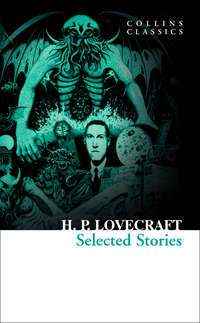
Cover image © Writer Howard Phillips (HP) Lovecraft (1890-1937) surrounded by monsters (top: Cthulhu), engraving, 1981 / Bridgeman Images.
A catalogue record for this book is available from the British Library
All rights reserved under International and Pan-American Copyright Conventions. By payment of the required fees, you have been granted the non-exclusive, non-transferable right to access and read the text of this e-book on-screen. No part of this text may be reproduced, transmitted, down-loaded, decompiled, reverse engineered, or stored in or introduced into any information storage and retrieval system, in any form or by any means, whether electronic or mechanical, now known or hereinafter invented, without the express written permission of HarperCollins
Source ISBN: 9780008284954
Ebook Edition © 2018 ISBN: 9780008284961
Version: 2018-01-18
Contents
Cover
Title Page
Copyright
History of William Collins
Life & Times
Dagon
The Statement of Randolph Carter
Herbert West–Reanimator
The Outsider
The Colour Out of Space
The Call of Cthulhu
The Silver Key
The Dunwich Horror
The Haunter of the Dark
The Thing on the Doorstep
Classic Literature: Words and Phrases
About the Publisher
History of William Collins
In 1819, millworker William Collins from Glasgow, Scotland, set up a company for printing and publishing pamphlets, sermons, hymn books, and prayer books. That company was Collins and was to mark the birth of HarperCollins Publishers as we know it today. The long tradition of Collins dictionary publishing can be traced back to the first dictionary William co-published in 1825, Greek and English Lexicon. Indeed, from 1840 onwards, he began to produce illustrated dictionaries and even obtained a licence to print and publish the Bible.
Soon after, William published the first Collins novel; however, it was the time of the Long Depression, where harvests were poor, prices were high, potato crops had failed, and violence was erupting in Europe. As a result, many factories across the country were forced to close down and William chose to retire in 1846, partly due to the hardships he was facing.
Aged 30, William’s son, William II, took over the business. A keen humanitarian with a warm heart and a generous spirit, William II was truly ‘Victorian’ in his outlook. He introduced new, up-to-date steam presses and published affordable editions of Shakespeare’s works and The Pilgrim’s Progress, making them available to the masses for the first time.
A new demand for educational books meant that success came with the publication of travel books, scientific books, encyclopedias, and dictionaries. This demand to be educated led to the later publication of atlases, and Collins also held the monopoly on scripture writing at the time.
In the 1860s Collins began to expand and diversify and the idea of ‘books for the millions’ was developed, although the phrase wasn’t coined until 1907. Affordable editions of classical literature were published, and in 1903 Collins introduced 10 titles in their Collins Handy Illustrated Pocket Novels. These proved so popular that a few years later this had increased to an output of 50 volumes, selling nearly half a million in their year of publication. In the same year, The Everyman’s Library was also instituted, with the idea of publishing an affordable library of the most important classical works, biographies, religious and philosophical treatments, plays, poems, travel, and adventure. This series eclipsed all competition at the time, and the introduction of paperback books in the 1950s helped to open that market and marked a high point in the industry.
HarperCollins is and has always been a champion of the classics, and the current Collins Classics series follows in this tradition – publishing classical literature that is affordable and available to all. Beautifully packaged, highly collectible, and intended to be reread and enjoyed at every opportunity.
Life & Times
‘The oldest and strongest emotion of mankind is fear, and the oldest and strongest kind of fear is fear of the unknown,’ wrote H. P. Lovecraft in a 1927 essay. ‘These facts few psychologists will dispute, and their admitted truth must establish for all time the genuineness and dignity of the weirdly horrible tale as a literary form.’
To modern readers it seems laughable that a writer of H. P. Lovecraft’s stature and popularity should feel it necessary to justify the value of his genre. Although he was one of the first to use the term ‘weird tale’, his name is nowadays synonymous with that mixture of horror, myth and fantasy . He introduced the world to Azathoth and Cthulhu, whose legacy has proven lucrative for successive generations of writers, artists and film-makers.
But not for Lovecraft himself. True success eluded him throughout his life, and by the time he died he was almost literally penniless.
Insatiable Curiosity
Howard Phillips Lovecraft was born in Providence, Rhode Island in 1890, into circumstances that appeared more promising than they really were. His mother’s family was well off; her father, Whipple Van Buren Phillips, was a noted businessman who was happy to pander to his grandson, an only child. But Lovecraft’s father suffered from mental illness and was confined to an institution when the boy was just three. It was the last they saw of each other.
The Phillips grandparents stepped in to help raise young Howard, encouraging him to read the classics from an early age – everything from Grimm’s Fairy Tales and Edgar Allan Poe to Ovid’s Metamorphoses – and indulging his ‘insatiable curiosity’ for chemistry by buying him books and apparatus for his little laboratory in the basement. ‘Being a “spoiled child” I had but to ask, and it was mine,’ he later recalled. By the age of nine, he was producing a magazine called The Scientific Gazette.
But Lovecraft was a sickly child, suffering general ill health and several nervous breakdowns through his youth. After the death of his grandmother when he was six, he ‘began to have nightmares of the most hideous description, peopled with things which [he] called “night-gaunts”’. When his grandfather died a few years later, he became ‘the most miserable of mortals’. As for friends and playmates: ‘I had none!’
The worst of his breakdowns occurred shortly before he was due to graduate from high school, as a result of which college was out of the question. Instead, isolated from his peers and the conventional trajectory into adult life, he spent what would have been his college years immersing himself in the science and literature of the eighteenth century, ‘of which I felt myself so oddly a part’.
Weird Tales
Lovecraft entered adulthood unqualified and insecure, but better read than anyone he knew. After some modest forays into journalism – letters to pulp-fiction magazines and a monthly astronomy column for the Providence Evening News – he was invited in 1914 to join the United Amateur Press Association. This validation set him on to a flurry of writing and submitting stories, poems and essays, and, although he remained reclusive and communicated mainly by letter, he started to hope that he might make his name as a writer of ‘weird tales’.
The Vagrant magazine was the first to showcase his work, publishing ‘The Alchemist’ (written in 1908) and ‘The Beast in the Cave’ (1905) in 1916 and 1918 respectively, followed soon after by ‘The Tomb’ and ‘The Statement of Randolph Carter’. In 1919 it printed ‘Dagon’, a story often credited as foreshadowing the Cthulhu stories for which Lovecraft remains best known. Like the later cycle of stories, ‘Dagon’ introduces a creature of such horrifying size and power that it exposes humankind as both naive and insignificant.
All the while, Lovecraft continued to read voraciously, discovering great horror writers such as M. R. James and Guy de Maupassant, as well as the fantasy writer Lord Dunsany, who he later said influenced him more than anyone except his ‘God of Fiction’, Edgar Allan Poe. In 1922, he plucked up the courage to write to a new literary hero of his, Clark Ashton Smith, sparking a correspondence that would continue for the rest of his life.
By the time the magazine Weird Tales was launched in 1923, Lovecraft was well enough known to be of interest to its editors. Between 1924 and 1926, in a successful attempt to boost circulation, they commissioned him to ghost-write (albeit without credit) a series of stories conceived by Harry Houdini.
Success and Rejection
In 1921, shortly after the death of his mother, Lovecraft met writer and businesswoman Sonia H. Greene at a National Amateur Press Association convention. They married in 1924 and moved to New York City, where they were surrounded by other writers on the pulp-fiction scene (Lovecraft was soon accepted into the Kalem Club, a group of like-minded authors whose surnames all began with K, L or M).
As his cultish fame grew through his popularity with the editors and readers of Weird Tales, particularly after the magazine published the hugely influential ‘The Call of Cthulhu’ in 1928, his circle of literary acquaintances became more intensely focused around him personally. The so-called Lovecraft Circle, which included Clark Ashton Smith, Robert E. Howard and August Derleth, was in no doubt about Lovecraft’s brilliance, finding in ‘The Call of Cthulhu’ the seeds of what they called a ‘Cthulhu Mythos’, a fully formed universe with its own pantheon of ancient deities, in which Derleth and others soon began setting their own stories.
Lovecraft himself remained intensely insecure about his own work, however (he’d originally considered ‘The Call of Cthulhu’ ‘rather middling’), and was swallowed by waves of despondency whenever Weird Tales declined to publish a story. When his novella At the Mountains of Madness was rejected for being too long, he despaired that he had ‘failed to crystallise the mood I was trying to crystallise’. Convinced that he was becoming ‘a parody on the only thing in life that means anything to me’, he didn’t even submit 1933’s ‘The Thing on the Doorstep’ to the magazine, and it only appeared there after his death.
I Am Providence
Lovecraft’s marriage to Sonia H. Greene was not a success. He was eternally on the verge of destitution and she suffered from bouts of ill health, and within two years they were living apart. In many ways he felt New York was to blame, and that he had made a terrible mistake in moving there at all. Writing to his aunt Lillian in 1926, he exclaimed, ‘It is New England I must have – in some form or other. Providence is part of me – I am Providence … Providence is my home, & there I shall end my days.’
With the marriage over, Lovecraft did just that: he moved back to Providence and continued writing stories, surviving on an inheritance until it ran out. By the time he was diagnosed with cancer in 1937, he was subsisting on almost nothing, and he died that year aged forty-six.
In his heart of hearts Lovecraft had always longed to secure a book deal, and felt that ‘incidental magazine placements’ compromised a serious writer’s ‘intellectual & aesthetic integrity’. It was only in the wake of his death that his true contribution to the weird-fiction canon – and to the many writers who continued in his footsteps – became apparent. Weird Tales had an enormous cache of unpublished stories and was able to print ‘new’ Lovecraft work for years after he died. By the 1960s he had garnered a new cult following of readers who valued him as an outsider, a rebel and an artist who challenged the world order.
‘The true function of phantasy is to give the imagination a ground for limitless expansion,’ Lovecraft had written to Clark Ashton Smith in 1930, ‘and to satisfy aesthetically the sincere and burning curiosity and sense of awe which a sensitive minority of mankind feel toward the alluring and provocative abysses of unplumbed space and unguessed entity.’
DAGON
I am writing this under an appreciable mental strain, since by tonight I shall be no more. Penniless, and at the end of my supply of the drug which alone makes life endurable, I can bear the torture no longer; and shall cast myself from this garret window into the squalid street below. Do not think from my slavery to morphine that I am a weakling or a degenerate. When you have read these hastily scrawled pages you may guess, though never fully realize, why it is that I must have forgetfulness or death.
It was in one of the most open and least frequented parts of the broad Pacific that the packet of which I was supercargo fell a victim to the German sea-raider. The great war was then at its very beginning, and the ocean forces of the Hun had not completely sunk to their later degradation; so that our vessel was made a legitimate prize, whilst we of her crew were treated with all the fairness and consideration due us as naval prisoners. So liberal, indeed, was the discipline of our captors, that five days after we were taken I managed to escape alone in a small boat with water and provisions for a good length of time.
When I finally found myself adrift and free, I had but little idea of my surroundings. Never a competent navigator, I could only guess vaguely by the sun and stars that I was somewhat south of the equator. Of the longitude I knew nothing, and no island or coastline was in sight. The weather kept fair, and for uncounted days I drifted aimlessly beneath the scorching sun; waiting either for some passing ship, or to be cast on the shores of some habitable land. But neither ship nor land appeared, and I began to despair in my solitude upon the heaving vastness of unbroken blue.
The change happened whilst I slept. Its details I shall never know; for my slumber, though troubled and dream-infested, was continuous. When at last I awaked, it was to discover myself half sucked into a slimy expanse of hellish black mire which extended about me in monotonous undulations as far as I could see, and in which my boat lay grounded some distance away.
Though one might well imagine that my first sensation would be of wonder at so prodigious and unexpected a transformation of scenery, I was in reality more horrified than astonished; for there was in the air and in the rotting soil a sinister quality which chilled me to the very core. The region was putrid with the carcasses of decaying fish, and of other less describable things which I saw protruding from the nasty mud of the unending plain. Perhaps I should not hope to convey in mere words the unutterable hideousness that can dwell in absolute silence and barren immensity. There was nothing within hearing, and nothing in sight save a vast reach of black slime; yet the very completeness of the stillness and the homogeneity of the landscape oppressed me with a nauseating fear.
The sun was blazing down from a sky which seemed to me almost black in its cloudless cruelty; as though reflecting the inky marsh beneath my feet. As I crawled into the stranded boat I realized that only one theory could explain my position. Through some unprecedented volcanic upheaval, a portion of the ocean floor must have been thrown to the surface, exposing regions which for innumerable millions of years had lain hidden under unfathomable watery depths. So great was the extent of the new land which had risen beneath me, that I could not detect the faintest noise of the surging ocean, strain my ears as I might. Nor were there any sea-fowl to prey upon the dead things.
For several hours I sat thinking or brooding in the boat, which lay upon its side and afforded a slight shade as the sun moved across the heavens. As the day progressed, the ground lost some of its stickiness, and seemed likely to dry sufficiently for travelling purposes in a short time. That night I slept but little, and the next day I made for myself a pack containing food and water, preparatory to an overland journey in search of the vanished sea and possible rescue.
On the third morning I found the soil dry enough to walk upon with ease. The odour of the fish was maddening; but I was too much concerned with graver things to mind so slight an evil, and set out boldly for an unknown goal. All day I forged steadily westward, guided by a far-away hummock which rose higher than any other elevation on the rolling desert. That night I encamped, and on the following day still travelled towards the hummock, though that object seemed scarcely nearer than when I had first espied it. By the fourth evening I attained the base of the mound, which turned out to be much higher than it had appeared from a distance; an intervening valley setting it out in sharper relief from the general surface. Too weary to ascend, I slept in the shadow of the hill.
I know not why my dreams were so wild that night; but ere the waning and fantastically gibbous moon had risen far above the eastern plain, I was awake in a cold perspiration, determined to sleep no more. Such visions as I had experienced were too much for me to endure again. And in the glow of the moon I saw how unwise I had been to travel by day. Without the glare of the parching sun, my journey would have cost me less energy; indeed, I now felt quite able to perform the ascent which had deterred me at sunset. Picking up my pack, I started for the crest of the eminence.
I have said that the unbroken monotony of the rolling plain was a source of vague horror to me; but I think my horror was greater when I gained the summit of the mound and looked down the other side into an immeasurable pit or canyon, whose black recesses the moon had not yet soared high enough to illumine. I felt myself on the edge of the world; peering over the rim into a fathomless chaos of eternal night. Through my terror ran curious reminiscences of Paradise Lost, and Satan’s hideous climb through the unfashioned realms of darkness.
As the moon climbed higher in the sky, I began to see that the slopes of the valley were not quite so perpendicular as I had imagined. Ledges and outcroppings of rock afforded fairly easy footholds for a descent, whilst after a drop of a few hundred feet, the declivity became very gradual. Urged on by an impulse which I cannot definitely analyse, I scrambled with difficulty down the rocks and stood on the gentler slope beneath, gazing into the Stygian deeps where no light had yet penetrated.
All at once my attention was captured by a vast and singular object on the opposite slope, which rose steeply about a hundred yards ahead of me; an object that gleamed whitely in the newly bestowed rays of the ascending moon. That it was merely a gigantic piece of stone, I soon assured myself; but I was conscious of a distinct impression that its contour and position were not altogether the work of Nature. A closer scrutiny filled me with sensations I cannot express; for despite its enormous magnitude, and its position in an abyss which had yawned at the bottom of the sea since the world was young, I perceived beyond a doubt that the strange object was a well-shaped monolith whose massive bulk had known the workmanship and perhaps the worship of living and thinking creatures.
Dazed and frightened, yet not without a certain thrill of the scientist’s or archaeologist’s delight, I examined my surroundings more closely. The moon, now near the zenith, shone weirdly and vividly above the towering steeps that hemmed in the chasm, and revealed the fact that a far-flung body of water flowed at the bottom, winding out of sight in both directions, and almost lapping my feet as I stood on the slope. Across the chasm, the wavelets washed the base of the Cyclopean monolith, on whose surface I could now trace both inscriptions and crude sculptures. The writing was in a system of hieroglyphics unknown to me, and unlike anything I had ever seen in books, consisting for the most part of conventionalized aquatic symbols such as fishes, eels, octopi, crustaceans, molluscs, whales and the like. Several characters obviously represented marine things which are unknown to the modern world, but whose decomposing forms I had observed on the ocean-risen plain.
It was the pictorial carving, however, that did most to hold me spellbound. Plainly visible across the intervening water on account of their enormous size was an array of bas-reliefs whose subjects would have excited the envy of a Doré. I think that these things were supposed to depict men – at least, a certain sort of men; though the creatures were shown disporting like fishes in the waters of some marine grotto, or paying homage at some monolithic shrine which appeared to be under the waves as well. Of their faces and forms I dare not speak in detail; for the mere remembrance makes me grow faint. Grotesque beyond the imagination of a Poe or a Bulwer, they were damnably human in general outline despite webbed hands and feet, shockingly wide and flabby lips, glassy, bulging eyes, and other features less pleasant to recall. Curiously enough, they seemed to have been chiselled badly out of proportion with their scenic background; for one of the creatures was shown in the act of killing a whale represented as but little larger than himself. I remarked, as I say, their grotesqueness and strange size; but in a moment decided that they were merely the imaginary gods of some primitive fishing or seafaring tribe; some tribe whose last descendant had perished eras before the first ancestor of the Piltdown or Neanderthal Man was born. Awestruck at this unexpected glimpse into a past beyond the conception of the most daring anthropologist, I stood musing whilst the moon cast queer reflections on the silent channel before me.
Then suddenly I saw it. With only a slight churning to mark its rise to the surface, the thing slid into view above the dark waters. Vast, Polyphemus-like, and loathsome, it darted like a stupendous monster of nightmares to the monolith, about which it flung its gigantic scaly arms, the while it bowed its hideous head and gave vent to certain measured sounds. I think I went mad then.
Of my frantic ascent of the slope and cliff, and of my delirious journey back to the stranded boat, I remember little. I believe I sang a great deal, and laughed oddly when I was unable to sing. I have indistinct recollections of a great storm some time after I reached the boat; at any rate, I know that I heard peals of thunder and other tones which Nature utters only in her wildest moods.
When I came out of the shadows I was in a San Francisco hospital; brought thither by the captain of the American ship which had picked up my boat in mid-ocean. In my delirium I had said much, but found that my words had been given scant attention. Of any land upheaval in the Pacific, my rescuers knew nothing; nor did I deem it necessary to insist upon a thing which I knew they could not believe. Once I sought out a celebrated ethnologist and amused him with peculiar questions regarding the ancient Philistine legend of Dagon, the Fish-God; but soon perceiving that he was hopelessly conventional, I did not press my inquiries.
It is at night, especially when the moon is gibbous and waning, that I see the thing. I tried morphine; but the drug has given only transient surcease, and has drawn me into its clutches as a hopeless slave. So now I am to end it all, having written a full account for the information or the contemptuous amusement of my fellow-men. Often I ask myself if it could not all have been a pure phantasm – a mere freak of fever as I lay sun-stricken and raving in the open boat after my escape from the German man-of-war. This I ask myself, but ever does there come before me a hideously vivid vision in reply. I cannot think of the deep sea without shuddering at the nameless things that may at this very moment be crawling and floundering on its slimy bed, worshipping their ancient stone idols and carving their own detestable likenesses on submarine obelisks of water-soaked granite. I dream of a day when they may rise above the billows to drag down in their reeking talons the remnants of puny, war-exhausted mankind – of a day when the land shall sink, and the dark ocean floor shall ascend amidst universal pandemonium.
The end is near. I hear a noise at the door, as of some immense slippery body lumbering against it. It shall not find me. God, that hand! The window! The window!
THE STATEMENT OF RANDOLPH CARTER
I repeat to you, gentlemen, that your inquisition is fruitless. Detain me here forever if you will; confine or execute me if you must have a victim to propitiate the illusion you call justice; but I can say no more than I have said already. Everything that I can remember, I have told you with perfect candor. Nothing has been distorted or concealed, and if anything remains vague, it is only because of the dark cloud which has come over my mind — that cloud and the nebulous nature of the horrors which brought it upon me.
Again I say, I do not know what has become of Harley Warren, though I think — almost hope — that he is in peaceful oblivion, if there be anywhere so blessed a thing. It is true that I have for five years been his closest friend, and a partial sharer of his terrible researches into the unknown. I will not deny, though my memory is uncertain and indistinct, that this witness of yours may have seen us together as he says, on the Gainsville pike, walking towards Big Cypress Swamp, at half past eleven on that awful night. That we bore electric lanterns, spades, and a curious coil of wire with attached instruments, I will even affirm; for these things all played a part in the single hideous scene which remains burned into my shaken recollection. But of what followed, and of the reason I was found alone and dazed on the edge of the swamp next morning, I must insist that I know nothing save what I have told you over and over again. You say to me that there is nothing in the swamp or near it which could form the setting of that frightful episode. I reply that I knew nothing beyond what I saw. Vision or nightmare it may have been — vision or nightmare I fervently hope it was — yet it is all that my mind retains of what took place in those shocking hours after we left the sight of men. And why Harley Warren did not return, he or his shade — or some nameless thing I cannot describe — alone can tell.
As I have said before, the weird studies of Harley Warren were well known to me, and to some extent shared by me. Of his vast collection of strange, rare books on forbidden subjects I have read all that are written in the languages of which I am master; but these are few as compared with those in languages I cannot understand. Most, I believe, are in Arabic; and the fiend-inspired book which brought on the end — the book which he carried in his pocket out of the world — was written in characters whose like I never saw elsewhere. Warren would never tell me just what was in that book. As to the nature of our studies — must I say again that I no longer retain full comprehension? It seems to me rather merciful that I do not, for they were terrible studies, which I pursued more through reluctant fascination than through actual inclination. Warren always dominated me, and sometimes I feared him. I remember how I shuddered at his facial expression on the night before the awful happening, when he talked so incessantly of his theory, why certain corpses never decay, but rest firm and fat in their tombs for a thousand years. But I do not fear him now, for I suspect that he has known horrors beyond my ken. Now I fear for him.
Once more I say that I have no clear idea of our object on that night. Certainly, it had much to do with something in the book which Warren carried with him — that ancient book in undecipherable characters which had come to him from India a month before — but I swear I do not know what it was that we expected to find. Your witness says he saw us at half past eleven on the Gains ville pike, headed for Big Cypress Swamp. This is probably true, but I have no distinct memory of it. The picture seared into my soul is of one scene only, and the hour must have been long after midnight; for a waning crescent moon was high in the vaporous heavens.
The place was an ancient cemetery; so ancient that I trembled at the manifold signs of immemorial years. It was in a deep, damp hollow, overgrown with rank grass, moss, and curious creeping weeds, and filled with a vague stench which my idle fancy associated absurdly with rotting stone. On every hand were the signs of neglect and decrepitude, and I seemed haunted by the notion that Warren and I were the first living creatures to invade a lethal silence of centuries. Over the valley’s rim a wan, waning crescent moon peered through the noisome vapours that seemed to emanate from unheard of catacombs, and by its feeble, wavering beams I could distinguish a repellent array of antique slabs, urns, cenotaphs, and mausoleum façades; all crumbling, moss-grown, and moisture-stained, and partly concealed by the gross luxuriance of the unhealthy vegetation.
My first vivid impression of my own presence in this terrible necropolis concerns the act of pausing with Warren before a certain half-obliterated sepulcher and of throwing down some burdens which we seemed to have been carrying. I now observed that I had with me an electric lantern and two spades, whilst my companion was supplied with a similar lantern and a portable telephone outfit. No word was uttered, for the spot and the task seemed known to us; and without delay we seized our spades and commenced to clear away the grass, weeds, and drifted earth from the flat, archaic mortuary. After uncovering the entire surface, which consisted of three immense granite slabs, we stepped back some distance to survey the charnel scene; and Warren appeared to make some mental calculations. Then he returned to the sepulchre, and using his spade as a lever, sought to pry up the slab lying nearest to a stony ruin which may have been a monument in its day. He did not succeed, and motioned to me to come to his assistance. Finally our combined strength loosened the stone, which we raised and tipped to one side.
The removal of the slab revealed a black aperture, from which rushed an effluence of miasmal gases so nauseous that we started back in horror. After an interval, however, we approached the pit again, and found the exhalations less unbearable. Our lanterns disclosed the top of a flight of stone steps, dripping with some detestable ichor of the inner earth, and bordered by moist walls encrusted with nitre. And now for the first time my memory records verbal discourse, Warren addressing me at length in his mellow tenor voice; a voice singularly unperturbed by our awesome surroundings.
‘I’m sorry to have to ask you to stay on the surface,’ he said, ‘but it would be a crime to let anyone with your frail nerves go down there. You can’t imagine, even from what you have read and from what I’ve told you, the things I shall have to see and do. It’s fiendish work, Carter, and I doubt if any man without ironclad sensibilities could ever see it through and come up alive and sane. I don’t wish to offend you, and heaven knows I’d be glad enough to have you with me; but the responsibility is in a certain sense mine, and I couldn’t drag a bundle of nerves like you down to probable death or madness. I tell you, you can’t imagine what the thing is really like! But I promise to keep you informed over the telephone of every move — you see I’ve enough wire here to reach to the centre of the earth and back!’
I can still hear, in memory, those coolly spoken words; and I can still remember my remonstrances. I seemed desperately anxious to accompany my friend into those sepulchral depths, yet he proved inflexibly obdurate. At one time he threatened to abandon the expedition if I remained insistent; a threat which proved effective, since he alone held the key to the thing. All this I can still remember, though I no longer know what manner of thing we sought. After he had obtained my reluctant acquiescence in his design, Warren picked up the reel of wire and adjusted the instruments. At his nod I took one of the latter and seated myself upon an aged, discoloured gravestone close by the newly uncovered aperture. Then he shook my hand, shouldered the coil of wire, and disappeared within that indescribable ossuary.
For a minute I kept sight of the glow of his lantern, and heard the rustle of the wire as he laid it down after him; but the glow soon disappeared abruptly, as if a turn in the stone staircase had been encountered, and the sound died away almost as quickly. I was alone, yet bound to the unknown depths by those magic strands whose insulated surface lay green beneath the struggling beams of that waning crescent moon.
I constantly consulted my watch by the light of my electric lantern, and listened with feverish anxiety at the receiver of the telephone; but for more than a quarter of an hour heard nothing. Then a faint clicking came from the instrument, and I called down to my friend in a tense voice. Apprehensive as I was, I was nevertheless unprepared for the words which came up from that uncanny vault in accents more alarmed and quivering than any I had heard before from Harley Warren. He, who had so calmly left me a little while previously, now called from below in a shaky whisper more portentous than the loudest shriek:
‘God! If you could see what I am seeing!’
I could not answer. Speechless, I could only wait. Then came the frenzied tones again:
‘Carter, it’s terrible — monstrous — unbelievable!’
This time my voice did not fail me, and I poured into the transmitter a flood of excited questions. Terrified, I continued to repeat, ‘Warren, what is it? What is it?’
Once more came the voice of my friend, still hoarse with fear, and now apparently tinged with despair:
‘I can’t tell you, Carter! It’s too utterly beyond thought — I dare not tell you — no man could know it and live — Great God! I never dreamed of this!’
Stillness again, save for my now incoherent torrent of shuddering inquiry. Then the voice of Warren in a pitch of wilder consternation:
‘Carter! for the love of God, put back the slab and get out of this if you can! Quick! — leave everything else and make for the outside — it’s your only chance! Do as I say, and don’t ask me to explain!’
I heard, yet was able only to repeat my frantic questions. Around me were the tombs and the darkness and the shadows; below me, some peril beyond the radius of human imagination. But my friend was in greater danger than I, and through my fear I felt a vague resentment that he should deem me capable of deserting him under such circumstances. More clicking, and after a pause a piteous cry from Warren:
‘Beat it! For God’s sake, put back the slab and beat it, Carter!’
Something in the boyish slang of my evidently stricken companion unleashed my faculties. I formed and shouted a resolution, ‘Warren, brace up! I’m coming down!’ But at this offer the tone of my auditor changed to a scream of utter despair:
‘Don’t! You can’t understand! It’s too late — and my own fault. Put back the slab and run — there’s nothing else you or anyone can do now!’
The tone changed again, this time acquiring a softer quality, as of hopeless resignation. Yet it remained tense through anxiety for me.
‘Quick — before it’s too late!’
I tried not to heed him: tried to break through the paralysis which held me, and to fulfil my vow to rush down to his aid. But his next whisper found me still held inert in the chains of stark horror.
‘Carter — hurry! It’s no use — you must go — better one than two — the slab —’
A pause, more clicking, then the faint voice of Warren:
‘Nearly over now — don’t make it harder — cover up those damned steps and run for your life — you’re losing time — so long, Carter — won’t see you again.’
Here Warren’s whisper swelled into a cry; a cry that gradually rose to a shriek fraught with all the horror of the ages -
‘Curse these hellish things — legions — My God! Beat it! Beat it! BEAT IT!’
After that was silence. I know not how many interminable eons I sat stupefied; whispering, muttering, calling, screaming into that telephone. Over and over again through those eons I whispered and muttered, called, shouted, and screamed, ‘Warren! Warren! Answer me — are you there?’
And then there came to me the crowning horror of all — the unbelievable, unthinkable, almost unmentionable thing. I have said that eons seemed to elapse after Warren shrieked forth his last despairing warning, and that only my own cries now broke the hideous silence. But after a while there was a further clicking in the receiver, and I strained my ears to listen. Again I called down, ‘Warren, are you there?’ and in answer heard the thing which has brought this cloud over my mind. I do not try, gentlemen, to account for that thing — that voice — nor can I venture to describe it in detail, since the first words took away my consciousness and created a mental blank which reaches to the time of my awakening in the hospital. Shall I say that the voice was deep; hollow; gelatinous; remote; unearthly; inhuman; disembodied? What shall I say? It was the end of my experience, and is the end of my story. I heard it, and knew no more — heard it as I sat petrified in that unknown cemetery in the hollow, amidst the crumbling stones and the falling tombs, the rank vegetation and the miasmal vapours — heard it well up from the innermost depths of that damnable open sepulcher as I watched amorphous, necrophagous shadows dance beneath an accursed waning moon.
And this is what it said:
‘You fool, Warren is DEAD!’
HERBERT WEST–REANIMATOR
I. FROM THE DARK
Of Herbert West, who was my friend in college and in other life, I can speak only with extreme terror. This terror is not due altogether to the sinister manner of his recent disappearance, but was engendered by the whole nature of his life-work, and first gained its acute form more than seventeen years ago, when we were in the third year of our course at the Miskatonic University medical school in Arkham. While he was with me, the wonder and diabolism of his experiments fascinated me utterly, and I was his closest companion. Now that he is gone and the spell is broken, the actual fear is greater. Memories and possibilities are ever more hideous than realities.
The first horrible incident of our acquaintance was the greatest shock I ever experienced, and it is only with reluctance that I repeat it. As I have said, it happened when we were in medical school, where West had already made himself notorious through his wild theories on the nature of death and the possibility of overcoming it artificially. His views, which were widely ridiculed by the faculty and by his fellow-students, hinged on the essentially mechanistic nature of life; and concerned means for operating the organic machinery of mankind by calculated chemical action after the failure of natural processes. In his experiments with various animating solutions he had killed and treated immense numbers of rabbits, guinea-pigs, cats, dogs, and monkeys, till he had become the prime nuisance of the college. Several times he had actually obtained signs of life in animals supposedly dead; in many cases violent signs; but he soon saw that the perfection of his process, if indeed possible, would necessarily involve a lifetime of research. It likewise became clear that, since the same solution never worked alike on different organic species, he would require human subjects for further and more specialized progress. It was here that he first came into conflict with the college authorities, and was debarred from future experiments by no less a dignitary than the dean of the medical school himself – the learned and benevolent Dr Allan Halsey, whose work in behalf of the stricken is recalled by every old resident of Arkham.
I had always been exceptionally tolerant of West’s pursuits, and we frequently discussed his theories, whose ramifications and corollaries were almost infinite. Holding with Haeckel that all life is a chemical and physical process, and that the so-called ‘soul’ is a myth, my friend believed that artificial reanimation of the dead can depend only on the condition of the tissues; and that unless actual decomposition has set in, a corpse fully equipped with organs may with suitable measures be set going again in the peculiar fashion known as life. That the psychic or intellectual life might be impaired by the slight deterioration of sensitive brain-cells which even a short period of death would be apt to cause, West fully realized. It had at first been his hope to find a reagent which would restore vitality before the actual advent of death, and only repeated failures on animals had shown him that the natural and artificial life-motions were incompatible. He then sought extreme freshness in his specimens, injecting his solutions into the blood immediately after the extinction of life. It was this circumstance which made the professors so carelessly sceptical, for they felt that true death had not occurred in any case. They did not stop to view the matter closely and reasoningly.
It was not long after the faculty had interdicted his work that West confided to me his resolution to get fresh bodies in some manner, and continue in secret the experiments he could no longer perform openly. To hear him discussing ways and means was rather ghastly, for at the college we had never procured anatomical specimens ourselves. Whenever the morgue proved inadequate, two local negroes attended to this matter, and they were seldom questioned. West was then a small, slender, spectacled youth with delicate features, yellow hair, pale blue eyes, and a soft voice, and it was uncanny to hear him dwelling on the relative merits of Christ Church Cemetery and the potter’s field, because practically every body in Christ Church was embalmed; a thing of course ruinous to West’s researches.
I was by this time his active and enthralled assistant, and helped him make all his decisions, not only concerning the source of bodies but concerning a suitable place for our loathsome work. It was I who thought of the deserted Chapman farmhouse beyond Meadow Hill, where we fitted up on the ground floor an operating room and a laboratory, each with dark curtains to conceal our midnight doings. The place was far from any road, and in sight of no other houses, yet precautions were none the less necessary; since rumours of strange lights, started by chance nocturnal roamers, would soon bring disaster on our enterprise. It was agreed to call the whole thing a chemical laboratory if discovery should occur. Gradually we equipped our sinister haunt of science with materials either purchased in Boston or quietly borrowed from the college – materials carefully made unrecognizable save to expert eyes – and provided spades and picks for the many burials we should have to make in the cellar. At the college we used an incinerator, but the apparatus was too costly for our unauthorized laboratory. Bodies were always a nuisance – even the small guinea-pig bodies from the slight clandestine experiments in West’s room at the boarding-house.
We followed the local death-notices like ghouls, for our specimens demanded particular qualities. What we wanted were corpses interred soon after death and without artificial preservation; preferably free from malforming disease, and certainly with all organs present. Accident victims were our best hope. Not for many weeks did we hear of anything suitable; though we talked with morgue and hospital authorities, ostensibly in the college’s interest, as often as we could without exciting suspicion. We found that the college had first choice in every case, so that it might be necessary to remain in Arkham during the summer, when only the limited summer-school classes were held. In the end, though, luck favoured us; for one day we heard of an almost ideal case in the potter’s field; a brawny young workman drowned only the morning before in Summer’s Pond, and buried at the town’s expense without delay or embalming. That afternoon we found the new grave, and determined to begin work soon after midnight.
It was a repulsive task that we undertook in the black small hours, even though we lacked at that time the special horror of graveyards which later experiences brought to us. We carried spades and oil dark lanterns, for although electric torches were then manufactured, they were not as satisfactory as the tungsten contrivances of today. The process of unearthing was slow and sordid – it might have been gruesomely poetical if we had been artists instead of scientists – and we were glad when our spades struck wood. When the pine box was fully uncovered West scrambled down and removed the lid, dragging out and propping up the contents. I reached down and hauled the contents out of the grave, and then both toiled hard to restore the spot to its former appearance. The affair made us rather nervous, especially the stiff form and vacant face of our first trophy, but we managed to remove all traces of our visit. When we had patted down the last shovelful of earth we put the specimen in a canvas sack and set out for the old Chapman place beyond Meadow Hill.
On an improvised dissecting-table in the old farmhouse, by the light of a powerful acetylene lamp, the specimen was not very spectral looking. It had been a sturdy and apparently unimaginative youth of wholesome plebeian type – large-framed, grey-eyed, and brown-haired – a sound animal without psychological subtleties, and probably having vital processes of the simplest and healthiest sort. Now, with the eyes closed, it looked more asleep than dead; though the expert test of my friend soon left no doubt on the score. We had at last what West had always longed for – a real dead man of the ideal kind, ready for the solution as prepared according to the most careful calculations and theories for human use. The tension on our part became very great. We knew that there was scarcely a chance for anything like complete success, and could not avoid hideous fears at possible grotesque results of partial animation. Especially were we apprehensive concerning the mind and impulses of the creature, since in the space following death some of the more delicate cerebral cells might well have suffered deterioration. I, myself, still held some curious notions about the traditional ‘soul’ of man, and felt an awe at the secrets that might be told by one returning from the dead. I wondered what sights this placid youth might have seen in inaccessible spheres, and what he could relate if fully restored to life. But my wonder was not overwhelming, since for the most part I shared the materialism of my friend. He was calmer than I as he forced a large quantity of his fluid into a vein of the body’s arm, immediately binding the incision securely.
The waiting was gruesome, but West never faltered. Every now and then he applied his stethoscope to the specimen, and bore the negative results philosophically. After about three-quarters of an hour without the least sign of life he disappointedly pronounced the solution inadequate, but determined to make the most of his opportunity and try one change in the formula before disposing of his ghastly prize. We had that afternoon dug a grave in the cellar, and would have to fill it by dawn – for although we had fixed a lock on the house we wished to shun even the remotest risk of a ghoulish discovery. Besides, the body would not be even approximately fresh the next night. So taking the solitary acetylene lamp into the adjacent laboratory, we left our silent guest on the slab in the dark, and bent every energy to the mixing of a new solution; the weighing and measuring supervised by West with an almost fanatical care.
The awful event was very sudden, and wholly unexpected. I was pouring something from one test-tube to another, and West was busy over the alcohol blast-lamp which had to answer for a Bunsen burner in this gasless edifice, when from the pitch-black room we had left there burst the most appalling and demoniac succession of cries that either of us had ever heard. Not more unutterable could have been the chaos of hellish sound if the pit itself had opened to release the agony of the damned, for in one inconceivable cacophony was centred all the supernal terror and unnatural despair of animate nature. Human it could not have been – it is not in man to make such sounds – and without a thought of our late employment or its possible discovery both West and I leaped to the nearest window like stricken animals; overturning tubes, lamp, and retorts, and vaulting madly into the starred abyss of the rural night. I think we screamed ourselves as we stumbled frantically towards the town, though as we reached the outskirts we put on a semblance of restraint – just enough to seem like belated revellers struggling home from a debauch.
We did not separate, but managed to get to West’s room, where we whispered with the gas up until dawn. By then we had calmed ourselves a little with rational theories and plans for investigation, so that we could sleep through the day – classes being disregarded. But that evening two items in the paper, wholly unrelated, made it again impossible for us to sleep. The old deserted Chapman house had inexplicably burned to an amorphous heap of ashes; that we could understand because of the upset lamp. Also, an attempt had been made to disturb a new grave in the potter’s field, as if by futile and spadeless clawing at the earth. That wc could not understand, for we had patted down the mould very carefully.
And for seventeen years after that West would look frequently over his shoulder, and complain of fancied footsteps behind him. Now he has disappeared.
Ücretsiz ön izlemeyi tamamladınız.