Kitabı oku: «A History of Oregon, 1792-1849»
INTRODUCTORY
The reader will observe that when we commenced furnishing the historical articles for the Marine Gazette, we did not know that they would be of sufficient interest to justify arranging them in book form; but few articles had been given, however, before there was a call for back numbers of the paper, which were not on hand. It was then decided to continue the articles, giving an opportunity to correct errors in statement of historical facts, and collect such as were printed, with all just criticisms, review the whole, and complete the manuscript for publication.
As will be seen, we have endeavored to narrate events in plain language, and as nearly in the order of occurrence as possible.
We make no claim to literary merit or attractive style; the facts we have collected, the proofs we are able to give of the policy and practices of one of the most gigantic frauds ever continued for a series of years by one professedly civilized and Christian nation upon another, in chartering and continuing to license a monster monopoly; and the manner in which they have sought for a series of years to prevent American trade and settlement of the western portion of our country, is contained in the following pages. We can only give the principal events, which in the future may be better arranged in an interesting and authentic history, which we must leave for others to write. The reader will find in the following pages: —
I. The American history of the Hudson’s Bay and Puget Sound Agricultural companies.
II. The causes of failure of the Protestant missions, the causes of Indian wars, and the causes that must tend to the utter destruction of the Indian race on the American continent.
III. The adverse influences that the early settlers had to contend with in coming to and settling in the country, fully explained.
IV. A concise history of the early settlement of the country, a short sketch of many of the public men in it, their public character and proceedings, and the organization of the provisional government.
V. The mining and agricultural interests of the country.
There are two grounds upon which every fact is based: —
1. Personal knowledge, observation, and participation in what is stated for one-third of a century.
2. The written and printed statements of others, so compared that conclusions are intended to be without a possibility of truthful contradiction; thus making this a standard history of the country for the time included within the period from its discovery by Captain Robert Gray to 1849.
CHAPTER I
First discovery of the river. – Natives friendly. – British ship. – Brig Jennet. – Snow Sea Otter. – The Globe. —Alert.—Guatimozin.—Atahualpa.– Lewis and Clarke. – Vancouver. – Hamilton. – Derby. —Pearl.—Albatross.– First house built in 1810. – Astor’s settlement. – The Tonquin. – Astor’s Company betrayed to the Northwest Company.
In all countries it is difficult to trace the history of their early discovery and settlement. That of Oregon is no exception. The Spanish claim, and it is generally conceded, that they were the discoverers of the coast, and gave names to the principal capes and to Fuca’s Straits. No evidence can be found in national archives, or among the native tribes of the country, that gives the discovery of the Columbia River to any civilized people but to the Bostons (Americans); so that, so far as civil history or national testimony is concerned, we are without any, except the conjectures of men as ignorant as ourselves. Hence we are left to the alternative of searching the old logs of vessels and such old books as have been written, and, in connection with the legends and statements of the aborigines of the country, form an opinion as to its discovery, and from such dates and conclusions commence its civil history. That of Oregon begins eight years previous to the commencement of the present century.
A ship, owned by Messrs. Barrell, Bulfinch & Co., of Boston, and commanded by Captain Robert Gray, discovered and entered the mouth of the third great river upon the American continent. It then had no name known to the civilized world. This unselfish American, instead of following the example of many contemporary British navigators by giving his own name to the majestic river he had discovered, gave it that of his noble ship, Columbia.
On the 7th of May, 1792, he discovered and ran in abreast of Cape Hancock, and anchored, and on the 11th ran ten miles up this river on the north side, which is now known as a little above Chinook Point, and at 1 P. M. they came to anchor. On the 14th they weighed anchor and ran, according to the ship’s log, fifteen miles, which would bring them up abreast of Tongue Point, where their ship grounded upon a sand bar for a short time, but they backed her off into three fathoms of water and anchored. By sounding they discovered that there was not sufficient water to pass up the river in their present channel. Having filled all their water-casks, repaired, painted, and calked the ship, and allowed the vast numbers of Indians that thronged around them in the most peaceable and friendly manner, to visit and traffic with them, on the 20th of May, 1792, they went to sea again.
On the 20th of October of this year, the Chatham, commanded by Captain Broughton, of the British navy, entered the river. He grounded his ship on what is now called the Sulphur Spit, and found in the bay the brig Jennet, Captain Baker, from Bristol, Rhode Island. Captain Broughton explored the river in his small boat as high up as the present site of Vancouver, and left the river with his ship on the 10th of November.
In 1797, five years later, the snow Sea Otter, Captain Hill, from Boston, visited the river.
In 1798, the ship Hazard, Swift, master, owned by Perkins, Lamb & Co., Boston, visited the river. This same ship visited the river again in 1801.
In 1802, this same Boston company sent the ship Globe, Magee, master, to the river.
During the year 1802, a brisk, and something like a permanent American trade appears to have been in contemplation by this Boston company. They sent the ship Caroline, Derby, master, from Boston, and the ship Manchester, Brice, master, from Philadelphia.
In 1803, Lamb & Company sent the ship Alert, Ebbets, master; also the ship Vancouver, Brown, master. This year, the ship Juno, Kendricks, master, from Bristol, Rhode Island, owned by De Wolf, entered the Columbia River for trade.
In the year 1804, Theodore Lyman sent the ship Guatimozin, Bumsted, master, from Boston. The Perkins Company sent the ship Hazard, Swift, master, to the river the same year.
In 1805, Lyman & Company sent the ship Atahualpa, O. Potter, master, from Boston. Lamb & Company sent the ship Caroline, Sturges, master, from the same place.
On the 15th of November, 1805, Lewis and Clarke, with their party, having crossed the Rocky Mountains under the direction of President Jefferson, of the United States, arrived at Cape Hancock; remaining but a few days, they crossed the Columbia River and encamped near the mouth of a small river still bearing the name of these two explorers. They left their encampment in March, 1806, and returned across the continent and reported the result of their expedition to the government.
This expedition consisted of one hundred and eighty soldiers or enlisted men. On arriving at the Mandan Village, on the Missouri River, in 1804, they encountered the influence of the Northwest British Fur Company, who, on learning their object, at once made arrangements to follow and get possession of the country at the mouth of the Columbia River.
In 1806, soon after Lewis and Clarke left their encampment on their return to the United States, the ship Vancouver, Brown, master, entered the river, having been sent out by Thomas Lyman, of Boston, in expectation of meeting Lewis and Clarke’s party at the mouth of the river. The Lamb Company sent the ship Pearl the same year, under the command of Captain Ebbets. Lyman, in addition to the Vancouver, sent the brig Lydia, Hill, master, to the river, making three American ships from Boston in the year 1806.
In 1807, the ship Hamilton arrived in the river, sent by Thomas Lyman, of Boston, L. Peters, master. The Perkins Company sent the Hazard, Smith, master.
In 1808, the ship Derby, Swift, master, sent by the Perkins Company. Lyman sent the ship Guatimozin, Glanville, master; both made successful trips in and out of the river.
In 1809, the Perkins Company sent the ships Pearl and Vancouver into the river, the former commanded by Smith, the latter by Whittimore.
In 1810, the ship Albatross, from Boston, T. Winship, master, entered the river and sailed as high up as Oak Point, where the captain erected a house, cleared a piece of land for cultivation, and planted a garden. This year, John Jacob Astor, of New York, organized the Pacific Fur Company, in connection with Wilson Price Hunt, of New Jersey. These two gentlemen admitted as partners in the fur trade, Messrs. McKay, McDougal, and David and Robert Stewart. These four last-mentioned partners, with eleven clerks and thirteen Canadian voyageurs, and a complete outfit for a fort, with cannon and small-arms, stores, shops, and houses, with five mechanics, were all embarked on the ship Tonquin, Captain Jonathan Thorn, master, in September, 1810, and sailed for the Columbia River, where they arrived, March 24, 1811.
The present site of the town of Astoria was selected as the principal depot for this American Fur Company, and called by them, in honor of the originator of the company, Astoria. This establishment was soon in full operation. The timber and thick undergrowth within musket range of the establishment were cleared away, and a kitchen-garden planted outside the stockade.
In the highly-interesting narrative of Gabriel Franchere, we read that, “in the month of May, 1811, on a rich piece of land in front of our establishment [at Astoria], we put into the ground twelve potatoes, so shriveled up during the passage from New York that we despaired of raising any from the few sprouts that still showed signs of life. Nevertheless, we raised one hundred and nineteen potatoes the first season. And, after sparing a few plants to our inland traders, we planted fifty or sixty hills, which produced five bushels the second year; about two of these were planted, and gave us a welcome crop of fifty bushels in the year 1813.”
They were cultivated at Astoria, by the old Northwest and Hudson’s Bay companies, in their little fort gardens. A few Indian chiefs were presented with the seed, but no general distribution was made among them, as they were considered as the Bostons’ root, and no better than those of the Indians, abounding in the country, which required less labor to cultivate. Up to the time of the arrival of the American missionaries, there never was an extra supply of potatoes in the country. In other words, the potato was a luxury enjoyed by none except the highest grades of the Fur Company’s servants and distinguished visitors; its cultivation was not generally encouraged by the company.
In October, 1810, after dispatching the Tonquin, Mr. Astor fitted out the ship Beaver, twenty guns, Captain Sowles, master, with Mr. Clark, six clerks, and a number of other persons, to join the establishment at Astoria. The ship touched at the Sandwich Islands; Mr. Clark engaged twenty-six Kanakas as laborers for the establishments on the Columbia River, where the ship arrived, May 5, 1812.
On the 15th of July, 1813, Mr. David Thompson, under the direction of the Northwest Canadian British Company, arrived at Astoria. I use the word Canadian, as applied to the Northwest Fur Company, that was established by the charter of Louis XIII. of France, 1630, in what was then called Acadia, or New France, forty years before Charles of England gave his charter to the Hudson’s Bay Company. This Northwest Fur Company, in the transfer of the sovereignty of Acadia, or New France, to England, in 1714, at the treaty of Utrecht, was acknowledged as having a legal existence, by both nations, and was allowed to transfer its allegiance and continue its trade under the protection of the British sovereign, as it had done under that of France.
As soon as the government and people of the United States entered upon active measures to explore and occupy the country west of the Rocky Mountains, this Canadian Northwest Fur Company dispatched Mr. Thompson to explore the Columbia River, and make an establishment at its mouth; but, on account of delays and mistaking the course of the various rivers through which the party traveled, Mr. Thompson did not arrive at Mr. Astor’s American establishment till in July, 1813; his object was to forestall Mr. Astor in the settlement of the country. He was received, kindly treated, and furnished with such goods and supplies as he and his party required, by Mr. McDougal, who was then in charge of Fort Astor, and, in company with David Stewart, returned as high up the Columbia as the Spokan, – Mr. Greenhow says Okanagon, – and established a trading-post, while Mr. Thompson went among the Kootenai and Flathead tribes, and established a trading-hut. It is due to those parties to state that as late as 1836, a square, solid, hewed log bastion, erected by Stewart’s party, was still standing at Spokan, while no vestige of the Thompson huts could be found in the Flathead country. At Spokan, garden vegetables were produced about the fort, which the Indians in that vicinity learned to appreciate, and continued to cultivate after the fort was abandoned in 1825, having been occupied by the Northwest and Hudson’s Bay companies till that time.
In the spring of 1811, the chief agent of the Pacific Fur Company, Mr. Hunt, with other partners, Crooks, McKenzie, and McClellen, with a party of sixty men, started across the continent. They were extremely annoyed by the opposition fur traders on their route, and also by hostile Indians. Such of the party as did not perish by famine and hostile Indians, and British fur traders, arrived at Astoria on the 28th of January, 1812.
On the 5th of May following the arrival of Mr. Hunt’s party, the ship Beaver arrived with the third installment of traders, clerks, and Kanaka laborers. In consequence of the loss of the ship Tonquin, and all on board except the Indian interpreter, in the Cliquot Bay, near the entrance of the Straits of Fuca, by the treachery of the Indians in the vicinity, Mr. Hunt embarked in the Beaver for the Russian establishment in August, 1812, effected an arrangement of trade with them, and dispatched the ship to China. He continued in her till she reached the Sandwich Islands, where he remained until June, 1813, when the ship Albatross arrived from Canton, and brought the news of the war between the United States and Great Britain, and also that the ship Beaver was blockaded at Canton by a British ship of war. Mr. Hunt at once chartered the Albatross and sailed for the Columbia River, where he arrived on the 4th of August, 1813.
On his arrival at Astoria he learned that it was the intention of his partners, all of whom claimed to be British subjects (McDougal and McKenzie having formerly been in the employ of the Northwest Company), to sell to McTavish, of that company. Hunt embarked in the Albatross for the Sandwich Islands, and from thence to the Washington Islands, where he learned from Commodore Porter, then at those Islands, in the frigate Essex, of the design of the British to seize all American property on the Pacific coast. From thence he returned to the Sandwich Islands, and chartered the brig Pedler, and arrived at Astoria in February, 1814, and learned that soon after his departure in the Albatross, in August, 1813, McTavish, with a party of the servants of the Northwest Company, had arrived at Astoria, and, in connection with McDougal, McKenzie, and Clarke, on the part of the American Pacific Fur Company, and McTavish and Alexander Stewart, on the part of the Canadian Northwest Company, had completed the sale of Astoria to that company, and secured for themselves important positions in the service of the latter company.
As a matter of fact and general historical interest, the amount and value of property thus transferred is here given: Eighteen thousand one hundred and seventy and one-fourth pounds of beaver, at two dollars per pound, selling in Canton at that time at from five to six dollars per pound; nine hundred and seventy otter skins, at fifty cents each, selling at that time in Canton for five and six dollars per skin.
The expense of building Mr. Astor’s establishment at Astoria, including those at Okanagon and Spokan, with boats, bateaux, tools, cannon, munitions, goods, transportation and salaries of clerks and men, etc., etc., was near two hundred thousand dollars, for which he received in bills on Montreal about forty thousand, including the appraised value of the furs at the fort, which was thirty-six thousand eight hundred and thirty-five dollars and fifty cents; this would leave less than three thousand one hundred and sixty-four dollars and fifty cents for the improvements, boats, munitions, cannon, etc., for which the Hudson’s Bay Company, in 1865, claims of our government, for the old, rotten, and abandoned post at Okanagon, nineteen thousand four hundred and sixty-six dollars and sixty-seven cents; the post at Colville, still held in place of the one built by Astor’s company at Spokan, eighty thousand three hundred dollars; the post at Fort George (Astoria), abandoned in 1849, four thousand one hundred and thirty-six dollars and sixty-seven cents; in all, for the three establishments, one hundred and three thousand nine hundred and three dollars and thirty-four cents – quite a contrast between the valuation of American property when in possession of British fur traders, having been used for forty years by British subjects, and abandoned as of little or no use to their trade, and that of American property but lately brought into the country. It will be remembered that Mr. Astor’s Pacific Fur Company was commenced in 1810; that at the time it was betrayed into the possession of this Canadian Northwest Fur Company it had been in operation but two years, hence was new, and but just ready to commence a profitable trade in the country.
The contract transferring this valuable property from American to British owners, was signed on the 16th day of October, 1813, by Duncan McDougal, J. G. McTavish, and J. Stewart, and witnessed by the principal clerks of the establishment. On the 1st of December following, the British sloop of war Raccoon, Captain Black, arrived in the river, and proceeded to take formal possession of Astoria, by lowering the American flag and hoisting that of Great Britain in its place, and changing the name of the fort to that of Fort George.
Previous to the landing of the British soldiers, or King George’s warriors, an interview took place (as related by Ross Cox) between the Indian warriors, with Concomly, their chief, at their head, and McDougal and McTavish. On the arrival of the British war vessel in Baker’s Bay, the Indians, having learned that there was war between the King George people and Bostons (Americans), they said, as they had always found the Bostons friendly and liberal toward them, they were their friends, and were ready to fight for them, to prevent the King George men from making them slaves. They proposed to conceal themselves behind the rocks and trees outside of the fort and to kill the King George soldiers with their arrows and spears, while the men of the fort fought the ship and small boats which they came in, with their big guns and rifles. McDougal assured them that the King George warriors would not hurt them, and advised them to be friendly with them, as they would do the people of the fort no harm. Concomly and his warriors were only convinced that the Bostons would not be made slaves by the King George warriors when they saw the sloop leave the river without taking any of them away as prisoners or slaves.
The treachery of the Canadian part of Astor’s company, which was not known to Mr. Astor, but provided for by the Northwest Canadian Company before the party left Montreal, and consummated by McDougal and his associates, in the absence of the American partners from the post, is proved by journals, letters, and facts still extant.
CHAPTER II
The country restored. – The order. – Description of Astoria. – Different parties. – Northwest Fur Company. – Astor’s plan. – Conflict of the two British fur companies. – The treaties. – The Selkirk settlement. – Its object. – The company asserts chartered rights as soon as united.
As stated in our first chapter, the English government, by its Canadian Northwest Fur Company, and the arrival of the British sloop of war, Raccoon, during the war of 1812-13, took possession of Oregon, and held it as British territory till it was formally restored to the United States on the 6th of October, 1818, in these words: —
We, the undersigned, do, in conformity to the first article of the treaty of Ghent, restore to the government of the United States, through its agent, J. P. Provost, Esq., the settlement of Fort George, on the Columbia River.
Given under our hands in triplicate, at Fort George (Columbia River), this 6th day of October, 1818.
F. Hickey, Captain H. M. Ship Blossom
J. Keith, of the N. W. Co
The order from the Prince Regent of England to the Northwest Company to deliver up the country to the American government, was issued on January 27, 1818, and complied with as above.
On the 17th of April, 1814, the Canadian Northwest Fur Company’s ship, Isaac Todd, reached Astoria, called Fort George.
According to the description sent to Washington by Mr. Provost, it consisted of a stockade made of fir-logs, twenty feet high above the ground, inclosing a parallelogram of one hundred and fifty by two hundred and fifty feet, extending in its greatest length from northwest to southeast, and defended by bastions, or towers, at two opposite angles. Within this inclosure were all the buildings of the establishment, such as dwelling-houses, magazines, storehouses, mechanics’ shops, etc.
The artillery were two heavy 18-pounders, six 6-pounders, four 4-pounders, two 6-pound coehorns, and seven swivels, all mounted.
The number of persons attached to the place besides the few native women and children, was sixty-five; of whom twenty-three were white, twenty-six Kanakas, and the remainder of mixed blood from Canada.
Of the party that crossed the Rocky Mountains with Mr. Hunt in 1811-12, six remained in the country, and but five returned to the United States; the remaining forty-five that started with him in his first expedition were mostly destroyed by the influence of the two British fur companies acting upon the Indians for that object.
These men, as independent trappers and petty traders among the Indians, were considered by those companies as intruders and trespassers upon their French and British chartered rights; hence none were allowed to remain in the country but such as were under their control, or subject to their rule.
From the time the Northwest Fur Company took possession of the country, with few exceptions, we have no authentic account of the number of vessels of any nation that visited the river, but we have reason to believe that they would average two each year; and, from known facts, we conclude that as soon as the post at Astoria was betrayed into the possession of the Canadian Northwest Fur Company by McDougal and associates, and the British government had taken formal possession of the country, this Northwest Company, with McDougal and others equally prominent, commenced to instill into the minds of the Indians a strong hatred of American traders by sea or land, and to change as much, and as fast as possible, the friendly feeling of the former toward the latter, so as to continue to hold the permanent and absolute sovereignty of the country, and make the Indians subservient to their commercial interests.
Mr. Astor says: “The plan by me adopted was such as must materially have affected the interests of the Northwest and Hudson’s Bay companies, and it was easy to be foreseen that they would employ every means to counteract my operations, and which, as my impression, I stated to the executive of your department as early as February, 1813.” This hatred of Americans had been so assiduously impressed upon the minds of the Indians, that one of their own vessels arriving in the river, being cast away on Sand Island, all on board were murdered by the Indians, who mistook them for Americans. The company sent a vessel from Vancouver (to which place they had removed their stores and principal depot) to punish the Indians, who had secured most of the wrecked property. The vessel came down and sent shell and grapeshot into the Indian village, destroying men, women, and children, landed their men and took such of their goods as they could find, having gained satisfactory evidence of the murder of the crew of the ship.
This view of the policy and practice of this Northwest and Hudson’s Bay Company, is further sustained by the inquiries which Mr. Keith felt it incumbent on him to make of Mr. Provost, on the restoration of Astoria to the Americans by the British authorities.
Mr. Keith was anxious to learn the extent of the rights of his company to remain and trade in the country. It would seem, from the whole history of these companies, that they felt their rights in the country to be but temporary, that they were trespassers upon American interests, and shaped all their arrangements accordingly.
It is an admitted historical fact that, while the Northwest Fur Company of Montreal was extending its trade across the Rocky Mountains and supplanting the American Pacific Fur Company of Mr. Astor, the Hudson’s Bay Company, with the assistance of Lord Selkirk’s Red River settlement, was cutting off their communication with these western establishments, and that, in consequence of this Red River interference with their trade, a deadly feud sprang up between the rival companies, in which both parties enlisted all the men and Indians over whom they had any influence, and frequently met in drunken and deadly strife, till they had quite destroyed all profits in their trade, and rendered the Indians hostile alike to friend and foe of the white race. So that, in 1821, the British Parliament was compelled to notice their proceedings, and, on the 2d of July, 1821, in an act bearing date as above, says of them: —
“Whereas, the competition in the fur trade between the governor and company of adventurers of England trading into Hudson’s Bay, and certain associations of persons trading under the name of the Northwest Company of Montreal, has been found, for some years past, to be productive of great inconvenience and loss, not only to the said company and association, but to the said trade in general, and also of great injury to the native Indians, and of other persons subjects of his Majesty; and whereas, the animosities and feuds arising from such competition have also, for some years past, kept the interior of America, to the northward and westward of the provinces of Upper and Lower Canada, and of the Territories of the United States of America, in a state of continual disturbance; and whereas, many breaches of the peace and violence extending to the loss of lives and considerable destruction of property have continually occurred therein,” etc. (See Greenhow’s History of Oregon, p. 467.)
The broad policy of British fur traders is here stated in plain language by their own government in a manner not to be mistaken. Their influence upon the Indians was injurious. Their policy toward each other was war and destruction to all opponents. The life and property of an opposing trader must not come in competition with the profits of their trade with Indians in any country.
How absurd it is for our government to spend millions of dollars to form treaties with Indians who are constantly visited by these foreign Indian traders and teachers, emissaries of a foreign power, who never breathed an honest breath or spoke a truthful word! Feeble and insignificant as they were, from 1813 to 1821 the whole Indian country of North America fell under their blighting and withering influence. Divided as they were, they were able to crush all honest competition, and combine in deadly combat against their own countrymen for the supremacy of the Indian trade. Have they lost their power and influence by uniting the elements of opposition in one vast fur monopoly? Nay, verily, as we shall see.
To gain a correct understanding of the foreign policy relative to the western portion of our country, it will be necessary to refer to the early history of the two fur companies, and trace their connection with France and England, which, notwithstanding the English government had given up the country to France in 1696 in the treaty of Ryswick, and no reservation was made on account of the Hudson’s Bay Company – as they did Oregon to the United States in the treaty of Ghent, in 1815, and made no reservation on account of the Northwest Fur Company – still the Hudson’s Bay Company held on to a single post, called Albany, on the southwest part of James Bay, for twenty-six years, as the Northwest and Hudson’s Bay fur companies did to Astoria and Oregon for forty-nine years.
In the wording of the treaty of Utrecht, in 1714, in which the country was given back to England by France, there is one proviso that is not to be overlooked, viz.: “It is, however, provided, that it may be entirely free for the company of Quebec, and all others the subjects of the most Christian king whatsoever, to go, by land or by sea, whithersoever they please, out of the lands of the said bay, together with all their goods, merchandise, arms, and effects, of what nature or condition soever, except such things as are above reserved in this article,” etc., the exceptions referring to forts, cannon, and permanent war materials.
This French stipulation in the treaty of Utrecht, in 1714, is repeated by the English diplomatist upon the Americans, in the third article of the treaty of June 15, 1846, forming the basis of the claim urged against our government in the treaty of 1864.
In the treaty stipulations between France and England in 1714, the commercial rights of the French company of Quebec were secured to them. From that time forward, the aggressive and oppressive policy of the British Hudson’s Bay Company was brought into collision, not only with the French Northwest Fur Company, but with the United States and all American fur companies and missionary and commercial enterprises coming within their fur-trade influence.
It will be remembered that the Hudson’s Bay Company, who claim their existence and privileges from the charter of Charles II., as early as 1670, had, in forty-four years’ time, only established (as Mr. Fitzgerald says) “four or five insignificant forts on the shores of Hudson’s Bay to carry on a trade in furs with those Indians who resorted thither;” while the French, for many years previous, had carried on an active trade with the Indians, and had explored the country and extended their posts up to the shores of the Saskatchewan, and over the Rocky Mountains, on to the waters of the Columbia. The French carried on the traffic by way of the St. Lawrence and the lakes to Fort William, on Lake Superior, and through the Lake of the Woods into Lake Winnipeg, or further south along the plains, crossing the course of the Red River; this being the direct and only line of posts kept up by the French Northwest Company, by which their food, goods, and furs were transported. The Hudson’s Bay Company carried theirs by way of Hudson’s Straits, around the coast of Labrador. In order to destroy and cut off as much as possible the trade of this Northwest Company, Lord Selkirk, in 1811-12, became a shareholder, and was allowed to claim, through the directors of the company, sixteen thousand square miles of territory in the Red River country, for the professed purpose of colonization.
This colony was planted directly in the line of the fur traffic of the Northwest Company, against which the Hudson’s Bay Company had encouraged and carried on the most bitter hostility, enlisting both men and Indians in a deadly feud between the two rival companies.
Our English writer remarks on page 57: “To those who had read the mutual recriminations that had been bandied between these two bodies, it was a strange sight to see the names of Messrs. McGillivray and Edward Ellice associated with that of the Hudson’s Bay Company, – to see men going hand-in-hand who had openly accused one another of the foulest crimes, of wholesale robbery, of allowing their servants to instigate the Indian tribes to MURDER the servants of their rivals, – this was a strange sight. And to see gentlemen who had publicly denied the validity of the company’s charter, who had taken the opinion of the leading counsel of the day against it, who had tried every means, lawful and unlawful, to overthrow it, to see these same men range themselves under its protection, and, asserting all that they had before denied, proclaim its validity as soon as they were admitted to share its advantages; who, without its pale, asserted the rights of British subjects against its monopoly, and, within its pale, asserted its monopoly against the rights of British subjects, – this, too, was a strange sight. Yet to all this did the Hudson’s Bay Company submit, rather than subject their charter and their claims to the investigation of a court of law.”
The Hudson’s Bay Company, one hundred and fifty years from the date of its charter, asserted its right to the country, and, by virtue of the privileges conferred in that charter, seized the supplies and goods of the Northwest French Canadian Company, and confiscated them to its own use. This resulted in a deadly war between the two companies, and was carried on, neither party applying to the courts of the mother country for a settlement of their difficulties; in fact, as has been shown by reference to the charter of the Hudson’s Bay Company, they had no legal rights, because none were in existence at the date of their charter; but, from the maneuvering of the company and the plausible efforts of Lord Selkirk to colonize, civilize, and settle the Red River country, they entered into his schemes, in order to crush the rival company and secure the whole country to themselves. It is unnecessary to detail any accounts of the horrid murders and infamous transactions that were put on foot and perpetrated by these two companies. After a furious contention, carried on for several years, “they bribed rivals whom they could not defeat, and the two companies united and agreed to carry on the fur trade together, to the exclusion of all others.”
The Selkirk settlement was soon made to feel the withering influence of the company that had located it in the country for a specific purpose, Neither, however, was there any compromise till its inhabitants had been driven from their homes, its Governor (Semple) and seventeen of his followers killed. Then a compromise was effected between the rival companies, and they were united by an act of Parliament, under the title of Honorable Hudson’s Bay Company, in 1821, – a license given to Messrs. William and Simon McGillivray, of the Northwest Company, and Edward Ellice, of the Hudson’s Bay Company. These corporate members and their associates “were to share the profits arising from the fur trade, not only from the Indian territories, but also from the Hudson’s Bay Company’s proper territories of Rupert’s Land.” The privileges of this company were limited to seven years. This carried them forward to 1828, in which year their license (called a charter) was renewed for ten years.
Our Indian missionary and American history commences in 1832, six years before this combined Northwest and Hudson’s Bay Company’s license of exclusive privileges to trade in British Indian Territory, and, jointly, in the Oregon Territory, would expire. Our English historian and Sir Edward Belcher are both mistaken when they attribute to the company the asking for, or in any way encouraging, the American missionaries to come to the country. This was an event wholly unknown to them, and brought about by the Indians themselves, by sending a delegation of four of their number to St. Louis, in 1832, to ask of the American people a religious teacher. Lee, Parker, and Whitman heard the request, and volunteered to make the effort to establish missions among them.
These missionaries all came across the Rocky Mountains unasked and uninvited by any one in the service of that company.
CHAPTER III
English Hudson’s Bay effort to secure Oregon. – British claim to Oregon. – Dr. McLaughlin’s relation to the company. – Treatment of Red River settlers. – A mistake. – Sir Edward Belcher. – Duplicity of the Hudson’s Bay Company. – A noble man. – An Englishman’s opinion of the Hudson’s Bay Company. – Sir James Douglas’s testimony. – J. Ross Browne. – Duty of an historian. – Cause and effect.
Since commencing this work we have, by the kindness of friends who have taken a deep interest in all that relates to this country, been furnished with many valuable and important statements, documents, pamphlets, papers, and books, all relating to its early history.
Of the whole catalogue, the most valuable information is contained in a work entitled “An Examination of the Charter and Proceedings of the Hudson’s Bay Company, with Reference to the Grant of Vancouver’s Island. By James Edward Fitzgerald. London.” Published in 1849.
The author of this book, though not having the personal knowledge of the company, the Indians, and the country about which he writes requisite to a complete history, has shown a correctness of statistical facts, a comprehensive knowledge of his subject, an enlarged view of the British colonial system, and a correct idea of the debasing practices and utterly false positions of the Hudson’s Bay Company not found in any other writer.
Up to the time that this book of 293 pages fell into my hands, I did not know that any writer entertained similar views with myself in relation to this monstrous imposition upon the British and American people.
Mr. Fitzgerald has fortified his statements by his knowledge of the English people, their laws and usages, and the casual outcroppings of a system of unparalleled selfishness and despotism, carried on under the guise of a Christian commercial company, whose professed object was to extend commerce, and civilize and christianize the savage tribes of North America, yet who have invariably held up their Christian chartered privileges for the sole purpose of carrying on the most degrading and inhuman practices with not only the savages, but with all civilized and Christian men who have attempted to expose or even investigate their conduct.
As we proceed with our history, we feel confident that we shall be able to enlighten our readers on many dark subjects and transactions, and to fully prove every statement we have made, or may yet make. Mr. Fitzgerald has given us clearly and truthfully the English side of our history as connected with this Hudson’s Bay Company. The American part of it the writer is gathering up, and, in giving it to the public, will discard every statement that does not bear the impress of truth.
The reader will notice that our subject is extensive, that England and America, commerce and Christianity, civilization and savagism, are all involved and interested in it, and that Oregon, California, and British and Russian America have all participated in it during the past and present century; that we are tracing cause and effect and bringing to light influences that, while producing their legitimate results, were strange and unaccountable, because always kept under the selfish and unscrupulous policy of this English corporation of fur traders.
By referring to the charter of the Hudson’s Bay Company, we find that it was given by Charles II., in 1670, granting to the “governor and company and their successors the exclusive right to trade, fish, and hunt in the waters, bays, rivers, lakes, and creeks entering into Hudson’s Straits, together with all the lands and territories not already occupied or granted to any of the king’s subjects, or possessed by the subjects of any other Christian prince or State.”
Forty years previous to the giving of this charter by Charles II., of England, Louis XIII., of France, gave a charter to a French company, who occupied the country called Acadia, or New France.
In 1632, Charles I., of England, resigned to Louis XIII., of France, the sovereignty of the country then called Acadia, or New France.
Forty years after Louis XIII., of France, had given his charter, and thirty-eight years after Charles I., of England, had given up his right to the country, Charles II., of England, imitating the example of him who wished to give the world and all its glory to obtain the worship of the Saviour of mankind, gave to the Hudson’s Bay Company what he had not the shadow of a title to, as in the treaty of Ryswick, in 1697, twenty-seven years after this charter of the Hudson’s Bay Company had been given, the whole country was confirmed to France, and no reservation made on account of the Hudson’s Bay Company.
Mr. Fitzgerald, on his 12th page, says: “It has often been asserted, and is to a great extent believed, because there is very little general information on this subject, that the claim which Great Britain made to the Oregon Territory was dependent upon, or, at any rate, strengthened by, the settlement of the Hudson’s Bay Company on the Columbia River.
“Those who hold such an opinion will be surprised to learn that there are many, and they well acquainted with the country itself, who assert that the conduct and policy of the Hudson’s Bay Company in the Oregon Territory formed the chief part of the title which the United States had to the country, which was gratuitously given to her by the settlement of the boundary. What the United States owe to the company for its policy on the west side of the Rocky Mountains is a question to which the English public will some day demand a satisfactory answer.
“Dr. McLaughlin was formerly an agent in the Northwest Fur Company of Montreal; he was one of the most enterprising and active in conducting the war between that association and the Hudson’s Bay Company. In the year 1821, when the rival companies united, Dr. McLaughlin became a factor of the Hudson’s Bay Company. But his allegiance does not appear to have been disposed of along with his interests, and his sympathy with any thing other than British, seems to have done justice to his birth and education, which were those of a French Canadian. This gentleman was appointed governor of all the country west of the Rocky Mountains, and is accused, by those who have been in that country, of having uniformly encouraged the emigration of settlers from the United States, and of having discouraged that of British subjects. While the company in this country (England) were asserting that their settlements on the Columbia River were giving validity to the claim of Great Britain to the Oregon Territory, it appears that their chief officer on the spot was doing all in his power to facilitate the operations of those whose whole object it was to annihilate that claim altogether.”
Mr. Fitzgerald has given us in the above statement an important fact, and one that reveals to an American the deep-laid schemes of the English government, which, by the influence of the Hudson’s Bay Company, sought to secure the Oregon Territory to itself. He also explains the conduct of Dr. McLaughlin in his treatment of emigrants, as well as the relation he sustained to that company. While, as Americans, we can admire and applaud the conduct of a noble and generous “Canadian-born” citizen, we at the same time can see the low, debasing, and mean spirit of the Englishman, as manifested in the attempt to deprive the American Republic of its rightful domain.
We shall have occasion to refer to the bringing into Oregon of the Red River settlers, and as the result of that move, the unparalleled effort of Dr. Whitman to defeat the British designs upon the country.
Mr. Fitzgerald explains that matter so well, that we could not do justice to the truth of history not to quote him. He says, on the 14th page of his work: “There is one story told, about which it is right that the truth should be ascertained. It is said that a number of half-breeds from the Red River settlement were, in the year of 1841-2, induced by the company’s officers to undertake a journey entirely across the continent, with the object of becoming settlers on the Columbia River. It appears that a number went, but on arriving in the country, so far from finding any of the promised encouragement, the treatment they received from Dr. McLaughlin was such, that, after having been nearly starved under the paternal care of that gentleman, they all went over to the American settlement in the Wallamet Valley.”
This statement, while it affirms an important fact, gives a false impression as regards Dr. McLaughlin. He, to our certain knowledge, extended to the Red River settlers every facility within his power, and all of those emigrants to this day speak of his kindness in the highest terms. But not so of other leading or controlling members, who really represented the English part and policy of that company. Those settlers complained of the domineering and tyrannical treatment of their English overseers, which was the cause of their leaving what they supposed would eventually be the English part of Oregon Territory. They also became sensible that the Hudson’s Bay Company in Oregon was a different concern from the Hudson’s Bay Company in Rupert’s Land; that, however small their privileges were there, they were less on Puget Sound; and being near an American settlement, they naturally sought its advantages and protection.
Mr. Fitzgerald informs us that “these emigrants became citizens of the United States, and it is further said were the first to memorialize Congress to extend the power of the United States over the Oregon Territory. For the truth of these statements we do not, of course vouch, but we do say they demand inquiry.”
This statement of Mr. Fitzgerald entitles him to be considered a candid and fair writer, and one who is seeking for truth in reference to the subject he is investigating. He has naturally imbibed the feelings of an Englishman against Dr. McLaughlin, under the strong effort made by the English Hudson’s Bay Company to suppress and supersede the French Canadian influence in it.
He says, on page 15: “Dr. McLaughlin’s policy was so manifestly American that it is openly canvassed in a book written by Mr. Dunn, one of the servants of the company, and written for the purpose of praising their system and policy.”
Sir Edward Belcher also alludes to this policy. He says: “Some few years since, the company determined on forming settlements on the rich lands situated on the Wallamet and other rivers, and for providing for their retired servants, by allotting them farms, and further aiding them by supplies of cattle, etc. That on the Wallamet was a field too inviting for missionary enthusiasm to overlook, but instead of selecting a British subject to afford them spiritual assistance, recourse was had to Americans, a course pregnant with evil consequences, and particularly in the political squabble pending, as will be seen by the result. No sooner had the American and his allies fairly squatted (which they deem taking possession of the country), than they invited their brethren to join them, and called on the American government for laws and protection.”
The American reader will smile at Sir Edward’s little fling at the squatters in Oregon. He asserts a great truth in the same sentence that he utters a positive falsehood. No member of the Hudson’s Bay Company, nor the whole company together, ever encouraged a single American missionary to come to the country. Revs. Lee and Parker and Dr. Whitman came without their invitation or aid. They were entirely independent of the company, and were only suffered to remain, the company not daring to drive them from the country on their first arrival, as they all held the protection of the American government, as Indian teachers, under the great seal of the Secretary of War. This English fling at their own company is evidence of a jealousy existing which could not be satisfied short of the utter extermination of all American influence on this coast, and is further illustrated by this same Sir Edward Belcher, in contrasting the treatment of Captain Wilkes and his party with that of his own. He says (vol. 1, p. 297): “The attention of the chief to myself and those immediately about me, particularly in sending down fresh supplies, previous to my arrival, I feel fully grateful for; but I can not conceal my disappointment at the want of accommodation exhibited toward the crews of the vessels under my command in a British possession.” We old Oregonians are amused at Sir Edward’s ignorance of the Hudson’s Bay Company’s treatment of the crews of vessels, and servants of the company. We all know his crew were allowed to associate freely with the native women in the country and to distribute their rations of rum, and any other supplies they might have, without any remonstrance from the company. Sir Edward continues: “We certainly were not distressed, nor was it imperatively necessary that fresh beef and vegetables should be supplied, or I should have made a formal demand. But as regarded those who might come after, and not improbably myself among the number, I inquired in direct terms what facilities her Majesty’s ship of war might expect, in the event of touching at this port for bullocks, flour, vegetables, etc. I certainly was extremely surprised at the reply that they were not in a condition to supply. As any observation here would be useless, and I well knew this point could be readily settled where authority could be referred to, I let the matter rest. But having been invited to inspect the farm and dairy, and been informed of the quantity of grain, and the means of furnishing flour, and notwithstanding the profusion of cattle and potatoes, no offer having been made for our crew, I regretted that I had been led into the acceptance of private supplies; although, at that time, the other officers of the establishment had told my officers that supplies would of course be sent down.”
Mr. Fitzgerald says “the American policy of the Hudson’s Bay Company would seem, from the above facts, to be more than a matter of suspicion,” while we Americans are only disposed to regard them as a part of the duplicity of that company in their effort to deceive their own countrymen as to the value of the country over which they had ruled so long.
They had been too successful in deceiving all American writers to allow their own countrymen to understand their secret policy. Sir Edward Belcher and our English historian were equally misled in relation to the American policy of the Hudson’s Bay Company. It is true that Dr. McLaughlin, though he was a French Canadian subject, had not lost his American soul. The British iron had not driven the last noble sentiment of humanity from his heart, nor his connection with that polluted corporation of iniquity which pervades half the continent of North America; for when he found that this Hudson’s Bay Company was utterly lost to humanity, he tells them to their teeth: “Gentlemen, I will serve you no longer.”
No true American historian will allow, without contradiction, that corrupt company to hand down to future infamy the name of a noble and generous servant, because their infamous policy was defeated by the establishment of the American missions in the country. Dr. McLaughlin did all that he could, honorably, to comply with their “system of iniquity.”
Our English author says, on page 19, in reference to the conduct of the company: “They are convictions which have strengthened and deepened at every step of the inquiry; convictions that the Hudson’s Bay Company has entailed misery and destruction upon thousands throughout the country which is withering under its curse; that it has cramped and crippled the energies and enterprise of England, which might have found occupation in the directions from which they are now excluded; that it has stopped the extension of civilization, and has excluded the light of religious truth; that it has alienated the hearts of all under its oppression, and made them hostile to their country; above all, that the whole and entire fabric is built upon utterly false and fictitious grounds; that it has not one shadow of reality in law or in justice; that there is not the smallest legal authority for any one of the rights which this corporation claims. It is this conviction which has urged me to submit the statements and arguments contained in the following pages to the consideration of the public; and to arraign before that tribunal, from which in these days there is no escape, – the judgment of public opinion, —a corporation who, under the authority of a charter which is invalid in law, hold a monopoly in commerce, and exercise a despotism in government, and have so used that monopoly and wielded that power as to shut up the earth from the knowledge of man, and man from the knowledge of God.”
With the statements and convictions of this English author before us, we will add a statement of Sir James Douglas, given in answer to interrogatory 11 in the case of Hudson’s Bay Company’s Claim v. United States, to give the reader a better idea of the power and influence of that company in Oregon, in 1846.
Sir James says: “The Honorable Hudson’s Bay Company had fifty-five officers and five hundred and thirteen articled men. The company having a large, active, and experienced force of servants in their employ, and holding establishments judiciously situated in the most favorable portions for trade, forming, as it were, a net-work of posts aiding and supporting each other, possessed an extraordinary influence with the natives, and in 1846 practically enjoyed a monopoly of the fur trade in the country west of the Rocky Mountains, north and south of the forty-ninth parallel of latitude. The profits of their trade,” says this witness, “from 1841 to 1846 were at least seven thousand pounds sterling annually.”
The fifty-five officers and five hundred and thirteen articled men of the company, with their eight hundred half-breeds, and the Indians they could command by the judicious position of their respective posts, were deemed by them sufficient security for their trade, and a substantial reason why they should not give up the country without making another direct effort to drive the missionary and American settlements from it, notwithstanding all their pretension to join in the provisional government organized by the pioneer Americans in 1843.
The reader is referred to the discussion on the liquor question between Judge Sir James Douglas and Mr. Samuel Parker, as found in the tenth and eleventh numbers, first volume, of the Spectator, published June 11 and 25, 1845, and in another chapter of this work, and requested to keep all these facts before the mind, so as not to lose sight of the commanding influence, or, in other words, the commander, when we enter upon the preliminary and immediate causes of the Whitman massacre, and the Indian war that followed.
We have before us the original depositions in reference to the facts stated, and also the attempt to excuse the principal actors in that horrible transaction, as given by Brouillet in justification of the course pursued by the Jesuit missionaries.
We have also the superficial and bombastic report of J. Ross Browne, special agent of the Treasury Department, dated December 4, 1857, containing a copy of this Jesuit history of the murder of Dr. Whitman. In his remarks previous to giving Brouillet’s history, he says: “In view of the fact, however, that objections might be made to any testimony coming from the citizens of the Territories, and believing also that it is the duty of a public agent to present, as far as practicable, unprejudiced statements, I did not permit myself to be governed by any representations unsupported by reliable historical data.” – “The fact also is shown that, as far back as 1835, the Indians west of the Rocky Mountains protested against the taking away of their lands by the white race. That this was one of the alleged causes of the murder of Dr. Whitman and family.”
There are sixty-six pages in this report. Twelve of them are Mr. Browne’s, one page of official acknowledgment, and fifty-three from the parties implicated.
The statements of Mr. Browne, of Mr. Fitzgerald, and the oath of Mr. Douglas, are sufficient to show the ignorance, stupidity, and falsehood incorporated in his report, were there no other historical facts to convict him of ignorance in allowing such representations to be made in an official document. In the proper place we will bring this report into our history, with both sides of the question.
Were we to express an opinion of Mr. J. Ross Browne’s report, with our personal knowledge of what he pretends to relate, we would say he ignored the people, the country, and the government whose agent he claimed to be, and was reporting for the special benefit of the Roman religion and British government, as these are extensively quoted as historical data from which his report and conclusions are drawn.
The reader will understand our main object to be to give a full history of all influences and prominent transactions and events that have occurred in Oregon from 1792 to 1849.
To understand cause and effect, and the true history of the country, we have to examine the facts as connected with actions, and also to trace back the history of the actors, in order to see how far they may be made responsible for the result of their actions.
Oregon, from the time of its discovery, has been a field where all the influences of which we are writing have been living, active influences; and they are by no means inactive or dead at the present time. Some of them are more active now than they were in 1836.
A full knowledge of the past will enable us to guard the present and the future. Our English writer has gathered his facts and drawn his conclusions in London. We, upon this, our western coast, are witnesses of the cause and results of his conclusions, and any statement he makes we feel ourselves abundantly able to corroborate or correct.
As we proceed with our history we shall have frequent occasion to quote Mr. Fitzgerald, as the best English evidence, in favor of our American statements or positions. Since writing the above we have noticed a lengthy article in the Edinburgh Westminster Review for July, 1867, giving a concise history of the Hudson’s Bay Company, under the heading, “The Last Great Monopoly.” In that article the author has shown extensive historical knowledge of the operations and influences of that monopoly in that portion of our continent over which they have held exclusive control.
He regards them as a blight upon the country, and an “incubus” to be removed by national legislation. If our work had been published, we should conclude that he must have drawn many of his facts from our own observations. But this is not the case; hence the value to us of his corroboration of the facts we affirm from personal knowledge.
CHAPTER IV
Care of Great Britain for her fur companies. – Columbia Fur Company. – Astor’s second fur company. – Major Pilcher’s fur company. – Loss of the ship Isabel. – Captain Bonneville’s expedition. – Cause of his failure. – Captain Wyeth’s, 1832. – Indians ask for missionaries in 1833. – Methodist Mission. – Fort Hall established. – Fort Boise.
By reference to the act of the British Parliament of June 2, 1821, it will be seen that the affairs of the North American British Fur companies were in a fair way to defeat all British interests in America. To suppress these feuds among their own people became a matter of national importance and policy.
To accomplish so desirable an object, Parliament, in the act above referred to, extended the civil and criminal jurisdiction of Canada over all the territories of the Hudson’s Bay Company; in the thirteenth article of the act, and in the fourteenth, repealed all that was before taken away from that company, and confirmed absolutely all the rights supposed to have been given by the original charter, as follows: —
Section 14. “And be it further enacted, that nothing in this act contained shall be taken or construed to affect any right or privilege, authority or jurisdiction, which the governor and company of adventurers trading to Hudson’s Bay are by law entitled to claim and exercise under their charter; but that all such rights, privileges, authorities, and jurisdictions, shall remain in as full force, virtue, and effect, as if this act had never been made; any thing in this act to the contrary notwithstanding.”
This act, however just it may have been considered, certainly embodied a large amount of national prejudice against the people of French or Canadian birth, in exempting the territory of the Hudson’s Bay Company from its influence. It had a twofold effect: the one, to check feuds among British subjects; the other, to unite them in one vast Indian monopoly, – to license this united company to go forward with their Indian political arrangements unmolested, – to punish and dispose of all intruders upon their supposed, or asserted rights, as they might deem for the interest of their trade, which, according to the charter of Charles II., bearing date May 2, 1670, they were “at all times hereafter to be personable and capable in law, to have, purchase, receive, possess, enjoy, and retain lands, rents, privileges, liberties, jurisdiction, franchises, and hereditaments of what kind, nature, or quality soever they be, to them and their successors.”
The whole trade, fisheries, navigation, minerals, etc., of the countries, are granted to the company exclusively; all other of the king’s subjects being forbidden to visit, hunt, frequent, trade, traffic, or adventure therein, under heavy penalties; and the company is moreover empowered to send ships, and to build fortifications for the defense of its possessions, as well as to make war or peace with all nations or peoples not Christian, inhabiting those territories, which are declared to be hence-forth reckoned and reputed as one of his Majesty’s plantations or colonies in America, called Rupert’s Land.
It will be remembered that as early as 1818, a question arose between the United States and Great Britain, as to which was the rightful owner of the Oregon country. The Northwest Fur Company were the only subjects of Great Britain that had competed with the American fur companies in the discovery or trade of the country. To ignore that company altogether would weaken the British claim to Oregon by right of prior discovery and occupancy. Hence, by uniting the two companies under an ancient English charter, combining their united capital and numerical strength, discarding all doubtful subjects, and confirming the absolute power of their own British company, they could easily secure Oregon as British territory. The wisdom and effect of this policy will be developed as we proceed.
By the third article of the convention between the United States and Great Britain, signed October 20, 1818, “it is agreed that any country that may be claimed by either party on the northwest coast of America, westward of the Stony Mountains, shall, together with its harbors, bays, and creeks, and the navigation of all rivers within the same, be free and open for the term of ten years from the date of the signature of the present convention, to the vessels, citizens, and subjects of the two powers; it being well understood that this agreement is not to be construed to the prejudice of any claim which either of the two high contracting parties may have to any part of said country, nor shall it be taken to affect the claims of any other power or state to any part of the said country; the only object of the high contracting parties, in that respect, being to prevent disputes and differences among themselves.”
This convention secured at that time the Northwest Fur Company’s existence in the country, by the act uniting the two British fur companies three years later. In 1821, the privileges here secured were transferred and confirmed to the Hudson’s Bay Company, who at once took the most active and efficient measures to guard against any future competition, by assessing and setting apart ten per cent. on their capital stock, which was counted at £200,000, as a sinking fund for the special purpose of opposing all competition in the fur trade by land or water.
The convention above referred to shows that Great Britain held a watchful eye over her fur traders in this distant country; and the act of her Parliament in 1821, that she was disposed, in a direct manner, to secure to her own people, as traders, the absolute sovereignty of the country. While Great Britain was protecting and strengthening her fur traders in North America, the American government was simply asserting its prior rights to the Oregon country, founded upon its discovery and subsequent purchase in what is termed the Louisiana purchase, from France; the treaties and conventions only serving to encourage and strengthen the British claim, while they used their influence, capital, and power against all American competition and settlement in the country.
In 1821, as was to be expected by the union of the two great British fur companies, under the license of the British Parliament, and absolute charter of Charles II., many of the servants, and especially such as were found favorable to the American fur traders, or violently opposed to the Hudson’s Bay Company, were thrown out of employment. They naturally sought to continue their wild Indian trade and habits, and formed a company under the name of the Columbia Fur Company, extending their operations up the Mississippi, Missouri, and Yellowstone rivers. In 1826, they transferred their interests to Astor’s second North American Fur Company, of which John Jacob Astor was the head. This company appears to have been commenced or organized in connection with Mr. W. H. Ashley, in 1823, and under his direction extended its trade to the south and west, along the Platte River, and passed into the Rocky Mountains as far as Green River, being the first to discover its sources, making a successful trading expedition that year.
In 1824, another expedition under Mr. Ashley explored the Rocky Mountains as far south as Salt Lake, and built a fort on the borders of a small lake, to which he gave his own name. In 1826, Mr. Ashley transported a 6-pound cannon to his establishment near Salt Lake, through what has since been termed Fremont’s, or the south pass of the Rocky Mountains, in a wagon. This establishment had in its employ over one hundred men, and was remarkably successful and profitable to the partners.
In 1826, Mr. Ashley sold all his interest to the Rocky Mountain Fur Company, composed of Smith, Jackson, and Subleth, who extended their trade into California, and as far north as the Umpqua River, in Oregon; where Smith and his party were met by a professedly friendly party of Indians, who murdered his men, seized his furs, and delivered them to a party of men sent by the Hudson’s Bay Company, under Mr. John McLeod and Thomas McKay, to receive the furs and pay the Indians for their services – as learned by the writer from eye-witnesses.
During this same year, 1827, Major Pilcher, with forty-five men, crossed the Rocky Mountains, and, in 1828-9, traversed the western portion of them as far north as Fort Colville. This fort had been established, and farming operations commenced, in 1825. This party of Major Pilcher were all cut off but two men, besides himself; his furs, as stated by himself to the writer, found their way into the forts of the Hudson’s Bay Company.
In 1828, the brig Owyhee, Captain Demenses, and the schooner Cowrey, Captain Thompson, entered and remained nearly a year in the Columbia River, trading with the Indians. They were owned in Boston.
In 1830, the British ship Isabel was lost on Sand Island – the second known to have been wrecked on the bar, or in attempting to enter the river. The crew were all saved, and it was the opinion of the company at Vancouver that, had the crew remained with the ship, no great loss would have been sustained.
In 1832, Captain Bonneville, of the United States army, on furlough, started, with over one hundred men, on an expedition into the Rocky Mountains. He crossed the mountains, and reached the Wallawalla Valley, on the Columbia River; but, through the influence of the Hudson’s Bay Company, his men were nearly all induced to leave him, so that he was obliged to abandon his property, and his expedition was a total failure, except the little scientific knowledge of the country gained by it.
To charge the failure of Captain Bonneville directly to the Hudson’s Bay Company would not be strictly true; but their great influence over the Indians was sufficient to prevent them from furnishing his party with food or horses, while he was within reach of their forts. Hence, many of his men became dissatisfied, and left him, till his party became too weak to effect their return to the States with their valuable furs and property. These eventually were lost, or fell into the hands of the Indians, and through them, his furs reached the Hudson’s Bay traders’ establishments.
This same year, 1832, Captain Nathaniel Wyeth, of Massachusetts, started on an exploring expedition to the mouth of the Columbia River, with a view of establishing a permanent trade in the Oregon country. He traveled across the continent and gathered all the information requisite for the undertaking, and returned to Boston in 1833; and in 1834, having completed his arrangements, chartered the brig May Dacre, and dispatched her with his own, and the goods of the Methodist Mission, for the Columbia River.
The same year, some Flathead Indians, from a tribe in the midst of the Rocky Mountains, went to St. Louis, and, through Mr. Catlin, an American artist, made known their object, which was to know something more of the white man’s God and religion. Through the representations of these Indians, the Methodist Episcopal Society in the United States established their missions in Oregon, and the American Board sent their missionaries among the Nez Percés, which, as will be seen, was the commencement of the permanent settlement of the country. It appears from the facts, briefly stated, that there had been eleven different trading expeditions and companies, besides the Northwest and Hudson’s Bay companies, that had sought for wealth by making fur-trading establishments in Oregon. All of them, including the Northwest and Hudson’s Bay companies, have retired from it, but the American missionaries are residents of the country, and their influence and labors are felt, notwithstanding other influences have partially supplanted and destroyed the good impressions first made upon the natives of the country by them. Still civilization, education, and religion, with all the improvements of the age, are progressing, and the old pioneer missionaries and settlers that were contemporary with them, with a few exceptions, are foremost in every laudable effort to benefit the present and rising generation.
In the month of March, 1833, a Japanese junk was wrecked near Cape Flattery, in the then Territory of Oregon, and all on board, except three men, were lost. Those three were received by Captain McNeal on board the British ship Lama; taken to Vancouver, and thence sent to England. Rev. Mr. Parker gives this, and another similar wreck on the Sandwich Islands, as evidence of the origin of the natives of those countries. But we give it for another object. The three Japanese were taken to England, and, during their stay, learned the English language, were sent back to Macao, and became the assistant teachers of Mr. Gutzlaff, the English missionary at that place, and were the means of opening their own country to missionary and commercial relations with other nations.
Captain Wyeth, with Revs. Jason and Daniel Lee, Cyrus Shepard, and P. L. Edwards, the first missionary party, together with Doctor Nutall, a naturalist, and J. K. Townsend, an ornithologist, sent out by a literary society in Philadelphia, all under the escort furnished by Captain Wyeth, crossed the mountains and reached the plain formed by the Portneuf and Snake rivers. At their junction Captain Wyeth stopped, and established Fort Hall, while the missionaries and scientific men of his party, in company with an Englishman by the name of Captain Stewart, and a party of Hudson’s Bay traders, under the direction of Mr. McLeod and McKay, proceeded to Fort Nez Percés (present name, Wallula). Thence they traveled in Hudson’s Bay bateaux to Vancouver.
Captain Wyeth established his post on the Snake River, by erecting a stockade of logs, and quarters for his men, and then proceeded to the lower Columbia to receive his goods, which arrived in the May Dacre, Captain Lambert, from Boston, about the time he reached Fort William, on what is now known as Sauvies Island, a few miles below the mouth of the Multnomah River, now called the Wallamet.
Rev. Mr. Lee and party made their first location about sixty miles from the mouth of the Wallamet, near what is now called Wheatland, ten miles below Salem.
Captain Wyeth received his goods, and commenced his trading establishment, but found that, notwithstanding he was personally treated by the principal officers of the Hudson’s Bay Company with great courtesy, yet it was evident that every possible underhanded and degrading device was practiced, both with the Indians and with his men, to destroy, as much as was possible, the value and profits of his trade. In the spring and summer of 1835 he supplied his Fort Hall establishment with goods.
During the year 1835, the Hudson’s Bay Company erected a temporary post about twelve miles up the Boise River, designed to counteract and destroy as much as possible the American fur trade established by Captain Wyeth, who continued his efforts less than three years; and, having lost of the two hundred men who had been in his employ one hundred and sixty (as stated to Rev. Samuel Parker), and finding himself unable to compete with this powerful English company, he accepted Dr. McLaughlin’s offer for his establishments, and left the country in 1836.
In 1835, the American Board of Commissioners for Foreign Missions sent Rev. Samuel Parker and Dr. Marcus Whitman to explore the Oregon country, with a view of establishing missions among the Indians west of the Rocky Mountains.
These two missionaries reached the American rendezvous on Green River, in company with the Rocky Mountain Fur Company’s traders, under the direction of Captains Drips and Fitzpatrick. From the American rendezvous Mr. Parker continued his explorations in company with, and under the protection of the Nez Percé Indians, till he reached old Fort Wallawalla, now called Wallula; thence he continued in canoes to Vancouver, while Dr. Whitman returned to the United States to procure associates to establish the Nez Percé mission.
CHAPTER V
Extent and power of Hudson’s Bay Company. – Number of forts. – Location. – Policy. – Murder of Mr. Black. – McKay. – Manner of dealing with Indians. – Commander of fort kills an Indian. – Necessity of such a course. – Hudson’s Bay Company not responsible for what their servants do.
Having briefly traced the operations of the two foreign fur companies in Oregon, a knowledge of the location of their several trading establishments will enable the reader to comprehend their power and influence in the country.
Fort Umpqua was located in the extreme southwestern part of Oregon, near the mouth of the river bearing that name. It was a temporary stockade built of logs, overlooking a small farm in its immediate vicinity, was generally occupied by a clerk and from four to eight Frenchmen.
Fort George (Astoria) already described.
They had a farm and small establishment at the mouth of the Cowlitz, and a more extensive farm some twenty-five miles up that river.
Fort Vancouver, – a stockade, six miles above the mouth of the Multnomah, or Wallamet River. This fort was the general depot for the southwestern department, at which their goods for Indian trade were landed, and their furs and peltries collected and shipped to foreign markets. There was also a trading-house at Champoeg, some thirty-five miles up the Wallamet River.
On the left bank of the Columbia River, near the 46° of north latitude, stood Fort Nez Percés, called Wallawalla, now Wallula, – a stockade, accidentally burned in 1841, and rebuilt with adobes in 1841-2.
On the left bank of the south branch of the Columbia, or Snake River, at the junction of the Boise, was located Fort Boise, built formerly, in 1834, with poles; later, with adobes.
Continuing up Snake River to the junction of the Portneuf, on its left bank we find Fort Hall, built by Captain Wyeth; a stockade in 1834; rebuilt by the Hudson’s Bay Company, with adobes, in 1838.
Thence up the Columbia, Fort Okanagon, at the mouth of Okanagon River, formerly a stockade, latterly a house or hut; and up the Spokan some twenty miles, was the old Spokan Fort, built by Astor’s Company, a stockade with solid bastions.
Continuing up the Columbia to Kettle Falls, and two miles above, on the left bank is Fort Colville, formerly a stockade, still occupied by the Hudson’s Bay Company.
Thence up the Columbia to the mouth of the Kootanie River, near the forty-ninth parallel of latitude, is the trading establishment called Kootanie House. Thence returning south, and ascending the Flathead (Clark’s) and Kootanie rivers, into what is now Montana Territory, is, or was, the hut called Flathead House. Still higher up on the Columbia was a small establishment, called the boat encampment, or Mountain House.
Entering the country by the Straits of Juan de Fuca and Puget Sound, we find Fort Nasqualla, formerly a stockade. Proceeding up Frazer River to near the forty-ninth parallel, upon the left or south bank of the river is Fort Langley, an extensive stockade. Thence up that river about ninety miles, half a mile below the mouth of the Coquehalla, is Fort Hope, a stockade. On the right bank of the Frazer, sixteen miles above, is Fort Yale, a trading-house.
Thence proceeding up the Frazer, and on to the waters of Thompson River, is Fort Kamloops; still further north and east, extending into New Caledonia, are Forts Alexander, William, Garey, and Abercrombie.
On the southeastern part of Vancouver Island is Fort Victoria, formerly a stockade. On the north side of the island is Fort Rupert, a stockade, still in good repair.
On the mainland, near Portland Channel, is Fort Simpson. At the mouth of the Stiken River, on Dundas Island, was formerly Fort Wrangle, a stockade. Recently the establishment has been removed some sixty miles up the Stiken River, and called Fort Stiken.
This, as will be seen, gives the company twenty-three forts and five trading-stations. In addition to these they had trading-parties extending south to California, southeast to Fort Hall and into Utah and Arizona, east into the Blackfoot country (Montana) and the Rocky Mountains, and north into New Caledonia and along the northwestern watershed of the Rocky Mountains.
They also had two steamers, the Beaver and Otter, to enter all the bays, harbors, rivers, and inlets along the western coast of our country, from Mexico on the south, to Russian America on the north, employing fifty-five officers and five hundred and thirteen articled men, all bound, under the strictest articles of agreement, to subserve the interests of that company under all circumstances; being strictly forbidden to acquire any personal or real estate outside of their stipulated pay as servants of the company, and were subject to such punishment for deficiency of labor or neglect of duty as the officer in charge might see fit to impose, having no appeal to any source for redress, as the original charter of Charles II., confirmed by act of Parliament in 1821, clearly conferred on the company absolute control over the country they occupied, and all in it.
As a matter of romance and adventure, many statements are made of conflicts with Indians and with wild animals, all terminating favorably to the interests of the company, confirming and strengthening their absolute power over all their opponents; but as they do not properly belong to a work of this character, they will be omitted, except where they may be brought to illustrate a fact, or to prove the principles and policy of the company.
As in the case of Mr. Black, a chief trader at Fort Kamloops, who had offended an Indian, the Indian disguised his resentment, entered the fort as a friend, and while Mr. Black was passing from the room in which the Indian had been received, he was deliberately shot by him, and fell dead. The Indian fled, and the fort was closed against the tribe. Not a single article of trade or supplies was allowed to the tribe till the murderer was given up, and hung by the company’s men, when the fort was opened and trade resumed.
In another case, near the mouth of the Columbia, a trader by the name of McKay was killed in a drunken row with the Indians at a salmon fishery. A friendly Indian gave information at head-quarters, when an expedition was fitted out and sent to the Indian camp. The murderer, with a few other Indians, was found in a canoe, but escaped to shore. They were fired at, and one woman was killed and others wounded. Dr. McLaughlin, being in command of the party, informed the Indians that if the murderer was not soon given up, he would punish the tribe. They soon placed the murderer in the hands of the party, who were satisfied of the guilt of the Indian, and at once hung him, as an example of the punishment that would be inflicted upon murderers of white men belonging to the company.
One other instance of daring and summary punishment is related as having been inflicted by Mr. Douglas, while in charge of a fort in the midst of a powerful tribe of Indians. A principal chief had killed one of the company’s men. Mr. Douglas, learning that he was in a lodge not far from the fort, boasting of his murderous exploit, armed himself, went to the lodge, identified the murdering chief, and shot him dead; then walked deliberately back to the fort.
A compliance with licensed parliamentary stipulations would have required the arrest of the murderers in all these cases, and the testimony and criminals to be sent to Canada for conviction and execution.
These cases illustrate, whether just or otherwise, the absolute manner of dealing with Indians by the company. The following chapter gives us the particulars of an aggravated case of brutal murder of the person in charge of one of their extreme northwestern forts by the men under his charge.
CHAPTER VI
Murder of John McLaughlin, Jr. – Investigation by Sir George Simpson and Sir James Douglas.
Very different was the course pursued by Sir George Simpson and Mr. (now Sir James) Douglas in the case of conspiracy and murder of John McLaughlin, Jr., at Fort Wrangle, near the southern boundary of Russian America.
In this case, Sir George Simpson went into a partial examination of the parties implicated, and reported that Dr. John McLaughlin, Jr., was killed by the men in self-defense. This report, from the known hostility of Sir George to the father and son, was not satisfactory, and Esquire Douglas was dispatched to Fort Wrangle, and procured the following testimony, which, in justice to the murdered man and the now deceased father, we will quote as copied from the original documents by Rev. G. Hines.
Pierre Kanaquassee, one of the men employed in the establishment at the time of the murder, and in whose testimony the gentlemen of the company place the utmost reliance, gives the following narrative, in answer to questions proposed by James Douglas, Esq., the magistrate that examined him: —
Q. Where were you on the night of the murder of the late Mr. John McLaughlin?
A. I was in my room, in the lower part of the main house, where I lived with George Heron, in an apartment in the lower story, immediately under the kitchen. My door opened into the passage which led to the apartment of Mr. John McLaughlin in the second story.
Q. What occurred on the night of the murder?
A. I will tell you the whole story, to the best of my recollection.
A few days preceding the murder, five Indians from Tako, with letters from Dr. Kennedy, arrived at the fort about midnight. The watchmen, hearing the knocking, called Mr. John. When he got up, he mustered a few hands to defend the gates, in case of any treacherous attack from the Indians, whom they did not, as yet, know. They were then admitted into the fort, delivered up their arms, according to custom, and were lodged in a small room in the lower story of the main house. A day or two after this, he beat, and put one of these Indians, a native of Nop, in irons, as Peter was told, for having committed some theft in Tako. About eight o’clock of the evening of the 20th of April, Mr. John gave liquor to the Indians, and made them drunk; after which he called the white men, viz., Laperti, Pripe, Lulaire, Heroux, Bellinger, Simon, Fleury, McPherson, Smith, and Antoine Kawanope. During this time, Peter was in his own, which was the adjoining room, lying awake in bed, and overheard all that passed. He heard Mr. John say to McPherson, “Peter is not among us. Where is he?” McPherson replied, that he was in bed, and he was sent for him by Mr. John. Peter, in consequence, went into the room, and saw all the men seated in a ring, on the floor, around a number of bottles standing within the ring, and the Indians lying dead drunk on another part of the floor, Mr. John himself was standing outside of the ring, and McPherson placed himself on the opposite side of the ring; neither of them appeared to be partaking of the festivities of the evening but were looking on, and forcing the people to drink. Antoine Kawanope was seated on his bed, apart from the other men, perfectly sober, as he told Peter afterward. Mr. John had ordered him not to drink, observing, “You are not to drink at this time, as I am going to die to-night, and you will help me in what I am going to do.” On entering the room, Mr. John told Peter to sit down with the other people, and ordered his servant, Fleury, to give him a good dram, which he did, in a tin pan. Peter could not drink the whole, and was threatened by Mr. John with violence if he did not finish it. He succeeded in emptying the pan, by allowing the liquor to run into the bosom of his shirt. Mr. John, in doing this, did not appear to be angry, but in a half-playful mood. Peter remained there about a quarter of an hour, during which time he was careful not to drink too much, as a few hours previously Antoine had called at his room and said, “My uncle, take care of yourself to-night; the master is going to die.” Peter said, “Who is going to kill him?” and Antoine said, “The Bluemen,” meaning the Kanakas, “are going to kill him.” This, Peter thought, was likely to be the case, as the men, some time before Christmas preceding, had agreed among themselves to murder him, and had signed a paper, which McPherson drew up, to that effect. Every one of the men of the place agreed to the commission of this deed, Smith and Heron as well as the others. Peter’s name was signed by McPherson, and he attested it by his cross. This paper was signed in Urbaine’s house, where the men severally repaired by stealth for the purpose, as Mr. John kept so vigilant a watch upon them, that they were afraid he might suspect their intentions if they were there in a body. The same impression made him also remark, in a low tone of voice, to Laperti, on his first entering the room, when he observed Mr. John forcing the people to drink, “I really believe our master feels his end near, as he never used to act in this manner.” As above mentioned, after Peter had been about fifteen minutes in the room where the men were drinking, Mr. John retired, followed by Antoine. Mr. John had not on that occasion drank any thing with the men, neither did he (Peter) ever see him, at any time preceding, drink in their company. He, however, supposed that he must have taken something in his own room, as he appeared flushed and excited, but not sufficiently so as to render his gait in the least unsteady. McPherson also did not taste any thing in the room. As soon as Mr. John was gone, Peter also left the room, and went to bed in his own room.
Peter was informed by Antoine that Mr. John, on leaving the room where the men were drinking, went up-stairs to his own apartment, and he heard him say to his wife, “I am going to die to-night.” And he and his wife both began to cry. Mr. John soon rallied, and observed, “Very well; if I die, I must fall like a man.” He then told Antoine to load his rifles and pistols, and ordered him also to arm himself with his own gun. He and Antoine then went out, and Peter thinks he heard the report of more than fifteen shots. Antoine afterward told Peter that Mr. John fired at Laperti, but missed him, and afterward ordered Antoine to fire at Laperti. Antoine refused to do so, until his own life was threatened by Mr. John, when he fired in the direction, without aiming at Laperti. He also told the Kanakas to kill the Canadians, and it was in part they who fired the shots that he (Peter) had heard. Peter then got up and placed himself behind his door, and saw Mr. John come in and go up-stairs with Antoine, when he took the opportunity of going out, armed with his gun and a stout bludgeon, and found the men standing here and there on the gallery watching an opportunity to shoot Mr. John. Laperti’s position on the gallery was fronting the door of the main house, toward which he had his gun pointed; when Peter saw him, he was on his knees, the small end of the gun resting on the top rail of the gallery, in readiness to fire. Laperti exclaimed, on seeing Peter, “I must kill him now, as he has fired two shots at me.” Peter objected to this, and proposed to take and tie him. Nobody answered him. At that moment, Smith came up to Laperti and told him to hide himself or he would certainly be killed. Laperti said, “Where can I hide myself?” and Smith said, “Come with me and I will show you a place in the bastion where you can hide yourself,” and they went off together in the direction of the bastion at the corner of Urbaine’s house. Peter, after a few minutes’ stay on the gallery, returned to his house, as he had previously agreed upon with George Hebram, who was lying sick in bed, and who had entreated him not to leave him alone. At the door of the main house, he met Mr. John coming out, followed by Antoine, who was carrying a lamp. Mr. John said to Peter, “Have you seen Laperti?” Peter answered, “No, I have not seen him;” and then Mr. John said, “Have you seen Urbaine?” And Peter again answered that he had not. The minute before this, as he (Peter) was returning from the gallery, he had seen Urbaine standing at the corner of the main house, next to Urbaine’s own dwelling, in company with Simon. Urbaine said, “I don’t know what to do; I have no gun, and do not know where to hide myself.” Simon said, “I have a gun, if he comes I will shoot him, and will be safe.” Mr. John, after Peter passed him, said to Antoine, “Make haste, and come with the lamp,” and proceeded with a firm step to Urbaine’s house, as Peter, who continued watching at the door, saw.
After he saw them go to Urbaine’s house, he proceeded toward his own room, and he and Antoine called out, “Fire! fire!” The report of several shots, probably five, immediately followed, and he heard Antoine exclaiming, “Stop! stop! stop! He is dead now.” Antoine afterward related to Peter, that on reaching Urbaine’s house, Mr. John ordered him to go round by one corner, while he went round by the other, directing Antoine to shoot any of the Canadians he might meet. Mr. John then proceeded in a stooping position, looking very intently before him, when a shot was fired from the corner of the house toward which he was going, which caused his death, the ball having entered at the upper part of the breast-bone, a little below the gullet, and come out a little below the shoulder, having broken the spine in its passage. Peter was also told by one of the Kanakas, that as soon as Mr. John fell, Urbaine sprung forward from the corner of the house within a few paces of the body, and put his foot savagely on his neck, as if to complete the act, should the ball have failed in causing death. The Kanakas immediately asked Urbaine who had killed the master. Urbaine replied, “It is none of your business who has killed him!” Peter, who during this time had removed to his house, seeing Heron go out without his gun, went out round the body, and said, “My friend, we have now done what we long intended to do; let us now carry the body back to the house.” Urbaine, Laperti, Bellinger, and other white men who were present replied, “When we kill a dog, we let him lie where we kill him.” And Antoine told him they had previously given him the same reply to a similar proposition from him. Peter then approached the body, and, with one hand under the neck, raised the head and trunk, when a deep expiration followed, which was the last sign of animation. He had previously perceived no signs of life, nor did he hear any one say that any appeared after the deceased fell. The white men being unwilling to assist him, he carried the body, with the aid of the Kanakas, into the main house, where he had it stripped, washed clean, decently dressed, and laid out. In doing so he received no help from any but the Kanakas. The wounds made by the balls were very large, both openings being circular, and severally three inches in diameter. The body bled profusely, there being a deep pool of blood found around it, which was washed away afterward by the Kanakas. Peter never heard that he spoke or moved after he fell. There was a perpendicular cut on the forehead, skin-deep, in a line with the nose, which Peter thinks was caused by his falling on the barrel of his rifle, though Urbaine said that he had received it from an Indian with his dog. It was, as Peter supposes, about eleven o’clock, P. M., when he had done washing and laying out the body; the watches had not then been changed, therefore he thinks it could not be midnight. The people continued coming and going during the night, to see the body, and Peter proposed praying over the body, as is customary in Canada; but they objected, saying they did not wish to pray for him. He did sit up with the body all night, having soon after gone, first to Urbaine’s and then to Lulaire’s house, who each gave him a dram, which he took, saying, “There is no need of drinking now; they might drink their fill now.” He soon afterward went to bed.
He inquired of Martineau, who also lived in the same room, if he had fired at the deceased. He replied, that he had fired twice. He then asked him if it was he that had killed him, and he said, “I do not know if it was me or not.” He (Peter) put the same question to several of the other men whom he saw afterward; they all said that they had not shot him, and Martineau afterward said that he had not directed his gun at him, but had fired in the air.
The following morning he asked Antoine Kawanope if he knew who had killed the deceased. He replied, “I know who killed him, but I am not going to tell you, or any one else. When the governor comes, I will tell him.” He asked Antoine why he would not tell; he said he was afraid it might cause more quarrels, and lead to other murders. He then advised Antoine not to conceal it from him, as he would tell no one. Antoine then said, he thought it was Urbaine who had done the deed. Peter observed that Urbaine had no gun. Antoine replied, “I think it was Urbaine, because as soon as the deceased fell, Urbaine rushed out from his lurking-place at the corner of the house, where, I was informed by the people, he always kept his gun secreted, with the intention of shooting the deceased.” Peter says Laperti, Urbaine, and Simon were all concealed in the corner whence the shot came, and he thinks it to be one of the three who fired it. Urbaine always denied having committed the murder, and said, “I am going to the Russian fort for trial, and will be either banished or hung. I will let the thing go to the end, and will then inform upon the murderers.”
Simon always said that he was never in the corner from whence the shot was fired, and knew nothing about the matter; but Peter thinks that he must have been there, as he saw him, as before related, at the corner of the main house, when he promised to protect Urbaine; and from the situation of the fort, he must have passed that spot with Urbaine, as there was no other passage from the place where they had been standing. Laperti also said he never fired at all. When Peter, as before related, went upon the gallery after the first firing had ceased, while Mr. John and Antoine had gone into the house, he saw all the men on the gallery, except Pripe, Lulaire, and McPherson, and he asked each of them, respectively, if they were going to shoot the master that night, and they all answered (as well as himself), they would do so at the first chance, except Pehou, a Kanaka, who would not consent to the murder. Smith was then without a gun.
Before the Christmas preceding, Peter put the question to Smith, how he should like to see him kill Mr. John? He replied, “I should like it very well; I would have no objection, because his conduct is so very bad that he can never expect to be protected by the company.” Peter Manifree says that Mr. John appeared to be aware of the plot formed by the men against his life; as he supposes, through the information of Fleury, his servant, who was aware of every thing that passed among them. Mr. John had often said to the men, “Kill me, if you can. If you kill me, you will not kill a woman – you will kill a man.” And he kept Antoine as a sentinel to watch his room. One evening George Heron proposed taking his life, and said if he could find a man to go with him, he would be the first to shoot him. Peter refused to go, and Heron watched a great part of the night in the passage leading to Mr. John’s room, holding his gun pointed toward its door, with the object of shooting Mr. John if he appeared, as he usually did at night when going to visit the watchmen; but he did not go out that night, or Peter thinks that he would have been shot by Heron. The following morning Peter asked Antoine if he would defend Mr. John were he attacked by the people. Antoine said he would not, and would be the first man to seize or shoot him, should any attempt be made against his life or liberty. He put the same question to McPherson; but McPherson said, “No, do not kill him till the governor comes, by and by, and then we shall have redress.”
Peter also says that all the unmarried men were in the habit of secretly going out of the fort at night, contrary to order, to visit the Indian camp, and that one evening, when he wished to go out, he met George Heron on the gallery, who showed him where a rope was slung to the picket, by which he might let himself down to the ground outside of the fort, saying, “This is the way I and others get out, and you may do the same without fear of detection.” On the morning after the murder he went into Urbaine’s and Lulaire’s house and got a dram in each of them, out of two bottles of rum which he saw there. He said, “Now Mr. John is dead, I shall go out of the fort and spend the day with my wife.” Urbaine replied, “No: no one shall go out of the fort. We keep the keys, and we shall keep the gates shut.” Peter was angry at this, and said to Antoine, “When Mr. John was alive, he kept us prisoners, and would not allow us to run after women; and now that we have killed him, the Canadians wish to keep us as close as he did. I see we must raise the devil again with these Canadians, before we can get our liberty.”
Peter also says that one principal cause of their dislike to John, and their plots against his life, was the strictness with which he prevented their sallying from the fort in quest of women; that he flogged Martineau for having given his blanket to a woman with whom he maintained illicit commerce, and he also flogged Lamb and Kakepe for giving away their clothes in the same manner. This, Peter says, exasperated the men.
The day after the murder many of the men went up to Mr. John’s room to see the body, and McPherson remarked to them, that when the master was living they were not in the habit of coming up there; but they did so now that he was dead. On hearing this, Peter and Urbaine went away and never returned. On their way to their own house, they met Pripe and Bellinger.
Urbaine told them what McPherson had said, and in a threatening manner said, “McPherson is getting as proud as the other, and will be telling tales about us. We will not murder him, but we will give him a sound thrashing.” And Peter says that he soon after went to Smith and told him to put McPherson on his guard, as the Canadians intended to attack him. Smith asked Peter what he would do, now the master was dead, and Peter said he would obey McPherson’s orders. Smith replied, “That is good, Peter. If we do not do so, we shall lose all our wages.” All the Canadians, and, he thinks, Simon, continued drinking the whole of the day following the murder; the other men of the fort did not drink. He thinks it was the remains of the liquor they had been drinking the preceding night. Peter also says that, for a month previous to the murder, Urbaine, Laperti, and Simon, were in the habit of getting drunk every night on rum purchased from the Indians. Peter told them to take care of themselves, because Mr. John would be angry if he knew it. Mr. John took no notice of their conduct, because, as Peter thinks, he knew of the plot against his life, and felt intimidated. He also says that Laperti was excited against Mr. John on account of a suspected intrigue which he carried on with his wife. The night following the murder, they all went to bed quietly. The next day all was also quiet, and all work suspended, except watching the Indians, which they did very closely, as they were afraid they might be induced to attack the fort, on learning that the master was no more. They continued watching, turn about. The second day a coffin was made, and the corpse removed from the main house to the bath, when McPherson gave the men a dram. The third day the corpse was buried and the men had another dram. He does not know whether the men asked for the dram, or whether McPherson gave it of his own accord. The corpse was carried to the grave by Laperti, Pripe, Lulaire, and some Kanakas, but Urbaine did not touch it; does not think it was through fear. Peter often heard Laperti say, “I wish the governor was here, to see what he would do.” He also says there was no quarrel in the room where they were drinking on the night of the murder; but he thinks there might have been a quarrel after they left, as Pripe was put in irons after that time. He also says that the Canadians must have fixed on that night to murder him, and that Fleury told him so, which accounts for his apparent dejection of mind, and of his having shed tears in presence of his wife and Antoine, when he said, “I know that I am going to die this night.” He also thinks this might have led to the outbreak, but of this he is not sure. It is a mere matter of opinion. Mr. John was a little in liquor, but knew perfectly well what he was about. He never saw him so far gone with liquor as not to be able to walk actively about, except on one occasion, the preceding Christmas Eve, when he appeared to walk unsteady, but nevertheless could mount the gallery. They only knew he had tasted liquor from the excitement and changed appearance of his countenance. He does not know who first suggested the idea of murdering Mr. John.
Since the above disclosures were made, a few other facts have come to light, which, however, do not materially affect the character of these atrocities. Mr. John McLaughlin, Jr., was doubtless intemperate, reckless, and tyrannical, and often unnecessarily cruel in the punishments inflicted upon his men; but he was surrounded by a set of desperadoes, who, for months before the arrival of the night, during the darkness of which the fatal shot ushered him into the presence of his Judge, had been seeking an opportunity to rob him of life. Some time before this event, he flogged Peter for the crime of stealing fish. Peter was exceedingly angry, and resolved upon the destruction of his master. At a time to suit his purpose, he went to the bastion, where were fire-arms, loaded to his hands, and rung the bell of alarm, with the intention of shooting Mr. McLaughlin when he should make his appearance. A man by the name of Perse came out to see what was the matter, instead of the intended victim, when Peter fired, but missed him, the ball hitting a post near his head. For this offense, Peter was again seized, put in irons, and subsequently severely flogged, and liberated. Nearly all the men had been flogged from time to time, for various offenses, and all conspired against the life of their master. As might have been expected, when the case was examined by Sir George Simpson, the murderers attempted to cast all the odium upon Mr. McLaughlin, doubtless for the purpose of exculpating themselves, in which attempt they but too well succeeded, in the estimation of Sir George. Whether the persons who procured his death would be pronounced, by an intelligent jury, guilty of willful murder, or whether, from the mitigating circumstances connected with these transactions, the verdict should assume a more modified form, is not for me to determine. But it can not be denied by any one, that the circumstances must be indeed extraordinary that will justify any man, or set of men, to cut short the probation of an immortal being, and usher him, with all his unrepented sins, into the presence of his God.
This account illustrates English and Hudson’s Bay Company’s dealings with Indians, and their treatment of men and murderers, both among the Indians and their own people.
We are forced to acknowledge that we can not see the correctness of moral principle in Mr. Hine’s conclusions. There was unquestionably a premeditated and willful murder committed by the men at that fort. We can understand the motives of Sir George Simpson and Mr. Douglas, in allowing those men to escape the penalty of their crime, from the amount of pecuniary interests involved, and the personal jealousy existing against Dr. McLaughlin and his sons, in the company’s service. We know of jealousies existing between Mr. Simpson and John McLaughlin, Jr., on account of statements made in our presence at the breakfast-table, that were only settled temporarily, while at Vancouver. These statements, and the placing of this young son of the doctor’s at that post, we are satisfied had their influence in acquitting his murderers, if they did not in bringing about the murder, which to us appears plain in the testimony; and we so expressed our opinion, when the father requested us (while in his office) to examine a copy of those depositions. We have no hesitancy in saying, that we believe it to have been a malicious murder, and should have sent the perpetrators to the gallows. We have never been able to learn of the trial of any one implicated.
CHAPTER VII
Treatment of Indians. – Influence of Hudson’s Bay Company. – Rev. Mr. Barnley’s statement. – First three years. – After that. – Treatment of Jesuits. – Of Protestants. – Of Indians. – Not a spade to commence their new mode of life. – Mr. Barnley’s statement. – Disappointed. – His mistake. – Hudson’s Bay Company disposed to crush their own missionaries.
Rev. Mr. Beaver says of them: “About the middle of the summer of 1836, and shortly before my arrival at Fort Vancouver, six Indians were wantonly and gratuitously murdered by a party of trappers and sailors, who landed for the purpose from one of the company’s vessels, on the coast somewhere between the mouth of the river Columbia and the confines of California. Having on a former occasion read the particulars of this horrid massacre, as I received them from an eye-witness, before a meeting of the Aborigines Society, I will not repeat them. To my certain knowledge, the circumstance was brought officially before the authorities of Vancouver, by whom no notice was taken of it; and the same party of trappers, with the same leader, one of the most infamous murderers of a murderous fraternity, are annually sent to the same vicinity, to perform, if they please, other equally tragic scenes. God alone knows how many red men’s lives have been sacrificed by them since the time of which I have been speaking. He also knows that I speak the conviction of my mind, and may he forgive me if I speak unadvisedly when I state my firm belief that the life of an Indian was never yet, by a trapper, put in competition with a beaver’s skin.”
One other case we will give to illustrate the conduct and treatment of this company toward the Indians under their “mild and paternal care,” as given, not by a chaplain, or missionary, but by Lieut. Chappel, in his “Voyage to Hudson’s Bay in H. M. S. Rosamond.” He relates that on one occasion, an English boy having been missed from one of the establishments in Hudson’s Bay, the company’s servants, in order to recover the absent youth, made use of the following stratagem: —
“Two Esquimaux Indians were seized and confined in separate apartments. A musket was discharged in a remote apartment, and the settlers, entering the room in which one of the Esquimaux was confined, informed him by signs that his companion had been put to death for decoying away the boy; and they gave him to understand at the same time that he must prepare to undergo the same fate, unless he would faithfully pledge himself to restore the absentee. The Esquimaux naturally promised every thing, and, on being set at liberty, made the best of his way into the woods, and, of course, was never afterward heard of. They kept the other a prisoner for some time. At length he tried to make his escape by boldly seizing the sentinel’s fire-lock at night; but the piece going off accidentally, he was so terrified at the report, that they easily replaced him in confinement; yet either the loss of liberty, a supposition that his countryman had been murdered, or that he was himself reserved for some cruel death, deprived the poor wretch of reason. As he became exceedingly troublesome, the settlers held a conference as to the most eligible mode of getting rid of him; and it being deemed good policy to deter the natives from similar offenses by making an example, they accordingly shot the poor maniac in cold blood, without having given themselves the trouble to ascertain whether he was really guilty or innocent” (p. 156). We have quoted these two examples, from two British subjects, to show the Hudson’s Bay Company’s manner of treating the Indians, who were under their absolute control from the mouth of the Umpqua River, in the extreme southwestern part of Oregon, to the extreme northern point on the coast of Labrador, including a country larger in extent than the whole United States.
This country had for two hundred and thirty years been in possession of these two powerful and equally unprincipled companies, who had kept it, as Mr. Fitzgerald says, “so us to shut up the earth from the knowledge of man, and man from the knowledge of God.”
But, we are asked, what has this to do with the history of Oregon, and its early settlement? We answer, it was this influence, and this overgrown combination of iniquity and despotism – this monster monopoly, which England and America combined had failed to overcome, – that was at last, after a conflict of thirty years, forced to retire from the country, by the measures first inaugurated by Lee, Whitman, and the provisional government of Oregon; and now this same monopoly seeks to rob the treasury of our nation, as it has for ages robbed the Indians, and the country of its furs.
They may succeed (as they have heretofore, in obtaining an extension of their licensed privileges with the English government), and obtain from the American government what they now, by falsehood, fraud, and perjury, claim to be their just rights. If they do, we shall be satisfied that we have faithfully and truly stated facts that have come to our knowledge while moving and living in the midst of their operations, and that we are not alone in our belief and knowledge of the events and influences of which we write.
Before closing this chapter we will quote one other witness (a British subject), the Rev. Mr. Barnley, a missionary at Moose Factory, on the southwestern part of James Bay, to show the full policy of that company toward British missionaries, and also to prove the assertion we make that the Hudson’s Bay Company, as such, is, in a measure, guilty of and responsible for the Whitman and Frazer River massacres, and for the Indian wars and the murder of American citizens contiguous to their territory.
The missionary above referred to says: “My residence in the Hudson’s Bay territory commenced in June, 1840, and continued, with the interruption of about eight months, until September, 1847.” The Whitman massacre was in November, 1847. Mr. Barnley continues: “My letter of introduction, signed by the governor of the territory, and addressed ‘To the Gentlemen in charge of the Honorable Hudson’s Bay Company’s Districts and Posts in North America,’ in one of its paragraphs ran thus: ‘The governor and committee feel the most lively interest in the success of Mr. Barnley’s mission, and I have to request you will show to that gentleman every personal kindness and attention in your power, and facilitate by every means the promotion of the very important and interesting service on which he is about to enter;’ and, consequently, whatsoever else I might have to endure, I had no reason to anticipate any thing but cordial co-operation from the officers of the company.
“For the first three years I had no cause of complaint. The interpretation was, in many cases, necessarily inefficient, and would have been sometimes a total failure, but for the kindness of the wives of the gentlemen in charge, who officiated for me; but I had the best interpreters the various posts afforded, the supply of rum to Indians was restricted, and the company, I believe, fulfilled both the spirit and the letter of their agreement with us, as far as that fulfillment was then required of them, and their circumstances allowed.
“In giving, however, this favorable testimony, so far as the first three years are concerned, I must say, that in my opinion we should have been informed, before commencing our labors, that the interpreters at some of the posts would be found so inefficient as to leave us dependent on the kindness of private individuals, and reduce us to the very unpleasant necessity of taking mothers from their family duties, that they might become the only available medium for the communication of Divine truth.
“But after the period to which I have referred, a very perceptible change, i. e., in 1845, took place. [The company had decided to introduce the Roman Jesuits to aid them in expelling all Protestant missionaries and civilization from the Indian tribes.] There was no longer that hearty concurrence with my views, and co-operation, which had at first appeared so generally. The effect was as if the gentleman in charge of the southern department had discovered that he was expected to afford rather an external and professed assistance than a real and cordial one; and, under his influence, others, both of the gentlemen and servants, became cool and reluctant in those services of which I stood in need, until at length the letter as well us the spirit of the company’s engagement with me failed.” The reader will remember that while Mr. Barnley was receiving this treatment at the Hudson’s Bay Company’s establishment at Moose Factory, James Douglas and his associates were combining and training the Indians in Oregon for the purpose of relieving, or, to use the language of the Jesuit De Smet, “to rescue Oregon from Protestant and American influence.”
Mr. Barnley continues: “I was prohibited from entertaining to tea two persons, members of my congregation, who were about to sail for England, because I happened to occupy apartments in the officer’s residence, and was told that it could not be made a rendezvous for the company’s servants and their families.” P. J. De Smet, S. J., on the 113th page of his book, says: “The Canadian-French and half-breeds who inhabit the Indian territory treat all the priests who visit them with great kindness and respect.” On page 313, he says of the Hudson’s Bay Company, just about this time: “In what manner can we testify our gratitude in regard to the two benefactors [Douglas and Ogden] who so generously charged themselves with the care of transporting and delivering to us our cases, without consenting to accept the slightest recompense? – How noble the sentiments which prompted them gratuitously to burden themselves and their boats with the charitable gifts destined by the faithful to the destitute missionaries of the Indians!” These last quotations are from letters of Jesuit missionaries, who were brought to the Indian country by this same Hudson’s Bay Company, and furnished transportation and every possible facility to carry on their missions among the Indians all over the American Indian country.
These missionaries have made no attempt to improve the condition of the Indians, but have impressed upon their ignorant minds a reverence for themselves and their superstitions. See Bishop Blanchet’s reply to Cayuse Indians, November 4, 1847, page 44 of Brouillet’s “Protestantism in Oregon;” also pages 34-5, Executive Doc. No. 38, J. Ross Browne, as given below: —
“The bishop replied that it was the pope who had sent him; that he had not sent him to take their land, but only for the purpose of saving their souls; that, however, having to live, and possessing no wealth, he had asked of them a piece of land that he could cultivate for his support; that in his country it was the faithful who maintained the priests, but that here he did not ask so much, but only a piece of land, and that the priests themselves would do the rest. He told them that he would not make presents to Indians, that he would give them nothing for the land he asked; that, in case they worked for him, he would pay them for their work, and no more; that he would assist them neither in plowing their lands nor in building houses, nor would he feed or clothe their children,” etc.
At Moose Factory, Mr. Barnley says: “A plan which I had devised for educating and training to some acquaintance with agriculture native children was disallowed, but permission was given me by the governor in council to collect seven or eight boys from various parts of the surrounding country, to be clothed, and at the company’s expense. A proposal made for forming a small Indian village near Moose Factory was not acceded to; and, instead, permission only given to attempt the location of one or two old men who were no longer fit for engaging in the chase, it being very carefully and distinctly stated by Sir George Simpson that the company would not give them even a spade toward commencing their new mode of life. When at length a young man was found likely to prove serviceable as an interpreter, every impediment was interposed to prevent his engaging in my service, although a distinct understanding existed that neither for food nor wages would he be chargeable to the company. And the pledge that I should be at liberty to train up several boys for future usefulness, though not withdrawn, was treated as if it had never existed at all; efforts being made to produce the impression on the mind of my general superintendent that I was, most unwarrantably, expecting the company to depart from their original compact, when I attempted to add but two of the stipulated number to my household. ⚹ ⚹ ⚹ ⚹ ⚹ ⚹
“At Moose Factory, where the resources were most ample, and where was the seat of authority in the southern department of Rupert’s Land, the hostility of the company (and not merely their inability to aid me, whether with convenience or inconvenience to themselves) was most manifest.
“The Indians were compelled, in opposition to their convictions and desires, to labor on the Lord’s day. They were not permitted to purchase the food required on the Sabbath, that they might rest on that day while voyaging, although there was no necessity for their proceeding, and their wages would have remained the same. ⚹ ⚹ ⚹
“At length, disappointed, persecuted, myself and wife broken in spirit, and almost ruined in constitution by months of anxiety and suffering, a return to England became the only means of escaping a premature grave; and we are happy in fleeing from the iron hand of oppression, and bidding farewell to that which had proved to us a land of darkness and of sorrow.
“From the above statements you will perceive that if true in some cases, it is not all, that the company have furnished the ‘means of conveyance from place to place.’ They have not done so, at all events, in the particular case mentioned, nor would they let me have the canoe, lying idle as it was, when they knew that I was prepared to meet ‘the expense.’
“And equally far from the truth is it, that the missionaries have been ‘boarded, lodged, provided with interpreters and servants free of charge.’”
In this last statement, Mr. Barnley is mistaken, for, to our certain knowledge, and according to the voluntary statement of the Roman Jesuits, Revs. Bishop Blanchet, Demer, P. J. De Smet, Brouillet, and many other Jesuit missionaries, they received from the Hudson’s Bay Company board and lodging, and were provided with interpreters, catechist, transportation, and even houses and church buildings.
The only mistake of Mr. Barnley was, that he was either an Episcopal or Wesleyan missionary or chaplain, like Mr. Beaver, at Fort Vancouver, and he, like Mr. Beaver, was a little too conscientious as to his duties, and efforts to benefit the Indians, to suit the policy of that company. The Roman Jesuitical religion was better adapted to their ideas of Indian traffic and morals; hence, the honorable company chose to get rid of all others, as they had done with all opposing fur traders. What was a civilized Indian worth to that company? Not half as much as a common otter or beaver skin. As to the soul of an Indian, he certainly could have no more than the gentlemen who managed the affairs of the honorable company.
CHAPTER VIII
Petition of Red River settlers. – Their requests, from 1 to 14. – Names. – Governor Christie’s reply. – Company’s reply. – Extract from minutes. – Resolutions, from 1 to 9. – Enforcing rules. – Land deed. – Its condition. – Remarks.
Before closing this subject we must explain our allusion to the Red River settlement, and in so doing illustrate and prove beyond a doubt the settled and determined policy of that organization to crush out their own, as well as American settlements, – a most unnatural, though true position of that company. It will be seen, by the date of the document quoted below, that, four years previous, that company, in order to deceive the English government and people in relation to the settlement on the Columbia River, and also to diminish the number of this Red River colony, had, by direction of Sir George Simpson, sent a part of it to the Columbia department. The remaining settlers of Rupert’s Land (the Selkirk settlement) began to assert their right to cultivate the soil (as per Selkirk grant), as also the right to trade with the natives, and to participate in the profits of the wild animals in the country. The document they prepared is a curious, as well as important one, and too interesting to be omitted. It reads as follows: —
“Red River Settlement,
“August 29, 1845.
“Sir, – Having at this moment a very strong belief that we, as natives of this country, and as half-breeds, have the right to hunt furs in the Hudson’s Bay Company’s territories whenever we think proper, and again sell those furs to the highest bidder, likewise having a doubt that natives of this country can be prevented from trading and trafficking with one another, we would wish to have your opinion on the subject, lest we should commit ourselves by doing any thing in opposition either to the laws of England or the honorable company’s privileges, and therefore lay before you, as governor of Red River settlement, a few queries, which we beg you will answer in course.
“Query 1. Has a half-breed, a settler, the right to hunt furs in this country?
“2. Has a native of this country, not an Indian, a right to hunt furs?
“3. If a half-breed has the right to hunt furs, can he hire other half-breeds for the purpose of hunting furs? Can a half-breed sell his furs to any person he pleases?
“5. Is a half-breed obliged to sell his furs to the Hudson’s Bay Company at whatever price the company may think proper to give him?
“6. Can a half-breed receive any furs, as a present, from an Indian, a relative of his?
“7. Can a half-breed hire any of his Indian relatives to hunt furs for him?
“8. Can a half-breed trade furs from another half-breed, in or out of the settlement?
“9. Can a half-breed trade furs from an Indian, in or out of the settlement?
“10. With regard to trading or hunting furs, have the half-breeds, or natives of European origin, any rights or privileges over Europeans?
“11. A settler, having purchased lands from Lord Selkirk, or even from the Hudson’s Bay Company, without any conditions attached to them, or without having signed any bond, deed, or instrument whatever, whereby he might have willed away his right to trade furs, can he be prevented from trading furs in the settlement with settlers, or even out of the settlement?
“12. Are the limits of the settlement defined by the municipal law, Selkirk grant, or Indian sale?
“13. If a person can not trade furs, either in or out of the settlement, can he purchase them for his own and family use, and in what quantity?
“14. Having never seen any official statements, nor known, but by report, that the Hudson’s Bay Company has peculiar privileges over British subjects, natives, and half-breeds, resident in the settlement, we would wish to know what those privileges are, and the penalties attached to the infringement of the same.
“We remain your humble servants,
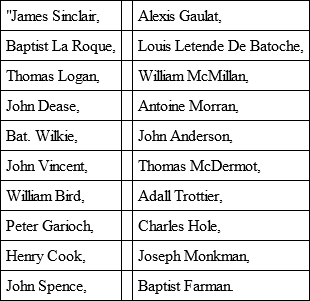
“Alexander Christie, Esq.,
“Governor of Red River Settlement.”
Governor Christie’s reply to these inquiries was so mild and conciliatory that it will not add materially to our knowledge of the company to give it. But the eight rules adopted by the company in council let us into the secret soul of the monstrosity, and are here given, that Americans may be informed as to its secret workings, and also to show what little regard an Englishman has for any but an aristocratic or moneyed concern.
“Extracts from minutes of a meeting of the Governor and Council of Rupert’s Land, held at the Red River settlement, June 10, 1845
“Resolved, 1st, That, once in every year, any British subject, if an actual resident, and not a fur trafficker, may import, whether from London or from St. Peter’s, stores free of any duty now about to be imposed, on declaring truly that he has imported them at his own risk.
“2d. That, once in every year, any British subject, if qualified as before, may exempt from duty, as before, imports of the local value of ten pounds, on declaring truly that they are intended exclusively to be used by himself within Red River settlement, and have been purchased with certain specified productions or manufactures of the aforesaid settlement, exported in the same season, or by the latest vessel, at his own risk.
“3d. That once in every year, any British subject, if qualified as before, who may have personally accompanied both his exports and imports, as defined in the preceding resolution, may exempt from duty, as before, imports of the local value of fifty pounds, on declaring truly that they are either to be consumed by himself, or to be sold by himself to actual consumers within the aforesaid settlement, and have been purchased with certain specified productions or manufactures of the settlement, carried away by himself in the same season, or by the latest vessel, at his own risk.
“4th. That all other imports from the United Kingdom for the aforesaid settlement, shall, before delivery, pay at York Factory a duty of twenty per cent. on their prime cost; provided, however, that the governor of the settlement be hereby authorized to exempt from the same all such importers as may from year to year be reasonably believed by him to have neither trafficked in furs themselves, since the 8th day of December, 1844, nor enabled others to do so by illegally or improperly supplying them with trading articles of any description.
“5th. That all other imports from any part of the United States shall pay all duties payable under the provisions of 5 and 6 Vict., cap. 49, the Imperial Statute for regulating the foreign trade of the British possessions in North America; provided, however, that the governor-in-chief, or, in his absence, the president of the council, may so modify the machinery of the said act of Parliament, as to adapt the same to the circumstances of the country.
“7th. That, henceforward, no goods shall be delivered at York Factory to any but persons duly licensed to freight the same; such licenses being given only in cases in which no fur trafficker may have any interest, direct or indirect.
“8th. That any intoxicating drink, if found in a fur trafficker’s possession, beyond the limits of the aforesaid settlement, may be seized and destroyed by any person on the spot.
“Whereas the intervention of middle men is alike injurious to the honorable company and to the people; it is resolved,
“9th. That, henceforward, furs shall be purchased from none but the actual hunters of the same.
“Fort Garry, July 10, 1845.”
Copy of License referred to in Resolution 7
“On behalf of the Hudson’s Bay Company, I hereby license A. B. to trade, and also ratify his having traded in English goods within the limits of Red River settlement. This ratification and this license to be null and void, from the beginning, in the event of his hereafter trafficking in furs, or generally of his usurping any whatever of all the privileges of the Hudson’s Bay Company.”
It was to save Oregon from becoming a den of such oppressors and robbers of their own countrymen, that Whitman risked his life in 1842-3, that the provisional government of the American settlers was formed in 1843, that five hundred of them flew to arms in 1847, and fought back the savage hordes that this same Hudson’s Bay Company had trained, under the teaching of their half-breeds and Jesuit priests, to sweep them from the land. Is this so? Let us see what they did just across the Rocky Mountains with their own children, as stated by their own witnesses and countrymen.
Sir Edward Fitzgerald says of them, on page 213: —
“But the company do not appear to have trusted to paper deeds to enforce their authority.
“They were not even content with inflicting fines under the form of a hostile tariff; but, as the half-breeds say, some of the fur traders were imprisoned, and all the goods and articles of those who were suspected of an intention to traffic in furs were seized and confiscated.
“But another, and even more serious attack, was made on the privileges of the settlers.
“The company being, under their charter, nominal owners of the soil, dispose of it to the colonists in any manner they think best. A portion of the land in the colony is held from Lord Selkirk, who first founded the settlement.
“Now, however, the company drew up a new land deed, which all were compelled to sign who wished to hold any land in the settlement.”
This new land deed, above referred to, is too lengthy and verbose to be given entire; therefore we will only copy such parts as bind the settlers not to infringe upon the supposed chartered rights of the Hudson’s Bay Company.
The first obligation of the person receiving this deed was to settle upon the land within forty days, and, within five years, cause one-tenth part of the land to be brought under cultivation.
The second: “He, his executors, administrators, and assigns, shall not, directly or indirectly, mediately or immediately, violate or evade any of the chartered or licensed privileges of the said governor and company, or any restrictions on trading or dealing with Indians or others, which have been or may be imposed by the said governor and company, or by any other competent authority, or in any way enable any person or persons to violate or evade, or to persevere in violating or evading the same; and, in short, shall obey all such laws and regulations as within the said settlement now are, or hereafter may be in force” – Here are enumerated a long list of political duties pertaining to the citizen.
The deed in its third condition says: “And also that he [the said receiver of the deed], his executors, administrators, and assigns, shall not nor will, without the license or consent of the said governor and company for that purpose first obtained, carry on or establish, in any part of North America, any trade or traffic in, or relating to, any kind of skins, furs, peltry, or dressed leather, nor in any manner, directly or indirectly, aid or abet any person or persons in carrying on such trade or traffic.” – Here follows a long lingo, forbidding the settler to buy, make, or sell liquors in any shape on his lands, and requiring him, under pain of forfeiture of his title, to prevent others from doing so, and binding the settler, under all the supposed and unsupposed conditions of obligation, not to supply or allow to be supplied any articles of trade to any unauthorized (by the company) person supposed to violate their trade, including companies “corporate or incorporate, prince, power, potentate, or state whatsoever, who shall infringe or violate, or who shall set about to infringe or violate the exclusive rights, powers, privileges and immunities of commerce, trade, or traffic, or all or any other of the exclusive rights, powers, privileges, and immunities of, or belonging, or in any wise appertaining to, or held, used or enjoyed by the said governor and company, and their successors, under their charter or charters, without the license or consent of the said governor and company and their successors, for the time being, first had and obtained.
“And, lastly,” – here follows a particular statement asserting that for the violation of any one of the thousand and one conditions of that deed, the settler forfeits to the company his right to the land, which reverts back to the company.
Our country delights to honor the sailor and soldier who performs a good, great, or noble act to save its territory from becoming the abode of despotism, or its honor from the taunt of surrounding nations. In what light shall we regard the early American missionaries and pioneers of Oregon?
It is true they heard the call of the oppressed savage for Christian light and civilization. They came in good faith, and labored faithfully, though, perhaps, mistaking many of the strict duties of the Christian missionary; and some, being led astray by the wiles and cunning of an unscrupulous fur monopoly, failed to benefit the Indians to the extent anticipated; yet they formed the nucleus around which the American pioneer with his family gathered, and from which he drew his encouragement and protection; and a part of these missionaries were the leaders and sustainers of those influences which ultimately secured this country to freedom and the great Republic.
The extracts from the deed above quoted show what Oregon would have been, had the early American missionaries failed to answer the call of the Indians, or had been driven from the country; or even had not Whitman and his associates separated, the one to go to Washington to ask for delay in the settlement of the boundary question, the others to the Wallamet Valley to aid and urge on the organization of the provisional government.
CHAPTER IX
Puget Sound Agricultural Company. – Its original stock. – A correspondence. – No law to punish fraud. – A supposed trial of the case. – Article four of the treaty. – The witnesses. – Who is to receive the Puget Sound money. – Dr. Tolmie, agent of the company. – The country hunted up. – Difficult to trace a fictitious object. – Statement of their claim. – Result of the investigation.
The Puget Sound Agricultural Company, now claiming of our government the sum of $1,168,000, was first talked of and brought into existence at Vancouver in the winter of 1837, in consequence of, and in opposition to, the Wallamet Cattle Company, which was got up and successfully carried through by the influence and perseverance of Rev. Jason Lee, superintendent of the Methodist Mission. This Nasqualla and Puget Sound Company was an opposing influence to Mr. Lee and his mission settlement, and was also to form the nucleus for two other British settlements in Oregon, to be under the exclusive control of the Hudson’s Bay Company.
The original stock of the company was nominally £200,000. The paid-up capital upon this amount was supposed to be ten per cent., which would give £20,000, or $96,800, at $4.84 per pound. From the most reliable information we can get, this amount was taken from a sinking fund, or a fund set apart for the purpose of opposing any opposition in the fur trade. About the time this Puget Sound Company came into existence, the American fur companies had been driven from the country, and the fund was considered as idle or useless stock; and as the question of settlement of the country would in all probability soon come up, Rev. Mr. Lee having taken the first step to the independence of his missionary settlement in the Wallamet, this Puget Sound Company was gotten up to control the agricultural and cattle or stock interests of the country. It was in existence in name some two years before its definite arrangements were fixed by the Hudson’s Bay Company, through the agency of Dr. W. F. Tolmie, who went to London for that purpose, and by whom they were concluded, “with the consent of the Hudson’s Bay Company, who stipulated that an officer connected with the fur-trade branch of the Hudson’s Bay Company should have supreme direction of the affairs of the Puget Sound Company in this country. It was also stipulated that the Puget Sound Company should be under bonds not to permit any of its employés to be in any way concerned in the fur trade, in opposition to the Hudson’s Bay Company.”
It is easy to be seen by the above-stated condition, that the Hudson’s Bay Company were not willing to allow the least interference with their fur trade by any one over whom they had any control or influence; that their design and object was to control the trade of the whole country, and that they had no intention in any way to encourage any American settlement in it, as shown by the arrangements made as early as 1837.
There had been a correspondence with the managing directors of the company in London previous to Dr. Tolmie’s visit. The directors had discouraged the proposed enlargement of their business, but it seems from the statement of Dr. Tolmie, and the arrangements he made, that they acceded to his plans, and constituted him their special agent. There was at the time a question as to a separate charter for that branch of their business. It was finally conceded that a separate charter would enable this agricultural and cattle company to become independent of the fur branch, and thus be the means of establishing an opposition by the use of the funds appropriated to prevent any thing of this kind, and decided that as the company had stipulated that they were to have the “supreme direction of the Puget Sound Agricultural Company,” no charter was necessary, and hence any arrangements to that effect were withdrawn. It was from a knowledge of the fact that that company had not even the Parliamentary acknowledgment of its separate existence from the Hudson’s Bay Company, that all their land claims were at once taken; and upon that ground they have not dared to prosecute their claims, only under the wording of the treaty with the United States, which is the only shadow of a legal existence they have, and which, there is no question, would have been stricken from the treaty, except through the fur influence of the company to increase the plausibility of their claims against our government.
If there was any law to punish a fraud attempted to be committed by a foreign company upon a friendly nation, this would be a plain case; as the Hudson’s Bay Company, they claim $3,822,036.37; as the Puget Sound Company, $1,168,000. The original stock of the Hudson’s Bay Company was £10,500, or $50,820. In 1690 the dividends upon this capital invested were so enormous that the company voted to treble their stock, which was declared to be £31,500, or $152,460. In 1720 the capital was again declared trebled, and to be £94,500, or $457,380, while the only amount paid was £10,500, or $50,820. It was then proposed to add three times as much to its capital stock by subscription; each subscriber paying £100 was to receive £300 of stock, so that the nominal stock should amount to £378,000, or $1,820,520 – the real additional sum subscribed being £94,500, and the amount of real stock added or paid but £3,150. In 1821, the Hudson’s Bay Company and Northwest Company, of Montreal, were united. The Hudson’s Bay Company called £100 on each share of its stock, thus raising it nominally to £200,000, or $958,000. The Northwest Company called theirs the same. The two companies combined held a nominal joint stock of £400,000, or $1,916,000, while we have reason to suppose that the original stock of the two companies, admitting that the Northwest French Company had an equal amount of original capital invested, would give £37,300, or $135,134, as the capital upon which they have drawn from our country never less than ten per cent. per annum, even when counted at £400,000, or $1,916,000; and what, we would ask, has America received in return for this enormous drain of her wealth and substance?
Have the Indians in any part of the vast country occupied by that company been civilized or bettered in their condition? Have the settlements under their fostering care been successful and prosperous? Have they done any thing to improve any portion of the country they have occupied, any further than such improvements were necessary to increase the profits of their fur trade?
To every one of these questions we say, emphatically, No, not in a single instance. On the contrary, they have used their privileges solely to draw all the wealth they could from the country, and leave as little as was possible in return.
The British author, from whose book we have drawn our figures of that company’s stock, says of them: “To say, then, that the trade of this country (England) has been fostered and extended by the monopoly enjoyed by the company, is exactly contrary to the truth.”
We come now to learn all we can of a something that has assumed the name of Puget Sound Agricultural Company, and under that name, through the paternal influence of a bastard corporation, presumes to ask an immense sum of the American government, whose country they have used all their power and influence to secure to themselves, by acting falsely to their own. We do not claim to be learned in the law of nations, therefore we can only express such an opinion in this case as we would were the case argued before a learned court and we one of the jurors, giving our opinion as to the amount the parties were entitled to receive. We will suppose that the lawyers have made their pleas, which would, when printed, with the testimony on both sides, make a volume of the usual size of law books of one thousand pages. Of course the fourth article of the treaty would be read to us by both the lawyers, and explained by the judge, who would doubtless say to the jury the first question to decide is, whether there is sufficient evidence to convince you that the company claiming this name have any legal existence outside the wording of the fourth article of this treaty. Our answer would be: “Your honor, there is not the least word in a single testimony presented before us to show that they ever had any existence, only as they assumed a name to designate the place a certain branch of the Hudson’s Bay Company’s business, outside of its legitimate trade; that this being a branch legitimately belonging to a settlement of loyal citizens of the country, we find that this Hudson’s Bay Company, in assuming the supreme direction, as per testimony of Dr. Tolmie, superseded and usurped the prerogatives of the State; that the claim of this company, as set up in the wording of the treaty, is for the benefit of a company having no natural or legal right to assume supreme direction of the soil or its productions. Hence any improvement made, or stock destroyed, was at the risk of the individual owning, or making, or bringing such stock or improvements into the country, and subject exclusively to the laws of the country in which the trespass occurred. The claiming a name belonging to no legal body cannot be made legal by a deception practiced upon the persons making the treaty, as this would be equivalent to pledging the nation to the payment of money when no cause could be shown that money was justly due, as neither nation (except by a deception brought to bear upon commissioners forming the treaty by the mere assertion of an interested party) acknowledged the reported existence of such a corporation, thereby creating a corporate body by the wording of a treaty.” This, to a common juror, we confess, would look like removing the necessity of a common national law, in relation to all claims of foreigners who might feel disposed to come over and trespass upon our national domain. A word in this treaty does not settle the matter, and the claim should not be paid. The article above referred to is commented upon by Mr. Day as follows: —
“That by article four of the treaty concluded between the United States of America and Great Britain, under date of the 15th day of June, 1864, it was provided that the farms, lands, and other property, of every description, belonging to the Puget Sound Agricultural Company, on the north side of the Columbia River [they should have included those in the French possession, and added another million to their claim; but we suppose they became liberal, and consented to take half of the country their servants had settled upon], should be confirmed to the said company; but that in case the situation of those farms and lands should be considered by the United States to be of public and political importance, and the United States government should signify a desire to obtain possession of the whole, or of any part thereof, the property so required should be transferred to the said government at a proper valuation, to be agreed upon between the parties.
“That the government of the United States has not, at any time, signified to the company a desire that any of the said property should be transferred to the said government at a valuation as provided by the treaty, nor has any transfer thereof been made [this was a great misfortune. Uncle Sam had so much land of his own he did not want to buy out this bastard company right away after the treaty was made]; but the company have ever since continued to be the rightful owners of the said lands, farms, and other property, and entitled to the free and undisturbed possession and enjoyment thereof. [True; so with all bastards. They live and die, and never find a father to own them, except they come up with a big pile of money, which in your claim is a case of clonas (don’t know.)]
“That, by a convention concluded between the two governments on the 1st day of July, 1863, it was agreed that all questions between the United States authorities on the one hand, and the Puget Sound Agricultural Company on the other, with respect to the rights and claims of the latter, should be settled by the transfer of such rights and claims to the government of the United States for an adequate money consideration.
“And the claimants aver that the rights and claims of the Puget Sound Agricultural Company, referred to and intended in and by the said convention, are their rights and claims in and upon the said lands, farms, and other property of every description which they so held and possessed within the said territory, and which, by reason of the said treaty of the 15th of June, 1846, and according to the terms of the fourth article thereof, the United States became and were bound to confirm. And of the said farms and other property, they now submit to the honorable the commissioners a detailed statement and valuation, as follows.”
There have been twenty-seven witnesses examined to prove the claims above set forth, and not a single one of them testified or gave the least intimation that there ever was any such company as here set forth in existence, only as connected with and subject to the control and management of the Hudson’s Bay Company, the same as their farming operations at Vancouver or Colville, or any other of their posts. The claim is so manifestly fictitious and without foundation, that the learned attorney for the company bases his whole reliance upon the wording of the treaty, and in consequence of the wording of that treaty, “and according to the terms of the fourth article thereof, he says the United States became and were bound to confirm.” So we suppose any other monstrous claim set up by a band of foreign fur traders having influence enough to start any speculation on a nominal capital in our country and failing to realize the profits anticipated, must apply for an acknowledgment of their speculation, be mentioned in a treaty, and be paid in proportion to the enormity of their demands. We are inclined to the opinion that so plain a case of fraud will be soon disposed of, and the overgrown monster that produced it sent howling after the Indians they have so long and so successfully robbed, as per their own admission, of £20,000,000 sterling. (See Mr. M. Martin’s Hudson’s Bay Company’s Territory, etc., p. 131.)
There is another question arising in this supposed Puget Sound concern. Suppose, for a moment, the commissioners decide to pay the whole or any part of this demand, who will be the recipients of this money? We doubt whether the learned commissioners or the counsel of the supposed company could tell, unless it is to be his fee for prosecuting the case.
Doctor William Fraser Tolmie and Mr. George B. Roberts are the only two witnesses that appear to know much about the matter, and Mr. Roberts’ information seems to be derived from the same source as our own, so that the writer, though not a member of the company, has about as good a knowledge of its object and organization as Mr. Roberts, who was connected with the Hudson’s Bay Company, and also an agent of this Puget Sound Company.
Dr. Tolmie says: “The Puget Sound Company acquired, or purchased from the Hudson’s Bay Company, all its improvements at Cowlitz and Nasqualla, with its lands, live stock, and agricultural implements, all of which were transferred, in 1840 or 1841, by the Hudson’s Bay Company to the Puget Sound Company.”
As we understand this matter, it amounts to just this, and no more: The Hudson’s Bay Company had consented to enlarge their business by employing an outside capital or sinking fund they had at their disposal; they instructed Dr. Tolmie, their special agent for that purpose, to receive all the property at the two stations or farms named, to take possession of them, and instead of opening an account with their opposition sinking fund, they called it the Puget Sound Agricultural Company. This explains the ten per cent. paid stock into that company. Now, if this venture is profitable, nothing is lost; if it is not, it does not interfere with the legitimate business of the fur company – hence the distinct claim under this name.
“The Puget Sound Company charged the Hudson’s Bay Company for all supplies furnished, and paid the Hudson’s Bay Company for all goods received from them.”
This was exactly in the line of the whole business done throughout the entire Hudson’s Bay Company, with all their forts, and other establishments.
“Were not the accounts of the Puget Sound Company always forwarded to the Hudson’s Bay Company’s depot?” “They were,” says Dr. Tolmie; and so were all the accounts of all the posts on this coast sent to the depot at Vancouver, and thence to head-quarters on the other side of the Rocky Mountains.
We have shown, by reference to the capital stock of the Hudson’s Bay Company, that, in 1821, it was counted at £200,000. From this sum ten per cent., or £20,000, was set apart as a sinking fund to oppose any fur company or traders on the west side of the mountains, and an equal sum for the same purpose on the east.
This western amount, being placed under the direction of Dr. Tolmie and his successors, produced in seven years £11,000 sterling, equal to $53,240. This transaction does not appear, from the testimony adduced in the case, to have interfered in the least with the fur trade carried on at these stations, and by the same officers or clerks of the Hudson’s Bay Company; hence, we are unable, from the whole catalogue of twenty-seven witnesses in the case, to find out who is to receive this nice little sum of $1,168,000 or £240,000 – only £40,000 more than the mother had to trade upon when she produced this beautiful full-grown child, the Puget Sound Agricultural Company, – having had an abortion on the other side of the continent in the loss, without pay, of a large portion of the Red River or Selkirk country. Uncle Sam was ungenerous there.
This is truly an acre of wonders, and this Hudson’s Bay Company and its productions are entitled to some consideration for their ingenuity, if not for their honesty. It will be interesting to look at our British cousins and see what is said about this “itself and its other self.” Mr. Fitzgerald says, page 260: “It is a matter of importance to know whether the Hudson’s Bay Company is about to submit itself and its other self– the Puget Sound Association – to the same regulations which are to be imposed on other settlers of Vancouver Island and British Columbia.”
On page 287, he further states: “The Oregon Territory was peopled, under the influence of the company, with subjects of the United States. (Since Writing the former chapter, I have heard this account given of the conduct of the Hudson’s Bay Company, in regard to the Oregon boundary, which offers still stronger ground for inquiry. The country south of the 49th parallel, it seems, was hunted up – therefore the posts of the Hudson’s Bay Company were become of no value at all. By annexing all that country to the United States, and inserting in the treaty a clause that the United States should pay the company for all its posts if it turned them out, the company were able to obtain from the Americans a large sum of money for what would have been worth nothing had the territory remained British.) That lost us the boundary of the Columbia River. That is one specimen of the colonization of the Hudson’s Bay Company. The boundary westward from the Lake of the Woods, we have seen, gave to the United States land from which the company was engaged, at the very time, in driving out British subjects, on the plea that it belonged to the company; and now that the boundary has been settled only a few years, we learn that the settlers on our side are asking the United States to extend her government over that country.”
If this does not show a clear case of abortion on the part of that honorable Hudson’s Bay Company east of the Rocky Mountains, tell us what does. But it is interesting to trace a little further the British ideas and pretensions to this Pacific coast. Our British author says, page 288: —
“Make what lines you please in a map and call them boundaries, but it is mockery to do so as long as the inhabitants are alienated from your rule, as long as you have a company in power whose policy erases the lines which treaties have drawn.
“Forasmuch, then, as these things are so, it becomes this country [Great Britain] to record an emphatic protest against the recent policy of the Colonial Office in abandoning the magnificent country on the shores of the Pacific Ocean to the Hudson’s Bay Company.
“The blindest can not long avoid seeing the immense importance of Vancouver Island to Great Britain. Those who, two years ago [1846], first began to attract public attention to this question, are not the less amazed at the unexpected manner and rapidity with which their anticipations have been realized.
“Six months ago it was a question merely of colonizing Vancouver Island; now it is a question involving the interests of the whole of British North America, and of the empire of Great Britain in the Pacific Ocean.”
It is always more or less difficult to trace the course of a false or fictitious object. It becomes peculiarly so when two objects of the same character come up; the one, by long practice and experience, assuming a fair and honorable exterior, having talent, experience, and wealth; the other, an illegitimate production, being called into existence to cripple the energies of two powerful nations, and living under the supreme control of the body, having acquired its position through the ignorance of the nations it seeks to deceive. It is out of the question to separate two such objects or associations. The one is the child of the other, and is permitted to exist while the object to be accomplished remains an opponent to the parent association.
The opposition to the fur monopoly having ceased west of the Rocky Mountains, a new element of national aggrandizement and empire comes within the range of this deceitful and grasping association. Its child is immediately christened and set to work under its paternal eye. We have the full history of the progress made by this Mr. Puget Sound Agricultural Company in the testimony of the twenty-seven witnesses summoned to prove his separate existence from that of the Hudson’s Bay Company.
We find, in tracing the existence of these two children of the British empire in North America, that they have established themselves in an island on the Pacific coast called Vancouver. In this island they are more thrifty and better protected than they were in the dominions of Uncle Samuel. Notwithstanding they are comfortably located, and have secured the larger part of that island and the better portion of British Columbia, there is occasionally a British subject that grumbles a little about them in the following undignified style: —
“If the company were to be destroyed to-morrow, would England be poorer? Would there not rather be demanded from the hands of our own manufacturers ten times the quantity of goods which is sent abroad, under the present system, to purchase the skins?” My dear sir, this would make the Indians comfortable and happy. “We boast [says this Englishman] that we make no slaves, none at least that can taint our soil, or fret our sight; but we take the child of the forest, whom God gave us to civilize, and commit him, bound hand and foot, to the most iron of all despotisms —a commercial monopoly.
“Nor, turning from the results of our policy upon the native population, to its effect upon settlers and colonists, is there greater cause for congratulation.
“The system which has made the native a slave is making the settler a rebel.
“Restrictions upon trade, jealousy of its own privileges, interference with the rights of property, exactions, and all the other freaks in which monopoly and despotism delight to indulge, have, it appears, driven the best settlers into American territory, and left the rest, as it were, packing up their trunks for the journey.”
This, so far as relates to the proceedings, policy, and influence of that company upon the settlement of Vancouver Island and British Columbia, is verified by the facts now existing in those British colonies. Their whole system is a perfect mildew and blight upon any country in which they are permitted to trade or to do business.
We have little or no expectation that any thing we may write will affect in the least the decision of the commissioners, whose business it is to decide this Puget Sound Company’s case; but, as a faithful historian, we place on record the most prominent facts relating to it, for the purpose of showing the plans and schemes of an English company, who are a nuisance in the country, and a disgrace to the nation under whose charters they profess to act. Up to the time we were permitted to examine the testimony they have produced in support of their monstrous claims, we were charitable enough to believe there were some men in its employ who could be relied upon for an honest and truthful statement of facts in relation to the property and improvements for which these claims are made; but we are not only disappointed, but forced to believe the truth is not in them, – at least in any whose testimony is before us in either case. Our English author says: —
“It does not appear that the interposition of ‘an irresponsible company’ can be attended with benefit to the colony. – A company whose direction is in London, and which is wholly irresponsible, either to the colonists or to the British Parliament. – There is ample evidence in the foregoing pages that it would be absurd to give this company credit for unproductive patriotism. – Considering the identity existing between this association [the Puget Sound Association] and the Hudson’s Bay Company, in whose hands the whole management of the colonization of Vancouver Island is placed, there is a very strong reason to fear that the arrangements which have been made will, for some years at any rate, utterly ruin that country as a field for colonial enterprise. There is a strong inducement for the company to grant all the best part of the island to themselves, under the name of the Puget Sound Association; and to trust to the settlements which may be formed by that association as being sufficient to satisfy the obligation to colonize which is imposed by the charter.
“There is a strong inducement to discourage the immigration of independent settlers; first, because when all the colonists are in the position of their own servants, they will be able much more readily to prevent interference with the fur trade; and secondly, because the presence of private capital in the island could only tend to diminish their own gains, derived from the export of agricultural produce.
“And, on the other hand, there will be every possible discouragement to emigrants of the better class to settle in a colony where a large part of the country will be peopled only by the lowest order of workmen, where they may have to compete with the capital of a wealthy company, and that company not only their rival in trade, but at the same time possessed of the supreme power, and of paramount political influence in the colony.
“There is a reason, more important than all, why the Hudson’s Bay Company will never be able to form a colony. An agricultural settlement they may establish; a few forts, where Scotchmen will grumble for a few years before they go over to the Americans, but never a community that will deserve the name of a British colony. They do not possess public confidence.
“But the Hudson’s Bay Company – the colonial office of this unfortunate new colony —has positive interests antagonistic to those of an important settlement.
“It is a body whose history, tendency, traditions, and prospects are equally and utterly opposed to the existence, within its hunting-grounds, of an active, wealthy, independent, and flourishing colony,” (we Americans say settlements) “with all the destructive consequences of ruined monopoly and wide-spread civilization.”
Need we stop to say the above is the best of British testimony in favor of the position we have assumed in relation to a company who will cramp and dwarf the energies of their own nation to increase the profits on the paltry capital they have invested.
Have the Americans any right to believe they will pursue any more liberal course toward them than they have, and do pursue toward their countrymen? As this writer remarks, “civilization ruins their monopoly.” The day those two noble and sainted women, Mrs. Spalding and Mrs. Whitman, came upon the plains of the Columbia, they could do no less than allow England’s banner to do them reverence, for God had sent and preserved them, as emblems of American civilization, religious light, and liberty upon this coast. One of them fell by the ruthless hand of the sectarian savages, pierced by Hudson’s Bay balls from Hudson’s Bay guns. The other was carried, in a Hudson’s Bay boat, to the protecting care of the American settlement; and for what purpose? That the savage might remain in barbarism; that the monster monopoly might receive its profits from the starving body and soul of the Indian; that civilization and Christianity, and the star of empire might be stayed in their westward course.
Not yet satisfied with the blood of sixteen noble martyrs to civilization and Christianity, quick as thought their missives are upon the ocean wave. Wafted upon the wings of the wind, a foul slander is sent by the representatives of that monopoly all over the earth, to blast her (Mrs. Whitman’s) Christian and missionary character with that of her martyred husband. And why?
Because that husband had braved the perils of a winter journey to the capital of his country, to defeat their malicious designs, to shut up the country and forever close it to American civilization and religion. And now, with an audacity only equaled by the arch-enemy of God and man, they come to our government and demand five millions of gold for facilitating the settlement of a country they had not the courage or power to prevent.
This, to a person ignorant of the peculiar arrangements of so monstrous a monopoly, will appear strange – that they should have an exclusive monopoly in trade in a country, and have not the courage or power to prevent its settlement, especially when such settlement interferes with its trade. So far as American territory was concerned, they were only permitted to have a joint occupancy in trade. The sovereignty or right of soil was not settled; hence, any open effort against any settler from any country was a trespass against the rights of such settler. They could only enforce their chartered privileges in British territory. The country, under these circumstances, afforded them a vast field in which to combine and arrange schemes calculated to perpetuate their own power and influence in it. The natives of the country were their trading capital and instruments, ready to execute their will upon all opponents. The Protestant missionaries brought an influence and a power that at once overturned their licensed privileges in trade, because with the privilege of trade, they had agreed, in accepting their original charter, to civilize and Christianize the natives of the country. This part of their compact the individual members of the company were fulfilling by each taking a native woman, and rearing as many half-civilised subjects as was convenient. This had the effect to destroy their courage in any investigation of their conduct. As to their power, as we have intimated above, it was derived from the capacity, courage, prejudices, and ignorance of the Indians, which the American missionary, if let alone, would soon overcome by his more liberal dealings with them, and his constant effort to improve their condition, which, just in proportion as the Indians learned the value of their own productions and labor, would diminish the profits in the fur trade.
This increase of civilization and settlement, says chief-trader Anderson, “had been foreseen on the part of the company, and to a certain extent provided for. The cession of Oregon, under the treaty of 1846, and the consequent negotiations for the transfer to the American government of all our rights and possessions in their territory, retarded all further proceedings.”
In this statement of Mr. Anderson, and the statement of Mr. Roberts, an old clerk of the company, and from our own observations, this “foreseeing” on the part of the company was an arrangement with the Indians, and such as had been half civilized by the various individual efforts of the members and servants of the company, to so arrange matters that an exterminating war against the missionary settlements in the country should commence before the Mexican difficulty with the United States was settled.
This view of the question is sustained by the reply of Sir James Douglas to Mr. Ogden, by Mr. Ogden’s course and treatment of the Indians on his way up the Columbia River, his letters to Revs. E. Walker and Spalding, his special instructions to the Indians, and payment of presents in war materials for their captives, and the course pursued by Sir James Douglas in refusing supplies to the provisional troops and settlers, and the enormous supplies of ammunition furnished to the priests for the Indians during the war of 1847-8.
We are decidedly of the same opinion respecting that company as their own British writer, who, in conclusion, after giving us a history of 281 pages, detailing one unbroken course of oppression and cruelty to all under their iron despotism, says: —
“The question at issue is a serious one, – whether a valuable territory shall be given up to an irresponsible corporation, to be colonized or not, as it may suit their convenience; or whether that colonization shall be conducted in accordance with any principles which are recognized as sound and right?”
We can easily see the connection in the principle of right in paying any portion of either of the monstrous claims of that company, which never has been responsible to any civilized national authority.
“The foregoing exposure of the character and conduct of the company has been provoked. When doubts were expressed whether the company were qualified for fulfilling the tasks assigned to them by the Colonial Minister, and when they appealed to their character and history, it became right that their history should be examined, and their character exposed.
“The investigation thus provoked has resulted in the discovery that their authority is fictitious, and their claims invalid. As their power is illegal, so the exercise of it has been mischievous; it has been mischievous to Great Britain, leaving her to accomplish, at a vast national expense, discoveries which the company undertook, and were paid to perform; and because our trade has been contracted and crippled, without any advantage, political or otherwise, having been obtained in return; it has been mischievous to the native Indians, cutting them off from all communication with the rest of the civilized world, depriving them of the fair value of their labor, keeping them in a condition of slavery, and leaving them in the same state of poverty, misery, and paganism in which it originally found them; it has been mischievous to the settlers and colonists under its influence, depriving them of their liberties as British subjects, frustrating, by exactions and arbitrary regulations, their efforts to advance, and, above all, undermining their loyalty and attachment to their mother country, and fostering, by bad government, a spirit of discontent with their own, and sympathy with foreign institutions.”
This writer says: “This is the company whose power is now [in 1849] to be strengthened and consolidated! – to whose dominion is to be added the most important post which Great Britain possesses in the Pacific, and to whom the formation of a new colony is to be intrusted.”
And, we add, this is the power that has succeeded in forcing their infamous claims upon our government to the amount above stated, and by the oaths of men trained for a long series of years to rob the Indian of the just value of his labor, to deceive and defraud their own nation as to the fulfillment of chartered stipulations and privileges.
The facts developed by our history may not affect the decision of the commissioners in their case, but the future student of the history of the settlement of our Pacific coast will be able to understand the influences its early settlers had to contend with, and the English colonist may learn the secret of their failure to build up a wealthy and prosperous colony in any part of their vast dominion on the North American continent.
CHAPTER X
Case of The Hudson’s Bay Company v. The United States. – Examination of Mr. McTavish. – Number of witnesses. – Their ignorance. – Amount claimed. – Original stock. – Value of land in Oregon. – Estimate of Hudson’s Bay Company’s property. – Remarks of author.
I have carefully reviewed all the testimony in the above case, on both sides, up to May 1, 1867. On April 12, the counsel on the part of the United States having already spent twenty-five days in cross-examining Chief-Factor McTavish, so as to get at the real expenditures of the Hudson’s Bay Company, and arrive at a just conclusion as to the amount due them, – Mr. McTavish having frequently referred to accounts and statements which he averred could be found on the various books of the company, – gave notice to the counsel of the company in the following language: —
“The counsel for the United States require of Mr. McTavish, who, as appears from his evidence, is a chief factor of the Hudson’s Bay Company, and its agent in the prosecution of this claim, to produce here for examination by the United States or their counsel, all accounts, account-books, and letter-books of said company, together with the regulations under which their books were kept, and the various forms of contracts with servants of the company, all of which books, rules, and forms contain evidence pertinent to the issue in this case, as appears from the cross-examination of Mr. McTavish, and suspends the further cross-examination of this witness until he shall produce such books, accounts, rules, and forms.”
On the 1st of May Mr. McTavish’s examination was resumed.
Int. 952.– “Will you please produce here for examination by the United States or their counsel, all accounts, account-books, and letter-books of the Hudson’s Bay Company which were kept at the various posts of that company south of the 49th parallel of north latitude during their occupation by the company, together with the regulations under which their books were kept, and the regular forms of contracts with the company’s servants?”
Ans.– “I can not say whether I will produce them or not.”
(The above question was objected to as incompetent, and as asking the witness, not as to what he knows of the subject, but as to what his future course of action will be, over which, as witness, he can have no control.)
During the examination of Mr. McTavish it was evident that he was the main prosecuting witness, and considerably interested in the results of the claim, or suit.
It would doubtless be interesting to most of our readers to see a review of the testimony, or at least a summary of the evidence presented on both sides in this case. There are now printed about one thousand pages of documents and depositions. That relating particularly to the Hudson’s Bay Company comprises about two-thirds of the whole amount. The balance relates more particularly to the Puget Sound Agricultural Company’s claim. This claim, the company have not been able, by any testimony yet presented, to separate from that of the Hudson’s Bay Company; so that there is no prospect of their receiving one dollar on that account. There have been examined on the part of the Puget Sound Company, to prove its separate existence from the Hudson’s Bay Company, thirty witnesses; on the part of the United States, twenty-one. On the part of the Hudson’s Bay Company’s claim as separate from the Puget Sound Company, nineteen witnesses; on the part of the United States, thirty. On both sides not far from forty-five witnesses have been called upon the stand to testify in this important case. The company in London have been requested to furnish evidence of the separate organization or independent existence of the two companies; and with all this evidence produced, nothing definite or certain is shown, except that the concern was gotten up to deceive the English people and rob the American government, and to counteract and oppose the American settlement of this country.
As a looker-on and an observer of events in this country, I must confess my astonishment at the ignorance, perverseness, and stupidity of men whom I have ever heretofore regarded as honorable and truthful.
From the testimony before me of the twenty odd English witnesses, it really appears as though they felt that all they had to do was to ask their pay, and our government would give it to them; or, in other words, they, as Englishmen and British subjects, are prepared to compel the payment of any sum they demand.
There are many interesting developments brought out in this case relative to the early history of this country, which renders the depositions in the case, though voluminous and tedious in the main, yet interesting to the close and careful student of our history.
If time and opportunity is given, I will review this whole testimony as a part of the history of this country, and, in so doing, will endeavor to correct an erroneous impression that will result from the testimony as now before us.
The amount claimed in this case is four million nine hundred and ninety thousand thirty-six dollars and sixty-seven cents, or, nine hundred and eighty-five thousand three hundred and fifty pounds sterling, in gold coin.
I now have before me, including the Hudson’s Bay Company’s memorial, eleven hundred and twenty-six pages of printed documents and depositions relating to this case. I also have what may properly be termed British testimony, bearing directly upon this case, which is entitled to its full weight in a proper and just decision as to the amount of compensation this Hudson’s Bay Company is entitled to receive from our government.
I do not propose to review all the one thousand four hundred and nineteen pages of statements and depositions in detail; that would be too tedious, though I might be able to make it interesting to the general reader, as it develops the whole history of that portion of our continent that has for one hundred and ninety-seven years been under the exclusive jurisdiction of a monopoly that effectually closed it to all outside influences up to the year A. D. 1834.
According to our British testimony, it was originally £10,500. In 1690, in consequence of the enormous profits upon this small capital, it was increased threefold, making it £31,500. In 1720 it was declared to be £94,500. In this year the stock was (as is termed) watered. The then proprietors each subscribed £100, and received £300 of stock, calling the whole nominal stock £378,000, while the actual subscription was but £94,500, and only £3,150 was paid. The stock was ordered to reckon at £103,500, while the actual total amount paid was but £13,650.
In 1821, there was another “watering” of the stock, and a call of £100 per share on the proprietors, which raised their capital to £200,000. The Northwest Fur Company joined the Hudson’s Bay Company in this year, and the joint stock was declared to be £400,000.
We are ready to admit, in fact, the testimony in the case goes to prove, that the French Northwest Company brought into the concern an equal amount of capital with that of the Hudson’s Bay Company. This would give the present Hudson’s Bay Company a real capital of £27,300, a nominal capital of £400,000.
By reference to the memorial of the company, we find they claim, on the 8th of April, 1867, of our government: —
For the right to trade, of which the settlement of the country and removal of Indians to reservations has deprived them, £200,000.
For the right of the free navigation of the Columbia River, £300,000.
For their forts, farms, posts, and establishments, with the buildings and improvements, £285,350, making, in all, £785,350, or $3,822,036.67, or £385,350 more than the whole amount of nominal stock which they claim to have invested in their entire trade.
We will not stop to speak of the morality of this claim; it is made in due form, and this with the claim as set forth in the same document, to wit: For lands, farms, forts, and improvements, £190,000; loss of live stock and other losses, £50,000; total, £240,000 – equal to $1,188,000, to be paid in gold. In British money these two sums amount to £1,025,350 sterling, in American dollars to $4,990,036.67; or £625,350 sterling money more than their nominal stock, and £998,050 sterling more than all their real stock invested.
It will be remembered that this demand is simply on account of the settlement of Oregon by the Americans. A part of the posts for which this demand is made are still in their undisputed possession, and a large portion of the claim is set up in consequence of the loss of the profits of the fur trade, of that portion of their business as conducted in territory that originally belonged to the United States, and was actually given up to them by the treaty of December 24, 1814.
The reader will bear in mind, that in the review or discussion of this Hudson’s Bay Company’s claim on our government, we only refer to that part of their trade, and the rights or privileges they were permitted to enjoy, jointly with Americans, in what is now absolutely American territory. Over two-thirds of their capital has always been employed in territory that the American has not been permitted to enter, much less to trade and form a settlement of any kind.
The witnesses on the part of the Hudson’s Bay Company have been forty-one in number. Of this number fifteen are directly interested in the results of the award. Fourteen were brought to the country by, and remained in the service of the company till they left the country; and were all British, though some of them have become naturalized American citizens. Twelve are American citizens, and are supposed to have no particular interest in the results of the case; in fact, their statements are all of a general and very indefinite character. Having come to the country since 1850, they know but little or nothing about the Hudson’s Bay Company, its rights, policy, or interests there. Not one of them appears, from the testimony given, to understand the justness of the company’s claim, or the injustice there would be in allowing any part of it. Their testimony appears to be given under the impression that because the treaty stipulated that the possessory rights of the company were acknowledged and to be respected, that therefore full payment must be paid the company for the right of trade, and the prospective profits in trade, and the increased value of assessable property for an indefinite period in the future. As, for example, a witness is asked: —
“What is the present value per acre of the company’s claims at Cowlitz and Nasqualla, for farming and grazing purposes?”
Ans.– “Supposing both claims to belong to the same person or company, having a clear and undisputed title, and perfectly exempt from molestation in the transaction of business, I think the Cowlitz claim worth to-day thirty dollars an acre, and the Nasqualla claim five dollars an acre, for farming and grazing purposes.”
The fifteen interested witnesses all testify to about the same thing, asserting positively as to the real value of the company’s supposed rights. One of the chief factors, in answer to the interrogatory, “State the value of the post at Vancouver, as well in 1846 as since, until the year 1863; give the value of the lands and of the buildings separately; and state also what was the value of the post in relation to the other posts, and as a center of trade,” said: —
“It being the general depot for the trade of the company west of the Rocky Mountains, in 1846 the establishment at Vancouver, with its out-buildings, was in thorough order, having been lately rebuilt; taking into account this post” (a notorious fact that but two new buildings were about the establishment and in decent repair), “together with the various improvements at the mill, on the mill plain, on the lower plain, and at Sauvies Island, I should estimate its value then to the company at from five to six hundred thousand dollars.”
The value of the land used by the company, at Fort Vancouver, in 1846, say containing a frontage of twenty-five miles on the Columbia, by ten miles in depth, in all two hundred and fifty square miles, or about 160,000 acres, I should calculate as being worth then, on an average, from $2.50 to $3 an acre (at $2.50 would give us $400,000); this, with the improvements, say $500,000, gives us, at this witness’s lowest estimate, $900,000 for the company’s possessory rights.
This witness goes into an argument stating surrounding and probable events, and concludes in these words: “I am clearly of opinion that had the company entire control to deal with it as their own, without any question as to their title, from the year 1846 and up to 1858, when I left there, taking the fort as a center point, the land above and below it, to the extent of three square miles, or 1,920 acres, with frontage on the Columbia River, could have been easily disposed of for $250 per acre ($480,000). The remainder of the land claim of the company at Vancouver is more or less valuable, according to its locality; thus, I consider the land on the lower plain, having frontage on the river for a distance of five miles, or 3,200 acres, as worth $100 per acre ($320,000). Below that, again, to the Cathlapootl, a distance of probably ten miles, with a depth of two miles, or 12,800 acres, is worth $25 an acre ($320,000). Going above the fort plain, and so on to the commencement of the claim, two miles above the saw-mill on the Columbia River, say a distance of six or seven miles and back three miles, or about 13,500 acres, should be worth from $10 to $15 per acre” ($135,000, at $10, his lowest estimate). “The remainder of the claim is worth from $1.50 to $3 per acre.” It being 128,580 acres, at $1.50 per acre, $192,580. This would make for the Vancouver property, as claimed, and several witnesses have sworn the value to amount, as per summary of a chief factor’s testimony —

This gives us the sum of $1,947,580 in gold coin, as the value of the possessory rights of the honorable the Hudson’s Bay Company to Fort Vancouver and its immediate surroundings.
This chief factor’s oath and estimate of the property is sustained by the estimates and oaths of three other chief factors, amounting to about the same sum. This one, after answering in writing, as appears in his cross-examination, twenty sworn questions affirming to the facts and truth of his knowledge of the claims and business of the company, etc., is cross-questioned (Interrogatory 477), by the counsel for the United States, as follows: “Can you not answer the last interrogatory more definitely?” The 476th interrogatory was: “Have you not as much knowledge of what the company claimed in this direction as any other?” The answer to the 477th interrogatory is: “Referring to my answer to the last interrogatory, it will be at once seen that I have no personal knowledge as to what land the company actually claimed on that line or any other, as regards the land in the neighborhood of Fort Vancouver. This answer embraces even the present time.”
There are several American witnesses introduced to prove this monstrous claim, and to show the reasonableness and justness of their demand. I will give a specimen of an answer given by one of them. After estimating the amount of land in a similar manner to the witness above referred to, calculating the land in four divisions, at $50, $10, and $1.25 per acre, and 161,000 acres amounting to $789,625, without any estimate upon the buildings or improvements, the following question was put to him: “Have you any knowledge of the market value of land in the vicinity of Vancouver, at any time since 1860?”
Ans.– “I only heard of one sale, which was near the military reserve; I think this was of 100 acres, and I understand brought $100 an acre. I heard of this within the last few months, but nothing was said, that I remember, about the time when the sale was made.”
From the intelligence and official position of this American witness, we are forced to the conclusion that the enriching effects of old Hudson’s Bay rum must have made him feel both wealthy and peculiarly liberal in estimating the possessory rights of his Hudson’s Bay Company friends.
There is one noticeable fact in relation to quite a number of the witnesses called, and that have testified in behalf of the company’s claim. It is their ignorance – we may add, total ignorance – of the general business, profits, and policy of the company. This remark will apply to every witness whose deposition has been taken, including their bookkeepers and clerks in London, and their chief factors in Oregon. Dr. McLaughlin seems to have been the only man upon this coast that knew, or that could give an intelligent account of its policy or its proceedings.
The whole Hudson’s Bay Company concern appears like a great barrel, bale, or box of goods, put up in London, and marked for a certain district, servants and clerks sent along with the bales, and boxes, and barrels of rum, to gather up all the furs and valuable skins they can find all over the vast country they occupy, then bale up these furs and skins and send them to London, where another set of clerks sell them and distribute the profits on the sale of the furs.
As to the value of the soil, timber, minerals, or any improvements they have ever seen or made in the country, they are as ignorant as the savages of the country they have been trading with. This ignorance is real or willful. The oaths of the two witnesses to which I have referred show this fact beyond a doubt, they having been the longest in the service, and attained a high position, and should know the most of its business and policy.
There is one other American witness that has given his testimony in the case of Puget Sound Agricultural Company v. United States. He came to this country in 1853. In cross-interrogatory 55, he is asked: “In your opinion, did not the agents of this company afford great protection to the first settlers of this section of country by the exercise of their influence over the different Indian tribes?”
Ans.– “In my opinion, the officers of the company, being educated gentlemen, have always exerted whatever influence they might have had with the Indians to protect the whites of all nations in the early settlement of the country.”
This opinion is expressed by a gentleman having no knowledge of the policy and proceedings of the company in relation to all American settlers previous to his arrival in the country. He concludes that because he, in his official transactions, having no occasion to ask or receive the company’s protection, was treated kindly, all others must have been, as the company’s officers were, in his opinion, “educated gentlemen.”
In answer to this last official American gentleman and his officious opinion, as expressed on oath in this case, I will quote a statement, under oath, of one of our old bed-rock settlers, who came on to the west side of the Rocky Mountains in 1829, twenty-four years previous to the last witness, who pretends to know so much.
Int. 7.– “What influence did the Hudson’s Bay Company exercise over the Indians in the section where you operated, with reference to the American trappers and traders? State such facts as occur to you in this connection.”
Ans.– “The Hudson’s Bay Company exercised a great influence over the western Indians; that is, the Cayuses, Nez Percés, Flatheads, and Spokans, and others through these; they had no influence over the Indians east of the Rocky Mountains at all, and away south they could do almost any thing with the Indians. I know of one party that was robbed by order of one of the Hudson’s Bay Company men, the commander of Fort Wallawalla (Wallula); the party was robbed, and the fur brought back to the fort and sold. I was not with the party; that was my understanding about the matter; and that was what the Indians said, and what the whites said that were robbed.” (A fact known to the writer.)
Int. 13.– “Was it not generally understood among the American trappers that the Hudson’s Bay Company got a very large quantity of Jedediah Smith’s furs, for which he and they failed to account to the company to which they belonged?” (Objected to, because it is leading, immaterial, and hearsay.)
Ans.– “It used to be said so among the trappers in the mountains,” (and admitted by the company, as no correct account was ever rendered.)
Int. 14.– “If you remember, state the quantity which was thus reported.” (Objected to as before.)
Ans.– “It was always reported as about forty packs.”
Int. 15.– “Give an estimate of the value of forty packs of beaver at that time.”
Ans.– “Forty packs of beaver at that time, in the mountains, was worth about $20,000. I do not know what they would be worth at Vancouver.”
Int. 16.– “State whether the dispute about this matter was the cause of the dissolution of the firm of Smith, Jackson & Sublet, to which you refer in your cross-examination.” (Objected to as above.)
Ans.– “I do not know; that was the report among mountain men.”
With these specimens of testimony on both sides, I will venture a general statement drawn from the whole facts developed.
About the time, or perhaps one year before, the notice that the joint occupancy of the country west of the Rocky Mountains was given by the American government to that of the British, the Hudson’s Bay Company, as such, had made extensive preparations and arrangements to hold the country west of the Rocky Mountains. This arrangement embraced a full and complete organization of the Indian tribes under the various traders and factors at the various forts in the country.
The probability of a Mexican war with the United States, and such influences as could be brought to bear upon commissioners, or the treaty-making power of the American government, would enable them to secure this object. In this they failed. The Mexican war was successfully and honorably closed. The Hudson’s Bay Company’s claims are respected, or at least mentioned as in existence, in the treaty of 1846, that the 49th parallel should be the boundary of the two national dominions.
On the strength of their supposed possessory right, they remain quietly in their old forts and French pig-pens, take a full inventory of their old Indian salmon-houses, and watch the progress of American improvement upon this coast, till 1863, when the American people are in the midst of a death struggle for its civil existence. They then for the third time “water” this monstrosity under the name of “‘The International Financial Society, limited,’ are prepared to receive subscriptions for the issue at par of capital stock in the Hudson’s Bay Company, incorporated by royal charter, 1670,” fixing the nominal stock of the Hudson’s Bay Company at £2,000,000; and taking from this amount £1,930,000, they offer it for sale under this new title in shares of £20 each, claiming as belonging to them [i. e., the Hudson’s Bay Company] 1,400,000 square miles, or upward of 896,000,000 acres of land, and, after paying all expenses, an income of £81,000 in ten years, up to the 31st of May – over four per cent. on the £2,000,000. This vast humbug is held up for the English public to invest in, – a colonization scheme to enrich the favored shareholders of that old English aristocratic humbug chartered by Charles II. in 1670.
In the whole history of that company there has never been any investigation of its internal policy so thorough as in the present proceedings. In fact, this is the first time they have ventured to allow a legal investigation into their system of trade and their rights of property. They have grown to such enormous proportions, and controlled so vast a country, that the government and treasury of the United States has become, in their estimation, a mere appendage to facilitate their Indian trade and financial speculations. From our recent purchases of Russian territory, it becomes an important question to every American citizen, and especially our statesmen, to make himself familiar with so vast an influence under the British flag, and extending along so great an extent of our northern frontier. Should they establish, by their own interested and ignorant testimony, their present claims, there will be no end to their unreasonable demands, for they have dotted the whole continent with their trading-posts. They claim all that is supposed to be of any value to savage and civilized man. The English nation without its Hudson’s Bay Company’s old traps and hunting-parties would have no claim west of the Rocky Mountains, yet, for the sake of these, it has almost ventured a third war with our American people in sending from its shores, instead of land pirates, under the bars and stars, the red flag of the Hudson’s Bay Company. The two flags should be folded together and laid up in the British Museum, as a lasting monument of British injustice.
I apprehend, from a careful review of all this testimony of the forty-one witnesses who were on the part of the Hudson’s Bay Company, and the forty-two on the part of the United States, that the whole policy of the company has been thoroughly developed; yet, at the same time, without a long personal acquaintance with their manner of doing business, it would be difficult to comprehend the full import of the testimony given, though I apprehend the commissioners will have no very difficult task to understand the humbuggery of the whole claim, as developed by the testimony of the clerks in London and the investigation at head-quarters. As to the amount of award, I would not risk one dollar to obtain a share in all they get from our government. On the contrary, a claim should be made against them for damages and trespass upon the American citizens, as also the lives of such as they have caused to be murdered by their influence over the Indians.
The telegraph has informed us that the commissioners have awarded to the Hudson’s Bay Company, $450,000, and to the Puget Sound concern, $200,000. We have no change to make in our opinion of the commissioners previously expressed, as they must have known, from the testimony developed in the Puget Sound concern, that that part of the claim was a fictitious one, and instituted to distract the public and divide the pretensions to so large an amount in two parts. That the commissioners should allow it can only be understood upon the principle that the Hudson’s Bay Company were entitled to that amount as an item of costs in prosecuting their case.
No man at all familiar with the history of this coast, and of the Hudson’s Bay Company, can conscientiously approve of that award. Our forefathers, in 1776, said “millions for defense, but not one cent for tribute,” which we consider this award to be, – for the benefit of English duplicity and double-dealing, in the false representations they made at the making of the treaty, and the perjury of their witnesses.
CHAPTER XI
Quotation from Mr. Swan. – His mistake. – General Gibbs’ mistake. – Kamaiyahkan. – Indian agent killed. – I. I. Stevens misjudged.
The gigantic fraud of slavery fell, in our own land, in the short space of four years; but that of this company – holding and destroying as many lives as the African slave trade – holds its own, and still lifts its head, under the patronage of a professed Christian nation; and claims to be an honorable company, while it robs and starves its unnumbered benighted Indians, and shuts up half of North America from civilization. At the same time it has obtained $650,000 for partially withdrawing its continued robberies of the American Indians within the United States, after implanting in the savage mind an implacable hatred against the American people.
While we have our own personal knowledge on this point, we will give a quotation from Mr. Swan’s work, written in 1852, page 381, showing his views of the subject, which are mostly correct; but, in speaking of the trade of the Americans and of the Hudson’s Bay Company, he says: “The Indians preferred to trade with the Americans, for they kept one article in great demand, which the Hudson’s Bay people did not sell, and that was whisky.”
In this Mr. Swan is entirely mistaken. The Hudson’s Bay people always had liquor, and let the Indians have all they could pay for, as proved by their own writer, Mr. Dunn. (See 12th chapter.) Mr. S. continues: “Reckless, worthless men, who are always to be found in new settlements, would give or sell whisky to the Indians, and then, when drunk, abuse them. If the injury was of a serious nature, the Indian was sure to have revenge; and should he kill a white man, would be certainly hanged, if caught; but, although the same law operated on the whites, I have never known an instance where a white man has been hanged for killing an Indian.” This has been my experience, Mr. Swan, for more than thirty years, with the Hudson’s Bay Company, or English. When a white man kills an Indian, the tribe, or his friends, are satisfied with a present, instead of the life of the murderer. It has been invariably the practice with the Hudson’s Bay Company to pay, when any of their people kill an Indian, and to kill the Indian murderer; not so when an American is killed. Says Mr. Swan: “The ill-feelings thus engendered against the Americans, by this, and other causes, was continually fanned and kept alive by these half-breeds and old servants of the company, whose feelings were irritated by what they considered an unwarrantable assumption on the part of these settlers, in coming across the mountains to squat upon lands they considered theirs by right of prior occupancy. The officers of the company also sympathized with their old servants in this respect, and a deadly feeling of hatred had existed between these officers and the American emigrant, for their course in taking possession of the lands claimed by the Puget Sound Agricultural Company, and other places on the Sound and the Columbia River; and there is not a man among them who would not be glad to have had every American emigrant driven out of the country.” It is unnecessary to add examples of this kind to prove to any reasonable mind the continued hostility of that company, and all under its influence, to the American government and people.
Can their friendship be bought by paying them the entire sum they claim? We think not.
Whatever sum is given will go to enrich the shareholders, who will rejoice over their success, as an Indian would over the scalp of his enemy. The implacable hatred will remain, and nothing but extermination, or a complete absorption of the whole continent into the American republic, will close up the difficulty, and save a remnant of the Indian tribes. This, to some, may not be desirable; but humanity and right should, and will, eventually, prevail over crime, or any foreign policy.
The American people are taunted by the Roman Jesuits and English with having driven the Indian from his lands, and having occupied it themselves; but how is it with the English? While the American has attempted to gather the Indians into convenient communities, and spent millions of dollars to civilize and better their condition, the English nation, as such, has never given one dollar, but has chartered company after company of merchants, traders, and explorers, who have entered the Indian country under their exclusive charters, or license to trade, and shut it up from all others. They have, in the profitable prosecution of their trade, so managed as to exterminate all surplus and useless Indians, and reduce them to easy and profitable control. Should one of their half-breed servants, or a white man, attempt to expose their system, or speak of their iniquitous policy, a great hue and cry is raised against him, both in England and America, and he must fall, either by a misinformed public or by savage hands, while they triumphantly refer to the ease with which they exercise absolute control over the Indians in their jurisdiction, as a reason why they should be permitted to continue their exclusive occupation and government of the country. Thus, for being forced partially to leave that portion of Oregon south of the 49th parallel, they presumed to make a claim against our government three times larger than the whole capital stock of the two companies combined.
This hue and cry, and the public sentiment they have continued to raise and control, has its double object. The one is to continue their exclusive possession of, and trade in the country, the other is to obtain all the money they can from the American government for the little part of it they have professedly given up.
It will be remembered that in the investigation of their claims, and the depositions given, it was stated that Forts Okanagon, Colville, Kootanie, and Flathead, were still in their possession in 1866; that Wallawalla, Fort Hall, and Boise were given up because they were prohibited by the government from trading ammunition and guns to the Indians. This means simply that the last-named posts were too far from their own territory to enable them to trade in these prohibited articles, and escape detection by the American authorities. The northern posts, or those contiguous to the 49th parallel, are still occupied by them. From these posts they supply the Indians, and send their emissaries into the American territory, and keep up the “deadly hatred,” of which Mr. Swan speaks, and about which General Gibbs, in his letter explaining the causes of the Indian war, is so much mistaken.
There is one fact stated by General Gibbs, showing the continued combination of the Roman priests with the Hudson’s Bay Company, which we will give in this connection. He says: “The Yankamas have always been opposed to the intrusion of the Americans.” This is also a mistake of Mr. Gibbs, as we visited that tribe in the fall of 1839, and found them friendly, and anxious to have an American missionary among them. At that time there had been no priest among them, and no combined effort of the company to get rid of the American missionary settlements. Kamaiyahkan, the very chief mentioned by General Gibbs as being at the head of the combination against the Americans, accompanied us to Dr. Whitman’s station, to urge the establishment of an American mission among his people.
General Gibbs says, that, “as early as 1853, Kamaiyahkan had projected a war of extermination. Father Pandosa, the priest at Atahnam (Yankama) mission, in the spring of that year, wrote to Father Mesplie, the one at the Dalls, desiring him to inform Major Alvord, in command at that post, of the fact. Major Alvord reported it to General Hitchcock, then in command on this coast, Hitchcock censured him as an alarmist, and Pandosa was censured by his superiors, who forthwith placed a priest of higher rank over him.”
The next year, Indian agent Bolon was killed, and the war commenced. How did General Hitchcock learn that Pandosa, a simple-hearted priest, and Major Alvord were alarmists? The fact of the censure, and placing a priest of higher rank over Pandosa at the Yankama station (the very place we selected in 1839 for an American station), is conclusive evidence on this point.
“The war of extermination,” that General Gibbs, in his mistaken ideas of Hudson’s Bay policy and Indian character, attributes to the policy of Governor I. I. Stevens, was commenced in 1845. At that time, it was supposed by James Douglas, Mr. Ogden, and the ruling spirits of that company, that all they had to do was to withhold munitions of war from the Americans, and the Indians would do the balance for them.
The Indian wars that followed, and that are kept up and encouraged along our borders, and all over this coast, are the legitimate fruits of the “DEADLY HATRED” implanted in the mind and soul of the Indian by the Hudson’s Bay Company and their allies, the priests. There is an object in this: while they teach the Indians to believe that the Americans are robbing them of their lands and country, they at the same time pretend that they do not want it.
Like Bishop Blanchet with the Cayuses, they “only want a small piece of land to raise a little provisions from,” and they are continually bringing such goods as the Indians want; and whenever they are ready to join their forces and send their war-parties into American territory, this company of honorable English fur traders are always ready to supply them with arms and ammunition, and to purchase from them the goods or cattle (including scalps, in case of war between the two nations) they may capture on such expeditions.
The more our government pays to that company, or their fictitious agent, the more means they will have to carry on their opposition to American commerce and enterprise on this coast. Should they obtain but one-third of their outrageous claim, it is contemplated to invest it, with their original stock, in a new company, under the same name, Honorable Hudson’s Bay Company, and to extend their operations so as to embrace not only the fur, but gold and grain trade, over this whole western coast.
Will it be for the interests of this country to encourage them? Let their conduct and proceeding while they had the absolute control of it answer, and prove a timely warning to the country before such vampires are allowed to fasten themselves upon it.
CHAPTER XII
Review of Mr. Greenhow’s work in connection with the conduct and policy of the Hudson’s Bay Company. – Schools and missionaries. – Reasons for giving extracts from Mr. Greenhow’s work. – Present necessity for more knowledge about the company.
As stated by General Gibbs, Mr. Greenhow has given us a complete history of the discovery of Oregon. At the point where he leaves us the reader will observe our present history commences. We did not read Mr. Greenhow’s very elaborate and interesting history till ours had been completed in manuscript. On reading it, we found abundant proof of statements we have made respecting the policy of the British government to hold, by the influence of her Hudson’s Bay Company, the entire country west of the Rocky Mountains that was not fully occupied by the Russian and Spanish governments.
This fact alone makes our history the more important and interesting to the American reader. Mr. Greenhow, upon pages 360 and 361 of his work, closes the labors of the eleven different American fur companies with the name of Captain Nathaniel Wyeth, and upon these two pages introduces the American missionaries, with the Roman Jesuits, though the latter did not arrive in the country till four years after the former.
On his 388th page, after speaking of various transactions relative to California, the Sandwich Islands, and the proceedings in Congress relative to the Oregon country, he says: “In the mean time, the Hudson’s Bay Company had been doing all in its power to extend and confirm its position in the countries west of the Rocky Mountains, from which its governors felicitated themselves with the idea that they had expelled the Americans entirely.”
Page 389. “The object of the company was, therefore, to place a large number of British subjects in Oregon within the shortest time, and, of course, to exclude from it as much as possible all people of the United States; so that when the period for terminating the convention with the latter power should arrive, Great Britain might be able to present the strongest title to the possession of the whole, on the ground of actual occupation by the Hudson’s Bay Company. To these ends the efforts of that company had been for some time directed. The immigration of British subjects was encouraged; the Americans were by all means excluded; and the Indians were brought as much as possible into friendship with, and subject to, the company, while they were taught to regard the people of the United States as enemies!”
In a work entitled “Four Years in British Columbia,” by Commander R. C. Mayne, R. N., F. R. G. S., page 279, this British writer says: “I have also spoken of the intense hatred of them all for the Boston men (Americans). This hatred, although nursed chiefly by the cruelty with which they are treated by them, is also owing in a great measure to the system adopted by the Americans of removing them away from their villages when their sites become settled by whites. The Indians often express dread lest we should adopt the same course, and have lately petitioned Governor Douglas on the subject.”
Commander Mayne informs us, on his 193d page, that in the performance of his official duties among the Indians, “recourse to very strong expressions was found necessary; and they were threatened with the undying wrath of Mr. Douglas, whose name always acts as a talisman with them.”
We shall have occasion to quote statements from members of the Hudson’s Bay Company, and from Jesuit priests, further confirming the truth of Mr. Greenhow’s statement as above quoted. It would be gratifying to us to be able, from our long personal experience and observations relative to the policy and conduct of the Hudson’s Bay Company, to fully confirm the very plausible, and, if true, honorable treatment of the aborigines of these countries; but truth, candor, observation, our own and other personal knowledge, compel us to believe and know that Mr. Greenhow is entirely mistaken when he says, on his 389th page, speaking of the Hudson’s Bay Company: —
“In the treatment of the aborigines of these countries, the Hudson’s Bay Company admirably combined and reconciled humanity with policy. In the first place, its agents were strictly prohibited from furnishing them with ardent spirits; and there is reason to believe that the prohibition has been carefully enforced.
“Sunday, March 11, 1852,” says Mr. Dunn, one of their own servants, “Indians remained in their huts, perhaps praying, or more likely singing over the rum they had traded with us on Saturday. – Tuesday, April 26. – Great many Indians on board. – Traded a number of skins. They seem to like rum very much. – May 4. – They were all drunk; went on shore, made a fire about 11 o’clock; being then all drunk began firing on one another. – June 30. – The Indians are bringing their blankets – their skins are all gone; they seem very fond of rum. – July 11. – They traded a quantity of rum from us.”
The Kingston Chronicle, a newspaper, on the 27th of September, 1848, says: “The Hudson’s Bay Company have, in some instances with their rum, traded the goods given in presents to the Indians by the Canadian Government, and afterward so traded the same with them at an advance of little short of a thousand per cent.”
Question asked by the Parliamentary Committee: “Are intoxicating liquors supplied in any part of the country – and where?” The five witnesses answered: —
1st. “At every place where he was.”
2d. “All but the Mandan Indians were desirous to obtain intoxicating liquor; and the company supply them with it freely.”
3d. “At Jack River I saw liquor given for furs.”
4th. “At York Factory and Oxford House.”
5th. The fifth witness had seen liquor given “at Norway House only.”
The writer has seen liquor given and sold to the Indians at every post of the company, from the mouth of the Columbia to Fort Hall, including Fort Colville, and by the traveling traders of the company; so that whatever pretensions the company make to the contrary, the proof is conclusive, that they traffic in liquors, without any restraint or hinderance, all over the Indian countries they occupy. That they charge this liquor traffic to renegade Americans I am fully aware; at the same time I know they have supplied it to Indians, when there were no Americans in the country that had any to sell or give.
In the narrative of the Rev. Mr. King, it is stated that “the agents of the Hudson’s Bay Company are not satisfied with putting so insignificant value upon the furs, that the more active hunters only can gain a support, which necessarily leads to the death of the more aged and infirm by starvation and cannibalism, but they encourage the intemperate use of ardent spirits.”
Says Mr. Alexander Simpson, one of the company’s own chief traders: “That body has assumed much credit for the discontinuance of the sale of spirituous liquors at its trading establishments, but I apprehend that in this matter it has both claimed and received more praise than is its due. The issue of spirits has not been discontinued by it on principle, indeed it has not been discontinued at all when there is a possibility of diminution of trade through the Indians having the power to resent this deprivation of their accustomed and much-loved annual jollification, by carrying their furs to another market.”
This means simply that Mr. Greenhow and all other admirers of the Hudson’s Bay Company’s manner of treating Indians have been humbugged by their professions of “humanity and policy.”
We are inclined to return Mr. Greenhow’s compliment to the Rev. Samuel Parker in his own language, as found on the 361st page of his work. He says: “Mr. Samuel Parker, whose journal of his tour beyond the Rocky Mountains, though highly interesting and instructive, would have been much more so had he confined himself to the results of his own experience, and not wandered into the region of history, diplomacy, and cosmogony, in all of which he is evidently a stranger.” So with Mr. Greenhow, when he attempts to reconcile the conduct of the Hudson’s Bay Company with “humanity,” and admires their policy, and gives them credit for honorable treatment of “Indians, missionaries, and settlers,” he leaves his legitimate subject of history and diplomacy, and goes into the subject of the Hudson’s Bay Company’s moral policy, to which he appears quite as much a “stranger” as Mr. Samuel Parker does to those subjects in which Mr. Greenhow found him deficient.
But, notwithstanding we are inclined to return Mr. Greenhow’s compliment in his own language, his historical researches and facts are invaluable, as developing a deep scheme of a foreign national grasping disposition, to hold, by a low, mean, underhanded, and, as Mr. Greenhow says, “false and malicious course of misrepresentation, the country west of the Rocky Mountains.” There are a few pages in Mr. Greenhow’s history that, – as ours is now fully written, and we see no reason to change a statement we have made, – for the information of our readers, and to correct what we conceive to be an erroneous impression of his relative to our early settlements upon this coast, we will quote, and request our readers to observe our corrections in the history or narration of events we have given them.
“Schools for the instruction of their children, and hospitals for their sick, were established at all their principal trading-posts; each of which, moreover, afforded the means of employment and support to Indians disposed to work in the intervals between the hunting seasons.”
Says the Rev. Mr. Barnley, a Wesleyan missionary at Moose Factory, whose labors commenced in June, 1840, and continued till September, 1847: “A plan which I had devised for educating and turning to some acquaintance with agriculture, native children, was disallowed, – it being very distinctly stated by Sir George Simpson, that the company would not give them even a spade toward commencing their new mode of life.”
Says Mr. Greenhow: “Missionaries of various sects were encouraged to undertake to convert these people to Christianity, and to induce them to adopt the usages of civilized life, so far as might be consistent with the nature of the labors in which they are engaged; care being at the same time taken to instill into their minds due respect for the company, and for the sovereign of Great Britain; and attempts were made, at great expense, though with little success, to collect them into villages, or tracts where the soil and climate are favorable to agriculture.”
Mr. Barnley says: “At Moose Factory, where the resources were most ample, and where was the seat of authority in the southern department of Rupert’s Land, the hostility of the company (and not merely their inability to aid me, whether with convenience or inconvenience to themselves) was most manifest.”
Another of the English missionaries writes in this manner: “When at York Factory last fall (1848), a young gentleman boasted that he had succeeded in starting the Christian Indians of Rossville off with the boats on a Sunday. Thus every effort we make for their moral and spiritual improvement is frustrated, and those who were, and still are, desirous of becoming Christians, are kept away; the pagan Indians desiring to become Christians, but being made drunk on their arrival at the fort, ‘their good desires vanish.’ The Indians professing Christianity had actually exchanged one keg of rum for tea and sugar, at one post, but the successive offers of liquor betrayed them into intoxication at another.”
The Rev. Mr. Beaver, chaplain of the company at Fort Vancouver, in 1836, writes thus to the Aborigines Protection Society, London, tract 8, page 19: —
“For a time I reported to the governor and committee of the company in England, and to the governor and the council of the company abroad, the result of my observations, with a view to a gradual amelioration of the wretched degradation with which I was surrounded, by an immediate attempt at the introduction of civilization and Christianity, among one or more of the aboriginal tribes; but my earnest representations were neither attended to nor acted upon; no means were placed at my disposal for carrying out the plan which I suggested.”
Mr. Greenhow says, page 389: “Particular care was also extended to the education of the half-breed children, the offspring of the marriage or the concubinage of the traders with the Indian women, who were retained and bred as much as possible among the white people, and were taken into the service of the company, whenever they were found capable. There being few white women in those countries, it is evident that these half-breeds must, in time, form a large, if not an important portion of the inhabitants; and there is nothing to prevent their being adopted and recognized as British subjects.
“The conduct of the Hudson’s Bay Company, in these respects, is worthy of commendation; and may be contrasted most favorably with that pursued at the present day by civilized people toward the aborigines of all other new countries.”
It is a most singular fact, that while Mr. Greenhow was writing the above high commendation of the conduct and policy of the Hudson’s Bay Company, in relation to their treatment of Indians and missionaries under their absolute control, that that company were driving from their posts at Moose Factory and Vancouver, their own Wesleyan and Episcopal missionaries, and doing all they could to prevent the settlement or civilization of the Indians, or allowing any missionary intercourse with them, except by foreign Roman Jesuits, and were actually combining the Indians in Oregon to destroy and defeat civil and Christian efforts among the Indians and American settlements then being established in the country. Page 390, Mr. Greenhow further says: “The course pursued by the Hudson’s Bay Company, with regard to American citizens in the territory west of the Rocky Mountains, was equally unexceptionable and politic. The missionaries and immigrants from the United States, or from whatever country they might come, were received at the establishments of the company with the utmost kindness, and were aided in the prosecution of their respective objects, so far and so long as those objects were not commercial; but no sooner did any person, unconnected with the company, attempt to hunt, or trap, or trade with the Indians, than all the force of the body was turned against him.”
The statement in the last part of the foregoing paragraph can be attested by more than one hundred American hunters and traders, who have felt the full force of that company’s influence against them; as also by missionaries and settlers on first arriving in the country. But Mr. Greenhow says: “There is no evidence or reason to believe that violent measures were ever employed, either directly or indirectly, for this purpose; nor would such means have been needed while the company enjoyed advantages over all competitors, such as are afforded by its wealth, its organization, and the skill and knowledge of the country, and of the natives, possessed by its agents.” This is simply an assertion of Mr. Greenhow, which our future pages will correct in the mind of any who have received it as truth. It is unnecessary to pursue Mr. Greenhow’s history of the Hudson’s Bay Company respecting their treatment of American or English missionaries or American settlers; the statements we have quoted show fully his want of a correct knowledge of the practices of that company in dealing with savage and civilized men. We only claim for ourselves close observation and deeply interested participation in all that relates to Oregon since 1832, having been permitted to be present at the forming of its early civil settlement and political history. This work of Mr. Greenhow’s appears to be peculiarly political as well as strongly national, and in the passages we have quoted, with many other similar ones, he seems to us to have written to catch the patronage of this foreign English corporation, which, according to his own showing, has been an incubus upon the English, and, so far as possible, the Americans also. While he shows his utter ignorance of their internal policy and history, his researches in the history of the early discoveries on this western coast are ample And most useful as vindicating our American claim to the country. But as to its settlement and civilization, or its early moral or political history, as he says of Mr. Samuel Parker, “in all of which he is evidently a stranger.”
Our reasons for giving the extracts from Mr. Greenhow’s work are —
1st. That the reader may the better understand what follows as our own.
2d. To avoid a future collision or controversy respecting statements that may be quoted from him to contradict or controvert our own, respecting the policy and practices of the Hudson’s Bay Company, which, Mr. Greenhow says, page 391, “did no more than they were entitled to do. If the Americans neglected or were unable to avail themselves of the benefits secured to both nations by the convention, the fault or the misfortune was their own, and they had no right to complain.” If this is true, as against the American, what right has the Hudson’s Bay Company to complain and ask pay for what had been rendered worthless to them by the American settlement of the country?
“The hospitable treatment extended to them [American citizens] by the agents of the Hudson’s Bay Company was doubtless approved by the directors of that body; and all who know Messrs. McLaughlin and Douglas, the principal managers of the affairs of that body on the Columbia, unite in testifying that the humanity and generosity of those gentlemen have been always carried as far as their duties would permit. That their conduct does not, however, meet with universal approbation among the servants of the company in that quarter, sufficient evidence may be cited to prove.” He quotes John Dunn’s book, chap. 12.
Mr. Greenhow wrote his history with the light then existing, i. e., in 1844. About that time Dr. McLaughlin was called to an account by the directors of the Hudson’s Bay Company, in London. He explained to them his position, and the condition of the Americans, who came to this country both naked and hungry, and that, as a man of common humanity, he could do no less than he did. The directors insisted upon the enforcement of their stringent rule, which was, to starve and drive every American from the country. He then told them: “If such is your order, gentlemen, I will serve you no longer.” As to Mr. Douglas, we have no such noble sentiment to record in his behalf; he belonged to that English party called by Mr. Greenhow “Patriots.” He says: “There were two parties among the British in Oregon, the Patriots and the Liberals, who, while they agreed in holding all Americans in utter detestation, as knaves and ruffians, yet differed as to the propriety of the course pursued with regard to them by the company. The Patriots maintained, that kindness showed to the people of the United States was thrown away, and would be badly requited; that it was merely nurturing a race of men, who would soon rise from their weak and humble position, as grateful acknowledgers of favors, to the bold attitude of questioners of the authority of Great Britain, and her right, even to Vancouver itself; that if any attempts were made for the conversion of the natives to Christianity, and to the adoption of more humanized institutions (which they limited to British institutions), a solid and permanent foundation should be laid; and for that purpose, if missionaries were to be introduced, they should come within the direct control of the dominant power, that is, the British power, and should be the countrymen of those who actually occupied Oregon, etc. The Liberals, while admitting all that was said on the other side, of the character of the Americans, nevertheless charitably opined that those people should not be excluded, as they possessed some claim, ‘feeble, but yet existing,’ to the country, and until ‘these were quashed or confirmed, it would be unjust and impolite’ to prevent them from all possession; that these missionaries, though bad, were better than none; and that good would grow out of evil in the end, for the Americans, by their intercourse with the British, would become more humanized, tolerant, and honest.”
As most of the above sentiment relative to the two English parties in the country appears to be quoted by Mr. Greenhow from some author, it would be interesting to know who he is; still, the fact is all that is essential to know, and we have reason to believe and know that the sentiments expressed were entertained by the controlling authority of the company in London and in Oregon; and that Messrs. Douglas and Ogden, and the Roman priests under their patronage, acted fully up to them as Roman and British Jesuits, there is no question; and under such circumstances, it is not surprising that the immigration from the United States in 1843, ’44, and ’45, should increase that feeling of hostility and hatred of the American settlement and civilization in the country.
We do not propose at present to speak of the action of the American Congress relative to Oregon, but, as will be seen, to connect and bring into our own history such allusions of Mr. Greenhow as serve to illustrate and prove the several propositions we have stated respecting the early history of its settlement, and also to prepare the reader to understand in a manner the combined influences that were ready to contest any claim or effort any American company or citizen might make for the future occupation of the country.
It will be seen that no company of settlers or traders could have succeeded, having arrived in advance of the American missionaries. They were unquestionably the only nucleus around which a permanent settlement could have been formed, eleven different American fur companies having commenced and failed, as will be shown; and although Mr. Greenhow seems to regard and treat the American missionary effort with contempt, yet impartial history will place them in the foreground, and award to them an honorable place in counteracting foreign influences and saving the country to its rightful owners.
It will be seen by the preliminary and following remarks and narrative of events, and by a careful study of all the histories and journals to which we have had occasion to refer, or from which we have quoted a statement, that the forming, civilizing, and political period in our Oregon history is all a blank, except that the Hudson’s Bay Company were the patron saints, the noble and generous preservers of the “knaves” and “ruffians” that came to this country to rob them of their pious and humane labors to civilize their accomplished native “concubines.” That, according to their ideas, the missionaries, such as came from the United States, “though bad,” could become “humanized, tolerant,” and even “honest,” by associating with such noble, generous, tolerant, virtuous, and pure-minded traders as controlled the affairs of that company, under the faithfully-executed and stringent rules of the honorable directors in London.
At the present time there is an additional important reason for a better understanding and a more thorough knowledge of the influences and operations of this British monopoly than formerly. Notwithstanding they have been driven from Oregon by its American settlement, they have retired to British Columbia, and, like barnacles upon a ship’s bottom, have fastened themselves all along the Russian and American territories, to repeat just what they did in Oregon; and, with the savage hordes with whom they have always freely mingled, they will repeat their depredations upon our American settlements, and defeat every effort to civilize or Christianize the natives over whom they have any influence.
Six generations of natives have passed away under their system of trade and civilization. The French, English, and Indians before our American revolution and independence could not harmonize. The French were driven from their American possessions and control over the Indians, and peace followed. The Indians, English, and Americans can not harmonize; they never have, and they never will; hence, it becomes a question of vast moment, not only to the Indian race, but to the American people, as to the propriety and expediency of allowing the English nation or British or foreign subjects to further exercise any influence among our American Indians.
Mr. A. H. Jackson estimates the expense of our Indian wars, since 1831 to the present time, at one thousand millions of dollars and thirty-seven thousand lives of our citizens, not counting the lives of Indians destroyed by our American wars with them. If the reader will carefully read and candidly judge of the historical facts presented in the following pages, we have no fears but they will join us in our conclusions, that the Monroe doctrine is irrevocably and of necessity fixed in our American existence as a nation at peace with all, which we can not have so long as any foreign sectarian or political organizations are permitted to have a controlling influence over savage minds. A Frenchman, an Englishman, a Mormon, a Roman priest, any one, or all of them, fraternizing as they do with the Indian, can work upon his prejudices and superstitions and involve our country in an Indian war – which secures the Indian trade to the British fur company. This is the great object sought to be accomplished in nearly all the wars our government has had with them.
One other remarkable fact is noted in all our Indian wars, the American or Protestant missionaries have been invariably driven from among those tribes, while the Roman Jesuit missionaries have been protected and continued among the Indians, aiding and counseling them in the continuance of those wars. It is no new thing that ignorance, superstition, and sectarian hate has produced such results upon the savage mind, and our Oregon history shows that a shrewd British fur company can duly appreciate and make use of just such influences to promote and perpetuate their trade on the American continent.
CHAPTER XIII
Occupants of the country. – Danger to outsiders. – Description of missionaries.
In 1832, this entire country, from the Russian settlement on the north to the gulf of California on the south, the Rocky Mountains on the east to the Pacific Ocean on the west, was under the absolute and undisputed control of the Honorable Hudson’s Bay Company; and the said company claimed and exercised exclusive civil, religious, political, and commercial jurisdiction over all this vast country, leaving a narrow strip of neutral territory between the United States and their assumed possessions, lying between the Rocky Mountains and the western borders of Missouri. Its inhabitants were gentlemen of the Hudson’s Bay Company, – their clerks, traders, and servants, – consisting mostly of Canadian-French, half-breeds, and natives.
Occasionally, when a venturesome Yankee ship or fur trader entered any of the ports of the aforesaid country for trade, exploration, or settlement, this honorable company asserted its licensed and exclusive right to drive said vessel, trader, explorer, or settler from it. Should he be so bold as to venture to pass the trained bands of the wild savages of the mountains, or, even by accident, reach the sacred trading-ground of this company, he was helped to a passage out of it, or allowed to perish by the hand of any savage who saw fit to punish him for his temerity.
While this exclusive jurisdiction was claimed and exercised by the company, four wild, untutored Indians of the Flathead tribe learned from an American trapper, who had strayed into their country, that there was a Supreme Being, worthy of worship, and that, by going to his country, they could learn all about him. Four of these sons of the wilderness found their way to St. Louis, Missouri, in 1832. Mr. Catlin, a celebrated naturalist and artist, I believe not a member of any religious sect, learned the object that had brought these red men from the mountains of Oregon, and gave the fact to the religious public.
This little incident, though small in itself, resulted in the organization, in 1833, of the Missionary Board of the Methodist Episcopal Church, the appointment of Rev. Jason Lee and associates, to the establishment of the Methodist Mission in the Wallamet Valley in 1834, the appointment of Rev. Samuel Parker and Dr. Marcus Whitman, by the American Board of Commissioners for Foreign Missions, to explore the country in 1835, and the establishment of a mission by said Board in 1836.
Rev. Jason Lee, of Stansted, Canada East, a man of light hair, blue eyes, fair complexion, spare habit, above ordinary height, a little stoop-shouldered, with strong nerve and indomitable will, yet a meek, warm-hearted, and humble Christian, gaining by his affable and easy manners the esteem of all who became acquainted with him, was the first to volunteer.
Rev. Daniel Lee, a nephew of Jason, was the second; – the opposite of the former in every particular – of medium height. The general impression of outsiders was, that his moral qualities were not of the highest order, yet it is not known that any specific charges were ever brought against him.
Cyrus Shepard, a lay member, was a devoted Christian, and a faithful laborer for the advancement of the objects of the mission and the general welfare of all in the country. We have never learned that he had an enemy or a slanderer while he lived in it. On his first arrival he taught the Hudson’s Bay Company’s school at Vancouver, consisting of children belonging to persons in the employ of the company, till the mission buildings were ready, when he gathered a large school of Indian and French half-breed children, and was quite successful in teaching the rudiments of an English education. Rev. D. Lee and Mr. Shepard were from New England.
Mr. P. L. Edwards, of Missouri, also a lay member, was of the company. But little is known of him; the inducements to become a permanent settler in the country do not appear in his case.
Rev. Samuel Parker, of Ithaca, New York, a man of good education and refinement, and exceedingly set in his opinions and conclusions of men and things, came to explore the country, and report to the American Board as to the feasibility of establishing missions among the Indians, one of the missionaries of the American Board, from the Sandwich Islands, having visited the coast in an American ship, several years previous, and made an unfavorable report on account of the fur-trade influence against American traders, giving the impression that American missionaries would not be tolerated in the country.
Mr. Parker was inclined to self-applause, requiring his full share of ministerial approbation or respect, though not fully qualified to draw it cheerfully from an audience or his listeners; was rather fastidious.
Dr. Marcus Whitman, of Rushville, New York, sent in company with Mr. Parker to explore the country. A man of easy, don’t-care habits, that could become all things to all men, and yet a sincere and earnest man, speaking his mind before he thought the second time, giving his views on all subjects without much consideration, correcting and changing them when good reasons were presented, yet, when fixed in the pursuit of an object, adhering to it with unflinching tenacity. A stranger would consider him fickle and stubborn, yet he was sincere and kind, and generous to a fault, devoting every energy of his mind and body to the welfare of the Indians and objects of the mission; seldom manifesting fears of any danger that might surround him, at times he would become animated and earnest in his argument or conversation. In his profession he was a bold practitioner, and generally successful. He was above medium height; of spare habit; peculiar hair, a portion of each being white and a dark brown, so that it might be called iron-gray; deep blue eyes, and large mouth.
The peculiarities of Messrs. Parker and Whitman were such, that, when they had reached the rendezvous on Green River, in the Rocky Mountains, they agreed to separate; not because Dr. Whitman was not willing and anxious to continue the exploring expedition, in company with Mr. Parker, but because Mr. P. could not “put up” with the off-hand, careless, and, as he thought, slovenly manner in which Dr. Whitman was inclined to travel. Dr. W. was a man that could accommodate himself to circumstances; such as dipping the water from the running stream with his hand, to drink; having but a hunter’s knife (without a fork) to cut and eat his food; in short, could rough it without qualms of stomach.
Rev. Mr. Parker had left a refined family circle, and his habits had become somewhat delicate from age and long usage in comfortable and agreeable society; hence his peculiar habits were not adapted to Rocky Mountain travel in those early days. Still, the great object on which they were sent must not be lost sight of. Their sense of moral obligation was such, that a reason must be given why Dr. Whitman returns to the States, and Mr. Parker proceeds alone on his perilous journey to this then unknown country. Here again the wild Indian comes in, by instinct, order, or providence (as the unbeliever may choose to call it), and offers to take charge of this delicate old gentleman, and carries him in triumph through the Rocky Mountains, and all through his country, and, in Indian pomp and splendor, delivers this rev. “black coat” to P. C. Pambrun, Esq., chief clerk of the Honorable Hudson’s Bay Company, at old Fort Wallawalla, supplying his every want on the journey, caring for his horses and baggage, not asking or receiving any thing, except such presents as Mr. Parker chose to give them on the way and at parting.
Dr. Whitman, it will be remembered, was associated with Mr. Parker, under the direction of the American Board. They had arrived at the rendezvous in the Rocky Mountains; most of the Nez Percés were at the American rendezvous. Ish-hol-hol-hoats-hoats, a young Nez Percé Indian (named by the American trappers, Lawyer, on account of his shrewdness in argument, and his unflinching defense of American against British and foreign influences), having learned of their arrival, came to them and settled matters quite satisfactorily to both, by requesting Mr. Parker to go with them to their country, they having heard of Rev. Mr. Lee and party going to settle near the husus-hai-hai (White Head), as the natives called Dr. John McLaughlin, in the Wallamet Valley. They consented to let the Doctor take two of their boys. To Ites he gave the name of John; Tuetakas he called Richard. Dr. Whitman was to go to the States, report to the American Board, and procure associates and the material to establish a mission in the Nez Percé country.
The Nez Percés were to take charge of Mr. Parker, and carry him forward in his explorations, and meet Dr. W., on his return next year, at the place of rendezvous in the mountains, to conduct him and his party to the place Mr. Parker might select for a mission establishment. Rev. S. Parker, in company with the Indians, went on, and Dr. Whitman, with his two Indian boys, with the American Fur Company, Capts. Fitzpatrick, Bridger, and others, started on their way to the States, or “home from the Rocky Mountains.” Dr. Whitman, by his off-hand, easy manner of accommodating himself to circumstances, and by his kind-heartedness and promptness to relieve all who needed his professional skill, had won the esteem of all with whom he traveled, so that the gentlemen of the American Fur Company cheerfully supplied his wants on his return trip to the States, where he arrived in due time, made his report to the American Board, who decided to establish the mission, as per arrangement with Parker and Whitman, on separating in the Rocky Mountains.
Mrs. Whitman, formerly Miss Narcissa Prentiss, of Prattsburg, Steuben County, New York, was a lady of refined feelings and commanding appearance. She had very light hair, light, fresh complexion, and light blue eyes. Her features were large, her form full and round. At the time she arrived in the country, in the prime of life, she was considered a fine, noble-looking woman, affable and free to converse with all she met. Her conversation was animated and cheerful. Firmness in her was natural, and to some, especially the Indians, it was repulsive. She had been brought up in comparative comfort, and moved in the best of religious society in the place of her residence. She was a good singer, and one of her amusements, as well as that of her traveling companions, was to teach the Doctor to sing, which she did with considerable success, – that is, he could sing the native songs without much difficulty.
The American Board appointed Rev. H. H. Spalding and wife to accompany Dr. Whitman and wife, to aid in establishing the Nez Percé mission. Mr. Spalding and wife had just completed their preparatory course of education in Lane Seminary, near Cincinnati, Ohio.
The first impression of the stranger on seeing H. H. Spalding is, that he has before him an unusual countenance. He begins to examine, and finds a man with sharp features, large, brown eyes, dark hair, high, projecting forehead, with many wrinkles, and a head nearly bald. He is of medium size, stoop-shouldered, with a voice that can assume a mild, sharp, or boisterous key, at the will of its owner; quite impulsive, and bitter in his denunciations of a real, or supposed enemy; inclined in the early part of his missionary labors to accumulate property for the especial benefit of his family, though the practice was disapproved of and forbidden by the regulations of the American Board. In his professional character he was below mediocrity. As a writer or correspondent he was bold, and rather eloquent, giving overdrawn life-sketches of passing events. His moral influence was injured by strong symptoms of passion, when provoked or excited. In his labors for the Indians, he was zealous and persevering, in his preaching or talking to them, plain and severe, and in his instructions wholly practical. For instance, to induce the natives to work and cultivate their lands, he had Mrs. Spalding paint a representation of Adam and Eve, as being driven from the garden of Eden by an angel, – Adam with a hoe on his shoulder, and Eve with her spinning-wheel. He taught the natives that God commanded them to work, as well as pray. Had he been allowed to continue his labors with the tribe, undisturbed by sectarian and anti-religious influences, he would have effected great good, and the tribe been now admitted as citizens of the United States. As a citizen and neighbor he was kind and obliging; to his family he was kind, yet severe in his religious observances. He was unquestionably a sincere, though not always humble, Christian. The loss of his wife, and the exciting and savage massacre of his associates, produced their effect upon him. Charity will find a substantial excuse for most of his faults, while virtue and truth, civilization and religion, will award him a place as a faithful, zealous, and comparatively successful missionary.
Mrs. Spalding was the daughter of a plain, substantial farmer, by the name of Hart, of Oneida County, New York. She was above the medium height, slender in form, with coarse features, dart brown hair, blue eyes, rather dark complexion, coarse voice, of a serious turn of mind, and quick in understanding language. In fact she was remarkable in acquiring the Nez Percé language, so as to understand and converse with the natives quite easily by the time they reached their station at Lapwai. She could paint indifferently in water-colors, and had been taught, while young, all the useful branches of domestic life; could spin, weave, and sew, etc.; could prepare an excellent meal at short notice; was generally sociable, but not forward in conversation with or in attentions to gentlemen. In this particular she was the opposite of Mrs. Whitman. With the native women Mrs. Spalding always appeared easy and cheerful, and had their unbounded confidence and respect. She was remarkable for her firmness and decision of character in whatever she or her husband undertook. She never appeared to be alarmed or excited at any difficulty, dispute, or alarms common to the Indian life around her. She was considered by the Indian men as a brave, fearless woman, and was respected and esteemed by all. Though she was frequently left for days alone, her husband being absent on business, but a single attempted insult was ever offered her. Understanding their language, her cool, quick perception of the design enabled her to give so complete and thorough a rebuff to the attempted insult, that, to hide his disgrace, the Indian offering it fled from the tribe, not venturing to remain among them. In fact, a majority of the tribe were in favor of hanging the Indian who offered the insult, but Mrs. Spalding requested that they would allow him to live, that he might repent of his evil designs and do better in future. In this short sketch of Mrs. Spalding the reader is carried through a series of years. We shall have occasion, as we progress in our sketches, to refer to these two ladies. They are not fictitious characters, – they lived; came over the Rocky Mountains in 1836; they are dead and buried, Mrs. Spalding near the Callapooya, in the Wallamet Valley. Mrs. Whitman’s remains, such portions of them as could be found, are buried not far from the place of her labors among the Cayuses. The last time we passed the ground not even a common board marked the place. We noticed a hollow in the ground, said to be the place where the very Rev. Mr. Brouillet, vicar-general of Wallawalla, says “the bodies were all deposited in a common grave which had been dug the day previous by Joseph Stanfield, and, before leaving, I saw that they were covered with earth, but I have since learned that the graves, not having been soon enough inclosed, had been molested by the wolves, and that some of the corpses had been devoured by them.” Bear this statement in mind, reader, as we proceed. We will tell you just how much he knows of the why and wherefore such things occurred in those early times. A part of the facts are already in history.
Messrs. Whitman and Spalding, with their wives, and a reinforcement for the Pawnee mission, made their way to Liberty Landing, on the Missouri River. At that place they were joined by a young man by the name of W. H. Gray, from Utica, New York, who was solicited by the agents of the American Board to join this expedition as its secular agent.
CHAPTER XIV
Missionary outfit. – On the way. – No roads. – An English nobleman. – A wagon taken along. – Health of Mrs. Spalding. – Meeting mountain men and Indians. – A feast to the Indians.
The mission party had brought with them a full supply of all the supposed et cæteras for a life and residence two thousand miles from any possible chance to renew those supplies when exhausted, having the material for a blacksmith shop, a plow, and all sorts of seeds, clothing, etc., to last for two years. Gray found his hands full in making calculations for the transportation of this large amount of baggage, or goods, as the trader would say. In a few days wagons, teams, pack-mules, horses, and cows, were all purchased in the county of Liberty, Missouri, the goods all overhauled, repacked, loaded into the two mission wagons, and an extra team hired to go as far as Fort Leavenworth. Spalding and Gray started with the train, three wagons, eight mules, twelve horses, and sixteen cows, two men, two Indian boys, and the man with the extra team. Dr. Whitman, having the ladies in charge, was to come up the Missouri River in the first boat, and await the arrival of the train having the greater portion of the goods with it. Boats on the Missouri River not being so numerous as at the present time, the Doctor and party did not reach Leavenworth till the train had arrived. They rearranged their goods, discharged the extra team, held a consultation, and concluded that the Doctor and ladies would keep the boat to Council Bluffs, the point from which the American Fur Company’s caravan was to start that year. Learning that the company was to start in six days, the conclusion was that the cattle and goods had better proceed as fast as possible.
The third day, in the morning, some forty miles from Fort Leavenworth, as we were about starting, a white boy, about sixteen years old, came into camp, having on an old torn straw hat, an old ragged fustian coat, scarcely half a shirt, with buckskin pants, badly worn, but one moccasin, a powder-horn with no powder in it, and an old rifle. He had light flaxen hair, light blue eyes, was thin and spare, yet appeared in good health and spirits. He said he had started for the Rocky Mountains; he was from some place in Iowa; he had been without food for two days; he asked for some ammunition; thought he could kill some game to get along; the rain the night previous had wet him quite effectually; he was really cold, wet, nearly naked, and hungry. He was soon supplied from our stores with all he wanted, and advised to return to his friends in Iowa. To this he objected, and said if we would allow him he would go with us to Council Bluffs, and then go with the fur company to the mountains. He agreed to assist all he could in getting along. He was furnished a horse, and made an excellent hand while he remained with the party, which he did till he reached Fort Hall, on Snake River. There he joined a party that went with the Bannock Indians, and became a member of that tribe, and, as near as we can learn, married a native woman (some say three), and is using his influence to keep the tribe at war with the United States. Of this we have no positive knowledge, though if such is the fact he may have been a deserter from Fort Leavenworth. His name was Miles Goodyear.
Within thirty miles of Council Bluffs a messenger overtook the missionary caravan, and stated that Mrs. Satterley, of the Pawnee mission, was dead; that Dr. Whitman and ladies were left at Fort Leavenworth; that they were coming on as fast as possible, with extra teams, to overtake us. Our party went into camp at once; the two wagons with horse teams started back to meet and bring up the balance of the party; wait two days at Omaha; fix one of the wagon boxes for a ferry-boat; Doctor and party arrive; cross all safe; get to camp late in the night. There was a slight jar in the feelings of some on account of haste, and slowness of movement, in others. However, as the fur company, with whom the mission party was to travel, was to start on a certain day, haste was absolutely necessary, and no time to be lost. Useless baggage overhauled and thrown away, cows started, mules and wagons loaded; Gray in charge of mules and cows, Spalding driver for a two-horse light wagon, Whitman the four-horse farm wagon. On goes the caravan; in two hours a message goes forward to Gray that Spalding has driven his wagon into a mud stream and broken his axletree; Gray goes back; soon repairs axletree by a new one; on Platte River; rains as it only can on that river, cold and almost sleet; nothing but a skin boat, that could carry but two trunks and one lady at a time; all day swimming by the side of the boat to get goods over; swim cattle, mules, and horses all over safe to north side.
Overhaul and lighten our baggage; Rev. Mr. Dunbar for pilot, three men, and two Indian boys, we hasten on to overtake fur company’s caravan. Second day, met one hundred Pawnee warriors on their way to Council Bluff agency. Mr. Dunbar being the missionary of the Pawnees, and understanding their language, we had no difficulty with them. Traveling early and late, we came up to the fur company at the Pawnee village, some two hours after their caravan had arrived and camped.
At this point the missionary menagerie was first exhibited, not that they attempted to make any display, or posted any handbills, or charged any fee for exhibiting, but the strange appearance of two white ladies in a caravan consisting of rough American hunters, Canadian packers with Indian women, with all the paraphernalia of a wild mountain expedition, drew the attention of all. The mission party had with them some fine cows, good horses and mules, and were tolerably well fitted out for their expedition, except a superabundance of useless things, causing much perplexity and hard labor to transport over the rough plains in 1836.
It will be borne in mind that at that early time there was no road, – not even a trail or track, except that of the buffalo; and those made by them were invariably from the river, or watering-places, into the hills or bluffs. Their trails being generally deep, from long use by the animal, made it quite severe and straining upon our teams, wagons, and the nineteen carts the fur company carried their goods in that year. The caravan altogether consisted of nineteen carts, with two mules to each, one in the shafts and one ahead, one light Dearborn wagon, two mules and two wagons belonging to an English nobleman, his titles all on, Sir William Drummond, K. B., who had come to the United States to allow his fortune to recuperate during his absence. He had been spending his winters in New Orleans with the Southern bloods, and his bankers in England complained that his income was not sufficient to meet his large expenditures; he was advised to take a trip to the Rocky Mountains, which would occupy him during the summer and sickly season, during which time he could only spend what he had with him, and could have a fine hunting excursion. This English nobleman with his party consisted of himself and a young English blood. I did not learn whether he was of the first, second, third, or fourth grade in the scale of English nobility; be that as it may, Sir William D., K. B., messed and slept in the same tent with this traveling companion of his, who, between them, had three servants, two dogs, and four extra fine horses, to run and hunt the buffalo. Occasionally, they would give chase to that swiftest of mountain animals, the antelope, which, in most instances, would, especially where the grass was short, leave them in the distance, when Sir William and his companion would come charging back to the train, swearing the antelope could outrun a streak of lightning, and offering to bet a thousand pounds that if he had one of his English ’orses he could catch ’em. The English nobleman, as a matter of course, was treated with great respect by all in the caravan; while in the presence of the ladies he assumed quite a dignified carriage, being a man (excuse me, your honor), a lord of the British realm, on a hunting excursion in North America, in the Rocky Mountains, in the year A. D. 1836. He was about five feet nine inches high. His face had become thin from the free use of New Orleans brandy, rendering his nose rather prominent, showing indications of internal heat in bright red spots, and inclining a little to the rum blossom, that would make its appearance from the sting of a mosquito or sand-fly, which to his lordship was quite annoying. Though his lordship was somewhat advanced in years, and, according to his own account, had traveled extensively in the oriental countries, he did not show in his conversation extensive mental improvement; his general conversation and appearance was that of a man with strong prejudices, and equally strong appetites, which he had freely indulged, with only pecuniary restraint. His two wagons, one with two horses, the other with four mules, with drivers, and a servant for cook and waiter, constituted his train – as large as his means would permit on that trip. All of the carts and wagons were covered with canvas to protect the goods from storms. Sir William traveled under the alias of Captain Stewart.
The order of march was as follows: Cattle and loose animals in advance in the morning, coming up in rear at night; fur company and Captain Stewart’s teams in advance; mission party in rear till we reached Fort Laramie. All went smoothly and in order. At the Pawnee village the fur company was short of meat or bacon. Arrangements were made to slaughter one of the mission cows, and replace it at Laramie. Two days from Pawnee village the hunters brought into camp some bull buffalo meat; next day cow buffalo meat in abundance. Not far from Scott’s Bluff, passed some hunters on their way down Platte River in boats; arrive at Fort Laramie, just above the mouth of that river; cross the Platte in two dug-outs, lashed together with sticks and poles, so as to carry the goods and carts all over to the fort. At that establishment the company and Captain Stewart leave all their wagons and carts except one, deeming it impracticable to proceed further with them.
On account of the ladies, Dr. Whitman insisted on taking one of the mission wagons along. The fur company concluded to try the experiment with him, and took one of their carts along. Overhaul all the baggage, select out all, that, with the knowledge any one had of the future wants of the mission party, could be dispensed with; put the balance up in packages of one hundred pounds each; for the top packs, fifty pounds; for mules, two hundred and fifty pounds; for horses, in proportion to strength. About the first of June, 1836, the caravan started from Laramie. All the goods on pack animals, wagon and cart light, Gray in charge of mission pack-train, with two men and one boy, two pack animals each; Spalding of cows, loose animals, and ladies, with the two Indian boys to assist in driving; Dr. Whitman in charge of the wagon train, consisting of the fur company’s cart and mission wagon; but one man in the cart and one in the wagon. On we go; the first day from Laramie had some difficulty in getting through a cotton-wood bottom on the river, on account of fallen timber in the trail. Whitman came into the camp puffing and blowing, in good spirits, all right side up, with only one turn over with the wagon and two with the cart. The fur company being interested in exploring a wagon route to Green River, next day gave the Doctor two additional men to assist in exploring and locating the road, and getting the wagon and cart over difficult places. Second day all right; train moves on; hunters in advance; cattle usually traveling slower than the train, were started in the morning in advance of the train, which usually passed them about one hour before reaching camp at night; at noon they usually all stop together. At the crossing of Platte below Red Buttes, in the Black Hills, kill buffalo, took hides, made willow frames for boats, sewed the hides together to cover the frames, used tallow for pitch, dried the skin boats over a fire, the rain having poured down all the time we were getting ready to cross. However, as fortune always favors the brave, as the saying is, it did us this time, for in the morning, when our boats were ready, it cleared up, the sun came out bright and clear, so that we had a fine time getting all things over. Next day on we moved, over the hills, through the valleys, around and among the salt pits to a willow grove to camp.
With the company was a gentleman from St. Louis, a Major Pilcher. He usually rode a fine white mule, and was dressed in the top of hunting or mountain style, such as a fine buckskin coat trimmed with red cloth and porcupine quills, fine red shirt, nice buckskin pants, and moccasins tinged and nicely trimmed; he was, in fact, very much of a gentleman in all his conversation and deportment. The major was also considerable of a gallant (as I believe most titled gentlemen are). He was proceeding around one of those clay salt pits, and explaining to the ladies their nature and danger, when suddenly mule, major and all dropped out of sight, except the mule’s ears and the fringe on the major’s coat. Instantly several men were on hand with ropes, and assisted the major and mule out of the pit. Such a sight! you may imagine what you please, I will not attempt to describe it. However, no particular harm was done the major, only the thorough saturation of his fine suit of buckskin, and mule, with that indescribably adhesive mud. He took it all in good part, and joined in the jokes on the occasion. No other remarkable incident occurred till we arrived at Rock Independence. On the south end of that rock nearly all the prominent persons of the party placed their names, and date of being there.
Later wagon trains and travelers have complained, and justly, of sage brush and the difficulties of this route. Whitman and his four men opened it as far as they could with a light wagon and a cart. To him must be given the credit of the first practical experiment, though Ashtley, Bonneville, and Bridger had taken wagons into the Rocky Mountains and left them, and pronounced the experiment a failure, and a wagon road impracticable. Whitman’s perseverance demonstrated a great fact – the practicability of a wagon road over the Rocky Mountains. You that have rolled over those vast plains and slept in your Concord coaches or Pullman palace cars, have never once imagined the toil and labor of that old off-hand pioneer, as he mounted his horse in the morning and rode all day in the cold and heat of the mountains and plains, to prove that a wagon road was practicable to the waters of the Columbia River. Even Fremont, seven years after, claims to be the discoverer of the passes through which Whitman took his cart and wagon, and kept up with the pack-train from day to day.
From Rock Independence the health of Mrs. Spalding seemed gradually to decline. She was placed in the wagon as much as would relieve her, and changed from wagon to saddle as she could bear, to the American rendezvous on Green River.
From Rock Independence information was sent forward into the mountains of the arrival of the caravan, and about the time and place they expected to reach the rendezvous. This information reached not only the American trapper and hunter in the mountains, but the Snake, Bannock, Nez Percé, and Flathead tribes, and the traders of the Hudson’s Bay Company. Two days before we arrived at our rendezvous, some two hours before we reached camp, the whole caravan was alarmed by the arrival of some ten Indians and four or five white men, whose dress and appearance could scarcely be distinguished from that of the Indians. As they came in sight over the hills, they all gave a yell, such as hunters and Indians only can give; whiz, whiz, came their balls over our heads, and on they came, in less time than it will take you to read this account. The alarm was but for a moment; our guide had seen a white cloth on one of their guns, and said, “Don’t be alarmed, they are friends,” and sure enough, in a moment here they were. It was difficult to tell which was the most crazy, the horse or the rider; such hopping, hooting, running, jumping, yelling, jumping sage brush, whirling around, for they could not stop to reload their guns, but all of us as they came on gave them a salute from ours, as they passed to the rear of our line and back again, hardly stopping to give the hand to any one. On to camp we went.
At night, who should we find but old Takkensuitas and Ish-hol-hol-hoats-hoats (Lawyer), with a letter from Mr. Parker, which informed the party that he had arrived safely at Wallawalla, and that the Indians had been kind to him, and from what he had seen and could learn of them, they were well disposed toward all white men. Mr. Parker, as his journal of that trip and observations will show, was a man of intelligence, and a close observer of men and things.
He soon learned, on arriving at Wallawalla, that there was a bitter anti-American feeling in the country, and that, notwithstanding he had arrived in it uninvited, and without the aid of the Honorable Hudson’s Bay Company, he was in it, nevertheless, as the guest of the Nez Percé Indians. They had found him in the Rocky Mountains; they brought him to Wallawalla; they had received him, treated him kindly, and proved to him that they were not only friendly, but anxious to have the American influence and civilization come among them. Rev. Jason Lee and party were in the country. Abundance of unasked advice was given to him by Hudson’s Bay Company’s men; his caution prevailed; he was to let Dr. Whitman, or the mission party that might be sent across the mountains, hear from him by the Indians. Feeling certain that any advice or information he might attempt to communicate to his missionary friends would in all probability be made use of to their detriment, and perhaps destroy the mission itself, he did not deem it prudent to write or to give any advice. Should any party come on before he could reach them, his note was sufficient to inform them of the fact of his safe arrival and the friendly treatment he had received of the Indians; further than this he did not feel safe to communicate – not for want of confidence in the Indians, but from what he saw and learned of the feelings of the Hudson’s Bay Company. Yet he felt that, notwithstanding they were showing him outwardly every attention, yet they evidently did not wish to see the American influence increase in any shape in the country.
Rev. Mr. Parker’s letter, short and unsatisfactory as it was, caused considerable expression of unpleasant feeling on the part of those who considered they had a right to a more full and extended communication. But Mr. Parker was at Vancouver, or somewhere else; they might and they might not meet him; he may and he may not have written more fully.
At supper time old Takkensuitas (Rotten Belly) and Ish-hol-hol-hoats-hoats were honored with a place at the missionary board. With your permission, ladies and gentlemen, I will give you the bill of fare on this memorable occasion. Place – by the side of a muddy stream called Sandy, about thirty miles south of Wind River Mountain. This mountain, you will remember, is about as near the highest point of the North American continent as can be. This fact is established, not from geographical or barometrical observations, but from the simple fact that water runs from it by way of the Missouri, Colorado, and Columbia rivers into the eastern, southern, and western oceans, and but a short distance to the north of this mountain commences the waters of the Saskatchewan River, running into Hudson’s Bay and the northern ocean. There are doubtless many other mountains whose peaks ascend higher into the clouds, but none of them supply water to so vast an extent of country, and none of them are so decidedly on top of the continent as this one. Of course our little party is in a high altitude, and in sight of this mountain, which may or may not have been ten thousand feet higher to its snow-capped peaks. Date – about the 20th day of July, 1836. Our table was the grass beside this muddy stream; cloth – an old broken oil-cloth badly used up; plates – when the company started were called tin, but from hard usage were iron in all shapes; cups – ditto; knives – the common short-bladed wooden-handled butcher knife; forks – a stick each cut to suit himself, or, if he preferred the primitive mode of conveying his food to its proper destination, he was at liberty to practice it; food extra on this occasion – a nice piece of venison, which the Indians had presented to the ladies, a piece of broiled and roast buffalo meat, roasted upon a stick before the fire, seasoned with a little salt, with a full proportion of sand and dirt. Dr. Whitman was inclined to discard the use of salt entirely; as to dirt and sand it was a matter upon which he and Mr. Parker differed on the trip the year previous, though Mrs. Whitman took sides with Mr. Parker against the Doctor, and with the assistance of Mrs. Spalding, the Doctor was kept in most cases within reasonable distance of comfortable cleanliness. On this occasion tea, with sugar, was used; the supply of bread was limited; we will not trouble the reader with an extra list of the dessert. Of this feast these sons of the wilderness partook with expressions of great satisfaction. The Lawyer, twenty-seven years after, spoke of it as the time when his heart became one with the Suapies (Americans).
CHAPTER XV
Arrival at American rendezvous. – An Indian procession. – Indian curiosity to see white women. – Captain N. Wyeth. – McCleod and T. McKay. – Description of mountain men. – Their opinion of the missionaries.
In two days’ easy travel we arrived at the great American rendezvous, held in an extensive valley in the forks formed by Horse Creek and Green River, on account of the abundance of wood, grass, and water all through the valley. Each party selected their own camp grounds, guarding their own animals and goods, as each felt or anticipated the danger he might be exposed to at the time. We will pass through this city of about fifteen hundred inhabitants – composed of all classes and conditions of men, and on this occasion two classes of women, – starting from a square log pen 18 by 18, with no doors, except two logs that had been cut so as to leave a space about four feet from the ground two feet wide and six feet long, designed for an entrance, as also a place to hand out goods and take in furs. It was covered with poles, brush on top of the poles; in case of rain, which we had twice during our stay at the rendezvous, the goods were covered with canvas, or tents thrown over them. Lumber being scarce in that vicinity, floors, doors, as well as sash and glass, were dispensed with. The spaces between the logs were sufficient to admit all the light requisite to do business in this primitive store. At a little distance from the store were the camps of the fur company, in which might be seen the pack-saddles and equipage of the mules, in piles to suit the taste and disposition of the men having them in charge. The trading-hut was a little distance from the main branch of Green River, so situated that the company’s mules and horses could all be driven between the store and the river, the tents and men on either side, the store in front, forming a camp that could be defended against an attack of the Indians, in case they should attempt any thing of the kind. Green River, at the point where our city in the mountains is situated, is running from the west due east. West of the fur company’s camp or store were most of the camps of the hunters and trappers; east of it, close to the river, was the missionary camp, while to the south, from one to three miles distant along Horse Creek, from its junction with Green River, where the Snake and Bannock Indians were camped, to six miles up that stream, were the camps of the Flatheads and Nez Percés. All these tribes were at peace that year, and met at the American rendezvous. The Indian camps were so arranged in the bends of the creek that they could defend themselves and their horses in case of any attack from the neighboring tribes, and also guard their horses while feeding in the day-time. The whole city was a military camp; every little camp had its own guards to protect its occupants and property from being stolen by its neighbor. The arrow or the ball decided any dispute that might occur. The only law known for horse-stealing was death to the thief, if the owner or the guard could kill him in the act. If he succeeded in escaping, the only remedy for the man who lost his horse was to buy, or steal another and take his chances in escaping the arrow or ball of the owner, or guard. It was quite fashionable in this city for all to go well armed, as the best and quickest shot gained the case in dispute. Of the number assembled, there must have been not far from one hundred Americans, – hunters and trappers; about fifty French, belonging principally to the caravan; some five traders; about twenty citizens, or outsiders, including the mission party. The Snakes and Bannocks mustered about one hundred and fifty warriors; the Nez Percés and Flatheads, about two hundred. By arrangement among themselves they got up a grand display for the benefit of their white visitors, which came off some six days after our American caravan had arrived at the rendezvous.
The procession commenced at the east or lower end of the plain in the vicinity of the Snake and Bannock camps. The Nez Percés and Flatheads, passing from their camps down the Horse Creek, joined the Snake and Bannock warriors, all dressed and painted in their gayest uniforms, each having a company of warriors in war garb, that is, naked, except a single cloth, and painted, carrying their war weapons, bearing their war emblems and Indian implements of music, such as skins drawn over hoops with rattles and trinkets to make a noise. From the fact that no scalps were borne in the procession, I concluded this must be entirely a peace performance, and gotten up for the occasion. When the cavalcade, amounting to full five (some said six) hundred Indian warriors (though I noticed quite a number of native belles covered with beads), commenced coming up through the plain in sight of our camps, those of us who were not informed as to the object or design of this demonstration began to look at our weapons and calculate on a desperate fight. Captain Stewart, our English nobleman, and Major Pilcher waited on the mission ladies and politely informed them of the object of the display; they assured them there would be no danger or harm, and remained at their tents while the cavalcade passed. Mrs. Whitman’s health was such that she could witness most of the display. Mrs. Spalding was quite feeble, and kept her tent most of the time. All passed off quietly, excepting the hooting and yelling of the Indians appropriate to the occasion.
The display over, the mission camp around the tent was thronged. On first hearing the war-whoop, the savage yell, and the sound of the Indian war drum, all parties not in the secret of this surprise party, or native reception for their missionaries, at once drove in their animals, and prepared for the worst; hence the mission cows, horses, and camp, were all together. Major Pilcher and Captain Stewart enjoyed the surprise of the party, and were equally delighted with the effect and surprise manifested by the Indians, as they approached the mission camp. The wagon, and every thing about their camp, was examined. The Indians would pass and repass the tent, to get a sight of the two women belonging to the white men. Mrs. Spalding, feeble as she was, seemed to be the favorite with the Indian women; possibly from that fact alone she may have gained their sympathy to some extent. The Lawyer and Takkensuitas were constant visitors at the tent. Their Indian wives were with them, and showed a disposition to do all in their power to assist the missionaries. Mrs. Spalding’s rest from the fatigues of the journey soon enabled her to commence a vocabulary of the Indian language. Mrs. Whitman also commenced one with her, but she was often interrupted by the attentions thought necessary to be paid to gentlemen callers. Excuse me, whoever believes that thirty-three years since there were no gentlemen on top of the Rocky Mountains. I can assure you that there were, and that all the refined education and manners of the daughter of Judge Prentiss, of Prattsburg, Steuben County, N. Y., found abundant opportunity to exhibit the cardinal ornaments of a religious and civilized country. No one, except an eye-witness, can appreciate or fully understand the charm there was in those early days in the sight of the form and white features of his mother. The rough veteran mountain hunter would touch his hat in a manner absolutely ridiculous, and often fail to express a designed compliment, which the mischief or good-humor of Mrs. Whitman sometimes enjoyed as a good joke. In consequence of these attentions or interruptions, she did not acquire the native language as fast as Mrs. Spalding, who showed but little attention to any one except the natives and their wives.
The Indian curiosity had not fully subsided before the company were introduced to, and cordially greeted by, Captain Wyeth, who had been to the lower Columbia on a trading expedition. He had conducted Rev. Jason Lee and party to Fort Hall, where he had established a trading-post; thence he had gone to the lower country, received his goods from the brig May Dacre, made arrangements with the Hudson’s Bay Company, sold his goods and establishment at Fort Hall to the Hudson’s Bay Company, and was then on his way back to the States. Captain Wyeth, in all his motions and features, showed the shrewd Yankee and the man of business. He politely introduced the mission party to Messrs. John McLeod and Thomas McKay, of the Hudson’s Bay Company. After the usual etiquette of introduction and common inquiries, Messrs. McLeod and McKay having retired to their camps, Captain W. entered into a full explanation of the whys and wherefores of Rev. Mr. Parker’s short note, confirming the observations and suspicions of Mr. Parker, in reference to the treatment the missionaries might expect, giving a full statement of the feelings and efforts of the Hudson’s Bay Company to get rid of all American influence, and especially traders. Turning, with a smile, upon the ladies, but addressing the gentlemen, he said, “You gentlemen have your wives along; if I do not greatly mistake the feelings of the gentlemen of the Hudson’s Bay Company, they will be anxious to have their influence in teaching their own wives and children, and you will meet with a different reception from any other American party that has gone into the country.” It would be useless to add in this sketch that the advice of Captain W. was of incalculable value in shaping the policy and conduct of the mission of the American Board in their necessary transactions and intercourse with the Hudson’s Bay Company. Captain W. had fallen in with Rev. S. Parker, but could give no definite information about him or his plans, except that he was on his return to the United States, by way of the Sandwich Islands.
As we have never seen a description of these semi-civilized men, that in youth had left their native countries, and found themselves thousands of miles away, in the midst of the Rocky Mountains, surrounded on all sides by wild, roving bands of savages, cut off from communication with civilization, except by the annual return of the fur company’s traders, or occasional wandering to some distant trading-post, a thousand or five hundred miles from the borders of any State or settlement, we will at this time introduce to the reader several men as we found them at this American rendezvous, most of them finding their way eventually into the settlement of Oregon, and becoming active and prominent men in the organization of the provisional government, as also good citizens. Among these veteran Rocky Mountain hunters was a tall man, with long black hair, smooth face, dark eyes (inclining to turn his head a little to one side, as much as to say, “I can tell you all about it”), a harum-scarum, don’t-care sort of a man, full of “life and fun in the mountains,” as he expressed it. He came and paid his respects to the ladies, and said he had been in the mountains several years; he had not seen a white woman for so long he had almost forgotten how they looked. He appeared quite fond of telling “yarns.” In the conversation, Mrs. Whitman asked him if he ever had any difficulty or fights with the Indians. “That we did,” said he. “One time I was with Bridger’s camp; we were traveling along that day, and the Blackfeet came upon us. I was riding an old mule. The Indians were discovered some distance off, so all the party put whip to their horses and started to get to a place where we could defend ourselves. My old mule was determined not to move, with all the beating I could give her, so I sung out to the boys to stop and fight the Indians where we were; they kept on, however. Soon, my old mule got sight of the Blackfeet coming; she pricked up her ears, and on she went like a streak, passed the boys, and away we went. I sung out to the boys, as I passed, ‘Come on, boys, there is no use to stop and fight the Indians here.’” Fun and firmness were the two prominent characteristics of this young mountain hunter. He expressed a wish and a determination to visit and settle in lower Oregon (as the Wallamet Valley was then called). He had a native wife, and one son, just beginning to speak a few words. The father seemed, on my first noticing him, to be teaching this son of his to say “God d – n you,” doubtless considering this prayer the most important one to teach his son to repeat, in the midst of the wild scenes with which he was surrounded. Though, to his credit be it said, this same wild, youthful mountaineer has become a good supporter of religious society, and has a respectable family, in an interesting neighborhood, near Forest Grove, in Oregon.
We will call these mountain hunters by numbers, for convenience, as we shall refer to them in our future political sketches, in which they participated.
No. 2. A man of medium height, black hair, black whiskers, dark-brown eyes, and very dark complexion; he was formerly from Kentucky. (I am not positive.) He was quite fond of telling yarns; still, as he was not considered very truthful, we will only give the story as we have it of the manner in which he and the one we will give as No. 3 obtained their titles. 2 and 3 were traveling together; 3 was from Cincinnati, Ohio. They had reached Independence, Mo.; says 3 to 2, “Titles are very necessary here in Missouri, what titles shall we take?” “Well,” says 2, “I will take Major.” 3 says, “I will take Doctor.” Very good. They rode up to the best hotel in the place and called for lodgings.
2. “Well, Doctor, what shall we have for supper?”
3. “I don’t care, Major, so as we get something to eat.”
The Major and the Doctor enjoyed their supper and have borne their titles to the present time. The Major has never been, from all I could learn of him, a very truthful man or reliable citizen. He spent several years in Oregon and in the mountains, and found his way back to Missouri. The Doctor is now a resident of Idaho. The most remarkable trait in his composition is story-telling, or yarns, and a disposition to make friends of all political parties, or join all religious sects – something of a good lord and good devil order. He appeared in those early times to belong to that party that paid him the best. He was first in the employ of the American Fur Company, but appeared to lend his influence to the Hudson’s Bay Company. He also had a native wife of the Nez Percé tribe, and was considered by the Hudson’s Bay Company a useful man to divide the American influence in trade with the Indians in the mountains, and equally useful to distract and divide the political influence of the early settlers. By his connection with the natives in marriage, the Hudson’s Bay Company in trade, and good lord and good devil principles, he could adapt himself to the Protestant or Catholic religion, and in this manner become a kind of representative man, something like strong lye and aquafortis mixed, and just about as useful as such a mixture would be. He succeeded, by political maneuvering, or as the sailors say, “boxing the compass,” to fill a place and draw a salary from Uncle Sam; carrying out the principles he has acted upon in his whole life, his efforts have been to neutralize what good others might do.
No. 4. A young man from Ohio, of a serious turn of mind; at least I concluded this to be the case, from the fact that he asked of the ladies if they had any books to sell, or that they could spare. A nice pocket-bible was given him, for which he politely expressed his thanks, after offering to pay for it. The pay, of course, was declined, as a few bibles were brought along for distribution. This young man, in a few years, followed the mission party and became a settler and a prominent man in the provisional government.
No. 5. A wild, reckless, don’t-care sort of a youth, with a Nez Percé wife, so thoroughly attached to Indian ideas and customs that he has felt it beneath his dignity to turn from the ancient habits of the Indian to a “more recent invention” of religion and civilization. His curiosity was a little excited, which induced him to pay his respects to the missionaries, on account of their wives. He called on them, and spoke of some day finding his way somewhere down about where the missionaries might be located; as he had bought him a Nez Percé wife, she might want to go and see her people, and he might make up his mind to go and settle. This man, from his utter disregard for all moral and civilized social relations, has coiled himself up in the tribe he adopted, and spit out his venomous influence against all moral and civil improvement, training his children so that the better portion of the natives treat them with contempt. For a time he had considerable influence in shaping government policy toward the tribe and securing his own personal Indian position, to the injury of all other interests. I am unable to say how he obtained his title of colonel, unless it was from the influence he once pretended to have with the Indians, and a disposition on the part of those of his countrymen to title those who aspire to such honors.
No. 6. What the miners nowadays would call a “plain, honest farmer,” with a native wife and one child. He called on the party, took a look at their cattle, and some four years afterward, after going into Mexico and Taos, found his way to the Wallamet as a settler, with a few head of cattle, which he managed to get through. This man is a quiet and good citizen, and has a respectable family of half-native children. The accursed influence of slavery in his neighborhood has borne heavily upon his children. Whether they will be able to rise above it and stand as examples of good citizens remains for them to demonstrate.
No. 7. A short, thick-set man, with a Nez Percé wife; a good honest farmer; has done credit to himself and family in giving them every possible advantage for education and society, though the aquafortis mixture has been strong in his neighborhood; his family are respected; his Indian wife he considers as good as some of his neighbors’, that don’t like her or her children. In this opinion all who are not saturated with our cultus mixture agree with him. His title in the mountains was Squire, but I think it has been improved since he came to the settlements by adding the E to it, he having been duly elected to fill the office under the provisional, territorial, and State government. I have learned, with much regret, that the Squire of the Rocky Mountains, who had courage and strength to meet and overcome all the dangers and trials of early times, has not the courage to resist the approaches of false friends and bad whisky, which will ultimately bring himself and his family to that certain destruction that follows the debasing habit of using liquor in any shape.
No. 8. A fair, light-haired, light-complexioned, blue-eyed man, rather above the medium height, with a Nez Percé wife, came about the camp, had little or nothing to say. I am not quite certain that he had his native wife at that time, still he had one when he came into the settlement. He has a good farm, and if he avoids his false friends and the fatal habits of his neighbors, he may have a good name, which will be of more value to his children than his present social and vicious habits.
Doctor Marcus Whitman, they considered, on the whole, was a good sort of a fellow; he was not so hide-bound but what he could talk with a common man and get along easily if his wife did not succeed in “stiffening,” starching him up; he would do first-rate, though there appeared considerable doubt in their minds, whether, from her stern, commanding manner, she would not eventually succeed in stiffening up the Doctor so that he would be less agreeable. Mrs. Whitman, they thought, was a woman of too much education and refinement to be thrown away on the Indians. “She must have had considerable romance in her disposition to have undertaken such an expedition with such a common, kind, good-hearted fellow as the Doctor. As to Spalding, he is so green he will do to spread out on a frog-pond; he may do to preach to Indians, but mountain men would have to be fly-blown before he could come near them. Mrs. Spalding is a first-rate woman; she has not got any starch in her; it is strange she ever picked up such a greenhorn as she has for a husband; she will do first-rate to teach the Indians, or anybody else; she has got good common sense, and doesn’t put on any frills. As to Gray, he is young yet, is not quite so green as Spalding; he seems inclined to learn a little; by the time he goes to the Columbia River and travels about more, he will know a good deal more than he does now. He may do well in his department if he ‘keeps his eye skinned.’”
I suppose by this expression was meant a sharp look out for swindlers, rogues, and thieves, to see that they do not lie, cheat, and steal, every opportunity they may have, or at least that you do not allow them to take your property under false pretenses. Be that as it may, the general conclusion was, that, as this mission party had succeeded in getting thus far on their journey, they might get still further, and perhaps (most were certain) make a failure, either by being sent out of the country by the Hudson’s Bay Company, or destroyed by the Indians. Good wishes and hopes that they might succeed were abundant from all, as was plainly expressed, and a disposition, in case the mission succeeded in establishing themselves, to find their way down into the Columbia River Valley with their native families, and become settlers about the mission stations. Lightly as these frank, open expressions of good wishes and future ideas of the mountain hunter may appear, the missionaries saw at once there was the germ of a future people to be gathered in the Columbia River Valley, probably of a mixed race. These men had all abandoned civilization and home for the wild hunter life in the midst of the mountains. They had enjoyed its wild sports, felt its fearful dangers and sufferings, and become, most of them, connected with native women – a large proportion of them with the Nez Percé and Flathead tribes. Their family, at least, could be benefited by education, and taught the benefits of civilization and Christianity. The men had expressed kind wishes, good feelings, and treated them kindly; why should they not include this class of men and their families in their efforts to benefit the Indians in the valleys of the Columbia River.
As before stated, the mission party had been introduced by Captain Wyeth to Mr. John McLeod, a gentleman holding the rank of chief trader in the Hudson’s Bay Company. He had frequent interviews and conversations with the mission party while at rendezvous, and as often as any of these mountain men met him at the mission camp, he would leave without ceremony. There appeared a mutual dislike, a sort of hatred between them. This chief trader of the Hudson’s Bay Company, in the conversations had with him, informed the mission party that it was not the wish of the company to encourage any of these mountain hunters and trappers to go to the Columbia River to settle, or to have any thing to do with them, assigning as a reason that they would cause trouble and difficulties with the Indians. He also gave them to understand that should they need manual labor, or men to assist them in putting up their houses and making their improvements, the company would prefer to furnish it, to encouraging these men in going into the country. This intimation was distinctly conveyed to the party, with the advice and intimations received from Captain Wyeth, who had seen and understood all the policy of the Hudson’s Bay Company, and had been compelled to sell his improvements at Fort Hall to this same McLeod, and his goods designed for the trade to Dr. McLaughlin, soon after their arrival in the country. These facts and statements, with the decided manner of Mr. McLeod, compelled the mission party to defer any effort for these mountain men, but subsequently they advised the sending of a man to travel with their camps.
CHAPTER XVI
Missionaries travel in company with Hudson’s Bay Company’s party. – The Lawyer’s kindness. – Arrival at Fort Hall. – Description of the country. – The Salmon Indians. – The Hudson’s Bay Company’s tariff.
Letters all written to friends, and everybody supposed to have any particular interest in the person or individual who wrote them; the letters placed in the hands of Captain Wyeth; mission camp overhauled and assorted; all goods supposed unnecessary, or that could be replaced, such as irons for plows, blacksmith’s tools, useless kettles, etc., etc., disposed of. (All articles left, the party were careful to learn, could be had at Vancouver of the Hudson’s Bay Company, or Methodist Mission, at reasonable prices.) Tents struck; good-byes said; over the party goes to Horse Creek, not far from the Nez Percé camp, where we found that of McLeod and McKay. Soon after we reached camp, along comes Dr. Whitman with his wagon, notwithstanding all parties and persons, except the Indians, advised him to leave it. He was literally alone in his determination to get his old wagon through on to the waters of the Columbia, and to the mission station that might be established no one knew where. The man that says Dr. Whitman is fickle-minded, knows nothing of his character and less of his moral worth.
Next day, all camps, including those of the Flathead and Nez Percé Indians, were “raised,” as the expression is, and on we went; the Hudson’s Bay Company and mission camp, or caravan, together, Dr. Whitman in charge of his wagon, with some Indians to help him. They seemed rather to get the Doctor’s ideas of this chick-chick-shauile-kai-kash (iron rolling carriage), and hunted a road around the bad places, and helped him along when he required their assistance. Our route was nearly the same as the great overland route to Bear River and Soda Springs.
Two days before we reached Soda Springs one of the mission party became quite unwell, and unable to sit upon his horse. He was left, at his own request, on a little stream, while the caravan passed on some six miles further to camp. After remaining alone and resting some two hours, The Lawyer and an Indian companion of his came along, picked up the sick man, put him upon a strong horse, got on behind him, and held him on till they reached camp. Dr. Whitman gave him a prescription, which relieved him, so that next day he was able to continue the journey with the camp. This transaction has always been a mystery to the writer. The place where the sick man was left was a beautiful stream, and a good place for a camp for the whole caravan. The sick man was wholly unable to proceed; did not ask the caravan to stop and bury him, but simply informed them he could proceed no further; his strength was gone; they could leave him to die alone if they chose. A word from McLeod would have stopped the caravan. Should the mission party remain with him? He said: “No; go on with the caravan and leave me; you will be compelled to seek your own safety in continuing with the caravan; I am but an individual; leave me to my fate.” He requested a cup that he might get some water from the stream, close to the side of which he wished them to place him. Dr. Whitman remained with him as long as was deemed safe for him, and passed on to overtake the caravan. The Lawyer and his companion came along two or three hours afterward, picked up the dying or dead man (for aught the caravan knew), and brought him into camp. My impression of this transaction has always been that McLeod wished to get rid of this young American, who was then in the service of the mission party.
“That d – d Indian, Lawyer,” as the Hudson’s Bay Company’s men called him, by his kindness of heart and determination not to let an American die if he could help it, defeated the implied wish of these Hudson’s Bay Company’s men in this case. The Lawyer says the sick man vomited all the way into camp, and called for water, which his young man got for him.
From the Soda Springs the Indian camps went north into the mountains for buffalo.
The Hudson’s Bay Company and mission party continued their journey through the spurs of the mountains over on to the waters of the Portneuf to Fort Hall. It is due to Dr. Whitman to say that notwithstanding this was the most difficult route we had to travel, yet he persevered with his old wagon, without any particular assistance; from Soda Springs to Fort Hall his labor was immense, yet he overcame every difficulty and brought it safe through. I have thrice since traveled the same route, and confess I can not see how he did it, notwithstanding I was with him, and know he brought the wagon through.
Fort Hall, in 1836, was a stockade, made of cotton-wood logs, about twelve feet long, set some two feet in the ground, with a piece of timber pinned near the top, running entirely around the stockade, which was about sixty feet square. The stores and quarters for the men were built inside with poles, brush, grass, and dirt for covering, stamped down so as to partially shed rain, and permit the guards to be upon the tops of the quarters and see over the top of the stockade. It is situated on an extensive level plain or flat, with spurs of the Rocky Mountains on the east, at the distance of thirty miles, high ranges of barren sage hills on the south, some eight miles distant. As you leave the flat level bottom formed by the Snake and Portneuf rivers, all along its banks it is skirted with a fine growth of cotton-wood, relieving the landscape and forming a beautiful contrast to the high barren plains beyond. To the west is the valley of the Snake River, from thirty to sixty miles wide, a high, sandy, and barren sage plain. This valley is bounded on the south by a low range of hills, running from northwest to southeast. On the north side of Fort Hall is an extensive high plain; this plain is, from Fort Hall, across it, full forty miles. The only objects that meet the eye on this extensive plain are three high basaltic buttes or mountains thrown up near its center. At the foot of the one a little to the south and west of the two rounder and equally prominent ones, is a fine spring of water. In 1837, the writer, in his explorations of the country, was anxious to learn more than was then known of the character of this great basin in the mountains, having the year previous entered it by way of Soda Springs and Portneuf. This time he came into it from the north by Codie’s Defile, and concluded he would take a straight course and pass between the two northeastern buttes, and reach Snake River near Fort Hall. His Indian guide objected; still, as we had good horses, and were traveling light, we took the precaution to water our animals before entering this plain. We were twenty-six hours on horseback, having stopped but six hours to rest; we tied our horses to the sage brush, to prevent them from leaving us to hunt for water. Not a drop did we find on our route till we reached Snake River, thirty-two hours from the time we left running water on the north and west sides of this plain. In our course we found nothing but barren, basaltic rock, sand, and sage. It is possible, had we turned to the right or left, we might have found water, but I saw nothing that gave indications that water was near; on the contrary, I noticed that the fine stream at which we watered our animals sank into the rocks, leaving no marks of a channel to any great distance. In fact, my impression was, after twelve hours’ ride, that it was useless to spend our time and strength to hunt for water, and kept our course. Jaded and fatigued as our animals were, as we approached Snake River every nerve seemed strung to the utmost; our animals became frantic and unmanageable; they rushed forward at full speed and plunged into the first water they saw. Fortunately for them and the riders, the water was only about three feet deep; water appeared to be preferred to air; they plunged their heads deep in and held their breaths till their thirst was relieved.
This plain is bounded on the north and east by spurs of the Rocky and Bear River mountains; on the south and west by the high plains of Portneuf and Snake River valleys. There is a range of mountains commencing on the northwest of this plain, extending west and north along Snake River, dividing the waters of the Snake and La Rivière aux Bois (the wooded river.) This whole plain has the appearance of having been one vast lake of lava, spread over the whole surrounding country, appearing to have issued from the three basaltic mountains in the midst of it. I noticed, as we passed between the two, which were probably not more than ten miles apart, that we appeared to be on higher rock than in any direction around us. From this fact I concluded that the three must have been pouring out their volcanic lava at the same time and ceased together, leaving the country comparatively level. The small amount of soil found upon the surface, as well as the barrenness of the rock, indicated no distant period of time when this volcanic plain had been formed.
At Fort Hall we had another overhauling and lightening of baggage. The Doctor was advised to take his wagon apart and pack it, if he calculated to get it through the terrible cañons and deep, bottomless creeks we must pass in going down Snake Plains. Miles Goodyear, the boy we picked up two days from Fort Leavenworth, who had been assigned to assist the Doctor, was determined, if the Doctor took his wagon any further, to leave the company. He was the only one that could be spared to assist in this wild, and, as all considered, crazy undertaking. Miles was furnished a couple of horses, and the best outfit the mission party could give him for his services, and allowed to remain or go where he might choose. In his conclusions, he was influenced by the stories he heard about the treatment he might expect should he reach the lower Columbia. His idea of liberty was unlimited. Restraint and obedience to others was what he did not like at home; he would try his fortune in the mountains; he did not care for missionaries, Hudson’s Bay men, nor Indians; he was determined to be his own man, and was allowed to remain at Fort Hall. This loss of manual strength to the mission party compelled the Doctor to curtail his wagon, so he made a cart on two of the wheels, placed the axletree and the other two wheels on his cart, and about the 1st of August, 1836, our camp was again in motion. As we reached camp on Portneuf the first night, in passing a bunch of willows, Mrs. Spalding’s horse, a kind and perfectly gentle animal, was stung by a wasp, causing him to spring to one side. Mrs. S. lost her balance; her foot hung fast in the stirrup; the horse made but a single bound from the sting of the wasp, and stopped still till Mrs. S. was relieved from what appeared almost instant death. Next day we continued on down the river till we reached Salmon Falls, on Snake River.
We found a large number of the Salmon and Digger Indians at their fishing stations. Their curiosity was excited, and overcame all the fears that had been attributed to them by former travelers. All of them came about the camp, and appeared quite friendly, furnishing to the party all the fresh and dried salmon they wanted, at the most reasonable rates, say a fine fresh salmon for two fish-hooks; four for a common butcher-knife; ten dried ones for a shirt; in fact, receiving only such pay or presents for their fish and roots, as the Hudson’s Bay Company’s traders saw fit, or would allow the missionary party to give them. It will be remembered that, in the conversation with Captain Wyeth, the party had been cautioned as to dealing with the Indians, or in any way interfering with the Indian trade, or tariff, as the Hudson’s Bay Company gentlemen call the prices they were in the habit of giving to the Indians, for any article of property they might have to dispose of, or that the company might want. If the Indian would part with it at all, he must receive the price or the article they chose to give him, not as an equivalent for his article, but as a condescension on the part of the trader, in allowing him the honor of making the exchange. The Indian’s property or article, whatever it might be, was of no consequence to the trader, but the article he gave or furnished to him was of great value. The Indian knew no other system of trade; it was that or nothing; hence the wealth of this arrogant and overgrown company, claiming exclusive trading privileges, as also the right to occupy the country in such a manner, and for such purposes as they chose. As a matter of course, the mission party were not in a condition to vary or change this system of trade; neither were they allowed to encourage the Indians in the expectation of any future change, except as to the religious instructions they were at liberty to impart to them.
The gentlemen of the Hudson’s Bay Company were frank with the mission in giving them their tariff: For a salmon at Salmon Falls, two awls or two small fish-hooks; one large hook for two salmon; for a knife, four salmon; for one load of powder and a charge of shot, or a single ball, one salmon. At Wallawalla the tariff was nearly double, say two balls and powder for one large-sized salmon; a three-point blanket, a check shirt, a knife, five or ten balls and powder, from half a foot to three feet of trail-rope tobacco, the price of a good horse. In short, there was but one single object the Indian could live for; that was to contribute his little mite of productive labor to enrich the Honorable Hudson’s Bay Company, and to assist them, when required, to relieve the country of intruders. That they were in a state of absolute subjection to the control of the company no one that traveled in it at that early day can doubt for a moment. Speak of improving the condition of the Indians to gentlemen of the company, they would insist that it only made them more insolent, demand higher prices for their produce, and be less inclined to hunt for the furs necessary to supply the goods furnished for their use. The idea of improving the condition of the Indian, and raising him in the scale of civilization, and by that means increase his natural wants, and encourage him with a fair compensation for his labor, was no part of their chartered privileges. They found the Indian as he was; they would leave him no better. The country and all in it was theirs; they could not allow any interference with their trade. “If you missionaries wish to teach them your religion, we have no particular objection, so long as you confine yourselves to such religious instruction; as to trade, gentlemen, we will not object to your receiving from the Indians what you may require for your own personal use and subsistence, provided you do not pay them more for the article you buy of them than the company does. We will give you our tariff, that you may be governed by it in your dealings with the Indians. You will readily perceive, gentlemen, that it is necessary for us to insist on these conditions, in order to protect our own interests, and secure our accustomed profits.”
CHAPTER XVII
An explanation. – Instructions of company. – Their tyranny. – Continuation of journey. – Fording rivers. – Arrival at Boise. – Dr. Whitman compelled to leave his wagon.
It may be asked why the writer gives this explanation of trade and intercourse with the Indians and missionaries before they have reached the field of their future labors? For the simple reason that the party, and the writer in particular, commenced their education in the Rocky Mountains. They learned that in the country to which they were going there was an overgrown, unscrupulous, and exacting monopoly that would prevent any interference in their trade, or intercourse with the Indians. This information was received through the American fur traders, and from Captain Wyeth, who was leaving the country; and from Mr. John McLeod, then in charge of our traveling caravan. It is true, we had only reached Salmon Falls, on Snake River, and we only wished to buy of the miserable, naked, filthy objects before us, a few fresh salmon, which they were catching in apparent abundance; and as is the case with most American travelers, we had many articles that would be valuable to the Indian, and beneficial to us to get rid of. But this overgrown company’s interest comes in. “You must not be liberal, or even just, to these miserable human or savage beings; if you are, it will spoil our trade with them; we can not control them if they learn the value of our goods.”
This supreme selfishness, this spirit of oppression, was applied not only to the Digger Indians on the barren Snake plains and the salmon fisheries of the Columbia River, but to the miserable discharged, and, in most cases, disabled, Canadian-French. This policy the Hudson’s Bay Company practiced upon their own servants, and, as far as was possible, upon all the early settlers of the country. In proof of this, hear what Messrs. Ewing Young and Carmichael say of them on the thirteenth day of January, 1837, just three months after our mission party had arrived, and had written to their friends and patrons in the United States glowing accounts of the kind treatment they had received from this same Hudson’s Bay Company. How far the Methodist Mission joined in the attempt to coerce Mr. Young and compel him to place himself under their control, I am unable to say. The Hudson’s Bay Company, I know, from the statement of Dr. McLaughlin himself, had an abundance of liquors. I also know they were in the habit of furnishing them freely to the Indians, as they thought the interest of their trade required. Mr. Young’s letter is in answer to a request of the Methodist Mission, signed by J. and D. Lee, C. Shepard, and P. L. Edwards, not to erect a distillers on his land claim in Yamhill County (Nealem Valley). The Methodist Mission was made use of on this occasion, under the threat of the Hudson’s Bay Company, that in case Mr. Young put up his distillery the Hudson’s Bay Company would freely distribute their liquors, and at once destroy all moral restraint, and more than probable the mission itself. Lee and party offered to indemnify Mr. Young for his loss in stopping his distillery project. The Hudson’s Bay Company held by this means the exclusive liquor trade, while the mission were compelled to use their influence and means to prevent and buy off any enterprise that conflicted with their interests. Mr. Young says, in his reply: —
“Gentlemen, having taken into consideration your request to relinquish our enterprise in manufacturing ardent spirits, we therefore do agree to stop our proceedings for the present: but, gentlemen, the reasons for first beginning such an enterprise were the innumerable difficulties placed in our way by, and the tyrannizing oppression of, the Hudson’s Bay Company, here under the absolute authority of Dr. McLaughlin, who has treated us with more disdain than any American’s feelings could support; but, gentlemen, it is not consistent with our feelings to receive any recompense whatever for our expenditures, but we are thankful to the society for their offer.”
The writer of the above short paragraph has long since closed his labors, which, with his little property, have done more substantial benefit to Oregon than the Hudson’s Bay Company, that attempted to drive him from the country, which I will prove to the satisfaction of any unprejudiced mind as we proceed, I am fully aware of the great number of pensioned satellites that have fawned for Hudson’s Bay Company pap, and would swear no injustice was ever done to a single American, giving this hypocritical, double-dealing smooth-swindling, called honorable, Hudson’s Bay Company credit for what they never did, and really for stealing credit for good deeds done by others. The company insisted that the mission party should, as a condition of being permitted to remain in the country, comply with their ideas of Indian trade and justice in dealing with the natives. The utmost care and attention was given to impress this all-important fact upon the minds of these first missionaries. They were told: “Gentlemen, your own pecuniary interests require it; the good —yes, the good– of the natives you came to teach, requires that you should observe our rules in trade.” And here, I have no doubt, lies the great secret of the partial failure of all the Protestant missions. But, thank God, the country is relieved of a curse, like that of slavery in the Southern States. An overgrown monopoly, in using its influence with Catholicism to destroy Protestantism in Oregon and the American settlements, has destroyed itself. Priestcraft and Romanism, combined with ignorance and savagism, under the direction of the Honorable Hudson’s Bay Company traders, is a kind of mixture which Mr. Ewing Young says “is more than any American citizen’s feelings could support;” yet for six years it was submitted to, and the country increased, not so much in wealth, but in stout-hearted men and women, who had dared every thing, and endured many living deaths, to secure homes, and save a vast and rich country to the American Republic. Was the government too liberal in giving these pioneers three hundred and twenty acres of land, when, by their toil and patient endurance they had suffered every thing this arrogant, unscrupulous, overgrown monopoly could inflict, by calling to its aid superstition and priestcraft, in the worst possible form, to subdue and drive them from the country?
Is there an American on this coast who doubts the fact of the tyrannical course of the company? Listen to what is said of them in 1857, ’58, in their absolute government of Vancouver Island and British Columbia, by a resident. He says: —
“In my unsophisticated ignorance, I foolishly imagined I was entering a colony governed by British institutions; but I was quickly undeceived. It was far worse than a Venetian oligarchy; a squawtocracy of skin traders, ruled by men whose lives have been spent in the wilderness in social communion with Indian savages, their present daily occupation being the sale of tea, sugar, whisky, and the usual et cæteras of a grocery, which (taking advantage of an increased population) they sold at the small advance of five hundred per cent.; by men, who, to keep up the entente cordiale with the red-skins, scrupled not (and the iniquitous practice is still continued) to supply them with arms and ammunition, well knowing that the same would be used in murderous warfare. I found these ’small fry’ claiming, under some antediluvian grant, not only Vancouver Island, but a tract of country extending from the Pacific to the Atlantic Ocean, from British Columbia to Hudson’s Bay – a territory of larger area than all Europe. The onward march of civilization was checked; all avenues to the mineral regions were closed by excessive, unauthorized, and illegal taxation; and a country abounding with a fair share of Nature’s richest productions, and which might now be teeming with a hardy and industrious population, was crushed and blasted by a set of unprincipled autocrats, whose selfish interests, idle caprices, and unscrupulous conduct, sought to gratify their petty ambition by trampling on the dearest rights of their fellow-men. In Victoria and British Columbia the town lots, the suburban farms, and the water frontage were theirs, – the rocks in the bay, and the rocks on the earth; the trees in the streets, which served as ornaments to the town, were cut down by their orders and sold for fire-wood; with equal right (presumption or unscrupulousness is the appropriate term) they claimed the trees and dead timber of the forests, the waters of the bay, and the fresh water on the shores; all, all was theirs; – nay, I have seen the water running from the mountain springs denied to allay the parched thirst of the poor wretches whom the auri sacra fames had allured to these inhospitable shores. They viewed with a jealous eye all intruders into their unknown kingdom, and every impediment was thrown in the way of improving or developing the resources of the colony. The coal mines were theirs, and this necessary article of fuel in a northern climate was held by them at thirty dollars per ton. The sole and exclusive right to trade was theirs, and the claim rigidly enforced. The gold fields were theirs likewise, and a tax of five dollars on every man, and eight dollars on every canoe or boat, was levied and collected at the mouth of the cañon before either were allowed to enter the sacred portals of British Columbia. This amount had to be paid hundreds of miles from the place where gold was said to exist, whether the party ever dug an ounce or not. They looked upon all new arrivals with ill-subdued jealousy and suspicion, and distrusted them as a prætorian band of robbers coming to despoil them of their ill-gotten wealth.”
Was this the case in 1858? Show me the man who denies it, and I will show you a man devoid of moral perception, destitute of the principle of right dealing between man and man; yet this same Hudson’s Bay Company claim credit for saving the thousands of men they had robbed of their hard cash, in not allowing a few sacks of old flour and a quantity of damaged bacon to be sold to exceed one hundred per cent. above prime cost. “Their goods were very reasonable,” says the apologist; “their trade was honorable.” Has any one ever before attempted to claim honorable dealing for companies pursuing invariably the same selfish and avaricious course? This company is not satisfied with the privilege they have had of robbing the natives of this coast, their French and half-native servants, the American settlers, and their own countrymen, while dependent upon them; but now, when they can no longer rob and steal from half a continent, they come to our government at Washington and make a demand for five millions of dollars for giving up this barefaced open robbery of a whole country they never had the shadow of a right to. It is possible the honorable commissioners may admit this arrogant and unjust claim. If they do, – one single farthing of it, – they deserve the curses due to the company who have robbed the native inhabitants of all their labor, their own servants they brought to it, the country of all they could get from it that was of any value to them, and the nation upon whom they call for any amount, be it great or small.
I have not time, and it would be out of place, to say more upon this subject, at this rime, in the historical sketches we propose to give. Be assured we do not write without knowing what we say, and being prepared to prove our statements with facts that have come under our own observation while in the country. We will leave the Hudson’s Bay Company and return to our mission party.
After getting a full supply of salmon for a tin whistle, or its equivalent, a smell of trail-rope tobacco, we came to the ford at the three islands in Snake River, crossed all safe, except a short swim for Dr. Whitman and his cart on coming out on the north side or right bank of the river. As nothing serious occurred, we passed on to camp. The next day, in passing along the foot hills of the range of mountains separating the waters of the Snake River and La Rivière aux Bois, we came to the warm springs, in which we boiled a piece of salmon. Then we struck the main Boise River, as it comes out of the mountain, not far below the present location of Boise City; thence, about ten miles down the river, and into the bend, where we found a miserable pen of a place, at that time called Fort Boise. It consisted of cotton-wood poles and crooked sticks set in a trench, and pretended to be fastened near the top. The houses or quarters were also of poles, open; in fact, the whole concern could hardly be called a passable corral, or pen for horses and cattle. I think, from appearances, the fort had been used to corral or catch horses in. We were informed that it was established in opposition to Fort Hall, to prevent the Indians, as much as possible, from giving their trade to Captain Wyeth, and that the company expected, if they kept it up, to remove it near the mouth of Boise River.
At this place, McLeod and McKay, and all the Johnny Crapauds of the company, united in the opinion that it was impossible to get the Doctor’s cart any further without taking it all apart and bending the iron tires on the wheels, and packing it in par-fleshes (the dried hide of the buffalo, used as an outside covering for packs), and in that way we might get it through, if the animals we packed it upon did not fall with it from the precipices over which we must pass. Impossible to get it through any other way. After several consultations, and some very decided expressions against any further attempt to take the wagon further, a compromise was made, that, after the party had reached their permanent location, the Doctor or Mr. Gray would return with the Hudson’s Bay Company’s caravan and get the wagon and bring it through. To this proposition the Doctor consented. The wagon was left, to the great advantage of the Hudson’s Bay Company, in removing their timber and material to build their new fort, as was contemplated, that and the following seasons.
All our goods were placed upon the tallest horses we had, and led across. Mrs. Spalding and Mrs. Whitman were ferried over on a bulrush raft, made by the Indians for crossing. The tops of the rushes were tied with grass ropes, and spread and so arranged that, by lying quite flat upon the rushes and sticks they were conveyed over in safety. Portions of our clothing and goods, as was expected, came in contact with the water, and some delay caused to dry and repack. This attended to, the party proceeded on the present wagon trail till they reached the Grand Ronde; thence they ascended the mountain on the west side of the main river, passed over into a deep cañon, through thick timber, ascended the mountain, and came out on to the Umatilla, not far from the present wagon route.
As the party began to descend from the western slope of the Blue Mountains, the view was surpassingly grand. Before us lay the great valley of the Columbia; on the west, and in full view, Mount Hood rose amid the lofty range of the Cascade Mountains, ninety miles distant. To the south of Mount Hood stood Mount Adams, and to the north, Mount Rainier; while, with the assistance of Mr. McKay, we could trace the course of the Columbia, and determine the location of Wallawalla. It was quite late in the evening before we reached camp on the Umatilla, being delayed by our cattle, their feet having become worn and tender in passing over the sharp rocks, there being but little signs of a trail where we passed over the Blue Mountains in 1836.
CHAPTER XVIII
Arrival at Fort Wallawalla. – Reception. – The fort in 1836. – Voyage down the Columbia River. – Portage at Celilo. – At Dalles. – A storm. – The Flatheads. – Portage at the Cascades.
Next day Mr. McLeod left the train in charge of Mr. McKay, and started for the fort, having obtained a fresh horse from the Cayuse Indians. The party, with Hudson’s Bay Company’s furs and mission cattle, traveled slowly, and in two days and a half reached old Fort Wallawalla, on the Columbia River, – on the second day of September, 1836, a little over four months from the time they left Missouri. Traveling by time from two to three miles per hour, making it two thousand two hundred and fifty miles.
Their reception must have been witnessed to be fully realized. The gates of the fort were thrown open, the ladies assisted from their horses, and every demonstration of joy and respect manifested. The party were soon led into an apartment, the best the establishment had to offer. Their horses and mules were unloaded and cared for; the cattle were not neglected. It appeared we had arrived among the best of friends instead of total strangers, and were being welcomed home in the most cordial manner. We found the gentleman in charge, Mr. P. C. Pambrun, a French-Canadian by birth, all that we could wish, and more than we expected.
Mr. J. K. Townsend, the naturalist, we found at Wallawalla. He had been sent across the Rocky Mountains, in company with Dr. Nutall, a geologist, by a society in Philadelphia, in 1834, in company with Captain Wyeth. He had remained in the country to complete his collection of specimens of plants and birds, and was awaiting the return of the Hudson’s Bay Company’s ship, to reach the Sandwich Islands, on his homeward course, having failed to get an escort to connect with Captain Wyeth, and return by way of the Rocky Mountains. From Mr. Townsend the mission party received much useful information relating to the course they should pursue in their intercourse with the Hudson’s Bay Company and the Indians. He appeared to take a deep interest in the objects of the mission, confirming, from his own observation, the information already received, cautioning the party not to do any thing with the Indians that would interfere with the Hudson’s Bay Company’s trade. Repeating almost verbatim Captain Wyeth’s words, “The company will be glad to have you in the country, and your influence to improve their servants, and their native wives and children. As to the Indians you have come to teach, they do not want them to be any more enlightened. The company now have absolute control over them, and that is all they require. As to Mr. Pambrun, at this place, he is a kind, good-hearted gentleman, and will do any thing he can for you. He has already received his orders in anticipation of your arrival, and will obey them implicitly; should the company learn from him, or any other source, that you are here and do not comply with their regulations and treatment of the Indians, they will cut off your supplies, and leave you to perish among the Indians you are here to benefit. The company have made arrangements, and expect you to visit Vancouver, their principal depot in the country, before you select your location.”
Mr. Townsend had gathered from the gentlemen of the Hudson’s Bay Company, during the year he had been in the country, a good knowledge of their policy, and of their manner of treatment and trade with the Indians. He had also learned from conversations with Rev. Samuel Parker and the various members of the company, their views and feelings, not only toward American traders, but of the missionary occupation of the country by the Americans. The mission party of 1836 learned from Mr. McLeod that the Hudson’s Bay Company had sent for a chaplain, to be located at Vancouver, and from Mr. Townsend that he had arrived.
It will be borne in mind that this honorable company, on the arrival of Rev. J. Lee and party to look after the civil and religious welfare of the Indians, examined their old charter, and found that one of its requirements was to Christianize as well as trade with the natives of this vast country. They found that the English church service must be read at their posts on the Sabbath. To conform to this regulation, a chaplain was sent for. He came, with his wife; and not receiving the submission and attention from the chivalry of the country he demanded, became thoroughly disgusted, and returned to England (I think) on the same ship he came in. As we proceed, we will develop whys and wherefores.
Old Fort Wallawalla, in 1836, when the mission party arrived, was a tolerably substantial stockade, built of drift-wood taken from the Columbia River, of an oblong form, with two log bastions raised, one on the southwest corner, commanding the river-front and southern space beyond the stockade; the other bastion was on the northeast corner, commanding the north end, and east side of the fort. In each of these bastions were kept two small cannon, with a good supply of small-arms. These bastions were always well guarded when any danger was suspected from the Indians. The sage brush, willow, and grease-wood had been cut and cleared away for a considerable distance around, to prevent any Indians getting near the fort without being discovered. Inside the stockade were the houses, store, and quarters for the men, with a space sufficiently large to corral about one hundred horses. The houses and quarters were built by laying down sills, placing posts at from eight to twelve feet apart, with tenons on the top, and the bottom grooved in the sides, and for corner-posts, so as to slip each piece of timber, having also a tenon upon each end, into the grooves of the posts, forming a solid wall of from four to six inches thick, usually about seven feet high from floor to ceiling, or timbers overhead. The roofs were of split cedar, flattened and placed upon the ridge pole and plate-like rafters, close together; then grass or straw was put on the split pieces, covered with mud and dirt, and packed to keep the straw from blowing off. The roofs were less than one-fourth pitch, and of course subject to leakage when it rained. For floors, split puncheons or planks were used in the chief trader’s quarters. In the corner of the room was a comfortable fireplace, made of mud in place of brick. The room was lighted with six panes of glass, seven inches by nine, set in strips of wood, split with a common knife, and shaped so as to hold the glass in place of a sash.
The doors were also of split lumber, rough hewn, wrought-iron hinges, and wooden latches; the furniture consisted of three benches, two stools, and one chair (something like a barber’s chair, without the scrolls and cushions); a bed in one corner of the room upon some split boards for bottom; a rough table of the same material roughly planed. This, with a few old cutlasses, shot-pouches, and tobacco sacks (such as were manufactured by the Indians about the post), constituted the room and furniture occupied by P. C. Pambrun, Esq., of the Honorable Hudson’s Bay Company. Into this room the mission party were invited, and introduced to Mrs. Pambrun and two young children-misses. The kind and cordial reception of Mr. Pambrun was such that all felt cheerful and relieved in this rude specimen of half-native, half-French dwelling. The cloth was soon spread upon the table, and the cook brought in the choice game of the prairies well cooked, with a small supply of Irish potatoes and small Canadian yellow corn. This was a feast, as well as a great change from dried and pounded buffalo meat “straight,” as the miners say, upon which we had subsisted since we left the rendezvous, except the occasional fresh bits we could get along the route. Dinner being disposed of, some fine melons were served, which Mr. Pambrun had succeeded in raising in his little melon patch, in the bends of the Wallawalla River, about two miles from the fort. The supply of melons was quite limited, a single one of each kind for the party. Mr. Townsend on this occasion yielded his share to the ladies, and insisted, as he had been at the fort and partaken of them on previous occasions, they should have his share. Dinner over, melons disposed of, fort, stores, and quarters examined, arrangements were made for sleeping in the various sheds and bastions of the fort. Most of the gentlemen preferred the open air and tent to the accommodations of the fort. Rooms were provided for the two ladies and their husbands, Dr. Whitman and Mr. Spalding.
Next morning early, Messrs. McLeod and Townsend started for Vancouver in a light boat, with the understanding that Mr. Pambrun, with the company’s furs, and the mission party, were to follow in a few days. Mr. McKay was to remain in charge of the fort. All things were arranged to Mr. Pambrun’s satisfaction; two boats or barges were made ready, the furs and party all aboard, with seven men to each barge, six to row and one to steer, with a big paddle instead of a helm, or an oar; we glided swiftly down the Columbia River, the scenery of which is not surpassed in grandeur by any river in the world. Fire, earth, and water have combined to make one grand display with melted lava, turning it out in all imaginable and unimaginable shapes and forms on a most gigantic scale. In other countries, these hills thrown up would be called mountains, but here we call them high rolling plains, interspersed with a few snow-capped peaks, some fifteen and some seventeen thousand feet high. The river is running through these plains, wandering around among the rocks with its gentle current of from four to eight knots per hour; at the rapids increasing its velocity and gyrations around and among the rocks in a manner interesting and exciting to the traveler, who at one moment finds his boat head on at full speed making for a big rock; anon he comes along, and by an extra exertion with his pole shoves off his boat to receive a full supply of water from the rolling swell, as the water rushes over the rock he has but just escaped being dashed to pieces against. As to danger in such places, it is all folly to think of any; so on we go to repeat the same performance over and over till we reach the falls, at what is now called Celilo, where we find about twenty-five feet perpendicular fall.
Our boats were discharged of all their contents, about one-fourth of a mile above the main fall, on the right bank of the river. Then the cargo was packed upon the Indians’ backs to the landing below the falls, the Indian performing this part of the labor for from two to six inches of trail-rope tobacco. A few were paid from two to ten charges of powder and ball, or shot, depending upon the number of trips they made and the amount they carried. The boats were let down with lines as near the fall as was considered safe, hauled out of the water, turned bottom up, and as many Indians as could get under them, say some twenty-five to each boat, lifted them upon their shoulders and carried them to the water below. For this service they each received two dried leaves of tobacco, which would make about six common pipefuls. The Indian, however, with other dried leaves, would make his two leaves of tobacco last some time.
This portage over, and all on board, we again glided swiftly along, ran through what is called the Little Dalles, and soon reached the narrowest place in the Columbia, where the water rushes through sharp projecting rocks, causing it to turn and whirl and rush in every conceivable shape for about three-fourths of a mile, till it finds a large circular basin below, into which it runs and makes one grand turn round and passes smoothly out at right angles and down in a deep smooth current, widening as it enters the lofty range of the Cascade Mountains. The river was deemed a little too high, by our Iroquois pilot, to run the Big Dalles at that time, although, in January following, the writer, in company with another party, did run them with no more apparent danger than we experienced on the same trip at what is called John Day’s Rapids. At the Dalles our party made another portage, paying our Indians as at Celilo Falls.
The Indians’ curiosity to look at the white women caused us a little delay at the falls, and also at the Dalles; in fact, numbers of them followed our boats in their canoes to the Dalles, to look at these two strange beings who had nothing to carry but their own persons, and were dressed so differently from the men.
We proceeded down the river for a few miles and met the Hudson’s Bay Company’s express canoe, in charge of Mr. Hovey, on its way to Lachine, going across the continent; stopped and exchanged greetings for a few minutes and passed on to camp just above Dog River. Next morning made an early start to reach La Cascade to make the portage there before night. We had proceeded but about one hour, with a gentle breeze from the east, sails all set, and in fine spirits, admiring the sublimely grand scenery, when, looking down the river, the ladies inquired what made the water look so white. In a moment our boatmen took in sail, and laid to their oars with all their might to reach land and get under shelter, which we did, but not till we had received considerable wetting, and experienced the first shock of a severe wind-storm, such as can be gotten up on the shortest possible notice in the midst of the Cascade Mountains. Our camp was just below White Salmon River. The storm was so severe that all our baggage, furs, and even boats had to be taken out of the water to prevent them from being dashed to pieces on the shore. For three days and nights we lay in this miserable camp watching the storm as it howled on the waves and through this mountain range. Stormy as it was, a few Indians found our camp and crawled over the points of rocks to get sight of our party.
Among the Indians of the coast and lower Columbia none but such as are of noble birth are allowed to flatten their skulls. This is accomplished by taking an infant and placing it upon a board corresponding in length and breadth to the size of the child, which is placed upon it and lashed fast in a sort of a sack, to hold its limbs and body in one position. The head is also confined with strings and lashing, allowing scarcely any motion for the head. From the head of the board, upon which the infant is made fast, is a small piece of board lashed to the back piece, extending down nearly over the eyes, with strings attached so as to prevent the forehead from extending beyond the eyes, giving the head and face a broad and flat shape. The native infants of the blood royal were kept in these presses from three to four months, or longer, as the infant could bear, or as the aspirations of the parent prompted. For the last fifteen years I have not seen a native infant promoted to these royal honors. My impression is that the example of the white mother in the treatment of her infant has had more influence in removing this cruel practice than any other cause. As a general thing, the tribes that have followed the practice of flattening the skull are inferior in intellect, less stirring and enterprising in their habits, and far more degraded in their morals than other tribes. To this cause probably more than any other may be traced the effect of vice among them. The tribes below the Cascade Mountains were the first that had any intercourse with the whites. The diseases never feared or shunned by the abandoned and profligate youth and sailor were introduced among them. The certain and legitimate effect soon showed itself all along the coast. So prevalent was vice and immorality among the natives, that not one escaped. Their blood became tainted, their bodies loathsome and foul, their communication corrupt continually. The flattened head of the royal families, and the round head of the slave, was no protection from vice and immoral intercourse among the sexes; hence, when diseases of a different nature, and such as among the more civilized white race are easily treated and cured, came among them, they fell like rotten sheep. If a remnant is left, I have often felt that the reacting curse of vice will pursue our advanced civilization for the certain destruction that has befallen the miserable tribes that but a few years since peopled this whole coast. It is true that the missionaries came to the country before many white settlers came. It is also true that they soon learned the causes that would sweep the Indians from the land, and in their feeble efforts to check and remove the causes, they were met by the unlimited and unbridled passions of all in the country, and all who came to it for a number of years subsequent, with a combined influence to destroy that of the missionaries in correcting or checking this evil. Like alcohol and its friends, it had no virtue or conscience, hence the little moral influence brought by the first missionaries was like pouring water upon glass: it only washed the sediment from the surface while the heart remained untouched. Most of the missionaries could only be witnesses of facts that they had little or no power to correct or prevent; many of them lacked the moral courage necessary to combat successfully the influences with which they were surrounded, and every action, word, or expression was canvassed and turned against them or the cause they represented.
The reader will excuse this little digression into moral facts, as he will bear in mind that we were in a most disagreeable camp on the Columbia River, between the Cascades and the Dalles, and for the first time were introduced to real live Flatheads and the process of making them such. The men, also, or boatmen, amused themselves in getting the members of the royal family who visited our camp drunk as Chinamen (on opium), by filling their pipes with pure trail-rope tobacco.
On the fourth morning after the storm stopped us, we were again on our way. Arrived at the Cascades and made a portage of the goods over, around, and among the rocks, till we reached the basin below the main shoot or rapids. The boats were let down by lines and hauled out to repair leakage from bruises received on the rocks in their descent. Damage repaired, all embarked again, and ran down to Cape Horn and camped; next day we reached the saw-mill and camped early. All hands must wash up and get ready to reach the fort in the morning. From the saw-mill an Indian was sent on ahead to give notice at the fort of the arrival of the party. Our captain, as the Americans would call Mr. Pambrun, who had charge of the boats, was slow in getting ready to start. Breakfast over, all dressed in their best clothes, the party proceeded on down the river. In coming round a bend of the upper end of the plain upon which the fort stands, we came in full view of two fine ships dressed in complete regalia from stem to stern, with the St. George cross waving gracefully from the staff in the fort. Our party inquired innocently enough the cause of this display. Captain Pambrun evaded a direct answer. In a short time, as the boats neared the shore, two tall, well-formed, neatly-dressed gentlemen waved a welcome, and in a moment all were on shore. Rev. Mr. Spalding and lady were introduced, followed by Dr. Whitman and lady, to the two gentlemen. One, whose hair was then nearly white, stepped forward and gave his arm to Mrs. Whitman. The other, a tall, black-haired, black-eyed man, with rather slim body, a light sallow complexion and smooth face, gave his arm to Mrs. Spalding. By this time Mr. McLeod had made his appearance, and bade the party a hearty welcome and accompanied them into the fort. We began to suspect the cause of so much display. All safely arrived in the fort, we were led up-stairs, in front of the big square hewed-timber house, and into a room on the right of the hall, where the ladies were seated, as also some six gentlemen, besides the tall white-headed one. The writer, standing in the hall, was noticed by Mr. McLeod, who came out and invited him into the quarters of the clerks. We will leave our ladies in conversation with the two fine-looking gentlemen that received them on arriving at the water’s edge, while we take a look at the fort, as it appeared on September 12, 1836.
CHAPTER XIX
Fort Vancouver in 1836. – An extra table. – Conditions on which cattle were supplied to settlers. – Official papers. – Three organizations.
Fort Vancouver was a stockade, built with fir-logs about ten inches in diameter, set some four feet in the ground, and about twenty feet above, secured by pieces of timber pinned on the inside, running diagonally around the entire stockade, which at that time covered or inclosed about two acres of ground. The old fort, as it was called, was so much decayed that the new one was then being built, and portions of the old one replaced. The storehouses were all built of hewn timber, about six inches thick, and covered with sawed boards one foot wide and one inch thick, with grooves in the edges of the boards, placed up and down upon the roof, in place of shingles; of course, in case of a knot-hole or a crack, it was a leaky concern. All the houses were covered with boards in a similar manner in the new quarters. The partitions were all upright boards planed, and the cracks battened; floors were mostly rough boards, except the office and the governor’s house, which were planed. The parsonage was what might be called of the balloon order, covered like the rest, with a big mud and stone chimney in the center. The partitions and floors were rough boards. There were but two rooms, the one used for dining-room and kitchen, the other for bedroom and parlor. The doors and gates of the fort, or stockade, were all locked from the inside, and a guard stationed over the gate. In front of the governor’s house was a half semicircle double stairway, leading to the main hall up a flight of some ten steps. In the center of the semicircle was one large 24-pound cannon, mounted on a ship’s carriage, and on either side was a small cannon, or mortar gun, with balls piled in order about them, all pointing to the main gate entrance; latterly, to protect the fort from the savages that had commenced coming over the Rocky Mountains, a bastion was built, said to be for saluting her Majesty’s ships when they might arrive, or depart from the country.
At 12 M. the fort bell rang; clerks and gentlemen all met at the common dinner-table, which was well supplied with potatoes, salmon, wild fowl, and usually with venison and bread. Dinner over, most of the gentlemen passed a compliment in a glass of wine, or brandy, if preferred; all then retired to the social hall, a room in the clerks’ quarters, where they indulged in a stiff pipe of tobacco, sometimes filling the room as full as it could hold with smoke. At 1 P. M. the bell rang again, when all went to business.
The party had no sooner arrived than the carpenter was ordered to make an extra table, which was located in the governor’s office, in the room where we left them on first bringing them into the house. This extra table was presided over by the governor, or the next highest officers of the fort; usually one or two of the head clerks or gentlemen traders were, by special invitation, invited to dine with the ladies, or, rather, at the ladies’ table. The governor’s wife was not sufficiently accomplished, at first, to take a seat at the ladies’ table. I never saw her in the common dining-hall; neither was the mother of the chief clerk’s children permitted this honor at first. However, as Mrs. Whitman and Mrs. Spalding soon learned the fort regulations, as also the family connection there was in the establishment, they very soon introduced themselves to the two principal mothers they found in the governor’s house, one belonging to the governor, and the other to the chief clerk, and made themselves acquainted with the young misses; and, in a short time, in opposition to the wish of the governor and his chief clerk, brought them both to the ladies’ table. They also brought the youngest daughter of the governor to the table, and took considerable pains to teach the young misses, and make themselves generally useful; so that, at the end of two weeks, when arrangements had been made for the party to return to Wallawalla to commence their missionary labors, the governor and chief clerk would not allow the ladies to depart, till the gentlemen had gone up and selected their stations and built their houses, so that they could be comfortable for winter. Captain Wyeth and Mr. Townsend were correct in their ideas of the reception of this party. The utmost cordiality was manifested, the kindest attention paid, and such articles as could be made about the establishment, that the party wanted, were supplied. The goods were all to be furnished at one hundred per cent. on London prices, drafts to be drawn on the American Board, payable in London at sight. They were cashed by the Board at thirty-seven cents premium on London drafts, costing the mission two dollars and seventy-four cents for every dollar’s worth of goods they received; freight and charges from Fort Vancouver to Wallawalla were added. These goods were received and paid for, not as a business transaction with the Hudson’s Bay Company, by any means, but as a gracious gift; or, to quote the governor and chief clerk, “You gentlemen must consider yourselves under great obligation to the Hudson’s Bay Company, as we are only here to trade with the natives. In your future transactions you will make out your orders, and we will forward them to London to be filled at their rates, and with this understanding.”
While at Vancouver, Dr. Whitman concluded that some more cattle than the mission had were necessary to facilitate the labor in breaking up the prairie for a spring crop; and a few cows might be useful to assist in getting a start in cattle. The proposition was made to the Hudson’s Bay Company, to know upon what terms they could get them. “Certainly,” said Dr. McLaughlin, “you can have what cattle you want on the conditions we furnish them to the company’s servants and the settlers in the Wallamet.” “What are those conditions?” said Dr. Whitman. “Why, in case of work cattle, you can take them from our band; we can not, of course, spare you those we are working, but the cattle you take, you break in, and when the company requires them you return them to the company.” “And what are your terms in letting your cows?” said Dr. Whitman. “Why, we let them have the cows for the use of the milk; they return the cow and its increase to the company.” “And how is it in case the animal is lost or gets killed?” “You gentlemen will have no difficulty on that account; you have some cattle; you can replace them from your own band.”
Dr. Whitman seemed a little incredulous as to the conditions upon which cattle could be had of the company, and inquired if such were the conditions they furnished them to their servants and the settlers. Dr. McLaughlin replied emphatically, it was. We learned in this connection that there was not a cow in the country, except those of the American Board, that was not owned by the Hudson’s Bay Company. The same was the case with all the beeves and work cattle. The mission party concluded they would not mortgage their own cattle for the use of the Hudson’s Bay Company’s; hence dropped the cattle question for the time being.
While at Vancouver, it was deemed necessary for a copy of the official papers of the mission party to be made out, and forwarded to the Sandwich Islands, to the American and British consuls, and one to the commercial agent of the Hudson’s Bay Company, with an order from Dr. McLaughlin, to the agent of the Hudson’s Bay Company, to forward any supplies or goods designed for the mission of the American Board. These documents were made out, and duly signed, by Rev. Mr. Spalding and Dr. Whitman. The question arose whether the name of the secular agent of the mission ought not also to be attached to the documents, and was decided in the affirmative. Gray was sent for; he entered the office with his hat under his arm, as per custom in entering the audience chamber where official business was transacted, examined hastily the documents, attached his name, and retired. The incident was noticed by Dr. McLaughlin, and while the mission party were absent, locating and building their stations, Dr. McLaughlin inquired of Mrs. Whitman who the young man was that Mr. Spalding and her husband had to sign a copy of the public documents sent to the Sandwich Islands. Mrs. Whitman replied, “Why, that is Mr. Gray, our associate, and secular agent of the mission.” The inquiries about Mr. Gray were dropped till the ladies reached their stations, and Mr. Gray was advised, when he visited Vancouver again, to present his credentials, and show the Hudson’s Bay Company his connection with the mission. Accordingly, when Mr. Gray visited Vancouver, in January, 1837, he presented his credentials, and was received in a manner contrasting very strongly with that of his former reception; still, the lesson he had learned was not a useless one. He saw plainly the condition of all the settlers, or any one in the country that had no official position or title; he was looked upon as a vagabond, and entitled to no place or encouragement, only as he submitted to the absolute control of the Hudson’s Bay Company, or one of the missions. There was nothing but master and servant in the country, and this honorable company were determined that no other class should be permitted to be in it. To the disgrace of most of the missionaries, this state of absolute dependence and submission to the Hudson’s Bay Company, or themselves, was submitted to, and encouraged. At least, no one but Rev. Jason Lee, of the Methodist Mission, fully comprehended the precise condition of an outsider. This will be shown as we proceed. We were made a party to a special contract, in 1837, touching this question.
Then we had three distinct organizations in the country: The first, and the most important in wealth and influence, was the Hudson’s Bay Company’s traders; the second, the Methodist Mission, with their ideas and efforts to Christianize the savages, and to do what they could to convert the gentlemen of the Hudson’s Bay Company from the error of their ways; third, the mission of the American Board, to accomplish the same object. The fact of these two missions being in the country, both having the same object to accomplish, elicited a discussion as to the proper location for both to operate in. It was not deemed advisable to locate in the same tribe, as the field was large enough for both. The Cowlitz and Puget Sound district was proposed, but not favored by the Hudson’s Bay Company; Mr. Pambrun kept the claims of the Nez Percés and Cayuses before the party. His interests and arguments prevailed.
CHAPTER XX
Settlers in 1836. – Wallamet Cattle Company. – What good have the missionaries done? – Rev. J. Lee and party. – The Hudson’s Bay Company recommend the Wallamet. – Missionaries not dependent on the company. – Rev. S. Parker arrives at Vancouver.
There were in the country, in the winter of 1836, besides those connected with the Hudson’s Bay Company and the missions, about fifteen men, all told. The two missions numbered seven men and two women, making the American population about twenty-five persons. To bring the outsiders from the Hudson’s Bay Company and the two missions into subjection, and to keep them under proper control, it was necessary to use all the influence the Methodist Mission had. They, as a matter of interest and policy, furnished to such as showed a meek and humble disposition, labor, and such means as they could spare from their stores, and encouraged them to marry the native women they might have, or be disposed to take, and become settlers about the mission. Such as were not disposed to submit to the government of the mission, or the Hudson’s Bay Company, like Mr. E. Young, Carmichael, and Killmer, were “left out in the cold.” They could get no supplies, and no employment. They were literally outcasts from society, and considered as outlaws and intruders in the country. All seemed anxious to get rid of them.
McCarty, the companion of Mr. Young from California to Oregon, had fallen out with him on the way, as Young was bringing to the country a band of California horses (brood mares). McCarty, it seems, to be avenged on Young, reported to Dr. McLaughlin and the mission that Young had stolen his band of horses (though it has since been stated upon good authority that such was not the case); still McCarty was (I understand) a member of the class-meeting, on probation. His statements were received as truth, and Young suffered. Young was a stirring, ambitious man; he had spent some time in the Rocky Mountains, and in Santa Fé and California, and the little property he could get he had invested in horses, and brought them to Oregon. This fact, with the malicious reports circulated about him, made him an object of suspicion and contempt on the part of the Hudson’s Bay Company and the mission. We find that Mr. Lee treated Mr. Young as an honest man, and, consequently, fell under the displeasure of Dr. McLaughlin and the Hudson’s Bay Company. With Mr. Young, Mr. Lee succeeded in getting up the first cattle company, and gave the first blow toward breaking up the despotism and power of the company. Mr. Young, as Mr. Lee informed us, was the only man in the country he could rely upon, in carrying out his plan to supply the settlement with cattle. He was aware of the stories in circulation about him, and of the want of confidence in him in the mission and among the French-Canadians and Hudson’s Bay Company. To obviate this difficulty, he suggested that Mr. P. L. Edwards, a member of the mission, should go as treasurer of the company, and Mr. Young as captain. This brought harmony into the arrangement, and a ready subscription to the stock of the Wallamet Cattle Company, all being anxious to obtain cattle. But few of the settlers had any means at command. Many of the discharged servants of the Hudson’s Bay Company had credit on their books. There were outside men enough in the country willing to volunteer to go for the cattle, and receive their pay in cattle when they arrived with the band in Oregon. This brought the matter directly to the Hudson’s Bay Company, and to Dr. McLaughlin. Rev. Jason Lee received the orders of the company’s servants, went to Vancouver, and learned from the clerks in the office the amounts due the drawers, then went to the Doctor, and insisted that certain amounts should be paid on those orders.
The Doctor very reluctantly consented to allow the money or drafts to be paid. This amount, with all the mission and settlers could raise, would still have been too small to justify the party in starting, but W. A. Slacum, Esq., of the United States navy, being on a visit to the country, Mr. Lee stated the condition of matters to him. Mr. Slacum at once subscribed the requisite stock, and advanced all the money the mission wished on their stock, taking mission drafts on their Board, and gave a free passage to California for the whole party. (As the missionaries would say, “Bless God for brother Slacum’s providential arrival among us.”) Uncle Sam had the right man in the right place that time. It was but a little that he did; yet that little, what mighty results have grown out of it!
On the 19th of January, 1837, six days after Mr. Young had given up his projected distillery, he is on board Mr. Slacum’s brig Lariat, lying off the mouth of the Wallamet River, and on his way to California with a company of stout-hearted men, eight (I think) in all, not to steal horses or cheat the miserable savages, and equally miserable settlers, out of their little productive labor, but to bring a band of cattle to benefit the whole country. In this connection, I could not do justice to all without quoting a paragraph which I find in Rev. G. Hines’ history of the Oregon missions. He says: —
“Mr. Slacum’s vessel left the Columbia River about the first of February, and arrived safely in the bay of San Francisco, on the coast of California. The cattle company proceeded immediately to purchase a large band of cattle and a number of horses, with which they started for Oregon. In crossing a range of mountains (Rogue River Mountains), they were attacked by the rascally Indians, and a number of their cattle were killed, but they at length succeeded in driving back their foe and saving the remainder. Contrary to the predictions and wishes of the members of the Hudson’s Bay Company, who INDIRECTLY OPPOSED them at the outset, they arrived in safety in the Wallamet Valley with six hundred head of cattle, and distributed them among the settlers, according to the provisions of the compact. This successful enterprise, which laid the foundation for a rapid accumulation of wealth by the settlers, was mainly accomplished through the energy and perseverance of Rev. Jason Lee.”
What good have the missionaries done in the country? I do not know how Mr. Hines arrived at the conclusion that the Hudson’s Bay Company “indirectly opposed” this cattle expedition. I know they did it directly, and it was only through the influence of Rev. J. Lee, and Mr. Slacum, of the United States navy, that they could have succeeded at all. Mr. Lee, in his conversation with Dr. McLaughlin, told that gentleman directly that it was of no use for the company to oppose the expedition any more; the party was made up, and the men were on the way, and the cattle would come as per engagement, unless the men were lost at sea. The Hudson’s Bay Company yielded the point only on the failure of the Rogue River Indians to destroy the expedition. Mr. Slacum placed it beyond their control to stop it. The courage of the men was superior to the company’s Indian allies. The cattle came, and no thanks to any of the Hudson’s Bay Company’s generosity, patronage, or power. They did all they dared to do, openly and secretly, to prevent the bringing of that band of cattle into the country; and, determining to monopolize the country as far as possible, they at once entered upon the Puget Sound Agricultural Company, under the auspices of the Hudson’s Bay Company and the English government.
Do you ask me how I know these things? Simply by being at Vancouver the day the brig dropped down the Columbia River, and listening to the discussion excited on the subject, and to the proposition and plan of the Puget Sound Company among the gentlemen concerned in getting it up.
The mission of the American Board had no stock in the cattle company of the Wallamet, not venturing to incur the displeasure of the Hudson’s Bay Company by expressing an opinion any way upon it. The writer was picking up items and preparing for a trip to New York overland, with one of the Hudson’s Bay Company’s traders, Mr. Francis (or Frank) Ermatinger. While in New York, Cincinnati, and other places, he stated the fact that the Methodist missionaries had fallen under the displeasure of the Hudson’s Bay Company in entering too freely into trade and speculation in cattle in the country. Truth and justice to them require that I enter fully into their transactions as men and missionaries.
Rev. J. Lee, it will be remembered, was the first man to answer the call of the Indian to come to his country. The Methodist Board had been formed, and J. Lee accepted their invitation and patronage. In this expedition he gathered his associates, and at the same time made arrangements for future supplies to arrive by sea, coming around Cape Horn. Captain Wyeth was in Boston, getting up a trading expedition, and chartering a vessel for the mouth of the Columbia River, the May Dacre. On board Captain Lambert’s brig Captain Wyeth and the Methodist Board shipped their goods for the two expeditions. The goods on the way, it became necessary for the future objects of the mission to have a few horses to carry on the improvements necessary to a civilized life. Lee and associates start across the continent. Missouri is the most western limit of civilization. They reach it, purchase their outfit, and, in company with Captain Wyeth, reach Fort Hall; here they fall in with Thomas McKay and our English nobleman, Captain Stewart. Captain Wyeth stopped to build his fort, while McKay, Stewart, Lee, Dr. Nutall, Townsend, and parties all made their way to Wallawalla, on the Columbia River. The supreme selfishness of the Hudson’s Bay Company seems here to begin to develop itself. Lee and party were made to believe that the Flathead tribe, who had sent their messengers for teachers, were not only a small, but a very distant tribe, and very disadvantageously situated for the establishment and support of a missionary among them. These statements determined them to proceed to the lower Columbia, to find a better location to commence operations. Leaving their horses at Wallawalla, in charge of one of their party, they proceeded down the Columbia in one of the Hudson’s Bay Company’s boats, being eleven days in reaching the fort, and one hundred and fifty-two days on the way from Missouri. They were kindly received by the gentlemen of the fort, and in two days were on the hunt for a location.
The party that arrived just two years later, with two ladies, were not allowed to leave the fort to look for locations till they had remained twelve days, and been invited to ride all over the farm, and visit the ships, and eat melons and apples (being always cautioned to save all the seeds for planting).
Lee and party were frank to make known to the company their object, and plans of future operations. Questions of trade and morality were comparatively new with the company. As religious teachers and Christian men they had no suspicions of any interference in trade. Mr. Lee hailed from Canada, and so did Dr. McLaughlin and a large number of the servants of the company.
“Mr. Lee is the man we want to instruct our retired servants in religious matters. Mr. Shepard will be an excellent man to take charge of our little private school; we have commenced with a Mr. S. H. Smith, who has found his way into this country, in company with Captain Wyeth, an opposition fur trader and salmon catcher. We do not know much about him, but if you will allow Mr. Shepard to take charge of our school till you can make other arrangements, and you require his services, we will make it all right.”
This arrangement placed the labor of selecting locations and the necessary explorations upon our friend Jason Lee. All being smooth and cordial with the company, Lee proceeds to French Prairie and up the river till he reaches a point ten miles below Salem, about two miles above Jarvie’s old place, and makes his first location. From all the information he could gather, this was the most central point to reach the greatest number of Indians and allow the largest number of French and half-native population to collect around the station. In this expedition he occupied about ten days. The whole country was before them – a wilderness two thousand six hundred miles broad, extending from the gulf of California on the south, to the Russian settlements on the north, with a few scattering stations among the border Indians along the western territories of Missouri, and the great unknown, unexplored west, which the American Board, in a book published in 1862, page 380, says, “brought to light no field for a great and successful mission,” showing that, for twenty-five years, they have neglected to give this country the attention its present position and importance demanded, and also a total neglect on their part to select and sustain proper men in this vast missionary field. They are willing now to plead ignorance, by saying, “Rev. Samuel Parker’s exploring tour beyond the Rocky Mountains in 1836 and 1837 (but two years after the Rev. J. Lee came to it) brought to light no field for a great and successful mission,” and console themselves by asserting a popular idea as having originated from Mr. Parker’s exploration, “a practicable route for a railroad from the Mississippi to the Pacific.” Mr. Parker never originated or thought of the practicability of the route till after Dr. Whitman had left his wagon at Fort Boise, and demonstrated the fact of a practicable wagon route. Then Mr. Parker, to give his work or journal a wider circulation, talked about a railroad. The American Board, I am sorry to feel and think, are good at attempting to catch at straws when important missionary objects have been faithfully placed before them.
Let us return to Mr. Lee. On Saturday, September 27, 1834, he was in council with Dr. McLaughlin, at Vancouver. The result of his observations were fully canvassed; the condition and prospects of the Indians and half-natives, Canadian-French, straggling sailors and hunters that might find their way into the country, were all called before this council. The call from the Flathead Indians and the Nez Percés was not forgotten. The Wallamet Valley had the best advocate in Dr. John McLaughlin. He “strongly recommended it, as did the other gentlemen of Vancouver, as the most eligible place for the establishment of the center of their operations.” This located that mission under the direct supervision and inspection of the Hudson’s Bay Company, and, at the same time, placed the American settlement south of the Columbia River.
Mr. Lee, the next day, was invited to preach in the fort. All shades of colors and sects attended this first preaching in the wilderness of Oregon. The effect in three months was the baptizing of four adults and seventeen children.
The Protestant missions were not dependent on the Hudson’s Bay Company for supplies any more than the Sandwich Islands were, or the American Fur Company. If such were the fact, that they were dependent upon the Hudson’s Bay Company, the missionaries themselves and the Boards that sent them to Oregon must have been a set of foolish men, not competent to conduct the commonest affairs of life. The idea that seven men and two women should be sent to a distant wilderness and savage country, and no provisions made for their subsistence and future supplies, is one originated without a soul, a lie to produce effect, a slander upon common honesty and common-sense Christianity. Whitman’s party left in the Rocky Mountains a better set of tools than could be found in Vancouver. They brought seeds of all kinds. They had no occasion to ask of the Hudson’s Bay Company a single seed for farming purposes, a single thing in establishing their mission, – only as they had disposed of things at the suggestion of McLeod and McKay as unnecessary to pack them further. Arrangements were made to forward around Cape Horn, as soon as was deemed necessary, such articles and supplies as might be required. Rev. Jason Lee and party did not arrive in the country (as those who have all along attempted to insinuate and make a stranger to the facts believe, and in 1865 claim the sum of $3,822,036.67 for stealing credit due to others, and preventing the good others might have done to the natives in advancing them in the scale of civilization) destitute and dependent upon the Hudson’s Bay Company for supplies. On the contrary, by the time they had selected their station, the goods on the brig May Dacre had arrived, and were ready to be landed at the lower mouth of the Wallamet River. These goods, whether suitable or not, were all received and conveyed to the station selected by Mr. Lee by the 6th of October. The rainy season soon commenced; they had no shelter for themselves or their goods. All old Oregonians who have not been seduced and brought up by the Hudson’s Bay Company can comprehend the condition they were in. Rev. Jason Lee, like Dr. Whitman with his old wagon, had undertaken a work he meant to accomplish. His religion was practical. Work, labor, preach, and practice his own precepts, and demonstrate the truth of his own doctrines. Religion and labor were synonymous with him, and well did the noble Shepard, though but a lay member of the mission and the church, labor and sustain him. These two men were really the soul and life of the mission, as Dr. Whitman and Mrs. Spalding were of the American Board. During the first winter, 1834-5, they were wholly occupied in building their houses and preparing for the cultivation of the land for their own subsistence. There was no alternative; it was work or starve. Rev. Jason Lee set the example. He held the plow, with an Indian boy to drive, in commencing his farming operations. The first year they produced enough for home consumption in wheat, peas, oats, and barley, and abundance of potatoes, with a few barrels of salt salmon. The superintendent of the mission put up at the Wallamet Falls late in the season of 1834. They had a supply of their own for the first year. It is true they did not have superfine flour to eat, but they had plenty of pounded and boiled wheat, and a change to pea and barley soup, with oats for the chickens they had received from the vessel.
Daniel Lee soon falls sick, and Edwards becomes dissatisfied. They both arrange to leave the country on the May Dacre. Rev. D. Lee is advised to go to the Sandwich Islands, and Edwards is induced to undertake an independent school at Champoeg.
Shepard toils on with his Indian and half-native school. Mr. Lee preaches and labors at the mission among the French, and at Vancouver.
In October, 1835, Rev. S. Parker arrived at Vancouver. In November he made a flying visit to Mr. Lee’s mission. His Presbyterian spectacles were not adapted to correct observations on Methodist Episcopal missions. He was inclined to pronounce their efforts a failure. This impression of Mr. Parker’s arose from the fact, that no female influence, except that of the natives of the country, was seen or felt about the mission. His impressions were also quite unfavorable to the Hudson’s Bay Company from the same cause. These impressions were, at the suggestion of the writer, omitted in his first published journal. Four months after Mr. Parker’s visit to Mr. Lee’s mission, we find the gentlemen of the Hudson’s Bay Company making a handsome donation to Mr. Lee’s mission of $130, including a handsome prayer for a blessing upon their labors, in the following words: “And they pray our heavenly Father, without whose assistance we can do nothing, that of his infinite mercy he may vouchsafe to bless and prosper your pious endeavors.” This is signed in behalf of the donors by John McLaughlin.
CHAPTER XXI
Arrival of Rev. Mr. Beaver and wife. – His opinion of the company. – A double-wedding. – Mrs. Spalding and Mrs. Whitman at Vancouver. – Men explore the country and locate stations. – Their opinion of the country. – Indian labor. – A winter trip down Snake River.
Nothing of note occurred till about the middle of August, 1836. The bark Nereus arrived from England, bringing back Rev. Daniel Lee, recovered from his sickness while in the Sandwich Islands, and Rev. Mr. Beaver and lady, an English Episcopal clergyman, as chaplain to the Hudson’s Bay Company at Fort Vancouver. Mr. Beaver was a man below the medium height, light brown hair, gray eyes, light complexion, a feminine voice, with large pretensions to oratory, a poor delivery, and no energy. His ideas of clerical dignity were such, that he felt himself defiled and polluted in descending to the “common herd of savages” he found on arriving at Vancouver. “The governor was uncivil, the clerks were boors, the women were savages. There was not an individual about the establishment he felt he could associate with.” This feeling was shared largely by Mrs. Beaver, who, from the little I saw of her at a double-wedding party at her own house, I concluded, felt she was condescending greatly in permitting her husband to perform the services.
She appeared totally indifferent to the whole performance, so far as giving it an approving smile, look, or word. The occasion was the marriage of the youngest daughter of Dr. McLaughlin to Mr. Ray; and of Miss Nelia Comilly to Mr. James Douglas, since governor of Vancouver Island and British Columbia.
While at Vancouver, I met Mr. Beaver once outside the fort, with his dog and gun. From what I could learn of him, he was fond of hunting and fishing; – much more so than of preaching to the “ignorant savages in the fort,” as he called the gentlemen and servants of the company. “They were not sufficiently enlightened to appreciate good sermons, and to conform to the English church service. However, as he was the chaplain in charge, by virtue of his appointment received from the executive committee and governor in London, he had rights superior to any half-savage, pretended gentlemen at this establishment, and he would let them know what they were, before they were done with him; he did not come to this wilderness to be ordered and dictated to by a set of half-savages, who did not know the difference between a prayer-book and an otter skin, and yet they presumed to teach him morals and religion.” This tirade, as near as I could learn, was elicited from his reverence soon after he arrived, on account of some supposed neglect or slight offered by Dr. McLaughlin, in not furnishing his quarters in the style he had expected. On reaching the post, in place of a splendid parsonage, well fitted up, and servants to do his bidding, he found what in early California times would be called an ordinary balloon house, made of rough boards, the floors (I think) not planed, and no carpets upon them, and none in the country to put upon them, except the common flag mats the Indians manufacture; and these the Rev. Mrs. Beaver considered “too filthy to step upon, or be about the house.” In addition to these very important matters (judging from the fuss they made about them), “the doctor and all the pretended gentlemen of the company were living in adultery. This was a horrible crime he could not, and would not, put up with; he could scarcely bring himself to perform the church service in so polluted an audience.” We had never been confirmed in the English church, and, consequently, did not feel at liberty to offer any advice after listening to this long tirade of abuse of the members of the Hudson’s Bay Company by his reverence. A short time after, Mr. Beaver met Dr. McLaughlin in front of the house, and commenced urging him to comply with the regulations of the English church. The doctor had been educated in the Roman Catholic faith; he did not acknowledge Mr. Beaver’s right to dictate a religious creed to him, hence he was not prepared to conform wholly to the English church service. Among other subjects, that of marriage was mentioned, Rev. Mr. Beaver insisting that the doctor should be married in accordance with the church service. The doctor claimed the right to be married by whom he pleased, and that Mr. Beaver was interfering and meddling with other than his parochial duties. This led his reverence to boil over and spill out a portion of the contemptuous feelings he had cherished from the moment he landed at the place. The doctor, not being in the habit from his youth of calmly listening to vulgar and abusive language, especially when addressed to his face, laid aside his reverence for the cloth, as also the respect due to his position and age, and gave Rev. Mr. Beaver a caning, some say kicking, causing his reverence to retreat, and abruptly suspend enforcing moral lessons in conformity to church usage. Rev. Mrs. Beaver very naturally sympathized with her husband, and they soon made arrangements and left the country, to report their case at head-quarters in London. Dr. McLaughlin chose to comply with civil usage, and as James Douglas had received a commission from her Majesty as civil magistrate under the English law, acting as justice of the peace, he united Dr. John McLaughlin in marriage to Mrs. Margaret McKay, whose first husband had been lost in the destruction of the bark Tonquin some years previous. This wedding occurred at Vancouver, about the end of January, 1837. The doctor was married privately, by Esquire Douglas, either a short time before, or a few days after, I have not yet learned which.
Rev. Mr. Beaver and lady arrived at Vancouver about four weeks before Mrs. Spalding and Mrs. Whitman. The gentlemen of the company, like the rough mountaineers who paid their respect to Mrs. Whitman and Mrs. Spalding at the American rendezvous, attempted to be polite and kind to Mr. and Mrs. Beaver. They most emphatically failed. The parsonage was a terror to them. They had become objects of contempt, scorn, and derision in the estimation of their religious guide and moral patron. Their wives and children were looked upon as filthy savages, not fit to associate with decent people. This feeling was so strong in the chaplain and his wife that it leaked out in very injudicious and indiscreet expressions of disapproval of actions and conduct, that, in a refined and polished society, would be considered offensive; yet these traders and Indian merchants, not having been in refined society for many years, did not understand or comprehend their own awkwardness and want of more refinement. They had forgotten that, in the progress of society, six hundred years had passed since their great great grandmothers were like the women they saw about them every day. They forgot that Mrs. Beaver was an English clergyman’s wife, and claimed to belong to the best English society. They thought there was but little difference in womankind; in short, they were much better qualified to deal with Indians than with civilians. Under such circumstances, and with such feelings existing in Fort Vancouver, the reader will not be astonished at the reception of two ladies who could interest and command the esteem and respect of the savage, the mountain hunter, and the Hudson’s Bay Company fur trader. They came among them expecting nothing but rough treatment; any little mistakes were overlooked or treated as a jest. They know no distinction in classes; they were polite to the servant and the master; their society was agreeable and refining; not the least insult in word, or look, or act, was ever given them by any white man; their courage had been tested in the trip they had performed; their conversation and accomplishments surprised and delighted those permitted to enjoy their acquaintance, and, as Mr. Hines, in his history of the Oregon mission, says, “these were the first American women that ever crossed the Rocky Mountains, and their arrival formed an epoch in the history of Oregon.”
Our mission party, with Captain Pambrun, his two boats loaded, two-thirds of the goods for the mission, on their way up the Columbia River, arrived all safe at the Dalles. Gray took a decided stand in favor of the first location at that point, on account of its accessibility, and the general inclination of all the Indians in the country to gather at those salmon fisheries; Spalding and Pambrun opposed; Whitman was undecided; Pambrun would not wait to give time to explore, nor assist in getting horses for the Doctor and Gray to look at the country in view of a location. On we go; make the portages at La Chute; reach John Day’s River; Pambrun leaves boats in charge of Whitman and Gray, and goes to Wallawalla on horseback. In four days’ hard pulling, towing, and sailing, we reach Wallawalla all safe; find cattle and horses all improving, and every thing in order, that is, as good order as could be expected; boats discharged, goods all carefully stored. Next morning, early, a fine band of Cayuse horses came into the fort; four fine ones were selected and saddled, an extra pack animal with traveling case and kitchen furniture, tent for camping, and provisions all ready, a servant with two Indians, all mounted, off we go up the Wallawalla River about twenty-five miles. Most of the land we passed over we pronounced barren, and good for nothing except grazing cattle, sheep, and horses. In the bends of the river, saw a few acres of land that might be cultivated if arrangements could be made to irrigate. Passed the Tuchet, but did not consider its appearance justified much delay to examine it closely, though the whole bottom was covered with a heavy coat of tall rye grass; went on into the forks of the Wallawalla and Mill Creek (as it is now called), pitched our tent at the place where Whitman’s station was afterward built, got our suppers. Whitman and Gray took a look around the place, went into the bends in the river, looked at the cotton-wood trees, the little streams of water, and all about till dark; came back to camp; not much said. Mr. Pambrun explained the quality of the soil, and what would produce corn, what potatoes, and what would produce (as he thought) wheat, though he had not tried it thoroughly; or, rather, he had tried it on a small scale and failed. A few Cayuses came about camp at night. Next morning up early; breakfast over, some fine fresh Cayuse horses were brought up, ready to mount. We proceeded through the valley in several directions; rode all day and returned to camp at night, stopping occasionally to pull up a weed or a bush, to examine the quality of the soil.
At night, if an artist could have been present and taken a picture of the group and the expressions of countenance, it certainly would have been interesting: Spalding, Whitman, Pambrun, and Gray discussing the quality of the soil, the future prospects of a mission, and of the natives it was contemplated to gather around. No white settlement was then thought of. They unanimously concluded that there was but a limited amount of land susceptible of cultivation, estimated at the place for the station at about ten acres. Along all the streams and at the foot of the Blue Mountains, there might be found little patches of from half an acre to six acres of land suitable to cultivate for the use of the natives. This, to say the least, was not an overestimate of the qualities of the soil that has proved, by twenty-five years’ cultivation without manure, to be richer to-day than soils of a different character with all the manuring they have received. The great objection and most discouraging indication to the party was the unlimited amount of caustic alkali found all over those plains and all through the valley. This fact alone proves the soil inexhaustible. All it requires is sufficient water to wash from the surface the superabundant alkali that forms upon it. Any cereals adapted to alkaline soil may be cultivated to any extent in those valleys.
A stake was set to mark the place. Next day all returned to the fort, and soon the mission tents, horses, goods, and cattle were upon the ground and work commenced. The Indians, what few had not gone for buffalo, came to our camp and rendered all the assistance they were capable of in getting a house up and covered.
In a few days Spalding and Whitman started with the Nez Percés to look at their country, in view of a location among them, leaving Gray alone in charge of the building and goods, while they examined the country up the Clearwater River, and selected a location in a beautiful valley about two miles up the Lapwai Creek, and about twelve miles from Lewiston. Whitman returned to assist in erecting buildings at his station. Spalding started for Vancouver, to bring up the ladies. About the middle of November, Mrs. Whitman’s quarters were ready, and she came to occupy them. Spalding and Gray, with Mrs. Spalding, started for the Lapwai station; arrived about the 1st of December, 1836, and, with the assistance of the Indians, in about twenty days a house was up, and Mrs. Spalding occupied it.
It is due to those Indians to say that they labored freely and faithfully, and showed the best of feelings toward Mr. and Mrs. Spalding, paying good attention to instructions given them, and appeared quite anxious to learn all they could of their teachers. It is also due to truth to state that Mr. Spalding paid them liberally for their services when compared with the amount paid them by the Hudson’s Bay Company for the same service: say, for bringing a pine-log ten feet long and one foot in diameter from the Clearwater River to the station, it usually took about twelve Indians; for this service Mr. Spalding paid them about six inches of trail-rope tobacco each. This was about four times as much as the Hudson’s Bay Company paid. This fact soon created a little feeling of unfriendliness toward Mr. Spalding. Dr. Whitman managed to get along with less Indian labor, and was able, from his location, to procure stragglers or casual men to work for him for a time, to get supplies and clothing to help them on their way down to the Wallamet settlement.
Mr. Spalding and Dr. Whitman were located in their little cabins making arrangements to get in their gardens and spring crops, teaching the Indians by example, and on the Sabbath interpreting portions of the Bible to them, and giving them such religious instruction as they were capable of communicating with their imperfect knowledge of their language; Mrs. Whitman and Mrs. Spalding teaching the children at their respective stations as much as was possible for them with their domestic duties to perform.
All things going on smoothly at the stations and all over the Indian country, it was thought advisable for Gray to visit Vancouver, procure the requisite spring supplies, and a suitable outfit for himself to explore the country, having in view further missionary locations, and return to the United States and procure assistance for the mission. Gray’s expedition, as contemplated then, would not be considered with present facilities a very light one. He started from Spalding’s station about the 22d of December, 1836. There had been about twenty inches of snow upon the ground, but it was concluded from the fine weather at the station that most of it had melted off. On reaching the forks of Clearwater (Lewiston), he learned from the Indians that the snow was too deep to go by land, sent his horses back to Spalding, got an Indian dug-out, started from Lewiston for Wallawalla with two Indians to pilot and paddle the canoe; reached the Paluce all safe; camped with the Indians; found them all friendly; that night came on bitter cold; – river full of floating ice; Indians concluded not safe to proceed further in canoe; procure horses and start down on the right bank of the river; travel all day; toward night, in passing over a high point, snow-storm came on, lost our trail; struck a cañon, followed it down, found the river and camped in the snow, turned our horses into the tall grass and made the best of a snow-camp for the night. Next day start early; wallow through the snow and drifts and reach an Indian camp near the mouth of Snake River at night; leave horses; next morning get canoe, leave one Paluce Indian; Paluce chief and chief of band at Snake River in canoe; two Indians to paddle; pull down the river into the Columbia in the floating ice, and reach Wallawalla, December 26, 1836; Pambrun pays Indians what he thinks right: Paluce chief, for horses and services, one three-point Hudson’s Bay blanket, one check shirt, one knife, half a brace (three feet) trail-rope tobacco. Gray thought the price paid was very reasonable, – quite little enough for the labor, to say nothing of the risk and suffering from cold on the trip. The river all closed up; Indians did not reach their homes for eight days; no communication in any direction for ten days. About the tenth day Whitman sends orders down for goods to be shipped from Vancouver. About the 10th of January, 1837, Mr. Ermatinger arrived from Colville by boat, having made several portages over ice in reaching Wallawalla. Next day we start down the river; pass through and over several fields of ice; reach Vancouver about the 12th of January. Rev. J. Lee and Mr. Slacum had just left the fort as our party arrived. We have previously given an account of the subjects of special interest, and also of the weddings that occurred about this time at the fort.
CHAPTER XXII
The French and American settlers. – Hudson’s Bay Company’s traveling traders. – The Flatheads. – Their manner of traveling. – Marriage. – Their honesty. – Indian fight and scalp dance. – Making peace. – Fight with the Sioux. – At Council Bluffs.
The reader is already acquainted with all of the first missionaries, and with the governing power and policy of the Hudson’s Bay Company, and of the different parties and organizations as they existed. We will now introduce parties of men as we find them in the Wallamet settlement.
There were at this time about fifty Canadian-Frenchmen in the Wallamet settlement, all of them retired servants of the Hudson’s Bay Company. These men, who had spent the most active part of their lives in the service of the company, had become connected with native women, and nearly all of them had their families of half-native children. This class of servants were found by the experience of the company not as profitable for their purposes as the enlisted men from the Orkney Isles, or even the Sandwich Islanders.
They were induced to allow those that had families of half-native children to retire from the service and settle in the Wallamet. In this manner they expected to hold a controlling influence in the settlement, and secure a population dependent upon them for supplies. It was upon this half-breed population that they relied to rally the Indian warriors of the country to prevent an American settlement. As was plainly stated by one of the Hudson’s Bay Company, Mr. F. Ermatinger, in the fall of 1838, in case any effort should be made to remove them from the country, they had but to arm the eight hundred half-breeds the company had, and, with the Indians they could control, they could hold the country against any American force that could be sent into it. The Hudson’s Bay Company knew very well the power and influence they had secured over the Indians. There was then too small a number of outside Americans to make any effort to remove them, other than to afford them facilities to leave the country. With all the facilities they furnished, and encouragement they gave to go to the Sandwich Islands and to California, there was a gradual increase of the population the company did not wish to see; – sailors from vessels, and hunters from the mountains. These sailors and hunters naturally gathered around the American mission; many of them had, or soon took, native women for wives; the missionaries themselves encouraged them to marry these women. This soon commenced an influence exactly like that held by the Hudson’s Bay Company through their Canadian-French settlement. The moral and religious influence of the English church had not been favorably received at Vancouver.
Gray procures his outfit at Vancouver, in January, 1837, and starts in company with Ermatinger on his return. First night camp at a saw-mill; meet a young man who had crossed the mountains with Captain Wyeth, and had remained as clerk at Fort Hall, under the Hudson’s Bay Company. This young man has never risen very high in the community where he resides. For a time he considered he was an important member of the Hudson’s Bay Company. His self-approbation was superior to the profits he brought to the company, and they found it convenient to drop him from their employ. He attempted a settlement out of the limits prescribed for Americans, and was soon compelled to locate himself under the influence of the Methodist Mission.
There was also in the settlement another young man, who about that time had taken a native wife and wished to locate at the mouth of the Columbia River. This privilege was denied him, unless he could procure some others to go with him. He had joined the Methodist class, and was considered a reliable man; he came to the country with Captain Wyeth, and had opened and taught the first school ever commenced in the country.
Ermatinger and company were detained fourteen days under the lee of a big rock just opposite Cape Horn, waiting for the east wind to subside and allow them to pass up the river. Ermatinger was a traveling trader of the Hudson’s Bay Company. That year he was with the Flathead tribe. Gray continued with him, having his own tent and traveling equipage. The route traveled was nearly that since explored and located as Mullan’s military road. We struck the Cœur d’Alêne Lake and took boats, passed through the lake and up the Flathead River, making two portages with our boats and goods before we reached Flathead House, as it was called, a common log hut, covered with poles and dirt, about 16 by 20. At this point our horses came up. Their packs and equipage were all put on board the boats, while the horses came light through the woods and along the rough river trail. At the place where we found our boats, we found a number of friendly Indians, also at the head of the lake, and a few at the Flathead House or hut. Here we found an old Frenchman in charge, with a small supply of goods, and about two packs of beaver which he had collected during the winter.
We were joined by a part of the Flathead tribe. In a few days all were ready. The tribe and trader started over the mountains on to the waters of the Missouri, to hunt the buffalo and fight the Blackfeet. Our route was along the main branch of Clark’s fork of the Columbia, till we reached the Culas Patlum (Bitter Root). A halt was made to allow the natives to dig and prepare the root for the season. The root is quite nutritious, answering the Indian in place of bread; it is somewhat bitter in taste, and to a person not accustomed to its use, is not a very agreeable diet. This root secured for the season, the camp continued over the dividing ridge into the Big Hole, or Jefferson fork of the Missouri. In this place we were joined by the balance of the buffalo Indians. All parties, persons, and property were carried upon horses. The camps usually traveled from ten to fifteen miles per day. It is due to this tribe to say that truth, honesty, and virtue were cardinal principles in all their transactions. An article of property found during the day was carried to an old chief’s lodge; if it were so light that he could hold it in his hand and walk through the camp, he would pass around and inquire whose it was. Sometimes several articles would be lost and picked up; in such cases the old chief would go through the camp on horseback and deliver them to the owner.
Their system of courtship and marriage was equally interesting. A youth wishing to marry a young miss was required to present a horse at the lodge of his intended, ready for her to mount as the camp should move. In case all were suited, her ladyship would mount the horse and ride it during the day; at night a feast was had at the lodge of the bride, the old chief announced the ceremony complete, and the parties proceeded to their own home or lodge. In case the suit was rejected the horse was not suitable; he was left for the owner to receive at his pleasure; the maid mounted her own horse and proceeded about her business.
In case of any visitors from other tribes, which they frequently had in going to buffalo, they would caution a stranger, and inform him of the propensity to steal which they had learned was the habit of the Indian visitor. This tribe claim to have never shed the blood of a white man. I believe it is the only tribe on the continent truly entitled to that honor; yet they are far more brave as a tribe than any other Indians. They never fear a foe, no matter how numerous.
Our sketches perhaps would not lose in interest by giving a short account of a fight which our Flathead Indians had at this place with a war party of the Blackfeet. It occurred near the present location of Helena, in Montana. As was the custom with the Flathead Indians in traveling in the buffalo country, their hunters and warriors were in advance of the main camp. A party of twenty-five Blackfeet warriors was discovered by some twelve of our Flatheads. To see each other was to fight, especially parties prowling about in this manner, and at it they went. The first fire of the Flatheads brought five of the Blackfeet to the ground and wounded some five more. This was more than they expected, and the Blackfeet made but little effort to recover their dead, which were duly scalped, and the bodies left for food for the wolves, and the scalps borne in triumph into the camp. There were but two of the Flatheads wounded: one had a flesh-wound in the thigh, and the other had his right arm broken by a Blackfoot ball.
The victory was complete, and the rejoicing in camp corresponded to the number of scalps taken. Five days and nights the usual scalp-dance was performed. At the appointed time the big war-drum was sounded, when the warriors and braves made their appearance at the appointed place in the open air, painted as warriors. Those who had taken the scalps from the heads of their enemies bore them in their hands upon the ramrods of their guns.
They entered the circle, and the war-song, drums, rattles, and noises all commenced. The scalp-bearers stood for a moment (as if to catch the time), and then commenced hopping, jumping, and yelling in concert with the music. This continued for a time, when some old painted women took the scalps and continued the dance. The performance was gone through with as many nights as there were scalps taken.
Seven days after the scalps were taken, a messenger arrived bearing a white flag, and a proposition to make peace for the purposes of trade. After the preliminaries had all been completed, in which the Hudson’s Bay Company trader had the principal part to perform, the time was fixed for the meeting of the two tribes. The Flatheads, however, were all careful to dig their war-pits, make their corrals and breastworks, and, in short, fortify their camp as much as if they expected a fight instead of peace. Ermatinger, the company’s trader, remarked that he would sooner take his chances for a fight off-hand than endure the anxiety and suspense of the two days we waited for the Blackfeet to arrive. Our scouts and warriors were all ready, and all on the watch for peace or war, the latter of which, from the recent fight they had had, was expected most. At length the Blackfeet arrived, bearing a red flag with H. B. C. in white letters upon it, and advancing to within a short distance of the camp, were met by Ermatinger and a few Flathead chiefs, shook hands, and were conducted to the trader’s lodge, – the largest one in the camp, – and the principal chiefs of both tribes, seated upon buffalo and bear skins, all went through with the ceremony of smoking a big pipe, having a long handle or stem trimmed with horse-hair and porcupine quills. The pipe was filled with the trader’s tobacco and the Indians’ killikinick. The war-chiefs of each tribe took a puff each of the pipe, passed it to his right-hand man, and so around till all the circle had smoked of the big medicine pipe, or pipe of peace, which on this occasion was made by the Indians from a soft stone which they find in abundance in their country, having no extra ornamental work upon it. The principal chief in command, or great medicine man, went through the ceremony, puffed four times, blowing his smoke in four directions. This was considered a sign of peace to all around him, which doubtless included all he knew any thing about. The Blackfeet, as a tribe, are a tall, well-formed, slim-built, and active people. They travel principally on foot, and are considered very treacherous.
The peace made with so much formality was broken two days afterward by killing two of the Flatheads when caught not far from the main camp.
It was from this Flathead tribe that the first Indian delegation was sent to ask for teachers. Three of their number volunteered to go with Gray to the States in 1837 to urge their claims for teachers to come among them. The party reached Ash Hollow, where they were attacked by about three hundred Sioux warriors, and, after fighting for three hours, killed some fifteen of them, when the Sioux, by means of a French trader then among them, obtained a parley with Gray and his traveling companions, – two young men that had started to go to the States with him. While the Frenchman was in conversation with Gray, the treacherous Sioux made a rush upon the three Flatheads, one Snake, and one Iroquois Indian belonging to the party, and killed them. The Frenchman then turned to Gray and told him and his companions they were prisoners, and must go to the Sioux camp, first attempting to get possession of their guns. Gray informed them at once: “You have killed our Indians in a cowardly manner, and you shall not have our guns,” at the same time telling the young men to watch the first motion of the Indians to take their lives, and if we must die, to take as many Indians with us as we could. The Sioux had found in the contest thus far, that, notwithstanding they had conquered and killed five, they had lost fifteen, among them one of their war-chiefs, besides several severely wounded. The party were not further molested till they reached the camp, containing between one and two hundred lodges. A full explanation was had of the whole affair. Gray had two horses killed under him and two balls passed through his hat, both inflicting slight wounds. The party were feasted, and smoked the pipe of peace over the dead body of the chief’s son; next day they were allowed to proceed with nine of their horses; the balance, with the property of the Indians, the Sioux claimed as part pay for their losses, doubtless calculating to waylay and take the balance of the horses. Be that as it may, Gray and his young men reached Council Bluffs in twenty-one days, traveling nights and during storms to avoid the Indians on the plains.
At Council Bluffs they found an Indian trader speaking the French language, meaner than the Sioux Indian, by the name of Papeon. The party had been twenty-one days on rations that ordinarily would have been consumed in four days; they had killed and eaten parts of two of the nine worn-out horses; they had with them six. The party entered the trading establishment and requested some food and the privilege of washing, not as beggars, but expecting to pay for what they required. They waited an hour or more; no food was forthcoming; Gray went to Papeon, the trader, and inquired the reason they could get no food. The old French imp inquired, in his broken French, “Have you got any ting to pa for de tings you vant?” He was asked if gold would pay him, or a draft on his company. “Oh, yes,” he said, and in a short time food and what was required was produced.
This is only a specimen of most Indian traders of the Catholic stamp. There are honorable exceptions.
CHAPTER XXIII
Re-enforcement to the Methodist Mission. – Re-enforcement to the mission of the American Board.
We will leave Gray and party on their way down the Missouri River, and return to Oregon to introduce to the reader a re-enforcement to the Methodist Mission, consisting of Dr. Elijah White, a man that few who have dealt with can speak well of, utterly destitute of all morality and genuine piety, assuming the garb of religion to cover his baseness of heart and meanness of life. He arrived at the Columbia River in May, 1837. He entered upon his professional duties, and in a few months boasted of the liberties he had taken with most of the ladies of the mission who were so unfortunate as to receive his medical attention. It was easy to see the influence of such a man. His words were smooth and brotherly, his acts were poison and infamy. He never had a friend but he betrayed or swindled him in some deal. He would tell a lie when the truth would answer his purposes better. This man for a time had considerable influence; his calling as a physician was necessary and indispensable to the mission. Rev. Jason Lee soon found out the character of this wolf in sheep’s clothing, and presented charges against him for his immorality, and expelled him from the mission. Previous to leaving the country, he called a public meeting and made his statements, and attempted to mob Mr. Jason Lee and get the settlers to give him a character, in both of which he failed, and left the country to impose upon the government at Washington, as he had done upon the mission and the early settlers of Oregon. We will leave Dr. White for the present, and give him all the credit due to his bad deeds and exhibitions of folly in his capacity as sub-Indian agent.
Mr. Alanson Beers, a blacksmith by trade, was a good honest man, a devoted Christian, a man whose moral worth was above price. True as steel, and honest as he was faithful, he was slow to believe others to be less true than himself. He was a pattern of honesty and piety, as well as industry and economy; the opposite of White in every respect, as was his wife when compared to Mrs. White. Though Mrs. Beers never claimed or aspired to shine or display more than she really was, yet her goodness of heart was manifested in her kind and generous treatment of all. If this man and his wife did not leave a handsome competency for their children it was no fault of theirs. Others may have felt it their duty to appropriate the orphan’s portion and receive the miser’s paradise. Mr. Beers came to the country full-handed, with a handsome competency to commence any business he might choose, independent of missionary patronage. He was more faithful in his department than most of his brethren.
He was considered by the early settlers an honest and sincere man; by the ruling spirits of the Methodist Mission, a faithful servant of their cause.
With this company came W. H. Wilson, an assistant missionary, of whose early life we have but little knowledge. From his own statements we learn that he had been connected with a whale ship as cooper. On arriving in Oregon as an assistant missionary, he was licensed as a preacher, and commenced the study of medicine with Dr. White, and, in later years, received the title of doctor instead of reverend. The doctor was a cheerful, whole-souled, good-sort of a fellow, with a greater abundance of interesting and funny yarns than profound medical skill, which always made him agreeable, and served to gain friends and popularity in a community that, as a general thing, would prefer a tincture of humbuggery.
The Misses Ann Maria Pitman, Susan Downing, and Elvira Johnson were also of this party. The first became the wife of Rev. Jason Lee, the second of Cyrus Shepard, the third of Rev. H. K. W. Perkins, who came to the country with the second re-enforcement to the mission, consisting of Rev. David Leslie, wife, and three daughters; H. K. W. Perkins; and Miss Margaret Smith, who afterward became the wife of an Englishman called Dr. Bailey. This gave to the Methodist Mission, on the 21st of November, 1837, Rev. Jason Lee (superintendent of the mission) and wife, Mr. C. Shepard and wife, Rev. Daniel Lee, Mr. P. L. Edwards, Rev. David Leslie and wife, Dr. Elijah White and wife, Rev. H. K. W. Perkins and wife, Mr. A. Beers and wife, Mr. W. H. Wilson, and Miss Margaret Smith, – nine men and seven women, – with three daughters of Rev. D. Leslie. From causes already mentioned, the moral strength of these early missionaries was neutralized. The larger portion of them had no knowledge of the influences that were sapping the foundation of their Christian effort, and tending to destroy the confidence of such as were considered ungodly outsiders. Instead of meeting sin, and vice, and lust which could not be hid, and condemning and banishing it, the attempt was made to excuse and cover up a fault in a professed brother, and reprove others for less faults, —the mote and the beam. The legitimate result followed, – though slow, yet certain. Here was a noble field, had all the men sent to occupy it been of the right stamp! Still they toiled on, or rather continued to occupy a place in the country, to form a nucleus for a settlement. In this position they are entitled to much credit. The roving sailor and the wild mountain hunter looked to this wilderness for a home. The shrewdness of these men soon detected the assailable points in the mission’s character, and adapted themselves to circumstances, and found it easy to profess compliance and receive the benefits of the association. There were few or none among this early set of missionaries that displayed much knowledge of human nature. They were totally ignorant of savage life, manners, and customs; hence were easily made the dupes of all.
In the winter of 1837-8, Gray is in the States giving an account of his trip across the Rocky Mountains in company with Messrs. Spalding and Whitman, and of his explorations of the country; the present and future prospects of the missionary efforts; the influence of the Hudson’s Bay Company and of the missions; the fact that a wagon had been taken by Dr. Whitman and his party to Fort Boise, and that it could be taken to the Wallamet settlement. Said one man in the audience at Utica, New York: “How do you get through the timber on the route?” “My dear sir, the traveler is compelled to use the buffalo chips to cook his food for a large part of the route, for want of wood; there is not twenty-five miles of timber on the route from the Missouri to the Columbia.” Of course a description of the vast plains and mountains had to be given, and the manner of travel and subsistence.
The American Board of Commissioners for Foreign Missions sent with Gray and wife, Rev. E. Walker and wife, C. Eells and wife, and A. B. Smith and wife, to re-enforce their mission. There was with this company a young man from Cincinnati, Ohio, – Cornelius Rogers, – active and useful in every department, respected and beloved by all who knew him. After remaining with the mission a few years, he received an appointment from the Board, but he had made up his mind to become a settler in the Wallamet, and made his arrangements accordingly. Captain Sutter came with this party to Wallawalla.
They reached Whitman’s station the first of September, 1838, bringing with them to Fort Hall some fourteen cows. A majority of the party were made to believe that these could be replaced at Fort Colville with a better stock of cows, and thus be saved the trouble of driving them further, and accordingly made an even exchange of the choicest and best stock that could be found in Missouri for such California stock as the Hudson’s Bay Company might have at Colville. This was considered by the greenhorns that made the bargain a good trade, till they came to receive the wild, furious, untamable California stock at Fort Colville, that required a Spaniard with his lasso to catch and hold, to get the milk for family use.
Rev. E. Walker was a tall, rather spare, stoop-shouldered, black-haired, brown-eyed, rather light-complexioned man, diffident and unassuming, always afraid to say amen at the end of his prayers, and requiring considerable effort to speak with confidence or decision upon any subject. This might arise from habit, or want of decision of character, or fear of offending. He had no positive traits of mind, yet he was studious, and kind as a friend and neighbor; faithful as a Christian, inefficient as a preacher. His efforts among the Indians were of the negative cast. The Indians respected him for his kindness, and feared him for his commanding appearance. Not at all adapted to fill the position he undertook, – as an Indian missionary in Oregon, – yet, as a citizen and settler, one of the best.
Rev. C. Eells, a short, slim, brown-haired, light-brown eyed, fair-complexioned man, with a superabundance of self-esteem, great pretensions to precision and accurateness of statement and strictness of conduct; very precise in all his actions, and about all his labors and property; with no soul to laud and admire nature, no ambition to lift his thoughts beyond the sphere of his own ideas of right, he was made to move in a small circle; his soul would be lost outside of it. There were but two instances on the trip from Boston to Oregon in which he ventured outside of himself. The first was at Soda Springs. The day the party arrived, notwithstanding they had made a long day’s drive to reach that camp, the four ladies – Walker, Eells, Smith, and Gray – wished to go round and see the springs and drink of the water, and look at the Steamboat Spring, a place where water and gas issue at intervals of about a minute, like the blowing of steam. These places the ladies, tired as they were, must look at and admire. Rev. Mr. Eells puts up his saddles, buckles, and tents, and takes his Testament and reads his chapter, as usual, and after prayers retires to rest. Next morning all were up and admiring the grand display of nature around, drinking of the water, and enjoying its exhilarating influence. Camp all ready, on they move. Nothing would satisfy the ladies but another look at the Steamboat. All mounted their horses and rode down to it. Eells mounts his horse as usual, and comes along down where all stood watching and admiring the phenomenon, dismounts from his horse, and in utter astonishment exclaims: “Well, this is really worth coming to see!” The other instance in which he lost himself was in admiring the grandeur of the great fall on Snake River. He had no poetry or romance in his soul, yet by dint of perseverance he was a good artificial singer. He lacked all the qualities requisite for a successful Indian missionary and a preacher of the gospel in a new country. As citizens and neighbors, Mr. Eells and his family were highly respected; as a teacher he was unreasonably strict.
Rev. A. B. Smith, a man whose prejudices were so strong that he could not be reasonable with himself. He attempted to make himself useful as a missionary, but failed for want of Christian forbearance and confidence in his associates. As to literary ability, he was superior to his associates, and probably excited their jealousy; so much so, that his connection in the mission became unpleasant, and he found an excuse to leave the country in 1841; not, however, till he and Mr. Rogers had, with the assistance of the Lawyer, completed a vocabulary and a grammar of the Nez Percé language, which was the cause of Ellis’s jealousy of the Lawyer and Mr. Smith, and also of an extra effort through the Jesuits and the company to get rid of him.
CHAPTER XXIV
Arrival of Jesuit missionaries. – Toupin’s statement about Rev. A. B. Smith. – Death of Mrs. Jason Lee. – First express. – Jesuits at work. – The first printing-press. – The Catholic tree.
A short time after the arrival of the re-enforcement to the mission of the American Board, Rev. F. N. Blanchet and Rev. Demerse arrived at Wallawalla by the annual overland boats of the Hudson’s Bay Company. While at Wallawalla, they induced a Cayuse, Young Chief, to have one of his children baptized, Mr. Pambrun being sponsor, or godfather. This was the first Indian child ever baptized in the country. It caused considerable excitement among the Indians, as also a discussion as to who was teaching the true religion. The interpreters of Wallawalla being of the Catholic faith, made free to inform the Indians that theirs was the true religion. The Indians soon came to the station of Dr. Whitman and informed him of what had been done, and that they had been told by the priest that his was the true religion; that what he and Mr. Spalding had been teaching them for two years past was all false, and that it was not right for the Indians to listen to the Doctor and Mr. Spalding. The instructions given, and the baptizing of the Indian child, were, unquestionably, designed to create a diversion in the minds of the Indians, and ultimately bring about the abandonment or destruction of the mission. I have never been able to learn, from any source, that any other Indian child was baptized by these priests on that trip from Canada to Vancouver. In fact, I see from their published works that they claim this as their first station or place of instruction.
The Rev. Mr. Blanchet was a black-haired, brown-eyed, smooth-faced, medium-sized Frenchman.
The Rev. Mr. Demerse had dark-brown hair, full, round eye, fair complexion, rather full habit, something of the bull-neck, inclining to corpulency. He was fond of good cheer and good living; of the Jesuit order of the Roman church; he seemed to have no scruples of conscience; so long as he could secure subjects for “mother church,” it mattered not as to intelligence or character.
During the year 1838, three clergymen arrived across the Rocky Mountains: Revs. Walker, Eells, and Smith, with their wives, and Mr. Cornelius Rogers, Mr. Gray, with his wife, had also returned. These new arrivals gave an addition of nine to the mission of the American Board, making their number thirteen in all. The Methodist Mission had sixteen, and the Roman Catholic, two. The total number of missionaries in the country, in December, 1838, was thirty-one, twenty-nine of the Protestant religion from the United States, and two of the Roman Jesuitical order. The latter were located at Vancouver as their head-quarters. The Methodists were in the Wallamet Valley, with one out-station at the Dalles, Wascopum. The American Board had three stations, one at Wailatpu, one at Lapwai, and one at Cimakain, near Spokan.
This array of missionary strength looked like a strong effort on the part of the Christian world to convert the tribes upon our western coast. Had all the men been chosen with proper care, and all acted with a single eye to the cause which they professed to espouse, each in his distinct department; had they closed their ears to the suggestions of hypocritical fur traders, and met their vices with a spotless life and an earnest determination to maintain their integrity as representatives of religion and a Christian people, the fruits of their labor would, undoubtedly, have been far greater. As the matter now stands, they can claim the influence they reluctantly yielded to the provisional government of the early settlers of the country.
It will be seen at once that the Hudson’s Bay Company was acting a double part with all the American missionary efforts in the country. On the arrival of Rev. J. Lee and party they sent for Mr. Beaver, an Episcopal clergyman. On the arrival of Dr. Whitman and party they sent for Blanchet and Demerse, and established their head-quarters at Vancouver. Blanchet took charge of the field occupied by the Methodists, and Demerse of that occupied by the American Board. A combination of Hudson’s Bay Company Indian traders Roman priests, Protestant missionaries, and American settlers, each having a distinct object in view. Unfortunately for the American missionaries and settlers, there was no one bold enough to attempt to act against these combinations. Cornelius Rogers and Robert Shortess were the first to show signs of rebellion against the policy of the Hudson’s Bay Company; Spalding, Whitman, and Smith chafed under the Jesuits’ proceedings in the interior.
“About the year 1839, in the fall, Mr. Smith, belonging to the same society as Dr. Whitman and Mr. Spalding, asked permission of Ellis to build upon his lands for the purpose of teaching the Indians as the other missionaries were doing, and of keeping a school. Ellis allowed him to build; but forbade him to cultivate the land, and warned him that if he did the piece of ground which he would till should serve to bury him in. In the following spring, however, Mr. Smith prepared his plow to till the ground; and Ellis, seeing him ready to begin, went to him and said to him: ‘Do you not recollect what I told you? I do not wish you to cultivate the land.’ Mr. Smith, however, persisted in his determination; but, as he was beginning to plow, the Indians took hold of him and said to him: ‘Do you not know what has been told you, that you would be digging a hole in which you should be buried?’ Mr. Smith then did not persist any longer, but said to them: ‘Let me go, I will leave the place;’ and he started off immediately. This circumstance had been related to me by the Indians, and soon after I saw Mr. Smith myself at Fort Wallawalla; he was on his way down to Fort Vancouver, where he embarked for the Sandwich Islands, whence he did not come back any more.” This is the statement of old John Toupin, Pambrun’s Roman Catholic interpreter, by Brouillet.
It will be borne in mind that Rev. Jason Lee started with P. L. Edwards and F. Y. Euing, across the Rocky Mountains, for the United States, in May, 1838. He met Gray, and party, at the American rendezvous that year, on the north fork of the Yellowstone River. Gray and party, on arriving at Fort Hall, received the news of the death of Mrs. Jason Lee, sent by Spalding and Whitman, and not by Dr. McLaughlin, as stated by Rev. G. Hines. Dr. McLaughlin may have allowed a messenger to go as far as Whitman’s station, but made no arrangements for going any further. Spalding’s Indian messenger delivered the packages to Gray, at Fort Hall. Gray employed Richardson a young man he had engaged as guide and hunter for the party, on starting from Westport, Missouri, to take these letters, and deliver them to Lee, for which he was to receive $150.
This express was carried from the Wallamet Valley to Westport, Missouri, in sixty days, forming the first data for the overland express and mail routes. The sixty days included two days’ detention at Wailatpu, and two at Fort Hall. It seems that Richardson, the messenger from Fort Hall, met Lee, and delivered his packages to him at the Shawnee mission, and received from Lee the price agreed upon. I am thus particular in these little facts, that those who claim so much credit for Hudson’s Bay Company patronage may understand what influences were in those early times bringing about results for which a combination of British fur traders now claim pay, and are awarded $650,000, in gold coin.
I have said that in December, 1838, there were twenty-nine persons connected with the Protestant missions in the country. This is not strictly true, Rev. Jason Lee and Mr. P. L. Edwards had gone to the States; Mr. C. Shepard and Mrs. J. Lee had gone to their reward. The devil had entered the field with his emissaries, and was exceedingly busy sowing tares among the wheat, through fear that the natives would be benefited, and the country become civilized. The Hudson’s Bay Company and its servants, Indians and all, are about to become converted to Christianity. Strange as this statement may appear, it is literally true. The clerks, traders, and servants of the Hudson’s Bay Company became catechists, to teach the Indians to repeat the catechism presented to them by their Reverences Blanchet and Demerse. Dr. McLaughlin and Esquire Douglas were both zealous supporters of the Christian reformation in progress in the country. During the year 1839, “Rev. Mr. Demerse (Jesuit priest) spent three weeks at Wallawalla, in teaching the Indians and baptizing their children,” employing Mr. P. C. Pambrun as his catechist, and godfather to the native children. (See page 87 of Rev. J. B. A. Brouillet’s “Protestantism in Oregon.”) While the Protestant missions were struggling to improve the condition of the Indians, to teach them to cultivate their lands and become permanent settlers in their own country, and to give the Indian children a knowledge of books, the Hudson’s Bay Company and Jesuit priests were equally busy in attempting to persuade them that the instructions given by these American or Boston missionaries were only to cover up a secret design they had to take their lands and property from them, and eventually to occupy the country themselves. To a certain extent Dr. Whitman’s statement to them would confirm this idea. As soon as those priests arrived and commenced their instructions, under the patronage of the Hudson’s Bay Company (for it will be remembered that their head-quarters were at Vancouver), their entire transportation was provided or furnished by the company. Doubtless it is to the assistance rendered these Roman missions to occupy the country, that the counsel for the Hudson’s Bay Company, Mr. Charles D. Day, alludes, in speaking of the “substantial benefits to the people and government of the United States.” Dr. Whitman repeatedly told the Indians about his station that he did not come among them to buy their land, but he came to teach them how to cultivate and live from what they produced from their own lands, and at some future time, if the American government wished any of their country, then the President would send men to buy and pay them for it. The difficulty about land had no existence in the minds or thoughts of the Indians till the fall of 1839, and after the renewal of the Hudson’s Bay Company’s license for twenty-one years. From that time forward a marked change was manifest in the feelings of most of the gentlemen of the company.
The first printing-press in Oregon was received as a donation from the mission of the American Board of Foreign Missions in the Sandwich Islands, to the mission of the Board in Oregon. It reached its destination at Lapwai, and was put in operation by Mr. E. O. Hall, of the Sandwich Islands Mission, and commenced printing books in the Nez Percé language. Both Mr. Rogers and Mr. Spalding soon learned to set type, and print the small books required for the Indian schools that had been kept at the stations. The books and instructions were furnished gratuitously to all the Indians that wished to receive them. This caused special efforts on the part of the priests to counteract the influence of the books printed by Spalding. To illustrate their ideas, and show the evil of heretical books and teachings, they had a representation of a large tree, with a cross on top, representing all religious sects as going up the tree, and out upon the different branches, and falling from the end of the branch into a fire under the tree, with a priest by the side of the fire throwing the heretical books into it. This was an interesting picture, and caused much discussion and violent denunciations among the Indians. Mr. Spalding, to counteract the influences of the Roman Catholic tree among the Indians, had Mrs. Spalding paint a number of sheets of cap-paper, commencing with Adam and Eve in the garden of Eden, representing the shrubbery, and all kinds of fruits, and the serpent, and the angel (after the fall) as guarding the garden; giving the pictures of most of the prominent patriarchs; Noah and the ark, and the prophets, down to Christ and the twelve apostles; showing the crucifixion of Christ by the Roman soldiers, and on down to the time when they adopted the cross as a form of worship, and the priests as kneeling to images. Spalding’s pictures were in such form, and contained so much Bible history and information, that his Indian preachers, to whom he gave them, could attract larger crowds of Indians, to listen to the instructions given by Spalding, than those who had the Catholic tree. This exasperated, or stirred up, as the Indians expressed it, all their bad feelings toward each other, and caused quarrels between those that were friends before, – a repetition of sectarian quarrels in all ages, and among every people not understanding the true principles of a genuine Christianity.
The main object of the priests was to destroy all interest in books, and thereby check the growing influence of the American missionaries in the country, substituting pictures and beads in place of knowledge.
CHAPTER XXV
Independent missionaries arrive. – Their troubles. – Conversion of Indiana at the Dalles. – Their motives. – Emigrants of 1839. – Blubber-Mouth Smith. – Re-enforcement of the Methodist Mission in 1840. – Father De Smet. – Rev. Harvey Clark and associates. – Ewing Young. – Names of missionaries and settlers.
In the fall of 1839, the Rev. J. S. Griffin and wife arrived at Dr. Whitman’s station. Mr. Griffin had undertaken an independent mission, in company with a Mr. Munger and wife. They had received an outfit from some warm-hearted Christians of the Litchfield North Association, of Connecticut. Mr. Griffin reached St. Louis a single man, fell in love and married on sight, I do not know whether it was first or second. At all events, Rev. Mr. Griffin and Mr. Munger and their wives consented to travel together till they reached Fort Hall, at which place Mr. Griffin, being the getter-up of the mission and claiming ecclesiastical jurisdiction, took it upon himself to leave Mr. Munger and his wife at Fort Hall, to take care of themselves as best they could. Frank Ermatinger, of the Hudson’s Bay Company, at once furnished Mr. Munger and his wife the means of transportation, and brought them to Dr. Whitman’s station, where he knew Mr. Munger could find a place for himself and wife. This transaction of Mr. Griffin injured his usefulness as a minister, and left him in the country but little inspected by any who knew of his conduct to a fellow-traveler and an intelligent Christian woman. The fact that Mr. Munger afterward became deranged, or even that he was partially deranged at Fort Hall, or before they reached that place, is no excuse for his treating a man in that condition and his wife as he did. Mr. Griffin claims that Mr. Ermatinger stole three of his horses, or had them hid, when at Fort Hall, to get Mr. Munger and wife to travel with him, and, by so doing, give the impression that he had abandoned them. From a careful review of Mr. Griffin’s lengthy defense in this case, we can not conceive that any further change or correction is required, as the facts stated are by him admitted. From Mr. Griffin’s statement we are satisfied that improper and undue influences were used to break up and defeat his Indian missionary plans and settlement by Mr. Ermatinger and the Hudson’s Bay Company, and also to destroy his clerical influence in the country. Unfortunately, Mr. Griffin gave too much cause for his enemies to do as they did.
In the winter of 1850, Mr. Griffin made an attempt to pass the Salmon River Mountains to Payette River, to establish a mission among the Snake Indians in which he failed and found his way into the Wallamet as a settler, where he still remains.
There were with Mr. Griffin’s party some four men, one by the name of Ben Wright, who hail been a Methodist preacher in the States, but whose religion failed him on his way over the mountains. He reached the Dalles, where he renewed his religion under Rev. Mr. Perkins and D. Lee.
While at the Dalles, the three clergymen succeeded in converting, as they supposed, a large number of the Indians. While this Indian revival was in progress the writer had occasion to visit Vancouver. On his way, he called on the missionaries at the Dalles, and, in speaking of the revival among the Indians, we remarked that, in our opinion, most of the religious professions of the natives were from selfish motives. Mr. Perkins thought not; he named one Indian that, he felt certain, was really converted, if there was a true conversion. In a short time Daniel Lee, his associate, came in, and remarked: “What kind of a proposition do you think – (naming Mr. Perkins’ truly converted Indian) has made to me?” Perkins replied: “Perhaps he will perform the work we wished him to do.” “No,” says Lee.; “he says he will pray a whole year if I give him a shirt and a capote.” This fact shows that the natives who were supposed to be converted to Christianity were making these professions to gain presents from the missionaries. We have witnessed similar professions among the Nez Percé and Cayuse Indians. The giving of a few presents of any description to them induces them to make professions corresponding to the wish of the donor.
With Messrs. Griffin, Munger, and Wright, came Messrs. Lawson, Keiser, and Geiger, late in the fall of 1839; also a man by the name of Farnam, who seemed to be an explorer or tourist. I met him at Vancouver, where he was receiving the hospitality of the Hudson’s Bay Company, and collecting material for a journal, or history of Oregon. It is said of him that, on starting from the States, he succeeded in getting himself appointed captain of a company consisting of some fourteen men. He soon attempted to exercise absolute control of the company, which caused a division. The party voted to suspend his official functions, and finally suspended him and expelled him from the train. On returning to the States he published a book, which, as was to be expected, was favorable to himself and friends (if he had any), and severe on his opposers or enemies. The professed object of the party was to form a settlement in Oregon. In consequence of the course pursued by Farnam, it all broke up. A man called Blubber-Mouth Smith, Blair, a millwright, and Robert Shortess were of the party. These all found their way into Oregon, while the balance of the party went south and wintered in the mountains. Mr. Farnam was furnished a free passage to the Sandwich Islands by the Hudson’s Bay Company, for which his traveling companions and those best acquainted with him have given the company credit, as one good act.
Sydney Smith – called “Blubber-Mouth,” from the fact that he was a great talker and fond of telling big yarns, which he, no doubt, had repeated so often that he believed them to be true, and would appear somewhat offended if his statements were not believed by others – had a tolerably fair education, and appeared to understand the lottery business, as conducted in some of the States. He was a man who had read considerable in his early days, and had he been less boisterous and persistent in statements that appeared improbable to others, would have been far more reliable and useful. As it was, in those early times, his knowledge and free-speaking became quite useful, when combined with the hearty action he gave to the objects in contemplation. He was ambitious and extremely selfish, and, when opposed in his plans, quite unreasonable.
Robert Shortess possessed a combination of qualities such as should have formed one of the best and noblest of men; with a good memory, extensive reading, inflexible purpose, strong hate, affectionate and kind, skeptical and religious, honest and liberal to a fault, above medium height, light-brown hair, blue eyes, and thin and spare features. His whole life is a mystery, his combinations a riddle. He early entered with heart and soul into the situation and condition of the settlements, and stood for their rights in opposition to all the combined influences in the country. As a politician he acts on the principle of right, without any regard to expediency. As a religious man he has no faith; as a skeptic he is severe on all alike. The country owes much to him for his labor and influence in combating slavery and shaping the organic policy of the settlements.
At the close of 1839, there were ten Protestant ministers and two Roman priests, two physicians, six laymen, and thirteen American women in the country – twenty-nine in all – connected with the Protestant missions, or under their immediate control, and twenty settlers, besides about ten men that were under the control of the Hudson’s Bay Company, yet having strong American feelings. There were also ten American children, five of them born in the country. Mrs. Whitman gave birth to the first white child, a daughter, born on this coast, who was drowned in the Wallawalla River at about two years of age; Mrs. Spalding the second, a daughter, still living; Mrs. Elkanah Walker the first boy, and Mrs. W. H. Gray, the second. These boys are both making good names for themselves. It is to be hoped that every act and effort of their lives will be alike honorable to their parents, themselves, and their native country. As to the first daughter of Oregon, I regret to say, she disobeyed the wish of her parents and friends, and married a man whose early education was neglected, but who has natural ability and energy to rise above his present position, obtain an education, and become an ornament to his adopted country, and an honor to Oregon’s eldest daughter.
On the first of June of this year, the Lausanne, Captain Spalding, arrived in the Columbia River with a re-enforcement for the Methodist Mission of eight clergymen, five laymen, and one physician, all with wives, five single ladies, and fifteen children, belonging to the different families, with a full supply of goods, such as were needed and appropriate for the settlement, the various missions, and for Indian trade. September following, Rev. Harvey Clark and wife, A. T. Smith and wife, and P. B. Littlejohn and wife, arrived across the Rocky Mountains. With this company came eleven mountain men, eight of them with native wives. We now had twenty-one Protestant ministers, three Roman priests, fifteen lay members of the Protestant Church, thirty-four white women, thirty-five American settlers, and thirty-two white children – one hundred and eight persons immediately under control of the missions. Thirty-six settlers, twenty-five of them with native wives. These thirty-six settlers are counted as outside the missions and Hudson’s Bay Company. There were about fifty Canadian-French under the control of the company.
Thus we can begin to see the development of the three influences or parties. The Hudson’s Bay Company had in their religious element three Romish priests, assisted actively by all the Canadian-French Catholics and such clerks as Pambrun, Guinea, Grant, and McBean, with such interpreters as old Toupin, of whom Mr. Parker, in his journal, says: “The interpreter I had been expecting did not arrive, and consequently much of what I wished to say to these hundreds of Indians could not be communicated for want of a medium.” On the preceding page, Mr. Parker remarks: “But as I have little prospect of the arrival of my interpreter, I shall probably be left to commiserate their anxiety, while it will be out of my power to do them good.”
Old John Toupin, under the sanctity of a Roman Catholic oath, says, at St. Louis, of Wallamet, on September 24, 1848; “I have been seventeen years employed as interpreter at Fort Wallawalla. I was there when Mr. Parker, in 1835, came to select places for Presbyterian missions among the Cayuses and Nez Percés, and to ask lands for those missions. He employed me as interpreter in his negotiations with the Indians on that occasion.” Mr. Parker has just said “the interpreter I had been expecting did not arrive.” Toupin says: “Mr. Pambrun, the gentleman then in charge of the fort, accompanied me to the Cayuses and Nez Percés. Mr. Parker, in company with Mr. Pambrun, an American, and myself, went first to the Cayuses, upon the lands called Wailatpu, that belonged to three chiefs, – Splitted Lip, or Yomtip; Red Cloak, or Waptachtakamal; and Feather Cap, or Tilokaikt.” Having met them at that place, he told them that he was coming to select a place to build a preaching-house, to teach them how to live, and to teach school to their children, and that he would not come himself to establish the mission, but a doctor, or medicine man, would come in his place; that the doctor would be the chief of the mission, and would come in the following spring. “I came to select a place for a mission,” said he, “but I do not intend to take your lands for nothing. After the doctor is come, there will come every year a big ship loaded with goods to be divided among the Indians. These goods will not be sold, but given to you. The mission will bring you plows and hoes to learn you how to cultivate the land, and they will not sell, but give them to you.” From the Cayuses Mr. Parker went to the Nez Percés, and there he made the same promises to the Indians as at Wailatpu. “Next spring there will come a missionary to establish himself here and take a piece of land; but he will not take it for nothing, you shall be paid every year; this is the American fashion.” This statement is made by authority of Rev. J. B. A. Brouillet; vicar-general of Wallawalla.
Rev. Mr. Parker, as before remarked, and as his journal shows, soon understood all the maneuverings of this Hudson’s Bay Company. He had no confidence in their friendship or their interpreters. As a matter of policy they could do no less than treat him kindly, or, more properly, civilly, and allow him to leave the country, as he did. But mark the strictness and care of the company to impress the necessity of compliance with their arrangements upon the minds of those that followed Mr. Parker. Keep the massacre to which Vicar-General Brouillet refers before your mind. Life and blood and treasure have been expended. The fair land we inhabit was not secured without a struggle. The early Protestant missions were not defeated and broken up without outside influences. The Indians were not abandoned till they had dipped their hands in the blood of their best and truest friend, and “become seven-fold more the children of the devil than they were in their native state,” by the teachings they had received from malicious and interested parties to make them so.
Father P. J. De Smet, from Brouillet’s statements, was among the Flatheads and at Wallawalla in 1840. This priest boasted of his belonging to the Jesuit order of the Romish Church. He usually wore a black frock-coat, was of full habit, arrogant and bigoted in his opinions, and spoke with considerable sarcasm and contempt of all Americans, and especially of the missionaries, as an ignorant set of men to represent the American churches. He would be considered, in his church, a zealous and faithful priest of the order of Jesus. His religious instructions to the Indians were simple and easy to be understood: “Count your beads, hate or kill the Suapies (Americans), and kiss the cross.”
Rev. Harvey Clark was a man whose religion was practical, whose labors were without ceasing, of slender frame, black hair, deep, mellow voice, kind and obliging to all. He organized the first Congregational Church in Tualatin Plains, and one in Oregon City, and was the getter-up of the Pacific University at Forest Grove; a warm friend to general education and all objects calculated to do good to any and all of his fellow-creatures. But few who knew him did not respect and esteem him for his sincere piety and Christian conduct. He came to the country as a missionary sent out by some of the northwestern churches in the United States, without any definite organization further than sufficient to furnish the means for outfit for himself and associates, – Smith and Littlejohn and their wives, – trusting Providence and their own strong arms and willing hearts to labor and do all they could for a subsistence. Mr. Clark was perhaps the best man that could have been sent with the early settlers. He early gained their confidence and esteem, and was always a welcome visitor among them. He had not that stern commanding manner which is usual to egotists of the clerical order, but was of the mild, persuasive kind, that wins the rough heart and calms the stormy passions. The country is blessed by his having lived in it.
A. T. Smith, the associate of Rev. H. Clark was an honest and substantial farmer, a sincere and devout Christian, a man not forward in forming society, yet firm and stable in his convictions of right; liberal and generous to all objects of real worth; not easily excited, or ambitious of political preferment. His wife seemed, in all her life and actions, to be a suitable helpmeet for him. They came early to this country, and have ever been substantial and useful citizens, and supporters of morality and religion. They were among the earliest settlers at Forest Grove, and the first members of Rev. H. Clark’s church.
P. B. Littlejohn was the opposite of Smith, a confirmed hypochondriac; yet, under excitement that was agreeable to his ideas, a useful man. Owing to his peculiar temperament, or the disease with which he was afflicted, his usefulness, and that of an interesting and Christian wife, were cramped and destroyed. He returned to the States with his family in 1845.
At this point, perhaps a statement of all the names of persons I have been able to collect and recollect, and the year they arrived in the country, will not be uninteresting to the reader. A short history of most of them has already been given.
In the year 1834, Rev. Jason Lee, Rev. Daniel Lee, Cyrus Shepard, and P. L. Edwards, connected with the Methodist Mission; Captain N. Wyeth, American fur trader, and of his party in 1832, S. H. Smith, Burdet, Greeley, Sergeant, Bull, St. Clair, and Whittier (who was helped to or given a passage to the Sandwich Islands by the Hudson’s Bay Company); Brock, a gunsmith; Tibbets, a stone-cutter; Moore, killed by the Blackfeet Indians; Turnbull, who killed himself by overeating at Vancouver. There was also in the country a man by the name of Felix Hathaway, saved from the wreck of the William and Ann. Of this number, Smith, Sergeant, Tibbets, and Hathaway remained. Of the party in 1834, James A. O’Neil, T. J. Hubbard, and Courtney M. Walker remained in the country, making six of Wyeth’s men and one sailor. C. M. Walker came with Lee’s company. With Ewing Young, from California, came, in this year, John McCarty, Carmichael, John Hauxhurst, Joseph Gale, John Howard, Kilborn, Brandywine, and George Winslow, a colored man. By the brig Maryland, Captain J. H. Couch, G. W. Le Breton, John McCaddan, and William Johnson. An English sailor, by the name of Richard or Dick McCary, found his way into the settlement from the Rocky Mountains.
In the year 1835 it does not appear that any settlers arrived in the country. Rev. Samuel Parker visited and explored it under the direction of the American Board of Foreign Missions.
In 1836, Rev. H. Spalding, Dr. M. Whitman, W. H. Gray, Mrs. Eliza Spalding, and Mrs. Narcissa Whitman, missionaries of the American Board, and Rev. Mr. Beaver, Episcopal chaplain at Vancouver, and Mrs. Beaver. There appear to have been no settlers this year; at least, none known to us.
In 1837, Mrs. A. M. Lee, Mrs. S. Shepard, Dr. E. White, Mrs. M. White, A. Beers, Mrs. R. Beers, Miss E. Johnson, W. H. Wilson, Mr. J. Whitcomb, members of the Methodist Episcopal Mission. Second re-enforcement this year: Rev. H. K. W. Perkins, Rev. David Leslie, Mrs. Leslie, Misses Satira, Mary, and Sarah Leslie, Miss Margaret Smith, Dr. J. Bailey, an Englishman, George Gay, and John Turner.
In 1838, Rev. Elkanah Walker, Mrs. Mary Walker, Rev. Cushing Eells, Mrs. Elvira Eells, Rev. A. B. Smith, Mrs. E. Smith, and Mrs. Mary A. Gray, missionaries of the American Board. As laborers under special contract not to trade in furs or interfere with Hudson’s Bay Company’s trade, James Conner, native wife, and one child, and Richard Williams, both from Rocky Mountains. Jesuit priests: Rev. F. N. Blanchet, Rev. Demerse, located at Vancouver and French Prairie.
In 1839, Rev. J. S. Griffin, Mrs. Griffin, Asael Munger, Mrs. Mary Munger, Independent Protestant Mission; Robert Shortess, J. Farnam, Sydney Smith, Mr. Lawson, Rev. Ben. Wright (Independent Methodist), Wm. Geiger, Mr. Keizer, John Edmund Pickernel, a sailor.
In 1840, Mrs. Lee, second wife of Rev. Jason Lee; Rev. J. H. Frost and wife; Rev. A. F. Waller, wife, and two children; Rev. W. W. Kone and wife; Rev. G. Hines, wife, and sister; Rev. L. H. Judson, wife, and two children; Rev. J. L. Parish, wife, and three children; Rev. G. P. Richards, wife, and three children; Rev. A. P. Olley and wife. Laymen: Mr. George Abernethy, wife, and two children; Mr. H. Campbell, wife, and one child; Mr. W. W. Raymond and wife; Mr. H. B. Brewer and wife; Dr. J. L. Babcock, wife, and one child; Rev. Mrs. Daniel Lee; Mrs. David Carter; Mrs. Joseph Holman; Miss E. Phillips. Methodist Episcopal Protestant Mission: Rev. Harvey Clark and wife; P. B. Littlejohn and wife. Independent Protestant Mission: Robert Moore, James Cooke, and James Fletcher, settlers. Jesuit Priest: P. G. De Smet, Flathead Mission.
Rocky Mountain men with native wives: William Craig, Robert or Dr. Newell, J. L. Meek, James Ebbets, William M. Dougherty, John Larison, George Wilkinson, a Mr. Nicholson, and Mr. Algear, and William Johnson, author of the novel, “Leni Leoti; or, the Prairie Flower.” The subject was first written and read before the Lyceum, at Oregon City, in 1843.
In the above list I have given the names of all the American settlers, as near as I can remember them, the list of names I once collected having been lost. I never was fully informed as to the different occupations of all these men. It will be seen that we had in the country in the fall of 1840 thirty-six American settlers, twenty-five of them with native wives; thirty-three American women, thirty-two children, thirteen lay members of the Protestant missions, nineteen ministers (thirteen Methodist, six Congregational), four physicians (three American and one English), three Jesuit priests, and sixty Canadian-French, – making, outside of the Hudson’s Bay Company, one hundred and thirty-seven Americans and sixty-three Canadians, counting the three priests as Canadians.
CHAPTER XXVI
1840. – Petition to Congress of United States. – British subjects amenable to the laws of Canada. – Esquire Douglas as justice of the peace. – Mr. Leslie as judge.
Eighteen hundred and forty finds Oregon with her little population all active and busy, laboring and toiling to provide the necessaries of life – food and raiment. And if a man did not wear the finest of broadcloth, his intelligence and good conduct secured him a cordial welcome to every house or shanty in the country among the American or French settlers and missions. This was an innovation upon Hudson’s Bay Company customs, and a violation of aristocratic rules sought to be enforced by foreign influences and sustained by the missionaries then in the country.
Mr. Hines, in his 21st chapter on Oregon, says: “The number of people in the colony was so small, the business transactions so limited, and the difficulties so few, that the necessity of organizing the community into a body politic did not appear to be very great, though for two years persons had been chosen to officiate as judges and magistrates.”
The fact that the judges and magistrates officiating were chosen by the Methodist Mission, in opposition to the wish of the settlers, and from whose decisions there was no appeal, and that there was no statute or law book in the country, and nothing to guide the decisions of the judge or magistrate but his own opinions, caprice, or preferences, Mr. Hines leaves out of sight. This state of things was submitted to from the combined organized influence of the Methodist Mission and the unorganized condition of the settlers. A petition was gotten up and sent to Congress. This petition is too important a document to be omitted. The writer has no means at present to give the names attached to it. The petition speaks for itself. As settlers, we saw and knew the objects of the Hudson’s Bay Company and the English government, by their actions and oft-repeated insolent assertions that they meant to “hold the country” by fair or by foul means, which, as men understanding the unscrupulous and avaricious disposition of the entire English occupants of this country, we fully understood and duly appreciated, as will be readily demonstrated upon a perusal of the following: —
Petition of 1840
To the Honorable the Senate and House of Representatives of the United States of America in Congress assembled:
Your petitioners represent unto your honorable bodies, that they are residents in the Oregon Territory, and citizens of the United States, or persons desirous of becoming such.
They further represent to your honorable bodies, that they have settled themselves in said Territory, under the belief that it was a portion of the public domain of said States, and that they might rely upon the government thereof for the blessings of free institutions, and the protection of its arms.
But your petitioners further represent, that they are uninformed of any acts of said government by which its institutions and protection are extended to them; in consequence whereof, themselves and families are exposed to be destroyed by the savages around them, and OTHERS THAT WOULD DO THEM HARM.
And your petitioners would further represent, that they have no means of protecting their own and the lives of their families, other than self-constituted tribunals, originated and sustained by the power of an ill-instructed public opinion, and the resort to force and arms.
And your petitioners represent these means of safety to be an insufficient safeguard of life and property, and that the crimes of theft, murder, infanticide, etc., are increasing among them to an alarming extent; and your petitioners declare themselves unable to arrest this progress of crime, and its terrible consequences, without the aid of the law, and tribunals to administer it.
Your petitioners therefore pray the Congress of the United States of America to establish, as soon as may be, a Territorial government in the Oregon Territory.
And if reasons other than those above presented were needed to induce your honorable bodies to grant the prayer of the undersigned, your petitioners, they would be found in the value of this Territory to the nation, and the alarming circumstances that portend its loss.
Your petitioners, in view of these last considerations, would represent, that the English government has had a surveying squadron on the Oregon coast for the last two years, employed in making accurate surveys of all its rivers, bays, and harbors; and that, recently, the said government is said to have made a grant to the Hudson’s Bay Company, of all lands lying between the Columbia River and Puget Sound; and that said company is actually exercising unequivocal acts of ownership over said lands thus granted, and opening extensive farms upon the same.
And your petitioners represent, that these circumstances, connected with other acts of said company to the same effect, and their declarations that the English government own and will hold, as its own soil, that portion of Oregon Territory situated north of the Columbia River, together with the important fact that the said company are cutting and sawing into lumber, and shipping to foreign ports, vast quantities of the finest pine-trees upon the navigable waters of the Columbia, have led your petitioners to apprehend that the English government do intend, at all events, to hold that portion of this Territory lying north of the Columbia River.
And your petitioners represent, that the said Territory, north of the Columbia, is an invaluable possession to the American Union; that in and about Puget Sound are the only harbors of easy access, and commodious and safe, upon the whole coast of the Territory; and that a great part of this said northern portion of the Oregon Territory is rich in timber, water-power, and valuable minerals. For these and other reasons, your petitioners pray that Congress will establish its sovereignty over said Territory.
Your petitioners would further represent, that the country south of the Columbia River, and north of the Mexican line, and extending from the Pacific Ocean one hundred and twenty miles into the interior, is of unequaled beauty and fertility. Its mountains, covered with perpetual snow, pouring into the prairies around their bases transparent streams of the purest water; the white and black oak, pine, cedar, and fir forests that divide the prairies into sections convenient for farming purposes; the rich mines of coal in its hills, and salt springs in its valleys; its quarries of limestone, sandstone, chalk, and marble; the salmon of its rivers, and the various blessings of the delightful and healthy climate, are known to us, and impress your petitioners with the belief that this is one of the most favored portions of the globe.
Indeed, the deserts of the interior have their wealth of pasturage; and their lakes, evaporating in summer, leave in their basins hundreds of bushels of the purest soda. Many other circumstances could be named, showing the importance of this Territory in a national, commercial, and agricultural point of view. And, although your petitioners would not undervalue considerations of this kind, yet they beg leave especially to call the attention of Congress to their own condition as an infant colony, without military force or civil institutions to protect their lives and property and children, sanctuaries and tombs, from the hands of uncivilized and merciless savages around them. We respectfully ask for the civil institutions of the American Republic. We pray for the high privileges of American citizenship; the peaceful enjoyment of life; the right of acquiring, possessing, and using property; and the unrestrained pursuit of rational happiness. And for this your petitioners will ever pray.
David Leslie, [and others.]1
We have before alluded to the fact that the English government, by act of Parliament, had extended the colonial jurisdiction and civil laws of Canada over all her subjects on this coast, and had commissioned James Douglas, Angus McDonald, and, I think, Mr. Wark, as justices of the peace, having jurisdiction in civil cases not exceeding two hundred pounds sterling. In criminal cases, if the magistrate found, on examination, sufficient cause, the accused was to be sent to Canada for final trial. In all minor matters the Hudson’s Bay Company were absolute. Their men, by the articles of enlistment, were bound to obey all orders of a superior officer, as much so as a soldier in the army. Flogging was a common punishment inflicted by all grades of officers, from a petty clerk of a trading-post up to the governor of the company. All British subjects, or any that had been subjects to the British crown, were considered as amenable to the laws of Canada, which were delivered from the brain of the magistrate or judge, who perchance may have passed through some parts of Canada on his way to this coast, no one knew when. Of course he knew all about the laws he was to enforce upon her Majesty’s subjects, the same as our American judge, I. L. Babcock, did of the laws he was called upon to administer among the American settlers. Although the following incident is not exactly in the order of time in which we are writing, yet it illustrates the legal knowledge of Esquire Douglas so well that the reader will excuse me for giving it just here. The case occurred in the summer of 1846, I think in August. The Hudson’s Bay Company and the British subjects in the country had changed from the open opposition policy to that of union with the provisional government, and some of the members of the company had been elected to office. Mr. Douglas had received a commission as justice of the peace and county judge from Governor Abernethy. A man by the name of McLame had taken it into his head to jump a claim belonging to one of the company’s servants, near Fort Vancouver. The fact was duly stated to Esquire Douglas, who issued his warrant commanding the sheriff, a servant of the company, to arrest McLame. The sheriff proceeded with his warrant and posse, took McLame, brought him to the fort, and put him in irons to keep him secure until he could be tried. The day following, the writer arrived at the fort, and as he was an old acquaintance of Esquire Douglas, and also holding a commission of justice of the peace and judge of the county court, Esquire Douglas stated the case to him, and asked his advice how to conduct it. I inquired what it was McLame had done.
“Why, he went upon the land of one of our people and set up a claim to it, and made some threats.”
“Did he use any weapons, or injure any one?”
“No; but he was very insulting, as the men tell me; used abusive language and frightened the men, and attempted to get them off the claim, is the most he did.”
“Well, Esquire, I think if you do not manage this case carefully you will have a devil of a muss among these fellows.”
“What do you think I had better do?” says the Esquire.
“If it was my case, as it is yours, I would call the court as soon as possible, and call the parties. McLame claims to know something of law, and he will plead his own case, or get some one that don’t know any more about law than he does, and they will call for a nonsuit on account of some illegality in the warrant or pleadings, and the first show you have, give them a nonsuit, and decide against your own people. This will satisfy McLame and his party, and the matter will end there. The suit is a civil one, and should have been by notice and summons, for ‘forcible entry and detainer,’ instead of an arrest and confinement as a criminal. They may attempt to make false imprisonment out of it. If they do, I would settle it the best way I could.”
I never learned the exact manner in which this case was settled. I think McLame received some compensation and the matter was settled. But the Esquire never fully recovered from the effect of this legal attempt at provisional American wisdom, as he came as near involving the two governments in a national war in the San Juan boundary question, in 1849, as he did the country, in attempting to protect the unreasonable claims of the company’s servants in 1846. As to law books or legal knowledge, the country in those early times could not boast of having an extensive law library or profound lawyers, and, as was to be expected, some new and strange lawsuits occurred.
Of the following case we have no personal knowledge, and can only give it as related to us by parties present. T. J. Hubbard, of Champoeg, had a native wife. She was claimed and coveted by a neighbor of his, who threatened to take her from him. Hubbard was armed, and prepared to defend his own supposed or real right of possession from his covetous neighbor, who attempted to enter his cabin window, or space where a window might be put (in case the owner had one to go there). Hubbard shot him while attempting to enter, and submitted to a trial. Rev. Mr. Leslie presided as judge. A jury was called, and the statements of all parties that pretended to know any thing about the case made. The verdict was, “Justifiable homicide.” The petition which was gotten up about this time, says that “theft, murder, and infanticide, are increasing among them to an alarming extent.” A fact was unquestionably stated in the petition, that justice and virtue were comparative strangers in the country. Despotism and oppression, with false notions of individual rights and personal liberty, were strongly at variance. The leading men, or such as one would naturally suppose to be guides of the erring, seemed to have fixed a personal standard for virtue, justice, and right, not difficult for the most abandoned to comply with.
CHAPTER XXVII
Death of Ewing Young. – First public attempt to organize a provisional government. – Origin of the provisional government. – First Oregon schooner.
In the early part of this year, about the 15th of February, 1841, Mr. Ewing Young, having been sick but a short time, died. He left a large band of cattle and horses and no will, and seems to have had no heirs in the country. On the 17th we find most of the settlers present at the funeral. After burying Mr. Young, a meeting was called, over which Rev. Jason Lee presided. After some discussion it was thought best to adjourn to meet at the Methodist Mission.
On the next day, the 18th, short as the notice was, nearly all the settlers were present, – Canadians, French, English, Americans, and Protestant missionaries and Jesuit priests.
Rev. Jason Lee, for some cause not stated, was excused from acting as chairman, and Rev. David Leslie elected to fill his place. Rev. Gustavus Hines and Sydney Smith were chosen as secretaries. “The doings of the previous day were presented to the assembly and adopted in part.” Why does not Mr. Hines give us all the proceedings of the previous day? Was there any thing in them that reflected upon the disposition of the reverend gentleman to control the property of the deceased Mr. Young, and apply it to the use of the mission, or distribute it among its members?
We are well aware of the fact that, on the death of a person in any way connected with, or in the service of, the Hudson’s Bay Company, they at once administer upon his estate, to the setting aside of the will of the deceased, as in the case of Mr. P. C. Pambrun, which occurred the summer before Mr. Young’s decease; and, more recently, of Mr. Ray, who died at San Francisco. Mr. Ray was an active, energetic young man, had won the heart and hand of Miss McLaughlin, youngest daughter of Governor McLaughlin, and by this marriage had three interesting children, a son and two daughters. By his trading and speculations with his private funds, he had acquired a handsome fortune for his young family. At his death the Hudson’s Bay Company sent an agent to take charge of the property. He claimed that as Mr. Ray was a servant of the company, and in their employ, he had no right to acquire property outside of their business; hence, the property belonged to the company. The books were canceled, and left his estate in debt to the company, and his family destitute. His widow was obliged to take in washing, which was given her by some American officers then at that place. By this means she supported herself and young family till she could obtain help from her father, who had withdrawn from the company, and was then residing in Oregon City.
This is as good an illustration of the Hudson’s Bay Company’s generosity as can be given. They pursued Dr. McLaughlin and his children to the death. Their influence and statements have led the American people to mistake the doctor’s unbounded generosity to them as wholly due to the company, and changed the friendly feeling and rewards due to Dr. McLaughlin for needed supplies in the hour of greatest peril to their own account, at the same time holding the doctor’s estate responsible for every dollar, as they did Mr. Ray’s.
As to Messrs. Shepard’s and Olley’s estates, they were both administered by the Methodist Mission, or some one or more of its members. I have never been able to learn the results, but have been informed that, as they were members of the mission, the little property they had was disposed of as per mission usage. In the case of Mr. Young, the settlers found themselves somewhat interested. As to any Frenchman or Roman Catholic, it was taken for granted, if he was not the servant of the Hudson’s Bay Company, his property went to the priest.
The settlers were united in the opinion that some understanding or laws should be adopted to govern the settlement of estates, other than the custom adopted by the Hudson’s Bay Company or the missions; hence they all turned out, and were completely defeated by the operations of the Jesuit and Methodist missions. A resolution was ready, prepared for the occasion: —
“Resolved, That a committee be chosen to form a constitution, and draft a code of laws, and that the following persons compose that committee: Rev. F. N. Blanchet, Rev. Jason Lee, Rev. Gustavus Hines, Rev. Josiah L. Parish; Mr. D. Donpierre, Mr. M. Charlevo, Mr. Robert Moore, Mr. E. Lucia, Mr. Wm. Johnson.”
The committee first named in the resolution contained the names of the three first-named clergymen. This was clerical law and constitution a little too strong. It was then moved to put upon the committee some that were not clergymen. The committee was finally made up of nine. Now comes the test of all, – the governor. Revs. Leslie and Hines, and Drs. Babcock and Bailey were prominent candidates. The prospects were that the three Protestant missionary candidates would divide that influence so that Dr. Bailey would be elected.
It will be borne in mind that Dr. Bailey was a man of strong English prejudices, and opposed to religious societies and religion generally. He could secure the French Catholic vote, and the majority of the settlers. He was present at the meeting, with his Canadian, French, and Hudson’s Bay servant voters, all trained to vote for him for governor. He nominated himself, and so disgusted the American settlers that they joined in the effort to defeat him.
Mr. Hines was the prominent candidate to enter the field, and secure the leading influence in the government. That office was the leading question, – Bailey could not be trusted, and Hines could not be elected; hence the office of governor was discarded, and the committee instructed to prepare a constitution and laws, to be executed without an executive. This was a shrewd and cunning device, to say the least of it, one calculated to make the judicial and executive office one, in the same person; which seemed by common consent to be Dr. I. L. Babcock, a man equally as ambitious and aspiring as Dr. Bailey, but in good standing in the mission, and a stranger to the settlers. This point gained, George W. Le Breton, a young adventurer, who came to the country in the employ of Captain Couch, on the brig Maryland, having a fair education, and generally intelligent and agreeable in conversation, who had been brought up in good society, and was inclined to, or educated in, the Roman faith. This young man was elected to fill the offices of clerk of the court and public recorder, as a compromise with the Jesuits. To harmonize the English element, Wm. Johnson was elected high sheriff. Zavia Ladaroot, Pierre Billique, and Wm. McCarty were chosen constables. Messrs. Gervais, Cannon, Robert Moore, and Rev. L. H. Judson were chosen justices of the peace. Here comes the climax of all wisdom: —
“It was then resolved, that, until a code of laws be drafted by the Legislative Committee and adopted by the people, Ira L. Babcock, the supreme judge, be instructed to act” —just as he pleased. Mr. Hines says in his book, 419th page – “according to the laws of the State of New York.”
I query whether there was a single copy of the laws of that State in the country for ten years after the last resolution was passed. I know there was none at the time, and only a single copy of the laws of Iowa two years after; hence, Ira L. Babcock was law-maker, judge, and executive to the settlement, just as much so as John McLaughlin was to the Hudson’s Bay Company.
To keep up the farce (for the whole proceeding deserves no other name), “it was then resolved to adjourn, to meet the first Thursday in June, at the new building near the Roman Catholic church.” The record proceeds: “Thursday, June 11, 1841. The inhabitants of the Wallamet Valley met according to adjournment, and the meeting was called to order by the chairman, Rev. David Leslie. On motion, the doings of the former meeting were read, on which the committee for drafting a constitution and code of laws was called for, and information was communicated to the meeting by the chairman of the committee, that, in consequence of his not having called the committee together, no report had been prepared.” His Jesuitical Reverence, F. N. Blanchet, was excused from serving on the committee, at his own request. The settlers and uninitiated were informed by his reverence that he was unaccustomed to make laws for the people, and did not understand how to proceed, while divide and conquer, the policy adopted by the Hudson’s Bay Company, was entered into with heart and soul by this Reverend Father Blanchet and his associates. “On motion, it was then resolved, that a person be chosen to fill the place thus vacated in the committee for drafting a constitution and code of laws, and Dr. Wm. J. Bailey was chosen.”
The motion that follows shows that the settlers were suspicious of influences operating against them to deprive them of a voice in their own government, for they then, “on motion, resolved that this committee be instructed to meet for the transaction of their business on the first Monday of August next.” They further instructed this committee to report at a subsequent meeting, “to be held the first Thursday in October next. On motion, resolved, that the committee be advised to confer with the commander of the American exploring squadron now in the Columbia River, concerning the propriety of forming a provisional government in Oregon.”
“Resolved, That the motion to adopt the report of the nominating committee presented at a previous meeting be rescinded.” Were the settlers really in favor of an organization adapted to their wants, and contrary to the wishes of the Hudson’s Bay Company and clerical government then existing? The above resolution shows the fact. They have handsomely relieved the Jesuits of their responsibility, and left them to work with their associates and co-laborers, – the Hudson’s Bay Company and Indians. They, to soften matters, allowed the committee to consider the nature of the government about to be formed, and the officers necessary, and —
“Resolved, That the committee to draft a constitution be instructed to take into consideration the number and kind of officers it will be necessary to create, in accordance with their constitution and code of laws, and to report the same at the next meeting.” It was also resolved that the report of the nominating committee be referred to the Legislative Committee.
Mr. Secretary Hines does not give us the names of the nominating committee and the officers they first reported.
The meeting held at or near the Roman Catholic church on the 11th of June was adjourned to meet at the Methodist Mission at eleven o’clock on the first Thursday in October following. Duly signed, David Leslie, chairman; Gustavus Hines, Sydney Smith, secretaries. The whole humbug had been completed; the Methodist Mission party was safe; the Hudson’s Bay Company and Jesuits only wanted time to carry out their arrangements and drive the whole concern from the country, or make a grand sacrifice for the benefit of the Hudson’s Bay Company’s trade and mother church.
The idea of resisting the American influence was no new one; it was announced as early as 1838. The combinations were ready to be made that, at the proper time, every Hudson’s Bay Company’s man felt certain, would accomplish the object they desired. They were ready and did invest their money upon the issue. It is true other parties came in and formed combinations that they supposed themselves capable of destroying by a single word. They failed; and in 1865 we find them, the petitioners, with a host of those they sought to rob, crying against their injustice. They ask for compensation for attempting to prevent the rightful owners of the country from occupying it. This is in keeping with their whole course. Their impudence may carry them through and win their case, which justice and truth should deny them.
Mr. Hines says, page 240: “I have previously stated that the origin of the attempt to form a kind of provisional government was the removal by death of the late Ewing Young, leaving, as he did, a large and unsettled estate, with no one to administer it, and no law to control its administration. The exigency of this case having been met by the appointment of a judge with probate powers, who entered immediately upon his duties” (giving no bonds to any body), “and disposed of the estate of Ewing Young to the entire satisfaction of the community, and the fact that some of the most influential citizens of the country, and especially some of the Legislative Committee, were adverse to the idea of establishing a permanent organization so long as the peace and harmony of the community could possibly be preserved without it, the subject was permitted to die away and the committee for drafting a constitution and code of laws did not meet according to their instructions, nor did the meeting at which they were expected to report ever take place.”
Mr. Hines, in his account of this affair, is not quite satisfied himself with the reasons he has given, so he goes on to state many facts as connected with the arrival of the exploring squadron of the United States, under command of Captain Wilkes, and says, page 421: “In addition to this, the officers of the squadron were consulted on the subject of organizing the country into a civil compact, and were found to be decidedly opposed to the scheme, and recommended that the subject be allowed to rest. They encouraged the people in the belief that the United States government would probably soon extend jurisdiction over the country.”
To the disgrace of the leader of that squadron, the general impression of all the early settlers of this country is, to the present day, that he understood and tasted the qualities of Dr. McLaughlin’s liquors, and received the polite attentions of the gentlemen of the Hudson’s Bay Company with far more pleasure than he looked into or regarded the wants of this infant settlement of his countrymen. Mr. Hines says “the officers of the squadron decidedly opposed the scheme.” And why did they do it? Simply because the parties named above were opposed. They had absolute control of the persons and property of all in the country, and they scrupled not to keep and use their power to the last.
The unconquerable energy of the Americans was this year manifested in the building of a schooner, of about forty tons burden, on a little island some four miles above the present city of Portland. R. L. Kilborn, of the party of Ewing Young, Charley Matts, P. Armstrong, who was afterward killed in the Indian war on Rogue River, H. Woods, John Green, and George Davis engaged in this enterprise. They employed Felix Hathaway, who was saved from the wreck of the William and Ann, as head carpenter, and commenced their work. To obtain spikes and such irons as were required, they had it reported that they were going to build a ferry-boat to cross the Wallamet River. To obtain rigging, they induced the French farmers to go to Fort Vancouver and get ropes to use in the old Dutch harness for plowing, Dr. McLaughlin having informed them in the start, that he did not approve of their scheme, and would furnish them no supplies. They, however, were not to be deterred in their undertaking. Procuring a whip-saw of the mission, and such tools as they could spare, these men commenced their work; and when Captain Wilkes visited them, and found they had a substantial and sea-worthy craft well under way, he furnished them such articles from his stores as he could spare, and spoke favorably of their enterprise to Dr. McLaughlin, who became more liberal; so that, with the assistance of Captain Wilkes, the mission, and such as they received from Dr. McLaughlin, the vessel was launched and made trips to California, under the command of Captain Joseph Gale, who returned to Oregon in 1843, and was elected one of our Executive Committee, with David Hill and Alanson Beers.
CHAPTER XXVIII
Lee and Hines explore the Umpqua River. – Hines tells a story. – Massacre and plunder of Smith’s party by the Indians. – Sympathy of the Hudson’s Bay Company. – Extract from the San Francisco Bulletin.
The reader is requested to note the statements that follow, as they show influences operating that tell how active the enemies of the Protestant missions had been. Mr. Hines admits that he owed his own and Mr. Lee’s life to the wife of Guinea. (See his journal, page 109.) He says: “During the evening Mr. Guinea came to us considerably excited, and warmly congratulated us on the safe guardianship his wife had exercised over us in our absence. He said that in all probability we should have been robbed of all we had, if we had not lost our lives, had it not been for the faithfulness of his wife and her brother. He told us that one of the chiefs of the clan we had visited was at the fort. Learning that we designed to visit his people on the coast, excited with the utmost fear, he hastened down the river and reported many evil things about us, intending thereby to instigate the Indians to prevent us from going among them.”
Mr. Hines, can you vouch for the truth of this statement? I believe sincerely you have told the truth, for you even attempt to excuse the Indian for his fears, and have not the least suspicion of the sources from which the Indian received his instruction and is made to believe that you and Mr. Jason Lee had come with your medicine bag to destroy them. Let us hear Mr. Hines’ excuse for the Indian’s fears, in his own words. He says: “Mr. Lee had brought a fowling-piece with him, and had in his possession a patent shot-pouch. This was the thing that had alarmed the chief. One story he told was, that we had brought medicine in a bag that Mr. Lee wore on his neck, for the purpose of killing them all off; and that if we were permitted to come among them the fatal bag would be opened and they would all be destroyed.”
How did these Indians learn about the missionary medicine bag? Our good friend, Guinea, Mr. Hines tells us, is from Montreal, and of a good family, – a Frenchman. This trip, it seems, was made in 1840, about the 26th day of October. Dr. Whitman had not yet gone to the States, but the medicine-bag story is tried with the Indians on the Umpqua. Guinea has a little too much sense of moral responsibility to allow his Indians to commence the slaughter of Lee and Hines, as Dr. White had come with them and seen them safe at the fort, and had returned to the settlement. The medicine man of the Methodist Mission had escaped, and it was not best to commence on these preachers. Madam Siwash Guinea must accompany them, to watch and explain matters and protect them.
Mr. Hines says, page 100: “We had been informed by Mr. Guinea that there would be great danger in our going among them alone, and indeed he appeared to stand in the utmost fear of them, of their hostility to the whites, and especially to the Americans.”
Can a reasonable man read this simple narrative with the light of history, and facts piled on facts, with the stains of the blood of our countrymen all over the country, and not trace the cause of these foul murders to their true source? While none but American traders and hunters were in the country, it was an easy matter to dispose of them, but when the American missionary comes among the natives, another element of opposition must be introduced; moral teachings must be met by religious superstitions, to secure the victim, to advance the interests of an unscrupulous trade. Let us take another statement from Mr. Hines before we proceed with his political history. On page 106, in speaking of the closing remarks of the chief at the mouth of the Umpqua, he tells us, the chief “said he was very glad we had come to see them; that their hearts toward us were like our hearts toward them; that he wanted us to continue with them another day and tell them about God; that they had heard about us, and had been told that we were a bad people.” Who told these wild Indians this? Was it an American that had been living among them and teaching them that his countrymen were a bad people? “That they were glad to see us for themselves, and were convinced that what they had heard was a lie; that they now believe us to be good, and that they meant to be good also.”
Mr. Hines tells a story, as he received it from the Hudson’s Bay Company gentlemen, to show that these Indians are very treacherous and not to be relied upon, especially those on the coast. It relates to a company of fur hunters composed of Smith, Sublet, and Jackson. At page 110 of his book, he says: “In this division Smith was to take the country extending from the Platte River by the way of Santa Fé to California; then turn north along the Pacific Ocean as far as the Columbia River, and thence back into the interior to join the other partners of the company. The country was in the wildest state, but few white men having ever passed through it. But, nothing daunted, Smith and his companions marched through to California, and thence along the coast north as far as the Umpqua River, collecting in their course all the valuable furs they could procure, until they had loaded several pack animals with the precious burden [forty packs of furs]. On arriving here, they encamped on the borders of the river near the place where they intended to cross, but, on examination, found it would be dangerous, if not impossible, to effect the passage of the river at that place. Accordingly, Smith took one of his men [he had two] and proceeded up the river on foot, for the purpose of finding a better place to cross. In his absence, the Indians, instigated by one of the savage-looking chiefs whom we saw at the mouth of the river, rushed upon the party with their muskets [the same furnished by the Hudson’s Bay Company for that purpose], bows and arrows, tomahawks, and scalping-knives, and commenced the work of death.” Just as they were expected to do with all intruders in this fur traders’ empire. “From the apparent kindness of the Indians previously, the party had been thrown entirely off their guard, and consequently were immediately overpowered by their ferocious enemies, and but one of the twelve in camp escaped from the cruel massacre. Scarcely knowing which way he fled, this one fell in with Smith, who was on his return to the camp, and who received from the survivor the shocking account of the murder of eleven of his comrades. Smith seeing all was lost, resolved upon attempting nothing further than to do his best to secure his own personal safety, with that of his surviving companions. The Indians had secured all the furs, horses, mules, baggage, and every thing the company had. The three immediately crossed the river and made the best of their way through a savage and inhospitable country toward Vancouver, where, after traveling between two and three hundred miles, and suffering the greatest deprivations, they finally arrived in safety.”
Rev. Mr. Hines’ savage-looking chief was no less a personage than a slave of a Frenchman by the name of Michel, or rather belonging to Michel’s Umpqua wife. This slave had learned, from the statements and talk he had heard at Vancouver, that in case the Indians killed and robbed the Boston men, there would be no harm to them; that neither the Hudson’s Bay Company nor the English or French would take any notice of it. Hence, the Indians were taught to regard the killing of a Boston man (American) as doing something that pleased the Hudson’s Bay Company. Under this instruction it is said this slave ran away from Vancouver, and went back to his people, and was the cause of the massacre of Smith’s party. He is again present, doing all he can to induce his people to rob and take the lives of Lee and Hines. Mr. Guinea, then in charge of the fort, is aware of his instructions and his object. He dare not tell Lee and Hines of their full danger, yet he knows all about it.
They were determined to visit the Indians and see for themselves. Guinea’s Indian wife and her brother must go with them. This is considered sufficient protection. The story of the Indian slave’s part in the massacre of Smith’s party is related to us by Mrs. Smith, the wife of S. H. Smith, an intelligent and much respected native woman, a neighbor of ours for near twenty years, and by one of the men that accompanied McKay to recover the property; corresponding exactly to another event of the same kind that occurred in 1847, which will be given in detail as stated by eye-witnesses under the solemnity of an oath.
Mr. Hines, of course, believes the following statement, because the gentlemen of the company told it to him; just as I did the first time I heard it from them. It is said, Smith and companions, “rehearsing the story of their wonderful escape and subsequent sufferings to the members of the Hudson’s Bay Company, the utmost sympathy was excited in their behalf, and a strong party was fitted out to go and rescue the property from the savage robbers, and restore it to its surviving owners. The vigor and perseverance of this party were equal to the promptitude with which it was fitted out. They proceeded to the scene of blood, and after committing the mangled bodies of Smith’s murdered companions to the grave, compelled the Indians to relinquish the property they had taken,” by giving them presents of blankets and powder, and such things as the Indians wished, as stated to us by a Frenchman, a servant of the company, who was one of McKay’s party that went to get the furs. They found no bodies to bury, and had no fight with the Indians about the property, as stated by Mr. Smith also. But, as the Hudson’s Bay Company tells the story through Mr. Hines, they “spread terror through the tribes.” Was this the case in the Whitman massacre in 1847? the Samilkamean massacre in 1857? the Frazer River murder of American citizens in 1858? No: Governor Douglas told the committee that asked him for protection, or for arms, to protect themselves; that “if they [the Americans] molested her Majesty’s subjects he would send a force to punish them.” Mr. Hines says his Umpqua party “returned in triumph to Vancouver.” And well they might, for they had made the best season’s hunt they ever made, in getting those furs and the property of Smith, which paid them well for the expedition, as there was no market for Smith, except London, through the hypocritical kindness of Mr. Simpson. By this time, Mr. Smith had learned all he wished to of this company. He preferred giving them his furs at their own price to being under any further obligations to them, Mr. Sublet, Mr. Smith’s partner, did not speak as though he felt under much obligation to Mr. Simpson or the Hudson’s Bay Company in 1836, which was not long after the transaction referred to.
I do not know how the company regard these statements of Mr. Hines, yet I regard them as true so far as Mr. Hines is concerned, but utterly false as regards the company. As old Toupin says Mr. Parker told the Indians, “It is their fashion” of taking credit to themselves for doing all they could against the Americans occupying the country in any way.
According to the testimony given in the case of The Hudson’s Bay Company v. United States, the amount of furs seized by the company at that time was forty packs, worth at the time $1,000 each, besides the animals and equipments belonging to the party, a large portion of which was given to the Indians, to compensate them for their services rendered to the company, in destroying Smith’s expedition and killing his men, corresponding with transactions of recent date, as stated in an article found in the San Francisco Bulletin: —
“Hudson’s Bay Company and the Indians. – A gentleman from Victoria gives us the following facts concerning the Indian outrages on the northern coast, and their allies, the Hudson’s Bay Company: Captain D. Warren said to M. A. Foster and William McCurdy, that, on returning to Victoria and reporting the circumstances of the attack of the Indians upon his sloop, Thornton, to the first lieutenant of the ship Zealous, he was the next day arrested and put under $2,000 bonds. The Sparrowhawk was to leave last Wednesday, but had not yet gone to inquire into the matter. It is known that the same Indians murdered Captain Jack Knight and partner but a short time before. The same crowd or band of Indians robbed the Nanaimo packet. Since thus attacked, Captain Warren, the captain of the Ocean Queen, informed them that a friendly Indian chief told him to leave; the Indians were hostile; they were preparing for war with the neighboring tribes.
“From a statement found in the Chronicle, of the 27th of June, we learn that Captain Mowatt, of the Hudson’s Bay Company, is in charge of Fort Rupert. We also learn that Captain Mowatt’s prejudices and feelings are peculiarly hostile to all American fur traders, and not any too friendly to those claiming to be English. The facts indicate a strong Hudson’s Bay Company Indian war influence against American or other traders in behalf of that company. It is evident from the statement of the two gentlemen above named that her Majesty’s naval officers are inclined, and more than probably instructed, to protect the Hudson’s Bay Company’s people in encouraging the Indian hostility and murder of all outside venturers upon their trading localities, as they are prompt to insinuate and affirm that the whites are the aggressors, and to arrest them for punishment.”
It is difficult to understand why our American government is so tolerant and generous to a foreign monopoly that has invariably sought and accomplished the destruction of its fur trade on its western borders, and used its entire influence against American institutions and citizens; not hesitating to incite the Indians to the most inhuman and brutal murders.
CHAPTER XXIX
Missionaries leaving. – Hudson’s Bay Company’s Gold Exchange. – Population in 1842. – Whitman and Lovejoy start for the States. – The Red River emigration. – American merchants. – Settlers not dependent on the Hudson’s Bay Company. – Milling Company. – The Oregon Institute. – Dr. Elijah White. – Proceedings and resolutions of a public meeting at Wallamet. – Correspondence with the War Department.
Rev. A. B. Smith and wife, Cornelius Rogers, and W. H. Gray and wife had left the mission of the American Board, on account of difficulties they had become fully satisfied would ultimately destroy the mission or drive it from the country. Mr. Spalding, it will be remembered, was a man of peculiar temperament, ambitious and selfish. He could not endure an associate of superior talent, or admit himself to be inferior in understanding the native language. From the time the Jesuits arrived (in 1838), some of his own pet Indians had turned Catholics and commenced a quarrel with him. These facts seemed to annoy and lead him to adopt a course opposed by Smith, Gray, and Rogers. Still he found it pleased the Indians as a whole, and was assented to by the balance of the mission. Smith and wife left for the Sandwich Islands; Rogers for the Wallamet in 1841; Gray and wife in 1842.
During the exploration of the country by Commodore Wilkes’ exploring squadron, Mr. Cornelius Rogers was found a very useful man. His knowledge of Indian languages (which he was remarkably quick to acquire) and of Indian character generally enabled him to become a reliable and useful interpreter. The officers soon became aware of the fact, and employed him at once to assist and interpret for them. He was paid for his services in gold coin, which amounted to something over five hundred dollars. Not wishing to carry his coin about, he offered to deposit it with the Hudson’s Bay Company. “Certainly, Mr. Rogers, we will receive your coin, and credit you upon our books twenty per cent. less, as the coin is not so valuable to us as our goods, at beaver prices.” Mr. R. allowed them to take his coin and credit him with four hundred dollars in beaver currency. In a short time a party of the squadron were to go by land to California. Mr. R. concluded he would go with them, and that his coin would be more convenient than beaver orders on the company. He therefore requested them to return to him the coin. “Certainly, Mr. Rogers,” and handed him back four hundred dollars less twenty per cent., – three hundred and twenty dollars. “How is this?” says Mr. R.; “I supposed from the statement you made on depositing this money with you, that that money was a drug to you, and now you wish me to pay you twenty per cent. for money I have left in your care, after deducting twenty per cent. for leaving it with you. You may consider this a fair and an honorable transaction; I do not.” He was told, “Such is our manner of doing business,” and that was all the satisfaction he could get. He finally left his money and drew his goods, at what was called beaver prices, of the company.
Nothing further of note occurred in 1841, except the loss of the Peacock, in which no lives were lost, and the extra efforts of the company to show to the officers of the expedition their good deeds and kind treatment to all Americans, and to prove to them that the whole country was of little value to any one. “It would scarcely support the few Indians, much less a large population of settlers.”
1842. – Our population, all told, in the beginning of this year, is twenty-one Protestant ministers, three Roman or Jesuit priests, fifteen lay members of churches, thirty-four white women, thirty-two white children, and thirty-five American settlers – twenty-five of them with native wives. Total, one hundred and thirty-seven Americans. At the close of the year we had an emigration from the States of one hundred and eleven persons, – some forty-two families, – with two lawyers, A. L. Lovejoy and A. M. Hastings. The latter became the lawyer of Dr. McLaughlin and relieved the settlement in the spring of 1843 of a number of not very valuable settlers, by assisting them to get credit of the Hudson’s Bay Company in procuring their outfits, giving their notes, payable in California; white settlers who remained could get no credit or supplies of the company, especially such as had asked protection of the American government. A. L. Lovejoy started from Whitman’s station to return to the States with Dr. Whitman. He reached Bent’s Fort with him, but stopped for the winter, while Whitman proceeded on to Washington in time to save the country from being given up to British rule. For an account of that trip, which we give in another chapter, we are indebted to the Honorable A. L. Lovejoy.
The Red River emigration, consisting of some forty families of English, Scotch, and Canadian-French half-breeds, had been ordered from the Red River, or Selkirk settlement, to locate in the Puget Sound district, by the Hudson’s Bay Company’s governor, Simpson. This company started across the plains with most of their property and families in carts, in the spring of 1842, directed, protected, and guided by the company, and expected to become settlers, subject to it, in Puget Sound. This was in fact a part of the original plan of the Puget Sound Agricultural Company, and these families were brought on to aid in securing and holding the country for the British government and the use of the company, – a plan and arrangement exactly similar to that adopted by the Hudson’s Bay Company in 1811-12, to cut off the trade of the French Northwest Fur Company, by establishing the Selkirk settlement directly in the line of their trade.
This Red River colony was a part of the company’s scheme to control and outnumber the American settlement of Oregon; it being connected with the Puget Sound concern, and under the control of the Hudson’s Bay Company, – which, by the decision of the commissioners, has won the company $200,000 from our national treasury. A more infamous claim could not well be trumped up, and the men who awarded it should be held responsible, and handed down to posterity as unjust rewarders of unscrupulous monopolies. Not for this alone, but for paying to the parent monopoly the sum of $450,000, for their malicious misrepresentations of the country, their murders, and their perjury respecting their claims to it.
As soon as the Red River colony reached the country, they found that the Hudson’s Bay Company on the west side of the Rocky Mountains was a different institution from that of the Selkirk settlement; consequently a large number of the more intelligent among them refused to remain in the Puget Sound district, and found their way into the Wallamet and Tualatin districts, and were received and treated as Oregonians, or citizens of the provisional government. This had the effect to embitter the feelings of the ruling spirits of the company, and caused them to change their policy. They commenced fortifying Fort Vancouver, and had a war-ship, the Modeste, stationed in the Columbia River, while the fort was being prepared for defensive or offensive measures. This only increased the anxiety and hastened the effort to organize for self-defense on the part of the American settlers.
In the mean time, Hon. Caleb Cushing, of Newburyport, Massachusetts, had sent to the country a ship with supplies. A. E. Wilson had established himself, or was about to, at Wallamet Falls as a trader, and some families were on their way by water from the States, – F. W. Pettygrove, Peter Foster, and Peter H. Hatch. Pettygrove arrived with a small stock of goods. The same ship brought a supply for the Methodist Mission.
The settlers were not dependent upon the Hudson’s Bay Company for supplies as much as has been asserted. I am certain that many of them never received a dollar’s worth of the company’s goods, except it might have been through the stores of Pettygrove, Wilson, or Abernethy. I know many of them were willing and did pay higher prices to their American merchants than they could get the same article for from the company’s store, which was about this time established at Oregon City. Soon after, a trading-post and warehouse were established at Champoeg, and Mr. Roberts sent up with orders to kick, change, and beat the half-bushel with a club in order to get more wheat at sixty cents per imperial bushel in payment for all debts due the company for the goods furnished to them at one hundred per cent. or more on London prices.
During this year the Wallamet Milling Company was formed, and commenced to build a saw-mill on the island above the falls. Dr. McLaughlin also commenced active opposition to American enterprise.
The Oregon Institute was commenced this year, under the direction of the Methodist missionaries. They carefully guarded against all outside patronage or influence getting control of their institution, by requiring a certain number of trustees to be members of their church in good standing. It was during the discussions in the organizing of that institution that the disposition on the part of that mission to control not only the religious, but literary and political interests of the settlement, was manifested. The leading members took strong ground, yet hesitated when it was found they would be compelled to ask for outside patronage. However, they were able to commence operations with the Institute, and succeeded in getting up a building deemed suitable by the building committee.
Dr. Elijah White returned to the country, as he supposed and frequently asserted, with unlimited discretionary powers from the President of the United States to arrange all matters between the Hudson’s Bay Company, Indians, and settlers, and “although his commission did not specify in so many words, yet, in short, he was the governing power of the United States west of the Rocky Mountains.” He entered at once upon the duties of his office, and such a muss as he kicked up all over the country it would require the pens of a Squibob and a Junius combined to describe. Rev. Mr. Hines has given to the world many useful notices of this notorious blockhead, and from his descriptions of his proceedings one would infer that he was a most important character in promoting the peace and harmony of the settlement and keeping the Indians quiet. I have always been at a loss to understand Mr. Hines, whether he is speaking of Dr. White’s proceedings in sober earnest or serious burlesque. Either he was woefully ignorant of the character of Dr. White, or he was cajoled and flattered and made to believe the doctor possessed power and influence at Washington that no document he could show gave any evidence of. Be that as it may, Dr. White arrived in the fall of 1842, in advance of the emigration. He pretended to have all power necessary for all cases, civil and criminal. He appointed temporary magistrates to try all cases as they might occur; and such as related to Indians and whites, or half-breeds and whites, he tried himself, and gave decisions to suit his own ideas of justice. Usually, in the case of two settlers, where he had appointed a justice to try the case, he would argue the case for one of the parties, and generally win it for his client or favorite. We attended two of the doctor’s trials, one in Tualatin Plains, the other at the saw-mill near Salem. In both of these cases the conclusion of those not interested was, that if such was the justice to which we as settlers were reduced, our own energy and arms must protect us.
At the meeting called to receive him, a committee, being appointed, retired, and, after a short absence, reported the following resolutions: —
Resolved, That we, the citizens of the Wallamet Valley, are exceedingly happy in the consideration that the government of the United States have manifested their intentions through their agent, Dr. E. White, of extending their jurisdiction and protection over this country.
Resolved, That, in view of the claims which the aborigines of this country have upon the sympathies of the white man, we are gratified at the appointment of an agent by the United States government to regulate and guard their interests.
Resolved, That we highly approve of the appointment of Dr. E. White to the above office, and that we will cordially co-operate with him in carrying out the measures of government in reference to this country.
Resolved, That we feel grateful to the United States government for their intended liberality toward the settlers of this country, and for their intention to support education and literature among us.
Resolved, That it will give us the highest pleasure to be brought, so soon as it maybe practicable, under the jurisdiction of our mother country.
On motion, it was
Resolved, That the report of the committee be adopted.
Resolved unanimously, That the doings of this meeting be transmitted to the government of the United States by Dr. E. White, in order that our views and wishes in relation to this country may be known.
The following communication shows the shrewdness of Dr. White, and the influence he was enabled to hold over Mr. Hines, who seems to have ignored all the doctor’s conduct while a missionary, and considers him a suitable person to deal with the complicated relations then culminating on our western coast. It is given entire, to place Mr. Hines in his true character in the history of the country, though Dr. White does not deign to mention his name in his report to the department. We also give an extract from the report of the Commissioners of Indian Affairs, November 28, 1843, as found on fifth and sixth pages of Dr. White’s report, Mr. Hines’ letter is as follows: —
Wallamet, April 3, 1843.
To the Honorable Secretary of War:
Sir, – I have the honor of addressing you a brief communication expressive of my views of the course pursued by Dr. E. White, sub-agent of Indian Affairs west of the Rocky Mountains.
I am not extensively acquainted with what properly belongs to the business of an Indian agent, but so far as I understand the subject, this agency requires the performance of duties which are of an onerous and complicated character.
The country is quite extensive, and an intercourse is carried on between the whites and Indians in almost every part of it. The principal settlements are on the Wallamet River and Taulatin Plains, but there are whites at the mouth of the Columbia River, the Falls, and among the Wallawalla, Cayuse, Nez Percé, and Snake Indians. Immediately after the arrival of your agent in this country, he received the most urgent calls from several of these places, if possible to come immediately and enter into such measures as would secure both the safety of the whites and welfare of the Indians.
He entered upon his business with diffidence, though with great energy and decision, and his indefatigable efforts to promote the interests of this country, with his untiring industry in the performance of his duties, entitle him to the warmest respect of the members of this infant and helpless colony, and to the confidence of the honorable department which has committed to him so important a trust. Although he has been with us but a short time in his official capacity, yet it is generally believed that the measures he has adopted to regulate the intercourse between the whites and Indians, particularly in the Cayuse, Nez Percé, and Wallawalla tribes, are wisely calculated to secure the protection of the former against the aggressions of the savages, and to secure to the latter the blessings of harmony, peace, and civilization.
Some time in November last news reached us from these formidable tribes that they were laying a plot for the destruction of this colony, upon which your agent, with characteristic decision, determined to proceed at once to the scene of this conspiracy, and, if possible, not only to frustrate the present designs of the Indians, but to prevent any future attempts of the same character.
This laborious journey was undertaken, and, accordingly, he set out on this perilous enterprise in the dead of winter, being accompanied by six men, and though the distance to be traveled by land and water was little less than one thousand miles, and the whole journey was one of excessive labor and much suffering, yet perseverance surmounted every difficulty, and the undertaking was brought to a most happy issue. In the fitting out and execution of such an expedition much expense must necessarily be incurred, but I am fully of the opinion the funds appropriated by your agent, for the purpose of accomplishing the object of his appointment, have been judiciously applied.
Not knowing the views I entertained in reference to the propriety of his course, Dr. White requested me to write to the honorable Secretary of War, definitely expressing my opinion. Considering this a sufficient apology for intruding myself upon your patience in this communication, allow me, dear sir, to subscribe myself most respectfully.
Your humble servant,
Gustavus Hines,
Missionary to the Wallamet Settlement.
Department of War,Office of Indian Affairs, Nov. 23, 1843.
I submit a report from the sub-agent west of the Rocky Mountains, received on the 9th of August last. It furnishes some deeply-interesting and curious details respecting certain of the Indian tribes in that remote part of our Territories. The Nez Percés are represented to be “more noble, industrious, sensible, and better disposed toward the whites,” than the others. Their conduct on the occasion of an important meeting between Dr. White and their leading men impresses one most agreeably. The school established for their benefit is very numerously attended, while it is gratifying to learn that this is not the only establishment for Indian instruction which has been made and conducted with success.
There will also be found in this paper some particulars as to the soil, water-courses, etc, of the Territory of Oregon, which may be interesting at this time, when public attention is so much directed to the region beyond the Rocky Mountains.
Respectfully submitted,
T. Hartley Crawford.
Hon. J. M. Porter, Secretary of War.
CHAPTER XXX
Dispatch of Dr. White to the Commissioner of Indian Affairs. – He praises the Hudson’s Bay Company. – His account of the Indians. – Indian outrages. – Dr. White’s expedition to the Nez Percés. – Indian council. – Speeches. – Electing a chief. – Laws of the Nez Percés. – Visit to the Cayuses. – Doings of the missionaries. – Drowning of Mr. Rogers and family. – George Geere. – Volcanoes. – Petition against Governor McLaughlin.
Oregon, April 1, 1843.
Sir, – On my arrival, I had the honor and happiness of addressing you a brief communication, giving information of my safe arrival, and that of our numerous party, to these distant shores.
At that time it was confidently expected that a more direct, certain, and expeditious method would be presented to address you in a few weeks; but that failing, none has offered till now.
I think I mentioned the kind and hospitable manner we were received and entertained on the way by the gentlemen of the Hudson’s Bay Company, and the cordial and most handsome reception I met with at Fort Vancouver from Governor McLaughlin and his worthy associate chief factor, James Douglas, Esq.; my appointment giving pleasure rather than pain, – a satisfactory assurance that these worthy gentlemen intend eventually to settle in this country, and prefer American to English jurisdiction.
On my arrival in the colony, sixty miles south of Vancouver, being in advance of the party, and coming unexpectedly to the citizens, bearing the intelligence of the arrival of so large a re-enforcement, and giving assurance of the good intentions of our government, the excitement was general, and two days after we had the largest and happiest public meeting ever convened in this infant colony.
I found the colony in peace and health, and rapidly increasing in numbers, having more than doubled in population during the last two years. English, French, and half-breeds seem, equally with our own people, attached to the American cause; hence the bill of Mr. Linn, proffering a section of land to every white man of the Territory, has the double advantage of being popular and useful, increasing such attachment, and manifestly acting as a strong incentive to all, of whatever nation or party, to settle in this country.
My arrival was in good time, and probably saved much evil. I had but a short season of rest after so long, tedious, and toilsome a journey, before information reached me of the very improper conduct of the upper country Indians toward the missionaries sent by the American Board of Commissioners, accompanied with a passport, and a desire for my interposition in their behalf at once.
I allude to the only three tribes from which much is to be hoped, or any thing to be feared, in this part of Oregon. These are the Wallawallas, Cayuses, and Nez Percés, inhabiting a district of country on the Columbia and its tributaries, commencing two hundred and forty miles from its mouth, and stretching four hundred and eighty miles into the interior. The Wallawallas, most contiguous to the colony, number some three thousand, including the entire population. They are in general poor, indolent, and sordid, but avaricious; and what few have property, in horses and herds, are proud, haughty, and insolent. The Cayuses, next easterly, are less numerous, but more formidable, being brave, active, tempestuous, and warlike. Their country is well watered, gently undulating, extremely healthy, and admirably adapted to grazing, as Dr. Marcus Whitman, who resides in their midst, may have informed you. They are comparatively rich in herds, independent in manner, and not unfrequently boisterous, saucy, and troublesome in language and behavior. The Nez Percés, still further in the interior, number something less than three thousand; they inhabit a beautiful grazing district not surpassed by any I have seen for verdure, water privileges, climate, or health. The tribe forms, to some extent, an honorable exception to the general Indian character, being more noble, industrious, sensible, and better disposed toward the whites and their improvements in the arts and sciences; and, though as brave as Cæsar, the whites have nothing to dread at their hands, in case of their dealing out to them what they conceive to be right and equitable. Of late, these three tribes have become strongly united by reason of much intermarriage. For the last twenty years they have been generally well disposed toward the whites; but at the time Captain Bonneville visited this district of country, he dealt more profusely in presents and paid a higher price for furs than Mr. Pambrun, one of the traders of the Hudson’s Bay Company, established at Wallawalla, who had long dealt with them, and was previously a general favorite. On Mr. Bonneville’s leaving, the chiefs assembled at the fort, and insisted on a change of the tariff in their favor. Pambrun refusing, they seized him, stamped violently upon his breast, beat him severely, and retained him prisoner, in rather unenviable circumstances, till they gained, to a considerable extent, their object. Since that time, they have been more consequential in feeling, and shown less deference and respect to the whites. On the arrival of missionaries among them they have never failed to make, at first, a most favorable impression, which has, in most instances, unfortunately, led to too near an approach to familiarity, operating alike prejudicial to both parties. The Rev. Messrs. Lee and Parker, who made each but a short stay among them, left with like favorable impressions. Their successors, Spalding, Whitman, Gray, and ladies, with others who remained among them, were at last driven to the conclusion that Indians as much resembled each other in character as complexion. These worthy people, not well versed in Indian character, and anxious to accomplish a great deal in a short time, resorted to various expedients to induce them to leave off their wandering migratory habits, and settle down contiguous to them in herding and agricultural pursuits, so as to be able to send their numerous and healthy children to school. In these efforts they were zealous and persevering, holding out various inducements as so many stimulants to action, most of which would have operated well in civilized life, but generally failed with these Indians; and whatever was promised conditionally, whether the condition was met or otherwise, there was no reprieve – the promised articles must come; and sometimes, under circumstances sufficiently trying, had these missionaries been less devoted, they would have driven them from their post forever.
The Indians, having gained one and another victory, became more and more insolent, till at last, some time previous to my arrival, they were not only obtrusive and exceedingly annoying about and in the missionaries’ houses, but seized one of the clergymen in his own house,2 without a shadow of provocation, further than that of treating a better neighboring chief with more respect than they, and insulted him most shamefully, there being no other white person within fifty miles, save his sick and delicate lady. Soon after, they commenced on Dr. Whitman; pulled his ears and hair, and threw off his hat three times in the mud at his feet. A short time after, the chiefs assembled, broke into the house, violently assailed his person with war clubs, and, with an ax, broke down the door leading to his own private apartment. It is generally thought, and possibly with truth, that, on this occasion, Dr. Whitman would have been killed, had not a party of white men arrived in sight just at this moment.3 Never was such an outrage and insult more undeserving. He had built, for the express purpose of Indian accommodation, a house of the same materials, and finished in like manner with his own, of respectable size, and joined to his, and at all times, night and day, accessible. In addition to this, they were admitted to every room in his house but one. This being closed, had like to have cost him his life. He had hardly left for the States last fall, when, shocking to relate, at the hour of midnight, a large Indian chief managed to get into the house, came to the door of Mrs. Whitman’s bed-chamber, and had succeeded in getting it partly open before she reached it. A white man, sleeping in an adjoining apartment, saved her from violence and ruin. The villain escaped. There was but one thing wrong in this matter on the part of Dr. Whitman, and that was a great error, – leaving his excellent lady unprotected in the midst of savages.4 A few days after this they burned down the mission mill on his premises, with all its appendages and considerable grain, damaging them not less than twelve or fifteen hundred dollars. About the same time, Mrs. Spalding was grossly insulted in her own house, and ordered out of it, in the absence of her husband. Information reached him of an Indian having stolen his horse near the same time; he hastened to the spot to secure the animal; the rogue had crossed the river; but, immediately returning, he presented his loaded gun, cocked, at the breast of Mr. Spalding, and abused and menaced as far as possible without shooting him.5
In addition to this, some of our own party were robbed openly of considerable property, and some twelve horses were stolen by night. All this information, coming near the same time, was embarrassing, especially as my instructions would not allow me to exceed, for office, interpreter, and every purpose, $1,250 per annum. On the other hand, their passport, signed by the Secretary of War, made it my imperative duty to protect them, in their persons, at least, from outrage. I did not long hesitate, but called upon Thomas McKay, long in the employment of the Hudson’s Bay Company as explorer and leader of parties, who, from his frank, generous disposition, together with his universal success in Indian warfare, has obtained an extensive influence among the aborigines of the country, and, placing the facts before him, he at once consented to accompany me to this scene of discord and contention. We took but six men with us, armed in the best manner, a sufficient number to command respect and secure the object of our undertaking, – McKay assuring me, from his familiar acquaintance with these Indians, and their thorough knowledge of the use of arms, that if hostile intentions were entertained, it would require a larger party than we could raise in this country to subdue them. Obtaining Cornelius Rogers as interpreter, we set out on the 15th of November on our voyage of misery (as McKay justly denominated it), having a journey, by water and land, of not less than nine hundred and fifty miles, principally over open plains, covered with snow, and several times under the necessity of spending the night without wood or fire, other than what was made by a small growth of wild sage, hardly sufficient to boil the tea-kettle. The gentlemen, as we called at Vancouver, did every thing in their power to make the journey comfortable, but evidently felt anxious concerning our safety. We reached the Dalles, some two hundred and twenty miles from the Pacific, on the 24th, having been detained by wind, spent several days with the Methodist Mission families, who welcomed us joyfully, and made our stay agreeable and refreshing. Mrs. Dr. Whitman was here, having found it improper and unsafe to remain where she had been so lately grossly insulted. Her noble and intellectual mind and spirit were much depressed, and her health suffering; but still entertaining for the people or Indians of her charge the feelings of a mother toward ungrateful children. Our visit encouraged her. We procured horses and traveled by land to Wallawalla, 140 miles above, reaching the Hudson’s Bay establishment on the 30th. Mr. McKinley, the gentleman in charge, to whom the missionaries are indebted for many kind offices in this isolated portion of earth, resolved to make it a common cause, and stand or fall with us. We reached Wailatpu, the station of Dr. Whitman, the day following, and were shocked and pained at beholding the sad work of savage destruction upon this hitherto neat and commodious little establishment. The Indians in the vicinity were few and shy. I thought best to treat them with reserve, but made an appointment to meet the chiefs and tribe on my return. Left the day following for the station of Mr. Spalding among the Nez Percés, some 120 or 130 miles from Wailatpu; reached it on the 3d of December, after a rather pleasant journey over a most verdant and delightful grazing district, well watered, but badly timbered. Having sent a private dispatch in advance, they had conveyed the intelligence to the Indians, many of whom were collected. The chiefs met us with civility, gravity, and dignified reserve, but the missionaries with joyful countenances and glad hearts.
Seldom was a visit of an Indian agent more desired, nor could one be more necessary and proper. As they were collecting, we had no meeting for eight and forty hours; in the mean time, through my able interpreter and McKay, I managed to secure confidence and prepare the way to a good understanding; visited and prescribed for their sick, made a short call at each of the chiefs’ lodges, spent a season in school, hearing them read, spell, and sing; at the same time examined their printing and writing, and can hardly avoid here saying I was happily surprised and greatly interested at seeing such numbers so far advanced and so eagerly pursuing after knowledge. The next day I visited their little plantations, rude, to be sure, but successfully carried on, so far as raising the necessaries of life were concerned; and it was most gratifying to witness their fondness and care for their little herds, pigs, poultry, etc.
The hour arriving for the public interview, I was ushered into the presence of the assembled chiefs, to the number of twenty-two, with some lesser dignitaries, and a large number of the common people. The gravity, fixed attention, and decorum of these sons of the forest was calculated to make for them a most favorable impression. I stated explicitly, but briefly as possible, the design of our great chief in sending me to this country, and the present object of my visit; assured them of the kind intentions of our government, and of the sad consequences that would ensue to any white man, from this time, who should invade their rights, by stealing, murder, selling them damaged for good articles, or alcohol, of which they are not fond. Without threatening, I gave them to understand how highly Mr. and Mrs. Spalding were prized by the numerous whites, and with what pleasure the great chief gave them a paper to encourage them to come here to teach them what they were now so diligently employed in obtaining, in order that they and their children might become good, wise, and happy.
After me, Mr. McKinley, the gentleman in charge of the Hudson’s Bay establishment at Wallawalla, spoke concisely, but very properly; alluded to his residence of some years, and of the good understanding that had generally existed between them, and of the happiness he felt that one of his brothers had come to stand and judge impartially between him, them, and whites and Indians in general; declared openly and frankly, that Boston, King George, and French, were all of one heart in this matter, as they, the Cayuses and Wallawallas should be; flattered them delicately in view of their (to him) unexpected advancement in the arts and sciences, and resumed his seat, having made a most favorable impression.
Next followed Mr. Rogers, the interpreter, who, years before, had been employed successfully as linguist in this section of the country by the American Board of Commissioners, and was ever a general favorite with this people. He adverted, sensibly and touchingly, to past difficulties between whites and Indians east of the mountains, and the sad consequences to every tribe who had resisted honorable measures proposed by the more numerous whites; and having, as he hoped, secured their confidence in my favor, exhorted them feelingly to adopt such measures as should be thought proper for their benefit.
Next, and lastly, arose Mr. McKay, and remarked, with a manner peculiar to himself, and evidently with some emotion: “I appear among you as one arisen from the long sleep of death. You know of the violent death of my father on board the ship Tonquin, who was one of the partners of the Astor company; I was but a youth; since which time, till the last five years, I have been a wanderer through these wilds, none of you, or any Indians of this country, having traveled so constantly or extensively as I have, and yet I saw you or your fathers once or more annually. I have mingled with you in bloody wars and profound peace; I have stood in your midst, surrounded by plenty, and suffered with you in seasons of scarcity; we have had our days of wild and joyous sports, and nights of watching and deep concern, till I vanished from among men, left the Hudson’s Bay Company, silently retired to my plantation, and there confined myself. There I was still, silent, and as one dead; the voice of my brother, at last, aroused me; I spoke and looked; I mounted my horse – am here. I am glad it is so. I came at the call of the great chief, the chief of all the whites in the country, as well as all the Indians – the son of the mighty chief whose children are more numerous than the stars in the heavens or the leaves in the forest. Will you hear, and be advised? You will. Your wonderful improvement in the arts and sciences prove you are no fools. Surely you will hear; but if disposed to close your ears and stop them, they will be torn open wide, and you will be made to hear.” This speech from Mr. McKay, whose mother is part Indian, though the wife of Governor McLaughlin, had a singularly happy influence, and opened the way for expressions on the other side, from which there had not hitherto been a sentence uttered.
First arose Five Crows, a wealthy chief of forty-five, neatly attired in English costume. He stepped gravely but modestly forward to the table, remarking: “It does not become me to speak first; I am but a youth, as yet, when compared with many of these, my fathers; but my feelings urge me to arise and say what I am about to utter in a very few words. I am glad the chief has come; I have listened to what has been said; have great hopes that brighter days are before us, because I see all the whites united in this matter; we have much wanted something; hardly knew what; been groping and feeling for it in confusion and darkness. Here it is. Do we see it, and shall we accept it?”
Soon the Bloody Chief (not less than ninety years old) arose, and said: “I speak to-day; perhaps to-morrow I die. I am the oldest chief of the tribe; was the high chief when your great brothers, Lewis and Clarke, visited this country; they visited me, and honored me with their friendship and counsel. I showed them my numerous wounds received in bloody battle with the Snakes; they told me it was not good, it was better to be at peace; gave me a flag of truce; I held it up high; we met and talked, but never fought again. Clarke pointed to this day, to you, and this occasion; we have long waited in expectation; sent three of our sons to Red River school to prepare for it; two of them sleep with their fathers; the other is here, and can be ears, mouth, and pen for us. I can say no more; I am quickly tired; my voice and limbs tremble. I am glad I live to see you and this day, but I shall soon be still and quiet in death.”
The speech was affecting. Six more spoke, and the meeting adjourned three hours. Met at the hour appointed. All the chiefs and principal men being present, stated delicately the embarrassed relation existing between whites and Indians in this upper country, by reason of a want of proper organization, or the chiefs’ authority not being properly regarded; alluding to some cases of improprieties of young men, not sanctioned by the chiefs and old men; and where the chiefs had been in the wrong, hoped it had principally arisen from imperfectly understanding each other’s language, or some other excusable cause, especially so far as they were concerned. Advised them, as they were now to some extent prepared, to choose one high chief of the tribe, and acknowledge him as such by universal consent; all the other subordinate chiefs being of equal power, and so many helps to carry out all his lawful requirements, which they were at once to have in writing, in their own language, to regulate their intercourse with whites, and, in most cases, with themselves. I advised that each chief have five men as a body-guard, to execute all their lawful commands. They desired to hear the laws. I proposed them clause by clause, leaving them as free to reject as to accept. They were greatly pleased with all proposed, but wished a heavier penalty to some, and suggested the dog law, which was annexed. We then left them to choose the high chief, assuring them if they did this unanimously by the following day at ten, we would all dine together with the chief, on a fat ox, at three, himself and myself at the head of the table; this pleased them well, and they set about it in good cheer and high hopes; but this was a new and delicate task, and they soon saw and felt it; however, all agreed that I must make the selection, and so reported two hours after we left the council. Assuring them this would not answer, that they must select their own chief, they seemed somewhat puzzled, and wished to know if it would be proper to counsel with Messrs. McKay and Rogers. On telling them that it was not improper, they left, a little relieved, and worked poor Rogers and McKay severely for many hours; but altogether at length figured it out, and in great good humor, so reported at ten, appointing Ellis high chief.6 He is the one alluded to by the Bloody Chief, a sensible man of thirty-two, reading, speaking, and writing the English language tolerably well; has a fine small plantation, a few sheep, some neat stock, and no less than eleven hundred head of horses. Then came on the feasting; our ox was fat, and cooked and served up in a manner reminding me of the days of yore; we ate beef, corn, and peas, to our fill, and in good cheer took the pipe, when Rev. Mr. Spalding, Messrs. McKinley, Rogers, and McKay, wished a song from our boatmen; it was no sooner given than returned by the Indians, and repeated again, again, and again, in high cheer. I thought it a good time, and required all having any claim to bring, or grievances to allege, against Mr. Spalding, to meet me and the high chief at evening, in the council-room, and requested Mr. Spalding to do the same on the part of the Indians. We met at six, and ended at eleven, having accomplished, in the happiest manner, much anxious business. Being too well fed to be irritable or disposed to quarrel, both parties were frank and open, seeming anxious only to learn our opinion upon plain undisguised matters of fact, many of the difficulties having arisen from an honest difference of sentiment respecting certain measures.
Ellis, the chief, having conducted himself throughout in a manner creditable to his head and heart, was quite as correct in his conclusions and firm in his decisions as could have been expected. The next day we had our last meeting, and one full of interest, in which they proposed to me many grave and proper questions; and, as it was manifestly desired, I advised in many matters, especially in reference to begging, or even receiving presents without, in some way, returning an equivalent; pointed out in strong language who beggars are among the whites, and how regarded; and commended them for not once troubling me, during my stay, with this disgusting practice; and as a token of respect, now, at the close of our long and happy meeting, they would please accept, in the name of my great chief, a present of fifty garden hoes, not for those in authority, or such as had no need of them, but for the chiefs and Mr. Spalding to distribute among their industrious poor. I likewise, as they were very needy, proposed and ordered them some medicines, to be distributed as they should from time to time be required. This being done, I exhorted them to be in obedience to their chiefs, highly approving the choice they had made, assuring them, as he and the other chiefs were responsible to me for their good behavior, I should feel it my duty to see them sustained in all lawful measures to promote peace and order. I then turned, and with good effect desired all the chiefs to look upon the congregation as their own children, and then pointed to Mr. Spalding and lady, and told the chiefs, and all present, to look upon them as their father and mother, and treat them in all respects as such; and should they happen to differ in sentiment respecting any matter during my absence, be cautious not to differ in feeling, but leave it till I should again return, when the chief and myself would rectify it. Thus closed this mutually happy and interesting meeting, and mounting our horses for home, Mr. Spalding and the chiefs accompanied us for some four or five miles, when we took leave of them in the pleasantest manner, not a single circumstance having occurred to mar our peace or shake each other’s confidence.
I shall here introduce a note, previously prepared, giving some further information respecting this tribe, and appending a copy of their laws. The Nez Percés have one governor or principal chief, twelve subordinate chiefs of equal power, being the heads of the different villages or clans, with their five officers to execute all their lawful orders, which law they have printed in their own language, and read understandingly. The chiefs are held responsible to the whites for the good behavior of the tribe. They are a happy and orderly people, forming an honorable exception to the general Indian character, being more industrious, cleanly, sensible, dignified, and virtuous.
This organization was effected last fall, and operates well, and with them, it is to be hoped, will succeed. A few days since Governor McLaughlin favored me with a note addressed to him from the Rev. H. H. Spalding, missionary to this tribe, stating as follows: —
“The Indians in this vicinity are remarkably quiet this winter, and are highly pleased with the laws recommended by Dr. White, which were unanimously adopted by the chiefs and people in council assembled. The visit of Dr. White and assistants to this upper country will evidently prove an incalculable blessing to this people. The school now numbers two hundred and twenty-four in daily attendance, embracing most of the chiefs and principal men of the nation.”
Laws of the Nez Percés
Article 1. Whoever willfully takes life shall be hung.
Art. 2. Whoever burns a dwelling-house shall be hung.
Art. 3. Whoever burns an out-building shall be imprisoned six months, receive fifty lashes, and pay all damages.
Art. 4. Whoever carelessly burns a house, or any property, shall pay damages.
Art. 5. If any one enter a dwelling, without permission of the occupant, the chiefs shall punish him as they think proper. Public rooms are excepted.
Art. 6. If any one steal he shall pay back twofold; and if it be the value of a beaver skin or less, he shall receive twenty-five lashes; and if the value is over a beaver skin he shall pay back twofold, and receive fifty lashes.
Art. 7. If any one take a horse and ride it, without permission, or take any article and use it, without liberty, he shall pay for the use of it, and receive from twenty to fifty lashes, as the chief shall direct.
Art. 8. If any one enter a field, and injure the crops, or throw down the fence, so that cattle or horses go in and do damage, he shall pay all damages, and receive twenty-five lashes for every offense.
Art. 9. Those only may keep dogs who travel or live among the game; if a dog kill a lamb, calf, or any domestic animal, the owner shall pay the damages and kill the dog.
Art. 10. If an Indian raise a gun or other weapon against a white man, it shall be reported to the chiefs, and they shall punish it. If a white do the same to an Indian, it shall be reported to Dr. White, and he shall punish or redress it.
Art. 11. If an Indian break these laws, he shall be punished by his chiefs; if a white man break them, he shall be reported to the agent, and punished at his instance.
After a severe journey of some four days, through the inclemency of the weather, we reached Wailatpu, Dr. Whitman’s station, where we had many most unpleasant matters to settle with the Cayuse tribe, – such as personal abuse to Dr. Whitman and lady, burning the mill, etc. Several, but not all, of the chiefs were present. Learning what the Nez Percés had done gave them great concern and anxiety. Tawatowe, the high chief, and Feather Cap were there, with some few more dignitaries, but manifestly uneasy, being shy and cautious. I thought best under the circumstances to be quiet, distant, and reserved, and let them commence the conversation with my worthy and faithful friends, Rogers and McKay, who conducted it with characteristic firmness and candor. They had not proceeded far before Feather Cap, for the first time in his life, so far as we know, commenced weeping, and wished to see me; said his heart was sick, and he could not live long as he now felt. Tawatowe, who was no way implicated personally in the difficulties, and a correct man, continued for some time firm and steady to his purpose; said the whites were much more to blame than the Indians; that three-fourths of them, though they taught the purest doctrines, practiced the greatest abominations, – alluding to the base conduct of many in the Rocky Mountains, where they meet them on their buffalo hunts during the summer season, and witness the greatest extravagances. They were shown the inapplicability of such instances to the present cases of difficulty. He, too, at last, was much subdued; wished to see me; was admitted; made a sensible speech in his own favor; said he was constituted, eight years before, high chief; entered upon its duties with spirit and courage, determined to reduce his people to order. He flogged the young men and reproved the middle-aged, till, having none to sustain him, his popularity had so declined, that, except in seasons of difficulty brought about by their improprieties, “I am left alone to say my prayers and go to bed, to weep over the follies and wickedness of my people.” Here his voice trembled, and he wept freely; acknowledged it as his opinion that the mill was burnt purposely by some disaffected persons toward Dr. Whitman. I spoke kindly and somewhat encouragingly to these chiefs; assured them the guilty only were to be regarded as such; and that candor was commendable, and would be honored by all the good; assured them I credited all they said, and deplored the state of their nation, which was in perfect anarchy and confusion; told them I could say but little to them now, as their chiefs were mostly abroad; but must say the shocking conduct of one of the chiefs toward Mrs. Whitman greatly afflicted me; and that, with the destruction of the mill, and their abominable conduct toward Dr. Whitman, if not speedily settled, would lead to the worst of consequences to their tribe. I made an engagement, to meet them and all the tribe on the 10th of the ensuing April, to adjust differences and come to a better understanding, they earnestly wishing to adopt such laws as the Nez Percés had done. We should probably have accomplished a satisfactory settlement, had not several of the influential chiefs been too far away to get information of the meeting. We reached Wascopum on December 25, the Indians being in great excitement, having different views and impressions respecting the nature of the approaching visit. We spent four days with them, holding meetings daily, instructing them in the nature of government, civil relations, domestic duties, etc. Succeeded, in like happy manner, with them as with the Nez Percés, they unanimously adopting the same code of laws.