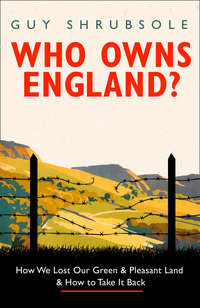
Kitabı oku: «Who Owns England?»


Copyright
William Collins
An imprint of HarperCollinsPublishers
1 London Bridge Street
London SE1 9GF
www.WilliamCollinsBooks.com
This eBook first published in Great Britain by William Collins in 2019
Copyright © Guy Shrubsole 2019
Cover images: Science & Society Picture Gallery / Getty
Guy Shrubsole asserts the moral right to be identified as the author of this work
A catalogue record for this book is available from the British Library
All rights reserved under International and Pan-American Copyright Conventions. By payment of the required fees, you have been granted the non-exclusive, non-transferable right to access and read the text of this e-book on-screen. No part of this text may be reproduced, transmitted, down-loaded, decompiled, reverse engineered, or stored in or introduced into any information storage and retrieval system, in any form or by any means, whether electronic or mechanical, now known or hereinafter invented, without the express written permission of HarperCollins
Source ISBN: 9780008321673
Ebook Edition © May 2019 ISBN: 9780008321697
Version: 2019-04-16
Epigraph
Who possesses this landscape?
The man who bought it or I who am possessed by it?
– Norman MacCaig
Contents
Cover
Title Page
Copyright
Epigraph
Introduction
1 This Land Is Not My Land
2 England’s Darkest Secret
3 The Establishment: Crown and Church
4 Old Money
5 New Money
6 Property of the State
7 Corporate Capture
8 A Property-Owning Democracy?
9 In Trust for Tomorrow
10 An Agenda for English Land Reform
Picture Section
Appendices: Figures on who owns land
Footnotes
Notes
Index
Acknowledgements
Image credits
About the Author
About the Publisher
INTRODUCTION
It’s often very difficult to find out who owns land in England. Land ownership remains our oldest, darkest, best-kept secret.
There’s a reason for that: concealing wealth is part and parcel of preserving it. It’s why big estates have high walls, why the law of trespass exists to keep prying commoners like you and me from seeing what the lord of the manor owns – and why the Government’s Land Registry, the official record of land ownership in England and Wales, remains a largely closed book. The geographer Doreen Massey once observed that the secrecy surrounding land ownership was ‘an indication of its political sensitivity’.
Owning land has unique benefits. The inherent scarcity of land means it’s almost always a solid bet for investment. ‘Buy land,’ quipped Mark Twain, ‘they’re not making it anymore.’ Own some land, particularly in a valuable location, and you’re pretty much guaranteed a steady stream of rental income from it – whether by leasing it out for farming, or building flats on it and charging tenants rent.
In fact, a landowner need not do anything to make a profit from their land. ‘Land … is by far the greatest of monopolies,’ raged Winston Churchill in a blistering polemic penned in 1909. Consider, wrote Churchill, ‘the enrichment which comes to the landlord who happens to own a plot of land on the outskirts or at the centre of one of our great cities’. The landowner need only wait while other people work and pay taxes to make the city grow more prosperous: building businesses, installing roads and railways, paying for schools and hospitals and public amenities. ‘All the while,’ Churchill growled, ‘the land monopolist has only to sit still and watch complacently his property multiplying in value, sometimes manifold, without either effort or contribution on his part; and that is justice!’
And that’s why land – and who owns it – lies at the heart of the housing crisis. It’s not because bricks and mortar have suddenly become incredibly expensive. It’s because the value of the land itself has gone through the roof. According to the Office for National Statistics, the value of land in the UK has increased fivefold since 1995. Landowners are laughing all the way to the bank: over half of the UK’s wealth is now locked up in land, dwarfing the amounts vested in savings.
Who owns land matters. How landowners use their land has implications for almost everything: where we build our homes, how we grow our food, how much space we leave for nature. After all, we’re not just facing a housing crisis. We’re also in the throes of an epoch-making environmental crisis, with our land scoured of species and natural habitats after decades of intensive farming. Our unsustainable food system is not only contributing to poor health; it also faces the biggest upheaval in generations thanks to Brexit. And all the while, our society has grown obscenely unequal, with wealth concentrated in the hands of a tiny few – including the ownership of land.
Politicians used to understand this. A century ago, the Liberal Chancellor of the Exchequer, Lloyd George, declared: ‘The land enters into everything … the food the people eat, the water they drink, the houses they dwell in, the industries upon which their livelihood depends. Yet most of the land is in the hands of the few.’ But today hardly any politicians even mention land in their speeches, let alone lift a finger to do anything about it.
Talking about land ownership has been taboo for far too long. Raise it in public debate, and sooner or later you’re accused of ‘the politics of envy’. But it’s not a sign of envy to ask questions about how we might best use and share out our most scarce common resource. It should just be common sense. Questioning why the Duke of Westminster, for example, has come to own so much land isn’t meant as an attack on him as a person. As Churchill said of land monopolists: ‘It is not the individual I attack, it is the system.’
I first got interested in land because of the fact we’re destroying the living world around us. Landowners like to portray themselves as wise stewards of the earth, but all too many of them abuse their property for short-term profit – despoiling habitats and wiping out wildlife in exchange for such things as coal mines, quarries and new roads. Later, after moving to London and paying stupid amounts of rent to landlords for a roof over my head, I started to see how land isn’t simply a rural issue, ‘out there’ in the countryside, but one that underpins how we all live. Homes have become assets, rather than places to live. Something’s gone badly wrong when a country tolerates thousands sleeping rough on our streets every night at the same time as allowing thousands of homes to lie empty. Who owned those empty properties, I wondered. Who owned the vast tracts of countryside from which our birds and insects had been carelessly eliminated? I wanted to find out.
When I started investigating who owns England, however, I was astonished by how difficult it was to answer such a simple question. The pervasive secrecy around land ownership made me suspicious; what was there to hide? Why were large landowners so coy about revealing what they owned, and public authorities so reluctant to make the information available?
As I dug into the issue, I decided to start a blog to share what I found, whoownsengland.org. The response was overwhelming. Almost immediately I was inundated with offers of help – from people offering snippets of information about landowners near where they lived, to data experts offering hours of their spare time to help crunch the numbers. Indeed, this book was only made possible thanks to a growing movement of data journalists, coders and campaigners, determined to set information free and put land back onto the political agenda: I try to pay tribute to many of them in the acknowledgements section.
In particular, early on I started collaborating with the computer programmer and data journalist Anna Powell-Smith, who became the Technical Lead on whoownsengland.org. She’s helped unlock the complex Land Registry datasets needed to investigate ownership, built many of the maps on the site, and advised extensively throughout. I’m extremely grateful to Anna for the coding wizardry and deep knowledge of data that she’s brought to the project.
This book is about who owns England, how they got it, and what that means for the rest of us. It’s part detective story, part history book, and part trespass through England’s green and pleasant land. The book’s subject, as its title states, is England, rather than Britain or the UK as a whole. Sometimes, in order to tell the story of England’s landowning elite, I’ve strayed into the other nations that make up the UK – for example, to touch upon the huge Highland estates that many English lords have acquired over the centuries. At times, the nature of the available information has also made it hard to disaggregate figures on land ownership by nation: the Land Registry, for instance, covers both England and Wales, and the data it provides remains frustratingly opaque. Wherever possible, however, I’ve broken down the statistics by country to concentrate on England alone, or else sought to make clear where the numbers refer to other nations too.
But my focus is on England, for three reasons. First, the question of who owns Scotland has already been comprehensively answered by the Scottish land reformer and MSP Andy Wightman, whose books on the subject – and maps at whoownsscotland.org.uk – I thoroughly recommend. Kevin Cahill’s Who Owns Britain, published in 2001, was another pioneering work that took a broader view, and on which I’ve sought to build. Second, I’ve lived most of my life in England, and feel qualified to write about it in a way that I don’t about the other nations that make up the UK. Since I started writing my blog, I’ve been delighted to be contacted by various individuals and groups keen to uncover who owns Wales and Northern Ireland; I hope their investigations bear fruit. Third, devolution, Scotland’s independence movement and Brexit have all thrown into question not only the unity of the UK, but also what it means to be English. Is it possible to construct a progressive English identity that isn’t based on xenophobia, nostalgia and grabbing land off Wales, Scotland, Ireland and the rest of the world? I’d argue that it is, but that land reform in England is a central part of doing so.
Uncovering the extraordinary story of how England has come to be owned by so few has, at times, made my blood boil. I hope it does the same for you, too. But I also hope that it inspires you to take action to make things better. In an old, conservative country like England it can often feel like things never change. But the example of successful land reform programmes in other countries, like Scotland, should give us hope – as should our own, forgotten history of land reform movements. Get land reform right, and we can go a long way towards ending the housing crisis, restoring nature and making our society more equal.
When discussing the size of estates, I’ve opted throughout to use acres as the unit of measurement. That might seem old-fashioned – why not talk of hectares? – but the reason is simply one of convenience. The UK as a whole is some 60 million acres, so if it were shared out equally among the current population, we’d have almost an acre each. To help visualise what that means, it’s worth bearing in mind that Parliament Square covers roughly an acre.
‘It is far easier to cling to privileges if few are privy to their extent,’ wrote the land rights campaigner Marion Shoard, in a book published not long after I was born. Three decades on, most people remain unaware of quite how much land is owned by so few. Enough is enough. It’s time to draw back the curtain, and uncover who owns England.
1
THIS LAND IS NOT MY LAND
Nearly half the county I grew up in is owned by just thirty landowners.
I was raised in Newbury in West Berkshire, a leafy part of the Home Counties. I always knew it was a well-off area; but only later in life did I discover just how much some of its inhabitants owned. Sixty-six thousand people – 40 per cent of the county’s population – live in settlements that cover a mere 2.4 per cent of the land. Yet 44 per cent of the county is owned by just thirty individuals and organisations. And the ways in which those landowners have chosen to use their land have impacted profoundly on the lives of everyone else living nearby. To appreciate what that means, let me take you on a tour of the place I called home.
I spent much of my childhood outdoors, exploring. My parents were teachers at the local comprehensive, and I was lucky enough to grow up in a detached house with a big garden – one that was wild and rambling, full of trees and brambles and corners to hide in. Like Calvin in the comic strip Calvin and Hobbes, whose imagination often gets the better of him, I’d often find myself imagining my treehouse to be a fortress and that our backyard was an entire country.
The earth in our garden also seemed to have magical properties. It was both a source of new life, alive with green shoots and shiny beetles, and a window onto the distant past. Once, I found a medieval silver penny in our vegetable patch, glistening in the dark soil. Something about that childhood experience of being close to the earth, of having a patch of ground to which I feel a sense of belonging, has stayed with me all my life.
I was ten years old when they decided to drive a bypass through nine miles of countryside to the west of Newbury. In the late 1980s, Margaret Thatcher had spoken of her admiration for the ‘great car economy’ and boasted of delivering ‘the largest road-building programme since the Romans’. In pursuit of this goal, the government gouged a motorway cutting through the ancient chalk downland of Twyford Down, and bulldozed hundreds of homes in East London for the M11 link road. Now the woods and water-meadows of West Berkshire were in the road lobby’s sights. To shave a few minutes off motorists’ journeys, it was deemed necessary to put a bypass through four Sites of Special Scientific Interest.
The government had reckoned without a huge outpouring of opposition from local residents and activists from across the country, who flocked to Newbury and staged one of the largest environmental protests ever seen in the UK. My parents took me on the 8,000-strong march organised by Friends of the Earth along the route of the proposed bypass, snaking past beautiful heathland and through a civil war battlefield. I remember looking longingly at the protesters’ tree-houses perched high in the great oaks that were destined to be felled, and pleading with Dad to let me go and join them. ‘Maybe when you’re older,’ he’d said.
Jim Hindle, one of the protesters who was old enough at the time to go and climb trees, later recounted: ‘The land to be lost to the road was meant to be compensated by the gift of other land elsewhere. But once it was gone, that was that.’ A new plantation would take years to grow and could never make up for the loss of ancient woodland, or the history that the road would obliterate. Where Hindle camped, ‘the rest of the Snelsmore reserve backed away over the Lambourn Downs in a primordial soup of ferns and birches and moss. It seemed like another country, stretching away further than we could rightfully imagine; half wild and ancient and vast.’
Perhaps the potential to halt the road lay in gaining control over the land. A previous plan to put a motorway through Otmoor in Oxfordshire had been thwarted by the cunning of local Friends of the Earth members. They had bought a field along the route of the road called ‘Alice’s Meadow’ – a reference to Alice in Wonderland, whose author Lewis Carroll had been inspired by the landscape of Otmoor. Dividing the field into 3,500 separate parcels, they had sold each one to a different person. This made compulsory purchase by the authorities virtually impossible, since they would have had to do deals with every single one of the landowners. Instead, an alternative route for the road was chosen, and Otmoor was saved.
Could opponents of the Newbury bypass count on the support of local landowners in halting the scheme? A young environmentalist, George Monbiot, initially hoped so. A huge swathe of land in the path of the bypass lay in the ownership of Sir Richard Sutton, a wealthy baronet who claims a lineage dating back to the Norman conquest. As Monbiot later recounted, ‘The Sutton Estate, just to the west of Newbury, covers some of the most exalted watermeadows in southern England. In 1983, when I was waterkeeper there, the manager told me not to cut too much of the bankside vegetation. The estate was the guardian of the countryside. As such it had a duty to preserve its ancestral character.’
Hoping that this sense of noblesse oblige would make Sir Richard an ally against the bypass, Monbiot approached him to make common cause. But then the estate manager published his plans. ‘Claiming that he was powerless to stop the road, he requested that he be allowed to supply the hardcore: he would dig out a further 100 acres of the meadows for gravel. Beside the road, he proposed building 1,600 houses, a hotel and an 18-hole golf course. As the new bypass was likely to fill up within a few years, he suggested that a second road should also pass through the estate.’
Other landowners along the route of the road were similarly craven. The Earl of Carnarvon, owner of Highclere Castle to the south of Newbury – made famous as the setting of the series Downton Abbey – told conservationist Charles Clover that ‘he had been behind a bypass for the past 40 years’, but admitted that he ‘did not know how much his son, Lord Porchester, had received for the sale of the site of a service station on the proposed new bypass.’ To Clover, ‘the saga of the Newbury bypass is about more than a road … It raises questions about whether we place sufficient value on our country’s human and natural history.’ The threat of a road, he felt, ‘has the ability to bring out a love of land in the strangest people.’ Just not, it seemed, in the people who actually owned the land.
The defence of the trees fell instead to a rag-tag army of courageous commoners, many of whom travelled from far and wide. Their tactics delayed the road for months, costing millions; police ended up making over 1,000 arrests. ‘Why don’t they save their dole money, go to South America and save the rainforests?’ sneered one local businessman in a letter to the local paper – a copy of which I pasted into my school project on the bypass, as an example of the calibre of the debate. I remember my mum shedding tears when we went to see the scene of destruction left by the bulldozers, saying it reminded her of images of deforestation in the Amazon. Ten thousand trees were felled along its route. My tree-climbing being strictly limited to trees in our garden, I did what I could. I saved a pine-cone from a tree destined for the chop and grew it into our family Christmas tree.
The unseen influence of other landowning interests may also have been at play in helping determine the route of the road. When the Highways Agency and their private contractor Costain came to my school to tell us what a great job they were making of the bypass, I remember putting my hand up to ask a question. ‘Why are you building the bypass through all the nature reserves on one side of Newbury,’ I asked, ‘when you could just build it through the racecourse on the other side of town?’
I didn’t know it at the time, but questioning the sanctity of horse racing in West Berkshire is a bit like doubting the existence of God in the Vatican. Breeding horses is big money here. Newbury Racecourse is one of the country’s largest horse-racing tracks, and Lambourn, a village to the north of Newbury, is second only to Newmarket for its stud farms. When I was growing up, classmates at school would joke about folks who lived in Lambourn being inbred. They stopped taking the piss when they got to sixth form and started partying: it was some of the Lambourn stable hands with their ready access to horse tranquillisers who could supply the ketamine.
Venturing out into horsey territory for Sunday walks, it was always obvious how rich the area was. Colonnaded mansions with sweeping driveways sat among rows of stables and well-manicured paddocks. What I didn’t know at the time was that most of the racing studs and surrounding fields were owned offshore, in tax havens, and that many of them also receive generous taxpayer-funded farm subsidies. One, Earl’s Court Farm Ltd, with an estate of 2,600 acres and an address in Bermuda, was handed £304,300 in 2015. The vast majority of this was as a Single Area Payment, a subsidy calculated on the basis of how much land you own, with few additional strings attached. But when I tried to find who was the ultimate beneficiary of such public largesse, it proved impossible to do so. Combing through a welter of offshore shell companies, the only records I could find indicated that the parent companies were called the Millennium Trust and the Racine Trust – two mysterious organisations with no apparent internet presence, and no named directors or owners.
‘Horseyculture’ takes up a lot of land in West Berkshire, but it’s as nothing compared to agriculture. Seventy per cent of England is given over to farming, and the rolling downland and river valley of the Kennet is a patchwork of pasture and crops. When we think of pressures on the English countryside, we tend to think of encroaching towns and fields being buried under concrete. But it’s industrialised farming practices that pose by far the biggest threat to England’s green and pleasant land. On this, landowners can have considerable sway, and sometimes for the better.
For years, the multinational pesticides manufacturer Bayer had its UK headquarters in Newbury. The weedkillers and insect sprays it manufactured were sent out into the surrounding countryside, where farmers and landowners doused their crops with them, year after year. Only now are we starting to wake up to the catastrophic effect this chemical inundation has had on ecosystems. One recent study from Germany reports the disappearance of three-quarters of all flying insects over the past twenty-seven years. Another study from France has shown that bird populations have fallen by a third in the past decade and a half. ‘There are hardly any insects left, that’s the number one problem,’ observes one scientist. The UK has seen a 56 per cent decline in farm birds since 1970, with industrialised farming and agrichemicals the key culprits. Neonicotinoid pesticides, in particular, have been shown to pose a major risk not just to insect ‘pests’ but to many other pollinating insects, including honeybees. Bayer, alongside other pesticide manufacturers, has been making them since the 1980s.
My parents used to keep bees in woodland belonging to the Sutton Estate. I still vividly remember extracting the honey from the big wooden Langstroth hives in our kitchen, spinning the wax-coated frames around in a big barrel, while chewing greedily on pieces of sweet honeycomb. But though we could make sure our bee colony had a good supply of food through the winter, and kept a watchful eye out for any signs of the bee-harming Varroa mite appearing in the hives, there was little we could do to stop surrounding landowners from spraying pesticides on their crops.
At least one landowner in the county, however, decided to treat their land differently. Sheepdrove is an 1,800-acre organic farm, lying to the north of Lambourn’s horse-racing studs, owned since 1972 by Peter and Juliet Kindersley. ‘Our original aim was to protect ourselves from the polluting chemicals used by farmers all around us and recreate the original downland landscape that we fell in love with so many years ago,’ they write. ‘We have witnessed the miraculous generosity of nature as the countryside around us has come back to life and, with the return of myriad birds, wild flowers, small mammals, reptiles and insect life, land which was turning into an arid prairie has been transformed to a rich tapestry of wildlife.’
But not all landowners have shared the Kindersleys’ philosophy. It’s taken much campaigning by environmental groups to eventually achieve an EU-wide ban on bee-harming neonicotinoid pesticides, in the face of considerable opposition from the National Farmers’ Union and other landowners’ groups.
The impending mass extinction of species poses a profound threat to the survival of human civilisation. A generation ago, a very different threat loomed over Britain: the spectre of nuclear annihilation. Here, too, the decisions of a large landowner in my home county were to have far-reaching repercussions.
West Berkshire’s recent history is deeply entwined with both the nuclear establishment and anti-nuclear protests. Since the 1950s, the village of Aldermaston has been central to Britain’s nuclear weapons programme, and became the target of the first CND marches towards the end of that decade. Another part of the Atomic Weapons Establishment is based at Burghfield, just down the road. But it was one military site in West Berkshire, above all others, that came to embody the terrifying logic of the Cold War, the struggle against nuclear weapons, and the battle over the land on which they were stationed: Greenham Common.
Comprising nearly a thousand acres of woods and open heathland, Greenham Common had been used as a military training ground for centuries, but was only enclosed when it was requisitioned for an airfield during The Second World War. When I visited Greenham in the spring of 2018, the remains of its huge runway could still be discerned amid the spreading sphagnum mosses and prickly gorse bushes that have now colonised it. It was leased by the Air Ministry, a predecessor department to the Ministry of Defence (MOD), to the US Air Force in 1968. Then in 1980, with Cold War tensions reaching a new peak, Margaret Thatcher agreed to station ninety-six US nuclear Cruise missiles at Greenham Common, making my hometown nuclear strike target number one.
The move represented a significant escalation in tactics by the hawkish new US President Ronald Reagan, who had reversed years of détente with the Soviet Union and begun calling it the ‘Evil Empire’. Many felt that the MOD – and the British state overall – had sold out British interests for American ones. ‘The sign at the gate maintained the pretence of RAF ownership, hence British control,’ notes historian George McKay. But ‘there is no obligation for the US Government to obtain Britain’s consent before firing missiles from Greenham Common.’ Instead of feeling safer under the US ‘nuclear umbrella’, the UK was now in the firing line, more than ever before. The investigative journalist Duncan Campbell, who revealed many of the Government’s clandestine plans for nuclear war, noted at the time: ‘Cruise missiles may soon be sited at Greenham Common and Molesworth, also US main bases. The Soviet Union would wish to destroy all these bases with considerable speed.’ Years later, when I met Campbell in person to interview him, I told him I had grown up in Newbury. ‘Oh dear,’ he said, shaking his head sadly. ‘Yes, that would have gone quickly.’
To local residents who had moved to this leafy Home Counties fastness for peace and quiet, the spectre of nuclear war now loomed terrifyingly large. Greenham Common quickly became a magnet for anti-nuclear protest. In 1981, a group of anti-nuclear protesters called Women for Life on Earth decided to march from Cardiff to Greenham to protest the lunacy of nuclear weapons. Upon their arrival at the base, four of them chained themselves to the fence, while a fifth, Karen Cutler, created a diversion. The lone policeman on guard ‘mistook her and the other protestors – as if playing his part in an unsubtle feminist satire – for the base’s cleaners.’
Ann Pettit, another of the marchers, was awestruck by the potential for a protest camp at Greenham Common. ‘I thought, “My God, it’s the Forest of Arden”,’ she recalled later, referring to the magical woodland in Shakespeare’s As You Like It where social rules are broken and norms challenged: ‘Somewhere to take to the woods and uphold better values than the corrupt court values.’
Historian Andy Beckett argues that Greenham Common ‘was one of the best places imaginable to stage a confrontation with the overmighty, transatlantic power structures that had grown up around British-based nuclear weapons. A great sweeping tabletop of gorse heath and grassland, fringed with deep-green stands of birch and bracken, in 1981 it was one of the few charismatic landscapes left in an increasingly suburbanized southeast England.’
The MOD and US Air Force had now militarised this landscape, sealing it off from the outside world with miles of fencing and barbed wire. But Greenham’s enclosure fence was soon to become synonymous with civil disobedience. On 12 December 1982, in an action called ‘Embrace the Base’, 30,000 women, including my mum, encircled Greenham Common’s perimeter. Others adopted spikier tactics, cutting through the fence with bolt croppers in order to exercise what they argued was their right to walk on common land. A court later found the protesters to be in the right: since Greenham was indeed a common, they couldn’t be stopped from walking on it – but damaging the fence in order to actually get in was still a criminal offence. Even so, the MOD opted to introduce new by-laws covering Greenham to ensure future trespassers could be sentenced harshly.
The Greenham Women’s Peace Camp maintained a permanent presence at the base for nearly two decades, becoming a rallying point for both anti-nuclear and feminist campaigners. Eventually, with the sudden end of the Cold War, the Cruise missiles left Greenham, and the MOD deemed the site ‘surplus to requirements’. It was sold to the local council and a charitable trust, who decided to finally open up the common again. The perimeter fence was torn down, grazing cattle returned, and common access rights restored. Greenham airbase’s huge runways were broken up, although this symbolic triumph also had a downside: most of the concrete was used to help build the Newbury bypass.
Only the colossal earthen bunkers that had housed the Cruise missiles remain standing today. On my visit to Greenham Common one spring evening, I stared across the heath at the brooding bulk of the missile siloes. Their silhouettes resembled a cross between aircraft hangars and Bronze Age burial mounds. But whereas the tumuli that dot Berkshire’s chalk downlands were built to remember the dead as they passed into the afterlife, these structures seemed to me to be far more nihilistic: monuments to Mutually Assured Destruction. Up close, the silos appeared even more malevolent. Still shrouded by three lines of fencing, some of it topped by razor wire, they squatted: ziggurats of grassed-over concrete with thick bulkhead doors, defended by menacing MOD signs. THIS IS A PROHIBITED PLACE WITHIN THE MEANING OF THE OFFICIAL SECRETS ACT, read one. UNAUTHORISED PERSONS ENTERING THIS AREA MAY BE ARRESTED AND PROSECUTED.
I patrolled the perimeter of the bunkers, thinking about the peace protesters who’d performed a Situationist rite during the Vietnam War to levitate the Pentagon. Here and there, I was gratified to see, were signs of where the Greenham Women had graffitied slogans onto the concrete fenceposts and cut holes in the fencing. To my disappointment, all of them had been repaired, making easy access to the site impossible. But nature is now slowly doing the job once performed by the protesters. In one place, a silver birch had grown through and around the fence, and was tearing it apart.
It’s not just the military who enclose common land and public space, of course. In West Berkshire, as elsewhere across the country, the main culprits are big private landowners. I saw this plainly when I decided to return to the county for a few days’ hiking one winter. The Berkshire countryside, beautiful though it is, is also stuffed full of PRIVATE – KEEP OUT signs, letting errant commoners know that the real owners of the landscape would rather you weren’t in it.
In some places, the influence of big estates permeates entire villages: a reminder that for a sizeable slice of rural England, feudalism has never died. That much seemed obvious when one freezing December afternoon I walked into the tiny village of Yattendon, on the edge of the Yattendon Estate. Acquired by the media mogul Baron Iliffe in the 1920s, the 8,295-acre estate has reshaped the area’s countryside with its vast conifer plantations. It sells 80,000 Christmas trees each festive season.
As I skirted around iced puddles, I noticed something odd about the village. Everything looked the same. All the doors, gates and windowsills in Yattendon were painted in the estate’s official dark green, as uniform as the serried ranks of saplings planted in the surrounding fields. Even the telephone box – that staple of quaint old English villages, maintained for tourist selfies long after the landline has been ripped out by vandals – was Yattendon green, rather than the traditional red. The village’s noticeboard, proudly displaying a plaque for the award of Best Kept Village of the Year 1974, presented neatly typed minutes from the latest parish council meeting. Out of the grand total of five attendees, they recorded, one had been a representative of the Yattendon Estate. It was hard to shake the sense that, behind the scenes, order was being maintained by some decorous yet shadowy patrician operating out of the Big House on the hill, like something out of the movie Hot Fuzz.
But it isn’t merely the colour scheme of villages that landowners have sway over. They also control access to large swathes of the countryside. A ‘Right to Roam’ was established by the Countryside and Rights of Way Act in the year 2000, but open-access land still only makes up around 10 per cent of England and Wales – a far cry from the situation in Scotland, where the right to roam is now established as the default – and much of that is mountain and moorland. Down south, the countryside is far less open to ramblers. ‘Less than 1.5 percent of West Berkshire, for example, is covered, and many of its glorious woodlands remain inaccessible to the large population of London and the Thames valley,’ notes Marion Shoard, whose tireless campaigning helped bring about Right to Roam. These tiny scraps of accessible woods include Snelsmore Common and Pen Wood – both of which were cut through by the Newbury bypass – and parts of Greenham Common, which had been closed off to the public for decades because of the airbase. So even these fragments of open-access land have been shut off or defiled by some of the county’s major landowners.
The efforts of large landowners to keep people off their estates have, however, proved their undoing when it comes to uncovering what they own.
I was inspired to try to map who owned my home county by the work of John McEwen, who pioneered studies of Scottish land ownership in the 1970s. McEwen set out to find who owned his native Perthshire, but it ended up taking him four years to map just the one county. Fortunately, I discovered a shortcut, and it was all thanks to the territorial behaviour of the landowners themselves.
Under an obscure clause, Section 31(6), of the otherwise extremely boring Highways Act 1980, landowners can prevent new public rights of way from being established across their land by lodging a statement with the local authority. The deposited statements usually last for twenty years, meaning that any public use of the land during this period will not then count towards determining new rights of way. But to protect their interests in this fashion, landowners also have to submit a map delineating the boundaries of their estates. This is then usually published by the council online, or is accessible under the Freedom of Information Act. Possessive landowners are thus hoist by their own petard.
It was this documentation that I was able to draw upon to discover who owns my home county. West Berkshire Council, it turned out, had a remarkably complete set of landowner deposits. I requested they send me their maps in a digital format, to make analysis easier. Combining these with information from a number of other sources, the jigsaw began to fit together. The results astonished me: it was now that I discovered that almost half the county was owned by just thirty landowners.
Their identities offer a telling insight into the landowning elite of modern England. Baronial estates owned by the same aristocratic families for centuries sit next to stately piles snapped up by newly moneyed businessmen (and it is nearly always men), organic farms, and horse-racing studs registered in the Cayman Islands. The aforementioned newspaper magnate Baron Iliffe and property mogul Sir Richard Sutton jostle for landowning supremacy with H&M chairman Stefan Persson, Formula One racing legend Frank Williams, and three scions of the wealthy Astor family.
But the single biggest landowner in West Berkshire is Richard Benyon MP. Benyon is the inheritor of the 12,000-acre Englefield Estate; the palatial, turreted Englefield House has belonged to his family since the eighteenth century.
Today, Benyon is the richest MP in Parliament, with an estimated fortune of £110 million. One tranche of this comes from the East India Company; another stems from property, through the development of De Beauvoir Town in the London Borough of Hackney in the nineteenth century. Richard Benyon still owns De Beauvoir today, via the Englefield Estate Trust Corporation, with the Berkshire connection commemorated in the name of Englefield Road. In 2014, his company courted controversy when it took a minority stake in a consortium that bought the New Era housing estate in Hoxton. The consortium threatened to hike rents on the estate, leading Hackney Council to warn of ‘enforced homelessness’ for nearly half of the ninety-three households living there. When the community rallied in protest, and were joined by comedian-turned-activist Russell Brand, Benyon’s firm was forced to back down and sell its stake.
A third income stream flows from farming. In 2017, Benyon’s Berkshire estate pocketed £278,180 in farm subsidies, courtesy of the taxpayer. It was through enclosure that the Englefield Estate grew to be so large, and so wealthy. To this day, a large expanse of woodland at Englefield is called Benyon’s Inclosure, denoting a former common enclosed by the MP’s ancestor.
His deer park was created two hundred years ago by literally moving a village to make way for it. The long flint wall that surrounds Englefield today signals a dark history: people’s homes had been demolished to make way for this private pleasure-ground. As the poet Oliver Goldsmith wrote in 1770, in protest at widespread enclosure:
Ill fares the land, to hastening ills a prey,
Where wealth accumulates, and men decay.
But more important than Benyon’s sheer wealth is the example he provides of the continuing political influence of landowners. Elected to Parliament in 2005, his political pedigree is impeccable: his father was Conservative MP for Buckingham and Milton Keynes, and his great-great-grandfather was the Conservative Prime Minister Robert Cecil, the 3rd Marquess of Salisbury. The estate’s paint scheme, perhaps by coincidence, is of deepest blue. In 2012, shortly after Benyon became a junior environment minister in David Cameron’s government, the gravel-quarrying company operating on his estate applied to extend its operations into Benyon’s Inclosure. Under the plans, the quarry would expand to cover 217 acres, extracting 200,000 tonnes of sand and gravel annually.
The existing quarry had already wrecked a patch of land called Burnt Common. I visited it one summer: the common looked like the surface of the moon, pockmarked with pits that had filled with water. Despite Burnt Common being marked as open-access land on Ordnance Survey maps, a barbed-wire fence had been erected around it, with signs reading DANGER – DEEP WATER – KEEP OUT.
The local Wildlife Trust protested that the new gravel-extraction plans would lead to the felling of trees, the destruction of ancient woodland and the permanent loss of heathland. As the minister then responsible for wildlife and biodiversity, you might have thought Benyon would have abandoned such plans out of sheer embarrassment. But he pressed on.
This wasn’t the only time Benyon’s landed interests appeared to clash with his ministerial jurisdiction. The MP also owns an 8,000-acre grouse moor in Scotland, and runs a pheasant shoot at Englefield. Coincidentally or not, as wildlife minister he refused to make it a criminal offence to possess the poison carbofuran, which is used by some gamekeepers to kill birds of prey when they are suspected of predating on game birds.
A second incident during Benyon’s ministerial tenure compounded the suspicions of his detractors. Walshaw Moor, a large grouse-shooting estate near Hebden Bridge owned by wealthy businessman Richard Bannister, was in the process of being prosecuted by the regulator Natural England for damaging protected blanket bog habitat, after its grouse moor management regime had intensified. Then, suddenly and mysteriously, the case was dropped. No explanation was ever offered by Natural England or DEFRA as to why they had abandoned legal proceedings, and Benyon refused to give a straight answer when questioned. Was this another instance of the landed classes coming to a gentleman’s agreement behind closed doors?
Even if Benyon had recused himself from such ministerial decisions, what does it say about prospects for meritocracy and democracy in England today when constituencies can still end up being represented by the local lords of the manor? Benyon may stand out for the sheer scale of his estates, but he isn’t the only sitting MP to be drawn from the ranks of the landed gentry.
Geoffrey Clifton-Brown MP, for example, owns the East Beckham Estate in Norfolk, for which his estate company received £102,566 in farm subsidies in 2017. Sir Henry Bellingham MP owns land in his seat near the Queen’s estate at Sandringham. And the MP for South Dorset is Richard Drax – or Richard Grosvenor Plunkett-Ernle-Erle-Drax, to give him his full quadruple-barrelled surname – owner of 7,000 acres of his constituency, bounded by the longest wall in England. Many MPs nowadays, too, are landlords with rental property portfolios, as the parliamentary register of interests attests.
Nor is the level of land ownership concentration in my home county an anomaly. England as a whole belongs to a tiny number of people and organisations. Just 36,000 landowners – a mere 0.06 per cent of the population – own half of the rural land of England and Wales, according to the Country Land & Business Association, who represent the land lobby in Westminster. That’s an extraordinary concentration of land in the hands of so few.
That concentration of ownership is visible in the landscape itself. Once you start looking for them, it becomes possible to discern patterns of land ownership, like invisible ley lines stretching out over the countryside. A hedgerow is no longer simply a tangle of hawthorn to keep out livestock, but a territorial boundary. A set of gateposts, previously remarkable only for the carved eagles perching atop them, takes on a new significance as a display of might: get off my land.
To see the world through the lens of land ownership is to survey a landscape of power. Many of England’s largest landowners have acquired their land through inheritance; an inheritance that has often been built on the back of conquest and enclosure. And landowners possess great power over how their land is used, for good or ill.
Ill fares the land, indeed. While our last wild habitats face collapse, many landowners continue to turn their land into chemical deserts or flog it off for development, traditional concepts of stewardship seemingly crushed by the lure of pound signs. In our cities, urban space is treated by landowners as an investment opportunity, with homes transformed into assets rather than being places to live in. Urban land is too often wasted, with properties left empty and vacant sites kept as land banks, as owners wait for their value to climb still higher before cashing them in. Shadowy offshore firms swallow taxpayers’ money to run horse-racing studs, and lords of the manor are elected to Parliament. Worst of all, the vast majority of people living in England today remain as landless as they have always been. I belong to England; I love its countryside and history. But does any of it really belong to me?
Ramblers and environmental activists, when they gather together around campfires, often sing the songs of the American folk musician Woody Guthrie. They console themselves with the heartwarming lyrics of his most famous piece, a paean to nationhood, land and belonging.
This land is my land, this land is your land …
But it isn’t true. This land does not belong to you or me.
2
ENGLAND’S DARKEST SECRET
There’s a huge reluctance to discuss who owns land in England. It’s seen as impolite, an expression of the politics of envy. Some of this is a hangover from an earlier era of deference, when the right of the local lord of the manor to his thousands of acres was as unquestioned as his hereditary seat in Parliament.
But there are also deeper ideologies at work. There’s a peculiarly English reluctance to debate land ownership, some of which has its roots in the work of the seventeenth-century moral philosopher John Locke. Locke argued that there was a natural right to the exclusive ownership of land, which permitted people to own land as private property just like any other possession. He admitted that ‘the earth … be common to all men’, but argued that any person who cultivated land ‘hath mixed his labour with, and joined to it something that is his own, and thereby makes it his property’. Owning land, in Locke’s view, was just like a carpenter owning a chair he had made by hand.
Locke’s arguments lent a moral respectability to the actions of large landowners through the centuries, shutting down the space for debate. There was just one proviso: taking private ownership of land was only morally justified ‘where there is enough, and as good, left in common for others’. That seemed to be true in Locke’s day, when the world appeared vast and its population small. But it also provided a convenient excuse for the English gentry to carry on enclosing commoners’ land in the name of agricultural improvement, and for the early English colonists in the New World to seize ‘wasteland’ from Native American peoples. Locke ignored common forms of land ownership, the inherent scarcity of land on a finite planet, and how taking private possession of it becomes a zero-sum game.
Over the past century and a half, Locke’s detractors have grown in number, reopening conversations about land. ‘Land differs from all other forms of property,’ argued Winston Churchill in 1909, at the height of the Liberal Party’s push for land reform. ‘Land, which is a necessity of human existence, which is the original source of all wealth, which is strictly limited in extent, which is fixed in geographical position – land, I say, differs from all other forms of property in these primary and fundamental conditions.’ Churchill was clearly right about this, and it’s a view that is once more gaining traction. But it’s taken a long time for such ideas to obtain a hearing, and for land ownership to become a permissible topic of debate.
Who owns England has also been literally hidden from plain sight. Large landowners have built high walls around their estates, to keep out prying eyes. The English countryside still bristles with a profusion of KEEP OUT, PRIVATE PROPERTY signs. Rich businesspeople and celebrities live in gated communities protected by private security. For many decades during the Cold War, some Ministry of Defence sites were literally erased from maps.
No one doubts the right to privacy in one’s own home, nor the need for security around military bases. But England’s laws to protect private landed property go far beyond simply defending the old notion that ‘an Englishman’s home is his castle’. For many Englishmen whose homes are actually castles, their rights also extend far beyond their moats into hundreds of acres of parkland, woods and fields.
The civil offence of trespass means that anyone setting foot on land where no public right of way exists without the consent of the landowner is a trespasser, and can be prosecuted. While access to the countryside has been opened up considerably in recent years, the extension of Right to Roam remains unfinished business, and is a continual reminder that the English remain unwelcome in most of their countryside. And if you can’t see it, you’re less likely to ask questions about who owns it.
Parallel developments in the 1990s also showed lawmakers to be overwhelmingly on the side of the landowners when it came to dealing with people protesting about land issues. The 1994 Criminal Justice Act created a new, criminal offence – invented by the Major government to squash roads protesters and hunt saboteurs – of ‘aggravated trespass’, for cases where trespassers were deemed to be impeding the landowner from undertaking lawful activities. This, coupled with the more recent criminalisation of squatting, has closed down the space for taking direct action against unjust and unsustainable uses of land.
Land has also been airbrushed from modern economic theory. All the classical economists – Adam Smith, Karl Marx, David Ricardo, John Stuart Mill – recognised land as a key factor of production, sitting alongside capital and labour as inputs to the economy. Land was different from capital and labour, however, in being of fixed supply, and in having no production costs: nature provided it for free. But neoclassical economists removed land as a separate factor of production, conflating it with capital. Land, despite being finite and thus a constraint upon economic activities, was no longer treated as such.
But most tellingly of all, public discussion of land ownership has been hampered and stymied for centuries by the near-impossibility of obtaining proper information on it. Accurate facts, figures and maps detailing the ownership of land in England are very hard to come by.
Charges of conspiracy are flung about wearyingly often in modern politics. But the long-term concealment of who owns England appears to me to be one of the clearest cases of a cover-up in English history. To understand its depths, we have to go back a thousand years, to Domesday.
The Domesday Book was the first comprehensive survey by any European monarchy of the owners and occupiers of land in their domain. It was, to put it bluntly, a swag list assembled by an acquisitive king. William the Conqueror commissioned Domesday in 1085, nineteen years after his conquest of England, in order to better understand who owned what, so he could tax them more in future. The anonymous scribe behind the Anglo-Saxon Chronicle recounts that King William ‘sent he his men over all England into each shire; commissioning them to find out … what, or how much, each man had, who was an occupier of land in England, either in land or in stock, and how much money it were worth’.
The significance of the Domesday survey is twofold. First, it was the first official state record of who owned England; and second, nothing like it was carried out again for another eight hundred years.
For eight centuries, Crown, Church and aristocracy hid their landholdings away, fenced off and out of public view. The Domesday Book was preserved and referred to, but mostly as a means for the Crown to extract taxes and settle disputes over legal title to land. There was little sense of it being a public record that might aid demands for wealth redistribution. Occasionally, it was used to try to turn the tables. In 1377, a ‘Great Rumour’ began spreading among peasants that Domesday Book granted them ancient rights to land that exempted them from feudal duties. The resulting protests, though short-lived, were a precursor to the Peasants’ Revolt of 1381. A similar moment of revolutionary possibility appeared in the aftermath of the English Civil War. Parliament, freshly victorious, carried out a survey of Crown lands belonging to the recently executed Charles I in order to auction them off. But more radical demands to redistribute land and give every man the vote were brutally quashed by Cromwell.
Yet in the past two hundred years, as England has become an industrial democracy, its governments have chosen to survey land ownership on multiple occasions, only to swiftly suppress knowledge of these activities. The past two centuries have seen four ‘modern Domesdays’ carried out by the authorities: the Tithe Maps of the 1830s; the 1873 Return of Owners of Land; the 1910–15 Valuation Maps; and the 1941 National Farm Survey. In each case these investigations faced huge opposition, were hushed up swiftly after they were carried out, and today have been almost entirely forgotten.
The first of these modern Domesdays occurred in the context of the upheaval generated by the French Revolution, which had caused the boulevards of Paris to run red with the blood of guillotined aristocrats and seen revolutionary Jacobins seize their lands. Napoleon ended the bloodshed but imposed new land taxes to finance wars abroad, levied with the help of a new system of land ownership maps called cadastres. These recorded not just the contours of hills and locations of buildings, but also the boundaries of estates – and who owned them. In turn, the Napoleonic Wars prompted the British state to grow, modernise and extend its powers. The British government began counting its population with the first decadal Census, and started to map its territories accurately with the creation of the Ordnance Survey, so that it could better defend them. But in order to impose cadastral maps and land taxes, the authorities would inevitably run into opposition from landowning interests.
In England, it was in fact the Church, rather than the state, that first attempted a system of cadastral maps. The Church was modernising too, through the monetisation of tithe payments. For centuries it had been customary for farmers and landowners to pay to the Church one-tenth of their produce, levied in kind. This continued, despite the Reformation, until modern times. Then in 1836, the Tithe Commutation Act allowed tithes to be paid in cash rather than in goods. As part of the process of commutation, tithe maps were to be drawn up, to show who owned a parcel of land and how much they owed in tithes.
Into this process stepped Lieutenant Robert Dawson, a mapmaker with utopian dreams. Dawson was a cartographer who had been seconded to the Tithe Commission from the Royal Engineers. He knew that for the purposes of collecting tithes, fully accurate maps of land ownership weren’t strictly necessary. But Dawson saw this as an opportunity to push a much larger, more ambitious project – a detailed cadastral survey of the entire country.
The Tithe Commission was at first enthusiastic, and backed Dawson’s proposals. They implored the government to help fund the accurate mapping of landowners, writing to the Chancellor of the Exchequer, who appointed a select committee of MPs to examine the matter. But while the committee was hearing evidence, ‘groups of landowners petitioned the House of Commons requesting that the tithe commissioners’ proposals for large-scale maps be defeated’. The English aristocracy feared that a full survey of land ownership might pave the way for new land taxes, as Napoleon’s cadastral surveys had on the Continent, or – worse – lead to social upheaval and even revolution. The committee concurred, and ‘an opportunity for a cadastral survey of the full kingdom was lost’. Many tithe maps were still produced, but their coverage was incomplete, and in many cases lacking in detail.
Others, however, continued to press for a public register of land ownership. In May 1848, Lord Brougham, a lawyer and former Lord Chancellor, made the case in Parliament for a Land Registry complete with cadastral maps. ‘I need hardly dwell on the benefits of a registry for securing titles and facilitating transfers of property,’ he told his fellow peers. ‘England is nearly the only country which is still without this advantage … Connected with a registry should be an authentic and detailed map, the result of a survey of each county or smaller district – what the French call a Cadastre.’
Brougham sought to appeal to the landed establishment, explaining that a register of land could ‘improve the security of its possessors, and … increase the facility of its transfer’. It was an argument he felt should appeal ‘to the Members of this House, peculiarly the lords, as you are, of the soil of England’. But his speech also hinted at support for land redistribution. ‘It was reckoned by Dr. Beke, in 1801, that there were not more than 200,000 owners of land in England,’ Brougham related, compared to many millions of small landowners in France: ‘No one can believe that the working of any system is good which confines landed property to so few hands.’
His was a lone voice, however, and he had to wait: a Land Registry was eventually established, but not until 1862. Moreover, for decades after its creation, it registered pitifully little land – registration was voluntary rather than compulsory – and it was not a public register.
In the absence of a proper public Land Registry, advocates of land reform had to make do with proxy figures. The 1861 Census provoked a commotion among radicals, as its records seemed to show there were just 30,000 landowners in a population of some 20 million people – although the census said nothing about how much each owned. This was grist to the mill of a new generation of radical liberals and socialists who wanted to see the grinding poverty of the Victorian slums redressed through a fairer distribution of wealth. It was also dynamite for democrats advocating an extension of the electoral franchise and the abolition of the ‘property qualification’ – the need to own land or capital in order to vote.
The 15th Earl of Derby – himself a major landowner, and the son of the former Conservative Prime Minister – sought to stamp out calls for land reform by disproving these claims. Addressing the House of Lords on 19 February 1872, he asked the Lord Privy Seal ‘whether it is the intention of Her Majesty’s Government to take any steps for ascertaining accurately the number of Proprietors of Land or Houses in the United Kingdom, with the quantity of land owned by each?’ An accurate survey would be a public service, Derby went on, for currently there was a ‘great outcry raised about what was called the monopoly of land, and, in support of that cry, the wildest and most reckless exaggerations and misstatements of fact were uttered as to the number of persons who were the actual owners of the soil’.
In the thousand years that have passed since the Domesday Book, those seeking to uncover who owns this country have faced obstacles at every turn. Physically and legally excluded from large swathes of the countryside, with debate about land airbrushed from mainstream economics and stymied within political circles by the lobbying of landowners, the general public have had to clamour and campaign for access to the land and for information about who controls it. But it’s now possible, at last, to ask questions about who owns England, and credibly hope for an answer.
3
THE ESTABLISHMENT: CROWN AND CHURCH
Somehow, I had expected the Queen’s private home to be different. Sandringham House was certainly grand: vast rooms, stuccoed ceilings, great expanses of polished hardwood. Gilded Swiss clocks ticked on marble fireplaces. A statue of Kali, the Hindu goddess of destruction, stood in a gloomy corner of the entrance hall, dancing upon a vanquished enemy. Moth-eaten Union Jacks from doomed polar expeditions hung next to crystal chandeliers. And pinned to the walls were a startling arsenal of knives, scimitars and vicious-looking knuckledusters: the gift of fifty long-dead Indian princes from when Queen Victoria had been crowned Empress of India.
But the house was also curiously parochial. A book on gnomes lay on top of an old edition of the Guinness Book of Records. An endless array of mirror-backed cabinets, crammed with onyx carvings and jade elephants and dinner services, gave the place a cluttered feel. Chintz chairs jostled for space with comfy sofas, their padded upholstery perhaps still bearing the imprint of the royal behind. The heavily patterned, Victorian-style carpets looked well worn. This was, after all – as our waistcoated tour guide informed us – the family home of Queen Elizabeth and Prince Philip for many months of the year. It felt like a bizarre mix: at once an old lady’s living room, complete with its collections of china dogs and tea sets, and at the same time a regal residence, filled with the tribute of defeated kingdoms. But then, separating out the personal from the public functions of the Crown is always a tricky exercise, as I was to discover.
I had cycled to Sandringham with my flatmate Roger, after taking the train out to King’s Lynn. This part of Norfolk has royal connections going back centuries: out in the Wash, it’s rumoured, lies King John’s buried treasure, submerged in the mudflats when the royal baggage train was caught by incoming tides. But it wasn’t until 1862 that the royal family decided to make the area their home. Queen Victoria bought the house for her son, the Prince of Wales – and future King Edward VII – along with an estate that then comprised around 7,000 acres. Today, Sandringham has grown to be even larger: some 20,000 acres of Norfolk, taking in prime farmland, oak woods and landscaped parks.
The whole area is dominated by huge aristocratic estates. As we pedalled through the arid countryside, neighbouring landowners staked their territorial claims through KEEP OUT signs and heraldic carvings. The balustrade of a bridge we cycled over was embossed repeatedly with the letter ‘H’, denoting the property of Lord Howard of Rising. To the east of Sandringham lies the Marquess of Cholmondeley’s Houghton Hall, whose land is registered in the tax haven of Jersey, and who holds the hereditary post of Lord Great Chamberlain, an ancient officer of the Crown.
What makes the Sandringham Estate unusual is not just that it’s a royal residence. It’s unusual because it’s owned by the Queen in person, rather than by the institution of the Crown. When Queen Victoria acquired it, she registered it in the name of the Prince of Wales, to avoid it becoming part of the Crown Estate and thereby surrendering its revenues to Parliament. It’s his name that’s recorded as the owner of Sandringham in the 1873 Return of Owners of Land. The current land title for Sandringham states the registered proprietor to be ‘Her most gracious Majesty Queen Elizabeth the Second’. But it omits the crucial line, ‘in right of her Crown’, which would make it Crown property. The only other royal residence to be owned personally by the royal family is Balmoral in Scotland, and that was bought by Queen Victoria’s husband, Prince Albert, before his untimely death. The subsequent Crown Estates Act allowed the royal family to inherit Balmoral and Sandringham as private residences thereafter.
If all that seems oddly arcane and complex, you’re starting to grasp how archaic the British constitution remains. And while this might at first appear an irrelevant quirk of history, the monarchy’s survival continues to shape how power is exercised – and how land is owned. But to understand fully, we need to go further down the rabbit hole.
Our tour of Sandringham passed from the kitsch comfort of the drawing rooms into a darkened corridor, hung with drawings of the royals out hunting and lists of the estate’s gamekeepers. To my surprise, the walls were lined with cabinets stuffed with dozens and dozens of shotguns. ‘This is a .450-bore double-barrelled breach-loading rifle,’ recorded one label, ‘shot by Queen Victoria.’
‘Are any of these used by the Queen currently?’ I asked our tour guide.
‘Aha, no,’ he said. ‘The Queen does occasionally go shooting. But under the Firearms Act, you can’t publicly display weapons which are in current use. Thanks to Magna Carta, not even the Queen is above the law of the land.’
Well, up to a point, Lord Copper, I thought. Sure, the monarchy nowadays is a shadow of what it once was, its powers tightly constrained, its status mostly symbolic. But when it comes to taxation, for instance, the Queen has a very different arrangement to those which bind her subjects. She has only paid income tax voluntarily since 1993. Up to that point, no monarch had paid taxes since the 1930s, a revelation that sparked a public outcry at the time – particularly as ordinary taxpayers had just been asked to foot the bill for repairing Windsor Castle after it had been gutted by fire. Support for republicanism soared during a decade that saw several royal divorces and the death of Diana; although thirty years on from the Queen’s annus horribilis, those still calling for the abolition of the monarchy must feel like they’re ploughing the loneliest of furrows. Two royal weddings, a diamond jubilee and several more grandchildren have helped restore the royal family’s public standing.
The point of this chapter isn’t to persuade you to become a republican. But it is intended to show you how the monarchy continues to shape how power and ownership are exercised in the UK. It seeks to outline why the royals – alongside that other great Establishment survivor, the Church – still own so much land after many centuries of existence. Most of all, it explains how the Crown is partly to blame for why land ownership in England remains so unequal today.
The smart-arse answer to the question ‘who owns England?’ is a simple one: the Crown. All land is ultimately owned by the Crown, and freehold and leasehold titles to land are technically ‘held of the Crown’, and therefore derived from it. The Crown is ‘lord paramount’, with land titles held on its sufferance. If you die without a will, any land you owned reverts to the Crown through the law of bona vacantia.
In practice, owning a freehold in land nowadays means you can do pretty well what you like with it. No marauding monarch is going to come and take it from you. But that hasn’t always been the case.
It was William the Conqueror who declared that all land in England belonged ultimately to the Crown, straight after the Norman Conquest of 1066. At William’s instigation, titles in land henceforth would be derived from the Crown. The king sat at the top of this feudal pyramid, and the whole country was now his to carve up as he pleased: a giant cake to be cut into slices and handed out to his cronies.
It’s this that lies at the heart of why land ownership remains so concentrated and unequal in England today. William the Conqueror’s land grab and system of patronage set the stage for the following thousand years. The king parcelled out land to a small coterie of barons, whose families would continue to inherit such lands for centuries afterwards. By dealing out the pack of cards so unfairly, William skewed the game from the outset. A large part of the blame for the resulting pattern of land ownership has to be levelled squarely at the Crown.
‘The public do a very good job of mentally separating the Royal Family from the rest of the aristocracy, but that is not the reality,’ admitted one peer with remarkable honesty during a House of Lords debate in 2013. ‘The Royal Family is the core of the aristocratic system.’ As Andy Wightman argues, ‘Private landownership in Scotland remains a small, inter-related and privileged club which is proud to have the Queen as a member.’ The same could be said of England.
Of course, William the Conqueror didn’t claim ownership of the whole of England only to immediately hand it out again to his barons. He also kept a very large chunk of land for the Crown itself. According to records in the Domesday Book, the king and his family owned around 17 per cent of England in 1086 – perhaps some 5.4 million acres. Nearly a thousand years later, the Crown in its various institutional guises still owns around a million acres of land in England and Wales, or half a million acres if you exclude the areas comprising foreshore and riverbeds. Looked at from one perspective, that represents a major loss of land over time. But from another angle, it’s an incredible tale of territorial survival. How have the fortunes of this vast estate changed over time, and how has it managed to survive into the twenty-first century?
If anything, the extent of Crown lands increased in size for a couple of centuries after the Norman Conquest. In particular, the Norman kings acquired lots of land to indulge their love of hunting. Another of William’s innovations, besides feudalism, was forest law. Nowadays we think of a forest as being composed of trees, a large woodland. But ‘forest’ is actually a legal construct – a term given to an area of land, whether wooded or not, where hunting privileges were restricted to the king. William and his successors established vast royal forests, including the New Forest and the Forest of Dean, where the hunting of deer and boar was outlawed for anyone save the king and his favoured courtiers.
Since English common law had created a customary right for hungry commoners to feed themselves by hunting wild game, this was a frightening new encroachment on the rights of ordinary people, in a kingdom already straining under the Norman yoke. Punishment for poaching in royal forests was severe. The Rime of King William, a furious poem written a year after William’s death by a disgruntled courtier, records that the king ‘established many deer preserves, / and he set up many laws concerning them, / such that whoever killed a hart or a hind / should be blinded.’
By the time of Henry II’s reign (1154–89), it’s reckoned that royal forests covered somewhere between a quarter and a third of all England – a vast area of land subjugated to the private pleasures of one individual at the expense of the public. Royal forests weren’t all strictly owned by the Crown – some were established on land belonging to other landowners – but the constraints and privileges enacted by forest law were so stringent that the Crown might as well have owned the land outright.
The royal penchant for game also inspired many barons to set up their own deer parks and hunting grounds. The thrill of the hunt is still recorded today in place names like Cannock Chase or Cranborne Chase, where nobles took their cue from the king in applying the principles of the royal forest to their own lands. Just as the Crown’s division of the spoils of conquest had established a landowning elite, so its act of closing off previously public lands for private gain set a dangerous precedent. In centuries to come, the aristocracy and gentry would begin the process of enclosure, stealing land once held in common and converting it into farmland for private profit.
But the Crown’s land grabs didn’t go unchallenged. Everyone today has heard of Magna Carta, the contract forced upon the Crown in 1215 by barons fed up with a despotic monarch. Most people have forgotten, however, about the Charter of the Forest, the ‘poor man’s Magna Carta’ which simultaneously pressed the Crown to respect rights customarily held by commoners.
As the historian Peter Linebaugh recounts, ‘There were two charters forced on King John at Runnymede. Beside the great charter with which we are all vaguely familiar, there was a second charter in 1217 known as the Charter of the Forest. Whereas the first charter concerned, for the most part, political and juridical rights, the second charter dealt with economic survival.’ The Charter ordered that ‘all woods made forest … shall be immediately disafforested’ – which is to say, removed from royal jurisdiction. The rights of commoners to the fruits of the earth – rights which were later to be savagely abused by the aristocracy – were accepted and codified by the Crown. Thereafter, royal rorests and forest law started to shrink in extent and influence. Edward III ‘disafforested’ the whole of Surrey in 1327, and by 1350 only 15 per cent of England lay under forest laws.
The decline of the royal forests didn’t end the Crown’s love affair with hunting, of course. Fashions simply evolved as nature’s larder was depleted. The last wild boar in England was killed in the seventeenth century. The Hanoverian kings had more of a taste for landscape gardening and hobby-farming, particularly George III, who earned the nickname ‘Farmer George’. But under Queen Victoria, the Crown’s sponsorship of bloodsports revived in a big way – only this time, the fashion was to buy a keepered grouse moor and blast away at birds with a shotgun. Today, the Queen owns a huge grouse moor estate around Balmoral and another in the North York Moors via the Duchy of Lancaster, as well as hosting pheasant shoots at Sandringham. Once again, the Crown has acted as a trendsetter in the ownership and misuse of land, shaping aristocratic tastes and causing hundreds of thousands of acres of upland England and Scotland to be converted into sporting estates.
Between the Black Death and the Civil War, the story of the Crown lands – as much as is known about them – seems to be one of financial mismanagement and decline. For a time, the monarchy’s landed estates had provided adequate income for the royal household to live within its means. But fighting endless foreign wars of aggression, from the Crusades to the Hundred Years War, proved expensive; and soon kings were summoning their barons to plead for more cash. Parliament, the setting for such negotiations, at first delivered the goods – even when it proved ruinous. The levying of the vastly unfair Poll Tax in 1381 sparked a colossal revolt by peasants and labourers that threatened to topple feudalism in its entirety. The revolt was quashed and the landowning order maintained. But increasingly, even landowner-dominated Parliaments came to view the excesses of the Crown with disdain.
Throughout this period, successive kings and queens flogged off and gave away Crown lands with scant thought for the longer term. With the exception of the two duchies – which we’ll turn to later – the monarchy’s lands were frittered away, handed out to favourites at court rather than managed to maximise incomes. Most profligate of all were the Stuart dynasty, whose thirst for cash resulted in the selling off of land, the creation of new peerages, demands for higher taxes and then, when MPs refused to levy them, the dissolution of Parliament. In fact, the Stuart kings cocked up their finances so badly, it led to civil war and Parliament’s execution of Charles I.
For eleven years, England had no Crown. Determined to run things more efficiently, Cromwell’s Parliaments carried out an extensive survey of Crown lands. But rather than keep hold of them as an ongoing source of revenue for the nation’s finances, they too decided to sell them off. The reason was simple: Cromwell’s army was massively in arrears, and its unpaid footsoldiers were getting restless. The Crown lands were sold for about £250 million in today’s money, going some way towards settling Parliament’s civil war debts. Many of the buyers were existing landed gentry; others belonged to Cromwell’s officer class. They didn’t get to enjoy their new possessions for long, however: the collapse of the Republic and restoration of the monarchy in 1660 led to the immediate return of all lands to the Crown.
The restored monarchy soon found its freedom to manoeuvre hemmed in by constitutional restraints put in place by a Parliament determined never to have to go to war with the Crown again. When the Stuarts once more proved too big for their boots, MPs invited first the Dutch and then the Germans to come and have a go at wearing the crown. The Hanoverian dynasty proved much more compliant with the wishes of Parliament. In 1760, George III agreed to give up the income from his Crown lands in exchange for an annual stipend called the Civil List. The lands would still technically be his, ‘in right of his Crown’, but the revenues would flow to the Treasury and they would be managed by an organisation answerable to Parliament – later called the Crown Estate.
It was a sweet deal for the king, as the Crown lands were in a pretty shambolic state at the time. Revenues remained low, and land holdings had continued to be filched for bribes and the enrichment of court favourites. The Civil List, by contrast, handed the royal family a guaranteed fixed income. And over the next century, the Crown Estate’s fortunes were to revive. Staffed with an increasingly professional civil service, its holding of land doubled in size from around 106,000 acres to 220,000 acres over the course of Queen Victoria’s reign. More importantly from the government’s perspective, revenues grew immensely, bringing in millions of pounds for the public purse. The development of London made some Crown lands stupendously valuable – such as Regent Street, built to link the Prince Regent’s mansion on Pall Mall with Regent’s Park in the north. And when it was forced to hand over the remaining royal forests to the Forestry Commission in 1924, the Crown Estate quickly made up the lost acreage by investing in farmland instead.
Over the last century, the Crown Estate has become a fully commercial institution, managing its enviable property portfolio with ruthless efficiency. Its holdings have expanded still further to cover 336,000 acres of England and Wales, with huge tracts of prime farmland in Lincolnshire and the Fens, on Romney Marsh, and along the Holderness shore. Comparing maps of what the Crown Estate owns with agricultural land classification maps, you can see that nearly all of its farms are on top-quality Grade 1 and 2 farmland. It also benefited from receiving £366,000 in taxpayer farm subsidies in 2016.
Still, nowadays, there’s much more money to be made from Apple iPhones than from apples. The Crown Estate gets more rental income from Apple’s flagship store on Regent Street than it does from its entire agricultural estate. And though it still bears responsibility for managing the Crown’s traditional stamping grounds – Windsor Great Park, for instance – its modern capitalist instincts mean it always has an eye out for new ways to boost its earnings. Where the Crown’s landed interests once lay in castles and deer parks, the Crown Estate now prioritises investment in shopping centres and retail parks. That may sound like a moan about creeping commercialisation, but frankly, I’d rather the Crown generate proceeds for the public purse than, say, own a forest for a monarch’s exclusive right to hunt boar. The Crown Estate’s ownership of the UK seabed has also made it a champion for renewable energy and addressing climate change: what was once an effectively worthless asset has become highly lucrative with the UK’s development of offshore wind, which the Estate now has a vested interest in promoting.fn1
The Crown Estate’s motto, ‘brilliant places through conscious commercialism’, may be a rather nauseating PR slogan, but its contribution to the Exchequer’s coffers nowadays is considerable: £329 million in 2017. Subject to Freedom of Information law and with its finances fully open for public scrutiny, the modern Crown Estate’s professionalism is a world away from the sloppy venality with which the Crown’s lands were managed for many centuries. Still, its transformation into a corporate property agent has its pitfalls: some of the properties it looks after risk succumbing to the overriding imperative for high returns. The Laxton Estate, for instance – the last example of a medieval open field system in England, which has been owned by the Crown Estate since 1981 – was earmarked for sale in early 2018 because it doesn’t turn enough of a profit.
Then there’s the matter of the reorganisation of the royals’ finances in 2012, when the then Chancellor, George Osborne, ended the Civil List and replaced it with a new Sovereign Grant. This new system re-established the link between the health of the Crown Estate and what the royal family receives in income. Now its annual funding is 15 per cent of Crown Estate revenues – so if the Estate posts higher turnover, the Queen and her family get more money. In fact, during the most recent review of the grant, MPs voted to increase the index to 25 per cent of revenues for the next decade, to cover repair works to Buckingham Palace. Not everyone was happy, understandably: as the Labour MP Alex Cunningham pointed out, ‘I have always respected the fact that we have a royal family, but I know they also have vast wealth and I don’t know what sort of contributions they will be making towards this project.’
Because the Crown’s wealth doesn’t actually stop with the Crown Estate. There’s also the small matter of the other two property empires it owns: the Duchies of Cornwall and Lancaster.
Down a side alley off the Strand, behind the Savoy Hotel, with its cucumber sandwiches and champagne and top-hatted doorman, is an ancient church. This is the Queen’s Chapel of the Savoy, and it harbours a well-kept secret. It lies at the heart of the Duchy of Lancaster, one of the oldest property empires in England, and a little-known moneyspinner for the monarchy.
When I visited it, the cool air of the chapel was a welcome relief from the sticky heatwave that had been slow-roasting London. Stepping into the sepulchral gloom, I felt the urge to tiptoe: though only yards from one of the capital’s busiest shopping districts, the building’s thick stone walls muffled all external sound. Blue satin cushions covered empty pews upon a chequerboard floor. Every surface seemed suffused with heraldry. Armorial plates plastered the wood-panelled walls, the coats-of-arms of bygone Knights Commander and Grand Masters of this or that Order. Translucent lions and crosses shone from the stained glass windows; above the altar, one gothic arch framed a depiction of the Holy Grail. It was all very Dan Brown.
Except here, the secret societies and ancient bloodlines are all real. The Savoy Chapel is not only the Queen’s personal place of worship, complete with regal throne at the back of the nave. It’s also the church for the Royal Victorian Order – an obscure, dynastic order of knighthood that rewards personal service to the monarch. More portentous still are the names that adorn the vaulted ceiling. Commemorated in azure and gold is the royal lineage of the Lancastrians, stretching back to one of the most Machiavellian and capricious bastards in English history: John of Gaunt, Duke of Lancaster, and founder of the Duchy. The chapel is built from the rubble of his luxurious mansion, the Savoy Palace.
Gaunt was the power behind the throne of his teenage nephew, Richard II: the archetypal evil uncle and scheming Grand Vizier par excellence. He was also stupendously rich, the largest landowner in England, with vast estates in every county. In 1381, Gaunt was up north hammering the Scots when the Poll Tax rebellions erupted in Kent and Essex. Peasants and townsfolk alike marched upon London, demanding that the king’s evil advisers should be hanged – Gaunt chief among them. When the young king refused to hand them over, anarchy ensued. The rebels descended upon the Savoy Palace and began systematically dismantling the wealth of their feudal masters. Tapestries were wrenched off walls, furniture thrown out of windows, and a vast bonfire made of Gaunt’s riches. Rather than engage in looting and be written off as mere thieves, the rebels instead opted to smash up the tyrant’s vast stash of gold plate so it couldn’t be reconstituted. The Savoy – which had cost £35,000 to build, a third of the estimated annual wage bill for the entire English army – was ground to dust.
But Gaunt’s ducal lands remained intact. After defeating the Peasants’ Revolt, Gaunt was determined to see the House of Lancaster prosper for ever. So when his son, Henry Bolingbroke, murdered Richard II and usurped the throne, his first act was to declare the Duchy to be his and his male heirs’ estate for ever more, held separately from other Crown lands. The Duchy of Lancaster has remained the monarchy’s personal fiefdom ever since.
Today it runs to 45,674 acres, including five ‘rural surveys’, which span grouse moors in north Lancashire, moorland in North Yorkshire, dozens of farms near Burton-upon-Trent, and entire villages in Cheshire. In addition, it owns the foreshore along most of the Lancashire coastline, and extensive mineral rights, including valuable gypsum mines. Looking through the Duchy’s entries in Land Registry data, the estate’s ancient hold over certain areas comes through clearly in the place names: Duchy House, Savoy Road, Lancaster Farm. The Duchy’s Savoy Estate in central London, though tiny in extent, rakes in rents from retail, as well as hosting the estate’s headquarters at Lancaster House, just around the corner from the Chapel of the Savoy.
The affairs of the Duchy of Lancaster remain cloaked in mystery. Until recently, anyone wishing to look into what the Duchy currently owns had to make do with one grainy map on its website. That’s changed with the Land Registry’s recent release of more data on land owned by companies and corporate bodies. But in every other way, the Duchy of Lancaster seems to have deflected public attention from its affairs. It’s not subject to scrutiny by the National Audit Office, Parliament’s financial watchdog. It produces an annual report to Parliament and a Cabinet minister serves as Chancellor of the Duchy, a mostly symbolic role; yet the Duchy has avoided being made subject to Freedom of Information requests from the public. Nor does it pay corporation tax (although the Queen voluntarily pays tax on any income). The Duchy claims that it ‘does not receive any public funds in connection with its activities’, yet it received almost £38,000 in taxpayer-funded farm subsidies in 2016.
The Duchy is an unreformed anachronism, which owes its survival to the accretions of royal privilege over the centuries. But this archaic body continues to benefit from the modern surge in land and property prices. In 2018, the Duchy of Lancaster posted a £20 million profit – three and a half times larger than what it generated back in the year 2000, and on top of the £76 million received by the royal household thanks to the Sovereign Grant. It seems crazy that we continue to tolerate this set-up, meekly allowing the monarchy to keep a medieval cash cow with minimal oversight and exempt from the tax levied on other businesses. ‘Why are we throwing millions of pounds at the Queen,’ asks Graham Smith of campaign group Republic, ‘when that money could be spent on schools, hospitals and local communities?’ Why indeed?
A similar story can be told about the Duchy of Cornwall. It, too, was created in the 1300s, as the personal dukedom of the heir to the throne. Its lands were first gifted to Edward III’s son, the Black Prince, and today the Duchy belongs to Prince Charles in his capacity as Duke of Cornwall.
Like its sister body, the Duchy of Cornwall is one of the strangest beasts in England’s still quasi-feudal political economy. It’s not a company, and so doesn’t pay corporation tax. It’s neither a charity nor a public body – and it isn’t subject to formal parliamentary scrutiny or Freedom of Information requests, though it has to gain permission from the Treasury if it wants to sell off land. The Duchy has even successfully fought off attempts to make it subject to public requests made under the Environmental Information Regulations – something that sits uneasily alongside the Prince’s environmental credentials – in a bizarre case involving its ancient ownership of the Fal estuary and its right to allow oyster dredging over it. It is, in short, an anachronism – but one that has survived for nearly seven hundred years and continues to grow in size.
But try to investigate what the Duchy of Cornwall owns, and you’ll find it’s an even more opaque institution than the Duchy of Lancaster. Its annual reports give a flavour of the properties it possesses, but little by way of detail. The Land Registry, despite releasing data on properties owned by the Duchy of Lancaster, has decided to exclude the Duchy of Cornwall from its Corporate and Commercial dataset – seemingly because it’s considered to be the personal estate of one individual, the Duke of Cornwall.
Old institutions die hard, especially in a conservative country like England. Long after the Crown and Church lost most of their formal powers, they continue to hold sway – kept alive, in part, by their landed wealth. Understanding how these archaic, quasi-feudal pillars of the Establishment operate is crucial to grasping the nature of power in modern Britain, and critical to comprehending why land ownership in England remains so unequal.
The efforts of the Duchies and the Church to evade full scrutiny by Parliament and the public tell us something profound about how privilege tries to perpetuate itself. And the way that both Crown and Church have avoided trying to disclose their landholdings is telling, too: because the concealment of wealth from prying eyes is also critical to preserving it.
These ancient organisations have survived into the modern world by transforming their landed estates from medieval baronies into capitalist property portfolios while still trying to avoid public accountability and wider social responsibility. Some would like to see the Anglican Church disestablished, and the monarchy abolished outright. Personally, I’m ambivalent about that. But on the question of the land they own, it’s clear that the estates of the Crown and Church ought to be made to better serve the public interest.
Most of all, the Crown and Church still matter because of the wider Establishment they helped to create. Without William the Conqueror’s division of conquered lands to his loyal barons, and without the Church’s tacit moral blessing for this unequal hierarchy, England would have no landed elite.
4
OLD MONEY
Once, when asked to give advice to young entrepreneurs on how they could succeed in modern Britain, the now-deceased 6th Duke of Westminster had some sage words. ‘Make sure they have an ancestor who was a very close friend of William the Conqueror,’ he said.
Class runs deep in English society. Many of the aristocratic families who continue to thrive, prosper and own great swathes of the British Isles can date their bloodlines all the way back to the Norman Conquest. Indeed, 1066 was the making of them: some of the largest landowners in England today owe their territorial empires to the patronage of William the Conqueror a thousand years ago.
The Dukes of Westminster are a case in point. Their family name, Grosvenor, derives from Hugh Le Grand Veneur, the ‘great huntsman’ of King William’s court. Disgruntled commoners took to calling the portly Hugh the ‘fat huntsman’, or ‘gros veneur’, and the nickname stuck. A statue of the first Marquess of Westminster in Belgrave Square, one of the London estates now owned by the family, bears the proud declaration: ‘The Grosvenor family came to England with William the Conqueror and have held land in Cheshire since that time.’ Today, the Duke of Westminster is consistently found towards the top of the annual Sunday Times Rich List, the inheritor of a £9 billion fortune made from owning a vast, 130,000-acre estate in land and property, built up over centuries.
Nor are the Grosvenors alone in having such an ancient pedigree. Travel to sleepy Arundel on the edge of the South Downs, and in the middle of the town square you’ll find a copper plaque affixed to a wall. ‘Since William rose and Harold fell,’ runs the inscription, ‘There have been Earls at Arundel.’ Raise your eyes skyward, and the colossal grey towers and crenellated walls of Arundel Castle loom over the town. The earls, since elevated to become Dukes of Norfolk, continue to lord it over this part of Sussex.
Sitting for a pint in a nearby pub garden overlooking the River Arun, with the Duke’s fortress silhouetted against the skyline and the wind hissing gently through the reeds growing on the floodplain, it seemed to me as though little had changed in the past millennium. Feudalism lived on; deference had never died. In the words of that Victorian celebration of the social hierarchy, ‘All Things Bright And Beautiful’:
The rich man in his castle,
The poor man at his gate,
God made them high and lowly,
And ordered their estate.
A fawning display in the local museum confirmed the impression. ‘When the 15th Duke stood on the battlements of his newly repaired keep in 1910’, it read, ‘he would have had the satisfaction of knowing that almost everything he could see in all directions belonged to him.’ Although the Norfolks’ estate is thought to have diminished a little in size since then, it’s still said to span some 16,000 acres.
Or take Ralph Percy, the current Duke of Northumberland. His ancestor William de Percy appears in Domesday as the owner of a hundred manors in the north of England. Nowadays, the Duke is the second-largest private landowner in England, with at least 100,000 acres in his possession. He runs his estate from Alnwick Castle; local residents complain that it feels like the whole county is run by him.
Such examples give the lie to the widespread notion, perpetuated by scholars, journalists and aristocrats themselves in recent years, that the aristocracy have been consigned to the dustbin of history. In fact, though their wealth and power has waned since their heyday, their stubborn resilience is one of the great success stories of recent English history.
The genteel image of the aristocracy today, epitomised in costume dramas and tea and cakes in country houses, masks an early history that was written in blood. The Norman Conquest was brutal: William’s seizure of land was absolute, and he brooked no challenges. Rebellions by the English against their new masters were quickly crushed; the Harrying of the North laid waste huge tracts of northern England. This was one of the most brazen land grabs in history. Four thousand Anglo-Saxon thegns were replaced by less than two hundred Norman barons and clergy, and they achieved supremacy through force of arms.
Domesday gives us some idea of how concentrated land ownership became under the Conqueror. The figures are staggering: twenty years after the Conquest, along with the king’s 17 per cent, the bishops and abbots owned some 26 per cent of the landed wealth of England, and the 190-odd barons roughly 54 per cent. Even within this elite there was an elite: a dozen of the leading barons controlled about a quarter of the kingdom. One, Alan Rufus – a close relative of the Conqueror – is estimated to have owned about 7 per cent of England’s landed wealth on his own, and was one of the richest men who has ever lived.
William and his barons were a tight-knit circle, whose experiences of fighting side-by-side were now being rewarded in the handing out of spoils. Perhaps the best modern analogy is the mafia boss and his cronies, who depend on one another’s loyalty and give each other gifts, and will readily spill blood to protect the syndicate’s honour. William, the Norman Don Corleone, summoned the nation’s biggest landowners to his court upon the completion of the Domesday Book, and is thought to have had them swear oaths of fealty to him as he sat on his throne. The symbiotic relationship between Crown and aristocracy, between monarchical patronage and noble fidelity, has continued ever since.
In later centuries, seizures of land by the gentry continued with the enclosure of the commons. Little of this is remembered or taught in schools today. A powerful folk-memory of the Scottish Highland Clearances rightly persists, but the dispossession of England’s peasantry is mostly forgotten. Yet between 1604 and 1914, some 6.8 million acres of common land were enclosed by Acts of Parliament – a fifth of all England. This, of course, was at a time when few ‘commoners’ could vote to sway what Parliament did. John Clare, the nineteenth-century poet who went mad with grief after witnessing the fencing-off of his beloved countryside, wrote how ‘Inclosure came and trampled on the grave / Of labour’s rights and left the poor a slave’.
Slavery and colonialism, too, played major roles in the formation of large English estates. Recent research by University College London has mapped over 3,000 British properties that once belonged to slave-owners or people who directly benefited from the slave trade. Large swathes of Bristol, London and Liverpool were built using the wealth that flowed from the sugar and cotton plantations of the Caribbean and North American colonies, where around three million Africans were transported and enslaved over three centuries. One example is Edwin Lascelles, 1st Baron Harewood, who inherited from his father a West Indian fortune which had included a slave plantation. From the proceeds, he had built for him Harewood House in Yorkshire, a vast Palladian mansion complete with parkland landscaped by Capability Brown. The Lascelles family went on to become one of the largest slave-owning families of their era, amassing 27,000 acres in Jamaica and Barbados and nearly 3,000 slaves, for whom life expectancy was a pitiful twenty-five years. Such suffering appeared not to elicit a hint of empathy or remorse from the 2nd Earl of Harewood, who campaigned against slavery’s abolition, declaring, ‘I, among others, am a sufferer.’ He was awarded over £23,000 in 1835 for his loss of ‘property’.
The role of violence in the acquisition of aristocratic estates is seldom acknowledged today in the placid displays you see in country mansions. But the stain remains. Gerrard Winstanley, the radical thinker whose group of Diggers sought to redistribute land during the Civil War, lambasted lords who tried to wash their hands of this bloody history. ‘The power of enclosing land and owning property was brought into the creation by your ancestors by the sword,’ he wrote. Or, as the anarcho-syndicalist peasants in Monty Python and the Holy Grail later put it, the violence was inherent in the system. An old joke, told by land reformers and socialists since the late nineteenth century, encapsulates the injustice. A lord confronts a poacher who is trespassing on his estate:
LORD: How dare you come on my land, sir?
POACHER: Your land! How do you make that out?
LORD: Because I inherited it from my father.
POACHER: And pray, how did he come by it?
LORD: It descended to him from his ancestors.
POACHER: But tell me how they came by it?
LORD: Why, they fought for it and won it, of course.
POACHER (taking off his coat): Then I’ll fight you for it.
But why own land at all? For centuries, of course, land was the primary source of wealth in England. As the source of food, fuel and shelter for an overwhelmingly agrarian nation, ownership of land conferred great riches – first as feudal dues, and later as monetary rents. But money was only part of the reason for having land; just as important was the power and status it conferred. The 15th Earl of Derby, the Victorian landowner who helped commission the Return of Owners of Land, listed five main benefits of land ownership: ‘One, political influence; two, social importance, founded on territorial possession, the most visible and unmistakeable form of wealth; three, power over tenantry; … four, residential enjoyment, including what is called sport; five, the money return – the rent.’
Moreover, owning land was a secure investment for the long term, a way of preserving wealth for posterity. Farming was rarely the means of earning a fast buck: it involved considerable outlays, and a poor harvest could cause a major loss of earnings. But in the long run, land would always appreciate in value. A country house and landed estate were the solid, lasting means by which a family’s name and fortune could endure down through the ages.
If conquest, enclosure and colonialism were important means by which the aristocracy first acquired their lands, equally important were the inheritance laws that meant they retained them. The crucial rule was male primogeniture – the custom that everything is inherited by the eldest son. This was vital to the maintenance of large estates, because it gave certainty about who was to inherit, and ensured that a lord’s landholdings remained intact: owned by one descendant rather than broken up between several. ‘If all the children shared the wealth, the properties would be divided and subdivided till the pomp and circumstance of the peerage would disappear,’ warned one American admirer of the gentry in 1885. ‘In order to retain its importance, the aristocracy must be kept small in numbers.’
The enforcement of male primogeniture has clearly influenced patterns of land ownership across much of England, keeping estates large. In Wales and in Kent, by contrast, estates tend to be smaller; here, and particularly in Kent, the older practice of gavelkind – dividing up land equally between all heirs – continued to hold sway. In eighteenth-century France, even before the Revolution sent aristocrats’ heads rolling, nobles’ estates tended to be smaller than those of their English contemporaries due to inheritance laws which stipulated the morcellation of land between all heirs. This gave many more men a stake in the land, though it failed to stop the eventual uprising against aristocratic privilege.
Male primogeniture is also, of course, fundamentally sexist. Occasionally, women have inherited aristocratic titles, and a few duchesses and countesses have become major landowners; but these are the exception rather than the rule. The early twentieth-century poet Vita Sackville-West, who wrote extensively about land and who is perhaps better known as Virginia Woolf’s lover, was dismayed not to inherit her family’s seat at Knole Castle due to these discriminatory laws of succession. But she struck back at her patriarchal father by buying up Sissinghurst Castle, after discovering the Sackvilles had once owned it. Other aristocratic women have been similarly disinherited. When the 6th Duke of Westminster died in 2016, his 26-year-old son Hugh inherited the entire family fortune over the heads of his elder sisters, making him the richest man under thirty in the world.
In 2013, a group of peers – both women and men – sought to bring an end to male primogeniture once and for all. An Act had recently been passed to change the laws governing royal succession, finally allowing the monarch’s eldest daughter to inherit the throne. This ‘set the hares running’ on whether the same reforms would now be made to noble inheritance, and a campaign group of aristocratic women calling themselves The Hares was formed. A number of peers tried to introduce legislation in Parliament to end male primogeniture. Dubbed the ‘Downton Law’, after the TV costume drama in which the eldest daughter is forbidden from inheriting the estate, the Equality (Titles) Bill got as far as its committee stage in the Lords.
But Lord Wallace, responding on behalf of the government, was having none of it, and kicked the Bill into the long grass. ‘We should take our time, look very carefully at the implications … and then perhaps consider further,’ he counselled, echoing the arguments of all those who have opposed change within the aristocracy for the past thousand years. Others were more vituperative in their opposition to equality. The Earl of Durham, locked in a dispute with his sisters over inheritance rights, railed against the campaign. ‘It is stupid in my view not only to be battling for something that could only possibly appeal to somebody’s pride and vanity,’ he spat, ‘but also something that affects about 0.0001 per cent of the population.’ It just so happens that this tiny percentage of people still own a large chunk of the country’s landed wealth.
Part and parcel of the aristocracy, and just as important to its formation as a select elite, is the system of hereditary titles. There are five ranks of the peerage, in descending order of importance: dukes, marquesses, earls, viscounts and barons. They’re created by the Crown without recourse to Parliament, through legal instruments known as letters patent. At present, there are around 800 hereditary peers: 24 dukes (not counting the various honorary dukedoms created for members of the royal family), 34 marquesses, 191 earls, 115 viscounts and 426 barons, as well as 4 countesses and 9 baronesses in their own right. Confusingly, peers can also hold multiple titles as they progress up the ranks, with their heirs adopting the subordinate honours: for example, the heir to the Marquess of Salisbury is styled Viscount Cranborne.fn1 Life peers, meanwhile, are a separate, more recent creation, invented to help modernise the House of Lords, with none of the land and wealth associated with the ancient hereditary peerage.
The whole arcane system of titles has become underpinned over the centuries by byzantine institutions and insignia. Old families proudly bear coats-of-arms, bedecked with heraldic beasts, mottoes and crests recalling their ancestors; the whole flummery policed by the College of Arms – whose head, the Duke of Norfolk, we met earlier. Aristocratic elitism finds its apogee in the voluminous pages of Debrett’s and Burke’s Peerage, obsessively compiled lists of current honours and their ancient bloodlines, which read a little like stock-books of good breeding.
The ranks of the peerage may appear convoluted and archaic to outsiders, but their complex, jealously guarded hierarchies are key to keeping the aristocracy exclusive. Sometimes, the closed nature of this club has proven problematic to kings wishing to broaden their pool of supporters and, above all, their income streams. James I ended up creating an entirely new class of hereditary titles, the baronetcies, which he sold to the lesser landed gentry in a seventeenth-century cash-for-honours scandal. Baronets have lower social standing than members of the peerage, but their titles are also hereditary, and their landed domains can be just as extensive. As of 2017, there were 1,204 extant baronetcies in the UK – meaning that the hereditary, titled aristocracy overall consists of just 2,000 families. Below peers and baronets sit knights and squires: holders of non-hereditary titles (‘Sir’, ‘Dame’, ‘Esquire’), but nevertheless often significant landowners in their own right. The ‘squirearchy’ of the early modern period were often lords of the manor across large parts of rural England. In terms of classes of landowners, however, this is where definitions become more blurred, and it gets harder to distinguish between estates that have been inherited and those bought more recently.
But was this exclusive club in fact open to newcomers? Overseas observers of England during the early modern period often marvelled at its political stability, and the fact that it had never suffered a far-reaching social revolution. They attributed this to what they surmised to be England’s ‘open elite’, a ruling class that was willing to welcome the newly wealthy bourgeoisie, and absorb those of middling rank who might otherwise become disgruntled and try to challenge the whole system.
Yet while there was a certain fluidity at the lower end, with merchants sometimes becoming members of the landed gentry, there was also great resistance to new money joining the peerage. Lawrence and Jeanne Stone, surveying the state of the aristocracy between the reign of Henry VIII and Queen Victoria’s Golden Jubilee, concluded that ‘for 340 years, the elite maintained a highly stable social and political system’, in which upward mobility was enjoyed only by a comparative few. Just 157 ‘men of business’ bought their way into the landowning elite over these three centuries and were able to acquire estates of 2,000 acres or more. Throughout this period, ‘many of the same families still resided in the same seats’, and newcomers attempting to join the landed aristocracy had to overcome ‘infinitely resistant lines of snobbery’. Subsequent research has suggested that there were a greater number of wealthy entrants to landed society who succeeded in buying smaller estates of around 1,000 acres; but these were small fry compared to the vast landholdings of the dukes and earls of their day.
By the time of the Victorian Return of Owners of Land, the landed aristocracy was at the peak of its political power. A mere 4,217 peers, great landowners and squires owned 18 million acres of land – half of England and Wales, possessed by 0.01 per cent of the population. In a triumph for trickle-down economics, it had taken eight centuries for England’s landowning elite to broaden out from around 200 Norman barons to 4,200 Victorian nobles and gentry. ‘In terms of territory, it seems likely that the notables owned a greater proportion of the British Isles than almost any other elite owned of almost any other country,’ writes the historian David Cannadine.
What happened next to the aristocracy has often been portrayed as a catastrophe. Between Queen Victoria becoming Empress of India and the killing fields of the First World War, the sun appeared to set on the gilded world of inherited privilege. This perception owes much to the work of the historian F.M.L. Thompson in his 1963 book English Landed Society in the Nineteenth Century, later popularised and embroidered in David Cannadine’s The Decline and Fall of the British Aristocracy. They recount how the entire aristocratic class experienced a sudden loss of territory, wealth and political power – plagued by death duties, assaulted by land reformers and Lords reform, and losing out to the nouveau riche. ‘The old order is doomed,’ bemoaned the Duke of Marlborough in 1919.
No one seriously disputes that the British aristocracy fell from grace after their Victorian heyday. But reports of the death of the aristocracy have been greatly exaggerated. This is particularly true when it comes to the land they own.
Thompson and Cannadine’s claims about the rapid territorial losses of the peerage in fact come down to one, rather shaky source. Cannadine states that ‘in the years immediately before and after the First World War, some six to eight million acres, one-quarter of the land of England, was sold by gentry and grandees’. Thompson likewise asserts: ‘it is possible that in the four years of intense activity between 1918 and 1921 something between six and eight million acres changed hands in England.’ For this startling figure, both relied on a single article in one edition of the property magazine Estates Gazette from December 1921.
That figure has recently been convincingly challenged by two statisticians, John Beckett and Michael Turner. They examined land sales data from the time and found that ‘much less than 25 per cent of England changed hands in the four highlighted years 1918–1921’. Instead, they concluded, it was actually more like 6.5 per cent, and that excitable estate agents at the Gazette had massively overstated the case.
Moreover, all sides agree that the highest echelons of the aristocracy were able to cling on to their landed estates with much greater success than the lesser gentry. As Thompson quietly admits in the final pages of his book, ‘The landed aristocracy has survived with far fewer casualties … Among the great ducal seats, for example … Badminton, Woburn, Chatsworth, Euston Hall, Blenheim Palace, Arundel Castle, Alnwick Castle, Albury and Syon House, Goodwood, Belvoir Castle, Berry Pomeroy, and Strathfield Saye are all lived in by the descendants of their nineteenth-century owners.’ That Thompson could say this half a century after his supposed ‘revolution in landownership’ is startling enough. It’s even more startling, then, that today, another half-century on, every single one of those ducal family seats still remains in the hands of the same aristocratic families.
What may have felt seismic at the time looks a good deal less drastic in retrospect. ‘When Thompson wrote in 1963, the great estate seemed to be in terminal decline,’ argue Beckett and Turner, ‘but the subsequent revival of the fortunes of landed society [have] brought seriously into question the whole business of just how bad things really were.’
At the same time as Thompson was performing the last rites on the aristocracy, another author found them to be in rude health, albeit rather leaner. The journalist Roy Perrott’s 1967 survey, The Aristocrats, surveyed the acreage held by seventy-six titled landowners. Though most of the estates had significantly diminished in size since 1873, together these individuals still owned a combined 2.5 million acres across the UK. Perrott estimated that this sample represented ‘about one-seventh of those owned by the titled nobility’, and his definition of that elite totalled around 3,000 people. So, in the era of the Space Race, 0.005 per cent of the UK population still owned 17.9 million acres of the country, or 30 per cent of the total land area.
Drawing on Perrott’s work, the geographer Doreen Massey arrived at a similar extrapolation a decade later, concluding that ‘in spite of the decline which they have undergone this century, the holdings of the landed aristocracy have by no means been reduced to insignificance’. Stephen Glover’s 1977 survey of thirty-three large landowners found that they owned 667,410 acres, a drop of almost two-thirds from the 1,869,573 acres those same estates had owned in 1873. Even taking into account the reduced acreages, Glover concluded, these people ‘remain – on paper at least – very rich men’, all the wealthier thanks to the rapid rise in land prices that occurred in the 1970s.
More recent estimates, too, strongly suggest that the aristocracy have held their own against the tide of history. Kevin Cahill’s Who Owns Britain, which draws upon multiple newspaper reports, obituaries and rich lists, presents figures for the 100 largest landowners in the UK and the Republic of Ireland. Altogether, Cahill reckons these select few own some 4.8 million acres. Still, this is only about 6 per cent of the land area of the two countries, and without figures for the rest of the aristocracy, it’s hard to conclude from Cahill’s research who actually owns the majority of Britain. Nevertheless, his figure for the land owned by the UK’s twenty-four non-royal dukes is startling. With a total of over 1 million acres between them, these remain men of very broad acres. Moreover, as we’ll see, the places they own have increased enormously in value, leaving many of the peerage extremely wealthy.
Or take the figures stated by the Country Land and Business Association (CLA), who represent the landowning lobby in England and Wales; many aristocrats are known to be members. In a 2009 document, the CLA state that ‘Our 36,000 members own and manage over 50% of all of the rural land in England and Wales.’ A second CLA document from the same year clarifies that the rural land in their members’ possession totals five million hectares. So the 36,000 members of the CLA own 12.35 million acres, a third of England and Wales. Dan and Peter Snow, in their 2006 BBC documentary Whose Britain Is It Anyway?, came to the similar conclusion that the aristocracy and old landed families still own nearly a third of the UK overall.
Further confirmation that land remains in the hands of the few comes from agricultural statistics collected by the Department for the Environment, Farming and Rural Affairs (DEFRA) on the number and size of farms. Counting the number of farm holdings isn’t quite the same as tallying up landowners: many farms are tenanted, and lots will be ultimately owned by companies and councils rather than the aristocracy. But these are still useful proxy figures. DEFRA’s 2017 data shows there are 218,000 farm holdings in the UK, covering 43 million acres – 72 per cent of the land area. Even this figure suggests that a tiny fraction of the overall population own the bulk of the land, and given that this includes tenanted farms, it’s likely a big overestimate. But the department also publishes statistics for England alone which give a more interesting breakdown of the total acreages owned by farms of different sizes. This allows us to see that the majority of English soil is farmed by a much smaller set of large farms: 25,638 farm holdings cover 16.5 million acres, or 52 per cent of England’s land area.
What’s more, comparing these with official statistics from 1960, now buried in the National Archives, shows that there are a lot fewer but bigger farms today than sixty years ago. When Thompson wrote about the decline of the aristocracy in the first half of the twentieth century, he described how smaller farmers had started buying up the land sold off by big estates. But since Thompson penned his book, the concentration of land ownership has, if anything, been increasing again.
Pinning down precisely what the aristocracy still own, and what’s now owned by the newly wealthy or by smaller-scale farmers, remains difficult. A definitive answer will remain elusive until the Land Registry is fully opened up. From the figures and estimates reviewed here, though, it seems a safe bet to say that around a third of England and Wales remains in the hands of the aristocracy and landed gentry – and that half of England is owned by less than 1 per cent of the population.
The aristocracy, in other words, have adapted, trimmed their sails – and survived. Their tenacity recalls Tennyson’s ‘Ulysses’:
Though much is taken, much abides; and though
We are not now that strength which in old days
Moved earth and heaven, that which we are, we are …
As the MP Chris Bryant puts it in his critical history of the aristocracy: ‘Far from dying away, they remain very much alive.’
That begs two further questions. What’s been the impact of so much land remaining in the hands of so few? And how have the aristocracy pulled off such a stunning feat of survival?
Ücretsiz ön izlemeyi tamamladınız.